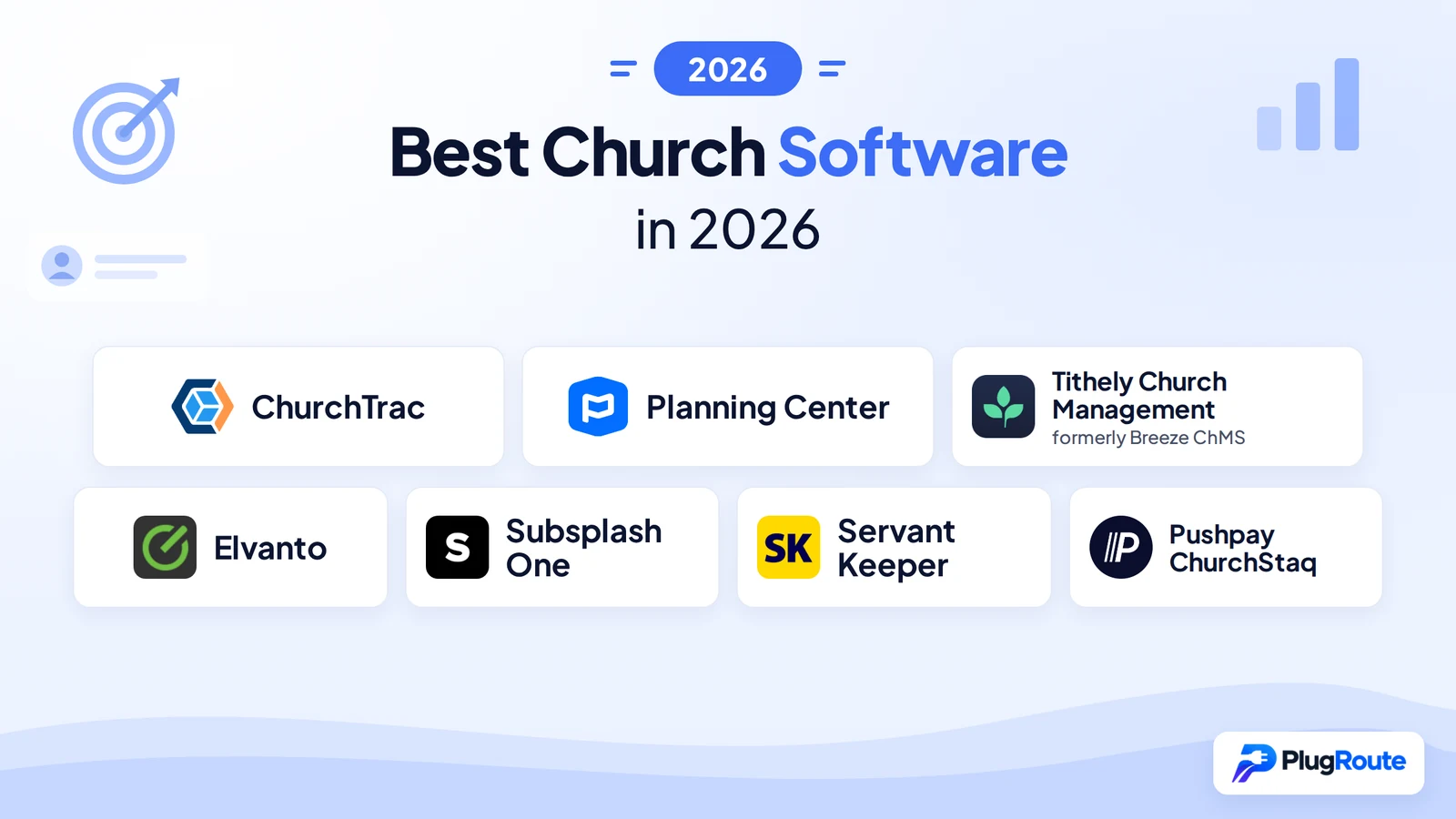
ChurchTrac is the best overall church software for small and mid-sized churches in 2026. Planning Center is best for worship planning and volunteer scheduling, and Tithely Church Management is the easiest to learn at a flat price. The main trade-off is accounting: only ChurchTrac includes native fund accounting, so Planning Center and Tithely need separate accounting software.
Choosing church software is harder than it looks. Many products overlap, and headline prices often leave out giving fees, add-ons and setup costs. Many churches also worry about moving decades of member and giving records, and about being locked into a contract with no clean way to export.
PlugRoute has no affiliate relationships with any company listed, and rankings are determined entirely by research data and objective evaluation criteria.
This guide ranks seven products on six published criteria. It shows real subscription and giving-fee costs at common church sizes and records when every price was checked.
What Are the 5 Categories of Church Software?
Church software falls into five categories. Each category differs in how a church pays and in what it must buy separately. All-in-one suites give the most predictable cost. Modular suites, legacy hybrid systems, digital engagement platforms and giving-first platforms each go deeper in one area, such as worship, records, media or giving.
Choosing between a modular platform and an all-in-one suite is really a choice between depth in one ministry area and one predictable bill.
- All-in-One Suite: An all-in-one suite covers people, giving and ministry tools in one subscription, and some products in this category also include accounting. ChurchTrac, Tithely Church Management and Elvanto are all-in-one suites.
- Modular Suite: A modular suite sells separately priced products that a church adds one at a time as its needs grow. Planning Center is a modular suite.
- Legacy Hybrid ChMS: A legacy hybrid ChMS is a long-running system focused on records and sold in both desktop and cloud editions. Servant Keeper is a legacy hybrid ChMS.
- Digital Engagement Platform: A digital engagement platform started with app, media and giving tools and added church management later. Subsplash One is a digital engagement platform.
- Giving-First Platform: A giving-first platform puts donor and giving tools at the core and builds church management around them. Pushpay ChurchStaq is a giving-first platform.
As one user on r/churchtech described:
“I think for church events and signups it is nice to have it in your church management, otherwise your dealing with extra lists and importing, exporting etc. Does your current church management system have an events registration portion already? If not, maybe make the switch. If you love what you got, you’re probably stuck with eventbrite and their fees.” Posted by u/God-is-able-jdub
Takeaway: Every outside tool added on top of church management software brings more lists, more imports and more fees, which is why the all-in-one versus modular decision matters so much.
How Do the Top Church Software Platforms Compare at a Glance?
ChurchTrac leads PlugRoute’s 2026 comparison with a weighted score of 41 out of 45. Planning Center follows with 38.5 and Tithely Church Management with 34. ChurchTrac is the only product with native fund accounting on every plan. The pricing models differ widely: per person tracked, per module, flat rate, per active adult, tiered subscription and quote-only.
| Rank | Company | Category | Best For | One-Line Summary | Key Capabilities | Primary Strength | Key Limitation |
|---|---|---|---|---|---|---|---|
| 1 | ChurchTrac | All-in-One Suite | Churches of 50–500 that need giving plus accounting | ChurchTrac is the most complete low-cost all-in-one church management system in PlugRoute’s 2026 evaluation and the only one with native fund accounting on every plan. | People, check-in, giving, fund accounting, worship planning, scheduling, app | Native fund accounting on every plan | Mobile feels browser-like; texting is a paid add-on |
| 2 | Planning Center | Modular Suite | Worship-heavy churches of 150–1,000 | Planning Center is a modular church software suite with the deepest worship planning and volunteer scheduling in PlugRoute’s 2026 evaluation, but churches must add separate accounting software and price each module themselves. | Services, People, Check-Ins, Groups, Registrations, Calendar, Giving | Deepest worship planning; SOC 2 Type II and PCI Level 1 | No general ledger; usage-based costs are hard to predict |
| 3 | Tithely Church Management | All-in-One Suite | Volunteer-run churches of 150–1,000 | Tithely Church Management, formerly Breeze ChMS, is the easiest-to-learn flat-priced church management system in PlugRoute’s 2026 evaluation, but it requires separate accounting software. | People, giving records, check-in, events, forms, volunteers | Highest ease-of-use score; flat price | CSV export only for the general ledger; 1% + $0.30 ACH fee |
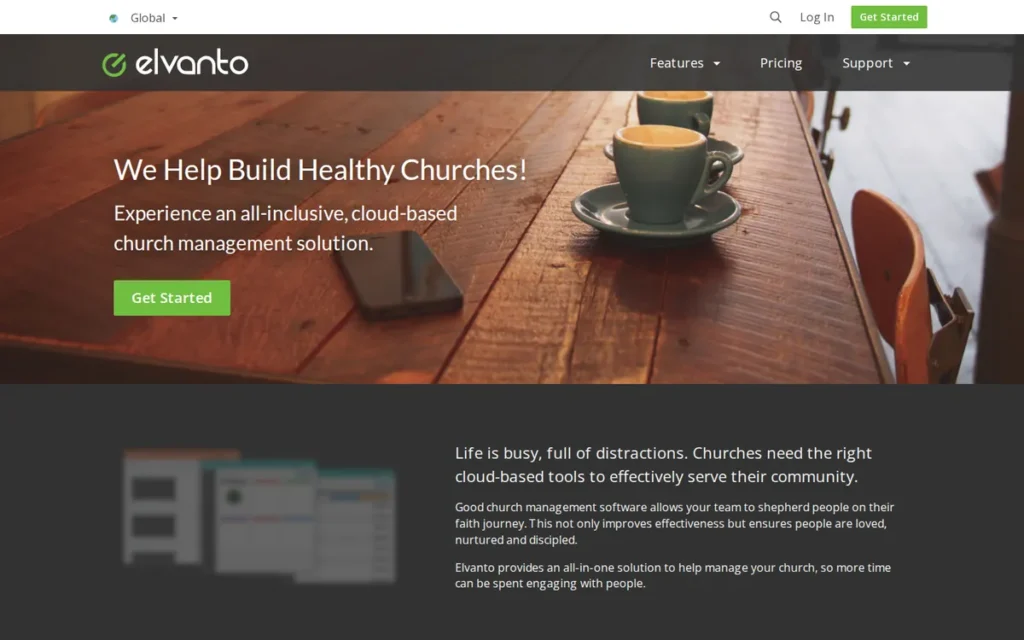
| 4 | Elvanto | All-in-One Suite | Churches under about 150 active adults | Elvanto has the lowest published entry price of any church management system in PlugRoute’s 2026 evaluation and suits small churches that need strong volunteer rostering, rated 4.5/5 from 126 Capterra reviews. | Rosters, service planning, check-in, events, giving, apps | Lowest published entry price | No full accounting; costs rise steeply above 100 adults |
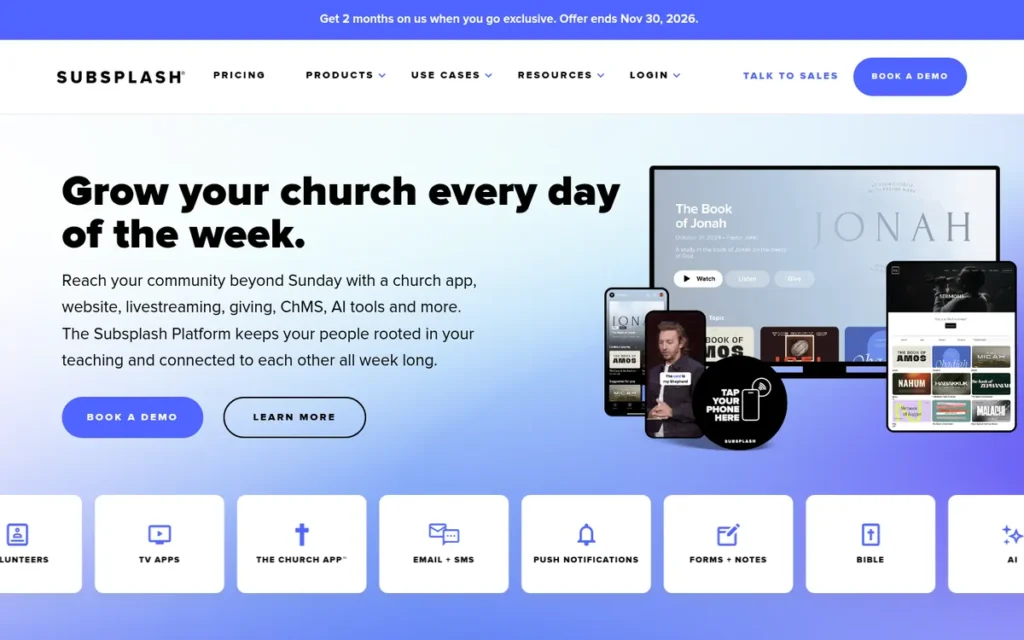
| 5 | Subsplash One | Digital Engagement Platform | Media-first churches | Subsplash One is the strongest church platform for branded apps, media and livestreaming in PlugRoute’s 2026 evaluation, but its church management tools and pricing transparency trail dedicated ChMS products. | Website, mobile and TV apps, livestreaming, giving, ChMS | Broadest app and media toolkit | Quote-only platform pricing; ChMS less mature |
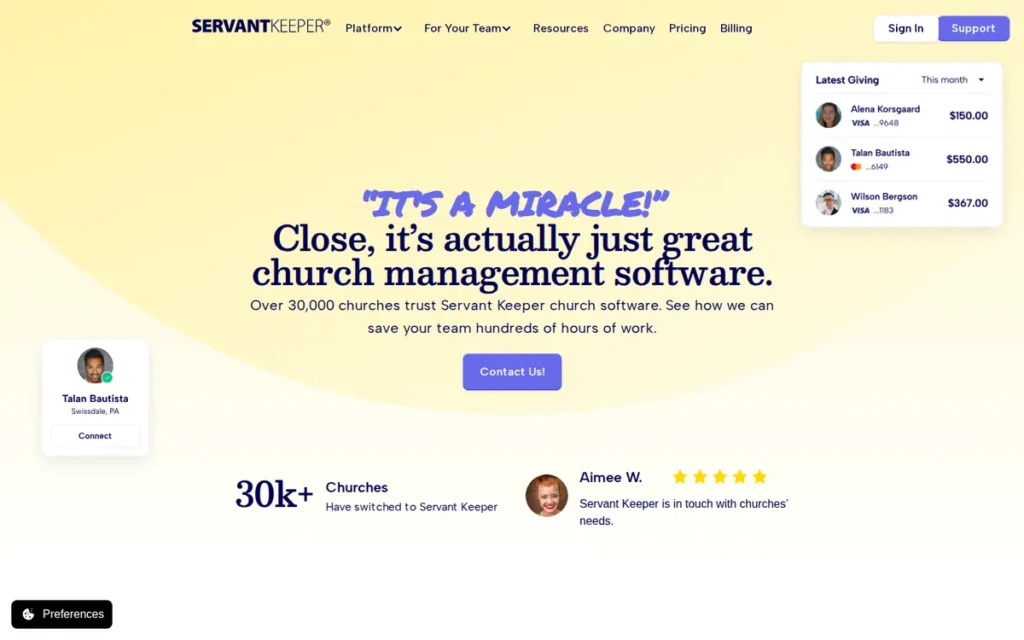
| 6 | Servant Keeper | Legacy Hybrid ChMS | Established churches with legacy records | Servant Keeper is a long-running church management system with strong contribution reporting and a rare desktop option, but it trails newer platforms on usability and volunteer scheduling. | Households, contributions, pledges, 100+ reports, desktop or cloud | Contribution and pledge reporting | Dated interface; reported pressure to use its own giving processor |
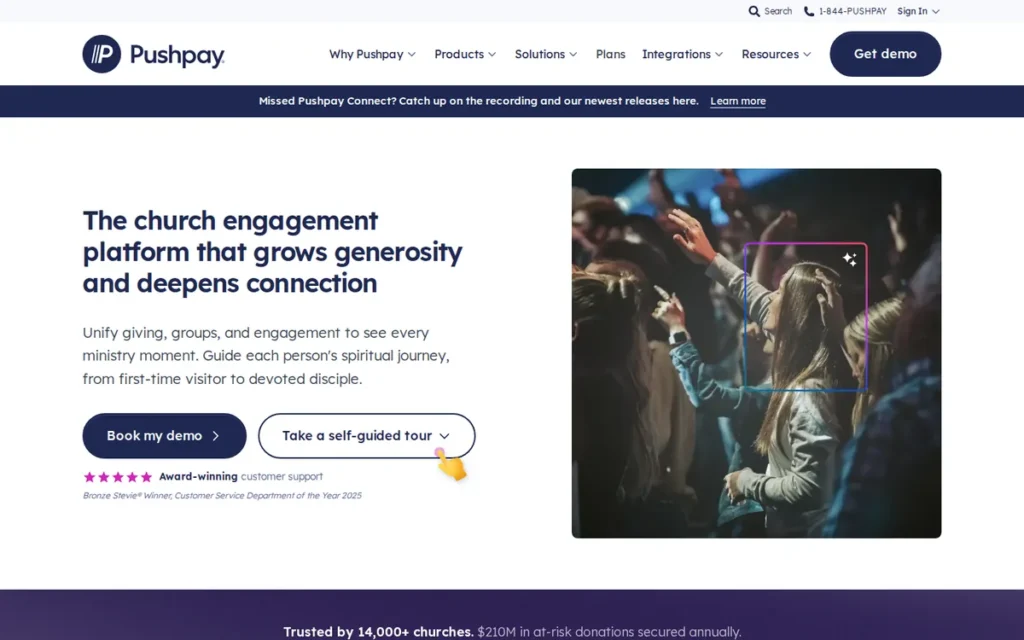
| 7 | Pushpay ChurchStaq | Giving-First Platform | Large and multi-site churches | Pushpay ChurchStaq is the most giving-focused church platform in PlugRoute’s 2026 evaluation, best suited to large and multi-site churches that can negotiate multi-year contracts. | Giving, ChMS workflows, Insights, app, Everygift | Most advanced giving toolkit | Quote-only pricing; 1–3 year contracts |
Which Church Software Should I Choose for My Top Priority?
Match your church’s top priority or size band to the recommended tool below. If you have giving and accounting needs in one system, the recommendation is ChurchTrac. If worship is your priority, it is Planning Center plus accounting software, and if volunteer simplicity matters most, it is Tithely Church Management. The Acceptable Alternative column gives a second option for each case.
| Your #1 Priority | Recommended Tool | Why | Acceptable Alternative |
|---|---|---|---|
| Giving plus native accounting in one system | ChurchTrac | Only product with fund accounting on every plan | Servant Keeper (contribution tracking plus export) |
| Worship planning and large volunteer rosters | Planning Center (plus separate accounting) | Deepest service planning; ProPresenter integration | Elvanto |
| Easiest for volunteers at a flat price | Tithely Church Management | Highest ease-of-use score; unlimited people | ChurchTrac |
| Under 100 active adults who need rostering | Elvanto | Lowest published entry price; children not counted | Planning Center free tiers |
| App, media and livestreaming first | Subsplash One | Website, apps and streaming in one platform | Pushpay ChurchStaq |
| Decades of records or a desktop preference | Servant Keeper | Perpetual desktop edition; 100+ reports | ChurchTrac |
| Large or multi-site and focused on giving | Pushpay ChurchStaq | Everygift recovery; donor analytics | Planning Center |
| Size band: under 75 people | Elvanto | Lowest entry price at US$15–$19/month | Planning Center free tiers or ChurchTrac at $29/month |
| Size band: 75–250 people | ChurchTrac | $39–$59/month with accounting included | Tithely Church Management or Planning Center |
| Size band: 250–1,000 people | ChurchTrac | $79–$99/month with accounting included | Tithely Church Management flat price, or Planning Center plus accounting |
| Size band: multi-site, 1,000+ people | Pushpay ChurchStaq | Giving analytics and Everygift | Planning Center |
What Are the Best Church Software Platforms in 2026?
These are PlugRoute’s seven best church software platforms in 2026 for churches of 50 to 1,000 attendees, in ranked order: ChurchTrac, Planning Center, Tithely Church Management, Elvanto, Subsplash One, Servant Keeper and Pushpay ChurchStaq. Every entry below uses the same structure. Each one labels every source by type and was checked in November 2026.
1. ChurchTrac: Best Overall for Small to Mid-Sized Churches
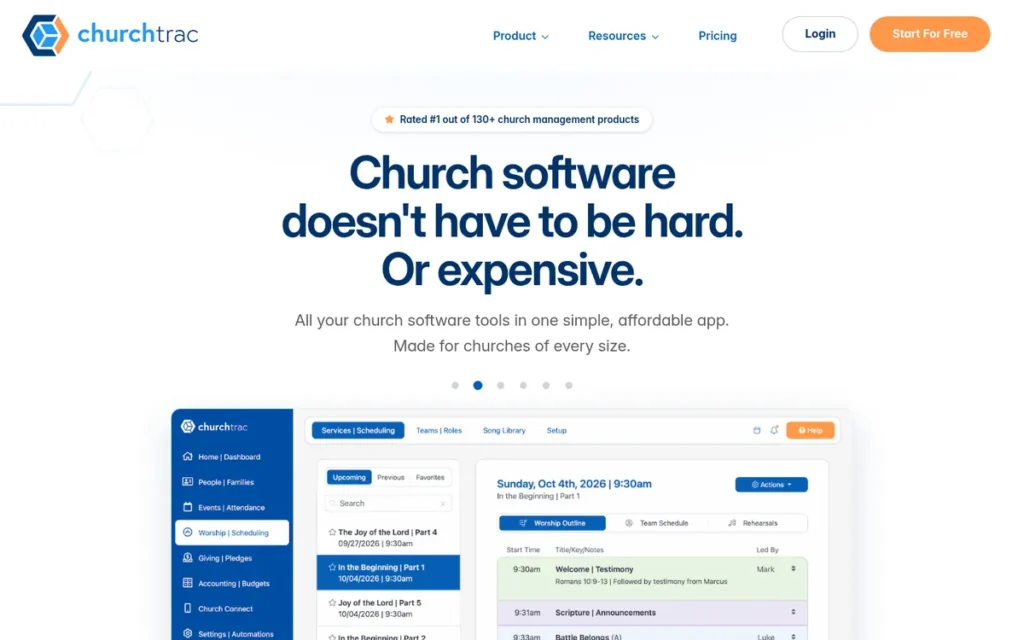
Category: All-in-One Suite, one subscription that covers people, giving and ministry tools together, with accounting included in some products.
At a Glance
- Category: All-in-One Suite
- Best For: Churches of 50 to 500 people that want member records, giving and native fund accounting in one low-cost system
- Price Range: $29–$119/month by people tracked (10% off annual billing); Messaging add-on $7/month; giving 2.2% + $0.30 card (nonprofit rate), $0.25 ACH
- Primary Strength: ChurchTrac includes native fund accounting, with budgets, bank sync and reconciliation, on every plan at every church size.
- Biggest Limitation: Reviewers describe ChurchTrac’s mobile experience as browser-like rather than a true app, and two-way texting requires a paid add-on.
- One-Line Summary: ChurchTrac is the most complete low-cost all-in-one church management system in PlugRoute’s 2026 evaluation and the only one with native fund accounting on every plan.
- Last Verified: November 2026
Overview
ChurchTrac is an all-in-one church management system for small to mid-sized churches that want member records, online giving, native fund accounting and ministry tools in one affordable subscription, without needing technical staff. One ChurchTrac subscription also covers child check-in, worship planning, volunteer scheduling, events and a member app.
ChurchTrac has been in development since 2002 and reports more than 14,000 churches (ChurchTrac, 2026; vendor claim). ChurchTrac prices by the number of people tracked, not by module.
Key Features
- ChurchTrac includes native fund accounting with budgets, bank import and sync, and reconciliation, so treasurers do not need separate software for core bookkeeping.
- ChurchTrac keeps the people database, attendance, child check-in, events and registrations in one system with one login.
- ChurchTrac handles online giving and year-end contribution statements at 2.2% + $0.30 per card gift and $0.25 per US ACH gift, with no ChurchTrac markup (ChurchTrac, 2026; vendor claim).
- ChurchTrac includes worship planning and volunteer scheduling, plus automations for routine follow-up.
- ChurchTrac includes a church website and the Church Connect member app in every plan, and offers two-way texting and voice through a $7/month Messaging add-on.
Best For
ChurchTrac is best for churches of roughly 50 to 500 people that want one predictable subscription for administration, giving and real fund accounting. ChurchTrac especially suits churches moving off spreadsheets or QuickBooks.
Pricing
ChurchTrac publishes six tiers with every feature included at every size. ChurchTrac has no long-term contracts, takes 10% off for annual billing and offers a 30-day trial with no credit card (ChurchTrac pricing page, 2026):
- ChurchTrac costs $29/month for up to 75 names.
- ChurchTrac costs $39/month for 125 names and $59/month for 250 names.
- ChurchTrac costs $79/month for 500 names and $99/month for 1,000 names.
- ChurchTrac costs $119/month for unlimited names.
Some older ChurchTrac pages still say “starts at $9/month,” which conflicts with the current table. Pricing verified November 2026.
Strengths
- ChurchTrac holds a 4.8/5.0 rating from 864 reviews (Capterra, 2026). That ties Tithely Church Management for the highest rating in PlugRoute’s evaluation, and ChurchTrac has more reviews.
- ChurchTrac’s $0.25 fee per US ACH gift is the lowest published ACH fee in PlugRoute’s evaluation, so a $1,000 bank-transfer gift costs $0.25 in fees (ChurchTrac, 2026; vendor claim).
- ChurchTrac’s published pricing includes every feature, so a 250-person church can work out its full subscription cost of $59/month plus giving fees before talking to sales (ChurchTrac pricing page, 2026).
- ChurchTrac reviewers repeatedly praise its human support and value. One reviewer reported moving membership, accounting, giving and the app off QuickBooks Online “within two weeks” (Capterra, 2026; individual review).
Limitations
- ChurchTrac gives up modern polish for price and breadth. Capterra reviewers say mobile feels like a browser rather than a “genuine app” (Capterra, 2026; individual reviews).
- ChurchTrac’s 2.2% card rate depends on Stripe nonprofit approval and falls back to 2.9% + $0.30 without it (ChurchTrac, 2026; vendor claim). Two-way texting needs a Twilio-based add-on that one reviewer found hard to set up (Capterra, 2026; individual review).
- ChurchTrac reviewers report that recurring transactions must be paused and restarted, which complicates bank reconciliation. One reviewer said it “does not handle fund accounting well at all” (Capterra, 2026; individual review).
- ChurchTrac states it implements PCI DSS Level 1 requirements and does not store card or bank details. Its security documentation does not mention a SOC 2 report, so churches should request one (ChurchTrac, 2026; vendor claim).
- ChurchTrac drew one Reddit report of unresponsive support during Christmas week, and another user replied that they had no issue (r/churchtech, 2025; isolated report).
Verdict
ChurchTrac is the best overall church software for small and mid-sized churches in 2026 because it is the only evaluated platform that includes native fund accounting, giving, check-in, worship planning and volunteer scheduling at one published price.
Churches that text heavily should budget for the Messaging add-on. During the 30-day trial, treasurers should test recurring-gift reconciliation and the mobile app before migrating historical records.
2. Planning Center: Best for Worship Planning and Volunteer Scheduling
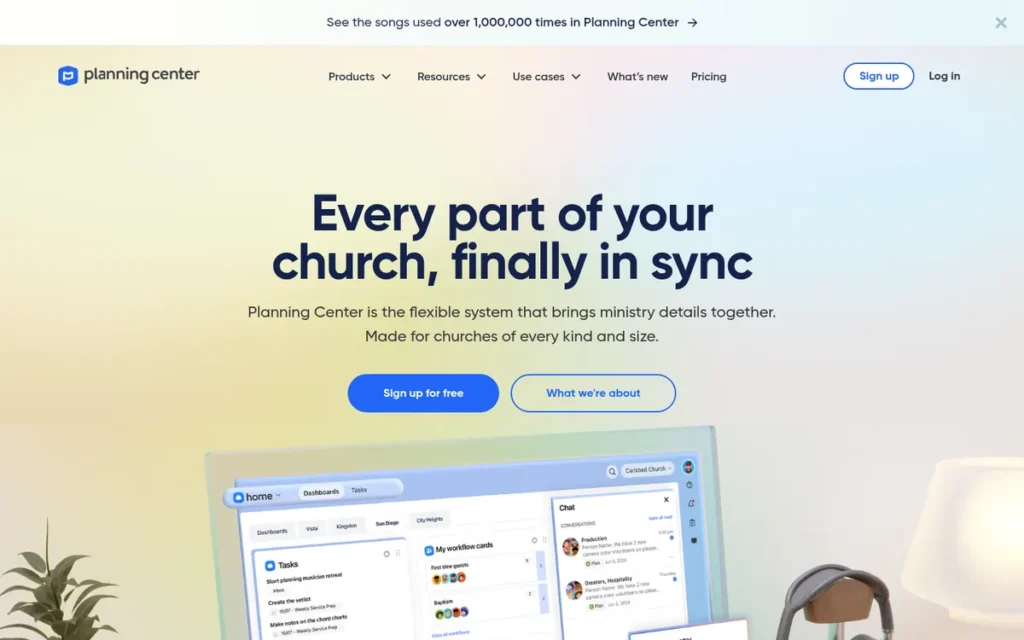
Category: Modular Suite, separately priced products a church adds one at a time as its needs grow.
At a Glance
- Category: Modular Suite
- Best For: Churches of 150 to 1,000 people whose top priorities are worship planning, volunteer scheduling and connected ministry workflows
- Price Range: Free tier on every product; paid tiers usage-based per module (third-party estimate: free to nearly $1,200/month); giving 2.15% + $0.30 card, $0.30 ACH
- Primary Strength: Planning Center Services is the most capable worship planning and volunteer scheduling tool in PlugRoute’s evaluation, with ProPresenter integration.
- Biggest Limitation: Planning Center has no general ledger or built-in church accounting, so churches must pay for and reconcile separate accounting software.
- One-Line Summary: Planning Center is a modular church software suite with the deepest worship planning and volunteer scheduling in PlugRoute’s 2026 evaluation, but churches must add separate accounting software and price each module themselves.
- Last Verified: November 2026
Overview
Planning Center is a modular church management suite of separately priced products. It is built for churches of any size whose top priorities are worship planning, volunteer scheduling and connected ministry workflows, and churches can start with one product and add more over time. Planning Center’s products include People, Services, Check-Ins, Groups, Registrations, Calendar and Giving.
Planning Center began as a worship planning tool, and many churches start with Services. Planning Center has the largest independent review base in PlugRoute’s evaluation (Capterra, 2026).
Key Features
- Planning Center Services manages service orders, songs and keys, rehearsal materials and volunteer scheduling, and it integrates with ProPresenter.
- Planning Center People is a free church database with no record limit, and the other Planning Center products build on it.
- Planning Center Check-Ins, Groups, Registrations and Calendar are separate products, and each has its own free tier and usage-based paid tiers.
- Planning Center Giving charges 2.15% + $0.30 on US card gifts and a flat $0.30 on ACH gifts, and Text2Give (text-to-give) costs $5/month (Planning Center pricing page, 2026).
- Planning Center offers a public API and the Church Center member app. It integrates with Mailchimp, Clearstream, Stripe and Checkr, which runs background checks.
Best For
Planning Center is best for churches of roughly 150 to 1,000 people with active worship teams and large volunteer rosters that are willing to pair it with separate accounting software. Planning Center also suits very small churches that can stay within its free tiers.
Pricing
Every Planning Center product has a free tier (Planning Center pricing page, 2026):
- Planning Center People is free for an unlimited database.
- Planning Center’s free tiers cover 5 team members in Services, 10 daily check-ins in Check-Ins and 15 members in Groups.
- Planning Center’s free tiers also cover 5 attendees in Registrations, 1 room in Calendar and 10 donations a month in Giving.
- Planning Center adds 1.5% on international card gifts.
- Planning Center charges no setup, minimum or cancellation fees, and new subscriptions get 30 days free.
- Planning Center’s paid tier prices were not captured, and one user reports Calendar at $14/month for 5 rooms (r/churchtech, 2024; individual report; the current price may differ).
- ChurchTechToday estimates total Planning Center cost at free to nearly $1,200/month, depending on modules and volume (ChurchTechToday, 2026).
Pricing verified November 2026.
Strengths
- Planning Center has the largest independent review base in PlugRoute’s evaluation. It holds 4.7/5.0 from 1,139 reviews (Capterra, 2026) and about 4.7/5 on GetApp (GetApp, 2026).
- Planning Center states it is SOC 2 Type II certified, with the audit done by Johanson Group, and a PCI Level 1 compliant merchant. Reports are available on request, which makes this the strongest verified security in PlugRoute’s evaluation (Planning Center security page, 2026).
- Planning Center charges a flat $0.30 per ACH gift and publishes no setup, minimum or cancellation fees. That puts it among the most flexible terms in this evaluation, alongside ChurchTrac’s no-long-term-contract policy (Planning Center pricing page, 2026).
- Planning Center Services earns consistent praise from practitioners. One user reports scheduling 88 volunteers “in a matter of minutes” with “really good acceptance rates” (r/churchtech, 2024; individual report).
Limitations
- Planning Center gives up unified accounting and predictable cost for modular flexibility. It has no general ledger, accounts payable, payroll or full financial statements, so churches need separate software such as QuickBooks Online (ChurchTechToday, 2026).
- Planning Center bills each product separately by usage. One user says people in several groups are counted more than once: “10 people that are in 5 groups. PC counts that as 50” (r/pastors, 2025; individual report).
- Planning Center reviewers mention separate settings in each product, weak reporting across modules, duplicate profiles and ProPresenter sync drift (Capterra and Software Advice reviews, 2026; individual reports).
- Planning Center splits users on usability. Administrators call scheduling “flawless,” while other users call it “not intuitive” (r/churchtech, 2024; individual reports).
- Planning Center reviewers report slowdowns at busy times (Capterra, 2026; individual reports). The free Giving tier is capped at 10 donations a month, so most churches will need paid Giving quickly (Planning Center pricing page, 2026).
Users on r/churchtech noted:
“We use planning center services and some adults from different households want to serve together. I can put them on for “once a month” and it won’t put them together but I can put them on for “first week” and it works unless one blocks out for the first week and then the they aren’t together.” Posted by u/Justin_Floor
Takeaway: Even Planning Center Services, the deepest scheduler in this evaluation, can’t reliably keep volunteers from different households paired once block-out dates come into play.
Verdict
Planning Center is the strongest church software for worship planning and volunteer scheduling in 2026, but churches that need built-in accounting must budget for a second system.
Before committing, price every module you plan to use at your real group and volunteer counts. Worship-heavy churches that pair Planning Center with accounting software get the deepest service planning in this evaluation on flexible terms.
3. Tithely Church Management (formerly Breeze ChMS): Best for Ease of Use and Flat Pricing
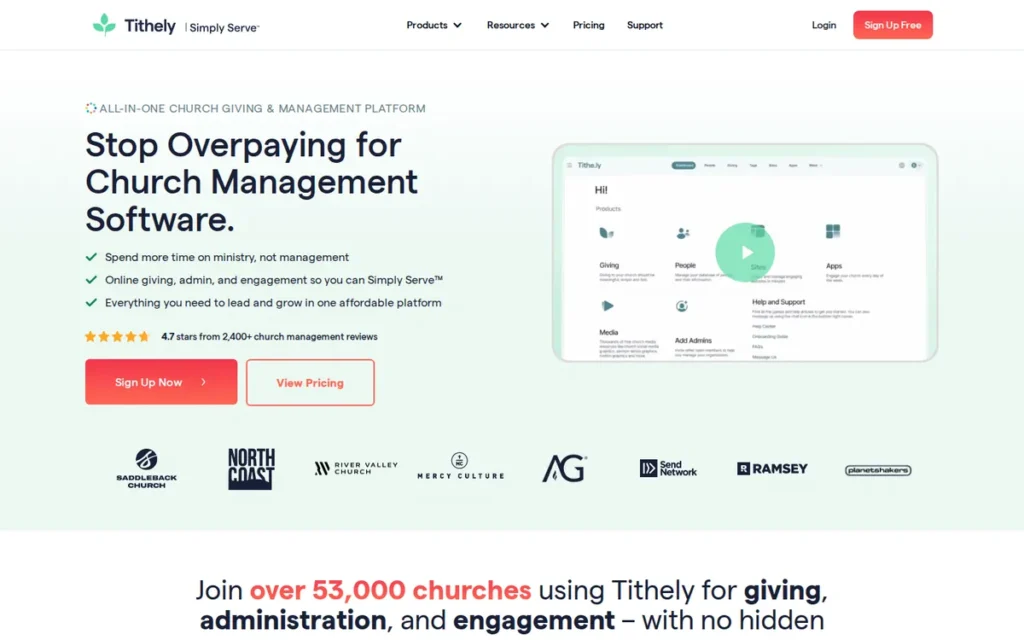
Category: All-in-One Suite, one subscription that covers people, giving and ministry tools together, with accounting included in some products.
At a Glance
- Category: All-in-One Suite
- Best For: Churches of 150 to 1,000 people that put volunteer-friendly simplicity and a flat price ahead of everything else
- Price Range: $72/month flat (Church Management) or $119/month bundles; Giving has no monthly fee, with 2.9% + $0.30 card and 1% + $0.30 ACH
- Primary Strength: Tithely Church Management is the system most consistently praised for ease of use in PlugRoute’s evaluation.
- Biggest Limitation: Tithely Church Management has no built-in fund accounting and offers only a CSV export for the general ledger.
- One-Line Summary: Tithely Church Management, formerly Breeze ChMS, is the easiest-to-learn flat-priced church management system in PlugRoute’s 2026 evaluation, but it requires separate accounting software.
- Last Verified: November 2026
Overview
Tithely Church Management, the product formerly sold as Breeze ChMS, is a flat-priced church management system. It is built for small and mid-sized churches that value simplicity, fast onboarding and unlimited people records at one predictable monthly price. Tithely Church Management covers people, giving records, child check-in, events, forms, volunteers and follow-up.
Tithely Church Management is sold within the Tithely ecosystem, and Tithely also owns Elvanto. Breeze and Tithely Church Management are the same product, not two competitors.
Key Features
- Tithely Church Management stores unlimited people records at one flat monthly price.
- Tithely Church Management syncs giving records with donor profiles when a church uses Tithely Giving.
- Tithely Church Management includes child check-in, events and forms, volunteer management and follow-up workflows.
- Tithely Church Management can be bundled into All Access, which adds Giving, Messaging, custom Apps, Events and Sites for $119/month.
- Tithely Church Management exports giving data as a CSV file for a separate general ledger (Pushpay, 2026; competitor claim).
Best For
Tithely Church Management is best for churches of roughly 150 to 1,000 people whose administration relies on volunteers and that value a short learning curve over deep customization. Tithely Church Management also suits churches already using Tithely Giving or Apps.
Pricing
Tithely publishes these 2026 prices (Tithely pricing page, 2026):
- Tithely Church Management costs $72/month flat.
- Tithely lists a $119/month Giving + Church Management plan and a $119/month All Access bundle, so churches should confirm which features their plan includes.
- Tithely Custom Church Apps cost $89/month on their own, and Giving + Text-to-Give costs $19/month.
- Tithely Giving has no monthly fee, setup fee or contract and charges 2.9% + $0.30 per card gift, 1% + $0.30 per ACH gift and 3.5% + $0.30 per Amex gift.
For a 75-person church, Tithely Church Management’s $72/month costs more than ChurchTrac’s $29 tier or Planning Center’s free People database. Verified November 2026.
Strengths
- Tithely Church Management holds a 4.8/5.0 rating from 624 reviews under its former Breeze ChMS listing (Capterra, 2026). That ties ChurchTrac for the highest rating in PlugRoute’s evaluation.
- Tithely Church Management’s flat $72/month price covers unlimited people, which gives churches of 500 to 1,000 one of the most predictable costs in this evaluation (Tithely pricing page, 2026).
- Tithely Church Management reviewers repeatedly call it “very user friendly” and describe its support as “stellar,” which earned it PlugRoute’s highest ease-of-use score of 4.5/5 (Capterra, 2026; individual reviews).
- Tithely reports that about 60% of donors choose to cover processing fees, which can offset its percentage-based giving fees (Tithely, 2026; vendor claim).
Limitations
- Tithely Church Management gives up depth for simplicity. It has no built-in fund accounting and offers only a CSV export for the general ledger (Pushpay, 2026; competitor claim).
- Tithely Giving charges 1% + $0.30 per ACH gift, so a $1,000 bank-transfer gift costs $10.30 in fees. That is among the highest ACH costs in this evaluation (Tithely pricing page, 2026).
- Tithely Church Management’s worship planning depth is unclear. One user wrote “I don’t think there’s a worship planning component (if there is, I don’t use it)” (r/pastors, 2025; individual report).
- Tithely Church Management reviewers cite limited customization, a Chrome compatibility complaint and confusion between the Breeze and Tithely names (Capterra, 2026; individual reviews).
- Tithely Church Management’s SOC 2 and PCI documentation was not confirmed in PlugRoute’s November 2026 check, so churches should request both.
Users on r/churchtech noted:
“Breeze (our current) has a super extensible database which nearly limitless profile fields for keeping people/staff/volunteer data organized without having to resort to Tags or Groups (though they are available). I’d like to try another ChMS with more robust check-in/out (childrens) and giving (campaigns/pledges) but which is similarly flexible in the people category.” Posted by u/Pitpawten1
Takeaway: Tithely Church Management (Breeze) wins loyalty for its flexible people database, but current users are looking elsewhere for stronger children’s check-in and campaign or pledge giving.
Verdict
Tithely Church Management is the best church software for volunteer-run teams that want the easiest learning curve at a flat price, provided the church has, or will buy, separate accounting software.
Worship-heavy churches should check the depth of its service planning in a demo. Churches under about 125 people will usually pay less with an alternative priced by headcount.
4. Elvanto: Best for Volunteer Rostering on a Tight Budget
Category: All-in-One Suite, one subscription that covers people, giving and ministry tools together, with accounting included in some products.
At a Glance
- Category: All-in-One Suite
- Best For: Small and multi-service churches under about 150 active adults whose main administrative burden is volunteer scheduling
- Price Range: US$15–$19/month up to 50 active adults; US$97.60–$122/month at 250; US$162.40–$203/month at 500; one-time US$149 setup fee
- Primary Strength: Elvanto combines volunteer rostering, service planning with a song database, and child check-in at the lowest published entry price in the evaluation.
- Biggest Limitation: Elvanto has no full accounting, and reviewers report that development slowed after Tithely acquired it.
- One-Line Summary: Elvanto has the lowest published entry price of any church management system in PlugRoute’s 2026 evaluation and suits small churches that need strong volunteer rostering, rated 4.5/5 from 126 Capterra reviews.
- Last Verified: November 2026
Overview
Elvanto is an Australian-made, Tithely-owned all-in-one church management system for small and multi-service churches. Its main users are churches whose biggest administrative burden is scheduling volunteers across services and campuses, and rosters, service planning and child check-in are included in every plan. Elvanto also covers people, events, giving and member apps.
Elvanto grew out of one local church’s need for volunteer scheduling. Elvanto is used in more than 40 countries (Elvanto, 2026; vendor claim).
Key Features
- Elvanto schedules multi-campus volunteer rosters across services, with reminders by email and text.
- Elvanto includes service planning with run sheets and a song database with chords.
- Elvanto provides child check-in with SMS alerts to parents.
- Elvanto manages events with ticketing and discount codes, and it tracks giving and pledges.
- Elvanto offers member login and iOS and Android apps, although reviewers say the apps do less than the web version.
Best For
Elvanto is best for churches under about 150 active adults, or multi-service churches, that need rostering and service planning on the smallest budget. Elvanto particularly suits churches with many children, because children do not count toward the price.
Pricing
Elvanto prices by active adults, meaning people who attend, serve or give (Elvanto US pricing page, 2026):
- Elvanto costs US$19/month billed monthly, or US$15/month billed annually, for up to 50 active adults.
- Elvanto costs US$39/month billed monthly, or US$31/month billed annually, for up to 100 active adults.
- Elvanto costs US$122/month monthly, or US$97.60/month annually, at 250 active adults.
- Elvanto costs US$203/month monthly, or US$162.40/month annually, at 500 active adults.
- Elvanto charges a one-time US$149 setup fee, which is unusual in this set.
Elvanto is cheapest at small sizes but not at scale. At 50 active adults it costs about half of ChurchTrac’s $29 tier. At 500 active adults it costs about double ChurchTrac’s $79.
A church with 50 active adults on annual billing pays US$329 in the first year (US$180 + US$149). Giving fees depend on the connected provider and were not verified. Verified November 2026.
Strengths
- Elvanto’s entry price of US$15/month on annual billing is the lowest paid entry point in PlugRoute’s evaluation (Elvanto US pricing page, 2026).
- Elvanto holds a 4.5/5.0 rating from 126 reviews (Capterra, 2026).
- Elvanto includes every feature with no add-on modules. It does not count children or community contacts toward its price, unlike name-based or usage-based pricing models (Elvanto, 2026).
- Elvanto reviewers repeatedly praise its reminders, email and text communication, and volunteer scheduling (Capterra and G2, 2026; individual reviews).
Limitations
- Elvanto gives up product momentum for price. One reviewer says development was “put on the back burner” after the Tithely acquisition (GetApp, 2026; individual report).
- Elvanto reviewers describe a “clunky” interface, a slow mobile app, and support “a timezone away” for US churches (Capterra, GetApp and G2, 2026; individual reviews).
- Elvanto has no full accounting, and one reviewer said their church’s accountants rejected it (Capterra, 2026; individual review).
- Elvanto’s Tithely giving integration is reported as one-way, and reviewers say giving statements are hard to filter (Capterra, 2026; individual reviews).
- Elvanto’s per-active-adult pricing rises steeply above 100 adults. At 250 and 500 active adults it costs more than ChurchTrac at the same sizes (Elvanto US pricing page, 2026).
Verdict
Elvanto is the best low-cost church software for small churches that mainly need volunteer rostering and service planning, as long as they accept separate accounting and a slower pace of product development.
Include the US$149 setup fee in first-year cost, and re-check pricing before you pass 100 active adults. US churches should test how quickly support responds across time zones before signing.
5. Subsplash One: Best for Church Apps, Media and Livestreaming
Category: Digital Engagement Platform, app, media and giving tools first, with church management added on.
At a Glance
- Category: Digital Engagement Platform
- Best For: Churches whose top priority is a branded app, sermon media and livestreaming, often layered on an existing ChMS
- Price Range: Subsplash One pricing on request; Giving $0/month with 2.3% + $0.30 card and 1% ACH
- Primary Strength: Subsplash One offers the most complete branded app, media and livestreaming toolkit in PlugRoute’s evaluation.
- Biggest Limitation: Subsplash One uses quote-only platform pricing with unpublished contract terms, and practitioners see its church management tools as less mature than dedicated ChMS products.
- One-Line Summary: Subsplash One is the strongest church platform for branded apps, media and livestreaming in PlugRoute’s 2026 evaluation, but its church management tools and pricing transparency trail dedicated ChMS products.
- Last Verified: November 2026
Overview
Subsplash One is a digital engagement platform for churches whose top priority is a branded digital front door. It combines a church website, custom mobile and TV apps, media hosting and livestreaming with giving and church management tools. Subsplash One also includes people management, groups, check-in and service planning.
Subsplash One began with apps and media and added church management later. Many churches run Subsplash One as a media layer on top of an existing ChMS.
Key Features
- Subsplash One provides a church website plus custom-branded mobile and TV apps.
- Subsplash One includes media hosting, livestreaming and podcasting for sermons and services.
- Subsplash One processes giving and donor management at 2.3% + $0.30 on cards and 1% on ACH, with lower GrowCurve rates for churches that qualify.
- Subsplash One adds people management, events, groups, messaging, volunteer management, child check-in, service planning, email and SMS, and forms.
- Subsplash One can integrate with Planning Center or Rock RMS, although its giving integration with Planning Center is described as one-way (Pushpay, 2026; competitor source; confirm current integrations with Subsplash).
Best For
Subsplash One is best for churches that treat online sermons, livestreaming and a branded app as a core ministry. Subsplash One fits especially well as a media layer on top of an existing church management system.
Pricing
Subsplash publishes its giving rates (Subsplash pricing page, 2026):
- Subsplash Giving costs $0/month with no setup fee, 2.3% + $0.30 on cards and 1% on ACH.
- Subsplash GrowCurve rates go as low as 1.9% + $0.30 on cards and 0.5% on ACH.
- Subsplash charges 2.99% + $0.30 on cards and 1% on ACH for non-charitable payments.
Subsplash One platform pricing is quote-based, and contract terms are not published. Subsplash reports that about 50% of donors cover fees when offered the option (Subsplash, 2025; vendor claim). Verified November 2026.
Strengths
- Subsplash One combines a website, mobile and TV apps, media hosting and livestreaming in one platform, the broadest digital toolkit PlugRoute found in this evaluation.
- Subsplash One holds about a 4.6/5.0 rating from 157 reviews (Capterra, 2026).
- Subsplash publishes its full giving fee schedule. It states PCI DSS Level 1 compliance, attested annually by a Qualified Security Assessor, plus annual penetration testing and a Bugcrowd bug bounty (Subsplash, 2026; vendor claim).
- Subsplash One users describe its livestreaming as “super easy to set up” and use it for “website, tithing, app, etc.” (r/churchtech, 2026; individual report).
Limitations
- Subsplash One gives up price transparency for digital reach. Its platform pricing is quote-only and its contract terms are not published.
- Subsplash One’s standard 1% ACH fee costs $10.00 on a $1,000 gift, compared with $0.25–$0.30 on flat per-gift ACH platforms. One user said its fees “feel like skimming the offering plate” (r/planningcenter, 2024; individual report).
- Subsplash One has no documented fund accounting.
- Subsplash One’s ChMS is described by practitioners as “not as good” as Planning Center (r/churchtech, 2024; individual report).
- Subsplash One’s public security materials cite PCI DSS Level 1 and SOC 1 but no Subsplash SOC 2 report. Churches that need SOC 2 should ask for it directly (Subsplash, 2026).
Users on r/churchtech noted:
“My church decided to go with SubSplash for an “app” that’s pretty much a glorified branded web browser. Upside is it integrates with their WYSIWYG website flawlessly that the non-techies can keep it all up-to-date without a fuss. So the online presence and calendar is officially off my plate. SubSplash handles online tithes, messaging, and church directory type stuff too which has mostly replaced the church secretary.” Posted by u/Free_Donkey4797
Takeaway: Subsplash One’s app gets dismissed as a branded web browser, but its tight website integration lets non-technical staff run online presence, giving and directory work on their own.
Verdict
Subsplash One is the best church software for media-first churches that want a branded app and livestreaming, but it is not the strongest choice as a church’s only management and accounting system.
Model your own ACH giving against the 1% rate and get full contract terms in writing. Many churches will get the most value by running Subsplash One alongside a dedicated ChMS.
6. Servant Keeper: Best for Established Churches With Legacy Records
Category: Legacy Hybrid ChMS, a long-running, records-focused system sold in both desktop and cloud editions.
At a Glance
- Category: Legacy Hybrid ChMS
- Best For: Established churches with decades of member and giving records, treasurers who prioritize contribution reporting, and churches that want a desktop option
- Price Range: $73.32–$146.66/month billed annually ($79.99–$159.99 monthly per Capterra); giving via Vanco 2.90% + $0.45 card, 1.00% + $0.45 ACH; desktop license not verified
- Primary Strength: Servant Keeper delivers strong contribution, pledge and statement reporting with more than 100 prebuilt reports.
- Biggest Limitation: Servant Keeper’s interface is widely described as dated, and users report that it pushes churches onto its own giving processor.
- One-Line Summary: Servant Keeper is a long-running church management system with strong contribution reporting and a rare desktop option, but it trails newer platforms on usability and volunteer scheduling.
- Last Verified: November 2026
Overview
Servant Keeper is a long-running church management system for established churches with decades of member and giving records and for treasurers who prioritize contribution tracking. It is sold as a cloud edition (SK Online) and as a perpetual-license Windows desktop edition. Servant Keeper focuses on membership, contributions, pledges, statements and reporting.
Servant Keeper reports more than 30,000 churches (Servant Keeper, 2026; vendor claim) and is sold under the Software for Ministry name.
Key Features
- Servant Keeper tracks households, contributions, pledges and giving statements, with more than 100 prebuilt reports.
- Servant Keeper is available as SK Online in the cloud, or as the Servant Keeper 8 Windows desktop edition under a perpetual license.
- Servant Keeper includes attendance, child check-in, events and an online member directory.
- Servant Keeper offers online giving with a $0/month subscription on its cloud plans, and Vanco publishes the processing rates for Servant Keeper users (Vanco, 2026).
- Servant Keeper exports contribution batches to accounting software, most often QuickBooks, instead of providing a general ledger.
Best For
Servant Keeper is best for established churches with long histories of member and giving data, and for treasurers who rely on detailed contribution reports. Servant Keeper also suits churches that specifically want a desktop, one-time-purchase option.
Pricing
Servant Keeper publishes two cloud tiers billed annually (Servant Keeper pricing page, 2026):
- Servant Keeper’s lower tier costs $73.32/month.
- Servant Keeper’s higher tier costs $146.66/month and adds email, texting and web.
- Servant Keeper’s Core and Complete plans appear on Capterra at $79.99 and $159.99, which look like the monthly-billing prices.
Vanco’s Servant Keeper rate page lists 2.90% + $0.45 per card gift, 1.00% + $0.45 per ACH gift and 3.99% per Amex gift, with no monthly fee (Vanco, 2026). Servant Keeper’s own page does not publish rates, so churches should confirm which processor applies.
Desktop license, support renewal and add-on prices were not verified. Reviewers complain about support charges after the initial period (Capterra, 2026; individual reviews). Verified November 2026.
Strengths
- Servant Keeper holds a 4.6/5.0 rating from 687 reviews (Capterra, 2026) and has 686 reviews on Software Advice (Software Advice, 2026).
- Servant Keeper’s case study describes Greater Fairview Baptist Church using it since 1999 and replacing at least five tools, including Excel and Access (Servant Keeper, 2026; vendor claim).
- Servant Keeper is one of the few current products sold under a perpetual desktop license, which avoids an ongoing subscription for that edition.
- Servant Keeper reviewers praise its contribution reports and migration help. One user called its original migration “pretty smooth, especially the historical giving” (r/planningcenter, 2024; individual report).
Limitations
- Servant Keeper’s most serious risk is lock-in. One user reports it dropped support for processors such as Vanco to push its own giving platform, which caused reconciliation problems (r/planningcenter, 2024; individual report). Vanco’s rate page still lists Servant Keeper, so churches should confirm in writing.
- Servant Keeper reviewers say the interface “looks and feels like it was developed in the ’90s” (Software Advice, 2026; individual review) and report repeated macOS problems (Capterra, 2026; individual reviews).
- Servant Keeper’s volunteer scheduling and modern check-in are rated weak (Wisefig, 2026).
- Servant Keeper tracks contributions and exports batches but has no general ledger.
- Servant Keeper’s Vanco-listed fixed fee of $0.45 per card and ACH gift is the highest per-gift fixed fee in this evaluation (Vanco, 2026).
Verdict
Servant Keeper is the best fit for established churches that value deep contribution reporting or a desktop license over modern usability, but it is a weaker choice for ministries that depend on volunteers.
Before renewing, get written confirmation of which giving processors are supported and what support renewals cost. Churches leaving Servant Keeper should set up custom fields and funds in the new system before importing.
7. Pushpay ChurchStaq: Best for Large, Multi-Site Churches Focused on Giving
Category: Giving-First Platform, donor and giving tools at the core, with church management built around them.
At a Glance
- Category: Giving-First Platform
- Best For: Larger and multi-site churches above about 500 attendees whose central priority is giving growth and donor analytics
- Price Range: Pricing on request (Core, Advanced, Complete); cards about 2.1–2.9% + $0.20–$0.30, ACH about 0.5–1.0% + $0.20–$0.30; 1–3 year terms
- Primary Strength: Pushpay ChurchStaq offers the most advanced giving toolkit in PlugRoute’s evaluation, including Everygift recovery of failed recurring gifts.
- Biggest Limitation: Pushpay ChurchStaq uses quote-based pricing and 1 to 3 year contracts, the largest lock-in risk in the evaluation for small churches.
- One-Line Summary: Pushpay ChurchStaq is the most giving-focused church platform in PlugRoute’s 2026 evaluation, best suited to large and multi-site churches that can negotiate multi-year contracts.
- Last Verified: November 2026
Overview
Pushpay ChurchStaq is a giving-first church platform for larger and multi-site churches whose central priority is donor engagement. It combines Pushpay Giving, the ChMS formerly called Church Community Builder, Insights analytics, a branded app and Everygift recovery of failed gifts. Pushpay ChurchStaq ties every gift to a donor profile.
Pushpay ChurchStaq’s parent company is privately owned by BGH Capital and Sixth Street (Pushpay, 2026). Pushpay also offers ParishStaq for Catholic parishes.
Key Features
- Pushpay ChurchStaq ties every gift to a donor profile and engagement data, so giving and donor management share one record.
- Pushpay ChurchStaq includes Everygift, which recovers failed recurring gifts.
- Pushpay ChMS includes profiles, groups, child check-in, forms, process queues and workflows, and volunteer scheduling.
- Pushpay ChurchStaq includes Insights analytics and a branded church app.
- Pushpay ChurchStaq integrates with QuickBooks Online, Sage Intacct and Aplos instead of providing native fund accounting.
Best For
Pushpay ChurchStaq is best for larger and multi-site churches with dedicated finance or operations staff who can negotiate contracts and make use of advanced giving analytics. Practitioners consider Pushpay ChurchStaq a poor fit for churches under about 200 members.
Pricing
Pushpay publishes its pricing structure but no dollar amounts (Pushpay pricing page, 2026):
- Pushpay ChurchStaq is sold in quote-based Core, Advanced and Complete tiers.
- Pushpay card fees run about 2.1–2.9% + $0.20–$0.30, and ACH fees about 0.5–1.0% + $0.20–$0.30, negotiated by volume.
- Pushpay contracts run 1, 2 or 3 years, and ending one early can leave the remaining balance due.
- Pushpay check scanning starts at $0.29 per check.
Get the total cost and termination terms in writing. Checked November 2026.
Strengths
- Pushpay reports that “7 of the 10 largest US churches” and “84 of Outreach’s top 100 churches” are its partners (Pushpay, 2026; vendor claim).
- Pushpay publishes no setup fee and no additional integration fees, and its card and ACH rates fall as giving volume rises (Pushpay pricing page, 2026).
- Pushpay ChurchStaq’s Everygift earns specific praise. One user called it “the real deal” and a “big reason to choose Pushpay over PCO” (r/churchtech, 2025; individual report).
- Pushpay ChurchStaq documents integrations with three accounting platforms: QuickBooks Online, Sage Intacct and Aplos (Pushpay, 2026).
Limitations
- Pushpay ChurchStaq gives up flexibility for enterprise giving power: its pricing is quote-only and its contracts run 1 to 3 years. A third-party review reports that contracts may auto-renew and make Pushpay the exclusive processor during the term, so check the order form (PaymentReview, 2026).
- Pushpay ChurchStaq reviewers allege refused cancellation, refused implementation support after signing, and a church held to 20 remaining months of an auto-renewed term (Capterra, 2026; PaymentReview, 2026; individual reports).
- Pushpay ChurchStaq’s predecessor, Church Community Builder, drew one user’s comment that “I don’t think we were large enough to use most of their stuff,” describing their experience around 2019 (r/pastors, 2025; individual report).
- Pushpay holds a 4.2/5.0 rating from 183 reviews (Capterra, 2026), the lowest verified rating in PlugRoute’s evaluation, and its PCI or SOC attestations were not confirmed.
- Pushpay ChurchStaq’s figure of 12.5% growth in first-time givers comes from churches it does not name (Pushpay, 2026; vendor claim).
Verdict
Pushpay ChurchStaq is the strongest church software for large, giving-focused and multi-site churches, but its quote-only pricing and multi-year contracts make it a high-risk choice for churches under about 200 members.
Ask for the full contract, auto-renewal and termination terms in writing. Smaller churches can usually get similar everyday coverage at lower, published prices elsewhere on this list.
What Will Church Software Actually Cost Us?
For a 250-person church, published 2026 church software subscriptions run from $59/month for ChurchTrac to about $147/month for Servant Keeper. Planning Center varies by module, and Subsplash One and Pushpay require quotes. Giving fees usually cost more than the subscription: about $257–$453 a month for a church processing $20,000 online.
Published subscription cost by church size (checked November 2026)
| Product | Pricing Model | 75 People | 250 People | 500 People |
|---|---|---|---|---|
| ChurchTrac | By names tracked | $29/mo | $59/mo | $79/mo |
| Planning Center | Per module, usage-based | Free tiers possible | Paid tiers vary by module (not captured, Nov 2026) | Paid tiers vary by module (not captured, Nov 2026) |
| Tithely Church Management | Flat | $72/mo ($119 bundles) | $72/mo | $72/mo |
| Elvanto | By active adults | US$31–$39/mo (up to 100 active adults) | US$97.60–$122/mo | US$162.40–$203/mo |
| Subsplash One | Quote | Pricing on request | Pricing on request | Pricing on request |
| Servant Keeper | Feature tiers | $73.32–$146.66/mo (billed annually; size limits not verified) | $73.32–$146.66/mo (billed annually; size limits not verified) | $73.32–$146.66/mo (billed annually; size limits not verified) |
| Pushpay ChurchStaq | Quote + contract | Pricing on request | Pricing on request | Pricing on request |
Fees, contracts and accounting (checked November 2026)
| Product | Card Fee | ACH Fee | Setup Fee | Contract | Native Accounting | Capterra Rating (Nov 2026) |
|---|---|---|---|---|---|---|
| ChurchTrac | 2.2% + $0.30 (nonprofit rate; 2.9% + $0.30 otherwise) | $0.25 per gift | Not published | No long-term contract | Yes | 4.8 (864) |
| Planning Center | 2.15% + $0.30 | $0.30 per gift | None | No minimum or cancellation fee | No | 4.7 (1,139) |
| Tithely Church Management | 2.9% + $0.30 | 1% + $0.30 | None (Giving) | None (Giving) | No (CSV export) | 4.8 (624) |
| Elvanto | Provider-dependent | Provider-dependent | US$149 | Monthly or annual billing | No | 4.5 (126) |
| Subsplash One | 2.3% + $0.30 | 1% | None (Giving) | Not published | No | About 4.6 (157) |
| Servant Keeper | 2.90% + $0.45 (via Vanco) | 1.00% + $0.45 (via Vanco) | Not verified | Annual or monthly billing | Export only | 4.6 (687) |
| Pushpay ChurchStaq | About 2.1–2.9% + $0.20–$0.30 | About 0.5–1.0% + $0.20–$0.30 | None required | 1–3 years | Integration only | 4.2 (183) |
ACH pricing matters most for large gifts. On a single $1,000 ACH gift, published 2026 fees are as follows:
- ChurchTrac charges $0.25.
- Planning Center charges $0.30.
- Pushpay ChurchStaq charges about $5.20 to $10.30, depending on negotiated volume.
- Subsplash One charges $10.00 at its standard rate.
- Tithely Church Management charges $10.30.
- Servant Keeper, via Vanco, charges $10.45.
What Do Giving Fees Cost a Typical Church?
A hypothetical church processing $20,000 a month online would pay about $257 to $453 a month in giving fees at published 2026 rates, depending on the platform. The annual gap between the lowest and highest is about $2,350. That is more than ChurchTrac’s full yearly subscription at 250 names, which costs $708.
The example assumes 100 card gifts of $100 and 40 ACH gifts of $250 each month, at each vendor’s standard published rates.
| Product | Card Rate Used | ACH Rate Used | Estimated Monthly Fees |
|---|---|---|---|
| Planning Center | 2.15% + $0.30 | $0.30 per gift | About $257 |
| ChurchTrac | 2.2% + $0.30 (nonprofit rate) | $0.25 per gift | About $260 |
| Pushpay ChurchStaq | About 2.1–2.9% + $0.20–$0.30 | About 0.5–1.0% + $0.20–$0.30 | About $288–$432 |
| Subsplash One | 2.3% + $0.30 | 1% | About $360 |
| Tithely Church Management | 2.9% + $0.30 | 1% + $0.30 | About $432 |
| Servant Keeper (via Vanco) | 2.90% + $0.45 | 1.00% + $0.45 | About $453 |
| Elvanto | Provider-dependent | Provider-dependent | Not calculated |
For churches with steady online giving, processing fees will often cost more each year than the church software subscription itself.
Letting donors cover the fees can offset part of this cost. Tithely reports about 60% uptake (Tithely, 2026; vendor claim), and Subsplash reports about 50% (Subsplash, 2025; vendor claim).
Which Church Software Includes Online Giving and Accounting?
All seven products handle online giving, but only ChurchTrac includes native fund accounting with a general ledger, budgets and bank reconciliation on every plan. Servant Keeper tracks contributions and exports batches, and Pushpay ChurchStaq integrates with outside accounting software. The other four products have no general ledger and need separate accounting software.
Native fund accounting matters most for restricted funds. These are gifts designated for a specific purpose, such as missions or a building, and the books must show that each one was spent as intended.
Online giving and church software are now standard. Lifeway Research (2025) found that 69% of US Protestant congregations offered online giving in 2025, up from 31% in 2015.
Pushpay’s State of Church Technology survey of more than 1,700 church leaders found that 86% of churches use a ChMS and 67% use an app (Pushpay, 2025; vendor-run survey). Vanco reports that recurring gifts make up about 42% of digital giving (Vanco, 2026; vendor data, publication year not confirmed).
The products fall along this accounting spectrum:
- Native fund accounting: ChurchTrac includes a general ledger, budgets, bank import and sync, and reconciliation.
- Contribution tracking with export: Servant Keeper tracks contributions and pledges and exports batches, most often to QuickBooks.
- Integration only: Pushpay ChurchStaq integrates with QuickBooks Online, Sage Intacct and Aplos.
- No general ledger: Planning Center, Tithely Church Management, Elvanto and Subsplash One need separate accounting software.
No product in PlugRoute’s evaluation documents built-in payroll, a gap several users raised (r/churchtech and r/pastors, 2025; individual reports). Churches should budget for a separate payroll provider.
How Do We Move Our Member and Giving Data to New Church Software?
Moving member and giving data to new church software works best as a staged process. Start with a test export and finish by running both systems side by side for one giving cycle. Practitioners say migration, permissions and support are where problems usually show up (r/pastors, 2025; individual report).
- A church should first export a full sample of member and giving data from its current system and check that the file opens cleanly in a spreadsheet.
- A church should set up custom profile fields and all giving funds in the new system before importing, an order practitioners recommend (r/planningcenter, 2024; individual report).
- A church should import historical giving separately from member records and check fund totals against the old system.
- A church should ask both vendors whether recurring-gift payment tokens can transfer, so recurring donors do not have to re-enter card or bank details.
- A church should run the old and new systems side by side for one full giving cycle before cancelling the old subscription.
Who Owns Which Church Software Brand?
Several church software brands share an owner or have been renamed. Breeze ChMS is now Tithely Church Management, and Tithely also owns Elvanto. Church Community Builder is now Pushpay ChMS within ChurchStaq, and Pushpay is privately held by BGH Capital and Sixth Street. Knowing this stops churches from comparing one product against itself.
- Tithely Church Management is the current name of the product formerly sold as Breeze ChMS.
- Elvanto is an Australian-made product owned by Tithely, and some reviewers report slower development since the acquisition.
- Pushpay ChMS is the current name of Church Community Builder (CCB), sold within Pushpay ChurchStaq.
- Pushpay was taken private by BGH Capital and Sixth Street, according to Pushpay’s About page (Pushpay, 2026).
Which Products Did We Not Rank This Cycle?
PlugRoute did not rank ChMeetings, Aplos, Rock RMS or FellowshipOne this cycle. AI answer engines often recommend all four, but our research on them did not reach the evidence standard used for the seven ranked products. PlugRoute will consider all four in the next quarterly update.
- ChMeetings was not ranked because the sources we reviewed contradicted each other on what its free plan includes.
- Aplos was not ranked because it was not researched this cycle to the evidence standard used for the ranked products.
- Rock RMS was not ranked because it was not researched this cycle to the same evidence standard.
- FellowshipOne was not ranked because it was not researched this cycle to the same evidence standard.
What Red Flags Should I Watch For When Evaluating Church Software?
The headline price of church software is rarely the real price, because per-gift fees, usage counts and contract terms decide what a church actually pays. The six biggest red flags each raise either the total cost or the cost of leaving. Watch for them in any demo or quote.
Red Flag #1: Quote-Only Pricing With Multi-Year Terms Red Flag #1 is quote-only pricing paired with a 1 to 3 year contract. A church cannot check its total cost before talking to sales, and ending early can leave the remaining balance due. In PlugRoute’s evaluation, Pushpay ChurchStaq publishes 1 to 3 year terms, and Subsplash One does not publish its contract terms.
Red Flag #2: $0/Month Giving That Hides Percentage Fees Red Flag #2 is a “$0/month” giving subscription that hides per-gift fees. Card and ACH fees still apply to every gift. On a $1,000 ACH gift, published 2026 fees range from $0.25–$0.30 on flat per-gift platforms to $10.00–$10.45 on percentage-based platforms, and that gap compounds across a year of recurring gifts.
Red Flag #3: Usage Counts That Double-Count People Across Groups Red Flag #3 is usage-based pricing that counts one person several times. A Reddit user reports that Planning Center counts 10 people in 5 groups as 50 group members (r/pastors, 2025; individual report). Before estimating cost from your membership, ask every usage-priced vendor exactly how it counts people across groups and modules.
Red Flag #4: Vendors Pushing You Onto Their Own Giving Processor Red Flag #4 is a vendor that pushes churches onto its own giving processor. One user reports that Servant Keeper dropped support for third-party processors such as Vanco, which caused reconciliation problems (r/planningcenter, 2024; individual report). Get written confirmation of which processors will stay supported for the life of your contract.
Red Flag #5: No Documented Data Export or Recurring-Gift Portability Red Flag #5 is a vendor that cannot document a full data export or explain whether recurring-gift payment tokens transfer. Without both, leaving a system can mean rebuilding records by hand, and recurring donors may have to re-enter payment details. PlugRoute found that guarantees of this kind are rarely documented across the seven products.
Red Flag #6: No Confirmed SOC 2 or PCI Documentation Red Flag #6 is a vendor that cannot produce a current SOC 2 report or PCI Attestation of Compliance on request. In PlugRoute’s November 2026 check, three vendors published security attestations, and the other four were not confirmed. Security status as of November 2026:
- Planning Center publishes SOC 2 Type II and PCI Level 1 merchant status, with reports available on request (Planning Center, 2026).
- Subsplash One states PCI DSS Level 1 compliance attested annually by a Qualified Security Assessor, plus SOC 1 (Subsplash, 2026).
- ChurchTrac states it implements PCI DSS Level 1 requirements, and its security page does not mention a SOC 2 report (ChurchTrac, 2026).
- Tithely Church Management, Elvanto, Servant Keeper and Pushpay ChurchStaq attestations were not confirmed in PlugRoute’s check.
What Questions Should I Ask Before Choosing Church Software?
Before choosing church software, a church should ask six questions about its real total cost, accounting, data export, contract terms, volunteer usability and integration syncing. Get written answers before signing anything. The answers show which vendor fits your church’s size, priorities and budget, and which ones carry hidden costs or lock-in risk.
Question #1: What is our total monthly cost at our real headcount, group count and giving mix? Ask for a written estimate that covers the subscription, add-ons, setup fees and processing fees at your current giving volume and real group and volunteer counts. A trustworthy vendor can explain each fee plainly. Compare the estimate with this guide’s worked example, where monthly giving fees range from about $257 to $453.
Question #2: Does this system include a general ledger, or will we need separate accounting software? Ask whether “accounting” means native fund accounting with a general ledger, a contribution batch export, or an integration with outside software. In PlugRoute’s evaluation, only ChurchTrac includes a general ledger on every plan. If the system lacks one, add the cost of separate accounting software and the staff time needed for reconciliation.
Question #3: Can we export all member and giving data, and can recurring donors’ payment details move with us? Before signing, ask for a sample full export of member and giving data in a standard format such as CSV. Then confirm in writing whether recurring-gift payment tokens can transfer to another processor. That way donors will not have to re-enter card or bank details after a future migration.
Question #4: What are the contract length, auto-renewal and early-termination terms? Ask for the full contract before signing, including the auto-renewal clause, the renewal notice period and the early-termination terms. Confirm in writing whether ending early leaves the remaining balance due. Also confirm whether the contract makes the vendor your exclusive payment processor during the term.
Question #5: Can our occasional volunteers complete a busy-Sunday check-in and self-schedule without training? Run the free trial with real volunteers, not only administrators. Practitioners care more about adoption than features: “It’s only helpful if your people use it” (r/churchtech, 2025; individual report). During any free trial, test these four things:
- A good trial test includes a full export of member and giving data.
- A good trial test includes a simulated busy-Sunday check-in in the lobby.
- A good trial test includes a volunteer self-scheduling a shift on a phone.
- A good trial test includes one recurring gift reconciled against the bank statement.
Question #6: Which giving processors and accounting integrations are supported, and do they sync in both directions? Ask the vendor to list every supported giving processor and accounting integration and to say which data flows in each direction. One-way syncs force staff to reconcile records by hand. Reviewers report one-way giving integrations for Elvanto with Tithely and for Subsplash One with Planning Center.
How Did We Rank These Church Software Platforms?
PlugRoute scored seven church software products from 1 to 5 on six criteria, checked in November 2026. Coverage of core church jobs, total cost transparency and independent reviews count twice. Ease of use, contract flexibility and security count once. The maximum weighted score is 45, and rankings follow the weighted total.
The criteria and why each one matters:
- Coverage of the seven core church jobs (primary, counted twice): Coverage matters because each missing job means another subscription, another login and more reconciliation for volunteer teams.
- Total cost transparency and value (primary, counted twice): Cost transparency matters because add-ons, setup fees and giving fees make headline prices misleading.
- Independent review ratings and volume (primary, counted twice): Independent reviews matter because large review volumes show how a product holds up for real churches over time.
- Ease of use for volunteers (secondary, counted once): Ease of use matters because software that occasional volunteers find hard to learn often goes unused.
- Contract flexibility and data portability (secondary, counted once): Contract flexibility matters because long terms and proprietary processors raise the cost of leaving.
- Verified security and vendor transparency (secondary, counted once): Security transparency matters because churches store donor payment data and children’s records.
| Product | Coverage | Cost | Reviews | Ease of Use | Contract | Security | Weighted Total |
|---|---|---|---|---|---|---|---|
| ChurchTrac | 5 | 5 | 5 | 4 | 4.5 | 2.5 | 41 |
| Planning Center | 4 | 3.5 | 5 | 3.5 | 5 | 5 | 38.5 |
| Tithely Church Management | 3.5 | 4 | 4.5 | 4.5 | 3.5 | 2 | 34 |
| Elvanto | 4 | 3.5 | 3.5 | 3 | 3 | 2.5 | 30.5 |
| Subsplash One | 3.5 | 2.5 | 3.5 | 3.5 | 2 | 3.5 | 28 |
| Servant Keeper | 3 | 3.5 | 4 | 2 | 2.5 | 2 | 27.5 |
| Pushpay ChurchStaq | 4 | 1.5 | 3 | 3 | 1 | 2.5 | 23.5 |
Scoring disclosures:
- “Best” here means best for churches of 50 to 1,000 attendees that need one system, including accounting, so a lower-ranked product can still be right for a large, multi-site or media-first church.
- ChurchTrac leads Planning Center by 2.5 points. It scores higher on coverage (+2 weighted) and cost (+3), while Planning Center scores higher on security (+2.5) and contract terms (+0.5).
- In November 2026, PlugRoute verified Capterra ratings for Elvanto, Subsplash One and Pushpay ChurchStaq, which replaced earlier placeholder review scores of 2. PlugRoute also confirmed vendor-published security statements from Planning Center, Subsplash One and ChurchTrac.
- Subsplash One moved above Servant Keeper after its independent Capterra rating and PCI attestation were verified in November 2026. Its 0.5-point lead comes from ease of use and security.
- Elvanto’s cost score fell from 4 to 3.5 because its published prices at 250 and 500 active adults exceed ChurchTrac’s at the same sizes.
- PlugRoute labels every data point as a vendor claim, competitor claim, independent directory or individual user report. Reddit years give the thread’s posting year.
- PlugRoute excluded two Reddit sources from scoring: one from a disclosed ChurchTrac employee and one from an account promoting an unlisted competitor.
- Planning Center draws the most community discussion, so it naturally has the most quoted praise and criticism.
- Servant Keeper’s founding date is disputed (1994 per the vendor, 1991 per Wisefig), and PlugRoute uses the vendor’s date.
PlugRoute has no affiliate relationships with any company listed, and rankings are determined entirely by research data and objective evaluation criteria.
What Do Churches Most Often Ask About Church Software?
The three questions churches most often ask are which church software suits a small church, what church management software costs in 2026, and how PlugRoute determines its rankings. Each answer below leads with the direct answer, uses dated 2026 data and can be read on its own.
What is the best church software for small churches?
ChurchTrac is the best church software for most small churches in 2026. Its plans start at $29/month for 75 names and include native fund accounting, giving, check-in and worship planning. Elvanto has the lowest entry price, at US$15/month on annual billing plus a US$149 setup fee. Planning Center’s free tiers suit churches with very light usage.
How much does church management software cost in 2026?
Published church management software subscriptions in 2026 range from free tiers to about $200 a month, before giving fees. ChurchTrac costs $29–$119/month, Tithely Church Management $72 flat and Servant Keeper $73.32–$146.66 billed annually. Subsplash One and Pushpay ChurchStaq require quotes. For churches with steady online giving, processing fees often cost more than the subscription.
How does PlugRoute determine rankings?
PlugRoute ranks church software by scoring each product from 1 to 5 on six published criteria, checked in November 2026. Coverage, cost transparency and independent reviews count twice. Ease of use, contract flexibility and security count once, for a maximum of 45 points. Every data point is labelled by source type and dated.
What Do Key Church Software Terms Mean?
Church Management System (ChMS): A ChMS is software that stores member records and runs church operations such as attendance, groups, giving and volunteers. A ChMS matters because it becomes the central record your staff and volunteers rely on every week.
Fund Accounting: Fund accounting tracks money by its designated purpose, such as a building fund or missions, rather than as one pool. Churches need fund accounting to show donors and boards that restricted gifts were spent as intended.
General Ledger: A general ledger is the master record of every financial transaction, used to produce financial statements. Without a built-in general ledger, a church needs separate accounting software and must reconcile it against giving records.
ACH: ACH is a direct bank-to-bank transfer used for online gifts. ACH fees can be flat per gift or a percentage, and the difference adds up quickly on large or recurring gifts.
Card Processing Fee: A card processing fee is the percentage plus fixed amount charged on each credit or debit card gift. For churches with steady online giving, card fees often cost more over a year than the software subscription, as the worked example in the cost section shows.
Cover the Fees: Cover the fees is a giving option that lets a donor add the processing cost to their gift. When donors use the cover-the-fees option, the church receives the full intended amount.
Usage-Based Pricing: Usage-based pricing charges according to how much a church uses, such as group members, check-ins or rooms. Usage-based pricing makes costs harder to predict because they rise as ministry activity grows.
Active Adult: An active adult is a person who attends, serves or gives, and some vendors use it as a billing unit. Pricing by active adults can exclude children and casual contacts, which lowers the cost for family-heavy churches.
Perpetual License: A perpetual license is a one-time purchase that lets a church use a software version indefinitely. Support and updates under a perpetual license may still cost extra, so ask about renewal fees.
SOC 2 Type II: SOC 2 Type II is an independent audit of how a vendor protects customer data over a period of time. A SOC 2 Type II report gives churches without technical staff outside evidence that security controls actually work.
PCI DSS Level 1: PCI DSS Level 1 is the highest compliance level of the payment card industry’s security standard. PCI DSS Level 1 matters because church giving systems handle donors’ card details.
Recurring-Gift Payment Token: A recurring-gift payment token is a stored, encrypted reference to a donor’s payment method. If payment tokens cannot move to a new system, recurring donors may have to re-enter their details after a migration.
Which Church Software Is Right for You?
Key Insights
- ChurchTrac leads PlugRoute’s 2026 rankings with 41 of 45 points because it is the only evaluated product with native fund accounting, giving, check-in and worship planning at one published price.
- Planning Center has the deepest worship planning, the most independent reviews and the strongest verified security in PlugRoute’s evaluation, but churches must add separate accounting software and price each module themselves.
- Tithely Church Management, formerly Breeze ChMS, is the easiest system to learn at a flat price, and it also needs separate accounting software.
- Giving processing fees often cost more than the software itself. A hypothetical church processing $20,000 a month would pay about $257 to $453 a month, depending on the platform.
- No product in PlugRoute’s evaluation combines Planning Center-level worship planning with native fund accounting, and none documents built-in payroll.
If you need giving and the books in one system, start with ChurchTrac. If worship planning drives your week, consider Planning Center plus accounting software. Media-first churches should look at Subsplash One, and large multi-site churches at Pushpay ChurchStaq after reading the contract terms.
Quote-only vendors with multi-year contracts carry the highest lock-in risk for churches under about 200 members, so re-check prices and terms every year. Read PlugRoute’s full church software methodology, or explore more PlugRoute reviews before you shortlist.
We update this guide quarterly. Last updated: November 12, 2026.