Tithely Sites is the best church website builder for small churches on a tight budget. Nucleus is best for visitor-focused sites that volunteers can update, and Subsplash is best for an app, livestream and giving in one system. The cheapest subscription isn’t always the cheapest website once you count giving fees, setup charges and lock-in.
Most churches run into the same problems. They face dozens of church-specific and general-purpose builders, prices hidden behind demo requests, and editors that the volunteer who updates the site can’t use without help.
As one user on r/worshipleaders described:
“I don’t have a point of comparison but they seem to have Amplify and a few Amplify+ options, none of which offer good descriptions or prices. So maybe it’s great but I am always suspicious when details are hidden behind a sales rep.” Posted by u/church-basement-lady
Takeaway: Church software buyers distrust vendors that hide pricing behind sales calls, which is why transparent total cost is a core criterion in any church website builder comparison.
This guide ranks seven platforms on six weighted criteria. Those criteria cover total cost, church features, volunteer ease, integrations, review evidence and how easily you could leave. Every price was verified in November 2026.
PlugRoute has no affiliate relationships with any company listed. Rankings are determined entirely by research data and objective evaluation criteria.
What Are the 4 Categories of Church Website Builder Tools?
Church website builders fall into four categories:
- All-in-one church platforms bundle the website with giving and church management.
- Church website specialists build only church sites.
- Content-bundle platforms pair a site with a media library.
- General-purpose builders offer strong design but no native church systems.
The right category depends on what your church already uses.
- All-in-One Church Platforms: Tithely Sites and Subsplash combine the website, giving, church management software (ChMS) and app tools under one vendor account.
- Church Website Specialists: Nucleus and Ekklesia 360 build only church websites, with native sermon, event and visitor tools.
- Content-Bundle Platforms: Sharefaith sells a church website as part of a library of graphics, video and curriculum.
- General-Purpose Builders: Squarespace and Wix are mainstream builders with church templates, but neither has a native sermon archive or church management system.
How Do the Top Church Website Builders Compare at a Glance?
The table below compares all seven platforms PlugRoute evaluated, with prices verified in November 2026. Tithely Sites ranks first on cost and integrations, Nucleus a close second on volunteer ease, and Subsplash third on breadth of connected tools. The general-purpose builders rank mid-table because they need embedded church tools.
| Rank | Company | Category | Best For | One-Line Summary | Key Capabilities | Primary Strength | Key Limitation |
|---|---|---|---|---|---|---|---|
| 1 | Tithely Sites | All-in-One Church Platform | Small, budget-limited churches | Tithely Sites is the lowest-cost church-specific builder evaluated, with sermons, events, visitor planning and giving for $19/month. | Sermon library, events, Plan Your Visit, prayer wall, built-in giving | Lowest published church-specific price and nine documented ChMS integrations for giving | Limited design customization; G2 rating rests on one review |
| 2 | Nucleus | Church Website Specialist | Visitor-focused churches with volunteer editors | Nucleus is a church website specialist built to turn visitors into attendees, with plans from $65 to $199/month. | Info Card editor, visitor follow-up, sermons, events | Card editor praised by Capterra reviewers; a build is included on the Standard plan | Only Planning Center integration confirmed; giving appears on the top tier (one third party reports an add-on) |
| 3 | Subsplash | All-in-One Church Platform | Churches needing app, livestream and giving in one | Subsplash connects the most components on one database of any platform evaluated, but pricing requires a demo. | App, website, livestream, giving, ChMS on one database | Widest giving methods; G2 4.2/5 from 34 reviews | Quote-only pricing and unpublished export terms |
| 4 | Squarespace | General-Purpose Builder | Design-led churches with separate giving tools | Squarespace is the strongest general-purpose option for design-led churches but needs embedded church tools. | Templates, donation and event blocks, Fluid Engine | Named best for design-led church sites by comparison sites; low upkeep reported | No native sermon archive or donor records |
| 5 | Ekklesia 360 | Church Website Specialist | Large or multisite churches with design budgets | Ekklesia 360 is a church CMS with the most detailed pricing evaluated and an optional custom-design service. | Church CMS, SEO tools, FTP/API access, custom design | Most detailed published pricing and more export access than most | Editor criticized as limiting and outdated |
| 6 | Wix | General-Purpose Builder | Tiny DIY churches starting free | Wix is the only option evaluated with a free plan, but donations need the $29/month Core plan. | Drag-and-drop editor, events, donations, members area | Free plan and the most layout freedom | No standard full-site export; highest lock-in risk |
| 7 | Sharefaith | Content-Bundle Platform | Churches needing graphics and curriculum | Sharefaith is a church media library with a website included, and the most expensive website-only option evaluated. | 100,000+ media assets, kids’ curriculum, website, giving | Large church media and curriculum library | $167–$190/month Suite required; billing complaints alleged |
Which Church Website Builder Should I Choose for My Use Case?
Choose a builder by your church’s top priority:
- Tithely Sites fits the lowest budget.
- Nucleus fits volunteer ease and Planning Center churches.
- Subsplash fits ministries built around an app and livestream.
- Squarespace fits design-first churches that already have giving tools.
- Ekklesia 360 suits large churches.
- Wix suits free DIY starts.
- Sharefaith suits media-heavy churches.
| Your #1 Priority | Recommended Tool | Why | Acceptable Alternative |
|---|---|---|---|
| Lowest-cost church-specific site | Tithely Sites | $19/month with sermons, events and giving (November 2026) | Wix Core |
| Easiest for volunteers plus a done-for-you build | Nucleus Standard | $99/month includes design and migration | Squarespace |
| Already on Planning Center, simplest editor | Nucleus | Native Planning Center integration and card editor | Tithely Sites |
| App, livestream and giving in one system | Subsplash (request a quote) | One people database across all channels | Tithely All Access ($119/month) |
| Design-first, with giving or ChMS already in place | Squarespace | Design-led templates and low reported upkeep | Wix |
| Large or multisite church with a design budget | Ekklesia 360 | Custom design service and FTP/API access | Subsplash |
| Start free and build it yourself | Wix (budget for Core to accept donations) | Only free plan evaluated | Tithely Sites |
| Graphics and curriculum matter most | Sharefaith Suite | 100,000+ asset media library | Tithely Sites plus separate media |
| Full control with a technical maintainer | WordPress.org (alternative path) | Low hosting cost and full ownership | Squarespace (lower upkeep, partial WordPress export) |
What Are the 7 Best Church Website Builders in 2026?
By PlugRoute’s weighted scores, the seven best church website builders in 2026 are:
- Tithely Sites
- Nucleus
- Subsplash
- Squarespace
- Ekklesia 360
- Wix
- Sharefaith
Each entry below uses the same structure, says how strong its evidence is and labels figures that come from the vendor. Every price was verified in November 2026.
1. Tithely Sites: Best Overall for Small Churches on a Tight Budget
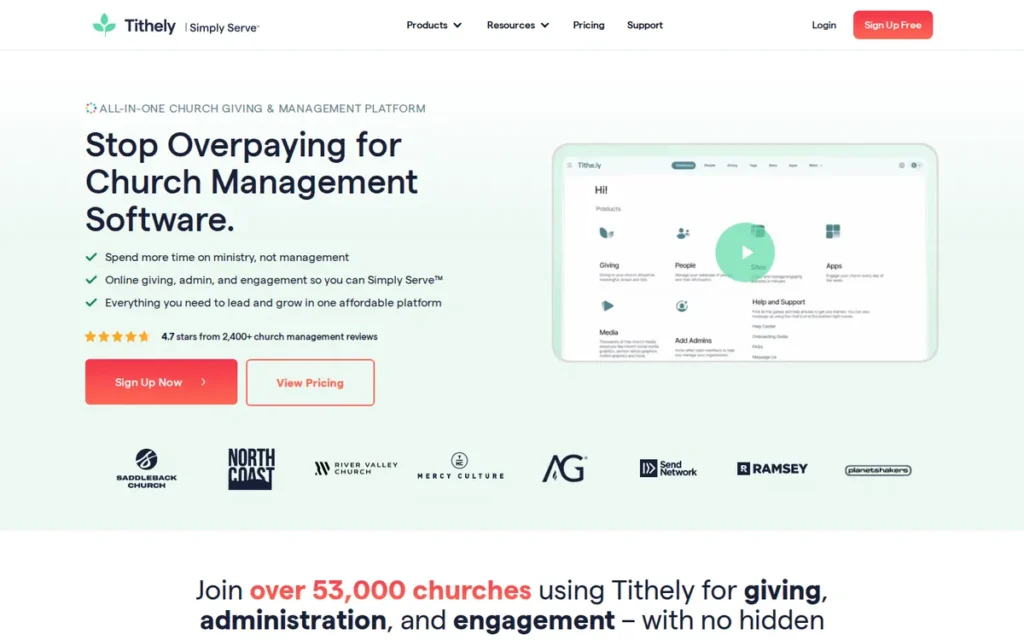
Category: All-in-One Church Platform, website, giving, church management and app tools from one vendor on one account.
At a Glance
- Category: All-in-One Church Platform
- Best For: Small churches that want sermons, events, visitor planning and giving at the lowest published church-specific price
- Price Range: $19/month (Sites, no contract); $119/month (All Access bundle); giving 2.9% + $0.30 card, 1% + $0.30 ACH
- Primary Strength: Tithely Sites includes a sermon library, events calendar, Plan Your Visit page and built-in giving at a published $19/month.
- Biggest Limitation: Tithely Sites offers limited design customization, and its only G2 rating comes from a single review.
- One-Line Summary: Tithely Sites is the lowest-cost church-specific website builder in PlugRoute’s 2026 evaluation, combining sermons, events, visitor planning and integrated giving for $19/month.
- Last Verified: November 2026
Score: Tithely Sites scored 28.75/37.5. Tithely Sites leads Nucleus by 0.5 point, mainly on cost (4.5 vs 3.5) and integrations (5 vs 3), while Nucleus leads on volunteer ease (4.5 vs 3).
Overview
Tithely Sites is a no-code church website builder from Tithely that bundles a sermon library, events calendar, Plan Your Visit page, livestream embeds and integrated giving for $19/month, built for small churches run by volunteers.
Tithely Sites also fits into Tithely’s All Access bundle, which adds ChMS, messaging and church apps.
Key Features
- Tithely Sites includes a sermon library and media player, so churches don’t need a separate media host.
- Tithely Sites provides an events calendar, a prayer wall and a dedicated Plan Your Visit page.
- Tithely Sites has built-in Tithely Giving, which supports one-time and recurring giving with no monthly fee.
- Tithely Sites allows unlimited users and unlimited storage, so rotating volunteers add no per-seat cost.
- Tithely Sites supports livestream embeds and multilingual content.
Best For
Tithely Sites is best for small, budget-limited churches that want church-native features and giving in one place. Tithely Sites fits especially well when the church already uses a ChMS that Tithely Giving integrates with.
Pricing (as of November 2026)
- Tithely Sites costs $19/month with no contract.
- Tithely All Access costs $119/month and includes a 30-day trial.
- Tithely Giving charges 2.9% + $0.30 for cards, 1% + $0.30 for ACH and 3.5% + $0.30 for Amex (Tithely, November 2026).
- Tithely’s own materials conflict on setup fees. A Tithely blog comparison lists a $149 one-time setup fee, while Tithely’s current help pages list $0 (Tithely, November 2026).
- Tithely Sites costs $228 in year one, plus $149 if the setup fee applies, plus giving fees.
Strengths
- Tithely Sites had the lowest published church-specific subscription in PlugRoute’s pricing review, at $19/month with no contract (Tithely, November 2026).
- Tithely Giving lists native integrations with nine church management systems, the longest documented list in this evaluation (Tithely, November 2026). The nine documented integrations are:
- Planning Center
- Breeze
- Church Community Builder (CCB)
- Rock RMS
- Elvanto
- MinistryPlatform
- Shelby
- F1
- Faith Teams
- Tithely Sites charges 1% + $0.30 for ACH gifts (Tithely, November 2026). On 500 gifts averaging $100, that is about $650 a year by ACH compared with $1,600 by card.
- Tithely Sites includes unlimited users, which lowers the risk when volunteers turn over.
Users on r/churchtech shared their experience:
“We use tithe.ly and it works nice. We also use the entire suite from them though with the website, app, etc. They do charge a fee per transaction. You can have an option to leave a box checked where they can cover the transaction fee. I like it since it does keep track on their end, can do giving receipts, reminds people if giving didn’t work, and handles it all on their end.” Posted by u/Live_Bread2645
Takeaway: Churches running the full Tithely suite value its hands-off giving records and receipts, but they still pay per-transaction fees unless donors choose to cover them.
Limitations
- Tithely Sites trades design flexibility for low cost. ReachRight Studios (2026) reports limited customization and a component model that frustrates churches wanting a custom look.
- Tithely Sites can make integrations outside Tithely’s own tools “more effort than expected,” according to ReachRight Studios (2026).
- Tithely Sites holds 3.0/5 on G2 from a single review (G2, November 2026), so the website product has no meaningful independent rating.
- PlugRoute scored Tithely Sites’ volunteer ease as neutral (3/5) because it found no independent user reports on its editor.
- Tithely Sites doesn’t document data export or cancellation terms beyond “no contract.”
Verdict
Tithely Sites is the best overall church website builder for small, budget-limited congregations in PlugRoute’s 2026 evaluation. Tithely Sites pairs the lowest published church-specific price with native sermons, visitor planning and widely integrated giving.
Churches that want a distinctive design may find the Tithely Sites templates restrictive. Confirm the setup fee and export options before committing.
2. Nucleus: Best for Visitor-Focused Design and Volunteer Ease
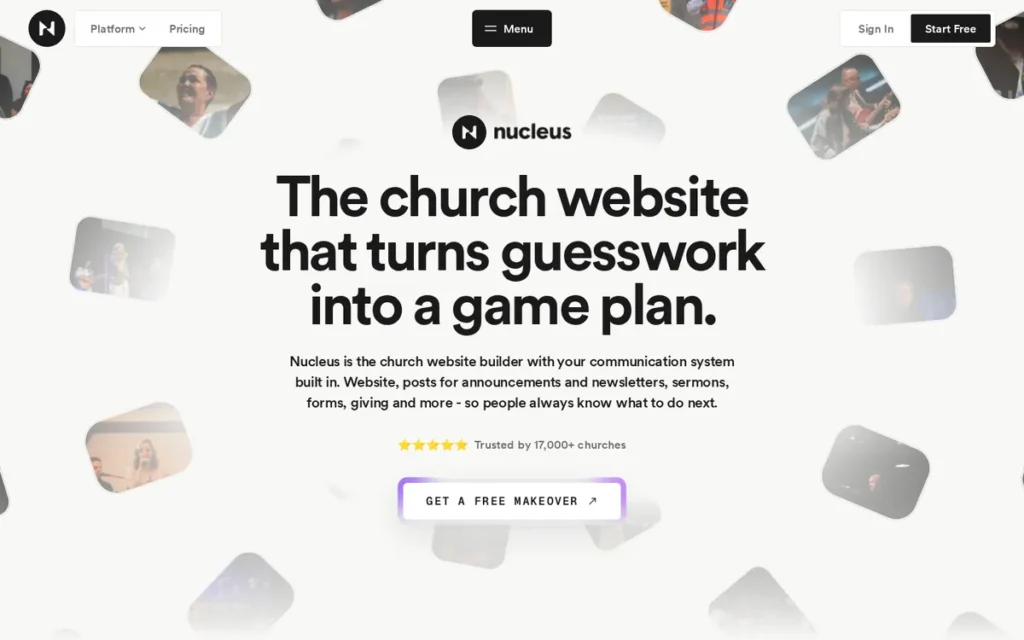
Category: Church Website Specialist, a platform built only for church websites and visitor communication.
At a Glance
- Category: Church Website Specialist
- Best For: Small to mid-sized churches that want a visitor-focused site volunteers can update easily
- Price Range: $65–$199/month (no contract); card 2.3% (per Nucleus), bank transfer $0.25 flat
- Primary Strength: Nucleus pairs a card-based editor with native visitor follow-up sequences and Plan Your Visit tools.
- Biggest Limitation: Nucleus has only one confirmed ChMS integration (Planning Center), and integrated giving appears on the $199/month Complete tier (a third party reports a $49/month add-on instead).
- One-Line Summary: Nucleus is a church website specialist built to turn website visitors into attendees, with an editor Capterra reviewers praise for its clean, mobile-first card layout and published plans from $65 to $199 per month.
- Last Verified: November 2026
Score: Nucleus scored 28.25/37.5. If you leave out the integration criterion, which matters less for churches already on Planning Center, Nucleus scores 25.25 to Tithely Sites’ 23.75.
Overview
Nucleus is a church website and communications platform that builds pages from “Info Cards” answering visitor questions. Nucleus is aimed at small to mid-sized churches whose non-technical volunteers need a modern site they can maintain without code.
Every Nucleus plan includes hosting, SSL, unlimited pages and unlimited admins.
Key Features
- Nucleus builds mobile-responsive pages from Info Cards, and each card links to a next step such as registering, praying or planning a visit.
- Nucleus includes native sermons, events, forms and prayer requests.
- Nucleus provides a Plan Your Visit page and automated new-visitor follow-up sequences.
- Nucleus includes unlimited pages, unlimited admin users, hosting and SSL on all plans.
- Nucleus offers a direct Planning Center integration that pushes subscribers into Planning Center.
Best For
Nucleus is best for churches that care most about turning website visitors into attendees and need a simple editor. Nucleus fits especially well for churches already on Planning Center.
Pricing (as of November 2026)
- Nucleus Essential costs $65/month ($780/year), with no contract and a 15-day trial.
- Nucleus Standard costs $99/month ($1,188/year) and includes a build with design and content migration, which Nucleus values at $4,500.
- Nucleus Complete costs $199/month ($2,388/year) and adds Giving and Media.
- Nucleus lists a 2.3% card fee and a $0.25 flat bank-transfer fee, shown to donors by default, and keeps no markup (Nucleus, November 2026).
- ChMeetings (2026) reports a 1.9% card fee and a $49/month Giving add-on, which is a third-party figure that doesn’t appear on Nucleus’s current giving page.
Strengths
- Nucleus holds a reported 4.9/5 on Capterra and 4.8/5 on Trustpilot, cited second-hand by ReachRight Studios (2026). Capterra reviewers specifically praise its mobile-first design and card editor.
- Nucleus Standard includes a done-for-you build (Nucleus, November 2026), which removes the hardest part of setup for volunteer teams.
- Nucleus charges a flat $0.25 per bank-transfer gift (Nucleus, November 2026), one of the lowest per-gift costs evaluated.
- Nucleus includes native visitor follow-up sequences, which the general-purpose builders in this evaluation lack.
This aligns with community sentiment on r/worshipleaders:
“The one thing I know Subsplash does better than anyone else is a mobile app. Best church app service I know of. But their website service (SnapPages) is so bad we gave it up for Nucleus.church (which I highly recommend).” Posted by u/KindledFlames
Takeaway: Nucleus wins over churches that leave all-in-one website builders, because its strength is the website itself rather than the app or ChMS bundled around it.
Limitations
- Nucleus trades flexibility for simplicity. Capterra reviewers (November 2026) report limited customization for larger ministries and problems with HTML blocks and domains.
- Nucleus confirms only a Planning Center integration, and reviewers describe moving data manually by CSV. PlugRoute couldn’t confirm integrations with CCB, Rock or Breeze.
- Nucleus draws Capterra complaints (November 2026) about limited migration help and little support outside office hours.
- Nucleus starts at $65/month, more than three times the lowest published church-specific plan in this evaluation ($19/month).
- Nucleus outcome claims, such as a 105% increase in giving, are vendor-reported with no church names attached (Nucleus, November 2026).
Verdict
Nucleus is the strongest church website builder for volunteer ease and visitor conversion in PlugRoute’s 2026 evaluation, though its entry price is more than three times the lowest church-specific plan.
Planning Center churches that want a done-for-you build will get the most value from Nucleus Standard. Churches on other ChMS platforms should confirm integrations first.
3. Subsplash: Best for App, Media, Livestream and Giving in One System
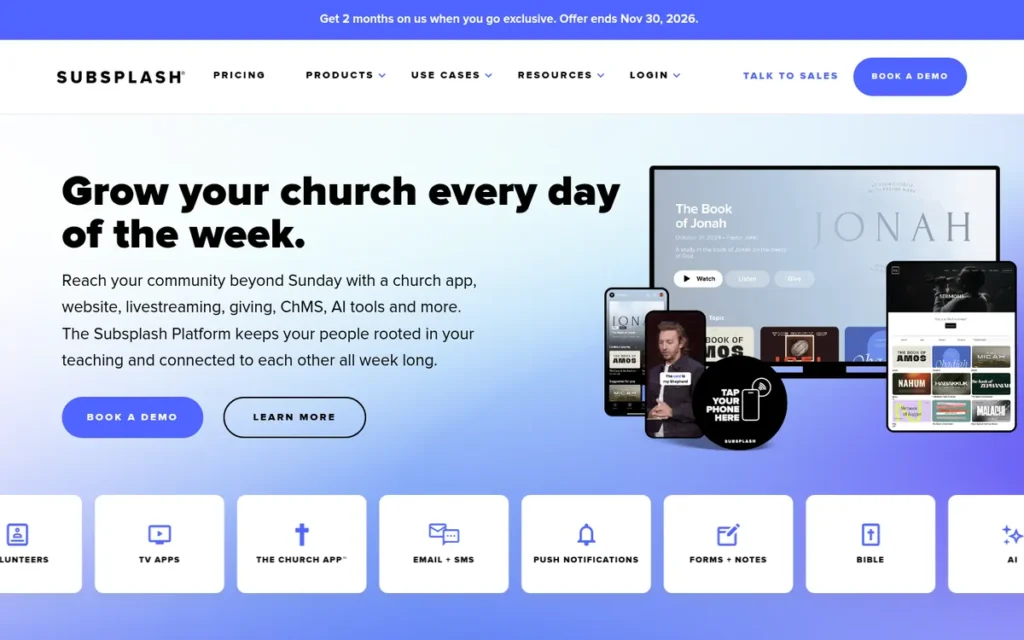
Category: All-in-One Church Platform, website, giving, church management and app tools from one vendor on one account.
At a Glance
- Category: All-in-One Church Platform
- Best For: Growing or mid-sized churches that want an app, livestream, giving and ChMS connected to their website
- Price Range: Pricing on request (third-party estimates about $200–$500+/month); giving $0 monthly fee, about 2.3%–2.99% + $0.30 per card gift
- Primary Strength: Subsplash connects the website, church app, livestream, giving and ChMS to one people database.
- Biggest Limitation: Subsplash publishes no prices, contract terms or data-export terms, so total cost can’t be compared without a sales demo.
- One-Line Summary: Subsplash connects the most components on one database of any platform in PlugRoute’s 2026 evaluation, with the widest giving options and a 4.2/5 G2 rating, but it requires a demo to get a price.
- Last Verified: November 2026
Score: Subsplash scored 23.25/37.5. Subsplash received 1/5 on cost because it publishes no price.
Overview
Subsplash is an all-in-one church platform. Its Subsplash One subscription combines a SnapPages website builder, church app, livestreaming, media, giving and church management on one database, for churches that want their whole digital ministry connected.
Subsplash pricing is quote-only and depends on church size and giving volume.
Key Features
- Subsplash uses the SnapPages drag-and-drop editor, which embeds media, events, giving and forms directly in pages.
- Subsplash publishes livestreams to Facebook, YouTube, the church website and the church app at once.
- Subsplash Giving accepts cards, ACH, stock, crypto, donor-advised funds, qualified charitable distributions and text-to-give.
- Subsplash GrowCurve automatically lowers processing rates as a church’s giving volume grows.
- Subsplash Pulpit AI turns one sermon into “20+ pieces” of discipleship content.
Best For
Subsplash is best for churches that run, or plan to run, a church app and livestream and want both connected to the website, giving and member data.
Pricing (as of November 2026)
- Subsplash Giving has a $0 monthly fee, and Subsplash prices the rest of the platform by quote.
- Subsplash is estimated at about $200–$500+/month (ReachRight Studios, 2026), which is an estimate, not a published price.
- Subsplash card processing is about 2.3%–2.99% + $0.30, depending on volume (ReachRight Studios and ChMeetings, 2026).
- Churches should ask Subsplash for website-only pricing, the contract term, sermon and donor-data export, and the GrowCurve rate tiers.
Strengths
- Subsplash holds 4.2/5 on G2 from 34 reviews (G2, November 2026), the largest confirmed independent rating sample in this evaluation.
- The Lead Pastor ranked Subsplash #1 in its 2026 comparison and called it best for mobile app integration.
- Subsplash supports the widest range of giving methods of the seven platforms evaluated (Subsplash, November 2026).
- Subsplash auto-publishes livestreams to every channel with minimal editing, according to an r/churchtech user (r/churchtech, 2026).
Limitations
- Subsplash trades price transparency for breadth, so a church can’t compare its total cost without a demo.
- Subsplash’s estimated $200–$500+/month puts it at or above the highest published church-specific plans in this evaluation, such as Nucleus Complete ($199/month).
- Subsplash doesn’t publish contract, cancellation or export terms. That raises lock-in risk, because member, giving and app data all sit in one system.
- Subsplash drew criticism from a GetApp reviewer (GetApp, November 2026) for its Pulpit AI push and ticket-only support.
- Subsplash’s GrowCurve figure of $8.4M returned to churches is vendor-reported (Subsplash, November 2026).
Users on r/worshipleaders noted:
“The biggest con with Subsplash is that they don’t have their ChMS sorted out yet. The app doesn’t play nice with their people management tool and it’s a mess. A form created in the app will not have the same features as a form created in their People module.” Posted by u/mateiogato
Takeaway: Subsplash’s all-in-one pitch is weakest on the people-management side, where long-time users report that its app and ChMS modules still don’t work together cleanly.
Verdict
Subsplash connects more ministry tools on one database than any other platform in PlugRoute’s 2026 evaluation, but its quote-only pricing makes it the hardest to budget for.
Churches that need an app, livestream and giving on one database should request a Subsplash quote. Small churches that only need a website will likely pay for features they won’t use.
4. Squarespace: Best for Design-Led Churches With Separate Giving Tools
Category: General-Purpose Builder, a mainstream website builder with church templates but no church management system.
At a Glance
- Category: General-Purpose Builder
- Best For: Small churches that want polished design and already use a separate giving or ChMS tool
- Price Range: $19–$99/month billed annually ($25–$139 billed monthly); card from 2.9% + $0.30; 2% commerce fee on Basic
- Primary Strength: Squarespace is named best for “design-led church sites” by comparison sites Lilach Bullock and Zarla (2026), and volunteers report very low upkeep.
- Biggest Limitation: Squarespace has no native sermon archive, donor statements or fund accounting, so churches must embed third-party church tools.
- One-Line Summary: Squarespace is the best general-purpose builder for design-led churches in PlugRoute’s 2026 evaluation, but it requires embedded third-party tools for sermons, giving records and church management.
- Last Verified: November 2026
Score: Squarespace tied Ekklesia 360 at 22.75/37.5 and ranks higher on the volunteer-ease tie-break (4.5 vs 2).
Overview
Squarespace is a general-purpose website builder known for design-led templates. Squarespace offers church templates and blocks for donations, events, forms and member areas, and suits small churches that value appearance and simple upkeep.
Squarespace doesn’t include a native sermon system, so most churches pair it with separate church software.
Key Features
- Squarespace provides church templates and blocks for donations, events, forms, audio, member areas and email campaigns.
- Squarespace’s Fluid Engine editor allows free-form grid layouts.
- Squarespace’s Blueprint AI builds a starter site through a chat conversation.
- Squarespace accepts donations through Squarespace Payments, Stripe or PayPal.
- Squarespace lets churches embed tools such as Tithely, Planning Center or Donorbox.
Best For
Squarespace is best for small churches that want a professional-looking site with minimal upkeep and are comfortable keeping giving and member records in a separate church tool.
Pricing (as of November 2026, US)
- Squarespace Basic costs $19/month billed annually ($25 monthly) and adds a 2% commerce fee.
- Squarespace Core costs $29/month billed annually ($39 monthly).
- Squarespace Plus costs $49/month billed annually ($65 monthly), and Advanced costs $99/month billed annually ($139 monthly).
- Squarespace Payments card processing starts at 2.9% + $0.30, and annual plans include a free domain for the first year only (Squarespace, November 2026).
Strengths
- Squarespace drew the strongest firsthand low-maintenance account in the research. A church tech volunteer said they had “never once had to help the staff with their squarespace site” (r/churchtech, 2019), though the thread is old.
- Squarespace publishes every plan price and its processing rate (Squarespace, November 2026), so costs are predictable.
- Squarespace is named best for “design-led church sites” by Lilach Bullock and Zarla (2026).
- Squarespace was endorsed by a second volunteer in the same thread, who said “I’ve used it for a few church sites and it works well” (r/churchtech, 2019).
Limitations
- Squarespace trades church functionality for design. According to ReachRight Studios (2026), Squarespace can’t natively organize sermons by series, speaker or Scripture passage.
- Squarespace lacks donor statements and fund accounting, so an embedded giving tool usually stays the main record.
- Squarespace’s free-form layouts need someone to check how pages look on mobile, and the domain is free only in year one.
- Squarespace offers a partial export to WordPress covering standard pages and one blog. The export leaves out calendar pages, audio and video blocks, and site design (Zarla, 2026), so events and sermon media must be rebuilt.
- Squarespace had no confirmed church-specific ratings or case studies.
Verdict
Squarespace is the best general-purpose builder for design-led small churches in PlugRoute’s 2026 evaluation, provided the church already has, or will pay for, separate giving and people tools.
Churches that want sermons, giving records and visitor follow-up built in will get more from a church-specific platform than from Squarespace.
5. Ekklesia 360: Best for Large or Multisite Churches Wanting Custom Design
Category: Church Website Specialist, a platform built only for church websites and visitor communication.
At a Glance
- Category: Church Website Specialist
- Best For: Larger or multisite churches with a design budget that want a church CMS with more export access than most
- Price Range: $70–$190/month (plus a custom tier, no contract); giving $10/month add-on; custom design $15K–$40K
- Primary Strength: Ekklesia 360 publishes the most detailed pricing in the category and lists developer FTP and API access.
- Biggest Limitation: Ekklesia 360’s editor is described by Capterra reviewers as limiting and unintuitive, which makes volunteer upkeep harder.
- One-Line Summary: Ekklesia 360 is a church CMS with an optional custom-design service and the most detailed pricing in PlugRoute’s 2026 evaluation, best suited to larger churches with staff support.
- Last Verified: November 2026
Score: Ekklesia 360 scored 22.75/37.5 and ranks below Squarespace on the volunteer-ease tie-break. Ekklesia 360’s portability score of 3.5 reflects FTP and API access plus listed import and export tools, the most export access documented in this evaluation.
Overview
Ekklesia 360 is a church content management system with SEO tools, real-time editing, developer access and an optional custom-design service. Ekklesia 360 is aimed at larger and multisite churches that want a professionally designed site and can handle a more complex editor.
Ekklesia 360 sells giving and ChMS as add-ons.
Key Features
- Ekklesia 360 lets churches start from a theme, order a custom design, bring their own design, or mix these approaches.
- Ekklesia 360 includes SEO tools, real-time editing and developer FTP and API access.
- Ekklesia 360 offers E360 Giving as a $10/month add-on, with kiosk and text options.
- Ekklesia 360 offers E360 ChMS from $40/month.
- Ekklesia 360 built a Class Finder, an Invite a Friend tool and a Prayer Engine for Woodbury Lutheran, according to its case study.
Best For
Ekklesia 360 is best for larger or multisite churches that have staff, not only volunteers, to manage the site, and a budget for professional design.
Pricing (as of November 2026)
- Ekklesia 360 publishes plans at $70, $95 and $190/month, plus a custom-priced fourth tier, with no contracts and 10% off for annual billing.
- Ekklesia 360 charges $500 for themes, from $350 for layouts, $125/hour for design and $150/hour for development.
- Ekklesia 360 fully custom sites cost $25,000–$35,000 (starting near $15,000), and custom multisite sites cost $25,000–$40,000.
- Ekklesia 360 add-ons cost $10/month for Giving (kiosk $19, text $5) and from $40/month for ChMS. An older third-party comparison citing about $65/month is likely out of date.
Strengths
- Ekklesia 360 publishes the most detailed pricing of any platform evaluated, including hourly design rates (Ekklesia 360, November 2026).
- Ekklesia 360 lists developer FTP and API access on its pricing page, and its Capterra listing describes import and export tools (Capterra, November 2026). Ekklesia 360 doesn’t say which content types those tools cover.
- Ekklesia 360’s $10/month giving add-on (Ekklesia 360, November 2026) is one of the cheapest ways to add integrated giving.
- Ekklesia 360 receives Capterra praise for “great support during the building and implementing phase” (Capterra, November 2026).
Limitations
- Ekklesia 360 trades volunteer ease for design control. Capterra reviewers (November 2026) call its back end “very limiting and unintuitive” and “very difficult to navigate.”
- Ekklesia 360’s editor is described by ReachRight Studios (2026) as outdated, with an inaccurate live preview.
- Ekklesia 360 has thin independent evidence: 3.1/5 on G2 from only 8 reviews (G2, November 2026), and PlugRoute found no Reddit discussion.
- Ekklesia 360 may charge a one-time $500 onboarding fee for theme-based sites (ChurchPress, 2026), so confirm this with the vendor.
- Ekklesia 360 doesn’t document how its multisite features work, and custom design can add $15,000–$40,000.
Verdict
Ekklesia 360 publishes the most detailed pricing of any church CMS in PlugRoute’s 2026 evaluation and is the best fit for larger churches with staff and a design budget.
Small, volunteer-run congregations should weigh the difficult Ekklesia 360 editor against simpler options. Ekklesia 360’s FTP and API access reduces, but doesn’t remove, long-term lock-in risk.
6. Wix: Best Free Starting Point for DIY Volunteer Builders

Category: General-Purpose Builder, a mainstream website builder with church templates but no church management system.
At a Glance
- Category: General-Purpose Builder
- Best For: Tiny volunteer-run churches that want to start free and will assemble church tools themselves
- Price Range: Free tier + paid ($17–$159/month billed annually; Core at $29/month is the minimum for donations); 2.9% + $0.30 card processing
- Primary Strength: Wix offers the only free plan in this evaluation and the most layout freedom for volunteer builders.
- Biggest Limitation: Wix offers no standard full-site export for ordinary sites, and blog posts can’t be exported directly, so leaving is difficult.
- One-Line Summary: Wix is the only church website option with a free plan in PlugRoute’s 2026 evaluation, but churches need the $29/month Core plan to accept donations and face the highest lock-in risk.
- Last Verified: November 2026
Score: Wix scored 21.25/37.5, including the lowest portability score in the evaluation (1/5).
Overview
Wix is a general-purpose drag-and-drop website builder with church templates, native events, donations, member areas and an AI site builder. Wix suits very small volunteer-run churches that want to start free and add church tools themselves.
Wix requires a paid plan for a custom domain and for online giving.
Key Features
- Wix provides church templates, a drag-and-drop editor and an AI site builder.
- Wix Events supports event registration and ticketing natively.
- Wix Donations accepts gifts on Core and higher plans, with no fee beyond Wix Payments processing.
- Wix offers members areas and an app marketplace.
- Wix Studio gives agency-level control for multisite churches or denominations.
Best For
Wix is best for very small churches testing a web presence for free. Wix also suits volunteer builders who want full layout control and already use separate tools for sermons and member records.
Pricing (as of November 2026)
- Wix’s free plan shows Wix branding, uses a Wix web address, caps storage at 500MB and bandwidth at 1GB, and can’t take payments.
- Wix annual plans cost $17 (Light, no payments), $29 (Core), $39 (Business) and $159 (Business Elite) per month.
- Wix monthly billing costs $24, $36, $46 and $172 for the same plans, and Wix prices vary by country.
- Wix Payments charges 2.9% + $0.30 for cards, 3.7% + $0.30 for Amex and 3.49% + $0.49 for PayPal (Wix, November 2026).
Strengths
- Wix is the only platform in PlugRoute’s evaluation with a free plan, so churches can build and test before paying.
- Wix is named the easiest option for tiny volunteer-run churches by ReachRight Studios and Tooltester (2026).
- Wix includes native event registration and ticketing without an add-on (Wix, November 2026).
- Wix Donations adds no fee beyond standard Wix Payments processing (Wix, November 2026).
Limitations
- Wix trades portability for a free start. Wix has no standard export for ordinary sites, blog posts can’t be exported directly, and templates can’t be switched after publishing (Wix Support, November 2026).
- Wix Studio offers a limited code export, but that export excludes dynamic pages, app widgets and member login (Wix Support, November 2026).
- Wix’s free plan can’t accept donations or use a custom domain, which makes Core ($348/year) the realistic minimum. That is above the lowest published church-specific plan in this evaluation ($228/year).
- Wix has no native sermon management or donor records, and New Culture (2026) raises speed concerns with large sermon archives.
- Wix renewal prices can climb after introductory discounts. One user paid $80 for a first year at 50% off (r/churchtech, 2019).
Verdict
Wix is the best free starting point for volunteer-built church websites in PlugRoute’s 2026 evaluation, but Wix carries the highest lock-in risk of any platform reviewed.
Churches planning to take online gifts should budget for Wix Core from day one. Decide early whether you can accept having no standard full-site export.
7. Sharefaith: Best for Churches That Need Graphics and Curriculum
Category: Content-Bundle Platform, a church website bundled with a media and curriculum library that is the main draw.
At a Glance
- Category: Content-Bundle Platform
- Best For: Churches without a designer that will make heavy use of graphics, video and kids’ curriculum
- Price Range: $167/month billed annually or $185–$190/month billed monthly (Suite, required for a website); giving transaction fees not published
- Primary Strength: Sharefaith bundles a media library of more than 100,000 church graphics, videos and curriculum assets with the website.
- Biggest Limitation: Sharefaith requires its $167–$190/month Suite for a website and faces Trustpilot allegations about billing and cancellation.
- One-Line Summary: Sharefaith is a church media library with a website included, valuable mainly for churches that need graphics and curriculum, and the most expensive website-only option in PlugRoute’s 2026 evaluation.
- Last Verified: November 2026
Score: Sharefaith scored 18.25/37.5. The billing allegations affected Sharefaith’s review-evidence and portability scores, not its feature score.
Overview
Sharefaith is a church website platform bundled with a media library of more than 100,000 graphics, worship backgrounds, short videos, bulletins and kids’ curriculum. Sharefaith is aimed at churches without a designer that will use the library as much as the site.
Sharefaith includes a website only in its top Suite tier.
Key Features
- Sharefaith includes a library of more than 100,000 graphics, worship backgrounds, videos and bulletins.
- Sharefaith bundles the Kids Wonders children’s curriculum.
- Sharefaith websites support sermon publishing, registration forms and prayer forms.
- Sharefaith offers named templates such as Advent, Hillside and Sanctuary.
- Sharefaith provides online giving with no monthly fee and a church app.
Best For
Sharefaith is best for churches that would otherwise buy stock graphics, worship media and kids’ curriculum separately, and that see the website as part of that package.
Pricing (as of November 2026)
- Sharefaith Suite, the only tier with a website, costs $167/month billed annually or $185–$190/month billed monthly ($2,004–$2,280/year), because 2026 listings conflict.
- Sharefaith’s lower content tiers cost $23–$85/month and don’t include a website.
- Sharefaith’s signup page also shows $30 and $90 figures, and churchdigital.com (2026) reports $59–$79/month.
- Sharefaith giving has no monthly fee, but Sharefaith doesn’t publish transaction fees. Sharefaith lists no setup fee.
Strengths
- Sharefaith bundles more than 100,000 church media assets (Sharefaith, November 2026), the only content library of its kind in this evaluation.
- Sharefaith reports serving more than 100,000 churches (Sharefaith, November 2026, vendor-reported) and publishes named testimonials.
- Sharefaith combines curriculum, giving and an app with the website, which can replace several separate purchases.
- Sharefaith Suite includes three subdomains (Sharefaith, November 2026), which is useful for separate ministries or campuses.
Limitations
- Sharefaith trades website value for content value. A church that only needs a website pays about nine times the lowest published church-specific plan in this evaluation ($19/month).
- Sharefaith holds 3.2/5 on Trustpilot from about 12 reviews (Trustpilot, November 2026). Reviewers allege “sneaky renewal tactics,” a denied cancellation, an unwanted $50 charge and unresponsive support.
- PlugRoute searched every vendor for similar complaints, and the Sharefaith allegations form the clearest pattern found.
- Sharefaith has too few G2 reviews to rate (G2, November 2026).
- Sharefaith sites run on WordPress with Elementor, according to an unconfirmed third-party report (Webtwizz, 2026), which conflicts with Sharefaith’s no-code marketing.
Verdict
Sharefaith is worth considering only for churches that will use its 100,000+ asset media and curriculum library, because Sharefaith is the most expensive way to get just a church website in PlugRoute’s 2026 evaluation.
Get Sharefaith’s renewal and cancellation terms in writing before subscribing.
What Does a Church Website Really Cost per Year?
The real yearly cost of a church website is the subscription plus giving-processing fees, and the fees are often the bigger number. Suppose a church receives $50,000 a year through 500 card gifts at 2.9% + $0.30. It pays about $1,600 in fees, which is more than most subscriptions here.
Online giving is now standard. 62% of churches accept gifts directly on their website, according to Vanco, a church payments provider (Vanco, 2025).
The table below is PlugRoute’s calculation for 500 gifts averaging $100 ($50,000 a year).
| Platform | Card Rate (2026) | Est. Annual Card Fees | Bank/ACH Rate (2026) | Est. Annual Bank Fees |
|---|---|---|---|---|
| Tithely Sites | 2.9% + $0.30 | $1,600 | 1% + $0.30 | $650 |
| Nucleus | 2.3% (1.9% per ChMeetings) | $1,150 ($950) | $0.25 flat | $125 |
| Subsplash | ~2.3%–2.99% + $0.30 | ~$1,300–$1,645 | Not published | N/A |
| Squarespace | From 2.9% + $0.30 | $1,600 | Not published | N/A |
| Wix | 2.9% + $0.30 | $1,600 | Not published | N/A |
| Ekklesia 360 | Not published | N/A | Not published | N/A |
| Sharefaith | Not published | N/A | Not published | N/A |
Note: Nucleus shows its card fee to donors by default, so the church may receive the full gift. The costs shown assume the church absorbs all fees.
A $19/month website costs $228 a year, while card fees on $50,000 of giving cost about $1,600, roughly seven times the subscription.
A developer building church websites noted on r/churchtech:
“Some platforms like tithely charge no monthly fee but tack on their own fee to each transaction making the true cost hard to track. Some will do just a fixed monthly cost and the per transaction fee is just what they have to pay to the card processor, and some do a mix of both.” Posted by u/ryan-webdev
Takeaway: “No monthly fee” giving tools such as Tithely move their cost into per-transaction fees, so churches have to model fees at their own giving volume to see what they really pay.
For a church that receives $50,000 a year online, each 1-point difference in card rate is worth about $500 a year. That is more than two years of a $19/month subscription.
A church on Tithely Sites that moves half its 500 yearly gifts from card to ACH cuts processing fees from about $1,600 to about $1,125 a year (PlugRoute calculation, November 2026).
Software costs, verified November 2026, vary widely by church situation:
| Church Situation | Best Fit | Approx. Year-One Software Cost | Approx. Three-Year Software Cost |
|---|---|---|---|
| Very small budget | Tithely Sites | $228 (+$149 if the setup fee applies) | $684 (+$149 if the setup fee applies) |
| Polished design with embedded giving | Squarespace Core or Wix Core | $348 | $1,044 |
| Church features plus a done-for-you build | Nucleus Standard | $1,188 | $3,564 |
| App, giving and ChMS in one | Tithely All Access or Subsplash | $1,428, or ~$2,400–$6,000+ (estimate) | $4,284, or ~$7,200–$18,000+ (estimate) |
| Large or multisite with custom design | Ekklesia 360 | $840–$2,280 plus $500 to $40,000 design | $2,520–$6,840 plus design |
| Media and curriculum first | Sharefaith Suite | $2,004–$2,280 | $6,012–$6,840 |
How Do Prices, Integrations and Export Compare?
Prices, integrations and export terms differ more than headline prices suggest. Starting prices with giving range from $19 to $199 a month among published plans. Tithely Giving documents the most ChMS integrations. Only Ekklesia 360 and Squarespace document any export path, and both paths are limited.
| Company | Starting Price With Giving (Nov 2026) | Documented ChMS Integrations | Export Documentation | Contract Terms |
|---|---|---|---|---|
| Tithely Sites | $19/month | Nine via Tithely Giving | Not published | No contract |
| Nucleus | $199/month Complete (third party reports a $49/month add-on) | Planning Center only | Not published; CSV moves reported | No contract |
| Subsplash | Quote only | In-house ChMS; third-party not documented | Not published | Not published |
| Squarespace | $29/month Core (Basic support for donations unconfirmed) | Embeds only | Partial (WordPress XML; excludes calendar and audio/video) | Monthly or annual |
| Ekklesia 360 | $80/month ($70 plan + $10 Giving) | In-house E360 ChMS add-on | FTP/API access; content types unspecified | No contract |
| Wix | $29/month Core | Embeds and app marketplace | No standard export (limited Wix Studio code export) | Monthly or annual |
| Sharefaith | $167/month Suite | Not documented | Not published | Annual or monthly; renewal complaints alleged |
Is There a Truly Free Church Website Builder?
None of the seven platforms PlugRoute evaluated offers a fully free church website that accepts donations on a custom domain. Wix has the only free plan, but it shows Wix branding, uses a Wix address and can’t take payments. The cheapest Wix plan with donations is Core, at $29/month billed annually (2026).
Wix’s free plan costs $0, but taking a single online gift requires Core at $348 a year. That is more than the lowest published church-specific plan ($228 a year).
Free-plan limits show up elsewhere too. A volunteer said Faithlife’s free church site offers “not much ability to edit and make it more personal unless you upgrade to premium” (r/churchtech, 2019).
The cheapest tier with a custom domain and giving on each platform, as of November 2026:
- Tithely Sites costs $19/month.
- Wix Core costs $29/month billed annually.
- Squarespace Core costs $29/month billed annually. Squarespace Basic ($19/month plus a 2% commerce fee) supports commerce, but PlugRoute couldn’t confirm that its donation blocks work on Basic.
- Ekklesia 360 costs $70/month plus a $10/month Giving add-on.
- Nucleus Complete costs $199/month, or Essential plus a disputed Giving add-on.
Should Our Church Use WordPress Instead?
WordPress.org suits churches that have a reliable technical maintainer, because it offers full ownership and low hosting costs. WordPress.org is a poor fit for churches that depend on rotating volunteers. PlugRoute treats WordPress.org as an alternative path, not a ranked product, because its cost depends on who maintains it.
Self-hosted WordPress can run about $7.99/month for hosting plus $11.99/year for a domain, according to one volunteer (r/churchtech, 2019). Other volunteers in the same discussion warned about the upkeep.
As one pastor on r/askapastor described:
“I used WordPress for some churches and Wix for most others. I have built websites with transferring the maintenance over to someone else in mind as they move us Methodist pastors around often. I was not a fan of WordPress because too many times a random update to a random plugin would crash the whole site.” Posted by u/ILINTX
Takeaway: WordPress’s habit of breaking after plugin updates makes it a risky choice for churches whose site maintainers change often.
The trade-offs of WordPress.org for churches:
- WordPress.org gives the church full ownership of its content and easy portability between hosts.
- WordPress.org requires ongoing plugin updates, security patches and backups unless the church pays for managed hosting.
- WordPress.org knowledge often leaves with the volunteer who built the site unless the church keeps handoff documentation.
- WordPress.org needs separate plugins or embeds for sermons, giving and events.
What Red Flags Should I Watch For When Evaluating Church Website Builders?
The most serious red flags are:
- quote-only pricing
- giving fees hidden behind “no monthly fee”
- misleading free or discounted entry prices
- missing export terms
- integrations done by CSV
- accounts registered to one volunteer
Each one adds cost or lock-in risk that a vendor’s headline price won’t show.
Red Flag #1: Quote-Only Pricing With No Published Contract Terms A vendor that only quotes prices after a demo makes it impossible to compare total cost before you spend time with sales. Ask for the contract length and the cancellation and renewal terms in writing before any demo ends.
Red Flag #2: Giving Fees Hidden Behind “No Monthly Fee” A “no monthly fee” giving tool still charges per gift, often 2.9% + $0.30 per card gift. At $50,000 a year in online giving, that comes to about $1,600, more than most website subscriptions (PlugRoute calculation, November 2026).
Red Flag #3: Free or Discounted Entry Prices That Hide the Real Cost A free plan that blocks payments, or a first-year discount, can hide what the church will actually pay. One church paid $80 for its first year at 50% off (r/churchtech, 2019). Budget at the renewal price of a tier that supports giving.
Red Flag #4: No Documented Content or Donor-Data Export A platform that doesn’t document export can trap your sermons, pages and recurring gifts. Few vendors here document export. Ekklesia 360 lists FTP and API access, and Squarespace’s partial WordPress export leaves out calendar and audio/video content. PlugRoute found no vendor documentation for moving recurring gifts.
Red Flag #5: Integrations Reserved for Higher Tiers or Done by CSV An “integration” that requires manual CSV transfers or a premium tier adds work for volunteers every week. Confirm that the integration with your ChMS is native and included in the exact plan you plan to buy.
Red Flag #6: Domain or Accounts Registered in a Volunteer’s Name A domain registered to a former volunteer can take the church website offline or block a platform switch. One commenter advised: “Nothing should be in your name that is the church’s” (r/churchtech, 2019).
“Whatever you do, don’t lose control of the domain!” (u/nancyb43, r/churchtech (2019))
Takeaway: Register the church domain and every platform account in the church’s name, not a volunteer’s.
What Questions Should I Ask Before Choosing a Church Website Builder?
Before choosing a builder, ask vendors seven questions about:
- year-one and year-three cost
- card and ACH rates
- native ChMS integration
- data export
- who will maintain the site
- cancellation terms
- migration
The answers show a church’s real cost, the work of keeping the site current and how easily it could leave later.
Question #1: What will we pay in year one and year three, including setup and giving fees? A complete answer includes the subscription at its renewal price, one-time setup or design fees, required add-ons, and projected processing fees at your giving volume. Compare three-year totals, not first-month prices.
Question #2: What are your card and ACH rates at our giving volume? A good answer gives separate card and bank rates in writing. ACH is usually much cheaper, for example 1% + $0.30 at Tithely or $0.25 flat at Nucleus (vendor pricing, November 2026).
Question #3: Does it natively integrate with our ChMS on the plan we’d buy? A good answer names your ChMS, such as Planning Center, Breeze or Rock RMS, and confirms that the integration is native, not CSV-based, on the tier you’re buying. Ask for the vendor’s help-page link as proof.
Question #4: Can we export pages, sermons and recurring-gift data if we leave? A good answer describes export formats, which content types are covered and how recurring donors are moved. Vague answers, or no documentation, mean higher lock-in risk for your content and giving.
Question #5: Who on our team will update this weekly, and can they do it without help? A good answer comes from your own team after a trial. Free trials found in 2026 include Tithely All Access (30 days), Nucleus (15 days) and the Wix free plan, while Subsplash requires a demo. Have your least technical volunteer publish a sermon and an event.
Question #6: What are your cancellation and renewal terms in writing? A good answer is a written policy covering notice periods, auto-renewal and refunds. Alleged billing and cancellation problems were the clearest warning sign PlugRoute found in this category’s 2026 reviews.
Question #7: How will we move our existing website to your platform? A good answer covers who moves the pages, how sermon media will be re-hosted, and how recurring gifts will move. Nucleus Standard includes migration (Nucleus, November 2026), but no vendor documents moving recurring gifts. Confirm that the church controls the domain first.
How Did We Rank These Church Website Builders?
PlugRoute scored seven church website builders on six criteria, using a 1–5 scale with half-points. Cost, church features and volunteer ease each count 1.5x. Integration, review evidence and portability each count 1x, for a maximum of 37.5. Ties are broken by the volunteer-ease score.
PlugRoute has no affiliate relationships with any company listed. Rankings are determined entirely by research data and objective evaluation criteria.
The six ranking criteria and why each matters:
- Total Cost Transparency and Value (1.5x): This criterion matters because hidden quotes, setup fees and renewal jumps hurt tight budgets.
- Church-Native Feature Coverage (1.5x): This criterion matters because native sermons, events, visitor pages and giving save churches from buying and stitching together add-ons.
- Volunteer Ease and Maintainability (1.5x): This criterion matters because the next volunteer must be able to update the site without coding.
- Integration with Existing Church Software (1x): This criterion matters because churches already rely on ChMS and giving tools.
- Independent Review Evidence (1x): This criterion matters because vendor claims are common and independent signals are scarce.
- Portability and Lock-In Risk (1x): This criterion matters because content, donors and domains must survive a future switch.
| Rank | Company | C1 Cost | C2 Features | C3 Ease | C4 Integration | C5 Reviews | C6 Portability | Weighted Total |
|---|---|---|---|---|---|---|---|---|
| 1 | Tithely Sites | 4.5 | 5 | 3 | 5 | 2 | 3 | 28.75 |
| 2 | Nucleus | 3.5 | 4.5 | 4.5 | 3 | 3.5 | 3 | 28.25 |
| 3 | Subsplash | 1 | 5 | 3.5 | 3 | 4 | 2 | 23.25 |
| 4 | Squarespace | 4 | 2 | 4.5 | 2.5 | 2 | 2.5 | 22.75 |
| 5 | Ekklesia 360 | 3.5 | 4 | 2 | 3 | 2 | 3.5 | 22.75 |
| 6 | Wix | 4 | 2.5 | 4 | 2.5 | 2 | 1 | 21.25 |
| 7 | Sharefaith | 2 | 3.5 | 3 | 2 | 1.5 | 2 | 18.25 |
Squarespace and Ekklesia 360 tied at 22.75, and Squarespace ranks higher on the volunteer-ease tie-break (4.5 vs 2).
Tithely Sites leads Nucleus by 0.5 point, mainly on integration breadth (5 vs 3). For a church already on Planning Center, integration matters less. Without that criterion, Nucleus leads 25.25 to 23.75.
How PlugRoute handled evidence and scoring rules:
- PlugRoute did not test the editors hands-on for this edition, so usability scores rely on documented user reports.
- PlugRoute scored missing community evidence on volunteer ease (C3) as neutral (3).
- PlugRoute scored independent review evidence (C5) at 2 when no rating was confirmed and at 2–2.5 for ratings from fewer than 10 reviews. Tithely Sites therefore scores 2, because its G2 rating rests on one review.
- PlugRoute scored absences that are themselves findings, such as unpublished pricing or export terms, below neutral.
- PlugRoute set portability (C6) scores as follows:
- Tithely Sites and Nucleus received 3 for no-contract terms with no documented export.
- Subsplash received 2 because its contract and export terms are unpublished.
- Squarespace received 2.5 because its partial export leaves out church-critical content.
- PlugRoute labeled sources as independent, vendor-reported, second-hand or possibly biased. The possibly biased sources included a Reddit commenter on Nucleus who works on a church-tech product and a template seller writing about WordPress.
- PlugRoute showed conflicting figures side by side, such as the Tithely setup fee, the Nucleus card rate and the Sharefaith Suite price, and gave no credit for ratings shown on a vendor’s own site.
Which Platforms Did We Not Rank, and Why?
PlugRoute didn’t rank The Church Co, Faithlife Sites, Clover Sites, ChurchSpring, Church Plant Media, Finalweb or SITE123. These are credible platforms, but PlugRoute didn’t research them to the same depth as the seven ranked entries. At least one AI answer that PlugRoute reviewed recommended The Church Co through an affiliate-tagged link.
Known details for the unranked platforms:
- The Church Co is listed from about $29/month billed annually (churchdigital.com, 2026), with Planning Center integration reportedly only on its $49 Premium tier.
- ChurchSpring is listed from $79/month (churchdigital.com, 2026).
- Faithlife Sites offers a free church site with limited editing, according to one volunteer (r/churchtech, 2019).
- Clover Sites, Church Plant Media, Finalweb and SITE123 were not evaluated in this edition.
What Do Churches Ask Most About Website Builders?
Small churches most often ask which builders include giving and sermons, whether a free option works for volunteers, and how PlugRoute decides its rankings. Each answer below reflects PlugRoute’s November 2026 evaluation of seven church website builders.
Which church website builder includes online giving and sermons?
Tithely Sites, Nucleus, Subsplash and Sharefaith include native sermon publishing and integrated giving in PlugRoute’s November 2026 evaluation. Tithely Sites is cheapest at $19/month. Nucleus includes giving on its $199/month Complete tier, Subsplash is quote-only, and Sharefaith requires its $167/month Suite. Squarespace and Wix take donations but lack native sermon archives.
What is the best free church website builder for volunteers?
Wix is the only free plan in PlugRoute’s November 2026 evaluation, and comparison sites call it the easiest option for tiny volunteer-run churches. The Wix free plan can’t accept donations or use a custom domain, so giving requires Core at $29/month billed annually. The lowest published church-specific plan with giving costs $19/month.
How does PlugRoute determine its rankings?
PlugRoute ranks church website builders with a weighted six-criterion score out of 37.5. Cost, church features and volunteer ease count 1.5x, while integration, independent reviews and portability count 1x. Every score rests on dated, labeled sources, and ties go to the platform that is easier for volunteers. The “How Did We Rank These Church Website Builders?” section publishes the full scoring matrix.
What Do Key Church Website Builder Terms Mean?
A church website builder’s pricing and features turn on about a dozen terms, from ChMS and ACH giving to content export and recurring-gift migration. The definitions below explain what each term means for a small church’s yearly cost, its volunteers’ workload and its ability to switch platforms without losing content or donors.
Church Management Software (ChMS): Software that stores member records, attendance, groups and giving history. A website builder that connects directly to your ChMS saves volunteers from entering the same data twice.
ACH (Bank Transfer) Giving: A gift paid directly from a donor’s bank account instead of a card. ACH fees are usually far lower than card fees, so encouraging bank giving can save hundreds of dollars a year.
Card Processing Fee: The percentage plus fixed amount charged on each card gift, such as 2.9% + $0.30. Card processing fees often cost more each year than the website subscription.
Setup Fee: A one-time charge to start service or build the site. A setup fee raises year-one cost and isn’t always shown on pricing pages, so ask about it up front.
Custom Domain: Your church’s own web address, such as yourchurch.org. Free plans often don’t allow a custom domain, and the domain should be registered in the church’s name, not a volunteer’s.
Builder Branding: The website builder’s logo or name shown on a free-plan site. Removing builder branding usually requires a paid plan, so it marks the line between a free trial and a professional site.
Content Export: The ability to download pages, sermons and media so you can move to another platform. Without content export, switching vendors usually means rebuilding everything.
Sermon Library: A native archive that organizes messages by series, speaker or Scripture passage. A built-in sermon library is easier to keep current than videos embedded from separate services.
Plan Your Visit Page: A page that answers first-time guests’ questions and lets them tell the church they’re coming. A Plan Your Visit page is a key tool for turning website visitors into attendees.
Donor Statement: A year-end record of each person’s gifts, used for tax purposes. General-purpose builders often can’t produce donor statements, so a separate giving tool is needed.
Fund Accounting: Tracking gifts by designated fund, such as missions or a building fund. Church giving tools typically include fund accounting, and generic payment processors typically don’t.
Recurring Gift Migration: Moving donors’ automatic recurring gifts to a new provider. No vendor in this evaluation documented recurring gift migration, so ask about it before you commit.
Which Church Website Builder Is Right for You?
Key Insights
- Tithely Sites offers the lowest published church-specific cost in 2026, at $19/month with native sermons, events and giving.
- Nucleus scored highest on volunteer ease among church-specific platforms, trails Tithely Sites by only 0.5 point, and includes a done-for-you build on its Standard plan.
- Subsplash connects the most ministry tools on one database, but its quote-only pricing makes budgeting difficult.
- Squarespace and Wix need embedded church tools for sermons, donor records and church management.
- Giving-processing fees often cost more each year than the website subscription, so churches should compare card and ACH rates.
- Wix carries the highest lock-in risk evaluated because ordinary Wix sites have no standard full-site or blog export.
Match your top priority to a starting point:
- Churches that need the lowest cost should start with Tithely Sites ($19/month, November 2026).
- Churches on Planning Center that value volunteer ease should compare Nucleus Standard ($99/month) directly with Tithely Sites, because the integration edge that puts Tithely Sites first matters less for them.
- Churches that already run an app and livestream should request a Subsplash quote.
- Design-first churches that already handle giving elsewhere should consider Squarespace.
Whichever platform you choose, register the domain in the church’s name and get export and cancellation terms in writing. For more independent research, read PlugRoute’s full scoring methodology and our other church software reviews of ChMS and online giving tools.
We update this guide quarterly. Last updated: November 2026.