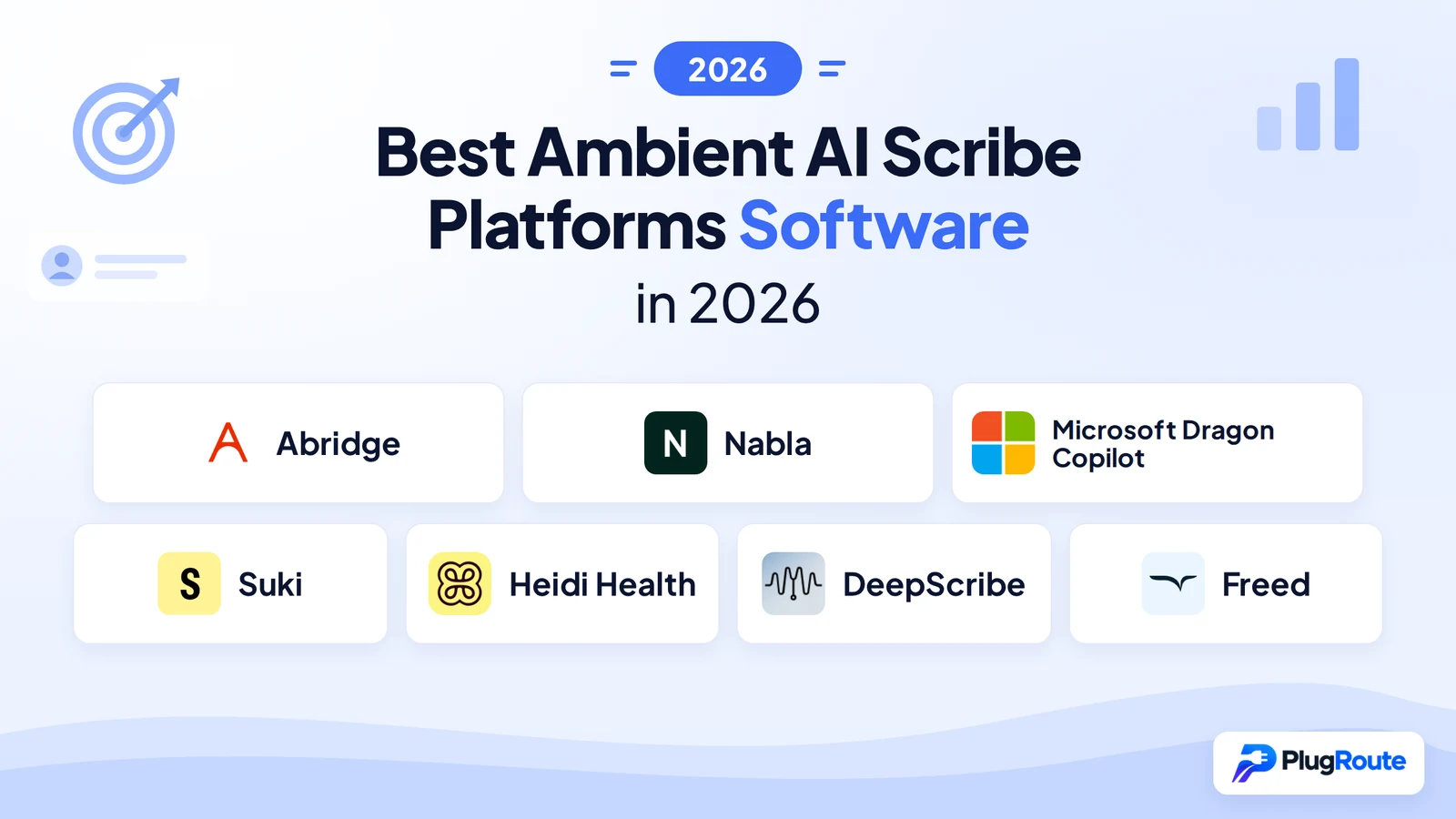
The best ambient AI scribe platforms in 2026 are Abridge for large Epic health systems, Nabla for privacy-first documentation across multiple EHRs, and Microsoft Dragon Copilot for nursing, inpatient, and dictation workflows. None of the seven vendors reviewed publishes audited accuracy rates, and independently measured time savings are modest, so EHR fit and total effort should decide your choice.
Buyers have no head-to-head data covering all seven vendors. Most claims come from the vendors themselves, enterprise contracts are opaque, and AI drafts can take as long to fix as to write. Solo clinicians have two low-cost options with published pricing: Heidi Health, which has a free tier, and Freed, which offers a trial with no credit card.
PlugRoute has no affiliate relationships with any company listed, and rankings are determined entirely by research data and objective evaluation criteria.
Every platform gets the same nine-part review and the same evidence labels, so no vendor gets more depth than another. After the entries, sections covering the whole category look at the evidence that matters across vendors, from EHR write-back to measured error rates.
What Are the 4 Categories of Ambient AI Scribe Tools?
Ambient AI scribes fall into four categories. The category matters more than star ratings because it sets integration depth, pricing model, and rollout time. Enterprise EHR-Native Scribes work inside Epic. EHR-Agnostic Platform Scribes work across several EHRs. Self-Serve Scribes need no contract. Specialty Scribes are built around one clinical field.
- Enterprise EHR-Native Scribe: Abridge and Microsoft Dragon Copilot are Enterprise EHR-Native Scribes. Both work inside Epic’s native workflow and are sold through institutional contracts.
- EHR-Agnostic Platform Scribe: Nabla and Suki are EHR-Agnostic Platform Scribes. Both integrate with, or embed inside, several EHRs instead of tying themselves to one.
- Self-Serve Scribe: Heidi Health and Freed are Self-Serve Scribes. Clinicians can sign up for either one without an enterprise contract.
- Specialty Scribe: DeepScribe is the Specialty Scribe in this comparison. DeepScribe is built around oncology and cardiology workflows, data, and EHRs.
How Do the Top Ambient AI Scribe Platforms Compare at a Glance?
Abridge ranks first for native Epic depth, randomized trial evidence, and customer satisfaction. Nabla ranks second, 0.15 points behind, for head-to-head trial evidence and privacy controls. Microsoft Dragon Copilot ranks third for the range of care settings it covers. Suki, Heidi Health, DeepScribe, and Freed follow, and each one leads a narrower group of buyers.
| Rank | Company | Category | Best For | One-Line Summary | Key Capabilities | Primary Strength | Key Limitation |
|---|---|---|---|---|---|---|---|
| 1 (4.20/5) | Abridge | Enterprise EHR-Native Scribe | Large Epic health systems | Abridge is an Epic-native enterprise ambient scribe, named Best in KLAS 2026, that links each note statement to the source conversation. | Haiku/Rover capture, Hyperspace review, Linked Evidence, CDI pre-bill review | Deepest Epic workflow plus a significant stepped-wedge RCT (NEJM AI, 2025) | Quote-only; no public trial; ambient AI used for only 38% of notes in its RCT |
| 2 (4.05/5) | Nabla | EHR-Agnostic Platform Scribe | Multi-EHR groups that prioritize privacy | Nabla is a privacy-first, EHR-agnostic ambient scribe that cut time-in-note by 9.5% in a 238-physician randomized trial (NEJM AI, 2025). | Ambient notes, dictation, coding, Nabla Connect embedding | Only significant result vs usual care in a head-to-head RCT that also tested DAX (NEJM AI, 2025) | No stored audio for replay; pricing conflicts across sources |
| 3 (3.45/5) | Microsoft Dragon Copilot | Enterprise EHR-Native Scribe | Nursing, inpatient, radiology, and dictation | Microsoft Dragon Copilot combines dictation and ambient documentation across physician, nursing, and radiology workflows. | Dictation plus ambient, Rover flowsheets, PowerScribe One, 58 languages | Widest range of documented care settings | No significant time saving in the head-to-head RCT |
| 4 (2.95/5) | Suki | EHR-Agnostic Platform Scribe | Groups running several major EHRs | Suki is a voice-enabled ambient assistant that claims two-way integration with six EHRs. | Voice commands, ambient order staging, coding, partner platform | Broad claimed EHR reach plus a KLAS score of 93.2 | Outcome data from the vendor only; quote-only pricing |
| 5 (2.90/5) | Heidi Health | Self-Serve Scribe | Solo and multilingual small practices | Heidi Health is a self-serve ambient scribe with a permanent free tier and 110+ claimed languages. | Free tier, multilingual sessions, widget or sync integration | Lowest-cost entry point | Integration depends on plan; evidence is company-reported only |
| 6 (2.20/5) | DeepScribe | Specialty Scribe | Oncology and cardiology networks | DeepScribe is a specialty ambient scribe that integrates with iKnowMed G2 and OncoEMR. | Oncology pre-charting, ICD-10/HCC/E/M prompts, Customization Studio | Oncology EHR integrations no other ranked tool has | Old vendor claims; users report auto-renewing contracts |
| 7 (2.10/5) | Freed | Self-Serve Scribe | Solo clinicians who want predictable pricing | Freed is a self-serve ambient scribe with published plans from $39 to $119 per month. | Templates, AI editing, Premier EHR push and ICD-10 | Clearest published pricing plus a trial with no card | Desktop push only on Premier; no verified rating |
Which Ambient AI Scribe Fits My EHR, Care Setting, and Budget?
Start with your EHR and care setting, then look at budget. Large Epic health systems should start with Abridge. Groups running several EHRs should compare Suki and Nabla. Solo clinicians on a budget should start with Heidi Health’s free tier or Freed Starter. The table below covers the other common priorities.
| Your #1 Priority | Recommended Tool | Why | Acceptable Alternative |
|---|---|---|---|
| Large Epic health system | Abridge | Native Haiku/Rover/Hyperspace workflow, Best in KLAS 2026, and a significant RCT | Microsoft Dragon Copilot or Nabla; also weigh Epic Art |
| Multi-EHR or non-Epic group | Suki | Claims two-way integration with six EHRs | Nabla (integration depth varies by EHR) |
| Independent trial evidence | Nabla | Only significant result vs usual care in a head-to-head RCT | Abridge (stepped-wedge RCT) |
| Privacy-sensitive organization (no stored audio) | Nabla | No audio stored by default; retention can be configured | Ask other vendors for written retention schedules |
| Nursing or inpatient documentation | Microsoft Dragon Copilot | Epic Rover nursing flowsheets | Abridge (nursing workflow in development) |
| Oncology or cardiology network | DeepScribe | iKnowMed G2 and OncoEMR integrations | No second specialty scribe in the ranked set; check Epic support |
| Small practice wanting EHR push | Freed Premier | Published price of $104–$119/month | Heidi Health Clinician or Practice, or Nabla Pro; ask whether “push” means API or desktop automation |
| Solo clinician on a tight budget | Heidi Health free tier | No cost to start | Freed Starter ($39/month); confirm BAA coverage |
What Are the Best Ambient AI Scribe Platforms in 2026?
Abridge ranks first in PlugRoute’s 2026 weighted evidence score with 4.20 out of 5. Nabla follows closely at 4.05, and Microsoft Dragon Copilot is third at 3.45. The other four platforms each lead a narrower group of buyers. Every entry below uses the same nine-part structure and the same evidence labels, so you can compare entries directly.
1. Abridge: Best Overall for Large Epic Health Systems
Category: Enterprise EHR-Native Scribe. An Enterprise EHR-Native Scribe is an ambient scribe built into a major enterprise EHR’s own workflow and sold through institutional contracts.
At a Glance
- Category: Enterprise EHR-Native Scribe
- Best For: Large Epic health systems documenting across outpatient, emergency, and inpatient care
- Price Range: Pricing on request (third-party estimates $208–$600/clinician/month; no self-serve plan or public trial)
- Primary Strength: Abridge combines a native Epic Haiku/Rover/Hyperspace workflow with a statistically significant reduction in note time in a randomized trial (NEJM AI, 2025).
- Biggest Limitation: Abridge is quote-only with no public trial, and independent and user reports say that editing extra or inaccurate content can cancel out the time saved.
- One-Line Summary: Abridge is an Epic-native enterprise ambient AI scribe, named Best in KLAS for Ambient AI in 2026, that links every note statement back to the source conversation so clinicians can check it.
- Last Verified: November 2026
Overview
Abridge is an enterprise ambient AI scribe that captures visits in Epic Haiku or Rover and returns draft notes to Hyperspace for review. It is built for large Epic health systems documenting outpatient, emergency, and inpatient care that want every note statement traceable to the source conversation.
Abridge was founded in Pittsburgh in 2018. It raised a $300M Series E at a $5.3B valuation in June 2025 (Healthcare AI Insights, 2025) [Funding announcement]. Menlo Ventures estimates Abridge’s 2025 market share at 30%, second to Microsoft (Menlo Ventures, 2025) [Analyst estimate].
Key Features
- Abridge captures ambient audio in Epic Haiku or Rover and sends draft notes to Hyperspace for clinician review and sign-off (Epic Showroom, 2026) [Third-party listing].
- Abridge’s Linked Evidence lets a clinician select any statement in the note and see the matching part of the transcript (Abridge, 2026) [Vendor claim].
- Abridge groups problems in billing-aligned language, can surface orders, and offers a pre-bill review product for CDI and coding teams (Abridge, 2026) [Vendor claim].
- Abridge supports 50+ specialties and 14+ languages according to Epic’s listing, while a third-party profile says 28 languages, so buyers should confirm the languages they need (Epic Showroom, 2026) [Third-party listing].
- Abridge is developing a nursing workflow with Mayo Clinic and Epic (Abridge, 2026) [Vendor claim].
Best For
Abridge is best for large Epic health systems that need one ambient scribe across outpatient, ED, and inpatient settings and want reviewers to trace each note statement back to the source conversation.
Strengths
- Abridge cut note time by about 22 minutes per day (0.36 hours) and significantly reduced work exhaustion in a 24-week stepped-wedge randomized trial of 66 practitioners at the University of Wisconsin (NEJM AI, 2025) [Independent RCT].
- Abridge was named Best in KLAS for Ambient AI in 2026, its second year in a row, and holds a 4.2/5 G2 rating from 16 reviews (KLAS, 2026; G2, 2026) [Satisfaction data].
- Abridge’s single-site pilot found that heavy users spent less time on notes and rated accuracy favorably (JMIR Medical Informatics, 2026) [Independent observational study].
- Abridge’s Linked Evidence makes it easier to check whether a draft can be trusted, because each statement is tied to the transcript. It does not guarantee accuracy (Abridge, 2026) [Vendor claim].
Limitations
Abridge’s deep Epic workflow comes with fully opaque enterprise pricing. Abridge publishes no rates, third-party estimates vary widely, and small practices have no way to buy it.
- Abridge’s trial result came with caveats: ambient AI was used for only 38% of 71,487 notes, and the drop in after-hours work stopped being significant once outliers were excluded (NEJM AI, 2025) [Independent RCT].
- Abridge’s 2026 JMIR pilot also reported hallucinations and omissions, and non-English encounters sometimes needed heavy editing (JMIR Medical Informatics, 2026) [Independent observational study].
- Abridge’s Sutter Health inpatient rollout had no copy-forward function at the time, and physicians said that editing extra or inaccurate content could cancel out the time saved (Today’s Hospitalist, accessed 2026) [User report].
- Abridge has little Reddit discussion specific to the product. One emergency physician said its notes come out “pan positive with superlatives” (Reddit r/emergencymedicine, accessed 2026) [User report]. A third party reports more than 200 health-system contracts, but the company has not confirmed that figure.
Users on r/BetterOffline shared their experience:
“Our organization implemented Abridge about six months ago and physicians, including myself, jumped on it and generally have had a positive experience. It allows physicians to focus on the patient rather than worry about documentation during an encounter. It definitely has flaws and you have to monitor it. I generally use it mostly for the HPI and then still mostly to type out my assessment and plan.” Posted by u/MoneyTeam1736
Takeaway: Physicians adopt Abridge readily for HPI capture, but many still write the assessment and plan themselves, so the time savings are partial rather than full-note.
Verdict
Abridge is the strongest overall choice for large Epic health systems that want a native, auditable ambient scribe across outpatient, emergency, and inpatient care. Abridge pairs Best in KLAS 2026 with a significant randomized trial result, which makes it easy to defend in a business case. Budget for a quote-only, multi-year contract, weigh Abridge against Epic AI Charting (Art), and measure editing time during the pilot.
2. Nabla: Best for Privacy-First, Multi-EHR Documentation With Head-to-Head Trial Evidence
Category: EHR-Agnostic Platform Scribe. An EHR-Agnostic Platform Scribe is an ambient scribe that integrates with, or embeds inside, several EHRs instead of tying itself to one.
At a Glance
- Category: EHR-Agnostic Platform Scribe
- Best For: Health systems and groups on Epic, athenahealth, or mixed EHRs that put independent evidence and privacy controls first
- Price Range: Free tier reported (~30 notes/month); Pro reported at ~$119/clinician/month (some listings show $239); enterprise by quote
- Primary Strength: Nabla is the only ambient scribe to significantly cut time-in-note against usual care in a head-to-head randomized trial that also tested a competitor (NEJM AI, 2025).
- Biggest Limitation: Nabla stores no audio by default, so clinicians can’t replay a visit to check a disputed note, and the time it saved in the trial was small.
- One-Line Summary: Nabla is a privacy-first, EHR-agnostic ambient AI scribe that cut time-in-note by 9.5% versus usual care in a 238-physician randomized trial published in NEJM AI.
- Last Verified: November 2026
Overview
Nabla is an EHR-agnostic ambient AI scribe that drafts clinical notes, takes dictation, and suggests codes inside existing EHR workflows. It is built for health systems and groups on Epic, athenahealth, or mixed EHRs that put privacy controls and independently tested results first.
Nabla was founded in Paris in 2018 by CEO Alexandre Lebrun and others. In June 2025 it raised a $70M Series C led by HV Capital, bringing total funding to $120M (Nabla, 2025) [Funding announcement].
Nabla is sold as a standalone app or through Nabla Connect, and describes itself as an “agentic AI layer” (Nabla, 2026) [Vendor claim].
Key Features
- Nabla drafts ambient notes, takes dictation, and suggests codes that flow into the chart (Nabla, 2026) [Vendor claim].
- Nabla Connect lets EHR and health-tech vendors embed Nabla’s ambient scribe directly in their own products (Nabla, 2026) [Vendor claim].
- Nabla does not store visit audio by default and lets organizations configure how long notes are kept (Nabla, 2026) [Vendor claim].
- Nabla states that patient data is not used to train foundation models and lists SOC 2 Type II, ISO 27001, HIPAA, and GDPR compliance (Nabla, 2026) [Vendor claim].
- Nabla lists Epic and athenahealth workflows, but integration depth varies by EHR and should be demonstrated on the buyer’s own build (Nabla, 2026) [Vendor claim].
Best For
Nabla is best for health systems and groups running several EHRs that need a shortlist backed by independent trial evidence, and whose compliance teams want no stored audio by default and configurable retention.
Strengths
- Nabla cut time-in-note by 9.5% versus usual care (p=0.02), from 4:30 to 3:49 per note, in a UCLA randomized trial of 238 physicians across 14 specialties and about 72,000 encounters (NEJM AI, 2025) [Independent RCT].
- Nabla’s result was the only statistically significant time-in-note outcome in that three-arm trial, where Microsoft’s DAX was also tested, and burnout improved by about 7% as a secondary outcome (NEJM AI, 2025) [Independent RCT].
- Nabla holds a KLAS performance score of 89.9 according to Nabla’s own KLAS page, and one review cites 90.9 from October 2024 (Nabla, 2026) [Satisfaction data].
- Nabla’s default of storing no audio makes consent and privacy simpler for compliance teams than tools that keep recordings (Nabla, 2026) [Vendor claim].
Limitations
Nabla’s privacy-first design is also its main trade-off. Because no audio is stored, a clinician cannot replay the visit to check a disputed statement.
- Nabla’s advantage in the trial was real but small, about 41 seconds per note, and after-hours EHR time did not change (NEJM AI, 2025) [Independent RCT].
- Nabla’s trial was English-only, Nabla was used in only 29.5% of visits, and occasional clinically major inaccuracies were reported (NEJM AI, 2025) [Independent RCT].
- Nabla’s pricing is inconsistent across public sources, and how deeply Nabla integrates depends on the EHR (MedAI Verdict, 2026) [Third-party estimate].
- Nabla has little Reddit discussion specific to the product. The published criticisms (bugs, desktop issues, slow generation) were compiled by a competitor, Heidi Health, so PlugRoute gives them little weight (Heidi Health, 2026) [Vendor claim].
Verdict
Nabla is the only ambient AI scribe that significantly reduced time-in-note against usual care in a head-to-head randomized trial that also tested a competitor (NEJM AI, 2025). The effect was modest, so buyers should pilot Nabla for total effort, not headline savings. Nabla’s default of storing no audio suits privacy-sensitive organizations. Get written pricing and an integration demo on your own EHR before signing.
3. Microsoft Dragon Copilot: Best for Enterprise Inpatient, Nursing, and Dictation Workflows
Category: Enterprise EHR-Native Scribe. An Enterprise EHR-Native Scribe is an ambient scribe built into a major enterprise EHR’s own workflow and sold through institutional contracts.
At a Glance
- Category: Enterprise EHR-Native Scribe
- Best For: Health systems that want one licence covering dictation, ambient notes, nursing flowsheets, and radiology
- Price Range: Pricing on request for the Per User licence; the Flex model costs $0.25 per AI session plus a quoted base speech licence
- Primary Strength: Microsoft Dragon Copilot covers the widest documented range of care settings, including Epic Rover nursing flowsheets and radiology.
- Biggest Limitation: Microsoft Dragon Copilot showed no statistically significant reduction in time-in-note in the head-to-head independent randomized trial.
- One-Line Summary: Microsoft Dragon Copilot is an enterprise clinical assistant that combines dictation and ambient documentation across physician, nursing, and radiology workflows, with an estimated 33% share of the 2025 ambient market.
- Last Verified: November 2026
Overview
Microsoft Dragon Copilot is an enterprise ambient clinical intelligence assistant that combines Dragon Medical One-style dictation with ambient note capture. It is built for health systems that want one licensed tool covering physician notes, Epic Rover nursing flowsheets, radiology, and ambient capture in 58 languages.
Microsoft Dragon Copilot was formerly Nuance DAX Copilot and was renamed in 2025. Microsoft bought Nuance in 2022, a deal widely reported at about $19.7B.
Key Features
- Microsoft Dragon Copilot combines speech-recognition dictation and ambient capture to produce specialty notes, referral letters, and after-visit summaries (Microsoft, 2026) [Vendor claim].
- Microsoft Dragon Copilot’s Epic Rover nursing workflow turns spoken observations into flowsheet entries, including vitals, intake and output, ADLs, CIWA-Ar, and wound/LDA assessments (Microsoft Support, 2026) [Vendor claim].
- Microsoft Dragon Copilot supports ambient capture in 58 languages as of August 2026. When multilingual recording is selected, it produces transcripts in the spoken language and notes in English (Microsoft Learn, 2026) [Vendor claim].
- Microsoft Dragon Copilot offers orders, diagnosis-aware notes in Epic, ICD-10 coder integration, and a radiology workflow through PowerScribe One (Microsoft Learn, 2026) [Vendor claim].
- Microsoft Dragon Copilot is licensed per user or through a Flex consumption model priced per AI-assisted session (Microsoft Licensing Guidance, 2026) [Published pricing].
Best For
Microsoft Dragon Copilot is best for health systems already using Dragon dictation that want to add ambient, nursing, and radiology documentation under one Microsoft contract.
Strengths
- Microsoft Dragon Copilot cut note time from 10.3 to 8.2 minutes (20.4% less time in notes) and after-hours work by 30% in a Penn Medicine pre/post study of 46 clinicians (PMC, 2025) [Independent observational study].
- Microsoft’s ambient nursing documentation cut flowsheet documentation time per shift by 22% in Mercy’s pilot. The report does not confirm by name that the product was Microsoft Dragon Copilot (Becker’s Hospital Review, 2026) [Independent reporting].
- Microsoft Dragon Copilot holds the largest estimated share of the ambient documentation market at 33% (Menlo Ventures, 2025) [Analyst estimate].
- Cooper University Health Care reported saving 4.15 minutes per patient with Microsoft Dragon Copilot (Microsoft customer story, accessed 2026) [Vendor case study].
Limitations
Microsoft Dragon Copilot covers more care settings than its two closest rivals, but its outcome evidence is weaker.
- Microsoft Dragon Copilot showed no significant reduction in time-in-note (1.7%, p=0.66) in the 238-physician randomized trial, and after-hours time did not change (NEJM AI, 2025) [Independent RCT].
- Microsoft Dragon Copilot’s notes grew 20.6% longer in the Penn study, and its Net Promoter Score was 0 (PMC, 2025) [Independent observational study].
- Microsoft Dragon Copilot keeps encounter audio, transcripts, and drafts for up to 90 days and keeps a 1% audio sample for one year. That is a governance trade-off compared with Nabla, which stores no audio (Microsoft Learn, 2026) [Vendor claim].
- Microsoft Dragon Copilot has no verified G2, Capterra, or KLAS score, and KLAS comments cite high cost and slow vendor responsiveness. Emergency physicians on Reddit report verbose notes and weak MDM, though one praised its MDM customization (KLAS comments, 2026; Reddit, accessed 2026) [User report].
This aligns with community sentiment on r/emergencymedicine:
“I don’t personally find it saves me much time. I found it awkward to speak out loud the physical exam. I like to use it for taking the more complicated HPI’s, but DAX hasn’t figured out how to filter out all the nonsense that patients say, so it still requires a lot of editing. Overall it’s a cool tool, helpful for taking a long history, but I use it less than 5% of the time.” Posted by u/uncle_freshflow
Takeaway: Microsoft Dragon Copilot (formerly DAX) helps with long histories, but its habit of pulling in irrelevant patient talk creates enough editing work that some emergency physicians barely use it.
Verdict
Microsoft Dragon Copilot is the enterprise ambient documentation platform with the widest documented coverage, for health systems that need physician, nursing, and radiology workflows under one contract. Microsoft Dragon Copilot’s nursing and dictation depth are real advantages, but the head-to-head randomized trial found no significant time saving. Use the published Flex price to anchor negotiations, and compare it against Abridge and Epic AI Charting (Art).
4. Suki: Best for Multi-EHR Groups Wanting Voice Commands and Order Staging
Category: EHR-Agnostic Platform Scribe. An EHR-Agnostic Platform Scribe is an ambient scribe that integrates with, or embeds inside, several EHRs instead of tying itself to one.
At a Glance
- Category: EHR-Agnostic Platform Scribe
- Best For: Mid-size and enterprise groups running more than one major EHR that want voice commands and help with orders
- Price Range: Pricing on request (third-party estimate $300–$400/provider/month)
- Primary Strength: Suki claims two-way integration with six EHRs and stages coded orders in athenahealth during the visit.
- Biggest Limitation: Suki’s outcome evidence is published by the vendor only, and its pricing is quote-only.
- One-Line Summary: Suki is a voice-enabled ambient AI assistant that claims two-way integration with Epic, Oracle Health, athenahealth, and MEDITECH, and reports an 18.5% cut in documentation time at Austin Regional Clinic.
- Last Verified: November 2026
Overview
Suki is an AI voice assistant and ambient clinical intelligence scribe that drafts notes, takes voice commands, stages orders, and suggests codes. It is built for medical groups and health systems running Epic, Oracle Health, athenahealth, MEDITECH, or a mix of these EHRs.
Suki runs on desktop, iOS, and Android and is built on Google Cloud Vertex AI (Suki, 2026) [Vendor claim]. Suki announced a $90M Series E in October 2026 (Healthcare Dive, 2026) [Funding announcement].
Key Features
- Suki combines ambient notes, dictation, and voice commands for moving around the chart in one assistant (Suki, 2026) [Vendor claim].
- Suki’s ambient order staging structures, codes, and stages orders in athenahealth during the visit (Suki, 2026) [Vendor claim].
- Suki claims two-way integration with Epic, Oracle Health, athenahealth, MEDITECH, MEDENT, and Azalea, and the depth varies by EHR (Suki, 2026) [Vendor claim].
- Suki offers patient summaries, clinical Q&A, and coding support, and reports coverage of 100+ specialties (Suki, 2026) [Vendor claim].
- Suki states that it is SOC 2 Type II certified and HIPAA compliant (Suki, 2026) [Vendor claim].
Best For
Suki is best for groups and health systems whose clinicians work across more than one major EHR and who want voice-driven chart navigation and help with orders alongside ambient notes.
Strengths
- Suki holds a KLAS performance score of 93.2/100, and 95% of respondents said they would buy again (reported by Plaud, 2026) [Satisfaction data].
- Suki’s Austin Regional Clinic deployment reported 18.5% less documentation time per encounter, 97% engagement, and $1,452 per provider per year from better E/M coding (Suki press release, accessed 2026) [Vendor case study].
- Suki received Frost & Sullivan’s 2026 Innovation Leadership recognition in ambient clinical intelligence (Suki, 2026) [Vendor-announced recognition].
- Suki’s partner platform lets EHR and telehealth vendors such as Zoom and Amwell embed its assistant (Suki, 2026) [Vendor claim].
Limitations
Suki reaches many EHRs and adds voice features, but its evidence is weaker and its pricing less clear than the leaders’.
- Suki has no independent trial or study, so its time-saving evidence rests on data the vendor published (Suki, 2026) [Vendor case study].
- Suki’s headline claim of “72% faster notes” is far above the 18.5% in its own named case study (Suki, 2026) [Vendor claim].
- Suki’s ratings disagree: two G2 listings show 4.2/5 from 19 reviews and 3.9/5 from 8 reviews. A comparison that rated its note quality lower was written by a competitor, DeepCura (G2, 2026) [Satisfaction data].
- Suki’s order staging is documented for athenahealth only, and PlugRoute found little user discussion specific to the product (PlugRoute research, 2026) [User report].
Verdict
Suki is a strong choice for organizations on several EHRs that want voice commands and order staging alongside ambient notes across Epic, Oracle Health, athenahealth, and MEDITECH. Suki’s KLAS score and partner network are strong signals, but its time savings come from the vendor’s own reports. Insist on a demo in your EHR and written pricing, and judge Suki by its 18.5% case-study figure, not the 72% headline.
5. Heidi Health: Best Free Starting Point for Solo and Multilingual Small Practices
Category: Self-Serve Scribe. A Self-Serve Scribe is an ambient scribe clinicians can sign up for and use without an enterprise contract.
At a Glance
- Category: Self-Serve Scribe
- Best For: Solo clinicians and small practices, often multilingual, that want to test AI documentation for free
- Price Range: Free tier; Clinician $150/user/month or $110 billed annually; Practice $180/user/month billed annually (third-party report); team plan on request
- Primary Strength: Heidi Health offers a permanent free tier with unlimited transcription, the lowest-cost entry point in the category.
- Biggest Limitation: Heidi Health’s EHR integrations depend on the plan, and all of its outcome data is reported by the company.
- One-Line Summary: Heidi Health is a self-serve ambient AI scribe with a permanent free tier, 110+ claimed languages, and plan-dependent EHR integration, rated 4.9/5 on G2 from 19 reviews.
- Last Verified: November 2026
Overview
Heidi Health is a self-serve ambient AI scribe with a permanent free tier that drafts notes, letters, and referrals in 110+ claimed languages. It is built for solo clinicians and small practices that want to test AI documentation before paying or setting up integration.
Heidi Health was founded in Melbourne, Australia. It reports US$436.6M raised and 500+ employees (Heidi Health, 2026) [Vendor claim]. Heidi Health also reports about 2.8 million patient interactions per week across 190 countries and territories (Heidi Health, 2026) [Vendor claim].
Key Features
- Heidi Health’s free tier includes unlimited transcription and notes with standard templates (Heidi Health, 2026) [Published pricing].
- Heidi Health claims 110+ languages and 200+ specialties, with up to three input languages per session and automatic language detection (Heidi Health, 2026) [Vendor claim].
- Heidi Health integrates as a widget embedded in the EHR or through back-end sync with Epic, Oracle Cerner, athenahealth, Cliniko, and others, depending on plan (Heidi Health, 2026) [Vendor claim].
- Heidi Health’s “Heidi Evidence” gives clinical answers with citations, but the in-session version is not available in the UK or EU (Heidi Health, 2026) [Vendor claim].
- Heidi Health claims ISO 27001, SOC 2 Type II, and HIPAA compliance, and stores data by region (Heidi Health, 2026) [Vendor claim].
Best For
Heidi Health is best for solo clinicians and small practices, especially those with multilingual patients, who want a free way to test ambient documentation and can live with copy-and-paste until they upgrade.
Strengths
- Heidi Health’s permanent free tier lets clinicians run a real-world pilot without spending anything (Heidi Health, 2026) [Published pricing].
- Heidi Health holds a 4.9/5 G2 rating, the highest in this comparison, though it comes from only 19 reviews (G2, 2026) [Satisfaction data].
- Heidi Health reports that in a 6-month pilot of 1,000 providers, 89% were satisfied with note quality and 74% did less charting after hours (Heidi Health via Healthcare AI Guy, accessed 2026) [Vendor claim].
- Heidi Health reports Frost & Sullivan 2026 Technology Innovation Leadership recognition and a Newsweek AI Impact Award (Heidi Health, 2026) [Vendor-announced recognition].
Limitations
Heidi Health’s free, easy entry comes at the cost of integration depth and verified evidence.
- Heidi Health keeps write-back and advanced features on paid tiers, and athenahealth integration reportedly needs the Practice tier plus marketplace approval (Heidi Health, 2026) [Vendor claim].
- Heidi Health’s own pricing pages disagree: an older page lists a Pro plan at $90 per user per month, while current US pages list Clinician and Practice tiers (Heidi Health, 2026) [Published pricing].
- Heidi Health’s pilot has not been independently evaluated. Google Play reviewers also report numbers and details being inserted that were never said (Google Play, 2026) [User report].
- One Reddit user said Heidi Health lost notes during unannounced updates in the middle of a clinic day. Reddit users have also alleged coordinated accounts promoting Heidi, so praise from single users is discounted (Reddit r/FamilyMedicine, accessed 2026) [User report].
Users on r/PrivatePracticeDocs noted:
“Heidi is fine. Very hard to get my notes exactly right so I do a decent amount of editing. Seemed amazing at first but annoying that it hasn’t improved over the past 6 months” Posted by u/oto-bro
Takeaway: Heidi Health makes a strong first impression, but some long-term users find that note quality plateaus and editing never fully goes away.
Verdict
Heidi Health is the lowest-cost way for solo clinicians to test ambient AI documentation, because its permanent free tier costs nothing. Its multilingual claims and stated certifications suit small practices, but its time-saving evidence comes from the company itself. Before upgrading, confirm which tier includes the EHR integration and BAA you need.
6. DeepScribe: Best for Oncology, Cardiology, and Specialty Networks
Category: Specialty Scribe. A Specialty Scribe is an ambient scribe built around the workflows, data, and EHRs of one clinical specialty.
At a Glance
- Category: Specialty Scribe
- Best For: Oncology and cardiology practices and networks, including those on iKnowMed G2 or OncoEMR
- Price Range: Pricing on request (one user report: a little over $1 per patient; annual contract)
- Primary Strength: DeepScribe brings oncology-specific context from the chart, plus HCC and E/M coding prompts, into the ambient note.
- Biggest Limitation: DeepScribe’s outcome claims are old and come only from the vendor, and users report an annual contract that renews automatically.
- One-Line Summary: DeepScribe is a specialty ambient AI scribe for oncology and cardiology that integrates with iKnowMed G2 and OncoEMR and scored 98.8/100 in KLAS’s January 2025 Emerging Company Spotlight.
- Last Verified: November 2026
Overview
DeepScribe is a specialty ambient AI scribe that pulls labs, imaging, pathology, and prior treatment lines into notes and suggests ICD-10, HCC, and E/M codes. It is built for oncology, cardiology, and other specialty networks, including practices on iKnowMed G2 or OncoEMR.
DeepScribe was founded in 2017 by researchers from UC Berkeley’s AI Research Lab. In January 2022 it raised a $30M Series A led by Index Ventures (TechCrunch, 2022) [Funding announcement].
Key Features
- DeepScribe pulls context from the chart before the visit, including labs, imaging, pathology, and prior lines of treatment, into oncology notes (DeepScribe, 2026) [Vendor claim].
- DeepScribe integrates with iKnowMed G2 and OncoEMR for The US Oncology Network, and also with athenahealth, AdvancedMD, Elation, DrChrono, and Practice Fusion (DeepScribe, 2026) [Vendor claim].
- DeepScribe Assist tells clinicians about coding requirements during the visit and suggests ICD-10, HCC, and E/M codes (DeepScribe, 2026) [Vendor claim].
- DeepScribe’s Customization Studio learns from a clinician’s past notes and edits to match their style (DeepScribe, 2026) [Vendor claim].
- DeepScribe’s current Epic and eClinicalWorks integrations could not be confirmed, so buyers on those EHRs must check directly (PlugRoute research, 2026) [Vendor claim].
Best For
DeepScribe is best for oncology and cardiology practices and networks that want specialty-aware notes with chart context and coding prompts, especially those already on iKnowMed G2 or OncoEMR.
Strengths
- DeepScribe scored 98.8/100 in KLAS’s January 2025 Emerging Company Spotlight and 97.6 in the 2025 ambient speech report, though that report drew on only 7 organizations (KLAS, 2025) [Satisfaction data].
- DeepScribe’s iKnowMed G2 and OncoEMR integrations are unique in this comparison (DeepScribe, 2026) [Vendor claim].
- DeepScribe’s named customers include Tennessee Cancer Specialists (16 locations), Commons Clinic, and CardioOne (DeepScribe, 2026) [Vendor claim].
- DeepScribe holds 4.3/5 on Capterra from 8 reviews, where reviewers praise its narrative notes, and 4.1/5 on G2 from 26 reviews as of July 2026 (Capterra, 2026; BastionGPT, 2026) [Satisfaction data].
Limitations
DeepScribe goes deep on specialties, but its evidence is thin and old and its contract terms are restrictive.
- DeepScribe’s headline savings of 3 hours per day and 80% less time per appointment come from vendor claims made in 2021, with no independent study behind them (GlobeNewswire, 2021) [Vendor claim].
- DeepScribe’s Capterra reviewers report an annual contract that renews automatically after a 30-day cancellation window, no laptop use, and iPhone battery drain (Capterra, 2026) [User report].
- DeepScribe’s reviewers also report recordings that stop during phone calls, details missed from soft-spoken patients, and wrong ICD-10 suggestions (Capterra, 2026) [User report].
- DeepScribe’s Epic integration is unconfirmed, and PlugRoute found little user discussion specific to the product (PlugRoute research, 2026) [User report].
Verdict
DeepScribe is the most specialized ambient AI scribe for oncology and cardiology networks, with oncology EHR integrations that no other platform in this comparison offers. Its KLAS scores are excellent but come from few organizations, and its time-saving claims have not been checked independently. Negotiate the auto-renewal terms, and pilot DeepScribe on real oncology visits before committing.
7. Freed: Best for Solo Clinicians Wanting Transparent, Self-Serve Pricing
Category: Self-Serve Scribe. A Self-Serve Scribe is an ambient scribe clinicians can sign up for and use without an enterprise contract.
At a Glance
- Category: Self-Serve Scribe
- Best For: Solo clinicians and small groups doing in-person and telehealth outpatient visits who value predictable pricing
- Price Range: $39–$119/month ($104/month billed annually on Premier); 7-day trial with no card; custom group pricing
- Primary Strength: Freed publishes the clearest tiered pricing in the category and offers a 7-day trial with no credit card.
- Biggest Limitation: Freed’s EHR push is desktop browser automation, not native API write-back, and it is available only on Premier.
- One-Line Summary: Freed is a self-serve ambient AI scribe for solo clinicians with published pricing from $39 to $119 per month, a 7-day trial with no card, and browser-based EHR push on its Premier plan.
- Last Verified: November 2026
Overview
Freed is a self-serve ambient AI scribe with published monthly pricing from $39 to $119 and a 7-day trial with no card. It is built for solo clinicians and small groups documenting in-person and telehealth visits who can accept browser-based EHR push instead of native integration.
Freed was founded in January 2023 by Erez Druk and Andrey Bannikov. Freed reports documenting 32.5 million visits in 2025 (Freed, 2026) [Vendor claim].
Key Features
- Freed offers specialty templates, a template builder, and an AI editing assistant for in-person and telehealth visits (Freed, 2026) [Vendor claim].
- Freed’s Premier plan adds EHR push, patient context, visit summaries, patient instructions, referral letters, and ICD-10 coding (Freed help center, 2026) [Published pricing].
- Freed’s EHR push types the note into browser-based EHRs on the desktop instead of writing it back through a native API (PracticeAll, 2026) [Third-party listing].
- Freed’s Starter plan is capped at 40 notes per month, while Core and Premier include unlimited notes (Freed help center, 2026) [Published pricing].
- Freed claims HIPAA, SOC 2 Type I and II, and HITECH compliance, and its group plans include a BAA covering the whole organization (Freed, 2026) [Vendor claim].
Best For
Freed is best for solo clinicians and small outpatient groups who want predictable monthly pricing and a quick trial with no card, and who can work with browser-based note push or copy-and-paste.
Strengths
- Freed publishes the clearest tiered pricing in the category, $39–$119 per month, plus a 7-day trial with no card (Freed help center, 2026) [Published pricing].
- Freed reports about 17,000 clinicians in its first two years and an estimated 5.9 million hours returned to clinicians (Freed, 2026) [Vendor claim].
- Freed raised a $30M Series A led by Sequoia Capital in March 2025 (Freed, 2025) [Funding announcement].
- Healthcare Tech Outlook named Freed “Top AI-Clinical Scribe Platform 2026,” which is a publication’s recognition, not a performance benchmark (Healthcare Tech Outlook, 2026) [Publication recognition].
Limitations
Freed is simple and clearly priced, but it gives up integration depth, verified evidence, and clear governance terms.
- Freed claims about 2 hours saved per day, a figure no one has tested independently, and Freed has no verified G2, Capterra, or KLAS rating (Freed, 2026) [Vendor claim].
- Freed does not publish its SOC 2 report, and it is unclear whether a BAA is available on individual plans (PracticeAll, 2026) [Third-party listing].
- Clinicians on Reddit say Freed handles simple notes well but struggles with complex visits covering several body systems. They also report delays of 5–6 minutes at peak hours and notes that can’t be reworked once finished (Reddit, accessed 2026) [User report].
- Freed users reported a disruptive change to the recording controls in January 2026. Bot accounts promoting Freed have been documented, so its Reddit praise is heavily discounted (Reddit r/HealthTech, 2026) [User report].
Users on r/PrivatePracticeDocs shared their experience:
“Freed has been good for me up until 2 weeks ago. Now the assessments are completely different, almost as if they are bullet points but put into a paragraph, and it’s repeating itself at times and using incomplete sentences… It’s bad enough that I have 6 months left on my subscription, but I am willing to just eat the payment and find another.” Posted by u/Th3Warm0ng3r
Takeaway: Freed’s unannounced output changes can damage note quality badly enough that satisfied long-term subscribers consider walking away from prepaid plans.
Verdict
Freed is the ambient AI scribe with the clearest pricing for solo clinicians, with published plans from $39 to $119 per month and a 7-day trial with no card. Freed’s low rank reflects thin public evidence and lighter integration, not unsuitability for simple outpatient notes. Confirm BAA coverage on your plan, and test how Premier’s push works with your exact EHR.
What Other Ambient AI Scribes Should I Consider?
Three more ambient AI scribes are worth a look, though PlugRoute did not score them because comparable evidence was not gathered. Ambience Healthcare is an enterprise competitor focused on coding. Epic Art is the native option every Epic system should weigh first. Sunoh.ai is aimed at eClinicalWorks users.
- Ambience Healthcare: Ambience Healthcare holds an estimated 13% share of the ambient market and could be a third Epic-focused enterprise vendor to consider (Menlo Ventures, 2025) [Analyst estimate].
- Epic Art: Epic Art is Epic’s own AI charting product, and it puts pressure on standalone vendors on both price and differentiation (Epic, 2026) [Vendor claim].
- Sunoh.ai: Sunoh.ai targets eClinicalWorks users and advertises a limited-time price of $149 per user per month (Sunoh.ai, 2026) [Vendor claim].
Which Ambient AI Scribes Integrate Best With Epic and Other EHRs?
Abridge and Microsoft Dragon Copilot have the deepest Epic integration, with native Haiku, Rover, and Hyperspace workflows. For groups running several EHRs, Suki and Nabla reach the most systems. Heidi Health and Freed tie integration to the plan, and Freed’s “push” types text on the desktop instead of writing back through an API.
As one user on r/PrivatePracticeDocs described:
“Yes, my colleagues who use epic have one that integrated with the EHR but for a small practice the lack of good EHR and scribe integration is a huge barrier.” Posted by u/Better_Bad_2077
Takeaway: EHR integration depth splits the ambient scribe category in two, with Epic-based systems getting native workflows while small practices on other EHRs are left with copy-and-paste.
PlugRoute scores integration on a five-level scale:
- Level 1: At Level 1, the scribe’s note must be copied and pasted into the EHR by hand.
- Level 2: At Level 2, the scribe pushes text through browser or desktop automation, or offers integration only on top tiers.
- Level 3: At Level 3, the scribe offers an embedded widget or API integration with a limited set of EHRs, or integration that depends on the plan.
- Level 4: At Level 4, the scribe offers two-way or embedded integration across several major EHRs.
- Level 5: At Level 5, the scribe runs a deep native workflow in a major enterprise EHR, including discrete fields such as orders or flowsheets.
| Product | Level | Documented EHRs | Plan Gating (Nov 2026) |
|---|---|---|---|
| Abridge | 5 | Epic (Haiku, Rover, Hyperspace) | Enterprise contract only |
| Microsoft Dragon Copilot | 5 | Epic, including Rover nursing flowsheets | Enterprise licence |
| Nabla | 4 | Epic, athenahealth; embedded via Nabla Connect | Depth varies by EHR |
| Suki | 4 | Epic, Oracle Health, athenahealth, MEDITECH, MEDENT, Azalea | Quote; depth varies |
| Heidi Health | 3 | Epic, Oracle Cerner, athenahealth, regional EHRs | Higher tiers; athenahealth reportedly needs the Practice tier |
| DeepScribe | 3 | iKnowMed G2, OncoEMR, athenahealth, AdvancedMD, Elation, DrChrono, Practice Fusion | Epic unconfirmed |
| Freed | 2 | Browser-based EHRs via desktop push | Premier only |
How Much Do Ambient AI Scribes Cost, and Which Have Free Trials?
Ambient AI scribes cost from $0 to an estimated $600 per clinician per month in 2026. Heidi Health starts free, and Freed publishes plans from $39 to $119 per month. Enterprise vendors such as Abridge and Suki price by quote, with third-party estimates of $208–$600 and $300–$400 respectively.
| Product | Published or Estimated Price | Free Tier / Trial | Transparency Label |
|---|---|---|---|
| Freed | $39–$119/month; $104/month on annual Premier | 7-day trial with no card | Published pricing |
| Heidi Health | Free; Clinician $150/month or $110/month annual; Practice $180/month annual (third-party) | Permanent free tier | Published, conflicting across pages |
| Nabla | ~$119/clinician/month (some listings show $239); enterprise quote | Free tier or 30-day trial reported | Third-party estimate, conflicting |
| Microsoft Dragon Copilot | Flex: $0.25/AI session plus a quoted base licence | 10 sessions/month included in Flex | Partial published pricing |
| Abridge | $208–$600/clinician/month | None | Third-party estimate |
| Suki | $300–$400/provider/month | None found | Third-party estimate |
| DeepScribe | “A little over a dollar per patient” | None found | User report |
Published self-serve plans as of November 2026:
- Freed Starter costs $39 per month for 40 notes, Freed Core costs $79 per month for unlimited notes, and Freed Premier costs $119 per month or $104 per month billed annually (Freed help center, 2026) [Published pricing].
- Freed’s prices have changed over time, and Reddit users cited $99 and $139 per month in 2025 (Reddit, 2025) [User report].
- Heidi Health’s Clinician plan costs $150 per month or $110 per month billed annually, and its Practice plan is reported at $180 per user per month billed annually (AI Optimized Practice, 2026) [Third-party estimate].
- Nabla’s pricing page reportedly now sends visitors to sales, so buyers should get Nabla’s pricing in writing (Clunic, 2026) [Third-party estimate].
Enterprise pricing anchors as of November 2026:
- Microsoft Dragon Copilot Flex charges 25 units at $0.01, or $0.25, per AI-assisted session as of May 4, 2026, with 10 sessions included per licence each month (Microsoft Licensing Guidance, 2026) [Published pricing].
- A clinician seeing 20 patients a day for 20 days uses 400 sessions on Microsoft Dragon Copilot Flex. After the 10 included sessions, that adds about $97.50 per month on top of the quoted base licence.
- Abridge’s third-party estimates equal about $2,500–$7,200 per clinician per year before implementation (MedAI Verdict, 2026) [Third-party estimate].
Billed annually, Freed Premier costs $1,248 a year and Heidi Health Clinician about $1,320. Third-party estimates for Abridge start around $2,500 per clinician per year.
Menlo Ventures describes scribing as becoming a commodity with low switching costs, which gives enterprise buyers room to negotiate (Menlo Ventures, 2025) [Analyst estimate].
Do Ambient AI Scribes Make Mistakes, and How Often?
Yes. Every one of the 20 AI scribes Ontario’s Auditor General tested in 2026 made at least one type of error, so a clinician has to review every note. None of the seven vendors reviewed here publishes independently audited accuracy rates. These findings apply to the category as a whole, not to any single vendor.
- Ontario’s Auditor General tested 20 approved scribe vendors in simulated visits: 9 hallucinated, 12 recorded incorrect drug information, and 17 missed mental-health details (Office of the Auditor General of Ontario, 2026) [Independent observational study].
- An AI scribe error left an Australian patient’s record falsely stating that she microdosed psilocybin (ABC News, 2026) [Independent reporting].
- Only 42.9% of emergency clinicians in one survey trusted their ambient scribe’s accuracy, and they cited noisy departments and older patients as problems (PMC, 2026) [Independent observational study].
- OpenAI’s Whisper speech model hallucinated in 1.4% of audio segments, and 38% of those hallucinations were potentially harmful. That is a risk in the underlying model, not a measured error rate for any vendor (Whisper study, 2024) [Independent observational study].
- Health IT developers on Reddit report AI scribes inventing ICD codes and getting laterality and suffixes wrong, so teams should check codes against a code database (Reddit r/healthIT, accessed 2026) [User report].
A radiologist on r/BetterOffline noted:
“That being said, they need to be used responsibly. Doctors are still responsible for everything in said note before and after it’s signed by them. It can save an immense amount of time in front of a computer and allow doctors to spend more time with patients, they just have to proofread (some docs are better at this than others).” Posted by u/Ski_Fish_Bike
Takeaway: Even clinicians who favor ambient AI scribes say the time savings only hold if every note is proofread, and how carefully clinicians proofread varies.
Do Ambient AI Scribes Actually Save Time?
Ambient AI scribes save some documentation time, but far less than vendors claim. Two randomized trials published in NEJM AI in November 2025 measured it. At UCLA, Nabla cut time-in-note by 41 seconds per note. At the University of Wisconsin, Abridge cut note time by about 22 minutes per day.
In the only head-to-head randomized trial of two ambient AI scribes, Nabla significantly cut note time against usual care and Microsoft’s DAX did not (NEJM AI, 2025) [Independent RCT].
- The UCLA trial of 238 physicians found Nabla cut time-in-note by 9.5%, while DAX showed a 1.7% change that was not significant (NEJM AI, 2025) [Independent RCT].
- The University of Wisconsin’s 24-week stepped-wedge trial of 66 practitioners found Abridge cut note time by 0.36 hours per day and reduced work exhaustion, with no change in professional fulfillment (NEJM AI, 2025) [Independent RCT].
- Burnout fell from 51.9% to 38.8% after 30 days across six health systems, but the study compared before and after rather than randomizing (JAMA Network Open, 2025) [Independent observational study].
- An NEJM AI commentary found that time savings in typical use are much smaller than when consent and uptake are high (NEJM AI, 2025) [Independent observational study].
- Of practices using AI, 47% use it in 25% or fewer of visits, and 44% say it has not yet reduced their workload (MGMA Stat, 2025) [Independent observational study].
No independent randomized trial reviewed here has matched vendor claims of two or more hours saved per day. The largest daily saving measured was about 22 minutes. At 20 notes a day, Nabla’s 41-second saving comes to about 14 minutes daily.
“If you’re spending 10–15 minutes fixing things, you didn’t actually save time.” (u/jayasurya1994, r/HealthTech (Reddit, accessed 2026) [User report])
Takeaway: Editing time can wipe out the time saved on drafting, so measure total effort rather than how fast notes are generated.
Time-in-note leaves out much of the work. A total-effort pilot should track:
- A total-effort pilot should track the time each clinician spends reviewing every AI draft before signing.
- A total-effort pilot should track the time spent editing out extra, verbose, or inaccurate content.
- A total-effort pilot should track the time spent setting up and maintaining templates.
- A total-effort pilot should track the time spent signing and routing notes.
- A total-effort pilot should track edits made after a note is “finished,” when history arrives late.
Record a baseline week without the scribe. Then compare minutes per note, including review, editing, and signing.
How Do Ambient AI Scribes Handle Privacy, Consent, and BAAs?
Ambient AI scribes differ widely in privacy controls. Nabla has the strongest documented default because it stores no audio. Microsoft Dragon Copilot keeps encounter audio, transcripts, and drafts for up to 90 days. Freed’s BAA status on individual plans is unclear, and several vendors leave retention to contract terms that buyers must ask for.
| Product | Audio Storage Default | Certifications (Vendor-Stated) | BAA / Contract Terms (Nov 2026) |
|---|---|---|---|
| Nabla | No audio stored; configurable retention | SOC 2 Type II, ISO 27001, HIPAA, GDPR | No training on patient data; request BAA terms |
| Microsoft Dragon Copilot | Audio, transcripts, and drafts kept up to 90 days; dictation 180 days; 1% audio sample kept one year | SOC 2 Type II (Microsoft Service Trust Portal) | Enterprise contract |
| Abridge | Retention governed by customer contract | HIPAA (vendor-stated); SOC 2 Type II per third-party Trust Center summaries | Enterprise contract; request retention schedule |
| Heidi Health | Regional storage; residency set by contract | ISO 27001, SOC 2 Type II, HIPAA | Confirm BAA by tier |
| Suki | Not documented in sources reviewed | SOC 2 Type II, HIPAA | Request directly |
| Freed | Not documented in sources reviewed | HIPAA, SOC 2 Type I and II, HITECH (report unpublished) | Group BAA included; individual BAA unclear |
| DeepScribe | Not documented in sources reviewed | Not documented in sources reviewed | Auto-renews annually after a 30-day window (user report) |
Patient consent is a gap across the whole category:
- Consent requirements for ambient recording vary with state recording laws, including two-party consent states, and with each organization’s own policy.
- Buyers should ask every ambient AI scribe vendor for a list of subprocessors and a written schedule for deleting data.
- Digital Rights Watch has documented consent failures with AI scribes, so organizations should set up their own consent workflow before rollout (Digital Rights Watch, 2026) [Independent reporting].
What Red Flags Should I Watch For When Evaluating Ambient AI Scribe Platforms?
The biggest red flags when evaluating ambient AI scribes are savings claims nobody has verified, misleading integration claims, and gaps in contracts or compliance. Each is a common way buyers overpay, lose time to editing, or take on HIPAA risk. The seven warning signs below are numbered so your team can check every vendor against each one.
Red Flag #1: Headline Savings Without a Named Study Discount heavily any vendor claim of “hours saved per day” that has no named, independent study behind it. The largest saving in an independent randomized trial was about 22 minutes per day (NEJM AI, 2025).
Red Flag #2: “Integration” That Is Really Desktop Typing Some “EHR push” features type text into a browser-based EHR instead of writing to discrete fields through an API. Ask vendors to show exactly where the note lands in your EHR build.
Red Flag #3: BAA Not Included on Your Plan A missing Business Associate Agreement on individual or lower-tier plans leaves a gap in HIPAA compliance. As of November 2026 it was unclear whether Freed’s individual plans include a BAA, while its group plans do.
Red Flag #4: Auto-Renewing Annual Contract With a Short Cancellation Window An annual contract that renews automatically, with a short window to cancel, can lock you into a tool that failed its pilot. DeepScribe users reported a 30-day cancellation window (Capterra, 2026).
Red Flag #5: Unannounced Mid-Clinic App Updates App updates pushed in the middle of a clinic day can lose notes or change recording controls without warning. Users reported this with both Heidi Health and Freed (Reddit, accessed 2026).
Red Flag #6: Ratings Built on Fewer Than 30 Reviews Star ratings based on fewer than 30 reviews are too thin to rank vendors on. Most G2 and Capterra review counts in this category were under 30 as of 2026, and KLAS scores measure satisfaction, not accuracy.
Red Flag #7: Single-Voice Reddit Praise (Documented Astroturfing) Glowing praise of one vendor on Reddit may come from coordinated promotional accounts. Reddit users documented identical pro-Freed comments posted from different accounts and alleged a network promoting Heidi (Reddit r/HealthTech, accessed 2026).
What Questions Should I Ask Before Choosing an Ambient AI Scribe Platform?
Before choosing an ambient AI scribe, ask each vendor six specific questions, and require them to answer on your own EHR build and your own recorded audio. Good answers show how deep the integration really goes and how much clinician time the tool truly costs, which a scripted demo will not. Each numbered question below describes what a strong answer looks like.
Question #1: Does the note write back to discrete EHR fields on my plan, or is it copy-and-paste or desktop push? A strong answer names specific EHR fields and plan tiers and comes with a live demonstration on your own EHR build. Treat a bare “it integrates” as Level 1 or 2 on PlugRoute’s integration scale.
Question #2: What independent evidence exists for your tool, beyond case studies? A strong answer cites a named, peer-reviewed or independent study and gives its sample size, design, and effect size. Vendor case studies and surveys are useful, but they are not independent evidence.
Question #3: Is audio stored, for how long, and is patient data used for model training? A strong answer gives written defaults for audio storage, configurable retention periods, and an explicit promise not to train on patient data. Get these terms in the contract and BAA, not only on marketing pages.
Question #4: Can the note be regenerated after I add history at the end of the visit? A strong answer shows the scribe reworking the MDM after new information arrives late. Users of Freed and Microsoft Dragon Copilot (formerly DAX) reported that finished notes could not be reworked this way (Reddit, accessed 2026).
Question #5: How does the tool perform with accents, noise, multiple speakers, and non-English visits? A strong answer comes from piloting on your own messy, real-world audio, not from a scripted demo. Independent evidence on non-English accuracy is thin, and the UCLA trial was English-only.
Question #6: How will we measure total effort, including review, edits, and signing, during a 1–2 week pilot? A strong pilot plan uses the total-effort checklist in the “Do Ambient AI Scribes Actually Save Time?” section and compares results against a baseline week. Penn Medicine’s 20.6% longer notes show that more output can mean more reading (PMC, 2025).
How Did We Rank These Ambient AI Scribe Platforms?
PlugRoute scored each of the seven platforms from 1 to 5 on six weighted criteria. Independent outcome evidence and EHR integration depth count for 25% each. Care-setting coverage and pricing transparency count for 15% each, and satisfaction and governance for 10% each. Every claim carries the same evidence labels, and all data was verified in November 2026.
Ranking criteria, why they matter, and scoring anchors:
- C1, Independent Outcome Evidence (25%): Independent trials are the only check on vendor claims. A score of 5 means a significant independent RCT result, 3 means mixed observational evidence, and 1 means company-reported evidence only.
- C1 precedence rule: A null result in an independent RCT caps C1 at 2, whatever observational studies find. Vendor claims never score above 2.
- C2, EHR Integration Depth and Write-Back (25%): Notes must land in the right fields without copy-and-paste. Scores run from Level 1 (copy-and-paste only) to Level 5 (a deep native workflow with discrete fields such as orders or flowsheets).
- C3, Care-Setting and Workflow Coverage (15%): Enterprise buyers need support for ED, inpatient, nursing, coding, and CDI, not just outpatient notes. A score of 5 means five or more documented settings, and 1 means outpatient notes only.
- C4, Pricing Transparency and Access (15%): Small practices need clear prices. A score of 5 means published tiers plus a free tier or a trial with no card, 3 means partial or conflicting pricing, and 1 means quote-only.
- C5, Verified Customer Satisfaction (10%): Satisfaction shows how real deployments go. A score of 5 means Best in KLAS or KLAS 90+ with broad data, 3 means G2 or Capterra with under 30 reviews, and 1 means no verified rating.
- C6, Governance, Privacy, and Contract Clarity (10%): Consent, retention, and BAA terms decide whether an organization can approve recording. C6 scores were re-checked against the completed governance table above.
| Product | C1 | C2 | C3 | C4 | C5 | C6 | Weighted Score |
|---|---|---|---|---|---|---|---|
| Abridge | 5 | 5 | 5 | 1 | 5 | 3 | 4.20 |
| Nabla | 5 | 4 | 3 | 3 | 4 | 5 | 4.05 |
| Microsoft Dragon Copilot | 2 | 5 | 5 | 3 | 2 | 3 | 3.45 |
| Suki | 2 | 4 | 4 | 1 | 4 | 3 | 2.95 |
| Heidi Health | 1 | 3 | 3 | 5 | 3 | 4 | 2.90 |
| DeepScribe | 1 | 3 | 3 | 1 | 4 | 2 | 2.20 |
| Freed | 1 | 2 | 2 | 5 | 1 | 2 | 2.10 |
Abridge leads Nabla by 0.15 points. Scoring Nabla’s integration at Level 3 would lower Nabla to 3.80. Scoring Microsoft Dragon Copilot’s C1 on the Penn study would raise it to 3.70. The top two positions hold under both changes.
Suki leads Heidi Health by 0.05 points, which is effectively a tie. Suki is stronger on integration and satisfaction, and Heidi Health is stronger on pricing access. No product was tested head-to-head across all criteria, so the ranking reflects the strength of public evidence, not guaranteed performance.
PlugRoute classified both NEJM AI trials as independent because academic health systems ran and published them. Readers should still review each paper’s funding and conflict-of-interest disclosures.
| Evidence Label | Meaning |
|---|---|
| [Independent RCT] | Randomized trial run and published outside the vendor |
| [Independent observational study] | Non-randomized study, audit, or survey not run by the vendor |
| [Independent reporting] | Journalism or advocacy reporting on a deployment or incident |
| [Vendor case study] | Named customer result published by the vendor |
| [Vendor claim] | Vendor-stated feature, statistic, or certification |
| [Vendor-announced recognition] | Award or analyst recognition announced by the vendor |
| [Third-party estimate] | Price or figure from an independent reviewer or aggregator |
| [Third-party listing] | Product details from an EHR marketplace or third-party review |
| [Analyst estimate] | Market data from an investment or research firm |
| [Published pricing] | Price published by the vendor |
| [Funding announcement] | Funding round from a press release or news report |
| [Publication recognition] | Editorial award, not a performance benchmark |
| [Satisfaction data] | KLAS, G2, or Capterra ratings with their sample sizes |
| [User report] | Clinician comments on Reddit, Capterra, Google Play, or KLAS |
Evidence rules applied:
- PlugRoute shows star ratings based on fewer than 30 reviews with their sample size and gives them little weight.
- PlugRoute treats KLAS scores as measures of satisfaction, not clinical accuracy.
- PlugRoute labels or excludes criticism compiled by competitors, such as Heidi Health’s criticism of Nabla and DeepCura’s of Suki.
- PlugRoute discounted Reddit content where coordinated promotional accounts were documented for Freed and Heidi Health.
PlugRoute has no affiliate relationships with any company listed, and rankings are determined entirely by research data and objective evaluation criteria.
What Do Buyers Most Often Ask About Ambient AI Scribes?
Buyers most often ask which ambient AI scribe suits a small practice, how to choose one for an Epic health system, and how PlugRoute builds its rankings. Short answers: start with Heidi Health or Freed for small practices and Abridge for Epic. PlugRoute’s rankings come from a weighted evidence score across six criteria.
What’s the best ambient AI scribe for small practices in 2026?
Heidi Health is the best free starting point for small practices, and Freed publishes the clearest paid pricing at $39–$119 per month with a 7-day trial that needs no card. Both are self-serve. Before committing, confirm which plan includes EHR write-back and a BAA, because integration and compliance coverage on both products depend on the tier you buy.
How do I choose an ambient AI scribe platform for Epic?
Epic health systems should shortlist Abridge first, then Microsoft Dragon Copilot for nursing and dictation and Nabla for privacy-first deployments. Weigh all three against Epic’s own AI Charting (Art), which is the native option. Run a one-to-two-week pilot that measures total effort, and get written pricing, because the enterprise leaders price by quote.
How does PlugRoute determine its ambient AI scribe rankings?
PlugRoute ranks ambient AI scribes on six weighted criteria, led by independent outcome evidence and EHR integration depth at 25% each. Every claim carries an evidence label, such as independent RCT, vendor claim, or user report. Ratings from small samples carry little weight, and Reddit posts from documented promotional accounts are discounted. Full scores and scoring anchors appear in our methodology.
What Do Key Ambient AI Scribe Terms Mean?
Buyers of ambient AI scribes need a few terms to compare vendors fairly. The most important are write-back versus desktop push, which decides whether notes land in discrete EHR fields. Next come hallucination and omission, the two main types of error. Last is time-in-note, the trial metric that leaves out editing and review.
Ambient AI scribe: An ambient AI scribe is software that listens to a clinical conversation and drafts a structured note for the clinician to review and sign. An ambient AI scribe differs from dictation, where the clinician speaks the note directly.
Write-back: Write-back is the transfer of a finished note into the correct fields of the EHR. True write-back avoids copy-and-paste and keeps the data structured.
Desktop push: Desktop push is an integration method that types the note text into a browser-based EHR on the clinician’s computer. Desktop push saves copying but does not fill discrete EHR fields the way an API integration does.
Business Associate Agreement (BAA): A Business Associate Agreement is a contract required by HIPAA in which a vendor agrees to protect patients’ health information. Buyers should confirm that their specific plan includes a BAA.
Hallucination: A hallucination is content in an AI-generated note that was never said or is factually wrong, such as an invented symptom or drug dose. Hallucination is the main safety reason every note needs a clinician’s review.
Omission: An omission is clinically relevant information from the visit that the AI leaves out of the note. Omissions are harder to spot than hallucinations because nothing on the page looks wrong.
Medical Decision Making (MDM): Medical Decision Making is the part of a note that records the clinician’s reasoning, diagnoses, and plan. MDM drives billing levels, so weak MDM drafting affects both compliance and revenue.
E/M coding: E/M coding uses Evaluation and Management codes to set the billing level for a visit. Scribes that suggest E/M codes can help capture the right level, but the codes still need checking.
Clinical Documentation Integrity (CDI): Clinical Documentation Integrity is a hospital function that reviews notes for accuracy and completeness before billing. CDI support matters to enterprise buyers who are worried about coding compliance.
Flowsheet: A flowsheet is a structured grid in the EHR where nurses record vitals, intake and output, and assessments. Scribes that fill in flowsheets support nursing workflows, not just physician notes.
Time-in-note: Time-in-note is the time a clinician spends with a note open in the EHR. Time-in-note is a common trial metric, but it leaves out editing inside the scribe app and other parts of total effort.
KLAS score: A KLAS score is a healthcare IT rating built from customer interviews about satisfaction and vendor performance. A KLAS score does not measure how accurate clinical notes are, and scores based on few organizations are less reliable.
Which Ambient AI Scribe Platform Is Right for You?
Key Insights
The right ambient AI scribe depends on your EHR, care setting, and budget, because no platform wins on every criterion. Abridge leads overall for Epic systems, Nabla leads on privacy and head-to-head trial evidence, and Microsoft Dragon Copilot covers the most care settings. Self-serve buyers should start with Heidi Health or Freed.
- No ambient AI scribe wins outright, and Abridge leads Nabla by only 0.15 points in PlugRoute’s weighted scoring.
- Abridge leads on Epic depth and customer satisfaction, and Abridge cut note time by about 22 minutes per day in a randomized trial (NEJM AI, 2025).
- Nabla leads on privacy defaults and is the only scribe to significantly beat usual care in a head-to-head randomized trial that also tested a competitor (NEJM AI, 2025).
- Microsoft Dragon Copilot covers the most care settings, including nursing flowsheets and radiology, but showed no significant time saving in that head-to-head trial.
- Independent trials put real-world AI scribe savings at roughly 41 seconds per note to 22 minutes per day, far below the 2–3 hours per day some vendors claim.
- Heidi Health and Freed are the lowest-cost self-serve options, while DeepScribe covers the oncology and cardiology niche.
- Every one of the 20 AI scribes Ontario’s Auditor General tested made at least one type of error, so a clinician must still review every note (Office of the Auditor General of Ontario, 2026).
If you run a large Epic system, pilot Abridge against Epic Art, Microsoft Dragon Copilot, and Nabla. If you are a group on several EHRs, compare Suki and Nabla on your own EHR builds. If you are a solo clinician, start with Heidi Health’s free tier or Freed’s trial, and confirm BAA coverage first.
For a structured evaluation, download PlugRoute’s ambient scribe pilot checklist and read our full scoring methodology. We update this guide quarterly. Last updated: November 12, 2026.