Last updated: November 12, 2026. Prices and KLAS results verified November 2026.
The right ambulatory software depends on practice size, ownership and specialty. athenahealth athenaOne is best for independent groups of 11–75+ physicians, Epic EpicCare Ambulatory for health-system-owned and 75+ physician practices, and Elation Health for small independent primary care. Specialty clinics should shortlist ModMed EMA. Most options trade suite depth against cost transparency.
Generic rankings are hard to trust because no single platform fits every practice. Most vendors quote prices privately. Interface and implementation fees are rarely published, and contracts can lock a practice into a poor fit for years. This guide ranks seven platforms and then matches each one to a practice type.
PlugRoute has no affiliate relationships with any company listed. Rankings are determined entirely by research data and objective evaluation criteria.
“Derm EMR needs will be very different from a private psych practice.” (u/InvestingDoc (r/PrivatePracticeDocs, 2026))
Takeaway: Your specialty and practice type should narrow the shortlist before price or features do.
What Are the 4 Categories of Ambulatory Software Tools?
Ambulatory software falls into four categories. The right one depends on your practice’s size, its ownership model and whether specialty workflows matter more than breadth. PlugRoute recommends choosing the category first and the vendor second, because each category serves a different buyer and prices its products differently.
- Integrated Independent-Practice Suite: An integrated independent-practice suite supplies the EHR, practice management, revenue cycle and patient engagement from one vendor for independent groups. This category includes athenahealth athenaOne, NextGen Healthcare and eClinicalWorks.
- Enterprise Health-System Platform: An enterprise health-system platform connects ambulatory clinics with hospitals on one system. An enterprise health-system platform is usually deployed by a health system or through one. This category includes Epic EpicCare Ambulatory.
- Small-Practice Cloud Platform: A small-practice cloud platform is a cloud EHR with optional or bundled billing, priced per provider, for practices of roughly 1–10 physicians. This category includes Elation Health and Tebra.
- Specialty-Specific EHR: A specialty-specific EHR has templates and workflows built for particular specialties rather than primary care. This category includes ModMed EMA.
How Do the Top Ambulatory Software Platforms Compare at a Glance?
athenahealth athenaOne leads overall for independent groups. Epic EpicCare Ambulatory leads on functionality for practices affiliated with a health system. Elation Health won KLAS’s 2026 small-practice award. Each remaining vendor leads a narrower segment. The Rank column shows each vendor’s PlugRoute weighted score out of 5.
| Rank | Company | Category | Best For | One-Line Summary | Key Capabilities | Primary Strength | Key Limitation |
|---|---|---|---|---|---|---|---|
| 1 (3.85/5) | athenahealth athenaOne | Integrated Independent-Practice Suite | Independent groups, 11–75+ physicians | athenahealth athenaOne holds the most 2026 Best in KLAS awards among independent-practice suites. | EHR, PM, RCM services, patient engagement; athenaAmbient scribe included at no extra cost (vendor-stated) | Won KLAS 2026 11–75 EHR category (85.4); tied Epic in 75+ (87.7) | Percentage-of-collections pricing; no published rate |
| 2 (3.75/5) | Epic EpicCare Ambulatory | Enterprise Health-System Platform | Health-system-owned and 75+ physician practices | Epic EpicCare Ambulatory is the highest-functionality ambulatory EHR for practices tied to a health system. | EHR, Resolute billing, Cadence, MyChart, Care Everywhere; ambient AI (pricing unpublished) | Highest KLAS functionality score (7.5/9) | Host control and reported high costs under Community Connect |
| 3 (3.63/5) | Elation Health | Small-Practice Cloud Platform | Independent primary care, 1–10 physicians | Elation Health is the top KLAS-rated EHR for small independent primary care practices in 2026. | Primary care EHR, optional billing, portal, value-based-care tools; Elation AI $199/month add-on | Two straight Best in KLAS small-practice wins | Primary care only |
| 4 (3.08/5) | Tebra | Small-Practice Cloud Platform | Small practices focused on patient growth | Tebra is the only ranked platform bundling patient-acquisition marketing with EHR and billing at published prices. | EHR, PM, billing, websites, booking, reputation tools; AI add-ons $99–$149/month | Largest open review base (1,392 Capterra reviews) | Contract and support complaints |
| 5 (3.00/5) | NextGen Healthcare | Integrated Independent-Practice Suite | FQHCs, behavioral health, integration-heavy groups | NextGen Healthcare is a configurable suite focused on FQHCs, behavioral health and interoperability. | Enterprise and Office tiers, Mirth Connect, RCM; Ambient Assist (pricing unpublished) | Content for 25+ specialties plus Mirth interoperability (vendor-reported) | KLAS vendor-level software score of 68.6 |
| 6 (3.00/5) | ModMed EMA | Specialty-Specific EHR | Derm, ophtho, ortho, GI, urology, ENT, pain | ModMed EMA offers the deepest specialty content among the seven ranked platforms. | Specialty EHR, ModMed PM, RCM, Klara, ModMed Pay; ModMed Scribe (pricing unpublished) | Highest user ratings (4.5/5 on Capterra and G2) | KLAS grades of D for value and D+ for relationship (2025) |
| 7 (2.75/5) | eClinicalWorks | Integrated Independent-Practice Suite | Budget-conscious general practice, FQHC, urgent care | eClinicalWorks publishes the most transparent list pricing among the large-footprint suites reviewed. | V12 EHR/PM, healow, Sunoh.ai (no separate published price), PRISMA, telehealth, RCM | Published $499/$599 pricing with no advertised startup costs | Lowest KLAS functionality (6.3/9) and Capterra (3.3/5) scores |
Which Ambulatory Software Should I Choose for My Practice?
Choose ambulatory software by matching your top priority to the platform with the strongest evidence for it. Independent groups should start with athenahealth athenaOne, practices affiliated with a health system with Epic EpicCare Ambulatory, and small primary care practices with Elation Health. The list and table below cover every segment.
- Small independent primary care practices should start with Elation Health.
- Small practices focused on growth should start with Tebra.
- Independent groups of 11–75 physicians should start with athenahealth athenaOne.
- Practices affiliated with a health system should evaluate Epic EpicCare Ambulatory.
- Specialty clinics should start with ModMed EMA.
- FQHCs should start with NextGen Healthcare.
- Budget-sensitive general practices should start with eClinicalWorks.
| Your #1 Priority | Recommended Tool | Why | Acceptable Alternative |
|---|---|---|---|
| Independent, 1–10 physicians, primary care | Elation Health | 2026 Best in KLAS small-practice winner; fully published pricing | Tebra |
| Independent, 1–10 physicians, patient growth | Tebra | Bundles websites, booking and reputation tools with EHR and billing | Elation Health |
| Independent, 11–75 physicians | athenahealth athenaOne | Won KLAS’s 2026 Ambulatory EHR 11–75 physicians category (85.4) | NextGen Healthcare |
| Independent, 75+ physicians | athenahealth athenaOne or Epic EpicCare Ambulatory | Tied at 87.7 (KLAS, 2026). Choose athenaOne to stay independent with bundled RCM. Choose Epic if hospital integration and referral networks matter most | Compare both in demos |
| Health-system-owned or affiliated | Epic EpicCare Ambulatory | Unified hospital-ambulatory platform; highest KLAS functionality | Evaluate Community Connect terms first |
| Specialty clinic (derm, ophtho, ortho, GI, urology, ENT, pain) | ModMed EMA | Specialty-built content and the highest user ratings | NextGen Healthcare; also consider Canvas Medical (reported 2026 KLAS specialty winner, unranked) |
| FQHC or behavioral health | NextGen Healthcare | FQHC and behavioral health focus; Mirth interoperability | eClinicalWorks |
| Budget-sensitive general practice or urgent care | eClinicalWorks | Most transparent list pricing among large-footprint suites | Tebra |
What Are the 7 Best Ambulatory Software Platforms in 2026?
In rank order, the seven best ambulatory platforms in 2026 are athenahealth athenaOne, Epic EpicCare Ambulatory, Elation Health, Tebra, NextGen Healthcare, ModMed EMA and eClinicalWorks. Rank reflects how broad the evidence is across all segments. A lower-ranked vendor can still be the best choice for a specific practice type. For example, ModMed EMA is the top pick for dermatology.
1. athenahealth athenaOne: Best Overall for Independent Practices (11–75+ Physicians)
Category: Integrated Independent-Practice Suite. One vendor supplies the EHR, practice management, revenue cycle and patient engagement for independent groups.
At a Glance
- Category: Integrated Independent-Practice Suite
- Best For: Independent primary care and multispecialty groups of 11–75+ physicians that want the EHR, billing services and engagement from one vendor
- Price Range: Percentage of collections; pricing on request (athenahealth, 2026)
- Primary Strength: athenahealth athenaOne won KLAS’s 2026 Ambulatory EHR 11–75 physicians (independent) category at 85.4 and tied Epic at 87.7 in the 75+ category.
- Biggest Limitation: athenahealth athenaOne’s percentage-of-collections pricing rises with revenue and is hard to compare with flat per-provider quotes.
- One-Line Summary: athenahealth athenaOne holds the most 2026 Best in KLAS awards among independent-practice suites, including a third consecutive Overall Independent Physician Practice Suite win.
- Last Verified: November 2026
Overview
athenahealth athenaOne is a cloud-based ambulatory suite for independent physician practices. It combines an EHR, practice management with revenue-cycle services, and patient engagement, and it suits groups of 11 to 75-plus physicians that want billing support bundled with the software.
athenahealth athenaOne is privately owned by Bain Capital and Hellman & Friedman. Their roughly $17B take-private was announced in November 2021 and closed in February 2022 (Healthcare Dive, 2021).
Key Features
- athenahealth athenaOne combines athenaClinicals (EHR), athenaCollector (practice management and revenue cycle) and athenaCommunicator (patient engagement) in one cloud suite.
- athenahealth athenaOne’s revenue-cycle service pairs billing staff with a payer rules engine that flags claim errors before submission.
- athenahealth athenaOne exchanges data with labs, pharmacies, payers and registries through a network spanning 170,000+ clinicians (athenahealth, 2026; vendor-reported).
- athenahealth athenaOne includes athenaAmbient, a native ambient-documentation scribe that drafts structured notes for clinician review, at no additional cost (athenahealth, 2026; vendor-stated).
Best For
athenahealth athenaOne is best for independent primary care and multispecialty groups of 11–75+ physicians that want one vendor to handle the EHR, practice management and outsourced revenue-cycle work.
Strengths
- athenahealth athenaOne won KLAS’s 2026 Ambulatory EHR 11–75 physicians (independent) category with a category score of 85.4, and it tied Epic at 87.7 in the 75+ category (KLAS, 2026).
- athenahealth athenaOne reports five 2026 Best in KLAS awards, including a third consecutive Overall Independent Physician Practice Suite win (athenahealth, 2026).
- athenahealth athenaOne scored 7.1/9 for functionality in KLAS’s 2026 ambulatory survey, second only to Epic’s 7.5 (Becker’s Hospital Review, 2026).
- athenahealth athenaOne scored 82 on KLAS’s vendor-level software measure for November 2025 to November 2026 (KLAS, 2026).
- athenahealth reports that athenaOne client Kalihi-Palama Health Center cut overall days in A/R from 45.6 to 31.2 (athenahealth, retrieved November 2026; vendor-published, not weighted in scoring).
Limitations
- athenahealth athenaOne gives up cost predictability in exchange for bundled revenue-cycle services, because its percentage-of-collections bill grows as the practice grows.
- athenahealth athenaOne’s open-platform ratings are middling despite its KLAS wins: 3.8/5 across 916 Capterra reviews and 3.4/5 across 115 G2 reviews (Capterra and G2, November 2026).
- athenahealth athenaOne’s KLAS vendor-level services score of 76.9 trails its software score of 82 (KLAS, 2026). Customers also report specialty-workflow gaps, implementation disruption, uneven support and extra costs (TechTarget, 2026).
- Risk check: PlugRoute’s standard legal and complaint check found no federal settlement or pending litigation involving athenahealth athenaOne (November 2026). Practitioner forum discussion was thin, and we disclose that as an evidence gap.
Users on r/PrivatePracticeDocs shared their experience:
“They quote anywhere from 7.5-9%. They had me at 8.5% and never went after my denials (hired an additionalbiller once I found out) and i couldn’t understand their data report.” Posted by u/Ok-Passenger3056
Takeaway: Some athenahealth athenaOne customers say they still had to pay for in-house denial follow-up on top of the percentage-of-collections fee, which cuts into the value of the bundled revenue-cycle service.
Verdict
athenahealth athenaOne is the strongest all-around choice for independent groups of 11–75+ physicians that want the EHR, practice management and revenue-cycle services from one vendor. Buyers should model percentage-of-collections costs over several years and get support commitments in writing.
athenahealth athenaOne scored 3.85/5 in PlugRoute’s weighted model, 0.10 ahead of Epic. The two tie on KLAS evidence and suite completeness. Epic leads on user ratings, while athenaOne leads on pricing transparency and risk profile for independent practices. athenahealth athenaOne is not a fit for practices that need a flat, predictable monthly fee.
2. Epic EpicCare Ambulatory: Best for Health-System-Owned Practices and 75+ Physician Groups
Category: Enterprise Health-System Platform. A single platform connects ambulatory clinics with hospitals and is usually deployed by or through a health system.
At a Glance
- Category: Enterprise Health-System Platform
- Best For: Health-system-owned practices, groups of 75+ physicians, and independent practices joining a host’s Epic instance
- Price Range: Pricing on request; reported Community Connect deals of $7,000–$30,000 upfront plus $400–$670 per provider per month (Blaze.tech, 2026; third-party reported)
- Primary Strength: Epic EpicCare Ambulatory has the highest KLAS functionality score in the 2026 ambulatory survey, at 7.5 out of 9.
- Biggest Limitation: When accessed through Community Connect, Epic EpicCare Ambulatory leaves configuration, upgrades and support priorities under the host health system’s control.
- One-Line Summary: Epic EpicCare Ambulatory is the highest-functionality ambulatory EHR for practices owned by or closely tied to a health system, but independent practices pay for that integration in cost and control.
- Last Verified: November 2026
Overview
Epic EpicCare Ambulatory is the outpatient EHR within Epic’s enterprise platform. It is built for health-system-owned practices, groups of 75-plus physicians, and independent practices that join a host system’s Epic instance through Community Connect.
Epic EpicCare Ambulatory is developed by Epic Systems, a privately held company founded in 1979 and based in Verona, Wisconsin (Wikipedia, 2026).
Key Features
- Epic EpicCare Ambulatory shares one platform with Resolute Professional Billing, Cadence scheduling and Epic’s hospital modules.
- Epic EpicCare Ambulatory exchanges records with other connected organizations through Care Everywhere.
- Epic EpicCare Ambulatory gives patients results, messaging and scheduling through MyChart, which has 190M+ users (Becker’s Hospital Review, 2025).
- Epic EpicCare Ambulatory connects to Cosmos, Epic’s de-identified dataset of 1.7 trillion medical events (Becker’s Hospital Review, 2025). Epic also markets ambient and generative AI tools, though no pricing for them was found.
- Epic EpicCare Ambulatory reaches independent practices mainly through a host’s Community Connect program, which includes the host’s configured EHR/PM, implementation, training and support.
Best For
Epic EpicCare Ambulatory is best for health-system-owned practices, large groups of 75+ physicians, and independent practices whose referral relationships already depend on a host’s Epic instance.
Strengths
- Epic EpicCare Ambulatory scored 7.5/9 for functionality, the highest in KLAS’s 2026 ambulatory survey. Epic Community Connect scored 7.3/9, a figure KLAS labels as limited data (Becker’s Hospital Review, 2026; 260 respondents, 159 practices).
- Epic EpicCare Ambulatory earned an 87.7 KLAS category score in the 2026 Ambulatory EHR category for independent practices of 75+ physicians, tying athenahealth (KLAS, 2026).
- Epic held 43.7% of the US acute-care hospital EHR market in 2025, up from 42.3%, which gives Epic-connected practices advantages in referrals and data sharing (Becker’s Hospital Review, 2025).
- Epic EpicCare Ambulatory’s Capterra listing averages 4.4/5 across 457 reviews (Capterra, November 2026).
Limitations
- Epic EpicCare Ambulatory gives independent practices integration at the cost of independence, because the Community Connect host controls configuration, upgrades and support priorities.
- Epic EpicCare Ambulatory’s Community Connect customers raised concerns about cost, rollout delays, limited customization and dependence on the host (Becker’s Hospital Review, 2025). Hosts may charge separately for custom builds and extra support (Blaze.tech, 2026).
- Epic’s G2 rating of 4.2/5 from 1,002 reviews is partly driven by patients rating MyChart rather than practice buyers (G2, November 2026).
- Risk check: Particle Health and CureIS have sued Epic, alleging anticompetitive data-access restrictions. These are allegations, not findings (Fifthrow, 2026). PlugRoute found no forum discussion of Community Connect at the practice level.
Users on r/PrivatePracticeDocs noted:
“It can be amazing. The downside is that the organization you are using has all of the access to your data including all of your patient demographics, everything you were doing including billing codes, how many patients you were seeing where those patients from what procedures you were doing
They can easily use it to evaluate your practice to buy you out or to open a competitive office across the street. Most of the time that’s not the case it is not nefarious and they want you to simply use their facilities
But they know EVERYTHING you are doing and EVERYTHING about your business.” Posted by u/InvestingDoc
Takeaway: Epic Community Connect can deliver excellent integration, but the host health system gets full visibility into an independent practice’s patients, coding and volume.
Verdict
Epic EpicCare Ambulatory is the best choice for ambulatory practices owned by or strategically tied to a health system, and it leads KLAS’s 2026 functionality rankings. For an independent practice, the decision is as much about affiliation as about software.
Epic EpicCare Ambulatory scored 3.75/5, second overall. It ranks below athenaOne mainly because Epic publishes no pricing (C4 = 1) and because Community Connect’s host control lowers its risk score for independent practices (C6 = 2). Epic EpicCare Ambulatory is not a fit for independent practices that want full control over configuration and upgrades.
3. Elation Health: Best for Independent Primary Care Practices (1–10 Physicians)
Category: Small-Practice Cloud Platform. A cloud EHR with optional or bundled billing, priced per provider, built for practices of roughly 1–10 physicians.
At a Glance
- Category: Small-Practice Cloud Platform
- Best For: Independent primary care, direct primary care and value-based-care practices of 1–10 physicians
- Price Range: $375–$500 per provider per month for the EHR; $699–$799 for EHR + billing; add-ons extra (Elation Health, November 2026)
- Primary Strength: Elation Health won KLAS’s 2026 Small Practice Ambulatory EHR/PM award for the second consecutive year.
- Biggest Limitation: Elation Health is built only for primary care, so it serves specialty practices poorly.
- One-Line Summary: Elation Health is the top KLAS-rated EHR for small independent primary care practices in 2026, with the most granular published pricing among the vendors reviewed.
- Last Verified: November 2026
Overview
Elation Health is a cloud-based, clinical-first EHR built only for primary care. It is designed for independent, direct primary care and value-based practices of roughly 1 to 10 physicians that want clinician usability and published pricing.
Elation Health offers optional Elation Billing, the Patient Passport portal, Elation AI note assistance and value-based-care tools. Elation Health began in 2010 as an EHR for the Fong family’s practice and reports serving 50,000+ clinicians (Elation Health, 2026).
Key Features
- Elation Health provides a primary-care EHR designed around clinical charting rather than billing workflows.
- Elation Health offers Elation Billing as an optional RCM service at 3.00% of transactions, or bundled into its EHR + billing plans.
- Elation Health includes Patient Passport for patient access, plus a $25 per provider telehealth add-on.
- Elation Health sells Elation AI (Note Assist) as a $199 per provider per month add-on.
- Elation Health supports value-based care with care-gap tracking, HCC coding tools and a developer API (API Core, $150 per month).
Best For
Elation Health is best for independent primary care, direct primary care and value-based-care practices of 1–10 physicians that put clinician usability and predictable pricing first.
Strengths
- Elation Health won the 2026 Best in KLAS Small Practice Ambulatory EHR/PM award (1–10 physicians, independent) for the second consecutive year, with a KLAS score of 81.7/100 from 24 organizations (KLAS, 2026).
- Elation Health publishes the most granular pricing in this ranking, covering seat types, add-ons and transaction fees (Elation Health, November 2026).
- Elation Health is praised for usability. One pediatrician said they trained staff on the basics “in about 20 minutes” (u/No_Walk_8785, r/Residency, retrieved November 2026).
- Elation Health reports that one 250-physician primary care organization improved care-gap closure by 200% within a year (Elation Health, retrieved November 2026; vendor-published, not weighted in scoring).
This aligns with community sentiment on r/nursepractitioner:
“The actual reason most people switch from Tebra to Elation isn’t usually the AI tools. It’s that Elation’s clinical interface is faster to navigate and the chart design fits independent practice better. Tebra built on a PM-first foundation and sometimes shows it.” Posted by u/techresearch95
Takeaway: Practices that switch to Elation Health tend to do it for faster clinical navigation and chart design, not for its paid AI add-ons.
Limitations
- Elation Health has depth in primary care but little breadth. It isn’t built for specialty clinics, and one user reported it lacks a pediatric prescription writer (u/Difficult-Equal1345, r/Residency, retrieved November 2026).
- Elation Health users report price increases, including one bill that rose from $250 to $499 plus $100 for billing. Another user said the definition of a “part-time” provider seat changed (r/Residency, retrieved November 2026).
- Elation Health users also describe a $500 per provider per month integration fee and declining support. A July 2026 commenter says some of these complaints are outdated (r/Residency, 2026).
- Risk check: PlugRoute found no federal settlement or pending litigation involving Elation Health (November 2026). Its Capterra and G2 ratings could not be verified, which is a disclosed evidence gap.
Verdict
Elation Health is the best-evidenced EHR for small independent primary care practices in 2026, backed by two straight Best in KLAS small-practice wins and fully published pricing. Buyers should lock seat definitions, add-on prices and renewal caps into the contract.
Elation Health scored 3.63/5. Its top score for pricing transparency is offset by a narrower suite limited to primary care (C3 = 3) and by unverified open-platform ratings (C2 = 2.5). Elation Health is not a fit for specialty clinics.
4. Tebra: Best All-in-One for Small Practices Focused on Patient Growth
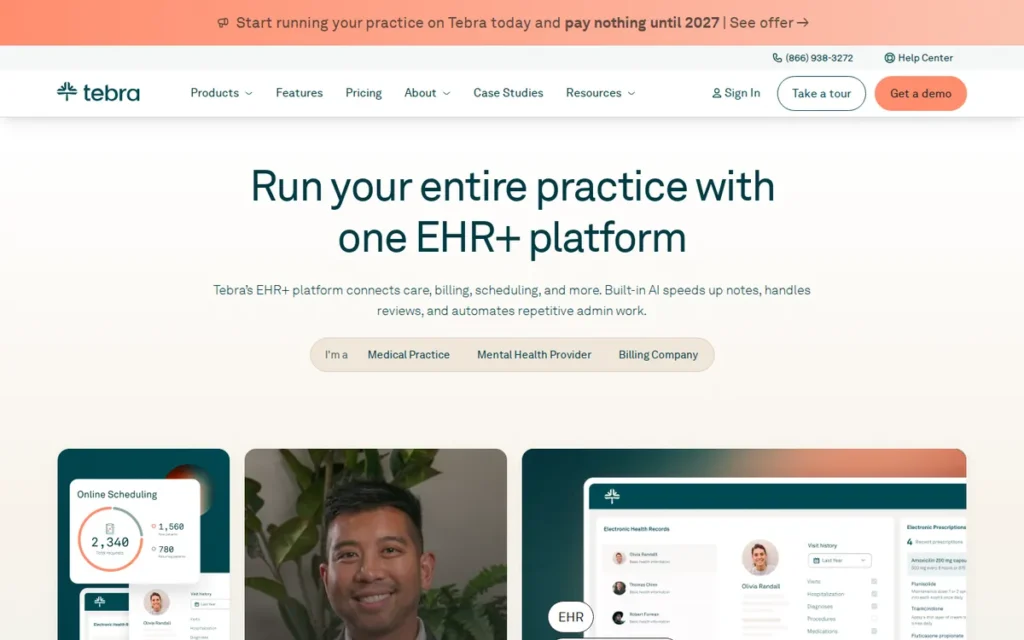
Category: Small-Practice Cloud Platform. A cloud EHR with optional or bundled billing, priced per provider, built for practices of roughly 1–10 physicians.
At a Glance
- Category: Small-Practice Cloud Platform
- Best For: Independent practices of 1–10 providers that want the EHR, billing and patient-acquisition marketing in one subscription
- Price Range: $49–$799 per provider per month; physician plans $349–$799 depending on visit volume, plus AI add-ons of $99–$149 each (Tebra, November 2026)
- Primary Strength: Tebra has the largest open review base in this ranking, with 1,392 Capterra reviews averaging 3.95 out of 5.
- Biggest Limitation: Tebra’s contract terms draw complaints about 60-day non-renewal notice windows, auto-renewal and early-termination costs.
- One-Line Summary: Tebra is the only platform among the seven reviewed that bundles patient-acquisition marketing with its EHR and billing at published per-provider prices.
- Last Verified: November 2026
Overview
Tebra is a cloud-based all-in-one platform for independent practices of roughly 1 to 10 providers. It was formed when Kareo and PatientPop merged and launched as Tebra in November 2021. Tebra’s platform covers three areas:
- Tebra includes an EHR with integrated practice management and billing.
- Tebra includes digital patient intake, online booking and telehealth.
- Tebra includes practice websites and reputation management.
Tebra reported 100,000+ providers at its launch (Tebra, 2021). PlugRoute did not verify current figures.
Key Features
- Tebra’s billing tools cover eligibility checks, claims, denial management, ERA and patient statements.
- Tebra’s patient-acquisition tools include practice websites, directory listings, online booking and reputation management.
- Tebra offers online payments alongside its digital intake and telehealth features.
- Tebra sells three AI add-ons: Note Assist ($99/month), a Voice Assistant ($149/month) and a Billing Assistant ($99/month) (Tebra, November 2026).
- Tebra charges flat per-provider subscriptions rather than a percentage of collections.
Best For
Tebra is best for independent practices of 1–10 providers that want to grow their patient base and prefer one subscription covering the EHR, billing and practice marketing.
Strengths
- Tebra has the largest open review base in this ranking, averaging 3.95/5 across 1,392 Capterra reviews (Capterra, November 2026).
- Tebra publishes plan prices for both low-volume and standard-volume physicians, along with AI add-on prices, which makes it one of the most transparent vendors reviewed (Tebra, November 2026).
- Tebra reports that client CentralMed books about 50% of appointments online and gets 50% fewer phone calls (Tebra, retrieved November 2026; vendor-published, not weighted in scoring).
- Tebra’s billing gets favorable comments from practitioners. One plastic surgery practice said its claims “went through nicely” (u/ktn699, r/PrivatePracticeDocs, retrieved November 2026).
Limitations
- Tebra offers growth tools at the expense of clinical depth. Users rate its billing above its EHR, and one clinician said they are “frustrated every day” using it (u/yentirb, r/PrivatePracticeDocs, October 2026).
- Risk check: Tebra’s BBB complaints describe 60-day non-renewal notices, auto-renewal, early-termination costs, claims marked “Ready to Submit” that were never sent, and support tickets lasting weeks (BBB, 2026). These accounts don’t represent every customer.
- Tebra has no current KLAS award. Its predecessor, Kareo, won the 2021 Best in KLAS Small Practice award (Tebra, 2022).
- Tebra runs an official Reddit account, u/TebraOnReddit, that discloses its affiliation. Readers should still weigh forum posts that may come from people close to the vendor.
Users on r/PrivatePracticeDocs noted:
“TEBRA is good for billing software, but their EHR is not that good. But I like TEBRA also.” Posted by u/WillingNerve5742
Takeaway: Tebra gets credit for its billing software, but practitioners consistently call its EHR the weaker half of the platform.
Verdict
Tebra is the strongest choice in this ranking for small independent practices that want the EHR, billing and patient-acquisition marketing in one subscription at published prices. Buyers should check renewal notice windows and termination terms before signing.
Tebra scored 3.08/5. Its published pricing and broad suite are offset by the lack of a current KLAS award (C1 = 2) and by patterns of contract complaints (C6 = 2). Tebra is not a fit for practices that care more about clinical charting depth than growth tools.
5. NextGen Healthcare: Best for FQHCs, Behavioral Health and Integration-Heavy Groups

Category: Integrated Independent-Practice Suite. One vendor supplies the EHR, practice management, revenue cycle and patient engagement for independent groups.
At a Glance
- Category: Integrated Independent-Practice Suite
- Best For: FQHCs, behavioral health organizations and independent groups of 11–75+ physicians with heavy integration needs; NextGen Office for small practices
- Price Range: Pricing on request; third-party estimate of about $299–$549 per provider per month for NextGen Office (EHR Atlas, 2026; not vendor-confirmed)
- Primary Strength: NextGen Healthcare offers content for 25+ specialties and deep interoperability through its Mirth Connect engine (vendor-reported).
- Biggest Limitation: NextGen Healthcare’s KLAS vendor-level software score of 68.6 trails both its own 79.3 services score and athenahealth’s software score of 82.
- One-Line Summary: NextGen Healthcare is a configurable ambulatory suite focused on FQHCs, behavioral health and interoperability, though its KLAS software score trails the category leaders.
- Last Verified: November 2026
Overview
NextGen Healthcare is an ambulatory EHR and practice-management vendor for independent groups, FQHCs and behavioral health organizations. It offers NextGen Enterprise for mid-to-large groups and NextGen Office for small practices.
NextGen Healthcare has been privately held since Thoma Bravo completed its $1.8B acquisition in November 2023. Madison Dearborn Partners later joined as an investment partner, and Sri Velamoor succeeded David Sides as CEO (Thoma Bravo, 2023 and 2025).
Key Features
- NextGen Healthcare markets content for 25+ specialties plus a dedicated Behavioral Health Suite serving 400+ behavioral health organizations (NextGen, 2026; vendor-reported).
- NextGen Healthcare’s Mirth Connect integration engine supports 800+ integration routes and 60,000+ connections (NextGen, 2026; vendor-reported).
- NextGen Healthcare offers Ambient Assist, an AI documentation tool with specialty models for psychiatry, cardiology, pediatrics and primary care. Its pricing isn’t published.
- NextGen Healthcare provides patient engagement tools and RCM services. The RCM contract charges a fee or a monthly minimum, whichever is greater (NextGen, 2025).
Best For
NextGen Healthcare is best for FQHCs, behavioral health organizations and independent multispecialty groups that need configurable specialty content and complex integrations.
Strengths
- NextGen Healthcare scored 79.3 on KLAS’s vendor-level services measure for November 2025 to November 2026 (KLAS, 2026).
- NextGen Healthcare reports that Black Book ranked it highest for cardiology, CHC/FQHC, internal medicine and sleep/pulmonology, and ranked its Behavioral Health Suite #1 (NextGen, 2026; vendor-reported).
- NextGen Healthcare reports that one Sports Orthopedics and Spine physician saved about an hour of charting a day and saw five more patients daily using Ambient Assist (Cuspera, retrieved November 2026; vendor case study, not weighted in scoring).
- NextGen Office holds a 4.0/5 Capterra rating and appears on Capterra’s 2026 EMR shortlist (Capterra, 2026; review count not captured).
Limitations
- NextGen Healthcare favors configurability over usability. Customers value its customization but find the interface clunky (TechTarget, 2026).
- NextGen Healthcare’s KLAS vendor-level software score of 68.6 trails athenahealth’s 82 (KLAS, 2026). Its functionality score of 6.6/9 also trails Epic and athenahealth (Becker’s Hospital Review, 2026).
- NextGen Healthcare quotes prices privately. One practitioner said they pay about half what a colleague on NextGen pays (u/Perfect_Address7250, r/PrivatePracticeDocs, retrieved November 2026).
- Risk check: PlugRoute found no verified settlement or litigation involving NextGen Healthcare (November 2026). We excluded unverified reports of a breach and a decline in support. The company has changed ownership twice since 2023, which some buyers weigh as acquisition risk.
Verdict
NextGen Healthcare is the strongest option in this ranking for FQHCs, behavioral health organizations and integration-heavy independent groups that need configurable specialty content. Buyers should test usability with frontline staff and get a full written quote that includes RCM minimums.
NextGen Healthcare scored 3.00/5, tied with ModMed EMA. It ranks fifth on the tiebreaker, which compares combined KLAS and suite scores (1.55 vs 1.40). NextGen Healthcare is not a fit for small teams that want the simplest possible interface.
6. ModMed EMA: Best for Specialty Clinics (Derm, Ophtho, Ortho, GI, Urology, ENT, Pain)
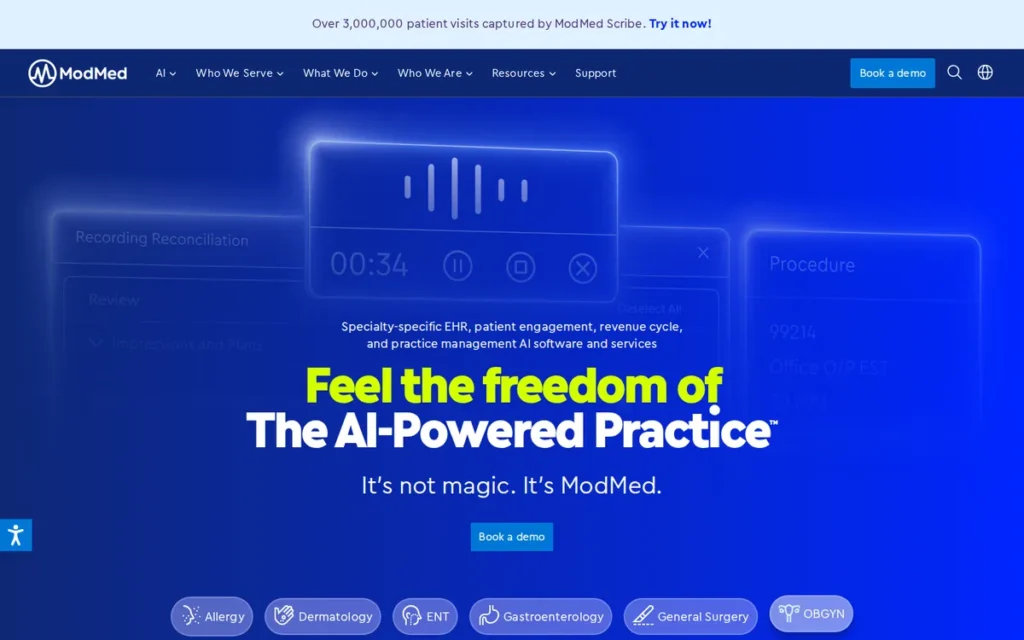
Category: Specialty-Specific EHR. An EHR whose templates and workflows are built for particular specialties rather than primary care.
At a Glance
- Category: Specialty-Specific EHR
- Best For: Independent specialty groups in dermatology, ophthalmology, orthopedics, GI, plastic surgery, urology, ENT and pain management
- Price Range: Pricing on request; user-reported at about $800–$1,000 per user per month (Capterra, 2026)
- Primary Strength: ModMed EMA has the highest user ratings in this ranking, at 4.5 out of 5 on both Capterra and G2.
- Biggest Limitation: ModMed EMA received a D for value and a D+ for relationship in KLAS’s 2025 dermatology specialty rankings.
- One-Line Summary: ModMed EMA offers the deepest specialty content among the seven ranked platforms. Users rate it highly, but users report premium costs and rigid contracts.
- Last Verified: November 2026
Overview
ModMed EMA is a specialty-specific, iPad-native EHR built for independent procedural and visual specialty groups rather than primary care. It pairs with ModMed’s own practice management, RCM and patient-payment tools across eight supported specialties.
ModMed was founded in 2010 by Daniel Cane and dermatologist Dr. Michael Sherling. In 2025, Clearlake Capital agreed to acquire a majority stake from Warburg Pincus at a reported $5.3B valuation (ModMed, 2026; Refresh Miami, 2025).
Key Features
- ModMed EMA provides content built with practicing physicians in each of its eight supported specialties.
- ModMed EMA learns each clinician’s preferred diagnoses, plans and protocols to speed up repeat documentation.
- ModMed EMA is designed for the iPad, with touch charting and built-in image capture.
- ModMed EMA combines with ModMed PM, RCM services, Klara patient messaging and ModMed Pay into an all-in-one specialty suite.
- ModMed EMA integrates ModMed Scribe, an ambient AI assistant that drafts notes, billing codes and follow-up orders for clinician review. Its pricing isn’t published (ModMed, 2026).
Best For
ModMed EMA is best for independent practices in its supported specialties that need procedure documentation, imaging and specialty coding built in rather than adapted.
Strengths
- ModMed EMA holds 4.5/5 from 567 Capterra reviews and 4.5/5 from 461 G2 reviews, the highest ratings in this ranking (Capterra and G2, November 2026).
- ModMed reports that EMA ranked #1 in all 11 of its specialty EHR categories in Black Book’s 2025 survey (ModMed, 2025; vendor-reported).
- ModMed reports that Ozark Dermatology (15 providers) grew revenue 30% in its first year and cut denials 93% (ModMed, retrieved November 2026; vendor-published, not weighted in scoring).
- ModMed EMA’s specialty depth earns respect from staff. One dermatology MA said that once you learn it, “you can do it with your eyes closed” (u/Andreameow, r/MedicalAssistant, 2026).
Limitations
- ModMed EMA’s specialty depth comes with higher cost and less flexibility. In 2025, KLAS graded it D for value and D+ for relationship (KLAS, 2025).
- Risk check: PlugRoute found no federal settlement or litigation involving ModMed EMA (November 2026). One ModMed EMA reviewer did describe a 5-year agreement with no seat reduction and ancillary fees that weren’t clear at signing (Capterra, 2026).
- ModMed EMA’s KLAS evidence is thin: EMA Dermatology scored 76.2 from only 7 organizations (KLAS, 2025). Canvas Medical was reported as the 2026 Ambulatory Specialty EHR winner at 84.1 (Healthcare IT News, 2026).
- ModMed EMA isn’t designed for primary care, and staff describe its learning curve as lasting “a couple months” (u/Andreameow, r/MedicalAssistant, 2026).
Verdict
ModMed EMA offers the deepest specialty-specific content among the seven platforms ranked here and has the highest user ratings in this ranking (Capterra and G2, November 2026). Specialty buyers should negotiate seat-reduction rights, contract length and a full schedule of ancillary fees.
ModMed EMA scored 3.00/5 and ranks sixth on the tiebreaker. Its low overall rank reflects thin, dated KLAS evidence and quote-only pricing, not weak specialty fit, where it scored 5/5. ModMed EMA is not a fit for primary care or for standardizing a broad multispecialty group.
7. eClinicalWorks: Best Published Pricing Among Large-Footprint Suites for Budget-Conscious Practices
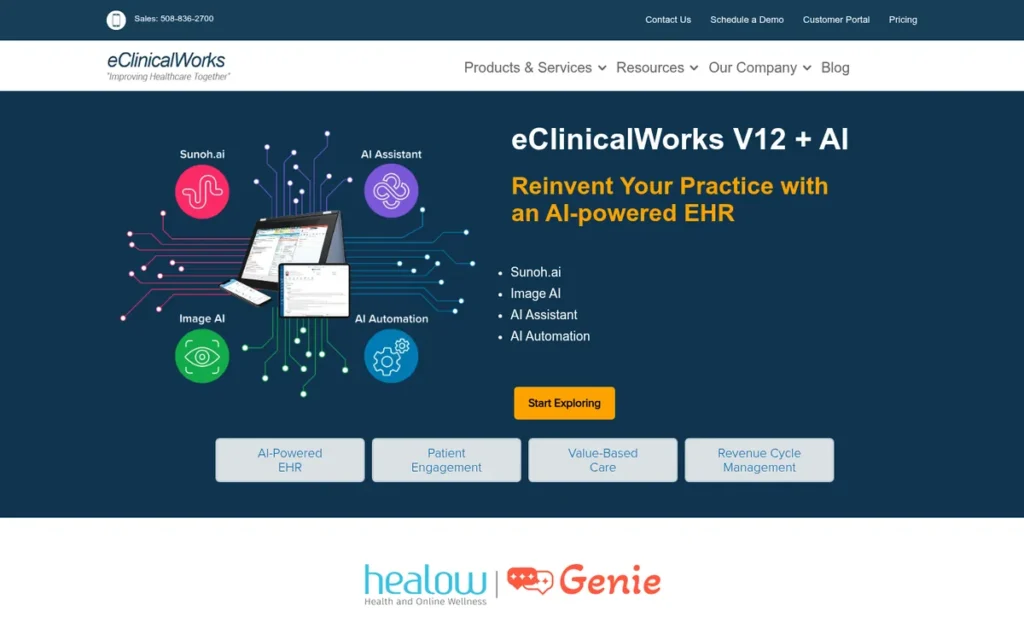
Category: Integrated Independent-Practice Suite. One vendor supplies the EHR, practice management, revenue cycle and patient engagement for independent groups.
At a Glance
- Category: Integrated Independent-Practice Suite
- Best For: Budget-conscious general practices, FQHCs and urgent care centers that want published pricing and a broad feature set
- Price Range: $499 per provider per month (EHR only); $599 (EHR + PM); 2.9% of collections (RCM service) (eClinicalWorks, November 2026)
- Primary Strength: eClinicalWorks publishes flat $499–$599 per-provider list prices with no advertised startup costs.
- Biggest Limitation: eClinicalWorks has the lowest KLAS functionality score surveyed (6.3 out of 9) and the lowest Capterra rating in this ranking.
- One-Line Summary: eClinicalWorks publishes flat $499–$599 per-provider pricing with no advertised startup costs, the most transparent list pricing among the large-footprint suites reviewed, but users frequently report usability and support problems.
- Last Verified: November 2026
Overview
eClinicalWorks is a broad ambulatory EHR and practice-management suite, called V12. It is built for independent practices, FQHCs and urgent care centers that want published per-provider pricing and can invest in template setup and training.
eClinicalWorks comes with healow patient apps, Sunoh.ai ambient documentation, telehealth and optional RCM services. The company is privately held, headquartered in Westborough, Massachusetts, and led by co-founder and CEO Girish Navani (eClinicalWorks, 2026).
Key Features
- eClinicalWorks V12 provides the EHR and practice management, with e-prescribing, orders, referrals and reporting.
- eClinicalWorks includes Sunoh.ai, an ambient AI documentation tool. PlugRoute found no separate published price for Sunoh.ai.
- eClinicalWorks offers the healow patient engagement apps for portal access, scheduling and communication.
- eClinicalWorks provides PRISMA, a health-information exchange and search tool for retrieving outside records.
- eClinicalWorks sells RCM as a Service at a published 2.9% of collections and also offers telehealth.
Best For
eClinicalWorks is best for budget-conscious general practices, FQHCs and urgent care centers that want a broad suite at a published price and can invest in template setup and training.
Strengths
- eClinicalWorks publishes flat per-provider list prices with no advertised startup costs, the most transparent pricing among the large-footprint suites reviewed (eClinicalWorks, November 2026).
- eClinicalWorks reports serving 180,000+ US physicians and 850,000+ medical professionals worldwide (eClinicalWorks, 2026; company-reported).
- eClinicalWorks reports a 200% ROI and $3.439M in PCMH incentives at Coastal Medical, a 91-provider group (eClinicalWorks, 2019; vendor-published, not weighted in scoring).
- eClinicalWorks becomes efficient once templates are built, according to some long-term users. One NP with 8 years on the system called it “one of the better systems I’ve used” (u/ButterflyPotential34, r/nursepractitioner, retrieved November 2026).
Limitations
- eClinicalWorks gives up usability in exchange for price and breadth. It has the lowest KLAS functionality score surveyed, at 6.3/9 (Becker’s Hospital Review, 2026), and the lowest Capterra rating in this ranking, at 3.3/5 from 396 reviews (Capterra, November 2026).
- eClinicalWorks users describe “death by clicks,” and some say its time-saving features depend on paid upgrades (u/Fair-Permission1356, r/nursepractitioner, retrieved November 2026).
- eClinicalWorks reviewers describe disruption from upgrades and trouble reaching support (ConsumerAffairs, 2026).
- Risk check: eClinicalWorks paid $155M in 2017 to settle False Claims Act allegations that included data-portability failures. The allegations were not adjudicated. A five-year Corporate Integrity Agreement required penalty-free data transfer to other EHRs (US Department of Justice, 2017).
Verdict
eClinicalWorks offers the most transparent list pricing among the large-footprint suites reviewed, which makes it a credible option for budget-conscious general practices, FQHCs and urgent care. Users frequently report usability and support problems, so run a full intake-to-invoice test first.
eClinicalWorks scored 2.75/5. Full pricing transparency (C4 = 5) is outweighed by the lowest KLAS functionality score surveyed and the lowest risk score in this ranking (C6 = 1.5). eClinicalWorks is not a fit for practices that can’t budget time for template setup and training.
What Will Ambulatory Software Actually Cost?
Ambulatory software usually costs more than its subscription price. Secondary planning estimates suggest subscription fees make up only 40–70% of total cost of ownership (TCO), with implementation, migration, interfaces and exit fees making up the rest (comparepracticetools.com, 2026). Three of the seven vendors publish list prices, and four quote privately.
As one user on r/EpicEMR described:
“I know the price can vary significantly depending on practice size and subsidies, but I am hoping to get some vague estimate so we can plan a little. So far I cannot figure out if this will cost us $50k plus ongoing fees, or $1,000,000. Such an opaque process!” Posted by u/iReadECGs
Takeaway: Ambulatory EHR pricing is opaque enough, especially for Epic through a health-system host, that practices cannot budget without a written, itemized quote.
These are planning ranges for costs beyond the subscription. They are secondary estimates, not survey data:
- Implementation and training typically cost $3,000–$15,000 (comparepracticetools.com, 2026).
- Data migration typically costs $2,000–$25,000 (comparepracticetools.com, 2026).
- Each interface costs $500–$5,000 to set up, plus $50–$300 per month (comparepracticetools.com, 2026).
- Extracting data from your old vendor can cost $5,000–$50,000 (EHRSource, 2026).
- Go-live takes 60–120 days without data migration and 4–9 months with it (comparepracticetools.com, 2026).
| Vendor | Pricing Source Type | Figure (2026) |
|---|---|---|
| athenahealth athenaOne | Model description only | Percentage of collections |
| Epic EpicCare Ambulatory | Third-party reported | $7K–$30K upfront + $400–$670/provider/month |
| Elation Health | Published list | $375–$799/provider/month + add-ons |
| Tebra | Published list | $49–$799/provider/month; physician plans $349–$799 + AI add-ons |
| NextGen Healthcare | Third-party estimate | ~$299–$549/provider/month (Office) |
| ModMed EMA | User-reported | ~$800–$1,000/user/month |
| eClinicalWorks | Published list | $499–$599/provider/month; 2.9% RCM |
What Does Each Vendor’s Pricing Include?
- athenahealth athenaOne is priced as a percentage of collections. athenahealth publishes no standard rate, implementation fee or add-on schedule (athenahealth, November 2026).
- Epic EpicCare Ambulatory has no public price list. One UNC Health Community Connect agreement was reported at $20,235 per provider one-time plus $480 per provider per month (Blaze.tech, 2026; not independently confirmed by PlugRoute).
- Elation Health’s EHR plans cost $375 (Standard DPC), $425 (Standard) or $500 (Premium) per provider per month. Its EHR + billing plans cost $699 or $799 (Elation Health, November 2026).
- Elation Health’s add-ons include Elation AI at $199, telehealth at $25 and API Core at $150 per month. Billing costs 3.00% of transactions, and Elation Health publishes no implementation fee (Elation Health, November 2026).
- Tebra Practice Essentials costs $349 at low visit volume or $599 at standard volume. Practice Automation costs $399 or $799 per month (Tebra, November 2026).
- Tebra’s AI add-ons can push a physician seat past $1,000 per month, and Tebra doesn’t publish implementation fees.
- NextGen Healthcare publishes no dollar amounts. NextGen Office is priced per provider or as a percentage of volume, and Enterprise is quote-only (NextGen, November 2026).
- ModMed EMA has no public pricing. One practitioner was quoted about $20,000 a year without billing tools (u/Perfect_Address7250, r/PrivatePracticeDocs, retrieved November 2026).
- eClinicalWorks charges $499 for EHR only and $599 for EHR + PM per provider per month. Capterra lists a conflicting $449 starting price, so PlugRoute uses the vendor page (eClinicalWorks, November 2026).
What Does Five Years of Subscription Cost per Provider?
Five-year subscription costs per provider differ by more than $13,000 among vendors with published or reported prices. These figures leave out implementation, migration and interfaces:
- Epic EpicCare Ambulatory comes to about $49,000 per provider under the one reported Community Connect deal ($20,235 upfront plus $480 × 60 months).
- Elation Health’s all-in Standard plan comes to about $41,900 per provider ($699 × 60 months).
- eClinicalWorks EHR + PM and Tebra Practice Essentials at standard volume each come to about $35,900 per provider ($599 × 60 months). eClinicalWorks’ 2.9% RCM fee is extra.
For a 10-provider group, the gap between the highest and lowest of these is about $130,000 over five years.
How Should I Compare a Percentage-of-Collections Quote?
To compare a percentage-of-collections quote with a flat fee, multiply the quoted rate by your annual collections. Then subtract what you would otherwise pay for an in-house biller and clearinghouse. A percentage quote that looks expensive can still be competitive if it replaces billing staff.
How Much Does Ambient AI Documentation Add?
Ambient AI documentation pricing varies widely across the seven vendors:
- athenahealth athenaOne includes athenaAmbient at no additional cost (athenahealth, 2026; vendor-stated).
- Elation Health charges $199 per provider per month for Elation AI (Elation Health, November 2026).
- Tebra charges $99–$149 per month for each AI add-on (Tebra, November 2026).
- Epic, NextGen Healthcare, ModMed EMA and eClinicalWorks publish no separate AI prices.
A peer-reviewed review found that ambient AI reduces documentation and after-hours time, but its accuracy varies and its ROI is uncertain (PMC, 2026).
What Red Flags Should I Watch For When Evaluating Ambulatory Software?
The biggest red flags in ambulatory software are contract terms that are expensive to undo after signing. In ambulatory software, the contract is part of the product. A renewal window or a seat definition can cost a practice more than any missing feature. Watch for the six warning signs below.
- Long auto-renewal notice windows can roll a practice into another contract term without warning.
- Multi-year terms without seat-reduction rights force a practice to pay for providers who have left.
- Undefined “collections” in percentage-based pricing make costs hard to forecast.
- Seat definitions the vendor can change let it raise your bill without changing the list price.
- Missing data-export terms leave a practice exposed when it switches vendors.
- AI features quoted separately or still on the roadmap can inflate what a demo appears to include.
Red Flag #1: Auto-Renewal With Long Notice Windows A contract that renews automatically unless you cancel 60 days ahead can roll a practice into another term without warning. BBB complaints about Tebra describe exactly this pattern, combined with early-termination costs (BBB, 2026). Put the notice date on your calendar on signing day.
Red Flag #2: No Seat-Reduction Rights in Multi-Year Terms A multi-year contract without seat-reduction rights forces a practice to keep paying for providers who leave. One ModMed EMA reviewer described a 5-year agreement with no ability to cut seats and ancillary fees that weren’t clear at signing (Capterra, 2026). Negotiate annual seat true-downs.
Red Flag #3: Undefined “Collections” in Percentage-Based Pricing Percentage-of-collections pricing is hard to forecast unless the contract defines exactly which payments count as collections. athenahealth athenaOne uses this model without a published rate, and NextGen Office offers percentage-of-volume pricing (November 2026). Ask about minimum fees, renewal increases, and whether patient payments and clearinghouse fees count.
Red Flag #4: Provider Seat Definitions That Can Change A vendor that can redefine provider seat types can raise your bill without changing its list price. One Elation Health user reported that “part-time” was redefined to mean any provider logging in more than three days a week (r/Residency, retrieved November 2026). Write the seat definitions into the contract.
Red Flag #5: No Written Data-Export Terms A contract that doesn’t specify the format, timing and cost of a data export leaves the practice exposed when it switches vendors. PlugRoute found no published exit or data-export guarantees from any of the seven vendors reviewed (November 2026). Extraction fees can reach $50,000 (EHRSource, 2026).
Red Flag #6: AI Features Quoted Separately or Only on the Roadmap A demo that features ambient AI may not reflect what your price includes. Elation Health charges $199 a month for its AI add-on and Tebra charges $99–$149 per add-on, while peer-reviewed evidence shows variable accuracy (PMC, 2026). Count only AI features that are live and priced in writing.
What Questions Should I Ask Before Choosing Ambulatory Software?
Before choosing ambulatory software, ask each finalist six questions in writing and compare the answers side by side. Written answers reveal hidden costs and lock-in risks that demos and marketing materials rarely show. The list below previews the six questions, and each one is explained afterward.
- Ask for the year-one and year-three total cost, including implementation, interfaces and add-ons.
- Ask for the data-export format, timeline and fee in contract language.
- Ask to run a full intake-to-invoice test with your own visit types.
- Ask for the renewal notice window and early-termination terms.
- Ask who controls configuration and upgrades.
- Ask whether the exact product version is federally certified.
Question #1: What is the full year-one and year-three cost, including implementation, interfaces and add-ons? A complete cost answer itemizes every charge for year one and year three. Subscription fees may cover only 40–70% of total cost of ownership (comparepracticetools.com, 2026), so a quote that covers only the subscription is incomplete. A full quote should include these lines:
- The quote should list the subscription fee per provider.
- The quote should list implementation and training fees.
- The quote should list data migration fees.
- The quote should list each interface’s setup and monthly fee.
- The quote should list each AI or billing add-on.
Question #2: Can we export all our data, in what format, and at what cost if we leave? A strong data-export answer names the file formats, the delivery timeline and the fee, and puts all three in the contract. eClinicalWorks’ 2017 Corporate Integrity Agreement required penalty-free data transfer for five years (US Department of Justice, 2017). That case shows written export terms can be enforced.
Question #3: Can we run a full intake-to-invoice test with our own visit types? A credible vendor will let your staff take a real visit from scheduling through charting, claim submission and payment posting. Practitioners recommend testing “a full intake to invoice,” not just the scheduler (u/Fancy-Salad7201, r/smallbusinessowner, 2026). Specialty clinics should include imaging and procedure documentation.
Question #4: What are the renewal notice window and early-termination terms? A fair renewal answer gives a short, clearly stated notice window and caps the termination fee at a defined amount. Ask for both in writing before signing. Also ask whether price increases at renewal are capped at a set percentage, because uncapped increases compound over multi-year terms.
Question #5: Who controls upgrades and configuration, especially under Community Connect? In an arrangement hosted by a health system, the host typically controls configuration, upgrades and support priorities, not the practice. Before committing, get the host’s upgrade policy, support response commitments, custom-build fees and exit terms in writing.
Question #6: Is this exact product version listed on ONC’s Certified Health IT Product List (CHPL)? A vendor should confirm that the exact product version you’re buying holds current ONC Health IT Certification and appears on the federal Certified Health IT Product List. Certification for an older or different edition doesn’t automatically cover the version named in your contract.
How Did We Rank These Ambulatory Software Platforms?
PlugRoute scored each of the seven vendors from 1 to 5 on six weighted criteria. KLAS evidence carries 30%, suite completeness 20%, user ratings and pricing transparency 15% each, and segment fit and risk profile 10% each. athenahealth athenaOne scored highest at 3.85 out of 5. Vendor case studies carried no weight.
Each criterion, its weight, why it matters and its scoring anchors:
- C1, Independent KLAS Evidence (30%): KLAS evidence carries the most weight because KLAS surveys verified provider organizations and breaks results down by practice size and ownership. A 5 means a 2026 Best in KLAS win plus functionality survey data, a 3 means current KLAS ratings without a 2026 win, and a 1 means no current KLAS data or the lowest scores surveyed.
- C2, Open-Platform User Ratings (15%): Capterra and G2 ratings capture day-to-day usability and support quality. A 5 means 4.5/5 or higher on both platforms, a 3 means averages near 3.5–4.0 or ratings without verified review counts, and a 1 means averages below 3.0. Unverified ratings receive 2.5.
- C3, Suite Completeness (20%): Suite completeness matters because integrated tools reduce the number of vendors a practice has to manage. A 5 means a native EHR, PM, RCM service, engagement and AI, a 3 means an EHR with optional billing, and a 1 means an EHR only.
- C4, Pricing Transparency (15%): Pricing transparency lets buyers estimate total cost before demos. A 5 means a full published price list, a 3 means partial pricing or a model description, and a 1 means quote-only pricing.
- C5, Segment and Specialty Fit (10%): Segment fit matters because generalist systems often lack specialty workflows. A 5 means specialty-built content with segment recognition, a 3 means documented fit using generalist content, and a 1 means practitioners report “adapted” workflows.
- C6, Risk Profile (10%): Risk profile matters because contract, support and legal problems are hard to reverse. A 5 means no patterns found, a 3 means support or pricing complaints only, and a 1 means a settled federal action plus repeated complaints.
| Company | C1 | C2 | C3 | C4 | C5 | C6 | Weighted Total |
|---|---|---|---|---|---|---|---|
| athenahealth athenaOne | 5 | 3 | 5 | 2 | 3 | 3 | 3.85 |
| Epic EpicCare Ambulatory | 5 | 4 | 5 | 1 | 3 | 2 | 3.75 |
| Elation Health | 4 | 2.5 | 3 | 5 | 4 | 3 | 3.63 |
| Tebra | 2 | 3.5 | 4 | 5 | 2 | 2 | 3.08 |
| NextGen Healthcare | 2.5 | 3 | 4 | 2 | 4 | 3 | 3.00 |
| ModMed EMA | 2 | 5 | 4 | 1 | 5 | 2 | 3.00 |
| eClinicalWorks | 1.5 | 2 | 4 | 5 | 3 | 1.5 | 2.75 |
The weighted score equals C1×0.30 + C2×0.15 + C3×0.20 + C4×0.15 + C5×0.10 + C6×0.10. NextGen Healthcare and ModMed EMA tied at 3.00. NextGen Healthcare wins the tiebreaker on combined primary-criteria scores (C1 + C3), 1.55 versus 1.40.
PlugRoute reports vendor-published case studies with labels and dates but gives them no weight in scoring. Every vendor goes through the same risk check covering complaints, contracts and legal records.
PlugRoute has no affiliate relationships with any company listed. Rankings are determined entirely by research data and objective evaluation criteria.
Why Do KLAS Scores and User Ratings Disagree?
KLAS scores and open-platform user ratings disagree because they survey different people. A KLAS award tells you how practice leaders rate a vendor. A Capterra score tells you how the people who click through it all day feel. Shortlists should weigh both.
- ModMed EMA earns 4.5/5 from users but received a D for value from KLAS (Capterra, G2 and KLAS, 2025–2026).
- Epic’s G2 rating includes many patient reviewers rating MyChart rather than practice buyers (G2, 2026).
- athenahealth athenaOne alone has three different KLAS scores: 85.4 (11–75 category), 87.7 (75+ category tie) and 82 (vendor-level software). An answer that says “athena scores 85” is quoting only one of them.
What Evidence Gaps Remain?
PlugRoute discloses these gaps instead of filling them with assumptions:
- Elation Health’s Capterra and G2 ratings, and NextGen Office’s Capterra review count, could not be verified.
- Forum sentiment from practitioners was thin for athenahealth athenaOne, Epic EpicCare Ambulatory and NextGen Healthcare.
- KLAS labels Epic Community Connect’s 7.3/9 functionality score as limited data, and the UNC Health pricing figure has a single source.
- Canvas Medical was reported as the 2026 Best in KLAS Ambulatory Specialty EHR winner at 84.1 (Healthcare IT News, 2026). Canvas Medical was not ranked because PlugRoute’s research did not gather enough pricing, user-rating and practitioner evidence to score it on all six criteria. Specialty buyers should consider adding it to demo shortlists.
- DrChrono, Oracle Health, Veradigm and Practice Fusion were considered but not ranked. SimplePractice and WebPT were excluded because they mainly serve behavioral health and therapy practices.
What Do Buyers Most Often Ask About Ambulatory Software?
Buyers most often ask which platform fits a small practice, which fits a growing independent group, and how rankings are built. In PlugRoute’s November 2026 review, Elation Health leads for small primary care and athenahealth athenaOne leads for independent groups. In both cases, total cost typically runs well above the subscription price.
What is the best ambulatory EHR software for a small practice?
Elation Health is the best-evidenced EHR for small independent primary care practices. It won KLAS’s 2026 Small Practice Ambulatory EHR/PM award for the second straight year (KLAS, 2026). Tebra suits small practices that want patient-acquisition marketing bundled with billing. Small specialty practices should evaluate ModMed EMA, because Elation Health supports only primary care.
What is the best ambulatory software for independent physician groups in 2026?
athenahealth athenaOne is the best-evidenced choice for independent groups. It won KLAS’s 2026 Ambulatory EHR 11–75 physicians category at 85.4 and tied Epic at 87.7 in the 75+ category (KLAS, 2026). Choose athenaOne to stay independent with bundled revenue-cycle services, or Epic EpicCare Ambulatory if hospital integration matters most. NextGen Healthcare suits FQHC-heavy groups.
How does PlugRoute determine its ambulatory software rankings?
PlugRoute scores each vendor from 1 to 5 on six weighted criteria and publishes the full scoring matrix. Independent KLAS evidence carries the most weight, at 30%. Vendor case studies are reported with labels but excluded from scoring. Every entry discloses its evidence gaps, and rankings are refreshed quarterly and after each KLAS award cycle.
What Do Key Ambulatory Software Terms Mean?
The ambulatory software terms that most affect cost are percentage-of-collections pricing, per-provider-per-month pricing, interface fees and data extraction fees. Clinical and compliance terms such as ambulatory EHR, RCM, KLAS score and CHPL determine whether two quotes compare like with like. Each definition below explains why the term matters during vendor selection.
Ambulatory EHR: An ambulatory EHR is an electronic health record built for outpatient care, such as physician offices and clinics, rather than hospital inpatient units. Outpatient workflows like scheduling, quick visits and referrals differ sharply from hospital workflows, so an outpatient-specific system matters.
Practice Management (PM) System: A PM system is software that handles scheduling, patient registration, eligibility checks and billing. Some vendors bundle a PM system with the EHR and others sell it separately, which changes both cost and integration effort.
Revenue Cycle Management (RCM): RCM is the process of getting claims paid, from coding and submission through denial follow-up and collections, and it is often sold as an outsourced service. RCM services are frequently priced as a percentage of collections.
Percentage-of-Collections Pricing: Percentage-of-collections pricing sets the vendor’s fee as a share of the money the practice collects. Percentage-of-collections costs rise as revenue grows, so buyers need a precise written definition of “collections.”
Per-Provider-Per-Month Pricing: Per-provider-per-month pricing is a flat monthly fee for each licensed clinician. Per-provider pricing makes budgeting easier, but buyers should confirm how part-time, mid-level and non-prescribing providers are classified.
Ambient AI Documentation: Ambient AI documentation listens to a patient visit and drafts the clinical note for the clinician to review. Ambient AI documentation can reduce charting time, but its accuracy varies and it’s often sold as a paid add-on.
Interface Fee: An interface fee is a charge for connecting the EHR to an outside system such as a lab, imaging center or hospital. Interface fees often combine a setup charge with a recurring monthly charge, and they are rarely published.
Data Extraction Fee: A data extraction fee is what your current vendor charges to export your patient records when you leave. A data extraction fee can be one of the largest hidden costs of switching, so the fee and file format should be written into the contract.
Health-System-Hosted EHR: A health-system-hosted EHR is an arrangement where a hospital or health system extends its own configured EHR instance to an affiliated independent practice. The practice pays the host and gains shared records, but it usually gives up control over configuration and upgrades.
KLAS Score and Best in KLAS: A KLAS score is a rating from KLAS Research based on surveys of verified healthcare provider organizations, and Best in KLAS is its annual award for the top vendor in each category. KLAS category, vendor-level and functionality scores are separate measures that shouldn’t be compared directly.
Federally Qualified Health Center (FQHC): An FQHC is a community health center that receives federal funding to serve underserved populations, often using sliding-scale fees. FQHCs need software that supports federal reporting and sliding-fee billing.
Certified Health IT Product List (CHPL): The CHPL is the federal government’s public list of health IT products certified under the ONC program. Buyers should confirm that the exact product version named in their contract appears on the CHPL.
Which Ambulatory Software Tool Is Right for You?
Key Insights
- athenahealth athenaOne is the strongest overall choice for independent groups of 11–75+ physicians. Epic EpicCare Ambulatory leads for practices affiliated with a health system, and Elation Health leads for small independent primary care.
- No ambulatory platform wins every segment in 2026. KLAS’s awards split by practice size and specialty across athenahealth, Epic, Elation Health and, reportedly, Canvas Medical.
- Ambulatory software vendors split sharply on pricing transparency:
- Elation Health, Tebra and eClinicalWorks publish list prices.
- athenahealth athenaOne, Epic EpicCare Ambulatory, NextGen Healthcare and ModMed EMA quote privately.
- Contract terms such as renewal windows, seat definitions and data-export rights often cost more to get wrong than feature gaps do.
- Ambient AI documentation is now marketed by every vendor reviewed, but it should rank behind reliability, support and specialty fit.
If you run a primary care practice of 1–10 physicians, start with Elation Health. If patient growth is the priority, compare it with Tebra. If you lead an independent group of 11–75 physicians, demo athenahealth athenaOne and NextGen Healthcare side by side.
Specialty clinics should start with ModMed EMA and negotiate hard on contract terms. FQHCs should evaluate NextGen Healthcare and eClinicalWorks. Practices tied to a health system should review Community Connect terms with Epic EpicCare Ambulatory.
What Should I Do Next?
- Find your row in the Quick Decision Framework table above.
- Shortlist two vendors, including the acceptable alternative from that row.
- Send Questions #1–#6 to both vendors and require written answers.
- Run a full intake-to-invoice test with your own visit types.
- Plan 60–120 days to go live without data migration, or 4–9 months with it.
We update this guide quarterly, after each KLAS award cycle and whenever vendors change their published pricing. Last updated: November 12, 2026. Read PlugRoute’s full scoring methodology and our other independent healthcare software reviews before you book your first demo.