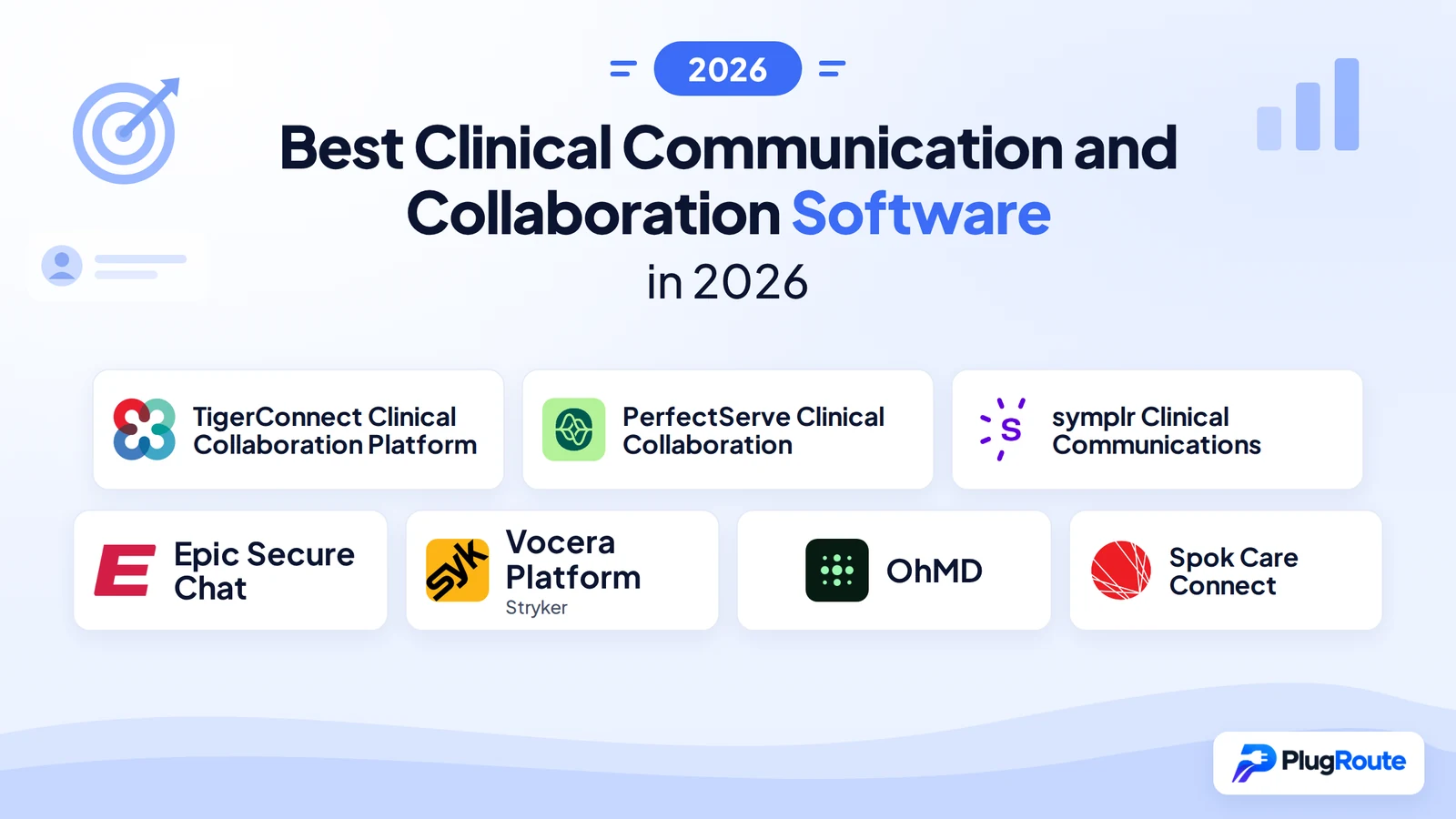
TigerConnect has the highest evidence-weighted score among standalone platforms for multi-system hospitals. PerfectServe leads for schedule-driven on-call routing, and symplr Clinical Communications is the closest-rated acute-care alternative. No single platform fits every organization. Your EHR, care setting and main problem decide the fit, and Epic-standardized hospitals should evaluate Epic Secure Chat first.
Most buyers are trying to retire pagers or disconnected alerting tools. At the same time, they deal with too many messaging apps, on-call coverage that keeps changing, urgent alerts nobody acknowledges, and quote-only pricing. This guide ranks seven platforms on dated, labeled evidence so you can defend a shortlist to clinical, security and finance stakeholders.
PlugRoute has no affiliate relationships with any company listed. Rankings are determined entirely by research data and objective evaluation criteria.
“My iPhone is my pager. Epic took over and we started using haiku chat within epic and that’s the new pager… the amount of apps the hospital makes you download is insane.” (u/gluten_is_kryptonite, r/Residency)
Takeaway: Clinicians judge a communication rollout by how many apps and devices it adds. That makes consolidation a selection criterion, not a nice-to-have.
What Are the 6 Categories of Clinical Communication and Collaboration Tools?
Clinical communication and collaboration (CC&C) tools fall into six categories. Standalone enterprise suites, schedule-driven routing platforms and EHR-native messaging cover most hospital needs. Voice-first hardware, paging hybrids and patient-facing practice messaging each solve a narrower problem: hands-free bedside calling, pager coexistence, or HIPAA-compliant patient texting for small clinics.
- Standalone Enterprise Suite: TigerConnect (#1) and symplr Clinical Communications (#3) combine HIPAA-compliant secure texting, schedule-aware routing, critical results notification and nurse-call connections outside the EHR.
- Schedule-Driven Routing Platform: PerfectServe (#2) routes calls and messages from live on-call schedules using its own Lightning Bolt scheduling engine.
- EHR-Native Messaging: Epic Secure Chat (#4) is built directly into the Epic EHR for care team collaboration inside the chart.
- Voice-First Hardware + Middleware: Vocera Platform by Stryker (#5) pairs wearable hands-free badges with alarm middleware aimed at reducing alarm fatigue.
- Patient-Facing Practice Messaging: OhMD (#6) provides HIPAA-focused patient texting and staff messaging for outpatient practices.
- Paging Network + Software Hybrid: Spok Care Connect (#7) combines a vendor-operated paging network with an operator console, a directory and smartphone messaging for gradual pager replacement.
How Do the Top Clinical Communication Platforms Compare at a Glance?
TigerConnect, PerfectServe and symplr Clinical Communications have the highest weighted scores. Epic Secure Chat is 0.15 points behind symplr, and OhMD and Spok Care Connect close the list because each serves a specialized need. The table below summarizes category, fit, capabilities, strengths and limitations so buyers can screen all seven platforms in one view.
| Rank | Company | Category | Best For | One-Line Summary | Key Capabilities | Primary Strength | Key Limitation |
|---|---|---|---|---|---|---|---|
| 1 | TigerConnect | Standalone Enterprise Suite | Multi-EHR hospitals consolidating tools | TigerConnect is the best-evidenced standalone clinical collaboration platform in 2026, with a near-top KLAS acute score and the largest G2 review base. | Role-based messaging, Amion/QGenda routing, FDA-cleared alarm management, nurse call, Smart Room | KLAS 2025 Acute 91.2 (n=25); G2 4.5, 195 reviews (Nov 2026) | App-store reports of missed notifications and logouts |
| 2 | PerfectServe | Schedule-Driven Routing Platform | Ambulatory, post-acute and on-call-heavy hospitals | PerfectServe scores highest on on-call routing depth in this comparison and won KLAS ambulatory/post-acute in 2025 and 2026. | Dynamic Intelligent Routing, Lightning Bolt scheduling, operator console | Owns its scheduling engine; seven named-site outcomes published (vendor-reported) | KLAS 2025 Acute 85.5 (n=34); 1 G2 review (Nov 2026) |
| 3 | symplr Clinical Communications | Standalone Enterprise Suite | Systems also buying workforce scheduling | symplr Clinical Communications is a closely rated acute-care alternative in 2026, scoring 90.2 in KLAS 2025. | Role/team messaging, VoIP, critical alerts, on-call scheduling | KLAS 2025 Acute 90.2 (n=16); G2 4.5, 148 reviews (Nov 2026) | No quantified outcomes; reports of undelivered messages |
| 4 | Epic Secure Chat | EHR-Native Messaging | Epic-standardized hospitals | Epic Secure Chat is the default first evaluation for Epic hospitals in 2026, with Best in KLAS acute-care wins in 2025 and 2026. | Chat inside Hyperspace, Haiku and Rover; team pools | KLAS 2025 Acute 91.3 (n=38); 2026 winner at 91.3 | Reported escalation and governance gaps; no public pricing |
| 5 | Vocera Platform (Stryker) | Voice-First Hardware + Middleware | Hands-free nursing units | Vocera is the primary hands-free voice option for bedside communication in 2026, but it needs a unit-level pilot. | Smartbadge, Vocera Engage middleware, Vocera Edge app | Only voice-first platform evaluated | KLAS 2025 Acute 78.9 (n=33); reported voice misrecognition |
| 6 | OhMD | Patient-Facing Practice Messaging | Small outpatient practices | OhMD is the best-fit option evaluated for small practices needing patient texting at a published price, not a hospital CC&C platform. | Patient SMS from practice number, team inbox, EHR integration | Only fully public price list; G2 4.8, ~170 reviews (Nov 2026) | No on-call, alarm or nurse-call capability |
| 7 | Spok Care Connect | Paging Network + Software Hybrid | Hospitals keeping pagers and operators | Spok Care Connect fits hospitals that must keep pagers and operator centers while adding smartphone messaging. | Paging network, operator console, directory, Spok Go | Owned paging network plus operator console | No KLAS CC&C score; G2 3.8, 12 reviews (Nov 2026) |
Which Clinical Communication Platform Should I Choose for My Use Case?
The fastest way to choose is to match your top priority to the platform built for it. Use your EHR as the first filter. Then look at on-call routing, legacy paging, hands-free voice or patient messaging. The table below maps each common priority to a recommended platform and an acceptable alternative.
Answer two questions before using the table:
- Is Epic your core EHR? If so, start with the Epic row.
- Are you a hospital or an outpatient practice? Small practices that need patient texting can go straight to the last row.
| Your #1 Priority | Recommended Tool | Why | Acceptable Alternative |
|---|---|---|---|
| Epic is your core EHR | Epic Secure Chat | Best in KLAS acute care in 2025 and 2026; no separate integration | A specialist layer (TigerConnect, PerfectServe, Vocera or Spok) for documented gaps |
| Non-Epic or mixed EHR, consolidating alarms and nurse call | TigerConnect | Broadest vendor-documented integration suite | symplr Clinical Communications |
| Reaching the right on-call clinician as coverage changes | PerfectServe | Owns its Lightning Bolt scheduling engine | TigerConnect (Amion/QGenda integrations) |
| Buying workforce scheduling at the same time | symplr Clinical Communications | Sold inside symplr’s Time and Scheduling Suite | PerfectServe (owned Lightning Bolt scheduling) |
| Hands-free bedside voice | Vocera Platform | Only voice-first wearable platform evaluated | No other voice-first wearable evaluated; smartphone apps cover calling but not hands-free use |
| Keeping pagers and operator centers | Spok Care Connect | Owned paging network plus operator console | PerfectServe operator console |
| Small practice needing patient texting | OhMD | Public pricing from $300/month with BAA | Not evaluated at equal depth (Spruce Health, OnPage excluded) |
What Are the Best Clinical Communication and Collaboration Platforms in 2026?
TigerConnect (4.28/5), PerfectServe (4.00) and symplr Clinical Communications (3.30) have the highest weighted scores in 2026. Epic Secure Chat (3.15), Vocera (2.88), OhMD (2.50) and Spok Care Connect (2.35) follow. A lower position often reflects missing public evidence or a specialized scope, not poor product quality.
In KLAS 2025 acute care, the top three clinical communication platforms finished within 1.1 points of each other: Epic Secure Chat 91.3, TigerConnect 91.2 and symplr 90.2. At that margin, EHR fit should decide, not score.
1. TigerConnect Clinical Collaboration Platform: Highest Weighted Score; Best for Multi-EHR Hospitals
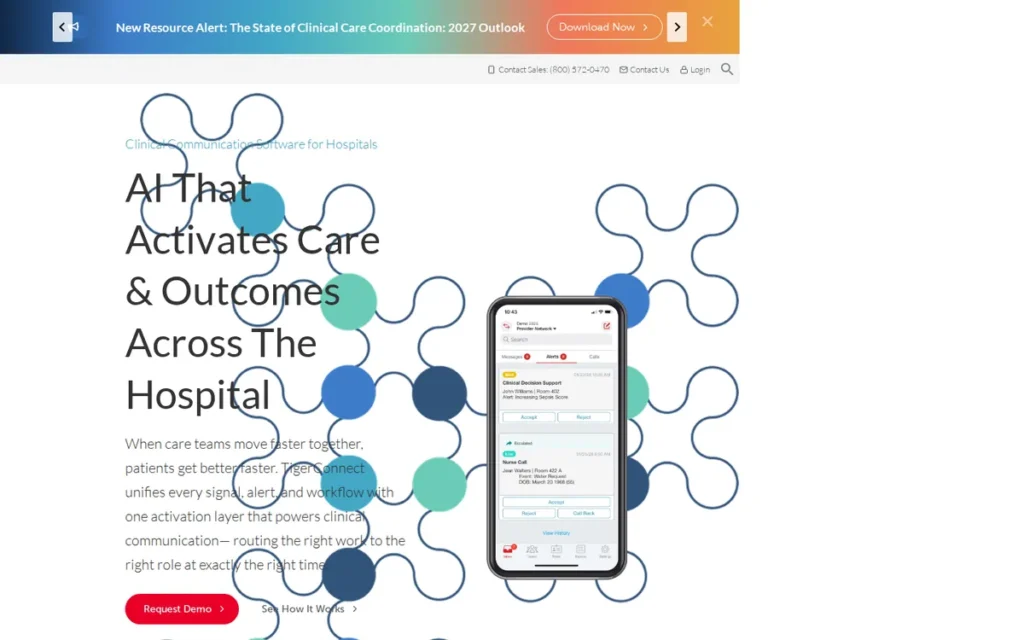
Category: Standalone Enterprise Suite. An independent CC&C platform that combines HIPAA-compliant secure texting, schedule-aware routing, alarms and nurse call outside the EHR.
At a Glance
- Category: Standalone Enterprise Suite
- Best For: Mid-size and large hospitals, including non-Epic and mixed-EHR systems, consolidating messaging, alarm and nurse-call tools
- Price Range: Quote-based; patient-messaging add-ons of $399–$1,299 per facility (TigerConnect Solutions Guide, 2024)
- Primary Strength: TigerConnect pairs a KLAS 2025 Acute Care score of 91.2 (n=25) with the broadest vendor-documented integration suite in this comparison.
- Biggest Limitation: TigerConnect app-store reviewers report missed urgent notifications, forced logouts and slow loading, so delivery reliability must be pilot-tested.
- One-Line Summary: TigerConnect is the best-evidenced standalone clinical collaboration platform in 2026, combining a near-top KLAS 2025 acute-care score with the largest G2 review base and the widest alarm, nurse-call and scheduling integration suite evaluated.
- Last Verified: November 2026
Overview
TigerConnect Clinical Collaboration Platform is a standalone, EHR-agnostic clinical communication suite for mid-size and large hospitals. It combines role-based secure messaging, schedule-driven on-call routing, alarm management, nurse call and patient-room engagement for organizations consolidating several communication tools.
TigerConnect has operated since 2010, originally as TigerText. It added nurse-call middleware when it acquired Critical Alert on January 6, 2021 (TigerConnect newsroom, 2021). TigerConnect ranks #1 because it scored 4 or higher on five of six criteria, even though it did not win a KLAS 2025 or 2026 category.
Key Features
- TigerConnect routes messages to whoever currently fills a role, pulling on-call schedules from its Amion and QGenda integrations.
- TigerConnect supports priority and escalated messages, auto-forwarding, read receipts, group messaging and do-not-disturb controls.
- TigerConnect Alarm Management received FDA 510(k) clearance (K243270) as a Class II secondary alarm notification device on September 30, 2025. Verified (FDA 510(k) database, 2025).
- TigerConnect integrates nurse call through its 2021 Critical Alert acquisition, and nurses report running it on hospital-issued Zebra phones. Users report (Reddit r/nursing, November 2026).
- TigerConnect Smart Room Suite extends the platform to interactive TVs, digital whiteboards, bedside tablets and door signs, with bidirectional Epic feeds. Vendor says (TigerConnect Smart Room page, November 2026).
Best For
TigerConnect Clinical Collaboration Platform is best for health systems that want one independent platform across multiple EHRs, departments and clinical systems. It fits especially well when the organization is replacing separate alarm-middleware or nurse-call notification tools.
Strengths
- TigerConnect scored 91.2 in the KLAS 2025 Clinical Communications Acute Care ranking from 25 organizations. That is 0.1 points behind Epic Secure Chat, effectively a tie. Verified (KLAS, 2025).
- TigerConnect holds a 4.5/5 G2 rating from 195 reviews, the largest review base in this comparison, with praise for ease of use, cross-platform support and read receipts. Verified (G2, November 2026).
- TigerConnect reports that Trinity Health System cut its ED left-without-being-seen rate from 3.63% in January 2023 to 0.5% in June 2023, after a February 2023 pilot. Trinity also raised sepsis-bundle compliance 46%. Vendor says, single site (TigerConnect case study, 2024).
- One r/nursing user preferred TigerConnect “maybe a little better than epic chat” because it lets nurses send photos of vitals or IV pumps. Users report (Reddit r/nursing, November 2026).
Users on r/nursing shared their experience:
“I loved it. Mostly because I could gifs to and pointless stuff to colleagues. It was our hospital system’s decision to move on. We then switched to the Voalte and had to carry those phones instead. I preferred TC and so did my colleagues. Voalte is fine though” Posted by u/InterestingAd1195
Takeaway: Frontline staff are attached enough to TigerConnect that some preferred it over the system their hospital switched to, which shows its adoption strength comes from everyday usability.
Limitations
TigerConnect trades breadth for reliability risk on some device fleets. Delivery complaints recur in app-store reviews even though its integration suite is the widest evaluated.
- TigerConnect app-store reviewers report missed urgent-message notifications, repeated logouts, sync issues and slow loading. These are individual reports, not a measured failure rate. Users report (Apple App Store and Google Play, November 2026).
- TigerConnect scored 86.5 in KLAS 2025 Ambulatory/Post-Acute, behind PerfectServe (94.1) and symplr Clinical Communications (89.2), and this research found no 2026 KLAS category score for it. Verified (KLAS, 2025).
- TigerConnect creates a parallel channel when it runs alongside Epic Secure Chat, so Epic organizations need explicit rules on which tool carries which message (Mindbowser, November 2026).
- TigerConnect publishes no core licensing prices, and G2 reviewers mention provider-search friction and glitches. Users report (G2, November 2026).
Verdict
TigerConnect has the highest score in this comparison for hospitals that want one EHR-agnostic platform covering messaging, on-call routing, alarms and nurse call in 2026. Its near-top KLAS acute-care score and 195-review G2 base give it the most consistent evidence profile evaluated.
Buyers should still require a reliability pilot that covers unacknowledged urgent messages and shared-device logins before signing.
2. PerfectServe Clinical Collaboration: Best for Schedule-Driven On-Call Routing
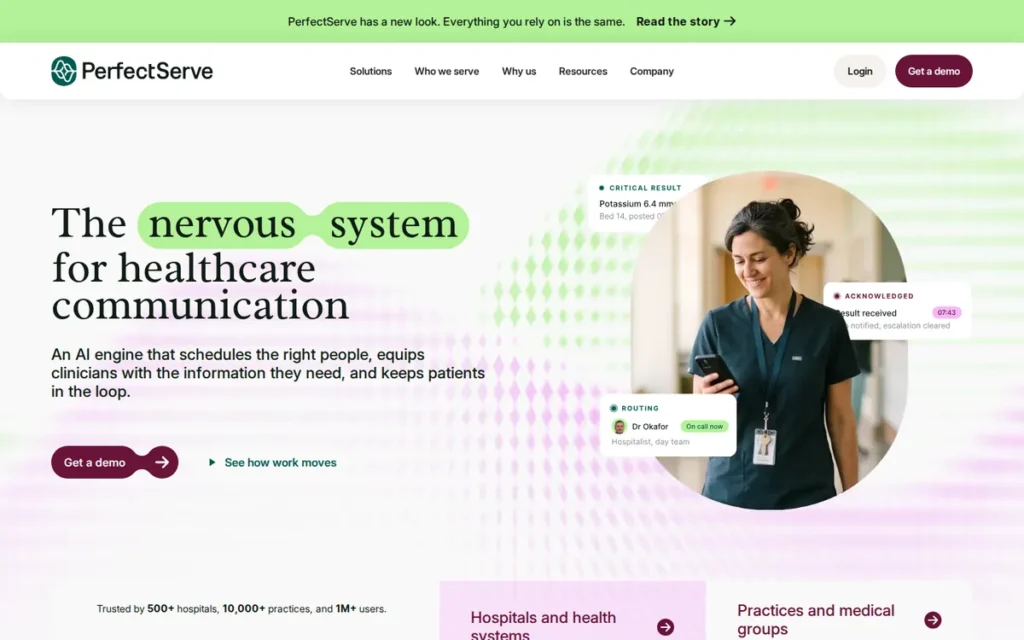
Category: Schedule-Driven Routing Platform. A CC&C platform built to route messages and calls to the right on-call clinician from live schedules.
At a Glance
- Category: Schedule-Driven Routing Platform
- Best For: Ambulatory groups, post-acute networks and hospitals whose main problem is reaching the right on-call clinician
- Price Range: Quote-based; priced per hospital bed, per operator and per person scheduled (PerfectServe FAQ, November 2026)
- Primary Strength: PerfectServe owns its Lightning Bolt scheduling engine, so routing follows live coverage changes without a third-party schedule integration.
- Biggest Limitation: PerfectServe scored 85.5 in KLAS 2025 Acute Care (n=34), below the top three acute vendors, and has only one G2 review.
- One-Line Summary: PerfectServe is the highest-scoring platform on on-call routing depth in this comparison and won the KLAS Ambulatory/Post-Acute Clinical Communications category in 2025 and 2026.
- Last Verified: November 2026
Overview
PerfectServe Clinical Collaboration is a clinical communication platform that routes calls and messages to the correct on-call clinician from live schedules. It is built for ambulatory groups, post-acute networks and hospitals where daily coverage changes make the right person hard to reach.
PerfectServe pairs this routing with its own Lightning Bolt provider-scheduling product, acquired in 2019, and with operator-console tools (PerfectServe news release, 2019). PerfectServe’s peer-review score of 2 comes from the not-demonstrated rule for a single G2 review. Its 0.28-point gap to #1 is therefore mainly an evidence-volume gap.
Key Features
- PerfectServe Dynamic Intelligent Routing sends calls and messages by role, schedule, message type, service line, urgency and time of day, with escalation.
- PerfectServe Lightning Bolt feeds schedule changes directly into message routing and operator-console transfers, so PerfectServe owns its schedule source instead of integrating one.
- PerfectServe says it offers EHR-embedded messaging with Epic and Oracle Health (Cerner) integrations. Vendor says (PerfectServe homepage, November 2026); this research did not independently verify integration depth.
- PerfectServe added Telmediq secure messaging and CareWire patient SMS engagement through acquisitions.
- PerfectServe provides an operator console for hospital switchboards, priced by number of operators.
Best For
PerfectServe is best for physician groups, ambulatory and post-acute networks, and hospitals whose top problem is routing messages to the correct on-call clinician when schedules change daily.
Strengths
- PerfectServe won 2026 Best in KLAS for Clinical Communications Ambulatory/Post-Acute with 89.0, after scoring 94.1 for the 2025 award in the same category. Verified (KLAS, 2025 and 2026).
- PerfectServe reports that Munson Healthcare retired 600 of its 1,497 pagers (about 40%) across 7 hospitals. Munson’s pager spending fell from roughly $20,000 to $10,000 a month, about $120,000 a year. Vendor says, single site (PerfectServe Munson Healthcare case study, 2026).
- PerfectServe reports that MemorialCare cut callback time from 45 to 14 minutes and Hospital for Special Surgery improved rapid-response time 73%. These are two of seven named-site outcomes PerfectServe publishes. Vendor says, unaudited (PerfectServe solution page, November 2026).
- PerfectServe Lightning Bolt scored 90.8 in 2026 KLAS Physician Scheduling, against a KLAS software average of 81.1. Verified (KLAS, 2026).
Limitations
PerfectServe trades acute-care standing for routing specialization. It scores lower with acute-care hospitals than with ambulatory and post-acute customers.
- PerfectServe scored 85.5 in KLAS 2025 Acute Care from 34 organizations, roughly 5–6 points behind Epic Secure Chat, TigerConnect and symplr Clinical Communications. Verified (KLAS, 2025).
- PerfectServe has a single G2 review (3.5/5), which gives no meaningful peer-review signal, so buyers must rely on KLAS and reference calls. Verified (G2, November 2026).
- PerfectServe offers no alarm-management or nurse-call suite comparable to TigerConnect’s in this research, and its Epic and Oracle Health integration depth is vendor-stated.
- PerfectServe community sentiment is under-sampled, because a large PerfectServe Reddit result could not be analyzed in this research.
Users on r/nursing noted:
“Best I can do is perfectserve. It’s far from perfect….” Posted by u/Mountain_Fig_9253
Takeaway: Nurses who use PerfectServe day to day call it an imperfect messaging tool, so its KLAS routing strength still needs confirming through frontline reference calls.
Verdict
PerfectServe is the best-evidenced choice in 2026 for organizations whose central problem is routing messages to the right on-call clinician as coverage changes. Its owned scheduling engine and consecutive KLAS ambulatory/post-acute wins give clinical teams concrete evidence.
PerfectServe’s published pricing units give finance teams inputs that most rivals do not provide. Acute-care hospitals should weigh its 85.5 acute score against the top three before an enterprise-wide rollout.
3. symplr Clinical Communications: Best for Buyers Pairing Messaging With Workforce Tools
Category: Standalone Enterprise Suite. An independent CC&C platform that combines secure messaging, schedule-aware routing, critical results notification and on-call management outside the EHR.
At a Glance
- Category: Standalone Enterprise Suite
- Best For: Health systems using or evaluating symplr workforce products that want a closely rated acute-care alternative
- Price Range: Quote-based; no published pricing (symplr, November 2026)
- Primary Strength: symplr Clinical Communications scored 90.2 in KLAS 2025 Acute Care (n=16), within about one point of the category leaders.
- Biggest Limitation: symplr Clinical Communications has no quantified named-site outcomes in this research, and Google Play reviewers report hangs and messages not arriving.
- One-Line Summary: symplr Clinical Communications is a closely rated acute-care alternative to Epic Secure Chat and TigerConnect in 2026, pairing a 90.2 KLAS 2025 score with built-in on-call scheduling and symplr’s broader workforce suite.
- Last Verified: November 2026
Overview
symplr Clinical Communications, formerly Halo Health, is an enterprise secure-messaging and on-call platform for hospitals and health systems. It combines role-based messaging, VoIP calling, critical alerts and on-call schedule management to coordinate care teams across roles and shifts.
symplr Clinical Communications became part of symplr when the Halo Health acquisition closed on October 13, 2021 (Clearlake press release, 2021). It leads Epic Secure Chat by 0.15 weighted points. It wins on peer reviews (3.5 vs. 2) and routing depth (4 vs. 2.5) and trails on KLAS (4 vs. 5).
Key Features
- symplr Clinical Communications provides role-, team- and provider-based secure messaging, so messages reach the current role-holder rather than a fixed name.
- symplr Clinical Communications supports VoIP calling over the hospital network from the same app.
- symplr Clinical Communications delivers critical alerts and results from nurse call, PACS, labs and the EHR to care-team devices.
- symplr Clinical Communications takes its on-call schedule from symplr’s bundled Time and Scheduling Suite, although this research did not confirm out-of-the-box integration between the products.
- symplr Clinical Communications supports an off-duty status. Reviewers say it lacks a recurring off-duty schedule and requires the work app on personal phones (BYOD). Users report (Google Play, 2025).
Best For
symplr Clinical Communications is best for acute-care health systems that want a highly rated alternative to the two acute-care leaders. It fits especially well when the organization is consolidating communication, workforce scheduling and timekeeping under one vendor.
Strengths
- symplr Clinical Communications scored 90.2 in the KLAS 2025 Clinical Communications Acute Care ranking from 16 organizations. That placed it third, behind Epic Secure Chat (91.3) and TigerConnect (91.2). Verified (KLAS, 2025).
- symplr Clinical Communications holds a 4.5/5 G2 rating from 148 reviews, with praise for ease of use, security and team coordination. Verified (G2, November 2026).
- symplr Clinical Communications scored 89.2 in KLAS 2025 Ambulatory/Post-Acute from a small sample of 7 organizations. Verified (KLAS, 2025).
- symplr Clinical Communications bundles on-call scheduling with role-based routing, which handles changing coverage within one vendor relationship. Vendor says (symplr product pages, November 2026).
Limitations
symplr Clinical Communications has proven peer satisfaction but thin outcome and integration evidence, so buyers will need to produce their own proof in a pilot.
- symplr Clinical Communications has a Google Play rating of 3.7 from 137 reviews, including a 2025 report of frequent hangs and messages not arriving. Users report (Google Play, 2025).
- symplr Clinical Communications case-study pages contain no quantified outcomes, and this research could not verify its middleware and Epic integration depth (symplr case studies, November 2026).
- symplr Clinical Communications G2 reviewers criticize messages expiring too soon, glitches, cost and user confusion. Users report (G2, November 2026).
- symplr Clinical Communications has small KLAS samples (16 acute, 7 ambulatory). No Reddit discussion was found, which reflects limited data rather than a clean record.
Verdict
symplr Clinical Communications is the strongest third option for acute-care hospitals in 2026, scoring within about one KLAS 2025 point of Epic Secure Chat and TigerConnect. Its 148-review G2 base and bundled on-call scheduling earn it a place on the shortlist.
Buyers should request quantified reference outcomes and pilot-test message delivery, because this research documented neither.
4. Epic Secure Chat: Best for Epic-Standardized Hospitals
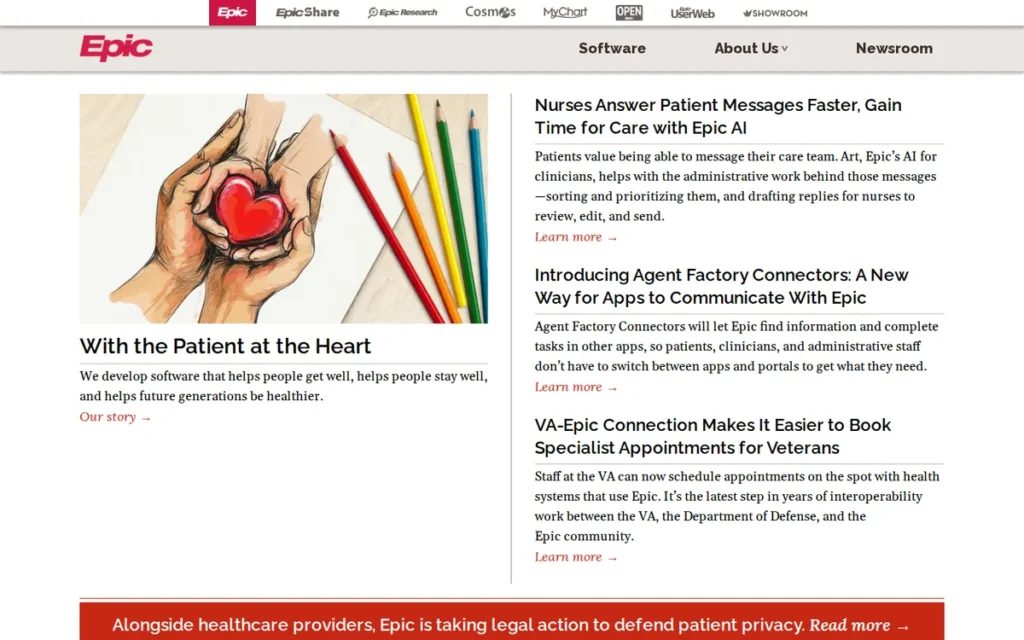
Category: EHR-Native Messaging. Secure chat built directly into the electronic health record rather than delivered as a separate platform.
At a Glance
- Category: EHR-Native Messaging
- Best For: Hospitals standardized on Epic that want staff messaging inside the EHR workflow with fewer separate apps
- Price Range: Not published; confirm whether it is included in your Epic license
- Primary Strength: Epic Secure Chat posted the top KLAS 2025 Acute Care score (91.3) from the category’s largest sample of 38 organizations and won again in 2026 at 91.3.
- Biggest Limitation: Epic Secure Chat users report governance gaps, such as direct messages to absent staff bypassing team pools, and escalation depth is reported to be limited.
- One-Line Summary: Epic Secure Chat is the default first evaluation for Epic-based hospitals in 2026, offering EHR-native messaging with Best in KLAS acute-care wins in 2025 and 2026 but limited public evidence on escalation, outcomes and pricing.
- Last Verified: November 2026
Overview
Epic Secure Chat is secure messaging built into the Epic EHR’s desktop (Hyperspace) and mobile (Haiku, Rover) apps. It is designed for Epic-standardized hospitals that want clinicians to message inside the patient-care workflow without a separate platform or integration project.
Epic Secure Chat ranks #4 because three of its six criterion scores (peer reviews, outcomes and pricing) reflect missing public evidence, not documented weakness. Hospitals often run it alongside a standalone platform such as TigerConnect or Imprivata Cortext, which requires deliberate channel governance (Mindbowser, November 2026).
Key Features
- Epic Secure Chat sits inside Hyperspace, Haiku and Rover, so clinicians message within the patient chart context.
- Epic Secure Chat uses Epic’s patient and care-team context, including team pools that send messages to a group rather than one person.
- Epic Secure Chat can be enabled or disabled organization-wide. Users report (Reddit r/EpicEMR, November 2026).
- Epic Secure Chat links to Voalte phones and Mobile Heartbeat devices in some deployments. Users report (Reddit r/nursing, November 2026).
- Epic Secure Chat has no detailed public feature specification from Epic, so this research could not check its routing and escalation features against Epic documentation.
Best For
Epic Secure Chat is best for Epic-standardized acute-care hospitals that want to reduce app sprawl and keep non-urgent coordination inside the EHR. A specialist layer can be added only where escalation, alarm or voice gaps remain.
Strengths
- Epic Secure Chat won 2025 Best in KLAS for Clinical Communications Acute Care with 91.3 from 38 organizations, the largest sample in the category. Verified (KLAS, 2025).
- Epic Secure Chat won 2026 Best in KLAS for Clinical Communications Acute Care at 91.3, the same score as its 2025 win. A separate KLAS product view showing 75.5 uses a different period and measure. Verified (KLAS 2026 ranking page, 2026).
- Epic Secure Chat requires no separate integration project in Epic environments and carries native patient and care-team context (Mindbowser, November 2026).
- One ED nurse said Epic Secure Chat is “a lot faster than physically walking around the department, and it doesn’t interrupt the way phone calls do.” Users report (Reddit r/nursing, November 2026).
Limitations
Epic Secure Chat trades native convenience for urgent-communication depth and governance control. Its value depends on how the organization configures pools and mobile access.
- Epic Secure Chat users report that direct messages to an absent team member go unseen, with one user saying “it’s creating a lot of loopholes.” Users report (Reddit r/EpicEMR, November 2026).
- One nurse called Epic Secure Chat “only semi-useful because people aren’t constantly at their computer,” so its reach depends on a Haiku and Rover mobile rollout. Users report (Reddit r/nursing, November 2026).
- A HIMSS 2025 commentary criticizes Epic Secure Chat for lacking urgency levels, escalation and role-based on-call alerting. OnPage, a competing alerting vendor, wrote it (OnPage, 2025).
- Epic Secure Chat has no G2 or Capterra listing, no named-site outcomes and no published pricing in this research, and it does not serve non-Epic organizations.
Users on r/nursing noted:
“I use Epic Secure chat. It functions fine, and I can use the Epic Haiku app on my phone. The only issue is when people mark themselves as unavailable, you can’t send them a message at all. We have providers leave themselves as unavailable the entirety of their day. Not a big deal, we just page them, but seriously, the secure chat is so much less intrusive to the day and workflow for a provider I would think.” Posted by u/Asmarterdj
Takeaway: Epic Secure Chat works well enough on mobile, but availability-status controls let providers opt out of it entirely, which pushes urgent traffic back to pagers.
Verdict
Epic Secure Chat should be the first product an Epic-standardized hospital evaluates in 2026. It won Best in KLAS acute care in 2025 and 2026 and needs no separate integration. Its #4 position reflects limited public evidence, not poor provider satisfaction.
Buyers should test urgent-alert escalation, mid-shift on-call changes and pool governance before deciding whether they also need a specialist layer.
5. Vocera Platform (Stryker): Best for Hands-Free Bedside Voice
Category: Voice-First Hardware + Middleware. Wearable hands-free voice devices paired with alarm middleware that aims to reduce alarm fatigue for bedside staff.
At a Glance
- Category: Voice-First Hardware + Middleware
- Best For: Nursing units that need hands-free, point-of-care voice communication and alarm filtering, after a Wi-Fi survey and a voice pilot
- Price Range: Quote-based; hardware, software and subscription quoted separately (Stryker, November 2026)
- Primary Strength: Vocera is the only platform evaluated that is built around hands-free, voice-first communication for bedside staff.
- Biggest Limitation: Vocera scored 78.9 in KLAS 2025 Acute Care (n=33), the lowest of the five vendors scored, and a highly upvoted r/nursing thread describes repeated voice misrecognition.
- One-Line Summary: Vocera by Stryker is the primary hands-free voice option for bedside clinical communication in 2026, but its 78.9 KLAS 2025 acute-care score and reported voice-recognition problems make a unit-level pilot essential.
- Last Verified: November 2026
Overview
Vocera Platform by Stryker is a hands-free clinical communication system for nurses and bedside staff. It combines the wearable Vocera Smartbadge, the Vocera Edge smartphone app and Vocera Engage alarm middleware so staff can make voice calls and receive filtered alerts without using their hands.
Vocera Platform became part of Stryker when the acquisition closed on February 23, 2022, at about $2.97 billion in equity value. Verified (Stryker press release, 2022).
Key Features
- The Vocera Smartbadge lets users say “OK Vocera” to call by name, role, group or extension, and it adds secure messaging, contextual alerts and a panic button.
- The Vocera Smartbadge weighs 89 g, carries an IP54 rating, has a 2.4-inch touchscreen and uses a swappable battery rated at 4 hours active and 40 hours standby. Vendor says (Stryker Smartbadge page, November 2026).
- Vocera Engage middleware filters, prioritizes and escalates alarms, and Stryker says it integrates with more than 150 clinical systems, including EHRs, nurse call, ventilators and monitors.
- The Vocera Edge smartphone app supports secure messaging and barcode medication-administration workflows, and residents report it running on personal phones (BYOD). Users report (Reddit r/Residency, November 2026).
- Vocera administrators can configure phonetic “alternate names” to improve voice recognition, according to a former Vocera trainer. Users report (Reddit r/nursing, November 2026).
Best For
Vocera Platform is best for nursing units where hands-free calling and bedside alarm filtering matter more than text-first messaging. The hospital needs reliable Wi-Fi and a budget for device lifecycle costs.
Strengths
- Vocera had been selected by more than 2,300 facilities, including nearly 1,900 hospitals, when Stryker announced the acquisition. Verified (Stryker press release, 2022).
- Vocera reports that Sentara Princess Anne Hospital improved door-to-needle time by 47% and University of Michigan Health-West saw 54% fewer duplicate alarms. The brochure does not always tie each metric to one site. Vendor says (Vocera platform brochure, November 2026).
- Vocera reports that UnityPoint Health–Allen Hospital saved 22 minutes per bedside nurse per discharge. Vendor says (Vocera platform brochure, November 2026).
- Vocera Smartbadge users praise hands-free calling and hot-swappable batteries in a KLAS smart-devices report. Verified (KLAS report hosted by Zebra, November 2026).
Limitations
Vocera trades hands-free convenience for voice-recognition and infrastructure risk. Its value depends heavily on configuration and Wi-Fi quality.
- Vocera scored 78.9 in KLAS 2025 Acute Care from 33 organizations, about 12 points below the leaders. Verified (KLAS, 2025).
- Vocera voice recognition draws complaints in a highly upvoted thread (“ask for John smith and vocera be like… ‘finding Melinda Bates'”). Nurses report more failures on non-Anglophone names, and configuring phonetic alternate names can partly fix this. Users report (Reddit r/nursing, November 2026).
- Vocera users and the KLAS device report cite Wi-Fi dependence, mid-shift drop-offs on personal phones, breakable clips and fragility when dropped.
- Vocera holds a 4.3/5 G2 rating from only 14 reviews, a low-confidence sample, and its total cost includes hardware lifecycle and network readiness beyond software. Verified (G2, November 2026).
Users on r/nursing shared their experience:
“I’m sure its better than Epic! I will say the one downside of vocera is we don’t have phones, so we have to use it on the computer/try to type stuff out on our tiny voceras.” Posted by u/jdoodlern
Takeaway: Nurses rate Vocera’s chat above EHR-native messaging, but badge-only deployments make text replies awkward without companion smartphones.
Verdict
Vocera by Stryker remains the primary choice in 2026 for hospitals that specifically need hands-free bedside voice communication, even though it has the lowest 2025 KLAS acute-care score of the vendors scored.
Vocera Engage’s vendor-stated integration with more than 150 clinical systems and Vocera’s published named-site outcomes support a place on a nursing-unit shortlist. Buyers should complete a Wi-Fi survey and a unit-level voice pilot with staff whose names vary widely.
6. OhMD: Best for Small Practices Needing Patient Texting
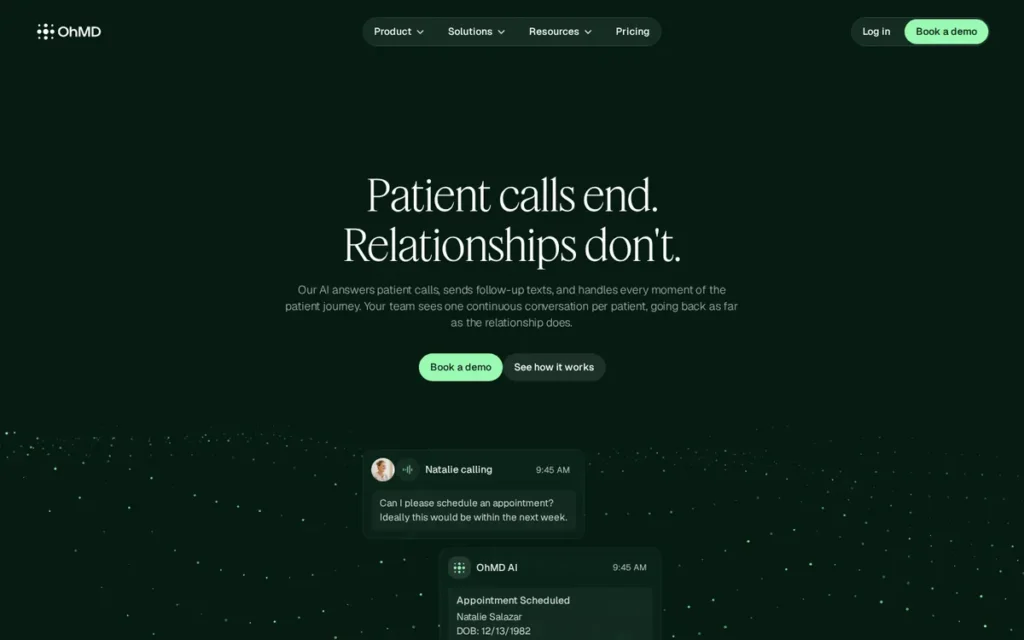
Category: Patient-Facing Practice Messaging. HIPAA-focused patient texting and team inbox tools for outpatient practices, not hospital-wide CC&C.
At a Glance
- Category: Patient-Facing Practice Messaging
- Best For: Small and mid-size outpatient practices that need HIPAA-compliant patient texting plus internal staff messaging
- Price Range: From $300/month (Communicate) and $500/month (Automate); Enterprise custom (OhMD pricing page, November 2026)
- Primary Strength: OhMD publishes the only fully public price list among the platforms evaluated and includes a BAA in its entry tier.
- Biggest Limitation: OhMD has no hospital on-call scheduling, alarm management or nurse-call integration, so OhMD is not designed to replace enterprise CC&C.
- One-Line Summary: OhMD is the best fit among evaluated platforms for small practices in 2026 that need HIPAA-compliant patient texting and staff messaging at a published price, but it is not a hospital clinical communication platform.
- Last Verified: November 2026
Overview
OhMD is a HIPAA-focused patient communication platform for small and mid-size outpatient practices. It offers two-way texting from the practice’s existing phone number, voice and video calling, a shared inbox and team messaging for clinics that need patient messaging rather than hospital on-call alerting.
OhMD was founded in 2014 in Burlington, Vermont (OhMD About, November 2026). OhMD ranks #6 because the criteria measure enterprise inpatient capability, not because OhMD is weak within its own segment.
Key Features
- OhMD sends two-way SMS from the practice’s existing landline or VoIP number, so patients do not need to download an app.
- OhMD includes voice and video calling, voicemail transcription, call-to-text handoff, website chat and patient broadcasts.
- OhMD provides internal team messaging and a shared inbox for front-desk and clinical staff.
- OhMD integrates with more than 85 EHR and practice-management systems, including athenahealth, eClinicalWorks, NextGen and AdvancedMD, in its Automate tier.
- OhMD offers the “Nia” AI voice and text agent for routine calls and routing in its Automate tier.
Best For
OhMD is best for small and mid-size outpatient practices that need affordable patient texting and staff messaging under a signed BAA, and that do not need hospital on-call routing, alarms or nurse call.
Strengths
- OhMD publishes the only fully public price list in this comparison. Its Communicate plan starts at $300/month and includes MFA and a BAA. Verified (OhMD pricing page, November 2026).
- OhMD holds a 4.8/5 G2 rating from about 170 reviews, with praise for ease of use and texting from the main practice number. Verified (G2, November 2026).
- OhMD reports that Integrated Spine & Joint Institute cut intake calls from 15–20 minutes to about 5 minutes and reached 90% text confirmation versus 30% by phone. The practice estimates $100,000–$120,000 a year in added revenue. Vendor says, single site (OhMD case study, November 2026).
- OhMD reports that Pediatric Care of Ogden saw a 13% decrease in no-shows. Vendor says, single site (OhMD case study, November 2026).
Limitations
OhMD trades enterprise scope for small-practice simplicity, and OhMD is not designed for inpatient care teams.
- OhMD has no hospital on-call scheduling, alarm management, nurse-call integration or KLAS recognition.
- OhMD’s pricing page does not say whether the $300 and $500 starting prices are per practice or per provider. Multi-provider practices therefore cannot model total cost from published figures (OhMD pricing page, November 2026).
- OhMD includes EHR integration only in the $500/month Automate tier and bills calling usage separately.
- OhMD G2 reviewers report slowness, glitches, session timeouts, limited customization and support that is sometimes slow or chat-only, and this research did not verify OhMD’s SOC 2 status. Users report (G2, November 2026).
Verdict
OhMD is the most suitable option among the evaluated platforms for small outpatient practices in 2026 that need HIPAA-compliant patient texting and team messaging at a published price. Its #6 overall position reflects enterprise-focused criteria, not weakness within its segment.
Practices should budget for OhMD Automate if they need EHR integration, and should get the pricing unit confirmed in writing.
7. Spok Care Connect: Best for Hospitals Keeping Pagers and Operators
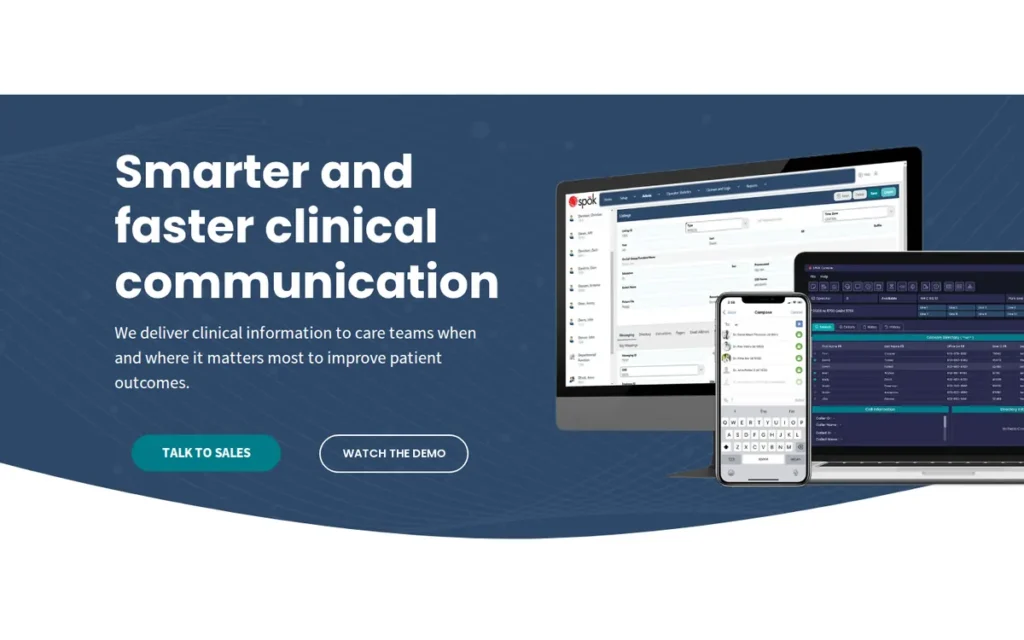
Category: Paging Network + Software Hybrid. A vendor-operated paging network combined with smartphone messaging, operator console and directory software for gradual pager replacement.
At a Glance
- Category: Paging Network + Software Hybrid
- Best For: Hospitals that will keep pagers and operator centers while gradually adding smartphone messaging
- Price Range: Quote-based; no published pricing for pagers or Spok Go (Spok, November 2026)
- Primary Strength: Spok Care Connect is the only platform evaluated that combines a vendor-operated paging network with operator console, directory and cloud messaging.
- Biggest Limitation: Spok Care Connect has no KLAS clinical communications score in this research and a low-volume G2 rating (3.8/5 from 12 reviews).
- One-Line Summary: Spok Care Connect is the strongest fit in 2026 for hospitals that must keep pagers and operator centers while adding smartphone messaging, but it lacks the independent KLAS evidence of the category leaders.
- Last Verified: November 2026
Overview
Spok Care Connect is a clinical communication suite for hospitals that are modernizing while they keep pagers and switchboards. It combines the Spok Go cloud platform, Spok Mobile messaging, paging on Spok’s own network, operator console, on-call scheduling and directory.
Spok Care Connect comes from Spok, a Nasdaq-listed company (SPOK) formed in 2014 from the merger of USA Mobility and Amcom Software (Spok company history, November 2026). Spok Care Connect ranks #7 mainly because no KLAS score was found, which scores 1 on the 30%-weighted KLAS criterion.
Key Features
- Spok Care Connect includes one-way and two-way paging on what Spok describes as the largest U.S. paging network, with vendor-stated 99.92% network reliability.
- Spok Care Connect provides an operator and call-center console with a web directory for hospital switchboards.
- Spok Care Connect delivers secure smartphone messaging through Spok Mobile and the Spok Go cloud platform.
- Spok Care Connect ties on-call scheduling and clinical alerting to operator workflows, so the operator console is the schedule source.
- Spok Care Connect supports pagers and smartphones on the same platform, so units can mix devices during a transition. Vendor says (Spok Care Connect page, November 2026).
Best For
Spok Care Connect is best for hospitals with large paging, operator and directory operations that need new smartphone messaging to coexist with pagers rather than replace them immediately.
Strengths
- Spok reported about 675,000 paging units in service at year-end 2025, documenting the scale of its paging operation. Verified (Spok Annual Report, 2025).
- Spok says more than 2,200 hospitals use its products and more than 65 million messages pass through each month. Vendor says (Spok, 2025).
- Spok Care Connect triggers operator workflows from Epic ADT events and shows patient information in the directory at VHC Health, though this research did not verify integration with Epic Secure Chat specifically. Vendor says (Spok case study, November 2026).
- Spok says Black Book’s 2025 survey ranked it highest in clinical communications customer experience for the 8th consecutive year. This result was announced by Spok and is not a KLAS rating (Spok release via AccessNewswire, 2025).
Limitations
Spok Care Connect trades paging continuity for weaker independent validation of its smartphone messaging layer.
- Spok Care Connect had no KLAS clinical communications score in this research, and its only satisfaction award is vendor-announced.
- Spok holds a 3.8/5 G2 rating from 12 reviews, a low-confidence sample. Verified (G2, November 2026).
- Spok Mobile App Store reviewers criticize navigation, threading, search, message history, alert acknowledgment and login after switching phones. Users report (Apple App Store, November 2026).
- Spok’s own SEC filings list declining paging units and long software sales cycles as risks (Spok SEC filing, 2026). This research found no named-site outcomes or Reddit discussion, which reflects limited data rather than a clean record.
Verdict
Spok Care Connect is the most practical choice in 2026 for hospitals that will keep pagers and operator centers through a long transition. Its owned paging network and operator console make Spok the only evaluated vendor that runs pagers and smartphone messaging under one provider.
Buyers should pilot-test Spok Mobile acknowledgment and search and request peer references, because independent evidence for the smartphone layer is thin.
Should an Epic Hospital Use Secure Chat or a Separate Platform?
Epic-standardized hospitals should evaluate Epic Secure Chat first. It won Best in KLAS acute care in 2025 (91.3, n=38) and again in 2026, and it needs no separate integration. Add a specialist platform only where testing exposes gaps in escalation, alarm routing, hands-free voice or paging coexistence, and plan channel governance if you run both.
Spok’s 2025 survey reports that most health systems run two secure-messaging platforms. The number running four or more rose 89% year over year (Spok survey, 2025). A paging vendor runs that survey, so treat the figures as directional.
The choice between Epic Secure Chat and TigerConnect usually comes down to one question. Does EHR-native messaging meet your urgent-escalation and alarm requirements? TigerConnect documents those capabilities; Epic does not publicly specify them.
This aligns with community sentiment on r/nursing:
“On Epic secure chat you can attached patients info (name etc) but on tiger I have to mention room 21 Mr. Meow etc otherwise recipient has not idea whom the sender is talking about. I miss Epic.” Posted by u/Altruistic-Item-1217
Takeaway: TigerConnect loses the native patient context Epic Secure Chat provides, so Epic hospitals adding TigerConnect should expect clinicians to identify patients manually in every message.
Epic Secure Chat alone may be enough when:
- Epic Secure Chat is deployed on Haiku and Rover mobile devices, not desktop only.
- Epic Secure Chat team pools are enforced, so messages to absent staff are not missed.
- Epic Secure Chat meets your urgent-escalation requirements in a live test.
A separate platform is worth adding when:
- The hospital needs alarm middleware or nurse-call routing, which TigerConnect and Vocera document.
- The hospital needs schedule-driven routing tied to an owned scheduling engine, such as PerfectServe Lightning Bolt.
- The hospital must keep pagers and operator consoles, which Spok Care Connect is built for.
How Much Does Clinical Communication Software Cost?
Only one of the seven platforms evaluated, OhMD, publishes a full price list, starting at $300/month. Every enterprise vendor requires a quote. PerfectServe publishes its pricing units, and TigerConnect publishes only patient-messaging add-on fees. Epic, symplr, Vocera and Spok publish no pricing (vendor pricing pages, November 2026).
| Platform | Published Pricing | Pricing Unit or Note |
|---|---|---|
| TigerConnect | Quote; add-ons $399–$1,299 per facility (2024) | Patient messaging included below 10,000/month; $399 at 10,000–49,000; $1,299 above 50,000 |
| PerfectServe | Quote; no dollar amounts | Per hospital bed (Clinical Communication), per operator (Operator Console), per person scheduled (Lightning Bolt) |
| symplr Clinical Communications | Quote only | G2 reviewers list cost among criticisms |
| Epic Secure Chat | Not published | Confirm whether it is included in your Epic license |
| Vocera Platform | Quote; hardware separate | Badges, batteries, clips, replacements and Wi-Fi readiness quoted separately |
| OhMD | From $300/month (Communicate); from $500/month (Automate) | Enterprise custom; per-practice vs. per-provider unit not stated; calling billed separately |
| Spok Care Connect | Quote only | No published pricing for pager units or Spok Go |
TigerConnect’s add-on figures date from 2024 and may have changed. One TigerConnect Capterra reviewer reported charges continuing after cancellation (Capterra, November 2026). It is a single report, but it is a good reason to review exit terms.
Spok reported FY2025 revenue of $139.7 million. That included $72.5 million in wireless revenue, of which $68.6 million was paging, and $67.1 million in software (Spok Annual Report, 2025).
Spok’s revenue mix shows continued reliance on paging. It does not indicate financial distress.
PerfectServe’s Munson Healthcare case is the only quantified pager-retirement saving found. Munson retired 600 of its 1,497 pagers, about 40%, and monthly pager spending fell from roughly $20,000 to $10,000. Vendor says, single site (PerfectServe Munson Healthcare case study, 2026). Munson halved its pager spending without eliminating paging.
Use these steps to compare quotes like for like:
- Ask each vendor to quote on the same unit, such as per bed, per user or per facility, using PerfectServe’s published units as a template.
- Ask voice and paging vendors such as Vocera and Spok to separate hardware, batteries, replacements and Wi-Fi readiness from software costs.
- Ask every vendor to put renewal, price-escalation and termination terms in writing.
- Ask Epic to confirm whether Secure Chat is included in your existing license.
What Red Flags Should I Watch For When Evaluating Clinical Communication Software?
The most serious red flags are missing acknowledgment and escalation tracking, recurring reports of missed notifications, and KLAS awards cited without year or setting. Quotes that leave out hardware, required personal devices, and vendor-run surveys presented as independent evidence also signal risk. Each red flag below is a named checkpoint for vendor evaluation.
Red Flag #1: No Acknowledgment or Escalation Tracking
A clinical communication platform that cannot show who acknowledged an urgent message, or that does not escalate automatically when no one responds, falls short of what this category is primarily bought to do. Ask vendors to demonstrate an unacknowledged critical result reaching a backup clinician on a timer.
Red Flag #2: Reliability Complaints About Missed Notifications
Recurring app-store or review-site reports of messages not arriving, or of forced logouts, are a patient-safety signal even when they are individual anecdotes. This research found such reports for TigerConnect, symplr Clinical Communications and Spok Mobile, so pilot-test delivery on your own devices and Wi-Fi.
Red Flag #3: KLAS Award Cited Without Year, Setting or Sample Size
A KLAS score means little without its year, care setting and sample size. PerfectServe scored 94.1 with ambulatory customers and 85.5 with acute-care hospitals in KLAS 2025, an 8.6-point gap from care setting alone (KLAS, 2025).
symplr’s 2023 Best in KLAS win was for Time and Attendance, not Clinical Communications (symplr press release, 2023). Epic Secure Chat’s 2026 Best in KLAS score (91.3) and a separate KLAS product-view figure (75.5) use different measures and periods. Citing either number without its measure is misleading.
Red Flag #4: Quotes That Exclude Hardware, Wi-Fi and Integration Costs
A software-only quote can understate the total cost of voice badges, pagers or smartphone fleets by leaving out hardware and services. Require a line-item quote that separates each of these cost categories:
- Device costs for badges, pagers or smartphones should appear as their own line.
- Battery and replacement-unit costs should be listed separately from devices.
- Wi-Fi and network upgrade costs should be estimated before contract signature.
- Integration services should be priced per interface, such as EHR, nurse call and monitors.
Red Flag #5: Required Personal Devices With No Stipend or Remote-Wipe Policy
A rollout that requires clinicians to use personal phones without a stipend, mute and off-duty controls, or a remote-wipe policy risks poor adoption and PHI exposure. Clinicians on Reddit cite required personal-phone use, Wi-Fi drop-offs and app overload as reasons messaging tools go unused. Users report (Reddit r/Residency and r/nursing, November 2026).
Red Flag #6: Vendor-Run Surveys Presented as Independent Evidence
Treat survey results from a vendor that sells the product being measured as directional, not independent. Spok’s 2025 survey reports that 82% of hospitals still use pagers, and Spok also sells paging (Spok survey, 2025).
Vendor-announced Black Book results and competitor-authored critiques also deserve less weight than KLAS scores or peer reviews.
What Questions Should I Ask Before Choosing Clinical Communication Software?
Before choosing clinical communication software, ask each vendor to prove six behaviors in a live demonstration, from mid-shift rerouting to downtime fallback. Use the numbered questions below. Live demonstrations and reference calls carry more weight than brochures, because integration depth and reliability are mostly vendor-stated in this category.
Question #1 (Mid-Shift Rerouting): How does the platform reroute a message when the on-call assignment changes mid-shift?
A strong answer shows routing driven by a live schedule source. That source may be owned (PerfectServe Lightning Bolt), integrated (TigerConnect with Amion or QGenda) or bundled (symplr’s workforce suite). Ask the vendor to change a schedule during the demo and show where the next message to that role goes.
Question #2 (Unacknowledged Urgent Messages): What happens when an urgent message is not acknowledged?
A strong answer shows priority levels, timed automatic escalation to a backup clinician, and an audit trail of read and acknowledgment events. During your pilot, send a simulated critical lab result that nobody acknowledges. Record exactly how many minutes pass before the backup is reached.
Question #3 (Live Integrations): Which integrations (EHR, nurse call, monitors, paging, operator console) are live at reference sites with our EHR?
A credible vendor names reference sites that run your EHR with the exact integrations you need, live in production. Integration depth is mostly vendor-stated in this category. Speak with those sites’ informatics teams directly and ask what custom interface work was required.
Question #4 (Pricing and Exit Terms): What is the pricing unit, and what are the renewal and termination terms?
A credible vendor states its pricing unit, such as per bed, user, facility or operator, so quotes can be normalized across vendors. Ask for written renewal caps and termination terms too. One TigerConnect Capterra reviewer reported charges continuing after cancellation (Capterra, November 2026).
Question #5 (Security and Policy): Which security attestations (HITRUST, SOC 2) can you document, and what are your audit and retention controls?
A credible vendor provides current HITRUST or SOC 2 attestation reports rather than marketing claims. This research could not independently verify either for any vendor. Confirm message retention, audit logs and BAA terms with your security team.
Also ask your compliance team whether clinicians may take orders by secure text. Nurses report bans on texted orders that apply across the category. Users report (Reddit r/nursing, November 2026).
Question #6 (Wi-Fi and Downtime): How does the platform behave during Wi-Fi dead zones and EHR downtime?
A strong answer explains how messages queue, fail over or fall back to paging when Wi-Fi coverage drops or the EHR goes down. Ask for the documented downtime procedure, because Vocera users report mid-shift drop-offs tied to Wi-Fi. Users report (Reddit r/Residency, November 2026).
Which Five Tests Should Every Pilot Include?
Run these five scenarios in any clinical communication pilot, whichever vendor you test:
- The pilot team should change an on-call assignment mid-shift and send a message to the role.
- The pilot team should send a simulated critical lab result and leave it unacknowledged to time the escalation.
- The pilot team should trigger a nurse-call or monitor alert to a unit device.
- The pilot team should log two users in and out of a shared device.
- The pilot team should walk the unit’s known Wi-Fi dead zones while receiving messages.
What Evidence Should Each Stakeholder See?
- Clinical leaders should see KLAS scores with year, care setting and sample size, plus your own pilot results.
- Security and CISO teams should see current HITRUST or SOC 2 reports, the signed BAA, and retention and audit controls.
- Finance teams should see the pricing unit, hardware lifecycle line items and vendor-reported benchmarks such as the Munson pager-retirement case.
How Did We Rank These Clinical Communication and Collaboration Platforms?
PlugRoute scored seven platforms from 1 to 5 on six weighted criteria, using only dated, sourced evidence gathered in November 2026. KLAS performance carries the most weight (30%), followed by on-call routing and escalation (20%). Peer reviews and integration each carry 15%, and outcomes and pricing transparency each carry 10%.
The six criteria and why each matters:
- C1: Independent KLAS Performance (30%): KLAS scores give committees peer evidence that vendor marketing cannot, and each is shown with year, care setting and sample size.
- C2: Peer Ratings and Reliability (15%): G2 ratings are weighted by review volume and lowered for recurring missed-notification complaints, because reliability drives adoption.
- C3: Routing, Acknowledgment and Escalation (20%): Reaching the right on-call clinician and escalating unanswered messages is the core job of the category.
- C4: Integration and Legacy Coexistence (15%): New messaging must coexist with the EHR, paging, nurse call, alarm middleware and operator systems.
- C5: Documented Outcomes (10%): Named-site results give stakeholders ROI inputs, and every one of them is labeled vendor-reported and unaudited.
- C6: Pricing Transparency (10%): Published prices or pricing units allow like-for-like cost modeling.
C1 follows its stated scale: 5 for a Best in KLAS acute winner with n≥25, and 1 for no KLAS data. Vocera’s documented 78.9 earns 2, one point above products with no KLAS data, because it trails the leaders by more than ten points.
Every claim carries one of three labels:
- Vendor says marks a claim the vendor published about itself.
- Verified marks a claim confirmed by an independent source such as KLAS, G2, the FDA or SEC filings.
- Users report marks Reddit or app-store anecdotes.
When C2 through C6 had no usable evidence, the product received 2/5 (“not demonstrated,” ND). That score reflects missing evidence, not product quality.
| Rank | Platform | C1 | C2 | C3 | C4 | C5 | C6 | Weighted Total |
|---|---|---|---|---|---|---|---|---|
| 1 | TigerConnect | 4.5 | 4.5 | 4 | 5 | 4 | 3 | 4.28 |
| 2 | PerfectServe | 4 | 2 (ND) | 5 | 4 | 5 | 4 | 4.00 |
| 3 | symplr Clinical Communications | 4 | 3.5 | 4 | 3.5 | 1.5 | 1 | 3.30 |
| 4 | Epic Secure Chat | 5 | 2 (ND) | 2.5 | 4 | 1 | 1.5 | 3.15 |
| 5 | Vocera Platform (Stryker) | 2 | 3 | 3.5 | 4.5 | 3.5 | 1 | 2.88 |
| 6 | OhMD | 1 | 4 | 1.5 | 3 | 3.5 | 5 | 2.50 |
| 7 | Spok Care Connect | 1 | 2.5 | 3.5 | 4.5 | 2 | 1 | 2.35 |
Several positions are near-ties, so readers should choose by fit within each group:
- The top three KLAS 2025 acute-care scores fall within 1.1 points of each other (91.3, 91.2, 90.2).
- symplr Clinical Communications (3.30) and Epic Secure Chat (3.15) are within 0.15 weighted points.
- OhMD (2.50) and Spok Care Connect (2.35) are within 0.15 weighted points.
Research limitations:
- PerfectServe community sentiment is under-sampled because one large Reddit result could not be analyzed.
- This research found no usable Reddit discussion for symplr Clinical Communications or Spok Care Connect.
- Epic Secure Chat, symplr Clinical Communications and Spok Care Connect have no published named-site outcomes.
- All outcome figures in this guide are vendor-reported and unaudited.
PlugRoute considered six other vendors and left them out, because none had verifiable category rating or review data at equal depth:
- Imprivata Cortext and Mobile Heartbeat MH-CURE are enterprise messaging tools that lacked verifiable category ratings in this research.
- Microsoft Teams is a general collaboration tool without category-specific rating data.
- Klara, Spruce Health and OnPage serve practice or alerting use cases but were not researched at equal depth.
These commercially interested sources are labeled wherever they appear:
- Spok’s annual clinical communication survey is published by a company that sells paging and messaging.
- The Black Book customer-experience result was announced by Spok, not by an independent body.
- The OnPage HIMSS 2025 commentary on Epic Secure Chat was written by a company that sells competing alerting software.
PlugRoute has no affiliate relationships with any company listed. Rankings are determined entirely by research data and objective evaluation criteria.
What Else Do Buyers Ask About Clinical Communication Software?
These answers cover three questions buyers often ask after reading the rankings. They explain how to read KLAS scores correctly, which platform fits small practices that need patient texting, and how PlugRoute’s evidence-weighted ranking method works, including what its scores do and do not measure.
How should I read KLAS clinical communications scores?
Read every KLAS score with its year, care setting and sample size, because results differ sharply between Acute Care and Ambulatory/Post-Acute. PerfectServe scored 94.1 ambulatory but 85.5 acute in KLAS 2025 (KLAS, 2025). Award scores and product views also use different measures. Epic Secure Chat’s 2026 award score (91.3) and its 75.5 product view are not comparable.
What is the best clinical communication software for small practices?
OhMD is the best fit among the platforms evaluated for small outpatient practices that need patient texting plus staff messaging. OhMD publishes plans from $300/month with a BAA included (OhMD pricing page, November 2026). Enterprise platforms such as TigerConnect and PerfectServe target hospital on-call workflows, and Spruce Health and OnPage were not researched at equal depth.
How does PlugRoute determine its rankings?
PlugRoute scores six weighted criteria from 1 to 5, with KLAS performance (30%) and on-call routing and escalation (20%) weighted most heavily. Every claim carries one of three labels: Vendor says, Verified or Users report. Missing evidence on criteria C2 to C6 scores 2/5, which reflects absent data rather than product quality.
What Do Key Clinical Communication Terms Mean?
Buyers comparing clinical communication vendors run into specialized terms for routing, alarms, compliance and pricing. Knowing these definitions helps you check vendor claims, compare quotes on equal terms, and explain trade-offs to clinical, security and finance stakeholders during a selection process.
Clinical Communication and Collaboration (CC&C): Software that lets care teams message, call and receive alerts securely across roles and devices. CC&C ranges from EHR-native chat to full suites with alarms and nurse call, so check which layers a product actually covers.
Role-Based Messaging: Addressing a message to a role, such as “cardiology on call,” instead of a named person. A 2 a.m. text to “Dr. Patel” can reach a physician who went off shift at midnight, while the same text sent to “cardiology on call” reaches whoever the schedule shows covering. Role-based messaging matters because messages follow coverage changes automatically.
Escalation: Automatically resending an unacknowledged message to a backup recipient after a set time. Buyers should test escalation timing, because missed urgent messages are a patient-safety risk.
Acknowledgment Tracking: A record showing that a recipient received, read or accepted a message. Acknowledgment tracking provides the audit trail needed to prove an urgent alert was handled.
Secondary Alarm Notification: Forwarding alarms from monitors, ventilators or nurse call to clinicians’ mobile devices. Some secondary alarm notification products hold FDA 510(k) clearance as Class II devices, which buyers can confirm in the FDA database.
Alarm Middleware: Software that filters, prioritizes and routes device alarms before they reach staff. Good alarm middleware reduces duplicate alarms and alarm fatigue.
Nurse Call Integration: A connection between patient call-light systems and staff devices, so patient requests reach the assigned nurse directly. Nurse call integration matters for any unit replacing overhead or station-based call systems.
ADT Event: An admission, discharge or transfer message from the EHR that can trigger communication workflows. ADT integration keeps routing and directories current with patient location.
Business Associate Agreement (BAA): A HIPAA contract in which a vendor agrees to safeguard protected health information, and it should be signed before go-live. HHS explicitly allows unencrypted email to patients who are warned of the risk and prefer it. HHS has issued no equally explicit rule for texting, so a BAA-covered platform is the lower-risk choice.
HITRUST CSF and SOC 2: Independent security frameworks and attestation reports that document a vendor’s controls. Buyers should request current HITRUST CSF or SOC 2 reports rather than rely on marketing claims.
Operator Console: Switchboard software that hospital operators use to page, transfer calls and look up on-call staff. An operator console matters to hospitals that keep centralized call centers during a transition.
Pricing Basis: The unit a vendor uses to price its product, such as beds, users, facilities or operators. Knowing the pricing basis lets finance teams normalize quotes from different vendors.
Which Clinical Communication and Collaboration Tool Is Right for You?
Key Insights
- The right clinical communication tool depends on your EHR, care setting and main operational problem, not on one universal ranking.
- The top three platforms in KLAS 2025 acute care (Epic Secure Chat 91.3, TigerConnect 91.2, symplr Clinical Communications 90.2) finished within 1.1 points, close enough that EHR fit should decide among them.
- Epic-standardized hospitals should test Epic Secure Chat before adding a separate platform, because it won Best in KLAS acute care in 2025 and 2026.
- PerfectServe scores highest on schedule-driven routing in this comparison and won KLAS ambulatory/post-acute in 2025 and 2026.
- User reports of missed or undelivered notifications appear for TigerConnect, symplr Clinical Communications and Spok Mobile, and Vocera users report Wi-Fi drop-offs, so delivery reliability is the first thing to test in any pilot.
- Quotes should be normalized by pricing unit and should list hardware, Wi-Fi and integration costs separately.
- Small practices need patient-messaging tools such as OhMD rather than enterprise CC&C suites.
If you need hands-free bedside voice, Vocera is the only voice-first wearable evaluated. Run a Wi-Fi survey and a voice pilot with diverse staff names first. If you will keep pagers and operators for years, Spok Care Connect is built for that transition.
Expect wearables and AI-assisted routing to grow, but judge each vendor on documented evidence, not roadmaps. Read PlugRoute’s full methodology and explore our other independent healthcare IT reviews to build your shortlist.
We update this guide quarterly. Last updated: November 2026.