The best ABA therapy providers in 2026 are Hopebridge for young children who need ABA plus speech, OT and feeding therapy, BlueSprig for flexibility across center, home and school, and LEARN Behavioral for teens up to 21 in BACA markets. No provider is best for everyone, because insurance, age, setting and the quality of the local center decide fit.
Online rankings rarely account for your Medicaid plan, your child’s age or the setting you prefer. This guide ranks multi-state therapy providers only. Clinic owners looking for software and students looking at graduate programs will find a short pointer section further down.
PlugRoute has no affiliate relationships with any company listed; rankings are determined entirely by research data and objective evaluation criteria.
None of the seven providers confirmed services for adults over 21. Autistic adults should ask their state Medicaid or developmental disabilities agency for providers that serve adults. Families of children and teens can start with the comparison tables below.
What Are the 4 Categories of ABA Therapy Providers?
The ABA therapy providers in this ranking fall into four categories: Center-Based, Multi-Therapy Center, Home-Based and Mixed-Setting Network. The category tells you where therapy happens and what other services come with ABA. Check it before you compare quality, because it rules out providers that can’t serve your family’s preferred setting.
These are the four categories and the providers in each:
- Center-Based: Action Behavior Centers delivers ABA only in clinics.
- Multi-Therapy Center: Hopebridge delivers ABA in centers alongside speech, occupational and feeding therapy and diagnostics.
- Home-Based: Kyo Autism Therapy and Centria Autism deliver ABA mainly in the family home, at school or in the community.
- Mixed-Setting Network: BlueSprig, LEARN Behavioral and ABA Centers of America offer ABA in several settings, which vary by market or local brand.
The trade-offs between settings below are PlugRoute’s editorial reasoning. They are not settled research findings.
- Center-Based care may give children more peer interaction and more structured supervision, but families have to travel, and skills may need extra work to carry over to home.
- Multi-Therapy Center care may make it easier to coordinate ABA with other therapists, but it usually comes with tighter age limits and fewer home options.
- Home-Based care may help skills fit into daily routines, but it depends heavily on staff showing up consistently.
- Mixed-Setting Network care offers the most choice, but quality and services can differ widely between local offices.
How Do the 7 Best ABA Therapy Providers Compare at a Glance?
Hopebridge leads PlugRoute’s 2026 ranking with a weighted score of 3.48 out of 5, only 0.08 points ahead of BlueSprig (3.40). LEARN Behavioral (3.20), Kyo Autism Therapy (3.05) and Action Behavior Centers (2.90) follow. Centria Autism (2.33) and ABA Centers of America (1.80) rank lowest because of weak transparency and documented legal issues.
| Rank | Company | Category | Best For | One-Line Summary | Key Capabilities | Primary Strength | Key Limitation |
|---|---|---|---|---|---|---|---|
| 1 | Hopebridge (3.48/5) | Multi-Therapy Center | Children aged 18 months–9 years needing ABA plus other therapies | Hopebridge is a center-based provider that pairs ABA with speech, OT and feeding therapy and accepts Medicaid in many states. | ABA, OT, speech, feeding therapy, diagnostics | Only confirmed in-house multi-therapy model; BHCOE accreditation confirmed at named centers | Google ratings range from 4.1 to 2.2 by location; civil OIG settlement in 2025 |
| 2 | BlueSprig (3.40/5) | Mixed-Setting Network | Families wanting setting flexibility, including TRICARE | BlueSprig offers center, home, school and community ABA with broad Medicaid, TRICARE and commercial insurance acceptance. | Four settings; early programs for ages 0–6 | Broadest confirmed range of settings | No published outcome data |
| 3 | LEARN Behavioral (3.20/5) | Mixed-Setting Network | Medicaid families and teens up to 21 in BACA markets | LEARN Behavioral is a network of local ABA brands with Medicaid acceptance and doctoral-level clinical leadership. | Home and center care; ages 2–21 at BACA | Widest confirmed age range | No outcomes and no independent parent ratings |
| 4 | Kyo Autism Therapy (3.05/5) | Home-Based | Medicaid families wanting home or school ABA | Kyo Autism Therapy is a home- and school-based ABA provider, confirmed in at least six states, that accepts Medicaid. | One-to-one play-based ABA; BCBA parent coaching; Care app | Highest Indeed rating among the seven providers | No outcomes or accreditation confirmed |
| 5 | Action Behavior Centers (2.90/5) | Center-Based | Commercially insured families with children aged 2–14 | Action Behavior Centers is a center-only ABA provider that publishes caseload targets and self-reported outcomes. | Clinic ABA; Family Guidance parent training; Everest RBT-to-BCBA program | Only provider in this evaluation found publishing BCBA caseload figures (November 2026) | Medicaid not accepted on the TX, AZ and IL pages checked |
| 6 | Centria Autism (2.33/5) | Home-Based | Families wanting in-home ABA who can verify coverage locally | Centria Autism is an in-home-focused ABA provider in 11 states with documented allegations about its Michigan billing. | In-home ABA; some centers through Life Skills Autism Academy | In-home care available in 11 states | Documented Michigan billing allegations; no outcomes |
| 7 | ABA Centers of America (1.80/5) | Mixed-Setting Network | Families needing fast intake who can confirm costs in writing | ABA Centers of America offers in-house diagnosis and multi-setting ABA and is under an acknowledged federal billing investigation. | Diagnosis plus center, home, school and community ABA | Broad service model | Federal investigation; bills mainly out of network |
Quick Decision Framework: Which Provider Fits Your #1 Priority?
| Your #1 Priority | Recommended Provider | Why | Acceptable Alternative |
|---|---|---|---|
| On Medicaid | Hopebridge | Hopebridge explicitly accepts Medicaid and publishes a range of covered hours | BlueSprig, LEARN Behavioral or Kyo Autism Therapy (confirm locally) |
| Speech, OT and ABA in one place | Hopebridge | Hopebridge is the only provider with confirmed in-house speech, OT and feeding therapy | None confirmed in this ranking |
| Home or school ABA | Kyo Autism Therapy | Kyo Autism Therapy is home- and school-first and accepts Medicaid | BlueSprig (Centria Autism with caution) |
| Child aged 10–21 | LEARN Behavioral | LEARN Behavioral’s BACA brand serves ages 2–21 | Ask local BlueSprig offices about upper age limits |
| Commercial insurance and a clinic with caseload targets | Action Behavior Centers | Action Behavior Centers publishes BCBA caseload figures | Hopebridge |
| Commercial insurance, any setting | BlueSprig | BlueSprig accepts major commercial plans across four settings | Action Behavior Centers (clinic only) |
| Military family on TRICARE | BlueSprig | BlueSprig’s Marietta center lists TRICARE | Ask other providers’ local centers directly |
| Autistic adult over 21 | No provider in this ranking | None of the seven confirmed adult services | Contact your state developmental disabilities agency |
| Considering ABA Centers of America | Proceed with caution | ABA Centers of America is under an acknowledged federal billing investigation | Get all costs in writing first |
Which ABA Provider Fits My Insurance, Age and Setting?
Medicaid stance, age range and setting narrow your options faster than any quality score. Hopebridge, BlueSprig, LEARN Behavioral and Kyo Autism Therapy explicitly accept Medicaid, while Action Behavior Centers doesn’t accept it in the markets checked. Only Hopebridge and Action Behavior Centers publish any outcomes, and both report those figures themselves.
| Company | Medicaid Stance (verified November 2026) | Ages Served | Settings | States | Other Therapies In-House | Published Outcomes | BHCOE Confirmed |
|---|---|---|---|---|---|---|---|
| Hopebridge | Accepted (varies by state and plan) | 18 months–9 years | Center | 10 (company) vs. 12 (third party) | Speech, OT, feeding, diagnostics | Yes (self-reported; figures inconsistent) | Yes, at named centers |
| BlueSprig | Listed at Marietta, GA center; confirm locally | Programs for ages 0–6; upper limit unconfirmed | Center, home, community, school | 15 before 2023 acquisition, plus Trumpet locations | None confirmed | No | Not verified |
| LEARN Behavioral | Accepted | 2–21 (BACA, Indiana) | Home, center (varies by brand) | 17 (2026) | None confirmed | No | Unconfirmed |
| Kyo Autism Therapy | Accepted (varies by region; under 21) | Unconfirmed | Home, school | 6 confirmed; about 11 per PESP (2026) | None confirmed | No | Not confirmed |
| Action Behavior Centers | Not accepted on TX, AZ and IL pages | 2–14 | Center only | 9 (company, November 2026) | Speech unconfirmed | Yes (self-reported; small samples) | Unconfirmed per center |
| Centria Autism | No state-by-state list | Unconfirmed | Home, some centers | 11 (company) | None confirmed | No | Scope unconfirmed |
| ABA Centers of America | Unclear | Unconfirmed | Center, home, school, community | 15 states and territories (company, 2026) | In-house diagnosis | No | Not confirmed |
What Are the Best ABA Therapy Providers in 2026?
All seven multi-state ABA providers in PlugRoute’s 2026 ranking are investor-backed, none publishes a self-pay rate, and none scored 5 out of 5 on any criterion. The ranking is a national evidence score, not a measure of local quality. Every entry uses the same structure and dated sources, and allegations are kept separate from findings.
1. Hopebridge: Highest-Scoring Provider for Young Children Who Need ABA Plus Speech, OT and Feeding
Category: Multi-Therapy Center, ABA delivered in a center alongside speech, occupational and other therapies.
PlugRoute Score: 3.48/5 (C1 4 · C2 4 · C3 3.5 · C4 2.5 · C5 3)
At a Glance
- Category: Multi-Therapy Center
- Best For: Children aged 18 months to 9 years who need ABA coordinated with speech, OT and feeding therapy, including Medicaid families
- Price Range: Insurance-based (Medicaid and commercial); self-pay rates not published
- Primary Strength: Hopebridge combines ABA, speech, occupational and feeding therapy and diagnostics in one center model, though services vary by location.
- Biggest Limitation: Hopebridge’s quality varies widely by location, its self-reported outcome figures differ between its own pages, and it settled a civil OIG matter over non-individualized care plans in 2025.
- One-Line Summary: Hopebridge is a multi-state, center-based autism provider that pairs ABA with speech, OT and feeding therapy for children aged 18 months to 9 years and accepts Medicaid in many states.
- Last Verified: November 2026
Overview
Hopebridge is a multi-state autism therapy provider that delivers ABA alongside occupational, speech and feeding therapy and diagnostic evaluations, built for families of children aged 18 months to 9 years who want coordinated care under one roof.
Occupational therapist Kim Strunk founded Hopebridge in 2005, and Arsenal Capital has owned Hopebridge since 2019 (Arsenal Capital, accessed November 2026).
Key Features
- Hopebridge’s “360 Care” model combines ABA, occupational, speech and feeding therapy and autism diagnostic evaluations, although the services available vary by center.
- Hopebridge focuses on early intensive intervention for children aged 18 months to 9 years.
- Hopebridge states that covered ABA hours range from 10 to 40 per week depending on medical need.
- Hopebridge delivers therapy mainly in centers, and PlugRoute couldn’t confirm telehealth availability as of November 2026.
Best For
Hopebridge is best for families of children aged 18 months to 9 years who want ABA coordinated with speech, OT or feeding therapy in one center, especially families on Medicaid. Hopebridge is a weaker fit for families who want home-based therapy or have children older than 9.
Pricing
Hopebridge publishes no self-pay rate (verified November 2026). Hopebridge accepts Medicaid, which varies by state and plan, and commercial insurance. Families should confirm prior authorization requirements and Medicaid acceptance at their specific center and get the treatment plan and expected costs in writing.
Strengths
- Hopebridge holds BHCOE full accreditation at named centers, including Fort Myers, Orlando and Central Phoenix, each listed as accredited since 2021 and valid through May 30, 2027 (BHCOE, accessed November 2026).
- Hopebridge reports an ASD Quality Index score of 151 in the National Autism Data Registry, which it describes as 11% above the provider average, and the registry updates these scores quarterly (Hopebridge, self-reported, accessed November 2026).
- Hopebridge served more than 11,700 families in 2025, according to its owner (Arsenal Capital, accessed November 2026).
- Hopebridge offers speech, OT and feeding therapy in-house at many centers, which can make coordination with ABA easier, and Hopebridge clinicians presented at the CASP 2026 conference (Breaking News ABA, accessed November 2026).
Limitations
- Hopebridge’s most consequential trade-off is inconsistency between locations: a third-party summary averages 3.5 on Google across 36 locations, ranging from 4.1 in Brandon, FL (28 reviews) to 2.2 in Memphis, TN (10 reviews) (ABA Care Network, accessed November 2026).
- Hopebridge agreed in October 2025 to pay $25,336.48 to resolve HHS Inspector General allegations that it billed for care plans that weren’t individualized. The matter was resolved civilly, without a fraud accusation (Washington Examiner, October 2026).
- Hopebridge is also the subject of an October 2026 American Accountability Foundation report, from an advocacy group, that summarizes lawsuits and allegations. Several of those cases settled or were dismissed without a verdict (Washington Examiner, October 2026).
- Hopebridge’s self-reported outcome figures differ by 3 to 4 points between its outcomes page and its About page (Hopebridge, accessed November 2026).
- Hopebridge’s age cap of 9 leaves out older children. One parent wrote, “I love my child’s RBTs but this company has not been good at all in my opinion” (r/ABA, 2026), and another reported a 4-month wait (r/ABA, May 2026).
A newly certified RBT on r/ABA, responding to a thread full of negative Hopebridge accounts, noted:
“The vast majority of our training was shadowing and asking questions from other RBTs and BCBAs. Punishment is outright banned and everyone seems to really care about the kids. There is the odd RBTs out that just treat it like a daycare but that isn’t the majority. It’s a fairly young managerial staff but they are all very helpful and kind. I honestly struggle to imagine the stories I’ve read coming from the same company and I don’t know if this location is just different or if I’m not seeing some dark secret.” Posted by u/RelationshipNew8746
Takeaway: Even Hopebridge staff at well-run centers recognize that their experience clashes sharply with accounts from other locations, which confirms that the specific Hopebridge center matters more than the brand.
Verdict
Hopebridge is the highest-scoring ABA provider in PlugRoute’s 2026 evaluation for families of children aged 18 months to 9 years who want ABA, speech, OT and feeding therapy coordinated in one center. Hopebridge’s 0.08-point lead depends on its clinical transparency score. Families who don’t need multi-therapy care should consider BlueSprig and LEARN Behavioral as close alternatives. Check reviews and BHCOE status for your specific Hopebridge center.
What We Couldn’t Verify: Network-wide BHCOE accreditation, telehealth, which therapies each center offers, an independent check of the outcome figures, and the state count (Hopebridge says 10 states; a third-party summary says 12).
2. BlueSprig: Best for Setting Flexibility, Including Medicaid and TRICARE Families
Category: Mixed-Setting Network, ABA offered across centers, homes, schools and community settings.
PlugRoute Score: 3.40/5 (C1 4 · C2 2.5 · C3 4.5 · C4 2.5 · C5 4)
At a Glance
- Category: Mixed-Setting Network
- Best For: Families who want to choose between center, home, school or community therapy, including Medicaid and TRICARE families
- Price Range: Insurance-based (Medicaid, TRICARE, major commercial plans), school-district contracts and private pay; self-pay rates not published
- Primary Strength: BlueSprig offers the broadest confirmed range of therapy settings of any provider in this evaluation.
- Biggest Limitation: BlueSprig publishes no quantified outcome data and has no verified BHCOE accreditation.
- One-Line Summary: BlueSprig is a KKR-backed ABA provider offering center, home, school and community therapy with broad Medicaid, TRICARE and commercial insurance acceptance, but it publishes no measured outcomes.
- Last Verified: November 2026
Overview
BlueSprig is a KKR-backed ABA therapy provider that serves autistic children in centers, homes, community settings and schools, with early-childhood programs for ages 0–6.
BlueSprig suits families who need Medicaid or commercial coverage. BlueSprig expanded in 2023 by acquiring Trumpet Behavioral Health, including the Therapeutic Pathways and The Behavior Center brands (Behavioral Health Business, October 2023). BlueSprig mentions telehealth, but it’s unclear which markets offer it.
Key Features
- BlueSprig delivers ABA in centers, homes, community settings and schools.
- BlueSprig runs “Sprouts” for ages 0–4 and “Sprigs” for ages 4–6, focused on communication, play, independence and school readiness.
- BlueSprig’s Marietta, Georgia center lists BCBS, Aetna, TRICARE, Cigna, Humana, UHC and Medicaid among accepted plans.
- BlueSprig also works with school districts and private-pay families.
- BlueSprig’s 2024 Parent Handbook commits to the least restrictive procedures and favors positive support over punishment.
Best For
BlueSprig is best for families who want flexibility in where therapy happens, such as moving between center and home or adding school support, and for military families using TRICARE. BlueSprig is a weaker fit for families who want published outcome evidence before enrolling.
Pricing
BlueSprig publishes no self-pay rates (verified November 2026). BlueSprig accepts most major commercial plans, and its Marietta center lists Medicaid. BlueSprig’s own handbook warns that bills can arrive late while claims are processed, so ask about prior authorization and billing timelines before starting.
Strengths
- BlueSprig’s Marietta center lists seven accepted plans, including Medicaid and TRICARE, one of the broadest documented insurance lists among the seven providers (BlueSprig, accessed November 2026).
- BlueSprig’s 2024 Parent Handbook puts in writing a commitment to the least restrictive procedures, the kind of written policy families can ask any provider to show them (BlueSprig, March 2024).
- BlueSprig had 137 centers in 15 states before the Trumpet acquisition added 37 locations in 7 states (Behavioral Health Business, October 2023).
- BlueSprig holds a 3.3/5 Indeed rating from 677 employee reviews, and a Kennesaw parent credited BlueSprig staff with helping their child learn to use an AAC device (Indeed and Birdeye, accessed November 2026).
Limitations
- BlueSprig’s most consequential trade-off is reach without published evidence: BlueSprig reports no quantified outcomes, and PlugRoute couldn’t verify any BHCOE accreditation, CASP membership or awards.
- BlueSprig’s location reviews describe operational problems. A San Antonio reviewer said staff lost the child’s file several times, and a Willoughby reviewer described periods with no RBT and last-minute notice (Birdeye, accessed November 2026).
- BlueSprig’s Indeed sub-scores for pay (2.7) and management (2.9) point to a risk of staff turnover (Indeed, accessed November 2026).
- BlueSprig’s Medicaid acceptance is documented for the Marietta center only, so families elsewhere should confirm with their local center.
A former BlueSprig RBT on r/RBT described the company’s attendance rules:
“See my last company *cough* BlueSprig cough* had a policy that you were punished anytime you called out even with a Dr.’s note if you got 5 you were automatically terminated.” Posted by u/Neawalkerthebear24
Takeaway: A rigid BlueSprig attendance policy, as one former RBT described it, fits the low management scores in its employee reviews and is a staffing-stability risk families should ask their local center about.
Verdict
BlueSprig is the most setting-flexible ABA provider in PlugRoute’s 2026 evaluation, with confirmed center, home, school and community therapy and broad Medicaid and TRICARE acceptance. BlueSprig trails Hopebridge mainly because it publishes no outcome data (C2: 2.5 vs. 4). Families considering BlueSprig should ask their local center for sample progress reports and staff retention figures.
What We Couldn’t Verify: BHCOE accreditation, which markets offer telehealth, upper age limits outside the early programs, the founding date (2014 vs. 2017 across sources), and exact quotes from a former employee’s Reddit thread.
3. LEARN Behavioral: Best for Older Children and Teens (Up to 21 in BACA Markets)
Category: Mixed-Setting Network, ABA offered across centers, homes, schools and community settings.
PlugRoute Score: 3.20/5 (C1 4 · C2 3 · C3 4 · C4 2 · C5 3)
At a Glance
- Category: Mixed-Setting Network
- Best For: Medicaid families and families of older children or teens, especially in BACA (Indiana) and Wisconsin markets
- Price Range: Insurance-based (Medicaid and most private insurers); copays due at time of service; self-pay rates not published
- Primary Strength: LEARN Behavioral pairs Medicaid acceptance with named doctoral-level clinical leadership and an age range that reaches 21 in some markets.
- Biggest Limitation: LEARN Behavioral has no published outcomes or independent parent ratings and faces a contested Massachusetts Medicaid recoupment.
- One-Line Summary: LEARN Behavioral is a Gryphon-backed network of local ABA brands offering home and center therapy for children and young adults, with Medicaid acceptance and CASP membership but no published outcomes.
- Last Verified: November 2026
Overview
LEARN Behavioral is a network of local ABA brands, including BACA in Indiana and the Wisconsin Early Autism Project, offering home and center therapy for children and young adults.
LEARN Behavioral fits Medicaid families and teens up to 21 in BACA markets. CEO Michael Maloney founded LEARN Behavioral in 2007, and LEARN Behavioral reports 17 states and 100+ centers as of 2026 (Acuity, accessed November 2026).
Key Features
- LEARN Behavioral operates through local brands, including BACA, Wisconsin Early Autism Project, Priorities ABA, Tandem Therapy, Novel Responses and Total Spectrum ABA.
- BACA serves Indiana families with children and young adults aged 2–21.
- Wisconsin Early Autism Project has operated in Wisconsin since 1995.
- LEARN Behavioral offers home-based and center-based therapy, with services varying by local brand.
- LEARN Behavioral reports 450–500+ BCBAs and 20–30+ doctoral-level clinicians, led by Chief Clinical Officer Hanna Rue, PhD, BCBA-D (LEARN Behavioral, self-reported, accessed November 2026).
- LEARN Behavioral is in network with most insurers, including Medicaid.
Best For
LEARN Behavioral is best for Medicaid families and for families of older children and teens who are aging out of providers that cap eligibility at 9 or 14. LEARN Behavioral is a weaker fit for families who want parent reviews or outcome data before choosing.
Pricing
LEARN Behavioral publishes no self-pay rate (verified November 2026). LEARN Behavioral accepts private insurance and Medicaid, and copays and coinsurance are due at the time of service. Ask your local brand how it handles prior authorization.
Strengths
- LEARN Behavioral is a CASP member and sponsor, and LEARN clinician Rebecca Thompson, PhD, BCBA-D, received a Wisconsin Association for Behavior Analysis award (LEARN Behavioral, October 2026).
- LEARN Behavioral delivers more than 3 million service hours a year with 4,000+ professionals, according to its majority owner (Gryphon Investors, accessed November 2026).
- LEARN Behavioral’s BACA brand serves ages 2–21, the widest confirmed age range in this evaluation.
- LEARN Behavioral’s Indeed reviewers (3.2/5 from 148–162 reviews) praise training and paid drive time (Indeed, accessed November 2026), and LEARN Behavioral’s leadership has been stable since Gryphon took majority ownership in 2019 (Behavioral Health Business, July 2024).
Limitations
- LEARN Behavioral’s most consequential trade-off is that its clinical depth is self-described: LEARN Behavioral publishes no outcomes, PlugRoute found no parent ratings on Google or BBB, and BHCOE status for individual clinics is unconfirmed.
- LEARN Behavioral subsidiary Autism Spectrum Therapies sued MassHealth on September 23, 2026, to block about $942,863 in recoupments for 2024 claims. The dispute centers on a 1:10 supervision-to-therapy ratio (Behavioral Health Business, September 2026).
- LEARN Behavioral’s subsidiary also seeks the return of $117,046 it paid under protest, and the court hasn’t ruled. This is a disputed payment matter, not a fraud finding.
- LEARN Behavioral’s local-brand structure means families may not realize a clinic belongs to LEARN, which makes reviews harder to research, and Indeed sub-scores for advancement (2.9) and management (3.0) suggest risks to staff continuity.
Verdict
LEARN Behavioral is the strongest option in PlugRoute’s 2026 evaluation for Medicaid families of older children and teens, because its BACA brand serves ages 2–21 and doctoral-level clinicians lead it. LEARN Behavioral families should search for their local brand name to find reviews. Given the MassHealth dispute, ask how BCBA supervision ratios are set.
What We Couldn’t Verify: BHCOE accreditation by clinic, school contracts, adult services, a documented assent-based model, and Reddit sentiment (searches returned nothing relevant).
4. Kyo Autism Therapy: Best for Home- and School-Based ABA with Medicaid
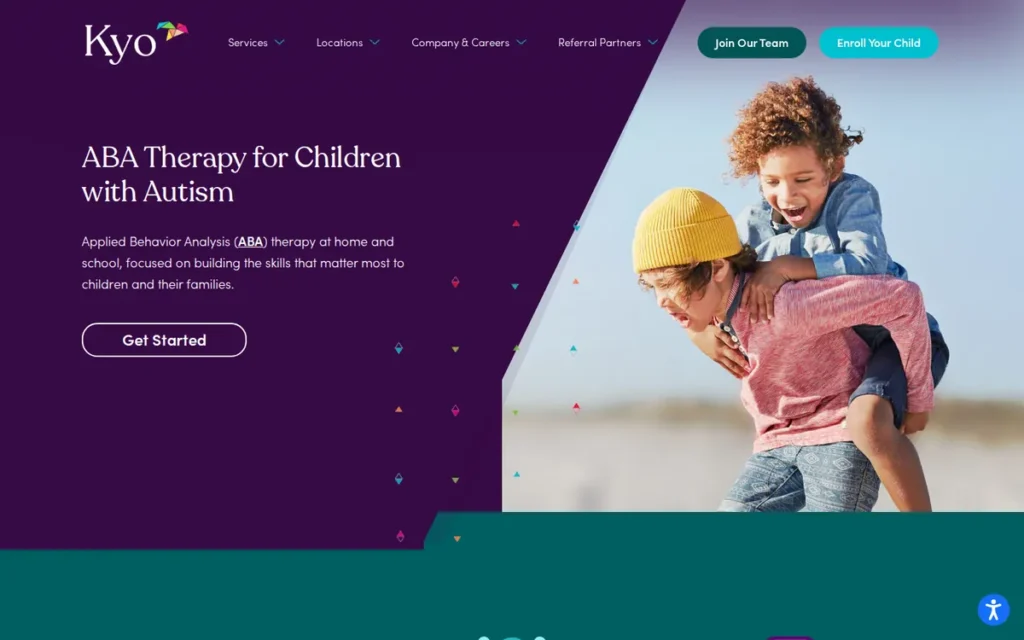
Category: Home-Based, ABA delivered mainly in the family home, school or community.
PlugRoute Score: 3.05/5 (C1 4 · C2 2 · C3 3 · C4 2.5 · C5 4)
At a Glance
- Category: Home-Based
- Best For: Families with Medicaid or private insurance who want one-to-one ABA at home or school in the states Kyo serves (confirm service in your area)
- Price Range: Insurance-based (Medicaid and major private insurers, varying by region); self-pay rates not published
- Primary Strength: Kyo Autism Therapy delivers play-based, one-to-one ABA built into the child’s home and school routines and accepts Medicaid.
- Biggest Limitation: Kyo Autism Therapy publishes no outcome data or accreditation and has documented scheduling and staffing problems.
- One-Line Summary: Kyo Autism Therapy is a Norwest-backed, home- and school-based ABA provider, confirmed in at least six states, that accepts Medicaid and offers BCBA parent coaching but has no published outcomes.
- Last Verified: November 2026
Overview
Kyo Autism Therapy is a home- and school-based ABA provider, formerly Gateway Learning Group, that delivers one-to-one, play-based therapy to families who want ABA built into daily routines.
Kyo Autism Therapy suits families with Medicaid or private insurance. Norwest has backed Kyo Autism Therapy since 2019 (Norwest, accessed November 2026), and PlugRoute couldn’t confirm center-based care.
Key Features
- Kyo Autism Therapy delivers one-to-one, play-based ABA mainly in homes and schools, built around the child’s interests and routines.
- Kyo Autism Therapy offers parent coaching with a BCBA, confirmed in its Houston market.
- Kyo Autism Therapy uses an in-house scheduling tool and a “Care” app for family communication.
- Kyo Autism Therapy’s own location pages confirm service in California, Texas, Washington, Arizona, Colorado and Georgia, and a 2026 industry report lists Kyo in about 11 states (Private Equity Stakeholder Project, April 2026).
- Kyo Autism Therapy’s FAQ notes that Medicaid covers eligible people under 21.
Best For
Kyo Autism Therapy is best for families who rely on Medicaid and want ABA at home or school, where skills can carry over into daily life. Kyo Autism Therapy is a weaker fit for families who want a center with peer interaction or published outcomes.
Pricing
Kyo Autism Therapy publishes no self-pay rate (verified November 2026). Kyo Autism Therapy is in network with major private insurers and Medicaid, varying by region. Ask Kyo how prior authorization is handled in your state.
Strengths
- Kyo Autism Therapy holds a 3.4/5 Indeed rating from 130–133 employee reviews, the highest among the seven providers, and Kyo publicly acknowledged its scheduling problems in replies (Indeed, accessed November 2026).
- Kyo Autism Therapy’s Kent, Washington location holds 4.0/5 from 8 Google reviews, and one parent there described staff as “highly skilled, compassionate, knowledgeable” (Birdeye, accessed November 2026).
- Kyo Autism Therapy’s FAQ explicitly explains Medicaid eligibility for people under 21 (Kyo Autism Therapy, accessed November 2026).
- Kyo Autism Therapy’s home-first model was confirmed by a former staff member who “felt supported by my BCBA” (r/ABA, accessed November 2026).
Limitations
- Kyo Autism Therapy’s most consequential trade-off is weak evidence: Kyo publishes no outcomes, BHCOE accreditation isn’t confirmed, and the “data-driven” label comes from its investor.
- Kyo Autism Therapy’s quality varies by location, including a 2.1/5 Yelp rating from 7 reviews in Oceanside, CA (Yelp, accessed November 2026).
- Kyo Autism Therapy’s Indeed reviewers cite uneven hours, no pay for client cancellations, understaffed scheduling and payroll errors, all of which threaten continuity for families (Indeed, accessed November 2026).
- Kyo Autism Therapy’s state footprint is unclear (6 confirmed vs. about 11 reported), and a former staff member reported being assigned to a Spanish-speaking family without speaking Spanish (r/ABA, November 2025).
This aligns with community sentiment on r/ABA, where a former RBT explained why they left:
“I started at Kyo and basically got my training and left (about a month or so with them) because of the hours issue and working in home with uncomfortable environments as well as management and team being mostly through Email and never answering all my questions! Playing telephone between managers and such was exhausting.” Posted by u/Hjcole82
Takeaway: Unreliable hours and email-only management are pushing new Kyo Autism Therapy RBTs out early, the kind of turnover that directly disrupts continuity for home-based families.
Verdict
Kyo Autism Therapy is the best home-and-school-focused ABA option for Medicaid families in PlugRoute’s 2026 evaluation, though it publishes no outcome data. Kyo Autism Therapy ranks above Action Behavior Centers mainly because of Medicaid access. Before enrolling with Kyo, ask about therapist retention, cancellation policies, language matching and service in your state.
What We Couldn’t Verify: Center-based care, BHCOE accreditation, current leadership, the founding date, ages served, the full state footprint, and whether the Autism Leadership Academy (reported in 2021) still runs.
5. Action Behavior Centers: Best for Commercially Insured Families Wanting a Clinic
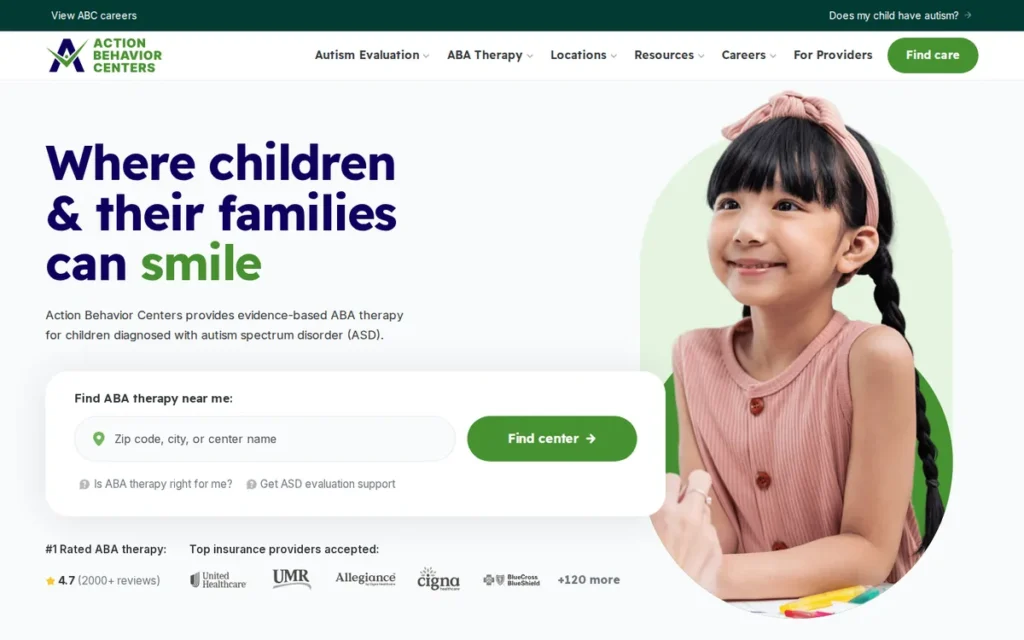
Category: Center-Based, ABA delivered only in a clinic setting.
PlugRoute Score: 2.90/5 (C1 2 · C2 4 · C3 2 · C4 2.5 · C5 4)
At a Glance
- Category: Center-Based
- Best For: Families with commercial insurance and children aged 2–14 who want clinic-based ABA with published caseload targets
- Price Range: Commercial insurance; Medicaid not accepted on the TX, AZ and IL pages checked; self-pay rates not published
- Primary Strength: Action Behavior Centers publishes caseload targets and outcome analyses that most competitors don’t disclose.
- Biggest Limitation: Action Behavior Centers did not accept Medicaid in the markets checked and offers no standard home-based option.
- One-Line Summary: Action Behavior Centers is a Charlesbank-backed, center-only ABA provider for children aged 2–14 that publishes caseload targets and self-reported outcomes but excludes Medicaid in several markets.
- Last Verified: November 2026
Overview
Action Behavior Centers is a center-only ABA provider, founded in Austin, Texas, in 2016, serving children aged 2–14 whose families want a clinic with published caseload targets.
Action Behavior Centers suits commercially insured families. Charlesbank has backed Action Behavior Centers since 2022, and the company reports more than 450 centers in nine states (Action Behavior Centers, November 2026).
Key Features
- Action Behavior Centers delivers ABA only in centers, for children aged 2–14.
- Action Behavior Centers states that each BCBA averages 5–6 children, capped at 8 (self-reported, not independently verified).
- Action Behavior Centers’ “Family Guidance” parent training targets 2 hours per month, which is a stated goal rather than a guarantee.
- Action Behavior Centers has run a paid RBT-to-BCBA training program called “Everest” since January 2024.
- Action Behavior Centers’ Texas page says Medicaid isn’t accepted but lists more than 120 other plans, and its Arizona and Illinois pages checked also exclude Medicaid.
Best For
Action Behavior Centers is best for commercially insured families who want clinic-based therapy for a child aged 2–14 and value disclosed caseload targets. Action Behavior Centers is a weaker fit for Medicaid families in the markets checked and for families who want therapy at home.
Pricing
Action Behavior Centers publishes no self-pay rates (verified November 2026). Action Behavior Centers lists insurance details on each location page. Families outside Texas, Arizona and Illinois should check their local page and ask about prior authorization.
Strengths
- Action Behavior Centers reported that average parent stress fell from the 57th to the 53rd percentile after one year across 298 families, and from the 93rd to the 80th in the highest-stress group (Action Behavior Centers, self-reported, October 2023).
- Action Behavior Centers surpassed 1,000 BCBA promotions through its paid Everest program (ACCESS Newswire, October 2026), a workforce pipeline that may support staff continuity.
- Action Behavior Centers is the only provider in this evaluation found publishing a BCBA caseload figure (as of November 2026), which gives families a number to check at intake.
- Action Behavior Centers displays Google ratings of 5.0 (Frisco, 10 reviews), 4.8 (Schertz, 37 reviews) and 4.9 (Burr Ridge) on its own location pages (accessed November 2026). The samples are small and the company chose which locations to show.
Limitations
- Action Behavior Centers’ most consequential trade-off is access: Medicaid isn’t accepted in the markets checked, care is center-only, children over 14 aren’t eligible, and on-site speech therapy is unconfirmed.
- Action Behavior Centers’ reported 86% reduction in challenging behaviors comes from a 2021 analysis of 20 children, and its two school-placement figures (19 of 30 respondents vs. 71% of 193 families) don’t reconcile (Action Behavior Centers, self-reported, accessed November 2026).
- Action Behavior Centers employees describe being pushed to schedule children for 35–40 hours a week even when the BCBA felt fewer would suit the child (r/bcba, unverified, accessed November 2026).
- Action Behavior Centers holds a C+ BBB rating on one profile, with 2 complaints in three years (BBB, accessed November 2026).
Users on r/ActionBehaviorCenters offered a balanced view in reply to a former RBT’s critical account:
“Agree with a lot of this, but want to make one thing clear as an ABC BCBA: SDLS (aka self-directed leisure skills, aka nap) is NOT billed to insurance. That would be billing fraud. The unbillable appointment you convert is just ABC’s internal way of tracking that the patient was accounted for during that time.” Posted by u/Ill-Awareness-9126
Takeaway: An Action Behavior Centers BCBA endorses much of the staff criticism while disputing billing claims, so families should ask ABC directly how non-therapy time is documented and billed.
Verdict
Action Behavior Centers is the only provider in PlugRoute’s 2026 evaluation found publishing a BCBA caseload figure, which makes it a strong clinic option for commercially insured families of children aged 2–14. For families who don’t need Medicaid, Action Behavior Centers rises to a tie for #2. Ask why a specific number of weekly hours was recommended, and who decided.
What We Couldn’t Verify: On-site speech therapy, BHCOE accreditation by center, independent Google ratings, the overall Glassdoor score, and Medicaid status outside the three states checked.
6. Centria Autism: Best Known for In-Home ABA, with Documented Michigan Billing Allegations
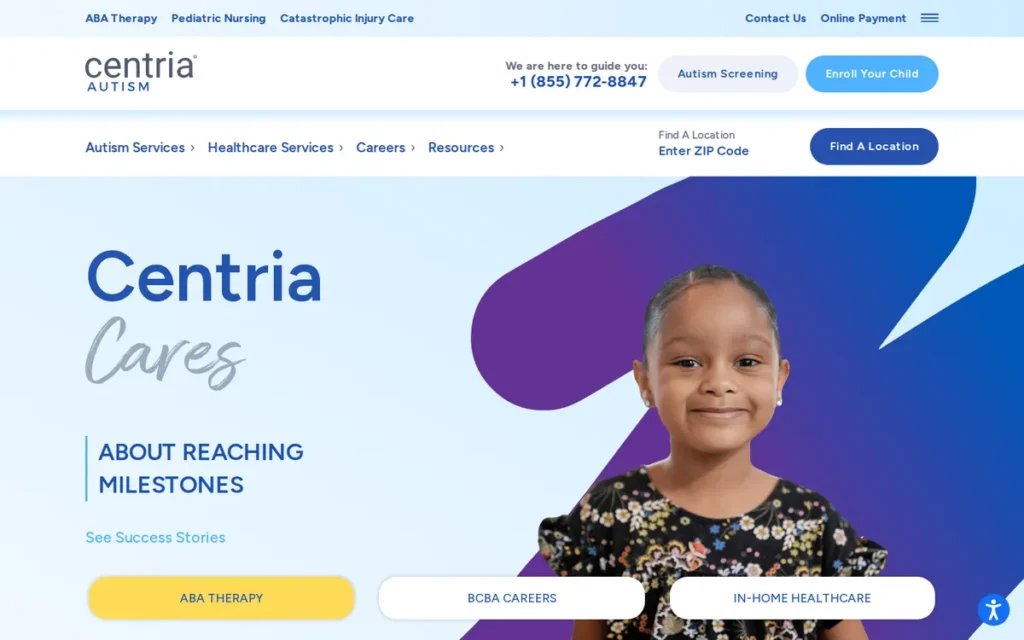
Category: Home-Based, ABA delivered mainly in the family home, school or community.
PlugRoute Score: 2.33/5 (C1 2.5 · C2 1.5 · C3 3.5 · C4 2.5 · C5 2)
At a Glance
- Category: Home-Based
- Best For: Families who want in-home ABA and can confirm insurance and Medicaid acceptance with their local office
- Price Range: Insurance-based (“most major insurance,” varying by state); no Medicaid list by state; self-pay rates not published
- Primary Strength: Centria Autism offers in-home ABA across 11 states, with centers in some areas.
- Biggest Limitation: Centria Autism faces documented allegations about its Michigan billing and publishes no outcome data.
- One-Line Summary: Centria Autism is an in-home-focused ABA provider in 11 states with mixed parent reviews, no published outcomes and documented allegations about its Michigan billing.
- Last Verified: November 2026
Overview
Centria Autism is the autism division of Centria Healthcare and is best known for in-home ABA across 11 states, serving families who want therapy delivered at home.
Centria Autism suits families who can confirm coverage with their local office. Centria Autism also runs centers in some areas through Life Skills Autism Academy (Centria Healthcare, accessed November 2026). Centria Autism has been owned by Thomas H. Lee Partners since 2019, according to a single source (CEPR, accessed November 2026).
Key Features
- Centria Autism is known for in-home ABA therapy.
- Centria Autism offers center-based care in some areas through Centria Autism and Life Skills Autism Academy centers.
- Centria Autism describes its care through an “Optimal Outcomes” framework, which appears only in company materials.
- Centria Autism reports operating in 11 states with 3,500+ clinical staff (self-reported, accessed November 2026).
- Centria Autism says it accepts most major insurance, varying by state.
Best For
Centria Autism is best for families who specifically want in-home ABA and can check insurance and staffing stability locally. Centria Autism is a weaker fit for families who need clear Medicaid confirmation or published outcome evidence.
Pricing
Centria Autism publishes no self-pay rate and no Medicaid list by state (verified November 2026). Centria Autism families should confirm coverage, prior authorization and how missed sessions are made up directly with their local office.
Strengths
- One Centria Autism clinic holds a 4.1/5 Google rating from 225 reviews, the largest single-location parent review sample PlugRoute found (ABARank, accessed November 2026).
- Centria Autism parents on Birdeye praise their child’s progress over two years and staff who taught skills the family could use at home (Birdeye, accessed November 2026).
- Centria Autism reports 3,500+ clinical staff across 11 states (self-reported, accessed November 2026), although parents on Birdeye describe long waits to start.
- Centria Autism has operated since 2009, according to its BBB listing (BBB, accessed November 2026).
Limitations
- Centria Autism’s most consequential trade-off is its legal history: a 2026 CEPR report summarizes allegations that a “25 to Thrive” model set a 25-hour weekly minimum and that supervisors were pressured to bill 25–40 hours (CEPR, accessed November 2026).
- Centria Autism’s Michigan matter has a documented outcome: the state attorney general closed its probe in March 2019, citing possible billing irregularities but insufficient evidence for criminal complaints. Centria denied wrongdoing, and former executives’ lawsuits were dismissed (CEPR, accessed November 2026).
- Centria Autism parents report continuity problems, including one family with nine technicians in a year, weekly call-outs and long waits to start (Birdeye, accessed November 2026).
- Centria Autism holds a 3.2/5 Indeed rating with a 2.9 management score, plus a C+ BBB rating with 1/5 from 2 customer reviews (Indeed and BBB, accessed November 2026), and Centria Autism publishes no outcome data.
Verdict
Centria Autism is a widely available in-home ABA option in PlugRoute’s 2026 evaluation, but documented billing allegations and staff turnover keep it near the bottom of the ranking. Centria Autism’s regulatory score of 2 reflects the 2026 CEPR allegations, the Michigan probe closed in 2019 without criminal complaints, and the dismissed lawsuits. Ask Centria Autism how hours were set and how many technicians your child is likely to have.
What We Couldn’t Verify: Ownership beyond the single CEPR source, the current CEO, the scope of BHCOE accreditation, school-based care, telehealth, the format of parent training, and the centriaautism.com domain.
7. ABA Centers of America: In-House Diagnosis and Multi-Setting ABA, Under Federal Billing Investigation
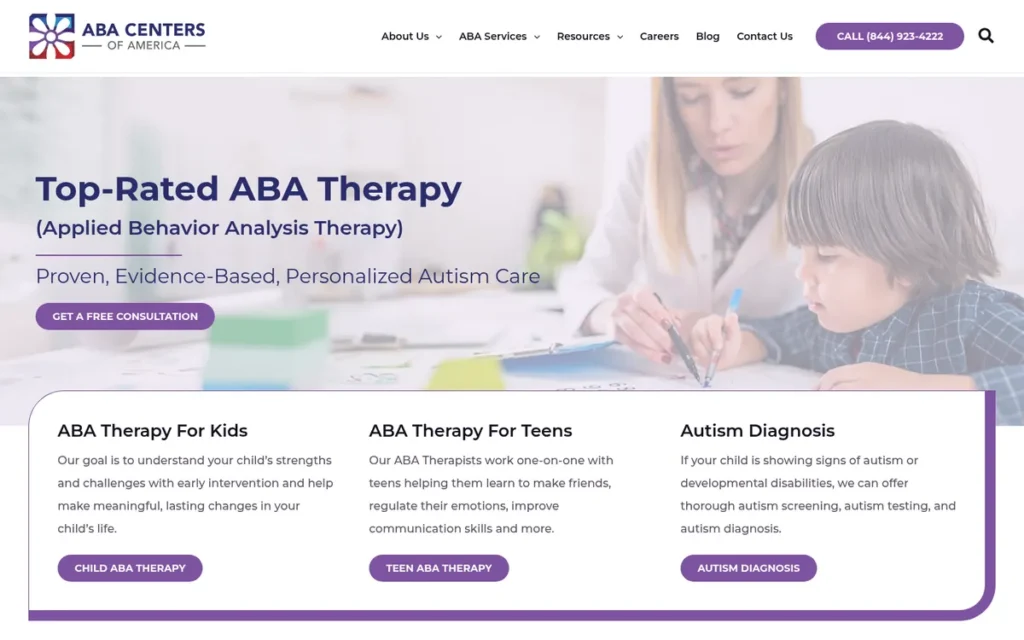
Category: Mixed-Setting Network, ABA offered across centers, homes, schools and community settings.
PlugRoute Score: 1.80/5 (C1 1.5 · C2 1.5 · C3 4 · C4 1.5 · C5 1)
At a Glance
- Category: Mixed-Setting Network
- Best For: Families who need fast diagnosis and intake and can confirm any out-of-network costs in writing before starting
- Price Range: Mainly out-of-network billing; Medicaid acceptance unclear; self-pay rates not published
- Primary Strength: ABA Centers of America offers in-house diagnosis and therapy across centers, homes, schools and the community.
- Biggest Limitation: ABA Centers of America has acknowledged a federal billing investigation, faces insurer litigation and bills mainly out of network.
- One-Line Summary: ABA Centers of America is a fast-growing ABA provider offering diagnosis and multi-setting therapy, now under an acknowledged federal billing investigation with no charges filed as of November 7, 2026.
- Last Verified: November 2026
Overview
ABA Centers of America is a Fort Lauderdale–based ABA provider, founded in 2020, that pairs in-house autism diagnosis with therapy in centers, homes, schools and the community.
ABA Centers of America suits families who need fast intake and can verify out-of-network costs in advance. ICBD Holdings owns ABA Centers of America, and CEO Jason Barker leads it.
Key Features
- ABA Centers of America offers in-house autism diagnosis followed by ABA treatment.
- ABA Centers of America delivers play-based therapy using positive reinforcement in centers, homes, schools and community settings.
- ABA Centers of America markets itself as having no waitlist, a claim PlugRoute couldn’t verify.
- ABA Centers of America reported 49 centers, 72 markets and 2,000+ children across 15 states and territories (ABA Centers of America, self-reported, accessed November 2026).
- ABA Centers of America founder Christopher Barnett gave $1 million to found the ABA Centers Autism Lab at Temple University (Temple University, accessed November 2026).
Best For
ABA Centers of America may suit families who urgently need services. ABA Centers of America is a weaker fit for families who can’t absorb out-of-network costs, and extra caution is warranted until the federal investigation and insurer disputes are resolved.
Pricing
ABA Centers of America is reported to bill mainly out of network and has lost its Optum relationship (Behavioral Health Business, August 2026). Medicaid acceptance is unclear. One reviewer mentions a $100 assessment fee (BBB customer review, accessed November 2026), and a parent reported a bill of almost $5,000 (r/Autism_Parenting, March 2026).
Strengths
- ABA Centers of America ranked No. 5 on the Financial Times 2026 list of the fastest-growing companies in the Americas, with 328.3% compound annual growth (ABA Centers of America, accessed November 2026). That ranking measures business growth, not quality of care.
- ABA Centers of America has one of the broadest service models on the list, and its in-house diagnosis could shorten the time between diagnosis and treatment.
- ABA Centers of America’s founder funded a university autism research lab, the ABA Centers Autism Lab at Temple University.
- An ABA Centers of Pennsylvania parent reported that their child “made alot of progress” and that services were “fine” (r/ABA, accessed November 2026).
Limitations
- ABA Centers of America’s most consequential trade-off is legal and financial risk: the company acknowledged working with federal investigators examining allegations including healthcare and wire fraud. No charges had been filed as of November 7, 2026 (Sun Sentinel, November 2026).
- ABA Centers of America faces a RICO counterclaim in which Publix’s health plan alleges a roughly $15 million billing scheme. In August 2026 a judge allowed six of nine claims to proceed, which isn’t a finding that they’re true (Behavioral Health Business, September 2026).
- ABA Centers of America made layoffs and shut down its Ohio operations in 2026, and it has the lowest Indeed rating of the seven providers (2.6/5, 144 reviews) (Behavioral Health Business and Indeed, accessed November 2026).
- ABA Centers of America holds a B− BBB rating with 1/5 from 6 reviews (BBB, accessed November 2026), and a Medicaid parent reported a refusal because of aggressive behaviors (r/Autism_Parenting, accessed November 2026).
Verdict
ABA Centers of America ranks last in PlugRoute’s 2026 evaluation because an acknowledged federal billing investigation, mainly out-of-network billing and the weakest review signals outweigh its broad service model. ABA Centers of America did earn a 4 on service breadth, and some families report progress. If you’re considering it, confirm costs in writing and get a diagnosis from a separate provider.
What We Couldn’t Verify: Medicaid acceptance, the no-waitlist claim, the current center count (49 vs. 61), outcome data, BHCOE accreditation, and how the investigation will turn out.
How Do I Verify a BCBA and an ABA Provider’s Accreditation?
You can verify an ABA provider yourself, starting with three checks: look up the supervising clinician on the BACB Certificant Registry, check state licensure, and confirm BHCOE accreditation for your specific location. Three more checks below cover who delivers therapy, location-level reviews and outcome claims.
- Check the BCBA credential. Search the supervising clinician by name on the BACB Certificant Registry.
- Check state licensure. Use the BACB’s U.S. licensure page to see whether your state licenses behavior analysts.
- Confirm BHCOE accreditation by location. BHCOE grants accreditation per organization or location (BHCOE, accessed November 2026). Hopebridge’s Fort Myers, Orlando and Central Phoenix listings tell you nothing about the Hopebridge center nearest you. Search BHCOE’s records.
- Know who delivers therapy. RBTs deliver most direct therapy under BCBA supervision, so how often supervision actually happens matters more than a credential on a website.
- Read reviews for your location. Ratings for the same brand can differ sharply from one center to the next.
- Test outcome claims. Ask how many children were measured, who reported the results, and whether the figures match across the provider’s pages.
If you’re unsure about a treatment plan, ask an independent BCBA who isn’t employed by the provider to review it.
How Should I Read ABA Provider Reviews?
For ABA providers, employee reviews predict therapist turnover better than parent testimonials predict quality, because RBTs deliver most direct therapy. Reviews are most useful at the location level. Hopebridge’s Google ratings range from 4.1 in Brandon, FL to 2.2 in Memphis, TN (ABA Care Network, accessed November 2026), a spread that a brand-wide average hides.
Use each review source for what it can tell you:
- Google, Yelp and Birdeye ratings reflect individual locations and often rest on small samples.
- Ratings displayed on a provider’s own pages were chosen by the company, so check them on Google directly.
- Indeed and Glassdoor ratings come from employees and are a signal of staff continuity, not family satisfaction.
- Company testimonials are selected by the provider and deserve the least weight.
- Reddit accounts offer directional insight but can’t be independently verified.
As one parent on r/Autism_Parenting described:
“I have been lucky with my clinic. I like the therapists and I haven’t seen anything that I would oppose to. She has grown over the last year and I can say that is in part due to ABA. But ABA is controversial and there seems to be strong opinions for and even stronger for against. But do what you think is right. You can try and always back out. I can’t speak for all ABA clinics either. I just know the one we use is a solid place.” Posted by u/tallym0mma
Takeaway: Even satisfied ABA parents frame their praise as luck with one clinic, so a positive review speaks for that location rather than the whole provider.
Is Home or Clinic ABA Better for My Child?
Neither home nor clinic ABA is better for every child. The right setting depends on your child’s goals, your family’s routines, and whether peer interaction or generalization (skills carrying over to new settings) matters more. The trade-offs below are PlugRoute’s editorial reasoning, not settled research findings.
- Clinic-based ABA may offer more peer interaction, structured supervision and easier access to other therapists, and Hopebridge and Action Behavior Centers are clinic-first.
- Home-based ABA may support generalization into daily routines and family life, and Kyo Autism Therapy and Centria Autism are home-first.
- School-based ABA may support classroom participation, and BlueSprig, Kyo Autism Therapy and ABA Centers of America confirm school-based services.
- Mixed settings let families change settings as needs change, and BlueSprig offers the broadest confirmed mix.
Home-based care depends heavily on staff consistency. Turnover complaints from families or staff appeared for all seven providers (for LEARN Behavioral, the evidence comes from employee reviews only). In any setting, ask how often therapists change and how caregiver training works.
Why Do Autistic Advocates Disagree About ABA?
Autistic advocates disagree about ABA because some therapy has pushed compliance, masking and “looking normal” at the cost of a child’s distress and quality of life. Practitioners respond that ethical ABA uses assent and least-restrictive procedures. The evidence for early intensive ABA is rated low quality, so the debate remains open.
The main positions and the evidence are:
- Advocates’ concerns: The Autistic Self Advocacy Network raises concerns about compliance, masking and distress (ASAN, accessed November 2026).
- The field’s response: The BACB Ethics Code addresses assent, least-restrictive procedures and working with other professionals, and CASP’s practice guidelines (third edition, 2024) set treatment standards (CASP, accessed November 2026).
- Evidence quality: A 2018 Cochrane review of five studies involving 202 children found possible gains in adaptive behavior, IQ and language from early intensive behavioral intervention, but rated the evidence low to very low quality (Cochrane, accessed November 2026).
One practitioner summarized the field’s own view: “Like pretty much any therapy, it’s good if it’s done well and damaging if it’s done poorly” (r/BehaviorAnalysis, accessed November 2026).
PlugRoute doesn’t take a side in this debate. ABA shouldn’t be presented as a replacement for speech therapy, occupational therapy or other supports, and listening to autistic adults can help families weigh these concerns.
Why Does Ownership Matter When Choosing an ABA Provider?
All seven providers in this ranking are backed by private equity or other investors. Ownership matters because billing incentives can shape how many hours are recommended. Ownership alone doesn’t determine the quality of care at a given center, but it’s a good reason to ask how decisions about hours and staffing are made.
The key documented findings are:
- Indiana: In a 2024 audit, HHS-OIG estimated at least $56.5 million in improper ABA Medicaid payments and recommended Indiana refund $39.4 million, the federal share (HHS-OIG, accessed November 2026).
- Wisconsin: In a 2025 audit, HHS-OIG found at least $18.5 million in improper payments and recommended a $12.2 million refund (HHS-OIG, accessed November 2026).
- Spending growth: Indiana’s ABA Medicaid spending rose from $21 million in 2017 to $611 million in 2023, according to a 2025 state work group (Indiana FSSA, accessed November 2026).
- Rate cuts: Nebraska (August 2025) and Indiana (April 2026) cut ABA Medicaid rates (Capstone, accessed November 2026).
- Private equity scrutiny: CEPR and MinnPost reported on private-equity investment in autism services (CEPR, accessed November 2026; MinnPost, September 2026).
Clinicians on Reddit repeatedly advise families to consider clinics owned by BCBAs. PlugRoute didn’t profile any BCBA-owned clinic, which is a known gap in this ranking.
Looking for ABA Software or a Graduate Program?
PlugRoute hasn’t ranked ABA practice-management software or ABA graduate programs, because independent research for those categories isn’t complete. AI tools commonly name Theralytics, ABA Matrix and AlohaABA for clinics, but PlugRoute hasn’t evaluated them. A separate software review using G2 and Capterra data is planned, as is a graduate-program guide.
In the meantime, clinic owners comparing software should check these four functions side by side:
- Scheduling: Check how the software handles staff assignments, cancellations and make-up sessions.
- Data collection: Check how the software captures session data and turns it into graphs.
- Billing: Check how the software submits, tracks and reconciles claims, including prior authorization.
- Reporting: Check how the software produces progress reports for families and payers.
What Red Flags Should I Watch For When Evaluating ABA Therapy Providers?
The three biggest red flags when evaluating ABA providers are promises of no waitlist, one company handling both diagnosis and treatment, and 35–40-hour recommendations with no clinical explanation. Frequent therapist changes, vague answers about distress and costs that aren’t in writing also deserve scrutiny. Each red flag below is numbered and sourced.
Red Flag #1: “No Waitlist” Promises A no-waitlist promise deserves scrutiny, because waits of 3–6 months are common, according to a Bay Area clinician in a 2025 post (r/bcba, accessed November 2026). A parent discussing ABA Centers of America wrote, “There has to be a reason why they never have waitlists” (r/Autism_Parenting, accessed November 2026).
Red Flag #2: Same Company Diagnoses and Treats When the same company diagnoses autism and then provides treatment, families lose an independent check on whether ABA is needed and how much. A BCBA discussing ABA Centers of America called its diagnosis-to-treatment pipeline “one of the many problems with their business” (r/ABA, 2026).
Red Flag #3: 35–40 Hours Without a Clinical Explanation A recommendation of 35–40 weekly hours with no clinical rationale is a warning sign. CASP’s guidelines (third edition, 2024) generally describe focused ABA as 10–25 hours a week and comprehensive ABA as 30–40 hours (CASP, accessed November 2026). A 35–40-hour plan for a few focused goals is a mismatch worth questioning.
Red Flag #4: Frequent Therapist Changes Frequent therapist changes can make therapy feel like it restarts each time. Turnover complaints from families or staff appeared for all seven providers, including one Centria Autism family with nine technicians in a year (Birdeye, accessed November 2026).
Red Flag #5: No Clear Answer on Distress or Refusal A provider that can’t explain what happens when a child cries, refuses or wants a break hasn’t shown that it respects assent. In an unverified account, a staff member discussing ABA Centers of America wrote that “clients are withdrawing assent and they want to do 7 hour sessions” (r/ABA, unverified, 2026).
Red Flag #6: Costs Not in Writing Costs that aren’t written down can turn into surprise bills. One parent reported “an almost five grand bill” after services ended (r/Autism_Parenting, March 2026), and BlueSprig’s own handbook warns that bills can arrive late (BlueSprig, March 2024).
What Questions Should I Ask Before Choosing an ABA Therapy Provider?
The most useful questions to ask an ABA provider cover BCBA supervision, how weekly hours were set, what happens when a child refuses, who chooses goals and how stable the staff are. Each of the eight numbered questions below comes with an example of a good answer and a worrying one, so you can judge responses during intake calls.
Question #1: How many clients does each BCBA supervise, and how often does the BCBA observe my child’s sessions? This question tells you whether supervision actually happens. Action Behavior Centers, for example, publishes an average of 5–6 children per BCBA (Action Behavior Centers, self-reported, accessed November 2026).
- Good answer: The provider gives a specific caseload number and a regular observation schedule.
- Worrying answer: The provider gives no number, or says the BCBA observes “as needed.”
Question #2: Why this number of weekly hours, and who decided? This question checks whether the recommended hours reflect your child’s needs. CASP’s guidelines generally describe 10–25 hours a week for focused ABA and 30–40 for comprehensive ABA, as typical ranges rather than prescriptions (CASP, accessed November 2026).
- Good answer: The BCBA connects the hours to specific goals and explains how they will be reviewed.
- Worrying answer: The provider says every child starts at 40 hours, without linking the number to goals.
Question #3: What happens when my child says no, cries or wants a break, and can I observe sessions? This question tests whether the provider respects assent in practice, which the BACB Ethics Code addresses (BACB, accessed November 2026).
- Good answer: Staff describe pausing, offering choices and welcoming parents to observe.
- Worrying answer: Staff say they “work through” refusal, or they discourage observation.
Question #4: Who chooses the goals, and can my child have input? This question shows whether the goals focus on useful skills and quality of life rather than on compliance.
- Good answer: The family and, where possible, the child help choose goals tied to daily life.
- Worrying answer: The goals come from a standard template, or they focus on appearing “normal.”
Question #5: How do you keep and assign therapists, including covering cancellations and matching our home language? This question addresses turnover, the most common complaint across the providers in this ranking. It also covers language matching, which matters for bilingual families (r/ABA, November 2025).
- Good answer: The provider shares retention figures, explains its backup coverage and confirms language matching before assigning staff.
- Worrying answer: The provider avoids giving figures and assigns staff based only on availability.
Question #6: Are there assessment fees, copays due at the time of service, or bills that could arrive late? This question surfaces costs that families often learn about only after billing. LEARN Behavioral, for example, collects copays at the time of service (LEARN Behavioral, accessed November 2026).
- Good answer: The provider gives you written estimates, a prior authorization plan and a billing timeline.
- Worrying answer: The provider says insurance will handle it and offers nothing in writing.
Question #7: Do you accept children with aggressive behavior, and what is your discharge policy? This question protects against sudden discharge. One Medicaid parent reported that a provider refused their child because of aggressive behaviors (r/Autism_Parenting, accessed November 2026).
- Good answer: The provider describes a clear intake process and a written discharge plan.
- Worrying answer: The provider says it can end services at any time without a transition plan.
Question #8: Will you coordinate with our speech therapist or OT? This question confirms that ABA will work alongside other supports rather than replace them. A provider that says ABA must replace speech or occupational therapy is out of step with the BACB Ethics Code on working with other professionals (BACB, accessed November 2026).
- Good answer: The BCBA commits to regular communication with your other therapists.
- Worrying answer: The provider suggests pausing or dropping other therapies.
How Did We Rank These ABA Therapy Providers?
PlugRoute scored seven multi-state ABA providers from 1 to 5 on five weighted criteria: insurance access (25%), clinical transparency (25%), family experience (20%), service breadth (15%) and regulatory record (15%). Hopebridge leads with 3.48, just ahead of BlueSprig at 3.40. The result is a national evidence score, not a local recommendation.
The five criteria, and why each one matters:
- C1, Insurance, Medicaid Access and Cost Transparency (25%): Insurance rules out providers faster than any other factor. Scoring: 4 = Medicaid explicitly accepted and cost terms disclosed; 2 = Medicaid excluded in the markets checked, or not stated; 1 = mainly out of network with documented surprise bills.
- C2, Clinical Transparency and Accreditation (25%): Published outcomes, BHCOE status and caseload figures are the only quality signals families can check in advance. Action Behavior Centers’ published caseload figure offsets its unconfirmed BHCOE status, so it matches Hopebridge at 4.
- C3, Service Model Breadth (15%): The settings, ages and other therapies offered decide who a provider can serve at all. A feature counts only if a source confirms it.
- C4, Family Experience and Staff Continuity (20%): RBT turnover shapes a child’s daily experience of therapy. Having no independent parent data scores 2.
- C5, Regulatory, Legal and Governance Record (15%): Investigations and closures can disrupt care partway through treatment. Scoring: 4 = no actions found (the maximum); 1 = an acknowledged federal investigation plus litigation.
| Rank | Provider | C1 | C2 | C3 | C4 | C5 | Weighted Total |
|---|---|---|---|---|---|---|---|
| 1 | Hopebridge | 4 | 4 | 3.5 | 2.5 | 3 | 3.48 |
| 2 | BlueSprig | 4 | 2.5 | 4.5 | 2.5 | 4 | 3.40 |
| 3 | LEARN Behavioral | 4 | 3 | 4 | 2 | 3 | 3.20 |
| 4 | Kyo Autism Therapy | 4 | 2 | 3 | 2.5 | 4 | 3.05 |
| 5 | Action Behavior Centers | 2 | 4 | 2 | 2.5 | 4 | 2.90 |
| 6 | Centria Autism | 2.5 | 1.5 | 3.5 | 2.5 | 2 | 2.33 |
| 7 | ABA Centers of America | 1.5 | 1.5 | 4 | 1.5 | 1 | 1.80 |
The scoring followed these rules:
- A score of 5 required independently verified evidence, and no provider reached 5 on any criterion.
- Missing evidence scored low rather than neutral.
- “No regulatory actions found” was capped at 4, because finding nothing doesn’t prove a clean record.
- Location ratings were never averaged into a company score, and company-displayed ratings were discounted. This lowered Action Behavior Centers’ C4 to 2.5.
- Self-reported outcome figures were capped below 5.
Hopebridge’s C5 is 3, not 4, because of its civil OIG settlement in 2025. That matches the 3 that LEARN Behavioral received for its contested recoupment.
For families with commercial insurance who don’t need Medicaid, Action Behavior Centers rises from #5 to a tie for #2, because its main deduction is for Medicaid access. Removing the insurance and Medicaid access criterion (C1) and reweighting the other four gives these scores:
- Hopebridge: 3.30
- Action Behavior Centers: 3.20
- BlueSprig: 3.20
- LEARN Behavioral: 2.93
- Kyo Autism Therapy: 2.73
No reasonable change in weights moves Centria Autism or ABA Centers of America into the top five.
PlugRoute chose providers with a multi-state footprint, a confirmed website and enough public data to research. All seven are investor-backed, and no BCBA-owned clinic was profiled. Company figures sometimes changed over time: Action Behavior Centers reported 200+ centers in 2022 and more than 450 in November 2026.
PlugRoute has no affiliate relationships with any company listed; rankings are determined entirely by research data and objective evaluation criteria.
What Do Families Ask Most About ABA Therapy Providers?
Families most often ask which ABA providers accept Medicaid, how many weekly hours a child needs, and how PlugRoute built this ranking. The short answers below draw on the evidence in this guide as of November 2026, so confirm the details with your local center before you enroll.
What’s the best ABA therapy provider for families on Medicaid?
Hopebridge, BlueSprig, LEARN Behavioral and Kyo Autism Therapy explicitly accept Medicaid as of November 2026, though acceptance varies by state, plan and center. Medicaid’s EPSDT benefit covers medically necessary services, which can include ABA, for eligible people under 21. Hopebridge scored highest overall, but confirm acceptance with your local center before joining a waitlist.
How many hours of ABA therapy per week does a child need?
No single number fits every child. CASP’s practice guidelines (third edition, 2024) generally describe focused ABA as 10–25 hours a week and comprehensive ABA as 30–40 hours of direct treatment (CASP, accessed November 2026). These are typical ranges, not prescriptions, so your BCBA should explain how the recommended hours connect to your child’s goals.
How does PlugRoute determine rankings?
PlugRoute scores each provider from 1 to 5 on five weighted criteria: insurance access, clinical transparency, service breadth, family experience and regulatory record. A 5 requires independently verified evidence, missing evidence scores low, and no provider reached 5 on any criterion. Location ratings are never averaged into one company score, and company-displayed ratings are discounted.
What Do Key ABA Therapy Terms Mean?
These are the terms families meet most often when comparing ABA therapy providers, covering credentials, insurance and treatment planning. Each definition explains what the term means in plain language and why it matters when you’re choosing a provider or reviewing a treatment plan.
Applied Behavior Analysis (ABA): ABA is a therapy approach that uses principles of learning and behavior to build skills and reduce behaviors that interfere with daily life. ABA is practiced very differently from one provider to the next, which is why setting, goals and supervision matter.
BCBA (Board Certified Behavior Analyst): A BCBA is a graduate-level clinician certified by the BACB who designs and oversees ABA treatment plans. Families can confirm a BCBA’s status on the BACB Certificant Registry.
RBT (Registered Behavior Technician): An RBT delivers most direct ABA sessions under BCBA supervision. RBT turnover directly affects how consistent a child’s therapy is.
BHCOE Accreditation: BHCOE accreditation is a third-party credential for ABA organizations, granted per organization or location. Families should confirm that BHCOE accreditation covers the specific center their child would attend.
Assent: Assent is a child’s ongoing willingness to take part in therapy, shown through words or behavior. A provider that respects assent pauses or adjusts when a child signals distress or refusal.
Least Restrictive Procedures: Least restrictive procedures are the least intrusive interventions that can work, with positive support favored over punishment. Families can ask whether a provider puts this commitment in writing.
Focused vs. Comprehensive ABA: Focused ABA targets a few specific goals, typically 10–25 hours a week, while comprehensive ABA addresses many areas, typically 30–40 hours a week. Knowing which type is proposed helps families judge whether the recommended hours make sense.
BCBA Caseload: A BCBA caseload is the number of clients one BCBA supervises. A smaller caseload generally leaves more time to observe and adjust each child’s plan.
Supervision Ratio: A supervision ratio is the share of technician therapy hours covered by BCBA supervision. MassHealth applies a 1:10 ratio, comparing CPT 97153 (technician therapy) units with CPT 97155 (protocol modification) units.
EPSDT (Medicaid Under-21 Benefit): EPSDT is a Medicaid benefit that covers medically necessary services for eligible people under 21. EPSDT is a key reason Medicaid can cover ABA for children and teens.
In-Network vs. Out-of-Network: An in-network provider has a contract with your insurer, while an out-of-network provider doesn’t. Out-of-network billing can lead to much higher out-of-pocket costs.
Medicaid Recoupment: A Medicaid recoupment is a state’s demand that a provider return Medicaid payments the state considers improper. A Medicaid recoupment can be disputed and isn’t the same as a fraud finding.
Which ABA Therapy Provider Is Right for You?
Key Insights
- Families should filter by insurance and age first, because Medicaid stance and age caps rule out providers faster than quality scores do.
- Families should judge the specific location rather than the brand, because Hopebridge’s Google ratings ranged from 4.1 in Brandon, FL to 2.2 in Memphis, TN (ABA Care Network, accessed November 2026).
- Families should verify the BCBA credential, state licensure and location-level BHCOE status themselves instead of trusting marketing.
- Families should ask how weekly hours were set and what happens when their child says no. PlugRoute found no provider in this ranking that publicly documents an assent-based model, although BlueSprig’s 2024 handbook commits in writing to least-restrictive procedures.
- Families should join several waitlists at once, because clinicians report that waits of 3–6 months are common (r/bcba, accessed November 2026).
A national ABA ranking tells you which providers to call first. What the local center says when you ask about hours, supervision and refusal tells you whether to enroll. On Medicaid, start with Hopebridge, BlueSprig, LEARN Behavioral or Kyo Autism Therapy. For a teen, check LEARN Behavioral’s BACA markets.
Your First Three Calls
- Call your insurer or Medicaid plan and ask for its list of in-network ABA providers, including independent and BCBA-owned clinics.
- Look up each supervising BCBA on the BACB Certificant Registry, and ask each clinic whether its owner is a practicing BCBA.
- Join two or three waitlists, and ask each provider the eight questions above while you wait.
We update this guide quarterly. Last updated: November 12, 2026. Read PlugRoute’s full methodology and watch for our upcoming independent review of ABA practice-management software.