GWI ranks first overall and is best for cross-market consumer research. Brandwatch is strongest for enterprise social listening, and Similarweb is best for competitive digital behavior. These platforms use different data types and aren’t direct substitutes, so the right choice depends on your business question, budget and activation needs.
“Audience intelligence” covers survey panels, social listening, social graphs, clickstream tools and channel discovery tools. Each one answers a different customer question. Most “top 10” lists still rank them side by side without saying what “best” means, so buyers are left to guess.
PlugRoute has no affiliate relationships with any company listed. Rankings are determined entirely by research data and objective evaluation criteria.
This guide matches each platform to the question its data can answer. It scores all seven on six published, weighted criteria and shows where each one falls short. Every price, rating and claim has a dated source, so you can check it before a pilot.
What Are the 5 Categories of Audience Intelligence Platforms?
Audience intelligence platforms fall into five categories by data type. Survey panels measure belief, social listening measures conversation and social graphs measure community. Clickstream measures behavior, and channel discovery measures attention. Each platform can only answer the question its data type was built for.
Choose the data type before the vendor. It’s the most reliable way to avoid buying a tool that can’t answer your question.
Each category answers one business question and has known blind spots:
- Survey Panel platforms such as GWI measure who an audience is and what it believes, using recurring, weighted, self-reported surveys. Survey panel data can’t capture real-time conversation or observed browsing behavior.
- Social Listening platforms such as Brandwatch, Meltwater and Pulsar Platform analyze what people say in public conversations, reviews and media. Social listening data over-represents vocal users and depends on each social platform’s API access.
- Social Graph platforms such as Audiense map which communities an audience belongs to, based on who people follow. Social graph data gets weaker when the audience isn’t active on the source platform.
- Clickstream platforms such as Similarweb estimate how audiences behave online by modelling clickstream panel and web visit data. Clickstream data can’t explain why people behave as they do.
- Channel Discovery platforms such as SparkToro show where an audience spends its attention across websites, podcasts, YouTube channels and social accounts. Channel discovery data has little psychographic depth.
- Customer data platforms (CDPs) and web analytics suites hold first-party data about known customers. PlugRoute treats them as complements to these five categories, not substitutes.
How Is Audience Intelligence Different From Social Listening?
Social listening is one category within audience intelligence, not another name for it. Social listening tells you what the loudest part of an audience is saying. A survey panel tells you what the whole audience believes.
Listening data over-represents vocal users, so it can’t stand in for a whole market. Here is one illustrative question, “How do UK Gen Z shoppers feel about sustainable fashion?”, answered five different ways:
- GWI returns the share of that audience who say sustainability affects their purchases.
- Brandwatch shows what that audience is posting about sustainable fashion this month.
- Audiense shows which communities the sustainability-minded followers cluster into.
- Similarweb shows which resale and fashion sites that audience visits.
- SparkToro shows which podcasts, creators and websites that audience follows.
Practitioners on Reddit suggest combining tools instead of relying on one. One example is Brandwatch for deep listening plus Dataminr for real-time alerts (r/AskMarketing, retrieved 2026).
How Do the Top Audience Intelligence Platforms Compare at a Glance?
GWI, Brandwatch and Similarweb take the top three places in PlugRoute’s 2026 ranking, scoring 4.00, 3.95 and 3.60 out of 5 on six weighted criteria. Meltwater, Audiense, Pulsar Platform and SparkToro follow. The Category column lets you compare tools that use the same data type.
| Rank | Company | Category | Best For | One-Line Summary | Key Capabilities | Primary Strength | Key Limitation |
|---|---|---|---|---|---|---|---|
| 1 (4.00/5) | GWI | Survey Panel | Cross-market consumer research | GWI is a survey-panel audience intelligence platform for cross-market consumer research, where comparable attitude data matters more than real-time conversation. | Quarterly survey waves in 53 markets; 200K–250K+ profiling points; API/MCP; segment export via Dynata | Comparable cross-market attitudes, plus a documented way to export segments | Self-reported, quarterly data; thin samples for niche cuts in smaller markets |
| 2 (3.95/5) | Brandwatch | Social Listening | Enterprise conversation analysis | Brandwatch is an enterprise social listening platform for teams that need deep, historical analysis of public online conversation and have analysts to run complex queries. | Full-firehose X; multi-source listening; Iris AI; archive back to 2008 | Widest documented source coverage and archive depth | Steep Boolean learning curve; often needs a dedicated analyst |
| 3 (3.60/5) | Similarweb | Clickstream | Competitor web and app benchmarking | Similarweb is a clickstream-based digital intelligence platform for benchmarking competitors’ web and app audiences. It is most accurate for high-traffic sites. | Web and app traffic; modelled demographics; cross-visitation; search and ads data | Broad behavior data with self-serve entry pricing | Modelled estimates; less reliable below ~100K monthly visits (vendor-stated) |
| 4 (3.30/5) | Meltwater | Social Listening | PR and earned-media teams | Meltwater is a media and social intelligence suite for PR and communications teams that want earned-media monitoring and social listening in one place, as long as they read the contract terms closely. | News, print, broadcast and podcast monitoring; Radarly; Klear; Mira | Earned media and social in one PR workflow | Reviewer complaints about price and auto-renewal terms |
| 5 (3.20/5) | Audiense | Social Graph | Personas for X-active audiences | Audiense is a social-graph segmentation platform for finding interest-based audience clusters and personas. It is most reliable for audiences that are active on X. | Follow-based clustering; personality profiling; X activation | Highest G2 rating on a meaningful sample (4.5/5, 247 reviews) | Heavy dependence on X data and API terms |
| 6 (3.15/5) | Pulsar Platform | Social Listening | Audience and narrative tracking | Pulsar Platform is an audience-first social listening tool for insights teams tracking how communities and narratives change. Its pricing and customer list can’t be publicly verified. | TRAC; Narratives AI; CORE; Crisis Oracle; 195 countries (vendor-stated) | Combines audience segmentation with narrative tracking | No public pricing; named customers unverified; no documented ad-platform export |
| 7 (2.70/5) | SparkToro | Channel Discovery | Small teams on limited budgets | SparkToro is a low-cost channel discovery tool for small teams that need to know where an audience pays attention, not what it believes or how to reach it through ad platforms. | Search by keyword, site, account or subreddit; demographics; Persona Builder; CSV export; MCP | Most transparent pricing in this ranking (free to $300/month) | Little attitudinal depth; no direct ad-platform push; weaker non-US data |
Which Audience Intelligence Platform Should I Choose for My Use Case?
The right audience intelligence platform depends on your main business question. GWI fits teams asking what audiences believe. Brandwatch fits what they are saying, Similarweb fits how they behave online and Audiense fits which communities exist. SparkToro fits where a small-budget team can reach them, and Meltwater suits PR-led monitoring.
Pulsar Platform suits teams that need to track how narratives form and spread.
| Your #1 Priority | Recommended Tool | Why | Acceptable Alternative |
|---|---|---|---|
| Comparable attitudes across markets | GWI | GWI asks the same survey questions in each of its 53 markets (GWI, 2026). | Pulsar Platform (multi-market listening, not survey-based) |
| Activating segments in ad platforms | GWI | GWI documents segment export to named ad platforms through Dynata (GWI, retrieved 2026). | Audiense Connect (X only) |
| Deep historical conversation analysis | Brandwatch | Brandwatch offers full-firehose X data and an archive back to 2008 (Brandwatch, 2026). | Pulsar Platform |
| PR and earned-media monitoring | Meltwater | Meltwater covers news, print, broadcast, podcasts and social in one suite (TrustRadius, 2026). | Brandwatch |
| Competitor web and app benchmarking | Similarweb | Similarweb models observed traffic, demographics and cross-visitation (Similarweb, 2026). | SparkToro (channel level, not traffic) |
| Community and persona segmentation | Audiense | Audiense clusters audiences by follow behavior and adds personality profiles (Audiense, 2026). | Pulsar Platform |
| Narrative tracking | Pulsar Platform | Pulsar Narratives AI groups conversations into narratives and tracks how they develop (G2 seller page, 2026). | Brandwatch (Iris AI spike explanation) |
| Small budget, finding where to reach people | SparkToro | SparkToro publishes all its pricing, from free to $300/month (SparkToro, 2026). | Similarweb Starter (~$125/month billed annually) |
Which Budget Tier Fits Which Platform?
The seven platforms fall into three budget tiers. Small teams can use SparkToro, Similarweb’s self-serve tiers or Audiense’s entry plan for under about $4,000 a year. Mid-sized teams typically spend $8,000–$30,000 a year. Enterprise contracts can run past $100,000 a year.
“I know talkwalker, meltwater, brandwatch etc are the most recommended platforms, but the price is just way too high for us right now. We’d want something more in the $100-300 per month price range.” (u/catlily222 (r/Marketresearch, retrieved 2026))
Takeaway: Enterprise listening suites cost more than many small teams can spend. That’s why SparkToro, Similarweb Starter and Audiense’s entry plan form a separate budget tier.
| Segment | Approximate Annual Budget | Platforms and Tiers |
|---|---|---|
| Solo or small team | $0–$2,700/yr | SparkToro: Free (3 preview reports/month); Personal $450/yr; Business $1,344/yr; Agency $2,700/yr (SparkToro, 2026) |
| Solo or small team | ~$1,500–$4,000/yr | Similarweb Starter or Professional (SaaSOdds, 2026) |
| Solo or small team | ~$948/yr | Audiense entry plan (G2, 2026) |
| Mid-sized | ~$8,352–$28,750/yr | Audiense Insights, depending on source (G2; F6S, 2026) |
| Mid-sized | ~$25,000/yr | Audiense Insights Unlimited (TrustRadius, 2026) |
| Mid-sized | ~$10,000–$30,000/yr | Meltwater entry tier (Capterra; PressPilot, 2026) |
| Mid-sized | ~$1,500 per seat/yr (indicative) | GWI (Stackmatix, 2026) |
| Enterprise | ~$40,000–$150,000+/yr | Meltwater multi-module (Vendr, 2026) |
| Enterprise | ~$50,000–$200,000+/yr | Similarweb Enterprise (SaaSOdds, 2026) |
| Enterprise | Not disclosed | Brandwatch and Pulsar Platform (quote-only) |
Which Platforms Work Well Together?
Many mature teams pair two data types, because no single category answers every question. These pairings come up most often:
- A survey panel plus a listening tool, such as GWI with Brandwatch, combines what audiences believe with what they are saying now.
- A survey panel plus a clickstream tool, such as GWI with Similarweb, combines stated attitudes with observed online behavior.
- A deep listening tool plus a real-time alerting tool, such as Brandwatch with Dataminr, is a stack enterprise practitioners suggest (r/AskMarketing, retrieved 2026).
How Do Refresh Cadence, Pricing Transparency and Activation Compare?
Refresh cadence, pricing transparency and activation vary more across these platforms than feature lists suggest. GWI and SparkToro document a refresh cadence. SparkToro is the only one that publishes complete pricing. GWI documents segment export to named ad platforms.
| Platform | Refresh Cadence | Pricing Transparency | Activation Path | Review Sample |
|---|---|---|---|---|
| GWI | Quarterly (four survey waves a year) | Plan structure published; no dollar tiers (third-party estimates only) | Documented export via Dynata and LiveRamp to Meta, Google, TikTok and The Trade Desk | G2: 205 reviews |
| Brandwatch | Not disclosed | Quote-only | Partners or API (no named destinations documented) | Capterra: 255; G2 figures conflict |
| Similarweb | Not disclosed; historical estimates get revised | Starter and Professional published; Enterprise quote-only | Partners or API (no named destinations documented) | Capterra: 263 |
| Meltwater | Not disclosed | Quote-only; third-party benchmarks exist | Partners or API (no named destinations documented) | G2: 2,679 |
| Audiense | Not disclosed | Tiers listed on G2 and TrustRadius | X only (Audiense Connect) | G2: 247; Capterra: 9 |
| Pulsar Platform | Not disclosed | Quote-only | Partners or API (no named destinations documented) | G2: ~105 |
| SparkToro | Rolling; 14-day (YouTube/podcasts), monthly (demographics/web) (SparkToro, 2026) | Fully published | CSV export of targeting inputs; no direct audience push | G2: 14–15 |
What Are the 7 Best Audience Intelligence Platforms in 2026?
PlugRoute’s 2026 ranking, scored on six weighted criteria, puts GWI first at 4.00 out of 5. A lower overall rank doesn’t make a tool weaker for every job. Each entry below has a job-specific “Best For” label, its criterion scores and its known limitations.
- GWI scores 4.00/5.
- Brandwatch scores 3.95/5.
- Similarweb scores 3.60/5.
- Meltwater scores 3.30/5.
- Audiense scores 3.20/5.
- Pulsar Platform scores 3.15/5.
- SparkToro scores 2.70/5.
1. GWI: Best Overall / Best for Cross-Market Consumer Research
Category: Survey Panel. Measures who audiences are and what they think through recurring, self-reported consumer surveys.
At a Glance
- Category: Survey Panel
- Best For: Consumer insights managers, media planners and agencies comparing attitudes, behaviors and media habits across several markets
- Price Range: Seat- and usage-based plans with no published dollar tiers (GWI, 2026). One unconfirmed snapshot cites a free plan and a Plus tier at ~$150/user/month (AI-retrieved pricing snapshot, 2026). Team and Pro are quote-only.
- Primary Strength: GWI combines comparable cross-market survey data with the most clearly documented audience activation path of any platform in this ranking.
- Biggest Limitation: GWI relies on self-reported survey data refreshed quarterly, so it misses real-time shifts, and its samples thin out for niche cuts in smaller markets.
- One-Line Summary: GWI is a survey-panel audience intelligence platform for cross-market consumer research, where comparable attitude data matters more than real-time conversation.
- Last Verified: November 2026
Overview
GWI is a survey-based audience intelligence platform for consumer insights managers, media planners and agencies that need research they can compare across markets. GWI profiles connected consumers’ attitudes, behaviors, media habits and purchase intent in 53 markets (GWI, 2026).
GWI runs four survey waves a year. GWI’s headline figure of 2.7B+ connected consumers is a modelled population, not a count of respondents (GWI, 2026). GWI’s Core page lists 53 markets, while 2022 materials cited 48 (GWI, 2026).
Key Features
- GWI Core asks the same survey questions in every market it covers, so attitudes and behaviors can be compared like for like across countries.
- GWI lets users build custom audiences from 200K–250K+ profiling points and cross any variable with any other. These figures come from the vendor and vary by source.
- GWI Spark adds an AI assistant that answers plain-language questions against GWI survey data.
- GWI offers API and MCP access, billed on usage, so GWI data can feed internal tools and AI assistants (GWI, 2026).
- GWI Audience Activation, built with Dynata, makes GWI segments available through LiveRamp and for activation in Meta, Google, TikTok and The Trade Desk (GWI, retrieved 2026).
Best For
GWI is best for media planning and insights teams at multi-market brands and agencies. These teams need to know who an audience is and what it believes, rather than what it is saying right now.
Strengths
- GWI is the only platform in this ranking with documented segment export to several named ad platforms, through its Dynata partnership (Research Live, retrieved 2026).
- GWI holds 4.4/5 from 205 G2 reviews, 98% of them four or five stars. Reviewers praise being able to “cross anything with anything” (G2, 2026).
- GWI publishes annual and quarterly sample sizes by market in its Core methodology document. Quarterly totals range from about 1,000 respondents in Morocco to 5,000 in Mexico (GWI, 2024).
- GWI raised more than $180M in a Series B led by Permira in February 2022, at a valuation above $850M (TechCrunch, 2022).
Limitations
GWI gives up immediacy and observed behavior in exchange for comparable attitude data. GWI data is self-reported and refreshed quarterly, so GWI can’t detect a viral moment or measure actual browsing behavior.
- GWI’s quarterly samples in smaller markets can be as small as about 1,000 respondents (GWI, 2024), so niche cuts there may be too small to use. GWI doesn’t publish error rates for custom cuts.
- G2 reviewers criticize GWI for limited regional depth, small samples in secondary datasets and occasional cell limits in complex analyses (G2, 2026).
- GWI reviewers also mention awkward psychographic questions and the cost of enterprise licences (Stackmatix, 2026).
Verdict
GWI is the highest-scoring platform in this ranking (4.00/5) for teams that need comparable, survey-based consumer insight across several markets and a documented way to activate those audiences in major ad platforms.
GWI earns its rank on activation (C3: 5) and published survey methodology (C1: 4). It scores a neutral 3 on pricing transparency because it publishes no dollar tiers. GWI doesn’t replace social listening or clickstream data. Buyers should get GWI sample sizes for their target cuts in writing during a pilot.
2. Brandwatch: Best for Enterprise Social Listening and Consumer Conversation Analysis
Category: Social Listening. Analyzes what people say in public online conversations, reviews and media.
At a Glance
- Category: Social Listening
- Best For: Enterprise brand, insights and comms teams that have analysts and need deep, historical analysis of public conversation
- Price Range: Pricing on request. Custom annual contracts; no verified public or third-party dollar figures as of November 2026.
- Primary Strength: Brandwatch combines full-firehose X data, broad multi-source coverage and an archive back to 2008 for deep conversation analysis.
- Biggest Limitation: Brandwatch needs Boolean query skills and often a dedicated analyst, and its coverage depends on social platforms’ API access.
- One-Line Summary: Brandwatch is an enterprise social listening platform for teams that need deep, historical analysis of public online conversation and have analysts to run complex queries.
- Last Verified: November 2026
Overview
Brandwatch is an enterprise consumer intelligence and social listening platform, owned by Cision, for brand, insights and comms teams with dedicated analysts. Brandwatch analyzes public conversation across social networks, review sites, forums, news and broadcast.
Brandwatch says its archive goes back to 2008, but the size figures conflict. One source gives 1.4T+ posts (BrandMentions, 2026), and a Pulsar-authored comparison page gives ~1.7T (Pulsar, 2026). Brandwatch’s G2 figures also conflict: 4.2/5 from 1,711 reviews (mktg.tech, 2026) versus 4.4/5 from 728 (Pulsar, 2026).
Key Features
- Brandwatch Consumer Intelligence provides full-firehose X and Tumblr data alongside major social networks, Reddit, forums, blogs, broadcast and review sites (Brandwatch, 2026).
- Brandwatch offers flexible Boolean query building for precise tracking of topics, brands and competitors.
- Brandwatch Iris AI summarizes conversations and explains sudden spikes in mention volume.
- Brandwatch Social Panels let teams define custom audience groups and track them over time.
- Brandwatch Vizia provides command-centre style displays for live monitoring.
Best For
Brandwatch is best for enterprise teams that need sentiment analysis, share-of-voice tracking and long-range trend history, and that have analysts who can run complex queries.
Strengths
- Brandwatch was named a Strong Performer in The Forrester Wave: Social Suites, Q4 2024. Brandwatch reports top scores in social listening, customer service, privacy and security, and supporting services (Forrester via Brandwatch, 2024).
- Brandwatch holds 4.2/5 from 255 Capterra reviews, and reviewers consistently praise its source breadth, historical data and flexible dashboards (Capterra, 2026).
- Brandwatch documents how it collects data source by source, combining firehose access with platform APIs. That supports its C1 score of 4 (Brandwatch, 2026).
- Brandwatch is owned by Cision, which agreed to buy it for $450M in February 2021 and completed the deal on June 1, 2021. Cision reported more than 75,000 customers at the time (TechCrunch, 2021).
Limitations
Brandwatch gives up ease of use in exchange for analytical depth. Brandwatch has a steep Boolean learning curve and often needs a dedicated analyst (Capterra; G2, 2026). That staffing cost comes on top of a contract price Brandwatch doesn’t disclose.
- Brandwatch coverage depends on each social platform’s API terms, so changes to X, Reddit or TikTok access directly affect what Brandwatch can see.
- Brandwatch, like any listening tool, over-represents vocal users, so its output isn’t a representative measure of a whole market.
- Brandwatch archive and rating figures conflict across sources, which makes its historical coverage claims harder to check before purchase.
A current Brandwatch user on r/AskMarketing described the gaps:
“I am using Brandwatch but it can be limited for some channels e.g. TikTok or for audience clustering. Are you using other tools, integrations, even LLMs, Apify?” Posted by u/Bitter_Ad6843
Takeaway: Even paying Brandwatch customers say its TikTok coverage and audience clustering fall short, so its breadth claims should be checked channel by channel.
Verdict
Brandwatch has the broadest documented source coverage and archive depth of the three listening platforms in this ranking, which suits enterprise teams that need deep, historical analysis of public conversation.
Brandwatch scores 3.95/5. It leads on coverage (C5: 5) and credentials (C6: 5) but trails GWI on activation (C3: 3) and undisclosed pricing (C4: 3, neutral). Brandwatch tells you what people are saying, not what they believe. Buyers should get source-by-source historical coverage in writing.
3. Similarweb: Best for Competitive Digital Behavior and Clickstream Analysis
Category: Clickstream. Estimates how audiences behave online by modelling web and app visit data.
At a Glance
- Category: Clickstream
- Best For: Growth marketers, strategy teams and media planners benchmarking competitors’ digital audiences and web and app behavior
- Price Range: Free tier; Starter ~$125–$199/month; Professional ~$333–$399/month; Enterprise ~$50K–$200K+/year (SaaSOdds; Capterra, 2026)
- Primary Strength: Similarweb offers broad, competitive web and app behavior data with self-serve entry pricing.
- Biggest Limitation: Similarweb’s modelled estimates are least reliable for smaller sites. An Omniconvert study of 1,787 ecommerce sites found Similarweb reported ~94% more sessions than Google Analytics.
- One-Line Summary: Similarweb is a clickstream-based digital intelligence platform for benchmarking competitors’ web and app audiences. It is most accurate for high-traffic sites.
- Last Verified: November 2026
Overview
Similarweb is a publicly listed digital market intelligence platform for growth marketers and strategy teams benchmarking competitors’ digital audiences. Similarweb models website and app traffic, audience demographics and cross-visitation from a mix of clickstream, panel and crawl data.
Similarweb estimates observed behavior, not stated attitudes. Similarweb says it covers 1B+ websites, 8M apps, 5B search terms and 250M display ads (G2, 2026). These figures come from the vendor.
Key Features
- Similarweb Web and App Intelligence estimate traffic, engagement and audience makeup for competitor websites and apps.
- Similarweb audience analysis reports modelled demographics, interests and geography for a site’s visitors.
- Similarweb cross-visitation data shows which other sites a given site’s audience also visits.
- Similarweb Digital Research covers search terms, display ads and content pages for market-level analysis.
- Similarweb combines first-party analytics shared by sites, opt-in clickstream and panel data, public crawls and statistical modelling (Similarweb, 2026).
Best For
Similarweb is best for growth and media planning teams asking how audiences behave online and how competitors’ digital audiences compare, especially when the key sites get a lot of traffic.
Strengths
- Similarweb holds 4.6/5 from 263 Capterra reviews, the highest Capterra score on a meaningful sample in this ranking (Capterra, 2026).
- Capterra reviewers give Similarweb 4.2/5 for value for money (Capterra, 2026).
- Similarweb is listed on the NYSE (SMWB) and reports 10,000+ customers (Similarweb, 2026). That lowers the risk of the vendor failing during a multi-year contract.
- Similarweb publishes Starter and Professional pricing, so smaller teams can start without a sales-led contract (SaaSOdds, 2026).
Limitations
Similarweb gives up precision in exchange for breadth. An Omniconvert analysis of 1,787 ecommerce websites found Similarweb reported about 94% more sessions than Google Analytics. Accuracy was lowest for sites under 10,000 sessions (Omniconvert via SaaSOdds, 2026).
- Similarweb’s own support documentation says its estimates are more reliable above 100,000 monthly visits (Similarweb, 2026).
- Similarweb demographics are modelled rather than measured, and reviewers note that historical estimates get revised (best-ai-seo-tools.com, 2026).
- SMB reviewers often complain about Similarweb’s cost above the Starter tier. Some describe trials converting to paid plans, though these reports are anecdotal (Capterra; best-ai-seo-tools.com, 2026).
Users on r/socialmedia noted:
“SimilarWeb is generally accurate for estimating website traffic, trends, and audience insights, especially for larger websites. However, its data is based on sampling and estimation, so it may not reflect exact numbers, particularly for smaller sites or niche markets. It’s best used for comparing trends, spotting competitor strategies, and understanding market behavior rather than relying on precise figures.” Posted by u/Personal_Body6789
Takeaway: Similarweb works well for directional competitor benchmarking on larger sites, but its exact figures can’t be trusted for small or niche sites.
Verdict
Similarweb is the strongest platform in this ranking for benchmarking competitors’ web and app audiences, as long as the sites being analyzed get enough traffic for its modelled estimates to be reliable.
Similarweb scores 3.60/5. It earns that on the highest Capterra rating on a meaningful sample (C2: 4), partly published pricing (C4: 4) and its NYSE listing (C6: 4). Documented estimation error keeps C1 at 3. Buyers should compare Similarweb’s estimates with their own Google Analytics data during a trial.
4. Meltwater: Best for PR, Communications, and Earned Media Intelligence
Category: Social Listening.
At a Glance
- Category: Social Listening
- Best For: PR and communications teams that want earned-media monitoring and social listening in one platform
- Price Range: Pricing on request. Third-party estimates run ~$10K–$130K+/year, with a reported median of ~$25,800/year (Vendr, 2026).
- Primary Strength: Meltwater covers news, print, broadcast, podcasts and social in a single PR-oriented workflow.
- Biggest Limitation: Meltwater gets repeated reviewer complaints about price, auto-renewal terms and written-cancellation deadlines.
- One-Line Summary: Meltwater is a media and social intelligence suite for PR and communications teams that want earned-media monitoring and social listening in one place, as long as they read the contract terms closely.
- Last Verified: November 2026
Overview
Meltwater is a media, social and consumer intelligence suite for PR and communications teams that manage earned media and brand reputation. Meltwater combines news, print, broadcast and podcast monitoring with social listening, influencer marketing and an AI assistant.
Meltwater is built for breadth rather than depth in any one data type. Meltwater describes its suite as “Monitor, Analyze, Distribute, Engage” (TrustRadius, 2026).
Key Features
- Meltwater monitors online news, print, broadcast and podcasts for earned-media coverage and share of voice.
- Meltwater Radarly provides social listening for analyzing conversation, sentiment and trends.
- Meltwater Klear supports influencer discovery and campaign management in the same suite.
- Meltwater Mira is an AI assistant for summarizing and querying monitored data.
- Meltwater provides alerts and PR workflows covering monitoring, analysis, distribution and engagement.
Best For
Meltwater is best for PR and comms heads who need one tool for press coverage, share of voice and social conversation, rather than a dedicated consumer research or segmentation platform.
Strengths
- Meltwater has the largest review base in this ranking, with 4.1/5 from 2,679 G2 reviews of its core product. Reviewers praise its monitoring breadth, alerts and PR workflows (G2, 2026).
- Meltwater scores 7.6–7.8/10 on TrustRadius from about 180 reviews (TrustRadius, 2026).
- Meltwater’s Capterra sub-scores are 4.0/5 for functionality, 4.0/5 for ease of use and 3.7/5 for customer service (Capterra, 2026).
- Meltwater combines broadcast, print and podcast monitoring with social listening, which PR teams would otherwise buy separately (TrustRadius, 2026).
Limitations
Meltwater gives up depth in any single data type in exchange for breadth, and its commercial terms draw more complaints than its product. Capterra reviewers give it 3.4/5 for value for money and describe auto-renewals that weren’t clearly disclosed (Capterra, 2026).
- Individual Capterra reviewers say Meltwater requires written cancellation 60 to 90 days before renewal. Meltwater scores 1.7/5 on Trustpilot, but from only 17 reviews, mostly about billing (Capterra; PressPilot, 2026).
- Meltwater’s listening is less deep than specialist tools, and TrustRadius reviewers mention outdated media-contact data and complex implementation (TrustRadius, 2026).
- Meltwater contract prices reportedly rise 3–7% a year (Vendr, 2026), and no named case studies with measured results could be verified.
A PR practitioner on r/PublicRelations offered a balanced comparison:
“But strictly for monitoring and database functions I would recommend Muck Rack most and Cision least; I would also say that Meltwater is closer to Muck Rack’s tier than it is to Cision’s, but maybe I just have had particularly bad luck with Cision.
If using for reporting and press release distribution, I’d rank Meltwater first.” Posted by u/Chi2KC
Takeaway: Meltwater gets its strongest practitioner praise for PR reporting and distribution, while specialist media-database tools can beat it on monitoring alone.
Verdict
Meltwater is the most practical all-in-one choice in this ranking for PR and communications teams that want earned-media monitoring and social listening in a single platform.
Meltwater scores 3.30/5. It matches Brandwatch on coverage (C5: 5) but scores lower on ratings once complaints about the commercial relationship are counted (C2: 3). Its ownership history is unverified, so C6 is a neutral 3. Meltwater buyers should get renewal terms in writing and ask for named references.
5. Audiense: Best for Social-Graph Audience Segmentation and Persona Development
Category: Social Graph. Maps which communities an audience belongs to, based on follow and interest connections.
At a Glance
- Category: Social Graph
- Best For: Brand strategists and agencies building personas and segments for audiences that are active on X
- Price Range: Free plan; ~$79/month entry; Audiense Insights ~$8,352–$28,750/year depending on source; Insights Unlimited ~$25,000/year (G2; F6S, 2026)
- Primary Strength: Audiense turns a seed audience into distinct interest-based clusters with personality and affinity profiles.
- Biggest Limitation: Audiense depends heavily on X data, so it struggles when a target audience isn’t active on X, and it is exposed to X API changes.
- One-Line Summary: Audiense is a social-graph segmentation platform for finding interest-based audience clusters and personas. It is most reliable for audiences that are active on X.
- Last Verified: November 2026
Overview
Audiense is a social-graph audience intelligence platform for brand strategists and agencies building personas and audience segments for campaign planning. Audiense splits a seed audience into interest-based clusters using follow behavior and personality profiling.
Audiense was founded in Spain in 2011 as SocialBro and later renamed; some sources give 2012 (Audiense, 2026). Audiense shows which communities exist and how they connect, rather than what people say.
Key Features
- Audiense Insights splits a seed audience into distinct clusters based on shared follow and interest behavior.
- Audiense adds personality profiling (Big Five, Needs, Values), which its documentation says is powered by IBM Watson (Audiense, 2026).
- Audiense reports cover up to 250K audience members, or up to 1M for some uploaded audiences (G2, 2026).
- Audiense shows each segment’s affinities, including influencers, media, brands and content preferences.
- Audiense Connect handles audience discovery, segmentation and ad activation on X.
Best For
Audiense is best for teams asking which communities make up their audience and how to reach each one, when the target audience has a meaningful presence on X.
Strengths
- Audiense holds 4.5/5 from 247 G2 reviews, the highest G2 score on a meaningful sample in this ranking. Reviewers praise its detailed audience insight (G2, 2026).
- Audiense Insights is listed from $8,352/year with up to 60 reports a year and unlimited seats, so buyers can budget before a sales call (G2, 2026).
- Audiense reports 4,000+ brand and agency customers, including Universal Music and Comic Relief, according to its co-founder’s LinkedIn profile. That source is close to the vendor (LinkedIn, 2026).
- Audiense is an X Official Partner, which gives it structured access to the data its segmentation depends on (Audiense, 2026).
Limitations
Audiense gives up breadth in exchange for depth on one social graph. Audiense’s core segmentation depends heavily on X, and one G2 reviewer says the tool is effectively unusable when a brand’s audience isn’t active there (G2, 2026).
- Audiense is directly exposed to changes in X’s API access or pricing. Its documentation says SOPRISM capabilities extend profiling to Meta and first-party data (Audiense, 2026).
- Audiense clusters can be hard to match up with other segmentation methods, and some reviewers find the feature set overwhelming at first (G2, 2026).
- Audiense’s Capterra rating rests on only 9 reviews, and its funding and headcount couldn’t be verified (Capterra, 2026).
Verdict
Audiense is the strongest social-graph segmentation tool in this ranking for teams that need to discover distinct audience communities and personas, as long as their audience is active on X.
Audiense scores 3.20/5 on its G2 rating (C2: 4) and listed pricing (C4: 4). Its reliance on X keeps coverage at C5: 2 until SOPRISM’s reach is independently verified. Audiense buyers should check how active their audience is on X and compare its clusters with first-party segments during a pilot.
6. Pulsar Platform: Best for Audience-First Listening and Narrative Tracking

Category: Social Listening.
At a Glance
- Category: Social Listening
- Best For: Insights and strategy teams tracking how specific audiences and narratives change across social, search and news
- Price Range: Pricing on request. No public or verified third-party figures as of November 2026.
- Primary Strength: Pulsar Platform combines audience segmentation with narrative tracking across social, search, news and web data.
- Biggest Limitation: Pulsar Platform has no public pricing, no verified named customers and no documented direct export to ad platforms.
- One-Line Summary: Pulsar Platform is an audience-first social listening tool for insights teams tracking how communities and narratives change. Its pricing and customer list can’t be publicly verified.
- Last Verified: November 2026
Overview
Pulsar Platform is an audience-first social listening and narrative intelligence tool for insights and strategy teams. Pulsar Platform groups audiences by the content and communities they engage with, then tracks how narratives spread across social, search and news.
Pulsar Platform’s founder and CEO, Francesco D’Orazio, promotes “narrative intelligence” as a separate category. That’s Pulsar’s own framing, not an industry standard (Pulsar, 2026). Pulsar Platform also publishes comparison pages, which PlugRoute treats as vendor marketing.
Key Features
- Pulsar TRAC combines social listening with audience segmentation based on engagement and community membership.
- Pulsar Narratives AI groups conversations into narratives and tracks how they develop over time.
- Pulsar CORE benchmarks owned-channel performance against competitors.
- Pulsar CLEAR supports ad compliance, and Pulsar Crisis Oracle watches for emerging reputational risks.
- Pulsar Platform draws on social, search, news and web data across 195 countries, according to the vendor (G2 seller page, 2026).
Best For
Pulsar Platform is best for insights teams that want listening organized around who is talking and which narratives are forming, not just around brand keywords.
Strengths
- Pulsar Platform holds 4.3/5 from about 105 G2 reviews, and 100 of them are four or five stars (G2, 2026).
- G2 users score Pulsar Platform 9.4/10 as a business partner, 8.9/10 for audience insights and 8.8/10 for segmentation (G2, 2026).
- Pulsar Platform reviewers praise its clean interface, responsive support, source breadth and share-of-voice analysis (G2, 2026).
- Pulsar Platform’s vendor-stated coverage of 195 countries supports narrative analysis across several markets (G2 seller page, 2026).
Limitations
Pulsar Platform’s approach is distinctive but harder to verify. Its named customers, company history and ownership couldn’t be independently verified, so buyers need to do more checking than with the other platforms.
- Pulsar Platform has no documented direct export to ad platforms, and like all listening tools it depends on social platforms’ API access.
- Some G2 reviewers raise concerns about Pulsar Platform’s data accuracy, incomplete data and limited geo-filtering for Reddit data (G2, 2026).
- Pulsar Platform reviewers report a learning curve for complex queries (G2, 2026).
Verdict
Pulsar Platform is the most audience-first of the three listening tools in this ranking. It suits insights teams that want listening organized around communities and narratives rather than keywords, but it needs more buyer checking than the other six platforms.
Pulsar Platform scores 3.15/5. It has broad coverage (C5: 4) and neutral scores where evidence is missing. Pulsar Platform buyers should ask for named references and a scoped pilot before signing.
7. SparkToro: Best for Small Teams and Affordable Channel Discovery
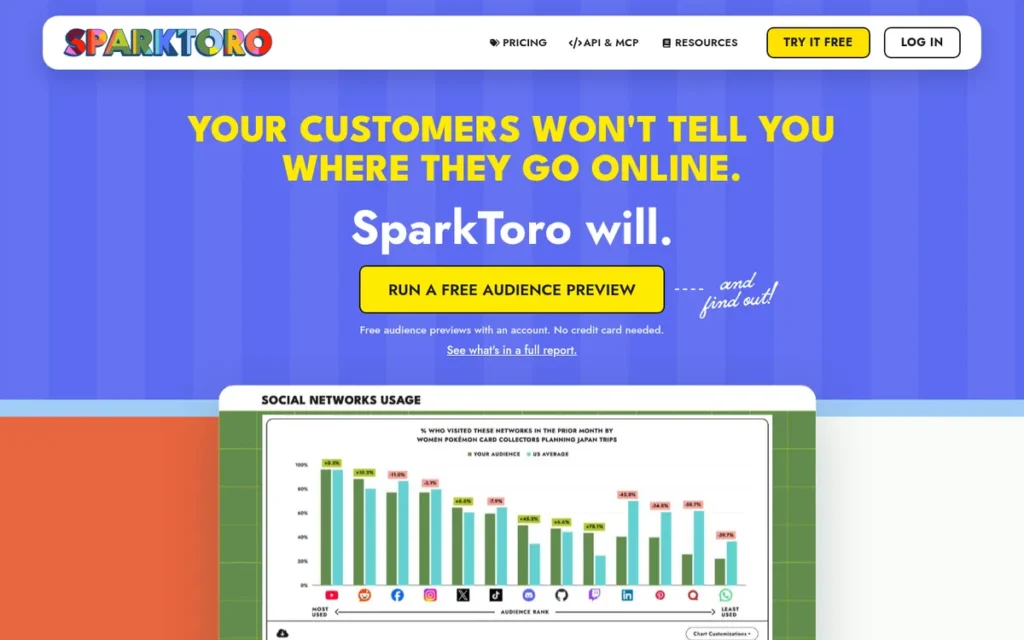
Category: Channel Discovery. Shows where an audience spends attention online across websites, podcasts and social accounts.
At a Glance
- Category: Channel Discovery
- Best For: Small marketing teams and agencies planning content, PR and media placements on a limited budget
- Price Range: Free; $450–$2,700/year billed annually; Business and Agency also $150–$300/month billed monthly (verified November 2026)
- Primary Strength: SparkToro shows where an audience pays attention, at the lowest and most transparent published price in this ranking.
- Biggest Limitation: SparkToro offers little attitudinal depth, can’t push audiences directly into ad platforms, and has weaker data outside the US and English-language markets.
- One-Line Summary: SparkToro is a low-cost channel discovery tool for small teams that need to know where an audience pays attention, not what it believes or how to reach it through ad platforms.
- Last Verified: November 2026
Overview
SparkToro is a self-serve audience research tool for small marketing teams and agencies planning content, PR and media placements on limited budgets. SparkToro shows which websites, podcasts, YouTube channels, social accounts and subreddits a target audience engages with.
SparkToro builds its data by crawling “billions” of public web and social profiles, informed by Datos clickstream research (SparkToro, 2026). SparkToro updates continuously: YouTube and podcast data refresh every 14 days, and demographic and website data refresh monthly (SparkToro, 2026).
Key Features
- SparkToro lets users search by keyword, website, social account, hashtag or subreddit to find what that audience engages with.
- SparkToro surfaces “hidden gems,” smaller sources with high audience affinity.
- SparkToro reports audience demographics, including age, gender, seniority, company size, salary and location.
- SparkToro includes Compare Audiences and Persona Builder for side-by-side audience analysis.
- SparkToro Lists export selected sources, keywords and hashtags as CSV targeting inputs, and SparkToro offers MCP access on all paid plans (SparkToro, 2026).
Best For
SparkToro is best for small teams planning where to reach an audience, such as which podcasts to pitch and which sites to advertise on, without signing an enterprise contract.
Strengths
- SparkToro publishes complete self-serve pricing from free to $300/month, the most transparent pricing of any platform in this ranking (SparkToro, 2026).
- SparkToro case studies report Rise Marketing Group cutting a client’s customer acquisition cost by 50% and Kurve getting 13% more sign-ups. Both are published by SparkToro and unaudited (SparkToro, 2026).
- SparkToro reported 100,000+ marketers using the tool by 2023 and has been profitable since November 2020 (SparkToro, 2023).
- SparkToro’s 2024 zero-click study with Datos found that 58.5% of US Google searches ended without a click, which gives the company research credibility (SparkToro, 2024).
Limitations
SparkToro gives up depth and activation in exchange for low cost. SparkToro shows where an audience pays attention but offers little attitudinal or psychographic insight, so it can’t explain why an audience behaves as it does.
- SparkToro doesn’t push custom audiences directly into ad platforms. Its CSV exports provide targeting inputs, so it works mainly as a research and planning tool.
- G2 reviewers say SparkToro data is weaker for non-English and non-US markets and that report allowances on cheaper plans are low. Its G2 rating rests on only 14–15 reviews (G2, 2026).
- SparkToro has a team of roughly 3–5 people, a continuity risk that enterprise procurement teams should weigh (Dashly, 2026).
Verdict
SparkToro is the best-value audience intelligence tool in this ranking for small teams that need to find where an audience pays attention, with fully published pricing that starts at free.
SparkToro scores 2.70/5. It leads on pricing transparency (C4: 5) but ranks last on criteria weighted toward enterprise buyers, such as review volume (C2: 2) and activation (C3: 2). A low rank here doesn’t mean low value for small teams, who should test the free plan on an audience they already know.
What Red Flags Should I Watch For When Evaluating Audience Intelligence Platforms?
The six red flags to watch for are:
- Modelled populations presented as respondents
- Missing sample sizes
- Restrictive auto-renewal clauses
- Dependence on a single platform’s API
- Coverage figures taken from competitor pages
- Thin or conflicting review samples
Each one applies to at least one of the seven platforms in PlugRoute’s 2026 ranking.
Red Flag #1: Modelled Populations Presented as Respondents
A modelled population is the number of people a dataset claims to represent, not the number actually surveyed. A dataset that “represents 2.7 billion consumers” may rest on a few thousand respondents per market.
GWI’s 2.7B+ figure is a modelled population. GWI’s methodology lists quarterly samples of roughly 1,000–5,000 respondents per market (GWI, 2024), so a narrow cut in a smaller market may rest on a few dozen people.
Red Flag #2: No Per-Market Sample Sizes or Error Rates
Most vendors in this ranking don’t publish per-market sample sizes, and none publishes error rates for custom audience cuts. GWI is the exception on sample sizes: its Core methodology document lists them by market (GWI, 2024).
Without these figures, coverage claims are hard to check for a specific country or segment.
Red Flag #3: Auto-Renewal and Written-Cancellation Clauses
Auto-renewal clauses that require written cancellation well before renewal can lock buyers into another contract year. Ask every vendor for the notice period in writing before signing.
Individual Capterra reviewers report Meltwater cancellation deadlines of 60 to 90 days (Capterra, 2026). Anecdotal Similarweb reviews describe trials converting to paid plans (best-ai-seo-tools.com, 2026).
Red Flag #4: Single-Platform API Dependency
Tools built on one social platform’s data are subject to that platform’s API decisions, including paid access tiers and restrictions. Audiense depends heavily on X, and every listening tool in this ranking is exposed to changes in X, Reddit and TikTok access.
Red Flag #5: Coverage Figures Sourced From Competitor Pages
Treat coverage figures that appear only on a competitor’s comparison page as unverified. Meltwater’s 300,000+ news sources and 200B+ social conversations come from a Pulsar-authored comparison (Pulsar, 2026). Brandwatch’s archive size ranges from 1.4T+ to ~1.7T posts depending on the source.
Red Flag #6: Small or Conflicting Review Samples
A high rating on a small sample is weaker evidence than a moderate rating on a large one. SparkToro’s G2 rating rests on 14–15 reviews and Audiense’s Capterra rating on 9 (G2; Capterra, 2026).
Brandwatch’s G2 figures conflict: 4.2/5 from 1,711 reviews versus 4.4/5 from 728 (mktg.tech; Pulsar, 2026).
What Questions Should I Ask Before Choosing an Audience Intelligence Platform?
Before choosing an audience intelligence platform, ask each vendor these six questions and get the answers in writing. Written answers make vendors easy to compare.
- What are the sample sizes in your markets?
- Which figures are modelled?
- Where can segments be activated?
- What is the historical coverage by source?
- What are the renewal terms?
- Can you run a scoped pilot against your own CRM or analytics data?
Question #1: What is the sample size for my target audience in each of my markets?
A good answer gives actual sample counts for your audience cut in each priority market, not a global headline figure. GWI publishes per-market totals (GWI, 2024). Ask GWI and every other vendor for counts on your specific cut, especially for niche segments.
Question #2: Which figures are measured and which are modelled?
A credible vendor separates directly measured data from statistical estimates and says where the estimates stop being reliable. Similarweb, for example, combines shared analytics, panels, crawls and modelling, and says its estimates are more reliable above 100,000 monthly visits (Similarweb, 2026).
Question #3: Which ad platforms can I push segments to, directly or through partners?
A useful answer names each ad platform and says whether export is direct, through a partner or API-only. In this ranking, GWI documents export through a partner, Audiense activates on X, and SparkToro exports CSV targeting inputs only.
Question #4: What is the historical coverage by source, and when was it last refreshed?
A strong answer lists archive depth source by source, with a refresh date for each. This matters most for listening tools such as Brandwatch, where archive-size figures conflict, and for any tool whose coverage depends on social platform APIs.
Question #5: What are the renewal notice period and annual price increase cap?
A transparent answer states the auto-renewal terms, the written-cancellation deadline and any cap on annual price increases. Meltwater contract prices reportedly rise 3–7% a year (Vendr, 2026), so negotiate these terms with any vendor before signing.
Question #6: Can we run a two-week scoped pilot validated against our CRM, analytics or brand tracker?
A confident vendor will support a scoped pilot on a few priority topics or audiences, checked against your own first-party data.
Enterprise practitioners on Reddit suggest a two-week pilot on five priority topics (r/AskMarketing, retrieved 2026). That’s a practitioner suggestion, not an industry standard.
How Can I Validate an Audience Intelligence Platform’s Data Before Buying?
The simplest check is to test the platform on an audience you already know well. If the output contradicts your CRM, analytics or recent research, ask the vendor to explain the gap in writing before signing. Each data type has its own practical check:
- Clickstream buyers can compare Similarweb’s estimate for their own site with their GA4 data.
- Survey panel buyers can check GWI’s published sample size for their target cut in each market.
- Channel discovery buyers can run SparkToro on an audience whose favorite sources they already know.
- Social graph buyers can compare Audiense clusters with their existing CRM segments.
- Social listening buyers can check whether Brandwatch, Meltwater or Pulsar Platform picks up a known past campaign spike.
As one practitioner on r/AskMarketing described:
“What ive done when a channel actually matters is stop trying to fully automate it: pull the 20-30 highest-reach videos by hand, watch them, and code the real sentiment from the comments and stitches, then use that to sanity-check whatever the dashboard claims for that channel. For audience clustering im skeptical of the auto-clusters until ive read enough raw posts to name the groups myself, because the model will happily split people on language that doesnt map to how they actually behave. Slower, but its the only version of the read id put in front of a stakeholder and defend.” Posted by u/Due_EmotionPri
Takeaway: Check sentiment scores and auto-generated clusters from audience intelligence dashboards against a hand-coded sample of raw posts before showing them to stakeholders.
How Did We Rank These Audience Intelligence Platforms?
PlugRoute scored each platform from 1 to 5 on six weighted criteria using dated, source-labelled evidence. Data methodology and accuracy transparency carries the most weight (25%), followed by independent user ratings (20%). Missing evidence scores a neutral 3, and the weighted total sets the overall rank.
PlugRoute has no affiliate relationships with any company listed. Rankings are determined entirely by research data and objective evaluation criteria.
What Criteria Did PlugRoute Use?
- C1: Data Methodology and Accuracy Transparency (25%). C1 rewards platforms that explain how data is collected, how often it refreshes and where it breaks down. This matters because buyers can’t otherwise test coverage claims.
- C2: Independent User Ratings (20%). C2 weights G2, Capterra and TrustRadius ratings by review count, discounts samples under 50 and includes how reviewers rate the commercial relationship.
- C3: Activation and Workflow Integration (15%). C3 awards 5 for documented export to several named ad platforms, either directly or through a named partner. It awards a neutral 3 for one platform or for partners/API with no named destinations, 2 for file exports only and 1 for research only. Insights that can’t be activated tend to go unused.
- C4: Pricing Transparency and Value Accessibility (15%). C4 awards 5 for full public pricing, 4 for partly published tiers and 3 for quote-only pricing. Hidden pricing makes budgeting harder.
- C5: Coverage Breadth and Market Fit (15%). C5 scores markets, sources and archive depth, and lowers the score for single-platform dependence or weak non-US data.
- C6: Vendor Stability and Independent Credentials (10%). C6 scores verified ownership, public listing, customer base and independent analyst recognition, because multi-year contracts carry the risk of the vendor failing.
How Were Scores Calculated?
- PlugRoute tagged each piece of evidence as vendor-stated, third-party, competitor-authored, unverified or not disclosed.
- PlugRoute gave missing or unverified evidence a neutral score of 3, never a negative one.
- PlugRoute treated comparison pages and blogs written by vendors, including GWI, Meltwater, Pulsar Platform and StatSocial, as marketing and left them out of scoring.
- PlugRoute counted value-for-money sub-scores under C2 only, so they weren’t also counted under C4.
What Changed in the November 2026 Re-Score?
- PlugRoute lowered GWI’s C4 score from 4 to 3, because GWI publishes no dollar tiers.
- PlugRoute kept GWI’s C1 at 4. Published sample sizes raise its transparency, but thin-sample criticism and the lack of error rates keep it below 5.
- PlugRoute raised Pulsar Platform’s C6 from 2 to 3 and its C3 from 2 to 3, applying the neutral rule and the same C3 standard used for every listening tool.
- PlugRoute raised SparkToro’s C3 from 1 to 2 because SparkToro documents CSV exports of targeting inputs.
| Platform | C1 (25%) | C2 (20%) | C3 (15%) | C4 (15%) | C5 (15%) | C6 (10%) | Weighted Total |
|---|---|---|---|---|---|---|---|
| GWI | 4 | 4 | 5 | 3 | 4 | 4 | 4.00 |
| Brandwatch | 4 | 4 | 3 | 3 | 5 | 5 | 3.95 |
| Similarweb | 3 | 4 | 3 | 4 | 4 | 4 | 3.60 |
| Meltwater | 3 | 3 | 3 | 3 | 5 | 3 | 3.30 |
| Audiense | 3 | 4 | 3 | 4 | 2 | 3 | 3.20 |
| Pulsar Platform | 3 | 3 | 3 | 3 | 4 | 3 | 3.15 |
| SparkToro | 3 | 2 | 2 | 5 | 2 | 2 | 2.70 |
Which Platforms Were Included and Excluded?
- PlugRoute replaced YouGov Profiles with SparkToro, because no G2 or Capterra rating was found for YouGov and this guide needed a low-cost option.
- PlugRoute didn’t evaluate Talkwalker, Sprinklr, Dataminr or YouScan, although several appear in practitioner tool stacks.
- PlugRoute treated CDPs and web analytics suites, such as Adobe Real-Time CDP, Salesforce Data 360 and Adobe Analytics, as out of scope.
- PlugRoute left out low-cost mention monitors such as Awario, Brand24 and Buffer Insights as adjacent tools.
PlugRoute rechecks prices and ratings every quarter, and rechecks API terms whenever X, Reddit or TikTok change them.
What Else Do Buyers Ask About Audience Intelligence Platforms?
Buyers most often ask about cost, ad activation and how PlugRoute builds its ranking. The short answers below use the same dated evidence as the entries above, so you can check each one against the ranked profiles and the methodology section.
How much do audience intelligence platforms cost?
Audience intelligence platforms range from free to more than $200,000 a year. SparkToro costs $0–$300/month, and Similarweb’s self-serve tiers start around $125/month. Audiense Insights is listed from $8,352/year, and Meltwater contracts have a reported median of about $25,800/year (Vendr, 2026). Brandwatch and Pulsar Platform are quote-only. Small teams can usually stay under $4,000 a year.
Can audience intelligence platforms push segments into ad platforms like Meta or The Trade Desk?
Only one of the seven ranked platforms documents export to several named ad platforms. GWI Audience Activation, built with Dynata, reaches Meta, Google, TikTok and The Trade Desk through LiveRamp (GWI, retrieved 2026). Audiense Connect activates on X and SparkToro exports CSV targeting inputs. The other four rely on partners or APIs.
How does PlugRoute determine its rankings?
PlugRoute scores each platform from 1 to 5 on six weighted criteria. Data methodology and accuracy transparency is weighted highest, at 25%. Missing evidence scores a neutral 3, and competitor-authored or unverified claims don’t affect scores. The weighted total sets the overall order, and each entry has a job-specific “Best For” label.
What Do Key Audience Intelligence Platform Terms Mean?
Survey Panel: A platform that measures who an audience is and what it believes through recurring, weighted, self-reported surveys. It is the right data type for comparing attitudes across markets, but it can’t capture real-time conversation or observed browsing behavior.
Social Listening: Analysis of what people say in public online conversations, reviews and media. It shows what the loudest part of an audience is saying, but it over-represents vocal users and depends on each social platform’s API access, so it can’t stand in for a whole market.
Social Graph: A method that maps which communities an audience belongs to, based on who people follow. It is useful for building personas and segments, but the data gets weaker when your audience isn’t active on the source platform.
Clickstream: Data on how audiences behave online, estimated by modelling panel and web visit data. It is good for benchmarking competitor websites and apps, but it can’t explain why people behave as they do, and estimates are less reliable for smaller sites.
Channel Discovery: A data type that shows where an audience spends its attention across websites, podcasts, YouTube channels and social accounts. It helps small teams plan content, PR and media placements, but it has little psychographic depth.
Modelled Population: The number of people a dataset claims to represent, not the number of people actually surveyed. A headline figure in the billions may rest on a few thousand respondents per market, so ask for real sample sizes on your target cut.
Full Firehose: Complete access to a social platform’s public post stream, rather than a sample pulled through standard APIs. Buyers who need deep, historical conversation analysis should ask which sources have firehose access and how far back each archive goes.
Boolean Query: A search built with logical operators to track specific topics, brands and competitors in listening tools. It allows precise tracking, but the learning curve is steep and often means hiring a dedicated analyst, which adds to the total cost.
Cross-Visitation: Clickstream data showing which other sites a given site’s audience also visits. It helps you understand competitor audiences and find partnership or advertising opportunities.
Audience Activation: Exporting audience segments into ad platforms so you can target them in campaigns, either directly, through a named partner or only via API or file export. Insights that can’t be activated tend to go unused, so ask each vendor to name the ad platforms it supports.
Refresh Cadence: How often a platform updates its data, from quarterly survey waves to rolling updates every few weeks. A slow cadence can miss viral moments and real-time shifts, and most vendors don’t disclose theirs.
Auto-Renewal Clause: A contract term that renews your subscription automatically unless you cancel in writing before a set deadline. Reviewers report notice periods of 60 to 90 days, so get the notice period and any cap on annual price increases in writing before you sign.
Which Audience Intelligence Platform Is Right for You?
The right audience intelligence platform is the one whose data type matches your question:
- GWI for cross-market beliefs
- Brandwatch or Meltwater for conversation
- Pulsar Platform for narratives
- Similarweb for online behavior
- Audiense for X-active communities
- SparkToro for small-budget channel discovery
Most mature teams pair two data types.
Key Insights
- Choosing the data type first (survey panel, social listening, social graph, clickstream or channel discovery) is the most reliable way to match a platform to a business question.
- GWI scores highest overall (4.00/5) and suits cross-market consumer research where comparable attitude data matters more than real-time conversation.
- Brandwatch suits enterprise teams that need deep, historical conversation analysis, while Meltwater suits PR teams that want earned media and social in one suite.
- Similarweb suits competitor benchmarking on high-traffic sites, Audiense suits persona work for X-active audiences, Pulsar Platform suits narrative tracking, and SparkToro suits small budgets.
- A scoped pilot against first-party data, such as CRM records, GA4 or brand-tracker results, is the most practical way to check any vendor’s claims before signing.
If you can only buy one, consumer insights managers should start with GWI, PR heads with Meltwater, growth marketers with Similarweb and small-team marketers with SparkToro. Teams that need both beliefs and conversation can pair GWI with Brandwatch.
X, Reddit and TikTok will keep changing their data access terms, so recheck coverage before each renewal. To see how every score was assigned, read PlugRoute’s full scoring methodology and its independent comparison of social listening tools.
We update this guide quarterly. Last updated: November 2026.