Meltwater earned the highest weighted score and is best for enterprise media and social monitoring, Sprout Social is best for social teams that want listening inside daily work, and Brandwatch is best for research-grade insights. The right tool depends on whether you need media monitoring, social listening, visual detection or survey-based brand health. Mention volume is not a brand-health score.
“Brand intelligence” is a vague label for tools that solve very different problems. Most enterprise vendors only give prices on request, and most “top tools” lists come from the vendors themselves. That makes it harder than it should be to compare products side by side or justify a contract to finance.
PlugRoute has no affiliate relationships with any company listed, and rankings are determined entirely by research data and objective evaluation criteria.
This guide sorts seven tools into six categories, compares them in one table, and scores each one on six weighted criteria using dated sources. Shortlist by category first and overall rank second, because the top four scores are within 0.13 points of each other.
What Are the 6 Categories of Brand Intelligence Tools?
Brand intelligence tools fall into six categories: Media Monitors, Consumer Intelligence Platforms, Social Workflow Suites, PR Workflow Suites, Self-Serve Monitors and Brand Health Trackers. Each category answers a different business question. Pick your category first, then compare vendors within it, because a tool built for one job is often a poor fit for another.
- Media Monitor: A Media Monitor tracks earned media and share of voice across online news, print, broadcast, podcasts and social media. Meltwater is the ranked example. Its main blind spot is cost and contract complexity.
- Consumer Intelligence Platform: A Consumer Intelligence Platform gives trained analysts research-grade consumer insights, with deep query control, long history and competitive benchmarking. Brandwatch and Talkwalker by Hootsuite are the ranked examples. Their main blind spot is a steep learning curve.
- Social Workflow Suite: A Social Workflow Suite combines publishing, engagement and analytics, and offers listening as a module. Sprout Social is the ranked example. Its main blind spot is shallower listening and no print or broadcast coverage.
- PR Workflow Suite: A PR Workflow Suite is built around journalist databases, pitching and coverage reporting. Muck Rack is the ranked example. Its main blind spot is limited depth in social and broadcast monitoring.
- Self-Serve Monitor: A Self-Serve Monitor offers affordable mention tracking and crisis-monitoring alerts with published pricing. Brand24 is the ranked example. Its main blind spot is limited history and no print or broadcast coverage.
- Brand Health Tracker: A Brand Health Tracker runs continuous brand-tracking surveys on awareness, perception and purchase intent. YouGov BrandIndex is the ranked example. Its main blind spot is that it doesn’t work in real time.
How Do the Top Brand Intelligence Tools Compare at a Glance?
Each of the seven ranked tools leads a different job. Meltwater leads multi-format media coverage and Sprout Social leads social workflow. Brandwatch and Talkwalker by Hootsuite lead research-grade listening. Brand24 leads transparent small-team pricing, Muck Rack leads PR outreach and YouGov BrandIndex leads survey-based brand health. Use the table to shortlist by category, then read the full entries.
| Rank (Score/5) | Company | Category | Best For | One-Line Summary | Key Capabilities | Primary Strength | Key Limitation |
|---|---|---|---|---|---|---|---|
| 1 (3.88) | Meltwater | Media Monitor | Enterprise comms teams across many markets | Meltwater is an enterprise media intelligence suite that combines print, broadcast, podcast, online news and social monitoring. | Print, TV, podcast, news and social monitoring; GenAI Lens; PR suite | Broadest documented media-format coverage | Quote-based modular pricing; reported auto-renewal disputes |
| 2 (3.80) | Sprout Social | Social Workflow Suite | Social teams that publish and engage daily | Sprout Social is a social media management suite with an add-on listening module. | Smart Inbox, publishing, Listening add-on, NewsWhip news intelligence | Largest review base (G2 4.4/5, 7,491 reviews) | Listening is a quote-based add-on that reviewers call basic; no print or broadcast |
| 3 (3.75) | Brandwatch | Consumer Intelligence Platform | Insights teams with trained analysts | Brandwatch is a research-grade consumer intelligence platform with deep query control, long history and image recognition. | Firehose access to X, Reddit and Tumblr; Image Insights; Iris AI; Boolean queries | Documented firehose access to X, Reddit and Tumblr | Quote-only pricing; steep learning curve; self-documented Instagram, Facebook and X limits |
| 4 (3.75) | Brand24 | Self-Serve Monitor | Small and midsize teams and agencies | Brand24 is a self-serve brand monitoring tool with published pricing, AI sentiment and spike alerts. | Social, news, forums, podcasts, reviews; Storm alerts; AI Visibility | Fully published price list; highest G2 rating here (4.6/5, 384 reviews) | No print or broadcast; limited history |
| 5 (3.55) | Talkwalker by Hootsuite | Consumer Intelligence Platform | Global brands where logos and video matter | Talkwalker by Hootsuite is a consumer intelligence platform known for logo and video recognition and multilingual sentiment. | Recognition of 40,000+ logos, objects and scenes (vendor figure); video logo detection; Blue Silk AI | Most extensive documented visual listening | Quote-only pricing; small review samples |
| 6 (3.20) | Muck Rack | PR Workflow Suite | PR teams focused on journalist outreach | Muck Rack is a PR management platform that pairs a verified journalist database with monitoring and coverage reporting. | Verified journalist profiles, pitch tracking, coverage reports | Editorially verified journalist profiles; G2 4.5/5 from 549 reviews | Quote-only pricing; shallow social and broadcast monitoring; add-on costs |
| 7 (2.70) | YouGov BrandIndex | Brand Health Tracker | CMOs reporting brand health to leadership | YouGov BrandIndex is a survey-based brand health tracker covering about 26,000–27,000 brands daily across 55+ markets. | 16 survey metrics, BrandIndex Voices, API for marketing-mix models | Representative brand-health measurement | Quote-only pricing; not real-time; almost no public review evidence |
Which Brand Intelligence Tool Should I Choose for My Use Case?
Start with your number-one priority:
- Print and broadcast coverage points to Meltwater.
- Social workflow points to Sprout Social.
- Deep history points to Brandwatch.
- Logo detection points to Talkwalker by Hootsuite.
- A tight budget points to Brand24.
- Journalist outreach points to Muck Rack.
- Representative brand health points to YouGov BrandIndex.
The Acceptable Alternative column in the table below gives a second option to pilot.
| Your #1 Priority | Recommended Tool | Why | Acceptable Alternative |
|---|---|---|---|
| Print, broadcast and online news across markets | Meltwater | Widest documented media-format coverage, including 210 US TV markets | No equal-depth alternative ranked; Muck Rack covers online news, but third parties describe weaker print and broadcast depth |
| Listening inside daily social workflow | Sprout Social | Listening sits next to publishing and Smart Inbox | Brand24 |
| Deep history and query control | Brandwatch | Firehose access and a multi-year archive | Talkwalker by Hootsuite |
| Logos and video, many languages | Talkwalker by Hootsuite | Recognition of 40,000+ logos, objects and scenes, video logo detection, and claims of 187–192 languages | Brandwatch (Image Insights) |
| Small or midsize team, predictable budget | Brand24 | Published plans from $199/month billed annually, plus a 14-day free trial | Free alerts for basic needs |
| Journalist outreach and coverage reports | Muck Rack | Editorially verified journalist profiles | Meltwater (PR suite) |
| Representative brand-health metrics | YouGov BrandIndex | Survey-based awareness, perception and funnel metrics | No equal-depth alternative ranked; pair with a listening tool |
| Basic alerts on a very limited budget | Free alerts (Google Alerts, Talkwalker Alerts) | No cost; email keyword alerts only | Brand24 Individual |
| Tracking how AI answer engines describe your brand | Meltwater (GenAI Lens) | Offered within Meltwater’s suite; confirm which plan or module includes it | Brand24 AI Visibility (Enterprise) or Muck Rack Generative Pulse (add-on) |
1. Meltwater: Highest Weighted Score; Best for Enterprise Media Monitoring Plus Social Listening
Category: Media Monitor, tracks earned media across news, print, broadcast, podcast and social channels.
At a Glance
- Category: Media Monitor
- Best For: Enterprise and mid-market communications teams that need print, broadcast and online news coverage alongside social listening across many markets
- Price Range: Quote-based; indicative $10,000–$130,000+/year (Capterra and vendor-blog estimates, accessed November 2026)
- Primary Strength: Meltwater has the broadest documented media-format coverage on this list, spanning online news, print, US broadcast TV, podcasts and major Western and Asian social networks.
- Biggest Limitation: Meltwater’s quote-based modular pricing and user-reported auto-renewal terms make total cost and exit risk harder to manage than with self-serve tools.
- One-Line Summary: Meltwater is an enterprise media intelligence suite that combines print, broadcast, podcast, online news and social monitoring for communications teams willing to pay five- to six-figure annual contracts.
- Last Verified: November 2026
Overview
Meltwater is an enterprise media monitoring and social listening suite for communications, PR and marketing teams that need to track earned coverage across online news, print, broadcast, podcasts and social media in many countries at once.
Meltwater was founded in Oslo in 2001, is now headquartered in San Francisco, and reports about 27,000 customers (Verdane, accessed November 2026). Meltwater sells its platform as modules, so the price rises with each one added:
- Meltwater’s media monitoring module tracks news, print, broadcast and podcast coverage.
- Meltwater’s Radarly module handles social listening.
- Meltwater’s consumer intelligence, influencer marketing and PR suite modules add research, creator and outreach tools.
Key Features
- Meltwater claims coverage of 200M+ online publications, 400,000+ print titles, 20,000+ podcasts and all 210 US TV markets. These are vendor figures, not deduplicated source counts (Meltwater, accessed November 2026).
- Meltwater monitors X, Facebook, Instagram, Reddit and YouTube, plus the Asian platforms WeChat, Weibo and LINE.
- Meltwater’s GenAI Lens provides AI search visibility tracking, showing how ChatGPT, Gemini, Claude and Perplexity describe a brand.
- Meltwater includes Mira, a natural-language AI assistant, and AI-assisted Boolean search for building queries.
- Meltwater’s PR suite adds a journalist database, press-release distribution and pitching tools.
Best For
Meltwater is best for enterprise communications teams that must report on print, broadcast and online coverage across several markets and want monitoring and PR outreach from one vendor.
Strengths
- Meltwater has the largest review sample among the dedicated monitoring tools on this list, with a 4.1/5 rating on G2 from 2,679 reviews (G2, accessed November 2026).
- Meltwater’s documented coverage of 210 US TV markets, 20,000+ podcasts and 400,000+ print titles gives it the widest media-format reach of the seven products evaluated (Meltwater, accessed November 2026).
- Meltwater’s scale, about 27,000 customers and about $439M in FY2022 revenue, points to an established vendor (Wikipedia; Verdane, accessed November 2026).
- Meltwater offers AI answer-engine visibility tracking through GenAI Lens as part of its monitoring suite (Meltwater, accessed November 2026).
Limitations
Meltwater trades accessibility for breadth. Its modular, quote-based pricing starts at an indicative five figures a year (Capterra, accessed November 2026), which puts it out of reach for many small teams.
- Meltwater’s Capterra reviewers (4.0/5, 96 reviews) report separately priced features, uneven monitoring quality, rep turnover and slow support (Capterra, accessed November 2026).
- Meltwater’s annual contracts reportedly auto-renew unless written notice arrives 60 days before renewal (Octolens, accessed November 2026). Some Capterra reviewers report a 90-day window, and one reviewer said notice given to a customer-success rep “wasn’t valid.”
- Meltwater is valued but described as unaffordable by a solo PR professional going freelance (r/PublicRelations, 2024).
This aligns with community sentiment on r/PublicRelations:
“I like MuckRacks database interface but Meltwater really has all the metrics you can’t beat. I would just be considerate of the additional costs for specific content sources like podcasts, Dow jones, premium content, etc.” Posted by u/conversehightops
Takeaway: Meltwater’s metrics win praise from practitioners, but premium sources such as podcasts and Dow Jones content push the real contract cost above the base quote.
Verdict
Meltwater is the strongest choice in 2026 for enterprise communications teams that need print, broadcast, podcast and online news monitoring in one platform across many markets.
Meltwater scored 3.88, 0.08 ahead of Sprout Social. The lead comes from the only C2 = 5 in the comparison. Meltwater scored below average on pricing transparency (C3 = 2.5) and ease of use (C6 = 3).
Buyers should budget for module add-ons, confirm coverage country by country, and negotiate renewal terms in writing. Small teams that only need alerts will likely over-buy.
2. Sprout Social: Best for Social Teams That Need Listening Built Into Daily Workflow
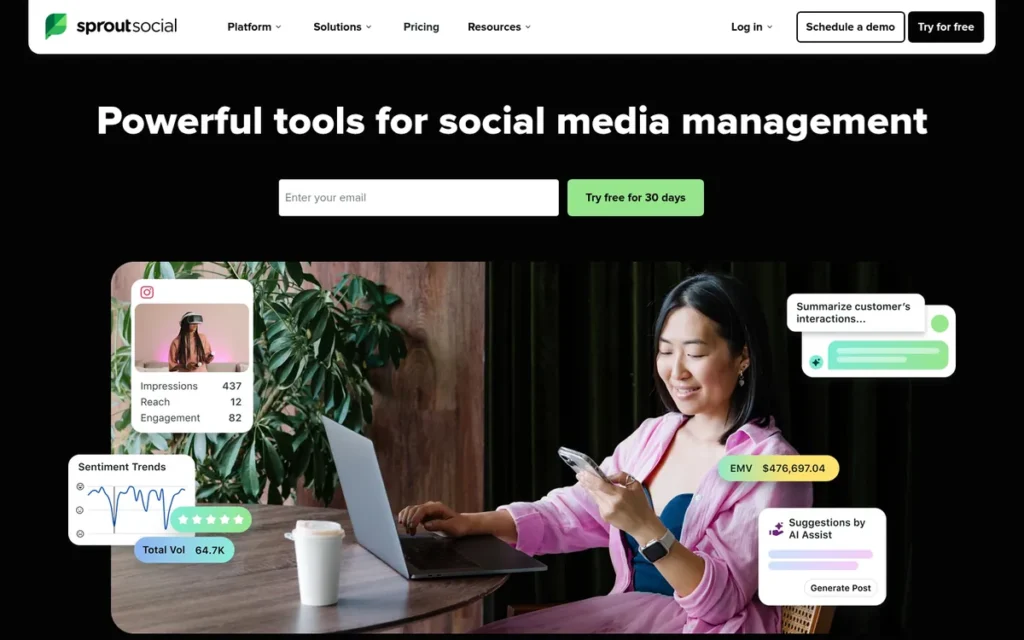
Category: Social Workflow Suite, a social media management platform with listening available as an add-on.
At a Glance
- Category: Social Workflow Suite
- Best For: Mid-market and enterprise social media teams whose main job is publishing and engagement, with listening as a supporting need
- Price Range: $199–$399/seat/month billed annually (Capterra, accessed November 2026); Listening add-on and Enterprise are quote-based
- Primary Strength: Sprout Social has the largest review base of any product on this list (4.4/5 on G2 from 7,491 reviews), with consistent praise for ease of use and centralized management.
- Biggest Limitation: Sprout Social’s Listening is a quote-based add-on that reviewers describe as basic compared with specialist tools, and it doesn’t cover print or broadcast media.
- One-Line Summary: Sprout Social is a social media management suite with an add-on listening module, best suited to teams that want brand monitoring built into daily publishing and engagement work.
- Last Verified: November 2026
Overview
Sprout Social is a social media management platform with an add-on listening module. It is built for mid-market and enterprise social teams that want publishing, engagement, analytics and brand monitoring in one workflow rather than a standalone research tool.
Sprout Social is listed on Nasdaq (SPT) and reported $457.5M in FY2025 revenue (Sprout Social FY2025 10-K, 2026). Sprout Social acquired NewsWhip in July 2025 to add predictive news intelligence (Sprout Social investor relations, 2025).
Key Features
- Sprout Social’s Smart Inbox pulls messages from multiple social networks into one queue for team engagement.
- Sprout Social offers Listening as an add-on module for tracking brand, competitor and topic conversations.
- Sprout Social’s Trellis AI agents and AI Assist draw on 1B+ messages a day (Sprout Social FY2025 10-K, 2026).
- Sprout Social’s $55M NewsWhip acquisition closed July 30, 2025. NewsWhip CEO Paul Quigley was then appointed to lead Sprout Social’s Listening business (Sprout Social investor relations, 2025).
- Sprout Social includes publishing, scheduling and Premium Analytics (an add-on) alongside listening.
Best For
Sprout Social is best for social media teams that spend most of their time publishing and engaging and want listening data in the same tool, without hiring a dedicated research analyst.
Strengths
- Sprout Social is rated 4.4/5 on G2 from 7,491 reviews and 4.4/5 on Capterra from about 606 reviews, the largest review sample of any product evaluated (G2; Capterra, accessed November 2026).
- Sprout Social’s FY2025 10-K reports $457.5M in revenue (up from $405.9M in 2024) and 3,803 customers paying $30K+ ARR, the most verifiable financial disclosure in this comparison (Sprout Social FY2025 10-K, 2026).
- Sprout Social is associated with customers including Atlassian, Canva and HP on G2’s seller page (G2, accessed November 2026).
- Sprout Social’s Smart Inbox draws specific praise: one TrustRadius reviewer called it “a lifesaver,” and one G2 reviewer called it a “game-changer” (TrustRadius; G2, accessed November 2026).
Limitations
Sprout Social trades listening depth for workflow convenience. Capterra reviewers describe its Listening module as basic compared with specialist tools (Capterra, accessed November 2026).
- Sprout Social has no print or broadcast monitoring and limited news history, which leaves gaps for PR-led teams.
- Sprout Social’s per-seat pricing scales quickly for larger teams, Listening is priced separately by quote, and some TrustRadius reviewers report possible multi-year contract requirements (TrustRadius, accessed November 2026).
- Sprout Social reviewers also cite complex settings, occasional scheduling problems and the planned deprecation of custom reports (Capterra; G2, accessed November 2026).
Users on r/b2bmarketing shared their experience:
“Primarily need someone who can really dial in our social listening topics so they aren’t surfacing trash that we (ok, me) have to spend hours sifting through daily to find the relevant mentions + getting our reporting to a decent place.” Posted by u/B2BBri
Takeaway: Sprout Social’s Listening can turn into a daily manual cleanup job for small B2B teams unless someone keeps tuning the listening topics.
Verdict
Sprout Social is the most-reviewed option in 2026 for social teams that want brand listening built into daily publishing and engagement work.
Sprout Social scored 3.80. Top marks on review evidence (C1 = 5) and verified credentials (C5 = 5) lifted the score, and listening depth (C4 = 2.5) and coverage (C2 = 3) held it back.
Sprout Social’s published seat pricing and audited financials make it easy to justify to finance. Insights teams that need research-grade query control, visual detection or print and broadcast coverage should either add a specialist platform or choose one instead.
3. Brandwatch: Best for Research-Grade Consumer Intelligence and Insights Teams
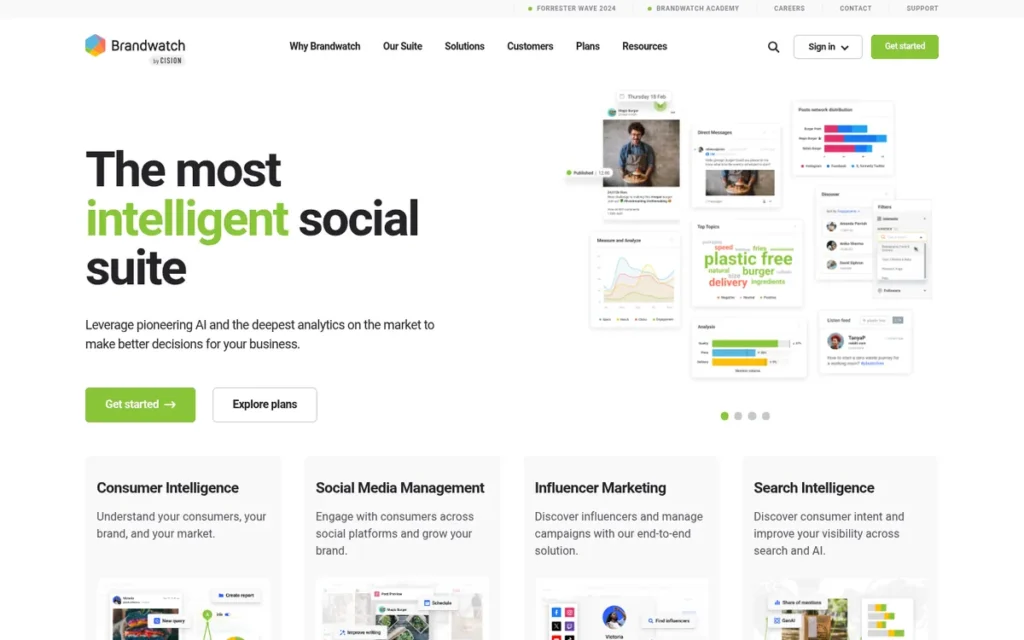
Category: Consumer Intelligence Platform, research-grade social and online listening with deep query control, history and AI analysis.
At a Glance
- Category: Consumer Intelligence Platform
- Best For: Enterprise insights, research and brand strategy teams with trained analysts who need deep historical and cross-source conversation analysis
- Price Range: Quote-based; no verified public figures (accessed November 2026)
- Primary Strength: Brandwatch combines firehose access to X, Reddit and Tumblr, a multi-year historical archive and Image Insights logo detection for research-grade consumer analysis.
- Biggest Limitation: Brandwatch has a steep Boolean learning curve, opaque premium pricing and self-documented coverage limits on Instagram, Facebook and X.
- One-Line Summary: Brandwatch is a research-grade consumer intelligence platform that gives trained insights teams deep query control, long historical data and image recognition across social and online sources.
- Last Verified: November 2026
Overview
Brandwatch is a research-grade consumer intelligence and social listening platform for enterprise insights and brand teams. These teams analyze conversations about brands, competitors and markets across social media, news, reviews, forums and blogs over many years.
Brandwatch is based in Brighton, England, and has been owned by Cision since June 2021 (Brandwatch press release, 2021). Brandwatch is quote-only, and Capterra reviewers describe its premium price as a barrier for small teams (Capterra, accessed November 2026).
Key Features
- Brandwatch claims 100M+ sources and about 500M posts processed per day (Brandwatch help center, accessed November 2026).
- Brandwatch’s Image Insights detects logos, objects, scenes and actions, so it catches brand appearances that have no text mention.
- Brandwatch’s Iris AI summarizes data, builds charts, and flags anomalies and drivers of change.
- Brandwatch describes its archive as 1.2 trillion documents back to 2008 on one page and 1.6 trillion conversations back to 2010 on another (Brandwatch, accessed November 2026).
- Brandwatch supports flexible Boolean queries, custom classifiers and configurable dashboards for analyst-led research.
Best For
Brandwatch is best for enterprise insights and research teams with trained analysts who need long history, deep query control and visual detection to answer strategic consumer questions, not just to receive alerts.
Strengths
- Brandwatch Consumer Intelligence is rated 4.4/5 on G2 from 730 reviews (G2, accessed November 2026).
- Brandwatch is rated 4.2/5 on Capterra from 255 reviews, with praise for image analysis, Iris summaries, flexible queries and historical data (Capterra, accessed November 2026).
- Brandwatch’s Image Insights is one of only two documented logo-detection capabilities among the seven products (Brandwatch features page; Talkwalker product page, accessed November 2026).
- Brandwatch’s help center documents full firehose access to X, Reddit and Tumblr. It also lists Brandwatch’s own coverage limits, so buyers can verify channel access before signing (Brandwatch help center, accessed November 2026).
Limitations
Brandwatch trades accessibility for depth. G2 reviewers report a steep Boolean learning curve, slow loading and data that doesn’t match native platform numbers (G2, accessed November 2026).
- Brandwatch reviewers also report inaccurate sentiment for non-English content and restricted exports, including Reddit data (G2, accessed November 2026).
- Brandwatch’s help center lists these coverage limits (Brandwatch help center, accessed November 2026):
- Brandwatch’s public Instagram data for new queries only goes back to February 2025.
- Brandwatch excludes Instagram comments unless the account is tracked.
- Brandwatch limits Facebook coverage to selected pages.
- Brandwatch may not show X post text in some products.
- Brandwatch can be limited for TikTok and audience clustering (r/AskMarketing, 2026). Practitioners in the same thread describe this as a gap across most listening tools.
- Brandwatch’s conflicting archive figures mean buyers should confirm history depth in writing.
Verdict
Brandwatch is the strongest choice in 2026 for insights teams that need research-grade consumer conversation analysis with long history, deep Boolean control and image recognition.
Brandwatch scored 3.75. It shares the top analytical-depth score with Talkwalker by Hootsuite (C4 = 5) and placed ahead of Brand24 on the C2 + C4 tiebreak (9.5 vs. 6.0). Brandwatch lost ground on pricing transparency (C3 = 1.5) and ease of use (C6 = 2.5).
Brandwatch fits best when a trained analyst owns the platform and the Instagram, Facebook and TikTok gaps can be filled another way.
4. Brand24: Best for Small and Midsize Teams That Need Transparent Pricing
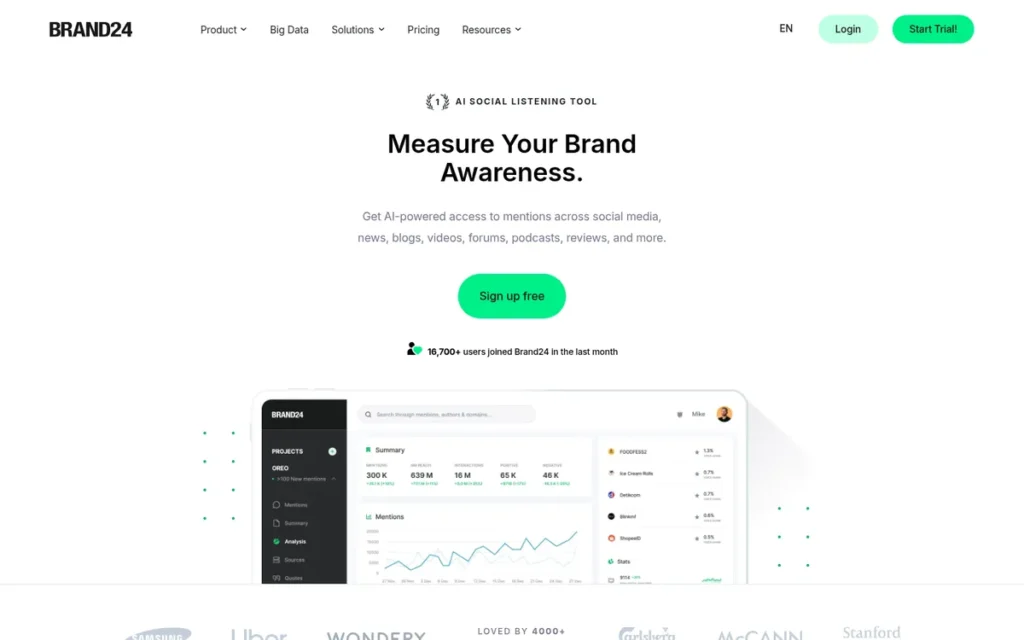
Category: Self-Serve Monitor, affordable, quick-setup mention monitoring and alerts with published pricing.
At a Glance
- Category: Self-Serve Monitor
- Best For: Small and midsize marketing teams and agencies that need web and social mention monitoring, alerts and competitor comparison without an enterprise contract
- Price Range: $199–$599/month billed annually; Enterprise from $1,499/month; 14-day free trial (Brand24 pricing page, accessed November 2026)
- Primary Strength: Brand24 publishes a complete price list with clear keyword, mention and user limits, so small teams can budget without a sales call.
- Biggest Limitation: Brand24 lacks print and broadcast coverage, offers limited historical data, and sets tight entry-plan limits on keywords, mentions and refresh frequency.
- One-Line Summary: Brand24 is a self-serve brand monitoring tool with published pricing that gives small and midsize teams AI sentiment, spike alerts and coverage of social, news, forums, podcasts and reviews.
- Last Verified: November 2026
Overview
Brand24 is a self-serve brand monitoring and social listening tool for small and midsize marketing teams, agencies and PR practitioners. It provides real-time mention alerts, sentiment and competitor comparison without an enterprise contract.
Brand24 was founded in Wrocław, Poland, in 2011 and is listed on the Warsaw Stock Exchange under the ticker B24 (Wikipedia, accessed November 2026). Brand24 publishes plans from $199 to $599 per month billed annually (Brand24 pricing page, accessed November 2026).
Key Features
- Brand24 monitors social media, news, blogs, forums, Reddit, podcasts, video and reviews from one dashboard.
- Brand24’s “Storm” alerts flag sudden spikes in mention volume, and Slack and Teams integrations send notifications to team channels.
- Brand24 includes AI sentiment analysis, an AI Brand Assistant and AI Topics for summarizing conversation themes.
- Brand24 monitors YouTube video transcripts. Brand24 claims that 70–90% of YouTube brand mentions can appear only in transcripts (r/Brand24Official, 2026; vendor claim, not independently verified).
- Brand24 offers an AI Visibility module for AI search visibility tracking, included in the Enterprise plan (Brand24 pricing page, accessed November 2026).
Best For
Brand24 is best for small and midsize teams and agencies that need dependable mention monitoring, spike alerts and simple reporting at a predictable monthly cost.
Strengths
- Brand24 is rated 4.6/5 on G2 from 384 reviews, the highest G2 rating in this comparison (G2, accessed November 2026).
- Brand24 is rated 4.7/5 on Capterra from 256 reviews, the highest Capterra rating among products here with more than 100 Capterra reviews (Capterra, accessed November 2026).
- Brand24 is the only ranked product whose core monitoring plans can all be priced without a sales call, and every plan comes with a 14-day free trial (Brand24 pricing page, accessed November 2026).
- Brand24 includes AI Visibility tracking for AI answer engines at its Enterprise tier, which puts this capability within reach of mid-market budgets (Brand24 pricing page, accessed November 2026).
Limitations
Brand24 trades depth for affordability. Brand24 has no print or broadcast monitoring, offers limited historical data, and leaves LinkedIn out of the entry plan (Brand24 blog, accessed November 2026).
- Brand24’s Individual plan allows one user, three keywords and 2,000 mentions a month, and refreshes only every 12 hours. That may be too slow during a crisis.
- Brand24’s own blog acknowledges sarcasm misclassification and quotes a review saying the tool lacks “useful social listening capabilities.” The blog also acknowledges Trustpilot complaints about auto-renewal and refunds (Brand24 blog, accessed November 2026; Trustpilot rating not verified).
- Brand24’s Capterra reviewers cite keyword limits on lower tiers, irrelevant results and filtering issues (Capterra, accessed November 2026). Its commonly cited customer names could not be verified.
Users on r/PublicRelations noted:
“I’m looking for suggestions on software I can use for Media Monitoring. I’ve been looking at Brand24.com and Mentionlytics.com … but my frustration is there’s always articles I pick up manually that these pieces of software often do not pick up.” Posted by u/caperanger
Takeaway: Self-serve monitors like Brand24 can miss coverage that PR practitioners find by hand, so client reports may still need manual additions.
Verdict
Brand24 is the most budget-predictable brand monitoring tool in 2026 for small and midsize teams that need alerts, sentiment and competitor tracking without an enterprise contract.
Brand24 scored 3.75, with top marks on pricing transparency (C3 = 5) and strong ease of use (C6 = 4.5). It placed behind Brandwatch on the C2 + C4 tiebreak (6.0 vs. 9.5) because of narrower coverage (C2 = 3) and analytical depth (C4 = 3).
Brand24’s free trial makes it easy to test before buying. Teams that need print or broadcast coverage, deep history or research-grade analysis will outgrow it.
5. Talkwalker by Hootsuite: Best for Visual Listening and Multilingual Coverage
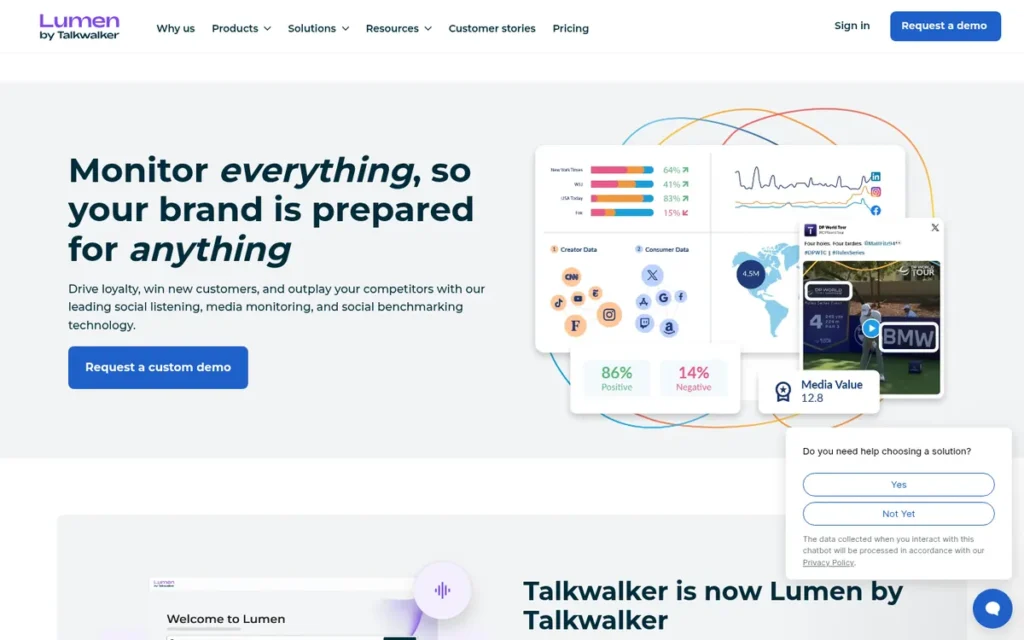
Category: Consumer Intelligence Platform.
At a Glance
- Category: Consumer Intelligence Platform
- Best For: Global brands and insights teams that need logo and video recognition plus multilingual sentiment across many markets
- Price Range: Quote-based paid platform (market estimates of tens of thousands to six figures per year); free Talkwalker Alerts (CommunityTracker, accessed November 2026)
- Primary Strength: Talkwalker by Hootsuite has the most extensive documented visual listening on this list, recognizing 40,000+ brand logos, objects and scenes (vendor figure) and detecting logos in video.
- Biggest Limitation: Talkwalker by Hootsuite has small public review samples, quote-only paid pricing and a reported steep learning curve at setup.
- One-Line Summary: Talkwalker by Hootsuite is a consumer intelligence platform best known for logo and video recognition and multilingual sentiment analysis across 30+ social networks and online sources.
- Last Verified: November 2026
Overview
Talkwalker by Hootsuite is a consumer intelligence and social listening platform for global brands and insights teams. It detects logos in images and video and analyzes sentiment and emotion across many languages, going beyond text-only mentions.
Talkwalker was founded in Luxembourg in 2009, and Hootsuite acquired it in April 2024 (Axios, 2024). Lumen is the AI-led interface for Talkwalker by Hootsuite’s newer product.
Key Features
- Talkwalker by Hootsuite’s visual AI recognizes 40,000+ brand logos, objects and scenes and monitors 60M+ new videos daily (Talkwalker product page, accessed November 2026; vendor figures).
- Talkwalker by Hootsuite’s Blue Silk AI offers sentiment and 7-emotion analysis in up to 192 languages, though another Talkwalker page cites 187 (Talkwalker, accessed November 2026).
- Talkwalker by Hootsuite covers 30+ social networks plus news, blogs, forums, podcasts and reviews (G2; Goodmans, accessed November 2026).
- Talkwalker by Hootsuite offers forecasting and a Virality Map to help teams anticipate how conversations will spread.
- Talkwalker by Hootsuite provides free Talkwalker Alerts for basic email keyword monitoring, separate from the paid platform.
Best For
Talkwalker by Hootsuite is best for global consumer brands whose logos and products often appear in images and video, and for teams that need sentiment analysis in many languages.
Strengths
- Talkwalker by Hootsuite’s documented logo and video recognition is the most direct answer in this comparison to the risk that text-only monitoring misses visual brand appearances (Talkwalker product page, accessed November 2026).
- Talkwalker had 2,500+ clients, including 500+ enterprises, when Hootsuite acquired it (Axios, 2024). Named customers include Adidas, Orange and HelloFresh (RTL Today; Britopian, accessed November 2026).
- Talkwalker by Hootsuite is rated 4.3/5 on G2 from 137 reviews, with praise for Boolean search, cluster analysis and theme synthesis (G2, accessed November 2026).
- Talkwalker by Hootsuite’s Blue Silk AI claims sentiment and emotion analysis in 187–192 languages, the broadest language claim documented in this research.
Limitations
Talkwalker by Hootsuite trades ease of use for visual and multilingual depth. G2 reviewers report a steep learning curve and a difficult initial setup (G2, accessed November 2026).
- Talkwalker by Hootsuite’s public review evidence is thin: Capterra 4.4/5 from 24 reviews and Trustpilot 2.6/5 from 4 reviews (CommunityTracker, accessed November 2026).
- Talkwalker by Hootsuite’s paid pricing is quote-only, and no usable Reddit discussion was found confirming that its video recognition works well in practice.
- Talkwalker’s own figures conflict on language counts (187 vs. 192) and logo counts (about 30,000 vs. 40,000+).
- Hootsuite’s Talkwalker terms note that third-party platforms may restrict API access and limit how raw data can be redistributed (Hootsuite, accessed November 2026).
Verdict
Talkwalker by Hootsuite is the strongest choice in 2026 for brands that need logo and video recognition and multilingual sentiment across many markets.
Talkwalker by Hootsuite scored 3.55. It shares the top analytical-depth score (C4 = 5) but was held back by thin review samples (C1 = 3) and quote-only pricing (C3 = 1.5).
Talkwalker’s small review samples mean buyers should insist on a pilot with their own brand assets before committing.
6. Muck Rack: Best for PR Teams Focused on Journalist Relations
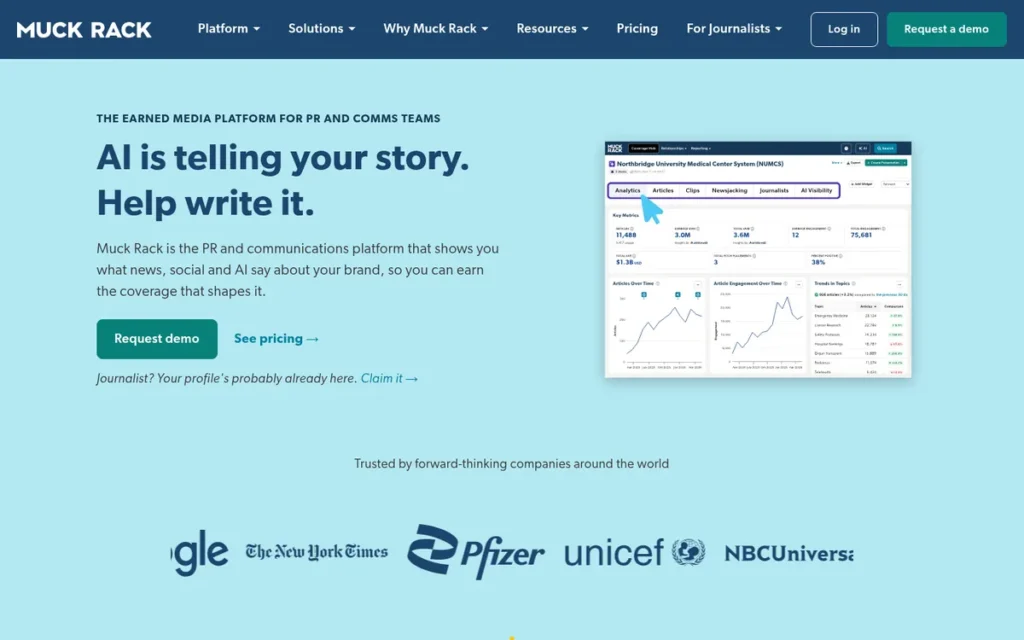
Category: PR Workflow Suite, a journalist database, pitching and coverage reporting, with media monitoring.
At a Glance
- Category: PR Workflow Suite
- Best For: In-house PR teams and agencies whose core work is journalist outreach, pitching and coverage reporting
- Price Range: Quote-only; estimated $5,000–$50,000+/year (Sacra, accessed November 2026); no free plan or trial
- Primary Strength: Muck Rack combines editorially verified journalist profiles with pitching and coverage reporting, backed by a 4.5/5 G2 rating from 549 reviews.
- Biggest Limitation: Muck Rack’s social listening and global print and broadcast monitoring are shallower than dedicated monitoring suites, and those modules cost extra.
- One-Line Summary: Muck Rack is a PR management platform that pairs a verified journalist database and pitching tools with media monitoring and coverage reporting for communications teams.
- Last Verified: November 2026
Overview
Muck Rack is a PR management platform for in-house communications teams and agencies. It puts a verified journalist database, media-list building, pitch tracking, monitoring and coverage reporting in one place, rather than offering a broad consumer intelligence tool.
Muck Rack was founded in 2009 by Greg Galant and Lee Semel and ran without outside funding for more than 10 years. Muck Rack raised $180M from Susquehanna Growth Equity in 2022 (TechCrunch, 2022).
Key Features
- Muck Rack’s editorial team confirms that each journalist profile belongs to a full-time journalist, and journalists can manage their own free profiles.
- Muck Rack supports media-list building and pitching with email open and reply tracking.
- Muck Rack provides media monitoring and coverage reports for showing PR results to stakeholders.
- Muck Rack reportedly sells social listening, print monitoring and broadcast monitoring as add-on modules (Sacra, accessed November 2026).
- Muck Rack’s Generative Pulse add-on provides AI search visibility tracking, showing how a brand appears in AI-generated answers.
Best For
Muck Rack is best for PR teams and agencies whose main job is building journalist relationships, pitching stories and reporting coverage, with monitoring as a supporting function.
Strengths
- Muck Rack is rated 4.5/5 on G2 from 549 reviews, the second-highest G2 rating here and from a larger sample than Brand24’s 384. One reviewer praised “the level of detail it provides on media outlets and media contacts” (G2, accessed November 2026).
- Muck Rack’s editorially verified journalist profiles address the bounced-email and stale-contact problems common in scraped databases (Muck Rack journalists page, accessed November 2026).
- Muck Rack raised $180M in its first outside funding (TechCrunch, 2022) and names Google, Pfizer, Zapier and Duolingo as customers.
- Muck Rack’s customer base grew from 4,000+ companies in mid-2023 to nearly 6,000 in late 2024, according to an analyst estimate (Sacra, accessed November 2026).
Limitations
Muck Rack trades monitoring breadth for PR workflow strength. Third-party comparisons describe weaker global print and broadcast coverage than Meltwater or Cision, plus shallow social listening (JournoFinder; Prezly; PodPitch, accessed November 2026).
- Muck Rack’s G2 reviewers report bounced emails, outdated contacts, missed articles and inaccurate sentiment (G2, accessed November 2026).
- Muck Rack’s pricing is known only from third-party estimates, and there is no trial. One TrustRadius reviewer said broadcast monitoring “did not provide sufficient ROI” (TrustRadius, accessed November 2026).
- Muck Rack’s fit for small budgets was questioned when a nonprofit marketer with an $8,000–$10,000 total marketing budget asked about it (r/AskMarketing, 2024).
Users on r/PublicRelations noted:
“I’ve used both. I didn’t know Muck Rack could track metrics, but Meltwater’s is excellent. Right now my company is using CISIONOne, which is MUCH cheaper than Meltwater and it has a great database of journalists and great metrics” Posted by u/IThinkImDumb
Takeaway: Muck Rack’s measurement features are little known even to PR practitioners who have used the platform, while Meltwater and the cheaper CisionOne get the credit for metrics.
Verdict
Muck Rack is the strongest choice in 2026 for PR teams whose core work is journalist outreach and coverage reporting, backed by a 4.5/5 G2 rating from 549 reviews (G2, accessed November 2026).
Muck Rack scored 3.20. Strong review evidence (C1 = 4.5) and ease of use (C6 = 4.5) were offset by narrower coverage (C2 = 2.5) and analytical depth (C4 = 2.5), which reflects its PR-workflow focus rather than weak execution.
Muck Rack’s verified profiles address the stale-contact problem common in scraped databases, though G2 reviewers still report some bounced emails. Teams that need global broadcast monitoring should add a dedicated monitoring tool.
7. YouGov BrandIndex: Best for Survey-Based Brand Health Tracking
Category: Brand Health Tracker, measures awareness, perception and purchase intent through representative consumer surveys.
At a Glance
- Category: Brand Health Tracker
- Best For: CMOs, brand strategists and insights leads who need to report representative brand-health metrics to leadership
- Price Range: Quote-only; no public price list (accessed November 2026)
- Primary Strength: YouGov BrandIndex measures brand awareness, perception and purchase intent daily through representative surveys across 55+ markets, something mention-based tools are not designed to do.
- Biggest Limitation: YouGov BrandIndex doesn’t work in real time, has almost no public review evidence, and may have thin samples for niche or B2B brands.
- One-Line Summary: YouGov BrandIndex is a survey-based brand health tracker that measures awareness, perception and purchase intent for about 26,000–27,000 brands daily across 55+ markets.
- Last Verified: November 2026
Overview
YouGov BrandIndex is a survey-based brand health tracker for CMOs, brand strategists and insights teams. It gives them representative consumer measures of awareness, perception and purchase intent for about 26,000–27,000 brands daily, instead of online mention counts (YouGov product pages, accessed November 2026).
YouGov BrandIndex is run by YouGov plc, an LSE-listed research company founded in London in 2000. YouGov BrandIndex groups its 16 survey metrics into three areas:
- YouGov BrandIndex’s media and communication metrics include Ad Awareness, Aided Awareness, Attention, Buzz and Word of Mouth.
- YouGov BrandIndex’s perception metrics include Impression, Satisfaction, Quality, Value, Reputation, Recommend and the composite Index.
- YouGov BrandIndex’s purchase-funnel metrics include Consideration, Purchase Intent, Current Customer and Former Customer.
Key Features
- YouGov BrandIndex tracks brands daily in 55–56 markets and draws on 8M+ interviews a year (YouGov, accessed November 2026; vendor figures).
- YouGov BrandIndex Voices runs AI-led qualitative interviews to explain why a brand metric moved.
- YouGov BrandIndex offers API data feeds that can be used as inputs to marketing-mix models (YouGov MMM page, accessed November 2026).
- YouGov BrandIndex provides a historical series, generally dated from about 2007, for trend analysis.
Best For
YouGov BrandIndex is best for CMOs and insights leads who must report defensible brand-health metrics to leadership, ideally paired with a listening tool for real-time signals.
Strengths
- YouGov BrandIndex uses representative surveys. That approach is supported by a study of about 500 US brands, which found online word-of-mouth had almost no ability to predict offline brand outcomes outside crises (Fay and Larkin, Journal of Advertising Research, 2017).
- YouGov BrandIndex covers 55–56 markets with 8M+ interviews a year, the widest market reach of any survey-based tool in this research (YouGov, accessed November 2026).
- YouGov’s Best Global Brands 2025 report, built from 1M+ surveys across 28 markets, shows the BrandIndex method working at scale (YouGov, 2025).
- YouGov BrandIndex API feeds support marketing-mix modeling, which links brand-health data to marketing investment decisions (YouGov MMM page, accessed November 2026).
Limitations
YouGov BrandIndex trades speed for representativeness. Survey data can’t flag a viral post or Reddit thread in real time, so crisis detection needs a separate listening tool.
- YouGov BrandIndex has almost no public review evidence (Capterra 5.0/5 from one review), and its pricing is quote-only (Capterra, accessed November 2026).
- YouGov’s own pages give conflicting figures for history length (15+ to 20+ years), panel size (15M+ vs. 27M+) and brand count (26,000 vs. 27,000+).
- YouGov BrandIndex samples are described as thin for niche or B2B brands by competitors (Listen Labs; Morning Consult, accessed November 2026), so treat that critique with caution. YouGov plc also lowered its revenue and profit expectations in June 2024 (YouGov Annual Report 2024).
Verdict
YouGov BrandIndex is the most direct way in 2026 to measure representative brand health, meaning awareness, perception and purchase intent, rather than inferring it from online mentions.
YouGov BrandIndex scored 2.70, and the largest single drag was C1 = 1 (one Capterra review). The 7th-place rank reflects thin review evidence and opaque pricing, not weak methodology.
Teams reporting brand health to leadership should evaluate YouGov BrandIndex alongside a listening tool, not instead of one.
Which Other Brand Intelligence Tools Did We Consider?
PlugRoute also considered 13 tools named by AI answer engines and practitioners but did not rank them, because none has yet been researched to PlugRoute’s equal-depth evidence standard. Treat this list as a starting point for further research, not an endorsement or a ranking. Each tool is listed with the use case it was cited for.
- Qualtrics BrandXM was named by AI answer engines as a survey-based brand health option.
- Attest was named by AI answer engines as a survey-based brand health option.
- Tracksuit was named as a survey-based brand tracker with simpler dashboards (Listen Labs, accessed November 2026; competitor source).
- YouScan was named by ChatGPT as a visual monitoring option.
- Mention scored 4.7/5 on Capterra from 288 reviews but was left out because Brand24 already fills the self-serve slot (Capterra, accessed November 2026).
- Cision owns Brandwatch, and its CisionOne platform had no public rating in PlugRoute’s discovery research.
- Critical Mention was shortlisted for media listening by a small nonprofit (r/AskMarketing, 2024).
- Google Alerts was recommended as a free option for very limited budgets (r/AskMarketing, 2024).
- Sprinklr Insights was named by AI answer engines in the brand intelligence category.
- Audiense was named by AI answer engines in the brand intelligence category.
- Awario was named by AI answer engines in the brand intelligence category.
- BrandMentions was named by AI answer engines in the brand intelligence category.
- Mentionlytics was named by AI answer engines in the brand intelligence category.
Is Brand Intelligence Software the Same as Social Listening?
No. Brand intelligence software is not the same as social listening, which is only one part of it. The broader category also covers media monitoring of print, broadcast and podcasts, as well as visual logo recognition, PR workflow and survey-based brand health. A social listening tool alone won’t cover news coverage or representative consumer perception.
PR professionals weight these parts differently. A PR statistics roundup reports that 60% of PR professionals call media-monitoring tools critical to their team’s success, compared with 22% for social-listening tools (MarketersMedia, accessed November 2026; original survey not identified).
Market estimates also treat the segments separately. Verified Market Research sizes brand intelligence software at $3.6B in 2023, projected to reach $14.9B by 2030. Research and Markets puts social listening at $10.37B in 2025 (accessed November 2026). These estimates overlap and shouldn’t be added together.
The ranked tools map to these jobs:
- Social listening: Brandwatch, Talkwalker by Hootsuite, Sprout Social Listening and Brand24 track social and online conversations.
- Media monitoring: Meltwater and Muck Rack track news coverage, and Meltwater adds print, broadcast and podcasts.
- Visual recognition: Talkwalker by Hootsuite and Brandwatch detect logos in images, and Talkwalker also detects them in video.
- Brand health: YouGov BrandIndex measures awareness and perception through surveys.
Does Online Mention Volume Reflect Brand Health?
No. Raw online mention volume doesn’t reliably reflect brand health. Peer-reviewed research shows that unadjusted social sentiment and word-of-mouth measures predict offline brand-tracking results poorly, and that they become useful only after statistical correction or modeling. Teams reporting brand health to leadership need either representative surveys or carefully modeled social data.
Three studies frame the evidence:
- Journal of Marketing Research: Unadjusted social sentiment diverged from offline brand-tracking surveys, but sentiment corrected for platform (venue) differences tracked the surveys closely (Schweidel and Moe, Journal of Marketing Research, 2014; via Wharton Magazine).
- Journal of Advertising Research: Across about 500 US brands in 16 categories, online word-of-mouth volume, sentiment and sharing had almost no ability to predict offline brand outcomes, except during crises (Fay and Larkin, Journal of Advertising Research, 2017; via Research Live).
- TNS: Across 61 brands, cleaned and modeled social and search signals reached R²=0.90 against later brand-equity survey changes and led the surveys by up to 8 weeks (TNS via GreenBook, accessed November 2026).
In practice, a spike of 5,000 positive mentions after a viral campaign can sit alongside flat purchase intent in survey tracking. A high mention count is not proof that perception changed.
The TNS result came from a specialist model, not raw mention counts. The TNS finding is the case for pairing a listening tool for early warning with a survey tracker for confirmation.
Measurement remains a recognized problem. 54% of PR professionals say linking results to business goals is their biggest measurement hurdle (Muck Rack State of PR 2025, via Truescope; vendor survey).
Listening tools tell you what people are saying, and survey trackers tell you what people think. Most brand-health reporting needs both.
How Much Does Brand Intelligence Software Cost in 2026?
Brand intelligence software ranges from free alerts to more than $130,000 a year. Brand24 publishes plans from $199 to $599 per month billed annually, and Sprout Social publishes seats at $199–$399 per month. Meltwater, Brandwatch, Talkwalker, Muck Rack and YouGov BrandIndex are quote-only. Third-party estimates exist for Meltwater, Muck Rack and Talkwalker.
| Product | Pricing Model | Documented Figures (accessed November 2026) |
|---|---|---|
| Brand24 | Published | $199–$599/month billed annually; Enterprise from $1,499/month; 14-day free trial |
| Sprout Social | Published seats + quote add-ons | $199–$399/seat/month billed annually; Listening quote-based |
| Meltwater | Quote-based | Indicative $10,000–$130,000+/year (reported, not published) |
| Muck Rack | Quote-only | Estimated $5,000–$50,000+/year; no trial |
| Talkwalker by Hootsuite | Quote-only | Market estimate of tens of thousands to six figures; Alerts free |
| Brandwatch | Quote-only | No verified public figures |
| YouGov BrandIndex | Quote-only | No public price list |
What do Brand24’s published plans include?
| Plan | Annual billing (per month) | Monthly billing | Keywords | Mentions/month | Users |
|---|---|---|---|---|---|
| Individual | $199 | $249 | 3 | 2,000 | 1 (updates every 12 hours) |
| Team | $299 | $349 | 7 | 10,000 | Unlimited |
| Pro | $399 | $499 | 12 | 40,000 | Unlimited |
| Business | $599 | $699 | 25 | 100,000 | Unlimited |
| Enterprise | From $1,499 | N/A | Custom | Custom | Unlimited, includes AI Visibility |
Brand24 Team billed annually costs $3,588 a year, and Brand24 Business costs $7,188 a year before API access or overages (Brand24 pricing page, accessed November 2026). Brand24’s blog cites a conflicting “$149/month” entry price, so rely on the pricing page.
How do Sprout Social’s seat prices add up?
- Sprout Social Standard costs $199 per seat per month, Professional costs $299 and Advanced costs $399, all billed annually (Capterra, accessed November 2026).
- Sprout Social is listed by TrustRadius at a different starting price of $249/user/month (TrustRadius, accessed November 2026).
- Sprout Social prices Listening, Premium Analytics and Enterprise by quote.
- Sprout Social’s five Advanced seats cost about $23,940 a year before Listening is added.
What is known about quote-only pricing?
- Meltwater’s indicative tiers are about $10,000/year (Starter), $25,000/year (Pro) and $130,000+/year (Enterprise), as reported by Capterra and Meltwater’s pricing blog. Meltwater does not publish fixed tier prices (accessed November 2026).
- Meltwater’s Capterra listing also shows “$199/month,” which conflicts with those tiers and shouldn’t be read as the platform price.
- Muck Rack’s estimated contracts run about $5,000/year at entry level, $10,000–$15,000/year mid-tier and $50,000+/year for enterprise (Sacra, accessed November 2026).
- Talkwalker’s pricing page lists components without dollar amounts, including dashboards, reports, alerts and IQ Apps (Talkwalker, accessed November 2026).
- YouGov BrandIndex cost reportedly rises with markets, sectors, brands, history depth, users, API access and Voices.
The total cost of brand intelligence software usually exceeds the published or quoted base price. The main cost drivers are:
- Seats, which multiply per-user pricing such as Sprout Social’s.
- Modules and add-ons, including Listening, analytics, broadcast monitoring and AI visibility.
- Overages, such as Brand24’s $19/month for each extra 10,000 mentions.
- API access, such as Brand24’s $99/month on the Business plan.
There are a few low-risk ways to start. Brand24 offers a 14-day free trial, and Talkwalker Alerts and Google Alerts are free. Muck Rack offers no free plan or trial, and the other vendors are sales-led.
Which Vendor Figures Conflict, and Why Does It Matter?
Four of the seven vendors publish conflicting figures about their own products, covering history, languages, logo counts, price and panel size, and a fifth conflict appears on Meltwater’s Capterra listing. These conflicts matter because contracts are signed on coverage and history claims. Ask each vendor to confirm the figures for your plan in writing.
- Brandwatch: Brandwatch pages cite 1.2 trillion documents back to 2008 and 1.6 trillion conversations back to 2010. Brandwatch’s founding year is commonly cited as 2005, but G2 lists 2007.
- Talkwalker by Hootsuite: Talkwalker pages cite both 187 and 192 supported languages. They also cite both about 30,000 logos and 40,000+ logos, objects and scenes.
- Brand24: Brand24’s blog cites a $149/month entry price, while its pricing page starts at $199/month billed annually.
- YouGov BrandIndex: YouGov pages cite 15+, 17+, 18+ and 20+ years of history, panels of 15M+ and 27M+ members, and 26,000 to 27,000+ brands tracked.
- Meltwater: Meltwater’s Capterra listing shows “$199/month,” which conflicts with reported tiers starting around $10,000/year.
What Red Flags Should I Watch For When Evaluating Brand Intelligence Software?
Six red flags come up most often:
- Long auto-renewal notice windows.
- Coverage claims without channel-level documentation.
- Conflicting vendor figures.
- Untested sentiment accuracy claims.
- Add-on pricing that hides total cost.
- Treating mention volume as brand health.
Each one appears in the reviews or documentation of at least one ranked vendor.
Red Flag #1: Auto-Renewal With Long Notice Windows
Auto-renewal clauses with long written-notice windows are the most repeated commercial complaint in this category. Meltwater’s contracts reportedly require 60 days’ notice (Octolens, accessed November 2026), and some Capterra reviewers report 90 days.
Similar complaints appear for Brand24 (Trustpilot complaints, as acknowledged on Brand24’s blog) and Muck Rack (Prezly; PodPitch, accessed November 2026). Some TrustRadius reviewers also report possible multi-year terms for Sprout Social. Here is how notice windows play out:
- A contract renewing on March 1 with a 90-day notice clause needs written notice by about December 1.
- The same contract with a 60-day notice clause moves the deadline to about December 31.
Red Flag #2: Coverage Claims Without Channel-Level Documentation
A source count is not a coverage guarantee. Figures like “100M+ sources” don’t show which channels your plan can actually reach. X and Meta API restrictions affect most listening tools that rely on those platforms’ data, so coverage is negotiated in procurement, not bought off a feature list.
Brandwatch is the only ranked vendor found to publish channel-level limits in its help center. Other vendors not publishing limits doesn’t mean those limits don’t exist. Demand channel-level documentation for your plan.
As one user on r/PublicRelations described:
“From my experience, it really depends on the industry you are in and the coverage your media monitoring tool is focusing on. If you are in a specific niche and your coverage falls outside of prominent news outlets, try reaching out to support and see if they can include sources that are regularly missed.” Posted by u/ListeningInPublic
Takeaway: Media monitoring coverage depends on the niche, so brands covered outside mainstream news outlets should get vendors to add the sources they regularly miss before trusting any headline source count.
Red Flag #3: Conflicting Vendor Figures
Conflicting vendor figures appear for Brandwatch, Talkwalker by Hootsuite, Brand24, YouGov BrandIndex and Meltwater’s Capterra listing. For example, Brandwatch cites archives starting in both 2008 and 2010. When a vendor’s pages disagree, get the correct figure written into your contract instead of relying on a marketing page.
Red Flag #4: Sentiment Accuracy Claims Without a Test on Your Language
Sentiment accuracy claims of 80–90% typically come from clean, limited datasets, so test any vendor on a hand-labeled sample of your own posts in each language you need. Academic sarcasm-detection F1 scores rarely exceed about 65% (Listen Labs, accessed November 2026; vendor-published summary).
Reviewers report non-English sentiment errors for Brandwatch, sarcasm misclassification for Brand24 and inaccurate sentiment for Muck Rack (G2; Brand24 blog, accessed November 2026).
Red Flag #5: Add-On Pricing That Hides Total Cost
Add-on pricing hides the real cost when listening, analytics, broadcast monitoring or AI-visibility modules are sold separately. Meltwater, Sprout Social and Muck Rack all sell key capabilities as add-ons. Get a fully loaded annual quote from each finalist before comparing vendors on price.
Red Flag #6: Treating Mention Volume as Brand Health
A vendor that presents raw mention counts as a brand-health score is likely overstating what peer-reviewed research says the data can show. Across about 500 US brands, online word-of-mouth predicted offline brand outcomes poorly outside crises (Fay and Larkin, Journal of Advertising Research, 2017).
What Questions Should I Ask Before Choosing Brand Intelligence Software?
Before choosing brand intelligence software, ask six questions:
- What channel and history coverage does my plan include?
- What is the fully loaded annual cost?
- What are the renewal terms?
- Can we pilot identical queries?
- How accurate is logo detection on our assets?
- Do we need survey data at all?
The answers expose most of the coverage, cost and contract risks that cause a purchase to fail.
Question #1: Which channels, countries and languages are covered, and what are the history limits per channel on my plan?
Strong answer: A strong vendor answer to the coverage question is written, channel-by-channel documentation of countries, languages and history limits on your plan, not a headline source count.
Why it matters: Suppose your brand ran an Instagram campaign in 2024. A new Brandwatch query can’t see that public history, because Brandwatch’s documented Instagram data for new queries starts in February 2025. X and Meta API restrictions and Hootsuite’s Talkwalker redistribution terms show why every vendor should be asked the same question.
Question #2: What is the total annual cost, including seats, modules, add-ons and overages?
Strong answer: A strong vendor answer to the cost question is a single annual figure that includes every module your team needs. To get one:
- Ask Sprout Social to price Listening alongside your seats.
- Ask Meltwater and Muck Rack to price each module separately.
- Check overage costs, such as Brand24’s $19 per extra 10,000 mentions.
Question #3: What is the renewal-notice period, and to whom must notice be sent?
Strong answer: A strong vendor answer to the renewal question names the exact notice window and the contact or address that must receive written notice.
Why it matters: Meltwater reviewers report 60–90 day windows and disputes over notice sent to customer-success reps (Capterra, accessed November 2026).
Question #4: Can we pilot identical queries and measure missed mentions, false positives and alert speed?
Strong answer: A strong vendor answer to the pilot question is a time-boxed trial on your own brand terms. PlugRoute found no independent head-to-head test of coverage or sentiment accuracy across these vendors, so a side-by-side pilot is the most reliable evidence you can get.
A brand intelligence pilot should follow these steps:
- Use the same 5–10 brand and competitor terms in every tool.
- Run the pilot for two weeks at the same time across tools.
- Count mentions that one tool found and another missed.
- Hand-check 50 sentiment labels per tool against your own judgment.
- Log alert delay on a known event, such as a scheduled announcement.
Question #5: Does the tool detect logos in images and video, and how accurate is it on our brand assets?
Strong answer: A strong vendor answer to the visual-detection question is a demonstration on a labeled sample of your own logos and products. Talkwalker by Hootsuite documents video logo detection, and Brandwatch documents Image Insights. PlugRoute found no reliable industry-wide logo-detection accuracy figure.
“caption-only listening will tell you a video exists and miss whether people are dunking on you in the replies.” (u/Due_EmotionPri, r/AskMarketing (2026))
Takeaway: Text- and caption-based listening can miss sentiment in short-video replies, so pilot any vendor on your own video content.
A Brandwatch employee in the same thread said these gaps are common across most listening tools (r/AskMarketing, 2026).
Question #6: Do we need representative survey data, or is listening enough for our reporting?
Strong answer: A strong answer to the survey-versus-listening question depends on who reads your reports. Listening tools fit crisis detection and campaign tracking.
Why it matters: If leadership expects awareness, perception and purchase-intent metrics, a survey-based tracker such as YouGov BrandIndex answers a different question than any listening tool.
How Did We Rank These Brand Intelligence Tools?
PlugRoute scored all seven products from 1 to 5 on six weighted criteria using dated public research. Data coverage carries the most weight (25%), followed by review evidence and analytical depth (20% each). The weights reflect buyer pain points around budgeting, coverage verification and over-buying. The ranking reflects available evidence, not a lab benchmark.
PlugRoute used these criteria and weights:
- C1 Review-Platform Evidence (20%): Review evidence matters because large-sample user ratings are the most independent signal available. Samples under 50 reviews and vendor-blog-only figures are discounted.
- C2 Data Coverage and Documented Limits (25%): Coverage matters because missed mentions and channel gaps are the most common reason a purchase fails. Conflicting vendor figures reduce the score.
- C3 Pricing Transparency and Total-Cost Accessibility (15%): Pricing transparency matters because quote-only pricing blocks budgeting. Auto-renewal disputes and hidden add-ons reduce the score.
- C4 Analytical Depth (20%): Analytical depth matters because teams need sentiment, trends, visual detection or brand-health metrics, not just alerts.
- C5 Verified Credentials and Vendor Stability (10%): Vendor stability matters because multi-year contracts carry ownership and roadmap risk.
- C6 Ease of Use and Time to Value (10%): Ease of use matters because small teams can’t staff a trained analyst.
| Rank | Product | C1 (20%) | C2 (25%) | C3 (15%) | C4 (20%) | C5 (10%) | C6 (10%) | Weighted Score |
|---|---|---|---|---|---|---|---|---|
| 1 | Meltwater | 3.5 | 5 | 2.5 | 4 | 4.5 | 3 | 3.88 |
| 2 | Sprout Social | 5 | 3 | 4 | 2.5 | 5 | 4.5 | 3.80 |
| 3 | Brandwatch | 4 | 4.5 | 1.5 | 5 | 3.5 | 2.5 | 3.75 |
| 4 | Brand24 | 4.5 | 3 | 5 | 3 | 3 | 4.5 | 3.75 |
| 5 | Talkwalker by Hootsuite | 3 | 4.5 | 1.5 | 5 | 3.5 | 2.5 | 3.55 |
| 6 | Muck Rack | 4.5 | 2.5 | 2.5 | 2.5 | 3.5 | 4.5 | 3.20 |
| 7 | YouGov BrandIndex | 1 | 3.5 | 1.5 | 4 | 3 | 3 | 2.70 |
Brandwatch and Brand24 tied at 3.75. PlugRoute broke the tie on combined C2 + C4, the two highest-weighted capability criteria. Brandwatch scored 9.5 and Brand24 scored 6.0.
PlugRoute re-scored two products in November 2026 after confirming new evidence:
- Brand24’s C1 rose from 4 to 4.5 and its C5 rose from 2 to 3 after its G2 rating (4.6/5, 384 reviews) and company facts were confirmed (G2; Wikipedia, accessed November 2026).
- Brandwatch’s C1 rose from 3.5 to 4.0 after its G2 rating (4.4/5, 730 reviews) was confirmed (G2, accessed November 2026).
The top two brand intelligence tools are separated by 0.08 points out of 5, which is why PlugRoute recommends shortlisting by category first and overall rank second. Ranks #2 through #4 are separated by 0.05 points, so buyers whose priorities differ from these weights should re-weight C1–C6 using the published scores.
Meltwater’s C4 score of 4 reflects AI-assisted Boolean search, the Mira assistant and GenAI Lens, with no documented image or logo detection.
PlugRoute applied these limits to its method:
- PlugRoute found no independent head-to-head test of sentiment accuracy or coverage for any vendor.
- PlugRoute did not run original pilot tests.
- PlugRoute never compares ratings across different review platforms as if they were equivalent.
- PlugRoute found no independently verified, quantified customer-outcome case studies for any of the seven products. The only quantified results found were two vendor-published Brandwatch case studies, which were not scored: Prosci (47% more reach on an employee-advocacy program) and Art of the Possible (158% client growth).
- PlugRoute marks undated web sources with the month accessed (November 2026).
PlugRoute has no affiliate relationships with any company listed, and rankings are determined entirely by research data and objective evaluation criteria.
What Do Buyers Ask Most About Brand Intelligence Software?
Buyers most often ask how to choose a brand intelligence tool, which tools suit small businesses and PR teams, and how PlugRoute produces its rankings. In short: choose by category and fully loaded cost, Brand24 suits small budgets, Meltwater or Muck Rack suit PR teams, and rankings come from weighted scoring of dated public evidence.
How do I choose brand intelligence software in 2026?
Choose brand intelligence software in 2026 by picking your category first, then setting a fully loaded annual budget that includes seats, modules and overages. Next, get each vendor’s channel, country and history coverage in writing. Finally, pilot two finalists with identical queries for two weeks and compare missed mentions, false positives and alert speed.
What is the best brand intelligence software for small businesses and PR teams?
Brand24 is the strongest small-business option in these rankings, with published plans from $199/month billed annually and a 14-day free trial (Brand24 pricing page, accessed November 2026). For PR teams, Meltwater fits multi-market print, broadcast and online monitoring. Muck Rack fits journalist outreach and coverage reporting, with a 4.5/5 G2 rating from 549 reviews.
How does PlugRoute determine its rankings?
PlugRoute scores every product from 1 to 5 on six weighted criteria: review evidence, data coverage, pricing transparency, analytical depth, credentials and ease of use. Scores come from dated public research, and PlugRoute did not run pilot tests. PlugRoute publishes the full score table and gives each product a category label, so readers can shortlist by use case first.
What Do Key Brand Intelligence Software Terms Mean?
Media Monitoring: Tracking of earned media coverage across online news, print, broadcast TV, podcasts and social media. It matters because a social listening tool alone won’t capture news or broadcast coverage, so PR-led teams should confirm which formats a plan actually includes.
Social Listening: Tracking social and online conversations about a brand, its competitors and topics in order to surface mentions, sentiment and trends. It is only one part of brand intelligence, so buyers should not assume a listening tool also covers print, broadcast or brand-health measurement.
Share of Voice: How much of the conversation or coverage in a market your brand holds compared with competitors. Media monitors track it across earned media, and it is a common way to benchmark against rivals.
Firehose Access: Full, direct access to a social platform’s data stream, such as X, Reddit or Tumblr, instead of a sample. It matters because complete data access reduces missed mentions, and X and Meta API restrictions mean channel access varies by vendor and plan.
Boolean Query: A search built from keywords joined by operators that controls exactly which mentions a tool collects. Precise queries cut irrelevant results, but research-grade platforms have a steep Boolean learning curve, so teams without a trained analyst may struggle.
Sentiment Analysis: Automated labeling of mentions as positive, negative or neutral, sometimes extended to specific emotions. Vendor accuracy claims often come from clean datasets, and sarcasm and non-English content are common failure points, so test it on a hand-labeled sample of your own posts.
Visual Listening (Logo Detection): Recognition of brand logos, objects and scenes in images or video, which catches brand appearances that have no text mention. Few tools document this capability, so buyers whose products often appear visually should ask for a demonstration on their own brand assets.
Brand Health Tracking: Measurement of awareness, perception and purchase intent through representative consumer surveys rather than online mention counts. Peer-reviewed research shows raw mention volume predicts offline brand outcomes poorly outside crises, so teams reporting brand health to leadership often need survey data alongside a listening tool.
AI Search Visibility Tracking: Monitoring of how AI answer engines such as ChatGPT, Gemini, Claude and Perplexity describe a brand. It is a new capability that is often sold as a separate module, add-on or higher-tier feature, so confirm which plan includes it.
Quote-Based Pricing: Pricing that is only available by request from a sales team rather than on a published price list. It makes budgeting and side-by-side comparison harder, so ask each finalist for a fully loaded annual quote.
Add-Ons and Overages: Add-ons are separately priced modules, such as listening, analytics or broadcast monitoring, and overages are fees for going past plan limits, such as extra mentions. Together they often push total cost well above the base price.
Auto-Renewal Notice Window: A contract clause that renews the agreement automatically unless written notice arrives a set number of days before the renewal date. Long windows, such as 60 or 90 days, are a frequent complaint in this category, so get the exact deadline and the notice recipient in writing.
Which Brand Intelligence Tool Is Right for You?
Key Insights
- The right brand intelligence tool depends on your main job and budget. Meltwater fits enterprise media monitoring and Sprout Social fits social-led teams. Brandwatch and Talkwalker by Hootsuite fit insights teams. Brand24 fits small budgets, Muck Rack fits journalist-led PR, and YouGov BrandIndex fits survey-based brand-health reporting.
- Meltwater earned the top weighted score (3.88), but its 0.08-point lead over Sprout Social means category fit should outweigh overall rank for most buyers.
- Sprout Social has the largest review base in this comparison (4.4/5 on G2 from 7,491 reviews, accessed November 2026), though its Listening add-on is shallower than specialist tools.
- Brand24 tied Brandwatch at 3.75. Brand24 holds the highest G2 rating here (4.6/5 from 384 reviews) and is the only ranked tool whose core plans are all published (G2; Brand24 pricing page, accessed November 2026).
- Brandwatch and Talkwalker by Hootsuite are the only two ranked tools with documented logo detection, and both need trained analysts and quote-only budgets.
- YouGov BrandIndex is the only ranked tool that measures representative brand health, and peer-reviewed research shows raw mention volume predicts offline brand outcomes poorly outside crises (Fay and Larkin, Journal of Advertising Research, 2017).
Match the tool to your budget and job:
- Under $5K/year: Small teams should start with Brand24 Individual or Team ($2,388–$3,588/year billed annually) or free alerts.
- PR teams at $5K–$15K/year: PR teams should consider Muck Rack (estimated pricing) and add Brand24 for social and web monitoring.
- Mid-market social teams: Social-led teams should consider Sprout Social and request a Listening quote.
- Enterprise communications: Global communications teams should consider Meltwater and negotiate renewal terms in writing.
- Insights teams: Research teams should consider Brandwatch, or Talkwalker by Hootsuite if logo and video detection is the priority.
- CMO-level brand health: Brand leaders should consider YouGov BrandIndex paired with a listening tool.
Whichever category you choose, pilot your finalists with identical queries before signing. Measure missed mentions, false positives and alert speed.
AI search visibility tracking from Meltwater, Muck Rack and Brand24 is a new capability worth watching through 2027. Read PlugRoute’s full methodology and our other independent SaaS reviews before you build your final shortlist.
We update this guide quarterly. Last updated: November 2026.