The best Lattice alternatives in 2026 are Leapsome for replacing the full Lattice suite, PerformYard for configurable review cycles, and 15Five for manager check-ins and fast rollout. The right choice depends on which Lattice function is failing you. Some teams are better off staying with Lattice and adding a specialist tool.
These tools overlap, but each one is built for a different job: replacing the full suite, running structured reviews, supporting manager check-ins, listening to employees, or tracking OKRs. Many vendors also hide total cost behind quotes, platform fees or per-manager charges. Buyers are right to worry that a cheaper tool may not handle calibration or 360s.
PlugRoute has no affiliate relationships with any company listed. Rankings are determined entirely by research data and objective evaluation criteria.
Last verified: November 2026. Leapsome’s €0 HRIS Foundation promotion ends December 31, 2026. We re-check all prices every quarter.
Why Do Teams Look for a Lattice Alternative?
Teams mostly leave Lattice over limited customization, rigid review cycles, weak survey analysis and per-user cost, based on G2 cons and Reddit threads from 2023 to 2026. These complaints come from a minority of reviewers. Lattice holds a 4.6/5 G2 rating from 4,171 reviews, and 98.2% of those reviews are 4 or 5 stars (G2, Nov 2026).
Lattice’s G2 list prices are $10.00 per user per month for HRIS and $11.00 for Talent Management (G2, Nov 2026). These prices may change.
What Lattice users say on G2 (G2, Nov 2026):
- Lattice’s most-cited G2 pros are Ease of Use (224), Helpful (131), Management (100) and Goal Setting (98).
- Lattice’s most-cited G2 cons are Missing Features (79), Limited Customization (50) and Learning Curve (48).
- Lattice is also described as Not User-Friendly (44 reviews) and as having Difficult Usability (43 reviews).
Lattice users ask G2 for these improvements (G2, Nov 2026):
- Lattice users want more custom reporting, dashboards and filtering.
- Lattice users want more flexible review cycles, templates and approvals, with easier bulk administration.
- Lattice users want group meetings and shared team agendas alongside 1:1s.
- Lattice users want clearer goal setting and goal tracking, plus more control over notifications.
Practitioners on Reddit give these reasons for leaving:
- One Lattice user said you “can’t always edit your questions post live” and that releasing forms involves “so much manual process” (Reddit r/humanresources, 2026).
- Another Lattice user called the product “terrible for employee surveys” and “hideously expensive for us on a per user basis” (Reddit r/humanresources, 2026).
- An I-O psychology intern at a startup that uses Lattice found Lattice’s survey tool “incredibly low quality for conducting meaningful analysis” (Reddit r/IOPsychology, 2024).
- One switcher reported that Lattice reviews “close empty without telling anyone” when managers miss deadlines (Reddit r/humanresources, 2023). The post is older, and Lattice may have changed this behavior since.
Takeaway: Practitioners leave Lattice mainly over rigid review cycles and weak survey analysis, not over its core usability.
As one user on r/humanresources described:
“The worst thing about Lattice is that you can’t always edit your questions post live. There’s also so much manual process to release the form (for firms where you don’t want to release automagically at one time). Do not recommend!!” Posted by u/IcySet3725
Takeaway: Lattice’s locked-after-launch review questions and manual form release are serious enough to push some HR teams to another platform.
What Are the 5 Categories of Lattice Alternative Tools?
Lattice alternatives fall into five categories. Full-suite talent platforms replace the whole Lattice contract, much like an HCM talent suite. Review-workflow specialists, manager check-in platforms, engagement listening platforms and OKR specialists each replace one Lattice function in more depth. Work out which Lattice function is failing before you compare vendors.
The five categories, with the products ranked in each, are:
- Full-Suite Talent Platform: Leapsome covers reviews, goals, engagement, 1:1s, compensation, learning and HRIS in one system.
- Review-Workflow Specialist: PerformYard is built to run highly configurable, structured review cycles.
- Manager Check-in Platform: 15Five and Workleap build continuous performance management around manager workflows such as 1:1s, check-ins and pulse feedback.
- Engagement Listening Platform: Culture Amp and Quantum Workplace specialize in employee surveys, benchmarks and people analytics.
- OKR and Strategy Specialist: Perdoo focuses on goals, OKRs, KPIs and strategy execution rather than reviews or engagement.
Which alternative is strongest for each Lattice module?
- Reviews and calibration: PerformYard is the strongest documented option. Leapsome also documents calibration with heatmaps and nine-box views.
- Check-ins and 1:1s: 15Five is built around weekly check-ins and manager coaching.
- Engagement surveys: Culture Amp is strongest for research-designed surveys. Quantum Workplace is strongest for public employer-ranking benchmarks.
- Goals and OKRs: Perdoo is the most specialized option for OKRs tied to company strategy.
- Compensation: Leapsome, Workleap and PerformYard (Talent Development plan) all include compensation tools.
- Learning: Leapsome includes a native learning module that supports SCORM and xAPI, and Workleap also includes an LMS.
- HRIS: Leapsome is the only ranked alternative that sells a dedicated HRIS product. PerformYard and Workleap also appear in G2’s Core HR category (G2, Nov 2026).
How Do the Top Lattice Alternatives Compare at a Glance?
Leapsome ranks first overall for breadth and satisfaction, PerformYard second for configurable reviews, and 15Five third for check-ins. Culture Amp and Quantum Workplace lead on engagement listening, Workleap leads on pulse surveys, and Perdoo leads on strategy-linked OKRs. All G2 figures come from G2’s verified dataset (G2, Nov 2026).
| Rank | Company | Category | Best For | One-Line Summary | Key Capabilities | Primary Strength | Key Limitation |
|---|---|---|---|---|---|---|---|
| 1 | Leapsome | Full-Suite Talent Platform | Replacing all of Lattice, plus learning and HRIS | Leapsome is the closest like-for-like Lattice replacement in 2026 and has the highest G2 rating among the alternatives evaluated. | Reviews, 360s, calibration, OKRs, surveys, 1:1s, LMS, compensation, ATS, HRIS | 4.8/5 G2 rating, 99.1% at 4–5 stars | Admin learning curve; €0 HRIS promotion ends Dec 31, 2026 |
| 2 | PerformYard | Review-Workflow Specialist | Matrixed orgs with varied review programs | PerformYard documents the widest range of review-cycle types in this evaluation, with published pricing that includes onboarding. | Annual, quarterly, project, probation and PIP cycles; custom forms; 9-box; OKRs; surveys | 4.7/5 G2 rating; 9.6 G2 support score | Weaker reporting; English only |
| 3 | 15Five | Manager Check-in Platform | Startups wanting a check-in culture and fast rollout | 15Five is a check-in-first Lattice alternative that matches Lattice’s 4.6/5 G2 rating and typically goes live in under a month. | Weekly check-ins, 1:1s, 360s, OKRs, Talent Matrix, surveys | Typical go-live under 1 month (tied with Workleap and Perdoo) | Limited Customization is its top G2 con; English only |
| 4 | Culture Amp | Engagement Listening Platform | Survey-led and multilingual organizations | Culture Amp scored highest for engagement listening in PlugRoute’s 2026 evaluation and supports 27 languages. | Engage, Perform and Develop modules; benchmarks; AI comment summaries | Research-designed surveys in 27 languages | Quote-only pricing; “baked” performance workflows |
| 5 | Workleap | Manager Check-in Platform | Small HR teams with few managers | Workleap is a manager-first Lattice alternative with a flat-rate base price and the most G2-listed integrations among alternatives that report them. | Pulse surveys, performance cycles, 1:1s, compensation, LMS, AI agent | 35 G2 integrations; pulse surveys rated above Lattice’s | 4.3/5 G2 rating; $32/manager/month added fee |
| 6 | Quantum Workplace | Engagement Listening Platform | Mid-market and enterprise teams wanting benchmarks and succession planning | Quantum Workplace pairs Best Places to Work survey benchmarks with succession planning, at quote-only pricing. | Surveys, 360s, talent reviews, succession, OKRs, Cue AI | Only alternative tied to a public employer-ranking program | Lowest share of 4–5 star G2 reviews in the set (90.3%) |
| 7 | Perdoo | OKR and Strategy Specialist | Strategy-linked OKRs on a budget | Perdoo is the lowest-cost entry point for strategy-linked OKRs, with a permanent free tier, but it replaces mainly Lattice’s goals function. | Strategy Map, OKRs, KPIs, check-ins, Spark AI; reviews in Supreme | Permanent free tier for up to 5 users | No engagement surveys or compensation; no documented calibration |
Which Lattice Alternative Should I Choose for My Main Need?
Choose by the single Lattice function you most need to replace. Pick Leapsome for the full suite, PerformYard for complex review cycles, 15Five for check-ins, Culture Amp for surveys, Workleap for flat-rate base pricing, Quantum Workplace for benchmarks and succession, and Perdoo for OKRs. If only surveys are failing, staying with Lattice may cost less.
| Your #1 Priority | Recommended Tool | Why | Acceptable Alternative |
|---|---|---|---|
| Replace the full suite and add learning | Leapsome | Broadest coverage in the set (22 G2 categories, including Core HR and LMS) | Workleap (lighter suite with an LMS and compensation tools) |
| Configurable cycles or a matrixed org | PerformYard | Documents annual, quarterly, project, probation and PIP cycles | Leapsome (calibration with heatmaps and nine-box views) |
| Manager check-ins and fast rollout | 15Five | Under 1 month is its most common go-live time on G2 | Workleap (also under 1 month) |
| Engagement surveys for a multilingual workforce | Culture Amp | Research-designed surveys in 27 languages | Quantum Workplace (23 languages) |
| Few managers and a flat-rate base budget | Workleap | $4,999/year flat base fee (G2 list), plus per-manager fees | 15Five Engage ($4/user/month G2 list) |
| External benchmarks and succession | Quantum Workplace | Survey platform behind Best Places to Work | Culture Amp (benchmarked templates) |
| Strategy-linked OKRs or a startup budget | Perdoo | Permanent free tier for up to 5 users; €6.40–€8.00/user/month | 15Five Perform (includes OKRs) |
| Lowest published per-user price for reviews | PerformYard | $5/user/month G2 list, onboarding included | Leapsome Reviews ($7/user/month G2 list) |
| Team under 100 people | Perdoo, 15Five Engage or PerformYard | Lowest published entry prices in the set | Workleap (if you have few managers) |
| Performance inside your HRIS | Leapsome (HRIS plus talent suite) | The only ranked alternative selling a dedicated HRIS | Your existing HRIS module, if review depth is not critical |
| Only surveys are failing | Stay with Lattice and add a survey tool | Avoids replacing review and compensation workflows that still work | Workleap pulse surveys |
1. Leapsome: Best Overall Full-Suite Lattice Replacement
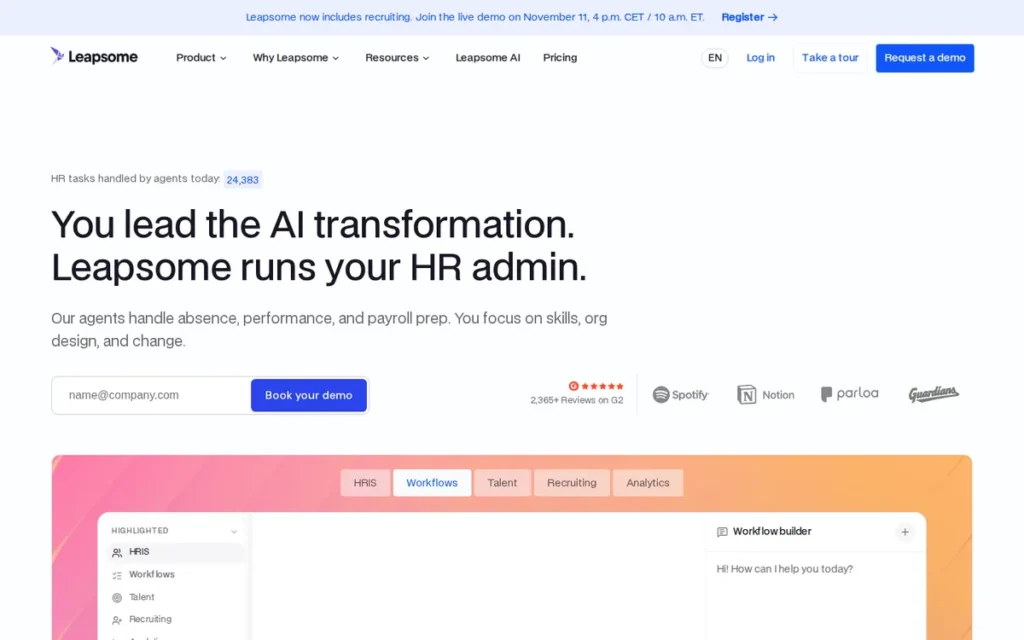
Category: Full-Suite Talent Platform, replaces most or all Lattice modules (reviews, goals, engagement, 1:1s, compensation, learning and HRIS) in one system.
At a Glance
- Category: Full-Suite Talent Platform
- Best For: Mid-sized and growing companies replacing the whole Lattice suite and adding learning and HRIS in one contract
- Price Range: G2 list (Nov 2026): $0–$5/user/month HRIS plus $7/user/month Reviews (USD). Vendor example: €17/employee/month for a 200-person suite (list price, before discounts)
- Primary Strength: Leapsome combines the broadest module coverage in this evaluation with the highest G2 satisfaction (4.8/5, 99.1% at 4–5 stars).
- Biggest Limitation: Leapsome’s breadth brings an admin learning curve, with Learning Curve (138) and Navigation Difficulty (132) among its top G2 cons.
- One-Line Summary: Leapsome is the closest like-for-like Lattice replacement in 2026, covering reviews, goals, engagement, 1:1s, compensation, learning and HRIS, and it holds the highest G2 rating among the alternatives PlugRoute evaluated.
- Last Verified: November 2026
Why #1: Leapsome scored 43/50, led by Function Coverage (5) and Verified Satisfaction (5), with a neutral 3 on Deployment because its data was unavailable. Leapsome’s 1.5-point lead over PerformYard comes mainly from coverage breadth.
Overview
Leapsome is a modular people platform that combines an HRIS foundation with reviews, 360 feedback, goals and OKRs, engagement surveys, 1:1s, learning, compensation and recruiting. It is built for HR teams that want to replace the entire Lattice suite with one contract.
Leapsome works much like an HCM talent suite, so HR teams can bring several point tools under one vendor.
Leapsome was founded in 2016, is headquartered in New York, and reports serving more than 2,000 organizations (Leapsome, Nov 2026).
Key Features
- Leapsome’s Talent Suite runs performance reviews, 360 feedback, goals and OKRs, engagement surveys and 1:1 meetings on top of its own HRIS foundation.
- Leapsome includes a native learning module that supports SCORM and xAPI content. Leapsome says Lattice has no equivalent module (Leapsome comparison page, Nov 2026; vendor claim).
- Leapsome documents calibration with heatmaps and nine-box views, though Lattice also offers calibration.
- Leapsome sells compensation benchmarks, recruiting (ATS) and learning content as separate modules, so buyers add only the functions they need.
- Leapsome markets “Agentic HR” AI for drafting and summarizing. One G2 reviewer called the output useful but “generic at times, requiring manual edits” (G2, Nov 2026).
Best For
Leapsome is best for HR teams at growing and mid-sized companies that want one vendor to replace Lattice’s reviews, goals, engagement and compensation, and to add learning and HRIS. Leapsome is a weaker fit for buyers who need only review cycles.
Pricing
- Leapsome’s G2 list prices are $0 for Agentic HRIS Foundation, $5 for Agentic HRIS Pro and $7 for Reviews, per user per month (G2, Nov 2026). These prices may change.
- Leapsome’s pricing page lists euro module prices from €1 (learning content) to €10 (HRIS Pro). HRIS Foundation is shown at €0 under a promotion ending December 31, 2026 (Leapsome pricing page, Nov 2026).
- Leapsome’s G2 and vendor prices conflict for HRIS Pro ($5 vs €10), so buyers should get a written quote for the same scope.
Strengths
- Leapsome holds a 4.8/5 G2 rating from 2,660 reviews, with 99.1% at 4–5 stars (G2, Nov 2026). Both figures are the highest among the alternatives and above Lattice’s 4.6/5 and 98.2%.
- Leapsome is listed in 22 G2 categories, including Core HR, Corporate LMS, Compensation Planning and Whistleblowing (G2, Nov 2026). No other alternative evaluated covers as many categories.
- Leapsome publishes per-module list prices, including Reviews at $7/user/month (G2, Nov 2026). Buyers can compare a reviews-only deployment with Lattice’s $11 Talent Management price before talking to sales.
- Leapsome’s most-cited G2 pro is Ease of Use, with 886 mentions. G2’s reviewer summary connects that praise to the employee-facing experience of reviews, feedback and goal tracking (G2, Nov 2026).
Limitations
Leapsome’s breadth comes at the cost of admin complexity. Learning Curve (138), Navigation Difficulty (132) and Not Intuitive (120) are among its top G2 cons (G2, Nov 2026).
- One G2 reviewer said Leapsome’s admin setup is harder than its employee experience and that pricing “can feel high for smaller teams” (G2, Nov 2026).
- Leapsome charges a platform fee even to buyers who need only reviews, which raises the effective cost of a single-module deployment.
- Leapsome publishes no quantified customer outcomes and has no significant Reddit discussion. PlugRoute’s research did not find its language count, integration count or typical go-live time.
- Leapsome’s website states that it holds SOC 2 Type II and ISO 27001:2022 certification (Leapsome, Nov 2026). Buyers should request the current report and certificate to confirm audit scope and dates.
How It Compares With Lattice
Leapsome is the closest functional match to Lattice and adds a native LMS. Leapsome is rated higher than Lattice on G2 (4.8 vs 4.6) on fewer reviews (2,660 vs 4,171). Buyers should expect similar complaints, since Learning Curve appears among the top cons for both products.
Verdict
Leapsome is the strongest all-around Lattice alternative in PlugRoute’s November 2026 evaluation, pairing the highest G2 rating in the set (4.8/5) with the broadest module coverage.
Leapsome suits buyers who are replacing the full Lattice suite and want learning and HRIS in the same system. Buyers who need only reviews should price the platform fee carefully and confirm what Leapsome will cost after the December 31, 2026 promotion ends.
2. PerformYard: Best for Configurable Review Cycles and Matrixed Organizations
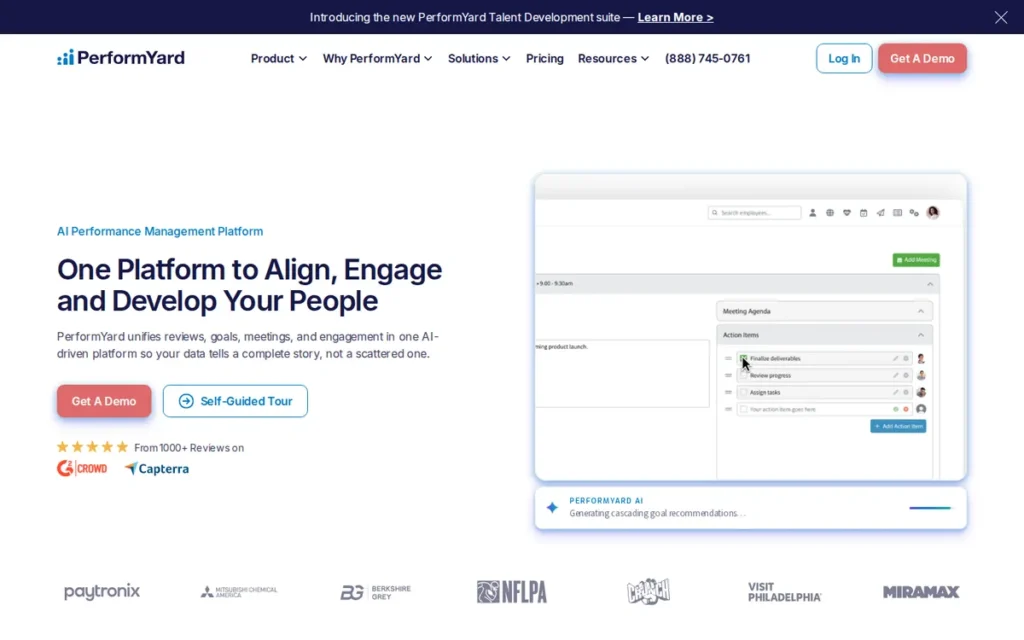
Category: Review-Workflow Specialist, built to run highly configurable, structured performance review cycles.
At a Glance
- Category: Review-Workflow Specialist
- Best For: HR teams with matrixed or dotted-line reporting, or review processes that vary by team or program
- Price Range: G2 list (Nov 2026): $5/user/month per product. Vendor range: $5–$15/person/month, billed annually, onboarding included
- Primary Strength: PerformYard runs review cycles of almost any structure, including probation, PIP and project-based cycles, with custom forms and rating scales.
- Biggest Limitation: PerformYard’s reporting and engagement features are less developed than Lattice’s, and the product supports English only.
- One-Line Summary: PerformYard documents the widest range of review-cycle types among 2026 Lattice alternatives, with a 4.7/5 G2 rating and published per-person pricing that includes onboarding.
- Last Verified: November 2026
Why #2: PerformYard scored 41.5/50, with top marks (5) on Verified Satisfaction, Pricing Transparency and Complex Reviews. PerformYard trails Leapsome on Function Coverage (3.5) and Deployment (2, English only). PerformYard would rank first (51.5 vs 51) if pricing transparency or complex reviews were weighted double.
Overview
PerformYard is a performance management and development platform for HR teams that need review cycles of any shape: annual, quarterly, project-based, 360, probation and PIP. It is built for organizations whose review needs vary by team.
PerformYard fits organizations with dotted-line or matrixed reporting especially well.
PerformYard was founded in 2013 and is headquartered in Arlington, Virginia (G2, Nov 2026).
Key Features
- PerformYard supports annual, quarterly, project-based, 360-degree, probation and performance-improvement-plan cycles with custom forms and rating scales (PerformYard vendor description on G2, Nov 2026).
- PerformYard includes cascading goals and OKRs, continuous feedback and recognition, and structured 1:1 meetings.
- PerformYard provides anonymous engagement surveys and reporting through live dashboards, 9-box grids and trend analysis.
- PerformYard’s Talent Development plan adds compensation, coaching, competencies, succession planning and career pathing.
- PerformYard’s case studies describe one organization-wide process customized by department, and another combining quarterly check-ins with annual reviews (PerformYard, Nov 2026).
Best For
PerformYard is best for HR teams whose main frustration with Lattice is rigid review cycles, especially organizations with dotted-line reporting or different processes for different groups. PerformYard is a weaker fit when the main need is engagement analytics or advanced custom reporting.
Pricing
- PerformYard’s G2 list prices are $5.00 per user per month for Performance Management and $5.00 for Talent Development (G2, Nov 2026). These prices may change.
- PerformYard’s pricing page gives a range of $5–$15 per person per month, depending on headcount and products, billed annually (PerformYard pricing page, Nov 2026).
- PerformYard includes onboarding and training at no extra fee, but buyers should still request a quote for their exact configuration.
Strengths
- PerformYard holds a 4.7/5 G2 rating from 1,261 reviews, with 98.6% at 4–5 stars (G2, Nov 2026). Both figures are second among the alternatives and above Lattice’s 4.6/5.
- PerformYard publishes a $5–$15 per-person price range with onboarding and training included (PerformYard pricing page, Nov 2026), which is unusually transparent for this category.
- PerformYard has a 9.6 G2 support score and appears in 12 G2 categories, including Succession Planning and Compensation Management (G2, Nov 2026).
- A user who switched from Lattice called PerformYard “way more customizable” for teams with “a lot of dotted lines or interdepartmental teams” (Reddit r/humanresources, 2023). The post is older, so give it limited weight.
Limitations
PerformYard gives up reporting depth in exchange for configurability. A 2023 r/humanresources user who switched from Lattice said “reporting is much better in Lattice,” and that post may be outdated.
- PerformYard’s most-cited G2 con is Goal Confusion (58), followed by Navigation Difficulty (49) (G2, Nov 2026).
- PerformYard is rated below Lattice on usability and on meeting requirements in G2 comparisons (G2, Nov 2026).
- PerformYard supports English only, which limits multilingual rollouts, and go-live most commonly takes 1–3 months (G2, Nov 2026).
- PerformYard publishes no quantified case-study outcomes, and PlugRoute did not verify its SOC 2 status.
How It Compares With Lattice
PerformYard is more flexible than Lattice for matrixed organizations and unusual review cycles, and it has a lower starting list price ($5 vs $11). PerformYard is weaker than Lattice on reporting and engagement, and it supports 1 language to Lattice’s 17.
Verdict
PerformYard is the best Lattice alternative in 2026 for HR teams whose main problem is inflexible review cycles, backed by a 4.7/5 G2 rating and published pricing that includes onboarding.
PerformYard suits organizations with matrixed reporting or varied review programs. Teams that depend on advanced reporting, deep engagement analytics or multilingual support should test those gaps in a demo first.
3. 15Five: Best for Manager Check-ins and Fast Deployment
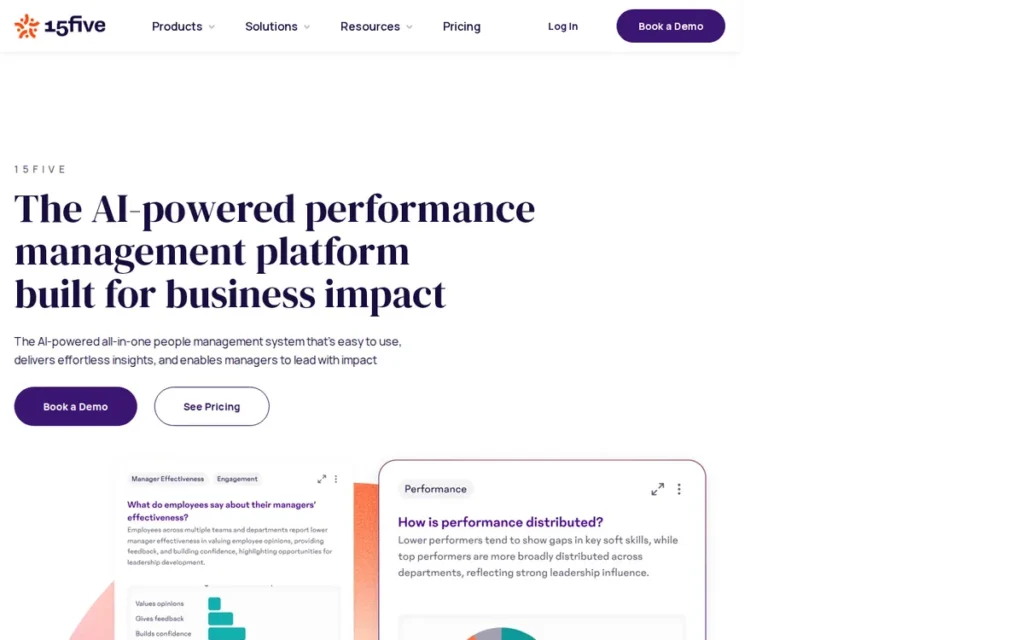
Category: Manager Check-in Platform, centers continuous manager-employee check-ins, 1:1s and coaching, with reviews and surveys built on top.
At a Glance
- Category: Manager Check-in Platform
- Best For: Startups and mid-sized teams that want a weekly check-in and coaching culture with a fast rollout
- Price Range: G2 list (Nov 2026): $4–$16/user/month. The vendor page lists Perform at $11/user/month, billed annually. AI and coaching add-ons cost extra
- Primary Strength: 15Five builds a regular manager check-in rhythm and most commonly goes live in under 1 month.
- Biggest Limitation: 15Five’s most-cited G2 con is Limited Customization, and it supports English only.
- One-Line Summary: 15Five is a check-in-first Lattice alternative that matches Lattice’s 4.6/5 G2 rating, publishes per-user pricing from $4/month, and typically goes live in under a month.
- Last Verified: November 2026
Why #3: 15Five scored 38.5/50. 15Five ranks below PerformYard on Verified Satisfaction (4 vs 5) and Complex Reviews (3.5 vs 5). It ranks above Culture Amp mainly on Pricing Transparency (4.5 vs 2).
Overview
15Five is a performance management platform built around weekly check-ins, 1:1s and manager coaching. It suits teams that want a lighter, manager-led alternative to Lattice’s review-heavy workflows, with the focus on manager effectiveness.
15Five adds 360 reviews, OKRs, engagement surveys and a Talent Matrix on top of its check-in core.
15Five was founded in 2011, is headquartered in San Francisco, and claims more than 3,000 customers (15Five, Nov 2026).
Key Features
- 15Five runs weekly check-ins, 1:1 meetings, High Fives recognition and Pulse Check to keep managers and employees in a regular feedback rhythm.
- 15Five includes 360 performance reviews, OKRs, a Talent Matrix and career paths in its Perform tier.
- 15Five offers engagement surveys with heat maps and benchmarking, plus an HR Dashboard.
- 15Five sells Kona AI (Coach and Notetaker) as paid add-ons, priced per manager or per employee.
- 15Five lists 15 integrations on G2 (G2, Nov 2026).
Best For
15Five is best for startups and mid-sized companies that want managers holding regular check-ins and coaching conversations, and that need to go live quickly. 15Five is a weaker fit for organizations with complex, highly customized review cycles or multilingual workforces.
Pricing
- 15Five’s G2 list prices are $4.00 for Engage, $10.00 for Perform and $16.00 for Total Platform, per user per month (G2, Nov 2026). These prices may change.
- 15Five’s own pricing page lists Perform at $11, billed annually, which conflicts with G2’s $10 (15Five pricing page, Nov 2026).
- 15Five’s add-ons cost extra: Kona Coach at $19 per manager per month, Kona Notetaker at $2 per employee per month, Manager Content at $49 per manager per month, and Coaching at $399 per credit (15Five pricing page, Nov 2026).
Strengths
- 15Five holds a 4.6/5 G2 rating from 1,994 reviews, with 96.7% at 4–5 stars, which matches Lattice’s star rating (G2, Nov 2026).
- 15Five most commonly goes live in under 1 month according to G2 implementation data, tied with Workleap and Perdoo, compared with Lattice’s typical 1–3 months (G2, Nov 2026).
- 15Five’s $4 Engage tier is the lowest published per-user entry price among the full performance platforms evaluated (G2, Nov 2026).
- 15Five’s vendor-published case study reports TrustRadius cutting turnover from 40% to 5% (15Five, Nov 2026). This is a vendor claim, not an independent causal study.
Limitations
15Five’s check-in-first design limits customization. Limited Customization (29) is its top G2 con, followed by Limited Features (17) and Reporting Issues (13) (G2, Nov 2026).
- 15Five users ask for customizable check-in questions, deeper dashboards and more notification control, and G2 says reminders can “feel overwhelming” (G2, Nov 2026).
- 15Five supports English only (G2, Nov 2026).
- 15Five’s G2 and vendor prices conflict for Perform ($10 vs $11), and its AI coaching costs extra, starting with Kona Coach at $19 per manager per month.
- 15Five’s Reddit reputation is split and dated: one user called it “a lot cheaper” than Lattice (2023), while another said “many users complain and are confused” (2022).
Users on r/humanresources noted:
“It’s just way different. You need to have leadership’s buy in for the weekly check-ins. It sounds all shiny until execs realize they have to do (perhaps extra) work.” Posted by u/k3bly
Takeaway: 15Five’s weekly check-in model only works when leadership commits to the extra manager effort it requires.
How It Compares With Lattice
15Five is lighter and faster to deploy than Lattice, typically under 1 month versus 1–3 months. 15Five’s Perform price ($10–$11) is close to Lattice’s $11 Talent Management list price. 15Five is weaker for complex reporting and supports 1 language to Lattice’s 17.
Verdict
15Five is the best Lattice alternative in 2026 for teams that want manager check-ins and coaching to drive performance, matching Lattice’s 4.6/5 G2 rating with a typically faster rollout.
15Five suits startups and mid-sized companies that care more about a regular feedback rhythm than complex review administration. Buyers should budget separately for AI add-ons and test 15Five’s customization limits in a demo.
4. Culture Amp: Best for Engagement Surveys and People-Science Benchmarks
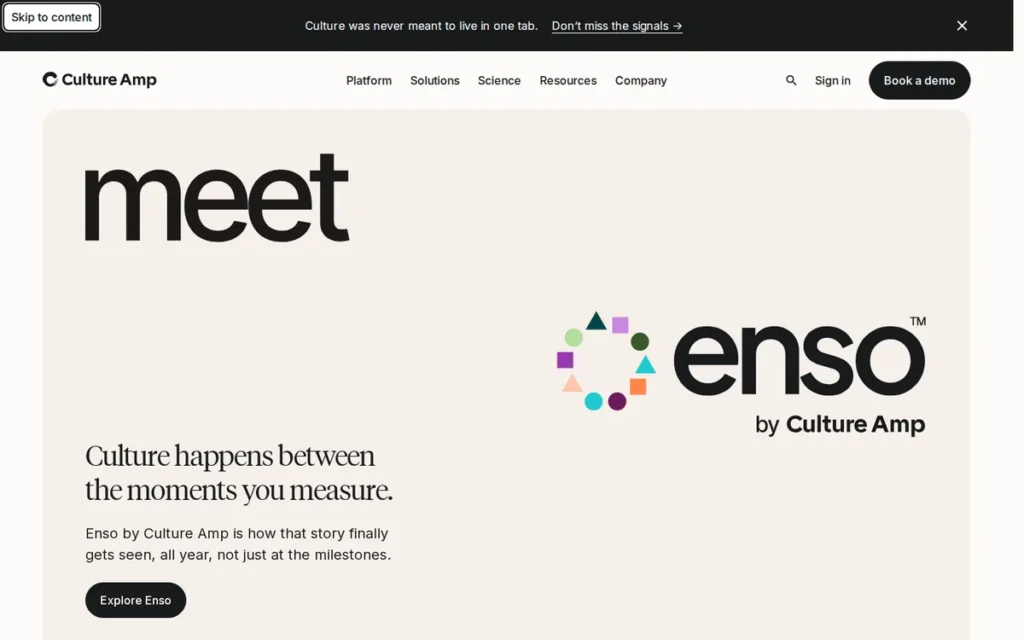
Category: Engagement Listening Platform, specializes in employee surveys, benchmarks and people analytics, with performance modules alongside.
At a Glance
- Category: Engagement Listening Platform
- Best For: Mid-market and enterprise organizations, including multilingual workforces, where engagement surveys and analytics come first
- Price Range: Quote-only. Vendr buyer data shows a median of about $23,270/year (range $8,356–$58,894)
- Primary Strength: Culture Amp pairs research-designed engagement surveys and benchmarks with 27-language support.
- Biggest Limitation: Practitioners describe Culture Amp’s performance workflows as less configurable than Lattice’s, and pricing is quote-only.
- One-Line Summary: Culture Amp scored highest for engagement surveys and benchmarking among 2026 Lattice alternatives and supports 27 languages, though its quote-only pricing and less configurable performance workflows need careful evaluation.
- Last Verified: November 2026
Why #4: Culture Amp scored 35.5/50, with the top Engagement Listening score (5) and the highest Deployment score (4.5), held back by quote-only pricing (2). Doubling the engagement weight narrows Culture Amp’s gap with 15Five to 1.5 points but does not change its fourth place.
Overview
Culture Amp is an employee engagement and performance platform organized into Engage, Perform and Develop modules. It is built for mid-market and enterprise HR teams that want research-designed surveys, benchmarks and people analytics alongside reviews.
Culture Amp also covers 360s, goals and calibration within its Perform module.
Culture Amp was founded in 2010 according to G2 (Wikipedia lists 2009) and is based in Richmond, Victoria, Australia (G2, Nov 2026).
Key Features
- Culture Amp’s Engage module runs engagement, pulse and lifecycle surveys with benchmarks and AI comment summaries.
- Culture Amp’s AI comment summaries need at least 5 meaningful comments per question and can be switched off per survey (Culture Amp support documentation, Nov 2026).
- Culture Amp’s Perform module covers performance reviews, 360 feedback, goals, ongoing feedback and calibration.
- Culture Amp’s Develop module supports career growth and role comparison.
- Culture Amp supports 27 languages and lists 19 integrations on G2 (G2, Nov 2026).
Best For
Culture Amp is best for organizations whose main reason for leaving Lattice is survey quality or survey analysis, especially multilingual workforces that need benchmarked engagement data. Culture Amp is a weaker fit for teams that need highly customized review cycles or published pricing.
Pricing
- Culture Amp publishes no list price, and G2 lists none (G2, Nov 2026).
- Culture Amp’s median annual contract is $23,270 across 523 purchases, ranging from $8,356 to $58,894, and buyers negotiate about 13% off on average (Vendr, Nov 2026).
- Culture Amp’s price depends on modules, headcount and contract term, and G2 reviewers say it can feel steep for very small organizations.
Strengths
- Culture Amp supports 27 languages, the most among alternatives with G2 language data and more than Lattice’s 17 (G2, Nov 2026).
- Culture Amp reports 15 years of People Science research and more than 1.5 billion data points from 6,000+ organizations (vendor-reported, G2, Nov 2026). That research base underpins its benchmarked templates.
- A user who moved their company from Culture Amp to Lattice still felt Lattice’s “Engagement tool was lagging behind Culture Amp” (Reddit r/humanresources, 2026).
- Culture Amp holds a 4.5/5 G2 rating from 1,633 reviews, with 96.3% at 4–5 stars, and Customer Support (117) is among its top pros (G2, Nov 2026).
Users on r/humanresources shared their experience:
“I got us to move from Culture Amp to Lattice at my last company. Felt the Engagement tool was lagging behind Culture Amp but loved everything else about it. This was 2 years ago, so maybe they made improvements there.” Posted by u/SplitEndsSuck
Takeaway: Culture Amp’s engagement tooling stood out even to an HR leader who preferred Lattice for everything else, which makes surveys its clearest advantage.
Limitations
Culture Amp gives up performance-workflow flexibility in exchange for survey strength. A practitioner called it “a lot more ‘baked’ ie there’s only one way to do things” compared with “highly customizable” Lattice (Reddit r/humanresources, 2026).
- Culture Amp lists Limited Customization (54) among its top G2 cons, and one reviewer said “goal reporting was basic and difficult to customize” (G2, Nov 2026).
- Culture Amp is quote-only, which makes budgeting harder, and its G2 rating (4.5) is slightly below Lattice’s (4.6).
- Culture Amp cut about 70 jobs (9% of staff) in June 2026, its third layoff round in three years, after Caroline Rawlinson became CEO in January 2026 (Capital Brief, 2026). The layoffs do not show that the product has declined, but buyers should ask about roadmap continuity.
How It Compares With Lattice
Culture Amp is stronger than Lattice for engagement listening, benchmarks and language coverage (27 vs 17). Culture Amp is less configurable for performance workflows, has a slightly lower G2 rating (4.5 vs 4.6), and publishes no pricing, while Lattice lists $10–$11 per user per month.
Verdict
Culture Amp is the best Lattice alternative in 2026 for organizations whose main need is engagement surveys and benchmarked people analytics, backed by research-designed templates and 27-language support.
Culture Amp suits mid-market and enterprise teams that value survey quality more than review-cycle flexibility. Buyers should get a full-scope quote, test performance configuration with their real review templates, and ask about roadmap continuity.
5. Workleap: Best for Small HR Teams Wanting Flat-Rate, Manager-First Pricing
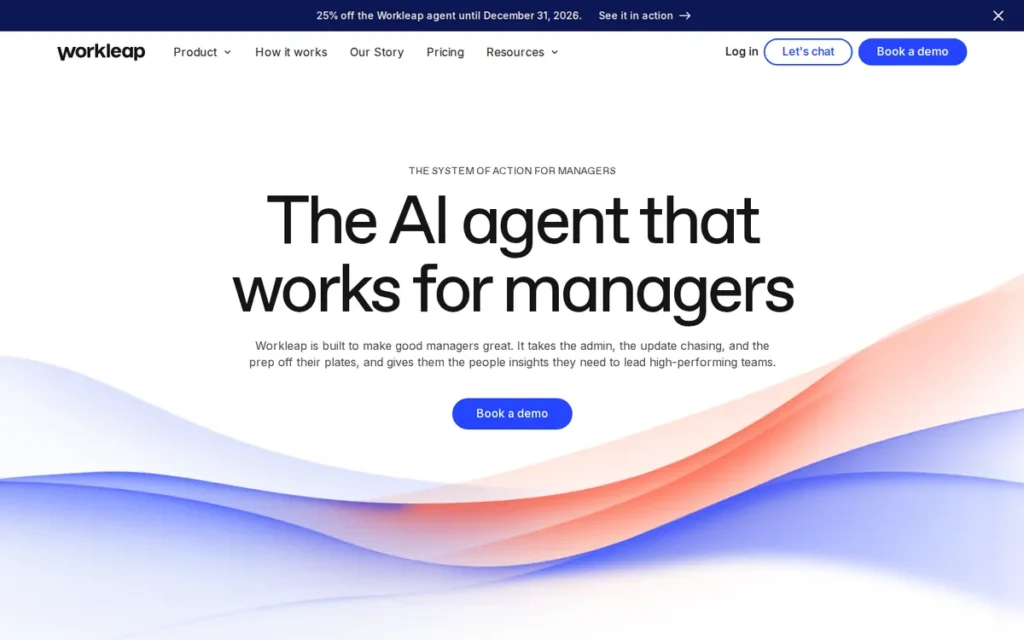
Category: Manager Check-in Platform, centers manager workflows (1:1s, pulse feedback and action items), with reviews and surveys built on top.
At a Glance
- Category: Manager Check-in Platform
- Best For: Smaller HR teams at organizations with many employees per manager that want flat-rate base pricing plus per-manager fees and strong pulse surveys
- Price Range: G2 list (Nov 2026): $4,999/year Standard, $11,999/year Pro, Enterprise by quote. The vendor page adds $32/manager/month
- Primary Strength: Workleap combines strong pulse surveys, 35 G2-listed integrations, and a typical go-live of under 1 month.
- Biggest Limitation: Workleap’s 91.9% share of 4–5 star G2 reviews is the second-lowest among the alternatives, and its performance-review features are lighter than Lattice’s.
- One-Line Summary: Workleap is a manager-first Lattice alternative with flat-rate base pricing, 35 G2-listed integrations, and pulse surveys that G2 comparison data rates above Lattice’s.
- Last Verified: November 2026
Why #5: Workleap scored 32/50. Workleap’s strong Engagement (4) and Deployment (4) scores are offset by Verified Satisfaction (2.5) and Complex Reviews (2.5).
Overview
Workleap is a manager-first people platform, formerly GSoft and Officevibe, built for smaller HR teams that want managers to act on engagement signals. It combines pulse surveys and performance cycles with compensation tools under flat-rate base pricing.
Workleap also includes anonymous feedback, recognition, goals, 1:1s and an LMS.
Workleap was founded in 2006 in Montréal (Workleap, Nov 2026).
Key Features
- Workleap includes Officevibe pulse surveys, anonymous feedback and Good Vibes recognition, and it sends survey signals to managers with suggested actions.
- Workleap runs performance cycles with 360s, goals and OKRs, and 1:1 meetings.
- Workleap includes compensation tools (pay bands, pay equity, and benchmarking with Mercer and Comptryx data) and an LMS.
- Workleap AI drafts performance reviews, prepares 1:1s and summarizes engagement data.
- Workleap Pro adds advanced intelligence, API and MCP access, SAML SSO, custom segments and personalized onboarding.
Best For
Workleap is best for smaller HR teams that want pulse surveys and manager workflows in one place, at organizations with many employees per manager. Workleap is a weaker fit for organizations that need deep review-cycle configuration or advanced reporting.
Pricing
- Workleap’s G2 list prices are $4,999 per year flat rate for Standard and $11,999 per year for Pro, with Enterprise by quote (G2, Nov 2026). These prices may change.
- Workleap’s pricing page adds $32 per manager per month on top of the flat fee, so total cost grows with manager count (Workleap pricing page, Nov 2026).
- Workleap’s Enterprise plan is for organizations with more than 250 employees. Workleap bills annually, and its listed prices apply to new customers.
Strengths
- Workleap lists 35 integrations on G2, more than Lattice’s 27 and the most among alternatives with a G2 integration count (G2, Nov 2026).
- Workleap’s Officevibe pulse surveys score higher than Lattice’s in G2 head-to-head comparison data (G2, Nov 2026).
- Workleap most commonly goes live in under 1 month and supports 5 languages: English, French, German, Portuguese and Spanish (G2, Nov 2026).
- Workleap’s industry page reports that customer Wahi reached a 9.0 relationship-with-manager score (Workleap, Nov 2026). This figure is vendor-reported.
Limitations
Workleap’s manager-first, engagement-led design comes at the cost of satisfaction scores and review depth: a 4.3/5 G2 rating and 91.9% at 4–5 stars, against Lattice’s 4.6 and 98.2% (G2, Nov 2026).
- Workleap’s support is rated below Lattice’s in G2 comparisons, and its performance-review features are lighter (G2, Nov 2026).
- Workleap users ask for richer report filters, more flexible OKR reporting, and configurable survey frequency to reduce survey fatigue (G2, Nov 2026).
- Workleap’s G2 pro and con counts are small (top con: 7 mentions), so its complaint themes rest on fewer data points than other vendors’ do.
- Workleap’s headline flat rate understates total cost, because the vendor page adds $32 per manager per month.
- Workleap has minimal Reddit discussion and no verified SOC 2 status. Buyers should also ask how the former Officevibe product maps onto the current platform.
How It Compares With Lattice
Workleap charges a flat base fee plus a per-manager fee, while Lattice charges $10–$11 per user per month. Workleap has stronger pulse surveys and more integrations (35 vs 27), but lighter performance features, fewer languages (5 vs 17) and a lower G2 rating (4.3 vs 4.6).
Verdict
Workleap is the best Lattice alternative in 2026 for smaller HR teams that want manager-led pulse surveys and flat-rate base pricing, with the most G2-listed integrations among alternatives that report them.
Workleap suits organizations with many employees per manager, where per-manager fees stay low. Buyers who need complex review cycles or advanced reporting should test Workleap carefully in those areas.
6. Quantum Workplace: Best for External Engagement Benchmarks and Succession Planning
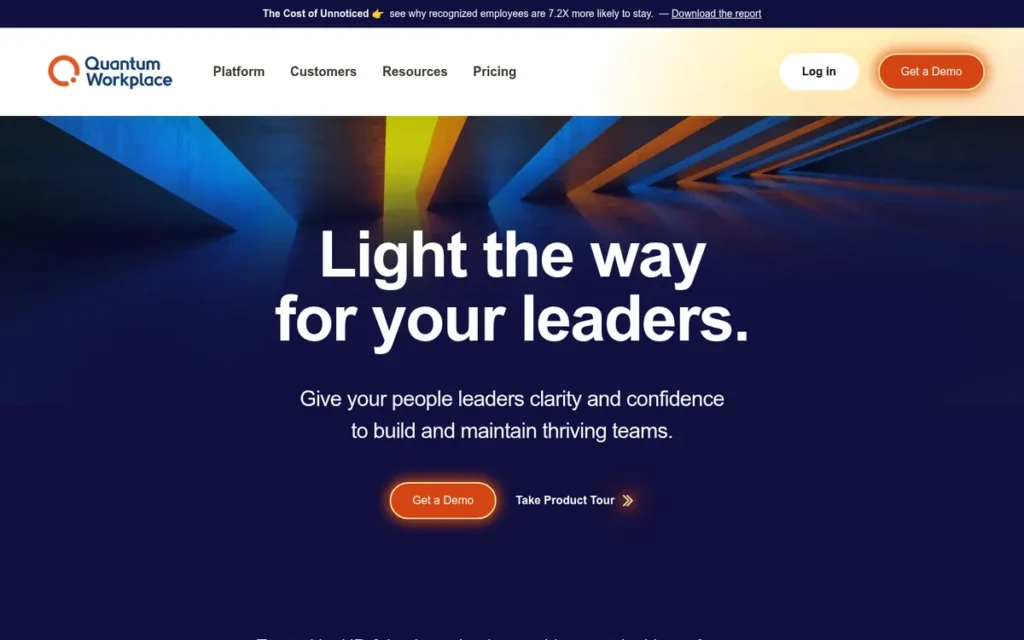
Category: Engagement Listening Platform, specializes in employee surveys, benchmarks and people analytics, with performance modules alongside.
At a Glance
- Category: Engagement Listening Platform
- Best For: Mid-market and enterprise HR teams that want external engagement benchmarks plus talent-review and succession tools
- Price Range: Quote-only (varies by organization size and products; multi-year options)
- Primary Strength: Quantum Workplace pairs engagement benchmarks from its Best Places to Work research with talent reviews and succession planning.
- Biggest Limitation: Quantum Workplace has the lowest share of 4–5 star G2 reviews in this evaluation (90.3%), driven by navigation and usability complaints.
- One-Line Summary: Quantum Workplace is a Lattice alternative for mid-market and enterprise teams that want engagement benchmarks from the Best Places to Work survey program combined with succession planning, at quote-only pricing.
- Last Verified: November 2026
Why #6: Quantum Workplace scored 30/50. Its Engagement score (4.5) is second only to Culture Amp’s, but quote-only pricing with no third-party data (1.5) and Verified Satisfaction (2.5) place Quantum Workplace below Workleap.
Overview
Quantum Workplace is an engagement, performance and talent platform best known as the survey provider behind Best Places to Work contests. It is built for mid-market and enterprise HR leaders who want external benchmarks alongside reviews and succession planning.
Quantum Workplace also covers 360s, goals, 1:1s and formal talent reviews.
Quantum Workplace was founded in 2002 and is headquartered in Omaha, Nebraska (G2, Nov 2026).
Key Features
- Quantum Workplace runs engagement, pulse and lifecycle surveys based on its e9 engagement model, with benchmarks from more than 10,000 organizations (Quantum Workplace, Nov 2026).
- Quantum Workplace supports review cycles, performance snapshots, attributed 360s and anonymous upward feedback.
- Quantum Workplace includes talent reviews (9-box and four-quadrant) and succession planning, with readiness tracked in 12-month increments.
- Quantum Workplace includes goals and OKRs, 1:1s and peer recognition.
- Quantum Workplace’s Insights Hub includes Cue, an AI agent for people analytics.
Best For
Quantum Workplace is best for mid-market and enterprise HR teams that want to benchmark engagement against an external dataset and run formal succession planning. Quantum Workplace is a weaker fit for buyers who need published pricing or who put interface simplicity first.
Pricing
- Quantum Workplace is quote-only, and G2 lists no price (G2, Nov 2026).
- PlugRoute’s research found no verified third-party contract data for Quantum Workplace.
- Quantum Workplace pricing varies by organization size and products, with multi-year options. Buyers should request a quote for the same headcount and modules as their other finalists.
Strengths
- Quantum Workplace is the survey partner for Best Places to Work contests run with American City Business Journals in more than 40 US metros (Quantum Workplace, Nov 2026). It is the only alternative in this set tied to a public employer-ranking program, though Culture Amp also offers benchmark data.
- Quantum Workplace supports 23 languages, second only to Culture Amp in this set and more than Lattice’s 17 (G2, Nov 2026).
- Quantum Workplace includes talent reviews and succession planning with 12-month readiness tracking, and G2 lists it under Succession Planning (G2, Nov 2026).
- Quantum Workplace holds 4.6/5 on Capterra from 160–166 reviews, higher than its 4.3/5 on G2 (Capterra, Nov 2026).
Limitations
Quantum Workplace’s tooling comes at a usability cost: its 90.3% share of 4–5 star G2 reviews is the lowest in this evaluation (G2, Nov 2026).
- Quantum Workplace’s top G2 cons are Not User-Friendly (37), Difficult Navigation (36) and Goal Confusion (34), and G2 describes its navigation as “cluttered” (G2, Nov 2026).
- Quantum Workplace is quote-only with no third-party price data, which makes it the hardest alternative in this set to budget.
- Quantum Workplace’s case-study headlines (+22% engagement, 36% retention) do not name clients (Quantum Workplace success stories, Nov 2026).
- Quantum Workplace’s go-live time and integration count were not available in PlugRoute’s research, and no significant Reddit discussion was found.
- Quantum Workplace’s Best Places to Work scores and ongoing engagement scores use different methods, so buyers should not compare them directly.
How It Compares With Lattice
Quantum Workplace offers stronger external engagement benchmarks and more developed talent-review and succession tools than Lattice. Quantum Workplace has weaker usability according to G2 cons, a lower G2 rating (4.3 vs 4.6), and no published pricing.
Verdict
Quantum Workplace is the best Lattice alternative in 2026 for organizations that want externally benchmarked engagement data combined with formal succession planning.
Quantum Workplace suits mid-market and enterprise teams that care more about benchmarks than interface polish. Buyers should test navigation with real managers and request a same-scope quote early, because no outside price reference exists.
7. Perdoo: Best for Strategy-Linked OKRs on a Budget
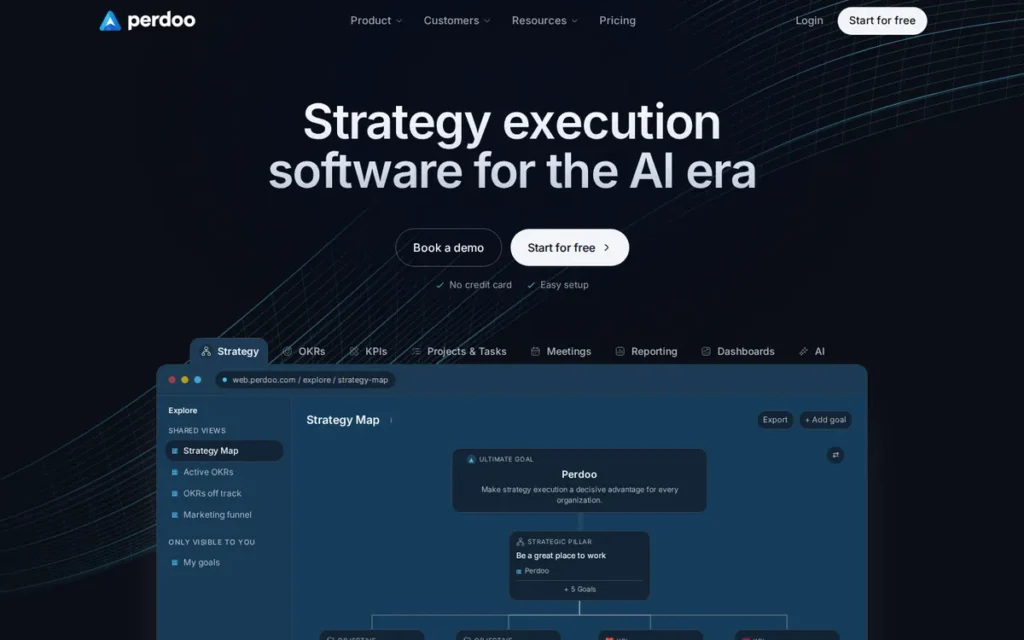
Category: OKR and Strategy Specialist, focuses on goals, OKRs, KPIs and strategy execution rather than reviews or engagement.
At a Glance
- Category: OKR and Strategy Specialist
- Best For: Startups and mid-sized teams that need goals and OKRs tied to company strategy without buying an enterprise suite
- Price Range: G2 list (Nov 2026): Free (up to 5 users); €6.40–€8.00/user/month
- Primary Strength: Perdoo connects company strategy to OKRs, KPIs and initiatives through its Strategy Map, with the only permanent free tier in this evaluation.
- Biggest Limitation: Perdoo replaces mainly Lattice’s goals function; reviews are Supreme-only, and engagement surveys and compensation are not covered.
- One-Line Summary: Perdoo is the lowest-cost entry point for strategy-linked OKRs among 2026 Lattice alternatives, with a permanent free tier for up to 5 users, though it replaces mainly Lattice’s goals function.
- Last Verified: November 2026
Why #7: Perdoo scored 26.5/50 because Function Coverage rewards replacing the whole Lattice contract, and Perdoo replaces mainly the goals module. Perdoo ties PerformYard for the top Pricing Transparency score (5). Buyers replacing only Lattice Goals should treat Perdoo as the category leader, not the seventh choice.
Overview
Perdoo is an OKR and strategy-execution platform that links company strategy to team OKRs, KPIs and initiatives through a visual Strategy Map. It is built for startups and mid-sized teams that need goal alignment without a heavy enterprise suite.
Perdoo works as a standalone OKR tool or alongside a review platform, including Lattice.
Perdoo was founded in 2015 and is based in Berlin (G2, Nov 2026).
Key Features
- Perdoo’s Strategy Map links an ultimate company goal to strategic pillars, and from there to OKRs, KPIs and initiatives.
- Perdoo tracks OKRs and KPIs alongside projects, check-ins, meetings and dashboards.
- Perdoo’s Supreme plan lists performance reviews and review cycles (Perdoo pricing page, Nov 2026).
- Perdoo includes the Spark AI Agent, the Vince AI Coach, and an API and MCP server.
- Perdoo lists 21 integrations on G2, including Slack, Microsoft Teams, Jira, Asana and Google Sheets (G2, Nov 2026).
Best For
Perdoo is best for startups and mid-sized teams whose main gap is aligning goals to strategy. It also suits teams that keep Lattice for reviews while upgrading OKRs. Perdoo is not a fit for buyers replacing Lattice’s engagement surveys or compensation.
Pricing
- Perdoo’s G2 list prices are Free (€0.00, up to 5 users), Premium €6.40 and Supreme €8.00 per user per month (G2, Nov 2026). These prices may change.
- Perdoo’s pricing calculator shows 100 users at €7,680 per year on Premium and €9,600 per year on Supreme (Perdoo pricing page, Nov 2026).
- Perdoo includes three free coaching hours with purchases of 50 or more licenses, and it quotes prices in euros.
Strengths
- Perdoo is the only alternative with a permanent free tier, covering up to 5 users (G2, Nov 2026). Leapsome’s $0 HRIS Foundation is a promotion ending December 31, 2026.
- Perdoo holds a 4.4/5 G2 rating from 552 reviews, with 95.3% at 4–5 stars, and Goal Setting (49) and OKR Management (37) are among its top pros (G2, Nov 2026).
- Perdoo most commonly goes live in under 1 month and supports 9 languages (G2, Nov 2026).
- A Capterra reviewer said Perdoo’s Strategy Map made it clear how team goals connect to company strategy (Capterra, Nov 2026).
Limitations
Perdoo’s focus on strategy means it replaces mainly one Lattice function and does not cover Lattice’s engagement surveys or compensation.
- Perdoo’s performance reviews are Supreme-only, and an older comparison listed them as unavailable (Tability, Nov 2026). No calibration, 360 or 9-box capability is documented.
- Perdoo users on G2 ask for presentation-ready dashboards, more goal levels and easier carry-over of progress between periods (G2, Nov 2026).
- One Capterra reviewer said Perdoo’s paid coaching did not deliver the value they expected (Capterra, Nov 2026).
- Perdoo has no quantified case-study outcomes and no Reddit discussion to check against.
How It Compares With Lattice
Perdoo is more specialized than Lattice for strategy-linked OKRs, adding a Strategy Map that links company goals to OKRs, KPIs and initiatives. Perdoo does not replace Lattice’s engagement surveys, compensation or calibration workflows.
Verdict
Perdoo is the best Lattice alternative in 2026 for teams that need goals and OKRs tied to company strategy at the lowest entry cost, including a permanent free tier for up to 5 users.
Perdoo works as a standalone OKR tool or as part of a hybrid stack with a review platform. Buyers who need calibration, 360s or engagement surveys should look higher on this list.
How Does Each Alternative Compare With Lattice on Ratings, Price and Languages?
Leapsome (4.8) and PerformYard (4.7) are the only alternatives rated above Lattice’s 4.6 on G2, and 15Five matches it. PerformYard ($5) and 15Five ($4 Engage) list lower per-user prices than Lattice’s $11 Talent Management. Culture Amp (27) and Quantum Workplace (23) support more languages than Lattice (17) (G2, Nov 2026).
| Product | G2 Rating (Nov 2026) | % 4–5 Stars | Review Count | G2 List Price | Pricing Transparency | Lattice Function Replaced | Top G2 Con | Languages | Integrations (G2) | Typical Go-Live |
|---|---|---|---|---|---|---|---|---|---|---|
| Lattice (baseline, unranked) | 4.6 | 98.2% | 4,171 | $10 HRIS; $11 Talent/user/mo | Public | Baseline (not ranked) | Missing Features (79) | 17 | 27 | 1–3 months |
| Leapsome | 4.8 | 99.1% | 2,660 | $0–$5 HRIS; $7 Reviews/user/mo | Public per module; promotion and conflicting figures | All, plus LMS and HRIS | Missing Features (142) | Not available in research | Not available in research | Not available in research |
| PerformYard | 4.7 | 98.6% | 1,261 | $5/user/mo per product | Public range; onboarding included | Reviews, goals, light surveys | Goal Confusion (58) | 1 | Not available in research | 1–3 months |
| 15Five | 4.6 | 96.7% | 1,994 | $4 / $10 / $16/user/mo | Public tiers; paid add-ons | Check-ins, reviews, OKRs, surveys | Limited Customization (29) | 1 | 15 | Under 1 month |
| Culture Amp | 4.5 | 96.3% | 1,633 | Not listed | Quote-only (Vendr data available) | Surveys, reviews, development | Missing Features (65) | 27 | 19 | 1–3 months |
| Workleap | 4.3 | 91.9% | 1,091 | $4,999 / $11,999 per year flat | Public base fee plus per-manager fee | Surveys, check-ins, reviews, compensation | Missing Features (7) | 5 | 35 | Under 1 month |
| Quantum Workplace | 4.3 | 90.3% | 945 | Not listed | Quote-only | Surveys, reviews, succession | Not User-Friendly (37) | 23 | Not available in research | Not available in research |
| Perdoo | 4.4 | 95.3% | 552 | €0 / €6.40 / €8.00/user/mo | Public; permanent free tier | Goals and OKRs; Supreme-only reviews | Missing Features (20) | 9 | 21 | Under 1 month |
PlugRoute uses G2 pro and con mention counts only to rank complaints within a single vendor. Vendors with more reviews collect more mentions, so raw counts cannot be compared across products.
How Do Lattice Alternatives Compare on Total Cost?
Per-seat prices alone are misleading, because Lattice alternatives use five different pricing models. Lattice’s G2 list prices are $10 per user per month for HRIS and $11 for Talent Management (G2, Nov 2026). Before comparing quotes, adjust every one to your actual headcount, manager count, modules and currency.
This aligns with community sentiment on r/humanresources:
“Lattice is terrible for employee surveys and is hideously expensive for us on a per user basis. We’re not sure where we’re going but can’t wait to pivot away.” Posted by u/cuponoodles213
Takeaway: Lattice’s per-user pricing becomes a breaking point for teams that already feel its survey tooling falls short.
The five pricing models in this set are:
- Per-seat tiers: PerformYard ($5/user/month G2 list) and 15Five ($4–$16/user/month G2 list) charge per user.
- Platform plus modules: Leapsome prices HRIS, Reviews, Recruiting, Compensation and Learning separately.
- Flat rate plus per-manager fee: Workleap charges $4,999 or $11,999 per year, plus $32 per manager per month on its pricing page.
- Freemium: Perdoo is free for up to 5 users, then €6.40–€8.00 per user per month.
- Quote-only: Culture Amp and Quantum Workplace publish no list prices.
Workleap’s cost scales with how many managers you have, Leapsome’s with how many modules you buy, and 15Five’s with how many AI add-ons your managers use. Under Workleap’s model, 50 new hires under existing managers add no per-manager fees, while 5 newly promoted managers add $32 each per month.
Check these pricing traps before signing:
- Leapsome’s €0 HRIS Foundation price is a promotion ending December 31, 2026 (normally €7), and single-module buyers still pay a platform fee.
- Workleap’s flat rate leaves out the $32 per manager per month listed on its pricing page.
- 15Five’s Kona Coach ($19 per manager per month) and Manager Content ($49 per manager per month) are add-ons on top of seat prices.
- Leapsome and Perdoo quote prices in euros, so exchange rates affect comparisons in dollars.
- G2 and vendor pages disagree for 15Five ($10 vs $11 for Perform) and Leapsome ($5 vs €10 for HRIS Pro).
Only three outside or vendor-published total-cost references exist for this set:
- Culture Amp’s median annual contract is $23,270 across 523 purchases, ranging from $8,356 to $58,894 (Vendr, Nov 2026).
- Leapsome’s calculator example shows €17 per employee per month for a 200-person suite at list price (Leapsome pricing page, Nov 2026).
- Perdoo’s calculator shows €7,680 (Premium) or €9,600 (Supreme) per year for 100 users (Perdoo pricing page, Nov 2026).
Can a Cheaper Lattice Alternative Handle Calibration and Complex Reviews?
Yes, some cheaper Lattice alternatives handle complex reviews. PerformYard, at a $5 per user per month G2 list price, documents probation, PIP, project-based and 360 cycles with custom forms (PerformYard vendor description on G2, Nov 2026). Calibration is not a differentiator, because Lattice offers it too. The real test is whether a tool fits your cycle types and reporting lines.
Documented complex-review capabilities by product:
- Leapsome: Leapsome documents calibration with heatmaps and nine-box views, plus 360 feedback (Leapsome comparison page, Nov 2026).
- PerformYard: PerformYard documents annual, quarterly, project-based, 360, probation and PIP cycles, custom forms, 9-box grids, and succession planning in Talent Development.
- 15Five: 15Five includes 360 reviews, a Talent Matrix and career paths, but Limited Customization is its top G2 con.
- Culture Amp: Culture Amp includes reviews, 360s and calibration, though a practitioner described its workflows as “baked” (Reddit r/humanresources, 2026).
- Workleap: Workleap runs performance cycles with 360s, with lighter overall review depth.
- Quantum Workplace: Quantum Workplace documents attributed 360s, anonymous upward feedback, 9-box and four-quadrant talent reviews, and succession readiness.
- Perdoo: Perdoo lists review cycles in its Supreme plan, but no calibration, 360 or 9-box capability is documented.
Small teams can usually skip calibration and succession planning at first. Teams with dotted-line reporting should test those cycles in a demo before signing.
When Does It Make Sense to Stay With Lattice?
Staying with Lattice makes sense when your main need is performance plus compensation workflows, when you value its customization at around 500 employees, or when only engagement surveys are failing. In that last case, adding a dedicated survey or OKR tool may cost less than replacing Lattice entirely.
Evidence for staying includes:
- Lattice’s compensation tool, which includes Mercer benchmarking according to users, still earns praise from practitioners (Reddit r/humanresources, 2026).
- One practitioner wrote that “for 500 employees I definitely think Lattice is better. It has a lot more flexibility.” (Reddit r/humanresources, 2026).
- One user said Lattice’s AI assistant is “accurate to the point the HR team uses it to double check their answers” (Reddit r/humanresources, 2026).
- Lattice has the largest G2 review base in this comparison (4,171), with 98.2% at 4–5 stars (G2, Nov 2026).
- One practitioner moved a previous employer from Culture Amp to Lattice (Reddit r/humanresources, 2026).
- Lattice can anchor a hybrid stack, with Culture Amp or Quantum Workplace added for surveys, or Perdoo added for OKRs.
Users on r/humanresources noted:
“We use lattice, I like it a lot. The performance management and compensation management tools work great for us. Employee engagement surveys are great too. We’re working on increasing adoption of employee development tools, but that’s also a manager development opportunity. We need more manager training.” Posted by u/kelskelsea
Takeaway: Lattice still works well for mid-sized teams that use its performance and compensation workflows together, so switching away is not automatically the right move.
Should You Buy a Standalone Performance Tool or Use Your HRIS’s Performance Module?
Use a standalone performance tool when review depth, survey science or OKRs matter most. Use your HRIS’s performance module when one system of record and fewer integrations matter more. Leapsome sits in between, selling an HRIS and a full talent suite from the same vendor.
The trade-offs, based on 2026 practitioner discussion:
- A bundled HRIS module reduces integration work. One 2026 user chose a full HCM platform for “way less headache than trying to make 5 different systems play nice” (Reddit r/humanresources, 2026).
- A bundled HRIS module may not satisfy leadership. Another 2026 user said their CEO “vehemently dislikes ADPs performance option” (Reddit r/humanresources, 2026).
- Standalone tools such as PerformYard, Culture Amp and Perdoo go deeper on review cycles, surveys or OKRs than most HRIS modules.
- Leapsome’s HRIS plus talent suite fits buyers who want both depth and one vendor.
What Red Flags Should I Watch For When Evaluating Lattice Alternatives?
The biggest red flags are hidden per-manager or platform fees, promotional prices that expire, and integration claims that shrink after signature. Three more deserve attention: ease-of-use praise that hides navigation complaints, vendor-written comparisons, and vague answers about roadmap continuity. The six numbered red flags below are listed so you can cite them individually.
Red Flag #1: Headline Price Hides Per-Manager or Platform Fees A low flat rate or per-module price can leave out per-manager charges, platform fees or paid AI add-ons. For example, Workleap adds $32 per manager per month and 15Five’s Kona Coach adds $19 per manager per month (vendor pricing pages, Nov 2026).
Red Flag #2: Promotional Pricing That Expires After Signature Introductory prices can disappear at renewal and raise your total cost. Leapsome’s €0 HRIS Foundation price, for example, is a promotion ending December 31, 2026, so ask every vendor for post-promotion and renewal pricing in writing before signing.
Red Flag #3: Integration Claims Broader in Sales Calls Than in Practice Integration claims often shrink after signature, so a vendor’s logo slide does not prove a working HRIS sync. One practitioner warned that integrations “are more limited in practice than they sound in sales conversations” (u/Chris_Upward365, Reddit r/humanresources, 2026). Ask each finalist to demo your exact sync live.
Red Flag #4: “Ease of Use” Praise Paired With Navigation Complaints Admins and employees can experience the same product very differently. Leapsome’s top G2 pro is Ease of Use (886), yet Learning Curve (138) and Navigation Difficulty (132) rank among its cons, a pattern seen across most vendors here (G2, Nov 2026). Test the admin experience separately.
Red Flag #5: Vendor-Written Comparisons and Disguised Recommendations Vendor comparison pages are marketing, and vendor founders sometimes post recommendations in HR forums, including a self-disclosed competing vendor founder (Reddit r/human_resources, 2026). Treat any unlabeled recommendation as a lead to verify, not as evidence, and look for independent G2 or Capterra data.
Red Flag #6: No Answer on Roadmap Continuity After Restructuring Layoffs and leadership changes can affect support and product roadmaps. Ask every finalist about recent restructuring, who owns your roadmap, and who your named support contacts will be. Culture Amp’s June 2026 job cuts are one recent example (Capital Brief, 2026).
What Questions Should I Ask Before Choosing a Lattice Alternative?
Before choosing a Lattice alternative, ask vendors whether review questions can be edited after launch, how they handle dotted-line reporting, and what your all-in cost will be. Also ask about HRIS integration depth, custom reporting, anonymity thresholds and security reports. These seven numbered questions target the most-cited reasons teams leave Lattice.
Question #1: Can we edit review questions after a cycle launches? Editing review questions after launch is a known Lattice pain point. One 2026 user said Lattice users “can’t always edit your questions post live” (Reddit r/humanresources, 2026). Ask each vendor to edit a live cycle’s question during the demo, not on a slide.
Question #2: How does the tool handle dotted-line and matrixed reporting? Review tools differ most on dotted-line reporting. Ask each vendor to set up a review with two managers using your real org chart, and to show how reminders reach both managers before and after the deadline.
Question #3: What is the total cost for our headcount, manager count and modules, including AI add-ons and renewal? A single all-in figure is the only fair basis for comparison. Ask every finalist to price the same scope in the same currency, and to list first-year and renewal costs separately, including platform fees and per-manager charges.
Question #4: How deep is the HRIS integration, and how will our data migrate out of Lattice? Integration depth matters more than how many integrations a vendor lists. Ask which fields sync in each direction and how often. Also ask how historical reviews, goals and survey results move out of Lattice.
Question #5: Can we build our own custom report during the demo? Custom reporting is a top G2 improvement request for Lattice and for all six ranked alternatives with improvement data (G2, Nov 2026). Bring a real reporting request to every demo and ask the vendor to build it live.
Question #6: What anonymity thresholds apply to survey results and AI summaries? Anonymity thresholds protect respondents and limit what managers can see. Culture Amp, for example, requires at least 5 meaningful comments before generating AI summaries (Culture Amp support documentation, Nov 2026). Get every vendor’s thresholds in writing.
Question #7: Can you provide current SOC 2 or ISO 27001 reports? Security claims on websites and comparison pages are not audit evidence. PlugRoute did not verify SOC 2 status for several vendors, so ask each finalist for the current reports or certificates under NDA, and confirm the audit dates and scope.
Score each finalist from 1 to 5 on this demo scorecard:
- The vendor edits a question in a live review cycle.
- The vendor runs a dotted-line review with two managers.
- The vendor builds your custom report live.
- The vendor shows field-level HRIS sync in both directions.
- The vendor provides an all-in first-year and renewal quote.
How Did We Rank These Lattice Alternatives?
PlugRoute ranked seven Lattice alternatives with a weighted score across six published criteria. Four primary criteria count double and two secondary criteria count once, for a maximum of 50 points. Every score uses dated evidence from G2 (Nov 2026), vendor pricing pages, Vendr, Capterra and Reddit. Missing data is disclosed and scored neutrally.
The ranking criteria are:
- C1 Lattice Function Coverage (primary, ×2): C1 counts how many Lattice modules a tool replaces natively, because a full suite can replace the whole Lattice contract.
- C2 Verified User Satisfaction (primary, ×2): C2 uses G2 rating, share of 4–5 star reviews and review volume, because third-party data is the most independent quality signal.
- C3 Pricing Transparency and Value (primary, ×2): C3 rewards public prices, low entry tiers, included onboarding and few add-ons, because buyers need numbers they can defend.
- C4 Complex Review-Cycle Capability (primary, ×2): C4 scores configurable cycles, calibration, 360s and dotted-line support, because rigid cycles drive teams away from Lattice.
- C5 Engagement Listening Depth (secondary, ×1): C5 scores surveys, benchmarks and analysis tools, because weak survey analysis is another common reason teams leave.
- C6 Deployment and Global Readiness (secondary, ×1): C6 scores go-live time, language count and integrations, because distributed teams need realistic rollout data.
A score of 5 means the strongest documented evidence in the set, 3 is neutral (including missing data), and 1 means the criterion is largely unsupported. The C2 bands are: 5 = G2 4.7+ with 98%+ at 4–5 stars; 4 = 4.6; 3.5 = 4.5; 3 = 4.4; 2.5 = 4.3 or below 93%.
| Product | C1 | C2 | C3 | C4 | C5 | C6 | Weighted Score (of 50) |
|---|---|---|---|---|---|---|---|
| Leapsome | 5 | 5 | 4 | 4 | 4 | 3 | 43 |
| PerformYard | 3.5 | 5 | 5 | 5 | 2.5 | 2 | 41.5 |
| 15Five | 4 | 4 | 4.5 | 3.5 | 3.5 | 3 | 38.5 |
| Culture Amp | 4 | 3.5 | 2 | 3.5 | 5 | 4.5 | 35.5 |
| Workleap | 3.5 | 2.5 | 3.5 | 2.5 | 4 | 4 | 32 |
| Quantum Workplace | 3.5 | 2.5 | 1.5 | 3.5 | 4.5 | 3.5 | 30 |
| Perdoo | 1.5 | 3 | 5 | 1.5 | 1 | 3.5 | 26.5 |
PlugRoute rescored Perdoo in this update. C2 moved from 3.5 to 3 to match the published bands, and C4 moved from 1 to 1.5 after Perdoo’s Supreme plan review cycles were confirmed. Perdoo’s total stays at 26.5.
PlugRoute publishes every score so readers can re-weight them. The top two are 1.5 points apart:
- Doubling Pricing Transparency (C3) or Complex Reviews (C4) puts PerformYard first, 51.5 to Leapsome’s 51.
- Doubling Function Coverage (C1), Engagement (C5) or Deployment (C6) keeps Leapsome first.
- Doubling Engagement narrows Culture Amp’s gap with 15Five to 1.5 points (40.5 vs 42) but does not change fourth place.
PlugRoute applied these data rules:
- PlugRoute treats G2’s verified November 2026 dataset as authoritative over older G2 figures.
- PlugRoute shows vendor-page prices alongside G2 list prices wherever they conflict.
- PlugRoute labels vendor-published claims and 2022–2023 Reddit posts as such.
- PlugRoute compares G2 pro and con counts only within a single vendor.
- PlugRoute scores missing data neutrally and did not rank Lattice, which serves as the baseline.
PlugRoute excluded three G2 candidates:
- WorkTango was excluded because its G2 profile centers on recognition and rewards, with no performance management category.
- Engagedly was excluded because its G2 pros and cons rest on 1–2 mentions each.
- Profit.co was excluded because it overlaps with Perdoo as an OKR specialist, and Perdoo has more reviews and public G2 pricing.
PlugRoute did not rank four vendors that AI answer engines sometimes name, because PlugRoute did not research them to the same depth in this cycle:
- Betterworks and WorkBoard are enterprise OKR and alignment platforms.
- BambooHR and HiBob are HRIS-first tools with performance as one module.
For market context:
- Analysts estimate the employee performance management software market at $3.52B–$4.2B for 2025, growing at about 12.3–12.4% CAGR through 2033–2034 (Research and Markets; Grand View Research, Nov 2026).
- Analysts estimate the employee engagement software market at about $1.2B for 2025 (IMARC, Nov 2026).
PlugRoute has no affiliate relationships with any company listed. Rankings are determined entirely by research data and objective evaluation criteria.
No peer-reviewed studies were available for this category, so no ranking relies on academic research.
What Do Buyers Most Often Ask About Lattice Alternatives?
Buyers most often ask about small-team budgets, engagement surveys, transparent pricing and how rankings are built. In short: Perdoo, 15Five or PerformYard suit small budgets; Culture Amp leads for engagement surveys; and PerformYard, Perdoo and 15Five publish the clearest pricing. PlugRoute ranks with a published six-criterion weighted score.
What is the best Lattice alternative for small businesses and startups?
Perdoo is the lowest-cost starting point for startups that mainly need OKRs, with a permanent free tier for up to 5 users and paid plans at €6.40–€8.00 per user per month (G2, Nov 2026). Startups that need reviews should compare PerformYard ($5) and 15Five ($4 Engage). Teams under 100 people can usually skip calibration, succession planning and HRIS replacement in year one.
Which Lattice alternatives are cheaper and publish transparent pricing?
PerformYard, Perdoo and 15Five publish the clearest pricing among Lattice alternatives. PerformYard lists $5–$15 per person per month with onboarding included, Perdoo runs from free to €8.00, and 15Five lists $4–$16 per user per month (G2, Nov 2026). Leapsome and Workleap publish base prices plus add-ons. Culture Amp and Quantum Workplace are quote-only.
How does PlugRoute determine rankings?
PlugRoute ranks Lattice alternatives with a weighted score across six published criteria, with four primary criteria counting double, for a maximum of 50 points. Every score cites dated evidence from G2 (Nov 2026), vendor pricing pages, Vendr, Capterra and Reddit. Missing data is disclosed and scored neutrally, and the full score table is published so readers can re-weight it.
What Do Key Performance Management Terms Mean?
Key performance management terms describe how vendors charge, how reviews are structured and how survey data is protected. Knowing them helps buyers compare quotes on equal terms, ask sharper demo questions, and spot where a cheaper tool may fall short on calibration, anonymity or integration depth.
Per-User-Per-Month (PUPM) Pricing: PUPM pricing charges a fixed amount for each employee each month, usually billed annually. PUPM pricing matters because total cost scales directly with headcount, so growing companies should price next year’s size.
Platform Fee: A platform fee is a base charge required before any module can be added. A platform fee matters because buyers who need only one function may pay more per module than full-suite buyers.
Calibration: Calibration is a process in which managers meet to compare and adjust ratings so standards are consistent across teams. Calibration matters for fairness in pay and promotion decisions.
360-Degree Feedback: 360-degree feedback collects input on an employee from managers, peers, direct reports and sometimes the employee. 360-degree feedback matters because it reduces reliance on a single manager’s view.
9-Box Grid: A 9-box grid plots employees on two axes, usually performance and potential, to support talent reviews. A 9-box grid matters for succession planning and for spotting high-potential employees.
Performance Improvement Plan (PIP): A PIP is a formal, time-bound plan that sets expectations for an underperforming employee. PIP support matters because PIP cycles need their own forms, timelines and documentation, which not every tool provides.
OKR (Objectives and Key Results): OKRs are a goal framework that pairs a qualitative objective with measurable key results. OKRs matter because they connect individual and team work to company strategy.
Pulse Survey: A pulse survey is a short, frequent employee survey that tracks sentiment over time. Pulse surveys matter because they catch problems faster than annual surveys, though asking too often causes survey fatigue.
Engagement Benchmark: An engagement benchmark compares your survey results with an external dataset of other organizations. An engagement benchmark matters because it shows whether a score is high or low relative to peers.
Anonymity Threshold: An anonymity threshold is the minimum number of responses needed before results or comment summaries are shown. An anonymity threshold matters because a low threshold can expose individual respondents and discourage honest feedback.
HRIS (Human Resources Information System): An HRIS is the core system of record for employee data such as job titles, reporting lines and employment history. An HRIS matters because performance tools depend on accurate HRIS data to build review cycles.
SOC 2 and ISO 27001: SOC 2 and ISO 27001 are independent security attestation and certification standards. SOC 2 and ISO 27001 matter because performance and survey data is sensitive, so buyers should request audit reports rather than rely on vendor claims.
Which Lattice Alternative Is Right for You?
Key Insights
- Buyers who first identify which Lattice function is failing (reviews, check-ins, surveys, OKRs or learning) can narrow a seven-vendor field to two or three finalists.
- Switching away from Lattice will not automatically fix reporting, because custom reporting is a top G2 improvement request for Lattice and for all six ranked alternatives with improvement data.
- Lattice alternatives can only be compared on total cost after adjusting for platform fees, per-manager charges, AI add-ons, expiring promotions and currency.
- Keeping Lattice and adding a survey or OKR specialist can cost less than a full replacement when only one Lattice function is failing.
Situational guidance by main need:
- To replace the whole Lattice contract, start with Leapsome and confirm its post-promotion pricing.
- If rigid review cycles are the problem, demo PerformYard.
- If engagement surveys are the problem, compare Culture Amp and Quantum Workplace.
- If budget is tight, start with Perdoo, 15Five or Workleap.
To build the internal business case, include:
- The business case should name the failing Lattice function and the evidence that it is failing.
- The business case should give same-scope first-year and renewal quotes from every finalist.
- The business case should list the dated G2 evidence for each finalist and their demo scorecard results.
- The business case should describe the plan for migrating historical review, goal and survey data out of Lattice.
Vendors are adding agentic AI, moving toward HRIS suites and making pricing more complex, so re-check your shortlist every year. Read PlugRoute’s full methodology and our other independent HR software reviews before your next renewal.
We update this guide quarterly. Last updated: November 2026.