Farmbrite is the best overall livestock management software for mixed-species and diversified farms. Herdwatch is best for UK and Irish cattle and sheep compliance, and AgriWebb is best for rotational grazing with offline maps. Your species, country and field workflow matter more than any overall rank.
For U.S. cattle ranches, CattleMax has the deepest records for registered and cow-calf herds, and AgriWebb suits grazing-led ranches with crews. Breedr fits beef finishers who sell into supply chains. UK sheep flocks using EID should start with Shearwell Data, and commercial dairies should start with DairyComp 305.
PlugRoute has no affiliate relationships with any company listed, and rankings are determined entirely by research data and objective evaluation criteria.
“Most time consuming thing I do is rotate mobs of sheep between paddocks… Collars like that are way too expensive for sheep.” (u/Ash_CatchCum, r/sheep (Reddit, accessed November 2026))
Takeaway: Moving animals and recording field work take the most time on many farms. Choose software that cuts that field effort at a price that suits your species, not the one with the longest feature list.
What Are the 6 Categories of Livestock Management Software?
Livestock management software falls into six categories: whole-farm platforms, compliance-first herd apps, grazing planners, EID hardware ecosystems, performance-and-trading platforms and species specialists. Each category fits a different operation, so a mixed homestead, a registered Angus breeder and a UK sheep flock should each start their shortlist in a different category.
- Whole-Farm Platform: A whole-farm platform combines livestock records with crops, accounting, inventory and sales in one system. Farmbrite is the evaluated example.
- Compliance-First Herd App: A compliance-first herd app keeps mobile-first records built around national traceability, movement and medicine rules. Herdwatch is the evaluated example.
- Grazing and Pasture Planner: A grazing and pasture planner is map-led software for planning mob moves, grazing and pasture use. AgriWebb is the evaluated example.
- EID Hardware Ecosystem: An EID hardware ecosystem supplies tags, readers, scales and software from one company as a connected system. Shearwell Data (MyFarmWorks) is the evaluated example.
- Performance and Trading Platform: A performance and trading platform links individual-animal performance records to a livestock marketplace, supply chain and finance. Breedr is the evaluated example.
- Species Specialist Recordkeeper: A species specialist recordkeeper keeps deep records for one species or production type. CattleMax (beef cattle) and DairyComp 305 (dairy) are the evaluated examples.
The cattle management software market was worth $1.93 billion in 2025 and is projected to grow at a 9.81% CAGR to 2030 (Mordor Intelligence, 2025). PlugRoute found no reliable official statistic for the share of U.S., UK or EU farms that use herd software.
How Do the Top Livestock Management Software Tools Compare?
Farmbrite leads on overall score and verified reviews, Herdwatch leads on compliance and AgriWebb leads on grazing. Shearwell Data has the only independent software trial we found (2011). Breedr is the only product linked to trading, CattleMax has the deepest cattle records and DairyComp 305 has the deepest dairy analytics.
| Rank | Company | Category | Best For | One-Line Summary | Key Capabilities | Primary Strength | Key Limitation |
|---|---|---|---|---|---|---|---|
| 1 | Farmbrite | Whole-Farm | Mixed-species and diversified farms | Farmbrite is the best overall livestock software for mixed-species farms that want herd records and farm finances in one subscription. | Multi-species records, grazing, accounting, inventory, sales, Square POS | 4.8/5 from 63 Capterra reviews (Capterra, accessed November 2026) | Offline mode covers field entry only; complaints about search and navigation |
| 2 | Herdwatch | Compliance | Irish and UK cattle and sheep farms | Herdwatch is a compliance-first livestock app for Irish and UK cattle and sheep farmers who need offline, inspection-ready records linked to national systems. | Medicine book, BCMS/ScotEID/NIFAIS/ICBF links, Bluetooth EID, Flockwatch | Direct links to UK and Irish national systems (Herdwatch, accessed November 2026) | Price shown only after sign-up; reported sync failures; limited U.S. fit |
| 3 | AgriWebb | Grazing | Pasture-led operations with crews | AgriWebb is map-based livestock software for pasture-led operations that plan rotational grazing and coordinate field crews offline. | Paddock maps, drag-and-drop mob moves, offline maps, Cibo Labs | Offline paddock maps for field crews (Apple App Store, accessed November 2026) | No verified review rating; total price only from a calculator |
| 4 | Shearwell Data | EID-Hardware | UK sheep flocks using EID | Shearwell Data suits UK sheep flocks that want EID tags, readers, crates and software from one supplier. | SET tags, SDL440S reader, weigh crates, Auto Drafter, MyFarmWorks | Top-performing software in the Alberta Lamb trial (Alberta Lamb Producers, 2011) | Hardware lock-in; trial evidence is from 2011; mixed Trustpilot reviews |
| 5 | Breedr | Trading | Beef finishers and feedyards | Breedr is the only ranked software that connects chute-side performance records to a cattle marketplace and finance. | Crush Mode, Bluetooth readers and weigh heads, marketplace, finance | £1.85M of cattle traded through its marketplace (Farming Life, 2021) | Almost no independent reviews; results date from 2021 |
| 6 | CattleMax | Specialist | U.S. registered and cow-calf herds | CattleMax is the deepest cattle-only record software for U.S. breeders who need pedigrees, EPDs and breed-association submissions. | Lifetime animal history, breed-association interfaces, EPDs, embryos | Deepest registered-cattle feature set (CattleMax, accessed November 2026) | 0 Capterra reviews; offline and hardware support not verified |
| 7 | DairyComp 305 | Specialist | Commercial dairies with consultants | DairyComp 305 is the most data-rich dairy herd system for dairies whose consultants need custom analysis of every cow. | 250+ data items per cow, report writer, DHIA and parlor links, offline mobile | 250+ data items per cow (VAS, accessed November 2026) | Steep learning curve; quote-only pricing |
Which Livestock Management Software Fits My Species, Country and Herd Size?
Start with your top priority, not the overall rank. Mixed and goat farms should start with Farmbrite, UK and Irish farms that put compliance first with Herdwatch, and grazing-led crews with AgriWebb. UK sheep flocks using EID should look at Shearwell Data, beef finishers at Breedr, registered cattle breeders at CattleMax and consultant-led dairies at DairyComp 305.
| Your #1 Priority | Recommended Tool | Why | Acceptable Alternative |
|---|---|---|---|
| Mixed species plus farm finances | Farmbrite | Supports many species and includes accounting, inventory and sales | Herdwatch (cattle and sheep only) |
| Goats or mixed small ruminants | Farmbrite | The only evaluated product that documents multi-species records beyond cattle and sheep | Herdwatch’s Flockwatch (sheep only) |
| Irish or UK compliance | Herdwatch | Direct BCMS, ScotEID, NIFAIS and ICBF links plus automatic withdrawal dates | Shearwell MyFarmWorks |
| Rotational grazing with crews | AgriWebb | Offline paddock maps and drag-and-drop mob moves | Farmbrite Grower/Rancher grazing tools |
| UK sheep with EID | Shearwell Data | Tags, readers, crates and software from one supplier | Herdwatch’s Flockwatch |
| Offline field entry above all | Herdwatch | Designed to work offline first, with automatic sync | AgriWebb (offline, including maps) |
| Beef finishing and selling | Breedr | Performance records linked to a marketplace and finance | CattleMax Commercial |
| U.S. registered or cow-calf cattle | CattleMax | Breed-association interfaces, pedigrees and EPDs | Farmbrite |
| Commercial dairy with consultants | DairyComp 305 | 250+ data items per cow and a custom report writer | Herdwatch (UK and Irish dairy) |
| EU farm outside the UK and Ireland | None confirmed | No evaluated product documents direct links to EU national registries (PlugRoute research, 2026) | Get registry links confirmed in writing by any vendor |
| Small budget start | Farmbrite Beginning Farmer discount | Up to 50% off for 3 years for eligible new farms | AgriWebb Essentials ($0), Herdwatch free tier, Breedr Trial ($2/mo) |
What Are the Best Livestock Management Software Tools in 2026?
The seven best livestock management software tools in 2026 are Farmbrite, Herdwatch, AgriWebb, Shearwell Data, Breedr, CattleMax and DairyComp 305, listed in order of weighted score. Weighted totals run from 3.85 down to 2.95 out of 5. With scores this close, the segment fit described in each entry matters more than the rank number.
Every entry uses the same structure, and every claim carries one of these evidence labels:
- [Independent]: The Independent label marks a third-party trial, award, analyst finding or editorial comparison.
- [Review platform]: The Review platform label marks a rating shown with its review count and check date.
- [Vendor-published]: The Vendor-published label marks a vendor case study or product page.
- [Company-reported]: The Company-reported label marks a figure the company reported about itself.
- [User-reported]: The User-reported label marks a forum, app-store or review-site comment.
- [PlugRoute research]: The PlugRoute research label marks a finding from PlugRoute’s own review of public sources.
- [Not verified]: The Not verified label marks a claim PlugRoute could not confirm.
1. Farmbrite: Best Overall for Mixed-Species and Diversified Farms
Category: Whole-Farm Platform. Livestock records combined with crops, accounting, inventory and sales in one system.
At a Glance
- Category: Whole-Farm Platform
- Best For: Mixed-species and diversified farms that want animal records and farm finances in one place
- Price Range: $29–$79/month ($290–$790/year); Beginning Farmer discount of up to 50% for eligible farms
- Primary Strength: Farmbrite has the highest verified user rating in this evaluation, 4.8/5 from 63 Capterra reviews, and manages several species in one account.
- Biggest Limitation: Farmbrite’s offline mode covers field data entry rather than every module, and G2 reviewers report clunky navigation and a search that returns blank results.
- One-Line Summary: Farmbrite is the best overall livestock management software for mixed-species and diversified farms that want herd records, grazing, accounting, inventory and sales in one subscription.
- Last Verified: November 2026
Why #1: Farmbrite scores 3.85/5, the highest weighted total. Two scores drive it: the only meaningful verified review volume in this ranking (5/5) and published core tiers (pricing transparency 5/5). Farmbrite loses points because offline mode covers field entry only (field reliability 3/5) and its government integrations are unverified (compliance 2/5).
Overview
Farmbrite is an all-in-one farm management platform for small and mid-sized mixed-species and diversified farms. It tracks animal and group records, breeding, health, weights, grazing, tasks, inventory, accounting and sales in one web and mobile system.
Farmbrite gives up the deep cattle-specialist records of a tool like CattleMax in exchange for whole-farm breadth. Farmbrite users do most admin and reporting on a desktop.
Key Features
- Farmbrite tracks individual animals and groups across multiple species, with genealogy, pedigrees, health and treatment records, weights and reminders.
- Farmbrite includes grazing and pasture-rotation tools, with grazing-day calculations and animal-movement tracking, on its Grower/Rancher tier.
- Farmbrite’s mobile app supports offline scouting, tasks and record entry, then syncs when the device reconnects.
- Farmbrite lists RFID/EID scanning as an integration on its mid-tier plan and connects to Square for point-of-sale sales.
- Farmbrite combines livestock records with accounting, inventory, sales and CRM, so farms can drop separate bookkeeping tools.
Best For
Farmbrite is best for mixed-species smallholders, homesteads and diversified crop-and-livestock farms that want one system for animals, tasks and finances. Farmbrite suits producers who sell direct to consumers at farmers’ markets especially well.
Pricing
Farmbrite’s pricing page listed these tiers (Farmbrite, accessed November 2026) [Vendor-published]:
- Farmbrite Essentials costs $29/month or $290/year for up to 300 active animals or groups and 5 team members, without breeding or RFID.
- Farmbrite Grower/Rancher costs $49/month or $490/year for up to 500 animals and unlimited users. It adds breeding, grazing, RFID/EID integration and inventory (up to 50 item types).
- Farmbrite’s higher tier shows $790/year, which matches a third-party report of about $79/month (Software Advice, accessed November 2026).
One review site quotes a $59/month combined crop-and-livestock plan. That suggests Farmbrite has restructured its plans, so check the live page. The Farmbrite Beginning Farmer discount gives up to 50% off for 3 years to farms that meet all of these conditions:
- The farm is a new Farmbrite customer.
- The farm is less than 2 years old.
- The farm has fewer than 5 employees.
- The farm earns less than $50,000 a year.
Strengths
- Farmbrite holds a 4.8/5 rating from 63 Capterra reviews (Capterra, accessed November 2026), the highest verified review volume of any product in this evaluation. [Review platform]
- Farmbrite’s App Store reviewers describe it as the only app they found that handles all their species in one place, and they call its support fast and very helpful (Apple App Store, accessed November 2026). [User-reported]
- Farmbrite publishes prices and herd caps for its Essentials and Grower/Rancher tiers. That makes it one of three evaluated vendors with public core tiers (PlugRoute research, 2026). [PlugRoute research]
- Farmbrite’s Greenwood Holistic Farm case study describes one system handling inventory, transactions, feed costs, expenses and soil tests for a cattle, broiler and hog operation. The study reports no quantified results (Farmbrite case study, accessed November 2026). [Vendor-published]
Limitations
Farmbrite trades specialist depth for whole-farm breadth. Farmbrite does not document breed-association submissions, EPD downloads or embryo records, all of which registered breeders get from CattleMax.
- Farmbrite’s offline mode covers field entry rather than every module, and breeding, grazing and RFID all require the $49 tier.
- Farmbrite’s Capterra reviewers describe a learning curve and tedious animal data entry. G2 reviewers report clunky navigation and a search that returns blank results (G2, accessed November 2026). [User-reported]
- Farmbrite had one Capterra reviewer report trouble downloading farm and animal data (Capterra, accessed November 2026). [User-reported]
- Farmbrite’s export scope, links to government traceability systems, founding date, headquarters and team size could not be verified. [Not verified]
Verdict
Farmbrite is the strongest all-round choice for mixed-species and diversified farms. It also has the only meaningful verified review volume among the seven products PlugRoute evaluated (4.8/5 from 63 Capterra reviews, accessed November 2026).
Farmbrite suits operations that want finances and animals managed together. Registered cattle breeders and UK or Irish farms that put compliance first should compare the specialists. Test data export and offline entry before you commit to an annual Farmbrite plan.
2. Herdwatch: Best for UK and Irish Cattle and Sheep Compliance
Category: Compliance-First Herd App. Mobile-first records built around national traceability, movement and medicine rules.
At a Glance
- Category: Compliance-First Herd App
- Best For: Irish and UK cattle and sheep farmers who need inspection-ready medicine and movement records
- Price Range: Free tier; paid plans priced by herd type and size (a U.S. promotion showed $49 for 6 months; users report about $79–$160/year)
- Primary Strength: Herdwatch links directly to UK and Irish systems such as BCMS, ScotEID, NIFAIS and ICBF, and its medicine book calculates withdrawal dates automatically.
- Biggest Limitation: Herdwatch shows paid pricing only after sign-up, is built around UK and Irish systems that limit its U.S. fit, and has reported sync failures between mobile and web.
- One-Line Summary: Herdwatch is a compliance-first livestock app for Irish and UK cattle and sheep farmers who need offline, inspection-ready medicine, movement and breeding records linked to national systems.
- Last Verified: November 2026
Why #2: Herdwatch scores 3.50/5, led by the strongest documented UK and Irish compliance links (5/5). Herdwatch’s offline-first design scores 4/5 rather than 5/5 because third-party roundups report sync failures. Herdwatch also loses points because pricing appears only after sign-up (2/5) and its Capterra rating has no verified count (3/5).
Overview
Herdwatch is an offline-first mobile herd management app for cattle and sheep farmers in Ireland and the UK. It keeps inspection-ready medicine books, calf registrations, movement records and breeding data linked to national systems such as BCMS, ScotEID, NIFAIS and ICBF.
Herdwatch launched in Ireland in February 2014 and in the UK in 2016 (Herdwatch company history, accessed November 2026). Herdwatch’s sheep product, Flockwatch, covers the lambing season, and Herdwatch is lighter on finance and analytics than whole-farm platforms.
Key Features
- Herdwatch keeps a medicine book that scans medicine barcodes and calculates milk and meat withdrawal dates automatically.
- Herdwatch registers calves through BCMS, ScotEID or NIFAIS in the UK, syncs breeding data with ICBF in Ireland, and produces Bord Bia and Department of Agriculture reports.
- Herdwatch is designed to work offline first and syncs automatically. It connects to Bluetooth EID readers and scale heads to show average daily gain.
- Herdwatch includes pasture tools covering satellite mapping, grass cover, stocking rate, soil tests and fertilizer records.
- Herdwatch’s sheep product, Flockwatch, records lameness, parasites and flystrike and produces due-to-lamb lists.
Best For
Herdwatch is best for Irish and UK dairy, suckler and sheep farmers whose biggest burden is compliance paperwork and inspection readiness. U.S. producers should treat Herdwatch as a secondary option because its integrations target UK and Irish systems.
Users on r/dairyfarming shared their experience:
“I’m in Ireland and there are a few of these apps available here. They don’t have farm reports per se or farm expenses. But this would be down to the farmer to add or keep track of. The idea is nice but I principle it takes too much time to log and keep track of everything for logging to the app. For me accountant keeps track of spending, app keeps track of all medicines, vaccinations, calving, cow health, etc and co op keeps track of milk.” Posted by u/heshemandude
Takeaway: Irish dairy farmers who leave spending to an accountant and milk data to the co-op want a herd app only for medicines, vaccinations, calving and cow health, which is the compliance-first scope Herdwatch is built around.
Pricing
Herdwatch offers a free tier with basic features, and paid pricing depends on herd type and size. Herdwatch’s published price points were limited to the following:
- Herdwatch showed a U.S. promotion of $49 for 6 months, and another Herdwatch page mentioned $20/month (Herdwatch, accessed November 2026). [Vendor-published]
- Herdwatch App Store users quote about $79/year and about $160/year and complain that the price appeared only after sign-up (Apple App Store, accessed November 2026). [User-reported]
- Herdwatch’s trial length differs between pages (30 days on one, 90 days on another), and no full EUR, GBP or USD tier table was public.
Herdwatch buyers should ask for a written quote for their herd size before entering data. One roundup says the basic plan may not include desktop access. [Not verified]
Strengths
- Herdwatch reports more than 20,000 farms using its app across Ireland and the UK (Agriland, 2026). [Company-reported]
- Herdwatch registers calves through BCMS, ScotEID and NIFAIS and syncs with ICBF, which removes duplicate entry into government and breeding portals (Herdwatch, accessed November 2026). [Vendor-published]
- Herdwatch holds about 4.4/5 on Capterra according to a third-party comparison, though the review count is not verified (Capterra, accessed November 2026). App Store reviewers praise its “small learning curve.” [Review platform, partial]
- Herdwatch names real users in its case studies, including Co. Offaly dairy farmer Pat O’Brien and Co. Kerry sheep farmer Glyn Egan. None of those studies report time savings (Herdwatch case studies, accessed November 2026). [Vendor-published]
Limitations
Herdwatch trades global fit and clear pricing for depth in UK and Irish compliance. Herdwatch’s integrations are built for UK and Irish systems, so U.S. ranchers lose its main advantage.
- Herdwatch shows paid pricing only after sign-up, and its conflicting trial lengths make comparison harder.
- Herdwatch App Store reviewers call the interface “clunky” and describe poor customer service (Apple App Store, accessed November 2026). [User-reported]
- Herdwatch faces recurring reports of mobile-to-web sync failures, including stale data and possible data loss, in third-party roundups. How often this happens has not been measured (dev.to, 2026). [User-reported]
- Herdwatch had one Capterra reviewer report that cows bred as repeats were not cleared from the breeding watchboard (Capterra, accessed November 2026). [User-reported]
- Herdwatch’s data export scope could not be verified. [Not verified]
Verdict
Herdwatch is the strongest choice in this ranking for Irish and UK cattle and sheep farmers whose top priority is offline, inspection-ready compliance records linked to national systems.
U.S. producers get much less value from Herdwatch. Get a written Herdwatch price for your herd size before committing, and test mobile-to-web sync during the trial.
3. AgriWebb: Best for Rotational Grazing and Pasture-Led Operations
Category: Grazing and Pasture Planner. Map-led software for planning mob moves, grazing and pasture use.
At a Glance
- Category: Grazing and Pasture Planner
- Best For: Pasture-based commercial cattle and sheep operations running rotational grazing with teams
- Price Range: Essentials $0; U.S. base fee $100–$150/year plus average head count; setup services from $500
- Primary Strength: AgriWebb plans grazing with drag-and-drop mob moves on interactive paddock maps that keep working offline in the field.
- Biggest Limitation: AgriWebb has no verified review-platform rating with a review count, and you only see its total price after entering herd numbers into a regional calculator.
- One-Line Summary: AgriWebb is map-based livestock management software for pasture-led cattle and sheep operations that plan rotational grazing on paddock maps and coordinate field crews offline.
- Last Verified: November 2026
Why #3: AgriWebb scores 3.35/5, third overall. Offline paddock maps (field reliability 5/5) and quantified case studies with named customers (outcome evidence 4/5) offset the lack of any verified review rating (1/5). AgriWebb also loses points because its total price comes only from a calculator (pricing transparency 3/5).
Overview
AgriWebb is a map-based livestock and grazing management platform for pasture-led commercial cattle and sheep operations. It lets managers plan mob moves on paddock maps, reconcile head counts, assign team tasks and keep audit-ready records, including offline in the field.
AgriWebb operates in Australia, the U.S. and the UK, and users can switch between mob-level and individual-animal records. AgriWebb is less deep on pedigrees and accounting than the specialists.
Key Features
- AgriWebb lets managers drag and drop mob moves on interactive paddock maps and plan grazing using animal units and pasture metrics.
- AgriWebb’s mobile app works offline, including maps, so crews can record moves and treatments without a signal.
- AgriWebb switches between mob-level and individual-animal records using EID or visual tags.
- AgriWebb integrates with Cibo Labs to provide grass measurements every 5 days.
- AgriWebb assigns team tasks, reconciles livestock counts and produces audit-ready records for crews and auditors.
Best For
AgriWebb is best for larger pasture-based cattle and sheep operations in Australia, the U.S. and the UK where rotational grazing, mob movements and team coordination drive daily work.
Pricing
AgriWebb charges a base fee plus an amount based on your average livestock numbers over 12 months. The model varies by region, and prices exclude GST (AgriWebb, accessed November 2026) [Vendor-published]:
- AgriWebb Essentials costs $0.
- AgriWebb’s U.S./Canada/Mexico Grazing Planner base is USD $150/year or $15/month, and its Movement Planner base is USD $100/year or $10/month.
- AgriWebb’s Australia/New Zealand base is AUD $300/year or $30/month per organisation, and the UK has only two plan types.
- AgriWebb’s setup services cost $500 (Starter), $1,000 (Professional) or $4,000 (Corporate).
AgriWebb buyers should enter their own head counts into the calculator and compare the result with vendors that use fixed tiers.
Strengths
- AgriWebb customer Wray Cattle Co. (about 1,000 cattle, Yuma County, Colorado) reports that automated gross-margin reports replaced 4–5 days of office work each winter (AgriWebb customer story, accessed November 2026). [Vendor-published]
- AgriWebb customer Tralee Cattle Co. (about 1,300 cows) reports that auditors accepted its digital records straight away (AgriWebb, accessed November 2026). [Vendor-published]
- AgriWebb customer Mumblebone Merinos (about 3,000 stud ewes) says its management meetings shifted to roughly 5 minutes of review and 50 minutes of planning (AgriWebb, accessed November 2026). [Vendor-published]
- AgriWebb’s App Store listing documents offline access to paddock maps, not only offline record entry (Apple App Store, accessed November 2026). No other evaluated product documents offline maps. [Vendor-published]
Limitations
AgriWebb trades pedigree depth, accounting breadth and clear pricing for grazing strength. AgriWebb has no verified review-platform rating with a count, so its usability claims rest mainly on vendor case studies.
- AgriWebb is rated less deep than CattleMax on pedigrees and EPDs and less broad than Farmbrite on accounting and crops (Gaugius, accessed November 2026). [Independent]
- AgriWebb’s pricing (base fee plus average head count) is hard to compare until you enter herd numbers, and setup services from $500 sit outside the subscription.
- AgriWebb’s NLIS and NAIT workflows, Gallagher and Tru-Test compatibility, and export or API scope could not be verified. [Not verified]
- AgriWebb’s founding details and Reddit discussion data could not be verified for this guide. [Not verified]
Verdict
AgriWebb is the strongest option in this ranking for pasture-led cattle and sheep operations that plan rotational grazing on maps and need offline field entry for crews.
AgriWebb has no independent review volume yet. Run your herd numbers through the AgriWebb calculator before comparing prices. Registered breeders should look at CattleMax instead.
4. Shearwell Data (MyFarmWorks): Best for UK Sheep Flocks Built Around EID
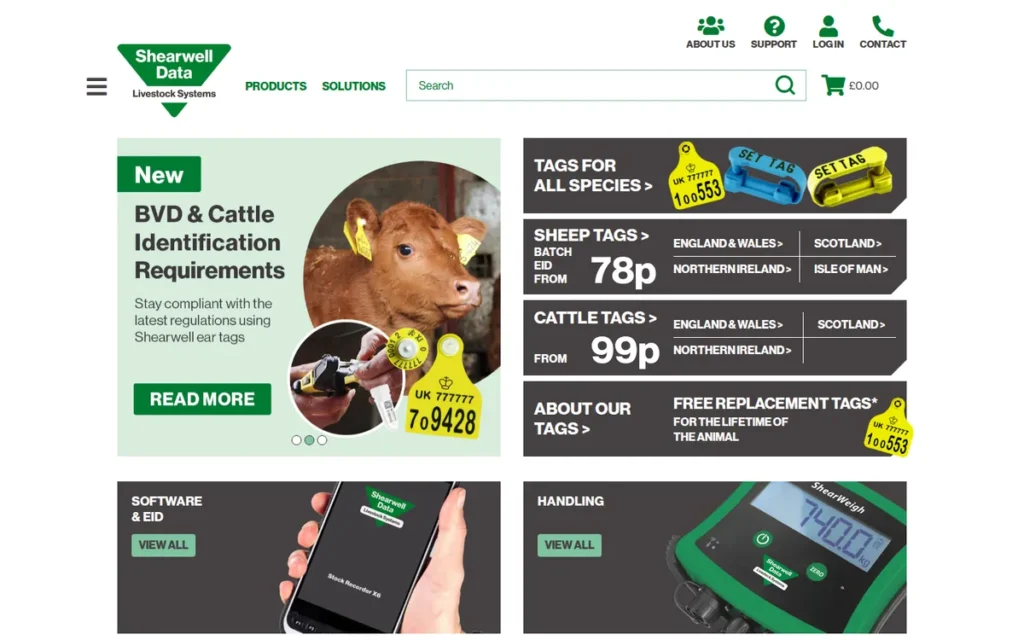
Category: EID Hardware Ecosystem. Tags, readers, scales and software supplied by one company as a connected system.
At a Glance
- Category: EID Hardware Ecosystem
- Best For: UK sheep and mixed sheep-and-cattle farmers who rely on EID tags, stick readers and weigh or draft crates
- Price Range: MyFarmWorks from £20/month excl. VAT (any herd size); SDL440S reader £595 excl. VAT; Pro tier price not published
- Primary Strength: Shearwell’s FarmWorks software was rated the top-performing software in an Alberta Lamb producer project (2011), the only independent software trial found for any product in this evaluation.
- Biggest Limitation: Shearwell ties farms to its own hardware ecosystem, its strongest evidence dates from 2011 and covered the legacy FarmWorks software, and its Trustpilot reviews are mixed.
- One-Line Summary: Shearwell Data is the strongest-documented choice for UK sheep flocks that want EID tags, readers, weigh crates and MyFarmWorks software from a single supplier.
- Last Verified: November 2026
Why #4: Shearwell Data scores 3.25/5. Flat software pricing (4/5), native EID hardware (4/5) and independent evidence (4/5) offset a small, mixed Trustpilot sample (2/5). Shearwell’s outcome-evidence score is 4 rather than 5 because its main trial dates from 2011 and tested the predecessor software.
Overview
Shearwell Data is a UK supplier of EID tags, stick readers, weigh crates and livestock software, including the cloud-based MyFarmWorks and the PC-based FarmWorks Classic. It serves sheep and cattle farmers who want statutory records, drafting, tupping and scanning data in one connected system.
Richard Webber founded Shearwell Data in 1992 in Somerset (Shearwell, accessed November 2026). Shearwell’s single-supplier approach avoids compatibility problems but increases lock-in.
Key Features
- Shearwell’s MyFarmWorks Starter covers statutory records and compliance. MyFarmWorks Pro adds drafting, scoring, tupping and pregnancy scanning on PC, phone and tablet.
- Shearwell’s SDL440S stick reader reads FDX-B and HDX tags, boluses and implants, and stores 16,000 animals and 26 groups.
- Shearwell’s EID weigh crates and Auto Drafter let one person weigh and sort 400+ sheep per hour in good conditions, according to the company.
- Shearwell supplies its own SET EID and visual tags, so Shearwell tags, readers and software are designed to work together.
- Shearwell’s Stock Recorder handheld captures data chute-side and transfers it into FarmWorks software.
Best For
Shearwell Data is best for UK commercial and pedigree sheep flocks, and for mixed sheep-and-cattle farms, where reading EID tags, weighing and drafting at handling time are the core daily tasks.
Pricing
Shearwell’s software and hardware pricing was published as follows (Shearwell, accessed November 2026) [Vendor-published]:
- Shearwell’s MyFarmWorks starts at £20/month excluding VAT, at one price for any number of cattle and sheep, with a 1-month free trial.
- Shearwell’s SDL440S stick reader costs £595 excluding VAT.
- Shearwell’s Pro tier pricing, FarmWorks Classic licensing, tag prices and U.S. pricing were not publicly available.
Shearwell software is easy to compare per head, but Shearwell hardware adds significant upfront cost.
Strengths
- Shearwell’s FarmWorks software was named the top-performing software in the Alberta Lamb Traceability Pilot, with praise for smooth EID capture, reporting and audit trail (Alberta Lamb Producers, 2011). [Independent; evaluated FarmWorks, the predecessor to MyFarmWorks]
- Shearwell’s loop tag lost 332 of 46,538 tags (0.7%) in the same 2009–2010 pilot (Alberta Lamb Producers, 2011). [Independent]
- Shearwell Data won the King’s Award for Enterprise (International Trade) in 2025 for 69% overseas sales growth over three years (The Gazette, 2025). [Independent] Shearwell also reports more than 100 million tags sold over five years (Shearwell, accessed November 2026). [Company-reported]
- Shearwell publishes a flat MyFarmWorks price from £20/month for any number of cattle and sheep (Shearwell, accessed November 2026), the simplest software pricing in this evaluation. [Vendor-published]
Limitations
Shearwell Data trades flexibility for compatibility. Buying tags, readers and software from one supplier reduces pairing problems, but it raises lock-in risk for farms that later want to switch.
- Shearwell’s main independent trial evidence dates from 2011 and covered FarmWorks, not the cloud-based MyFarmWorks sold today.
- Shearwell’s legacy FarmWorks Classic uses a PC-and-handheld workflow that feels dated next to cloud-built apps.
- Shearwell’s Trustpilot reviews are mixed and the sample is small. Praise for patient phone support sits alongside complaints about wrong orders and one claim of tags falling out, which conflicts with the 0.7% trial figure (Trustpilot, accessed November 2026). [User-reported]
- Shearwell has no verified App Store, Google Play or Capterra ratings, and its ARAMS, BCMS, ScotEID and EIDCymru connections were not individually verified. [Not verified]
- Shearwell’s MyFarmWorks data export scope was not verified, which matters more under a single-supplier model. [Not verified]
Verdict
Shearwell Data is the strongest-documented choice in this ranking for UK sheep flocks that run their handling around EID tags, readers and weigh crates. It is backed by a 2011 independent trial and a 2025 King’s Award.
Shearwell’s 2011 Alberta Lamb result is the only independent software trial found for any product in this ranking, though it evaluated the older FarmWorks software. Budget for Shearwell hardware on top of the £20/month software.
5. Breedr: Best for Data-Driven Beef Finishers Selling into Supply Chains
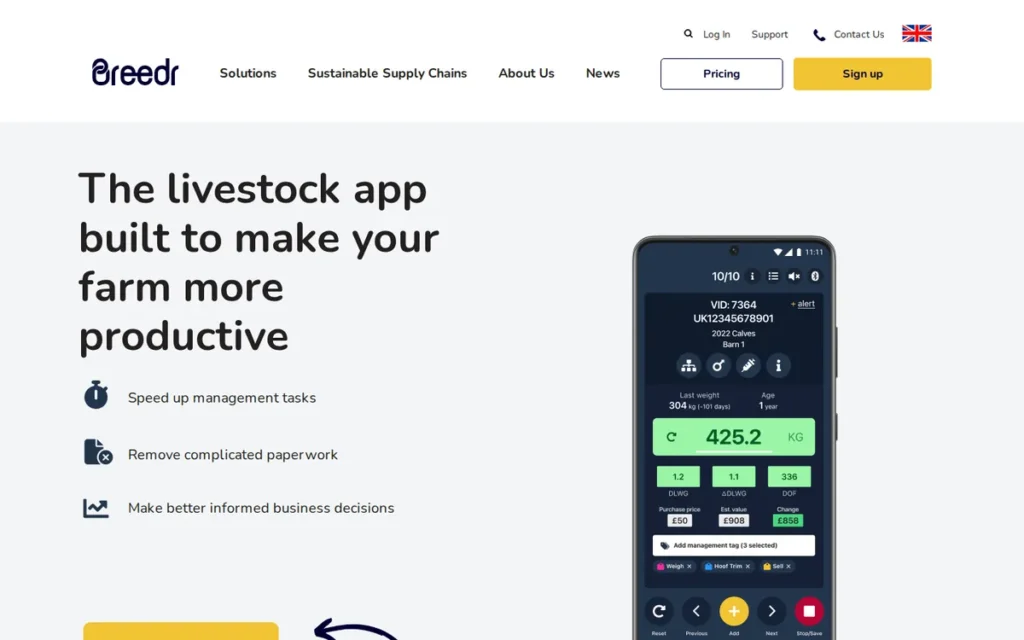
Category: Performance and Trading Platform. Individual-animal performance records linked to a livestock marketplace, supply chain and finance.
At a Glance
- Category: Performance and Trading Platform
- Best For: Commercial beef finishers, backgrounders and feedyards that track weight gain and sell into supply chains
- Price Range: U.S. $2–$235/month by head count; feedyard tiers $400–$1,500/month; UK pricing not published
- Primary Strength: Breedr links individual-animal weights and performance records to a livestock marketplace and cattle finance, a combination no other evaluated product offers.
- Biggest Limitation: Breedr has almost no independent review volume, and its marketplace results date from 2021.
- One-Line Summary: Breedr is the only livestock management software in this ranking that connects chute-side performance records to a cattle marketplace and livestock finance, which makes it a fit for data-driven beef finishers.
- Last Verified: November 2026
Why #5: Breedr scores 3.05/5. Chute-side hardware pairing and offline capture (field reliability 5/5) and published U.S. tiers (pricing transparency 4/5) are offset by almost no review evidence (1/5) and outcome figures from 2021 (2/5).
Overview
Breedr is a livestock performance and trading platform for commercial beef finishers, backgrounders and feedyards in the UK and U.S. It records individual-animal weights, growth, medicines and movements chute-side and links them to a livestock marketplace and cattle finance.
Breedr launched its free app in March 2020 (Breedr, 2020). Breedr leans toward weight-gain tracking for commercial beef rather than sheep or suckler herds.
Key Features
- Breedr records parentage, movements, weights, growth, medicines, photos and sales for each animal.
- Breedr’s chute-side Crush Mode connects to Bluetooth EID readers and weigh heads in the Tru-Test and Gallagher ecosystems.
- Breedr’s mobile app works offline, so records can be captured on handling day without a signal.
- Breedr links records to a livestock trading marketplace, supply-chain sourcing and livestock finance (cash advances against cattle).
- Breedr’s UK version reports BCMS and ScotEID movements, and its U.S. version adds EPDs, genomics, ranch mapping and feedyard plans.
Best For
Breedr is best for data-driven beef finishers and feedyards that want their weight-gain records to feed straight into selling, sourcing and financing cattle.
Pricing
Breedr’s U.S. pricing page listed these tiers (Breedr, accessed November 2026) [Vendor-published]:
- Breedr Trial costs $2/month for up to 50 head.
- Breedr Plus costs $35/month for up to 300 head, Pro costs $95/month for up to 1,000, and Premium costs $235/month for up to 2,000.
- Breedr feedyard tiers cost $400 and $1,500/month, with larger tiers on request.
An older Breedr U.S. schedule ($40–$650/month plus implementation fees of $150–$3,000) still circulates. Current UK GBP pricing was not available.
Breedr’s marketplace was free for the first 3 trades in 2021 and then charged 2% commission (Yespress, 2021), so confirm the current terms.
Strengths
- Breedr reported £1.85M of cattle (2,912 head) traded in its marketplace’s first four months, to July 2021. Sellers averaged 99.7% of asking price and sold within five days of listing (Farming Life, 2021). [Company-reported; dated]
- Breedr raised £2.2M in seed funding in 2020, led by LocalGlobe (Breedr, 2020). This is evidence of vendor maturity rather than product performance. [Company-reported]
- Breedr’s Crush Mode pairs with Bluetooth EID readers and weigh heads from the Tru-Test and Gallagher ecosystems (Google Play, accessed November 2026). [Vendor-published]
- Breedr publishes U.S. tiers by head count, starting at $2/month for up to 50 head (Breedr, accessed November 2026), one of the cheapest documented entry points in this evaluation. [Vendor-published]
Limitations
Breedr trades broad farm fit and an established review record for a commercial-beef focus tied to trading. Breedr shows too few App Store ratings to give an average, and no Capterra or Trustpilot presence was verified (Apple App Store, accessed November 2026).
- Breedr has a “small G2/Capterra footprint,” according to an analyst profile (Teardown.ai, accessed November 2026). [Independent]
- Breedr focuses less on sheep and suckler herds than on commercial beef finishing (Guideflow, accessed November 2026). [Independent]
- Breedr’s marketplace and user figures date from 2021, and its UK pricing is unpublished.
- Breedr’s ARAMS integration was not confirmed, one comparison could not confirm its statutory reporting at all, and its data export scope was not verified. [Not verified]
- Breedr needs consistent data entry and does not suit every type of farm, according to SpotSaaS (SpotSaaS, accessed November 2026). [Independent]
Verdict
Breedr is the only product in this ranking that turns chute-side performance records into a route to selling and financing cattle, which makes it the specialist pick for data-driven beef finishers.
Independent Breedr reviews are almost absent, and Breedr’s marketplace figures are from 2021. Sheep and cow-calf operations are better served elsewhere.
6. CattleMax: Best for U.S. Registered and Cow-Calf Cattle Herds
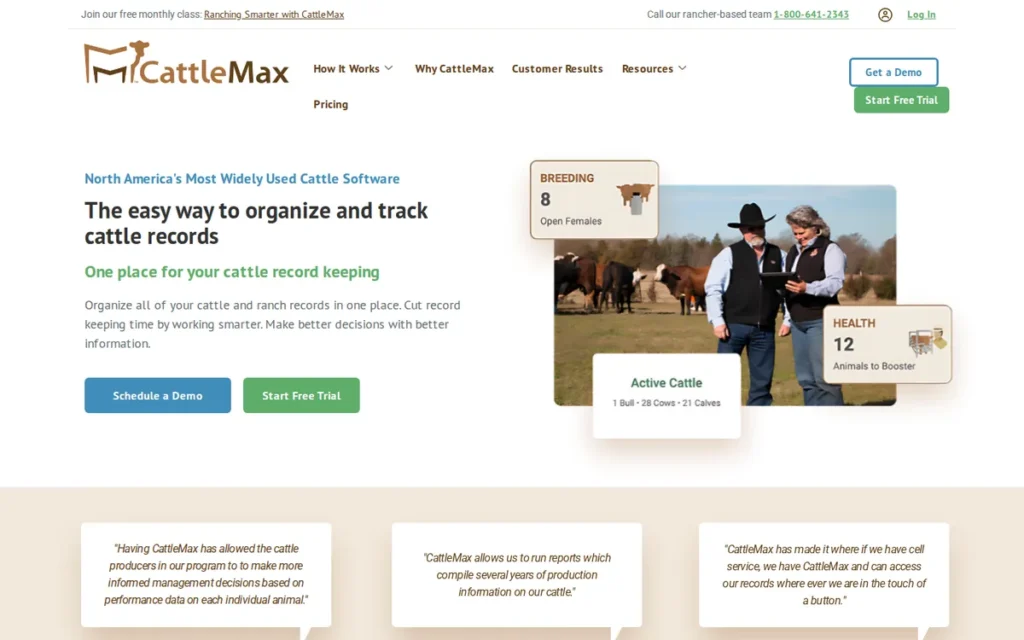
Category: Species Specialist Recordkeeper. Deep records built for one species or production type.
At a Glance
- Category: Species Specialist Recordkeeper
- Best For: U.S. commercial cow-calf ranchers and registered or seedstock cattle breeders
- Price Range: $30–$41/month billed annually (Registered covers up to 250 active animals); 2,000+ head from $80/month; 21-day free trial, no card required
- Primary Strength: CattleMax’s Registered plan provides breed-association interfaces, 3-generation pedigrees, embryo records and EPD/EBV tracking that no other evaluated product matches.
- Biggest Limitation: CattleMax has zero user reviews on Capterra, and its offline behavior and EID or scale hardware support could not be verified.
- One-Line Summary: CattleMax is the deepest cattle-only record-keeping software in this ranking, built for U.S. cow-calf and registered breeders who need pedigrees, EPDs and breed-association submissions at a published price.
- Last Verified: November 2026
Why #6: CattleMax scores 3.00/5. CattleMax has the highest operation-fit score in the ranking (5/5) and fully published pricing (5/5). It scores 1/5 on review volume and 2/5 on field reliability because review and offline evidence are missing.
Overview
CattleMax is cattle-only record-keeping software for U.S. commercial cow-calf ranchers and registered or seedstock breeders. It keeps each animal’s lifetime history of breeding, calving, treatments, weights and pedigrees, along with pasture maps, expenses and tasks.
CattleMax is narrower than whole-farm platforms but deeper on cattle. The CattleMax Registered plan adds breed-association tools.
Key Features
- CattleMax organizes breeding, calving, treatments and weights around each animal’s lifetime history.
- CattleMax’s Registered plan adds breed-association interfaces, 3-generation pedigrees, embryo flushes, transfers and inventory, EPDs/EBVs, multiple ownership and marketing records.
- CattleMax requires the user’s approval before EPD downloads or electronic association submissions send any data.
- CattleMax includes pasture maps, income and expense records, equipment logs, and a calendar with tasks.
- CattleMax includes unlimited users, so family members and hired hands can have their own logins at no extra cost, according to a third-party comparison.
Best For
CattleMax is best for U.S. registered and seedstock breeders who submit to breed associations and track EPDs. CattleMax also suits commercial cow-calf ranchers who want cattle-only records without paying for whole-farm modules.
Pricing
CattleMax’s live pricing page listed these terms (CattleMax, accessed November 2026) [Vendor-published]:
- CattleMax Commercial costs $30/month, billed annually. Its herd cap was not confirmed for this guide.
- CattleMax Registered costs $41/month, billed annually, for up to 250 active animals.
- CattleMax pricing for ranches with 2,000+ head starts at $80/month.
- CattleMax counts only active animals, so sold, dead and archived animals don’t raise the price, and the 21-day free trial needs no card.
Older CattleMax figures still circulate, including in AI answers: $12–$100/month and a legacy one-time price of $145 on Capterra. Use only the live CattleMax pricing page.
Strengths
- CattleMax’s Registered plan lists breed-association interfaces, 3-generation pedigrees, embryo flushes and transfers, EPDs/EBVs and multiple ownership (CattleMax, accessed November 2026). It is the deepest registered-cattle feature set in this evaluation. [Vendor-published]
- CattleMax publishes current pricing based on active animals only, with a 21-day no-card trial (CattleMax, accessed November 2026), which makes it one of the easiest products to cost accurately. [Vendor-published]
- CattleMax is praised in third-party editorial comparisons for how deep its cattle records go and how easy it is to use (Axiobench, accessed November 2026). Claims that its interface is dated were not substantiated. [Independent]
- CattleMax includes unlimited user logins according to a Farmonaut comparison (Farmonaut, accessed November 2026), which avoids per-seat charges for family and crew. The vendor page did not confirm this. [Not verified]
Limitations
CattleMax trades multi-species breadth and verified field reliability for cattle depth. CattleMax shows zero user reviews on Capterra, and no verified G2, App Store or Google Play rating exists (Capterra, accessed November 2026). [Review platform]
- CattleMax’s offline behavior and EID reader or scale support could not be verified, and one comparison says its sync under patchy connectivity needs testing (Axiobench, accessed November 2026). [Not verified]
- CattleMax is cattle-only, so mixed farms will need a second tool.
- CattleMax’s Registered plan covers up to 250 active animals at $41/month, so larger registered herds move to a higher price step.
- CattleMax has no quantified customer results or named case studies. No user evidence could be published because the only Reddit quotes found were relayed and unverified. [Not verified]
- CattleMax’s founding details and data export scope were not verified. [Not verified]
Verdict
CattleMax is the most specialized choice in this ranking for U.S. registered and seedstock cattle breeders who need pedigrees, EPDs and breed-association submissions at a published price based on active head.
CattleMax’s rank reflects missing review and offline evidence, not weak cattle features. Test offline entry and reader pairing during the 21-day CattleMax trial. Mixed-species farms should look at Farmbrite.
7. DairyComp 305 (VAS): Best for Commercial Dairies Working with Consultants
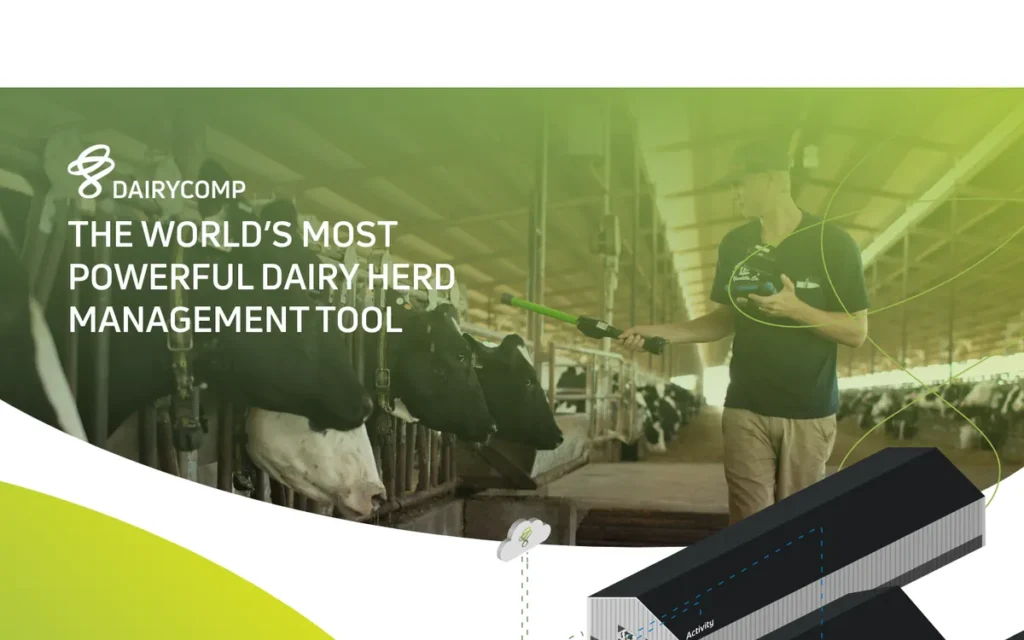
Category: Species Specialist Recordkeeper. Deep records built for one species or production type.
At a Glance
- Category: Species Specialist Recordkeeper
- Best For: Commercial dairies whose consultants and vets need deep, custom herd analytics
- Price Range: Pricing on request (third-party estimate of about $2,000/year in some setups, plus support and interface costs)
- Primary Strength: DairyComp 305 tracks more than 250 data items per cow and lets consultants build almost any report through its command-line report writer.
- Biggest Limitation: DairyComp 305 has a steep learning curve, depends on a Windows desktop, uses coded command entry and publishes no pricing.
- One-Line Summary: DairyComp 305 is the most data-rich dairy herd management system in this ranking, built for commercial dairies whose consultants and vets need custom analysis of 250+ data items per cow.
- Last Verified: November 2026
Why #7: DairyComp 305 scores 2.95/5. Quote-only pricing (1/5) and an unverified review rating (2/5) pull down strong dairy depth (4/5) and field integration (4/5). DairyComp 305’s rank reflects a narrow audience and opaque pricing, not weak dairy capability.
Overview
DairyComp 305 is VAS’s on-farm dairy herd database for commercial dairies. It tracks lactations, DHI test data, reproduction, health, drug inventory, embryos and pen moves across 250+ data items per cow, and consultants analyze that data with a command-line report writer.
DairyComp 305 has been in use since 1983, and its mobile app and PULSE cloud sync sit on top of a Windows desktop core. VAS’s MyDC product for smaller dairies was not separately evaluated.
Key Features
- DairyComp 305 tracks more than 250 data items per cow, including lactations, DHI test data, reproduction, health, treatments, drug inventory, embryos and pen moves.
- DairyComp 305 lets users build custom reports and graphs through a command line and report writer that consultants and vets value.
- DairyComp 305’s DC on Mobile app for iOS and Android works online or offline and pairs with RFID wands.
- DairyComp 305 connects to DHIA centers, milk meters and parlors, and it brings heat and activity-monitor data into the cow card.
- DairyComp 305 syncs on-farm data to the cloud through the VAS PULSE Platform.
Best For
DairyComp 305 is best for mid-sized and large commercial dairies that already work with consultants or vets who use it. Small family dairies that rely on daily direct observation may find DairyComp 305 more than they need.
Pricing
DairyComp 305 has no public pricing and is sold by quote (VAS, accessed November 2026). Known cost information is limited to the following:
- DairyComp 305 costs about $2,000/year in some setups, plus support and interface costs, according to a third-party blog (DairyFarmManager, 2026). This is not an official VAS price. [Not verified]
- DairyComp 305 buyers should ask for a quote that covers interfaces, support and mobile licensing.
Strengths
- VAS reports more than 6,000 producers using DairyComp 305 worldwide, with 15M+ animals on the wider VAS platform (VAS, accessed November 2026). [Company-reported]
- DairyComp 305 was first installed in Tulare, California, in 1983 and marked 40 years in 2023 (VAS, 2023), the longest track record in this evaluation. [Company-reported]
- DairyComp 305 can graph “virtually anything” and has strong breeding, dry-off and calving reports, according to a G2 reviewer (G2, accessed November 2026). [User-reported]
- DairyComp 305 has been the preferred system of Larson Acres’ consultants for 25+ years, according to a VAS brochure (VAS brochure, accessed November 2026). [Vendor-published]
Limitations
DairyComp 305 trades ease of use and clear pricing for analytical depth. Third-party reviews say DairyComp 305 takes new staff weeks to learn (Rankite, accessed November 2026). [Independent]
- DairyComp 305 uses a dated, DOS-like interface, depends on a Windows desktop and tends to concentrate knowledge in one or two power users (DairyFarmManager, accessed November 2026). [Independent]
- DairyComp 305’s coded entries, such as “rc=6” for a dry cow, compare poorly with menu-driven alternatives. A G2 reviewer also criticizes the lack of standardized health codes for transition-cow diseases (G2, accessed November 2026). [User-reported]
- DairyComp 305’s pricing is quote-only, and compatibility with parlor brands such as DeLaval, GEA, BouMatic and Lely is not published. [Not verified]
- DairyComp 305 is dairy-only, and its regulatory reporting and data export scope were not documented. [Not verified]
Users on r/dairyfarming shared their experience:
“We currently use dairy comp for cow records, this includes genetic data that we import from another website that we use, any treatment records and hoof care. This is the most important program we use and takes the most maintenance.” Posted by u/sendgoodmemes
Takeaway: For dairies that run on it, DairyComp 305 is the central cow-records system, and it also takes the most upkeep of any program on the farm.
Verdict
DairyComp 305 is the most data-rich herd system in this ranking for commercial dairies whose consultants and vets need custom analysis of every cow.
Small herds and new staff face a steep DairyComp 305 learning curve. Get parlor and sensor compatibility confirmed in writing, and get a full quote that includes interfaces.
Which Other Livestock Tools Were Considered but Not Fully Evaluated?
AI answer engines named five more livestock tools that PlugRoute did not research to its full standard: FarmKeep, LIVESTOCKED, VAS MyDC, CowManager and Afimilk. These tools were left out of the ranking to keep editorial depth equal across entries. Leaving them out is not a negative judgment of any of them.
- PlugRoute did not evaluate FarmKeep, a livestock app that comes up in small-farm community discussions.
- PlugRoute did not evaluate LIVESTOCKED, which AI answer engines named for livestock record-keeping.
- PlugRoute did not evaluate VAS MyDC, a VAS dairy product that ChatGPT recommended for dairies, separately from DairyComp 305.
- PlugRoute did not evaluate CowManager, a cow-worn sensor platform that Perplexity named for dairy monitoring.
- PlugRoute did not evaluate Afimilk, a dairy sensor and herd platform that Perplexity named.
Users on r/homestead noted:
“Nobody wants any management apps. We get flooded by app builders multiple times a day, on this subreddit. Besides, there are many forms of software in existence already, so unless you can offer something drastically better, you will get no love. BTW, Lely, the builder of robotic dairy products, offers excellent dairy software. So that is someone you are running against, just so you know.” Posted by u/Dangerous_Ingenuity1
Takeaway: Farmers are tired of new herd management apps, so any livestock tool outside the established names has to be clearly better than incumbents like Lely’s dairy software to earn a place on the farm.
How Do the Seven Tools Compare on Species, Offline Scope and Reviews?
The seven ranked tools differ most on species coverage, offline scope, pricing model and review volume. Farmbrite covers the most species, AgriWebb documents offline maps and Shearwell Data has the simplest flat software price. Farmbrite is the only one with a verified rating backed by a meaningful review count.
Field and Evidence Snapshot (checked November 2026)
| Company | Species | Offline Scope | Pricing Model | Regions | Review Volume |
|---|---|---|---|---|---|
| Farmbrite | Many | Field records, tasks and scouting | Fixed tiers, $29–$79/mo | Not stated by vendor (U.S. pricing in USD) | Capterra 4.8/5 (63 reviews) |
| Herdwatch | Cattle, sheep | Offline-first with auto-sync | Free tier, then by herd type and size | Ireland, UK | Capterra about 4.4/5 (count not verified) |
| AgriWebb | Cattle, sheep | Offline, including maps | Base fee plus 12-month average head, by region | Australia, U.S., UK | No verified rating with count |
| Shearwell Data | Sheep, cattle | Handheld or stick-reader capture | From £20/mo flat, plus hardware | UK | Trustpilot mixed (small sample) |
| Breedr | Mainly cattle | Offline app | U.S. tiers by head count, $2–$235/mo | UK, U.S. | App Store: too few ratings |
| CattleMax | Cattle only | Not verified | By active head, $30–$41/mo billed annually (Registered up to 250 active) | Mainly U.S. | Capterra: 0 reviews |
| DairyComp 305 | Dairy only | Mobile app online or offline | Quote only | U.S. and global | G2 listing; rating not verified |
How Is Livestock Management Software Priced?
Livestock management software uses six pricing models: fixed tiers, active-head pricing, base fee plus average head, flat software plus hardware, price after sign-up, and quote-only. Three of the seven vendors PlugRoute evaluated publish full core pricing (PlugRoute research, 2026). The other four hide part of the real price behind a calculator, sign-up, quote or unpublished tier.
- Fixed tiers with herd caps: Farmbrite ($29–$79/month) and Breedr’s U.S. plans ($2–$235/month) publish caps by animal count (Farmbrite, accessed November 2026; Breedr, accessed November 2026).
- Active-head pricing: CattleMax charges only for active animals, at $30–$41/month billed annually (CattleMax, accessed November 2026).
- Base fee plus 12-month average head: AgriWebb’s pricing varies by region and adds setup services from $500 (AgriWebb, accessed November 2026).
- Flat software price plus hardware: Shearwell MyFarmWorks costs from £20/month for any herd size, and the Shearwell SDL440S reader costs £595 excluding VAT (Shearwell, accessed November 2026).
- Price after sign-up: Herdwatch users report seeing prices only after registering (Apple App Store, accessed November 2026).
- Quote only: DairyComp 305 publishes no price (VAS, accessed November 2026).
Herd caps change the real price. A farm with 400 animals goes over the 300-animal cap on Farmbrite Essentials, so its real Farmbrite price is $49/month, not $29. A 400-head registered herd also goes over the 250-active-animal cap on the $41 CattleMax Registered plan.
Total cost of ownership for livestock software includes these costs beyond the listed subscription:
- Tax (VAT or GST) is added on top of many listed prices.
- Setup or implementation fees apply at some vendors, such as AgriWebb from $500.
- EID readers add upfront cost, such as the Shearwell SDL440S at £595 excluding VAT.
- Scales and weigh heads add cost for farms recording weights chute-side.
- Tags add recurring cost for every new animal.
- Support and interface fees can apply, as with DairyComp 305.
Which Livestock Software Works Offline?
Herdwatch, AgriWebb, Breedr and DairyComp 305’s mobile app document offline entry. Farmbrite’s offline mode covers field records, and Shearwell Data captures data on handheld readers. CattleMax’s offline behavior could not be verified. PlugRoute found no independent test of sync conflict handling for any of the seven products (November 2026).
In livestock software, “works offline” can mean four different things: full record creation, field-only entry, entry plus maps, or view-only access. Ask vendors which one they mean before you subscribe.
- Herdwatch: Herdwatch is designed to work offline first and syncs automatically, though third-party roundups report mobile-to-web sync failures. [Vendor-published; User-reported]
- AgriWebb: AgriWebb’s mobile app works offline, including maps. [Vendor-published]
- Breedr: Breedr’s mobile app works offline for chute-side records. [Vendor-published]
- DairyComp 305: DairyComp 305’s DC on Mobile works online or offline with RFID wands. [Vendor-published]
- Shearwell Data: Shearwell’s SDL440S and Stock Recorder capture data at handling time for transfer to FarmWorks. [Vendor-published]
- Farmbrite: Farmbrite supports offline scouting, tasks and record entry, while reporting and admin happen on a desktop. [Vendor-published]
- CattleMax: CattleMax includes mobile access, but its offline scope was not verified. [Not verified]
Picture recording a 2 a.m. calving in a back paddock with no signal. An offline-first app like Herdwatch lets you create the record on the spot. Field-only modes cover basic entry. If the offline scope is unverified, as with CattleMax, test it before you depend on it.
What Red Flags Should I Watch For When Evaluating Livestock Management Software?
The biggest red flags in livestock management software are hidden pricing, offline claims with no defined scope, missing verified reviews, unpublished export options, vague hardware compatibility and compliance built for another country. Any of these can cost a farm money, double its data entry or lock in years of records.
Red Flag #1: Pricing Shown Only After Sign-Up Pricing shown only after sign-up is a red flag because it makes fair comparison much harder before you commit time to data entry. In this evaluation, Herdwatch users report seeing paid prices only after registering (Apple App Store, accessed November 2026). Ask any vendor for a written annual quote for your herd size.
Red Flag #2: Offline Claims With No Defined Scope An offline claim with no defined scope is a red flag because “offline” can mean full record creation, field-only entry, entry plus maps, or view-only access. Among the seven products evaluated, CattleMax’s offline scope could not be verified at all. Get a written list of offline modules and the vendor’s sync-conflict rule.
Red Flag #3: No Verified Reviews With a Count A rating without a review count, or no rating at all, is a red flag because it gives you no outside check on daily usability for a real crew. In PlugRoute’s November 2026 evaluation of seven livestock software products, six had thin or no verified review volume. Treat the trial as your own review.
Red Flag #4: Unpublished Data Export or API Unpublished data export is a red flag because years of breeding, treatment and pedigree records become hard to move if you switch vendors. PlugRoute could not verify export scope for any of the seven ranked products (PlugRoute research, 2026). Export a sample file during the trial and open it.
This aligns with community sentiment on r/dairyfarming:
“Our biggest challenge is that we’ve got all of this data already across a number of platforms, but no one is willing to integrate it because their own platform is their intellectual property. For example, we have a breeding information programme that tracks genetics and records health events and treatments, and we have wearables that alert for heats and health events, but the breeding programme refuses to automatically share the data with the far superior wearables programme so we’re flicking between the two manually inputting data.” Posted by u/rednz01
Takeaway: When livestock software vendors treat farm data as their own property and won’t share it, farmers end up re-keying records by hand between systems, so open export and integration should be a buying requirement.
Red Flag #5: Hardware Compatibility Listed Only as “Integrations” A vague “RFID integration” line is a red flag because it does not prove the software pairs with your reader, scale head or parlor. Farmbrite lists RFID/EID only as a mid-tier integration, and CattleMax’s hardware support could not be verified. Ask for named brands, models and connection method.
Red Flag #6: Compliance Built for Another Country Compliance built for another country is a red flag because software designed around one region’s traceability rules can force double entry or failed audits elsewhere. PlugRoute found no evaluated product that documents direct links to EU national registries outside the UK and Ireland (PlugRoute research, 2026).
- U.S.: Since November 5, 2024, USDA APHIS has required official eartags on covered cattle and bison moving interstate to be both visually and electronically readable (Federal Register, 2024). Covered animals are sexually intact animals 18 months or older, all dairy cattle, and rodeo or exhibition animals.
- UK: UK traceability runs through BCMS, ScotEID, NIFAIS, ARAMS and EIDCymru, and cattle EID rules differ between England, Wales, Scotland and Northern Ireland.
- Ireland: Irish farms report through ICBF, Bord Bia and the Department of Agriculture.
- EU: The EU Animal Health Law (Regulation (EU) 2016/429) sets duties for identification, registration, movement and record-keeping.
Check current UK and EU rules on official government sites. This guide is information, not legal advice.
What Questions Should I Ask Before Choosing Livestock Management Software?
Before choosing livestock management software, ask seven questions. They cover individual-animal records, offline scope, compliance filing, all-in cost, data export, hardware pairing and whether you have outgrown spreadsheets. The answers separate a system your crew will use daily from a polished demo.
Question #1: Does it keep individual-animal records, not just group counts? Livestock software must keep individual-animal records if you select breeding stock or track treatments per animal. Look for per-animal histories of breeding, birthing, treatments, weights and pedigrees. All seven evaluated products offer individual records, but AgriWebb tracks mobs by default until you switch to individual EID or tag tracking.
Question #2: Which modules can I create records in with no signal, and how are sync conflicts handled? Offline record creation must be confirmed module by module, because vendors use “offline” to mean different things. Ask for a written list of modules that let you create records with no signal. Also ask what happens when two users edit the same animal while offline.
Question #3: Will it file directly to my government or breed-association system? Software should file directly to the systems you report to, because generic “compliance reports” still leave you re-keying data. Look for named links such as BCMS, ScotEID, ICBF or breed-association submissions. Herdwatch documents UK and Irish links, and CattleMax documents breed-association interfaces.
Question #4: What will I pay for my herd size, including setup, hardware, seats and tax? Your real cost is one annual figure for your herd size that includes setup, hardware, seats and tax. The headline monthly price is not your real cost. AgriWebb setup services start at $500, Shearwell’s SDL440S reader costs £595 excluding VAT, and herd caps push Farmbrite and CattleMax users onto higher tiers.
Question #5: Can I export all my records in an open format if I leave? You should be able to export every record in an open format such as CSV. Years of breeding and treatment history create lock-in if they can’t move. PlugRoute could not verify export scope for any of the seven ranked products, so run a full test export during the trial.
Question #6: Does it pair with the EID reader and scales I already own? Software should pair with the EID reader and scales you already own, named by brand and model. Breedr documents Tru-Test and Gallagher ecosystems, Herdwatch documents Bluetooth readers and scale heads, and DairyComp 305 documents RFID wands. Pair your own device during the trial.
Users on r/farming shared their experience:
“Performance livestock analytics is nice. Use it to track cattle, track costs, track sales, manage feed inventory, load feed trucks, deliver feed to cattle (ipad BT to scale), keep track of sick cattle and withdrawal dates, process cattle and weigh them with Bluetooth scale on arrowquip chute, view weight projections based on intakes, examine pretty much any metric. Only thing is doesn’t do very well is showing a birds eye view of profit/loss across the operation rather than a pen by pen basis.” Posted by u/hr8245r
Takeaway: Cattle software that pairs over Bluetooth with chute scales and feed-truck scales pays off chute-side, but strong pen-level detail does not guarantee a clear profit-and-loss view of the whole operation.
Question #7: Have I outgrown spreadsheets and paper records? A spreadsheet usually stops working once you need individual-animal histories across several breeding seasons, more than one person entering data, or records captured in the field with no signal. Until then, a well-kept spreadsheet is a reasonable free option, especially for a small herd you see every day.
“We are small (80 cows) and I have eyes on all of them a minimum of twice a day when I’m milking.” (u/Octavia9, r/dairyfarming (Reddit, accessed November 2026))
Takeaway: Small dairies that see every cow twice a day often rely on observation. Software pays off mainly when herd size, staff numbers or compliance records outgrow memory and paper.
Trial checklist to complete before you subscribe:
- Add at least ten real animals with tags and parentage to test individual records.
- Record one birth and one treatment, including a withdrawal date where relevant.
- Move a group between paddocks or pens to test movement and grazing records.
- Enter records with the phone offline, then reconnect and confirm they synced.
- Ask the vendor in writing which modules allow offline record creation.
- Export your herd records during the trial and open the file to confirm every field came through.
- Add a second user and confirm that user’s access level.
How Did We Rank These Livestock Management Software Tools?
PlugRoute scored seven livestock management software products from 1 to 5 on six weighted criteria, using research dated November 2026. The weights are operation-type fit 25%, verified sentiment 20%, field reliability 20%, pricing transparency 15%, compliance 10% and outcome evidence 10%. The weighted total sets the rank.
PlugRoute has no affiliate relationships with any company listed, and rankings are determined entirely by research data and objective evaluation criteria.
Ranking criteria and why each matters:
- Operation-Type Fit and Workflow Depth (C1, 25%): Operation-type fit matters because a tool missing your species or breeding workflow is a dealbreaker.
- Verified User Sentiment and Review Volume (C2, 20%): Verified review volume matters because independent reviews with a count are the main outside check on daily usability. A score of 1 means too few verified reviews to check, not a poor product.
- Field Reliability, Offline and Hardware (C3, 20%): Field reliability matters because handling and grazing work often happens with no signal and depends on EID readers and scales. Reported sync complaints lower this score.
- Pricing Transparency and Total Cost (C4, 15%): Pricing transparency matters because per-head, calculator and quote-only models are hard to compare.
- Compliance and Traceability by Region (C5, 10%): Compliance support matters because a mismatch with national systems causes double entry or failed audits.
- Documented Outcome Evidence and Vendor Maturity (C6, 10%): Outcome evidence matters because independent trials and long track records lower the risk of trusting a vendor with years of records. Evidence more than three years old is discounted.
Score table (1–5 per criterion; weighted total = C1×0.25 + C2×0.20 + C3×0.20 + C4×0.15 + C5×0.10 + C6×0.10)
| Rank | Company | C1 | C2 | C3 | C4 | C5 | C6 | Weighted Total |
|---|---|---|---|---|---|---|---|---|
| 1 | Farmbrite | 4 | 5 | 3 | 5 | 2 | 3 | 3.85 |
| 2 | Herdwatch | 4 | 3 | 4 | 2 | 5 | 3 | 3.50 |
| 3 | AgriWebb | 4 | 1 | 5 | 3 | 3 | 4 | 3.35 |
| 4 | Shearwell Data (MyFarmWorks) | 3 | 2 | 4 | 4 | 3 | 4 | 3.25 |
| 5 | Breedr | 3 | 1 | 5 | 4 | 3 | 2 | 3.05 |
| 6 | CattleMax | 5 | 1 | 2 | 5 | 2 | 2 | 3.00 |
| 7 | DairyComp 305 (VAS) | 4 | 2 | 4 | 1 | 2 | 4 | 2.95 |
How the published rules shaped two scores:
- Herdwatch’s field reliability score is 4 rather than 5 because third-party roundups report recurring sync failures, and the C3 method lowers scores for reported sync complaints.
- Shearwell’s outcome-evidence score is 4 rather than 5 because its main independent trial was published in 2011, and the C6 method discounts evidence more than three years old.
- If two products tie, the product with the higher combined C1–C3 score ranks higher. No tie occurred in this edition.
Important limits of this methodology:
- PlugRoute did not test any product hands-on, so offline sync, data export and hardware pairing are reported as claimed, user-reported or not verified.
- Evidence age varies. Shearwell’s strongest independent result comes from 2009–2010 trials published in 2011, and Breedr’s marketplace results are from 2021, so neither is current proof of today’s software.
- PlugRoute used only Reddit comments retrieved directly from source threads and excluded relayed quotes that could not be checked.
- PlugRoute excluded Farmbrite’s hypothetical “Rolling Ridge Cattle Company” example from all scoring.
- PlugRoute listed tools named by AI answer engines but did not rank them, because they were not researched to the same depth.
What Are Common Questions About Livestock Management Software?
These answers cover three frequent livestock software buying questions: options for small farms, picks for cattle ranches, and how PlugRoute sets its rankings. Each answer opens with a direct recommendation based on PlugRoute research dated November 2026. The offline, pricing and evaluation sections above go deeper.
What is the best livestock management software for small farms?
For small mixed-species farms, Farmbrite is the strongest fit at $29/month, with up to 50% off for eligible new farms (Farmbrite, accessed November 2026). Small farms on the tightest budgets can start with these options:
- AgriWebb Essentials costs $0.
- Herdwatch offers a free tier for UK and Irish farms.
- Breedr’s Trial tier costs $2/month for up to 50 head.
What is the best livestock management software for cattle ranches in 2026?
For U.S. cattle ranches in 2026, CattleMax fits registered and cow-calf herds best. AgriWebb suits grazing-led ranches with crews, and Breedr fits beef finishers selling into supply chains. Irish and UK cattle farms should start with Herdwatch. CattleMax’s offline support was not verified, so test it during the 21-day CattleMax trial.
How does PlugRoute determine its livestock software rankings?
PlugRoute ranks livestock software by scoring each product from 1 to 5 on six published, weighted criteria, using research dated November 2026. Every claim carries an evidence label, such as Independent, Vendor-published or Not verified. PlugRoute did not test products hands-on, so confirm offline sync, data export and hardware pairing during any trial.
What Do Key Livestock Management Software Terms Mean?
Livestock management software uses terms from animal ID, pricing, breeding and connectivity that vendors rarely define. The twelve definitions below explain the terms used in this guide and why each one matters when you compare vendors, read pricing pages or test a trial.
EID (Electronic Identification): EID is an electronic ear tag, bolus or implant that a reader scans to identify an animal. EID support decides whether your software can capture records chute-side without manual typing.
FDX-B and HDX: FDX-B and HDX are the two common EID transponder standards. A reader that supports both matters if your animals carry mixed tag types.
Active-head pricing: Active-head pricing charges only for animals currently on the farm, not those sold, dead or archived. Active-head pricing keeps costs in line with your real herd size.
Average-head pricing: Average-head pricing bases the fee on livestock numbers averaged over a period, often 12 months. Seasonal operations should calculate this figure before comparing vendors.
Mob: A mob is a managed group of animals moved and recorded together. Mob-level records save time for grazing operations but may not replace individual records.
Withdrawal period: A withdrawal period is the time after a medicine treatment before milk or meat can enter the food chain. Automatic withdrawal-date tracking reduces the risk of failing an inspection.
EPD/EBV (Expected Progeny Difference / Estimated Breeding Value): EPDs and EBVs estimate the genetic merit an animal passes to its offspring. Registered breeders need software that stores and updates these values.
DHI/DHIA testing: DHI (Dairy Herd Improvement) testing measures milk yield and components for each cow. Dairy software that imports DHI data avoids manual re-entry.
Offline-first: Offline-first software is designed to create and store records without a signal and sync later. Offline-first design differs from apps that only display cached data offline.
Sync conflict: A sync conflict happens when two users change the same record while offline. The way software resolves conflicts determines whether data is lost.
Stocking rate: Stocking rate is the number of animals grazed on a given area of land over time. Grazing software uses stocking rate to plan rotations and prevent overgrazing.
Chute-side (crush-side) recording: Chute-side recording means entering weights, treatments and tag reads while animals are in the handling system. Chute-side recording reduces the transcription errors that come from paper notes.
Which Livestock Management Software Is Right for You?
Key Insights
- No single livestock management software product wins for every operation, and the weighted scores in this ranking span only 2.95 to 3.85 out of 5.
- Country and species narrow a livestock software shortlist faster than features do, so a UK sheep flock and a Texas cow-calf ranch should not start from the same list.
- Six of the seven ranked products have thin or no verified independent review volume (PlugRoute research, 2026), so trials matter more than ratings in this category.
- Livestock software pricing models differ so much that every quote should be converted to an annual figure for your herd size, including setup, hardware and tax.
- Offline scope and data export were not independently verified for any ranked product, so test both during a trial.
Where to start by operation type:
- If you run mixed species or goats and want finances in the same system, start with Farmbrite.
- If you farm cattle or sheep in Ireland or the UK and compliance drives your workload, start with Herdwatch.
- If your UK sheep flock runs its handling on EID, start with Shearwell Data.
- If grazing rotations and crews define your day, start with AgriWebb.
- If you finish beef for supply chains, start with Breedr.
- If you breed registered or cow-calf cattle in the U.S., start with CattleMax.
- If you manage a consultant-led commercial dairy, start with DairyComp 305.
National EID and traceability rules keep changing, so expect compliance links and verified offline sync to matter more each year. Read PlugRoute’s full scoring methodology and our independent guides to livestock software pricing and compliance before you commit to a subscription.
We update this guide quarterly. Last updated: November 12, 2026.