ECP is the best overall assisted living software in 2026, scoring 4.33/5 in PlugRoute’s six-criterion evaluation for connected clinical-to-billing workflows. ALIS (4.20) is best for integration value and state forms, and Eldermark (4.05) for published pricing. PointClickCare Senior Living, the 2026 Best in KLAS winner, fits large hospital-connected portfolios.
No single platform fits every operator. Leaders who replace assisted living software tend to run into the same four problems:
- Clinical, medication, admissions and billing data sit in separate tools that don’t connect.
- Pricing is opaque, and setup, migration and module costs show up late in the sales process.
- Pharmacy sync breaks, and the med pass stalls when Wi-Fi drops.
- Vendor demos show feature lists instead of a real resident’s workflow from start to finish.
PlugRoute has no affiliate relationships with any company listed, and rankings are determined entirely by research data and objective evaluation criteria.
This guide ranks six platforms on six weighted criteria. Each data point carries an evidence label, so you can see what each claim rests on.
What Are the 3 Categories of Assisted Living Software?
Assisted living software falls into three categories:
- All-in-one suites connect clinical records, eMAR and billing. ECP, ALIS and Eldermark are in this group.
- Enterprise platforms add hospital or finance depth. PointClickCare Senior Living and Yardi Senior Living Suite are in this group.
- AI-forward care EHRs rely on partners for back-office work. August Health is in this group.
Each category is defined below, with the label used in the comparison table:
- All-in-One Assisted Living Suite (table label: Suite): An All-in-One Assisted Living Suite covers clinical records, eMAR, care plans, CRM, move-ins and billing in one system.
- Enterprise Senior Living Platform (table label: Enterprise): An Enterprise Senior Living Platform is built for large or complex portfolios. It connects deeply to outside providers, such as hospitals, or to back-office systems, such as the general ledger. Yardi Senior Living Suite and PointClickCare Senior Living fall in this category.
- AI-Forward Care EHR (table label: AI-EHR): An AI-Forward Care EHR uses AI to speed up documentation and relies on partners for some back-office functions. August Health falls in this category.
How Do the Top Assisted Living Software Platforms Compare at a Glance?
ECP leads the 2026 assisted living software rankings with a weighted score of 4.33/5. ALIS follows at 4.20 and Eldermark at 3.93. PointClickCare Senior Living (3.75) has the strongest independent recognition. Yardi Senior Living Suite (3.20) and August Health (2.75) each fit narrower buyer profiles.
Data captured and verified November 2026. PlugRoute weighted scores are shown in the Rank column.
| Rank | Company | Category | Best For | One-Line Summary | Key Capabilities | Primary Strength | Key Limitation |
|---|---|---|---|---|---|---|---|
| 1 (4.33) | ECP | Suite | Single to multi-community AL/MC operators | ECP is the best-evidenced all-in-one assisted living platform in 2026, combining a 179-review Capterra base with native eMAR-to-billing workflows. | eMAR, assessments-to-care-plans, CRM, e-sign move-ins, care-level billing | The largest review base (Capterra 4.6/5, 179 reviews, Nov 2026) | Reviewers report lag and report-builder confusion; one reported a 3-year lock-in |
| 2 (4.20) | ALIS | Suite | Operators who want broad pharmacy integration and state forms | ALIS is a highly rated assisted living suite in 2026 that pairs native clinical-to-billing workflows with offline device caching and 130+ advertised integrations. | eMAR, service plans, billing, ALIS Pay, CRM, ALIS Connect family portal | The highest Capterra rating (4.8/5, 67 reviews, Nov 2026) | Smaller review base; reported glitches; integration fees possible under its terms |
| 3 (4.05) | Eldermark | Suite | Operators who want published pricing and revenue capture | Eldermark is the most price-transparent connected assisted living suite in 2026, with a published $295-per-community starting price. | Assessment-to-billing flow, Surescripts, CRM, ElderSmarts analytics | Only verified published starting price in this evaluation | Smallest suite review base (37 Capterra reviews); legacy version not web-based |
| 4 (3.75) | PointClickCare Senior Living | Enterprise | Large, hospital-connected operators | PointClickCare Senior Living is the most independently recognized assisted living EHR in 2026 and the only platform evaluated with documented real-time hospital and ER visit alerts. | EHR, Pharmacy Connect, hospital/ER alerts, Occupancy Dashboard | Best in KLAS 2026 (83.4); named by 70% of 2026 CTO Hotline respondents | Reviewers report no record access offline; modules sold separately |
| 5 (3.20) | Yardi Senior Living Suite | Enterprise | Finance-led operators and mixed portfolios | Yardi Senior Living Suite is the most finance-integrated platform in PlugRoute’s 2026 evaluation, unifying general ledger, billing, CRM and clinical records in one database. | Voyager GL and billing, EHR, eMAR, RentCafe CRM and family portal | Single database across finance and care | Small review base (18) with the lowest support score evaluated (3.9) |
| 6 (2.75) | August Health | AI-EHR | Growing multi-community operators | August Health is the evaluated platform that most emphasizes AI-drafted documentation, with Cogir selecting it for 120+ communities in October 2026. | AI-drafted care plans, eMAR, digital move-ins, billing and payments | AI documentation plus large named rollouts | Thinnest independent reviews; CRM via partner |
Which Assisted Living Software Should I Choose for My Use Case?
Pick assisted living software based on your top priority:
- Small residential homes: start with ECP.
- Single buildings that want connected workflows: compare ECP, ALIS and Eldermark. Eldermark is the only one that publishes a verified price.
- Hospital-linked enterprises: PointClickCare Senior Living.
- Finance-led portfolios: Yardi Senior Living Suite.
Quick Decision Framework
| Your #1 Priority | Recommended Tool | Why | Acceptable Alternative |
|---|---|---|---|
| Small residential or personal care home | ECP | ECP natively connects assessments, care plans, eMAR, CRM and care-level billing | Eldermark (published $295 per community per month starting price) |
| Single AL/MC building that wants clinical and business tools together | ECP | ECP natively connects assessments, care plans, eMAR, CRM and care-level billing | ALIS or Eldermark |
| A published price before a sales call | Eldermark | Eldermark publishes a $295 per community per month starting price (Nov 2026) | ALIS (integrations advertised at no extra charge, subject to its terms) |
| Growing operator with 5–50 communities | ECP | ECP has named multi-site deployments, including a group that grew from 3 to 40 communities (vendor-reported) | ALIS or August Health |
| Large or hospital-linked enterprise | PointClickCare Senior Living | PointClickCare Senior Living won Best in KLAS 2026 for AL & MC and offers hospital/ER visit alerts | No close equivalent among the six; MatrixCare (not ranked) was named by 27% of 2026 CTO Hotline respondents |
| Finance-led or mixed property portfolio | Yardi Senior Living Suite | Yardi Senior Living Suite keeps GL, billing, CRM and clinical records in one database | PointClickCare Senior Living |
| Unreliable Wi-Fi | ECP, ALIS or Eldermark | ECP, ALIS and Eldermark are the three platforms in this evaluation that publicly claim offline documentation (Nov 2026) | Test any vendor with the internet disconnected |
| Memory-care-heavy community | No verified leader | No vendor in this evaluation has verified memory-care-specific evidence | Shortlist by workflow fit and run the five memory care scenario tests |
Physician EMRs such as Charm come up as suggestions for small homes. They charge per visit and aren’t built around assisted living med passes or state forms [Source: Reddit r/PrivatePracticeDocs, User-reported, November 2026].
Replying to a physician who had just opened a 10-bed assisted living home, a user on r/PrivatePracticeDocs wrote:
“Charm EHR is free for the first 50 visits per month, and it’s 0.50/visit after that. If you want eRx and other functionalitieax those are all add-ons. But the price point is pretty reasonable.” Posted by u/CTRL_ALT_DELIGHT
Takeaway: Charm’s per-visit pricing looks cheap to small-home operators, but it charges extra for core functions like eRx and covers physician visits rather than the facility’s med pass.
What Are the 6 Best Assisted Living Software Platforms in 2026?
The top three assisted living software platforms in 2026, by PlugRoute’s weighted score, are ECP (4.33), ALIS (4.20) and Eldermark (4.05). Every entry below follows the same structure: an At a Glance block, dated evidence labels, offline status and named integrations.
- ECP (4.33)
- ALIS (4.20)
- Eldermark (4.05)
- PointClickCare Senior Living (3.75)
- Yardi Senior Living Suite (3.20)
- August Health (2.75)
1. ECP (Extended Care Professional): Best Overall for Connected Assisted Living Workflows
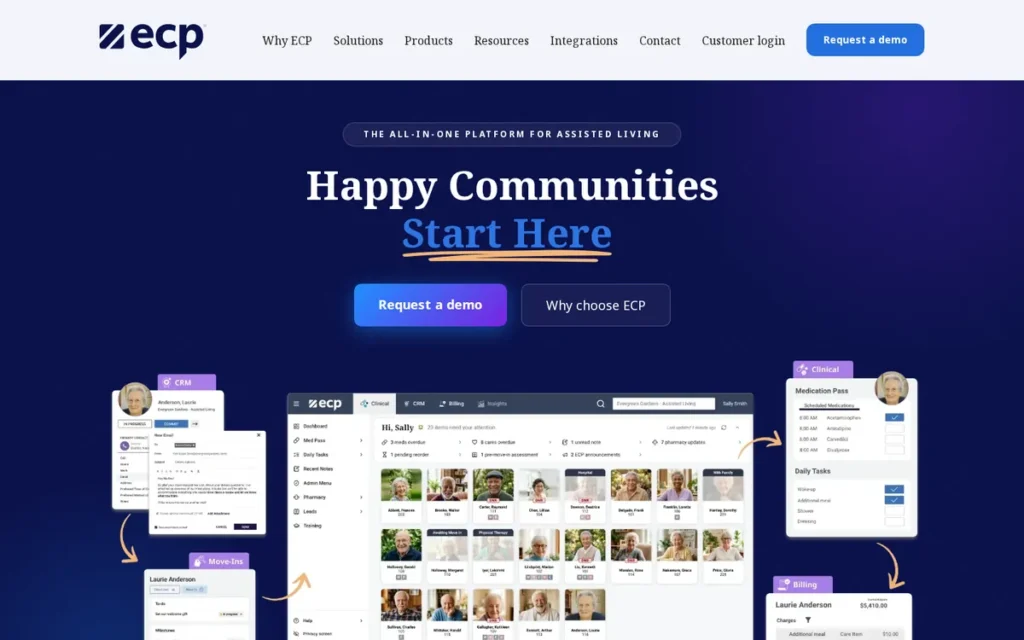
Category: All-in-One Assisted Living Suite. A single platform covering clinical records, eMAR, care plans, CRM/move-ins and billing for assisted living and memory care.
At a Glance
- Category: All-in-One Assisted Living Suite
- Best For: Assisted living and memory care operators, from one building to many communities, who want clinical, move-in and billing workflows in one system
- Price Range: Pricing on request (third-party estimate of about $10/unit/month, unverified, 2026)
- Primary Strength: ECP has the largest review base in this evaluation (179 Capterra reviews) and natively connects assessments, care plans, eMAR, CRM and care-level billing.
- Biggest Limitation: ECP reviewers report report-builder confusion, lag and medication inventory discrepancies, and one reviewer reported a 3-year contract lock-in on quote-only pricing.
- One-Line Summary: ECP is the best-evidenced all-in-one assisted living platform in 2026, combining a 179-review Capterra base with native eMAR-to-billing workflows and vendor-claimed offline charting.
- Last Verified: November 2026
Overview
ECP (Extended Care Professional) is an all-in-one assisted living platform that combines EHR, eMAR, assessments, care planning, CRM, move-ins and care-level billing. It is built for U.S. assisted living and memory care operators, from single buildings to multi-community portfolios, that want one connected system.
ECP was founded in 2004 in East Troy, Wisconsin, and reports more than 8,500 communities and 120,000+ users across all 50 states [Source: ECP, Vendor-reported, November 2026]. ECP scored 4.33/5, the highest score in PlugRoute’s six-criterion evaluation.
Key Features
- ECP’s eMAR tracks scheduled and as-needed (PRN) doses, flags missed and late doses, supports pharmacy-initiated medication orders and keeps audit logs for survey readiness.
- ECP assessments automatically create care plans and staff tasks, and those tasks feed billing tied to care levels.
- ECP includes a built-in CRM with a lead pipeline, tour scheduling and reminders, plus move-ins with e-signatures.
- ECP says staff can chart on phones and tablets during Wi-Fi outages and that records sync automatically afterward [Source: ECP, Vendor-reported, November 2026].
- ECP lists 900+ pharmacy partners separately from 75+ technology integrations (REST API, webhooks, HL7, CSV and secure messaging), but it does not name its pharmacy partners publicly [Source: ECP, Vendor-reported, November 2026].
Best For
ECP is best for operators who want one vendor for clinical care, sales/move-ins and billing, and who are willing to verify pharmacy integration and contract terms in writing.
Strengths
- ECP has a 4.6/5 Capterra rating from 179 reviews, the largest base in this evaluation. Reviewers praise its ease of use and U.S.-based phone support [Source: Capterra, Independent, November 2026].
- ECP reports that Senior Solutions Management Group cut medication errors by more than 50% and grew from 3 to 40 communities on the platform [Source: ECP case study, Vendor-reported, November 2026].
- ECP reports 99% accuracy across more than 8.5 million scheduled medication passes a year at Navion Senior Solutions. ECP also reports that Cedarhurst Senior Living runs ECP in nearly 60 communities [Source: ECP case studies, Vendor-reported, November 2026].
- ECP is one of three platforms in this evaluation that publicly claim offline charting, which addresses the risk of Wi-Fi dropping during med passes.
Limitations
ECP’s most consequential trade-off is reporting reliability. Capterra reviewers describe a confusing report builder and dashboard data that can be inaccurate [Source: Capterra, Independent, November 2026]. Other reviewer complaints follow.
- ECP users report lag, freezing and unexpected log-outs [Source: Capterra, Independent, November 2026].
- ECP users report medication inventory discrepancies, backdating issues and delays in pharmacy updates [Source: Capterra, Independent, November 2026].
- ECP’s mobile claim did not hold for one reviewer, who said the iOS app didn’t work for them [Source: Capterra, Independent, November 2026].
- ECP pricing is quote-only. Reviewers mention setup and pharmacy charges, and one objected to a 3-year contract lock-in [Source: Capterra, Independent, November 2026].
Verdict
ECP is the strongest-evidenced all-in-one assisted living platform in PlugRoute’s 2026 evaluation. ECP ranks #1 on review volume, native eMAR-to-billing coverage and named multi-community deployments, but its lead over ALIS is narrow (4.33 vs. 4.20).
ECP buyers should run a demo with Wi-Fi disconnected and test pharmacy sync with their own pharmacy before signing. They should also get exit and data-export terms in writing.
2. ALIS (by Medtelligent): Best for Integration Value and State-Form Coverage

Category: All-in-One Assisted Living Suite. A single platform covering clinical records, eMAR, care plans, CRM/move-ins and billing for assisted living and memory care.
At a Glance
- Category: All-in-One Assisted Living Suite
- Best For: Assisted living, memory care and independent living operators who want broad named pharmacy integration with interface fees limited in the contract, plus state-specific forms
- Price Range: Pricing on request: monthly fee plus one-time setup per community ($8/user/month directory listing, unverified, 2026)
- Primary Strength: ALIS has the highest Capterra rating in this evaluation (4.8/5, 67 reviews). It also advertises 130+ integrations at no extra charge, subject to its subscription terms.
- Biggest Limitation: ALIS has a smaller independent review base than ECP, and reviewers report glitches and at least one unmet state compliance need.
- One-Line Summary: ALIS is a highly rated assisted living suite in 2026 that pairs native clinical-to-billing workflows with offline device caching and 130+ advertised integrations.
- Last Verified: November 2026
Overview
ALIS is Medtelligent’s assisted living platform for medication passes, assessments, service plans, billing, CRM, occupancy tracking and family access. It is built for assisted living, memory care and independent living communities that want connected clinical and revenue workflows plus state forms.
ALIS launched in 2009 and serves more than 2,000 communities, according to a case study published by Medtelligent’s development partner [Source: BT Partners case study, Vendor-reported, November 2026]. ALIS scored 4.20/5 in PlugRoute’s weighted evaluation.
Key Features
- ALIS handles medication passes, PRN tracking, digital physician orders and e-faxed refill requests in its eMAR.
- ALIS stores resident and medication data on the device during an internet outage and syncs it when the connection returns [Source: ALIS FAQ, Vendor-reported, November 2026].
- ALIS names Framework, Omnicare, QS1, Farmerica and PioneerRx pharmacy connections and holds FrameworkHL7 certification.
- ALIS advertises 130+ integrations at no extra charge. Its subscription terms allow fees when a third-party vendor charges ALIS or when a custom integration is needed [Source: ALIS Terms and Conditions, Vendor-reported, January 2026].
- ALIS includes billing, accounts receivable, ALIS Pay, CRM, move-in packets, a move-out predictor, state forms and the ALIS Connect family portal.
Best For
ALIS is best for operators who want predictable integration costs and built-in state forms. Buyers should confirm state coverage and fee terms in writing.
Strengths
- ALIS has a 4.8/5 Capterra rating from 67 reviews, the highest in this evaluation. Its sub-scores are 4.9 for support and 4.8 for ease of use [Source: Capterra, Independent, November 2026].
- ALIS has a matching 4.8/5 on Software Advice from 67 reviews, 53 of them five-star [Source: Software Advice, Independent, November 2026].
- ALIS now advertises 130+ integrations, up from the 50+ listed on an older ALIS page, and names major long-term care pharmacies [Source: ALIS, Vendor-reported, November 2026].
- ALIS reviewers praise its organized dashboard, access from any device and support during the move off paper charting [Source: Capterra, Independent, November 2026].
Limitations
ALIS’s most consequential trade-off is a smaller, less consistent evidence base than ECP’s. The ALIS G2 score is a lower 4.3/5 from only 5 reviews [Source: G2, Independent, November 2026].
- ALIS G2 reviewers cite limited integrations, no billing-notes field and an update that moved where observation notes are entered [Source: G2, Independent, November 2026].
- ALIS Capterra reviewers report glitches, inconsistent resident-name formatting and no way to enter medications before admission, which distorts census counts [Source: Capterra, Independent, November 2026].
- ALIS did not meet one reviewer’s state compliance needs, and ALIS itself tells buyers to confirm state coverage [Source: ALIS FAQ, Vendor-reported, November 2026].
- ALIS has published no named client case studies with measured results.
Verdict
ALIS has the highest Capterra rating in PlugRoute’s 2026 evaluation and is the strongest choice for buyers who want broad, named pharmacy integration at low interface cost. ALIS finished a narrow second to ECP because its review base is smaller and its multi-site results are less documented.
ALIS buyers should confirm state-form coverage and write the integration-fee terms into the contract.
3. Eldermark: Best for Pricing Transparency and Revenue Capture
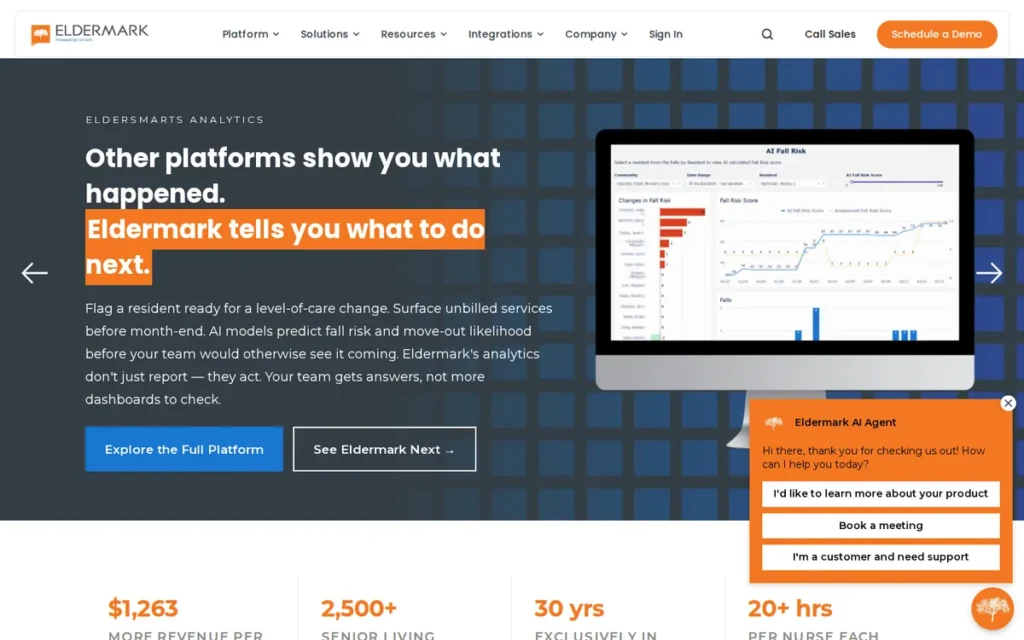
Category: All-in-One Assisted Living Suite. A single platform covering clinical records, eMAR, care plans, CRM/move-ins and billing for assisted living and memory care.
At a Glance
- Category: All-in-One Assisted Living Suite
- Best For: Single and multi-community operators who prioritize transparent pricing and billing for services delivered beyond resident agreements
- Price Range: From $295/community/month for NEXT Clinical and eMAR (published, 2026)
- Primary Strength: Eldermark publishes a starting price and advertises no per-module add-ons or contract minimums, which is rare in this category.
- Biggest Limitation: Eldermark has the smallest Capterra review base of the three suites (37 reviews), and reviewers describe its legacy version as cumbersome and not web-based.
- One-Line Summary: Eldermark is the most price-transparent connected assisted living suite in 2026, with a published $295-per-community starting price and native care-to-billing workflows built to surface unbilled services.
- Last Verified: November 2026
Overview
Eldermark is a senior living platform that links assessments, care plans, eMAR, pharmacy, billing, CRM and incident tracking. It is built for assisted living and memory care operators who want care documentation tied directly to billing and who want to see pricing before talking to sales.
Eldermark reports more than 2,500 communities onboarded [Source: Eldermark, Vendor-reported, November 2026]. Eldermark scored 4.05/5 in PlugRoute’s weighted evaluation.
Key Features
- Eldermark connects assessments to care plans, care plans to the eMAR, and the eMAR to pharmacy (including Surescripts) and billing.
- Eldermark lets caregivers record scheduled and unscheduled services on mobile devices, online or offline [Source: Eldermark, Vendor-reported, November 2026].
- Eldermark’s ElderSmarts analytics benchmarks operations and is designed to flag services delivered beyond what resident agreements cover.
- Eldermark includes CRM for leads, referral reporting and the move-in pipeline, plus resident engagement and risk and incident tracking.
- Eldermark assigns a dedicated implementation contact and customer success manager, and says most communities go live in under 60 days [Source: Eldermark, Vendor-reported, November 2026].
Best For
Eldermark is best for operators who need a predictable budget before the first sales call and suspect they are under-billing for care.
Strengths
- Eldermark is the only platform in this evaluation with a verified published starting price ($295 per community per month), and it advertises no per-module add-ons and no contract minimums [Source: Eldermark pricing page, Vendor-reported, November 2026].
- Eldermark reports that The Waters Senior Living (13 communities, 1,600+ beds) cut unconfirmed services from about 2,000 to 26 per week and agency staffing hours by 85% [Source: Eldermark case study, Vendor-reported, November 2026].
- Eldermark reports that Monarch Healthcare Management (41 communities) found $270,000 in unbilled daily-rate revenue, and that RM Management/Marquis grew service revenue 40% across 8 communities [Source: Eldermark case studies, Vendor-reported, November 2026].
- Eldermark holds a 4.6/5 Capterra rating, with 4.8 for customer service, 4.7 for value and 90% of reviewers likely to recommend. G2 reviewers praise how Eldermark links service plans to charges [Source: Capterra; G2, Independent, November 2026].
Limitations
Eldermark’s most consequential trade-off is the depth of its evidence. Eldermark has 37 Capterra reviews, the smallest base of the three suites, with a 4.3 features score. The listing still appears under its legacy URL name, Service-Minder [Source: Capterra, Independent, November 2026].
- Eldermark’s support picture conflicts. SelectHub reports long support waits and a steep learning curve, which doesn’t match the 4.8 service score on Capterra [Source: SelectHub, Independent, November 2026].
- Eldermark reviewers describe the legacy version as not web-based and “cumbersome and unintuitive,” and say lease documents are still partly on paper [Source: Capterra, Independent, November 2026].
- Eldermark G2 reviewers report eMAR gaps: there is no alert for doses missed on previous days and no way to search all residents for medications due [Source: G2, Independent, November 2026].
- Eldermark’s claim that 20–30% of residents receive unbilled services is a vendor claim, and its setup fees are not disclosed.
Verdict
Eldermark is the most price-transparent connected assisted living suite in PlugRoute’s 2026 evaluation and the clearest fit for operators focused on billing for all the care they deliver. Eldermark ranks third (4.05) because its review base is smaller than ECP’s or ALIS’s and third-party support findings conflict, not because its features are thin.
Eldermark buyers should confirm they are buying the NEXT platform and test the eMAR alerts for missed doses.
4. PointClickCare Senior Living: Best for Large and Hospital-Connected Operators
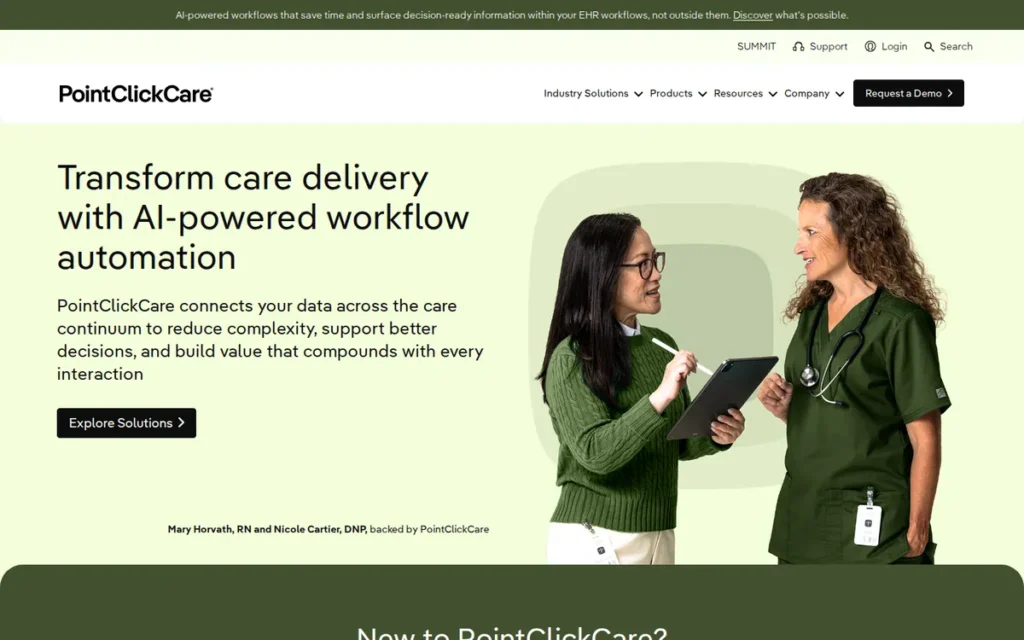
Category: Enterprise Senior Living Platform. A broad platform built for large or complex portfolios, with deep connections to outside providers.
At a Glance
- Category: Enterprise Senior Living Platform
- Best For: Large, multi-community or hospital-linked operators that value care coordination with hospitals and independent recognition
- Price Range: Pricing on request (modular; the Capterra “$1 per feature” figure is a placeholder, 2026)
- Primary Strength: PointClickCare Senior Living has the strongest independent recognition in this evaluation, including Best in KLAS 2026 for Assisted Living & Memory Care.
- Biggest Limitation: PointClickCare Senior Living reviewers report records are unavailable during internet outages, and modules are sold separately without public pricing.
- One-Line Summary: PointClickCare Senior Living is the most independently recognized assisted living EHR in 2026 and the only platform evaluated with documented real-time hospital and ER visit alerts.
- Last Verified: November 2026
Overview
PointClickCare Senior Living is an assisted living and memory care EHR. It covers resident records, care plans, assessments, charting, incident management, paperless move-ins and pharmacy connectivity, and it is built for larger operators that need care coordination with hospitals and other providers.
PointClickCare was founded in 2000 and has its roots in skilled nursing [Source: PointClickCare About Us, Vendor-reported, November 2026]. PointClickCare Senior Living scored 3.75/5 in PlugRoute’s weighted evaluation.
Key Features
- PointClickCare Senior Living covers resident profiles, medical histories, medication lists, care plans, assessments, charting and incident management at the point of care.
- PointClickCare Senior Living sends real-time alerts when residents visit hospitals or ERs. That capability came from the Collective Medical (December 2020) and Audacious Inquiry (March 2021) acquisitions.
- PointClickCare Senior Living offers Pharmacy Connect, Connect for Senior Living, an Occupancy Dashboard and the PointClickCare Companion mobile app.
- PointClickCare Senior Living supports paperless move-ins and reporting dashboards.
- PointClickCare Senior Living integrates with Accushield for visitor check-in, RevSpring for billing and payments, and WelcomeHome for sales CRM [Source: Capterra, Independent, November 2026].
Best For
PointClickCare Senior Living is best for large operators with skilled nursing or hospital partnerships who weigh recognition and care coordination above pricing transparency and offline resilience.
Strengths
- PointClickCare Senior Living won Best in KLAS 2026 for Senior Living: Assisted Living & Memory Care with a score of 83.4, its first win in that category. A separate KLAS listing shows 75.0 from 16 organizations, which may cover a different time window or scope [Source: KLAS Research, Independent, November 2026].
- PointClickCare was named as an assisted living EHR by 70% of respondents in the 2026 Ziegler Link-age Funds/LeadingAge CAST CTO Hotline, up from 61% in 2025. MatrixCare was named by 27%, and respondents could choose more than one answer [Source: Ziegler/LeadingAge CAST, Independent, July 2026].
- PointClickCare Senior Living has a 4.7/5 Capterra rating from 63 reviews, and reviewers praise its customization and security settings [Source: Capterra, Independent, November 2026].
- PointClickCare Senior Living’s hospital and ER visit alerts are the only documented real-time care-transition alerts in this evaluation [Source: PointClickCare acquisition disclosures, Vendor-reported, March 2021; PlugRoute analysis].
Limitations
PointClickCare Senior Living’s most consequential trade-off is offline resilience. Reviewers report records cannot be reached when the internet is down, and no source confirms an offline mode. That is a material risk for med passes [Source: Capterra, Independent, November 2026].
- PointClickCare Senior Living pricing is modular and unpublished. One reviewer said “everything is sold separately,” and G2 lists pricing as unavailable [Source: Capterra; G2, Independent, November 2026].
- PointClickCare Senior Living relies on a WelcomeHome integration for sales CRM. Because the product’s roots are in skilled nursing, test its assisted living workflows rather than assuming them.
- PointClickCare Senior Living reviewers report a training curve, variable support and difficulty finding specific data in reports [Source: Capterra; G2, Independent, November 2026].
A Pennsylvania assisted living nurse posted on r/nursing that their facility had moved to PCC a few months earlier, and asked how to make the eMAR flag blood pressure and heart rate readings outside a medication’s hold parameters. One reply:
“i think you need to ask your pcc admin to build the MAR with conditional rules tied to the vitals field, it’s not automatic like the insulin scale but you can set it up in the order entry template. our facility has it working for bp meds so it’s definitely possible, just takes some digging in the back-end settings” Posted by u/KeyMeasurement1959
Takeaway: PointClickCare Senior Living can enforce medication safety rules like vitals-based holds, but only after an administrator configures them in the back end, so new assisted living customers should budget for setup expertise.
Verdict
PointClickCare Senior Living is the most independently recognized assisted living EHR in PlugRoute’s 2026 evaluation and the strongest choice for large, hospital-connected operators. PointClickCare Senior Living ranks fourth because it scores lower on offline reliability, pricing transparency and native CRM, which this audience weights heavily.
PointClickCare Senior Living’s main enterprise advantage, its hospital and ER alerts, is not scored as a separate criterion. Operators who make hospital connectivity the deciding factor should treat PointClickCare Senior Living as a top contender.
5. Yardi Senior Living Suite: Best for Finance-Led Operators and Mixed Property Portfolios
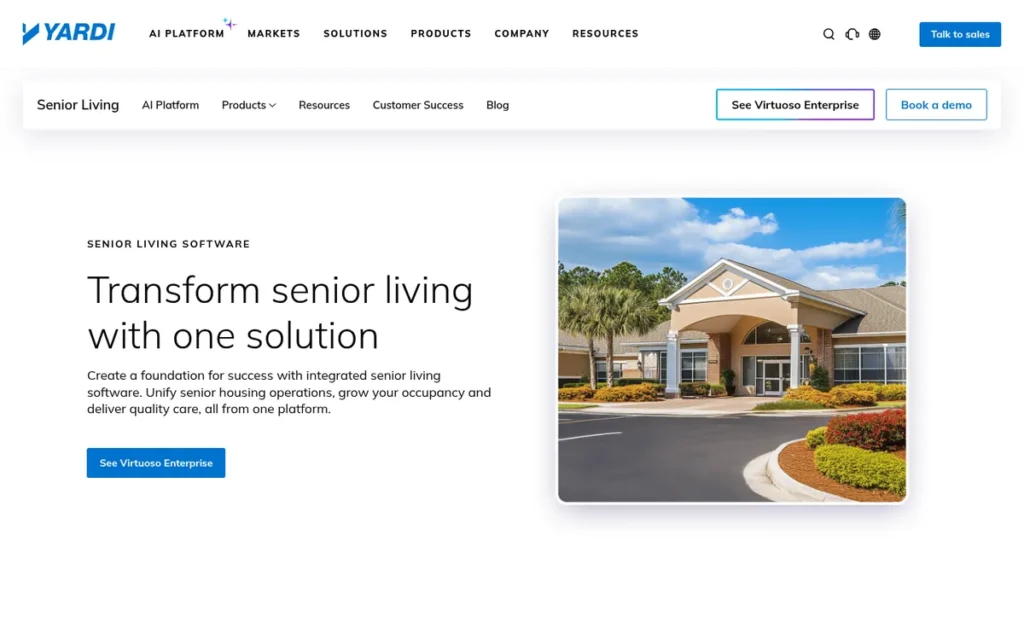
Category: Enterprise Senior Living Platform. A broad platform built for complex portfolios, with deep back-office integration.
At a Glance
- Category: Enterprise Senior Living Platform
- Best For: Finance-led operators and mixed senior housing portfolios that want accounting, property, CRM and clinical data in one database
- Price Range: Pricing on request (users report bundled per-unit pricing, 2026; dollar amounts unpublished)
- Primary Strength: Yardi Senior Living Suite runs accounting, property management, CRM, billing and clinical records on a single database.
- Biggest Limitation: Yardi Senior Living Suite has a small review base (18 Capterra reviews) with the lowest support score in this evaluation (3.9), and its complexity may require internal support staff.
- One-Line Summary: Yardi Senior Living Suite is the most finance-integrated platform in PlugRoute’s 2026 evaluation, unifying general ledger, billing, CRM and clinical records in one database.
- Last Verified: November 2026
Overview
Yardi Senior Living Suite is an enterprise platform built on Yardi Voyager Senior Housing. It combines property management, general ledger, billing, CRM, EHR, eMAR, a family portal and analytics in one database for finance-led senior living operators and mixed property portfolios.
Yardi names Anthology, Brightwater, Dial and Silverado among its senior living customers [Source: Yardi, Vendor-reported, November 2026]. Yardi Senior Living Suite scored 3.20/5 in PlugRoute’s weighted evaluation.
Key Features
- Yardi Senior Living Suite runs on Voyager Senior Housing, so care-plan changes flow into billing and costs post to the general ledger without data conversion.
- Yardi Senior Living Suite supports flexible rate plans and billing based on care points, time and other care factors.
- Yardi Senior Living Suite adds Yardi EHR and eMAR to its financial core for clinical documentation.
- Yardi Senior Living Suite includes RentCafe Senior CRM and a RentCafe family portal with real-time health updates and online payments.
- Yardi Senior Living Suite’s Senior IQ analytics is used to find unbilled care charges [Source: Yardi Dial case study, Vendor-reported, November 2026].
Best For
Yardi Senior Living Suite is best for finance-led operators that want to eliminate integrations between accounting, sales and clinical systems and have internal staff to support a complex suite.
Strengths
- Yardi reports that Dial Senior Living (38 communities, 2,100+ units) saved about four hours per move-in. Dial also found unbilled care charges that “could pay for the solution in less than three months” [Source: Yardi case study, Vendor-reported, November 2026].
- Yardi reports that Stage Management’s Golden Pond (115 units) responded to leads 12 times faster and raised average occupancy 7% [Source: Yardi/LeadingAge CAST case study, Vendor-reported, November 2026].
- Yardi reports that Brightwater Senior Living (13 communities) cut manual reporting by 75% and that Anthology Senior Living saved six hours a day [Source: Yardi case studies, Vendor-reported, November 2026].
- Yardi Senior Living Suite’s single-database model targets interoperability, which 77% of senior living executives rank among their top three technology barriers [Source: Argentum Technology Report, Independent, June 2025; PlugRoute analysis].
Limitations
Yardi Senior Living Suite’s most consequential trade-off is thin independent validation. Its 4.3/5 Capterra rating comes from 18 reviews, with a 3.9 support score, and no G2 or KLAS senior living data was found [Source: Capterra, Independent, November 2026].
- Yardi Senior Living Suite reviewers cite slow support and integrations, limited reporting and customization, and occasional freezing [Source: Capterra, Independent, November 2026].
- Yardi Senior Living Suite’s offline support and named long-term care pharmacy integrations could not be confirmed [Source: PlugRoute research, no source found, November 2026].
- Yardi users in a general Yardi thread, not one specific to senior living, said the suite’s extensive customization needs a strong after-sale support package [Source: Reddit r/yardi, User-reported, November 2026].
In a separate general Yardi Voyager thread on r/yardi, also not specific to senior living, one user described the platform’s complexity:
“Start reaching out to consultants. Every yardi config is different due to customizations and included modules and these differences can be drastic. There is a yardi team for every module and the integrations between them are complex.” Posted by u/The_Dugan
Takeaway: Yardi’s module-by-module setup makes every installation different, so Yardi Senior Living Suite buyers should expect to rely on consultants or in-house specialists after go-live.
Verdict
Yardi Senior Living Suite is the most finance-integrated platform in PlugRoute’s 2026 evaluation and the strongest fit for operators who want accounting, property, sales and clinical data in one database. Yardi Senior Living Suite ranks fifth mainly because its independent evidence is thin and its offline and pharmacy details are unconfirmed.
Yardi Senior Living Suite buyers should ask for senior-living-specific references and test the med pass offline.
6. August Health: Best for AI-Assisted Documentation and Fast Rollouts
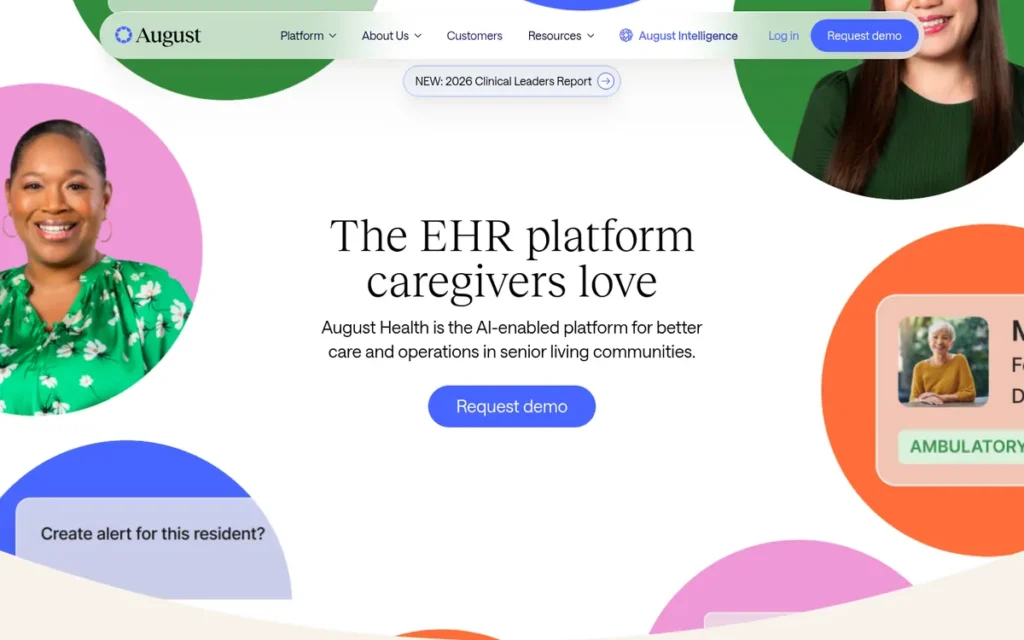
Category: AI-Forward Care EHR. A modern EHR/eMAR that uses AI to speed up documentation and relies on partners for some back-office functions.
At a Glance
- Category: AI-Forward Care EHR
- Best For: Growing multi-community operators who want AI-drafted documentation and fast rollouts, and who already use a separate sales CRM
- Price Range: $160 flat rate/month directory listing (unit unclear, unverified, 2026)
- Primary Strength: August Health uses AI to draft care plans and resident summaries, and Cogir selected it for 120+ communities (announced October 2026).
- Biggest Limitation: August Health has the thinnest independent review evidence in this evaluation, relies on a partner for CRM, and has unconfirmed offline support.
- One-Line Summary: August Health is the evaluated platform that most emphasizes AI-drafted documentation, but its independent review evidence remains thin in 2026.
- Last Verified: November 2026
Overview
August Health is a modern assisted living EHR with assessments, service plans, eMAR, incidents, digital move-ins, billing and payments, family communication and AI-drafted care plans. It is built for growing operators who want fast implementation and modern design.
August Health was founded in 2020 in San Francisco and raised a $29 million Series B led by Base10 Partners [Source: Senior Housing News, Independent, August 2025]. August Health scored 2.75/5 in PlugRoute’s weighted evaluation.
Key Features
- August Health’s “August Intelligence” drafts care plans from assessments, writes resident summaries and suggests conversation prompts.
- August Health covers assessments, service plans, incidents, compliance dashboards, eMAR and Care Track documentation.
- August Health offers digital move-ins and Billing & Payments, with billing visible to families.
- August Health integrates with QuickBooks Online and Sage Intacct for accounting and with WelcomeHome for sales CRM.
- August Health’s Insights analytics is used to find care needs that aren’t being tracked [Source: August Health, Vendor-reported, November 2026].
Best For
August Health is best for growing multi-community operators who value AI-assisted documentation, already run a separate CRM, and can accept a younger vendor.
Strengths
- Cogir Senior Living announced that it will run August Health across more than 120 U.S. communities, and August Health reports more than 50 communities at Lifespark [Source: BusinessWire; August Health, Vendor-reported, October 2026].
- August Health reports implementing its EHR across 40 Koelsch Communities in under 100 days [Source: August Health case study, Vendor-reported, November 2026].
- August Health reports that Bickford Senior Living saw 23% fewer incidents, 34% fewer citations and 50% fewer 90-day move-outs. An independent vendor profile notes the data covers one quarter at five communities, with no baseline [Source: August Health case study, Vendor-reported, November 2026].
- August Health reports that Claiborne Senior Living cut move-in document preparation by 75% [Source: August Health case study, Vendor-reported, November 2026].
Limitations
August Health’s most consequential trade-off is evidence. No U.S. Capterra rating could be retrieved, and the UK listing has only 2 reviews [Source: Capterra UK, Independent, November 2026].
- August Health relies on WelcomeHome for sales CRM, and its offline support and named pharmacy integrations are unconfirmed.
- August Health reviewers on Software Finder cite limited mobile access, limited customization and limited sales-data reporting [Source: Software Finder, Independent, November 2026].
- August Health’s Cogir rollout was announced in October 2026, so no outcome data exists yet at that scale.
- August Health’s voice-to-chart and shift handoff features appear only in a third-party profile and are unconfirmed.
Verdict
August Health is the evaluated platform that most emphasizes AI-drafted documentation and a credible option for growing operators who want fast, modern rollouts. August Health ranks sixth because its C1 score (1.5) reflects a UK Capterra listing with 2 reviews and no retrievable U.S. rating. That is missing evidence rather than a shown weakness.
August Health buyers should ask for references at operators their size and test offline med passes directly.
Which Assisted Living Software Works Offline and Connects to My Pharmacy?
ECP, ALIS and Eldermark are the three platforms in this evaluation that publicly claim offline documentation (November 2026). Reviewers of PointClickCare Senior Living report records are unavailable when the internet is down. Offline support is unconfirmed for Yardi Senior Living Suite and August Health. Every offline claim comes from the vendor, so test it yourself.
Offline, Pharmacy and Pricing at a Glance
| Platform | Offline Status | Named Pharmacy/Accounting Integrations | Pricing Unit | Pricing Evidence Label |
|---|---|---|---|---|
| ECP | Vendor-claimed | 900+ pharmacy partners claimed (none named); REST API, HL7 | Per unit (estimate) | Third-party estimate |
| ALIS | Vendor-claimed (device caching) | Framework, Omnicare, QS1, Farmerica, PioneerRx | Per user (directory) plus setup | Directory listing |
| Eldermark | Vendor-claimed | Surescripts | Per community | Published |
| PointClickCare Senior Living | Contradicted by reviews | Pharmacy Connect; RevSpring | Per feature/module | Directory placeholder |
| Yardi Senior Living Suite | Unconfirmed | Native Voyager general ledger; pharmacy unconfirmed | Per unit (bundle) | User-reported |
| August Health | Unconfirmed | QuickBooks Online, Sage Intacct; pharmacy unconfirmed | Flat rate (unit unclear) | Directory listing |
Pharmacy sync is the most common review complaint across ECP and ALIS, even though these vendors advertise many integrations. An integration count tells you how many pharmacies a vendor connects to. It does not tell you whether yours is one of them.
ECP lists 900+ pharmacy partners but names none publicly. ALIS names five pharmacies but can charge fees when a third-party vendor charges ALIS. Neither fact shows whether your pharmacy’s order changes reach the eMAR automatically.
In a long-term care thread on r/computerscience about automating pharmacy order entry, one commenter explained why integrations still leave manual work:
“The reality, many DEA, state and Federal rules limit the process so much that it literally is less complicated to manually enter. Especially, since it has to be reviewed for accuracy, and most all nursing home admissions arrive after normal pharmacy hours causing more issues in their own right” Posted by u/StorageJazzlike5494
Takeaway: Pharmacy integrations in long-term care rarely remove manual order entry, because controlled-substance rules, accuracy reviews and after-hours admissions keep nurses re-entering and checking orders anyway.
Test these items in every demo:
- Disconnect the internet during a med pass, reconnect, and confirm every record syncs without duplicates.
- Ask your pharmacy to send a live order change and watch how fast it appears on the eMAR.
- Run a controlled-substance count and confirm the eMAR and inventory records match.
How Much Does Assisted Living Software Cost in 2026?
In 2026, only one of the six leading assisted living platforms publishes a verified starting price: Eldermark, at $295 per community per month. Every other figure is a directory listing, placeholder, third-party estimate or user report. A true price comparison requires written quotes in the same pricing unit.
- Eldermark: Eldermark starts at $295 per community per month for NEXT Clinical and eMAR, but its setup fees are not disclosed [Source: Eldermark pricing page, Vendor-reported, November 2026].
- ECP: A third-party guide estimates ECP at about $10 per unit per month, and ECP reviewers mention setup and pharmacy charges [Source: AveeCare, Unverified, November 2026].
- ALIS: ALIS directories list $8 per user per month, and ALIS also charges a per-community setup fee that is not published [Source: Capterra; Software Advice, Unverified, November 2026].
- PointClickCare Senior Living: PointClickCare’s “$1 per feature” Capterra listing is a placeholder, and a reviewer said “everything is sold separately” [Source: Capterra, Unverified, November 2026].
- Yardi Senior Living Suite: Yardi users report that most Yardi products now carry a single per-unit price [Source: Reddit r/yardi, User-reported, November 2026].
- August Health: August Health is listed at a $160 flat rate per month on Capterra, and the pricing unit is unclear [Source: Capterra, Unverified, November 2026].
Small homes face the tightest budgets. Replying to a CRM vendor’s pitch, a small-home operator wrote:
“Unless you can do the above with multiple user accounts and only charge $50/ month or even $100/month I don’t see you prospect for you guys.” (u/Spare-Transition-771, r/AssistedLiving)
Takeaway: Small homes treat pharmacy-linked eMAR as the minimum requirement and expect to pay roughly $50–$100 a month for it.
Ask every vendor to itemize these potential hidden costs:
- Setup and implementation fees are unpublished by most vendors in this evaluation, so ask for a written figure.
- Data migration fees cover moving resident records from your current system and are rarely published.
- Staff training costs often recur, because turnover requires retraining new hires.
- Support tiers and after-sale support packages can change the real cost of complex suites.
- Add-on modules sold separately can push the total well above the starting quote.
- Pharmacy interface fees can apply per connection, so ask whether your pharmacy’s interface is included.
- Annual price increases over a 3-year term should be capped in the contract.
- Exit and data-export fees determine what it costs to leave the vendor later.
Which Assisted Living Software Combines eMAR and Billing?
ECP, ALIS, Eldermark and Yardi Senior Living Suite connect eMAR and billing natively in one flow, so care-level changes reach invoices without re-entry. PointClickCare Senior Living and August Health connect the two but rely on partners for CRM, payments or accounting.
- ECP: ECP assessments generate care plans and tasks that feed billing tied to care levels.
- ALIS: ALIS pairs its eMAR with billing, accounts receivable, ALIS Pay and investor reports.
- Eldermark: Eldermark links assessment, care plan, eMAR, pharmacy and billing in one chain.
- Yardi Senior Living Suite: Yardi Senior Living Suite posts care-plan changes to billing and the general ledger in one database.
- PointClickCare Senior Living: PointClickCare Senior Living handles billing and payments through a RevSpring integration.
- August Health: August Health includes Billing & Payments and connects to QuickBooks Online or Sage Intacct.
How Should I Evaluate Assisted Living Software for Memory Care?
Have your own staff run memory care scenarios in the demo instead of trusting a “memory care ready” label. PlugRoute found limited vendor-specific memory care evidence for all six platforms in 2026. Test wandering and elopement, behavior charting, dementia care plans and PRN psychotropic documentation live.
PointClickCare’s Best in KLAS 2026 award covers a combined Assisted Living & Memory Care category. A combined-category award doesn’t, on its own, show that memory-care-specific workflows work.
Have your own staff run these five memory care scenario tests:
- Document a wandering or elopement incident from the secured-unit door alarm through to the family notification, and confirm whether wander-management hardware integrates.
- Chart a behavior episode and show how the behavioral health documentation updates the dementia care plan.
- Record a PRN psychotropic dose with the reason for use, the follow-up and any gradual dose reduction review.
- Run a mock state survey and pull every required memory care record.
- Repeat the med pass with the internet disconnected, then restore it and confirm the data syncs.
How Long Does Assisted Living Software Implementation Take?
Vendor-reported implementation timelines for assisted living software range from one day at a single site to about 100 days for a 40-community rollout. ECP, Eldermark and August Health publish the clearest timeline claims, but none is independently verified. Staff adoption is usually harder than the software setup.
- ECP: ECP reports that Stellar Senior Living went live in 1 day at one site and 3 days at a larger one [Source: ECP case study, Vendor-reported, November 2026].
- ECP: ECP reports that Senior Solutions Management Group implemented in half its previous system’s 120-day average [Source: ECP case study, Vendor-reported, November 2026].
- Eldermark: Eldermark says most communities go live in under 60 days [Source: Eldermark, Vendor-reported, November 2026].
- August Health: August Health reports a 40-community Koelsch rollout in under 100 days [Source: August Health, Vendor-reported, November 2026].
Staff adoption is the barrier vendors rarely demo. In the 2025 Argentum Technology Report, 61% of senior living executives ranked staff and resident adoption among their top three technology barriers [Source: Argentum Technology Report, Independent, June 2025].
Plan super-users on every shift so turnover doesn’t erase your training investment.
What Red Flags Should I Watch For When Evaluating Assisted Living Software?
The biggest red flags when evaluating assisted living software are untested offline claims, integration counts that don’t name your pharmacy, modules sold separately, and multi-year lock-ins without data-export terms. Each one hides cost or operational risk that a feature demo won’t reveal. The six numbered flags below show what to check.
Red Flag #1: The Offline Blind Spot An offline blind spot exists when a vendor claims offline charting but won’t demo the med pass with the internet disconnected. In November 2026, only ECP, ALIS and Eldermark publicly claimed offline support. Reviewers of PointClickCare Senior Living reported records were unavailable during outages.
Red Flag #2: Integration Counts Without Named Pharmacies An integration count without named pharmacies is a red flag because “900+” or “130+” doesn’t prove your pharmacy’s order changes sync correctly. Pharmacy sync was the most common review complaint across ECP and ALIS [Source: Capterra, Independent, November 2026].
Red Flag #3: “Everything Sold Separately” Pricing “Everything sold separately” pricing is a red flag because modular quotes can hide the true total cost of the modules you actually need. One PointClickCare reviewer used those exact words, and most vendors in this evaluation publish no setup fees [Source: Capterra, Independent, November 2026].
Red Flag #4: Multi-Year Lock-In Without Data-Export Terms A multi-year lock-in without data-export terms is a red flag because it can trap your resident records if the platform underperforms. One ECP reviewer objected to a 3-year contract lock-in, so exit terms belong in every contract [Source: Capterra, Independent, November 2026].
Red Flag #5: Vendor Case Studies Without Baselines Vendor case studies without baselines are a red flag because nearly every percentage outcome cited in this evaluation is vendor-reported. The only exception is one self-reported reviewer figure. An independent vendor profile noted that August Health’s Bickford results covered one quarter at five communities with no baseline.
Red Flag #6: Feature-Tour Demos and “Memory Care Ready” Claims Without Scenario Proof A feature-tour demo is a red flag because it shows screens rather than proving your workflow connects. Ask the vendor to walk one resident from inquiry through to invoice. For memory care, ask them to demonstrate elopement documentation, behavior charting and PRN psychotropic records live.
What Questions Should I Ask Before Choosing Assisted Living Software?
Before choosing assisted living software, ask each vendor to prove an end-to-end resident workflow, an offline med pass, your specific pharmacy integration and a 3-year all-in cost. Score every vendor from 1 to 5 on the same eight questions using the same resident scenario. That way the comparison reflects your workflow rather than the vendor’s tour.
Question #1: End-to-End Resident Journey, Can you show one resident’s journey from inquiry to move-in, assessment, care plan, med pass, incident and invoice? A strong answer runs live, start to finish, without switching systems or re-entering data. Watch for manual handoffs between the CRM, clinical and billing modules.
Question #2: Offline Med Pass, Does the eMAR keep working with the internet disconnected, and how does it sync? A strong answer is a live demo with Wi-Fi off, then a reconnection and a clean sync. Confirm how the system resolves records that conflict after the outage.
Question #3: Your Pharmacy Integration, Is our specific pharmacy integrated, how do order changes flow, and is there an interface fee? A strong answer names your pharmacy, shows a live order change, and puts any interface fee in writing. ALIS, for example, advertises integrations at no extra charge, but its terms allow fees in some cases [Source: ALIS Terms and Conditions, Vendor-reported, January 2026].
Question #4: 3-Year All-In Cost, What is the total cost of ownership, including setup, migration, training, support, modules, annual increases and exit fees? A strong answer is an itemized written quote covering every line in that question. Compare quotes in the same pricing unit, whether that is per community, per unit, per user or per feature.
Question #5: State Forms, Which of our state’s forms are built in? A strong answer lists your state’s forms by name and shows them in the product. ALIS tells buyers to confirm state coverage, and one ALIS reviewer reported an unmet state requirement [Source: ALIS FAQ; Capterra, November 2026].
Question #6: Memory Care Documentation, How do you handle elopement, behavior charting and PRN psychotropic documentation? A strong answer is a live scenario walkthrough run by your own memory care staff. Check whether behavior data updates the care plan automatically.
Question #7: Matching References, Can we speak with references that match our size, state and care model? A strong answer gives you references at operators of similar size, in your state, with a similar care model. References matter most for vendors with thin independent reviews, such as Yardi Senior Living Suite and August Health.
Question #8: Staff Adoption Plan, How will you train every shift and absorb staff turnover? A strong answer includes a written go-live plan with super-users on every shift and retraining resources for new hires. The implementation timeline should name who does what before and after go-live.
How Did We Rank These Assisted Living Software Platforms?
PlugRoute scored each platform from 1 to 5 on six weighted criteria, using research captured and verified in November 2026. The rank equals the weighted total, and every data point carries an evidence label. The weights are:
- Independent evidence: 25%
- Native workflow coverage: 25%
- Integration and offline reliability: 20%
- Pricing transparency: 10%
- Multi-community scale: 10%
- Adoption support: 10%
Ranking Criteria
- C1. Independent Review & Recognition Evidence (25%): This criterion matters because KLAS, the CTO Hotline survey and review platforms that show sample sizes are the only evidence not written by vendors.
- C2. Native Workflow Coverage (25%): This criterion matters because disconnected clinical, medication, admissions and billing data is the core pain point readers report.
- C3. Integration & Offline Reliability (20%): This criterion matters because 77% of senior living executives rank interoperability among their top three technology barriers [Source: Argentum Technology Report, Independent, June 2025].
- C4. Pricing Transparency & Cost Structure (10%): This criterion matters because hidden setup, migration and module costs make total cost unpredictable.
- C5. Multi-Community Scale Evidence (10%): This criterion matters because portfolio operators need proof of named multi-site deployments.
- C6. Adoption, Implementation & Support Evidence (10%): This criterion matters because reviews of all six platforms describe a learning curve.
Full Score Table
| Rank | Platform | C1 (25%) | C2 (25%) | C3 (20%) | C4 (10%) | C5 (10%) | C6 (10%) | Weighted Total |
|---|---|---|---|---|---|---|---|---|
| 1 | ECP | 4.5 | 5 | 4.5 | 2 | 5 | 3.5 | 4.33 |
| 2 | ALIS | 4 | 5 | 4.5 | 3 | 3.5 | 4 | 4.20 |
| 3 | Eldermark | 3 | 5 | 4 | 5 | 4 | 3.5 | 4.05 |
| 4 | PointClickCare Senior Living | 5 | 4 | 3 | 1 | 5 | 3 | 3.75 |
| 5 | Yardi Senior Living Suite | 2 | 5 | 3 | 2 | 4.5 | 2 | 3.20 |
| 6 | August Health | 1.5 | 3.5 | 2.5 | 2.5 | 4 | 3.5 | 2.75 |
Verification Note (November 12, 2026)
PlugRoute’s verification pass confirmed the Capterra listings for Eldermark and Yardi Senior Living Suite. Scores were updated under the published rubric:
- Eldermark C1 rose from 2.5 to 3.0.
- Yardi Senior Living Suite C1 rose from 1.5 to 2.0.
Evidence Labels
- Independent data comes from KLAS, the CTO Hotline, trade press and review platforms with a recorded rating, review count and capture date.
- Vendor-reported data comes from vendor or partner case studies, footprint claims, feature claims and published price pages.
- User-reported data comes from Reddit posts and self-reported reviewer figures.
- Unverified data includes directory placeholder prices, third-party estimates and features that could not be confirmed.
- Dates in source tags show the publication month where known and the November 2026 capture month otherwise.
What the Weights Mean
PlugRoute’s weights favor this audience’s stated pain points: connected eMAR-to-billing, pharmacy integration, offline reliability and cost clarity. The top two are close. Moving five points of weight from scale to pricing (C4 15%, C5 5%) ties ECP and ALIS at 4.18.
PointClickCare Senior Living’s hospital and ER alerts are not scored as a separate criterion. Even enterprise-leaning weights (C1 40%, C2 20%, C3 15%, C4 5%, C5 15%, C6 5%) keep ECP ahead, 4.50 to 4.20. ALIS and Eldermark are 0.15 apart.
Thin evidence is not a verdict on the product. It is a verdict on what the product has proven publicly.
Considered but Not Ranked
- MatrixCare: MatrixCare was named by 27% of 2026 CTO Hotline respondents but was not researched to equal depth this cycle. It is slated for the next refresh.
- StoriiCare: StoriiCare was excluded because it focuses on UK care homes and adult day services.
- ShiftCare: ShiftCare was excluded because it covers general residential care rather than senior living.
- WelcomeHome: WelcomeHome was excluded because it is a sales CRM, not a clinical system.
- Caremerge: Caremerge was excluded because the research found too little evidence to score it.
- Other small-home tools: ALChartsPlus, Digitol, CareMAR and Tendera were not evaluated, and PlugRoute does not repeat their unverified prices.
Independence Disclosure
PlugRoute has no affiliate relationships with any company listed, and rankings are determined entirely by research data and objective evaluation criteria.
What Do Buyers Ask Most About Assisted Living Software?
Buyers most often ask three things about assisted living software: which platform suits small communities, how ECP and ALIS differ, and how PlugRoute ranks vendors. In short, ECP suits small homes, ECP has more evidence while ALIS has the top rating, and rankings follow six published criteria.
What is the best assisted living software for small communities?
ECP is the strongest option for small communities in 2026, especially those that also want built-in CRM and billing. ECP natively connects assessments, care plans, eMAR, CRM and care-level billing, and its pricing is on request. Confirm the price in writing.
What’s the difference between ECP and ALIS?
ECP and ALIS are both all-in-one assisted living suites, and they are only 0.13 points apart in PlugRoute’s 2026 scoring. ECP has more reviews (179 vs. 67) and more named multi-site deployments. ALIS has the highest Capterra rating (4.8/5), names five pharmacy partners and advertises integrations at no extra charge.
How does PlugRoute determine its assisted living software rankings?
PlugRoute scores each platform from 1 to 5 on six published criteria. Independent evidence and native workflow coverage carry 25% each, and integration and offline reliability carry 20%. Pricing, scale and support carry 10% each. Every data point is labeled by evidence type, and the full score table appears in the methodology section.
What Do Key Assisted Living Software Terms Mean?
The assisted living software terms buyers need most cover medication records, care planning, billing, integration standards and contract protections. Each term affects survey readiness, revenue capture or how hard it is to leave a vendor. Check vendor demos and quotes against the 12 definitions below.
eMAR: An electronic medication administration record replaces the paper MAR for logging every dose given, refused, late or missed. It matters because medication accuracy and audit trails are central to state surveys.
PRN: PRN means a medication given “as needed” rather than on a fixed schedule. Software should record the reason for each PRN dose and the follow-up, which is especially important for psychotropics in memory care.
EHR: An electronic health record holds a resident’s clinical history, assessments, care plans and charting. In assisted living, the EHR should connect to the eMAR and billing rather than stand alone.
Service Plan: A service plan, also called a care plan, sets out the care and services a resident receives based on assessments. It matters because the service plan should drive both staff tasks and what the resident is billed.
Care-Level Billing: Care-level billing charges residents according to the amount of care they receive, often measured in points or time. It matters because care that is delivered but not billed is lost revenue.
HL7: HL7 is a healthcare data standard for exchanging clinical information between systems such as pharmacies and hospitals. HL7 support signals that a platform can integrate, but each specific connection still needs testing.
REST API: A REST API is a standard way for software systems to exchange data programmatically. It matters when you need to connect accounting, CRM or analytics tools that a vendor doesn’t integrate with directly.
Interoperability: Interoperability is the ability of separate systems to share data accurately without manual re-entry. Senior living executives rank interoperability among their top technology barriers.
Offline Mode: Offline mode lets staff keep documenting during an internet outage and sync the records afterward. It matters because a med pass can’t wait for Wi-Fi to come back.
Census: Census is the count of residents currently living in a community. Software errors that distort census figures can affect billing, staffing and occupancy reporting.
Data-Export Terms: Data-export terms are contract clauses that define how, and at what cost, you can retrieve your records when you leave a vendor. These terms protect an operator from being locked in.
Total Cost of Ownership: Total cost of ownership is the full cost of software over a contract term. It includes subscription, setup, migration, training, support, add-on modules, interface fees and price increases. Comparing it, rather than the starting price, prevents budget surprises.
Which Assisted Living Software Is Right for You?
Key Insights
The right assisted living software depends on your care model, size and infrastructure:
- ECP leads overall.
- ALIS is a narrow second.
- Eldermark leads on pricing transparency.
- PointClickCare Senior Living leads on independent recognition.
Offline support, pharmacy sync and nearly every outcome statistic in this category still need verification by the buyer.
- ECP ranks #1 in PlugRoute’s 2026 evaluation (4.33) on review volume, native eMAR-to-billing coverage and named multi-community deployments, just ahead of ALIS (4.20).
- ALIS has the highest Capterra rating in this evaluation (4.8/5, November 2026) and advertises 130+ integrations at no extra charge, subject to its subscription terms.
- Eldermark is the only vendor with a verified published starting price ($295 per community per month), and PointClickCare Senior Living holds Best in KLAS 2026 for large, hospital-connected enterprises.
- Yardi Senior Living Suite fits finance-led portfolios, and August Health emphasizes AI-drafted documentation but has thin independent reviews.
- Offline support and pharmacy sync must be tested rather than assumed, because nearly every percentage outcome cited in this evaluation is vendor-reported.
Your Next 30 Days
- Shortlist three vendors using the Quick Decision Framework above.
- Send each vendor the eight evaluation questions before the demo.
- Run the same resident scenario and the disconnected-Wi-Fi test with every vendor.
- Collect 3-year all-in quotes in the same pricing unit.
- Call at least two references that match your size, state and care model.
Small residential homes should start with ECP and compare Eldermark, which publishes its starting price. Operators who need connected clinical and business workflows should demo ECP, ALIS and Eldermark side by side.
Large, hospital-linked operators should put PointClickCare Senior Living at the top of the shortlist, and finance-led operators should evaluate Yardi Senior Living Suite.
PlugRoute will refresh these rankings after the next KLAS cycle and add MatrixCare to the evaluation. For the scoring details, read PlugRoute’s full scoring methodology and download PlugRoute’s 3-year all-in quote checklist.
We update this guide quarterly. Last updated: November 12, 2026.