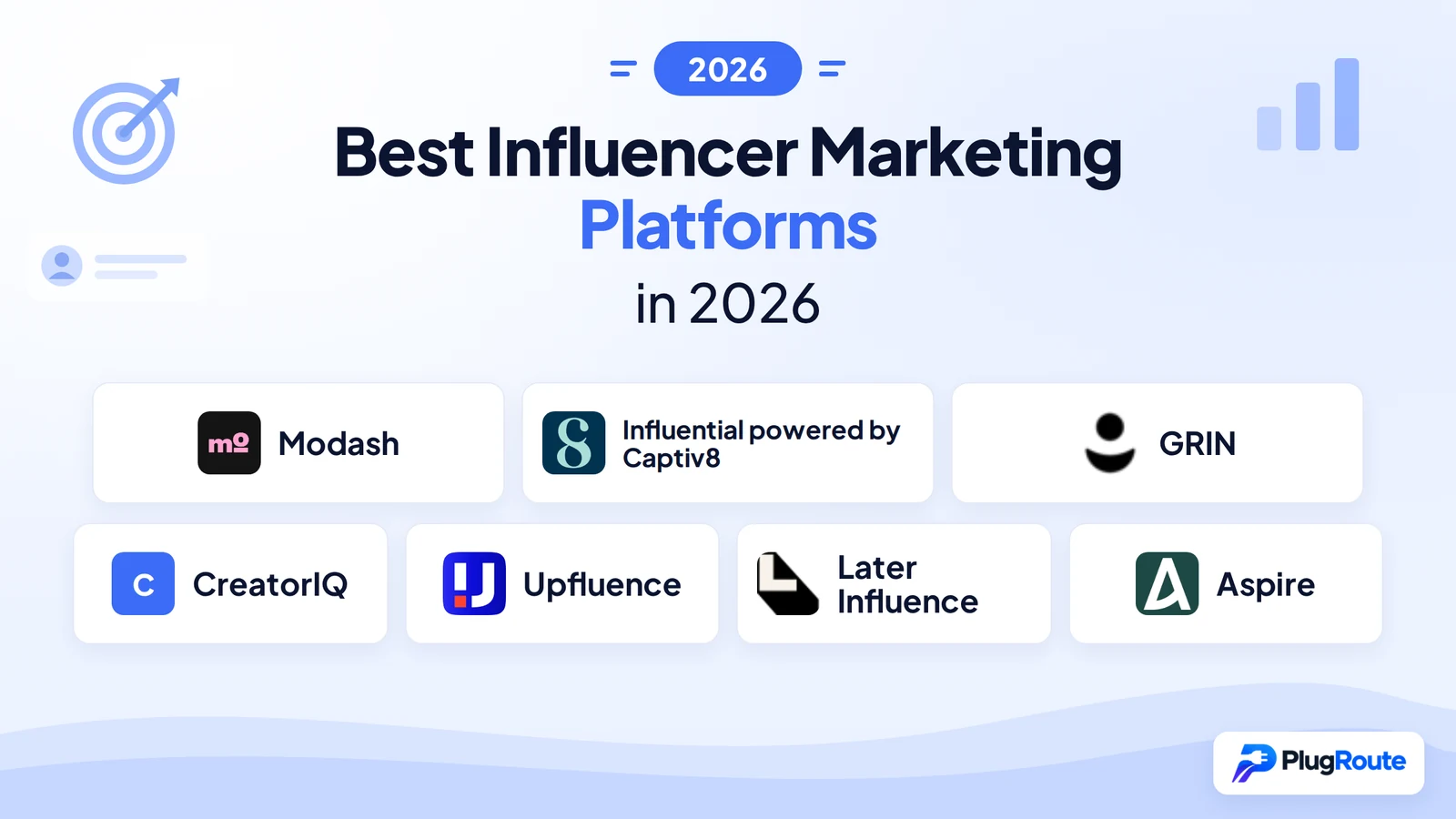
Modash is the best overall influencer marketing platform for small and growing Shopify teams. Influential powered by Captiv8 leads for enterprise brand safety and social commerce. GRIN now offers self-serve CRM plans for DTC brands with existing creator rosters. No single platform suits everyone, and the right choice depends on budget, sales channel and program type.
Many of these tools offer the same features, and most enterprise vendors only give prices through custom quotes. It is still hard to prove that creator posts drove Shopify or Amazon sales. This guide scores seven platforms on six published criteria so you can build a demo shortlist of two or three tools.
PlugRoute has no affiliate relationships with any company listed. Rankings are determined entirely by research data and objective evaluation criteria.
“Paid subscriptions help if someone on the team actually owns the tool… Otherwise it’s an expensive search bar.” (r/influencermarketing practitioner (Reddit, 2026, User-Reported))
Takeaway: Pick the platform your team will actually run every day, not the one with the biggest database.
What Are the 5 Categories of Influencer Marketing Platforms?
Influencer marketing platforms fall into five categories. The categories differ in who runs the software, how creators are found and how contracts are priced. The category matters more than a feature list because it predicts price, contract terms and the buyer each tool was built for. The categories are:
- Self-Serve Discovery & CRM: Modash is software a brand team uses itself to find, vet, contact and track creators without an annual enterprise contract.
- Enterprise Suite: Influential powered by Captiv8 and CreatorIQ are end-to-end platforms for global brands and agencies, with governance, brand safety, measurement and managed-service options.
- Ecommerce Creator CRM: GRIN and Upfluence are all-in-one platforms that connect creator discovery, gifting, affiliate tracking and payments to store sales data.
- Social Suite with Influencer Module: Later Influence is a social media management platform that adds creator discovery, campaign workflows and affiliate tools to publishing and listening.
- Marketplace & Ambassador Platform: Aspire is software that pairs an inbound creator marketplace with ambassador, affiliate, gifting and UGC tools.
As one user on r/influencermarketing described:
“There are articles that list influencer marketing tools but for someone who is relatively new to this it can be hard to decide. Also many seem to have similar features.” Posted by u/TuscanSun_YH
Takeaway: First-time buyers struggle to tell influencer marketing platforms apart on features alone, so platform category is a more useful first filter than a feature checklist.
How Do the Top Influencer Marketing Platforms Compare at a Glance?
The seven ranked platforms differ most on pricing transparency, commerce coverage and data model. Modash and GRIN publish monthly pricing. Upfluence documents the broadest commerce integrations. Influential powered by Captiv8 and CreatorIQ lead on enterprise governance. The table below summarizes each platform’s fit, strength and limitation, verified November 2026.
| Rank | Company | Category | Best For | One-Line Summary | Key Capabilities | Primary Strength | Key Limitation |
|---|---|---|---|---|---|---|---|
| 1 | Modash | Self-Serve Discovery & CRM | Shopify brands and lean teams | Modash is a self-serve discovery and CRM platform with published pricing from $199/month. | Public-account index, fake-follower checks, CRM, Shopify gifting, API | Published month-to-month pricing with no reported payout fees | Shopify-only commerce; email-unlock caps |
| 2 | Influential powered by Captiv8 | Enterprise Suite | Enterprise brands and agencies | Influential powered by Captiv8 is a Publicis-owned enterprise suite combining brand safety, paid amplification and social commerce. | Brand-safety screening, Spark Ads, storefronts, payments, managed services | Brand safety, paid amplification and storefronts in one suite | Quote-only; evidence comes mostly from G2 |
| 3 | GRIN | Ecommerce Creator CRM | DTC brands with an existing creator roster | GRIN is an ecommerce creator CRM for Shopify and WooCommerce brands, with self-serve plans from $0–$1,500/month. | CRM, seeding, affiliate codes, PayPal payouts, 1099 handling | Mature long-term creator CRM with published monthly plans | Widest G2-versus-Trustpilot gap; 5–20% wallet-deposit fees |
| 4 | CreatorIQ | Enterprise Suite | Global multi-market enterprises | CreatorIQ is an enterprise creator marketing operating system built on authenticated first-party data. | Creator Graph, governance, payments, content rights, reporting | Largest verified G2 review sample | Listed from $36,000/user/year; data-accuracy complaints |
| 5 | Upfluence | Ecommerce Creator CRM | Multichannel ecommerce sellers | Upfluence is an ecommerce influencer platform with the broadest multichannel commerce integrations in this ranking. | Shopify, Amazon, WooCommerce, Magento, BigCommerce, Klaviyo; Live Capture | Widest commerce attribution coverage | 4–6% Upfluence Pay processing fees; auto-renewal complaints |
| 6 | Later Influence | Social Suite with Influencer Module | Social teams running creator programs | Later Influence combines Later’s scheduling tools with creator campaigns and the Mavely affiliate network. | Scheduling, discovery, campaign workflows, Mavely network | Publishing, influencer and affiliate tools from one vendor | No published influencer pricing; EMV-based reporting |
| 7 | Aspire | Marketplace & Ambassador Platform | Shopify DTC ambassador and UGC programs | Aspire combines an inbound creator marketplace with ambassador, affiliate, gifting and UGC tools. | Creator Marketplace, tiered commissions, bulk codes, UGC rights | Strongest negotiated-deal price evidence | Shopify-only; support and cancellation complaints |
Which Influencer Marketing Platform Should I Choose for My Use Case?
Choose by your top priority, not by overall rank, because each of the seven platforms was built for a different buyer. The framework below matches eight common priorities to a recommended platform and an acceptable alternative. The priorities range from bootstrapped gifting programs to global governance, and the matches use November 2026 pricing and feature evidence.
| Your #1 Priority | Recommended Tool | Why | Acceptable Alternative |
|---|---|---|---|
| Bootstrapped or small team (<$10K/yr) | Modash | Published pricing from $199/month, month-to-month option, 14-day trial (Modash pricing page, 2026) | Shopify Collabs for Shopify-native affiliate (not ranked) |
| Growing Shopify DTC brand running ambassadors/UGC ($12K–$35K/yr) | Aspire | Inbound marketplace plus tiered affiliate commissions; Vendr median $15,588/yr (Vendr, 2026) | Upfluence |
| Multichannel commerce (Amazon, WooCommerce, BigCommerce) | Upfluence | Broadest documented commerce integrations (Upfluence, 2026; Rankite, 2026) | GRIN (Shopify and WooCommerce) |
| Scaling DTC brand with an existing creator roster | GRIN | CRM-first design; self-serve plans from $0–$1,500/month (GRIN, 2026) | Aspire |
| Social team that also publishes content | Later Influence | Bundles scheduling, listening and influencer workflows | Aspire |
| Enterprise needing brand safety, paid amplification and commerce | Influential powered by Captiv8 | Brand-safety screening, Spark Ads and storefronts in one suite | CreatorIQ |
| Global enterprise needing authenticated data and governance | CreatorIQ | Authenticated first-party data and multi-market management | Influential powered by Captiv8 |
| Flexibility and no annual lock-in | Assembled stack (discovery tool + gift form + affiliate tool) | Practitioner-reported cost under $1,500/month with no annual contract (Reddit, 2025, User-Reported) | Modash or GRIN self-serve (both month-to-month) |
How Much Do Influencer Marketing Platforms Really Cost?
Influencer marketing platforms cost about $0–$6,000 per year for self-serve tools, $12,000–$35,000 for mid-market platforms and $30,000–$100,000+ for enterprise suites (Creator-Hero and Heepsy, 2026). Modash and GRIN publish monthly pricing. The other five require quotes, so Vendr negotiated-deal data is the most reliable guide where it exists.
- Self-serve tools cost $0–$6K per year and include Modash, GRIN’s Free, Starter and Growth plans, and Shopify Collabs (Creator-Hero, 2026; GRIN pricing page, 2026).
- Mid-market platforms cost $12K–$35K per year and include Aspire, Upfluence and GRIN’s Scale plan (Creator-Hero, 2026; GRIN pricing page, 2026).
- Enterprise suites cost $30K–$100K+ per year and include CreatorIQ, Influential powered by Captiv8 and GRIN’s legacy enterprise contracts (Creator-Hero, 2026; Vendr, 2026).
What does each platform’s pricing include?
- Modash Essentials costs $199/month billed annually or $299 month-to-month with 150 email unlocks. Modash Performance costs $499 billed annually or $599 month-to-month with 400 unlocks (Modash pricing page, 2026).
- Influential powered by Captiv8 is quote-only. Competitor-run blogs estimate about $25,000/year plus about $3,000 onboarding at entry level (Storika, 2026; Syncly, 2026, Competitor-Sourced).
- GRIN publishes four plans: Free ($0), Starter ($200/month), Growth ($500/month) and Scale ($1,500/month), with wallet-deposit fees of 20%, 10%, 7% and 5% respectively (GRIN pricing page, 2026).
- GRIN’s legacy annual contracts ran $30,000–$200,000+/year, according to Vendr negotiated-deal data (Vendr, 2026).
- CreatorIQ is quote-only. Capterra lists a starting price of $36,000 per user per year with no free trial, and competitor-sourced estimates put the median contract near $39,000 (Capterra, 2026; Cheerful.ai, 2026).
- Upfluence is quote-based, with reported tiers of about $795/month and $1,750/month on 12-month terms. Upfluence says it takes no percentage of tracked sales (Toolradar, 2026; Upfluence pricing page, 2026).
- Later Influence shows three influencer tiers without dollar amounts. Capterra’s $129/month figure belongs to the legacy Mavrck listing (Later pricing page, 2026; Capterra, 2026).
- Aspire’s Vendr median is $15,588/year, with a range of $11,139–$36,599. List-price estimates are about $2,299/month on a 12-month term plus about $2,000 onboarding (Vendr, 2026; SaaSTracker, 2026).
What do contract terms and fees look like for each platform?
| Platform | Price Evidence | Evidence Type | Minimum Term | Monthly Option | Free Trial | Commerce Integrations | Reported Payout Fees |
|---|---|---|---|---|---|---|---|
| Modash | $199–$599/month | Published | None required | Yes | 14 days (20 profile views, 6 unlocks, 10 tracked creators) | Shopify | None reported |
| Influential powered by Captiv8 | ~$25K/yr + ~$3K onboarding | Competitor-Sourced (low credibility) | Not documented | No self-serve tier | Not documented | Storefronts, TikTok Shop, affiliate | USD-only PayPal payouts reported (third-party) |
| GRIN | $0–$1,500/month (self-serve); legacy contracts $30K+/yr | Published (self-serve); Negotiated-Deal Data (legacy) | None on self-serve | Yes | Free tier | Shopify, WooCommerce | 5–20% wallet-deposit management fee (published) |
| CreatorIQ | From $36,000/user/yr | Review-Site Listing | Not documented | No | None listed (Capterra) | Reporting-led | None documented |
| Upfluence | ~$478–$2,000/month | Third-party reported | 12 months commonly reported | Not documented | Not documented | Shopify, WooCommerce, Amazon, Magento, BigCommerce, Klaviyo | 4–6% processing, 5% instant payout, 1–2% FX (published); ~7% total (User-Reported) |
| Later Influence | Tiers shown without prices | Published tiers, no amounts | Not documented | Not documented | Not documented | Mavely affiliate network | None documented |
| Aspire | Median $15,588/yr | Negotiated-Deal Data | 12 months (list-price estimate) | Not documented | Not documented | Shopify only | None documented |
How much does a payout or deposit fee add to total cost?
Suppose you pay $20,000 a year to creators through a platform that charges a 7% deposit or payout fee. That adds $1,400 a year on top of the subscription. At a 20% fee, the same creator budget adds $4,000. Model fees against your creator budget, not just the license.
How should market-size figures be read?
Market-size estimates differ because they measure different things, so they should never be averaged.
- MarketsandMarkets measures software only and projects $1.15B for 2026 (MarketsandMarkets, 2026).
- Fortune Business Insights projects $27.54B for 2026, including services and spend (Fortune Business Insights, 2026).
- Grand View Research projects $45.2B for 2026, also including services and spend (Grand View Research, 2026).
- eMarketer projects creator ad spend of $43.9B in 2026, with micro and nano creators receiving 45.5% of spend (eMarketer, 2026).
What Are the Best Influencer Marketing Platforms in 2026?
The best influencer marketing platforms in 2026 are Modash (29.5/40), Influential powered by Captiv8 (28.25), GRIN (27.5), CreatorIQ (27.0), Upfluence (25.5), Later Influence (25.25) and Aspire (25.0). GRIN and CreatorIQ sit 0.5 points apart. Upfluence, Later Influence and Aspire sit within 0.5 points of each other. Treat those positions as close calls.
1. Modash: Best Overall for Small and Growing Teams and Self-Serve Creator Discovery on Shopify
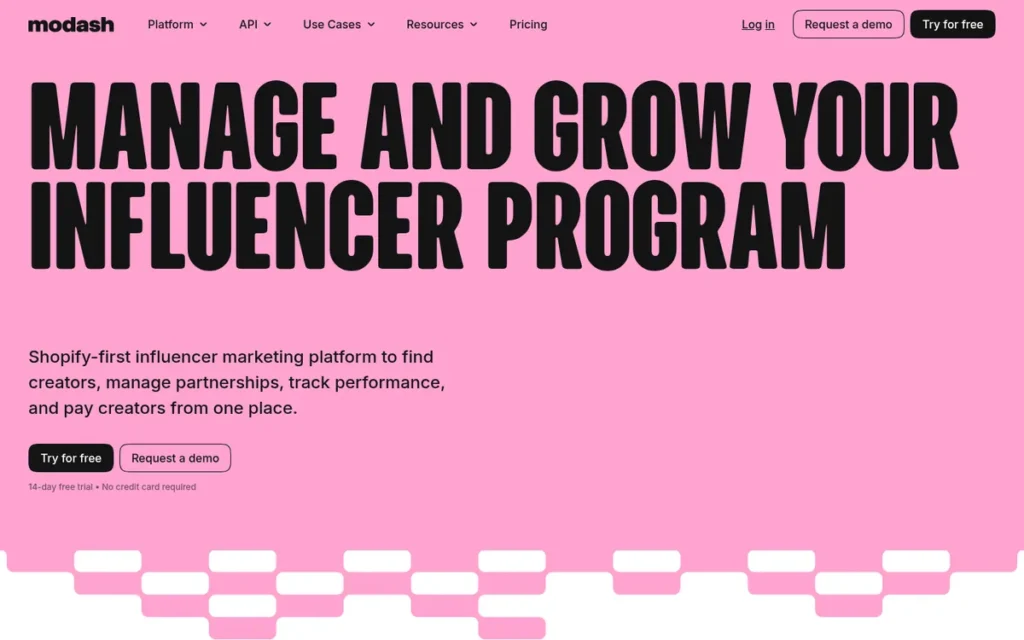
Category: Self-Serve Discovery & CRM, software a brand team uses itself to find, vet, contact and track creators, without a managed marketplace or annual enterprise contract.
At a Glance
- Category: Self-Serve Discovery & CRM
- Best For: Shopify brands, startups and in-house teams of 1–5 people running gifting, seeding and affiliate programs on Instagram, TikTok and YouTube
- Price Range: $199–$599/month (published, November 2026); Enterprise custom; 14-day free trial
- Primary Strength: Modash combines the broadest documented public-creator index in this ranking (250M+ profiles, TechCrunch, 2024) with published month-to-month pricing.
- Biggest Limitation: Modash supports commerce integrations only with Shopify and caps email unlocks on entry plans.
- One-Line Summary: Modash is a self-serve influencer discovery and CRM platform with published pricing from $199/month, best for Shopify brands and lean teams that want broad creator search without an annual contract.
- Last Verified: November 2026
Overview
Modash is a self-serve influencer discovery and creator-management platform that indexes every public Instagram, TikTok and YouTube account with 1,000+ followers. Modash is built for Shopify brands and lean in-house teams that want published, month-to-month pricing.
Modash is software rather than a marketplace, so creators do not apply to a brand’s campaigns. TechCrunch described the Modash index as 250M+ profiles (TechCrunch, 2024), and Modash’s current marketing claims 350M+ (Modash, 2026, Vendor-Reported).
Key Features
- Modash indexes public creator accounts with more than 1,000 followers, so creators do not need to opt in to be discoverable (TechCrunch, 2024).
- Modash includes fake-follower and audience-quality checks, so teams can screen creators before outreach (Modash pricing page, 2026).
- Modash automatically tracks creator posts, Stories and Reels, which reduces manual screenshot collection (Modash pricing page, 2026).
- Modash offers a free native Shopify integration for gifting, affiliate links and discount codes, plus creator payments and an API (Shopify App Store, 2026).
- Modash provides natural-language and lookalike search, which a Reddit practitioner praised (Reddit, 2026, User-Reported).
Best For
Modash is best for Shopify merchants, startups and small in-house teams that need to vet creators quickly, want to test before committing and want to avoid 12-month lock-in.
Strengths
- Modash publishes month-to-month pricing from $199/month billed annually or $299 month-to-month, with a 14-day trial and no reported payout fees (Modash pricing page, 2026).
- Modash raised a $12M Series A led by henQ in October 2024, bringing total reported funding to about $13.6M (TechCrunch, 2024; CB Insights, 2026).
- Modash reports more than 1,500 clients, including Victoria’s Secret, Birkenstock, Canon and Farfetch (CB Insights, 2026, Vendor-Reported).
- Modash “made scaling much more manageable,” according to a Shopify App Store reviewer (Shopify App Store, 2026, User-Reported).
Users on r/influencermarketing shared their experience:
“I’ve bounced between Modash and HypeAuditor for months. Modash works better for finding nano and micro creators outside the usual US crowd, while HypeAuditor does more detective work on audience authenticity. If you want to test reach and engagement stats, Modash wins for me. If you want deeper analytics, HypeAuditor is the pick.” Posted by u/Abhi_deep
Takeaway: Modash stands out for creator discovery, but practitioners who need deeper audience-authenticity analytics still turn to a specialist audit tool.
Limitations
Modash gives up commerce breadth and enterprise depth in exchange for accessibility. Modash’s commerce integrations are Shopify-only, so brands selling through Amazon, WooCommerce or BigCommerce cannot attribute those sales natively (Modash pricing page, 2026).
- Modash’s Essentials plan includes 150 email unlocks, which reviewers call too low for large gifting programs. A Reddit user said outreach limits pushed them to contact creators outside the tool (Reddit, 2026, User-Reported).
- Modash’s 14-day trial is limited to 20 profile views, 6 email unlocks and tracking for 10 creators, so a trial tests the workflow more than scale (Modash pricing page, 2026).
- Modash does not publish an email-accuracy rate, and its support terms target a first response within two business days (Modash Terms of Service, 2026).
- Modash’s 4.9/5 G2 rating comes from only 20 reviews, and Modash lacks the brand-safety governance and managed services that enterprise suites offer (G2, 2026).
Verdict
Modash is the strongest overall choice for small and growing teams in 2026 because it pairs the broadest documented public creator index in this ranking with published, month-to-month pricing and no reported payout fees.
Modash lets a Shopify brand test real discovery and vetting workflows before committing budget. Modash leads by 1.25 points, so teams that need multichannel commerce or enterprise brand safety should compare Upfluence, Influential powered by Captiv8 or CreatorIQ.
2. Influential powered by Captiv8: Best for Enterprise Audience Intelligence
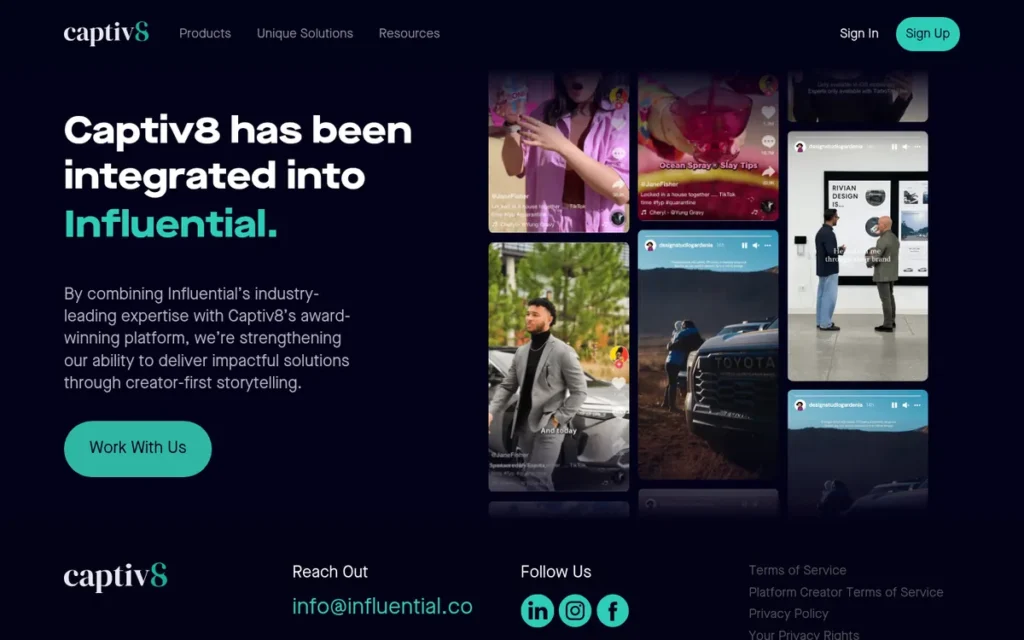
Category: Enterprise Suite, an end-to-end creator marketing platform for global brands and agencies, with governance, brand safety, measurement and managed-service options.
At a Glance
- Category: Enterprise Suite
- Best For: Enterprise brands and agencies that want audience intelligence, brand-safety screening, paid amplification and social commerce in one platform
- Price Range: Pricing on request; third-party estimates ~$25,000+/year plus ~$3,000 onboarding (competitor-sourced, low credibility)
- Primary Strength: Influential powered by Captiv8 combines audience intelligence, brand-safety screening, paid amplification and social commerce in a single enterprise suite.
- Biggest Limitation: Influential powered by Captiv8 publishes no pricing, has no self-serve tier, and draws its reputation evidence almost entirely from G2.
- One-Line Summary: Influential powered by Captiv8 is a Publicis-owned enterprise influencer suite combining audience intelligence, brand-safety screening, paid amplification and social commerce, best for large brands and agencies with five-figure annual budgets.
- Last Verified: November 2026
Overview
Influential powered by Captiv8 is an enterprise influencer marketing suite owned by Publicis Groupe. It combines creator discovery, brand-safety screening, payments, storefronts and paid amplification. Influential powered by Captiv8 is built for large brands and agencies running high-budget, multi-platform creator programs.
Influential powered by Captiv8 supports Instagram, TikTok, YouTube, Facebook and X, and offers managed services on top of the software (Capterra, 2026).
Key Features
- Influential powered by Captiv8 claims a database of 15M+ creators searchable with 500+ discovery filters (Captiv8 newsroom, 2026, Vendor-Reported).
- Influential powered by Captiv8 screens creators for brand safety using language models across 11 IAB risk categories (Captiv8 newsroom, 2026, Vendor-Reported).
- Influential powered by Captiv8 supports paid amplification through TikTok Spark Ads and Meta, so brands can boost creator content from the same platform (Capterra, 2026).
- Influential powered by Captiv8 offers affiliate tools and social-commerce storefronts, including TikTok Shop workflows (Capterra, 2026).
- Influential powered by Captiv8 automates creator payments and offers managed services for teams that want hands-on support (Capterra, 2026).
Best For
Influential powered by Captiv8 is best for enterprise brands and agencies that need brand safety, paid amplification and commerce in one contract. Influential powered by Captiv8 is a weaker fit for agencies that compete with Publicis Groupe.
Strengths
- Influential powered by Captiv8 holds a G2 rating of about 4.7/5 across 505 reviews, including 398 five-star and 96 four-star reviews (G2, 2026).
- Publicis Groupe acquired Influential powered by Captiv8 on May 21, 2025. The Wall Street Journal reported a price of about $150M, and Publicis’s half-year report records €143M in total consideration (Wall Street Journal, 2025; Publicis Groupe, 2025).
- Influential powered by Captiv8’s TurboTax campaign reported 271M impressions, 15.1M engagements and 624K app visits from 9 creators (Captiv8 newsroom, 2026, Vendor-Reported, not independently audited).
- Influential powered by Captiv8 says G2 data named it the #1 enterprise influencer marketing software three years in a row (Captiv8 blog, 2025, Vendor-Reported).
Limitations
Influential powered by Captiv8 gives up transparency and accessibility in exchange for enterprise breadth. Influential powered by Captiv8 publishes no pricing and has no self-serve tier. Third-party estimates start around $25,000/year plus about $3,000 onboarding (Storika, 2026; Syncly, 2026, Competitor-Sourced).
- Influential powered by Captiv8 has a learning curve that requires training, according to G2 reviewers (G2, 2026).
- Influential powered by Captiv8 has occasional creator-payment delays and USD-only PayPal payouts that can add currency-conversion costs, according to third-party blogs (Syncly, 2026; Afluencer, 2026).
- Influential powered by Captiv8’s Publicis ownership may be a conflict for brands or agencies working with rival holding companies.
- Influential powered by Captiv8 has no verified Capterra rating, Trustpilot rating or Reddit discussion, and its database and brand-safety figures are vendor-reported (PlugRoute research, 2026).
Verdict
Influential powered by Captiv8 is the strongest enterprise choice in 2026 for brands that want brand-safety screening, paid amplification and social commerce in a single suite.
Influential powered by Captiv8 scored highest in this ranking on documented credentials (C6 4.5) and tied for the top governance score (C5 5.0). Buyers should budget for quote-only pricing and check Publicis ownership against their agency relationships. They should also ask for references, because independent evidence beyond G2 is limited.
3. GRIN: Best for DTC Brands Managing an Existing Creator Roster Long-Term
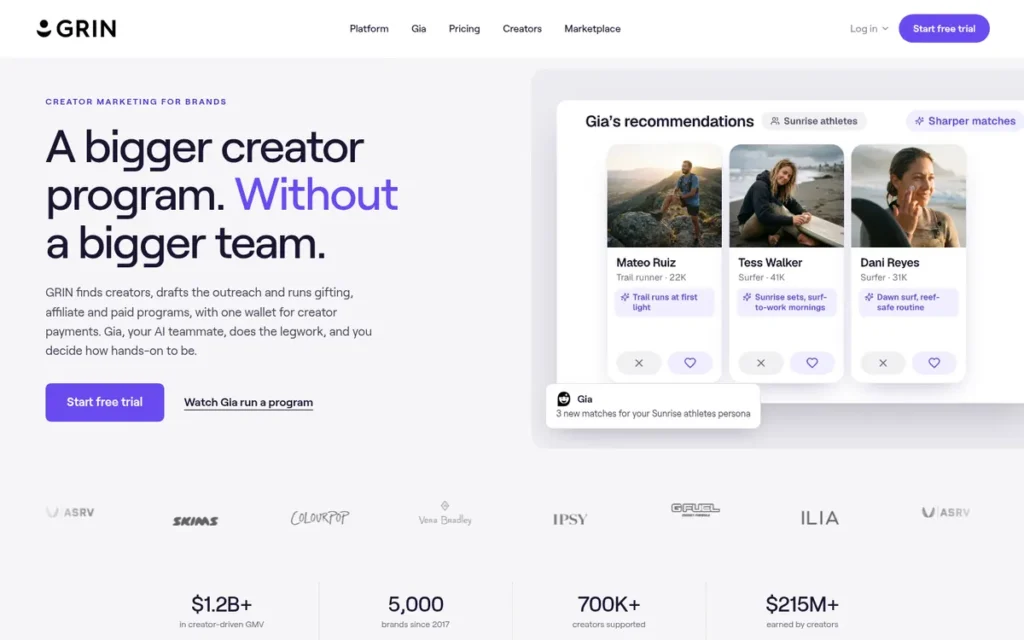
Category: Ecommerce Creator CRM, an all-in-one platform for ecommerce brands that connects creator discovery, outreach, gifting, affiliate tracking and payments to store sales data.
At a Glance
- Category: Ecommerce Creator CRM
- Best For: Scaling DTC brands on Shopify or WooCommerce that already have creator relationships and want a long-term CRM
- Price Range: Self-serve $0–$1,500/month plus 5–20% wallet-deposit fees (published, November 2026); legacy enterprise contracts $30,000+/year (Vendr, 2026)
- Primary Strength: GRIN offers a mature ecommerce creator CRM with Shopify and WooCommerce seeding, affiliate attribution, built-in creator payments and published self-serve plans.
- Biggest Limitation: GRIN has the widest review gap in this ranking (Trustpilot 3.2/5 vs. Capterra 4.7/5) and charges 5–20% management fees on wallet deposits.
- One-Line Summary: GRIN is an ecommerce-focused creator CRM for Shopify and WooCommerce brands, now offering self-serve monthly plans from $0–$1,500, best for scaling DTC teams that manage an established creator roster long-term.
- Last Verified: November 2026
Overview
GRIN is an ecommerce-focused creator relationship management platform that combines discovery, CRM, product seeding, affiliate links, payments and reporting. GRIN is built for scaling Shopify or WooCommerce brands that manage an existing creator roster long-term.
GRIN launched self-serve, month-to-month plans on January 27, 2026, alongside its legacy annual contracts (GRIN, 2026). GRIN includes an AI assistant called “Gia” and handles creator 1099 tax forms (GRIN FAQ, 2026).
Key Features
- GRIN connects to Shopify and WooCommerce for product seeding, order handling and revenue attribution (Vendr, 2026).
- GRIN manages creator relationships in a CRM designed for long-term programs rather than one-off bookings (GRIN FAQ, 2026).
- GRIN searches a claimed 190M+ creators with lookalike search (Influencer Marketing Hub, 2026, Vendor-Reported).
- GRIN pays creators through PayPal and handles 1099 tax forms (GRIN FAQ, 2026).
- GRIN includes content management, affiliate links and codes, reporting and the “Gia” AI assistant (Toolradar, 2026).
Best For
GRIN is best for scaling DTC brands on Shopify or WooCommerce that want structured long-term management of seeding, affiliate tracking and payments. GRIN’s self-serve plans now suit teams that want to avoid annual contracts.
This aligns with community sentiment on r/SaaS:
“Depends what you are looking to do. Every platform have its strengths and weaknesses. Quick overview: Grin: if you already have influencer relationships or want to build them long-term, and need integrated e-commerce tracking and gifting.” Posted by u/Unfair_Variation4733
Takeaway: GRIN’s community reputation rests on long-term creator relationships with built-in ecommerce tracking and gifting, which matches its fit for DTC brands managing an established roster.
Strengths
- GRIN launched self-serve, month-to-month plans with a free tier in January 2026. Its pricing page lists Free ($0), Starter ($200/month), Growth ($500/month) and Scale ($1,500/month) (GRIN, 2026; GRIN pricing page, 2026).
- GRIN holds a Capterra rating of 4.7/5 across 147 reviews and a G2 rating of 4.5/5 across 483 reviews, and was named a G2 Leader in 2024 and 2025 (Capterra, 2026; Toolradar, 2026; GRIN G2 Report, 2025).
- GRIN is one of only two ranked platforms with documented store integrations beyond Shopify, via WooCommerce (Vendr, 2026).
- GRIN’s upgraded creator search “saves us a ton of hours,” according to a Reddit user who said GRIN offers “a lot more features for the price” (Reddit, 2025, User-Reported).
Limitations
GRIN’s self-serve model removes the annual contract but adds deposit fees. GRIN’s self-serve plans charge wallet-deposit management fees of 20% (Free), 10% (Starter), 7% (Growth) and 5% (Scale), and GRIN changed plan prices several times during 2026 (GRIN pricing page, 2026).
- GRIN’s Trustpilot score of 3.2/5 from 31 reviews sits well below its G2 and Capterra ratings. Only one of those reviews was posted in the past 12 months, and it cites bugs, weak support, payment problems and GRIN’s shift toward AI (Trustpilot, 2026).
- GRIN’s legacy annual contracts ran $30,000+/year on 12-month terms, and reviewers report auto-renewals with no downgrade option (Vendr, 2026; Seed Influencers, 2026, third-party).
- GRIN users report support going quiet for days during technical issues, and they describe paid curated creator lists as irrelevant or duplicated (Seed Influencers, 2026, third-party).
- A February 2025 Reddit user alleged that GRIN’s analytics are inflated when creators don’t link their accounts, attributing this to scraped data (Reddit, 2025, User-Reported).
Verdict
GRIN is a strong fit in 2026 for scaling Shopify and WooCommerce brands that need a long-term CRM for an established creator roster and now want month-to-month terms.
GRIN ranks #3 after PlugRoute rescored its pricing criterion from 1.5 to 3.5 based on its confirmed self-serve plans. Buyers should model wallet-deposit fees against their creator budget. They should also require creators to link their accounts before trusting GRIN’s analytics.
4. CreatorIQ: Best for Global Enterprise Governance and Authenticated Creator Data
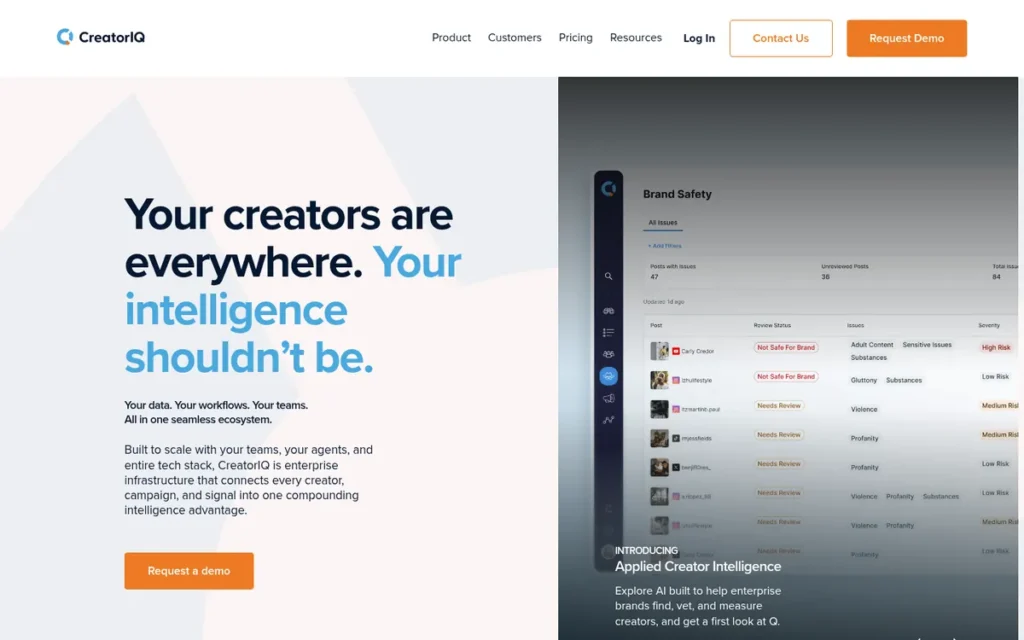
Category: Enterprise Suite.
At a Glance
- Category: Enterprise Suite
- Best For: Global enterprise brands and agencies managing creators across multiple markets with strict governance and reporting requirements
- Price Range: Pricing on request; Capterra lists from $36,000/user/year; no free trial listed
- Primary Strength: CreatorIQ offers authenticated creator data and enterprise governance backed by the largest G2 review sample in this ranking.
- Biggest Limitation: CreatorIQ is among the most expensive and slowest-to-deploy options, with an estimated 6–8 week onboarding and recurring reviewer complaints about data accuracy.
- One-Line Summary: CreatorIQ is an enterprise creator marketing operating system built on authenticated first-party data, best for global brands and agencies that need multi-market governance and reporting.
- Last Verified: November 2026
Overview
CreatorIQ is an enterprise creator marketing operating system covering discovery, vetting, brand safety, CRM, payments, content rights and commerce reporting. CreatorIQ is built for global brands and agencies that manage creators across many markets and need authenticated first-party data.
CreatorIQ lists integrations with Meta, TikTok, YouTube and Snapchat (CreatorIQ LinkedIn, 2026). CreatorIQ’s named customers include Google, LVMH, Sephora and Unilever (G2, 2026).
Key Features
- CreatorIQ builds its “Creator Graph” data layer on creators linking their social accounts, which gives brands authenticated first-party performance data (CreatorIQ, 2026; G2, 2026).
- CreatorIQ includes discovery, vetting and brand-safety workflows in the same platform as its CRM (G2, 2026).
- CreatorIQ manages creators across multiple markets in one workspace, which G2 reviewers cite as a core benefit (G2, 2026).
- CreatorIQ handles creator payments, content-rights management and campaign workflows alongside measurement (CreatorIQ, 2026).
- CreatorIQ lists integrations with Meta, TikTok, YouTube and Snapchat, although the scope of each integration is not publicly documented (CreatorIQ LinkedIn, 2026).
Best For
CreatorIQ is best for global enterprises and agencies running multi-market programs that can absorb five-figure contracts and multi-week onboarding. CreatorIQ is usually more platform than SMB and mid-market DTC teams need.
Strengths
- CreatorIQ holds a G2 rating of 4.6/5 across about 591 reviews, corroborated by a Capterra rating of 4.5/5 from 17 reviews, the largest verified review sample in this ranking (G2, 2026; Capterra, 2026).
- CreatorIQ raised more than $80M, including a $24M Series C in 2020 and $40M in 2021, and acquired Tribe Dynamics in 2021 (BusinessWire, 2021; CreatorIQ, 2021).
- CreatorIQ counts Google, LVMH, Nestlé, Sephora, Delta, Disney, Unilever and Salesforce among its named customers, and claims more than 1,300 brand and agency customers (G2, 2026; ZoomInfo, 2026, Vendor-Reported).
- CreatorIQ’s reporting is a repeated point of praise, with one G2 reviewer writing “the reporting stats are also a big plus for me” (G2, 2026, User-Reported).
Limitations
CreatorIQ gives up accessibility in exchange for governance. CreatorIQ is quote-only, Capterra lists it from $36,000 per user per year with no free trial, and onboarding takes an estimated 6–8 weeks (Capterra, 2026; Cheerful.ai, 2026, Competitor-Sourced).
- CreatorIQ’s authenticated data requires creators to link their accounts, which reviewers say adds onboarding friction (G2, 2026).
- CreatorIQ draws recurring G2 complaints about a slow interface, weak discovery of emerging creators, missed posts when creators skip required tags, demographic mismatches and payment delays (G2, 2026).
- CreatorIQ’s commerce features are reporting-led rather than storefront- or affiliate-led (CreatorIQ, 2026).
- CreatorIQ has no verified named-client case-study metrics and no Reddit discussion. The only related Reddit mention showed a mid-market buyer ruling CreatorIQ out (Reddit, 2025).
Verdict
CreatorIQ is the best-reviewed enterprise influencer platform in 2026 by verified review volume, and the strongest fit for global brands that need authenticated data and multi-market governance.
CreatorIQ ranks #4, 0.5 points behind GRIN, because its quote-only pricing (C2 1.0) offsets its leading review reputation (C1 4.5). Mid-market and SMB teams will likely pay for enterprise capacity they don’t need.
5. Upfluence: Best for Multichannel Ecommerce Attribution (Shopify, Amazon, WooCommerce and More)
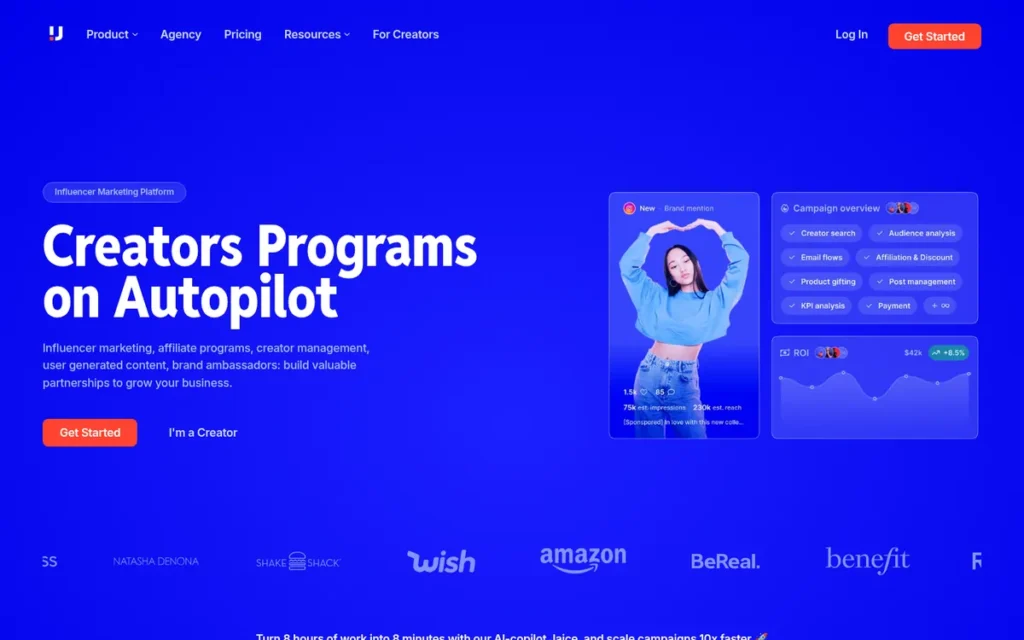
Category: Ecommerce Creator CRM.
At a Glance
- Category: Ecommerce Creator CRM
- Best For: Ecommerce brands selling across multiple storefronts or marketplaces that want to recruit creators from existing customers
- Price Range: Pricing on request; reported ~$478–$2,000/month, typically on a 12-month term; Upfluence Pay fees 4–6% (published)
- Primary Strength: Upfluence offers the broadest commerce integration coverage in this ranking, including Amazon, WooCommerce, Magento and BigCommerce.
- Biggest Limitation: Upfluence faces recurring user-reported complaints about auto-renewal and about payout fees that one buyer says were not raised during sales calls.
- One-Line Summary: Upfluence is an ecommerce-focused influencer platform with the broadest multichannel commerce integrations in its class, best for brands that sell beyond Shopify and want to turn customers into creators.
- Last Verified: November 2026
Overview
Upfluence is an all-in-one influencer and affiliate platform for multichannel ecommerce brands. Upfluence connects creator discovery, outreach, affiliate links, payments and sales attribution across six commerce and marketing platforms, including Amazon and WooCommerce.
Upfluence’s Live Capture feature identifies existing customers and subscribers who are already creators, which sets Upfluence apart in this ranking (Upfluence, 2026).
Key Features
- Upfluence searches 12M+ creator profiles across Instagram, TikTok, YouTube, Twitch, X, Pinterest and blogs (Rankite, 2026, third-party).
- Upfluence integrates with Shopify, WooCommerce, Amazon (attribution), Magento, BigCommerce and Klaviyo (Upfluence, 2026; Rankite, 2026).
- Upfluence’s Live Capture matches existing Shopify and Klaviyo customers and subscribers to creator profiles (Upfluence, 2026).
- Upfluence provides affiliate links, promo codes and creator payouts through Upfluence Pay (Upfluence Help Center, 2026).
- Upfluence includes a Chrome extension and an AI agent called “Jaice” for discovery and outreach (Upfluence, 2026).
Best For
Upfluence is best for ecommerce brands selling through several storefronts or Amazon that need creator revenue attributed across every channel. Upfluence suits teams willing to negotiate contract and payout terms carefully.
Strengths
- Upfluence documents integrations with six commerce and marketing platforms, the widest commerce coverage in this ranking (Upfluence, 2026; Rankite, 2026).
- Upfluence holds a G2 rating of about 4.6/5 across about 138–140 reviews, with praise for targeted discovery, ecommerce integrations and support (Rannkly aggregator, 2026).
- Upfluence charges a fixed platform fee rather than a percentage of tracked sales (Upfluence pricing page, 2026, Vendor-Reported). A Reddit buyer called it “the cheapest option we found by far” (Reddit, 2025, User-Reported).
- Upfluence’s one-click store connection helped a Reddit user “find influencers that already purchased our brand,” though that account repeatedly praises Upfluence (Reddit, 2025, User-Reported).
Users on r/influencermarketing noted:
“I mostly use upfluence because it does discovery plus campaign management and payments all in one, I hate juggling multiple tools. It depends what you need tho, if you just want to vet influencers HypeAuditor works fine for that” Posted by u/Impossible_Control67
Takeaway: Upfluence appeals to teams that want discovery, campaign management and payments in one tool, but teams that only need creator vetting can use a lighter audit tool.
Limitations
Upfluence’s competitive headline price comes with fee and contract risk. Upfluence’s help center lists Upfluence Pay processing fees of about 4–6%, a 5% instant-payout fee and 1–2% currency-conversion fees (Upfluence Help Center, 2026).
- Upfluence’s total payout fees came to about 7%, according to one Reddit buyer who says the fees were not raised during multiple sales calls (Reddit, 2025, User-Reported).
- Upfluence faces Trustpilot allegations of auto-renewal after a 6-month contract, unclear renewal notices and full-year billing (Trustpilot, 2026).
- Upfluence’s Capterra rating of about 4.1/5 from about 41 reviews trails its G2 score. Reddit practitioners also say scaling teams “grow out of Upfluence pretty quickly” (Rannkly, 2026; Reddit, 2025).
- Upfluence’s founding details and headcount could not be verified, and its “10× ROI” Branded case study is vendor-reported and not independently audited (Upfluence pricing page, 2026).
Verdict
Upfluence is the best choice in 2026 for ecommerce brands that sell beyond Shopify and need creator activity attributed across Amazon, WooCommerce, Magento or BigCommerce.
Upfluence leads this ranking on commerce breadth (C3 5.0). Buyers should get the full Upfluence Pay fee schedule and renewal terms in writing before signing, because fee and auto-renewal complaints recur.
6. Later Influence: Best for Social Teams Wanting Scheduling Plus Creator Programs
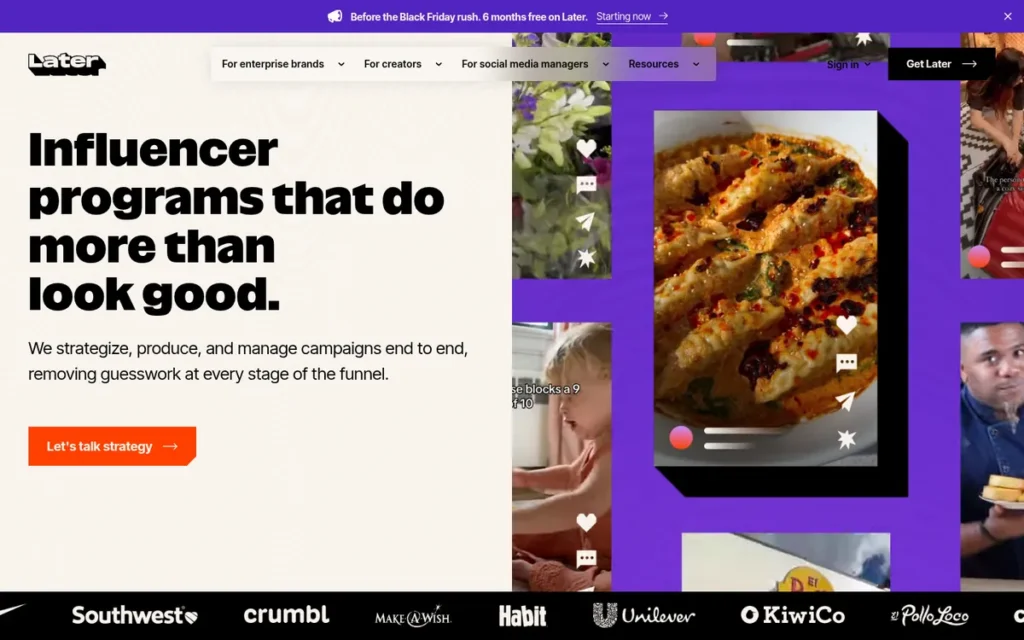
Category: Social Suite with Influencer Module, a social media management platform that adds creator discovery, campaign workflows and affiliate tools to publishing and listening.
At a Glance
- Category: Social Suite with Influencer Module
- Best For: Mid-sized consumer brands whose social team wants publishing, scheduling and creator campaigns from one vendor
- Price Range: Pricing on request (tiers published without dollar amounts)
- Primary Strength: Later Influence is the only one of the seven ranked platforms with a built-in social publishing suite, combined with influencer workflows and an affiliate creator network.
- Biggest Limitation: Later Influence does not publish influencer pricing and relies on modeled EMV metrics. Third parties also report tracking gaps for short-form video.
- One-Line Summary: Later Influence is a social-suite influencer platform that combines Later’s scheduling tools with creator campaigns and the Mavely affiliate network, best for mid-sized brands whose social team runs creator programs.
- Last Verified: November 2026
Overview
Later Influence, formerly Mavrck, is an influencer marketing platform that combines creator discovery, campaign workflows and reporting with Later’s scheduling, link-in-bio and listening tools. Later Influence is built for mid-sized brands whose social teams run creator programs alongside publishing.
Later Influence gained the Mavely affiliate creator network when Later acquired Mavely for $250M on January 3, 2025 (PR Newswire, 2025; Axios, 2025).
Key Features
- Later Influence provides AI-assisted discovery across 10M+ creators (Later, 2026, Vendor-Reported).
- Later Influence handles invites, briefs, draft approval and asset collection in one campaign workflow (Capterra, 2026).
- Later Influence includes the Mavely affiliate network of 120,000+ creators, with product-level sales attribution (PR Newswire, 2025).
- Later Influence bundles Later’s scheduling, link-in-bio and social listening tools with influencer management (Later, 2026).
- Later Influence reports results with “Influence Value” and earned media value (EMV) metrics, which are modeled estimates rather than tracked sales (Later, 2026).
Best For
Later Influence is best for mid-sized consumer brands whose social team already schedules content and wants creators and affiliates from the same vendor. Later Influence suits US-focused programs in categories the Mavely network already covers well.
Strengths
- Later Influence gained a network of 120,000+ affiliate creators, $1B+ in GMV and 1,400+ brands through the Mavely acquisition (PR Newswire, 2025; Boston Globe, 2025). These are network-level figures.
- Later Influence holds a G2 rating of about 4.5/5 across about 468 reviews, one of four G2 samples above 450 reviews in this ranking (G2, 2026).
- Later Influence keeps sourcing, invites, communication, asset collection, draft approval and analytics in one place, according to Capterra and GetApp reviewers (GetApp, 2026, User-Reported).
- Later Influence is backed by Summit Partners, which invested $120M in Mavrck in 2021. Mavrck received another $135M in strategic investment when it acquired Later in 2022 (Summit Partners, 2025; Later, 2026).
Limitations
Later Influence gives up pricing transparency and measurement rigor in exchange for an integrated social workflow. Later Influence’s pricing page shows three tiers without dollar amounts. Its headline value metrics are modeled estimates, not revenue (Later pricing page, 2026).
- Later Influence has gaps in automatic tracking of Reels, TikTok and YouTube Shorts, according to Syncly, a competitor (Syncly, 2026, Competitor-Sourced).
- Later Influence is lighter than CreatorIQ or GRIN on attribution and enterprise controls, and creator profiles show little past-collaboration performance, according to a third-party review (Rankite, 2026).
- Later Influence’s Mavely network draws mixed creator sentiment, with Reddit users reporting both unexpected account closures and uneven category coverage (Reddit, 2026, User-Reported).
- Later Influence’s Capterra price of $129/month belongs to the legacy Mavrck listing. A Reddit buyer who asked publicly about tier fees got no useful answer (Capterra, 2026; Reddit, 2026).
Verdict
Later Influence is the best fit in 2026 for social teams that want publishing, creator campaigns and an affiliate creator network from one vendor.
Later Influence’s Mavely network adds 120,000+ affiliate creators (PR Newswire, 2025). Buyers who need audited sales attribution should test short-form tracking during a demo and ask Later for a written quote.
7. Aspire: Best for Ambassador, UGC and Gifting Programs With Inbound Creator Applications
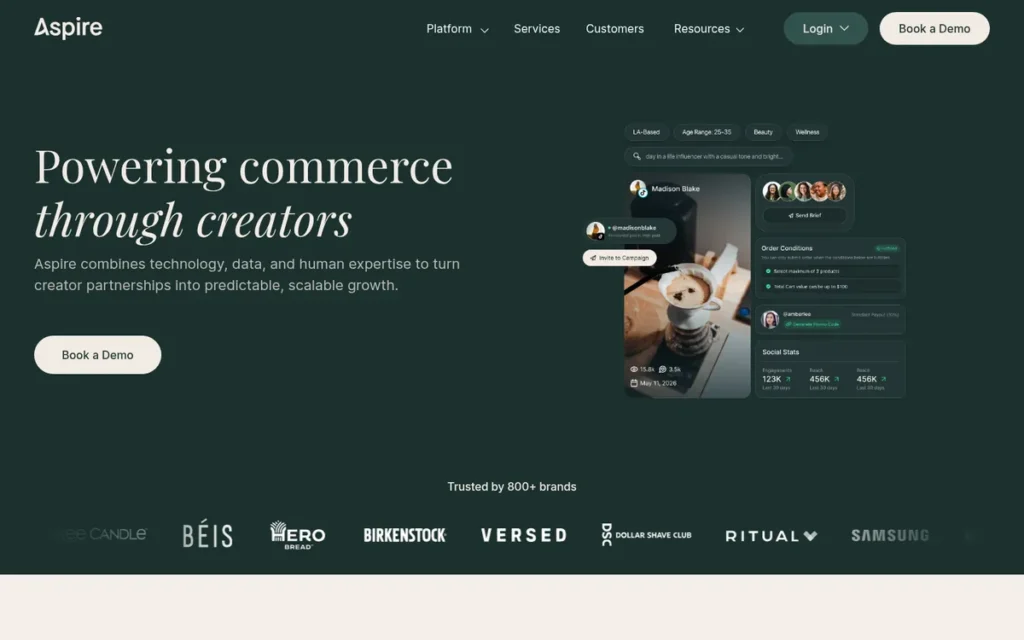
Category: Marketplace & Ambassador Platform, software that pairs an inbound creator marketplace with tools for ambassador, affiliate, gifting and UGC programs.
At a Glance
- Category: Marketplace & Ambassador Platform
- Best For: Growing Shopify DTC brands running always-on ambassador, affiliate, gifting and UGC programs
- Price Range: Pricing on request; Vendr median ~$15,600/year (range ~$11,100–$36,600/year)
- Primary Strength: Aspire combines an inbound creator marketplace with tiered affiliate commissions, gifting and UGC rights management in one platform.
- Biggest Limitation: Aspire supports commerce integration only with Shopify and has documented support and cancellation complaints.
- One-Line Summary: Aspire is an influencer platform combining an inbound creator marketplace with ambassador, affiliate, gifting and UGC tools, best for growing Shopify brands running always-on creator programs.
- Last Verified: November 2026
Overview
Aspire, formerly AspireIQ, is an influencer marketing platform that combines an inbound Creator Marketplace with outbound search, Shopify gifting, tiered affiliate commissions and UGC rights. Aspire is built for growing DTC brands that run always-on ambassador communities.
Aspire reports about 900 customers, including M&M’s, Samsung and HelloFresh (Aspire, 2026, Vendor-Reported).
Key Features
- Aspire runs an inbound Creator Marketplace where creators apply to brand campaigns, alongside outbound creator search (SaaSTracker, 2026).
- Aspire supports Shopify gifting and seeding, affiliate links, bulk promo codes and tiered affiliate commissions (Shopify App Store, 2026).
- Aspire manages UGC content rights, including usage in Meta ads (SaaSTracker, 2026).
- Aspire offers ambassador program tools and creator payments in the same workspace (G2, 2026).
- Aspire includes natural-language search, lookalike recommendations and reverse-image search, according to a competitor blog (Upfluence blog, 2026, Competitor-Sourced).
Best For
Aspire is best for growing Shopify DTC brands that want creators to come to them and want to reuse UGC in paid social. Aspire suits brands targeting micro and mid-tier creators more than managed talent.
Strengths
- Aspire’s real-world pricing is documented by Vendr negotiated-deal data at a $15,588/year median, the strongest negotiated-deal price evidence among the quote-only platforms (Vendr, 2026).
- Aspire reports paying more than $100M to creators and serving about 900 customers, including Keurig, Samsung and Dyson (Aspire, 2026; G2, 2026, Vendor-Reported).
- Aspire holds a G2 rating of about 4.6/5 across about 145–146 reviews, with praise for ease of use and budget tracking (G2, 2026).
- Aspire won over an in-house manager running five brands, who said its affiliate features replaced a separate tool and its pricing was “very competitive” after negotiation (Reddit, 2026, User-Reported).
Limitations
Aspire gives up commerce breadth and consistent support in exchange for an all-in-one ambassador workflow. Aspire’s commerce integration is Shopify-only, and a competitor blog reports that it has no public API (Upfluence blog, 2026, Competitor-Sourced).
- Aspire’s customer support scored lowest of its ratings, at 3.0/5, in one Capterra sample. One reviewer alleges Aspire kept charging $500/month after the account was closed (Seed Influencers summarizing Capterra reviews, 2026, third-party).
- Aspire’s contract allows discretionary cancellation only if the order form says so (Seed Influencers summarizing Aspire’s contract terms, 2026, third-party).
- Talent managers on Reddit say Aspire’s marketplace skews toward lower-tier brands and creators, and creators cite perpetual usage rights and low rates as deterrents (Reddit, 2026, User-Reported).
- Aspire’s first quote ran about 2× Upfluence’s price for one Reddit buyer before it was negotiated down (Reddit, 2026, User-Reported).
Verdict
Aspire is the strongest mid-market choice in 2026 for Shopify brands running always-on ambassador, affiliate and UGC programs where creators apply to the brand.
Aspire ranks #7, within 0.5 points of Upfluence and Later Influence, so its position is a close call. Buyers should negotiate Aspire’s first quote, confirm cancellation terms in the order form, and expect limited access to managed, higher-tier creators.
What About Other Influencer Tools Like Shopify Collabs, HypeAuditor and Insense?
PlugRoute considered several adjacent influencer tools but left them out of the scored ranking because our research did not cover them at the same depth as the seven ranked platforms. Shopify Collabs, impact.com, HypeAuditor and the other unranked tools are not scored, and leaving them out is not a negative judgment.
- Shopify Collabs is a Shopify-native affiliate tool that third-party cost guides list as free (Creator-Hero, 2026).
- impact.com is a broader partnerships platform that covers more than influencer marketing.
- HypeAuditor is a fraud-audit specialist that publishes an annual State of Influencer Marketing report (HypeAuditor, 2025).
- Traackr, Insense, #paid and Klear were considered as alternatives but were not researched at equal depth.
What Red Flags Should I Watch For When Evaluating Influencer Marketing Platforms?
The biggest red flags in influencer marketing platforms are fees, contract terms and data claims that a buyer cannot check before signing. Each of the seven red flags below has appeared in documented user reports, review-site complaints or vendor disclosures for the platforms ranked in this guide, verified November 2026.
Red Flag #1: Payout Fees Not Disclosed on Sales Calls
Payout fees that aren’t disclosed quietly shrink the budget that reaches creators. Upfluence’s help center lists Upfluence Pay processing fees of about 4–6% plus a 5% instant-payout fee (Upfluence Help Center, 2026). Even so, one Reddit buyer says the roughly 7% total was not raised during sales calls (Reddit, 2025, User-Reported).
GRIN publishes its 5–20% wallet-deposit fees on its pricing page (GRIN pricing page, 2026). That is the disclosure standard to ask every vendor to match.
Red Flag #2: 12-Month Auto-Renewal With No Downgrade Option
Annual auto-renewal without a downgrade path locks teams into spending they may not need after a campaign ends. Ask for the renewal notice window in writing before signing, because reviewers have reported renewal or billing problems at three of the seven ranked platforms:
- GRIN reviewers report 12-month auto-renewals on legacy contracts with no downgrade option (Seed Influencers, 2026, third-party).
- Upfluence reviewers allege auto-renewal after a 6-month contract and unclear renewal notices (Trustpilot, 2026, User-Reported).
- One Aspire reviewer alleges billing continued at $500/month after the account was closed (Seed Influencers summarizing Capterra reviews, 2026, third-party).
Red Flag #3: Analytics That Depend on Scraped Data When Creators Don’t Link Accounts
Analytics built on scraped data can overstate creator performance, especially for Stories that disappear after 24 hours. A February 2025 Reddit user alleged that GRIN’s analytics are “hugely inflated” when creators don’t connect their accounts (Reddit, 2025, User-Reported).
CreatorIQ takes the opposite approach and requires authenticated data, which reviewers say adds onboarding friction (G2, 2026).
Red Flag #4: EMV Presented as Revenue
Earned media value is a modeled estimate, not proof of sales caused by a campaign. A post with 200,000 views can show tens of thousands of dollars in modeled EMV and still produce zero tracked orders. Only sales matched to links, codes or UTM parameters show revenue.
Later Influence reports results using “Influence Value” and EMV (Later, 2026). Tracked revenue comes from affiliate links, UTM parameters or promo codes matched to orders in Shopify or GA4. Codes can leak to coupon sites, so compare code sales with link sales.
Red Flag #5: Database Size Claims Without Accuracy Rates
Database sizes in this ranking range from 10M+ to 350M+ creators, and none of the seven vendors publishes an independently audited accuracy rate. Each figure comes from the vendor. Only Modash’s 250M+ figure was reported independently, by TechCrunch (2024), and even that relies on company data.
Modash does not publish an email-accuracy rate (Articuler, 2026). CreatorIQ reviewers report demographics that don’t match creators’ self-reports (G2, 2026).
Red Flag #6: Perpetual Usage Rights Terms That Put Off Quality Creators
Perpetual usage-rights terms and low rates drive higher-tier creators away from open creator marketplaces. One creator in an r/influencermarketing thread said these platforms “often… want perpetual usage rights or something equally ridiculous. And the rates are often too low” (Reddit, 2026, User-Reported).
Talent managers in an r/influencermarketing thread said managed creators tend to avoid Aspire-style marketplaces (Reddit, 2026, User-Reported).
Red Flag #7: Review Scores That Diverge Sharply Between G2 and Trustpilot
A large gap between curated B2B review sites and open review sites can reveal problems that appear after the sale. GRIN holds 4.5/5 on G2 but 3.2/5 on Trustpilot (G2, 2026; Trustpilot, 2026). However, only one of GRIN’s 31 Trustpilot reviews was posted in the past 12 months.
Check review dates as well as scores, because an old gap may not reflect the current product.
What Questions Should I Ask Before Choosing an Influencer Marketing Platform?
Before signing, ask every vendor for written answers on fees, contract terms, commerce coverage and data accuracy. The eight questions below target the contract, attribution and data-quality problems documented across the seven ranked platforms in November 2026. They also let you compare quote-only and published-price vendors on equal terms.
Question #1: What are all payout, processing and currency-conversion fees, in writing?
A written fee schedule protects your creator budget from surprise deductions. Ask for every percentage fee on creator payouts or wallet deposits. Documented fees across the ranked platforms range from 4% to 20% (Upfluence Help Center, 2026; GRIN pricing page, 2026).
Ask also about currency-conversion costs, given reported USD-only PayPal payouts at Influential powered by Captiv8 (Syncly, 2026, Competitor-Sourced).
Question #2: What is the minimum term, renewal notice period and downgrade policy?
Contract terms decide whether you can scale down or leave without paying for unused months. Ask for the minimum term, the auto-renewal notice window, and whether mid-term downgrades and cancellations are allowed. Then compare each answer against what the sales rep said on the call.
Confirm that every answer appears in the order form, because Aspire’s cancellation rights depend on order-form language (Seed Influencers summarizing Aspire’s contract terms, 2026).
Question #3: Which commerce platforms besides Shopify do you attribute sales for?
Commerce coverage decides whether multichannel sales can be attributed at all. Ask for a live demo using your own store data, and check whether the platform’s numbers match Shopify or GA4. Documented coverage across the ranked platforms varies widely:
- Modash and Aspire are Shopify-only (Modash and Aspire documentation, 2026).
- GRIN adds WooCommerce to Shopify (Vendr, 2026).
- Upfluence documents Amazon, WooCommerce, Magento and BigCommerce alongside Shopify (Upfluence, 2026; Rankite, 2026).
Question #4: Is creator data authenticated or indexed, and what is your email-accuracy rate?
The choice between first-party (authenticated) data and indexed public data determines how far you can trust audience and performance metrics. Indexed data shows who a creator appears to reach. Authenticated data, as used by CreatorIQ, shows who actually saw the post, but it adds creator friction.
During any trial, vet 10 creators you already know and compare the platform’s audience data with their media kits. Also check bot ratio and engagement across their last 15–20 posts by hand (Reddit, 2026).
As one user on r/influencermarketing described:
“Hi, I am looking for nano-micro influencers but seems like a LOT of them only have for engagement other nano-micro influencers. So on 50 comments under a reel there is only 2 real followers and other are clearly there to boost one others profile and posts. How can brands navigate this type of fake engagement and find quality influencers ? Thank you !” Posted by u/Ok-Form9175
Takeaway: Engagement pods among nano and micro creators make manual, comment-level vetting essential, whichever influencer marketing platform supplies the audience data.
Question #5: Which content formats (Stories, Reels, Shorts, TikTok) are tracked automatically?
Automatic tracking of every format avoids missed posts and manual screenshots. Modash lists automatic tracking of posts, Stories and Reels (Modash pricing page, 2026). Third parties report short-form tracking gaps for Later Influence (Syncly, 2026), and CreatorIQ reviewers report missed posts when creators skip required tags (G2, 2026).
Question #6: What are the plan limits on email unlocks, gifting volume and seats?
Plan limits set your true cost at your expected campaign volume. Modash Essentials includes 150 email unlocks and Performance includes 400 (Modash pricing page, 2026). Capterra lists CreatorIQ pricing per user (Capterra, 2026). Model your expected creator count and team size before comparing quotes.
Question #7: Can I export all creator and campaign data if I leave?
Full data export prevents lock-in and protects the creator relationships you have built. Ask whether contact lists, contract history, content assets and performance data can be exported in a standard format.
Ask also whether an API is available. Modash offers one (Modash pricing page, 2026), and a competitor blog reports that Aspire does not (Upfluence blog, 2026, Competitor-Sourced).
Question #8: Who on our team will own this tool day to day?
A named internal owner decides whether a platform pays for itself. Practitioners judge tools by hours saved per creator signed, not database size (Reddit, 2026, User-Reported).
One practitioner added, “I wouldn’t trust a tool to make the final call,” so budget time for human brand-fit review (Reddit, 2026, User-Reported).
How Did We Rank These Influencer Marketing Platforms?
PlugRoute scored each platform from 1 to 5 on six published criteria. Four primary criteria are weighted 1.5× and two secondary criteria are weighted 1.0×, for a maximum of 40 points. Every score links to a dated, labeled source, and all evidence was verified in November 2026.
Ranking Criteria
- C1: Cross-Platform Review Reputation (primary): Review reputation matters because buyers can’t verify vendor claims before signing. Small samples are discounted, single-site evidence is capped at 4.0, and a Trustpilot score more than one point below G2 lowers the score.
- C2: Pricing Transparency and Contract Flexibility (primary): Pricing transparency addresses hidden quotes and annual lock-in. Monthly terms and free tiers earn points, while 12-month minimums, renewal disputes and percentage fees lose points.
- C3: Commerce Integration and Sales Attribution Depth (primary): Commerce depth decides whether creator activity can be tied to revenue. Attribution that relies on modeled EMV scores lower.
- C4: Creator Discovery Breadth and Data Reliability (primary): Discovery quality reduces manual vetting and spend wasted on fake followers. Vendor-reported database sizes are capped unless independently corroborated.
- C5: Enterprise Governance, Brand Safety and Scale (secondary): Governance matters for global teams. This criterion balances C2 so the ranking does not structurally favor self-serve tools.
- C6: Documented Results and Verified Credentials (secondary): Credentials signal long-term stability, and facts that could not be verified lose points.
Scoring Matrix (Total = 1.5 × (C1 + C2 + C3 + C4) + 1.0 × (C5 + C6); max 40)
| Rank | Company | C1 | C2 | C3 | C4 | C5 | C6 | Total |
|---|---|---|---|---|---|---|---|---|
| 1 | Modash | 3.5 | 5.0 | 3.0 | 4.5 | 2.0 | 3.5 | 29.5 |
| 2 | Influential powered by Captiv8 | 4.0 | 1.0 | 4.0 | 3.5 | 5.0 | 4.5 | 28.25 |
| 3 | GRIN | 3.5 | 3.5 | 4.0 | 3.0 | 3.0 | 3.5 | 27.5 |
| 4 | CreatorIQ | 4.5 | 1.0 | 3.0 | 3.5 | 5.0 | 4.0 | 27.0 |
| 5 | Upfluence | 3.0 | 2.5 | 5.0 | 3.5 | 2.0 | 2.5 | 25.5 |
| 6 | Later Influence | 4.0 | 2.0 | 3.5 | 3.0 | 3.0 | 3.5 | 25.25 |
| 7 | Aspire | 3.5 | 2.5 | 3.5 | 3.5 | 2.5 | 3.0 | 25.0 |
How close are the rankings?
- Modash leads Influential powered by Captiv8 by 1.25 points, so Modash’s #1 means best overall value and accessibility, not best for every buyer.
- GRIN sits 0.75 points behind Influential powered by Captiv8 and 0.5 points ahead of CreatorIQ.
- Upfluence, Later Influence and Aspire sit within 0.5 points of each other, so these positions are close calls.
- C2 favors self-serve tools by design and C5 favors enterprise suites, so readers who weight governance more heavily would place Influential powered by Captiv8 and CreatorIQ above Modash.
- Modash’s C1 is limited to 3.5 because its 4.9 G2 score rests on 20 reviews, and GRIN’s C1 is limited to 3.5 by its Trustpilot gap.
Why did GRIN’s score change? GRIN was rescored after PlugRoute confirmed its January 2026 self-serve launch on GRIN’s own pricing page (GRIN pricing page, 2026). GRIN’s C2 rose from 1.5 to 3.5. Published monthly plans and a free tier earned points, offset by 5–20% deposit fees and several 2026 price changes.
Evidence Labels
- Verified claims come from primary sources or review-platform pages.
- Negotiated-Deal Data claims come from Vendr’s records of actual contracts.
- Vendor-Reported claims come from the company itself and are not independently audited.
- User-Reported claims come from Reddit, Trustpilot or Capterra reviewers.
- Competitor-Sourced claims come from rival vendors’ blogs and carry low credibility.
- Unverified claims could not be confirmed, and vendor pages without a publication date are dated by the year PlugRoute retrieved them.
What remains unverified?
- Later Influence’s actual contract prices remain unverified.
- Upfluence’s founding details and headcount remain unverified.
- GRIN’s founding details remain unverified.
PlugRoute has no affiliate relationships with any company listed. Rankings are determined entirely by research data and objective evaluation criteria. PlugRoute found no peer-reviewed studies in this category, so these rankings do not imply academic validation.
What Do Buyers Most Often Ask About Influencer Marketing Platforms?
Buyers most often ask three things: which platform suits small businesses and Shopify brands, what platforms really cost once fees are included, and how PlugRoute’s rankings work. Each answer below gives a direct response first. It draws only on the dated evidence used in the rankings above, verified November 2026.
What is the best influencer marketing platform for small businesses and Shopify brands in 2026?
Modash is the best influencer marketing platform for most small businesses and Shopify brands in 2026. Modash publishes pricing from $199/month billed annually, offers month-to-month terms and a 14-day trial, and indexes public creators with 1,000+ followers (Modash pricing page, 2026). Brands with existing creator rosters should also compare GRIN’s self-serve plans (GRIN pricing page, 2026).
How much do influencer marketing platforms cost?
Influencer marketing platforms cost roughly $0–$6K/year for self-serve tools, $12K–$35K/year for mid-market platforms and $30K–$100K+/year for enterprise suites (Creator-Hero, 2026). Modash publishes $199–$599/month. GRIN publishes plans from $0 to $1,500/month plus 5–20% wallet-deposit fees (GRIN pricing page, 2026). Aspire’s negotiated median is $15,588/year (Vendr, 2026).
How does PlugRoute determine its influencer platform rankings?
PlugRoute scores every platform from 1 to 5 on six published criteria and publishes the full scoring matrix. Review reputation, pricing transparency, commerce attribution and discovery data quality are weighted 1.5×, while governance and credentials are weighted 1.0×. Every score links to a dated, labeled source, and close calls such as ranks #5–#7 are flagged openly.
What Do Key Influencer Marketing Platform Terms Mean?
Email Unlock: An email unlock is one reveal of a creator’s contact email inside a discovery tool, and plans often cap how many you get each month. Check the cap against your planned outreach volume, because a low limit can push your team to contact creators outside the tool.
Wallet-Deposit Fee: A wallet-deposit fee is a percentage the platform charges when you load money into its wallet to pay creators. These fees can run from 5% to 20% depending on the plan, so work them out against your full creator budget as well as the license price.
Payout Fee: A payout fee is a charge taken when creators are paid through the platform. It can include processing fees, instant-payout fees and currency-conversion fees. Ask for the full fee schedule in writing, because buyers report that some of these fees never came up on sales calls.
Earned Media Value (EMV): EMV is a modeled estimate of what a campaign’s exposure would be worth. It is not a record of sales the campaign caused. A post can show a high EMV and still produce zero tracked orders, so don’t treat EMV as revenue.
Sales Attribution: Sales attribution ties creator activity to actual orders, using affiliate links, promo codes or UTM parameters matched to sales in your store or analytics. Promo codes can leak to coupon sites, so compare code sales with link sales before trusting the numbers.
Commerce Integration: A commerce integration is a direct connection between the platform and your store or marketplace (Shopify, WooCommerce, Amazon, BigCommerce and so on) for gifting, seeding and tracking sales. If you sell beyond Shopify, check which channels a platform supports, because many tools only connect to Shopify.
Authenticated (First-Party) Data: Authenticated data comes from creators linking their social accounts to the platform, so it shows who actually saw a post. It is more reliable than estimates, but it adds onboarding friction because each creator has to connect their accounts.
Indexed Data: Indexed data comes from scanning public social accounts, so creators don’t have to opt in to be found. It shows who a creator appears to reach. Platforms that depend on scraped data may overstate performance when creators haven’t linked their accounts.
Product Seeding (Gifting): Seeding means sending free products to creators so they will try them and post about them. Platforms with store integrations can handle gifting orders directly, which matters for brands running gifting or ambassador programs at volume.
Creator Marketplace: A creator marketplace is an inbound model where creators apply to a brand’s campaigns, unlike discovery software where the brand searches for creators itself. Marketplaces can bring in a steady flow of applicants, but higher-tier and managed creators often stay away from them.
Usage Rights (UGC Rights): Usage rights set how a brand may reuse creator content, such as running user-generated content in paid social ads. Demanding perpetual usage rights can put off quality creators, so check the terms a platform uses by default.
Auto-Renewal: Auto-renewal means a contract renews automatically at the end of its term, often for 12 months, sometimes with no way to downgrade. Get the minimum term, the renewal notice window and the cancellation rights in writing on the order form before you sign.
Which Influencer Marketing Platform Is Right for You?
Key Insights
- The right influencer marketing platform depends on budget, sales channel and program type. Small teams should start with Modash, and DTC brands with existing creator rosters should test GRIN’s self-serve plans. Multichannel sellers should evaluate Upfluence, ambassador-led Shopify brands should consider Aspire, and enterprises should compare Influential powered by Captiv8 and CreatorIQ.
- Modash and GRIN are the two ranked platforms that publish monthly pricing, and the other five require quotes (vendor pricing pages, 2026).
- Upfluence has the broadest commerce coverage in this ranking, including Amazon, WooCommerce, Magento and BigCommerce attribution (Upfluence, 2026; Rankite, 2026).
- CreatorIQ has the largest verified review sample in this ranking, at 4.6/5 across about 591 G2 reviews (G2, 2026).
- Influential powered by Captiv8 did not appear in the Perplexity or ChatGPT answers PlugRoute reviewed in November 2026, despite 505 G2 reviews at 4.7/5 and its 2025 acquisition by Publicis Groupe.
- GRIN’s 1.3-point gap between its G2 and Trustpilot ratings shows why buyers should compare review sites and review dates rather than trust one score (G2 and Trustpilot, 2026).
- Practitioners judge influencer tools by hours saved per creator signed, and some assemble tool stacks for under $1,500/month instead of buying a suite (Reddit, 2025, User-Reported).
Match your situation to the right starting point:
- If you sell beyond Shopify, prioritize commerce integrations over database size.
- If you need brand safety across markets, budget for enterprise pricing and multi-week onboarding.
- If you are just starting with gifting or UGC, begin with a self-serve tool and test it with a real campaign.
Upgrade to a full suite only when manual work becomes the bottleneck, such as when spreadsheets can no longer track gifting, payouts and attribution for your active creators. In 2026, the cheapest influencer platform is the one whose fees you can read before signing. Modash and GRIN publish theirs, and every other ranked platform requires a quote.
Users on r/influencermarketing noted:
“yes, they do help, but only if you actually have the budget and the time to use them properly. If you’re just looking for 5–10 influencers, don’t waste your money. Just use Instagram/TikTok search for free.” Posted by u/MostConference8742
Takeaway: An influencer marketing platform only pays off once your creator volume and team time justify it, so very small programs can start with free native search before buying software.
For more, read PlugRoute’s full scoring methodology or browse more PlugRoute independent SaaS reviews. We update this guide quarterly. Last updated: November 2026.