The best consumer goods software depends on the job: SPS Commerce for retailer EDI, Microsoft Dynamics 365 Business Central or Oracle NetSuite for mid-market ERP, Katana Cloud Inventory for small makers, Aptean for food, SAP S/4HANA Cloud for multinationals and Salesforce Consumer Goods Cloud for trade promotion. Choose by job and company size first.
It is easy to buy the wrong consumer packaged goods (CPG) software. Vendors that do different jobs get compared as if they were interchangeable. Total cost is hidden behind sales quotes, and most of the evidence comes from vendor marketing. This guide separates the jobs and labels every data point with its source and date.
PlugRoute has no affiliate relationships with any company listed, and rankings are determined entirely by research data and objective evaluation criteria.
“Around 100k to just implement then licensing is around 30k per year then another integration license of 15k. We will have maybe 5-7 users max” (u/JMoney2371, r/Netsuite (May 2026))
Takeaway: If your team has fewer than 10 users, ask for the implementation quote broken down by module before you sign.
What Are the 6 Categories of Consumer Goods Software?
Consumer goods software falls into six categories, each with a different primary job. Most do not substitute for one another, but they overlap at the edges. For example, SAP Trade Management and Salesforce Consumer Goods Cloud both handle promotions. Most CPG brands that sell to retailers need at least two categories: an ERP or MRP, plus EDI.
These are the six categories and the products we evaluated in each:
- Enterprise ERP is the financial, manufacturing and supply chain backbone for multinationals with many legal entities (SAP S/4HANA Cloud).
- Mid-Market Cloud ERP puts finance, inventory, orders and light manufacturing in one system for growing brands (Oracle NetSuite and Microsoft Dynamics 365 Business Central).
- Food & Beverage Process ERP is built for recipes, yields, catch weight, allergens, shelf life and lot recall (Aptean Food & Beverage ERP).
- Small-Maker Manufacturing Software (MRP) handles bills of materials, production orders, batch tracking and online store sync alongside separate accounting software (Katana Cloud Inventory).
- Commercial Execution & Trade Promotion covers field sales, store visits, trade funds, claims and deductions, and it connects to an ERP rather than replacing it (Salesforce Consumer Goods Cloud).
- Retail EDI Network exchanges purchase orders, ship notices and invoices with retailers and works alongside any ERP (SPS Commerce).
How do analysts size this category?
- Dataintelo estimates the consumer goods software market at $13.18B in 2025 (Dataintelo, 2025).
- Verified Market Research estimates the same market at $20.1B in 2025 (Verified Market Research, 2025).
- The roughly $7B gap between the two shows that analysts do not agree on what the category includes.
What is each category not?
- A commercial execution platform such as Salesforce Consumer Goods Cloud is not an ERP and does not manage the general ledger or inventory.
- A small-maker MRP such as Katana Cloud Inventory is not a full ERP and is not an EDI service.
- An EDI network such as SPS Commerce does not manage inventory, production or accounting.
- Brands with significant trade spend usually add a commercial execution tool on top of their ERP and EDI.
Which size markers help place your company? (Guidance, not hard rules)
- Katana Cloud Inventory’s free plan is capped at 30 SKUs (Katana, 2026).
- SAP’s GROW with SAP program for S/4HANA Cloud requires at least 15 users (SAP service description guide, 2025).
- Practitioners treat a roughly $100,000 implementation quote for 5–7 users as a sign that the system is oversized for the team (r/Netsuite, May 2026).
- PlugRoute uses roughly $5M in annual revenue as an editorial guide for where small online-first makers sit.
How Do the Top Consumer Goods Software Tools Compare at a Glance?
The seven tools below cover six different jobs. SPS Commerce ranks first on strength of evidence within retail EDI. Microsoft Dynamics 365 Business Central and Katana Cloud Inventory follow because of their transparent pricing and verified ratings. Use the Category column to find your job first, then use the rank and score to see how much independent evidence supports each choice.
| Rank | Company | Category | Best For | One-Line Summary | Key Capabilities | Primary Strength | Key Limitation |
|---|---|---|---|---|---|---|---|
| 1 (3.98/5) | SPS Commerce | Retail EDI Network | Brands whose retailers require EDI | SPS Commerce is a publicly traded, full-service retail EDI network that connects consumer goods suppliers to retailers. | Managed EDI, pre-built retailer maps, ERP integrations, sell-through analytics | Audited SEC filings that report on the product itself, plus named customer results | Quote-based pricing with per-partner and per-document fees |
| 2 (3.60/5) | Microsoft Dynamics 365 Business Central | Mid-Market Cloud ERP | Growing brands that run on Microsoft 365 | Microsoft Dynamics 365 Business Central is a mid-market cloud ERP with public per-user pricing. | Finance, inventory, lot tracking, discrete manufacturing, Copilot | Fully public license pricing | Food process features need add-ons |
| 3 (3.50/5) | Katana Cloud Inventory | Small-Maker Manufacturing Software (MRP) | Small online-first makers | Katana Cloud Inventory links Shopify, Amazon, QuickBooks and Xero with bills of materials and production orders. | BOMs, recipes, batch tracking, barcoding, storefront sync | Highest verified user rating (Capterra 4.6/5, 171 reviews) | No built-in accounting or EDI |
| 4 (3.25/5) | Oracle NetSuite | Mid-Market Cloud ERP | Multichannel, multi-entity brands | Oracle NetSuite is the most-reviewed product in this evaluation (5,238 G2 reviews across all industries) and a broad, unified cloud ERP. | Finance, inventory, demand planning, WMS, OneWorld multi-company | Largest review base (G2 4.1/5) | High total cost for small teams |
| 5 (3.25/5) | Aptean Food & Beverage ERP | Food & Beverage Process ERP | Food and beverage manufacturers | Aptean Food & Beverage ERP gives food makers native process manufacturing, traceability and recall. | Recipes, yields, catch weight, allergens, lot recall | Most food-specific features out of the box | Small review base; quote-only pricing |
| 6 (3.20/5) | SAP S/4HANA Cloud | Enterprise ERP | Multinationals and SAP ECC migrations | SAP S/4HANA Cloud is the enterprise ERP that ERP Research’s FMCG comparison ranks first for large consumer goods multinationals. | Process manufacturing, batch, shelf life, IBP, Trade Management | Broadest process manufacturing and localization for multi-country operations | Highest implementation risk; no public dollar pricing |
| 7 (3.20/5) | Salesforce Consumer Goods Cloud | Commercial Execution & Trade Promotion | Brands with large trade spend and field sales | Salesforce Consumer Goods Cloud combines trade promotion, field sales and retail execution, and it must be paired with an ERP. | Store visits, offline app, trade promotion, key accounts, Agentforce | Only commercial execution platform evaluated | Small, unconfirmed rating sample (Gartner Peer Insights 3.8/5, 22 reviews); trade promotion priced by quote only |
Which Consumer Goods Software Should I Choose for My Use Case?
Choose consumer goods software by your biggest operational problem:
- SPS Commerce for retailer EDI.
- Microsoft Dynamics 365 Business Central for growing brands that run on Microsoft.
- Oracle NetSuite for multi-entity brands.
- Katana Cloud Inventory for small online-first makers.
- Aptean Food & Beverage ERP for food production.
- Salesforce Consumer Goods Cloud for trade spend.
- SAP S/4HANA Cloud for multinational complexity.
| Your #1 Priority | Recommended Tool | Why | Acceptable Alternative |
|---|---|---|---|
| Selling to retailers that require EDI (any company size) | SPS Commerce | Managed retailer maps and ready ERP integrations; quote-based pricing | EDI providers with transparent pricing (not evaluated at full depth) |
| Growing brand on Microsoft 365 (roughly 10+ users) | Microsoft Dynamics 365 Business Central | Published per-user pricing and native Microsoft integration | Oracle NetSuite |
| Small online-first maker leaving spreadsheets (under ~$5M revenue) | Katana Cloud Inventory | Free entry plan and Shopify, QuickBooks and Xero sync | Cin7 Core or Acctivate (not evaluated at full depth) |
| Multi-entity, multichannel brand (mid-market) | Oracle NetSuite | OneWorld multi-company accounting in one cloud ERP; quote-only | Microsoft Dynamics 365 Business Central |
| Food or beverage manufacturer (small to mid-sized) | Aptean Food & Beverage ERP | Native recipes, catch weight, allergens and recall; quote-only | Microsoft Dynamics 365 Business Central plus food add-ons |
| Multinational or SAP ECC migration (15+ users, multi-country) | SAP S/4HANA Cloud | Broadest native process manufacturing and global localization; quote-only | No alternative evaluated at comparable depth |
| Significant trade spend and field sales (mid-sized and larger) | Salesforce Consumer Goods Cloud | Combines trade promotion, retail execution and key accounts; partly published pricing | Vividly or Repsly for smaller brands (not evaluated at full depth) |
What Are the 7 Best Consumer Goods Software Tools in 2026?
The seven best consumer goods software tools in 2026, ranked by weighted evidence score, are:
- SPS Commerce
- Microsoft Dynamics 365 Business Central
- Katana Cloud Inventory
- Oracle NetSuite
- Aptean Food & Beverage ERP
- SAP S/4HANA Cloud
- Salesforce Consumer Goods Cloud
The rank measures evidence, not whether one tool can replace another. SPS Commerce (#1) moves a retailer’s purchase order into your ERP, but it cannot tell you whether you have the inventory to fill it.
1. SPS Commerce: Best for Retailer EDI Connectivity
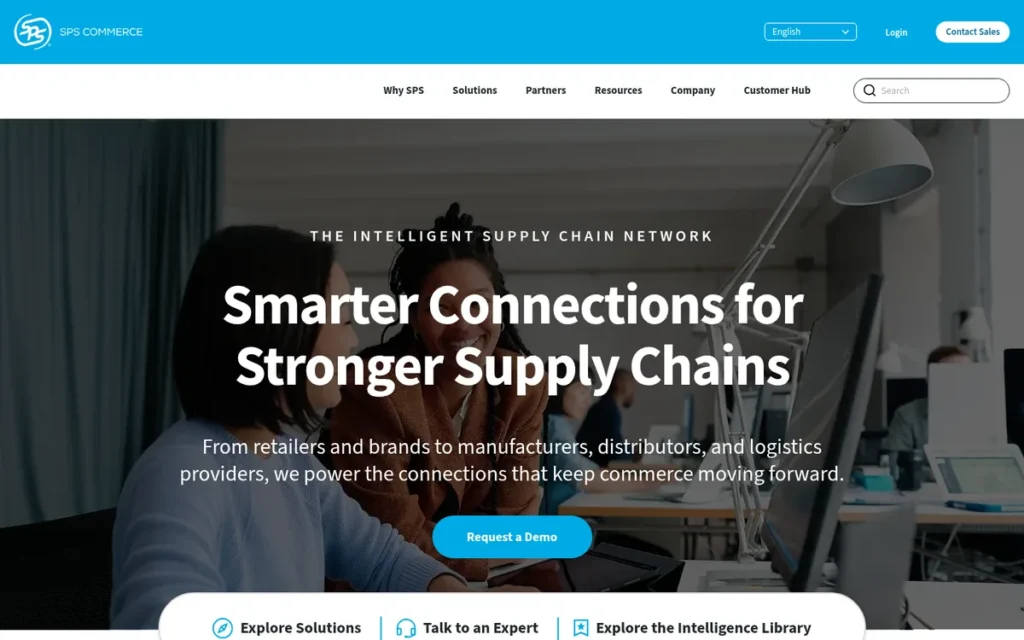
Category: Retail EDI Network, exchanges purchase orders, ship notices and invoices between brands and retailers.
At a Glance
- Category: Retail EDI Network
- Best For: Consumer goods brands of any size whose retailers require EDI and that want a managed provider to handle retailer maps
- Price Range: Capterra lists “starting at $20/month”; otherwise quote-based, scaling with trading partners, document volume and modules
- Primary Strength: SPS Commerce combines managed retail EDI, pre-built retailer maps and ready integrations with major ERPs on one supplier network.
- Biggest Limitation: SPS Commerce does not publish full pricing, and per-partner and per-document fees can push costs up as a brand adds retailers.
- One-Line Summary: SPS Commerce is a publicly traded, full-service retail EDI network that connects consumer goods suppliers to retailers and plugs into NetSuite, Business Central, QuickBooks and SAP.
- Last Verified: November 2026
Overview
SPS Commerce is a full-service retail EDI network for consumer goods brands of any size whose retail customers require EDI. SPS Commerce exchanges documents such as the 850 purchase order, 856 advance ship notice and 810 invoice between those suppliers and their retailers.
SPS Commerce ranks #1 with 3.98 out of 5 on PlugRoute’s six weighted criteria. Its strongest scores are vendor stability (C6 5) and named customer outcomes (C5 4). SPS Commerce would still rank #1 if its C2 score fell to 3.5 (3.88), and pricing transparency is its weakest criterion (C3 2.5).
Key Features
- SPS Commerce provides managed EDI with pre-built retailer maps, so the provider maintains each retailer’s document formats instead of the brand.
- SPS Commerce offers ready integrations with Oracle NetSuite, Microsoft Dynamics 365 Business Central, QuickBooks and SAP.
- SPS Commerce includes point-of-sale and sell-through analytics that show how products perform at retail.
- SPS Commerce supports item and assortment data exchange, plus supplier compliance tools that aim to reduce retailer chargebacks for late or incorrect documents.
- SPS Commerce added European e-invoicing by acquiring TIE Kinetix for about €64.5M (SPS Commerce investor relations, 2025).
Best For
SPS Commerce is best for consumer goods brands that already sell to retailers requiring EDI, or soon will, and that would rather outsource mapping and onboarding than hire an EDI specialist. SPS Commerce is not an ERP; it sits between a brand’s ERP or accounting system and its retail trading partners.
Strengths
- SPS Commerce is the only vendor in this evaluation whose audited SEC filings report on the evaluated product as a standalone business. 2025 revenue was $751.5M, up 18% from $637.8M in 2024 (SPS Commerce Q4 2025 earnings release, February 2026).
- SPS Commerce holds a G2 rating of 4.3/5 across 732 reviews on its Fulfillment EDI listing, with a G2 Grid Leader designation (G2, November 2026). It also holds a Capterra rating of 4.2/5 across 527 reviews (Capterra, November 2026).
- SPS Commerce publishes named customer results, all vendor-published rather than audited (SPS Commerce case studies, accessed November 2026):
- Beyond Meat cut order processing time by 25%, with 70% of orders entered automatically without errors.
- Therabody halved partner onboarding time.
- Mile Marker recovered about $2M in missed revenue.
- SPS Commerce reported its 100th consecutive quarter of revenue growth in Q4 2025, with more than 45,000 recurring-revenue customers (SPS Commerce Q4 2025 earnings release, February 2026).
Limitations
SPS Commerce gives up pricing transparency in exchange for convenience. Full pricing is not published, and per-document fees can raise costs as volume grows, a point made by competitor Orderful (Orderful, 2026).
- Competitors Cleo and Orderful argue that SPS-owned retailer maps can create lock-in. These are competitor claims, not independent findings (Cleo, 2026; Orderful, 2026).
- SPS Commerce support runs through ticket queues, which reviewers and competitors cite as a weakness when retailer onboarding issues are urgent (Capterra review themes, November 2026).
- One commenter described their SPS Commerce experience in strongly negative terms and preferred BSI as “very reasonably priced.” That is one practitioner’s view (r/Odoo, September 2025).
- SPS Commerce cannot remove the need for custom mapping, because retailers use EDI documents such as the 830 planning schedule and 850 purchase order in different ways (r/Odoo, September 2025).
Users on r/acumaticaerp shared their experience:
“Most companies I come across use either sps or true commerce for edi. Generally once configured there isn’t that goes wrong with them, they are pretty sticky solutions.” Posted by u/betamode
Takeaway: SPS Commerce is a dependable default once configured, but the same stickiness that keeps it running makes switching away from it difficult.
Verdict
SPS Commerce is the best-documented retail EDI provider in this evaluation, with audited financials that cover the product itself, named customer results and verified ratings on both G2 and Capterra.
SPS Commerce suits brands that want retailer onboarding handled for them and that run a mainstream ERP. Brands with only a few retailers and tight budgets should compare quotes from lower-cost EDI providers, or those with transparent pricing, before signing.
2. Microsoft Dynamics 365 Business Central: Best Mid-Market ERP for Microsoft-Based Brands
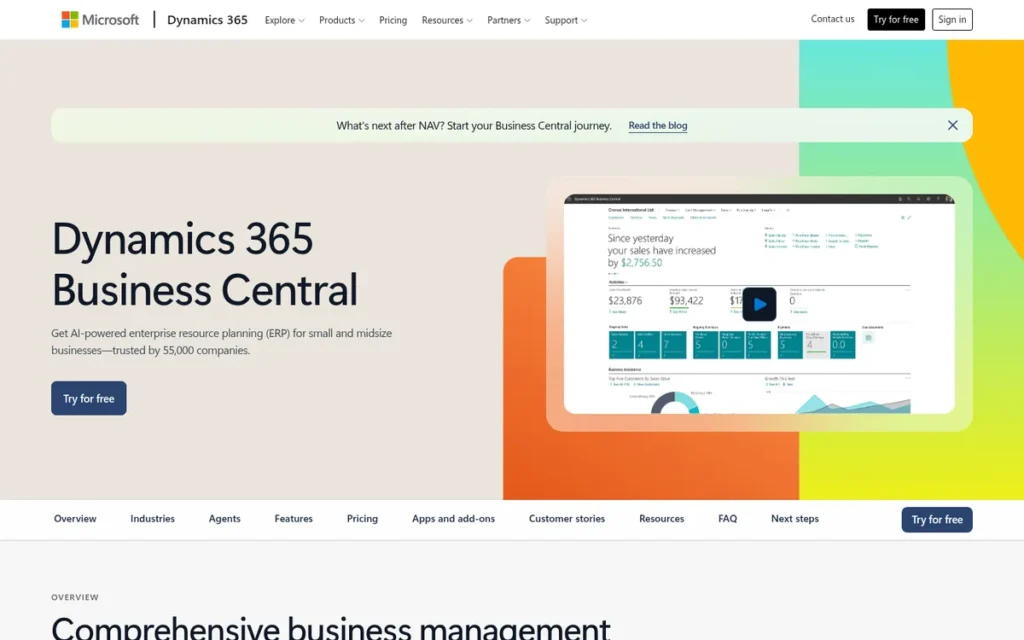
Category: Mid-Market Cloud ERP, one system for finance, inventory, orders and light manufacturing at growing companies.
At a Glance
- Category: Mid-Market Cloud ERP
- Best For: Growing small and midsize consumer goods brands already on Microsoft 365 that want predictable, published license pricing
- Price Range: $80/user/month (Essentials) to $110/user/month (Premium); Team Members $8/user/month; billed annually
- Primary Strength: Microsoft Dynamics 365 Business Central offers published per-user pricing and close integration with Microsoft 365, Power BI and the Power Platform.
- Biggest Limitation: Microsoft Dynamics 365 Business Central handles discrete manufacturing natively but needs third-party add-ons for food process features such as formulas, yields and catch weight.
- One-Line Summary: Microsoft Dynamics 365 Business Central is a mid-market cloud ERP with public per-user pricing that suits Microsoft-based consumer goods brands, with food process features added through Marketplace add-ons.
- Last Verified: November 2026
Overview
Microsoft Dynamics 365 Business Central is a cloud ERP for small and midsize companies. It covers finance, inventory, lot tracking and warehousing, plus production planning in the Premium tier, and it is built for growing consumer goods brands that already run on Microsoft 365.
Microsoft Dynamics 365 Business Central ranks #2 with 3.60 out of 5 on PlugRoute’s six weighted criteria, driven by fully public per-user pricing (C3 5). The C1 capability score of 3 for Microsoft Dynamics 365 Business Central reflects that food process manufacturing requires third-party add-ons.
Key Features
- Microsoft Dynamics 365 Business Central covers finance, inventory, lot and serial tracking, warehousing and assembly bills of materials in both tiers.
- Microsoft Dynamics 365 Business Central Premium adds production bills of materials, routings, material requirements planning (MRP) and capacity planning for discrete manufacturing.
- Microsoft Dynamics 365 Business Central integrates natively with Outlook, Excel, Teams, Power BI and the Power Platform.
- Microsoft Dynamics 365 Business Central extends to food workflows through Microsoft Marketplace add-ons such as Aptean Process Manufacturing and Aptean Product Specification for allergens and nutrition.
- Microsoft Dynamics 365 Business Central includes the Copilot AI assistant, with sales-order and payables agents arriving in 2025–2026 (Microsoft, 2025).
Best For
Microsoft Dynamics 365 Business Central is best for growing multichannel or light-manufacturing consumer goods brands on Microsoft 365 that want to budget license costs from public prices before talking to a partner. Microsoft Dynamics 365 Business Central is sold and implemented through partners rather than by Microsoft directly.
Strengths
- Microsoft Dynamics 365 Business Central publishes per-user prices of $80 (Essentials), $110 (Premium) and $8 (Team Members), effective November 1, 2025. That is the most transparent license pricing of any ERP evaluated (Microsoft, November 2026).
- Microsoft Dynamics 365 Business Central holds a G2 rating of 4.0/5 across 918 reviews on its own G2 product page, and reviewers praise its familiarity for Microsoft users (G2, November 2026).
- Forbes Advisor named Microsoft Dynamics 365 Business Central the Best Overall Cloud ERP Software of 2025 (Forbes Advisor, 2025). Microsoft says Dynamics 365 products overall are trusted by more than 50,000 small and midsize businesses (Microsoft, 2025).
- Microsoft Dynamics 365 Business Central connects natively with Power BI and the Power Platform, so Microsoft-based teams can report and automate without separate integration licenses (Microsoft, November 2026).
Limitations
Microsoft Dynamics 365 Business Central gives up food manufacturing depth in exchange for low, simple licensing. Its manufacturing is built for discrete production, so formulas, yields, catch weight and co-products require third-party add-ons (Flectic, accessed November 2026).
- Microsoft Dynamics 365 Business Central bundles features into two tiers, so buyers pay for modules they may not use. One user estimated their team uses about 10% of the product (r/Dynamics365, accessed November 2026).
- Microsoft Dynamics 365 Business Central scores lower on Capterra for ease of use and customer service, at about 4.1/5 overall. This figure is secondhand (Toollers, accessed November 2026).
- Microsoft Dynamics 365 Business Central outcomes depend heavily on partner quality, because Microsoft does not usually implement it directly.
- Microsoft Dynamics 365 Business Central has no numeric consumer goods outcome data in our research. Microsoft’s Taylor Farms testimonial refers to “Dynamics 365” generally and gives no figures (Microsoft, accessed November 2026).
Users on r/Dynamics365 noted:
“Our current partner is really bad, they outsource consultants from cheap countries and the code I look at sometimes makes me cry. We are in the process of launching a new a call for offers to replace them but finding a replacement won’t be so easy as our guidelines force us to have a local partner and the pool is limited.” Posted by u/Aggravating-Boot-983
Takeaway: Microsoft Dynamics 365 Business Central customers live or die by their implementation partner, and a weak partner is hard to replace once the project is underway.
Verdict
Microsoft Dynamics 365 Business Central is the most transparently priced mid-market ERP in this evaluation and the most natural fit for consumer goods brands already standardized on Microsoft.
Food and beverage makers should budget for process manufacturing add-ons and test them before signing. Every buyer should vet the implementation partner as carefully as the software.
3. Katana Cloud Inventory (Katana MRP): Best for Small Makers Graduating from Spreadsheets
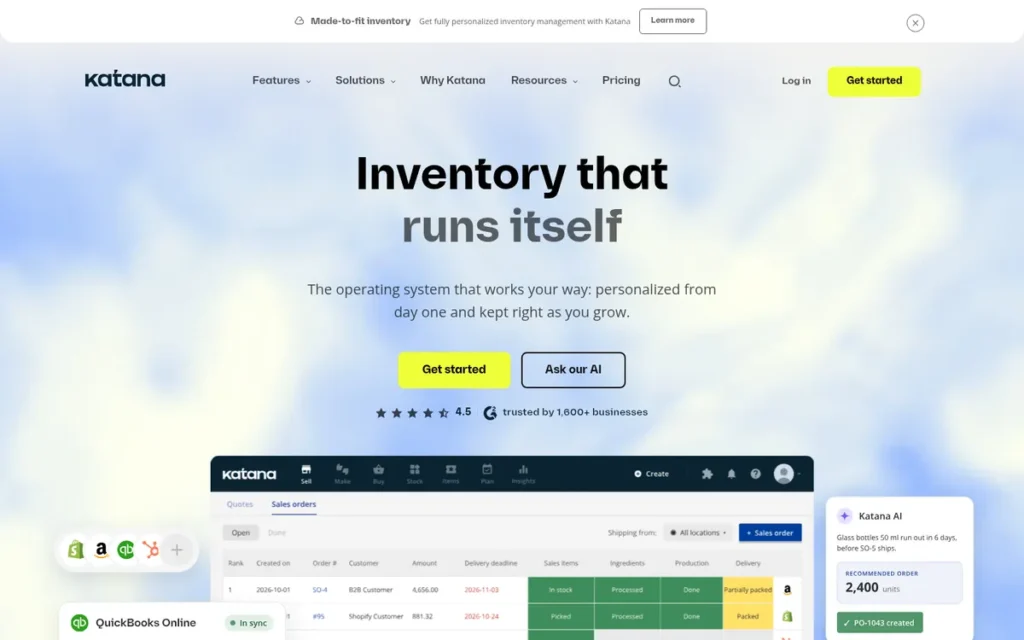
Category: Small-Maker Manufacturing Software (MRP), bills of materials, production and inventory for small brands, used alongside separate accounting software.
At a Glance
- Category: Small-Maker Manufacturing Software (MRP)
- Best For: Small online-first makers on Shopify or Amazon that use QuickBooks or Xero and need bills of materials and production tracking without ERP cost
- Price Range: Free (up to 30 SKUs); Core from $299/month plus usage fees and add-ons; Advantage custom-priced (confirm on the live pricing page)
- Primary Strength: Katana Cloud Inventory connects production, inventory and online sales channels with small-business accounting tools at a published entry price.
- Biggest Limitation: Katana Cloud Inventory is not a full ERP: it has no built-in accounting and no EDI, and complex food production may outgrow it.
- One-Line Summary: Katana Cloud Inventory is cloud manufacturing and inventory software for small online-first makers that links Shopify, Amazon, QuickBooks and Xero with bills of materials and production orders.
- Last Verified: November 2026
Overview
Katana Cloud Inventory is cloud manufacturing and inventory software that manages bills of materials, recipes, manufacturing orders, batch tracking and barcoding. It is built for small, online-first consumer goods makers that are outgrowing spreadsheets but do not yet need a full ERP.
Katana Cloud Inventory ranks #3 with 3.50 out of 5 on PlugRoute’s six weighted criteria, led by the highest verified user rating in the set (C2 4.5). Katana Cloud Inventory’s implementation-risk score of 4 (C4) reflects self-serve deployment, not documented implementation data.
Key Features
- Katana Cloud Inventory manages bills of materials, recipes and manufacturing orders with visual production scheduling.
- Katana Cloud Inventory provides batch and serial tracking, barcoding and a shop-floor app for production staff.
- Katana Cloud Inventory syncs both ways with Shopify, Amazon, WooCommerce and BigCommerce, and Katana is a Shopify Plus certified partner.
- Katana Cloud Inventory integrates with QuickBooks Online and Xero, which remain the system of record for accounting.
- Katana Cloud Inventory’s Core plan includes unlimited SKUs, users and integrations for one location, with usage fees for sales orders and extra locations (Katana, 2026).
Best For
Katana Cloud Inventory is best for small consumer goods makers, roughly under $5M in revenue, that sell mainly online and need to track materials, production and finished goods alongside an existing accounting tool.
Strengths
- Katana Cloud Inventory holds a Capterra rating of 4.6/5 across 171 reviews, the highest verified user rating among the seven products. Capterra ratings are not directly comparable to the G2 ratings cited for other products (Capterra, November 2026).
- Katana Cloud Inventory raised a €35M Series B in 2022 and a €14M extension in 2025 led by Cogito Capital Partners, bringing total funding above €60M (Katana newsroom, 2025).
- Katana Cloud Inventory reports more than 1,500 customer companies in 70 countries processing over $3B in annual gross merchandise value. This is a company claim (Katana, 2025).
- Katana Cloud Inventory users on the Xero App Store say the Xero integration “streamlines our entire manufacturing process” (Xero App Store, accessed November 2026).
Limitations
Katana Cloud Inventory gives up breadth in exchange for affordability and simplicity. It has no built-in accounting, so brands depend on a working sync with QuickBooks Online or Xero.
- Katana Cloud Inventory is not designed as an EDI tool, so selling to retailers that require EDI means adding a separate provider.
- Katana Cloud Inventory’s Core plan covers one location, so brands using a 3PL or co-packer pay extra for additional locations (Katana, 2026).
- Katana Cloud Inventory may be outgrown by food makers with variable yields, co-products or quality holds. This point comes from Cin7, a competitor (Cin7, accessed November 2026).
- Katana Cloud Inventory’s total cost is hard to predict:
- One reviewer’s annual cost rose from $1,188 to $2,148 after plan changes (Xero App Store, accessed November 2026).
- A 2024 Katana pricing PDF listed different tiers, from $179 to $1,799 per month (Katana, 2024).
- Katana Cloud Inventory’s G2 rating of 4.4/5 is reported by Katana and has not been confirmed independently (Katana, 2026).
Verdict
Katana Cloud Inventory holds the highest verified user rating in this evaluation (Capterra 4.6/5, 171 reviews, November 2026) and is the only small-maker MRP evaluated.
Katana Cloud Inventory works best paired with QuickBooks or Xero, with EDI added only when retailers require it. Brands with complex food production or many retailers should plan for an eventual move to a full ERP.
4. Oracle NetSuite: Best Unified Cloud ERP for Growing Multichannel and Multi-Entity Brands
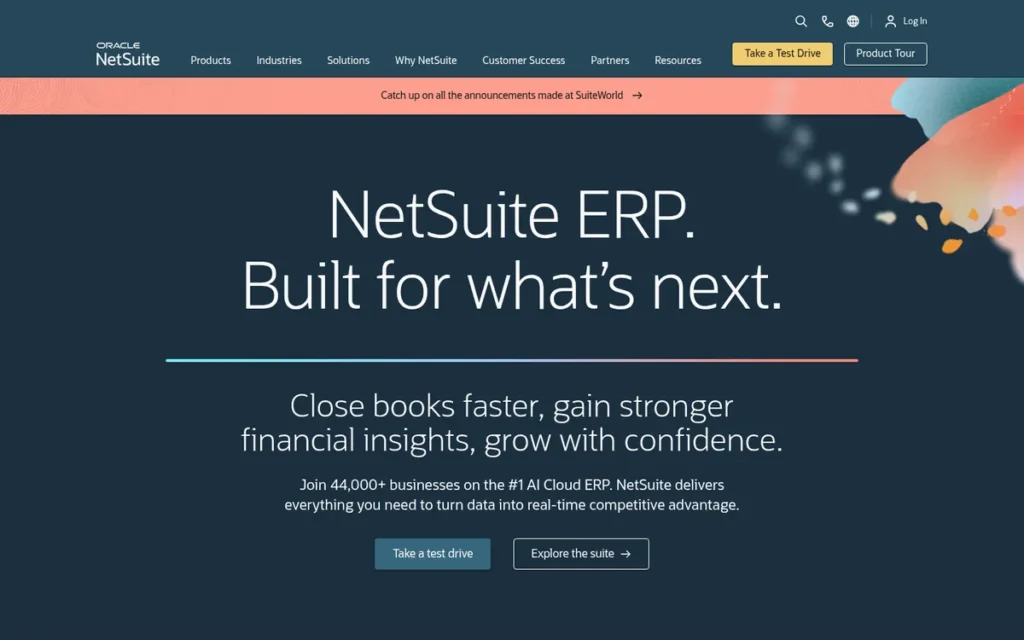
Category: Mid-Market Cloud ERP.
At a Glance
- Category: Mid-Market Cloud ERP
- Best For: Growing multichannel consumer goods brands, especially those with multiple entities, distribution or light assembly
- Price Range: Quote-only; third-party estimates of about $23,900–$35,900/year for 10 users, plus implementation of about $25,000–$250,000 depending on company size
- Primary Strength: Oracle NetSuite combines finance, inventory, demand planning, warehousing and multi-company accounting in one cloud ERP.
- Biggest Limitation: Oracle NetSuite’s quote-only pricing, implementation cost and limited food process depth often push small teams toward add-ons or lighter tools.
- One-Line Summary: Oracle NetSuite is the most-reviewed product in this evaluation (5,238 G2 reviews across all industries, November 2026), offering broad unified cloud ERP functionality at a total cost that small teams often find hard to justify.
- Last Verified: November 2026
Overview
Oracle NetSuite is a cloud ERP that brings together finance, inventory, lot tracking, manufacturing work orders, demand planning, warehouse management and multi-company accounting. It is built for growing and mid-market consumer goods brands that sell through several channels.
Oracle NetSuite ranks #4 with 3.25 out of 5 on PlugRoute’s six weighted criteria. It ties Aptean Food & Beverage ERP and ranks higher on the C2 tie-break (4 vs. 3). Oracle NetSuite’s documented-outcomes score is 1 (C5) because we found no verified consumer goods results.
Key Features
- Oracle NetSuite covers finance, inventory, lot and serial tracking, bills of materials, routings, work orders and work in progress in one cloud system.
- Oracle NetSuite OneWorld handles multi-company and multi-subsidiary accounting for brands with several entities or regions.
- Oracle NetSuite includes demand planning and warehouse management modules.
- Oracle NetSuite offers SuiteSuccess for Consumer Goods as a preconfigured industry starting point.
- Oracle NetSuite connects to retailers through EDI partners such as SPS Commerce, TrueCommerce, Celigo and Boomi rather than a single built-in EDI service (Rand Group, accessed November 2026).
Best For
Oracle NetSuite is best for growing consumer goods brands with multiple sales channels, multiple entities or distribution-heavy operations that want one cloud system and can pay for a partner-led implementation. Oracle NetSuite is strongest in distribution, light assembly and multi-entity finance, and weaker in food process manufacturing.
Strengths
- Oracle NetSuite holds a G2 rating of 4.1/5 across 5,238 reviews from all industries, the largest review base in this evaluation. Reviewers praise its breadth, multi-company accounting and dashboards (G2, November 2026).
- Oracle NetSuite has run as a cloud-native ERP since its 1998 founding as NetLedger, longer than any other ERP in this evaluation, and Oracle acquired it in 2016 for about $9.3B.
- Oracle NetSuite is positioned for growing and mid-market consumer goods companies in ERP Research’s independent FMCG comparison (ERP Research, accessed November 2026).
- Oracle NetSuite’s SuiteCloud platform allows extensive customization, and its 2025–2026 releases add AI task agents and an AI marketplace (Houseblend, 2026).
Limitations
Oracle NetSuite gives up affordability for small teams in exchange for breadth. One practitioner with “maybe 5-7 users max” reported a quote of “around 100k to just implement,” about $30,000 a year in licensing and a $15,000 integration license (r/Netsuite, May 2026).
- Some practitioners distrust Oracle NetSuite’s own professional services team on inventory-heavy projects, which makes partner choice a major risk (r/Netsuite, May 2026).
- Oracle NetSuite’s food features, such as recipes, co-products, catch weight, allergens and quality holds, may require third-party applications (NetSuite implementation resources, accessed November 2026).
- Oracle NetSuite reviewers cite complex reporting, customization cost and price increases at renewal (G2, November 2026).
- Oracle NetSuite had no consumer goods case study with named, verifiable percentage results in our research.
This aligns with community sentiment on r/Netsuite:
“NetSuite has a problem with their suite success being essentially a self implementation and causes a lot of failed implementations. They also tend to raise prices slot year over year from what I have seen
Product is solid though if your, multi entity or multi currency, lots of languages.
Lot of pros and lot of cons” Posted by u/ERP-Advisor
Takeaway: Oracle NetSuite is strong for multi-entity and multi-currency operations, but SuiteSuccess implementations that leave customers to do much of the work themselves, plus price increases every year, are real risks buyers need to plan for.
Verdict
Oracle NetSuite is the broadest unified cloud ERP evaluated for growing multichannel consumer goods brands, but its total cost is hard to justify for teams of fewer than about ten users.
Oracle NetSuite fits best when multi-entity accounting and multichannel breadth are the priority. Buyers should scope by module, choose an independent partner carefully and budget for EDI and food add-ons.
5. Aptean Food & Beverage ERP: Best for Food and Beverage Process Manufacturing and Lot Traceability
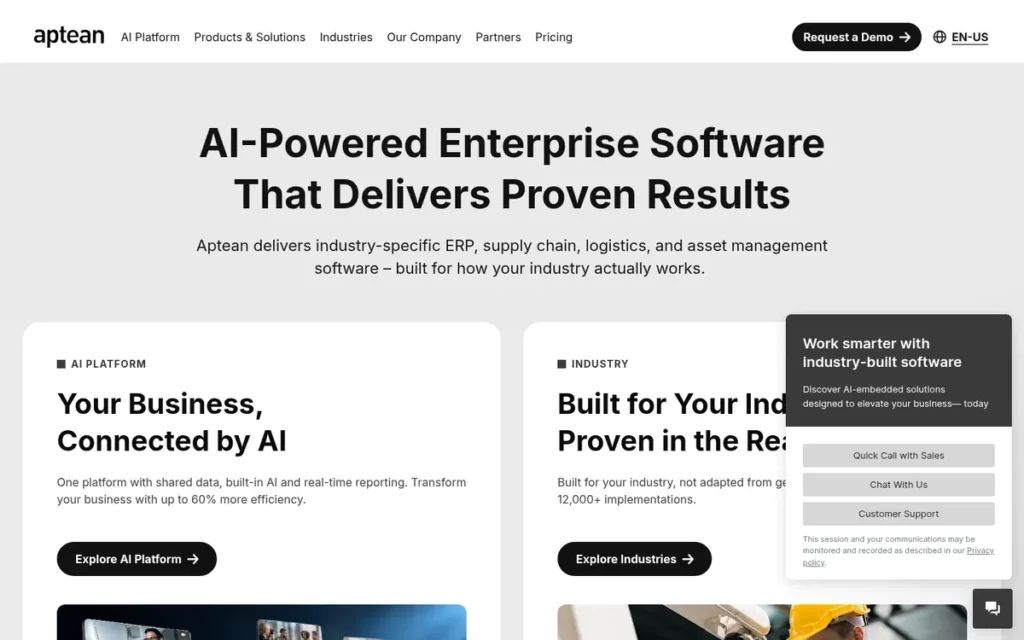
Category: Food & Beverage Process ERP, ERP built for recipes, yields, catch weight, allergens, shelf life and lot recall.
At a Glance
- Category: Food & Beverage Process ERP
- Best For: Small and mid-sized food and beverage manufacturers that need native recipe management, lot traceability and recall without assembling add-ons
- Price Range: Quote-only; third-party implementation estimate of about $50,000–$250,000+, plus Business Central licenses of $80–$110/user/month for the flagship edition
- Primary Strength: Aptean Food & Beverage ERP offers the most food-specific out-of-the-box features (catch weight, allergens, FEFO picking, recall) for small and mid-sized food makers in this evaluation.
- Biggest Limitation: Aptean Food & Beverage ERP has a small independent review base, quote-only pricing and reviewer complaints about slow support and performance.
- One-Line Summary: Aptean Food & Beverage ERP is a food-specific ERP, largely built on Microsoft Business Central, that gives food and beverage makers native process manufacturing, traceability and recall features.
- Last Verified: November 2026
Overview
Aptean Food & Beverage ERP is a food-specific ERP with native recipes, yields, co-products, catch weight, shelf-life management, allergen controls and lot recall. It is built for food and beverage manufacturers that want process manufacturing without adding extensions to a generic ERP.
Aptean Food & Beverage ERP ranks #5 with 3.25 out of 5 on PlugRoute’s six weighted criteria, tied with Oracle NetSuite but lower on the C2 tie-break. Aptean Food & Beverage ERP’s C2 score is capped at 3 because it has fewer than 100 G2 reviews, not because reviewers rate it poorly.
Key Features
- Aptean Food & Beverage ERP manages recipes, formulas, yields and co-products for process manufacturing.
- Aptean Food & Beverage ERP provides lot tracing and recall tools that support food traceability requirements.
- Aptean Food & Beverage ERP handles catch weight, shelf life and first-expiry-first-out (FEFO) picking.
- Aptean Food & Beverage ERP includes allergen management, quality checks and EDI capability.
- Aptean Food & Beverage ERP comes preconfigured for ingredients, meat, seafood, dairy, bakery, prepared foods, produce and beverages. Aptean Express offers a fixed-scope implementation based on templates.
Best For
Aptean Food & Beverage ERP is best for food and beverage manufacturers whose biggest risks are traceability, recall readiness and recipe costing. Aptean Food & Beverage ERP’s flagship edition runs on Microsoft Dynamics 365 Business Central, and a separate Process Edition traces back to Ross ERP.
Strengths
- Aptean Food & Beverage ERP includes recipe management, catch weight, allergens, shelf life and recall natively. The general-purpose ERPs in this evaluation need add-ons or workarounds to match them.
- Aptean Food & Beverage ERP holds a G2 rating of 4.0/5 across about 50 reviews, with praise for ease of use, real-time inventory and traceability (G2, November 2026). Reviewers on Capterra and TrustRadius also mention traceability and production cost analysis, though ratings there were not confirmed.
- Aptean lists the Frost & Sullivan 2026 Global Technology Innovation Leadership recognition and the Food Logistics / SDCE Top Software & Technology 2024 award on its awards page (Aptean, 2026).
- Aptean reports serving more than 10,000 customers in more than 80 countries across all its product lines (TA Associates, accessed November 2026).
Limitations
Aptean Food & Beverage ERP gives up independent evidence in exchange for food depth. About 50 G2 reviews make a much thinner independent record than the larger ERPs have, and its Capterra rating could not be confirmed (G2, November 2026).
- Aptean Food & Beverage ERP reviewers cite slow support, unclear impact of updates, slow performance on large data sets and dashboards that are hard to customize (G2, November 2026).
- Aptean Food & Beverage ERP rollouts are described as rocky or lengthy by some reviewers despite the Express method (G2, November 2026).
- Aptean Food & Beverage ERP pricing is quote-only. Teardown.ai estimates implementations across Aptean products at about $50,000–$250,000+ (Teardown.ai, accessed November 2026).
- Aptean Food & Beverage ERP’s customer evidence consists of vendor-published testimonials without figures from Tony’s Chocolonely, Pizza Joe’s and GA Foods (Aptean, accessed November 2026).
- Aptean grew through many acquisitions under private-equity ownership. Buyers should check how fragmented the product line is, but this is a question to investigate, not a proven problem.
Verdict
Aptean Food & Beverage ERP offers the most food-specific out-of-the-box features in this evaluation, including catch weight, allergens, FEFO picking and recall, for small and mid-sized food makers.
Aptean Food & Beverage ERP fits food and beverage makers that would rather buy food capability ready-made than build it from add-ons. Buyers should run a scripted recall test, check support response commitments and ask for references in their own food segment.
6. SAP S/4HANA Cloud: Best Enterprise ERP for Multinational Consumer Goods Complexity
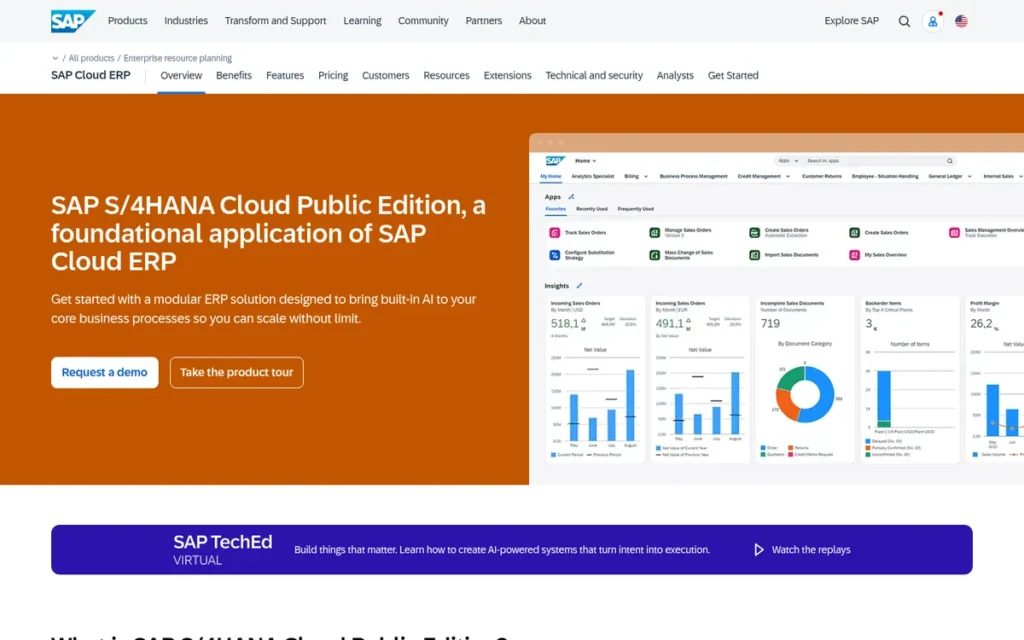
Category: Enterprise ERP, the financial, manufacturing and supply chain backbone for multinationals with many legal entities.
At a Glance
- Category: Enterprise ERP
- Best For: Large and multinational consumer goods manufacturers with multi-country, multi-entity operations, including companies migrating off SAP ECC
- Price Range: Quote-only; priced in full use equivalents (FUEs), with a 15-user minimum for GROW with SAP; no public dollar price
- Primary Strength: SAP S/4HANA Cloud offers the broadest native process manufacturing, batch and global localization coverage for multi-country operations in this evaluation.
- Biggest Limitation: SAP S/4HANA Cloud carries the highest implementation risk and the least pricing transparency of any product evaluated.
- One-Line Summary: SAP S/4HANA Cloud is the enterprise ERP that ERP Research’s FMCG comparison ranks first for large food and consumer goods multinationals. It combines deep process manufacturing with the highest cost and implementation risk in this evaluation.
- Last Verified: November 2026
Overview
SAP S/4HANA Cloud is an enterprise ERP with native process manufacturing, batch management, shelf-life controls and lot traceability. It is built for large and multinational consumer goods companies that need global localization across many countries and legal entities.
SAP S/4HANA Cloud ranks #6 with 3.20 out of 5 on PlugRoute’s six weighted criteria. SAP S/4HANA Cloud scores 5 on capability (C1) but 1 on pricing transparency (C3), implementation risk (C4) and documented outcomes (C5).
Key Features
- SAP S/4HANA Cloud handles process manufacturing natively, including recipes, process orders, co-products and by-products.
- SAP S/4HANA Cloud provides batch management, shelf-life controls and lot traceability.
- SAP S/4HANA Cloud extends to SAP Integrated Business Planning and SAP Trade Management for demand planning, sales and operations planning, promotions, accruals and deductions.
- SAP S/4HANA Cloud comes as a standardized Public Edition, including GROW with SAP for midsize companies, and a more customizable Private Edition through RISE with SAP.
- SAP S/4HANA Cloud includes the Joule AI assistant and connects to SAP Business Data Cloud to combine SAP and non-SAP data.
Best For
SAP S/4HANA Cloud is best for multinational consumer goods manufacturers with complex supply chains and budgets for systems integrators. SAP S/4HANA Cloud is also the natural path for SAP ECC customers facing the end of mainstream maintenance in 2027.
Strengths
- SAP S/4HANA Cloud is ranked first for large food and consumer goods multinationals in ERP Research’s independent FMCG comparison (ERP Research, accessed November 2026).
- SAP S/4HANA Cloud holds a G2 rating of 4.2/5 across 953 reviews on the SAP Cloud ERP listing, which may cover more than S/4HANA Cloud (G2, November 2026). That is the highest G2 average among the ERPs evaluated.
- SAP S/4HANA Cloud supports process manufacturing, batch management and shelf-life controls natively, without the add-ons that mid-market ERPs need.
- SAP S/4HANA Cloud is the only ERP in this evaluation with a trade promotion module from the same vendor, SAP Trade Management.
Limitations
SAP S/4HANA Cloud gives up cost predictability and takes on delivery risk in exchange for depth. SAP publishes no dollar price per FUE, and total cost usually includes several additional SAP products plus systems integrators (SAP service description guide, 2025).
- SAP projects have failed in the retail and consumer goods sector before. Lidl abandoned an SAP merchandise-management project in 2018 after about 7 years and roughly €500M (Intent Solutions, accessed November 2026).
- Revlon disclosed a material weakness and about $64M in unfulfilled shipments after its February 2018 SAP go-live (Revlon 2018 Form 10-K, filed March 2019).
- SAP S/4HANA Cloud reviewers consistently cite cost, complexity, a steep learning curve and dependence on consultants (G2, November 2026).
- SAP S/4HANA Cloud’s outcome data in our research consists only of vendor claims, including a claimed 40–60% cut in implementation cost for Public Edition (SAP, 2026).
Verdict
SAP S/4HANA Cloud offers the broadest enterprise ERP coverage for multinational consumer goods complexity in this evaluation, and also the highest risk and least transparent pricing.
SAP S/4HANA Cloud fits companies whose scale justifies a multi-year program with a strong integrator and a change-management budget. Growing brands below multinational scale will usually get value faster from a mid-market ERP.
7. Salesforce Consumer Goods Cloud: Best for Trade Promotion, Field Sales and Retail
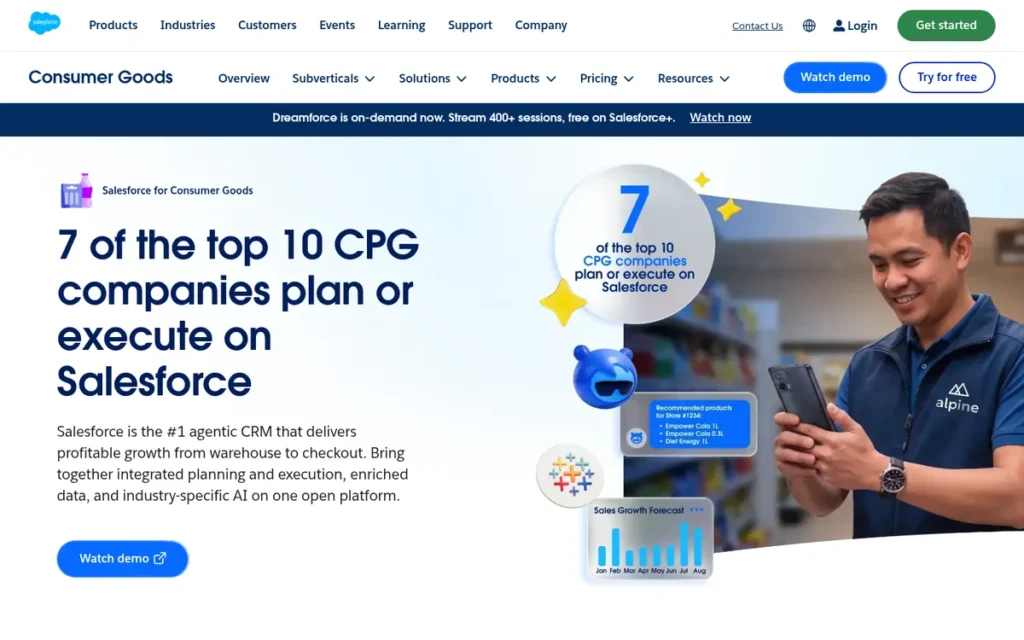
Category: Commercial Execution & Trade Promotion, field sales, retail execution and trade spend management that connects to an ERP rather than replacing it.
At a Glance
- Category: Commercial Execution & Trade Promotion
- Best For: Mid-sized to multinational consumer goods brands with significant trade spend, key accounts and field sales teams
- Price Range: $100/user/month (Retail Execution Merchandiser) to $275/user/month (Sales Core); trade promotion management quote-only; billed annually
- Primary Strength: Salesforce Consumer Goods Cloud is the only platform evaluated that combines trade promotion management, retail execution, key account planning and distributor operations.
- Biggest Limitation: Salesforce Consumer Goods Cloud has only a small, unconfirmed independent rating sample (Gartner Peer Insights 3.8/5, 22 reviews), quote-only trade promotion pricing and heavy dependence on systems integrators.
- One-Line Summary: Salesforce Consumer Goods Cloud is a CRM-based commercial execution platform that combines trade promotion, field sales and retail execution for consumer goods brands, and it must be paired with a separate ERP.
- Last Verified: November 2026
Overview
Salesforce Consumer Goods Cloud is an industry CRM platform that combines trade promotion management, store visits and retail execution, key account planning, distributor operations and customer service. It is built for consumer goods brands with significant trade spend and field sales teams.
Salesforce Consumer Goods Cloud ranks #7 with 3.20 out of 5 on PlugRoute’s six weighted criteria. It ties SAP S/4HANA Cloud and ranks lower on the C2 tie-break. Salesforce Consumer Goods Cloud’s rank reflects a thin, unconfirmed rating sample (C2 2.5), not weak capability (C1 4).
Key Features
- Salesforce Consumer Goods Cloud supports store visit planning, routing, audits and photo and planogram compliance for field reps.
- Salesforce Consumer Goods Cloud provides an offline mobile app that shows exact promotion pricing in the store.
- Salesforce Consumer Goods Cloud includes trade promotion management for funds, claims and deductions.
- Salesforce Consumer Goods Cloud covers key account planning, distributor operations and customer service.
- Salesforce Consumer Goods Cloud adds Agentforce AI agents, including a Trade Promotion Management Agent and a Visit Assistant.
Best For
Salesforce Consumer Goods Cloud is best for consumer goods brands whose biggest operational problem is trade spend, key account relationships or field execution. Salesforce Consumer Goods Cloud does not replace an ERP; it connects to one for financial and inventory data.
Strengths
- Salesforce Consumer Goods Cloud is the only product evaluated that combines trade promotion management, retail execution and distributor operations on one platform.
- Salesforce Consumer Goods Cloud was recognized in the Promotion Optimization Institute 2026 Vendor Panorama for combining CRM, trade promotion, data and AI agents. The source is an excerpt published by Salesforce, and Salesforce’s own recognition counts conflict (Salesforce, 2026).
- Salesforce Consumer Goods Cloud publishes per-user prices for its retail execution and core tiers, so buyers have more to budget from than with quote-only competitors (Salesforce, November 2026).
- Salesforce Consumer Goods Cloud has been generally available since October 15, 2019, and it now includes Agentforce trade promotion and visit agents (Salesforce, 2019; Salesforce, 2026).
Limitations
Salesforce Consumer Goods Cloud gives up independent proof in exchange for platform breadth. The only product-specific rating we found is 3.8/5 across 22 Gartner Peer Insights reviews (Gartner Peer Insights, November 2026). The sample is small, and PlugRoute has not yet confirmed it directly.
- Salesforce Consumer Goods Cloud’s consumer goods outcome data is limited to Salesforce’s own claims, including a “31% faster resolution time” figure and L’Oréal and Casper examples (Salesforce, accessed November 2026).
- Salesforce Consumer Goods Cloud’s trade promotion pricing is quote-only, and implementation usually depends on a systems integrator.
- Salesforce Consumer Goods Cloud must be integrated with a separate ERP, which adds integration scope and cost.
- Smaller brands that only need store visits or simple promotions may get value faster from Repsly, Vividly or Pepperi, which we did not evaluate at full depth.
Verdict
Salesforce Consumer Goods Cloud is the only platform in this evaluation that combines trade promotion, retail execution and key account management for consumer goods brands, but its independent rating sample is small and unconfirmed.
Salesforce Consumer Goods Cloud fits mid-sized and larger brands with significant trade spend and an established ERP. Smaller brands should compare dedicated trade promotion and retail execution tools first.
What Does Consumer Goods Software Really Cost in 2026?
Consumer goods software usually costs far more than the license price. For a mid-market ERP such as Oracle NetSuite, implementation alone runs about 1.5–2× the annual subscription (Rand Group, accessed November 2026). Add-ons, integration licenses and EDI fees come on top of that. Panorama Consulting reported a median ERP project cost of $450,000 (Panorama Consulting, 2024).
How transparent is each product’s pricing?
- Microsoft Dynamics 365 Business Central publishes $80 (Essentials), $110 (Premium) and $8 (Team Members) per user per month, billed annually. Prices rose from $70 and $100 on November 1, 2025 (Microsoft, November 2026).
- Katana Cloud Inventory lists a free plan for up to 30 SKUs, a Core plan from $299 per month plus usage fees, and a custom-priced Advantage plan (Katana, November 2026).
- Salesforce Consumer Goods Cloud publishes per-user monthly prices, but trade promotion management is quote-only (Salesforce, November 2026):
- Retail Execution Merchandiser: $100.
- Sales Core and Service Core: $275 each.
- Service Advanced: $450.
- Service Max: $700.
- SPS Commerce is listed at “starting at $20 per month” and is otherwise quote-based (Capterra, November 2026).
- Oracle NetSuite is quote-only. Third-party estimates put it at about $23,900–$35,900 per year for 10 users and $98,300–$187,000 for 50 users (Accounting.Events, AlphaBOLD and Rand Group, accessed November 2026).
- Aptean Food & Beverage ERP is quote-only. Its flagship edition also requires Microsoft Business Central licenses at $80–$110 per user per month.
- SAP S/4HANA Cloud is quote-only and priced in FUEs, where 1 FUE equals 1 advanced user, 5 core users, 30 self-service users or 0.5 developer users (SAP service description guide, 2025).
What should a total cost model include?
- A total cost model should include the software license or subscription for each user tier.
- Implementation by a partner or systems integrator often costs 1.5–2× the annual subscription for a mid-market ERP such as Oracle NetSuite (Rand Group, accessed November 2026).
- Industry add-ons, such as food process manufacturing extensions for Microsoft Dynamics 365 Business Central, carry their own license fees.
- Integration licenses can add five figures a year. One Oracle NetSuite practitioner reported a $15,000 integration license (r/Netsuite, May 2026).
- EDI providers such as SPS Commerce typically charge fees that scale with trading partners and document volume.
A 10-user Oracle NetSuite subscription estimated at about $30,000 per year implies roughly $45,000–$60,000 for implementation in year one, before EDI and integrations (Rand Group and Accounting.Events, accessed November 2026).
Trade promotion can cost more than the software stack itself. A $50M consumer goods brand that spends about 20% of revenue on trade promotion commits about $10M a year. McKinsey, citing 2016 Nielsen research, reports that 59% of promotions lose money globally (McKinsey, 2019).
How long do ERP projects take?
- Panorama Consulting reported a median ERP project duration of 15.5 months (Panorama Consulting, 2024).
- Panorama Consulting reported a median duration of 9 months in its most recent reports, with data problems the top cause of delays (Panorama Consulting, 2025 and 2026).
What Does a Realistic Consumer Goods Software Stack Look Like?
A realistic consumer goods stack combines products from several categories instead of relying on one vendor. Small makers usually pair an MRP with accounting software. Growing brands pair a mid-market ERP with an EDI network. Brands with significant trade spend add a commercial execution platform on top. The three example shortlists below show how this works by company size.
Example Shortlist #1: An $8M snack brand on Shopify landing its first big-box retailer
- Katana Cloud Inventory fits if production is simple. Microsoft Dynamics 365 Business Central fits if revenue growth and a rising retailer count point toward a full ERP.
- QuickBooks Online or Xero handles accounting if the brand chooses Katana Cloud Inventory.
- SPS Commerce or another EDI provider is needed because the big-box retailer requires EDI.
Example Shortlist #2: A $60M beverage maker with three legal entities
- Oracle NetSuite fits if multi-entity accounting through OneWorld is the top priority.
- Aptean Food & Beverage ERP fits if recipe costing, lot traceability and recall are the top priority.
- SPS Commerce handles retailer document exchange and connects to both ERPs.
- Salesforce Consumer Goods Cloud, or a lighter trade promotion tool, handles accounts, promotions and store visits.
Example Shortlist #3: A multinational migrating off SAP ECC before 2027
- SAP S/4HANA Cloud handles finance, manufacturing and supply chain.
- SAP Integrated Business Planning and SAP Trade Management handle planning and promotions.
- An EDI network handles retailer document exchange, and a 5–10-year total cost model covers integrators and managed services.
Decide which system owns item, customer and inventory master data before you integrate anything. Panorama Consulting names data problems as the top cause of ERP project delays (Panorama Consulting, 2025).
When Should a Small Maker Move from Katana Cloud Inventory to a Full ERP?
A small maker should consider moving from Katana Cloud Inventory to a full ERP when operations outgrow a single location, a single accounting sync and simple recipes. The four triggers below appear repeatedly in PlugRoute’s research. Two or more of them together usually justify an ERP evaluation.
- Katana Cloud Inventory’s Core plan covers one location, so adding warehouses, 3PLs or co-packers raises cost and complexity.
- Retailers that require EDI are multiplying, and each one adds mapping and compliance work outside Katana Cloud Inventory.
- Variable-yield recipes, co-products or quality holds need process manufacturing depth that a food ERP such as Aptean Food & Beverage ERP provides natively.
- Accounting sync errors between Katana Cloud Inventory and QuickBooks or Xero keep recurring at month-end close.
What Red Flags Should I Watch For When Evaluating Consumer Goods Software?
The main red flags when evaluating consumer goods software are signs that total cost or risk will be higher than the sales process suggests. PlugRoute’s research found six recurring warning signs. They involve implementation quotes, integration fees, bundled tiers, vendor-run projects, unverified results and EDI map ownership.
Red Flag #1: Six-Figure Implementation Quotes for Small Teams
A six-figure implementation quote for a team of fewer than ten users suggests the system or its scope is oversized. One Oracle NetSuite practitioner reported about $100,000 to implement for 5–7 users, and commenters suggested lighter tools (r/Netsuite, May 2026).
Red Flag #2: Separate Integration License Fees
Integration license fees listed separately from the core subscription can add substantially to annual cost. A NetSuite practitioner who received a $100,000 implementation quote for 5–7 users also reported a $15,000 integration license on top of about $30,000 a year in licensing (r/Netsuite, May 2026).
Red Flag #3: Bundled Tiers You Will Mostly Not Use
Bundled license tiers can mean paying for capability your team never uses. One Microsoft Dynamics 365 Business Central user estimated their team uses about 10% of the product, and another said buyers now purchase “a bunch of modules they would never select” (r/Dynamics365, accessed November 2026).
Red Flag #4: Vendor-Run Implementation for Inventory-Heavy Projects
A vendor’s own implementation team is not automatically the safest choice for inventory-heavy projects. Practitioners described NetSuite Professional Services as “generally bad when inventory is involved,” so vet every implementer on reference projects similar to yours (r/Netsuite, May 2026).
Red Flag #5: Results Without Stated Baselines
Customer results published without baselines or independent verification should be treated as claims, not evidence. SPS Commerce was the only vendor in this evaluation with named consumer goods results with specific percentages in PlugRoute’s research, and even those are vendor-published rather than audited.
Red Flag #6: EDI Maps You Do Not Control
EDI maps owned by the provider can make switching providers expensive. Competitors Cleo and Orderful argue that SPS-owned retailer maps create lock-in (Cleo, 2026; Orderful, 2026), so ask any EDI provider who owns the maps and whether you can export them.
What Questions Should I Ask Before Choosing Consumer Goods Software?
Before choosing consumer goods software, ask the seven questions below to separate real fit from sales positioning. They cover master data, recall testing, five-year cost, references, EDI fees, partner track record and renewal terms. Each answer should be specific, itemized and confirmable by a customer of your size.
Question #1: Which system will own item, customer and inventory master data?
Master data ownership determines how cleanly your ERP, EDI network and commercial execution platform will integrate. Expect one named system of record for each data type, because Panorama Consulting identifies data problems as the top cause of ERP delays (Panorama Consulting, 2025).
Question #2: Can you run our scripted recall test live?
A live recall test shows whether lot traceability works natively or depends on add-ons. The FDA’s FSMA 204 rule takes effect July 20, 2028 (FDA, 2025). It requires firms handling foods on the Food Traceability List to record Critical Tracking Events and Key Data Elements.
As one user on r/ERPNext_Solution described:
“I ended up downloading ERPNext and messing around with it to figure out the capabilities, much the same way I played with live demos of other systems we were looking into. I even built a customization to do catchweights sanely just to prove it could do it (other systems said they could but then there would be a record scratch moment the second I got access to a live demo).” Posted by u/webhick666
Takeaway: Food ERP vendor claims about features such as catch weight often fall apart in hands-on demos, so buyers should insist on testing with their own data before signing.
Question #3: What is the five-year total cost, including implementation, add-ons, integrations and EDI?
A five-year total cost figure exposes the gap between license price and actual spend. Look for an itemized answer. As a cross-check, Rand Group estimates NetSuite implementation at 1.5–2× the annual subscription (Rand Group, accessed November 2026), and SAP buyers should model 5–10 years.
Question #4: Which named customers in our segment and size can we call?
Reference customers of your size and product type are the closest thing to independent outcome evidence in this category. Ask for customers who went live within the past two years and can describe implementation effort, partner quality and support after go-live.
Question #5: How are EDI fees charged per trading partner and per document?
The EDI fee model decides whether costs rise gently or sharply as you add retailers. Request a quote modeled on your actual retailer count and monthly document volume, and confirm who owns each retailer map and whether you can export it.
Users on r/acumaticaerp noted:
“This is a great write up. An additional thing I would add – does your order volume necessitate EDI. Lots of companies think they need to start with EDI but if you’re only getting 10 orders a month, maybe not the first thing to focus on.” Posted by u/Bizdatastack
Takeaway: Consumer goods brands with low order volume often buy full EDI before they need it, so they should match EDI spend to actual retailer volume.
Question #6: Which implementation partner will run the project, and which similar projects has that partner delivered?
Partner quality is the implementation risk practitioners name most often, especially for Microsoft Dynamics 365 Business Central and Oracle NetSuite. Ask for the named project lead and two comparable consumer goods go-lives, and confirm that the partner, not only the vendor, stands behind the scope.
Question #7: How will pricing change at renewal or when we change plans?
Renewal and plan-change terms determine whether year-three costs match year-one quotes. G2 reviewers cite Oracle NetSuite price increases at renewal (G2, November 2026), and one Katana Cloud Inventory reviewer’s annual cost rose from $1,188 to $2,148 (Xero App Store, accessed November 2026).
How Did We Rank These Consumer Goods Software Tools?
PlugRoute scored each product from 1 to 5 on six weighted criteria using dated research data, then ranked products by weighted total. The seven products do different primary jobs and rarely substitute for one another. Rank therefore reflects how strong and verifiable the evidence is within each product’s own job, not whether one product can replace another.
PlugRoute has no affiliate relationships with any company listed, and rankings are determined entirely by research data and objective evaluation criteria.
What criteria and weights did PlugRoute use?
- C1 Job-Fit Capability Depth (25%) measures how completely each product handles its own job natively, with deductions for required add-ons. This criterion matters because buying the wrong type of system is the reader’s top risk.
- C2 Verified Independent User Ratings (20%) uses G2, Capterra and Gartner Peer Insights averages. Fewer than 100 reviews caps the score at 3, secondhand or unconfirmed figures lose 0.5, and a missing rating scores 1.
- C3 Pricing Transparency and TCO Clarity (15%) scores from 5 (full public pricing) down to 1 (quote-only with no reliable estimate). This criterion matters because hidden total cost is where buyers lose the most money.
- C4 Implementation Risk and Partner Dependence (15%) draws on documented failures, practitioner quotes and reviewer complaints, and a higher score means lower risk. Gartner projects that more than 70% of recent ERP projects will not fully meet their business-case goals by 2027 (Gartner, accessed November 2026).
- C5 Documented Customer Outcomes (10%) rewards named, quantified results and labels each one as vendor-published or independent.
- C6 Vendor Stability and Maturity (15%) reflects years in market, ownership, audited financials and customer base. This criterion matters because ERP and EDI decisions are 5–10-year commitments.
A half-point score means the evidence sits between two rubric levels. For example, SPS Commerce scores C3 2.5 because it publishes a starting price but no full price list.
Full scoring matrix:
| Product | C1 | C2 | C3 | C4 | C5 | C6 | Weighted | Main Score Drivers |
|---|---|---|---|---|---|---|---|---|
| SPS Commerce | 4.5 | 4 | 2.5 | 3.5 | 4 | 5 | 3.98 | Managed EDI plus analytics but not an inventory system; starting price only; audited filings that cover the product |
| Microsoft Dynamics 365 Business Central | 3 | 3.5 | 5 | 3 | 2 | 5 | 3.60 | Full public pricing; food features need add-ons; partner-dependent |
| Katana Cloud Inventory | 3 | 4.5 | 4 | 4 | 2 | 3 | 3.50 | Highest verified rating; not a full ERP; self-serve deployment with no independent implementation data |
| Oracle NetSuite | 4 | 4 | 2 | 2 | 1 | 5 | 3.25 | Broad native ERP; quote-only; six-figure quotes for small teams; no verified outcomes |
| Aptean Food & Beverage ERP | 5 | 3 | 2 | 3 | 2 | 3 | 3.25 | Native food features; C2 capped (under 100 reviews); quote-only |
| SAP S/4HANA Cloud | 5 | 4 | 1 | 1 | 1 | 5 | 3.20 | Broadest native capability; no public pricing; documented project failures |
| Salesforce Consumer Goods Cloud | 4 | 2.5 | 3 | 2 | 2 | 5 | 3.20 | Only commercial execution platform; 22-review Gartner sample not yet confirmed; integrator-led |
On PlugRoute, a missing rating scores 1 and is labeled “not verified.” When evidence is missing, we report it as a gap, not as a verdict on the product.
How sensitive are the ranks?
- Salesforce Consumer Goods Cloud’s rank depends most on C2. A directly confirmed Gartner rating would raise C2 to 3, giving 3.30 and moving Salesforce Consumer Goods Cloud to #4.
- SPS Commerce would remain #1 even if its C2 score fell to 3.5, which gives a weighted score of 3.88.
- Oracle NetSuite and Aptean Food & Beverage ERP are separated only by the C2 tie-break, and so are SAP S/4HANA Cloud and Salesforce Consumer Goods Cloud.
What are the tie-break and re-scoring rules?
- PlugRoute breaks weighted-score ties using C2. That is why Oracle NetSuite (4) ranks above Aptean Food & Beverage ERP (3), and SAP S/4HANA Cloud (4) ranks above Salesforce Consumer Goods Cloud (2.5).
- PlugRoute will re-score Salesforce Consumer Goods Cloud on C2 once its Gartner Peer Insights rating is confirmed directly on Gartner.
- PlugRoute will re-score Katana Cloud Inventory on C3 if its current tier prices cannot be reconciled with its 2024 pricing PDF.
Which products were considered but not evaluated at full depth?
- Acumatica holds a G2 rating of 4.4/5 across 2,055 reviews but was not evaluated at full depth (G2, November 2026).
- Vividly holds a G2 rating of 4.8/5 across 42 reviews and is the best-rated dedicated trade promotion tool we found, but it was not evaluated at full depth (G2, November 2026).
- Repsly, Exceedra and Pepperi serve retail execution and trade promotion but were not evaluated at full depth.
- Odoo, Acctivate, Cin7 Core, Fishbowl and Deacom serve smaller manufacturers and distributors but were not evaluated at full depth.
- Infor CloudSuite Food & Beverage is recommended by some AI answer engines, but PlugRoute’s web research did not verify it.
Source disclosure: Some sources cited in this article were published by competitors of ranked products, including Orderful, Cleo and Cin7. We label those as competitor claims wherever they appear.
What Else Do Buyers Ask About Consumer Goods Software?
Buyers most often ask which ERP fits consumer goods brands in 2026, how a CPG company should choose software, and how PlugRoute ranks products. In short: choose an ERP by company size and product type, choose software by job before vendor, and read rank as strength of evidence against six published criteria.
What is the best consumer goods ERP software in 2026?
The best consumer goods ERP in 2026 depends on size and product type. Microsoft Dynamics 365 Business Central (3.60/5) and Oracle NetSuite (3.25/5) fit growing CPG brands. Aptean Food & Beverage ERP fits food and beverage makers, and SAP S/4HANA Cloud fits multinationals. Scores reflect PlugRoute’s six weighted criteria (November 2026).
How do I choose consumer goods software for a CPG company?
Choose consumer goods software for a CPG company in four steps. First, name the job (ERP, MRP, EDI or trade promotion). Then match it to your company size, model five-year total cost and call reference customers of your size. Most CPG brands that sell to retailers end up with an ERP or MRP plus a separate EDI provider.
How does PlugRoute determine rankings?
PlugRoute ranks products by weighted score across six published criteria: job-fit capability, verified user ratings, pricing transparency, implementation risk, documented outcomes and vendor stability. Missing data scores lowest and is labeled “not verified.” Rank reflects strength of evidence within each product’s job, so readers should choose by job first and use rank second.
What Do Key Consumer Goods Software Terms Mean?
ERP (Enterprise Resource Planning): A single system that runs finance, inventory, orders and manufacturing, and it often serves as the system of record for the general ledger. Buyers should know which ERP tier fits their size, because mid-market and enterprise ERPs differ widely in capability, cost and implementation risk.
MRP (Manufacturing Resource Planning): Software that manages bills of materials, production orders, batch tracking and inventory for small makers, used alongside separate accounting software. An MRP is not a full ERP and is not an EDI service, so growing brands should plan for when they might outgrow it.
EDI (Electronic Data Interchange): The standard way brands exchange purchase orders, ship notices and invoices with retailers that require it. EDI works alongside any ERP and does not manage inventory, production or accounting, so most brands that sell to retailers need it in addition to their ERP or MRP.
Retailer Map: The setup that translates each retailer’s EDI document formats into data your systems can use. Some providers own and maintain these maps for you, which saves work but can make switching providers expensive. Ask who owns the maps and whether you can export them.
Advance Ship Notice (856): The EDI document that tells a retailer what is shipping and when, alongside the 850 purchase order and 810 invoice. Late or incorrect documents can trigger retailer chargebacks, which is why supplier compliance tools matter.
Bill of Materials (BOM): The list of materials and components needed to make a finished product. BOMs drive production planning and costing, and almost every manufacturing system handles them, though in different depth.
Process Manufacturing: Production built on recipes, formulas, variable yields and co-products, as in food and beverage, as opposed to discrete manufacturing of countable units. Some general-purpose ERPs handle only discrete production natively and need paid add-ons for process features.
Catch Weight: Tracking a product by both unit count and actual variable weight, which is common in meat, seafood and dairy. Food makers should test catch weight in a hands-on demo with their own data, because vendor claims can fall apart in practice.
Lot Traceability and Recall: The ability to trace each batch of ingredients and finished goods forward and backward so affected products can be found and pulled quickly. FSMA 204, the FDA rule taking effect July 20, 2028, requires firms handling foods on the Food Traceability List to record Critical Tracking Events and Key Data Elements. Food buyers should run a scripted recall test before signing.
FEFO (First-Expiry-First-Out): A picking method that ships the stock closest to expiry first. It matters for shelf-life products because it reduces waste, and some systems support it only through add-ons.
Trade Promotion Management: Software that plans and tracks trade funds, promotions, claims and deductions with retailers. It connects to an ERP rather than replacing it, and it matters because trade spend can cost more than the entire software stack.
Full Use Equivalent (FUE): A pricing unit some enterprise ERPs use instead of a simple per-user price, where 1 FUE equals 1 advanced user, 5 core users, 30 self-service users or 0.5 developer users. Buyers need their user mix mapped to FUEs to estimate cost, because no public dollar price per FUE is published.
Total Cost of Ownership (TCO): The full cost of a system over time, covering licenses, implementation, add-ons, integration licenses and EDI fees. For a mid-market ERP, implementation alone can run about 1.5 to 2 times the annual subscription, so ask for an itemized five-year figure.
Which Consumer Goods Software Is Right for You?
Key Insights
- Consumer goods buyers should choose software by job before comparing vendors, because the categories rarely substitute for one another. Most brands that sell to retailers need an ERP or MRP plus an EDI network such as SPS Commerce.
- Food and beverage makers should test lot traceability and recall natively, in Aptean Food & Beverage ERP or in Microsoft Dynamics 365 Business Central with food add-ons, ahead of the July 20, 2028 FSMA 204 date (FDA, 2025).
- Buyers of mid-market cloud ERPs such as Oracle NetSuite should budget implementation at roughly 1.5–2× the annual subscription (Rand Group, accessed November 2026).
- Consumer goods software buyers should treat vendor-published results as claims until reference customers of similar size confirm them.
Where should you start?
- Small online-first makers should start with Katana Cloud Inventory and their existing accounting tool.
- Growing brands on Microsoft 365 should shortlist Microsoft Dynamics 365 Business Central.
- Brands that prioritize multi-entity accounting should shortlist Oracle NetSuite.
- Food producers should start with Aptean Food & Beverage ERP, or Microsoft Dynamics 365 Business Central plus food add-ons.
- Multinationals should start with SAP S/4HANA Cloud.
- Brands with significant trade spend should evaluate Salesforce Consumer Goods Cloud or a lighter trade promotion tool.
For the full scoring matrix, re-scoring updates and more independent reviews of ERP, EDI and trade promotion software, follow PlugRoute’s methodology page. We update this guide quarterly. Last updated: November 2026.