In 2026, the best alumni management software is Almabase for advancement-led engagement and fundraising, Hivebrite for large chapter-based and international networks, and Graduway for branded networking and mentoring. No single platform is best for every institution, so start from your primary goal, then compare pricing, integration, security and vendor stability.
Alumni platforms do different jobs, and that makes side-by-side comparisons confusing:
- Fundraising databases hold the official donor and gift records.
- Community networks run alumni directories, chapters and groups.
- Career and mentoring tools connect students with alumni.
- All-in-one platforms bundle the basics for small teams.
Only AlmaShines and Hivebrite publish plan prices. Every vendor reviewed claims CRM integration, but as of November 2026 PlugRoute found no independently confirmed field-level sync documentation for any of them. Every platform below is scored on the same six criteria.
PlugRoute has no affiliate relationships with any company listed. Rankings are determined entirely by research data and objective evaluation criteria.
What Are the 5 Categories of Alumni Management Software?
Alumni management software falls into five categories. Each one is built for a different main job, from holding fundraising records to running chapter communities. Comparing products from different categories without that context is a common reason shortlists go wrong, so place every product you consider into one category first.
- Advancement Engagement Hub: An advancement engagement hub combines community, events, email and giving, and syncs with a fundraising database. Almabase is in this category.
- Community Network: A community network is a branded alumni community built around directories, chapters, groups and networking. Hivebrite and Graduway are in this category.
- Career & Mentoring Platform: A career and mentoring platform runs structured student–alumni mentoring and career-readiness programs. PeopleGrove is in this category.
- Fundraising System of Record: A fundraising system of record is the donor and gift database that holds the official constituent records other tools sync with. Blackbaud Raiser’s Edge NXT is in this category.
- Budget All-in-One: A budget all-in-one platform bundles a database, community, events and fundraising at low cost for small teams. AlmaShines is in this category.
Most institutions choose between two setups:
- System of record plus engagement layer: In this setup, Raiser’s Edge NXT holds the gift and donor records, and a separate platform such as Almabase, Graduway or Hivebrite handles alumni-facing engagement.
- Single engagement platform: In this setup, one product such as AlmaShines or Almabase covers the database, communications, events and giving for a lean team.
Many U.S. advancement offices are not really choosing one alumni platform. They are choosing a donor database and the engagement layer that sits on top of it.
Small-school buyers often describe the single-system need in their own words:
“Engagement capabilities for Alumni, current/past parent body, non affiliated donors, integration with constant contact, credit card donation/Quickbooks integration, full campaign/event planning from inception to execution.” (u/YSTBEST1 (r/CRM, November 2026))
Takeaway: Small-school buyers often want one combined donor-and-alumni system that also connects to tools like Constant Contact and QuickBooks. Confirm those connectors before you assume a budget all-in-one platform fits.
How Do the Top Alumni Management Software Platforms Compare at a Glance?
Almabase ranks first overall with a weighted score of 38 out of 45, and PeopleGrove ranks sixth with 25. Each product is the strongest fit for a different main goal, so read the Best For column before the rank. All ratings and prices below were checked in November 2026.
| Rank | Company | Category | Best For | One-Line Summary | Key Capabilities | Primary Strength | Key Limitation |
|---|---|---|---|---|---|---|---|
| 1 | Almabase | Advancement Engagement Hub | Advancement-led teams using Raiser’s Edge NXT | Almabase is the best-evidenced all-in-one choice for advancement teams that want engagement and fundraising working alongside Raiser’s Edge NXT. | Directory, email, events, giving days, crowdfunding, mentoring | Capterra 4.7/5 (144 reviews, November 2026) and named-school giving results | Raiser’s Edge sync only from the Engage tier up; vendor-advertised cost of about 4–7% per dollar raised |
| 2 | Hivebrite | Community Network | Large chapter-based or international networks | Hivebrite is the best-documented choice for a large alumni community where chapter leaders run their own groups. | Chapter groups with their own admins, directory and map, events, jobs, branded app | Most extensive documented chapter governance in this evaluation; ISO 27001 | No standalone SOC 2 report; group management requires Flex (about $23,940/year) |
| 3 | Graduway (by Gravyty) | Community Network | Branded networking and mentoring synced to a CRM | Graduway is a well-reviewed alumni community for institutions that put branded networking and mentoring first. | Formal and flash mentoring, job board, chapters, events | Capterra 4.4/5 (133 reviews, November 2026); Gravyty states SOC 2 Type 2 | No public pricing; reporting rated weak in a dataset compiled by a competitor |
| 4 | AlmaShines | Budget All-in-One | Small schools on tight budgets | AlmaShines is the lowest-priced all-in-one alumni platform reviewed, with published plan prices. | Database, mobile app, events, fundraising, jobs, chapters | Lowest published prices ($1,199–$2,499/year, November 2026) | Depth of U.S. CRM sync and U.S. support hours not confirmed |
| 5 | Blackbaud Raiser’s Edge NXT | Fundraising System of Record | Mid-sized and large advancement offices | Blackbaud Raiser’s Edge NXT is the fundraising system of record that many alumni platforms connect to. | Gifts, campaigns, Prospect Insights, SKY APIs | Deepest fundraising records; largest review base (640 G2 reviews, November 2026) | Lowest ratings in the set (G2 3.9/5, November 2026); few community features |
| 6 | PeopleGrove | Career & Mentoring Platform | Career services and mentoring programs | PeopleGrove is the specialist choice for structured student–alumni mentoring and career outcomes. | Mentor matching, milestones, PathwayU, Student Opportunity Center | Only platform reviewed that combines mentoring with career assessments and experiential learning | No gift processing; integrations beyond SSO not confirmed |
Which Alumni Management Software Should I Choose for My Use Case?
Choose by your main goal and your current setup:
- Advancement teams on Raiser’s Edge NXT should start with Almabase.
- Large chapter networks should start with Hivebrite.
- Mentoring programs should start with PeopleGrove.
- Small schools on tight budgets should start with AlmaShines.
| Your #1 Priority | Recommended Tool | Why | Acceptable Alternative |
|---|---|---|---|
| Advancement engagement and fundraising alongside Raiser’s Edge NXT | Almabase | It bundles giving days, events, email and a marketed two-way Raiser’s Edge sync (Engage tier and up) | Graduway |
| Large or international chapter network | Hivebrite | It gives each chapter its own admins, calendar, forum and file library | Graduway (Gravyty states SOC 2 Type 2) if your IT review requires SOC 2 |
| Two-way sync with Salesforce or Banner | Hivebrite (two-way claimed) | It advertises two-way Salesforce and Banner integrations, sold as packages from $5,000/year | Graduway (Salesforce Sales Cloud listed); verify either one in a demo |
| Student–alumni mentoring and career programs | PeopleGrove, paired with a fundraising CRM | It combines mentor matching with career assessments and experiential learning | Graduway |
| Small school on a tight budget | AlmaShines | It publishes the lowest plan prices reviewed ($1,199–$2,499/year); verify CRM sync and U.S. support | Almabase (from about $8,000/year) |
| Deep donor, gift and prospect database | Raiser’s Edge NXT plus an engagement layer | It has the deepest fundraising records and the widest integration ecosystem | No alternative system of record was evaluated |
What Are the 6 Best Alumni Management Software Platforms in 2026?
These are the six best alumni management platforms in 2026, ranked by PlugRoute’s weighted evidence score out of 45. Every entry uses the same structure, dates its evidence and labels results the vendor published itself, so you can read and compare any section on its own.
- Almabase ranks #1 with 38/45 and is best for advancement-led engagement and fundraising.
- Hivebrite ranks #2 with 34/45 and is best for large chapter-based and international networks.
- Graduway ranks #3 with 32/45 and is best for branded networking and mentoring.
- AlmaShines ranks #4 with 32/45 and is best for small schools on tight budgets.
- Blackbaud Raiser’s Edge NXT ranks #5 with 27/45 and is best as a fundraising system of record.
- PeopleGrove ranks #6 with 25/45 and is best for student–alumni mentoring and career programs.
1. Almabase: Best Overall for Advancement-Led Alumni Engagement and Fundraising
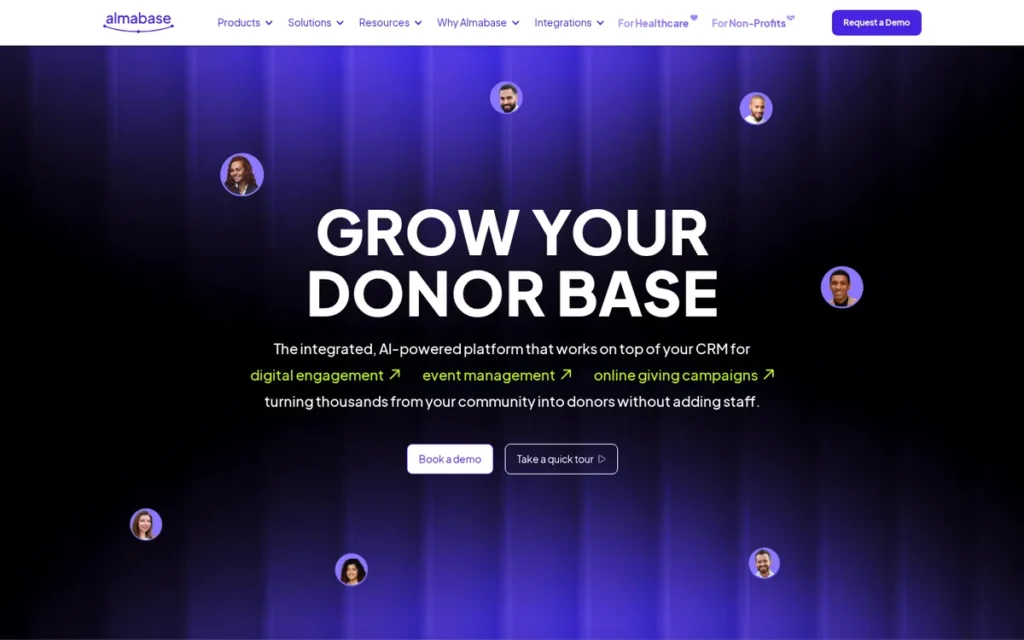
Category: Advancement Engagement Hub, an alumni engagement platform that combines community, events, communications and giving, and syncs with a fundraising system of record.
At a Glance
- Category: Advancement Engagement Hub
- Best For: U.S. colleges and independent schools whose advancement teams want engagement, events and giving alongside Raiser’s Edge NXT
- Price Range: From about $8,000/year, with all tiers quoted individually; Almabase advertises total fundraising costs of about 4–7% per dollar raised (Almabase, November 2026)
- Primary Strength: Almabase combines giving days, crowdfunding, events, email and mentoring in one platform, with a marketed two-way Raiser’s Edge NXT sync.
- Biggest Limitation: Almabase offers its Raiser’s Edge integration only from the Engage tier up, and its fundraising costs grow as giving grows because they are charged per dollar raised.
- One-Line Summary: Almabase has the strongest documented evidence of any all-in-one choice for advancement-led alumni teams that want engagement and fundraising to work alongside Raiser’s Edge NXT.
- Last Verified: November 2026
PlugRoute Scores (1–5): Workflow 5 · Ratings 5 · Integration 4 · Pricing 3 · Security & Stability 3 · Outcomes 4 · Weighted total 38/45
Overview
Almabase is an alumni engagement and advancement platform for U.S. colleges and independent schools. It is built for teams that want alumni engagement and fundraising to run alongside an existing advancement CRM such as Raiser’s Edge NXT.
Almabase sells three tiers: Launch, Engage and Thrive. Almabase puts the features advancement teams usually need most, including the Raiser’s Edge integration, in the Engage and Thrive tiers.
Key Features
- Almabase includes an alumni database and directory that pulls profile updates from LinkedIn and Facebook.
- Almabase handles events and reunions with multi-day events, tiered tickets and check-in, and the Thrive tier adds reunion management.
- Almabase offers online giving, crowdfunding with leaderboards, auctions and giving-day tools for annual-fund and campaign work.
- Almabase markets TrueSync as a two-way Raiser’s Edge NXT integration that syncs engagement data automatically, available from the Engage tier up.
- Almabase also provides mentoring, affinity groups, membership and engagement scoring in the same platform.
Best For
Almabase is best for advancement-led alumni offices that already run Raiser’s Edge NXT and want one engagement layer for events, email, giving days and mentoring without replacing their system of record.
Strengths
- Almabase has a Capterra rating of 4.7/5 from 144 reviews (Capterra, November 2026), one of the highest ratings in this evaluation that rests on a meaningful number of reviews.
- Almabase reports that St. Ignatius College Preparatory had 60% more donors and raised 80% more than on its previous giving day (Almabase customers page, November 2026).
- Almabase reports that Villanova Preparatory School raised $442,000 in a Month of Giving and reconciled gifts in four days instead of nearly a month (Almabase case studies, November 2026).
- Almabase reviewers praise its easy setup, event and email management, dashboards and having many tools in one platform (G2 and Capterra, November 2026).
Limitations
Almabase’s bundled fundraising tools carry costs that grow with success. At Almabase’s vendor-advertised cost of 4–7% per dollar raised, Villanova Preparatory School’s $442,000 Month of Giving implies roughly $17,700–$30,900. That is about two to four times an $8,000 starting subscription, and actual fees depend on the contract and payment processor.
- Almabase leaves its Raiser’s Edge integration out of the entry-level Launch tier.
- Almabase’s two-way TrueSync claim is published by the vendor and has not been independently confirmed field by field, so test field mapping and how conflicting edits are handled in a demo.
- Almabase states SOC 2 Type II compliance but does not publish the audit period or report date (Almabase, November 2026).
- Almabase gives two different customer counts (2,000+ and 500+), and its G2 score of 4.7/5 is reported only by the vendor.
Verdict
Almabase is the best-evidenced alumni platform in this evaluation for advancement teams that want engagement and fundraising in one system connected to Raiser’s Edge NXT. Almabase’s high Capterra rating and named-school giving results give it the top weighted score of 38/45.
Before signing, confirm Almabase’s fee terms, which tier includes the integration and the date of the current SOC 2 report.
2. Hivebrite: Best for Large Chapter-Based and International Alumni Networks
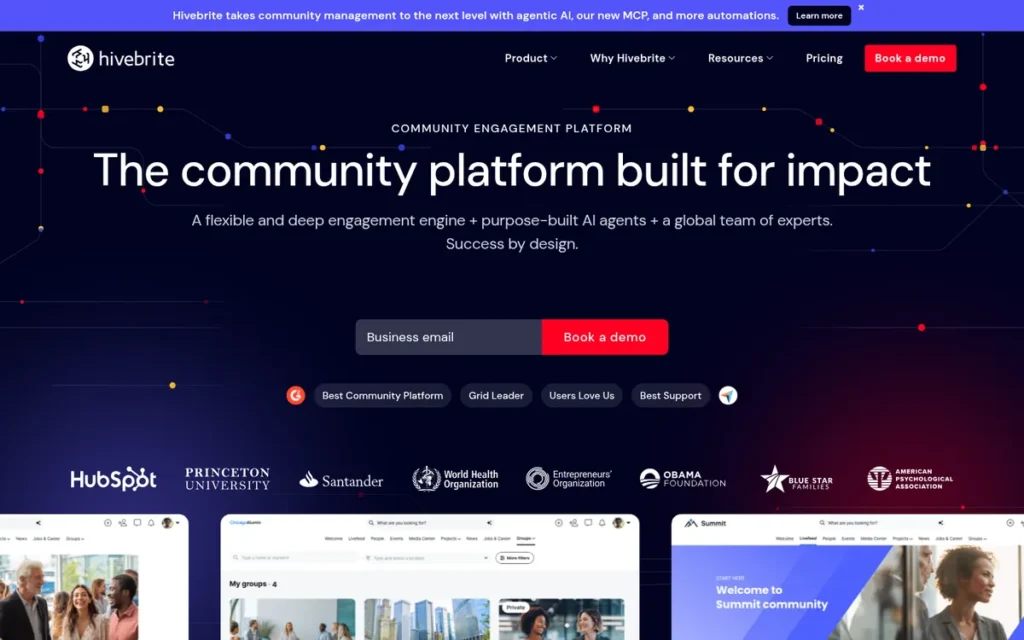
Category: Community Network, a branded alumni community platform focused on directories, chapters, groups, networking and member engagement.
At a Glance
- Category: Community Network
- Best For: Universities and associations running large chapter-based or international alumni networks where chapter leaders manage their own groups
- Price Range: Core at $895/month and Flex at $1,995/month, billed annually (about $10,740 and $23,940/year); integrations from $5,000/year; Enterprise quoted (Hivebrite, November 2026)
- Primary Strength: Hivebrite offers the most extensive documented chapter governance in this evaluation, with group-level admins, calendars, forums and file libraries.
- Biggest Limitation: Hivebrite does not claim its own SOC 2 report, and chapter group management requires the higher-priced Flex tier.
- One-Line Summary: Hivebrite is the best-documented choice for institutions running a large chapter-based or international alumni community where chapter leaders run their own groups.
- Last Verified: November 2026
PlugRoute Scores (1–5): Workflow 4 · Ratings 4 · Integration 4 · Pricing 4 · Security & Stability 3 · Outcomes 3 · Weighted total 34/45
Overview
Hivebrite is a white-label community platform for universities and associations that run large chapter-based or international alumni networks. Hivebrite fits teams that need chapter leaders to manage their own groups, events and members.
Hivebrite is headquartered in Paris, launched commercially in 2015 and reports more than 2,000 customer organizations (Hivebrite, November 2026).
Key Features
- Hivebrite runs chapters, cohorts and committees as groups, each with its own administrators, calendars, forums and file libraries.
- Hivebrite includes a searchable directory and member map, events and ticketing, a jobs board, and email and push messaging.
- Hivebrite handles donations and paid memberships inside the community platform.
- Hivebrite advertises two-way integrations with Salesforce, Banner, Raiser’s Edge NXT and Ellucian, sold as packages from $5,000/year with a 4–6 week setup.
- Hivebrite offers a native branded mobile app, mentoring through an Orbiit integration and a REST API.
Best For
Hivebrite is best for alumni relations teams that manage many regional, international or affinity chapters. Hivebrite fits institutions where community matters more than fundraising depth inside the platform.
Strengths
- Hivebrite holds ISO 27001 certification and states that it complies with GDPR, CCPA and PCI-DSS v4.0 (Hivebrite, November 2026).
- Hivebrite has a Capterra rating of 4.5/5 from 71 reviews (Capterra, November 2026).
- Hivebrite reports that Cornell Hotel Society cut membership admin time by 60%, and that SETsquared, a partnership of six UK universities, passed 1,500 users (Hivebrite case studies, November 2026).
- Hivebrite publishes plan prices, integration package prices and setup times, which helps buyers budget before demos (Hivebrite, November 2026).
Limitations
Hivebrite’s governance depth comes with cost and complexity. Chapter group management moves the plan from about $10,740/year (Core: 2 admin seats, 5 groups) to about $23,940/year (Flex: 5 admin seats, 10 groups). That more than doubles the price before any $5,000/year integration package (Hivebrite, November 2026).
- Hivebrite’s hosting providers hold SOC reports, but Hivebrite does not claim its own SOC 2 report, which matters if your IT review requires one.
- Hivebrite’s G2 reviewers report that implementation commonly takes 3–6 months, describe a “difficult learning process” and call it expensive for small communities and nonprofits (G2, November 2026).
- Hivebrite also states on another page that plans “start at $8,000/year.” That figure does not match its Core and Flex prices, so ask for a current quote.
- Hivebrite’s two-way integration claims have not been independently verified, and its case studies report no giving or donation results.
Verdict
Hivebrite is the best-documented platform in this evaluation for running a large chapter-based or international alumni community where chapter leaders run their own groups. Hivebrite’s group-level permissions and published plan prices place it second at 34/45.
Hivebrite’s fundraising evidence is thinner than Almabase’s. Institutions that require a vendor SOC 2 report should confirm fit early.
3. Graduway (by Gravyty): Best for Branded Alumni Networking and Mentoring
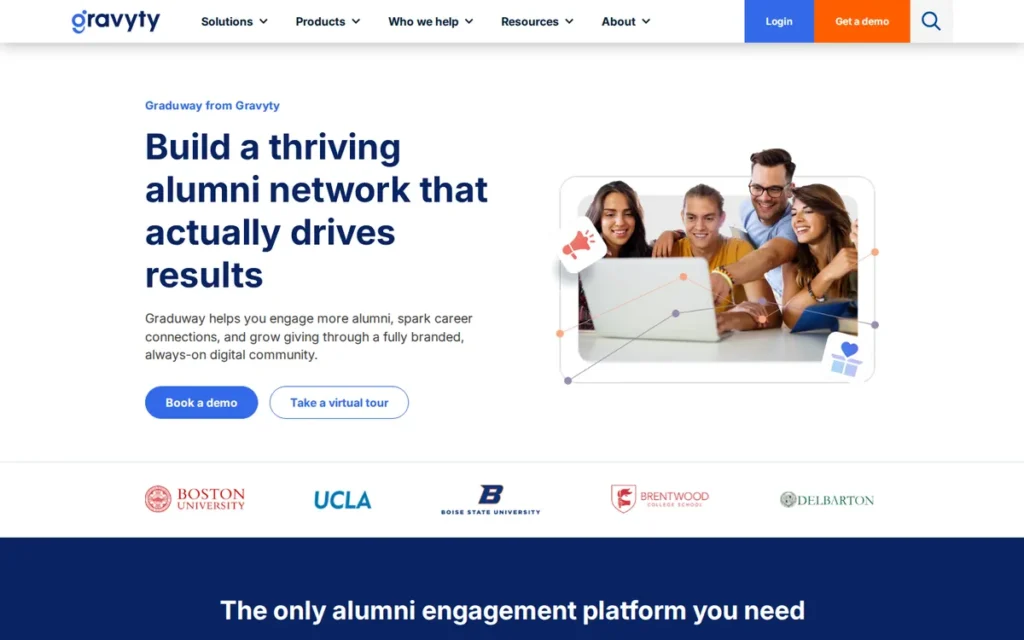
Category: Community Network, a branded alumni community platform focused on directories, chapters, groups, networking and member engagement.
At a Glance
- Category: Community Network
- Best For: Colleges and universities that want a branded alumni network with mentoring and jobs, synced to Raiser’s Edge NXT or Salesforce
- Price Range: Pricing on request; estimates from Raklet, a competitor, range from about $5,000 to more than $100,000/year (Raklet, November 2026)
- Primary Strength: Graduway combines formal and flash mentoring, a job board and chapters in a branded community, with named integrations for advancement CRMs.
- Biggest Limitation: Graduway publishes no pricing, and users rate its reporting and email analytics as weak.
- One-Line Summary: Graduway is a well-reviewed alumni community platform for institutions that put branded networking and mentoring first and need it connected to their advancement CRM.
- Last Verified: November 2026
PlugRoute Scores (1–5): Workflow 4 · Ratings 4 · Integration 4 · Pricing 2 · Security & Stability 3 · Outcomes 3 · Weighted total 32/45
Overview
Graduway, sold by Gravyty, is a branded, mobile-friendly alumni community platform. It is built for colleges and universities that want alumni networking and mentoring connected to Raiser’s Edge NXT or Salesforce.
Graduway serves alumni, students, parents and faculty in one community. Graduway belongs to the wider Gravyty product suite.
Key Features
- Graduway provides formal mentoring with matching, goals and milestones, plus short-term “flash mentoring” for quick alumni–student connections.
- Graduway includes a job board, groups and chapters, events, and newsletters and digests.
- Graduway lists integrations with Raiser’s Edge NXT, Blackbaud CRM and Salesforce Sales Cloud among the 10 integrations shown on Capterra.
- Graduway offers a branded, mobile-friendly community for alumni, students, parents and faculty.
- Graduway connects to Gravyty’s other products (Advance, Gratavid and Raise), and Gravyty’s fundraising AI sits in Raise rather than in Graduway.
Best For
Graduway is best for colleges and universities that want a branded alumni network centered on mentoring, jobs and chapters, where alumni data must sync with an advancement CRM.
Strengths
- Graduway has a Capterra rating of 4.4/5 from 133 reviews and a G2 rating of 4.6/5 from about 27 reviews. That is more Capterra reviews than Hivebrite, the other Community Network reviewed (Capterra and G2, November 2026).
- Gravyty, which sells Graduway, states that it has achieved SOC 2 Type 2 (Gravyty, November 2026). Request the current report and confirm that it covers Graduway.
- Graduway reports that Ohio University’s Bobcat Network saw 180% more platform engagement and that William & Mary tripled event registrations after launching its “One Network” (Gravyty case studies, November 2026).
- Graduway reviewers praise its ease of use, branding, support, mentoring and job board (G2 and GetApp, November 2026).
Limitations
Graduway’s strength in networking and mentoring does not extend to reporting. One review dataset compiled by Raklet, a competitor, scores Graduway’s reporting and analytics at about 3.0/5 (Raklet, November 2026).
- Graduway reviewers cite weak mailing-list segmentation, limited email analytics, a cluttered admin interface, LinkedIn sign-in problems and slow responses to feature requests (G2 and GetApp, November 2026).
- Graduway publishes no prices, and reviewers cited in Raklet’s competitor comparison report upselling after signing (Raklet, November 2026).
- Graduway’s fundraising AI sits in a separate Gravyty product (Raise), so advancement teams that want AI-assisted fundraising have to buy a second module.
- Graduway’s published results cover engagement rather than fundraising, and how deeply its CRM sync works could not be confirmed field by field.
Verdict
Graduway is a well-reviewed alumni community and mentoring platform for institutions that want branded networking synced to Raiser’s Edge NXT or Salesforce. Graduway’s stated SOC 2 Type 2 is an advantage over Hivebrite for institutions whose IT review requires SOC 2.
Graduway ranks below Hivebrite at 32/45 because it publishes no pricing, draws repeated complaints about reporting and reports no fundraising outcomes.
4. AlmaShines: Best Low-Cost All-in-One Option with Published Pricing
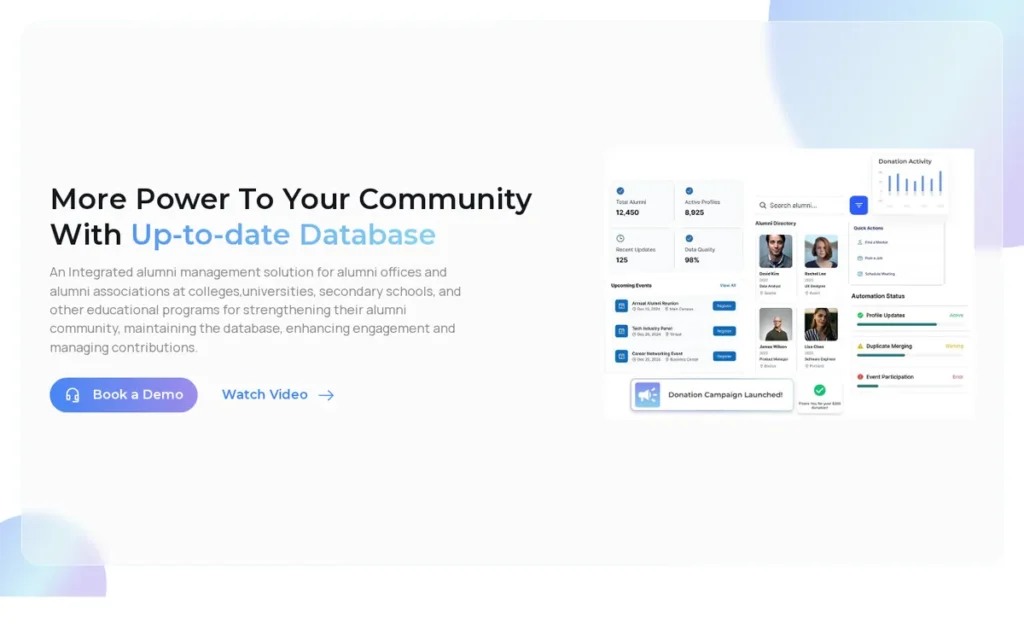
Category: Budget All-in-One, a low-cost alumni platform that bundles a database, community, events and fundraising for small teams.
At a Glance
- Category: Budget All-in-One
- Best For: Budget-constrained schools and small alumni offices that want one system at a known price
- Price Range: $1,199–$2,499 per institution per year for the Booster and Pro plans (G2, November 2026); the official pricing page also lists monthly starting prices of $120 and $240 (AlmaShines, November 2026)
- Primary Strength: AlmaShines combines a broad all-in-one feature set with the lowest published plan prices in this evaluation.
- Biggest Limitation: AlmaShines lists CRM integrations, but how deeply it syncs with Raiser’s Edge NXT or Salesforce, and whether it offers U.S. support coverage, could not be confirmed.
- One-Line Summary: AlmaShines is the lowest-priced all-in-one alumni platform in this evaluation, best for small teams that confirm CRM sync and U.S. support before buying.
- Last Verified: November 2026
PlugRoute Scores (1–5): Workflow 4 · Ratings 5 · Integration 2 · Pricing 5 · Security & Stability 2 · Outcomes 3 · Weighted total 32/45
Overview
AlmaShines is a low-cost alumni platform for budget-constrained schools and small alumni offices. It is built for teams that want their alumni database, events and fundraising in one system at a published price of $1,199–$2,499 per year.
AlmaShines was founded in 2014, is based in India and says it serves more than 1,800 institutions in over 35 countries (LinkedIn, November 2026).
Key Features
- AlmaShines includes an alumni database and directory with a branded mobile app.
- AlmaShines handles events and reunions with ticketing, and it runs fundraising campaigns.
- AlmaShines provides a jobs board, career networking, chapters and communications tools.
- AlmaShines offers digital ID cards with QR codes and alumni election management.
- AlmaShines sells a paid data-update service that refreshes alumni job titles, employers and locations.
Best For
AlmaShines is best for small schools and lean alumni offices that need one system at a predictable, published price and can confirm CRM sync in a demo.
Strengths
- AlmaShines has a Capterra rating of 4.6–4.7/5 from 154–172 reviews, depending on the listing page, and a G2 rating of 4.4/5 from 47 reviews (Capterra and G2, November 2026).
- AlmaShines publishes the lowest plan prices in this evaluation, at $1,199 and $2,499 per institution per year (G2, November 2026).
- AlmaShines reports that IIT Delhi Alumni Association raised more than ₹30 lakh (about $36,000) from more than 700 donors, and that T.B. Dam School raised more than ₹1 crore (about $120,000) at a 6,500-alumni event (AlmaShines case studies, November 2026).
- AlmaShines reviewers praise its value for money, ease of use and fast support (Capterra, November 2026).
Limitations
AlmaShines keeps its price low with a product built mainly for institutions outside the U.S. AlmaShines lists CRM and ERP integration, software directories list Salesforce, and a third party reports a Raiser’s Edge connection. However, the direction of the sync, which fields it covers and what it costs could not be confirmed (Software Advice, November 2026).
- AlmaShines highlights accreditation reporting for Indian institutions (NAAC, NBA, NIRF), which does not apply to U.S. schools, and most of its published case studies come from India.
- AlmaShines has no verified U.S. office or support hours in U.S. time zones, and this research found no ISO or GDPR certification documents for it.
- AlmaShines’ annual and monthly prices do not match each other, and its setup, app and transaction fees could not be verified, so confirm the billing model in writing.
- AlmaShines reviewers say analytics “could be improved” and report slow page loads (Capterra, November 2026).
Verdict
AlmaShines is the lowest-priced all-in-one alumni platform in this evaluation, and it has one of the largest review bases. AlmaShines ties Graduway at 32/45 but ranks fourth because it scores lower on the primary criteria, mainly because its integration with U.S. systems of record could not be confirmed.
U.S. institutions should confirm CRM sync, security documentation and support hours before buying.
5. Blackbaud Raiser’s Edge NXT: Best Fundraising System of Record for Larger Offices
Category: Fundraising System of Record, a donor and gift database that holds the official constituent and giving records other alumni tools sync with.
At a Glance
- Category: Fundraising System of Record
- Best For: Mid-sized and large advancement offices that need a deep donor, gift and prospect database, often paired with an engagement platform
- Price Range: Pricing on request; multi-year contracts that renew automatically and are priced by number of donor records; add-ons cost extra (G2, November 2026)
- Primary Strength: Blackbaud Raiser’s Edge NXT has the deepest gift, campaign and prospect-management features and the widest integration ecosystem in this evaluation.
- Biggest Limitation: Blackbaud Raiser’s Edge NXT has the lowest user ratings in this evaluation and few alumni-community features.
- One-Line Summary: Blackbaud Raiser’s Edge NXT is the fundraising system of record many U.S. advancement offices build around, and it works best paired with a dedicated engagement platform.
- Last Verified: November 2026
PlugRoute Scores (1–5): Workflow 3 · Ratings 3 · Integration 4 · Pricing 2 · Security & Stability 3 · Outcomes 2 · Weighted total 27/45
Overview
Blackbaud Raiser’s Edge NXT is a cloud fundraising and donor database for mid-sized and large advancement offices. It is built for teams that need an official system of record for constituent records, gift history and campaigns, rather than an alumni community.
Blackbaud Raiser’s Edge NXT often sits underneath a separate engagement platform such as Almabase, Graduway or Hivebrite.
Key Features
- Blackbaud Raiser’s Edge NXT manages donor and alumni records, gift and recurring-gift history, campaigns, funds and appeals.
- Blackbaud Raiser’s Edge NXT provides dashboards for annual, sustaining and major giving, with built-in AI that flags changes in giving.
- Blackbaud Raiser’s Edge NXT includes Prospect Insights, which ranks likely major-gift prospects by how likely they are to give and how much they could give, and recommends actions such as building prospect pools.
- Blackbaud Raiser’s Edge NXT connects to other systems through SKY APIs, Microsoft Power Automate connectors and the Blackbaud Marketplace.
- Blackbaud Raiser’s Edge NXT records online donations, memberships and event registrations directly in donor records, and uses JustGiving for peer-to-peer fundraising.
Best For
Blackbaud Raiser’s Edge NXT is best for mid-sized and large advancement offices doing relationship-based and major-gift fundraising that need an official donor and gift database.
Strengths
- Blackbaud Raiser’s Edge NXT has the largest independent review base in this evaluation, with 640 G2 reviews, 417 Capterra reviews and 747 TrustRadius reviews and ratings. Reviewers consistently praise its depth as a fundraising record (G2, Capterra and TrustRadius, November 2026).
- Blackbaud Raiser’s Edge NXT customer After-School Matters, a nonprofit rather than a school, increased individual giving to its general operating fund by 69% over three years (Blackbaud customer story, November 2026).
- Blackbaud says its security program holds SOC 1, SOC 2, PCI DSS and HIPAA certifications, the broadest stated set in this evaluation. Buyers should confirm which ones cover Raiser’s Edge NXT (Blackbaud, November 2026).
This aligns with community sentiment on r/Accounting (June 2018):
“Blackbaud Raiser’s Edge is pretty popular in the non-profit space. I’m very familiar with it. Most non profits I know uses it.” Posted by u/Randomize_
Takeaway: Blackbaud Raiser’s Edge is so widely used across nonprofits that many teams treat it as the default fundraising database.
Limitations
Blackbaud Raiser’s Edge NXT gives up alumni-facing engagement and ease of use in exchange for fundraising depth. Blackbaud Raiser’s Edge NXT has the lowest ratings in this evaluation (G2 3.9/5, Capterra 4.1/5 and TrustRadius 7.5/10) and few community features (G2, Capterra and TrustRadius, November 2026).
- Blackbaud Raiser’s Edge NXT reviewers report switching between the older database view and the newer web view, reports that require exports and third-party tools, and a steep learning curve (G2 and GetApp, November 2026).
- Blackbaud Raiser’s Edge NXT reviewers report unclear pricing and extra fees. One G2 reviewer’s contract rose from about $4,700 to more than $10,000/year at renewal (G2, November 2026).
- Blackbaud had a ransomware incident in 2020 and paid a ransom after determining that data had been taken, which is relevant to IT security review.
- Blackbaud later paid a $3 million SEC civil penalty (SEC, March 2023) and $49.5 million to 49 states and D.C. (state attorneys general, October 2023). A 2024 FTC order required Blackbaud to meet data-security obligations but did not fine it.
Users on r/nonprofit shared their experience (January 2024):
“My organization is considering switching from RE-NXT to a different CRM due to dissatisfaction with the product (limited integrations, poor functionality for events & marketing). We want to make a decision by the end of Q1 but Blackbaud won’t provide renewal quotes for us until 6 months before our contract ends, which won’t be until June or July.” Posted by u/manondessources
Takeaway: Raiser’s Edge NXT customers who want to leave over weak integrations and event tools can struggle to plan a switch because Blackbaud releases renewal quotes so late.
Verdict
Blackbaud Raiser’s Edge NXT is the deepest fundraising system of record in this evaluation and the hub most alumni engagement platforms connect to, but it is not an alumni community platform. Blackbaud Raiser’s Edge NXT ranks fifth at 27/45 because of its lower ratings, limited community features and reports of renewal price increases.
Advancement offices with significant major-gift programs will value its prospect tools. Small schools should weigh the learning curve and cost.
6. PeopleGrove: Best for Student–Alumni Mentoring and Career Services Programs
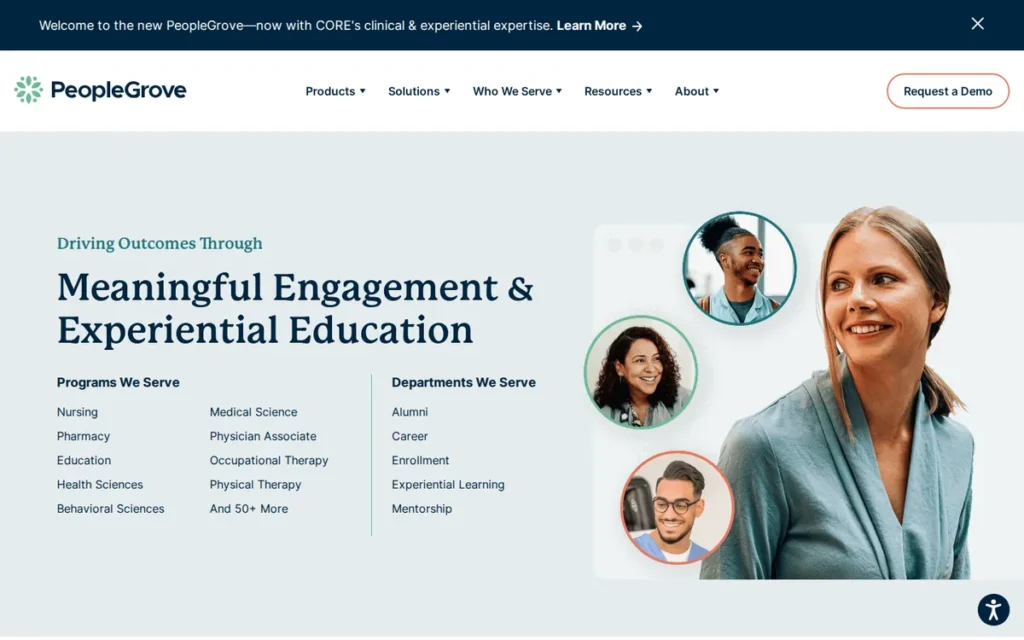
Category: Career & Mentoring Platform, a student–alumni networking tool focused on structured mentoring, career pathways and experiential learning.
At a Glance
- Category: Career & Mentoring Platform
- Best For: Career services and alumni relations teams running structured student–alumni mentoring and career-readiness programs
- Price Range: Pricing on request; no reliable third-party estimate available (G2, November 2026)
- Primary Strength: PeopleGrove is the only platform reviewed that combines structured mentor matching and milestones with career assessments (PathwayU) and experiential learning (Student Opportunity Center).
- Biggest Limitation: PeopleGrove has no gift processing or prospect management, and its CRM integrations beyond single sign-on could not be verified.
- One-Line Summary: PeopleGrove is the specialist choice for institutions whose main goal is structured student–alumni mentoring and career outcomes, used alongside a separate fundraising CRM.
- Last Verified: November 2026
PlugRoute Scores (1–5): Workflow 3 · Ratings 4 · Integration 2 · Pricing 1 · Security & Stability 3 · Outcomes 3 · Weighted total 25/45
Overview
PeopleGrove is a student–alumni networking and structured mentoring platform for career services and advancement teams that run mentoring and career-readiness programs. It suits teams that plan to keep a separate fundraising CRM.
PeopleGrove was founded in 2015, is based in San Francisco and is usually paired with a fundraising CRM rather than replacing one.
Key Features
- PeopleGrove matches students and alumni on skills, interests and goals, and tracks structured program milestones.
- PeopleGrove includes PathwayU career assessments for career-pathway guidance.
- PeopleGrove includes Student Opportunity Center for experiential learning opportunities.
- PeopleGrove supports alumni–student networking across admissions, student services, careers and advancement.
- PeopleGrove supports single sign-on customization, the only integration capability this research could confirm.
Best For
PeopleGrove is best for career services leads and alumni relations teams whose main goal is structured mentoring that connects students with alumni early. PeopleGrove also suits work to build the next generation of donors, since about 69% of alumni donors graduated more than 30 years ago (CASE, March 2026).
Strengths
- PeopleGrove has a Capterra rating of 4.7/5 from 29 reviews and a G2 rating of about 4.5–4.6/5 from about 27 reviews, though both samples are small (Capterra and G2, November 2026).
- PeopleGrove is used by more than 650 institutions (G2, November 2026).
- PeopleGrove hosts the London School of Economics’ AI-assisted student–alumni question-matching program, which won Gold in CASE’s 2024 Circle of Excellence awards. The award went to the school’s program, not to PeopleGrove.
- PeopleGrove added career assessments and experiential learning through its 2023 acquisitions of PathwayU and Student Opportunity Center, and G2 reviewers praise its ease of use and support (G2, November 2026).
Limitations
PeopleGrove’s focus on mentoring and careers means PeopleGrove is not a full advancement platform. PeopleGrove has no gift processing or prospect management, so it has to run alongside a fundraising CRM.
- PeopleGrove’s integrations with Salesforce, Raiser’s Edge, Handshake and student information systems could not be verified beyond single sign-on, and one G2 reviewer rated its data integration 1.5/5 (G2, November 2026).
- PeopleGrove reviewers cite the lack of a mobile app, slow bulk email on very large sends and extra effort for users to register and set up profiles (G2, November 2026).
- PeopleGrove’s public IT materials document a SOC 2 Type 1 report (PeopleGrove, July 2022). A completed Type 2 report could not be confirmed, and Mentorly, a mentoring-software vendor, described that audit as in progress (Mentorly, November 2026).
- PeopleGrove’s merger with CORE Higher Education Group and its private-equity backing make ownership commitments worth asking about.
Verdict
PeopleGrove is the specialist platform in this evaluation for institutions whose main goal is structured student–alumni mentoring and career outcomes. PeopleGrove ranks sixth at 25/45 because the workflow criterion rewards breadth by design, and PeopleGrove does not cover fundraising.
PeopleGrove’s quote-only pricing and unconfirmed integrations also lower its score, so pair it with a system of record and test data integration in a demo.
Do I Need a Separate Alumni Platform If We Already Use Raiser’s Edge NXT?
You will likely need a separate platform alongside Raiser’s Edge NXT if you want alumni community, chapters, mentoring or giving-day tools, because Blackbaud Raiser’s Edge NXT is a fundraising system of record with few community features. The common setup keeps Raiser’s Edge NXT as the main constituent database and adds an engagement layer on top.
Blackbaud Raiser’s Edge NXT alone may be enough for teams that mainly need gift records and major-gift work:
- Blackbaud Raiser’s Edge NXT tracks gifts, campaigns, funds and appeals in one donor database.
- Blackbaud Raiser’s Edge NXT ranks major-gift prospects by how likely they are to give and how much they could give, through Prospect Insights.
- Blackbaud Raiser’s Edge NXT records online donations, memberships and event registrations directly in donor records.
An engagement platform on top of Raiser’s Edge NXT is the usual choice for teams that need alumni-facing tools:
- Almabase adds giving days, crowdfunding, events and email on top of Raiser’s Edge NXT, with a marketed two-way TrueSync available from the Engage tier up.
- Hivebrite adds chapter governance on top of Raiser’s Edge NXT, with a claimed two-way integration sold as a package from $5,000/year.
- Graduway adds branded networking, mentoring and a job board on top of Raiser’s Edge NXT, with a listed integration whose sync depth is unconfirmed.
- AlmaShines offers a low-cost engagement layer, but only a third party reports that it connects to Raiser’s Edge.
As of November 2026, PlugRoute found no independent field-level verification for any vendor’s Raiser’s Edge integration. A one-way or partial sync is a common cause of duplicate constituent records and other data-quality problems.
As one user on r/nonprofit described while trying to flag duplicate records (November 2021):
“I’ve read a lot of posts here about how crummy RE is, I agree. As a total newbie to the program as well a computer focused job, even I can see it’s short comings. I’ve asked what I think are pretty basic questions, but the answer usually is along the lines of ‘this is the way we’ve always done it’. The people I work with seem to treat it as a dodgy old aunt, “oh, it’s just her way”! Then to top it off, we also use Galaxy, which seems to not talk to RE very well, I don’t think they were ever meant to mesh.” Posted by u/katieh809
Takeaway: Raiser’s Edge users who connect it to other systems report connections that don’t work well, so any engagement platform’s Raiser’s Edge integration should be tested with real records before you buy.
Test the integration in a demo before you sign:
- Edit one test constituent record in both Raiser’s Edge NXT and the engagement platform.
- Check which direction the change flows between the two systems.
- Check which system’s edit wins when both change the same field.
- Check whether the sync creates a duplicate record afterward.
An integration logo on a vendor’s website is a claim. A record edited in both systems during your demo is evidence.
How Do Pricing, Integration and Security Documentation Compare?
Pricing, integration and security documentation vary widely across the six platforms. AlmaShines and Hivebrite publish plan prices, and PlugRoute found no independently verified field-level CRM sync for any vendor. Blackbaud states the broadest set of certifications, while Hivebrite has no SOC 2 report of its own. The tables below show each product’s status as of November 2026.
Pricing Transparency (November 2026)
| Platform | Pricing Evidence Type | Documented Figures | Cost Factors to Confirm |
|---|---|---|---|
| Almabase | Approximate | From about $8,000/year | Vendor-advertised cost of 4–7% per dollar raised; integration requires the Engage tier |
| Hivebrite | Published | Core $895/month (about $10,740/year); Flex $1,995/month (about $23,940/year), billed annually | Integration packages from $5,000/year; group management requires Flex; a separate “$8,000/year” statement doesn’t match |
| Graduway | Competitor estimate only | About $5,000 to more than $100,000/year (Raklet) | Reported upselling after signing |
| AlmaShines | Published | $1,199–$2,499 per institution per year; official page also lists $120/$240 monthly starting prices | Billing model; setup, app and transaction fees |
| Raiser’s Edge NXT | Quote only | One reviewer: about $4,700/year, renewing above $10,000/year | Add-ons; price scales with number of donor records; auto-renewal |
| PeopleGrove | Quote only | None available | License, implementation and integration costs |
Integration Claims vs. Verification Status (November 2026)
| Platform | Raiser’s Edge NXT | Blackbaud CRM | Salesforce | Ellucian / Banner | Verification Status |
|---|---|---|---|---|---|
| Almabase | Two-way claimed (TrueSync, Engage+) | Not documented | Not documented | Not documented | Vendor claim only |
| Hivebrite | Two-way claimed | Not documented | Two-way claimed | Ellucian and Banner claimed | Vendor claim only |
| Graduway | Listed | Listed | Listed (Sales Cloud) | Not documented | Sync depth unconfirmed |
| AlmaShines | Reported by a third party | Not documented | Listed by software directories | Not documented | CRM/ERP integration listed; depth unconfirmed |
| Raiser’s Edge NXT | System of record | Not applicable | Via SKY APIs and Power Automate | Via Marketplace | Ecosystem documented by vendor |
| PeopleGrove | Unverified | Unverified | Unverified | SIS unverified | Only SSO confirmed |
Security Documentation and Ownership Status (November 2026)
| Platform | Stated Certifications | Ownership or Incident Notes |
|---|---|---|
| Almabase | SOC 2 Type II stated; audit date not published; ADA, GDPR, HEVCAT claimed | Founded around 2015; 91 team members reported |
| Hivebrite | ISO 27001; GDPR, CCPA, PCI-DSS v4.0; hosting providers hold SOC reports; no standalone Hivebrite SOC 2 | Founded 2012, launched 2015, Paris HQ |
| Graduway | SOC 2 Type 2 stated by Gravyty | Sold as a Gravyty product |
| AlmaShines | No ISO or GDPR documents found | Privately held; based in India |
| Raiser’s Edge NXT | SOC 1, SOC 2, PCI DSS, HIPAA stated for Blackbaud’s security program | 2020 ransomware incident; $3M SEC penalty (March 2023); $49.5M state AG settlement (October 2023); 2024 FTC order |
| PeopleGrove | SOC 2 Type 1 documented (July 2022); Type 2 not confirmed | Merged with CORE Higher Education Group |
What Red Flags Should I Watch For When Evaluating Alumni Management Software?
The most important red flags in alumni software evaluations are claims you cannot verify and costs you cannot see before you sign. Each of the six numbered flags below appeared in at least one of the six products reviewed, and each one matches a demo question in the next section.
Red Flag #1: Integration Claimed but Not Demonstrated Every vendor reviewed claims CRM integration, but as of November 2026 PlugRoute found no independently confirmed field-level sync documentation for any of them. Treat any integration you have not seen working with your own constituent records as unverified, because a partial sync can create duplicate records.
Red Flag #2: Headline Price Hidden by Tiers and Renewals The entry price often leaves out the features you need, or rises after the first year. Hivebrite’s group management moves the plan from about $10,740/year (Core) to about $23,940/year (Flex). One G2 reviewer’s Raiser’s Edge NXT contract rose about 113% at renewal, from about $4,700 to more than $10,000/year (Hivebrite and G2, November 2026).
Red Flag #3: Fees Taken from Donations A fee charged on funds raised can cost more than the subscription in a strong campaign year. At Almabase’s vendor-advertised cost of 4–7% per dollar raised, Villanova Preparatory School’s $442,000 Month of Giving implies roughly $17,700–$30,900 (Almabase, November 2026). Blackbaud’s payment-processing rates are not public.
Red Flag #4: No Current SOC 2 Report A missing or undated SOC 2 report can stop a U.S. university’s IT security review. Hivebrite claims no SOC 2 report of its own, PeopleGrove’s documented report is Type 1 and Almabase does not publish its audit date. This research found no certification documents for AlmaShines.
Red Flag #5: Ownership Change Without Written Commitments Ownership changes create risk for the roadmap, support and data export over a multi-year contract. Graduway and PeopleGrove have both changed corporate structure through acquisitions and mergers. Get roadmap, support and export commitments in writing from the current legal owner.
Red Flag #6: Weak Reporting Hidden Behind Dashboards Reporting weakness is a frequently documented complaint in this category, cited for three of the six products reviewed. Users raise it for Graduway, Raiser’s Edge NXT and AlmaShines, often only after a polished dashboard demo. Ask each vendor to build one of your real reports live (G2, Capterra and GetApp, November 2026).
What Questions Should I Ask Before Choosing Alumni Management Software?
Ask every vendor the same eight questions in the same order, and score each answer on the same scale. A repeatable script lets you compare demos with each other instead of with each vendor’s own marketing. Each question below matches a red flag in the previous section.
Score each answer with this rubric, for a maximum of 24 points per vendor:
- A score of 0 means the vendor gave no answer.
- A score of 1 means the vendor made a spoken claim only.
- A score of 2 means the vendor made a written commitment.
- A score of 3 means the vendor gave a live demonstration with your records.
Question #1: Can you show a record edited in both systems and how the conflict resolves? A credible answer is a live demo using a test record from your own CRM. The demo should show which direction the sync runs, which edit wins when both systems change the same field, and whether a duplicate constituent record appears afterward.
Question #2: Which tier includes the integration and chapter-admin permissions? A strong answer names, in writing, the exact tier that includes the CRM integration and chapter-admin permissions. In this evaluation, Almabase’s Raiser’s Edge integration starts at the Engage tier, and Hivebrite’s group management starts at Flex (about $23,940/year). Price the tier that includes what you need, not the entry plan.
Question #3: What percentage of donations or processing fees do you take, and can we use our own payment gateway? Get donation and processing fee terms in writing, including whether you can use your own payment gateway. Then calculate the fees at your expected giving-day and campaign totals, because a percentage fee can outweigh the subscription price you are comparing across vendors.
Question #4: Can you provide your current SOC 2 Type 2 report and its date? A strong answer is a dated SOC 2 Type 2 report shared under NDA, with the audit period stated and the product you are buying covered. Send answers such as “in progress,” “compliant” or a Type 1 report to your IT security team before you shortlist the vendor.
Question #5: Who is our contracting company, and what roadmap and data-export commitments will you put in writing? The vendor should name the legal contracting company and commit in writing to support terms, a roadmap summary and a full data export in a standard format. This matters most when a product has changed corporate structure, as Graduway and PeopleGrove have through acquisitions and mergers.
Question #6: Do we send email from our own domain with SPF, DKIM and DMARC, and do unsubscribes sync to our CRM? Since February 2024, Google and Yahoo have required bulk senders, which Google defines as those sending about 5,000 or more messages a day to Gmail, to meet five requirements (Google and Yahoo sender guidelines, February 2024):
- Bulk senders must authenticate their email with SPF and DKIM.
- Bulk senders must publish a DMARC policy.
- Bulk senders must offer one-click unsubscribe.
- Bulk senders must honor unsubscribe requests within two days.
- Bulk senders must keep spam rates below 0.3%.
Look for three capabilities in each platform:
- The platform sends email from your institution’s own authenticated domain.
- The platform syncs unsubscribe lists in both directions with your CRM.
- The platform gives your team access to DMARC reports.
Question #7: How many staff hours and months will implementation and migration take? Ask for a dated project plan with staff-hour estimates and references from institutions your size. Implementation length varies widely. G2 reviewers report that Hivebrite implementations commonly take 3–6 months, and Hivebrite quotes 4–6 weeks for integration packages alone (G2 and Hivebrite, November 2026).
Question #8: How do chapter-leader permissions limit access to central data? A strong answer shows a chapter leader managing their own group’s events, members and files without being able to see or export the full alumni database. Ask the vendor to log in as a test chapter-admin user during the demo and try to run a full export.
How Did We Rank These Alumni Management Software Platforms?
PlugRoute scored every platform from 1 to 5 on the same six criteria, counted the three primary criteria double and ranked products by weighted total out of 45. The rank measures how much a platform can prove, not how loudly it markets itself. Each entry’s Best For label tells you whether that proof applies to you.
The six criteria and why each matters:
- C1: Core Workflow Coverage (primary): C1 measures whether a platform fully covers its main job, which reduces the number of tools a lean team has to manage. Breadth counts by design, so platforms that do only one job score lower.
- C2: Verified Review Ratings and Volume (primary): C2 weights Capterra, G2 and TrustRadius ratings by review count. It marks scores that are vendor-only, cover a whole parent company or mix in another product as low-confidence.
- C3: Integration with Systems of Record (primary): C3 compares claimed and verified CRM integrations. No product can score 5 without independent field-level verification.
- C4: Pricing Transparency (secondary): C4 rewards published or approximate prices. It lowers scores for conflicting figures, fees on donations and reports of renewal increases.
- C5: Security Documentation and Vendor Stability (secondary): C5 covers stated certifications, breach history and ownership changes, any of which can end an evaluation outright.
- C6: Documented Institutional Outcomes (secondary): C6 scores named-institution results. All such results in this guide were published by the vendors themselves and are labeled that way.
How the weighted total works: Weighted total = 2 × (C1 + C2 + C3) + (C4 + C5 + C6), for a maximum of 45. Ties are broken by the primary-criteria subtotal, which places Graduway ahead of AlmaShines at 32.
| Rank | Platform | C1 | C2 | C3 | C4 | C5 | C6 | Primary Subtotal | Weighted Total |
|---|---|---|---|---|---|---|---|---|---|
| 1 | Almabase | 5 | 5 | 4 | 3 | 3 | 4 | 14 | 38/45 |
| 2 | Hivebrite | 4 | 4 | 4 | 4 | 3 | 3 | 12 | 34/45 |
| 3 | Graduway | 4 | 4 | 4 | 2 | 3 | 3 | 12 | 32/45 |
| 4 | AlmaShines | 4 | 5 | 2 | 5 | 2 | 3 | 11 | 32/45 |
| 5 | Blackbaud Raiser’s Edge NXT | 3 | 3 | 4 | 2 | 3 | 2 | 10 | 27/45 |
| 6 | PeopleGrove | 3 | 4 | 2 | 1 | 3 | 3 | 9 | 25/45 |
The scores reflect a verification pass PlugRoute completed in November 2026:
- Gravyty states that Graduway’s parent company has achieved SOC 2 Type 2 (Gravyty, November 2026).
- AlmaShines lists CRM integrations, and software directories list a Salesforce connection (Software Advice, November 2026).
- Almabase advertises total fundraising costs of about 4–7% per dollar raised (Almabase, November 2026).
The research had the following limits:
- Reddit produced no product-specific evidence. One general post about buyer requirements (r/CRM) is quoted for context, and r/nonprofit removes posts asking which CRM to use.
- Raiser’s Edge NXT received one extra research query because the first returned little pricing data.
- Some comparison sources were written by competing vendors (Almabase, Hivebrite, Raklet, Gravyty and Mentorly), and they are labeled where used.
- All outcome figures were published by the vendors.
- ToucanTech, EverTrue, Vaave, 360Alumni and Ellucian CRM Advance were not ranked because they had no verified G2 or Capterra rating, and WildApricot was excluded as general membership software.
- Citations show a source’s publication month where known; otherwise they show the month PlugRoute accessed it.
PlugRoute has no affiliate relationships with any company listed. Rankings are determined entirely by research data and objective evaluation criteria.
What Do Buyers Ask Most About Alumni Management Software?
Buyers most often ask which platform suits a university, which suits a small school and how PlugRoute builds its rankings. Each answer below starts with the direct answer, stays under 60 words and relies on evidence dated November 2026, so you can read each one on its own.
What is the best alumni management software for universities in 2026?
For U.S. universities in 2026, Almabase has the strongest overall evidence for advancement-led engagement, Hivebrite for large chapter-based or international networks, and Graduway for branded networking and mentoring. Universities with major-gift programs typically keep Blackbaud Raiser’s Edge NXT as the fundraising database and add one of these as the engagement layer.
What is the best alumni management software for small schools?
AlmaShines has the lowest published prices reviewed, at $1,199–$2,499 per year, but how deeply it syncs with U.S. CRMs and whether it offers U.S. support hours could not be confirmed.
Almabase, starting around $8,000/year, fits small independent schools already using Raiser’s Edge NXT. Confirm total cost, including setup and donation fees, before you sign.
How does PlugRoute determine rankings?
PlugRoute scores every platform from 1 to 5 on six criteria, counts the primary criteria double and ranks products by weighted total out of 45. The same evidence rules apply to every product.
- The primary criteria are workflow coverage, verified ratings and integration with systems of record.
- The secondary criteria are pricing transparency, security and stability, and documented outcomes.
What Do Key Alumni Management Software Terms Mean?
Alumni management software buyers meet the same technical, pricing and compliance terms in nearly every vendor demo and contract. The plain-language definitions below explain twelve of them and why each one matters when you compare platforms or review contract terms.
System of record: A system of record is the database that holds the official version of constituent and gift data. Other tools sync to it, so you need to know which system’s data wins when records conflict.
Two-way sync: A two-way sync is an integration where changes made in either system update the other automatically. A one-way sync can leave your CRM out of date or create duplicate records.
Field mapping: Field mapping is the set of rules that matches each data field in one system to a field in another. Missing or mismatched fields are a common reason integrations fail after launch.
Tier gating: Tier gating is the practice of limiting certain features to higher-priced plans. It means the entry price may not include the integration or permissions you actually need.
Platform fee on donations: A platform fee on donations is a percentage a vendor takes from funds raised through its giving tools. In a large campaign year it can cost more than the subscription.
SOC 2 Type 2: SOC 2 Type 2 is an independent audit report showing that a vendor’s security controls worked over a period of time. Many U.S. universities require one during IT security review, and a Type 1 report covers only a single point in time.
ISO 27001: ISO 27001 is an international certification for information security management systems. It is a recognized security credential, but some institutions specifically require SOC 2 instead.
PCI DSS: PCI DSS is the security standard for handling payment card data. It matters for any platform that processes online gifts or event tickets.
SPF, DKIM and DMARC: SPF, DKIM and DMARC are email authentication standards that prove your messages really come from your domain. Major inbox providers require bulk senders to use them, and they affect whether your email reaches inboxes.
Single sign-on (SSO): Single sign-on is a login method that lets users sign in with their existing institutional account. It simplifies access but is not the same as a data integration.
Engagement scoring: Engagement scoring is a calculated score that tracks alumni activity such as event attendance, email opens or volunteering. CASE counts four types of alumni engagement (communication, experiential, volunteer and philanthropic), so ask whether a platform’s score maps to that framework (CASE, September 2025).
Chapter governance: Chapter governance is the set of permission settings that lets local chapter leaders manage their own groups without seeing the full alumni database. It matters for large or international networks.
Which Alumni Management Software Is Right for You?
Key Insights
- The right alumni management software is the platform built for your main goal. PlugRoute’s rankings reflect the strength of documented evidence, not one winner for every institution: Almabase leads overall, but each of the six products is the best fit for a specific situation.
- Tier gating and fees on donations can change total cost more than the headline subscription price, as Hivebrite’s Flex tier and Almabase’s vendor-advertised cost of 4–7% per dollar raised show.
- No alumni platform vendor’s CRM integration claim had been independently confirmed field by field as of November 2026, so test every integration live with your own records.
- Security documentation and ownership status can end an evaluation outright, as Hivebrite’s lack of its own SOC 2 report shows.
- Small schools should weigh low published prices, such as AlmaShines from $1,199/year, against confirmed U.S. CRM sync and support hours.
Start your shortlist from your situation:
- If you run Raiser’s Edge NXT and want fundraising-focused engagement, shortlist Almabase and Graduway.
- If you manage dozens of chapters, start with Hivebrite and confirm whether your IT review requires SOC 2.
- If careers are your mandate, pair PeopleGrove with your fundraising CRM.
- If your budget is tight, start with AlmaShines and verify CRM sync and U.S. support.
Investing in young alumni is becoming more urgent. In FY2025, the median number of alumni donors fell 3.5% while alumni dollars rose about 8.7%, and about 69% of alumni donors graduated more than 30 years ago (CASE, March 2026).
Platforms that engage younger alumni through mentoring and community are an investment in future donors, not just a cost.
For a fair, repeatable way to compare demos, download PlugRoute’s alumni software demo scorecard. You can also read our guides to testing CRM integrations and calculating the total cost of alumni software.
We update this guide quarterly. Last updated: November 2026.