Slate by Technolutions has the strongest evidence among admissions platforms for U.S. colleges. Finalsite Enrollment leads for private K–12 schools, and Blackbaud Enrollment Management System fits schools already using Blackbaud’s tuition and aid products. Choose by segment first, then by your SIS and how much configuration your staff can handle.
Most “best of” lists rank college admissions CRMs next to private-school enrollment suites and lean on vendor marketing. That leaves buyers guessing which systems fit their segment, which connect cleanly to their SIS, and which handle post-admit steps without hidden costs.
PlugRoute has no affiliate relationships with any company listed, and rankings are determined entirely by research data and objective evaluation criteria.
The stakes are high. About 88% of U.S. higher-ed institutions already run some form of CRM (Tambellini Group, accessed November 2026). In EAB’s benchmark, 17% of enrollment teams adopted a new CRM in 2024–25 (EAB, 2025). For that reason, this guide ranks higher-ed and K–12 platforms in separate lists.
What Are the 5 Categories of Admissions and Enrollment Management Tools?
Admissions and enrollment tools fall into five categories. Three serve higher education and two serve private K–12 schools. Pick your category before you compare features. A college admissions CRM and a private-school enrollment suite solve different problems and connect to different student information systems, so comparing them feature by feature can mislead you.
Higher Education
- Dedicated Higher-Ed Admissions CRM: Slate by Technolutions and Element451 are purpose-built platforms that run college admissions from inquiry through deposit.
- Enterprise Education Platform: Salesforce Education Cloud is a general CRM platform extended across admissions and other campus offices.
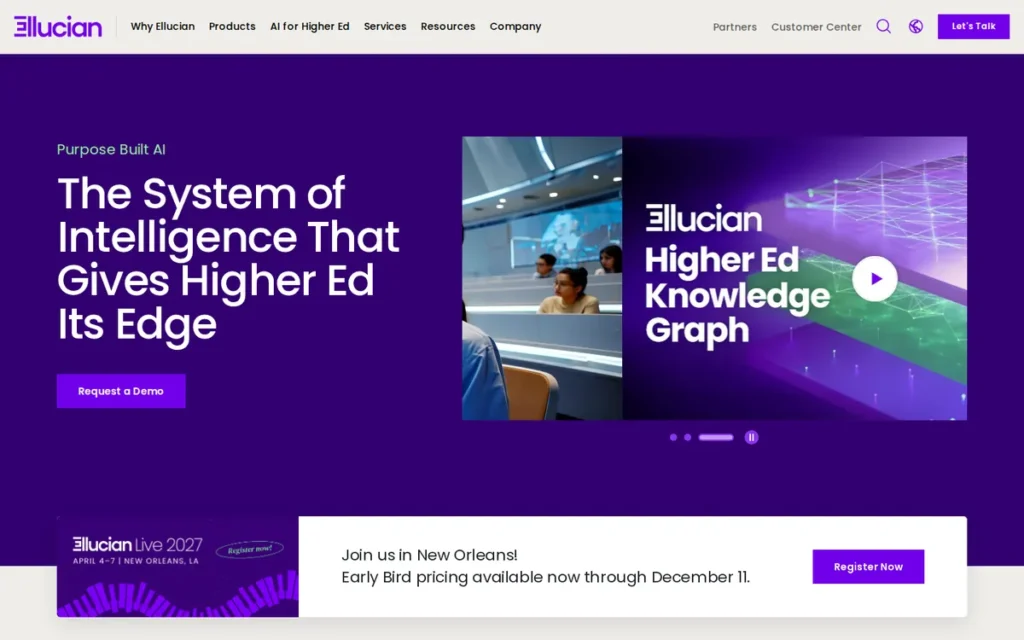
- SIS-Ecosystem CRM: Ellucian Student Recruiting & Admissions is an admissions CRM sold by the same vendor as the Banner and Colleague student information systems.
Private, Independent and International K–12
- K–12 Enrollment Suite: Finalsite Enrollment and Blackbaud Enrollment Management System run private-school admissions through contracts, re-enrollment and tuition.
- K–12 Admissions Specialist: Ravenna is a focused admissions platform that hands tuition billing off to a separate system.
How Do the Top Admissions and Enrollment Platforms Compare at a Glance?
In PlugRoute’s November 2026 scoring, Slate by Technolutions leads higher education (3.90/5) and Finalsite Enrollment leads private K–12 (3.85/5). Blackbaud Enrollment Management System is the K–12 runner-up for schools on Blackbaud’s tuition and aid products. Rows are grouped by segment. The overall rank appears in parentheses for reference only.
| Rank | Company | Category | Best For | One-Line Summary | Key Capabilities | Primary Strength | Key Limitation |
|---|---|---|---|---|---|---|---|
| Higher Ed | |||||||
| HE #1 (Overall #1); 3.90/5 | Slate by Technolutions | Dedicated Higher-Ed Admissions CRM | Admissions-led colleges with CRM staff | Slate by Technolutions is identified by the Tambellini Group as the leading packaged admissions CRM in U.S. higher education, best suited to institutions that can staff in-house configuration. | Application builder, Reader review, Deliver messaging, Slate Payments, Slate.org | Broadest named higher-ed SIS connections; analyst-recognized leader | SQL skills often needed; 1–2 admins recommended |
| HE #2 (Overall #4); 3.30/5 | Salesforce Education Cloud | Enterprise Education Platform | Large campuses wanting a cross-office CRM | Salesforce Education Cloud is the broadest institution-wide CRM option for higher education, best for campuses that can fund partner-led implementation and per-user licensing. | Admissions, student success, advancement, Agentforce AI agents, AppExchange | Only vendor with published per-tier list prices | 6–18 month complex implementations; Flex Credit rates unpublished |
| HE #3 (Overall #5); 3.20/5 | Element451 | Dedicated Higher-Ed Admissions CRM | Smaller colleges and community colleges | Element451 is an AI-focused higher-ed CRM with transparent starting pricing, best for smaller teams willing to validate its implementation timeline through references. | CRM, applications, events, Bolt AI agents, Socure fraud screening | Published $20,000/year starting price | Only 7 Capterra reviews; reported implementation overrun |
| HE #4 (Overall #7); 2.25/5 | Ellucian Student Recruiting & Admissions | SIS-Ecosystem CRM | Banner or Colleague institutions | Ellucian Student Recruiting & Admissions is the SIS-vendor option for Banner and Colleague schools, but it carries the weakest independent ratings and an unscheduled platform migration. | Applicant portals, decision routing, email/SMS/chat, events, dashboards | Same vendor as Banner and Colleague | G2 rating of 2.5/5, lowest in this review |
| K–12 | |||||||
| K–12 #1 (Overall #2); 3.85/5 | Finalsite Enrollment | K–12 Enrollment Suite | Private K–12 wanting inquiry-to-tuition | Finalsite Enrollment is the best-reviewed private K–12 enrollment platform in 2026, covering inquiry, contracts, deposits, re-enrollment and tuition billing in one system. | CRM, reading and scoring, lotteries, contracts, e-signature, re-enrollment, tuition billing, Ask AI | Highest rating in review (G2 4.7/5, 98 reviews) | SIS sync via export and hourly-sync services; PowerSchool non-API; reported Blackbaud friction |
| K–12 #2 (Overall #3); 3.60/5 | Blackbaud Enrollment Management System | K–12 Enrollment Suite | K–12 schools on the Blackbaud suite | Blackbaud Enrollment Management System is the most tightly connected admissions-to-tuition option for private K–12 schools already on the Blackbaud suite. | Applications, committee review, contracts, deposits, re-enrollment, aid and tuition links | Contracts flow into same-vendor aid and tuition | Dated family experience; 2020 vendor breach history |
| K–12 #3 (Overall #6); 3.00/5 | Ravenna | K–12 Admissions Specialist | Hub regions; Veracross, FACTS, TADS schools | Ravenna is a K–12 admissions specialist with a unique shared family application and explicit SIS and tuition integrations, but limited independent validation. | Ravenna Hub, campaigns, scheduling, committee review, Ravenna Enroll contracts and re-enrollment | Shared family application; named TADS and FACTS partnerships | No published pricing; 0 Capterra reviews |
Which Admissions Tool Should I Choose for My Use Case?
Choose Slate by Technolutions if your college has CRM staff, Salesforce Education Cloud for a cross-campus platform, and Element451 for a small team that wants AI and a known price. Private K–12 schools should start with Finalsite Enrollment, choose Blackbaud Enrollment Management System if they already use Blackbaud, or consider Ravenna in Hub regions.
| Your #1 Priority | Recommended Tool | Why | Acceptable Alternative |
|---|---|---|---|
| A college with CRM admin staff | Slate by Technolutions | Deepest documented higher-ed workflow and broadest named SIS connections | Element451 |
| A cross-campus platform, with budget for partners | Salesforce Education Cloud | Covers admissions, student success and advancement on one data model | Slate by Technolutions |
| A small team or community college wanting AI and a known price | Element451 | Published $20,000/year starting price and built-in Bolt AI agents | Salesforce Education Cloud (if partner budget exists) or Slate by Technolutions (only if CRM staff can be added) |
| A Banner or Colleague school that wants one vendor | Ellucian Student Recruiting & Admissions (check references first) | Same vendor as your SIS | Element451 (Ethos connector to Banner and Colleague) or Slate by Technolutions |
| A private K–12 school wanting inquiry-to-tuition in one system | Finalsite Enrollment | Highest ratings plus built-in tuition billing with payment plans | Blackbaud Enrollment Management System |
| A K–12 school already on Blackbaud tuition and aid | Blackbaud Enrollment Management System | Signed contracts feed Blackbaud Tuition Management | Finalsite Enrollment |
| A K–12 school in a Ravenna Hub region or on Veracross, FACTS or TADS | Ravenna | Shared family application and named K–12 SIS and tuition integrations | Finalsite Enrollment |
Which Are the Best Admissions Platforms for Higher Education?
In PlugRoute’s November 2026 scoring, Slate by Technolutions ranks first among higher-education platforms at 3.90/5. Salesforce Education Cloud (3.30), Element451 (3.20) and Ellucian Student Recruiting & Admissions (2.25) follow. Each platform leads on a different buying priority, so your staffing, scope and SIS should decide the choice.
- Slate by Technolutions leads on workflow coverage and SIS breadth.
- Salesforce Education Cloud leads on institution-wide scope.
- Element451 leads on its published starting price and AI agents.
- Ellucian Student Recruiting & Admissions leads on Banner and Colleague alignment.
1. Slate by Technolutions: Best Overall for Higher-Ed Admissions Teams with In-House CRM Staff
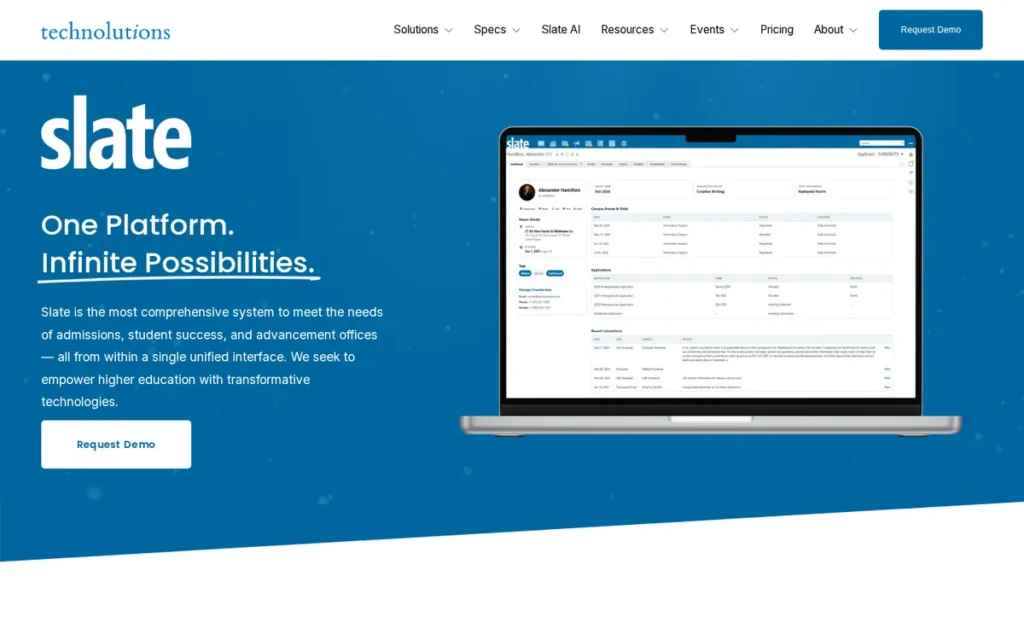
Category: Dedicated Higher-Ed Admissions CRM, purpose-built platforms that run college admissions from inquiry through deposit.
At a Glance
- Category: Dedicated Higher-Ed Admissions CRM
- Best For: Admissions-led U.S. colleges and universities with at least one dedicated CRM administrator
- Price Range: ~$30,000–$100,000+/year (third-party estimate, tiered by application volume; the vendor does not publish figures)
- Primary Strength: Slate by Technolutions covers applications, reader review, events, multichannel communications and deposits under one admissions license.
- Biggest Limitation: Slate by Technolutions relies on in-house configuration, and reviewers report needing SQL skills for advanced reporting.
- One-Line Summary: Slate by Technolutions is identified by the Tambellini Group as the leading packaged admissions CRM in U.S. higher education, best suited to institutions that can staff in-house configuration.
- Last Verified: November 2026
Score and Why This Rank: 3.90/5 (Higher Ed #1, Overall #1). Slate by Technolutions scores 5 on workflow coverage and 4 on ratings, integrations and vendor risk. It scores 3 on pricing transparency and 2 on operational burden, because reviewers report SQL is needed for advanced work.
Overview
Slate by Technolutions is a single-license admissions CRM and application platform for U.S. colleges and universities. It fits schools that want applications, reader review, events, communications and deposits in one system and that have staff who can configure and maintain it in-house.
Slate by Technolutions licenses Student Success and Advancement separately from admissions. Technolutions also sells a K–12 edition of Slate, which this review did not evaluate.
Key Features
- Slate by Technolutions includes an application builder and Reader, which routes applications to reviewers for scoring and decisions.
- Slate by Technolutions includes Deliver, which sends email, SMS, print and voice messages from the same database that holds applications.
- Slate by Technolutions processes application fees, event payments and enrollment deposits through its built-in Slate Payments module.
- Slate by Technolutions connects to Banner, Colleague, PeopleSoft and PowerSchool through APIs, scheduled web services and SFTP file transfers (Gilzor and Itexus, accessed November 2026).
- Slate by Technolutions provides Slate.org, a free portal where high school counselors and community organizations can follow their students’ application materials and status.
Best For
Slate by Technolutions is best for admissions-focused colleges and universities that want one deep, configurable admissions platform and can budget for one or two CRM specialists to run it.
Strengths
- Slate by Technolutions is identified by the Tambellini Group as the leading packaged recruitment and admissions CRM in U.S. higher education (Tambellini Group, accessed November 2026). Technolutions’ website cites 2,000+ institutions, and its G2 seller listing cites 1,600+ (both vendor-supplied, accessed November 2026).
- Slate by Technolutions holds a 4.4/5 G2 rating across 74 reviews, and reviewers consistently praise its depth and flexibility (G2, accessed November 2026).
- Slate by Technolutions names the broadest set of higher-ed SIS connections in this review: Banner, Colleague, PeopleSoft and PowerSchool (Gilzor and Itexus, accessed November 2026).
- Slate by Technolutions prices admissions per institution rather than per user, so adding admissions staff does not raise the license cost.
Limitations
- Slate by Technolutions trades ease of use for configurability. One Software Advice reviewer who did not work in IT said they had to learn coding and SQL to use it well (Software Advice user reviews, accessed November 2026).
- Slate by Technolutions stores prospects and applicants as separate record types, and one reviewer reports that searching both together requires SQL (Software Advice user reviews, accessed November 2026).
- Slate by Technolutions’ low license fee can hide the larger cost of one or two dedicated CRM administrators. That cost matters most for Slate because so much of the platform is configured in-house.
- Slate by Technolutions has no Workday Student integration confirmed in any source reviewed, and G2 reviewers describe a learning curve and complex reporting (G2, accessed November 2026).
Users on r/highereducation shared their experience:
“You’d have to put the calculations in the form you create, my recommendation would be for your team to hire Slate trainers to get your basic needs met. Slate is amazing but it takes a lot of work – I’m switching to the operations team to work on it exclusively. It’s going to accelerate your review process.” Posted by u/jaimeyeah
Takeaway: Slate by Technolutions delivers a faster review process, but only when an institution commits dedicated staff or paid trainers to configure it.
Verdict
Slate by Technolutions has the strongest evidence of any admissions platform for U.S. higher education in 2026, as long as the institution can staff in-house configuration.
Slate by Technolutions ranks first in higher education for workflow coverage, independent recognition and SIS breadth. Budget for administrator staffing alongside the license. Teams without technical staff should compare Element451.
Due-Diligence Check: No documented security incidents, regulatory actions or announced platform migrations were found for Slate by Technolutions as of November 2026.
Evidence Gaps: Slate by Technolutions has no named admissions case study with quantified results (the published Barnard College case study covers Slate for Student Success). Its Reddit content was captured but not reviewed, Workday Student integration is unconfirmed, and dollar pricing comes only from third-party estimates.
2. Salesforce Education Cloud: Best for One CRM Platform Across Admissions and Campus Offices
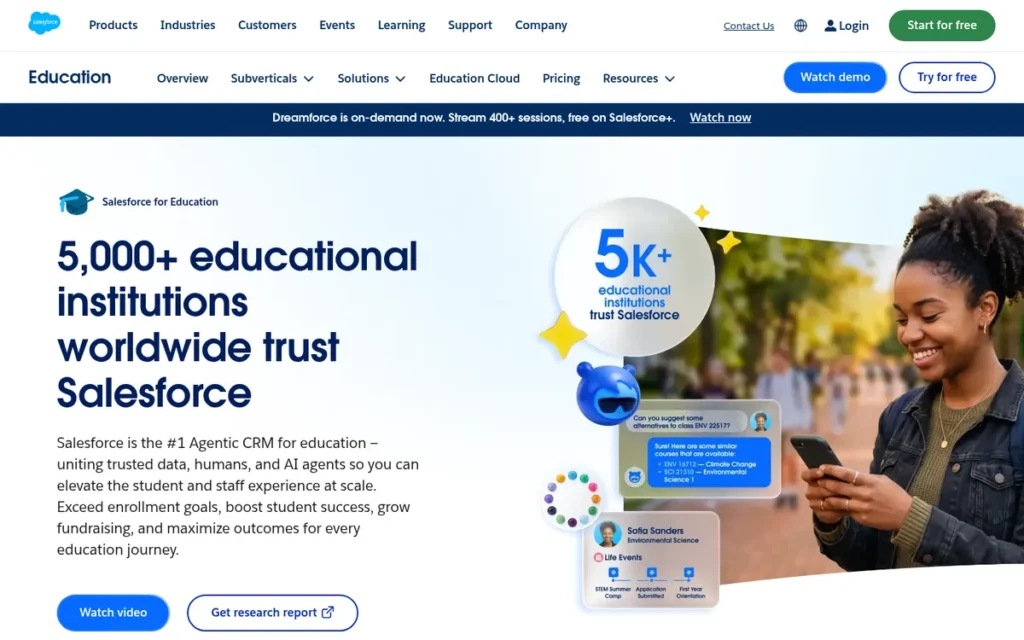
Category: Enterprise Education Platform, general CRM platforms extended across admissions and other campus offices.
At a Glance
- Category: Enterprise Education Platform
- Best For: Larger colleges and universities wanting a cross-campus CRM, with budget for implementation partners and platform administrators
- Price Range: $87–$363 per user/month (published nonprofit/education list price, billed annually; usage restrictions apply), plus Flex Credits and partner fees
- Primary Strength: Salesforce Education Cloud is the only product in this review with published per-tier list pricing, and it covers admissions, student success and advancement on one platform.
- Biggest Limitation: Salesforce Education Cloud usually requires implementation partners, and complex projects run 6–18 months.
- One-Line Summary: Salesforce Education Cloud is the broadest institution-wide CRM option for higher education, best for campuses that can fund partner-led implementation and per-user licensing.
- Last Verified: November 2026
Score and Why This Rank: 3.30/5 (Higher Ed #2, Overall #4). Salesforce Education Cloud edges Element451 by 0.10. Its combined G2 and Capterra rating base of 46 reviews outscores Element451’s 7 reviews, which outweighs its heavier implementation burden (operational burden score of 2).
Overview
Salesforce Education Cloud, now sold as Agentforce for Education, is an enterprise CRM platform for colleges and universities. It fits schools that want recruitment, admissions, student success and advancement on one shared data model and that have budget for implementation partners and platform administrators.
Salesforce Education Cloud does not ship a fixed admissions module, so each institution configures its post-admit workflows, usually with a partner.
Key Features
- Salesforce Education Cloud provides recruitment and admissions functions, including application management, review and applicant portals.
- Salesforce Education Cloud uses Salesforce’s Education Data Architecture and Data Cloud to share student records across offices (FullFabric, accessed November 2026).
- Salesforce Education Cloud includes Agentforce AI agents for recruitment, admissions, advising and transfer-credit questions (Salesforce, accessed November 2026).
- Salesforce Education Cloud can be extended with AppExchange apps and a large network of implementation partners.
- Salesforce Education Cloud covers student success, academic operations, student financials and advancement as well as admissions.
Best For
Salesforce Education Cloud is best for institutions that want admissions on the same platform as other campus offices and have the budget and staff for a partner-led build.
Strengths
- Salesforce Education Cloud has the largest combined CRM footprint in U.S. higher education once custom and enterprise deployments are counted. The Tambellini Group also names Salesforce the leading higher-ed marketing CRM vendor (Tambellini Group, accessed November 2026).
- Salesforce Education Cloud is the only product among the seven with published per-tier list prices, at $87–$363 per user per month for nonprofit and education institutions (Salesforce, November 2026).
- Salesforce Education Cloud holds a 4.5/5 Capterra rating (8 reviews) and a 4.2/5 G2 rating (38 reviews), and reviewers praise its flexible integration (Capterra and G2, accessed November 2026).
- Salesforce Education Cloud has the widest institution-wide scope in this review, from recruitment through advancement (FullFabric, accessed November 2026).
Limitations
- Salesforce Education Cloud trades out-of-the-box admissions readiness for platform breadth. HubSpot estimates 6–18 months for complex multi-department implementations (HubSpot, 2026).
- One Capterra reviewer reports that their team entered data by hand for five months after the Salesforce Education Cloud SIS integration failed to work (Capterra user reviews, accessed November 2026). That is a single account, not a typical timeline.
- Salesforce Education Cloud reviewers describe a steep learning curve, a higher-ed data model that “can feel convoluted,” a slow interface and multi-step lookups for application attachments (Capterra user reviews, accessed November 2026).
- Salesforce Education Cloud may be getting harder to staff. General Salesforce practitioners, not admissions staff, report that the Education Cloud Consultant certification was retired with no replacement (u/CalBearFan, r/salesforce, June 2026).
Users on r/highereducation noted:
“Definitely Salesforce but you need a strong implementation team. You can have a strong org or a terrible one depending on who builds it and how familiar they are with higher Ed.” Posted by u/xo1cew01f
Takeaway: Whether Salesforce Education Cloud succeeds depends more on the implementation partner’s higher-ed experience than on the platform itself.
Verdict
Salesforce Education Cloud is the strongest higher-ed choice in 2026 for institutions that want one CRM platform across admissions and other campus offices.
Salesforce Education Cloud has the most transparent list price but the least predictable total cost, because usage credits and partner fees come on top. Buyers who only need admissions will usually find Slate by Technolutions or Element451 faster to deploy.
Due-Diligence Check: No security incidents or regulatory actions specific to Salesforce Education Cloud were found as of November 2026. The Agentforce rebrand and the retired certification are a documented talent-availability risk.
Evidence Gaps: Salesforce Education Cloud Flex Credit rates are unpublished, no named institution’s admissions results could be verified, and no admissions-specific Reddit discussion was found.
3. Element451: Best for Smaller Higher-Ed Teams Prioritizing AI Agents and a Known Price
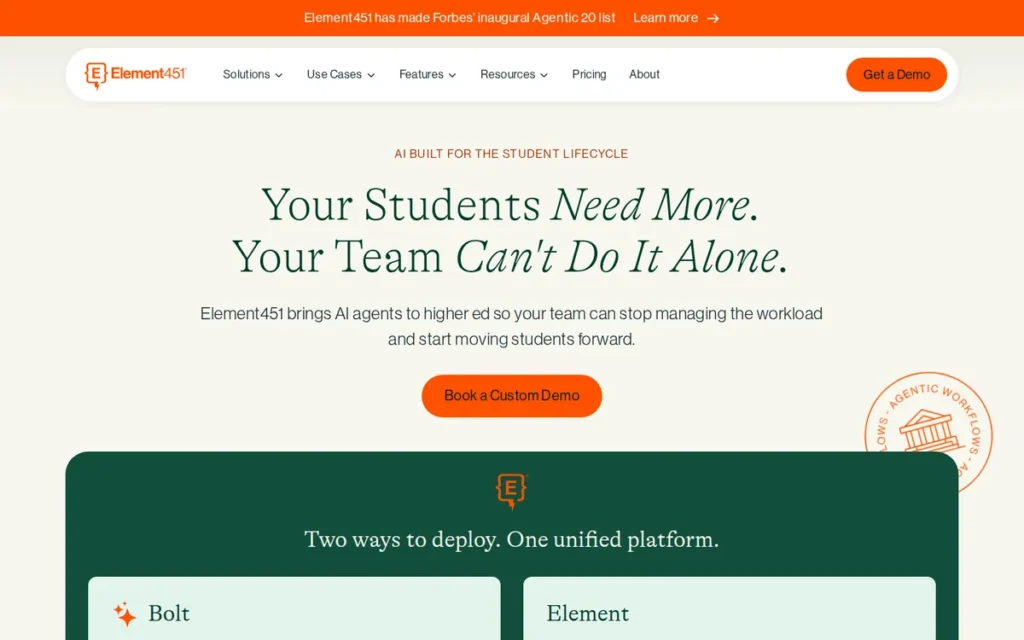
Category: Dedicated Higher-Ed Admissions CRM, purpose-built platforms that run college admissions from inquiry through deposit.
At a Glance
- Category: Dedicated Higher-Ed Admissions CRM
- Best For: Small to mid-sized colleges and community colleges without dedicated CRM staff that want built-in AI agents
- Price Range: From $20,000/year (published starting price; tiered by submitted-application volume and support tier)
- Primary Strength: Element451 combines a higher-ed CRM with built-in Bolt AI agents at a published starting price of $20,000 per year.
- Biggest Limitation: Element451 has only 7 Capterra reviews, and one independent account reports an implementation that ran far past its expected 12 weeks.
- One-Line Summary: Element451 is an AI-focused higher-ed CRM with transparent starting pricing, best for smaller teams willing to validate its implementation timeline through references.
- Last Verified: November 2026
Score and Why This Rank: 3.20/5 (Higher Ed #3, Overall #5). Element451 scores 4 on workflow coverage and pricing transparency, and 3 on integrations, operational burden and vendor risk. It scores 2 on ratings because only 7 Capterra reviews exist.
Overview
Element451 is an AI-focused higher-education CRM and engagement platform for colleges, including community colleges. It fits schools that want applications, events, campaigns, and Bolt AI agents for students and staff, at a published starting price of $20,000 per year.
Element451 reports serving 350+ institutions on its customers page and 400+ on its pricing page (vendor-reported; Element451, accessed November 2026). Buyers should ask for a current count.
Key Features
- Element451 combines CRM, applications, events, marketing automation and student success tools in one platform.
- Element451 offers Bolt AI agents that answer student and family questions, register event attendees and book appointments over chat, SMS, email and voice, using the institution’s own knowledge base.
- Element451 provides AI agents for staff that help with application review, campaign building and drafting content.
- Element451 pairs Bolt with Socure identity verification to detect and resolve fraudulent applications (Element451, accessed November 2026).
- Element451 connects to Ellucian Banner and Colleague through Ellucian’s Ethos integration layer.
Best For
Element451 is best for smaller colleges and community colleges that want AI-assisted student engagement and a predictable starting price without hiring a CRM specialist.
Strengths
- Element451 publishes a $20,000/year starting price, making it one of only two vendors in this review with a published price point (Element451, accessed November 2026).
- Element451 holds a 4.6/5 Capterra rating, with 5.0 for support and 4.8 for value, though only 7 reviews support these scores (Capterra, accessed November 2026).
- Element451 reports that Texas State Technical College cut its cost per submitted application from $424 to $81 and raised enrollment 33% (vendor-reported, no method disclosed; Element451, accessed November 2026).
- Element451 documents the most specific AI agent use cases among the seven products. These cover student-facing agents on four channels, staff-facing review and drafting agents, and fraud screening through a named identity partner, Socure.
Limitations
- Element451 trades a long independent track record for AI-led innovation, and its 7 Capterra reviews are too few to rely on.
- An independent Three Sonorans account reports that Element451’s implementation at Pima Community College ran far beyond the expected 12 weeks, with a steep learning curve for custom builds (Three Sonorans, accessed November 2026).
- Element451 may be weak at advanced cross-module reporting, which RFP.wiki analysts flag as a concern for data-heavy teams (RFP.wiki, accessed November 2026).
- Element451 lists Workday Student in its marketing, but the integration is not confirmed in its help documentation (Yardstick Research, accessed November 2026). Jenzabar integration is also unconfirmed, and AI accuracy data is not disclosed.
Verdict
Element451 is the only dedicated higher-ed admissions CRM in this review with a published starting price. That makes it a strong fit in 2026 for smaller teams that want built-in AI agents without dedicated CRM staff.
Element451’s vendor-reported outcomes are strong but have not been independently verified. Before signing, ask institutions of similar size about their implementation timelines.
Due-Diligence Check: No documented security incidents, regulatory actions or announced platform migrations were found for Element451 as of November 2026.
Evidence Gaps: Element451 Reddit content was captured but not reviewed, no G2 rating was verified, and every quantified outcome is vendor-reported with no independently checked method.
4. Ellucian Student Recruiting & Admissions: Best for Banner or Colleague Single-Vendor Schools
Category: SIS-Ecosystem CRM, admissions CRMs sold by the institution’s student information system vendor.
At a Glance
- Category: SIS-Ecosystem CRM
- Best For: Colleges and universities on Ellucian Banner or Colleague that want a single SIS vendor
- Price Range: Pricing on request (no public pricing or contract amounts found)
- Primary Strength: Ellucian Student Recruiting & Admissions is built to work with Ellucian Banner and Colleague, and reviewers cite the SIS integration as a benefit.
- Biggest Limitation: Ellucian Student Recruiting & Admissions has the lowest user rating in this review, at 2.5/5 on G2.
- One-Line Summary: Ellucian Student Recruiting & Admissions is the SIS-vendor option for Banner and Colleague schools, but it carries the weakest independent ratings and an unscheduled platform migration.
- Last Verified: November 2026
Score and Why This Rank: 2.25/5 (Higher Ed #4, Overall #7). Ellucian Student Recruiting & Admissions scores 3 on workflow and integration, and 2 on pricing, operational burden and vendor risk. It scores 1 on ratings, because its 2.5/5 G2 score is the lowest in this review.
Overview
Ellucian Student Recruiting & Admissions, formerly Ellucian CRM Recruit, is a recruitment and admissions CRM built on Microsoft Dynamics. It is designed for colleges and universities already running Ellucian Banner or Colleague that want applicant portals, communications and decision routing from their SIS vendor.
Ellucian Student Recruiting & Admissions hands post-admit steps such as deposits and enrollment off to the SIS rather than running them itself.
Key Features
- Ellucian Student Recruiting & Admissions provides applications and applicant portals with document and status tracking.
- Ellucian Student Recruiting & Admissions routes application decisions through configurable workflows.
- Ellucian Student Recruiting & Admissions sends email, SMS and chat messages and keeps a history of communications.
- Ellucian Student Recruiting & Admissions includes event management, recruitment workflows and dashboards.
- Ellucian Student Recruiting & Admissions is designed to integrate with Ellucian Banner and Colleague.
Best For
Ellucian Student Recruiting & Admissions is best for Banner or Colleague institutions that value having one vendor for SIS and CRM and can confirm through references how the integration actually behaves.
Strengths
- Ellucian Student Recruiting & Admissions comes from a vendor whose products serve about 3,000 institutions in 50 countries (Ellucian, accessed November 2026). That is a company-wide figure, not a count of Recruit customers.
- Ellucian Student Recruiting & Admissions is praised by TrustRadius reviewers for SIS integration and dashboards (TrustRadius, 6/10 from 3 reviews, accessed November 2026).
- Ellucian Student Recruiting & Admissions gets G2 praise for workflows that are easy to set up and for useful communication tracking (G2, accessed November 2026).
- Ellucian Student Recruiting & Admissions gives one vendor responsibility for both systems at institutions already standardized on Banner or Colleague.
Limitations
- Ellucian Student Recruiting & Admissions trades user experience for SIS-vendor alignment. G2 reviewers (2.5/5, 21 reviews) call it “not intuitive” and describe clunky query building and limited customization (G2, accessed November 2026).
- Ellucian Student Recruiting & Admissions reviewers report little training, support tickets “unanswered for months,” and a failed on-premise installation that could not be upgraded. Some of these complaints may concern older on-premise versions.
- Ellucian Student Recruiting & Admissions did not work well with one reviewer’s own Ellucian SIS, so a same-vendor integration is not guaranteed (G2 user reviews, accessed November 2026).
- Ellucian Student Recruiting & Admissions is moving to Microsoft Dynamics 365 and Power Platform. Ellucian’s March 19, 2025 announcement cites improved AI, security and scalability, but no customer migration timeline has been published (Ellucian, March 2025).
Verdict
Ellucian Student Recruiting & Admissions is best suited in 2026 to Banner or Colleague institutions that put single-vendor alignment ahead of user experience.
Ellucian Student Recruiting & Admissions has the weakest independent ratings of the seven products. Ask for references from cloud customers and a written Dynamics 365 migration plan, and demo Slate by Technolutions or Element451 alongside it.
Due-Diligence Check: No documented security incidents or regulatory actions were found for Ellucian Student Recruiting & Admissions as of November 2026. The announced Dynamics 365 move has no published customer timeline.
Evidence Gaps: Ellucian Student Recruiting & Admissions has no named case-study results, no Capterra presence and no Reddit discussion found, and its Recruit-specific customer count is unknown.
Which Are the Best Enrollment Platforms for Private K–12 Schools?
In PlugRoute’s November 2026 scoring, Finalsite Enrollment ranks first among private K–12 platforms at 3.85/5, followed by Blackbaud Enrollment Management System (3.60) and Ravenna (3.00). All three document contracts, deposits and re-enrollment. The deciding factors are ratings, who owns tuition billing, and which SIS or tuition system a school already runs.
- Finalsite Enrollment leads on independent ratings and built-in tuition billing.
- Blackbaud Enrollment Management System leads on same-vendor financial aid and tuition connections.
- Ravenna leads on its shared family application and named TADS and FACTS partnerships.
1. Finalsite Enrollment: Best Overall for Private K–12 Schools Wanting Inquiry-to-Tuition
Category: K–12 Enrollment Suite, systems that run private-school admissions through contracts, re-enrollment and tuition.
At a Glance
- Category: K–12 Enrollment Suite
- Best For: Private, independent and international K–12 schools that want admissions through tuition billing from one vendor
- Price Range: Pricing on request (custom quote by school size and products)
- Primary Strength: Finalsite Enrollment has the highest independent user rating in this review and covers the full K–12 journey from inquiry to tuition billing.
- Biggest Limitation: Finalsite Enrollment connects to SIS platforms mainly through sync and export services (PowerSchool exports are non-API), and one G2 reviewer reports it “didn’t play well with Blackbaud.”
- One-Line Summary: Finalsite Enrollment is the best-reviewed private K–12 enrollment platform in 2026, covering inquiry, contracts, deposits, re-enrollment and tuition billing in one system.
- Last Verified: November 2026
Score and Why This Rank: 3.85/5 (K–12 #1, Overall #2). Finalsite Enrollment edges Blackbaud by 0.25 on ratings, operational burden and vendor risk. Blackbaud scores higher on integration depth and pricing predictability.
Overview
Finalsite Enrollment, formerly SchoolAdmin, is an enrollment management system for private, independent and international K–12 schools. It covers inquiry, application, review, lotteries, contracts, deposits, re-enrollment and tuition billing in one system, and it comes from the same vendor that runs many schools’ websites.
Finalsite Enrollment joined Finalsite when Finalsite acquired SchoolAdmin on March 10, 2021. SchoolAdmin served more than 650 schools at the time (Business Wire, March 2021).
Key Features
- Finalsite Enrollment provides inquiry, application and event forms connected to an admissions CRM with email and text messaging.
- Finalsite Enrollment supports application reading with custom scoring, plus lotteries and waitlists.
- Finalsite Enrollment handles enrollment contracts with e-signatures, deposits and family checklists.
- Finalsite Enrollment runs annual re-enrollment and tuition billing with payment plans in the same system.
- Finalsite Enrollment offers an “Ask AI” assistant in the parent portal that answers families around the clock using school-approved content.
Best For
Finalsite Enrollment is best for private K–12 schools that want contracts, deposits, re-enrollment and tuition handled in one place, especially schools already on, or considering, a Finalsite website.
Strengths
- Finalsite Enrollment holds a 4.7/5 G2 rating across 98 reviews on its product page, the highest rating and largest review count among the seven products evaluated (G2, accessed November 2026).
- Finalsite Enrollment is one of three K–12 products here that document contracts, e-signature, deposits and re-enrollment. It also adds built-in tuition billing with payment plans (Finalsite, accessed November 2026).
- Finalsite Enrollment reviewers repeatedly praise its usability and responsive support. One G2 reviewer called SchoolAdmin “one of the most responsive customer services” of their admissions career (G2, accessed November 2026).
- Finalsite Enrollment reports first-year averages of +27% enrollment and +17% applications for schools that switch (vendor-reported, no method disclosed; Finalsite, accessed November 2026).
Limitations
- Finalsite Enrollment trades integration certainty for single-vendor convenience. It documents a Blackbaud Admissions integration with hourly syncing and a data-export service to Veracross and PowerSchool, with PowerSchool exports non-API (Finalsite support documentation, accessed November 2026).
- Finalsite Enrollment “didn’t play well with Blackbaud,” according to one G2 reviewer, who also said it lacked features compared with the tools it replaced (G2 user reviews, accessed November 2026).
- Finalsite Enrollment reporting is described as cumbersome by some G2 reviewers (G2 user reviews, accessed November 2026).
- Finalsite Enrollment’s review base includes many reviews written before the 2021 acquisition, so they may not reflect current support quality.
Verdict
Finalsite Enrollment has the strongest evidence in 2026 for private K–12 schools that want admissions through tuition billing in one system.
Finalsite Enrollment leads all seven products on independent ratings and ties for the most complete K–12 post-admit coverage. Before signing, get a written two-way, field-level integration spec for your SIS. Schools already deep in the Blackbaud suite should compare Blackbaud Enrollment Management System directly.
Due-Diligence Check: No documented security incidents, regulatory actions or announced platform migrations were found for Finalsite Enrollment as of November 2026.
Evidence Gaps: Finalsite Enrollment has no verified Capterra or TrustRadius presence and no relevant Reddit discussion. Its outcome metrics have no disclosed method, and claims of post-acquisition price increases or weaker support were not verified.
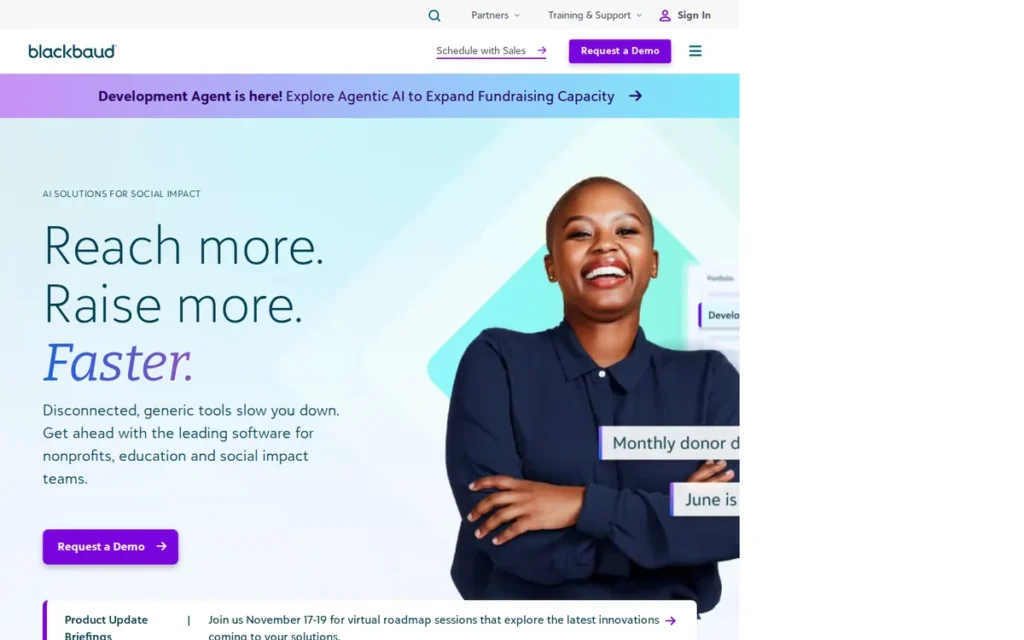
2. Blackbaud Enrollment Management System: Best for K–12 Schools Already on Blackbaud
Category: K–12 Enrollment Suite, systems that run private-school admissions through contracts, re-enrollment and tuition.
At a Glance
- Category: K–12 Enrollment Suite
- Best For: Private K–12 schools already using, or committing to, Blackbaud’s SIS, financial aid and tuition products
- Price Range: Pricing on request (the vendor states implementation, training and support are typically included)
- Primary Strength: Blackbaud Enrollment Management System connects contracts, deposits, financial aid and tuition billing within one vendor’s suite.
- Biggest Limitation: Blackbaud Enrollment Management System reviewers describe a dated family-facing experience and a depth that overwhelms occasional users.
- One-Line Summary: Blackbaud Enrollment Management System is the most tightly connected admissions-to-tuition option for private K–12 schools already on the Blackbaud suite.
- Last Verified: November 2026
Score and Why This Rank: 3.60/5 (K–12 #2, Overall #3). Blackbaud Enrollment Management System scores 5 on workflow coverage, 4 on integration, and 3 on ratings, pricing and operational burden. It scores 2 on vendor risk because of its vendor’s 2020 breach and the 2023–2024 regulatory settlements.
Overview
Blackbaud Enrollment Management System is the admissions and enrollment module of Blackbaud’s K–12 suite. It is built for private schools that want applications, committee review, contracts, deposits and re-enrollment connected directly to Blackbaud Financial Aid Management and Tuition Management.
Blackbaud Enrollment Management System’s “one database” design and SKY API are vendor marketing claims that buyers should test in a live demo (Edurolia, accessed November 2026).
Key Features
- Blackbaud Enrollment Management System provides custom applications and forms with family checklists and automatic reminders.
- Blackbaud Enrollment Management System supports self-scheduled visits, online committee review and admissions dashboards.
- Blackbaud Enrollment Management System manages enrollment contracts with payment-plan selection, deposits and re-enrollment.
- Blackbaud Enrollment Management System links to Blackbaud Financial Aid Management for aid applications and awards.
- Blackbaud Enrollment Management System passes signed contracts to Blackbaud Tuition Management, which creates family billing accounts.
Best For
Blackbaud Enrollment Management System is best for private K–12 schools that already run Blackbaud’s student, aid and tuition products and that value data flowing within one vendor more than a modern family interface.
Strengths
- Blackbaud Enrollment Management System documents the deepest native admissions-to-finance chain in this review. Signed contracts create Tuition Management billing accounts, and Financial Aid Management links to enrollment (Blackbaud, accessed November 2026).
- Blackbaud Enrollment Management System holds a 4.2/5 G2 rating across 59 reviews, and reviewers praise its integration with other Blackbaud products for board reporting (G2, accessed November 2026).
- Blackbaud Enrollment Management System is one of three K–12 products here that document contracts, deposits and re-enrollment as built in.
- Blackbaud Enrollment Management System is the only quote-only vendor found to state in writing that implementation, training and support are typically included, which helps with total-cost planning.
Limitations
- Blackbaud Enrollment Management System trades family experience and flexibility for suite integration. One detailed G2 review describes a process that looked “very dated,” with families confused about where they were in it (G2 user reviews, accessed November 2026).
- Blackbaud Enrollment Management System reviewers also report checklists that were hard to simplify, reports that were hard to navigate, and support that leaned on a chatbot (G2 user reviews, accessed November 2026).
- Blackbaud Enrollment Management System carries the most documented vendor-risk history in this review because of the 2020 breach. That record does not prove the product is insecure today. Buyers should request audit reports and breach-notification commitments, as PlugRoute recommends for every vendor.
- Blackbaud Enrollment Management System pricing was called “steep” by one G2 reviewer (G2 user reviews, accessed November 2026).
This aligns with community sentiment on r/k12sysadmin:
“Been using blackbaud for years. My biggest problem with them is that it’s almost impossible to get good data out of the system in an automated way unless you have api experience. Their reporting is lacking, as well.
Currently strongly considering a move to Veracross.” Posted by u/MrThursty
Takeaway: Long-time users of Blackbaud’s K–12 suite say weak reporting and API-dependent data extraction are serious enough to push schools toward competitors.
Verdict
Blackbaud Enrollment Management System is the best-connected K–12 enrollment option in 2026 for schools already committed to Blackbaud’s tuition and financial aid products.
Blackbaud Enrollment Management System ties Finalsite Enrollment on post-admit coverage but trails it on user ratings and family experience. Schools outside the Blackbaud ecosystem get less from its main advantage.
Due-Diligence Check: Blackbaud’s 2020 ransomware breach affected 13,000+ customers. It led to a $3 million SEC penalty (SEC, March 2023), a $49.5 million multistate settlement (multistate attorneys general, October 2023) and an FTC order requiring security improvements (FTC, February 2024). No announced platform migration was found.
Evidence Gaps: Blackbaud Enrollment Management System Reddit content was captured but not reviewed, and a Raiser’s Edge integration is unconfirmed. Its only named case study, Gonzaga College High School, gives no figures.
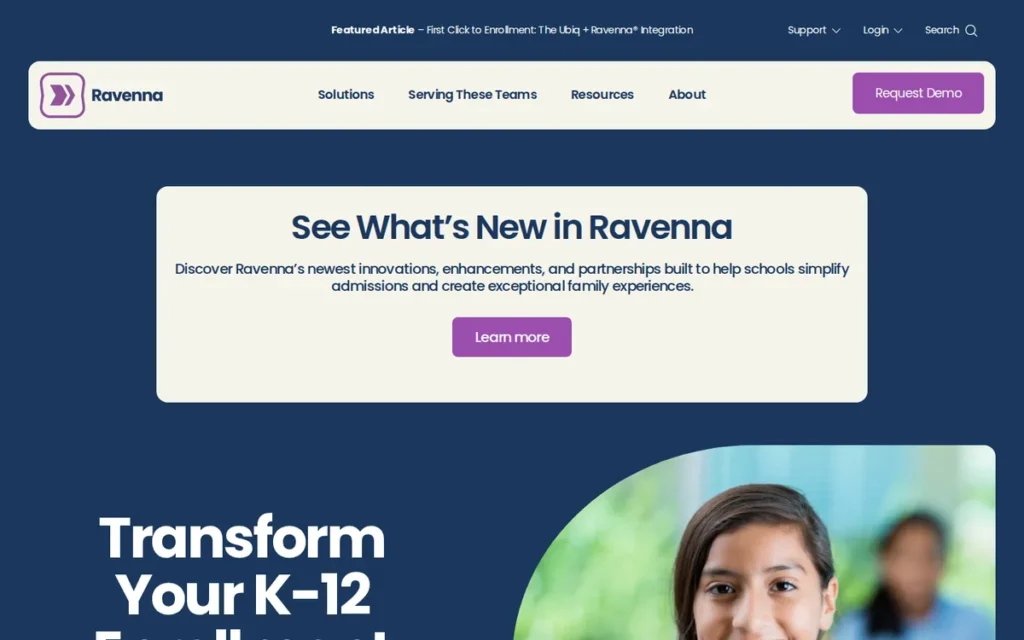
3. Ravenna: Best for K–12 Shared-Application Regions and Veracross, FACTS or TADS Schools
Category: K–12 Admissions Specialist, focused admissions platforms that hand tuition billing off to a separate system.
At a Glance
- Category: K–12 Admissions Specialist
- Best For: Private, independent and faith-based K–12 schools in Ravenna Hub regions, or schools running Veracross, FACTS, PowerSchool or TADS
- Price Range: Pricing not published (school fees, per-applicant fees and any family fees unverified)
- Primary Strength: Ravenna offers a shared family application through Ravenna Hub and the most explicitly named K–12 SIS and tuition partner list in this review.
- Biggest Limitation: Ravenna publishes no pricing, and its Capterra listing shows 0 user reviews, so buyers must rely on references and quotes.
- One-Line Summary: Ravenna is a K–12 admissions specialist with a unique shared family application and explicit SIS and tuition integrations, but limited independent validation.
- Last Verified: November 2026
Score and Why This Rank: 3.00/5 (K–12 #3, Overall #6). Ravenna scores 5 on workflow coverage and 4 on integrations. It scores 1 on ratings (0 Capterra reviews) and 1 on pricing transparency (nothing published), and both low scores reflect transparency gaps, not product defects.
Overview
Ravenna is an admissions platform for private, independent and faith-based K–12 schools. It offers a shared family application through Ravenna Hub and committee review. Through Ravenna Enroll it handles contracts, deposits and re-enrollment, and it has named integrations with Veracross, Blackbaud, FACTS, PowerSchool and TADS.
Ravenna began working with a group of Seattle private schools in 2012 and is now part of VenturEd Solutions (Ravenna, accessed November 2026).
Key Features
- Ravenna Hub lets families find participating schools in their region and reuse application answers and documents across several schools.
- Ravenna supports inquiry imports, email and text campaigns, and tour and interview scheduling.
- Ravenna provides committee review, document collection, and funnel and yield reporting.
- Ravenna Enroll imports returning students from the SIS and issues customizable re-enrollment contracts with e-signatures, multiple signers and payers, deposits and automated reminders (Ravenna, 2025).
- Ravenna lists named integrations with Veracross, Blackbaud, FACTS, PowerSchool and TADS (Ravenna integrations overview, 2024).
Best For
Ravenna is best for K–12 schools in a region with an active Ravenna Hub, or schools that want an admissions specialist feeding an existing Veracross, FACTS, PowerSchool or TADS setup.
Strengths
- Ravenna has the most explicitly named K–12 SIS and tuition partner list in this review. The list includes TADS and FACTS, which no other K–12 product here names (Ravenna integrations overview, 2024).
- Ravenna offers the only shared multi-school family application among the seven products, through Ravenna Hub (Ravenna, accessed November 2026).
- Ravenna partners with the Enrollment Management Association, including its Standard Application Online data, as well as SSAT, Gateway to Prep Schools and TABS (Ravenna, accessed November 2026).
- Ravenna reports serving 5,000+ schools, processing 300,000 applications a year, and delivering “67% fewer hours” for schools (vendor-reported, no method disclosed; Ravenna, accessed November 2026).
Limitations
- Ravenna trades marketing and CRM depth for its admissions focus. Edurolia and other comparison sites describe it as having less of both than Finalsite Enrollment, which is a difference in scope rather than a documented complaint (Edurolia, accessed November 2026).
- Ravenna’s Capterra listing shows 0 user reviews, and no G2 or TrustRadius rating was found, so independent user experience cannot be checked (as of November 2026).
- Ravenna routes tuition billing through TADS Tuition and Billing Management rather than a billing module of its own, so schools add a second system relationship for billing (Ravenna, accessed November 2026).
- Ravenna publishes no school subscription price, per-applicant fees or family fees, and Ravenna Hub was not confirmed as free for families (as of November 2026).
Verdict
Ravenna is the strongest K–12 option in 2026 for schools in shared-application regions or on Veracross, FACTS, PowerSchool or TADS.
Ravenna’s third-place K–12 rank reflects missing public ratings and pricing, not documented product failures. Buyers should ask for reference calls and a full written quote.
Due-Diligence Check: No documented security incidents, regulatory actions or announced platform migrations were found for Ravenna as of November 2026. The date and terms of its move into VenturEd Solutions are unknown.
Evidence Gaps: Ravenna has no verified ratings, no pricing, no relevant Reddit discussion and no confirmed founder or headcount data. Its efficiency claims have no disclosed method, and integration depth varies by system.
How Much Does Admissions and Enrollment Software Cost in 2026?
Admissions and enrollment software ranges from Element451’s published starting price of $20,000 a year to $100,000+ a year for enterprise Slate deployments (third-party estimate). Salesforce lists $87–$363 per user per month. Five of the seven vendors publish no dollar pricing. Staffing of 1.1–2 CRM specialists (EAB, 2025) can cost more than the license.
| Product | Pricing Model | Known Figure | Source Type | Undisclosed Cost Lines |
|---|---|---|---|---|
| Slate by Technolutions | Per institution, tiered by application volume | ~$30,000–$100,000+/year | Third-party estimate | Admin staffing; Student Success and Advancement licenses |
| Salesforce Education Cloud | Per user plus usage credits | $87 / $131 / $363 per user/month | Published | Flex Credit rates, Marketing Cloud, partners, middleware |
| Element451 | Annual, tiered by volume and support | From $20,000/year | Published | Full tier schedule, AI usage limits |
| Ellucian Student Recruiting & Admissions | Quote only | None found | Quote only | All lines |
| Finalsite Enrollment | Quote by size, products and services | None found | Quote only | Implementation, payment processing, integrations, website bundle |
| Blackbaud Enrollment Management System | Quote by size, users and modules | None found; implementation, training and support “typically included” | Quote only | License, module pricing |
| Ravenna | Not disclosed | None found | Not verified | School, per-applicant and family fees |
Illustrative Year-One Math (PlugRoute arithmetic, not vendor quotes)
- A college paying a typical ~$50,000 Slate by Technolutions license (third-party estimate) and staffing 1.5 CRM specialists at a $90,000 midpoint salary spends about $185,000 in year one, nearly four times the license.
- A 20-user Salesforce Education Cloud deployment at the $131 Advanced tier costs about $31,440 a year in licenses, before Flex Credits, partner fees and administrators.
- Adding five admissions counselors raises that Salesforce Education Cloud bill by about $7,860 a year. A per-institution Slate by Technolutions license stays flat unless rising application volume moves it into a higher tier.
In admissions software, the license quote is the floor of your cost, not the total. The staff who configure and maintain the system often cost more than the software itself.
As one user on r/highereducation described:
“regardless of what CRM you go with it is essential to have a dedicated integration team within the uni – people whose whole role is to set up the crm for the different teams. It is not possible to do this as ‘part of your role’.
It’ll take about 2 years total with the right funding and if all goes to plan” Posted by u/llksg
Takeaway: Higher-ed CRM rollouts of any brand need full-time internal staff and multi-year timelines, so staffing belongs in the budget from day one.
Vendor Pricing Notes (verified November 2026)
- Slate by Technolutions describes its admissions license as all-inclusive with “no hidden costs” (Technolutions, accessed November 2026). Its dollar estimates come from Guideflow and are partly backed by a competitor’s (Element451’s) blog, which may be biased.
- Salesforce Education Cloud Sales & Service Core costs $87 per user per month for nonprofit and education institutions, billed annually (Salesforce, November 2026).
- Salesforce Education Cloud Advanced costs $131 per user per month, and Sales & Service Max costs $363 per user per month, with usage restrictions applying (Salesforce, November 2026).
- Salesforce Education Cloud requires for-profit institutions to request a quote. Third-party listings showing “$87 Enterprise / $145 Unlimited” or “$81.25” appear outdated.
- Element451 is listed on TrustRadius at “$20,000 per month,” which conflicts with the vendor’s pricing page and is treated as a listing error.
- Ellucian Student Recruiting & Admissions offers no free trial, according to TrustRadius, and possible bundling for Banner or Colleague licensees is unverified (TrustRadius, accessed November 2026).
- Finalsite Enrollment buyers should ask for a quote that lists license, implementation and migration, payment processing, integrations and any website bundle separately.
- Blackbaud Enrollment Management System buyers should get the vendor’s “typically included” implementation, training and support commitment in writing.
- Ravenna buyers should ask in writing for school fees, implementation and integration fees, and any fees passed on to families.
Which Platforms Handle Contracts, Deposits and Re-Enrollment in One Place?
Finalsite Enrollment, Blackbaud Enrollment Management System and Ravenna all document contracts, deposits and re-enrollment for K–12 schools. Finalsite adds built-in tuition billing, Blackbaud passes contracts to its own Tuition Management product, and Ravenna hands billing to TADS. Among higher-ed platforms, only Slate documents built-in deposits. The others configure deposits or hand them to the SIS.
| Product | Deposits/Payments | Contracts & E-Signature | Re-Enrollment | Tuition/Aid Handoff |
|---|---|---|---|---|
| Slate by Technolutions | Built in (Slate Payments) | Not documented | Not applicable (higher ed) | Handed off to SIS |
| Salesforce Education Cloud | Configured | Configured | Not applicable (higher ed) | Configured (student financials) |
| Element451 | Not specified | Not documented | Not applicable (higher ed) | Handed off to SIS |
| Ellucian Student Recruiting & Admissions | Handed off to SIS | Handed off to SIS | Not applicable (higher ed) | Handed off to SIS |
| Finalsite Enrollment | Built in | Built in | Built in | Built in (tuition billing) |
| Blackbaud Enrollment Management System | Built in | Built in (contracts) | Built in | Built in (same-vendor aid and tuition) |
| Ravenna | Built in (Ravenna Enroll) | Built in (contracts and e-signature) | Built in (Ravenna Enroll re-enrollment) | Handed off to TADS Tuition and Billing Management |
How Do AI Features Compare Across Admissions and Enrollment Platforms?
AI now appears in most vendor pitches, but none of the seven vendors publishes accuracy data, usage limits or AI-specific pricing. Element451, Salesforce Education Cloud and Finalsite Enrollment document the most specific AI features. This research found no documented AI features for Slate, Ellucian, Blackbaud or Ravenna.
| Product | AI Features (vendor-described, Nov 2026) | AI Billing | Accuracy Data Published |
|---|---|---|---|
| Slate by Technolutions | None documented in this research | Not applicable | No |
| Salesforce Education Cloud | Agentforce agents for recruitment, admissions, advising and transfer credit | Flex Credits at unpublished rates | No |
| Element451 | Bolt student and staff agents; Socure fraud screening | Usage costs undisclosed | No |
| Ellucian Student Recruiting & Admissions | None documented (Ellucian cites AI as a reason for its Dynamics 365 move) | Not applicable | No |
| Finalsite Enrollment | Ask AI parent-portal assistant | Not disclosed | No |
| Blackbaud Enrollment Management System | None documented in this research | Not applicable | No |
| Ravenna | None documented in this research | Not applicable | No |
What Red Flags Should I Watch For When Evaluating Admissions and Enrollment Software?
Six red flags turned up in this research, each tied to at least one vendor, and each can be checked during a demo or contract review before signing. The most serious is an integration promised as “native” without a written field-level specification, because reviewers documented failures even between two products from the same vendor.
Red Flag #1: Native Integration Promised Without a Field-Level Spec
A “native” integration is only a claim until the vendor puts a field-level sync spec in writing. Reviewers documented failures between Finalsite Enrollment and Blackbaud and between Ellucian’s CRM and its own SIS. One Salesforce reviewer’s team entered data by hand for five months (G2 and Capterra user reviews, accessed November 2026).
Finalsite Enrollment, for example, syncs Blackbaud Admissions data hourly but sends PowerSchool data as a non-API export that the school validates and imports. A sales slide calls both of these “integrations,” but they create very different daily workflows.
Red Flag #2: A License Quote That Omits Staffing, Partners or Usage Credits
A license quote on its own understates the true cost of an admissions platform. CRM administrators often cost more than the software. Per-user platforms such as Salesforce Education Cloud also add unpublished usage credits and partner fees on top of seat licenses. Ask every vendor to itemize staffing assumptions, partner fees and metered usage.
Red Flag #3: AI Features With No Plan, Price or Accuracy Disclosure
Most major vendors now pitch AI features, but none of the seven in this review publishes accuracy rates, usage limits or AI-specific costs. Salesforce Education Cloud’s Flex Credit rates, for example, are unpublished (Salesforce, November 2026). Treat any AI feature without a written plan, price and accuracy disclosure as unproven.
Red Flag #4: Reporting Demoed Only With Prebuilt Dashboards
Reporting difficulty appears in user reviews or analyst assessments of five of the seven products: Slate, Ellucian, Finalsite, Blackbaud and Element451 (G2, Software Advice and RFP.wiki, accessed November 2026). A demo limited to prebuilt dashboards hides the effort your team will face building custom reports, sometimes in SQL.
Red Flag #5: Outcome Metrics With No Method Disclosed
Every quantified outcome found in this research was vendor-reported, including enrollment gains and hours saved. A metric with no stated baseline period, sample or method should be treated as marketing until a reference customer of similar size confirms it. Ask vendors to name the school and the period they measured.
Red Flag #6: No Written Security Audit or Platform Roadmap Commitment
A vendor that will not provide audit reports, a breach-notification commitment and a dated roadmap leaves student data and multi-year contracts exposed. Blackbaud’s 2020 breach and later settlements, and Ellucian’s untimed Dynamics 365 move, show why every vendor should answer in writing (SEC, March 2023; Ellucian, March 2025).
Salesforce’s Agentforce rebranding also retired the Education Cloud Consultant certification without a direct replacement, according to a June 2026 practitioner thread (u/CalBearFan, r/salesforce, June 2026).
What Questions Should I Ask Before Choosing Admissions and Enrollment Software?
The best evaluation questions make vendors prove fit with your own data instead of a generic tour. The seven questions below work as a demo script for both higher-ed and K–12 buyers, and one is just for K–12 schools. Ask for each answer in writing so you can compare vendors fairly.
Question #1: Can you show our real workflow from inquiry to SIS handoff using our data?
A generic product tour cannot show whether a platform fits your office. Ask the vendor to take one of your actual applicants through inquiry, review, decision and SIS handoff during the demo. Count the manual steps and workarounds you see, because each one turns into recurring staff time after launch.
Question #2: Which fields sync with our SIS, in which direction, and how often?
None of the seven vendors was found to publish a complete field-level integration matrix, and Finalsite’s sync-frequency documentation is the closest example. Ask for a written spec covering each field, its sync direction and frequency, and what happens when a sync fails. Integration methods vary widely in this category:
- Slate by Technolutions uses APIs, scheduled web services and SFTP file transfers.
- Element451 connects to Banner and Colleague through Ellucian’s Ethos integration layer.
- Finalsite Enrollment uses hourly syncs for Blackbaud Admissions and non-API exports for PowerSchool.
- Blackbaud Enrollment Management System markets its SKY API, which buyers should test live.
Question #3: What does year-one and year-three total cost look like, including implementation, modules, credits and staff?
A three-year cost model exposes renewal increases, add-on modules and usage credits that a year-one quote hides. Ask the vendor to list every cost line separately and to say which costs are fixed and which grow with staff headcount or application volume.
Question #4: How many administrators, and with what skills, do comparable customers employ?
Staffing is often the largest hidden cost of an admissions platform. Ask how many CRM administrators customers of your size employ and whether those staff need SQL or developer skills. Then compare the answer with EAB’s benchmark of 1.1–2 CRM specialists per enrollment team (EAB, 2025).
Question #5: Which AI features are in our quote, how is usage billed, and how is human oversight maintained under FERPA?
AI features differ in what’s included, how they are billed and how they handle student data, and no vendor in this review publishes accuracy data. Ask each vendor these four questions in writing before you give AI features any weight in your decision:
- Which AI agents are included in our quote?
- How is AI usage metered and billed?
- Is accuracy or error-rate data available?
- How are student records protected under FERPA when AI features process them?
Question #6 (K–12): Can you demo contracts, e-signature, deposits, re-enrollment and tuition handoff from the family’s view?
For K–12 schools, the family experience is part of the product, because parents complete contracts, deposits and re-enrollment themselves. Ask to see the parent portal from start to finish, including how families track their status. Confusion about status was a documented complaint in at least one review.
Question #7: Can we speak to three references of our size who went live in the last 18 months?
Three references of your size that went live in the last 18 months show what implementation looks like today, not years ago. Ask each one about planned versus actual timelines, staff hours and support after launch. Documented overruns include Pima Community College’s Element451 rollout (Three Sonorans, accessed November 2026).
How Should I Run a Shortlist Evaluation for Admissions Software?
Run a shortlist evaluation in five steps: confirm your category, request integration specs, script the demos, model three-year cost and finish reference calls. Following this order keeps vendor marketing from setting your agenda. You will only see demos from platforms that already fit your segment, your SIS and your team’s capacity.
- Confirm your segment and category first, using the five categories defined at the top of this guide.
- Request written field-level integration specs from two or three vendors before you schedule any demos.
- Run Questions #1 through #7 as a scripted demo, using your own applicant data and real staff.
- Build a three-year total-cost model that includes staffing, partners, modules and usage credits for each finalist.
- Complete at least three reference calls per finalist with institutions of similar size that went live recently.
How Did We Rank These Admissions and Enrollment Management Platforms?
PlugRoute scored all seven platforms from 1 to 5 on the same six weighted criteria, using research collected November 12, 2026. The weighted score sets each product’s overall rank. Products are then presented in separate higher-ed and K–12 lists, so buyers never have to compare unlike products directly.
Ranking Criteria
- C1: Full Student-Journey Workflow Coverage (25%): Workflow coverage matters because every gap from inquiry to re-enrollment means another tool or more spreadsheet work.
- C2: Independent User Ratings and Review Volume (20%): Independent ratings matter because review-site data is the main independent check on vendor marketing.
- C3: SIS, Financial Aid and Tuition Integration Evidence (20%): Integration evidence matters because user reviews show “native” integrations can fail.
- C4: Pricing Transparency and Total-Cost Predictability (15%): Pricing transparency matters because implementation, modules, credits and staffing drive total cost of ownership.
- C5: Operational Burden (10%): Operational burden matters because configurable systems can require technical staff that teams do not have.
- C6: Vendor Risk and Evidence Quality (10%): Vendor risk matters because security history, roadmap stability and talent availability affect long-term risk.
Full Scorecard
| Product | Segment | C1 | C2 | C3 | C4 | C5 | C6 | Weighted | Overall Rank |
|---|---|---|---|---|---|---|---|---|---|
| Slate by Technolutions | Higher Ed | 5 | 4 | 4 | 3 | 2 | 4 | 3.90 | 1 |
| Finalsite Enrollment | K–12 | 5 | 5 | 3 | 2 | 4 | 3 | 3.85 | 2 |
| Blackbaud Enrollment Management System | K–12 | 5 | 3 | 4 | 3 | 3 | 2 | 3.60 | 3 |
| Salesforce Education Cloud | Higher Ed | 4 | 3 | 3 | 4 | 2 | 3 | 3.30 | 4 |
| Element451 | Higher Ed | 4 | 2 | 3 | 4 | 3 | 3 | 3.20 | 5 |
| Ravenna | K–12 | 5 | 1 | 4 | 1 | 3 | 3 | 3.00 | 6 |
| Ellucian Student Recruiting & Admissions | Higher Ed | 3 | 1 | 3 | 2 | 2 | 2 | 2.25 | 7 |
Evidence Hierarchy and Scoring Rules
- Independent review data and regulatory records carried the most weight, followed by third-party estimates and then vendor-reported claims, each labeled inline.
- Missing data for C2 or C4 scored low, because transparency is what those two criteria measure. A quote-only vendor scores 2 on C4, and a vendor with no pricing information at all scores 1.
- Missing data for any other criterion scored a neutral 3, and each entry’s Evidence Gaps line discloses the gap.
- Operational burden (C5) scores 2 for heavy technical-skill requirements and 1 for failed installs documented on current versions. Ellucian scored 2 because its reported failed install may reflect an older on-premise version.
- Slate by Technolutions and Salesforce Education Cloud both have Tambellini recognition, but Salesforce scores 3 on C6 because the retired Education Cloud Consultant certification is a documented talent-availability risk.
- Scores for Finalsite Enrollment (C3, 2 to 3), Ravenna (C1, 4 to 5) and Ellucian (C4, 1 to 2) were revised after a verification pass on November 12, 2026. That pass found documented integrations and re-enrollment features, plus one place where the rubric had been applied inconsistently. No segment rank changed.
- No peer-reviewed studies of this software category were found in this research, and no independent comparison of outcomes was found.
Research Limitations
- Reddit content for Slate, Element451 and Blackbaud was captured but not reviewed for this edition.
- Ravenna has no verified review ratings or pricing.
- One source backing Slate’s pricing estimate is a competitor’s (Element451’s) blog.
PlugRoute has no affiliate relationships with any company listed, and rankings are determined entirely by research data and objective evaluation criteria.
What Do Buyers Most Often Ask About Admissions and Enrollment Software?
Buyers most often ask which platform is best for their segment and how PlugRoute produces its rankings. The answers below give the short version, drawn from PlugRoute’s November 2026 scoring of seven admissions and enrollment platforms across U.S. higher education and private K–12 schools.
What’s the best admissions software for higher education in 2026?
Slate by Technolutions is the best-evidenced admissions platform for U.S. higher education in 2026. It holds a 4.4/5 G2 rating across 74 reviews (G2, accessed November 2026), and the Tambellini Group recognizes it as the leading packaged admissions CRM. Smaller teams without CRM staff should compare Element451. Institutions wanting one cross-campus CRM should consider Salesforce Education Cloud.
What’s the best enrollment management software for private K–12 schools?
Finalsite Enrollment is the best-reviewed private K–12 enrollment platform in 2026. It holds a 4.7/5 G2 rating across 98 reviews (G2, accessed November 2026) and offers built-in tuition billing alongside contracts, deposits and re-enrollment. Schools on Blackbaud’s aid and tuition products should compare Blackbaud Enrollment Management System, and schools in Ravenna Hub regions should evaluate Ravenna.
How does PlugRoute determine rankings?
PlugRoute scores every product from 1 to 5 on the same six weighted criteria, using dated evidence labeled by source type. Independent ratings and regulatory records count more than vendor claims. The full scorecard is published, including any score corrections, so readers can see every score, its source and how missing data affected the result.
What Do Key Admissions and Enrollment Management Terms Mean?
Buyers of admissions and enrollment software need a shared vocabulary for SIS integration, licensing models and post-admit steps. The terms below are defined the way PlugRoute uses them in this review. You can apply each one directly when comparing vendor quotes, integration specs and demo scripts.
Student Information System (SIS): The system of record for enrolled students’ academic and registration data. Your admissions platform must hand admitted students to it cleanly, so SIS fit is often the deciding factor.
Admissions CRM: Software that tracks prospective students and applicants and communicates with them before enrollment. Check whether it also handles applications, review and deposits, or whether it depends on other tools.
Enrollment Funnel: The stages a student moves through: prospect, inquiry, applicant, admit and deposit. Funnel reporting shows where students drop out, so check that a platform can report each stage without custom queries.
Enrollment Contract: A signed agreement in which a K–12 family commits to enrollment and tuition terms. Built-in contracts with e-signature avoid paper forms and duplicate data entry.
Re-Enrollment: The yearly process in which current K–12 families confirm they are returning. Running it in the same system as admissions keeps family records and billing consistent.
Yield: The share of admitted students who enroll. Yield is a core enrollment metric, so check whether a platform reports it without custom work.
Per-Institution Licensing: A pricing model with one fee for the whole institution, often tiered by application volume. Costs stay flat as staff grow, but a large jump in applications can move you into a higher tier.
Per-User Licensing: A pricing model that charges for each staff account. At $131 per user per month, adding five staff adds about $7,860 a year, so model future headcount before signing.
Usage Credits: Metered units billed for activity such as AI agent conversations or data processing. Unpublished credit rates make total cost hard to predict.
Field-Level Integration Spec: A document listing exactly which data fields sync between systems, in which direction and how often. It turns a vague integration promise into something you can enforce in a contract.
FERPA: The U.S. federal law protecting the privacy of student education records. Confirm how vendors, including their AI features, store and process student data under it.
Total Cost of Ownership (TCO): The full cost of a system over time, including license, implementation, add-ons, training and staffing. TCO is often far higher than the license fee alone.
Which Admissions and Enrollment Management Tool Is Right for You?
Key Insights
The right admissions and enrollment tool depends first on your segment, then on your SIS and then on your staffing. Slate by Technolutions and Finalsite Enrollment lead their segments in PlugRoute’s November 2026 scoring. Even so, license price, integration method and reporting effort decide whether a platform will work for your team.
- Admissions buyers should choose by segment first, SIS second and staffing third, because even the best-reviewed platform fails if the team cannot run it.
- License price is not total cost. EAB benchmarks 1.1–2 CRM specialists per enrollment team, with job postings at $70,000–$150,000+ (EAB, 2025).
- A “native” integration is a claim to verify, because reviewers documented failures even between products from the same vendor.
- Reporting difficulty appears in user reviews or analyst assessments of five of the seven products, so buyers should demo live custom reporting rather than dashboards alone.
- For private K–12 schools, the family-facing portal is part of the product, because parents complete contracts, deposits and re-enrollment there.
- Every quantified outcome found in this research was vendor-reported, so reference calls are the most practical way to check results.
Higher education:
- College admissions offices with CRM staff should start with Slate by Technolutions.
- Institutions wanting one platform across campus should consider Salesforce Education Cloud.
- Small teams wanting AI and a known price should look at Element451.
- Banner or Colleague schools can evaluate Ellucian Student Recruiting & Admissions after thorough reference checks.
Private K–12:
- Schools wanting inquiry-to-tuition in one system should start with Finalsite Enrollment.
- Schools committed to the Blackbaud suite should evaluate Blackbaud Enrollment Management System.
- Schools in Ravenna Hub regions or on Veracross, FACTS or TADS should evaluate Ravenna.
Also Considered, Not Evaluated: Liaison/TargetX, OpenApply, SchoolMint, Veracross Admissions and Anthology Reach.
We update this guide quarterly. Last updated: November 12, 2026. For full scoring details and ready-to-use demo scripts, read PlugRoute’s methodology and scorecard, or browse PlugRoute’s other independent education software reviews.