The best attribution software depends on what you measure: AppsFlyer leads for mobile app installs, CallRail for lead-gen calls and forms, Dreamdata for B2B account-based revenue, and Northbeam or Triple Whale for ecommerce orders depending on ad spend. No single tool wins every job, so match the tool to your outcome.
Free analytics tools offer few attribution models and weak connections to CRM data. Different tools also give different credit for the same sale. PlugRoute found no published independent head-to-head accuracy tests as of November 2026, which makes vendor claims hard to check.
As one user on r/Entrepreneurs described:
“I run campaigns for 2 b2b companies and the reporting inconsistencies are driving me up the wall. One platform will show 2.3X ROAs, another shows 1.8X for the same campaign period. I have more tough questions from clients every reporting cycle and I’m now almost spending more time trying to track than I spend optimizing.” Posted by u/NiceStraightMan
Takeaway: When ad platforms report conflicting ROAS figures, marketers end up spending more time reconciling attribution than improving campaigns.
PlugRoute has no affiliate relationships with any company listed, and rankings are determined entirely by research data and objective evaluation criteria.
Every entry below uses the same structure. Each one labels vendor-reported and competitor-written claims and says plainly where independent evidence is thin. Use the overall rank to compare how strong the evidence is, and use the Best For guidance to match a tool to your business model.
What Are the 4 Categories of Attribution Software?
Attribution software falls into four categories, defined by what each one tracks:
- Mobile Measurement Partners track devices and installs.
- Lead & Call Attribution tools track calls and forms.
- B2B Account-Based tools track buying accounts.
- Ecommerce Attribution tools track people and orders.
A tool from one category rarely replaces a tool from another.
- Mobile Measurement Partner (MMP): A Mobile Measurement Partner uses a device and SKAdNetwork identity model to credit app installs and in-app events. PlugRoute’s 2026 review includes AppsFlyer in this category.
- Lead & Call Attribution: A Lead & Call Attribution tool uses a call, form, or visitor-to-CRM identity model to credit phone calls, forms, and chats. PlugRoute’s 2026 review includes CallRail and Ruler Analytics in this category.
- B2B Account-Based Attribution: A B2B Account-Based Attribution tool uses an account identity model to credit pipeline and closed-won revenue across every contact in a buying group. PlugRoute’s 2026 review includes Dreamdata and HockeyStack in this category.
- Ecommerce Attribution: An Ecommerce Attribution tool uses a person-and-order identity model to credit online orders and revenue. PlugRoute’s 2026 review includes Northbeam and Triple Whale in this category.
The identity model decides what an attribution tool can see: a device, a person and an order, a buying account, or a phone call.
Take a B2B deal with three people involved. A VP clicked a LinkedIn ad, an engineer read a blog post, and a buyer phoned sales. CallRail records one call, and GA4 records three unconnected users. Dreamdata or HockeyStack can group all three people under one account journey.
Multi-touch attribution (MTA) tools in every category now rely more on first-party data and server-side tracking. Many of them also send offline conversions back to ad platforms.
Market forecasts show the category is growing. Research firms define the market differently, so do not add their figures together:
- Grand View Research values the marketing attribution software market at $4.74B in 2024 and forecasts $10.10B by 2030, a 13.6% CAGR (Grand View Research, 2024).
- Mordor Intelligence reports that multi-touch attribution made up 48.24% of attribution-services revenue in 2025 (Mordor Intelligence, 2025).
How Do the Top Attribution Software Tools Compare at a Glance?
AppsFlyer ranks first overall on evidence strength, followed by CallRail and Dreamdata. Northbeam, Triple Whale, HockeyStack, and Ruler Analytics score within 0.30 points of each other. Use the overall rank to compare evidence strength, and use the Category and Best For columns to pick a tool for your business model.
| Rank | Company | Category | Best For | One-Line Summary | Key Capabilities | Primary Strength | Key Limitation |
|---|---|---|---|---|---|---|---|
| 1 | AppsFlyer | MMP | Mobile app user-acquisition teams | AppsFlyer is the only MMP in PlugRoute’s 2026 review, and SplitMetrics (2026) positions it as the broadest enterprise MMP. | Install and in-app attribution, SKAdNetwork, Protect360, Data Locker, deep linking | Attribution, fraud prevention, and raw exports in one platform; G2 integrations score of 9.8/10 | Costs are hard to forecast as volume grows; add-on prices are not published |
| 2 | CallRail | Lead/Call | Local service and lead-gen businesses, agencies | CallRail has the largest review base and the lowest published paid entry price among the call tools in PlugRoute’s 2026 review. | Dynamic number insertion (DNI), AI transcripts, self-reported attribution, form tracking | 1,000+ G2 reviews; 9.0/10 ease of setup | Leads are organized by call or form, not by person; no MMM |
| 3 | Dreamdata | B2B | Long-cycle B2B teams running LinkedIn-heavy ABM | Dreamdata is the highest-rated B2B attribution platform in PlugRoute’s 2026 review. | Account timelines, LinkedIn CAPI, Audience Builder, warehouse syncs | Highest ratings (G2 4.7/5 from 279 reviews; Capterra 4.8/5) | Paid tiers are quote-only; free plan is single-touch only |
| 4 | Northbeam | Ecommerce | DTC brands spending about $50K+/month on ads | Northbeam scored highest on measurement rigor in PlugRoute’s 2026 review. | C+DV view credit, flexible lookback windows, Apex, MMM+ | Measurement rigor and published pricing | $1,500/month entry price; 30–45 day warm-up; 16-review G2 sample |
| 5 | Triple Whale | Ecommerce | Shopify-first DTC brands | Triple Whale is the only ecommerce tool in PlugRoute’s 2026 review with a free dashboard tier. | Triple Pixel, seven models, configurable windows, Sonar, Moby AI | Unified Shopify-native dashboard with a free tier | Mixed accuracy reports; unpublished GMV-based pricing |
| 6 | HockeyStack | B2B | B2B teams that want incrementality inside a GTM platform | HockeyStack has the widest go-to-market feature scope of the two B2B tools in PlugRoute’s 2026 review. | Nine models, Lift Reporting, IP identification, Odin AI | Only documented lift testing among the B2B tools reviewed | Prices not published by vendor; 4–6 week setup |
| 7 | Ruler Analytics | Lead/Call | Lead-gen businesses that also buy offline media | Ruler Analytics is the only lead-gen tool in PlugRoute’s 2026 review that pairs lead-to-revenue matching with MMM. | Call, form, and chat tracking; CRM revenue matching; MMM | Closed-loop revenue matching plus MMM | Thinnest review evidence; 12-month contracts reported |
Which Attribution Software Should I Choose for My Top Priority?
Choose attribution software by the outcome you need to credit:
- AppsFlyer fits app installs.
- CallRail fits calls on a small budget.
- Ruler Analytics fits leads matched to revenue.
- Dreamdata or HockeyStack fit long-cycle B2B.
- Triple Whale or Northbeam fit ecommerce, depending on ad spend.
Low-spend teams with simple funnels may not need a paid tool yet.
| Your #1 Priority | Recommended Tool | Why | Acceptable Alternative |
|---|---|---|---|
| Mobile app installs | AppsFlyer | Broadest MMP feature set (SplitMetrics, 2026), plus Data Locker raw exports | Adjust (runner-up, not profiled) |
| Calls and forms on a small budget | CallRail | $55/month entry price and the highest ease-of-setup score in this review | Ruler Analytics if you need revenue matching |
| Leads matched to revenue, plus offline media | Ruler Analytics | Closed-loop CRM matching plus built-in MMM | CallRail paired with CRM reporting |
| Long-cycle B2B with LinkedIn ABM | Dreamdata | Account timelines and LinkedIn Conversions API | HockeyStack |
| B2B with incrementality needs | HockeyStack | Lift Reporting alongside nine attribution models | Dreamdata |
| Shopify brand with moderate spend | Triple Whale (start on the free tier) | Free Founders Dash and an all-in-one dashboard | Northbeam once spend grows |
| DTC brand spending $50K+/month | Northbeam | Configurable lookback windows, view-through credit, MMM+ | Triple Whale |
| Low spend and a simple funnel | GA4 plus native reporting and a Conversions API (CAPI) setup | Free; community advice says fix tracking basics first | Google Ads call tracking or Triple Whale Founders Dash |
How Do Pricing and Measurement Options Compare?
Pricing models differ more than headline prices do:
- AppsFlyer charges per conversion.
- Triple Whale scales with GMV.
- Ruler Analytics scales with website traffic.
- Northbeam scales with ad spend and pageviews.
Only four of the seven tools publish official paid pricing. The worked examples below turn those list prices into annual budgets.
| Company | Identity Model | Pricing Basis | Entry Price (Nov 2026) | Configurable Lookback | MMM / Incrementality | Conversion Feedback to Ad Platforms |
|---|---|---|---|---|---|---|
| AppsFlyer | Device / SKAN | Per conversion | Free for 12K conversions in year one (Growth plan for paid UA), then $0.07 each | Not verified (ask vendor) | Incrementality add-on (price not public) | Not verified (ask vendor) |
| CallRail | Call / form | Plan plus add-ons and minutes | $55/month (calls) or $105/month (calls + forms); $50/$95 billed annually | Not verified (ask vendor) | No | Not verified (ask vendor) |
| Dreamdata | Account | Tier, by quote | Free plan (single-touch); paid tiers by quote | Not verified (ask vendor) | Not verified (ask vendor) | Yes (LinkedIn CAPI, Google Ads audiences) |
| Northbeam | Person, ML-modeled | Ad spend and pageviews | $1,500/month | Yes (Polar Analytics, competitor source) | Yes, higher tiers | Yes (Apex) |
| Triple Whale | Person and order | Annual GMV | Free Founders Dash; ~$219–$749+/month reported | Yes: 1-, 7-, 14-, 28-day and lifetime (Triple Whale) | Yes | Yes (Sonar) |
| HockeyStack | Account and user | Tier, usage | From $2,200/month on G2; Growth ~$1,400 reported; not published by vendor | Not verified (ask vendor) | Lift Reporting; MMM on Custom tier | Offline conversions on Custom tier |
| Ruler Analytics | Visitor matched to CRM | Website traffic | From £249–£299/month by traffic, plus call charges (official) | Not verified (ask vendor) | Yes (MMM) | Yes (Google Ads, Meta) |
PlugRoute’s worked examples show what list prices mean as annual budgets (vendor pricing pages, November 2026):
- An AppsFlyer Growth customer with 20,000 conversions in year one pays for 8,000 billable conversions, or $560 before add-ons.
- CallRail Lead Tracking Complete costs $1,260 per year billed monthly, or $1,140 billed annually, before minute overages and add-ons.
- Northbeam Starter costs at least $18,000 per year.
Every free tier has hard limits:
- AppsFlyer’s free Zero plan covers owned-media activity only. Paid user acquisition needs the Growth plan.
- Dreamdata’s free plan offers single-touch attribution and keeps 2 months of history.
- Triple Whale’s free Founders Dash is a dashboard, not Triple Whale’s full attribution suite.
What Are the 7 Best Attribution Software Tools in 2026?
By PlugRoute’s weighted evidence score, the seven best attribution software tools in 2026 are:
- AppsFlyer
- CallRail
- Dreamdata
- Northbeam
- Triple Whale
- HockeyStack
- Ruler Analytics
Every entry follows the same structure. Vendor-reported results and competitor-written claims are labeled each time.
1. AppsFlyer: Best Overall Evidence / Best for Mobile App Install and In-App Attribution
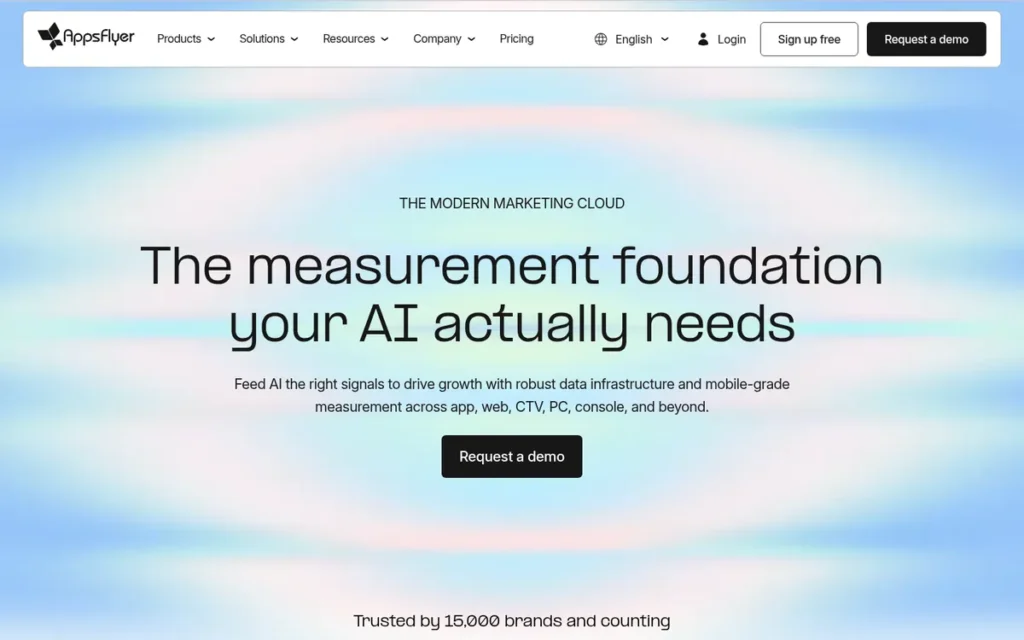
Category: Mobile Measurement Partner (MMP). Attributes app installs and in-app events to the ad networks and campaigns that drove them.
At a Glance
- Category: Mobile Measurement Partner (MMP)
- Best For: Mobile app marketers who need install, in-app event, and SKAdNetwork attribution plus fraud prevention across many ad networks
- Price Range: Free for 12,000 conversions in year one (Growth plan for paid campaigns), then $0.07 per conversion; Enterprise and add-ons by quote
- Primary Strength: AppsFlyer combines install attribution, Protect360 fraud prevention, deep linking, and Data Locker raw exports in one platform, and G2 users score its third-party integrations 9.8/10 (G2, November 2026).
- Biggest Limitation: AppsFlyer costs become hard to forecast as conversion volume grows, and add-on prices such as Protect360 are not published.
- One-Line Summary: AppsFlyer is the only mobile measurement partner in PlugRoute’s 2026 review and is positioned as the broadest enterprise MMP (SplitMetrics, 2026). It suits app teams that need install attribution, fraud prevention, and raw-data access in one platform.
- Last Verified: November 2026
Overview
AppsFlyer is a mobile measurement partner that attributes app installs and in-app events to ad networks and campaigns. It is built for app marketers and user-acquisition teams that need SKAdNetwork support, fraud prevention, and raw-data access across mobile, web, and connected TV.
AppsFlyer also offers deep linking and combines cost and ROI data across ad networks. No MMP, including AppsFlyer, can recover iOS data that Apple withholds.
Key Features
- AppsFlyer attributes app installs and post-install events to media sources, and supports SKAdNetwork and other privacy-focused measurement for iOS.
- AppsFlyer Protect360 blocks fraudulent installs and provides raw-data reports on blocked installs, so teams can investigate fraud themselves.
- AppsFlyer Data Locker exports raw attribution data that teams can check against their own backend records.
- AppsFlyer includes deep linking and combines cost and ROI data across ad networks.
- AppsFlyer measures across mobile, web, connected TV, and PC/console, and offers AI creative analysis.
Best For
AppsFlyer is best for app businesses that run user acquisition across several ad networks and need fraud controls and raw-data reconciliation. AppsFlyer is not designed for B2B pipeline or call-driven lead generation.
Pricing
AppsFlyer’s Zero plan is free, includes 12,000 conversions in the first 12 months, and covers owned-media activity only. AppsFlyer’s Growth plan includes the same allowance for paid campaigns and then charges $0.07 per conversion. Enterprise pricing is custom (AppsFlyer, November 2026).
- AppsFlyer does not publish prices for add-ons such as Protect360 and incrementality.
- AppsFlyer Growth customers with 20,000 conversions in year one would pay $560 for 8,000 billable conversions, before add-ons.
- AppsFlyer buyers should get plan and add-on terms in writing before committing.
Strengths
- AppsFlyer holds G2 ratings of 4.5–4.7/5 from about 700–730 reviews, and G2 users score its third-party integrations 9.8/10 (G2, November 2026).
- AppsFlyer holds a Capterra rating of 4.5/5 from 138 reviews, with reviewers praising its breadth, ROI analysis, and Data Locker (Capterra, November 2026).
- AppsFlyer Data Locker is the feature one practitioner credited with finding where install counts were leaking after Apple’s App Tracking Transparency changes (Reddit r/AppBusiness, 2026).
- AppsFlyer’s 2026 Performance Index analyzed 27.2 billion installs across nearly 25,000 apps. This vendor-produced benchmark shows scale, not market share (AppsFlyer, 2026).
Users on r/PPC noted:
“Personally I’d definitely vouch for Appsflyer, their UI is great, they have heaps of information and documentation on implementation. While having a lot of features and being expensive is the downside, the other thing is their add ons like Fraud Prevention (which some competitors have by default).” Posted by u/Ok-Knowledge9609
Takeaway: Even practitioners who vouch for AppsFlyer name its premium price and separately sold fraud-prevention add-ons as the cost of its feature depth.
Limitations
AppsFlyer trades breadth for complexity, and the cost of that falls hardest on teams without analysts. G2 and Capterra reviewers cite a steep learning curve, confusing onboarding, and information that is hard to find (G2, 2026).
- AppsFlyer reports are described by some reviewers as slow or incomplete, and PeerSpot reviewers cite limited reporting flexibility (PeerSpot, 2026).
- AppsFlyer costs rise with conversion volume, and Capterra reviewers call it “expensive relative to alternatives” (Capterra, 2026).
- AppsFlyer moved one G2 reviewer from the free plan to a paid plan and billed for services the reviewer did not request, according to that single user’s account (G2, 2026).
- AppsFlyer has no named customer case studies with percentage results in PlugRoute’s research, and its SOC 2/ISO certification status was not verified, so buyers should request both.
Verdict
AppsFlyer has the strongest overall evidence base in PlugRoute’s 2026 attribution software review and is the default shortlist pick for measuring mobile app installs.
AppsFlyer ranks #1 with a weighted score of 4.30. It leads on capability depth (5/5) and integrations (5/5), and it scores lowest on time to value (2.5/5). For teams with analyst capacity, AppsFlyer’s large review base and raw-data exports outweigh the learning curve.
Smaller app teams should use AppsFlyer’s free year-one allowance to test their setup and model volume costs before committing.
2. CallRail: Best for Lead-Gen Call and Form Attribution on a Small-Business Budget
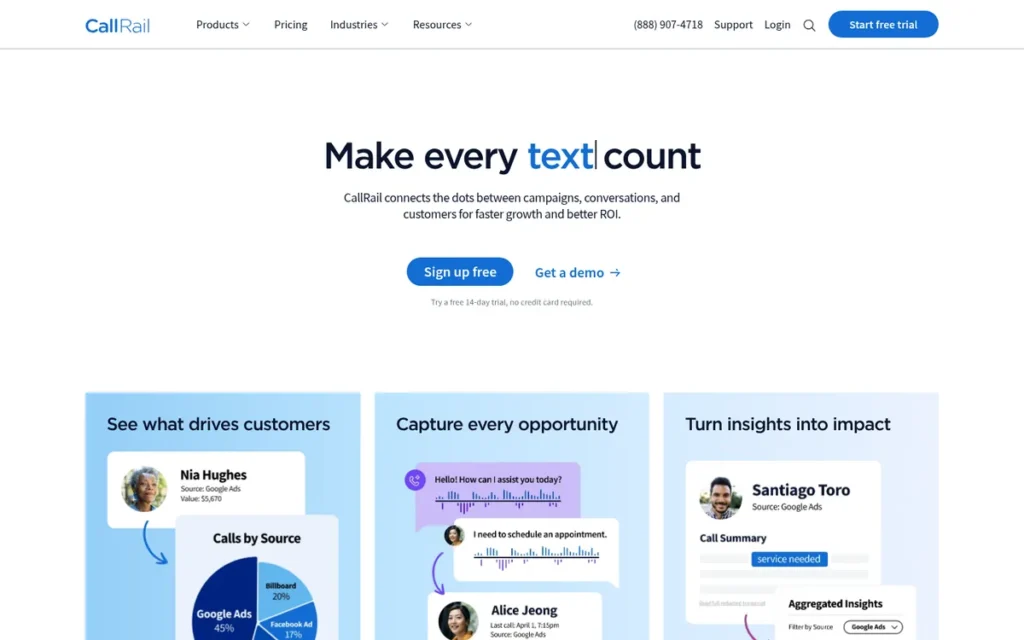
Category: Lead & Call Attribution. Connects phone calls, texts, forms, and chats to the marketing source that produced them.
At a Glance
- Category: Lead & Call Attribution
- Best For: Local service businesses, lead-gen firms, and agencies whose conversions happen by phone or form
- Price Range: $55/month (calls) or $105/month (calls + forms) billed monthly; $50/$95 billed annually; plus add-ons and minute overages
- Primary Strength: CallRail has the largest review base in PlugRoute’s 2026 attribution software review (1,000+ G2 reviews) and a 9.0/10 G2 ease-of-setup score.
- Biggest Limitation: CallRail organizes leads by call or form rather than by a persistent person, which limits attribution across devices and long journeys.
- One-Line Summary: CallRail has the largest review base and the lowest published paid entry price among the call and form attribution tools in PlugRoute’s 2026 review. It is built for lead-gen businesses that need to know which campaigns make the phone ring.
- Last Verified: November 2026
Overview
CallRail is a lead intelligence platform that tracks calls, texts, forms, and chats and links each one to the campaign that produced it. It is built for local service businesses, lead-generation firms, and agencies whose revenue starts with a phone call or form fill.
CallRail adds AI transcripts and summaries through Conversation Intelligence. CallRail was founded in Atlanta in 2011 (CallRail, 2026).
Key Features
- CallRail uses dynamic number insertion (DNI) to show each website visitor a tracking number tied to their traffic source.
- CallRail Conversation Intelligence produces AI transcripts and summaries of recorded calls. CallRail says the models were trained on more than 650,000 hours of voice data (vendor claim).
- CallRail’s patent-pending self-reported attribution feature pulls source mentions such as “a friend referred me” out of call transcripts.
- CallRail tracks form submissions alongside calls and texts. Form tracking requires the Lead Tracking Complete tier.
- CallRail integrates with Google Ads, GA4, and Facebook to pass conversions to ad and analytics platforms, and with HubSpot and Salesforce to sync leads into the CRM. An API is also available.
Best For
CallRail is best for small and mid-size lead-gen businesses and agencies where calls are a major conversion path. CallRail is not built for ecommerce transactions, B2B account journeys, or app installs.
Pricing
CallRail Lead Tracking costs $55/month billed monthly ($50/month billed annually) and includes 5 tracking numbers and 250 minutes. Lead Tracking Complete costs $105/month ($95/month annually) and adds form tracking and multi-touch cost-per-lead reporting (CallRail, November 2026).
- CallRail charges extra for agency white labeling and premium integrations.
- CallRail also charges extra for advanced call flows and HIPAA compliance.
- CallRail’s AI features are a paid add-on.
One Trustpilot reviewer said a CallRail plan of about $50/month rose to nearly $200 after going over the 250 included minutes. This is one user’s report (Trustpilot, 2026). Competitor WhatConverts claims CallRail’s entry price is “rarely the price you end up paying” (WhatConverts, 2026).
Strengths
- CallRail holds a G2 rating of 4.5–4.6/5 from more than 1,000 reviews, the largest review base in PlugRoute’s 2026 review, with ease-of-setup and ease-of-use scores of 9.0/10 (G2, November 2026).
- CallRail holds a Capterra rating of 4.5/5 from 173 reviews, with praise for call categorization and for linking web history to calls (Capterra, November 2026).
- CallRail reports serving more than 225,000 companies, up from 65,000 in 2017 and 150,000 in 2020. These figures are self-reported (CallRail, 2026).
- CallRail call recordings are why one practitioner pays for CallRail instead of using free Google Ads call tracking, which does not let users listen to calls (Reddit r/PPC, 2023).
Limitations
CallRail trades measurement depth for accessibility. CallRail organizes leads by call or form rather than by a persistent person ID, which makes it a poor fit for multi-device or multi-stakeholder journeys (WhatConverts, 2026; competitor claim).
- CallRail offers no MMM or incrementality testing, and its coverage of chat and ecommerce transactions is limited.
- CallRail’s headline price can rise through add-ons, minute overages, and the $105/month tier that form tracking requires. Trustpilot complaints focus on these costs (Trustpilot, 2026).
- Competitor WhatConverts claims CallRail cannot import custom fields via the API and has shallower contact-center routing than CallTrackingMetrics (WhatConverts, 2026).
- CallRail has no named client case studies with percentage results in PlugRoute’s research, so buyers must verify results claims directly with the vendor.
This aligns with community sentiment on r/PPC:
“Yes thanks we do this, but it’s very manual to match the converted form submits back to what was scored as a conversion in Callrail. It’s a very roundabout way of doing something that should be easy in Callrail itself, hence the question.” Posted by u/timnewlinppc
Takeaway: CallRail does not natively filter converted form leads for Google Ads uploads, so agencies end up matching them by hand in spreadsheets.
Verdict
CallRail has the largest review base in PlugRoute’s 2026 attribution software review and the lowest published paid entry price among the call and form attribution tools reviewed ($55/month billed monthly).
CallRail ranks #2 with a weighted score of 4.03. It leads on time to value (5/5) and scores lowest on measurement rigor (2/5), because it offers no MMM or incrementality testing.
Teams that need lead-to-revenue matching or offline media measurement should compare CallRail with Ruler Analytics. Every CallRail buyer should budget for add-ons and overages.
3. Dreamdata: Best for B2B Account-Based Revenue Attribution Across Long Sales Cycles
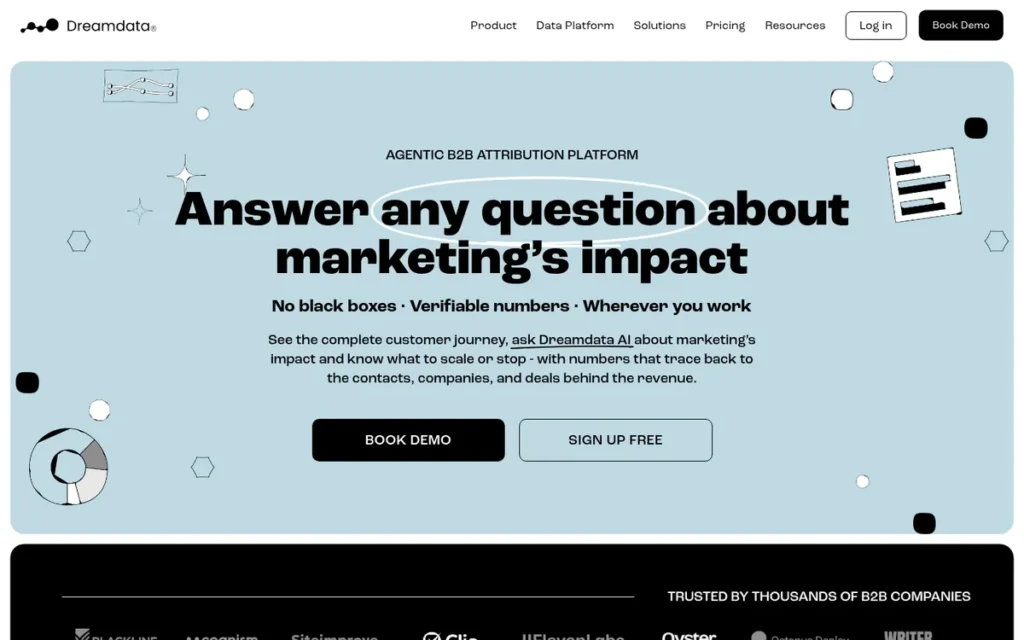
Category: B2B Account-Based Attribution. Credits pipeline and closed-won revenue to touchpoints across every contact in a buying account.
At a Glance
- Category: B2B Account-Based Attribution
- Best For: B2B SaaS teams with multi-stakeholder buying groups, LinkedIn-heavy ABM, and HubSpot or Salesforce as their CRM
- Price Range: Free plan (single-touch attribution, 2 months of history); Attribution and Enterprise tiers by quote
- Primary Strength: Dreamdata holds the highest G2 rating in PlugRoute’s 2026 attribution software review (4.7/5, 279 reviews) and resolves contacts into account-level journeys.
- Biggest Limitation: Dreamdata does not publish paid pricing, and reviewers report a steep learning curve and complex setup.
- One-Line Summary: Dreamdata is the highest-rated B2B attribution platform in PlugRoute’s 2026 review. It is built for account-based teams that need to tie long, multi-stakeholder journeys to pipeline and revenue.
- Last Verified: November 2026
Overview
Dreamdata is a B2B account-based attribution and activation platform that matches contacts to companies and attributes pipeline and closed-won revenue across ads, website, CRM, and sales activity. It is built for B2B marketing teams with long sales cycles and multi-person buying groups.
Dreamdata is an official LinkedIn Marketing Partner and is based in Copenhagen.
Key Features
- Dreamdata builds account timelines that combine paid and organic ads, website sessions, CRM records, and sales activity.
- Dreamdata attributes pipeline and closed-won revenue using multi-touch, custom, and data-driven models on paid plans.
- Dreamdata sends pipeline data to LinkedIn through the Conversions API and syncs audiences daily to LinkedIn and Google Ads.
- Dreamdata provides Reveal and Engagement Score intent signals drawn from website, LinkedIn, and G2 activity.
- Dreamdata connects to HubSpot, Salesforce, and Pipedrive for CRM data, syncs with BigQuery and Snowflake for warehouse access, and takes in events through Segment and Zapier.
Best For
Dreamdata is best for B2B SaaS teams running account-based marketing with several contacts per account. Ruler Analytics or CallRail serve call-heavy lead-gen funnels better than Dreamdata does.
Pricing
Dreamdata offers a free plan and prices its Attribution and Enterprise tiers by custom quote (Capterra, November 2026). Dreamdata’s free plan includes single-touch attribution only. Multi-touch attribution, data-warehouse access, and SSO require a paid plan (G2, November 2026).
- Dreamdata’s free plan includes B2B web analytics with cookie and cookieless tracking.
- Dreamdata’s free plan includes company identification and Audience Builder.
- Dreamdata’s free plan keeps 2 months of user history and allows 5 seats and 1 data sync.
Dreamdata’s 2-month free history is far shorter than the 10.1-month average B2B buying cycle (6sense, 2025). One G2 reviewer calls Dreamdata “expensive” (G2, 2026).
Strengths
- Dreamdata holds a G2 rating of 4.7/5 from 279 reviews and a Capterra rating of 4.8/5 from 55–56 reviews, the highest ratings in PlugRoute’s 2026 review (G2 and Capterra, November 2026).
- Dreamdata reports that customer Chameleon closed pipeline 33% faster and cut CPA by 50% using G2 data with Dreamdata. These results are vendor-reported (Dreamdata, 2026).
- Dreamdata’s B2B benchmark reports draw on 414 active B2B companies, 66M+ sessions, and 3.5M+ customer journeys. The sample is limited to Dreamdata’s own customers (Dreamdata, 2026).
- Dreamdata reviewers on G2 praise customer-journey visibility, offline conversions, the LinkedIn Conversions API, and hands-on setup support (G2, 2026).
Limitations
Dreamdata trades analytical depth for setup effort, and G2 reviewers report a steep learning curve and complex setup (G2, 2026). Small B2B teams also face a free plan limited to single-touch attribution and 2 months of history.
- Dreamdata cannot identify anonymous visitors who are not in the CRM, and G2 reviewers say its organic LinkedIn attribution “could be better” (G2, 2026).
- Dreamdata’s paid pricing is quote-only, so buyers cannot estimate total cost before a sales conversation.
- Dreamdata, like other B2B multi-touch tools, does not measure brand lift from video or offline media.
- Dreamdata was called a “rigid starter tool” by one Reddit user, but that commenter went on to promote a competitor. Organic Reddit discussion of Dreamdata is minimal (Reddit r/DigitalMarketing, 2025).
- Dreamdata’s SOC 2 status was not verified in PlugRoute’s research, so buyers should request it.
Users on r/LinkedinAds noted:
“If this is based on DreamData’s data it’s probably fairly solid (HOWEVER both LinkedIn and dream data may have some squirrelly attribution) attributing revenue to ad impressions is a little generous, considering most of us have remarketing on to bottom of funnel audiences so if you’re tying impressions to sales, it’s not exactly causal.” Posted by u/askoshbetter
Takeaway: Practitioners trust Dreamdata’s benchmark data, but they warn that its impression-based revenue credit overstates LinkedIn’s causal impact when retargeting is running.
Verdict
Dreamdata is the highest-rated B2B account-based attribution platform in PlugRoute’s 2026 review and the leading shortlist pick for long-cycle B2B teams.
Dreamdata ranks #3 with a weighted score of 3.93. It ties for the top review-sentiment score (4.5/5) and scores lowest on time to value (2.5/5). Pricing transparency (3/5) also held it back.
Dreamdata’s account timelines and LinkedIn activation fit ABM programs closely. Buyers should run a proof of concept on their own CRM history and get a written quote before signing.
4. Northbeam: Best for High-Spend DTC Brands Needing ML Attribution and MMM
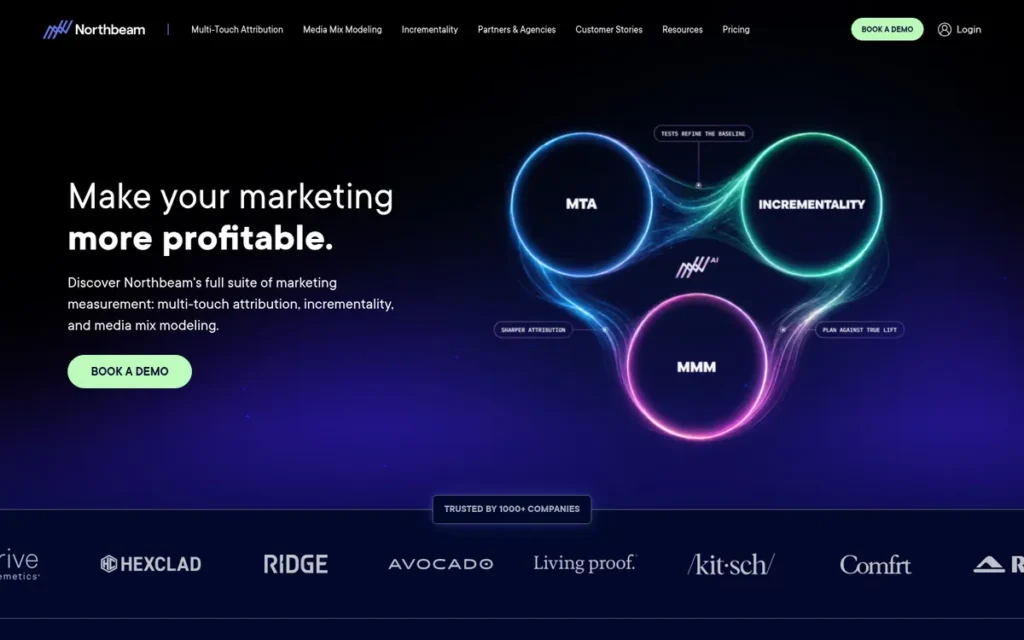
Category: Ecommerce Attribution. Credits online orders and revenue to the ads, channels, and touchpoints that drove them.
At a Glance
- Category: Ecommerce Attribution
- Best For: DTC brands spending roughly $50K+/month on paid media that have analyst capacity
- Price Range: $1,500–$3,500/month published; Enterprise by quote
- Primary Strength: Northbeam offers configurable lookback windows, view-through credit reported separately, and MMM+ and incrementality testing on higher tiers.
- Biggest Limitation: Northbeam has the highest entry price in the ecommerce group and needs a 30–45 day warm-up before its reports are reliable.
- One-Line Summary: Northbeam scored highest on measurement rigor in PlugRoute’s 2026 review. It suits high-spend DTC brands that can absorb a $1,500/month entry price and a model warm-up period.
- Last Verified: November 2026
Overview
Northbeam is a machine-learning multi-touch attribution platform built on first-party data that credits both clicks and modeled ad views. It is designed for direct-to-consumer brands with large paid-media budgets that need configurable lookback windows plus MMM and incrementality testing.
Northbeam publishes Starter and Professional pricing. Northbeam was founded in 2019 (Builtin, 2026).
Key Features
- Northbeam’s C+DV (Clicks + Deterministic/Modeled Views) gives credit to ads people saw but did not click, and reports that credit separately from click credit.
- Northbeam supports flexible, effectively unlimited lookback windows (Polar Analytics, 2026; competitor source).
- Northbeam Apex sends attribution data back to ad platforms to improve how they deliver ads.
- Northbeam offers MMM+ and incrementality testing on higher tiers.
- Northbeam provides omnichannel dashboards and a Northbeam MCP integration.
Best For
Northbeam is best for DTC brands that spend heavily across several paid channels and have the analyst capacity to act on modeled data. Northbeam’s economics work at roughly $50K+/month in ad spend. This is a rule of thumb, not a firm threshold (10xGTM, 2026).
Pricing
Northbeam’s own pricing page is the current source. G2 still lists older prices of $1,000 and $2,500/month (Northbeam and G2, November 2026). Northbeam pricing is also partly based on pageviews.
- Northbeam Starter costs from $1,500/month for brands spending under $1.5M a year on ads, runs month-to-month, and supports Shopify only.
- Northbeam Professional costs from $3,500/month for brands spending up to $500K/month on ads. It adds unlimited users, exports, non-Shopify platforms, and a media strategist, and usually requires an annual term.
- Northbeam Enterprise is custom-priced for brands spending $500K+/month on ads and adds a customer success manager, a Slack channel, and hourly data.
- Northbeam Starter costs at least $18,000 per year.
Strengths
- Northbeam publishes Starter and Professional pricing, which is unusual among premium ecommerce attribution tools (Northbeam, November 2026).
- Northbeam holds a G2 rating of 4.5/5 from only 16 reviews, and G2 reviewers praise its attribution accuracy, clearer budget allocation, and knowledgeable support (G2, November 2026).
- Northbeam customers quoted by 10xGTM said its weighting of Meta prospecting, Google Shopping, and email touchpoints changed their media-buying decisions. One said its data quality beat other tools they had tested (10xGTM, 2026).
- Northbeam’s configurable lookback windows, as described by competitor Polar Analytics, address fixed windows that misattribute credit over longer buying cycles (Polar Analytics, 2026).
Limitations
Northbeam trades methodological power for cost and patience. Northbeam has the highest entry price in the ecommerce group, and G2 reviewers call it “inaccessible to smaller companies,” with a steep learning curve (G2, 2026).
- Northbeam needs a 30–45 day model warm-up before reports are reliable, and support on Starter is slower (10xGTM, 2026).
- Northbeam’s Starter tier supports Shopify only, so non-Shopify brands must start at $3,500/month.
- Northbeam limits customer success manager and Slack access to Enterprise. Competitor Polar Analytics calls Northbeam a “trusted black box” and says raw exports are Enterprise-only (Polar Analytics, 2026).
- Northbeam’s 16-review G2 sample falls below PlugRoute’s 30-review threshold, and PlugRoute found no Capterra or Trustpilot presence and no significant Reddit discussion.
- Northbeam’s SOC 2 status was not verified, so buyers should request it.
Verdict
Northbeam offers the most rigorous measurement options among the ecommerce attribution tools in PlugRoute’s 2026 review, but high-spend DTC brands are the most likely to recover its cost.
Northbeam ranks #4 with a weighted score of 3.53. It leads on measurement rigor (4.5/5) and scores lowest on time to value (2/5). Its 16-review G2 sample also limits its review-sentiment score.
Northbeam’s configurable lookback windows and MMM+ suit brands whose buying cycles run longer than standard 7- or 28-day windows. Buyers should insist on a trial period that covers the warm-up.
5. Triple Whale: Best for Shopify-First Ecommerce Brands Wanting an All-in-One Commerce Dashboard
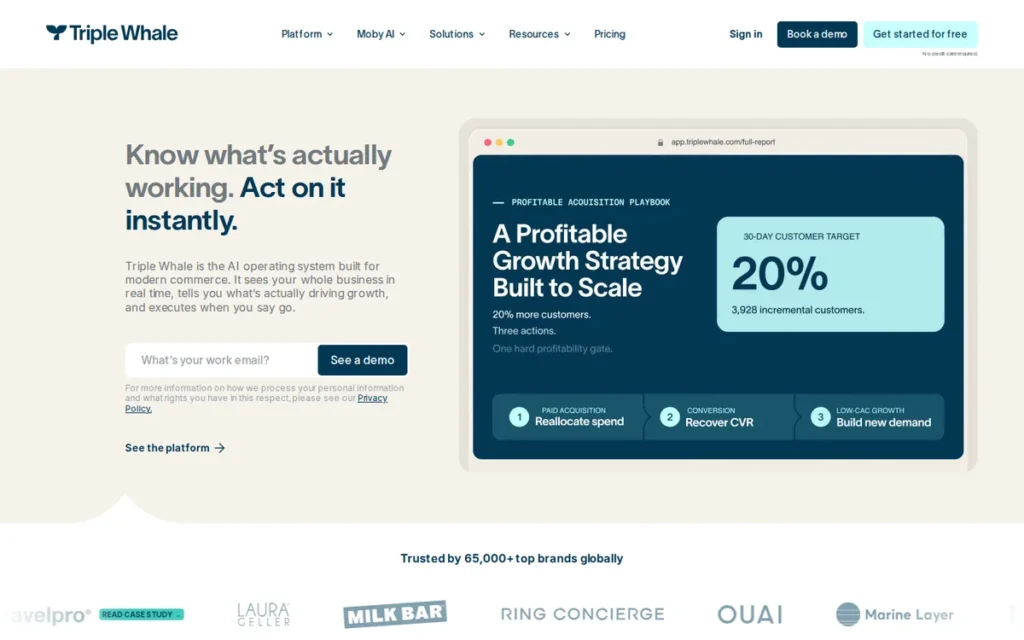
Category: Ecommerce Attribution.
At a Glance
- Category: Ecommerce Attribution
- Best For: Shopify-first DTC brands that want attribution, profit, creative analytics, and automation in one dashboard
- Price Range: Free Founders Dash; paid plans reported at ~$219–$749+/month, scaling with GMV
- Primary Strength: Triple Whale combines attribution, profit and LTV tracking, creative analytics, and conversion feedback in one Shopify-native dashboard.
- Biggest Limitation: Triple Whale’s price rises with revenue through an unpublished GMV slider, and users report inconsistent attribution accuracy.
- One-Line Summary: Triple Whale is the only ecommerce tool in PlugRoute’s 2026 review with a free dashboard tier. It is best for Shopify brands that test it side by side against their current tracking before upgrading.
- Last Verified: November 2026
Overview
Triple Whale is an ecommerce intelligence platform that combines a first-party pixel, seven attribution models, post-purchase surveys, creative analytics, and MMM in one dashboard. It is designed for Shopify-first direct-to-consumer brands that want store and ad performance in a single view.
Triple Whale offers a free Founders Dash. Triple Whale was founded in 2021 by ecommerce operators, and Shopify is an investor (Triple Whale, 2026).
Key Features
- Triple Whale’s Triple Pixel provides first-party, cross-device tracking with seven attribution models, including Total Impact.
- Triple Whale offers 1-, 7-, 14-, and 28-day and lifetime attribution windows (Triple Whale, November 2026).
- Triple Whale Sonar sends enriched conversion data back to Meta, Google, and Klaviyo.
- Triple Whale combines click data with post-purchase survey responses and includes MMM, incrementality, and Compass benchmarks.
- Triple Whale’s Moby AI agents generate reports, KPI alerts, ad monitoring, and audience updates. Some of these AI features require purchased credits (Shopify App Store, 2026).
Best For
Triple Whale is best for Shopify-first DTC brands with moderate ad spend that want one dashboard for attribution, profit, and creative performance. Triple Whale is likely premature for very small brands, since community advice suggests those brands should put creative and conversion-rate work first (Reddit r/FacebookAds, 2024).
Pricing
Triple Whale prices by annual GMV and package (Foundation, Automate, Enterprise) on 12-month subscriptions. Plans include unlimited users, and annual billing gives 2 months free (Triple Whale, November 2026). Third-party estimates conflict, probably because they reflect different GMV bands.
- Teardown.ai reports Triple Whale’s Foundation plan at about $219/month (Teardown.ai, 2026).
- Humblytics reports Triple Whale’s Foundation plan at about $549/month, likely for a higher GMV band (Humblytics, 2026).
- Humblytics reports Triple Whale’s Automate plan at about $749/month (Humblytics, 2026).
One Reddit user reported paying Triple Whale $3,200/month for the pixel plus Sonar. Pricing may have changed since that report (Reddit r/ecommerce, 2022). Trustpilot reviewers allege cancellation problems, including a 30-day notice period and discounted prices reverting. These are user allegations, not established facts (Trustpilot, 2026).
Strengths
- Triple Whale holds an approximately 4.5/5 G2 rating from about 478 reviews, with praise for ease of use and the unified dashboard (Admetrics, 2026; secondary source).
- Triple Whale reports that 60,000+ brands use it and that it tracks $65B+ in annual revenue. These figures are self-reported (Triple Whale, November 2026).
- Triple Whale Sonar was credited by a brand spending about $3M per quarter with paying for its enterprise subscription four times over in one quarter, with ROAS that stayed directionally aligned with the ad platforms (Reddit r/FacebookAds, 2024).
- Triple Whale case studies report Brightland running “5× more launches with no growth team” and YSE Beauty saving “up to 10 hours per week” with Moby. These results measure efficiency, not attribution accuracy (Triple Whale, 2026).
Limitations
Triple Whale trades breadth and ease of use for methodological transparency and consistent accuracy. G2 reviewers report “wrong attribution data” and wrongly attributed marketplace orders (G2, 2026). Reddit users report both over-counting and under-counting (Reddit r/FacebookAds, 2024).
- Triple Whale scored below an existing CAPI setup in one Reddit user’s Meta Event Match Quality test, where the existing setup scored 9.3/10 (Reddit r/FacebookAds, 2024).
- Triple Whale’s Total Impact methodology is not publicly documented, and competitor Polar Analytics calls it a hard-to-defend “black box” (Polar Analytics, 2026).
- Triple Whale holds 4.1/5 on the Shopify App Store from 93 reviews, and Trustpilot reviewers describe its support as unresponsive (Shopify App Store and Trustpilot, 2026).
- Triple Whale’s Reddit sentiment needs caution, because one “positive” comment was exposed as coming from a Triple Whale sales rep (Reddit r/ecommerce, 2022).
Users on r/FacebookAds noted:
“Don’t overthink the attribution discrepancy between Triple Whale and Meta. They measure differently and neither one is telling you the full story. What matters is whether your retargeting campaign as a whole is contributing to revenue.” Posted by u/BruTeve
Takeaway: Triple Whale often credits orders differently than Meta does, and experienced media buyers treat neither tool as the full picture of what drove a sale.
Verdict
Triple Whale is the most accessible all-in-one ecommerce dashboard in PlugRoute’s 2026 review because it is the only ecommerce tool reviewed with a free tier. Mixed accuracy reports limit its rank.
Triple Whale ranks #5 with a weighted score of 3.40. It scores 4/5 on capability depth, integrations, and time to value, and lowest on pricing transparency (2/5) because its GMV-based pricing is unpublished.
Shopify brands should start on Triple Whale’s free Founders Dash and upgrade only after a side-by-side test against their existing tracking. Buyers should also confirm which attribution window each report uses.
6. HockeyStack: Best for B2B Teams Wanting Attribution Inside a GTM Platform
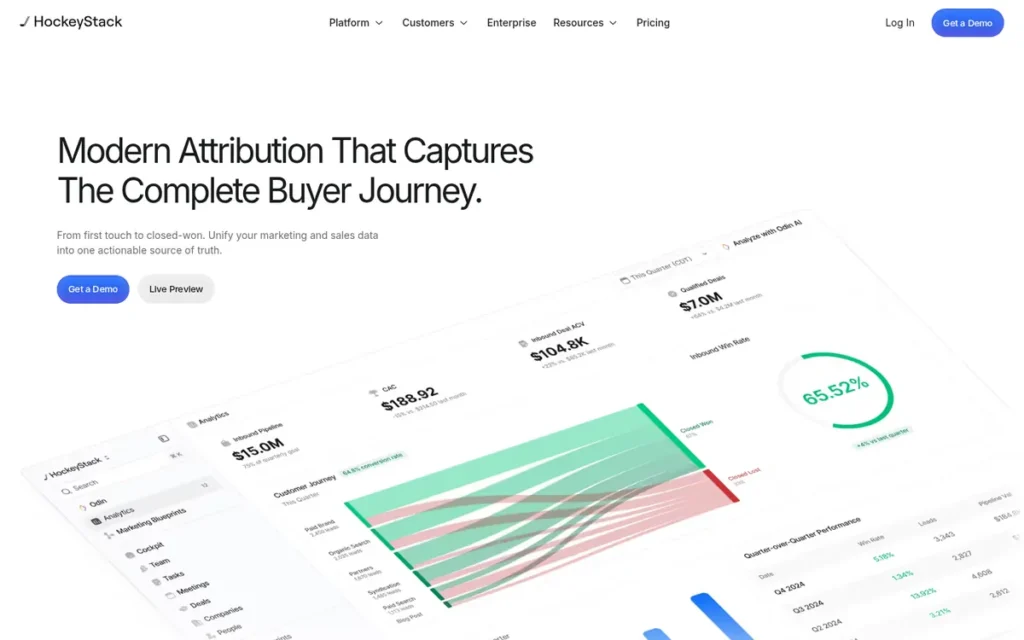
Category: B2B Account-Based Attribution.
At a Glance
- Category: B2B Account-Based Attribution
- Best For: B2B SaaS teams that want attribution, incrementality, and GTM intelligence in one platform and can support a multi-week setup
- Price Range: From $2,200/month on G2; Growth ~$1,400 and Scale ~$2,400 per HockeyStack Academy; not published on the vendor pricing page; Custom tier by quote
- Primary Strength: HockeyStack pairs nine attribution models with Lift Reporting for incrementality, and it is the only B2B tool in PlugRoute’s 2026 review with documented lift testing.
- Biggest Limitation: HockeyStack’s pricing is inconsistent across sources, and some reviewers report data that disagrees with Salesforce.
- One-Line Summary: HockeyStack has the widest go-to-market feature scope of the two B2B attribution tools in PlugRoute’s 2026 review. It suits teams that want incrementality reporting and accept a 4–6 week setup.
- Last Verified: November 2026
Overview
HockeyStack is a B2B go-to-market intelligence platform that combines revenue attribution, cookieless account- and user-level buyer journeys, and Lift Reporting for incrementality. It is designed for B2B SaaS marketing and revenue teams that want attribution alongside lead scoring and company identification.
HockeyStack is backed by Y Combinator and was founded in 2021 in San Francisco (Caplight, 2026).
Key Features
- HockeyStack offers nine attribution models across account- and user-level cookieless buyer journeys.
- HockeyStack Lift Reporting measures incrementality alongside attributed credit.
- HockeyStack provides IP-based company identification, lead scoring, and LinkedIn Ads impression tracking.
- HockeyStack’s Atlas layer brings website, CRM, sales, and product data together in no-code reports.
- HockeyStack’s Odin AI agents extend the platform into GTM execution.
Best For
HockeyStack is best for B2B SaaS teams that want attribution and incrementality inside a broader GTM platform. Teams that only need attribution may end up paying HockeyStack for features they will not use.
Pricing
HockeyStack’s official pricing page does not list Growth or Scale prices, and three other sources conflict (HockeyStack, November 2026). HockeyStack’s Custom tier adds ML attribution, MMM, data warehouse access, and offline conversions, so buyers should get a written quote.
- G2 lists a HockeyStack Platform entry point of $2,200/month (G2, November 2026).
- HockeyStack Academy pages list Growth at $1,400/month and Scale at $2,400/month, or about $16.8K–$28.8K per year (HockeyStack Academy, 2026).
- Capterra lists HockeyStack “from $599/month, usage-based” (Capterra, 2026).
Strengths
- HockeyStack holds a G2 rating of 4.4/5 from 84 reviews and a Capterra rating of 4.7/5 from 27 reviews, with praise for real-time insights and for consolidating scattered data (G2 and Capterra, November 2026).
- HockeyStack reports that customer Firstup saw 49% more closed-won deals from MQLs, 28.5% more qualified pipeline per customer, and 139% higher ROAS. These results are vendor-reported (HockeyStack, 2026).
- HockeyStack Lift Reporting is the only documented lift-testing feature among the B2B tools in PlugRoute’s 2026 review, which helps teams separate attributed credit from incremental impact (HockeyStack, 2026).
- HockeyStack says it holds SOC 2 Type II, GDPR, and ISO 27001 compliance. Buyers should verify this self-reported claim through its trust center (HockeyStack, 2026).
Limitations
HockeyStack trades a broad GTM scope for setup effort and pricing clarity. HockeyStack setup typically takes 4–6 weeks (HeySid, 2026). Current negative themes on G2 include lengthy implementation and extensive manual data mapping (G2, November 2026).
- HockeyStack data “continually differed from Salesforce” with slow sync, according to one G2 reviewer, and another cited a lack of support urgency and ownership (G2, 2026).
- HockeyStack’s pricing conflicts across three sources and is not published by the vendor, which makes total cost hard to predict.
- Competitor Docket claims HockeyStack lacks API access and that attribution is “becoming one feature” of the platform, so buyers should confirm API availability directly (Docket, 2026).
- HockeyStack has no significant Reddit user discussion, and its Capterra score rests on only 27 reviews.
Verdict
HockeyStack offers the most complete attribution-plus-incrementality toolkit among the B2B tools in PlugRoute’s 2026 review, but a smaller review base and conflicting prices limit its rank.
HockeyStack ranks #6 with a weighted score of 3.30. It leads on capability depth and measurement rigor (4/5 each) and scores lowest on pricing transparency and time to value (2/5 each).
B2B teams choosing between HockeyStack and Dreamdata should weigh Lift Reporting and GTM breadth against Dreamdata’s higher ratings. A proof of concept on your own Salesforce or HubSpot history is essential before signing.
7. Ruler Analytics: Best for Closed-Loop Attribution Including Calls, Chat and Offline

Category: Lead & Call Attribution.
At a Glance
- Category: Lead & Call Attribution
- Best For: Lead-gen and considered-purchase businesses that need leads matched to CRM revenue and offline media measured with MMM
- Price Range: From £249–£299/month to £1,499+/month by website traffic, plus call-tracking charges; 12-month contracts reported
- Primary Strength: Ruler Analytics is the only lead-gen tool in PlugRoute’s 2026 attribution software review that combines closed-loop call, form, and chat attribution with built-in MMM.
- Biggest Limitation: Ruler Analytics has the thinnest review evidence of the seven tools reviewed, and reviewers report 12-month contracts.
- One-Line Summary: Ruler Analytics is the only lead-gen attribution tool in PlugRoute’s 2026 review that pairs closed-loop lead-to-revenue matching with marketing mix modeling, though its review evidence is the thinnest of the seven.
- Last Verified: November 2026
Overview
Ruler Analytics is a closed-loop attribution platform that follows each visitor through calls, forms, and live chat and then matches those leads to CRM opportunities and revenue. It is designed for lead-generation businesses whose sales close weeks or months after first contact.
Ruler Analytics also includes MMM for offline media. Ruler Analytics is based in Liverpool, UK, and has 11–50 employees (LinkedIn, 2026).
Key Features
- Ruler Analytics follows each visitor with a tracking tag and attributes calls (via DNI), forms, and live chat to their source.
- Ruler Analytics matches leads to CRM opportunities and closed revenue, then sends offline revenue back to Google Ads and Meta.
- Ruler Analytics offers six attribution models, plus data-driven attribution that combines click paths with impression weights taken from MMM.
- Ruler Analytics includes built-in MMM that estimates the impact of TV, radio, and print advertising.
- Ruler Analytics’ MMM also covers out-of-home and sponsorship spend.
Best For
Ruler Analytics is best for lead-gen businesses that need to tie calls, forms, and chats to revenue that closes later, and that also spend on offline media. Teams that need conversation intelligence or call transcription should look at CallRail instead of Ruler Analytics.
Pricing
Ruler Analytics publishes indicative pricing based on monthly website visits, and some multi-touch setups start at £249/month (Ruler Analytics, November 2026). Ruler Analytics bills call-tracking numbers, line rental, and minutes separately, and users report 12-month contracts.
- Ruler Analytics Small costs £299/month for up to 10,000 visits.
- Ruler Analytics Medium costs £499/month, and Large costs £999/month.
- Ruler Analytics Advanced costs £1,499+/month.
Older or third-party listings for Ruler Analytics differ from the official table. Capterra lists $149/month, G2 lists £179/month, and SalesHive lists about £199/month (Capterra, G2, and SalesHive, 2026).
Strengths
- Ruler Analytics holds a G2 rating of 4.6/5 from 30 reviews, with praise for integrations, ease of implementation, and customer-journey analytics (G2, November 2026).
- Ruler Analytics combines visitor-level attribution with MMM for offline channels, which CallRail does not offer (Ruler Analytics, 2026).
- Ruler Analytics publishes an official indicative price table, which only four of the seven tools in PlugRoute’s 2026 review do (Ruler Analytics, November 2026).
- Ruler Analytics openly states that MMM needs enough historical data and suits strategic budget decisions better than weekly optimization (Ruler Analytics, 2026).
Limitations
Ruler Analytics trades conversation features and pricing simplicity for closed-loop revenue matching. Ruler Analytics does not offer native conversation intelligence or call transcription (Phonexa, 2026; G2, November 2026). It does record calls, and buyers should confirm routing options with the vendor.
- Ruler Analytics has complex CRM data mapping, a “dated or slower” interface, and limited report customization unless you export the data (SalesHive, 2026).
- Ruler Analytics reportedly uses 12-month contracts, and its call-tracking charges sit outside the license fee.
- Ruler Analytics’ Capterra score of 3.7/5 rests on only 3 reviews, and PlugRoute found no significant Reddit discussion and no named case studies with results.
- Ruler Analytics buyers outside the UK should confirm tracking-number availability country by country.
Verdict
Ruler Analytics is the most complete lead-to-revenue attribution option in PlugRoute’s 2026 review for businesses that also buy offline media, but it has the thinnest review evidence of the seven tools.
Ruler Analytics ranks #7 with a weighted score of 3.23. It leads on measurement rigor (4/5) and scores lowest on pricing transparency (2.5/5), because call charges are billed separately and 12-month contracts are reported.
Ruler Analytics’ pairing of attribution and MMM stands out among lead-gen tools. Buyers should get contract terms and call-tracking charges in writing before committing.
Is Free GA4 Enough, or Do You Need Paid Attribution Software?
Free GA4 is enough for low-spend teams with short, simple funnels. It is not enough for long B2B cycles, call-driven leads, or revenue matched to a CRM. GA4’s lookback windows max out at 90 days, far short of the 10.1-month average B2B buying cycle (6sense, 2025).
GA4 has the following documented limits as a free attribution baseline (Google Analytics Help, 2026):
- GA4 offers three attribution models in 2026: data-driven (the default), paid and organic last click, and Google paid channels last click.
- Google removed first-click, linear, time-decay, and position-based models from GA4 in November 2023.
- GA4’s lookback windows default to 30 days for acquisition events and 90 days for other key events, and 90 days is the maximum.
- GA4 brings in offline and CRM data only through Measurement Protocol or data imports.
- GA4 applies thresholding, which hides data for small user counts in some reports.
GA4 works best as one input rather than the source of truth for revenue. A team has likely outgrown GA4 when any of these signs appear:
- A team has outgrown GA4 when phone calls are a major conversion path that GA4 cannot attribute.
- A team has outgrown GA4 when deals regularly close more than 90 days after first touch.
- A team has outgrown GA4 when revenue lives in a CRM that GA4 cannot see without imports.
- A team may have outgrown GA4 when ad spend exceeds about $3K/day, a community rule of thumb (Reddit r/FacebookAds, 2024).
- A team has outgrown GA4 when stakeholders regularly dispute ROAS reported by the ad platforms.
Practitioners describe several free or low-cost options to try before paying for a dedicated tool:
- Google Ads call tracking is free but does not let users listen to call recordings (Reddit r/PPC, 2023).
- One team’s DIY setup uses a different phone number per channel, Twilio inbound data, and a Google Sheet, and costs under $100/month (Reddit r/PPC, 2022).
- One small ecommerce operator found a paid attribution dashboard not worth the monthly cost and relied on last-click attribution with careful tracking links (Reddit r/ecommerce, 2024).
Premium ML attribution such as Northbeam makes economic sense at about $50K+/month in ad spend. This is a rule of thumb, not a firm threshold (10xGTM, 2026).
Why Do Attribution Tools Report Different Numbers?
Attribution tools report different numbers because they use different lookback windows, time zones, view-through rules, deduplication logic, and event definitions. Two attribution tools can disagree on the same sale without either one being wrong. Before trusting any tool, check its totals against your own backend orders, installs, or CRM records.
Attribution numbers commonly diverge for the following reasons:
- Lookback windows of different lengths credit different touchpoints.
- Time-zone differences move conversions between reporting days.
- View-through rules give credit to ads that were seen but not clicked.
- Deduplication logic varies across platforms that each claim the same conversion.
- Event definitions differ. An MMP usually counts an install at first app open after the SDK starts, while a backend may count it at account creation (Reddit r/AppBusiness, 2026).
“Some discrepancy is just… expected now. iOS privacy changes basically broke the old model.” (u/Numerous-Movie3107 (Reddit r/AppBusiness, 2026))
Takeaway: Since Apple’s ATT changes, some gap between MMP and backend install counts is normal. Judge an MMP on how well it explains the gap, not on whether it closes it.
Apple’s App Tracking Transparency requires users to opt in before apps can track them, and opt-in rates vary widely by app category and prompt design. SKAdNetwork and AdAttributionKit return delayed, coarse, aggregated data, and no MMP can recover what Apple withholds.
Practitioners on r/AppBusiness, r/FacebookAds, and r/DigitalMarketing describe the following ways to validate a tool (Reddit, 2024–2026):
- Teams should run any new tool alongside their current tracking for at least 30 days, or 45 days for ML tools with a warm-up period such as Northbeam.
- Teams should check raw exports against backend order, install, or CRM records before changing budgets.
- Teams should compare Meta Event Match Quality scores between server-side setups.
- B2B teams should run a proof of concept on their own CRM history before signing a contract.
What Red Flags Should I Watch For When Evaluating Attribution Software?
Watch for six red flags in attribution software. Each one can quietly distort budget decisions or total cost:
- Lookback windows shorter than your sales cycle
- Unpublished usage-based pricing
- Raw exports locked to enterprise tiers
- Untested accuracy claims
- Undisclosed vendor posts on Reddit
- Attribution reports sold as proof of incrementality
Red Flag #1: Fixed Lookback Windows Shorter Than Your Sales Cycle
A lookback window shorter than your real buying cycle drops early touchpoints and quietly misattributes credit. GA4’s maximum 90-day window cannot cover a B2B buying cycle averaging 10.1 months (6sense, 2025).
Suppose a prospect first finds you through a podcast ad in January and signs in October. A 90-day window credits the October retargeting ad. The podcast that started the deal gets zero credit and looks worthless.
Red Flag #2: Pricing That Scales With Revenue or Volume Without a Published Table
Pricing tied to GMV, conversions, pageviews, or call minutes without a published table makes total cost unpredictable. PlugRoute’s 2026 review of seven attribution tools found three examples:
- HockeyStack’s prices conflicted across three sources.
- Triple Whale’s GMV slider is unpublished.
- AppsFlyer does not publish add-on prices, even though its per-conversion costs rise with volume.
Red Flag #3: Raw Data Exports Locked to Enterprise
When raw exports are locked to the top tier, teams cannot check attribution numbers against their backend records. Competitor Polar Analytics says Northbeam’s raw exports are Enterprise-only (Polar Analytics, 2026), so buyers should confirm export access for every vendor in writing.
Red Flag #4: Accuracy Claims With No Independent Test
PlugRoute found no published independent head-to-head accuracy tests of these tools as of November 2026. Every accuracy claim reviewed came from a vendor or a competitor. Treat “most accurate” marketing as unverified until your own side-by-side test supports it.
Red Flag #5: Reddit Recommendations From Undisclosed Vendors
Vendors post often in Reddit attribution threads. PlugRoute reviewed threads on r/ecommerce, r/FacebookAds, and r/DigitalMarketing (2026) and repeatedly found commenters linked to ThoughtMetric, Venon, TrueROAS, Aimerce, Usermaven, and other vendors. Check a commenter’s history before treating a recommendation as independent.
Red Flag #6: Attribution Reports Sold as Proof of Incrementality
Attribution shows where a buyer was before converting. Incrementality testing shows whether your marketing caused the conversion. Each method answers a different question:
- Holdout and geo-lift tests prove causation.
- MMM guides budget allocation.
- Multi-touch attribution guides daily optimization.
Using all three together is called triangulation.
What Questions Should I Ask Before Choosing Attribution Software?
Before choosing attribution software, ask the vendor six questions:
- What identity model does the tool use?
- Can the lookback window be changed?
- How does it handle refunds and marketplace orders?
- Which integrations come with your tier?
- Can you run a proof of concept on your own data?
- What are the contract terms?
Written answers reveal fit and total cost better than any demo dashboard.
Question #1: What identity model does the tool use, and does it match my buying journey?
The identity model (device, person and order, account, or call and form) determines what the tool can see. A tool that tracks by call or form, such as CallRail, cannot rebuild a multi-stakeholder B2B account journey.
Question #2: Can I change the lookback window?
The lookback window should match your real buying cycle, not a vendor default. Ask whether you can change the window for each conversion type and whether changes update past reports. Also check how much history the tool keeps: Dreamdata’s free plan keeps only 2 months.
Question #3: How does the tool handle refunds, repeat orders, and marketplace orders?
Refunds, repeat purchases, and marketplace orders are common sources of misattribution. G2 reviewers report Triple Whale attributing marketplace orders incorrectly (G2, 2026). Ask every ecommerce vendor, including Northbeam, how they handle these cases.
Question #4: Which integrations and exports are included at my tier?
Integrations and raw exports often depend on the pricing tier, and add-on prices are not always published. AppsFlyer does not publish Protect360 or incrementality add-on prices, and CallRail charges for premium integrations. Ask for a written list covering:
- Buyers should confirm ad platform connections and whether conversion data flows back to Meta, Google, and LinkedIn.
- Buyers should confirm CRM sync with HubSpot, Salesforce, or Pipedrive.
- Buyers should confirm ecommerce and payment connections such as Shopify and Stripe.
- Buyers should confirm data warehouse exports to BigQuery or Snowflake and the tier those exports require.
Question #5: Can I run a proof of concept on my own CRM history or a side-by-side test against my current tracking?
A proof of concept on your own data is the closest substitute for independent accuracy testing. Run the test for at least 30 days, and allow for model warm-up periods such as Northbeam’s 30–45 days (10xGTM, 2026).
Question #6: What are the contract length, cancellation terms, and overage charges?
Contract length, cancellation notice, and overage charges drive total cost. Reviewers report the following issues:
- Ruler Analytics users report 12-month contracts (SalesHive, 2026).
- CallRail users report minute overages above the included 250 minutes (Trustpilot, 2026).
- One AppsFlyer user reported being moved from the free plan to a paid plan without asking for it (G2, 2026).
- Triple Whale users allege cancellation problems, including a 30-day notice period (Trustpilot, 2026).
How Did We Rank These Attribution Software Tools?
PlugRoute ranked these attribution software tools by scoring each one from 1 to 5 on six weighted criteria, using dated, sourced research. The overall rank reflects evidence strength. The Best For guidance reflects fit for each business model, so use both when building a shortlist.
PlugRoute used the following criteria and weights:
- Capability Depth for Its Measurement Job (25%): Capability depth matters because a tool is only useful if it can see your outcome (install, order, pipeline, or call) with the right identity model.
- Verified Review Sentiment and Sample Size (25%): Review sentiment matters because user reviews are the best buyer-side evidence. Larger samples counted more, and samples under 30 reviews were marked down.
- Pricing Transparency and Cost Predictability (15%): Pricing transparency matters because add-ons, overages, revenue-based scaling, and lock-ins push real cost above list price.
- Integrations and Raw-Data Access (15%): Integrations matter because raw exports and ad-platform feedback let teams check attribution numbers against backend records.
- Measurement Rigor Beyond Click Credit (10%): Measurement rigor matters because configurable windows, MMM, and incrementality testing reduce the risk of mistaking credit for causation.
- Time to Value and Ease of Setup (10%): Time to value matters because small teams cannot absorb multi-week setups or model warm-ups.
| Company | C1 | C2 | C3 | C4 | C5 | C6 | Weighted Total |
|---|---|---|---|---|---|---|---|
| AppsFlyer | 5 | 4.5 | 3.5 | 5 | 4 | 2.5 | 4.30 |
| CallRail | 4 | 4.5 | 4 | 4 | 2 | 5 | 4.03 |
| Dreamdata | 4.5 | 4.5 | 3 | 4.5 | 3 | 2.5 | 3.93 |
| Northbeam | 4 | 3 | 4 | 3.5 | 4.5 | 2 | 3.53 |
| Triple Whale | 4 | 3 | 2 | 4 | 3.5 | 4 | 3.40 |
| HockeyStack | 4 | 3.5 | 2 | 3.5 | 4 | 2 | 3.30 |
| Ruler Analytics | 3.5 | 3 | 2.5 | 3.5 | 4 | 3 | 3.23 |
PlugRoute re-scored three tools in November 2026 after verification checks. The rank order did not change:
- Northbeam’s review-sentiment score rose from 2.5 to 3.0 after a G2 rating of 4.5/5 from 16 reviews appeared (G2, November 2026).
- Triple Whale’s measurement-rigor score rose from 3.0 to 3.5 after Triple Whale’s documentation confirmed configurable attribution windows (Triple Whale, November 2026).
- Ruler Analytics’ review-sentiment score rose from 2.5 to 3.0 and its pricing-transparency score rose from 2.0 to 2.5. PlugRoute confirmed its official price table and applied the 30-review threshold consistently.
Ranks 4 through 7 fall within 0.30 points of each other. For those four tools, fit with your segment matters more than the score gap.
PlugRoute applied the following editorial rules:
- PlugRoute ran no head-to-head accuracy tests and found no published independent tests of these tools as of November 2026.
- PlugRoute labeled every limitation claim from a competitor (WhatConverts, Polar Analytics, Docket, Airbridge) as a competitor claim.
- PlugRoute screened Reddit sentiment for undisclosed vendor posts and dated each Reddit citation by the year the thread was posted.
- PlugRoute treated GA4 and HubSpot as free or bundled baselines rather than ranked dedicated tools.
- PlugRoute named Adjust, CallTrackingMetrics, and Hyros as the closest runners-up. Polar Analytics, Rockerbox, Marketo Measure, and WhatConverts appear often in AI answers but were not profiled.
PlugRoute has no affiliate relationships with any company listed, and rankings are determined entirely by research data and objective evaluation criteria.
What Do Buyers Most Often Ask About Attribution Software?
Buyers most often ask which attribution software fits ecommerce or long-cycle B2B, how a small business should choose, and how rankings are built. In short:
- Triple Whale and Northbeam lead ecommerce, depending on ad spend.
- Dreamdata and HockeyStack lead long-cycle B2B.
- Small teams should start with free tools.
What is the best attribution software for ecommerce and B2B in 2026?
For ecommerce, Triple Whale suits Shopify brands with moderate ad spend and offers a free Founders Dash. Northbeam suits DTC brands spending about $50K+/month and starts at $1,500/month (Northbeam, November 2026). For long-cycle B2B, Dreamdata holds the highest rating (G2 4.7/5, 279 reviews), and HockeyStack adds Lift Reporting for incrementality.
How should a small business choose attribution software?
A small business should start with GA4, native ad-platform reporting, and a Conversions API setup. Pay for a dedicated tool once calls, CRM revenue, or long sales cycles outgrow that setup. CallRail ($55/month) suits call-driven businesses, Triple Whale’s free tier suits Shopify stores, and Dreamdata’s free plan suits small B2B teams.
How does PlugRoute determine its attribution software rankings?
PlugRoute scores each tool from 1 to 5 on six weighted criteria:
- Capability depth (25%)
- Review sentiment (25%)
- Pricing transparency (15%)
- Integrations (15%)
- Measurement rigor (10%)
- Time to value (10%)
Every claim comes from dated, sourced research. Competitor claims are labeled, vendor results are flagged, and Reddit is screened for vendor posts.
What Do Key Attribution Software Terms Mean?
Identity Model: The identity model is what an attribution tool tracks and gives credit to: a device, a person and an order, a buying account, or a call or form. It decides what the tool can see, so buyers should choose one that matches their buying journey. A tool that tracks by call or form cannot rebuild a B2B account journey with several people in it.
Multi-Touch Attribution (MTA): Multi-touch attribution spreads credit for a conversion across several touchpoints instead of giving it all to one click. Some tools offer it only on paid plans, while their free tiers include single-touch attribution only. It helps with day-to-day optimization, but it does not prove that marketing caused a sale.
Lookback Window: A lookback window is how far back a tool looks for touchpoints to credit before a conversion. If the window is shorter than your real buying cycle, early touchpoints get no credit. That matters for B2B buyers, because GA4’s 90-day maximum cannot cover a buying cycle that averages 10.1 months.
View-Through Credit: View-through credit is given to ads a person saw but did not click. View-through rules are one reason tools report different numbers for the same sale, so buyers should check whether a tool reports view credit separately from click credit.
Marketing Mix Modeling (MMM): Marketing mix modeling estimates how each channel affects results, including offline media such as TV, radio and print. It needs enough historical data, and it suits strategic budget decisions better than weekly optimization. Only some tools include it, and some offer it only on higher tiers.
Incrementality (Lift Testing): Incrementality testing, such as holdout and geo-lift tests, shows whether your marketing actually caused a conversion, not just where the buyer was beforehand. Buyers should be wary of attribution reports sold as proof of incrementality. Using attribution, MMM and incrementality together is called triangulation.
Mobile Measurement Partner (MMP): A mobile measurement partner gives credit for app installs and in-app events to the ad networks and campaigns that drove them. It uses a device and SKAdNetwork identity model. No MMP can recover iOS data that Apple withholds.
SKAdNetwork: SKAdNetwork is Apple’s privacy-focused measurement framework for iOS app campaigns. It returns delayed, coarse, aggregated data. Since Apple’s App Tracking Transparency changes, some gap between MMP install counts and backend counts is normal.
Dynamic Number Insertion (DNI): Dynamic number insertion shows each website visitor a tracking phone number tied to their traffic source, so a call can be credited to the campaign that produced it. It is the core technique behind call attribution for lead-gen and local service businesses.
Conversions API (CAPI): A Conversions API sends conversion data from your server back to ad platforms such as Meta or LinkedIn so they can deliver ads better. It is part of the move toward first-party data and server-side tracking. Buyers should confirm whether a tool sends conversion data back to the platforms they use.
Raw Data Export: A raw data export lets teams pull detailed attribution records out of the tool and check them against their own backend orders, installs or CRM records. When exports are limited to enterprise tiers, buyers cannot check the numbers, so they should confirm export access in writing.
GMV-Based Pricing: GMV-based pricing ties the subscription cost to a store’s annual gross merchandise value, so the price goes up as revenue grows. Without a published price table, total cost is hard to predict. It is one of several usage-based models, along with per-conversion, traffic-based and ad-spend-based pricing.
Which Attribution Software Is Right for You?
Key Insights
- The right attribution software is the one whose identity model matches your outcome, because app installs, ecommerce orders, B2B pipeline, and lead-gen calls each need a different kind of tracking.
- GA4’s maximum 90-day lookback window cannot cover a B2B buying cycle that averaged 10.1 months in 2025 (6sense, 2025).
- Attributed credit is not proof of incremental impact, so teams should pair attribution with MMM or holdout experiments before shifting major budgets.
- PlugRoute found no published independent head-to-head accuracy tests as of November 2026, so a side-by-side test on your own data is the most reliable check available.
- Total cost of attribution software often far exceeds list price once add-ons, overages, revenue-based scaling, and 12-month contracts are included.
If you run a mobile app, start with AppsFlyer’s free year-one allowance, using the Growth plan for paid campaigns. If calls drive your revenue, start with CallRail. Move to Ruler Analytics if you need revenue matching or offline media measurement.
If you sell B2B with long cycles, shortlist Dreamdata and HockeyStack and test both on your CRM history. If you run a Shopify brand, start on Triple Whale’s free tier, and consider Northbeam once ad spend reaches about $50K/month.
As privacy rules tighten and MMM becomes common again, teams that combine several measurement methods will likely get better answers than teams that trust a single dashboard. We update this guide quarterly. Last updated: November 2026.
For more independent, evidence-based comparisons, read PlugRoute’s full attribution methodology and see our other marketing software reviews.