The best ZoomInfo alternatives in 2026 are Apollo.io for contact data and outreach sequencing in one tool, Lusha for fast contact lookups with documented compliance credentials, and Lead411 for budget US contact data. No alternative replaces all of ZoomInfo, so match the tool to the jobs you use and test it on your own prospect list.
ZoomInfo’s annual, auto-renewing contracts and unpublished pricing are hard to justify for smaller teams. Outdated contact data is its most-cited user complaint. Most buyers don’t need a full replacement. They need the jobs they actually use covered at a cost they can defend.
PlugRoute has no affiliate relationships with any company listed. Rankings are determined entirely by research data and objective evaluation criteria.
Every ranked tool below gets the same At a Glance block, a PlugRoute Score out of 50 and a direct comparison with ZoomInfo. After the rankings, you’ll find guidance on cost, European data and pilots.
What Are the 5 Categories of ZoomInfo Alternatives?
ZoomInfo alternatives, which are sales intelligence and B2B contact database tools, fall into five categories: all-in-one prospecting platforms, contact lookup tools, contact data providers, signals-led outbound platforms, and verified data and intent providers. Each category replaces a different part of ZoomInfo, so the right category depends on which ZoomInfo jobs your team uses every week.
The tools in each category are:
- All-in-One Prospecting Platform: An all-in-one prospecting platform combines a contact database with outreach sequencing and calling in one subscription. Apollo.io, Clodura.AI and Selling.com are in this category.
- Contact Lookup Tool: A contact lookup tool gives individual reps fast, lightweight email and phone reveals plus CRM enrichment. Lusha is in this category.
- Contact Data Provider: A contact data provider is a list-building database with verification, and outreach is an optional add-on. Lead411 is in this category.
- Signals-Led Outbound Platform: A signals-led outbound platform runs AI-driven multichannel outreach triggered by buying signals, with contact data built in. Amplemarket is in this category.
- Verified Data & Intent Provider: A verified data and intent provider offers human-verified contacts plus account-level intent and visitor identification, without built-in outreach. SalesIntel is in this category.
PlugRoute checked each alternative against seven jobs that teams commonly use ZoomInfo for:
- Contact discovery means finding new prospects by role, company and filters.
- Enrichment and CRM sync means adding data to existing records.
- Outreach sequencing means sending multistep email or multichannel cadences.
- Dialer and calling means placing calls from inside the platform.
- Browser-extension quick lookups means revealing contacts while browsing.
- Intent or buying signals means spotting accounts that look in-market.
- Visitor identification means identifying companies that visit your website.
How Do the Top ZoomInfo Alternatives Compare at a Glance?
Apollo.io ranks first with a PlugRoute Score of 39 out of 50, followed by Lusha (35) and Lead411 (33). Clodura.AI and Amplemarket tie at 32, and Clodura.AI wins the tie-break. SalesIntel (26) and Selling.com (24) complete the list. Scores come from six weighted criteria, which are explained in the methodology section further down.
| Rank | Company | Category | Best For | One-Line Summary | Key Capabilities | Primary Strength | Key Limitation |
|---|---|---|---|---|---|---|---|
| 1 | Apollo.io (Score: 39/50) | All-in-One Prospecting Platform | Small and mid-market teams that sell mainly to the US and lead with email | Apollo.io is the most complete low-cost ZoomInfo alternative for teams that want contact data and outreach sequences in one tool. | Database, sequences, dialer, AI agents, intent, visitor ID | Covers all seven ZoomInfo jobs; largest G2 review base (9,862) | Outdated contact records are its top G2 con (226 mentions) |
| 2 | Lusha (Score: 35/50) | Contact Lookup Tool | Reps who need quick lookups, and buyers who need compliance documents | Lusha is the best ZoomInfo alternative for fast, lightweight contact lookups backed by vendor-listed compliance credentials. | Chrome extension, enrichment, signals, API, HubSpot/Salesforce | Most extensive compliance documentation in the set | A phone reveal costs 5 credits; an email costs 1 |
| 3 | Lead411 (Score: 33/50) | Contact Data Provider | US-focused teams building lists on a fixed budget | Lead411 is a low-cost ZoomInfo alternative for US-focused teams that mainly need verified emails and direct dials. | Triple-verified emails, Growth Intent, Bombora add-on, Reach add-on | Lowest published annual entry price ($490/seat/year) | Thinner coverage outside North America; no named case studies |
| 4 | Clodura.AI (Score: 32/50) | All-in-One Prospecting Platform | Solo sellers and small North American teams that want to avoid a subscription | Clodura.AI is the only ranked ZoomInfo alternative that sells paid credits without a subscription. | Waterfall email finding, Atlas AI sequences, US/CA dialer, Bombora | Free plan for unlimited users plus a $99 pay-as-you-go option | Dialer limited to the US and Canada; GDPR posture undocumented |
| 5 | Amplemarket (Score: 32/50) | Signals-Led Outbound Platform | SDR teams consolidating data, signals and engagement | Amplemarket is the best-fit ZoomInfo alternative for SDR teams that want to replace a data provider and engagement stack with one AI outbound platform. | 100+ signals, Duo AI, multichannel sequences, deliverability tools | Highest share of 4- or 5-star G2 reviews (97.2%) | Annual contract from about $7,200/year for 2 seats |
| 6 | SalesIntel (Score: 26/50) | Verified Data & Intent Provider | US mid-market teams wanting verified data, intent and visitor ID | SalesIntel is a ZoomInfo alternative for human-verified contacts with intent data and visitor identification. | Human verification, Research on Demand, Bombora, VisitorIntel | Only tool with a stated accuracy guarantee | Lowest share of 4- or 5-star reviews (91.3%); quote-only pricing |
| 7 | Selling.com (Score: 24/50) | All-in-One Prospecting Platform | Teams targeting small businesses or local territories | Selling.com is a niche ZoomInfo alternative for targeting small businesses by industry code and geography. | SIC/NAICS, ZIP and radius filters, sequences, dialer, two intent sources | Unique local and territory targeting filters | Smallest evidence base (151 G2 reviews) |
Which ZoomInfo Alternative Should I Choose for My Use Case?
Choose a ZoomInfo alternative by the job you need most, not by overall rank. Apollo.io fits data plus outreach, Lusha fits quick lookups, and Lead411 fits low-cost US lists. Each of the other four leads on one narrower job. Teams that depend on deep US phone coverage may be better off staying with ZoomInfo.
| Your #1 Priority | Recommended Tool | Why | Acceptable Alternative |
|---|---|---|---|
| Data and sequencing in one subscription | Apollo.io | Covers all seven ZoomInfo jobs; free plan and paid tiers from $49/user/month (G2 list price, November 2026; may change) | Clodura.AI |
| Fast email and phone lookups | Lusha | Chrome-extension lookups with HubSpot and Salesforce integrations even on the free plan | Apollo.io (Chrome extension) |
| Documented compliance credentials | Lusha | Lists GDPR, CCPA, ISO 27001, ISO 27701 and SOC 2 Type II (Lusha Trust Center, November 2026) | Ask any shortlisted vendor for a DPA |
| Lowest published annual price for US data | Lead411 | $490 per seat per year (G2 list price, November 2026; may change) | Clodura.AI Max ($99/month) |
| No subscription commitment | Clodura.AI | $99 one-time pay-as-you-go purchase; free plan for unlimited users | Lusha Free (40 credits/month) |
| Consolidating an outbound tool stack | Amplemarket | 100+ signals, multichannel sequences and deliverability tools in one platform | Apollo.io |
| Intent data and visitor ID without enterprise ABM | SalesIntel | Bombora plus its own intent signals, and VisitorIntel | Apollo.io (G2 lists Visitor Identification and Buyer Intent categories) |
| Unsure whether you need intent/ABM or more contacts | Start with Question #1 below | If you mainly prioritize accounts rather than find contacts, evaluate SalesIntel | An unranked ABM platform (6sense, Demandbase) |
| Local or SMB territory targeting | Selling.com | SIC/NAICS, ZIP-code and delivery-radius filters | No other ranked tool documents radius filters; test Lead411’s geography filters |
| Deepest US mobile and direct-dial coverage | Stay with ZoomInfo or use a hybrid setup | User reports and a disclosed Apollo employee say ZoomInfo’s phone data is deeper | Lead411 (pilot first) |
| European prospects | Lusha, tested country by country | None of the seven is an EU-first specialist | Add a regional provider |
1. Apollo.io: Best Overall ZoomInfo Alternative for Data Plus Outreach in One Tool
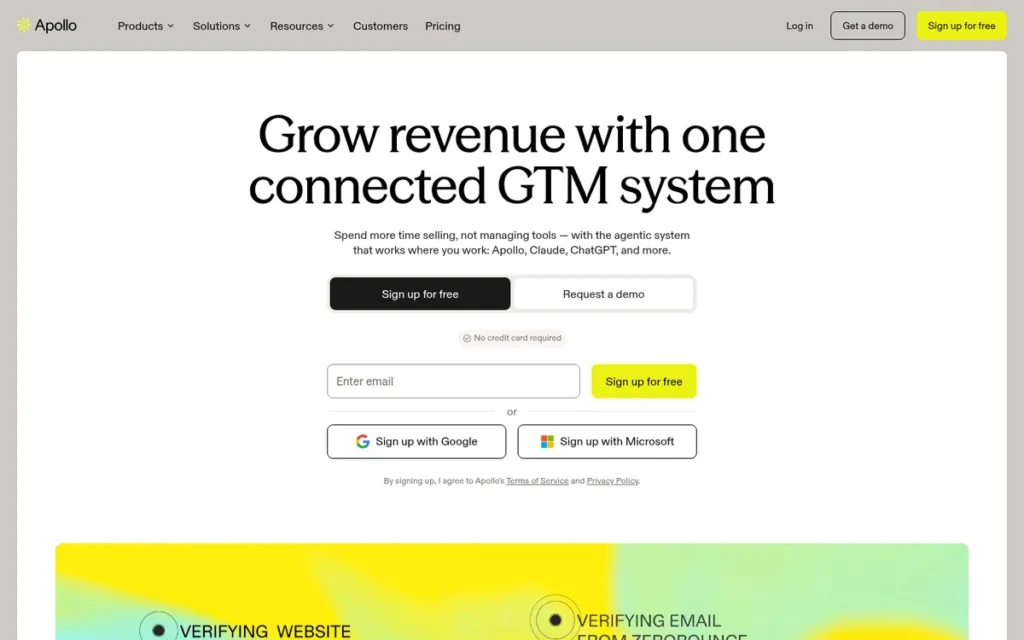
Category: All-in-One Prospecting Platform, combines a contact database with outreach sequencing and calling in one subscription.
At a Glance
- Category: All-in-One Prospecting Platform
- Best For: Startups and small-to-mid-market teams, mostly US-focused and email-first, that want data and sequencing in one tool
- Price Range: Free; $49–$99 per user/month (G2 list price, November 2026; may change)
- Primary Strength: Apollo.io combines prospecting data, email sequences, a dialer and AI agents in one subscription, and it has the largest G2 review base in this ranking.
- Biggest Limitation: Apollo.io’s most-cited G2 complaint is outdated contact records (226 mentions), and its phone data is thinner than ZoomInfo’s outside the US.
- One-Line Summary: Apollo.io is the most complete low-cost ZoomInfo alternative for teams that want contact data and outreach sequences in one tool, provided they verify emails before sending.
- Last Verified: November 2026
PlugRoute Score: 39/50
- Apollo.io scored Job Coverage 5, Review Evidence 5, Pricing Flexibility 5, Accuracy Evidence 2, Regional/Compliance 2 and Independent Evidence 3.
- Apollo.io ranks first because it scored the maximum on three of the four primary criteria, although its accuracy-evidence score (2 of 5) is the joint-lowest in this ranking.
Overview
Apollo.io is an all-in-one go-to-market platform that combines a searchable B2B contact database with email sequencing, a dialer and AI agents. It’s built for startups and small-to-mid-market teams that want to replace ZoomInfo’s data and a separate engagement tool with one subscription.
Apollo.io replaces ZoomInfo plus a sales engagement tool, but Apollo.io does not match ZoomInfo’s US direct-dial and mobile depth like for like.
Key Features
- Apollo.io combines contact search and enrichment with multistep email sequences, a dialer and call recording in a single workspace.
- Apollo.io’s AI agents research accounts, prioritize leads, draft outreach and book meetings (Apollo product pages, 2026, vendor-documented).
- Apollo.io lists 56 integrations on G2 (G2, November 2026), the most in this ranking and more than the 35 ZoomInfo lists. Its G2 vendor description names Anthropic, Autodesk and DocuSign as customers (vendor-reported).
- Apollo.io states that its database holds 240M+ contacts and 30M+ companies (Apollo, 2026, vendor claim), although other sources cite 210M or 275M.
- Apollo.io sources data from a contributor network of more than 2 million members, activity in its own engagement tools, web crawling and third-party providers (Apollo Data Overview, November 2026).
Best For
Apollo.io is best for startups and small-to-mid-market teams that sell mainly into the US and want to cancel both ZoomInfo and a separate sequencing tool. Phone-heavy teams selling into EMEA should pilot Apollo.io carefully first.
Pricing
On G2, Apollo.io lists Free ($0), Basic ($49) and Professional ($99) per user per month (G2 list price, November 2026; may change). A third-party tracker reports these annual and monthly rates (UsagePricing, 2026):
| Apollo.io Plan | Annual billing (per user/month) | Monthly billing (per user/month) | Credits per year |
|---|---|---|---|
| Basic | $49 | $65 | 30,000 |
| Professional | $79 | $99 | 48,000 |
| Organization | $119 | $149 | 72,000 (3-seat minimum) |
Apollo.io charges 1 credit per email reveal and 8 credits per verified phone reveal, so revealing both for one contact costs 9 credits (Apollo pricing page, November 2026). Credits are pooled across the account, expire each billing cycle and were reportedly cut in 2025 while prices stayed the same (PricingSaaS, 2025).
Strengths
- Apollo.io holds a 4.7/5 G2 rating from 9,862 reviews, and 97.1% of them are 4 or 5 stars (G2, November 2026). That is the largest review base and the highest G2 rating in this ranking.
- Apollo.io’s third most-cited G2 pro is “Prospecting and Outreach Together” (206 mentions) (G2, November 2026), which speaks to the cost of paying for separate data and engagement subscriptions.
- Apollo.io offers a free plan and paid tiers from $49 per user per month (G2 list price, November 2026; may change), and G2 reviewers most often report going live in under one day.
- Apollo.io was preferred for its UX and its standard sequences by a Reddit user who had used both tools (r/sales, 2025, user report), although that user rated ZoomInfo’s email coverage higher, at 8.5/10 against 7/10.
Limitations
Apollo.io keeps costs low with a crowd-contributed data model, and the trade-off is uneven accuracy. Switching from ZoomInfo to Apollo.io doesn’t escape the stale-data problem: outdated records are the top G2 complaint for both.
- Apollo.io’s top G2 con is Outdated Contact Records (226 mentions), more than the 158 outdated-data mentions in ZoomInfo’s reviews (G2, November 2026).
- Apollo.io drew a report of 20–30% bounce rates on its “verified” emails from one Reddit user on a mid-market team (r/CRM, 2026, single user report). Apollo’s own documentation says a bounce rate of 8% or more “warrants action.”
- Apollo.io’s phone data “isn’t as deep as ZoomInfo, especially outside the US,” and job changes lag, according to a disclosed Apollo employee (r/sales, 2025).
- Apollo.io takes time to learn, with Confusing Interface Navigation (162) and Steep Learning Curve (92) among its top G2 cons (G2, November 2026).
- Apollo.io’s pooled credits do not roll over, and each verified phone reveal costs 8 credits, so phone-heavy teams use up their allowance quickly (Apollo pricing page, November 2026).
Users on r/salesdevelopment shared their experience:
“Apollo has terrible data. Positions are often wrong, they often provide email addresses from different companies than the account you are interested in. But you can use Apollo for outreach and Sales Nav for data, it works well” Posted by u/cloudysprout
Takeaway: Some Apollo.io users trust it for outreach but not for data, because they report wrong job titles and emails tied to the wrong company.
How Does Apollo.io Compare With ZoomInfo?
Apollo.io covers the same seven jobs as ZoomInfo at a lower, published entry price with monthly terms.
- Apollo.io has a higher G2 rating than ZoomInfo (4.7 vs 4.5) and a higher share of 4- or 5-star reviews (97.1% vs 94.0%) (G2, November 2026).
- ZoomInfo still leads Apollo.io on US direct-dial and mobile depth, according to user reports and an Apollo employee.
- ZoomInfo and Apollo.io share the same top G2 con, which is outdated data.
Verdict
Apollo.io is the strongest overall ZoomInfo alternative for small and mid-market teams that want contact data and outreach sequencing in one subscription, but it does not match ZoomInfo’s US phone depth.
Apollo.io earned the #1 rank on job coverage, review evidence and price access. Run Apollo.io exports through an email verifier before they reach your CRM. Call-heavy and EMEA teams should pilot it on their own ICP list first.
2. Lusha: Best for Fast Contact Lookups and Documented Compliance Credentials
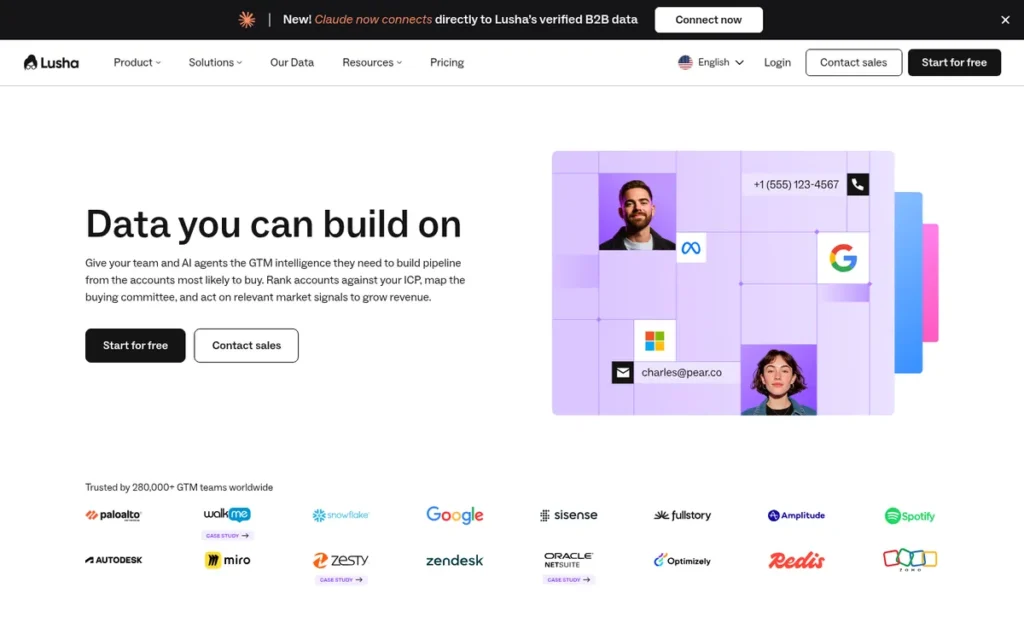
Category: Contact Lookup Tool, fast, lightweight email and phone reveals for individual reps, with CRM enrichment.
At a Glance
- Category: Contact Lookup Tool
- Best For: Reps and small teams that need quick verified email and phone lookups, and buyers who need documented compliance credentials
- Price Range: Free (40 credits/month); $49.90–$69.90 per user/month (G2 list price, November 2026; may change)
- Primary Strength: Lusha gives reps one-click contact lookups through a Chrome extension and lists the strongest compliance credentials in this ranking.
- Biggest Limitation: Lusha charges 5 credits per phone reveal versus 1 per email, so phone-heavy teams use their allowance about five times faster.
- One-Line Summary: Lusha is the best ZoomInfo alternative for fast, lightweight contact lookups and for buyers who need vendor-listed GDPR, ISO 27701 and SOC 2 documentation.
- Last Verified: November 2026
PlugRoute Score: 35/50
- Lusha scored Job Coverage 4, Review Evidence 3, Pricing Flexibility 4, Accuracy Evidence 3, Regional/Compliance 4 and Independent Evidence 3.
- Lusha ranks second on the strongest documented compliance credentials and transparent self-serve pricing, and it trails Apollo.io because its 4.3 G2 rating is below ZoomInfo’s 4.5 and G2 publishes no pros/cons counts for it.
- Lusha’s accuracy-evidence score of 3 sets its 95–98% email-accuracy vendor claim against a customer-reported 80–90%, because G2 pros/cons counts are unavailable.
Overview
Lusha is a B2B contact data and sales intelligence tool built around a Chrome extension and web app. It’s designed for reps and small teams that need quick verified emails, direct dials and CRM enrichment without ZoomInfo’s annual contract or heavy workflow.
Lusha replaces ZoomInfo’s lookup and enrichment jobs, not its full engagement suite. Teams that need multistep sequencing usually pair Lusha with a separate engagement tool.
Key Features
- Lusha’s Chrome extension and web app reveal business emails and direct dials for individual contacts in one click.
- Lusha enriches CRM records through native HubSpot and Salesforce integrations, which are available even on its free plan.
- Lusha tracks buying signals, which Lusha describes as 26 dated signal types (Lusha, 2026), alongside firmographics and technographics.
- Lusha offers API access for teams that want to feed its data into automation tools or AI agents.
- Lusha states that it holds 300M+ business contacts and 30M+ company profiles across North America, EMEA, APAC and LATAM (Lusha, 2026, vendor claim), but it publishes no counts by region.
Best For
Lusha is best for individual reps and small teams that look up a handful of emails and phone numbers at a time. Lusha also suits buyers whose legal or security review requires documented GDPR, ISO and SOC 2 credentials.
Pricing
Lusha lists Free ($0), Starter ($49.90) and Pro ($69.90) per user per month (G2 list price, November 2026; may change). Lusha’s credit rules are:
- Lusha’s Free plan includes 40 credits per month and one seat (Lusha pricing page, November 2026).
- Lusha charges 1 credit per email reveal and 5 credits per phone reveal (Lusha pricing page, November 2026).
- Lusha’s Scale tier is custom-quoted.
- Lusha’s monthly plans roll over unused credits up to twice the allowance, and annual credits are issued upfront (Emelia, 2026).
As an example, Lusha’s 40 free credits buy either 40 email reveals or 8 phone reveals.
Strengths
- Lusha lists SOC 2 Type II, ISO 27001 and ISO 27701, with GDPR compliance certified by ePrivacyseal GmbH and CCPA compliance validated by TrustArc (Lusha Trust Center, November 2026). That is the most extensive compliance documentation in this ranking, and PlugRoute did not review the certificates.
- Lusha holds a 4.3/5 G2 rating from 1,678 reviews (G2, November 2026), the second-largest review base among the ranked alternatives.
- Lusha’s free plan includes 40 credits per month with native HubSpot and Salesforce integrations (Lusha pricing page, November 2026), so teams can test how it fits their CRM before paying.
- Lusha reports in a named case study that insightsoftware achieved 2× ROI in two weeks and deployed 25+ users in one hour (Lusha, 2026, named vendor case study). Lusha also lists Google, Zendesk, Snowflake and Palo Alto Networks as customers (Lusha, 2026, vendor-reported).
Users on r/salesdevelopment noted:
“UK based firm here, we use a mix of Cognism and Lusha, we get decent quality data through both combined, e.g. data not in one but available in the next one. Lusha is very well priced and transparent (website) / cognism is pretty hefty £7.5k inc VAT for each licence per year” Posted by u/Wrong-Big4819
Takeaway: Users credit Lusha with transparent, affordable pricing, but some UK teams still pair it with a second provider to fill coverage gaps.
Limitations
Lusha’s simple per-reveal model is easy to start with, and the trade-off is cost for phone-heavy teams. Each Lusha phone reveal uses 5 credits (Lusha pricing page, November 2026).
- Lusha claims 95–98% email accuracy, but an unnamed customer on Lusha’s own case-study page reports 80–90% accuracy (Lusha, 2026, vendor-hosted customer report).
- Lusha is thinner for mid-market targets outside the UK and Nordics (Asphia Consulting, 2025). A Reddit user described US-built tools in general as “absolutely useless for DACH” (r/sales, 2025, user report).
- Lusha’s Capterra rating (4.0/5 from 403 reviews) is lower than its G2 rating (Capterra, 2026). Trustpilot reviewers allege unexpected auto-renewal charges and personal mobile numbers kept after removal requests (Trustpilot, 2026, anecdotes, not regulatory findings).
- Lusha’s evidence profile in this review is less detailed, because G2 publishes no pros/cons counts for it and no dedicated Reddit discussion surfaced, so buyers should weight their own pilot more heavily.
How Does Lusha Compare With ZoomInfo?
Lusha replaces ZoomInfo’s quick-lookup and enrichment jobs at a published monthly price with a free tier.
- Lusha has only basic sequencing and no visitor identification, while ZoomInfo covers both.
- Lusha’s G2 rating (4.3) is lower than ZoomInfo’s (4.5) (G2, November 2026).
- Lusha’s G2 profile notes that coverage still varies by region for teams switching from ZoomInfo.
Verdict
Lusha is the best ZoomInfo alternative for reps who need fast, lightweight contact lookups and for buyers whose compliance review requires documented GDPR, ISO 27701 and SOC 2 credentials.
Lusha is a lookup and enrichment tool, not a full engagement suite. Budget 5 credits for every phone reveal. EMEA teams should test Lusha country by country, especially in DACH.
3. Lead411: Best for Budget US Contact Data on an Annual Plan
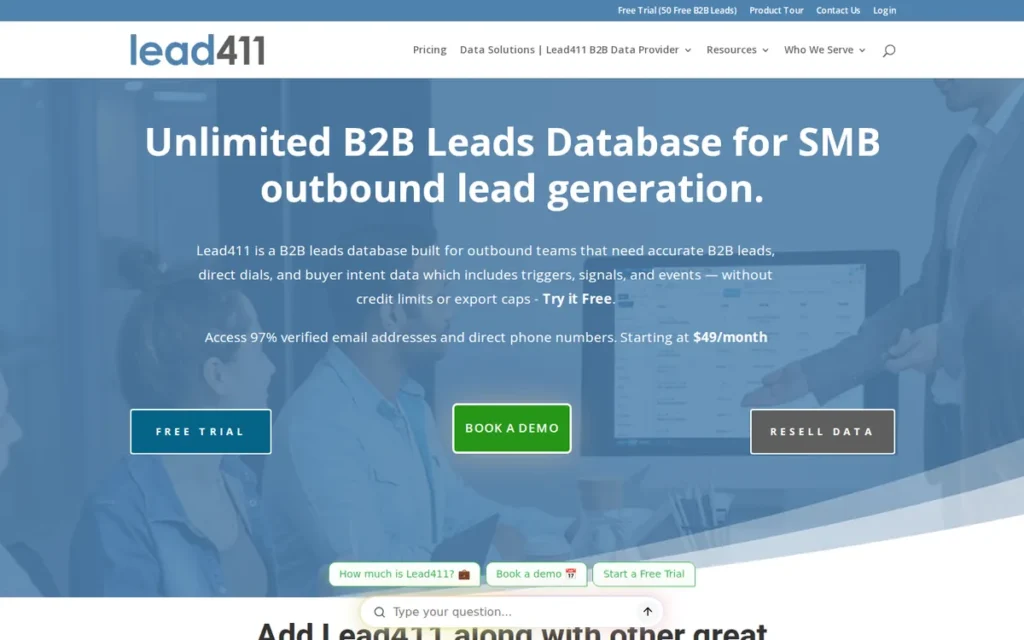
Category: Contact Data Provider, a list-building database with verification, with outreach available as an option.
At a Glance
- Category: Contact Data Provider
- Best For: Small US-focused sales teams that build lists on a fixed budget and run outreach in another tool
- Price Range: $490 per seat/year for Spark Annual (G2 list price, November 2026; may change); upper tiers on request
- Primary Strength: Lead411 offers the lowest published annual entry price for a paid contact-data plan in this ranking, and data accuracy is among its top G2 pros.
- Biggest Limitation: Lead411 is strongest in North America and thinner in EMEA and APAC, and it is a small company (19 employees per G2) with no named case studies.
- One-Line Summary: Lead411 is a low-cost ZoomInfo alternative for US-focused teams that mainly need verified emails and direct dials for list building, not a full engagement suite.
- Last Verified: November 2026
PlugRoute Score: 33/50
- Lead411 scored Job Coverage 4, Review Evidence 4, Pricing Flexibility 4, Accuracy Evidence 3, Regional/Compliance 1 and Independent Evidence 2.
- Lead411 ranks third on a positive review base and the lowest published annual entry price, and it falls below Lusha on regional coverage and thin corroborating evidence.
Overview
Lead411 is a US-focused B2B contact database with triple-verified emails, direct dials, growth-intent triggers and an optional outreach add-on. It’s aimed at small sales teams that mainly prospect North American accounts and want a low published annual price instead of a ZoomInfo contract.
Lead411 replaces ZoomInfo’s data and list-building jobs. Lead411’s Reach add-on covers basic email and SMS sequencing for teams without a separate engagement tool.
Key Features
- Lead411 verifies emails in three steps (SMTP check, human review and email-open validation) and double-verifies direct dials (Lead411 data-solutions page, 2026, vendor-documented).
- Lead411’s Growth Intent triggers flag companies that are hiring, raising funding, changing executives or expanding.
- Lead411 offers Bombora intent data as an optional add-on on higher tiers.
- Lead411’s Reach add-on sends email and SMS sequences with dialing, allowing up to 300 emails per day and 600–2,000 SMS per month depending on tier.
- Lead411 provides a Chrome extension and 25+ CRM integrations for exporting contacts into existing workflows (Lead411, 2026, vendor-documented).
Best For
Lead411 is best for small sales teams prospecting mainly into the US that want verified emails and direct dials at a low, predictable annual price. These teams usually run sequences in a separate engagement tool or in Lead411’s Reach add-on.
Pricing
On G2, Lead411 lists Spark Annual at $490 per seat per year on a 1-year contract, and its Ignite and Blaze plans are “Contact Us” (G2 list price, November 2026; may change). Lead411’s own pricing page gives more detail (Lead411 pricing page, November 2026):
| Lead411 Plan | Price | Exports |
|---|---|---|
| Spark | $49/month or $490/year | 1,000/month (12,000/year on annual) |
| Ignite | From $150/month or $1,500/year | 1,000+/month; Bombora as an add-on |
| Blaze | Custom | Unlimited annual exports |
Unlimited exports apply only on Lead411’s top tier. A third-party source reports a 7-day trial with 50 exports and no card required (LeadOcean, 2026), which PlugRoute did not verify first-hand.
Strengths
- Lead411 holds a 4.5/5 G2 rating from 483 reviews, and 95.4% of them are 4 or 5 stars (G2, November 2026). That share is above ZoomInfo’s 94.0%.
- Lead411 has Data Accuracy (29) and Accurate Data (25) among its top five G2 pros (G2, November 2026), and G2 reviewers most often report going live in under one day.
- Lead411’s Spark plan, at $490 per seat per year (G2 list price, November 2026; may change), is the lowest published annual entry price for a paid data plan in this ranking.
- Lead411 was described as “not the largest, but cleaner than ZoomInfo” for mobile numbers by a Reddit user (r/CRM, 2026, user report).
This aligns with community sentiment on r/sales:
“We really liked what zoominfo had but unfortunately was way too expensive for us being a small team. So I’ve been trying to look for a competing service for a smaller price. Being in Canada, I found that seamless and uplead simply wasn’t giving quality lead searches, but lead411 was.” Posted by u/AvengedFADE
Takeaway: Lead411 appeals to small teams priced out of ZoomInfo, and one Canadian evaluator found its search quality better than other low-cost databases they tested.
Limitations
Lead411’s low price and US focus come with a trade-off in reach and corroboration. Lead411 is strongest in North America, thinner in EMEA and APAC, and supports English only (TheRankMasters and Prospeo, a competing data vendor, 2026).
- Lead411’s G2 reviews praise and criticize the same thing, and all five of its top cons concern outdated or inaccurate data, led by Outdated Contacts (13) (G2, November 2026).
- Lead411 publishes no named, quantified case studies. Much of its positive Reddit commentary, including a reported bounce rate under 5%, comes from one repeat advocate (r/sales, 2021–2026, possibly biased user report).
- Lead411 drew a skeptical comment from a user who had “never heard anyone claim Lead411’s data was amazing” (r/sales, 2021, user report).
- Lead411 lists 19 employees on G2, the smallest team in this set, and its interface is described as dated for advanced searches (TheRankMasters and Prospeo, 2026).
How Does Lead411 Compare With ZoomInfo?
Lead411 replaces ZoomInfo’s US contact discovery and list building at a published annual price, while ZoomInfo publishes none.
- Lead411 lacks ZoomInfo’s visitor identification and depth of engagement tools.
- Lead411’s accuracy-related G2 pros (54 mentions) roughly equal its data-quality cons (57), while ZoomInfo’s data-quality cons (242) outnumber its accuracy pro (187) (G2, November 2026).
- Lead411, like ZoomInfo, is strongest in the US.
Verdict
Lead411 is the best low-cost ZoomInfo alternative for US-focused teams that need verified emails and direct dials for list building at a published annual price.
Lead411 is a data provider first, and Reach is a basic add-on. Teams selling into EMEA or APAC should look elsewhere. Pilot Lead411 on your own ICP list, because its community evidence is thin and partly comes from one advocate.
4. Clodura.AI: Best Free and Pay-As-You-Go ZoomInfo Alternative
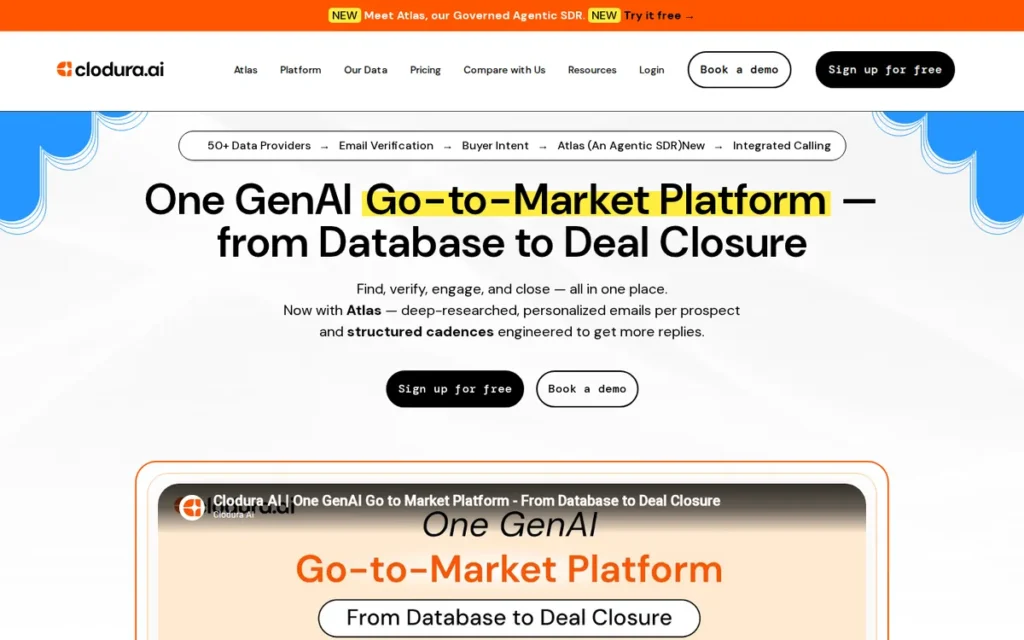
Category: All-in-One Prospecting Platform, combines a contact database with outreach sequencing and calling in one subscription.
At a Glance
- Category: All-in-One Prospecting Platform
- Best For: Solo sellers, bootstrapped founders and small North American teams that want to avoid any subscription commitment
- Price Range: Free (unlimited users, 100 credits); Max $99/month (includes 4,500 credits); Pay As You Go one-time purchase (G2 list price, November 2026; may change)
- Primary Strength: Clodura.AI combines a waterfall-verified contact database, AI-drafted sequences and a dialer with free and pay-as-you-go access and no contract.
- Biggest Limitation: Clodura.AI’s CallPilot dialer calls only the US and Canada, and Clodura.AI does not document its GDPR posture for European data.
- One-Line Summary: Clodura.AI is the only ranked ZoomInfo alternative that sells paid credits without a subscription, pairing a free plan and a $99 pay-as-you-go option with built-in waterfall verification.
- Last Verified: November 2026
PlugRoute Score: 32/50
- Clodura.AI scored Job Coverage 4, Review Evidence 3, Pricing Flexibility 5, Accuracy Evidence 3, Regional/Compliance 1 and Independent Evidence 1.
- Clodura.AI ties Amplemarket at 32/50 and ranks fourth on the tie-break (primary subtotal 15 vs 13), driven by the most flexible pricing in this ranking, while anonymous case studies and no community discussion keep it below Lead411.
Overview
Clodura.AI is a budget all-in-one prospecting platform that pairs a contact database using waterfall email verification with AI-written sequences, a dialer and Bombora intent. It’s built for solo sellers and small teams that want ZoomInfo-style data without a subscription commitment.
Clodura.AI suits North American prospecting best because its dialer is limited to the US and Canada. Clodura.AI’s built-in waterfall also lets teams try multi-provider enrichment without buying a separate workflow tool.
Key Features
- Clodura.AI finds emails through a waterfall across 50+ external email providers and 20+ dialer networks (Clodura product pages, 2026, vendor-documented).
- Clodura.AI’s Atlas AI agent drafts a five-step sequence for each prospect (Hook, Value, Proof, Bump, Breakup), and a person reviews it before anything is sent.
- Clodura.AI’s CallPilot dialer is built into the platform but calls only US and Canadian numbers.
- Clodura.AI provides Bombora-based buyer intent, sales-trigger alerts and org charts for account research.
- Clodura.AI claims 600M+ contacts and 50M companies (Clodura, 2026, vendor claim), the largest database claim in this ranking, which PlugRoute could not verify.
Best For
Clodura.AI is best for solo sellers and small teams prospecting into North America that want contact data and outreach without signing a contract. Clodura.AI also suits teams that want to test waterfall enrichment before investing in a separate workflow tool.
Pricing
Clodura.AI lists Free Forever ($0), Max ($99 per month) and Pay As You Go, a one-time purchase (G2 list price, November 2026; may change). Clodura.AI’s pricing page adds these details (Clodura pricing page, November 2026):
- Clodura.AI’s Free plan includes 100 credits, with no card required.
- Clodura.AI’s Max plan costs $99 per month and includes 4,500 credits.
- Clodura.AI’s Pay As You Go option costs $99 one-time for 2,025 credits, about $0.049 per credit.
- Clodura.AI’s credit top-ups cost $0.019 per credit, and every Clodura.AI plan includes unlimited users.
Clodura.AI’s Max page also shows a struck-through $89 promotional figure. G2 pricing notes say some small businesses still find $99 expensive (G2, November 2026).
Strengths
- Clodura.AI is the only ranked alternative that sells paid credits without a subscription: a $99 one-time purchase for 2,025 credits (Clodura pricing page, November 2026).
- Clodura.AI holds a 4.6/5 G2 rating from 346 reviews, and 96.2% of them are 4 or 5 stars (G2, November 2026).
- Clodura.AI’s free plan allows unlimited users with 100 credits and no card required (Clodura pricing page, November 2026), so a whole team can test it.
- Clodura.AI attracts switchers from Apollo, Lusha and ZoomInfo looking for “a more affordable way to combine prospecting and outreach,” according to G2’s switching summary (G2, November 2026).
Limitations
Clodura.AI’s low entry cost and broad feature set come with a trade-off in regional reach and corroboration. Clodura.AI’s CallPilot dialer calls only the US and Canada (Clodura pricing page, November 2026), a real limit for EMEA and APAC calling teams.
- Clodura.AI does not document its GDPR posture for European data, and a G2 snippet says its direct-dial coverage is stronger in North America than for European targets (G2, 2026).
- Clodura.AI’s case studies are anonymous, Reddit has no meaningful discussion of it, and its claims of 40%+ open rates and 4%+ reply rates are unverified (Clodura, 2026, vendor claim).
- Clodura.AI’s top G2 con is Learning Curve (18 mentions) (G2, November 2026), and Capterra reviewers call the interface “clunky” (Capterra, 2026).
- Clodura.AI offers English-only support, and some G2 reviews mention slow responses (G2, 2026).
How Does Clodura.AI Compare With ZoomInfo?
Clodura.AI covers six of ZoomInfo’s seven jobs, all except visitor identification, with no contract required.
- Clodura.AI’s pay-as-you-go option contrasts with ZoomInfo’s annual, auto-renewing agreement (user reports).
- Clodura.AI rates higher on G2 than ZoomInfo (4.6 vs 4.5) but from a far smaller base (346 vs 9,240 reviews) (G2, November 2026).
- Clodura.AI’s dialer and regional coverage are narrower than ZoomInfo’s.
Verdict
Clodura.AI is the only ranked ZoomInfo alternative that sells paid credits without a subscription, combining a free unlimited-user plan and a $99 pay-as-you-go option with built-in waterfall verification and AI-drafted sequences.
Clodura.AI fits North American, email-first prospecting best. Its evidence base is thinner than its G2 rating suggests. EMEA teams, and phone-heavy teams outside North America, should look elsewhere.
5. Amplemarket: Best for Signals-Led AI Outbound and Tool Consolidation
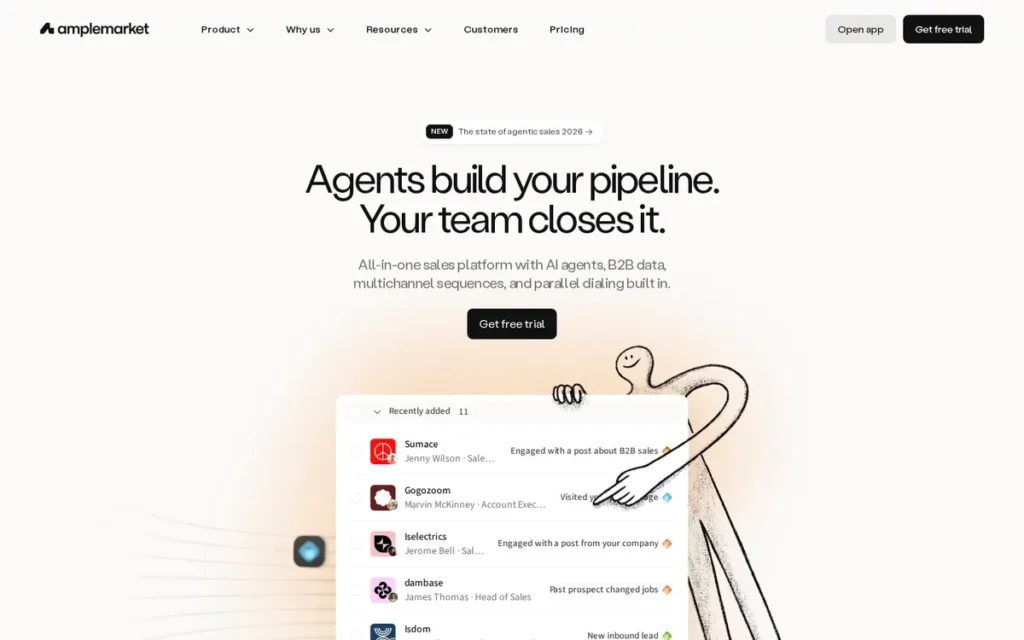
Category: Signals-Led Outbound Platform, AI-driven multichannel outreach triggered by buying signals, with contact data built in.
At a Glance
- Category: Signals-Led Outbound Platform
- Best For: SDR teams that want to consolidate data, signals, sequencing and deliverability into one platform and can commit to an annual contract
- Price Range: Not listed on G2; vendor-published Startup plan $600/month billed annually for 2 seats (Amplemarket, March 2026); Growth and Elite on request; may change
- Primary Strength: Amplemarket combines contact data verified through a multi-provider waterfall with 100+ buying signals, multichannel sequences and deliverability tools in one platform.
- Biggest Limitation: Amplemarket requires an annual contract starting at about $7,200 per year for 2 seats, a real commitment for small teams leaving ZoomInfo to escape lock-in.
- One-Line Summary: Amplemarket is the best-fit ZoomInfo alternative for SDR teams that want to replace their data provider and engagement stack with one signals-led AI outbound platform.
- Last Verified: November 2026
PlugRoute Score: 32/50
- Amplemarket scored Job Coverage 4, Review Evidence 4, Pricing Flexibility 2, Accuracy Evidence 3, Regional/Compliance 2 and Independent Evidence 4.
- Amplemarket ranks fifth despite the highest share of 4- or 5-star reviews and strong named case studies, because its annual 2-seat entry contract and missing G2 list price scored 2 of 5 on pricing flexibility, a primary criterion that counts double.
Overview
Amplemarket is an AI outbound platform that combines a contact database verified through a multi-provider waterfall with 100+ buying signals, multichannel sequences and deliverability tools. It’s built for SDR teams that want to replace ZoomInfo and a separate engagement stack with one signals-led workflow.
Amplemarket is a way to consolidate tools, not a cheaper drop-in database. Teams pay for Amplemarket to cut the number of subscriptions, not to lower the cost of data alone.
Key Features
- Amplemarket verifies contact data across multiple providers in sequence, a built-in waterfall, though it does not disclose which providers it uses.
- Amplemarket tracks 100+ intent signals, including job changes, hiring, funding and social activity, to prioritize accounts.
- Amplemarket’s Duo AI copilot finds leads, researches them and drafts sequences for a rep to review before sending.
- Amplemarket runs multichannel sequences across email, LinkedIn and phone from one workspace.
- Amplemarket includes mailbox warm-up, domain-health monitoring and a spam checker to protect deliverability.
Best For
Amplemarket is best for SDR and outbound teams of several reps that currently pay for ZoomInfo plus separate engagement and deliverability tools. These teams want to consolidate into Amplemarket and can commit to an annual contract.
Pricing
Amplemarket is not listed on G2 (G2, November 2026). Amplemarket’s own pricing article gives these details, which may change (Amplemarket, March 2026):
- Amplemarket’s Startup plan costs $600 per month billed annually for 2 seats, about $7,200 per year.
- Amplemarket’s Startup plan includes 15,000 email credits and 480 phone credits per user per year, and extra phone credits cost $0.50 each.
- Amplemarket’s Growth (4 seats) and Elite (10 seats) plans are custom-priced, and Duo Inbox is a Growth add-on.
- Amplemarket’s two-seat Startup plan costs about $7,200 a year, against $1,176 a year for two Apollo.io Basic seats at G2 list price. The difference is the price of signals-led multichannel automation and deliverability tools.
Strengths
- Amplemarket holds a 4.6/5 G2 rating from 719 reviews, and 97.2% of them are 4 or 5 stars (G2, November 2026), the highest share in this ranking.
- Amplemarket reports in a named case study that O’Reilly generated $21M in pipeline in 90 days and saved 839 hours of manual social work (Amplemarket, 2026, named vendor case study).
- Amplemarket reports in a named case study that LILT cut tooling costs by 56% and raised quota attainment by 18%, with payback in under 3 months (Amplemarket, 2026, named vendor case study).
- Amplemarket is the only ranked alternative with G2 pros/cons data whose top five cons do not include data accuracy (G2, November 2026), although G2’s summary says accuracy “can occasionally be an issue.”
Limitations
Amplemarket’s consolidated platform comes with the trade-off of a high entry commitment. Amplemarket has no price on G2, and its vendor-listed entry plan costs about $7,200 per year on an annual contract (Amplemarket, March 2026), so small teams escaping ZoomInfo’s lock-in would take on a new one.
- Amplemarket’s top G2 con is Missing Features (56 mentions), followed by Learning Curve (32), Sequence Issues (28) and Integration Issues (26) (G2, November 2026).
- Amplemarket has no deal-management or forecasting features, according to Amplemarket’s own comparison of multichannel outreach tools (Amplemarket, 2026).
- Amplemarket’s LinkedIn automation can breach LinkedIn’s terms and risk account restrictions, a risk Amplemarket itself flags on its Duo product page (Amplemarket, 2026).
- Amplemarket’s regional data coverage is undocumented, Reddit has no meaningful discussion of it, and PlugRoute could not verify its funding and headcount.
How Does Amplemarket Compare With ZoomInfo?
Amplemarket replaces ZoomInfo’s data and engagement jobs and adds deliverability tools.
- Amplemarket rates higher on G2 than ZoomInfo (4.6 vs 4.5; 97.2% vs 94.0% of reviews at 4 or 5 stars) (G2, November 2026).
- Amplemarket, like ZoomInfo, requires an annual commitment.
- Amplemarket has no visitor identification, and its regional data depth is undocumented.
Verdict
Amplemarket is the best-fit ZoomInfo alternative for SDR teams that want to replace a data provider and a separate engagement stack with one signals-led AI outbound platform.
Amplemarket has some of the strongest named case-study evidence in this ranking, alongside SalesIntel, and the highest share of 4- or 5-star G2 reviews (97.2%). Its annual, 2-seat entry plan makes it a poor fit for solo users or tight budgets. Use cautious LinkedIn automation settings.
6. SalesIntel: Best for Human-Verified Data Plus Intent and Visitor Identification
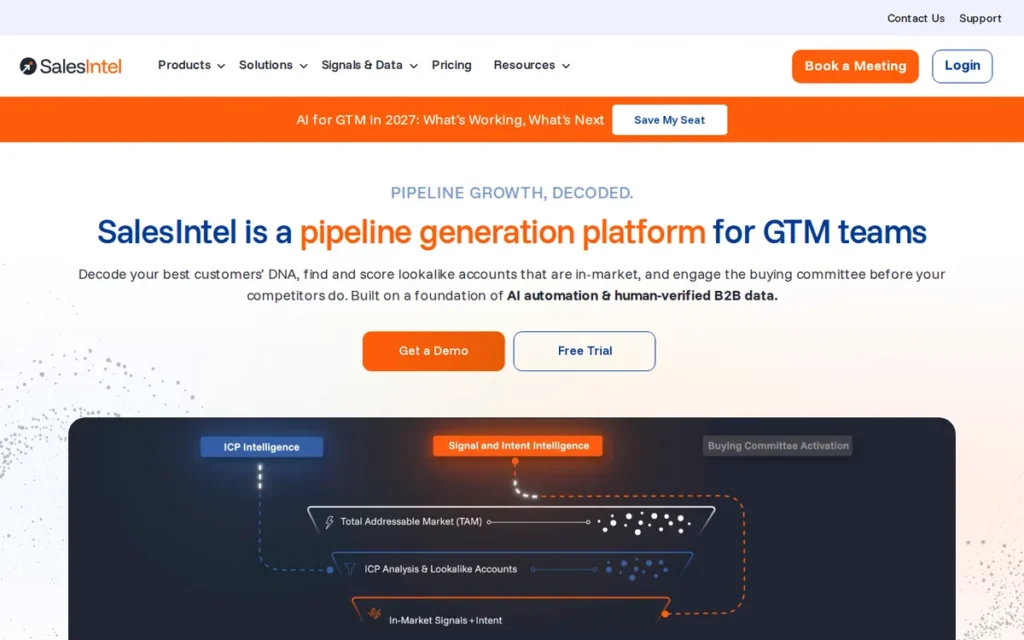
Category: Verified Data & Intent Provider, human-verified contacts plus account-level intent and visitor identification, without built-in outreach.
At a Glance
- Category: Verified Data & Intent Provider
- Best For: US-focused mid-market sales and marketing teams that want verified contacts plus intent and visitor identification and already own an engagement tool
- Price Range: Pricing on request; quote-only with annual contracts (not listed on G2, November 2026)
- Primary Strength: SalesIntel is the only ranked alternative that backs its human-verified data with a stated accuracy guarantee and on-demand research for missing contacts.
- Biggest Limitation: SalesIntel has the lowest share of 4- or 5-star G2 reviews in this ranking, and all five of its top G2 complaints concern outdated or inaccurate data.
- One-Line Summary: SalesIntel is a ZoomInfo alternative for mid-market teams that want human-verified contacts with intent and visitor identification, but its quote-only pricing and data-quality complaints mean it should be piloted first.
- Last Verified: November 2026
PlugRoute Score: 26/50
- SalesIntel scored Job Coverage 4, Review Evidence 2, Pricing Flexibility 1, Accuracy Evidence 3, Regional/Compliance 2 and Independent Evidence 4.
- SalesIntel ranks sixth because its quote-only annual pricing scored 1 of 5 and its below-baseline review satisfaction scored 2 of 5, and both are primary criteria that count double.
Overview
SalesIntel is a B2B data and pipeline platform that pairs human-verified contacts with Bombora intent, visitor identification and on-demand research. The vendor says it re-verifies those contacts every 90 days. It’s aimed at mid-market teams that want verified data and account prioritization rather than built-in outreach.
SalesIntel replaces ZoomInfo’s data, intent and visitor-identification jobs, but not its engagement suite. PlugRoute could not verify built-in sequencing for SalesIntel.
Key Features
- SalesIntel states that a 2,000+ person research team re-verifies contacts every 90 days, backed by an “up to 95%” accuracy guarantee (SalesIntel, 2026, vendor claim). SalesIntel separately reports 83%+ phone-number accuracy and cites a 68% direct-dial connect rate from a test it commissioned (SalesIntel blog, 2026, vendor-published).
- SalesIntel’s Research on Demand service lets customers request contacts that are not yet in its database.
- SalesIntel combines Bombora intent with its own intent signals to help teams prioritize accounts that look in-market.
- SalesIntel’s VisitorIntel identifies companies visiting a customer’s website, a ZoomInfo job that most alternatives in this ranking do not cover.
- SalesIntel provides the RevDriver browser extension and technographic data for account research.
Best For
SalesIntel is best for US-focused mid-market teams that need verified contacts plus intent and visitor identification and already run sequences in another tool. SalesIntel also suits teams deciding whether they need ABM-style prioritization rather than another contact database.
Pricing
SalesIntel is not listed on G2 and is sold quote-only on annual contracts (G2, November 2026). These are the known pricing facts:
- SalesIntel plans include unlimited users and export or enrichment credits, according to third-party listings (SalesHive, 2026).
- SalesIntel price figures commonly repeated online could not be verified by PlugRoute, so they are not published here.
- SalesIntel’s total cost, as with ZoomInfo, cannot be estimated without a quote.
Strengths
- SalesIntel reports in a named case study that the Seattle Mariners beat a seven-figure Q2 pipeline goal and added 4,000 new contacts (SalesIntel, 2026, named vendor case study).
- SalesIntel lists Data Accuracy (70) and Accuracy (61) among its top five G2 pros from 541 reviews (G2, November 2026).
- SalesIntel reports in a named case study that Kona AI achieved 3× faster pipeline velocity and 40% less list-building time (SalesIntel, 2026, named vendor case study).
- SalesIntel offers the only accuracy guarantee and on-demand research service documented in this ranking.
Limitations
SalesIntel’s human-verification model promises quality, and the trade-off is mixed observed accuracy. All five of SalesIntel’s top G2 cons concern outdated or inaccurate data, led by Outdated Data (40) and Inaccurate Data (40) (G2, November 2026).
- SalesIntel’s 91.3% share of 4- or 5-star reviews is the lowest in this ranking and below ZoomInfo’s 94.0% (G2, November 2026).
- SalesIntel’s quote-only, annual pricing does not solve the price-transparency problem that pushes buyers away from ZoomInfo.
- SalesIntel’s coverage is weaker in Europe and South America, and its phone numbers do not sync through HubSpot, according to G2 reviewers (G2, 2026).
- SalesIntel drew older Reddit comments saying ZoomInfo had “more, and more accurate” contacts and that an AE quoted “a price higher than Zoom” (r/sales, 2021, dated user reports).
How Does SalesIntel Compare With ZoomInfo?
SalesIntel overlaps with ZoomInfo’s data, intent and visitor-identification jobs more than any other ranked tool except Apollo.io.
- SalesIntel lacks ZoomInfo’s engagement suite and uses the same quote-only, annual model.
- SalesIntel’s G2 rating (4.3 vs 4.5) and share of 4- or 5-star reviews (91.3% vs 94.0%) are both lower than ZoomInfo’s (G2, November 2026).
Verdict
SalesIntel is the ZoomInfo alternative best suited to mid-market teams that want human-verified contacts combined with intent data and visitor identification, provided they pilot its coverage before signing.
SalesIntel covers ZoomInfo’s intent and visitor-ID jobs better than most of this list. Quote-only annual pricing and the lowest review satisfaction in the set held it to #6. Pair SalesIntel with an engagement tool.
7. Selling.com: Best for SMB and Local Territory Targeting
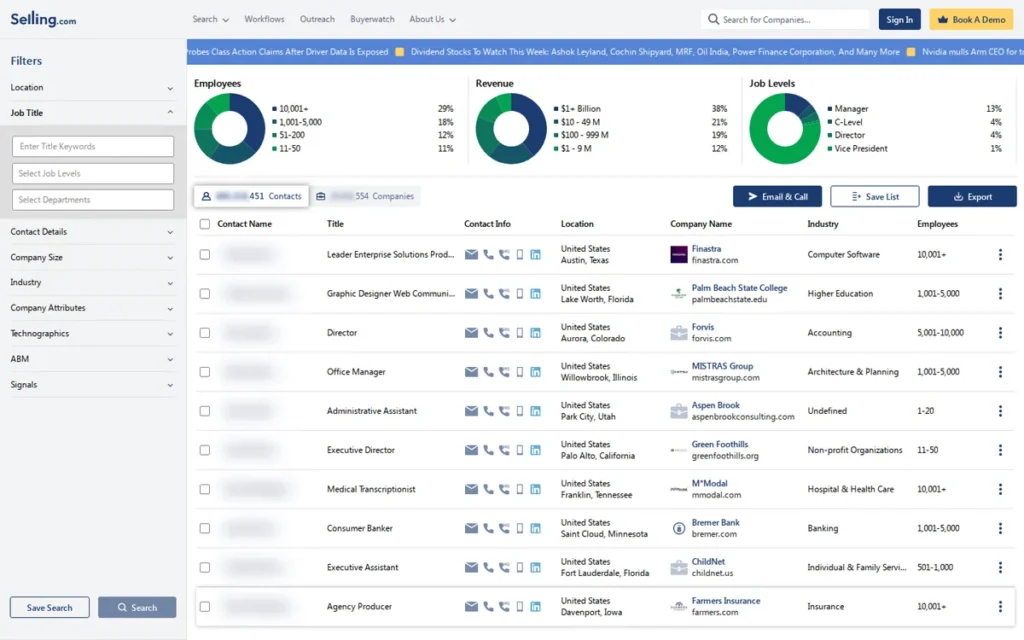
Category: All-in-One Prospecting Platform, combines a contact database with outreach sequencing and calling in one subscription.
At a Glance
- Category: All-in-One Prospecting Platform
- Best For: Teams selling to small businesses or within defined geographic territories, such as field and franchise-territory sales
- Price Range: Free Chrome extension (1 user); Research Solo from $89 per user/month (G2 list price, November 2026; may change)
- Primary Strength: Selling.com offers local and SMB targeting by SIC and NAICS code, ZIP code and delivery radius, a niche that larger databases serve poorly.
- Biggest Limitation: Selling.com has the smallest evidence base in this ranking (151 G2 reviews), and Inaccurate Data is its top G2 complaint.
- One-Line Summary: Selling.com is a niche ZoomInfo alternative for teams targeting small businesses by industry code and geography, best treated as a pilot candidate given its thin evidence base.
- Last Verified: November 2026
PlugRoute Score: 24/50
- Selling.com scored Job Coverage 4, Review Evidence 2, Pricing Flexibility 3, Accuracy Evidence 2, Regional/Compliance 1 and Independent Evidence 1.
- Selling.com ranks seventh because it has the smallest evidence base and Inaccurate Data is its top G2 con, and its unique local-targeting filters don’t offset these scores.
Overview
Selling.com is a B2B pipeline platform that combines a contact database with SIC, NAICS, ZIP-code and delivery-radius filters, Bombora and INFUSE intent, sequences and a dialer. It’s built for teams that sell to small businesses or defined territories and find ZoomInfo too expensive.
Selling.com fills a territory-targeting niche rather than serving as a broad ZoomInfo replacement. Selling.com’s G2 seller profile links the product to Infotelligent.
Key Features
- Selling.com filters accounts by SIC and NAICS industry codes, ZIP code and delivery radius, which supports territory-based and field sales.
- Selling.com combines intent data from Bombora and INFUSE Media to flag accounts that look in-market.
- Selling.com includes email and call sequences, an auto/power dialer and AI call coaching alongside its data.
- Selling.com offers suppression lists and technographic filters for refining target lists.
- Selling.com integrates with Salesforce, HubSpot, Zoho CRM, Outreach, Salesloft and Gmail/Outlook (G2 pricing page, November 2026).
Best For
Selling.com is best for teams that sell to small businesses or within defined territories and need industry-code and radius filters that broad databases lack. Selling.com suits buyers willing to run a careful pilot, given the limited independent evidence.
Pricing
Selling.com lists these options on G2 (G2 list price, November 2026; may change):
- Selling.com’s Chrome extension is free for one user, and a free trial is available.
- Selling.com Research Solo starts at $89 per user per month, billed annually, with 500 export credits and 50 mobile credits per month.
- Selling.com Research + Outreach costs $159 per user per month billed annually, with unlimited email credits and 2,400 mobile credits per year.
Sources disagree on Selling.com’s pricing, because GTM Tech Index says its paid rates are not publicly published (GTM Tech Index, 2026). PlugRoute could not establish team or enterprise prices.
Strengths
- Selling.com documents local targeting by SIC and NAICS code, ZIP code and delivery radius (G2 vendor description, November 2026), which is unique in this ranking.
- Selling.com holds a 4.6/5 G2 rating, with 95.4% of its 151 reviews at 4 or 5 stars (G2, November 2026), and G2’s summary highlights “excellent customer support.”
- Selling.com offers a free Chrome extension for one user (G2, November 2026), so teams can test its data on real prospects at no cost.
- Selling.com was described as “Zoom info without the bloated price tag” by one G2 reviewer (G2, 2026, individual user report).
Limitations
Selling.com’s niche targeting comes with the trade-off of the thinnest evidence base in this ranking. Selling.com has 151 G2 reviews, no published case studies, no Capterra reviews and no relevant Reddit discussion (2026).
- Selling.com’s top G2 con is Inaccurate Data (8 mentions) (G2, November 2026), and one reviewer reported a “40-50%” bounce rate (G2, 2026, single user report).
- Selling.com reviewers mention emails for people who “no longer work there” and running out of contact credits unexpectedly (G2, 2026).
- Selling.com’s EMEA coverage is undocumented, and PlugRoute could not verify its “97% accurate” data claim (Selling.com, 2026, vendor claim).
How Does Selling.com Compare With ZoomInfo?
Selling.com covers six of ZoomInfo’s seven jobs at a published entry price and adds local targeting filters.
- Selling.com’s radius and NAICS filters address a ZoomInfo weakness, since ZoomInfo users criticize its filters as inflexible (34 mentions) (G2, November 2026).
- Selling.com has a small fraction of ZoomInfo’s review evidence (151 vs 9,240 reviews) and no documented coverage outside the US.
Verdict
Selling.com is the only ZoomInfo alternative in this ranking that documents SIC, NAICS, ZIP-code and delivery-radius targeting, but its small evidence base makes it a pilot candidate rather than a safe default.
Selling.com’s territory filters fill a real gap. Reported accuracy varies widely, probably depending on the ICP. Test Selling.com with the free extension before committing to annual billing.
How Do These Alternatives Compare With ZoomInfo?
None of the seven alternatives covers every ZoomInfo job with ZoomInfo’s US phone depth, but most cost less upfront and offer more flexible terms. Apollo.io is the only one that covers all seven jobs. Clodura.AI, Lead411 and Selling.com cover six. The table uses ZoomInfo as an unranked baseline row.
| Product | ZoomInfo jobs covered (of 7) | Built-in sequencing | Intent type | Entry price (G2 list, Nov 2026) | Contract type | Documented regional limits | G2 rating (reviews) |
|---|---|---|---|---|---|---|---|
| ZoomInfo (baseline) | 7 | Yes | Buyer intent | Not listed on G2 | Annual, auto-renewing (user reports) | Users want better coverage across regions | 4.5 (9,240) |
| Apollo.io | 7 | Yes | Buyer intent | Free; $49/user/month | Monthly or annual | Phone data thinner outside the US (Apollo employee) | 4.7 (9,862) |
| Lusha | 5 | Basic | Buying signals | Free; $49.90/user/month | Monthly or annual | Thinner outside the UK and Nordics (Asphia, 2025) | 4.3 (1,678) |
| Lead411 | 6 (sequencing and dialing via Reach add-on) | Add-on | Growth Intent; Bombora add-on | $490/seat/year | Annual (monthly shown on vendor page) | Strongest in North America (TheRankMasters, Prospeo, 2026) | 4.5 (483) |
| Clodura.AI | 6 | Yes | Bombora | Free; $99/month; pay as you go | No contract needed for PAYG | Dialer calls only the US and Canada | 4.6 (346) |
| Amplemarket | 5 | Yes (multichannel) | 100+ signals | Not listed (vendor: $600/month, 2 seats) | Annual | Undocumented | 4.6 (719) |
| SalesIntel | 5 | Not verified | Bombora plus its own signals | Quote only | Annual | Weaker in Europe and South America (G2 reviewers) | 4.3 (541) |
| Selling.com | 6 | Yes | Bombora plus INFUSE Media | Free extension; from $89/user/month | Billed annually | Undocumented | 4.6 (151) |
Why Do Teams Look for ZoomInfo Alternatives?
Teams look for ZoomInfo alternatives mainly because of cost, contract rigidity and data freshness. ZoomInfo’s most-cited G2 complaints are Outdated Contact Data (158 mentions) and Expensive For Small Teams (88 mentions) (G2, November 2026). ZoomInfo publishes no list price on G2, so it is hard to estimate total cost before a sales call.
ZoomInfo is still a well-reviewed product. ZoomInfo holds a 4.5/5 G2 rating from 9,240 reviews, and 94.0% of them are 4 or 5 stars (G2, November 2026). ZoomInfo Sales is now sold as GTM Workspace, according to its G2 listing.
ZoomInfo’s top G2 pros (G2, November 2026) are:
- ZoomInfo is praised for Accurate Business Records (187 mentions).
- ZoomInfo is praised for Intuitive Daily Use (181 mentions).
- ZoomInfo is praised for Faster Prospect Research (161 mentions).
- ZoomInfo is praised for Quick Setup and Onboarding (143 mentions).
- ZoomInfo is praised for helping users Find Relevant Decision-Makers (128 mentions).
ZoomInfo’s top G2 cons (G2, November 2026) are:
- ZoomInfo is criticized for Outdated Contact Data (158 mentions).
- ZoomInfo is criticized as Expensive For Small Teams (88 mentions).
- ZoomInfo is criticized for Incorrect Contact Details (84 mentions).
- ZoomInfo is criticized for a Cluttered Interface (59 mentions).
- ZoomInfo is criticized for Inflexible Search Filters (34 mentions).
As one user on r/salesdevelopment described:
“I don’t know UK but I’m very displeased with ZoomInfo in the US. Data has been off and at least once a day the system is down. Haven’t used Apollo to give you feedback but have heard good things about it. Lately I have been hearing great things about amplemarket but I have no idea on cost.” Posted by u/Handle_Resident
Takeaway: Inaccurate data and reliability problems push some US-based ZoomInfo customers to look at alternatives such as Apollo.io and Amplemarket.
ZoomInfo users ask G2 for these improvements (G2, November 2026):
- ZoomInfo users want fresher records, with better coverage of more regions and of smaller companies.
- ZoomInfo users want easier search, filters and navigation.
- ZoomInfo users want better CRM sync and record matching.
- ZoomInfo users want AI answers that use more context and are easier to verify.
ZoomInfo’s 2025 revenue was $1.2495 billion, up 3% from $1.2143 billion, from more than 35,000 customers (ZoomInfo FY2025 Form 10-K, SEC, 2026). ZoomInfo reported net revenue retention of 90% at year-end 2025, up from 87% in 2024.
A net revenue retention figure below 100% means ZoomInfo’s existing customers, taken together, spent less than they did a year earlier.
ZoomInfo pricing and contract signals from Reddit are unverified user reports:
- ZoomInfo “starts at like $15k,” according to one user (r/Sales_Professionals, 2026, user report).
- ZoomInfo “will negotiate, always at quarter end,” according to another user (r/CRM, 2026, user report).
- ZoomInfo held one customer to a 60-day cancellation notice period, which the user called “redix” (r/sales, 2025, user report).
- ZoomInfo reportedly ignored one team’s request to stop auto-renewal until the deadline had passed (r/Sales_Professionals, 2026, user report).
The wider category is growing. The sales intelligence market is projected to grow from $4.99 billion in 2026 to $9.15 billion by 2031, a 12.89% CAGR over that period (Mordor Intelligence, 2025).
What Will a ZoomInfo Alternative Really Cost?
A ZoomInfo alternative’s real cost depends on what each phone reveal costs, on seat minimums and on contract terms, not only on the headline price. Apollo.io charges 8 credits per verified phone number and Lusha charges 5, against 1 credit per email (vendor pricing pages, November 2026). A phone-heavy team can use up an allowance five to eight times faster.
On credit-based plans, the phone-to-email ratio of your outreach matters more than the headline seat price.
| Tool | Entry price (source) | Credit rules | Rollover / expiry | Seat minimum | Contract |
|---|---|---|---|---|---|
| Apollo.io | Free; $49–$99/user/month (G2, Nov 2026) | Email = 1 credit; verified phone = 8 credits; pooled 30,000–72,000/year by tier (Apollo pricing page; UsagePricing, 2026) | Expire each cycle; no rollover | Organization: 3 seats | Monthly or annual |
| Lusha | Free; $49.90–$69.90/user/month (G2, Nov 2026) | Email = 1 credit; phone = 5 credits | Monthly plans roll over up to 2× (Emelia, 2026) | Free plan: 1 seat | Monthly or annual; Scale quoted |
| Lead411 | $490/seat/year (G2, Nov 2026) | 1,000 exports/month on Spark (Lead411 pricing page, Nov 2026) | Not documented | Not documented | Annual on G2; monthly on vendor page |
| Clodura.AI | Free; $99/month; $99 PAYG (G2, Nov 2026) | Max: 4,500 credits/month; PAYG: 2,025 credits for $99; top-ups $0.019/credit (Clodura pricing page, Nov 2026) | Not documented | None; unlimited users on every plan | No contract for PAYG |
| Amplemarket | $600/month billed annually (Amplemarket, March 2026) | 15,000 email + 480 phone credits/user/year; extra phone $0.50 | Not documented | Startup: 2 seats | Annual |
| SalesIntel | Quote only | Third-party listings describe credits; not verified | Not documented | Third-party listings describe unlimited users | Annual |
| Selling.com | Free extension; from $89/user/month (G2, Nov 2026) | Research Solo: 500 exports + 50 mobiles/month; Research + Outreach: $159/user/month | Not documented | Not documented | Billed annually |
| ZoomInfo | Not listed on G2 | Not published | Not published | Not published | Annual, auto-renewing (user reports) |
These worked examples use only published credit rules:
- Apollo.io Basic’s 30,000 annual credits buy 30,000 email reveals, or only 3,750 verified phone reveals at 8 credits each (Apollo pricing page; UsagePricing, 2026).
- Lusha’s 40 free monthly credits buy 40 email reveals or 8 phone reveals.
- Lusha Pro’s 600 monthly credits buy 600 email reveals or 120 phone reveals (Emelia, 2026).
- Amplemarket’s 480 annual phone credits per user average 40 phone credits per user per month before $0.50 overages apply.
- Lead411’s Spark annual plan works out to about $0.04 per export ($490 for 12,000 exports).
- Clodura.AI Max’s 4,500 monthly credits for $99 work out to about $0.022 per credit, less than half the pay-as-you-go rate of about $0.049.
ZoomInfo customers should time any switch around their renewal notice window. One user reports a 60-day cancellation notice (r/sales, 2025, user report), so check your own contract for the exact deadline.
Can You Combine Several Data Providers Instead of Replacing ZoomInfo?
Yes. Many teams combine providers instead of replacing ZoomInfo with one tool. The options range from built-in waterfalls, such as Clodura.AI across 50+ email providers and Amplemarket across undisclosed providers, to stacks that add an email verifier, a regional provider, or a ZoomInfo contract kept only for priority-account mobile numbers.
These are the most common combinations:
- A built-in waterfall checks several providers in sequence inside one tool, as Clodura.AI and Amplemarket describe (vendor-documented, 2026).
- An Apollo.io plus email-verifier stack runs Apollo.io exports through a verifier such as NeverBounce or ZeroBounce before CRM import. One user says this cut bounce rates from 20–30% to 5–8% (r/CRM, 2026, possibly biased user report).
- A regional stack adds a local provider for Europe, such as one Central and Eastern European user’s combination of Apollo, Lusha and BizMachine (r/sales, 2025, user report).
- A hybrid setup keeps a negotiated ZoomInfo contract “only for mobile numbers” on priority accounts and runs volume prospecting through a cheaper tool (r/CRM, 2026, user report).
Clay is the tool most often associated with custom waterfall workflows. It sits outside PlugRoute’s verified November 2026 dataset and is not ranked here.
Which ZoomInfo Alternatives Work for European B2B Data?
None of the seven ranked ZoomInfo alternatives is an EU-first data specialist. Every one is either documented as weaker outside the US or leaves its regional coverage undocumented. Lusha has the most extensive vendor-listed compliance credentials. Teams selling into Europe should test coverage country by country and may need to add a regional provider.
Each ranked tool’s documented regional position is:
- Apollo.io’s phone data “isn’t as deep as ZoomInfo, especially outside the US,” according to a disclosed Apollo employee (r/sales, 2025), and Apollo.io says it follows GDPR practices.
- Lusha lists GDPR certification by ePrivacyseal GmbH, ISO 27701 and SOC 2 Type II (Lusha Trust Center, November 2026), but Lusha is thinner for mid-market targets outside the UK and Nordics (Asphia Consulting, 2025).
- Lead411 is strongest in North America and thinner in EMEA and APAC (TheRankMasters and Prospeo, 2026).
- Clodura.AI’s dialer calls only the US and Canada, and Clodura.AI does not document its GDPR posture (Clodura, 2026).
- Amplemarket’s regional coverage is undocumented in the sources PlugRoute reviewed (2026).
- SalesIntel’s coverage is weaker in Europe and South America, according to G2 reviewers (G2, 2026).
- Selling.com’s EMEA coverage is undocumented (2026).
European coverage varies by country, including within DACH (Germany, Austria and Switzerland):
“quite okay for Benelux and Nordics, but absolutely useless for DACH” (r/sales, 2025, user report on US-built databases)
Takeaway: European match rates vary by country, so test DACH, Benelux and Nordic prospects separately before signing.
Cognism is the vendor that Reddit users and comparison sites most often name for European data. It was outside PlugRoute’s verified November 2026 dataset and is not ranked here.
GDPR allows B2B prospecting with a documented lawful basis, such as legitimate interest backed by a balancing test, but national ePrivacy and e-marketing rules still apply. Ask every shortlisted vendor for the following (general information, not legal advice):
- Ask the vendor for a Data Processing Agreement (DPA).
- Ask the vendor for a current subprocessor list.
- Ask the vendor for documentation of the lawful basis under which it collects and supplies contact data.
- Ask the vendor which plan tiers include do-not-call screening, including UK TPS/CTPS screening.
- Ask the vendor how individuals can opt out and how quickly removals take effect across its database.
When Should You Stay With ZoomInfo?
Staying with ZoomInfo makes sense for call-heavy enterprise teams that depend on deep US mobile and direct-dial coverage, and for teams that actively use its intent, visitor-identification and engagement features. Many teams get the best of both with a hybrid setup: a negotiated ZoomInfo deal for priority accounts and a cheaper tool for volume prospecting.
ZoomInfo remains the better fit in these situations:
- ZoomInfo suits call-heavy enterprise teams that need the deepest US direct dials and mobiles, a strength that even a disclosed Apollo employee acknowledges (r/sales, 2025).
- ZoomInfo suits teams that actively use its intent, visitor-identification and engagement features, because no ranked alternative matches all of them with ZoomInfo’s US phone depth.
- ZoomInfo suits teams with negotiating leverage, because users report that it “will negotiate, always at quarter end” (r/CRM, 2026, user report).
- ZoomInfo suits a hybrid model, where teams keep a negotiated contract “only for mobile numbers” on priority accounts and run volume prospecting through a cheaper tool (r/CRM, 2026, user report).
Users on r/salesdevelopment noted:
“I’ve used ZI for 6 months and Apollo for 4 months. Both premiums are great, but if price is no option go with ZI. Even if price is an option go with ZI, it’s got better customer service, and UI. Both have great data but ZI is more accurate.” Posted by u/p4755166
Takeaway: Some users who have run ZoomInfo and Apollo.io side by side still rate ZoomInfo higher on accuracy, customer service and UI, even with the price difference.
How Should You Test a ZoomInfo Alternative Before Committing?
The most reliable way to test a ZoomInfo alternative is a 2–3 week side-by-side pilot on the same ICP list, tracking measured results instead of vendor claims. ZoomInfo and five of the six ranked tools with G2 pros/cons data list data freshness or accuracy among their top G2 complaints. G2’s summary flags occasional accuracy issues for the sixth tool, Amplemarket.
The useful question isn’t which ZoomInfo alternative has the most accurate data. The useful question is which one is accurate enough for your ICP, and how you’ll prove it before renewal.
Track these metrics during the pilot:
- Track the match rate, meaning the share of your target accounts and contacts each tool finds.
- Track the valid-email rate after running exports through a third-party email verifier.
- Track the phone connect rate for direct dials and mobiles.
- Track meetings booked from each tool’s contacts.
- Track rep time spent cleaning or fixing records.
- Track whether emails and phone numbers sync into the correct CRM fields.
Work backward from your ZoomInfo renewal date:
- Find the notice deadline in your ZoomInfo contract, since one user reports a 60-day notice period (r/sales, 2025, user report).
- Start the 2–3 week pilot at least 30 days before that notice deadline.
- Send written non-renewal notice before the deadline, even if negotiation with ZoomInfo is still going on.
What Red Flags Should I Watch For When Evaluating ZoomInfo Alternatives?
The biggest red flags when evaluating ZoomInfo alternatives are claims you cannot check and terms that raise cost after signing. Six warning signs come up again and again in user reports and pricing pages, from “verified” labels with no bounce-rate commitment to undocumented GDPR posture. Each one can turn a cheaper-looking tool into a costlier or riskier one.
Red Flag #1: Verified Labels Without a Bounce-Rate Commitment A “verified” email label does not guarantee deliverability. One Reddit user reports 20–30% bounce rates on emails a vendor labelled verified (r/CRM, 2026, user report). Ask any vendor what bounce rate it will stand behind, and measure it yourself.
Red Flag #2: Database Size Claims That Change Between Sources Database size claims are marketing figures, not quality measures. Apollo.io’s contact count appears as 210M, 240M+ and 275M depending on the source (2026). Judge a vendor by match rate on your own ICP list, not by its headline record count.
Red Flag #3: Phone Reveals Priced at 5–8× an Email Phone credits can drain an allowance far faster than email credits. Apollo.io charges 8 credits and Lusha charges 5 credits per phone reveal, against 1 per email (vendor pricing pages, November 2026). Model your real phone-to-email ratio before comparing headline prices.
Red Flag #4: Auto-Renewal Clauses With Long Notice Windows Auto-renewal clauses with long notice periods can lock a team in for another year. Users report a 60-day cancellation notice and ignored requests to stop auto-renewal (Reddit, 2025–2026, user reports). Read the renewal terms before signing with any vendor, including alternatives.
Red Flag #5: No Documented GDPR Posture for EU Data A vendor that cannot document its GDPR posture creates compliance risk for EU prospecting. Among the seven ranked tools, Clodura.AI does not document its GDPR posture in the sources PlugRoute reviewed (2026). Request a DPA, a subprocessor list and lawful-basis documentation before buying.
Red Flag #6: Recommendations From Posters Who Sell Setup Services Community recommendations can come from people with a commercial interest. Several Reddit comments in ZoomInfo comparison threads look promotional, and one helpful-looking user also offered paid setup services (r/CRM, 2026). Check posting histories before treating a recommendation as independent evidence.
What Questions Should I Ask Before Choosing a ZoomInfo Alternative?
Before choosing a ZoomInfo alternative, ask which ZoomInfo jobs you actually use and how each tool performs on your own ICP sample. Then ask about phone-heavy cost, contract terms, GDPR documentation and CRM sync quality. These six questions turn vendor marketing into claims you can check before you sign anything.
Question #1: Which ZoomInfo jobs do we actually use each week? List which of the seven ZoomInfo jobs (defined in the categories section) your team uses weekly. A team that only uses lookups and enrichment can choose a lighter tool than a team that also needs intent and visitor identification.
Question #2: What is the match rate and bounce rate on our own ICP sample? Ask each vendor to run your own sample list through the tool, then verify the results independently. A good answer gives measured match and bounce rates on your accounts. A weak answer repeats a general accuracy percentage from marketing materials.
Question #3: What will phone-heavy usage cost per month under your credit rules? Ask for the credit cost of each email reveal and each phone reveal, plus the rollover rules. A good answer lets you calculate monthly cost from your team’s actual call volume. A weak answer only quotes a per-seat price.
Question #4: Can we pay monthly, and what is the cancellation notice period? Ask whether monthly terms exist, how auto-renewal works and how many days’ notice cancellation requires. A good answer puts these terms in writing before you sign.
Apollo.io and Lusha offer monthly terms, while Amplemarket, SalesIntel and Lead411’s G2-listed plan are annual.
Question #5: Can you provide a DPA, a subprocessor list and lawful-basis documentation? Ask for GDPR documentation if you prospect in Europe. A good answer provides a DPA, a current subprocessor list and a clear lawful basis for data collection. A vendor that cannot produce these documents creates risk for EU outreach.
Question #6: Does the tool sync phone numbers and emails cleanly into our CRM fields? Ask for a live demonstration of sync into your actual CRM fields. G2 reviewers report SalesIntel phone numbers not syncing through HubSpot (G2, 2026), and ZoomInfo users ask for better record matching. A good answer shows field mapping and duplicate handling on your own records.
How Did We Rank These ZoomInfo Alternatives?
PlugRoute ranked these ZoomInfo alternatives by scoring each one from 1 to 5 on six criteria. The four primary criteria (job coverage, review evidence, pricing flexibility and accuracy evidence) count double, so the maximum weighted score is 50. When two tools tie, the one with the higher primary-criteria subtotal ranks higher.
PlugRoute has no affiliate relationships with any company listed. Rankings are determined entirely by research data and objective evaluation criteria.
The six criteria and why each matters:
- C1: ZoomInfo Job Coverage (primary). C1 counts how many of the seven ZoomInfo jobs a tool covers, because any gap forces a second subscription. Seven jobs score 5, 5–6 score 4, 4 scores 3, 3 scores 2, and 2 or fewer score 1, with add-ons counted.
- C2: Verified User Review Evidence (primary). C2 combines G2 rating, review count and share of 4- or 5-star reviews (G2, November 2026), because large independent review bases are the most consistent evidence available for every vendor.
- C3: Pricing Transparency and Commitment Flexibility (primary). C3 rewards published prices, free tiers, monthly terms and documented credit rules, because cost and lock-in are the main reasons teams leave ZoomInfo.
- C4: Data Accuracy Evidence and Verification Mechanisms (primary). C4 weighs G2 accuracy pros against data-quality cons, labelled user bounce reports and documented verification methods. Vendor accuracy percentages are recorded but never scored as fact.
- C5: Regional Coverage and Compliance Documentation (secondary). C5 scores documented regional coverage, admitted regional limits and vendor-listed certifications, because match rates drop outside the US and GDPR review can stall a purchase.
- C6: Strength of Independent and Named Evidence (secondary). C6 scores named case studies, independent community discussion and verifiable documentation, because thin or anonymous evidence raises buyer risk.
| Rank | Company | C1 | C2 | C3 | C4 | C5 | C6 | Weighted Total (of 50) |
|---|---|---|---|---|---|---|---|---|
| 1 | Apollo.io | 5 | 5 | 5 | 2 | 2 | 3 | 39 |
| 2 | Lusha | 4 | 3 | 4 | 3 | 4 | 3 | 35 |
| 3 | Lead411 | 4 | 4 | 4 | 3 | 1 | 2 | 33 |
| 4 | Clodura.AI | 4 | 3 | 5 | 3 | 1 | 1 | 32 (primary subtotal 15) |
| 5 | Amplemarket | 4 | 4 | 2 | 3 | 2 | 4 | 32 (primary subtotal 13) |
| 6 | SalesIntel | 4 | 2 | 1 | 3 | 2 | 4 | 26 |
| 7 | Selling.com | 4 | 2 | 3 | 2 | 1 | 1 | 24 |
The formula is: weighted total = 2 × (C1 + C2 + C3 + C4) + (C5 + C6). Review volume measures how much evidence exists, not how good a product is.
PlugRoute labelled every claim by evidence type:
- G2 data means ratings, review counts, pros/cons counts and list prices taken from G2 in November 2026.
- A vendor claim is a figure or statement published by the company itself and not independently confirmed.
- A named vendor case study is a vendor-published result attributed to an identified customer.
- An anonymous vendor case study is a vendor-published result with no identified customer, so it carries the least weight.
- A user report is an individual experience posted on Reddit, G2, Capterra or Trustpilot that PlugRoute could not verify.
- A possibly biased user report comes from a poster with a visible commercial interest or a pattern of promoting one vendor.
Which tools did we exclude or leave unranked?
- plusvibe.ai was excluded because it describes itself as “Cold Email Infrastructure” and has no contact database.
- Visual Visitor Sales Intelligence was excluded because it is a white-label visitor-identification product sold to agencies (95 G2 reviews).
- FlashIntel was excluded because G2 has no pros/cons data for it and the research did not establish a ZoomInfo-scale database.
- Cognism (European data), Clay (waterfall workflows), LinkedIn Sales Navigator (LinkedIn research), 6sense and Demandbase (enterprise ABM), UpLead and LeadIQ appear in AI answer-engine shortlists. These tools are unscored because PlugRoute has not yet verified them.
What could not be verified?
- PlugRoute could not verify Apollo.io’s funding, Amplemarket’s funding and headcount, Clodura.AI’s founders, Selling.com’s earlier brand names, SalesIntel’s pricing or any named Lead411 case studies.
- PlugRoute’s Reddit searches returned no dedicated threads for Lusha, Amplemarket, Lead411, Clodura.AI or Selling.com, and the SalesIntel thread dates from 2021.
What Do Buyers Ask Most About ZoomInfo Alternatives?
Buyers most often ask which ZoomInfo alternative suits small teams, which alternatives are free to start and how PlugRoute produced its ranking. In short: Apollo.io suits most small teams, four of the seven ranked tools offer free access, and the ranking comes from a published, weighted six-criteria score.
What is the best ZoomInfo alternative for small sales teams in 2026?
Apollo.io is the best ZoomInfo alternative for most small teams in 2026, because it combines contact data, email sequences and a dialer with a free plan and paid tiers from $49 per user per month (G2 list price, November 2026). Apollo.io’s most-cited G2 complaint is outdated contact records (226 mentions, G2, November 2026), so verify exported emails before sending.
Which ZoomInfo alternatives have a free plan?
Four ranked ZoomInfo alternatives offer free access, according to G2 and vendor pricing pages (November 2026). Free tiers work best for testing data quality on your own prospects before paying:
- Apollo.io offers a free plan.
- Lusha offers 40 free credits per month for one seat.
- Clodura.AI offers unlimited free users with 100 credits.
- Selling.com offers a free Chrome extension for one user.
How does PlugRoute determine rankings?
PlugRoute ranks ZoomInfo alternatives by scoring each product from 1 to 5 on six criteria: job coverage, review evidence, pricing flexibility, accuracy evidence, regional and compliance documentation, and independent evidence. The first four count double, for a maximum of 50. Every claim is labelled by evidence type, and ties go to the higher primary-criteria subtotal.
What Do Key ZoomInfo Alternative Terms Mean?
The most important terms when comparing ZoomInfo alternatives are credits, match rate, bounce rate, direct dials and waterfall enrichment. Together they determine what a tool really costs and how much of your target market it covers. The definitions below explain each term in plain language, so you can compare vendor pricing pages and accuracy claims on equal terms.
Credit: A credit is the unit many data tools charge for revealing or exporting a contact. Buyers need to know how many credits each action costs, because phone reveals often cost several times more than email reveals.
Credit rollover: Credit rollover means unused credits carry into the next billing period. Plans without credit rollover can waste budget in quiet months.
Direct dial: A direct dial is a phone number that reaches a specific person instead of a company switchboard. Direct dials matter most to call-heavy teams, and direct-dial coverage often varies by region.
Bounce rate: Bounce rate is the share of sent emails that fail to deliver. A high bounce rate damages sender reputation, so buyers should measure bounce rate themselves rather than trust “verified” labels.
Match rate: Match rate is the share of your target accounts or contacts that a data provider can find. Match rate is the most practical way to test whether a database covers your market.
Waterfall enrichment: Waterfall enrichment checks several data providers in sequence until one returns a usable result. Waterfall enrichment can improve coverage, but buyers should know which providers are used and how each lookup is charged.
Intent data: Intent data is a signal suggesting that an account is researching a topic related to your product. Intent data helps prioritize outreach, but it shows likely interest, not a confirmed buying decision.
Visitor identification: Visitor identification matches anonymous website traffic to the companies behind it. Visitor identification helps sales teams follow up with accounts already showing interest.
Sales sequencing: Sales sequencing is a scheduled series of emails, calls or social touches sent to a prospect. Tools with built-in sales sequencing can replace a separate engagement subscription.
Ideal Customer Profile (ICP): An Ideal Customer Profile describes the companies and roles most likely to buy from you. Buyers should test any data provider on a sample drawn from their ICP, because accuracy varies by segment.
Data Processing Agreement (DPA): A Data Processing Agreement is a contract that defines how a vendor handles personal data on your behalf. EU-focused buyers usually need a DPA before using a contact data provider.
Legitimate interest: Legitimate interest is a GDPR lawful basis that can allow B2B prospecting if a documented balancing test supports it. Buyers should confirm how a vendor applies legitimate interest, because national e-marketing rules still apply.
Which ZoomInfo Alternative Is Right for You?
Key Insights
- No ZoomInfo alternative replaces ZoomInfo’s full feature set together with its US phone depth, so buyers should map tools to the specific jobs they use.
- Switching from ZoomInfo to Apollo.io doesn’t escape the stale-data problem, because outdated records are the top G2 complaint for both, with 226 mentions for Apollo.io and 158 for ZoomInfo (G2, November 2026).
- Credit rules, seat minimums and contract terms change real cost more than headline prices do, especially for phone-heavy teams paying 5–8 credits per phone reveal.
- None of the seven ranked alternatives is an EU-first specialist, so teams prospecting in Europe should test coverage country by country and consider adding a regional provider.
Use this guide to match your main need to a tool:
- If you need data and outreach in one subscription, start with Apollo.io.
- If you need quick lookups or compliance documentation, start with Lusha.
- If you need budget US list building, start with Lead411.
- If you want paid credits without a subscription, start with Clodura.AI.
- If you want to consolidate an outbound stack around signals, start with Amplemarket.
- If you need verified data plus intent and visitor identification, start with SalesIntel.
- If you target local territories or small businesses, start with Selling.com.
- If you depend on deep US mobile coverage, stay with ZoomInfo or use a hybrid setup.
EMEA-heavy teams may need a regional specialist from outside this ranking alongside any tool above. Whichever tool you shortlist, a 2–3 week pilot on your own ICP list should make the final call, and it should finish before your ZoomInfo notice deadline.
All ratings, prices and pros/cons counts in this article were last verified in November 2026. Read PlugRoute’s full methodology and our other independent sales-tool reviews before your next renewal. We update this guide quarterly. Last updated: November 2026.