Apollo.io is the best overall agentic GTM platform for outbound prospecting in 2026. Unify is best for signal-based warm outbound, and Clay is best for GTM engineers building custom enrichment workflows. Which one fits depends less on “agentic” branding than on your GTM motion and the CRM you already run.
Revenue leaders face three problems at once when they shortlist agentic GTM software:
- Many vendors label one-shot text generation or rule-based sequences as “agentic.”
- A new agent platform can overlap or clash with the Salesforce, HubSpot or Dynamics setup you already run.
- Credit-based pricing makes the total cost of most agentic GTM platforms hard to forecast.
This ranking scores seven platforms on dated evidence. Each platform is judged by the qualified pipeline it creates, not by how much activity its agents log.
PlugRoute has no affiliate relationships with any company listed. Rankings are determined entirely by research data and objective evaluation criteria.
What Are the 4 Categories of Agentic GTM Platforms?
Agentic GTM platforms fall into four categories. Each category is defined by where the agent sits relative to your CRM and by how much of the workflow you build yourself. The category matters more than the brand, because it decides how much a platform overlaps with the stack you already run.
- CRM-Native Agent Layer: Salesforce Agentforce and HubSpot Breeze put agents inside the CRM you already run, and those agents follow the CRM’s existing permissions.
- Execution Layer: Apollo.io and Outreach run prospecting, sequencing and engagement beside your CRM. Apollo.io can also serve early-stage teams that have no CRM yet.
- Builder/Orchestrator: Clay is a programmable data and workflow layer that your own team designs, tests and maintains.
- Signal Intelligence: Unify and Common Room detect buying signals and start outreach when those signals fire.
Each ranked platform has a different relationship with your CRM:
- Salesforce Agentforce runs inside Salesforce.
- HubSpot Breeze runs inside HubSpot.
- Apollo.io sits beside your CRM, or stands in for one at an early stage.
- Outreach sits beside Salesforce or Dynamics 365.
- Clay sits beside your CRM and syncs automatically on the Growth plan and above.
- Unify sits beside Salesforce or HubSpot.
- Common Room sits beside your CRM and needs a separate sender.
A Salesforce team that buys Common Room still needs Outreach or another sequencer to send email, so it ends up running three systems. The same team buying Salesforce Agentforce adds no new system, but it does take on Data 360 consumption costs.
How Can You Tell If a GTM Platform Is Really Agentic?
A GTM platform is really agentic when it reads changing context, picks its own next action, and works toward a goal across several steps without a human scripting each one. Rule-based sequences, rebranded chatbots and one-shot text generation each fail at least one of those tests, even when vendors call them agents.
Production use of AI agents is still rare. According to McKinsey, 62% of organizations are at least experimenting with AI agents and 23% are scaling an agent somewhere. No single business function has more than 10% of respondents scaling agents [Source: McKinsey, 2025].
PlugRoute uses a three-question test to spot agent washing:
- Test 1: A genuinely agentic platform reads changing context, such as new CRM fields, website visits or replies, instead of following a fixed script.
- Test 2: A genuinely agentic platform chooses its next action, such as research, enrich, route or draft, instead of running a predefined step.
- Test 3: A genuinely agentic platform pursues a goal, such as a booked meeting, across several steps and systems.
How Much Does Each Platform Do Without Human Approval?
The seven ranked platforms sit at four points on an autonomy spectrum. At one end, agents mostly assist a human. At the other, agents act on their own inside approval guardrails. PlugRoute notes whether each placement comes from observed use or from vendor documentation, because the two often disagree.
- HubSpot Breeze (Customer Agent): r/CRM practitioners report using HubSpot Breeze mainly for summaries and insights, not fully automated replies (observed use) [Source: r/CRM, 2025].
- Clay and Common Room: Clay and Common Room research, enrich and route accounts, and a human or a separate tool does the sending (observed use).
- Unify and Apollo.io: Unify Plays and Apollo.io agents run automated sequencing with configurable human review (documentation and reviews).
- Salesforce Agentforce and Outreach: The Salesforce Agentforce SDR Agent and Outreach agents act on their own inside approval guardrails (documentation).
How Do the Top Agentic GTM Platforms Compare at a Glance?
Apollo.io (4.00) leads PlugRoute’s 2026 ranking of agentic GTM platforms. Unify (3.70) and Clay (3.65) follow, then Salesforce Agentforce and Outreach tied at 3.35, HubSpot Breeze (3.00) and Common Room (2.90). The table below compares each platform’s category, best-fit buyer, primary strength and key limitation, verified November 2026.
| Rank | Company | Category | Best For | One-Line Summary | Key Capabilities | Primary Strength | Key Limitation |
|---|---|---|---|---|---|---|---|
| 1 (4.00) | Apollo.io | Execution Layer | Seed to mid-market outbound | Apollo.io is the best overall agentic GTM platform for outbound teams that want data, AI research agents and sequencing in one transparently priced product. | 210M+ contacts, AI Research Agent, sequencing, warmup | 4.7/5 from 9,857 G2 reviews; published pricing for every tier | Assisted execution; data accuracy outside the US |
| 2 (3.70) | Unify | Signal Intelligence | Signal-triggered outbound | Unify is the best agentic GTM platform for signal-based warm outbound, with built-in mailboxes and warmup. | 25+ signals, Plays, 40+ source waterfall | Signal-to-send with built-in deliverability; per-seat pricing | Small review base (42–44 G2 reviews) |
| 3 (3.65) | Clay | Builder/Orchestrator | Teams with a GTM engineer | Clay is the best agentic GTM platform for teams that want to build custom enrichment and AI research workflows across 150+ data providers. | Waterfall enrichment, Claygent, Sculptor, Signals | Deepest enrichment waterfall in this ranking | Steep learning curve; two pricing meters |
| 4 (3.35) | Salesforce Agentforce | CRM-Native Agent Layer | Salesforce enterprises | Salesforce Agentforce is the best agentic GTM platform for Salesforce-standardized enterprises that need governed, CRM-native agents. | Atlas Reasoning Engine, SDR Agent, Trust Layer | Highest agent-capability and governance score | Hardest total cost to forecast |
| 5 (3.35) | Outreach | Execution Layer | Salesforce/Dynamics enterprises | Outreach is the best agentic execution layer for Salesforce or Dynamics enterprises that want agents beside the CRM, not a second CRM. | Research and Deal Agents, Kaia, MCP | Two-way Salesforce and Dynamics sync; 4.3/5 from 3,676 G2 reviews | Quote-only pricing; reported onboarding costs |
| 6 (3.00) | HubSpot Breeze | CRM-Native Agent Layer | HubSpot-native teams | HubSpot Breeze is the lowest-friction agentic GTM option for teams already on HubSpot. | Prospecting, Customer and Data Agents | Per-outcome billing on existing CRM data | Prospecting Agent less proven |
| 7 (2.90) | Common Room | Signal Intelligence | PLG, developer, community GTM | Common Room is the best agentic GTM platform for turning product and community signals into person-level pipeline. | Person360, RoomieAI, 50+ integrations | Person-level identity resolution | Needs a separate sender; ~$30K/year entry |
Which Agentic GTM Platform Should I Choose for My Use Case?
Choose by CRM first and GTM motion second. Salesforce shops should compare Salesforce Agentforce with Outreach, and HubSpot shops should start with HubSpot Breeze. Teams without an entrenched CRM should pick from Apollo.io, Unify, Clay and Common Room according to their top priority: budget, signals, custom workflows or PLG data.
| Your #1 Priority | Recommended Tool | Why | Acceptable Alternative |
|---|---|---|---|
| Governed agents inside Salesforce | Salesforce Agentforce | Native permissions, approval steps and audit logs | Outreach |
| Execution layer for Salesforce or Dynamics 365 | Outreach | Two-way sync with both CRMs plus MCP | Salesforce Agentforce (Salesforce only) |
| Agents on existing HubSpot data | HubSpot Breeze | No second platform; pay per outcome | Apollo.io |
| Seed-stage outbound on a budget | Apollo.io | Free tier and published per-seat pricing | Unify (self-serve from $20/seat/month) |
| Custom enrichment with a GTM engineer on staff | Clay | Waterfall across 150+ providers | Apollo.io |
| Outbound triggered by buying signals | Unify | 25+ signals, built-in mailboxes | Common Room plus a sequencer |
| PLG, developer or community signals | Common Room | Person-level resolution of product and GitHub activity | Unify |
| Built-in deliverability infrastructure | Unify | Managed mailboxes and warmup | Apollo.io (warmup) |
| Per-outcome billing | HubSpot Breeze | Pays per recommended lead or resolved conversation | Salesforce Agentforce ($2/conversation) |
What Are the 7 Best Agentic GTM Platforms in 2026?
Under PlugRoute’s weighted six-criterion score, the best agentic GTM platforms in 2026 are Apollo.io for outbound, Unify for signal-based outbound and Clay for custom workflows. Salesforce Agentforce and Outreach tie at 3.35. Salesforce Agentforce takes fourth place on the C1 tiebreak, and HubSpot Breeze and Common Room complete the seven.
- Apollo.io ranks #1 with a weighted score of 4.00.
- Unify ranks #2 with a weighted score of 3.70, 0.05 points ahead of Clay.
- Clay ranks #3 with a weighted score of 3.65.
- Salesforce Agentforce ranks #4 with a weighted score of 3.35, placed ahead of Outreach by the C1 tiebreak.
- Outreach ranks #5 with a weighted score of 3.35.
- HubSpot Breeze ranks #6 with a weighted score of 3.00.
- Common Room ranks #7 with a weighted score of 2.90.
1. Apollo.io: Best Overall for Outbound Prospecting
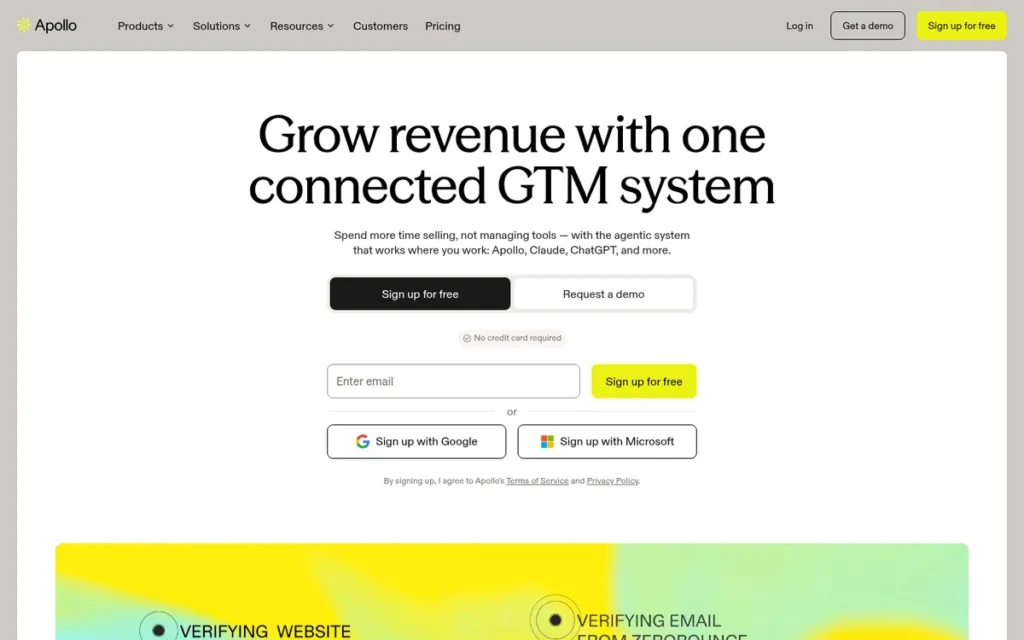
Category: Execution Layer, runs prospecting, sequencing and engagement beside your CRM, or in place of one at an early stage.
At a Glance
- Category: Execution Layer
- Best For: Seed-stage to mid-market outbound teams that want data, AI research and sequencing in one platform
- Price Range: Free tier; $49–$119/user/month billed annually
- Primary Strength: Apollo.io combines a 210M+ contact database, sequencing and AI agents in one platform, with published pricing for every tier.
- Biggest Limitation: Apollo.io’s agents work with seller review rather than full autonomy, and reviewers report weaker data accuracy in smaller and non-US markets.
- One-Line Summary: Apollo.io is the best overall agentic GTM platform for outbound teams that want prospecting data, AI research agents and sequencing in one transparently priced product.
- Last Verified: November 2026
Overview
Apollo.io is an all-in-one B2B prospecting and engagement platform for startup and mid-market outbound teams. It pairs a database of 210M+ contacts and 35M+ companies with agents for AI research, sequence building and lead discovery.
Apollo.io’s agent features come with the Professional and Organization plans. Apollo.io’s agents run with configurable human review rather than end-to-end autonomy.
Key Features
- Apollo.io provides a B2B database of 210M+ contacts and 35M+ companies, and a third-party review cites 240M+ contacts [Source: BestStacked, 2026].
- Apollo.io’s AI Research Agent and AI Sequence Builder research accounts and draft multistep outreach sequences for seller review.
- Apollo.io runs agents for lead discovery and sequence optimization on the Professional and Organization plans.
- Apollo.io includes intent and job-change signals, enrichment, a dialer, call recording and inbound lead routing.
- Apollo.io includes built-in email warmup to protect sender reputation during outbound.
Best For
Apollo.io is best for seed-stage to mid-market B2B outbound teams that want one affordable platform for data, research and sequencing before they add specialist tools.
Pricing (verified November 2026) [Source: Apollo.io pricing page, November 2026]
- Apollo.io Free costs $0 and includes limited credits.
- Apollo.io Basic costs $49/user/month billed annually ($65 billed monthly) and includes 2,500 credits/user/month.
- Apollo.io Professional costs $79/user/month billed annually ($99 billed monthly) and includes 4,000 credits/user/month.
- Apollo.io Organization costs $119/user/month billed annually, with a 3-user minimum and 6,000 credits/user/month.
- Apollo.io pools credits across the team, and PlugRoute could not retrieve overage pricing, so check Apollo.io’s live calculator.
- What else you’ll need: Apollo.io buyers should budget for credit overages at high volume and, as the team grows, a dedicated CRM.
Strengths
- Apollo.io holds a 4.7/5 rating from 9,857 G2 reviews, the largest product-specific review base in this ranking [Source: G2, November 2026].
- Apollo.io reports that teams using its AI Research Agent book 46% more meetings, and that AI messaging produced 35% more bookings over three months (vendor-reported) [Source: Apollo Magazine, 2025].
- Apollo.io reports $145M+ ARR (vendor-reported) [Source: Apollo Magazine, 2025].
- Apollo.io publishes the price of every tier, including Organization, which makes it one of the two most forecastable entries in this ranking alongside Unify [Source: Apollo.io pricing page, November 2026].
Limitations
Apollo.io gives up some autonomy in exchange for control. Its agents run with configurable human review, so teams expecting hands-off outbound should budget seller time for reviewing agent output.
- G2 reviewers report that Apollo.io data is less accurate in smaller and non-US markets and that phone numbers often need cleaning [Source: G2, 2026].
- Trustpilot reviewers say it is hard to reach a human at Apollo.io and hard to delete an account [Source: Trustpilot, 2026].
- Apollo.io’s performance claims are aggregate vendor statistics, and PlugRoute found no named-customer pipeline result it could verify independently.
- PlugRoute found no independent Reddit discussion of Apollo.io; the only result was an affiliate promotional post, which PlugRoute excluded.
Verdict
Apollo.io is the strongest all-round agentic GTM platform in 2026 for outbound teams that need data, AI research and sequencing in one transparently priced product.
Apollo.io’s review volume and published pricing give it the highest weighted score in this ranking (4.00). Treat Apollo.io’s agents as assisted execution, and test data accuracy in your own target regions before you sign an annual contract.
2. Unify: Best for Signal-Based Warm Outbound
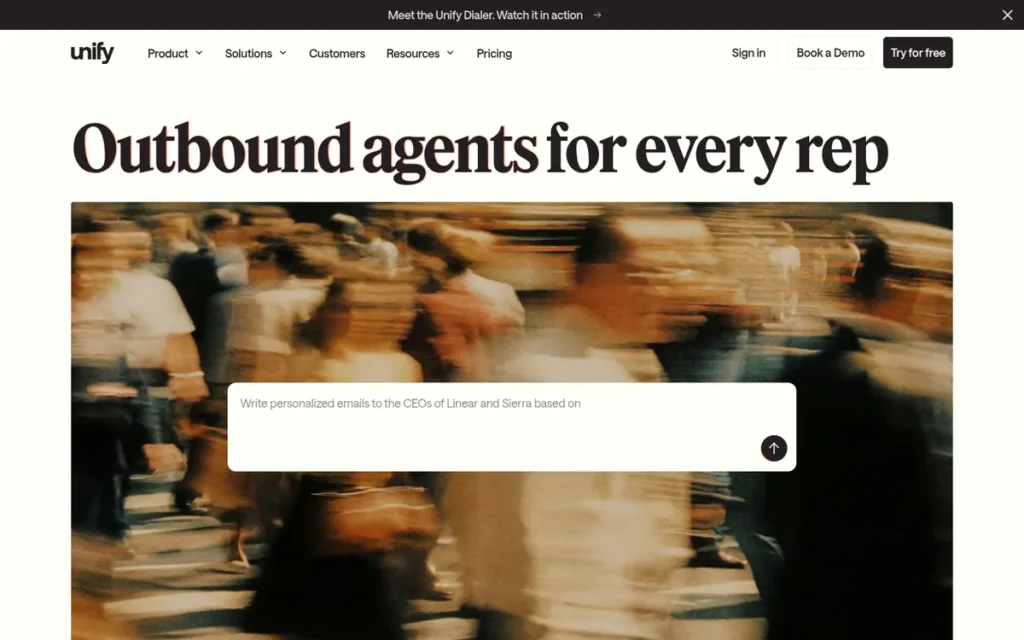
Category: Signal Intelligence, detects buying signals and starts outreach when they fire.
At a Glance
- Category: Signal Intelligence
- Best For: Startup and mid-market teams whose outbound depends on timely buying signals
- Price Range: Free (up to 3 seats); Base $20/seat/month; Pro $60/seat/month; Business custom
- Primary Strength: Unify connects 25+ buying signals to automated outbound Plays with built-in sending infrastructure.
- Biggest Limitation: Unify’s 4.7/5 G2 rating rests on only 42–44 reviews, and third-party reviews say its contact coverage is mostly limited to the US.
- One-Line Summary: Unify is the best agentic GTM platform for signal-based warm outbound, turning 25+ intent signals into automated, human-controlled outreach with built-in mailboxes and warmup.
- Last Verified: November 2026
Overview
Unify is a signal-based warm-outbound platform for startup and mid-market teams that want outreach triggered by buying intent. It detects 25+ intent signals, runs AI research agents inside automated Plays and sends through built-in sequencing.
Unify keeps its agents inside human-defined workflows rather than running them as a fully autonomous AI SDR.
Key Features
- Unify tracks 25+ intent signals, including website visitor de-anonymization, job changes, champion tracking, hiring and third-party intent.
- Unify runs AI research agents inside Plays, its automated workflows, and reports 41M+ Plays executed (vendor-reported) [Source: Unify, 2026].
- Unify runs waterfall enrichment across 40+ sources, including Wiza, Prospeo, Findymail and ContactOut.
- Unify includes built-in sequencing with managed mailboxes and warmup to protect sender reputation.
- Unify syncs with both Salesforce and HubSpot.
Best For
Unify is best for teams that want outbound to start when an account shows intent, with built-in sending infrastructure and no loss of human control.
Pricing (verified November 2026) [Source: Unify pricing page, November 2026]
- Unify Free covers up to 3 seats.
- Unify Base costs $20/seat/month and includes 800 credits per seat.
- Unify Pro costs $60/seat/month, includes 2,400 credits per seat and offers a 14-day trial.
- Unify Business is custom-priced on annual contracts.
- Unify’s earlier sales-led pricing, listed at about $1,460–$1,740/month, predates the 2026 relaunch and appears to have been replaced.
- What else you’ll need: Unify buyers with complex enterprise sequencing needs may still need a dedicated engagement platform.
Strengths
- Unify reports that Perplexity booked 80+ enterprise meetings and generated $1.7M in pipeline in three months (vendor-reported) [Source: Unify, 2026].
- Unify reports that Campfire doubled qualified outbound pipeline in five months (vendor-reported) [Source: Unify, 2026].
- Unify holds a ~4.7/5 G2 rating from 42–44 reviews, and users praise its easy setup and effective automation [Source: G2, November 2026].
- Unify is one of the two ranked platforms whose documentation most prominently features built-in deliverability infrastructure [Source: PlugRoute review of vendor documentation, November 2026].
Limitations
Unify gives up sequencing depth in exchange for signal-to-send speed. Its sequencing is lighter than Outreach’s, so enterprise teams may still want a dedicated engagement platform.
- Third-party reviews of Unify flag outdated contacts, weak phone enrichment and coverage that is mostly limited to the US, though both reviews are competitor-authored [Source: ZoomInfo Pipeline and Salesforge, 2026].
- Unify’s Base plan includes 800 credits per seat per month, so high-volume signal plays may require Pro or custom Business pricing [Source: Unify pricing page, November 2026].
- Unify’s 42–44 G2 reviews are too few to rule out large swings in its rating.
- PlugRoute found no Reddit discussion of Unify, so practitioner sentiment is unverified.
Verdict
Unify is the strongest choice in 2026 for teams that want outbound triggered by buying signals and sent through built-in infrastructure that protects deliverability.
Unify’s agents stay inside human-defined Plays, which suits teams wary of autonomous SDRs. Unify’s newly published per-seat tiers lift it to #2, 0.05 points ahead of Clay. Test contact accuracy outside the US before you buy.
3. Clay: Best for GTM Engineering and Custom Research Workflows
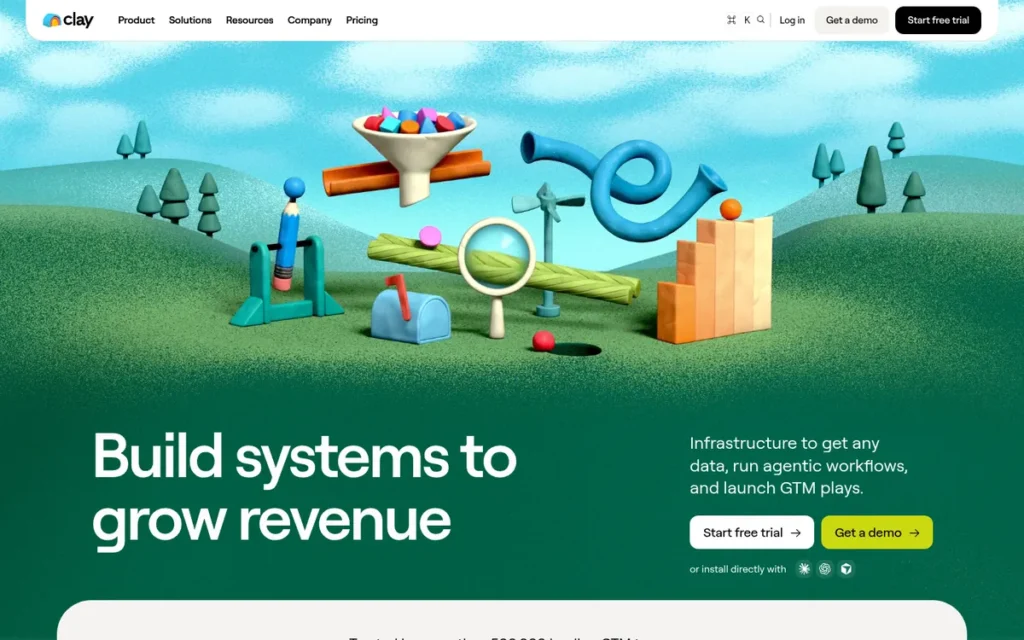
Category: Builder/Orchestrator, a programmable data and workflow layer that you design yourself.
At a Glance
- Category: Builder/Orchestrator
- Best For: RevOps teams and GTM engineers who need custom enrichment, research and signal workflows
- Price Range: Free; Launch from $185/month; Growth from $495/month; Enterprise custom
- Primary Strength: Clay offers the most flexible enrichment and agent-research layer in this ranking, with waterfall enrichment across 150+ providers.
- Biggest Limitation: Clay takes real GTM-engineering effort to maintain, and its separate Data Credit and Action meters make cost harder to forecast.
- One-Line Summary: Clay is the best agentic GTM platform for teams with a GTM engineer who want to build custom enrichment and AI research workflows across 150+ data providers.
- Last Verified: November 2026
Overview
Clay is a programmable GTM data and workflow platform for RevOps teams and GTM engineers who design custom prospecting workflows. It combines waterfall enrichment across 150+ providers, the Claygent AI research agent and signal tracking.
Clay uses a spreadsheet-style interface, and G2 reviewers say advanced use turns into “light engineering” [Source: G2, 2026]. Clay’s global agent can build and edit workflows, but it is still in beta.
Key Features
- Clay runs waterfall enrichment across 150+ data providers, falling back to the next provider when one returns no match.
- Clay’s Claygent agent researches websites and accounts and surfaces web signals that teams use for scoring and outreach.
- Clay’s Sculptor workflow builder lets teams design, test and reuse multistep enrichment and research workflows.
- Clay tracks signals such as job changes and web intent and builds Audiences from them.
- Clay includes a Sequencer and Clay Functions, and it syncs automatically with CRMs on the Growth plan and above.
Best For
Clay is best for teams with a dedicated GTM engineer or a technical RevOps owner who need enrichment and research workflows that off-the-shelf tools can’t provide.
Pricing (verified November 2026) [Source: Clay pricing page and Clay University, November 2026]
- Clay Free includes 100 Data Credits and 500 Actions per month.
- Clay Launch starts at $185/month with 2,500 Data Credits and 15,000 Actions.
- Clay Growth starts at $495/month with 6,000 Data Credits and 40,000 Actions.
- Clay Enterprise is custom-priced with 100K+ Data Credits and 200K+ Actions.
- Clay Data Credits start at $0.05, a fully enriched record uses about 6–20 credits, and top-ups carry a ~30% premium (50% on legacy plans).
- Clay’s FAQ still lists “from $149/mo,” which conflicts with the pricing page, and PlugRoute treats the pricing page as authoritative.
- What else you’ll need: Clay buyers need GTM-engineering time to maintain workflows and may need a separate sequencer at scale.
Strengths
- Clay reports reaching $100M ARR in December 2025, with 3.5x+ year-over-year growth and 17,000+ customers including Anthropic, OpenAI, Stripe and Visa (vendor-reported) [Source: Clay, 2026].
- Clay holds a 4.6/5 G2 rating from 234 reviews [Source: G2, November 2026].
- G2 reviewers consistently praise Clay’s waterfall enrichment for chaining multiple providers to improve match rates [Source: G2, 2026].
- Clay saved one G2 reviewer an estimated 60–70% of research time by automating lead research and scoring [Source: G2, 2026].
Limitations
Clay gives up ease of use in exchange for flexibility. Teams without a GTM engineer may struggle to build and maintain Clay workflows.
- Clay’s separate Data Credit and Action meters make cost per contact less transparent, according to a competitor-authored analysis [Source: Docket, 2026].
- A competitor-started (Bitscale) r/revops thread claimed one Clay customer paid $61K for data plus $19K for actions, rising to a $114,584 quote with signals, and other users disputed those figures [Source: r/revops, 2026].
- G2 reviewers cite credit burn, slow performance on large tables and uneven data accuracy in Clay [Source: G2, 2026].
- Clay’s global agent is still in beta, so campaign launches stay under user control.
Users on r/gtmengineering noted:
“the community built their moat and now it feels like they’re mortgaging that goodwill to chase bigger contracts, which happens but it’s risky when the core product still has so many sharp edges. i’d probably come back if they proved the self-learning stuff actually reduced the manual tuning i spend half my week on, but not if the pricing stays where it is” Posted by u/Round-Station-284
Takeaway: Hands-on Clay practitioners say rising prices and hours of weekly manual tuning are pushing smaller teams away, even when they value what the platform can do.
Verdict
Clay is the most flexible agentic GTM platform in 2026 for teams with GTM-engineering capacity, but it suits builders and is a poor fit for teams that need a turnkey tool.
Clay’s enrichment waterfall, which spans 150+ providers, is the deepest in this ranking. Budget for both meters, for top-ups, and for the staff time needed to maintain workflows.
4. Salesforce Agentforce: Best for Salesforce-Centered Enterprises
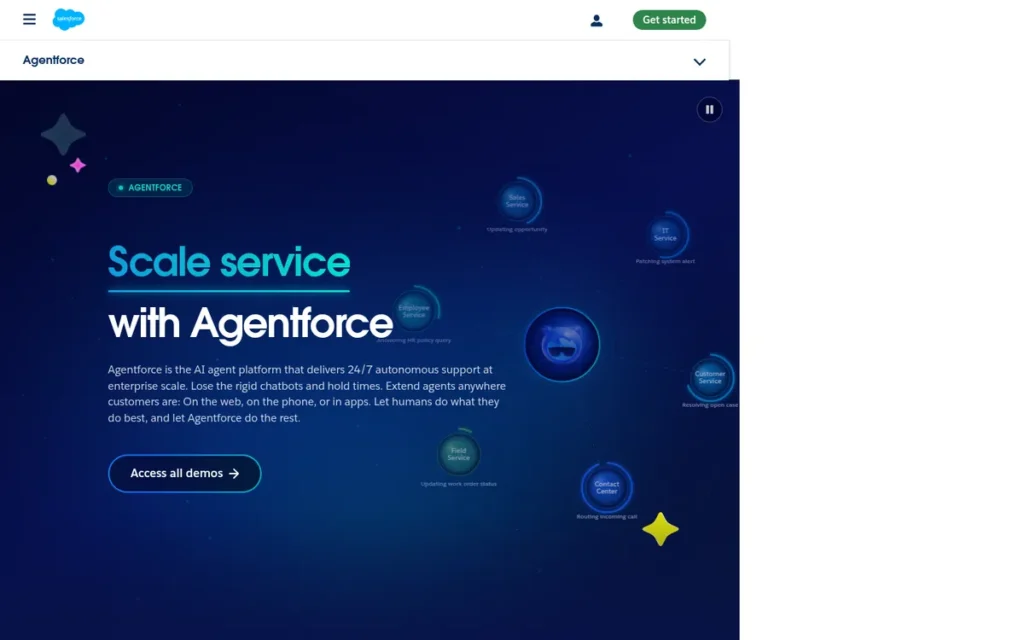
Category: CRM-Native Agent Layer, agents built into the CRM you already run.
At a Glance
- Category: CRM-Native Agent Layer
- Best For: Enterprises standardized on Salesforce that need governed agents across revenue workflows
- Price Range: $2/conversation; ~$0.10/action; $125/user/month add-on; Agentforce 1 from $550/user/month
- Primary Strength: Salesforce Agentforce offers the deepest governed autonomy in this ranking, with approval steps, permission-aware actions and audit logs.
- Biggest Limitation: Salesforce Agentforce’s four pricing models, separately billed Data 360 consumption and partner implementation costs make its total cost the hardest in this ranking to forecast.
- One-Line Summary: Salesforce Agentforce is the best agentic GTM platform for Salesforce-standardized enterprises that need governed, CRM-native agents, but its total cost is the hardest in this ranking to forecast.
- Last Verified: November 2026
Overview
Salesforce Agentforce is an autonomous-agent platform built into Salesforce Customer 360 for enterprises whose revenue data and permissions already live in Salesforce. It runs on the Atlas Reasoning Engine, includes prebuilt agents such as the SDR Agent, and grounds agents in Data Cloud.
Salesforce Agentforce adds less value when the job is simply prospecting, enrichment or sequencing.
Key Features
- Salesforce Agentforce’s Atlas Reasoning Engine breaks tasks into steps and picks the tools and actions for each one.
- Salesforce Agentforce’s SDR Agent works inbound leads around the clock, answering questions, handling objections, booking meetings and updating CRM records.
- Salesforce Agentforce’s Agent Builder offers low-code setup of custom agents.
- Salesforce Agentforce relies on Data Cloud/Data 360 to vectorize unstructured documents and ground agents in them [Source: r/salesforce, 2026].
- Salesforce Agentforce enforces human escalation, approval steps, record-level access and audit logs through the Einstein Trust Layer and Flow controls.
Best For
Salesforce Agentforce is best for enterprises whose revenue data, permissions and processes already live in Salesforce and that need governed agents rather than a separate execution tool.
Pricing (verified November 2026) [Source: Salesforce Agentforce pricing page, November 2026]
- Salesforce Agentforce costs $2 per conversation on the per-conversation model.
- Salesforce Agentforce Flex Credits cost $500 per 100,000 credits, and one action uses 20 credits, or about $0.10 per action.
- Salesforce Agentforce is available as a $125/user/month add-on.
- Salesforce Agentforce 1/Max Edition starts at $550/user/month and includes 2.75M Flex Credits per org per year.
- Salesforce gives qualifying Enterprise Edition customers 100,000 Flex Credits through Salesforce Foundations.
- What else you’ll need: Salesforce Agentforce buyers should budget separately for Data 360 consumption and an implementation partner.
Strengths
- Salesforce Agentforce reached 18,500+ deals, 9,500+ of them paid, and about $540M ARR in the quarter ended October 2025 (vendor-reported) [Source: Salesforce Q3 FY2026 earnings release, 2025].
- Salesforce Agentforce early adopters increased the number of agents created and deployed by 119% from January to June 2025, and sales was one of the top three use areas [Source: Salesforce Agentic Enterprise Index, 2025].
- Salesforce Agentforce is listed as a Leader in the IDC MarketScape for Worldwide Agentic AI Platforms (vendor-reported) [Source: Salesforce, 2026].
- Salesforce Agentforce users say it “works amazingly well with the context already in Salesforce,” according to a competitor-authored review analysis [Source: Oliv.ai, 2026].
Limitations
Salesforce Agentforce gives up cost predictability in exchange for depth. Buyers must choose among four pricing models and also budget for Data 360 consumption and implementation partners.
- Salesforce Agentforce users cite a steep learning curve, agent behavior that is hard to debug, and weaker accuracy on unstructured data [Source: Oliv.ai, 2026].
- An r/salesforce practitioner reported a Salesforce Agentforce proof of concept that was built in about a week but failed when the workflow needed a phone call, plus a proposal of about $600K/year for five use cases [Source: r/salesforce, 2026].
- Salesforce Agentforce’s 4.4/5 G2 rating from 25,840 reviews covers the broader Sales Cloud listing, not the agents alone [Source: G2, November 2026].
- PlugRoute found no verified named-customer pipeline results for Salesforce Agentforce.
Users on r/salesforce noted:
“There is a lot of cool potential, but the learning curve is going to be very steep for a lot of admins and developers. If you struggle doing complex things with flow, you will have an absolutely terrible time with agents.” Posted by u/SeriouslyImKidding
Takeaway: Salesforce admins see real potential in Salesforce Agentforce, but building custom agents takes more skill than Flow does, so teams without strong admin talent should expect a slow, difficult rollout.
Verdict
Salesforce Agentforce scores highest in this ranking on agent capability and governance controls (C1 = 5) for Salesforce-centered enterprises. It is also the platform whose total cost is hardest to predict.
Salesforce Agentforce avoids adding a second CRM, and it ranks above Outreach only because of the C1 tiebreak. Model Data 360 consumption, partner fees and per-action volume before you sign, and pilot one bounded use case first.
5. Outreach: Best Execution Layer for Salesforce and Dynamics Enterprises
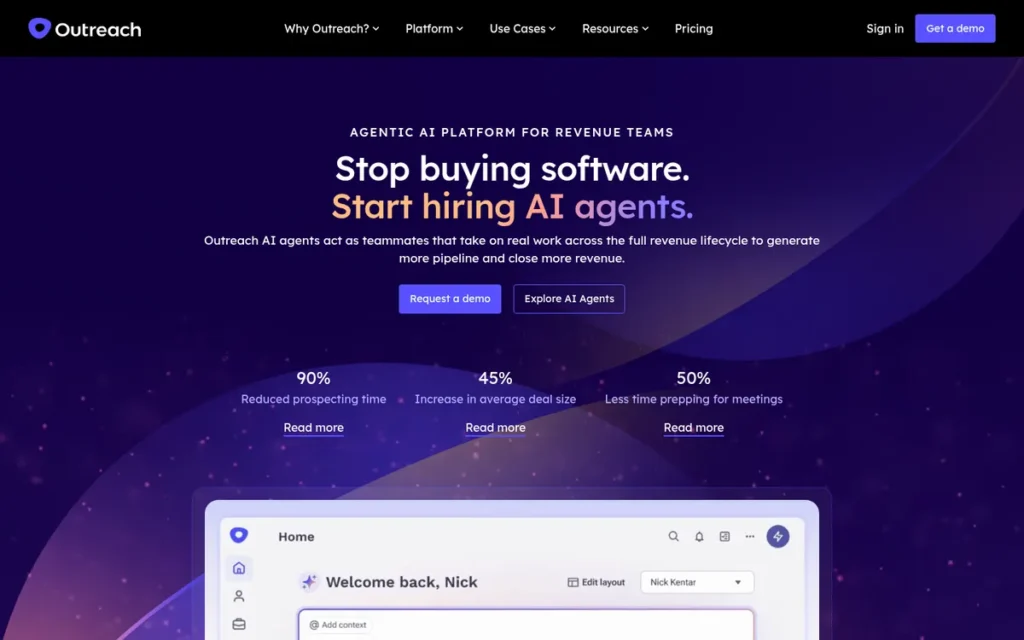
Category: Execution Layer, runs prospecting, sequencing and engagement beside your CRM.
At a Glance
- Category: Execution Layer
- Best For: Enterprise sales organizations on Salesforce or Microsoft Dynamics 365
- Price Range: Quote-only; third-party estimates ~$100–$160+/user/month on annual contracts
- Primary Strength: Outreach adds research, deal and revenue agents to enterprise sequencing, syncs two-way with Salesforce and Dynamics 365, and holds a 4.3/5 G2 rating from 3,676 reviews.
- Biggest Limitation: Outreach is quote-only, with reported onboarding costs in the thousands, and reviewers describe its interface as confusing.
- One-Line Summary: Outreach is the best agentic execution layer for Salesforce or Dynamics enterprises that want governed agents beside their CRM rather than a second CRM.
- Last Verified: November 2026
Overview
Outreach is an enterprise revenue-execution platform for sales organizations on Salesforce or Microsoft Dynamics 365. It adds Research, Deal, Revenue and Personalization agents to multichannel sequencing, Kaia conversation intelligence and AI forecasting.
Outreach publishes no prices, so every Outreach buyer needs a quote.
Key Features
- Outreach’s Research Agent briefs sellers using emails, Kaia call recordings and meeting data.
- Outreach’s Deal Agent recommends opportunity-field updates and flags deal risk.
- Outreach runs multichannel sequences across email, calls, LinkedIn and SMS.
- Outreach includes AI forecasting with AI Projection and scenario planning.
- Outreach syncs two-way with Salesforce and Dynamics 365 and offers an MCP client/server so external agents can trigger its workflows.
Best For
Outreach is best for Salesforce- or Dynamics-centered enterprise sales teams that want agents across sequencing, conversations and forecasting without replacing their system of record.
Pricing (verified November 2026; third-party estimates) [Source: StackSheriff and BestStacked, 2026]
- Outreach Amplify Core is estimated at ~$100–$120/user/month with 25K AI credits.
- Outreach Amplify Plus is estimated at ~$130–$160/user/month with 50K AI credits.
- Outreach Amplify Pro is estimated at $160+/user/month with 100K AI credits.
- Outreach onboarding reportedly costs thousands of dollars, and PlugRoute could not verify minimum seat counts.
- What else you’ll need: Outreach buyers need an existing Salesforce or Dynamics 365 CRM, plus admin and enablement time.
Strengths
- Outreach holds a 4.3/5 G2 rating from 3,676 reviews [Source: G2, November 2026].
- Outreach says it was named a Leader in the 2026 Gartner Magic Quadrant for Revenue Action Orchestration for the second consecutive year (vendor-reported) [Source: Outreach, 2026].
- Outreach says it was named a Leader in the Forrester Wave for B2B Revenue Orchestration Platforms, Q3 2026, with top marks on 15 of 22 criteria (vendor-reported) [Source: Outreach, 2026].
- Outreach reports that SolarWinds’ win-back agent achieved a 45% reply rate, reactivated 100+ accounts and reopened $200K in pipeline (vendor-reported) [Source: Outreach, 2026].
Limitations
Outreach gives up accessibility in exchange for enterprise depth. Its quote-only pricing and onboarding costs, reportedly in the thousands of dollars, earn Outreach the lowest pricing-transparency score in this ranking.
- Review roundups describe Outreach’s UI as “confusing or chaotic” and say bulk edits are tedious [Source: Vantaige, 2026].
- Reviewers flag narrow cancellation windows on Outreach annual contracts and worry about renewal pricing [Source: Vantaige, 2026].
- Review roundups describe Outreach as powerful but hard to master, so expect admin and enablement time before reps use its agents consistently [Source: Vantaige, 2026].
- PlugRoute found no Reddit discussion of Outreach, so practitioner sentiment is unverified.
Verdict
Outreach is the strongest agentic execution layer in 2026 for Salesforce or Dynamics enterprises that want governed agents across sequencing, conversations and forecasting without a second CRM.
Outreach’s Leader placements in the Gartner Magic Quadrant (2026) and Forrester Wave (Q3 2026) are vendor-announced, while its 4.3/5 G2 rating from 3,676 reviews can be checked independently. Negotiate cancellation and renewal terms up front, and ask for references with agent-driven pipeline results.
6. HubSpot Breeze: Best for HubSpot-Native Teams
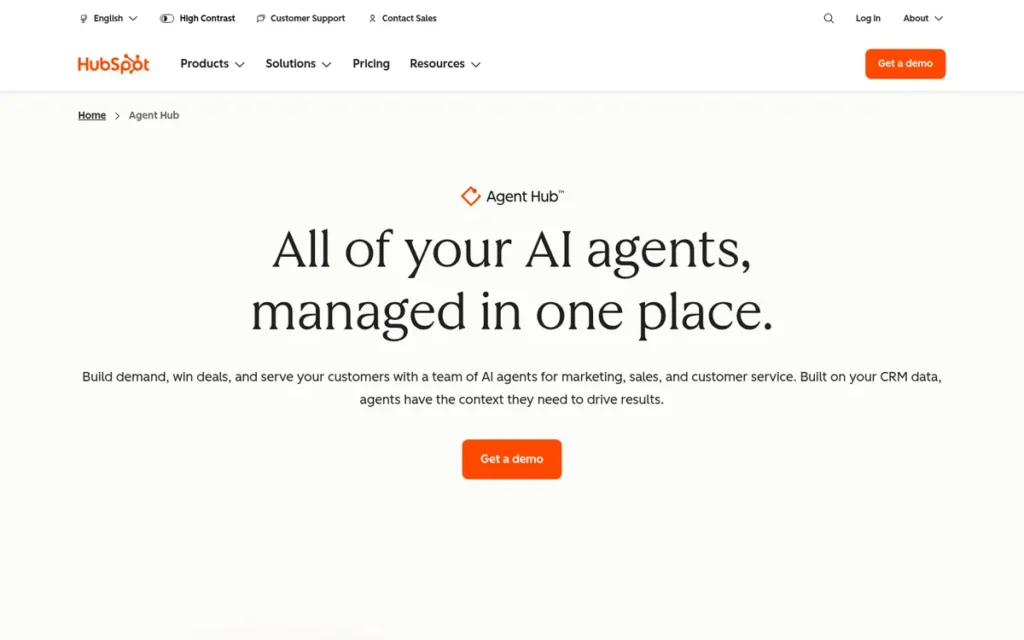
Category: CRM-Native Agent Layer, agents built into the CRM you already run.
At a Glance
- Category: CRM-Native Agent Layer
- Best For: Small and mid-market teams already running marketing, sales and service on HubSpot
- Price Range: Credits included by tier; ~$1 per recommended lead; ~$0.50 per resolved conversation; seat prices not verified
- Primary Strength: HubSpot Breeze lets HubSpot customers deploy agents on existing CRM data with little integration work and pay per outcome.
- Biggest Limitation: HubSpot Breeze’s only independent Prospecting Agent test found heavy credit use for few leads.
- One-Line Summary: HubSpot Breeze is the lowest-friction agentic GTM option for teams already on HubSpot, but its Prospecting Agent is less proven than its service-side agents.
- Last Verified: November 2026
Overview
HubSpot Breeze is the AI-agent layer inside HubSpot Smart CRM for small and mid-market teams that already run marketing, sales and service on HubSpot. It offers Prospecting, Customer and Data Agents, Breeze Intelligence enrichment and an Agent Builder.
HubSpot Breeze needs integrations before it can use data stored in Salesforce or Snowflake.
Key Features
- HubSpot Breeze’s Prospecting Agent researches accounts, finds contacts and drafts personalized outreach.
- HubSpot Breeze’s Customer Agent handles chat, qualification, support resolution and meeting booking.
- HubSpot Breeze’s Data Agent answers questions using CRM records, calls and documents.
- HubSpot Breeze Intelligence provides enrichment and buyer-intent data inside the CRM.
- HubSpot Breeze’s Agent Builder (formerly Breeze Studio) is included in Starter, Professional and Enterprise.
Best For
HubSpot Breeze is best for HubSpot-standardized teams, especially inbound- and service-heavy ones, that want agents on their existing CRM data without buying a second platform.
Pricing (verified November 2026) [Source: HubSpot Product and Services Catalog, 2026]
- HubSpot Breeze uses the HubSpot Credits included in each plan: 500 on Sales Hub Starter, 3,000 on Professional and 5,000 on Enterprise.
- HubSpot Breeze extra credits cost $0.01 each, and credits don’t add up across Hubs; a customer gets the single highest allotment.
- HubSpot Breeze’s Customer Agent costs 50 credits (~$0.50) per resolved conversation.
- HubSpot Breeze’s Prospecting Agent costs 100 credits (~$1) per recommended lead, and reviewers report that agent features are limited to Professional and Enterprise tiers [Source: Default.com, 2026].
- PlugRoute could not retrieve Sales Hub seat prices or Breeze Intelligence pricing, so verify both on HubSpot’s live pricing page.
- What else you’ll need: HubSpot Breeze buyers need a well-maintained knowledge base and content library for the Customer Agent to perform well [Source: r/CRM, 2025].
Strengths
- HubSpot Breeze’s Customer Agent handled 37% of one customer’s 1,800 chats without a human (vendor-reported) [Source: HubSpot, 2026].
- HubSpot Breeze helped another customer achieve 16% faster response times and 7% higher CSAT despite a 75% rise in tickets (vendor-reported) [Source: HubSpot, 2026].
- HubSpot Breeze runs on HubSpot Sales Hub, which is rated 4.5/5 from 505 Capterra reviews, though Breeze has no standalone rating [Source: Capterra, November 2026].
- HubSpot Breeze bills agents per outcome, a pricing model that r/hubspot practitioners had asked for [Source: r/hubspot, 2024].
Limitations
HubSpot Breeze gives up proven prospecting performance in exchange for convenience. In an independent test, HubSpot Breeze’s Prospecting Agent recommended 22 contacts in one day while using 2,200 of a 3,000-credit monthly allowance [Source: Engagent, 2026].
- The Engagent reviewer would not yet recommend HubSpot Breeze’s Prospecting Agent as a first-choice prospecting tool [Source: Engagent, 2026].
- HubSpot Breeze’s pooled credits are hard to forecast, and reviewers note that AI features may move from “included” to metered [Source: Default.com, 2026].
- r/CRM users report using HubSpot Breeze mainly for summaries, and most of its quantified results are on the service side [Source: r/CRM, 2025].
- HubSpot Breeze offers less customization than Salesforce Agentforce, according to reviewers [Source: Default.com, 2026].
This aligns with community sentiment on r/hubspot:
“That is also why a lot of teams end up disappointed with enrichment tools like Breeze Intelligence. They expect better data to solve workflow problems. Better data helps,. It does not replace having a clean Customer Relationship Management architecture and disciplined processes.” Posted by u/RageKni8
Takeaway: HubSpot Breeze Intelligence disappoints teams that expect enrichment to fix broken CRM processes, because Breeze only performs as well as the HubSpot data and governance underneath it.
Verdict
HubSpot Breeze is the lowest-friction agentic GTM option in 2026 for teams already on HubSpot, with stronger evidence for its inbound and service agents than for prospecting.
HubSpot Breeze’s per-outcome billing (~$1 per recommended lead, ~$0.50 per resolved conversation) is the pricing model in this ranking most directly tied to completed tasks. Confirm tier eligibility and monitor credit burn before you rely on the Prospecting Agent for outbound.
7. Common Room: Best for PLG, Developer and Community-Led GTM
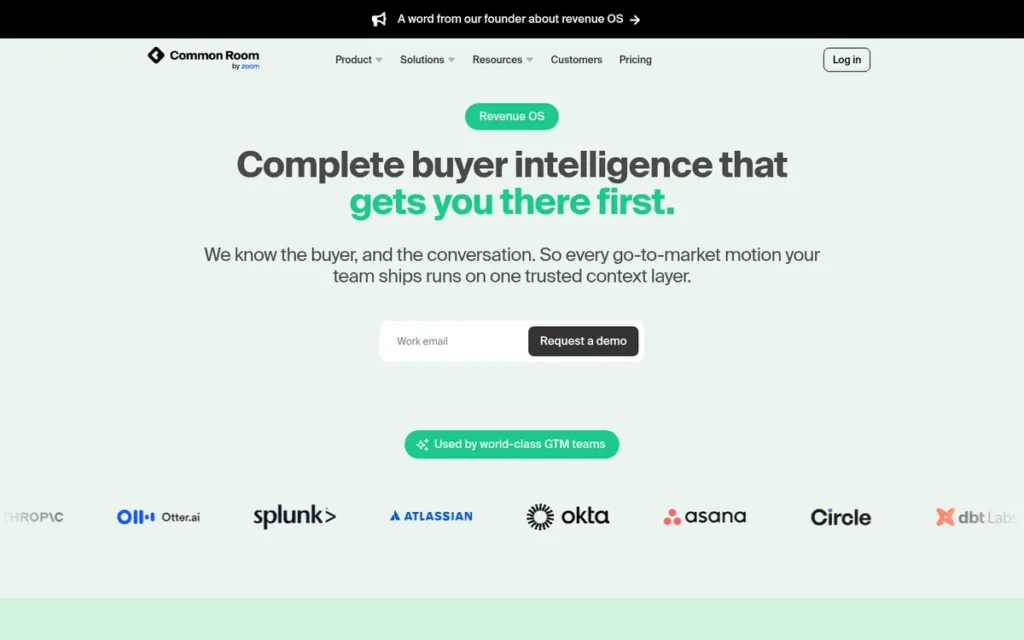
Category: Signal Intelligence, detects buying signals and starts outreach when they fire.
At a Glance
- Category: Signal Intelligence
- Best For: Developer-tool, open-source, PLG and community-led B2B companies
- Price Range: Essential $2,500/month billed annually (~$30K/year); Team and Enterprise custom
- Primary Strength: Common Room resolves product, community, GitHub and web signals to specific people and accounts before acting on them.
- Biggest Limitation: Common Room’s sequencing is shallow, so most teams still need a separate sender, and its entry price rules out most early-stage startups.
- One-Line Summary: Common Room is the best agentic GTM platform for PLG, developer and community-led companies that need to turn product and community signals into person-level pipeline.
- Last Verified: November 2026
Overview
Common Room is a signal-based buyer-intelligence platform for developer, PLG and community-led B2B companies. Its Person360 feature resolves web, product-usage, community, GitHub and job-change signals to specific people and accounts.
Common Room acts on those signals with RoomieAI agents, and it usually works alongside a separate sequencer rather than replacing one.
Key Features
- Common Room captures signals from web visits, product usage, Slack and Discord communities, LinkedIn, Reddit, GitHub, job changes and CRM data.
- Common Room’s Person360 resolves identities across a 400M+ contact directory.
- Common Room’s RoomieAI agents research, prioritize and activate accounts based on combined signals.
- Common Room includes Prospector for contact discovery, plus built-in enrichment.
- Common Room offers 50+ integrations, including Salesforce, HubSpot, Slack and Outreach.
Best For
Common Room is best for PLG, developer-tool and community-heavy companies whose strongest buying signals come from product usage, GitHub and community activity rather than static lists.
Pricing (verified November 2026) [Source: Common Room pricing page, November 2026]
- Common Room Essential costs $2,500/month billed annually (~$30K/year) and includes 5 seats, 100K contacts, 5,000 RoomieAI credits and 2,500 Prospector credits.
- Common Room Team is custom-priced with 15 seats and 250K contacts.
- Common Room Enterprise is custom-priced with 30 seats, 750K contacts and a dedicated CSM.
- An earlier Common Room Starter plan, listed on G2 at $12,000/year with 2 seats and 35K contacts, appears to have been retired in 2026 [Source: G2, November 2026].
- What else you’ll need: Common Room buyers usually need a separate sequencer such as Outreach, Salesloft or HubSpot to send outreach.
Strengths
- Common Room reports that one customer saw 74% more pipeline in a single quarter from plays built on product-usage, web and GitHub signals (vendor-reported) [Source: Common Room, 2026].
- Common Room reports that Notion saw about 30% more meetings booked per rep per month (vendor-reported) [Source: Common Room, 2026].
- Common Room holds a 4.5/5 G2 rating from 146 reviews [Source: G2, November 2026].
- G2 reviewers praise Common Room for giving “one view across OSS activity, Reddit, Slack, LinkedIn” [Source: G2, 2026].
Limitations
Common Room gives up execution in exchange for signal depth. Because Common Room’s sequencing is shallow, most teams still need a separate sender, which adds cost on top of a ~$30K/year entry price [Source: AI Ignitions and Salesforge, 2026].
- G2 reviewers cite a learning curve, slow responses, a clunky interface and tricky CRM setup in Common Room [Source: G2, 2026].
- Third-party reviews flag signal noise in Common Room, so expect to spend time tuning filters [Source: AI Ignitions, 2026].
- Common Room’s entry price rules out most early-stage startups.
- PlugRoute found no Reddit discussion of Common Room and could not verify its founding and funding details.
Verdict
Common Room is the strongest fit in 2026 for PLG, developer and community-led companies whose buyers show intent through product usage, GitHub and community activity.
Common Room is not a complete outbound system on its own. Budget for a separate sequencer and expect to spend time filtering out signal noise.
How Much Does an Agentic GTM Platform Cost at Real Volume?
At real volume, credit meters drive the cost of an agentic GTM platform more than list prices do. At 1,000 leads a month, HubSpot Breeze’s Prospecting Agent alone uses about $1,000 in credits, while five Apollo.io Professional seats cost $395. The figures below are illustrative, calculated from published rates [Source: vendor pricing pages, November 2026].
- HubSpot Breeze’s Prospecting Agent uses 100 credits per recommended lead. At $0.01 per credit, 1,000 leads need 100,000 credits, or about $1,000, and Sales Hub Professional’s 3,000 included credits cover about 30 leads.
- Clay uses about 6–20 Data Credits per fully enriched record, so 1,000 records need 6,000–20,000 credits. Clay Growth’s 6,000 monthly credits cover roughly 300–1,000 records before top-ups.
- Salesforce Agentforce costs about $0.10 per action, or roughly $100 per 1,000 agent actions, before Data 360 consumption and partner fees.
- Apollo.io Professional for a five-person team costs $395/month billed annually and includes 20,000 pooled credits.
- Unify Pro for five seats costs $300/month and includes 12,000 credits, but PlugRoute could not verify how many credits one enriched lead uses.
- Common Room Essential costs a fixed $2,500/month billed annually, and Outreach is quote-only, so PlugRoute cannot model either platform per lead.
Compare quotes on cost per qualified opportunity, not cost per seat.
Why Didn’t We Rank Fully Autonomous AI SDRs?
PlugRoute did not rank fully autonomous AI SDRs such as 11x and Artisan because their verifiable G2 and Capterra review volume was limited in this research cycle. Published reporting also raises unresolved concerns about customer retention and output quality, which buyers should weigh before letting agents run outbound alone.
- TechCrunch reported in March 2025 that former employees said 11x lost 70–80% of its customers, and 11x disputed this, citing 79% retention [Source: ai-sdr.cc summary of TechCrunch, 2025].
- ZoomInfo reportedly said 11x performed “significantly worse” than its human SDRs [Source: ai-sdr.cc, 2025].
- Artisan’s CEO admitted that early versions of the Artisan product had “extremely bad hallucinations” [Source: ai-sdr.cc, 2025].
- Gartner predicts that by 2030, 75% of B2B buyers will prefer sales experiences that prioritize human interaction over AI [Source: Gartner, 2025].
In 2026, the agentic GTM platforms with the strongest evidence keep a human approval step in outbound. None of the seven ranked platforms is best used as an unsupervised AI SDR.
How Do You Prove ROI From an Agentic GTM Platform?
You prove ROI from an agentic GTM platform by measuring qualified meetings and pipeline created against a baseline, not by counting agent actions. Run a 2–4 week pilot with one use case, one segment and one owner, and keep human approval on outbound until the results hold up.
Track these metrics during the pilot:
- Qualified meetings booked: Qualified meetings show whether agent output turns into real buyer conversations.
- Pipeline created: Pipeline created ties agent work to revenue rather than activity.
- Data accuracy: Data accuracy shows whether enrichment and contact data hold up in your target regions.
- Unsubscribe and complaint rates: Unsubscribe and complaint rates give early warning of deliverability damage.
- Cost per qualified opportunity: Cost per qualified opportunity combines credits, seats and staff time into a single figure you can defend.
An agent that sends 10,000 emails and books zero qualified meetings has produced activity, not pipeline.
Write down go/no-go thresholds before the pilot starts: a target number of qualified meetings, a maximum cost per qualified opportunity and a ceiling on complaint rate. Do not expand the rollout if the pilot misses them.
What Red Flags Should I Watch For When Evaluating Agentic GTM Platforms?
The biggest red flags in agentic GTM platforms are agent washing, credit meters you can’t forecast, and hidden data and implementation dependencies. Any of them can turn a strong demo into a weak production deployment, so check for all six red flags below before you sign a contract.
Red Flag #1: Agent Washing
Agent washing is when a vendor labels rule-based sequences or one-shot text generation as “agentic.” Gartner estimates that only about 130 of the thousands of vendors marketing agentic AI offer genuinely agentic solutions. Gartner also predicts that more than 40% of agentic AI projects will be canceled by the end of 2027 [Source: Gartner, 2025].
Apply PlugRoute’s three-question test to every vendor: does the agent read context, choose its own actions, and pursue a goal across steps?
Red Flag #2: Unforecastable Credit Meters and Tier-Gated Agents
Unforecastable credit meters take three forms: dual meters (Clay), pooled credits (HubSpot Breeze) and several pricing models at once (Salesforce Agentforce). Tier gating makes it worse, because the agent in the demo may need a pricier plan. HubSpot Breeze agents need Professional or Enterprise [Source: Default.com, 2026], and Apollo.io agents need Professional or Organization.
Red Flag #3: Hidden Data and Implementation Dependencies
Hidden dependencies are costs and prerequisites that a demo never shows. One r/salesforce practitioner’s proof of concept worked within a week but failed when the workflow needed a phone call. The same practitioner described a proposal of about $600K/year [Source: r/salesforce, 2026].
- Salesforce Agentforce relies on Data Cloud/Data 360 consumption, which is billed separately.
- HubSpot Breeze’s Customer Agent quality depends on the quality of the knowledge base and content.
- CRM-native agents depend on clean CRM records.
- Enterprise rollouts often require implementation-partner fees.
As one user on r/hubspot described:
“I think this gets overlooked a lot. AI isn’t really the first step if the underlying CRM data is messy. We spent more time fixing data quality than experimenting with AI features, and it paid off.” Posted by u/Glass_Honeydew4280
Takeaway: Clean CRM data is the hidden prerequisite for any agentic GTM platform, and teams that fix data quality first get more value than teams that start with AI features.
Red Flag #4: Outbound Volume Without Deliverability Controls
Outbound volume without deliverability controls puts your sender reputation at risk under the Gmail and Yahoo bulk-sender rules. A dataset of 7.5M cold emails showed a 0.45% human reply rate, so more volume rarely means more pipeline [Source: MarketSplash, accessed November 2026].
- Bulk senders must authenticate their email with SPF, DKIM and DMARC.
- Bulk senders must include one-click unsubscribe in marketing messages.
- Bulk senders must keep spam-complaint rates below Google’s published threshold.
Red Flag #5: ROI Reported as Activity Counts
ROI reported as activity counts, such as emails sent or actions run, does not prove pipeline. Almost every quantified result in this research cycle was vendor-reported; the Engagent test of HubSpot Breeze is a rare independent exception. Ask every vendor for named-customer pipeline outcomes.
Red Flag #6: “Independent” Comparisons Written by Competitors
Competitor-authored comparisons often pass as neutral reviews. Several sources in this research cycle came from direct rivals of the products they assessed. Check who published a review before you weigh its criticism or its praise.
- Oliv.ai reviewed Salesforce Agentforce while competing with it.
- Docket reviewed Clay alternatives while competing with Clay.
- Salesforge and ZoomInfo Pipeline reviewed Unify and Common Room while competing with them.
- Bitscale, a competing vendor, started the r/revops thread about Clay pricing.
What Questions Should I Ask Before Choosing an Agentic GTM Platform?
Before choosing an agentic GTM platform, ask vendors seven questions that expose what the agent can do on its own and what it will really cost. A vague answer to any of them usually points to cost or risk you haven’t seen yet. Each question below describes a strong answer and a weak one.
Question #1: Which actions can the agent take without human approval?
A strong answer names specific approval gates, permission-aware actions and audit logs, as Salesforce Agentforce’s documentation does. A weak answer is “it’s fully autonomous,” with no guardrails described and no way to review what the agent did after the fact.
Question #2: What will this cost at my monthly volume, including credits, tiers, data and implementation?
A strong answer is a written cost model for your expected volume, including overage rates and any separate data or partner fees. A weak answer is a per-seat price, with credits, data and implementation described as “depends on usage.”
Question #3: Does this sit beside my CRM or duplicate it?
A strong answer explains two-way sync or MCP access with your system of record, as Outreach does with Salesforce and Dynamics 365. A weak answer requires you to move contacts, deals or activity history into a second database you’ll have to keep reconciled.
Question #4: What else must I buy for a complete workflow?
A strong answer lists any required sequencer, data platform or mailbox infrastructure up front; Common Room, for example, usually needs a separate sender. A weak answer only reveals those add-ons after the contract is signed and the first workflow stalls.
Question #5: Who owns sender reputation?
A strong answer describes warmup, managed mailboxes and spam-rate monitoring. Unify and Apollo.io are the two ranked platforms whose documentation most prominently features built-in deliverability infrastructure. A weak answer leaves domain health entirely to your team.
Question #6: Can you show named-customer pipeline results, not activity metrics?
A strong answer includes named references with qualified meetings or pipeline created, ideally with before-and-after figures. A weak answer offers aggregate statistics, such as emails sent or hours saved, that you can’t trace to a specific customer.
Question #7: What are the cancellation and renewal terms?
A strong answer puts the cancellation window and any renewal-price caps in writing before you sign. A weak answer defers those terms to renewal time. Reviewers flag narrow cancellation windows at Outreach [Source: Vantaige, 2026].
How Did We Rank These Agentic GTM Platforms?
PlugRoute ranked these platforms with a weighted six-criterion matrix, scoring each criterion from 1 (weak or unverified evidence) to 5 (strong, dated, independently sourced evidence). Every score is tied to a labeled source. The weights favor genuine agent capability, CRM fit and independent review evidence.
Ranking criteria:
- C1, Multistep Agent Capability and Autonomy Controls (25%): C1 separates real agents from agent washing and checks for approval gates and audit logs.
- C2, CRM and Stack Fit Without Overlap (20%): C2 checks native sync with Salesforce, HubSpot or Dynamics and what else a buyer must purchase.
- C3, Independent Review Ratings and Volume (20%): C3 discounts ratings that cover a broader product, are only vendor-cited, or can’t be verified.
- C4, Pricing Transparency and Cost Predictability (15%): C4 penalizes quote-only pricing, multiple meters, tier gating and custom-only tiers.
- C5, Documented Results and Market Validation (10%): C5 treats vendor-reported figures as directional only.
- C6, Implementation Effort and Time to Value (10%): C6 weighs learning curves, prerequisites and proof-of-concept-to-production gaps.
| Company | C1 | C2 | C3 | C4 | C5 | C6 | Weighted Total |
|---|---|---|---|---|---|---|---|
| Apollo.io | 3 | 4 | 5 | 5 | 3 | 4 | 4.00 |
| Unify | 4 | 4 | 3 | 4 | 3 | 4 | 3.70 |
| Clay | 4 | 4 | 4 | 3 | 4 | 2 | 3.65 |
| Salesforce Agentforce | 5 | 3 | 3 | 2 | 4 | 2 | 3.35 |
| Outreach | 4 | 4 | 4 | 1 | 4 | 2 | 3.35 |
| HubSpot Breeze | 3 | 3 | 3 | 3 | 2 | 4 | 3.00 |
| Common Room | 3 | 3 | 3 | 3 | 3 | 2 | 2.90 |
How close are the rankings?
- Unify (#2, 3.70) leads Clay (#3, 3.65) by 0.05 points.
- Salesforce Agentforce and Outreach tie at 3.35. Ties are broken by the highest-weighted criterion (C1, 25%), which places Salesforce Agentforce (C1 = 5) fourth and Outreach (C1 = 4) fifth.
- HubSpot Breeze (#6, 3.00) leads Common Room (#7, 2.90) by 0.10 points.
Score changes on November 5, 2026:
- Outreach’s C3 rose from 2 to 4 after PlugRoute verified a 4.3/5 G2 rating from 3,676 reviews.
- Unify’s C4 rose from 2 to 4 after Unify published per-seat pricing; Unify scores one point below Apollo.io because Unify’s Business tier is custom-priced.
Source labels used throughout:
- Independent sources include G2, Capterra, Trustpilot and independent tests such as Engagent.
- Vendor-reported sources include customer results, ARR figures and analyst placements that the vendor itself published.
- Competitor-authored sources include analyses from Oliv.ai, Docket, Salesforge and ZoomInfo Pipeline, plus the Bitscale-started r/revops thread.
- Practitioner sources include Reddit discussions in r/salesforce, r/hubspot, r/CRM and r/revops.
Considered but not ranked: PlugRoute considered 14 more vendors but found too little verifiable review evidence in this research cycle (November 2026). PlugRoute will re-evaluate them next quarter.
- PlugRoute did not rank the autonomous AI SDRs 11x, Artisan and Salesforge.
- PlugRoute did not rank Regie.ai, Amplemarket and Landbase.
- PlugRoute did not rank Relevance AI, Warmly, ZoomInfo, Qualified, Gong, 6sense, Gumloop or Microsoft Dynamics 365’s native AI.
PlugRoute has no affiliate relationships with any company listed. Rankings are determined entirely by research data and objective evaluation criteria.
What Do Buyers Most Often Ask About Agentic GTM Platforms?
Buyers most often ask which agentic GTM platform suits startups and outbound teams and how agentic platforms differ from traditional sales automation. They also ask how PlugRoute sets its rankings. Each answer below is short enough to stand on its own, and each names the relevant platforms in full.
What is the best agentic GTM platform for B2B startups and outbound prospecting in 2026?
Apollo.io is the best agentic GTM platform for most B2B startups and outbound prospecting teams in 2026. Apollo.io offers a free tier, published pricing from $49/user/month billed annually, and data plus sequencing in one product. Startups that rely on buying signals should also evaluate Unify, whose self-serve plans start at $20/seat/month [Source: Unify pricing page, November 2026].
What is the difference between an agentic GTM platform and traditional sales automation?
An agentic GTM platform reads changing context, chooses its next action and pursues a goal across several steps. Traditional sales automation runs predefined rules and sequences that a human scripts in advance. Many vendors blur this line, so test any “agent” against those three behaviors in a proof of concept before you buy.
How does PlugRoute determine its rankings?
PlugRoute determines rankings with a published weighted matrix of six criteria: agent capability, CRM fit, independent reviews, pricing transparency, documented results and implementation effort. Every score is tied to a dated source labeled independent, vendor-reported, competitor-authored or practitioner. Agent capability breaks ties, and every score change is logged with its date.
What Do Key Agentic GTM Platform Terms Mean?
Agentic: A platform is agentic when it reads changing context, picks its own next action and works toward a goal across several steps, with no human scripting each one. Buyers should test this in a proof of concept, because rule-based sequences and one-shot text generation don’t meet this standard.
Agent Washing: Agent washing is when a vendor calls rule-based sequences, rebranded chatbots or one-shot text generation “agentic.” To catch it, ask three questions: does the agent read context, does it choose its own actions, and does it pursue a goal across steps?
Autonomy Controls (Approval Guardrails): These settings decide which actions an agent can take without a human signing off. They include approval steps, permission-aware actions, human escalation and audit logs. They matter because the platforms with the strongest evidence still keep a human approval step on outbound.
CRM-Native Agent Layer: In this setup the agents run inside the CRM you already use and follow its existing permissions. You don’t add a new system, but results depend on clean CRM records, and there may be separate data consumption costs.
Execution Layer: An execution layer is a platform that runs prospecting, sequencing and engagement next to your CRM, not inside it. Ask whether it offers two-way sync with your system of record, so you don’t end up maintaining a second database.
Signal Intelligence: These platforms detect buying signals and start outreach when a signal fires. Signals include website visits, job changes, hiring, product usage and community activity. Some of them need a separate sequencer to send email, which adds another system and another cost.
Credits (Credit Meters): Credits are usage units that agent actions, enrichment and recommendations use up, often on top of seat prices. At real volume, credit meters affect cost more than list prices do. Check for dual meters, pooled credits, overage rates and top-up premiums before you sign.
Per-Outcome Billing: With per-outcome billing you pay for each completed result, such as a recommended lead or a resolved conversation, not for each seat or each action. Of the pricing models in this guide, it is the most directly tied to completed tasks, though it still draws on credit allowances that you need to monitor.
Tier Gating: Tier gating means agent features are only available on higher-priced plans. The agent you see in a demo may need a pricier tier than the one you were quoted, so confirm which plan you are actually buying.
Waterfall Enrichment: Waterfall enrichment queries several data providers in sequence and moves to the next provider when one returns no match. This improves contact match rates, but each enriched record can use several credits.
Deliverability Infrastructure: This covers email warmup, managed mailboxes and spam-rate monitoring, all of which protect your sender reputation. It matters because bulk senders must meet the Gmail and Yahoo rules on SPF, DKIM and DMARC authentication, one-click unsubscribe and spam-complaint limits.
MCP (Model Context Protocol): MCP is a client/server connection that lets external agents trigger a platform’s workflows. It is one way a tool can work alongside your existing stack without duplicating it.
Cost per Qualified Opportunity: This metric rolls credits, seats and staff time into a single figure, measured against the qualified pipeline a platform creates. Use it to compare vendor quotes and to set go/no-go thresholds for a pilot. Cost per seat and agent activity counts don’t show whether you’re getting pipeline.
Which Agentic GTM Platform Is Right for You?
Key Insights
- Choose an agentic GTM platform by your CRM first and your GTM motion second. Salesforce and Dynamics enterprises should compare Salesforce Agentforce and Outreach, HubSpot-native teams should start with HubSpot Breeze, and teams without an entrenched CRM should start with Apollo.io.
- Apollo.io ranks #1 overall (4.00) because it combines the largest product-specific review base in this ranking with published pricing for every tier.
- Unify ranks #2 (3.70) after publishing per-seat pricing, while Clay (#3, 3.65) remains the most flexible option for teams with GTM-engineering capacity.
- Salesforce Agentforce scores highest on agent capability and governance (C1 = 5), but its total cost is the hardest in this ranking to forecast.
- Unify and Apollo.io are the two ranked platforms whose documentation most prominently features built-in deliverability infrastructure.
- HubSpot Breeze’s Professional tier includes 3,000 credits, enough for about 30 Prospecting Agent lead recommendations at 100 credits each [Source: HubSpot Product and Services Catalog, 2026].
Signal-driven teams should start with Unify, and teams with a GTM engineer should start with Clay. PLG and community-led companies should look at Common Room plus a sequencer. Almost every quantified result for these seven platforms is vendor-reported, so ask each vendor for named-customer pipeline evidence.
Whichever platform you choose, pilot one use case for 2–4 weeks and measure qualified pipeline, not agent activity. We update this guide quarterly. Last updated: November 5, 2026.
Read PlugRoute’s full scoring methodology for the evidence behind every score.