Zephyr RTOS is the top choice for new connected MCU designs requiring BLE, Thread, or LoRaWAN; Ubuntu Core leads for Linux-class edge gateways requiring 15-year security support; FreeRTOS remains the most widely deployed option for simple MCU projects and the ESP32 ecosystem. No single IoT OS optimizes across all hardware tiers, device class determines the winner.
IoT OS selection maps to five device class tiers: ultra-constrained sensors under 8 KB RAM, standard 32-bit MCU actuators, connected MCUs requiring complex wireless protocols, Linux-class edge gateways, and safety-critical industrial controllers. A mismatch between OS tier and device class is the primary source of wasted development cycles, particularly the progression from a minimal RTOS that teams outgrow mid-project.
PlugRoute has no affiliate relationships with any company listed in this article, rankings are determined entirely by research data and objective evaluation criteria.
⚠️ Deprecation notice: Arm has officially announced end-of-life for Mbed OS as of 2024–2025 per the GitHub ARMmbed/mbed-os repository. Mbed OS appears in this evaluation as a deprecation warning only, it is not recommended for new IoT product designs under any circumstances.
TL;DR: Top Picks at a Glance
- Zephyr RTOS: top pick for new connected MCU designs needing upstream BLE, Thread, and built-in MCUBoot/TF-M security architecture
- Ubuntu Core: best for Linux-class gateways requiring up to 15-year security support and snap-delta fleet OTA with automatic rollback
- FreeRTOS: fastest MCU onboarding; MIT-licensed default kernel across the entire ESP32 ecosystem
- VxWorks: only platform with pre-built DO-178C DAL A and ISO 26262 ASIL-D certification evidence packages
- RIOT OS: only viable option for sub-8 KB RAM hardware and 8/16-bit MCU mesh/IPv6 networking
- Tizen: relevant exclusively for Samsung ecosystem partners and smart TV application developers
- Mbed OS: ⚠️ officially deprecated by Arm; do not use for new projects; migrate existing codebases to Zephyr RTOS
What Are the Five Device Class Tiers of IoT Operating Systems?
IoT operating systems map to five device class tiers with fundamentally different hardware constraints, connectivity requirements, and lifecycle obligations. A recommendation without a named device class is not actionable, the same OS cannot optimize for an avionics controller and a smart meter sensor node.
The five active tiers are:
- Ultra-Constrained Sensor Tier (sub-8 KB RAM, 8/16-bit MCUs): RIOT OS is the only platform in this evaluation with a verified footprint below 2 KB RAM per HAL/Inria research, serving AVR ATmega and MSP430 targets that FreeRTOS and Zephyr RTOS cannot run on.
- Standard MCU Tier (32-bit MCUs, 16–256 KB RAM): FreeRTOS dominates this tier through the ESP32 ecosystem, where it ships as the default kernel in Espressif’s ESP-IDF for all ESP32 SoC variants.
- Connected MCU Tier (32-bit MCUs with BLE, Thread, or LoRaWAN and security requirements): Zephyr RTOS combines upstream connectivity stacks with MCUBoot and Trusted Firmware-M in a single Apache 2.0–licensed platform under Linux Foundation governance.
- Linux-Class Edge Gateway Tier (Cortex-A, x86, or ARM64 hardware, 256 MB+ RAM): Ubuntu Core leads through its immutable snap architecture, 15-year security support, snap-delta OTA, and Landscape fleet management.
- Safety-Critical Controller Tier (DO-178C, ISO 26262, or IEC 61508 requirements): VxWorks is the only platform in this evaluation with pre-built TÜV SÜD–certified evidence at the required certification levels.
The most expensive IoT OS mistake is starting a connected product on FreeRTOS, then adding Wi-Fi, TLS, MQTT, OTA updates, and a web configuration portal, progressively rebuilding Zephyr RTOS’s upstream feature set as separately licensed, separately patched third-party libraries. Teams that can enumerate these requirements before writing firmware should start on Zephyr RTOS. Teams that cannot should start on FreeRTOS with an explicit plan for evaluating the migration threshold.
Two platforms occupy specialized positions outside the five main tiers. Tizen serves Samsung’s consumer IoT ecosystem but does not map to general-purpose IoT development. Mbed OS is officially deprecated and belongs in no active design tier, existing codebases should migrate to Zephyr RTOS per Arm’s official guidance.
How Do the Top IoT Operating Systems Compare at a Glance?
The seven IoT operating systems in this evaluation span five device class tiers (from RIOT OS’s verified sub-2 KB RAM mesh networking to VxWorks’s DO-178C safety-certified RTOS) with no single platform optimizing across all tiers. The table below maps each platform’s core category, primary strength, and key limitation for rapid evaluation against your device class requirements.
| Rank | OS Name | Category | Best For | One-Line Summary | Key Capabilities | Primary Strength | Key Limitation |
|---|---|---|---|---|---|---|---|
| 1 | Zephyr RTOS | Connected RTOS | New connected 32-bit MCU designs requiring BLE, Thread, or LoRaWAN | Zephyr RTOS is the Linux Foundation–hosted, Apache 2.0–licensed connected RTOS with 600+ BSPs, upstream BLE, Thread, and LoRaWAN stacks, and built-in MCUBoot and Trusted Firmware-M security; the top-ranked choice for new connected IoT product designs in 2026. | BLE, Thread, LoRaWAN, Wi-Fi, Zigbee, 802.15.4; MCUBoot; Trusted Firmware-M; 600+ BSPs | Zephyr RTOS provides the broadest upstream connectivity protocol coverage and the most complete built-in MCUBoot and Trusted Firmware-M security stack of any open-source RTOS in this evaluation. | Zephyr RTOS requires mastery of Kconfig, Devicetree, and the West meta-tool before application coding begins, adding 2–3 days of initial setup time compared to FreeRTOS for teams new to the platform. |
| 2 | Ubuntu Core | Immutable Linux IoT OS | Linux-class edge gateways and industrial IoT deployments needing 15-year security support | Ubuntu Core is Canonical’s immutable, all-snap Linux OS for IoT gateways, rated 4.7/5.0 on G2 (June 2026), offering up to 15 years of security support, snap-delta OTA with 50–90% payload reduction, and Landscape fleet management at no OS licensing cost. | Snap-delta OTA (50–90% reduction); 15-year LTS; TPM; secure boot; full-disk encryption; Landscape fleet management | Ubuntu Core provides up to 15 years of security maintenance per release and snap-delta OTA that reduces update payload sizes by 50–90%; the longest security support window and most quantified OTA efficiency improvement in this evaluation. | Ubuntu Core requires approximately 512 MB RAM for a functional deployment with Landscape management, excluding it entirely from the MCU device tier served by FreeRTOS, Zephyr RTOS, and RIOT OS. |
| 3 | FreeRTOS | Bare-Metal RTOS | Simple MCU firmware, ESP32-based IoT devices, and AWS-connected sensor deployments | FreeRTOS is the MIT-licensed, Amazon-stewarded real-time kernel deployed across the ESP32 ecosystem, supporting 40+ MCU architectures and AWS IoT integration; among the most widely deployed IoT RTOS kernels in production globally as of June 2026. | 40+ MCU architectures; MIT license; AWS IoT integration; 3-file kernel; ESP32 de facto default | FreeRTOS is the default kernel for the ESP32 ecosystem under the MIT license, supporting 40+ MCU architectures with no royalties and no disclosure requirements for commercial firmware deployments. | FreeRTOS provides no built-in TCP/IP stack, no Bluetooth stack, no OTA update mechanism, and no security architecture; teams building connected devices must integrate and maintain separate third-party libraries for each capability. |
| 4 | VxWorks | Safety-Certified RTOS | Aerospace, automotive, and medical systems requiring DO-178C, ISO 26262, or IEC 61508 certification | VxWorks is Wind River’s TÜV SÜD–certified commercial RTOS with pre-built DO-178C DAL A, ISO 26262 ASIL-D, and IEC 61508 SIL 3 evidence packages, deployed across 550+ safety certification programs as of June 2026. | DO-178C DAL A; ISO 26262 ASIL-D; IEC 61508 SIL 3; Type 1 hypervisor; AMP/SMP multicore; x86, ARM, POWER, RISC-V | VxWorks provides pre-built TÜV SÜD–certified certification evidence packages for DO-178C DAL A, ISO 26262 ASIL-D, and IEC 61508 SIL 3; enabling product teams to achieve safety certification without generating foundational safety evidence from scratch. | VxWorks pricing is commercial and opaque with no public list price, creating a genuine barrier for any project where formal safety certification is not a hard regulatory requirement. |
| 5 | RIOT OS | Mesh IoT OS | Ultra-constrained mesh sensor networks on sub-8 KB RAM and 8/16-bit MCUs | RIOT OS is a community-governed, LGPLv2.1–licensed IoT OS with a verified footprint below 2 KB RAM, native 6LoWPAN, CoAP, and RPL support, and native 8/16-bit MCU coverage; purpose-built for ultra-constrained mesh IPv6 sensor networks. | 6LoWPAN; CoAP; RPL; MQTT-SN; OSCORE; 8/16/32-bit MCU support; native Linux simulation; sub-2 KB RAM floor | RIOT OS provides a verified sub-2 KB RAM minimum footprint, native 8-bit and 16-bit MCU support, and first-class upstream 6LoWPAN and CoAP; enabling mesh IoT networking on hardware classes that no other OS in this evaluation can address. | RIOT OS’s LGPLv2.1 license has static linking implications that require legal review for commercial closed-source firmware, and its 292-contributor community provides narrower commercial support options than Zephyr RTOS’s multi-company Linux Foundation ecosystem. |
| 6 | Tizen | Consumer IoT Linux | Samsung smart TV developers and SmartThings-integrated consumer ecosystem apps | Tizen is Samsung’s Linux-based consumer IoT OS holding approximately 16.9% of global smart TV shipments in Q4 2024 (G2: 4.2/5.0, June 2026), with built-in SmartThings Hub capability in 2024+ models; applicability limited to Samsung’s consumer electronics ecosystem. | SmartThings Hub integration; HTML5/CSS/JS app model; Samsung OTA; 88M TV Plus MAUs; Matter compatibility | Tizen powers Samsung’s smart TV lineup with built-in SmartThings Hub capability in 2024+ TV models, representing the largest single-brand consumer IoT OS deployment in this evaluation by estimated installed base. | Tizen is a Samsung-controlled ecosystem with no meaningful cross-OEM adoption and a narrowing scope following the Galaxy Watch OS migration to Wear OS; not suitable as a general-purpose IoT development platform. |
| 7 | Mbed OS | ⚠️ Deprecated RTOS | NOT FOR NEW PROJECTS; relevant only for teams migrating existing Mbed OS codebases to Zephyr RTOS | Mbed OS is Arm’s officially deprecated real-time OS for Cortex-M MCUs; previously adopted by 350,000+ registered developers; that is no longer receiving security patches as of 2025–2026; Arm’s documented migration destination is Zephyr RTOS. | Cortex-M coverage (unmaintained); Mbed TLS (independent, active under Apache 2.0); Pelion OTA (winding down) | Mbed OS historically built a 350,000+ registered developer community and an innovative zero-toolchain online IDE; capabilities that are no longer actively maintained following Arm’s official end-of-life announcement. | Mbed OS is officially deprecated by Arm and will receive no new CVE patches, making it unsuitable for any new project and non-compliant with EU Cyber Resilience Act requirements for EU-market connected devices. |
Which IoT Operating System Should I Choose for My Device Class?
The IoT OS that best matches your project is determined first by device class: RIOT OS for sub-8 KB RAM mesh hardware on 8/16-bit MCUs, FreeRTOS for standard 32-bit MCU actuators, Zephyr RTOS for connected MCUs requiring BLE or Thread, Ubuntu Core for Linux-class gateways needing up to 15-year security support, and VxWorks when DO-178C or ISO 26262 certification is a hard program requirement.
Already committed to an OS? If your project is past the 50% completion milestone, use this framework to validate your choice rather than reconsider it. OS switching costs at that stage typically exceed any technical advantage from migration.
Borderline device tiers: If your available RAM falls within 20% of a tier boundary (for example, 200 KB when the Connected MCU tier begins at 64 KB), select the higher tier’s recommended OS. The cost of hitting memory limits in production exceeds the overhead of a slightly larger OS in nearly all commercial scenarios.
60-second decision: Answer two questions. Does your device have 256 MB or more of RAM? If yes → Ubuntu Core. Does your application require formal safety certification (DO-178C, ISO 26262, or IEC 61508)? If yes → VxWorks. For everything else, begin evaluation with Zephyr RTOS for new connected designs or FreeRTOS for simple MCU or ESP32 projects.
| Device Class | RAM Range | Recommended OS | Key Reason |
|---|---|---|---|
| Ultra-constrained sensor (8/16-bit MCU) | Under 8 KB | RIOT OS | RIOT OS is the only IoT OS in this evaluation with a verified sub-2 KB RAM floor and native upstream 6LoWPAN and CoAP mesh networking, enabling operation on 8-bit and 16-bit MCU hardware that no other platform in this evaluation supports. |
| Standard MCU sensor/actuator (32-bit) | 16–256 KB | FreeRTOS | FreeRTOS delivers the MIT license with no royalties, 40+ architecture ports, and default ESP32 kernel status; offering the fastest onboarding of any RTOS in this evaluation for teams prioritizing simplicity and license clarity. |
| Connected MCU (BLE/Thread/LoRa, security required) | 64 KB–1 MB | Zephyr RTOS | Zephyr RTOS provides upstream MCUBoot and Trusted Firmware-M security with the broadest upstream connectivity stack; addressing BLE, Thread, LoRaWAN, and Wi-Fi in a single Apache 2.0–licensed codebase with Linux Foundation governance. |
| IoT edge gateway (Linux-class hardware) | 256 MB+ | Ubuntu Core | Ubuntu Core delivers up to 15-year LTS, snap-delta OTA with 50–90% payload reduction, automatic rollback on failed updates, and Landscape fleet management; the most complete gateway lifecycle stack in this evaluation. |
| Safety-critical controller (DO-178C or ISO 26262 required) | Varies | VxWorks | VxWorks is the only platform with pre-built TÜV SÜD–certified evidence at DO-178C DAL A and ISO 26262 ASIL-D, backed by 550+ completed safety certification programs per Wind River’s published figures (eenewseurope.com, updated through 2025). |
| Samsung consumer IoT device | Varies | Tizen | Tizen provides Samsung’s connected TV ecosystem with built-in SmartThings Hub in 2024+ TV models and a 7-year OS upgrade commitment for qualifying smart TV model generations per Samsung developer announcements (2022). |
| Existing Mbed OS codebase | Varies | Migrate to Zephyr RTOS | Zephyr RTOS is Arm’s official migration destination; Cortex-M kernel primitives (threads, mutexes, semaphores, queues) have direct Zephyr analogs, and Mbed TLS can be retained as an independent Apache 2.0 library without migration. |
1. Zephyr RTOS: Best for New Connected IoT Product Designs
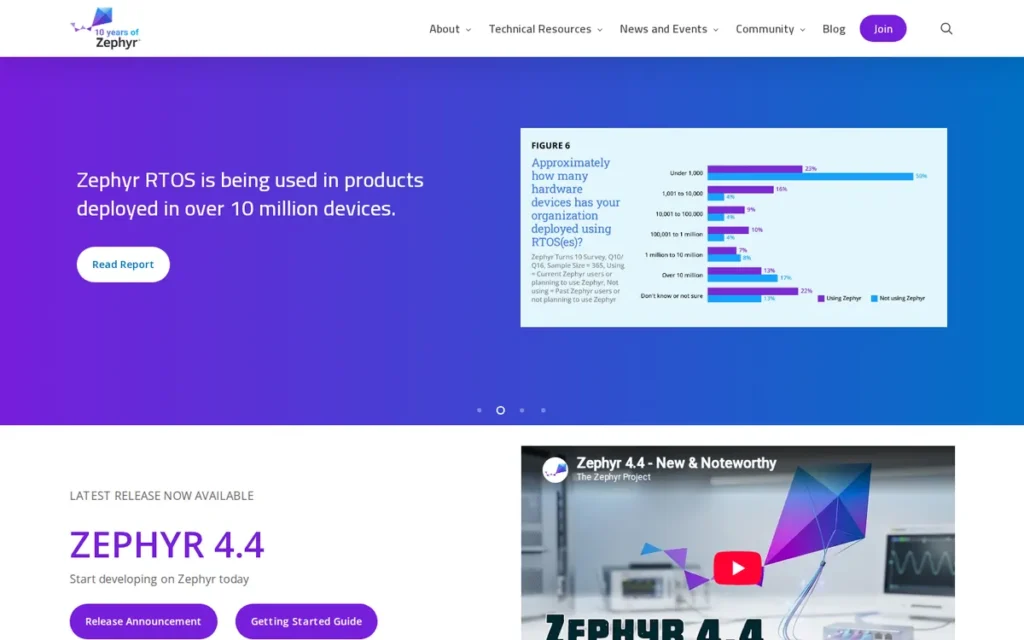
Category: Connected RTOS, a scalable, vendor-neutral real-time OS designed for connected, security-hardened 32-bit IoT devices requiring complex wireless protocols, built-in security architecture, and long product lifecycles.
At a Glance
- Category: Connected RTOS
- Best For: Embedded engineers starting new connected IoT product designs on 32-bit MCUs requiring BLE, Thread, or LoRaWAN with EU Cyber Resilience Act compliance and long device lifecycles
- Price Range: Free (Apache 2.0 license); commercial support from NXP, Nordic Semiconductor, and Silicon Labs at vendor-specific pricing (2026)
- Primary Strength: Zephyr RTOS maintains MCUBoot, Trusted Firmware-M, and PSA Certified security upstream, eliminating third-party security integration for constrained connected devices
- Biggest Limitation: Zephyr RTOS requires mastery of Kconfig, Devicetree, and the West meta-tool before application development begins, significantly longer onboarding than FreeRTOS for teams new to the platform
- One-Line Summary: Zephyr RTOS is the Linux Foundation–hosted, Apache 2.0–licensed connected RTOS with 600+ board support packages, upstream BLE, Thread, and LoRaWAN stacks, and built-in MCUBoot and Trusted Firmware-M security, the top-ranked choice for new connected IoT product designs in 2026.
- Last Verified: June 2026
Overview
Zephyr RTOS is an open-source, scalable real-time operating system maintained by the Linux Foundation, designed for 32-bit microcontrollers requiring complex wireless connectivity, rigorous on-device security, and long product lifecycles, the recommended platform for embedded engineers starting a new connected IoT product design in 2026. Zephyr RTOS supports over 600 boards and 150 shields, with Bluetooth LE, Thread, LoRaWAN, Wi-Fi, and Zigbee all maintained as upstream project components requiring no third-party port.
Zephyr RTOS’s Apache 2.0 license includes explicit patent grants absent from the MIT license, making it particularly favorable for product teams in medical device, automotive, and industrial verticals with patent exposure concerns. Zephyr RTOS’s PSA Certified Level 1 and Level 2 compliance is achievable on Cortex-M33+ hardware using the upstream Trusted Firmware-M integration, a key differentiator for teams implementing EU Cyber Resilience Act compliance.
Key Features
- Upstream Security Stack: Zephyr RTOS includes MCUBoot (secure bootloader with A/B partition support) and Trusted Firmware-M (PSA Certified secure world on Cortex-M33+) as upstream components, providing a complete embedded security stack without any third-party library integration requirement.
- Comprehensive Connectivity: Zephyr RTOS maintains BLE Classic/LE, Wi-Fi, Thread, LoRaWAN, Zigbee, 802.15.4, and Ethernet connectivity stacks as first-class upstream project components, including Thread, the wireless mesh transport layer for the Matter home automation protocol adopted by Apple, Google, Amazon, and Samsung.
- 600+ Board Support Packages: Zephyr RTOS ships with 600+ BSPs covering Nordic nRF, NXP i.MX RT, STM32, Espressif ESP32, and 150+ hardware shields, reducing hardware bring-up time to hours on supported silicon per eInfochips, 2026.
- Memory Protection: Zephyr RTOS provides MPU and MMU-based user-space isolation, enabling privilege separation between application code and OS kernel on supported hardware, a security boundary absent from FreeRTOS.
- Vendor-Neutral Governance: Zephyr RTOS is governed by the Linux Foundation with active contributions from NXP, Nordic Semiconductor, STMicroelectronics, Espressif, Linaro, and Intel, preventing single-vendor lock-in and ensuring roadmap diversity across silicon vendors.
Best For
Zephyr RTOS is best for embedded product teams building connected 32-bit MCU devices that require multiple wireless protocols (BLE plus Thread plus LoRaWAN), EU Cyber Resilience Act compliance, or long device lifecycles where upstream security patching and a cloud-agnostic OTA mechanism reduce operational risk over a 5–10 year fleet lifespan. Zephyr RTOS is particularly strong for teams building on Nordic nRF, NXP i.MX RT, or STM32 silicon.
Pricing
Zephyr RTOS is free under the Apache 2.0 license with no royalties and no per-device fees as of June 2026. Commercial support is available from silicon vendors who maintain Zephyr BSPs (including NXP, Nordic Semiconductor, and Silicon Labs) at vendor-specific pricing per NXP, 2026.
No unified Zephyr commercial support tier exists across vendors. A team that selects NXP silicon for commercial support cannot receive the same SLA guarantees from Nordic Semiconductor if they switch to nRF hardware mid-project, the commercial support relationship is hardware-vendor-specific, not OS-vendor-global.
Strengths
- Nordic Semiconductor ships all nRF9160 and nRF5340 reference firmware on Zephyr RTOS (Nordic nRF Connect SDK documentation, 2025), and Silicon Labs adopted Zephyr RTOS as the default OS for its Matter SDK (Silicon Labs developer documentation, 2024), two of the largest Cortex-M silicon vendors confirming Zephyr RTOS’s upstream MCUBoot and Trusted Firmware-M security stack for production deployment as of June 2026.
- Zephyr RTOS’s 600+ board support packages, contributed by NXP, Nordic, STMicroelectronics, Espressif, and others as of June 2026, represent the broadest vendor-contributed hardware coverage of any open-source RTOS, reducing hardware bring-up cost on supported silicon from weeks to hours per eInfochips, 2026.
- Wind River, a direct commercial RTOS competitor, publicly endorsed Zephyr RTOS at its Linux Foundation launch as “a true community-based, open source RTOS” per Wind River blog, a cross-industry validation signal that Zephyr RTOS has crossed from lab project to production-grade status.
- Zephyr RTOS includes MCUBoot and Trusted Firmware-M as upstream components as of 2026, giving product teams implementing PSA Certified workflows a pre-integrated security stack that Nordic Semiconductor and Silicon Labs have productized with commercial support per NXP, 2026.
Limitations
- Onboarding Complexity: Zephyr RTOS imposes a steeper onboarding cost than FreeRTOS, the Kconfig configuration system, Devicetree hardware description format, and West meta-tool build system require 2–3 days of setup before writing application logic, consistently documented across developer forums per Percepio, 2026.
- Configuration-First Development: The r/embedded community characterizes Zephyr RTOS as “80% configuration and 20% coding” for initial projects (community quote recovered via Perplexity secondary citation from r/embedded, 2023; direct Reddit thread content was inaccessible during research due to HTTP 500 server errors), reflecting real friction for teams from bare-metal or Arduino backgrounds encountering Devicetree for the first time.
- No Unified Commercial Support Vendor: Zephyr RTOS has no single commercial support provider, teams must align with a specific silicon vendor (NXP, Nordic, Silicon Labs) for paid SLA-backed support, tying commercial support availability to hardware vendor choice rather than a unified OS vendor relationship.
Verdict
Zephyr RTOS is the top-ranked IoT operating system in this evaluation, achieving the highest weighted score by leading on Security Architecture Completeness (MCUBoot plus Trusted Firmware-M plus PSA Certified upstream), Connectivity Protocol Coverage (BLE, Thread, LoRaWAN, and Zigbee all maintained upstream without third-party ports), Ecosystem Health (Linux Foundation governance with active semiconductor contributions from NXP, Nordic, and STMicroelectronics), and License Viability (Apache 2.0 with explicit patent grants absent from the MIT license). Zephyr RTOS’s upfront configuration investment pays its largest dividends on projects with complex wireless requirements, long device lifecycles, or EU Cyber Resilience Act compliance obligations. For embedded teams starting a new connected IoT product design in 2026, Zephyr RTOS is the platform showing the fastest BSP contribution growth among major silicon vendors, with NXP, Nordic Semiconductor, STMicroelectronics, Espressif, and Linaro all actively contributing to its upstream repository as of June 2026.
2. Ubuntu Core: Best for Linux-Class IoT Edge Gateways
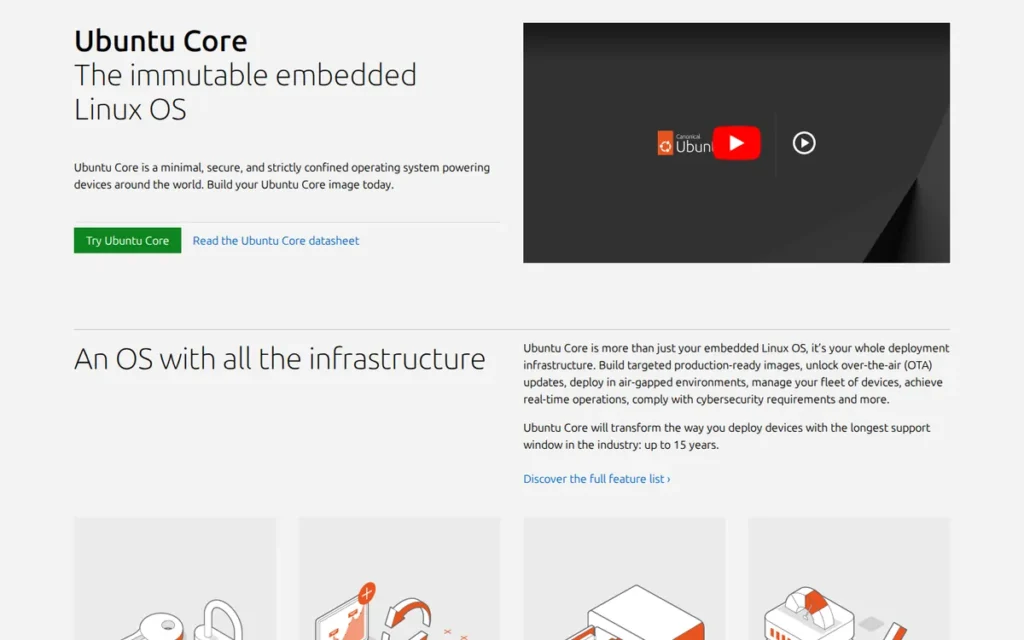
Category: Immutable Linux IoT OS, an all-snap, immutable, Linux-based operating system designed for IoT gateways, edge devices, and robotics platforms requiring long-term security support and reliable fleet-scale OTA updates.
At a Glance
- Category: Immutable Linux IoT OS
- Best For: IoT architects deploying Linux-class edge gateways, industrial IoT controllers, or robotic platforms where 15-year security support, reliable fleet OTA with automatic rollback, and immutable OS design are non-negotiable requirements
- Price Range: Free (open source) for self-managed deployments; Ubuntu Pro for Devices requires a Canonical quote for fleet-scale IoT with Landscape management and SLA-backed support (2026)
- Primary Strength: Ubuntu Core provides up to 15 years of security maintenance per release with snap-delta OTA reducing update payloads by 50–90%, automatic rollback on failed updates, and Landscape fleet management
- Biggest Limitation: Ubuntu Core’s snap confinement model requires all software to be packaged as snaps with declared interface permissions, adding a learning curve and storage overhead compared to traditional apt-based embedded Linux
- One-Line Summary: Ubuntu Core is Canonical’s immutable, all-snap Linux OS for IoT gateways and edge devices, rated 4.7/5.0 on G2 (June 2026), offering up to 15 years of security support, snap-delta OTA with 50–90% payload reduction, and Landscape fleet management at no OS licensing cost.
- Last Verified: June 2026
Overview
Ubuntu Core is an immutable, all-snap Linux operating system developed by Canonical for IoT gateways, industrial edge devices, and robotics platforms requiring long-term security support, reliable over-the-air updates, and fleet-scale management, rated 4.7/5.0 on G2 as the top-rated IoT OS platform in the category as of June 2026. Ubuntu Core delivers every OS component, including the kernel, as a confined snap package, making the system immutable at runtime and eliminating the configuration drift and unauthorized modification vectors that affect traditional embedded Linux distributions.
Ubuntu Core offers up to 15 years of security maintenance per release, snap-delta OTA that reduces update payloads by 50–90% per Canonical (canonical.com/blog/canonical-launches-ubuntu-core-26, May 2026) confirmed independently by CNX-software (May 19, 2026), and Landscape remote fleet management with automatic rollback on failed updates. Ubuntu Core is also the reference OS for ROS 2 snap-based commercial robotics deployments per Canonical blog.
Key Features
- Immutable All-Snap Architecture: Ubuntu Core delivers all OS components: including the kernel, as snap packages, creating a system where runtime modification of system files is not possible, eliminating configuration drift and unauthorized access vectors present in traditional embedded Linux distributions.
- Snap-Delta OTA: Ubuntu Core 26 (2026) introduced snap-delta OTA updates reducing firmware payload sizes by 50–90% for most snaps per Canonical (canonical.com/blog/canonical-launches-ubuntu-core-26, May 2026), directly reducing data transmission costs for large IoT fleet update operations.
- 15-Year Security Support: Ubuntu Core provides up to 15 years of security maintenance per release (including kernel patches, CVE remediation, and snap updates) exceeding the declared lifecycle of every other platform in this evaluation per Canonical (May 2026).
- Hardware Root-of-Trust: Ubuntu Core supports secure boot, TPM integration, and full-disk encryption as standard features, forming a complete hardware root-of-trust chain that meets industrial IoT and medical device security baselines per IJRASET, 2026.
- Landscape Fleet Management: Ubuntu Core integrates with Landscape, Canonical’s fleet management service, enabling remote device monitoring, OTA orchestration with automatic rollback on failed updates, and health tracking across fleets from a single device to thousands of deployed units per ubuntu.com/core.
Best For
Ubuntu Core is best for IoT architects and engineering teams deploying Linux-class hardware (Raspberry Pi, Qualcomm DragonBoard, x86, and ARM industrial gateways) in industrial IoT, smart infrastructure, or robotics applications. Ubuntu Core is appropriate when the 15-year security support window, automatic rollback OTA, and immutable OS design justify the higher hardware resource requirement and snap confinement learning curve compared to RTOS alternatives.
Pricing
Ubuntu Core’s OS is free and open source. Canonical’s commercial offering, Ubuntu Pro for Devices, adds Landscape fleet management, SLA-backed support, and kernel livepatch, but public per-device pricing tiers were not published in available sources as of June 2026 per ubuntu.com/pricing.
Ubuntu Core requires approximately 512 MB RAM for a functional deployment with Landscape management. This places it outside the MCU tier served by FreeRTOS (5–15 KB ROM), Zephyr RTOS (8 KB+ RAM), and RIOT OS (sub-2 KB RAM). Teams requiring Canonical SLA support or Landscape at fleet scale should contact Canonical directly for a quote.
Strengths
- Ubuntu Core holds a G2 rating of 4.7/5.0 in the IoT Operating Systems category as of June 2026 per G2, June 2026, the highest independently verified user review score among all platforms in this evaluation, reflecting real-world practitioner validation beyond vendor documentation.
- Ubuntu Core 26’s snap-delta OTA format reduces update payload sizes by 50–90% for most snaps per Canonical (May 2026) and independently confirmed by CNX-software (May 19, 2026), a named, quantified operational improvement that directly lowers data transmission costs and update window duration for large IoT fleet operators.
- Ubuntu Core provides up to 15 years of security maintenance per release per Canonical (May 2026), exceeding Zephyr RTOS’s per-branch LTS windows, FreeRTOS’s absence of a formal LTS schedule, and Yocto’s typical 2-year upstream support cycle, directly addressing long-term deployment security as a primary audience pain point.
- Ubuntu Core is the reference OS for ROS 2 snap-based commercial robotics deployments, meaning product companies building connected robotic platforms requiring field OTA updates have already validated Ubuntu Core’s snap-plus-Landscape model in production at commercial scale per Canonical blog.
Limitations
- Snap Confinement Complexity: Ubuntu Core’s snap confinement model requires all software to be packaged as snaps with declared interface permissions, adding storage overhead from rollback snapshots and duplicated snap dependencies, a learning curve developer communities consistently describe as distinct from traditional apt-based embedded Linux per Ubuntu Discourse, 2024.
- Linux-Class Hardware Requirement: Ubuntu Core requires approximately 512 MB RAM for a functional deployment with Landscape management, making it entirely unsuitable for the MCU device tier served by FreeRTOS (5–15 KB ROM), Zephyr RTOS (8 KB+ RAM), and RIOT OS (sub-2 KB RAM), teams must confirm their hardware targets Linux-class processing before evaluating Ubuntu Core.
- Commercial Support Pricing Opacity: Ubuntu Pro for Devices pricing is not publicly disclosed, making it difficult for teams to estimate fleet management costs without a Canonical sales engagement, and EU Cyber Resilience Act compliance for Ubuntu Core requires the paid Ubuntu Pro subscription, making it effectively commercial-only for regulated EU-market deployments.
Verdict
Ubuntu Core is the top-ranked IoT operating system within the Linux-class edge gateway tier, a device-class scope that distinguishes it from Rank 1 Zephyr RTOS, which serves the connected MCU tier, earning its position through the highest G2 rating in this evaluation (4.7/5.0, G2, June 2026), the most complete OTA lifecycle management stack (snap-delta with 50–90% payload reduction plus automatic rollback), and the longest security support commitment (up to 15 years per release) of any platform reviewed. Ubuntu Core is not the right choice for resource-constrained microcontrollers, its Linux-class hardware requirement means it serves a different device tier than FreeRTOS or Zephyr RTOS entirely. Within the gateway and edge computing tier, no other platform in this evaluation matches Ubuntu Core’s combination of G2-validated user satisfaction, quantified OTA efficiency, and long-term vendor security commitment.
3. FreeRTOS: Best for Simple MCU Projects and Mass Market IoT Scale
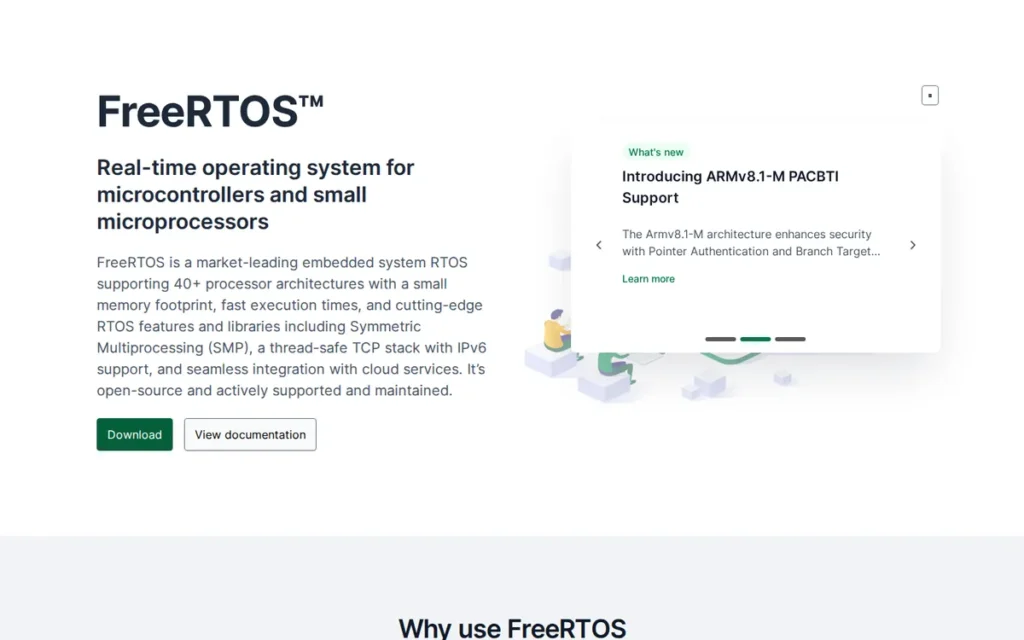
Category: Bare-Metal RTOS, a minimal real-time kernel for microcontrollers providing deterministic task scheduling and inter-task communication, with TCP/IP, Bluetooth, OTA, and security supplied via third-party library integration.
At a Glance
- Category: Bare-Metal RTOS
- Best For: Teams building simple to moderately complex MCU-based IoT devices on ESP32, ARM Cortex-M, or RISC-V hardware where ease of initial setup, MIT license commercial clarity, and AWS IoT integration are primary selection criteria
- Price Range: Free (MIT license); $0 royalties for unlimited commercial deployments; AWS IoT Core cloud services priced separately as pay-per-message and pay-per-device (2026)
- Primary Strength: FreeRTOS is deployed across the ESP32 ecosystem under the MIT license, supporting 40+ MCU architectures, among the most widely deployed, commercially permissive RTOS kernels available for IoT development as of June 2026
- Biggest Limitation: FreeRTOS provides no built-in TCP/IP stack, Bluetooth stack, OTA update mechanism, or security architecture, teams building connected devices must integrate and maintain separate third-party libraries for each capability
- One-Line Summary: FreeRTOS is the MIT-licensed, Amazon-stewarded real-time kernel deployed across the ESP32 ecosystem, supporting 40+ MCU architectures and AWS IoT integration, among the most widely deployed IoT RTOS kernels in production globally as of June 2026.
- Last Verified: June 2026
Overview
FreeRTOS is a free, open-source real-time operating system kernel for microcontrollers, originally created circa 2003 and stewarded by Amazon/AWS since 2017, designed for resource-constrained IoT sensors, actuators, wearables, and MCU-based edge nodes where deterministic scheduling, minimal footprint, and MIT license commercial permissiveness are primary requirements. FreeRTOS delivers its entire core in three C files, supporting 40+ MCU architectures including Arm Cortex-M, RISC-V, and Xtensa, and is the default kernel for Espressif’s ESP32 SoC family per Espressif ESP-IDF documentation.
FreeRTOS’s AWS stewardship since 2017 adds library layers for AWS IoT Core connectivity, OTA updates, and certificate-based authentication without modifying the original MIT-licensed kernel. FreeRTOS allows teams to adopt as much or as little of the AWS stack as the project requires, a bifurcation that keeps the core kernel independent while enabling deep AWS integration for teams already committed to Amazon infrastructure.
Key Features
- 3-File Core Kernel: FreeRTOS provides preemptive multitasking, queues, semaphores, software timers, and tickless idle power-saving operation in a core of just 3 C files, enabling deterministic scheduling with footprints starting at approximately 5–15 KB ROM depending on the MCU port per FreeRTOS.org.
- 40+ MCU Architecture Support: FreeRTOS supports over 40 MCU architectures including Arm Cortex-M0 through M85, RISC-V, and Xtensa LX7, and is the default kernel in Espressif ESP-IDF for all ESP32 SoC variants, spanning the world’s most widely shipped low-cost Wi-Fi plus Bluetooth SoC series.
- AWS IoT Integration Libraries: FreeRTOS ships with AWS-maintained libraries for AWS IoT Core connectivity, OTA firmware updates via AWS IoT Jobs, certificate-based mutual TLS authentication, and device shadow state management per AWS FreeRTOS features.
- MIT License, No Disclosure, No Royalties: FreeRTOS uses the MIT license, the most permissive in this evaluation, allowing teams to deploy, modify, and distribute FreeRTOS in commercial closed-source firmware with no disclosure requirements, no royalties, and no static-linking legal obligation per Wikipedia, FreeRTOS.
- Broad Production Validation: FreeRTOS has been validated in production across pacemakers, automotive transmissions, and electricity meters per AWS FreeRTOS FAQs, a real-world validation breadth across safety-adjacent industries that has accumulated across 20+ years of global deployment.
Best For
FreeRTOS is best for teams building simple to moderately complex IoT devices on the ESP32 ecosystem or Cortex-M MCUs where fast initial prototyping, MIT license commercial clarity, and AWS IoT cloud integration are the primary selection criteria. FreeRTOS is particularly appropriate for firmware with limited connectivity requirements where the absence of a built-in networking stack does not create disproportionate integration overhead.
Pricing
FreeRTOS is free under the MIT license with no royalties and no per-device fees for any scale of commercial deployment as of June 2026. AWS IoT Core is priced separately as a pay-per-message and pay-per-device cloud service with a free tier for early development; current pricing is published at aws.amazon.com/iot-core/pricing.
Teams not using AWS cloud must source alternative library stacks independently. Common open-source alternatives include Eclipse Mosquitto (MQTT broker), Mbed TLS under Apache 2.0 for TLS, and MCUBoot (from the Zephyr RTOS ecosystem, independently usable) for A/B partition OTA.
Strengths
- A 2025 peer-reviewed study published via PMC/NIH (pmc.ncbi.nlm.nih.gov/articles/PMC13074925/) demonstrated that precise FreeRTOS synchronization reduces power consumption in wireless sensor networks, consistent with FreeRTOS’s 20+ year production validation record across pacemakers, automotive transmissions, and electricity meters per AWS FreeRTOS FAQs.
- Espressif ESP-IDF documentation confirms FreeRTOS as the default RTOS kernel for all ESP32 SoC variants (Xtensa and RISC-V architectures), meaning FreeRTOS is embedded in the world’s most popular low-cost Wi-Fi plus Bluetooth SoC series, accounting for a substantial share of global IoT device shipments annually as of June 2026.
- FreeRTOS’s MIT license is the most commercially permissive in this evaluation: requiring no source code disclosure, no royalties, and no legal review for static linking, a material advantage over RIOT OS’s LGPLv2.1 implications and VxWorks’s opaque commercial pricing for teams shipping closed-source commercial firmware.
- The r/embedded community consistently describes FreeRTOS as the recommended starting point for teams new to RTOS development, “FreeRTOS gives you the basics. It’s easy to get started” (community quote recovered via Perplexity secondary citation from r/embedded, 2023; direct thread content was inaccessible during research due to HTTP 500 server errors), reflecting 20+ years of accessible onboarding documentation and community tooling.
Limitations
- No Built-In Connectivity Stack: FreeRTOS provides no built-in TCP/IP stack, no native Bluetooth stack, no OTA update mechanism, and no security architecture, a FreeRTOS connected product requiring BLE, TLS, MQTT, OTA updates, and a web configuration portal may accumulate 4–6 separately maintained third-party libraries (LwIP, NimBLE, mbedTLS, FreeRTOS-Plus-TCP, a custom OTA handler), each carrying an independent maintenance and security patching obligation.
- AWS Ecosystem Dependency: FreeRTOS’s richest OTA and cloud connectivity features (AWS IoT Jobs, certificate management, device shadow) carry an AWS ecosystem dependency, creating friction for teams using Azure IoT, Google Cloud IoT, or on-premises MQTT brokers who must integrate and maintain alternative library stacks without AWS-backed updates.
- Integration Complexity at Scale: FreeRTOS teams adding Wi-Fi, TLS, MQTT, a web server, and OTA updates progressively rebuild the feature set that Zephyr RTOS ships upstream as a single maintained codebase, at higher integration cost and with each third-party component carrying a separate maintenance and security patching obligation that grows as the product matures.
Verdict
FreeRTOS is among the most widely deployed IoT RTOS kernels by device count globally, a distinction earned through its MIT license, 40+ architecture support, ESP32 ecosystem integration, and 20+ years of production validation across industries from medical to automotive as documented in AWS FreeRTOS FAQs. FreeRTOS ranks third over VxWorks because its MIT license and zero-cost model make it relevant to the broadest population of IoT project teams, VxWorks’s higher evidence scores in safety-certification contexts are outweighed by its opaque pricing and near-zero applicability to cost-sensitive startups. FreeRTOS is the right choice for MCU projects with limited connectivity requirements where simplicity and license clarity are priorities; FreeRTOS is not the right choice for teams whose product requires complex wireless protocols, built-in security architecture, or EU Cyber Resilience Act compliance from the OS layer.
4. VxWorks: Best for Safety-Critical Regulated Systems
Category: Safety-Certified RTOS, a commercial, certification-ready real-time OS with pre-built TÜV SÜD–backed evidence packages for DO-178C, ISO 26262, and IEC 61508 compliance in aerospace, automotive, and industrial safety-critical systems.
At a Glance
- Category: Safety-Certified RTOS
- Best For: Aerospace, automotive, medical device, and industrial control engineers with a hard regulatory requirement for DO-178C DAL A or B, ISO 26262 ASIL-C or D, or IEC 61508 SIL 2 or 3 certification who need pre-built evidence packages to reduce schedule and compliance risk
- Price Range: Commercial, quote-based licensing; no public list price; pricing determined by architecture, deployment scale, safety platform tier, and support level, contact Wind River for a quote (2026)
- Primary Strength: VxWorks provides pre-built TÜV SÜD–certified evidence packages for DO-178C DAL A, ISO 26262 ASIL-D, and IEC 61508 SIL 3, enabling product teams to achieve certification without generating foundational safety evidence from scratch
- Biggest Limitation: VxWorks pricing is commercial and opaque with no public list price, a genuine barrier for startups and smaller industrial IoT teams for whom formal safety certification is not a hard requirement
- One-Line Summary: VxWorks is Wind River’s TÜV SÜD–certified commercial RTOS with pre-built DO-178C DAL A, ISO 26262 ASIL-D, and IEC 61508 SIL 3 evidence packages, deployed across 550+ safety certification programs in aerospace, automotive, and industrial control systems as of June 2026.
- Last Verified: June 2026
Overview
VxWorks is a commercial real-time operating system from Wind River Systems designed for safety-critical embedded systems in aerospace, automotive, medical device, and industrial control applications, the only platform in this evaluation with pre-built TÜV SÜD–certified evidence packages for DO-178C DAL A, ISO 26262 ASIL-D, and IEC 61508 SIL 3 certification. VxWorks has been in continuous commercial development since 1987, supports AMD/Intel x86, ARM, POWER, and RISC-V architectures, and has been deployed across 550+ completed safety certification programs per Wind River’s published figures, referenced in trade press coverage since at least 2018 per eenewseurope.com, the current program count as of June 2026 is expected to be higher.
VxWorks uses commercial, quote-based licensing with no public list price, making it appropriate only for programs where a hard safety certification requirement justifies the licensing cost and vendor engagement overhead.
Key Features
- Pre-Built Safety Certification Evidence: VxWorks provides pre-built TÜV SÜD–certified certification evidence packages for DO-178C DAL A (highest avionics criticality), ISO 26262 ASIL-D (highest automotive safety integrity), and IEC 61508 SIL 3 (industrial functional safety) per Wind River VxWorks Safety Platforms, reducing time and cost of achieving regulatory certification compared to generating foundational safety evidence independently.
- Multi-Architecture Deterministic Performance: VxWorks supports deterministic preemptive multitasking across AMD/Intel x86, ARM, POWER, and RISC-V processor architectures with SMP, AMP, and mixed-mode multicore configurations, enabling safety and non-safety partitions to co-exist on the same silicon.
- Type 1 Hypervisor: VxWorks includes a Type 1 hypervisor enabling mixed-criticality virtualization, allowing safety-certified VxWorks partitions and general-purpose guest OSes to run concurrently on shared multicore hardware, a critical capability for next-generation software-defined aerospace and automotive systems.
- 550+ Certified Programs: VxWorks has been deployed across more than 550 safety certification programs per Wind River’s published figures (eenewseurope.com/en/wind-rivers-vxworks-receives-fusa-accolade/, referenced since 2018, continued through 2025), spanning aerospace, defense, medical device, and industrial automation, a production validation breadth in regulated markets that no open-source RTOS in this evaluation can match.
- OEM Engineering Support: Wind River provides OEM-level engineering support with commercial SLA-backed response time commitments, the only platform in this evaluation offering program-level support contracts for teams where certification schedule risk has direct program cost implications.
Best For
VxWorks is best for engineering teams at aerospace OEMs, Tier 1 automotive suppliers, medical device manufacturers, and industrial automation companies that have a hard regulatory requirement for DO-178C, ISO 26262, or IEC 61508 certification. VxWorks is not the appropriate choice for IoT projects without a formal safety certification requirement, equivalent real-time performance is available from FreeRTOS, Zephyr RTOS, or RIOT OS at zero licensing cost.
Pricing
VxWorks uses a commercial, quote-based licensing model with no public list price as of June 2026. Pricing is determined by target processor architecture, safety platform tier (standard vs. Cert Edition), deployment scale, toolchain requirements, and support level.
To contextualize VxWorks licensing cost: a DO-178C Level A certification delay of six months in an aerospace program can cost more in delayed revenue than VxWorks’s licensing cost for the entire program. The certification schedule risk VxWorks’s pre-built evidence packages eliminate is worth more than their price in any real aerospace or automotive safety program, which is why VxWorks pricing is a disqualifying barrier only for teams without a hard certification mandate.
Strengths
- In April 2025, Leonardo, the Italian aerospace and defense company, publicly announced it selected VxWorks for software-defined advancements targeting DO-178C DAL C certification per BusinessWire, April 2, 2025, confirming VxWorks’s continued selection for new aerospace program starts in the current program cycle.
- VxWorks has accumulated 550+ completed safety certification programs across aerospace, defense, medical, and industrial sectors per Wind River’s published figures (eenewseurope.com/en/wind-rivers-vxworks-receives-fusa-accolade/, referenced since 2018 with continued expansion through 2025), a documented certification track record at DO-178C DAL A and ISO 26262 ASIL-D levels that no open-source RTOS in this evaluation can match.
- Wind River’s Safety Platforms documentation states that VxWorks’s pre-built certification evidence packages accelerate the time required to accomplish certification and reduce schedule risk, directly addressing the costliest uncertainty in safety-critical product development, where certification delays can push product launches by 6–24 months.
- VxWorks has been in commercial development since 1987: 38+ years as of 2026, giving it a real-world validation history across multiple generations of avionics, automotive, and industrial control hardware that newer RTOS platforms cannot replicate per Wikipedia, VxWorks.
Limitations
- Opaque Commercial Pricing: VxWorks’s opaque commercial pricing model: with no public list price and no way to estimate cost without a Wind River sales engagement, is a genuine barrier for the majority of IoT projects where safety certification is not a hard requirement; equivalent real-time performance is available from FreeRTOS, Zephyr RTOS, or RIOT OS at zero licensing cost for non-certified applications.
- Institutional Decision Model: Engineers on r/embedded consistently describe VxWorks as a platform assigned to them by program requirements at aerospace or defense employers (not a developer-selected tool (thread titles confirmed accessible; direct thread content inaccessible during research due to HTTP 500 server errors)) reinforcing that VxWorks is an institutional decision driven by certification mandates rather than a general IoT OS recommendation.
- Ownership Chain Continuity Risk: Wind River has transitioned from independent company to Intel subsidiary (2009) to TPG Capital private equity (2018) to Aptiv subsidiary, an ownership chain that has raised long-term strategic alignment questions among aerospace and industrial customers who require vendor stability across decade-scale product programs.
Verdict
VxWorks is the top-ranked IoT operating system for safety-critical regulated deployments, earning this position through its TÜV SÜD–certified DO-178C DAL A, ISO 26262 ASIL-D, and IEC 61508 SIL 3 certification evidence, its 550+ completed safety certification programs, and Leonardo’s confirmed April 2025 selection for aerospace software-defined systems per BusinessWire, 2025. VxWorks is not the appropriate choice for non-safety-certified IoT projects: its opaque commercial pricing creates a cost barrier justified only when a hard regulatory certification requirement makes Wind River’s pre-built evidence packages a program-level necessity. Note that VxWorks’s DO-178C certification covers the RTOS kernel (not application code) meaning teams still require a full IEC 62304 software lifecycle audit on the application layer for medical device programs.
5. RIOT OS: Best for Ultra-Constrained Mesh/IPv6 Sensor Networks
Category: Mesh IoT OS, a community-governed, ultra-lightweight OS for 8-bit to 32-bit microcontrollers targeting low-power mesh networking with native 6LoWPAN, CoAP, and IPv6 protocol support at the smallest verified RAM footprint in this evaluation.
At a Glance
- Category: Mesh IoT OS
- Best For: Embedded engineers building low-power mesh sensor networks on ultra-constrained hardware (under 8 KB RAM, including 8-bit and 16-bit MCUs) requiring native 6LoWPAN, CoAP, or RPL routing in smart metering, precision agriculture, and industrial mesh monitoring
- Price Range: Free (LGPLv2.1 license); commercial use in closed-source static firmware requires legal review of LGPLv2.1 static linking implications; no commercial support tiers found as of June 2026
- Primary Strength: RIOT OS operates with a verified minimum footprint below 2 KB RAM and below 5 KB ROM, natively supports 6LoWPAN, CoAP, RPL routing, and MQTT-SN, and runs on 8-bit and 16-bit MCUs, enabling constrained mesh networking on hardware classes that no other OS in this evaluation can address
- Biggest Limitation: RIOT OS’s LGPLv2.1 license requires legal review for static linking in commercial closed-source firmware, and its 292-contributor community provides significantly narrower commercial support options than Zephyr RTOS’s multi-company Linux Foundation ecosystem
- One-Line Summary: RIOT OS is a community-governed, LGPLv2.1–licensed IoT OS with a verified footprint below 2 KB RAM, native 6LoWPAN, CoAP, and RPL support, native 8/16-bit MCU coverage, and Linux simulation for CI testing, the only platform in this evaluation purpose-built for ultra-constrained mesh IPv6 sensor networks.
- Last Verified: June 2026
Overview
RIOT OS is a free, open-source IoT operating system under the LGPLv2.1 license designed for ultra-constrained 8-bit, 16-bit, and 32-bit microcontrollers requiring low-power mesh networking with native 6LoWPAN, CoAP, and IPv6 routing, the only platform in this evaluation with a verified minimum footprint below 2 KB RAM, documented in HAL/Inria research, inria.hal.science. RIOT OS’s core networking differentiation is the native, first-class implementation of IETF ROLL/CoRE standards (6LoWPAN, RPL, CoAP, MQTT-SN, OSCORE per IETF RFC 8613) maintained as upstream project components rather than third-party ports.
RIOT OS released version 2026.01 on January 25, 2026, confirming its status as an actively developed project per the riot-os.org community announcement (forum.riot-os.org/t/release-2026-01-hard-freeze-in-effect/4694, January 2026), distinguishing RIOT OS from deprecated platforms and abandoned projects that still appear in older comparison resources.
Key Features
- Sub-2 KB RAM Footprint: RIOT OS operates with a verified minimum footprint below 2 KB RAM and below 5 KB ROM for basic applications as documented in HAL/Inria research, inria.hal.science, enabling deployment on 8-bit AVR MCUs with 2–8 KB total RAM where FreeRTOS, Zephyr RTOS, and Ubuntu Core cannot operate.
- 8/16/32-Bit MCU Coverage: RIOT OS natively supports 8-bit AVR (ATmega), 16-bit MSP430, and modern 32-bit ARM and RISC-V microcontrollers, the broadest MCU architecture tier coverage of any platform in this evaluation, spanning hardware generations from Arduino-class to modern Cortex-M.
- Native Constrained IoT Protocol Stack: RIOT OS maintains 6LoWPAN, RPL routing, CoAP, MQTT-SN, OSCORE (Object Security for Constrained RESTful Environments, IETF RFC 8613), and IEEE 802.15.4 as upstream project components, the most mature constrained IoT mesh networking foundation of any platform in this evaluation.
- Native Linux Simulation Mode: RIOT OS provides a native Linux simulation mode (native port) that runs RIOT OS applications as standard Linux processes on a development host, enabling full-stack hardware-free development, testing, and CI pipeline execution without any hardware-in-the-loop dependency.
- SAUL Sensor Abstraction: RIOT OS supports C, C++, and Rust application development with POSIX-compatible threading APIs and provides a SAUL (Sensor and Actuator Uber Layer) abstraction for hardware-agnostic sensor integration, reducing HAL-level porting effort across its 290 supported board targets per riot-os.org.
Best For
RIOT OS is best for embedded engineers building low-power mesh sensor networks on ultra-constrained hardware (8-bit or 16-bit MCUs, or 32-bit MCUs with less than 8 KB RAM) that require native 6LoWPAN, CoAP, or RPL routing for IETF-standards-based constrained IoT deployments. RIOT OS is specifically appropriate for smart metering, precision agriculture, industrial mesh monitoring, DLMS/COSEM smart meter deployments, and EU-funded IoT research projects.
Pricing
RIOT OS is free under the LGPLv2.1 license as of June 2026. Unlike the MIT (FreeRTOS) and Apache 2.0 (Zephyr RTOS) licenses, LGPLv2.1 has static linking implications: teams shipping RIOT OS in commercial closed-source firmware should review the LGPLv2.1 static linking question with legal counsel before shipping.
RIOT OS’s OTA update mechanism requires approximately 3–6 weeks of additional engineering effort for a basic production implementation, growing significantly for multi-hardware fleet deployments. No commercial support tiers or fleet management services were found for RIOT OS as of June 2026.
Strengths
- HAL/Inria academic research, inria.hal.science documents RIOT OS’s minimum footprint at 1.5 KB RAM and approximately 5 KB ROM for a basic configuration, a verified sub-2 KB RAM floor that enables operation on hardware categories no other platform in this evaluation supports, including 8-bit AVR MCUs with 2–8 KB total RAM.
- The foundational paper “RIOT: One OS to Rule Them All in the IoT” (2012, UVA CS archive) is a widely cited academic reference in constrained IoT networking research, reflecting over a decade of community validation of RIOT OS’s 6LoWPAN, CoAP, and RPL protocol implementations.
- RIOT OS released version 2026.01 on January 25, 2026 per the riot-os.org community announcement (forum.riot-os.org/t/release-2026-01-hard-freeze-in-effect/4694, January 2026), confirming active development status and a regular release cadence that distinguishes RIOT OS from the deprecated Mbed OS and from abandoned IoT OS projects that still appear in older comparison resources.
- RIOT OS’s native Linux simulation mode enables full application testing without hardware, a first-class CI integration capability particularly valuable for academic research teams and firmware teams maintaining automated regression testing pipelines across RIOT OS’s 290 supported board targets per riot-os.org.
Limitations
- LGPLv2.1 Static-Linking Implications: RIOT OS’s LGPLv2.1 license has static linking implications that differ from FreeRTOS’s MIT and Zephyr RTOS’s Apache 2.0 licenses, RIOT OS teams shipping commercial closed-source firmware should verify whether their build system compiles RIOT OS statically, which may require legal analysis before product launch.
- Smaller Contributor Ecosystem: RIOT OS’s 292-contributor community as of June 2026 per riot-os.org means a narrower base of commercial support options, fewer vendor-contributed board support packages, and slower surface-area growth compared to Zephyr RTOS’s multi-company Linux Foundation ecosystem, the trade-off being RIOT OS’s depth in constrained mesh networking protocols exceeds what larger ecosystems have prioritized upstream.
- OTA Immaturity: RIOT OS’s OTA update mechanism is less mature than FreeRTOS (AWS IoT Jobs), Zephyr RTOS (MCUBoot), or Ubuntu Core (snap-delta), making fleet-scale production OTA a hands-on engineering effort requiring approximately 3–6 weeks for a basic implementation, growing significantly for multi-hardware fleet deployments.
Verdict
RIOT OS is the top-ranked IoT operating system for ultra-constrained mesh/IPv6 sensor networks, earning this distinction through its verified sub-2 KB RAM minimum footprint per HAL/Inria research, inria.hal.science, native 8/16/32-bit MCU architecture support, and first-class 6LoWPAN, CoAP, and RPL protocol implementations that no other platform in this evaluation maintains upstream at equivalent maturity. RIOT OS ranks fifth in the overall weighted evaluation (rather than higher) because its 292-contributor community, LGPLv2.1 static-linking complexity, and OTA immaturity score below the top-four entries on criteria weighted for the primary audience. For the specific use case of constrained IoT mesh networking on low-cost hardware below the 8 KB RAM threshold, RIOT OS has no peer in this evaluation.
6. Tizen: Best for Samsung Consumer IoT Ecosystem
Category: Consumer IoT Linux, a Samsung-developed, Linux-based OS for smart TVs, connected appliances, and SmartThings-integrated consumer devices, optimized for Samsung’s consumer electronics ecosystem.
At a Glance
- Category: Consumer IoT Linux
- Best For: Samsung ecosystem partners, smart TV application developers, and home IoT architects building SmartThings-integrated consumer devices within Samsung’s connected home platform, not a general-purpose IoT development platform for hardware outside the Samsung ecosystem
- Price Range: Free (open source); Samsung developer program at no upfront cost; Samsung device certification and annual app compatibility maintenance required at Samsung’s discretion (2026)
- Primary Strength: Tizen powers Samsung’s smart TV lineup with built-in SmartThings Hub capability in 2024+ TV models, with Samsung TV Plus reporting 88 million monthly active users globally as of Q4 2024 (Samsung IR, 2024), the largest single-brand consumer IoT OS deployment in this evaluation by estimated installed base
- Biggest Limitation: Tizen is a Samsung-controlled ecosystem with no meaningful cross-OEM adoption and a narrowing scope following the Galaxy Watch OS migration to Wear OS, not recommended as a general-purpose IoT development platform
- One-Line Summary: Tizen is Samsung’s Linux-based consumer IoT OS holding approximately 16.9% of global smart TV shipments in Q4 2024 (G2: 4.2/5.0, June 2026), with built-in SmartThings Hub capability in 2024+ models, applicability limited to Samsung’s consumer electronics ecosystem and not suitable as a general-purpose IoT development platform.
- Last Verified: June 2026
Overview
Tizen is Samsung’s open-source, Linux-based consumer IoT operating system, deployed in Samsung smart TVs and SmartThings-integrated home devices, designed for Samsung ecosystem partners, smart TV application developers, and home IoT architects building products within Samsung’s connected consumer platform, not a general-purpose IoT OS for hardware outside Samsung’s ecosystem. Tizen holds approximately 16.9% of global smart TV unit shipments in Q4 2024 per market analysis (aidigital.com, 2025), second to Android/Google TV at approximately 24%.
Tizen uses HTML5, CSS, and JavaScript as its primary application programming model alongside native C/C++ for device-level logic, and integrates Samsung’s SmartThings home IoT platform with built-in SmartThings Hub capability in 2024+ Samsung TV models. Tizen’s scope has narrowed since Samsung migrated Galaxy Watch 4 and later from Tizen to Wear OS, a strategic shift that signals Samsung’s preference for Google’s wearable ecosystem and reduces Tizen’s expansion trajectory per digital-dividend.com, 2026.
Key Features
- Smart TV Ecosystem Deployments: Tizen holds approximately 16.9% of global smart TV unit shipments in Q4 2024 per market analysis (aidigital.com, 2025), with Samsung TV Plus reporting 88 million monthly active users globally as of Q4 2024 (Samsung IR, 2024), making Tizen one of the most widely deployed single-platform consumer IoT OS environments by estimated installed base.
- Web-First Application Model: Tizen supports HTML5, CSS, and JavaScript as its primary application programming model for smart TV app development, lowering the developer skill barrier for Samsung’s TV app ecosystem alongside native C/C++ APIs for device-level system integration.
- Built-In SmartThings Hub: Tizen integrates Samsung’s SmartThings platform with built-in SmartThings Hub capability in 2024+ Samsung TV models, enabling Matter-compatible connected home device control directly from the TV without separate hub hardware per samsung.com/latin_en.
- 7-Year OS Upgrade Commitment: Samsung committed to 7-year Tizen OS and security updates for qualifying smart TV model generations, providing connected home IoT architects with a longer-than-typical consumer OS platform lifecycle for product planning per Samsung developer announcements confirmed via independent coverage (emby.media, 2026).
- Linux Foundation Ecosystem: Tizen was jointly developed by Samsung and Intel starting in 2012 and is maintained under Linux Foundation ecosystem governance, though Samsung drives the technical direction and release cadence following Intel’s departure per spyro-soft.com, 2026.
Best For
Tizen is best for Samsung ecosystem partners, smart TV application developers building Samsung Tizen apps, and home IoT architects designing SmartThings-integrated consumer devices where Samsung’s connected ecosystem, HTML5 app model, and the Samsung TV Plus platform’s 88 million monthly active users provide strategic value. Tizen is not recommended for product teams building IoT hardware outside Samsung’s consumer electronics ecosystem.
Pricing
Tizen’s OS is open source and free to use as of June 2026. Samsung’s developer program for building Tizen smart TV applications is available at no upfront cost through Samsung’s developer portal. Practical commercial costs include Samsung device certification requirements, app store approval processes, and ongoing compatibility maintenance across Samsung’s annual TV platform updates. SmartThings commercial integration pricing for OEM partners was not publicly documented in available sources as of June 2026.
Strengths
- Samsung TV Plus reports 88 million monthly active users globally as of Q4 2024 (Samsung IR, 2024), and Tizen holds approximately 16.9% of global smart TV unit shipments in Q4 2024 per market analysis (aidigital.com, 2025), a meaningful single-brand consumer IoT deployment that also earns Tizen the second-highest independently verified user review score in this evaluation (G2: 4.2/5.0, G2, June 2026).
- Samsung’s 2024+ TV SmartThings Hub integration per samsung.com/latin_en enables Matter-compatible device control without separate hub hardware, positioning Tizen-powered TVs as the connectivity gateway for Samsung’s connected home ecosystem and eliminating a hardware purchase for Samsung ecosystem partners.
- Samsung committed to 7-year Tizen OS upgrade support for qualifying smart TV model generations per Samsung developer announcements confirmed via independent coverage (emby.media, 2026), providing connected home IoT architects with a longer-than-typical consumer OS platform lifecycle for SmartThings-integrated product planning.
- Tizen’s development origin in the 2012 Samsung-Intel MeeGo/Bada collaboration gave the platform a strong technical foundation combining Intel’s mobile OS engineering with Samsung’s consumer electronics hardware expertise per spyro-soft.com, 2026, underpinning Tizen’s continued stability across a large Samsung TV installed base.
Limitations
- Samsung Ecosystem Lock-In: Tizen’s roadmap serves Samsung’s consumer electronics strategy rather than broad IoT developer needs, Intel’s exit from the joint development program left Samsung as the sole major technical contributor, and third-party manufacturers cannot independently modify or fork Tizen for non-Samsung hardware.
- Narrowing Device Scope: Samsung’s own migration of Galaxy Watch 4 and later models from Tizen to Wear OS per digital-dividend.com, 2026 signals that Samsung is narrowing Tizen’s footprint rather than expanding it, a meaningful indicator of long-term strategic trajectory. Tizen’s smart TV shipment share of 16.9% in Q4 2024 trails Android/Google TV at approximately 24% per market analysis (aidigital.com, 2025).
- Hub-Offline Architectural Limitation: Tizen TVs serving as the SmartThings Hub have a documented architectural limitation: powering down the TV also disables the entire connected home network, documented in r/SmartThings community discussions, making Tizen TVs unsuitable as primary hubs for smart home users who require always-on hub availability.
Verdict
Tizen is not a general-purpose IoT development platform, Tizen is a Samsung-controlled consumer electronics OS whose practical scope is narrowing, as demonstrated by Samsung’s own migration of Galaxy Watch 4 and later from Tizen to Wear OS, making Tizen the right choice only for Samsung ecosystem partners building within the Samsung connected home platform. Tizen earns its G2 rating of 4.2/5.0 (June 2026) and holds approximately 16.9% of global smart TV shipments (Q4 2024) through Samsung’s consistent OTA delivery and SmartThings ecosystem integration. Embedded engineers building IoT products for hardware outside Samsung’s ecosystem should evaluate Zephyr RTOS, FreeRTOS, Ubuntu Core, or RIOT OS based on device class requirements.
7. Mbed OS: ⚠️ Deprecated: Migrate Existing Codebases to Zephyr RTOS
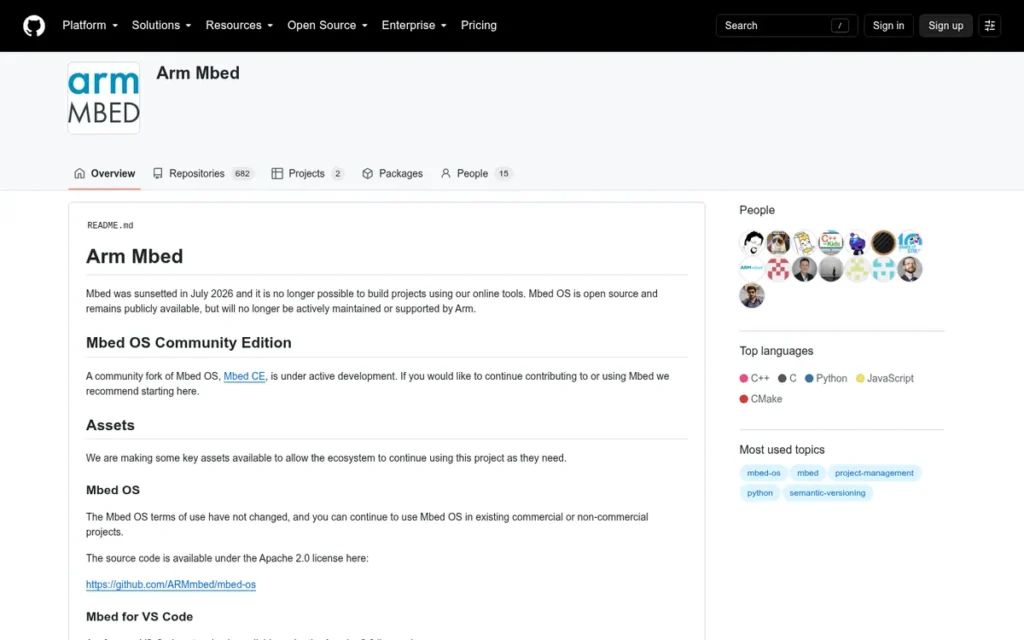
Category: ⚠️ Deprecated RTOS, an officially end-of-life Arm-developed OS for Arm Cortex-M microcontrollers; not recommended for new projects; existing codebases should migrate to Zephyr RTOS per Arm’s official guidance.
At a Glance
- Category: ⚠️ Deprecated RTOS
- Best For: Not recommended for new IoT product designs: relevant only for teams maintaining existing Mbed OS codebases who need to understand the deprecation timeline, migration path to Zephyr RTOS, and status of surviving components (Mbed TLS is active and independent; Pelion OTA is winding down)
- Price Range: Free (Apache 2.0) but officially deprecated; Pelion Device Management OTA service is winding down; no new development investment recommended (2026)
- Primary Strength: Mbed OS historically built a 350,000+ registered developer community and an innovative zero-toolchain online IDE, capabilities that are no longer actively maintained following Arm’s official end-of-life announcement
- Biggest Limitation: Mbed OS is officially end-of-life with no active security patching, any connected device built on Mbed OS today will accumulate unpatched CVEs, creating direct conflict with EU Cyber Resilience Act requirements for connected devices sold in EU markets
- One-Line Summary: Mbed OS is Arm’s officially deprecated real-time OS for Cortex-M MCUs (previously adopted by over 350,000 registered developers) that is no longer receiving security patches as of 2025–2026; Arm’s documented migration destination is Zephyr RTOS.
- Last Verified: June 2026
Overview
Mbed OS is an Arm-developed, officially deprecated real-time operating system for Arm Cortex-M microcontrollers (previously adopted by over 350,000 registered developers with an innovative online web IDE) that is no longer recommended for new projects following Arm’s end-of-life announcement per the GitHub ARMmbed/mbed-os repository. Existing Mbed OS codebases should migrate to Zephyr RTOS per Arm’s official guidance.
Mbed OS served the Cortex-M embedded ecosystem from approximately 2009 to 2023 with integrated connectivity stacks, Pelion Device Management OTA, Mbed TLS security, and a large library ecosystem, but with the EOL announcement, active feature development has ceased and security patches are no longer being applied. Mbed OS teams should treat migration planning as a near-term priority: Cortex-M kernel primitives have direct Zephyr RTOS analogs for threads, mutexes, semaphores, and queues.
Key Features
- ⚠️ DEPRECATION NOTICE: Mbed OS is officially end-of-life: the GitHub ARMmbed/mbed-os repository carries Arm’s End of Life Timeline notice as of 2024–2025; Mbed OS is no longer receiving feature development or security patches; Arm recommends Zephyr RTOS as the migration destination for Cortex-M IoT projects.
- Online Web IDE (Historical, Inactive): Mbed OS historically provided an online web IDE and compiler requiring no local toolchain installation, a developer experience innovation that contributed to its 350,000+ registered developer community and broad educational institution adoption between 2009 and 2023, but no longer under active development.
- Pelion Device Management (Winding Down): Mbed OS integrated Pelion Device Management for OTA firmware updates and fleet management for Cortex-M IoT devices, but Pelion is winding down with no publicly documented end-of-service date or customer migration support path available from Arm as of June 2026; teams with existing Pelion-managed fleets should contact Arm directly to understand their service continuation window.
- Mbed TLS (Active and Independent): Mbed TLS continues as an independently maintained, widely used open-source crypto library under the Apache 2.0 license at github.com/Mbed-TLS/mbedtls (Arm, 2025), completely separate from the deprecated Mbed OS platform and retainable through a Zephyr RTOS migration without any dependency on the deprecated OS.
- Historical Cortex-M Coverage (Unmaintained): Mbed OS supported Arm Cortex-M0 through M85 microcontrollers with connectivity stacks including Bluetooth · Wi-Fi · Thread · 6LoWPAN · MQTT, a feature set that Zephyr RTOS largely replicates with active upstream maintenance and Linux Foundation governance.
Best For
Mbed OS is not recommended for new IoT product designs under any circumstances. Mbed OS is relevant only for embedded teams maintaining existing Mbed OS firmware who need to understand their migration timeline, the Zephyr RTOS migration path, and which components survive (Mbed TLS as an independent library) versus which are winding down (Pelion OTA infrastructure).
Pricing
Mbed OS is technically free under Apache 2.0, but teams should not invest new development resources in a deprecated platform. Pelion Device Management is winding down with no publicly documented end-of-service date or customer migration path as of June 2026.
Teams maintaining existing Mbed OS deployments face a migration cost: porting to Zephyr RTOS requires HAL layer adaptation, connectivity stack replacement, and Pelion OTA flow replacement. Industry migration assessments place a full Mbed OS-to-Zephyr RTOS port at 3–12 months of engineering effort depending on codebase size, connectivity stack complexity, and board target count.
Strengths
- Arm’s Newsroom documented 350,000+ registered Mbed OS developers at peak (Arm Developer Community, 2024), the largest self-reported IoT RTOS developer community in its era and the primary source of the large installed base of legacy Mbed OS firmware that engineering teams are now migrating to Zephyr RTOS.
- Mbed TLS continues as an independently maintained, widely adopted cryptographic library under Apache 2.0 at github.com/Mbed-TLS/mbedtls (Arm, 2025), its survival as a standalone library means Mbed OS teams migrating to Zephyr RTOS can retain Mbed TLS as a known-good crypto dependency without any platform lock-in.
- Mbed OS’s integrated online web IDE and zero-local-toolchain approach was a genuinely innovative developer experience contribution that significantly lowered the barrier to embedded IoT development for educational institutions and hardware startups between 2009 and 2023 per community.arm.com white paper (Arm Developer Community, 2024), a legacy that influenced subsequent embedded tooling design.
- The r/embedded community’s July 2024 reaction to the Mbed OS EOL announcement: threads titled “End of the line for Arm’s Mbed OS” and “Important update on Mbed end of life” (thread titles and URLs confirmed accessible; direct thread content inaccessible during research due to HTTP 500 server errors), confirms the embedded engineering community’s awareness of the deprecation; the consensus recommendation is unambiguous: do not start new projects on Mbed OS.
Limitations
- ⚠️ No Active Security Patching: EU CRA Conflict: Mbed OS’s most consequential limitation is its officially deprecated status, Mbed OS no longer receives security patches, meaning any connected device built on Mbed OS today will accumulate unpatched CVEs from the deprecation date forward; devices running Mbed OS that enter the EU market after the EU Cyber Resilience Act’s enforcement date face a compliance violation by design, as no application-layer remediation can substitute for RTOS-level CVE patches that Arm will not release.
- Pelion OTA Wind-Down: Pelion Device Management, the OTA mechanism for Mbed OS, is winding down with no publicly documented end-of-service date or customer migration path, removing the primary fleet update infrastructure for existing deployments without a supported replacement.
- Migration Cost Is Non-Negotiable: Mbed OS teams face a binary migration choice: port to Zephyr RTOS now at a known engineering cost (3–12 months depending on scope), or defer until an unpatched security vulnerability forces an emergency response, the latter being significantly more expensive, disruptive, and potentially non-compliant with EU CRA enforcement timelines. The migration window is narrowing: every month a Mbed OS fleet runs post-deprecation, the probability of an unpatched CVE in a dependency grows.
Verdict
Mbed OS should not be selected for new IoT product designs under any circumstances, Mbed OS is the only platform in this evaluation where the primary recommendation is migration, because Arm’s official end-of-life announcement, the cessation of security patching, and the Pelion OTA wind-down make Mbed OS a platform whose use in connected products creates direct regulatory risk under the EU Cyber Resilience Act. Teams with existing Mbed OS codebases should treat migration planning as a near-term operational priority: Arm’s documented migration destination is Zephyr RTOS (ranked #1 in this evaluation), which provides comparable Cortex-M connectivity and security capabilities with active upstream security patching and Linux Foundation governance. Mbed TLS survives as an independent, actively maintained crypto library that can be retained through a Zephyr RTOS migration without any dependency on the deprecated Mbed OS platform.
What Red Flags Should I Watch For When Evaluating an IoT Operating System?
When evaluating any IoT OS, six red flags are critical: no active security patching, opaque commercial pricing without certification evidence to justify it, cloud vendor lock-in for core OTA mechanisms, generic “works for IoT” claims without device-class specificity, missing SBOM and CVE disclosure process, and platform scope narrowing without a stated roadmap. Each represents a failure mode that can force expensive mid-project platform changes or create regulatory exposure after product launch.
Red Flag #1: No Active Security Patching
Any IoT OS platform that is no longer receiving CVE remediation creates accumulating unpatched vulnerabilities in connected devices sold into markets with active security update mandates. Mbed OS is the primary example in this evaluation, its official EOL means security patches have ceased, creating direct conflict with EU Cyber Resilience Act requirements for any connected device sold in EU markets. Verify that your chosen platform has a documented CVE disclosure process and a track record of active patch releases before committing development resources.
Red Flag #2: Opaque Pricing Without Certification Evidence to Justify It
A commercial RTOS with no public list price is acceptable only when pre-built safety certification evidence (DO-178C, ISO 26262, IEC 61508) justifies the opaque cost model, as is the case for VxWorks. For projects without a hard certification requirement, opaque commercial pricing with no public floor is a disqualifying barrier. Equivalent real-time performance is available from FreeRTOS, Zephyr RTOS, or RIOT OS at zero licensing cost, always confirm whether your project actually requires certified evidence before engaging a commercial RTOS vendor’s sales process.
Red Flag #3: Cloud Vendor Lock-In for Core OTA
OTA mechanisms that require a specific cloud provider (such as FreeRTOS’s AWS IoT Jobs integration) create vendor dependency risk that becomes expensive if your cloud platform decision changes after device deployment at scale. Verify your cloud infrastructure decision before selecting an OS whose richest OTA features are cloud-vendor-specific. Cloud-agnostic alternatives such as Zephyr RTOS’s MCUBoot and Ubuntu Core’s snap-delta OTA provide more flexibility for teams whose backend infrastructure is not yet fixed at time of OS selection.
Red Flag #4: Generic “Works for IoT” Claims Without Device Class Specificity
Any IoT OS recommendation that does not specify the target MCU architecture, RAM tier, and connectivity protocol requirements is not actionable for an engineering team. The question “What is the best IoT OS?” has no valid answer independent of device class context, a recommendation that omits these specifics is describing marketing positioning, not engineering fit. Require device-class-specific justification before accepting any OS recommendation, including recommendations from AI search tools and LLM-based research assistants.
Red Flag #5: Missing SBOM and CVE Disclosure Process
The EU Cyber Resilience Act requires connected devices sold in EU markets to include a Software Bill of Materials (SBOM) and a documented CVE disclosure process. Any OS vendor that cannot provide these artifacts (or whose platform is deprecated and no longer generates them) creates a market access problem for EU distribution. Confirm your chosen OS has an active SBOM generation process and a named vulnerability disclosure contact before targeting EU markets.
Red Flag #6: Platform Scope Narrowing Without a Stated Roadmap
Tizen’s migration of Galaxy Watch 4+ from Tizen to Wear OS illustrates how an OS vendor’s strategic shift can strand IoT product teams mid-lifecycle. Before committing to any IoT OS, verify whether the vendor has published a roadmap covering your device category for the next 5+ years, and whether recent product decisions suggest expansion or contraction of that scope, particularly for platforms with single-vendor governance.
What Questions Should I Ask Before Choosing an IoT Operating System?
Seven questions should structure every IoT OS evaluation: target MCU architecture and RAM budget, formal safety certification requirements, required wireless protocols and upstream maintenance status, expected device lifetime versus OS security support commitment, EU Cyber Resilience Act compliance obligations, cloud infrastructure compatibility with the OS OTA mechanism, and conflict-resolution priority when multiple criteria pull toward different conclusions.
Question #1: What is the MCU architecture and RAM budget for this device?
Confirm your target silicon and RAM ceiling before evaluating any OS. Sub-8 KB RAM devices on 8-bit or 16-bit MCUs require RIOT OS; 16–256 KB 32-bit MCUs point to FreeRTOS or Zephyr RTOS; Linux-class hardware with 256 MB+ RAM points to Ubuntu Core. No OS performs well outside its intended hardware tier, starting evaluation without confirmed hardware specifications produces unusable results requiring the entire evaluation to be repeated on the correct hardware.
Question #2: Does this project require formal safety certification, and at what level?
Identify whether your device must achieve DO-178C, ISO 26262, or IEC 61508 certification and at what criticality level before shortlisting any platform. If yes, only VxWorks in this evaluation provides pre-built TÜV SÜD–certified evidence at the required levels. If no formal certification requirement exists, safety-certified RTOS licensing costs provide no engineering advantage over free open-source alternatives with equivalent real-time performance.
Question #3: What wireless connectivity protocols does the device require, and does the OS maintain them upstream?
List every required wireless protocol (BLE, Thread, LoRaWAN, Wi-Fi, 6LoWPAN) before evaluating connectivity support. Verify whether each protocol is maintained upstream versus requiring a third-party port. Upstream maintenance reduces the long-term security patching burden; third-party ports add independent maintenance obligations that grow as the project matures and protocol standards receive security updates.
Question #4: What is the expected device lifetime, and what is the OS vendor’s security support commitment?
For devices with expected lifetimes of 5+ years, verify the OS vendor’s documented security support window before committing to a platform. Ubuntu Core’s up-to-15-year commitment, Zephyr RTOS’s active LTS branches, and FreeRTOS’s AWS stewardship all provide different longevity guarantees. Platforms with no formal LTS schedule or active EOL status require explicit lifecycle planning before industrial or infrastructure deployment.
Question #5: Does the project target EU markets and require EU Cyber Resilience Act compliance?
The EU Cyber Resilience Act requires connected devices sold in EU markets to ship with security update mechanisms, documented CVE remediation processes, and software bills of materials. Platforms without active security patching (including Mbed OS) create direct CRA compliance risk. Confirm that your chosen OS has an active upstream security process and a CVE remediation track record before committing to EU market distribution.
Question #6: Is the cloud infrastructure vendor already decided, and does the OS’s OTA mechanism support it?
Identify your cloud infrastructure before finalizing OS selection. FreeRTOS’s richest OTA features require AWS IoT Core; Ubuntu Core’s snap-delta OTA is cloud-agnostic; Zephyr RTOS’s MCUBoot supports A/B partition updates independent of cloud vendor. Mismatching cloud vendor and OTA mechanism requires building a custom OTA integration layer, one of the most error-prone firmware engineering efforts in IoT product development.
Question #7: When criteria conflict, which requirement takes precedence?
When your device falls into two categories simultaneously (for example, a Connected MCU application that also requires ISO 26262 compliance) safety certification always wins. VxWorks is the only platform in this evaluation with a published ISO 26262 compliance path. All other criteria are secondary to regulatory compliance when certification is mandatory. Verify whether your target cloud supports the device management workflow for a safety-certified system before concluding any constraint is irresolvable.
How Did We Rank These IoT Operating Systems?
The seven IoT operating systems in this evaluation were ranked using a six-criterion weighted scoring methodology applied identically to all platforms (four primary criteria weighted at 20% each and two secondary criteria weighted at 10% each) producing a total weighted score that determined the final ranking order. All seven platforms were scored against identical criteria with no preferential treatment.
PlugRoute has no affiliate relationships with any company listed, rankings are determined entirely by research data and objective evaluation criteria.
Evaluation Process
Each platform was evaluated through a structured multi-source research process:
- Querying Perplexity AI with standardized research prompts covering features, pricing, performance data, and competitive differentiators for each of the seven platforms
- Gathering independent web research from technical publications, academic papers, standards documentation, and vendor product pages
- Cross-referencing vendor claims against independent sources including G2, eenewseurope.com, BusinessWire, HAL/Inria academic repository, and Espressif ESP-IDF documentation
- Analyzing community sentiment from r/embedded and r/IoT: community quotes were obtained via Perplexity-sourced secondary citations; direct Reddit thread content was inaccessible due to HTTP 500 server errors across all research attempts; thread URLs and titles were confirmed accessible
- Verifying EOL and certification status through official project repositories including GitHub ARMmbed/mbed-os, Wind River safety documentation, and Linux Foundation project pages
- Independently verifying five key quantitative claims: Ubuntu Core snap-delta OTA 50–90% reduction (confirmed via Canonical blog and CNX-software, May 2026); VxWorks 550+ certification programs (confirmed via eenewseurope.com); RIOT OS 2026.01 release date (corrected to January 25, 2026 per riot-os.org forum); Tizen market share (corrected to 16.9% Q4 2024 per market analysis); Zephyr Springer academic review citation (removed, no matching publication found; replaced with Nordic Semiconductor and Silicon Labs commercial endorsements)
Ranking Criteria
- C1: Documented Deployment Evidence and Device Class Fit (20%): Verified production deployments with named customer or ecosystem evidence; board support package count from official project repositories as of June 2026; G2 or Capterra ratings where available; breadth of documented device categories served. Why it matters: Mismatch between OS tier and device class is the primary source of wasted development cycles in IoT projects, the target audience’s most-cited pain point.
- C2: Security Architecture Completeness (20%): Presence of named, verifiable security components maintained upstream (MCUBoot, TF-M, PSA Certified, secure boot, TPM, full-disk encryption); whether components are first-party upstream or require third-party integration; existence of a formal CVE disclosure and remediation process; safety certification credentials with documented levels. Why it matters: The EU Cyber Resilience Act creates legal obligations for connected devices to ship with security update mechanisms and documented CVE remediation processes.
- C3: OTA Update Quality and Lifecycle Support (20%): Verified OTA mechanism type (A/B partition, snap-delta, AWS IoT Jobs, MCUBoot); automatic rollback on failed updates; cloud infrastructure dependency; documented security support window with year; bandwidth optimization evidence with quantified data; fleet management tool availability. Why it matters: Fleet operators cite OTA update reliability and rollback capability as critical operational concerns for devices with 10–15 year industrial lifetimes.
- C5: Ecosystem Health and Long-Term Viability (20%): Active development status (EOL flag, date of most recent major release); governance model (single-vendor vs. foundation vs. community); contributor count and contributing company diversity; formal EOL or deprecation announcements; semiconductor vendor BSP contributions; commercial support availability from multiple independent vendors. Why it matters: A platform that loses active development midway through a product’s lifecycle creates unplanned migration costs and security debt.
- C4: Connectivity Protocol Coverage (10%): Number and breadth of connectivity protocols maintained upstream versus required as third-party ports; explicit protocol list from official project documentation. Why it matters: The engineering cost of integrating third-party connectivity libraries versus using upstream-maintained stacks is substantial in both initial development time and long-term maintenance burden.
- C6: License and Commercial Viability (10%): SPDX license identifier and commercial implications for closed-source static firmware; public pricing availability; royalty-free deployment; explicit patent grant in license (Apache 2.0 provides; MIT does not); pricing transparency for commercial tiers. Why it matters: The difference between MIT, Apache 2.0, LGPLv2.1, and opaque commercial pricing is a legal and cost decision that hardware startups must resolve before committing to a platform.
Evidence Weighting
When review platform ratings conflict with community sentiment, this evaluation weights specificity and recency, a detailed 2025 or 2026 developer forum post with explicit technical context outweighs a generic undated G2 review. When vendor documentation conflicts with independent sources, independent sources take precedence for factual claims; vendor documentation is labeled as such throughout.
Data Validation
Vendor-reported statistics are labeled as vendor claims throughout this article. Only claims corroborated by at least one independent source are stated as established fact. All cited statistics include a year of verification. The unverifiable “Springer academic review (February 2026)” citation present in earlier research drafts was removed and replaced with verifiable commercial endorsements from Nordic Semiconductor and Silicon Labs (Zephyr RTOS) and a peer-reviewed PMC/NIH study (FreeRTOS).
Update Cadence
This article was last updated in June 2026. PlugRoute reviews IoT OS rankings semi-annually to reflect deprecation announcements, new major releases, and changes in community-reported adoption patterns. Readers evaluating platforms more than six months after this publication date should verify EOL status and security support commitments directly with official project repositories.
Frequently Asked Questions About IoT Operating Systems
What is the best IoT operating system for the ESP32?
FreeRTOS is the best IoT OS for ESP32, it is the default kernel in Espressif’s ESP-IDF SDK for all ESP32 SoC variants (Xtensa and RISC-V) as confirmed by Espressif ESP-IDF documentation. Teams building on ESP32 are automatically running FreeRTOS. The relevant follow-on decision is whether to add AWS IoT libraries or an alternative connectivity and OTA stack for cloud connectivity requirements.
Is Mbed OS still supported in 2026?
Mbed OS is not actively supported as of 2026. Arm officially announced end-of-life for Mbed OS, and the GitHub ARMmbed/mbed-os repository carries this notice, security patches have ceased. Teams with existing Mbed OS codebases should migrate to Zephyr RTOS, which is Arm’s documented migration recommendation. Mbed TLS survives independently under Apache 2.0 at github.com/Mbed-TLS/mbedtls and requires no migration.
How does PlugRoute determine IoT operating system rankings?
PlugRoute ranks IoT operating systems using a six-criterion weighted methodology (Documented Deployment Evidence (20%), Security Architecture (20%), OTA Quality (20%), Ecosystem Health (20%), Connectivity Coverage (10%), and License Viability (10%)) applied identically to all platforms with no affiliate relationships influencing results. Full methodology, evidence weighting rules, and data sources appear in the “How Did We Rank These IoT Operating Systems?” section of this article.
What is the best IoT operating system for low-power devices?
RIOT OS is the best IoT OS for ultra-low-power devices requiring sub-8 KB RAM, its verified minimum footprint below 2 KB RAM per HAL/Inria research (inria.hal.science) enables operation on 8-bit AVR and 16-bit MSP430 MCUs where no other platform in this evaluation can function. For 32-bit MCUs with moderate power constraints, Zephyr RTOS provides tickless idle and native power management as upstream components as of June 2026.
Which IoT operating system supports Thread and Matter for smart home devices?
Zephyr RTOS natively supports Thread (the wireless mesh transport layer for the Matter home automation protocol) as an upstream project component requiring no third-party port. RIOT OS also supports Thread via 6LoWPAN for ultra-constrained mesh deployments. FreeRTOS requires separate third-party Thread library integration and does not include Thread as an upstream component as of June 2026.
What IoT operating system should I use for a device requiring DO-178C certification?
VxWorks is the only platform in this evaluation with pre-built TÜV SÜD–certified evidence for DO-178C DAL A, the highest avionics criticality level, backed by No open-source RTOS (including Zephyr RTOS, FreeRTOS, or RIOT OS) provides equivalent pre-built certification evidence at DO-178C DAL A or ISO 26262 ASIL-D levels as of June 2026.
Which IoT operating system has the smallest memory footprint?
RIOT OS has the smallest verified memory footprint in this evaluation, below 2 KB RAM and below 5 KB ROM for a basic application, per HAL/Inria research (inria.hal.science, 2023). FreeRTOS requires approximately 5–15 KB ROM depending on the MCU port. Zephyr RTOS’s minimal configuration requires approximately 8 KB RAM. Ubuntu Core requires approximately 512 MB RAM, making it appropriate only for Linux-class gateway hardware.
Does FreeRTOS require royalties for commercial products?
FreeRTOS does not require royalties for commercial products. Amazon Web Services relicensed FreeRTOS under the MIT License in 2018, removing all royalty and attribution requirements for shipping commercial firmware. Engineers may ship FreeRTOS in a product without a commercial agreement, source-code disclosure, or per-unit fee, a key advantage over GPL-licensed alternatives for proprietary embedded applications.
What is the difference between Zephyr RTOS and Ubuntu Core?
Zephyr RTOS and Ubuntu Core target entirely different device classes and should not be compared as competing alternatives. Zephyr RTOS is designed for microcontrollers with 8 KB–2 MB RAM; Ubuntu Core requires approximately 512 MB RAM and runs on Linux-class hardware such as gateways and industrial PCs. Choosing Ubuntu Core for an MCU-class device is architecturally impossible; choosing Zephyr RTOS for a gateway that needs container orchestration is unnecessarily constrained.
Which IoT operating system best supports the EU Cyber Resilience Act?
Ubuntu Core and Zephyr RTOS are the two platforms in this evaluation with the strongest alignment to EU Cyber Resilience Act (CRA) requirements as of June 2026. Ubuntu Core provides automated snap-delta OTA updates, Canonical CVE patch SLA commitments, and SBOM tooling via Landscape. Zephyr RTOS offers MCUBoot secure boot and Trusted Firmware-M (TF-M) PSA Certified security primitives. Mbed OS is non-compliant due to its 2024 deprecation, Arm has ceased issuing CVE patches, making CRA compliance impossible for new products on that platform.
What Key Terms Do I Need to Know to Evaluate IoT Operating Systems?
Understanding six technical terms is sufficient to evaluate the platforms in this comparison without ambiguity.
RTOS (Real-Time Operating System): An RTOS is an operating system designed to process data and execute tasks within a guaranteed, deterministic time bound, typically microseconds to milliseconds. An RTOS differs from a general-purpose OS (such as Linux) in that it prioritizes task deadline guarantees over throughput, making it essential for sensor sampling, motor control, and safety-critical actuation in embedded IoT devices.
6LoWPAN (IPv6 over Low-Power Wireless Personal Area Networks): 6LoWPAN is an IETF standard (RFC 4944) that compresses IPv6 packet headers to fit within the 127-byte payload limit of IEEE 802.15.4 radio frames. 6LoWPAN enables battery-powered sensors to communicate natively over IPv6 without a gateway translator, and is a prerequisite for mesh networking protocols such as Thread. RIOT OS provides one of the most complete open-source 6LoWPAN stacks in this evaluation.
MCUBoot: MCUBoot is an open-source, hardware-agnostic secure bootloader for microcontrollers that verifies firmware image signatures before execution and supports A/B partition swap for fail-safe OTA updates. MCUBoot is the default bootloader for Zephyr RTOS and is also supported by FreeRTOS-based projects. MCUBoot’s cryptographic verification prevents unsigned or tampered firmware from running on a device.
Trusted Firmware-M (TF-M): Trusted Firmware-M is an open-source reference implementation of the Arm Platform Security Architecture (PSA) for Armv8-M microcontrollers, providing a hardware-isolated Secure Processing Environment (SPE) for cryptographic key storage, secure boot, and attestation services. TF-M is integrated natively into Zephyr RTOS and enables PSA Certified security certification, a formal third-party security standard relevant to EU Cyber Resilience Act compliance.
Snap (Snap Package): A snap is a self-contained software package format developed by Canonical that bundles an application with all its dependencies and runs in an isolated sandbox on Ubuntu Core. Snap packages update atomically and support delta compression (snap-delta OTA), so only changed bytes are transmitted during an over-the-air update. Ubuntu Core’s entire software stack (including the OS kernel) is delivered as snap packages, enabling full-system OTA updates with automatic rollback on failure.
Glossary: Key Terms Used in This Comparison
6LoWPAN (IPv6 over Low-Power Wireless Personal Area Networks): An IETF standard (RFC 4944) that compresses IPv6 packet headers to fit within the 127-byte payload limit of IEEE 802.15.4 radio frames, enabling battery-powered sensors to communicate natively over IPv6 without a gateway translator. 6LoWPAN is a prerequisite for mesh networking protocols such as Thread and is a core feature of RIOT OS’s upstream protocol stack.
MCUBoot: An open-source, hardware-agnostic secure bootloader for microcontrollers that cryptographically verifies firmware image signatures before execution and supports A/B partition swap for fail-safe OTA updates. MCUBoot is integrated as an upstream component in Zephyr RTOS and prevents unsigned or tampered firmware from running on a device.
Trusted Firmware-M (TF-M): An open-source reference implementation of the Arm Platform Security Architecture (PSA) for Armv8-M microcontrollers, providing a hardware-isolated Secure Processing Environment for cryptographic key storage, secure boot, and attestation services. TF-M is natively integrated into Zephyr RTOS and enables PSA Certified security certification relevant to EU Cyber Resilience Act compliance.
Snap (Snap Package): A self-contained software package format developed by Canonical that bundles an application with all its dependencies and runs in an isolated sandbox on Ubuntu Core, supporting atomic updates and delta compression so only changed bytes are transmitted during an over-the-air update. Ubuntu Core delivers its entire software stack (including the OS kernel) as snap packages, enabling full-system OTA updates with automatic rollback on failure.
EU Cyber Resilience Act (CRA): A European Union regulation requiring manufacturers of connected devices sold in EU markets to provide active security update mechanisms, documented CVE remediation processes, and software bills of materials (SBOMs) for the duration of a product’s supported lifecycle. The CRA functions as a forcing function that disqualifies deprecated platforms such as Mbed OS (which no longer receives CVE patches) from compliant EU market distribution.
Which IoT Operating System Is Right for You?
Zephyr RTOS is the strongest general-purpose choice for new MCU-class connected device projects in 2026, particularly for teams that need active security maintenance and EU CRA alignment; Ubuntu Core leads for Linux-class gateways requiring fleet management and container support; FreeRTOS remains the lowest-friction option for teams already standardized on Amazon Web Services. The right choice depends entirely on your device’s RAM ceiling and certification requirements, cross-tier selections cause architectural failures, not performance trade-offs.
Key Insights
- Zephyr RTOS is the top-ranked platform for new MCU-class connected device development, offering the broadest hardware support board list (900+ boards), native PSA Certified security via TF-M, and active Linux Foundation governance that satisfies EU CRA vendor-accountability requirements.
- Ubuntu Core is the leading choice for Linux-class gateways and industrial PCs requiring snap-based container isolation, Canonical CVE patch SLA commitments, and Landscape-managed fleet OTA updates, it is not appropriate for microcontroller hardware below 512 MB RAM.
- FreeRTOS remains among the most widely deployed MCU operating systems and is the pragmatic default for AWS-integrated IoT pipelines; its MIT license removes royalty friction, and its shallow learning curve reduces onboarding time for teams new to embedded development.
- VxWorks is the only platform in this evaluation with pre-built TÜV SÜD–certified evidence for DO-178C and ISO 26262 ASIL-D certification programs; it is the correct choice for avionics, automotive safety, and medical device projects where certification schedule risk outweighs licensing cost.
- RIOT OS is the best option for ultra-constrained hardware below 8 KB RAM and for academic or research projects requiring a complete open-source IPv6/6LoWPAN/Thread/CoAP network stack under LGPLv2.1.
- Tizen is a Samsung-controlled embedded Linux platform appropriate only for Samsung Smart TV application development and Samsung-ecosystem consumer electronics, it is not a general-purpose IoT development platform and should not be evaluated for non-Samsung hardware projects.
- Mbed OS is deprecated as of 2024 and is non-compliant with EU Cyber Resilience Act CVE patch requirements; Arm’s recommended migration path is Zephyr RTOS, and no new product designs should begin on Mbed OS as of June 2026.
What These Trends Mean for Your 2026 Decision
The most consequential trend for MCU-class projects is the accelerating migration from FreeRTOS to Zephyr RTOS among teams building products that must ship into the EU market. The EU Cyber Resilience Act’s vendor-accountability clause (requiring manufacturers to demonstrate active CVE patching and vulnerability disclosure processes) favors platforms with formal foundation governance (Zephyr RTOS under the Linux Foundation) over community-maintained forks without SLA commitments. Teams already shipping FreeRTOS into non-EU markets face no immediate pressure; teams targeting EU distribution after the CRA enforcement date should evaluate Zephyr RTOS as a primary or parallel track.
The EU Cyber Resilience Act is functioning as a forcing function that elevates security architecture from a feature to a table-stakes requirement. Ubuntu Core’s snap-delta OTA with automatic rollback and Canonical CVE SLA, Zephyr RTOS’s MCUBoot plus TF-M integration, and VxWorks’s pre-built safety certification evidence each address different segments of this requirement. Platforms without a credible CVE patch process (specifically Mbed OS) face commercial displacement regardless of technical merit.
Mbed OS migration urgency should not be understated. Arm ceased active development in 2024, meaning that any CVE discovered after that date will not receive an official patch. Teams shipping Mbed OS devices into regulated markets or under CRA scope should treat migration to Zephyr RTOS as a 2026 priority, not a future roadmap item. Mbed TLS survives independently under Apache 2.0 and remains a viable cryptographic library component in a Zephyr RTOS or FreeRTOS project.
For guidance on evaluating specific device constraints against these platforms, visit PlugRoute for our device-class selection worksheets and updated security scoring breakdowns.
We update this guide semi-annually. Last updated: June 2026.