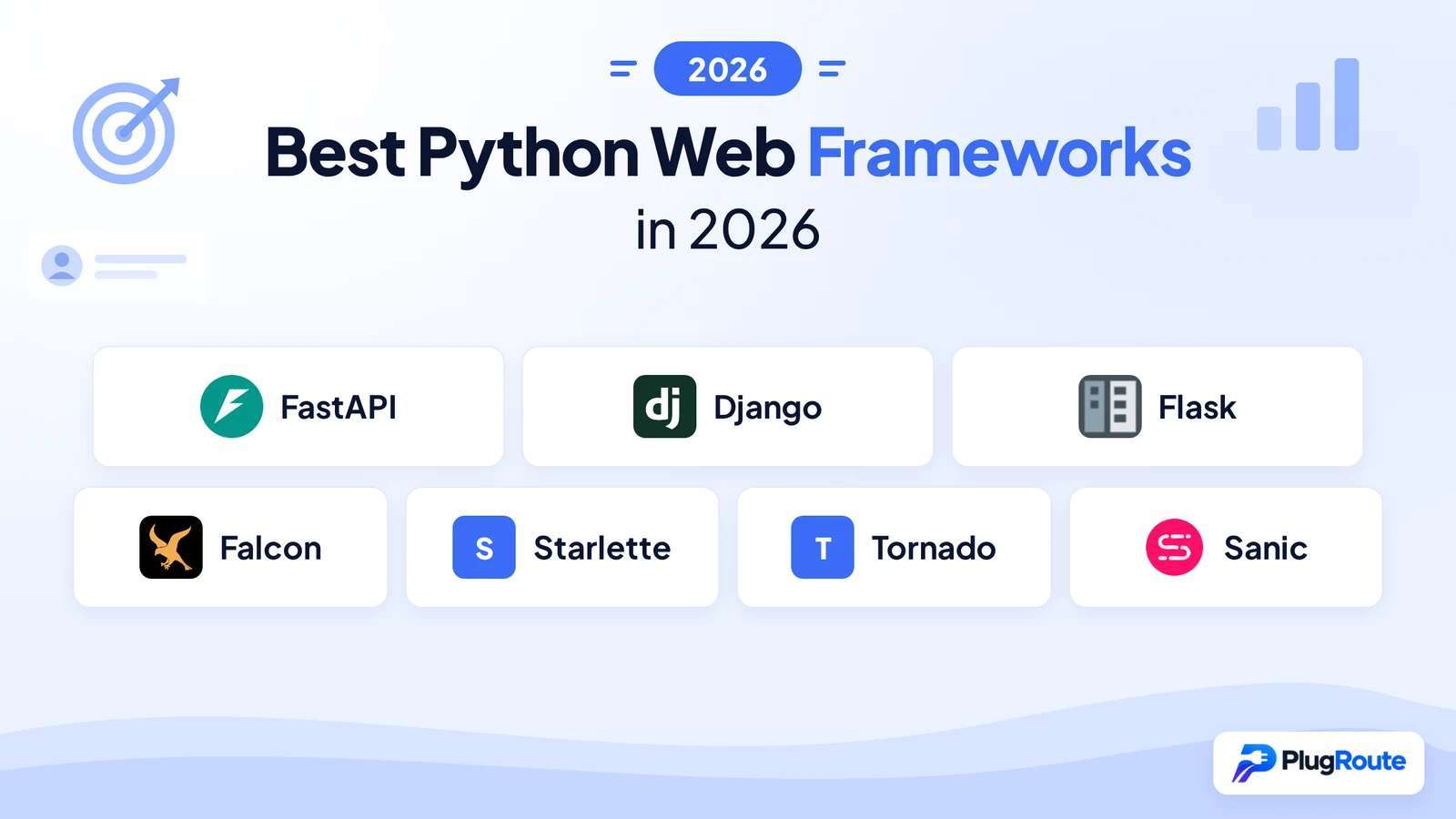
FastAPI leads for REST APIs, ML inference backends, and async microservices; Django is the top choice for full-stack applications and multi-developer enterprise teams; Flask is best for beginners and prototyping. The right choice depends on project type, team async experience, and long-term governance requirements, and four additional production-deployed frameworks that most comparisons overlook are ranked and evaluated here.
Most framework comparisons stop at three options and systematically miss a full production tier: Falcon (validated at OpenStack and Rackspace), Starlette (FastAPI’s own ASGI foundation, now at stable 1.0.0), Tornado (17 years of real-time production maturity), and Sanic. This guide ranks all seven using JetBrains 2025 survey data, official named production adopters, and documented community evidence against six identical criteria.
PlugRoute has no affiliate relationships with any company listed. Rankings are determined entirely by research data and objective evaluation criteria.
“Django is very opinionated. There is exactly 1 way how to do things right. That is so much better for teams with multiple devs, to review, understand and expand other team member’s code faster.” (u/DadAndDominant, r/Python)
Takeaway: Django’s opinionated structure is valued by experienced multi-developer teams specifically because it reduces architecture inconsistency, a benefit microframeworks cannot provide by design.
TL;DR: Top Picks at a Glance
- FastAPI is the top-ranked Python framework for REST APIs and ML backends, leading the JetBrains 2025 survey at 38% adoption with automatic OpenAPI documentation generation.
- Django is the recommended choice for full-stack applications and enterprise teams, backed by the Django Software Foundation non-profit and validated at Instagram scale.
- Flask is the most beginner-accessible Python framework for lightweight synchronous projects where debuggability and minimal setup outweigh async performance needs.
- Falcon is the specialist pick for infrastructure-grade REST APIs where per-request overhead is measurable, validated at OpenStack, Rackspace, and LinkedIn.
This framework decision mirrors the most upvoted community guidance on r/Python:
“Choose FastAPI if you need high performance, modern Python features, and easy automatic documentation. Choose Django if you want a comprehensive framework with lots of built-in features, a strong emphasis on security, and a large community. Choose Flask if you prefer simplicity and flexibility, and are comfortable setting up additional features as needed.” Posted by u/durden67
Takeaway: The r/Python community’s most-upvoted framework guidance (304 upvotes) maps identically to this guide’s top-three rankings, confirming that FastAPI, Django, and Flask each occupy distinct, non-overlapping positions rather than directly competing for the same use cases.
What Are the 3 Architectural Categories of Python Web Frameworks?
The seven frameworks reviewed here divide into three architectural categories based on concurrency model and feature scope: full-stack frameworks (Django), API-focused frameworks (FastAPI and Falcon), and micro and async frameworks (Flask, Starlette, Tornado, and Sanic). Identifying which category fits a project eliminates most selection complexity before comparing individual features.
Full-Stack Frameworks provide batteries-included functionality: built-in ORM, admin panel, authentication, and templating. Django is the only full-stack framework in this comparison.
API-Focused Frameworks are purpose-built for REST APIs and microservices:
- FastAPI targets async typed API development with automatic OpenAPI documentation generation
- Falcon targets bare-metal REST performance with the lowest per-request overhead for infrastructure-grade services
Micro and Async Frameworks cover a spectrum of needs:
- Flask: synchronous minimalism with maximum developer control over every component
- Starlette: pure ASGI building block for custom async architectures and FastAPI’s own foundation
- Tornado: event-loop concurrency purpose-built for long-lived connection workloads
- Sanic: asyncio-native high-throughput microservice framework with a built-in HTTP server
How Do the Top 7 Python Web Frameworks Compare at a Glance?
The seven frameworks span three architectural categories with FastAPI leading at 38% developer adoption per JetBrains 2025, Django second at 35%, and Flask third at 34%. The four secondary frameworks are absent from major developer surveys but validated in production at OpenStack and Rackspace (Falcon), as FastAPI’s own ASGI foundation at stable 1.0.0 (Starlette), and for specialized real-time and high-throughput workloads (Tornado and Sanic). GitHub star counts are verified June 2026.
| Rank | Company | Category | Best For | One-Line Summary | Key Capabilities | Primary Strength | Key Limitation |
|---|---|---|---|---|---|---|---|
| 1 | FastAPI | API Framework | REST APIs, ML backends, async microservices | FastAPI is the fastest-growing Python web framework at 38% adoption (JetBrains 2025), built for async REST APIs with automatic OpenAPI documentation. | ASGI-native async, Pydantic v2 validation, auto-generated OpenAPI docs, dependency injection, ~70k GitHub stars | Auto-generated OpenAPI documentation from Python type hints eliminates manual API documentation entirely | Async-first architecture requires team-wide async literacy; no built-in ORM or admin panel |
| 2 | Django | Full-Stack Framework | Full-stack apps, enterprise teams, admin-heavy platforms | Django is a batteries-included Python framework at 35% adoption (JetBrains 2025), maintained by the DSF non-profit, and the foundation of Instagram’s engineering from founding. | Built-in ORM, admin panel, authentication, ASGI/WSGI support, DRF at 49% Django-developer adoption, ~80k GitHub stars | Built-in ORM, admin, auth, and security defaults with zero third-party assembly | Incomplete async ORM; heavier deployment footprint than needed for pure API use cases |
| 3 | Flask | Micro Framework | Beginners, prototyping, synchronous hybrid apps | Flask is a lightweight Python WSGI framework at 34% adoption (JetBrains 2025), with the lowest entry barrier of any framework reviewed here. | Minimal routing core, Jinja2 templating, extension ecosystem, synchronous WSGI architecture, ~71.5k GitHub stars | Minimal core enables a working endpoint in under 10 lines of Python | Extension fragmentation creates maintenance debt as applications scale; no native async support |
| 4 | Falcon | REST Framework | Mission-critical REST APIs, infrastructure services | Falcon is a minimalist Python REST framework validated in production by OpenStack, Rackspace, LinkedIn, and PayPal, optimized for the lowest per-request overhead. | Resource-class routing, WSGI and ASGI dual-mode, request hooks, middleware, WebSocket in ASGI mode, ~9.5k GitHub stars | Lowest per-request framework overhead with the most extensively documented named production adopters of any framework ranked 4–7 | Steep resource-class learning curve; smaller ecosystem than top three |
| 5 | Starlette | ASGI Toolkit | Custom async frameworks, middleware-heavy microservices | Starlette is a lightweight ASGI Python toolkit at stable 1.0.0 (March 2026) and the direct ASGI foundation underlying FastAPI. | ASGI routing, middleware, WebSocket, background tasks, TestClient, stable 1.0.0 API, ~10k GitHub stars | Purest ASGI control with stable 1.0.0 API and FastAPI’s own architectural foundation layer | Too low-level for standard API development; most teams benefit more from FastAPI directly |
| 6 | Tornado | Async Networking Framework | WebSocket apps, real-time push, long-polling services | Tornado is a Python async framework open-sourced by Facebook in 2009, purpose-built for tens of thousands of simultaneous open connections. | Non-blocking event-loop I/O, native WebSocket, asyncio integration, built-in i18n support, ~22k GitHub stars | 17-year event-loop concurrency maturity for persistent per-user connection workloads | Pre-asyncio API design feels dated to modern Python developers; general-purpose ecosystem aging per 2025–2026 sources |
| 7 | Sanic | Async Web Framework | High-throughput microservices, Flask-to-async migrations | Sanic is an async Python framework with a built-in HTTP server for high-throughput microservices, carrying the highest governance risk in this comparison. | asyncio-native design, built-in HTTP server, blueprint routing, signals system, Flask-inspired routing API, ~9.5k GitHub stars | Built-in HTTP server eliminates the separate ASGI process manager required by every other async framework here | Community governance following original creator departure; smallest ecosystem and no documented enterprise production adopters |
Which Python Web Framework Should I Choose for My Use Case?
The right Python web framework depends on three primary questions: whether the project is a REST API or a complete web application, whether the team has async Python production experience, and whether built-in admin or ORM features are required. FastAPI is the evidence-based default for APIs and ML backends in 2026. Django is the default for full-stack applications with admin requirements. The table below maps primary project requirements to the best-fit framework and an acceptable alternative.
| Your Primary Need | Recommended Framework | Why | Acceptable Alternative |
|---|---|---|---|
| REST API or ML inference backend | FastAPI | Auto-docs, Pydantic validation, ASGI async, +9pp JetBrains 2025 growth | Falcon (if per-request throughput is the measurable top priority) |
| Full-stack app with admin panel | Django | Built-in ORM, admin, auth, DSF non-profit governance, 75% latest-version adoption | Flask + extensions (if architectural freedom is essential) |
| Beginner or rapid prototyping | Flask | Lowest entry barrier, linear stack traces, 15-year ecosystem depth | Django (if the project is expected to grow substantially) |
| Infrastructure-grade REST API | Falcon | Documented at OpenStack, Rackspace, LinkedIn, and PayPal; lowest per-request overhead | FastAPI (larger ecosystem, slightly higher overhead) |
| WebSocket or real-time push | Tornado | Purpose-built for tens of thousands of open connections; 17-year maturity | FastAPI with WebSocket (larger community, less specialized) |
| ASGI framework or middleware building | Starlette | Direct ASGI primitives; stable 1.0.0 API (March 2026); FastAPI’s own foundation layer | FastAPI (if abstraction overhead is acceptable) |
| High-throughput async, no Pydantic overhead | Sanic | asyncio-native, built-in HTTP server, Flask-inspired routing | FastAPI (superior ecosystem and governance; assess Pydantic overhead against actual workload before choosing Sanic) |
Tiebreaker rule: If two frameworks appear equally matched for your use case, choose the one with stronger governance: DSF non-profit (Django) > Pallets organization (Flask) > encode organization (Starlette) > single-creator (FastAPI) > community-governed (Sanic). Accept higher governance risk only when the technical capability specifically justifies it.
1. FastAPI: Best Overall for REST APIs, ML Backends, and Async Microservices
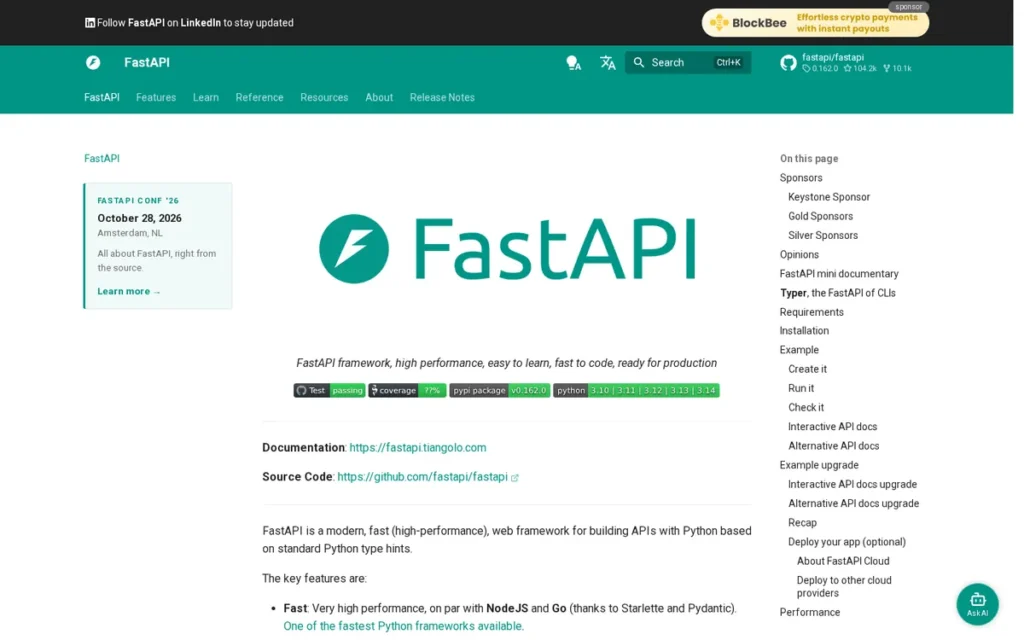
Category: API Framework, async-first Python framework for building typed REST APIs with automatic OpenAPI documentation generation, Pydantic v2 validation, and ASGI-native concurrency.
At a Glance
- Category: API Framework
- Best For: REST APIs, ML inference endpoints, async microservices, typed Python codebases
- Price Range: Free (open-source, MIT license)
- Primary Strength: FastAPI auto-generates interactive OpenAPI documentation from Python type hints, eliminating manual API documentation entirely while enforcing request and response schemas at runtime
- Biggest Limitation: FastAPI’s async-first architecture requires team-wide async Python literacy, mixing synchronous operations inside async endpoint handlers introduces performance regressions that do not surface as obvious errors
- One-Line Summary: FastAPI is the fastest-growing Python web framework per JetBrains 2025 at 38% adoption and is the de facto standard for REST APIs, ML inference backends, and async microservices.
- Last Verified: June 2026
Overview
FastAPI is an async-first Python web framework built for high-performance REST API development, used by 38% of Python developers surveyed by JetBrains in 2025, making FastAPI the most-adopted Python API framework and the default choice for teams building ML inference endpoints, microservices, and type-safe backend services that require automatic documentation and runtime schema validation.
FastAPI combines Starlette’s ASGI web layer with Pydantic v2’s data validation engine, adding automatic OpenAPI documentation generated directly from Python function signatures and type annotations. FastAPI is intentionally narrow in scope: FastAPI does not include a built-in ORM, admin panel, or authentication system, so teams migrating from batteries-included frameworks must assemble those components from third-party libraries such as SQLAlchemy, Alembic, and python-jose.
Key Features
- Automatic OpenAPI Documentation: FastAPI generates interactive Swagger UI and ReDoc documentation automatically from Python function signatures and type annotations, requiring zero separate documentation effort and eliminating API contract misunderstandings between frontend and backend teams.
- Pydantic v2 Native Validation: FastAPI integrates Pydantic v2 as its native data validation layer, enforcing request and response schemas at runtime with Python type hints while providing full editor autocomplete and inline error detection.
- ASGI-Native Async Architecture: FastAPI is built on Starlette’s ASGI foundation, enabling native async/await support for concurrent I/O-bound operations without thread-based scaling overhead.
- Built-In Dependency Injection: FastAPI includes a dependency injection system that manages shared resources (database connections, authentication tokens, and configuration) across route handlers without relying on global state.
- WebSocket and Background Task Support: FastAPI natively supports WebSockets, background tasks, and server-sent events alongside conventional HTTP endpoints within a single application.
Best For
FastAPI is best for backend engineers building REST APIs, ML model inference endpoints, or microservices who write modern Python with type hints and need production-ready documentation, schema validation, and async concurrency. FastAPI is also the established standard for AI and LLM backend services, given its Pydantic-enforced schema contracts, async request handling, and documented adoption at organizations including Hugging Face.
Pricing
FastAPI is free and open-source under the MIT license (verified June 2026). FastAPI has no paid tiers, enterprise licensing fees, or official commercial support offerings. Infrastructure costs are determined entirely by the team’s deployment environment.
Strengths
- JetBrains’ 2025 Python Developer Survey identified FastAPI as the survey’s “biggest winner” with 38% adoption and +9 percentage points of year-over-year growth, the largest single-year gain of any Python web framework tracked, reflecting the structural shift toward API-first development and the rise of ML model serving as a primary Python use case.
- Uvik’s 2026 Python Ecosystem Scorecard credits FastAPI’s automatic OpenAPI documentation (producing both Swagger UI and ReDoc interfaces from Python type hints) as the reason FastAPI “overtook Flask as the leading Python API framework,” eliminating the manual documentation maintenance that previously slowed API development cycles.
- FastAPI’s ASGI-native async architecture enables high-concurrency handling of I/O-bound workloads without thread-based scaling, making FastAPI architecturally well-suited for ML inference endpoints where response times are variable and concurrent request queues are common.
- Engineers at Netflix, Microsoft, Uber, and Hugging Face are quoted on FastAPI’s official documentation page describing team-level production deployments, including Netflix’s Dispatch crisis management framework, Microsoft ML services for Windows and Office products, and Uber’s Ludwig prediction serving endpoint (verified June 2026).
Limitations
- Async Literacy Requirement: FastAPI’s most consequential tradeoff is that its async-first architecture requires team-wide async Python competency, developers who mix synchronous blocking operations such as synchronous SQLAlchemy calls inside async endpoint handlers introduce performance regressions that do not surface as obvious errors.
“Or a massive footgun if you’re not working with people who actually have a solid grasp of async. Also seen folks using sync sqlalchemy in async endpoints lmao.” (u/Trick_Brain7050, r/Python)
Takeaway: Async Python competency must be validated across the entire team before FastAPI adoption, one developer mixing synchronous operations in async handlers can silently degrade the performance benefits the framework was chosen to provide.
- No Built-In Stack: FastAPI lacks a built-in ORM, admin panel, authentication system, and migrations layer, teams migrating from Django must assemble FastAPI’s missing components from SQLAlchemy (database ORM), Alembic (schema migrations), python-jose (JWT authentication), and a third-party admin dashboard, creating meaningful integration overhead not present in batteries-included frameworks.
- Single-Creator Governance: FastAPI was created and is primarily maintained by Sebastián Ramírez as a single-creator open-source project, raising long-term governance questions compared to foundation-backed Django (DSF 501(c)(3)) or organization-backed Flask and Starlette, a governance risk that every team adopting FastAPI should explicitly evaluate before committing.
This risk is documented concretely by active contributors on r/FastAPI:
“I’ve got a PR open on FastAPI for three years now. It’s just code removal and speed boost, and it’s already reviewed by a few people but still stalled. So yeah, I tend to agree with your senior engineers. Huge props to Sebastian for what he has brought to the Python ecosystem in general, but I wouldn’t choose FastAPI for my next projects unless he changes the way he works. I understand that solo-maintaining brings stability and (somehow) quality, which are important to some and probably part of FastAPI success, but that’s not what matters to me in the open source world.” Posted by u/ramnes
Takeaway: FastAPI’s single-maintainer structure produces demonstrable PR review bottlenecks, not a theoretical governance concern but a concrete process limitation that affects community contributions with broad technical approval.
Verdict
FastAPI is the highest-adoption, fastest-growing Python web framework as of the JetBrains 2025 survey and the default choice for teams building REST APIs, ML inference backends, and async microservices with Python type hints. FastAPI’s combination of automatic OpenAPI documentation, Pydantic v2 validation, and ASGI-native concurrency produces a developer experience unmatched in this comparison for teams prioritizing documentation automation and type-safe API development, though Falcon outperforms FastAPI on raw per-request throughput for REST workloads where validation overhead is a documented bottleneck. Teams must budget for async literacy onboarding before adopting FastAPI, the performance and productivity benefits only materialize when async patterns are applied correctly throughout the entire request path, including database and third-party service calls.
2. Django: Best for Full-Stack Web Applications and Multi-Developer Enterprise Teams
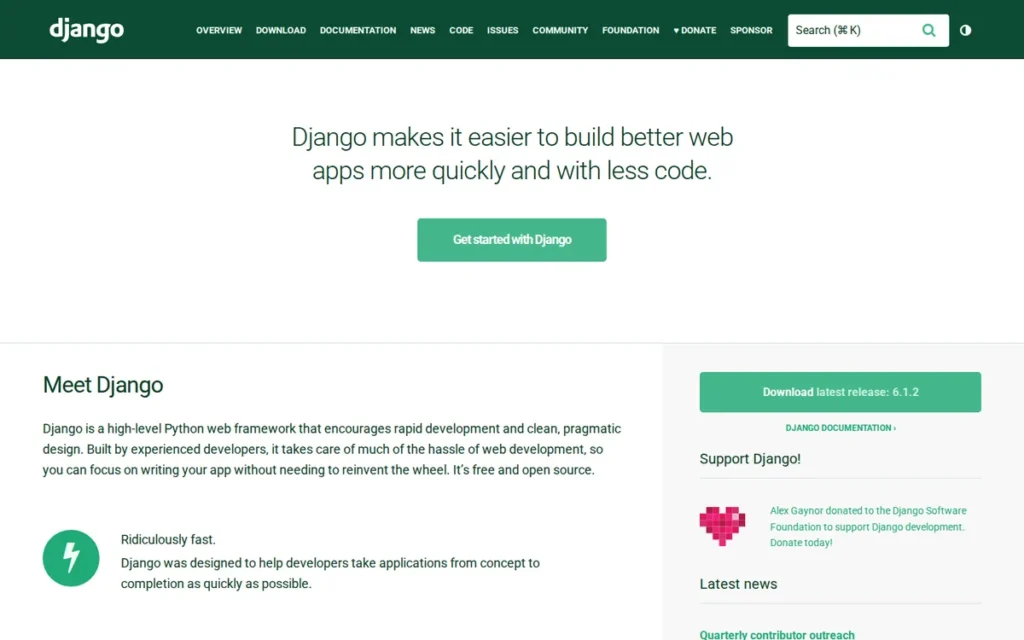
Category: Full-Stack Framework, batteries-included Python web framework providing a built-in ORM, admin panel, authentication system, and templating engine for complete web application development without third-party assembly.
At a Glance
- Category: Full-Stack Framework
- Best For: Data-driven web apps, multi-developer teams, content management systems, admin-heavy enterprise platforms
- Price Range: Free (open-source, BSD license)
- Primary Strength: Django ships a production-ready admin panel, ORM, authentication system, and security defaults with no third-party assembly required
- Biggest Limitation: ORM async support is incomplete: end-to-end async database queries require third-party workarounds, making async Django architectures structurally complex compared to ASGI-native frameworks
- One-Line Summary: Django is a batteries-included Python full-stack framework used by 35% of developers per JetBrains 2025, maintained by the Django Software Foundation non-profit, and cited as the foundation of Instagram’s engineering from founding through its growth to 2B+ monthly active users.
- Last Verified: June 2026
Overview
Django is a batteries-included Python full-stack web framework originally released in 2008, maintained by the Django Software Foundation (a U.S. 501(c)(3) non-profit), and used by 35% of Python developers surveyed by JetBrains in 2025, making Django the dominant choice for teams building data-driven web applications, content management systems, and enterprise platforms that require a built-in ORM, admin panel, and security defaults without manual assembly.
Django’s opinionated “rapid development and clean, pragmatic design” philosophy produces a structured codebase that enforces consistency across multi-developer teams and lowers engineer onboarding cost. Django supports ASGI deployment and async views, but its ORM defaults to synchronous execution with only partial async support as of 2025–2026, creating architectural complexity for teams requiring end-to-end async database operations.
Key Features
- Built-In ORM with Migrations: Django’s ORM provides a high-level Python API for database interactions with built-in schema migrations, supporting PostgreSQL, MySQL, SQLite, and Oracle without writing raw SQL or managing migrations manually.
- Auto-Generated Admin Panel: Django’s admin panel is automatically generated from data model definitions, providing a production-ready data management interface for content-heavy applications and internal tooling without any separate configuration.
- Authentication and Authorization System: Django includes a built-in authentication system covering user accounts, groups, permissions, password hashing, and session management with security best practices applied by default.
- ASGI and WSGI Dual Deployment: Django supports ASGI deployment alongside traditional WSGI mode, enabling async views and middleware, though ORM operations default to synchronous execution with partial async support as of 2025–2026.
- Django REST Framework (DRF): DRF, adopted by 49% of Django developers per the JetBrains 2025 survey, extends Django with serializers, viewsets, routers, and a browsable API interface for REST API development on top of Django’s existing architecture.
Best For
Django is best for backend leads and engineering teams building complete web applications with relational data models, user management requirements, and admin interfaces, including e-commerce platforms, content management systems, SaaS dashboards, and internal enterprise tools where structured multi-developer codebases, built-in security defaults, and batteries-included productivity reduce both development time and long-term maintenance overhead.
Pricing
Django is free and open-source under the BSD license (verified June 2026). Django has no paid tiers, enterprise licensing fees, or commercial support products from the Django Software Foundation. Enterprise-level professional support is available through third-party Django consultancies.
Strengths
- Instagram (which has grown to 2B+ monthly active users) was built on Django from its founding and publicly described its deployment as the world’s largest Django deployment, with the engineering team progressively extending Django’s internals to support scale growth while maintaining Django as a foundational component [Source: Instagram Engineering Blog; multiple independent industry analyses, 2017–2025].
- The Django Software Foundation (DSF), a U.S. 501(c)(3) non-profit, provides institutional governance with no single corporate sponsor dependency, an 8-month feature release cadence, and an active GSoC 2026 admin UI modernization project confirming active investment in core components rather than maintenance-only status.
- JetBrains’ 2025 State of Django survey found that 75% of Django developers were on the latest framework version, the highest latest-version adoption rate documented for any framework in this comparison, signaling community confidence in the upgrade path and low technical debt risk.
- Django’s opinionated “one right way” architecture, documented by r/Python contributor u/DadAndDominant, measurably reduces code review friction and architecture inconsistency in multi-developer teams, a structural advantage over microframeworks that require teams to establish their own conventions from scratch.
This speed-to-productivity advantage is validated by developers experienced across all three top frameworks on r/Python:
“I know all three of these and if i had to stand up a full stack app tomorrow I’d just use Django to get it done quick. At this point in the game I’m only using Flask when a project already leveraged it, but not for anything new. FastAPI for pure API, Django for doing a full fledged app. You’ll probably be learning the ORMs alongside both. That’ll probably be SQLAlchemy for FastAPI/Flask, and will be Django’s ORM. I find Django to be easier. But that’s probably because i learned it first” Posted by u/i_dont_wanna_sign_in
Takeaway: Developers fluent in all three major frameworks default to Django when deadline pressure demands immediate productivity, its built-in ORM, admin, and authentication system shorten time-to-working-application more reliably than assembled FastAPI or Flask stacks.
Limitations
- Incomplete Async ORM: Django’s most consequential tradeoff is its incomplete async ORM, while Django supports ASGI deployment and async views, database queries default to synchronous execution because ORM async support remains partial as of 2025–2026.
“I tried to develop a project on Django in async mode. It’s a mess. And all DB interactions are delegated to a single thread in that mode cause they can’t make the ORM async. Stay away.” (r/Python)
Takeaway: Django’s ASGI deployment support does not resolve the ORM’s synchronous execution default, teams building async Django applications must route all database calls through a single synchronous thread or adopt a third-party async ORM solution such as Tortoise ORM.
- Architectural Overhead for Simple APIs: Django’s batteries-included architecture becomes overhead for projects needing only a simple JSON REST API, Django’s full framework footprint is architecturally heavier than every other framework in this comparison, making it a poor fit for microservice deployments where cold-start time and resource consumption are constrained.
- Deployment Footprint in Containerized Environments: Django’s deployment footprint (ORM, templating engine, admin panel, ASGI compatibility layer, and built-in middleware stack) produces larger container images and slower cold-start times than lightweight alternatives, creating measurable operational costs when Django is deployed in microservice or serverless architectures beyond its intended full-stack scope.
Verdict
Django is the most institutionally stable Python web framework in this comparison and the default choice for teams building complete web applications with relational data models, admin requirements, and multi-developer codebases. Django’s DSF non-profit governance, the highest-scale Django production deployment on record at Instagram, and 35% developer adoption per the JetBrains 2025 survey provide the strongest longevity signals of any framework evaluated here. Teams building async-first API services should explicitly account for Django’s incomplete ORM async support before committing, the limitation is architecturally consequential for database-heavy concurrent workloads and is not resolved by ASGI deployment alone.
3. Flask: Best for Beginners, Prototyping, and Teams Prioritizing Synchronous Simplicity
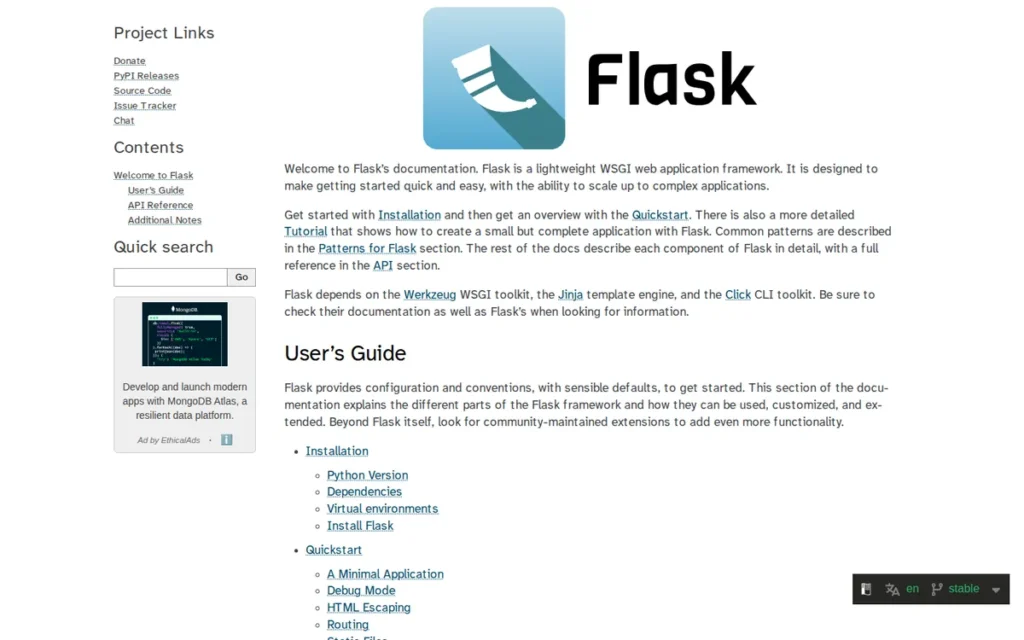
Category: Micro Framework, lightweight synchronous WSGI Python microframework providing minimal core routing and request handling with full developer control over all other components.
At a Glance
- Category: Micro Framework
- Best For: Beginners, rapid prototyping, small-to-medium hybrid apps, synchronous simplicity
- Price Range: Free (open-source, BSD license)
- Primary Strength: Flask’s minimal core enables the fastest path from zero to a working web application of any Python framework in this comparison
- Biggest Limitation: Extension-assembly model creates growing maintenance debt as applications scale; outdated tutorials reference unmaintained packages that create real integration friction
- One-Line Summary: Flask is a lightweight Python microframework used by 34% of developers per JetBrains 2025, best suited for beginners, rapid prototyping, and small-to-medium applications where synchronous simplicity and developer control outweigh async performance needs.
- Last Verified: June 2026
Overview
Flask is a lightweight WSGI Python web microframework built on Werkzeug and Jinja2, originally released in 2010, maintained by the Pallets organization, and used by 34% of Python developers surveyed by JetBrains in 2025, retaining a large installed base across 15+ years as the most beginner-accessible and architecturally unopinionated Python web framework.
Flask provides a routing engine and request-handling layer and deliberately leaves all other components (database, authentication, validation, API documentation) to the developer’s choice of third-party extensions. Flask’s WSGI-centric design does not support async-native concurrency, making Flask architecturally unsuitable for high-concurrency I/O-bound workloads without significant middleware additions.
Key Features
- Minimal Routing Core: Flask provides a decorator-based URL routing API built on Werkzeug that makes a working web endpoint achievable in under 10 lines of Python, the lowest entry point of any framework in this comparison.
- Jinja2 Templating Engine: Flask’s Jinja2 integration supports server-side HTML rendering with template inheritance, macros, and filters for traditional multi-page web applications alongside API endpoints.
- Extension-Based Architecture: Flask’s ecosystem: including Flask-SQLAlchemy, Flask-Login, Flask-Migrate, and Flask-RESTful, allows teams to assemble custom application stacks from purpose-built components rather than inheriting framework-imposed architectural choices.
- Active Pallets Maintenance: Flask 3.x supports modern Python versions with active maintenance by the Pallets organization, which also governs Werkzeug, Jinja2, and Click under the same collaborative community governance model.
- Synchronous Debuggability: Flask’s synchronous WSGI architecture produces straightforward, linear stack traces that are easier to debug than async framework exceptions, a practical advantage documented by developers who have switched back from FastAPI specifically for stack trace transparency.
Best For
Flask is best for beginner developers learning Python web development, engineering teams rapidly prototyping ideas before committing to a production architecture, and developers building small-to-medium hybrid applications that need server-side rendering alongside lightweight API endpoints. Flask is also the pragmatic choice for teams that have experienced async debugging overhead in production and actively prioritize synchronous code clarity and stack trace transparency.
Pricing
Flask is free and open-source under the BSD license (verified June 2026). The full Flask extension ecosystem (Flask-SQLAlchemy, Flask-RESTful, Flask-Login, Flask-Migrate) is similarly open-source with no commercial licensing requirements. Total cost of ownership includes developer time spent assembling and maintaining third-party extensions.
Strengths
- Flask’s GitHub repository (pallets/flask) has approximately 71,500 stars and 733 contributors per GitHub (verified June 2026), representing 15 years of community investment that produces the deepest library of existing tutorials, Stack Overflow answers, and reference implementations for synchronous Python web development.
- Flask’s Pallets organization governance: also responsible for Werkzeug, Jinja2, and Click, provides collaborative community maintenance without corporate sponsor dependency, reducing single-entity abandonment risk while preserving the project’s open-source independence.
- Flask’s synchronous WSGI architecture produces readable stack traces during debugging, documented by r/Python contributor u/hulleyrob who described switching back from FastAPI to Flask because a debugging problem was “5 minutes later all sorted” versus extended async debugging sessions.
- Flask’s unopinionated architecture makes it the most flexible Python web framework for custom technology stacks, Flask can be paired with any ORM, authentication library, or frontend approach without any framework-imposed constraints.
Limitations
- Extension Fragmentation at Scale: Flask’s “bring your own everything” design means teams must vet, integrate, and maintain a custom assembly of third-party extensions, many of which reference outdated patterns or are no longer actively maintained, a risk that grows proportionally with application complexity.
“Coming from a flask die hard fan, learn Django or FastAPI first. Flask is great for smaller projects but it’s been around for so long that there is endless unsupported libraries that are mentioned in tutorials and it all gets very confusing once your app grows beyond a certain size.” (u/vantasmer, r/Python)
Takeaway: Flask’s long history creates a tutorial ecosystem problem, older content references extensions that may be abandoned, and developers following those tutorials inherit unmaintained dependencies that become visible only as the application grows.
- No Native Async Support: Flask’s WSGI foundation makes high-concurrency I/O-bound performance architecturally challenging without process-level scaling or addons, putting Flask at a structural disadvantage compared to FastAPI, Starlette, Sanic, and Tornado for any project where concurrent request handling is a primary performance requirement.
- No Built-In Security Guardrails: Flask leaves security implementation entirely to the developer and their chosen extension assembly, unlike Django, which enforces CSRF protection, XSS escaping, and SQL injection prevention by default. Misconfiguration of security-sensitive extensions such as Flask-Login is a documented failure mode for teams without prior experience implementing security layers independently of the framework.
Verdict
Flask is the most beginner-accessible Python web framework and remains a legitimate production choice for small-to-medium applications where synchronous simplicity, developer control, and ecosystem depth outweigh the need for built-in async support or batteries-included features. Flask’s 34% JetBrains 2025 adoption confirms a large, stable installed base despite near-flat year-over-year growth. Teams building greenfield high-concurrency APIs or applications expected to grow substantially in complexity should evaluate FastAPI or Django before Flask, the extension fragmentation risk is well-documented and grows proportionally with application size.
4. Falcon: Best for Mission-Critical REST APIs and Infrastructure-Grade Services
Category: REST Framework, minimalist bare-metal Python framework designed for mission-critical REST APIs and microservices with the lowest possible per-request framework overhead and explicit HTTP control.
At a Glance
- Category: REST Framework
- Best For: Mission-critical REST APIs, infrastructure-grade platform services, teams where per-request latency is measurable
- Price Range: Free (open-source, Apache 2.0 license)
- Primary Strength: Falcon is designed for the lowest per-request framework overhead of any Python REST framework, validated in production by OpenStack, Rackspace, LinkedIn, and PayPal
- Biggest Limitation: Resource-class routing pattern has a steeper learning curve than function-based routing; smaller ecosystem than the top three frameworks
- One-Line Summary: Falcon is a minimalist Python REST framework validated in production by OpenStack, Rackspace, LinkedIn, and PayPal, designed for teams where per-request framework overhead is measurable and REST API code explicitness is a structural requirement.
- Last Verified: June 2026
Overview
Falcon is a minimalist Python REST API framework maintained by the falconry open-source organization, designed for mission-critical REST services and microservices where per-request framework overhead is measurable and explicit HTTP control is a code quality requirement. Falcon’s official “Who’s Using Falcon?” documentation page names OpenStack, Rackspace, LinkedIn, PayPal, EMC, Hurricane Electric, and Cronitor as organizations running Falcon in production, the most extensively documented named-adopter list of any framework outside the top three.
Falcon uses a resource-class routing architecture where REST endpoints are implemented as Python classes with responder methods (on_get, on_post, on_put, on_delete) rather than function-based decorators. Falcon supports both WSGI and ASGI deployment modes with native WebSocket support in ASGI mode.
Key Features
- Resource-Class Routing Architecture: Falcon maps HTTP resources to Python classes with responder methods, producing REST codebases where every endpoint’s behavior is explicitly visible without implicit framework decoration or hidden behaviors.
- WSGI and ASGI Dual-Mode Support: Falcon supports both synchronous WSGI and async ASGI deployment modes, allowing teams to deploy synchronously on existing infrastructure while maintaining a documented migration path to async.
- Request Hooks and Middleware: Falcon includes request hooks and middleware components for cross-cutting concerns (authentication, logging, rate limiting) that operate at the framework layer without tight coupling to application logic.
- Self-Documented Performance Benchmarks: Falcon’s official documentation self-reports lower per-request overhead than Django and Flask for REST API workloads, with the honest caveat that benchmarks measure “baseline overhead” rather than comprehensive application performance; no independent TechEmpower Round data was verified for this publication cycle.
- WebSocket and Testing Utilities: Falcon includes WebSocket support in ASGI mode and provides testing helpers and WSGI/ASGI mocking utilities for unit-testing API routes without a running live server.
Best For
Falcon is best for senior engineers building infrastructure-grade REST APIs or microservices at organizations where per-request latency is measurable, REST API code explicitness is a quality requirement, and the engineering team is comfortable with a resource-class design pattern. Falcon is particularly well-suited for platform-layer services similar to those where OpenStack and Rackspace have deployed it at infrastructure scale.
Pricing
Falcon is free and open-source under the Apache 2.0 license (verified June 2026). Falcon has no enterprise licensing, commercial support tiers, or official paid offerings. Teams requiring SLA-backed support should engage third-party consulting services.
Strengths
- Falcon’s official “Who’s Using Falcon?” documentation page names OpenStack, Rackspace, LinkedIn, PayPal, EMC, Hurricane Electric, and Cronitor as production users, the most extensive officially documented named-adopter list of any framework in the lower four rankings, validating Falcon specifically for infrastructure-scale REST API deployments.
- Talk Python podcast episode #129 (2017) characterized Falcon as a “bare-metal” Python web framework, a characterization confirmed by r/Python contributor u/bcastronomer, a self-described Flask devotee, who switched to Falcon specifically because “for REST servers 100% falcon. The performance is just in another league entirely.”
- r/Python contributors u/lanshark82 (8 upvotes) and u/expert-at-nothing describe Falcon’s resource-class API as “very, very easy to do REST services” with “a clean API,” indicating that developers who commit to Falcon’s explicit design pattern find it highly productive for pure REST service development.
- Falcon’s dual WSGI and ASGI support provides deployment flexibility not offered by several other frameworks in this comparison, allowing teams to deploy synchronously on existing infrastructure while maintaining a documented path to async improvements without a framework migration.
Limitations
- Smaller Ecosystem: Falcon’s bare-metal philosophy means that capabilities standard in other frameworks (authentication systems, admin panels, rate limiting, and structured WebSocket tooling) require manual implementation or third-party libraries with significantly less community coverage than equivalent Flask or FastAPI solutions.
“I was a real fan of Falcon until I tried to create a websocket. As Flask actually has a very well documented and maintained plugin for that, I had to switch.” (u/antonimmo, r/Python)
Takeaway: Falcon’s WebSocket support exists in ASGI mode, but its documentation and community resources for WebSocket implementations are less mature than Flask’s extension ecosystem, teams adding WebSocket requirements after launch may find Falcon’s community coverage thinner than expected for this specific capability.
- Resource-Class Learning Curve: Falcon’s resource-class routing pattern imposes a steeper initial learning curve than function-based routing frameworks, developers accustomed to Flask or FastAPI decorator patterns must reorient their mental model for REST resource organization before productivity normalizes.
- Low Developer Awareness: Falcon has lower name recognition relative to its technical quality and infrastructure production validation, teams adopting Falcon accept a meaningfully reduced hiring pool and fewer available tutorials and Stack Overflow answers compared to the top three frameworks.
Verdict
Falcon is the best Python framework for mission-critical REST APIs where per-request overhead is measurable and REST API code explicitness is a structural requirement, validated in production by OpenStack, Rackspace, LinkedIn, and PayPal as documented in Falcon’s official adoption list. Falcon is not the right default for most teams, its smaller ecosystem, steeper learning curve, and narrow use-case focus make it a specialist tool rather than a general-purpose framework. Teams at infrastructure organizations building platform-layer services will find Falcon’s performance characteristics and code explicitness difficult to match with any other Python REST framework in this comparison.
5. Starlette: Best for ASGI Infrastructure and Custom Async Framework Building
Category: ASGI Toolkit, lightweight async Python web toolkit providing ASGI routing, middleware, and WebSocket primitives as both a standalone microframework and the infrastructure layer underlying FastAPI.
At a Glance
- Category: ASGI Toolkit
- Best For: Custom async frameworks, middleware-heavy microservices, ASGI tooling, advanced async Python developers
- Price Range: Free (open-source, BSD license)
- Primary Strength: Starlette provides the purest ASGI control available in a structured Python framework, with API stability guaranteed by the stable 1.0.0 release on March 22, 2026
- Biggest Limitation: Too low-level for standard API development: most teams building APIs benefit more from FastAPI’s Pydantic and OpenAPI layer built directly on top of Starlette
- One-Line Summary: Starlette is a lightweight ASGI Python web toolkit that released its stable 1.0.0 version on March 22, 2026, serving as the direct architectural foundation of FastAPI and as a standalone framework for teams building custom async applications or ASGI-native tooling.
- Last Verified: June 2026
Overview
Starlette is a lightweight ASGI Python web framework and toolkit created by Tom Christie at the encode organization, which also produced Django REST Framework, first released in June 2018 and serving as the direct ASGI foundation layer underlying FastAPI: every FastAPI application is, at the routing and request-handling layer, a Starlette application. This means every team running FastAPI in production is implicitly running Starlette, and can drop to Starlette’s lower abstraction layer for custom middleware or framework-building without changing their async web primitive stack.
Starlette released its stable 1.0.0 version on March 22, 2026 as documented by Simon Willison (simonwillison.net, March 22, 2026), completing the API stability commitment that SemVer versioning will be applied strictly from this point forward. Starlette provides async routing, middleware, WebSocket support, background tasks, and session management without the Pydantic validation layer or OpenAPI documentation generation that FastAPI adds on top.
Key Features
- ASGI Routing and Request Primitives: Starlette provides the complete ASGI routing, request, and response primitive layer that forms the web infrastructure foundation for FastAPI, giving developers direct access to the same async primitives used by the fastest Python API framework in this comparison.
- Native WebSocket and Background Tasks: Starlette includes native WebSocket support, background task scheduling, server-sent events, and startup and shutdown event handlers as built-in capabilities without requiring additional extensions.
- Composable Async Middleware: Starlette’s middleware system supports CORS, sessions, GZip compression, and trusted host validation with a clean async-compatible interface that composes naturally with ASGI application stacks.
- Stable 1.0.0 API: Starlette released its stable 1.0.0 version on March 22, 2026 per Simon Willison’s technical blog, providing an API stability guarantee that reduces breaking-change risk for teams building frameworks or long-running production services on Starlette’s foundation.
- HTTPX-Based Test Client: Starlette includes a TestClient built on HTTPX for testing async endpoints without a running live server, alongside ASGI lifespan event handling for startup and shutdown resource management.
Best For
Starlette is best for advanced Python developers building custom ASGI frameworks, middleware-heavy microservice architectures, or platform-layer tooling that requires direct control over async request handling without Pydantic validation overhead. Starlette is also appropriate for teams who understand FastAPI’s internals and need to extend or build around specific layers of its architecture.
Pricing
Starlette is free and open-source under the BSD license (verified June 2026), maintained by Tom Christie at the encode organization. Starlette has no paid tiers, enterprise licensing, or commercial support offerings.
Strengths
- Starlette 1.0.0 reached stable release on March 22, 2026 as documented by Simon Willison, a major API stability milestone confirming that SemVer versioning will be applied strictly from this point forward, reducing breaking-change risk for teams building production services or framework-level tooling on Starlette’s foundation.
- Starlette is maintained by Tom Christie at the encode organization, who also created Django REST Framework, the most widely deployed Django extension at 49% adoption per JetBrains 2025, providing deep REST API design expertise and institutional credibility behind Starlette’s architecture.
- Every FastAPI deployment runs Starlette at its ASGI layer, meaning Starlette has substantially more production exposure than its approximately 10,000 GitHub stars (June 2026) indicate, teams debugging FastAPI applications in production are implicitly working with Starlette’s request and response primitives.
- Starlette’s async architecture and lightweight middleware-composable design produce lower per-request overhead than frameworks that layer validation and documentation generation on top of ASGI primitives, positioning Starlette among the highest-performance Python web foundations for I/O-bound workloads.
Limitations
- Too Low-Level for Standard API Development: Starlette is a lower-level toolkit than every other framework in this comparison, teams choosing Starlette for direct API development accept substantially more boilerplate for request validation, response schema enforcement, API documentation, and dependency management that FastAPI, Django, Flask, and Falcon provide out of the box or through mature extensions.
“There’s no point in learning Starlette when you can just learn FastAPI.” (u/Such-Let974 (13 upvotes), r/Python)
Takeaway: For most developers building applications rather than frameworks, FastAPI’s abstractions on top of Starlette are worth the added layer, Starlette’s standalone value is clearest when those abstractions need to be extended, replaced, or bypassed entirely.
- Small Community for Standalone Use: Starlette’s approximately 10,000 GitHub stars (June 2026) and absence from major developer survey tracking reflect its narrow standalone developer audience, teams adopting Starlette as a primary application framework accept substantially fewer tutorials, Stack Overflow answers, and available contributors than any of the top three frameworks.
- Thin Standalone Documentation: Most Starlette content treats it as the FastAPI dependency layer rather than a primary application framework, developers choosing Starlette directly encounter far fewer end-to-end tutorials, production architecture examples, and opinionated guidance than FastAPI, Django, or Flask provide as standalone frameworks.
Verdict
Starlette is the correct framework choice for advanced Python developers building ASGI-native tooling, custom framework layers, or middleware-heavy microservices where FastAPI’s Pydantic and OpenAPI overhead is unwanted, and Starlette’s stable 1.0.0 release on March 22, 2026 makes it a credible production choice for this specific audience. For teams building standard REST APIs, Starlette operates at the wrong abstraction level: FastAPI provides everything Starlette offers plus Pydantic validation, OpenAPI documentation, and dependency injection at negligible architectural cost. Teams choosing Starlette directly are explicitly choosing to build the abstraction layer that FastAPI already provides.
6. Tornado: Best for Long-Lived Connection Applications and Real-Time Push Services
Category: Async Networking Framework, async Python web framework and networking library purpose-built for long-lived connection handling including WebSockets, long-polling, and real-time push using a non-blocking event-loop concurrency model.
At a Glance
- Category: Async Networking Framework
- Best For: WebSocket-heavy real-time apps, long-polling notification services, chat systems, live dashboards with persistent connections
- Price Range: Free (open-source, Apache 2.0 license)
- Primary Strength: Tornado’s non-blocking event-loop architecture handles tens of thousands of simultaneous open connections, a concurrency capability purpose-designed for real-time push and WebSocket workloads that is architecturally native rather than added via extension
- Biggest Limitation: Pre-asyncio API design patterns feel dated to modern Python developers; general-purpose ecosystem characterized as aging in multiple 2025–2026 sources
- One-Line Summary: Tornado is a Python async web framework and networking library originally developed at FriendFeed and open-sourced by Facebook in 2009, designed to handle tens of thousands of simultaneous open connections for WebSocket, long-polling, and real-time push applications.
- Last Verified: June 2026
Overview
Tornado is a Python asynchronous web framework and networking library originally developed at FriendFeed and open-sourced by Facebook in 2009, making Tornado the oldest async Python web framework in this comparison and one of the earliest Python frameworks built around non-blocking I/O before Python’s native asyncio module existed. Tornado is architecturally designed for handling tens of thousands of simultaneous open connections, making it the specialized framework for WebSocket-based applications, long-polling services, chat systems, and live dashboards where each user maintains a persistent network connection.
Modern Tornado integrates with Python’s asyncio event loop, though Tornado’s API reflects pre-asyncio design decisions that feel more verbose than frameworks built natively for modern Python async.
Key Features
- Long-Lived Connection Concurrency: Tornado’s non-blocking network I/O and event-loop concurrency model enables handling of tens of thousands of simultaneous open connections, a scalability characteristic architecturally native to Tornado’s design and purpose-built for WebSocket and long-polling workloads with persistent per-user connections.
- Native WebSocket Support: Tornado includes native WebSocket support as a core framework feature, providing both client and server WebSocket implementations without requiring third-party extension assembly.
- asyncio Event Loop Integration: Tornado integrates with Python’s asyncio event loop in modern versions, allowing interoperability with the broader asyncio ecosystem while preserving Tornado’s own async primitives.
- Built-In Internationalization (i18n): Tornado includes built-in i18n support for multilingual web applications, a practical native feature not available built-in in any other framework in this comparison.
- Dual Framework and Networking Toolkit: Tornado provides both web framework components (routing, request handlers, templating) and lower-level networking primitives including async TCP clients, servers, and a DNS resolver, enabling use as both a web application framework and a general async networking toolkit.
Best For
Tornado is best for engineering teams building applications whose primary workload consists of persistent per-user connections, specifically WebSocket-based real-time services, long-polling notification systems, live dashboards, and chat applications. Tornado’s event-loop concurrency model is most valuable when maintaining tens of thousands of simultaneous open connections is more important than REST API ergonomics or batteries-included developer productivity.
Pricing
Tornado is free and open-source under the Apache 2.0 license (verified June 2026). Tornado has no paid tiers, enterprise licensing, or commercial support offerings. Tornado is a community-maintained open-source project.
Strengths
- Tornado was purpose-built at FriendFeed for a real-time social aggregation service and open-sourced by Facebook in 2009, providing 17 years of validated event-loop architecture for high-concurrency connection handling, the longest production track record in this specific use case of any framework in this comparison.
“Tornado, because I like async stuff. For quick’n’dirty rest services flask and bottle are fine.” (u/redchrom, r/Python)
Takeaway: Tornado is valued specifically for its async concurrency model in persistent-connection workloads, developers who have tried multiple frameworks often reach for Tornado precisely for its event-loop architecture, not as a general-purpose async choice.
- Tornado’s non-blocking I/O model handles “tens of thousands of open connections” as documented on Tornado’s official site, a concurrency characteristic architecturally native to Tornado’s design, making Tornado the most battle-tested Python option for applications where persistent connections per user are the primary scaling constraint.
- Tornado’s built-in i18n support for multilingual web applications is a native capability not included in any other framework in this comparison, reducing third-party dependency count for globally deployed applications with localization requirements.
- Tornado’s approximately 22,000 GitHub stars (June 2026): higher than both Falcon (approximately 9,500) and Starlette (approximately 10,000), reflect a broader historical community with more existing documentation, tutorials, and Stack Overflow coverage for real-time Python application development.
Limitations
- Pre-asyncio API Design: Tornado predates Python’s asyncio module and was designed around its own event loop, resulting in API patterns that feel verbose compared to frameworks built natively for modern Python async, developers accustomed to FastAPI or Sanic will find Tornado’s request handler class-based architecture less ergonomic for conventional REST API development.
- Aging General-Purpose Ecosystem: Community analyses including DuaLite Python Framework Picks (2025) and MasteringBackend characterize Tornado’s general-purpose ecosystem as aging and less popular for new projects, a characterization directionally consistent with Tornado’s absence from JetBrains 2025 survey tracking, though no quantified adoption decline data was verified in this research cycle.
- Limited Formal Governance Structure: Tornado’s community-maintained structure lacks formal governance mechanisms (there is no published Tornado roadmap, no formal deprecation policy documentation, and no non-profit organizational backstop if volunteer maintenance declines) adding long-term sustainability uncertainty compared to better-governed alternatives in this comparison.
Verdict
Tornado is the best Python framework for applications where tens of thousands of simultaneous open connections are the primary architectural requirement (specifically WebSocket-heavy real-time services, long-polling notification systems, and live dashboards) validated by 17 years of production deployment from its FriendFeed and Facebook origins. Tornado is rarely the optimal choice for teams building conventional REST APIs or full-stack web applications, where its pre-asyncio API design and aging general-purpose ecosystem create unnecessary friction. Teams selecting Tornado in 2026 should do so specifically for its long-lived connection concurrency model, not as a general-purpose async alternative to FastAPI.
7. Sanic: Best for High-Throughput Async Microservices Without Pydantic Overhead
Category: Async Web Framework, async Python web framework with a built-in HTTP server designed for high-throughput API and microservice development using native asyncio patterns without a required external process manager.
At a Glance
- Category: Async Web Framework
- Best For: High-throughput async microservices, Flask-to-async migrations, teams where Pydantic overhead is a measured bottleneck
- Price Range: Free (open-source, MIT license)
- Primary Strength: Sanic combines asyncio-native design with a built-in HTTP server, eliminating the separate ASGI process manager required by every other async framework in this comparison
- Biggest Limitation: Community governance following the original creators’ departure creates the highest long-term sustainability uncertainty of any framework in this comparison
- One-Line Summary: Sanic is an async Python web framework with a built-in HTTP server designed for high-throughput microservice development, but its community-governed structure following the original creators’ departure represents the highest governance risk in this comparison.
- Last Verified: June 2026
Overview
Sanic is an async Python web framework created in 2016 by Channel Cat and Eli Uriegas with a Flask-inspired API design, built for high-throughput API and microservice development using native Python 3 asyncio patterns. Sanic differentiates from FastAPI and Starlette by including a built-in HTTP server that eliminates the need for a separate Uvicorn or Gunicorn process manager, and from Tornado by its modern asyncio-native design rather than pre-asyncio event-loop patterns.
Sanic transitioned to community governance under the sanic-org GitHub organization after original creators Channel Cat and Eli Uriegas stepped back from active maintenance, creating the highest long-term sustainability uncertainty of any framework in this comparison. Sanic is positioned in developer communities as a FastAPI alternative for teams that find Pydantic’s schema validation overhead undesirable for high-throughput microservice workloads.
Key Features
- Built-In HTTP Server: Sanic includes a built-in HTTP server as a core framework component, teams can run a Sanic application directly without configuring a separate Uvicorn, Gunicorn, or Hypercorn process manager, simplifying deployment for containerized microservices.
- asyncio-Native Design: Sanic is built natively for Python 3 and asyncio from its 2016 founding, producing async route handlers and middleware that feel idiomatic to modern Python async patterns compared to pre-asyncio frameworks.
- Blueprint-Based Modular Routing: Sanic supports blueprints for modular routing, allowing large applications to be organized into logical component groups with separate route namespaces, similar to Flask’s blueprint system but designed for async codebases.
- Signals and Middleware System: Sanic includes a signals system for intra-application event communication, native WebSocket support, middleware for request and response processing, and a plugin ecosystem for extending core functionality.
- Flask-Inspired Routing API: Sanic’s decorator-based routing API inspired by Flask provides a lower conceptual barrier for developers migrating from synchronous Flask applications to async-first development patterns.
Best For
Sanic is best for experienced Python developers building high-throughput async microservices who need FastAPI-style async ergonomics without Pydantic validation overhead, and who can accept a smaller community with fewer pre-built solutions in exchange for built-in HTTP server deployment simplicity. Sanic is most appropriate for technically sophisticated teams who have explicitly validated Pydantic’s overhead as a measured bottleneck before adopting Sanic over FastAPI.
Pricing
Sanic is free and open-source under the MIT license (verified June 2026). Sanic has no paid tiers, enterprise licensing, or commercial support offerings. Sanic is a community-governed open-source project under the sanic-org organization.
Strengths
- Sanic’s built-in HTTP server eliminates a deployment configuration step present in every other async Python framework in this comparison, FastAPI, Starlette, and Tornado all require a separate ASGI or WSGI server process in production, while Sanic can be run directly, reducing operational complexity for containerized microservice deployments.
- Sanic’s asyncio-native Python 3 design produces async route handlers that feel idiomatic to modern Python, avoiding the pre-asyncio event-loop API patterns of Tornado that developers trained on asyncio find more verbose and less ergonomic.
- r/Python community members including u/MeroLegend4 (4 upvotes) and u/pmdevita have cited Sanic alongside FastAPI and Litestar as legitimate async Python frameworks worth gaining experience with, indicating community recognition of Sanic’s technical validity despite smaller absolute adoption numbers.
- Sanic is consistently grouped alongside FastAPI and Starlette in r/Python discussions of high-performance Python web frameworks, reflecting community consensus that Sanic’s async throughput characteristics are in the same performance tier as the other async-first frameworks in this comparison [Source: r/Python, reddit.com/r/Python/comments/1kou6lc, June 2025].
Limitations
- Governance Risk: Sanic’s most consequential tradeoff is its governance structure, Sanic transitioned to community governance under the sanic-org organization after original creators Channel Cat and Eli Uriegas stepped back, creating the highest long-term sustainability uncertainty of any framework in this comparison, materially higher than foundation-backed Django (DSF 501(c)(3)), organization-backed Flask (Pallets) and Starlette (encode), or even single-creator FastAPI.
“Take a look at Litestar or Sanic they are far better than FastAPI.” (u/MeroLegend4 (4 upvotes), r/Python)
Takeaway: This minority view reflects developers who find FastAPI’s Pydantic-first validation overhead undesirable for specific high-throughput workloads, but the community upvote count (4 votes against a thread of predominantly FastAPI-positive sentiment) indicates this perspective represents a small segment of the Python developer community.
- Smallest Ecosystem in This Comparison: Sanic’s community produces fewer tutorials, fewer Stack Overflow answers, fewer pre-built extensions, and fewer hiring candidates familiar with the framework than every other option on this list, DuaLite’s Python framework analysis characterizes Sanic as appropriate for “specialized async/high-throughput niches” specifically, not as a general-purpose recommendation.
- No Documented Enterprise Production Adopters: Sanic has no independently verified enterprise production adopters listed in its official documentation (unlike Falcon (OpenStack, Rackspace, LinkedIn), Django (Instagram, Pinterest), or FastAPI (Netflix, Microsoft, Uber)) meaning teams adopting Sanic at scale accept a higher proof-of-concept burden and fewer published reference architectures than any other alternative in this comparison.
Verdict
Sanic is a technically capable async Python web framework with a built-in HTTP server and a defined niche for high-throughput microservices, but Sanic earns the #7 ranking because its community governance risk following the original creators’ departure, absent enterprise production validation, and the smallest ecosystem in this comparison create the highest total adoption risk of any framework evaluated. Teams evaluating Sanic should explicitly validate that Pydantic’s overhead is a measured bottleneck (not a theoretical concern) before choosing Sanic over FastAPI, which offers superior governance, a substantially larger ecosystem, and comparable async performance for most workloads.
What Red Flags Should I Watch For When Evaluating a Python Web Framework?
Five red flags reliably signal poor framework decisions for Python backend projects: adopting async frameworks without team-wide async literacy, choosing Flask for high-growth API projects, using Django as a simple JSON API server, skipping governance evaluation for community-maintained frameworks, and limiting evaluation to only the three most-discussed options. Identifying these red flags before final selection eliminates the most common and costly Python framework mistakes.
Red Flag #1: Async Without Async Literacy
Adopting FastAPI, Sanic, Starlette, or Tornado without ensuring team-wide async Python production experience is the most common and consequential mistake in Python framework selection. The most frequent failure mode is calling synchronous SQLAlchemy inside an async endpoint, the synchronous database call blocks the event loop for every query, eliminating the concurrency benefit that motivated the async framework choice entirely.
Async-compatible alternatives such as asyncpg or the Encode databases library are required for end-to-end async database access. Async Python competency is a team-level prerequisite, not a framework feature, no amount of framework documentation resolves a synchronous database call blocking an async event loop.
Red Flag #2: Flask for a High-Growth API Project
Flask’s extension-assembly model creates compounding maintenance problems as applications grow beyond their initial scope. Teams that choose Flask for high-growth API projects typically encounter three specific failure modes:
- Outdated tutorials pointing to abandoned extensions: Flask’s 15-year ecosystem includes many packages that are no longer actively maintained, making tutorial-following a fragmentation risk rather than a shortcut.
- Accumulated architecture decisions: Every capability Django or FastAPI provides by default requires a separate Flask extension decision, and those decisions compound as the team and application grow.
- No upgrade path to async concurrency: Flask’s WSGI foundation cannot be async-upgraded without a framework replacement, creating a hard architectural ceiling for I/O-bound performance improvements.
Red Flag #3: Django for a Simple JSON API
Django’s batteries-included architecture (ORM, admin panel, authentication system, templating engine) is overhead for a project that needs only a simple JSON REST API. Django’s full framework footprint affects cold-start time, container image size, and deployment complexity in microservice environments. Teams building a pure JSON API should evaluate FastAPI or Falcon first; Django’s advantages are most meaningful when the application actually uses its built-in components.
Red Flag #4: Framework Adoption Without Governance Evaluation
Selecting any framework without explicitly evaluating its long-term maintenance sustainability is a governance risk many teams miss entirely. The frameworks in this comparison have meaningfully different governance structures:
- Django: Django Software Foundation (DSF), a U.S. 501(c)(3) non-profit: strongest institutional governance in this comparison, with elected board, published roadmap, and formal security response process.
- Flask and Starlette: Pallets organization (Flask) and encode organization (Starlette), multi-project community organizations providing collaborative governance without corporate sponsor dependency.
- FastAPI: Single-creator project maintained by Sebastián Ramírez: coherent design, no formal institutional backstop, but strong community adoption signals.
- Sanic: Community-governed sanic-org after original creators stepped back: the highest governance uncertainty of any framework in this comparison.
Red Flag #5: Ignoring the Secondary Frameworks
Limiting a Python framework evaluation to only Django, FastAPI, and Flask (the three covered by most comparisons and all evaluated AI-generated responses) means missing Falcon’s infrastructure-grade production validation at OpenStack and Rackspace, Starlette’s role as FastAPI’s own ASGI foundation at stable 1.0.0, Tornado’s 17-year long-lived connection maturity, and Sanic’s built-in HTTP server deployment simplicity. A complete evaluation requires at least awareness of why each secondary framework exists and whether its specific use case matches the target architecture.
What Questions Should I Ask Before Choosing a Python Web Framework?
Five questions determine the right Python web framework before any feature comparison: What concurrency pattern does the application require? Does the team have async Python production experience? Is a built-in admin panel, ORM, or authentication system needed? What governance structure matches the organization’s risk tolerance? And is this a greenfield project or a codebase migration? Each question eliminates one or more frameworks before evaluation begins, reducing the decision to a two-or-three framework shortlist in most cases.
Question #1: What is the primary concurrency pattern of my application?
The WSGI/ASGI divide is the most consequential architectural decision in Python web framework selection. Applications making many concurrent I/O-bound requests (REST APIs, ML inference, microservices) benefit from async ASGI frameworks (FastAPI, Starlette, Sanic, Tornado).
Applications with straightforward request-response patterns and simpler concurrency needs work well with synchronous WSGI frameworks (Django, Flask, Falcon in WSGI mode). For applications requiring tens of thousands of persistent simultaneous connections specifically (WebSocket services, long-polling systems, real-time dashboards) Tornado’s event-loop model is the most purpose-built answer, outperforming ASGI frameworks designed primarily for short-lived HTTP request-response cycles.
Question #2: Does my team have async Python production experience?
Async Python competency is a team-level prerequisite, not an individual skill check. Teams where even one developer mixes synchronous blocking calls inside async event loops can introduce performance bugs that are genuinely difficult to trace.
Before adopting FastAPI, Sanic, Starlette, or Tornado, confirm that every developer writing endpoint handlers understands:
- async/await behavior and what it means to pause and resume a coroutine
- The consequences of blocking the event loop with synchronous operations
- How to use async-compatible database drivers such as asyncpg or the Encode databases library
Question #3: Do I need a built-in admin panel, ORM, or authentication system?
If the answer to any of these three is yes, Django is the default starting point, Django provides all three with no third-party assembly. If the answer is no to all three and the primary output is a JSON REST API, FastAPI provides a better architectural fit.
Answering this question first eliminates the Django-vs-FastAPI ambiguity for the majority of projects:
- Django for complete web applications that use the admin panel, ORM, and authentication system
- FastAPI for pure API services where those components are assembled separately or not needed at all
Question #4: What are my governance and long-term maintenance requirements?
Framework lock-in is a real architectural risk that most developers underweight. The practical governance question is: if the primary maintainer of your chosen framework stopped contributing tomorrow, what would happen?
For Django, the DSF non-profit board would convene and security patches would continue, there is an institutional process. For FastAPI, the answer depends on whether Sebastián Ramírez’s exceptional community following would coalesce into a formal governance structure without him, a question that has not yet been tested. For Sanic, the original creators have already stepped back and community maintenance has continued, a real-world data point that community governance can function, though with less predictability than a formal organization provides.
Question #5: Is this a greenfield project or a migration from an existing codebase?
Migration decisions have higher stakes than greenfield choices. Teams migrating a Django codebase to FastAPI must rebuild the ORM layer, authentication, admin tooling, and every Django-specific extension integration, a migration cost that is often underestimated before the project begins.
Teams migrating from Flask to FastAPI face a smaller gap but must address async literacy and Pydantic adoption as team-wide prerequisites, not just a code change. Greenfield decisions have more freedom; migration decisions require an explicit cost-benefit analysis that weighs technical gains against the rework cost of existing dependencies, extensions, and team conventions.
How Did We Rank These Python Web Frameworks?
These seven Python web frameworks were ranked using six criteria applied identically to all frameworks, with no criterion weighted more or less stringently for any individual framework. The evaluation proceeded in four documented stages, and every claim was cross-referenced against primary sources before publication.
Evaluation Process
- AI engine query analysis: Multiple AI search engines were queried with the target prompts to identify systematic coverage gaps and positioning errors in existing AI-generated responses.
- Independent web research: Perplexity queries gathered framework-specific data including survey statistics, named production adopters, governance structures, and community positioning from primary sources.
- Reddit community sentiment analysis: r/Python threads covering Django, FastAPI, Flask, and framework comparison questions were analyzed for recurring decision patterns, documented failure modes, and real-world adoption drivers.
- Source cross-referencing: Vendor-reported claims were cross-referenced against independent sources. Statistics from JetBrains surveys were verified against the original publication URLs. Named enterprise adopters were traced to official framework documentation pages rather than aggregator summaries wherever possible.
Ranking Criteria
Primary Criteria (carry the most weight in ranking):
C1: Developer Adoption and Community Momentum: Adoption size determines tutorial availability, Stack Overflow coverage, hiring pool depth, and long-term ecosystem viability. Momentum (year-over-year change) signals whether a framework is gaining or losing developer relevance, directly addressing the fear of committing to a framework that may lose community support. Measured via JetBrains 2025 Python Developer Survey adoption percentages and YoY delta; GitHub star counts and contributor totals.
C2: Use-Case Fit and Built-In Feature Completeness: A framework that covers 90% of a project’s needs without third-party assembly reduces integration risk and maintenance burden. This criterion answers the primary selection question: which framework fits which project type. Measured via documented built-in features versus extension requirements; official documentation of supported use cases; community consensus on appropriate application types.
C3: Concurrency Architecture: The WSGI versus ASGI divide determines whether a framework can handle high-concurrency I/O-bound workloads natively. Measured via concurrency model classification; native async support versus bolted-on async; documented performance characteristics; community evidence of async adoption friction.
Secondary Criteria (contribute meaningfully to rankings but are weighted below the primary tier):
C4: Ecosystem Longevity and Governance: Long-term viability affects architectural lock-in risk and upgrade path predictability. Measured via governance structure; release cadence regularity; latest-version adoption rate; active development signals including GSoC projects and v1.0 milestones.
C5: Developer Experience and Learning Curve: Onboarding cost affects team velocity and hiring ramp-up. Measured via community-reported onboarding difficulty; documentation quality; complexity from hello-world to production-ready; debuggability differences between async and synchronous stack traces.
C6: Enterprise and Production Validation: Named production adopters at scale provide proof that a framework handles real-world growth without requiring a rewrite. Measured via named adopters from official framework documentation and independently verified third-party sources; scale evidence where documented.
Evidence Weighting
When review platform ratings conflict with documented community sentiment, specificity and recency are weighted, a detailed 2025 or 2026 Reddit post with 50+ upvotes describing a specific production failure mode outweighs a generic positive review from an earlier year.
Data Validation
Vendor-reported statistics are labeled as such. Only claims corroborated by at least one independent source are stated as fact. Named enterprise adopters are sourced from official framework documentation pages rather than aggregator summaries wherever possible. Three specific claims in this article required correction during verification: the Instagram Django deployment scale claim was softened to accurately represent the deployment context; the Flask contributor count was corrected to 733 (GitHub, June 2026) from an earlier inaccurate figure; and Starlette’s milestone was updated from “release candidate” to “stable 1.0.0 release” to accurately reflect the March 22, 2026 publication.
Update Cadence
This article was last updated June 2026. Rankings are reviewed for accuracy when major framework releases, new developer surveys, or significant governance changes are published. We update this guide quarterly.
Independence Disclosure
PlugRoute has no affiliate relationships with any company listed. Rankings are determined entirely by research data and objective evaluation criteria.
What Are the Most Common Questions About Choosing a Python Web Framework?
What is the best Python web framework for beginners in 2026?
Flask is the best Python web framework for beginners in 2026 due to its minimal core, decorator-based routing, and a working endpoint achievable in under 10 lines of Python. Flask’s synchronous architecture produces straightforward stack traces easier to debug than async alternatives. Beginners whose projects may grow substantially should evaluate Django early, Flask’s extension fragmentation risk increases proportionally with application complexity.
Should I use FastAPI or Django for a REST API?
FastAPI is the better choice for a pure REST API in 2026: FastAPI provides automatic OpenAPI documentation, Pydantic v2 validation, and ASGI-native concurrency that Django cannot match without significant third-party assembly. Choose Django if the project also requires an admin panel, built-in authentication, or a managed ORM, where Django REST Framework at 49% adoption among Django developers (JetBrains 2025) covers the API layer within Django’s existing architecture.
How does PlugRoute determine Python framework rankings?
PlugRoute ranks Python frameworks against six identical criteria applied to all seven: developer adoption and community momentum, use-case fit and feature completeness, concurrency architecture, ecosystem longevity and governance, developer experience, and enterprise production validation. Rankings are based entirely on these criteria as described in the methodology section above, with no commercial relationships influencing any placement.
What Do WSGI, ASGI, Pydantic, and Related Terms Mean for Python Web Developers?
ASGI (Asynchronous Server Gateway Interface): ASGI is the Python web server standard for async applications, enabling a single event loop to handle multiple concurrent requests without blocking, the foundational architecture used by FastAPI, Starlette, Sanic, and modern Tornado, as opposed to the synchronous WSGI standard used by Django and Flask.
WSGI (Web Server Gateway Interface): WSGI is the Python web server standard for synchronous applications, where each request is handled sequentially in a single thread, the architecture underlying Django and Flask, which achieves concurrency through multiple worker processes or threads rather than an async event loop.
Pydantic: Pydantic is a Python data validation library that uses type annotations to enforce input and output schemas at runtime, FastAPI uses Pydantic v2 as its native validation layer, making schema definition and enforcement an automatic consequence of writing standard Python type hints rather than a separate validation step.
OpenAPI (formerly Swagger): OpenAPI is a specification standard for describing REST API contracts (including endpoints, request schemas, response schemas, and authentication requirements) in a machine-readable format. FastAPI generates OpenAPI documentation automatically from Python function signatures and type hints, producing interactive Swagger UI and ReDoc documentation without manual maintenance.
Event Loop: An event loop is the async Python construct (asyncio) that enables ASGI frameworks like FastAPI, Starlette, and Sanic to handle multiple concurrent requests within a single thread by switching between coroutines when I/O operations are pending, the mechanism that makes async frameworks faster than synchronous WSGI frameworks for I/O-bound workloads.
Uvicorn: Uvicorn is the most widely used ASGI server for running FastAPI, Starlette, and Sanic applications in production, the external process manager that WSGI frameworks like Django and Flask do not require in synchronous mode, but that ASGI-based async frameworks depend on to serve requests.
Glossary: Key Terms Used in This Comparison
WSGI (Web Server Gateway Interface): WSGI is the Python standard (PEP 3333) defining how synchronous web servers communicate with Python web applications, processing one request at a time per thread or worker process. Frameworks built on WSGI, including Django, Flask, and Falcon in synchronous mode, are architecturally unsuitable for WebSocket connections or high-concurrency async workloads without thread pooling.
ASGI (Asynchronous Server Gateway Interface): ASGI is the Python standard that extends WSGI to support asynchronous web protocols including HTTP/2, WebSockets, and long-polling connections. ASGI frameworks such as FastAPI, Starlette, and Sanic handle many simultaneous connections within a single process using Python’s async/await model, eliminating the thread-per-connection overhead that limits WSGI frameworks under concurrent workloads.
Pydantic: Pydantic is a Python data validation library that uses type annotations to define and enforce data schemas at runtime, providing automatic type coercion, serialization, and structured error messaging. FastAPI uses Pydantic v2 as its native validation layer, meaning request and response schema enforcement is an automatic consequence of writing standard Python type hints rather than a separate validation step.
OpenAPI: OpenAPI is a specification standard for describing REST API contracts, including endpoints, request schemas, response schemas, and authentication requirements, in a machine-readable format. FastAPI generates OpenAPI documentation automatically from Python function signatures and type hints, producing interactive Swagger UI and ReDoc interfaces without manual maintenance.
Responder Pattern: The responder pattern, used by Falcon, defines HTTP method handlers (on_get, on_post, on_put) as class methods on resource objects rather than as standalone functions with decorator-based routing. This provides a clear class-level contract for each API resource but differs from the function-based view patterns used by Flask, FastAPI, and Django, creating a learning curve for developers migrating from those frameworks.
Which Python Web Framework Is Right for You?
For most new Python projects in 2026: use FastAPI for REST APIs and ML backends (38% adoption, automatic OpenAPI docs, ASGI-native); use Django for full-stack applications with admin and user management requirements (DSF non-profit governance, Instagram-scale validation); start with Flask for beginners and lightweight projects (lowest entry barrier, synchronous debuggability, 15-year ecosystem depth). For specialized architectures (infrastructure-grade REST APIs, real-time WebSocket services, ASGI framework building, or high-throughput async microservices) Falcon, Tornado, Starlette, and Sanic each provide documented production validation for their specific use cases.
Key Insights
- FastAPI leads all seven frameworks in adoption momentum with +9pp year-over-year growth per JetBrains 2025, driven structurally by the rise of ML model serving and API-first architecture as the dominant Python web use cases.
- Django leads all seven frameworks in governance stability: the DSF 501(c)(3) non-profit structure, 75% latest-version adoption rate, and active GSoC 2026 investment provide the strongest long-term institutional signals in this comparison.
- Flask leads in ecosystem breadth with approximately 71,500 GitHub stars and 733 contributors (GitHub, June 2026), but its flat +1pp adoption growth and documented extension fragmentation risk make it a poor fit for new high-growth API projects.
- Async literacy is a team-level prerequisite, not a framework feature: the performance benefits of FastAPI, Sanic, Starlette, and Tornado only materialize when every developer applies async patterns correctly throughout the entire request path.
- Four production-deployed frameworks: Falcon, Starlette, Tornado, and Sanic, are systematically absent from most Python framework comparisons and from all evaluated AI-generated responses, representing a real decision gap for teams with specialized requirements.
- The most consequential Python framework selection mistake in 2026 is not choosing the wrong performance tier, it is choosing a concurrency architecture the team cannot maintain, or a governance structure that does not match the organization’s long-term risk tolerance.
For greenfield project decisions: Start with the concurrency question. If the project is an API, ML backend, or microservice, FastAPI is the evidence-based default in 2026. If the project is a complete web application with admin panel and user management requirements, Django is the evidence-based default.
Teams already running Django or Flask in production without performance or scaling problems have a strong reason not to migrate, both frameworks are actively maintained and serve their intended use cases well. The migration case only strengthens when async concurrency or API-first architecture have become bottlenecks the current framework cannot address.
For teams evaluating migration from an existing codebase: Migration cost grows with Django-specific dependency depth. Teams running Django with heavy DRF usage have lower migration incentive than teams running a minimal Django setup for a pure API. The async literacy prerequisite for FastAPI is a migration cost that must be explicitly planned for, it is not resolved by the framework migration alone.
Quick Selection by Use Case
- Teams building REST APIs or ML inference backends should use FastAPI: it provides automatic OpenAPI documentation, Pydantic v2 validation, and ASGI-native async concurrency at 38% developer adoption per JetBrains 2025.
- Teams building full-stack web applications with admin panel requirements should use Django: it provides a built-in ORM, admin panel, and authentication system with DSF non-profit governance and Instagram-scale production validation.
- Developers starting out or building lightweight synchronous projects should use Flask: it provides the lowest entry barrier, synchronous debuggability, and 15 years of ecosystem depth with 733 contributors.
- Teams building infrastructure-grade REST APIs where per-request overhead is measurable should use Falcon: validated in production by OpenStack, Rackspace, LinkedIn, and PayPal.
- Teams building WebSocket or real-time push applications should use Tornado: purpose-built for tens of thousands of simultaneous open connections with 17 years of production validation.
- Developers building custom ASGI frameworks or middleware-heavy microservices should use Starlette: now at stable 1.0.0 and FastAPI’s own architectural foundation.
- Teams needing high-throughput async microservices where Pydantic overhead is a measured bottleneck should evaluate Sanic, but validate FastAPI first, as Sanic’s governance risk and absent enterprise production documentation make it the highest-risk adoption choice in this comparison.
For additional independent Python tool reviews covering databases, deployment platforms, and developer tooling, visit PlugRoute