Churn Buster ranks #1 in PlugRoute’s 2026 scoring for multi-platform and Shopify subscription recovery with flat, published pricing. Stripe Billing is the best built-in starting point for Stripe users, and Chargebee leads for multi-gateway billing. Set up and measure your billing platform’s built-in recovery before paying for a separate tool.
Declined and expired cards quietly cancel subscriptions that customers never meant to end, and many teams only notice when MRR drops. Vendors then make the choice harder by publishing recovery rates with different definitions and pricing that ranges from flat monthly fees to a share of recovered revenue.
As one user on r/SaaS described:
“Every month, 8-12 payments fail (expired cards, insufficient funds, whatever). Stripe sends their generic “Your payment failed” email. Customers ignore it. I lose the customer.” Posted by u/EducationalGold2813
Takeaway: Small subscription businesses lose customers to failed payments every month because generic default dunning emails go ignored.
PlugRoute has no affiliate relationships with any company listed. Rankings are determined entirely by research data and objective evaluation criteria.
This guide scores seven tools on six weighted criteria. It then shows which ones fit your billing system, what each costs and how to test whether a separate tool actually recovers more than your current setup.
What Are the 3 Categories of Failed Payment Recovery Software?
Failed payment recovery software falls into three categories. Native Billing Recovery is built into the billing platform that charges the card. Recovery Add-Ons connect to your existing billing system. Enterprise Recovery Engines use machine learning to recover payments at high volume and charge a share of what they recover.
- Native Billing Recovery tools handle retries, dunning and card updates inside the billing platform itself. Stripe Billing, Chargebee and Recurly are in this category.
- Recovery Add-On tools sit on top of your billing system and add retries, customer messages and card-update flows. Churn Buster, Paddle Retain and Churnkey are in this category.
- Enterprise Recovery Engine tools focus on silent technical recovery at high volume and charge a share of recovered revenue. Butter Payments is the only product in this category.
Here is an example. A business that bills some customers in Stripe and others through a Shopify app such as Recharge cannot rely on Stripe Billing’s recovery features for the subscriptions Recharge manages. A Recovery Add-On fills that gap.
PlugRoute ranks billing platforms and add-ons together because, for most readers, the real choice is between using what’s built in and adding a tool.
Is My Billing Platform’s Built-In Recovery Enough?
Built-in recovery is enough for many smaller subscription businesses. Built-in retries plus a card account updater recover roughly 20–40% of failed card payments. A well-run separate tool adds somewhere between a few percentage points and the low teens. Practitioners say a $250+/month tool rarely pays for itself below about $15K MRR.
These planning figures are directional estimates. None of them comes from an audited study.
- Built-in baseline: Built-in retries plus a card account updater recover roughly 20–40% of failed card payments (PlugRoute synthesis of Churn Buster and Yuno articles, retrieved November 2026; unverified).
- Extra from a separate tool: A separate tool adds anywhere from a few points to the low teens, and the gain is smaller when built-in retries are already sophisticated (PlugRoute synthesis of Churn Buster and Yuno articles, retrieved November 2026; unverified).
- Soft vs hard declines: A soft decline, such as insufficient funds, can succeed on a later retry. A hard decline, such as a stolen card or closed account, cannot, and network tokens update many reissued cards automatically.
- Small-business threshold: One r/microsaas practitioner says that at $5K–$15K MRR, “the math just doesn’t work” for tools priced at $250+/month. That poster was building a competing tool (Reddit, 2026; community).
- Break-even example: A $269/month flat-fee tool working on $100K a month of failed payments, at an 80% gross margin, breaks even at about 0.34% extra recovery (PlugRoute calculation, November 2026; PlugRoute analysis).
- Vendor break-even claim: Churn Buster’s pricing page says its fee is designed to break even at about a 1% improvement in recovery rate (Churn Buster, retrieved November 2026; vendor-reported).
The problem is big enough to measure carefully:
- Recurly reports that about 13% of recurring transactions are declined each month (Recurly, retrieved November 2026; vendor-reported).
- Industry estimates put involuntary churn at 20–40% of all churn (Stay.ai, retrieved November 2026; third-party).
Which Settings Should I Switch On Before Buying Anything?
Before buying any tool, switch on the recovery settings your billing platform already offers and measure the results. Practitioners on r/stripe recommend handling decline types separately, turning on retries and tracking recovered revenue before adding anything more complex (Reddit, 2026; community). Check that each setting below is turned on.
- Handle soft and hard declines differently. Send soft declines to retries and hard declines to customer outreach, because retrying an expired card eight times over two weeks recovers nothing and uses up card-network retry allowances.
- Turn on a card account updater and network tokens where your processor supports them. They can fix reissued and expired cards without a single retry.
- Send pre-dunning warnings before cards expire, so customers update their details before a payment fails.
- Time reminder emails separately from retries, so customers hear from you even when the next retry is days away.
- Send internal failed-payment alerts to a team channel, so failures don’t sit unseen in a dashboard.
- Make sure card-update pages don’t require customers to log in.
“The bigger issue though is most of them just sit inside the dashboard and nobody checks daily, so you only notice when MRR drops.” (u/Stfnn_8428, r/stripe (Reddit, 2026; community))
Takeaway: Failed payments often go unnoticed until MRR drops, so set up failed-payment alerts before you evaluate any tool.
How Do I Run a Holdout Test?
A holdout test randomly keeps a share of failed invoices on built-in recovery only, then compares their recovery rate with the invoices a new tool handles. The difference is the tool’s incremental lift, and that figure decides whether a tool pays for itself. Five steps are enough for most subscription businesses.
- Randomly assign 10–20% of failed invoices to built-in recovery only, and send the rest through the tool being tested.
- Run the test for at least one full dunning window, typically 30–60 days.
- Compare the recovered-revenue rate between the two groups.
- Treat the difference between the groups as the tool’s incremental lift.
- Multiply the incremental recovered revenue by your gross margin and compare the result with the tool’s fee.
Failed Payment Recovery Software Comparison Table
This table compares all seven failed payment recovery tools by category, best use case, capabilities, strength and limitation. Scan the Category column first: Native Billing Recovery tools only work if you bill on that platform, while Recovery Add-Ons connect to your existing billing system. Butter Payments ranks last mainly because little public evidence exists.
| Rank | Company | Category | Best For | One-Line Summary | Key Capabilities | Primary Strength | Key Limitation |
|---|---|---|---|---|---|---|---|
| 1 (42/55) | Churn Buster | Recovery Add-On | Shopify subscription apps; SaaS on Stripe or Braintree | Churn Buster is a flat-fee dunning tool and managed service with 17 native integrations, most of them Shopify subscription apps. | Decline-aware retries, email, SMS, card-update pages | Broadest Shopify-app coverage plus published flat pricing | No in-app wall; few native SaaS billing integrations |
| 2 (40/55) | Stripe Billing | Native Billing Recovery | Stripe users, especially under ~$15K MRR | Stripe Billing is the built-in recovery baseline for Stripe subscriptions, included in its 0.7% billing fee. | Smart Retries, emails, card updater, hosted portal | Machine-learning retries at no extra cost | Stripe-only; no SMS or in-app prompts |
| 3 (39/55) | Chargebee | Native Billing Recovery | Multi-gateway subscription billing | Chargebee is a multi-gateway billing platform with smart dunning and a card account updater. | Smart retries, dunning sequences, gateway routing | Largest verified G2 base (~1,025 reviews) | Tier jumps; add-on prices not published |
| 4 (38/55) | Paddle Retain | Recovery Add-On | Paddle users; multilingual recovery | Paddle Retain is a recovery layer, included with Paddle Billing, offering multilingual in-app and email dunning. | Tactical Retries, 19 languages, no-login card pages | Widest SaaS billing-system support among add-ons | Retry decisions can’t be inspected; partial standalone pricing |
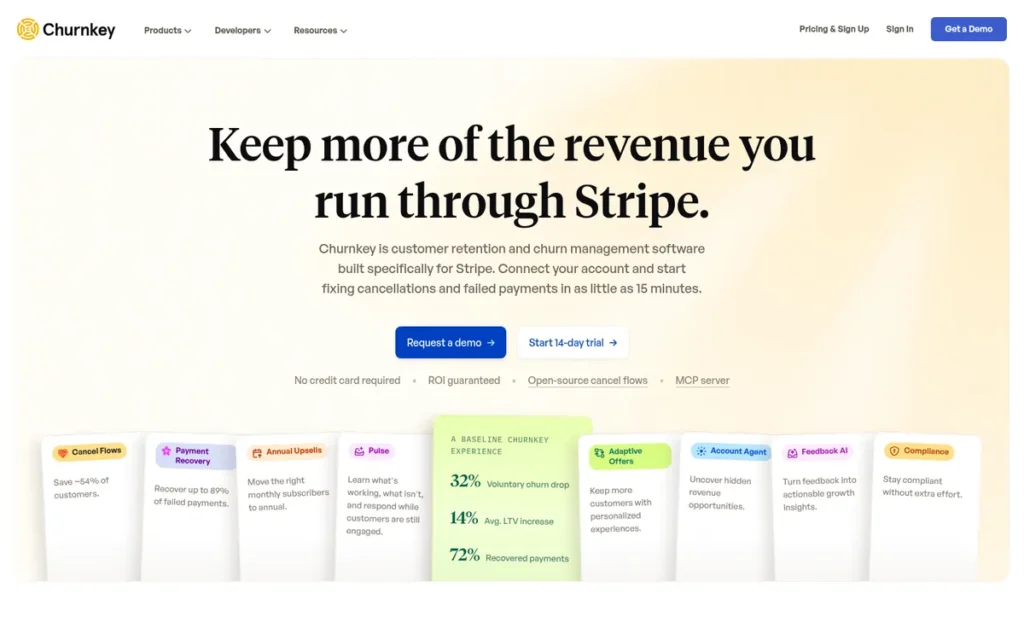
| 5 (37/55) | Churnkey | Recovery Add-On | SaaS wanting recovery plus cancel flows | Churnkey combines failed-payment recovery with no-code cancellation flows for SaaS. | Precision Retries, email, SMS, payment wall, cancel flows | Most complete retention toolkit | Precision Retries Core+ only; wall Stripe-only |
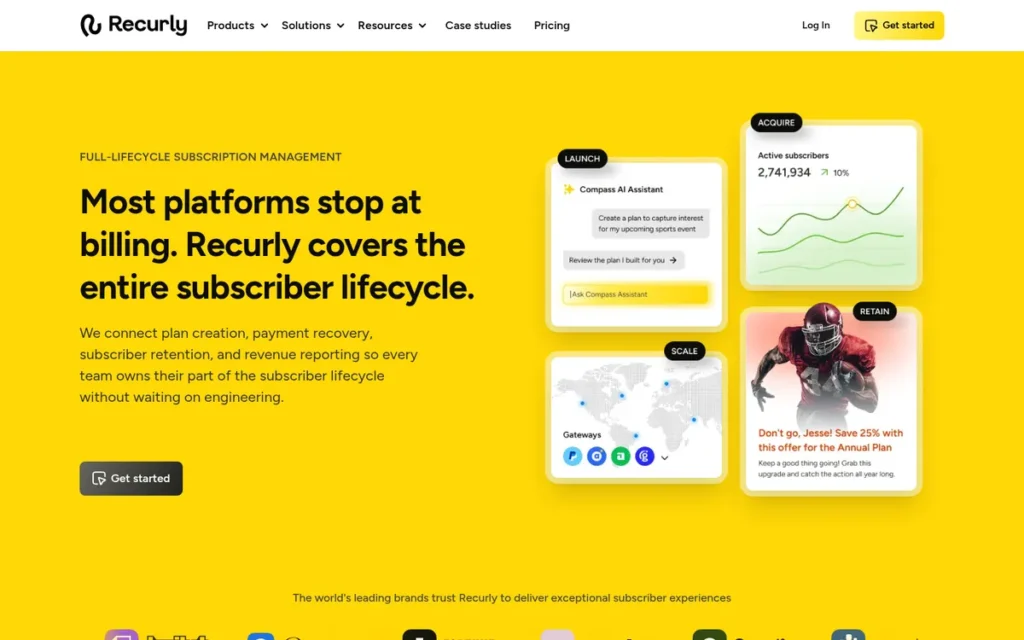
| 6 (33/55) | Recurly | Native Billing Recovery | Configurable retry logic across gateways | Recurly is a multi-gateway billing platform with machine-learning and static decline-code retries. | Intelligent Retries, static retries, account updater | Published recovery-rate definition | Mainly email outreach; reporting criticised |
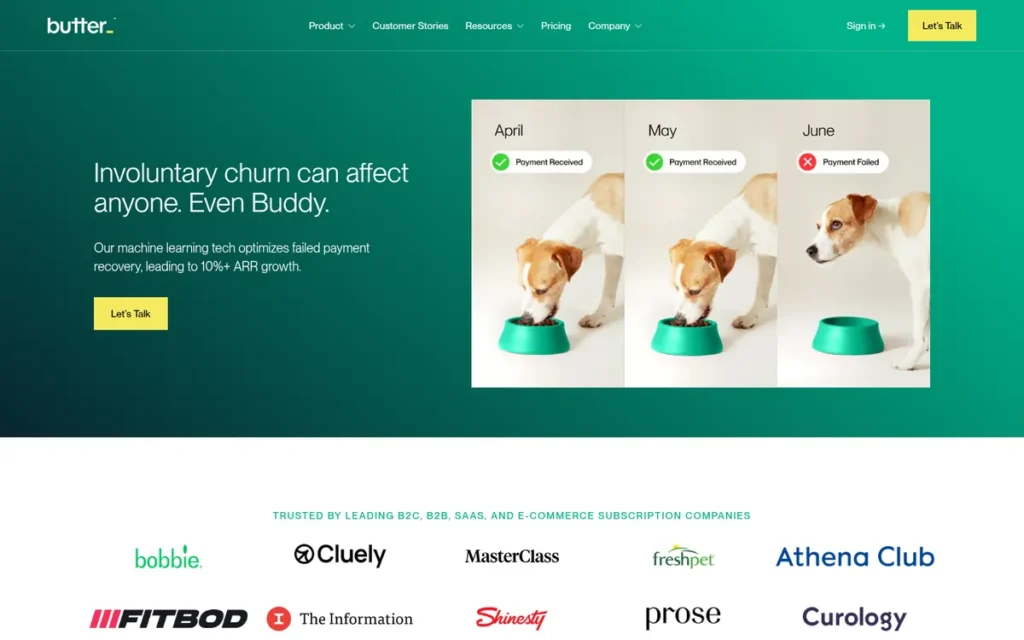
| 7 (23/55) | Butter Payments | Enterprise Recovery Engine | High-volume brands wanting silent recovery | Butter Payments is an enterprise machine-learning engine that charges a share of recovered revenue. | Per-payment machine learning, silent recovery | Retry decisions made for each payment | No published rate; small review footprint |
Quick Decision Framework
Pick by billing setup first and budget second. Stripe businesses under about $15K MRR should start with Stripe Billing, and Shopify subscription brands should look at Churn Buster. Paddle users already have Paddle Retain. High-volume enterprises that want silent recovery should evaluate Butter Payments with a holdout pilot.
| Your #1 Priority | Recommended Tool | Why | Acceptable Alternative |
|---|---|---|---|
| On Stripe, under ~$15K MRR | Stripe Billing | Recovery is included in the 0.7% fee | Churnkey Starter, once a holdout test shows a gap |
| Shopify subscription apps or several platforms | Churn Buster | 17 native integrations, mostly Shopify apps; flat fee | Paddle Retain, for SaaS billing systems plus Recharge |
| Several gateways, need a full billing platform | Chargebee | Gateway routing plus the largest G2 base | Recurly, for configurable retry modes |
| Several processors, no billing-platform migration | Butter Payments (confirm each processor) | Per-payment machine learning across custom setups | Chargebee or Recurly, if moving billing is acceptable |
| Already on Paddle | Paddle Retain | Included with Paddle Billing | Churnkey, which supports Paddle |
| SaaS wanting recovery plus cancel flows | Churnkey | Most complete cancel-flow toolkit | Paddle Retain |
| Enterprise, high volume, silent recovery | Butter Payments | Per-payment machine learning, optional silent mode | No direct equivalent here; see FlyCode under Also Considered |
What Are the 7 Best Failed Payment Recovery Tools in 2026?
The seven best failed payment recovery tools in 2026 are Churn Buster, Stripe Billing, Chargebee, Paddle Retain, Churnkey, Recurly and Butter Payments, ranked by PlugRoute’s weighted six-criterion score. Every entry below uses the same structure and states its score. Each claim is labelled vendor-reported, third-party, competitor-written, community or unverified.
1. Churn Buster: Top Dedicated Recovery Tool for Multi-Platform and Shopify Billing
Category: Recovery Add-On, a separate layer that connects to your existing billing system to add retries, customer messaging and card-update flows.
At a Glance
- Category: Recovery Add-On
- Best For: Shopify subscription brands and SaaS teams on Stripe or Braintree that want a predictable flat fee and setup done for them
- Price Range: $269–$430/month up to $150K MRR; higher bands about 0.1% of MRR
- Primary Strength: Churn Buster combines the broadest documented Shopify subscription-app coverage in this review with published flat-fee pricing.
- Biggest Limitation: Churn Buster has no in-app payment wall, no published recovery benchmark and no native integration with SaaS billing platforms such as Chargebee, Paddle and Maxio.
- One-Line Summary: Churn Buster is a flat-fee dunning tool and managed service that adds decline-aware retries, email and SMS campaigns and card-update pages across 17 native integrations, most of them Shopify subscription apps.
- Last Verified: November 2026
Overview Churn Buster is a flat-fee dunning service and software tool that adds decline-aware retries, email and SMS campaigns and card-update pages to subscription billing. It is built mainly for Shopify subscription brands and for SaaS teams on Stripe or Braintree that want predictable pricing.
Churn Buster scored 42/55 and ranks #1 of 7 because it is the only product scoring 4 or 5 on four of the five primary criteria. Churn Buster is held back by a score of 2 for independent evidence.
Churn Buster sells two products, Dunning and Cancel Flows, which you can buy separately or together.
Key Features
- Churn Buster retries failed payments based on the decline type and sets retry timing separately from message timing.
- Churn Buster sends branded email and SMS dunning campaigns, pre-dunning warnings before cards expire and links to hosted card-update pages.
- Churn Buster times its messages around the billing platform’s own retries when that platform controls retries, instead of adding a second set.
- Churn Buster’s Rolling Analysis labels each failed payment as recovered by retry, recovered after a card update, cancelled or lost.
- Churn Buster includes segmentation, A/B testing and setup done by its team, plus a Custom API for platforms outside its native list.
Best For Churn Buster is best for subscription businesses on Stripe, Braintree, Orb or a Shopify subscription app such as Recharge, Skio or Loop that want a predictable monthly fee. Churn Buster is a weaker fit for SaaS teams that need an in-app wall or that bill through Chargebee, Paddle or Maxio.
Pricing Churn Buster’s pricing page (retrieved November 2026) lists these prices for businesses up to $150K MRR:
- Churn Buster Dunning costs $269/month.
- Churn Buster Cancel Flows costs $269/month.
- Churn Buster’s bundle of both products costs $430/month.
Above $150K MRR, Churn Buster’s fee rises by MRR band at about 0.1% of MRR. Billing is month to month, and businesses above $10M MRR get a custom quote.
Churn Buster charges no commission on recovered revenue. PlugRoute did not verify prices for the higher bands, so ask for them in writing.
Strengths
- Churn Buster has 17 native integrations, including Recharge, Skio, Loop, Stay.ai, Smartrr, Ordergroove, Seal and Awtomic. That is the widest Shopify subscription-app coverage in this review (Churn Buster, retrieved November 2026; vendor-reported).
- Churn Buster counts a payment as recovered only once it clears, the strictest published recovery definition among the seven products (Churn Buster, retrieved November 2026; vendor-reported).
- Churn Buster’s flat fee does not rise as recovered revenue rises, so its total cost is easier to forecast than a revenue-share fee (Churn Buster, retrieved November 2026; vendor-reported).
- Churn Buster reports more than 1,000 customers, including AG1, Black Rifle Coffee Company, MeUndies and Pura (Churn Buster, retrieved November 2026; vendor-reported).
Limitations Churn Buster trades SaaS billing breadth for Shopify depth. Chargebee, Paddle and Maxio are not on its current native integration list, so SaaS teams on those systems would have to connect through its Custom API.
- Churn Buster lists Recurly only through an ambiguous “Privé/Recurly” entry, so Recurly users should confirm support in writing (Churn Buster, retrieved November 2026; vendor-reported).
- Churn Buster has no in-app payment wall, so SaaS teams that want to block app access until a card is updated need another tool.
- Churn Buster publishes no recovery-rate benchmark, and competitor FlyCode’s comparison table lists its rate as “not published” (FlyCode, retrieved November 2026; competitor-written).
- Churn Buster holds a 4.3/5 G2 rating from only 3 reviews, too few to be meaningful. One reviewer called its implementation cost “a bit on the higher side” (G2, retrieved November 2026; third-party).
- Churn Buster’s $269/month starting fee may not pay for itself below roughly $15K MRR, according to practitioner estimates (Reddit, 2026; community).
Users on r/Entrepreneur shared their experience:
“Do you have a system for catching expired credit cards before they fail? Or alerting customers their card is about to expire? Stripe sends some emails but they seem pretty generic. Curious what others do – especially if you’re too small for expensive tools like Churn Buster (£200+/month)” Posted by u/RAV957_YT
Takeaway: Small subscription founders see Churn Buster’s flat fee as out of reach, which confirms that its pricing suits established businesses more than early-stage ones.
Verdict Churn Buster is the highest-scoring dedicated failed payment recovery tool in PlugRoute’s 2026 evaluation (42/55), best suited to subscription businesses that bill through Shopify subscription apps or several platforms and want a published flat fee.
Churn Buster pairs decline-aware retries with email and SMS outreach. SaaS teams on Chargebee, Paddle or Maxio, and teams that need in-app walls, should compare Churn Buster with Churnkey and Paddle Retain and run a holdout test.
2. Stripe Billing (Smart Retries + Revenue Recovery): Best Built-In Option for Stripe Users
Category: Native Billing Recovery, retries, dunning and card updates built into the billing platform that charges the card.
At a Glance
- Category: Native Billing Recovery
- Best For: Stripe businesses, especially under about $15K MRR or those that haven’t yet measured a recovery gap
- Price Range: 0.7% of billing volume, recovery included; card processing fees extra
- Primary Strength: Stripe Billing includes machine-learning Smart Retries, a card account updater, failed-payment emails and recovery analytics at no extra cost.
- Biggest Limitation: Stripe Billing works only for payments processed on Stripe and offers no built-in SMS or in-app prompts.
- One-Line Summary: Stripe Billing is the built-in recovery baseline for Stripe subscriptions, combining Smart Retries, automated emails, a card account updater and a hosted portal within its 0.7% billing fee.
- Last Verified: November 2026
Overview Stripe Billing is Stripe’s subscription billing product. It includes machine-learning Smart Retries, failed-payment and expiring-card emails, a card account updater and a hosted customer portal, and it is built for businesses that process subscriptions on Stripe and want recovery without adding another vendor.
Stripe Billing scored 40/55 and ranks #2 of 7. Stripe Billing has the top retry-engine score (C1 = 5) and ties for the strongest independent evidence (C5 = 4). It scores 2 on compatibility because it works only with Stripe.
Stripe Billing’s Smart Retries are also the baseline that competitor FlyCode measures other recovery tools against (FlyCode, retrieved November 2026; competitor-written).
Key Features
- Stripe Billing’s Smart Retries use a model trained on Stripe’s network to time up to 8 retry attempts within a window of 1 week to 2 months.
- Stripe Billing sends automated emails for failed payments and expiring cards, and you can customise the subject, body, branding and sending domain.
- Stripe Billing includes a card account updater and a hosted portal where customers update cards, pay invoices, pause or cancel.
- Stripe Billing provides recovery analytics covering failure rate, amount recovered and recovery rate.
- Stripe Billing supports up to 3 recovery automations for different customer segments.
Best For Stripe Billing is best for businesses already on Stripe that want to switch on and measure built-in recovery before paying another vendor. Stripe Billing does not suit teams that bill through other processors.
Pricing Stripe’s pricing page (retrieved November 2026) lists pay-as-you-go Stripe Billing at 0.7% of billing volume with no recurring fee. Smart Retries and recovery automations are included, and card processing fees are charged on top.
Stripe Billing’s fee applies to all billing volume, not just recovered payments. At $2M a month of volume, Stripe Billing costs $14,000 a month, and that fee pays for far more than recovery.
Strengths
- Stripe Billing holds a 4.4/5 G2 rating from about 141 reviews, tying Chargebee for the strongest independent evidence in this review (G2, retrieved November 2026; third-party).
- Stripe reports that its recovery tools recovered more than $8.2 billion in failed payments in 2025, and that Retool recovered more than $630,000 with Smart Retries (Stripe, retrieved November 2026; vendor-reported).
- Stripe Billing is used by more than 350,000 companies and includes revenue recovery in its 0.7% fee with no separate recovery charge (Stripe, retrieved November 2026; vendor-reported).
- Practitioners on r/stripe advise turning on Stripe Billing’s automated retries and separating decline types before adding other tools (Reddit, 2026; community).
Limitations Stripe Billing keeps recovery inside one processor with no extra vendor. The trade-off is that it works only for payments processed on Stripe, so it cannot coordinate retries across several processors.
- Stripe Billing’s failed-payment emails cannot include marketing content, which rules out save offers in dunning messages (Stripe Support, retrieved November 2026; vendor-reported).
- Stripe Billing has no built-in SMS or in-app recovery prompts.
- Stripe Billing users on r/stripe say failed payments “sit inside the dashboard and nobody checks daily” (Reddit, 2026; community).
- Stripe Billing’s two average recovery figures measure different things and are not independently audited. The 55% figure covers all failed payments recovered across Stripe’s tools, and the 57% figure covers recurring payments recovered by Smart Retries alone (Stripe, retrieved November 2026; vendor-reported).
- Stripe Billing’s 0.7% fee grows with all billing volume, not with recovered revenue.
Users on r/SaaS noted:
“Do you have CAU on? Is this a recurring subscription? If so, are you using Stripe Billing? If so, are you using smart retries? Have you played around with smart retries settings? Ultimately, stripe can help with expired cards and to an extent insufficient funds but if there are no funds in the cards then that’s not really on Stripe.” Posted by u/ForcaBarca1899
Takeaway: Stripe Billing’s card updater and Smart Retries must be switched on and tuned to deliver results, and even then they cannot recover payments from cards that simply have no funds.
Verdict Stripe Billing is the recommended starting point for most businesses processing subscriptions on Stripe, because machine-learning retries, a card account updater and recovery emails are included in its 0.7% billing fee.
Set up Stripe Billing’s recovery settings fully and measure them before buying a separate tool. Teams that need SMS, in-app walls or recovery across several processors will eventually need something more.
3. Chargebee: Best for Multi-Gateway Subscription Billing With Built-In Recovery

Category: Native Billing Recovery.
At a Glance
- Category: Native Billing Recovery
- Best For: Mid-market and growing subscription companies that bill through more than one payment gateway
- Price Range: Free Starter tier up to an unverified revenue threshold; Performance from $599/month (per G2, reportedly billed annually); Receivables and Retention priced on request
- Primary Strength: Chargebee combines smart dunning and a card account updater with routing across several payment gateways.
- Biggest Limitation: Chargebee’s pricing is hard to forecast because of tier jumps, gated features and add-ons with unpublished prices.
- One-Line Summary: Chargebee is a multi-gateway subscription billing platform with smart dunning, configurable retries and a card account updater, best suited to companies that need recovery across more than one gateway.
- Last Verified: November 2026
Overview Chargebee is a subscription billing platform with smart dunning, configurable retry sequences, a card account updater and routing across several payment gateways. It is built for SaaS and subscription companies that bill through more than one gateway and want recovery inside a full billing system.
Chargebee scored 39/55 and ranks #3 of 7, one point behind Stripe Billing. Chargebee ties for the top compatibility score (C3 = 5) and the strongest independent evidence (C5 = 4), but low pricing transparency (C4 = 2) holds it back.
Chargebee sells cancellation flows and advanced receivables management as separate products.
Key Features
- Chargebee retries failed payments automatically with timing set for each transaction, and supports multi-step dunning sequences.
- Chargebee routes recovery across several payment gateways and includes a card account updater.
- Chargebee says its newer engine looks at 200+ signals per transaction to decide whether to retry, wait or ask for new payment details. Chargebee has published no method for this (Chargebee, retrieved November 2026; vendor-reported).
- Chargebee Receivables is a separate add-on with machine-learning retries, alerts before payments fail and analytics.
- Chargebee Retention, formerly Brightback, handles cancellation flows as a separate product.
Best For Chargebee is best for subscription companies that bill across several gateways and want billing and recovery in one platform. Chargebee is a weaker fit for small teams that want one predictable recovery price.
Pricing G2 lists Chargebee’s Performance tier from $599/month, reportedly billed annually (G2, retrieved November 2026; third-party). PlugRoute did not confirm this price on Chargebee’s own pricing page.
Chargebee’s Starter tier is free up to a revenue threshold that PlugRoute could not verify. Chargebee prices Receivables and Retention on request, so full recovery and retention may mean paying for two or three Chargebee products.
Strengths
- Chargebee holds a 4.4/5 G2 rating from about 1,025 reviews, the largest verified review base in this list (G2, retrieved November 2026; third-party).
- Chargebee routes payments and recovery across several gateways inside one billing platform, which makes it one of the few options here for multi-processor teams (Chargebee, retrieved November 2026; vendor-reported).
- Chargebee reports that Zenchef recovered 60% of formerly unpaid accounts and that Cafeyn cut involuntary churn by 90% across more than 2M subscribers (Chargebee, retrieved November 2026; vendor-reported).
- One G2 reviewer wrote that Chargebee’s “Smart Dunning, payment retries, and automated reminders help recover failed payments effectively” (G2, retrieved November 2026; third-party).
Limitations Chargebee gives you recovery across several gateways inside a full billing platform. Buyers often pay for that breadth with costs that are hard to predict.
- Third-party summaries report sharp price jumps between Chargebee’s tiers and features locked to higher plans (CFO Presso, retrieved November 2026; third-party).
- Chargebee reviewers report long setup times, and Chargebee offers priority phone support only on top tiers (CFO Presso, retrieved November 2026; third-party).
- Chargebee requires the separate Retention product for cancel flows and the Receivables add-on for advanced dunning.
- Chargebee documents multi-gateway routing at platform level, but buyers should confirm in writing that each retry and dunning feature works on every gateway they use.
- PlugRoute could not find a published Chargebee definition of a recovered payment, or any Chargebee control-group results.
Verdict Chargebee is the highest-ranked multi-gateway billing platform in this review (39/55) for subscription companies that need failed payment recovery across several payment gateways.
Chargebee also has the largest verified G2 review base in this list. Treat Chargebee as a billing-platform decision rather than a dunning add-on, and get written pricing for the tier and add-ons you need before committing.
4. Paddle Retain: Best for Paddle Billing Users and Multilingual In-App Recovery
Category: Recovery Add-On.
At a Glance
- Category: Recovery Add-On
- Best For: Paddle Billing users, or international teams on Stripe, Chargebee, Recurly, Braintree, Zuora or Maxio that want hands-off recovery
- Price Range: Included with Paddle Billing (5% + 50¢ per checkout transaction); from about $500/month standalone; results-based pricing possible for larger companies
- Primary Strength: Paddle Retain offers in-app and email dunning in 19 languages and no-login card-update pages that accept digital wallets.
- Biggest Limitation: Paddle Retain’s retry decisions can’t be inspected, its standalone pricing is only partly published and its own pages give conflicting recovery figures.
- One-Line Summary: Paddle Retain is a recovery and retention layer, included free with Paddle Billing, that adds Tactical Retries, multilingual in-app and email dunning and no-login card-update pages.
- Last Verified: November 2026
Overview Paddle Retain, formerly ProfitWell Retain, is a recovery and retention layer that adds Tactical Retries, dunning in 19 languages and no-login card-update pages. It is built for Paddle Billing users and for SaaS teams on Stripe, Chargebee, Recurly, Braintree, Zuora or Maxio.
Paddle Retain scored 38/55 and ranks #4 of 7. Paddle Retain scores 5 on customer channels (C2) and has the widest SaaS billing-system coverage of any add-on. It scores 4 on compatibility (C3) because its only documented Shopify subscription-app integration is Recharge.
Paddle Retain is included with Paddle Billing and sold separately for other billing systems.
Key Features
- Paddle Retain’s Tactical Retries use 15+ signals, including failure code, card type, location and day of week, and run alongside the billing provider’s own retries.
- Paddle Retain sends email and in-app dunning in 19 languages, with a 30-day default dunning window.
- Paddle Retain provides branded card-update pages that need no login and accept Apple Pay and Google Pay.
- Paddle Retain sends pre-dunning prompts before customers’ cards expire.
- Paddle Retain includes cancellation flows, monthly-to-annual upgrade prompts and win-back campaigns.
Best For Paddle Retain is best for businesses already billing through Paddle, where it costs nothing extra, and for international teams that want multilingual recovery. Paddle Retain is a weaker fit for teams that want control over email copy and retry timing.
Pricing Paddle’s help centre (retrieved November 2026) says Paddle Retain is included with Paddle Billing. On other billing systems, smaller companies can start at about $500/month and larger companies may get results-based pricing. Some modules have a 30-day free trial.
Getting Paddle Retain free means moving your billing to Paddle, which costs 5% + 50¢ per checkout transaction (Paddle, retrieved November 2026; vendor-reported).
Strengths
- Paddle Retain supports Stripe, Chargebee, Zuora, Recurly, Braintree, Maxio, Recharge and Paddle Billing, the widest SaaS billing-system coverage among the add-ons (Paddle, retrieved November 2026; vendor-reported).
- Paddle Retain sends dunning in 19 languages, with no-login card pages that accept Apple Pay and Google Pay (Paddle, retrieved November 2026; vendor-reported).
- Paddle Retain costs nothing extra for Paddle Billing customers (Paddle, retrieved November 2026; vendor-reported).
- Paddle as a whole holds a 4.5/5 G2 rating from about 241 reviews, although that rating isn’t specific to Paddle Retain (G2, retrieved November 2026; third-party).
Limitations Paddle Retain is designed to run without hands-on management. The trade-off is that teams get little control over email copy and timing and cannot inspect retry decisions (StayPaid, retrieved November 2026; competitor-written).
- Competitors argue that Paddle Retain’s recovery credit may include payments that would have recovered anyway (FlyCode, retrieved November 2026; competitor-written).
- Paddle’s own pages contradict each other on Paddle Retain, claiming “50%+ of failed payments” recovered on one page and involuntary churn cut by “up to 17%” on another (Paddle, retrieved November 2026; vendor-reported).
- Paddle Retain’s standalone pricing for non-Paddle users is only partly published. Smaller companies pay about $500/month, and larger companies get results-based terms set case by case.
- PlugRoute found no G2 or Capterra rating specific to Paddle Retain.
- Moving to Paddle to get Paddle Retain free brings higher fees. One r/SaaS user also reported that Paddle stopped supporting their products after accepting them (Reddit, 2026; community).
Users on r/SaaS noted:
“Thanks for your comment. Yes, I’ve already implemented Paddle, and it has everything I was looking for. I think it’s worth paying a little more for a more complete service (in my case); it pleasantly surprised me.” Posted by u/Weak-Sheepherder-112
Takeaway: Some founders find that Paddle Billing’s higher fees are worth paying for a more complete service, which makes Paddle Retain’s bundled inclusion a real benefit for teams that are willing to move.
Verdict Paddle Retain is the recommended failed payment recovery choice for businesses already on Paddle Billing, because it adds multilingual in-app dunning and no-login card updates at no extra cost.
Paddle Retain also documents more SaaS billing systems than any other add-on here. Teams that want retry logic they can inspect should get written terms and run a holdout test.
5. Churnkey: Best for Combining Failed Payment Recovery With Cancellation Prevention
Category: Recovery Add-On.
At a Glance
- Category: Recovery Add-On
- Best For: SaaS teams on Stripe, Chargebee, Braintree, Paddle or Maxio that want recovery and cancel prevention in one product
- Price Range: $250/month billed yearly (about $300 monthly) for under $5K/month churned revenue; Core and Intelligence pricing on request
- Primary Strength: Churnkey combines email, SMS and in-app payment-wall recovery with the most complete cancel-flow toolkit in this review.
- Biggest Limitation: Churnkey reserves Precision Retries for Core and higher tiers, limits its payment wall to Stripe and has only a small G2 review sample.
- One-Line Summary: Churnkey is a retention platform that combines failed-payment recovery, including retries, email and SMS dunning and a Stripe in-app payment wall, with no-code cancellation flows for SaaS.
- Last Verified: November 2026
Overview Churnkey is a retention platform that combines failed-payment recovery with no-code cancellation flows. Its recovery tools include Precision Retries, email and SMS dunning and an in-app payment wall, and it is built for SaaS teams on Stripe, Chargebee, Braintree, Paddle or Maxio.
Churnkey scored 37/55 and ranks #5 of 7. Churnkey has the top retention-fit score (C6 = 5) and ties for the best customer channels (C2 = 5). Tier-gated retries (C1 = 3) and Stripe-only wall support (C3 = 3) hold it back.
Churnkey prices its plans by how much revenue a company loses to churn each month.
Key Features
- Churnkey’s Precision Retries adjust retry timing automatically. Churnkey’s pricing page lists them in the Core plan, not Starter (Churnkey, retrieved November 2026; vendor-reported).
- Churnkey sends email and SMS dunning and offers a Billing Contact API for reaching the right billing contact.
- Churnkey’s payment wall blocks app access until the customer updates payment details, but it works on Stripe only.
- Churnkey provides no-code cancel flows with pause, discount and downgrade offers, plus win-back campaigns.
- Churnkey includes A/B testing, segmentation and Feedback AI for analysing cancellation reasons.
Best For Churnkey is best for SaaS teams, especially on Stripe, that want failed-payment recovery and cancellation prevention in one place. Churnkey is a weaker fit below about $15K MRR, where a fee of $250+/month may not pay for itself.
Pricing Churnkey’s pricing page (retrieved November 2026) lists Starter at $250/month billed yearly, or about $300/month month to month, for companies with under $5K a month in churned revenue. Churnkey fixes prices for 12 months and offers a 14-day trial.
Churnkey’s Core and Intelligence tiers are for companies with $10K+ a month in churned revenue, and their prices are not published. Precision Retries start at Core, so confirm what is included in the tier you are quoted.
Strengths
- Churnkey attributes 28.1% of its recoveries to Precision Retries and only 0.6% to SMS. That makes it one of the few vendors to publish a channel-level breakdown (Churnkey State of Retention, 2025; vendor-reported).
- Churnkey reports recovering 70% of detected involuntary churn in 2024, and 55% on top of Stripe’s retries with an average of 4.8 days to recover. These two figures use different definitions (Churnkey, 2025; vendor-reported).
- Churnkey offers the most complete cancellation-prevention toolkit in this review, covering save offers, win-back campaigns and A/B testing (PlugRoute feature comparison of vendor documentation, November 2026; PlugRoute analysis).
- Churnkey publishes its flat Starter price instead of charging a share of recovered revenue (Churnkey, retrieved November 2026; vendor-reported).
Limitations Churnkey combines recovery and retention, and the trade-off is narrower compatibility. Its in-app payment wall works only on Stripe, and PlugRoute could not confirm Recurly support.
- Churnkey reserves Precision Retries for Core and higher tiers, whose prices are not published (Churnkey, retrieved November 2026; vendor-reported).
- Churnkey’s 4.6/5 G2 rating rests on only 7 reviews, below the 10-review threshold PlugRoute uses for scoring (G2, retrieved November 2026; third-party).
- Churnkey’s own recovery figures (“up to 89%”, a 70% average and 55% on top of Stripe) use different definitions and can’t be compared with each other.
- Competitor FlyCode argues that Churnkey’s headline rates include payments Stripe would have recovered anyway, and that stacking Churnkey’s retries on Stripe’s can hit card network limits (FlyCode, retrieved November 2026; competitor-written).
- Churnkey’s $250+/month fee may not pay for itself below about $15K MRR, according to an r/microsaas poster who is building a competing tool (Reddit, 2026; community).
Users on r/SaaS shared their experience:
“Our experience with Churnkey has been utterly dismal. This may be due to percularities in our market and I don’t hold its poor performance during our trial against them (5% of cancellations saved – 1 cancellation).” Posted by u/ContributionShoddy82
Takeaway: Churnkey can deliver little measurable lift for very small SaaS businesses, which supports running a holdout test before committing below about $15K MRR.
Verdict Churnkey scored highest on retention fit (C6 = 5) for SaaS teams that want failed-payment recovery and cancellation prevention in one product, especially on Stripe, where its payment wall works.
Churnkey is one of the few vendors in this review to publish recovery data broken down by channel. Confirm which tier includes Precision Retries, and test Churnkey against Stripe’s built-in recovery with a holdout group.
6. Recurly: Best for Configurable Retry Logic in a Multi-Gateway Billing Platform
Category: Native Billing Recovery.
At a Glance
- Category: Native Billing Recovery
- Best For: Subscription businesses that want multi-gateway billing with configurable retries and a published recovery definition
- Price Range: $249/month + 0.9% of billing volume above $40K/month (Starter, Recurly pricing page); higher tiers on request
- Primary Strength: Recurly combines machine-learning Intelligent Retries with a static mode that follows decline codes and Mastercard advice codes.
- Biggest Limitation: Recurly relies mainly on email outreach, has no core cancellation flows and draws reviewer criticism for its reporting.
- One-Line Summary: Recurly is a multi-gateway subscription billing platform whose Intelligent Retries and static decline-code retry mode let teams choose between machine-learning and predictable recovery logic.
- Last Verified: November 2026
Overview Recurly is a subscription billing platform with machine-learning Intelligent Retries, an optional static retry mode based on decline codes, an account updater and backup payment methods. It is built for businesses that want recovery inside a multi-gateway billing system with a documented recovery definition.
Recurly scored 33/55 and ranks #6 of 7. Recurly scores well on its retry engine (C1 = 4) and compatibility (C3 = 4). Email-centred outreach (C2 = 2) and the lack of cancellation flows (C6 = 1) hold it back.
Recurly also publishes churn benchmark research.
Key Features
- Recurly’s Intelligent Retries use a model that Recurly says is trained on billions of transactions from 2,000+ merchants to pick a retry window for each payment.
- Recurly offers a static retry mode based on decline codes and Mastercard advice codes, for teams that want predictable behaviour.
- Recurly’s default dunning window is 10 days, extendable to 28 days for monthly plans and 60 days for annual plans.
- Recurly supports Account Updater, backup payment methods and several gateways.
- Recurly’s dunning summary shows which of four sources recovered each payment: Account Updater, customer updates, retries or manual collection.
Best For Recurly is best for subscription businesses that want multi-gateway billing with configurable retry logic and a clearly defined recovery metric. Recurly is a weaker fit for teams that need SMS, in-app recovery or cancellation flows.
Pricing Recurly’s pricing page (retrieved November 2026) lists the Starter tier at $249/month plus 0.9% of billing volume above the first $40,000 of monthly billing.
Recurly does not publish higher-tier prices or say whether Intelligent Retries require a higher tier, so ask for a written quote.
Strengths
- Recurly’s static retry mode follows Mastercard advice codes, which helps teams avoid retrying payments the network has flagged as not to be retried (Recurly documentation, retrieved November 2026; vendor-reported).
- Recurly defines its recovery rate as failed invoices paid within the dunning window, one of only two published definitions in this review (Recurly, retrieved November 2026; vendor-reported).
- Recurly holds a 4.1/5 G2 rating from 227 reviews and earned G2 Leader and High Performer badges across the 2024 and 2025 seasons (G2 and Recurly, 2025; third-party).
- Recurly reports that about 13% of recurring transactions are declined each month, a benchmark you can compare your own decline rate against (Recurly, retrieved November 2026; vendor-reported).
Limitations Recurly gives teams configurable retry logic, and the trade-off is limited customer outreach. Recurly relies mainly on email dunning, with no documented SMS or in-app prompts.
- Recurly does not include cancellation prevention as a core feature.
- Third-party reviews call Recurly’s interface “clunky and outdated” and say its dunning sequences are hard to customise (SelectHub, retrieved November 2026; third-party).
- Recurly has the lowest G2 score of the billing platforms reviewed, and reviewers mention weak reporting (G2, retrieved November 2026; third-party).
- Recurly’s 0.9% fee on volume above $40K a month grows with all billing, not with recovery.
- Recurly says customers recover “more than 70%” of failed transactions only “in some cases”, and no named customer case study supports the figure (Recurly, retrieved November 2026; vendor-reported).
Verdict Recurly is a strong choice for subscription teams that want multi-gateway billing with configurable retry logic, including a static mode that follows decline codes and Mastercard advice codes.
Recurly is also one of only two vendors here that publish a recovery-rate definition. Teams that need SMS, in-app recovery or cancellation flows will have to add another tool.
7. Butter Payments: Best for Enterprise Brands Wanting Silent, Results-Priced Recovery
Category: Enterprise Recovery Engine, a machine-learning layer that charges a share of recovered revenue and focuses on silent technical recovery at high volume.
At a Glance
- Category: Enterprise Recovery Engine
- Best For: High-volume subscription brands on Stripe, Recharge or custom payment setups where dunning messages are unwelcome
- Price Range: Share of recovered revenue; rate set after a free Payment Health Analysis (no published percentage)
- Primary Strength: Butter Payments uses a patented machine-learning engine that handles each failed payment individually, with optional silent recovery.
- Biggest Limitation: Butter Payments publishes no pricing rate, has only a small review footprint and lists processor support inconsistently across sources.
- One-Line Summary: Butter Payments is an enterprise machine-learning recovery engine, priced as a share of recovered revenue, that can recover failed payments silently for high-volume subscription brands.
- Last Verified: November 2026
Overview Butter Payments is an enterprise payment recovery engine that uses patented machine learning to retry each failed payment individually, with optional silent recovery. It is built for high-volume subscription brands on Stripe, Recharge or custom payment setups that will pay a share of recovered revenue.
Butter Payments scored 23/55 and ranks #7 of 7. The low score reflects how hard Butter Payments is to evaluate from public data, given its unpublished pricing and small review footprint. It is not evidence that Butter recovers less.
Butter Payments focuses on technical recovery rather than customer messaging.
Key Features
- Butter Payments’ patented engine weighs hundreds of variables for each payment and handles each failure individually.
- Butter Payments adjusts the dunning period by subscription type, value and region.
- Butter Payments can recover payments silently, with optional email, SMS and phone outreach.
- Butter Payments’ own site names Stripe, Recharge and custom setups. Third-party directories also list Braintree, Adyen, Worldpay, PayPal Enterprise and Zuora, which buyers should confirm with Butter (Capterra and SourceForge, retrieved November 2026; third-party).
- Butter Payments offers a free Payment Health Analysis before it sets your price.
Best For Butter Payments is best for enterprise subscription brands, such as consumer media or telehealth companies, where dunning messages would hurt the customer experience and recovery volume justifies a negotiated revenue share. Butter Payments is a weaker fit for small SaaS teams.
Pricing Butter Payments’ pricing page (retrieved November 2026) says it charges a share of recovered revenue, with the rate set after a free Payment Health Analysis. Butter Payments publishes no percentage, minimum or contract term.
Negotiate Butter Payments’ fee on incremental recovery only, measured against a random holdout group, rather than on all recovered revenue.
Strengths
- Butter Payments reports that MasterClass increased invoice recovery by 26% and recovered revenue by 27%, and cut refunds by 31%, in 3 months (Butter Payments, retrieved November 2026; vendor-reported).
- Butter Payments lists enterprise customers including MasterClass, Fabletics, The Athletic, Wyze and Curology (Butter Payments, retrieved November 2026; vendor-reported).
- Butter Payments’ G2 reviewers praise fast implementation and responsive onboarding, although the sample is only 7 reviews (G2, retrieved November 2026; third-party).
- Butter Payments raised a $22M Series A in January 2023 led by Norwest Venture Partners, although another Butter page gives the figure as $21.5M (Butter Payments, 2023; vendor-reported).
Limitations Butter Payments costs little up front. The trade-off is a cost that is hard to forecast, because Butter publishes no revenue-share percentage, minimum or contract term.
- Butter Payments has a small review footprint, with 7 G2 reviews and 1 Capterra review rated 5.0/5 (G2 and Capterra, retrieved November 2026; third-party).
- All of Butter Payments’ performance figures come from its own case studies. Competitor FlyCode criticises it for publishing no method for comparing customer groups (FlyCode, retrieved November 2026; competitor-written).
- Butter Payments’ processor support differs between its own site and third-party directories, so buyers should confirm each processor in writing.
- Competitor pages say Butter Payments probably requires minimum volumes, takes more setup than a plug-in Stripe app and has no cancellation flows (FlyCode, retrieved November 2026; competitor-written).
Verdict Butter Payments is the only enterprise-focused machine-learning recovery engine in this review that charges a share of recovered revenue, and it suits high-volume brands where silent recovery matters more than customer messaging.
Butter Payments’ named case studies are encouraging, but none has been independently verified. Insist on a pilot measured against a control group, with fees charged on incremental recovery only.
What Other Failed Payment Recovery Tools Did We Consider?
PlugRoute also considered Baremetrics Recover, FlyCode, Gravy Solutions, Stunning, Maxio and Vindicia Retain, but found too little verified evidence on them for a full ranking. AI answer engines also mention Revaly and Redux Payments, which PlugRoute did not verify. Treat these as leads to research yourself, not recommendations.
- Baremetrics Recover is a $129/month add-on that works with Stripe, Braintree and Recurly (Baremetrics, retrieved November 2026; vendor-reported).
- FlyCode charges only on recovery above a baseline and mainly supports Stripe (FlyCode, retrieved November 2026; vendor-reported).
- Gravy Solutions costs roughly $997–$8,000/month (third-party estimate, retrieved November 2026; unverified).
- Stunning, Maxio and Vindicia Retain came up during PlugRoute’s discovery research but were not researched in depth.
- Revaly and Redux Payments appeared in AI answer-engine responses, and PlugRoute did not verify either product.
Which Recovery Tools Work With My Billing System?
Check compatibility first. Stripe Billing works only with Stripe, while Chargebee and Recurly support several gateways as full billing platforms. Among add-ons, Paddle Retain documents the widest SaaS billing-system support and Churn Buster leads on Shopify subscription apps. Butter Payments officially documents Stripe, Recharge and custom setups.
“Not listed” means PlugRoute’s research did not find documented support, which does not prove the integration doesn’t exist. “Confirm” marks support that is unverified or listed only by third parties. “N/A” marks a competing billing platform.
| Product | Stripe | Chargebee | Recurly | Braintree | Paddle | Zuora | Maxio | Shopify subscription apps | Other processors / custom |
|---|---|---|---|---|---|---|---|---|---|
| Churn Buster | Yes | Confirm (Custom API) | Confirm (“Privé/Recurly” listing) | Yes | Custom API only | Not listed | Custom API only | Yes (Recharge, Skio, Loop, Stay.ai, Smartrr, Ordergroove, Seal, Rivo, Awtomic and others) | Orb; Custom API |
| Stripe Billing | Native | No | No | No | No | No | No | No | No (Stripe only) |
| Chargebee | Gateway (confirm) | Native | N/A | Gateway (confirm) | N/A | N/A | N/A | Not listed | Several gateways with routing (confirm each) |
| Paddle Retain | Yes | Yes | Yes | Yes | Yes (included) | Yes | Yes | Recharge only | Not listed |
| Churnkey | Yes (wall Stripe-only) | Yes | Confirm | Yes | Yes | Not listed | Yes | Not listed | Custom integration framework |
| Recurly | Gateway (confirm) | N/A | Native | Gateway (confirm) | N/A | N/A | N/A | Not listed | Several gateways; backup payment methods |
| Butter Payments | Yes | Not listed | Not listed | Confirm (third-party) | Not listed | Confirm (third-party) | Not listed | Recharge | Custom setups; Adyen, Worldpay, PayPal Enterprise (third-party; confirm) |
How Does Failed Payment Recovery Software Pricing Compare?
Failed payment recovery software uses four pricing models: a share of billing volume, flat fees by MRR band, tiers based on churned revenue, and a share of recovered revenue. Stripe Billing, Churn Buster, Churnkey, Recurly and Paddle publish at least an entry price; Chargebee’s comes from G2 and Butter publishes none.
| Product | Pricing Model | Published Price (Nov 2026) | Price Source | Gating or Hidden Costs |
|---|---|---|---|---|
| Churn Buster | Flat fee by MRR band | $269 Dunning; $430 bundle (to $150K MRR) | Vendor page | Implementation costs mentioned by G2 reviewers; higher bands unverified |
| Stripe Billing | % of billing volume | 0.7% | Vendor page | Card processing fees extra; fee applies to all volume |
| Chargebee | Tiered subscription | Performance from $599/month (reportedly billed annually) | G2 (third-party) | Receivables and Retention priced on request |
| Paddle Retain | Bundled, flat or results-based | Included with Paddle Billing (5% + 50¢ per checkout transaction); ~$500/month standalone | Vendor pages | Results-based terms for larger companies set case by case |
| Churnkey | Tiers by churned revenue | $250/month billed yearly (Starter) | Vendor page | Precision Retries in Core and above, priced on request |
| Recurly | Platform fee + % of volume | $249/month + 0.9% above $40K/month | Vendor page | Higher tiers priced on request |
| Butter Payments | Share of recovered revenue | Not published | Vendor page | Rate, minimums and contract terms not published |
How Should I Read Vendor Recovery Rates?
Treat vendor recovery rates as marketing claims, not comparable benchmarks. Vendors mix gross, “up to”, average and incremental figures, and some contradict their own pages. Only Recurly and Churn Buster publish how they define a recovered payment. None of the seven vendors reviewed publishes results against a random control group that PlugRoute could find.
Vendors use four kinds of recovery figure:
- Gross rates count every recovered payment, including payments that would have recovered anyway.
- “Up to” rates describe the best case, not the typical result.
- Average rates blend results across customers whose businesses may be very different from yours.
- Incremental rates measure only the extra a tool adds over a baseline, which is the figure buyers actually need.
Suppose Stripe’s Smart Retries already recover 55 of every 100 failed payments and an add-on reports “62% recovered”. The add-on’s real contribution is about 7 payments, not 62. A revenue-share fee on all 62 would pay the vendor for 55 recoveries it did not make.
Several vendors publish figures that conflict with each other:
- Stripe reports 55% of failed payments recovered on average on its Billing page and 57% recovered by Smart Retries on its features page (Stripe, retrieved November 2026; vendor-reported).
- Churnkey reports “up to 89%”, a 70% average for 2024 and 55% on top of Stripe (Churnkey, 2025; vendor-reported).
- Paddle reports “50%+ of failed payments” recovered by Paddle Retain on one page and “up to 17%” less involuntary churn on another (Paddle, retrieved November 2026; vendor-reported).
These are the recovery definitions PlugRoute found:
- Recurly counts a failed invoice as recovered if it is paid within the dunning window, which is 10 days by default.
- Churn Buster counts a payment as recovered only once it clears.
- Stripe Billing’s recovery analytics report a recovery rate, but its 55% and 57% headline figures measure different groups of payments.
A recovery rate means little without a baseline: a tool that “recovers 60%” may add only 5 points if your billing platform already recovered 55%.
What Red Flags Should I Watch For When Evaluating Failed Payment Recovery Software?
The biggest red flags in failed payment recovery software are undefined recovery rates, missing control-group results, stacked retries and revenue-share fees on all recovered revenue. Each one can inflate expected results or hide real costs. The six red flags below are numbered so you can check vendors against them.
Red Flag #1: Recovery Rates Without a Definition A recovery rate with no published definition can’t be compared with anything. Only Recurly and Churn Buster define what counts as a recovered payment, so ask every other vendor how it counts before you trust its numbers.
Red Flag #2: No Control-Group Results None of the seven vendors reviewed publishes results against a random holdout group that PlugRoute could find. Without a control group, headline recovery rates may include payments your billing platform would have recovered anyway.
Red Flag #3: Retries Stacked on Your Platform’s Retries Two retry engines working on the same card do not double recovery; they double the risk of breaching card network retry limits. Commonly documented limits are listed below (PayKings and Acquired.com, 2026; third-party; confirm with your processor).
- Mastercard can charge fees for more than 10 attempts on the same card within 24 hours, or more than 35 within 30 days.
- Mastercard can also charge fees for retrying after “do not retry” Merchant Advice Codes 03 and 21.
- Visa allows no retries on Category 1 declines and is commonly documented at about 15 retries in 30 days for other categories, with some sources saying 20.
Red Flag #4: Revenue-Share Fees on All Recovered Revenue A revenue-share fee charged on all recovered revenue pays the vendor for recoveries your built-in retries would have made anyway. Negotiate fees on incremental recovery only, measured against a holdout group.
Red Flag #5: Key Features Gated to Unpublished Tiers Recovery features locked to tiers without published prices make the total cost impossible to judge. Churnkey’s Precision Retries (Core and above) and Chargebee’s Receivables add-on are examples to price in writing.
Red Flag #6: Vendor-Written Comparison Pages Presented as Neutral Many “best recovery tool” comparisons are written by competing vendors such as FlyCode, Churn Buster, Churnkey and StayPaid. PlugRoute cites some of these pages in this review and labels every such claim as competitor-written.
What Questions Should I Ask Before Choosing Failed Payment Recovery Software?
Before choosing failed payment recovery software, ask each vendor how it defines a recovered payment, whether its retries conflict with your platform’s, and whether its fee applies only to incremental recovery. The seven numbered questions below show how much a tool really adds and what a strong answer looks like.
Question #1: How do you define a recovered payment? A strong answer names a clear rule, such as Churn Buster’s “only once the payment clears” or Recurly’s “paid within the dunning window.” Be cautious with vendors who can only quote “up to” figures.
Question #2: Will your retries conflict with my billing platform’s retries? A strong answer explains whether the tool runs its own retries or times its messages around the platform’s retries. It should also explain how the tool respects card network retry limits and Merchant Advice Codes.
Question #3: Which processors and billing systems are supported for every feature I need? A strong answer confirms support feature by feature, not just platform by platform. For example, Churnkey’s payment wall works only on Stripe, even though Churnkey supports other billing systems.
Question #4: Is your fee charged on incremental recovery or on all recovery? A strong answer puts the fee basis in writing. This matters most for revenue-share pricing, such as Butter Payments and results-based Paddle Retain deals, where fees on all recovery overpay the vendor.
Question #5: Can I run a holdout test during the trial? A strong answer lets you randomly keep a share of failed invoices on built-in recovery only. Comparing recovery between the two groups is the most reliable way to measure what a tool adds.
Question #6: Will your reports show which channel recovered each payment? A strong answer shows recoveries split by source, as Recurly’s dunning summary, Churn Buster’s Rolling Analysis and Churnkey’s channel breakdown do. Without that split, you can’t tell whether retries, emails or card updates are doing the work.
Question #7: Will my team be alerted when payments fail? A strong answer describes real-time alerts by email or in a team channel. Practitioners on r/stripe say failed payments often go unnoticed until MRR drops, so alerts matter as much as retry logic (Reddit, 2026; community).
How Did We Rank These Failed Payment Recovery Tools?
PlugRoute scored each tool from 1 to 5 on six criteria. The five primary criteria count double and the secondary criterion counts once, for a maximum of 55 points. Every score is based on dated, source-labelled research. The scores rank tools against general criteria and cannot predict which tool will recover the most for your business.
The six ranking criteria are:
- C1 Retry Engine Depth (primary, ×2): C1 matters because retrying expired or stolen cards does nothing. A 5 requires decline-aware retries plus an account updater, and tier gating lowers the score.
- C2 Customer Channels and Card-Update Experience (primary, ×2): C2 matters because customer channels decide whether customers update their payment details. A 5 requires email, in-app prompts and no-login card pages.
- C3 Billing and Processor Compatibility (primary, ×2): C3 matters because an incompatible tool cannot act on payments it cannot see. The scoring anchors are listed below.
- C4 Pricing Transparency (primary, ×2): C4 matters because published pricing lets you work out total cost. A 5 means full prices on the vendor’s own page, a 3 means an entry price only and a 1 means no published rate.
- C5 Independent Evidence (primary, ×2): C5 matters because verified ratings and published definitions offset vendor marketing. Ratings based on fewer than 10 reviews are disclosed but do not raise the score.
- C6 Retention Fit (secondary, ×1): C6 matters because recovery works best alongside cancellation prevention. A 5 requires cancel flows, save offers and win-back campaigns in the same product.
PlugRoute applied these C3 anchors to every product. Support that is unconfirmed or listed only by third parties does not raise the score.
- A C3 score of 5 means documented routing of payments and retries across several gateways inside one platform, or native support for at least four SaaS billing systems and four Shopify subscription apps.
- A C3 score of 4 means native support for several systems, but with coverage concentrated in one segment or no documented cross-gateway routing.
- A C3 score of 3 means several systems are supported but a core recovery feature works on only one processor.
- A C3 score of 2 means one processor only, or a short vendor-documented list.
| Product | C1 | C2 | C3 | C4 | C5 | C6 | Total /55 |
|---|---|---|---|---|---|---|---|
| Churn Buster | 4 | 4 | 4 | 5 | 2 | 4 | 42 |
| Stripe Billing | 5 | 3 | 2 | 5 | 4 | 2 | 40 |
| Chargebee | 4 | 3 | 5 | 2 | 4 | 3 | 39 |
| Paddle Retain | 3 | 5 | 4 | 3 | 2 | 4 | 38 |
| Churnkey | 3 | 5 | 3 | 3 | 2 | 5 | 37 |
| Recurly | 4 | 2 | 4 | 3 | 3 | 1 | 33 |
| Butter Payments | 4 | 2 | 2 | 1 | 2 | 1 | 23 |
Churn Buster’s 2-point lead over Stripe Billing equals one primary-criterion point, so a one-point drop on any primary criterion would produce a tie. Positions 2–5 sit within 3 points of each other, so treat them as a near-tie and choose by billing setup.
PlugRoute labelled every claim with one of five source types:
- A vendor-reported claim is published by the company being reviewed, such as a case study, price or recovery rate.
- A third-party claim comes from a review platform or independent review site, such as G2, Capterra or SelectHub.
- A competitor-written claim comes from a comparison page published by a rival vendor, such as FlyCode or StayPaid.
- A community claim comes from a Reddit practitioner and is cited by subreddit.
- An unverified claim could not be confirmed against a primary source and is flagged in the text.
Where a source’s publication year was unavailable, PlugRoute’s citations show the retrieval date (retrieved November 2026).
The evidence was uneven across products:
- PlugRoute found G2 ratings for Churn Buster (3 reviews), Churnkey (7 reviews) and Butter Payments (7 reviews), but each sample is below the 10-review threshold.
- PlugRoute found no Reddit threads about Chargebee, Recurly or Butter Payments.
- PlugRoute found no peer-reviewed studies of failed payment recovery tools.
PlugRoute has no affiliate relationships with any company listed. Rankings are determined entirely by research data and objective evaluation criteria.
What Do Buyers Commonly Ask About Failed Payment Recovery Software?
Buyers most often ask whether Stripe’s built-in Smart Retries are enough, how the two best-known dunning add-ons differ and how PlugRoute ranks tools. The short answers: start with built-in recovery, choose an add-on by billing platform, and treat any ranking as a shortlist that still needs your own holdout test.
Is Stripe’s Smart Retries enough, or do I need a separate dunning tool?
Stripe’s Smart Retries are often enough for Stripe businesses under about $15K MRR. Stripe Billing includes machine-learning retries, a card account updater and recovery emails within its 0.7% fee. Consider a separate tool once you need SMS, in-app payment walls or cancellation flows, and only after a holdout test shows a real recovery gap.
What’s the difference between Churnkey and Churn Buster?
Churnkey and Churn Buster differ mainly in platform focus and in-app features. Churnkey targets SaaS teams, with a Stripe-only in-app payment wall and the most complete cancel-flow toolkit here. Churn Buster targets Shopify subscription brands and Stripe or Braintree users, with flat MRR-band pricing, managed setup and no in-app wall. Both start around $250–$270 a month.
How does PlugRoute determine rankings?
PlugRoute ranks tools by a weighted score out of 55 across six criteria, with five primary criteria counting double and retention fit counting once. Every score is based on dated, source-labelled research, and ratings from fewer than 10 reviews do not raise evidence scores. The full criteria, scoring anchors and matrix appear in the methodology section above.
What Do Key Failed Payment Recovery Software Terms Mean?
Dunning: Dunning is the sequence of retries and customer messages (email, SMS or in-app prompts) used to collect a failed subscription payment. Its quality matters because generic default dunning emails are often ignored, and customers who don’t respond are lost.
Soft Decline: A soft decline is a temporary failure, such as insufficient funds, that can succeed on a later retry. Buyers should check that a tool sends soft declines to retries and doesn’t treat every failure the same way.
Hard Decline: A hard decline is a permanent failure, such as a stolen card or closed account, that no retry can fix. These declines need customer outreach instead of repeated retries, which recover nothing and use up card-network retry allowances.
Card Account Updater: A card account updater automatically refreshes the details of reissued or expired cards, often without any retry. Together with built-in retries, it is part of the baseline that recovers a large share of failed payments before any separate tool is involved.
Network Tokens: Network tokens are card credentials managed by the card networks, and they update many reissued cards automatically. Turn them on where your processor supports them before you pay for extra recovery tools.
Pre-Dunning: Pre-dunning means warning customers before their card expires so they can update their details before a payment fails. It stops failures before they happen, so check whether your billing platform or a tool offers it.
Merchant Advice Codes: Merchant Advice Codes are signals from the card network, including “do not retry” codes, that tell a merchant whether a declined payment may be retried. Retrying against these codes or going over network retry limits can bring fees, so ask vendors how their retries follow them.
Involuntary Churn: Involuntary churn is customers lost because their payments fail, not because they chose to cancel. Industry estimates put it at 20 to 40% of all churn, which is why recovery is worth measuring carefully.
Recovery Rate: A recovery rate is the share of failed payments a tool or platform collects. Vendors define it differently (for example, paid within the dunning window or only once the payment clears), so ask how each vendor counts a recovered payment before comparing figures.
Incremental Lift: Incremental lift is the extra recovery a tool adds over what your billing platform’s built-in recovery would have collected anyway. This is the number that decides whether a tool pays for itself, and revenue-share fees should apply only to it.
Holdout Test: A holdout test randomly keeps a share of failed invoices on built-in recovery only and compares their results with the invoices the new tool handles. It is the most reliable way to measure incremental lift during a trial.
Revenue-Share Pricing: Revenue-share pricing charges a percentage of recovered revenue instead of a flat or tiered fee. Without a negotiated incremental basis, it can pay the vendor for recoveries your built-in retries would have made anyway.
Which Failed Payment Recovery Tool Is Right for You?
Key Insights
- Set up and measure your built-in recovery fully before you pay for any separate failed payment recovery tool.
- Compatibility with your billing system and processors matters more than feature lists, because an incompatible tool cannot act on payments it cannot see.
- Vendor recovery rates can’t be compared with each other, because vendors use different definitions and none of the seven reviewed publishes control-group results that PlugRoute could find.
- Your pricing model should match your volume: flat fees suit predictable budgets, and revenue-share fees should apply only to incremental recovery.
- A holdout test is the most reliable way to measure how much extra revenue a recovery tool brings in.
Here is how the shortlist breaks down by situation:
- Stripe, under about $15K MRR: Stripe businesses under about $15K MRR should stay on Stripe Billing’s built-in recovery until a holdout test shows a gap.
- Shopify subscription apps or a flat budget: Shopify subscription brands that want a predictable fee should shortlist Churn Buster.
- Several gateways, full billing platform: Companies billing across several gateways should evaluate Chargebee, or Recurly if they want a choice between machine-learning and static retries.
- Already on Paddle Billing: Paddle Billing users should turn on Paddle Retain, which is included in their plan.
- Want recovery plus cancel flows: SaaS teams that want recovery and cancellation prevention in one product should trial Churnkey against a holdout group.
- Enterprise volume, silent recovery: High-volume brands that want silent recovery should pilot Butter Payments against a control group, with fees on incremental recovery only.
Failed payment recovery is now more a measurement problem than a tooling problem: the teams that recover the most are the ones that hold out a control group. Decline-aware retries and network tokens will keep narrowing the gap between built-in and separate tools.
For more help, read PlugRoute’s full methodology above or browse other PlugRoute subscription billing reviews. We update this guide quarterly. Last updated: November 2026.