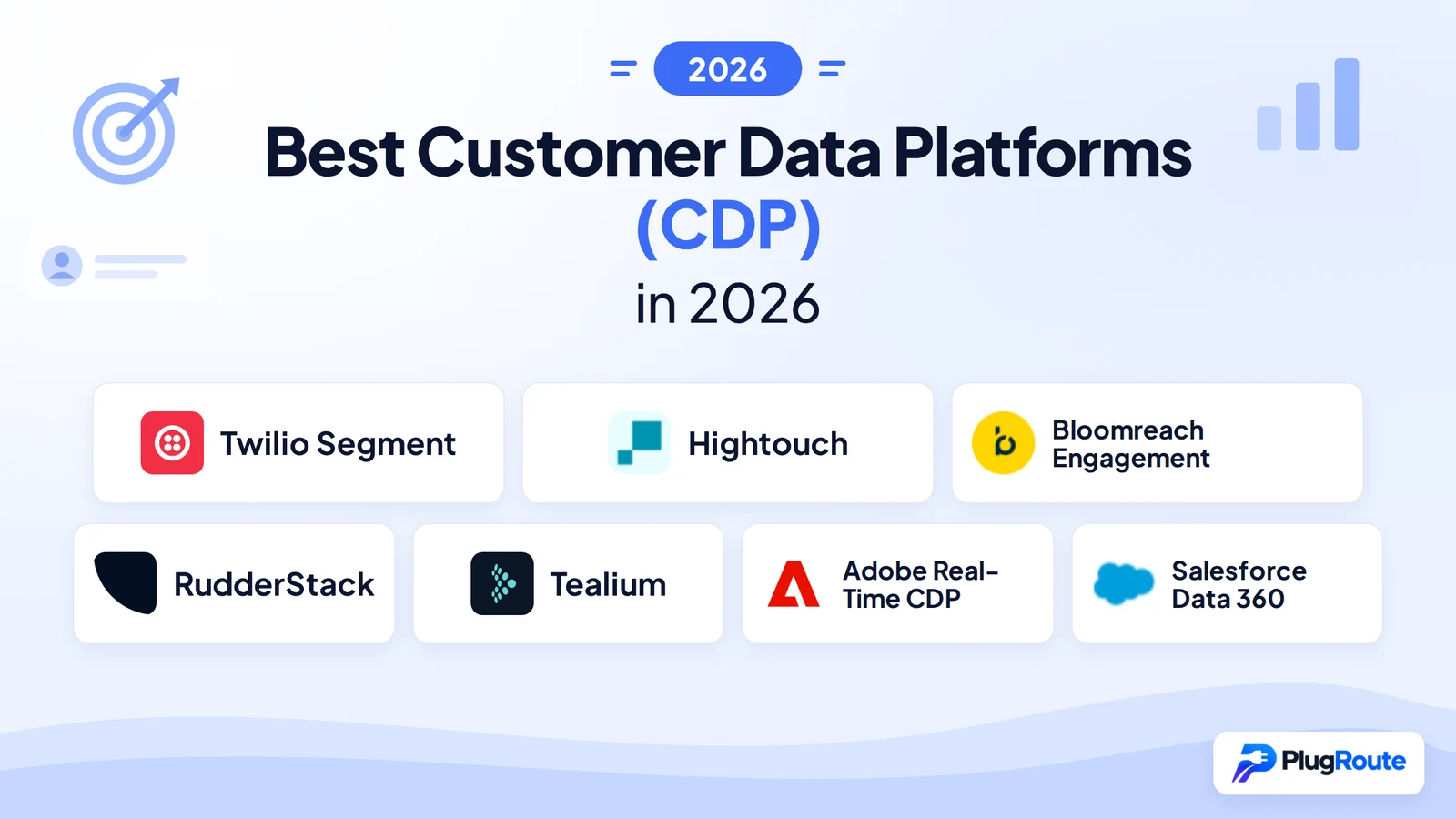
Twilio Segment and Hightouch are effectively tied as the top-scoring customer data platforms in PlugRoute’s 2026 evaluation (4.15 and 4.10 of 5), followed by Bloomreach Engagement. Twilio Segment fits governed event collection, Hightouch fits warehouse-ready teams and Bloomreach Engagement fits ecommerce brands. No single CDP fits every stack.
CDP shortlists tend to stall on the same three questions. Each one affects cost, team fit and lock-in risk:
- Should you buy a packaged CDP or build on your own warehouse?
- How do you forecast CDP pricing tied to profiles, monthly tracked users (MTUs) or credits?
- How do you avoid CDP lock-in to the Salesforce or Adobe ecosystem?
This guide answers each question with dated, sourced evidence. All seven vendors get the same template, the same scoring rubric and the same depth of review.
PlugRoute has no affiliate relationships with any company listed. Rankings are determined entirely by research data and objective evaluation criteria.
What Are the 5 Categories of Customer Data Platforms?
The seven CDPs in this evaluation fall into five categories. The categories are defined by where customer data lives and who runs the platform. Your category usually narrows the shortlist before any feature comparison does, because it decides warehouse dependence, latency, engineering burden and ecosystem lock-in.
- Composable (Warehouse-Native) CDP: Hightouch and RudderStack treat your cloud data warehouse as the source of truth. They do not keep a separate profile store held by the vendor.
- Event Infrastructure CDP: Twilio Segment collects, validates and routes first-party events from web, app and server sources to downstream tools.
- Commerce Engagement CDP: Bloomreach Engagement combines real-time profiles with built-in cross-channel messaging and web personalization for retail and ecommerce.
- Real-Time Collection and Governance Hub: Tealium collects data on both the client side and the server side. It enforces consent before routing data and then builds real-time profiles across multi-vendor stacks.
- Suite-Native Enterprise CDP: Adobe Real-Time CDP and Salesforce Data 360 deliver most of their value inside the Adobe Experience Cloud and Salesforce ecosystems.
How Do the Top Customer Data Platforms Compare at a Glance?
Twilio Segment (4.15) and Hightouch (4.10) lead PlugRoute’s 2026 scorecard and are effectively tied. Bloomreach Engagement and RudderStack tie at 3.55, followed by Tealium at 3.40. Adobe Real-Time CDP (2.70) and Salesforce Data 360 (2.65) score lower overall, but they may be the best fit for buyers already committed to those ecosystems.
| Rank | Company | Category | Best For | One-Line Summary | Key Capabilities | Primary Strength | Key Limitation |
|---|---|---|---|---|---|---|---|
| 1 (4.15) | Twilio Segment (G2 4.5/5, 567 reviews) | Event Infrastructure CDP | Engineering-supported digital businesses | Twilio Segment is a developer-first data infrastructure platform that collects, validates and routes first-party events to hundreds of tools. | Connections, Protocols, Unify, Engage, Linked Audiences | Vendor-neutral routing to a catalog cited at 450–700+ integrations | Anonymous visitors count as MTUs; EU residency and HIPAA are Business-tier only |
| 2 (4.10) | Hightouch (G2 4.6/5, 425 reviews) | Composable (Warehouse-Native) CDP | Data-mature teams on a governed warehouse | Hightouch is a warehouse-native composable CDP that lets marketers build and sync audiences from an existing cloud warehouse. | Reverse ETL, Customer Studio, AI Decisioning, 300+ integrations | Lowest Vendr median in this research (~$15,000/year) plus a no-code audience builder | Needs a mature, well-modeled warehouse; Starter covers only 2 billable destinations |
| 3 (3.55) | Bloomreach Engagement (G2 ~4.6/5, ~844 reviews) | Commerce Engagement CDP | Ecommerce, retail and DTC brands | Bloomreach Engagement is a commerce-focused CDP with built-in email, SMS, push and web personalization. | Real-time profiles, journeys, Loomi AI, seven messaging channels | Highest G2 review volume plus documented ISO 27001 and SOC 2 Type II | Custom pricing that starts around $60,000/year |
| 4 (3.55) | RudderStack (G2 4.7/5, 52 reviews) | Composable (Warehouse-Native) CDP | Engineering-led teams needing cost control | RudderStack is a warehouse-first customer data pipeline with self-hosting options and per-event pricing. | Event Stream, Profiles, Transformations, Reverse ETL | $265/month Growth tier and the only self-hostable data plane here | Small review sample; Profiles and HIPAA are Enterprise-only |
| 5 (3.40) | Tealium (G2 4.3/5, 486 reviews) | Real-Time Collection and Governance Hub | Regulated, multi-vendor enterprises | Tealium is a vendor-neutral real-time CDP and collection hub with strong consent and compliance controls. | iQ, EventStream, AudienceStream, CloudStream, Moments API | 1,300+ integrations and documented ISO/SOC 2/HIPAA BAA support | Steep learning curve; Vendr median ~$146K/year |
| 6 (2.70) | Adobe Real-Time CDP (G2 4.1/5, 180 reviews) | Suite-Native Enterprise CDP | Adobe Experience Cloud and B2B account-based teams | Adobe Real-Time CDP is an enterprise CDP with native B2B account modeling and strong governance. | XDM profiles, B2B/B2P editions, DULE, Shields | Deep governance and native buying-group modeling | Lowest verified G2 score here; key capabilities are quote-only add-ons |
| 7 (2.65) | Salesforce Data 360 (G2 4.2/5, 769 reviews) | Suite-Native Enterprise CDP | Salesforce-centric enterprises adopting Agentforce | Salesforce Data 360 is a CRM-native CDP that unifies customer data inside Salesforce and grounds Agentforce AI agents. | DMO mapping, zero-copy, Agentforce grounding, Hyperforce | Only SEC-reported adoption figures here (combined Agentforce + Data 360 ARR ~$1.4B) | Credit pricing that reviewers call hard to predict |
Which Customer Data Platform Should I Choose for My Use Case?
Let your top priority set your starting point. Twilio Segment fits governed event collection and Hightouch fits a governed warehouse. Bloomreach Engagement fits ecommerce, RudderStack fits self-hosting and per-event pricing, and Tealium fits regulated multi-vendor stacks. Adobe Real-Time CDP and Salesforce Data 360 fit buyers already committed to those clouds.
| Your #1 Priority | Recommended Tool | Why | Acceptable Alternative |
|---|---|---|---|
| Governed event collection across many tools | Twilio Segment | Protocols validates events before bad data spreads downstream | RudderStack (Segment-compatible APIs) |
| Governed warehouse plus 1+ data engineer | Hightouch | Composable option with a no-code audience builder for marketers | RudderStack |
| Ecommerce/DTC, consolidating messaging and personalization | Bloomreach Engagement | CDP and seven messaging channels in one commerce platform | Klaviyo Data Platform (Klaviyo-native brands should test it first) |
| Self-hosting, data residency or per-event pricing | RudderStack | Self-hostable or VPC data plane with published per-event tiers | Twilio Segment Business (EU West workspaces) |
| Regulated, multi-vendor stack | Tealium | Consent enforcement, ISO 27001/27018, SOC 2, HIPAA BAAs and regional hosting | Adobe Real-Time CDP |
| Committed to Adobe or running B2B account-based programs | Adobe Real-Time CDP | Native accounts, buying groups and Adobe activation | Tealium |
| Committed to Salesforce or deploying Agentforce | Salesforce Data 360 | Unified profiles act directly inside CRM workflows | Hightouch (syncing into Salesforce) |
| Mid-market, no data team, budget under $60K | No option in this evaluation fully fits | Packaged CDPs start near $60K/year, and cheaper tools assume engineers | Klaviyo Data Platform if already on Klaviyo, or a scoped Twilio Segment Team or RudderStack Growth pilot with contractor support |
What Are the 7 Best Customer Data Platforms in 2026?
PlugRoute’s 2026 ranking of customer data platforms, in order, is Twilio Segment, Hightouch, Bloomreach Engagement, RudderStack, Tealium, Adobe Real-Time CDP and Salesforce Data 360. Every entry below uses the same template, labels where each claim comes from, and lists real limitations alongside strengths.
1. Twilio Segment: Highest Overall Score; Best for Governed Event Collection
Category: Event Infrastructure CDP. Collects, validates and routes first-party event data from web, app and server sources to downstream tools and profiles.
At a Glance
- Category: Event Infrastructure CDP
- Best For: Product-led and digital businesses with engineering capacity that need governed event collection routed to many downstream tools
- Price Range: Free (1,000 MTUs); Team $120/month for 10,000 MTUs; Business custom (Vendr-reported median ~$55,600/year)
- Primary Strength: Twilio Segment holds a 4.5/5 rating from 567 G2 reviews (G2, 2026). It routes to a catalog cited at 450–700+ integrations and validates events at the source with Protocols.
- Biggest Limitation: Twilio Segment counts anonymous visitors as MTUs, so costs grow quickly for high-traffic B2C sites.
- One-Line Summary: Twilio Segment is a developer-first customer data infrastructure platform that collects, validates and routes first-party events to hundreds of tools, and it is best suited to engineering-supported teams that need a governed collection layer.
- Last Verified: November 2026
Overview Twilio Segment is a developer-first customer data platform for digital businesses whose engineering teams need one governed collection layer. It collects first-party events from websites, apps and servers, validates them against tracking plans, and routes them to downstream tools.
Twilio Segment is sold as separate modules, so buyers license capabilities individually. Twilio Segment scores 4.15 of 5 in PlugRoute’s 2026 evaluation, 0.05 ahead of Hightouch.
Key Features
- Twilio Segment Connections routes web, mobile and server events to a catalog cited at 450+ to 700+ integrations, depending on how sources and destinations are counted (Costbench, 2026).
- Twilio Segment Protocols checks incoming events against a tracking plan and flags violations before bad data reaches downstream tools.
- Twilio Segment Unify resolves identities deterministically from anonymous IDs, device IDs, emails and custom external IDs. It does no probabilistic matching.
- Twilio Segment Engage builds audiences and journeys from unified profiles for activation in marketing tools.
- Twilio Segment Linked Audiences and Reverse ETL let teams build audiences from warehouse data, which adds hybrid warehouse-native capability.
Best For Twilio Segment is best for product-led and digital companies with in-house engineers whose main problem is collecting clean event data and sending it to many tools, rather than running campaigns inside one suite.
Strengths
- Twilio Segment holds a 4.5/5 rating from 567 G2 reviews (G2, 2026). One G2 reviewer praised having “a single place for customer data and traits.”
- Twilio Segment Business offers EU data residency through EU West regional workspaces hosted in Dublin. It also offers HIPAA eligibility under a signed BAA, alongside marketed SOC 2 and ISO 27001 compliance (Twilio, 2026).
- Twilio Segment publishes entry pricing and MTU overage rates (Twilio Help Center, 2026), which makes cost modeling easier than with quote-only CDPs.
- Twilio Segment’s analyst recognition is vendor-reported: Twilio says it was a Leader in the IDC MarketScape for CDPs 2024–2025 (Twilio, 2024). A vendor-commissioned study also reports 35% less data-engineer time than home-built solutions (Forrester via Twilio, 2026).
A practitioner on r/dataengineering put it this way:
“Amplitude has a free tier, as does Segment. The whole point of Amplitude is to get answers quickly, without having to write SQL or to do any “coding” yourself. If you understand these products and your use case absolutely needs custom analysis aka SQL, you can use Segment instead of Amplitude and have Segment send the data to a database.” Posted by u/jawabdey
Takeaway: Practitioners treat Twilio Segment as a routing layer for teams that need custom SQL analysis on raw events, not as a no-code answer tool for non-technical users.
Limitations
- Twilio Segment gives up marketer usability in exchange for engineering control. Getting full value from Protocols, identity rules and Engage requires technical ownership.
- Twilio Segment’s MTU pricing counts anonymous visitors. EU data residency and HIPAA eligibility are reserved for the Business tier, which has no published price.
- Twilio Segment’s deterministic-only matching leaves anonymous visitors unstitched until they log in or buy, and shared emails or devices can cause false merges.
- Twilio Segment reviewers criticize the UX/UI and report inconsistent support since the 2020 Twilio acquisition (Opensend, 2026).
Verdict Twilio Segment is the highest-scoring platform in PlugRoute’s 2026 evaluation (4.15 of 5) and the best fit for engineering-supported teams that need governed event collection. Twilio Segment leads Hightouch by only 0.05, so the two are effectively tied.
PlugRoute’s research does not support treating Twilio Segment as a universal “safe default.” High-traffic B2C brands should model anonymous MTU growth first. Marketer-led teams without engineers should look elsewhere.
2. Hightouch: Best for Warehouse-Ready Teams
Category: Composable (Warehouse-Native) CDP. Activates customer data directly from your cloud data warehouse without a separate profile store held by the vendor.
At a Glance
- Category: Composable (Warehouse-Native) CDP
- Best For: Mid-market and enterprise teams with a governed cloud warehouse (Snowflake, BigQuery, Databricks or Redshift) and at least one data engineer
- Price Range: Free (2 active syncs); Starter $350/month (up to 2 billable destinations); Pro $800/month (up to 4); Business/Enterprise custom (Vendr median ~$15,000/year, plus warehouse compute)
- Primary Strength: Hightouch is one of the two highest-rated platforms with 300+ G2 reviews (4.6/5 from 425), and reviewers praise its marketer-friendly audience builder (G2, 2026).
- Biggest Limitation: Hightouch depends on a mature, well-modeled warehouse, and warehouse latency limits in-session personalization.
- One-Line Summary: Hightouch is a warehouse-native composable CDP that lets marketers build and sync audiences from an existing cloud warehouse, and it is best suited to data-mature teams that already trust that warehouse.
- Last Verified: November 2026
Overview Hightouch is a warehouse-native composable customer data platform that runs on major cloud warehouses such as Snowflake and BigQuery. It lets marketers at data-mature mid-market and enterprise companies use warehouse data without copying it into a separate CDP.
Hightouch is built for teams that already trust their warehouse as the source of truth. Hightouch adds its activation and AI Decisioning features on top of that warehouse.
Key Features
- Hightouch Customer Studio lets marketers build audiences from warehouse data with drag-and-drop controls instead of SQL.
- Hightouch Reverse ETL syncs modeled warehouse data to more than 300 destinations, including CRM, ad and email tools.
- Hightouch Identity Resolution and Events collection run in the customer’s warehouse, so the warehouse stays the single source of truth.
- Hightouch AI Decisioning agents decide who to contact, when, and with which message across owned and paid channels, and they run experiments automatically.
- Hightouch Match Booster aims to raise ad-platform match rates for paid-media audiences.
Best For Hightouch is best for organizations whose customer data is already modeled and governed in a cloud warehouse and who have at least one data engineer. It also suits teams whose marketers need self-serve audience building more than sub-second personalization.
Strengths
- Hightouch holds a 4.6/5 rating from 425 G2 reviews (G2, 2026), level with Bloomreach Engagement among platforms with 300+ reviews, and reviewers cite short ramp-up for marketers.
- Hightouch lists SOC 2, ISO 27001, HIPAA support and regional deployment for enterprise plans (Hightouch, 2026), and it has the lowest reported transaction median in this research at $15,000/year (Vendr, 2026).
- Hightouch raised an $80M Series C at a $1.2B valuation in February 2025 (TechCrunch, 2025), followed by a July 2025 extension from Snowflake Ventures and Capital One Ventures (Hightouch, 2025).
- Hightouch says it was named a Leader in Gartner’s January 2026 Magic Quadrant for CDPs, vendor-reported (Hightouch, 2026). It also reports a 60% customer-acquisition lift for Gorgias, vendor-published (Hightouch, 2025) and not independently verified.
Limitations
- Hightouch avoids the cost and lock-in of a separate profile store by depending entirely on your warehouse, so teams without modeled, governed data will struggle to get value from it.
- Hightouch inherits warehouse query latency of seconds to minutes (cdp.com, 2026), which limits in-session personalization.
- Hightouch Starter covers up to 2 billable destinations and Pro up to 4 (G2, 2026), and warehouse compute costs come on top of the license.
- Hightouch reviewers report heavy engineering time at setup, a sync that failed silently because one field was unmapped, slow large-volume jobs and one sudden pricing change (G2, 2026).
Verdict Hightouch is the second-highest-scoring CDP in PlugRoute’s 2026 evaluation (4.10 of 5) and the best fit for teams whose cloud warehouse is already their trusted source of customer data. Hightouch trails Twilio Segment by only 0.05, so the two are effectively tied.
Hightouch is the wrong choice for teams without a modeled warehouse or for use cases that need sub-second personalization. Before signing, confirm Hightouch’s pricing units and destination caps in writing.
3. Bloomreach Engagement: Best for Ecommerce and Retail Brands
Category: Commerce Engagement CDP. Combines real-time customer profiles with built-in cross-channel messaging and personalization for retail and ecommerce.
At a Glance
- Category: Commerce Engagement CDP
- Best For: Mid-market and enterprise ecommerce, retail and DTC brands without a large data team that want to consolidate CDP, messaging and personalization
- Price Range: Custom; Bloomreach states smaller brands start at about $60,000/year
- Primary Strength: Bloomreach Engagement has the highest review volume in this evaluation, rated about 4.6/5 from roughly 844 G2 reviews (G2, 2026).
- Biggest Limitation: Bloomreach Engagement is built for commerce and is not a neutral data layer for non-commerce or B2B stacks.
- One-Line Summary: Bloomreach Engagement is a commerce-focused CDP with built-in email, SMS, push and web personalization, and it is best suited to ecommerce and retail brands that want one platform instead of a separate CDP and messaging stack.
- Last Verified: November 2026
Overview Bloomreach Engagement is a commerce-focused customer data platform that pairs real-time profiles and predictive segmentation with native messaging channels. It is built for ecommerce and retail brands replacing a separate CDP and marketing automation stack.
Bloomreach Engagement, formerly Exponea, is part of a wider Bloomreach commerce suite. Bloomreach Engagement scores 3.55 of 5 in PlugRoute’s 2026 evaluation.
Key Features
- Bloomreach Engagement builds real-time customer profiles with segmentation and predictive models aimed at commerce behavior.
- Bloomreach Engagement runs journeys across seven channels, from email and SMS to WhatsApp and RCS, on the same platform that holds the profile.
- Bloomreach Engagement uses Loomi AI to build segments from natural language, generate content and optimize send times.
- Bloomreach Engagement connects to Bloomreach Discovery for AI search, Clarity for conversational shopping and Content for headless CMS.
- Bloomreach Engagement supports advanced personalization through HTML and Jinja2 templating.
Best For Bloomreach Engagement is best for ecommerce, retail and DTC brands that want one platform for profiles, cross-channel messaging and onsite personalization. It suits brands that can offset its cost by retiring separate tools.
Strengths
- Bloomreach Engagement is rated about 4.6/5 from roughly 844 G2 reviews (G2, 2026). Capterra (~4.8/5) and TrustRadius (~4.5/5) are broadly consistent (cdp.com, 2026), though Bloomreach’s own page shows Gartner Peer Insights at 4.45.
- Bloomreach documents ISO/IEC 27001:2022, ISO 27017, ISO 27018 and SOC 2 Type II, and hosts Bloomreach Engagement on Google Cloud in the US, UK or EU depending on contract (Bloomreach, 2026).
- Bloomreach raised $175M led by Goldman Sachs Asset Management at a $2.2B valuation in February 2022 and reports 900+ employees (Bloomreach, 2022).
- Bloomreach reports being a Visionary in the 2025 Gartner Magic Quadrant for Multichannel Marketing Hubs, vendor-reported (Bloomreach, 2025). That report is not a CDP-specific evaluation.
Limitations
- Bloomreach Engagement gives up neutrality in exchange for commerce depth, so it is not designed as a general-purpose data layer for B2B or non-commerce stacks.
- Bloomreach Engagement’s custom pricing starts around $60,000/year (Bloomreach, 2026), which is steep for teams that only need a CDP.
- Bloomreach Engagement reviewers ask for better reporting and analytics, note that advanced personalization requires Jinja2, and find large scenarios hard to maintain (G2, 2026).
- One G2 reviewer found that Bloomreach Engagement’s predictive features worked “only moderately” for their business model (G2, 2026), so test predictive models on your own catalog during a proof of value.
Verdict Bloomreach Engagement is the only commerce-focused CDP in PlugRoute’s 2026 evaluation and has the highest G2 review volume (about 844 reviews). Bloomreach Engagement ties with RudderStack at 3.55 of 5 and ranks #3 on the user-review tie-breaker.
Bloomreach Engagement makes the most sense for retail and DTC brands that will retire separate messaging and personalization tools. Bloomreach Engagement is a poor fit for non-commerce and B2B buyers, or for teams that only need a CDP without messaging.
4. RudderStack: Best for Engineering-Led Teams Needing Cost Control and Data Residency
Category: Composable (Warehouse-Native) CDP. Collects and routes events into your own warehouse, where profiles and activation run without a separate profile store held by the vendor.
At a Glance
- Category: Composable (Warehouse-Native) CDP
- Best For: Engineering-led teams that want warehouse-first event pipelines, predictable per-event pricing or self-hosted data residency
- Price Range: Free (250K events/month); Growth $265/month for 1M events; Enterprise custom
- Primary Strength: RudderStack publishes low entry pricing and is the only platform in this evaluation with a self-hostable or VPC data plane.
- Biggest Limitation: RudderStack has a small verified review base (4.7/5 from 52 G2 reviews) and requires engineering ownership.
- One-Line Summary: RudderStack is a warehouse-first customer data pipeline with self-hosting options and per-event pricing, and it is best suited to engineering-led teams that want control over cost, residency and their warehouse.
- Last Verified: November 2026
Overview RudderStack is a warehouse-first customer data infrastructure platform for engineering-led teams that want cost control and data residency. It collects events, routes them to 200+ destinations, and resolves identity inside the customer’s own warehouse.
RudderStack is also built as an easy migration path from Twilio Segment. RudderStack pairs event collection with warehouse-based profiles and Reverse ETL.
Key Features
- RudderStack Event Stream collects data from 16 SDK sources and routes it to 200+ cloud destinations.
- RudderStack Profiles performs identity resolution inside the warehouse, and RudderStack says it does not keep its own copy of customer profiles.
- RudderStack can run its data plane self-hosted or in a customer’s private cloud (VPC), which supports data residency requirements.
- RudderStack uses Segment-compatible track, identify, page and group APIs, which makes migrating off Twilio Segment easier.
- RudderStack JavaScript Transformations and tracking plans let engineers shape and govern events before delivery.
Best For RudderStack is best for engineering-led companies with a cloud warehouse that want per-event pricing, a self-hosted or VPC data plane, or a lower-cost, API-compatible move away from Twilio Segment.
Strengths
- RudderStack publishes a $0 tier for 250,000 events/month and a $265/month Growth tier for 1M events (RudderStack, 2026), among the most transparent pricing in this evaluation.
- RudderStack offers a self-hosted or VPC data plane and states that it holds SOC 2 Type II certification (RudderStack, 2026), which gives it a strong data-residency position.
- RudderStack raised a $56M Series B in February 2022 led by Insight Partners ($82M total) and reported 13,000+ apps and sites using it in 2021 (TechCrunch, 2022). Both figures are now several years old.
- RudderStack reports peaks of up to 1M events per second with 99.95% uptime, vendor-reported (RudderStack G2 profile, 2026). Its customers include Allbirds, Wealthfront and Crate & Barrel.
Limitations
- RudderStack gives up marketer accessibility in exchange for engineering control, and it offers marketers less self-serve help than Hightouch.
- RudderStack holds a high 4.7/5 rating from only 52 G2 reviews, plus a single Capterra review (G2, 2026; Capterra, 2026), so buyers should check references directly.
- RudderStack restricts Profiles, 5-minute sync, HIPAA and SSO to its Enterprise tier, and Growth caps Reverse ETL at 25 connections.
- RudderStack’s core server is source-available under Elastic License 2.0, not OSI open source. ISO 27001 appears only in third-party listings, so request the certificate.
A user evaluating open-source event tools on r/dataengineering noted:
“I would need an intermediate server for this. The other downside is that the documentation for the open-source version demands the use of Kubernetes since the tool itself does more than just sending the data, it also has observability features.” Posted by u/dataismysuperpower
Takeaway: RudderStack’s self-hosted path comes with Kubernetes-level infrastructure demands, which makes it a poor fit for teams without engineering capacity.
Verdict RudderStack publishes per-event pricing from $0 to $265/month and is the only platform in PlugRoute’s 2026 evaluation with a self-hostable or VPC data plane. RudderStack ties with Bloomreach Engagement at 3.55 of 5 and ranks #4 because its user-review score is lower (3 vs 5).
RudderStack’s newest traction data dates from 2021–2022, so ask for current customer references. Engineering-led teams should shortlist RudderStack next to Hightouch and Twilio Segment. Marketer-led teams should look elsewhere.
5. Tealium: Best for Regulated, Multi-Vendor Enterprises
Category: Real-Time Collection and Governance Hub. A vendor-neutral platform that collects data client-side and server-side, enforces consent, routes it, and then builds real-time profiles.
At a Glance
- Category: Real-Time Collection and Governance Hub
- Best For: Regulated enterprises in healthcare, financial services and insurance that run multi-vendor marketing stacks with strict consent and residency needs
- Price Range: No public pricing; Vendr median ~$146,141/year; reported range ~$50K–$500K+/year depending on monthly unique visitors
- Primary Strength: Tealium combines vendor-neutral collection, 1,300+ integrations and documented ISO 27001/27018, SOC 2 and HIPAA BAA support.
- Biggest Limitation: Tealium has a steep learning curve and a complex, dated UI.
- One-Line Summary: Tealium is a vendor-neutral real-time CDP and data collection hub with strong consent and compliance controls, and it is best suited to regulated enterprises running multi-vendor marketing stacks.
- Last Verified: November 2026
Overview Tealium is a vendor-neutral real-time customer data platform and collection hub for regulated enterprises that need governed data flowing to many tools. It combines tag management, server-side event collection, consent enforcement and real-time profiles.
Tealium is built for multi-vendor stacks rather than a single marketing suite. Tealium sells its capabilities as separate products, from iQ Tag Management to AudienceStream CDP.
Key Features
- Tealium iQ Tag Management and EventStream API Hub collect data client-side and server-side and enforce consent before routing, which supports GDPR and CCPA consent requirements.
- Tealium AudienceStream CDP builds real-time profiles, stitches identities and creates audiences for activation.
- Tealium connects to 1,300+ built-in integrations, one of the largest advertised catalogs in this evaluation (Equilar, 2026).
- Tealium CloudStream delivers data to Snowflake, Databricks and AWS, and Tealium promotes Snowflake delivery in under 10 seconds for some use cases.
- Tealium Moments API supplies real-time customer context to apps and AI agents.
Best For Tealium is best for regulated enterprises running multi-vendor stacks that need consent-enforced server-side collection, documented certifications and regional hosting without committing to the Salesforce or Adobe ecosystem.
Strengths
- Tealium documents ISO 27001, ISO 27018, SOC 2 Type I/II, HIPAA BAAs and regional hosting (Tealium, 2026), and pairs them with consent enforcement at the point of collection.
- Tealium was one of two Leaders in Gartner’s March 2025 Magic Quadrant for CDPs (Tealium, 2025; CX Today, 2025). Its 2024 placement is vendor-reported.
- Tealium holds a 4.3/5 rating from 486 G2 reviews (G2, 2026), and reviewers praise its real-time unification and integration breadth.
- Tealium has raised about $263.9M, including a $96M Series G in February 2021 (Latka, 2025). It reports 1,000+ customers (Tealium, 2026), though another source cites 850+ (Equilar, 2026).
Limitations
- Tealium gives up ease of use in exchange for control. It has a steep learning curve for non-technical users and native analytics that reviewers call limited (G2, 2026).
- Tealium reviewers describe the UI as complex and dated, and one needed several weeks of training (AWS Marketplace, 2026).
- Tealium’s Vendr median of about $146K/year is the highest transaction median in this research (Vendr, 2026).
- Tealium grew out of data collection, so campaign execution depends on other tools.
Verdict Tealium is the best fit in PlugRoute’s 2026 evaluation for regulated enterprises that need consent-enforced collection across a multi-vendor stack. Tealium scores 3.40 of 5 and ranks #5, held back by opaque pricing and a heavy implementation burden.
Tealium buyers should budget for training and negotiate firmly, because 20–30% discounts off initial quotes are common (Vendr, 2026). Teams without dedicated data or analytics staff should look elsewhere.
6. Adobe Real-Time CDP: Best for Adobe Experience Cloud and B2B Account-Based Programs
Category: Suite-Native Enterprise CDP. A CDP built into a broader marketing or CRM cloud that delivers most of its value inside that vendor’s ecosystem.
At a Glance
- Category: Suite-Native Enterprise CDP
- Best For: Large B2C, B2B and B2P organizations already invested in Adobe Experience Cloud, especially account-based B2B programs and regulated industries
- Price Range: Quote-only; priced by addressable profiles, edition (Prime/Ultimate; B2C/B2B/B2P), sandboxes and add-ons
- Primary Strength: Adobe Real-Time CDP models B2B accounts and buying groups natively and offers some of the deepest governance controls in the category.
- Biggest Limitation: Adobe Real-Time CDP has the lowest verified G2 rating in this evaluation (4.1/5 from 180 reviews).
- One-Line Summary: Adobe Real-Time CDP is an enterprise CDP built on Adobe Experience Platform with native B2B account modeling and strong governance, and it is best suited to organizations already invested in Adobe Experience Cloud.
- Last Verified: November 2026
Overview Adobe Real-Time CDP is an enterprise customer data platform built on Adobe Experience Platform for large organizations already running Adobe Experience Cloud. It unifies known and anonymous profiles, models B2B accounts and enforces data-usage governance.
Adobe Real-Time CDP is sold in Prime and Ultimate packages, each in B2C, B2B and B2P editions. For buyers already in Adobe’s ecosystem, Adobe Real-Time CDP may be the best practical fit despite its #6 rank.
Key Features
- Adobe Real-Time CDP uses XDM schemas and Identity Service to build real-time person and account profiles from a deterministic identity graph.
- Adobe Real-Time CDP B2B and B2P editions natively model accounts, buying groups and account-person relationships.
- Adobe Real-Time CDP enforces DULE data usage labeling, and it offers Privacy & Security Shield and Healthcare Shield, usually as add-ons.
- Adobe Real-Time CDP Federated Audience Composition builds audiences from external warehouses without fully copying data, and some packages license it separately.
- Adobe Real-Time CDP activates audiences natively into Adobe Journey Optimizer, Target and Analytics.
Best For Adobe Real-Time CDP is best for enterprises committed to Adobe Experience Cloud and for B2B or B2P organizations running account-based programs. It also fits regulated companies that need labeled data-usage enforcement.
Strengths
- Adobe Real-Time CDP offers DULE labeling, Privacy & Security Shield and Healthcare Shield (Adobe, 2026), some of the deepest governance controls in the category.
- Adobe Real-Time CDP is one of the few CDPs here that natively models B2B buying groups, and Vanguard presented a deployment spanning two marketing organizations (Adobe Summit, 2025).
- Adobe Real-Time CDP was credited with +162% opportunity pipeline and +85% closed revenue for one unnamed B2B customer, vendor-published (Adobe Summit session S510, 2025).
- Adobe Real-Time CDP was a Visionary in Gartner’s March 2025 Magic Quadrant for CDPs (CX Today, 2025). A vendor-published summary lists it among Leaders in the January 2026 edition (Hightouch, 2026).
Limitations
- Adobe Real-Time CDP gives up accessibility in exchange for depth, and its implementation complexity typically requires Adobe partners and XDM expertise.
- Adobe Real-Time CDP holds a 4.1/5 rating from 180 G2 reviews (G2, 2026), the lowest verified score here, and reviewers say identity stitching is hard to debug.
- Adobe Real-Time CDP identity graphs span 2–50 identities, so overly broad namespaces such as shared emails can collapse profiles that should stay separate (Adobe, 2026).
- Adobe Real-Time CDP pricing is quote-only, key capabilities are add-ons, and reviewers report high cost for smaller organizations.
Verdict Adobe Real-Time CDP is the best fit in PlugRoute’s 2026 evaluation for Adobe Experience Cloud customers running B2B account-based or regulated programs. Adobe Real-Time CDP scores 2.70 of 5 and ranks #6 because of low scores on cost transparency, implementation burden and user rating.
Adobe Real-Time CDP’s governance depth and native account modeling are real strengths. Buyers outside the Adobe ecosystem will rarely find Adobe Real-Time CDP the best fit.
7. Salesforce Data 360: Best for Salesforce-Centric Enterprises Adopting Agentforce
Category: Suite-Native Enterprise CDP.
At a Glance
- Category: Suite-Native Enterprise CDP
- Best For: Enterprises whose sales, service and marketing already run on Salesforce, especially those deploying Agentforce AI agents
- Price Range: Consumption credits, quote-based for most buyers; Capterra lists a starting price of $2,394/user/year (third-party listing that does not reflect consumption costs)
- Primary Strength: Salesforce Data 360 is the only platform in this evaluation with SEC-reported adoption figures: combined Agentforce and Data 360 ARR of nearly $1.4B, up 114% year over year.
- Biggest Limitation: Salesforce Data 360 uses a consumption-credit model that reviewers call hard to predict, and it requires specialist architecture skills.
- One-Line Summary: Salesforce Data 360 is a CRM-native CDP that unifies customer data inside Salesforce and grounds Agentforce AI agents, and it is best suited to enterprises whose customer operations already run on Salesforce.
- Last Verified: November 2026
Overview Salesforce Data 360, formerly Data Cloud, is a CRM-native customer data platform for enterprises whose sales, service and marketing already run on Salesforce. It maps data into Salesforce Data Model Objects, resolves identities and triggers Salesforce actions directly.
Salesforce Data 360 also grounds Agentforce AI agents and federates external warehouses through zero-copy. For Salesforce-centric buyers, Salesforce Data 360 may be the best practical fit despite its #7 rank.
Key Features
- Salesforce Data 360 maps data into Data Model Objects and applies identity-resolution rules and segmentation tied to CRM permissions.
- Salesforce Data 360 lets unified profiles update records, start journeys and inform service reps without a custom CDP-to-CRM integration.
- Salesforce Data 360 zero-copy federation queries Snowflake, Databricks and other warehouses without copying every record into Salesforce.
- Salesforce Data 360 grounds Agentforce AI agents under the Einstein Trust Layer, which Salesforce says includes zero-data-retention agreements with LLM providers.
- Salesforce Data 360 supports regional data residency through Hyperforce, though compliance still depends on customer configuration.
Best For Salesforce Data 360 is best for enterprises standardized on Salesforce Sales, Service and Marketing clouds that want unified profiles to act inside CRM workflows.
Strengths
- Salesforce reported combined Agentforce and Data 360 ARR of nearly $1.4B, up 114% year over year (Salesforce SEC filing, 2025). Salesforce does not report Data 360 separately.
- Salesforce Data 360 holds a 4.2/5 rating from 769 G2 reviews (G2, 2026), and reviewers praise its real-time CRM integration and unified reporting.
- Salesforce Data 360 is governed by the Einstein Trust Layer, and Agentforce is HIPAA-eligible under a BAA and covered by ISO 27001/27017/27018 (Salesforce, 2026).
- Salesforce was one of two Leaders in Gartner’s March 2025 Magic Quadrant for CDPs (CX Today, 2025). It also reports Leader status in The Forrester Wave: CDPs for B2C, Q3 2024, vendor-reported (Salesforce, 2024).
Responding to a question about whether Data Cloud requires Marketing Cloud, a user on r/salesforce noted:
“You don’t have to, but it makes sense to use them together. Data Cloud will give you a consolidated view of your customers. A 360 view. Once you get that, what do you want to do with it? Probably analyze, segment and activate it” Posted by u/ajpicco
Takeaway: Practitioners see Salesforce Data 360 as most valuable when it is paired with Marketing Cloud for activation, so much of its value depends on wider Salesforce adoption.
Limitations
- Salesforce Data 360 gives up neutrality in exchange for CRM-native power. Over 40% of FY26 Q2 Data Cloud/Agentforce bookings came from existing-customer expansion (Salesforce SEC filing, 2025).
- Salesforce Data 360 reviewers call the consumption credit model “hard to predict” and describe a steep learning curve in DMO mapping and identity rules (G2, 2026).
- Salesforce Data 360 reviewers say debugging lineage and pipeline errors “lacks the transparency and real-time observability” of dedicated data engineering stacks (G2, 2026).
- Salesforce Data 360 training drew criticism from an r/salesforce practitioner who found official materials outdated (Reddit, 2026).
Verdict Salesforce Data 360 is the only platform in PlugRoute’s 2026 evaluation with SEC-reported adoption figures, and it may be the best practical fit for Salesforce-centric enterprises. Salesforce Data 360 scores 2.65 of 5 and ranks #7 because of cost predictability, neutrality and implementation burden.
Salesforce Data 360 buyers should run a credit-usage simulation before signing. Buyers outside Salesforce, or without architect capacity, should look elsewhere.
Should You Choose a Packaged or Warehouse-Native CDP?
Choose a warehouse-native CDP if your customer data is already modeled and governed in a cloud warehouse and you have at least one data engineer. Choose a packaged CDP if you need sub-second in-session personalization or don’t yet have a mature warehouse. Most major vendors now sell hybrid features, so the line is blurring.
Packaged vendors have added warehouse-native capabilities:
- Salesforce Data 360 offers zero-copy federation that queries external warehouses without copying every record into Salesforce.
- Adobe Real-Time CDP offers Federated Audience Composition, which some packages license separately (Adobe, 2026).
- Twilio Segment offers Linked Audiences for building audiences from warehouse data.
Composable vendors have moved the opposite way:
- Hightouch has added event collection, journeys and AI Decisioning agents.
- RudderStack has added Event Stream collection, Profiles and Reverse ETL.
In a r/dataengineering thread asking whether reverse ETL tools like Hightouch are hype, one user explained:
“The pattern is legit and it requires different thinking. First, standard ETL/ELT tools pull data from the apps through bulk extract api’s and then write into the data warehouse. rETL is reading from a cloud data warehouse (snowflake, redshift, big query) and it’s usually a discrete package of data that is meaningful to a specific application. The data needs to be shaped to the spec of the receiving application and is loaded or written in via the application api’s.” Posted by u/Mpickett83
Takeaway: Data engineers see reverse ETL, the core of composable CDPs like Hightouch, as a real pattern, but one that requires shaping data for each destination app rather than just running ETL in reverse.
Latency is still the main architectural difference. Composable CDPs depend on dbt-modeled warehouse tables that can take seconds to minutes to query, while packaged CDPs serve profiles via API for real-time personalization (cdp.com, 2026).
Warehouse-native CDPs move the cost of a second profile store into the warehouse bill; packaged CDPs move it into the license.
What Does a CDP Really Cost in 2026?
A CDP’s entry tier is not its price. Published tiers start at $120–$800 per month, but 2026 transaction medians run from about $15,000/year for Hightouch to about $146,000/year for Tealium (Vendr, 2026). Industry estimates put packaged CDPs at $50K–$150K/year before implementation and staffing (Vero, 2026).
| Platform | Billing Unit | Published Entry Price | Transaction Data |
|---|---|---|---|
| Twilio Segment | Monthly tracked users | $120/month for 10K MTUs | Vendr-related median $55,600/year |
| Hightouch | Usage (Vendr: rows plus destinations) | $350/month Starter (2 billable destinations) | Vendr median $15,000/year (179 purchases) |
| Bloomreach Engagement | Profiles, events, messages | None; “about $60,000/year” floor | Not verified |
| RudderStack | Events | $265/month for 1M events | Not verified |
| Tealium | Monthly unique visitors, server calls, modules | None | Vendr median $146,141/year |
| Adobe Real-Time CDP | Profiles, edition, add-ons | None | Not verified |
| Salesforce Data 360 | Consumption credits | Capterra lists $2,394/user/year | Not verified |
Published tiers (verified November 2026):
- Twilio Segment Free costs $0 for 1,000 MTUs, and Twilio Segment Team costs $120/month for 10,000 MTUs (Twilio Help Center, 2026).
- Twilio Segment Team overages are $12 per additional 1,000 MTUs up to 25,000, $11 up to 100,000 and $10 above that (Twilio Help Center, 2026).
- Hightouch Starter costs $350/month for up to 2 billable destinations, and Hightouch Pro costs $800/month for up to 4 (G2, 2026).
- RudderStack Free costs $0 for up to 250,000 events per month, and RudderStack Growth costs $265/month for 1M events (RudderStack, 2026).
Transaction data and pricing caveats:
- Twilio Segment’s Vendr-related median is $55,600/year with ~17.35% negotiated savings (Zapro, 2026). PlugRoute left out a conflicting “$449 median” because it could not be reconciled with that figure.
- Hightouch’s pricing variables are described by Vendr as monthly tracked rows plus destinations, which conflicts with Hightouch’s “no MTU limits” positioning (Vendr, 2026). Confirm the units in writing.
- Tealium deployments of 1–3M monthly unique visitors typically cost $50K–$120K/year, and Tealium mid-market EventStream plus AudienceStream deployments cost $60K–$150K/year (Vendr, 2026).
- Tealium deployments of 5–10M monthly unique visitors cost $150K–$350K/year, and Tealium deployments above 10M cost $200K–$500K+/year (Vendr, 2026).
Bloomreach Engagement quotes depend on these variables (Bloomreach, 2026):
- Bloomreach Engagement prices on customer profile volume.
- Bloomreach Engagement prices on catalog size.
- Bloomreach Engagement prices on event and message volume.
- Bloomreach Engagement prices on which Bloomreach products are enabled.
Adobe Real-Time CDP pricing is quote-only and depends mainly on addressable profiles and edition, with the Shields priced as add-ons. Adobe Real-Time CDP total cost is usually well above the license, because it is commonly bundled with other Adobe products and partner services.
Salesforce Data 360 core pricing is based on consumption credits. PlugRoute could not verify Salesforce Data 360 credit rates, so budget separately for system-integrator fees.
Three cost patterns stand out:
- Twilio Segment counts anonymous visitors as MTUs. At 50,000 MTUs, Twilio Segment Team costs about $575/month ($120 base + $180 + $275 in overages) before Business-tier features (Twilio Help Center, 2026).
- Hightouch and RudderStack add warehouse compute costs on top of the license.
- Adobe Real-Time CDP and Salesforce Data 360 usually carry partner or system-integrator fees on top of the license.
As one user on r/dataengineering described:
“It may also be worth taking a second look at what’s being tracked. One company I worked at was sending volumes that my other, publicly traded, company was sending. Tracking was poorly implemented and we didn’t need 5% of the data that was being collected. I’m not saying this is the case with you, but the cost of analytics being that high is usually an indicator that something is off.” Posted by u/jawabdey
Takeaway: Inflated CDP and analytics bills often come from poorly implemented tracking, so buyers should audit event volume before they negotiate on price.
Packaged CDPs typically take 3–9 months to deliver broad value, according to an industry estimate (Vero, 2026). Mid-market teams without data engineers face a real gap: packaged options start near $60K/year, and cheaper composable tools assume a warehouse and engineers.
Which Other CDPs Are Worth Considering?
Several credible CDPs fell outside this evaluation’s scope, but some deserve a look in specific situations. Klaviyo Data Platform suits Klaviyo-native DTC brands, and Amperity is often cited for identity resolution. PlugRoute did not score any platform below, and several have changed ownership since 2024.
- Klaviyo Data Platform: Klaviyo Data Platform is a CDP add-on to Klaviyo’s email and SMS tool. One unverified source reports about $500/month for 100,000 profiles on top of the marketing plan (marketintelligencetools, 2026).
- Amperity: Amperity is frequently cited for identity resolution and is worth a proof of concept for fragmented online and offline records.
- Treasure Data: Treasure Data is cited as a managed, enterprise-scale CDP.
- Amplitude: Amplitude is a product-analytics-led platform adjacent to the CDP category.
- mParticle, ActionIQ and Census: mParticle was acquired by Rokt in January 2025, ActionIQ by Uniphore in December 2024 and Census by Fivetran in May 2025 (MarTech, 2025; cdp.com, 2025).
- Insider: Insider is a G2-listed CDP alternative that PlugRoute did not research in depth.
What Red Flags Should I Watch For When Evaluating Customer Data Platforms?
Six red flags distort CDP cost or fit more than any feature gap does. They hide plan limits, inflate bills, overstate analyst status or mask identity problems. Each red flag below names the warning sign, explains why it matters, and points to evidence you can test before you sign a contract.
Red Flag #1: Integration Counts Without Plan Confirmation An integration count is a red flag when the vendor can’t confirm your destinations are included in your plan. Advertised catalogs range from 200+ to 1,300+. Hightouch Starter covers 2 billable destinations, and RudderStack Growth caps Reverse ETL at 25 connections.
Red Flag #2: Pricing Units That Count Anonymous Traffic Pricing that counts anonymous traffic is a red flag because high-traffic B2C sites pay for visitors they cannot identify. Twilio Segment counts anonymous visitors as MTUs, and Tealium prices on monthly unique visitors.
Example: a site with 80,000 monthly visitors, of whom 8,000 log in, is billed on roughly 80,000 Twilio Segment MTUs, not 8,000.
Red Flag #3: Analyst Badges Without Report Access An analyst badge is a red flag when the vendor can’t show the licensed report and its edition date. Gartner’s March 2025 Magic Quadrant for CDPs named two Leaders, Salesforce and Tealium. Vendor summaries of the January 2026 edition list six.
Red Flag #4: Identity Resolution Demos on Vendor Data Only An identity demo is a red flag when it runs only on clean vendor data, because false merges show up on your own records. All seven platforms documented in this research rely mainly on deterministic matching.
Example: if two spouses share one family email, a deterministic identity graph can merge them into one golden record. One partner’s purchases then trigger the other’s abandoned-cart emails, and one consent withdrawal may suppress both.
Red Flag #5: Unsupported Failure-Rate or ROI Statistics A CDP failure-rate or ROI statistic is a red flag when it has no named, dated source. No authoritative public Gartner or Forrester statistic establishes a fixed CDP failure rate, so treat “60–80% of CDPs fail” as unsupported. Read vendor-commissioned ROI studies as directional only.
Red Flag #6: Hybrid Features Sold as Separate Licenses A hybrid warehouse feature is a red flag when the quote doesn’t say whether it is included. Adobe Real-Time CDP licenses Federated Audience Composition separately in some packages, and Twilio Segment reserves EU residency for its Business tier.
What Questions Should I Ask Before Choosing a Customer Data Platform?
Before choosing a customer data platform, get six things confirmed in writing:
- which destinations your quoted plan includes
- what you will pay at double your volume
- how false merges are prevented
- who will own the platform
- which audit reports exist
- how you can export your data and identity graph if you leave
Question #1: Which of our required destinations are included in the plan being quoted? Your quoted plan should list every required destination by name, because catalogs and plan entitlements differ. Hightouch Starter covers 2 billable destinations and RudderStack Growth caps Reverse ETL at 25 connections. Ask for a written map of which destinations come with which tier before signing.
Question #2: What will we pay at 2x our current profile, MTU or event volume? Your vendor should price a scenario at double your current volume, including anonymous visitors. Twilio Segment Team rises from about $300/month at 25,000 MTUs to about $1,125/month at 100,000 (Twilio Help Center, 2026). Credit-based Salesforce Data 360 needs a simulation that covers query frequency.
Question #3: Is matching deterministic or probabilistic, and how are shared-email and household false merges prevented? Your vendor should prove its false-merge controls on a sample of your own records. Ask whether matching is deterministic or probabilistic and how householding works. Also ask how the identity graph keeps apart profiles that share an email address or device.
Question #4: Who on our team will own this platform day to day? The platform should match the people you already have. Hightouch, RudderStack and Twilio Segment need engineering ownership. Adobe Real-Time CDP and Salesforce Data 360 typically need specialist architects or partners. Bloomreach Engagement is built for marketers.
Question #5: Which certifications can you show us audit reports for, and is HIPAA available on our tier? Your vendor should share current SOC 2 and ISO audit reports and BAA terms. Ask how the platform honors signals from your consent management platform (CMP) and handles GDPR/CCPA deletion requests across destinations. Twilio Segment and RudderStack reserve HIPAA for higher tiers.
Question #6: How do we export our data and identity graph if we leave? Your contract should define the export format and any fees for your data and identity graph. Warehouse-native tools such as Hightouch and RudderStack keep data in your own warehouse. RudderStack’s Segment-compatible APIs show what a realistic exit path looks like.
What should a 60–90-day proof of value test? A CDP proof of value should test four things on your own data:
- The proof of value should measure the identity match rate and false-merge rate on a 50,000-record sample.
- The proof of value should measure end-to-end latency to your two most important destinations.
- The proof of value should produce a priced bill at 2x your current volume.
- The proof of value should confirm that a marketer can build and activate an audience without engineering help.
How Did We Rank These Customer Data Platforms?
PlugRoute scored all seven customer data platforms from 1 to 5 on six published criteria, using the same evidence template for each. User reviews, pricing transparency, architecture flexibility and implementation burden each carry 20% weight. Governance and vendor stability carry 10% each. Unverified data received a neutral 2.5. G2 data for all seven vendors was re-verified in November 2026.
Ranking criteria:
- C1, Verified User Review Ratings and Volume (20%): C1 matters because independently hosted reviews are the most independent signal of real-world satisfaction.
- C2, Pricing Transparency and Cost Predictability (20%): C2 matters because buyers name unpredictable MTU, credit and add-on pricing as a top pain point.
- C3, Architecture Flexibility and Ecosystem Neutrality (20%): C3 matters because buyers worry about lock-in and about the choice between packaged and warehouse-native.
- C4, Governance, Consent, Compliance and Data Residency (10%): C4 matters because regulated buyers can’t shortlist a vendor without documented controls.
- C5, Implementation Burden and Team Fit (20%): C5 matters because many mid-market teams lack the engineers that developer-led tools require.
- C6, Market Traction and Vendor Stability (10%): C6 matters because a consolidating market raises risk over a multi-year contract.
C1 rubric (G2 checked first):
- A score of 4.5+ with 300+ reviews earns 5, and a score of 4.5+ with 100–299 reviews earns 4.
- A score of 4.3–4.4 with 200+ reviews earns 3.5, and a score of 4.1–4.2 with 100+ reviews earns 3.
- Any score from 50–99 reviews earns 3, and fewer than 50 reviews or an unverifiable score earns 2.5.
- A score below 4.1 with 100+ reviews earns 2.
| Rank | Platform | C1 | C2 | C3 | C4 | C5 | C6 | Weighted Total |
|---|---|---|---|---|---|---|---|---|
| 1 | Twilio Segment | 5 | 4 | 5 | 4 | 3 | 3.5 | 4.15 |
| 2 | Hightouch | 5 | 4 | 4.5 | 4 | 3 | 4 | 4.10 |
| 3 | Bloomreach Engagement | 5 | 2.5 | 2.5 | 4 | 4 | 3.5 | 3.55 |
| 4 | RudderStack | 3 | 4.5 | 4.5 | 4 | 2.5 | 2.5 | 3.55 |
| 5 | Tealium | 3.5 | 2 | 5 | 5 | 2 | 4 | 3.40 |
| 6 | Adobe Real-Time CDP | 3 | 1.5 | 3 | 5 | 1.5 | 4 | 2.70 |
| 7 | Salesforce Data 360 | 3 | 1.5 | 2.5 | 4.5 | 1.5 | 5 | 2.65 |
Ties are broken by C1, then C5, then C3. Twilio Segment leads Hightouch by 0.05, so treat #1 and #2 as effectively tied. Without credit for Twilio Segment’s Business-only EU residency, both score 4.10. In that case Twilio Segment still ranks #1 on C3 (5 vs 4.5).
Re-verifying G2 data in November 2026 changed C1 for Twilio Segment, RudderStack and Salesforce Data 360, which moved Twilio Segment to #1. Verified certifications raised C4 for Twilio Segment, Bloomreach Engagement and RudderStack. Bloomreach Engagement ranks above RudderStack on C1 (5 vs 3).
Gartner’s March 2025 Magic Quadrant for CDPs named two Leaders, Salesforce and Tealium, and placed Adobe as a Visionary. Vendor summaries of the January 2026 edition list six Leaders. PlugRoute did not read either licensed report.
The weights favor neutrality, cost predictability and team fit. Buyers already committed to Salesforce or Adobe should read entries #6 and #7 as potentially their best fit.
Evidence notes: PlugRoute found no peer-reviewed studies on CDP performance. Where a source shows no publication date, the year cited is the year PlugRoute accessed it.
PlugRoute has no affiliate relationships with any company listed. Rankings are determined entirely by research data and objective evaluation criteria.
What Do CDP Buyers Ask Most Often?
CDP buyers most often ask three things: whether a CDP can work without data engineers, whether most CDP projects really fail, and how independent rankings are calculated. The answers below are direct and self-contained. Each one draws on the same dated evidence used in the entries and scorecard above.
Can we run a CDP without data engineers?
Yes, but the options are limited, and none in this evaluation fully fits a mid-market team without engineers. Bloomreach Engagement is built for marketers but starts around $60,000/year (Bloomreach, 2026). Cheaper tools such as Twilio Segment Team and RudderStack Growth assume engineering ownership, so consider a scoped pilot with contractor support.
Is it true that most CDP projects fail?
No authoritative public Gartner or Forrester statistic establishes a fixed CDP failure rate, so “60–80% of CDPs fail” claims should not be treated as fact. Reviews do consistently document learning curves, pricing surprises, identity-resolution problems and marketers who can’t use tools the data team built. A scoped 60–90-day proof of value reduces these risks.
How does PlugRoute determine CDP rankings?
PlugRoute scores each customer data platform from 1 to 5 on six weighted criteria: user reviews, pricing transparency, architecture neutrality, governance, implementation burden and vendor stability. Unverified data receives a neutral 2.5. Ties are broken by user-review evidence, then implementation burden, then architecture. The full scorecard is published so readers can reweight the criteria for their own needs.
What Do Key Customer Data Platform Terms Mean?
Monthly Tracked Users (MTUs): A pricing unit that bills you for each distinct user who sends data to the platform in a month. Some vendors count anonymous visitors as MTUs, so a high-traffic site can pay for many visitors it never identifies. Model your total traffic, not only logged-in users, before you compare quotes.
Composable (Warehouse-Native) CDP: A CDP that uses your own cloud data warehouse as the source of truth and does not keep a separate profile store held by the vendor. It avoids paying for a second copy of your data, but it only works well if your warehouse is already modeled and governed and you have at least one data engineer.
Packaged CDP: A CDP that stores and serves customer profiles itself, often with built-in activation or messaging. It suits teams that need sub-second, in-session personalization or don’t yet have a mature warehouse. The cost of the profile store moves into the license instead of your warehouse bill.
Reverse ETL: The process of reading modeled data from a cloud warehouse and syncing it into business tools such as CRM, ad and email platforms. Data has to be shaped to fit each receiving application, so ask how many sync connections or destinations your plan includes.
Billable Destination: A downstream tool (CRM, ad platform, email tool) that counts toward your plan’s limits when you send data to it. Advertised integration catalogs can be large, but entry plans may cover only a few destinations, so confirm in writing that every tool you need is included.
Identity Resolution: The process of combining anonymous IDs, device IDs, emails and other identifiers into one unified customer profile, sometimes called a golden record. Deterministic matching links records only on exact shared identifiers. Probabilistic matching estimates likely matches. Ask which one a vendor uses and test it on your own records.
False Merge: An identity error where two different people are combined into one profile, for example spouses who share a family email. It can send one person messages triggered by the other’s behavior, and one consent withdrawal may suppress both, so ask vendors to prove their controls on a sample of your data.
Tracking Plan: A defined specification of which events and properties your sources should send. Incoming data is checked against it, and violations are flagged before bad data spreads to downstream tools. It is central to governed event collection and helps you avoid paying for poorly implemented tracking.
Consumption Credits: A pricing model where usage, such as data processing and queries, draws down a pool of purchased credits instead of a fixed per-user or per-profile fee. Reviewers describe this model as hard to predict, so run a credit-usage simulation that covers query frequency before you sign.
Zero-Copy Federation: A capability that lets a CDP query data in external warehouses without copying every record into the CDP. It reduces data duplication, but some vendors license related hybrid features separately, so check whether your quote includes it.
Self-Hosted or VPC Data Plane: An option to run the part of the CDP that processes data on your own infrastructure or in your private cloud. It supports strict data residency requirements, but it can bring heavy infrastructure demands (such as Kubernetes) that need engineering capacity.
Business Associate Agreement (BAA): A signed contract that lets a vendor handle protected health data under HIPAA. Healthcare and other regulated buyers need one, and some vendors offer HIPAA eligibility only on higher or enterprise tiers. Confirm it is available on the tier you are buying.
Proof of Value: A scoped trial, typically 60 to 90 days, that tests a CDP on your own data before a full commitment. It should measure identity match and false-merge rates, end-to-end latency, a priced bill at double your volume, and whether a marketer can build an audience without engineering help.
Which Customer Data Platform Is Right for You?
Key Insights
- Twilio Segment (4.15) and Hightouch (4.10) are effectively tied at the top of PlugRoute’s 2026 evaluation. Bloomreach Engagement and RudderStack tie below them at 3.55.
- Packaged CDPs typically start around $60K–$150K/year, and no option in this evaluation fully serves mid-market teams without data engineers.
- Gartner’s March 2025 Magic Quadrant for CDPs named only Salesforce and Tealium as Leaders, so buyers should ask for the licensed report and edition date behind any analyst badge.
- Buyers already committed to Adobe or Salesforce may still be best served by Adobe Real-Time CDP or Salesforce Data 360 despite their lower overall scores.
If clean event collection is your bottleneck, start with Twilio Segment. If your warehouse is governed and you have data engineers, start with Hightouch or RudderStack. Ecommerce brands should evaluate Bloomreach Engagement, and regulated multi-vendor stacks should evaluate Tealium.
In 2026, the deciding CDP criterion is not features but fit: who on your team will own it, and what you will pay at twice your current volume. For a deeper look, read PlugRoute’s full CDP scoring methodology and our independent guide to CDP total cost of ownership.
We update this guide quarterly. Last updated: November 2026.