The best data management platforms for advertising in 2026 are LiveRamp for neutral cross-cloud identity and clean rooms, Salesforce Data 360 for Salesforce-centric enterprises, and Lotame Spherical for classic audience DMP workflows. Cookie-based DMPs have largely given way to CDPs and identity platforms, so the right choice depends on your stack.
Shopping for a DMP is confusing because “DMP” can mean an advertising audience platform or an enterprise data management platform, and each meaning produces a different shortlist. Legacy tools such as Oracle BlueKai have also been retired, which leaves many teams replacing a platform they relied on.
PlugRoute has no affiliate relationships with any company listed, and rankings are determined entirely by research data and objective evaluation criteria.
This guide covers the advertising meaning of DMP and the tools that replaced it: CDPs, identity platforms and data collaboration tools. Enterprise data and IT readers who need integration, governance or master data management should see PlugRoute’s separate enterprise data management guide.
What Are the 5 Categories of Data Management Platform Tools?
In 2026, advertising data management platforms fall into five categories. Each one handles a different part of the old DMP job of activating first-party data for programmatic advertising. Which category fits depends on whether you buy media, sell media or already run one vendor’s marketing suite. The five categories are defined below.
- Identity & Data Collaboration Platform: An identity and data collaboration platform matches people and devices across identifiers and lets companies analyze data together without sharing raw records. LiveRamp is the ranked example.
- Suite CDP: A suite CDP builds persistent first-party profiles and activates them inside, and outward from, one vendor’s suite. Salesforce Data 360 and Adobe Real-Time CDP are the ranked examples.
- Audience DMP: An audience DMP collects, segments, enriches and activates largely anonymous audience data for paid media. Lotame Spherical and OnAudience DMP are the ranked examples.
- Publisher Data Platform: A publisher data platform helps media owners build, package and sell their own first-party audiences to advertisers. Permutive is the ranked example.
- Composable / Privacy-First CDP: A composable CDP can run on the buyer’s own data warehouse and treats consent and data residency as first priorities. Zeotap CDP is the ranked example.
Not ranked here: Enterprise data management platforms such as Microsoft Fabric, Snowflake, Databricks, Informatica and Collibra handle integration, governance and master data management. PlugRoute covers them in a separate guide.
“I am trying to read the offerings of them but more or less they all do the same thing. the differences are minute (at least from their pitches).” (u/sharathonthemove, r/CustomerDataPlatforms (2020))
Takeaway: Vendor pitches sound alike, so sort platforms by the job they do (identity, suite CDP, audience DMP, publisher or composable) before you compare features.
How Is a DMP Different From a CDP, Clean Room, or Identity Platform?
A DMP manages mostly anonymous audiences for paid media, while a CDP builds persistent first-party customer profiles. A data clean room lets companies analyze data together without sharing raw records, and an identity platform matches people and devices across identifiers. These definitions follow the IAB’s State of Data report (IAB, 2023).
- An advertising DMP manages anonymous audiences for paid media.
- A CDP builds persistent first-party customer profiles.
- A data clean room lets two or more companies analyze data together without sharing raw records.
- An identity platform matches people and devices across identifiers.
- An enterprise data management platform handles master data management, lineage and governance.
In practice these categories overlap. More than 80% of clean-room users also use CDPs and DMPs (eMarketer citing IAB, 2025).
Is a DMP Still Worth It If Chrome Kept Third-Party Cookies?
First-party audience platforms are still worth evaluating in 2026. Google confirmed that Chrome would keep third-party cookies under user settings with no new standalone prompt (Google, April 22, 2025). It then announced it was retiring most Privacy Sandbox APIs, including Topics and Protected Audience (Google, October 17, 2025).
Google’s updated Chrome plans include three changes:
- Google Chrome keeps third-party cookies, managed through user settings (Google, April 22, 2025).
- Google dropped the standalone cookie choice prompt it had planned for Chrome (Google, April 22, 2025).
- Google is retiring most Privacy Sandbox APIs, including Topics, Protected Audience and Attribution Reporting (Google, October 17, 2025).
First-party data still matters for four reasons:
- Safari blocks third-party cookies by default through Intelligent Tracking Prevention.
- Firefox blocks third-party trackers by default through Enhanced Tracking Protection.
- Chrome users can still turn off third-party cookies in browser settings.
- Consent rules such as GDPR restrict third-party cookie use without user permission.
No platform in this ranking cleanly replaces cookie-based anonymous prospecting. Buyers should expect cookieless identity and first-party approaches to carry more of the load.
“Pixel data is useless. Name, email, phone, mailing address can be useful” (u/ppcbetter_says, r/PPC (2025))
Takeaway: Practitioners value identity-grade first-party data (email, phone, address) over audiences collected by pixels, which favors identity and CDP approaches over cookie-based DMPs.
Chrome kept third-party cookies, but first-party data is still the safer bet in 2026. The reason changed, not the conclusion.
What Should Replace Oracle BlueKai or Adobe Audience Manager?
Oracle BlueKai customers who want a like-for-like audience DMP should shortlist Lotame Spherical or OnAudience DMP. Adobe Audience Manager customers should plan a move to Adobe Real-Time CDP, and Salesforce Audience Studio use cases are moving to Salesforce Data 360. Buyers who need neutral identity across clouds should also add LiveRamp.
A DMP migration usually means re-mapping your audience taxonomy and segments. Adobe’s own guide warns that some Audience Manager segments have no equivalent in Real-Time CDP (Adobe Experience League, checked November 2026).
Which Legacy DMPs Are Off the 2026 Shortlist?
- Oracle BlueKai reached end-of-life on September 30, 2024 (affroom.com, checked November 2026; PlugRoute did not review an Oracle notice).
- Adobe Audience Manager is a legacy product in transition, and Adobe has published no official end-of-life date (Adobe, checked November 2026).
- Salesforce Audience Studio use cases are moving to Salesforce Data 360, but PlugRoute found no Salesforce primary-source retirement notice (checked November 2026).
- Google Audience Center 360 is a legacy, deprioritized product.
| Legacy Tool | Status (November 2026) | Primary Alternative | Also Consider |
|---|---|---|---|
| Oracle BlueKai | Retired (September 30, 2024) | Lotame Spherical | OnAudience DMP, LiveRamp |
| Adobe Audience Manager | Legacy, in transition | Adobe Real-Time CDP | LiveRamp |
| Salesforce Audience Studio | Use cases moving to Data 360 (status unconfirmed) | Salesforce Data 360 | Lotame Spherical, LiveRamp |
| Google Audience Center 360 | Deprioritized | LiveRamp | Lotame Spherical |
How Has Consolidation Changed the DMP Market?
- LiveRamp acquired Habu in 2024, adding cross-cloud clean-room orchestration (LiveRamp, 2024).
- Oracle BlueKai reached end-of-life in September 2024, ending Oracle’s advertising DMP.
- Publicis Groupe announced its acquisition of Lotame in March 2025, completed it later in 2025 and folded Lotame into Epsilon (Publicis Groupe, 2026).
- WPP acquired the clean-room vendor InfoSum in April 2025 (WPP, 2025).
How Do the Top Data Management Platforms Compare at a Glance?
LiveRamp leads PlugRoute’s 2026 data management platform rankings with a weighted score of 4.00, just 0.05 ahead of Salesforce Data 360 at 3.95. Lotame Spherical (3.45) and Permutive (3.38) come next. The bottom three platforms sit in a near-tie between 3.10 and 3.15, so stack fit should decide among them.
| Rank (Score) | Company | Category | Best For | One-Line Summary | Key Capabilities | Primary Strength | Key Limitation |
|---|---|---|---|---|---|---|---|
| 1 (4.00) | LiveRamp | Identity & Data Collaboration Platform | Multi-cloud brands, retail media networks, large publishers | LiveRamp is PlugRoute’s #1-ranked 2026 DMP for cloud-neutral identity and clean rooms. | RampID identity graph, clean room, 500+ destinations (vendor figure) | Neutral cross-cloud activation reach | Enterprise pricing from ~$150K/year (Vendr, checked November 2026) |
| 2 (3.95) | Salesforce Data 360 | Suite CDP | Salesforce-centric enterprises | Salesforce Data 360 has the largest G2 review base and the only full per-unit price list in PlugRoute’s 2026 DMP rankings. | Unified profiles, zero-copy warehouse access, 270+ connectors (vendor figure) | Full published price list; 706+ G2 reviews | Deep Salesforce ecosystem lock-in |
| 3 (3.45) | Lotame Spherical | Audience DMP | Brands, agencies and publishers needing classic DMP functions | Lotame Spherical is the closest 2026 equivalent to a traditional advertising DMP in PlugRoute’s rankings. | Enrichment, marketplace data, Panorama ID, broad activation | Full classic DMP workflow; G2 4.3/5 (117 reviews) | Agency-group ownership (Publicis/Epsilon since 2025) |
| 4 (3.38) | Permutive | Publisher Data Platform | Premium publishers | Permutive is the only dedicated publisher data platform in PlugRoute’s 2026 DMP rankings. | Edge processing, advertiser curation, clean-room collaboration | G2 4.5/5 (~90 reviews); named premium publishers | Sell-side focus; reliance on Google Ad Manager |
| 5 (3.15) | Zeotap CDP | Composable / Privacy-First CDP | GDPR-heavy enterprises with Snowflake skills | Zeotap CDP is the only composable, warehouse-native CDP in PlugRoute’s 2026 DMP rankings. | Composable CDP on Snowflake, consent tools, 100+ destinations (vendor figure) | Low structural lock-in (runs on buyer’s Snowflake) | Single-testimonial results evidence; opaque pricing |
| 6 (3.13) | OnAudience DMP | Audience DMP | SMBs, agencies, buyers in Central and Eastern Europe | OnAudience DMP has the lowest published entry price in PlugRoute’s 2026 DMP rankings. | 4,100+ segments, lookalikes, cookieless graph | $500/month published entry price | Smallest vendor; thin results evidence |
| 7 (3.10) | Adobe Real-Time CDP | Suite CDP | Adobe-centric enterprises and Audience Manager customers | Adobe Real-Time CDP is Adobe’s designated successor to Audience Manager in PlugRoute’s 2026 DMP rankings. | Batch, streaming and edge segmentation; Destination SDK | Deep Adobe Experience Cloud integration | Opaque pricing; documented migration gaps |
Which Data Management Platform Should I Choose for My Use Case?
The right data management platform depends on your stack and your main job. Find your top priority in the table below, then shortlist the recommended tool and one alternative. Pilot both on your own data before signing, because no ranking can replace a match test on your own records.
| Your #1 Priority | Recommended Tool | Why | Acceptable Alternative |
|---|---|---|---|
| Neutral identity and clean rooms across clouds | LiveRamp | Cloud-neutral across AWS, Azure, GCP, Snowflake and Databricks | Zeotap CDP (composable on Snowflake) |
| You are standardized on Salesforce | Salesforce Data 360 | Native fit with a full published per-unit price list | LiveRamp (neutral activation layer) |
| Replacing BlueKai or needing a classic audience DMP | Lotame Spherical | Full classic DMP workflow plus marketplace data | OnAudience DMP |
| A publisher monetizing first-party audiences | Permutive | Purpose-built for sell-side curation | Lotame Spherical (data-seller tools) |
| GDPR-heavy, Snowflake skills, low lock-in | Zeotap CDP | Composable deployment on your own Snowflake | Salesforce Data 360 (zero-copy Snowflake access) |
| An SMB or agency on a limited budget | OnAudience DMP | Published entry price of $500/month | Salesforce Data 360 Starter ($60,000/year) |
| You are standardized on Adobe or migrating from Audience Manager | Adobe Real-Time CDP | Adobe’s designated Audience Manager migration path | LiveRamp |
| Nearly all spend in Google or Amazon | Their native data managers (see Considered but Not Ranked) | Activation stays inside those ecosystems | LiveRamp |
| Enterprise MDM, governance or integration | See PlugRoute’s separate enterprise data management guide | A different category from advertising DMPs | N/A |
As one user on r/adops described:
“Data driven marketing fails when there’s a lack of organization, direction, and talent. All tech products are a waste of money otherwise. DMPs, DSPs, CDPs, CMPs, and the like are all money pits if you put your tools ahead of your people. Race cars don’t drive themselves.” Posted by u/bones5071
Takeaway: No data management platform pays off without the people and processes to run it, so check your team’s capacity before you pick a tool.
What Are the 7 Best Data Management Platforms in 2026?
The seven best advertising data management platforms in 2026 are ranked below by PlugRoute’s weighted evidence score, from LiveRamp (4.00) to Adobe Real-Time CDP (3.10). Every entry uses the same structure. Each performance claim is labeled as an analyst report or filing, a named case study, an anonymous reviewer or a vendor claim.
1. LiveRamp: Best Overall for Cross-Channel Identity, Clean Rooms, and Neutral Activation
Category: Identity & Data Collaboration Platform, matches people and devices across identifiers and lets companies analyze and activate data together without sharing raw records.
At a Glance
- Category: Identity & Data Collaboration Platform
- Best For: Multi-cloud brands, retail media networks and large publishers that need neutral identity and clean rooms
- Price Range: ~$150K–$1M+/year total; ~$150K–$350K/year for 5–15M monthly identities (Vendr, checked November 2026); no public list price
- Primary Strength: LiveRamp offers the broadest vendor-reported activation reach in this list, with 500+ destinations and a cloud-neutral clean-room layer.
- Biggest Limitation: LiveRamp is priced for enterprises, with reported total costs starting around $150K per year, and G2 reviewers cite inconsistent support and limited reporting visibility.
- One-Line Summary: LiveRamp is a cloud-neutral identity and data collaboration platform and PlugRoute’s #1-ranked 2026 DMP (4.00 of 5), best suited to enterprises that need clean rooms and activation across 500+ vendor-reported destinations.
- Last Verified: November 2026
Overview
LiveRamp is a cloud-neutral identity and data collaboration platform built on its pseudonymous RampID graph. Multi-cloud brands, retail media networks and publishers use LiveRamp to resolve identities, run clean-room analysis and activate first-party audiences across 500+ vendor-reported destinations.
LiveRamp grew out of Acxiom’s business and became a standalone company in 2018, when Acxiom Marketing Solutions was sold to IPG. LiveRamp is not a copy of a cookie-based DMP. LiveRamp is the identity and collaboration layer many buyers now use instead of one.
Key Features
- LiveRamp’s RampID is a pseudonymous identity graph that connects customer records across channels without exposing raw personal data.
- LiveRamp Clean Room (Safe Haven) lets brands, retailers and publishers analyze combined datasets without sharing raw records.
- LiveRamp Connect sends audiences to more than 500 destinations, according to LiveRamp (LiveRamp Annual Report, 2025).
- LiveRamp’s Authenticated Traffic Solution helps publishers make logged-in, consented audiences addressable without third-party cookies.
- LiveRamp Data Marketplace gives buyers access to third-party data providers for enrichment and audience expansion.
Best For
LiveRamp is best for multi-cloud enterprises, retail media networks and large publishers that need neutral identity resolution and clean-room collaboration across several cloud ecosystems. LiveRamp is a weaker fit for mid-market buyers and for teams that only need simple segment activation.
Strengths
- LiveRamp was named a Leader in the IDC MarketScape for Data Clean Room Technology (IDC, 2025), an independent analyst placement in LiveRamp’s core category.
- LiveRamp reported FY2026 revenue of $812.9M, up 9.0% from $745.6M in FY2025 (LiveRamp 10-K, 2026), the strongest public viability evidence in this list.
- LiveRamp grew its customers paying more than $1M a year from 115 to 128 in FY2025 (LiveRamp SEC 8-K, 2025), the most recent customer-count disclosure PlugRoute reviewed.
- LiveRamp’s 2024 acquisition of Habu added cross-cloud clean-room orchestration across AWS, Azure, GCP, Snowflake and Databricks (LiveRamp, 2024).
- LiveRamp users on G2 (4.1/5, 116 reviews, checked November 2026) frequently praise better match rates across paid channels.
Limitations
LiveRamp’s most important trade-off is giving up accessibility for breadth. Vendr’s reported totals of $150K to more than $1M per year, plus a clean-room add-on of roughly $250K–$600K, put LiveRamp out of reach for most mid-market buyers (Vendr, checked November 2026).
- LiveRamp reviewers on G2 (checked November 2026) cite inconsistent support, too many workflow steps, limited reporting visibility and weak results for B2B pipeline.
- LiveRamp’s 99.5% match-rate claim is a vendor best case on full PII with complete addresses, not a typical result (LiveRamp, checked November 2026).
- LiveRamp’s direct subscription customers fell from 900 to 840 in FY2025 (LiveRamp SEC 8-K, 2025), which suggests a shift toward fewer, larger accounts.
- LiveRamp is neutral across clouds, but LiveRamp buyers still depend on the RampID identity graph.
Users on r/adops shared their experience:
“They quoted me $100k annual acct fee to access their marketplace without a guarantee they would facilitate a deal if that helps paint a picture of their model.” Posted by u/SavvyTraveler10
Takeaway: LiveRamp’s six-figure entry costs apply even to marketplace access with no guaranteed return, which supports its enterprise-only positioning.
Verdict
LiveRamp is the strongest 2026 choice for enterprises that need neutral, cross-cloud identity resolution and clean-room collaboration rather than a classic cookie-based DMP.
LiveRamp’s weighted score of 4.00 leads Salesforce Data 360 by 0.05. The lead comes from the top C1 score (5/5 for 500+ vendor-reported destinations) and C5 neutrality (4/5), not from any independently benchmarked performance advantage. Buyers should pilot LiveRamp match rates on their own data and negotiate exit terms for identity mappings.
2. Salesforce Data 360: Best for Salesforce-Centric Enterprises Replacing Audience Studio
Category: Suite CDP, builds persistent first-party profiles and activates them inside, and outward from, one vendor’s marketing and CRM suite.
At a Glance
- Category: Suite CDP
- Best For: Salesforce-centric enterprises unifying CRM, commerce and service data and moving Audience Studio use cases
- Price Range: $240–$420 per 1,000 profiles/year; Starter package $60,000/year; Flex Credits $500 per 100,000 (Salesforce, checked November 2026)
- Primary Strength: Salesforce Data 360 has the only full published per-unit price list and the largest independent review base of any platform in this list.
- Biggest Limitation: Salesforce Data 360 creates one of the two deepest ecosystem lock-ins in this list and is not a one-for-one replacement for cookie-based anonymous audience targeting.
- One-Line Summary: Salesforce Data 360 has the largest G2 review base and the only full per-unit price list in PlugRoute’s 2026 DMP rankings, and it is best suited to organizations already standardized on Salesforce.
- Last Verified: November 2026
Overview
Salesforce Data 360 (formerly Data Cloud) is an enterprise customer data platform that unifies CRM, commerce, service, web and app data into real-time profiles. It is built for Salesforce-centric organizations that want to segment and activate first-party audiences without leaving Salesforce.
Salesforce Data 360 is the successor path for Audience Studio, the advertising DMP Salesforce built after acquiring Krux in 2016. Salesforce Data 360 has been renamed several times: Customer 360 Data Manager → Salesforce CDP → Genie → Data Cloud → Data 360.
Key Features
- Salesforce Data 360 unifies CRM, commerce, service, web and app data into real-time customer profiles.
- Salesforce Data 360 offers zero-copy access to Snowflake, Databricks and Google BigQuery, so it queries data where it lives instead of copying it.
- Salesforce Data 360 offers more than 270 connectors, including Workday, Shopify and Zendesk, according to Salesforce (Salesforce, checked November 2026).
- Salesforce Data 360’s higher $420 profile tier has included Ad Audiences and Data Masking in earlier Salesforce pricing materials, so buyers should confirm current entitlements.
- Salesforce Data 360 uses Flex Credits that can be moved between Data 360 and Agentforce workloads.
Best For
Salesforce Data 360 is best for enterprises already standardized on Salesforce Sales, Service, Commerce or Marketing Cloud that want first-party profiles and audience activation in the same ecosystem. Salesforce Data 360 is a weaker fit for buyers who need anonymous-audience prospecting, lookalikes or publisher-side activation like a classic DMP.
Strengths
- Salesforce Data 360 holds a 4.2/5 rating on G2 across 706 reviews (checked November 2026; a second check showed 769), by far the largest review sample in this category.
- Salesforce Data 360 is the only platform in this list with a full published per-unit price list, so buyers can model profile-based costs before talking to sales (Salesforce, checked November 2026).
- Salesforce Data 360 is listed as a Leader in the Gartner Magic Quadrant for CDPs (2025), the Forrester Wave for B2C CDPs (Q3 2024) and the IDC MarketScape for B2B and B2C CDPs (2024–2025). Salesforce reports these placements on its own pages.
- Salesforce Data 360 reviewers on G2 (checked November 2026) consistently praise its fit with the Salesforce ecosystem, its unified profiles and its zero-copy architecture.
Limitations
Salesforce Data 360’s most important trade-off is giving up neutrality for ecosystem depth. The tight Salesforce integration that reviewers praise is also a lock-in risk, and Salesforce Data 360 shares the lowest neutrality score in this list with Adobe Real-Time CDP.
- Salesforce Data 360 is not a one-for-one replacement for a cookie-based DMP’s anonymous-audience, lookalike and publisher-activation jobs.
- Salesforce Data 360 reviewers on G2 and TrustRadius (checked November 2026) report complex implementation, data-cleansing and duplicate-handling issues, and consumption costs that are hard to forecast.
- Salesforce Data 360’s repeated renaming has made SKUs and documentation confusing, a pattern also visible in Reddit threads about sandbox setup (r/salesforce, 2024).
- Salesforce has not published a primary-source retirement notice for Audience Studio, so buyers should confirm its support timeline with their account team (checked November 2026).
Users on r/salesforce noted:
“It is such a complex solution to build with database with full potential but it was a nightmare building it on data cloud which is relatively new tool and lacks a lot of essential features needed for any type of advanced analytics. So I would suggest not to take up data cloud anything fairly medium complex analysis also . But it’s a great tool to faster data extraction and sending to other orgs without much manipulation compared to any traditional path .” Posted by u/No-Potential-9941
Takeaway: Salesforce Data 360 moves data between Salesforce orgs well, but implementers say it struggles with complex analytics and master-data builds.
Verdict
Salesforce Data 360 is the most transparently priced and most-reviewed platform in this category in 2026, and the default shortlist choice for organizations already standardized on Salesforce.
Salesforce Data 360 scored 3.95. It earned top marks on review evidence (C2 = 5), pricing transparency (C4 = 5) and viability (C6 = 5), offset by the tied-lowest neutrality score in the list (C5 = 2). Buyers moving from Audience Studio should test lookalike requirements and model credit consumption before committing.
3. Lotame Spherical: Best Classic Audience DMP for Brands, Agencies, and Publishers
Category: Audience DMP, collects, segments, enriches and activates largely anonymous audience data for paid media across buying and selling platforms.
At a Glance
- Category: Audience DMP
- Best For: Brands, agencies and publishers that need classic DMP functions plus access to third-party marketplace data
- Price Range: Not published; custom quotes only, so no worked example is possible (checked November 2026)
- Primary Strength: Lotame Spherical covers the full classic DMP workflow, from audience collection and enrichment to activation across buying platforms, selling platforms and clean rooms.
- Biggest Limitation: Lotame Spherical has been owned by Publicis Groupe through Epsilon since 2025, which weakens the vendor-neutral positioning that once set it apart.
- One-Line Summary: Lotame Spherical is the closest 2026 equivalent to a traditional advertising DMP in PlugRoute’s rankings, best for teams that need cross-channel audience activation and marketplace data and can accept agency-group ownership.
- Last Verified: November 2026
Overview
Lotame Spherical is an audience data management platform and the closest 2026 equivalent to a classic advertising DMP. Brands, agencies and publishers use Lotame Spherical to collect, enrich and activate audience data across advertising platforms with Lotame’s cookieless Panorama ID.
Lotame Spherical serves more than 4,000 brands and publishers in 109 countries (Publicis Groupe, 2025). Andy Monfried founded Lotame in Maryland in 2006 and led the company through its 2025 acquisition by Publicis Groupe, which folded Lotame into Epsilon (Publicis Groupe, 2026).
Key Features
- Lotame Spherical combines DMP functions, data enrichment, audience insights and activation in one platform.
- Lotame Spherical activates audiences to DSPs, SSPs, ad servers, social platforms, CDPs, data warehouses and clean rooms.
- Lotame’s Panorama ID, launched in 2020, is a cookieless identifier covering more than 1.6B IDs across more than 100 data sources (Publicis Groupe, 2025).
- Lotame Spherical includes a data marketplace and data-seller tools that let media companies sell access to their audience data.
- Lotame Spherical supports one-click audience exports to ad servers and DSPs, a feature TrustRadius reviewers single out for praise (TrustRadius, checked November 2026).
Best For
Lotame Spherical is best for brands, agencies and publishers that need traditional cross-channel audience segmentation and activation with access to third-party marketplace data. Lotame Spherical is a weaker fit for organizations whose procurement rules require independence from agency holding companies.
Strengths
- Lotame Spherical holds a 4.3/5 rating on G2 across 117 reviews (checked November 2026), one of the larger independent review samples in this list.
- Lotame Spherical has named-client evidence: Family Trust Federal Credit Union reported 21% more loan applications, and its conversions doubled within six months (Lotame case study via Cuspera, checked November 2026).
- Lotame Spherical holds an 8.8/10 TrustRadius score across 15 reviews, with reviewers citing “great reporting features” and customer service that is “out of this world” (TrustRadius, checked November 2026).
- Lotame Spherical helped RE/MAX and Advance Local find an 11% overlap in qualified leads, about 30,000 unique profiles and more than 200 extra attributes (Lotame case study via Cuspera, checked November 2026).
Limitations
Lotame Spherical’s most important trade-off is ownership. Publicis Groupe acquired Lotame in 2025 and folded it into Epsilon (Publicis Groupe, 2026). AdExchanger called the deal “the end for one of ad tech’s evolutionary wonders” (AdExchanger, 2025).
- Lotame Spherical’s agency-group ownership puts its long-standing neutrality in question for buyers who work with rival agency groups.
- Lotame Spherical publishes no pricing, and Lotame quotes modules such as enrichment, insights, activation and Addressable Audiences separately, so costs can stack (Cuspera, checked November 2026).
- Lotame Spherical has no verified Gartner Magic Quadrant or Forrester Wave placement (checked November 2026).
- Lotame Spherical’s TrustRadius score of 8.8/10 rests on 15 reviews, so it carries less weight than its 117-review G2 rating.
- Lotame Spherical’s case studies are published by the vendor and have not been independently audited.
Verdict
Lotame Spherical covers the most classic DMP jobs of any platform PlugRoute evaluated for 2026, which makes it the natural shortlist candidate for teams replacing Oracle BlueKai.
Lotame Spherical scored 3.45. Strong DMP-job coverage (C1 = 4.5) was offset by opaque pricing (C4 = 2) and agency-group ownership (C5 = 3). Buyers should ask directly how Epsilon ownership affects data use, roadmap and neutrality toward rival agencies.
4. Permutive: Best for Publisher First-Party Audience Monetization

Category: Publisher Data Platform, helps media owners build, package and sell their own first-party audiences to advertisers.
At a Glance
- Category: Publisher Data Platform
- Best For: Large and premium publishers making money from first-party audiences without third-party cookies
- Price Range: Not published; enterprise quotes only, so no worked example is possible (checked November 2026)
- Primary Strength: Permutive combines a 4.5/5 G2 rating with named premium-publisher customers, including News Corp, the BBC and The Economist.
- Biggest Limitation: Permutive is focused on publishers and leans on Google Ad Manager workflows, where reviewers report friction such as segment IDs appearing instead of names.
- One-Line Summary: Permutive is the only dedicated publisher data platform in PlugRoute’s 2026 DMP rankings and holds a 4.5/5 G2 rating (about 90 reviews, checked November 2026), the highest-rated vendor in the list with more than 50 reviews.
- Last Verified: November 2026
Overview
Permutive is a publisher data platform that processes audience data on the user’s device to build first-party cohorts without third-party cookies. It is built for large and premium publishers that sell audiences through advertiser curation, clean-room collaboration and Audience Connector.
Permutive describes itself as “the only publisher data platform built on edge computing,” which is a vendor claim. Joe Root (CEO) and Tim Spratt (CTO) founded Permutive in London in 2014.
Key Features
- Permutive processes audience data at the edge, on the user’s device, to build cohorts without relying on third-party cookies.
- Permutive offers advertiser curation tools that let publishers package first-party audiences for buyers.
- Permutive supports clean-room collaboration, so publishers and advertisers can match audiences without sharing raw data.
- Permutive’s Audience Connector extends publisher audiences into advertiser activation workflows.
- Permutive integrates with Google Ad Manager to activate segments in direct and programmatic sales.
Best For
Permutive is best for large and premium publishers and media groups that need to sell logged-in and anonymous first-party audiences in a privacy-conscious way. Permutive is a weaker fit for advertisers or brands looking for a general customer data foundation.
Strengths
- Permutive holds a 4.5/5 rating on G2 across about 90 reviews (checked November 2026), and reviewers praise its interface, support, segmentation and number of available cohorts.
- Permutive won Best DMP at the Digiday Technology Awards for Penske Media Corporation’s ATLAS Data Studio, which was built with Permutive (Digiday, 2023). Permutive also won Gold (Programmatic) at The Drum Awards (The Drum, 2024).
- Permutive lists News Corp, the BBC, The Guardian, Condé Nast and The Economist among its customers (Permutive, checked November 2026).
- Permutive reports that a Sky campaign achieved 55% lower CPA and 121% more attributed sales (Permutive vendor case study, checked November 2026).
- Permutive’s on-device processing reduces dependence on third-party cookies, which Safari and Firefox block by default.
Limitations
Permutive’s most important trade-off is giving up breadth for publisher specialization. Permutive is built for sell-side monetization, not as a general customer data foundation for advertisers, and its workflows lean heavily on Google Ad Manager.
- Permutive users in Google Ad Manager see segment IDs instead of names, which forces spreadsheet lookups, according to one reviewer who also calls model accuracy “relatively low… for now” (SoftwareFinder, checked November 2026).
- Permutive reviewers on G2 most often say reporting needs work, and some cite relatively high cost and occasional data-accuracy issues (G2, checked November 2026).
- Permutive reportedly reduced staff in April 2023, according to a secondary source (Simplify, 2023). PlugRoute could not confirm the scale of the cuts or Permutive’s current headcount.
- Permutive’s network-level results (75% revenue growth, 31% higher CPM) are vendor-reported, with no publisher named.
This aligns with community sentiment on r/adops:
“I work in the DMP industry and they are a competitor of ours.
The product is great, the price is not.”
Posted by u/Penderyn
Takeaway: Even a self-identified Permutive competitor rates the product highly, but its pricing is a common barrier for publishers.
Verdict
Permutive is the only dedicated publisher-first audience platform in PlugRoute’s 2026 rankings, and the default shortlist choice for premium publishers selling first-party audiences.
Permutive scored 3.38, held back by sell-side activation scope (C1 = 3.5) and opaque pricing (C4 = 2). Its viability score (C6 = 3.5) leaves out the unconfirmed 2023 staffing claim. Publishers should run a pilot and measure CPM and revenue uplift after fees before committing.
5. Zeotap CDP: Best for GDPR-Heavy Enterprises and Composable (Warehouse-Native) Deployments
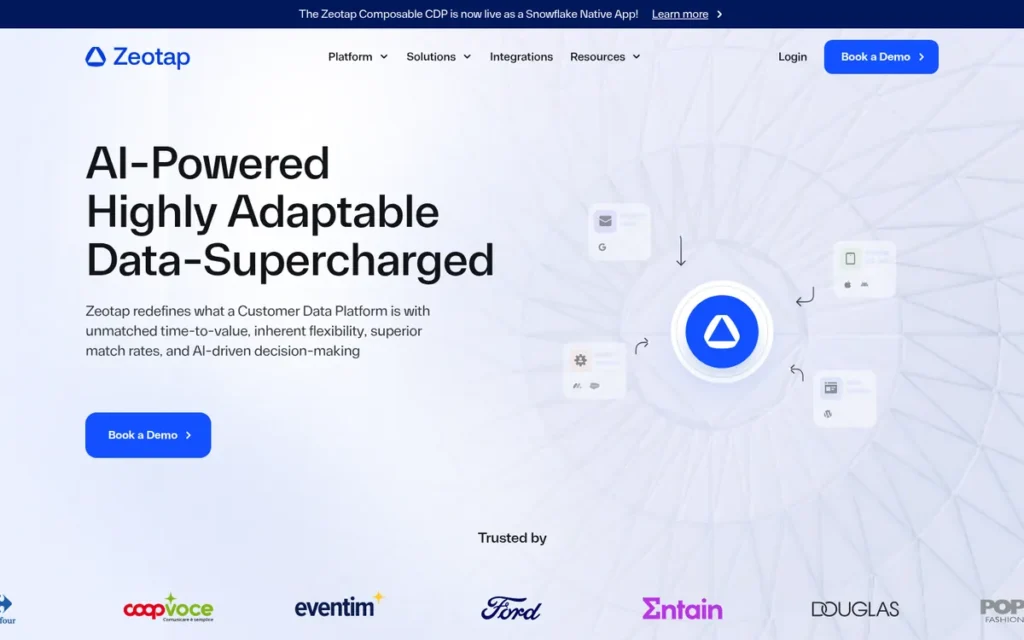
Category: Composable / Privacy-First CDP, a customer data platform that can run on the buyer’s own data warehouse and treats consent management and data residency as first priorities.
At a Glance
- Category: Composable / Privacy-First CDP
- Best For: GDPR-heavy enterprises, especially those with warehouse skills that want a composable CDP on their own Snowflake
- Price Range: Not published; quoted on data volume, profiles and modules, so no worked example is possible (European Stack, checked November 2026)
- Primary Strength: Zeotap CDP offers a composable option that runs on the buyer’s own Snowflake, which earns it a lock-in neutrality score of 4/5, tied with LiveRamp for the highest in this list.
- Biggest Limitation: Zeotap CDP’s results evidence rests on a single vendor-published testimonial and self-reported 2020 growth figures, and its Gartner and Forrester recognition is unverified.
- One-Line Summary: Zeotap CDP is the only composable, warehouse-native CDP in PlugRoute’s 2026 DMP rankings, built to run on the buyer’s own Snowflake.
- Last Verified: November 2026
Overview
Zeotap CDP is a European, privacy-first customer data platform with deterministic and probabilistic identity resolution, consent tooling and activation to 100+ vendor-reported destinations. It is built for GDPR-heavy enterprises, including those that want a composable version running on their own Snowflake.
Zeotap CDP began as a telecom-data provider, founded in Berlin in 2014, before moving into the CDP market. Zeotap co-founder Daniel Heer moved from CEO to President in 2025.
Key Features
- Zeotap CDP combines deterministic and probabilistic identity resolution to unify customer records.
- Zeotap CDP offers a composable version that runs on the customer’s own Snowflake, keeping data in the buyer’s warehouse.
- Zeotap CDP includes consent-management tooling designed for GDPR-heavy environments.
- Zeotap CDP’s ZeoAI provides AI-assisted audience segmentation.
- Zeotap CDP activates audiences to more than 100 destinations, according to Zeotap (Zeotap, checked November 2026).
Best For
Zeotap CDP is best for European or GDPR-heavy enterprises that have warehouse engineering skills and want to keep customer data in their own Snowflake environment. Zeotap CDP is a weaker fit for teams without in-house warehouse engineers and for buyers who need a verified US support presence.
Strengths
- Zeotap CDP holds a 4.4/5 rating on G2 across 59 reviews (checked November 2026), and reviewers praise its ease of use, support and BigQuery integration.
- Zeotap CDP’s composable deployment runs on the buyer’s own Snowflake, which structurally reduces lock-in compared with suite-hosted CDPs (Zeotap, checked November 2026).
- Zeotap CDP customer Entain says it got a product to market in two months, against an expected six months or more (Zeotap testimonial, checked November 2026).
- Zeotap CDP holds ISO 27001 certification for information security management (Zeotap, checked November 2026).
Limitations
Zeotap CDP’s most important trade-off is architectural flexibility at the cost of documented proof. Zeotap CDP’s only customer result is a single vendor-published testimonial. Its growth figures (431% run-rate growth, 70+ of the top 100 global brands) date from around 2020 and are self-reported (TMCnet, 2020).
- Zeotap CDP’s ISO 27001 certification covers its India operations only, so buyers with EU or US data-residency requirements should confirm the scope for their region.
- Zeotap CDP reviewers report integration problems during setup and data ingestion, a learning curve and implementation complexity (G2 and SpotSaaS, checked November 2026).
- Zeotap CDP’s composable option needs in-house warehouse skills that many go-to-market teams lack.
- Zeotap CDP publishes no pricing, and reviewers on OMR Reviews and SpotSaaS describe prices as high and unclear (checked November 2026).
- Zeotap CDP has a Gartner Peer Insights listing, but PlugRoute found no Gartner Magic Quadrant or Forrester Wave placement, and Zeotap’s US presence is unverified (checked November 2026).
Verdict
Zeotap CDP is the only composable, warehouse-native option PlugRoute ranked for 2026, and a credible shortlist choice for GDPR-heavy enterprises that can run a CDP on their own Snowflake.
Zeotap CDP scored 3.15. Its neutrality (C5 = 4) was offset by single-testimonial results evidence (C3 = 2.5) and opaque pricing (C4 = 2). Positions #5–#7 are within 0.05 points of each other, so buyers should request named references and a warehouse proof of concept.
6. OnAudience DMP: Best for SMBs, Agencies, and Budget-Constrained Buyers
Category: Audience DMP.
At a Glance
- Category: Audience DMP
- Best For: SMBs, agencies, and buyers in Central and Eastern Europe priced out of enterprise platforms
- Price Range: From $500/month (≈ $6,000/year at the entry tier) with free setup (OnAudience pricing guide, checked November 2026)
- Primary Strength: OnAudience DMP offers classic DMP and third-party data functions at the lowest published entry price in this list.
- Biggest Limitation: OnAudience DMP is the smallest vendor in this list, and its results evidence rests on a 31-review G2 sample and a single anonymous reviewer claim.
- One-Line Summary: OnAudience DMP has the lowest entry price of any classic audience DMP in PlugRoute’s 2026 rankings and is best for SMBs and agencies that need third-party segments and lookalikes on a limited budget.
- Last Verified: November 2026
Overview
OnAudience DMP is a data management platform combined with an audience-data business. It offers more than 4,100 predefined segments, lookalike modeling and publisher monetization tools. It is aimed at SMBs, agencies and Central and Eastern European buyers who need classic DMP functions at a lower entry price.
OnAudience DMP was founded in 2016 and belongs to Cloud Technologies S.A., which is listed on the Warsaw Stock Exchange (ticker CLD). Sources disagree on OnAudience’s headquarters: LinkedIn lists London, while other sources say Poland.
Key Features
- OnAudience DMP manages first- and third-party data for segmentation, lookalike modeling and publisher monetization.
- OnAudience DMP provides more than 4,100 predefined audience segments from its own data business.
- OnAudience Graph offers cookieless identity resolution for audience matching.
- OnAudience DMP offers a raw Data Stream feed and CRM enrichment for buyers who want direct data access.
- OnAudience DMP supports GDPR, CCPA, IAB TCF 2.3 and Global Privacy Control (LiveRamp partner directory, checked November 2026).
Best For
OnAudience DMP is best for SMBs, agencies, and Central and Eastern European advertisers and publishers that need segmentation, lookalikes and third-party data without enterprise contract minimums. OnAudience DMP is a weaker fit for large enterprises that need deep first-party profile unification or verified named-client results.
Strengths
- OnAudience DMP plans start at $500 per month with free setup, unlimited segments, free lookalikes and monthly or annual contracts (OnAudience pricing guide, checked November 2026).
- OnAudience DMP holds a 4.8/5 rating on G2 across 31 reviews (checked November 2026), the highest score in this list but from a small sample.
- OnAudience DMP is listed in LiveRamp’s partner directory and names Microsoft Advertising as a data partner, with partners praising its “high-quality & custom audience segments” (LiveRamp partner directory, checked November 2026).
- OnAudience DMP’s parent, Cloud Technologies S.A., grew 2025 revenue to PLN 50.7M from PLN 47.0M (Cloud Technologies investor relations, checked November 2026).
Limitations
OnAudience DMP’s most important trade-off is a low price at the cost of vendor scale. With 11–50 employees, OnAudience is the smallest vendor in this list. Its parent’s net income fell from PLN 12.4M to PLN 6.2M in 2025 (Cloud Technologies investor relations, checked November 2026).
- OnAudience DMP’s only results claim, 72% higher CTR from lookalike audiences, comes from a single anonymous G2 reviewer, and PlugRoute verified no named-client case studies.
- OnAudience DMP’s scale claim of 25B+ devices counts devices, not unique people, and LinkedIn separately claims 50B+ user profiles.
- OnAudience DMP reviewers on G2 (checked November 2026) report a steep learning curve at first.
- OnAudience DMP’s Capterra score of 5.0 rests on one review and should carry no weight, and PlugRoute could not review Reddit sentiment for OnAudience.
Verdict
OnAudience DMP has the lowest published entry price of any platform PlugRoute evaluated for 2026 ($500 per month, per OnAudience’s pricing guide), which makes it the most practical shortlist entry for SMBs and agencies.
OnAudience DMP scored 3.13. Its vendor-published entry price (C4 = 4) was offset by vendor scale (C6 = 2.5) and a single anonymous results claim (C3 = 2). Buyers should test segment quality on a limited campaign before scaling.
7. Adobe Real-Time CDP: Best for Adobe-Centric Enterprises and Audience Manager Migrations
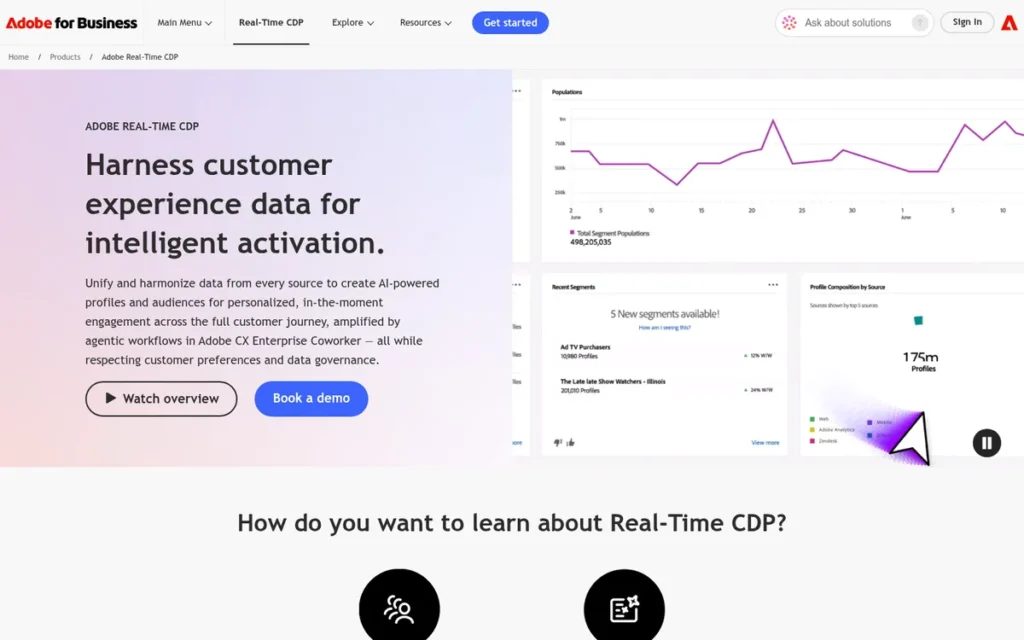
Category: Suite CDP, builds persistent first-party profiles and activates them inside, and outward from, one vendor’s marketing suite.
At a Glance
- Category: Suite CDP
- Best For: Enterprises running Adobe Analytics, Target, Journey Optimizer or AEM, and Audience Manager customers planning a migration
- Price Range: Not published; licensed per 1,000 profiles, so no worked example is possible (Adobe, checked November 2026)
- Primary Strength: Adobe Real-Time CDP offers batch, streaming and edge segmentation tightly integrated with the rest of Adobe Experience Cloud.
- Biggest Limitation: Adobe Real-Time CDP has fully opaque pricing and deep Adobe-stack lock-in, and Adobe’s own guide documents Audience Manager segments with no equivalent after migration.
- One-Line Summary: Adobe Real-Time CDP is Adobe’s designated successor to Audience Manager and the best fit in PlugRoute’s 2026 DMP rankings for enterprises already invested in Adobe Experience Cloud.
- Last Verified: November 2026
Overview
Adobe Real-Time CDP is an enterprise customer data platform built on Adobe Experience Platform. It unifies first-party data into real-time profiles with batch, streaming and edge segmentation, and Adobe Real-Time CDP is Adobe’s designated migration path for Audience Manager customers.
Adobe Real-Time CDP comes in B2C, B2B and B2P editions, each in Prime and Ultimate packages. New buyers should avoid signing a new Audience Manager contract, because Adobe treats Audience Manager as a legacy product in transition.
Key Features
- Adobe Real-Time CDP uses Adobe’s XDM data schema to unify first-party data into real-time customer profiles.
- Adobe Real-Time CDP supports batch, streaming and edge segmentation, and its edge segmentation enables personalization on the same page or the next one.
- Adobe Real-Time CDP’s Ultimate package adds advanced enterprise connectors, Destination SDK for custom destinations, and Profile API entitlements.
- Adobe Real-Time CDP integrates natively with Adobe Target, Journey Optimizer, Analytics and AEM.
- Adobe Real-Time CDP offers an expanded-activation path that lets existing Audience Manager customers send legacy audiences to advertising destinations.
Best For
Adobe Real-Time CDP is best for enterprises already standardized on Adobe Experience Cloud and for existing Audience Manager customers who need a supported migration path. Adobe Real-Time CDP is a weaker fit for organizations outside the Adobe stack and for buyers who need a classic anonymous-audience DMP.
Strengths
- Adobe Real-Time CDP was named a Leader in the IDC MarketScape for Retail Customer Data Platforms (IDC, 2025).
- Adobe Real-Time CDP scores 8.3/10 overall and 8.6/10 for likelihood to renew on TrustRadius (checked November 2026), and 87% of reviewers said they were satisfied (TrustRadius market report hosted by Adobe, report year not stated).
- Adobe Real-Time CDP reviewers on G2 (4.1/5, review count not displayed, checked November 2026) praise its flexible segmentation and its Target and Journey Optimizer integrations.
- Adobe Real-Time CDP has a documented, vendor-supported migration path from Audience Manager, so Adobe customers do not face a BlueKai-style hard shutdown (Adobe Experience League, checked November 2026).
Limitations
Adobe Real-Time CDP’s most important trade-off is giving up openness for suite depth. Adobe publishes no dollar pricing, and total cost also includes AEP capacity, Web SDK work and implementation partners (Adobe, checked November 2026).
- Adobe Real-Time CDP’s lock-in runs through Adobe’s XDM schema, Web SDK and identity conventions.
- Adobe Real-Time CDP’s migration guide says some Audience Manager segments need redesign or have no equivalent, and it notes a 500-streaming-segment cap in some contexts (Adobe Experience League, checked November 2026).
- Adobe Audience Manager is described as expensive, complex and increasingly at risk of being sunset (MarTech Stack Builder, checked November 2026), though Adobe has published no official end-of-life date.
- Adobe’s Gartner Magic Quadrant Leader placement (2025) covers Multichannel Marketing Hubs, a related category, not CDPs.
- Adobe Real-Time CDP’s G2 listing shows no review count, which limits how much weight its rating can carry.
Verdict
Adobe Real-Time CDP is the right 2026 platform for enterprises already invested in Adobe Experience Cloud, and it is Adobe’s designated migration path for Audience Manager customers.
Adobe Real-Time CDP scored 3.10. Strong viability (C6 = 4) was offset by opaque pricing (C4 = 2) and the tied-lowest neutrality score (C5 = 2). At 0.05 points behind Zeotap CDP, #7 is a near-tie, not a judgment on performance.
How Much Do These Data Management Platforms Cost?
In 2026, data management platform costs range from $500 per month for OnAudience DMP’s entry plan to more than $1M per year for LiveRamp (Vendr, checked November 2026). Salesforce Data 360 lists a $60,000-per-year Starter package and profiles at $240–$420 per 1,000 per year. Implementation adds roughly $10K–$500K (CDP.com, checked November 2026).
| Platform | Pricing Transparency | Published or Reported Figure | Worked Example |
|---|---|---|---|
| Salesforce Data 360 | Full published price list | $240–$420 per 1,000 profiles/year; Starter $60,000/year | 450,000 profiles ≈ $108,000/year; 10M ≈ $2.4M/year at list |
| OnAudience DMP | Published entry price | From $500/month | ≈ $6,000/year at the entry tier |
| LiveRamp | Third-party estimates (Vendr) | $150K–$1M+/year total; clean room add-on $250K–$600K/year | 5–15M monthly identities ≈ $150K–$350K/year |
| Lotame Spherical | Not published | Custom quotes by module | No worked example possible |
| Permutive | Not published | Enterprise quotes only | No worked example possible |
| Zeotap CDP | Not published | Quoted on volume, profiles and modules | No worked example possible |
| Adobe Real-Time CDP | Not published | Licensed per 1,000 profiles | No worked example possible |
- At Salesforce Data 360 list prices, 450,000 profiles cost about $108,000 a year, which matches TrustRadius’s indicative figure (TrustRadius, checked November 2026). By the same math, 10M profiles cost about $2.4M a year.
- Profile count is often a bigger driver of suite-CDP cost than which platform you choose.
- Salesforce Data 360’s zero-copy access does not make queries free, because queries and processing still consume Flex Credits.
- CDP implementation typically adds $10K–$500K and zero to five engineering FTEs on top of license fees (CDP.com, checked November 2026).
What Can’t Any Data Management Platform Do Yet?
None of the data management platforms PlugRoute evaluated cleanly replaces cookie-based anonymous prospecting, and PlugRoute found no vendor that publishes independently verified match rates (checked November 2026). Buyers should treat these gaps as limits of the whole category rather than of any one vendor, and plan pilots and contract terms around them.
- No platform in this category offers a clean replacement for cookie-based anonymous prospecting.
- PlugRoute found no vendor in this category that publishes independently verified match rates (checked November 2026).
- No standard total-cost-of-ownership benchmark exists for DMPs, CDPs or identity platforms.
- Data portability on exit, covering identity mappings and derived segments, is rarely written into contracts.
- Mid-market buyers are poorly served, because most platforms are priced for enterprises.
- CDP satisfaction is mixed: 45% of respondents said their CDP fell short of expectations (Forrester survey cited by Zeta Global; survey year not disclosed).
Some practitioners question whether they need a dedicated platform at all.
“the warehouse route can work, but it requires a level of data engineering resource that most GTM teams just don’t have” (u/New_Grape7181, r/b2bmarketing (2026))
Takeaway: Building audiences on your own warehouse only works if you have dedicated data engineering capacity. Composable options such as Zeotap CDP sit between building and buying.
Considered but Not Ranked
PlugRoute considered the products below but left them out of the ranking. Each one was retired, tied to its own platform’s ecosystem, outside this article’s scope, or not researched in enough depth to compare fairly with the seven ranked platforms.
- Oracle BlueKai was not ranked because it was retired on September 30, 2024.
- Google Audience Center 360 was not ranked because Google has deprioritized it.
- Google Ads Data Manager and Amazon Ads Data Manager were not ranked because they activate mainly within their own ecosystems, though they are useful when your spend is concentrated there.
- Nexxen Data Platform was not ranked because it is tied to Nexxen’s DSP/SSP and was not evaluated to PlugRoute’s evidence standard.
- Tealium, Decentriq, Optable, mediarithmics and 1plusX were not ranked because PlugRoute did not collect enough evidence to evaluate them in equal depth.
- InfoSum was not ranked because WPP acquired it in April 2025 (WPP, 2025) and its scope is mainly clean rooms.
- Eyeota was not ranked because it has been owned by Dun & Bradstreet since 2021 and is mainly a data provider.
What Red Flags Should I Watch For When Evaluating Data Management Platforms?
The biggest red flags when evaluating data management platforms are signs that cost or lock-in will rise after you sign. PlugRoute identified six warning signs in this category, starting with best-case match rates presented as typical. Each red flag below links to the evaluation question that tests for it.
Red Flag #1: Best-Case Match Rates Presented as Typical A match rate quoted without conditions is a red flag, because best-case figures rarely reflect your own data. LiveRamp’s 99.5% figure applies to records with full name, email and complete postal address (LiveRamp, checked November 2026). Files with only emails, or records collected by pixels, will match at lower rates.
What to ask instead: Question #2 asks for a pilot match test on your own sample.
Red Flag #2: No Data Portability Terms on Exit A contract with no exit terms for identity mappings and derived segments is a red flag, because DMP and CDP contracts rarely include them. Buyers who leave without those terms may have to rebuild audiences from scratch on the next platform.
What to ask instead: Question #5 asks what you can export if you leave.
Red Flag #3: Unforecastable Consumption Pricing Consumption-based pricing with no forecasting model is a red flag, because credits for queries and processing can grow faster than expected. Salesforce Data 360 reviewers on G2 report that consumption costs are hard to forecast, even though data ingestion is free (G2, checked November 2026).
What to ask instead: Question #6 asks for the full first-year cost.
Red Flag #4: Ratings Built on Tiny Review Samples A near-perfect rating from a handful of reviews is a red flag, because small samples are statistically unreliable. OnAudience DMP’s 5.0 Capterra score rests on one review, and LiveRamp’s 5.0 Gartner Peer Insights score rests on one rating (both checked November 2026).
What to check instead: Compare ratings with 50 or more reviews and note the date you checked them.
Red Flag #5: Signing a New Deal on a Legacy Product Signing a new contract on a product in transition is a red flag. Adobe’s own documentation directs Audience Manager customers to Real-Time CDP (Adobe Experience League, checked November 2026). Oracle BlueKai customers already went through a hard end-of-life on September 30, 2024.
What to ask instead: Question #7 asks about ownership and roadmap.
Red Flag #6: Destinations Tied to One DSP/SSP or Agency Group A data platform whose activation or ownership depends on one DSP, SSP, cloud or agency group is a lock-in red flag. The 2024–2025 consolidation wave, including Publicis acquiring Lotame and WPP acquiring InfoSum, shows that a vendor’s neutrality can change after you sign.
What to ask instead: Questions #1 and #7 test destination coverage and ownership.
What Questions Should I Ask Before Choosing a Data Management Platform?
Before choosing a data management platform, ask each vendor the seven questions below. They expose gaps that vendor demos and headline connector counts usually hide. The pilot checklist that comes first turns them into tests you can run on your own data before signing.
Pilot Checklist
- Your pilot should confirm native support for every destination in your current stack.
- Your pilot should measure the match rate on a sample of your own records, broken out by identifier type.
- Your pilot should show how consent withdrawal and deletion requests reach downstream destinations.
- Your pilot should measure how quickly audiences refresh after a profile change.
- Your pilot should end with a written commitment to export identity mappings and derived segments.
- Your pilot should produce a first-year cost estimate that includes implementation partners and engineering staff.
Question #1: Which of my actual destinations do you support natively today? A good answer is a named list checked against your DSPs, SSPs, ad servers and clean rooms, not a headline connector count. LiveRamp’s 500+ destinations, Salesforce Data 360’s 270+ connectors and Zeotap CDP’s 100+ destinations are all vendor figures to check against your stack.
Question #2: What match rate do you achieve on a sample of our own data? A credible vendor should agree to a pilot match test on a sample of your records and report results by identifier type. Treat a refusal, or answers that only repeat best-case marketing figures, as a sign that your real-world match rates may be lower.
Question #3: How are consent withdrawal and data deletion propagated to destinations? A strong answer explains how opt-outs and deletion requests reach every downstream destination, and how quickly. Ask which frameworks are supported. OnAudience DMP, for example, lists support for GDPR, CCPA, IAB TCF 2.3 and Global Privacy Control (LiveRamp partner directory, checked November 2026).
Question #4: How quickly do audiences refresh after a profile change? A good answer separates batch, streaming and edge refresh, because refresh speed decides whether audiences stay accurate for suppression and personalization. Adobe Real-Time CDP, for example, documents edge segmentation that supports same-page or next-page personalization (Adobe Experience League, checked November 2026).
Question #5: What identity mappings and derived segments can we export if we leave? The vendor should commit in writing to exporting identity mappings, derived segments and audience definitions in usable formats. Composable deployments, such as Zeotap CDP’s option on the buyer’s own Snowflake, keep more data under your control than suite-hosted platforms do.
Question #6: What is the full first-year cost, including implementation partners and engineering FTEs? A complete answer covers license, consumption, implementation partners and internal staff, not just the license. CDP implementation runs roughly $10K–$500K with zero to five engineering FTEs (CDP.com, checked November 2026). Adobe Real-Time CDP costs also include AEP capacity and Web SDK work.
Question #7: Who owns your company, and how does that affect data use and neutrality? The vendor should explain who owns it, how a parent company can use or access your data, and whether its roadmap favors affiliated buyers. This matters for Lotame Spherical now that Publicis has completed its 2025 acquisition, and for any vendor bought during the consolidation wave.
How Did We Rank These Data Management Platforms?
PlugRoute scored seven platforms from 1 to 5 on six weighted criteria, led by activation coverage (25%) and independent review evidence (20%). Only dated, attributed evidence counted. No independent performance benchmark exists for this category, so the ranking measures fit, evidence quality, pricing transparency and neutrality rather than campaign results.
PlugRoute counted five types of evidence:
- Review ratings counted only when they included a review count and the date checked.
- SEC filings counted as the strongest evidence of vendor viability.
- Published vendor price lists counted as the strongest pricing evidence.
- Vendr market estimates counted as third-party pricing evidence.
- Analyst reports such as IDC MarketScape counted as independent recognition.
PlugRoute used six weighted criteria, each with a scoring rubric:
- C1 Activation & Destination Coverage (25%): C1 matters because the core DMP job is getting audiences into the tools a buyer already uses. A 5 means 500+ destinations plus clean rooms, a 3.5 means broad activation with gaps, and a 2 means activation in one ecosystem only.
- C2 Independent Review Evidence (20%): C2 matters because review platforms are the main independent voice in this category. A 5 means 500+ reviews at 4.0+, a 4 means 4.5+ on 75–499 reviews, a 3.5 means 4.0+ on 30–499 reviews or no visible count, and 2 or below means no verified rating.
- C3 Documented Results & Evidence Quality (15%): C3 ranks evidence from strongest to weakest. A 5 means filings plus independent analyst placements, a 3.5 means an analyst placement or named case studies, and a 2 means only anonymous-reviewer or vendor claims.
- C4 Pricing Transparency & TCO Predictability (15%): C4 matters because buyers need real numbers for a business case. A 5 means a full published price list, a 4 means a vendor-published entry price, a 3.5 means third-party ranges, and a 2 means custom quotes only.
- C5 Lock-in & Ownership Neutrality (15%): C5 matters because consolidation made ownership a live risk. A 4 means cloud-neutral or composable, a 3 means tied to an agency group or ad server, and a 2 means bound to one suite’s data schema.
- C6 Vendor Viability & Privacy Readiness (10%): C6 matters because buyers replacing BlueKai want no repeat end-of-life event. A 5 means strong filed financials, a 3.5 means stable but with limited disclosure, and a 2.5 means a small vendor or falling profit.
| Rank | Platform | C1 | C2 | C3 | C4 | C5 | C6 | Weighted Score |
|---|---|---|---|---|---|---|---|---|
| 1 | LiveRamp | 5 | 3.5 | 3.5 | 3.5 | 4 | 4 | 4.00 |
| 2 | Salesforce Data 360 | 3.5 | 5 | 3.5 | 5 | 2 | 5 | 3.95 |
| 3 | Lotame Spherical | 4.5 | 3.5 | 3.5 | 2 | 3 | 3.5 | 3.45 |
| 4 | Permutive | 3.5 | 4 | 3.5 | 2 | 3.5 | 3.5 | 3.38 |
| 5 | Zeotap CDP | 3.5 | 3.5 | 2.5 | 2 | 4 | 3 | 3.15 |
| 6 | OnAudience DMP | 3 | 3.5 | 2 | 4 | 3.5 | 2.5 | 3.13 |
| 7 | Adobe Real-Time CDP | 3.5 | 3.5 | 3.5 | 2 | 2 | 4 | 3.10 |
Four caveats apply to these scores:
- If five points of weight shift from neutrality to pricing transparency, Salesforce Data 360 overtakes LiveRamp, 4.10 to 3.98, so the #1 spot depends on buyer priorities.
- Positions #5–#7 sit within 0.05 points of each other (3.10–3.15) and should be read as a near-tie decided by stack fit.
- For Zeotap CDP, OnAudience DMP and Adobe Real-Time CDP, a lower rank reflects pricing opacity, vendor scale or evidence quality, not measured campaign underperformance.
- Missing data is labeled “Not verified” or “Not published” rather than estimated.
PlugRoute has no affiliate relationships with any company listed, and rankings are determined entirely by research data and objective evaluation criteria.
Updated November 2026:
- Zeotap CDP’s G2 rating (4.4/5, 59 reviews) was confirmed, raising its C2 score from 1.5 to 3.5 and its total from 2.75 to 3.15.
- OnAudience DMP’s $500/month entry price was confirmed in the vendor’s pricing guide, raising its C4 score from 3.5 to 4 and its total from 3.05 to 3.13.
- Permutive’s C6 score rose from 3 to 3.5 after PlugRoute could not confirm a reported 2023 staffing cut.
- Adobe Real-Time CDP moved from #5 to #7 because of these re-scores, while its own score stayed at 3.10.
- LiveRamp’s FY2026 results, Lotame’s G2 rating and the completion of Publicis’s Lotame acquisition were added.
What Else Do Buyers Ask About Data Management Platforms?
What is the best DMP for publishers’ first-party data?
Permutive is the best fit for premium publishers monetizing first-party audiences in PlugRoute’s 2026 rankings. It scored 3.38 and holds a 4.5/5 G2 rating across about 90 reviews (checked November 2026). Lotame Spherical is the alternative for publishers that also want data-seller and marketplace tools. Publishers should judge either platform on revenue uplift after fees.
Should I buy a CDP or build on my data warehouse?
Buy a CDP if you lack dedicated data engineering capacity. Build on your warehouse only if you can staff and maintain it long term, because practitioners report that warehouse builds stall without engineers (r/b2bmarketing, 2026). Composable options such as Zeotap CDP sit between the two, running CDP functions on your own Snowflake.
How does PlugRoute determine its rankings?
PlugRoute scores every platform from 1 to 5 on six weighted criteria: activation coverage (25%), independent review evidence (20%), documented results (15%), pricing transparency (15%), lock-in neutrality (15%) and vendor viability (10%). Only dated, attributed evidence counts. Missing data is labeled “Not verified” rather than estimated, and scores are re-checked when evidence changes.
What Do Key Data Management Platform Terms Mean?
Audience DMP: A platform that collects, segments, enriches and activates mostly anonymous audience data for paid media across buying and selling platforms. Buyers replacing a retired cookie-based tool usually look here first if they want a like-for-like replacement.
Customer Data Platform (CDP): A platform that builds persistent first-party customer profiles and activates them. A suite CDP does this inside one vendor’s marketing or CRM suite, which makes it fit well with that suite but adds lock-in.
Data Clean Room: A tool that lets two or more companies analyze their combined data without sharing raw records. It matters for brands, retailers and publishers that want to collaborate on audiences without exposing personal data.
Identity Graph: A system that matches people and devices across identifiers, such as emails, phone numbers and device IDs, often using pseudonymous IDs. Your audience reach depends on it, and buyers stay dependent on the vendor’s graph even when the platform works across clouds.
Match Rate: The share of your records that a platform can link to known identities. Vendors often quote best-case figures that assume full name, email and postal address, so test it on a sample of your own data, broken out by identifier type.
Destinations: The DSPs, SSPs, ad servers, social platforms, warehouses and clean rooms a platform can send audiences to. Headline connector counts are vendor figures, so check them against the tools you actually use.
Composable CDP: A CDP that runs on your own data warehouse instead of storing data in the vendor’s system. It reduces lock-in and keeps more data under your control, but it needs in-house data engineering skills.
Zero-Copy Access: A way for a platform to query data where it already lives in a warehouse, without copying it. Queries and processing can still use up paid credits, so it does not make usage free.
Consumption Pricing (Credits): A pricing model that charges credits for queries and processing on top of, or instead of, a fixed license. Reviewers say these costs can be hard to forecast, so ask for a full first-year cost estimate.
Per-1,000-Profile Pricing: A licensing unit where cost rises with the number of customer profiles you store. Profile count often affects suite-CDP cost more than which vendor you choose.
Edge Segmentation: Audience segmentation that runs close to the user, sometimes on the user’s own device, instead of in batch jobs. It decides how quickly audiences update, which allows personalization on the same page or the next one and helps keep suppression lists accurate.
Data Portability on Exit: Contract terms that let you export identity mappings, derived segments and audience definitions if you leave. These terms are rarely in standard contracts, and without them you may have to rebuild audiences from scratch on your next platform.
Which Data Management Platform Is Right for You?
Key Insights
- LiveRamp (4.00) and Salesforce Data 360 (3.95) are nearly tied in PlugRoute’s 2026 rankings, and the deciding factor is whether you value cloud neutrality or pricing transparency more.
- Zeotap CDP (3.15), OnAudience DMP (3.13) and Adobe Real-Time CDP (3.10) are in a near-tie, so buyers should choose among them by stack fit rather than rank.
- The classic advertising DMP survives mainly as Lotame Spherical and OnAudience DMP, while suite CDPs and identity platforms have absorbed most other DMP jobs.
- Chrome kept third-party cookies under user settings (Google, April 22, 2025), but browser blocking, opt-outs and consent rules still make first-party data the safer long-term strategy.
- PlugRoute found no vendor in this category that publishes independently verified match rates (checked November 2026), so a pilot on your own data is the most reliable test.
- Suite CDPs such as Salesforce Data 360 and Adobe Real-Time CDP carry the deepest lock-in, while Zeotap CDP’s composable option and LiveRamp’s cloud neutrality carry the least.
Every buyer should pilot with their own data and negotiate data portability before signing, because exit terms are rarely in standard contracts.
- If you run Salesforce or Adobe, start with Salesforce Data 360 or Adobe Real-Time CDP and test for gaps in anonymous-audience targeting.
- If you are a premium publisher, shortlist Permutive and measure uplift after fees.
- If budget is tight, shortlist OnAudience DMP ($500/month entry price) or the Salesforce Data 360 Starter package ($60,000/year) and confirm current pricing in writing.
- If you need neutral identity across clouds, pilot LiveRamp’s match rates first.
The category is still consolidating, so check vendor ownership and product status at every renewal. PlugRoute’s methodology page sets out the 1–5 scoring rubric for all six criteria. PlugRoute’s independent guide to enterprise data management platforms covers the enterprise meaning of “DMP.”
We update this guide quarterly. Last updated: November 2026.