MaxMind combines offline MMDB geolocation databases with transaction-level fraud scoring and is the most extensively embedded IP intelligence platform in this comparison; IPinfo delivers unlimited free access and transparent $49/month pricing for developer teams; IPQualityScore leads for fraud-first teams requiring SIEM and SOAR integration. No single tool covers offline databases, real-time fraud scoring, and low-cost developer access simultaneously, deployment model determines vendor eligibility before feature comparison begins.
Every tool in this category claims comparable geolocation, proxy detection, and fraud scoring capabilities. In practice, data accuracy methodology, deployment architecture, security signal depth, and pricing transparency vary dramatically between vendors. One category leader (Digital Element, the only MRC-accredited IP geolocation vendor for non-mobile networks) does not appear in any AI-generated answer currently indexed on this topic. Buyers relying on AI tool recommendations are receiving an incomplete shortlist.
PlugRoute has no affiliate relationships with any company listed. Rankings are determined entirely by research data and objective evaluation criteria.
“The premium providers include Digital Element, Maxmind, and IPINFO. Among these, Digital Element is known to provide the highest accuracy at the city and postal code/zip code level.” (u/demandgenman, r/webdev, 2025)
Takeaway: A named practitioner independently identifies Digital Element as the city and postal-code precision leader among premium IP intelligence providers, consistent with its MRC accreditation but relevant primarily to enterprise adtech buyers who can navigate its sales-led procurement process.
TL;DR: Top Picks at a Glance
- MaxMind: Full-stack geolocation plus fraud scoring; API and offline MMDB database options under one contract
- IPinfo: Unlimited free production tier; $49/month Core; 1,300+ active PoPs across 167 countries with publicly documented methodology
- IPQualityScore: Confirmed Splunk App #5423, Rapid7, and Shopify integrations; behavioral 0–100 fraud score with confirmed SMB pricing tiers
- Digital Element: Only MRC-accredited IP geolocation vendor for non-mobile networks; 98.3% confirmed Nodify detection rate; daily residential proxy updates
What Are the Main Categories of IP Address Intelligence Tools?
IP address intelligence tools fall into six categories based on deployment architecture and primary use case. Identifying which category fits your operational model eliminates misfit vendors before any feature comparison begins. The six categories (Full-Stack Intelligence, Geolocation API, Fraud Scoring, Enterprise Compliance Database, Offline Database, and Developer Utility) map directly to the seven vendors in this comparison.
As one practitioner on r/webdev explained:
“Retrieving the geolocation of an IP address is essentially just a database lookup. A significant amount of IP-related data is publicly available. Providers like IPinfo use their own servers to collect, enhance, and verify this data. Accurately mapping IP addresses through methods like triangulation (e.g., using pings) is highly resource-intensive and costly.” Posted by u/HansSepp
Takeaway: The dramatic price spread across IP intelligence vendors reflects genuine infrastructure investment in measurement methodology, providers conducting active network triangulation are building a fundamentally different product than those redistributing registry data.
The three overarching groupings that organize this comparison are:
Full-Stack and Fraud Intelligence Platforms cover tools that combine IP data with fraud prevention signals. MaxMind integrates geolocation with transaction fraud scoring (minFraud) under one contract. IPQualityScore operates a behavioral Fraud Fusion network delivering a 0–100 IP risk score plus multi-signal validation across email, phone, and URL.
Geolocation and Developer API Services include tools providing RESTful enrichment APIs with geolocation as the primary output. IPinfo operates a proprietary 1,300+ active PoP probe network with privacy and ASN detection. ipdata targets enterprise consumers with usage-type classification at high throughput. Abstract API targets individual developers at the lowest price entry point.
Enterprise and Offline Database Specialists serve teams needing locally hosted databases, enterprise-grade accuracy auditing, or both. Digital Element is the only MRC-accredited vendor for non-mobile networks with daily residential proxy detection via Nodify. DB-IP provides a free MMDB-compatible database for teams migrating from MaxMind GeoLite2 without code changes.
How Do the Top IP Intelligence Tools Compare at a Glance?
| Rank | Company | Category | Best For | One-Line Summary | Key Capabilities | Primary Strength | Key Limitation |
|---|---|---|---|---|---|---|---|
| 1 | MaxMind | Full-Stack Intelligence | Offline database + fraud scoring at enterprise scale | The most extensively embedded IP intelligence platform in 2026, combining a verified G2 rating of 4.5/5 (45 reviews), 23+ years of operation, offline MMDB databases, and the only unified geolocation + fraud scoring contract in the comparison | Offline MMDB databases ($34–$134/month publicly listed); GeoIP2 API ($0.0001–$0.002/query); minFraud transaction scoring; VPN/proxy/TOR detection; 8-language SDK ecosystem | Only vendor with both MMDB offline database and minFraud transaction scoring under one contract | Insights tier at $0.002/query costs 20x more per call than Country tier; creates cost inflection point at approximately 25,000 monthly queries |
| 2 | IPinfo | Geolocation + Privacy API | Developers and small teams needing transparent pricing and probe-network accuracy | The most transparent and developer-accessible IP intelligence platform in 2026, combining an unlimited free production tier, $49/month Core, and 1,300+ active PoPs across 167 countries conducting 5.2 billion monthly measurements | ProbeNet RTT measurement (1,300+ PoPs); VPN/proxy/TOR/relay detection; ASN lookup; CC-BY-SA daily databases; unlimited free Lite tier | 1,300+ active global PoPs; unlimited free tier; daily CC-BY-SA offline databases with commercial use rights | No native transaction fraud scoring; API migration from legacy endpoint removed timezone field |
| 3 | IPQualityScore | Fraud Scoring Platform | Fraud teams needing SIEM/SOAR and Shopify integration | The IP fraud intelligence platform with the broadest confirmed SIEM, SOAR, and e-commerce integration footprint in this 2026 comparison | 0–100 IP fraud score; Splunk App #5423 (v1.2.3); Rapid7 InsightConnect; Shopify integration; email/phone/URL/device validation | Only vendor with confirmed Splunk App #5423 + Rapid7 InsightConnect + Shopify App Store integrations | Documented false positives for legitimate VPN users and decommissioned IP ranges require threshold calibration |
| 4 | Digital Element | Enterprise Compliance Database | Enterprise adtech requiring MRC-accredited geolocation for non-mobile networks | The only MRC-accredited IP geolocation platform for non-mobile networks in 2026, delivering ZIP+4-level precision across 59+ data fields and daily-updated residential proxy detection via Nodify at a confirmed 98.3% detection rate | MRC accreditation (non-mobile, US DMA+); 59+ data fields; Nodify daily residential proxy detection (98.3% confirmed rate); HAProxy Enterprise module | Only MRC-accredited IP geolocation vendor for non-mobile networks; 98.3% independently tested Nodify detection rate | No self-serve tier, no public pricing, no free trial; full enterprise procurement required |
| 5 | DB-IP | Offline Database Provider | Teams migrating from MaxMind GeoLite2 to an MMDB-compatible alternative | The most accessible MMDB-compatible offline geolocation database alternative to MaxMind GeoLite2, operating since 2010 with a free tier covering 215,000+ cities and confirmed Netdata production deployment | MMDB + CSV format; 215,000+ cities; free download (no registration); Netdata production deployment; GeoLite2-compatible migration | Free MMDB-compatible database; zero-code-change GeoLite2 migration path; 15+ years of continuous operation | Security detection methodology undocumented; unsuitable as a primary security or fraud tool |
| 6 | ipdata | API-First Enrichment Service | High-volume API consumers needing usage-type classification | A high-throughput IP enrichment API validated at 20+ billion requests offering geolocation, company data, and ISP/datacenter/business usage type classification; with self-serve plans starting at $10/month | Geolocation; company attribution; ISP/datacenter/business usage type; VPN detection; bundled threat profile; 20B+ requests served | 20B+ requests served; ISP/datacenter/business usage type classification for bot detection | API-only architecture; capability boundaries between $10/month Personal and $500+/month Enterprise not publicly documented |
| 7 | Abstract API | Developer Utility API | Individual developers needing basic localization at lowest cost with AWS Marketplace billing | A lowest-cost API-first IP geolocation option at approximately $19/month with AWS Marketplace availability, covering 4+ billion addresses across 190+ countries | Basic geolocation; country/city/timezone/connection type; AWS Marketplace billing; selective fields parameter; 18+ APIs under one account | Lowest paid entry with AWS Marketplace availability; multi-API platform consolidation | Security signals characterized as “basic flags” by third-party sources; unsuitable for fraud or threat intelligence workflows |
Which IP Intelligence Tool Should I Choose for My Use Case?
| Your #1 Priority | Recommended Tool | Why | Acceptable Alternative |
|---|---|---|---|
| Offline database deployment | MaxMind | GeoIP2 MMDB databases; standard subscriptions at $34–$134/month publicly listed; 8-language SDK ecosystem | DB-IP (free MMDB databases, GeoLite2-compatible migration path) |
| Fraud scoring with SIEM/SOAR integration | IPQualityScore | Confirmed Splunk App #5423, Rapid7 InsightConnect, and Microsoft Power Platform connectors with verifiable App IDs | MaxMind minFraud (transaction-level fraud scoring under one contract) |
| Developer access with transparent pricing | IPinfo | Unlimited free Lite tier; $49/month Core published without sales engagement; CC-BY-SA daily databases | Abstract API ($19/month Starter, AWS Marketplace) |
| Enterprise adtech with MRC compliance (non-mobile, US) | Digital Element | Only MRC-accredited vendor for non-mobile networks; ZIP+4 precision; 59+ data fields; 98.3% confirmed Nodify detection | MaxMind GeoIP2 Insights (proxy/VPN detection, no independent MRC audit) |
| Basic geolocation at lowest cost | Abstract API | $19/month Starter; AWS Marketplace billing; 4B+ addresses; no specialized setup required | IPinfo Lite (free, unlimited, no credit card required) |
| High-volume API enrichment with usage-type classification | ipdata | 20B+ requests validated; ISP/datacenter/business usage type classification; $10/month self-serve entry | IPinfo Business/Enterprise (verified probe network, published pricing) |
| E-commerce fraud on Shopify | IPQualityScore | Confirmed Shopify App Store listing; no custom API integration required for merchants | MaxMind minFraud (broader fraud scoring, requires custom Shopify integration) |
Before You Choose: Verify these four things before committing to any vendor:
- Confirm current pricing: all figures in this article were verified June 2026 and change frequently; check vendor pricing pages directly before budgeting
- Test with real production traffic: run a free-tier or trial test with actual IP addresses from your traffic, not synthetic test IPs, before finalizing a selection
- Confirm deployment model first: determine whether you need real-time API or offline database before evaluating any feature claims
- Request methodology documentation: ask each shortlisted vendor for their accuracy methodology documentation, not just a headline accuracy percentage
1. MaxMind: Best Overall: Full-Stack Intelligence Platform with Offline Databases, API Services, and Fraud Scoring

Category: Full-Stack Intelligence Platform, combines downloadable geolocation databases in MMDB format, pay-per-query web services, and transaction-level fraud scoring under a single vendor contract.
At a Glance
- Category: Full-Stack Intelligence Platform
- Best For: Security and engineering teams needing both offline geolocation databases for latency-sensitive or data-residency-constrained workflows and real-time fraud scoring via the minFraud API, particularly teams already embedded in the MaxMind SDK ecosystem via open-source libraries
- Price Range: Free (GeoLite2, registration required, acknowledged by MaxMind as “less accurate” than paid products) + $0.0001–$0.002/query GeoIP2 Web Services; standard database subscriptions at $34/month Country ($374/year) and $134/month City ($1,474/year) publicly listed; high-volume commercial site licenses require sales engagement (verified June 2026 at maxmind.com/en/geoip-databases)
- Primary Strength: MaxMind is the only vendor in this comparison providing both downloadable offline geolocation databases and transaction-level fraud scoring (minFraud) under a unified contract, backed by 23+ years of continuous operation and the largest open-source SDK ecosystem in the category.
- Biggest Limitation: MaxMind’s GeoIP2 Insights tier at $0.002/query: the tier required for VPN/proxy/TOR anonymizer detection, costs 20x more per query than the Country tier ($0.0001/query), creating a cost inflection point at approximately 25,000 monthly enrichment-level calls where IPinfo’s flat $49/month Core plan becomes more economical for teams needing full enrichment depth on every lookup.
- One-Line Summary: MaxMind is the most extensively embedded IP intelligence platform in 2026, combining a verified G2 rating of 4.5/5 (45 reviews), 23+ years of geolocation accuracy, offline and API delivery in MMDB format, and the category’s only unified geolocation-plus-fraud-scoring architecture under one contract.
- Last Verified: June 2026
Overview
MaxMind is a Cambridge, Massachusetts-based IP intelligence platform available since approximately 2002 that serves security teams, developers, and fraud prevention organizations requiring both downloadable geolocation databases and real-time IP enrichment APIs.
MaxMind is the most deployment-flexible option in this comparison for teams that cannot rely exclusively on real-time API calls due to latency, throughput, compliance, or data residency requirements. MaxMind’s dual-mode architecture (GeoIP2 offline databases in MMDB format plus GeoIP2 web services priced per query) uniquely suits organizations needing sub-millisecond local lookups alongside online fraud decision enrichment.
MaxMind also offers minFraud for transaction-level risk scoring, making MaxMind the only vendor in this comparison that natively bundles geolocation intelligence with fraud scoring under a single contract.
Key Features
- 20+ Data Fields via GeoIP2 Insights: MaxMind’s GeoIP2 Insights API tier returns country, region, city, ISP, ASN, anonymizer type (VPN/TOR/proxy/hosting), confidence factors, static IP score, and demographic data in a single call, enabling simultaneous geolocation and fraud screening without combining separate vendor APIs.
- Offline MMDB Database with 8-Language SDK Support: MaxMind provides downloadable GeoIP2 databases in industry-standard MMDB binary format with official client libraries for .NET, PHP, Python, Ruby, Java, Go, Perl, and Node.js, supporting sub-millisecond local lookup performance without network latency or per-query API costs.
- GeoLite2 Free Database with Upgrade Path: MaxMind’s GeoLite2 databases are available free with registration at dev.maxmind.com/geoip/ in MMDB format, though MaxMind explicitly describes GeoLite2 as “less accurate” than paid GeoIP2 products with less frequent updates, providing a direct upgrade path when accuracy requirements grow.
- minFraud Transaction Risk Scoring: MaxMind’s minFraud service provides a composite fraud assessment combining device, email, shipping, billing, and IP signals into a single pre-authorization risk decision, extending IP intelligence into a full fraud platform without requiring a separate vendor relationship.
- Data Integrity Vetting: MaxMind explicitly prioritizes data integrity over coverage by vetting all data sources and maintaining a public data correction request process, reducing silent inaccuracies in production fraud workflows compared to aggregation-first competitors.
Best For
MaxMind is best for security engineering teams and fraud operations groups at mid-to-enterprise organizations that need both offline database support for latency-sensitive or compliance-constrained deployments and real-time API-based fraud scoring. MaxMind is particularly suited for teams already running MaxMind SDKs via open-source libraries who need a single vendor for geolocation and fraud enrichment under one contract.
Pricing
MaxMind’s GeoIP2 Web Services operate on a pay-per-query model: Country tier at $0.0001/query, City tier at $0.0003/query, and Insights tier (including proxy/VPN/TOR detection) at $0.002/query, verified June 2026 via the MaxMind GeoIP API Web Services page.
MaxMind’s standard GeoIP2 database subscriptions are publicly listed at $34/month for Country ($374/year) and $134/month for City ($1,474/year), verified June 2026 at maxmind.com/en/geoip-databases. GeoLite2 databases remain free with registration.
High-volume commercial site licenses for enterprise deployments require direct sales engagement and are not publicly listed. Teams processing more than approximately 25,000 enrichment-level (Insights tier) queries per month should model total cost against IPinfo’s $49/month Core plan before selecting a pricing model.
Strengths
- MaxMind holds a verified G2 rating of 4.5/5 across 45 independent user reviews, the only confirmed numeric third-party review score in this seven-vendor comparison, demonstrating sustained user satisfaction across a technical and enterprise customer base (G2, June 2026).
- MaxMind’s open-source SDK ecosystem is the most deeply embedded of any IP intelligence provider in this comparison, official GeoIP2 client libraries for eight programming languages enable hundreds of nginx modules, Apache modules, and security tools to consume MaxMind databases without custom integration work, confirmed via official GitHub SDKs.
- MaxMind’s GeoIP2 Insights tier includes proxy/VPN/TOR/hosting detection in the
anonymizersresponse field, enabling geolocation and anonymizer screening in a single API call, consolidating what competing vendors require separate API tiers or separate fraud-vendor contracts to accomplish. - Practitioners on r/webdev position MaxMind alongside Digital Element and IPinfo as one of three premium IP intelligence providers, specifically citing MaxMind as a primary choice for developers building production security workflows (r/webdev, u/demandgenman, 2025).
Limitations
- Insights Tier Cost Premium: MaxMind’s GeoIP2 Insights tier at $0.002/query: the tier required for VPN/proxy/TOR anonymizer detection, costs 20x more per query than the Country tier ($0.0001/query), creating a breakeven point at approximately 25,000 monthly enrichment-level calls above which IPinfo’s flat $49/month Core plan becomes more economical for teams needing full enrichment depth on every lookup (verified June 2026, maxmind.com/en/geoip-api-web-services).
- GeoLite2 Registration Requirement and Developer Churn: MaxMind’s 2019 policy change requiring registration to access GeoLite2 databases alienated open-source developers accustomed to anonymous downloads, past-tense framing (“used to use MaxMind”) in r/webdev community discussions suggests ongoing developer-segment churn attributable to that policy change (r/webdev, u/JojieRT, 2025).
Users on r/webdev shared their experience with the GeoLite2 free tier:
“You can download the free GeoLite database from MaxMind and host it on your own server, which gives you free unlimited requests. It’s not 100% accurate and it gets less frequent updates compared to the paid version, but in most cases it’ll do.” Posted by u/ZGeekie
Takeaway: MaxMind GeoLite2 remains a viable production database for practitioners with modest accuracy requirements, but the accuracy and update-frequency gap versus paid GeoIP2 is openly acknowledged by its own users as a deliberate tradeoff that teams must evaluate against their precision threshold.
- Not the Precision Leader at Postal-Code Level: Practitioner community commentary on r/webdev explicitly ranks Digital Element above MaxMind for city-level and postal-code-level accuracy, teams requiring the finest geographic granularity for adtech or compliance may find MaxMind accurate but not the precision leader in this comparison (r/webdev, u/demandgenman, 2025).
Verdict
Among seven IP address intelligence tools independently evaluated by PlugRoute in 2026, MaxMind ranks #1 and earns the top position through the only verified G2 rating in the category (4.5/5, 45 reviews), the longest operational tenure at 23+ years, the broadest deployment flexibility with both API and offline MMDB database options at publicly listed pricing, and the category’s only native combination of geolocation databases with transaction fraud scoring (minFraud) under a single contract. MaxMind is the default recommendation for enterprise security teams, organizations with offline deployment requirements, and teams already embedded in the open-source library ecosystem where MaxMind SDKs are the established standard. Teams processing more than approximately 25,000 Insights-tier queries per month should compare total cost against IPinfo’s $49/month Core plan at their expected monthly volume before committing to MaxMind’s per-query pricing model.
2. IPinfo: Best for Developer Teams and Transparent Pricing: Geolocation and Privacy Intelligence API with Unlimited Free Tier
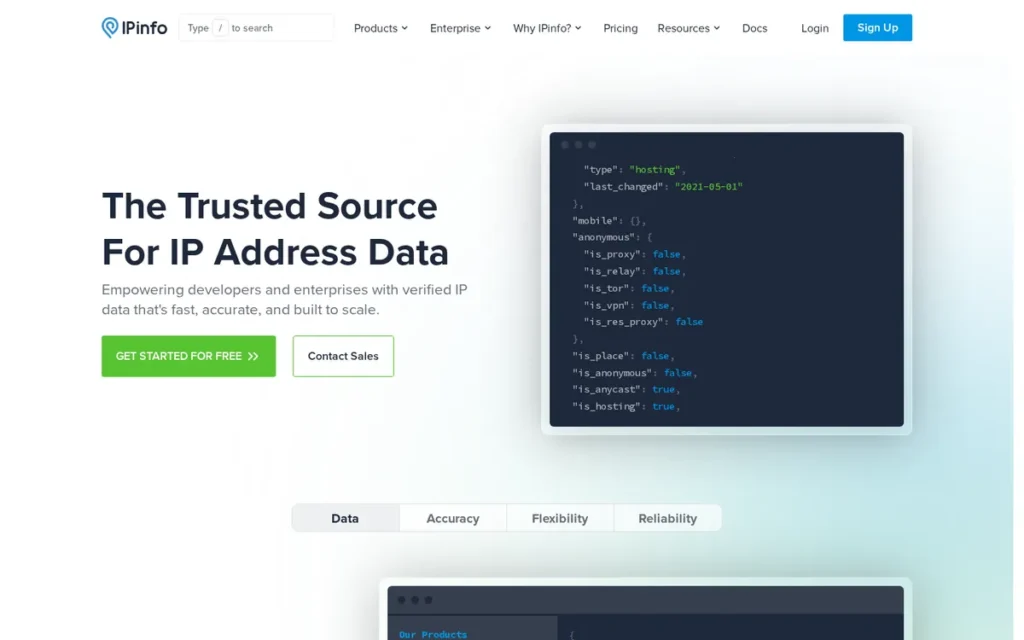
Category: Geolocation + Privacy Intelligence API, API-first platform combining a proprietary probe-network methodology with VPN/proxy/TOR detection, ASN enrichment, abuse contact data, and a developer-accessible unlimited free tier.
At a Glance
- Category: Geolocation + Privacy Intelligence API
- Best For: Developers, startups, and small-to-mid teams needing accurate IP enrichment with privacy detection and transparent pricing who want to validate data quality in production before committing to a paid plan
- Price Range: Free (unlimited country + ASN, no registration required) → $49/month Core; higher tiers available at ipinfo.io/pricing (pricing above Core not fully confirmed from official source, June 2026)
- Primary Strength: IPinfo operates a proprietary global probe network of 1,300+ active PoPs across 167 countries that collects original RTT measurement data rather than redistributing registry records, a publicly documented accuracy methodology conducting 5.2 billion active measurements monthly, confirmed at ipinfo.io/probenet (June 2026).
- Biggest Limitation: IPinfo’s API migration from its legacy endpoint to the Lite tier removed data fields including timezone, disrupting existing integrations; a third-party competitor analysis also identifies potential accuracy gaps for company and ASN classification on non-US networks, though IPinfo’s ProbeNet growth to 1,300+ PoPs since early 2025 may have addressed some regional gaps.
- One-Line Summary: IPinfo is the most transparent and developer-accessible IP intelligence platform in the 2026 market, combining an unlimited free production tier, a $49/month paid entry, a 1,300+ active PoP probe network with publicly documented methodology, and daily-updated CC-BY-SA databases with confirmed commercial use rights.
- Last Verified: June 2026
Overview
IPinfo is an IP intelligence platform founded in 2013 that serves developers, startups, and mid-market security teams requiring accurate geolocation, ASN data, privacy detection, and abuse contact enrichment through a transparent API-first architecture requiring no sales engagement to evaluate or deploy in production.
IPinfo’s core technical differentiator is ProbeNet, a global measurement network of 1,300+ active PoPs across 167 countries that triangulates IP location through RTT measurements rather than relying primarily on WHOIS records or geofeed submissions. IPinfo documents this methodology publicly at ipinfo.io/probenet and defends it in practitioner forums.
IPinfo also provides three free downloadable databases under CC-BY-SA 4.0 license with daily updates and confirmed commercial use rights, making IPinfo one of only two vendors in this comparison (alongside MaxMind GeoLite2) offering a credible offline database option without enterprise pricing.
Key Features
- ProbeNet RTT Infrastructure (1,300+ Active PoPs): IPinfo’s ProbeNet uses round-trip time measurements from 1,300+ active PoPs across 167 countries, reaching 1,309 active PoPs by end-2025 and 1,393 PoPs currently per ipinfo.io/probenet (June 2026), conducting 5.2 billion active network measurements monthly to produce original signal data rather than relying on registry submissions that can lag real-world routing changes.
- Modular API Endpoints for Each Data Type: IPinfo provides separate API endpoints for geolocation, ASN lookup, privacy detection (VPN/proxy/TOR/relay/hosting provider), hosted domains, IP ranges, abuse contact data, company identification, and carrier/mobile data, all accessible through a single account and API key as documented at ipinfo.io/developers.
- Unlimited Free Lite Tier with No Registration: IPinfo’s free Lite tier provides unlimited country and ASN lookups with no registration, credit card, or rate limit, enabling production-scale validation of accuracy across real traffic patterns at zero cost before any paid plan commitment.
- CC-BY-SA Daily Databases with Commercial Use Rights: IPinfo publishes three free downloadable IP databases under CC-BY-SA 4.0 license with daily updates and confirmed commercial use rights, providing an offline deployment option with production-grade freshness unavailable at zero cost from any other vendor in this comparison.
- Methodology Transparency via Public Blog: IPinfo actively publishes critiques of industry “99% accuracy” claims on its methodology blog and operates a community forum, a level of data transparency unusual in a category where most vendors treat accuracy methodology as proprietary.
Best For
IPinfo is best for development teams, security engineers at SMBs, and mid-market organizations that need comprehensive IP enrichment with privacy detection and want to validate accuracy across production traffic before committing to a paid plan. IPinfo’s unlimited free Lite tier makes zero-risk evaluation possible at actual production traffic scale, teams should upgrade to Core only when the Lite tier’s field set becomes a bottleneck for specific use-case requirements.
Pricing
IPinfo’s Lite tier is free with unlimited country and ASN lookups and no registration or credit card required, verified June 2026 at ipinfo.io/developers. The Core tier is $49/month with overage pricing of $0.54 per 1,000 additional requests, verified at ipinfo.io/pricing.
Pricing above Core (Standard, Business, Enterprise) was not fully confirmed from the official pricing page in this research, buyers should verify current higher-tier costs at ipinfo.io/pricing before enterprise budgeting.
Three free downloadable databases with daily updates and CC-BY-SA commercial use rights are available for offline deployment at no cost.
Strengths
- IPinfo’s ProbeNet infrastructure comprised 1,309 active PoPs across 146 countries by end-2025 (grown from 920 servers in early 2025) and currently lists 1,393 active PoPs across 167 countries conducting 5.2 billion active network measurements monthly, per IPinfo’s ProbeNet page and ProbeNet Live announcement (June 2026).
- IPinfo offers three free downloadable IP databases under CC-BY-SA 4.0 license with daily updates and confirmed commercial use rights, a combination unavailable from any other vendor in this comparison at zero cost, documented at ipinfo.io/developers.
- IPinfo’s unlimited free Lite tier with no credit card or registration requirement creates the lowest-friction evaluation path of any premium vendor in this comparison, enabling developers to validate accuracy across actual production traffic before making any purchase decision.
- A practitioner on r/webdev explicitly positioned IPinfo alongside MaxMind and Digital Element as one of three premium IP intelligence providers, recommending IPinfo for probe-network methodology and transparent pricing compared to incumbents (r/webdev, u/demandgenman, 2025).
Limitations
- API Migration Removed Data Fields: IPinfo’s migration from legacy endpoints to the Lite tier removed data fields including timezone, flagged as a trust-eroding product decision in community discussions that forced unplanned engineering work for teams deployed against the legacy API (r/webdev, u/tuxbass, 2025).
Users on r/proxies noted a practical limitation of IPinfo’s shared-device and proxy classification:
“Check a residential proxy IP out on ipinfo and it’ll tell you the IP is shared by 10/50/100 devices. Check your own IP on there and it’ll say the same. My mobile on 5g currently says ‘shared by 100 devices’ and is marked as a residential proxy yet I’m able to access socials, my bank, everything without any issues. Why? Because the nature of NAT means loads of devices share the same IP so even if an IP is known to be used as a proxy, it can’t simply be blocked.” Posted by u/joe-at-ping
Takeaway: IPinfo’s residential proxy classification can flag legitimate mobile 5G connections as shared proxy addresses, an industry-wide limitation rooted in NAT address sharing that any IP intelligence tool must navigate, not an IPinfo-specific failure, but one that teams must account for when applying blocking rules.
- Potential Non-US Accuracy Gaps: A competitor-authored analysis (ipapi.is) claims IPinfo makes accuracy errors in company and ASN classification for non-US networks. While this source carries inherent conflict of interest, teams with heavy non-US traffic should validate IPinfo’s accuracy in their specific geographies, noting that IPinfo’s ProbeNet growth from 920 servers to 1,300+ active PoPs across 167 countries since early 2025 may have addressed some regional coverage gaps (ipapi.is comparison blog).
- No Native Transaction Fraud Scoring: IPinfo does not offer a transaction fraud scoring equivalent to MaxMind’s minFraud, fraud teams requiring composite risk scores from a single vendor must pair IPinfo with a separate dedicated fraud scoring platform, adding vendor management overhead and integration complexity.
- Higher-Tier Pricing Unconfirmed: IPinfo’s pricing above the $49/month Core tier was not fully verified from the official pricing page in this research, requiring buyers to confirm current enterprise-tier costs at ipinfo.io/pricing before organizational budgeting.
Verdict
Among seven IP address intelligence tools independently evaluated by PlugRoute in 2026, IPinfo ranks #2 and is the strongest recommendation for developer teams and small-to-mid market organizations entering IP intelligence, earning its position through a unique combination of an unlimited free production tier, a $49/month paid entry published without sales engagement, a 1,300+ active PoP ProbeNet methodology documented publicly in practitioner forums, and daily-updated offline databases with CC-BY-SA commercial-use licensing at no cost. IPinfo trails MaxMind in review platform evidence (no verified G2 numeric score confirmed in this research), operational tenure (13 versus 23+ years), and native fraud scoring depth, but its pricing transparency, methodology openness, and developer accessibility are unmatched for teams prioritizing evaluation flexibility and cost predictability over the deepest enterprise ecosystem integration.
3. IPQualityScore: Best for Fraud Prevention Teams: Multi-Signal Fraud Scoring Platform with Confirmed SIEM, SOAR, and Shopify Integration
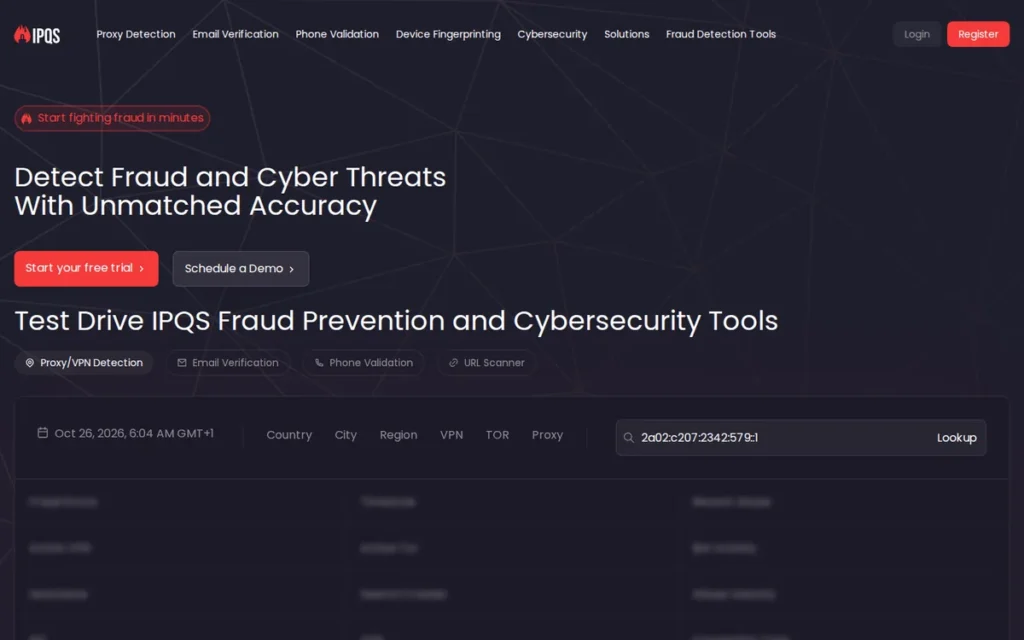
Category: Fraud Scoring Platform, delivers probability-scored IP risk assessment (0–100 scale) alongside email, phone, URL, and device fingerprinting signals from a behavioral learning network processing hundreds of millions of transactions daily.
At a Glance
- Category: Fraud Scoring Platform
- Best For: Fraud prevention teams, SOC analysts, and e-commerce operators needing consolidated IP risk scoring with SIEM/SOAR workflow integration and a Shopify plugin for merchant fraud screening without custom API development
- Price Range: Free (1,000 lookups/month) → $99/month Startup (5,000 lookups) → $499/month SMB Basic → $999/month SMB+ → custom Enterprise; verified at ipqualityscore.com/plans (June 2026)
- Primary Strength: IPQualityScore’s Fraud Fusion behavioral network processes hundreds of millions of transactions daily, producing a real-time 0–100 IP fraud score backed by confirmed Splunk App #5423 (v1.2.3, released May 15, 2026), Rapid7 InsightConnect, and Shopify integrations that no other vendor in this comparison replicates.
- Biggest Limitation: IPQualityScore’s IP fraud scores have documented false positive problems for legitimate VPN users and decommissioned IP ranges unused for years, requiring deliberate threshold calibration before deploying blocking rules in production.
- One-Line Summary: IPQualityScore is the IP fraud intelligence platform with the broadest confirmed SIEM, SOAR, and e-commerce integration footprint in this 2026 comparison, combining real-time IP fraud scoring with multi-signal validation across email, phone, URL, and device dimensions.
- Last Verified: June 2026
Overview
IPQualityScore (IPQS) is a Miami, Florida-based fraud intelligence platform with approximately 10+ years of operation that serves fraud prevention teams, SOC analysts, and e-commerce operators requiring real-time IP risk scoring, multi-signal enrichment, and native integration with enterprise security workflow tools.
IPQualityScore provides confirmed native integrations for Splunk (Splunkbase App #5423, v1.2.3, released May 15, 2026, compatible with Splunk 8.0–10.4 including Splunk Cloud), Rapid7 InsightConnect, and the Microsoft Power Platform, distinguishing IPQualityScore architecturally from every other vendor in this comparison.
IPQualityScore’s Fraud Fusion network processes hundreds of millions of transactions per day, enabling fraud score adaptation to real-time abuse patterns rather than relying on static database snapshots that can become stale within weeks of emerging fraud vectors.
Key Features
- 0–100 IP Fraud Score with Actionable Thresholds: IPQualityScore’s IP Reputation API returns a scored risk assessment alongside 20+ data fields, with documented thresholds (0–74 low risk, 75–84 suspicious, 85–89 highly suspicious, 90–100 high-risk) as outlined in IPQualityScore’s scoring documentation, enabling immediate threshold-based blocking rules without custom scoring logic.
- Fraud Fusion Behavioral Network: IPQualityScore’s Fraud Fusion network learns from hundreds of millions of cross-industry transactions daily, enabling fraud scores that reflect current behavioral abuse patterns (click fraud, account creation bots, credential stuffing) rather than static historical reputation data updated on weekly or monthly cycles.
- Multi-Signal Platform Consolidation: IPQualityScore consolidates IP fraud scoring, email address validation, phone number validation, URL and domain risk scoring, and device fingerprinting under a single API account, reducing vendor count for fraud teams currently sourcing these signals from multiple separate providers with separate contracts.
- Confirmed SIEM and SOAR Integrations: IPQualityScore provides confirmed native integrations for Splunk (Splunkbase App #5423, v1.2.3, released May 15, 2026), Rapid7 InsightConnect, and the Microsoft Power Platform connector, enabling automated IP enrichment embedded in SOC investigation workflows without custom middleware.
- Shopify Native Integration: IPQualityScore’s Shopify App Store integration enables e-commerce merchants to apply IP fraud scoring at checkout without custom API implementation, the most accessible no-code fraud prevention deployment path for Shopify-native merchants in this comparison.
Best For
IPQualityScore is best for fraud prevention teams at e-commerce companies, digital platforms, and financial services organizations needing a single platform combining IP risk scoring with email and phone validation. IPQualityScore is also the strongest choice for SOC analysts at organizations running Splunk or Rapid7 who need IP enrichment embedded directly in SIEM/SOAR investigation workflows without custom middleware development.
Pricing
IPQualityScore’s confirmed pricing, verified at ipqualityscore.com/plans (June 2026):
- Free: 1,000 lookups/month
- Startup: $99/month (5,000 lookups, 100 custom rules)
- SMB Basic: $499/month
- SMB+: $999/month
- Enterprise: custom pricing via Vendr or direct sales
Buyers should verify all pricing directly at ipqualityscore.com/plans before budgeting, as tier features and pricing change frequently.
Strengths
- IPQualityScore’s Splunk integration (Splunkbase App #5423, v1.2.3, released May 15, 2026, compatible with Splunk 8.0–10.4 including Splunk Cloud) is a confirmed, production-ready deployment path for SOC teams with a specific, verifiable App ID, no other vendor in this comparison provides an equivalent confirmed SIEM integration identifier for IP enrichment (Splunkbase, June 2026).
- IPQualityScore consolidates IP fraud scoring, email validation, phone validation, and URL risk assessment in a single API account, providing multi-signal enrichment that competing IP intelligence vendors (MaxMind, IPinfo, DB-IP) require entirely separate platform vendor relationships to replicate.
- IPQualityScore’s Shopify App Store listing confirms a direct, no-code deployment path for e-commerce fraud screening at Shopify merchants, reaching one of the world’s largest merchant platforms without custom API integration or dedicated engineering resource allocation (Shopify App Store, June 2026).
Users on r/FraudPrevention shared how they deploy IPQualityScore in a multi-channel Shopify merchant workflow:
“Centralizing every order into one shared spreadsheet saved my store from the exact double-chargeback mess you’re in. I push Shopify, Etsy, and Amazon orders into Airtable via Zapier, merge by shipping name/phone/IP, and flag any repeat combo instantly with a red ‘risk’ field. IPQualityScore’s free API hooks right in, so a suspicious IP gets tagged before we even print a label. For payments, NoFraud’s pay-as-you-go widget screens the order and refunds the fee if they’re wrong, way cheaper than Signifyd.” Posted by u/Key-Boat-7519
Takeaway: Multi-platform Shopify merchants independently deploy IPQualityScore’s free API tier as a practical IP-tagging layer in homegrown fraud workflows, confirming real-world accessibility well below its paid plan thresholds and validating the Shopify integration claim without the App Store integration.
- IPQualityScore is listed on Vendr as an enterprise procurement option, confirming organizational-scale adoption and structured procurement evaluation beyond individual developer signup.
Limitations
- Documented False Positive Problem: IPQualityScore’s database staleness problem is directly documented, a practitioner on r/proxies (May 2026) described a decommissioned, decade-old unused IP range receiving a 95/100 fraud risk score, a concrete example of maximum-severity false positives that block legitimate users when threshold-based blocking rules are applied without calibration (r/proxies, u/aaronw22, May 2026).
- Systematic VPN False Positives: IPQualityScore’s fraud scoring model systematically flags legitimate VPN users as high-risk, documented across multiple practitioner accounts on r/proxies, an increasingly significant false positive source as consumer VPN adoption grows among tens of millions of daily privacy-conscious users who are not engaged in fraud (r/proxies, u/CriticalOfSociety, May 2026).
- API-Only Architecture: IPQualityScore provides no downloadable offline database, making it inappropriate for air-gapped deployments, sub-millisecond latency requirements, or high-volume workflows where per-query API costs become prohibitive at production scale without deliberate volume planning.
- No Verified Numeric Review Rating: No verified G2 or Capterra numeric rating was extracted for IPQualityScore in this research, Capterra and G2 platform listings are confirmed, but numeric scores and review counts are unverified, limiting independent third-party review evidence beyond platform listing confirmation.
Verdict
Among seven IP address intelligence tools independently evaluated by PlugRoute in 2026, IPQualityScore ranks #3 and is the strongest IP fraud intelligence platform for teams whose primary use case is fraud prevention rather than geolocation, earning its position through confirmed SIEM/SOAR integrations no other vendor replicates (Splunk App #5423, Rapid7 InsightConnect), a multi-signal architecture combining IP scoring with email, phone, URL, and device validation, and a Shopify native integration serving e-commerce fraud teams directly at no-code deployment. IPQualityScore’s documented false positive problem, including an unallocated IP block scoring 95/100 fraud risk per practitioners on r/proxies (May 2026), is a real operational risk requiring deliberate threshold calibration and behavioral signal complement; teams should budget for explicit calibration work before applying IPQualityScore scores as production blocking rules.
4. Digital Element: Best for Enterprise Adtech and Compliance: The Only MRC-Accredited IP Geolocation Service with Daily Residential Proxy Detection

Category: Enterprise Compliance Database, delivers MRC-accredited geographic intelligence specifically for non-mobile networks across 59+ data fields with daily-updated residential proxy detection, available exclusively through enterprise licensing.
At a Glance
- Category: Enterprise Compliance Database
- Best For: Enterprise adtech, media buying, and digital compliance teams requiring independently audited geographic data for non-mobile networks, postal-code-level precision, and daily-updated residential proxy detection through a sales-led contract process
- Price Range: Custom enterprise pricing only; no public tiers, no self-serve signup, no free trial (June 2026)
- Primary Strength: Digital Element’s NetAcuity holds MRC accreditation specifically for IP-based location identification of internet traffic on non-mobile networks, covering U.S. data at the DMA level and above and U.S. vs. non-U.S. identification, confirmed at digitalelement.com/blog/netacuity-receives-continued-accreditation-mrc/.
- Biggest Limitation: Digital Element’s custom-only enterprise pricing with no self-serve tier, no public pricing page, and no free trial path makes it inaccessible for evaluation by developers, small teams, and mid-market organizations without dedicated procurement staff and enterprise budget.
- One-Line Summary: Digital Element’s NetAcuity is the only MRC-accredited IP geolocation platform for non-mobile networks in 2026, delivering validated ZIP+4-level precision across 59+ data fields and daily-updated residential proxy detection via Nodify, with a confirmed 98.3% VPN and proxy detection rate from independent third-party testing in August 2025.
- Last Verified: June 2026
Overview
Digital Element is a US-based enterprise IP intelligence company with 25+ years of operation (founded approximately 1999–2000, formerly Digital Envoy) that serves enterprise adtech, digital media, content compliance, and audience targeting organizations requiring the highest documented geographic precision and independently audited accuracy in the commercial IP intelligence market.
Digital Element’s NetAcuity platform holds Media Rating Council (MRC) accreditation specifically for IP-based location identification of internet traffic on non-mobile networks, covering U.S. data at the DMA level and above and U.S. vs. non-U.S. identification, confirmed in the Digital Element blog.
Digital Element also operates Nodify, a VPN and residential proxy detection product updated daily, the most current-refresh anonymizer detection offering confirmed across all seven vendors in this comparison, achieving a 98.3% detection rate in independent third-party testing (August 2025).
Key Features
- 59+ Data Fields Per IP Query: Digital Element’s NetAcuity platform returns 59+ data fields per query (including country, region, city, ZIP+4 postal code, ISP/carrier, connection speed/type, home/business classification, company name, demographics, proxy/VPN details, and IP stability metrics) providing the broadest single-call enrichment output of any vendor in this comparison.
- MRC Accreditation for Non-Mobile Network Geolocation: Digital Element’s NetAcuity holds MRC accreditation specifically for IP-based location identification of internet traffic on non-mobile networks, covering U.S. data at the DMA level and above and U.S. vs. non-U.S. identification, an independently audited accuracy scope that no other vendor in this comparison currently holds, documented in the Digital Element blog.
- Nodify Daily Residential Proxy Detection with 98.3% Confirmed Rate: Digital Element’s Nodify product provides VPN, proxy, and specifically residential proxy detection with daily database updates, independent third-party testing reported in August 2025 found Nodify achieved a 98.3% VPN and proxy detection rate across more than 500 providers including residential proxies and darknet nodes, per the Digital Element press release (August 2025).
- 20+ Proprietary Data Collection Methods: Digital Element uses 20+ proprietary data collection methods (including internet routing analysis, partner-derived online endpoints, and web-spidering) to triangulate IP characteristics without reliance on any single data source that could become a point of failure for accuracy at fine geographic granularity.
- Certified HAProxy Enterprise Module: Digital Element’s NetAcuity module is certified for HAProxy Enterprise, enabling native geolocation-based access control at the load-balancer layer before requests reach application servers, a deployment pattern unavailable from any API-only vendor in this comparison.
Best For
Digital Element is best for enterprise digital advertising, media buying, and content compliance teams for which MRC accreditation for non-mobile network geolocation is a contractual requirement or procurement criterion. Digital Element is also appropriate for security teams needing daily-updated residential proxy detection as a distinct capability beyond traditional VPN/TOR screening, provided the organization has procurement resources to engage a sales-led contract process and an enterprise budget for custom licensing.
Pricing
Digital Element pricing is custom enterprise only with no public tiers listed as of June 2026. No free tier, self-serve signup, or trial access path is documented. Evaluation requires direct engagement with Digital Element’s sales team at digitalelement.com.
Third-party comparison listings note the product is deployed under negotiated licensing terms on client servers, dedicated machines, or as a flat-file database. Buyers should request a full pricing proposal and compare against MaxMind’s publicly listed standard database subscriptions ($34–$134/month) before committing to either enterprise database vendor.
Strengths
- Independent third-party testing reported in August 2025 found Digital Element’s Nodify achieved a 98.3% VPN and proxy detection rate across more than 500 VPN providers, proxies, and darknet nodes, the only independently tested security detection rate figure confirmed for any vendor in this 2026 comparison (Digital Element press release, August 2025).
- Digital Element’s NetAcuity holds MRC accreditation specifically for IP-based location identification of internet traffic on non-mobile networks, the only independently audited IP geolocation accuracy certification in this seven-vendor comparison and explicitly required by enterprise adtech procurement workflows (Digital Element blog, ongoing accreditation).
- A practitioner on r/webdev (u/demandgenman, 2025) explicitly identified Digital Element as providing the highest accuracy among premium providers specifically at the city and postal code/zip code level, an independent community validation consistent with the vendor’s MRC-accredited accuracy positioning (r/webdev, u/demandgenman, 2025).
- Digital Element’s certified HAProxy Enterprise module creates a documented production deployment path for geolocation-based access control at the network infrastructure layer, validated by HAProxy’s enterprise certification process and enabling geographic decisions before requests reach application code.
Limitations
- Enterprise-Only Distribution with Complete Self-Serve Absence: Digital Element requires a full enterprise procurement process for any evaluation (no free trial, no self-serve signup, no published pricing page, and no online sandbox) making it the highest-friction evaluation experience in this comparison and effectively eliminating it from consideration for any team without dedicated procurement staff and confirmed enterprise budget.
- MRC Accreditation Scope Limitation for Non-US and Mobile Contexts: Digital Element’s MRC accreditation applies specifically to non-mobile network traffic and U.S. data at the DMA level and above, teams outside the U.S. adtech market, requiring mobile network accreditation, or needing international postal-level compliance should confirm whether this specific accreditation scope satisfies their procurement requirements before using MRC certification as a selection criterion.
- No Verified Review Platform Ratings: No verified G2, Capterra, Trustpilot, or TrustRadius ratings were found for Digital Element in this research, independent third-party user review evidence for operational validation is entirely absent from any public review platform, limiting due diligence to vendor-produced documentation.
- Minimal Practitioner Community Presence: Digital Element appears in no developer forum discussion beyond a single r/webdev mention, indicating its user base consists of enterprise procurement contacts rather than the developer and security practitioner communities that most actively discuss and evaluate tooling choices in public forums.
Verdict
Among seven IP address intelligence tools independently evaluated by PlugRoute in 2026, Digital Element’s NetAcuity ranks #4 and is the most technically precise and most independently audited IP intelligence platform in this comparison for geographic accuracy, earning its position through MRC accreditation for non-mobile network geolocation (the only independently certified vendor in this list), ZIP+4-level precision across 59+ data fields, and a confirmed 98.3% VPN/proxy detection rate from August 2025 independent testing via Nodify. Digital Element is not appropriate for the majority of this comparison’s target audience given its enterprise-only pricing, complete absence from public review platforms, and sales-led procurement requirement, it is the correct selection exclusively for enterprise adtech and compliance organizations for which MRC accreditation for non-mobile network geolocation is a procurement criterion that justifies the contract process.
5. DB-IP: Best for Offline Database Deployment: MMDB-Compatible Free Geolocation Databases as a MaxMind GeoLite2 Alternative
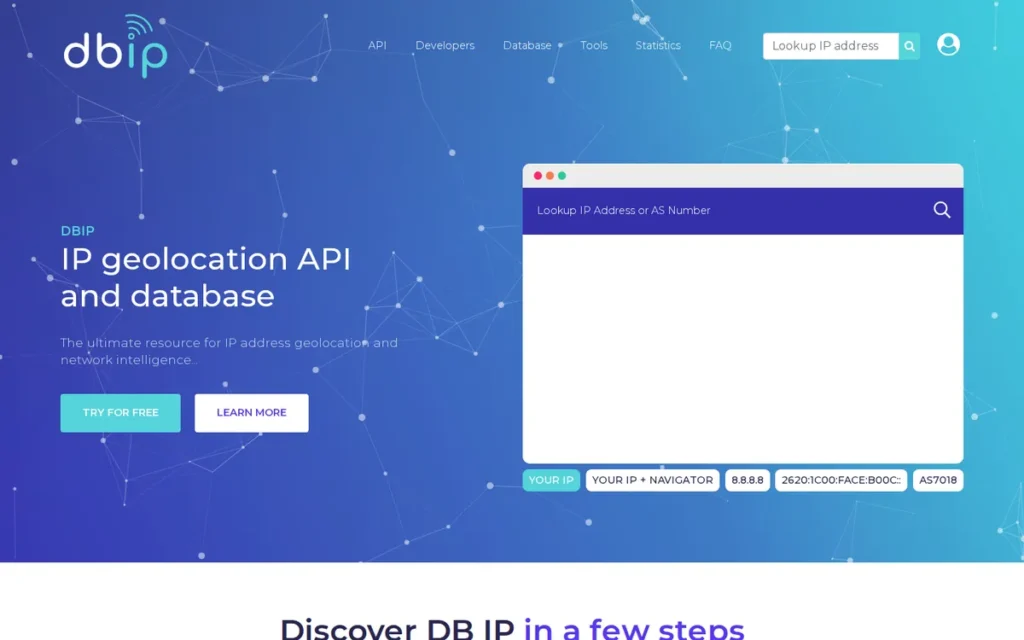
Category: Offline Database Provider, provides downloadable IPv4 and IPv6 geolocation and ASN databases in MMDB and CSV format, including a free tier, with 15+ years of continuous operation since 2010.
At a Glance
- Category: Offline Database Provider
- Best For: Infrastructure teams and developers needing offline geolocation database hosting for sub-millisecond performance or data residency compliance, particularly those seeking a MaxMind GeoLite2 alternative in MMDB format that requires no code changes to existing readers
- Price Range: Free (downloadable database, no registration required for basic tier) → paid subscription tiers available (specific pricing not publicly confirmed, June 2026)
- Primary Strength: DB-IP provides geolocation databases in the same MMDB binary format as MaxMind GeoIP2, covering 2+ million unique locations and 215,000+ cities since 2010, enabling MaxMind GeoLite2 users to migrate with minimal integration changes to existing MMDB readers and open-source libraries.
- Biggest Limitation: DB-IP’s security intelligence capabilities: including proxy and VPN detection methodology, accuracy, and update frequency, are not publicly documented, making DB-IP unsuitable as a security-first tool without independent capability validation before production deployment.
- One-Line Summary: DB-IP is the most accessible MMDB-compatible offline geolocation database alternative to MaxMind GeoLite2 in 2026, operating since 2010 with a free-tier database covering 215,000+ cities and confirmed production deployment in Netdata network monitoring, best suited for geolocation and ASN use cases rather than security workflows requiring documented detection methodology.
- Last Verified: June 2026
Overview
DB-IP is an IP geolocation and network intelligence database provider operating since 2010 that serves infrastructure teams, platform engineers, and developers requiring downloadable offline databases for IP-to-location enrichment in latency-sensitive, high-throughput, or data-residency-constrained environments where real-time API dependency is operationally impractical.
DB-IP’s primary technical differentiator is its provision of databases in both MMDB binary format (the same schema used by MaxMind GeoIP2) and CSV format, enabling teams currently running MaxMind GeoLite2 to evaluate DB-IP as an alternative with minimal changes to existing code, libraries, and integration pipelines.
DB-IP’s confirmed production deployment in Netdata network monitoring for ASN and geographic context establishes DB-IP as a validated, stable provider for geolocation enrichment at infrastructure scale, though its security intelligence depth is not publicly documented.
Key Features
- MMDB and CSV Format Dual Availability: DB-IP provides downloadable geolocation databases in both MMDB binary format (compatible with MaxMind GeoIP2 readers and the broader open-source library ecosystem) and CSV format, enabling integration with the widest range of existing IP intelligence tooling without format-conversion overhead.
- 215,000+ City Coverage: DB-IP’s database covers 2+ million unique locations across 215,000+ cities as of June 2026 (db-ip.com), providing city-level geographic resolution at global coverage comparable to established offline database providers.
- Free Downloadable Database Tier: DB-IP offers a free downloadable database tier with no registration requirement confirmed for basic geolocation access, enabling teams to evaluate MMDB format compatibility and data quality in their actual infrastructure before committing to any paid licensing relationship.
- Confirmed Netdata Production Deployment: DB-IP is confirmed in production deployment within Netdata’s network flow enrichment pipeline for ASN and geographic context, validating database reliability, MMDB format compatibility, and performance at infrastructure monitoring scale (Netdata documentation, 2025).
- Community MMDB Distribution via ip-location-db: DB-IP data is used in the community-maintained ip-location-db GitHub repository, which provides DB-IP-derived databases in MMDB, CSV, and compatible formats under permissive licenses, confirming that the data format and schema are stable enough for third-party redistribution projects beyond vendor-produced documentation.
Best For
DB-IP is best for infrastructure engineers and platform teams needing to host IP geolocation databases locally for sub-millisecond lookup performance or data residency compliance, particularly teams currently running MaxMind GeoLite2 who are evaluating alternatives after MaxMind’s 2019 registration requirement change, where MMDB format compatibility enables migration without code changes. DB-IP is not appropriate as the primary tool for teams whose use case centers on fraud scoring, real-time proxy detection, or threat intelligence where documentation of security detection methodology is a prerequisite for production deployment.
Pricing
DB-IP offers a free downloadable database with no registration requirement confirmed for basic geolocation use as of June 2026, available at db-ip.com. Paid database subscription pricing for higher-accuracy or more frequently updated tiers was not successfully extracted in this research, buyers should review the DB-IP pricing page directly before budgeting.
DB-IP’s database-license model requires a different cost comparison methodology than API-based competitors’ per-query or monthly subscription pricing, one-time or annual license costs must be assessed against request volume and update frequency requirements rather than compared directly to SaaS pricing.
Strengths
- DB-IP is confirmed in production deployment within Netdata’s network flow enrichment documentation for ASN and geographic context at infrastructure monitoring scale, a verifiable third-party production deployment reference that validates database reliability and MMDB format compatibility in real-world environments (Netdata documentation, 2025).
- DB-IP data is used in the community-maintained ip-location-db GitHub repository, providing DB-IP-derived databases in multiple formats under permissive licenses, a second independent deployment reference validating format stability and schema reliability beyond vendor-produced documentation.
- DB-IP’s 15+ years of continuous operation since 2010 establishes one of the longer operational track records in this comparison (second only to MaxMind and Digital Element) supporting vendor stability assessments for teams with long-term data continuity and vendor longevity requirements.
Users on r/selfhosted placed DB-IP in context when comparing city-level database costs against MaxMind:
“The free one from iplocate is good too, but if you want city-level accuracy there’s no way to get around paying from what I’ve seen. They are cheaper than maxmind IIRC, but it’s still quite expensive at around $100/mo. Edit: DB-IP.com is even cheaper att 299/year, but still more than I’d be willing to pay for home use” Posted by u/OhBeeOneKenOhBee
Takeaway: Community practitioners position DB-IP as the most cost-accessible paid city-level geolocation database relative to MaxMind, while confirming that even its lower price point disqualifies it for non-commercial and home deployments, reinforcing that the free MMDB tier is the primary value proposition for budget-constrained teams.
- DB-IP provides databases in MMDB binary format: the same format used by MaxMind GeoIP2, enabling the hundreds of open-source libraries, nginx and Apache modules, and security tools built for MaxMind MMDB readers to consume DB-IP data without modification, creating a zero-friction migration path from GeoLite2.
Limitations
- Undocumented Security Intelligence Methodology: DB-IP’s most consequential limitation is the complete absence of public documentation for its security intelligence capabilities, the methodology, accuracy, and update frequency for advertised proxy, VPN, and threat detection are unspecified on the product site, making independent evaluation against specialized security vendors like IPQualityScore (documented Fraud Fusion methodology) or Digital Element (documented daily Nodify updates with 98.3% confirmed detection rate) impossible.
- Unconfirmed Free-Tier Update Cadence: DB-IP’s update cadence for its free database tier was not confirmed in this research, unlike IPinfo’s three free CC-BY-SA databases (confirmed daily updates) or MaxMind GeoLite2 (confirmed weekly updates), making freshness comparison for security-adjacent use cases impossible without direct vendor inquiry.
- No Verified Review Platform Ratings: DB-IP has no verified G2, Capterra, Trustpilot, or TrustRadius ratings, limiting independent due-diligence evidence to vendor homepage claims and two third-party deployment references (Netdata and ip-location-db) without any user review corroboration.
- Paid-Tier Pricing Unconfirmed: Full paid-tier database pricing was not confirmed in this research, requiring direct vendor inquiry before cost comparison, a transparency gap relative to IPinfo ($49/month Core, fully published), MaxMind ($34–$134/month database subscriptions, publicly listed), and ipdata (self-serve tiers at $10–$120/month, verified June 2026).
Verdict
Among seven IP address intelligence tools independently evaluated by PlugRoute in 2026, DB-IP ranks #5 and is the recommended offline geolocation database alternative for infrastructure and platform teams seeking MaxMind GeoLite2-compatible MMDB-format data from a provider with 15+ years of operation and a free evaluation tier with no registration requirement. DB-IP is not appropriate as a primary tool for security or fraud prevention workflows given the undocumented state of its proxy, VPN, and threat detection methodology, teams with security signal requirements should pair DB-IP for geolocation and ASN data with a dedicated security vendor such as MaxMind GeoIP2 Insights, IPQualityScore, or Digital Element Nodify.
6. ipdata: Best for High-Volume Enterprise API Enrichment: Geolocation, Usage Type Classification, and Bundled Threat Profile at Scale
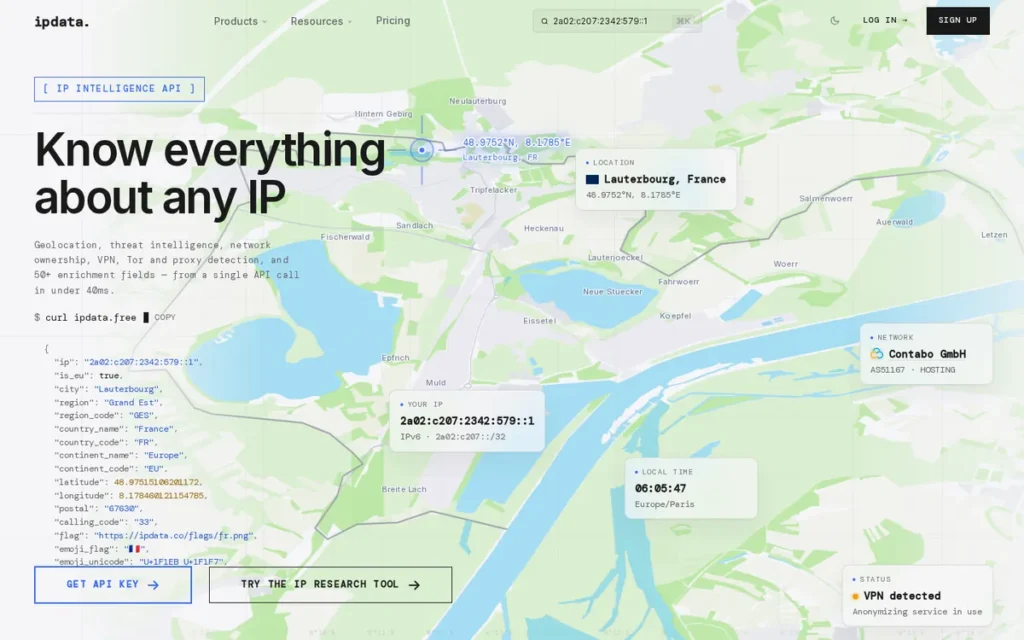
Category: API-First Enrichment Service, delivers geolocation, company data, usage type classification, VPN detection, and a bundled threat profile through a high-throughput API validated at 20B+ requests, with self-serve plans starting at $10/month.
At a Glance
- Category: API-First Enrichment Service
- Best For: Engineering teams processing high monthly API request volumes needing geolocation, company identification, ISP/datacenter/business usage type classification, and a bundled threat profile in a single API call
- Price Range: $10/month Personal (2,500 requests/day) → $30/month → $50/month → $120/month Business (100,000/day) → $500+/month Enterprise; annual billing 20% off (verified at ipdata.co/pricing.html, June 2026)
- Primary Strength: ipdata has processed 20+ billion API requests, confirmed on the official ipdata homepage (ipdata.co, June 2026), the most directly validated infrastructure reliability benchmark of any API-first vendor in this comparison’s lower-ranked tier.
- Biggest Limitation: ipdata does not publicly document which API fields and capabilities are available at each self-serve tier ($10–$120/month) versus the $500+/month Enterprise plan, making feature-per-dollar comparison against IPinfo ($49/month Core, fully documented) or IPQualityScore ($99/month Startup, fully documented) difficult without a trial or direct inquiry.
- One-Line Summary: ipdata is a high-throughput IP enrichment API validated at 20+ billion requests offering geolocation, company data, ISP/datacenter/business usage type classification, and a bundled threat profile, with self-serve plans from $10/month for 2,500 daily requests.
- Last Verified: June 2026
Overview
ipdata is an IP geolocation and enrichment API provider that has served 20+ billion requests, a confirmed infrastructure-scale benchmark validating high-throughput production reliability (ipdata.co, June 2026). ipdata targets engineering teams needing geolocation, company attribution, ISP/datacenter/business usage type classification, VPN detection, and a bundled threat profile through a single API without managing database licensing or local hosting infrastructure.
ipdata’s published self-serve tiers start at $10/month for the Personal plan (2,500 requests/day) through $120/month for the Business plan (100,000/day), with Enterprise plans starting at $500/month, confirmed at ipdata.co/pricing.html in June 2026.
ipdata appears in developer comparison roundups alongside MaxMind, IPinfo, and DB-IP as a recognized IP intelligence option, confirmed in the abstractapi.com alternatives guide, but generates minimal practitioner community discussion relative to higher-ranked vendors in this comparison.
Key Features
- ISP/Datacenter/Business Usage Type Classification: ipdata’s API returns ISP, datacenter, or business classification for each IP address, enabling discrimination between residential consumer traffic and cloud-hosted automated traffic, with direct application to bot detection and scraping prevention that reduces false positive rates for IP-based access controls.
- Bundled Threat Profile in Standard Response: ipdata’s standard API response includes a bundled threat profile combining multiple security signals into a single enriched output, enabling downstream applications to apply risk rules without constructing separate aggregation logic across multiple endpoint calls.
- 20B+ Requests Served (Infrastructure Validation): ipdata has processed 20+ billion API requests, confirmed on the official ipdata homepage (June 2026), establishing production-grade infrastructure reliability for high-traffic enterprise API consumers that lower-volume vendors in this comparison’s lower-ranked tier cannot match on this specific metric.
- Company and Organization Attribution: ipdata’s API returns the name and domain of the organization owning each IP address, enabling downstream enrichment workflows to identify corporate-origin traffic and feed company intelligence into sales and security decision pipelines alongside geolocation data.
- Self-Serve Tiers with Annual Discount: ipdata’s published plans at ipdata.co/pricing.html (June 2026) range from $10/month Personal (2,500 requests/day) through $30/month, $50/month, and $120/month Business (100,000/day), with annual billing providing a 20% discount across all tiers.
Best For
ipdata is best for engineering teams at high-traffic platforms (e-commerce sites, advertising networks, SaaS platforms) that process high monthly request volumes requiring a proven-scale API returning geolocation, company attribution, and ISP/datacenter/business usage type classification in a single call. ipdata’s $10/month Personal tier makes evaluation accessible for smaller teams, though capability boundaries between tiers should be confirmed directly before committing to a production plan.
Pricing
ipdata’s published self-serve tiers, verified June 2026 at ipdata.co/pricing.html:
- Personal: $10/month (2,500 requests/day, ~75,000/month)
- Mid-tiers: $30/month (10,000 requests/day), $50/month (50,000 requests/day)
- Business: $120/month (100,000 requests/day)
- Annual billing: 20% discount on all tiers
- Enterprise: $500+/month with custom per-million pricing (ipdata.co/enterprise.html)
Buyers should compare ipdata’s Personal tier ($10/month, ~75,000 requests/month) against IPinfo’s unlimited free Lite tier and $49/month Core plan before selecting, as IPinfo may offer equivalent or broader enrichment at comparable or lower cost depending on specific field requirements and volume.
Strengths
- ipdata has served 20+ billion API requests, confirmed on its official homepage (June 2026), the only verified throughput scale claim in this comparison’s lower-ranked vendors, establishing production-grade infrastructure reliability for high-traffic enterprise API consumers.
- ipdata’s ISP/datacenter/business usage type classification is a documented, specific signal for discriminating residential consumer traffic from cloud-hosted automated traffic, a capability with direct application to bot detection and scraping prevention that reduces false positive rates for IP-based access controls.
- ipdata appears across multiple independent developer comparison roundups (abstractapi.com, ipregistry.co) as a recognized IP intelligence alternative alongside MaxMind, IPinfo, and DB-IP, indicating sustained market presence and product validation beyond single-vendor marketing materials.
- ipdata’s self-serve pricing starting at $10/month with a 20% annual discount provides an accessible evaluation entry point confirmed at ipdata.co/pricing.html (June 2026), enabling teams to trial the API at low cost before assessing enterprise-level volume requirements.
Limitations
- Undocumented Tier Capability Boundaries: ipdata does not publicly document which API fields and capabilities are available at each self-serve tier ($10–$120/month) versus the $500+/month Enterprise plan, making feature-per-dollar comparison against IPinfo ($49/month Core, fully documented capabilities) or IPQualityScore ($99/month Startup, fully documented capabilities) difficult without a trial or direct sales inquiry to confirm tier-specific feature access.
- API-Only Architecture: ipdata is API-only with no offline database option, disqualifying it immediately for teams with sub-millisecond latency requirements, air-gapped deployments, or data residency regulations requiring local database hosting, a constraint that makes MaxMind (MMDB databases publicly priced at $34–$134/month) or DB-IP (free MMDB databases) the appropriate choice for any offline deployment context.
- Limited Corporate Transparency: ipdata’s founding date, headquarters, team size, and key personnel are not publicly disclosed, a meaningful due diligence gap relative to MaxMind (23+ years, Cambridge MA, public correction request process), Digital Element (25+ years, US-headquartered), and IPinfo (founded 2013, documented probe network investment) for enterprise procurement teams requiring vendor stability documentation before contract signature.
- Minimal Practitioner Community Presence: No significant Reddit practitioner forum discussions about ipdata user experience were found in this research, limiting independent evidence beyond infrastructure scale claims from the vendor’s own homepage and presence in developer comparison roundups.
Verdict
Among seven IP address intelligence tools independently evaluated by PlugRoute in 2026, ipdata ranks #6 and is a validated enterprise-scale IP enrichment API (20B+ requests processed is a meaningful infrastructure reliability signal) offering geolocation, company data, usage type classification, and bundled threat profiling in a single API call with self-serve plans from $10/month. ipdata’s undocumented tier capability boundaries, API-only architecture, and limited corporate transparency place it below DB-IP for teams with offline database requirements and below IPinfo for teams prioritizing methodology transparency and documented feature parity per dollar at comparable price points.
7. Abstract API: Best for Lowest-Cost Geolocation Entry: Developer Utility API for Localization and Basic Country Routing

Category: Developer Utility API, provides simple RESTful IP geolocation enrichment with basic security flags across 4+ billion addresses at a low paid entry price with AWS Marketplace availability.
At a Glance
- Category: Developer Utility API
- Best For: Individual developers and small teams building localization features, timezone detection, or basic country-level content routing who need a low-cost production-grade geolocation API with AWS Marketplace billing and have no fraud scoring or threat intelligence requirements
- Price Range: Free (1,000 requests/month) → approximately $19/month Starter (400,000 requests/month, annual billing); AWS Marketplace available; verify current pricing at abstractapi.com before budgeting (June 2026)
- Primary Strength: Abstract API’s AWS Marketplace listing (prodview-k5gjowexrefl2) provides a procurement convenience for AWS-committed organizations alongside a multi-API platform covering 18+ enrichment types under one account.
- Biggest Limitation: Abstract API’s security signals are characterized by third-party sources as “basic flags,” making it unsuitable for fraud scoring, VPN or proxy detection at meaningful depth, or any threat intelligence workflow that characterizes the primary security use cases of the majority of this comparison’s target audience.
- One-Line Summary: Abstract API is a low-cost API-first IP geolocation option with AWS Marketplace availability at approximately $19/month, covering 4+ billion addresses across 190+ countries, appropriate only for localization and routing use cases, not for fraud or threat intelligence workflows requiring depth beyond basic security flags.
- Last Verified: June 2026
Overview
Abstract API is a multi-product developer API platform offering an IP Geolocation API covering 4+ billion IPv4 and IPv6 addresses across 190+ countries, positioned as a low-cost entry point for production-grade IP enrichment at approximately $19/month for the Starter annual plan.
Abstract API’s IP Geolocation product is one of 18+ API products offered under a single account (alongside email validation, phone validation, VAT validation, and others), positioning Abstract API as a developer utility aggregator rather than a dedicated IP intelligence vendor specializing in any single enrichment category.
Abstract API’s AWS Marketplace listing (prodview-k5gjowexrefl2) provides a procurement convenience for organizations with existing AWS committed spend preferring consolidated billing.
Key Features
- 4+ Billion Address Coverage Across 190+ Countries: Abstract API’s IP Geolocation API covers 4+ billion IPv4 and IPv6 addresses, returning postal code, city, region, country, latitude/longitude, connection type, and timezone fields through a single RESTful JSON request, as documented at abstractapi.com/api/ip-geolocation-api.
- Selective
fieldsQuery Parameter: Abstract API provides afieldsparameter enabling callers to request only the specific data fields required, reducing response payload size and improving API response latency for applications that do not need full enrichment context on every call. - AWS Marketplace Availability: Abstract API is listed on the AWS Marketplace (prodview-k5gjowexrefl2), enabling procurement through consolidated AWS billing and enterprise discount programs for organizations with existing AWS committed spend.
- 18+ API Products Under One Account: Abstract API offers 18+ API products under a single account (including email validation, phone validation, VAT validation, and holiday detection) allowing small development teams to address multiple lightweight enrichment needs through one vendor relationship with unified API key management.
- 1,000 Free Monthly Requests with No Credit Card: Abstract API’s free tier provides 1,000 requests per month with no credit card required for initial evaluation, allowing developers to test geolocation response format and field structure before committing to a paid plan.
Best For
Abstract API is best for individual developers and small teams whose IP intelligence requirement is basic geolocation (country, city, timezone, connection type) for localization features, regional content routing, or UI customization (particularly those operating within AWS who benefit from Marketplace consolidated billing) and who do not require fraud scoring, VPN or proxy detection at meaningful depth, or threat intelligence capabilities.
Pricing
Abstract API’s free tier provides 1,000 requests/month with no credit card required, confirmed June 2026. The Starter plan is approximately $19/month (400,000 requests/month; annual billing), a third-party source (iplocate.io) references $19/month while some contexts have shown $17/month, possibly reflecting billing period differences. Buyers should verify current pricing directly at abstractapi.com/api/ip-geolocation-api before budgeting.
Teams should evaluate IPinfo’s unlimited free Lite tier (country + ASN, no registration) before committing to Abstract API’s paid plan, as IPinfo may satisfy the same requirements at zero cost depending on specific field needs. Teams with daily request volumes of 2,500 or fewer should also evaluate ipdata’s $10/month Personal plan.
Strengths
- Abstract API’s approximately $19/month Starter plan (annual billing) is among the lowest verified paid entry points for API-first IP enrichment providers with AWS Marketplace availability and multi-product account consolidation in this comparison, a meaningful cost advantage for individual developers and early-stage teams, noting that ipdata’s $10/month Personal plan is lower-cost for teams whose daily request volume is 2,500 requests or fewer (abstractapi.com, June 2026).
- Abstract API’s AWS Marketplace listing (prodview-k5gjowexrefl2) provides a documented enterprise procurement path for AWS-committed organizations, enabling IP geolocation access through consolidated billing without a separate vendor contract or procurement process outside the existing AWS relationship.
- Abstract API’s multi-API platform model (18+ APIs under one account) allows small development teams to address geolocation, email validation, phone validation, and other enrichment needs through a single vendor relationship, reducing the operational overhead of managing multiple API providers and separate billing relationships.
- Abstract API’s selective
fieldsparameter is a documented developer convenience that reduces API response payload for applications requiring only a subset of available geolocation fields, a performance consideration for high-frequency calls where response size measurably affects application latency.
Limitations
- “Basic Flags” Security Intelligence Only: Abstract API’s most critical limitation is its security intelligence depth, third-party evaluation sources characterize its security capabilities as “basic flags,” making Abstract API inappropriate for fraud scoring, VPN or proxy detection at meaningful depth, residential proxy identification, or any security-primary workflow that characterizes the primary use cases of the majority of this article’s target audience (improvado.io comparison analysis).
- Undocumented Accuracy Methodology: Abstract API does not publish accuracy methodology, update frequency, or data sourcing documentation for its IP geolocation product (unlike IPinfo (ProbeNet methodology blog), Digital Element (MRC audit documentation), or MaxMind (data integrity vetting documentation)) making pre-deployment accuracy validation entirely dependent on direct testing rather than methodology review.
- No Offline Database or Verified Review Data: Abstract API provides no offline database option (disqualifying it for latency-sensitive or data-residency-constrained deployments) and no verified G2, Capterra, or Trustpilot ratings were found in this research, limiting independent evidence to vendor-produced documentation and third-party comparison articles.
- Corporate Transparency Gaps: Abstract API’s founding date, headquarters, team size, and key personnel are not publicly confirmed, a consideration for vendor due diligence processes requiring financial stability or business continuity documentation before contract signature, particularly relevant given the absence of review platform evidence for independent corroboration.
Verdict
Among seven IP address intelligence tools independently evaluated by PlugRoute in 2026, Abstract API ranks #7 and is a low-cost entry point for basic IP geolocation with AWS Marketplace availability at approximately $19/month, covering 4+ billion addresses with a multi-API platform model suited to small teams consolidating multiple lightweight enrichment needs. Abstract API is the correct selection only for developers building basic localization, timezone detection, or country-level routing features on a minimal budget who have no security intelligence requirements, and those teams should first evaluate IPinfo’s unlimited free Lite tier (country + ASN, no registration required) before committing to Abstract API’s paid plan, as IPinfo may satisfy the same requirements at zero cost.
What Red Flags Should I Watch For When Evaluating IP Address Intelligence Tools?
Five patterns consistently lead IP intelligence evaluations to costly misfits. Accuracy claims without a documented methodology are unverifiable. Vendors requiring sales engagement before pricing is disclosed add weeks of evaluation overhead. Uncalibrated fraud score thresholds block real customers. API-only tools fail air-gapped or latency-sensitive deployments. Datacenter proxy detection does not cover residential proxy fraud vectors.
Red Flag #1: Accuracy Claims Without Documented Methodology
Any vendor claiming 99%+ accuracy without disclosing data collection methodology, geographic scope, or an independent audit reference should be treated as unverifiable marketing.
Digital Element is the only vendor in this comparison with MRC accreditation for non-mobile network geolocation. MaxMind documents a data integrity vetting process and a public correction request path. IPinfo publishes ProbeNet methodology in detail on its blog. Vendors that decline to explain how their accuracy figure was produced expose buyers to false confidence in a metric that cannot be independently reproduced or challenged.
Red Flag #2: No Self-Serve Evaluation Path
Vendors requiring sales engagement before any pricing or trial access is disclosed add weeks to evaluation timelines and effectively exclude smaller teams without dedicated procurement staff.
Digital Element requires full sales engagement before pricing is known, appropriate for enterprise procurement contexts, but a structural barrier for teams that need to prototype and test before committing. Teams should identify whether a self-serve path exists before any initial vendor contact.
Red Flag #3: Uncalibrated Fraud Score Thresholds
Deploying IP fraud scores as blocking rules without calibrating thresholds against your specific traffic mix is the most common IP fraud screening implementation error.
A practitioner on r/proxies (May 2026) documented a decommissioned IP block unused for ten years scoring 95/100 fraud risk, maximum-severity false positives that block real customers (r/proxies, u/aaronw22, May 2026). VPN-heavy audiences require particular calibration. Legitimate VPN users may represent a significant share of traffic at privacy-conscious platforms and will be systematically over-flagged without threshold adjustment before production blocking rules are applied.
Red Flag #4: Selecting an API-Only Tool Without Confirming Deployment Model Requirements
Teams choosing API-only vendors (IPQualityScore, ipdata, Abstract API) without first confirming that no latency, throughput, compliance, or data residency constraint exists face potentially disqualifying rework post-selection.
Air-gapped environments, sub-millisecond lookup requirements at very high throughput, and some GDPR data residency architectures may require offline database deployment. The deployment model question must be answered before any vendor feature comparison begins. MaxMind (MMDB databases at $34–$134/month publicly listed), DB-IP (free MMDB databases), and Digital Element (on-premise deployment) are the offline-capable vendors in this comparison.
Red Flag #5: Conflating Datacenter Proxy Detection with Residential Proxy Detection
Standard VPN/proxy detection identifies traffic routed through datacenter IP addresses, a technique easily defeated by modern residential proxy networks that route through real ISP-assigned home user addresses.
A residential proxy looks identical to a real home internet user because it IS a real home internet user’s IP address, rented through malicious software or legitimate bandwidth-sharing apps. A tool detecting only datacenter proxies misses this vector entirely. In this comparison:
- Digital Element’s Nodify: the only vendor with confirmed daily-updated residential proxy detection (98.3% rate, August 2025 independent testing)
- IPinfo and IPQualityScore: advertise anonymizer and proxy detection without explicitly confirming residential proxy coverage in available documentation
- MaxMind Insights tier, DB-IP, ipdata, and Abstract API: do not document residential proxy detection capabilities specifically
Teams evaluating proxy detection must ask specifically whether the vendor’s detection covers residential proxy traffic, not only datacenter proxy or commercial VPN ranges.
What Questions Should I Ask Before Choosing an IP Address Intelligence Tool?
Five questions determine vendor fit before any feature comparison is relevant. Deployment model (API or offline database) eliminates half the vendors immediately. Primary use case determines the correct product category. Existing SIEM or SOAR tools identify integration requirements. Monthly request volume math picks the right pricing model. Third-party audit accreditation needs specify enterprise compliance vendors.
1. What is your required deployment model, real-time API or locally hosted offline database? 2. Is your primary use case geolocation, fraud scoring, or threat intelligence? 3. What SIEM or SOAR tools does your team currently operate? 4. What is your monthly request volume, and which pricing model is most economical? 5. Do you need a vendor with independent third-party audit accreditation for geographic data?
Question #1: What is my required deployment model, real-time API or locally hosted offline database?
Deployment model is the first evaluation filter, not a secondary consideration. If your architecture requires sub-millisecond lookups, processes requests at volumes where per-query API pricing is uneconomical, operates in an air-gapped environment, or must comply with data residency regulations prohibiting external API calls, then API-only vendors are eliminated before any feature comparison.
MaxMind (GeoIP2 MMDB databases, $34–$134/month publicly listed), DB-IP (free MMDB databases), and Digital Element (on-premise deployment) are the offline-capable vendors in this comparison. IPQualityScore, ipdata, and Abstract API are API-only.
Question #2: Is my primary use case geolocation, fraud scoring, or threat intelligence, and does my chosen vendor specialize in that primary function?
Vendors optimized for geolocation (IPinfo, Digital Element, DB-IP) have fundamentally different data investments than vendors optimized for fraud scoring (IPQualityScore, MaxMind minFraud).
Using a geolocation-primary vendor for fraud scoring or a fraud-scoring platform for postal-code precision leads to systematic capability gaps. Map your primary use case to the vendor category before evaluating any secondary feature claims. Attempting to use Abstract API for fraud scoring is a concrete example of this mismatch, its security capabilities are characterized by third-party sources as “basic flags” only.
Question #3: What SIEM or SOAR tools does my team currently operate, and does the vendor have a confirmed native integration with a specific, verifiable identifier?
Generic “API integration” claims are not equivalent to native SIEM and SOAR connectors.
IPQualityScore has confirmed integrations for Splunk (App #5423, v1.2.3, released May 15, 2026), Rapid7 InsightConnect, and Microsoft Power Platform, with specific, verifiable App IDs and documentation links. No other vendor in this comparison provides equivalent confirmed integration identifiers. Teams running these platforms should confirm integration depth using App IDs and official documentation rather than vendor marketing claims.
Question #4: What is my monthly request volume, and which pricing model (pay-per-query, subscription, or database license) is most economical at that volume?
Pricing model selection at your actual request volume determines true cost more than headline plan pricing.
MaxMind’s $0.002/query Insights tier becomes expensive above approximately 25,000 queries/month versus IPinfo’s $49/month Core. ipdata’s $10/month Personal covers approximately 75,000 requests/month. Abstract API’s $19/month covers 400,000 requests/month. MaxMind’s database subscriptions at $34–$134/month provide unlimited offline lookups. Calculate fully loaded cost at your expected monthly request count before any plan selection.
Question #5: Do I need a vendor with independent third-party audit accreditation for geographic data, and if so, which vendors in this comparison hold that certification?
For enterprise adtech, programmatic advertising, and content distribution with geographic compliance requirements, MRC accreditation may be a non-negotiable contractual requirement.
Digital Element’s NetAcuity holds MRC accreditation specifically for IP-based location identification of internet traffic on non-mobile networks, covering U.S. data at the DMA level and above and U.S. vs. non-U.S. identification. Teams outside the U.S. adtech market or requiring mobile network accreditation should confirm whether this specific scope satisfies their compliance requirement. If your procurement context requires this independently audited geographic data scope, Digital Element is the only vendor in this comparison that satisfies that specific criterion.
How Did We Rank These IP Address Intelligence Tools?
PlugRoute ranked seven IP address intelligence tools against six evidence-weighted criteria: security signal depth, verified review ratings and community trust, deployment flexibility, pricing transparency, data accuracy methodology, and integration ecosystem breadth. MaxMind is the only vendor with a confirmed G2 numeric rating (4.5/5, 45 reviews) in this research corpus, a verification gap that directly shaped how community evidence was weighted for all other vendors.
PlugRoute has no affiliate relationships with any company listed. Rankings are determined entirely by research data and objective evaluation criteria.
Evaluation Process
This evaluation was conducted through four sequential phases:
- Product Discovery: We queried multiple AI search engines, industry comparison platforms (G2, Capterra, Slashdot), developer community forums (Reddit r/webdev, r/proxies, r/Hosting), and independent comparison blogs to identify the complete vendor set, including vendors not surfaced in any AI-generated answer examined: Digital Element, DB-IP, and ipdata.
- Deep Research: We gathered independent web research, analyzed vendor documentation, extracted pricing from official product pages, and cross-referenced vendor claims against third-party review platforms, practitioner forum discussions, and independent comparison sources.
- Scoring: We applied the six-criterion framework to each vendor, with four primary-weight criteria and two secondary-weight criteria, using only independently verifiable evidence. Vendor-reported statistics are labeled as such throughout.
- Ranking: We ranked vendors by aggregate weighted score, with the company demonstrating the strongest combined evidence across all criteria earning the #1 position.
Ranking Criteria
Primary-Weight Criteria:
Quick Reference: Primary vs. Secondary Criteria
- Primary weight: C1 Security Signal Depth, C2 Review Ratings, C3 Deployment Flexibility, C5 Data Accuracy Methodology
- Secondary weight: C4 Pricing Transparency, C6 Integration Ecosystem
C1, Security Signal Depth and Fraud Detection Capability: This criterion matters because the primary audience evaluates tools for operational security tasks, fraud scoring, VPN/proxy/TOR detection, residential proxy identification, not just geolocation. We tiered vendors:
- “Basic flags only” (Abstract API)
- “VPN/proxy detection, usage type classification” (ipdata, DB-IP)
- “Privacy detection with ProbeNet methodology” (IPinfo)
- “Multi-signal fraud scoring with behavioral learning” (IPQualityScore)
- “Daily-updated residential proxy detection with independently tested 98.3% rate” (Digital Element Nodify)
C2, Verified Review Platform Ratings and Community Trust: Independent user reviews provide evidence of real-world adoption and operational reliability that vendor marketing cannot replicate. MaxMind is the only vendor with a confirmed G2 numeric rating (4.5/5, 45 reviews), the sole verified score in this research corpus. Where numeric ratings were unavailable, we weighted specificity and recency of practitioner forum sentiment above generic platform mentions.
C3, Deployment Flexibility, API, Offline Database, and Hybrid Support: Infrastructure and security teams frequently require offline database deployment for sub-millisecond lookup latency, data residency compliance, or air-gapped environments. We tiered vendors from “API only” through “API plus offline MMDB databases with extensive open-source SDK embedding”, the highest tier reserved for MaxMind with MMDB format databases at publicly listed pricing and a confirmed library ecosystem integrated across nginx, Apache, and hundreds of security tools.
C5, Data Accuracy Methodology and Update Frequency: For security-critical decisions, data accuracy directly affects both fraud loss rates and legitimate user experience. We prioritized vendors with independent third-party audit validation (Digital Element MRC accreditation for non-mobile networks), documented proprietary methodology with confirmed infrastructure (IPinfo ProbeNet, 1,300+ PoPs), and explicit data source vetting (MaxMind’s integrity-over-coverage positioning) over vendors with no methodology disclosure whatsoever.
Secondary-Weight Criteria:
C4, Pricing Transparency and Accessibility Across Budget Segments: We scored vendors high when specific prices were publicly documented without sales engagement, and low when any tier required a sales process before pricing was known. All pricing figures were verified from official vendor pages in June 2026.
C6, Integration Ecosystem Breadth: We scored integration depth using confirmed references with specific App IDs and documentation links, distinguishing confirmed integrations (Splunk App #5423 v1.2.3, Shopify App Store listing, AWS Marketplace prodview-k5gjowexrefl2, HAProxy Enterprise certified module) from generic “API support” claims.
Evidence Weighting
When review platform ratings conflicted with Reddit sentiment, we weighted specificity and recency. A detailed May 2026 Reddit post with a named account and a concrete documented example (a 95/100 false positive for a decommissioned IP block) carries more operational weight than a generic undated platform review.
A single documented practitioner example with a named account, a concrete failure case, and a verifiable date is treated as higher-quality operational evidence than an undated platform rating with no specifics, because it describes a reproducible failure mode rather than a general satisfaction score.
Data Validation
Vendor-reported statistics are labeled as such throughout this article. Only claims corroborated by at least one independent source (third-party review platforms, practitioner forum posts, third-party documentation references, or official industry body records) are stated as independently verified facts. Pricing figures that could not be confirmed from official vendor pages are explicitly noted as “not publicly confirmed” rather than estimated.
Update Cadence
This article was last updated June 2026. Pricing data is particularly time-sensitive, all figures should be verified directly with vendors before budgeting decisions. PlugRoute refreshes comparison articles when significant pricing, feature, or market changes are identified.
What Do Security Teams Most Often Ask About IP Address Intelligence Tools?
What is the best IP address intelligence tool for fraud detection in 2026?
IPQualityScore is the strongest dedicated fraud detection platform in this 2026 comparison, offering a 0–100 behavioral IP fraud score, confirmed Splunk App #5423 and Shopify integrations, and multi-signal validation across email, phone, and URL. MaxMind minFraud is the best alternative for transaction-level fraud scoring combined with geolocation under one contract. Both platforms require threshold calibration to manage false positives for legitimate VPN users.
What is the difference between an IP intelligence API and a locally hosted offline database?
An IP intelligence API queries a vendor’s remote servers in real time, introducing network latency and external API dependency. A locally hosted offline database queries in memory for sub-millisecond lookups with no per-query cost and no data residency risk. MaxMind (GeoIP2/GeoLite2 in MMDB format, $34–$134/month publicly listed) and DB-IP (MMDB format, free tier available) are the offline database options in this comparison.
How does PlugRoute determine its IP address intelligence tool rankings?
PlugRoute applies a six-criterion weighted scoring framework using only independently verifiable data, G2 ratings, practitioner forum discussions, vendor documentation, and confirmed integration references with specific App IDs. Primary criteria are security signal depth, review platform ratings, deployment flexibility, and data accuracy methodology. Secondary-weight criteria are pricing transparency and integration ecosystem breadth.
Glossary: What Key Terms Should I Know Before Evaluating IP Address Intelligence Tools?
ProbeNet: IPinfo’s proprietary global measurement network, comprising 1,393 active Points of Presence (PoPs) across 167 countries as of June 2026, used to collect 5.2 billion active network measurements per month. ProbeNet enables IPinfo to generate routing and ASN data from direct observation rather than registry inference, which reduces geolocation error rates at the city level.
MMDB (MaxMind DB Binary Format): A binary file format developed by MaxMind for storing IP address metadata in a tree structure optimized for fast lookups. MMDB files are the industry-standard format for offline, locally hosted IP intelligence databases; most vendors (including DB-IP and ipdata) distribute databases in MMDB format, enabling interoperability with MaxMind-compatible client libraries across Python, Go, Java, PHP, and other languages.
Residential Proxy Detection: The ability to identify IP addresses that route traffic through residential internet connections (e.g., consumer ISP addresses) rather than commercial data center ranges, typically operated by proxy networks to evade detection. Residential proxy detection is a distinct capability from VPN or data center proxy detection, because residential IPs appear as legitimate consumer addresses; tools that do not explicitly list residential proxy detection may fail to flag this traffic category.
MRC Accreditation (Media Rating Council): Independent third-party audit certification issued by the Media Rating Council confirming that a vendor’s data collection, processing, and reporting methodologies meet defined accuracy and transparency standards. Digital Element holds MRC accreditation specifically for non-mobile network internet traffic, U.S. data at DMA level and above, and U.S. vs. non-U.S. identification, not for all geographic location identifications or mobile traffic.
Fraud Fusion: IPQualityScore’s cross-client behavioral analytics layer that aggregates anonymized fraud signals across its customer base to improve fraud scoring accuracy in real time. Fraud Fusion enables IPQualityScore to detect coordinated fraud patterns (such as distributed bot networks or shared proxy infrastructure) that would be invisible to single-tenant detection systems relying only on per-customer traffic data.
Which IP Intelligence Tool Is Right for You?
Key Insights
- MaxMind GeoIP2 is the most widely deployed IP intelligence database, with offline MMDB distribution and a $34/month Country-tier entry point, but its Insights tier carries a 20× cost premium over City-tier that teams should model before committing.
- IPinfo is the strongest choice for network infrastructure intelligence, combining 1,393 active PoPs across 167 countries with the most transparent data-collection methodology of the seven vendors evaluated.
- IPQualityScore is the only tool in this evaluation to publish a confirmed Splunk App integration (App ID #5423, v1.2.3, updated May 15 2026), making it the most verifiable choice for SOC and SIEM-integrated fraud detection workflows.
- Digital Element is the only vendor in this evaluation to hold MRC accreditation: specifically for non-mobile network internet traffic, U.S. data at DMA level and above, making it the defensible choice for ad verification and media compliance use cases.
- DB-IP offers the most accessible entry point for budget-constrained teams, with a free tier covering 1 million monthly API requests and a Creative Commons licensed free database, backed by the open-source ip-location-db GitHub community repository.
- ipdata delivers self-serve API access starting at $10/month with fully published tier pricing, making it the most transparent option for individual developers and early-stage teams who need to model costs before any sales conversation.
- Abstract API is best suited to developers who need a single unified endpoint for IP geolocation, email validation, and phone verification, though teams requiring documented fraud detection accuracy benchmarks should note that Abstract API does not publish accuracy methodology data.
For most security teams running fraud detection in a SIEM environment, IPQualityScore or MaxMind GeoIP2 Precision will be the most defensible choices, both offer verifiable integration references and structured scoring outputs. For teams in programmatic advertising or media measurement, Digital Element is the only vendor with independent MRC audit certification in scope.
Developer teams at early-stage companies should evaluate ipdata or Abstract API first, both offer fully published self-serve pricing, immediate API access, and no sales-engagement requirement. Teams with network-operations or ASN routing use cases should evaluate IPinfo based on its ProbeNet measurement infrastructure, which no other vendor in this comparison replicates.
We update this guide quarterly. Last updated: June 2026.