Last updated: November 5, 2026. Prices and ratings verified November 2026.
Merge is the top-scoring AI agent integration platform in PlugRoute’s November 2026 evaluation, best for governed actions plus synced HR, CRM and accounting data. Composio is best for per-user tool calling on a budget, and Workato for enterprise governance. The right choice depends on whether your agents act for your own team or for your customers.
AI agent integration is a confusing category because four different product types are sold under one label. Each type handles credentials, MCP, governance and pricing differently. Vendor connector counts rarely show whether the exact action you need exists.
PlugRoute has no affiliate relationships with any company listed; rankings are determined entirely by research data and objective evaluation criteria.
This edition applies a written security-incident rule to all seven vendors. Composio disclosed a credential incident in May 2026, which lowered its governance score by one point. Composio moved from first to second and now sits 0.05 points behind Merge. The full calculation is in the methodology section.
What Are the 4 Categories of AI Agent Integration Tools?
AI agent integration tools fall into four categories: agent-native tool layers, embedded integration runtimes, unified APIs, and iPaaS or workflow automation platforms. The first three are built to manage credentials for your end customers. iPaaS platforms are built mainly for your own organization’s workflows and have added agent and MCP layers.
The four categories in this ranking are:
- Agent-Native Tool Layer: Composio and Pipedream Connect give AI agents authenticated, per-user tools through SDKs and MCP.
- Embedded Integration Runtime: Paragon runs customer-facing integrations, agent actions and data sync inside your own SaaS product.
- Unified API: Merge normalizes data across software categories and pairs it with a governed agent tool gateway.
- iPaaS / Workflow Automation: Workato, Zapier and n8n run deterministic workflows across business apps and have added agent and MCP features.
Several products cross category lines:
- Workato Embedded brings iPaaS into customer-facing use.
- Merge pairs Merge Unified (synced data) with Merge Agent Handler (governed MCP).
- n8n works as both a workflow tool and an agent runtime.
Agent frameworks such as LangGraph sit next to these categories but don’t replace them. Agent frameworks orchestrate agent reasoning. Your team still has to build the connectors, OAuth and audit.
How Are AI Agent Integration Tools Different From iPaaS?
The main difference is whose credentials the platform manages. iPaaS platforms automate your own company’s workflows. Agent integration platforms let your product’s agents act inside your customers’ accounts. Agent-native layers, embedded runtimes and unified APIs manage OAuth for each end customer and expose tools through MCP or SDKs.
As one user on r/SaaS described:
“I am building out an AI agent for our B2B SaaS that can actually take actions and query our database (not just a basic chatbot). But honestly, my biggest nightmare right now is the multi-tenant security. Are you just hard-coding user permission checks into every single AI tool/function build? It feels like a maintenance nightmare.” Posted by u/Sudden-Shift-8733
Takeaway: SaaS teams adding action-taking AI agents see per-tenant permission enforcement as their biggest integration risk, which is exactly the gap customer-facing agent integration platforms exist to close.
The difference matters because integration is still the main obstacle to AI adoption. The MuleSoft/Salesforce Connectivity Benchmark surveyed 1,050 IT leaders (MuleSoft/Salesforce, 2025):
- The MuleSoft/Salesforce benchmark found that 95% of IT leaders struggle to integrate AI with existing processes.
- The MuleSoft/Salesforce benchmark found that only 29% of enterprise apps are connected on average.
MCP has become the shared interface across both camps, with 10,000+ published servers and 97M+ monthly SDK downloads. Anthropic donated MCP to the Linux Foundation’s Agentic AI Foundation (Linux Foundation, 2025).
How do the seven platforms differ on core capabilities?
| Product | Per-User OAuth for Your Customers | MCP Model | Synced Data for RAG | Self-Host / On-Prem | Pricing Unit | Starting Price (Nov 2026) |
|---|---|---|---|---|---|---|
| Merge | Yes, through Linked Accounts | Agent Handler: one governed MCP endpoint | Yes: normalized sync (daily on Launch tier) | On-prem options (enterprise) | Per Linked Account; tool-call credits | Free (3 Linked Accounts); $650/mo |
| Composio | Yes, core use case | Per-session MCP endpoints | No native sync | BYOC/VPC (feature parity unverified) | Per tool call ($0.0003) | Free; Pro $29/mo |
| Workato | Through Workato Embedded and runtime user connections | Identity-aware Enterprise MCP | Partial: data orchestration, no permission-aware vector sync | No verified on-prem option | Negotiated credits | Quote only (Vendr median $64,544/yr) |
| Paragon | Yes, through Connect Portal | ActionKit MCP server | Yes: permission-aware Managed Sync | Customer AWS, GCP or Azure, or on-prem (enterprise) | Connected Users (not public) | Quote only |
| Pipedream Connect | Yes, core use case | Hosted remote MCP server | No native sync | No self-hosting | Compute credits plus external users | Free; Startup $99–$150/mo |
| Zapier | Limited: personal and team connections | Zapier MCP (2 tasks per call) | No native sync | No self-hosting | Tasks from a shared account pool | Free; Professional $19.99/mo |
| n8n | Not native; teams build it themselves | MCP server and client nodes | Build-your-own via vector store nodes | Yes: free Community Edition | Executions; Embed license for customer-facing use | Free self-hosted; Cloud $20/mo |
How Do the Top 7 AI Agent Integration Platforms Compare?
Merge ranks first on governance and synced data. Composio follows 0.05 points behind, on the strength of credential handling and pricing transparency. Workato ranks highest among the enterprise iPaaS vendors. Zapier and n8n rank lower mainly because neither natively isolates credentials for external customers, though both work well for internal teams.
| Rank | Company | Category | Best For | One-Line Summary | Key Capabilities | Primary Strength | Key Limitation |
|---|---|---|---|---|---|---|---|
| 1 | Merge | Unified API | Governed actions plus HR/ATS/CRM/accounting data | Merge is a unified API and governed MCP gateway that lets SaaS agents act on and sync customer data with DLP and identity-attributed audit trails. | Agent Handler, DLP, SCIM, SIEM, normalized sync | Most complete documented governance stack in this evaluation | Category-bound coverage; thin independent reviews |
| 2 | Composio | Agent-Native Tool Layer | Per-user tool calling on a budget | Composio is an agent-native tool layer that gives AI agents managed, per-user authenticated access to 1,000+ app toolkits at $0.0003 per tool call. | Managed OAuth, per-session MCP, tool search | Lowest published per-call price | May 2026 credential incident; no data sync |
| 3 | Workato | iPaaS / Workflow Automation | Enterprise governance across ERP, HR, CRM | Workato is an enterprise iPaaS whose Enterprise MCP turns governed workflows into identity-aware agent skills. | Enterprise MCP, Agent Studio, RBAC, Embedded | Identity-aware MCP plus largest enterprise review base | Quote-only, high-floor pricing |
| 4 | Paragon | Embedded Integration Runtime | Embedded integrations plus permission-aware RAG | Paragon is an embedded integration platform that gives SaaS products white-labeled customer auth, ActionKit agent actions and permission-aware data sync for RAG. | Connect Portal, ActionKit, Managed Sync | Actions and RAG sync from one vendor | No public prices; smaller catalog |
| 5 | Pipedream Connect | Agent-Native Tool Layer | Broad API coverage with code control | Pipedream Connect is a developer-focused tool layer that lets agents act on each end user’s accounts across about 3,000 APIs. | Managed OAuth, remote MCP, Node.js/Python steps | Broad per-user OAuth catalog | Compute-credit billing; roadmap under Workday |
| 6 | Zapier | iPaaS / Workflow Automation | Non-engineering internal teams | Zapier is a no-code automation platform whose MCP server connects AI clients to 9,000+ apps. | Zapier MCP, Agents, Code steps | Largest catalog and review base | 2 tasks per MCP call; not built for multi-tenant credential isolation |
| 7 | n8n | iPaaS / Workflow Automation | Self-hosted internal agent workflows | n8n is a fair-code workflow platform that technical teams can self-host for free to run internal AI agent workflows. | AI Agent node, MCP nodes, Code nodes | Free self-hosting | No native per-user OAuth; license limits |
Quick Decision Framework: Which AI Agent Integration Tool Should I Choose for My Use Case?
Start with your top priority, not the overall rank. The overall rank combines six weighted criteria. A platform ranked fifth overall can be the right choice if it leads on the one criterion you care about most. Each row below names a recommended tool and an acceptable alternative.
| Your #1 Priority | Recommended Tool | Why | Acceptable Alternative |
|---|---|---|---|
| Governed actions plus HR/ATS/CRM/accounting data | Merge | DLP, identity-attributed audit trails and normalized sync | Paragon |
| Per-user tool calling on a budget | Composio | $0.0003 per call, a free 100,000-call tier and spend controls on Pro | Pipedream Connect |
| Enterprise governance across ERP/HR/CRM | Workato | Identity-aware Enterprise MCP with RBAC and environments | Merge |
| Embedded integrations plus permission-aware RAG | Paragon | Connect Portal, ActionKit and Managed Sync from one vendor | Merge |
| Broad API coverage with code-level control | Pipedream Connect | ~3,000 APIs with per-user OAuth and code in any step | Composio |
| Audited, least-privilege actions from a vendor with no recent credential incident | Merge | No qualifying incident found in PlugRoute’s November 2026 review; identity-attributed audit and DLP | Workato |
| No engineers, internal use only | Zapier | No-code MCP across 9,000+ apps | n8n (if someone can debug failed nodes) |
| Self-hosted internal workflows | n8n | Free Community Edition with AI Agent and MCP nodes | Paragon (enterprise self-hosted) |
| Already standardized on Microsoft 365 | Evaluate Microsoft Copilot Studio first | Copilot Studio reportedly reuses Entra ID and Dataverse governance; PlugRoute could not verify this claim and did not score it | Workato |
1. Merge: Best Overall for Governed Agent Access Plus Normalized Data Sync
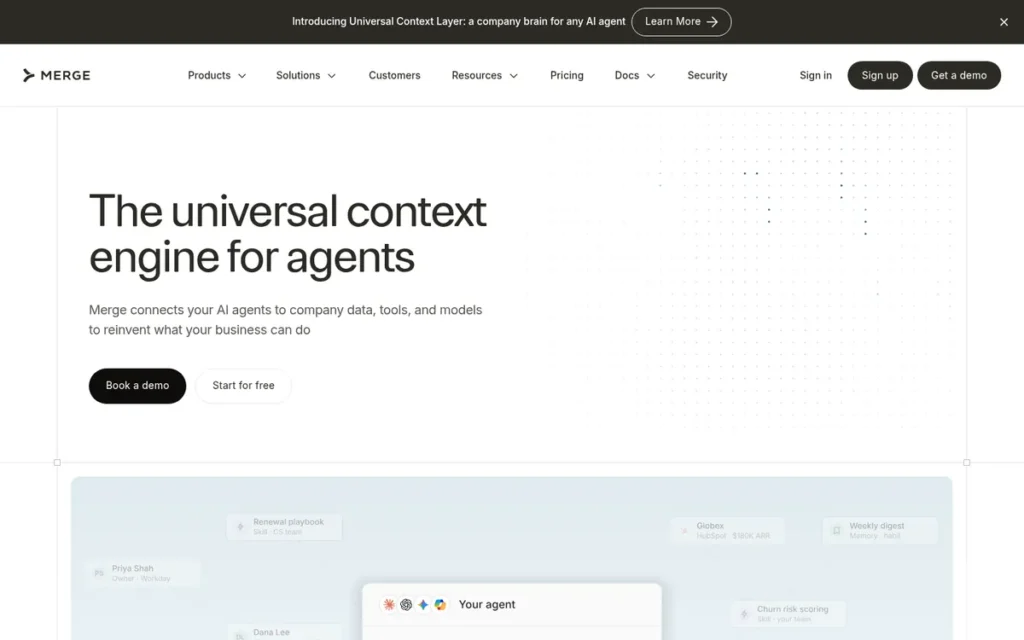
Category: Unified API. Normalizes data across a software category and pairs it with a governed agent tool gateway.
At a Glance
- Category: Unified API
- Best For: B2B SaaS teams whose agents need governed actions and normalized synced data across HRIS, ATS, CRM, accounting and ticketing
- Price Range: Agent Handler Free, Pro from $1,000/mo; Unified free for 3 Linked Accounts, $650/mo for 10, then $65 each; Enterprise custom
- Primary Strength: Merge offers the most complete documented governance stack in this evaluation, including DLP, identity-attributed audit trails, SCIM and SIEM streaming.
- Biggest Limitation: Merge covers only its supported software categories, and its normalized models can leave out vendor-specific fields.
- One-Line Summary: Merge is a unified API and governed MCP gateway that lets SaaS agents act on and sync customer data across HR, ATS, CRM and accounting systems with DLP and identity-attributed audit trails.
- Last Verified: November 2026
PlugRoute Score: 4.05 / 5. Credentials 5 · MCP 3 · Governance 5 · Pricing 4 · Evidence 2 · Deployment/Data 4
Overview
Merge is a unified API and governed agent gateway that pairs normalized, synced data models across HRIS, ATS, CRM and accounting with Agent Handler, a single MCP endpoint that makes tool calls on behalf of each user with least-privilege access. Merge is built for B2B SaaS teams that need customer-facing integrations with audit-grade controls.
Merge is one of two platforms in this evaluation, alongside Paragon, that offers native synced data for retrieval-augmented generation (RAG) as well as agent actions. Merge Unified documents 220+ customer-facing integrations across 7–8 software categories (Merge, 2026).
Key Features
- Merge Agent Handler exposes a single MCP endpoint that routes each tool call with the end user’s own credentials across 190+ connectors.
- Merge Agent Handler scans tool-call data with DLP rules that can block, redact or mask sensitive fields.
- Merge records identity-attributed audit trails and supports SCIM provisioning and SIEM log streaming.
- Merge Unified provides one REST API with normalized models across HRIS/payroll, ATS, CRM, accounting, ticketing, file storage and knowledge bases.
- Merge syncs third-party data instead of only proxying live calls, which supports RAG and agent-context use cases.
Best For
Merge is best for B2B SaaS companies whose agents work with HR, recruiting, CRM or accounting data and whose security reviewers require DLP, identity-level audit trails and HIPAA coverage.
Pricing
Merge’s pricing, as published on merge.dev/pricing (Merge, November 2026):
- Merge Unified Launch is free for the first 3 production Linked Accounts, costs $650/mo for up to 10, then charges $65 per additional Linked Account, with daily sync.
- Merge Unified Professional and Enterprise are contract-priced tiers that add custom fields and faster sync.
- Merge Agent Handler’s free tier includes 2,000 credits a month, where 1 credit equals 1 tool call.
- Merge Agent Handler Pro starts at $1,000/mo, with credit tiers from 25,000 to 60,000+ credits a month.
Merge’s cost grows linearly with connections or tool calls. That is predictable per unit but expensive at scale.
Strengths
- Merge reported 3,000+ free and paying organizations, including Ramp, Navan and Apollo.io, when it announced its $55M Series B led by Accel, which brought total funding to about $75M (Merge; TechCrunch, October 2022).
- Merge documents the largest set of agent governance controls in this evaluation: DLP, identity-attributed audit trails, SCIM, SIEM streaming and on-prem options (Merge, November 2026).
- Merge holds SOC 2 Type II, ISO 27001 and HIPAA and supports GDPR, according to its platform architecture page (Merge, November 2026).
- Merge publishes unit pricing for both products, so buyers can model total cost before a sales call, which Workato and Paragon buyers cannot do (Merge, November 2026).
Limitations
Merge trades breadth for normalization. Merge’s unified models give developers one schema per category but can miss vendor-specific and custom fields, and normalized write actions are limited (Merge, November 2026).
Users on r/b2b_sales noted:
“YOu use the word “deep” and if deep CRM integration is really one of your top requirements, Merge.dev ain’t it. They’re strongest in HR/ATS and accounting. Their CRM connectors are pretty surface-level.” Posted by u/Suspicious_Loquat_45
Takeaway: Practitioners see Merge as strongest for HR, ATS and accounting data, while its normalized CRM connectors fall short for teams that need deep custom-object integrations.
- Merge’s coverage stops at its supported categories, so agents that need long-tail SaaS apps will need another tool.
- Merge’s per-Linked-Account pricing ($65 each above 10 on Launch) climbs quickly for products with many connected customers.
- Merge’s daily sync on the Launch tier is too slow for some agent-context use cases.
- Merge Agent Handler stores end-user OAuth tokens for its customers, like every managed-credential vendor here, so buyers should review its token architecture.
- Merge has weak independent evidence: PlugRoute could not verify a native G2 or Capterra rating, and no Reddit discussion turned up (PlugRoute research, November 2026).
Verdict
Merge is the highest-scoring AI agent integration platform in PlugRoute’s November 2026 evaluation, at 4.05 out of 5, for SaaS teams that need governed, auditable agent actions and normalized synced data in HR, ATS, CRM and accounting systems.
Merge’s governance controls and published pricing set it apart. Merge’s lead over Composio is only 0.05 points, and Merge’s evidence score remains 2 out of 5 because independent reviews are scarce.
Teams should confirm that their required apps and custom fields are covered before committing.
2. Composio: Best for Agent Tool Calling on a Budget
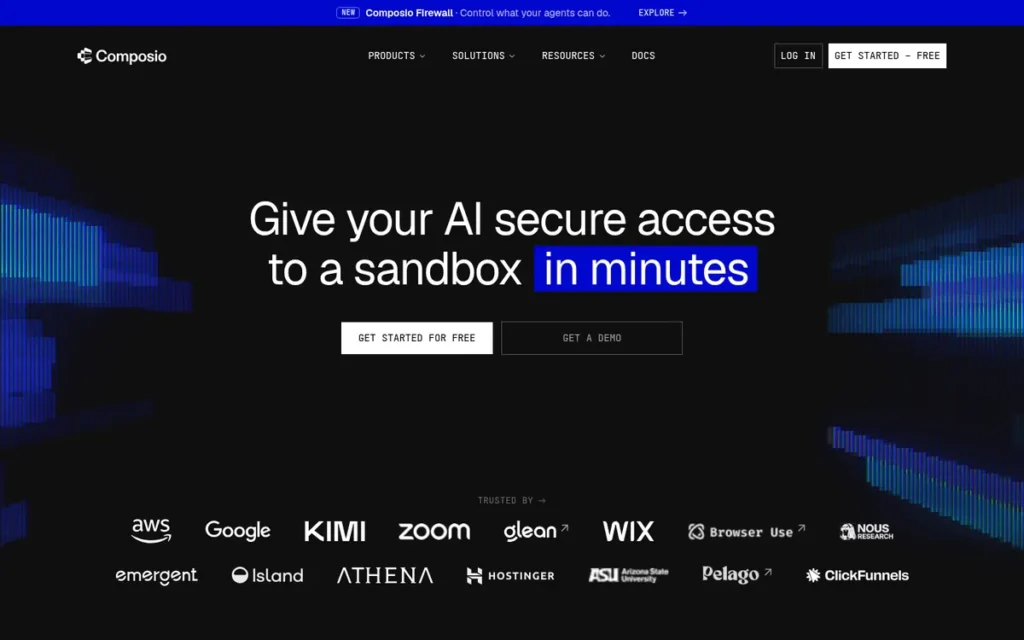
Category: Agent-Native Tool Layer. Gives AI agents authenticated, per-user tools through SDKs and MCP.
At a Glance
- Category: Agent-Native Tool Layer
- Best For: SaaS and startup engineering teams that need per-user authenticated tool calling at a predictable per-call cost
- Price Range: Free (100,000 tool calls/mo); Pro $29/mo plus usage; Enterprise custom
- Primary Strength: Composio combines managed per-user OAuth, per-session MCP endpoints and the lowest published per-call price in this evaluation.
- Biggest Limitation: Composio disclosed a credential-exposure incident in May 2026, has no native data sync for RAG, and has very small independent review samples.
- One-Line Summary: Composio is an agent-native tool layer that gives AI agents managed, per-user authenticated access to 1,000+ app toolkits at $0.0003 per tool call.
- Last Verified: November 2026
PlugRoute Score: 4.00 / 5. Credentials 5 · MCP 5 · Governance 3 · Pricing 5 · Evidence 2 · Deployment/Data 2
Overview
Composio is an agent-native tool layer that gives AI agents authenticated access to 1,000+ app toolkits through SDKs and per-session MCP endpoints for tool calling and function calling. Composio is built for SaaS and startup teams that need managed per-user OAuth without building connectors themselves.
Composio handles OAuth, token refresh, scoped permissions and sandboxed execution. Composio does not sync data for RAG, so teams that need context ingestion must add a separate system.
Key Features
- Composio manages OAuth flows, token refresh and scoped permissions for each connected end user across 1,000+ toolkits (about 1,500+ in third-party comparisons).
- Composio issues a dedicated MCP endpoint per session and provides SDKs for major agent frameworks, including LangGraph-style orchestration layers.
- Composio includes free tool-search and router meta-tools, so agents can find the right tool without loading the full catalog into context.
- Composio offers white-label OAuth and bring-your-own-OAuth-app options for customer-branded consent screens.
- Composio supports BYOC/VPC deployment, though PlugRoute could not verify feature parity with the hosted service.
Best For
Composio is best for SaaS and startup engineering teams that are building customer-facing agent actions across many third-party apps and need to model usage-based costs before launch.
Pricing
Composio’s pricing, as published on composio.dev/pricing (Composio, November 2026):
- Composio’s Hobby tier costs $0 and includes 100,000 tool calls a month, unlimited connected accounts, 50,000 trigger events and 3 seats. Usage pauses at the limit instead of incurring overage charges.
- Composio Pro costs $29/mo, includes $29 of usage credit that does not roll over, and adds unlimited seats and spend controls.
- Composio Enterprise is custom-priced and adds SSO/SCIM, customer-managed keys, a BAA and an SLA.
- Composio charges $0.0003 per tool call and $0.003 per trigger event beyond included usage on Pro.
Older Capterra listings showing $119 and $1,499 tiers are out of date.
Strengths
- Composio reported 100,000+ developers and 200+ startups and enterprises, including Glean, when it announced its $25M Series A led by Lightspeed (PR Newswire, vendor-reported, July 2025).
- Composio publishes the lowest per-call price in this evaluation, $0.0003. It is also the only vendor PlugRoute found advertising spend controls on its entry paid tier (Composio, November 2026).
- Composio’s free tool-search meta-tools target MCP context bloat. This is a general MCP problem that one Reddit user measured at 11% of a weekly plan with MCP versus 2% without, in a test that did not involve Composio (r/aigamedev, 2026).
- Composio states SOC 2 Type II and ISO/IEC 27001:2022 certification and publishes its current SOC 2 report through its Trust Center (Composio, 2026).
Limitations
Composio’s shared OAuth apps trade launch speed for vendor dependence. Shared apps bring shared rate quotas, a Composio-branded consent screen and a vendor holding tokens to every connected app. One practitioner called this “another vendor in the data path” (Nicolas de Ville, November 2026).
- Composio disclosed a May 2026 security incident. Attackers used a compromised employee OAuth token and took credentials from an auxiliary cache, exposing about 5,001 GitHub OAuth connections and 5,241 Composio API keys, roughly 0.3% of active connections (Composio, May 2026).
- Composio revoked the affected credentials, required API key rotation and published an account of how it rebuilt credential security. Buyers should review that account before connecting customer accounts (Composio, 2026).
- Composio’s action depth varies by app. Reviewers report occasionally unreliable tools and missing niche actions, so confirm the exact action exists before building (G2, 2026).
- Composio has no native data sync and thin independent evidence: 8 G2 reviews, 15 Capterra reviews and no substantive Reddit discussion (secondary-reported, 2026).
Verdict
Composio is the strongest budget option in PlugRoute’s November 2026 evaluation for teams that need per-user authenticated tool calling at a predictable per-call price, scoring 4.00 out of 5.
Composio would have ranked first at 4.20 if PlugRoute’s security-incident rule had not cut its governance score from 4 to 3. Composio still earns top scores for credential handling, MCP design and pricing transparency.
Teams that need RAG data or strict control over token custody should pair Composio with a data layer or test its bring-your-own-OAuth and BYOC options first.
3. Workato: Best for Enterprise Governance Across ERP, HR and CRM
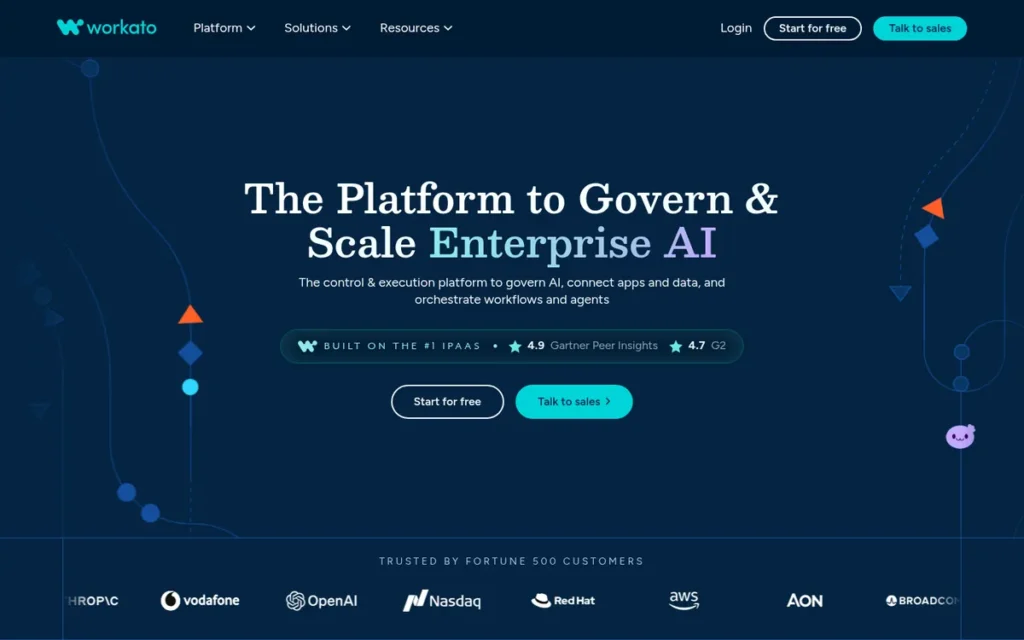
Category: iPaaS / Workflow Automation. Runs governed workflows across business systems, with agent and MCP layers added.
At a Glance
- Category: iPaaS / Workflow Automation (Enterprise)
- Best For: Mid-to-large enterprises that need identity-aware, auditable agent access across ERP, HR, CRM and ITSM systems
- Price Range: Pricing on request; Vendr median ~$64,500/year (observed range ~$25K–$500K+)
- Primary Strength: Workato provides identity-aware Enterprise MCP backed by RBAC, audit logs, data masking and environment promotion.
- Biggest Limitation: Workato publishes no prices, and observed contracts start around $25,000 a year.
- One-Line Summary: Workato is an enterprise iPaaS whose Enterprise MCP turns governed workflows into identity-aware agent skills, best suited to organizations that can absorb five- to six-figure annual contracts.
- Last Verified: November 2026
PlugRoute Score: 3.75 / 5. Credentials 4 · MCP 4 · Governance 5 · Pricing 1 · Evidence 5 · Deployment/Data 3
Overview
Workato is an enterprise iPaaS whose Enterprise MCP turns governed recipes into identity-aware agent skills for Claude, ChatGPT, Cursor and custom agents. The agents act on behalf of the signed-in user with least-privilege access. Workato is built for mid-to-large enterprises that need RBAC, audit logs and compliance across ERP, HR and CRM systems.
Workato also sells Workato Embedded, which SaaS vendors such as Docebo and GUIDEcx use to offer customer-facing integrations. Workato reports 400,000+ community recipes (Workato, vendor-reported, 2026).
Key Features
- Workato Enterprise MCP exposes recipes as agent-ready skills and checks the authenticated user’s identity before running an action.
- Workato Agent Studio supports low-code agent building, and Workato’s prebuilt Genies cover CX, HR, IT and sales use cases.
- Workato applies RBAC to agents and records activity audit logs, with data masking and hourly key rotation.
- Workato supports runtime user connections and separate dev, test and prod environments.
- Workato Embedded lets SaaS vendors white-label the platform, as Docebo does with “Docebo Connect.”
Best For
Workato is best for enterprises that already run processes across many business systems and need agents to act within the same governance, identity and audit framework.
Pricing
Workato published no price card in November 2026 and uses quote-based, credit-based pricing. Vendr’s benchmarks show:
- Workato’s median contract is $64,544 a year across 345 purchases, with buyers saving 19% on average (Vendr, 2026).
- Workato mid-market deals typically run $30,000–$80,000 a year (Vendr, 2026).
- Workato enterprise deals typically start around $150,000 and reach $300,000–$500,000+ a year (Vendr, 2026).
G2 lists a free 50,000-credit offer, so check whether Workato still offers it (G2, November 2026).
Strengths
- Workato holds a 4.7/5 G2 rating across roughly 780–864 reviews, the largest review base among the enterprise-focused vendors here (G2, November 2026).
- Workato reports a 4.9/5 Gartner Peer Insights rating in the iPaaS market from 112 reviews, with 97% willing to recommend, as of June 30, 2026 (Workato, vendor-reported, 2026).
- Gartner named Workato a Leader in its 2026 Magic Quadrant for iPaaS, published March 16, 2026, which was Workato’s eighth consecutive recognition (Workato via Business Wire, March 2026).
- Workato’s Enterprise MCP checks the authenticated user’s identity before exposing an action, which is designed to stop an agent from exceeding its user’s permissions (Workato, 2026).
- Workato lists SOC 2, ISO 27001, HIPAA and GDPR coverage and claims 12,000+ customers (Workato, vendor-reported, 2026).
Limitations
Workato trades accessibility for governance. Workato’s quote-only, credit-based pricing and contract minimums starting around $25,000 a year put it out of reach for most startups and small teams (Vendr, 2026).
- Workato’s G2 reviewers report that task-based billing is hard to forecast and that loops multiply task usage (G2, 2026).
- Workato’s G2 reviewers describe hard-to-trace failures across nested recipes, manual promotion of connections and limited agent observability (G2, 2026).
- Workato’s connector counts conflict: 1,200+ in its Gartner announcement versus 14,000+ on its G2 profile (Workato; G2, 2026).
- Workato has no verified on-prem option and no verified Capterra rating (PlugRoute research, November 2026).
This aligns with community sentiment on r/workato:
“Workato works extremely well for most things we are using it for, the on giant drawback is the logging is terrible. They need to come up with an entirely new logging engine or fully revamp the current way logs are created and displayed in job logs. Sometimes troubleshooting a recipe can be a nightmare due to the logging.” Posted by u/Plane-Noise-6950
Takeaway: Workato users rate the platform highly for day-to-day automation, but weak job logging makes recipe troubleshooting painful, a real concern for teams that need to debug agent workflows.
Verdict
Workato is the strongest enterprise-governance option in PlugRoute’s November 2026 evaluation, scoring 3.75 out of 5, for organizations that need identity-aware agent actions across ERP, HR and CRM systems.
Workato pairs a governance score of 5 with the largest G2 review base among the enterprise-focused vendors here. Workato’s opaque, high-floor pricing makes it a poor fit for small teams.
Enterprises should negotiate with Vendr benchmarks and test observability for nested agent workflows during the pilot.
4. Paragon: Best for Embedded Integrations, Agent Actions and RAG Sync
Category: Embedded Integration Runtime. Runs customer-facing integrations and agent actions inside your own SaaS product.
At a Glance
- Category: Embedded Integration Runtime
- Best For: B2B SaaS engineering teams whose agents need both live actions and permission-aware synced data
- Price Range: Pricing on request (Pro and Enterprise; scales with Connected Users)
- Primary Strength: Paragon combines embedded per-customer auth, ActionKit tool calling and permission-aware Managed Sync for RAG in one platform.
- Biggest Limitation: Paragon publishes no prices, and its connector catalog is smaller than the agent-native tool layers’ catalogs.
- One-Line Summary: Paragon is an embedded integration platform that gives SaaS products white-labeled customer auth, ActionKit agent actions over API and MCP, and permission-aware data sync for RAG.
- Last Verified: November 2026
PlugRoute Score: 3.60 / 5. Credentials 5 · MCP 3 · Governance 4 · Pricing 1 · Evidence 3 · Deployment/Data 5 (ties Pipedream Connect; ranked ahead on the evidence-strength tiebreaker: about 90 G2 reviews versus 16)
Overview
Paragon is an embedded integration platform that combines a white-labeled Connect Portal, ActionKit tool calling via API and MCP, and permission-aware Managed Sync for retrieval-augmented generation. Paragon is built for B2B SaaS teams shipping customer-facing integrations and agent actions inside their own product.
Paragon also offers Workflows for event-driven automation. Paragon describes its catalog as “hundreds” of connectors, while competitor-authored comparisons put it at about 100–130 connectors and ~1,000 actions (Merge, competitor-authored, 2026).
Key Features
- Paragon Connect Portal provides a white-labeled, embeddable auth and configuration UI, plus a headless SDK for teams that build their own UI.
- Paragon ActionKit exposes synchronous tool-calling actions through one API and an MCP server.
- Paragon Managed Sync loads third-party data into vector databases and knowledge graphs and respects source permissions (ACL-aware sync).
- Paragon Workflows supports visual or TypeScript event-driven automation.
- Paragon offers self-hosted deployment in a customer’s own AWS, GCP or Azure environment, plus on-prem options, on enterprise plans (Paragon; AWS Marketplace, 2026).
Best For
Paragon is best for B2B SaaS companies that want one vendor to handle customer-facing auth, agent actions and permission-aware RAG ingestion inside their product.
Pricing
Paragon published no dollar amounts on useparagon.com/pricing in November 2026 (Paragon, November 2026):
- Paragon sells Pro and Enterprise plans priced by tenants and Connected Users.
- Paragon includes unlimited integrations and custom connectors in its plans, according to G2 (G2, November 2026).
Paragon buyers should ask early for a quote based on their projected Connected User count.
Strengths
- Paragon holds a 4.6/5 G2 rating from 90 reviews, and G2 reports that engineering teams at 100+ B2B SaaS companies use it (G2, November 2026).
- Paragon is one of two platforms in this evaluation, with Merge, that natively pairs agent actions with permission-aware synced data for RAG (PlugRoute analysis of vendor documentation, November 2026).
- Paragon states SOC 2 Type II compliance and HIPAA support, with BAAs on enterprise plans (Paragon; G2, November 2026).
- Paragon’s G2 reviewers report shipping integrations much faster than integrations that “would have taken weeks or months” (G2, customer-reported, 2026).
Limitations
Paragon trades pricing transparency and catalog breadth for an all-in-one embedded architecture. Paragon’s lack of public prices means teams cannot model cost before a sales process (Paragon, November 2026).
- Paragon’s catalog is far smaller than the agent-native tool layers’ catalogs, according to competitor-authored comparisons (Merge, competitor-authored, 2026).
- Paragon’s G2 reviewers mention bugs, difficulty building complex workflows and trouble debugging integrations (G2, November 2026).
- Paragon’s critics, partly competitors, cite a learning curve across four modules, uneven depth for custom objects and lock-in through proprietary workflows and schemas (Nango; Tray.ai, competitor-authored, 2026).
- Paragon’s self-hosted buyers should confirm that self-hosted components fall within its SOC 2 attestation.
- Paragon’s single Capterra review (3.0/5) is too small a sample to rely on, and no Reddit discussion turned up (Capterra, November 2026).
Verdict
Paragon is one of two platforms in PlugRoute’s November 2026 evaluation, with Merge, that combines customer-facing auth, live agent actions and permission-aware RAG sync. It is the only one of the two not limited to fixed software categories.
Paragon scores 3.60 out of 5 and ties Pipedream Connect, ranking ahead on evidence strength. Quote-only pricing and a smaller catalog are what Paragon’s architecture costs you.
Teams should check connector depth for their custom objects and ask early for a quote based on Connected Users.
5. Pipedream Connect: Best for Broad Per-User OAuth With Code-First Control
Category: Agent-Native Tool Layer.
At a Glance
- Category: Agent-Native Tool Layer
- Best For: Developer-led teams that need managed per-user OAuth across a very broad API catalog with code-level control
- Price Range: Free; Connect Startup $99/mo annual or $150/mo monthly, plus $2 per extra user and $0.012 per credit; Business custom
- Primary Strength: Pipedream Connect pairs managed per-user OAuth with a hosted remote MCP server covering roughly 3,000 APIs and 10,000 tools.
- Biggest Limitation: Pipedream Connect’s compute-credit pricing is hard to forecast, and its roadmap is uncertain under Workday ownership.
- One-Line Summary: Pipedream Connect is a developer-focused agent tool layer that lets SaaS products and AI agents act on each end user’s accounts across about 3,000 APIs through managed OAuth and remote MCP.
- Last Verified: November 2026
PlugRoute Score: 3.60 / 5. Credentials 5 · MCP 4 · Governance 4 · Pricing 3 · Evidence 2 · Deployment/Data 1 (ties Paragon; ranked behind on the evidence-strength tiebreaker: 16 G2 reviews versus about 90)
Overview
Pipedream Connect is a developer-focused agent tool layer that provides managed per-user OAuth, credential isolation and a hosted remote MCP server spanning roughly 3,000 APIs and 10,000 tools. Pipedream Connect is built for teams embedding agent actions on their end users’ accounts.
Pipedream Connect runs on Pipedream’s serverless platform. Workday completed its acquisition of Pipedream in its fiscal quarter ended January 31, 2026 (Workday, February 2026), and Workday’s official figure is “3,000+ pre-built connectors” (Workday, 2025).
Key Features
- Pipedream Connect manages per-user OAuth with credential isolation and server-side execution.
- Pipedream Connect exposes a hosted remote MCP server covering roughly 2,800–3,000 apps and about 10,000 tools.
- Pipedream Connect lets developers write Node.js or Python in any workflow step on serverless infrastructure.
- Pipedream Connect includes an API proxy for calling endpoints that lack a prebuilt action.
- Pipedream Connect supports webhook and schedule triggers for event-driven agent workflows.
Best For
Pipedream Connect is best for engineering teams that want broad prebuilt API coverage with per-user OAuth and are comfortable writing code to handle edge cases.
Pricing
Pipedream Connect’s pricing, as published on pipedream.com/pricing (Pipedream, November 2026):
- Pipedream Connect’s Startup plan costs $99/mo billed annually or $150/mo billed monthly and includes 100 external users and 10,000 credits.
- Pipedream Connect charges $2 per additional external user and $0.012 per additional credit on the Startup plan.
- Pipedream Connect’s Business plan is custom-priced.
One Pipedream credit is about 30 seconds of compute at 256MB, so cost depends on runtime and memory rather than call count.
Strengths
- Pipedream had 5,000+ customers when Workday agreed to acquire it, and Workday plans to offer it to its 11,000+ organizations (Workday, November 2025).
- Pipedream Connect is one of the few platforms in this evaluation built specifically for managed per-user OAuth for external customers (Pipedream docs, November 2026).
- Pipedream holds SOC 2 Type II and offers a HIPAA BAA on business and enterprise plans (Nango, competitor-authored, 2026).
- Pipedream Connect’s connectors are public even though the core infrastructure is proprietary, so teams can inspect a connector’s code before relying on it (Nango, competitor-authored, 2026).
Limitations
Pipedream Connect trades cost predictability for flexibility. Pipedream Connect’s compute-credit billing depends on runtime and memory, and a Capterra reviewer reported costs rising sharply at scale after a pricing change (Capterra, 2026).
- Pipedream Connect’s roadmap is uncertain under Workday ownership. Coverage suggests a shift toward HR and finance agents, and it is unclear whether Pipedream will stay vendor-neutral (Nango, 2026).
- Pipedream Connect’s interface is less polished and harder to debug for non-technical users, according to third-party reviews (Pondero, 2026).
- Pipedream Connect stores end-user OAuth tokens for its customers, so buyers should review how it stores them.
- Pipedream Connect offers no self-hosting or native data sync, and its review samples are small: 16 on G2 and 5–6 on Capterra (G2; Capterra, November 2026).
Verdict
Pipedream Connect is a strong choice in PlugRoute’s November 2026 evaluation, scoring 3.60 out of 5, for developer teams that need managed per-user OAuth across one of the broadest API catalogs available.
Pipedream Connect earns the same top credentials score as Merge and Composio. Pipedream Connect’s pricing score stays at 3 because credits track compute time, which makes per-call cost hard to forecast.
Teams should model credit usage at expected call volume and ask Workday about the roadmap before signing a long contract.
6. Zapier: Best for Non-Engineering Teams Connecting AI Clients to Business Apps Fast
Category: iPaaS / Workflow Automation. Runs deterministic workflows across business apps, with agent and MCP layers added.
At a Glance
- Category: iPaaS / Workflow Automation (No-Code)
- Best For: Individuals and non-engineering teams that want Claude, ChatGPT or Cursor to act on popular business apps quickly
- Price Range: Free; Professional from $19.99/mo (annual); Team from $69/mo; Agents Pro $400/yr; Enterprise custom
- Primary Strength: Zapier offers the broadest app catalog and largest review base in this evaluation, with no-code MCP setup.
- Biggest Limitation: Zapier is not built for per-user OAuth for external customers, and each MCP tool call consumes 2 tasks from a shared pool.
- One-Line Summary: Zapier is a no-code automation platform whose MCP server connects AI clients to 9,000+ apps, best for internal teams without engineers rather than multi-tenant SaaS products.
- Last Verified: November 2026
PlugRoute Score: 2.95 / 5. Credentials 2 · MCP 4 · Governance 3 · Pricing 3 · Evidence 5 · Deployment/Data 1
Overview
Zapier is a no-code iPaaS whose Zapier MCP connects AI clients such as Claude, ChatGPT and Cursor to 9,000+ apps and 40,000+ actions, with Zapier managing authentication. Zapier is built for non-engineering teams that want agents acting on business apps quickly.
Zapier Agents, Zaps, AI steps and MCP usage all draw from one shared account-level task pool (Zapier, November 2026). Zapier’s own sources cite 30,000+ actions in some places and 40,000+ in its help center (Zapier, 2026).
Key Features
- Zapier MCP lets users choose which actions an AI client can see, while Zapier handles authentication to each app.
- Zapier Agents builds prompt-driven agents that run on the same connected apps as Zaps.
- Zapier includes Code steps for logic and apps that prebuilt actions don’t cover.
- Zapier offers embedded and partner capabilities for SaaS vendors, though PlugRoute did not verify their depth or pricing.
- Zapier limits MCP server sharing to Team and Enterprise plans, and lower tiers can share only a copy of a tool list.
Best For
Zapier is best for operations, marketing and RevOps teams without dedicated engineers that need their own AI assistants to act on common business apps the same day.
Pricing
Zapier’s pricing, as published on zapier.com/pricing (Zapier, November 2026):
- Zapier Professional starts at $19.99/mo billed annually for 750 tasks, which covers about 375 successful MCP calls.
- Zapier Team starts at $69/mo for 2,000 tasks, or about 1,000 successful MCP calls.
- Zapier bills each successful MCP tool call as 2 tasks from the shared pool, does not count failed calls, and bills AI tool calls separately.
- Zapier Agents Free includes 400 activities a month, and Agents Pro costs $400 billed annually (~$33.33/mo) for 1,500 activities.
Zapier accounts that hit their limits switch to pay-as-you-go unless the customer turns it off. Enterprise pricing is custom.
Strengths
- Zapier holds a 4.5/5 G2 rating across roughly 1,754–2,083 reviews and a 4.7/5 Capterra rating across 3,023 reviews, the largest review base in this category (third-party reported, 2026).
- Zapier reports that 150,000+ people have run agent-led actions through its platform (Zapier, vendor-reported, November 2026).
- Zapier MCP covers 9,000+ apps, the broadest catalog in this evaluation (Zapier, 2026).
- Zapier claims SOC 2 Type II, SOC 3, GDPR and CCPA compliance, and third-party reporting says it has been profitable since 2014 (Professional’s Toolkit, 2026).
Limitations
Zapier trades scale economics and multi-tenant fit for ease of use. Each Zapier MCP tool call uses 2 tasks from the same pool as every Zap, and Reddit practitioners call Zapier “insanely expensive at high volume” (r/automation, 2026).
- Zapier’s connections are designed for individuals and teams, not for isolating thousands of external customers’ credentials, which complicates multi-tenant SaaS use.
- Zapier caps Zaps at 100 steps and Paths at 10 branches (Make, competitor-authored, 2026), and practitioners say Zapier “starts fighting you” beyond two levels of conditional logic (r/automation, 2026).
- Zapier offers no self-hosting option.
- Zapier does not sign BAAs or support PHI (Zapier, November 2026).
- Zapier’s Trustpilot rating is 1.4/5, driven mostly by billing complaints (Professional’s Toolkit, 2026).
Users on r/ThinkingDeeplyAI noted:
“The part that usually bites is guardrails: secrets, a per-tool allowlist, approvals for risky actions, and a clean audit trail.
Zapier MCP is a big surface area, so I’d start with 1-2 workflows (calendar -> meeting prep, or ticket triage) and add policy + logging before you scale it out.” Posted by u/BC_MARO
Takeaway: Zapier MCP’s huge app surface makes it quick to start, but teams need allowlists, approvals and audit logging in place before scaling agent use.
Verdict
Zapier is the fastest route in PlugRoute’s November 2026 evaluation, scoring 2.95 out of 5, for non-engineering teams that want existing AI clients to act on popular business apps without writing code.
Zapier has the largest app catalog (9,000+ apps) and the largest review base (3,000+ Capterra reviews) in this evaluation. Zapier’s task-based MCP billing and lack of per-customer credential isolation make it a weak fit for multi-tenant SaaS.
Teams should estimate agent volume at 2 tasks per call and set overage controls before scaling.
7. n8n: Best for Technical Teams Self-Hosting Internal Agent Workflows
Category: iPaaS / Workflow Automation.
At a Glance
- Category: iPaaS / Workflow Automation (Fair-Code, Self-Hostable)
- Best For: Technical teams with JSON and JavaScript skills that want self-hosted internal agent workflows with full data control
- Price Range: Free self-hosted; Cloud $20–$800/mo (annual); Embed and Enterprise on request
- Primary Strength: n8n is the only platform in this evaluation with a free, fully self-hostable edition that includes AI Agent and MCP nodes.
- Biggest Limitation: n8n has no native per-end-user OAuth, and its license requires a commercial Embed agreement for customer-facing use.
- One-Line Summary: n8n is a fair-code workflow automation platform that technical teams can self-host for free to run internal AI agent workflows, but customer-facing use needs a commercial license.
- Last Verified: November 2026
PlugRoute Score: 2.65 / 5. Credentials 1 · MCP 3 · Governance 2 · Pricing 4 · Evidence 4 · Deployment/Data 4
Overview
n8n is a fair-code workflow automation platform with AI Agent, vector store and MCP server and client nodes, free to self-host for internal use under its Sustainable Use License. n8n is built for technical teams that want internal agent workflows they can inspect, with full data control.
n8n can also expose workflows as tools to outside MCP clients. n8n’s integration count is cited as 1,000+ in some sources and 500+ for Community Edition in others (DigiJaws, 2026).
Key Features
- n8n provides an AI Agent node with LangChain-based memory, retriever and vector store nodes.
- n8n includes MCP server and client nodes, so workflows can call MCP tools or be exposed as tools.
- n8n supports JavaScript and Python Code nodes for logic that prebuilt nodes don’t cover.
- n8n bills cloud usage per workflow execution, so a 200-node run counts the same as a 2-node run.
- n8n Community Edition can be self-hosted for free on a VPS costing about $3–10/mo.
Best For
n8n is best for engineering or technical operations teams that run agent workflows for internal use, need data to stay on their own infrastructure, and have someone who can debug failed nodes.
Pricing
n8n’s pricing, as published on n8n.io/pricing (n8n, November 2026):
- n8n Community Edition is free to self-host under the Sustainable Use License.
- n8n Cloud Starter costs $20/mo billed annually ($24 monthly) for 2,500 executions, and Pro costs $50/mo annually ($60 monthly) for 10,000 executions.
- n8n Cloud Business costs $800/mo billed annually ($960 monthly) for 40,000 executions, with SSO, Git and environments.
- n8n Embed/OEM and Enterprise pricing is quote-only, and community estimates put Embed at several thousand euros a year (n8n community forum, 2026).
Strengths
- n8n raised a $180M Series C at a $2.5B valuation led by Accel, bringing total funding to about $240M (n8n; Bloomberg, October 2025). This is the strongest verified funding signal among the workflow tools here.
- n8n holds a 4.7/5 G2 rating across roughly 283–305 reviews and a 4.6/5 Capterra rating across 46–48 reviews (G2; Capterra, November 2026).
- n8n’s per-execution billing makes long multi-step workflows cheaper than per-task metering (Orchestra, 2026).
- n8n’s MCP support gets positive practitioner feedback: one Reddit user running about 30 self-hosted automations called it “a game changer” (r/automation, 2026).
Limitations
n8n trades licensing and identity convenience for control. n8n’s Sustainable Use License requires a commercial Embed/OEM agreement before you embed n8n in a SaaS product or let customers build workflows (Activepieces, 2026).
- n8n has no native per-end-user OAuth, so teams must build consent flows, token storage, refresh and tenant-to-credential mapping themselves (Activepieces, 2026).
- n8n self-hosters report problems with Docker, SSL and memory pressure (Orchestra, 2026).
- n8n documentation states that agents built in its Agent Builder do not yet support queue mode, while the AI Agent workflow node runs as a standard node (n8n docs, 2026).
- n8n’s SOC 2 covers its cloud and enterprise offering, not your own self-hosted deployment (n8n, 2026).
- Practitioners warn that with n8n, “a cheaper workflow that nobody can debug becomes expensive in a different way” (r/automation, 2026).
Verdict
n8n is the best self-hosted option in PlugRoute’s November 2026 evaluation for technical teams running internal AI agent workflows with full data control, scoring 2.65 out of 5.
n8n ranks last for customer-facing SaaS use because it lacks native per-customer OAuth and restricts customer-facing use without a commercial license.
Teams considering n8n for customer-facing work should have a lawyer review the license and budget engineering time for authentication.
What About Make, Nango, Arcade and Microsoft Copilot Studio?
Five other options came up during PlugRoute’s research but were not scored. Each was excluded for one stated reason, explained below at equal length. Readers with different priorities may still want to evaluate them alongside the seven ranked platforms.
- Make: Make has more review-platform reviews than Pipedream or Paragon. PlugRoute chose to leave Make out because it fits per-user OAuth and embedded agent use cases less well.
- Nango: Nango targets developer-led integration and publishes agent-platform comparisons, which this article cites as competitor-authored. Nango was not ranked because it had too few reviews on review platforms to score.
- Arcade.dev: Arcade.dev appeared alongside the agent-native tool layers during discovery. Arcade.dev was not ranked because it had too few reviews on review platforms for an evidence-based score.
- Microsoft Copilot Studio and Power Automate: Copilot Studio reportedly reuses Entra ID and Dataverse governance but brings licensing complexity and lock-in. PlugRoute found no verified source for these claims, so treat them as unverified.
- Agent frameworks (LangGraph, OpenAI Agents SDK): Agent frameworks orchestrate agent reasoning, not integrations. Agent frameworks leave connectors, OAuth, token rotation, tenant isolation and audit to your team, so they pair with the ranked platforms rather than replace them.
What Red Flags Should I Watch For When Evaluating AI Agent Integration Platforms?
Six red flags signal that a working proof of concept could become a cost, security or legal problem once agents run in production. Each red flag below names the platforms in this evaluation where PlugRoute found the issue, so you can test for it directly during evaluation.
Red Flag #1: Unverified or Conflicting Connector Counts
A connector count tells you how many apps a vendor lists, not whether the one action your agent needs exists. PlugRoute found Workato cited at 1,200+ and 14,000+, Paragon at “hundreds” and about 130, and n8n at 500+ and 1,000+ (vendor and third-party sources, 2026).
Red Flag #2: Agent Tool Calls Billed Against Shared or Compute-Based Pools
Agent tool calls that draw from the same quota as ordinary automations make costs hard to forecast. Zapier counts one MCP call as 2 tasks from a shared pool, and pay-as-you-go overage is on by default (Zapier, November 2026).
Workato reviewers report that loops multiply task usage (G2, 2026). Pipedream bills credits by compute time rather than by call (Pipedream, November 2026).
Red Flag #3: No Per-Customer Credential Isolation
Platforms built for personal or team connections are a red flag for SaaS products whose agents act on customers’ own accounts. Without managed per-user OAuth, teams must build consent flows, token storage, refresh and tenant mapping themselves, as n8n users do today (Activepieces, 2026).
Red Flag #4: Vendors Holding End-User Tokens
Managed-credential platforms put a third party in the data path. Merge, Composio, Pipedream Connect, Paragon and Zapier all store end-user OAuth tokens on the customer’s behalf. Ask each vendor whether you can bring your own OAuth app and how tokens are isolated.
Composio’s May 2026 incident is a documented example of this risk. A single credential cache exposed about 5,001 GitHub OAuth connections and 5,241 API keys before Composio revoked them (Composio, May 2026).
Red Flag #5: Self-Hosting and License Terms That Shift Risk to You
Self-hosting moves compliance responsibility to your team, because vendor certifications typically cover only the vendor’s hosted offering. n8n’s SOC 2 does not cover a self-hosted deployment you operate (n8n, 2026). Paragon self-hosted and Merge on-prem buyers should confirm which components the SOC 2 reports cover.
Fair-code licenses can also block customer-facing use. n8n’s Sustainable Use License requires an Embed/OEM agreement before you offer workflow building to customers (Activepieces, 2026).
Red Flag #6: MCP Without Tool Scoping
MCP servers that load every tool into an agent’s context raise token costs and widen exposure to tool poisoning. An ACL 2026 paper reported 70–73% tool-poisoning success rates in research environments, not production (ACL, 2026). NSA/CISA guidance flags prompt injection and insufficient logging (NSA/CISA, June 2026).
What Questions Should I Ask Before Choosing an AI Agent Integration Platform?
Before choosing an AI agent integration platform, ask the eight questions below. Each one tests a failure point that vendor demos rarely show. Vendors that cannot answer clearly in writing are likely to surprise you once agent call volume grows.
Question #1: Does the exact action my agent needs exist, and how deep does it go?
Catalog totals do not show whether a specific action exists or which fields it supports. Independent critiques of Composio, Paragon and Pipedream Connect all note uneven connector depth (PlugRoute research, November 2026). Request the exact action name and its write capabilities, then test custom objects and rare webhooks in a proof of concept.
Question #2: Can I use my own OAuth app?
Bringing your own OAuth app means the consent screen shows your brand and customer tokens are tied to your app rather than the vendor’s. Composio offers bring-your-own-OAuth options. Ask every vendor the same question, because owning the OAuth app reduces shared rate quotas and lets customers stay connected if you switch platforms.
Question #3: How are MCP tool calls billed, and what happens at overage?
MCP billing units differ so much that the same agent workload can be free on one platform and exceed a paid plan on another. The billing units in this evaluation are:
- Composio charges $0.0003 per tool call beyond its free 100,000-call Hobby tier (Composio, November 2026).
- Merge Agent Handler charges 1 credit per tool call, with 2,000 free credits a month (Merge, November 2026).
- Zapier charges 2 tasks per successful MCP call from a shared pool (Zapier, November 2026).
- Pipedream Connect charges credits based on compute time and memory, not call count (Pipedream, November 2026).
At 10,000 tool calls a month, the differences look like this:
- Composio’s free Hobby tier covers 10,000 calls at no charge.
- Zapier would consume 20,000 tasks, far beyond the 750 tasks in its Professional starting tier.
- Merge Agent Handler would need a paid tier, because its free tier covers 2,000 credits.
- Pipedream Connect’s Startup plan includes 10,000 credits, but actual usage depends on how long each call runs.
Question #4: Are audit logs tied to the end user’s identity?
Identity-attributed audit logs record every agent action against the human user it acted for, not a shared service account. Merge documents identity-attributed audit trails, and Workato checks user identity before exposing actions. NSA/CISA MCP guidance flags insufficient logging as a key risk (NSA/CISA, June 2026).
Question #5: Which plan includes SSO, SCIM and a HIPAA BAA?
Security controls such as SSO, SCIM and HIPAA BAAs are often enterprise-only, so the plan you can afford may not pass your security review. Composio offers SSO/SCIM and a BAA on Enterprise, and Paragon and Pipedream offer BAAs on higher plans. Zapier does not sign BAAs or support PHI (Zapier, November 2026).
Question #6: Does the platform sync permission-aware data for RAG, and how often?
Paragon and Merge are the only platforms in this evaluation with native synced data alongside agent actions. n8n offers build-your-own vector nodes, and Workato offers partial data orchestration. Ask whether sync respects source permissions and how often it runs, because Merge’s Launch tier syncs daily (Merge, November 2026).
Question #7: Who on my team fixes it when it breaks?
The person who maintains the platform matters more than the feature list, because every integration eventually breaks. Practitioners describe a common path of “Zapier until it hurts, n8n until it breaks, custom when it matters” (r/automation, 2026). Match the platform to the skills of whoever will debug it.
“Who fixes this at 9am Monday when it breaks?” (u/getstackfax, r/automation, 2026)
Takeaway: Choose the platform your team can actually debug, because maintenance ownership affects total cost more than the feature list does.
Question #8: What happens to connected customer accounts if I switch vendors?
Switching vendors can force every connected customer to re-authenticate if tokens are tied to the vendor’s OAuth app. Proprietary workflows and schemas raise switching costs further, and critiques of Paragon specifically cite lock-in risk (Nango, competitor-authored, 2026). Ask whether workflows, schemas and tokens can be exported.
How Did We Rank These AI Agent Integration Platforms?
PlugRoute scored seven AI agent integration platforms from 1 to 5 on six weighted criteria. The three heaviest are per-user credential management (25%), MCP implementation (20%) and governance, including disclosed security incidents (20%). The weighted total sets the rank. Scores draw on vendor documentation, review platforms, pricing pages and community discussion checked in November 2026.
The six criteria and why each matters:
- C1 Per-User Credential Management (25%): Per-user credential management is the most distinctive need for SaaS teams whose agents act on each customer’s own accounts.
- C2 MCP and Tool-Calling Implementation (20%): MCP implementation determines whether agents work in Claude, ChatGPT and Cursor without context bloat or billing surprises.
- C3 Governance, Security and Compliance (20%): Governance controls and certifications decide whether security reviewers approve agents writing to business systems.
- C4 Pricing Transparency and Cost Predictability (15%): Pricing transparency determines whether teams can budget for agent call volume before signing.
- C5 Evidence Strength and Reputation (10%): Evidence strength reflects production behavior, but review samples range from more than 3,000 down to 1, so this criterion carries limited weight.
- C6 Deployment Flexibility and Data-for-Context (10%): Deployment flexibility and data sync cover self-hosting needs and RAG context.
PlugRoute applies the same security-incident rule to every vendor. C3 loses 1 point for a publicly disclosed incident that exposed customer credentials in the 12 months before November 2026, unless independently verified remediation is documented.
Composio’s May 2026 disclosure met this rule. Composio’s C3 score fell from 4 to 3 and its total from 4.20 to 4.00. PlugRoute found no qualifying disclosures for the other six vendors.
Full scoring matrix:
| Rank | Platform | C1 (25%) | C2 (20%) | C3 (20%) | C4 (15%) | C5 (10%) | C6 (10%) | Weighted Total |
|---|---|---|---|---|---|---|---|---|
| 1 | Merge | 5 | 3 | 5 | 4 | 2 | 4 | 4.05 |
| 2 | Composio | 5 | 5 | 3 | 5 | 2 | 2 | 4.00 |
| 3 | Workato | 4 | 4 | 5 | 1 | 5 | 3 | 3.75 |
| 4 | Paragon | 5 | 3 | 4 | 1 | 3 | 5 | 3.60 |
| 5 | Pipedream Connect | 5 | 4 | 4 | 3 | 2 | 1 | 3.60 |
| 6 | Zapier | 2 | 4 | 3 | 3 | 5 | 1 | 2.95 |
| 7 | n8n | 1 | 3 | 2 | 4 | 4 | 4 | 2.65 |
Paragon and Pipedream Connect tie at 3.60. Paragon ranks ahead on the documented tiebreaker, a higher evidence-strength (C5) score: about 90 G2 reviews versus 16.
The margin between Merge and Composio is only 0.05. Both score 2 on evidence strength because independent review samples are thin.
Would the ranking change if the weights changed?
- Changing the weights changes the winner. If evidence strength counted 20% and pricing 5%, Workato would score 4.15, Merge 3.85, Paragon 3.80 and Composio 3.70.
- Without the security-incident rule, Composio would rank first at 4.20, ahead of Merge at 4.05.
- Readers whose priorities differ should use the Quick Decision Framework rather than the overall rank.
Every claim is labeled by source type: vendor-reported, third-party, competitor-authored or verified. PlugRoute did not test hands-on whether specific actions are available.
PlugRoute has no affiliate relationships with any company listed; rankings are determined entirely by research data and objective evaluation criteria.
What Do Buyers Most Often Ask About AI Agent Integration Platforms?
Short answers to the most-searched AI agent integration questions: Merge or Composio for SaaS products, n8n for self-hosted internal workflows (with license caveats), and a published six-criterion weighted score for how rankings are set. Each answer below opens with the direct answer and cites PlugRoute’s November 2026 research.
What’s the best AI agent integration platform for SaaS products in 2026?
Merge is the best AI agent integration platform for SaaS products whose agents need governed actions plus synced HR, CRM or accounting data, scoring 4.05 in PlugRoute’s November 2026 evaluation. Composio (4.00) is the better fit for per-user tool calling on a budget. Paragon suits teams that want embedded auth, actions and permission-aware RAG sync together.
What’s the best self-hosted AI agent integration platform?
n8n is the best self-hosted AI agent integration platform for internal workflows, because its free Community Edition includes AI Agent and MCP nodes. n8n has no native per-customer OAuth and needs an Embed license for customer-facing use. For customer-facing deployments, the alternatives are Paragon (customer cloud or on-prem), Merge (on-prem) and Composio (BYOC/VPC).
How does PlugRoute determine rankings?
PlugRoute scores each platform from 1 to 5 on six weighted criteria and publishes the full scoring matrix. The weights are credential management 25%, MCP implementation 20%, governance 20%, pricing transparency 15%, evidence strength 10% and deployment flexibility 10%. One written security-incident rule applies to every vendor, and every figure is tagged by source type and dated.
What Do Key AI Agent Integration Platform Terms Mean?
MCP (Model Context Protocol): A shared interface that lets AI agents and clients find and call tools from outside services. It has become the common standard across agent integration platforms, so buyers should check how each vendor implements it: per-session endpoints, one governed endpoint, or a hosted remote server.
Per-User OAuth: A setup where the platform manages a separate login and token for each of your end customers, so an agent acts inside that customer’s own account with that customer’s permissions. This is the main thing that separates customer-facing agent platforms from tools built for one company’s internal workflows.
Bring Your Own OAuth App: An option to connect customers through your own registered OAuth app instead of the vendor’s shared one. Your brand appears on the consent screen, you avoid shared rate quotas, and customers may not have to reconnect if you switch vendors.
Credential Isolation: Keeping each tenant’s credentials separate so one customer’s tokens can never be used for another customer’s account. Platforms designed for personal or team connections often lack it, which makes them a risky choice for multi-tenant SaaS products.
Unified API: A single API that converts data from many apps in one software category, such as HR or CRM, into one standard schema. It saves building each connector separately, but the standard model can leave out vendor-specific and custom fields.
iPaaS (Integration Platform as a Service): A workflow automation platform built mainly to connect your own organization’s business apps, which has since added agent and MCP features. It works well for internal teams but usually is not designed to manage credentials for external customers.
Embedded Integration Runtime: A platform that runs customer-facing integrations, agent actions and data sync inside your own SaaS product, often with a white-labeled connection portal. It suits teams that want their customers to see integrations as part of their own product.
Permission-Aware Sync (for RAG): Copying third-party data into vector databases or knowledge stores while keeping the source system’s access permissions. It matters for retrieval-augmented generation (RAG) because it gives agents business context without exposing data a user shouldn’t see. Also ask how often the sync runs.
Identity-Attributed Audit Trail: A log that records every agent action against the specific human user the agent acted for, not a shared service account. Security reviewers often require it, and security guidance flags poor logging as a key risk.
DLP (Data Loss Prevention): Rules that scan the data in tool calls and can block, redact or mask sensitive fields. It is one of the governance controls that can decide whether a security team approves agents writing to business systems.
Tool Call Credits, Tasks and Compute Credits: The different units vendors use to bill agent activity. These can be a flat price per tool call, several tasks per call drawn from a shared pool, or credits based on compute time and memory. The same workload can cost very different amounts depending on the unit, so model your expected call volume and check what happens when you go over your limit.
Tool Poisoning and Tool Scoping: Tool poisoning is an attack where malicious tool definitions trick an agent into harmful actions. Tool scoping limits which tools get loaded into an agent’s context. Good scoping reduces token costs and your exposure to this attack.
Which AI Agent Integration Tool Is Right for You?
Key Insights
- The right AI agent integration tool depends on whose credentials your agents use and who will maintain the system. Customer-facing SaaS agents point to Merge, Composio, Paragon or Pipedream Connect. Enterprise governance points to Workato, and internal teams point to Zapier or n8n.
- Merge ranks first in PlugRoute’s November 2026 evaluation at 4.05, just 0.05 points ahead of Composio, after a written security-incident rule lowered Composio’s governance score.
- Paragon and Merge are the only platforms in this evaluation with native synced data alongside agent actions, which matters for agents that need business context.
- Workato pairs a top governance score with the largest enterprise review base, but Vendr’s $64,544 median annual contract (Vendr, 2026) puts Workato out of reach for small teams.
If your agents act only for your own team, Zapier or n8n may be enough. Practitioners describe a common path from no-code tools to self-hosted workflows to custom builds as workflows become core infrastructure (r/automation, 2026).
If your agents act for your customers, run a proof of concept that checks the following:
- Confirm that the platform offers the exact action your agent needs, at the depth you need.
- Confirm that the platform keeps credentials separate between tenants.
- Confirm that the platform’s OAuth scopes and token revocation work as documented.
- Test how the platform handles errors and how visible its failures are.
- Confirm that the platform ties audit trails to the end user’s identity.
- Measure how well the platform’s tool scoping limits context overhead.
- Model what the platform costs at your expected call volume.
AI agent integration platforms are changing quickly as MCP becomes the shared standard and security guidance tightens. Expect rankings to shift as review evidence for newer vendors grows.
Read PlugRoute’s full scoring methodology and our other independent integration-platform reviews to keep your shortlist current. We update this guide quarterly. Last updated: November 5, 2026.