Based on PlugRoute’s evidence-weighted scoring, the top brand asset management platforms in 2026 are Canto for small and mid-market teams that need fast adoption, Brandfolder for sharing assets with partners and agencies, and Bynder for large, distributed enterprises. The right choice depends on your main bottleneck and what you can realistically implement.
Most brand teams know the problem. The current logo sits in someone’s inbox. Expired photos keep coming back, and agencies work from files nobody approved. Brand guidelines live in a PDF far from the assets. Every vendor quotes privately, so comparing total cost is guesswork.
PlugRoute has no affiliate relationships with any company listed, and rankings are determined entirely by research data and objective evaluation criteria.
This guide scores seven platforms on six weighted criteria. Every claim shows its source and year in the text, and the guide shows where each tool stops fitting. Canto and Brandfolder are effectively tied, so use the decision table to choose between them by fit.
What Are the 5 Categories of Brand Asset Management Tools?
Brand asset management tools fall into five categories. Each category solves a different bottleneck: sharing, governance at scale, guideline consistency, compliance-heavy operations or creative approvals. Matching your main bottleneck to a category is the fastest way to narrow a crowded market. The seven platforms in this comparison map to the categories below.
- Distribution DAM is a central asset library built around sharing approved files with internal teams, agencies and partners. Canto and Brandfolder belong here.
- Enterprise Brand DAM is a broad DAM with governance, automation, templating and a large integration ecosystem for distributed organizations. Bynder belongs here.
- Brand-First Platform puts interactive brand guidelines, templates and assets in one brand hub. Frontify belongs here.
- Creative Workflow DAM combines a DAM with creative request intake, project management and online proofing. Lytho belongs here.
- Content Operations Suite embeds a DAM in planning, workflow, compliance and multichannel delivery for complex enterprises. Aprimo and Adobe Experience Manager Assets belong here.
Market data shows why so many teams are buying or consolidating right now:
- A Cloudinary survey of 420 DAM users found that 57% run 2–3 DAM systems and 19% run more than three (Cloudinary, 2026) [Third-party estimate].
- IDC research cited by G2 found that employees spend about 16% of their time searching for information (IDC via G2, 2026) [Third-party estimate].
- Grand View Research projects the DAM market at $6.6B in 2026, rising to $11.9B by 2030 (Grand View Research, 2026) [Third-party estimate].
- MarketsandMarkets estimates the DAM market at $6.23B in 2025, rising to $14.51B by 2031 (MarketsandMarkets, 2025) [Third-party estimate]. The two forecasts define the market differently, so their figures aren’t directly comparable.
Is Brand Asset Management Software Different From Digital Asset Management?
Yes. Brand asset management (BAM) software is digital asset management (DAM) plus brand rules, templates and controlled distribution. A DAM stores, tags and versions files. A BAM platform also keeps brand guidelines next to those files, enforces approved usage, and delivers assets to teams and partners through governed portals.
- A plain DAM is enough when your main problem is storing and finding files internally.
- A BAM platform is the better fit when off-brand usage, expired assets or partner sharing are your main problems.
How Do the Top Brand Asset Management Platforms Compare at a Glance?
Canto and Brandfolder lead on verified review evidence and partner-friendly access, and they are effectively tied. Bynder, Aprimo and Adobe Experience Manager Assets lead on raw capability but cost more and take more effort to implement. Frontify and Lytho serve narrower needs: living guidelines and creative approvals.
| Rank | Company | Category | Best For | One-Line Summary | Key Capabilities | Primary Strength | Key Limitation |
|---|---|---|---|---|---|---|---|
| 1 (4.08) | Canto | Distribution DAM | Small and mid-market teams needing fast adoption | Canto is a mid-market distribution DAM with unlimited end users and portals and the largest combined verified review base here. | AI visual search, brand portals, style guides, SKU-linked assets | Ease of use plus unlimited end users and portals | Slow large-batch uploads; inconsistent auto-tagging |
| 2 (4.00) | Brandfolder | Distribution DAM | Teams sharing assets with many partners; Smartsheet users | Brandfolder is a Smartsheet-owned distribution DAM with free unlimited guest users and a large verified review base. | Rights and expiration dates, CDN, API, approvals, AI tagging | Free unlimited guest users | Confusing admin; renewal jumps |
| 3 (3.58) | Bynder | Enterprise Brand DAM | Large multi-brand, multi-region enterprises | Bynder is an enterprise brand DAM with the broadest governance and automation modules among brand-focused platforms. | AI search, guidelines, workflow, Studio, content automation | Most complete brand-governance module set | Steep learning curve; high cost |
| 4 (3.50) | Frontify | Brand-First Platform | Teams fighting off-brand usage | Frontify is a brand-first platform that brings interactive guidelines, DAM, templates and portals together in one hub. | Living guidelines, DAM, templates, portals | Guidelines sit directly beside assets | MAU billing counts logged-in partners; template limits |
| 5 (3.18) | Lytho | Creative Workflow DAM | In-house creative teams with slow approvals | Lytho is a creative workflow DAM that unites request intake, proofing, approvals and asset management. | Intake, project management, proofing, DAM | Unlimited reviewers on every tier | Weak search; no open API |
| 6 (3.13) | Aprimo | Content Operations Suite | Regulated, workflow-heavy enterprises | Aprimo is a content operations suite that combines DAM, marketing work management, AI agents and regulated review workflows. | MRM, MLR review, FDA 21 CFR Part 11, Veeva Vault | Regulated review depth | Too heavy for lean teams; no public pricing |
| 7 (2.53) | Adobe Experience Manager Assets | Content Operations Suite | Adobe-standardized enterprises | Adobe Experience Manager Assets is an enterprise DAM with the deepest native Adobe integration of the seven platforms here. | Content Hub, Dynamic Media, Creative Cloud, Firefly | Deepest Adobe integration | Highest cost; specialist implementation |
The number in parentheses in the Rank column is each platform’s PlugRoute weighted score out of 5.
Which Brand Asset Management Platform Fits My #1 Priority?
Choose by your single biggest bottleneck. Partner sharing points to Brandfolder, fast small-team adoption to Canto, multi-brand governance to Bynder, and living guidelines to Frontify. Regulated review points to Aprimo, creative approvals to Lytho, and Adobe-centred delivery to Adobe Experience Manager Assets. The list below the table shows when each choice stops fitting.
| Your #1 Priority | Recommended Tool | Why | Acceptable Alternative |
|---|---|---|---|
| Fast adoption for a small or mid-market team | Canto | Strong ease-of-use reputation plus unlimited end users and portals | Brandfolder Basic |
| Sharing with many agencies, distributors and partners | Brandfolder | Free, unlimited guest users | Canto (unlimited end users and portals) |
| Multi-brand enterprise governance | Bynder | Broadest brand-governance modules and integration marketplace | Aprimo |
| Guidelines and assets kept together | Frontify | Interactive guidelines next to the DAM | Bynder (Brand Guidelines module) or Canto (Style Guides) |
| Creative requests, proofing and approvals | Lytho | Built around creative request intake, with proofing and DAM in one product | Aprimo (workflow and review) for larger teams |
| Regulated review workflows | Aprimo | FDA 21 CFR Part 11 support, medical/legal/regulatory review, Veeva Vault | No close equivalent documented here; Bynder for general governance |
| Adobe-standardized multichannel delivery | Adobe Experience Manager Assets | Native Creative Cloud, Firefly and Workfront integration | Aprimo (documented Adobe CC integration) or Bynder |
Each recommendation stops fitting in specific situations:
- Canto stops fitting when you run heavy large-batch processing. Small deployments are estimated at ~$15K–$20K a year (unnamed planning benchmark, 2026) [Third-party estimate].
- Brandfolder stops fitting when you need strong templating. Premium, the typical tier for partner-heavy use, is estimated at ~$18K–$50K a year (Brault, 2026) [Third-party estimate].
- Bynder stops fitting when you are a small team on a tight budget, because its average enterprise contract is estimated at ~$125K a year (Brandrums, 2026) [Third-party estimate, weak source].
- Frontify stops fitting when many external users log in every month. Its median contract is estimated at ~$32K a year (Picajet, 2026) [Third-party estimate].
- Lytho stops fitting when you need an open API, and no verified dollar figures exist for its tiers.
- Aprimo stops fitting when you have no content-operations team, and no verified dollar figures exist for its contracts.
- Adobe Experience Manager Assets stops fitting when you only need a simple brand library. Licenses run $122K–$272K a year before implementation (Filecamp, 2026) [Government price list].
Two quick self-checks help you avoid buying the wrong size of tool:
- You are likely overbuying if you have no dedicated DAM or content-ops owner, fewer than 25 regular users, or no regulated review.
- You are likely underbuying if you manage multiple brands or regions, share with hundreds of partners every month, or need rights expiration enforced automatically.
A designer who moved from a traditional server to a DAM on r/graphic_design put the sizing question this way:
“The value you get out of DAMs is directly proportional to the amount of work you put into them. I’m not sold on DAM for small teams though. I see no significant reason for like a small department of 10 people or so, or a place that doesn’t create or aquire thousands of new assets each year, to have to go to through the rigamarole of setting up a DAM system, all small teams need is to agree on a simple organization system of thier own choice.” Posted by u/The_Dead_See
Takeaway: Brand asset management software only pays off when a team creates enough assets and puts in enough upkeep to justify it, so very small teams with low asset volume often overbuy.
What Are the 7 Best Brand Asset Management Software Platforms in 2026?
Canto (4.08) and Brandfolder (4.00) are the top-scoring brand asset management platforms in 2026, and they are effectively tied. Bynder (3.58) and Frontify (3.50) follow, then Lytho (3.18), Aprimo (3.13) and Adobe Experience Manager Assets (2.53). The two lowest-ranked enterprise suites lose points on cost and implementation effort, not on capability.
Which Brand Asset Management Software Should I Choose for My Use Case?
Start with your biggest bottleneck, then match it to the platform built for it.
- If you are a small or mid-market team that needs fast adoption: choose Canto, because it pairs a strong ease-of-use reputation with unlimited end users and portals, and small deployments are estimated at ~$15K–$20K a year.
- If you share assets with many agencies, distributors and partners: choose Brandfolder, because it offers free, unlimited guest users. Its Basic tier is estimated at ~$6K–$12K a year, and Smartsheet customers also get a native integration.
- If you run a large multi-brand or multi-region enterprise: choose Bynder, because it has the broadest brand-governance modules and integration marketplace among brand-focused platforms. Its average enterprise contract is estimated at ~$125K a year.
- If your main problem is people using the wrong logo, colors or rules: choose Frontify, because its interactive brand guidelines sit directly beside the asset library and templates. It also offers a 30-day free trial.
- If your in-house creative team struggles with slow requests and approvals: choose Lytho, because it combines request intake, project management, online proofing and DAM in one product, with unlimited reviewers on every tier.
- If you work in a regulated industry like life sciences or financial services: choose Aprimo, because it supports medical, legal and regulatory review, FDA 21 CFR Part 11 and Veeva Vault integration.
- If your enterprise is already standardized on Adobe: choose Adobe Experience Manager Assets, because it has the deepest native integration with Creative Cloud, Firefly and Workfront. Licenses run $122K–$272K a year before implementation.
1. Canto: Best for Small and Mid-Market Teams That Need Fast Adoption
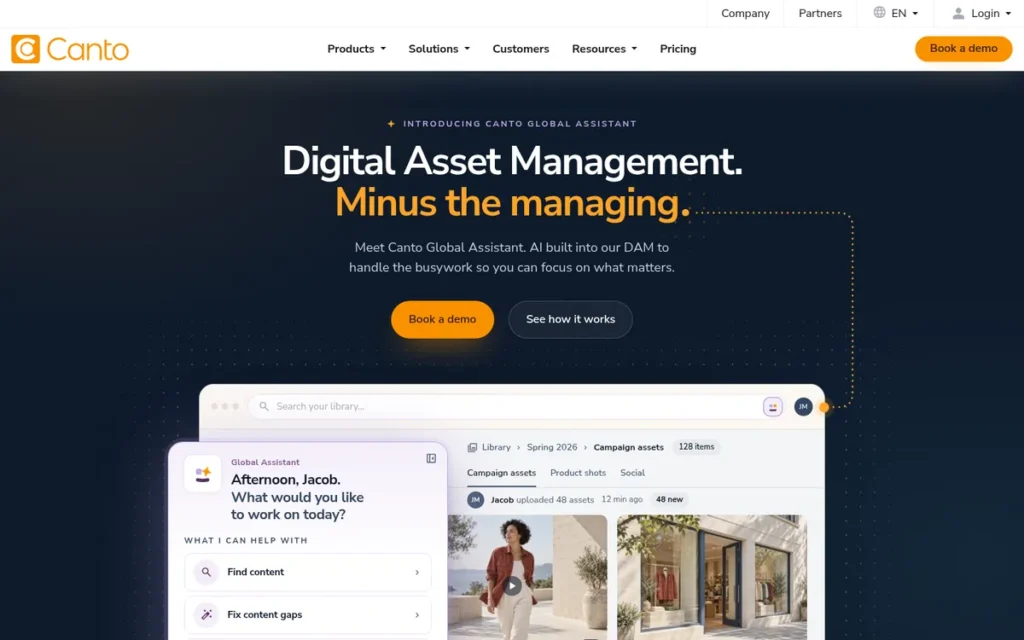
Category: Distribution DAM, a central asset library built around sharing approved files with internal teams, agencies and partners.
At a Glance
- Category: Distribution DAM
- Best For: Small and mid-market marketing and creative teams that need an easy, fast-to-adopt DAM with branded portals
- Price Range: Quote-only; ~$15K–$20K/yr for small deployments (unnamed planning benchmark, 2026) [Third-party estimate]
- Primary Strength: Canto combines unlimited end users and portals with a strong ease-of-use reputation, including G2 usability badges and practitioner recommendations for small teams.
- Biggest Limitation: Canto users report slow uploads, inconsistent AI auto-tagging and renewal risk from auto-renewal terms.
- One-Line Summary: Canto is a mid-market distribution DAM with unlimited end users and portals and the largest combined verified review base in this comparison, best suited to small and growing teams that put fast adoption ahead of enterprise-grade complexity.
- Last Verified: November 2026
Overview
Canto is a digital asset management platform for small and mid-market teams. It organizes brand assets in a searchable library with AI visual search, brand portals, style guides, approvals and rights controls. Canto is positioned on ease of use and offers a free trial.
Canto scored 4.08 (#1), strongest on verified user ratings (C1 5.0) and weakest on pricing transparency (C4 3.0). Canto’s 0.08-point lead over Brandfolder comes from implementation effort (C5 4.0 vs 3.0), so treat the two as effectively tied.
Key Features
- Canto provides AI Visual Search, Smart Tags, facial recognition and OCR to help teams find current assets quickly.
- Canto includes Brand Portals and Style Guides, so teams and partners see approved assets alongside the usage rules.
- Canto supports workspaces, approvals, templates, and rights and expiration controls that keep expired files out of use.
- Canto offers a “DAM for Products” setup that ties SKUs to assets for e-commerce and product marketing teams.
- Canto offers Media Publisher/CDN delivery and API/MCP access on higher tiers, with confirmed Adobe CC, Figma and Slack integrations.
Canto’s feature list comes from Canto’s product documentation and pricing page (Canto, 2026) [Verified].
Best For
Canto is best for small and mid-market teams without a dedicated DAM operations function that want a friendly library and branded portals they can roll out in weeks rather than quarters.
Strengths
- Canto holds G2 4.4/5 from 1,825 reviews and Capterra 4.5/5 from 686 reviews (G2; Capterra, 2026) [Verified], the largest combined verified review base in this comparison.
- Canto was called “the friendliest of the established mid-market names, and the one I’m seeing recommended most for small teams” (Reddit r/DigitalAssetManagemen, 2026) [User review].
- Canto includes unlimited end users and portals, which lowers the cost of broad internal and partner access (Canto, 2026) [Verified].
- Canto reports a creative team cutting photo retrieval from about one hour to about 10 minutes, more than 4,000 brands as customers, and a 2026 MarTech Breakthrough “DAM Platform of the Year” award (Canto, 2026) [Vendor-reported].
Limitations
Canto trades enterprise depth for simplicity: the platform that is easiest to adopt is also the one reviewers say struggles most with heavy batch workloads. Canto’s “unlimited users” covers end users only, because power users and storage drive the quote (Brault, 2026) [Third-party estimate].
- Canto reviewers report slow uploads, trouble with large batches, interface lag and delayed file processing (Capterra, 2026) [User review].
- Canto’s AI auto-tagging is described as “hit or miss,” and reviewers put implementation at about two months even though Canto says kickoff happens within two days of signing (Reddit; G2, 2026) [User review].
- Canto support follow-up is reported as slow by some users, and reviewers flag renewal increases and auto-renewal as risks (G2, 2026) [User review]. No Gartner Magic Quadrant or Forrester Wave placement was verified for Canto.
Users on r/Archivists noted:
“Canto is pretty user friendly and good for smaller teams, but not great for a lot of files. If your client needs stronger metadata tools or even heavier search then you should be taking a look at MediaValet for example.” Posted by u/AtharavaSrivastava
Takeaway: Canto’s ease of use makes it a strong fit for smaller teams, but buyers with very large libraries or heavy metadata and search needs report that it runs out of headroom.
Verdict
Canto is the top-scoring brand asset management platform for small and mid-market teams that need fast adoption, backed by the largest combined verified review base and unlimited end users and portals in this comparison.
Canto is not built for heavyweight governance or very large batch workloads. During the free trial, test uploads and auto-tagging with your own files, confirm how many power users you need, and negotiate auto-renewal terms upfront.
2. Brandfolder (by Smartsheet): Best for Sharing Brand Assets with Partners and Agencies
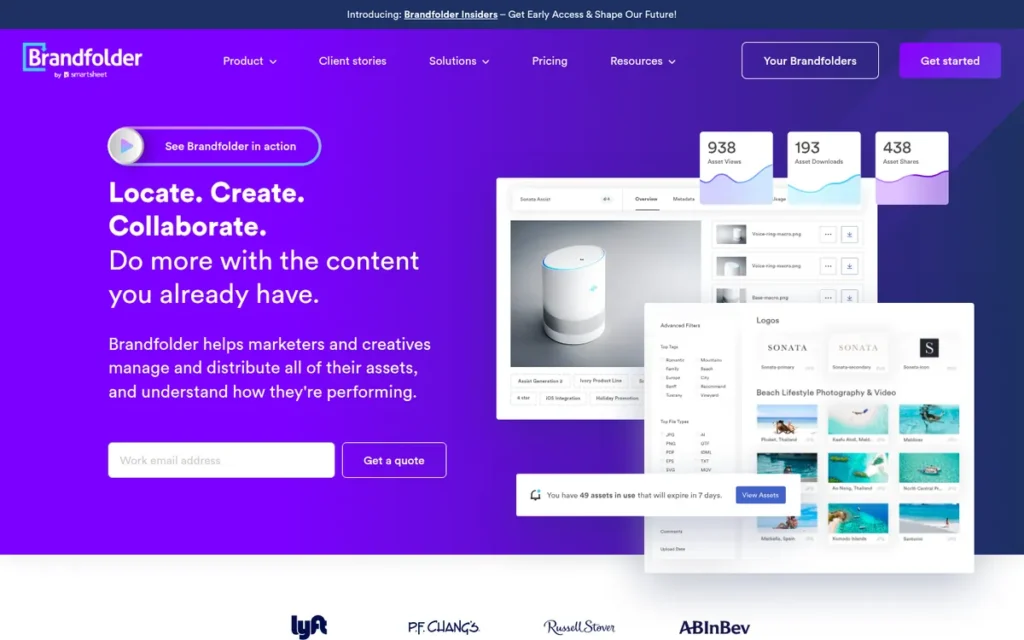
Category: Distribution DAM.
At a Glance
- Category: Distribution DAM
- Best For: Mid-market and enterprise marketing teams that share assets with many agencies, distributors or partners, especially Smartsheet customers
- Price Range: Quote-only; ~$6K–$12K/yr (Basic) to $30K–$100K+/yr (Enterprise) (Brault, 2026) [Third-party estimate]
- Primary Strength: Brandfolder lets organizations add unlimited guest users for free, so governed partner sharing costs less to scale than seat-based or MAU-based models.
- Biggest Limitation: Brandfolder users report confusing admin configuration, weak templating and steep renewal increases, and Brandfolder offers no free trial.
- One-Line Summary: Brandfolder is a Smartsheet-owned distribution DAM with free unlimited guest users and a large verified review base, best suited to teams that share brand assets widely with external partners.
- Last Verified: November 2026
Overview
Brandfolder is a cloud distribution DAM, owned by Smartsheet since 2020, that gives marketing, sales and partner teams one governed source of truth for logos, images, videos and templates. Brandfolder includes version control, rights and expiration dates, usage analytics and a native Smartsheet connection.
Brandfolder scored 4.00 (#2), strongest on external sharing cost (C3 5.0) and weakest on implementation and admin burden (C5 3.0). Brandfolder trails Canto by 0.08 points, so treat the two as effectively tied and choose by fit.
Key Features
- Brandfolder supports free, unlimited guest users, so agencies and partners can access approved assets without per-seat fees.
- Brandfolder manages rights and expiration dates, version control and permissions to keep outdated or expired assets out of circulation.
- Brandfolder’s Brand Intelligence AI provides auto-tagging, OCR, scene detection, speech-to-text and text extraction on higher pricing tiers.
- Brandfolder delivers assets through a CDN, embed codes and an API that connects to websites and other systems.
- Brandfolder includes workflow approvals, templating and usage analytics, plus a native connection to Smartsheet work management.
Brandfolder’s feature list comes from Brandfolder’s product documentation, pricing page and FAQ (Brandfolder, 2026) [Verified].
Best For
Brandfolder is best for organizations whose main brand problem is distributing approved assets to many external partners without per-seat costs, especially where Smartsheet already runs campaign planning.
Strengths
- Brandfolder holds G2 4.4/5 from 1,434 reviews and Capterra 4.7/5 from 456 reviews (G2; Capterra, 2026) [Verified], the highest Capterra rating among the platforms here with more than 400 reviews.
- Brandfolder’s free, unlimited guest users directly reduce the cost of sharing with agencies, distributors and partners (Brandfolder FAQ, 2026) [Verified].
- Brandfolder reviewers consistently praise easy setup, search, OCR, metadata, external sharing and version control (G2; Capterra, 2026) [User review].
- Brandfolder reports that Conga saved more than $300,000 in software costs and that a 1,200-person global team now finds assets on its own (Brandfolder, 2026) [Vendor-reported].
This aligns with community sentiment on r/graphic_design:
“I’m a designer at an in-house marketing department for a global ag-tech company and we use BrandFolder. Pricing is custom quoted for your needs so I’m honestly not sure if it will be in your budget but we use it for absolutely everything you are looking for and much more. So far we love it.” Posted by u/FictionWorthyWind
Takeaway: In-house teams that adopt Brandfolder value it as an all-in-one asset hub, but its custom-quoted pricing can put it out of reach for small budgets.
Limitations
Brandfolder trades easy external sharing for admin friction and renewal risk. Brandfolder also offers no free trial or free version, so buyers must judge it through demos (Capterra, 2026) [Verified].
- Brandfolder’s admin experience draws criticism: one current customer described a confusing UX and having to upload a CSV to set dependent custom fields (Reddit r/CreativeOperations, 2026) [User review].
- Brandfolder reviewers report slow bulk uploads, bulk tagging that is hard to undo, and a PrintUI templating tool one reviewer called “unusable” (G2; Capterra, 2026) [User review].
- Brandfolder practitioners cite “steep renewal pricing jumps, and features sliding up to the Enterprise tier” (Reddit r/DigitalAssetManagemen, 2026) [User review]. No current Gartner Magic Quadrant or Forrester Wave placement could be verified for Brandfolder.
Verdict
Brandfolder is the strongest-evidenced brand asset management platform in this comparison for organizations that share assets widely with external partners, pairing free unlimited guest users with a large verified review base.
Brandfolder’s admin experience and templating draw consistent complaints, so test bulk tagging, custom fields and template editing in a demo. Negotiate a renewal cap before signing. Smartsheet customers gain the most from Brandfolder’s native integration.
3. Bynder: Best for Large, Distributed Enterprises Needing Broad Governance and Integrations
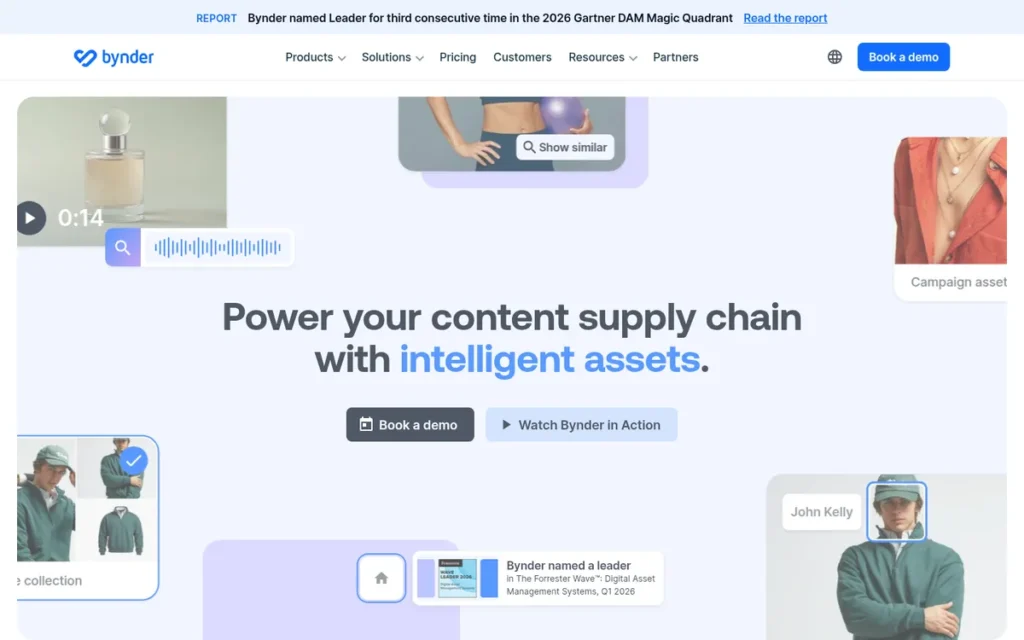
Category: Enterprise Brand DAM, a broad DAM with governance, automation, templating and a large integration ecosystem for distributed organizations.
At a Glance
- Category: Enterprise Brand DAM
- Best For: Large, multi-brand or multi-region enterprises that need governed distribution, approvals, templating and broad integrations
- Price Range: Quote-only; ~$34K/yr average SMB contract to ~$125K/yr average enterprise contract (Brandrums, 2026) [Third-party estimate, weak source]
- Primary Strength: Bynder offers the most complete brand-governance module set among brand-focused DAMs, from AI search and guidelines to workflow and Studio templates.
- Biggest Limitation: Bynder reviewers report a steep learning curve, rollouts of weeks to months, and costs that are heavy for smaller teams.
- One-Line Summary: Bynder is an enterprise brand DAM with the broadest governance and automation modules among brand-focused platforms, best suited to large distributed organizations willing to invest in a longer rollout.
- Last Verified: November 2026
Overview
Bynder is an enterprise digital asset management platform for large, distributed brand organizations. It combines AI-powered search, brand guidelines, content workflow, Studio templates and content automation with a large integration marketplace.
Bynder was founded in 2013 in Amsterdam, is backed by Thoma Bravo, and claims more than 4,000 customers in 160 countries (Bynder, 2026) [Vendor-reported]. Bynder scored 3.58 (#3), strongest on governance capability (C2 5.0) and weakest on pricing transparency (C4 2.0).
Key Features
- Bynder provides AI search with natural-language search, face recognition, text-in-image search and duplicate detection.
- Bynder includes Brand Guidelines and Content Workflow modules for governed review, proofing and approvals.
- Bynder Studio and Content Automation let teams produce on-brand video and digital content from approved templates.
- Bynder offers an integration marketplace and APIs for connecting the DAM to the wider marketing stack.
- Bynder’s current product messaging centers on AI Agents that automate work across the content supply chain.
Bynder’s feature list comes from Bynder’s product documentation and resources pages (Bynder, 2026) [Verified].
Best For
Bynder is best for large enterprises running multiple brands, regions or agencies that need one governed system for distribution, approvals and on-brand content creation, and that have the resources for a structured rollout.
Strengths
- Bynder holds Capterra 4.4/5 from 246 reviews (Capterra, 2026) [Verified] and claims G2 4.5+/5 from more than 1,000 reviews (Bynder, 2026) [Vendor-reported]. PlugRoute could not confirm the G2 count on G2 as of November 2026, though a Reddit consultant independently cited “1,100+ reviews.”
- Bynder reports that Simplot automated distribution to more than 1,300 sites with $2.3M in savings, and that Vodafone supports more than 93,000 employees on Bynder (Bynder, 2026) [Vendor-reported].
- Bynder says it was named a Leader in the 2026 Gartner Magic Quadrant for DAM (report dated October 26, 2026) for the third consecutive year (Bynder, 2026) [Vendor-reported].
- Bynder was described as “the enterprise standard” with “the deepest track record of the group” (Reddit r/DigitalAssetManagemen, 2026) [User review].
Limitations
Bynder trades breadth for complexity. Bynder’s pricing is fully opaque, and the only available cost benchmarks come from a weak secondary source (Brandrums, 2026) [Third-party estimate, weak source].
- Bynder reviewers report a steep learning curve and heavy cost for smaller teams (Reddit r/DigitalAssetManagemen, 2026) [User review].
- Bynder rollouts are said to take “weeks to months” on a rival vendor’s comparison page (Air, 2026) [Competitor-authored].
- Bynder admin customizations are reported as missing or inflexible. A former Webdam consultant also cautions that long enterprise rollouts “really [don’t] have to be that hard” with newer platforms (Reddit, 2026) [User review].
An agency designer using Bynder on r/graphic_design shared their experience:
“The largest issue has been mostly human as my ACD and CD don’t want to use it which has sort of stalled the roll out. As far as I have used it, it has been fine, but kind of a weird way of working when you are used to detail file structures.” Posted by u/Superb_Firefighter20
Takeaway: Bynder works acceptably once in use, but its unfamiliar way of working can stall adoption when senior creatives resist leaving folder-based habits.
Verdict
Bynder is the most capable brand-focused DAM for large distributed enterprises that need governance, automation and broad integrations in one system.
Bynder’s depth comes with a longer rollout, admin complexity and contract values smaller teams usually can’t justify. Ask Bynder to demo your real scenarios and to confirm in writing which modules are included in the quote.
4. Frontify: Best for Keeping Brand Guidelines, Templates and Assets Together
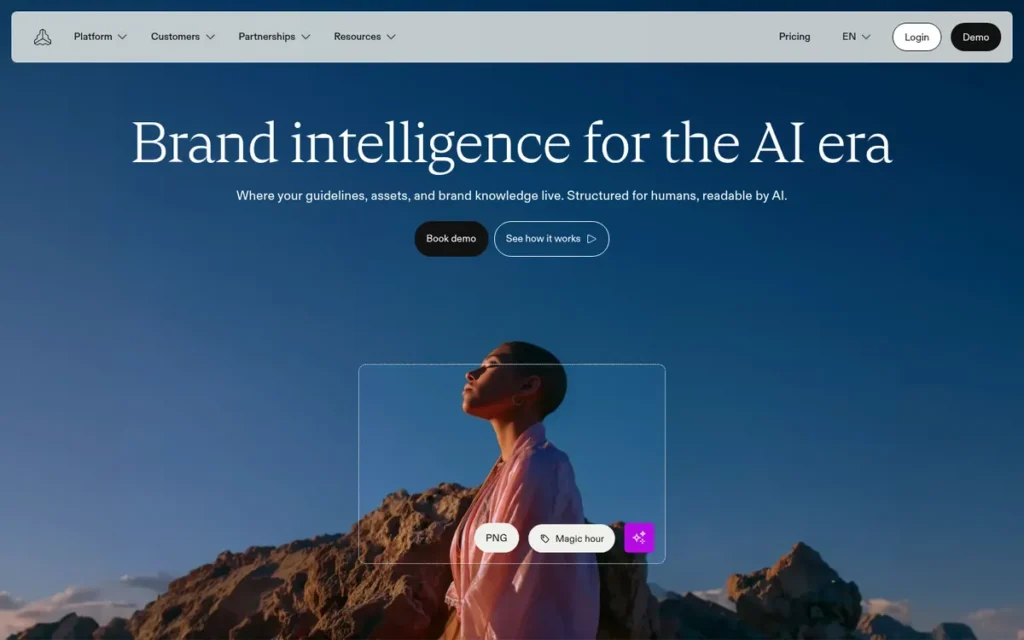
Category: Brand-First Platform, interactive brand guidelines, templates and assets in one brand hub.
At a Glance
- Category: Brand-First Platform
- Best For: Brand teams whose main problem is people using the wrong logo, colors or rules
- Price Range: Quote-only, metered by monthly active users; ~$32K/yr median (Picajet, 2026) [Third-party estimate]; 30-day free trial
- Primary Strength: Frontify places interactive brand guidelines directly beside the asset library, templates and portals, so rules and files stay in sync.
- Biggest Limitation: Frontify bills every logged-in monthly active user, including external partners, and users report limited template customization.
- One-Line Summary: Frontify is a brand-first platform that unifies interactive brand guidelines, DAM, templates and portals, best suited to teams whose core challenge is brand consistency rather than large-scale asset operations.
- Last Verified: November 2026
Overview
Frontify is a brand-first platform for brand and marketing teams that puts interactive brand guidelines next to a DAM library, templates, brand portals and approval workflows. Employees and partners find both the right file and the current rules in one place.
Frontify was founded in 2013 in St. Gallen, Switzerland. Frontify scored 3.50 (#4), strongest on governance capability (C2 4.5) and weakest on external sharing cost (C3 2.5), because its MAU billing counts logged-in partners.
Key Features
- Frontify provides interactive brand guidelines that update immediately and sit alongside the asset library.
- Frontify’s DAM includes metadata, OCR search, AI metadata suggestions, duplicate detection, and rights and expiration management.
- Frontify offers templates, brand portals, workflows and approvals for distributing on-brand content.
- Frontify supports dynamic resizing, format conversion and media delivery from the library.
- Frontify positions itself as a “brand intelligence layer,” and reviewers mention an AI brand assistant that helps keep AI-generated output on-brand.
Frontify’s feature list comes from Frontify’s product overview and DAM guide (Frontify, 2026) [Verified].
Best For
Frontify is best for mid-market and enterprise brand teams that want living guidelines, templates and approved assets in one hub, and that have a moderate number of logged-in external users.
Strengths
- Frontify holds Capterra 4.8/5 from 82 reviews and G2 4.5/5 from 230 reviews (G2; Capterra, 2026) [Verified]. That is the highest Capterra rating in this comparison, though it comes from a small sample.
- Frontify was included in The Forrester Wave: Digital Asset Management Systems, Q1 2024, and recognized in G2’s Best Software of 2024 (Forrester, 2024, via Capterra) [Verified].
- Frontify is praised for removing “the chaos of outdated files, broken links, and all the PDF brand manuals” (G2, 2026) [User review].
- Frontify reports that Skyscanner saw efficiency gains within months and an end to repeated questions about hex codes and branded decks (Frontify, 2026) [Vendor-reported].
Limitations
Frontify trades brand-first design for partner-sharing economics. Frontify bills every external partner who logs in as a monthly active user, though it publishes this model openly and excludes unauthenticated viewers (Frontify, 2026) [Verified].
- Frontify reviewers report limits on template customization and management, with one still relying on Canva, plus a learning curve for deeper configuration (G2, 2026) [User review].
- Frontify’s API and integration depth is described as weaker than that of DAM specialists (Picajet, 2026) [Third-party estimate]. Frontify also has the least Reddit discussion of the leading platforms.
Verdict
Frontify is the strongest choice in this comparison for organizations whose core brand problem is keeping guidelines, templates and approved assets together in one living hub.
Frontify’s MAU billing makes wide logged-in partner access costlier than guest-based models. Use the 30-day trial to test template editing, and model MAU costs against your real partner log-in volumes.
5. Lytho: Best for In-House Creative Teams Managing Requests, Proofing and Approvals
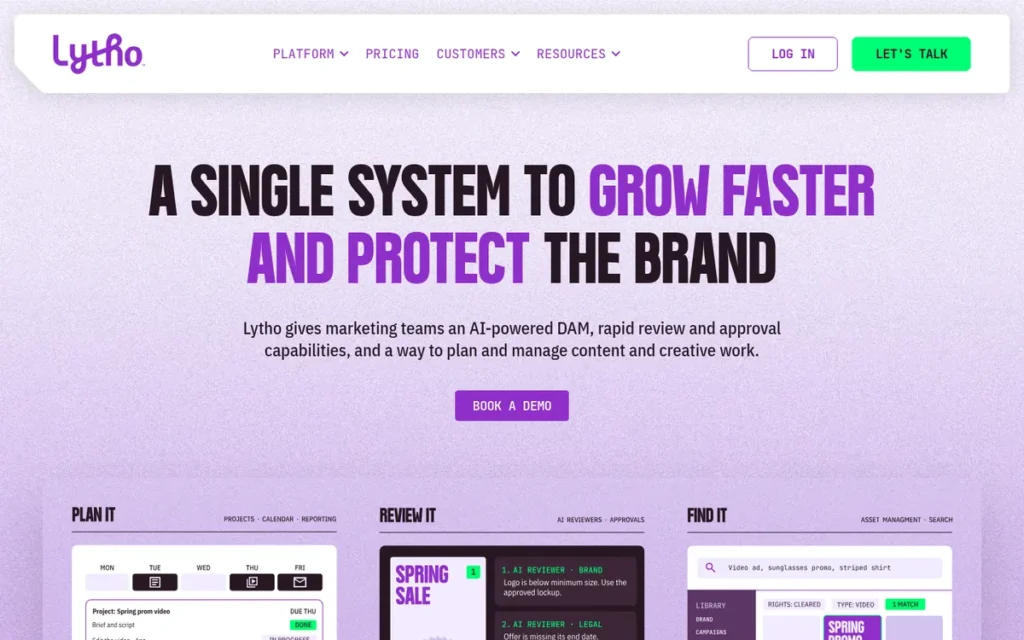
Category: Creative Workflow DAM, a DAM combined with creative request intake, project management and online proofing.
At a Glance
- Category: Creative Workflow DAM
- Best For: In-house creative and marketing teams whose biggest bottleneck is slow, poorly tracked requests and approvals
- Price Range: Quote-only; tiers from Standard (10 core users, 500 GB) to Enterprise (unlimited core users, 5 TB); no dollar figures verified (Lytho, 2026) [Verified]
- Primary Strength: Lytho combines request intake, project management, online proofing and asset management, with unlimited reviewers on every tier.
- Biggest Limitation: Lytho reviewers on G2 report weak search, non-intuitive navigation and no open API.
- One-Line Summary: Lytho is a creative workflow DAM that unites request intake, proofing, approvals and asset management for in-house creative teams, best suited to organizations whose approval process is the main bottleneck.
- Last Verified: November 2026
Overview
Lytho is a creative workflow and digital asset management platform for in-house creative teams. It combines request intake, project management, online proofing, brand portals and a DAM, replacing separate DAM and proofing tools. Lytho began as InMotionNow, founded in 1999 in North Carolina, and merged with Lytho BV in 2021.
Lytho scored 3.18 (#5), strongest on external access cost (C3 3.5) and weakest on verified user ratings (C1 3.0). Lytho moved from #6 to #5 after a November 2026 check found a verified G2 rating. The methodology explains the change.
Key Features
- Lytho combines creative request intake, project management, online proofing and approvals with a DAM in one workflow, and includes unlimited reviewers so stakeholders can approve work without paid seats.
- Lytho offers AI tagging and brand portals, plus Tempo templates and a Chrome Extension for brand checks as add-ons.
- Lytho integrates with Adobe Creative Cloud, so designers can open DAM files and submit proofs from inside Adobe apps, and with Microsoft Word, PowerPoint, Teams and SharePoint.
- Lytho integrates with Canva, Box, Dropbox and Google Drive for file handoffs.
- Lytho integrates with Slack, HubSpot, WordPress, Drupal and Zapier for communication and publishing.
Lytho’s feature list comes from Lytho’s product and integrations pages (Lytho, 2026) [Verified].
Best For
Lytho is best for in-house creative teams in sectors such as financial services, healthcare, higher education and consumer goods that need to fix slow approvals and asset handoffs in one system.
Strengths
- Lytho is the only platform in this comparison built around creative request intake, combining it with project management, online proofing and DAM in one product (Lytho, 2026) [Verified].
- Lytho publishes core-user and storage limits for each tier, with unlimited reviewers on all of them (Lytho, 2026) [Verified]. That gives buyers more planning detail than most competitors offer.
- Lytho is praised for covering “request submission, project management, team communication, online proofing, digital asset management, asset sharing, and templating” in one workflow (G2, 2026) [User review].
- Lytho reports serving more than 400 enterprise teams, and a Kinney testimonial describes moving off a DAM used for more than 20 years (LinkedIn; Lytho, 2026) [Vendor-reported].
Limitations
Lytho trades creative-workflow depth for DAM maturity. Lytho’s G2 rating of 4.3/5 from roughly 370 reviews ties Aprimo for the lowest G2 rating among scored platforms, and no Capterra or Gartner Peer Insights rating was found (G2, 2026) [Verified].
- Lytho reviewers report insufficient search, non-intuitive navigation, a steep learning curve, a confusing comment layout, struggles with the new mobile UI and limited reporting customization (G2, 2026) [User review].
- Lytho has no open API listed on G2 and no verified Figma connector, and it did not appear in any community DAM-selection thread PlugRoute retrieved.
Verdict
Lytho is the most direct fit in this comparison for in-house creative teams whose main problem is slow, untracked requests and approvals rather than distribution at scale.
Lytho’s reported search weaknesses mean buyers should test search on their own library before committing. Confirm API and Figma support before signing.
6. Aprimo: Best for Regulated Industries and Complex Content Operations
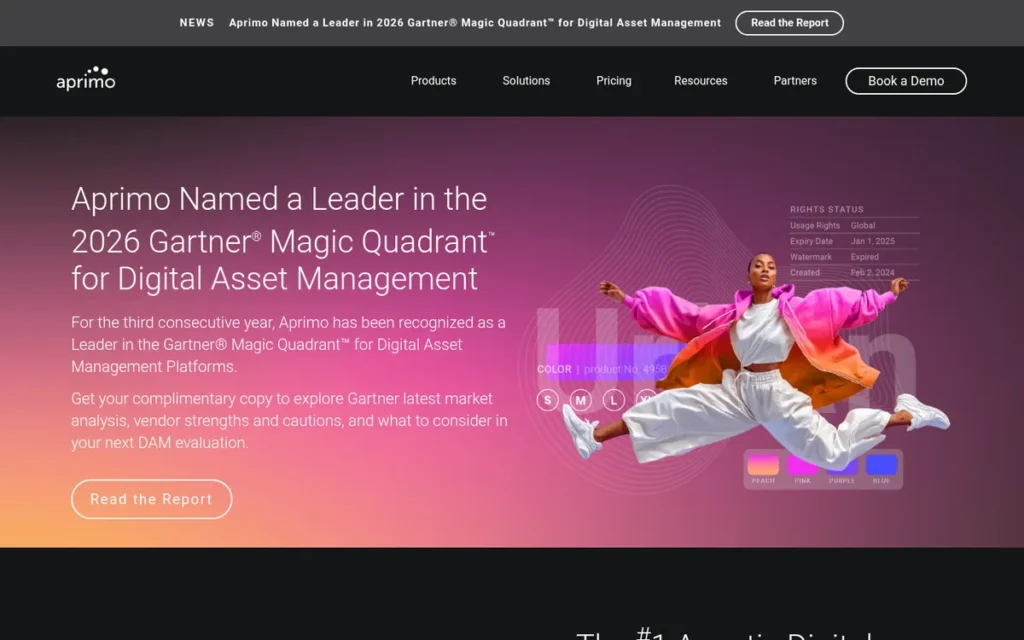
Category: Content Operations Suite, a DAM embedded in planning, workflow, compliance and multichannel delivery for complex enterprises.
At a Glance
- Category: Content Operations Suite
- Best For: Regulated enterprises (life sciences, financial services) and organizations where asset management is part of a larger planning and compliance process
- Price Range: Quote-only, by modules and users; typically 12-month contracts; no verified dollar figures (Aprimo, 2026) [Verified]
- Primary Strength: Aprimo pairs DAM with regulated review workflows, FDA 21 CFR Part 11 support and Veeva Vault integration, a combination no other platform here documents.
- Biggest Limitation: Aprimo is described by mid-market practitioners as too heavy, and it publishes no verifiable pricing.
- One-Line Summary: Aprimo is a content operations suite that combines DAM with marketing work management, AI agents and regulated review workflows, best suited to compliance-heavy enterprises rather than lean brand teams.
- Last Verified: November 2026
Overview
Aprimo is an enterprise content operations platform for regulated and workflow-heavy organizations. It combines digital asset management with planning, budgets, review, rights, brand portals and distribution, built on a marketing resource management (MRM) heritage. Aprimo was founded in 1998 in Indianapolis and has about 400 employees.
Aprimo scored 3.13 (#6), strongest on governance capability (C2 5.0) and weakest on implementation effort (C5 2.0). That rank reflects cost opacity, implementation weight and thin independent review data, not weaker capability. Aprimo ties Bynder for the top capability score.
Key Features
- Aprimo combines DAM with marketing planning, budgets, workflow, review, rights management and distribution in one platform.
- Aprimo supports medical, legal and regulatory review workflows and FDA 21 CFR Part 11 requirements.
- Aprimo integrates with Veeva Vault, FADEL and SecureCHEK for regulated content and rights processes.
- Aprimo offers five AI agent types (Planning, Librarian, Critic, Compliance, Production), which it says can govern content in SharePoint, Box or a CMS.
- Aprimo connects with Adobe Creative Cloud, Microsoft 365 and Canva, as shown in the UNICEF Australia deployment.
Aprimo’s feature list comes from Aprimo’s platform, AI agent and customer pages (Aprimo, 2026) [Vendor-reported].
Best For
Aprimo is best for regulated enterprises in life sciences, healthcare and financial services, and for large organizations that need asset management embedded in formal review and compliance workflows.
Strengths
- Aprimo reports that Kimberly-Clark achieved 480% more asset reuse, 56% faster time to market within six months, and 80% shorter approval times (Aprimo, 2026) [Vendor-reported]. This is the most detailed quantified case study in this comparison.
- Aprimo says it was named a Leader in The Forrester Wave: Digital Asset Management Systems, Q1 2026, with a 4.38/5 Current Offering score, and a Leader in the 2026 Gartner Magic Quadrants for DAM and for Marketing Work Management (Aprimo, 2026) [Vendor-reported].
- Aprimo lists Novartis, Johnson & Johnson and Bayer as customers using its regulated workflows (Aprimo, 2026) [Vendor-reported].
- Aprimo is praised for centralizing marketing assets and handling large data volumes (G2, 2026) [User review].
Limitations
Aprimo trades governance depth for weight. A consultant shortlisting for a brand with no ops team called Aprimo “definitely too heavy” (Reddit r/DigitalAssetManagemen, 2026) [User review].
- Aprimo reviewers call it “not user-friendly for beginners” and say setup needed training and had “teething issues” (G2, 2026) [User review].
- Aprimo’s G2 rating (4.3/5) has no verified review count, and no Capterra or Gartner Peer Insights data was found for Aprimo as of November 2026.
Verdict
Aprimo is the most specialized option in this comparison for regulated enterprises that need DAM, compliance review and marketing work management in one governed system.
Aprimo’s structure makes it a poor fit for lean brand teams without dedicated content operations staff. Regulated buyers should verify the analyst claims against the original reports and ask for references from their own industry.
7. Adobe Experience Manager Assets: Best for Adobe-Standardized Enterprises
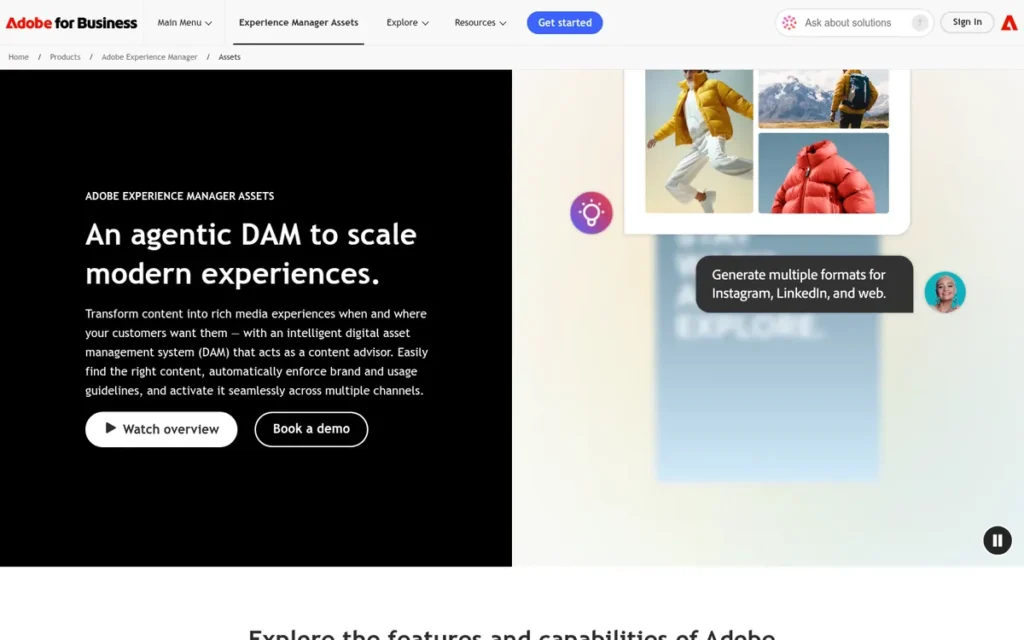
Category: Content Operations Suite.
At a Glance
- Category: Content Operations Suite
- Best For: Large enterprises already standardized on Adobe Experience Cloud and Creative Cloud with high-volume multichannel delivery
- Price Range: Quote-only; $122,350/yr (Prime) to $271,889/yr (Ultimate) before implementation (Filecamp, 2026) [Government price list]
- Primary Strength: Adobe Experience Manager Assets offers the deepest native integration with Creative Cloud, Firefly, Workfront and AEM Sites of any platform here.
- Biggest Limitation: Adobe Experience Manager Assets is the most expensive and implementation-heavy option here, and reviewers describe it as clunky.
- One-Line Summary: Adobe Experience Manager Assets is an enterprise content operations DAM with the deepest native Adobe integration of the seven platforms in this comparison, best suited to large Adobe-committed organizations that can absorb six-figure licenses and specialist-led implementation.
- Last Verified: November 2026
Overview
Adobe Experience Manager Assets is a cloud-native enterprise DAM for large Adobe-standardized organizations. It manages and delivers assets across channels through a Content Hub portal, Dynamic Media renditions and native Creative Cloud and Firefly integration.
Adobe Experience Manager Assets scored 2.53 (#7), strongest on ecosystem fit (C6 5.0) and weakest on implementation effort (C5 1.0). The rank reflects cost, implementation burden and thin independent review data, not weaker technology.
Key Features
- Adobe Experience Manager Assets includes Content Hub, a governed self-service portal where non-designers remix approved assets with Adobe Express and Firefly.
- Adobe Experience Manager Assets offers Dynamic Media for real-time image and video renditions, sold as an add-on in some packages.
- Adobe Experience Manager Assets integrates natively with Creative Cloud, AEM Sites, Workfront and GenStudio.
- Adobe Experience Manager Assets has been licensed to new customers only in Prime or Ultimate editions since December 1, 2024.
- Adobe Experience Manager Assets Ultimate adds staging and development environments, APIs and customization, while Prime runs in production only, with no customization.
The Adobe Experience Manager Assets feature list comes from Adobe Experience League and Adobe partner documentation (Adobe, 2026) [Verified].
Best For
Adobe Experience Manager Assets is best for large enterprises already committed to Adobe Experience Cloud that need high-volume multichannel delivery and have the budget for specialist implementation partners.
Strengths
- Adobe Experience Manager Assets offers native integration with Creative Cloud, AEM Sites, Workfront, Firefly and GenStudio, the deepest Adobe fit in this comparison (Adobe, 2026) [Verified].
- Adobe Experience Manager Assets has the most traceable price signal of any platform here, a US GSA price list, which helps buyers set realistic budgets (Filecamp, 2026) [Government price list].
- Adobe Experience Manager Assets Content Hub lets non-designers remix approved assets inside governed boundaries (Adobe Experience League, 2026) [Verified].
- Adobe states that Gartner has named Adobe Experience Manager Assets a Leader for DAM platforms (Adobe, 2026) [Vendor-reported].
Limitations
Adobe Experience Manager Assets trades ecosystem depth for cost. Licenses run $122K–$272K a year before an estimated $500K–$5M+ implementation (Filecamp; Brainvire, 2026) [Government price list; Third-party estimate].
- Adobe Experience Manager Assets reviewers call it “difficult to navigate, clunky, and tedious to sift through” (Gartner Peer Insights, 2026) [User review]. A rival vendor’s page says it needs Adobe specialists (Frontify, 2026) [Competitor-authored].
- Adobe Experience Manager Assets has no Assets-specific review-site rating. G2’s Adobe Experience Manager listing (4.2/5 from 715 reviews) covers the whole AEM product family (G2, 2026) [Verified]. Edition caps also limit collaborators and casual users.
Users on r/aem noted:
“From my AEM experience, there isn’t a single thing easy. Everything is difficult, takes more time than you’d think, needs specialists, and doesn’t work like it should.” Posted by u/jinendu
Takeaway: Practitioners on the wider Adobe Experience Manager platform, which includes Assets, report that even routine changes need specialists and take longer than expected.
Verdict
Adobe Experience Manager Assets is the strongest fit in this comparison for large enterprises already standardized on Adobe that need deep Creative Cloud, Firefly and multichannel delivery integration.
For most brand teams, Adobe Experience Manager Assets’ six-figure licensing and specialist-led implementation mean overbuying. Adobe-committed buyers should model total cost, including Dynamic Media, Content Hub and implementation partners.
How Much Does Brand Asset Management Software Cost?
Brand asset management software typically costs $5K–$30K a year for small businesses, $30K–$125K for mid-market teams and $100K–$500K+ for enterprises (The DAM Republic; Canto, 2026) [Third-party estimate]. None of the seven vendors publishes commercial dollar prices on its website as of November 2026, so published estimates and tier limits are the best signals available.
Typical budget bands map to these shortlists:
- Teams budgeting under ~$30K a year can consider Canto, Brandfolder Basic (~$6K–$12K estimated) or Lytho’s Standard tier if proofing matters.
- Teams budgeting $30K–$125K a year can consider Frontify (~$32K median) for brand governance, or Bynder or Brandfolder Premium for wider distribution.
- Enterprises budgeting more than $125K a year can consider Bynder enterprise (~$125K average), Aprimo, or Adobe Experience Manager Assets ($122K–$272K in licenses before implementation).
| Platform | Pricing Basis (November 2026) | Published Estimate | Free Trial |
|---|---|---|---|
| Canto | Quote-only; unlimited end users and portals; power users and storage drive price | ~$15K–$20K/yr small (unnamed planning benchmark, 2026) [Third-party estimate]; ~$25K/yr for 2 TB and five power users (Brault, 2026) [Third-party estimate] | Yes (Canto, 2026) [Verified] |
| Brandfolder | Quote-only Basic, Premium and Enterprise; free unlimited guests | Basic ~$6K–$12K; Premium ~$18K–$50K; Enterprise $30K–$100K+ (Brault, 2026) [Third-party estimate]; one reviewer pays ~$8K (G2, 2026) [User review] | None (Capterra, 2026) [Verified] |
| Bynder | Quote by users, storage, connected systems, modules and support | ~$33,663 SMB average; ~$124,668 enterprise average (Brandrums, 2026) [Third-party estimate, weak source] | Not confirmed |
| Frontify | Monthly active users, including logged-in partners; 6-month averaging, reviewed annually | ~$32,000 median (Picajet, 2026) [Third-party estimate] | 30 days, no card (Frontify, 2026) [Verified] |
| Lytho | Standard 10 core users/500 GB; Professional 25/2 TB; Enterprise unlimited/5 TB; unlimited reviewers | No dollar figures found | Not confirmed |
| Aprimo | Quote by modules and users; typically 12-month contracts | No verified dollar figures | Claimed by a likely vendor-affiliated commenter (Reddit, 2026) [User review] |
| Adobe Experience Manager Assets | Prime or Ultimate editions only | Prime $122,350/yr; Ultimate $271,889/yr (Filecamp, 2026) [Government price list] | Not confirmed |
Several pricing details sit outside the headline numbers:
- Brandfolder reviewers say advanced analytics, automation, extra admin seats, proofing and templating can be sold as paid add-ons (G2, 2026) [User review].
- Bynder competitors say key Bynder features sit in higher packages (Air, 2026) [Competitor-authored].
- Frontify’s older Starter and Professional price lists found online may be out of date.
- Lytho’s tier structure on G2 differs from Lytho’s own pricing page, so buyers should confirm current Lytho tiers directly. Tempo, AI Teammates and the Chrome Extension are Lytho add-ons.
- Adobe Experience Manager Assets charges $3,081–$4,350 per extra power user, $997–$1,495 per extra collaborator and $245–$308 per extra limited user (Filecamp, 2026) [Government price list]. Those are government contract prices, not commercial list prices.
- Adobe Experience Manager Assets implementation is estimated at $500K to more than $5M, plus $10K–$25K a month in maintenance for large deployments (Brainvire, 2026) [Third-party estimate].
Total cost of ownership comes from five drivers:
- License fees scale with users, storage and modules on every platform in this comparison.
- External-user billing determines whether partner access is free, metered or capped.
- Paid add-ons such as analytics, templating and proofing can raise the effective tier.
- Implementation adds 15–30% of first-year software cost for simple deployments (The DAM Republic, 2026) [Third-party estimate].
- Renewal increases can reset the budget after year one if no cap is written into the contract.
How Do Brand Asset Management Platforms Charge for Agencies and Partners?
Brand asset management platforms bill external partners in very different ways, and the model can change total cost more than the headline quote. In brand asset management, the price of your partners often matters more than the price of your team. Model your real partner volume before comparing quotes.
- Brandfolder offers free, unlimited guest users (Brandfolder, 2026) [Verified].
- Canto includes unlimited end users and portals, while power users affect the quote (Canto; Brault, 2026) [Verified; Third-party estimate].
- Lytho includes unlimited reviewers on every tier, while core users are capped by tier (Lytho, 2026) [Verified].
- Frontify bills every logged-in monthly active user, including partners, but excludes unauthenticated viewers (Frontify, 2026) [Verified].
- Adobe Experience Manager Assets caps collaborators and limited users by edition (Adobe, 2026) [Verified].
Worked example: A brand team with 20 internal users shares assets with 200 agency and distributor contacts who log in every month.
- On Brandfolder, the 200 partner contacts are free guests.
- On Canto, the 200 partner contacts fall under unlimited end users, though power-user count still shapes the quote.
- On Frontify, the 200 partner contacts count as monthly active users unless they view assets without logging in.
- On Adobe Experience Manager Assets Prime, the 150 contacts beyond the 50-limited-user cap add about $36,750 a year at $245 each, before implementation (Filecamp, 2026) [Government price list].
How Long Does Brand Asset Management Software Take to Implement?
Small teams typically implement brand asset management software in 4–8 weeks, mid-market organizations in 2–6 months, and enterprises in 6–12+ months (The DAM Republic, 2026) [Third-party estimate]. Vendor claims often run shorter than reviewer reports, so ask for references from organizations your size.
- Canto says implementation kicks off within two days of signing, while reviewers report about two months to go live (Canto; G2, 2026) [Vendor-reported; User review].
- Bynder rollouts are described as taking “weeks to months” (Air, 2026) [Competitor-authored].
- Aprimo mid-market rollouts take 4–8 weeks, according to a Reddit commenter who appears affiliated with Aprimo (Reddit, 2026) [User review, likely vendor-affiliated].
- Adobe Experience Manager Assets implementations are specialist-led and estimated at $500K–$5M+ for large deployments (Brainvire, 2026) [Third-party estimate].
How should I run a two-week evaluation?
- Shortlist two or three platforms from the Quick Decision table above.
- Load about 200 real assets into each trial or sandbox, including files with industry jargon.
- Send one share link to an outside partner and check whether they get the right file without help.
- Set an expiration date on one asset and confirm the platform actually blocks its use.
- Request a written renewal cap and a fixed feature list before negotiating price.
What Red Flags Should I Watch For When Evaluating Brand Asset Management Software?
The most damaging red flags in brand asset management buying are contract traps that raise cost after signing and demos that hide everyday usability problems. Each red flag below appears repeatedly in 2026 G2, Capterra and Reddit discussions of DAM projects, and each comes with one concrete action to take before you sign.
Red Flag #1: Renewal Price Jumps and Tier Creep Renewal increases are the most common contract complaint in this research. Users raise steep renewal jumps and features moving into higher tiers most often for Brandfolder, Bynder and Canto (Reddit; G2, 2026) [User review]. Ask for a written renewal cap and a feature list fixed for the full contract term.
Red Flag #2: External User Billing You Didn’t Model Partner billing models can multiply cost after signing. Frontify counts every logged-in partner as a monthly active user. Adobe Experience Manager Assets Prime caps limited users at 50, with extras at $245 each (Filecamp, 2026) [Government price list]. Model your real agency and distributor log-ins before comparing quotes.
Red Flag #3: Letting the AI Demo Decide AI auto-tagging often underperforms the demo, especially on industry jargon and product-specific terms. Users describe auto-tagging on Canto and across the category as “hit or miss” (Reddit, 2026) [User review]. Practitioners warn against letting AI features drive the purchase, so judge tagging only on your own files.
Red Flag #4: Admin Overhead Your Team Can’t Absorb Reviewers report admin and configuration learning curves for all seven brand asset management platforms PlugRoute evaluated in 2026 (G2; Capterra; Reddit, 2026) [User review]. The risk peaks when a heavy suite meets a lean team. One consultant called Aprimo “definitely too heavy” for a brand with no ops team (Reddit, 2026) [User review].
Red Flag #5: Unverifiable “Leader” Badges and ROI Claims Most analyst placements and ROI figures in this market come from the vendors themselves. In this research, nearly every quantified result came from the vendor, including the Kimberly-Clark, Simplot and Conga figures (Aprimo; Bynder; Brandfolder, 2026) [Vendor-reported]. Check analyst claims against the original Gartner or Forrester report, and ask for references.
Red Flag #6: Migrating Everything, Including Duplicates Migration projects fail when teams move every file, including duplicates and obsolete assets, into the new system (PhotoShelter, 2026) [Third-party estimate]. PhotoShelter documents three related failure causes that buyers should plan around before migration starts:
- Poor taxonomy design slows search and adoption.
- No named metadata owner leads to tagging decay.
- Leaving old shared drives open keeps outdated files in use.
What Questions Should I Ask Before Choosing Brand Asset Management Software?
Before choosing brand asset management software, ask vendors seven questions covering external access, partner billing, AI tagging on your own files, expired-asset controls, implementation, renewals and integrations. A strong vendor answers each one in writing or live in the demo. Vague answers often predict cost overruns and failed adoption.
Question #1: Can an outsider open one link and get the right file without logging in? A strong answer is a live demonstration, not a slide. Ask the vendor to send a share link to someone outside your company during the call. That person should reach the current, approved file in one step, without creating an account or asking your brand team for help.
One DAM practitioner described checking whether an outsider can open one link and get the right file as “the test I am running at every demo.” (Reddit r/DigitalAssetManagemen, 2026) [User review]
Takeaway: The fastest brand asset platform test is whether an outside partner can open one link and get the current, approved file without help.
Question #2: How are agencies, distributors and reviewers billed? A strong answer spells out guest, reviewer, portal and limited-user licensing in writing. Billing models in this comparison range from free unlimited guests (Brandfolder) to monthly-active-user metering (Frontify) and edition caps (Adobe Experience Manager Assets). Compare each model against your actual partner log-in count.
Question #3: Can you auto-tag and search our own assets live in the demo? A credible vendor runs AI tagging on your files, including industry-specific ones, rather than on curated demo content. Users across the category call auto-tagging “hit or miss” (Reddit, 2026) [User review]. Treat a refusal to tag your files live as a warning sign.
Question #4: How do you flag and block expired or rights-restricted assets? A strong answer shows rights and expiration controls that actually stop expired files from being downloaded or shared, not just a metadata field. This directly addresses the “outdated assets keep getting used” problem. Ask the vendor to expire a sample asset and show what an outside user sees.
Question #5: What is the realistic implementation timeline and cost for an organization our size? A strong answer gives a go-live date and cost you can compare with reviewer reports. Canto, for example, says implementation kicks off within two days of signing, while reviewers report about two months to go live (Canto; G2, 2026) [Vendor-reported; User review]. Ask for references at your size.
Question #6: What is the renewal cap, and which features could move to a higher tier? A strong answer names a written renewal cap, typically a fixed percentage, and lists every feature included in your tier for the full term. Brandfolder, Bynder and Canto users all report renewal increases or features moving to higher tiers (Reddit; G2, 2026) [User review]. Get both commitments in the order form.
Question #7: Which integrations (Adobe CC, Figma, Microsoft, Smartsheet, Veeva) are native, and is there an open API? A strong answer separates native connectors from partner-built ones and confirms API access by tier. In this research, Lytho had no open API listed on G2 and no verified Figma connector (G2, 2026) [User review]. Canto confirmed Figma, and Aprimo documented Veeva Vault.
How Did We Rank These Brand Asset Management Platforms?
PlugRoute scored seven brand asset management platforms from 1 to 5 on six weighted criteria, using only dated, source-labelled research gathered in November 2026. Products are ranked by weighted total. Independent user reviews carry the most weight (25%), followed by governance capability (20%), with external sharing, pricing and implementation at 15% each.
- C1: Verified User Ratings and Review Volume (25%) matters because large independent review samples are the most reliable usability signal. A 4.8 rating from 82 reviews tells you less than a 4.4 from more than 1,400, so PlugRoute weights sample size alongside the score.
- C2: Brand Governance and Asset Management Capability (20%) matters because search, versioning, rights, guidelines, templates and approvals address the core pain points.
- C3: External Sharing and Access Cost Model (15%) matters because partner billing can change total cost more than the headline quote.
- C4: Pricing Transparency and Cost-to-Value (15%) scores published pricing signals, credible estimates and user reports of add-on fees or renewal increases.
- C5: Implementation Effort and Admin Burden (15%) matters because mismatched, too-heavy tools are a leading cause of DAM project failure.
- C6: Integration Ecosystem and Independent Recognition (10%) matters because stack fit and analyst recognition reduce multi-year contract risk.
| Rank | Platform | C1 | C2 | C3 | C4 | C5 | C6 | Weighted Total |
|---|---|---|---|---|---|---|---|---|
| 1 | Canto | 5.0 | 4.0 | 4.5 | 3.0 | 4.0 | 3.0 | 4.08 |
| 2 | Brandfolder | 5.0 | 4.0 | 5.0 | 3.0 | 3.0 | 3.0 | 4.00 |
| 3 | Bynder | 4.0 | 5.0 | 3.0 | 2.0 | 2.5 | 4.5 | 3.58 |
| 4 | Frontify | 3.5 | 4.5 | 2.5 | 3.5 | 3.5 | 3.0 | 3.50 |
| 5 | Lytho | 3.0 | 3.5 | 3.5 | 3.0 | 3.0 | 3.0 | 3.18 |
| 6 | Aprimo | 2.5 | 5.0 | 3.0 | 2.0 | 2.0 | 4.5 | 3.13 |
| 7 | Adobe Experience Manager Assets | 1.5 | 4.5 | 2.0 | 2.0 | 1.0 | 5.0 | 2.53 |
The scoring comes with these disclosures:
- A final check on November 7, 2026 found newly verifiable G2 ratings for Canto (4.4/5 from 1,825 reviews) and Lytho (4.3/5 from roughly 370). Applying PlugRoute’s published rules moved Canto from #2 to #1 and Lytho from #6 to #5.
- Canto and Brandfolder both hold large verified review bases and both score 5.0 on C1. Canto’s 0.08-point lead comes from implementation effort, so treat the two as effectively tied.
- Any rating PlugRoute could not verify scores 1.5 rather than a neutral 3.0. Scored neutral, Adobe Experience Manager Assets would rise to 2.90 and stay seventh. No other rank would change.
- Ratings not fully verified are Bynder’s G2 count, Aprimo’s G2 count and Adobe Experience Manager Assets, which has only a family-wide G2 listing.
- Frontify’s newly verified G2 count (230) left its C1 at 3.5, because its combined sample remains small. One unhappy reviewer moves Frontify’s 82-review Capterra average about eight times more than Canto’s 686-review average.
- Aprimo and Adobe Experience Manager Assets score highest on capability (C2) and ecosystem (C6). They rank lower because of cost, implementation burden and thin independent review data.
| Evidence Label | Meaning |
|---|---|
| [Verified] | Confirmed on an independent review site or in official vendor documentation |
| [User review] | Statement from a G2, Capterra, Gartner Peer Insights or Reddit user |
| [Vendor-reported] | The vendor’s own claim, including analyst badges and case studies |
| [Third-party estimate] | Secondary pricing, survey or benchmark source |
| [Government price list] | US GSA pricing, not commercial list pricing |
| [Competitor-authored] | Claim from a rival vendor’s comparison page |
Citation years refer to when a source was accessed (2026) unless the source states its own publication year. Reddit commenters who appeared vendor-affiliated were quoted only with a disclosure.
Air, Lingo, Dash, Canva, Acquia DAM, Papirfly and MediaValet were outside this evaluation because PlugRoute did not gather equivalent evidence for them, not because they were judged weaker.
PlugRoute has no affiliate relationships with any company listed, and rankings are determined entirely by research data and objective evaluation criteria.
What Do Buyers Ask Most About Brand Asset Management Software?
Buyers most often ask which platform suits small teams, which suits enterprises, and how independent rankings are produced. The short answers are Canto or Brandfolder Basic for small teams and Bynder for distributed enterprises, with Aprimo and Adobe Experience Manager Assets for specialized needs. Rankings come from weighted, evidence-labelled scoring.
What is the best brand asset management software for small teams?
Canto and Brandfolder Basic are the best-evidenced brand asset management options for small teams in 2026. Practitioners describe Canto as the platform “recommended most for small teams,” with small deployments estimated at $15K–$20K a year. Brandfolder Basic is estimated at $6K–$12K a year. Enterprise suites such as Aprimo and Adobe Experience Manager Assets are usually too heavy.
What is the best brand asset management software for enterprises in 2026?
Bynder is PlugRoute’s top pick for large, distributed enterprises in 2026. It scores 3.58 on PlugRoute’s weighted criteria and has the broadest brand-governance modules. Regulated enterprises should evaluate Aprimo for compliance review workflows, and Adobe-standardized organizations should evaluate Adobe Experience Manager Assets. Brandfolder Enterprise suits enterprises whose main need is partner distribution.
How does PlugRoute determine its brand asset management rankings?
PlugRoute ranks brand asset management platforms by a weighted score across six criteria, led by verified user ratings (25%) and governance capability (20%). Every claim carries an evidence label and a year. Unverifiable ratings score as low-evidence. The full score table, sensitivity analysis and November 2026 verification changes are published in the methodology.
What Do Key Brand Asset Management Software Terms Mean?
Digital Asset Management (DAM): Software that stores, tags and versions files such as logos, images, videos and templates in one searchable library. A plain DAM is enough when your main problem is storing and finding files inside your own team.
Brand Asset Management (BAM): A DAM plus brand rules, templates and controlled distribution. It keeps brand guidelines next to the files, enforces approved usage and delivers assets to teams and partners through governed portals. It is the better fit when off-brand usage, expired assets or partner sharing are your main problems.
Brand Portal: A branded, governed space where internal teams, agencies and partners can find approved assets, often shown alongside the usage rules. Some platforms include unlimited portals, which lowers the cost of giving many people access.
Interactive (Living) Brand Guidelines: Online brand rules that update immediately and sit directly beside the asset library and templates. They replace static PDF brand manuals, so people find both the right file and the current rules in one place.
Guest User: An external person, such as an agency or distributor contact, who can access approved assets without a paid seat. Platforms that offer free, unlimited guest users make partner sharing much cheaper to scale.
Power User: A user with full rights to upload, manage and administer assets, unlike end users who mostly view and download. “Unlimited users” offers often cover end users only, so the number of power users (plus storage) can drive the quote.
Monthly Active User (MAU) Billing: A pricing model that charges for every person who logs in during the month, including external partners. Unauthenticated viewers may be excluded. If many partners log in, costs can climb quickly, so model your real partner log-in volume before comparing quotes.
Rights and Expiration Controls: Settings that attach usage rights and expiry dates to an asset so that expired or restricted files are flagged or blocked from download and sharing. Ask vendors to show that these controls actually stop expired files from being used, not just record a date in a metadata field.
AI Auto-Tagging: Automatic labelling of assets using AI features such as scene detection, OCR and face recognition, which makes them easier to find in search. Users often describe it as “hit or miss,” especially on industry jargon, so test it on your own files rather than on demo content.
CDN (Content Delivery Network): A delivery method that serves assets straight from the platform to websites and other channels, often through embed codes or an API. It matters when you publish assets across many channels and want them to stay current everywhere.
Open API: A published interface that lets your developers connect the asset platform to the rest of your marketing stack. API access can depend on your pricing tier and is not offered by every vendor, so confirm it in writing before you sign.
FDA 21 CFR Part 11 and MLR Review: Compliance requirements and medical, legal and regulatory review workflows used by regulated industries such as life sciences. Buyers in these sectors need a platform that supports them natively, often alongside integrations like Veeva Vault.
Renewal Cap: A clause in the contract that limits how much the price can rise when you renew, usually a fixed percentage. Without one, renewal increases and features moving to higher tiers can reset your budget after the first year.
Which Brand Asset Management Tool Is Right for You?
Key Insights
- Canto and Brandfolder are effectively tied on evidence, separated by 0.08 points, and are best chosen by fit rather than by rank.
- How a brand asset management platform bills external users can matter more to total cost than the headline quote.
- Enterprise suites such as Aprimo and Adobe Experience Manager Assets score highest on capability but lowest on cost and implementation effort.
- Vendor-reported claims, including analyst badges and ROI figures, make up most of this market’s evidence, so independent verification is essential.
- A November 2026 verification pass changed two ranks, which shows why dated, re-checkable evidence matters in brand asset management buying.
Each type of organization has a different demo shortlist:
- Small teams should demo Canto and Brandfolder Basic.
- Mid-market brand teams should demo Canto, Brandfolder and Frontify.
- In-house creative teams should demo Lytho, with Aprimo for larger, regulated creative operations.
- Large distributed enterprises should demo Bynder, Frontify and Brandfolder Enterprise.
- Regulated organizations should start with Aprimo.
- Adobe-standardized enterprises should evaluate Adobe Experience Manager Assets against Bynder.
As generative AI multiplies content volume, the brand asset platform that wins is the one your partners actually use to find the current file. Read PlugRoute’s full scoring methodology and browse more independent PlugRoute DAM reviews before you book your first demo.
We update this guide quarterly. Last updated: November 7, 2026.