Rockbot is the best overall business music software for multi-location businesses that need music, TV and signage in one system. Soundtrack is best for brand-controlled playlists, and Pandora CloudCover is the lowest-cost licensed option for single locations. The right choice depends on rights coverage, billing model and how many zones and locations you run.
Many owners still play personal Spotify or Apple Music accounts in their business, and they worry about fines from music rights organizations. Buyers also find it hard to compare per-zone and per-location billing, and hard to confirm which rights organizations a plan actually covers.
PlugRoute has no affiliate relationships with any company listed, and rankings are determined entirely by research data and objective evaluation criteria.
“Buy a premium amazon music or spotify account? Should be ok.”, a Reddit user answering what a restaurant needs to play music (Reddit r/NoStupidQuestions, 2023)
Takeaway: A consumer streaming subscription, even a premium one, does not license public performance in a business.
What Are the 4 Categories of Business Music Software?
Business music software falls into four categories. All-in-one media platforms run music, TV and signage (Rockbot). Playlist-based streaming platforms offer song-level control (Soundtrack, SoundMachine). Station-based radio services play stations or channels (Pandora CloudCover, SiriusXM). Managed enterprise providers install and run everything under contract (Mood Media, Vibenomics / PlayNetwork).
- All-in-One Media Platform: An all-in-one media platform is self-service software that runs licensed music, business TV and digital signage from one dashboard. Rockbot is the only provider in this ranking in this category.
- Playlist-Based Streaming Platform: A playlist-based streaming platform offers song-level licensed streaming with custom playlists, scheduling and zone control. Soundtrack and SoundMachine fall into this category.
- Station-Based Radio Service: A station-based radio service plays pre-programmed stations or channels chosen by mood or format rather than song by song. Pandora CloudCover and SiriusXM Music for Business fall into this category.
- Managed Enterprise Provider: A managed enterprise provider designs, installs and programs music, signage and the in-store experience under contract. Mood Media and Vibenomics / PlayNetwork fall into this category.
What this ranking covers: In this guide, “business music software” means licensed in-store playback services. Artist distribution tools such as TuneCore and music analytics tools such as Chartmetric are not business playback software, so they are not ranked.
Ownership links between ranked providers:
- SiriusXM acquired Pandora CloudCover, formerly Cloud Cover Music, on January 13, 2022 (SiriusXM, 2022). Choosing between Pandora CloudCover and SiriusXM Music for Business means choosing between two SiriusXM products.
- Mood Media acquired PlayNetwork in September 2021 and Vibenomics in March 2023 (Mood Media, 2021; Mood Media, 2023). Vibenomics / PlayNetwork is therefore not independent of Mood Media.
Can I Legally Play Spotify or Apple Music in My Business?
No. Spotify’s terms limit use to “personal, non-commercial use,” and Spotify’s support page says bars, restaurants, stores and salons cannot play it publicly (Spotify, retrieved November 2026). Apple Media Services terms are also limited to individual, non-commercial use (Apple, retrieved November 2026). Businesses need a commercially licensed service or direct licenses.
U.S. copyright law sets out the legal stakes:
- Statutory damages: U.S. copyright law sets statutory damages at $750–$30,000 per work, and up to $150,000 per work if the infringement is willful (17 U.S.C. §504, 2026). These are statutory ranges, not typical outcomes.
- Narrow small-business exemption: The §110(5)(B) exemption applies only up to 2,000 gross sq ft for retail or 3,750 gross sq ft for food and drink. It also requires home-style equipment and no cover charge (17 U.S.C. §110, 2026).
- Four U.S. performing rights organizations (PROs): ASCAP, BMI, SESAC and GMR each license only their own catalog, so a plan that leaves one out leaves a gap.
- Bundled licenses: A business music subscription bundles the public performance licenses that would otherwise require a separate blanket license from each PRO. Some providers, such as SiriusXM Music for Business, also list SoundExchange.
As one user on r/restaurateur described:
“You could roll the dice. It wasn’t until they sent us a letter stipulating we needed a license to play music as well as have live music. Been around for 20+ years and do not recall when they initially approached us.” Posted by u/Normal-University454
Takeaway: Businesses that skip music licensing can run unnoticed for years, but the PROs can still catch up with a demand letter, so “rolling the dice” on unlicensed playback is a real gamble.
Background music licenses typically exclude the following uses (Soundtrack, retrieved November 2026; Athletech News, retrieved November 2026):
- Live bands and other live performers are typically excluded.
- DJs and karaoke are typically excluded.
- Ticketed or cover-charge events are typically excluded.
- Choreographed fitness classes are typically excluded, and some providers exclude all gym use.
- On-hold music is typically excluded.
- Music used in ads or social video is typically excluded.
This section is general information, not legal advice. Confirm your situation with the PROs or a qualified attorney.
Does Brand-Fit Music Actually Affect Customer Behavior?
The evidence suggests it does. A 2017 field experiment by HUI Research, run with Soundtrack Your Brand, covered 16 restaurants and about 1.8 million transactions. Brand-fit music lifted sales 9.1% compared with music that did not fit the brand (HUI Research with Soundtrack Your Brand, 2017).
- The HUI Research study was run in partnership with a vendor in this ranking, so readers should weigh it as vendor-partnered evidence.
- In a 1,250-consumer survey in Australia and New Zealand, about 40% of respondents said they had left a venue because of its music, and about half said they stayed longer when the music fit (OneMusic Australia via Inside Retail, 2026).
How Do the Top Business Music Software Platforms Compare at a Glance?
Rockbot leads overall for music, TV and signage combined. Soundtrack leads for song-level brand control, and SoundMachine for published tier pricing. Pandora CloudCover has the lowest entry price, and SiriusXM Music for Business is the only satellite option. Mood Media and Vibenomics / PlayNetwork serve enterprise chains on quote-based contracts.
| Rank | Company | Category | Best For | One-Line Summary | Key Capabilities | Primary Strength | Key Limitation |
|---|---|---|---|---|---|---|---|
| 1 | Rockbot | All-in-One Media Platform | Multi-location venues needing music, TV and signage | Rockbot is a licensed business media platform combining music, guest requests, TV and signage in one multi-location dashboard. | Scheduling, guest requests, business TV, signage, offline failover | Largest verified review base (G2 4.5/5, 279 reviews, 2026) | Per-zone, per-feature billing multiplies cost |
| 2 | Soundtrack | Playlist-Based Streaming Platform | Brand-led chains wanting song-level control | Soundtrack is a business streaming platform with 100M+ licensed tracks, Spotify import and per-zone scheduling. | 100M+ tracks, AI playlists, zone permissions, lyrics filter | Largest documented catalog in this ranking | High per-zone price; G2 rating rests on 1 review |
| 3 | SoundMachine | Playlist-Based Streaming Platform | Small businesses and growing chains (not gyms) | SoundMachine is an app-based business music service that publishes every tier’s monthly and annual per-location price. | Playlist import, CloudBox offline player, Sonos/Crestron/Control4 | Most complete published price table | No verified independent reviews; gyms excluded from bundled coverage |
| 4 | Pandora CloudCover | Station-Based Radio Service | Single-location cafes, salons and shops | Pandora CloudCover is a SiriusXM-owned station-based service from $16.95 per location per month. | Music Genome stations, messaging, scheduling, signage tier | Lowest published entry price | No custom track-by-track playlists |
| 5 | SiriusXM Music for Business | Station-Based Radio Service | Sites with unreliable internet | SiriusXM Music for Business is a channel-based service delivered by streaming or satellite at $26.95 per location per month. | Satellite delivery, 30 business channels, day-parting portal | Only satellite option in this ranking | Fixed channels only; no playlists or import |
| 6 | Mood Media | Managed Enterprise Provider | Enterprise chains outsourcing the in-store experience | Mood Media is a managed provider bundling music, messaging, signage, scent and AV under custom quotes. | Music, on-hold, signage, scent, AV installation | Broadest single-vendor scope | BBB 2.33/5 from 3 reviews; billing complaints |
| 7 | Vibenomics / PlayNetwork | Managed Enterprise Provider | Large chains monetizing store audio | Vibenomics / PlayNetwork is Mood Media’s enterprise audio business pairing music with targeted in-store ads. | Audio ad network, targeting, branded music and video | Built as a brand-funded retail-media audio network | No public pricing, PRO statement or reviews |
Which Business Music Software Should I Choose for My Use Case?
Choose by your top priority, not by overall rank. Pandora CloudCover fits a single location on a tight budget, Rockbot fits chains that need music, TV and signage, and Soundtrack fits brands that want song-level control. Gyms and venues with live music should check license exclusions before choosing any provider.
| Your #1 Priority | Recommended Tool | Why | Acceptable Alternative |
|---|---|---|---|
| One location, lowest cost, hands-off | Pandora CloudCover | Lowest published entry price ($16.95/mo annual, 2026) | SiriusXM Music for Business |
| Music + TV + signage across locations | Rockbot | Sells music, business TV and signage as native per-zone products | Mood Media (managed) |
| Bar or social restaurant wanting guest requests | Rockbot | Guest requests limited to operator-approved playlists | Soundtrack |
| Brand-controlled song-level playlists across a chain | Soundtrack | 100M+ tracks with zone permissions | SoundMachine |
| Month-to-month billing with published tiers and a no-card trial | SoundMachine | Publishes every tier’s monthly and annual rate | Pandora CloudCover |
| Unreliable internet | SiriusXM Music for Business | Satellite delivery | SoundMachine (CloudBox offline player) |
| Gym or fitness studio with classes | Confirm fitness exclusions first | SoundMachine’s bundled coverage excludes gyms; most plans exclude choreographed classes | License directly with ASCAP, BMI, SESAC and GMR |
| Enterprise turnkey with signage, scent and AV | Mood Media | Broadest managed scope | Vibenomics / PlayNetwork |
| Large chain monetizing store audio with ads | Vibenomics / PlayNetwork | Brand-funded retail-media audio network | Mood Media |
| Live music, DJs or karaoke | License separately | Background music plans usually exclude these uses | Contact the PROs directly |
What Are the Best Business Music Software Platforms in 2026?
Rockbot is PlugRoute’s top-ranked business music software for 2026 (4.60/5). Soundtrack follows at 3.90/5, then SoundMachine at 3.85/5, which places ahead of Pandora CloudCover through a published tie-break. Scores come from six weighted criteria led by rights coverage, pricing and multi-location control, so read each entry’s Best For line alongside its rank.
1. Rockbot: Best Overall for Multi-Location Businesses Needing Music, TV and Signage in One System
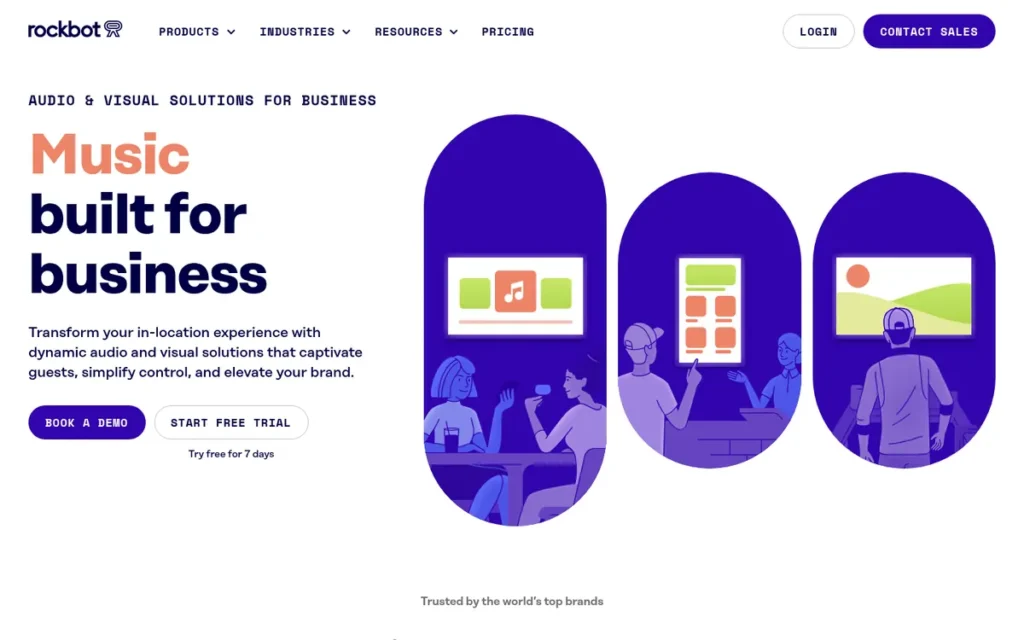
Category: All-in-One Media Platform, self-service software that runs licensed music, business TV and digital signage from one dashboard.
At a Glance
- Category: All-in-One Media Platform
- Best For: Multi-location restaurants, gyms, bars and retailers that want music, TV and signage managed in one system
- Price Range: $25 per zone/month each for Music or Business TV on a 12-month term; Music Videos $75 per zone/month (Rockbot pricing page, retrieved November 2026); hardware billed separately
- Primary Strength: Rockbot has the largest independent review base in this ranking, rated 4.5/5 from 279 G2 reviews (G2, retrieved November 2026).
- Biggest Limitation: Rockbot bills per zone and per feature, so a zone running music, TV and signage pays roughly three times the music-only price.
- One-Line Summary: Rockbot is a licensed business media platform that combines background music, guest song requests, business TV and digital signage in one multi-location dashboard, priced from $25 per zone per feature per month in 2026.
- Last Verified: November 2026
Overview
Rockbot is an Oakland-based business media platform, founded in 2010, that combines licensed background music, guest song requests, business TV and digital signage for restaurants, gyms, bars and retailers managing several zones or locations from one dashboard.
Rockbot can replace separate music, TV and signage vendors with one platform. Rockbot’s U.S. licensing covers ASCAP, BMI, SESAC and GMR when Rockbot is the business’s only music source (Rockbot, retrieved November 2026).
Key Features
- Rockbot schedules music by daypart, season, region and volume across every zone and location from a central dashboard.
- Rockbot lets customers request and vote on songs through a mobile app, and operators can limit requests to approved playlists.
- Rockbot sells business TV and digital signage as separate per-zone products and supports the Amazon Signage Stick and some Android commercial displays.
- Rockbot includes one-click explicit-content filtering that can be scheduled by time of day.
- Rockbot provides offline playback and failover, device-health monitoring and analytics through its Smart Amp and Media Player hardware.
Best For
Rockbot is best for multi-location restaurants, bars, gyms and social venues that want music, TV and signage from one vendor, and want guests to influence the music within brand-safe limits.
Pricing (verified November 2026)
- Rockbot charges $25 per zone per month each for Music and Business TV on a 12-month term, and $75 per zone per month for Music Videos (Rockbot pricing page, retrieved November 2026).
- Rockbot’s Digital Signage is listed at $25 per zone per month in a third-party comparison (Guideflow, 2026), so buyers should confirm it on rockbot.com/pricing.
- Rockbot’s monthly pricing is reported at $29.95 per feature by Capterra and $30 by musicforbusinessfinder (2026), and these figures conflict.
- Rockbot bills hardware separately and does not publish hardware prices.
Strengths
- Rockbot holds a 4.5/5 rating from 279 G2 reviews (G2, retrieved November 2026), the largest independent review base in this ranking. Rockbot’s reviewers praise its ease of use and schedule customization.
- Rockbot’s support article itemizes ASCAP, BMI, SESAC and GMR coverage for U.S. customers who use Rockbot as their sole music source (Rockbot support, retrieved November 2026).
- Rockbot is the only self-service provider in this ranking that sells music, business TV and digital signage as native products managed from one dashboard.
- Rockbot’s customers include Planet Fitness, Panera, Neiman Marcus and JetBlue, as listed on co-founder Garrett Dodge’s LinkedIn profile (retrieved November 2026). A Reddit thread confirms Rockbot’s use at Planet Fitness.
Limitations
- Rockbot’s all-in-one convenience costs more as features are added. One zone running music, TV and signage pays about $75 per month at annual rates instead of $25, before hardware.
- Rockbot’s licensing excludes music from personal devices, DJs, live performers and karaoke, so venues that host live or DJ nights need separate PRO licenses (Rockbot support, retrieved November 2026).
- Rockbot’s G2 reviewers report streams stopping randomly, sometimes several times a day (G2, retrieved November 2026). Rockbot’s G2 reviewers also report a Sonos integration that can time out, and the need for a separate phone, tablet or computer to control playback.
- Rockbot’s corporate song-approval controls frustrate some franchise staff whose local song suggestions are blocked (Reddit r/Rockbot, retrieved November 2026). Rockbot also publishes no quantified case-study results and shows zero Capterra reviews.
Users on r/PlanetFitnessMembers noted:
“Rockbot has gone down the tubes in the past couple of months. I can be the only signed in “DJ” and songs I request now play 1 to 2 hours later. What is the point of that?
“Downvoting” songs previously moved it to the back of the queue. Now it seems to move to the front of the queue.
And the selection still stinks, no AC/DC?
The staff at Planet fitness claims to have no control over this and are also unhappy.” Posted by u/Economy_Bad5584
Takeaway: Rockbot’s guest-request queue can frustrate gym members when requests are heavily delayed, and corporate-level controls can leave on-site staff unable to fix it.
Verdict
Rockbot is PlugRoute’s top-scoring business music platform in 2026 (4.60/5) for multi-location businesses that want licensed music, business TV and digital signage managed from one dashboard.
Rockbot has 279 G2 reviews, the most independently tested track record in this ranking, and its four-PRO coverage is documented. Buyers should budget for per-feature pricing and hardware. Single-location shops that only need background music will find cheaper options in this ranking.
2. Soundtrack: Best for Brand-Controlled Playlists Across Many Locations
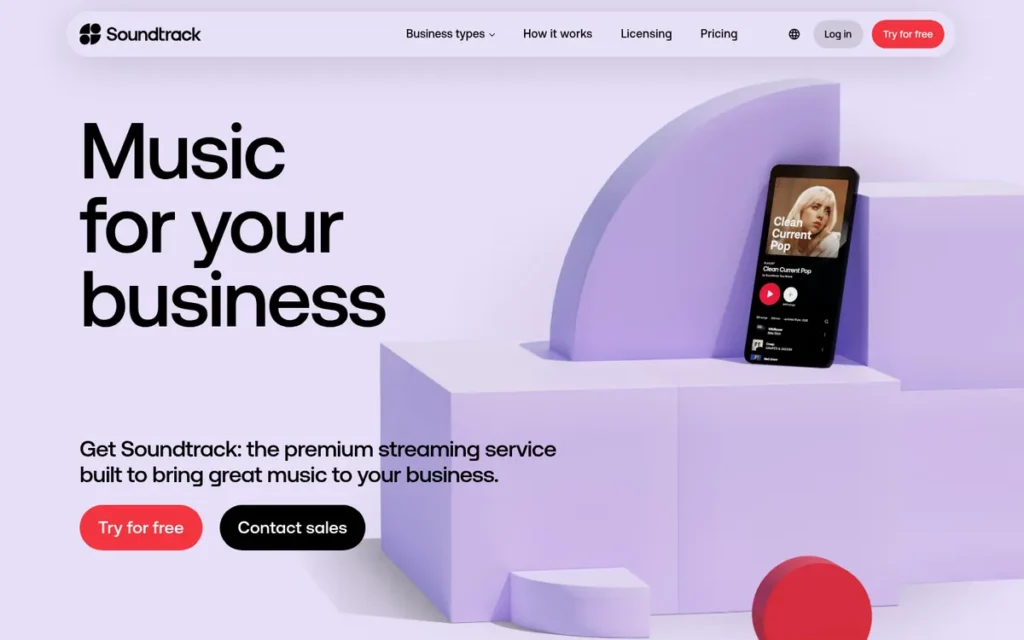
Category: Playlist-Based Streaming Platform, song-level licensed streaming with custom playlists, scheduling and zone control.
At a Glance
- Category: Playlist-Based Streaming Platform
- Best For: Brand and marketing managers at multi-location retail, restaurant and hospitality chains who want song-level control
- Price Range: About $37 per zone/month billed annually or about $41 monthly (musicforbusinessfinder, 2026); USD pricing not shown on soundtrack.io in PlugRoute’s check; some controls and offline mode may cost extra
- Primary Strength: Soundtrack offers the largest documented commercial catalog in this ranking, with more than 100 million tracks, Spotify playlist import and per-zone permissions.
- Biggest Limitation: Soundtrack is among the priciest self-service options per zone, and Google Play users report a slow app and incomplete Spotify playlist imports.
- One-Line Summary: Soundtrack is a Stockholm-founded business music streaming platform offering more than 100 million licensed tracks, Spotify playlist import and per-zone scheduling, built for brands that want song-level control across many locations.
- Last Verified: November 2026
Overview
Soundtrack, formerly Soundtrack Your Brand, is a Stockholm-founded business music streaming platform. Soundtrack gives multi-location retailers, restaurants and hospitality brands song-level control over a licensed catalog of more than 100 million tracks.
Soundtrack began in 2013 as a joint venture with Spotify and keeps a Spotify-like playlist workflow. Soundtrack’s U.S. subscriptions include ASCAP, BMI, GMR and, since November 1, 2026, SESAC (Soundtrack, 2026; Bloomberg, 2026).
Key Features
- Soundtrack offers a commercial catalog of more than 100 million tracks and 1,500–2,000 curated playlists.
- Soundtrack imports existing Spotify playlists and includes an AI playlist creator for building brand-specific programming.
- Soundtrack schedules playlists by zone and controls who can change music through user permissions.
- Soundtrack includes lyrics filtering, in-store messaging and Sonos support.
- Soundtrack publishes a separate U.S. licensing page explaining its coverage for each performing rights organization.
Best For
Soundtrack is best for brand-led retail and restaurant chains that treat music as part of their identity and want to choose specific songs rather than radio-style stations across many locations.
Pricing (verified November 2026)
- Soundtrack bills per zone, and a third-party source reports the Essential plan at about $37 per zone per month annually and about $41 monthly (musicforbusinessfinder, 2026).
- Soundtrack is listed at about $29 per zone per month on a competitor-authored Pandora CloudCover comparison page (Pandora CloudCover, 2026), a figure that may be biased.
- Soundtrack’s unlimited control and offline mode may cost extra, and PlugRoute did not verify Soundtrack’s hardware pricing.
- Soundtrack buyers should confirm current USD pricing on soundtrack.io/pricing.
Strengths
- Soundtrack’s documented catalog of more than 100 million tracks is the largest in this ranking (Soundtrack, retrieved November 2026), and its Spotify import shortens onboarding for brands with existing playlists.
- Soundtrack co-ran a 2017 field experiment with HUI Research across 16 restaurants and about 1.8 million transactions. The HUI Research study found brand-fit music lifted sales 9.1% (HUI Research with Soundtrack Your Brand, 2017).
- Soundtrack reported about $25M in annual recurring revenue in 2023 after 60% revenue growth in 2022, and has raised about $64M in total funding (PR Newswire, 2023; Music Ally, 2023).
- Soundtrack’s customers have included McDonald’s, lululemon, Uniqlo, Aesop and Joe & The Juice, as reported in 2017–2023 coverage (TechCrunch, 2017; PR Newswire, 2023).
Limitations
- Soundtrack charges more for its extra control. At about $37 per zone per month, a multi-zone location costs more on Soundtrack than on per-location services.
- Soundtrack’s Google Play users describe the app as slow, with weak search and playlist editing. One Soundtrack user reported that a 200+ song Spotify playlist imported only about 100 songs (Google Play, retrieved November 2026).
- Soundtrack’s G2 profile shows 4.5/5 from a single review (G2, retrieved November 2026), so independent user evidence for Soundtrack is thin.
- Soundtrack’s SESAC coverage for U.S. subscribers began only on November 1, 2026, so buyers with earlier contracts should confirm their coverage date. Soundtrack also offers no native TV or signage.
Users on r/restaurantowners shared their experience:
“Hi, we use it and it works great, but the songs can be really redundant unless you add a bunch of options to the playlist. The curated playlists are just okay, but you do have the option of importing your Spotify playlists too” Posted by u/Extension-18
Takeaway: Soundtrack works reliably for restaurants, but its curated playlists get repetitive, so operators get the most from it by building and importing their own Spotify playlists.
Verdict
Soundtrack is the top-scoring playlist-based platform in PlugRoute’s 2026 ranking (3.90/5) for brands that want song-level control over licensed music across many locations.
Soundtrack holds #2 because of its song-level programming and multi-location control. Its rights coverage no longer sets it apart from other providers. Buyers should budget for per-zone pricing and test the app and playlist import during onboarding.
3. SoundMachine: Best for Published Tier Pricing and Month-to-Month Billing
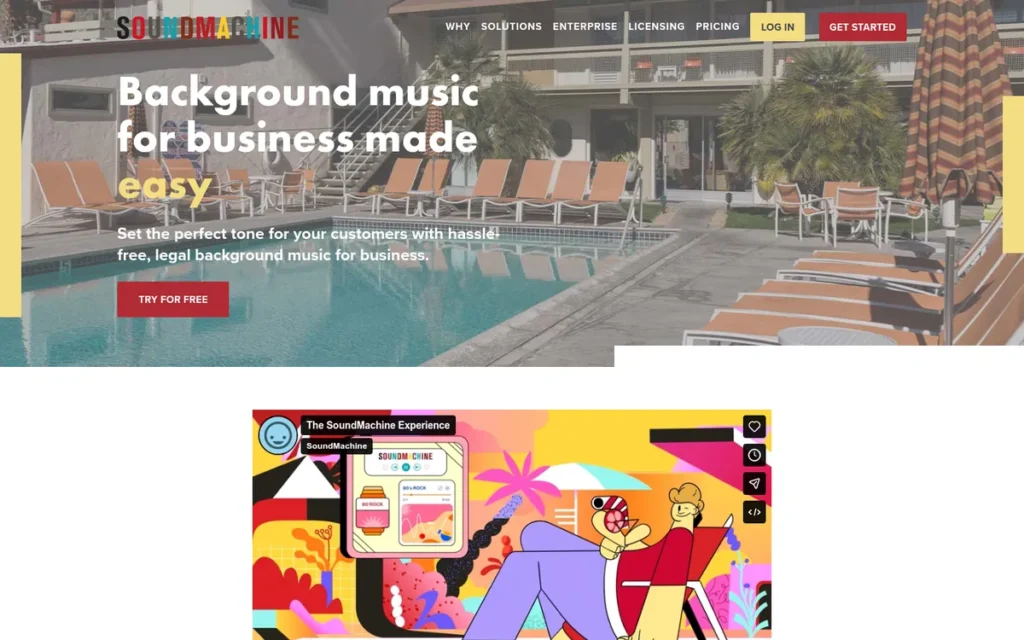
Category: Playlist-Based Streaming Platform.
At a Glance
- Category: Playlist-Based Streaming Platform
- Best For: Small businesses and growing chains, other than gyms and fitness facilities, that want published pricing, month-to-month billing and AV-installer integration
- Price Range: $26.95–$35.95 per location/month billed annually; $29.95–$41.95 monthly; Enterprise custom (SoundMachine pricing page, retrieved November 2026)
- Primary Strength: SoundMachine publishes the most complete tier-by-tier price table in this ranking, with month-to-month billing and a no-card 14-day trial.
- Biggest Limitation: SoundMachine has no verified independent reviews on G2, Capterra or Trustpilot, so its reliability claims cannot be checked against user evidence.
- One-Line Summary: SoundMachine is a Los Angeles-based, app-based business music service that lists ASCAP, BMI, SESAC and GMR coverage for eligible U.S. subscribers and publishes per-location pricing from $26.95 per month in 2026.
- Last Verified: November 2026
Overview
SoundMachine is a Los Angeles-based business music service, founded in 2008, that runs on iOS and Android apps. SoundMachine gives small businesses and growing chains licensed stations, custom mixes, imported playlists and scheduling at published per-location prices.
SoundMachine also offers an optional CloudBox player that stores music locally for offline playback.
Key Features
- SoundMachine lists ASCAP, BMI, SESAC and GMR coverage for eligible background music on its U.S. licensing page.
- SoundMachine imports playlists from Spotify, Apple Music and Amazon Music on its Premium tiers.
- SoundMachine schedules music and custom audio messages across multiple locations.
- SoundMachine’s optional CloudBox player stores music locally so playback continues when the internet drops.
- SoundMachine works with Sonos, Crestron and Control4 systems that AV installers already manage.
Best For
SoundMachine is best for small and mid-size businesses other than gyms that want published pricing, month-to-month flexibility and compatibility with existing installer-managed audio.
Pricing (verified November 2026)
- SoundMachine Business costs $26.95 per month billed annually ($323.40 per year) or $29.95 monthly (SoundMachine pricing page, retrieved November 2026).
- SoundMachine Business Premium costs $33.95 per month annually or $38.95 monthly, and Business Premium HD costs $35.95 or $41.95.
- SoundMachine prices its Enterprise plan on request.
- SoundMachine offers a 14-day free trial that needs no credit card, volume discounts from 10 or more licenses and prorated pricing for added locations.
- SoundMachine buyers should confirm the annual and monthly toggle on sound-machine.com/pricing and get CloudBox hardware prices directly.
Strengths
- SoundMachine publishes the most complete pricing table in this ranking, with monthly and annual rates for every tier (SoundMachine pricing page, retrieved November 2026).
- SoundMachine’s U.S. licensing page lists ASCAP, BMI, SESAC and GMR for background music played through the service (SoundMachine, retrieved November 2026).
- SoundMachine reports serving 24,000+ locations across retail chains, hotels, restaurants and coffee chains (SoundMachine, self-reported, retrieved November 2026).
- SoundMachine’s CloudBox player and its Sonos, Crestron and Control4 compatibility address both internet outages and existing AV installs.
Limitations
- SoundMachine’s simple bundled license has a carve-out. SoundMachine’s U.S. PRO coverage excludes gyms and fitness facilities, which must license ASCAP, BMI, SESAC and GMR directly (SoundMachine, retrieved November 2026).
- SoundMachine has no verified independent reviews on G2, Capterra, Trustpilot or the App Store as of November 2026, so its reliability cannot be checked against user evidence.
- SoundMachine does not name its customers, and it publishes its own “best music services for business” comparison (SoundMachine, 2025), so its claims about competitors are vendor-authored.
- SoundMachine does not document its catalog size, and SoundMachine offers no TV, signage or scent capabilities.
Verdict
SoundMachine publishes the most complete tier-by-tier price table in PlugRoute’s 2026 ranking, with monthly and annual rates for every plan and a no-card 14-day trial.
SoundMachine scores 3.85/5 and ranks ahead of Pandora CloudCover through the tie-break on multi-location control. Because independent reviews are missing, buyers should use the free trial to test reliability. Gyms should license directly.
4. Pandora CloudCover: Best Budget Pick for Single-Location Small Businesses
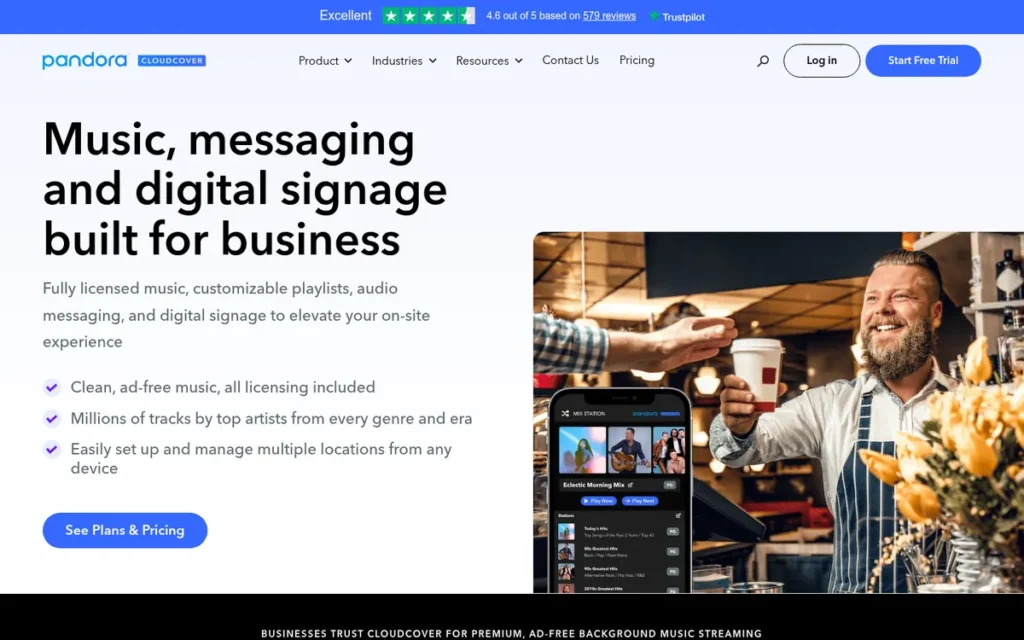
Category: Station-Based Radio Service, pre-programmed stations or channels chosen by mood or format rather than song by song.
At a Glance
- Category: Station-Based Radio Service
- Best For: Single-location cafes, salons, shops and offices that want low-cost, hands-off licensed music
- Price Range: Music $16.95 per location/month prepaid annually or $18.95 monthly; Manage $21.50 or $23.95; Messaging & Signage $26.95 or $29.95 (Pandora CloudCover pricing page, retrieved November 2026); extra zones cost more
- Primary Strength: Pandora CloudCover has the lowest published entry price in this ranking at $16.95 per location per month on annual billing.
- Biggest Limitation: Pandora CloudCover uses stations generated from a song, artist or genre, so businesses cannot build their own track-by-track playlists.
- One-Line Summary: Pandora CloudCover is a SiriusXM-owned business music service offering ad-free, licensed, family-friendly stations from $16.95 per location per month in 2026, the lowest published entry price in this ranking.
- Last Verified: November 2026
Overview
Pandora CloudCover, formerly Cloud Cover Music and owned by SiriusXM since 2022, is a licensed business music service. Pandora CloudCover gives single-location small businesses ad-free, family-friendly stations built on Pandora’s Music Genome from $16.95 per location per month.
Pandora CloudCover includes scheduling, messaging and remote volume control, and recently added digital signage. Pandora CloudCover’s licensing guide lists ASCAP, BMI, SESAC and GMR coverage (Pandora CloudCover, retrieved November 2026).
Key Features
- Pandora CloudCover generates stations from a chosen song, artist or genre using Pandora’s Music Genome, and also offers stations curated by musicologists.
- Pandora CloudCover includes scheduling, remote volume control and content blocking.
- Pandora CloudCover offers overhead audio messaging and, since a recent SiriusXM launch, digital signage on its Messaging & Signage plan (SiriusXM, retrieved November 2026).
- Pandora CloudCover’s Manage plan adds centralized control for businesses with several locations.
- Pandora CloudCover does not require dedicated hardware on its basic plan.
Best For
Pandora CloudCover is best for single-location cafes, salons and retail shops that want legal, clean background music at the lowest published price without spending time curating playlists.
Pricing (verified November 2026)
- Pandora CloudCover’s Music plan costs $16.95 per location per month prepaid annually or $18.95 monthly (Pandora CloudCover pricing page, retrieved November 2026).
- Pandora CloudCover’s Manage plan costs $21.50 per month annually or $23.95 monthly.
- Pandora CloudCover’s Messaging & Signage plan costs $26.95 per month annually or $29.95 monthly.
- Pandora CloudCover offers a 14-day trial, requires no dedicated hardware and charges extra for additional zones.
Strengths
- Pandora CloudCover publishes the lowest entry price of any provider in this ranking, at $16.95 per location per month prepaid annually (Pandora CloudCover pricing page, retrieved November 2026).
- Pandora CloudCover’s licensing guide lists ASCAP, BMI, SESAC and GMR for background music played through the service. DJs, karaoke, live performances and some fitness-class uses are not covered (Pandora CloudCover, retrieved November 2026).
- Pandora CloudCover had “tens of thousands of customers” as of its January 2022 acquisition by SiriusXM. Named locations include Crumbl, Dunkin’, Big 5 Sporting Goods and Amazon One Medical (SiriusXM, 2022; RBR, 2022).
- Pandora CloudCover’s Trustpilot reviewers praise its effortless music, and one wrote that its song selection is “always clean and retail friendly” (Trustpilot, retrieved November 2026).
This aligns with community sentiment on r/restaurantowners:
“Check out Cloud Cover. It’s simple, cheap and easy to configure playlist. Pandora owns it. The box they give you is (or at least was) free.” Posted by u/wortsandall
Takeaway: Restaurant owners point to Pandora CloudCover as a simple, low-cost alternative to Soundtrack, which backs up its standing as this ranking’s budget pick.
Limitations
- Pandora CloudCover gives up control for simplicity, because its station model does not let businesses build their own track-by-track playlists.
- Pandora CloudCover’s $16.95 entry price applies only to single-location music. Multi-location control requires the Manage plan ($21.50 annually), and signage requires Messaging & Signage ($26.95 annually).
- Pandora CloudCover’s G2 seller page shows zero reviews, and PlugRoute could not verify Pandora CloudCover’s Trustpilot score or review count (G2, retrieved November 2026).
- Pandora CloudCover’s marketing cites 42% dwell-time and 37% sales figures from a “Gant” report that PlugRoute could not locate (retrieved November 2026). Pandora CloudCover also shares a parent company with SiriusXM Music for Business.
Verdict
Pandora CloudCover is the lowest-cost published option in PlugRoute’s 2026 ranking for a single-location business that wants legal, family-friendly background music.
Pandora CloudCover scores 3.85/5, the same as SoundMachine, and ranks #4 on the multi-location tie-break. The station model suits owners who want to pick a vibe and walk away. Brands that need song-level playlists should consider Soundtrack or SoundMachine instead.
5. SiriusXM Music for Business: Best for Locations With Unreliable Internet
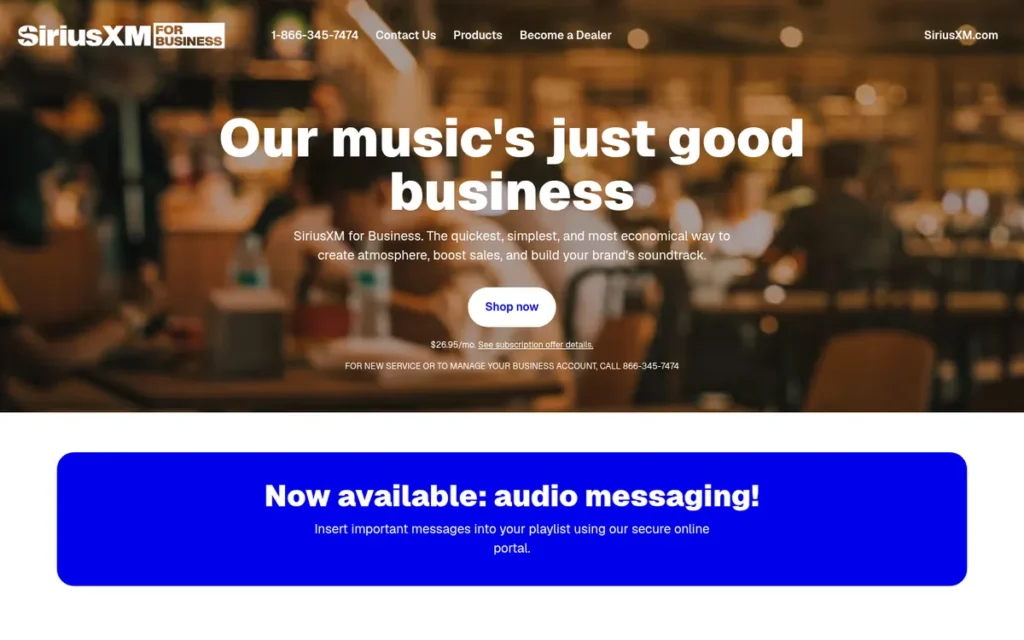
Category: Station-Based Radio Service.
At a Glance
- Category: Station-Based Radio Service
- Best For: Small businesses and rural or remote sites with unreliable internet that want hands-off, channel-based music
- Price Range: $26.95 per location/month (streaming or satellite); $274.45/year for annual streaming; $15 activation fee plus taxes and fees (SiriusXM, retrieved November 2026)
- Primary Strength: SiriusXM Music for Business is the only provider in this ranking with satellite delivery, which keeps music playing where broadband is unreliable.
- Biggest Limitation: SiriusXM Music for Business offers fixed channels only, with no song-level playlists, playlist import or customer requests.
- One-Line Summary: SiriusXM Music for Business is a channel-based licensed music service delivered by streaming or satellite at $26.95 per location per month in 2026, and it is the only option in this ranking with satellite delivery.
- Last Verified: November 2026
Overview
SiriusXM Music for Business is a channel-based licensed background music service from Sirius XM Holdings, delivered by streaming or satellite at $26.95 per location per month. SiriusXM Music for Business is built for small businesses and remote sites that want hands-off programming.
SiriusXM Music for Business suits multi-site operators where internet is weak, and adds a web portal for scheduling and multi-location control.
Key Features
- SiriusXM Music for Business streams 100+ ad-free channels, including 30 business-formatted channels with no explicit content, DJs or interruptions.
- SiriusXM Music for Business offers satellite delivery with 80 ad-free channels everywhere except Alaska and Hawaii.
- SiriusXM Music for Business provides a web portal for day-parting, including automatic channel changes and on/off scheduling.
- SiriusXM Music for Business supports centralized control of multiple locations and restricted employee access.
- SiriusXM Music for Business includes audio messaging.
Best For
SiriusXM Music for Business is best for small businesses and rural or remote sites where unreliable broadband makes streaming-only services risky, and for owners who prefer set-and-forget channels.
Pricing (verified November 2026)
- SiriusXM Music for Business costs $26.95 per location per month for streaming or satellite, plus taxes and fees (SiriusXM support, retrieved November 2026).
- SiriusXM Music for Business annual streaming costs $274.45, about $22.87 per month, plus a $15 activation fee (SiriusXM, retrieved November 2026).
- SiriusXM Music for Business does not publish equipment prices.
- SiriusXM Music for Business’s customer agreement auto-renews paid subscriptions, including those that begin with a free period (SiriusXM Customer Agreement, 2025).
Strengths
- SiriusXM Music for Business is the only provider in this ranking with satellite delivery, offering 80 ad-free satellite channels for sites with unreliable broadband (SiriusXM support, retrieved November 2026).
- SiriusXM Music for Business’s support materials list ASCAP, BMI, SESAC, GMR and SoundExchange royalty coverage for music played through the service (SiriusXM support, retrieved November 2026).
- SiriusXM Music for Business publishes per-location pricing, including an annual rate that works out to about $22.87 per month.
- SiriusXM Music for Business offers 30 business-formatted streaming channels free of explicit content, DJs and interruptions.
Limitations
- SiriusXM Music for Business gives up flexibility for simplicity. Its fixed channels allow no song-level playlists, Spotify import or customer requests (Guideflow, 2026).
- SiriusXM Music for Business auto-renews subscriptions under its May 2025 agreement. SiriusXM’s corporate Trustpilot and BBB pages show recurring cancellation complaints, mostly from consumers rather than business customers (Trustpilot, retrieved November 2026; BBB, retrieved November 2026).
- SiriusXM Music for Business has no verified independent reviews for the business product as of November 2026.
- SiriusXM has published a 2026 price-increase chart, so SiriusXM Music for Business buyers should confirm the rate locked in at signing. Equipment prices are unpublished.
Verdict
SiriusXM Music for Business is the most resilient option in PlugRoute’s 2026 ranking for locations with unreliable internet, because it is the only provider here with satellite delivery.
SiriusXM Music for Business scores 3.50/5. It ranks below its sister product, Pandora CloudCover, because CloudCover is cheaper and adds signage. Buyers should review the auto-renewal terms and confirm the current rate before signing.
6. Mood Media: Best for Enterprises Wanting a Fully Managed, Single-Vendor In-Store Experience
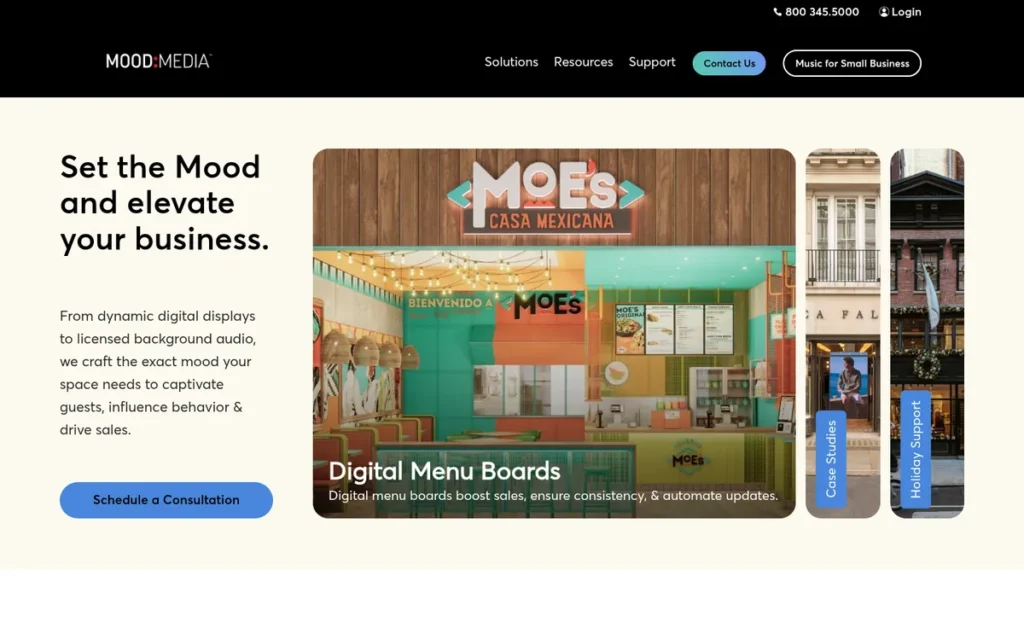
Category: Managed Enterprise Provider, full-service vendors that design, install and program music, signage and the in-store experience under contract.
At a Glance
- Category: Managed Enterprise Provider
- Best For: Enterprise retail and hospitality chains that want music, signage, scent and AV installation outsourced to one vendor
- Price Range: Quote-based; third-party figures range from about $15.30 to $26.99 per month, and customer complaints cite $90/month (low confidence, 2026)
- Primary Strength: Mood Media offers the broadest single-vendor in-store experience in this ranking, combining music, signage, scent, on-hold messaging and AV installation.
- Biggest Limitation: Mood Media has the most negative available complaint record in this ranking: BBB 2.33/5 from 3 reviews (2026), plus recurring Trustpilot complaints about cancellation and continued billing.
- One-Line Summary: Mood Media is a managed in-store experience provider that bundles licensed background music, messaging, digital signage, scent marketing and AV installation for enterprise chains, sold by custom quote rather than published pricing.
- Last Verified: November 2026
Overview
Mood Media is a managed in-store experience company that provides enterprise retail and hospitality chains with licensed background music, messaging, digital signage, scent marketing and AV installation under quote-based contracts.
Mood Media reports more than 500,000 client locations in over 140 countries (Mood Media, self-reported, retrieved November 2026). Mood Media also owns PlayNetwork and Vibenomics.
Key Features
- Mood Media delivers background music through its Mood Harmony and Mood Mix platforms.
- Mood Media provides in-store and on-hold messaging alongside music.
- Mood Media designs and deploys digital signage, including menu boards, video walls and kiosks.
- Mood Media offers scent marketing as part of its in-store experience services.
- Mood Media designs, installs and maintains commercial sound systems and AV.
Best For
Mood Media is best for large chains that have procurement teams to negotiate terms and want one contracted vendor to design, install and run music, signage, scent and AV across hundreds of sites.
Pricing (verified November 2026)
- Mood Media prices mostly by quote, and third-party figures conflict.
- Mood Media is listed at about $26.99 per month by Guideflow (Guideflow, 2026).
- Mood Media’s “Fundamentals” plan is reported at $17 per month monthly or $15.30 per month annually by Sonosfera (Sonosfera, 2026).
- Mood Media customers report figures of $90 per month, a $358.88 annual renewal and a “$300-plus nonrefundable” payment (Trustpilot, retrieved November 2026; BBB, retrieved November 2026).
- Mood Media buyers should expect possible multi-year contracts, hardware costs and add-on fees.
Strengths
- Mood Media reports more than 500,000 client locations in over 140 countries, the largest stated footprint in this ranking (Mood Media, self-reported, retrieved November 2026).
- Mood Media deployed digital menu boards, video walls, kiosks and touchscreens for Premier Restaurants Romania, a McDonald’s licensee running 100+ restaurants in 29 cities (Mood Media, retrieved November 2026). The Mood Media case study reports no ROI figures.
- Mood Media offers scent marketing and AV installation, which none of the self-service providers in this ranking list as products.
- Mood Media lists 105 case studies and 39 customer references on FeaturedCustomers (FeaturedCustomers, retrieved November 2026).
Limitations
- Mood Media gives up self-service control in exchange for managed scope. Mood Media’s BBB complaints cover cancellation difficulty, refund disputes and a renewal charge after equipment was returned (BBB, retrieved November 2026).
- Mood Media’s Trustpilot reviewers describe limited music customization, continued billing and one bank chargeback (Trustpilot, retrieved November 2026). Mood Media is not listed as a standalone product on G2 (G2, retrieved November 2026).
- Mood Media’s rights coverage is not verified, because PlugRoute could not confirm which PROs Mood Media’s service covers.
- Mood Media’s Harmony platform drew a Reddit report from a retail employee whose station change never took effect (Reddit r/AskRetail, retrieved November 2026).
As one retail employee on r/AskRetail described:
“Does anyone use this station at work? I’ve been trying to switch the station because im tired of listening to country. It says its queue up and will play shortly but never does 😭 help” Posted by u/ElegantMessage4662
Takeaway: Mood Media’s Harmony platform can leave in-store staff unable to change the music, which supports the limited-customization complaints in its user reviews.
Verdict
Mood Media offers the broadest fully managed in-store experience scope in PlugRoute’s 2026 ranking, best suited to enterprise chains that want music, signage, scent and AV under one contract.
Mood Media scores 2.55/5 because PlugRoute could not verify its PRO coverage, pricing or user evidence. Buyers should negotiate exit terms, renewal notice periods and written PRO coverage before signing.
7. Vibenomics / PlayNetwork: Best for Large Retail Chains Monetizing In-Store Audio
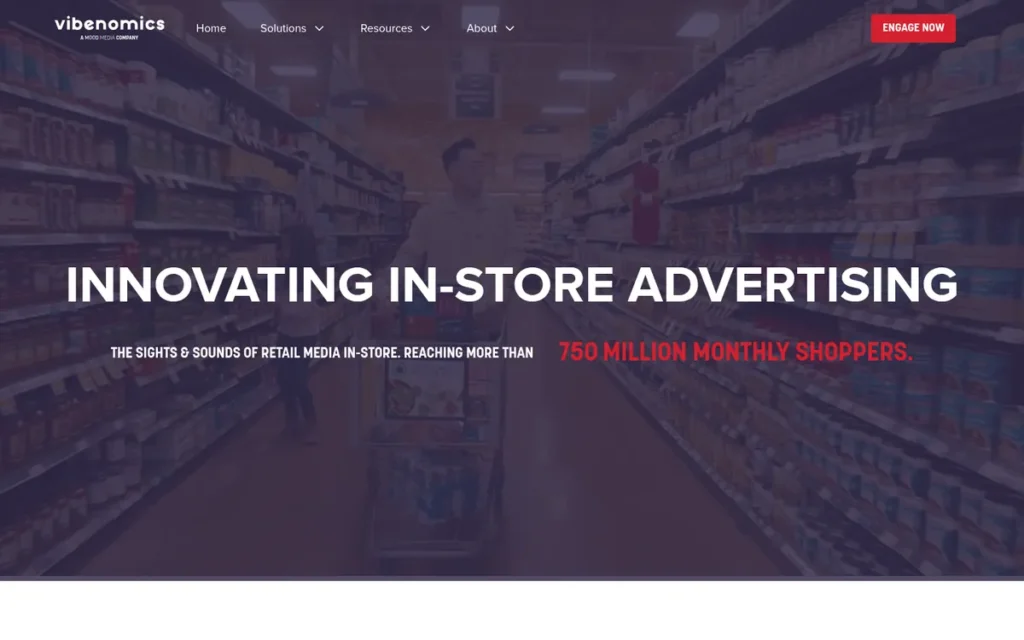
Category: Managed Enterprise Provider.
At a Glance
- Category: Managed Enterprise Provider
- Best For: Grocery, drug, convenience and big-box chains that want to sell in-store audio ads to brands
- Price Range: No public pricing; enterprise proposals with ad-funded or revenue-share models (Vibenomics, retrieved November 2026)
- Primary Strength: Vibenomics is the only provider in this ranking built primarily as a brand-funded retail-media audio network that can generate revenue for the retailer.
- Biggest Limitation: Vibenomics / PlayNetwork publishes no pricing or PRO coverage and has no verified independent reviews, making it the least transparent option in this ranking.
- One-Line Summary: Vibenomics / PlayNetwork is Mood Media’s enterprise in-store audio and branded media business, combining curated background music with targeted audio advertising so large retail chains can monetize store audio, sold only by enterprise proposal.
- Last Verified: November 2026
Overview
Vibenomics / PlayNetwork is Mood Media’s enterprise in-store audio business. Vibenomics / PlayNetwork pairs curated background music with targeted brand advertising for large grocery, drug and convenience chains, and provides branded music, video and AV for global rollouts.
Vibenomics / PlayNetwork is sold only through enterprise proposals and is not independent of Mood Media (#6).
Key Features
- Vibenomics combines curated background music with targeted in-store audio advertising sold to brands.
- Vibenomics targets audio campaigns by daypart, ZIP+4, banner, DMA, demographics and SKU/UPC.
- Vibenomics provides no-cost creative production, professional voice talent, IoT players and post-campaign reporting.
- PlayNetwork delivers enterprise branded music, video and digital signage for multi-country rollouts.
- PlayNetwork handles AV installations for large brand programs.
Best For
Vibenomics / PlayNetwork is best for large, high-traffic retail chains that want to treat store audio as a revenue-generating retail-media channel. Vibenomics / PlayNetwork is not suited to single-location businesses.
Pricing (verified November 2026)
- Vibenomics / PlayNetwork publishes no pricing, CPMs, minimums or per-store fees (Vibenomics, retrieved November 2026).
- Vibenomics / PlayNetwork is sold through enterprise proposals with ad-funded or revenue-share models.
- Vibenomics / PlayNetwork buyers should request written PRO coverage, ad-load limits and contract terms during any RFP.
Strengths
- Vibenomics has been a Kroger in-store audio network partner since May 2020 and works with Lowe’s media network (Vibenomics, retrieved November 2026).
- PlayNetwork served 400+ brands at 100,000+ locations when Mood Media acquired it in September 2021 (Mood Media, 2021).
- Vibenomics reports a network of 17,500+ locations reaching 1B+ monthly shopping visits (Vibenomics, self-reported, retrieved November 2026).
- Vibenomics is the only provider in this ranking built primarily as a brand-funded audio network. Rockbot offers advertising tools, but Rockbot does not run a brand-funded network.
Limitations
- Vibenomics / PlayNetwork gives up transparency in exchange for an enterprise revenue model. Vibenomics / PlayNetwork publishes no pricing and no PRO coverage statement, so its rights coverage is not verified.
- Vibenomics / PlayNetwork has no verified G2, Capterra or Trustpilot reviews as of November 2026.
- Vibenomics’ self-reported network size has shifted from 6,000 to 15,000 to 17,500+ locations, and Vibenomics’ holiday case studies report sales increases without percentages (Vibenomics, 2025).
- Vibenomics’ ad-funded model carries a risk that heavy ad loads could hurt the shopper experience. This is a PlugRoute editorial assessment, not a documented user complaint.
Verdict
Vibenomics / PlayNetwork is the only provider in PlugRoute’s 2026 ranking built primarily to turn in-store audio into brand-funded retail-media revenue, which makes it relevant to large grocery, drug and convenience chains.
Vibenomics / PlayNetwork scores 2.20/5 because it publishes no pricing, PRO coverage statement or user reviews. Buyers should evaluate it through a formal RFP with written licensing and ad-load terms.
Which Rights Organizations Does Each Business Music Service Cover?
As of November 2026, Rockbot, Soundtrack, SoundMachine and Pandora CloudCover publicly list all four U.S. performing rights organizations (ASCAP, BMI, SESAC and GMR), and SiriusXM’s support materials also list all four. PlugRoute could not verify coverage for Mood Media or Vibenomics / PlayNetwork. Soundtrack’s SESAC coverage began November 1, 2026.
| Provider | ASCAP | BMI | SESAC | GMR | Source and Date | Notable Exclusions |
|---|---|---|---|---|---|---|
| Rockbot | Listed | Listed | Listed | Listed | Rockbot licensing page and support article, Nov 2026 | Personal devices, DJs, live performers, karaoke; applies when Rockbot is sole source |
| Soundtrack | Listed | Listed | Listed (since Nov 1, 2026) | Listed | Soundtrack U.S. licensing pages, Nov 2026; Bloomberg, Nov 2026 | Live music, DJs, cover-charge events, instructional classes |
| SoundMachine | Listed | Listed | Listed | Listed | sound-machine.com/licensing/united-states, Nov 2026 | Gyms and fitness facilities |
| Pandora CloudCover | Listed | Listed | Listed | Listed | Pandora CloudCover licensing guide, Nov 2026 | DJs, karaoke, live performances, some fitness-class uses |
| SiriusXM Music for Business | Listed | Listed | Listed | Listed | SiriusXM support (KC-2084), Nov 2026 | Not stated in sources reviewed |
| Mood Media | Not verified | Not verified | Not verified | Not verified | No public statement found, Nov 2026 | Not verified |
| Vibenomics / PlayNetwork | Not verified | Not verified | Not verified | Not verified | No public statement found, Nov 2026 | Not verified |
A business music plan is only as legal as its narrowest PRO license. If a service leaves out one of ASCAP, BMI, SESAC or GMR, every song in that organization’s catalog is unlicensed in your store.
Ask every provider to confirm coverage and exclusions in writing, because rights deals change.
How Much Does Business Music Software Cost Per Location?
Published 2026 list prices range from $16.95 per location per month (Pandora CloudCover, annual) to about $37 per zone per month (Soundtrack, annual). The real price depends on the billing unit, zone count and features. Mood Media and Vibenomics / PlayNetwork quote privately.
The three billing models work like this:
- Per-location pricing: Pandora CloudCover, SiriusXM Music for Business and SoundMachine charge one price per site, which is simpler for single-zone shops.
- Per-zone pricing: Rockbot and Soundtrack bill each separately controlled area, such as a dining room and a patio, as its own zone.
- Per-feature pricing: Rockbot bills music, business TV and signage separately for each zone, so costs stack as features are added.
The headline price of business music software is rarely the real price. The billing unit can turn a $25 plan into a $75 plan for one zone running music, TV and signage.
Worked example: A cafe that plays the same music in its dining room and patio as one zone pays $16.95 per month on Pandora CloudCover’s Music plan. A cafe that wants separate control of the two areas pays about $50 per month on Rockbot and about $74 on Soundtrack, because both bill per zone (annual list prices, 2026).
Illustrative Monthly Cost (Published 2026 List Prices, Annual Billing)
| Provider | 1 location / 1 zone | 1 location / 3 zones | 1 zone: music + TV + signage | 10 locations / 1 zone each |
|---|---|---|---|---|
| Pandora CloudCover | $16.95 | Extra zones cost more (price not published) | $26.95 (music + signage, no TV) | $169.50; $215.00 with Manage plan |
| SiriusXM Music for Business | ~$22.87 + $15 activation | Not published | TV/signage not offered | ~$228.70 + $150 activation |
| Rockbot | $25 | $75 | ~$75 | $250 |
| SoundMachine | $26.95 | Not published | TV/signage not offered | $269.50 before volume discount |
| Soundtrack | ~$37 (sources conflict) | ~$111 | TV/signage not offered | ~$370 |
| Mood Media | Quote only | Quote only | Quote only | Quote only |
| Vibenomics / PlayNetwork | Quote only | Quote only | Quote only | Quote only |
This table is illustrative. It excludes hardware, taxes, add-ons and unpublished zone fees. Rockbot’s Music Videos product costs $75 per zone separately (Rockbot pricing page, retrieved November 2026). Confirm current prices on each provider’s pricing page.
What Red Flags Should I Watch For When Evaluating Business Music Software?
The biggest red flags in business music software are licensing gaps and hidden costs. A service that cannot name its rights organizations or exclusions leaves you exposed legally, and per-feature billing or auto-renewal can inflate the real price. The six warning signs below can all be checked before you sign.
Red Flag #1: Staff Playing Personal Streaming Accounts Personal Spotify and Apple Music accounts are limited by their terms to personal, non-commercial use (Spotify, retrieved November 2026; Apple, retrieved November 2026). A staff member’s phone playing a personal account can expose the business to statutory damages of $750–$30,000 per work (17 U.S.C. §504, 2026).
Red Flag #2: Vague “Fully Licensed” Claims Without Named PROs A general “fully licensed” claim does not say which of ASCAP, BMI, SESAC and GMR are covered, or which uses are excluded. Ask every provider for the named list and the exclusions in writing. As of November 2026, PlugRoute could not verify coverage for Mood Media or Vibenomics / PlayNetwork.
Red Flag #3: Per-Feature Pricing That Multiplies With TV and Signage Per-feature pricing can triple the cost of a single zone once TV and signage are added. Rockbot’s $25 Music rate becomes about $75 per zone per month for music, TV and signage on annual billing (Rockbot pricing page, retrieved November 2026; Guideflow, 2026).
Red Flag #4: Auto-Renewal and Hard-to-Exit Contracts Auto-renewal clauses and quote-only multi-year contracts can lock businesses into unwanted service. SiriusXM Music for Business’s May 2025 agreement auto-renews subscriptions, and Mood Media’s BBB complaints describe cancellation and renewal disputes (BBB, retrieved November 2026).
Red Flag #5: Vendor-Authored Comparisons Presented as Independent Many “best business music” comparisons are written by vendors in the category. SoundMachine publishes its own ranking (SoundMachine, 2025), and Pandora CloudCover publishes competitor comparison pages, so check who wrote any comparison before trusting it.
Red Flag #6: Assuming Background Music Covers Live Events or Classes Background music licenses rarely cover live performance, DJs or choreographed classes. See the exclusions list in the legal section above. Gyms, bars and event venues usually need separate licenses.
What Questions Should I Ask Before Choosing Business Music Software?
Before signing, ask eight questions about rights, billing, hardware, central control, outages, exclusions, business-type eligibility and contract exit. Get every answer in writing, because pricing and rights deals in this category change often. Soundtrack’s November 2026 SESAC addition is a recent example.
Question #1: Which of ASCAP, BMI, SESAC and GMR does my plan cover, in writing? A strong answer names all four U.S. performing rights organizations and points to a public licensing page. A weak answer is a general “fully licensed” statement with no named organizations.
Question #2: Am I billed per zone, per location or per feature? The billing unit determines your real cost more than the headline price does. Ask for a quote that matches your actual zone count and features, with both annual and monthly options.
Question #3: What hardware is required, and what does it cost? Most providers in this ranking do not publish hardware prices. Ask whether a dedicated player, amplifier or signage device is required, and whether existing Sonos or installer-managed systems are supported.
Question #4: Can I control schedules, volume and permissions for every location from one dashboard? Multi-location operators need central scheduling, volume control and user permissions that stop staff from overriding programming. Ask for a demo of day-parting and permission settings across several locations.
Question #5: What happens when the internet goes down? A good answer names a specific offline, failover or satellite option. Providers in this ranking document three approaches:
- Rockbot documents offline playback and failover through its hardware.
- SoundMachine offers a CloudBox player that stores music locally.
- SiriusXM Music for Business offers satellite delivery outside Alaska and Hawaii.
Question #6: Does the license cover live music, DJs, karaoke, fitness classes, on-hold or social video? Background music licenses usually exclude these uses. Bars that host DJs and chains outside the U.S. and Canada should confirm exactly what is excluded and what needs separate licensing.
Question #7: What are the renewal, notice and cancellation terms? Ask for the auto-renewal clause, the notice period and the equipment-return process in writing. Complaints in this category often involve continued billing after cancellation attempts.
Question #8: Does the coverage apply to my business type, such as a gym or fitness studio? Some bundled licenses exclude whole business types. SoundMachine’s bundled U.S. coverage excludes gyms and fitness facilities (SoundMachine, retrieved November 2026), so fitness operators should confirm eligibility before subscribing.
How Did We Rank These Business Music Software Platforms?
PlugRoute scored each provider from 1 to 5 on six weighted criteria drawn from buyers’ pain points. Rights coverage carries 25%, pricing and multi-location control carry 20% each, independent reviews carry 15%, and breadth and programming control carry 10% each. Rockbot leads at 4.60, followed by Soundtrack (3.90) and SoundMachine (3.85).
Ranking criteria and why each matters:
- Rights coverage transparency (25%): Each U.S. PRO licenses only its own catalog, and statutory damages reach $150,000 per work if the infringement is willful.
- Pricing transparency and value (20%): Buyers struggle to compare per-zone, per-location and per-feature billing and fees.
- Multi-location control (20%): Operations teams need central scheduling, volume control, permissions and device monitoring.
- Independent review evidence (15%): Most comparison content in this category is written by vendors, so user reviews are the main check on vendor claims.
- Breadth beyond music (10%): Many buyers want messaging, TV and signage in one system.
- Programming control and resilience (10%): Brand fit depends on song-level control, and weak-internet sites need offline or satellite delivery.
Review evidence (C4) anchors: 5 = 100+ verified reviews; 4 = 25–99; 3 = 5–24; 2 = 1–4 reviews, or reviews without a verifiable count; 1 = none.
| Rank | Provider | Rights (25%) | Pricing (20%) | Multi-Location (20%) | Reviews (15%) | Breadth (10%) | Programming (10%) | Total |
|---|---|---|---|---|---|---|---|---|
| 1 | Rockbot | 5 | 3.5 | 5 | 5 | 5 | 4 | 4.60 |
| 2 | Soundtrack | 5 | 3 | 5 | 2 | 2.5 | 5 | 3.90 |
| 3 | SoundMachine | 5 | 5 | 4 | 1 | 2 | 4.5 | 3.85 |
| 4 | Pandora CloudCover | 5 | 5 | 3.5 | 2 | 3.5 | 2.5 | 3.85 |
| 5 | SiriusXM Music for Business | 5 | 4.5 | 3.5 | 1 | 2 | 3 | 3.50 |
| 6 | Mood Media | 2 | 1.5 | 3.5 | 2 | 5 | 2.5 | 2.55 |
| 7 | Vibenomics / PlayNetwork | 2 | 1 | 3.5 | 1 | 4 | 2.5 | 2.20 |
Scoring rules applied to every provider equally:
- PlugRoute scores “not verified” data the same way for every provider.
- When weighted totals tie, PlugRoute ranks the provider with the higher multi-location control score first.
- PlugRoute labels vendor-commissioned and self-reported figures, and reports complaints with sample sizes.
- PlugRoute performed no hands-on testing, so scores reflect documented evidence only.
- PlugRoute dates undated web pages by retrieval month.
Verification update, November 5, 2026: PlugRoute confirmed that Rockbot, Pandora CloudCover and SiriusXM Music for Business list all four U.S. PROs, and that Soundtrack added SESAC on November 1, 2026. PlugRoute then applied the review anchors to all seven providers and recalculated every score.
Sensitivity and ownership disclosures:
- If Pandora CloudCover’s Trustpilot review count is verified at 5 or more, its C4 score rises to 3 and its total to 4.00, which would move it to #2.
- SiriusXM owns Pandora CloudCover, and Mood Media owns PlayNetwork and Vibenomics.
PlugRoute has no affiliate relationships with any company listed, and rankings are determined entirely by research data and objective evaluation criteria.
What Do Buyers Most Often Ask About Business Music Software?
Buyers most often ask three things. Which service fits a restaurant, retail store or small business? Does a licensed service replace separate PRO licenses? How does PlugRoute rank providers? In short: it depends on size and features, it usually does for background music only, and rankings use six weighted, evidence-based criteria.
What’s the best business music software for small businesses, restaurants and retail stores?
For a single cafe or shop, Pandora CloudCover is the lowest-cost licensed option at $16.95 per location per month on annual billing (Pandora CloudCover, 2026). Rockbot suits restaurants and bars that want guest requests plus TV. Soundtrack suits retail chains that want song-level brand programming. SoundMachine suits small businesses other than gyms that want month-to-month billing.
Do I still need separate ASCAP or BMI licenses if I use a licensed business music service?
Usually not, for background music played through the service, as long as the provider covers all four U.S. PROs. You still need direct licenses for live music, DJs, karaoke, cover-charge events, some fitness uses and any music played outside the service. Gyms using SoundMachine must license directly. Get the exclusions in writing.
How does PlugRoute determine rankings?
PlugRoute scores every provider from 1 to 5 on six weighted criteria: rights coverage (25%), pricing (20%), multi-location control (20%), independent reviews (15%), breadth (10%) and programming control (10%). PlugRoute applies the same review-evidence anchors and tie-break rule to every provider, labels vendor-funded figures and publishes the full score table.
What Do Key Business Music Software Terms Mean?
Performing Rights Organization (PRO): A body that licenses the public performance of songs in its own catalog. The U.S. has four: ASCAP, BMI, SESAC and GMR. Each one covers only its own catalog, so a plan that leaves one out leaves every song from that organization unlicensed in your business.
Public Performance License: Permission to play music publicly in a business. A business music subscription bundles these licenses so you don’t need a separate blanket license from each PRO. Personal Spotify or Apple Music accounts don’t include it, because their terms limit use to personal, non-commercial listening.
Statutory Damages: The penalty range set by U.S. copyright law for infringement: $750 to $30,000 per work, and up to $150,000 per work if the infringement is willful. This is the legal risk a business takes on when it plays music without a license.
Small-Business Exemption (§110(5)(B)): A narrow U.S. exemption for businesses up to 2,000 gross sq ft (retail) or 3,750 gross sq ft (food and drink). It also requires home-style equipment and no cover charge. Most businesses that want professional sound or larger spaces fall outside it and need a license.
License Exclusions: Uses a background music plan doesn’t cover. These typically include live performers, DJs, karaoke, ticketed or cover-charge events, choreographed fitness classes, on-hold music and music used in ads or social video. Some plans exclude whole business types (gyms, for example), so ask for the exclusions in writing before you sign.
Zone: A separately controlled area within a location, such as a dining room and a patio. Providers that bill per zone charge for each area, so a site with several zones can cost much more than the headline price suggests.
Per-Location Pricing: A billing model that charges one price per site whatever its layout. It is usually simpler and cheaper for single-zone shops, though extra zones may still cost more.
Per-Feature Pricing: A billing model that charges music, business TV and digital signage separately for each zone. Costs stack as you add features, so a zone running all three can cost about three times the music-only rate.
Day-Parting: Scheduling different music, channels or volume for different times of day, often across many locations from one dashboard. It helps multi-location operators keep the sound on-brand without relying on staff at each site.
Offline Playback and Failover: Features that keep music playing when the internet drops, either by storing music locally on a player or by switching to a backup. Satellite delivery is another way to stay on air, which matters for sites with unreliable broadband.
Station-Based vs. Playlist-Based Programming: Station-based services play pre-programmed stations or channels chosen by mood or format. Playlist-based services let you pick music song by song and build custom playlists. The choice comes down to hands-off simplicity versus song-level brand control.
Auto-Renewal: A contract clause that renews a subscription automatically unless you cancel within the notice period, sometimes including plans that started with a free period. Check renewal, notice and cancellation terms in writing, because complaints in this category often involve billing that continued after people tried to cancel.
Which Business Music Software Is Right for You?
Key Insights
The right business music software depends on your size and your must-have feature. For a single location, Pandora CloudCover has the lowest licensed price. Chains usually choose between Rockbot for music, TV and signage and Soundtrack for song-level control. Personal Spotify or Apple Music accounts are not licensed for business use.
- Personal Spotify and Apple Music accounts are not licensed for business use, and U.S. statutory damages range from $750 to $30,000 per work (17 U.S.C. §504, 2026).
- As of November 2026, five of the seven ranked providers publicly list all four U.S. PROs. PlugRoute could not verify coverage for Mood Media or Vibenomics / PlayNetwork.
- Pandora CloudCover has the lowest published entry price in this ranking at $16.95 per location per month on annual billing (Pandora CloudCover, 2026).
- Rockbot leads PlugRoute’s 2026 ranking at 4.60/5, with native music, TV and signage and the largest verified review base (G2 4.5/5 from 279 reviews, 2026).
- Background music licenses rarely cover live music, DJs or fitness classes, and SoundMachine’s bundled coverage excludes gyms entirely.
The right pick depends on your size:
- Single location: Pandora CloudCover is the low-cost, hands-off pick, and SoundMachine adds playlist control with month-to-month billing.
- Multi-location chain: Rockbot fits chains that need TV and signage, and Soundtrack fits chains where song-level brand control matters most.
- Enterprise: Mood Media and Vibenomics / PlayNetwork belong on an enterprise RFP shortlist, with exit terms and written PRO coverage negotiated before signing.
Three steps to take this week:
- Count your zones and locations, and list the features you need beyond music.
- Ask each shortlisted provider for its PRO coverage and exclusions in writing.
- Trial your shortlist for 14 days where a free trial is offered.
Pricing and rights deals in this category change often, so verify every figure with the provider before you buy. Read PlugRoute’s full methodology, or browse more independent PlugRoute reviews of related business software.
We update this guide quarterly. Last updated: November 2026.