The best food software depends on the job. Square for Restaurants is the lowest-risk POS for cafés, food trucks and quick-service shops. MarginEdge and MarketMan lead food-cost control, and MRPeasy is the most affordable verified route to lot traceability for small manufacturers. Choose your category first, then compare total cost and contract terms.
Small food businesses run on thin margins and face three buying problems:
- Small food businesses face too many vendors and no clear way to compare them.
- Advertised monthly prices often leave out card processing, hardware and paid add-ons.
- Long contracts can tie a business to the wrong tool for years.
As one user on r/restaurant described:
“There seems to be 100s of POS systems out right now but most people hate theirs. Does anybody have a system they would vouch for? Feel free to let me know which POS systems to absolutely stay away from. Cheers!” Posted by u/FutureBus3439
Takeaway: Restaurant owners shopping for a POS face hundreds of options and widespread dissatisfaction, which is why a category-first, contract-aware comparison matters.
“Food software” covers four different jobs, so this shortlist is sorted by business type. Each entry states its total costs and commitment risk up front, and every price is dated November 2026.
PlugRoute has no affiliate relationships with any company listed, and rankings are determined entirely by research data and objective evaluation criteria.
What Are the 4 Categories of Food Software Tools?
Food software falls into four categories. Point of Sale (POS) handles orders and payments. Food-Cost Controllers handle invoices and recipe costs. Production Planners handle manufacturing batches and ingredient lots. Compliance Trackers handle food-safety records. Most restaurants start with a POS, manufacturers start with a Production Planner, and many businesses end up using two categories together.
- Point of Sale (POS) software runs ordering, payments and kitchen tickets at the counter, at the table and online. A business needs a POS if it takes orders and payments from customers. This review covers Square for Restaurants and Toast POS.
- Food-Cost Controller software tracks invoices, inventory and recipe costs so operators can see and reduce food spend. A restaurant needs one if rising supplier prices eat its margin before month-end reports show the problem. This review covers MarginEdge and MarketMan.
- Production Planner (Manufacturing ERP/MRP) software plans batches, manages recipes as bills of materials and tracks ingredient lots from supplier to finished product. A business needs one if it makes packaged food for wholesale or retail. This review covers MRPeasy and Katana Cloud Inventory.
- Compliance Tracker (Food Safety) software records checklists, labels and temperature logs that prove food-safety procedures were followed. An operator needs one to keep consistent food-safety records across several sites. This review covers Jolt.
These categories stack, and so do their costs. A Food-Cost Controller works alongside a POS and accounting system and does not replace either one. A manufacturer facing audits may need a Production Planner plus a separate compliance process.
How Do the Top Food Software Tools Compare at a Glance?
Square for Restaurants and MarginEdge tied for the top score (40 of 45). Square ranks first on the tie-break because it scored highest on fit, pricing transparency and contract flexibility. MRPeasy follows at 39 and MarketMan at 36. Toast POS, Katana Cloud Inventory and Jolt carry the highest pricing and commitment risk.
| Rank (Score /45) | Company | Category | Best For | One-Line Summary | Key Capabilities | Primary Strength | Key Limitation |
|---|---|---|---|---|---|---|---|
| 1 (40) | Square for Restaurants | POS | Cafés, food trucks, quick-service | Square for Restaurants is the lowest-risk POS start for small counter-service operators, with a $0 plan and no long-term contract. | Ordering, payments, KDS, kiosks, online ordering, payroll | Published plan prices, card rates and add-on fees; no long-term contract | Weaker for complex full service; fund-hold risk |
| 2 (40) | MarginEdge | Food-Cost | Restaurants that want invoice automation and a daily P&L | MarginEdge turns submitted supplier invoices into a daily food-cost P&L at a published $350 per location per month. | Human-checked invoice processing, recipe costing, daily P&L, bill pay | One published per-location price with unlimited invoices and no-contract monthly billing | Lighter inventory controls; adds cost on top of POS and accounting |
| 3 (39) | MRPeasy | Production | Small batch food manufacturers | MRPeasy is the most affordable verified route to lot traceability in this review, included on every plan from $49 per user per month. | MRP, BOMs, lot traceability, procurement, accounting | Transparent per-user pricing and no long-term contract | No verified food-specific compliance modules; dated interface |
| 4 (36) | MarketMan | Food-Cost | Restaurants that need deep inventory and purchasing control | MarketMan offers the most detailed restaurant inventory and recipe-costing controls in this review, rated 4.6/5 on Capterra. | Par-level ordering, vendor EDI, actual-vs-theoretical cost, AI invoice scans | Most detailed inventory and purchasing controls; 4.6/5 from 114 Capterra reviews | Heavy upkeep; commitment and cancellation complaints |
| 5 (26) | Toast POS | POS | Full-service and multi-location restaurants | Toast POS has the deepest restaurant-specific feature set of any POS in this review and also the highest commitment risk. | Front-of-house, KDS, handhelds, online ordering, payroll, marketplace | Deepest restaurant-specific features and largest review base | Multi-year contracts and early-termination fees |
| 6 (24) | Katana Cloud Inventory | Production | Food makers selling through Shopify | Katana Cloud Inventory links production and lot traceability to Shopify orders but is now quote-only on annual contracts. | Visual planning, lot and expiry tracking, shop-floor app, Shopify sync | Tight Shopify, Xero and QuickBooks integration | Documented price increases; no published pricing |
| 7 (19) | Jolt | Compliance | Franchise and multi-unit operators | Jolt combines food-safety checklists, prep labels and Bluetooth temperature logging in one restaurant platform, now owned by SmartSense. | Checklists, corrective actions, labels, probes, cooler sensors | All-in-one food-safety bundle; 4.6/5 from 314 Capterra reviews | Quote-only, reported 3-year contract, ownership change, reliability complaints |
Which Food Software Should I Choose for My Business Type?
The right food software depends on your business type:
- Cafés and food trucks should start with Square for Restaurants.
- Full-service restaurants should compare Toast POS with Square.
- Restaurants focused on food cost should compare MarginEdge and MarketMan.
- Small manufacturers should start with MRPeasy.
- Multi-unit operators that need food-safety records should evaluate Jolt.
A single small location should test spreadsheets first.
| Your #1 Priority | Recommended Tool | Why | Acceptable Alternative |
|---|---|---|---|
| Low-cost, no-contract POS for a café, food truck or counter service | Square for Restaurants | $0–$49 per location per month, published rates and no long-term contract. Check the fund-hold policy and the 24-hour offline payment window before signing (Square pricing page, November 2026). | Toast POS, if table service grows |
| Deep full-service or multi-location restaurant workflows | Toast POS | Deepest restaurant-specific features. Costs $0 (Starter Kit, pay-as-you-go) or $69 per month, plus processing and hardware. Check the Merchant Agreement termination fee before signing (Toast pricing page, November 2026). | Square for Restaurants Premium ($149 per location per month) |
| Cutting invoice paperwork and seeing daily food cost | MarginEdge | $350 per location per month with unlimited invoices and no-contract monthly billing. Check onboarding and integration fees before signing (MarginEdge pricing page, November 2026). | MarketMan |
| Detailed inventory counts and par-level purchasing | MarketMan | Par ordering, vendor EDI and actual-vs-theoretical cost from $249 per month. Check the per-location basis and cancellation terms before signing (MarketMan pricing page, November 2026). | MarginEdge |
| Affordable lot traceability for a batch manufacturer | MRPeasy | Lot traceability on every plan from $49 per user per month, with no long-term contract. Check which plan includes expiry tracking (MRPeasy pricing page, November 2026). | Katana Cloud Inventory |
| Production synced to Shopify sales | Katana Cloud Inventory | Native Shopify, Xero and QuickBooks connections. Sold on a quote-only annual contract, and its 2024 plans started at $179 per month. Check multi-year price protection and API limits (Katana pricing page, November 2026). | MRPeasy |
| Standardized food-safety checks across many units | Jolt (part of SmartSense since August 2025) | Checklists, labels and temperature probes in one tool. Quote-only; one reported quote was $115 per month per location on a 3-year contract. Check which SmartSense contract you are signing and the pilot terms (Connecteam, November 2026). | No alternative evaluated in this review |
| A single small location on a tight budget | Square for Restaurants plus spreadsheets | Operators recommend spreadsheets before paying $249–$350 a month for back-office software (r/KitchenConfidential, 2024). | MarginEdge, once invoice volume justifies it |
What Are the Best Food Software Tools in 2026?
Ranked by PlugRoute’s six-criterion score, the seven best food software tools in 2026 are Square for Restaurants, MarginEdge, MRPeasy, MarketMan, Toast POS, Katana Cloud Inventory and Jolt. The top three come from different categories and scored within one point of each other, so pick the leading tool in your category rather than the overall #1.
Every entry below uses the same structure. Prices are as of November 2026. Vendor case studies and competitor-written data are labeled wherever they appear.
1. Square for Restaurants: Best POS for Cafés, Food Trucks and Quick-Service Restaurants
Category: Point of Sale (POS). Runs ordering, payments and kitchen tickets at the counter, at the table and online.
At a Glance
- Category: Point of Sale (POS)
- Best For: Cafés, food trucks, counter-service and quick-service restaurants that want a low-cost, no-contract start
- Price Range: $0–$149 per location per month plus processing (2.4%–2.6% + 15¢ in person); hardware from $59; add-ons extra
- Primary Strength: Square for Restaurants publishes its plan prices, card rates and per-device add-on fees and requires no long-term contract.
- Biggest Limitation: Square for Restaurants is a weaker fit for complex full-service restaurants, and its risk systems can hold funds or deactivate accounts.
- One-Line Summary: Square for Restaurants is the lowest-risk POS starting point for cafés, food trucks and quick-service restaurants, with a $0 plan, published processing rates and no long-term contract as of November 2026.
- Last Verified: November 2026
Overview
Square for Restaurants is a restaurant point-of-sale system that handles ordering, payments, kitchen tickets and online orders for cafés, food trucks and quick-service operators who want published prices and no long-term contract. Square for Restaurants runs on Square’s own Register, Handheld, Terminal, Kiosk, Stand and KDS hardware.
Key Features
- Square for Restaurants has three plans (Free, Plus and Premium), and card rates go down as the plan tier goes up.
- On the Plus and Premium plans, Square for Restaurants includes a kitchen display system with ticket routing, timers, device sync and performance reports.
- Square for Restaurants supports tableside ordering through Square Terminal and self-ordering through Square Kiosk.
- Square for Restaurants connects to Square’s own payroll, banking, marketing, loyalty and online ordering tools.
- Square for Restaurants integrates with MarketMan for ingredient-level inventory (MarketMan partners page, November 2026).
Best For
Square for Restaurants is best for cafés, food trucks, coffee shops and quick-service restaurants that want to start on a $0 plan, pay published rates and stay free to leave at any time.
Pricing
Square for Restaurants pricing as of November 2026 (Square pricing page, November 2026):
- The Free plan costs $0 per location. Card rates are 2.6% + 15¢ in person and 3.3% + 30¢ online.
- The Plus plan costs $49 per location per month. Card rates are 2.5% + 15¢ in person and 2.9% + 30¢ online.
- The Premium plan costs $149 per location per month. Card rates are 2.4% + 15¢ in person and 2.9% + 30¢ online.
- KDS costs $30 per device per month on Plus or $20 on Premium. Kiosk costs $99 per device per month, Kiosk Lite costs $50 on Plus or $30 on Premium, and hardware starts at $59.
Plus and Premium include a 30-day trial. Businesses processing more than $250K a year can ask for custom rates.
The Plus plan cuts the in-person card rate by 0.1 percentage points. On rates alone, it only pays for itself above about $49,000 a month in in-person card sales. Most small cafés should choose Plus for features such as the kitchen display system, not for the rate.
Strengths
- NerdWallet gives Square for Restaurants a 5.0-star rating and highlights the free plan and built-in payroll (NerdWallet, November 2026).
- Square for Restaurants scored 86% for support quality in a G2-based comparison, ahead of Toast’s 81%. Competing POS vendor SpotOn published that comparison (SpotOn, 2026).
- Square for Restaurants publishes its plan prices, card rates and per-device add-on fees, the most complete pricing disclosure in this review. Hardware is listed only as “from $59” (Square pricing page, November 2026).
- Square for Restaurants has no long-term contract, so operators can try the Free plan or a 30-day paid trial before committing (NerdWallet, November 2026).
Limitations
- Square for Restaurants gives up depth for simplicity. In a 2023 thread, one operator called it “pretty inferior for full service” but recommended it for counter service (r/restaurantowners, 2023).
- Square for Restaurants’ risk systems can hold funds or deactivate accounts, and some support cases are hard to escalate (WhichPOS, November 2026).
- On the Free plan, Square for Restaurants offers phone support only for the first 90 days (NerdWallet, November 2026).
- Square for Restaurants may decline offline payments if a device doesn’t reconnect within 24 hours (Square help pages, November 2026).
- Square for Restaurants’ Capterra rating of 4.4/5 comes from 54 reviews on the general Square Point of Sale listing (Capterra, November 2026). Square scored 2 of 5 on documented results, tied with Toast POS for lowest.
Users on r/foodtrucks noted:
“i’ve used square without issue. i didn’t find it very hard to set up. their “free” version (basic square app) has worked fine for me – i don’t think most food trucks need to subscribe to “square for restaurants.”
just know ahead of time that your sales from thursday after 6:00 pm through sunday at 11:59pm won’t be transferred to your bank account until monday morning at 7:00 am.” Posted by u/okjorn
Takeaway: Square’s free tier is enough for many food trucks, but because weekend sales don’t reach the bank until Monday, cash-flow planning has to be part of the decision.
Verdict
Square for Restaurants is the best first POS in 2026 for cafés, food trucks and quick-service restaurants, because it pairs a $0 plan and published processing rates with no long-term contract.
Full-service restaurants with complex table, coursing or multi-location needs should compare it with Toast POS. Every operator should ask Square for Restaurants how it handles fund holds and offline payments before depending on it for daily cash flow.
2. MarginEdge: Best for Restaurants That Want Automated Invoice Processing and a Daily P&L
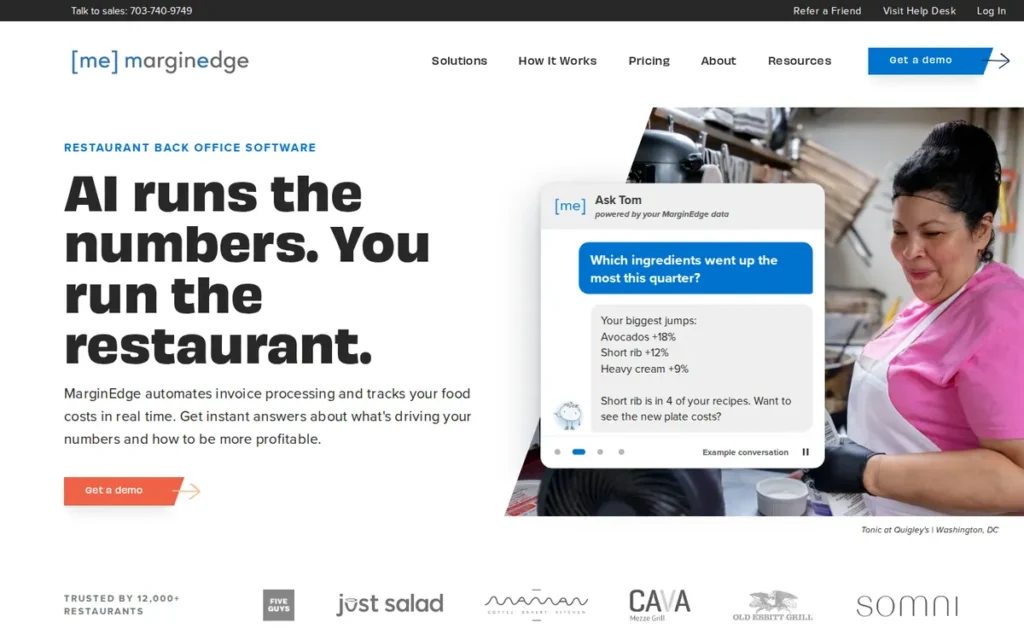
Category: Food-Cost Controller. Tracks invoices, inventory and recipe costs so operators can see and reduce food spend.
At a Glance
- Category: Food-Cost Controller
- Best For: Independent and multi-location restaurants that want invoice automation and daily food-cost visibility alongside their existing POS
- Price Range: $350 per location per month, or about $315 per month billed annually; unlimited invoices and US bill pay included; onboarding fees not verified
- Primary Strength: MarginEdge turns submitted supplier invoices into human-checked line-item cost data that feeds recipe costing and a daily controllable P&L.
- Biggest Limitation: MarginEdge has lighter inventory controls than MarketMan, and it adds a monthly cost on top of a POS and accounting system instead of replacing either one.
- One-Line Summary: MarginEdge is a restaurant back-office tool that turns supplier invoices into a daily food-cost P&L at a published $350 per location per month with no-contract monthly billing, as of November 2026.
- Last Verified: November 2026
Overview
MarginEdge is a restaurant back-office tool that turns supplier invoices into line-item cost data, recipe costing and a daily controllable P&L. It is built for independent and multi-location restaurants that want to track food cost percentage without replacing their POS or accounting software. MarginEdge connects to the systems a restaurant already uses.
Key Features
- MarginEdge reads invoices sent by photo, email, upload or EDI using AI or OCR. People then check them, with turnaround in under 24 hours.
- MarginEdge uses invoice line items to keep recipe costs current as supplier prices change.
- MarginEdge builds a daily controllable P&L that compares food cost with budget without waiting for the month-end books.
- MarginEdge includes inventory counts, order guides and unlimited bill pay for US restaurants.
- MarginEdge integrates with a restaurant’s existing POS and accounting system and does not replace either one.
Best For
MarginEdge is best for restaurants, from single independents to multi-unit groups, whose biggest food-cost problem is invoice paperwork and slow financial visibility rather than detailed inventory control.
Pricing
MarginEdge pricing as of November 2026 (MarginEdge pricing page, November 2026):
- MarginEdge costs $350 per location per month on monthly billing, which it describes as no-contract.
- Annual billing takes 10% off, which brings it to about $315 per month and saves $420 per location per year.
- MarginEdge includes unlimited invoice processing and unlimited US bill pay. Bill pay is not offered in Canada.
Capterra and older sources listed MarginEdge at $330, so the price appears to have gone up. Three locations cost $1,050 a month, on top of POS and accounting subscriptions.
Strengths
- MarginEdge has a 4.6/5 rating from 47 Capterra reviews and 4.6/5 from 31 G2 reviews. That is a high rating on lower review volume than MarketMan (Capterra and G2, November 2026).
- MarginEdge says it serves more than 12,000 restaurants in the US and Canada (MarginEdge website, November 2026; vendor-stated).
- In MarginEdge case studies, Burger 21 cut food costs by 2% and Chef Geoff’s estimated savings of “at least $40,000 a year.” Both are vendor-published and not independently audited (MarginEdge case studies, November 2026).
- A bookkeeper said MarginEdge’s line-item invoice coding “saved our office a tremendous amount of time” and called recipe costing “the coolest feature” (r/Bookkeeping, 2025).
- MarginEdge publishes one per-location price that includes unlimited invoices, and it offers no-contract monthly billing (MarginEdge pricing page, November 2026).
This aligns with community sentiment on r/restaurateur:
“I had toast also, can confirm ME worked well with it. Iit does update my recipe costs and had price alerts.” Posted by u/seekdave49
Takeaway: MarginEdge delivers the recipe-cost updates and price alerts it advertises, and operators running Toast report that the integration works reliably.
Limitations
- MarginEdge gives up inventory depth in exchange for invoice and P&L automation. G2 comparisons describe its inventory controls as lighter than MarketMan’s or Craftable’s (G2, November 2026).
- One operator called MarginEdge “a Corolla” next to Craftable’s “Cadillac,” while noting that MarginEdge is easy to deploy (r/restaurantowners, 2024).
- MarginEdge reviewers report delayed invoice posting, slow payments to vendors and trouble getting at raw data (Capterra, November 2026).
- One bookkeeper said MarginEdge can turn into “a lot of manual cleanup work” unless managers and chefs use it properly (r/Bookkeeping, 2025).
- MarginEdge’s bill pay works only in the US, not Canada, and onboarding and integration fees were not verified (MarginEdge pricing page, November 2026).
Verdict
MarginEdge is the food-cost tool in this review with a single published per-location price ($350 per month as of November 2026) and no-contract monthly billing, built for restaurants that want invoice automation and a daily P&L.
Restaurants that need deep par-level ordering should compare MarginEdge with MarketMan. A single small location should first check whether spreadsheets or its POS’s inventory features are enough.
3. MRPeasy: Best for Small Batch Food Manufacturers Needing Affordable Lot Traceability
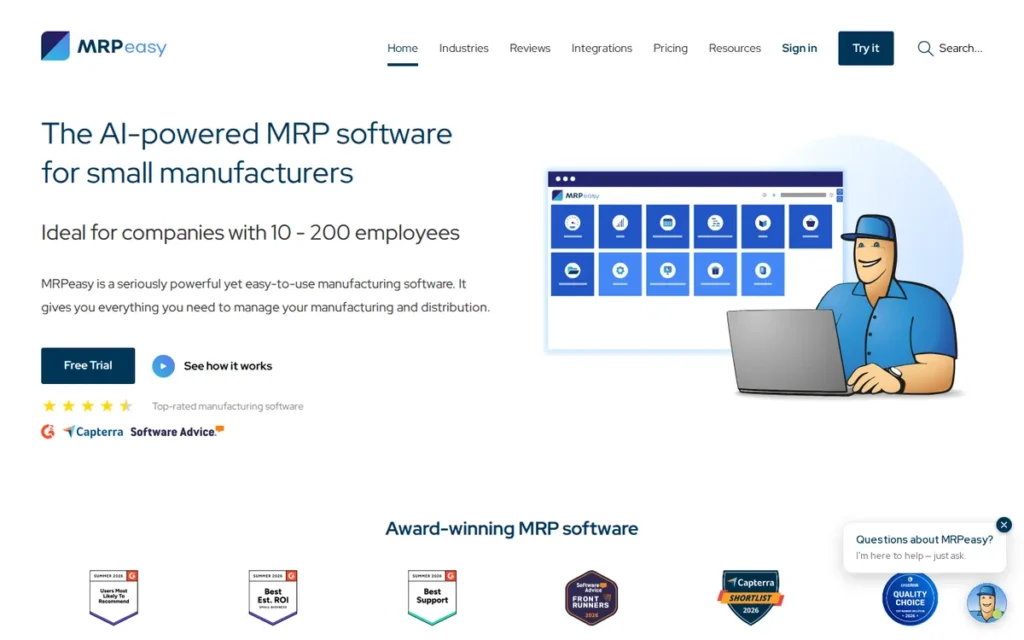
Category: Production Planner (Manufacturing ERP/MRP). Plans batches, manages recipes as bills of materials and tracks ingredient lots from supplier to finished product.
At a Glance
- Category: Production Planner (Manufacturing ERP/MRP)
- Best For: Small batch food manufacturers that need affordable lot traceability and production planning without an enterprise ERP
- Price Range: $49–$149 per user per month; lot traceability on every plan; no long-term contract
- Primary Strength: MRPeasy includes lot and batch traceability on every plan, starting at $49 per user per month.
- Biggest Limitation: MRPeasy is a general manufacturing tool with no verified allergen, HACCP or FSMA 204 modules, and reviewers call its interface dated.
- One-Line Summary: MRPeasy is the most affordable verified route to lot traceability for small food manufacturers in this review, with published plans from $49 per user per month and a 4.5/5 Capterra rating from 170 reviews as of November 2026.
- Last Verified: November 2026
Overview
MRPeasy is a cloud manufacturing ERP covering production planning, multi-level bills of materials, inventory, procurement and lot traceability. It is aimed at manufacturers with up to 200 employees, including batch food producers. MRPeasy is not built specifically for food, so food-safety compliance needs a separate process.
Key Features
- MRPeasy plans production with MRP, a master production schedule and Gantt charts.
- MRPeasy manages multi-level bills of materials, which food producers can use to model recipes and sub-recipes.
- MRPeasy includes lot and batch traceability on every plan. Expiry dates, quality checks and serial numbers start at the Professional plan.
- MRPeasy includes procurement, CRM, built-in accounting and shop-floor reporting with no per-module fees.
- MRPeasy integrates with QuickBooks Online and Xero.
Best For
MRPeasy is best for small batch food manufacturers, such as sauce, bakery, snack or beverage producers, that need ingredient-lot traceability and production planning on a tight budget and can handle compliance documentation separately.
Pricing
MRPeasy pricing as of November 2026 (MRPeasy pricing page, November 2026):
- The Starter plan costs $49 per user per month and includes lot traceability.
- The Professional plan costs $69 per user per month and adds expiry dates, quality checks and serial numbers.
- The Enterprise plan costs $99 per user per month.
- The Unlimited plan costs $149 per user per month, with a minimum of 2 users.
From the 11th user on, extra seats are sold in bundles of 10 for $79 per month. MRPeasy has no long-term contract, can be cancelled at any time and offers optional annual billing.
Strengths
- MRPeasy has a 4.5/5 rating from 170 Capterra reviews (Capterra, November 2026). MRPeasy’s own site reports a 4.6/5 G2 rating, which is vendor-reported (MRPeasy website, November 2026).
- One food producer said MRPeasy’s ingredient-lot traceability supported their HACCP plan and saved time compared with paper work orders and spreadsheets. This is one reviewer’s account (Software Advice, November 2026).
- MRPeasy says more than 2,400 manufacturers use it. Food-tech company Apeel Sciences reports one-step-forward, one-step-back traceability, an unquantified result. Both claims are vendor-published (MRPeasy website, November 2026).
- MRPeasy publishes every plan price, includes lot traceability on every tier and requires no long-term contract. That is the clearest manufacturing pricing in this review (MRPeasy pricing page, November 2026).
Limitations
- MRPeasy gives up food specificity for affordability. It has no verified allergen, HACCP or FSMA 204 modules, so manufacturers facing audits may need a separate compliance tool (MRPeasy product pages, November 2026).
- MRPeasy reviewers mention an outdated interface and an iPad shop-floor screen that isn’t touch-friendly (Software Advice, November 2026).
- MRPeasy reviewers also report an awkward CRM, limited reporting by period and shallow QuickBooks Online sync (Software Advice, November 2026).
- MRPeasy’s per-user pricing adds up for larger teams. Ten users on the Professional plan cost $690 per month (MRPeasy pricing page, November 2026).
- MRPeasy’s $49 Starter plan does not include expiry dates or quality checks, so producers tracking shelf life will likely need the $69 Professional plan (MRPeasy pricing page, November 2026).
Verdict
MRPeasy has the lowest verified entry price for lot traceability in this review, at $49 per user per month with no long-term contract, which makes it the value pick for small batch food producers.
MRPeasy is a general MRP, not a food-safety platform, so traceability records alone do not make a manufacturer audit-ready. Makers who sell mostly through Shopify should compare MRPeasy with Katana Cloud Inventory.
4. MarketMan: Best for Deep Restaurant Inventory, Purchasing and Recipe Costing
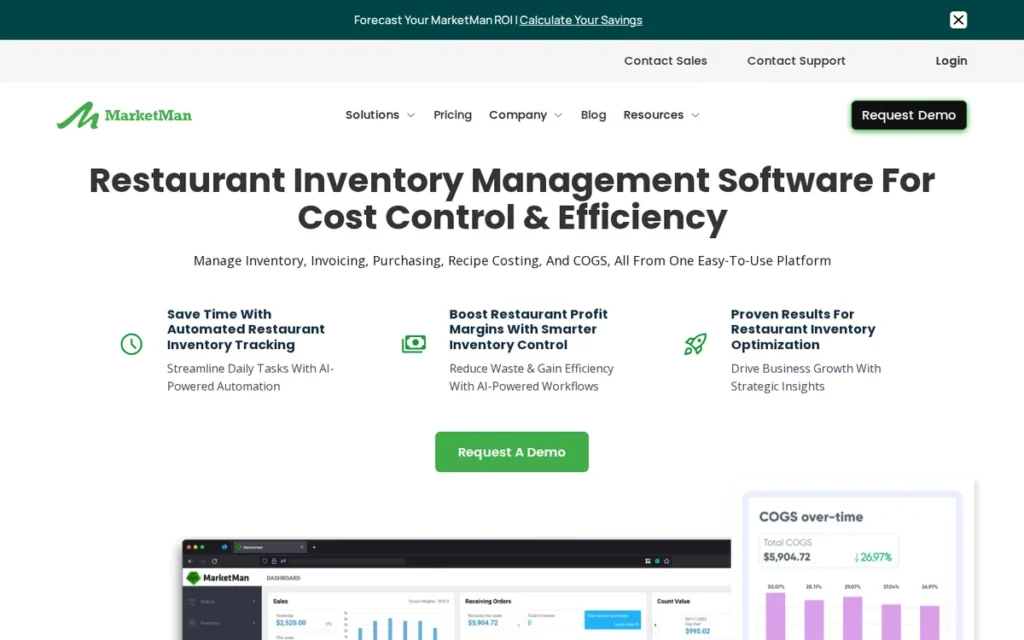
Category: Food-Cost Controller. Tracks invoices, inventory and recipe costs so operators can see and reduce food spend.
At a Glance
- Category: Food-Cost Controller
- Best For: Restaurants and hospitality groups that need detailed inventory counts, automated purchasing and actual-vs-theoretical food-cost control
- Price Range: $249–$449+ per month (per-location basis not verified)
- Primary Strength: MarketMan combines par-level ordering, vendor EDI, real-time recipe costing and actual-vs-theoretical food cost in one inventory platform.
- Biggest Limitation: MarketMan takes ongoing upkeep to run well, and reviewers report invoice-scan errors, annual-commitment disputes and price increases.
- One-Line Summary: MarketMan offers the most detailed restaurant inventory and recipe-costing controls in this review, rated 4.6/5 from 114 Capterra reviews as of November 2026, with published plans from $249 per month.
- Last Verified: November 2026
Overview
MarketMan is a restaurant inventory and purchasing platform that combines inventory counts, par-level ordering, vendor EDI, real-time recipe costing and actual-versus-theoretical food cost for restaurants that need tight control over ingredient spend. MarketMan is built for restaurants and hospitality groups and integrates with Toast, Square, QuickBooks and Xero.
Key Features
- MarketMan supports inventory counts on web, iOS and Android devices.
- MarketMan creates purchase orders automatically from par levels and connects to vendors through EDI.
- MarketMan calculates real-time recipe costs and compares actual with theoretical food cost.
- MarketMan tracks waste and scans invoices with AI, with scan limits that vary by plan.
- MarketMan includes accounts payable (AP) automation and says it charges nothing extra for POS or accounting integrations.
Best For
MarketMan is best for restaurants and multi-unit hospitality groups that have someone available to maintain inventory data and want the most detailed purchasing and food-cost controls in this review.
Pricing
MarketMan pricing as of November 2026 (MarketMan pricing page, November 2026):
- The Starter plan costs $249 per month. It includes recipe costing, actual-vs-theoretical cost, waste tracking, 1 vendor EDI connection and 50 AI invoice scans per month.
- The Growth plan costs $299 per month and adds smart ordering and unlimited invoice scans.
- The Enterprise plan starts at $449 per month and adds advanced reports, unlimited EDI and API access.
An earlier review listed MarketMan plans from $199, which suggests prices have gone up (The Restaurant HQ, 2025). MarketMan says guided onboarding and training are included (vendor-stated, November 2026). Whether pricing is per location was not verified, so get it in writing.
Strengths
- MarketMan has a 4.6/5 rating from 114 Capterra reviews, tied with MarginEdge and Jolt for the highest Capterra rating among the restaurant tools in this review (Capterra, November 2026).
- In MarketMan case studies, ATFC Ltd cut inventory-count time by 80% and Taco Del Mar lowered its cost of goods sold (COGS) by 3%. Both are vendor-published and not independently audited (MarketMan case studies, November 2026).
- MarketMan says it charges nothing extra for its Toast, Square, QuickBooks and Xero integrations (MarketMan partners page, November 2026; vendor-stated).
- One reviewer called MarketMan’s onboarding “well organised and extensive” and also said the product “can seem complex to begin with” (Capterra, November 2026).
Limitations
- MarketMan gives up simplicity for depth. One operator said keeping up with all its features “would be a full time job” (r/KitchenConfidential, 2024).
- MarketMan reviewers report invoice-scan errors, inaccurate price data and slow support (G2 and Trustpilot, November 2026).
- MarketMan reviewers also describe trouble cancelling and disputes over annual commitments (G2 and Trustpilot, November 2026).
- MarketMan’s per-location pricing basis was not verified for this review.
- MarketMan’s $249 starting price may be hard to justify for a single small kitchen, where operators recommended spreadsheets instead (r/KitchenConfidential, 2024).
Users on r/Restaurant_Managers noted:
“But I find the UI very unintuitive, the inventory aspect of it is fine but tedious like any other, and if you’re not careful and depending on how many people you have doing invoices over a long period of time you’ll have a ton of redundant (and duplicate) suppliers and SKUs that are a pain to sort through. If everything is done properly it can give you a clear overview of pricing history and costing over time but I suppose for me the biggest issue it’s just the intuitiveness (even after using it for years).” Posted by u/Sabvegas
Takeaway: MarketMan can deliver a clear pricing and costing history, but its unintuitive interface and SKU clutter frustrate even long-term users.
Verdict
MarketMan offers the most detailed inventory and purchasing controls evaluated in this review, including par-level ordering, vendor EDI and actual-vs-theoretical food cost, backed by a 4.6/5 Capterra rating from 114 reviews.
MarketMan works best when one person is assigned to maintain its data. Buyers should get cancellation terms and per-location pricing in writing before signing.
5. Toast POS: Best for Full-Service and Multi-Location Restaurants
Category: Point of Sale (POS). Runs ordering, payments and kitchen tickets at the counter, at the table and online.
At a Glance
- Category: Point of Sale (POS)
- Best For: Full-service and multi-location restaurants that need restaurant-specific workflows and will commit to a multi-year contract
- Price Range: $0 per month (Starter Kit, pay-as-you-go at about 3.09% + 15¢) or $69 per month (Point of Sale plan, processing by quote); hardware and partner integrations extra
- Primary Strength: Toast POS offers the deepest restaurant-specific feature set and the largest review base of any POS in this review.
- Biggest Limitation: Toast POS carries the highest commitment risk in this review, with multi-year contracts and early-termination fees that can reach $150 per remaining month.
- One-Line Summary: Toast POS is the most feature-rich restaurant-only POS in this review for full-service and multi-location restaurants, but its multi-year contracts and early-termination fees make it the highest-commitment POS choice as of November 2026.
- Last Verified: November 2026
Overview
Toast POS is a restaurant-only point-of-sale platform that combines front-of-house ordering, kitchen display systems, handheld and online ordering, reporting and payroll for full-service and multi-location restaurants. Toast POS runs only on Toast’s own Android hardware, not on iPads.
Key Features
- Toast POS combines front-of-house ordering, kitchen display systems and handheld tableside ordering in one restaurant-only platform.
- Toast POS includes online ordering, delivery, order-and-pay and loyalty tools.
- Toast POS offers reporting and payroll alongside the core POS.
- Toast POS provides an open developer platform and a partner marketplace, though many partner integrations charge their own subscriptions.
- Toast POS runs on Toast’s own Android handhelds, kiosks and kitchen displays, and its app does not run on iOS devices.
Best For
Toast POS is best for full-service and multi-location restaurants that need table service, kitchen routing and online ordering in one restaurant-specific system and have budgeted for a multi-year commitment.
Pricing
Toast POS pricing as of November 2026 (Toast pricing page, November 2026):
- The Toast POS Starter Kit costs $0 per month on pay-as-you-go processing of 3.09% + 15¢ in person (Toast pricing blog, November 2026).
- The Toast POS Point of Sale plan costs $69 per month for eligible new single-location customers. Its processing rate is set by quote and is commonly reported at about 2.49% + 15¢ (third-party pricing summaries, November 2026).
- Toast POS upfront costs vary with hardware and installation, and extra devices cost more.
- Toast POS’s early-termination fee can equal the remaining software fees, or $150 per remaining month on pay-as-you-go, plus financed-equipment fees (Toast Merchant Agreement, November 2026).
On pay-as-you-go terms, leaving Toast POS with 24 months remaining could cost $3,600 before any equipment balance. Ask for a written quote covering software, hardware, processing and partner integrations.
Strengths
- Toast POS has the largest review base in this review, with Capterra 4.1/5 from 555 reviews and G2 4.2/5 from 377 reviews (Capterra and G2, November 2026).
- An operator who has used Square, Clover and Toast called Toast POS “by far the most versatile” of the three and added “expensive though” (r/RestaurantSuperstar, 2024).
- Toast POS is built only for restaurants and covers front-of-house, kitchen display, online ordering, payroll and guest engagement (Toast product pages and Expert Market, November 2026).
- Toast POS offers an open developer platform and a partner marketplace for extending the system (Toast integrations blog, November 2026).
Limitations
- Toast POS gives restaurant depth in exchange for long commitments, and operators describe 2–3 year contracts (r/RestaurantSuperstar, 2024).
- Toast POS scored 81% for support quality in a G2-based comparison published by competitor SpotOn, behind Square (86%), Lightspeed (88%) and SpotOn (92%) (SpotOn, 2026).
- Toast POS has BBB complaints about billing, refunds, repairs, cancellation fees and help during outages. These are individual allegations, not a measured rate (BBB, November 2026).
- Toast POS runs only on Toast’s Android hardware, so a restaurant cannot reuse its existing iPads (Expert Market, November 2026).
- One Canadian operator said Toast POS features marketed in the US were “always ‘coming soon'” while the operator was under contract (r/toasttabcanada, 2024).
Users on r/restaurant shared their experience:
“I went through changing from Lightspeed to Toast last year. Prior to that NCR Aloha. Toast is amazing absolutely no complaints. It did take about 3 months of negotiations before I had a contract that was relatively affordable. Toast has lots of monthly fees. Don’t forget everything is negotiable and your first two offers will not be what you want.” Posted by u/trebleclefjeff
Takeaway: Operators who use Toast POS praise it, but its many monthly fees mean buyers should expect months of contract negotiation before the price becomes affordable.
Verdict
Toast POS has the deepest restaurant-specific feature set and the largest review base (555 Capterra reviews, November 2026) of any POS in this review, which makes it a strong functional fit for full-service and multi-location restaurants.
Toast POS also carries the highest contract risk of any POS evaluated. Read the Merchant Agreement’s termination terms and price every partner integration before signing. Cafés and food trucks will usually find Square for Restaurants a lower-risk fit.
6. Katana Cloud Inventory: Best for Food Makers Selling Direct-to-Consumer Through Shopify
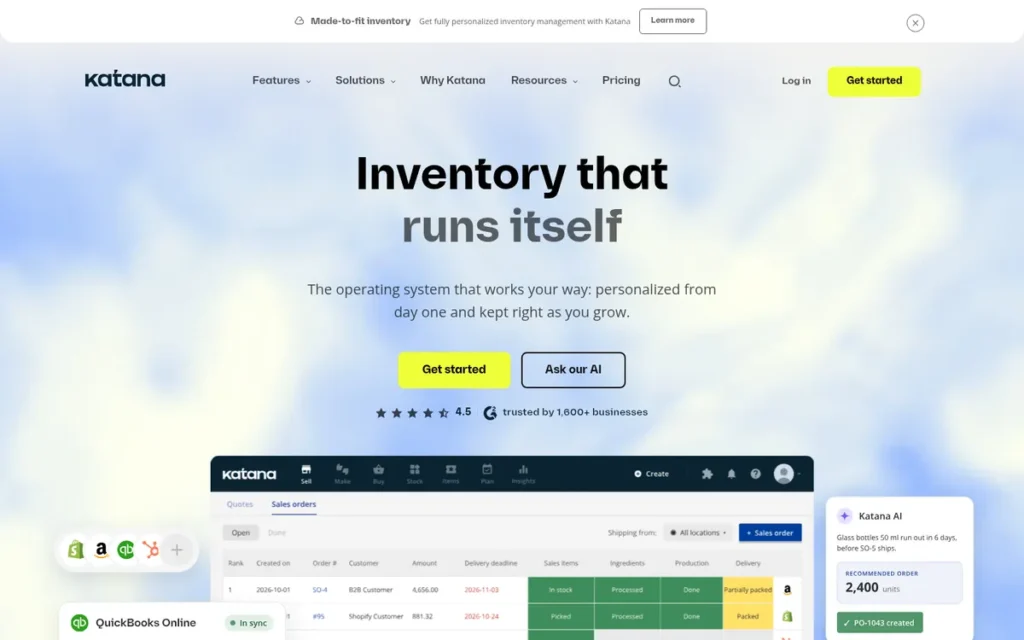
Category: Production Planner (Manufacturing ERP/MRP). Plans batches, manages recipes as bills of materials and tracks ingredient lots from supplier to finished product.
At a Glance
- Category: Production Planner (Manufacturing ERP/MRP)
- Best For: Food and beverage makers that sell direct to consumers through Shopify and want production tied to online orders
- Price Range: Pricing on request (annual contract); 2024 published plans ranged from $179 to $1,999 per month
- Primary Strength: Katana Cloud Inventory ties visual production planning and lot traceability directly to Shopify sales orders and Xero or QuickBooks accounting.
- Biggest Limitation: Katana Cloud Inventory is now quote-only on annual contracts, and long-time users report repeated price increases and features moved behind paywalls.
- One-Line Summary: Katana Cloud Inventory is a Shopify-connected manufacturing platform with lot and expiry traceability for direct-to-consumer food makers, but as of November 2026 it is quote-only on annual contracts after documented price increases.
- Last Verified: November 2026
Overview
Katana Cloud Inventory is a cloud manufacturing and inventory platform that links visual production planning, live inventory and lot traceability with expiry dates to Shopify, Xero and QuickBooks for small makers who sell online. Katana Cloud Inventory is not a dedicated food-safety or quality-management platform.
Key Features
- Katana Cloud Inventory provides visual production planning tied to live inventory and incoming sales orders.
- Katana Cloud Inventory tracks batches and lots with expiry dates, traced back to suppliers.
- Katana Cloud Inventory includes a shop-floor app for production staff.
- Katana Cloud Inventory connects to Shopify, Xero and QuickBooks.
- Katana Cloud Inventory’s current Advantage plan bundles implementation, traceability, the shop-floor app and unlimited users into one custom quote.
Best For
Katana Cloud Inventory is best for growing food and beverage makers, such as coffee roasters or specialty producers, whose sales run mainly through Shopify and who can accept a custom annual contract.
Pricing
Katana Cloud Inventory pricing as of November 2026:
- Katana Cloud Inventory currently sells a custom-quoted “Advantage” plan on an annual contract, with no published price (Katana pricing page, November 2026).
- Katana’s 2024 Starter plan cost $179 per month billed annually or $199 billed monthly (Katana pricing PDF, 2024).
- Katana’s 2024 Standard plan cost $359 per month billed annually or $399 billed monthly (Katana pricing PDF, 2024).
- Katana’s 2024 Professional and Professional Plus plans cost $799–$899 and $1,799–$1,999 per month (Katana pricing PDF, 2024).
The 2024 figures are out of date. Individual users report pricing tied to sales revenue and a lowest tier of about $4,000 a year (r/manufacturing, 2025).
Strengths
- Katana Cloud Inventory has a 4.6/5 rating from 172 Capterra reviews and 4.4/5 from 131 G2 reviews (Capterra and G2, November 2026).
- Katana Cloud Inventory says it serves more than 1,500 businesses in 70 countries. It raised a €14M Series B extension in October 2025, taking total funding above €60M (Katana newsroom, 2025).
- Hamburg producer Komali Tortillas reported about 80% better inventory control and more than 100% higher production efficiency with Katana Cloud Inventory. This is a vendor-published case study (Katana case study, November 2026).
- Raw Coffee Company (UAE) uses Katana Cloud Inventory with Shopify and Xero to manage roasting batches and expiry dates (ERP Research, November 2026).
Limitations
- Katana Cloud Inventory has moved upmarket to quote-only pricing, and long-time users report prices doubling twice (r/manufacturing, 2025).
- Users in a June 2025 r/manufacturing thread report that Katana Cloud Inventory went from $499 to $999 a month to keep API access, limits API calls to about 30 requests per minute, and raised prices 300% over six years (r/manufacturing, 2025).
- Katana Cloud Inventory reviewers say batch tracking became a paid add-on (Capterra and G2, November 2026).
- Katana Cloud Inventory reviewers on Trustpilot mention problems with support, cancellation and pricing (Trustpilot, November 2026).
- Katana Cloud Inventory has no verified FSMA 204 toolkit, and its current prices are not published (Katana pricing page, November 2026).
Verdict
Katana Cloud Inventory is the best fit in this review for food makers whose production must sync tightly with Shopify sales, with lot and expiry traceability tied to online orders.
Katana Cloud Inventory’s quote-only annual contracts and documented price increases make it riskier than MRPeasy for budget-conscious manufacturers. Get multi-year price protection and API limits in writing.
7. Jolt: Best for Multi-Unit Restaurants Needing Digital Food-Safety Records
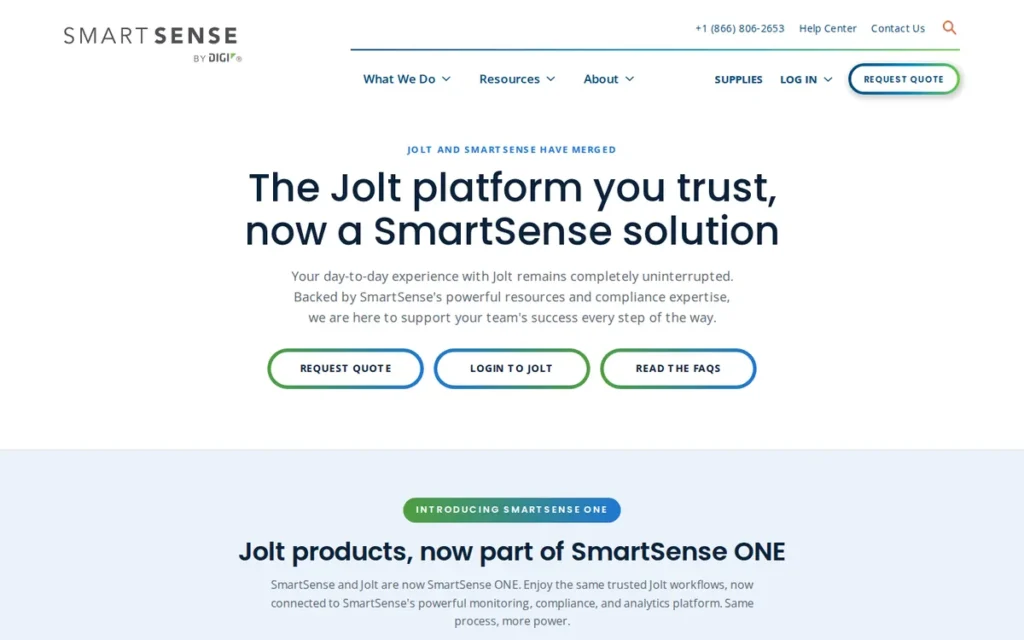
Category: Compliance Tracker (Food Safety). Records checklists, labels and temperature logs so operators can prove food-safety procedures were followed.
At a Glance
- Category: Compliance Tracker (Food Safety); part of SmartSense since August 2025
- Best For: Franchise and multi-location quick-service operators that need standardized digital food-safety checklists, prep labels and temperature logs
- Price Range: Pricing on request; one third-party quote of about $115 per month for one location on a 3-year contract
- Primary Strength: Jolt combines digital checklists, food prep and date labels, and Bluetooth temperature probes in one restaurant food-safety platform.
- Biggest Limitation: Jolt is quote-only with reported 3-year contracts, and users report slow label printing and unreliable temperature monitoring.
- One-Line Summary: Jolt is a restaurant food-safety platform that combines digital checklists, prep labels and Bluetooth temperature logging for franchise and multi-unit operators, sold quote-only with a reported 3-year contract as of November 2026.
- Last Verified: November 2026
Overview
Jolt is a restaurant food-safety and operations platform that combines digital checklists, food prep labels, Bluetooth temperature probes and cooler monitoring for franchise and multi-location operators. Jolt’s digital temperature logs help document procedures that health inspectors review. Jolt has been part of SmartSense since Digi International acquired it on August 18, 2025 (Digi International SEC filing, August 2025).
Key Features
- Jolt provides digital checklists that trigger corrective actions when a step fails.
- Jolt prints food prep and date labels through connected label printers.
- Jolt connects to Bluetooth temperature probes, including Cooper-Atkins IR and TempTest Plus models.
- Jolt monitors cooler temperatures continuously with IoT sensors.
- Jolt includes scheduling and reporting, but its scheduling has no auto-scheduling (Connecteam, November 2026).
Best For
Jolt is best for franchise and multi-unit quick-service operators that need to standardize food-safety checks, labels and temperature records across many locations and can commit to a multi-year contract.
Pricing
Jolt pricing as of November 2026:
- Jolt’s list pricing is quote-only, sold à la carte or in bundles (Jolt pricing page, November 2026).
- One third party received a Jolt quote of $115 per month for a single location, billed annually on a 3-year contract. This is one reported quote, not a list price (Connecteam, November 2026).
- Jolt buyers should run a paid pilot to test label printers and sensors before committing to a full rollout.
Strengths
- Jolt has a 4.6/5 rating from 314 Capterra reviews and 4.4/5 from 118 G2 reviews. These ratings cover the whole Jolt platform, not the food-safety module alone (Capterra and G2, November 2026).
- One restaurant manager called Jolt “the gold standard (used by McDonalds) but expensive for independents” (r/restaurantmanager, 2025).
- A February 2026 comment said Jolt has “very good sensors” and “splendid” labels and called its checklist app “okay” (r/restaurantmanager, 2026).
- A reviewer from a McDonald’s operator said Jolt caused few technical problems and put the customer’s needs first (G2, November 2026).
Limitations
- Jolt gives up price transparency for an all-in-one bundle. Its pricing is quote-only, and the one third-party quote required a 3-year contract (Connecteam, November 2026).
- Jolt reviewers allege they were billed for most of a year after they stopped using the product (Capterra, November 2026).
- Jolt reviewers also say it feels pricey for a small business and takes time to set up (Capterra, November 2026).
- Jolt app reviewers report label printing that can take minutes, app freezes and unreliable temperature monitoring (Google Play, November 2026).
- Jolt changed owners in August 2025, and SmartSense launched a combined SmartSense ONE platform in January 2026. Buyers should confirm which product, contract and pricing they are signing for (SmartSense, 2026).
Verdict
Jolt is the only restaurant food-safety tool evaluated in this review, and it combines checklists, prep labels and Bluetooth temperature logging in one platform for franchise and multi-unit operators.
Jolt’s quote-only pricing, reported 3-year contracts and hardware reliability complaints make a pilot at one or two locations essential before a full rollout. Independent cafés and single restaurants may not need this much.
What Will Food Software Actually Cost?
The real monthly cost of food software is the subscription plus the cost layers listed below. As of November 2026, four tools publish plan prices with standard rates: Square for Restaurants, MarginEdge, MarketMan and MRPeasy. Toast POS publishes plan prices but quotes its main processing rate. Katana Cloud Inventory and Jolt are quote-only.
Margins leave little room for surprise fees:
- In 2025, 42% of restaurant operators said they were not profitable (National Restaurant Association, State of the Industry 2026).
- Food and labor costs have each risen at least 35% since the pandemic (National Restaurant Association, State of the Industry 2026).
- In 2024, median pre-tax margins were 2.8% for full-service and 4% for limited-service restaurants (National Restaurant Association, State of the Industry 2026).
- More than 9 in 10 operators call costs, including card swipe fees, a significant challenge (National Restaurant Association, State of the Industry 2026).
- The USDA forecasts that food-away-from-home prices will rise 3.5% in 2026 (USDA ERS Food Price Outlook, November 2026).
Food software costs come in these layers:
- Vendors charge per location (Square, MarginEdge), per user (MRPeasy), per device (Square KDS and kiosks) or, according to users, by revenue (Katana).
- Card processing costs 2.4%–2.6% + 15¢ in person on Square’s published plans and 3.09% + 15¢ on Toast’s pay-as-you-go Starter Kit.
- Hardware costs extra: Square hardware starts at $59, and Toast requires its own Android devices.
- Many Toast marketplace partners charge their own subscriptions on top of the POS fee.
- MarketMan says onboarding is included, while MarginEdge’s onboarding fees were not verified.
- Katana Cloud Inventory and Jolt publish no current prices, so total cost is known only after a sales quote.
Sample monthly stacks, using only published prices (vendor pricing pages, November 2026):
- A single café on Square for Restaurants Plus ($49) with one KDS ($30) and MarginEdge ($350) pays $429 a month in subscriptions before card processing.
- A five-person food manufacturer on MRPeasy Professional pays $345 a month (5 × $69).
| Product | Pricing Model | Prices Published? | Contract Type | Documented Increases (Nov 2026) |
|---|---|---|---|---|
| Square for Restaurants | Per location + processing + per-device add-ons | Yes | No long-term contract | None documented |
| MarginEdge | Single per-location price | Yes | No-contract monthly; annual option | $330 → $350 |
| MRPeasy | Per user | Yes | No long-term contract; cancel anytime | None documented |
| MarketMan | Tiered plans (per-location basis not verified) | Yes, plan prices | Not verified; annual-commitment disputes reported | $199 → $249 starting price |
| Toast POS | Plan fee + hardware + processing | Partial: $0 Starter Kit and $69 POS plan published; processing rate by quote | Multi-year reported; early-termination fees | Not verified |
| Katana Cloud Inventory | Custom quote | No (2024 figures only) | Annual contract | Users report pricing doubled twice |
| Jolt | Custom quote | No | 3-year (one third-party quote) | Not verified |
Does Lot Traceability Make a Food Manufacturer Audit-Ready?
Lot traceability alone does not make a food manufacturer audit-ready. None of the small-business tools in this review has verified FSMA 204, allergen or HACCP modules out of the box. Even when an MRP traces ingredient lots, audit documentation usually needs a separate process or tool.
The FDA has proposed moving the FSMA 204 Food Traceability Rule compliance date from January 20, 2026 to July 20, 2028. Congress has directed the FDA not to enforce the rule before July 20, 2028 (FDA.gov, November 2026).
What lot traceability covers, and what it leaves out:
- MRPeasy and Katana Cloud Inventory trace ingredient lots, which supports one-up, one-back traceability and mock recalls.
- FSMA 204 also requires recording specific Key Data Elements (KDEs) at Critical Tracking Events (CTEs), such as receiving, transforming and shipping food.
- Allergen controls and HACCP records usually need a separate documentation process.
MRPeasy, for example, can show which flour lot went into which batch of bread. An FSMA 204 audit also asks for the KDEs recorded at each CTE. Manufacturers preparing for audits should have a food-safety specialist review their traceability records.
What Red Flags Should I Watch For When Evaluating Food Software?
The biggest red flags when buying food software are contract and pricing terms, not missing features. Operators in r/restaurantowners and r/manufacturing threads (2023–2025) point to lock-in, opaque pricing and fees that grow after signing. Each red flag below names the risk and gives examples from this review.
Red Flag #1: Multi-Year Contracts With Early-Termination Fees A multi-year contract with an early-termination fee can lock a business into software it no longer wants. On pay-as-you-go terms, Toast’s fee of $150 per remaining month comes to $3,600 with 24 months left, and Jolt’s one reported quote required a 3-year contract (Toast Merchant Agreement, November 2026; Connecteam, November 2026).
Red Flag #2: Quote-Only Pricing Quote-only pricing keeps buyers from comparing total cost before they enter a sales process. In this review, Katana Cloud Inventory and Jolt publish no current prices. Toast POS publishes its plan prices but quotes the processing rate on its main plan (Toast pricing page, November 2026).
Red Flag #3: Per-Order or Revenue-Based Fees Per-order or revenue-based fees grow with your sales, so success raises your software bill. Toast’s former $0.99 online-order fee drew backlash before it was removed, and Katana users report revenue-tied pricing (r/restaurantowners, 2023; r/manufacturing, 2025). Card processing on every POS also scales with sales, so compare effective rates at your volume.
Red Flag #4: Features Moved to Higher Tiers or Paid Add-Ons When features move to higher tiers after you sign, your current plan is worth less. Katana reviewers say batch tracking became a paid add-on, and one Toast user said trial features become “mandatory 6 months later” (Capterra, November 2026; r/RestaurantSuperstar, 2024).
Even published tiers gate key features. Square for Restaurants’ KDS requires Plus or Premium, and MarketMan’s Starter plan caps AI invoice scans at 50 a month (vendor pricing pages, November 2026).
Red Flag #5: Price Increases at Renewal A price increase at renewal can wipe out the food-cost savings software is supposed to deliver. This review documents several: MarginEdge rose from $330 to $350, MarketMan’s starting plan rose from $199 to $249, and users report Katana prices doubling (MarginEdge pricing page, November 2026; The Restaurant HQ, 2025; r/manufacturing, 2025).
Red Flag #6: Integrations That Carry Their Own Subscriptions Integrations that charge their own subscriptions hide part of the real monthly cost. Many Toast marketplace partners bill separately (Toast integrations blog, November 2026). MarketMan, by contrast, says it charges nothing extra for its POS or accounting integrations (MarketMan partners page, November 2026; vendor-stated). Ask every vendor for a full list of integration fees.
What Questions Should I Ask Before Choosing Food Software?
Before choosing food software, ask the eight questions below and get every answer in writing. They show whether a tool’s real cost and contract terms match the sales pitch, and whether your team can realistically run it. Each question explains what a good vendor answer should include.
Question #1: What is my total monthly cost including processing, hardware and add-ons? A complete answer adds subscription, card processing, hardware, per-device add-ons and integration fees into one monthly number. At $30,000 a month in in-person card sales, Square for Restaurants’ Free-plan rate of 2.6% comes to $780 before per-transaction fees, against a $0 software fee (Square pricing page, November 2026).
Question #2: What happens if I cancel early? A good answer names the exact early-termination fee, any financed-equipment balance and the notice period. Square for Restaurants, MarginEdge and MRPeasy offer no-contract options. Toast POS and Jolt have reported multi-year terms. Ask for the merchant agreement before signing.
Question #3: Is pricing per location, per user or per device? The pricing unit, not the headline price, decides how fast costs grow as you expand. Three restaurant locations on MarginEdge cost $1,050 a month, while a 10-person team on MRPeasy Professional costs $690 a month (vendor pricing pages, November 2026). MarketMan’s per-location basis was not verified, so ask MarketMan directly.
Question #4: Does it integrate with my POS and accounting system, and at what cost? A strong answer lists native integrations with your exact POS and accounting system, along with any fees and sync limits. Katana users report a limit of about 30 API requests per minute, and MRPeasy reviewers report shallow QuickBooks Online sync (r/manufacturing, 2025; Software Advice, November 2026).
Question #5: Can I run a trial or pilot first? A trial or pilot lets you test fit before committing. In 30 days, map 10 recipes, process one month of invoices or one production batch, and check the export format.
Square for Restaurants offers a 30-day trial on Plus and Premium, and MRPeasy and MarginEdge bill monthly with no long-term contract. For hardware-heavy tools like Jolt, ask for a paid pilot.
Question #6: Who on my team will own and maintain the data? Food-cost and inventory software works best when one person is responsible for keeping the data current. One bookkeeper said MarginEdge turns into manual cleanup without consistent staff use (r/Bookkeeping, 2025), and one operator said keeping up with MarketMan would be a full-time job (r/KitchenConfidential, 2024).
Operators also advise buyers to “ask to speak to the people who install it” (Reddit restaurant operator forums, 2023–2025).
Question #7: Does lot traceability here meet my audit requirements? Lot traceability in an MRP is not the same as audit-ready compliance. Ask whether the vendor supports allergen controls, HACCP records and the FSMA 204 Key Data Elements. If it doesn’t, plan for a separate compliance process reviewed by a food-safety specialist.
Question #8: Can I export my data if I leave? A good answer names the export formats for recipes, invoices, inventory and lot records, and confirms that export stays free after cancellation. Data access matters because Capterra reviewers report difficulty getting at MarginEdge raw data (Capterra, November 2026). Several vendors in this review also have documented cancellation disputes.
How Did We Rank These Food Software Tools?
PlugRoute scored each product from 1 to 5 on six criteria. Business-type fit, pricing transparency and contract flexibility count double. Review ratings, documented results and integration count once, for a maximum of 45. The weighting follows the reader’s main concerns: hidden costs, lock-in and buying an overkill tool.
The six ranking criteria are:
- C1: Business-Type Fit (double weight). Business-type fit matters because buyers worry about paying for an overkill tool or picking the wrong category.
- C2: Pricing Transparency and Total Cost (double weight). Pricing transparency matters because hidden fees hit restaurants running on 2024 median pre-tax margins of 2.8%–4% (National Restaurant Association, State of the Industry 2026). Published plan prices with a quote-dependent processing rate score 3.
- C3: Contract Flexibility and Commitment Risk (double weight). Contract flexibility matters because operators name multi-year contracts and termination fees as top red flags.
- C4: Review Platform Ratings and Volume. Peer ratings matter because they are the most independent sentiment signal available. A rating of 4.5 or higher with 100+ reviews scores 5, and the same rating with fewer than 100 reviews scores 4.
- C5: Documented Results and Adoption Evidence. Documented results matter because buyers want proof of gains. No product scored 5, because none has independently audited outcome data.
- C6: Integration and Scalability. Integration matters because new tools must connect to existing POS, accounting and e-commerce systems.
| Rank | Product | C1 | C2 | C3 | C4 | C5 | C6 | Weighted Total (/45) |
|---|---|---|---|---|---|---|---|---|
| 1 | Square for Restaurants | 5 | 5 | 5 | 4 | 2 | 4 | 40 |
| 2 | MarginEdge | 4 | 5 | 5 | 4 | 4 | 4 | 40 |
| 3 | MRPeasy | 4 | 5 | 5 | 5 | 3 | 3 | 39 |
| 4 | MarketMan | 4 | 4 | 3 | 5 | 4 | 5 | 36 |
| 5 | Toast POS | 4 | 3 | 1 | 4 | 2 | 4 | 26 |
| 6 | Katana Cloud Inventory | 3 | 1 | 2 | 5 | 3 | 4 | 24 |
| 7 | Jolt | 3 | 1 | 1 | 5 | 2 | 2 | 19 |
How to Read the Scores
- The weighted total is 2 × (C1 + C2 + C3) + (C4 + C5 + C6).
- When totals tie, the product with the higher C1 + C2 + C3 subtotal ranks higher. That puts Square for Restaurants (15) above MarginEdge (14).
- Toast POS ranks fifth because of its pricing transparency (3) and contract flexibility (1) scores, which account for 6 of the 10 points it trails MarketMan by. Full-service restaurants may still find Toast POS the best functional fit.
- The overall rank measures how safely a small food business can adopt each tool. It does not claim that one category beats another.
The top pick in each category is:
- POS: Square for Restaurants (40) leads Toast POS (26).
- Food-Cost Controller: MarginEdge (40) leads MarketMan (36). Choose based on whether you need invoice automation or inventory depth.
- Production Planner: MRPeasy (39) leads Katana Cloud Inventory (24).
- Compliance Tracker: Jolt (19) was the only product researched in this category, so no head-to-head comparison was made.
PlugRoute’s evidence hierarchy:
- Vendor pages, merchant agreements and SEC filings supplied features, prices, contract terms and ownership.
- Independent reviewers supplied business-type fit.
- Review platforms supplied sentiment, always with review counts.
- Operator forums supplied lived experience.
- BBB, Trustpilot and app-store complaints supplied risk signals.
Vendor case studies, vendor-reported ratings and competitor-written comparisons are labeled inline. Missing evidence is labeled “not verified” and scored neutral-to-low for every product. Known gaps: no relevant Reddit discussion was found for MRPeasy, and the available Square for Restaurants operator quotes date from 2023.
All evidence was captured in November 2026. Dates in parentheses give the publication year for dated sources and November 2026 for undated pages.
PlugRoute has no affiliate relationships with any company listed, and rankings are determined entirely by research data and objective evaluation criteria.
Which Food Software Tools Were Not Evaluated?
This review covers seven tools, and several well-known alternatives were not evaluated. Leaving a tool out implies no judgment about its quality. Readers whose needs fall outside this shortlist should research the alternatives below using the same six criteria and the evaluation questions above.
- PlugRoute did not evaluate the POS systems Lightspeed, Clover, SpotOn, TouchBistro or Lavu.
- PlugRoute did not evaluate the food-cost and back-office tools Craftable, xtraCHEF, Restaurant365, meez or 7shifts (scheduling).
- PlugRoute did not evaluate the manufacturing tools FoodReady, Wherefour, Craftybase, Fishbowl or Unleashed.
- PlugRoute did not evaluate SafetyChain, a quality-management platform for manufacturers.
Frequently Asked Questions
What’s the difference between MarketMan and MarginEdge?
MarketMan is built for inventory depth, while MarginEdge is built for invoice automation and a daily P&L. MarketMan offers par-level ordering, vendor EDI and actual-vs-theoretical food cost from $249 per month. MarginEdge has people check submitted invoices and lists one price of $350 per location per month with no-contract monthly billing (vendor pricing pages, November 2026).
Users on r/restaurateur noted:
“Marketman has a ton of issues, but we switched from MM to ME and it was even worse. Back on MM now and it’s gotten a little better (like not deleting your entire count when you go into wifi deadzones like the freezer) We have had a lot of trial and error with Marketman but until something better comes out it feels like we’re stuck with it.” Posted by u/happyyappynappy
Takeaway: Switching between MarketMan and MarginEdge is no guaranteed upgrade, and some operators who leave MarketMan for MarginEdge end up going back.
Is Toast or Square better for my restaurant?
Square for Restaurants is usually the better fit for cafés, food trucks and quick-service restaurants, while Toast POS suits complex full-service and multi-location operations. Square publishes its rates and has no long-term contract. Toast offers deeper restaurant workflows, but operators report multi-year contracts, and early-termination fees can reach $150 per remaining month (Toast Merchant Agreement, November 2026).
How does PlugRoute determine rankings?
PlugRoute scores every product from 1 to 5 on six criteria using the same evidence rules, for a maximum of 45 points. Business-type fit, pricing transparency and contract flexibility count double. A tie goes to the product with the higher primary-criteria subtotal. Missing evidence is labeled “not verified” and scored neutral-to-low, and vendor case studies are labeled.
What Do Key Food Software Terms Mean?
Point of Sale (POS): The system that takes orders and payments at the counter, at the table or online. A POS is usually the first food software a restaurant buys, and its contract terms affect every tool added later.
Kitchen Display System (KDS): A kitchen screen that shows and routes order tickets instead of printed slips. KDS screens are often priced per device, which adds to the monthly cost.
Card Processing Rate: The percentage plus fixed fee charged on each card payment, such as 2.5% + 15¢. At $30,000 a month in card sales, a 2.6% rate comes to $780 before per-transaction fees, which can be more than the software subscription.
Early-Termination Fee: A charge for cancelling a contract before its term ends. Buyers should know this figure before signing, because it decides how expensive it is to switch tools.
Recipe Costing: Working out what each menu item costs to make based on current ingredient prices. Recipe costing shows which dishes are underpriced as supplier costs rise.
Actual vs. Theoretical Food Cost: A comparison of what you actually spent on ingredients with what your recipes say you should have spent. The gap points to waste, over-portioning or theft.
Par Level: The minimum stock of an item you want on hand before reordering. Software that orders automatically from par levels reduces both stockouts and over-ordering.
EDI (Electronic Data Interchange): A direct electronic link for sending orders and invoices between a business and its suppliers. EDI cuts manual data entry and invoice errors.
Controllable P&L: A profit-and-loss view limited to the costs managers can influence, such as food and labor. A daily controllable P&L lets operators act before the month-end books close.
Bill of Materials (BOM): A structured list of the ingredients and quantities needed to make a product. Food manufacturers use BOMs to model recipes and plan purchasing.
Lot Traceability: The ability to trace each ingredient batch forward to finished products and back to suppliers. Lot traceability is essential for recalls, but on its own it does not make a business audit-ready.
HACCP (Hazard Analysis and Critical Control Points): A food-safety framework for identifying hazards and controlling them at specific steps. Buyers facing audits should check whether a tool supports HACCP records or needs a separate process.
Which Food Software Tool Is Right for You?
Key Insights
- The right food software depends on which of four jobs you need done: POS, food-cost control, production planning or food-safety compliance. Choose the category first. Then compare total cost and contract terms, because those two factors separated the top-ranked tools from the rest of this review.
- Contract terms separate the leaders from the laggards in food software more than features do. The three highest-scoring tools in this review all offer month-to-month or no-contract terms.
- Square for Restaurants is the lowest-risk POS start for cafés, food trucks and quick-service restaurants, with a $0 plan and no long-term contract as of November 2026.
- MarginEdge suits restaurants that mainly need invoice automation and a daily P&L, while MarketMan suits restaurants that need deep inventory control and par-level purchasing.
- MRPeasy is the most affordable verified route to lot traceability for small food manufacturers in this review, from $49 per user per month with no long-term contract.
- Toast POS and Jolt fit complex or multi-unit operations, but they carry the highest commitment risk in this review.
If you run a single café or food truck, start with Square for Restaurants and a spreadsheet. Add a Food-Cost Controller once your invoice volume justifies $250–$350 a month. If you manufacture, pair an MRP like MRPeasy with a compliance process reviewed by a food-safety specialist.
Pricing models are changing quickly, and several vendors are moving to quotes and annual contracts, so recheck pricing before every renewal. For more rankings built on the same methodology, see PlugRoute’s other independent software reviews. We update this guide quarterly. Last updated: November 2026.