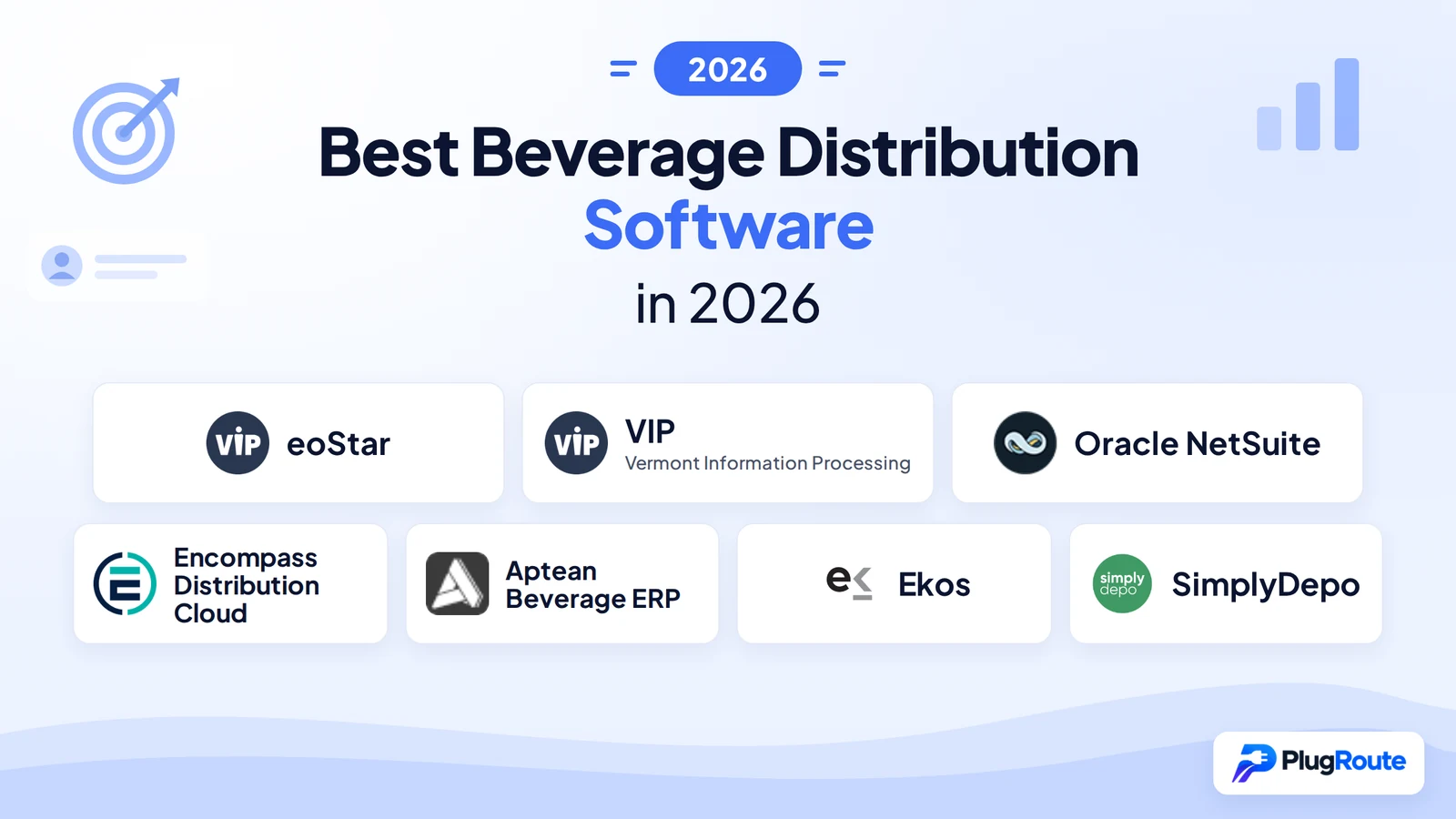
The best beverage distribution software in 2026 is eoStar for route accounting and warehouse automation, VIP (Vermont Information Processing) for supplier data and depletion reporting, and Oracle NetSuite for mid-size distributors with heavy finance needs. Choose a software category first, because mobile ordering apps and producer platforms are not designed to replace a beverage ERP.
Building a demo shortlist is harder than it should be. Full ERPs, field-sales apps and producer tools all use the “beverage distribution” label. Most vendors hide their pricing, and the leading beverage ERPs have almost no product reviews. Three of the leading beverage-specific ERPs (eoStar, VIP and Encompass) now share one owner.
PlugRoute has no affiliate relationships with any company listed, and rankings are determined entirely by research data and objective evaluation criteria.
“Sick of all these companies not being upfront about pricing without getting hounded by them just for inquiring.” (u/collision_bend [Source: r/TheBrewery, user report, 2023])
Takeaway: Buyers often complain about hidden pricing, so this guide labels every price reference by its source type.
What Are the 4 Categories of Beverage Distribution Software?
Beverage distribution software falls into four categories: Beverage-Specific ERPs, General/F&B ERPs, Producer Platforms and Mobile Field-Sales/DSD Front Ends. Only Beverage-Specific ERPs are built around wholesale route, warehouse and supplier workflows from end to end. Each of the other three categories covers only part of a distributor’s operation.
The seven platforms PlugRoute evaluated fit the categories like this:
- Beverage-Specific ERP: eoStar, VIP and Encompass Distribution Cloud are full back-office and route systems built for beverage wholesale.
- General/F&B ERP: Oracle NetSuite and Aptean Beverage ERP are broad business ERPs. Both need add-ons, partners or extra verification for beverage route and compliance work.
- Producer Platform: Ekos is a production-to-sales system for breweries, wineries, cideries and distilleries that self-distribute.
- Mobile Field-Sales/DSD Front End: SimplyDepo is a mobile ordering and delivery app that needs a separate back office for accounting, warehouse and compliance.
Growing distributors moving off QuickBooks can avoid a second migration by following three steps:
- A growing distributor should decide its target category first, based on whether it will need route settlement and three-tier compliance within 3 years.
- A growing distributor that will need those functions should demo a beverage-specific ERP now rather than adding a front-end app it will later outgrow.
- A growing distributor should ask each vendor for a written edition upgrade path. eoStar’s eoStarOne, which eoStar describes as an edition for growing distributors, is one example to verify.
As of November 2026, Vermont Information Processing owns all three Beverage-Specific ERPs PlugRoute ranked: eoStar, VIP and Encompass Distribution Cloud. VIP acquired eoStar from Seaport Capital in May 2022 and completed its acquisition of Encompass Technologies on September 14, 2026 [Source: Seaport Capital, news release, 2022; PR Newswire, news release, 2026].
A distributor that shortlists eoStar, VIP and Encompass Distribution Cloud as “three competing quotes” is getting three quotes from one parent company. To get a quote from a different owner, add Oracle NetSuite with a beverage add-on or another vendor outside the VIP group.
How Do the Top Beverage Distribution Software Platforms Compare at a Glance?
eoStar, VIP and Encompass Distribution Cloud are the three Beverage-Specific ERPs in PlugRoute’s 2026 ranking, and VIP owns all three. Oracle NetSuite and Aptean Beverage ERP are general ERPs that need add-ons or verification for route work. Ekos serves self-distributing producers, and SimplyDepo is a mobile front end.
| Rank | Company | Category | Best For | One-Line Summary | Key Capabilities | Primary Strength | Key Limitation |
|---|---|---|---|---|---|---|---|
| 1 | eoStar | Beverage-Specific ERP | Established wholesalers with high-volume warehouses and their own delivery routes | eoStar is a beverage-specific ERP, owned by VIP since 2022, that combines route accounting with warehouse automation. | Route accounting, route settlement, voice picking, palletization, iOS sales and delivery apps | Most quantified distributor outcomes (vendor-published) | Only 2 G2 reviews; no public pricing |
| 2 | VIP (Vermont Information Processing) | Beverage-Specific ERP | Three-tier wholesalers whose suppliers depend on depletion data | VIP is a beverage-specific ERP founded in 1972 that also owns eoStar and Encompass Technologies. | ERP, routing, inventory, financials, Supplier Reporting Services, iDIG analytics | Supplier data network that also reaches distributors on other software | No pricing, no quantified case studies, 0 G2 reviews |
| 3 | Oracle NetSuite | General/F&B ERP | Mid-size distributors with heavy finance or multi-entity needs | Oracle NetSuite is a general cloud ERP with strong financials that needs add-ons for beverage route and compliance work. | Financials, lot tracking, multi-location, CRM | Largest independent review base | No native route settlement or TTB reporting documented |
| 4 | Encompass Distribution Cloud | Beverage-Specific ERP | Cloud-first distributors that want ties to producers and retailers | Encompass Distribution Cloud is a cloud-first beverage ERP, owned by VIP since September 2026, that links distributors to producers and retailers. | Sales, routing, warehouse, finance, smartphone apps | Connected producer–distributor–retailer network | Compliance, deposits and offline behavior undocumented |
| 5 | Aptean Beverage ERP | General/F&B ERP | Microsoft-centric businesses needing excise and deposit tracking | Aptean Beverage ERP is a Business Central-based ERP with native excise, deposit and lot tracking. | Excise, deposits, pricing conditions, lot traceability | Native excise and deposit handling | Route execution undocumented; reviewers call routing inflexible |
| 6 | Ekos | Producer Platform | Craft producers that self-distribute | Ekos is a production-to-sales platform for self-distributing craft producers, not a wholesaler ERP. | Keg tracking, TTB reporting, route planning, QuickBooks sync | Keg and TTB tools for producers | Not built for three-tier wholesale fleets |
| 7 | SimplyDepo | Mobile Field-Sales/DSD Front End | Small DSD teams of about 1–15 reps on QuickBooks | SimplyDepo is a transparently priced mobile DSD app that needs a separate back office. | Order taking, offline-first routes, proof of delivery, B2B portal | Only fully public pricing | No documented warehouse, settlement, accounting or compliance features |
Which Beverage Distribution Software Should I Choose for My Use Case?
Pick beverage distribution software by your top operational priority:
- Route and warehouse efficiency points to eoStar.
- Supplier depletion reporting points to VIP.
- Multi-entity finance points to Oracle NetSuite plus a beverage add-on.
- Native excise and deposit tracking points to Aptean Beverage ERP.
- A cloud network linking producers and retailers points to Encompass Distribution Cloud.
- Self-distribution points to Ekos.
- A small DSD team on QuickBooks points to SimplyDepo.
| Your #1 Priority | Recommended Tool | Why | Acceptable Alternative |
|---|---|---|---|
| Route and warehouse efficiency at an established wholesaler | eoStar | eoStar documents route accounting, voice picking and palletization in one database. | Encompass Distribution Cloud (same owner) or Oracle NetSuite plus add-on (different owner) |
| Heavy supplier depletion reporting | VIP | VIP’s Supplier Reporting Services passes daily distributor data to suppliers. | eoStar (same owner) |
| Multi-entity finance at a mid-size distributor | Oracle NetSuite plus a beverage add-on | Oracle NetSuite has the most independently reviewed financial core in this evaluation. | Aptean Beverage ERP (different owner) |
| Native excise and deposits in a Microsoft environment | Aptean Beverage ERP | Aptean Beverage ERP natively lists excise and empty-container tracking. | Oracle NetSuite plus add-on (different owner) |
| A cloud-first producer and retailer network | Encompass Distribution Cloud | Encompass Distribution Cloud links distributors, producers and retailers on one platform. | Oracle NetSuite plus add-on (different owner) |
| Self-distribution for a craft producer | Ekos | Ekos ties keg tracking and TTB reporting to production. | SimplyDepo (front end only) |
| A small DSD team on QuickBooks | SimplyDepo | SimplyDepo offers public pricing, a 30-day trial and no setup fee. | Ekos (for producers) |
An alternative marked “same owner” is another product from the VIP group. An alternative marked “different owner” gives you a quote from a competing parent company.
What Are the 7 Best Beverage Distribution Software Platforms?
PlugRoute’s 2026 ranking of the seven best beverage distribution software platforms, by weighted score on a 1–5 scale:
- eoStar (3.78)
- VIP (3.43)
- Oracle NetSuite (3.25)
- Encompass Distribution Cloud (3.20)
- Aptean Beverage ERP (2.95)
- Ekos (2.65)
- SimplyDepo (2.40)
Every entry below uses the same structure so the platforms can be compared directly.
1. eoStar: Top-Scored for Route and Warehouse Operations at Established Wholesalers
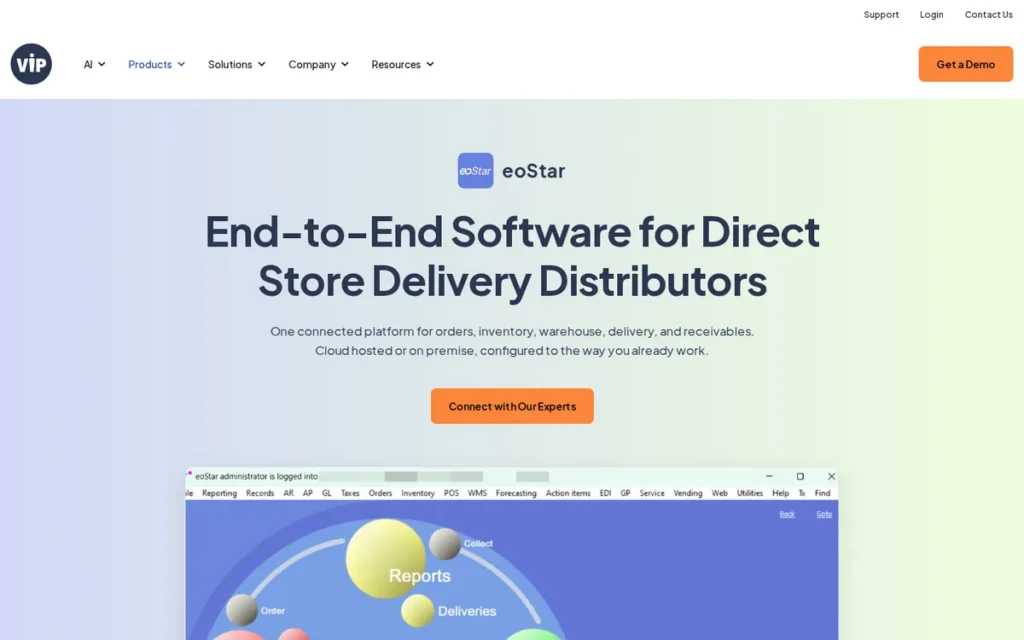
Category: Beverage-Specific ERP, a full back-office and route system built for beverage wholesale workflows.
At a Glance
- Category: Beverage-Specific ERP
- Best For: Established beer, wine, spirits and non-alcoholic wholesalers with high-volume warehouses and their own delivery routes
- Price Range: Pricing on request (from $30,000 one-time per user [Source: Capterra, directory listing, November 2026])
- Primary Strength: eoStar runs route accounting, warehouse management, voice picking and mobile delivery from a single database.
- Biggest Limitation: eoStar has only 2 product reviews on G2 and none on Capterra, so there is little independent evidence on user satisfaction.
- One-Line Summary: eoStar is a beverage-specific ERP, owned by VIP since 2022, that combines route accounting with warehouse automation and has more quantified distributor case studies than any other vendor PlugRoute evaluated.
- Last Verified: November 2026
Overview
eoStar is a beverage-specific ERP from Holland, Michigan, that runs route accounting, warehouse management, voice picking and mobile sales and delivery from one database for established wholesalers running pre-sell or driver-sell routes. eoStar was founded in 1986.
eoStar ranks first with a weighted score of 3.78 on PlugRoute’s 1–5 scale. eoStar ties VIP on workflow coverage (4.5 of 5) and leads on documented outcomes (4 of 5), but all of that outcome evidence is vendor-published. If documented outcomes were scored equally, eoStar and VIP would be effectively tied.
Key Features
- eoStar’s eoPick module provides hands-free, paperless voice picking alongside electronic picking and palletization.
- eoStar’s eoTouch suite of iOS apps supports sales and delivery with a virtual route book that shows where product goes in each store.
- eoStar’s eoTouch apps let The Beverage Works replace rugged handhelds costing $1,000+ each with iPhones and iPads [Source: eoStar, vendor-published, 2022].
- eoStar added mobile check capture to eoTouch through a partnership with FTNI [Source: PR Newswire, news release, 2022].
- eoStar supports both pre-sell and driver-sell route models in the same system.
Ownership: Vermont Information Processing (VIP) owns eoStar, acquired from Seaport Capital in May 2022, and Encompass Technologies, acquired in a deal completed September 14, 2026. VIP says each company keeps its own name and brand [Source: Seaport Capital, news release, 2022; PR Newswire, news release, 2026].
Best For
eoStar is best for established three-tier wholesalers whose largest operating costs sit in the warehouse and on the route, especially those with conveyor systems, high pick volumes or reconciliation bottlenecks.
Strengths
- eoStar’s Alliance Beverage Distributing case study reports 39% more cases picked per hour and more than 50% less warehouse breakage within 3 months [Source: eoStar, vendor-published, 2022].
- eoStar’s Andrews Distributing case study reports $75,000 less driver overtime, one day per week saved on reconciliation, and income statements in 5 days instead of 10 [Source: eoStar, vendor-published, 2022].
- eoStar’s Comer Distributing case study reports more than 90% fewer mispicks, from over 300 to about 20–25 per week, after adopting eoPick [Source: eoStar, vendor-published, 2022].
- eoStar is described as a preferred vendor for Coca-Cola North America and Molson Coors [Source: LinkedIn, company profile, accessed November 2026], though the current scope of those relationships is not verified.
Limitations
eoStar gives up independent validation in exchange for detailed vendor evidence. Every quantified eoStar outcome is vendor-published, and eoStar’s 4.8/5 G2 rating rests on just 2 reviews, one of which mentions occasional crashes [Source: G2, review platform, November 2026].
- eoStar does not publicly document keg and deposit workflows, state-by-state compliance reports or offline mobile behavior, so test each in a demo.
- eoStar’s eoTouch apps are iOS-focused, which may not suit fleets standardized on Android devices.
- eoStar’s $30,000-per-user directory figure points to a large upfront cost for small teams.
- eoStar buyers should ask how the eoStar, VIP and Encompass product roadmaps will relate, since VIP now owns all three.
- PlugRoute’s Reddit search returned no relevant eoStar discussions [Source: Reddit, PlugRoute search, November 2026].
Verdict
eoStar is the most extensively documented beverage-specific ERP for wholesalers that need route accounting and warehouse automation in one system, though all of its quantified outcomes are vendor-published.
eoStar’s pick-rate, mispick and reconciliation figures are the most specific PlugRoute found in the category. Insist on reference calls with comparable distributors and a scripted demo covering keg returns, state reports and offline sync.
2. VIP (Vermont Information Processing): Best for Supplier Data and Depletion Reporting
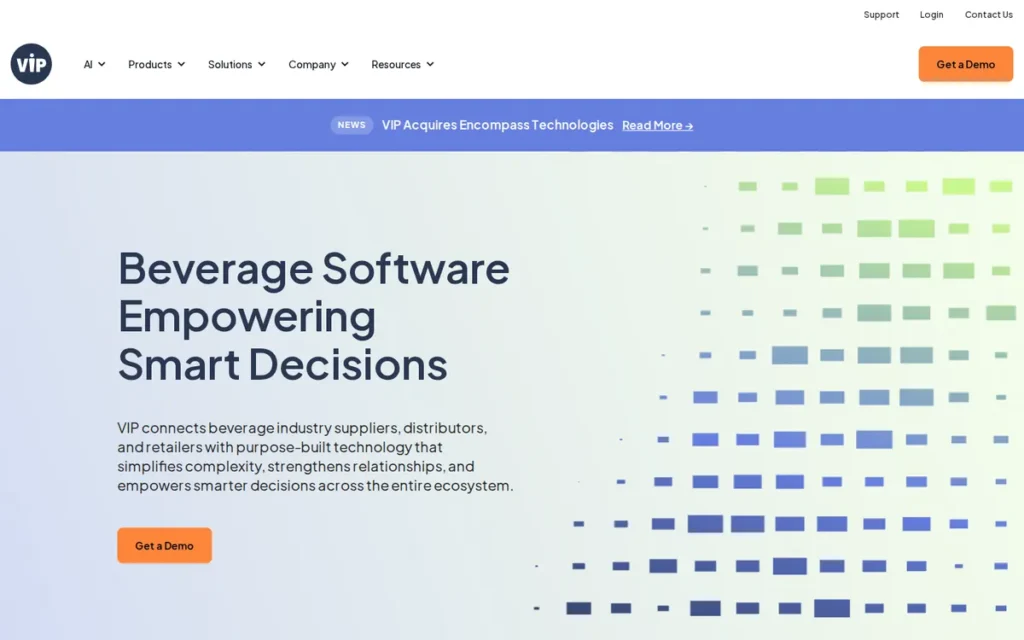
Category: Beverage-Specific ERP, a full back-office and route system built for beverage wholesale workflows.
At a Glance
- Category: Beverage-Specific ERP
- Best For: Established three-tier beer, wine and spirits wholesalers whose suppliers depend on daily depletion and sales data
- Price Range: Pricing on request (no public pricing, November 2026)
- Primary Strength: VIP pairs a beverage ERP with a supplier data network (Supplier Reporting Services and iDIG) that VIP says collects data even from distributors running other software.
- Biggest Limitation: VIP publishes no pricing and no quantified distributor case studies, and VIP has no product-level G2 reviews.
- One-Line Summary: VIP (Vermont Information Processing) is a beverage-specific ERP founded in 1972 whose Supplier Reporting Services network is its clearest differentiator, and VIP also owns eoStar and Encompass Technologies.
- Last Verified: November 2026
Overview
VIP (Vermont Information Processing) is a beverage-specific ERP and supplier data network, founded in 1972 in Colchester, Vermont, that connects routing, sales, inventory and financials for beer, wine, spirits and non-alcoholic distributors whose suppliers expect daily depletion data.
VIP ranks second with a weighted score of 3.43 on PlugRoute’s 1–5 scale. VIP scores 5 on vendor credentials and 5 on integration and growth path, but only 2 on documented outcomes, 1 on reviews and 1 on pricing transparency. The score reflects limited public evidence, not a documented product weakness.
Key Features
- VIP’s Supplier Reporting Services collects daily invoice-level sales, inventory, route and customer data from distributors and passes it to suppliers.
- VIP’s iDIG analytics shows sales, depletions, inventory and distribution, with drill-down by market, territory, chain, account and SKU.
- VIP offers KARMA, a field app for supplier sales teams.
- VIP announced VIP Intelligence, described as purpose-built AI for the beverage industry [Source: Brewbound, news release, 2026], though its feature details still need verification.
Ownership: Vermont Information Processing (VIP) owns eoStar, acquired from Seaport Capital in May 2022, and Encompass Technologies, acquired in a deal completed September 14, 2026. VIP says each company keeps its own name and brand [Source: Seaport Capital, news release, 2022; PR Newswire, news release, 2026].
Best For
VIP is best for established three-tier wholesalers with large supplier portfolios, where depletion reporting matters as much as route and warehouse operations.
Strengths
- VIP served more than 1,000 distributors and 800 suppliers as of 2019 [Source: Seven Days VT, news, 2019], the most recent published figure.
- VIP’s Supplier Reporting Services can collect data even from distributors running other software [Source: VIP, vendor-published, accessed November 2026], which makes VIP a data network as well as back-office software.
- VIP is listed with SOC 1 Type 2 and SOC 2 Type 2 certifications and NBWA Champion’s Circle participation [Source: BevIndustry, directory listing, accessed November 2026], though these listings are not audit records.
- VIP data gives Sierra Nevada a more granular view of retail sales, according to sales information manager Rhonda Swanson [Source: Vermont Business Magazine, news, 2022].
Limitations
VIP’s limitations come from how little VIP shows publicly rather than from documented failures. VIP has 0 product reviews on G2 [Source: G2, review platform, November 2026] and no quantified distributor case studies, so buyers must rely on demos and reference calls.
- VIP’s interface “feels dated” and customization “may require effort,” according to one secondary comparison summary [Source: findalternatives.net, third-party summary, accessed November 2026].
- VIP’s module-level handling of keg deposits, state reporting and offline mobile use could not be confirmed from public sources.
- VIP’s named testimonials come from suppliers, not distributors.
- VIP now owns three of the beverage-specific ERPs PlugRoute ranked, so buyers have less pricing leverage within that category and should ask which product line VIP will prioritize.
- PlugRoute’s Reddit search returned no relevant VIP discussions [Source: Reddit, PlugRoute search, November 2026].
Verdict
VIP is the longest-running beverage-specific ERP in this evaluation for three-tier wholesalers whose supplier relationships depend on daily depletion data, but VIP offers the least public evidence of any market leader.
VIP’s history since 1972, its installed base and its supplier data network make VIP a natural demo candidate for established wholesalers. Ask for distributor references, a full written quote and a scripted demo of route settlement.
3. Oracle NetSuite: Best for Mid-Size Distributors With Heavy Finance or Multi-Entity Needs
Category: General/F&B ERP, a broad business ERP that needs add-ons or partners for beverage-specific route and compliance work.
At a Glance
- Category: General/F&B ERP
- Best For: Mid-size beverage distributors with complex finance, multi-entity or multi-location needs
- Price Range: About $999–$5,000+/month base, $99–$300/user/month, plus $40,000–$60,000 implementation [Source: accounting.events, third-party estimate, 2026]
- Primary Strength: Oracle NetSuite has the most independently reviewed financial and inventory core in this evaluation.
- Biggest Limitation: Oracle NetSuite documents no native route settlement or three-tier/TTB reporting, so beverage workflows depend on add-ons or partners.
- One-Line Summary: Oracle NetSuite is a general cloud ERP with strong financials and the largest review base in this evaluation, but beverage distributors must add route settlement and three-tier compliance through add-ons or partners.
- Last Verified: November 2026
Overview
Oracle NetSuite is a general-purpose cloud ERP covering financials, inventory, lot and batch tracking, multiple locations, order management and CRM, suited to mid-size beverage distributors with heavy finance needs who will add beverage functions through add-ons. Oracle NetSuite reports 44,000+ customers [Source: NetSuite, company-reported, accessed November 2026].
Oracle NetSuite ranks third with a weighted score of 3.25 on PlugRoute’s 1–5 scale, 0.05 above Encompass Distribution Cloud. High scores for independent reviews (5), vendor scale (5) and third-party pricing data (3) offset low beverage workflow coverage (2), so the rank reflects how much evidence exists, not how well the product fits beverage work.
Key Features
- Oracle NetSuite unifies financials, inventory, order management and CRM in a single cloud database.
- Oracle NetSuite supports lot and batch tracking and multiple locations natively.
- Oracle NetSuite offers warehouse management as a separately licensed Oracle module.
- Oracle NetSuite can be extended for beverage workflows through add-ons such as Crafted ERP and OrchestratedBEER, or through implementation partners.
- Oracle NetSuite running the Crafted ERP add-on removed manual inventory processes across 5 sites and 75+ vessels at August Schell Brewing [Source: ERP Research, vendor-ecosystem source, accessed November 2026].
Ownership: Oracle owns NetSuite, which Oracle acquired in 2016 for about $9.3 billion [Source: SEC, regulatory filing, 2016].
Best For
Oracle NetSuite is best for mid-size distributors whose main pain points are multi-entity accounting and financial reporting, and whose route execution can run through an add-on.
Strengths
- Oracle NetSuite holds 4.3/5 from 445 ratings on Gartner Peer Insights and 4.1/5 from 5,258 reviews on G2 [Source: Gartner Peer Insights and G2, review platforms, November 2026].
- Oracle NetSuite helped an unnamed U.S. wine and spirits distributor cut manual data entry by 80% and speed up invoice processing by 50% [Source: dotSolved, partner-published, accessed November 2026].
- Oracle NetSuite let Select Wines, a Northern Virginia craft beer and fine wine distributor, end manual inventory counts [Source: NetSuite, vendor-published, accessed November 2026].
- Oracle NetSuite reviewers praise its flexibility, customization and single source of financial truth [Source: G2, review platform, November 2026].
Limitations
Oracle NetSuite gives up beverage-specific depth in exchange for financial breadth. Oracle NetSuite documents no native route settlement, route accounting or three-tier/TTB reporting, so choosing the add-on or partner is part of choosing the product.
- Oracle NetSuite outcomes depend on the implementation partner. One r/Netsuite user said none of the partners they tried came on site to learn their workflows [Source: r/Netsuite, user report, 2024].
- One r/Netsuite user reported that Oracle NetSuite licenses could not be downgraded once purchased, and that the Mid-Market edition cost almost twice as much as Small Business [Source: r/Netsuite, user report, 2022]. Confirm downgrade rights in writing.
- Oracle NetSuite reviewers report a steep learning curve, complex setup, slowness with large data sets, and add-ons and renewals that raise costs [Source: G2, review platform, November 2026].
This aligns with community sentiment on r/Netsuite:
“Partners who specialize are worth going with. Look for partners who don’t seem to do much outside your industry. Not always easy but for example, BlueCollar only does construction so all their people already know your industry. Paapri is one that focuses on manufacturing, etc.” Posted by u/TheGenusHomo
Takeaway: Oracle NetSuite buyers get better results from implementation partners that specialize in their industry, so beverage distributors should favor partners with proven beverage experience over generalists.
Verdict
Oracle NetSuite is the most-reviewed financial core in this evaluation, but Oracle NetSuite does not work as a beverage distribution system until add-ons or partners supply route settlement and three-tier compliance.
Mid-size distributors should shortlist Oracle NetSuite together with its beverage add-on and evaluate the two as one solution. Route-heavy wholesalers should demo route settlement before anything else.
4. Encompass Distribution Cloud: Best for Cloud-First Distributors Wanting a Connected Network
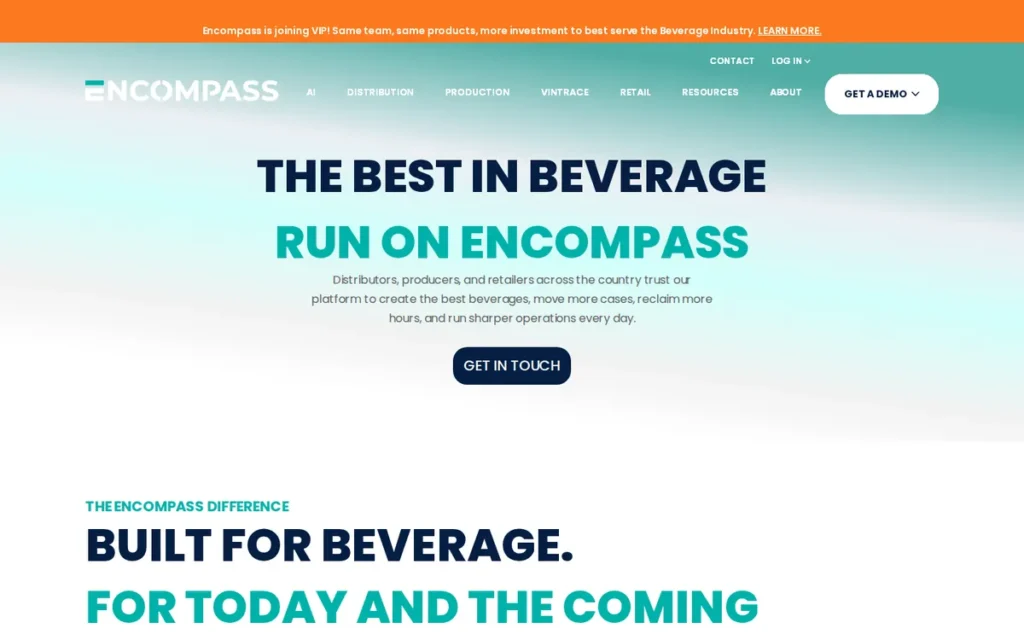
Category: Beverage-Specific ERP, a full back-office and route system built for beverage wholesale workflows.
At a Glance
- Category: Beverage-Specific ERP
- Best For: Mid-size and large beverage distributors that want a cloud-first platform connected to producers and retailers
- Price Range: Pricing on request (only historical figure: $50,000–$500,000 initial subscription [Source: BizWest, historical, 2011])
- Primary Strength: Encompass Distribution Cloud connects distributor operations with producers and retailers on one cloud platform.
- Biggest Limitation: Encompass Distribution Cloud does not publicly document keg and deposit handling, state compliance reports, supplier EDI or offline mobile behavior.
- One-Line Summary: Encompass Distribution Cloud is a cloud-first beverage ERP, owned by VIP since September 2026, that reports serving 660 distributors and links them to producers and retailers.
- Last Verified: November 2026
Overview
Encompass Distribution Cloud is a beverage-specific cloud ERP from Encompass Technologies that combines sales, routing and logistics, warehouse, inventory, finance and reporting for distributors who want one platform linking them to producers and retailers. Encompass Technologies was founded in 2001 in Fort Collins, Colorado.
Encompass Distribution Cloud scores 3.20 on PlugRoute’s 1–5 scale, 0.05 below Oracle NetSuite’s 3.25. Encompass Distribution Cloud still fits route-running distributors better because it documents routing natively. The score is held back by qualitative-only outcomes (2) and historical-only pricing (1).
Key Features
- Encompass Distribution Cloud covers sales, routing and logistics, warehouse, inventory, finance and reporting in one cloud ERP.
- Encompass Distribution Cloud’s mobile sales and delivery apps ran on ordinary smartphones rather than rugged handhelds [Source: BizWest, historical, 2011]. Confirm current device support in a demo.
- Encompass Routing offers map-based account planning and live inventory, according to G2 reviewers [Source: G2, review platform, November 2026].
- Encompass Distribution Cloud connects distributors, producers and retailers on a network that the company says handles $1.5 billion in retail transactions each month [Source: Encompass, company-reported, accessed November 2026].
- Encompass Technologies merged with Orchestra Software in 2020 [Source: PR Newswire, news release, 2020] and acquired vintrace winery software in 2022 [Source: Wikipedia, secondary source, accessed November 2026].
Ownership: Vermont Information Processing (VIP) owns eoStar, acquired from Seaport Capital in May 2022, and Encompass Technologies, acquired in a deal completed September 14, 2026. VIP says each company keeps its own name and brand [Source: Seaport Capital, news release, 2022; PR Newswire, news release, 2026].
Best For
Encompass Distribution Cloud is best for distributors that want a cloud-first, all-in-one beverage platform and value connections to producers and retailers more than on-premise control.
Strengths
- Encompass Technologies reports serving 660 distributors, more than 2,000 producers and more than 562,000 retailers [Source: Encompass, company-reported, accessed November 2026].
- Encompass Routing holds 4.3/5 from 5 G2 reviews and the Encompass Technologies seller page holds 4.0/5 from 16 [Source: G2, review platform, November 2026], with praise for easy routing and live inventory.
- Encompass Distribution Cloud was more user-friendly than Orchestrated Beer while still powerful, according to one brewery user [Source: r/TheBrewery, user report, 2023; paraphrased].
- Encompass Technologies helped New Belgium Brewing replace handwritten invoices and improve route efficiency after it adopted the software in 2008 [Source: BizWest, historical, 2011]. No figures were published, and the account may not reflect the current product.
Limitations
Encompass Distribution Cloud covers a broad platform but documents little of it in detail. Keg and deposit workflows, state compliance reports, supplier EDI transaction sets and offline mobile behavior are not publicly documented, so each one must be proven in a demo.
- Encompass migration was not plug-and-play, according to brewery users who also cited features “still in development” and undertrained support [Source: r/TheBrewery, user report, 2023; paraphrased].
- Encompass Technologies had not announced integration milestones or migration plans under VIP [Source: IN Food, news, 2026], so get written commitments on Distribution Cloud’s support timeline.
- Encompass review data is split across a seller page, a routing page and a Distribution Cloud product page with 0 reviews.
Verdict
Encompass Distribution Cloud is a cloud-first beverage ERP built around a producer–distributor–retailer network, but buyers should budget extra time for migration and verify its undocumented compliance and deposit workflows.
Encompass Distribution Cloud’s reported scale and smartphone apps make the platform a strong demo candidate for cloud-first distributors. Focus reference calls on migration experience and how quickly support responds.
5. Aptean Beverage ERP: Best for Microsoft-Centric Businesses Needing Excise and Deposits
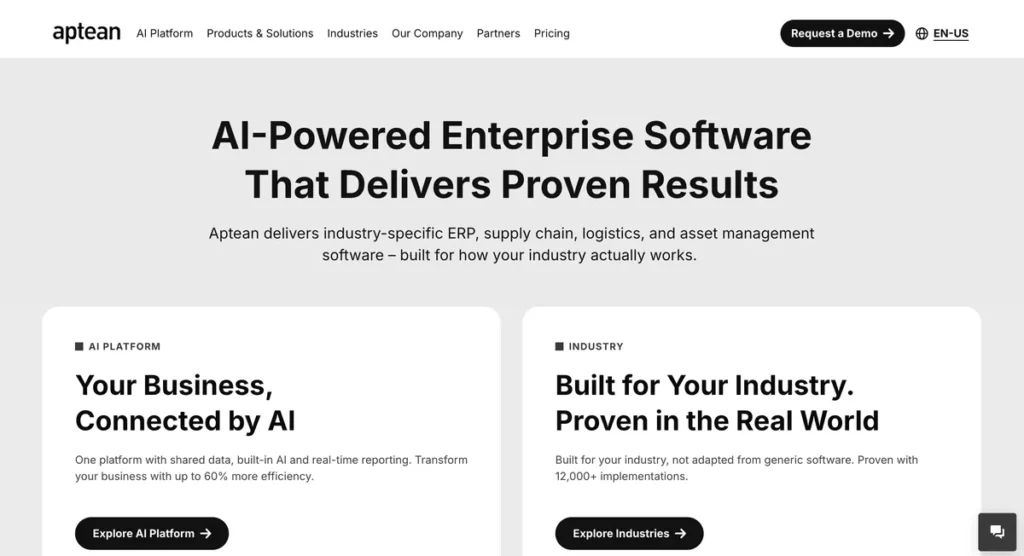
Category: General/F&B ERP, a broad business ERP that needs add-ons or partners for beverage-specific route and compliance work.
At a Glance
- Category: General/F&B ERP
- Best For: Mid-size beverage businesses invested in Microsoft that put excise, deposits and lot traceability ahead of route execution
- Price Range: Pricing on request (no public pricing, November 2026)
- Primary Strength: Aptean Beverage ERP natively lists excise management and empty-container and deposit tracking on Microsoft Dynamics 365 Business Central.
- Biggest Limitation: Aptean Beverage ERP does not document route planning, proof of delivery or driver apps, and reviewers call its delivery-route features inflexible.
- One-Line Summary: Aptean Beverage ERP is a Microsoft Dynamics 365 Business Central-based ERP that natively handles excise, deposits and lot traceability but documents little about route execution.
- Last Verified: November 2026
Overview
Aptean Beverage ERP is a food-and-beverage ERP built on Microsoft Dynamics 365 Business Central that natively lists excise management, empty-container and deposit tracking, pricing conditions and lot traceability for mid-size beverage businesses already using Microsoft tools. Aptean Beverage ERP features vary by edition across a product family that includes JustFood.
Aptean Beverage ERP ranks fifth with a weighted score of 2.95 on PlugRoute’s 1–5 scale. Aptean Beverage ERP scores 4 on review evidence and 4 on vendor scale. Route execution is undocumented, and its quantified outcomes come from the food sector.
Key Features
- Aptean Beverage ERP includes automated excise and tax management.
- Aptean Beverage ERP tracks empty containers and deposits natively.
- Aptean Beverage ERP supports sales and purchase pricing conditions and contract management.
- Aptean Beverage ERP includes a packaging module, lot traceability, quality management and warehousing.
- Aptean Beverage ERP fits into the Microsoft ecosystem through its Dynamics 365 Business Central foundation.
Ownership: Aptean is privately held by an investor group led by TA Associates, with Insight Partners, Clearlake Capital and Charlesbank also invested [Source: TA Associates, news release, 2025; Aptean, news release, 2024].
Best For
Aptean Beverage ERP is best for mid-size beverage businesses that use Microsoft tools and need native excise, deposit and lot-traceability handling more than advanced route settlement.
Strengths
- Aptean Food & Beverage ERP holds 4.0/5 from 50 G2 reviews and 4.4/5 from 17 Capterra reviews [Source: G2 and Capterra, review platforms, November 2026], with praise for ease of use and Microsoft integration.
- Aptean reports 10,000+ customers in 80+ countries and 3,000+ employees [Source: TA Associates, company-reported, 2025].
- Aptean Beverage ERP natively lists excise management and deposit tracking [Source: Aptean, vendor-published, accessed November 2026]. Among the seven platforms evaluated, only Aptean Beverage ERP and Ekos document deposit tracking.
- Aptean’s Schwarzbräu story describes unified financials, production, inventory and logistics at a German brewery, with no published figures [Source: Aptean, vendor-published, accessed November 2026].
- Aptean’s SunWest Foods case study reports 80% less admin time [Source: Aptean, vendor-published, accessed November 2026], though SunWest is a food company.
Limitations
Aptean Beverage ERP is stronger on compliance and traceability than on route execution. Aptean Beverage ERP does not document route planning, proof of delivery or driver apps for any specific edition.
- Aptean Beverage ERP reviewers describe inflexible delivery routes, hard-to-change reports, overloaded implementation staff and overly technical training [Source: Capterra, review platform, November 2026].
- Aptean Food & Beverage ERP reviewers cite slow support responses [Source: G2, review platform, November 2026].
- Aptean has grown through repeated acquisitions, so ask about product lineage, roadmap and how long legacy editions will be supported.
- PlugRoute’s Reddit search returned no relevant Aptean Beverage ERP discussions [Source: Reddit, PlugRoute search, November 2026].
Verdict
Aptean Beverage ERP is the only general or F&B ERP in this evaluation that natively lists excise management and deposit tracking, but route-driven distributors should verify its route execution before shortlisting it.
Aptean Beverage ERP is a credible choice for businesses built around Microsoft. Confirm which edition is being quoted and demo delivery routing in detail.
6. Ekos: Best for Craft Producers That Self-Distribute
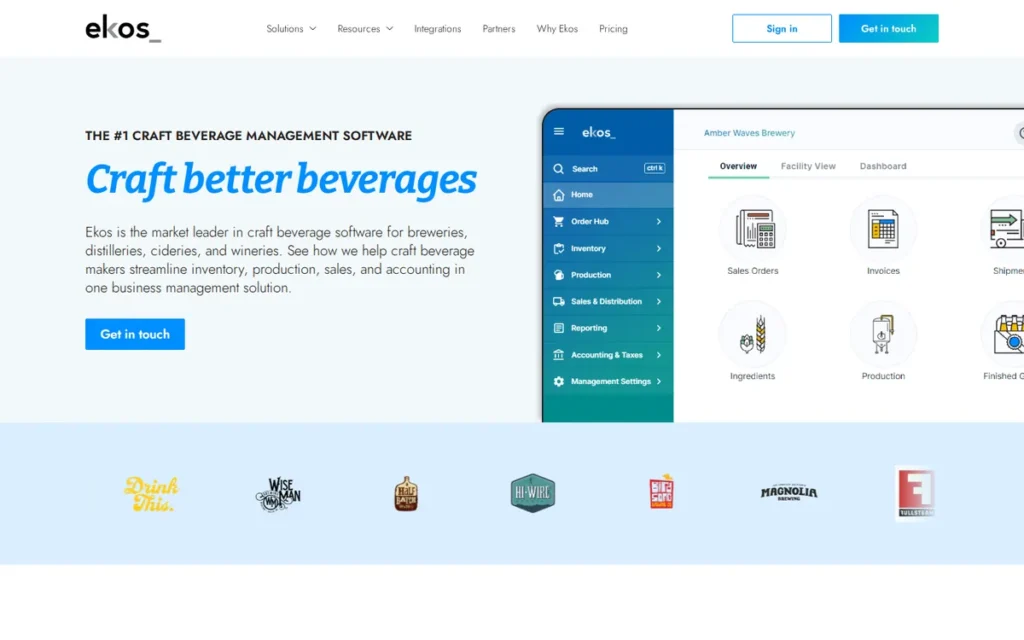
Category: Producer Platform, a production-to-sales system for beverage makers that self-distribute.
At a Glance
- Category: Producer Platform
- Best For: Craft breweries, wineries, cideries and distilleries that self-distribute
- Price Range: Custom-quoted tiers: Essentials, Plus and Professional (no public dollar amounts, November 2026)
- Primary Strength: Ekos combines keg tracking, TTB and excise reporting, and QuickBooks sync for self-distributing producers.
- Biggest Limitation: Ekos is built for producers, not for three-tier wholesalers running large delivery fleets.
- One-Line Summary: Ekos is a production-to-sales platform for craft producers that self-distribute, with keg tracking, TTB reporting and QuickBooks integration, but it is not a wholesaler ERP.
- Last Verified: November 2026
Overview
Ekos is a production-to-sales platform for breweries, wineries, cideries and distilleries that combines inventory, keg and deposit tracking, route planning, TTB and excise reporting, and QuickBooks integration for craft producers that self-distribute. Ekos was founded in 2014 in Charlotte, North Carolina, and reports a team of 50+.
Ekos ranks sixth with a weighted score of 2.65 on PlugRoute’s 1–5 scale. Ekos scores 4 on independent review evidence but only 2 on wholesale workflow coverage, because Ekos is built for producers rather than the three-tier wholesalers this guide targets.
Key Features
- Ekos tracks kegs, deposits and returns as part of its inventory management.
- Ekos generates TTB and excise reports for producers.
- Ekos provides route planning, pick lists and delivery tracking for self-distribution.
- Ekos syncs distributor invoices and sales with QuickBooks and offers an Order Hub where customers place orders online.
- Ekos added Yeast Management and Sales Forecasting at no extra cost [Source: Ekos, vendor-published, 2023].
Ownership: Ekos is privately held and backed by Catalyst Investors and Noro-Moseley Partners [Source: Ekos, company-reported, accessed November 2026].
Best For
Ekos is best for craft producers that run their own deliveries and need keg tracking and TTB compliance connected to production and QuickBooks.
Strengths
- Ekos helped Raleigh Brewing save 8 hours per week on TTB paperwork at 7,000 barrels of production [Source: Ekos, vendor-published, 2021].
- Ekos prevented the loss of about 100 kegs worth $20 each (roughly $2,000), according to an estimate by the owner of Padraigs Brewing [Source: Ekos, vendor-published, accessed November 2026].
- Ekos cut Moody Ales’ provincial distribution and excise reporting from days to minutes or hours [Source: Ekos, vendor-published, accessed November 2026].
- Ekos holds 4.3/5 from 57 Capterra reviews and 4.1/5 from 38 G2 reviews [Source: Capterra and G2, review platforms, November 2026], with praise for support and the Order Hub.
- Ekos reported 18,000+ users on 6 continents [Source: Ekos, company-reported, 2023] and made the Inc. 5000 list in 2021 and 2022.
Limitations
Ekos is built for producers, so it lacks the capabilities a wholesale fleet needs. Ekos is not designed for three-tier wholesalers running large route fleets with supplier depletion reporting.
- Ekos users report a slow or glitchy mobile app [Source: G2, review platform, November 2026].
- Ekos makes frequent UI changes that can “hide a page/button that you use nearly every day,” according to one user [Source: r/TheBrewery, user report, 2024].
- The original poster in that thread described both Ekos and Ollie as “super expensive” [Source: r/TheBrewery, user report, 2024].
- Ekos drew a complaint about a frustrating price increase [Source: Capterra, review platform, November 2026], so get renewal terms in writing.
Users on r/TheBrewery shared their experience:
“We are in process of moving out of Ekos and to Orchestrated. It is more expensive, but is also more capable. We’ve had Ekos for almost 3 years and we just got tired of fighting with every little thing that should be easy. As they have expanded, support has gotten pretty bad, too.” Posted by u/alementarybrewer
Takeaway: Long-term Ekos users have left the platform because everyday tasks took too much effort and support got worse as the company grew.
Verdict
Ekos is a well-reviewed option for craft producers that self-distribute, but Ekos is the wrong category for three-tier wholesalers.
Self-distributing producers should shortlist Ekos for its keg tracking and TTB reporting. Wholesalers who land on Ekos in search results should look at beverage-specific ERPs instead.
7. SimplyDepo: Best for Small DSD Teams Needing a Mobile Front End on QuickBooks
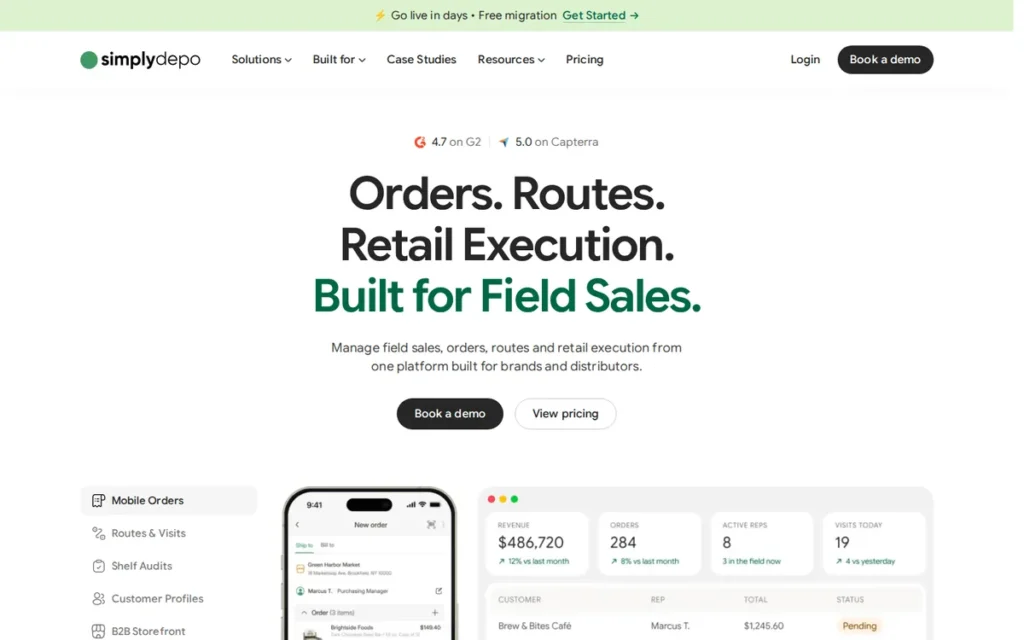
Category: Mobile Field-Sales/DSD Front End, a mobile ordering and delivery app that needs a separate back office for accounting, warehouse and compliance.
At a Glance
- Category: Mobile Field-Sales/DSD Front End
- Best For: Small beverage brands and DSD teams of roughly 1–15 reps using QuickBooks
- Price Range: $49–$69/rep/month by team size; Enterprise custom; billing basis to confirm [Source: SimplyDepo, vendor-published, November 2026]
- Primary Strength: SimplyDepo is the only vendor in this evaluation with fully public, per-rep pricing and a free trial.
- Biggest Limitation: SimplyDepo documents no warehouse management, route settlement, accounting or three-tier compliance, so SimplyDepo is not designed to replace a beverage ERP.
- One-Line Summary: SimplyDepo is a transparently priced mobile field-sales and DSD app for small beverage teams, but it is a front end that needs a separate back office, not a beverage ERP.
- Last Verified: November 2026
Overview
SimplyDepo is a mobile field-sales and direct-store-delivery app for iOS and Android that handles order taking, offline-first route planning, shelf audits, payment collection and proof of delivery for small beverage teams running QuickBooks. SimplyDepo was founded in 2022 in Brooklyn, New York.
SimplyDepo ranks seventh with a weighted score of 2.40 on PlugRoute’s 1–5 scale. SimplyDepo leads on pricing transparency (5) but scores 1 on beverage workflow coverage and 1 on vendor credentials, because SimplyDepo covers the front end of distribution, not the back office.
Key Features
- SimplyDepo supports order taking with customer-specific pricing on iOS and Android.
- SimplyDepo offers offline-first route planning for reps and drivers.
- SimplyDepo captures shelf audits, photos, payments and proof of delivery in the field.
- SimplyDepo provides a 24/7 B2B ordering portal for retail customers.
- SimplyDepo lists 100+ integrations, including QuickBooks, Acumatica and ShipStation.
Ownership: SimplyDepo is an independent startup led by founder and CEO Trent Moffat and co-founder Luke Livingston [Source: SimplyDepo, company-reported, accessed November 2026].
Best For
SimplyDepo is best for small beverage brands and DSD operations that already run their accounting in QuickBooks and need an affordable mobile ordering layer.
Strengths
- SimplyDepo publishes full per-rep pricing [Source: SimplyDepo, vendor-published, November 2026], making it the only vendor here whose cost can be modeled without a sales call.
- SimplyDepo holds 4.7/5 from 58 G2 reviews and 5.0/5 from 19 Capterra reviews [Source: G2 and Capterra, review platforms, November 2026].
- SimplyDepo’s Brooklyn Best case study reports 20% sales growth and 12 hours saved per rep per week [Source: SimplyDepo, vendor-published, accessed November 2026].
- SimplyDepo’s Gotham DSD case study reports 3x faster report generation and 95% order accuracy, and its Tenace Distribution case study reports 70% fewer order corrections [Source: SimplyDepo, vendor-published, accessed November 2026].
Limitations
SimplyDepo is fast to set up and openly priced, but it has no back office. SimplyDepo documents no warehouse management, route settlement, accounting or three-tier alcohol compliance, so distributors need separate systems for those functions.
- SimplyDepo’s offline mode did not work well in poor-service areas, according to one reviewer [Source: G2, review platform, November 2026], despite its offline-first positioning.
- SimplyDepo setup can be complex, and some reviewers call its pricing structure complicated [Source: G2, review platform, November 2026].
- SimplyDepo lists 1–10 employees [Source: LinkedIn, company profile, November 2026], so larger distributors should check support capacity.
- SimplyDepo’s high ratings come entirely from small businesses reviewing a mobile app, so do not compare them directly with ERP ratings.
- PlugRoute’s Reddit search returned no relevant SimplyDepo discussions [Source: Reddit, PlugRoute search, November 2026].
Verdict
SimplyDepo is the most transparently priced and easiest-to-trial tool in this evaluation, but SimplyDepo is a mobile front end, not a replacement for a beverage distribution ERP.
Small teams on QuickBooks can get a working field-sales layer quickly with SimplyDepo. Growing distributors should plan for the point when they need a real back office with route settlement and compliance.
Which Beverage Distribution Software Handles Route Accounting and Settlement?
eoStar is the only one of the seven platforms that PlugRoute found publicly documenting native route settlement. Oracle NetSuite relies on add-ons, and Aptean Beverage ERP leaves route execution undocumented. The other four document routing without settlement:
- VIP documents routing.
- Encompass Distribution Cloud documents routing.
- Ekos documents route planning.
- SimplyDepo documents mobile route planning.
Route settlement is the end-of-day process that ties a driver’s stops to the financial records. Between load-out and check-in, route settlement usually covers three tasks:
- Route settlement reconciles the cash and checks collected on the route.
- Route settlement trues up truck inventory against what was loaded, delivered and returned.
- Route settlement resolves overs and shorts before invoices post to the ledger.
Illustrative example (hypothetical): a driver loads 400 cases, delivers 380, brings back 15 and collects a $1,240 check against a $1,265 invoice. Route settlement has to account for the 5 missing cases and the $25 short before the invoice posts.
The table below shows what each vendor documents publicly as of November 2026. “Undocumented” means PlugRoute could not confirm the capability from public sources. It does not mean the capability is missing, so verify it in a demo.
| Capability | eoStar | VIP | Oracle NetSuite | Encompass | Aptean | Ekos | SimplyDepo |
|---|---|---|---|---|---|---|---|
| Routing/route planning | Native | Native | Add-on | Native | Undocumented | Native | Native |
| Route settlement | Native | Undocumented | Add-on | Undocumented | Undocumented | Undocumented | Undocumented |
| Warehouse/picking | Native (incl. voice picking) | Undocumented | Native (separately licensed module) | Native | Native | Native (pick lists) | Undocumented |
| Mobile pre-sell/delivery | Native (iOS) | Undocumented (KARMA is supplier-facing) | Undocumented | Native (smartphone apps) | Undocumented | Native (delivery tracking) | Native (iOS and Android) |
| Keg/deposits | Undocumented | Undocumented | Undocumented | Undocumented | Native | Native | Undocumented |
| Excise/TTB | Undocumented | Undocumented | Add-on | Undocumented | Native | Native | Undocumented |
| State reporting | Undocumented | Undocumented | Undocumented | Undocumented | Undocumented | Undocumented | Undocumented |
| Lot traceability | Undocumented | Undocumented | Native | Undocumented | Native | Undocumented | Undocumented |
| Offline mobile | Undocumented | Undocumented | Undocumented | Undocumented | Undocumented | Undocumented | Native (vendor-documented; one G2 review reports problems) |
| Supplier data/depletions | Undocumented | Native (SRS, iDIG) | Undocumented | Undocumented | Undocumented | Undocumented | Undocumented |
| QuickBooks integration | Undocumented | Undocumented | Not applicable | Undocumented | Undocumented | Native | Native |
PlugRoute found no public documentation of state-by-state compliance reporting from any of the seven vendors. Offline mobile behavior was documented only by SimplyDepo [Source: PlugRoute, vendor documentation review, November 2026]. These two gaps are the most important things to test in every demo.
Users on r/TheBrewery noted:
“My only meaningful gripe about the current ERPs on the market is how they handle yeast and excise taxes relative to COGs (yah I know taxes are not a material, but the question is ultimately “how much does this liquid cost”.
Humans are the glue that hold all of this together. Keeping my team (who are rockstars) on top of quality data entry is the biggest daily issue I have, and I cannot see how another SaaS is going to solve that.” Posted by u/silverfstop
Takeaway: Beverage ERP users say excise-tax costing and staff discipline with data entry are still weak spots, and no software fully fixes them.
What Does Beverage Distribution Software Cost in 2026?
SimplyDepo is the only one of the seven vendors that publishes full pricing, listing $49–$69 per rep per month depending on team size [Source: SimplyDepo, vendor-published, November 2026]. Every other vendor quotes prices individually, so ask each one for a written breakdown of first-year and ongoing costs.
For every vendor except SimplyDepo, buyers have to piece together directory listings, third-party estimates or historical figures. The table below labels each reference point by its source type.
| Vendor | Pricing Status | Reference Point | Source Type |
|---|---|---|---|
| SimplyDepo | Public | $49–$69/rep/month by team size (billing basis to confirm) | Vendor-published, 2026 |
| Oracle NetSuite | Quote-based | ~$999–$5,000+/month base; $40,000–$60,000 implementation | Third-party estimate, 2026 |
| eoStar | Quote-based | From $30,000 one-time per user | Directory listing (Capterra), 2026 |
| Encompass Distribution Cloud | Quote-based | $50,000–$500,000 initial subscription | Historical (BizWest), 2011 |
| Ekos | Named tiers, unpriced | Essentials, Plus, Professional | Vendor-published, 2026 |
| VIP | Quote-only | None published | Not applicable |
| Aptean Beverage ERP | Quote-only | None published | Not applicable |
Vendor-specific reference points:
- SimplyDepo lists Lean Teams (1–5 reps) at $69, Growing Teams (6–15 reps) at $59 and Scaling Teams (16–49 reps) at $49 per rep per month, with custom Enterprise pricing for 50+ reps [Source: SimplyDepo, vendor-published, November 2026].
- SimplyDepo also lists a SimplyAI add-on at $19 per rep per month, no setup fee, a 30-day free trial and a claimed 5-day launch. An $89-per-rep monthly-billing rate has also been reported, so confirm whether the listed rates assume annual or monthly billing.
- Oracle NetSuite costs about $999–$1,000 per month for Starter and $5,000+ per month for Enterprise, plus $99–$300 per user per month, according to third-party estimates. Implementation runs $40,000–$60,000 and services $145–$300 per hour [Source: accounting.events, third-party estimate, 2026].
- eoStar’s Capterra listing of $30,000 one-time per user does not say whether it covers implementation, hosting or mobile apps.
- Encompass Distribution Cloud’s only price figure is historical. A $79/month “Encompass” listing on G2 belongs to an unrelated KYC product.
- Ekos offers three named tiers (Essentials, Plus and Professional) with no public dollar amounts, so get renewal terms in writing.
- VIP publishes no pricing, so ask VIP for a quote that separates licensing, implementation, data migration, training and SRS/iDIG costs.
- Aptean Beverage ERP publishes no pricing, and one reviewer called its price “a little steep” [Source: Capterra, review platform, November 2026].
All-industry benchmarks can help set a budget. The median ERP project costs $450,000 and takes 9 months, and more than half of projects stay within budget [Source: Panorama Consulting, industry report, 2025]. These figures are not specific to beverage distribution.
As one user on r/TheBrewery described:
“Basically I need an easy to grasp/explain ROI on whatever is being measured. We recently switched from our free, but awful spreadsheet inventory system to Ollie. We were able to justify the monthly cost based on getting accurate costing data, and not losing sales based on faulty inventory data.” Posted by u/adroth90
Takeaway: Beverage software purchases get approved when buyers can tie the subscription cost to clear ROI, such as accurate costing and fewer lost sales, which makes a written total-cost-of-ownership quote essential.
The food and beverage distribution ERP market is estimated at $5.53 billion in 2026 [Source: ResearchAndMarkets, market report, 2026]. That estimate covers a different scope from DSD software market estimates, so do not add the two together.
What Red Flags Should I Watch For When Evaluating Beverage Distribution Software?
The most serious red flags are signs that a product is in the wrong category, that its ratings rest on too few reviews, or that its real cost is hidden. The six red flags below come from PlugRoute’s 2026 research across review platforms, vendor documentation and Reddit user reports.
Red Flag #1: Mobile App Sold as a Full ERP A mobile ordering or DSD app can have excellent ratings and still lack warehouse management, route settlement, accounting and three-tier compliance. Check a product’s software category before comparing its scores with full beverage ERPs.
Red Flag #2: Star Ratings Without Sample Size In beverage distribution software, a rating’s review count matters more than its star score. eoStar’s 4.8/5 rests on 2 G2 reviews, while Oracle NetSuite’s 4.1/5 rests on 5,258 [Source: G2, review platform, November 2026]. Also watch for name collisions, such as unrelated KYC and mortgage products called “Encompass.”
Red Flag #3: Route Settlement Promised Through Unnamed Add-Ons General ERPs often handle beverage route settlement through third-party add-ons or implementation partners. If the vendor cannot name the add-on and demo it live, treat route settlement as missing until proven.
Red Flag #4: No Written Total Cost of Ownership A quote-only headline price often leaves major costs out, and G2 reviewers report that add-ons and renewals substantially raise general ERP costs [Source: G2, review platform, November 2026]. Don’t advance a vendor without a written cost breakdown:
- A written quote should itemize implementation fees.
- A written quote should itemize data migration costs.
- A written quote should itemize training costs.
- A written quote should itemize integration costs.
- A written quote should state renewal escalators.
Red Flag #5: License Terms That Prevent Downgrading One r/Netsuite user reported that licenses could not be downgraded once purchased [Source: r/Netsuite, user report, 2022]. Before signing a multi-year contract, growing distributors should confirm downgrade rights, renewal escalators and discount schedules in writing.
Red Flag #6: No Distributor (Not Supplier) References Supplier testimonials show that data reaches suppliers. They don’t show that drivers, warehouse staff and finance teams work well on the system. Ask for at least two reference calls with distributors of similar size and route model, and ask each reference three questions:
- Ask each reference how long go-live took compared with the quoted timeline.
- Ask each reference how long end-of-day route settlement now takes per driver.
- Ask each reference what they would require in the contract if they bought again.
What Questions Should I Ask Before Choosing Beverage Distribution Software?
Ask every vendor the same scripted questions about route settlement, deposits, state reporting, offline behavior, lot traceability, roadmap and total cost. PlugRoute’s 2026 research found state compliance and offline behavior largely undocumented across all seven vendors, so live demos have to supply the proof.
Question #1: Can you demo a full route settlement, including cash, checks and truck inventory true-up? A credible answer is a live demo using your own sample route, from load-out through check-in to posted invoices. A slide deck is not enough.
Question #2: How do you handle keg and empty-container deposits and returns? Look for deposit tracking that flows through invoicing, returns and the general ledger. Ask to see a keg return processed during the demo.
Question #3: Which state reports does the system generate for my states? Ask for a named list of reports, with a sample output, for each state where you operate. Also ask whether the system supports state price-posting filings and supplier billbacks where your states require them.
Question #4: What happens to driver and rep apps with no signal, and how are sync conflicts resolved? Ask the vendor to switch a device to airplane mode during the demo, take an order and a delivery, then reconnect. Watch how conflicts are handled.
Question #5: How does the system trace lots across multiple warehouses? Ask for a recall-style lot trace that follows one lot from receipt through transfers to the retail accounts that received it.
Question #6: What is the roadmap and support timeline for my edition after recent acquisitions? Vendor consolidation is common in this category. VIP acquired eoStar in 2022 and Encompass Technologies in 2026, and Aptean has grown through repeated acquisitions. Ask for written commitments on how long your edition will be supported and how any migration between product lines would work.
Question #7: What are the first-year and ongoing costs, including implementation, migration, training and integrations? Ask for an itemized quote that separates licensing, implementation, data migration, training, integrations, support and renewal terms.
How Did We Rank These Beverage Distribution Software Platforms?
PlugRoute ranked these platforms with a weighted 1–5 score across six published criteria, and beverage-wholesale workflow coverage carried the most weight at 35%. Each score uses only public evidence PlugRoute could verify as of November 2026. Every data point is labeled by source type so readers can judge how reliable it is.
The six criteria and their weights:
- C1 Beverage-Wholesale Workflow Coverage (35%): C1 measures documented native route accounting, warehouse, deposits, excise, lot traceability, mobile and supplier data, because those capabilities separate a beverage ERP from a general tool.
- C2 Documented Customer Outcomes (20%): C2 scores quantified, named-customer results and caps vendor-published evidence at 4 of 5, because buyers need proof from comparable operations.
- C3 Market Adoption and Vendor Credentials (15%): C3 covers installed base, years in business, ownership and certifications, because an ERP is a commitment of 10 years or more.
- C4 Independent Review Evidence (10%): C4 scores ratings together with review volume after checking for name collisions. Samples under 10 reviews score at most 2, because small samples can mislead.
- C5 Pricing Transparency (10%): C5 awards 5 for public vendor pricing, 3 for detailed third-party estimates, 2 for a directory listing or unpriced tiers, and 1 for quote-only or historical pricing.
- C6 Integration and Growth Path (10%): C6 covers integrations, device flexibility and lock-in signals, because growing distributors want to avoid a second migration.
| Rank | Product | C1 | C2 | C3 | C4 | C5 | C6 | Weighted Score |
|---|---|---|---|---|---|---|---|---|
| 1 | eoStar | 4.5 | 4 | 4 | 2 | 2 | 4 | 3.78 |
| 2 | VIP | 4.5 | 2 | 5 | 1 | 1 | 5 | 3.43 |
| 3 | Oracle NetSuite | 2 | 3 | 5 | 5 | 3 | 4 | 3.25 |
| 4 | Encompass Distribution Cloud | 4 | 2 | 4 | 3 | 1 | 4 | 3.20 |
| 5 | Aptean Beverage ERP | 3 | 2 | 4 | 4 | 1 | 4 | 2.95 |
| 6 | Ekos | 2 | 3 | 3 | 4 | 2 | 3 | 2.65 |
| 7 | SimplyDepo | 1 | 3 | 1 | 4 | 5 | 4 | 2.40 |
Review-evidence rule: For each vendor, C4 uses the G2 pages most relevant to the product. Encompass Distribution Cloud’s own product page has 0 reviews, so its score of 3 draws on the Encompass seller page (16 reviews) and the Encompass Routing page (5 reviews). VIP has no equivalent seller-level reviews, so VIP scores 1.
Evidence labels used in this article:
- Vendor-published and company-reported evidence comes from the company’s own case studies, pages or announcements.
- Partner-published evidence comes from an implementation partner.
- A third-party estimate or directory listing comes from an independent analysis or a software directory such as Capterra.
- A historical figure is dated data that may no longer reflect the current product or price.
- An undocumented capability earns no credit, but PlugRoute does not treat it as missing.
Sensitivity notes:
- eoStar’s lead over VIP comes mostly from C2, and all of eoStar’s C2 evidence is vendor-published. With the same C2 score as eoStar (4), VIP would score 3.83 to eoStar’s 3.78, which is effectively a tie.
- Oracle NetSuite and Encompass Distribution Cloud are 0.05 apart, a statistical tie, and Encompass Distribution Cloud fits route-running distributors better.
- VIP owns eoStar (since May 2022) and Encompass Technologies (since September 2026), so three of the seven ranked products share a parent company.
Considered but not ranked:
- Cavallo, Infor CloudSuite Distribution and Acctivate appeared in the AI-engine responses PlugRoute reviewed. PlugRoute did not find verified beverage-specific documentation and ratings for them at the same depth as the ranked products.
- Pepperi, OrderEase, Orchestrated Beer, Provi and Sevendots were excluded because their domains or ratings could not be verified, or because they are mainly ordering marketplaces. Orchestrated Beer is part of Encompass Technologies, which VIP acquired in September 2026.
- PlugRoute will re-evaluate all eight products in future updates.
The Reddit research added limited evidence: 4 of PlugRoute’s 7 product-specific Reddit searches returned no relevant threads (November 2026).
PlugRoute has no affiliate relationships with any company listed, and rankings are determined entirely by research data and objective evaluation criteria.
What Do Buyers Most Often Ask About Beverage Distribution Software?
Buyers most often ask which software fits small distributors, whether VIP, eoStar and Encompass are separate companies, and how PlugRoute sets its rankings. The answers below come from PlugRoute’s 2026 evaluation of seven platforms across four software categories, with every figure dated and labeled by source type.
What is the best beverage distribution software for small distributors?
For small beverage distributors, SimplyDepo is the lowest-cost option PlugRoute evaluated, at $49–$69 per rep per month for teams on QuickBooks [Source: SimplyDepo, vendor-published, November 2026]. However, SimplyDepo does not handle route settlement, warehouse or compliance work. Small wholesalers that need a full back office should request sized quotes from eoStar, VIP or Encompass Distribution Cloud, all owned by VIP.
Are VIP, eoStar and Encompass the same company?
VIP, eoStar and Encompass Technologies share one owner but sell separate products. Vermont Information Processing acquired eoStar in May 2022 and completed its acquisition of Encompass Technologies on September 14, 2026, keeping both brands [Source: Seaport Capital, news release, 2022; PR Newswire, news release, 2026]. Ask each vendor how the three roadmaps relate.
How does PlugRoute determine rankings?
PlugRoute ranks software with a weighted 1–5 score across six published criteria, led by beverage-wholesale workflow coverage at 35%. Every data point is labeled by source type, such as vendor-published, third-party estimate or historical. Vendor-published outcomes are capped at 4 of 5, and ratings based on fewer than 10 reviews score at most 2.
What Do Key Beverage Distribution Software Terms Mean?
When you evaluate beverage distribution software, five terms matter most: route accounting, route settlement, depletion reporting, keg deposits and TTB/excise reporting. These five functions are what most often separate a beverage-specific ERP from a general ERP or a mobile ordering app.
Route accounting: Route accounting is software that tracks the money, inventory and invoices tied to each delivery route. Route accounting matters because it connects what happens on the truck to the general ledger.
Route settlement: Route settlement is the end-of-day process that reconciles cash and checks, trues up truck inventory and resolves overs and shorts after check-in. A weak route settlement process lets driver errors and losses go unnoticed.
Pre-sell and driver-sell: Pre-sell is a route model in which reps take orders ahead of time and drivers deliver later. Driver-sell is a model in which drivers sell and deliver from the truck on the same visit. Each model needs different mobile invoicing and truck-inventory workflows.
Direct store delivery (DSD): Direct store delivery is a model in which the distributor delivers straight to retail accounts, often capturing proof of delivery such as a signature or photo. DSD software must work on the route, not only in the office.
Three-tier system: The three-tier system is the U.S. alcohol structure that separates producers, wholesale distributors and retailers. Wholesaler software must support the reporting and pricing rules the three-tier system creates.
Depletion reporting: Depletion reporting shows how much of a supplier’s product has sold from the distributor to retailers. Suppliers often require depletion data daily, and many supplier agreements include it.
Keg and container deposits: Keg and container deposits are refundable charges on kegs and empty containers that must be tracked through invoicing and returns. Mishandled deposits distort both inventory and receivables.
TTB and excise reporting: TTB and excise reporting covers required tax and regulatory filings to the federal Alcohol and Tobacco Tax and Trade Bureau and state agencies. Errors can lead to penalties, so ask for sample reports.
Lot traceability: Lot traceability is the ability to follow a specific production lot from receipt through warehouses to retail accounts. Lot traceability is essential for running recalls quickly and accurately.
Electronic data interchange (EDI): Electronic data interchange is a standard format for exchanging orders, invoices and sales data between distributors, suppliers and retailers. Supplier EDI support reduces manual re-keying of order and depletion data.
Offline-first mobile: Offline-first mobile describes apps designed to keep working without a signal and sync later. Offline-first design matters for drivers and reps in rural or low-connectivity areas.
Total cost of ownership: Total cost of ownership is the full cost of software over its life, including licensing, implementation, migration, training, integrations and renewals. Comparing only license prices can understate the real cost; the median all-industry ERP project costs $450,000 [Source: Panorama Consulting, industry report, 2025].
Which Beverage Distribution Software Tool Is Right for You?
Key Insights
- Software category matters more than star ratings, because mobile apps and producer platforms are not designed to replace a beverage-specific ERP.
- eoStar, VIP and Encompass Distribution Cloud share one owner, so buyers who want quotes from competing owners should include at least one vendor outside the VIP group.
- SimplyDepo is the only evaluated vendor with fully public pricing, so you need a written total-cost-of-ownership quote from every other vendor.
- A rating’s review count matters more than its star score: eoStar’s 4.8/5 rests on 2 G2 reviews, while Oracle NetSuite’s 4.1/5 rests on 5,258 [Source: G2, review platform, November 2026].
- PlugRoute found no public documentation of state-by-state compliance reporting from any of the seven vendors, so a scripted demo with your own routes, returns and reports is the place to prove it.
Use your top pain point to choose where to start:
- Distributors that need route and warehouse automation at scale should start with eoStar and VIP, keeping in mind that both share an owner.
- Distributors whose business depends on supplier data should look closely at VIP’s Supplier Reporting Services network.
- Distributors that want cloud connections to producers and retailers should demo Encompass Distribution Cloud.
- Distributors whose main pain point is finance complexity should evaluate Oracle NetSuite together with its beverage add-on as one solution.
- Distributors outgrowing QuickBooks should choose their target category now, so a front-end tool doesn’t lead to a second migration.
Build your demo shortlist in five steps:
- Step 1 is to pick the software category that matches your operation.
- Step 2 is to shortlist 2–3 vendors, including at least one outside the VIP group if possible.
- Step 3 is to send every vendor the same seven evaluation questions.
- Step 4 is to require a written total cost of ownership from every vendor.
- Step 5 is to hold reference calls with distributors, not suppliers, of similar size and route model.
For more detail, see PlugRoute’s full scoring methodology above and PlugRoute’s other independent reviews of distribution and ERP software. We update this guide quarterly. Last updated: November 2026.