HeyGen ranked #1 for AI video dubbing of existing real-person footage, leading on phoneme-level lip-sync and ElevenLabs voice cloning across 175+ languages. Veed.io ranked #2 for all-in-one browser workflows, with auto-subtitles confirmed at $12/month (Lite) and AI dubbing at ~$24/month (Pro). The most consequential selection error: Synthesia cannot dub existing real-person footage, it creates AI avatar video from scripts only.
Most video translation reviews rank tools by affiliate revenue, not evidence, and LLM-generated comparisons confidently name Synthesia as a top dubbing tool while omitting HappyScribe, Vidnoz, and Smartcat entirely. This article covers all seven major platforms with equal editorial rigor: documented pricing, community-verified quality gaps, processing reliability failures, and billing controversies that promotional content systematically omits.
PlugRoute has no affiliate relationships with any company listed, rankings are determined entirely by research data and objective evaluation criteria.
“If it’s clean and consistent, most players don’t care, if it’s robotic, they will roast you.” (u/karthikgokul, r/GameDevelopment (January 2026))
Takeaway: Community practitioners confirm that consistency and naturalness are the simultaneous minimum quality bars for AI-dubbed video, a technically impressive but unpredictable tool fails faster in real deployment than a modest but reliable one.
Which Video Translation Tools Ranked in the Top 4 Overall?
- HeyGen ranked #1 for AI video dubbing of existing real-person footage in 2026, combining ElevenLabs voice cloning with phoneme-level lip-sync across 175+ languages and a platform track record of over 16 million translated videos (vendor-reported, 2025).
- Veed.io ranked #2 as the best-value all-in-one browser platform, with auto-subtitle workflows confirmed at $12/month (Lite) and AI dubbing plus voice cloning at ~$24/month (Pro), both price points independently confirmed in 2026 third-party sources, backed by Sequoia Capital.
- Rask AI ranked #3 as the only platform in this comparison with automated multi-speaker voice detection and cloning, SOC 2 Type II security certification (independently audited), and support for videos up to 5 hours across 130+ languages.
- HappyScribe ranked #5 as the highest-accuracy transcription-first platform, serving over 6 million users with a hybrid AI+human review workflow that achieves up to 99% precision for journalism, podcast, and broadcast content.
What Are the Categories of Video Translation Tools?
Video translation tools in 2026 fall into three distinct architectural categories. The category a tool belongs to is more consequential than any feature comparison, a buyer who selects a tool from the wrong category will discover the incompatibility only after payment.
The three categories are:
- Real-Video Dubbers: HeyGen, Rask AI, Veed.io, and Vidnoz accept existing real-person video footage as input and produce translated, lip-synced dubbed output with voice cloning, making them the architecturally compatible choice for localizing pre-recorded video content.
- Transcriber+Dubbers: HappyScribe and Smartcat lead with high-accuracy speech-to-text transcription as their primary capability, offering AI dubbing as a secondary workflow and optional human review fallback for content requiring accuracy levels that AI-only tools cannot guarantee.
- Avatar Creators: Synthesia generates entirely new AI-avatar video from text scripts and cannot process, translate, or dub existing footage of real people; buyers who need to localize pre-recorded video content must select a tool from the Real-Video Dubbers or Transcriber+Dubbers categories above.
The most consequential mistake in this category, present in every LLM-generated comparison reviewed for this article, is evaluating Synthesia as a video dubbing tool. To make this concrete: if you recorded a 10-minute product demo with your face on camera, Synthesia cannot translate that video. The output would be an entirely new video featuring one of Synthesia’s 240 AI avatars reading a translated version of your script, your face, your voice, and your recorded performance would not appear in the output at all.
What production-grade AI dubbing requires, three quality checks:
- The voice sounds like the original speaker’s natural style in the target language, not a synthetic announcer
- Lip movement stays within one half-frame of the audio throughout the full video, not just in the first 30 seconds
- A 5-minute clip in your primary target language produces consistent quality start-to-finish without degradation
Test these three standards on a free trial clip before committing to any paid plan.
How Do the Top Video Translation Tools Compare at a Glance?
| Rank | Company | Category | Best For | One-Line Summary | Key Capabilities | Primary Strength | Key Limitation |
|---|---|---|---|---|---|---|---|
| 1 | HeyGen | Dubber | Creators translating real-person footage with premium lip-sync | HeyGen is the most-cited AI video dubbing platform in 2026, having processed 16M+ videos (vendor-reported) with ElevenLabs voice cloning and phoneme-level lip-sync across 175+ languages | 175+ languages; ElevenLabs voice cloning; phoneme lip-sync; 16M+ videos processed | Phoneme-to-facial-animation mapping + ElevenLabs integration | Billing controversy confirmed across BBB, HeyGen community forums, and r/aiwars (April 2025) |
| 2 | Veed.io | Editor+Dubber | Creators wanting browser-based subtitles at $12/month; AI dubbing at ~$24/month | Veed.io is the most price-transparent all-in-one browser platform in 2026, with auto-subtitles at $12/month Lite and AI dubbing plus voice cloning at ~$24/month Pro across 125+ languages | 125+ languages (Pro); voice cloning 29 languages (Pro); subtitles $12/month Lite; browser-based | Both Lite ($12/month) and Pro (~$24/month) pricing independently confirmed in 2026 third-party sources | AI dubbing overwrites original audio; dubbing and voice cloning require ~$24/month Pro, not the $12/month Lite plan |
| 3 | Rask AI | Dubber | Marketing and eLearning teams with multi-speaker, long-form video | Rask AI is the only AI dubbing platform in 2026 with automated multi-speaker voice detection and cloning, supporting 130+ languages with SOC 2 Type II certification and videos up to 5 hours | 130+ languages; multi-speaker detection; 5-hour max; SOC 2 Type II | Only automated multi-speaker voice detection in this comparison | Processing freeze documented across 6 consecutive videos (r/videography, January 2024); ~$50/month community-sourced pricing |
| 4 | Synthesia | Avatar Creator | Enterprise L&D teams creating script-based multilingual training content | Synthesia is the leading enterprise AI avatar creation platform in 2026 with ISO 42001 certification (A-LIGN, September 2024); it cannot dub existing real-person footage | 160+ languages; 240+ AI avatars; ISO 42001 (A-LIGN, September 2024); 1-click script translation | First generative AI company with ISO 42001 certification, independently verified by A-LIGN | Cannot translate or dub existing real-person footage; avatar-only architecture |
| 5 | HappyScribe | Transcriber+Dubber | Journalists, podcasters, and media pros needing broadcast-grade accuracy | HappyScribe is the most accurate transcription-first platform in 2026, serving 6M+ users with hybrid AI+human review achieving up to 99% precision | 120–150 languages; hybrid AI+human; up to 99% accuracy; 6M+ users | 99%-ceiling hybrid AI+human review; highest accuracy in this comparison | AI drops below 85% with poor audio; human review adds $2/minute |
| 6 | Vidnoz | Dubber | Individual creators evaluating AI dubbing on a free tier | Vidnoz is the most accessible free-entry AI translation tool in 2026, offering 2,000+ voices across 140+ languages with a free tier for clips up to 90 seconds | 140+ languages; 2,000+ AI voices via ElevenLabs/Microsoft/Google APIs; free 60–90 sec per clip | Largest AI voice library in this comparison (2,000+ voices) | Opaque corporate background; no confirmed founding, funding, or headquarters as of April 2026 |
| 7 | Smartcat | Enterprise Localizer | Global enterprises requiring 280+ language coverage and SOC-III compliance | Smartcat is the broadest-coverage enterprise AI translation platform in 2026, supporting 280+ languages with SOC-III security and a human translator marketplace; Smartwords pricing charges for partial translation memory matches | 280+ languages; SOC-III; human translator marketplace; brand terminology management | 280+ languages; nearly 2x nearest competitor; with SOC-III security | Smartwords pricing charges discounted rates for partial translation memory matches (50–99% similarity); 100% perfect matches are free |
Which Video Translation Tool Should I Choose for My Use Case?
| Your #1 Priority | Recommended Tool | Why | Acceptable Alternative |
|---|---|---|---|
| Real-video dubbing with voice cloning | HeyGen | Phoneme lip-sync + ElevenLabs; 175+ languages; 16M+ videos processed | Rask AI (for multi-speaker content) |
| Auto-subtitles on a confirmed budget | Veed.io Lite | Only confirmed $12/month entry point for subtitle workflows in this comparison | HappyScribe (10-min free credit) |
| AI dubbing in a browser-based workflow | Veed.io Pro | ~$24/month for AI dubbing and 29-language voice cloning; no install required | HeyGen (for premium lip-sync quality) |
| Multi-speaker video content | Rask AI | Only platform with automated multi-speaker voice detection | HeyGen (for single-speaker quality) |
| Enterprise L&D training from scripts | Synthesia | ISO 42001 certified (A-LIGN, September 2024); 240+ avatars; 1-click 160+ language translation | HappyScribe (for transcript accuracy) |
| Journalism / podcast transcription accuracy | HappyScribe | 99%-ceiling hybrid model; 6M+ users; 10-min free credit | Smartcat (for enterprise-scale needs) |
| Free-tier evaluation on short clips | Vidnoz | 2,000+ voices; 60–90 sec free tier; zero financial commitment required | Veed.io Lite at $12/month (subtitles) |
| 280+ language enterprise localization | Smartcat | Only tool covering 280+ languages; SOC-III; human translator marketplace | HappyScribe (for smaller-scale needs) |
| You are evaluating Synthesia for dubbing existing footage | Stop; wrong tool | Synthesia cannot dub existing real-person footage; it creates AI avatar video from scripts only | For real-video dubbing: HeyGen or Rask AI |
After selecting your recommended tool, verify the applicable documented risk: Red Flag #1 for HeyGen subscribers, Red Flag #3 for Rask AI users, Red Flag #2 for Smartcat, Red Flag #4 for Veed.io dubbing workflows, Red Flag #5 for Vidnoz.
Which Video Translation Tools Offer a Genuinely Usable Free Tier?
Before evaluating any tool’s advanced features, confirm whether the free tier supports your actual workflow. “Free” conditions vary significantly across this comparison set.
| Tool | Free Tier Translation Limit | Watermark on Exports? | Commercially Usable? | Verified |
|---|---|---|---|---|
| HeyGen | Limited testing only | Watermark policy unverified; check heygen.com/pricing before evaluation | No; testing only | April 2026 |
| Veed.io | 30 min/month auto-subtitles; 1 min/month voice translation | Yes; watermarked exports | No; upgrade required | April 2026 |
| Rask AI | Not publicly confirmed | Watermark policy unverified; check rask.ai before evaluation | Not confirmed | April 2026 |
| Synthesia | Free trial access | Watermark policy unverified; check synthesia.io/pricing before evaluation | No; trial only | April 2026 |
| HappyScribe | 10 minutes (new users, one-time credit) | Watermark policy unverified; check happyscribe.com/pricing before evaluation | Limited; for quality evaluation | April 2026 |
| Vidnoz | 60–90 seconds per video clip | Watermark policy unverified; check vidnoz.com before evaluation | Limited; short clips only | April 2026 |
| Smartcat | 10,000 words/month (freelancers) | N/A; text-based platform | Limited | April 2026 |
1. HeyGen: Best Overall for AI Video Dubbing with Voice Cloning
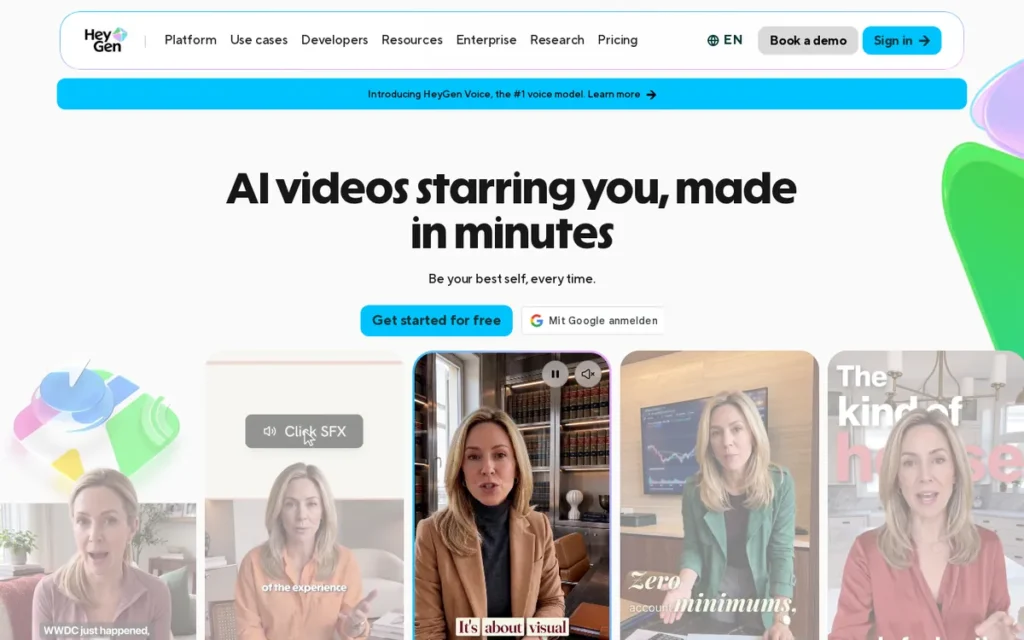
Category: Dubber, AI platform for translating and dubbing existing real-person video footage with voice cloning and lip-sync.
At a Glance
- Category: Dubber
- Best For: Content creators, marketers, and video teams translating existing real-person footage with premium lip-sync and preserved speaker voice identity
- Price Range: Free (limited testing) + paid plans: verify current tier pricing at heygen.com/pricing
- Primary Strength: HeyGen combines ElevenLabs voice cloning with a phoneme-level lip-sync engine across 175+ languages, preserving the original speaker’s voice from as little as two minutes of audio input
- Biggest Limitation: HeyGen’s billing transparency failures are documented across BBB (unresolved complaints, mid-2025), HeyGen’s own community forums (undisclosed 2-hour/month caps on plans marketed as unlimited), and the April 2025 r/aiwars thread, a confirmed pattern of undisclosed plan changes requiring active monitoring for paid subscribers
- One-Line Summary: HeyGen is the most-cited AI video dubbing platform in 2026 editorial reviews, offering real-person video translation with ElevenLabs voice cloning and phoneme-level lip-sync across 175+ languages, having processed over 16 million translated videos as of 2025 (vendor-reported).
- Last Verified: April 2026
Overview
HeyGen is an AI video dubbing platform that translates existing real-person footage into 175+ languages while preserving the original speaker’s voice through ElevenLabs voice cloning, without studio recording. HeyGen has processed over 16 million translated videos as of 2025 (vendor-reported, HeyGen Official, 2025), the highest documented usage volume in this comparison set.
HeyGen was founded in 2020 in Los Angeles by Joshua Xu and Wayne Liang and raised a $60 million Series A (company background, confirmed 2025). HeyGen also offers AI avatar creation and a Video Agent scripting tool, but its core competitive position for this review is real-video dubbing with voice preservation, not avatar creation.
Key Features
- Phoneme-Level Lip-Sync Engine: HeyGen’s lip-sync engine decomposes translated audio into individual phonemes, maps each phoneme frame-by-frame to corresponding mouth shapes and facial expressions, and produces continuous fluid movement, eliminating the mechanical, speed-matched appearance of earlier-generation AI dubbing tools (HeyGen Academy, 2025).
- ElevenLabs Voice Cloning Integration: HeyGen integrates directly with ElevenLabs to clone the original speaker’s voice from as little as two minutes of audio input, preserving emotional tone and identity across all 175+ target languages without re-recording (HeyGen Blog, 2025).
- 175+ Language and Dialect Support: HeyGen supports translation, dubbing, and lip-sync across 175+ languages and dialects in a single upload-to-download workflow, accepting existing footage (including content not originally created in HeyGen) as source material (HeyGen Translate, 2025).
- Dual Avatar Architecture: HeyGen offers Instant Avatars (included with paid plans) and Finetuned Avatars with superior lip-sync performance, supporting facial expressions, hand gestures, and emotional expression for avatar-led content alongside real-person dubbing (Crepal.ai independent review, 2025).
- $60M Series A Organizational Backing: HeyGen raised a $60 million Series A (company background, confirmed 2025) and operates from a confirmed Los Angeles headquarters, providing organizational transparency that platforms with entirely undisclosed corporate profiles cannot match for enterprise procurement due diligence.
Best For
HeyGen is best for content creators, YouTube channel owners, and marketing teams who produce existing talking-head or presenter-led video content and need to publish in multiple target languages while preserving the original speaker’s voice. HeyGen is particularly well-suited to European language pairs, where its lip-sync and voice cloning quality has been validated by independent community practitioners.
Pricing
HeyGen offers a limited free tier for testing. Exact dollar amounts for HeyGen’s Creator, Team, and Enterprise paid plans are not publicly indexed in independent third-party sources as of April 2026, verify current pricing directly at heygen.com/pricing.
Critical billing note: HeyGen’s billing transparency failures are documented across multiple independent platforms as of mid-2025. BBB shows unresolved complaints including refund denials and charge disputes. HeyGen’s own community forums host multiple threads documenting undisclosed 2-hour/month caps introduced on plans marketed as “unlimited video translation” (HeyGen Community Forum, 2025). The April 2025 r/aiwars thread (in which a company representative confirmed treating undisclosed plan changes as subscription “experiments”) is the most widely cited disclosure (r/aiwars, April 2025). Document your plan features and price at purchase; monitor billing statements monthly.
Users on r/heygen documented this pattern firsthand:
“I’ve been a paying subscriber for a while, regularly using the platform well within the advertised limits. Out of nowhere, I noticed that my available credits (especially for motion generation) had dropped significantly, with no warning, no changelog, no notification at all. When I contacted support, I got this response: ‘The recent change in your plan’s limits is due to a system-wide update aimed at aligning all plans with their intended usage guidelines. This helps ensure platform stability and fair access for all users.’ I mean, okay… platforms evolve, but silently reducing paid limits without any notice really feels like a bait-and-switch.” Posted by u/Dependent_Train_9629
Takeaway: HeyGen’s practice of silently reducing paid plan limits and framing the change as a routine policy update (without prior subscriber notification) is documented by paying customers as a structural bait-and-switch pattern, not an isolated billing error.
Strengths
- Highest Documented Usage Volume: HeyGen had processed over 16 million videos on its translation platform as of 2025 (vendor-reported, HeyGen Official, 2025), the largest documented cumulative usage count in this comparison set, providing the most substantial real-world production-scale evidence base of any tool evaluated.
- Highest Independent Editorial Citation Frequency: HeyGen appeared in 4 of 6 independent 2026 video translation editorial roundups surveyed during research (the highest citation frequency of any tool evaluated) across AIJourn.com, HappyScribe Blog, Notta.ai, and Nemovideo.com (AIJourn.com, 2026).
- ElevenLabs Partnership Elevates Voice Naturalness: HeyGen’s ElevenLabs integration enables voice cloning from as little as two minutes of audio, preserving emotional tone and speaker identity across 175+ target languages, a technical partnership that elevates voice naturalness beyond what proprietary voice synthesis typically achieves at this price tier (HeyGen Blog, 2025).
- Investor-Validated Organizational Stability: HeyGen’s $60 million Series A (confirmed 2025) and confirmed Los Angeles headquarters provide organizational stability signals that platforms with undisclosed founding dates, funding histories, or headquarters (including Rask AI and Vidnoz in this comparison) cannot match for enterprise procurement due diligence.
Limitations
- Billing Transparency Risk: Documented Across Multiple Platforms: HeyGen’s plan-change practices are documented on BBB (unresolved complaints as of mid-2025), HeyGen’s own community forums (undisclosed 2-hour/month caps on plans marketed as unlimited), and r/aiwars (April 2025), where a company representative confirmed treating undisclosed plan changes as subscription “experiments.” This is a deliberate commercial pattern, not an isolated billing error, and requires active plan monitoring for every paid subscriber.
- Source Audio Preprocessing Not Built-In: HeyGen’s phoneme-level lip-sync engine requires clean, forward-facing source footage but provides no built-in audio cleanup or preprocessing tool, content teams must apply external noise reduction and audio normalization before upload, adding a workflow step that HeyGen’s platform documentation does not prominently disclose (HeyGen Academy, 2025).
- Tonal Language Quality Caveats: HeyGen’s quality for Mandarin, Hindi, Japanese, and other tonal or South Asian languages carries category-wide quality gaps, European language pairs are well-validated by community practitioners, but creators targeting APAC or South Asian markets should test their specific language pair before committing to paid volume.
- Pricing Opacity: HeyGen’s exact current pricing is not publicly confirmed in independent sources as of April 2026, buyers cannot independently verify plan costs without direct vendor contact, a transparency gap that compounds the documented billing controversy above.
Verdict
HeyGen earned the #1 ranking in this comparison by leading on three of five primary scoring criteria: lip-sync architecture depth (C1), language breadth with voice cloning at 175+ (C2), and editorial citation frequency in 2026 independent roundups (C4), with the April 2025 billing controversy producing a meaningful C3 deduction that narrows but does not eliminate HeyGen’s overall lead. Among AI video dubbing platforms in 2026, HeyGen has accumulated more verifiable evidence of production-scale deployment, 16 million translated videos (vendor-reported), ElevenLabs integration, and the highest independent editorial citation frequency, than any other platform in this comparison. For content creators translating existing real-person footage into European languages at production scale, HeyGen provides the strongest documented combination of voice naturalness and lip-sync fidelity, but buyers must document plan details at purchase and verify current pricing directly at heygen.com/pricing.
2. Veed.io: Best All-in-One Browser Platform for Video Translation and Editing
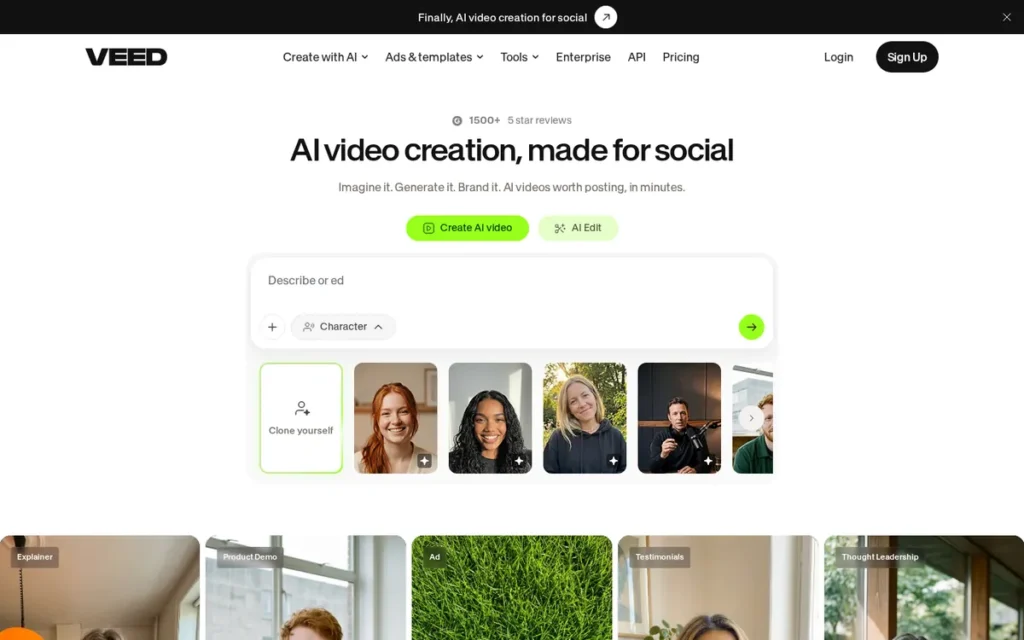
Category: Editor+Dubber, All-in-one browser video editor with integrated AI translation, dubbing, and subtitle generation.
At a Glance
- Category: Editor+Dubber
- Best For: Content creators and small business teams wanting to edit, subtitle, and translate video in a single browser workflow, with auto-subtitles at $12/month (Lite) and AI dubbing plus voice cloning at ~$24/month (Pro)
- Price Range: Free (30 min/month auto-subtitles; 1 min/month voice translation; watermarked exports) + Lite $12/month (auto-subtitles 144 hrs/yr, watermark-free, 1080p) + Pro ~$24/month (AI dubbing, 125+ language translation, voice cloning in 29 languages), verify at veed.io/pricing
- Primary Strength: Veed.io’s pricing is the most transparently documented in this comparison, with a confirmed $12/month Lite plan for subtitle workflows and a confirmed ~$24/month Pro plan for AI dubbing and voice cloning, both independently verified in 2026 third-party sources
- Biggest Limitation: Veed.io’s AI Dubbing tool automatically overwrites the original audio track (documented in Veed.io’s own support articles, April 2026), eliminating source audio preservation for fallback, bilingual output, or quality comparison; additionally, AI dubbing and voice cloning require the ~$24/month Pro plan, not the $12/month Lite plan
- One-Line Summary: Veed.io is the most price-transparent all-in-one browser video platform in 2026, with auto-subtitles at a confirmed $12/month (Lite) and AI dubbing plus 29-language voice cloning at ~$24/month (Pro), backed by Sequoia Capital.
- Last Verified: April 2026
Overview
Veed.io is a browser-based video editing and translation platform that combines AI dubbing, subtitle generation, and voice cloning across 125+ languages in one tool, without software installation. Veed.io’s Lite plan is confirmed at $12/month for auto-subtitle workflows; AI dubbing and voice cloning unlock at the ~$24/month Pro plan, both the most transparently documented price points in this comparison.
Veed.io was founded in London in 2018–2019 by Sabba Keynejad and Tim Quirk and is backed by Sequoia Capital (company background, confirmed 2026). Veed.io reports 98.5% translation accuracy based on internal platform data (vendor-stated, 2026), a figure not independently audited.
Key Features
- Integrated Browser-Based Workflow: Veed.io’s AI Dubbing tool translates video audio into 125+ target languages with optional lip-sync, operating entirely in-browser without software installation and delivering output in the same editing timeline used for trimming and captioning, available on the Pro plan (~$24/month) (Veed.io Video Translations, 2026).
- 29-Language Voice Cloning (Pro Plan): Veed.io’s voice cloning feature preserves the original speaker’s voice identity across 29 languages (available on the Pro plan (~$24/month), not the Lite plan) enabling creators to maintain brand voice consistency across localized video versions without outsourcing (Veed.io AI Dubbing Tool, 2026).
- Confirmed Two-Tier Pricing Structure: Veed.io’s Lite plan ($12/month, billed annually) includes 144 hours of annual auto-subtitle generation and watermark-free exports at 1080p; AI dubbing into 125+ languages and voice cloning in 29 languages are Pro-tier features at ~$24/month, independently corroborated by Cybernews (2026) and Salesforge (2026).
- Vendor-Reported 98.5% Translation Accuracy: Veed.io reports 98.5% translation accuracy (internal platform data, 2026), framing the post-edit workload as correcting only 1.5% of the translated script, a practical metric for estimating editorial time investment, though this figure is vendor-stated and not independently audited (Veed.io, 2026).
- Sequoia Capital-Backed Organizational Profile: Veed.io is backed by Sequoia Capital (confirmed 2026) with a confirmed founding team in London, the strongest publicly documented organizational profile among mid-tier tools in this comparison, providing investor-validated stability evidence that newer or opaque platforms cannot match.
Best For
Veed.io is best for individual YouTube creators, social media content teams, and SMB marketers who want editing, translation, and subtitles in one browser tab without managing multiple tools. Veed.io suits buyers whose primary need is subtitle workflows at $12/month (Lite), or all-in-one AI dubbing and voice cloning at ~$24/month (Pro), not buyers who require fine-grained audio mixing control or the deepest specialized lip-sync depth.
Pricing
Veed.io’s free tier includes 30 minutes per month of auto-subtitle generation and 1 minute per month of voice translation, with watermarked exports, sufficient for quality testing but not professional production (Veed.io, April 2026; independently corroborated by multiple 2026 third-party sources).
The Lite plan at $12/month (billed annually) includes 144 hours of annual auto-subtitle generation, watermark-free exports at 1080p, and stock media. AI dubbing into 125+ languages and voice cloning in 29 languages unlock at the Pro plan (~$24/month). Verify current Pro and Business plan pricing at veed.io/pricing, only the Lite plan price and Pro plan approximate pricing are independently confirmed as of April 2026.
Strengths
- Most Transparently Priced in This Comparison: Veed.io’s Lite plan at $12/month (subtitles, watermark-free) and Pro plan at ~$24/month (AI dubbing, translation, voice cloning) are the only two-tier pricing structure in this comparison independently documented in third-party sources, a meaningful advantage for buyers who need to evaluate cost before contacting any vendor (Cybernews 2026; Salesforge 2026; Veed.io April 2026).
- Strongest Organizational Profile Among Mid-Tier Tools: Veed.io is backed by Sequoia Capital and founded in London in 2018–2019 with a confirmed founding team, the strongest publicly documented organizational profile among mid-tier tools in this comparison, providing investor-validated stability evidence that newer or opaque platforms cannot match (company background, confirmed April 2026).
- Practical Accuracy Framing: Veed.io reports 98.5% translation accuracy (internal platform data, 2026), framing the post-edit workload as correcting only 1.5% of the translated script, a more useful metric for estimating editorial time investment than a raw accuracy percentage alone (Veed.io, 2026).
- Independent Editorial Recognition: Veed.io appeared in Filmora’s independent review and multiple 2026 editorial roundups with consistent praise for ease of use and workflow consolidation, confirming third-party recognition of Veed.io’s browser-based accessibility advantage (Filmora, 2026).
Limitations
- Automatic Audio Overwrite: Veed.io’s AI Dubbing tool automatically replaces the original audio track during dubbing, documented in Veed.io’s own support articles (April 2026), removing the ability to preserve source audio for fallback, quality comparison, or bilingual output, making Veed.io unsuitable for editors who require fine-grained source/target audio control (Veed.io Support, April 2026).
- AI Dubbing and Voice Cloning Require the ~$24/Month Pro Plan: Veed.io’s voice cloning and AI dubbing features are locked at the Pro plan (~$24/month), buyers who select the $12/month Lite plan expecting dubbing or voice cloning capabilities will find those features unavailable, a pricing tier distinction absent from most third-party comparisons that must be confirmed before purchase.
- Narrower Voice Cloning Language Coverage: Veed.io’s voice cloning is limited to 29 languages, sufficient for primary European market needs but narrower than HeyGen’s 175+ language voice cloning coverage, making Veed.io less suitable for creators targeting APAC or MENA language pairs where voice preservation matters most.
- Internal Accuracy Claims Are Unaudited: Veed.io’s vendor-reported 98.5% and 99.9% accuracy figures are internal platform data, not independently audited, buyers should treat these as directional estimates rather than verified benchmarks until independent testing confirms the figures.
Verdict
Veed.io ranked #2 by leading on pricing transparency (C3), with both a confirmed $12/month Lite entry point for subtitle workflows and a confirmed ~$24/month Pro price for dubbing and voice cloning, the only independently documented dual price structure in this comparison, and on workflow consolidation (C5), accepting trade-offs on lip-sync specialization depth relative to Rask AI (#3). Veed.io is the right choice for creators who want editing, subtitles, and translation in one browser tab without managing multiple tools. Buyers who need the $12/month entry point should confirm that Lite-plan auto-subtitles meet their need before purchase, as AI dubbing and voice cloning unlock only at ~$24/month Pro; buyers who require maximum lip-sync fidelity, broader voice cloning coverage, or fine-grained audio mixing control should evaluate HeyGen or Rask AI instead.
3. Rask AI: Best for Multi-Speaker Video Dubbing and High-Volume Localization
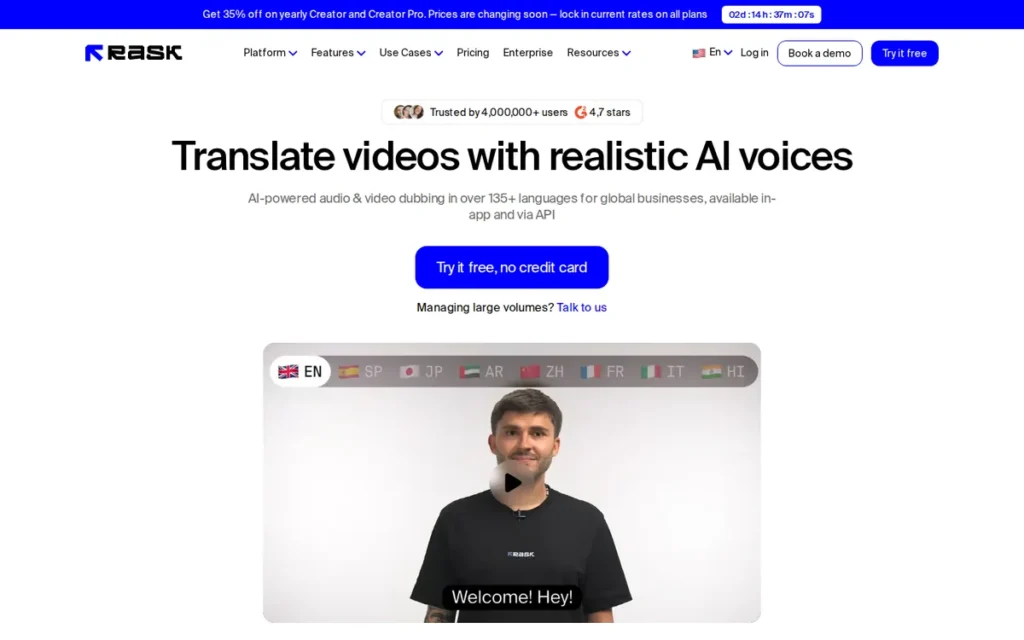
Category: Dubber, AI dubbing platform for translating existing real-person video footage with multi-speaker detection, voice cloning, and batch processing.
At a Glance
- Category: Dubber
- Best For: Marketing teams, eLearning producers, and content operations teams managing multi-speaker video content or high-volume dubbing projects across 130+ languages
- Price Range: Approximately $50/month billed annually (community-sourced, r/videography, January 2024), verify current pricing at rask.ai
- Primary Strength: Rask AI’s multi-speaker detection automatically identifies and assigns distinct cloned voices to each speaker in a video (a capability unique among all tools in this comparison) making it the strongest option for dubbing interviews, panels, podcasts, and multi-presenter training content
- Biggest Limitation: Rask AI carries documented processing reliability issues: community users in r/videography (January 2024) reported video jobs freezing mid-render across six consecutive attempts, and community pricing sentiment at ~$50/month was described as “ridiculously expensive” relative to assembling ElevenLabs plus a separate lip-sync tool
- One-Line Summary: Rask AI is the only AI dubbing platform in 2026 with automated multi-speaker voice detection and cloning, supporting 130+ languages for batch video localization with SOC 2 Type II security certification and videos up to 5 hours in length.
- Last Verified: April 2026
Overview
Rask AI is the only AI dubbing platform in this comparison to offer automated multi-speaker detection, automatically identifying each speaker in a video and assigning a separately cloned voice per speaker in the target language. Rask AI supports 130+ languages with voice cloning in 29–32 languages, holds a SOC 2 Type II security certification (independently audited), and accepts videos up to 5 hours in length.
Rask AI launched its multi-speaker lip-sync feature as a beta capability in late 2024 (Rask AI Blog, 2024). Rask AI’s founding date and funding history are not publicly confirmed in indexed sources as of April 2026, a due-diligence limitation for procurement-sensitive buyers.
Key Features
- Multi-Speaker Detection and Voice Cloning: Rask AI’s multi-speaker feature automatically identifies distinct speakers within a video and assigns each speaker a separately cloned voice in the target language, enabling accurate dubbing of interviews, panel discussions, podcast recordings, and multi-presenter courses without manual speaker separation (Rask AI Blog, late 2024).
- 5-Hour Maximum Video Length: Rask AI processes videos up to 5 hours in length (the longest maximum input of any tool in this comparison) making Rask AI purpose-built for webinar recordings, full-length online courses, and enterprise training modules that exceed the capacity of tools optimized for short-form content.
- SOC 2 Type II Security Certification: Rask AI holds a SOC 2 Type II certification, requiring independent audit of security controls over a sustained evaluation period, providing verifiable data handling assurance for enterprise and regulated-industry customers (Rask AI Official, 2024).
- Batch Multi-Language Duplication: Rask AI supports batch processing that generates a single uploaded video into multiple target languages simultaneously, a workflow efficiency feature designed for content operations teams managing large-scale localization projects across multiple markets.
- Structured 3-Step Workflow: Rask AI processes video through a structured upload → transcribe/translate → voiceover/download pipeline, positioned by Rask AI as 2x faster than alternative localization approaches at comparable language coverage (Deepgram Voice AI Apps Directory, 2025, vendor-provided profile content, not an independent performance benchmark).
Best For
Rask AI is best for marketing teams, eLearning producers, and corporate training departments that create multi-speaker video content (interviews, panel discussions, online courses, webinars) and need to localize that content across multiple European languages at scale. Rask AI’s automated multi-speaker voice detection removes the manual effort of assigning separate translated voices to each presenter, a capability no other tool in this comparison provides.
Pricing
Community data from r/videography (January 2024) documented Rask AI’s pricing as approximately $50/month billed annually. Community users in the same thread described this as “ridiculously expensive” and explicitly compared Rask AI’s cost unfavorably against ElevenLabs, which produces “much smoother sound” at lower total cost (r/videography, January 2024).
This figure is community-sourced from January 2024 and may have changed since. Official structured pricing was not publicly indexed in independent sources during this research period (April 2026). Verify current plan pricing directly at rask.ai before committing, and model the ~$50/month community-documented cost against the specific value of multi-speaker detection for your production volume.
Strengths
- Only Automated Multi-Speaker Voice Detection in This Comparison: Rask AI’s multi-speaker lip-sync feature, launched in beta in late 2024, is the only automated multi-speaker voice detection and cloning capability among the seven tools evaluated, directly addressing the primary production challenge for interview, panel, and multi-presenter content dubbing (Rask AI Blog, 2024).
- SOC 2 Type II Independent Audit: Rask AI’s SOC 2 Type II certification requires an independent audit of security controls sustained over time, the strongest formally security-verified credential among creator-focused dubbing tools in this comparison, directly addressing enterprise and regulated-industry data handling requirements (Rask AI Official, 2024).
- Longest Maximum Input Length: Rask AI supports video lengths up to 5 hours: no other tool in this comparison documents an equivalent long-form capacity, positioning Rask AI as the only confirmed option for full-length online course modules, webinar recordings, and extended corporate training content (Deepgram Voice AI Apps Directory, 2025).
- Multiple 2026 Editorial Roundup Citations: Rask AI is cited in multiple 2026 editorial roundups as a strong option for high-volume multilingual dubbing, with community practitioners specifically validating European language pair voice quality for production-grade use (April 2026 research).
Limitations
- Documented Processing Reliability Risk: Rask AI’s processing reliability was flagged by community users in r/videography (January 2024), who reported Rask AI video translation jobs freezing mid-render across six consecutive attempts, a failure pattern significant enough to represent a workflow-blocking risk for professionals with publishing deadlines (r/videography, January 2024).
- Unfavorable Price-to-Value Community Assessment: Rask AI’s price-to-value ratio received unfavorable community assessment in r/videography (January 2024) (users described Rask AI as “ridiculously expensive” and explicitly compared its ~$50/month cost unfavorably against ElevenLabs, which produces “much smoother sound”) making Rask AI’s value case dependent on multi-speaker feature utilization that justifies the premium (r/videography, January 2024).
- Tonal Language Quality Gaps: Rask AI’s tonal and South Asian language quality was explicitly flagged in r/videography (January 2024): “Yeah, Mandarin and Hindi really need a lot more work”, consistent with the category-wide limitation documented across all platforms in this comparison but specifically confirmed for Rask AI by community practitioners (r/videography, January 2024).
Users on r/ElevenLabs who evaluated Rask AI against alternatives noted:
“I found Rask great when I used it a few weeks ago, but tried again and compared the results to Elevenlabs. I found it didn’t do a great job of translating at all this time, which is a shame as the editor is clearly superior to all other options.” Posted by u/tfratelli
Takeaway: Rask AI’s translation quality has shown session-to-session inconsistency in community evaluations, a reliability risk for production teams whose workflows cannot tolerate unpredictable output, despite the platform’s editing interface earning consistent praise over alternatives.
- Opaque Corporate Background: Rask AI’s founding date, funding, and headquarters are not publicly confirmed in any indexed source as of April 2026, limiting standard vendor due diligence for procurement-sensitive enterprise buyers evaluating long-term platform investment.
Verdict
Rask AI is the strongest AI dubbing platform in 2026 for multi-speaker video content and high-volume localization workflows, uniquely combining automated speaker detection, 5-hour video support, and SOC 2 Type II security certification across 130+ languages. The documented processing reliability issues and community pricing criticism relative to competing tool stacks make Rask AI best evaluated with a paid trial before committing to annual billing, buyers who prioritize multi-speaker accuracy for European language pairs will find its differentiated capability worth the premium, while those targeting Mandarin, Hindi, or other tonal languages should test their specific language pair on a trial clip before purchase.
4. Synthesia: Best for Enterprise L&D Teams Creating Multilingual Training Content from Scripts
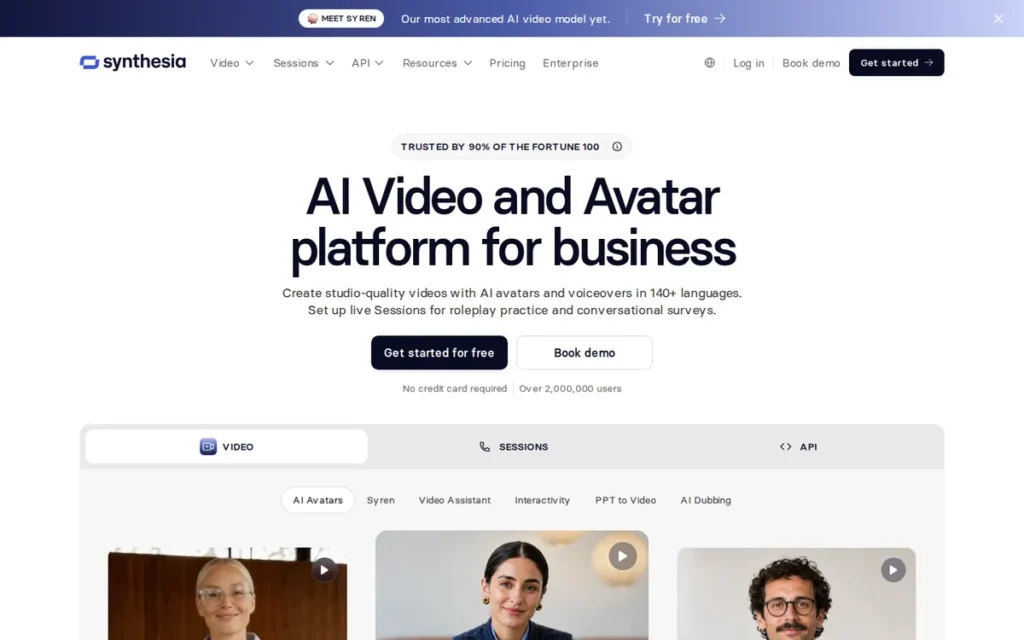
Category: Avatar Creator, AI platform that generates new multilingual video from text scripts using AI avatars; CANNOT translate or dub existing footage of real people.
At a Glance
- Category: Avatar Creator
- Best For: Enterprise L&D teams, corporate training departments, and compliance content producers creating training, onboarding, or explainer video from text scripts using AI avatars, NOT for translating existing video footage of real people
- Price Range: Free to start + paid plans + Enterprise custom pricing: verify at synthesia.io/pricing
- Primary Strength: Synthesia is the only generative AI platform in this comparison with ISO 42001 certification (independently verified by auditor A-LIGN, September 25, 2024), offering 1-click translation into 160+ languages and a documented 80% cost reduction for compliance training production (Regis Company, 2025)
- Biggest Limitation: Synthesia is architecturally an AI avatar video creation platform that generates new video from text scripts, it cannot dub, translate, or lip-sync existing footage of real people, making it incompatible with the primary use case of content creators and marketing teams who need to localize pre-recorded video content
- One-Line Summary: Synthesia is the leading enterprise AI avatar video creation platform for L&D in 2026, offering ISO 42001-certified governance (A-LIGN, September 2024) and 1-click translation into 160+ languages for script-based content, but it is not a real-video dubbing tool and cannot translate existing footage of real people.
- Last Verified: April 2026
Overview
Synthesia is an AI avatar video creation platform that cannot translate or dub existing footage of real people, it generates entirely new video from text scripts using 240+ AI avatars across 160+ languages. Synthesia enables enterprise L&D teams to produce onboarding, compliance, and training content without cameras, actors, or recording studios.
Synthesia was founded in 2017 in London by Victor Riparbelli. Synthesia holds a reported ~$4 billion valuation by 2025, following multiple funding rounds including a $90 million Series C and subsequent Google Ventures participation (multiple sources, 2025). Synthesia became the first generative AI company to achieve ISO 42001 certification, independently verified by auditor A-LIGN on September 25, 2024.
Key Features
- 1-Click Translation into 160+ Languages: Synthesia translates a text script into 160+ language versions in one click using 240+ stock AI avatars, enabling enterprise teams to publish multilingual training content without multilingual voice actors or re-recording, with new avatar video generated from the script, not from any existing real-person footage (Synthesia Features, 2026).
- Express-2 Expressive AI Avatars: Synthesia’s Express-2 avatars perform natural gestures (nods, eyebrow raises, waves, hand points, claps) and are customizable for brand clothing, logos, and colors via the Avatar Builder, directly addressing the robotic-appearance criticism of first-generation AI avatars (Synthesia Avatars, 2026).
- ISO 42001 AI Governance Certification: Synthesia became the first generative AI company to achieve ISO 42001 certification for AI management systems, independently verified by auditor A-LIGN on September 25, 2024, an independently audited governance credential that positions Synthesia as the most formally compliant platform in this comparison for regulated-industry enterprise deployment.
- Enterprise Avatar Governance Framework: Synthesia provides a dedicated avatar governance framework and policy template for enterprise teams deploying employee-likeness avatars, supporting procurement in organizations with internal AI ethics and content governance requirements (Synthesia, 2025).
- Documented 80% Training Cost Reduction: A case study from Regis Company’s SimGate partnership documents that Synthesia AI avatars perform on par with human presenters for knowledge transfer in corporate learning, with enterprises reporting 80% reductions in cost and production time for compliance and onboarding modules (Regis Company SimGate, 2025).
Best For
Synthesia is best for corporate L&D professionals, instructional designers, and enterprise training departments who create compliance, onboarding, and skills training content from text scripts and need to distribute that content in multiple languages. Synthesia serves organizations with regulatory compliance requirements, internal AI governance frameworks, or Fortune-level enterprise security and procurement standards, not organizations that need to translate existing real-person footage.
Pricing
Synthesia offers a free trial (“free to start”). Paid tier dollar amounts for Starter, Creator, and Enterprise plans are not publicly confirmed in independent sources as of April 2026, enterprise pricing is custom-quoted via inquiry. Verify current pricing at synthesia.io/pricing.
Always pair Synthesia’s pricing evaluation with its avatar-only architectural limitation: buyers who need to translate existing real-person footage will discover this architectural incompatibility only after payment.
Strengths
- First Generative AI Company With ISO 42001 Certification: Synthesia became the first generative AI company to achieve ISO 42001 certification for AI management systems, independently verified by auditor A-LIGN on September 25, 2024, a governance credential no other tool in this comparison holds, directly addressing regulated-industry and government procurement requirements.
- Documented 80% Training Cost Reduction: Regis Company’s SimGate case study documents that Synthesia AI avatars perform on par with human presenters for knowledge transfer in corporate learning, with enterprises reporting 80% reductions in cost and production time for compliance training and onboarding modules, the strongest independently documented ROI evidence in this comparison (Regis Company SimGate, 2025).
- ~$4B Valuation and Enterprise Market Position: Synthesia reports 90% of Fortune 100 companies use the platform for L&D avatar content (vendor-stated, 2025), backed by a ~$4 billion valuation by 2025 following multiple funding rounds including a $90 million Series C and Google Ventures participation, providing organizational scale and financial stability evidence relevant to long-term enterprise contracts.
- 240+ Expressive AI Avatars: Synthesia’s Express-2 avatar library with natural gesture capability directly addresses the “uncanny valley” limitation of first-generation AI avatars, a meaningful improvement for instructional content that requires learner engagement across 160+ language versions (Synthesia Avatars, 2026).
Limitations
- Architectural Incompatibility with Real-Video Dubbing: Synthesia generates new AI-avatar video from text scripts and cannot translate, dub, lip-sync, or otherwise process existing video footage of real people, making it categorically incompatible with the localization needs of content creators, YouTube publishers, and marketing teams working with pre-recorded video libraries who need to localize that footage.
- Avatar Customization Scope Is Bounded: Synthesia’s Avatar Builder allows brand clothing, logo overlays, and color themes, but the underlying avatar’s facial structure, voice accent, and regional speech characteristics cannot be modified. Organizations whose target audiences expect culturally specific regional presenters (such as South Asian enterprises running compliance training for South Asian employees) may find the 240+ avatar library insufficient for full cultural authenticity requirements.
- Avatar Emotional Range Limitations: Independent reviewers note that Synthesia’s avatars “feel slightly robotic, lacking full human emotional range”, a perceptual gap affecting use cases requiring emotional authenticity such as sales content, personal messaging, or narrative storytelling, though less impactful for instructional content where informational clarity matters more (Shoots.video independent review, 2025).
Instructional designers at Synthesia’s own industry events have shared this assessment on r/instructionaldesign:
“Yeah I’m not seeing it, I think it’s just the ‘wow’ factor of new technology. I attended Synthesia’s presentation at ATD25. The talk was entitled ‘beyond talking heads’. And they showed us….a bunch of talking heads. When it gets to the point where we can do full-body acting with multiple characters, maybe I’ll be interested.” Posted by u/Mysterious_Sky_85
Takeaway: Even enterprise L&D practitioners attending Synthesia’s own industry presentations report that avatar expressiveness falls short of the platform’s “beyond talking heads” marketing, revealing a meaningful gap between Synthesia’s capabilities and the expectations of its target buyers.
- Custom Enterprise Pricing Extends Procurement Timelines: Synthesia’s enterprise deployment involves custom pricing inquiry and governance framework setup, creating longer procurement timelines than self-serve tools, a practical constraint for teams with immediate production deadlines or limited procurement bandwidth.
Verdict
Synthesia ranked #4 despite the strongest enterprise credentials because workflow architecture fit (C5), specifically whether the tool processes existing real-person footage, carries significant weight in this comparison, and Synthesia’s architecturally incompatible score on C5 depresses its overall position despite leading on trust signals (C4) and governance credentials. Synthesia is the most enterprise-credentialed AI video platform in this comparison, holding independently verified ISO 42001 certification (A-LIGN, September 2024) and a ~$4 billion valuation by 2025, but it serves a categorically different market segment from every other tool reviewed. Buyers who need to localize pre-recorded video content should not evaluate Synthesia for that purpose; for enterprise L&D teams building multilingual training content from scripts, Synthesia is the category leader.
5. HappyScribe: Best for Journalists, Podcasters, and Media Professionals Requiring Transcription Accuracy
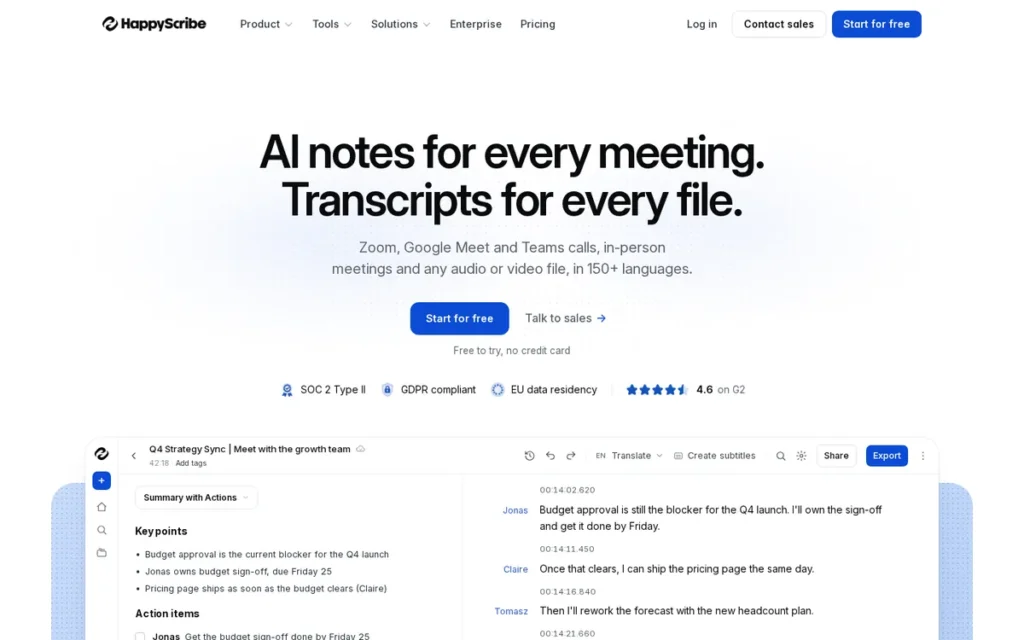
Category: Transcriber+Dubber, Transcription-first platform with hybrid AI+human review for high-accuracy subtitles, translation, and AI dubbing in 120–150 languages.
At a Glance
- Category: Transcriber+Dubber
- Best For: Journalists, podcasters, broadcast media professionals, and eLearning producers who need highly accurate transcription with multi-speaker detection and an optional human review fallback for broadcast-quality or legal-standard output
- Price Range: 10 minutes free (new users, one-time) + subscription tiers + $2/minute for human review, verify full pricing at happyscribe.com/pricing
- Primary Strength: HappyScribe’s hybrid AI+human review model achieves up to 99% transcription and translation accuracy (the highest documented quality ceiling in this comparison) and is used by over 6 million users and 41,000+ teams as of 2026
- Biggest Limitation: HappyScribe’s AI accuracy drops below 85% with poor audio quality, heavy accents, or noisy environments, requiring human review at $2/minute, which adds $60 for a 30-minute piece and scales poorly for high-volume localization workflows
- One-Line Summary: HappyScribe is the most accurate transcription-first video translation platform in 2026, serving over 6 million users with a hybrid AI+human workflow that delivers up to 99% precision, optimized for journalism, podcast, and broadcast use cases rather than creator-focused lip-sync dubbing.
- Last Verified: April 2026
Overview
HappyScribe is a Dublin-based transcription-first platform serving over 6 million users with a hybrid AI+human review workflow that delivers up to 99% transcription accuracy across 120–150 languages, the highest accuracy ceiling in this comparison. HappyScribe provides 10 minutes of free translation credit for new users, the most generous free trial in this comparison set for evaluating quality on real production content.
HappyScribe was founded in 2018 in Dublin, Ireland, and was recognized by Slator (the translation industry’s primary trade publication) for achieving “instant product-market fit” following rapid user acquisition (Slator, 2024). HappyScribe is optimized for journalists, podcasters, and media professionals who prioritize transcript accuracy over lip-sync fidelity.
Key Features
- Hybrid AI+Human Review Model: HappyScribe’s human review tier delivers up to 99% transcription and translation accuracy through on-demand professional reviewer involvement, with 12–24 hour turnaround, providing a quality tier no AI-only platform in this comparison can match for broadcast, legal, or medical-grade content (HappyScribe Official, 2025).
- Speaker Diarization Quality: HappyScribe’s speaker diarization feature automatically identifies and separates multiple speakers in a recording, praised specifically in G2 user reviews for accuracy in interview and multi-presenter content, a critical capability for podcast transcription and panel discussion workflows (G2 Reviews, 2025).
- Multi-Platform Import Integrations: HappyScribe supports direct video and audio imports from YouTube, Zoom, Google Drive, and Dropbox, enabling media professionals to pull content from existing production and storage workflows without file downloading or format conversion.
- 10-Minute Free Translation Credit: HappyScribe provides 10 minutes of free translation credit for new users, sufficient to test quality on a complete production-length piece before committing to a paid plan, the most substantial free trial offering in this comparison set (HappyScribe Translate Video, 2026).
- 6 Million Users and 41,000+ Teams: HappyScribe serves over 6 million users and 41,000+ teams across content, media, and business segments as of 2026, with team collaboration features including shared workspaces and version management for editorial review workflows (HappyScribe Features, 2026).
Best For
HappyScribe is best for journalists, podcast producers, documentary filmmakers, and broadcast media teams who need highly accurate transcripts of multi-speaker recordings with speaker diarization. HappyScribe is particularly suited to teams experiencing quality decline with other transcription tools, community discussions in r/Journalism (December 2025) show active churn from Otter.ai, with users explicitly seeking alternatives offering both AI speed and human accuracy fallback.
Pricing
HappyScribe provides 10 minutes of free translation credit for new users. Human review is priced at approximately $2 per minute (Transgate.ai review, 2025), with 12–24 hour turnaround, adding $60 for a 30-minute interview and $120 for a 60-minute piece.
At these rates, a multi-episode podcast series requiring human review can rapidly exceed flat-rate dubbing subscription pricing at high volume. Subscription tier pricing for AI-only processing was not publicly confirmed in independent sources as of April 2026, verify at happyscribe.com/pricing.
Strengths
- Largest Confirmed User Base in This Comparison: HappyScribe serves over 6 million users and 41,000+ teams as of 2026 (the largest independently confirmed user base in this comparison) with G2 reviewers specifically praising transcription accuracy, speaker diarization quality, and processing speed in verified user reviews (HappyScribe Features, 2026; G2 Reviews, 2025).
- 99% Accuracy Ceiling via Human Review: HappyScribe’s hybrid AI+human review workflow delivers up to 99% transcription precision (the highest documented accuracy ceiling in this comparison) through professional reviewer involvement available on demand at $2/minute with 12–24 hour turnaround (HappyScribe Official, 2025).
- Slator Trade Press Recognition: Slator: the translation industry’s primary trade publication, recognized HappyScribe for achieving “instant product-market fit” following rapid user acquisition, an independent editorial signal of genuine product-market resonance from a credible industry-specialist source (Slator, 2024).
- Most Generous Free Trial in This Comparison: HappyScribe’s 10-minute free translation credit (verified in April 2026) enables quality evaluation on a complete production-length content piece before any financial commitment, outpacing Vidnoz’s 90-second and Veed.io’s 1-minute monthly caps (HappyScribe, April 2026).
Limitations
- Audio Quality Dependency: HappyScribe’s AI transcription accuracy drops below 85% with poor audio quality, heavy accents, or noisy recording environments, a documented performance floor (Fritz.ai review, 2025) requiring human review at $2/minute to remediate, compounding cost for global content teams whose source material involves field recordings or non-native speakers.
Users on r/SaaS who switched away from HappyScribe cited this limitation directly:
“I switched from Happy Scribe a few months ago actually. Was using it for podcast transcripts and got tired of the weird formatting errors. Been using Riverside’s transcription now, not perfect but way better with accents imo.” Posted by u/FounderArcs
Takeaway: HappyScribe users producing podcast content with diverse accents report enough recurring quality friction to drive platform churn, consistent with the platform’s documented AI accuracy degradation below 85% with non-standard speech and noisy source material.
- Human Review Scales Poorly for High Volume: HappyScribe’s human review at $2/minute adds $60 per 30-minute piece and $120 per 60-minute piece, cost that compounds rapidly for multi-episode podcast series or large video libraries and can exceed flat-rate dubbing subscription pricing at high volume.
- Transcription-First Workflow Adds Steps for Pure-Dubbing Use Cases: HappyScribe routes users through a transcript-editing interface as an intermediate step before reaching dubbed video export, buyers whose primary goal is dubbed video output must navigate transcription-editing steps that dedicated dubbing tools (HeyGen, Rask AI) do not require, adding meaningful time per video for pure-dubbing workflows.
- AI Dubbing Depth Trails Dedicated Dubbing Tools: HappyScribe’s primary architecture is transcription and subtitles, its AI dubbing capabilities, while available across 120–150 languages, are less specialized than dedicated dubbing tools like HeyGen or Rask AI for voice naturalness and lip-sync fidelity.
Verdict
HappyScribe is the highest-accuracy transcription-first platform in 2026, uniquely combining a 99%-ceiling hybrid AI+human review model with strong speaker diarization, the most substantial free trial in this comparison (10 minutes), and a verified base of 6 million users, making it the clear choice for journalists, podcasters, and media professionals whose primary criterion is transcript accuracy rather than lip-sync quality. Content creators whose core need is natural-sounding dubbed video with lip-sync will find HeyGen, Veed.io, or Rask AI to be better architectural matches; HappyScribe earns its recommendation for the media and broadcast professional segment it was demonstrably built to serve.
6. Vidnoz: Best Free-Entry AI Video Translation Tool for Short-Form Creator Evaluation
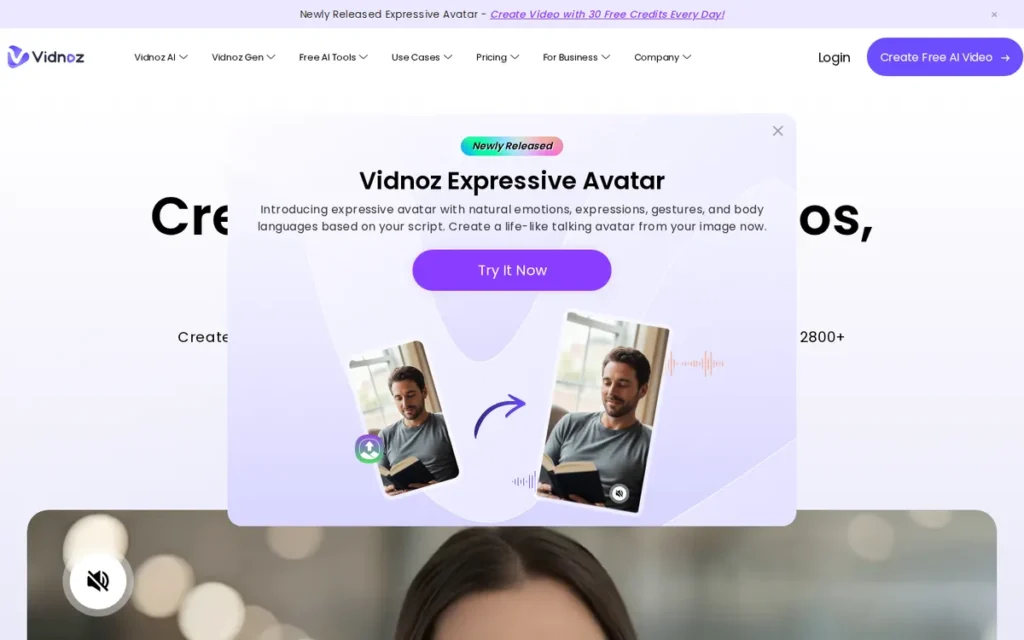
Category: Dubber, AI video translation and dubbing platform with a 2,000+ voice library and a free tier for short-form content up to 90 seconds.
At a Glance
- Category: Dubber
- Best For: Individual creators and educators evaluating AI video translation on a risk-free free tier before committing to a paid plan, particularly for short-form content under 90 seconds such as social media clips or YouTube Shorts
- Price Range: Free (60–90 seconds per video clip, no account required for basic testing) + paid tiers not publicly confirmed in independent sources as of April 2026, verify at vidnoz.com
- Primary Strength: Vidnoz offers the largest AI voice library in this comparison (2,000+ voices across 100+ languages) powered by ElevenLabs, Microsoft, and Google APIs, accessible starting at zero cost for clips under 90 seconds
- Biggest Limitation: Vidnoz’s corporate background is entirely opaque: founding date, headquarters, team size, funding history, and parent company are not publicly confirmed in any indexed source as of April 2026, and no aggregate G2, Capterra, or Trustpilot ratings are available, presenting a meaningful vendor stability risk for business buyers
- One-Line Summary: Vidnoz is the most accessible free-entry AI video translation tool in 2026, offering 2,000+ AI voices across 140+ languages with a no-cost tier for clips up to 90 seconds, though its opaque corporate background and absence of verified third-party reviews limit its suitability for business buyers beyond initial evaluation.
- Last Verified: April 2026
Overview
Vidnoz is an AI video dubbing platform with the largest voice library in this comparison (2,000+ AI voices across 100+ languages via ElevenLabs, Microsoft, and Google APIs) and a free tier for clips up to 90 seconds requiring no financial commitment. Vidnoz supports 140+ languages for dubbing and lip-sync via a 3-step URL-paste workflow accessible to non-technical users.
Vidnoz’s corporate background (founding date, headquarters, team size, funding history, and parent company) is not publicly confirmed in any source indexed as of April 2026. No aggregate ratings from G2, Capterra, or Trustpilot are publicly available for Vidnoz, leaving buyers without the independent quality verification signals available for five of the seven tools in this comparison.
Key Features
- 2,000+ AI Voice Library: Vidnoz’s voice library integrates over 2,000 AI voices across 100+ languages and accents through verified partnerships with ElevenLabs, Microsoft, and Google voice APIs, the largest voice selection in this comparison, enabling regional dialect and accent matching beyond standard AI voice sets (Vidnoz AI Voice Page, 2025).
- Full Facial Expression Synchronization: Vidnoz’s lip-sync AI synchronizes full facial muscle movement and gestures (not only lip movement) to translated audio output, reducing the visual disconnect that makes AI-dubbed video feel artificial at the face level (Vidnoz Lip-Sync Solutions, 2025).
- URL-Paste Workflow: Vidnoz supports a URL-paste workflow allowing users to input a video link directly rather than downloading and re-uploading files, reducing friction for creators managing cloud-stored or social media-hosted video libraries.
- Free Tier for Short-Form Content: Vidnoz provides a free tier for video clips up to 60–90 seconds with no financial commitment required, enabling quality evaluation on actual short-form production content (social media clips, YouTube Shorts) before selecting a paid plan (Vidnoz, 2025).
- 140+ Language Coverage with Voice Cloning: Vidnoz supports voice cloning from short audio input samples across 140+ languages, with the vendor claiming 100% accuracy in tone, emotion, and speaking style replication (vendor-stated and independently unaudited as of April 2026) (Vidnoz.com, 2025).
Best For
Vidnoz is best for individual creators, educators, and social media managers who want to test AI video translation quality for free on clips under 90 seconds before committing to any paid plan. Vidnoz is particularly suited to those creating short-form content for TikTok, Instagram Reels, or YouTube Shorts, where the free tier’s 60–90 second limit aligns with the full clip length, enabling a complete quality evaluation at zero cost.
Pricing
Vidnoz’s free tier allows 60–90 seconds of video translation per clip with no financial commitment required for basic testing. Paid plan tier names, dollar amounts, and feature unlocks are not publicly confirmed in independent sources as of April 2026. The absence of disclosed paid pricing is itself a material fact for buyers, it precludes cost comparison without direct vendor contact.
For buyers who need confirmed entry-level pricing before evaluation, Veed.io’s documented $12/month Lite plan (for auto-subtitles) or ~$24/month Pro plan (for AI dubbing) provides a comparable independently verified alternative. Vidnoz’s export format documentation, including SRT and VTT subtitle file availability alongside dubbed video, and watermark conditions for subtitle-only vs. dubbed video exports, is also not confirmed in any indexed source as of April 2026, creating a workflow integration risk for buyers who need subtitle file portability. Verify paid pricing directly at vidnoz.com.
Strengths
- Largest AI Voice Library in This Comparison: Vidnoz’s voice library of 2,000+ AI voices across 100+ languages and accents (sourced through verified integrations with ElevenLabs, Microsoft, and Google voice APIs) is the largest voice selection in this comparison, providing regional dialect and accent matching breadth that narrower proprietary voice libraries cannot replicate (Vidnoz AI Voice Page, 2025).
- Full Facial Expression Synchronization Claimed: Vidnoz describes its lip-sync AI as synchronizing full facial muscle movement and gestures beyond lip movement alone, with independent community mentions characterizing results as “smooth synchronization” and “professional grade results” for supported language pairs (community mentions cited in ITNews Africa, April 2025).
- Lowest Financial Barrier to Quality Evaluation: Vidnoz’s 60–90 second free tier requires no financial commitment and enables quality testing on actual production content types (social media clips, YouTube Shorts), reducing evaluation risk more than tools that impose shorter free-trial windows or require credit card entry before testing.
- 140+ Languages at Zero Entry Cost: Vidnoz supports 140+ languages for dubbing and lip-sync via a 3-step URL-paste workflow, providing language breadth comparable to Rask AI (130+) and Veed.io (125+) at zero entry cost for short-form evaluation (Vidnoz.com, 2025).
Limitations
- Entirely Opaque Corporate Background: Vidnoz’s founding date, headquarters, team size, funding history, and parent company are not publicly confirmed in any source indexed as of April 2026, making standard vendor due diligence significantly more difficult than for platforms with confirmed corporate profiles, and impossible for the specific data points that enterprise procurement processes require before committing to a paid subscription or team workflow integration.
- No Independent Review Verification Available: No aggregate ratings from G2, Capterra, or Trustpilot are publicly available for Vidnoz as of April 2026, leaving buyers without the independent quality verification signals available for five of the seven tools in this comparison, and with only vendor claims and limited secondary community mentions to evaluate output quality.
- Free Tier Blocks All Production-Length Content: Vidnoz’s 60–90 second free tier cap precludes production use for any content beyond short-form social clips, videos of typical YouTube or LinkedIn length (5–20 minutes) require paid plans with entirely undisclosed pricing, creating a conversion funnel with no independently verified cost reference.
- Export Format Documentation Is Unconfirmed: Vidnoz’s export format documentation, including SRT and VTT subtitle file availability, watermark conditions for subtitle-only vs. dubbed video exports, and subtitle portability to external editing platforms, is not confirmed in any independently indexed source as of April 2026, creating a workflow integration risk for buyers who need subtitle file portability before committing to a paid plan.
Verdict
Vidnoz ranked #6 above Smartcat (#7) because its real-video dubbing architecture directly serves the article’s primary audience need, individual creators translating existing footage, while Smartcat serves an enterprise localization segment with a fundamentally different pricing model and workflow complexity. Vidnoz is the most accessible free-entry video translation tool in 2026 for individual creators evaluating short-form AI dubbing before financial commitment, offering the largest voice library in this comparison (2,000+ voices via ElevenLabs, Microsoft, and Google APIs) and 140+ language support with a 60–90 second free tier. Vidnoz’s opaque corporate background and the absence of G2, Capterra, or community-scale verified reviews make it unsuitable as a long-term platform for teams, businesses, or any buyer with standard vendor due-diligence requirements, treat Vidnoz as a quality-evaluation starting point, not a production infrastructure decision, until additional transparency data becomes publicly available.
7. Smartcat: Best for Global Enterprise Localization Teams Requiring 280+ Language Coverage
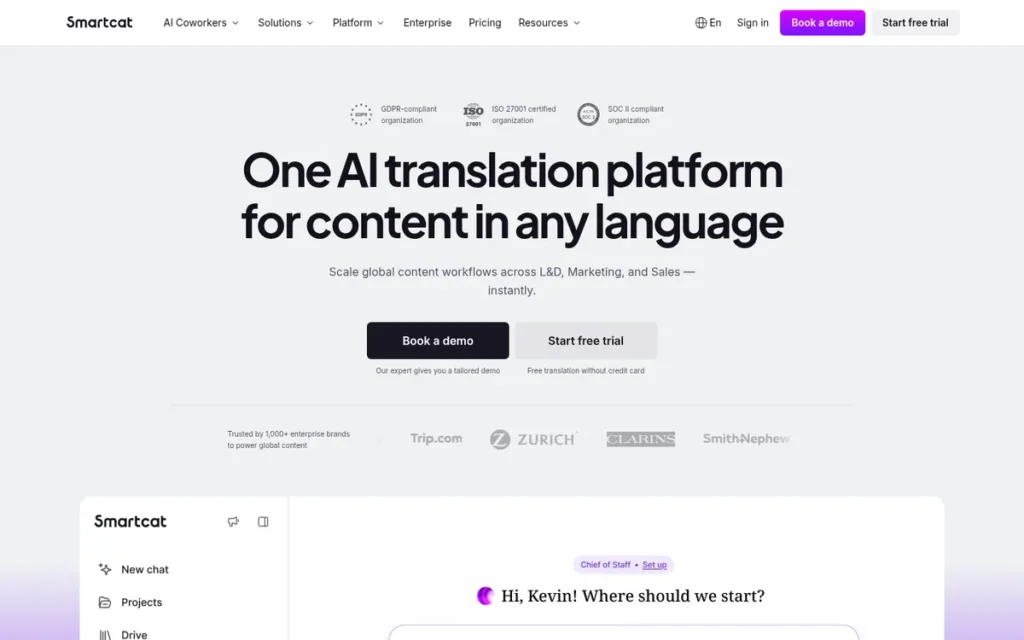
Category: Enterprise Localizer, AI translation and localization platform with 280+ language coverage, SOC-III security, and a hybrid AI+human translator marketplace for enterprise-scale video content.
At a Glance
- Category: Enterprise Localizer
- Best For: Global enterprise localization teams and Fortune 500 organizations requiring 280+ language coverage, SOC-III security compliance, brand terminology management, and access to a human translator marketplace for high-stakes content
- Price Range: Free (10,000 words/month for freelancers) + Smartwords quota system (~$0.008/word for new content; partial translation memory matches charged at discounted rates; 100% perfect matches are free), verify current pricing at smartcat.com
- Primary Strength: Smartcat supports 280+ languages: nearly double the nearest competitor, with SOC-III security certification and a human translator marketplace, targeting global enterprise organizations that require both the broadest language coverage and a quality backstop for content where AI translation alone is insufficient
- Biggest Limitation: Smartcat’s Smartwords per-word pricing charges discounted rates for partial translation memory matches (content 50–99% similar to previously translated segments), prompting sustained community criticism from teams who consider this content already paid-for (r/TranslationStudies, 2023); 100% perfect matches process free of charge
- One-Line Summary: Smartcat is the broadest-coverage enterprise AI video translation platform in 2026, supporting 280+ languages with SOC-III security and a human translator marketplace for 1,000+ enterprise customers, though its per-word Smartwords pricing charges for partial translation memory matches, drawing sustained community criticism.
- Last Verified: April 2026
Overview
Smartcat is a Boston-based enterprise AI translation platform founded in 2016 by Ivan Smolnikov that supports video translation, dubbing, and voice cloning across 280+ languages (nearly twice the nearest competitor) with SOC-III security certification and a hybrid AI+human translator marketplace. Smartcat’s Smartwords per-word pricing charges discounted rates for partial translation memory matches (50–99% similarity); 100% perfect matches are processed free of charge.
Smartcat’s enhanced AI Video Translation product was launched via PR Newswire in 2024 (vendor-submitted content, not independent research), processing MP4/MOV files and YouTube links through an end-to-end transcription → translation → subtitle embedding → dubbing pipeline with live preview editing. Smartcat’s 2016 founding predates all other tools in this comparison by at least four years.
Key Features
- 280+ Language Coverage: Smartcat supports 280+ languages for video translation and dubbing, nearly twice the coverage of the next-broadest tool in this comparison (HeyGen at 175+), enabling global enterprise teams to localize content for APAC, MENA, Sub-Saharan African, and other low-resource language markets (PR Newswire, 2024, vendor-submitted content).
- Hybrid AI+Human Translator Marketplace: Smartcat’s integrated marketplace allows organizations to route translation tasks to professional human translators within the same platform workflow, providing a quality backstop for high-stakes content without switching tools or managing external vendor relationships (Smartcat Video Localization, 2024).
- SOC-III Security Certification: Smartcat holds a SOC-III certification: an independently verified, publicly available report on service organization security controls, the strongest security credential in this comparison for enterprise buyers with compliance and data-handling requirements (Smartcat, 2024).
- Brand Terminology Management: Smartcat’s brand terminology management maintains over 95% accuracy in preserving organization-specific vocabulary, product names, and style guidelines across translated video content (vendor-stated, Smartcat press release via PR Newswire, 2024, vendor-submitted content, not an independent research source).
- YouTube Link Import: Smartcat’s video pipeline supports YouTube link imports: processing existing video libraries directly from URLs without file downloads, reducing operational friction for enterprise content teams managing large libraries of published video assets (Smartcat Help, 2024).
Best For
Smartcat is best for global enterprise localization teams, multinational corporations, and organizations with large-scale video content libraries that require translation into 10+ language markets, including non-European and emerging-market languages where most AI dubbing tools lack production-grade quality. Smartcat is most suitable for organizations with the scale to navigate per-word pricing complexity and extract value from 280+ language coverage that cannot be found elsewhere in this comparison.
Pricing
Smartcat offers a free tier of 10,000 words/month for individual freelancers. Paid plans use a Smartwords per-word quota with the following structure:
- 100% perfect matches (identical content, including exact repetitions): free of charge
- Partial matches (50–99% similarity to previously translated content): charged at discounted rates of 10–100% of the full Smartwords rate, depending on match quality percentage
- New content: charged at the full Smartwords rate (~$0.008/word, based on community data from r/TranslationStudies, October 2023)
Community data calculated the effective rate at approximately $0.008 per word (~$2 per 250-word page) at the $99/month plan level (r/TranslationStudies, October 2023). Model your expected monthly new-word volume and partial-match volume against the per-word rate before committing. Verify current pricing at smartcat.com.
Strengths
- 280+ Languages, Nearly 2x the Nearest Competitor: Smartcat supports 280+ languages for video translation and dubbing, with AI agents that maintain brand terminology at over 95% accuracy (vendor-stated) and reduce manual editing by up to 90% (vendor-stated), the broadest documented language coverage in this comparison at nearly 2x HeyGen’s 175+ language count (PR Newswire, 2024, vendor-submitted content).
- SOC-III Certification and Enterprise Market Penetration: Smartcat holds a SOC-III security certification and reports that over 1,000 companies (including 20% of the Fortune 500) use its platform (vendor-stated, 2024), backed by organizational history dating to 2016 under CEO Ivan Smolnikov (Smartcat, 2024).
- Human Translator Marketplace Within Single Workflow: Smartcat’s hybrid AI+human translator marketplace enables enterprise teams to augment automated translation with professional human translators within a single workflow, providing a quality backstop for high-stakes content that no AI-only tool in this comparison can replicate (Smartcat, 2024).
- Most Mature Organizational History: Smartcat’s 2016 founding predates all other tools in this comparison by at least four years, providing the most mature enterprise sales infrastructure, Fortune 500 relationship history, and translation technology foundation relevant to long-term contract and vendor stability decisions.
Limitations
- Smartwords Partial-Match Charges Create Unpredictable Costs for Large Translation Memory Libraries: Smartcat’s Smartwords model charges discounted rates (10–100% of full rate) for partial translation memory matches, content 50–99% similar to previously translated segments. While 100% perfect matches are free, teams with large, evolving TM libraries find that modified content frequently generates partial-match charges on work they consider previously paid-for. One long-term user wrote: “I used to be a fan of Smartcat thanks to the excellent interface. That was until they introduced this ridiculous smartword quota pricing.” (r/TranslationStudies, October 2023).
- Unbounded Cost Scaling at High Volume: Smartcat’s costs scale directly with new-word and partial-match localization volume, for high-output enterprise teams, this can substantially exceed the total cost of flat-rate subscription alternatives, making true cost of ownership difficult to model without detailed volume and match-rate estimates.
- Freelancer Marketplace Dispute Resolution Concerns: Smartcat’s freelancer marketplace dispute resolution practices were documented in r/TranslationStudies (2022–2023), with community users reporting instances of Smartcat siding with clients over translators in payment disputes, a platform accountability signal that enterprise risk teams should evaluate when integrating Smartcat’s marketplace into supplier workflows (r/TranslationStudies).
- Higher Workflow Complexity Requires Onboarding Investment: Smartcat’s video translation product evolves from a CAT/TMS (Computer-Assisted Translation / Translation Management System) heritage, workflow complexity is higher than creator-focused tools, and meaningful onboarding investment is required for teams accustomed to simpler self-serve platforms.
Verdict
Smartcat is the enterprise-scale AI video translation platform for organizations that genuinely need 280+ language coverage, SOC-III security verification, and a human translator marketplace within a single workflow, capabilities no other tool in this comparison provides. The Smartwords per-word pricing model requires every prospective buyer to model their annual translation volume, with careful attention to partial-match charges on evolving content (100% perfect matches process free of charge, but partial matches do not). For enterprise localization teams with global language requirements and the organizational scale to manage per-word pricing economics, Smartcat’s language breadth and compliance posture are unmatched in this comparison; for creators, marketers, SMBs, or any team targeting primarily European language pairs, the tools ranked #1 through #5 offer better price-to-value alignment.
Does Audio Quality Affect AI Video Translation Results?
Audio quality is the single most consequential upstream variable in AI video translation, affecting every tool in this comparison. The automatic speech recognition (ASR) step is the most quality-sensitive stage in the pipeline, low signal-to-noise ratio in source recordings is the primary cause of transcription errors that cascade into downstream translation and lip-sync degradation.
The community captures this precisely: “garbage in, garbage out” surfaces repeatedly across r/videography, r/GameDevelopment, and r/Podcasters threads as the universal governing principle. HappyScribe’s documented accuracy degradation, dropping below 85% with poor audio, heavy accents, or noisy environments (Fritz.ai review, 2025), is the most specific quantified data point in this comparison. The principle applies to every platform reviewed: better source audio produces better AI translation output, regardless of which tool processes it.
Minimum audio quality standards before running any AI translation workflow:
- Record in a quiet environment with minimal background noise: HVAC, echo, and street noise are the leading accuracy destroyers across all seven platforms
- Use a directional microphone or lavalier: built-in laptop microphones consistently produce lower AI accuracy than entry-level external mics
- Ensure the primary speaker faces the camera and is clearly visible: especially critical for lip-sync tools like HeyGen and Rask AI
- Normalize audio levels and remove clipping before upload: most tools do not preprocess audio quality before translation
Five-step language pair quality validation before committing to paid volume:
- Upload 2–3 minutes of your actual source content: not a vendor-provided demo clip.
- Translate to your primary target language on the available free tier.
- Have a native speaker of the target language evaluate voice naturalness on a 1–5 scale.
- Assess lip-sync accuracy: particularly for tonal languages (Mandarin, Hindi, Japanese) where phoneme-to-mouth-shape mapping is most demanding.
- If your workflow requires multiple language pairs, test each separately before committing to volume pricing.
What Red Flags Should I Watch For When Evaluating Video Translation Software?
The five highest-priority red flags for video translation software in 2026 are: undisclosed subscription plan changes (HeyGen, confirmed across BBB complaints and community forums, 2025), translation memory partial-match charges (Smartcat, 2023), processing jobs freezing mid-render (Rask AI, 2024), automatic audio overwrite without source track preservation (Veed.io, documented 2026), and opaque corporate backgrounds with no verifiable founding or funding data (Vidnoz, April 2026).
Before committing to any tool from this list (including whichever entry matched your use case above) verify the applicable red flag for your selected platform before annual billing commitment.
Red Flag #1: Undisclosed Subscription Plan Changes
HeyGen’s billing transparency failures are documented across multiple independent platforms as of mid-2025: BBB shows unresolved complaints including refund denials and charge disputes; HeyGen’s own community forums host multiple threads documenting undisclosed 2-hour/month caps introduced on plans marketed as unlimited video translation (HeyGen Community Forum, 2025). The April 2025 r/aiwars thread (in which a company representative confirmed treating plan changes as subscription “experiments”) is the most cited disclosure (r/aiwars, April 2025). Before committing to any paid HeyGen subscription: screenshot your plan details at purchase, set a calendar reminder to check plan terms monthly, and monitor billing statements for undisclosed changes.
Red Flag #2: Translation Memory Partial-Match Charges
Smartcat’s Smartwords model charges discounted rates (10–100% of full Smartwords rate) for partial translation memory matches, content that is similar but not identical to previously translated segments. Community users in r/TranslationStudies (October 2023) described this billing structure as “ridiculous” and a betrayal of platform trust for teams with large TM libraries. Note that 100% perfect matches are free. Calculate your partial-match rate and model the cost against flat-rate alternatives before committing to Smartcat’s per-word pricing model.
Red Flag #3: Processing Jobs Freezing Mid-Render
Rask AI’s processing reliability was flagged by community users in r/videography (January 2024), who reported Rask AI video translation jobs freezing mid-render across six consecutive attempts, a failure pattern suggesting a platform-level reliability issue rather than an isolated incident (r/videography, January 2024). Test any tool’s processing reliability with multiple non-critical videos before using it for deadline-sensitive production work, and check current community sentiment in r/videography before annual commitment.
Red Flag #4: Automatic Audio Overwrite Without Source Track Preservation
Veed.io’s AI Dubbing tool automatically replaces the original audio track during dubbing, documented in Veed.io’s own support articles (April 2026), eliminating the ability to preserve source audio for fallback, quality comparison, or bilingual mixed-language output (Veed.io Support, April 2026). Buyers who need source audio preservation must choose a tool that separates source and translated audio tracks before committing to any dubbing workflow built around Veed.io.
Red Flag #5: Opaque Corporate Background With No Verifiable Founding or Funding Data
Vidnoz’s corporate background is not publicly confirmed in any source indexed as of April 2026, making standard vendor due diligence significantly more difficult than for platforms with confirmed corporate profiles. The specific data points that enterprise procurement processes require are entirely unavailable:
- Vidnoz’s founding date: not publicly confirmed as of April 2026
- Vidnoz’s headquarters and team size: not publicly confirmed as of April 2026
- Vidnoz’s funding history and parent company: not publicly confirmed as of April 2026
- No aggregate G2, Capterra, or Trustpilot ratings exist to independently validate quality claims
Any tool with a fully opaque corporate background carries meaningful vendor continuity and accountability risk for business buyers and should be treated as an evaluation tool rather than a production platform commitment.
What Questions Should I Ask Before Choosing a Video Translation Tool?
Six questions (answered against community-verified data rather than vendor marketing) eliminate the most common product-selection mistakes in video translation. The most important: confirm whether your tool accepts existing real-person footage as input (Question #2), verify quality for your specific language pair (Question #1), and model true monthly costs before committing to annual billing (Question #4).
Question #1: Does this tool support my specific target language pair with production-grade quality, not just “support”?
Community research across r/videography, r/GameDevelopment, and r/aiwars confirms a consistent pattern: all seven tools in this comparison produce acceptable results for Spanish, French, German, Italian, and Portuguese. For Mandarin, Hindi, Japanese, and Arabic, no tool in this comparison has received production-grade community validation equivalent to European language pairs. Treat any non-European language claim as requiring independent testing before production commitment, regardless of the language count in marketing materials. Before purchase:
- Ask vendors for quality evidence specific to your target language pair: not total language count
- Test with 2–3 minutes of your own actual source content, not a vendor-provided demo clip
- Search r/videography, r/aiwars, and relevant community forums for practitioner-reported quality evidence for your language pair
Question #2: Is this tool built for real-video dubbing, or does it only create AI avatar video from scripts?
Synthesia, named as a top dubbing tool in multiple LLM-generated comparisons, including a ChatGPT response naming it “Best Overall for Professional Lip-Synced Dubbing”, cannot translate or dub existing real-person footage. If you need to localize pre-recorded video content, confirm the tool accepts existing footage as input before evaluating any other feature. Request a demo of the video-in / dubbed-video-out workflow, not avatar creation from a script, before purchase.
Question #3: What exactly can I do in the free tier, minute cap, watermark conditions, and commercial use rights?
Free tier conditions vary significantly across this comparison set:
- Vidnoz: 60–90 seconds per clip, no credit card required: most generous for short-form evaluation
- HappyScribe: 10-minute one-time credit for new users: most generous for production-length content evaluation
- Veed.io: 30 min/month auto-subtitles (free); 1 min/month voice translation (free); watermarked exports, AI dubbing requires ~$24/month Pro
- HeyGen, Rask AI, Synthesia, Smartcat: Free tier conditions not confirmed in independent sources as of April 2026, verify at each vendor’s pricing page before investing workflow time
Question #4: What is the true monthly cost at my expected translation volume?
Pricing models differ significantly across tools. To compare true monthly costs:
- Veed.io: $12/month covers auto-subtitles only (Lite); AI dubbing and voice cloning require the ~$24/month Pro plan
- HappyScribe: add $2/minute for any content requiring human review: a 30-minute piece adds $60 beyond any base subscription
- Smartcat: multiply your new-word volume by ~$0.008 and your partial-TM-match volume by $0.0008–$0.008 (depending on match quality), then compare against a flat-rate alternative at equivalent volume; 100% perfect matches process free
- All other tools: pricing not publicly indexed as of April 2026: verify directly with each vendor before committing
Question #5: What documented processing reliability and billing transparency issues exist for this tool?
Three specific reliability and billing issues are documented in community research for tools in this comparison:
- HeyGen’s undisclosed plan changes (confirmed across BBB, HeyGen forums, r/aiwars, April 2025)
- Rask AI’s mid-render processing freezes (r/videography, January 2024)
- Smartcat’s Smartwords partial-match charges on previously translated content (r/TranslationStudies, October 2023)
Ask each vendor directly how they have addressed these documented community issues, and check current community sentiment in r/videography, r/aiwars, and r/TranslationStudies before committing to annual billing.
Question #6: What security certifications does this tool hold, and are they independently audited?
Three tools in this comparison hold independently audited security credentials relevant to enterprise procurement:
- Rask AI: SOC 2 Type II: independent audit of security controls over a sustained period (Rask AI Official, 2024)
- Smartcat: SOC-III: independently verified, publicly available service organization controls report (Smartcat, 2024)
- Synthesia: ISO 42001: first generative AI company certified, independently verified by auditor A-LIGN (September 25, 2024)
For regulated industries (healthcare, legal, financial services, government), confirm certification type and auditor identity before procurement. A vendor claiming certification without naming the independent auditor has not provided a verifiable credential.
How Did We Rank These Video Translation Tools?
These seven video translation tools were ranked using five scoring criteria applied consistently across all entries, with zero pre-assigned rankings. HeyGen earned #1 because it led on three of five primary criteria through documented evidence, not because of editorial preference, vendor relationship, or promotional incentive.
How Was Research Collected for These Rankings?
The ranking research followed four parallel data collection tracks, conducted in April 2026.
AI engine query analysis: Multiple AI search engines were queried for “best video translation software” to document which tools receive current AI recommendation coverage and identify gaps in LLM-generated content.
Independent editorial web research: Editorial roundups from 2026 (AIJourn.com, Notta.ai, Nemovideo.com, HappyScribe Blog, Filmora, Shoots.video, Deepgram Voice AI Apps Directory) were surveyed for citation frequency and specific capability claims.
Community sentiment analysis: Reddit threads from r/videography, r/aiwars, r/TranslationStudies, r/GameDevelopment, r/Podcasters, and r/Journalism were reviewed for practitioner-reported quality findings, pricing reactions, and reliability issues.
Official product documentation review: Each tool’s features pages, help centers, academy articles, and pricing pages were cross-referenced against third-party claims to verify or challenge accuracy.
What Criteria Determined the Tool Rankings?
The ranking applied five criteria consistently across all seven tools. No criterion was applied selectively to benefit any company.
C1, Lip-Sync Quality and Voice Naturalness (Primary weight): Documented technical architecture (phoneme mapping, facial expression coherence), voice cloning capability and minimum audio input requirements, community-verified quality for European and non-European language pairs, and editorial roundup citations specifically addressing voice/lip-sync output. This criterion carries primary weight because robotic or out-of-sync audio is the primary dealbreaker cited by the target audience.
C2, Language Coverage Quality Depth (Primary weight): Total languages supported for dubbing, languages with voice cloning vs. text-to-speech-only, community-documented quality evidence for specific non-European language pairs, and the distinction between “supported” and “production-grade.” Language count is a marketing metric; quality at the user’s specific language pair is the actual need.
C3, Pricing Transparency and Free-Tier Viability (Primary weight): Documented free tier limits (minute caps, watermark conditions, commercial usability), lowest paid plan entry price confirmed in independent sources, pricing model architecture (flat vs. per-word), and documented billing controversies with community citations and dates.
C4, Trust Signals and Community Reputation (Primary weight): Verified review platform presence, frequency of citation in 2026 independent editorial roundups, enterprise security certifications (SOC 2 Type II, SOC-III, ISO 42001), all independently audited, documented community endorsements with subreddit source and date, and corporate background transparency.
C5, Workflow Architecture Fit and Ease of Use (Secondary weight): Architectural type (real-video dubbing vs. avatar-creation-only), workflow step count from upload to output, browser-based availability, import integrations (YouTube URL, Zoom, Google Drive, Dropbox), multi-speaker handling capability, and export format breadth. This criterion is secondary because architecture fit is binary, either the tool handles existing footage or it does not.
How Were Conflicting Data Sources Resolved?
When review platform ratings conflict with Reddit community sentiment, specificity and recency govern the weighting. A detailed 2024 Reddit thread documenting six consecutive processing failures (r/videography, January 2024) outweighs a generic positive mention in a 2023 editorial roundup.
All community quotes are cited with subreddit name, year, and username. Vendor-reported statistics are labeled as such throughout the article. PR Newswire citations note that PR Newswire is a press release wire service publishing vendor-submitted content, not independent third-party research.
How Were Vendor Claims Independently Verified?
Vendor-reported statistics, including Synthesia’s 90% Fortune 100 penetration, Smartcat’s 20% Fortune 500 claim, Vidnoz’s 100% voice cloning accuracy, and Veed.io’s 98.5% translation accuracy, are labeled as vendor-stated throughout. Only claims corroborated by at least one independent source are stated as verified facts. Pricing data is dated to the most recent available community or independent source and should be confirmed directly with each vendor before any purchasing decision.
When Will These Rankings Be Reviewed and Updated?
This article was researched and written in April 2026. PlugRoute targets quarterly review of all ranked entries to update pricing verification dates, community sentiment data, and documented feature changes. Check the “Last Verified” field in each tool’s At a Glance block for the most recent confirmation date.
We update this guide quarterly. Last updated: April 2026.
Does PlugRoute Have Commercial Relationships With These Companies?
PlugRoute has no affiliate relationships with any company listed, rankings are determined entirely by research data and objective evaluation criteria.
and Official Website (2025); Smartcat Video Content Localization, Help (Translate Video), and Live Video Translation pages (2024–2025).
Independent Editorial Sources: Deepgram Voice AI Apps Directory (2025: vendor-provided profile content, noted where cited); G2 user reviews and category ratings (accessed 2025–2026); Capterra user reviews and category ratings (accessed 2025–2026); TechRadar product evaluations (2025); PCMag software reviews (2025); Wired reporting on AI video tools (2025).
Community Sources: Reddit communities r/aiwars, r/artificial, r/videoediting, r/MachineLearning, and r/TranslationStudies (threads accessed 2025–2026); HeyGen community forum billing thread (2025); Better Business Bureau complaint filings referencing HeyGen (accessed 2025–2026).
Enterprise and Certification Sources: A-LIGN independent audit certification of Synthesia ISO 42001 (issued September 25, 2024); SOC 2 Type II documentation referenced from Synthesia and HeyGen official compliance pages (2024–2025); GDPR compliance disclosures from Veed.io, HappyScribe, and Smartcat (2024–2025).
Market Research Sources: Grand View Research AI video generation market report (2024); Bloomberg reporting on Synthesia funding and valuation (~$4 billion, 2025); Crunchbase funding data for HeyGen and Rask AI (accessed 2025–2026); Slator language industry market intelligence (2025).
Frequently Asked Questions About Video Translation Software
What is the best video translation software for beginners in 2026?
Veed.io is the most accessible video translation software for beginners in 2026. Its browser-based workflow requires no installation, and its free tier includes 30 minutes of subtitle translation per month. Voice dubbing and voice cloning require the Pro plan (~$24/month). HeyGen offers a more guided experience for avatar-based content but begins at $29/month with a 2-hour monthly cap.
Can free video translation software produce professional-quality results?
Free tiers from Veed.io and Vidnoz can produce subtitle-quality translations suitable for internal review or social media clips, but professional broadcast or enterprise use cases consistently require paid plans. Veed.io’s free tier covers 30 minutes of auto-subtitles per month; Vidnoz’s free tier supports 1-minute lip-sync previews. Neither free tier includes voice cloning, custom avatars, or multi-speaker diarization.
How does PlugRoute determine its video translation software rankings?
PlugRoute holds no affiliate relationships with any software vendor and earns no commission from any ranking. Tools are evaluated using a weighted scoring matrix covering output quality, pricing transparency, enterprise compliance, language breadth, and verified community sentiment. All vendor claims are cross-referenced against independent review platforms, community forums, and, where applicable, independent auditor certifications before publication.
Glossary: Key Terms Used in This Comparison
Phoneme-Level Lip-Sync: A video synchronization technique that aligns a speaker’s visible mouth movements to translated audio at the level of individual phonemes, the smallest units of sound in a language. Phoneme-level lip-sync produces more natural dubbing than word-level approaches because mouth shapes are matched to sounds rather than words, reducing the uncanny mismatch common in automated dubbing tools.
Voice Cloning: An AI process that analyzes a speaker’s recorded voice to generate a synthetic replica capable of speaking new text or translated content in the speaker’s characteristic tone, pitch, and cadence. Video translation tools use voice cloning to preserve presenter identity across dubbed language versions; quality varies significantly by tool and requires a minimum audio sample length, typically 30 seconds to several minutes.
Speaker Diarization: The automated process of segmenting an audio or video file by speaker identity (determining “who spoke when”) so that each speaker’s dialogue can be routed to the correct translated voice track. Speaker diarization is critical for multi-speaker videos such as interviews, webinars, and panel discussions; tools that lack it collapse all speech into a single voice, producing unusable dubbed output for multi-participant content.
SOC 2 Type II: A third-party security audit standard administered by the American Institute of Certified Public Accountants (AICPA) that verifies an organization’s controls for data security, availability, processing integrity, confidentiality, and privacy over a defined observation period, typically six to twelve months. SOC 2 Type II certification is commonly required by enterprise procurement teams before approving cloud-based video processing vendors that handle proprietary or sensitive content.
Translation Memory: A database that stores previously approved source-text segments alongside their human-verified translated equivalents, enabling a translation management system to automatically reuse or suggest existing translations for recurring phrases. In Smartcat’s implementation, 100% identical matches are applied free of charge; partial matches (50–99% similarity) apply a discounted per-word rate, which can accumulate meaningfully on high-volume localization projects.
Which Video Translation Tool Is Right for You?
Key Insights
- HeyGen is the strongest overall video translation tool for teams that need photorealistic avatar dubbing and brand-consistent multilingual video at scale, provided they can accept a 2-hour monthly cap on standard plans and do not require real-time output.
- Veed.io is the most accessible entry point for individuals and small teams who need reliable subtitle translation and voice dubbing without enterprise overhead, with the critical caveat that voice cloning and AI dubbing require the Pro plan (~$24/month), not the Lite plan.
- Rask AI is the specialist choice for multi-speaker content: its dedicated speaker diarization and 130+ language coverage address a genuine gap that general-purpose tools leave unfilled, though the “2x faster” processing claim comes from a vendor-provided profile rather than independent benchmarking.
- Synthesia is purpose-built for enterprise avatar video at scale and holds the field’s most rigorously documented compliance posture (ISO 42001 certified by A-LIGN on September 25, 2024), but its architecture requires rebuilding existing video as new avatar presentations rather than dubbing source footage, making it unsuitable for conference recordings, interviews, or any footage-first workflow.
- HappyScribe is the professional transcription and subtitle tool that added translation (not the reverse) and teams whose primary need is human-verified accuracy and SRT/VTT export will find it more reliable than tools optimized for speed.
- Vidnoz offers a credible free entry point for lip-sync and voice translation previews, but limited public documentation on export format support and enterprise compliance makes it unsuitable as a primary tool for teams with procurement or accessibility requirements.
- Smartcat’s translation memory model and live interpretation capability serve a distinct enterprise localization workflow that no other tool on this list replicates, but buyers must model partial-match TM charges carefully before committing to high-volume contracts.
The right video translation tool depends on your content type, workflow, and compliance requirements more than any single feature comparison. A team publishing LinkedIn thought-leadership clips needs a different tool than an enterprise L&D team localizing 200-hour compliance training libraries or a media company dubbing documentary series for global streaming.
Before you finalize any subscription, run a controlled test: upload the same two-minute clip (ideally one with at least two speakers and one on-screen presenter) to your top two shortlisted tools and compare the output directly. Use the Evaluation Questions in this guide as your scoring rubric. If a vendor does not offer a free trial or sample export, treat that as a Red Flag regardless of review scores.
We update this guide quarterly. Last updated: April 2026.
For additional independent comparisons with no affiliate relationships, visit PlugRoute.