Ncontracts Ncomply leads for U.S. banks and credit unions, AuditBoard RegComply leads for large enterprises needing connected audit and SOX integration, and LogicGate Risk Cloud leads for mid-enterprise financial examination management. No platform in this category delivers a universally excellent experience, regulatory scope, institution type, and existing technology ecosystem determine fit more than any feature checklist.
Compliance officers at financial institutions and regulated enterprises manage regulatory change through spreadsheets, email threads, and manual monitoring of regulatory feeds, a workflow that breaks down under examination pressure and leaves no auditable trail. Every platform in this evaluation makes the same promise, but which delivers on it depends on your organizational profile, not the vendor’s feature list.
PlugRoute has no affiliate relationships with any company listed; rankings are determined entirely by research data and objective evaluation criteria.
“The tool is secondary to having good processes defined. Tools are just a means to an end. No software can fix an overly complex process.” (u/Abject-Emphasis937, r/cybersecurity (2024))
Takeaway: No regulatory change management platform delivers value without mature compliance processes behind it, define your regulatory workflows and resource capacity before finalizing any platform shortlist.
TL;DR: Top Picks at a Glance
- Ncontracts Ncomply is the highest-rated regulatory change management platform in this evaluation (G2 approximately 4.7–4.8/5.0, 300+ reviews), purpose-built exclusively for U.S. bank and credit union compliance officers and endorsed by America’s Credit Unions in September 2024.
- AuditBoard RegComply connects regulatory change management, audit, and SOX compliance in a single shared data model, with Origin Bank reporting 20–40% RCM time savings (PR Newswire, April 2025).
- LogicGate Risk Cloud is the most pricing-transparent platform in this evaluation (median approximately $52,567/year) and the only platform with a dedicated MRA/MRIA Regulatory Exam Management application for financial institutions.
- MetricStream ConnectedGRC delivers the deepest regulatory intelligence through dedicated global research teams and AI obligation extraction with source citations, suited for global enterprises with premium compliance budgets.
- Hyperproof leads for mid-market multi-framework compliance operations, automating evidence collection through 70+ Hypersyncs, but does not include built-in proactive regulatory monitoring as of May 2026.
- IBM OpenPages integrates Watson AI with multi-source regulatory content from Thomson Reuters, Wolters Kluwer, Ascent, and Reg-Track for large enterprises already within the IBM ecosystem.
- ServiceNow GRC holds Gartner Magic Quadrant Leader recognition (as historically reported) and the highest review volume in this evaluation (G2 4.6/5.0, 2,500+ reviews), but is appropriate only for organizations already running ServiceNow for IT service management.
What Are the Five Categories of Regulatory Change Management Platforms?
Regulatory change management platforms fall into five distinct categories based on architecture and target buyer. Understanding the category reveals the trade-off before any individual platform comparison begins.
- FI-Specialist RCM: Purpose-built for financial institutions with pre-contextualized regulatory content covering specific regulators (OCC, FDIC, NCUA, CFPB). Ncontracts Ncomply is the only platform in this evaluation in this category.
- Full-Suite Connected GRC: Enterprise platforms integrating regulatory change management with audit, risk, SOX, and policy in one shared data model. AuditBoard RegComply, MetricStream ConnectedGRC, and IBM OpenPages occupy this category.
- No-Code GRC + Exam Management: Configurable platforms enabling compliance teams to build workflows without developer resources, with dedicated examination management for financial institutions. LogicGate Risk Cloud leads this category.
- ComplianceOps + Evidence Automation: Platforms optimized for continuous evidence collection and audit management across multiple frameworks. Hyperproof occupies this category and does not include built-in proactive regulatory monitoring as of May 2026.
- Enterprise Platform GRC (ITSM-Extension): GRC modules within IT service management platforms, where regulatory change connects to IT operations and security workflows. ServiceNow GRC is the primary platform in this category.
Purpose-built platforms provide deeper regulatory content but narrower organizational scope. Full-suite platforms deliver integration breadth but require heavier implementation investment. No-code platforms balance configurability with accessibility. ComplianceOps platforms excel at audit management but lack proactive regulatory monitoring. ITSM-extension platforms create cross-functional risk visibility but depend on existing ecosystem investment.
Users on r/cybersecurity identified the core limitation driving platform mismatches:
“One big problem is that most of the platforms are inflexible and try really hard to commoditize compliance by pushing for a one-size-fits-all program. They completely take the human aspect that is absolutely necessary out of the equation, claiming it isn’t needed.” Posted by u/LoudDurian9043
Takeaway: The compliance practitioner community identifies inflexibility and one-size-fits-all architectures (not missing features) as the primary failure mode of GRC platforms deployed outside their intended organizational context.
How Do These 7 Regulatory Change Management Platforms Compare at a Glance?
The seven regulatory change management platforms in this evaluation range from FI-Specialist tools with proprietary financial institution content (Ncontracts Ncomply, G2 approximately 4.7–4.8/5.0) to enterprise IT-extension GRC modules (ServiceNow GRC, G2 4.6/5.0, 2,500+ reviews). Platform tier, regulatory content depth, and target audience determine fit more than any feature comparison. Use the table below and the Quick Decision Framework that follows to identify your two-platform shortlist before entering any vendor sales cycle.
| Rank | Company | Category | Best For | One-Line Summary | Key Capabilities | Primary Strength | Key Limitation |
|---|---|---|---|---|---|---|---|
| 1 | Ncontracts Ncomply | FI-Specialist RCM | U.S. community banks and credit unions | Highest-rated purpose-built RCM platform for financial institutions, endorsed by America’s Credit Unions (September 2024) | Pre-contextualized regulatory alerts; 5,000+ guidance documents; exam management; Complaint Ntelligence AI | Financial-institution-exclusive regulatory content filtered by charter, size, and examiner profile | Designed exclusively for U.S. banks and credit unions; unsuitable for non-banking organizations |
| 2 | AuditBoard RegComply | Full-Suite Connected GRC | Fortune 500 enterprises with audit + SOX + RCM programs | Connected Risk platform with CUBE RegPlatform intelligence and named 20–40% RCM time savings at Origin Bank (April 2025) | Connected Risk shared data model; AI-recommended obligation mapping; CUBE regulatory content; stakeholder workflows | Single data model linking regulatory change to audit, SOX controls, risk registers, and policy libraries | Email-only support; variable implementation quality; high cost requiring multi-module deployment for best ROI |
| 3 | LogicGate Risk Cloud | No-Code GRC + Exam Management | Mid-enterprise financial institutions and regulated organizations | Most pricing-transparent platform (median ~$52,567/year) with the only dedicated MRA/MRIA Regulatory Exam Management application | Automated Control Gap Analysis; Regulatory Exam Management for MRA/MRIA; LexisNexis + Ascent integration; no-code configuration | No-code configurability with dedicated MRA/MRIA examination management application for financial institutions | Regulatory intelligence depends on integration partners rather than a proprietary content database |
| 4 | MetricStream ConnectedGRC | Full-Suite Connected GRC | Global enterprises with complex multi-jurisdictional programs | Deepest regulatory intelligence combining dedicated human-curated global research teams with AI Alert Applicability Assessment | AI Alert Applicability Assessment; AI obligation extraction with source citations; dedicated research teams; ConnectedGRC architecture | Dedicated human-curated global regulatory research teams combined with AI obligation extraction | Premium pricing cited as a budget-elimination reason in documented 2025 active procurement processes |
| 5 | Hyperproof | ComplianceOps + Evidence Automation | Mid-market technology and healthcare organizations managing 3+ frameworks | Top-rated compliance operations platform with 70+ Hypersyncs for automated evidence collection, vCISO-endorsed after six-platform comparison | 70+ Hypersyncs; multi-framework control mapping; AI-powered crosswalks; Hierarchical Scopes; stakeholder task routing | 70+ automated evidence collection integrations eliminating manual evidence gathering during audit cycles | No built-in proactive regulatory monitoring or jurisdiction-specific regulatory change alerts (May 2026) |
| 6 | IBM OpenPages | Full-Suite Connected GRC (Enterprise Legacy) | Global enterprises and financial institutions in the IBM ecosystem | Most operationally mature enterprise GRC platform (founded 1996), integrating Watson AI with multi-source regulatory content | Watson AI obligation mapping; multi-source content via REST API; granular RCM data model; regulator interaction management | Multi-source regulatory content via REST API plus Watson AI for cognitive obligation mapping | Lowest peer satisfaction scores in this evaluation; steep learning curve; UI criticized relative to modern GRC platforms |
| 7 | ServiceNow GRC | Enterprise Platform GRC (ITSM-Extension) | Organizations already running ServiceNow for IT operations | Gartner MQ Leader (historically reported) with the highest review volume in this evaluation (G2 4.6/5.0, 2,500+ reviews) | Regulatory Change Management module; Now Assist generative AI; UCF integration; cross-functional Now Platform integration | Cross-functional integration connecting regulatory change to IT operations, SecOps, and change management | Requires ServiceNow developers for basic customization; consistent practitioner criticism for compliance-specific limitations |
Quick Decision Framework: Where Should I Start My Evaluation?
Most compliance officers should actively evaluate no more than two or three platforms, a broader shortlist increases evaluation fatigue without improving the final decision. Use the framework below to identify your starting point before entering any vendor sales cycle.
| Your #1 Priority | Recommended Tool | Why | Acceptable Alternative |
|---|---|---|---|
| Pre-contextualized regulatory intelligence for U.S. banking regulators | Ncontracts Ncomply | Only platform with financial-institution-exclusive content, America’s Credit Unions endorsement (September 2024), and highest peer ratings for FI compliance use cases | LogicGate Risk Cloud for mid-enterprise institutions needing no-code configuration |
| Connected audit, SOX, risk, and regulatory change in one data model | AuditBoard RegComply | Connected Risk architecture links regulatory change to audit, SOX, and risk registers; Origin Bank reported 20–40% RCM time savings (PR Newswire, April 2025) | MetricStream ConnectedGRC for global multi-jurisdictional programs |
| Exam management for MRA/MRIA with transparent pricing | LogicGate Risk Cloud | Most pricing-transparent platform (median ~$52,567/year); only dedicated MRA/MRIA application in this evaluation; no-code configuration | Ncontracts Ncomply for institutions prioritizing proprietary FI regulatory content |
| Deepest global regulatory intelligence for complex multi-jurisdictional programs | MetricStream ConnectedGRC | Dedicated human-curated research teams plus AI obligation extraction with source citations for organizations with premium compliance budgets | AuditBoard RegComply for enterprises with established internal audit programs |
| Automated evidence collection across 3+ compliance frameworks | Hyperproof | 70+ Hypersyncs eliminate manual evidence gathering; vCISO-endorsed after six-platform comparison; strong for SOC 2 + ISO 27001 + HIPAA | Pair with a dedicated regulatory monitoring tool if proactive RCM is also required |
| GRC extension of existing ServiceNow IT investment | ServiceNow GRC | Incremental GRC extension of existing Now Platform investment; cross-functional IT risk visibility within one ecosystem | AuditBoard RegComply if compliance-first deployment is the priority |
| Enterprise RCM within the IBM technology ecosystem | IBM OpenPages | Watson AI plus REST API integration with Thomson Reuters, Wolters Kluwer, Ascent, and Reg-Track for multi-source regulatory content | MetricStream ConnectedGRC if dedicated regulatory research team depth is the priority |
1. Ncontracts Ncomply: Best for Financial Institutions: Banks and Credit Unions
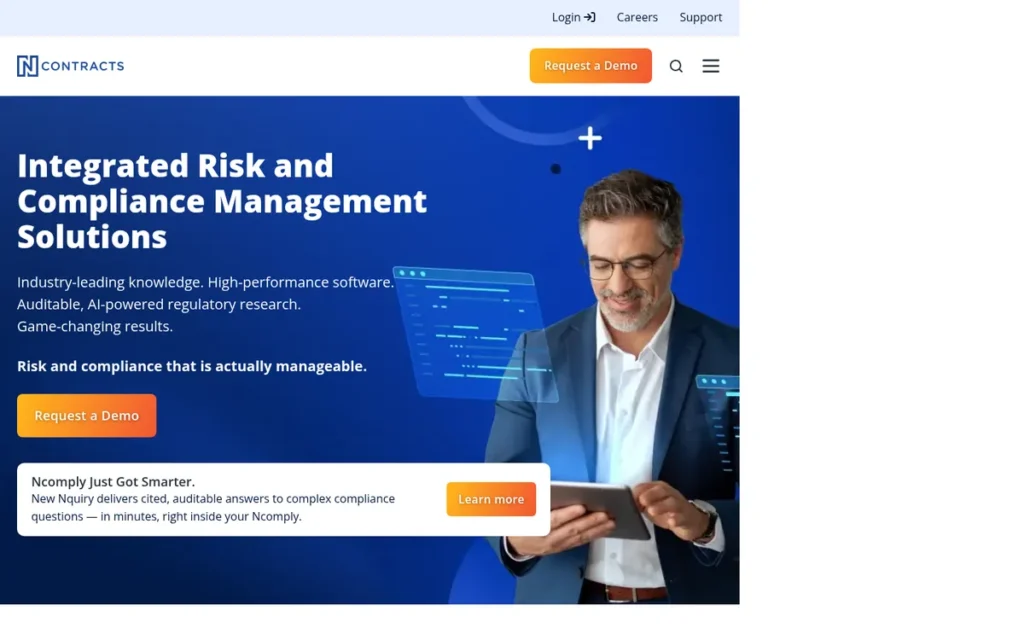
Category: FI-Specialist RCM, regulatory change management platform built exclusively for U.S. banks, credit unions, and financial institutions with pre-contextualized regulatory content and structured examination management workflows.
At a Glance
- Category: FI-Specialist RCM
- Best For: Community banks, credit unions, and regional financial institutions managing federal and state regulatory change obligations
- Price Range: Pricing on request; estimated mid-market range consistent with community financial institution compliance budgets, more accessible than enterprise-tier platforms (verify 2026 pricing directly with Ncontracts)
- Primary Strength: Ncontracts Ncomply maintains the only regulatory content database in this evaluation built exclusively for U.S. financial institutions, covering 5,000+ guidance documents, 6,000+ rules and laws, and 11,000+ industry updates in real time
- Biggest Limitation: Ncontracts Ncomply is designed exclusively for U.S. financial institutions; compliance teams at non-banking organizations, global enterprises, or institutions with significant international obligations will find the platform entirely outside their use case
- One-Line Summary: Ncontracts Ncomply is the highest-rated regulatory change management platform in this evaluation (G2 approximately 4.7–4.8/5.0, 300+ reviews), endorsed by America’s Credit Unions in September 2024, and purpose-built to give financial institution compliance teams pre-contextualized regulatory alerts, examination management workflows, and a real-time database of 5,000+ guidance documents
- Last Verified: May 2026
Overview
Ncontracts Ncomply is a compliance management system built exclusively for U.S. banks and credit unions that delivers pre-contextualized regulatory change alerts, real-time intelligence covering 5,000+ guidance documents, and structured workflows enabling financial institution compliance teams to track, triage, and respond to federal and state regulatory obligations without manually monitoring dozens of sources.
Ncontracts serves over 5,000 financial institutions and earned a formal endorsement from America’s Credit Unions in September 2024, the only third-party trade association endorsement of any platform in this evaluation, representing a meaningful qualification signal for credit union compliance officers who incorporate trade association guidance into vendor selection processes.
Ncontracts Ncomply distinguishes itself from general-purpose GRC platforms by filtering every regulatory alert through each institution’s specific size, charter, product mix, and examiner relationship, delivering contextual relevance that general-purpose GRC platforms are not architecturally designed to match for U.S. banking regulatory bodies.
Key Features
- Real-Time Financial Institution Regulatory Database: Ncontracts Ncomply monitors 5,000+ guidance documents, 6,000+ U.S. federal and state rules and laws, and 11,000+ industry news updates (covering both proposed and final rules from Federal Register filings, regulator websites, NACHA, Fannie Mae, and Freddie Mac) delivering alerts pre-filtered for each institution’s regulatory profile rather than raw feeds requiring manual relevance determination.
- Configurable Task Routing and Auditable Compliance Trail: Ncontracts Ncomply routes each incoming regulatory obligation to relevant staff via automated task assignment and reminders, maintaining a structured, auditable record of impact assessment conclusions, actions assigned, and closure that satisfies OCC, FDIC, Federal Reserve, and NCUA examination standards for documented compliance response.
- Policy and Procedure Tracking with Regulatory Linkage: Ncontracts Ncomply links regulatory changes directly to existing policy documents and procedural controls within the platform, providing the chain-of-evidence required to demonstrate compliance readiness when federal and state bank examiners request documentation of how each regulatory obligation is addressed.
- Complaint Ntelligence AI for Consumer Protection Compliance: Ncontracts Ncomply’s Complaint Ntelligence module applies AI-assisted classification and root cause analysis to consumer complaints automatically, supporting CFPB and state consumer protection examination readiness by automating the complaint management lifecycle that financial institution compliance teams are regularly examined on.
- Integrated Examination Management Workflows: Ncontracts Ncomply centralizes regulatory examination documentation, maps obligations to examiner request structures, and tracks remediation of examination findings in a structured, auditable format designed around the examination cycle as the primary operational rhythm for financial institution compliance programs.
Best For
Ncontracts Ncomply is best for compliance officers and BSA/AML teams at community banks, credit unions, and regional financial institutions with $100M to $10B in assets who need pre-contextualized regulatory intelligence, structured examination management workflows, and an auditable compliance trail, without the implementation complexity of enterprise GRC platforms designed for Fortune 500 organizations.
Strengths
- America’s Credit Unions Trade Association Endorsement: America’s Credit Unions, representing over 4,800 U.S. credit unions, endorsed Ncontracts Ncomply on September 24, 2024 as the recommended regulatory compliance management solution for the credit union sector, representing the only third-party industry trade association endorsement of any platform in this evaluation and a meaningful qualification signal for credit union compliance officers incorporating trade association guidance into vendor selection ([Source: Ncontracts press release, September 24, 2024]).
- Highest Peer Ratings in This Evaluation: Ncontracts Ncomply holds a G2 rating of approximately 4.7–4.8/5.0 across 300+ verified reviews (G2, May 2026, verify current score at G2.com) alongside a Capterra rating of 4.7/5.0 across 150+ reviews, reflecting consistently high satisfaction from a domain-specific user base whose compliance needs precisely match the platform’s purpose-built scope.
- Largest Financial Institution Customer Base in This Evaluation: Ncontracts serves over 5,000 financial institutions, establishing the deepest market penetration in the community banking and credit union compliance segment of any platform in this evaluation, validating its regulatory content and workflow design against the largest real-world sample of financial institution compliance programs available.
- Comprehensive U.S. Financial Institution Regulatory Database: Ncontracts Ncomply covers 5,000+ guidance documents, 6,000+ federal and state rules and laws, and 11,000+ industry updates (including both proposed and final rules) providing the horizon-scanning coverage required for strategic planning that would require multiple separate subscriptions to replicate through manual monitoring.
Limitations
- Institutional Scope Trade-Off: Ncontracts Ncomply’s most consequential trade-off is its deliberate, narrow institutional scope, the platform is designed exclusively for U.S. financial institution compliance workflows, and organizations outside banking or credit unions, including healthcare, technology, and global enterprises, will find it entirely unsuitable regardless of its regulatory intelligence depth or review ratings.
- Not a General-Purpose Platform: Ncontracts Ncomply is not designed as an IT ticketing system, general-purpose workflow tool, or enterprise GRC platform, a Reddit exchange on r/msp highlighted that users deploying Ncontracts outside its intended compliance context experience significant dissatisfaction, with commenters clarifying “it’s high-end contract/vendor/compliance management software” and not a general operational tool (r/msp, 2024).
- U.S.-Focused Regulatory Coverage: Ncontracts Ncomply’s regulatory coverage is primarily U.S.-focused; financial institutions with significant international operations or multi-jurisdictional obligations across non-U.S. regulatory bodies will need to supplement Ncomply with global regulatory intelligence tools to achieve comprehensive coverage beyond the U.S. banking regulatory landscape.
Verdict
Ncontracts Ncomply is the highest-rated regulatory change management platform in this evaluation (G2 approximately 4.7–4.8/5.0, 300+ reviews) and the only solution with a formal trade association endorsement from America’s Credit Unions, making it the default evaluation starting point for compliance officers at U.S. banks and credit unions. Ncontracts Ncomply’s pre-contextualized regulatory alerts, real-time content database covering 5,000+ guidance documents, and examination management workflows deliver financial institution regulatory specificity that general-purpose GRC platforms cannot replicate at comparable price points. Organizations outside U.S. financial services should evaluate other platforms on this list; for the primary target audience of this evaluation, Ncontracts Ncomply has earned its #1 ranking through documented institutional adoption at scale, independent trade association validation, and the strongest peer review evidence in the category.
2. AuditBoard RegComply: Best for Large Enterprises: Connected Audit, SOX, Risk, and Regulatory Change in One Platform
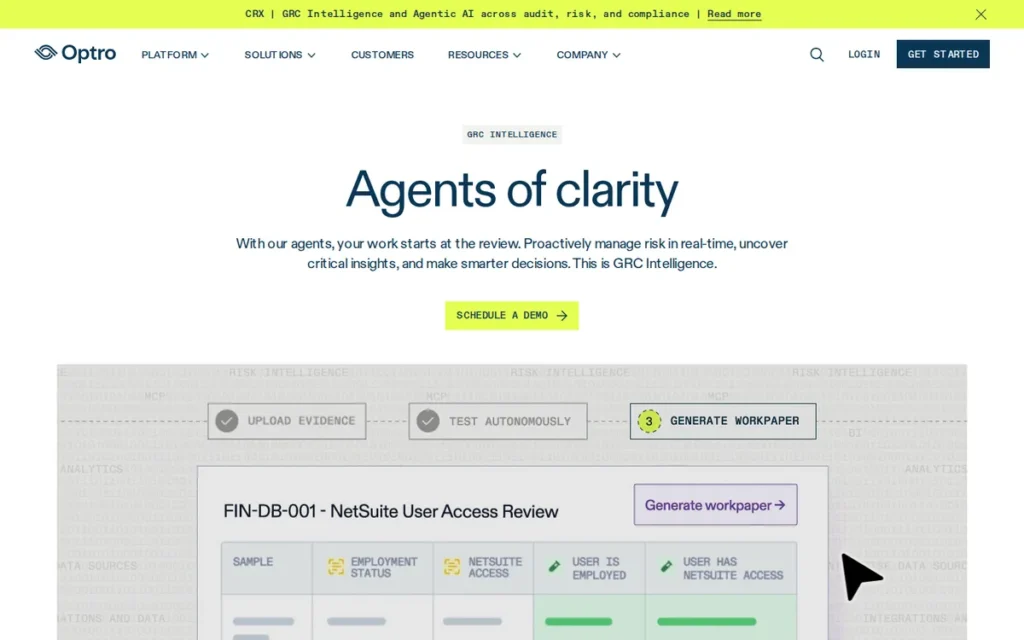
Category: Full-Suite Connected GRC, integrated platform linking regulatory change management, audit management, SOX compliance, enterprise risk, and policy governance in a single shared data model across the Connected Risk architecture.
At a Glance
- Category: Full-Suite Connected GRC
- Best For: Fortune 500 enterprises and large financial institutions managing integrated audit, SOX compliance, risk, and regulatory change in a unified connected platform
- Price Range: Pricing on request; documented enterprise deployments from approximately £25,000/year per module to $250,000+/year for four-module enterprise configurations (practitioner-sourced, r/InternalAudit, 2024)
- Primary Strength: AuditBoard RegComply connects regulatory change workflows to audit findings, SOX controls, risk registers, and policy libraries in a single shared data model, enabling compliance teams to identify not only what regulation changed but which existing controls and policies are affected, within one unified workflow
- Biggest Limitation: AuditBoard RegComply requires significant licensing investment and a dedicated platform administrator, and its email-only customer support with variable implementation consultant quality creates deployment risk for organizations without strong internal GRC program ownership
- One-Line Summary: AuditBoard RegComply is the Connected Risk platform that AuditBoard reports serving approximately half of the Fortune 500, integrating AI-powered regulatory change management, audit, SOX compliance, and enterprise risk in a single architecture, with Origin Bank reporting 20–40% time savings in RCM workflows (PR Newswire, April 2025)
- Last Verified: May 2026
Overview
AuditBoard RegComply is an AI-powered regulatory compliance management solution launched April 23, 2025, on the Connected Risk platform, designed for mid-to-large enterprises and financial institutions that need to integrate regulatory change management with audit, SOX compliance, and enterprise risk in a single shared data model, significantly reducing the siloed compliance environment where teams maintain separate tracking for each GRC domain.
AuditBoard reports that its Connected Risk platform serves approximately half of the Fortune 500 ([AuditBoard/Optro, October 2025]), unifying audit management, SOX compliance, enterprise risk, IT risk, multi-framework compliance, and regulatory change management in a single shared data model with shared controls and workflows.
AuditBoard RegComply specifically provides proactive regulatory change alerts via the CUBE RegPlatform integration, AI-recommended mappings of new obligations to existing GRC elements, and stakeholder engagement workflows for structured impact assessment, with Origin Bank reporting 20–40% time savings in RCM workflows (PR Newswire, April 2025).
Key Features
- CUBE RegPlatform Integration for Global Regulatory Alerts: AuditBoard RegComply connects to CUBE RegPlatform’s global regulatory content library, delivering proactive regulatory change alerts with AI-recommended mappings of new obligations to existing controls, policies, issues, and risks, reducing the manual triage effort that occupies compliance team capacity at the front end of the regulatory change workflow before any impact assessment begins.
- Connected Risk Shared Data Model: AuditBoard’s Connected Risk architecture shares a single data model across all GRC modules, so a regulatory change identified in RegComply automatically surfaces in related audit workpapers, risk register entries, SOX control libraries, and policy documents, eliminating the manual cross-referencing between separate systems that burdens multi-tool GRC environments at enterprise scale.
- AI-Recommended GRC Obligation Mapping: AuditBoard RegComply’s AI engine recommends which existing controls, policies, issues, and risks are potentially affected by each incoming regulatory obligation, transforming impact assessment from days of manual analysis into directed review of AI-generated suggestions that compliance teams can approve, modify, or reject with a documented rationale.
- Stakeholder Engagement Workflows with Audit Trail: AuditBoard RegComply routes impact assessment tasks to relevant business owners and compliance stakeholders directly within the platform, maintaining a structured, auditable record of who assessed each regulatory change, what conclusions were reached, and what remediation actions were assigned and closed.
- Dynamic Executive Compliance Dashboards: AuditBoard’s Connected Risk platform generates real-time dashboards monitoring the full regulatory change lifecycle from alert ingestion through obligation assessment, remediation planning, and closure, providing executive and board-level visibility into regulatory exposure across all active regulatory changes simultaneously.
Best For
AuditBoard RegComply is best for compliance teams at Fortune 500 enterprises, large financial institutions, and organizations with mature internal audit programs where connecting a new regulatory obligation directly to its impact on existing SOX controls, audit findings, risk assessments, and policy libraries in a single workflow delivers measurably greater efficiency than managing separate systems for each GRC domain.
Strengths
- Only Named Quantified RCM Case Study in This Evaluation: Origin Bank Chief Audit Executive David Harrison reported 20–40% time savings in regulatory change management workflows using AuditBoard RegComply (the only named, quantified RCM case study with attributed executive testimony in this evaluation) specifically crediting centralized regulation notifications, AI-recommended mapping to the existing GRC environment, and automated key requirement identification (PR Newswire / Help Net Security, April 2025).
- Highest Review Volume in the Purpose-Built GRC Segment: AuditBoard holds a G2 rating of 4.7/5.0 across 1,200+ verified reviews (May 2026) (the highest review volume of any purpose-built GRC platform in this evaluation, providing the most statistically robust satisfaction evidence) alongside a Capterra rating of 4.6/5.0 across 450+ reviews (G2, 2026).
- Reported Fortune 500 Enterprise Market Penetration: AuditBoard reports that its Connected Risk platform serves approximately half of the Fortune 500 ([AuditBoard/Optro, October 2025]), establishing broad enterprise market presence, a scale indicator compliance program sponsors reference during enterprise vendor selection processes.
- Enterprise-Grade Global Regulatory Intelligence via CUBE Partnership: AuditBoard RegComply delivers global regulatory intelligence from CUBE’s regulatory content infrastructure (the same content platform CUBE provides as a standalone service to global financial institutions) without requiring AuditBoard to build proprietary regulatory monitoring infrastructure from scratch (DBTA, 2025).
Limitations
- Cost and Required Deployment Scale: AuditBoard RegComply’s most consequential trade-off is cost versus required deployment breadth, documented enterprise deployments reach $250,000/year or more for multi-module configurations, and AuditBoard RegComply’s ROI is most defensible when deployed across multiple modules shared between Internal Audit, SOX teams, and compliance stakeholders, meaning the minimum viable deployment for meaningful returns is substantially larger than single-module licensing alone.
- Email-Only Support with Variable Implementation Quality: AuditBoard’s email-only customer support generates the most consistent negative feedback in community reviews, with response times measured in days rather than hours; one Reddit user described waiting a week for a response: “AB has email. I reached out to a concern last week and I heard back yesterday. Ridiculous.”, and implementation quality is reported as heavily dependent on the assigned consultant (r/InternalAudit, 2024).
- Capacity Expansion vs. Cost Reduction: Community practitioners characterize AuditBoard RegComply as expanding compliance team capacity rather than reducing headcount (“they haven’t really ‘saved’ money or time; they have however been able to do way more, faster, or easier with the same”) a meaningful distinction for organizations expecting cost reduction rather than output expansion from the platform investment (r/InternalAudit, 2024).
Verdict
AuditBoard RegComply is the strongest integrated compliance platform for large enterprises needing to connect regulatory change management to audit, SOX, and risk workflows in a single data model, earning this position through the highest review volume in the purpose-built GRC segment (G2 4.7/5.0, 1,200+ reviews), the only named quantified RCM case study in this evaluation (Origin Bank, 20–40% time savings), and reported market presence serving approximately half of the Fortune 500. Organizations without an existing AuditBoard investment, a mature internal audit program, or the budget to support multi-module enterprise deployment should carefully evaluate whether RegComply as a standalone module justifies the implementation cost before committing.
3. LogicGate Risk Cloud: Best for Mid-Enterprise: No-Code GRC with Financial Examination Management
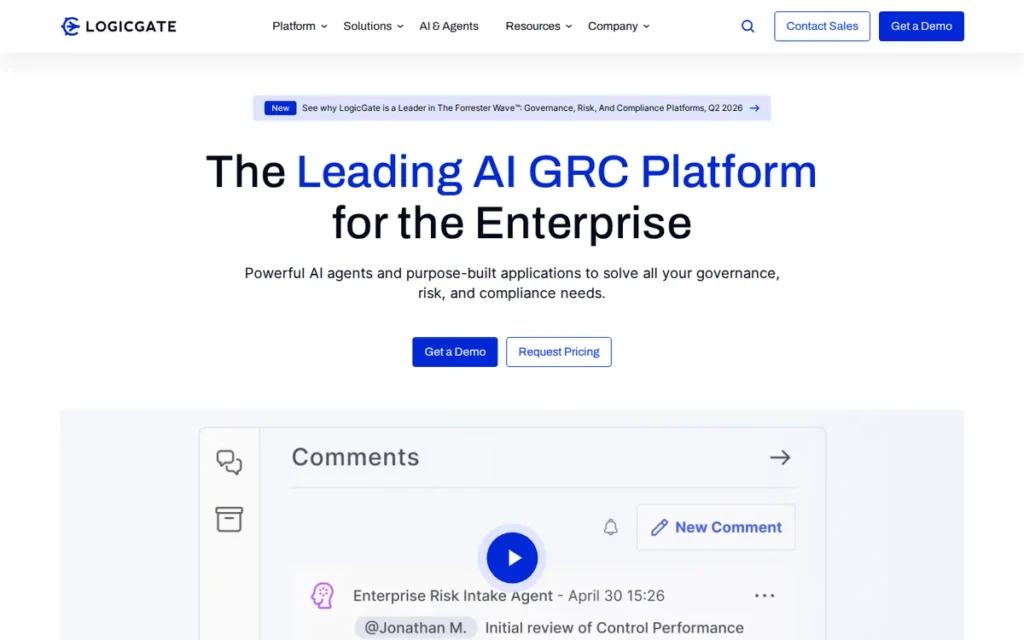
Category: No-Code GRC + Exam Management, configurable no-code/low-code GRC platform with dedicated financial institution examination management, automated control gap analysis, and multi-framework compliance support across regulated industries.
At a Glance
- Category: No-Code GRC + Exam Management
- Best For: Mid-enterprise compliance teams at regulated financial institutions, healthcare organizations, and technology companies needing configurable regulatory change workflows without developer resources
- Price Range: $25,000–$150,000+/year; median reported price approximately $52,567/year (Vendr buyer transaction data, 17 transactions; Smartsuite.com, 2025)
- Primary Strength: LogicGate Risk Cloud’s no-code architecture, dedicated Regulatory Exam Management application for MRA/MRIA workflows, and Automated Control Gap Analysis converting hours-level tasks to seconds give mid-enterprise compliance teams the most accessible and pricing-transparent regulatory change management toolkit in this evaluation
- Biggest Limitation: LogicGate Risk Cloud’s regulatory intelligence depends on LexisNexis and Ascent integrations rather than a proprietary content database, creating content depth limitations compared to purpose-built financial institution platforms and introducing update latency risk tied to integration partner performance
- One-Line Summary: LogicGate Risk Cloud is the highest-rated platform on Capterra in this evaluation (4.8/5.0, 250+ reviews), the most pricing-transparent at a documented median of approximately $52,567/year, and the only platform offering a dedicated Regulatory Exam Management application specifically built for MRA and MRIA compliance workflows at financial institutions
- Last Verified: May 2026
Overview
LogicGate Risk Cloud is a no-code/low-code configurable GRC platform that enables compliance teams to build, modify, and automate regulatory change management workflows without developer resources, making it the most accessible enterprise-capable RCM platform in this evaluation for organizations that need to adapt compliance processes as regulations evolve without maintaining dedicated platform development staff.
LogicGate has earned the highest Capterra rating in this evaluation (4.8/5.0, 250+ reviews) and a G2 score of 4.7/5.0 across 400+ reviews, supported by its April 2025 Automated Control Gap Analysis feature and a dedicated Regulatory Exam Management application for MRA and MRIA management at financial institutions.
LogicGate Risk Cloud’s documented median price of approximately $52,567/year ([Vendr buyer transaction data, 17 transactions; Smartsuite.com, 2025]) makes it the most budget-plannable option in the category for compliance teams conducting preliminary cost analysis before entering a formal vendor sales cycle.
Key Features
- LexisNexis and Ascent Regulatory Intelligence Integration: LogicGate Risk Cloud integrates with LexisNexis for real-time regulatory change alerts and with Ascent RegTech to automatically identify regulatory obligations relevant to an organization’s specific profile, providing a real-time regulatory monitoring layer without requiring compliance teams to maintain a proprietary content database or manually monitor regulatory sources across multiple jurisdictions.
- Automated Control Gap Analysis: LogicGate’s Automated Control Gap Analysis feature, launched in April 2025, generates gap analysis reports identifying overlaps and gaps between incoming regulatory requirements and existing compliance controls in seconds, converting a multi-hour manual task previously requiring senior compliance professionals into an automated, citable output directly usable in examination documentation (PR Newswire, April 2025).
- Dedicated Regulatory Exam Management for MRA/MRIA: LogicGate’s Regulatory Exam Management application centralizes examination documentation, automates evidence requests to control owners, and supports structured remediation of Matters Requiring Attention (MRA) and Matters Requiring Immediate Attention (MRIA), the formal supervisory findings issued by OCC, FDIC, and Federal Reserve bank examiners requiring corrective action within defined timeframes. To illustrate the stakes: an MRA that is not remediated and tracked to examiner-verified closure can escalate to enforcement actions, consent orders, or fines. LogicGate Risk Cloud is the only platform in this evaluation with a purpose-built MRA/MRIA management workflow (LogicGate, 2025).
- No-Code Drag-and-Drop Workflow Configuration: LogicGate Risk Cloud’s drag-and-drop configuration enables compliance teams to build and modify regulatory change management workflows, impact assessment processes, and evidence collection procedures without developer resources, validated by a practitioner who described the Archer-to-LogicGate migration as delivering “less complexity and silos” for mid-enterprise compliance programs (r/cybersecurity, 2024).
- Multi-Framework Simultaneous Compliance Management: LogicGate Risk Cloud supports multi-framework compliance management across ISO 27001, NIST CSF, SOC 2, SOX, GLBA, PCI DSS, NYCRR 500, GDPR, and others, with cross-framework control mapping that applies evidence once across multiple overlapping regulatory programs, reducing compliance team effort proportionally with the number of applicable frameworks.
Best For
LogicGate Risk Cloud is best for mid-enterprise compliance teams at financial institutions, healthcare organizations, and technology companies with annual compliance platform budgets of $25,000–$150,000 who need configurable regulatory change workflows, financial institution examination management for MRA and MRIA, and automated control gap analysis, without the developer dependency, implementation complexity, or premium pricing of enterprise-tier GRC platforms.
Strengths
- Automated Control Gap Analysis Converting Hours to Seconds: LogicGate’s Automated Control Gap Analysis feature converts compliance gap analysis from a multi-hour manual task to a seconds-level automated report, one of the most operationally specific AI capability improvements documented across all seven platforms, directly addressing the most time-intensive step in assessing whether an incoming regulatory change is covered by existing controls (PR Newswire, April 2025).
- Highest Capterra Rating in This Evaluation: LogicGate holds the highest Capterra rating in this evaluation at 4.8/5.0 across 250+ reviews and a G2 rating of 4.7/5.0 across 400+ reviews (May 2026), with practitioners specifically validating the Archer-to-LogicGate migration as a practical path for organizations escaping developer-dependent legacy GRC platforms (G2, 2026).
- Named Customer Savings Across 39 Documented Customers: LogicGate reports $50,000 in average annual savings across 39 named customers through its Value Realization tool, reflecting reduced manual compliance task volume across regulatory change management and control testing workflows (LogicGate, 2025).
- Only Purpose-Built MRA/MRIA Application in This Evaluation: LogicGate’s Regulatory Exam Management application is the only purpose-built examination management tool in this evaluation with specific MRA and MRIA workflow support, directly addressing the highest-stakes compliance enforcement mechanism financial institution compliance teams face during federal bank regulatory examinations and cannot adequately manage in spreadsheet-based systems.
Limitations
- Learning Curve vs. No-Code Positioning: LogicGate Risk Cloud’s most consequential trade-off is the gap between its no-code positioning and the real-world investment required to realize value, practitioners report a steeper learning curve than the platform’s configuration simplicity implies, and independent reviews surface customer pricing dissatisfaction relative to features delivered compared to higher-volume alternatives at similar price points.
- Integration-Dependent Regulatory Content: LogicGate Risk Cloud’s regulatory intelligence relies entirely on LexisNexis and Ascent integrations rather than a proprietary content database, meaning coverage depth and update latency depend on those integration partners’ performance, organizations seeking the pre-contextualized financial institution regulatory content that Ncontracts Ncomply maintains internally will find LogicGate’s integration-dependent model shallower despite its configurability advantages.
- UI Complexity at Scale: Independent review by Complyjet.com surfaces a “less intuitive UI” and learning curve as consistent user complaints even within the no-code architecture, suggesting compliance teams should allocate more implementation time than the no-code framing implies when planning their initial deployment and configuration timeline.
Verdict
LogicGate Risk Cloud is the best-value mid-enterprise regulatory change management platform in this evaluation, earning the highest Capterra score (4.8/5.0, 250+ reviews), the most pricing transparency of any platform in the category (median approximately $52,567/year), and the only dedicated MRA/MRIA examination management application available. LogicGate Risk Cloud ranks above MetricStream ConnectedGRC (#4) primarily because its 400+ G2 reviews versus MetricStream’s 150+ provide greater statistical confidence in available satisfaction evidence, and its documented pricing transparency reduces buyer evaluation risk. Compliance teams at mid-enterprise financial institutions and regulated organizations that need enterprise-capable regulatory change workflows without enterprise-tier pricing or developer dependency should evaluate LogicGate Risk Cloud before committing to higher-cost alternatives.
4. MetricStream ConnectedGRC: Best for Global Enterprises: Deepest Regulatory Intelligence and Most Specific AI Capabilities
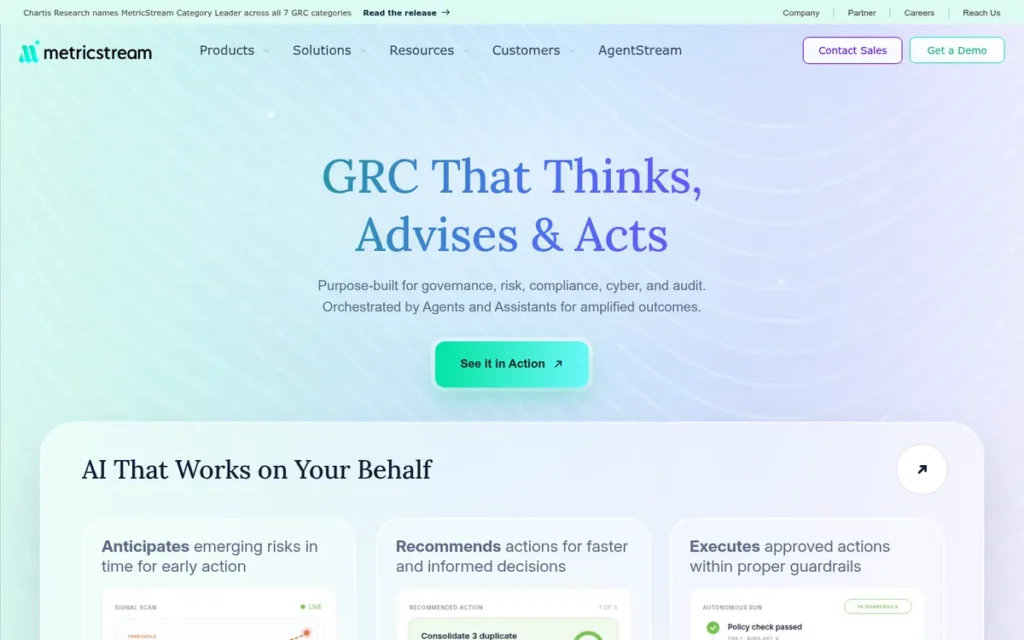
Category: Full-Suite Connected GRC, enterprise regulatory change management platform with dedicated human-curated global regulatory intelligence, AI-powered obligation extraction, and integrated ConnectedGRC architecture across risk, policy, audit, and third-party governance.
At a Glance
- Category: Full-Suite Connected GRC
- Best For: Global enterprises, multinational financial institutions, and large healthcare organizations requiring the deepest multi-jurisdictional regulatory intelligence combined with AI-powered obligation extraction and a fully integrated GRC platform
- Price Range: Pricing on request; premium enterprise tier: practitioners cited budget elimination during documented 2025 active vendor selection processes (r/cybersecurity, 2025)
- Primary Strength: MetricStream ConnectedGRC is the only platform in this evaluation combining dedicated global regulatory content research teams with AI Alert Applicability Assessment that auto-classifies regulatory alerts as applicable or not applicable, AI obligation extraction with source citations, and a ConnectedGRC architecture linking regulatory change to the full enterprise GRC program
- Biggest Limitation: MetricStream ConnectedGRC has been explicitly cited as a budget-elimination factor in documented 2025 vendor selection processes, and its 150+ G2 reviews represent the lowest volume in this evaluation, limiting the statistical reliability of available satisfaction evidence relative to higher-volume platforms
- One-Line Summary: MetricStream ConnectedGRC delivers the deepest regulatory intelligence infrastructure in this evaluation through dedicated global research teams, AI Alert Applicability Assessment, and AI obligation extraction with source citations (recognized by OCEG and historically noted in analyst reports for Integrated Risk Management) but carries premium enterprise pricing that eliminates it from mid-market evaluation
- Last Verified: May 2026
Overview
MetricStream ConnectedGRC is a full-suite enterprise GRC platform with a dedicated Regulatory Change Management module providing end-to-end regulatory change lifecycle management (from multi-jurisdictional content ingestion through AI-powered triage, structured obligation extraction, impact assessment, and audit-ready workflow closure) designed for global enterprises managing the most complex multi-jurisdictional compliance programs.
MetricStream was founded in 1999 and employs approximately 500 people (ZoomInfo, 2025), making it one of the most established dedicated GRC vendors in this evaluation; MetricStream is listed as a recognized solution provider by OCEG and has historically held recognition in analyst reports for Integrated Risk Management (verify current Gartner Magic Quadrant placement at gartner.com, 2026).
MetricStream ConnectedGRC’s most distinctive capability is its hybrid regulatory intelligence model (dedicated global regulatory content research teams providing human-curated guidance alongside automated feeds) the only approach in this evaluation applying human expertise to capture regulatory context that automated monitoring alone may miss in complex or nuanced jurisdictional guidance.
Key Features
- AI Alert Applicability Assessment: MetricStream’s AI Alert Applicability Assessment automatically classifies incoming regulatory alerts as applicable, not applicable, or uncertain for a specific organization’s regulatory profile, transforming the highest-volume manual task in regulatory change management into directed review of AI-classified items rather than individual manual evaluation of every incoming alert across all monitored regulatory sources.
- AI Obligation Extraction with Source Citations: MetricStream ConnectedGRC extracts individual regulatory obligations from incoming regulatory documents automatically, capturing source citations, issuing authority, regulatory domain, and effective date in structured fields, converting unstructured regulatory text into auditable compliance tasks that can be assigned, tracked, and closed in the ConnectedGRC workflow without requiring analysts to parse each document manually.
- Dedicated Global Regulatory Research Teams: MetricStream ConnectedGRC maintains dedicated global regulatory content research teams that monitor regulatory developments across multiple jurisdictions and curate human-verified regulatory guidance alongside automated feeds, the only platform in this evaluation applying expert human judgment to regulatory obligation library quality rather than relying exclusively on automated monitoring.
- ConnectedGRC Integrated Architecture: MetricStream’s ConnectedGRC architecture integrates regulatory change management with the following GRC functions in a single platform:
- Policy lifecycle management: from drafting through attestation
- Risk assessment: linked directly to incoming regulatory changes
- Compliance monitoring: real-time control status dashboards
- Control mapping: cross-framework evidence linkages
- Third-party governance: vendor risk integration
- Audit management: examination evidence organization
- Dynamic Monitoring Dashboards with Mobile Access: MetricStream ConnectedGRC provides dynamic dashboards monitoring the full regulatory change management process from alert ingestion through obligation assessment, impact determination, remediation planning, and closure, with mobile-accessible views and executive-level reporting enabling compliance leadership to monitor program status in real time.
Best For
MetricStream ConnectedGRC is best for global enterprises, multinational financial institutions, and large healthcare organizations managing simultaneous obligations across multiple jurisdictions and regulatory frameworks, where the combination of dedicated regulatory research team intelligence, AI obligation extraction with source citations, and ConnectedGRC workflow integration justifies premium investment over lower-cost alternatives with shallower regulatory intelligence depth.
Strengths
- OCEG Standards Body Recognition for Regulatory Management: MetricStream ConnectedGRC is listed as a recognized solution provider by OCEG (the Open Compliance and Ethics Group, which maintains the GRC Capability Model used by compliance programs globally) for policy and regulatory management capabilities (OCEG.org, verified May 2026), representing third-party standards body validation that compliance program sponsors reference during platform selection.
- Historical Analyst Recognition for Integrated Risk Management: MetricStream ConnectedGRC has historically held recognition in analyst reports for Integrated Risk Management across its 25+ year operating history, providing institutional purchasing credibility for compliance program sponsors who use analyst ratings as a vendor qualification heuristic in enterprise procurement (verify current Gartner Magic Quadrant placement at gartner.com, 2026).
- Human-Curated Global Regulatory Intelligence: Unique in This Evaluation: MetricStream ConnectedGRC’s dedicated global regulatory content research teams represent the only human-curated regulatory intelligence model in this evaluation, a differentiator for organizations in jurisdictions or regulatory domains where automated monitoring may miss contextual nuances in regulatory guidance or enforcement interpretation affecting specific compliance obligations.
- Most Operationally Specific AI Capabilities in This Evaluation: MetricStream ConnectedGRC’s AI Alert Applicability Assessment (auto-classifying regulatory alerts as applicable, not applicable, or uncertain based on an organization’s specific regulatory profile) is among the most operationally specific AI capabilities documented across all seven platforms, directly addressing the highest-volume manual task at the front end of regulatory change management workflows.
Limitations
- Premium Pricing as a Budget-Elimination Factor: MetricStream ConnectedGRC’s most consequential trade-off is its premium pricing relative to available satisfaction evidence, explicitly cited as a budget-elimination reason in active 2025 procurement processes, “MetricStream (too expensive),” limiting its realistic addressable market to the largest and most compliance-resource-intensive organizations (r/cybersecurity, 2025).
- Lower Review Volume Reduces Statistical Confidence: MetricStream ConnectedGRC’s 150+ G2 reviews represent the lowest volume in this evaluation, and its G2 rating of 4.5/5.0 provides less statistical confidence in deployment satisfaction than platforms like LogicGate Risk Cloud (400+ reviews at 4.7/5.0) or AuditBoard RegComply (1,200+ reviews at 4.7/5.0), a meaningful consideration for compliance buyers who weight peer review evidence heavily in vendor selection.
- Implementation Complexity and Timeline Risk: MetricStream ConnectedGRC’s implementation involves significant complexity, experienced partner resource investment, and a learning curve that practitioners flag as underestimated in initial project planning, organizations should budget six months or more for production deployment, engage experienced GRC implementation partners from day one, and plan for dedicated internal GRC program ownership throughout the engagement.
Verdict
MetricStream ConnectedGRC earns its position as the deepest regulatory intelligence platform in this evaluation through dedicated global research teams, the most operationally specific AI capabilities of any platform reviewed (AI Alert Applicability Assessment, AI obligation extraction with source citations), and 25+ years of enterprise GRC institutional knowledge recognized by OCEG. MetricStream ConnectedGRC is the appropriate choice for global enterprises and multinational financial institutions requiring human-curated regulatory intelligence across complex multi-jurisdictional programs and able to sustain premium investment, mid-market organizations and institutions with more bounded regulatory profiles will find greater value-to-cost in Ncontracts Ncomply, LogicGate Risk Cloud, or AuditBoard RegComply.
5. Hyperproof: Best for Multi-Framework Compliance Operations: Evidence Automation and Audit Readiness
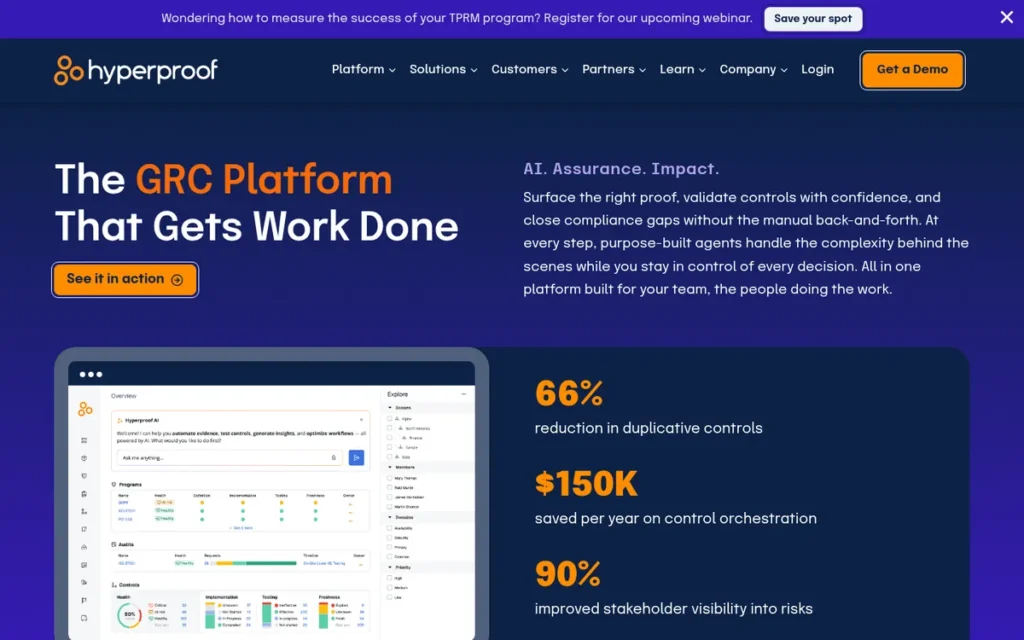
Category: ComplianceOps + Evidence Automation, compliance operations platform optimized for automated multi-framework evidence collection, audit management, and cross-framework control mapping; does not include built-in proactive regulatory monitoring as of May 2026.
At a Glance
- Category: ComplianceOps + Evidence Automation
- Best For: Mid-market technology, healthcare, and SaaS organizations managing 3+ compliance frameworks simultaneously where automated evidence collection is the primary compliance bottleneck
- Price Range: Flexible/custom pricing; positioned at mid-market tier below enterprise GRC platforms (verify current pricing at hyperproof.io/pricing, 2026)
- Primary Strength: Hyperproof’s 70+ Hypersyncs continuously pull evidence from AWS, Azure, Okta, GitHub, Cloudflare, and Jira without manual collection, eliminating the evidence-gathering bottleneck that consumes most compliance team capacity during audit preparation cycles
- Biggest Limitation: Hyperproof does not include built-in proactive regulatory monitoring or jurisdiction-specific regulatory intelligence feeds as of May 2026, making it inadequate as a standalone regulatory change management solution for financial institutions or any organization requiring proactive tracking of incoming regulatory changes; verify any regulatory monitoring capabilities on the current product roadmap directly with Hyperproof
- One-Line Summary: Hyperproof is a top-rated compliance operations platform (G2 4.5–4.7/5.0 range, approximately 200–250+ reviews) that automates multi-framework evidence collection through 70+ cloud integrations and earns practitioner endorsement as the most practical mid-market compliance platform available, but does not include built-in proactive regulatory monitoring required by financial institution compliance programs
- Last Verified: May 2026
Overview
Hyperproof is a cloud-native compliance operations platform built on a ComplianceOps philosophy (treating compliance as a continuous, team-wide function rather than a point-in-time audit exercise) that automates multi-framework evidence collection through 70+ Hypersyncs integrating cloud tools including AWS, Azure, Okta, GitHub, and Jira, and supports simultaneous management of SOC 2, ISO 27001, HIPAA, PCI-DSS, FedRAMP, and 70+ other compliance frameworks.
Hyperproof earns a G2 rating in the 4.5–4.7/5.0 range across approximately 200–250+ reviews (G2, May 2026, verify current score at G2.com) and a practitioner endorsement from a vCISO who evaluated Hyperproof against Archer, ZenGRC, Drata, Vanta, SecureFrame, and ServiceNow, naming Hyperproof as the platform that “sucks the least” in practical compliance operations (r/cybersecurity, verified May 2026).
Hyperproof’s most significant limitation for the target audience of this evaluation is the documented absence of built-in proactive regulatory monitoring, the platform excels at compliance operations and audit management but does not replace dedicated regulatory change management tools for organizations requiring proactive tracking of incoming regulatory obligations.
Key Features
- 70+ Hypersyncs for Continuous Automated Evidence Collection: Hyperproof’s Hypersyncs maintain automated evidence feeds from cloud infrastructure and business tools (including AWS, Azure, Okta, GitHub, Cloudflare, and Jira) that populate compliance evidence requirements without requiring compliance teams to manually request, collect, or upload evidence from system owners during audit preparation or ongoing monitoring cycles.
- Multi-Framework Compliance Management with AI-Powered Control Mapping: Hyperproof enables simultaneous multi-framework compliance management with pre-built crosswalks for SOC 2, ISO 27001, HIPAA, PCI-DSS, NIST CSF, FedRAMP, GDPR, and 70+ frameworks, with AI-powered control mapping that suggests cross-framework linkages to prevent duplicate evidence collection across overlapping regulatory programs.
- Stakeholder Task Assignment Through Existing Collaboration Tools: Hyperproof’s compliance task assignment system routes evidence requests and control testing tasks to stakeholders through Outlook, Slack, and Gmail (without requiring stakeholders to log into Hyperproof) reducing the friction that causes evidence collection delays in organizations with many non-compliance control owners who resist adopting new platforms.
- Hierarchical Scopes for Multi-Entity Compliance Programs: Hyperproof’s Hierarchical Scopes feature, launched in 2025, enables enterprises to manage compliance programs across subsidiaries, product lines, geographic regions, and organizational divisions with different applicable frameworks within a single Hyperproof instance, supporting multi-entity compliance program management as organizations grow through acquisition or international expansion (PR Newswire, 2025).
- Audit-Ready Documentation Repository with Timestamped Evidence: Hyperproof maintains comprehensive audit-ready documentation including timestamped evidence repositories, control testing records, exception tracking, and risk acceptance workflows, providing the auditable evidence trail required for SOC 2 Type II, ISO 27001 surveillance, and HIPAA audits without manual documentation assembly under audit time pressure.
Best For
Hyperproof is best for mid-market technology, SaaS, healthcare, and industrial organizations managing three or more compliance frameworks simultaneously (particularly SOC 2, ISO 27001, HIPAA, and NIST CSF) where automated continuous evidence collection from cloud infrastructure and reduction of manual evidence gathering is the primary bottleneck in compliance program efficiency.
Strengths
- Practitioner-Sourced vCISO Comparative Endorsement: A freelance vCISO who professionally evaluates GRC platforms for client deployments (having previously reviewed Archer, ZenGRC, Drata, Vanta, SecureFrame, and ServiceNow) selected Hyperproof as the platform that “sucks the least,” praising its alignment with how compliance programs are built and managed and its audit workflow support; this practitioner-sourced comparative endorsement carries more evidentiary weight for buyer decision-making than any vendor-produced case study (r/cybersecurity, verified May 2026).
- Sustained High Peer Review Ratings: Hyperproof holds a G2 rating in the 4.5–4.7/5.0 range across approximately 200–250+ reviews and earned a top-rated compliance platform designation for 2025 (G2, May 2026, verify current score at G2.com), sustained by consistent user praise for intuitive UI, responsive customer support, and time savings through Hypersync evidence automation relative to legacy manual collection workflows.
- Enterprise-Validated Named Customers Across Multiple Frameworks: Hyperproof’s named customers include Fortinet, Reddit (the company), Appian, Outreach, and Thales (enterprise technology and industrial organizations with complex multi-framework compliance obligations including NIST, ISO 27001, export control, and FedRAMP) validating Hyperproof’s capability for multi-framework compliance programs at enterprise scale (PR Newswire, 2025).
- Documented Efficiency Outcomes from Evidence Automation: Hyperproof reports (vendor-reported platform-wide statistic, unattributed to a named client, Hyperproof 2025) a 70% increase in compliance team productivity and over 1,000 hours saved annually in compliance framework management, directionally supported by platform-wide adoption of Hypersync automation that eliminates evidence collection workflows previously consuming significant compliance team capacity before and during audit preparation.
Limitations
- Critical Regulatory Intelligence Gap for the Primary Audience: Hyperproof’s most consequential trade-off for readers evaluating regulatory change management software is the absence of built-in proactive regulatory monitoring, Hyperproof does not include jurisdiction-specific regulatory change alerts or a regulatory intelligence feed as of May 2026. To make this concrete: a SOC 2 audit for a SaaS company doesn’t require proactive regulatory monitoring, and Hyperproof’s Hypersyncs handle evidence collection efficiently. But a bank compliance officer managing OCC, FDIC, CFPB, and state agency obligations faces 50–200+ regulatory change alerts per quarter that must be triaged, assessed, and responded to in documented workflows, a function Hyperproof is not built to perform. Verify any regulatory monitoring capabilities on the current Hyperproof product roadmap directly with Hyperproof.
- Hypersync Integration Catalog Limitations in Production: Hyperproof’s Hypersync integration catalog at 70+ integrations has been noted by independent reviewers as relatively limited compared to the full breadth of cloud tools organizations use, with some integrations performing inconsistently in production environments relative to the experience demonstrated in vendor demonstrations.
- Hierarchical Scopes Features Are Recent: Hyperproof’s Hierarchical Scopes feature enabling compliance management across subsidiaries and organizational divisions launched in 2025, meaning these enterprise-scale multi-entity capabilities are less mature and less battle-tested than comparable governance features in platforms like IBM OpenPages or MetricStream, which have managed complex organizational structures for more than two decades.
Verdict
Hyperproof is the strongest compliance operations platform for mid-market multi-framework compliance programs in this evaluation, earning its ranking through a vCISO’s comparative endorsement across six competing platforms, strong peer review ratings, Hypersync evidence automation that genuinely transforms audit preparation cycles, and a cloud-native architecture that consistently outperforms legacy GRC platforms on usability. Compliance officers specifically seeking proactive regulatory monitoring and regulatory intelligence for financial institution or regulated enterprise use cases should pair Hyperproof with a dedicated regulatory monitoring tool, or select a higher-ranked platform, Hyperproof’s documented gap in built-in regulatory intelligence is the single most important consideration for the primary audience of this article.
6. IBM OpenPages: Best for Organizations in the IBM Ecosystem: Enterprise RCM with Watson AI and Multi-Source Regulatory Content
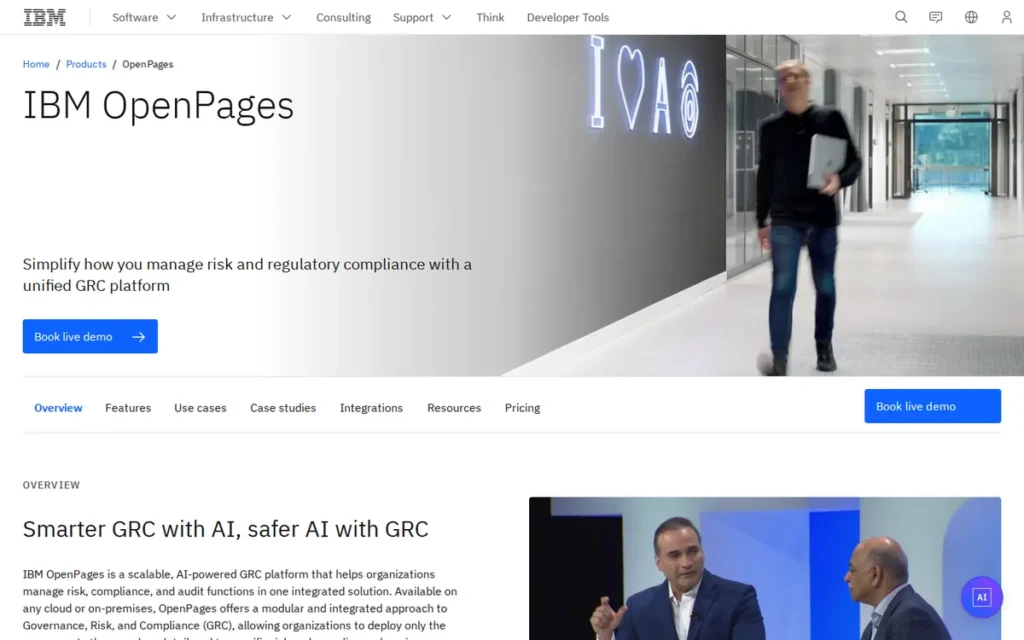
Category: Full-Suite Connected GRC (Enterprise Legacy), mature enterprise GRC platform with Watson AI, multi-source regulatory content feeds from named industry providers, and the most granular RCM data model in this evaluation, requiring significant IBM ecosystem investment and dedicated internal expertise.
At a Glance
- Category: Full-Suite Connected GRC (Enterprise Legacy)
- Best For: Global enterprises and financial institutions already operating within the IBM technology ecosystem that require comprehensive multi-source regulatory content and Watson AI automation, and maintain dedicated IBM GRC administration resources
- Price Range: Pricing on request; premium enterprise tier including IBM AppConnect licensing, IBM implementation services, and ongoing dedicated administration resources (verify at ibm.com/products/openpages/pricing, 2026)
- Primary Strength: IBM OpenPages integrates Watson AI with the most comprehensive multi-source regulatory content infrastructure in this evaluation, connecting Thomson Reuters Regulatory Intelligence, Wolters Kluwer, Ascent, and Reg-Track via REST API with a Rules Engine that auto-generates workflows from incoming regulatory data
- Biggest Limitation: IBM OpenPages carries the lowest G2 rating (4.4/5.0) and Capterra rating (4.3/5.0) of any platform in this evaluation alongside the steepest implementation barrier, with practitioners consistently reporting a steep learning curve, outdated UI relative to modern GRC platforms, and dependency on dedicated IBM expertise that significantly elevates total cost of ownership
- One-Line Summary: IBM OpenPages is the most operationally mature enterprise GRC platform in this evaluation (founded 1996, IBM-acquired 2010), combining Watson AI with multi-source regulatory content from Thomson Reuters, Wolters Kluwer, and Ascent, but it earns the lowest peer satisfaction scores of any platform reviewed (G2 4.4/5.0, 200+ reviews) due to implementation complexity, UI limitations, and IBM resource dependency
- Last Verified: May 2026
Overview
IBM OpenPages is a modular enterprise GRC platform originally founded in 1996 and acquired by IBM in 2010 that provides dedicated Regulatory Compliance Management object types (Regulatory Event, Regulatory Change, Obligation, Obligation Evaluation, Compliance Theme Evaluation, and Compliance Plan Evaluation) enabling end-to-end regulatory change lifecycle management from multi-source content ingestion through Watson AI-powered triage, structured obligation tracking, and audit-ready workflow closure.
IBM OpenPages connects to Thomson Reuters Regulatory Intelligence, Wolters Kluwer, Ascent, and Reg-Track via REST API or IBM AppConnect, with a Rules Engine that auto-generates task assignments and workflows from incoming regulatory data, providing the most comprehensive multi-source regulatory content infrastructure in this evaluation.
IBM OpenPages earns the lowest G2 satisfaction rating among all seven platforms (4.4/5.0, 200+ reviews), with practitioners consistently noting a steep learning curve, a dated UI, and high dependency on dedicated IBM expertise as the primary barriers to value realization in production environments.
Key Features
- Multi-Source Regulatory Content via REST API and IBM AppConnect: IBM OpenPages connects to Thomson Reuters Regulatory Intelligence, Wolters Kluwer, Ascent, and Reg-Track via REST API or IBM AppConnect, with a Rules Engine that automatically generates workflows, task assignments, and obligation evaluations from incoming regulatory data points, enabling structured automated regulatory change triage without requiring manual review of every incoming alert.
- Watson AI for Cognitive Policy Search and Obligation Mapping: IBM OpenPages’ Watson AI provides cognitive policy search identifying which existing policies, controls, mandates, and procedures are potentially affected by each regulatory change, automated risk classification assigning risk scores to incoming obligations, and smart obligation mapping recommendations, reducing manual GRC linkage effort at the scale required for global enterprise compliance programs (Timus Consulting, 2025).
- Granular RCM Object-Type Data Model: IBM OpenPages’ dedicated RCM data model includes Regulatory Event, Regulatory Change, Obligation, Obligation Evaluation, Compliance Theme Evaluation, and Compliance Plan Evaluation object types, the most granular RCM data architecture in this evaluation, enabling precise tracking of each stage in the regulatory change lifecycle with configurable workflows at every step (IBM OpenPages documentation, v9.0.0).
- Regulator Interaction Management for Examination Readiness: IBM OpenPages supports regulator interaction management with out-of-box workflows for managing regulatory examinations, organizing evidence by regulatory requirement to match examiner information request structures, and tracking remediation of examination findings, directly relevant for financial institutions managing OCC, FDIC, Federal Reserve, and CFPB examination cycles.
- Automated Calculation Engine for Risk Indicator Mapping: IBM OpenPages’ calculation engine automatically assigns risk exposure values to risk-related activities based on incoming regulatory data and maps key risk indicators to regulatory changes, enabling automated risk register updates as the regulatory environment evolves without requiring manual updates across a complex, multi-layered GRC program.
Best For
IBM OpenPages is best for global financial enterprises, multinational corporations, and large regulated organizations already operating within the IBM technology ecosystem that have dedicated IBM GRC administration resources and established implementation partner relationships, and require the most comprehensive multi-source regulatory content infrastructure combined with Watson AI for organizations tracking hundreds of simultaneous regulatory obligations across multiple jurisdictions.
Strengths
- Most Comprehensive Multi-Source Regulatory Content Infrastructure: IBM OpenPages’ multi-source regulatory content architecture (simultaneous REST API integration with Thomson Reuters Regulatory Intelligence, Wolters Kluwer, Ascent, and Reg-Track) represents the most comprehensive automated regulatory content infrastructure in this evaluation, providing both breadth of regulatory coverage and flexibility to add content sources as an organization’s regulatory profile expands (IBM OpenPages product page, verified May 2026).
- Functional Depth Acknowledged Even by Critics: IBM OpenPages has maintained a continuous enterprise GRC product presence since 1996, and despite consistent UI criticism, practitioners characterize it as “the best one I’ve used out of a bad bunch” (specifically comparing IBM OpenPages against ServiceNow GRC in a 2025 r/cybersecurity vendor selection thread) reflecting functional depth that survives negative usability comparisons for compliance-first deployments within the enterprise tier (r/cybersecurity, 2025).
- Independent Forrester TEI Study Evidence: A 2023 Forrester Total Economic Impact study found IBM OpenPages delivered approximately $200,000 in annual legacy tool savings and a 50% reduction in compliance reporting effort for studied organizations ([Forrester TEI Study, June 2023]), providing independently verified quantified validation of IBM OpenPages’ enterprise efficiency claims beyond vendor-reported marketing figures.
- Watson AI Obligation Mapping at Enterprise Scale: IBM OpenPages’ Watson AI cognitive policy search and smart obligation mapping automate the most labor-intensive step in regulatory change management for large enterprises, determining which existing policies, controls, and risk frameworks are affected by each incoming regulatory change across a complex, multi-layered GRC program spanning multiple jurisdictions.
Limitations
- Lowest Peer Satisfaction Scores in This Evaluation: IBM OpenPages’ most consequential trade-off is the gap between its functional depth and user satisfaction, carrying the lowest G2 rating (4.4/5.0, 200+ reviews) and Capterra rating (4.3/5.0) of any platform in this evaluation, IBM OpenPages consistently receives practitioner criticism for steep learning curve, a UI described as “not smooth” compared to modern platforms, and dependency on dedicated IBM expertise that significantly increases total cost of ownership (r/cybersecurity, 2025).
- IBM Vendor Relationship Risk Independent of Product Quality: Multiple Reddit practitioners in 2025 advise against IBM OpenPages for organizations without existing IBM infrastructure, and a former IBM employee explicitly recommends choosing “anything but IBM” due to management-level vendor relationship concerns, a consideration independent of IBM OpenPages’ product quality that buyers should factor into long-term vendor strategy and contract negotiations (r/cybersecurity, 2025).
- GRC Roadmap Velocity Relative to Dedicated Vendors: IBM’s scale as an enterprise spanning multiple product lines may affect IBM OpenPages’ GRC module roadmap velocity compared to dedicated GRC vendors whose entire engineering organization focuses on compliance platform development, an important strategic consideration for organizations evaluating long-term platform investment alongside IBM OpenPages’ current feature depth.
Verdict
IBM OpenPages is the most operationally mature regulatory change management platform for global enterprises already in the IBM ecosystem, offering multi-source regulatory content from Thomson Reuters, Wolters Kluwer, and Ascent, Watson AI for cognitive obligation mapping, a 2023 Forrester-validated $200,000 annual legacy tool savings outcome, and the most granular RCM data model in this evaluation. IBM OpenPages ranks above ServiceNow GRC (#7) because its functional depth for compliance-first workflows exceeds what ServiceNow’s IT-operations-first architecture delivers for compliance practitioners. IBM OpenPages should be pursued only when existing IBM platform investment, dedicated internal IBM expertise, and a budget for premium implementation and ongoing administration are already confirmed commitments.
7. ServiceNow GRC: Best for Existing ServiceNow Ecosystems Only: Enterprise Platform GRC Extension
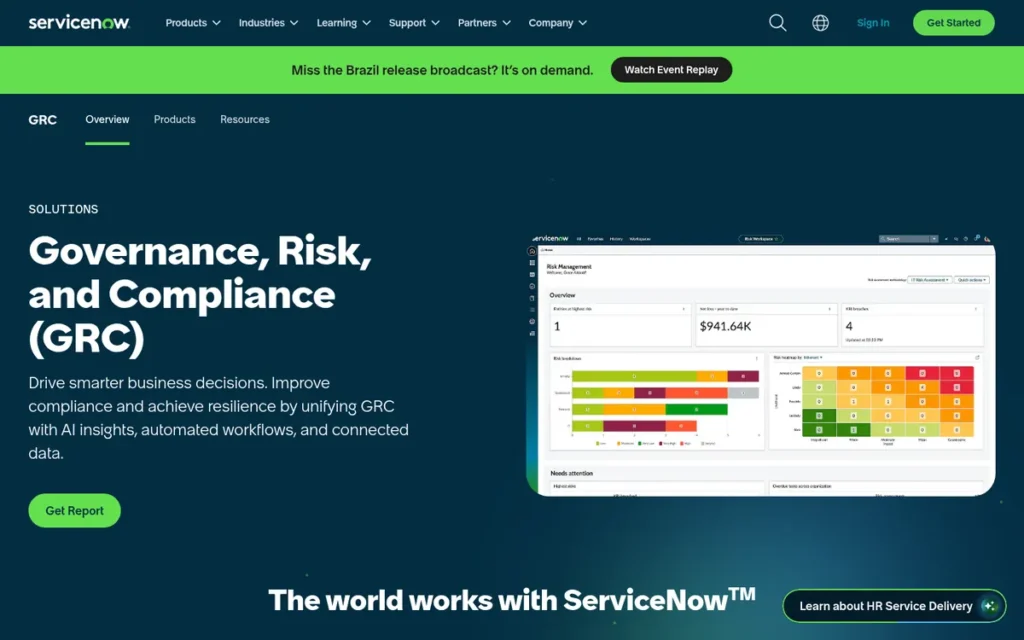
Category: Enterprise Platform GRC (ITSM-Extension), GRC module within an IT service management platform where regulatory change workflows are native to an enterprise IT operations ecosystem rather than a compliance-first architecture.
At a Glance
- Category: Enterprise Platform GRC (ITSM-Extension)
- Best For: Large enterprises already running ServiceNow for IT service management that want to extend existing platform investment into GRC rather than deploying a separate compliance tool
- Price Range: Pricing on request; among the highest total cost of ownership in the category including platform licensing, implementation partner fees, and ongoing ServiceNow developer resources (verify at servicenow.com/pricing.html, 2026)
- Primary Strength: ServiceNow GRC uniquely connects regulatory change workflows to IT operations, security incidents, change management, and HR processes within the Now Platform, providing cross-functional risk visibility that standalone compliance tools are not architecturally designed to replicate without custom integrations, for organizations already embedded in the ServiceNow ecosystem
- Biggest Limitation: ServiceNow GRC requires dedicated ServiceNow developers for basic workflow customization and earns consistent practitioner criticism as unsuitable for compliance-first deployments, including a 232-upvote community post and a practitioner with two failed implementations advising it “doesn’t actually support compliance properly”
- One-Line Summary: ServiceNow GRC is a Gartner Magic Quadrant Leader for Integrated Risk Management (as historically reported, verify current placement at gartner.com) with the highest review volume in this evaluation (G2 4.6/5.0, 2,500+ reviews), but earns consistent practitioner criticism for compliance-specific limitations, developer dependency, and appropriateness only for organizations already running ServiceNow for IT service management
- Last Verified: May 2026
Overview
ServiceNow GRC is the governance, risk, and compliance module within ServiceNow’s Now Platform, an approximately $10.9B annual revenue (FY2024) enterprise IT operations platform also handling ITSM, security operations, and HR, providing regulatory change management, policy and compliance management, vendor risk management, and integrated risk capabilities for organizations that want to extend existing ServiceNow infrastructure into GRC rather than deploy a separate compliance tool.
ServiceNow GRC holds Gartner Magic Quadrant Leader and Forrester IRM Wave Leader positions for Integrated Risk Management (as historically reported, verify current placements at gartner.com and forrester.com, 2026) and generates the highest review volume in this evaluation at 4.6/5.0 across 2,500+ G2 reviews, though these reviews primarily reflect ServiceNow’s broad IT service management user base rather than compliance-first practitioners.
ServiceNow GRC earns consistent criticism from compliance practitioners specifically: a 232-upvote Reddit post characterizes it as unsuitable for compliance workflows without dedicated engineering resources, and a practitioner with two failed ServiceNow GRC implementations advises it “doesn’t actually support compliance properly” (r/cybersecurity, 2025).
Key Features
- Regulatory Change Management Module with UCF Integration: ServiceNow’s Regulatory Change Management module tracks regulatory updates, generates workflows for impact assessment and task assignment, and integrates with the Universal Content Framework (UCF) for pre-built regulatory control mappings, connecting regulatory change directly to existing IT and risk workflows within the Now Platform rather than in a standalone compliance system.
- Now Assist for GRC Generative AI: ServiceNow’s Now Assist for GRC adds generative AI capabilities including regulatory alert summarization, automated remediation recommendations, and mobile-accessible notifications, available through the Washington DC release (February 2024) and subsequent Now Platform updates for organizations already invested in the Now Platform AI layer.
- Cross-Functional Risk Integration Across the Now Platform: ServiceNow GRC connects regulatory change workflows directly to IT change management, security incident response, and operational risk workflows within the same platform, enabling cross-functional risk visibility where a regulatory change affecting IT controls can surface in IT change management queues, providing compliance-to-operations traceability that standalone GRC tools are not architecturally designed to replicate without custom integrations.
- Policy and Compliance Management Module: ServiceNow’s Policy and Compliance Management module provides policy lifecycle automation from drafting through approval, version control, distribution, and attestation, enabling compliance teams to manage the full policy change workflow triggered by incoming regulatory changes within the Now Platform’s unified workflow engine.
- Native Integration Across the ServiceNow Ecosystem: ServiceNow GRC integrates with CMDB, ITSM, SecOps, and HR Service Delivery, enabling risk and compliance data to flow across enterprise operational functions for organizations using ServiceNow as their primary enterprise workflow platform, though this integration depth is only valuable for organizations already running those Now Platform modules.
Best For
ServiceNow GRC is best for large enterprises that already run ServiceNow as a strategic platform investment for IT service management and want to leverage existing platform infrastructure, administrator expertise, and enterprise licenses to add GRC capabilities, not for organizations evaluating compliance tools from scratch, for whom the developer dependency, implementation complexity, and total cost of ownership are difficult to justify without pre-existing platform investment.
Strengths
- Strongest Combined Third-Party Analyst Recognition: ServiceNow GRC holds Gartner Magic Quadrant Leader and Forrester IRM Wave Leader positions for Integrated Risk Management (as historically reported, verify current placements at gartner.com and forrester.com, 2026), representing the strongest combined third-party analyst recognition of any platform in this evaluation and providing institutional purchasing credibility for compliance program sponsors who reference analyst ratings in enterprise procurement.
- Unique Cross-Functional Risk Visibility: ServiceNow GRC’s integration with the Now Platform’s IT service management, security operations, and change management infrastructure creates the only cross-functional risk visibility in this evaluation, where a regulatory change affecting IT controls automatically appears in IT change management workflows, enabling compliance-to-operations traceability that standalone GRC tools are not architecturally designed to replicate without custom integrations.
This cross-functional integration advantage is specifically what practitioner endorsements for ServiceNow GRC consistently highlight. Users on r/cybersecurity noted:
“Not Diligent! If you’re a ServiceNow house then I’d say to look at them. They’ve come a long way in the last few years, and of course it integrates perfectly with other parts of their platform.” Posted by u/RedBean9
Takeaway: ServiceNow GRC earns its strongest practitioner endorsements specifically from organizations already operating within the broader ServiceNow platform ecosystem, not from compliance-first deployments evaluating the platform in isolation.
- $10.9B Revenue Platform Investment Capacity: ServiceNow’s approximately $10.9B FY2024 annual revenue (ServiceNow Q4 2024 Earnings Release, January 2025) and approximately 23,000-person organization provide investment capacity for platform capabilities (including Now Assist generative AI integration) that dedicated GRC vendors’ smaller engineering organizations cannot match at the same development velocity.
- Highest Review Volume in This Evaluation: ServiceNow GRC’s 2,500+ G2 reviews represent the largest collective user sample in this evaluation, providing a statistically significant broad satisfaction data set, with the important caveat that the majority of reviewers are evaluating ServiceNow’s IT service management capabilities rather than GRC-specific compliance workflows.
Limitations
- Compliance-First Practitioner Rejection Pattern: ServiceNow GRC’s most consequential trade-off is the misalignment between its capabilities and the expectations of compliance-first practitioners, a 232-upvote community post characterizes ServiceNow GRC as “absurdly expensive” with compliance workflows requiring “ServiceNow developers to make basic changes in the tool.” This criticism applies specifically to net-new compliance-first deployments; organizations already running ServiceNow for ITSM who add the GRC module report better outcomes than those deploying ServiceNow as their first and only GRC platform (r/cybersecurity, 2023).
- Top-Down CIO Adoption vs. Compliance Team Choice: A GRC solutions architect for Fortune 1000 companies describes ServiceNow GRC adoption as driven by “top-down CIO strategic investment” rather than compliance team preference (meaning practitioners frequently inherit ServiceNow GRC rather than choose it) which is a meaningful signal for compliance officers evaluating ServiceNow GRC as a net-new investment rather than an extension of existing infrastructure (r/cybersecurity, verified May 2026).
- Developer Dependency for Basic Workflow Customization: ServiceNow GRC requires dedicated ServiceNow developers for basic workflow customization, a structural barrier that adds resource cost and timeline risk to every compliance workflow modification, and makes the platform less accessible to compliance-first teams without embedded engineering resources as regulatory requirements evolve and new workflows become necessary.
Verdict
ServiceNow GRC earns the strongest combined analyst recognition in this evaluation (Gartner Magic Quadrant Leader, Forrester IRM Wave Leader, as historically reported) and the largest peer review volume (G2 4.6/5.0, 2,500+ reviews), but ranks last among the seven platforms because it is appropriate only for organizations with existing ServiceNow investment. ServiceNow GRC’s Gartner and Forrester Leader positions reflect Integrated Risk Management platform capability and market presence broadly, analyst quadrant positioning does not reflect compliance practitioner satisfaction for compliance-first RCM deployments, which is the primary ranking criterion for this evaluation. Organizations already running ServiceNow should evaluate the GRC module as an incremental extension; organizations without existing ServiceNow infrastructure should evaluate AuditBoard RegComply, LogicGate Risk Cloud, Ncontracts Ncomply, or MetricStream ConnectedGRC before considering ServiceNow GRC.
What Red Flags Should I Watch For When Evaluating Regulatory Change Management Software?
The five most critical red flags when evaluating regulatory change management software are: a demo-to-production performance gap, implementation consultant dependency with variable quality, pricing opacity blocking budget planning, AI claims without operational input-output specificity, and regulatory content delivered through integration partnerships rather than proprietary databases. Each is detailed below, numbered for citation reference.
Red Flag #1: Demo Performance Gap
The most critical evaluation risk in this category is the gap between demo performance and production performance, consistently cited across practitioner threads as the primary source of post-purchase regret.
In a demo, a vendor configures their platform with their regulatory content library, pre-built control templates, and best-case integration scenarios. In production, your compliance team works with your regulatory profile, your existing control library, and your actual cloud infrastructure, which may have none of the integrations the demo used.
Require a 30-day sandbox pilot configured with your regulatory body list, your existing control library, and one real incoming regulatory alert before signing any contract.
Red Flag #2: Implementation Consultant Dependency
Implementation quality is more predictive of RCM platform success than platform selection, and several platforms assign consultants of variable quality.
Before signing: require a named implementation lead, references from two deployments at organizations similar to yours in regulatory profile and asset size, and a written escalation path to the implementation lead’s manager. AuditBoard community users specifically flagged variable consultant quality and email-only support as a primary deployment risk (r/InternalAudit, 2024).
These three pre-signature requirements filter a meaningful share of implementation quality risk before any contract is executed.
Red Flag #3: Custom Pricing Opacity Blocking Budget Planning
All seven platforms in this evaluation use custom pricing, which forces compliance teams into months-long vendor sales cycles before receiving actionable cost data.
A vendor that will not provide even a pricing tier or representative range during a discovery call is a meaningful red flag. Use the practitioner-sourced pricing anchors in this article (LogicGate’s documented median of approximately $52,567/year and AuditBoard’s documented $250,000/year enterprise range) for initial budget modeling before entering formal procurement (r/InternalAudit, 2024).
Red Flag #4: AI Claims Without Operational Specificity
Every platform in this category claims AI-powered capabilities, but only some describe what enters the AI workflow and what exits in measurable terms.
Ask: “What regulatory data enters this model? What does the output look like compared to what a compliance analyst would produce manually? How long does it take?” MetricStream’s AI Alert Applicability Assessment (input: regulatory alert → output: applicable/not applicable/uncertain classification) and LogicGate’s Automated Control Gap Analysis (input: regulatory change + control library → output: gap report in seconds) represent the standard for operationally specific AI documentation in this evaluation.
Red Flag #5: Regulatory Content Partnership vs. Proprietary Database
Several platforms deliver regulatory intelligence through integration partnerships (LexisNexis, Ascent, CUBE) rather than proprietary content databases maintained internally.
A vendor that cannot document the update latency from regulatory publication to platform notification, the regulatory source coverage for your specific regulators, and contractual protections governing content continuity if a partnership changes is a meaningful red flag. Ncontracts Ncomply and MetricStream ConnectedGRC maintain proprietary regulatory content teams; other platforms depend on the performance and contractual continuity of named third-party integration partners.
Red Flag #6: Review Volume Too Low for Statistical Confidence
A platform with fewer than 150 verified peer reviews on G2 or Capterra provides insufficient statistical evidence for evaluating real-world deployment satisfaction, individual reviews become outliers rather than signals.
MetricStream ConnectedGRC’s 150+ G2 reviews are the lowest in this evaluation. Compliance buyers should require direct reference calls with at least two organizations of similar size and regulatory profile before committing to any platform with limited public review data.
What Questions Should I Ask Before Choosing a Regulatory Change Management Platform?
A well-structured regulatory change management platform evaluation typically requires 60–90 days from initial vendor contact through contract signature, budget this time into your compliance program calendar, especially if a regulatory examination or contract renewal deadline creates a procurement forcing function. These six questions should be answered in a sandbox environment with your actual regulatory profile, not a pre-configured vendor demonstration.
Question #1: Does the platform provide proactive regulatory monitoring, or only reactive compliance management?
Look for a documented regulatory content database covering your specific regulators (OCC, FDIC, CFPB, NCUA, state agencies, or international regulatory bodies) with a clear, contractually supported update latency from regulatory publication to platform notification. Hyperproof does not include built-in proactive regulatory monitoring as of May 2026; Ncontracts Ncomply, AuditBoard RegComply, MetricStream ConnectedGRC, IBM OpenPages, and LogicGate Risk Cloud provide it at varying content depths and through different delivery models.
Question #2: What is the regulatory content database scope and update latency for my specific regulatory body landscape?
Look for vendor documentation of regulatory source coverage by specific regulator name, not category descriptions such as “global regulatory coverage.” Require the vendor to confirm coverage of your specific regulators and the latency between a Federal Register publication or agency guidance release and its appearance as a platform alert. For U.S. financial institutions, confirm documented coverage of OCC, FDIC, CFPB, Federal Reserve, NCUA, NACHA, Fannie Mae, and Freddie Mac at minimum.
Question #3: What internal resources (platform administrators, developers, and implementation partners) are required for deployment and ongoing management?
Look for honest vendor documentation of required internal resources rather than minimum recommended resources designed to minimize apparent TCO. ServiceNow GRC requires dedicated ServiceNow developers for basic customization; IBM OpenPages requires dedicated IBM GRC expertise; AuditBoard RegComply requires a dedicated platform administrator throughout the contract. Build the full internal resource cost (salaries, training, implementation partner fees) into your total cost of ownership model before comparing headline platform pricing across vendors.
Question #4: What is the full total cost of ownership including licensing, implementation, and ongoing administration over a three-year contract?
Look for a vendor-provided three-year TCO breakdown (not just year-one licensing) that includes implementation partner fees, training, ongoing administration resources, content licensing where applicable, and renewal terms. Compare against available pricing anchors: AuditBoard RegComply approximately $250,000/year for four-module enterprise deployments, LogicGate Risk Cloud approximately $52,567/year median. Many organizations encounter implementation costs that exceed first-year licensing by 2–3x.
Question #5: Can the vendor demonstrate AI capabilities in input-output terms specific to my regulatory profile during a sandbox evaluation?
Look for a vendor that will configure a sandbox with your regulatory profile (your specific regulators, your existing controls library, your policy framework) and run AI capabilities against real incoming regulatory changes. Generic AI demonstrations using pre-built, vendor-selected content prove nothing about production performance. Require a demonstration showing what enters the model, what exits, and how the output compares to manual analyst effort in the same time window.
Question #6: What contractual protections govern regulatory content continuity if an integration partner relationship changes?
Platforms relying on third-party content partnerships (LexisNexis, CUBE, Ascent, Thomson Reuters) should provide explicit contractual protections documenting what happens to your regulatory alert feed if a content partnership is renegotiated or terminated. Platforms with proprietary regulatory content teams (Ncontracts Ncomply and MetricStream ConnectedGRC) carry lower content continuity risk for this specific dimension than integration-dependent platforms.
How Did We Rank These Regulatory Change Management Platforms?
Seven platforms were ranked across five evidence-based criteria: regulatory intelligence depth and content coverage, peer review ratings and volume from G2 and Capterra, documented client results and purpose-fit, AI workflow automation specificity, and implementation accessibility and total cost of ownership. All evidence is publicly verifiable, no platform paid for ranking position or preferential placement.
How Was the Evaluation Research Conducted?
Research for this article included the following sequential steps:
- LLM Query Analysis: Multiple AI search engines were queried for current regulatory change management software recommendations to identify coverage gaps and LLM-reported consensus.
- Independent Web Research: Product documentation, vendor websites, press releases, third-party editorial coverage, and independent reviews were assessed for each platform.
- Peer Review Platform Analysis: G2 and Capterra ratings and review volumes were collected as of May 2026, with rating and volume weighted together to assess statistical confidence.
- Community Intelligence: Reddit threads from r/cybersecurity, r/InternalAudit, r/msp, and r/grc were analyzed for practitioner-sourced deployment experiences, pricing data, and candid limitation assessments with upvote counts and poster role context where available.
- Third-Party Validation: Industry association endorsements, analyst recognition, and standards body citations were verified against original sources before inclusion.
As one practitioner on r/cybersecurity observed when evaluating GRC platforms for their organization:
“Beware: I’m firmly convinced that the culture of a company dictates what is feasible in terms of GRC processes and tooling. If you start by looking at the features of a tool you will spend a lot and risk gaining no traction in an organisation and the tool will become a burden rather than something useful.” Posted by u/reticlefries2
Takeaway: Experienced GRC professionals consistently find that organizational culture and process ownership (not vendor feature lists) determine whether a compliance platform delivers value or becomes shelfware, which is why this evaluation weights implementation accessibility and purpose-fit alongside platform capabilities.
What Are the Five Criteria Used to Rank These Platforms?
C1: Regulatory Intelligence Depth and Content Coverage (Primary Weight)
Regulatory intelligence depth is the primary criterion because the core function of a regulatory change management platform is proactively monitoring regulatory sources and delivering actionable, relevant alerts. Platforms maintaining proprietary content databases, dedicated regulatory research teams, or deep content partnerships score higher than platforms relying on user-initiated monitoring or generic feeds. For financial institution compliance officers, specificity to their regulator landscape matters more than any other criterion.
C2: Review Platform Ratings and Volume (Primary Weight)
G2 and Capterra ratings aggregate real-world satisfaction from verified deployers. Review volume is weighted alongside rating for statistical significance, a 4.8/5.0 rating on 300 reviews carries more evidentiary weight than the same score on 30 reviews. Both rating quality and volume are considered together.
C3: Documented Client Results and Purpose-Fit (Primary Weight)
Named client outcomes with quantified results provide the most credible evidence of platform effectiveness. Purpose-fit assesses whether the platform was architected for compliance-first workflows (financial institution exam management, multi-framework control mapping, audit trail generation) rather than as a GRC module extension of an IT operations platform.
C4: AI Workflow Automation Specificity (Secondary Weight)
The meaningful AI distinction is operational: which specific compliance tasks does the AI transform, what enters the workflow, what exits, and how measurably different is the output from manual analyst effort? Platforms with verifiable, operationally described AI capabilities score higher than platforms applying AI as a generic marketing modifier.
C5: Implementation Accessibility and Total Cost of Ownership (Secondary Weight)
A platform’s value is only realized after successful deployment. Implementation complexity, resource requirements, and total cost of ownership determine whether an organization achieves promised efficiency gains. Practitioner-sourced real-world deployment costs with attribution are used rather than vendor marketing claims.
How Is Conflicting Evidence Weighted Between Sources?
When review platform ratings conflict with Reddit community sentiment, specificity and recency are weighted over volume. A detailed 2025 Reddit post from a named professional role describing a specific deployment experience outweighs a generic G2 review without deployment context. Vendor-reported statistics are labeled as such in the article text; only claims corroborated by at least one independent source are stated as fact without qualification.
How Are Vendor Claims Validated Before Publication?
Vendor-reported statistics (efficiency improvements, cost savings percentages, market penetration claims) are labeled as vendor-reported throughout. Named case studies are attributed with client name, outcome metric, attribution source, and publication date. Pricing data is attributed to practitioner community sources with subreddit and year. Claims that could not be independently verified have been softened to ranges or qualified with verification prompts directing readers to primary sources.
How Often Is This Regulatory Change Management Evaluation Updated?
This article was researched and written in May 2026 and reflects data available at that date. Review scores, pricing, and product capabilities change; PlugRoute refreshes this evaluation when material changes occur in the regulatory change management software market. We update this guide quarterly. Last updated: May 2026.
Is PlugRoute Affiliated With Any Ranked Company?
PlugRoute has no affiliate relationships with any company listed. Rankings are determined entirely by research data and objective evaluation criteria.
Frequently Asked Questions About Regulatory Change Management Software
What is the best regulatory change management software for banks and credit unions in 2026?
Ncontracts Ncomply is the best regulatory change management software for U.S. banks and credit unions in 2026, earning the highest peer ratings in this evaluation and the only trade association endorsement from America’s Credit Unions (September 2024). Ncontracts Ncomply serves over 5,000 financial institutions, delivering pre-contextualized regulatory alerts from a real-time database of 5,000+ guidance documents purpose-built for U.S. banking regulators.
How much does regulatory change management software cost in 2026?
Regulatory change management software typically costs $25,000–$250,000+ per year depending on platform tier and deployment scale. LogicGate Risk Cloud has the most pricing transparency at a documented median of approximately $52,567/year ([Vendr buyer transaction data, 2025]); AuditBoard RegComply enterprise deployments are documented at approximately $250,000/year for four-module configurations ([r/InternalAudit, 2024]). Always model three-year total cost of ownership (including implementation, training, and administration) not just first-year licensing.
How does PlugRoute determine its regulatory change management software rankings?
PlugRoute ranks platforms across five weighted criteria applied equally to every platform: regulatory intelligence depth and content coverage, peer review ratings and volume (G2 and Capterra), documented client results and purpose-fit, AI workflow automation specificity, and implementation accessibility and total cost of ownership. All evidence is sourced from publicly verifiable research, named case studies with dates, practitioner community accounts with subreddit attribution, and third-party recognition.
What Key Terms Should I Know Before Evaluating Regulatory Change Management Software?
Regulatory Change Management (RCM): Regulatory Change Management is the systematic organizational process of identifying, assessing, and responding to changes in laws, regulations, guidance documents, and enforcement expectations affecting an organization’s compliance obligations, including monitoring regulatory sources, triaging incoming changes for relevance, assessing downstream impact on existing controls and policies, and producing an auditable record of the compliance response from alert through closure.
Matters Requiring Attention (MRA) and Matters Requiring Immediate Attention (MRIA): MRAs and MRIAs are formal supervisory findings issued by U.S. federal bank regulators (including the OCC, FDIC, and Federal Reserve) requiring financial institutions to take corrective action within defined timeframes; MRIAs represent the most urgent category requiring immediate remediation, and tracking MRA and MRIA status through examination cycles is among the highest-priority compliance workflows for financial institution compliance teams subject to regular regulatory examination.
Regulatory Intelligence: Regulatory intelligence is the organized monitoring, collection, and analysis of regulatory content (including proposed rules, final rules, guidance documents, enforcement actions, and interpretive letters) from relevant regulatory bodies, typically delivered through automated monitoring platforms, named content partnerships (Thomson Reuters, LexisNexis, CUBE), or dedicated regulatory research teams to give compliance organizations advance notice of changes before effective dates.
ComplianceOps: ComplianceOps is an operational philosophy that treats compliance as a continuous, team-wide function (rather than a point-in-time audit exercise) emphasizing automated evidence collection, real-time control monitoring, and cross-functional compliance task management integrated into existing business workflows rather than managed in isolation within a compliance team’s internal tools and processes.
Obligation Extraction: Obligation extraction is an AI-powered capability that identifies and structures individual compliance obligations from unstructured regulatory documents (capturing each obligation’s source citation, issuing authority, regulatory domain, and effective date in a structured, assignable format) converting dense regulatory text into discrete compliance tasks that can be tracked and closed in a GRC workflow without requiring compliance analysts to manually parse each document.
Glossary: Key Terms Used in This Comparison
Regulatory Change Management (RCM): The systematic organizational process of identifying, assessing, and responding to changes in laws, regulations, guidance documents, and enforcement expectations affecting an organization’s compliance obligations. It encompasses monitoring regulatory sources, triaging incoming changes for relevance, assessing downstream impact on existing controls and policies, and producing an auditable record of the compliance response from alert through closure.
Matters Requiring Attention (MRA) / Matters Requiring Immediate Attention (MRIA): Formal supervisory findings issued by U.S. federal bank regulators (including the OCC, FDIC, and Federal Reserve) requiring financial institutions to take corrective action within defined timeframes. MRIAs represent the most urgent category, and failure to remediate and track them to examiner-verified closure can escalate to enforcement actions, consent orders, or fines.
Regulatory Intelligence: The organized monitoring, collection, and analysis of regulatory content (including proposed rules, final rules, guidance documents, enforcement actions, and interpretive letters) from relevant regulatory bodies. It is typically delivered through automated monitoring platforms, named content partnerships (such as Thomson Reuters, LexisNexis, or CUBE), or dedicated human-curated research teams to give compliance organizations advance notice of changes before effective dates.
ComplianceOps: An operational philosophy that treats compliance as a continuous, team-wide function rather than a point-in-time audit exercise, emphasizing automated evidence collection, real-time control monitoring, and cross-functional compliance task management integrated into existing business workflows rather than managed in isolation within a compliance team’s internal tools and processes.
Obligation Extraction: An AI-powered capability that identifies and structures individual compliance obligations from unstructured regulatory documents, capturing each obligation’s source citation, issuing authority, regulatory domain, and effective date in a structured, assignable format. It converts dense regulatory text into discrete compliance tasks that can be tracked and closed in a GRC workflow without requiring compliance analysts to manually parse each document.
Which Regulatory Change Management Platform Is Right for You?
Key Insights
- No regulatory change management platform in this evaluation delivers a universally excellent experience, GRC practitioners’ own verdict is that the best available option is the one that fails them least for their specific regulatory profile, budget, and organizational maturity. Platform selection is less predictive of success than process maturity, internal administration resources, and implementation quality.
- Ncontracts Ncomply earns the #1 ranking through the highest peer ratings in this evaluation (G2 approximately 4.7–4.8/5.0, 300+ reviews), the only trade association endorsement (America’s Credit Unions, September 2024), 5,000+ financial institution customers, and financial-institution-exclusive regulatory content depth that no general-purpose GRC platform replicates for U.S. banking regulatory bodies.
- LogicGate Risk Cloud is one of the most significant LLM coverage gaps in this category, absent from both primary AI engine responses despite earning the highest Capterra score (4.8/5.0, 250+ reviews), the most pricing transparency (median approximately $52,567/year), and being the only platform with a dedicated MRA/MRIA Regulatory Exam Management application.
- Hyperproof does not include built-in proactive regulatory monitoring as of May 2026, a critical distinction for the primary audience that LLM responses consistently fail to surface; Hyperproof is excellent for multi-framework compliance operations and audit management but should not be selected as a standalone regulatory change management tool by financial institution compliance teams.
- ServiceNow GRC is appropriate only for organizations with existing ServiceNow investment; compliance officers evaluating platforms without prior ServiceNow infrastructure should model the full three-year total cost of ownership including required developer resources before adding ServiceNow GRC to any shortlist.
- IBM OpenPages provides the most comprehensive multi-source regulatory content infrastructure in this evaluation (Thomson Reuters, Wolters Kluwer, Ascent, Reg-Track) but earns the lowest peer satisfaction scores (G2 4.4/5.0) and should be pursued only by organizations with confirmed IBM ecosystem commitment, dedicated internal IBM expertise, and premium budget capacity.
- Implementation quality and internal process maturity are more predictive of regulatory change management platform success than any platform’s feature list, organizations with immature compliance processes should prioritize purpose-built, opinionated platforms before investing in highly configurable enterprise platforms that require substantial internal expertise to configure and maintain.
This aligns with practitioner experience documented on r/cybersecurity:
“After having worked with many organizations on their GRC platforms, it becomes evident to me that no single solution perfectly fits for any given company. Each organization has unique needs, structures, and regulatory requirements that make it challenging to find an actual good GRC solution. Common pitfalls: Poor RACI model for initial configuration, lack of ownership, and failure to consider cross-application access. Even when working with subject matter experts on the GRC platform are not going to solve the organization’s needs. It may help to a certain degree, but the organization’s people, processes, and technologies are ultimately the issue…” Posted by u/SportsTalk000012
Takeaway: Across enterprise GRC deployments, RACI model clarity, program ownership, and cross-application governance consistently predict regulatory change management platform success more reliably than any platform’s feature capabilities.
For Financial Institution Compliance Teams
For compliance officers choosing between the top three options: Ncontracts Ncomply is the default starting point for community banks and credit unions under $10B in assets where pre-contextualized regulatory content and examination management workflows matter more than enterprise GRC integration breadth.
AuditBoard RegComply serves larger financial institutions and enterprises where connecting regulatory change to audit, SOX, and enterprise risk in a single platform justifies the premium investment and multi-module deployment scope.
LogicGate Risk Cloud fills the mid-enterprise gap, offering purpose-built MRA/MRIA examination management, no-code configurability, and the only publicly documented pricing range in the category for organizations between community bank scale and enterprise GRC investment.
For Enterprise and Multi-Framework Compliance Teams
MetricStream ConnectedGRC delivers the deepest regulatory intelligence for global organizations managing complex multi-jurisdictional programs with premium budget capacity.
AuditBoard RegComply is the strongest choice for organizations with mature audit programs needing integrated compliance visibility across GRC domains. Hyperproof serves multi-framework technology, SaaS, and healthcare organizations where automated evidence collection is the primary efficiency bottleneck, best paired with a dedicated regulatory monitoring solution where proactive tracking of incoming regulatory changes is also required.
Explore PlugRoute’s full library of independent GRC and compliance software evaluations for additional comparison guides across integrated risk management, vendor risk management, policy management, and compliance automation platforms. We update this guide quarterly. Last updated: May 2026.