PushPress is the best gym management software for most independent gyms in 2026. GymMaster is best for 24/7 unstaffed access, and Wodify is best for CrossFit boxes that want built-in workout tracking. The right choice depends on your gym model and your all-in monthly cost, including processing fees, member bands and add-ons.
The advertised entry price rarely matches the monthly bill. Processing percentages, member-count bands, branded app add-ons and door hardware can push real spend well above list price. A free plan can even cost more than a paid one.
Switching platforms later means moving members, recurring billing and stored card tokens, so a wrong first choice is expensive. This guide ranks seven platforms on November 2026 pricing, independent review ratings and owner evidence. It then matches each platform to the gym model it fits best.
As one user on r/bjj described:
“Every community seems to have its preferences.
Gymdesk, spark, wodify, MyStudio, mindbody, etc.
Depending on what group you ask in you’ll get different answers.
They all have ups and downs” Posted by u/wpgMartialArts
Takeaway: Gym owners comparing management software get conflicting recommendations depending on which community they ask, which is why a ranking based on published costs and evidence is useful.
PlugRoute has no affiliate relationships with any company listed. Rankings are determined entirely by research data and objective evaluation criteria.
What Are the 5 Categories of Gym Management Software?
Gym management software falls into five categories. Core Operations platforms run memberships and billing. Performance platforms add native workout tracking. Access-Control platforms add door hardware. Rank-Tracking platforms manage belt progression. Growth & Marketplace platforms focus on branded apps and finding new clients. Your gym model decides which category matters most.
The seven evaluated platforms fall into these categories:
- Core Operations Platform: PushPress and TeamUp handle memberships, recurring billing, class scheduling, check-in and member communication for independent gyms and studios.
- Performance Platform: Wodify builds workout programming, performance tracking and leaderboards into the same app that handles billing.
- Access-Control Platform: GymMaster combines gym management software with its own door-entry hardware for unstaffed or mixed-hours facilities.
- Rank-Tracking Platform: Zen Planner builds member management around belt, rank and skill progression for martial arts and specialty schools.
- Growth & Marketplace Platform: ABC Glofox and Mindbody focus on branded apps, marketing automation or consumer marketplace discovery.
How Do the Top Gym Management Software Platforms Compare at a Glance?
PushPress leads PlugRoute’s 2026 evaluation with a weighted score of 4.35 out of 5. GymMaster (4.13), TeamUp (3.90) and Wodify (3.85) follow within three-tenths of a point of each other. Zen Planner (3.68), ABC Glofox (2.95) and Mindbody (2.85) score lower, mainly on contract risk, cost transparency or review ratings. Each one still leads a specific niche.
| Rank | Company | Category | Best For | One-Line Summary | Key Capabilities | Primary Strength | Key Limitation |
|---|---|---|---|---|---|---|---|
| 1 | PushPress | Core Operations Platform | Independent CrossFit, strength and new gyms | PushPress is the most cost-transparent platform in PlugRoute’s 2026 evaluation. | Memberships, billing, scheduling, check-in, member app, unlimited members and staff | PushPress publishes every price and processing rate, and card tokens stay with the gym. | PushPress Free charges 4.99% + $0.30 per card transaction. |
| 2 | GymMaster | Access-Control Platform | 24/7 and mixed-hours gyms | GymMaster is the best-documented choice for 24/7 unstaffed gyms in PlugRoute’s 2026 evaluation. | Billing, bookings, fob/PIN/app entry, overdue-balance lockout, tailgating detection | GymMaster publishes both software and door-hardware prices. | GymMaster excludes installation labor and does not clearly document U.S. processors. |
| 3 | TeamUp | Core Operations Platform | Class-based and boutique studios | TeamUp is the simplest-priced option for class-based studios, with every feature on every plan. | Payments, POS, gift cards, penalty systems, apps, unlimited locations | TeamUp prices only by monthly active customers, month-to-month, with no setup fee. | TeamUp does not publish its payment processing rates. |
| 4 | Wodify | Performance Platform | CrossFit and functional-fitness boxes | Wodify is the most complete single-app option for CrossFit boxes in PlugRoute’s 2026 evaluation. | Billing, scheduling, waivers, leaderboards, Whiteboard TV, 24/7 Access add-on | Wodify builds native tracking and in-gym displays into its billing app. | Wodify publicly prices only Essentials, and tracking sits on the quote-required Ultimate tier. |
| 5 | Zen Planner | Rank-Tracking Platform | Martial arts and BJJ schools | Zen Planner has the most documented belt and rank tracking among the seven platforms in PlugRoute’s 2026 evaluation. | Belt/rank tracking, promotion readiness, billing, member app | Zen Planner reports promotion readiness and offers a $39 branded app. | Zen Planner does not publish processing rates, and its published bands raise Studio from $99 to $289. |
| 6 | ABC Glofox | Growth & Marketplace Platform | Multi-location and international studio brands | ABC Glofox fits multi-location studio brands but quotes every tier through sales. | Branded app, kiosk, marketing automation, 80+ countries | ABC Glofox supports 80+ countries and holds 4.4/5 on Capterra. | ABC Glofox quotes every tier and does not publish a full fee breakdown. |
| 7 | Mindbody | Growth & Marketplace Platform | Studios that rely on marketplace discovery | Mindbody is the only evaluated platform with a large built-in consumer marketplace. | Scheduling, payments, marketplace listing, AI Concierge | Mindbody publishes a capped new-client marketplace fee. | Mindbody has the lowest G2 rating in the group (3.9/5, 706 reviews). |
Which Gym Management Software Should I Choose for My Gym Model?
Pick the platform that matches your gym model first, then check the cost driver that most affects your bill. New gyms with low card volume fit PushPress Free. 24/7 gyms fit GymMaster, and class studios fit TeamUp. CrossFit boxes that want native tracking fit Wodify, martial arts schools fit Zen Planner, and studios that depend on a marketplace fit Mindbody.
| Your #1 Priority | Recommended Tool | Why | Acceptable Alternative |
|---|---|---|---|
| Opening a new gym with low card volume | PushPress Free | $0/month; check the cost driver, a 4.99% + $0.30 card rate | GymMaster ($89/month software-only, up to 100 members) |
| Running a single-location CrossFit or strength gym | PushPress Pro | $159/month per location; check add-on stacking | Wodify Essentials ($199/month list, $99 demo offer) |
| Unstaffed 24/7 door access | GymMaster | From $129/month with access; check per-door hardware and installer labor | Wodify with its 24/7 Access add-on (price unpublished) |
| Price-sensitive class gym with 100–200 members | GymMaster software-only | $129/month for 101–400 members; check booking depth in a trial | TeamUp ($189/month for 101–200 active customers) |
| Class-based studio with fluctuating attendance | TeamUp | From $119/month by active customers; check processing rates | PushPress Pro ($159/month, unlimited members) |
| Native workout tracking and leaderboards | Wodify | Tracking is native; Ultimate is quote-required | PushPress Pro + Train ($238/month) |
| Belt and rank progression | Zen Planner | $99/month up to 45 active members, $189 at 76–100; check your projected band | PushPress, if rank tracking is not essential |
| Multi-location or international studio brand | ABC Glofox | Advertised from $99/month; check the written quote and app eligibility | TeamUp (unlimited locations on every plan) |
| Marketplace client discovery | Mindbody | Starter from $79/month; check the 20% new-client fee (capped at $30) | None of the other evaluated platforms has a comparable marketplace |
All prices in this table were verified in November 2026.
What Are the 7 Best Gym Management Software Platforms in 2026?
The seven best gym management software platforms in 2026 are PushPress, GymMaster, TeamUp, Wodify, Zen Planner, ABC Glofox and Mindbody. PlugRoute ranked them on six weighted criteria. All-in cost transparency carries the most weight, followed by independent review ratings and core operational coverage. Every entry below uses the same structure.
1. PushPress: Best Overall for Independent Gyms
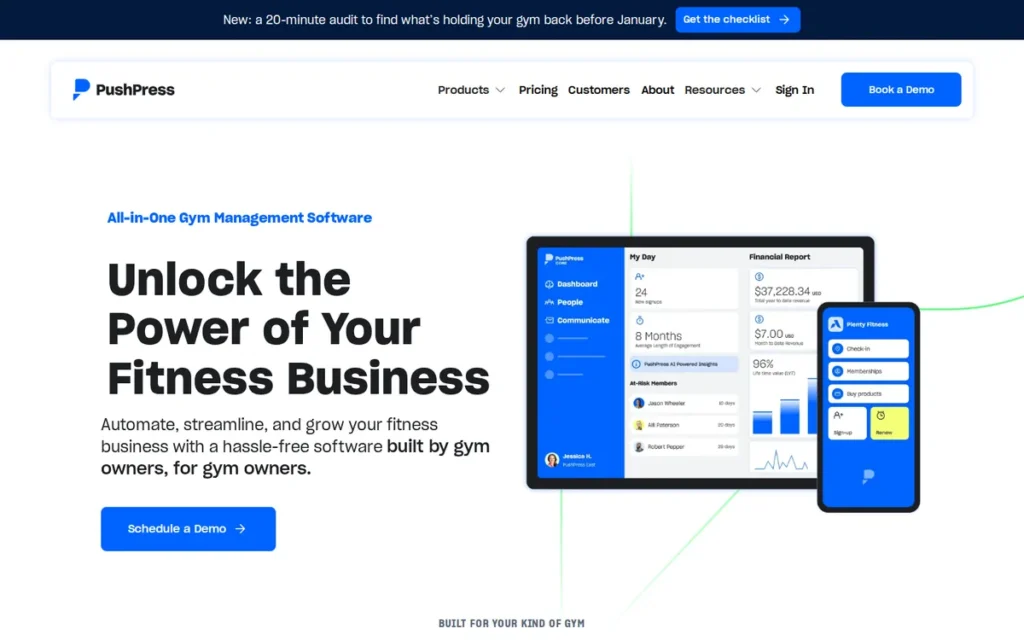
Category: Core Operations Platform, runs memberships, recurring billing, class scheduling and check-in for independent gyms.
At a Glance
- Category: Core Operations Platform
- Best For: Independent CrossFit, strength and functional-fitness gyms, including brand-new gyms with low card volume
- Price Range: Free ($0) to $229/month per location; add-ons $79–$329/month
- Primary Strength: PushPress publishes every plan price and processing rate, and gyms keep their own Stripe account and card tokens.
- Biggest Limitation: PushPress’s Free plan charges 4.99% + $0.30 per card transaction, which costs more than the $159 Pro plan once electronic volume passes about $7,570 a month.
- One-Line Summary: PushPress is the most cost-transparent gym management platform in PlugRoute’s 2026 evaluation, with a free plan, published processing rates on every tier and card tokens that stay with the gym.
- Last Verified: November 2026
Overview
PushPress is a gym management platform for independent CrossFit, strength and functional-fitness gyms that want memberships, recurring billing, class scheduling, check-in and a member app at a cost they can work out from published prices, starting with a $0 Free plan.
PushPress also offers a $159 Pro plan and a $229 Max plan, and every plan includes unlimited members and staff. PushPress scored 4.35 out of 5. It leads second-ranked GymMaster by 0.22 points, mainly on contract and exit portability (C4: 5 vs 3).
Key Features
- PushPress Core covers memberships, recurring billing, class scheduling, appointments, session packs, check-in and a member app on every plan, including Free.
- PushPress includes unlimited members and unlimited staff on all three plans, so the subscription does not rise as the gym grows.
- PushPress runs payments through the gym’s own Stripe account, and stored card tokens stay with the gym if it leaves.
- PushPress Train adds workout programming and PR tracking for $79/month. PushPress Grow adds a website, CRM and automated lead follow-up for $329/month plus a $699 setup fee.
- PushPress offers a branded member app as a $97/month add-on.
Best For
PushPress is best for single-location CrossFit, strength and functional-fitness gyms that want a predictable monthly cost. PushPress Free also suits new gyms that collect less than about $7,570 a month electronically.
Pricing
PushPress publishes per-location pricing (PushPress pricing page, 2026):
| Plan | Monthly fee | Card rate | ACH rate |
|---|---|---|---|
| Free | $0 | 4.99% + $0.30 | 2.89% + $0.30 |
| Pro | $159 | 2.89% + $0.30 | 0.79% + $0.30 |
| Max | $229 | 2.75% + $0.30 | 0.79% + $0.30 |
These break-even points are PlugRoute calculations from published list prices:
- PushPress Free costs more than Pro once electronic volume passes about $7,570 a month ($159 ÷ the 2.10-point rate gap, which is the same for card and ACH).
- PushPress Max beats Pro on processing alone only above about $50,000 a month in card volume.
- PushPress Free costs about $559 and Pro about $508 all-in on $10,000 a month across 200 card transactions.
- PushPress lists a 48-hour human support response time on Free and support SLAs on Pro and Max (PushPress pricing page, 2026).
Strengths
- PushPress is the only platform in PlugRoute’s November 2026 evaluation that publishes every subscription price, card rate, ACH rate and add-on price (PushPress pricing page, 2026).
- PushPress holds 4.7/5 from 187 Capterra reviews (Capterra, 2026). PushPress reports a 4.8 G2 figure that PlugRoute could not verify, so only the Capterra rating counted toward its review score.
- PushPress lets gyms keep their own Stripe account and card tokens and promotes no long-term contracts (PushPress, 2026), which lowers exit risk.
- PushPress draws ease-of-use praise from owners. One called PushPress Pro “very nice, extremely easy to use,” and another advised starting on PushPress rather than “trying to migrate over later” (r/crossfit, 2024).
Limitations
- PushPress trades a $0 subscription for the highest card rate in this evaluation, so many established gyms will pay less overall on the $159 Pro plan.
- PushPress keeps workout tracking, CRM and a branded app behind add-ons. A Pro gym that adds Train, Grow and the app pays $664/month plus a $699 setup fee (PlugRoute calculation, 2026). One owner warned that integrations “eventually could be costly” (r/crossfit, 2024).
- PushPress drew a negative testimonial on Wodify’s comparison page (a competitor’s site, unverified). The testimonial quotes a gym that found PushPress more complicated and expensive after switching from Wodify.
- PushPress’s door-access and point-of-sale capabilities could not be verified (November 2026). One positive Reddit testimonial came from a disclosed PushPress employee and was excluded from scoring.
Users on r/gymowner noted:
“Push Press free tier is a gimmick. Get’s real expensive once you bolt on all the extras.” Posted by u/SakshamBaranwal
Takeaway: PushPress’s $0 entry price can mislead budget-conscious owners, because add-ons and the higher Free-plan card rate make real costs climb quickly.
Verdict
PushPress earns PlugRoute’s #1 ranking for 2026 because it pairs the most complete published pricing among the seven platforms PlugRoute evaluated with portable payment data and no long-term contracts.
PushPress gyms should run the break-even calculation before choosing Free over Pro. Gyms that need native door access or deep workout tracking should price the add-ons, or compare GymMaster and Wodify.
2. GymMaster: Best for 24/7 Unstaffed Access Gyms
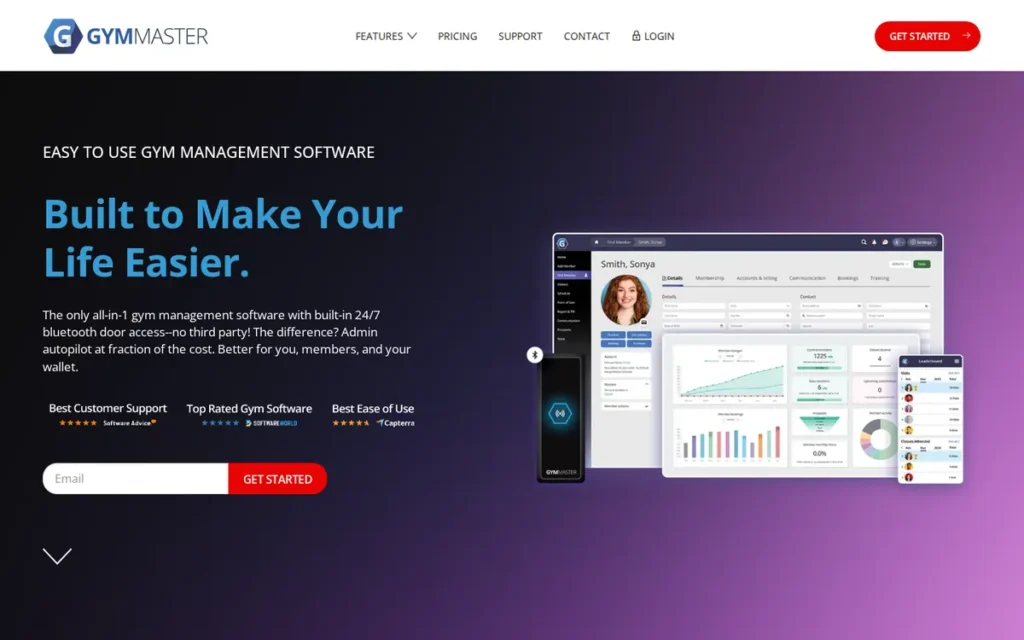
Category: Access-Control Platform, combines gym management software with door-entry hardware for unstaffed or mixed-hours facilities.
At a Glance
- Category: Access-Control Platform
- Best For: 24/7 and mixed-hours gyms that need unattended door entry tied to membership status
- Price Range: $89–$249/month per site for up to 1,300 members; door hardware from about $1,045 for one door
- Primary Strength: GymMaster publishes both software and access-hardware prices, so 24/7 operators can budget door access before a sales call.
- Biggest Limitation: GymMaster’s hardware prices exclude installation labor, which buyers must source separately from an electrician, locksmith or security firm.
- One-Line Summary: GymMaster is the best-documented choice for 24/7 unstaffed gyms in PlugRoute’s 2026 evaluation because it sells its own door-access hardware at published prices and links entry to membership billing.
- Last Verified: November 2026
Overview
GymMaster is gym management software with built-in keyless door-access control for 24-hour and mixed-hours gyms that need membership billing, bookings, a member app, kiosk check-in and fob, PIN or app entry tied to billing status.
GymMaster costs $89 a month software-only, or $129 a month with door access, for up to 100 members. GymMaster scored 4.13 out of 5, the highest specialization score in the group. GymMaster is the only vendor here that sells and prices its own access hardware.
Key Features
- GymMaster controls entry by RFID fob, PIN or Bluetooth app, with access logs, live monitoring and camera integration.
- GymMaster automatically blocks door entry for members with overdue balances, which ties access to billing status.
- GymMaster offers optional tailgating detection at US$400 per camera plus a US$40/month module (GymMaster pricing page, 2026).
- GymMaster includes membership billing, bookings, online joining, automated communications, a member app and kiosk check-in.
- GymMaster supplies wiring diagrams so a professional installer can fit its door readers and Gatekeeper units.
Best For
GymMaster is best for 24/7 access gyms and mixed-hours facilities where unattended entry is central to the business and the owner wants software and door hardware from one vendor.
Pricing
GymMaster publishes per-site monthly pricing in USD, excluding tax, with 10% off for annual payment (GymMaster pricing page, 2026):
| Current members | Software only | With 24/7 door access |
|---|---|---|
| Up to 100 | $89 | $129 |
| Up to 400 | $129 | $169 |
| Up to 1,300 | $209 | $249 |
| Unlimited | Quote | Quote |
| GymMaster hardware item | List price |
|---|---|
| Door reader (RFID/Bluetooth) | $300 |
| Gatekeeper unit | $550 |
| Reception reader | $130 |
| RFID fob | $1.30 each |
| Branded Bluetooth reader | $700 setup |
Unattended door access for a one-door gym with 150 members starts at about $1,045 in GymMaster hardware ($300 + $550 + 150 × $1.30) plus $169 a month, before installer labor (PlugRoute calculation, November 2026).
- Buyers should confirm with GymMaster whether every door needs its own Gatekeeper unit.
- Buyers should ask GymMaster what a separate $150/month + $450 setup item covers, because sources disagree.
- Buyers should ask GymMaster which lock types, such as electric strikes or maglocks, the Gatekeeper supports.
Strengths
- GymMaster holds 4.7/5 on Capterra from 173 reviews (Capterra, 2026). Reviewers say “door access and Bluetooth web application made it easy” and praise the support team’s “level and speed.”
- GymMaster publishes the most detailed price list in PlugRoute’s November 2026 evaluation, covering software tiers by member band and individual hardware unit prices.
- GymMaster reports 6,000+ gyms in 90+ countries and 3.6M+ managed members (GymMaster, 2026, company-reported). Its developer, Treshna Enterprises, was founded in 1996 (Capterra, 2026), the earliest in this group.
- GymMaster has one of the lowest entry prices in this evaluation at $89/month software-only. One owner called GymMaster “super affordable and a great user experience” (r/gymowner, 2026).
Limitations
- GymMaster’s door-access strength comes with real up-front cost, because hardware for a single door can exceed $1,000 before installation labor, which GymMaster does not include.
- GymMaster does not clearly document its U.S. payment processors. Capterra reviewers call its payment fees “too high” and say expired cards do not update automatically (Capterra, 2026).
- GymMaster’s 4.7 G2 rating rests on only 20 reviews (G2, 2026), and PlugRoute found no named GymMaster case studies with measured results (November 2026).
- GymMaster’s booking depth did not come up in any Reddit discussion. A 2026 owner using a different, unnamed access-first system said it had nothing built in for training bookings (r/GymOwnerNetwork, 2026), so test GymMaster bookings in a trial.
Users on r/gymowner noted:
“GymMaster and a payment processor are two separate services/vendors that you will need. GymMaster pricing is based on the number of members and is quite affordable. Payment processors charge rates of about 1-2% to process a transaction. GymMaster just integrates with a select number of payment processors to automatically trigger transactions but does not themselves process the transaction.” Posted by u/easy_peazy
Takeaway: GymMaster’s affordable member-based subscription leaves owners to source and pay a separate payment processor, so its all-in cost depends on a fee the platform does not set.
Verdict
GymMaster is the best-documented choice for 24/7 unstaffed gyms in 2026 because it is the only evaluated platform that publicly prices its own door hardware and ties entry to billing status.
GymMaster’s software pricing is also among the lowest for small gyms. GymMaster buyers should budget for installation, confirm U.S. payment processing and test class booking flows before signing.
3. TeamUp: Best for Class-Based Studios That Want Every Feature on Every Plan
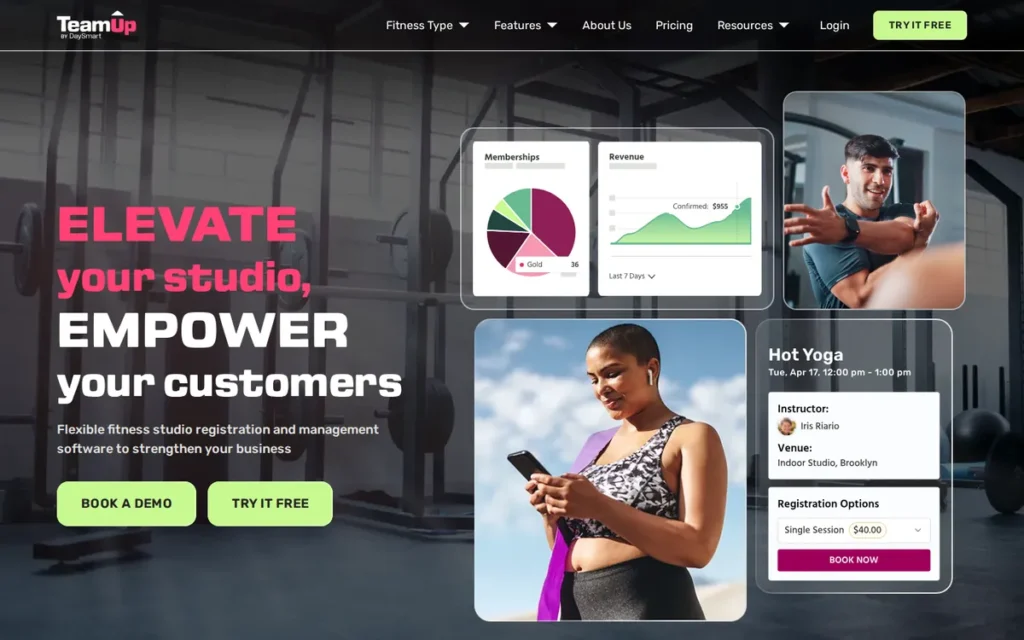
Category: Core Operations Platform, runs memberships, recurring billing, class scheduling and check-in for independent gyms and studios.
At a Glance
- Category: Core Operations Platform
- Best For: Boutique and class-based studios with roughly 100–500 active customers that want simple, usage-based pricing
- Price Range: $119–$379/month by monthly active customers; branded app and Perform add-ons £79/month each
- Primary Strength: TeamUp includes every feature on every plan and prices only by monthly active customers, with no setup fee and month-to-month terms.
- Biggest Limitation: TeamUp does not publish its payment processing rates, so buyers cannot calculate the full monthly cost from public figures.
- One-Line Summary: TeamUp is the simplest-priced option for class-based studios in PlugRoute’s 2026 evaluation, including every feature on every plan with month-to-month terms and strong review volume.
- Last Verified: November 2026
Overview
TeamUp is a class booking and membership platform for boutique and class-based studios that want scheduling, memberships, online and in-person payments, point of sale and mobile apps on every plan, priced from $119 a month for up to 100 monthly active customers.
TeamUp prices by usage rather than by feature tier, which is unusual in this category. TeamUp scored 3.90 out of 5. It edges fourth-ranked Wodify by 0.05 points, mainly on cost transparency (C1: 4 vs 3) and review ratings (C2: 4.5 vs 4).
Key Features
- TeamUp includes online and in-person payments, a customer store, point of sale, gift cards, joining fees and Apple Pay/Google Pay on every plan.
- TeamUp includes penalty systems for no-shows and late cancellations, reporting, integrations and mobile apps on all plans.
- TeamUp supports unlimited locations on every plan without per-location charges.
- TeamUp counts a customer once per month only if they register or buy, so inactive records do not raise the price.
- TeamUp offers a branded customer app and TeamUp Perform, a workout app for CrossFit and functional-fitness gyms, each listed at £79/month.
Best For
TeamUp is best for boutique class studios, yoga and Pilates studios, and multi-location class businesses that want every feature without tier upgrades and whose active customer count rises and falls with drop-ins and seasonal clients.
Pricing
TeamUp publishes monthly pricing by active customers (TeamUp pricing page, 2026):
| Monthly active customers | Price |
|---|---|
| 0–100 | $119 |
| 101–200 | $189 |
| 201–300 | $219 |
| 301–400 | $249 |
| 401–500 | $289 |
| 501+ | $379 |
TeamUp pricing terms:
- TeamUp charges no setup fee, runs month-to-month and allows cancellation without penalty (TeamUp pricing page, 2026).
- TeamUp lists its branded app at £79/month on the official page, while third parties quote $99 USD, so buyers should confirm the USD price.
- TeamUp’s payment processing rates were not published in the sources reviewed (November 2026), so buyers should request them before comparing.
Strengths
- TeamUp holds 4.5/5 on G2 from 329 reviews (G2, 2026), the largest G2 sample among platforms rated 4.5 or higher. The Capterra directory lists 4.8/5 from 346 reviews, though a profile page shows 4.7/5 from 53.
- TeamUp publishes its full six-band pricing table and includes every feature on every plan, which makes costs easy to forecast as a studio grows.
- TeamUp offers month-to-month terms with no setup fee and no cancellation penalty, which lowers commitment risk for owners leaving another system.
- TeamUp’s BASI Pilates testimonial reports the studio “saved 50% on costs” (TeamUp pricing page, vendor-published, 2026), and reviewers call TeamUp “very easy to use” (Capterra, 2026).
Limitations
- TeamUp’s simple usage pricing comes with a less transparent payment side, because TeamUp does not publish processing rates and prices its app add-ons in GBP.
- TeamUp draws G2 complaints about “clunky” sign-up forms, a dated interface, weak churn and lifetime-value reporting, no checkout upsells and difficulty booking a workshop series in one step (G2, 2026).
- TeamUp has no native door access or rank tracking. CrossFit members describe boxes pairing TeamUp with BTWB or BoxMate (r/crossfit, 2018 and 2024).
- TeamUp’s founding year, headquarters and customer count could not be verified in PlugRoute’s November 2026 research.
Verdict
TeamUp is the simplest-priced platform for class-based studios in 2026, because every feature is included on every plan and the price depends only on monthly active customers.
TeamUp’s review volume is strong and its terms are month-to-month. TeamUp buyers should request processing rates in writing and test sign-up forms and reporting before switching.
4. Wodify: Best for CrossFit Boxes That Want Built-In Workout Tracking
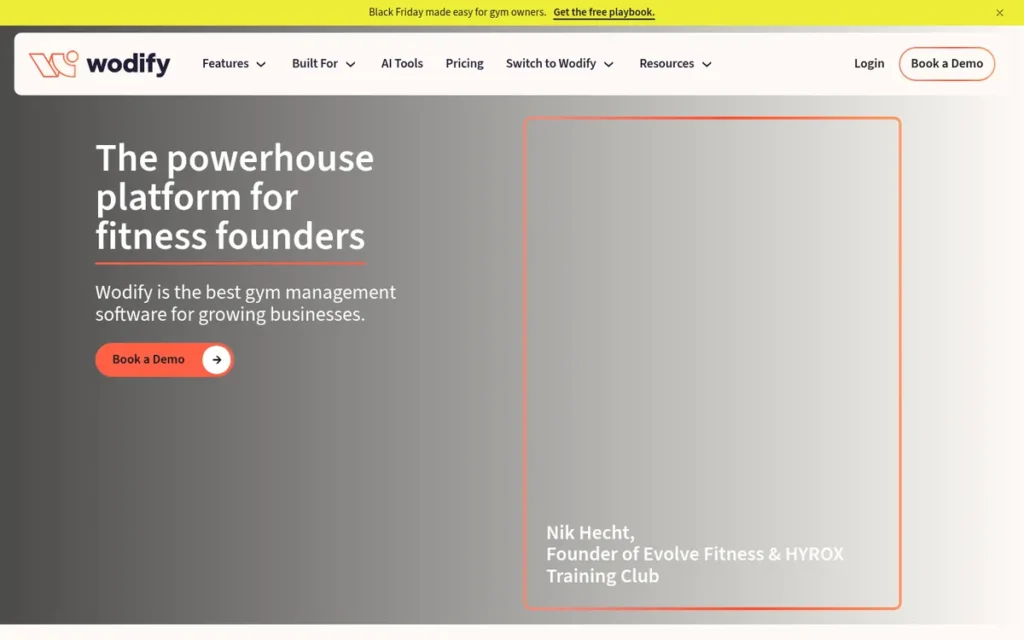
Category: Performance Platform, gym management with native workout programming, performance tracking and leaderboards.
At a Glance
- Category: Performance Platform
- Best For: CrossFit and functional-fitness boxes that want billing and workout tracking in a single app
- Price Range: $199/month list per location for Essentials ($99 demo offer); Accelerate and Ultimate quote-required
- Primary Strength: Wodify builds performance tracking, leaderboards and in-gym displays into the same app that handles billing and scheduling.
- Biggest Limitation: Wodify puts performance tracking on its quote-required Ultimate tier or behind an add-on, so the published entry price does not include its main differentiator.
- One-Line Summary: Wodify is the most complete single-app option for CrossFit boxes in PlugRoute’s 2026 evaluation, combining billing, scheduling and native performance tracking, though its headline features sit on quote-required tiers.
- Last Verified: November 2026
Overview
Wodify is a gym management platform for CrossFit affiliates and functional-fitness boxes that want billing, scheduling, client management, waivers and native workout performance tracking in one app, with Essentials listed at $199 a month per location.
Wodify is the only evaluated platform with fully native leaderboards and in-gym TV displays. Wodify scored 3.85 out of 5 and is tied with Mindbody for the highest operational-coverage score in the group.
Key Features
- Wodify Essentials includes billing, scheduling, client management, digital waivers and contracts, and a single app for clients and staff.
- Wodify Accelerate adds lead management, dashboards, family groups with shared payments, prebuilt automations and email campaigns.
- Wodify Ultimate adds performance tracking, a custom website, unlimited automations, one-day payouts and the lowest processing rates.
- Wodify offers leaderboards and “Whiteboard TV” in-gym displays, plus Kiosk+ for check-in and announcements.
- Wodify sells a 24/7 Access add-on that controls entry through the Wodify app, though its price is not published.
Best For
Wodify is best for CrossFit and functional-fitness boxes where WOD programming, PR tracking and leaderboards are central to the member experience and the owner wants to avoid running a separate tracker.
Pricing
Wodify’s pricing page lists Essentials at $199/month per location, with a $99/month offer for booking a demo. Accelerate and Ultimate are quote-required (Wodify pricing page, November 2026).
FitBizStack, a seller of competing software (unverified), estimates these per-location monthly prices:
| Tier | Third-party estimate |
|---|---|
| Essentials | $99 promotional / $199 regular |
| Accelerate | $199–$299 |
| Ultimate | $399–$499 |
Wodify processing and terms:
- Wodify advertises processing “as low as” 2.7% + $0.30 for cards and 1.5% + $0.30 for ACH, with the lowest rates on Ultimate. These are minimum advertised rates that vary by plan and country (Wodify pricing page, 2026).
- Wodify runs payments on Stripe with no monthly processing fee (Wodify pricing page, 2026).
- Wodify’s branded app costs about $79/month according to FitBizStack (unverified), and Wodify does not publish its 24/7 Access price.
- Wodify states month-to-month terms with no long-term contract, so buyers should confirm in writing when any demo-offer price ends.
Strengths
- Wodify holds 4.5/5 on Capterra from 154–182 reviews (Capterra, 2026), and G2 reviewers praise its “quick responses and always helpful” support (G2, 2026). Wodify’s 4.7 G2 figure is vendor-reported.
- Wodify reports 5,000+ businesses (Wodify, 2026) and has served CrossFit affiliates since 2012. One owner says they have been “with them for over a decade” (r/gymowner, 2026).
- Wodify is the only evaluated platform with fully native leaderboards and in-gym TV displays. Wodify’s Turn 2 CrossFit case study credits these features with growth to 200+ members (Wodify case study, vendor-published, undated).
- Wodify offers month-to-month plans with no long-term contract and publishes its minimum processing rates (Wodify pricing page, 2026).
Users on r/crossfit shared their experience:
“They all have their own quirks, so I don’t know if any One system is better than the others. I use wodify and have grown accustomed to whatever quirks it has. I can’t say it’s objectively better than the others, but I’ve used it for most of a decade and for what they charge, it meets my needs well.” Posted by u/demanbmore
Takeaway: Wodify earns long-term loyalty from CrossFit owners on value for money, even though veteran users admit it has quirks and is not clearly better than its rivals.
Limitations
- Wodify’s single-app convenience costs more as features are added, because native tracking sits on the quote-required Ultimate tier (estimated at $399–$499 by an unverified third party) or behind an add-on.
- Wodify publishes a price only for Essentials. Accelerate, Ultimate, 24/7 Access and the branded app are all unpriced on Wodify’s own pages (November 2026).
- Wodify draws Capterra complaints that it is pricey for small gyms and that processing fees add to the cost. G2 reviewers report confusing navigation, setup friction and app issues (Capterra and G2, 2026).
- Wodify faced outage complaints in an older thread (r/crossfit, 2018). Recent reviews still mention app issues, but less severely.
Verdict
Wodify is the most complete single-app platform for CrossFit boxes in PlugRoute’s 2026 evaluation, because billing, scheduling and native leaderboards live in one system.
Wodify’s headline tracking features sit on higher, quote-required tiers. Wodify buyers should compare a written Ultimate quote with PushPress Pro + Train ($238/month) or with a billing platform plus a separate tracker.
5. Zen Planner: Best for Martial Arts Schools That Need Belt and Rank Tracking

Category: Rank-Tracking Platform, gym management built around belt, rank and skill progression for martial arts and specialty schools.
At a Glance
- Category: Rank-Tracking Platform
- Best For: Martial arts, BJJ and specialty schools where belt and skill progression drive retention
- Price Range: $99–$538/month across published active-member bands; add-ons $39–$249/month
- Primary Strength: Zen Planner tracks belts, ranks and attendance milestones, reports which students are ready for promotion, and publishes pricing for every member band.
- Biggest Limitation: Zen Planner’s published member bands nearly triple the Studio price as a school grows, and its processing rates are unpublished.
- One-Line Summary: Zen Planner has the most documented belt and rank tracking among the seven platforms in PlugRoute’s 2026 evaluation, with published band pricing that rises steeply as a school grows.
- Last Verified: November 2026
Overview
Zen Planner is a member management platform for martial arts schools, dojos, BJJ academies and specialty gyms that need billing, scheduling, attendance, a member app and belt, rank and skill tracking with promotion-readiness reporting, starting at $99 a month.
Zen Planner prices by active members and publishes every band. Zen Planner scored 3.68 out of 5, held back mainly by contract and exit risk (C4 = 2.5) and lower review ratings (C2 = 3.5).
Key Features
- Zen Planner tracks belts, ranks and skills, sets attendance milestones and rank requirements, and reports promotion readiness.
- Zen Planner includes member management, billing, scheduling, attendance and a member app.
- Zen Planner offers a branded app for $39/month, a website for $99/month and the Engage marketing add-on for $249/month.
- Zen Planner integrates with SugarWOD for workout logging and PR tracking rather than relying only on its own tracker.
- Zen Planner offers a New Business Bundle at $199/month for schools that are just opening.
Best For
Zen Planner is best for martial arts schools, dojos and BJJ academies that track belts and stripes against a curriculum. It fits owners who want rank requirements tied to attendance because progression drives student retention.
Pricing
Zen Planner publishes monthly pricing by active-member band. An active member is anyone with a membership or recent attendance (Zen Planner active-member tiers page, November 2026):
| Active members | Studio | Essentials | Ultimate |
|---|---|---|---|
| 0–45 | $99 | $198 | $348 |
| 46–60 | $133 | $232 | $382 |
| 61–75 | $155 | $254 | $404 |
| 76–100 | $189 | $288 | $438 |
| 101–150 | $229 | $328 | $478 |
| 151–200 | $239 | $338 | $488 |
| 201–250 | $269 | $368 | $518 |
| 251+ | $289 | $388 | $538 |
Zen Planner’s Studio plan rises from $99 to $289 a month as a school grows from fewer than 46 to more than 250 active members (Zen Planner, November 2026).
- Zen Planner’s processing rates, setup fees and contract terms were not published in the sources reviewed (November 2026).
- Zen Planner drew one Trustpilot review reporting a bill rising from $118 to $229 plus a $39 fee. That is one individual review, not a typical outcome.
Strengths
- Zen Planner publishes pricing for all eight active-member bands across its three plans, so a school can forecast its subscription at any size (Zen Planner, November 2026).
- Zen Planner holds 4.3/5 on Capterra from about 270 reviews (Capterra, 2026), where reviewers praise its member information and dashboards.
- Zen Planner reports 5,000+ customers (Zen Planner, 2026) and was founded by a martial arts school owner. An undated r/bjj thread cites its “heavy martial arts school focus” and built-in rank requirements.
- Zen Planner’s $39/month branded app is the lowest-priced branded app found in this evaluation. Its 10th Planet Portland case study reports a 51.8% lead conversion rate (Zen Planner case study, vendor-published, December 2022–August 2023).
This aligns with community sentiment on r/bjj:
“We use zen planner and I really like how comprehensive it is. I did a lot of research recently to maybe switch and gym desk seemed like it was great as well. Besides those two you wont have a lot of the automations and reports that those have” Posted by u/willtravel4food3000
Takeaway: BJJ owners who have priced alternatives still rate Zen Planner as one of the few platforms with the automations and reporting depth their schools need.
Limitations
- Zen Planner’s rank-tracking depth comes with steep band pricing: Studio rises from $99 to $289, and going from 100 to 101 active members adds $40/month (Zen Planner active-member tiers page, November 2026).
- Zen Planner does not publish processing rates, and one reviewer reported a bill nearly doubling (Trustpilot review, accessed November 2026).
- Zen Planner draws Capterra complaints of “rudimentary” reporting and slow billing support. G2 reviewers cite rising cost, dated features and clunky switching between locations (Capterra and G2, 2026).
- Zen Planner gets mixed feedback on workout tracking. One CrossFit owner called its tracker “terrible” and paired it with BTWB (r/crossfit, 2018).
Verdict
Zen Planner is the best-documented rank-tracking platform for martial arts schools in PlugRoute’s 2026 evaluation, with belt, attendance-milestone and promotion-readiness tools and the cheapest branded app found.
Zen Planner’s band pricing rises steeply as a school grows, and its processing rates are unpublished. Zen Planner buyers should price their projected band and request processing rates in writing before signing.
6. ABC Glofox: Best for Multi-Location and International Studio Brands
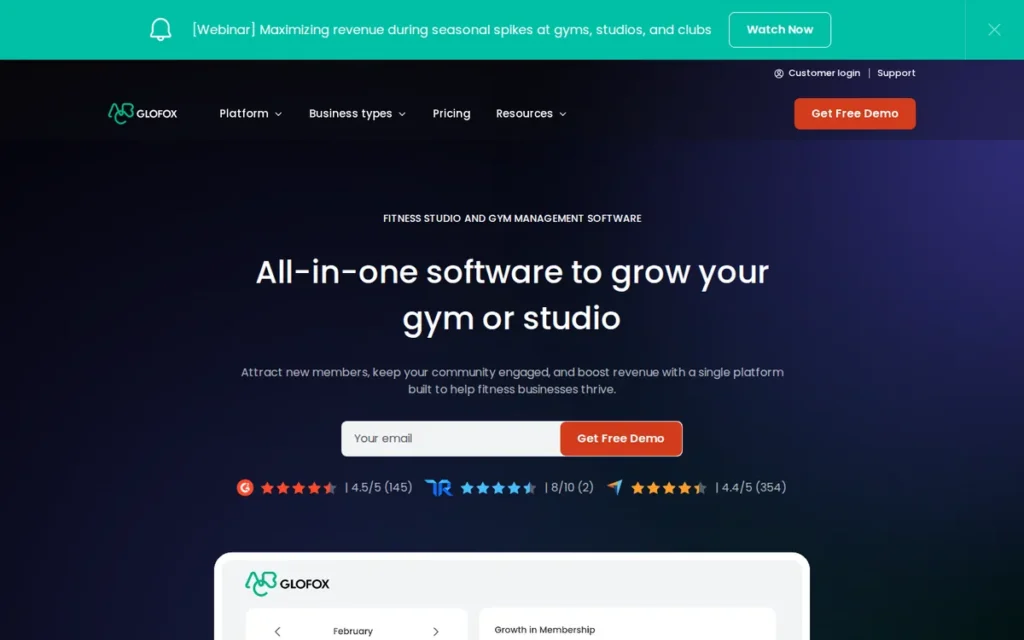
Category: Growth & Marketplace Platform, studio software built around branded apps, marketing automation or consumer discovery.
At a Glance
- Category: Growth & Marketplace Platform
- Best For: Boutique studio brands, franchises and multi-location or international operators that want a branded member app
- Price Range: Advertised from $99/month; all tiers quote-based (unverified third-party estimates of $110–$600+/month)
- Primary Strength: ABC Glofox combines a branded member app, kiosk check-in and marketing automation with support for 80+ countries and 17 languages.
- Biggest Limitation: ABC Glofox quotes every tier through sales and does not publish a full fee breakdown, which makes side-by-side cost comparison difficult.
- One-Line Summary: ABC Glofox is a strong fit for multi-location and international studio brands in PlugRoute’s 2026 evaluation, but its quote-only pricing and documented price-increase complaints raise commitment risk.
- Last Verified: November 2026
Overview
ABC Glofox is a gym and studio management platform for boutique brands, franchises and multi-location or international operators that want memberships, class scheduling, a branded app, kiosk check-in and automated marketing, advertised from $99 a month.
ABC Glofox has been owned by ABC Fitness since August 25, 2022, and quotes every tier through sales. ABC Glofox scored 2.95 out of 5. It edges Mindbody by 0.10 points, driven by stronger review ratings (C2: 3.5 vs 2.75) and owner sentiment (C6: 3 vs 2).
Key Features
- ABC Glofox includes memberships with family plans, class and facility scheduling, recurring and one-time billing, and reporting.
- ABC Glofox offers a branded member app and portal, though eligibility depends on plan.
- ABC Glofox provides kiosk check-in and automated email, SMS and push marketing.
- ABC Glofox supports operators in 80+ countries and 17 languages, and a seller of competing software reports ABC Glofox billing in GBP, EUR, AUD and USD.
- ABC Glofox publishes migration documentation that separates “member data only” from “member plus payment data” migration.
Best For
ABC Glofox is best for studio brands, franchises and multi-location or international operators that put a branded app and marketing automation first and are prepared to negotiate an itemized quote.
Pricing
ABC Glofox advertises “from $99/month,” and its Essential, Boost, Elite and Enterprise tiers are all quote-based (Glofox, 2026). Vibefam, a seller of competing software (unverified), estimates these monthly ranges:
- ABC Glofox Essential costs $110–$150.
- ABC Glofox Boost costs $160–$250.
- ABC Glofox Elite costs $250–$400+.
- ABC Glofox Enterprise costs $500–$600+.
Vibefam also reports Stripe processing of about 2.9% + $0.30 and alleges an extra Glofox platform surcharge. ABC Glofox has not confirmed either claim.
An AI answer sampled in November 2026 cited a $275/month Essential price that PlugRoute could not confirm. ABC Glofox buyers should request a written fee breakdown, branded app eligibility and renewal terms.
Strengths
- ABC Glofox holds 4.4/5 on Capterra from 356 reviews, with sub-scores of 4.5 for ease of use, 4.4 for customer service, 4.2 for value and 4.2 for features (Capterra, November 2026). G2 shows 4.5/5 from 137 reviews (G2, 2026).
- ABC Glofox is backed by ABC Fitness. When the acquisition closed, the combined company supported 31M+ members across 24,000+ locations (Glofox, 2022).
- ABC Glofox supports operators in 80+ countries and 17 languages, the broadest documented international footprint in this evaluation.
- ABC Glofox’s Komo Studio case study reports 33% revenue growth over 12 months (ABC Glofox customer stories, vendor-published, undated). One owner says they pay “a fraction” of a $900/month Mindbody bill for similar functionality (r/gymowner, 2026).
Limitations
- ABC Glofox’s branded-app-centered studio offering comes with the least transparent pricing in this evaluation, because every tier is quote-based and the full fee stack is unpublished.
- ABC Glofox holds 3.6/5 on Trustpilot from about 385 reviews (Trustpilot, 2026). Complaints include trouble cancelling, charges after cancellation, and a customer told at setup that they did not qualify for the branded app.
- ABC Glofox drew a G2 review reporting a 70% price increase without enough notice (G2 review, accessed November 2026).
- ABC Glofox’s own migration guide says leftover class credits must be re-added by hand, and its door-access integrations could not be verified (November 2026).
Verdict
ABC Glofox is a capable platform for multi-location and international studio brands in 2026, with solid Capterra and G2 ratings and the broadest international support in this evaluation.
ABC Glofox’s quote-only pricing and documented price-increase and cancellation complaints make it a higher-commitment choice. ABC Glofox buyers should get branded app eligibility, the full fee breakdown and renewal terms in writing.
7. Mindbody: Best for Studios That Want Marketplace Client Discovery
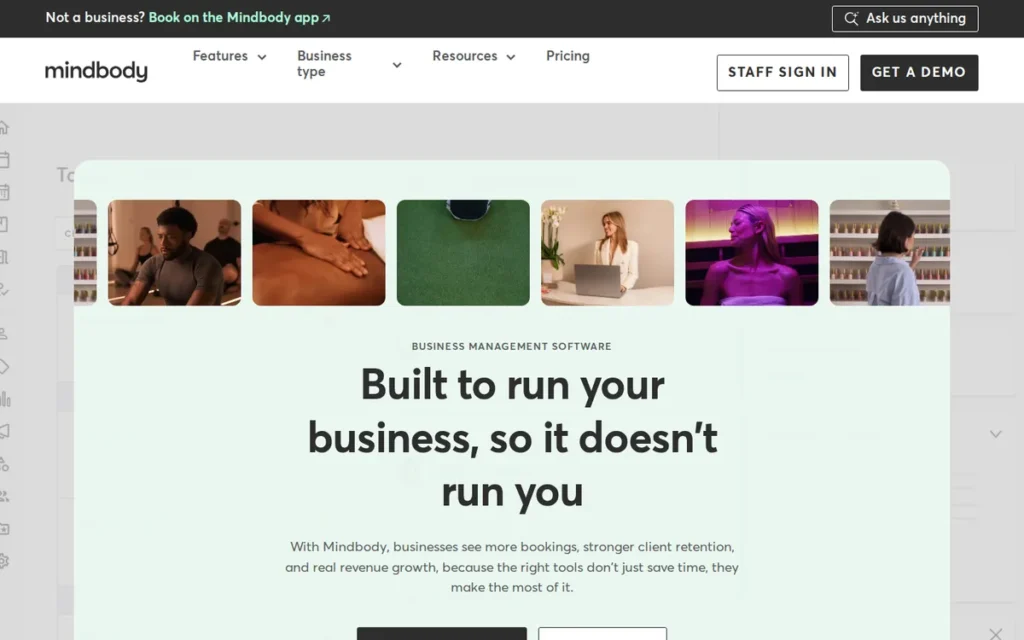
Category: Growth & Marketplace Platform, studio software built around branded apps, marketing automation or consumer discovery.
At a Glance
- Category: Growth & Marketplace Platform
- Best For: Boutique fitness and wellness businesses that value consumer marketplace discovery
- Price Range: From $79/month per location (Starter); upper tiers quote-based; marketplace fee up to $30 per new client
- Primary Strength: Mindbody is the only evaluated platform with a large built-in consumer marketplace for acquiring new clients.
- Biggest Limitation: Mindbody has the lowest G2 rating and Capterra value-for-money score in this evaluation, and owners report spending far above its $79 list price.
- One-Line Summary: Mindbody is the only platform in PlugRoute’s 2026 evaluation with a large built-in consumer marketplace, but it has the group’s lowest value-for-money ratings and least predictable all-in cost.
- Last Verified: November 2026
Overview
Mindbody is all-in-one business software for boutique fitness and wellness businesses that want scheduling, memberships, payments and reporting, plus a free listing in a consumer marketplace that the company says reaches over 3 million monthly users.
Mindbody Starter costs from $79 a month per location, while the higher tiers and the branded app are priced through sales. Mindbody scored 2.85 out of 5, with strong coverage and specialization but the weakest sentiment and value evidence.
Key Features
- Mindbody includes scheduling, memberships, payments, reporting, website booking widgets and unlimited users per location.
- Mindbody includes a free marketplace listing on every plan and charges a capped fee only on qualifying new clients.
- Mindbody Accelerate adds room and resource management, Pick-a-Spot booking, promo codes and advanced analytics.
- Mindbody Ultimate includes automated email and SMS campaigns, lead management and AI Concierge, which answers client questions and follows up on missed calls.
- Mindbody belongs to the Playlist group with ClassPass and Booker, and Playlist announced a $7.5B merger in March 2026 (TechCrunch, 2026).
Best For
Mindbody is best for boutique fitness and wellness businesses where marketplace discovery brings in a meaningful share of new clients, and whose owners will negotiate a quote and track marketplace returns.
Pricing
Mindbody publishes these terms (Mindbody pricing and support pages, 2026):
- Mindbody Starter costs from $79 per location per month, and Accelerate and Ultimate are contact-sales.
- Mindbody charges no onboarding or extra-user fee, and the branded app price is unpublished.
- Mindbody Payments charges $0.10–$0.30 per transaction in North America plus a percentage that “varies” and is unpublished for the U.S. Gyms may use another processor.
- Mindbody’s marketplace fee is 20% of a qualifying new client’s first purchase, capped at $30, so a $100 purchase costs $20 and a $200 purchase costs $30.
- Mindbody charges no marketplace fee on existing clients or on clients referred through a tracked link.
Owner reports show how far real spend can exceed list price. One 300-client gym reported paying $900/month, and another owner negotiated down to about $450 (r/gymowner, 2026). These are individual reports, not typical prices.
Strengths
- Mindbody has the largest review base in this evaluation, about 2,997 Capterra reviews at 4.0/5 (Capterra, 2026). Gymdesk, a seller of competing software, says Mindbody began as Hardbody Software in 1998 (Gymdesk review, 2026).
- Mindbody is the only evaluated platform with a large consumer marketplace, at 3M+ monthly users (Mindbody, 2025, company-reported). One owner credited it with reaching “all sorts of people looking for exercise options” (r/crossfit, 2018).
- Mindbody publishes a capped marketplace fee with no commission on later bookings, which lets owners model the cost of acquiring each client.
- Mindbody includes unlimited users per location with no onboarding fee, and Trustpilot reviewers praise its onboarding specialists (Trustpilot, 2026).
Limitations
- Mindbody’s marketplace reach comes with the weakest value evidence in this evaluation: a G2 rating of 3.9/5 from 706 reviews (G2, November 2026) and a Capterra value-for-money sub-score of 3.6 (Capterra, 2026).
- Mindbody publishes a price for Starter only and does not publish its U.S. processing percentage, so its all-in cost cannot be calculated from public figures (November 2026).
- Mindbody drew the most negative owner sentiment in this evaluation. One owner who had switched platforms called it “worst software ever,” and another said “its hard to get ahold of anyone sometimes” (r/GymOwnerNetwork, 2026).
- Mindbody drew a warning from a long-term Trustpilot reviewer to read termination and fee-change clauses. PlugRoute found no named Mindbody case studies with measured results (November 2026).
Users on r/yoga noted:
“mindbodyonline – limited multiple locations (need a lot ofaccunts and dashshare which adds to final costs) Also has a lot of bad reviews from many people. Too many additions with hidden costs.” Posted by u/SlowTwitcher
Takeaway: Multi-location operators have ruled out Mindbody for years over add-on costs that pile up per location and hidden fees, which matches the gap between its list price and reported spend.
Verdict
Mindbody is the only gym management platform in PlugRoute’s 2026 evaluation with a large built-in consumer marketplace, which can justify its cost for studios that win clients through discovery.
Mindbody also has the group’s lowest value-for-money ratings and the widest gap between list price and reported spend. Mindbody buyers should negotiate, track marketplace client value against the capped fee, and ask how the 2026 Playlist merger affects pricing.
How Much Does Gym Management Software Really Cost?
Small-gym subscriptions run from $79 to about $290 a month at list price, but processing fees, member bands, add-ons and door hardware decide the real bill. Only PushPress publishes every plan price and processing rate. ABC Glofox, plus Wodify’s and Mindbody’s upper tiers, require a quote (PlugRoute, November 2026).
What do subscriptions cost at 100, 150 and 300 members?
The table below shows monthly subscription list prices only, verified November 2026, before processing and add-ons.
| Platform | 100 members | 150 members | 300 members | Main cost driver to check |
|---|---|---|---|---|
| PushPress Pro | $159 | $159 | $159 | Add-ons (Train $79, Grow $329, app $97) |
| GymMaster (software / with access) | $89 / $129 | $129 / $169 | $129 / $169 | Door hardware and installer labor |
| TeamUp | $119 | $189 | $219 | Unpublished processing rates |
| Wodify Essentials | $199 list ($99 demo offer) | $199 list ($99 demo offer) | $199 list ($99 demo offer) | Quote-required Ultimate for tracking |
| Zen Planner Studio | $189 | $229 | $289 | Band increases and unpublished processing |
| ABC Glofox | Quote required | Quote required | Quote required | Fee stack and app eligibility |
| Mindbody Starter | From $79 | From $79 | From $79 ($450–$900 reported) | Upper tiers and processing percentage |
TeamUp counts monthly active customers, and Zen Planner counts active members, rather than total records. At 150 members, subscription-only list prices are PushPress Pro $159, GymMaster $129 (software only), TeamUp $189, Wodify Essentials $199 and Zen Planner Studio $229 (PlugRoute, November 2026).
What happens when you cross a member band?
Crossing a member band can raise a bill sharply for a single extra member. A Zen Planner school that grows from 100 to 101 active members moves from $189 to $229 on Studio, an extra $480 a year. TeamUp’s step from 100 to 101 active customers goes from $119 to $189 (vendor pricing pages, November 2026).
What do payment processing rates look like?
Processing often costs more than the subscription itself. On $10,000 a month in card payments, PushPress Pro processing comes to about $349, more than double its $159 subscription (PlugRoute calculation, 2026).
Only PushPress publishes exact card and ACH rates for every plan. Wodify publishes “as low as” floors, Mindbody publishes only its fixed fee, and four platforms publish no rates (vendor pricing pages, November 2026).
| Platform | Card rate | ACH rate | Status |
|---|---|---|---|
| PushPress Free | 4.99% + $0.30 | 2.89% + $0.30 | Published |
| PushPress Pro | 2.89% + $0.30 | 0.79% + $0.30 | Published |
| PushPress Max | 2.75% + $0.30 | 0.79% + $0.30 | Published |
| Wodify | As low as 2.7% + $0.30 | As low as 1.5% + $0.30 | Minimum rates; vary by plan and country |
| Mindbody | $0.10–$0.30 fixed + unpublished % | Not published | Partly published |
| GymMaster | Not published | Not published | Capterra lists PayPal and Paysafe |
| TeamUp | Not published | Not published | Request in writing |
| Zen Planner | Not published | Not published | Request in writing |
| ABC Glofox | Not published (third-party claim ~2.9% + $0.30 plus alleged surcharge, unverified) | Not published | Request in writing |
How do CrossFit tracking setups compare on cost?
CrossFit owners who want workout tracking have three documented setups:
- Wodify Ultimate includes native tracking and leaderboards, is quote-required, and is estimated at $399–$499 per month by an unverified third party.
- PushPress Pro + Train costs $238 per month at published prices (PushPress pricing page, 2026).
- A billing platform plus a separate tracker such as SugarWOD or BTWB is a common setup, but PlugRoute did not research tracker pricing.
Is a marketplace new-client fee worth it?
Mindbody’s marketplace fee is 20% of a new client’s first purchase, capped at $30. PlugRoute found no independent data on how many clients a typical gym gains from the marketplace. As an example, if a marketplace client produces $600 in margin over their membership, the maximum $30 fee is 5% of that value (PlugRoute illustration).
Where Do Sources Disagree on Gym Management Software Data?
Sources disagree on several figures in this evaluation, including TeamUp’s Capterra rating, Mindbody’s review counts, ABC Glofox’s founding year and one GymMaster line item. PlugRoute shows each conflict side by side instead of quietly picking one value. Confirm any figure that affects your decision directly with the vendor.
- TeamUp Capterra rating: The Capterra directory lists 4.8/5 from 346 reviews, while a Capterra profile page shows 4.7/5 from 53 reviews.
- Wodify Essentials price: Earlier sources cited $99 and $199. Wodify’s own pricing page shows both figures: a $199 list price and a $99 offer for booking a demo (November 2026).
- Mindbody G2 rating: Earlier third-party pages showed 3.7–3.8/5 from 527–577 reviews, while G2 showed 3.9/5 from 706 reviews in November 2026.
- Mindbody Trustpilot figures: One source shows 4.4/5 from 2,239 reviews, while another shows 1,064 reviews with no clear score.
- ABC Glofox founding year: The Irish Independent reports 2014, while Glofox states 2017.
- GymMaster $150/month + $450 setup item: One source describes it as an access option, while a Glofox blog (a competitor) calls it GymMaster’s branded app.
- Zen Planner founding year: Zen Planner says 2006, while some sources say 2005.
What Red Flags Should I Watch For When Evaluating Gym Management Software?
The biggest red flags in gym management software are hidden or unpublished costs, contract and exit risk, and unreliable evidence. Each one can push your real bill above list price or make switching harder later. PlugRoute found seven red flags, numbered below, across vendor pricing pages, review platforms and owner forums (November 2026).
Red Flag #1: Quote-Only Pricing With No Written Fee Breakdown
Quote-only pricing makes side-by-side comparison impossible and leaves room for bills well above list price. In this evaluation, ABC Glofox quotes every tier, and Wodify and Mindbody quote everything above their entry plans. Ask every vendor for an itemized written quote.
One Mindbody owner reported paying $900/month before negotiating down to about $450 (r/gymowner, 2026).
Red Flag #2: Unpublished Processing Percentages
An unpublished processing percentage hides what is often a gym’s largest variable cost. In November 2026, TeamUp, Zen Planner, ABC Glofox and GymMaster published no card rates, Mindbody published only its fixed fee, and Wodify published only floor rates. Ask for card and ACH rates before comparing subscriptions.
Red Flag #3: A Free Plan With a Higher Card Rate
A free plan with a higher card rate can cost more than a paid plan once volume grows. On PushPress, the $0 plan costs more than the $159 Pro plan for any gym collecting more than about $7,570 a month electronically (PlugRoute calculation, 2026 published rates).
Red Flag #4: Branded App Eligibility Not Confirmed in Writing
If branded app eligibility is not confirmed in writing, you can end up without the feature you chose the platform for. One ABC Glofox customer said the branded app was “the key reason” for choosing it, then learned at setup they did not qualify (Trustpilot review, accessed November 2026). Put eligibility in your contract.
Red Flag #5: Payment Tokens You Can’t Take With You
Payment tokens you can’t take with you force every member to re-enter card details when you switch platforms, which risks failed payments and lost members. PushPress documents that card tokens stay with the gym’s own Stripe account. For any other vendor, ask in writing how tokens are transferred out.
Red Flag #6: Promotional Prices With No Stated End Date
A discounted price with no stated end date makes your long-term cost unpredictable. Wodify’s $99 demo offer sits $100 below its $199 list price. Reviewers also report a 70% ABC Glofox increase and a Zen Planner bill rising from $118 to $229 (G2 and Trustpilot reviews, accessed November 2026).
Get the end date of any discounted price, and the regular price that follows, in writing.
Red Flag #7: Vendor Staff Posing as Owners in Forums
Vendor staff posting in owner forums can make community sentiment look more positive than it really is. PlugRoute found a Mindbody employee pitching in a 2026 r/GymOwnerNetwork thread and a disclosed PushPress employee posting a testimonial. Check commenters’ post histories before trusting forum recommendations.
What Questions Should I Ask Before Choosing Gym Management Software?
Before choosing gym management software, ask questions that expose all-in cost, exit risk and everyday usability. Vague answers in any of these areas usually mean higher costs or harder switching later. PlugRoute recommends the six questions numbered below and advises getting every answer in writing before you sign.
Question #1: What will I pay each month at my current and projected member count, including processing?
A useful answer gives the subscription, the member-band thresholds, card and ACH rates, and every add-on price at both sizes. Treat “it depends” without numbers as a warning sign, especially from platforms that scale pricing with active members or quote their upper tiers.
Question #2: Do my members’ card tokens transfer if I leave?
A good answer names the payment processor, who owns the merchant account, and how stored card tokens are exported to a new platform. Gym-owned processor accounts, such as PushPress’s own-Stripe setup, make leaving easier. If the vendor owns the account, ask for the export process and any fees in writing.
Question #3: How are partly used session packs handled during migration?
A good answer walks through a real example, such as a 10-session pack with four sessions left, from import to the next billing cycle. One owner warned that “a successful import of names is not the same as being ready for the next billing/booking cycle” (r/gymowner, 2026).
ABC Glofox’s own guide says leftover credits must be re-added by hand.
Question #4: Can you demo a failed payment, membership freeze, cancellation and class waitlist?
A live demo of everyday flows shows usability better than any feature list, because staff run these flows daily. Retention makes this matter: median member retention was 66.4% in 2024 (Health & Fitness Association 2025 Benchmarking Report; 175 companies, 17,000+ facilities). Ask the vendor for these demos:
- The vendor should show how a failed card payment is retried and how the member is notified.
- The vendor should show how a membership is frozen and restarted.
- The vendor should show how a member cancels through self-service.
- The vendor should show how a full class handles its waitlist.
Question #5: What are the renewal, price-change and termination terms?
A good answer gives the contract length, the notice period for price changes and any early-termination fee, all in writing. Wodify, TeamUp and PushPress publish month-to-month or no-long-term-contract terms. Mindbody and ABC Glofox face documented complaints about termination and cancellation.
Question #6: Does door-access pricing include installation, and how many controllers does each door need?
A good answer itemizes the readers, controllers, fobs and installation labor for each door. GymMaster publishes hardware prices but excludes installation. Wodify’s 24/7 Access price is unpublished, and access options for ABC Glofox and Mindbody could not be verified.
How Did We Rank These Gym Management Software Platforms?
PlugRoute scored seven gym management platforms from 1 to 5 on six weighted criteria. The heaviest weights went to all-in cost transparency (25%), independent review ratings (20%) and core operational coverage (20%). Contract flexibility, business-model specialization and owner sentiment make up the remaining 35%. Every score uses desk research dated November 2026.
The six criteria, and why each one matters:
- C1 All-In Cost Transparency (25%): This criterion checks five published elements: plan prices, card and ACH rates, member bands, add-on prices and setup fees. Hidden costs are buyers’ top pain point.
- C2 Independent Review Ratings (20%): This criterion averages verified Capterra and G2 ratings adjusted for volume, because vendor pages do not show real-world quality.
- C3 Core Operational Coverage (20%): This criterion checks memberships, billing, scheduling, check-in, apps, communications and reporting, with deductions for documented workflow weaknesses.
- C4 Contract Flexibility and Exit Portability (15%): This criterion rewards month-to-month terms, gym-owned payment accounts and migration documentation, because buyers are mid-migration.
- C5 Business-Model Specialization (10%): This criterion rewards native depth in door access, workout tracking, rank tracking or marketplace acquisition.
- C6 Owner Sentiment and Support Evidence (10%): This criterion scores owner comments on Reddit and published support commitments.
| Platform | C1 | C2 | C3 | C4 | C5 | C6 | Weighted | Key evidence sources |
|---|---|---|---|---|---|---|---|---|
| PushPress | 5 | 4 | 4 | 5 | 3.5 | 4 | 4.35 | Pricing page; Capterra; r/crossfit |
| GymMaster | 4.5 | 4.5 | 4 | 3 | 5 | 3.5 | 4.13 | Pricing and access pages; Capterra; G2 |
| TeamUp | 4 | 4.5 | 4 | 4 | 3 | 3 | 3.90 | Pricing page; G2; Capterra |
| Wodify | 3 | 4 | 4.5 | 4 | 4.5 | 3.5 | 3.85 | Pricing page and FAQ; Capterra; r/gymowner |
| Zen Planner | 4 | 3.5 | 4 | 2.5 | 4.5 | 3.5 | 3.68 | Pricing and tier pages; Capterra; G2; Trustpilot; r/bjj |
| ABC Glofox | 2 | 3.5 | 4 | 2 | 3.5 | 3 | 2.95 | Glofox pages; Capterra; G2; Trustpilot |
| Mindbody | 2 | 2.75 | 4.5 | 2 | 4 | 2 | 2.85 | Pricing and support pages; Capterra; G2; Reddit |
PushPress leads by 0.22 points. GymMaster, TeamUp and Wodify sit within three-tenths of a point of each other, so treat ranks 2–4 as roughly equal and choose among them by gym model.
| Vendor | (a) Plan prices | (b) Card/ACH rates | (c) Member bands | (d) Add-on prices | (e) Setup fees | C1 |
|---|---|---|---|---|---|---|
| PushPress | Published | Published | Not applicable (unlimited) | Published | Published | 5 |
| GymMaster | Published (quote above 1,300) | Not published | Published | Published (hardware); one item unclear | Partial | 4.5 |
| TeamUp | Published | Not published | Published | Partial (GBP only) | Published (none) | 4 |
| Zen Planner | Published | Not published | Published | Published | Not published | 4 |
| Wodify | Partial (Essentials only) | Partial (floor rates) | Not applicable (per location) | Not published | Not published | 3 |
| ABC Glofox | Not published (quote) | Not published | Not published | Not published | Not published | 2 |
| Mindbody | Partial (Starter only) | Partial (fixed fee only) | Not applicable (per location) | Partial (marketplace fee only) | Published (none) | 2 |
C1 gives the most weight to plan prices and processing rates, because they are the largest cost lines. A score of 5 requires all five elements. Scores of 4–4.5 mean plans and bands are published but processing rates are not. A 3 means one tier plus floor rates are published.
GymMaster received the extra half point within the 4–4.5 range because it itemizes door hardware, its largest add-on cost. ABC Glofox and Mindbody both score 2 because neither lets buyers calculate all-in cost from public figures. Mindbody owners also report spend of $450–$900 against its $79 list price.
PlugRoute applied these evidence rules:
- PlugRoute rewards publishing information only in C1. On every other criterion, missing evidence scores a neutral 3, so a vendor is not penalized twice.
- PlugRoute labels vendor case studies and vendor-reported ratings as self-reported. It labels claims from Vibefam, Gymdesk and FitBizStack, which sell competing software, as unverified.
- PlugRoute shows conflicting figures side by side and excludes or flags Reddit comments from vendor employees.
- PlugRoute ran no hands-on workflow timing tests and found no peer-reviewed studies on gym management software.
- PlugRoute’s dedicated Reddit searches for Mindbody, ABC Glofox, TeamUp and GymMaster returned little, so C6 scores for those vendors rest on incidental mentions and thin evidence.
Exercise.com (Capterra 4.7/5, 250 reviews) was excluded because its pricing is mostly quote-based and it overlaps with the evaluated set. Gymdesk and Kicksite were not evaluated in this round. Gymdesk publishes competing review content, which PlugRoute used only as a flagged source.
November 2026 corrections: Zen Planner publishes its member bands, so its C1 rose from 3 to 4. Wodify lists Essentials at $199 with a $99 demo offer and quotes its upper tiers, so its C1 fell from 3.5 to 3, which moved Wodify from #3 to #4.
PushPress’s C2 fell from 4.5 to 4 because only one of its ratings could be verified. Mindbody’s G2 figure was updated to 3.9/5 from 706 reviews, which raised its C2 from 2.5 to 2.75. ABC Glofox’s Capterra ease-of-use sub-score was updated to 4.5.
PlugRoute has no affiliate relationships with any company listed. Rankings are determined entirely by research data and objective evaluation criteria.
What Do Gym Owners Most Often Ask About Gym Management Software?
Gym owners most often ask which platform suits a small gym, which one handles 24/7 door access best, and how independent rankings are produced. In short: PushPress fits most small gyms, GymMaster leads on documented door access, and PlugRoute ranks on six weighted, published criteria.
What’s the best gym management software for a small gym in 2026?
PushPress is the best fit for most small independent gyms in PlugRoute’s 2026 evaluation, because every price and processing rate is published. PushPress Free costs $0 but charges 4.99% + $0.30 per card payment. Above about $7,570 a month collected electronically, that makes Free cost more than the $159 Pro plan (PlugRoute calculation, 2026).
Which gym management software has the best door access control for 24/7 gyms?
GymMaster has the best-documented door access control for 24/7 gyms in PlugRoute’s 2026 evaluation. GymMaster sells its own readers and controllers at published prices, blocks entry for overdue balances and offers tailgating detection. Plans with door access start at $129 a month, plus about $1,045 in hardware for one door and installer labor.
How does PlugRoute determine its gym management software rankings?
PlugRoute ranks gym management software on six weighted criteria scored from 1 to 5. Cost transparency counts for 25%, review ratings for 20%, operational coverage for 20%, contract and exit portability for 15%, specialization for 10% and owner sentiment for 10%. Outside cost transparency, missing evidence scores a neutral 3, and every score appears in a public scorecard.
What Do Key Gym Management Software Terms Mean?
Gym management software pricing and feature pages use terms that directly affect cost and switching risk. The glossary below defines the pricing, payment and access-control terms used in this article in plain language, so you can compare vendor quotes like for like.
ACH payment: An ACH payment is a bank-to-bank transfer that usually carries a lower processing rate than a card payment. Moving recurring members to ACH payments can noticeably lower monthly fees.
Card processing rate: A card processing rate is the percentage plus fixed fee charged on each card payment, such as 2.89% + $0.30. On recurring billing, the card processing rate often costs more than the software subscription.
Fixed per-transaction fee: A fixed per-transaction fee is the flat amount, often $0.10 to $0.30, added to every payment on top of the percentage. A fixed fee weighs most heavily on small, frequent payments like drop-ins.
Active member band: An active member band is a pricing tier based on how many members count as active each month. Check how “active” is defined and where each threshold sits, because crossing a band raises your bill.
Per-location pricing: Per-location pricing charges a separate subscription for each site you operate. Multi-site owners should multiply the quoted price by their number of locations.
Branded app: A branded app is a member app published under your gym’s name and logo rather than the vendor’s. A branded app is usually a paid add-on, and eligibility can depend on your plan.
Card token portability: Card token portability means your members’ stored card details can move with you to a new platform. Without card token portability, every member must re-enter payment details when you switch.
Door access controller: A door access controller is the hardware unit that tells an electronic lock to open when a valid fob, PIN or app credential is presented. Ask how many controllers each door needs, because controllers are often the most expensive hardware item.
Tailgating detection: Tailgating detection uses cameras to flag people who enter behind a member without checking in. Tailgating detection matters most for unstaffed 24/7 gyms, where nobody watches the door.
Marketplace new-client fee: A marketplace new-client fee is a charge on the first purchase of a client who found you through the vendor’s consumer app. Compare the marketplace fee with the value you expect from that client.
Promotional pricing: Promotional pricing is a discounted introductory rate that later reverts to a higher regular price. Get the end date and the regular price in writing.
Promotion readiness reporting: Promotion readiness reporting shows which students have met the attendance and skill requirements for their next belt or rank. Promotion readiness reporting saves martial arts instructors from tracking progression by hand.
Which Gym Management Software Is Right for You?
Key Insights
- The right gym management software depends on your gym model. PushPress fits most independent gyms, GymMaster fits 24/7 unstaffed gyms, TeamUp fits class studios, Wodify fits CrossFit boxes that want native tracking, and Zen Planner fits martial arts schools. Compare all-in monthly cost, not advertised entry prices.
- All-in monthly cost is a better decision metric than sticker price, because processing rates, member bands, add-ons and hardware often cost more than the subscription itself.
- PushPress Free costs more than PushPress Pro once card and ACH volume passes about $7,570 a month, according to PlugRoute’s calculation from published 2026 rates.
- GymMaster door hardware for a single door costs about $1,045 at list price before installation labor, so 24/7 gyms should budget for hardware separately from software.
- Gym owners should check exit terms and card-token portability before signing, because switching later means migrating members, billing and stored cards.
- Median member retention was 66.4% in 2024 (Health & Fitness Association, 2025), so freeze, cancel and win-back flows are daily workflows worth testing in a demo.
If you run an independent CrossFit or strength gym, start with PushPress and run the Free-versus-Pro break-even. If your doors open unstaffed, shortlist GymMaster. Class studios should request TeamUp’s processing rates. CrossFit boxes that want native leaderboards should get a written Wodify Ultimate quote.
Martial arts schools should price Zen Planner at their projected member band. Multi-location brands and studios that rely on marketplace discovery should get itemized ABC Glofox or Mindbody quotes before committing.
We update this guide quarterly. Last updated: November 2026. Read PlugRoute’s full scoring methodology above, and see PlugRoute’s other independent software reviews.