PushPress ranks first in PlugRoute’s 2026 evaluation for small CrossFit and functional gyms. ABC Trainerize is effectively tied and fits online and hybrid personal trainers, and Wodify suits established CrossFit boxes that want performance tracking. Your business model and total cost, including processing fees and contract terms, matter more than the advertised monthly price.
“Fitness software” can mean a personal workout app or a business platform, which makes search results hard to read. Real costs also hide in processing fees, add-ons and contract terms. This guide ranks seven business platforms for trainers, coaches, studios and gyms, using six weighted criteria and dated evidence.
PlugRoute has no affiliate relationships with any company listed. Rankings are determined entirely by research data and objective evaluation criteria.
If you want an app for your own training rather than software to run a business, see PlugRoute’s Personal Workout App note in the categories section. It explains which of three app types fits you.
What Are the 4 Categories of Fitness Software Tools?
Fitness software falls into four categories. Coaching platforms serve online and hybrid trainers, studio management suites serve boutique studios, box management platforms serve CrossFit and functional gyms, and personal workout apps serve individuals. The first three run a fitness business. The fourth guides one person’s own training, and PlugRoute ranks only the first three.
- Coaching Platforms serve online and hybrid personal trainers with workout programs, nutrition and habit coaching, and client messaging. PlugRoute ranks ABC Trainerize and TrueCoach in this category.
- Studio Management Suites run class and appointment booking, memberships, payments, marketing and a member app for boutique and class-based studios. PlugRoute ranks WellnessLiving, Mindbody and ABC Glofox in this category.
- Box Management Platforms run billing, scheduling, check-in and workout programming for CrossFit, functional-fitness and class-based gyms. PlugRoute ranks PushPress and Wodify in this category.
- Personal Workout Apps guide or log one person’s own workouts. PlugRoute does not rank them in this article.
Why the search results are confusing: Consumer fitness apps were a $12.1 billion market in 2025 (Grand View Research, 2025). A smaller research firm puts the gym management software market near $970 million (6Wresearch, 2025), far below that figure. The size gap explains why “fitness software” searches mix workout apps with business platforms.
The two research firms define their markets differently, and the definitions overlap, so the figures should not be added together.
Personal Workout App note: People who train on their own usually need one of three app types:
- A guided-class app streams instructor-led workout sessions for people who want structure.
- A free workout library offers follow-along routines at no cost.
- A strength logger records sets, reps and loads so you can track progress over time.
PlugRoute has not verified consumer apps to the same evidence standard, so this guide recommends none of them. PlugRoute’s upcoming review of personal workout apps will cover them.
Multi-location note: Four ranked platforms document multi-site features. A fifth platform’s multi-site features are unverified.
- Mindbody prices its software per location and includes unlimited extra users.
- ABC Glofox offers roll-up reporting and franchise royalty billing.
- WellnessLiving Enterprise adds an HQ account and lets members visit across locations.
- ABC Trainerize Studio Plus offers custom pricing for five or more locations.
- PlugRoute could not verify the multi-site scope of PushPress Core Max.
How Do the Top Fitness Software Platforms Compare at a Glance?
PushPress ranks first with a weighted score of 4.13, ABC Trainerize follows at 4.08, and Wodify ranks third at 3.93, across six weighted criteria. The table lists each platform’s category, best-fit buyer, strongest documented advantage and biggest limitation, so you can shortlist by business model before you look at overall rank.
| Rank | Company | Category | Best For | One-Line Summary | Key Capabilities | Primary Strength | Key Limitation |
|---|---|---|---|---|---|---|---|
| 1 (score 4.13) | PushPress | Box Management Platform | Small CrossFit and functional gyms | PushPress is modular gym software with fully published pricing and a $0 entry tier. | Billing, scheduling, check-in, CRM, programming modules | Most calculable total cost | Free tier’s 4.99% + $0.30 card rate |
| 2 (score 4.08) | ABC Trainerize | Coaching Platform | Online and hybrid trainers | ABC Trainerize is an all-in-one coaching app with programming, nutrition, habits and wearable sync. | AI Workout Builder, nutrition, habits, messaging, wearables | Broadest coaching toolkit of the two ranked | Client tiers and add-ons raise cost |
| 3 (score 3.93) | Wodify | Box Management Platform | Established CrossFit boxes | Wodify pairs gym billing and scheduling with WOD, PR and leaderboard tracking on month-to-month terms. | Billing, waivers, leads, WOD and PR tracking, belts | Deep performance tracking | Unpublished subscription prices; member-side complaints |
| 4 (score 3.73) | TrueCoach | Coaching Platform | 1:1 strength coaches | TrueCoach is a programming-first coaching app with the highest verified rating in this review. | Drag-and-drop builder, 3,500+ videos, workout-level messaging | Capterra 4.8/5 (838 reviews) | Price jumps at client caps |
| 5 (score 3.55) | WellnessLiving | Studio Management Suite | Budget boutique studios | WellnessLiving is a studio suite with published pricing and built-in loyalty and review tools. | Booking, POS, Achieve app, loyalty, AI concierge | Clearest pricing among studio suites | Processing rates and contract terms unpublished |
| 6 (score 3.23) | Mindbody | Studio Management Suite | Studios that rely on discovery | Mindbody is a full-featured studio platform whose consumer marketplace drives new-client discovery. | Scheduling, POS, marketing, marketplace, AI Concierge | Marketplace discovery | Order-Form lock-in and cancellation complaints |
| 7 (score 3.13) | ABC Glofox | Studio Management Suite | Studios and franchises that want a branded app | ABC Glofox is a studio platform known for its fully branded member app and franchise tools. | Branded app, failed-payment retries, access control, royalties | Branded member app | Quote-only pricing |
Quick Decision Framework: Match your top priority to a platform. Each “Why” cell also names the main trade-off.
| Your #1 Priority | Recommended Tool | Why | Acceptable Alternative |
|---|---|---|---|
| All-in-one online or hybrid coaching | ABC Trainerize | Programming, nutrition, habits, video and wearables in one app. Trade-off: add-on costs stack up. | TrueCoach |
| Programming-focused 1:1 strength coaching | TrueCoach | Focused builder, 3,500+ demo videos, highest verified rating. Trade-off: steep client-cap price jumps. | ABC Trainerize |
| Low upfront cost for a new or small CrossFit or functional gym | PushPress | $0 entry tier with fully published rates. Trade-off: thin free-tier support, unverified multi-site features. | Wodify |
| Performance tracking for an established CrossFit box | Wodify | WOD, PR and leaderboard tracking on published month-to-month terms. Trade-off: subscription price by quote only. | PushPress |
| Published prices for a budget boutique studio | WellnessLiving | Monthly and annual prices published for three tiers. Trade-off: steep setup, processing rates unpublished. | Mindbody |
| Marketplace discovery to fill classes | Mindbody | Consumer app plus ClassPass ownership. Trade-off: contract flexibility and cost predictability. | ABC Glofox |
| A branded member app for a studio or franchise | ABC Glofox | Fully branded app, access control, royalty billing. Trade-off: no published pricing. | WellnessLiving |
| Tracking your own workouts | See the Personal Workout App note | Business platforms aren’t built for solo training. | Not applicable |
What Are the 7 Best Fitness Software Platforms in 2026?
By PlugRoute’s weighted score, the seven best fitness software platforms in 2026 are PushPress, ABC Trainerize, Wodify, TrueCoach, WellnessLiving, Mindbody and ABC Glofox. Only 0.05 points separate PushPress and ABC Trainerize, and the two serve different business models, so read the entry for your own setup first.
- PushPress ranks #1 with a weighted score of 4.13.
- ABC Trainerize ranks #2 with a weighted score of 4.08.
- Wodify ranks #3 with a weighted score of 3.93.
- TrueCoach ranks #4 with a weighted score of 3.73.
- WellnessLiving ranks #5 with a weighted score of 3.55.
- Mindbody ranks #6 with a weighted score of 3.23.
- ABC Glofox ranks #7 with a weighted score of 3.13.
Every entry uses the same structure, with dated evidence, labeled pricing and real limitations, so you can compare platforms side by side.
1. PushPress: Best Overall for Small CrossFit and Functional Gyms
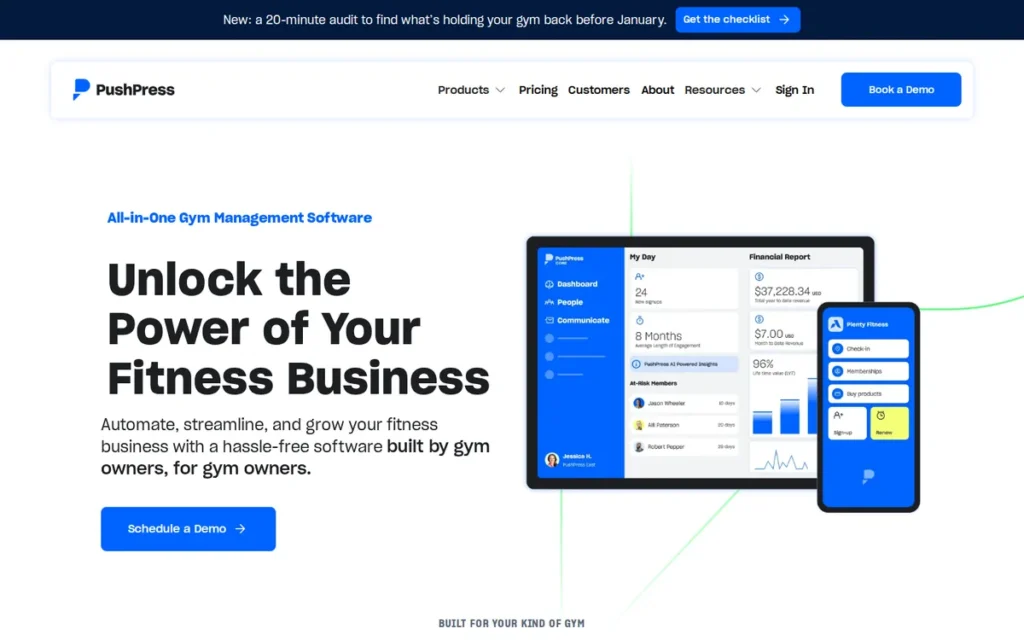
Category: Box Management Platform. Runs billing, scheduling, check-in and workout programming for CrossFit, functional-fitness and class-based gyms.
At a Glance
- Category: Box Management Platform
- Best For: Small and new CrossFit, functional-fitness and boxing gyms that mostly run group classes and want low upfront cost
- Price Range: $0–$229/month for Core, plus optional modules at $79–$329/month; PushPress lists a full-stack figure of about $559/month (published, retrieved November 2026)
- Primary Strength: PushPress publishes every subscription tier and card processing rate, so its total cost is the easiest to calculate of any platform reviewed.
- Biggest Limitation: PushPress’s free tier charges 4.99% + $0.30 per card payment, which makes it more expensive than the $159 Pro tier once card volume passes about $7,500 a month.
- One-Line Summary: PushPress is modular gym management software for CrossFit and functional gyms with fully published pricing, a $0 entry tier and advertised no-long-term-contract terms.
- Last Verified: November 2026
Overview
PushPress is modular gym management software for CrossFit, functional-fitness and boxing gyms that combines billing, scheduling, check-in and optional programming and marketing modules, designed for small gym owners who want a $0 entry tier and fully published pricing.
PushPress CEO Dan Uyemura built the product after opening Torrance Training Lab in 2013. PushPress says it serves 5,000+ fitness studios (PushPress About page, retrieved November 2026).
Key Features
- PushPress Core handles billing, class scheduling, member check-in, member tracking and reporting on every plan tier, including the $0 tier.
- PushPress Grow adds CRM, automated workflows, email and SMS campaigns and website tools for $329 per month (PushPress pricing page, retrieved November 2026).
- PushPress Train adds workout programming and tracking for up to 20 clients for $79 per month (PushPress pricing page, retrieved November 2026).
- PushPress offers a member app with a social feed, a separate staff app and AI-powered support, and a branded app costs $97 per month.
- PushPress card processing falls from 4.99% + $0.30 on Core Free to 2.89% + $0.30 on Core Pro and 2.75% + $0.30 on Core Max.
Best For
PushPress is best for new or small CrossFit and functional gyms with low card volume that mainly run group classes and want to start without a monthly subscription. PushPress gyms should plan to move to Core Pro once monthly card volume passes about $7,500.
Pricing
PushPress publishes the rate card below (PushPress pricing page, retrieved November 2026):
| PushPress Plan | Monthly Price | Card Processing | ACH |
|---|---|---|---|
| Core Free | $0 | 4.99% + $0.30 | 2.89% + $0.30 |
| Core Pro | $159 | 2.89% + $0.30 | 0.79% + $0.30 |
| Core Max | $229 | 2.75% + $0.30 | Not listed |
| Train module | $79 (up to 20 clients) | Not applicable | Not applicable |
| Grow module | $329 | Not applicable | Not applicable |
| Branded App | $97 | Not applicable | Not applicable |
| Full stack | About $559 (PushPress-listed bundle figure) | Not applicable | Not applicable |
- PushPress Core Free’s card rate is 2.1 points higher than Core Pro’s. Because 2.1% × $7,571 ≈ $159, Free stops being cheaper at about $7,500/month in card volume (PlugRoute calculation from published rates, 2026).
- At $12,000/month in card volume, PushPress Core Free charges about $599 in percentage fees and Core Pro about $347. The $252 gap is larger than Pro’s $159 subscription (PlugRoute calculation, 2026).
- PushPress’s listed full-stack figure of about $559 doesn’t match the $734 you’d pay for Core Max, Train, Grow and Branded App bought separately. Ask PushPress which bundle the $559 covers.
- PushPress advertises “no long-term contracts” (PushPress marketing, 2026), but PlugRoute found no published contract terms that confirm it.
Strengths
- PushPress holds a 4.8/5 rating from 200 reviews on G2 (G2, retrieved November 2026), and PlugRoute checked the figure directly on G2.
- PushPress publishes the most complete pricing of the seven platforms reviewed, covering subscription tiers, add-on modules and card processing rates for every Core tier (PushPress pricing page, retrieved November 2026).
- PushPress’s free model helps owners plan their costs, and small-gym reviewers say it “helped them estimate when upgrading… would make financial sense” (Capterra reviews, retrieved November 2026).
- PushPress gets practical owner endorsements. A two-gym owner said it will “work really well for a gym that’s gonna be primarily group classes” (Reddit r/crossfit, retrieved November 2026), though PushPress executives also post in these communities.
- PushPress publishes a case study in which Swift River CrossFit grew from 170 to 230 members in 2022 (PushPress case study, retrieved November 2026; vendor-published, not independently audited).
A member whose box switched to PushPress described the owner’s view on r/crossfit:
“we use sugar wod for the app to track our own stuff, but it integrates very well, and the box is able to use an old Kind Fire stick to display the wods on the TV, so that is nice. the app to check in seems fine, billing is good enough, tracks waivers etc. I just asked the owner today if he liked push press and he said it does exactly what it needs to, he looked a something called Tribes I think, but decided it wasn’t worth it to go through another system.” Posted by u/cmh_ender
Takeaway: PushPress earns functional, “good enough” approval from box owners for check-in, billing and waivers, but some gyms pair it with a separate tracker like SugarWOD instead of relying on its own workout tools.
Limitations
PushPress trades a low upfront price for higher processing costs and thinner service at the bottom tier. PushPress Core Free’s 4.99% + $0.30 card rate costs more than the $159 Pro subscription once card volume passes about $7,500/month. For a growing gym, the “free” tier becomes the expensive one.
- PushPress Free-tier human support has a 48-hour response time (PushPress pricing page, retrieved November 2026), which is slow for billing problems during class hours.
- PushPress reviewers report a slow member app, freezing after updates, unreliable payments, and problems with waiver and website integrations (Capterra, GetApp and Google Play reviews, retrieved November 2026).
- PushPress reporting “could be more detailed,” according to one reviewer, and some basics such as reminders require paid add-ons (Capterra reviews, retrieved November 2026).
- PushPress makes its “no long-term contracts” claim in marketing, not in published contract terms, so buyers should confirm it in the signed agreement.
- PushPress Core Max’s multi-location capabilities were not verified in this research.
Verdict
PushPress has the most calculable total cost of any fitness business platform reviewed in 2026, and its $0 entry tier suits small CrossFit and functional gyms with low card volume. PushPress earned the top overall score (4.13) for pricing and contract clarity, not for feature depth.
Gyms on Core Free should model their processing costs every month. Multi-site operators should verify what Core Max supports before committing.
2. ABC Trainerize: Best for Online and Hybrid Personal Trainers
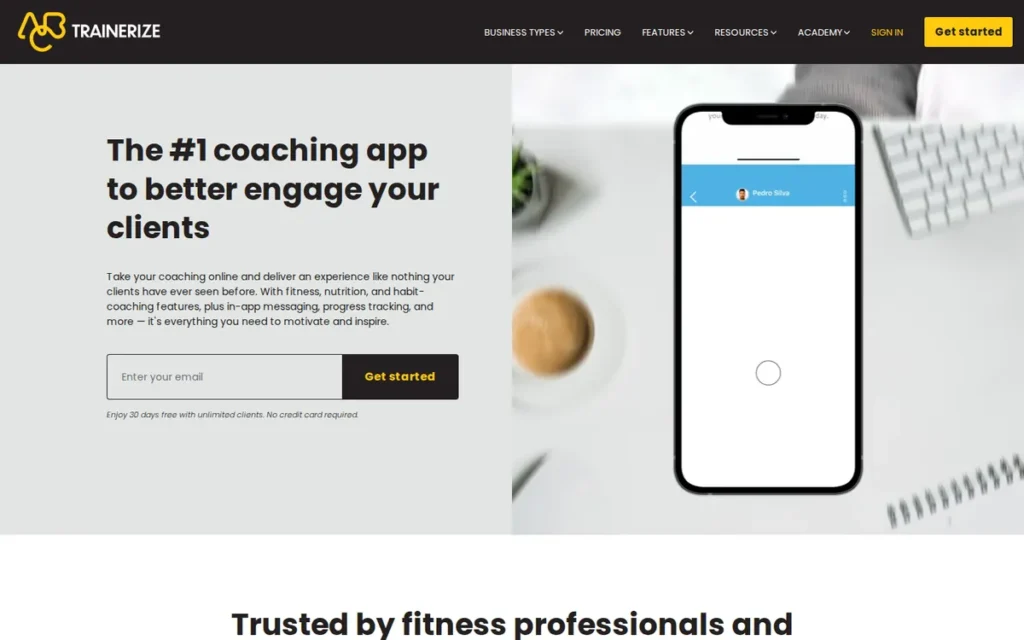
Category: Coaching Platform. Delivers workout programs, nutrition and habit coaching, and client communication for online and hybrid trainers.
At a Glance
- Category: Coaching Platform
- Best For: Online and hybrid personal trainers who want programming, nutrition, habits, messaging and wearable integrations in one app
- Price Range: Free (1 client) to $248/month for Studio Plus, plus add-ons of $10–$45/month; custom pricing from 5 locations (published, retrieved November 2026)
- Primary Strength: ABC Trainerize has the broadest all-in-one toolkit of the coaching platforms reviewed, including AI workout building, nutrition and habit coaching.
- Biggest Limitation: ABC Trainerize’s costs climb quickly with client count and paid add-ons, and its pricing has changed twice since 2024.
- One-Line Summary: ABC Trainerize is an all-in-one online coaching platform that combines workout programming, nutrition, habits and wearable integrations for trainers who expect to grow from solo coaching into a studio.
- Last Verified: November 2026
Overview
ABC Trainerize is online personal training software for personal trainers and hybrid coaches that delivers workout programs, nutrition and habit coaching, messaging and wearable-synced progress tracking, built for trainers who want one app that can grow from a single free client to a multi-location studio.
ABC Trainerize is owned by ABC Fitness, which also owns ABC Glofox. ABC Fitness says it is connecting the two products to give studios digital coaching and nutrition tools (ABC Fitness, 2023).
Key Features
- ABC Trainerize includes an AI Workout Builder on paid plans that speeds up session assembly (Trainerize pricing page, retrieved November 2026).
- ABC Trainerize provides meal and macro tracking, habit coaching with streaks and badges, and an Advanced Nutrition add-on for $20–$45 per month.
- ABC Trainerize supports in-app and voice messaging, automations, groups, challenges and leaderboards to keep clients engaged.
- ABC Trainerize syncs with four wearable and health platforms (Fitbit, Garmin, Apple Health/Apple Watch and Withings) and with the MyFitnessPal nutrition app.
- ABC Trainerize offers Stripe payments for $10 per month, and a branded app on the Pro plan carries a $169 one-time setup fee.
Best For
ABC Trainerize is best for online and hybrid trainers who want one app for programming, nutrition and habits and who expect to grow into a studio. ABC Trainerize also suits clients who already track activity on wearables.
Pricing
ABC Trainerize publishes these tiers (Trainerize pricing page, retrieved November 2026):
- ABC Trainerize Free costs $0 for 1 client.
- ABC Trainerize Grow costs $9/month for 2 clients.
- ABC Trainerize Pro starts at $23/month, with seat tiers of 5, 15, 30, 50, 75, 100 and 200 clients.
- ABC Trainerize Studio Plus costs $248/month for 500 to 1,000+ clients, with custom pricing from 5 locations.
ABC Trainerize add-ons cost extra:
- ABC Trainerize Advanced Nutrition costs $20/month on Grow and Pro 5/15 or $45/month on Pro 30–200, and is included in Studio.
- ABC Trainerize Video Coaching and Stripe Payments each cost $10/month.
- ABC Trainerize’s branded app on Pro carries a $169 one-time setup fee.
Worked example: A coach with 21–30 clients is on the ABC Trainerize Pro 30 seat tier. Advanced Nutrition ($45), Video Coaching ($10) and Stripe Payments ($10) add $65/month to the base price (PlugRoute calculation from published add-on prices, 2026).
ABC Trainerize’s pricing page shows conflicting figures after changes in 2024 and 2026, and Capterra lists paid plans “from $10/month” (Capterra, retrieved November 2026). Estimate your cost at your next client tier, including the add-ons you’ll actually use.
Strengths
- ABC Trainerize holds a 4.6/5 Capterra rating from 694 reviews (Capterra, retrieved November 2026), and reviewers praise its ease of use for clients and its helpful support.
- ABC Trainerize publishes its tiers and itemized add-on prices (Trainerize pricing page, retrieved November 2026), so trainers can calculate their cost at each client count.
- ABC Trainerize has the widest documented feature set of the two coaching platforms ranked, covering programming, nutrition, habits, video, groups and payments.
- ABC Trainerize reports a 4.9 app-store rating from 60,000 ratings (Trainerize, retrieved November 2026; vendor-reported, not independently verified).
- ABC Trainerize users single out its chat feature and webinars, and one client who compared it with TrueCoach said, “I find Trainerize better” (Reddit r/personaltraining, retrieved November 2026).
- PlugRoute found no named ABC Trainerize case study with quantified results as of November 2026.
Limitations
ABC Trainerize trades cost predictability for breadth. ABC Trainerize’s base price rises at each client tier, and nutrition, video, payments and branded-app add-ons are charged on top. As a coaching business grows, its total cost becomes hard to predict.
- ABC Trainerize changed its pricing in both 2024 and 2026, and its pricing page shows conflicting figures (Trainerize pricing page, retrieved November 2026).
- ABC Trainerize reviewers report app glitches, crashes, slow loading and occasional data loss (Capterra reviews, retrieved November 2026).
- ABC Trainerize has a learning curve and dated demo videos, and older clients need extra onboarding, according to Capterra reviewers (retrieved November 2026).
- ABC Trainerize’s AI builder doesn’t automatically adjust working weights between sessions (MesoStrength, retrieved November 2026), which matters to strength coaches.
A coach who disclosed in the same comment that he is building a competing app noted on r/personaltraining:
“I’ve used Trainerize but honestly hate how the user interface looks. EverFit is much cleaner IMO. Client experience on Trainerize app is better tho I think.” Posted by u/BscBryan
Takeaway: Coaches find ABC Trainerize’s trainer-side interface dated compared with newer rivals, even though its client-side experience still holds up.
Verdict
ABC Trainerize has the broadest documented coaching toolkit of the two coaching platforms PlugRoute ranked in 2026, covering programming, nutrition, habits and wearable sync in one app. ABC Trainerize scored 4.08, effectively tied with PushPress, but it serves a different business model.
Trainers should price their next client tier with add-ons included. Strength-focused coaches who want simpler programming should also compare TrueCoach.
3. Wodify: Best for Established CrossFit and Performance-Training Gyms
Category: Box Management Platform. Runs billing, scheduling, check-in and workout programming for CrossFit, functional-fitness and class-based gyms.
At a Glance
- Category: Box Management Platform
- Best For: Established CrossFit, performance-training and martial-arts gyms that want gym operations and athlete performance tracking in one system
- Price Range: Not published by Wodify; G2 lists $99/month and StudioDesk HQ reports $199–$499/month across three tiers (third-party reported), plus card processing from 2.7% + $0.30 (retrieved November 2026)
- Primary Strength: Wodify combines a full gym back office with deep performance tracking and publishes month-to-month terms with no long-term contracts.
- Biggest Limitation: Wodify does not publish subscription prices, and owners and members repeatedly report downtime and frustration on the member side.
- One-Line Summary: Wodify is a CrossFit and functional-gym management platform that pairs billing and scheduling with WOD logging, PRs and leaderboards on month-to-month terms.
- Last Verified: November 2026
Overview
Wodify is gym management software for CrossFit, performance-training and martial-arts gyms that combines billing, scheduling, digital waivers and lead management with workout logging, PR history and leaderboards, designed for established box owners who want operations and athlete tracking in one system.
Wodify sells three tiers: Essentials, Accelerate and Ultimate. Each tier includes everything in the one below it and adds more (Wodify pricing page, retrieved November 2026).
Key Features
- Wodify Essentials covers billing, scheduling, client management, digital waivers and contracts, and one app for both clients and staff.
- Wodify Accelerate adds lead management, dashboards, family billing, pre-built automations, email campaigns and a media library.
- Wodify Ultimate adds performance tracking, a custom website, unlimited automations, next-day payouts and Wodify’s lowest processing rates.
- Wodify records WOD results, PR history and leaderboards, and tracks skill and belt progress for CrossFit and martial-arts programs.
- Wodify processes card payments from 2.7% + $0.30 and ACH payments from 1.5% + $0.30, with no monthly processing fee (Wodify pricing page, retrieved November 2026).
Best For
Wodify is best for established CrossFit and performance-training gyms that want deep athlete tracking alongside billing and scheduling, without a long-term contract.
Pricing
Wodify does not publish subscription prices on its official pricing page as of November 2026. Here is what is published or reported:
- G2’s pricing page lists Wodify at $99 per month (G2, retrieved November 2026), and the PushPress blog, a competitor, reports a similar starting figure.
- StudioDesk HQ reports Wodify’s three tiers at $199, $299 and $499 per month (StudioDesk HQ, retrieved November 2026; third-party reported).
- Wodify officially publishes month-to-month terms with no long-term contracts, plus a small onboarding fee whose amount isn’t stated (Wodify pricing page, retrieved November 2026).
- Wodify card processing is “as low as” 2.7% + $0.30 and ACH “as low as” 1.5% + $0.30. Rates vary by tier and country, and the lowest are reserved for Ultimate.
Worked example: At $12,000/month in card volume, Wodify’s “as low as” 2.7% rate comes to about $324 in percentage fees, plus $0.30 per transaction, and only Ultimate gets that rate (PlugRoute calculation, 2026).
Get a written quote that lists the subscription price, the onboarding fee and the processing rates for your tier.
Strengths
- Wodify holds a 4.7/5 G2 rating from 208 reviews (G2, retrieved November 2026) and a 4.9/5 Apple App Store rating from 17,000 ratings (Apple App Store, retrieved November 2026).
- Wodify publishes month-to-month terms with no long-term contracts on its official pricing page, along with its processing rates, which makes its commitment risk unusually clear.
- Wodify reviewers praise having scheduling, billing, tracking and communication in one place, and they describe support as responsive (Capterra and GetApp reviews, retrieved November 2026).
- Wodify has the deepest performance tracking of the two box platforms ranked. Third-party comparisons say it also covers the business back office that tracker-only tools like SugarWOD don’t (StudioDesk HQ and Gymdesk, retrieved November 2026; Gymdesk is competitor-published).
- PlugRoute found no independent quantified Wodify case study as of November 2026. Wodify’s published customer quotes are chosen by the vendor.
A box owner who had also used ZenPlanner and Mindbody shared their experience on r/crossfit:
“As an owner they integrate attendance, coach schedule/payments, WOD/PR tracking, WOD posting, athlete billing, retail, etc… It all just works. You don’t need to worry about being a tech wizard – just learn the basics and get back to marketing, coaches development, and helping your athletes. While there are some very occasional glitches in the website and app, as others have posted, they aren’t super common, and have never been a “Holy Crap I Hate This” problem.” Posted by u/Kylemoschetto
Takeaway: Owners value Wodify for putting the whole box back office and WOD/PR tracking in one system, and they treat its occasional app glitches as a tolerable cost of that breadth.
Limitations
Wodify trades member-side polish for owner-side depth. A former box owner summed it up as “good for owners, lousy for your customers” (Reddit r/crossfit, threads 2017–2022), and members in the same threads describe outages during the day.
- Wodify members report that the app “goes down in the middle of the day,” and another user mentioned “downtime issues” (Reddit r/crossfit, threads 2017–2022).
- Some Wodify App Store reviewers report frequent sign-outs (Apple App Store, retrieved November 2026), which is current evidence of member-side friction.
- Wodify reviewers mention complexity, cost, recurring glitches, billing issues and requests for live support (Capterra and GetApp reviews, retrieved November 2026).
- Wodify doesn’t publish subscription prices, so buyers can’t calculate total cost without talking to sales.
- Most of Wodify’s Reddit sentiment dates from 2017–2022 and may predate the current app, so treat it as a pattern to check in a demo, not as current fact.
Verdict
Wodify offers the deepest performance tracking of the box management platforms PlugRoute ranked in 2026, and it publishes month-to-month terms. Wodify would rank above ABC Trainerize if it published subscription prices, because raising its Total Cost Transparency score from 3.0 to 4.0 would add 0.20 points.
Ask Wodify for itemized pricing early, and test the member app with a few athletes during the trial. Smaller or newer boxes should compare PushPress’s published pricing.
4. TrueCoach: Best for Programming-Focused 1:1 Strength Coaches
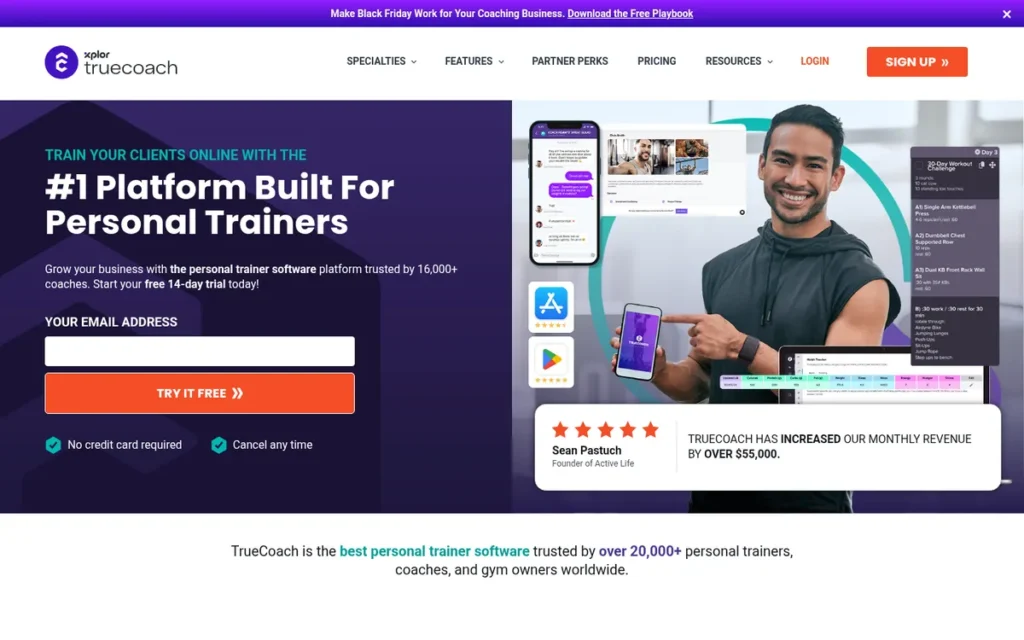
Category: Coaching Platform. Delivers workout programs, nutrition and habit coaching, and client communication for online and hybrid trainers.
At a Glance
- Category: Coaching Platform
- Best For: 1:1 strength and conditioning coaches whose work is mainly individualized programming and workout feedback
- Price Range: $29.98–$164.98/month on monthly billing or $26.34–$136.99/month billed annually, for up to 50 clients; custom pricing above 50 clients (published, retrieved November 2026)
- Primary Strength: TrueCoach has the highest verified user rating of any platform reviewed and a focused, programming-first workflow.
- Biggest Limitation: TrueCoach’s fixed client caps cause steep price jumps: adding a 21st client moves a coach from $69.98 to $164.98 per month on monthly billing.
- One-Line Summary: TrueCoach is a programming-first coaching app for 1:1 trainers, with a drag-and-drop workout builder, 3,500+ demo videos and the highest verified user rating in this review.
- Last Verified: November 2026
Overview
TrueCoach is personal training software for 1:1 trainers and strength coaches that offers a drag-and-drop program builder, 3,500+ exercise demo videos, workout-level messaging and progress graphs, designed for coaches who want simple, focused programming rather than an all-in-one business suite.
TrueCoach runs on web, iOS and Android, and clients use the TrueCoach app for free (TrueCoach pricing page, retrieved November 2026).
Key Features
- TrueCoach provides a template-based, drag-and-drop workout builder with 3,500+ exercise demo videos, and coaches can add their own.
- TrueCoach supports in-app messaging with photos, videos and comments attached to individual workouts.
- TrueCoach tracks progress graphs, custom metrics and habits, and sets calorie and macro targets through a MyFitnessPal integration.
- TrueCoach includes wearable integrations (Apple Health, Garmin, Oura) and a custom branded app on its Standard and Pro tiers only.
- TrueCoach offers Zapier automations on its Pro tier (TrueCoach pricing page, retrieved November 2026).
Best For
TrueCoach is best for 1:1 strength coaches whose work is individualized programming and workout feedback, not holistic behavior-change coaching.
Pricing
TrueCoach publishes these tiers (TrueCoach pricing page and Coachful, retrieved November 2026):
- TrueCoach Starter costs $29.98/month on monthly billing or $26.34/month billed annually, for up to 5 clients.
- TrueCoach Standard costs $69.98/month on monthly billing or $57.99/month billed annually, for up to 20 clients.
- TrueCoach Pro costs $164.98/month on monthly billing or $136.99/month billed annually, for up to 50 clients.
- TrueCoach offers custom pricing above 50 clients.
Worked example: A 21st client moves a TrueCoach coach from $69.98 to $164.98 per month on monthly billing (+$95), or from $57.99 to $136.99 billed annually (+$79) (PlugRoute calculation from published prices, 2026).
- TrueCoach offers a 14-day free trial and a free client app (TrueCoach pricing page, retrieved November 2026).
- TrueCoach says Stripe payments carry “no additional fee,” but a third party reports a possible 5% fee and Stripe support in only 4 countries (Coachway, retrieved November 2026; unconfirmed).
Strengths
- TrueCoach holds a 4.8/5 Capterra rating from 838 reviews (Capterra, retrieved November 2026), the highest verified rating of the seven platforms reviewed.
- TrueCoach also holds a G2 rating of about 4.6/5 (Coachful, retrieved November 2026; third-party reported, review count unverified).
- TrueCoach publishes prices for both monthly and annual billing, along with a 14-day free trial and a free client app.
- TrueCoach includes 3,500+ exercise demo videos and workout-level feedback tools, and reviewers praise its coaching workflow (Capterra reviews, retrieved November 2026).
- TrueCoach keeps loyal users despite its gaps. One coach said they were “95% happy with the service” (Reddit r/personaltraining, retrieved November 2026).
- PlugRoute found no quantified TrueCoach case study as of November 2026.
Limitations
TrueCoach trades breadth for simplicity, so coaches whose businesses grow beyond programming tend to outgrow it. One reviewer left because TrueCoach lacked “automation, structured check-ins, and nutrition tools” (Capterra reviews, retrieved November 2026).
- TrueCoach can’t schedule more than one workout on the same day, according to one reviewer (Capterra reviews, retrieved November 2026).
- TrueCoach’s phone-browser logging is clumsy during in-person sessions, and one coach described a refresh that would “wipe everything out” mid-session (Reddit r/personaltraining, retrieved November 2026).
- TrueCoach clients report “very few features” and say it’s hard to change workout dates (Reddit r/personaltraining, retrieved November 2026).
- TrueCoach’s fixed client caps cause steep price jumps, and at least one coach left after a price increase (Reddit r/personaltraining, retrieved November 2026).
- TrueCoach’s Stripe fees may not be fee-free in practice, because a third party reports a possible 5% fee (Coachway, retrieved November 2026; unconfirmed).
A trainer who weighed TrueCoach against ABC Trainerize noted on r/personaltraining:
“so I’ve used Truecoach for about a year now and just got hit with a huge increase in price. For some, this would be okay, but for me where I literally have 1 client right now using it, it makes zero sense to pay +$300/year for just her to use it. I also had the option of doing monthly, but trainerize was still cheaper.” Posted by u/avprobeauty
Takeaway: TrueCoach’s price increases hit low-volume coaches hardest, and some trainers with very small client lists have left for ABC Trainerize on cost alone.
Verdict
TrueCoach is the highest-rated programming-first coaching app PlugRoute ranked for 1:1 strength coaches in 2026, with a verified Capterra rating of 4.8/5 from 838 reviews. TrueCoach ranks below ABC Trainerize because of its narrower scope and the price cliffs at its client caps, not because users dislike it.
Coaches near a cap should price the next tier before signing. Coaches who need nutrition and structured check-ins should compare ABC Trainerize.
5. WellnessLiving: Best for Budget-Conscious Boutique Studios
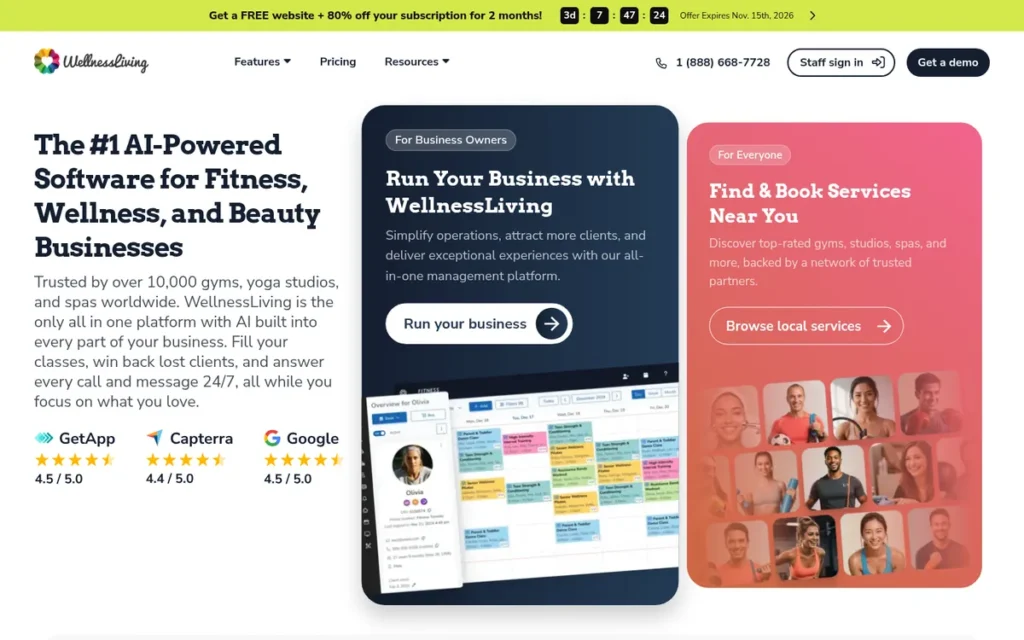
Category: Studio Management Suite. Runs class and appointment booking, memberships, payments, marketing and a member app for boutique and class-based studios.
At a Glance
- Category: Studio Management Suite
- Best For: Single-location and growing boutique studios (yoga, Pilates, class-based fitness) that want published pricing and built-in engagement tools
- Price Range: $69–$349/month on monthly billing ($62–$314 billed annually); Enterprise by quote (published, retrieved November 2026)
- Primary Strength: WellnessLiving publishes the clearest subscription pricing among studio suites and bundles loyalty, review collection and AI client-retention tools.
- Biggest Limitation: WellnessLiving’s Starter tier allows only one staff member, so most studios realistically start at the $199 Business tier, and its processing rates and contract terms are not published.
- One-Line Summary: WellnessLiving is an all-in-one studio management suite with published pricing, built-in loyalty and review tools, and an Enterprise tier for multi-location operators.
- Last Verified: November 2026
Overview
WellnessLiving is all-in-one class booking and studio management software for boutique fitness, yoga, Pilates and wellness studios that handles classes, appointments, billing, marketing, loyalty and the Achieve client app, built for owners who want published pricing and built-in retention tools.
WellnessLiving focuses on member retention. Alongside booking, it offers loyalty rewards, review collection and AI tools that flag at-risk clients.
Key Features
- WellnessLiving schedules classes, appointments, events and asset reservations, with waitlists and self check-in.
- WellnessLiving provides POS, recurring billing, email, SMS and push marketing, and lead management.
- WellnessLiving includes the Achieve client app, with a white-label version on its BusinessPro tier.
- WellnessLiving bundles rewards, loyalty, review collection, the CAASI AI concierge and the Isaac AI assistant with an at-risk-client predictor (WellnessLiving pricing page, retrieved November 2026).
- WellnessLiving Enterprise adds an HQ account, multi-location reporting, cross-location visits and royalty billing for franchise and multi-site operators.
Best For
WellnessLiving is best for boutique studio owners who want to see their subscription price upfront and want loyalty and review tools without adding separate apps.
Pricing
WellnessLiving publishes prices for three of its four tiers (WellnessLiving pricing page, retrieved November 2026):
| WellnessLiving Plan | Monthly Billing | Annual Billing (per month) | Notes |
|---|---|---|---|
| Starter | $69 | $62 | 1 staff member |
| Business | $199 (promo $39 for 2 months) | $179 | Unlimited staff, marketing |
| BusinessPro | $349 (promo $69 for 2 months) | $314 | White-label app |
| Enterprise | Quote | Quote | Multi-location |
Worked example: Adding a second staff member moves a studio from WellnessLiving Starter at $69/month to Business at $199/month on monthly billing, a $130 increase. Billed annually, the move is from $62 to $179 (PlugRoute calculation from published prices, 2026).
- WellnessLiving includes free setup, data migration and training.
- WellnessLiving charges $19/month for API access.
- WellnessLiving doesn’t publish processing rates or contract length, so get both in writing.
Strengths
- WellnessLiving holds a 4.4/5 Capterra rating from 613 reviews (Capterra, retrieved November 2026).
- WellnessLiving publishes monthly and annual prices for its Starter, Business and BusinessPro tiers, and setup, data migration and training are free.
- WellnessLiving lists loyalty rewards, review collection, the CAASI AI concierge and the Isaac at-risk-client predictor on its pricing page, so studios don’t need separate apps for them (WellnessLiving pricing page, retrieved November 2026).
- WellnessLiving users say that once setup is finished “it saves tons of time” (Reddit r/smallbusiness, 2025).
- One WellnessLiving user who has run a massage and yoga business on it for four years said it “does what we need it to do” (Reddit r/smallbusiness, 2025).
- PlugRoute found no named WellnessLiving case study with quantified results as of November 2026.
Limitations
WellnessLiving trades deep customization for a steep start. A yoga and Pilates studio owner said the first weeks were “overwhelming because it’s super customizable,” before the platform started saving time (Reddit r/smallbusiness, 2025).
- WellnessLiving users report reliability problems. One business described “entire geographical areas not being able to login” and Zoom sessions disconnecting (Reddit r/smallbusiness, 2025).
- WellnessLiving draws complaints about auto-renewal, notice requirements and cancellation (Capterra reviews and BBB profile, retrieved November 2026).
- WellnessLiving reviewers also mention confusing billing, price increases, bugs and marketing automation that is hard to set up (Capterra reviews, retrieved November 2026).
- WellnessLiving doesn’t publish card processing rates, so buyers can’t fully calculate its total cost before signing.
Verdict
WellnessLiving is the most price-transparent studio management suite PlugRoute ranked in 2026, with published monthly and annual prices for three of its four tiers. WellnessLiving was re-scored in November 2026 after PlugRoute retrieved its Capterra rating, and its #5 rank did not change.
WellnessLiving buyers should budget for the $199 Business tier, not Starter. Get processing rates and renewal terms in writing, and expect a learning curve in the first few weeks.
6. Mindbody: Best for Studios That Rely on Marketplace Discovery
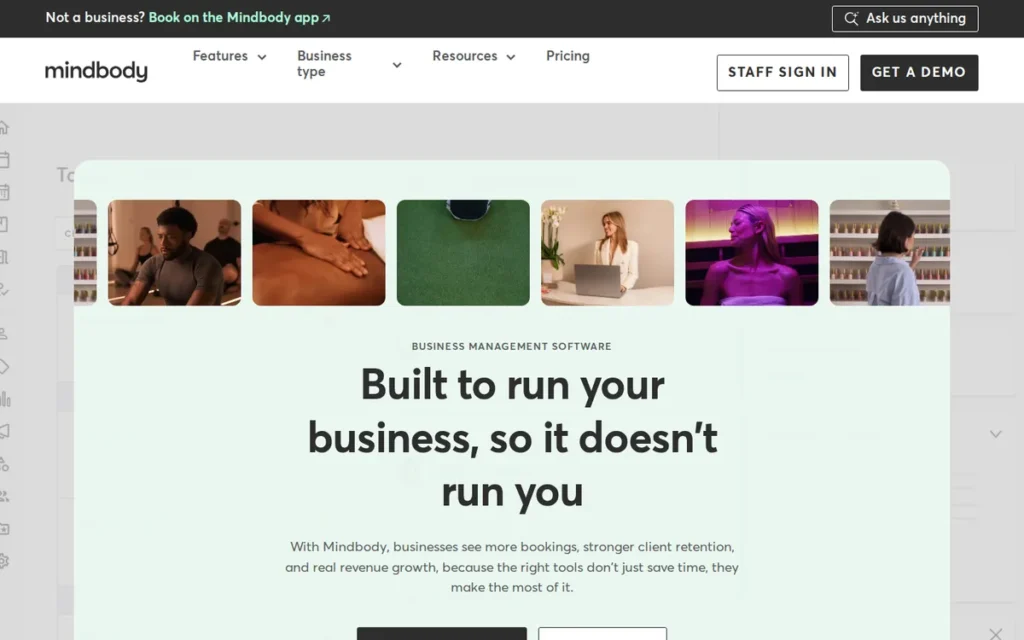
Category: Studio Management Suite. Runs class and appointment booking, memberships, payments, marketing and a member app for boutique and class-based studios.
At a Glance
- Category: Studio Management Suite
- Best For: Established fitness, wellness and multi-location studios that want new-client discovery through a consumer marketplace
- Price Range: From $79 per location per month; higher tiers by quote; plus processing, add-ons and marketplace commissions (starting price published, retrieved November 2026)
- Primary Strength: Mindbody combines the broadest documented studio feature set with a built-in consumer marketplace for finding new clients.
- Biggest Limitation: Mindbody’s Order Forms can set fixed 12–36-month terms on top of a 90-day standard term, and reviewers repeatedly report difficult cancellation and charges after cancelling.
- One-Line Summary: Mindbody is a full-featured studio and wellness management platform whose consumer marketplace and ClassPass ownership make it the strongest option for new-client discovery.
- Last Verified: November 2026
Overview
Mindbody is all-in-one studio and wellness management software for fitness, wellness and beauty businesses that covers scheduling, payments, marketing and reporting and adds a consumer marketplace for client discovery, built for established studios that want new clients more than low cost or flexible contracts.
Mindbody also owns ClassPass, which it acquired in 2021, giving Mindbody studios a second marketplace for reaching new clients (Gymdesk Mindbody review, retrieved November 2026; competitor-published).
Key Features
- Mindbody schedules classes, appointments, rooms and resources, and includes POS, recurring billing and reporting.
- Mindbody lists studios free in its consumer app and takes 20% of a new client’s first eligible purchase, capped at $30. Later bookings are commission-free (Mindbody support, retrieved November 2026).
- Mindbody includes email and SMS marketing and lead management, with Pick-a-Spot and promo codes on higher tiers.
- Mindbody offers an AI Concierge front-desk assistant on higher tiers that answers questions and responds to missed calls (Mindbody pricing page, retrieved November 2026).
- Mindbody sells a branded app as an add-on on its Accelerate and Ultimate tiers.
Best For
Mindbody is best for established studios that rely on marketplace discovery to fill classes and can accept a possible fixed-term contract in exchange.
Pricing
Mindbody publishes only its starting price, $79 per location per month, as of November 2026. Its four tiers are Starter, Accelerate, Ultimate and Ultimate Plus, and the higher tiers are priced by quote. Mindbody’s added costs and terms include:
- Mindbody Payments charges a fixed $0.10–$0.30 per transaction plus a variable percentage that depends on how the card is taken (Mindbody pricing page, retrieved November 2026).
- Mindbody’s marketplace commission is 20% of a new client’s first eligible purchase, capped at $30. If the first purchase is free, the fee applies to the next eligible purchase within three months.
- Mindbody’s branded app is an add-on on Accelerate and Ultimate, and AI features cost extra on higher tiers.
- Mindbody may charge data-transfer fees, according to one cost guide (Blurstudio, 2026).
- Mindbody’s standard terms set a 90-day initial term that then renews every 30 days. An individual Order Form can set a fixed 12-, 24- or 36-month term, and cancelling requires at least 30 days’ notice (Mindbody support and terms of service, retrieved November 2026).
- Mindbody includes unlimited extra users, but the price rises with each added location.
Worked example: A studio that gains 40 new clients a month through the Mindbody app, each buying a $150 intro pack, would pay 40 × $30 = $1,200 in first-purchase commissions that month (PlugRoute calculation, 2026).
Get the Order Form term, the renewal date and the cancellation notice period in writing.
Strengths
- Mindbody holds a 4.0/5 Capterra rating from 2,994 reviews (Capterra, retrieved November 2026), the largest review base of the seven platforms reviewed.
- Mindbody runs the only built-in consumer marketplace among the platforms reviewed. It reports an average of 3 million monthly active app users and more than 22,000 first purchases a month (Mindbody, 2026; vendor figures).
- Mindbody has the broadest documented studio feature set of the platforms reviewed and includes unlimited extra users at no charge (Mindbody pricing page, retrieved November 2026).
- One gym member comparing Mindbody with Glofox said Mindbody “seems more solid overall just not as simple to use” (Reddit r/emiratiwomen, retrieved November 2026).
- Mindbody’s only published performance claim is a testimonial from an unnamed customer saying “50% of free trials came from the branded app” (Mindbody pricing page, retrieved November 2026; vendor-published).
Limitations
Mindbody trades cost predictability and contract flexibility for discovery and depth. Processing fees, branded-app and AI add-ons, per-location pricing and marketplace commissions push Mindbody’s total cost well above its $79 starting price.
- Mindbody’s value-for-money score is one of its weakest Capterra sub-ratings (Capterra, retrieved November 2026).
- Mindbody reviewers repeatedly report difficult cancellation, refund problems and charges after cancelling, and Reddit users describe being “stuck in a contract” (Capterra and Reddit r/mindbody, retrieved November 2026).
- Mindbody Order Forms can lock a studio into a fixed 12–36-month term, and a studio that leaves early may still owe fees for the rest of the term.
- Mindbody has a steep learning curve and a scheduling interface reviewers call “complicated,” and reports on its support are mixed (Capterra, Trustpilot and GetApp, retrieved November 2026).
- Mindbody’s ClassPass payouts per session are criticized as low by reviewers (Capterra, retrieved November 2026).
Verdict
Mindbody is the strongest fit among the platforms PlugRoute ranked for studios that depend on marketplace discovery, and it has the weakest contract score (2.0 out of 5) in this review.
Mindbody has the broadest documented studio feature set among the platforms reviewed, and its #6 rank reflects cost opacity and lock-in complaints, not missing features. Budget for the commission on every new marketplace client, and confirm the Order Form term before signing.
7. ABC Glofox: Best for Studios and Franchises That Want a Branded App
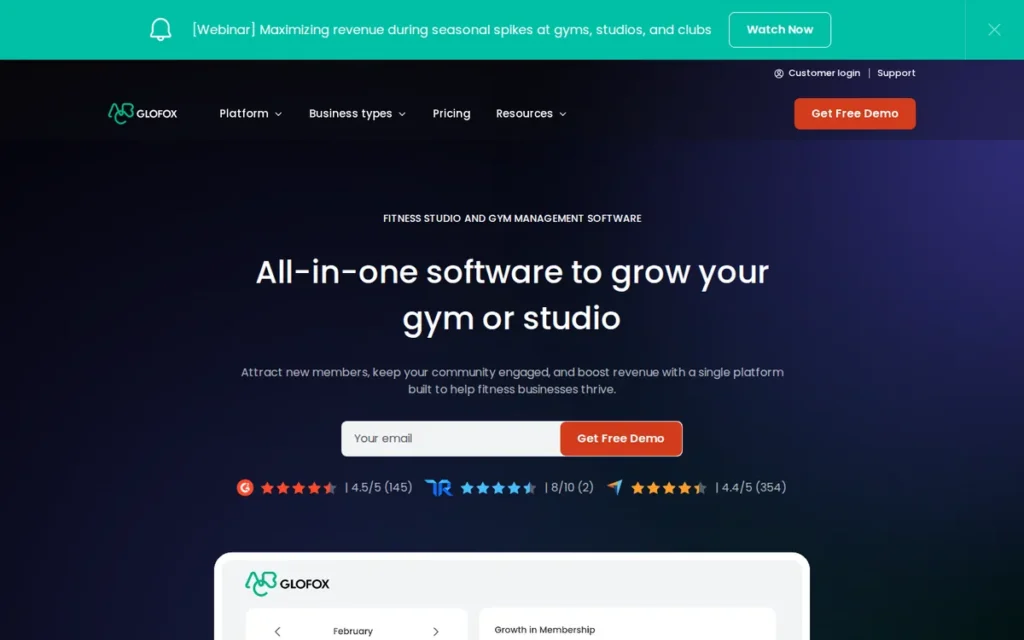
Category: Studio Management Suite. Runs class and appointment booking, memberships, payments, marketing and a member app for boutique and class-based studios.
At a Glance
- Category: Studio Management Suite
- Best For: Boutique studios, gyms and franchises that want a branded member app, payment automation and access control
- Price Range: Quote-only; Vibefam, a competing vendor, estimates about $99–$600+/month across tiers, plus processing (competitor estimate, Vibefam, 2026)
- Primary Strength: ABC Glofox’s branded member app, automatic failed-payment retries and access control tied to payment status are its strongest documented features.
- Biggest Limitation: ABC Glofox has the least transparent pricing in this review: no published prices, unconfirmed processing surcharges, and annual contracts reported as common.
- One-Line Summary: ABC Glofox is a boutique studio and gym management platform best known for its fully branded member app, payment automation and franchise-ready multi-location tools.
- Last Verified: November 2026
Overview
ABC Glofox is gym management and class booking software for boutique fitness studios, gyms and franchises that handles booking, memberships, recurring billing and access control through a fully branded member app, designed for operators who put branding and payment automation ahead of pricing transparency.
ABC Glofox is owned by ABC Fitness, which also owns ABC Trainerize. ABC Glofox says it is used by 30,000+ studios and gyms (Glofox features page, retrieved November 2026).
Key Features
- ABC Glofox books classes, courses and appointments with waitlists and reminders, and supports memberships and credit packs.
- ABC Glofox automates recurring billing and automatically retries failed payments through Stripe, GoCardless, Ezidebit and PayU, and it also accepts Apple Pay and Google Pay.
- ABC Glofox provides a branded member app with the studio’s logo, colors and icon, plus in-app booking, payment, push notifications and barcode check-in.
- ABC Glofox links door access through Kisi, Gantner and Passport Technologies to each member’s payment status (Glofox features page, retrieved November 2026).
- ABC Glofox includes AI churn prediction, CRM integrations (HubSpot, Mailchimp, Zapier, Facebook Pixel), roll-up reporting and franchise royalty billing.
Best For
ABC Glofox is best for boutique studios and franchise operators who want their own branded member app and payment automation and who are prepared to negotiate a written quote.
Pricing
ABC Glofox pricing is quote-only as of November 2026, and G2 also lists it as custom (G2, retrieved November 2026). A competing vendor estimates these ranges (Vibefam, 2026; competitor-published):
- ABC Glofox Essential is estimated at about $110–$150/month.
- ABC Glofox Boost is estimated at about $160–$250/month.
- ABC Glofox Elite is estimated at about $250–$400+/month.
- ABC Glofox Enterprise is estimated at about $500–$600+/month.
- ABC Glofox may add a card surcharge of 2.9% + $0.30 on top of Stripe’s rate (Vibefam, 2026; unconfirmed).
- ABC Glofox annual contracts are reported as common, sometimes with quarterly prepayment (Vibefam, 2026; competitor-published).
Worked example: If the unconfirmed 2.9% surcharge applies, a studio processing $12,000/month in card payments would pay about $348/month on top of Stripe’s own fees (PlugRoute calculation, 2026; surcharge unconfirmed).
Insist on an itemized written quote that covers the subscription, processing, the app and the contract length.
Strengths
- ABC Glofox holds a 4.4/5 Capterra rating from 356 reviews (Capterra, retrieved November 2026) and a 4.5/5 G2 rating from 147 reviews (G2, retrieved November 2026).
- ABC Glofox won FIT Summit’s 2023 Technology Company of the Year award (ABC Fitness and Australasian Leisure Management, 2023).
- ABC Glofox’s Capterra sub-ratings are 4.4 for both ease of use and customer service (Vibefam, 2026; third-party reported).
- ABC Glofox publishes customer case studies, including JourneyFit’s 36% revenue growth in 12 months (Glofox case study, retrieved November 2026; vendor-published, not audited).
- One ABC Glofox member said, “From user POV, I like Glofox” (Reddit r/bjj, retrieved November 2026), and G2 reviewers praise its ease of use.
Limitations
ABC Glofox trades pricing clarity for a polished member-facing app. ABC Glofox pricing is quote-only, so buyers can’t calculate total cost before a sales conversation, and the only tier estimates come from a competing vendor (Vibefam, 2026).
- ABC Glofox has a 3.6/5 Trustpilot rating from 388 reviews (Trustpilot, retrieved June 2026), and many of the 1-star reviews mention cancellation and price increases.
- ABC Glofox reviewers report mismatches between payments and class credits, calendar and waitlist bugs, incomplete reports, and fixes that take weeks (Capterra reviews, retrieved November 2026).
- ABC Glofox draws studio-owner complaints about slow support, limited automation and “prices keep going up without new features being added” (Reddit r/emiratiwomen, retrieved November 2026).
- ABC Glofox’s lowest Capterra sub-ratings are value and features, at 4.2 each (Vibefam, 2026; third-party reported).
- ABC Glofox scored 2.0 on Contract Terms because annual contracts are reported as common and Trustpilot reviewers mention cancellation problems.
Verdict
ABC Glofox offers the most fully branded member app among the studio platforms PlugRoute ranked in 2026, but it has the least transparent pricing in this review. ABC Glofox’s last-place rank reflects cost opacity and commitment risk, not missing features.
ABC Glofox trails Mindbody by about 0.10 points, a gap that depends on its provisional pricing score. Franchise operators should weigh its royalty and roll-up reporting tools and confirm every fee in writing.
What Does Fitness Software Really Cost?
Fitness software usually costs more than its advertised monthly price. Total cost of ownership also includes merchant (card processing) fees, add-ons, client caps, per-location fees and marketplace commissions. Single-location software typically runs $50–$300+ per month (Gymdesk, retrieved November 2026; competitor-published), and processing fees often exceed the subscription.
The table shows how much of each platform’s real cost you can see before signing (retrieved November 2026):
| Platform | Subscription Pricing | Processing Rates | Contract Terms |
|---|---|---|---|
| PushPress | Fully published | Card rates published by tier | “No long-term contracts” (marketing claim; terms not published) |
| ABC Trainerize | Published tiers and add-ons (changed 2024 and 2026) | Stripe add-on $10/month; rates not verified | Not verified |
| TrueCoach | Published for monthly and annual billing | “No additional fee” claimed; 5% fee reported, unconfirmed | 14-day trial; terms not verified |
| Wodify | Not published (G2 lists $99; third parties report $199–$499) | Published “as low as” rates | Month-to-month (published) |
| WellnessLiving | Published for 3 of 4 tiers | Not published | Not published; auto-renewal complaints |
| Mindbody | Starting price only ($79/location) | $0.10–$0.30 per transaction + variable % | Standard 90-day initial term, then 30-day renewals; Order Forms may set 12/24/36-month terms |
| ABC Glofox | Quote-only | Surcharge estimated, unconfirmed | Annual contracts reported as common |
Only two of the seven platforms, PushPress and WellnessLiving, publish enough pricing for a buyer to estimate most of the monthly bill before a sales call. Only PushPress publishes a card processing rate for every tier (2026).
Each platform has one worked cost example from its entry:
- PushPress breakeven: PushPress Core Free becomes more expensive than the $159 Core Pro tier at about $7,500/month in card volume (PlugRoute calculation, 2026).
- ABC Trainerize add-ons: ABC Trainerize add-ons cost $65/month on the Pro 30 tier when Advanced Nutrition, Video Coaching and Stripe Payments are all included.
- Wodify processing: Wodify’s “as low as” 2.7% card rate comes to about $324/month on $12,000 in card volume, plus per-transaction fees.
- TrueCoach client cliff: TrueCoach jumps from $69.98 to $164.98 per month on monthly billing when a coach adds a 21st client.
- WellnessLiving staff limit: WellnessLiving Starter allows one staff member, so adding a second moves a studio from $69 to $199 per month.
- Mindbody commission: Mindbody’s marketplace commission would total $1,200 in a month with 40 new clients each buying a $150 intro pack.
- ABC Glofox surcharge: ABC Glofox’s unconfirmed 2.9% surcharge would add about $348/month on $12,000 in card volume.
Third-party benchmarks show where the rest of the money goes:
- Card processing typically runs 2.7%–3.5% + about $0.30, and some entry tiers charge 4.99% (Gymdesk, retrieved November 2026; competitor-published).
- Branded apps typically cost $39–$249/month, sometimes with a setup fee on top (Rankite, retrieved November 2026).
- A 150-member gym collecting $12,000/month might pay about $470–$980/month for software plus processing (Gymdesk, retrieved November 2026; competitor-published, figures illustrative).
Which Fitness Software Is Best for Online Coaching?
ABC Trainerize is the strongest fit among the platforms PlugRoute ranked for online coaching clients who need programming, nutrition, habit tracking and wearable sync in one app. TrueCoach fits coaches whose clients mainly need individualized programming and workout-level feedback, at published prices starting at $29.98 per month on monthly billing (2026).
The table compares monthly cost at common client counts (TrueCoach pricing page, Coachful and Trainerize pricing page, retrieved November 2026):
| Active Clients | TrueCoach (monthly billing) | TrueCoach (billed annually) | ABC Trainerize |
|---|---|---|---|
| 5 | $29.98 | $26.34 | Pro from $23 (5-client tier); Advanced Nutrition +$20 |
| 20 | $69.98 | $57.99 | Pro 30 seat tier (base price not verified); Advanced Nutrition +$45 |
| 21 | $164.98 | $136.99 | Same Pro 30 seat tier as 20 clients |
| 50 | $164.98 | $136.99 | Pro 50 seat tier (base price not verified); Advanced Nutrition +$45 |
- ABC Trainerize’s Pro 30 seat tier covers both 20 and 21 clients, so the 21st client does not trigger the jump TrueCoach does.
- TrueCoach costs $95 more per month on monthly billing at 21 clients than at 20.
- Coaches should compare both platforms at their next client count, with add-ons included, before signing.
What Red Flags Should I Watch For When Evaluating Fitness Software?
The biggest red flags in fitness software are costs you can’t calculate and commitments you can’t get out of. PlugRoute found six recurring warning signs in review-site and Reddit patterns, from processing fees larger than the subscription to price increases with no new features. Each one is listed below with how to check for it.
“It’s not AMAZING (none of the available options are)…”, Two-gym owner, Reddit r/crossfit (retrieved November 2026)
Takeaway: Experienced gym owners judge fitness software by how well it fits their class model, not by perfection, because no platform scores well on every criterion.
Red Flag #1: Processing Fees Larger Than the Subscription A low or $0 subscription paired with a high card rate can end up costing more than a paid tier as your volume grows. Calculate processing at your real monthly card volume, because fees often exceed the subscription (Gymdesk, retrieved November 2026; competitor-published).
Red Flag #2: Quote-Only Pricing With No Itemized Fees Quote-only pricing means you can’t compare total cost before you talk to a salesperson. If a vendor won’t itemize its subscription, processing, app and onboarding fees in writing, treat its total cost as unknown until it does.
Red Flag #3: Fixed-Term Order Forms or Auto-Renewal Without Clear Notice Fixed terms and auto-renewal decide how expensive a wrong choice becomes. Third parties report 12–24-month minimums on some platforms (Rankite, retrieved November 2026), and cancellation complaints recur for Mindbody, ABC Glofox and WellnessLiving (Capterra, Trustpilot and BBB, retrieved November 2026).
Red Flag #4: Downtime During Class Hours Outages during peak class times block check-ins, bookings and payments when you need them most. Members report gym apps that go “down in the middle of the day” (Reddit r/crossfit, threads 2017–2022), so ask every vendor for its uptime history in writing.
Red Flag #5: Clients Troubleshooting the Coach’s App When clients struggle with basic tasks such as moving a workout, retention suffers. One commenter, who disclosed a competing interest, said “as a client you should never have to help troubleshoot software for your coach” (Reddit r/personaltraining, retrieved November 2026).
Red Flag #6: Price Increases Without New Features Repeated price increases without matching improvements show up in reviews across the category. A studio owner researching options cited “prices keep going up without new features being added” (Reddit r/emiratiwomen, retrieved November 2026), so ask how often prices have changed recently.
What Questions Should I Ask Before Choosing Fitness Software?
Before choosing fitness software, ask about total cost at your next growth stage, contract and cancellation terms, data export, the features you’ll actually use, setup time, member ratings, and how to leave a current contract. Ask every vendor all seven questions, and get the answers in writing before you sign.
Question #1: What will I pay per month at my current and next growth stage, including processing and add-ons? A good answer itemizes the subscription, card and ACH rates, add-ons, and any client or location fees. Ask for pricing at your next client tier or location count too, because the jump at a client cap can more than double the monthly cost.
Question #2: Is the contract month-to-month, and what is the cancellation notice period? A good answer states the term length, renewal terms and notice period in writing. Month-to-month terms published on an official pricing page are more reliable than a salesperson’s verbal assurance. Order Forms can override a vendor’s standard terms.
Question #3: Can I export all my member and payment data if I leave? A good answer confirms you can export member profiles, billing history and attendance in a standard format. Gym owners list “will I have access to my data” among their main decision criteria (Reddit r/crossfit, threads 2017–2022), so get the export process documented.
Question #4: Which features will I actually use every week? A good answer comes from your own workflow, not the vendor’s feature list. Map booking, billing, check-in, access control, programming and client messaging to your daily operations. Don’t pay for tiers built around features you won’t use.
Question #5: How long does staff training and setup take? A good answer gives a realistic onboarding timeline and says whether migration and training are included. One WellnessLiving studio owner called the first weeks “overwhelming” (Reddit r/smallbusiness, 2025), and reviewers describe a steep learning curve for Mindbody (Capterra, retrieved November 2026).
Question #6: How do members rate the app, separately from owners? A good answer points to app-store ratings and member reviews, not just owner testimonials. A former box owner called Wodify “good for owners, lousy for your customers” (Reddit r/crossfit, threads 2017–2022). Glofox members praise an app that studio owners describe as glitchy behind the scenes.
Question #7: How do I switch platforms if I’m already in a contract? A good answer starts with your Order Form: find its term length and renewal date. Give notice at least 30 days before renewal, as Mindbody’s documented terms require (Mindbody, retrieved November 2026), and export all member and billing data before you cancel.
As one user on r/crossfit warned a gym owner shopping for software:
“Please do yourself and your members a favor and demo the app before committing. Changing to a new app will be complicated and messy after the fact. Usability plays a big role and some apps out there absolutely suck. ZenPlanner for example is atrocious.” Posted by u/CidVilas
Takeaway: Switching fitness software after launch is costly enough that a hands-on, member-inclusive demo before signing is the cheapest insurance a gym owner can buy.
How Did We Rank These Fitness Software Platforms?
PlugRoute scored seven fitness software platforms from 1 to 5 on six weighted criteria: review ratings, cost transparency, contract risk, feature fit, reliability and member experience, and scalability. Every score is based on dated, sourced desk research. No product was tested hands-on, and vendor- or competitor-published sources are labeled wherever they appear.
PlugRoute used these six criteria:
- Verified Review Ratings and Volume (20%): This criterion matters because dated G2 and Capterra ratings with review counts are the most comparable satisfaction signal, and vendor-reported ratings earn less credit.
- Total Cost Transparency (20%): This criterion matters because processing fees, add-ons, client caps and commissions hide the real cost behind the monthly price.
- Contract Terms and Commitment Risk (15%): This criterion matters because lock-in, auto-renewal and hard cancellation decide how expensive a wrong choice becomes.
- Feature Fit for the Target Business Model (20%): This criterion matters because no single tool fits online coaching, boutique studios and CrossFit gyms equally well.
- Reliability, Support and Member Experience (15%): This criterion matters because downtime, slow support and buggy member apps hurt daily operations and retention.
- Scalability Path (10%): This criterion matters because buyers worry about outgrowing a platform as they grow from solo trainer to studio to multiple locations.
| Rank | Platform | C1 Ratings | C2 Cost | C3 Contract | C4 Features | C5 Reliability | C6 Scale | Weighted Total |
|---|---|---|---|---|---|---|---|---|
| 1 | PushPress | 4.5 | 5.0 | 4.5 | 4.0 | 3.0 | 3.0 | 4.13 |
| 2 | ABC Trainerize | 4.5 | 4.0 | 3.5 | 5.0 | 3.0 | 4.0 | 4.08 |
| 3 | Wodify | 4.5 | 3.0 | 5.0 | 5.0 | 2.5 | 3.0 | 3.93 |
| 4 | TrueCoach | 5.0 | 4.0 | 3.5 | 3.5 | 3.0 | 2.5 | 3.73 |
| 5 | WellnessLiving | 4.0 | 4.0 | 2.5 | 4.0 | 2.5 | 4.0 | 3.55 |
| 6 | Mindbody | 3.0 | 2.5 | 2.0 | 5.0 | 2.5 | 4.5 | 3.23 |
| 7 | ABC Glofox | 4.0 | 1.5 | 2.0 | 4.5 | 2.5 | 4.5 | 3.13 |
Re-score log (November 2026): PlugRoute re-scored five inputs, applying the same rules to every platform, after retrieving updated ratings and terms. No rank changed.
- PushPress C1 went from 4.0 to 4.5 because its G2 rating (4.8/5, 200 reviews) is now directly verified.
- PushPress C3 went from 5.0 to 4.5 because its contract claim appears in marketing, not in published terms.
- WellnessLiving C1 went from 2.0 to 4.0 after PlugRoute retrieved its Capterra rating (4.4/5, 613 reviews).
- ABC Glofox C1 went from 3.5 to 4.0 because its Capterra rating (4.4/5, 356 reviews) is now directly verified.
- Mindbody C3 went from 1.5 to 2.0 because its standard 90-day terms are now published.
Read the scores with these sensitivity caveats in mind:
- #1 vs #2: PushPress (4.13) and ABC Trainerize (4.08) are separated by about 0.05 points and serve different business models.
- #2 vs #3: Wodify would rank above ABC Trainerize if it published subscription prices.
- #6 vs #7: Mindbody leads ABC Glofox by about 0.10 points. ABC Glofox’s pricing score is provisional because it rests on competitor estimates, and a C2 score of 2.5 would lift ABC Glofox above Mindbody.
- Vendor participation: Vendor executives post in some Reddit threads, and PlugRoute counted those posts as vendor participation, not independent sentiment.
PlugRoute also looked at Everfit, TeamUp, Gymdesk, Zen Planner, Exercise.com, Vagaro, Kilo and Momence but did not rank them. Their review-platform evidence couldn’t be verified to the same standard, which is not a judgment that they are worse.
PlugRoute has no affiliate relationships with any company listed. Rankings are determined entirely by research data and objective evaluation criteria.
What Do Buyers Most Often Ask About Fitness Software?
Buyers most often ask three things: which platform suits personal trainers and online coaches, which suits small gyms and studios, and how PlugRoute ranks software. In short, trainers should compare ABC Trainerize and TrueCoach, gyms and studios should start with PushPress, Wodify or WellnessLiving, and the rankings come from a published six-criterion weighted score.
What is the best fitness software for personal trainers and online coaching in 2026?
ABC Trainerize is the best all-in-one fit among the platforms PlugRoute ranked for online and hybrid personal trainers in 2026. ABC Trainerize holds a 4.6/5 Capterra rating from 694 reviews (Capterra, retrieved November 2026). TrueCoach suits programming-focused 1:1 coaches, with a 4.8/5 rating from 838 reviews and monthly prices from $29.98.
What is the best fitness software for small gyms and studios?
PushPress is the best fit among the platforms PlugRoute ranked for small CrossFit and functional gyms, because PushPress publishes every subscription tier and card rate and offers a $0 entry tier (PushPress, retrieved November 2026). WellnessLiving fits budget boutique studios that want published pricing. Established boxes that want performance tracking should compare Wodify.
How does PlugRoute determine its fitness software rankings?
PlugRoute ranks fitness software with a weighted 1-to-5 score across six criteria: review ratings, cost transparency, contract risk, feature fit, reliability and scalability. Every score is based on dated, sourced desk research, and vendor- or competitor-published sources are labeled. PlugRoute publishes the full score table, a re-score log and its sensitivity caveats.
What Do Key Fitness Software Terms Mean?
Fitness software buyers run into the same pricing, payment and contract terms with every vendor. Knowing what processing rates, client caps, marketplace commissions, auto-renewal and data portability mean lets you calculate true cost and commitment risk before signing. That is where most selection mistakes happen.
Card processing rate: A card processing rate is the percentage plus fixed fee charged on each card payment, such as 2.9% + $0.30. A card processing rate matters because processing on monthly memberships can cost more than the software subscription itself.
ACH payment: An ACH payment is a direct bank transfer that usually costs less to process than a card payment. Buyers should compare ACH rates, because moving members to bank payments can lower total fees.
Total cost of ownership: Total cost of ownership is everything a platform costs over time, including subscription, processing, add-ons, setup fees and commissions. Total cost of ownership is the most reliable basis for comparing vendors, because headline monthly prices leave many of these costs out.
Client cap (seat tier): A client cap is the maximum number of active clients a pricing tier allows before you must upgrade. Coaches should check client caps, because adding one client past a limit can sharply raise the monthly bill.
Branded (white-label) app: A branded app shows the business’s own name, logo and colors instead of the software vendor’s branding. A branded app can strengthen member loyalty, but it often costs extra as a monthly add-on or setup fee.
Marketplace commission: A marketplace commission is a fee a software vendor takes when a new client finds the business through the vendor’s consumer app. Studios should budget for marketplace commissions, because each new client acquired this way adds a cost.
Access control: Access control connects door entry systems to the software so that only members in good standing can get in. Access control matters for unstaffed or 24-hour facilities that need automatic entry tied to payment status.
Month-to-month contract: A month-to-month contract lets a business cancel without a long minimum term, usually with short notice. A month-to-month contract lowers the cost of choosing the wrong platform, so buyers should confirm it in the signed agreement.
Auto-renewal: Auto-renewal is a contract clause that extends the agreement automatically unless the customer cancels within a set notice window. Buyers should note the auto-renewal notice period, because missing it can lock them into another full term.
Roll-up reporting: Roll-up reporting combines revenue, attendance and membership data from several locations into one view. Roll-up reporting matters for multi-site operators who need to compare locations without exporting separate reports.
Data portability: Data portability is the ability to export member, billing and attendance records in a usable format. Data portability matters because it decides whether a business can switch platforms later without losing its history.
Which Fitness Software Is Right for You?
Key Insights
The right fitness software depends on your business model first and total cost second. Online coaches should compare ABC Trainerize and TrueCoach, CrossFit and functional gyms should compare PushPress and Wodify, and boutique studios should compare WellnessLiving, Mindbody and ABC Glofox. Model processing fees, add-ons and contract terms before you decide.
- PushPress and ABC Trainerize are effectively tied at the top (4.13 vs 4.08), so business-model fit should decide between them, not overall rank.
- PushPress Core Free becomes more expensive than the $159 Core Pro tier once monthly card volume passes about $7,500, based on PushPress’s published 2026 rates.
- TrueCoach’s client caps create a price cliff from $69.98 to $164.98 per month at the 21st client on monthly billing (TrueCoach, retrieved November 2026).
- Mindbody’s marketplace takes 20% of each new client’s first eligible purchase, capped at $30 (Mindbody, retrieved November 2026), so every client found through the marketplace has a cost.
- Wodify publishes month-to-month terms and PushPress advertises no long-term contracts (2026). Mindbody’s standard terms also renew monthly after a 90-day initial term, though Order Forms can set fixed 12–36-month terms.
- ABC Glofox and Mindbody publish the least pricing of the seven platforms reviewed, so buyers should require itemized written quotes before signing.
If you coach clients online, start with ABC Trainerize for an all-in-one toolkit or TrueCoach for focused programming. If you run a CrossFit or functional gym, compare PushPress for low upfront cost with Wodify for deep performance tracking.
If you run a boutique studio, choose WellnessLiving for published prices, Mindbody for marketplace discovery or ABC Glofox for a branded app. In fitness software, the advertised monthly price is the least reliable number on the page. Processing fees, client caps and contract terms decide what you actually pay.
For the scoring detail, see PlugRoute’s full methodology section above. PlugRoute’s upcoming review of personal workout apps will cover the solo-training app types. We update this guide quarterly. Last updated: November 2026.