Last updated: November 2026. Prices and ratings captured November 2026.
TeamUp is the best overall studio management software for class-based studios that want a predictable bill, according to PlugRoute’s 2026 ranking. Zen Planner is best for martial arts and CrossFit, and Vagaro is the lowest-cost option for small mixed-service studios. The right choice depends on your studio type and its full monthly cost.
“Studio management” covers businesses as different as a yoga studio and a photography business, so generic “best of” lists often recommend tools that don’t fit. Starting prices also hide much of the real bill, because add-ons, staff limits, and fees often show up only after you sign.
PlugRoute has no affiliate relationships with any company listed. Rankings are determined entirely by research data and objective evaluation criteria.
This guide ranks seven platforms on six weighted criteria. It also shows what each one really costs at your studio’s size before processing fees.
What Are the 6 Categories of Studio Management Software?
PlugRoute groups studio management software into six categories. Each one is built for a different kind of studio: class-based, martial arts and CrossFit, mixed-service, lesson-based, marketplace-driven, and marketing-led. Matching your studio to the right category matters more than picking the highest-ranked product overall, because each category solves a different operational problem.
The seven evaluated products map to these categories:
- All-in-One Class Platform: This category manages class scheduling, memberships, payments, and reporting in one system for class-based studios. TeamUp and WellnessLiving fall here.
- Member & Progression Manager: This category combines membership billing with attendance and skill, belt, or rank tracking for martial arts and CrossFit. Zen Planner falls here.
- Mixed-Service Booking Platform: This category books classes alongside appointments, retail, and wellness services at a low entry price. Vagaro falls here.
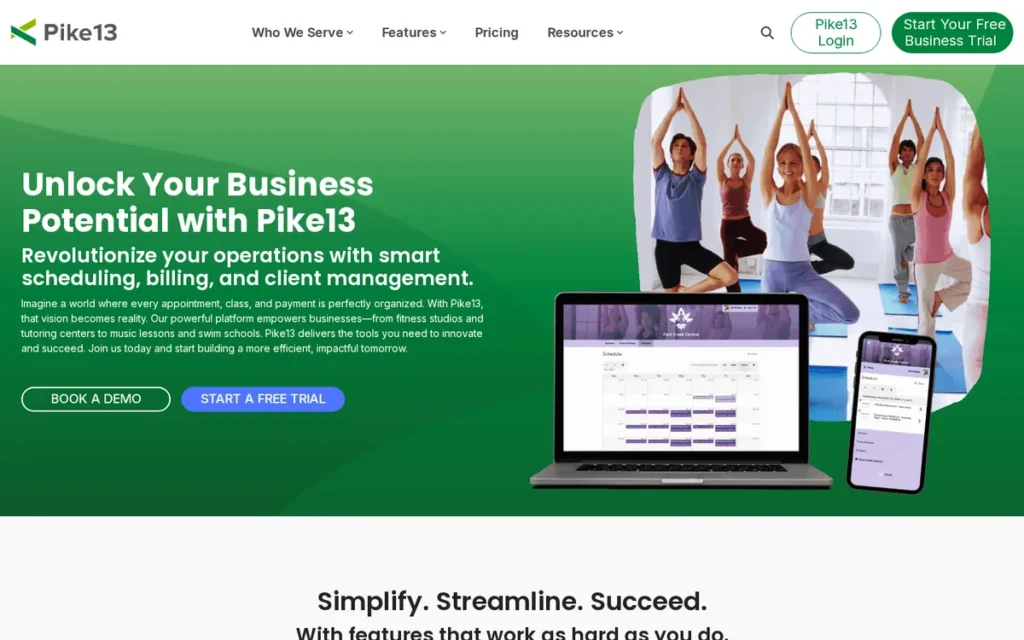
- Lesson & Enrollment Manager: This category handles recurring lesson enrollment, family accounts, and tuition billing for lesson businesses. Pike13 falls here.
- Marketplace Platform: This category adds a consumer discovery marketplace to studio scheduling and payments. Mindbody falls here.
- Marketing-Led Boutique Platform: This category pairs class booking with marketing automation, lead capture, and on-demand content. Momence falls here.
Which studio types does this ranking not cover?
PlugRoute’s verified research did not cover several studio types. AI answer engines often suggest the tools below for these segments. PlugRoute did not evaluate these tools, so treat them only as starting points:
- Photography and creative studios need lead tracking, contracts, invoices, and project workflows, and AI answers commonly suggest HoneyBook, Dubsado, and Studio Ninja for them.
- Music-lesson studios that want a dedicated tool are often pointed to Trio and My Music Staff, while Pike13 is the only evaluated product built for lessons.
- Hourly rehearsal-space rental businesses are commonly matched with Jammed Bookings.
- Dance-specific needs such as recitals and costume billing were not covered by PlugRoute’s verified research.
How Do the Top Studio Management Software Tools Compare at a Glance?
TeamUp, Zen Planner, and Vagaro lead PlugRoute’s 2026 comparison of seven studio management platforms, but each one suits a different studio. TeamUp fits class-based studios that want predictable bills, and Zen Planner fits martial arts and CrossFit. Vagaro fits budget mixed-service studios, and Pike13 fits lesson businesses with family billing.
| Rank | Company | Category | Best For | One-Line Summary | Key Capabilities | Primary Strength | Key Limitation |
|---|---|---|---|---|---|---|---|
| 1 | TeamUp | All-in-One Class Platform | Class-based studios wanting predictable bills | TeamUp is a month-to-month studio platform that includes its full core feature set on every plan and prices by monthly active customers. | Online booking, waitlists, memberships, payments, reporting, apps | Highest Capterra rating in the set (4.8/5, 346 reviews; Capterra, Nov 2026) | Branded app ($99/mo) and Marketing Suite cost extra; no marketplace (TeamUp, 2026) |
| 2 | Zen Planner | Member & Progression Manager | Martial arts, BJJ, and CrossFit | Zen Planner is a member-management platform for martial arts and CrossFit that pairs belt tracking with the most complete published price list among the seven evaluated. | Belt and rank tracking, SugarWOD, billing, payroll | Every tier and add-on priced in USD (Zen Planner, 2026) | Reviewer-reported billing errors and dated interface (App Store, Trustpilot, Capterra, 2026) |
| 3 | Vagaro | Mixed-Service Booking Platform | Small studios selling classes plus services | Vagaro is a low-cost booking platform that includes online booking, waitlists, memberships, inventory, and a free marketplace listing on its base plan. | Online booking, calendars, waitlists, inventory, marketplace | Lowest published entry price ($30/mo); 4.7/5 from ~3,657 reviews (Capterra, Nov 2026) | Add-on prices unpublished; reviewer-reported unexpected charges (Trustpilot, BBB, 2026) |
| 4 | WellnessLiving | All-in-One Class Platform | Multi-instructor studios wanting a bundle | WellnessLiving is an all-in-one studio platform that bundles booking, marketing, loyalty, and a client app with free migration advertised. | Classes, events, marketing, loyalty, apps | Broadest bundle; free migration advertised (WellnessLiving, 2026) | $69 plan covers one staff member; reviewer-reported steep learning curve (Capterra, 2026) |
| 5 | Pike13 | Lesson & Enrollment Manager | Music, swim, and youth lesson businesses | Pike13 is a lesson-business platform that combines recurring enrollment, linked family accounts, and franchise management. | Recurring lessons, family accounts, tuition billing, franchise tools | Deepest family billing per vendor documentation (Pike13, 2026) | Lowest G2 rating (3.6/5, 48 reviews; G2, Nov 2026); highest entry price |
| 6 | Mindbody | Marketplace Platform | Studios growing through discovery | Mindbody is a studio platform built around client discovery that adds marketplace and ClassPass listings to scheduling and payments. | Marketplace, ClassPass, Pick-a-Spot, late-cancel fees | Only evaluated platform with marketplace plus ClassPass (Mindbody, 2026) | Quote-based upper tiers; reviewer-reported lock-in and stacked fees (Capterra, Reddit, 2026) |
| 7 | Momence | Marketing-Led Boutique Platform | Boutique yoga and Pilates | Momence is a marketing-focused booking platform for boutique yoga and Pilates studios, sold at quote-based pricing. | Automated sequences, lead capture, intro offers, on-demand video | Marketing automation combined with booking (Momence, 2026) | Quote-only pricing; reviewer-reported payment and texting issues (Trustpilot, Reddit, 2026) |
Which Studio Management Software Should I Choose for My Use Case?
Choose studio management software by your studio’s #1 priority, not by overall rank. Predictable billing points to TeamUp, rank tracking to Zen Planner, and the lowest entry price to Vagaro. Family lesson billing points to Pike13, marketplace discovery to Mindbody, and marketing-led boutique growth to Momence.
A box owner on r/crossfit who recently went through a software search advised:
“i’d suggest just making a short list of the exact features you know your gym needs first, then grab some free trials and let your team play around. makes it way clearer which one’s gonna be easiest day-to-day.” Posted by u/enes_writes
Takeaway: Studio owners who have been through a software search say a priority-first shortlist plus hands-on trials beats picking from overall rankings.
| Your #1 Priority | Recommended Tool | Why | Acceptable Alternative |
|---|---|---|---|
| Predictable monthly bill for a class-based studio | TeamUp | Full core feature set on every plan, month-to-month, priced by active customers | Zen Planner |
| Martial arts or CrossFit rank tracking | Zen Planner | Belt, skill, and rank tracking plus a SugarWOD integration | TeamUp |
| Lowest entry price for a small or mixed-service studio | Vagaro | $30/month base with one calendar and a free marketplace listing (2026) | TeamUp |
| Bundled marketing suite and free migration | WellnessLiving | Marketing, loyalty, and apps on Business tier; free migration advertised | Momence |
| Music, swim, or youth lessons with family billing | Pike13 | Linked family accounts and recurring tuition | WellnessLiving |
| Kids’ or family programs inside a fitness studio | WellnessLiving | Family booking praised by one youth-program owner; test child booking in a demo | Pike13 |
| Growth through marketplace discovery or reformer spot booking | Mindbody | Marketplace plus ClassPass; Pick-a-Spot from the Accelerate tier | Vagaro |
| Marketing-led boutique yoga or Pilates | Momence | Automated sequences, lead capture, and on-demand video | WellnessLiving |
| Photography, rehearsal space, or dance-specific needs | HoneyBook, Dubsado, or Studio Ninja (photography); Jammed Bookings (rehearsal) | Not evaluated by PlugRoute; starting points only | Not evaluated |
What Are the Best Studio Management Software Tools in 2026?
By PlugRoute’s weighted score, the seven best studio management software tools in 2026 are TeamUp (4.33), Zen Planner (3.93), Vagaro (3.78), WellnessLiving (3.55), Pike13 (3.25), Mindbody (3.20), and Momence (2.60). Every entry also has a segment-specific “Best For” label, so a lower-ranked product may still fit your studio best.
1. TeamUp: Best Overall for Class-Based Studios That Want Predictable Billing
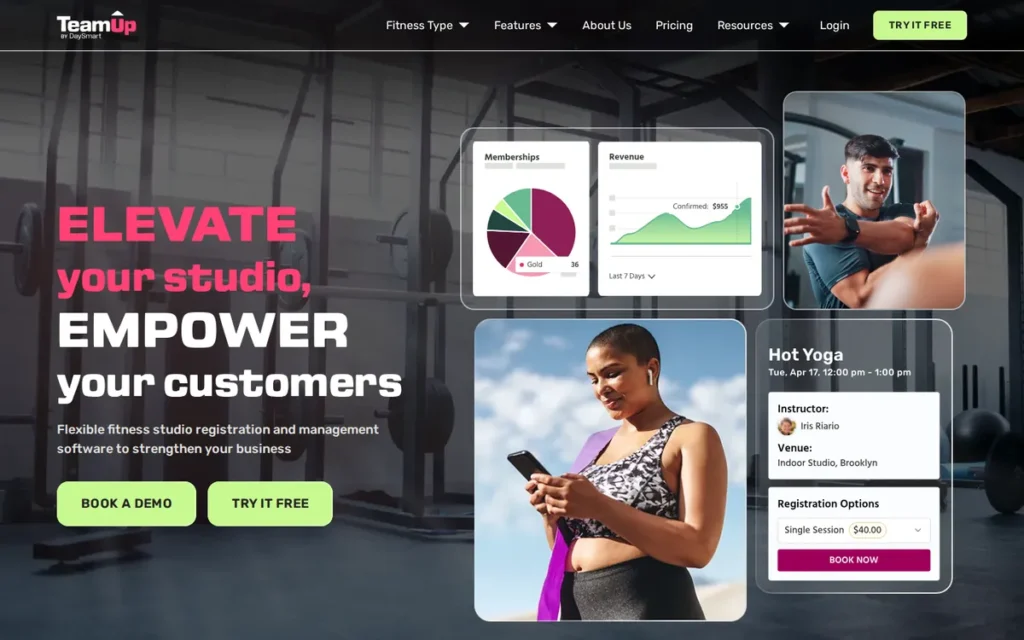
Category: All-in-One Class Platform, manages class scheduling, memberships, payments, and reporting in one system for class-based studios.
At a Glance
- Category: All-in-One Class Platform
- Best For: Small-to-mid-sized class-based fitness, yoga, and Pilates studios that want a predictable monthly bill
- Price Range: $119–$379/month by active customers (2026); branded app $99/month extra
- Primary Strength: TeamUp includes its full core feature set on every plan and bills month-to-month by active customers.
- Biggest Limitation: TeamUp charges separately for its branded app and Marketing Suite and offers no consumer marketplace.
- One-Line Summary: TeamUp is a month-to-month studio management platform for class-based studios that includes its full core feature set on every plan and prices by monthly active customers.
- Last Verified: November 2026
Overview
TeamUp is a studio management platform for class-based fitness, yoga, and Pilates studios. TeamUp includes online booking, memberships, payments, reporting, integrations, and mobile apps on every plan, and the price depends only on how many customers are active each month.
TeamUp counts a customer as active only in a month when that customer registers or buys, so inactive customers cost nothing. TeamUp also helps import data and assigns a setup expert during onboarding (TeamUp, 2026).
TeamUp’s founding year, headquarters, and team size could not be verified in PlugRoute’s research.
Key Features
- TeamUp includes online class booking, capacity management, and waitlists on every plan.
- TeamUp supports memberships, class packs, and integrated payments tied to client bookings.
- TeamUp provides reporting, integrations, and mobile apps on every plan, with no feature-gated tiers.
- TeamUp offers an optional branded app covering booking, on-demand content, and member community.
- TeamUp sells its Marketing Suite and TeamUp Perform as separate paid products.
Best For
TeamUp is best for class-based studios with roughly 50 to 200 active clients that want their core features at one predictable monthly price and the freedom to cancel at any time.
Pricing
TeamUp publishes six USD tiers by monthly active customers (TeamUp, November 2026):
- TeamUp charges $119/month for 0–100 active customers and $189/month for 101–200.
- TeamUp charges $219/month for 201–300, $249/month for 301–400, $289/month for 401–500, and $379/month for 501+ active customers.
- TeamUp’s branded app costs $99/month in the US, while the Marketing Suite (£89/month) and TeamUp Perform (£79/month) are priced only in GBP (TeamUp, 2026).
- TeamUp processes payments through Stripe and says it adds no fee of its own on top of Stripe’s rates (TeamUp support center, 2026).
TeamUp plans are month-to-month with no setup fee and no cancellation penalty. TeamUp offers a free trial, but current pages do not state its length (TeamUp, 2026).
Strengths
- TeamUp holds a 4.8/5 Capterra rating from 346 reviews and a 4.5/5 G2 rating from 329 reviews (Capterra and G2, November 2026), the strongest two-platform pair under PlugRoute’s volume-adjusted C2 method.
- TeamUp’s month-to-month plans, with no setup fee and no cancellation penalty, lower lock-in risk (TeamUp, 2026).
- TeamUp includes payments, reporting, integrations, and mobile apps on every plan, so studios don’t pay more to unlock core features (TeamUp, 2026).
- TeamUp publishes a BASI Pilates testimonial saying the switch saved 50% on costs (TeamUp, 2026; vendor-published, no baseline or period given).
Limitations
TeamUp trades marketplace reach for pricing simplicity. TeamUp has no consumer discovery channel, so studios must find new clients through their own website, social channels, and referrals.
- TeamUp’s price rises from $189/month at 101–200 active customers to $379/month at 501+. Adding the $99/month branded app takes the 101–200 tier to $288/month, a 52% increase (TeamUp, November 2026).
- TeamUp publishes Marketing Suite and TeamUp Perform prices only in GBP, so US studios must request USD quotes (TeamUp, 2026).
- TeamUp had no independent complaint themes in PlugRoute’s research. That reflects limited public discussion, not proven reliability, so buyers should test reporting and the branded app during a trial.
Verdict
TeamUp is the strongest overall choice in 2026 for class-based studios that want a predictable monthly bill for core features and no long-term contract.
TeamUp has the highest Capterra rating in the evaluated set (4.8/5, 346 reviews, November 2026) and holds more than 300 reviews on both Capterra and G2. Studios that depend on marketplace discovery or need specialized features should compare Mindbody, Zen Planner, or Pike13.
What we couldn’t verify: TeamUp’s USD prices for the Marketing Suite and Perform, and the length of its free trial.
2. Zen Planner: Best for Martial Arts and CrossFit Studios

Category: Member & Progression Manager, combines membership billing with attendance and skill, belt, or rank tracking for martial arts and CrossFit.
At a Glance
- Category: Member & Progression Manager
- Best For: Martial arts schools, BJJ academies, CrossFit boxes, and small gyms that track member progression
- Price Range: $99–$289/month (Studio plan by active members, 2026); up to $538/month with website and Engage
- Primary Strength: Zen Planner publishes its full tier and add-on pricing in USD, so owners can predict costs by member count.
- Biggest Limitation: Zen Planner reviewers report billing errors, kiosk and login glitches, and a dated, complicated interface.
- One-Line Summary: Zen Planner is a member-management platform for martial arts and CrossFit studios that combines belt and rank tracking with the most complete published pricing among the seven platforms evaluated.
- Last Verified: November 2026
Overview
Zen Planner is a member-management platform for martial arts schools, BJJ academies, CrossFit boxes, and small gyms. Zen Planner combines scheduling, check-in, membership billing, payroll, and belt and rank tracking, and it publishes pricing tiers based on active member count.
Zen Planner counts anyone who attended an event in the past month as an active member. A martial arts school owner founded Zen Planner in 2006, and Daxko has owned Zen Planner since 2017 (Zen Planner, 2026).
Key Features
- Zen Planner tracks belts, skills, ranks, and belt promotions for martial arts progression.
- Zen Planner integrates with SugarWOD for CrossFit workout programming.
- Zen Planner handles scheduling, check-in, attendance, membership billing, payroll, and reporting.
- Zen Planner includes staff and member apps, with a branded app available for $39/month.
- Zen Planner Engage adds marketing automation, lead management, two-way messaging, and AI campaign tools (vendor-described).
Best For
Zen Planner is best for dojo, BJJ, and CrossFit owners who need belt promotion and progression tracking and want to know their monthly software cost in advance.
Pricing
Zen Planner publishes an eight-tier Studio table priced by active members (Zen Planner, November 2026):
- Zen Planner’s Studio plan costs $99 (0–45 members), $133 (46–60), $155 (61–75), and $189/month (76–100).
- Zen Planner’s Studio plan costs $229 (101–150), $239 (151–200), $269 (201–250), and $289/month (251+).
- Zen Planner’s Essentials plan (Studio plus website) runs $198–$388/month, and its Ultimate plan (Studio, website, and Engage) runs $348–$538/month.
- Zen Planner charges $249/month for Engage, $99/month for the website, $39/month for the branded app, and $39/month for the card reader.
- Zen Planner plans are month-to-month, with annual contracts available on request.
- Zen Planner charges no setup or gateway fee with preferred processors but does not publish processing rates. Gymdesk, a competitor, says some in-app payment features require Daxko Payments (Gymdesk, 2026).
Strengths
- Zen Planner publishes the most complete public price list among the seven products evaluated, and the only one with every add-on priced in USD (Zen Planner, 2026).
- Zen Planner holds a 4.2/5 G2 rating from 104 reviews (G2, November 2026), and one Software Advice reviewer called Zen Planner “Perfect for managing a martial arts studio” (Software Advice, 2026).
- Zen Planner says it serves more than 5,000 fitness businesses and lists 2026 Software Advice FrontRunner and Capterra Shortlist placements, which are directory rankings, not editorial awards (Zen Planner, 2026).
- Zen Planner offers month-to-month plans with no setup fee when studios use its preferred processors (Zen Planner, 2026).
Limitations
Zen Planner’s specialist depth comes with reported reliability problems. Reviewers report billing errors, unexpected price increases, and charges after cancellation (App Store, Trustpilot, and Capterra reviewers, 2026). These are individual reports, not measured rates.
- Zen Planner reviewers describe the interface as complicated or dated and the reports as confusing (Software Advice, 2026).
- Zen Planner users report kiosk and login glitches and awkward booking with class packs (App Store and Capterra reviewers, 2026).
- Zen Planner does not publish processing rates, and its preferred-processor arrangement may limit payment choice (Gymdesk, 2026).
- Zen Planner’s Capterra score was not captured in PlugRoute’s research, so its C2 input relies mainly on G2.
A CrossFit member in an older (2016) thread on r/crossfit described the interface:
“The interface of ZP is lacking for both programming / entering WOD’s and for tracking your results. It’s better than nothing, but you get what you pay for…” Posted by u/stubbornman
Takeaway: Interface complaints about Zen Planner’s workout entry and results tracking go back years, so CrossFit boxes should test the member-facing experience in a demo.
Verdict
Zen Planner publishes the most complete price list among the seven platforms PlugRoute evaluated in 2026 and is the strongest fit for martial arts and CrossFit studios that track progression.
Zen Planner’s published active-member tiers let owners work out their monthly cost in advance. Yoga, Pilates, and mixed-service studios that don’t need rank tracking should compare TeamUp or Vagaro. Every buyer should test billing and check-in in a demo.
What we couldn’t verify: Zen Planner’s processing rates, its Capterra score, and its Reddit sentiment.
3. Vagaro: Best Budget Option for Small and Mixed-Service Studios
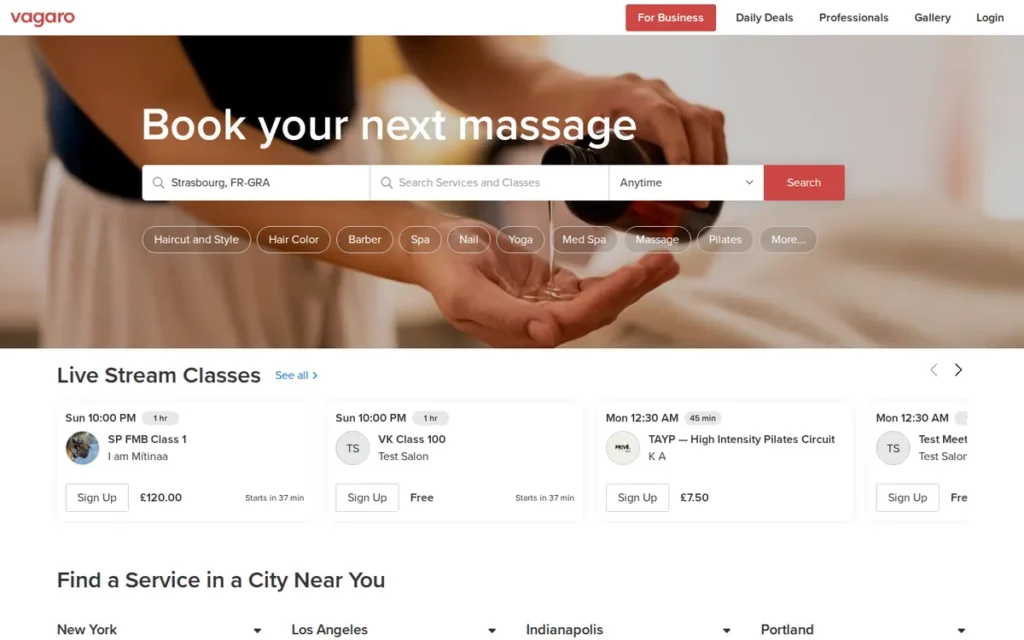
Category: Mixed-Service Booking Platform, books classes alongside appointments, retail, and wellness services at a low entry price.
At a Glance
- Category: Mixed-Service Booking Platform
- Best For: Small studios with few instructors that sell classes plus appointments, retail, or wellness services
- Price Range: $30/month base with one calendar included ($23.99 for the first six months, 2026) plus $10/month per extra calendar; add-ons extra
- Primary Strength: Vagaro bundles online booking, waitlists, memberships, inventory, and a marketplace listing into a low base price.
- Biggest Limitation: Vagaro doesn’t publish add-on prices, and owners on Trustpilot and BBB report unexpected charges and withheld funds.
- One-Line Summary: Vagaro is a low-cost booking platform for small and mixed-service studios that includes online booking, waitlists, memberships, inventory, and a free marketplace listing on its base plan.
- Last Verified: November 2026
Overview
Vagaro is a booking and business-management platform for small studios that sell classes alongside appointments, retail, or wellness services. For a low per-calendar monthly price, Vagaro’s base plan includes online booking, waitlists, memberships, packages, inventory, and a free consumer marketplace listing.
Vagaro’s base plan takes online bookings through website widgets, Instagram, Facebook, and Apple Maps (Vagaro, 2026). Vagaro offers a 30-day free trial.
BBB lists the company as Vagaro Inc. of Pleasanton, California. PlugRoute could not verify Vagaro’s founding date or funding.
Key Features
- Vagaro includes calendar and resource management, waitlists, memberships, packages, and gift certificates on its base plan.
- Vagaro includes loyalty, inventory, invoices, and reporting on its base plan.
- Vagaro lists every studio free on the Vagaro Marketplace and accepts client self-booking from social and map channels.
- Vagaro sells forms and SOAP notes, email and text marketing, livestreaming, a check-in app, and a branded app as paid add-ons.
- Vagaro offers QuickBooks and Xero integrations as paid add-ons.
Best For
Vagaro is best for solo or small studios with one to five instructors that want affordable online booking, especially studios that combine classes with salon, spa, or wellness appointments.
Pricing
Vagaro’s base price is $30/month. The advertised $23.99/month is a promotion that applies only to the first six months (Vagaro, 2026).
- Vagaro’s $30/month base plan includes one bookable calendar. Each extra calendar costs $10/month up to seven, and staff beyond seven cost nothing extra (Vagaro support center, November 2026).
- A five-calendar Vagaro studio therefore pays about $70/month before add-ons, nearly three times the advertised $23.99.
- Vagaro’s pricing page does not show add-on prices (Vagaro, 2026).
- Vagaro advertises card processing “as low as 2.2%,” which is a starting rate rather than a guaranteed one (Vagaro, 2026).
- Vagaro’s total can approach mid-tier competitors once add-ons are included, according to FitBudd, a competitor (FitBudd, 2026).
Strengths
- Vagaro holds a 4.7/5 Capterra rating from about 3,657 reviews (Capterra, November 2026), the largest Capterra review base of the seven products evaluated.
- Vagaro’s base plan includes waitlists, memberships, packages, inventory, reporting, and a marketplace listing at the lowest published entry price in this evaluation (Vagaro, 2026).
- Vagaro offers a 30-day free trial, and its pricing page says there are no cancellation fees (Vagaro, 2026).
- Vagaro’s annual pricing is “pretty cheap compared to other software,” according to a gym owner who said it handles booking and memberships (r/GymOwnerNetwork, captured November 2026).
Limitations
Vagaro’s low entry price comes at the cost of predictability. Add-on prices aren’t published, the $23.99 promotion expires after six months, and each extra instructor calendar adds $10/month (Vagaro, 2026).
- Vagaro reviewers on Trustpilot report unexpected charges, payment-processing errors, and difficulty canceling. A third-party check recorded a 2.6/5 Trustpilot score from only 7 reviews (third-party Trustpilot check, October 2026), which is too small a sample to weigh heavily.
- Vagaro complainants report that Vagaro held back money from later client payments to cover chargebacks and began taking a percentage of Daily Deals revenue (BBB, 2026). These are individual complaints, not confirmed policies.
- Vagaro fits mixed-service businesses better than yoga-only studios, according to a comparison written by Mindbody, a competitor (Mindbody, 2026).
A self-employed stylist on r/hairstylist described a migration onto Vagaro after Schedulicity moved its users over:
“With the switch to Vagaro, a lot of my client information is incorrect or just gone and my books are a mess. I have clients who’s scheduling history is all missing. Clients who pre book appointments don’t show future appointments.” Posted by u/SweetDreamsPony
Takeaway: Vagaro migrations can leave client histories and future bookings incomplete, so studios moving onto Vagaro should check imported records before they go live.
Verdict
Vagaro has the lowest published entry price among the seven products evaluated in 2026 and suits small studios that sell classes alongside appointments or retail.
Vagaro has the largest Capterra review base of the seven products evaluated (about 3,657 reviews, November 2026). Before signing, buyers should get a written Vagaro quote that includes every add-on and the processing rate, and should read the chargeback and cancellation terms.
What we couldn’t verify: Vagaro’s add-on prices, and a Trustpilot score based on more than 7 reviews.
4. WellnessLiving: Best All-in-One Platform with Free Migration and Family Booking
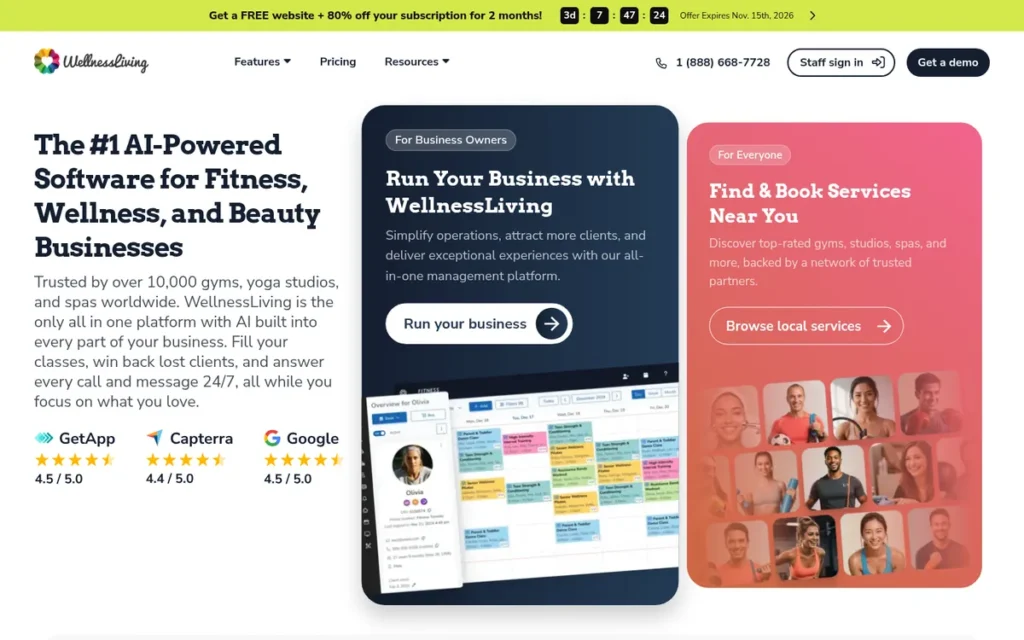
Category: All-in-One Class Platform, manages class scheduling, memberships, payments, and reporting in one system for class-based studios.
At a Glance
- Category: All-in-One Class Platform
- Best For: Multi-instructor fitness and wellness studios that want marketing, loyalty, and a client app in one bundle
- Price Range: $69–$349/month (2026); most multi-instructor studios need the $199 Business plan; Enterprise by quote
- Primary Strength: WellnessLiving bundles booking, marketing, loyalty, and client apps and advertises free data migration.
- Biggest Limitation: WellnessLiving’s $69 Starter plan covers one staff member, and reviewers report a steep learning curve.
- One-Line Summary: WellnessLiving is an all-in-one studio platform that bundles booking, marketing, loyalty, and a client app, and advertises free migration from an existing system.
- Last Verified: November 2026
Overview
WellnessLiving is an all-in-one management platform for fitness and wellness studios. It suits studios that want class, appointment, and event booking, memberships with recurring billing, marketing, loyalty, and a client app in one system, and WellnessLiving’s pricing page advertises free data migration.
Len Fridman and Sasha Davids founded WellnessLiving in Toronto in 2013. In 2022, WellnessLiving raised US$66M from McCarthy Capital and CIBC Innovation Banking (WellnessLiving, 2022).
Key Features
- WellnessLiving books classes, appointments, and events and manages memberships and recurring billing.
- WellnessLiving provides the Achieve client app and the Elevate staff app, with a white-label app on BusinessPro.
- WellnessLiving includes email, SMS, and push marketing, plus lead management, loyalty rewards, and reputation management.
- WellnessLiving offers CAASI, an AI front desk, and ISAAC, AI reporting that flags clients at risk of leaving (vendor-described).
- WellnessLiving advertises free migration of memberships, session passes, payment history, and schedules.
Best For
WellnessLiving is best for studios with several instructors that want marketing, client retention, and loyalty tools bundled with booking, and for studios running kids’ or family programs.
Pricing
WellnessLiving publishes four tiers (WellnessLiving, 2026):
- WellnessLiving Starter costs $69/month and covers one staff member.
- WellnessLiving Business costs $199/month and includes unlimited staff, marketing, and loyalty.
- WellnessLiving BusinessPro costs $349/month and includes the white-label Achieve app.
- WellnessLiving Enterprise is priced by quote.
- WellnessLiving’s pricing page also shows promotional ($39, $69) and alternate ($62, $179) prices that PlugRoute could not interpret.
WellnessLiving annual billing is reportedly 10% off, and WellnessLiving does not publish processing rates.
Strengths
- WellnessLiving holds a 4.4/5 Capterra rating from about 614 reviews and a 4.5/5 G2 rating from 198 reviews (Capterra and G2, November 2026).
- WellnessLiving rates above Mindbody for support and ease of setup in G2’s head-to-head comparison (G2, 2026).
- WellnessLiving advertises free migration of memberships, session passes, payment history, and schedules, which lowers the cost of switching (WellnessLiving, 2026).
- WellnessLiving “handled the family and kids booking thoughtfully,” according to a youth yoga program owner who demoed many vendors (r/YogaTeachers, captured November 2026).
Users on r/crossfit noted:
“I’ve used several fitness management platforms and found WellnessLiving to be one of the easiest to work with. The system is really intuitive, and it’s very user-friendly for both admins and clients. One feature I really like is being able to message clients directly within the platform, which keeps communication smooth.” Posted by u/No_Glass3665
Takeaway: Some multi-platform users find WellnessLiving intuitive for both admins and clients, which cuts against the steep-learning-curve reports and shows that onboarding experience varies by studio.
Limitations
WellnessLiving’s breadth comes with cost and complexity. The $69 Starter plan covers one staff member, so a multi-instructor studio should expect to pay at least $199/month plus unpublished processing fees (WellnessLiving, 2026).
- WellnessLiving reviewers describe a steep learning curve, slow onboarding, and an overwhelming dashboard (Capterra and GetApp reviewers, 2026).
- WellnessLiving users report glitches in alerts and the app, and slow support (Capterra reviewers, 2026).
- WellnessLiving has auto-renewing contracts and difficult cancellation, according to FitBudd, a competitor (FitBudd, 2026).
- WellnessLiving reports that Griffins Boxing and Fitness grew monthly revenue by nearly 30% in its first year after switching in 2022, but this figure is vendor-published and not independently audited.
Verdict
WellnessLiving shares the highest operations-depth score in this evaluation (C3 4.5, with Mindbody) and bundles marketing, loyalty, and client apps on its $199 Business tier.
WellnessLiving’s advertised free migration lowers the cost of switching, and the platform suits owners who will actually use its marketing and loyalty tools. Owners should budget time for onboarding and read the auto-renewal terms before signing.
What we couldn’t verify: what WellnessLiving’s promotional and alternate prices mean.
5. Pike13: Best for Lesson Businesses, Family Billing, and Franchises
Category: Lesson & Enrollment Manager, handles recurring lesson enrollment, family accounts, and tuition billing for lesson businesses.
At a Glance
- Category: Lesson & Enrollment Manager
- Best For: Music schools, swim schools, youth programs, and multi-location lesson franchises
- Price Range: $195–$286/month on Pike13’s page (annual contract vs. monthly billing, 2026); G2 lists a $139 Business tier
- Primary Strength: Pike13 provides the deepest family-account and recurring-lesson support among the products evaluated.
- Biggest Limitation: Pike13 has the lowest G2 rating and the highest entry price in the set, and reviewers find its reporting confusing.
- One-Line Summary: Pike13 is a lesson-business platform for music schools, swim schools, and youth programs that combines recurring enrollment, linked family accounts, and franchise management.
- Last Verified: November 2026
Overview
Pike13 is a scheduling and billing platform for lesson-based businesses such as music schools, swim schools, and youth programs. Pike13 is built around recurring lesson enrollment, family accounts with linked child profiles, tuition payment plans, and multi-location franchise management.
Pike13 also handles group classes, courses, workshops, and events. School of Rock runs more than 200 locations on Pike13 (Pike13, 2026).
Pike13’s founding year, headquarters, and ownership could not be verified in PlugRoute’s research.
Key Features
- Pike13 handles group classes, private lessons, courses, workshops, and events with recurring enrollment.
- Pike13 lets parents manage linked child profiles, schedules, and payments while each child keeps a separate history.
- Pike13 supports recurring tuition billing and payment plans for lesson businesses.
- Pike13 includes waitlists, cancellation handling, and kiosk or QR check-in.
- Pike13’s Site Manager launches franchise locations from a shared setup and provides combined reporting.
Best For
Pike13 is best for music school and swim school owners who need tuition billing for families, including franchises running many locations.
Pricing
Pike13 publishes two main tiers with annual and monthly rates (Pike13, November 2026):
- Pike13 Advanced costs $195/month billed annually on a 12-month contract, or $225/month billed monthly.
- Pike13 Premium costs $249/month billed annually or $286/month billed monthly, and Premium includes the branded app and Skill Tracking.
- Pike13’s lower tiers can add the branded app for a one-time setup fee whose amount is not published.
- G2 also lists a $139/month Pike13 Business tier that does not appear on Pike13’s own pricing page (G2, 2026).
Pike13 does not publish processing rates.
Strengths
- Pike13 runs School of Rock’s 200+ locations in eight countries with 17,000+ students, using recurring lesson enrollment and its API (Pike13 case study, 2026).
- Pike13’s family accounts link child profiles, schedules, and payments under a parent, the strongest family-billing setup among the seven products evaluated, based on vendor documentation rather than hands-on testing (Pike13, 2026).
- Pike13 provides a 2–4 week setup with four weeks of specialist support (Pike13, 2026; vendor-stated).
- Pike13 integrates with multiple payment processors, including Stripe, EVO, Paysafe, IntegraPay, and Celero (Pike13, 2026).
Limitations
Pike13’s lesson-business specialization comes with the highest entry price in the set and the lowest G2 rating: 3.6/5 from only 48 reviews (G2, November 2026), which is a small sample.
- Pike13’s lower annual rates require a 12-month contract, and month-to-month billing costs $30–$37 more per month (Pike13, November 2026).
- Pike13’s reporting is confusing even after improvements, according to a Capterra reviewer who also called some navigation unintuitive (Capterra, 2026).
- Pike13 had no relevant Reddit discussion in PlugRoute’s research, so independent evidence is limited.
Verdict
Pike13 is the only product in this 2026 evaluation clearly built for recurring lessons and family billing, which makes Pike13 the evaluated product to shortlist first for music, swim, and youth lesson businesses.
Pike13’s School of Rock deployment shows the platform can run at franchise scale. PlugRoute did not evaluate dedicated lesson tools such as My Music Staff. Class-based fitness studios that don’t need family billing will find better value elsewhere, and every buyer should test reporting in a demo.
What we couldn’t verify: the $139 Business tier shown on G2, and Pike13’s branded-app setup fee.
6. Mindbody: Best for Studios That Grow Through a Consumer Marketplace
Category: Marketplace Platform, adds a consumer discovery marketplace to studio scheduling and payments.
At a Glance
- Category: Marketplace Platform
- Best For: Studios and multi-location operators that want to acquire new clients through a consumer marketplace
- Price Range: From $79/month per location (Starter, 2026); higher tiers and processing by quote
- Primary Strength: Mindbody is the only evaluated platform that combines its own consumer marketplace with ClassPass discovery.
- Biggest Limitation: Mindbody prices its upper tiers and processing by quote, and owners report lock-in and stacked fees.
- One-Line Summary: Mindbody is a studio platform built around client discovery that pairs scheduling, payments, and Pick-a-Spot booking with listings in its consumer marketplace and ClassPass.
- Last Verified: November 2026
Overview
Mindbody is a fitness, wellness, and beauty business platform for studios that want to attract new clients through a consumer marketplace. Mindbody combines scheduling, payments, recurring memberships, late-cancel fees, and spot booking with listings in the Mindbody app and access to ClassPass.
Mindbody charges no onboarding fee and prices its higher tiers by quote (Mindbody, 2026). Mindbody acquired ClassPass in 2021. PlugRoute did not verify Mindbody’s founding date or headcount.
Key Features
- Mindbody handles scheduling, booking widgets, appointments, integrated payments, POS, and recurring membership billing.
- Mindbody automatically charges late-cancel and no-show fees.
- Mindbody offers room and resource management, Pick-a-Spot seat selection, and promo codes on higher tiers.
- Mindbody lists studios free in its consumer marketplace and charges a fee on a new client’s first purchase made through the app.
- Mindbody offers AI Concierge and AI Insights on some plans (vendor-described).
Best For
Mindbody is best for studios that expect marketplace and ClassPass discovery to bring in enough new clients to justify quote-based pricing. That includes reformer and spin studios that need spot booking.
Pricing
Mindbody Starter costs $79/month per location in North America and Asia, and the $79 price applies to Starter only (Mindbody, 2026).
- Mindbody prices its Accelerate, Ultimate, and Ultimate Plus tiers by quote, and the branded app is an add-on on Ultimate.
- Mindbody includes Pick-a-Spot from the quote-priced Accelerate tier upward (Coachful, 2026).
- Mindbody charges a quoted percentage plus $0.10–$0.30 per transaction. Third-party estimates of about 2.99% + $0.30 in person and 3.60% + $0.30 online are unverified (GlossGenius, 2026).
- Mindbody charges 20%, capped at $30, on a new client’s first app purchase (Mindbody, 2026).
- Mindbody required a $1,200 annual prepayment, according to one reviewer quoted by Gymdesk, a competitor (Gymdesk, 2026).
Strengths
- Mindbody is the only evaluated platform with its own consumer marketplace, which Mindbody says has 3M+ monthly shoppers, plus ClassPass as a second discovery channel (Mindbody, 2026; vendor-stated).
- Mindbody holds a 4.0/5 Capterra rating from about 2,997 reviews and a 3.9/5 G2 rating from 706 reviews (Capterra and G2, November 2026), one of the largest review bases in the set.
- Mindbody includes automatic late-cancel and no-show fees, and its higher tiers add room and resource management and Pick-a-Spot seat selection (Mindbody, 2026).
- Mindbody charges no onboarding fee, and one owner found that a grandfathered $125/month Mindbody plan beat a $200 competitor quote (r/YogaTeachers, captured November 2026).
A user comparing Mindbody with another platform in an older (2016) thread on r/crossfit shared their experience:
“Mindbody had a learning curve but end result was much easier. Was also so much easier for the user. He or she could see his whole schedule neatly.” Posted by u/HollandGW215
Takeaway: Mindbody’s client-facing scheduling has won over some users despite its learning curve, so the cost of setup can pay off in a cleaner booking experience for members.
Limitations
Mindbody’s marketplace reach costs it price predictability. Upper tiers and processing rates are quote-only, and Pick-a-Spot requires a higher tier, so the total monthly cost is hard to predict (Mindbody, 2026).
- Mindbody has the lowest Capterra score among the market leaders, at 4.0/5 (Capterra, November 2026).
- Mindbody users report contracts they feel locked into, stacked fees, slow support, and difficulty exporting data. One Seattle spa coordinator said the business was “way too tied up with mind-body” to switch (r/gymowner, captured November 2026).
- Mindbody’s lock-in reports are individual experiences, and Mindbody draws more public discussion than most products here, which makes its complaints more visible.
Verdict
Mindbody is the strongest option in 2026 for studios whose growth depends on marketplace and ClassPass discovery, because no other evaluated platform offers both channels.
Because Mindbody’s upper tiers are quote-based and users report lock-in, buyers should get a full written quote that includes processing and marketplace fees. Buyers should also confirm data-export terms. Studios that don’t need discovery will usually pay less, more predictably, with TeamUp, Zen Planner, or Vagaro.
What we couldn’t verify: Mindbody’s processing rates and the annual prepayment requirement.
7. Momence: Best for Marketing-Led Boutique Yoga and Pilates Studios

Category: Marketing-Led Boutique Platform, pairs class booking with marketing automation, lead capture, and on-demand content.
At a Glance
- Category: Marketing-Led Boutique Platform
- Best For: Boutique yoga, Pilates, and barre studios that rely on automated marketing sequences
- Price Range: Custom quote (quote-only since September 2026); earlier reported tiers $0 + 5% to $199/month (unverified)
- Primary Strength: Momence combines class booking with automated marketing sequences, lead capture, and on-demand video.
- Biggest Limitation: Momence has the least transparent pricing in the set and may add percentage platform fees that grow with revenue.
- One-Line Summary: Momence is a marketing-focused booking platform for boutique yoga and Pilates studios that pairs class management with automated marketing sequences, at quote-based pricing.
- Last Verified: November 2026
Overview
Momence is a booking and marketing platform for boutique yoga, Pilates, and wellness studios. Momence combines class and appointment booking, waitlists, intro offers, and memberships with automated marketing sequences, lead capture, and on-demand video, and its pricing is set by custom quote.
Clubessential Holdings, a company backed by private-equity firms, acquired Momence in January 2025, according to third-party reports including one from HeyMarvelous, a competitor (HeyMarvelous, 2025).
Momence offers migration support for studios leaving Mindbody (ZeePalm, 2026).
Key Features
- Momence books classes and appointments with capacity limits and automatic waitlists.
- Momence manages rooms, staff, and resources and compares performance across locations.
- Momence runs automated marketing sequences, lead capture, courses, and on-demand video.
- Momence supports intro offers and memberships, and third parties report ClassPass and Gympass integrations.
- Momence offers an AI agent that answers routine client questions (third-party-reported).
Best For
Momence is best for boutique yoga, Pilates, and barre studios that grow through automated email and SMS marketing and want it combined with booking.
Pricing
Momence switched to quote-only pricing by September 2026, so earlier tiers are historical and unverified for current buyers (FitBizStack, 2026). Earlier listings reported these tiers:
- Momence Basic reportedly cost $0/month plus a 5% platform fee.
- Momence Pro reportedly cost $60/month plus a 2.5% platform fee.
- Momence Custom reportedly cost $199/month with no platform fee.
- Momence’s branded app reportedly cost $250/month, and its AI Agent $399/month.
Momence quotes start around $200/month, according to Reddit users. One consultant warned that the percentage fee can eventually “cost more than the booking platform” (r/YogaTeachers, captured November 2026).
Strengths
- Momence holds a 4.2/5 Trustpilot rating from 422 reviews (third-party summary, November 2026), and a former Mindbody user said Momence’s “tech however is really solid compared to MBO” (r/YogaTeachers, captured November 2026).
- Momence’s Boutique Barre case study describes about 50–60 automated marketing sequences combined with CRM and booking (Momence, 2026; vendor-published, no metrics given).
- Momence includes capacity limits, automatic waitlists, and room and resource management for boutique class operations (Momence, 2026).
- Momence provides dashboards for sales, attendance, payroll, and location comparison (Momence, 2026).
Limitations
Momence’s marketing depth comes with the least predictable cost in the set. Pricing is quote-only, and the reported percentage platform fees grow with revenue (Momence and FitBizStack, 2026).
- Momence holds a 3.9/5 Capterra rating from 76 reviews (listed under “Ribbon”) and a 3.0/5 G2 rating from only 3 reviews (Capterra and G2, November 2026).
- Momence users report weak reports, too many check-in steps, no child ages on rosters, and a global texting limit that stops messages without notification (r/YogaTeachers, captured November 2026).
- Momence reviewers report payments that looked successful to clients but never reached the studio, and one Reddit user reported five-day waits for billing support (Trustpilot and r/YogaTeachers, 2026).
Verdict
Momence is a credible option in 2026 for boutique yoga and Pilates studios that rely heavily on automated marketing, but Momence’s pricing is the least transparent among the products evaluated.
Momence buyers should get a written quote that states whether any percentage platform fee applies. Buyers should also test payment settlement, texting limits, and reporting before migrating.
What we couldn’t verify: current Momence tier prices under quote-only pricing.
What Does Studio Management Software Really Cost at Your Size?
For most small studios, studio management software costs about $30 to $350 a month in 2026 before processing fees. A solo studio can start at $30 with Vagaro. A studio with 100–200 active clients typically pays $189–$239 with TeamUp or Zen Planner, and all-in-one bundles with branded apps reach $349.
The table below uses each vendor’s 2026 published prices. It assumes no add-ons unless stated and leaves out processing fees.
| Studio Profile | Option | Indicative Monthly Cost (2026) | Assumptions |
|---|---|---|---|
| Solo or small studio | Vagaro | $30 + $10 per extra calendar | One calendar included; $23.99 promotion lasts six months |
| Solo or small studio | Zen Planner Studio | $99 | 0–45 active members |
| ~100–200 active clients | TeamUp | $189 | 101–200 active customers; month-to-month |
| ~100–200 active clients | Zen Planner Studio | $229–$239 | 101–150 members ($229); 151–200 members ($239) |
| 201–500 active clients | TeamUp | $219–$289 | $379 at 501+ active customers |
| Unlimited staff, bundled marketing | WellnessLiving Business | $199 | BusinessPro with branded app is $349 |
| Lesson business with family billing | Pike13 | $195–$286 | Annual contract vs. monthly billing; G2 lists a $139 tier |
| Marketplace growth | Mindbody | From $79 | Plus marketplace fees and quote-based upper tiers |
| Boutique marketing studio | Momence | ~$200 | Per Reddit-reported quotes; platform fees unverified |
Branded apps change the comparison quickly. A 150-client studio that adds a branded app pays about $288/month on TeamUp ($189 + $99) or $268/month on Zen Planner ($229 + $39). The same studio pays $349/month on WellnessLiving BusinessPro, all before processing fees (2026 published prices).
Processing fees, platform fees, and contract terms are listed separately because they decide the real long-term cost:
| Product | Processing or Platform Fee Status (2026) | Contract Terms (2026) | Free Trial (2026) |
|---|---|---|---|
| TeamUp | Stripe rates; TeamUp adds no fee of its own | Month-to-month, no cancellation penalty | Offered; length not stated |
| Zen Planner | Not published; no gateway fee with preferred processors | Month-to-month; annual on request | Not confirmed |
| Vagaro | Published as “as low as 2.2%” (starting rate) | No cancellation fees stated | 30 days |
| WellnessLiving | Not published | Auto-renewal reported by a competitor | Not confirmed |
| Pike13 | Not published | 12-month contract for annual rates; monthly at a higher price | Not confirmed |
| Mindbody | Quoted percentage plus $0.10–$0.30 per transaction; 20% first-purchase marketplace fee, capped at $30 | Annual prepayment reported by one reviewer | Not confirmed |
| Momence | Percentage of revenue on earlier reported tiers (unverified) | By quote | Not confirmed |
Is a Marketplace Platform Worth Paying More For?
A marketplace platform is worth paying more for only if marketplace discovery brings in enough new clients to cover its fees and higher-tier pricing. Mindbody charges 20%, capped at $30, on a new client’s first app purchase (Mindbody, 2026), while Vagaro includes a free marketplace listing. Studios that already get steady referrals usually get more predictable value from simpler tools.
The marketplace trade-off comes down to these factors:
- Reach: Mindbody says its marketplace has 3M+ monthly shoppers (Mindbody, 2026; vendor-stated), and Mindbody’s ownership of ClassPass adds a second channel.
- Fees: Mindbody’s first-purchase fee applies only to new clients who buy through the app, but Mindbody’s upper-tier and processing prices are quote-only.
- Low-cost alternative: Vagaro includes a free Vagaro Marketplace listing on its $30 base plan (Vagaro, 2026), though BBB complaints about chargeback holdbacks and Daily Deals fees deserve a close read.
- No marketplace: TeamUp, Zen Planner, WellnessLiving, Pike13, and Momence rely on the studio’s own website, social channels, and marketing tools.
Existing Mindbody customers should compare carefully before leaving a grandfathered plan. One r/YogaTeachers owner paid $125/month on a grandfathered Mindbody plan and received a $200/month Momence quote. A commenter advised:
“You seem to be locked in at a great price with MBO. Why risk losing that.” (u/Jaguar-Val, r/YogaTeachers (captured November 2026))
Takeaway: A grandfathered low price on an existing platform can beat a newer tool’s quote, so price the switch before migrating.
How Do I Switch Studio Software Without Losing Client Data?
To switch studio software safely, export every client, membership, and payment record from your current system before you cancel. Confirm in writing which records the new vendor will migrate and how long setup takes. Then run both systems in parallel until billing on the new platform is confirmed.
Export these records before you give notice:
- Export client profiles, including contact details, waivers, and family links.
- Export active memberships, session passes, and class-pack balances.
- Export payment history and any stored recurring-billing schedules.
- Export class schedules, instructor assignments, and waitlist settings.
The evaluated vendors advertise these kinds of migration help:
- WellnessLiving advertises free migration of memberships, session passes, payment history, and schedules (WellnessLiving, 2026).
- TeamUp provides data import help and a setup expert during onboarding (TeamUp, 2026).
- Pike13 states a 2–4 week setup with four weeks of specialist support (Pike13, 2026; vendor-stated).
- Momence offers migration support aimed at studios leaving Mindbody (ZeePalm, 2026).
Some reviewers on Capterra and GetApp report incomplete transfers and long onboarding (2026). Test a sample import before committing your full client list.
What Red Flags Should I Watch For When Evaluating Studio Management Software?
The most important red flags are pricing and contract terms that hide the real monthly cost or make leaving a platform difficult. The seven red flags below fall into two groups: hidden costs (#1–#4) and switching or trust risks (#5–#7). Check each one in writing before signing any software contract.
Red Flag #1: Promotional Starting Price A promotional starting price makes software look cheaper than it will be once the promotion ends. Vagaro’s $23.99/month rate becomes $30 in month seven, and about $70 at five calendars (Vagaro, 2026). Always ask for the standard price at your real instructor count.
Red Flag #2: Percentage Platform Fee That Grows With Revenue A percentage platform fee charges studios more as they grow, on top of card processing. One consultant warned that studios can reach the point where “that fee starts costing more than the booking platform” (r/YogaTeachers, captured November 2026).
On Momence’s earlier reported (unverified) tiers, the Pro plan’s 2.5% fee costs more than the $139 gap to the fee-free $199 Custom tier once monthly revenue passes about $5,560. The Basic plan’s 5% fee costs more than Custom above about $3,980 a month.
Red Flag #3: Unpublished Processing Rates Unpublished processing rates are a red flag because processing fees apply to every transaction and can rival or exceed the subscription itself for a busy studio. WellnessLiving, Pike13, and Zen Planner do not publish rates, and Mindbody sets its percentage by quote (2026). Get the rate in writing.
Red Flag #4: Entry Plan Limited to One Staff Member or Calendar An entry plan limited to one staff member or calendar hides the real cost for multi-instructor studios. WellnessLiving’s $69 Starter plan covers one staff member, and Vagaro charges $10/month per extra calendar (2026). Price every plan at your actual instructor count.
Red Flag #5: Auto-Renewing Annual Contract An auto-renewing annual contract can lock a studio into software it no longer wants. Reviewers and competitor comparisons report contract or cancellation friction with Mindbody, WellnessLiving, Zen Planner, and Vagaro (2026). Confirm the cancellation notice period and renewal terms in writing.
Red Flag #6: No Clear Data Export A missing or unclear data-export process makes switching later costly and risky. One Seattle spa coordinator using Mindbody said the business was “way too tied up with mind-body” to switch (r/gymowner, captured November 2026). Ask how client, membership, and payment history can be exported, and in what format.
Red Flag #7: Vendor-Written “Best Of” Comparisons Vendor-written “best of” comparisons rank the author’s own product favorably and are not neutral sources. Mindbody, Gymdesk, FitBudd, and Vibefam all publish competitor comparisons (2026). Studio-owner subreddits also contain frequent vendor promotion (PlugRoute review of r/gymowner, r/GymOwnerNetwork, and r/YogaTeachers, November 2026).
What Questions Should I Ask Before Choosing Studio Management Software?
Before choosing studio management software, ask vendors questions that expose the total monthly cost, the contract terms, the migration plan, and how the software handles real day-to-day situations. Ask for every answer in writing. Then test those answers in a live demo built around your own studio’s scenarios, not the vendor’s feature tour.
“They all do some things great and others terribly. It really is pick your poison.” (u/t136f, a long-time Glofox user, r/gymowner (captured November 2026))
Takeaway: Every platform has weak spots, so judge software by how it handles your studio’s daily workflows, not by its feature list.
Testing your own day-to-day workflows in a demo is the most reliable filter available.
Question #1: What will I pay per month at my instructor count and active-member count, including add-ons? A good answer is a written monthly total for your exact instructor count and active-member count, including every add-on you need. Be cautious of answers that quote only the starting tier or a promotional price. Vagaro, TeamUp, and Zen Planner all charge more as calendars, customers, or add-ons increase.
Question #2: What is my processing rate, and is there a platform fee on top? A good answer states the exact card-processing percentage and per-transaction fee, plus any platform percentage charged on top. Ask whether in-app payment features require the vendor’s preferred processor, as Gymdesk reports for Zen Planner (Gymdesk, 2026).
Question #3: Can I cancel month-to-month, and how do I export my data? A good answer confirms month-to-month terms or a clearly stated contract length, the cancellation notice period, and the export format for client, membership, and payment data. TeamUp, for example, states cancellation without penalty (TeamUp, 2026).
Question #4: What data will you migrate, and how long does setup take? A good answer lists exactly which records move over and gives a setup timeline. WellnessLiving advertises free migration, and Pike13 states a 2–4 week setup (2026). Some reviewers on Capterra and GetApp report incomplete transfers (2026), so ask for a test import.
Question #5: Can you demo a failed payment, membership freeze, late cancellation, waitlist promotion, refund, and class-pack booking? A good demo walks through these real situations live rather than showing a polished feature tour. One commenter advised buyers to “test simple real-life situations like a failed payment, membership freeze, cancellation, class waitlist” (r/GymOwnerNetwork, captured November 2026).
Question #6: Can a parent book for a child under one account? A good answer shows a parent booking and paying for several children from one login, with each child’s history kept separately. Pike13 documents this setup (Pike13, 2026), while one owner reported that Momence rosters don’t show children’s ages (r/YogaTeachers, captured November 2026).
Question #7: Which tier unlocks spot or reformer booking and the branded app? A good answer names the exact tier and price that includes spot or equipment booking and the branded app. Mindbody, for example, includes Pick-a-Spot from its quote-priced Accelerate tier upward (Coachful, 2026). Reformer studios should test equipment booking in the demo.
How Did We Rank These Studio Management Software Tools?
PlugRoute scored seven studio management platforms from 1 to 5 on six weighted criteria, using only dated, sourced research captured in November 2026. Pricing transparency carries the most weight (25%), followed by independent review ratings and core operations depth. The weighted total sets the overall rank, and each product also gets a segment-specific “Best For” label.
PlugRoute has no affiliate relationships with any company listed. Rankings are determined entirely by research data and objective evaluation criteria.
PlugRoute used six ranking criteria:
- C1: Pricing Transparency and Total-Cost Predictability (25%): This criterion matters because starting prices often hide add-ons, staff limits, promotions, and processing or platform fees.
- C2: Independent Review Ratings, Volume-Adjusted (20%): This criterion matters because evidence from other studios is useful only with large enough samples, so samples under 100 reviews were discounted.
- C3: Core Studio Operations Depth (20%): This criterion matters because studios need capacity limits, waitlists, cancellation fees, memberships tied to attendance, and family accounts.
- C4: Contract Flexibility and Switching Risk (15%): This criterion matters because lock-in and fear of migrating are among owners’ most consistent concerns.
- C5: Segment Fit and Specialization (10%): This criterion matters because generic tools often fail specialized studios such as martial arts schools or lesson businesses.
- C6: Reported Reliability and Support, Evidence-Adjusted (10%): This criterion matters because payment errors and slow support can cost owners more than missing features.
C4 scores start from each vendor’s published contract terms. PlugRoute then reduces them for attributed owner reports of lock-in, auto-renewal, or billing after cancellation. TeamUp’s 5.0 reflects published month-to-month terms and no such reports, not a tested cancellation.
| Company | C1 | C2 | C3 | C4 | C5 | C6 | Weighted Total |
|---|---|---|---|---|---|---|---|
| TeamUp | 4.5 | 5.0 | 4.0 | 5.0 | 3.5 | 3.0 | 4.33 |
| Zen Planner | 5.0 | 3.5 | 4.0 | 3.5 | 4.0 | 2.5 | 3.93 |
| Vagaro | 3.5 | 4.5 | 4.0 | 4.0 | 3.5 | 2.5 | 3.78 |
| WellnessLiving | 3.0 | 4.0 | 4.5 | 3.0 | 3.5 | 3.0 | 3.55 |
| Pike13 | 3.0 | 2.5 | 4.0 | 3.0 | 4.5 | 3.0 | 3.25 |
| Mindbody | 2.5 | 3.0 | 4.5 | 2.5 | 4.5 | 2.5 | 3.20 |
| Momence | 1.5 | 2.5 | 4.0 | 2.5 | 3.5 | 2.0 | 2.60 |
Three score differences need explaining:
- Pike13 vs. Mindbody: Pike13 (3.25) and Mindbody (3.20) fall within the 0.05 tie-break window, and Pike13’s higher C1 score (3.0 vs. 2.5) confirms its position.
- Zen Planner vs. TeamUp on C1: Zen Planner scores 5.0 against TeamUp’s 4.5 because Zen Planner publishes every add-on price in USD, while TeamUp prices its Marketing Suite and Perform only in GBP.
- Vagaro vs. TeamUp on C2: Vagaro scores 4.5 despite ten times TeamUp’s Capterra volume because Vagaro’s strength rests on one platform, while TeamUp has strong scores on two platforms with 300+ reviews each.
WellnessLiving’s C2 of 4.0 includes its G2 rating (4.5/5, 198 reviews, G2, November 2026).
PlugRoute’s research also considered five products that were excluded from the final seven:
- Glofox (Capterra 4.4/5, 356 reviews, November 2026) overlaps with the All-in-One Class Platform category already covered by TeamUp and WellnessLiving.
- bsport (Capterra 4.3/5, 333 reviews, November 2026) was excluded for the same category overlap.
- Arketa (Capterra 4.3/5, 111 reviews, November 2026) was excluded for the same category overlap.
- Walla was excluded because no rating was found.
- Virtuagym (G2 4.4/5, 55 reviews, November 2026) was excluded because it mainly targets gyms and personal trainers.
Momence was included as the boutique yoga and Pilates option with the most non-promotional owner discussion. It is also the platform most often considered by studios leaving Mindbody.
Evidence volume differs by product. Mindbody and Momence have substantial non-promotional Reddit discussion, while TeamUp, Vagaro, Zen Planner, and Pike13 have little or none.
PlugRoute gave a neutral C6 of 3.0 to any product with little public complaint evidence. Missing complaints were not treated as proof of quality.
PlugRoute applied three further rules to its sources:
- Ratings differ across Capterra, G2, Trustpilot, and BBB because each platform attracts different reviewers.
- Simpler, lower-cost tools tend to receive higher directory ratings, so PlugRoute capped C2 at 20% weight.
- PlugRoute excluded promotional Reddit accounts from sentiment conclusions and labeled vendor-published and competitor-written sources. No peer-reviewed studies were available for this category.
What Do Studio Owners Most Often Ask About Studio Management Software?
Studio owners most often ask three things: which platform is most affordable with online booking, which fits yoga and Pilates, and how PlugRoute ranks the software. Each answer below stands on its own and uses the same November 2026 evidence as the ranked entries.
What is the most affordable studio management software with online booking for small fitness studios?
Vagaro is the most affordable option with online booking among the seven platforms PlugRoute evaluated. Vagaro costs $30/month with one calendar included and takes bookings through website widgets, Instagram, Facebook, and Apple Maps (Vagaro, 2026). Zen Planner starts at $99/month. TeamUp starts at $119/month and has the set’s highest Capterra rating (4.8/5, 346 reviews, November 2026).
What is the best studio management software for yoga and Pilates studios in 2026?
The best software for a yoga or Pilates studio depends on how the studio grows. TeamUp scored highest for predictable pricing, Mindbody for reformer spot booking and marketplace discovery, and Momence for marketing-led boutique studios (PlugRoute, November 2026). ClassPass data puts reformer bookings up 71% in 2025 (ClassPass data via Dataintelo, an aggregator, 2025).
How does PlugRoute determine its studio software rankings?
PlugRoute ranks studio software by scoring each product from 1 to 5 on six weighted criteria, using only dated, sourced research captured in November 2026. The weighted total sets the overall rank. Vendor-published, competitor-written, and unverified figures are labeled throughout. The six criteria carry these weights:
- Pricing transparency carries 25% of the score.
- Independent review ratings carry 20%.
- Core operations depth carries 20%.
- Contract flexibility and switching risk carry 15%.
- Segment fit carries 10%.
- Reliability and support carry 10%.
What Do Key Studio Management Software Terms Mean?
A handful of terms decide what studio management software really costs each month: active-member pricing, platform fees, payment processing rates, and branded-app add-ons. The definitions below explain each term and what a studio owner should check before signing a contract.
Active member pricing: Active member pricing charges based on how many clients book, buy, or attend in a given month. Active member pricing matters to buyers because costs rise in busy months, and platforms define “active” differently. Some count only clients who register or buy, while others count anyone who attended.
Platform fee: A platform fee is a percentage of revenue that some software vendors charge on top of card processing. Buyers should watch for a platform fee because it grows as the studio grows and can eventually exceed the subscription price.
Payment processing rate: A payment processing rate is the percentage and per-transaction fee charged on each card payment. Processing applies to every transaction, so it can rival the subscription for a busy studio, and buyers should get the exact rate in writing.
Branded app: A branded app is a mobile app carrying the studio’s own name and logo rather than the software vendor’s. A branded app is usually a paid add-on or a higher-tier feature, so buyers should price it separately.
Waitlist auto-promotion: Waitlist auto-promotion moves the next waitlisted client into a class automatically when a spot opens. Waitlist auto-promotion protects class capacity and reduces manual front-desk work for class-based studios.
Late-cancel and no-show fees: Late-cancel and no-show fees are charges applied automatically when clients cancel inside a set window or miss a booked class. These fees help studios protect revenue from limited class spots.
Spot booking: Spot booking lets clients reserve a specific spot, bike, or reformer in a class. Pilates, reformer, and spin studios should confirm which pricing tier includes spot booking.
Family account: A family account is a single login that lets a parent book, pay for, and manage several linked child profiles. A family account is essential for music schools, swim schools, and youth programs.
Data migration: Data migration is the transfer of client records, memberships, session passes, payment history, and schedules from an old system to a new one. Buyers should confirm exactly which records transfer during data migration and how long setup takes.
Month-to-month contract: A month-to-month contract is a software agreement that can be cancelled at the end of any billing month. A month-to-month contract lowers switching risk compared with an auto-renewing annual contract.
Consumer marketplace: A consumer marketplace is a vendor-run app or website where consumers discover and book classes at many studios. A consumer marketplace can bring in new clients but often carries fees on first purchases.
Chargeback: A chargeback is a payment reversal that a client starts through their card issuer. Buyers should read how a vendor recovers chargeback amounts, because some vendors deduct them from later client payments.
Which Studio Management Software Is Right for You?
Key Insights
- TeamUp offers the most predictable core-feature pricing for class-based studios in 2026 and holds the highest Capterra rating in the evaluated set (4.8/5, 346 reviews).
- Zen Planner publishes the most complete price list among the seven products PlugRoute evaluated, and it is the only one with every add-on priced in USD.
- Vagaro has the lowest published entry price, but its $23.99 rate is a six-month promotion on a $30 base plan that includes one calendar.
- Pike13 is the only evaluated platform clearly built for recurring lessons and family billing.
- Mindbody is the only evaluated platform combining its own consumer marketplace with ClassPass, though its upper tiers are quote-only.
- Percentage platform fees and unpublished processing rates are the most common ways studio software ends up costing more than its listed price.
The right studio management software depends on your studio type and its full monthly cost, not the advertised starting price. Class-based studios should start with TeamUp, martial arts and CrossFit studios with Zen Planner, and budget mixed-service studios with Vagaro.
Multi-instructor studios that will use bundled marketing and loyalty tools should consider WellnessLiving. Boutique yoga or Pilates studios driven by automated marketing should consider Momence only after getting a written quote that covers platform fees.
PlugRoute did not evaluate tools for photography and creative studios. AI answers commonly suggest HoneyBook, Dubsado, or Studio Ninja for photography and Jammed Bookings for rehearsal rooms, so treat these only as starting points.
We update this guide quarterly. Last updated: November 2026. Read PlugRoute’s full scoring methodology or browse more PlugRoute independent reviews.