The best foreign exchange software for most businesses in 2026 is Airwallex for scaling multi-currency operations, Wise Business for transparent spot payments, and Corpay Cross-Border for advisory hedging. The right choice depends on whether you mainly need to move money or manage currency risk, and many businesses need one tool for each.
“Foreign exchange software” covers five different kinds of product, from business payment platforms to retail trading software. For finance teams, the bigger risks are usually hidden exchange-rate markups and funds frozen during compliance checks, not missing features. This guide ranks seven business tools using dated, labelled evidence.
PlugRoute has no affiliate relationships with any company listed, and rankings are determined entirely by research data and objective evaluation criteria.
“Moving USD around will cost you a lot… Exchange rates are horrible at most banks…” (u/ccalinl, r/eupersonalfinance (Reddit, 2020; community anecdote))
Takeaway: Compare every provider on the amount your recipient actually receives, not on the advertised fee.
What Are the 5 Categories of Foreign Exchange Software?
Foreign exchange software falls into five categories, and only two of them serve business finance teams. Payment platforms move money across borders cheaply. Hedging tools protect margins from currency swings. This ranking covers those two categories, and the other three get pointers later in the article.
The five categories are:
- Business payment and multi-currency platforms move, hold and convert company money across borders through multi-currency accounts, cards and transfers.
- Hedging and treasury tools protect margins from currency swings with forward contracts, limit orders and rules-based hedging programmes.
- Bureau de change software runs retail currency exchange shops, handling tills, cash inventory by denomination, customer screening and regulatory reporting.
- Trading platforms such as MetaTrader 5, cTrader and TradingView let individuals speculate on currency prices through a separate broker.
- Exchange-rate APIs such as Open Exchange Rates and Fixer feed currency data into websites, apps and finance systems.
The seven ranked tools fall into three groups:
- Payment Platform tools move, hold and convert business money through multi-currency accounts. This group is Airwallex, Wise Business and Revolut Business.
- Hybrid Payments + Hedging providers combine cross-border payments with rate-locking instruments and help from dealers or advisers. This group is Corpay Cross-Border and OFX.
- Hedging Automation tools manage currency risk with forwards and rules-based programmes on top of a business’s existing accounts. This group is Bound and Kantox.
| If your main job is… | You need… | Where this article helps |
|---|---|---|
| Paying overseas suppliers, contractors or staff | Payment Platform | Entries #1, #2 and #6 |
| Locking in future rates on payables or receivables | Hybrid Payments + Hedging or Hedging Automation tool | Entries #3, #4, #5 and #7, plus the hedging section |
| Running a currency exchange shop | Bureau de change software | “Not What You Need?” section |
| Trading currencies personally | Trading platform plus a regulated broker | “Not What You Need?” section |
| Feeding exchange rates into an app or website | Exchange-rate API | “Not What You Need?” section |
How Do the Top Foreign Exchange Software Tools Compare at a Glance?
The seven tools split into three payment platforms, two hybrid providers and two hedging specialists. Airwallex leads on workflow breadth and Wise Business leads on pricing transparency. Corpay Cross-Border and Kantox share the top hedging score, and Bound publishes the clearest hedging prices. Each row shows the tool’s overall score and pricing model.
| Rank | Company | Category | Best For | One-Line Summary | Key Capabilities | Primary Strength | Key Limitation |
|---|---|---|---|---|---|---|---|
| 1 | Airwallex (3.93/5) | Payment Platform | Scaling SaaS, e-commerce and multi-entity SMBs | Airwallex has the broadest documented workflow coverage in this ranking (top C3 score of 5/5), built for scaling companies that need accounts, cards, card acceptance and APIs. | Pricing model: interbank + 0.5–1%. Accounts in 20+ currencies, transfers to 120+ countries, cards, card acceptance, APIs, Xero and QuickBooks | Broadest single-platform stack | Limited hedging; Capterra support sub-score of 3.4 |
| 2 | Wise Business (3.85/5) | Payment Platform | Small businesses making spot payments | Wise Business is the most price-transparent FX tool for small businesses making spot international payments. | Pricing model: mid-market rate + visible fee. About 40 currencies held, batch payments, cards, API | Most transparent FX pricing model (top C1 score) | No hedging; reports of account restrictions |
| 3 | Corpay Cross-Border (3.73/5) | Hybrid Payments + Hedging | Mid-market firms with significant FX exposure | Corpay Cross-Border is the most complete advisory hedging and payments provider in this ranking, pairing a dedicated trader with the widest forward range. | Pricing model: quote-only spread. 200+ countries, 100+ currencies, window and non-deliverable forwards, dedicated trader, ERP connectivity | Widest hedging range | No public pricing; cumbersome onboarding |
| 4 | OFX (3.60/5) | Hybrid Payments + Hedging | SMEs making large or recurring transfers | OFX is the most accessible dealer-assisted FX provider for SMEs making large or recurring transfers. | Pricing model: spread built into quote. Forwards, limit orders, human dealers, Global Currency Account, Xero and NetSuite | Human dealers plus forwards | Margin built into quotes; tiers not published |
| 5 | Bound (3.60/5) | Hedging Automation | UK and EU SMEs that want automated forwards | Bound is the most price-transparent FX hedging tool for UK and EU small businesses. | Pricing model: published spread table. Forwards, NDFs, averaging programmes, accounting-fed automation, 36+ currencies | Full published spread table (top C1 score) | Young provider; not an operating account |
| 6 | Revolut Business (3.53/5) | Payment Platform | Teams with predictable monthly FX volume | Revolut Business is a broad all-in-one business app with good FX value inside its plan allowance. | Pricing model: plan allowance, then about 0.6–1%. Multi-currency accounts, FX forwards, cards, expenses | Bundled banking, cards and FX | Lowest support sub-score measured (3.0) |
| 7 | Kantox (3.18/5) | Hedging Automation | Multi-entity firms with ERP-recorded exposure | Kantox is the only ERP-driven hedging automation platform evaluated, sharing the top hedging score (5/5). | Pricing model: negotiated. ERP exposure capture, Dynamic Hedging®, sales-order FX pricing, multi-provider execution | End-to-end hedging automation | No public pricing; not a payments account |
Which Foreign Exchange Software Should I Choose for My Use Case?
Pick a payment platform if you mainly send money abroad, and a hedging tool if currency swings threaten your margins. If both apply, pick one of each. Wise Business suits occasional spot payments and Airwallex suits scaling companies. OFX and Corpay Cross-Border suit large transfers with a dealer, and Bound and Kantox suit automated hedging.
| Your #1 Priority | Recommended Tool | Why | Acceptable Alternative |
|---|---|---|---|
| Transparent fees on occasional spot payments | Wise Business | Mid-market rate plus a visible fee; $0/month in the US | Airwallex |
| Cards, card acceptance and APIs for a scaling company | Airwallex | Broadest stack; published 0.5–1% markup | Revolut Business |
| One banking app with predictable FX volume | Revolut Business | Interbank-rate FX within the plan allowance | Wise Business |
| Large or irregular transfers with a human dealer | OFX | Forwards, limit orders and dealers; average transaction about A$29,500 (FY2025) | Corpay Cross-Border |
| Advisory hedging plus mass payments (mid-market) | Corpay Cross-Border | Widest forward range; dedicated trader | OFX |
| Automated forwards without a margin deposit (UK/EU SME) | Bound | Published spreads; no-deposit option | OFX |
| Rules-based hedging across entities from ERP data | Kantox | Dynamic Hedging® fed by ERP exposure | Corpay Cross-Border |
| Payments AND hedging | A payment platform paired with a hedging tool | None of the seven tools evaluated scores highly on both low-cost operating accounts and transparent, automated hedging | Wise Business or Airwallex, plus Bound or OFX forwards |
These volume thresholds are editorial rules of thumb. They are based on Wise’s volume-discount threshold of about $25k a month and OFX’s average transaction of about A$29,500 (OFX FY2025 Annual Report, 2025; investor filing):
- Businesses sending less than about $25k a month in spot payments are usually well served by a pay-as-you-go platform such as Wise Business or Airwallex.
- Businesses making single transfers or monthly volumes above about $25k should also get a quote from a dealer-assisted provider such as OFX or Corpay Cross-Border.
- Businesses with predictable foreign-currency costs six or more months ahead should consider adding a hedging tool.
What Are the 7 Best Foreign Exchange Software Tools for Businesses?
We scored seven business FX tools on six weighted criteria. Airwallex ranks first at 3.93 out of 5, and Kantox ranks seventh at 3.18. The top five sit within 0.33 points of each other. Rank reflects evidence across all criteria, so readers who mainly need hedging should compare hedging scores first.
1. Airwallex: Best Overall for Scaling Multi-Currency Operations
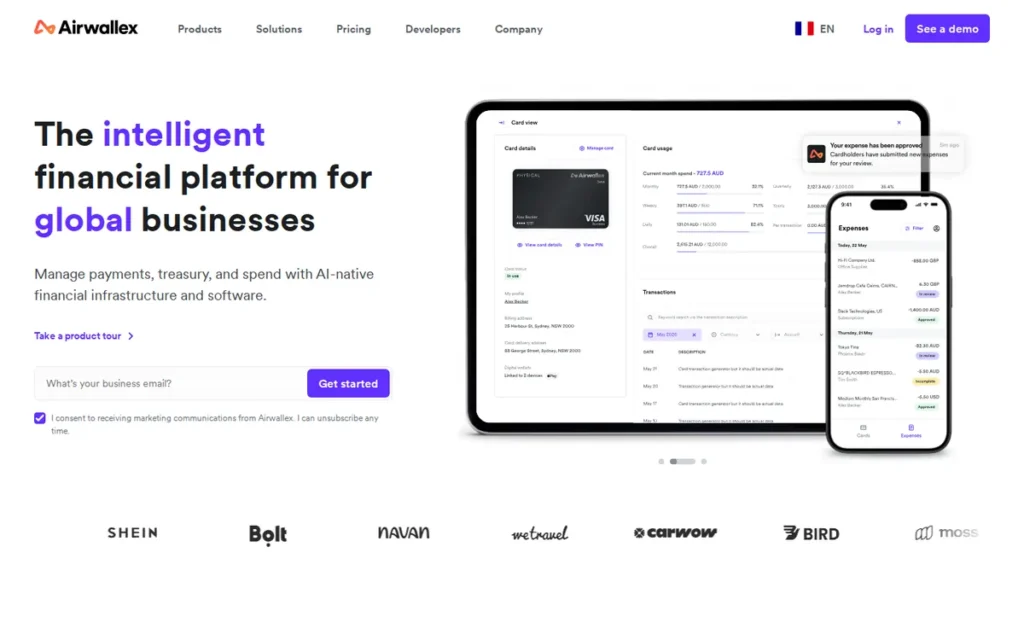
Category: Payment Platform, moves, holds and converts business money across currencies through multi-currency accounts.
At a Glance
- Category: Payment Platform
- Best For: Scaling SaaS, e-commerce and multi-entity SMBs that need accounts, cards, payment acceptance and APIs in one platform
- Price Range: US Explore $0/month; Grow $12/user/month plus a platform fee; Accelerate by quote; FX at interbank + 0.5% (major currencies) or + 1.0% (others)
- Primary Strength: Airwallex combines multi-currency accounts, cards, payment acceptance and APIs on one platform, and says 95%+ of its transactions run on local payment rails.
- Biggest Limitation: Airwallex offers only limited hedging, and its Capterra customer service sub-score (3.4) trails its ease-of-use score (4.1).
- One-Line Summary: Airwallex has the broadest documented workflow coverage in this ranking (top C3 score of 5/5) and is best suited to scaling companies that need global accounts, cards, card acceptance and APIs rather than advanced hedging.
- Last Verified: October 2026
Overview
Airwallex is a global business finance platform for scaling SMBs and mid-market companies that operate in several currencies. Airwallex combines multi-currency accounts in 20+ currencies, local transfers to 120+ countries, corporate cards, payment acceptance and APIs.
Airwallex sits between a payments app and financial infrastructure, and it syncs with Xero and QuickBooks for reconciliation. Airwallex was founded in Australia in 2015. In December 2025 it named San Francisco a second global headquarters alongside Singapore (Airwallex newsroom, 2025; vendor-reported).
Key Features
- Airwallex provides multi-currency accounts in 20+ currencies with local transfers to 120+ countries.
- Airwallex issues corporate cards, with up to 10 free cards on the US Explore plan.
- Airwallex includes payment acceptance, spend management and bill pay alongside FX conversion.
- Airwallex offers APIs and embedded-finance tools for companies that build payments into their own products.
- Airwallex syncs with Xero and QuickBooks for multi-currency reconciliation.
Best For
Airwallex is best for scaling SaaS, e-commerce and multi-entity companies that want one platform for global accounts, cards, card acceptance and API-driven payments. Airwallex users whose main need is locking in future rates should pair it with a hedging tool.
Pricing
- Airwallex’s US Explore plan costs $0 per month with no minimum balance (Airwallex US pricing page, 2026; primary pricing data).
- Airwallex’s Grow plan costs $12 per user per month plus a platform fee, and the Accelerate plan is priced by quote (Airwallex US pricing page, 2026; primary pricing data).
- Airwallex charges interbank + 0.5% on major currencies (USD, EUR, GBP, AUD, SGD, HKD, CNY, CAD, CHF, NZD and JPY) and + 1.0% on others (Airwallex US pricing page, 2026; primary pricing data).
- Airwallex SWIFT transfers are reported at $15–$25. Card acceptance is reported at 2.80% + $0.30 domestic and up to 4.30% + $0.30 international (Slash, 2026; competitor-sourced).
- Airwallex’s free-plan conditions vary by country. A competitor says the Australian free plan requires about A$5k in monthly deposits or a A$10k minimum balance (Wise, 2026; competitor-sourced).
Strengths
- Airwallex reported $1B+ in annualised revenue and $235B+ in annualised volume in December 2025, up from $720M and $130B+ in March 2025 (Airwallex newsroom, 2025; vendor-reported).
- Airwallex raised a $330M Series G at an $8B valuation in December 2025, in a round led by Addition (Airwallex newsroom, 2025; vendor-reported).
- Airwallex says 95%+ of its transactions run on local rails across 127 countries and about 94% settle the same day (Airwallex mission update, 2025; vendor-reported).
- Airwallex says it holds 60+ licences and registrations worldwide, and it works with Lead Bank and Evolve Bank & Trust in the US (Airwallex state licences page, 2026; vendor-reported).
- Airwallex has a G2 rating of 4.2/5 from 53 reviews, the highest G2 score among the three payment platforms ranked (G2, 2026; review platform).
Limitations
Airwallex gives up hedging depth for platform breadth. Research found only limited currency-risk tools, so companies with large future-dated exposure will likely need a separate hedging provider.
- Airwallex’s Capterra customer service sub-score is 3.4, against 4.1 for ease of use, from only 15 reviews. G2 reviewers also mention slow support at busy times (Capterra and G2, 2026; review platform).
- Airwallex’s reported international card-acceptance fee of up to 4.30% + $0.30 can outweigh FX savings for e-commerce sellers with many overseas customers (Slash, 2026; competitor-sourced).
- Airwallex payout timing depends on reserve terms and each payment method’s settlement schedule, according to a community user, so cash-flow plans should not assume instant payouts (Reddit, 2026; community anecdote).
- Airwallex, like every payment platform evaluated, can hold funds for compliance review, so Airwallex users should keep a backup bank account.
Users on r/PaymentProcessing shared their experience:
“Our account went through its first routine review, and our payment services were temporarily restricted while Airwallex requested additional information about our business.
We provided detailed explanations of our business model along with supporting documentation, including proof of transactions, service delivery, customer engagement, and other information they requested. After reviewing everything, Airwallex lifted the restriction in less than 48 hours.” Posted by u/Asgharty118
Takeaway: Airwallex compliance reviews can temporarily restrict a legitimate business account, but well-organised documentation can get the restriction lifted within days.
Verdict
Airwallex is the strongest all-in-one foreign exchange platform for scaling businesses in 2026, ranking first on workflow breadth and provider scale while publishing its FX markup openly.
Airwallex ranks #1 (3.93/5), 0.08 points ahead of Wise Business. Its higher hedging, workflow and review-confidence scores together outweigh Wise Business’s lead on pricing transparency. Limited hedging and a 3.4 Capterra support sub-score are the main trade-offs. Model the total cost, including card-acceptance and SWIFT fees.
2. Wise Business: Best for Transparent Spot Payments for Small Businesses
Category: Payment Platform, moves, holds and converts business money across currencies through multi-currency accounts.
At a Glance
- Category: Payment Platform
- Best For: Freelancers, startups and small businesses making regular spot payments to suppliers, contractors or staff abroad
- Price Range: US: $31 one-time fee for account details, $0/month; conversion fees vary by route, advertised from about 0.33% with some routes near 2%
- Primary Strength: Wise Business converts at the mid-market rate and shows its fee separately, the most transparent FX pricing model among the payment platforms evaluated.
- Biggest Limitation: Wise Business offers no forward contracts or hedging tools, and business reviewers repeatedly report account restrictions and slow support during urgent problems.
- One-Line Summary: Wise Business is the most price-transparent foreign exchange tool for small businesses making spot international payments, but it is not built for hedging future currency exposure.
- Last Verified: October 2026
Overview
Wise Business is a pay-as-you-go multi-currency business account that converts money at the mid-market exchange rate and shows its fee separately. Wise Business is built for small businesses, startups and freelancers that send and receive regular international payments and don’t want a monthly subscription.
Wise Business is built for spot conversion and payments, not hedging. Wise reported about 850,000 active Wise Business customers in FY26, the year to March 2026 (Wise FY26 results, 2026; investor filing).
Key Features
- Wise Business converts currency at the mid-market rate and shows its fee separately, so no markup is hidden in the rate.
- Wise Business provides local account details in about 23 currencies and holds balances in about 40 currencies.
- Wise Business supports batch payments for paying many suppliers or contractors at once.
- Wise Business issues business debit cards with employee spending controls.
- Wise Business integrates with Xero and QuickBooks and offers API access through Wise Platform.
Best For
Wise Business is best for small businesses and startups that make regular spot payments abroad and want to see exactly what each conversion costs. Wise Business is a weak fit for companies that need to lock in future rates.
Pricing
- Wise Business charges a one-time $31 fee for US account details and $0 per month (Wise, 2026; primary pricing data).
- Wise Business conversion fees vary by currency route. Advertised starting rates are about 0.33% and some routes cost around 2%, so check the exact fee in Wise’s calculator before converting (Wise, 2026; primary pricing data).
- Wise Business example fees for incoming SWIFT payments are $6.11 (USD), £2.16 (GBP) and €2.39 (EUR). Volume discounts apply above roughly $25k a month (Wise, 2026; primary pricing data).
Strengths
- Wise reported a Wise Business take rate of 0.39% and about $70.5B in Wise Business cross-border volume (up about 42%) for FY26. The group-wide take rate was 0.52% (Wise FY26 results, 2026; investor filing).
- Wise reported that 74% of payments were instant in H1 FY26, when 13.4M customers moved £84.9B (Wise H1 FY26 results, 2025; investor filing).
- Wise Business charges no monthly fee in the US, so low-volume businesses pay only per conversion (Wise, 2026; primary pricing data).
- Wise Business users in community discussions rate its exchange rates above typical banks, and one user reports moving seven figures “with no issues at all” (Reddit, 2022; community anecdote).
Limitations
Wise Business gives up hedging for pricing simplicity. Wise Business has no conventional forward contracts or limit orders, so businesses with future payables in foreign currency need a separate hedging tool.
- Wise Business scores 3.9/5 on G2 (~89–96 reviews) and 3.8/5 on Capterra (~72–90 reviews), below its consumer-heavy Trustpilot score of 4.3. Reviewers on G2 and Capterra cite verification friction, frozen funds and support delays (G2, Capterra and Trustpilot, 2026; review platform).
- Wise Business, like every payment platform evaluated, applies compliance checks that scale with deposit size. One user said a six-figure deposit was rejected and had to be sent to a regular bank account (Reddit, 2022; community anecdote).
- Wise Business receiving limits vary by country. A user in the Philippines reported a 400K PHP (about $8K) monthly cap (Reddit, 2024; community anecdote).
- Wise safeguards customer funds rather than holding them as insured deposits, and Wise is unavailable in some countries, including Russia, Iran and Venezuela (Wise help centre, 2026; vendor-reported).
Users on r/PersonalFinanceCanada noted:
“Wise seems to limit transfer to $5k USD to KRW person to person. Higher limit for business transfers but will not work for large transfers. These days, $5k will get you a Big Mac combo meal so they need to increase the limit.” Posted by u/elee32502
Takeaway: Wise’s route-specific transfer caps can rule it out for large payments on some routes, even with higher business limits.
Verdict
Wise Business is the most transparent foreign exchange option for small businesses making spot international payments in 2026, and the only provider evaluated that publishes a take rate directly in its investor results.
Wise Business ranks #2 (3.85/5) because it offers no hedging and its business-review scores are lower than its Trustpilot rating suggests. Readers who care more about pricing transparency than workflow breadth would rank Wise Business #1. Keep a backup bank account and prepare source-of-funds documents before large transfers.
3. Corpay Cross-Border: Best for Advisory Hedging and Mid-Market Cross-Border Payments
Category: Hybrid Payments + Hedging, combines cross-border payments with rate-locking instruments and help from dealers or advisers.
At a Glance
- Category: Hybrid Payments + Hedging
- Best For: Mid-market and larger firms with significant currency exposure that want advisory hedging, mass payments and ERP connectivity
- Price Range: Pricing on request; spread and fees built into quotes; forwards may require margin
- Primary Strength: Corpay Cross-Border offers the broadest hedging range evaluated, including open, fixed, window and non-deliverable forwards with a dedicated trader.
- Biggest Limitation: Corpay Cross-Border publishes no pricing, minimums or collateral terms, and reviewers describe onboarding as cumbersome.
- One-Line Summary: Corpay Cross-Border is the most complete advisory hedging and payments provider in this ranking, best for mid-market firms that value a dedicated trader over published, self-serve pricing.
- Last Verified: October 2026
Overview
Corpay Cross-Border is the cross-border payments and currency risk division of NYSE-listed Corpay, built for mid-market and enterprise finance teams with significant FX exposure. Corpay Cross-Border offers payments to 200+ countries in 100+ currencies, plus forward contracts and custom hedging programmes.
Corpay Cross-Border gives each client a dedicated relationship manager and trader instead of a purely self-serve dashboard. Corpay Complete adds accounts-payable automation and cards for teams that want broader payables coverage.
Key Features
- Corpay Cross-Border sends payments to 200+ countries in 100+ currencies, including local payments to 115+ countries.
- Corpay Cross-Border offers open, fixed, window and non-deliverable forwards, plus customised hedging programmes.
- Corpay Cross-Border holds balances in about 40 currencies through FXBalance and offers same-day payments in 10+ currencies across 50+ countries.
- Corpay Cross-Border supports mass payments, REST APIs and connections to ERP and treasury management systems.
- Corpay Cross-Border gives each client a dedicated relationship manager and trader.
Best For
Corpay Cross-Border is best for mid-market and larger companies with recurring, material currency exposure that want a human trader to design a hedging programme alongside high-volume payments. Corpay Cross-Border is less suitable for small businesses that want transparent self-serve pricing.
Pricing
- Corpay Cross-Border publishes no pricing as of October 2026, and rates come from quotes that include spread and fees (Corpay, 2026; vendor-reported).
- Corpay Cross-Border does not publish its minimums, spreads or collateral terms.
- Corpay Cross-Border forwards may require initial or variation margin, so buyers should ask for the margin-call terms in writing.
- Anyone evaluating Corpay Cross-Border should get competing quotes for the same amount and currency pair.
Strengths
- Corpay completed its ~$2.4B acquisition of Alpha Group International in November 2025. Mastercard completed a $300M minority investment in Corpay’s cross-border business in December 2025 (Corpay investor releases, 2025; investor filing).
- Corpay Cross-Border has a G2 rating of 4.5/5 from 1,154 reviews, the largest review count in this ranking. We could not confirm whether that profile covers only the Cross-Border division (G2, 2026; review platform).
- Corpay Cross-Border reports 21,000+ customers and 4.1M+ payments a year (Corpay, 2026; vendor-reported).
- Corpay Cross-Border is the exclusive provider of integrated commercial cross-border solutions to Mastercard’s financial-institution customers under the partnership announced in April 2025 (Mastercard and Corpay investor releases, 2025; investor filing).
- Corpay Cross-Border won Best Payment Provider – Global at the Global Payments Innovation Awards and was named in the FXC Intelligence Top 100 (Corpay, 2023; vendor-reported).
Limitations
Corpay Cross-Border gives up price transparency for advisory depth. Corpay Cross-Border publishes no spreads, minimums or collateral terms, so the only way to judge cost is to collect competing quotes.
- Corpay Cross-Border forwards may require initial or variation margin. That ties up working capital and can trigger margin calls when currencies move sharply.
- Corpay Cross-Border reviewers on G2 mention a “cumbersome approval process”, a difficult setup that needs manual help, a learning curve for same-day trades and processing delays (G2, 2026; review platform).
- Corpay Cross-Border has 88 Trustpilot reviews that mention delayed payments and features that are hard to use, and we could not retrieve the numeric score (Trustpilot, 2026; review platform).
- Corpay Cross-Border has almost no community discussion, so independent evidence comes mostly from review platforms.
Verdict
Corpay Cross-Border is the most comprehensive advisory hedging provider for mid-market businesses in 2026, pairing the widest forward-contract range evaluated with a G2 rating of 4.5/5 from 1,154 reviews (profile scope unconfirmed).
Corpay Cross-Border ranks #3 (3.73/5) because quote-only pricing and onboarding friction offset its hedging strength. Its C4 score of 4.5 depends on that G2 profile. At a C4 score of 3.5, Corpay Cross-Border would total 3.58, below OFX. Benchmark several quotes and get collateral terms in writing.
4. OFX: Best for Large or Recurring Transfers with a Human Dealer
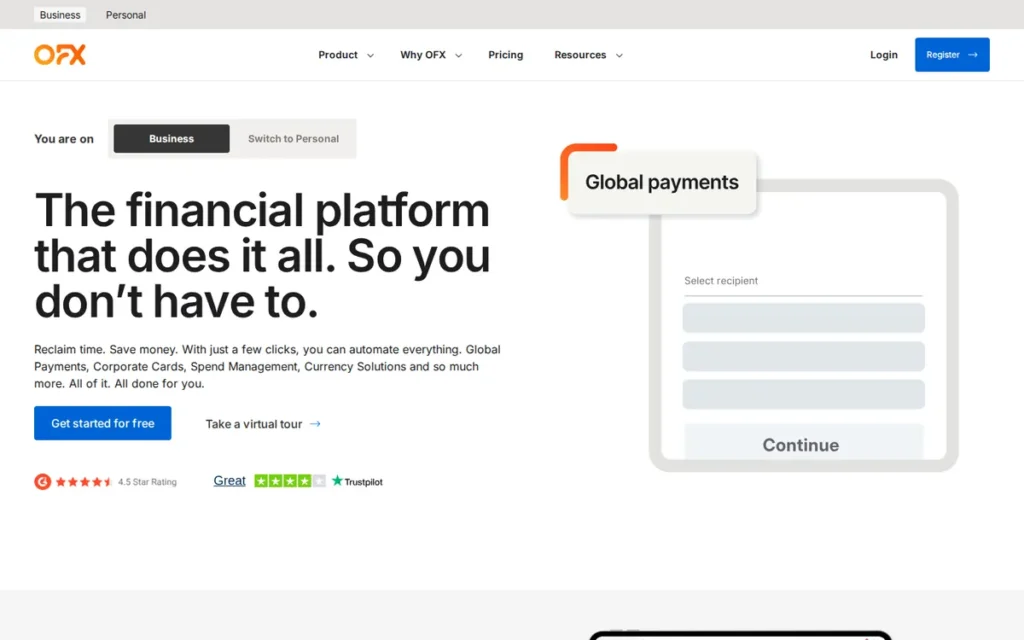
Category: Hybrid Payments + Hedging, combines cross-border payments with rate-locking instruments and help from dealers or advisers.
At a Glance
- Category: Hybrid Payments + Hedging
- Best For: SMEs making large, irregular or recurring supplier payments that want a human dealer and simple forward contracts
- Price Range: Australia: Standard A$0/user/month, Full Suite A$75/month for 5 users; US plan fees not published as a single schedule; FX margin built into the quote; US SWIFT fee $20 per transaction
- Primary Strength: OFX pairs forward contracts and limit orders with human dealers, which suits businesses making larger transfers.
- Biggest Limitation: OFX builds its margin into the exchange-rate quote and does not publish margin tiers, so true cost shows only when you compare quotes with the mid-market rate.
- One-Line Summary: OFX is the most accessible dealer-assisted foreign exchange provider for SMEs making large or recurring transfers, combining forward contracts and limit orders with human dealers and a G2 rating of 4.5/5 from 81 reviews.
- Last Verified: October 2026
Overview
OFX is an ASX-listed business payments provider built for SMEs that make large, irregular or recurring cross-border payments and want rate certainty. OFX combines multi-currency accounts, forward contracts, limit orders and human FX dealers.
OFX was founded in Sydney in 1998 and has been listed on the ASX since 2013 (OFX factsheet, 2024; investor filing). OFX sits between a bank FX desk and a fintech app, combining self-service transfers with human “OFXperts”.
Key Features
- OFX offers forward contracts that lock in a rate for a future transfer, plus limit orders that execute at a target rate.
- OFX gives clients access to human “OFXperts” and dealers, available 24/7 in some markets.
- OFX provides a Global Currency Account with local account details for currencies including USD, CAD, GBP and EUR. Sources give either 30+ or 50+ supported currencies, so confirm OFX covers your pairs.
- OFX supports batch payments, cards and spend management.
- OFX integrates with Xero and NetSuite.
Best For
OFX is best for SMEs that make larger or recurring supplier payments and want a human dealer’s help locking in rates with forwards. OFX may feel heavier than a pay-as-you-go platform for businesses making frequent small payments.
Pricing
- OFX charges a $20 SWIFT fee per US cross-border transaction (OFX US pricing page, 2026; primary pricing data).
- OFX’s Australian Standard business plan costs A$0 per user per month. Full Suite costs A$75 per month for five users plus A$10 per extra user (OFX Australia, 2026; primary pricing data).
- OFX does not publish US plan fees as a single schedule, and OFX margin tiers are not public.
- OFX earns most of its revenue from the FX spread built into its quote, so compare the recipient amount on an OFX quote with what the mid-market rate would give.
Strengths
- OFX processed about 689,400 cross-currency transactions averaging about A$29,500 in FY2025, on A$38.1B turnover, which confirms its focus on larger transfers (OFX FY2025 Annual Report, 2025; investor filing, AUD).
- OFX has a G2 rating of 4.5/5 from 81 reviews and a Trustpilot rating of 4.2/5 from about 11,500 reviews. Reviewers praise responsive support and better-than-bank rates (G2 and Trustpilot, 2026; review platform).
- OFX reported that enterprise revenue grew 23.5% to A$11.7M in FY26 (OFX FY26 Annual Report, 2026; investor filing, AUD).
- OFX reports 1M+ clients and is regulated by ASIC in Australia and the FCA in the UK. Its US entity, USForex Inc., is a FinCEN-registered money services business with state licences (OFX about page and annual reports, 2025–2026; investor filing).
This aligns with community sentiment on r/AusFinance:
“I’ve transferred a lot of money via OFX and was low stress and successful. In my experience, and at the time I checked, the rates were superior to anything else, meaning in saving hundreds if not thousands in fees.” Posted by u/xku6
Takeaway: OFX earns trust from users moving large sums, who describe transfers as low-stress and rates as better than the alternatives they checked.
Limitations
OFX gives up price visibility for dealer support. OFX’s margin sits inside the quoted rate rather than appearing as a separate fee, so buyers have to check every quote against the mid-market rate.
- OFX’s financial trend is mixed. FY2025 net operating income fell 5.5% to A$214.9M and corporate revenue fell 4.3% to A$133.2M, even though enterprise revenue grew in FY26 (OFX annual reports, 2025–2026; investor filing, AUD).
- OFX reviewers on Trustpilot report transfers taking several days, repeated document requests and having to chase funds held for compliance. Reviewers report similar holds at every payment-focused provider evaluated (Trustpilot, 2026; review platform).
- OFX reviewers on G2 find the newer interface confusing (G2, 2026; review platform).
- OFX has little independent community discussion and no Capterra profile was found, which narrows its evidence base.
Verdict
OFX is the most accessible dealer-assisted foreign exchange provider for SMEs making large or recurring transfers in 2026, combining forward contracts and limit orders with strong business review scores.
OFX ties Bound at exactly 3.600/5 and ranks #4 because its review evidence is stronger (a C4 score of 4.5 against 3.5). Because OFX pricing is spread-based, always compare the quoted recipient amount and prepare compliance documents before large transfers.
5. Bound: Best for Self-Serve Automated Hedging for UK and EU SMEs
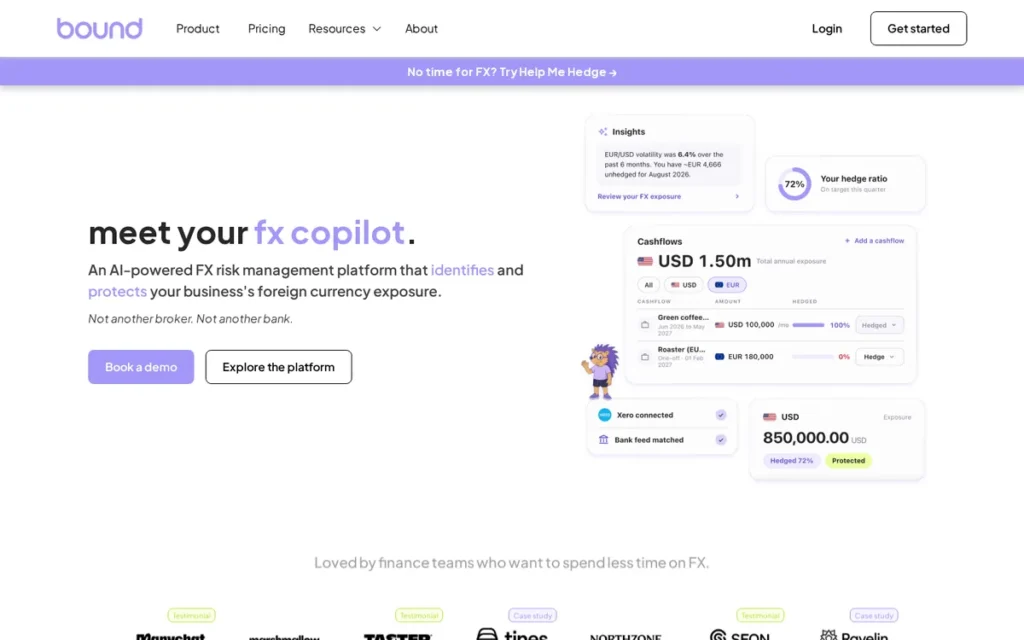
Category: Hedging Automation, manages currency risk with forwards and rules-based programmes on top of a business’s existing accounts.
At a Glance
- Category: Hedging Automation
- Best For: UK and EU SMEs with recurring foreign-currency costs or revenue that want transparent, automated forwards without tying up cash in margin
- Price Range: No platform fees; spot from 0.03%; forwards 0.45% (with a 5% deposit) or 0.75% (no deposit) under $20M annual flow, falling to 0.25%/0.50% at $250M+
- Primary Strength: Bound publishes its full hedging spread table, including the cost of choosing no margin deposit. No other hedging provider evaluated does this.
- Biggest Limitation: Bound is a young, UK/EU-focused provider with only 10 G2 reviews and no operating-account features, so most businesses need a separate payments tool.
- One-Line Summary: Bound is the most price-transparent FX hedging tool for UK and EU small businesses, automating forward contracts from accounting data with an option to avoid margin deposits.
- Last Verified: October 2026
Overview
Bound is a self-serve FX hedging platform, founded in 2020 and FCA-authorised. Bound automates forwards, non-deliverable forwards and averaging programmes from exposure data in accounting tools, for UK and European SMEs that want to manage currency risk without enterprise treasury complexity.
Bound is a hedging layer, not a full operating account. Bound has no local receiving details or payroll features, so Bound works alongside an existing bank or payment platform.
Key Features
- Bound offers forwards, non-deliverable forwards, averaging programmes, limit orders, swaps and spot conversions.
- Bound automates hedging using exposure data from Xero, QuickBooks, NetSuite, Stripe, Revolut, Google Sheets and bank feeds.
- Bound writes executed trades back to the accounting ledger.
- Bound lets businesses choose between a 5% margin deposit with a narrower spread or no deposit with a wider spread.
- Bound supports 36+ currencies.
Best For
Bound is best for UK and EU SMEs that have predictable foreign-currency payables or receivables, use cloud accounting software and want automated forwards with published pricing. Businesses outside the UK and EU should check Bound’s availability first.
Pricing
- Bound charges no setup, monthly or per-seat fees, and spot conversions start from 0.03% (Bound pricing page, 2026; primary pricing data).
- Bound forward spreads (with a 5% deposit / with no deposit) are 0.45%/0.75% below $20M of annual flow, 0.40%/0.65% at $20–50M, 0.35%/0.60% at $50–100M, 0.30%/0.55% at $100–250M and 0.25%/0.50% at $250M+ (Bound pricing page, 2026; primary pricing data).
- Bound charges 0.05% to change a date or reduce an amount.
- Bound’s no-deposit option protects working capital, but Bound users pay for it through the wider spread.
Strengths
- Bound publishes a complete five-tier hedging spread table on its pricing page, the most transparent hedging pricing among the providers evaluated (Bound pricing page, 2026; primary pricing data).
- Bound Rates Limited is FCA-authorised as a MiFID investment firm (FRN 966723). Bound is also an Electronic Money Institution (FRN 1036025) and holds ISO 27001 certification (Bound about page, 2026; vendor-reported).
- Bound reports serving 200+ companies after a $24.5M Series A led by AlbionVC (Bound Series A announcement, 2026; vendor-reported).
- Bound reports that client Tines grew an automated six-month rolling USD-to-EUR programme from $800k to $2M a month (Bound case study, 2026; vendor-reported).
Limitations
Bound gives up breadth for its focus on hedging. Bound has no operating-account features, so businesses still need a separate payments platform or bank.
- Bound’s public material does not show vanilla options or collars, so companies that need option-based strategies should look elsewhere.
- Bound Rates Limited is FCA-authorised, but Bound states that FX spot and exempt forwards (forwards used to pay for identifiable goods or services) are not regulated activities. Those are the instruments most SME users buy (Bound, 2026; vendor-reported).
- Bound’s independent evidence is thin: 10 G2 reviews, no Capterra or Trustpilot presence and no community discussion, so most performance claims are vendor case studies.
- Bound is the youngest and smallest provider in this ranking and focuses on the UK and Europe.
Verdict
Bound is the most transparent self-serve FX hedging tool for UK and EU small businesses in 2026, publishing full forward spreads and offering a no-margin-deposit option.
Bound ties OFX at exactly 3.600/5 and ranks #5 because its review sample and operating history are limited. Bound shares the top pricing-transparency score with Wise Business and would lead this ranking on pricing transparency and hedging combined. Most Bound users will pair it with a payment platform.
6. Revolut Business: Best All-in-One Business Account for Teams with Predictable Monthly FX Volume
Category: Payment Platform, moves, holds and converts business money across currencies through multi-currency accounts.
At a Glance
- Category: Payment Platform
- Best For: Teams wanting banking, cards, expenses and FX in one app whose monthly FX volume stays within a plan allowance
- Price Range: UK £10–£125/month across Basic, Grow and Scale; Enterprise custom; check US and EU pricing directly
- Primary Strength: Revolut Business bundles multi-currency accounts, cards, expense management and interbank-rate FX within plan allowances in a single app.
- Biggest Limitation: Revolut Business has the lowest Capterra support sub-score measured (3.0), and its FX costs rise beyond the plan allowance and outside market hours.
- One-Line Summary: Revolut Business is a broad all-in-one business finance app that offers good FX value when monthly volume stays within its plan allowance, but its support sub-score is the lowest measured in this ranking.
- Last Verified: October 2026
Overview
Revolut Business is a subscription-based business account for small and growing teams that want banking, spending and FX in one app. Revolut Business bundles multi-currency accounts, FX forwards, cards and expense management, and exchanges currency at the interbank rate within plan allowances.
Revolut Business costs depend mostly on the plan allowance. Revolut Business users who stay within it during market hours get interbank rates, while volume above it or outside market hours costs more.
Key Features
- Revolut Business exchanges currency at the interbank rate within each plan’s monthly allowance during market hours.
- Revolut Business lists FX forwards on its plans page for locking in future rates.
- Revolut Business provides multi-currency accounts with transfers to 160+ countries. Sources give between 25 and 36+ supported currencies, so confirm the count.
- Revolut Business includes cards, expense management and payment acceptance.
- Revolut Business offers an API and a Xero integration.
Best For
Revolut Business is best for small teams that want one app for banking, cards, expenses and FX and whose monthly FX volume fits within a plan allowance. Revolut Business buyers with large or irregular FX volume should model the cost above the allowance first.
Pricing
- Revolut Business has four tiers: Basic, Grow, Scale and Enterprise. UK examples run from £10/month (Basic) to £125/month (Scale), and Enterprise is custom (Revolut plans page, 2026; primary pricing data).
- Revolut Business offers savings of up to 28% with annual billing (Revolut plans page, 2026; primary pricing data).
- Revolut Business FX above the plan allowance reportedly costs about 0.6%, and exchanges outside market hours about 1% (Wise, 2026; competitor-sourced).
- Revolut Business prices for the US and EU could not be retrieved, so check them directly.
Strengths
- Revolut left the UK banking mobilisation phase in March 2026, and deposits with Revolut Bank UK Ltd are FSCS-eligible up to the applicable limit (Reuters, 2026; news report). Check whether your business account sits with that UK bank entity.
- Revolut Business had 767,000 business customers at the end of FY2025 (Sacra, 2025; third-party analysis).
- Revolut Business has a Capterra rating of 4.0/5 from 82 reviews, with ease of use rated 4.2 and features 4.0. Reviewers praise its multi-currency wallets and Xero automation (Capterra, 2026; review platform).
- Revolut Business lists FX forwards on its plans page, giving everyday users basic rate-locking inside an all-in-one account (Revolut plans page, 2026; primary pricing data).
- Revolut holds an EU banking licence through Lithuania, so Revolut Business customers in the EU deal with a licensed bank (Sacra, 2025; third-party analysis).
Limitations
Revolut Business gives up predictable pricing for bundled convenience. The interbank rate applies only within the allowance and during market hours. Spiky volumes can cost about 0.6% extra, or about 1% out of hours (Wise, 2026; competitor-sourced).
- Revolut Business has the weakest support score measured: a Capterra sub-score of 3.0, with value at 3.6. Airwallex, the only other provider with published sub-scores, scores 3.4 on support (Capterra, 2026; review platform).
- Revolut Business was the subject of community reports of 15-day support response times. Users also reported business accounts or cards opened in their name without a request, which they said were hard to resolve as non-customers (Reddit r/Revolut, 2024–2025; community anecdote).
- Revolut Business scores 3.7/5 on G2 from 21 reviews. The 4.7 Trustpilot score covers the whole brand, retail users included, and overstates business sentiment (G2 and Trustpilot, 2026; review platform).
- Revolut Business, like every payment platform evaluated, can hold funds for compliance review, so Revolut Business users should keep a backup bank account.
Users on r/Revolut noted:
“We used the merchant services and after a couple of payments Revolut started slow-walking the payouts (went from like 4 days to 21 days).
We are a UK company with a 30 year history and these were payments from big reputable institutions (top 10 UK universities).
That was enough to put us off using their merchant services and we went back to Stripe.” Posted by u/peakedtooearly
Takeaway: Revolut Business payout delays have driven even long-established UK companies back to other processors, so a backup provider is worth keeping.
Verdict
Revolut Business is a capable all-in-one business account for teams with predictable FX volume in 2026, but it has the lowest support sub-score of any provider measured in this ranking.
Revolut Business ranks #6 (3.53/5) because allowance-based pricing and support concerns outweigh its broad features, scale and newly confirmed UK banking licence. Compare your monthly FX volume with each Revolut Business plan’s allowance before committing.
7. Kantox: Best for ERP-Driven Hedging Automation in Multi-Entity Companies
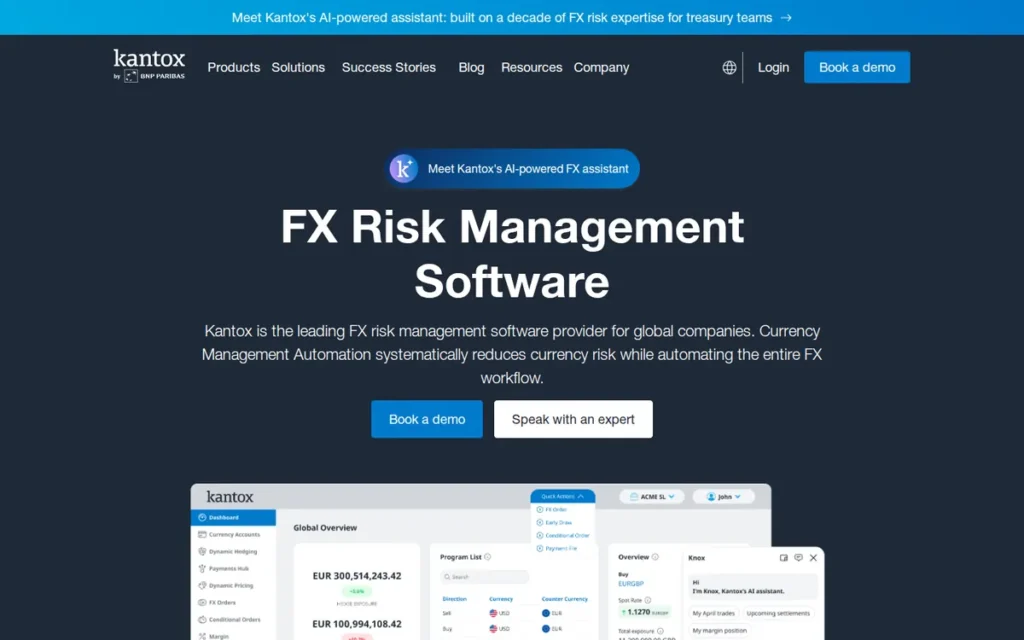
Category: Hedging Automation, manages currency risk with forwards and rules-based programmes on top of a business’s existing accounts.
At a Glance
- Category: Hedging Automation
- Best For: Mid-market and enterprise multi-entity companies with recurring currency exposure recorded in an ERP
- Price Range: Pricing on request; negotiated licence and/or transaction fees; implementation costs extra
- Primary Strength: Kantox automates the full hedging workflow from ERP exposure capture to execution and audit trail, with layered, rolling and conditional hedging rules.
- Biggest Limitation: Kantox publishes no pricing, a third-party analysis calls it relatively expensive for smaller users, and Kantox is not a payments account.
- One-Line Summary: Kantox is the only ERP-driven hedging automation platform evaluated and shares the top hedging score (5/5) with Corpay Cross-Border. It is built for multi-entity companies rather than small businesses making ad hoc payments.
- Last Verified: October 2026
Overview
Kantox is a currency management automation platform, founded in 2011, for mid-market and enterprise multi-entity companies with recurring foreign-currency costs or revenue. Kantox captures FX exposure from a company’s ERP and runs rules-based hedging programmes through its Dynamic Hedging® engine.
Kantox is a software layer, not a payments account. Kantox was founded in London and Barcelona by Philippe Gelis and Antonio Rami, and Kantox coined the “Currency Management Automation” category name.
Key Features
- Kantox captures currency exposure directly from ERP data, and Kantox case studies confirm SAP integration.
- Kantox’s Dynamic Hedging® engine runs layered, rolling, micro-, delayed and conditional hedging programmes.
- Kantox provides FX pricing for sales orders so commercial teams can quote prices in foreign currencies.
- Kantox executes trades across several liquidity providers.
- Kantox provides reporting and audit trails for governance. Kantox also markets NetSuite and Dynamics integrations, but we could not confirm whether they are native.
Best For
Kantox is best for multi-entity mid-market and enterprise companies that record currency exposure in an ERP and want their hedging policy carried out automatically. Kantox is unlikely to justify its cost and implementation effort for small businesses with occasional payments.
Pricing
- Kantox publishes no pricing as of October 2026, so buyers should expect a negotiated licence and/or transaction fees (moneytransfercomparison, 2026; third-party analysis).
- Kantox does not publish minimum volumes.
- Kantox’s total cost includes implementation and ERP integration work. A third-party analysis describes Kantox as “relatively expensive” for small users (moneytransfercomparison, 2026; third-party analysis).
Strengths
- Kantox has been owned by BNP Paribas since 2023, under an acquisition agreement announced in October 2022 (BNP Paribas press release, 2022; corporate press release).
- Kantox reports that Profine cut FX fees by up to 60% in some entities, with near-real-time SAP data flow (Kantox case study, 2026; vendor-reported).
- Kantox reports that Dulevo (Fayat Group) saves about €50,000 a year in bank commissions and that Capchase saves about 225 treasury hours a year (Kantox case studies, 2026; vendor-reported).
- Kantox received a FinTech Innovator Award for In-House FX (FinTech Innovator Awards, 2024; vendor-reported).
- Kantox holds 4.5/5 ratings on G2 (6 reviews) and Capterra/Software Advice (31 reviews), with praise for account management and fee transparency (aggregator data, 2026; review platform).
Limitations
Kantox gives up accessibility for automation depth. Negotiated pricing, implementation work and dependence on an ERP put Kantox out of reach for most small businesses.
- Kantox is not a payments account, and reviewers note it has no cash handling and no dedicated dealer.
- Kantox reviewers report some unexpected fees and exchange rates (G2, 2026; review platform).
- Kantox has thin independent evidence: 37 combined business reviews and no community discussion, so most performance figures come from vendor case studies.
- Kantox does not publish implementation timelines or total cost of ownership, so buyers cannot model time-to-value before entering a sales process.
Verdict
Kantox is the only ERP-driven FX hedging automation platform evaluated in 2026 and shares the top hedging score with Corpay Cross-Border. Its negotiated pricing and implementation effort make it a fit mainly for multi-entity mid-market and enterprise companies.
Kantox ranks #7 (3.18/5) because our criteria give heavy weight to pricing transparency and workflow fit for an SMB-focused audience. If hedging automation matters to you more than anything else, treat Kantox as a top contender.
How Much Does Foreign Exchange Software Really Cost?
Foreign exchange software usually costs more than its advertised fee. The true cost is the gap between the rate you get and the mid-market rate, plus fixed fees such as transfer, subscription and card charges. Comparing total cost per transfer is the only fair test.
Effective cost = (mid-market rate − all-in rate) ÷ mid-market rate, plus fixed fees as a share of the amount sent.
Providers may call the markup a spread, an FX margin or a conversion fee. On SWIFT transfers, intermediary (correspondent bank) fees can reduce the amount received further.
Here is a hypothetical example with no provider named:
- A business converts $10,000 to euros when the mid-market rate is 0.9200 EUR per USD.
- The provider quotes 0.9108, so the recipient gets €9,108 instead of €9,200.
- The hidden markup is (0.9200 − 0.9108) ÷ 0.9200 = 1.0%, or about $100.
- A $20 transfer fee brings the effective cost to about $120, or 1.2%.
Each provider prices FX differently:
- Wise Business converts at the mid-market rate and shows its fee separately.
- Airwallex charges a published markup of about 0.5–1% above interbank.
- Revolut Business gives interbank rates within a plan allowance, then charges markups.
- OFX and Corpay Cross-Border build their spread into each quote.
- Bound publishes a full spread table.
- Kantox negotiates pricing with each client.
B2B cross-border payment flows reached about $34.8T in 2025, and revenue take rates across cross-border payments are tightening (FXC Intelligence, 2025; third-party analysis).
A range commonly cited in industry comparisons says banks mark up FX by 2–5% and fintechs by 0.3–1%. Treat it as an unverified screening estimate. The headline fee tells you what a provider wants you to see, while the recipient amount tells you what you actually pay.
As one user on r/PersonalFinanceCanada described:
“I opened accounts with OFX and Wise to compare the rates for CAD to EUR conversion and this is what I found:
- OFX: send CAD 100,000, recipient gets EUR 68,530.00 (rate 0.6853).
- Wise: send CAD 100,000, recipient gets EUR 68,828.27 (rate 0.691873).” Posted by u/Bob_QC
Takeaway: In one user’s side-by-side test of a CAD 100,000 transfer, Wise delivered more euros than OFX, so check rules of thumb about which provider is cheapest for large amounts against real quotes.
How Do I Choose Foreign Exchange Software for Hedging?
Choose hedging software by matching its instruments, automation and margin terms to your exposure. Small businesses with predictable flows can use self-serve automated forwards. Mid-market firms may prefer advisory hedging with a dedicated trader. Multi-entity companies with exposure recorded in an ERP benefit most from rules-based automation.
The main hedging instruments are:
- Forward contracts lock in an exchange rate today for a transfer on a future date.
- Limit orders convert money automatically when the market reaches a target rate.
- Window forwards let a business draw down a locked rate at any point within a date range.
- Non-deliverable forwards (NDFs) hedge currencies that cannot be freely delivered, settling the difference in a major currency.
- Layered or rolling programmes hedge future exposure in staggered tranches to smooth out rate swings.
Hedging buys certainty, but you miss out if the rate later moves in your favour. Not hedging is a valid choice when foreign-currency costs are small relative to margin. Our rule of thumb: consider hedging when a plausible 5–10% currency move would wipe out a quarter’s profit on those flows.
“Most business owners we talked to are usually just exchange when they need to and suffer the volatility” (u/kbn2400, r/smallbusiness (Reddit, 2024; community anecdote))
Takeaway: Many small businesses don’t hedge at all, so starting with even one forward on your largest predictable payment is a meaningful step.
The margin decision matters as much as the instrument. Here is a hypothetical $1M forward under Bound’s published pricing, below $20M of annual flow (Bound pricing page, 2026; primary pricing data):
- The 5% deposit option costs about $4,500 in spread (0.45%) and ties up $50,000 of working capital until settlement.
- The no-deposit option costs about $7,500 in spread (0.75%) and ties up no cash.
- The business pays roughly $3,000 extra to keep $50,000 of working capital free.
- Every provider should be asked for its margin and collateral terms in writing.
Two more terms help frame the decision. A budget rate is the exchange rate your plan assumes. A hedge ratio is the share of forecast exposure you lock in. Bound reports that client Timely beat its budget rate by 5.4% (Bound case study, 2026; vendor-reported).
Hedging capability score (C2, out of 5, from our methodology):
- Corpay Cross-Border (5) offers open, fixed, window and non-deliverable forwards with a dedicated trader.
- Kantox (5) runs ERP-driven, rules-based Dynamic Hedging® programmes.
- Bound (4.5) automates forwards, NDFs and averaging programmes from accounting data.
- OFX (4) offers forwards and limit orders with help from a human dealer.
- Revolut Business (3) lists FX forwards on its plans page.
- Airwallex (2) offers only limited currency-risk tools.
- Wise Business (1) offers no hedging instruments.
Not What You Need? Where Should Currency Exchange Shops, Traders and Developers Look?
Currency exchange shops need bureau de change software, traders need a trading platform plus a regulated broker, and developers need an exchange-rate API. None of these categories is ranked here, because we could not verify any product in them to the same evidence standard as the seven business FX tools above.
What software does a currency exchange business need?
Bureau de change software runs the till and the compliance side of a retail currency shop. Products in this category include CXR Software, CXI, Cambista, FXmanager and Exchange Pro, which we have not evaluated. Check that any system covers these functions:
- Bureau de change software should track till balances and cash inventory by denomination.
- Bureau de change software should run know-your-customer (KYC) checks on customers.
- Bureau de change software should screen customers against sanctions and politically exposed person (PEP) lists.
- Bureau de change software should produce currency transaction reports (CTRs) and suspicious activity reports (SARs).
- Bureau de change software should give owners control across multiple branches.
What should individual forex traders know?
Trading platforms such as MetaTrader 4/5, cTrader and TradingView are software, not brokers. Regulators report that most retail traders lose money:
- The CFTC says about two in three retail OTC forex customers lose money (CFTC customer advisory, 2026; regulator publication).
- ASIC reports that 68% of Australian retail CFD clients lost money in FY2024, more than A$458M in total (ASIC Report 828, 2026; regulator publication).
The CFTC warns that unregistered offshore dealers use popular platforms to look legitimate and then refuse withdrawals (CFTC, 2026; regulator publication). Check any broker through NFA BASIC, the FCA Firm Checker or ASIC’s registers before you deposit money.
What should developers compare in an exchange-rate API?
Exchange-rate APIs such as Open Exchange Rates, XE and Fixer differ on four points. We have not evaluated them:
- Exchange-rate APIs differ in how often their rates update.
- Exchange-rate APIs differ in whether they provide bid/ask rates or only mid-market rates.
- Exchange-rate APIs set different licensing terms for redistributing rate data to end users.
- Exchange-rate APIs offer different service-level agreements (SLAs).
Which tools were not evaluated in this edition?
Xe Business appears in at least one AI-generated answer for this query, but it was not researched to our ranking standard, so it is not ranked in this edition.
What Red Flags Should I Watch For When Evaluating Foreign Exchange Software?
The biggest red flags are rates you can’t compare with the mid-market rate, “free” plans with conditions attached, no backup plan for compliance holds, forwards with unstated margin terms, unclear licensing and comparisons written by competitors. Each one can cost a business more than the FX savings it promised.
Red Flag #1: Advertised Rates With No Mid-Market Comparison A provider that won’t show its rate next to the mid-market rate is hiding its true cost. Spread-based pricing isn’t wrong in itself. You should still be able to see the recipient amount and work out the effective cost before you confirm a transfer.
Red Flag #2: “Free” Plans With Hidden Conditions A $0 monthly plan is free of subscription fees only, and other charges still apply. Read the conditions for your own country, not the US headline price, before assuming a plan is free. Common charges include:
- A “free” plan can still charge an FX markup on every conversion.
- A “free” plan can still charge SWIFT transfer fees.
- A “free” plan can still charge card-acceptance fees.
- A “free” plan can carry deposit or minimum-balance conditions that vary by country.
Red Flag #3: No Backup Plan for Compliance Holds Relying on a single FX provider for all supplier and payroll payments is a red flag. Reviewers report compliance holds and source-of-funds requests at every payment platform evaluated. Keep a backup business bank account, and run these checks before your first large transfer:
- Confirm the exact recipient amount before you approve the transfer.
- Prepare source-of-funds documents such as the invoice, the contract and a recent bank statement.
- Check the receiving limits for the destination country.
- Find out how to reach a human if the transfer is held.
Red Flag #4: Forward Contracts With Unstated Margin Terms A forward contract with undisclosed margin or collateral terms can lead to sudden margin calls when currencies move sharply. Some providers publish this trade-off. In this ranking, Bound’s pricing page shows deposit and no-deposit spreads. For other providers, request initial and variation margin terms in writing.
Red Flag #5: Unclear Licensing or Fund Protection in Your Country FX providers are licensed country by country, and fund protection varies between safeguarding, banking licences and partner banks. A provider that can’t name its licence in your country, or say whether your funds are safeguarded or deposit-insured, is a risk.
Red Flag #6: Rankings Written by Competitors Much of the comparison content online is written by FX providers about their rivals, so treat it as marketing, not independent evidence. Our research found these competitor-written comparisons:
- Wise publishes comparisons of its rivals Airwallex and Revolut Business.
- Airwallex publishes comparisons of its rivals Wise Business and OFX.
- OFX publishes comparisons of its rival Wise Business.
- Bound publishes comparisons of its rival Kantox.
What Questions Should I Ask Before Choosing Foreign Exchange Software?
Before choosing foreign exchange software, ask six questions covering effective cost, licensing, compliance holds, margin terms on forwards, accounting integration and whether you need one tool or two. The answers show fit better than any ranking, because they test each provider against your own transfers, country and exposure.
Question #1: What will my recipient actually receive compared with the mid-market rate? A trustworthy provider shows the exact recipient amount before you confirm. Compare it with the mid-market rate at the same moment and add fixed fees. That gives you the effective cost, so you can compare providers on equal terms.
Question #2: Is this provider licensed in my country without limits on my account, and are my funds safeguarded or insured? Ask which local entity serves your country, and check it on the FCA register, the ASIC register or the FinCEN MSB search. Also ask about receiving limits in your country and whether your balance is safeguarded or covered by deposit insurance.
Question #3: What happens if a payment is held for compliance, and how do I reach a human? Ask how long compliance reviews usually take, which documents get funds released and whether you can escalate by phone or to a dedicated manager. Support sub-scores vary widely: Revolut Business scores 3.0 and Airwallex 3.4 (Capterra, 2026; review platform).
Question #4: Do you offer forwards, and what margin or collateral do they require? Ask which instruments are available, whether forwards need an upfront deposit and what happens if the market moves against your position. Get the margin-call terms in writing, and compare the cost of a deposit option with a no-deposit option.
Question #5: Does it integrate natively with my accounting or ERP system? Ask whether integrations are native or built through third parties, because native sync cuts manual reconciliation. Integrations that turn out not to be native can add implementation cost and delay. Listed integrations in this ranking:
- Xero integrations are listed for Airwallex, Wise Business, Revolut Business, OFX and Bound.
- QuickBooks integrations are listed for Airwallex, Wise Business and Bound.
- NetSuite integrations are listed for OFX and Bound, and Kantox markets one.
- SAP integration is confirmed for Kantox in its case studies.
- Corpay Cross-Border lists REST APIs and connections to ERP and treasury systems.
Question #6: Do I need one tool or a payments tool plus a hedging tool? If you only make spot payments, one payment platform is usually enough. If you have future payables or receivables in foreign currencies, you may need two tools. None of the seven tools evaluated scores highly on both low-cost operating accounts and transparent, automated hedging.
Here is a hypothetical setup. A UK-based e-commerce SME pays suppliers through a payment platform such as Wise Business or Airwallex. It hedges six months of predictable USD costs with automated forwards from Bound, so each tool does the job it scores highest on.
How Did We Rank These Foreign Exchange Software Tools?
We scored seven business FX tools from 1 to 5 on six weighted criteria, using dated and labelled evidence: pricing transparency, hedging, workflow fit, business reviews, regulatory reliability and provider scale. Pricing transparency carries the most weight because hidden markups are the main pain point for finance teams.
The six criteria and their weights:
- C1: Pricing Transparency and Effective FX Cost (25%) matters because hidden markups and fees are the audience’s main pain point.
- C2: Hedging and Currency Risk Capability (15%) matters because currency swings hit profit margins.
- C3: Multi-Currency Workflow and Integration Fit (20%) matters because missing accounts, cards and integrations force manual reconciliation.
- C4: Business-Focused Review Evidence and Confidence (15%) matters because consumer reviews inflate scores for some brands.
- C5: Regulatory Footprint and Operational Reliability (15%) matters because frozen funds and slow support can cost more than FX savings.
- C6: Provider Scale and Financial Stability (10%) matters because supplier payments and multi-year hedges need a provider that will last.
| Rank | Tool | C1 (25%) | C2 (15%) | C3 (20%) | C4 (15%) | C5 (15%) | C6 (10%) | Weighted Total |
|---|---|---|---|---|---|---|---|---|
| 1 | Airwallex | 4 | 2 | 5 | 3.5 | 4 | 5 | 3.93 |
| 2 | Wise Business | 5 | 1 | 4.5 | 3 | 4 | 5 | 3.85 |
| 3 | Corpay Cross-Border | 2 | 5 | 3.5 | 4.5 | 4 | 5 | 3.73 |
| 4 | OFX | 2.5 | 4 | 3.5 | 4.5 | 4 | 4 | 3.60 |
| 5 | Bound | 5 | 4.5 | 2.5 | 3.5 | 3 | 2 | 3.60 |
| 6 | Revolut Business | 3 | 3 | 4.5 | 3 | 3.5 | 4.5 | 3.53 |
| 7 | Kantox | 2 | 5 | 2.5 | 3.5 | 3 | 4.5 | 3.18 |
How is the business-review score (C4) calculated?
C4 combines the average business rating on G2 and Capterra with sample size. Products with fewer than about 50 combined business reviews are capped at 3.5 as low-confidence. Uncapped, Bound’s 4.9 average would score 5 and Kantox’s 4.5 would score 4.5, but both are capped at 3.5.
Wise Business (3.8–3.9 average) and Revolut Business (3.7–4.0) have larger samples but lower averages, so both score 3.0. Corpay Cross-Border’s 4.5 depends on a G2 profile whose scope is unconfirmed. Trustpilot is context only: Revolut scores 4.7 there brand-wide but 3.7 on G2 from business users.
Scoring rules applied equally to every tool:
- Every figure carries one source-type label: investor filing, corporate press release, primary pricing data, vendor-reported, competitor-sourced, third-party analysis, review platform, regulator publication, news report or community anecdote.
- Where a publication date was not available, the year shown is the year we accessed the source (2026).
- No peer-reviewed studies exist in this category, so none are cited.
- Ties are broken by C4. OFX and Bound both score exactly 3.600 unrounded, and OFX ranks higher on C4 (4.5 against 3.5).
- We never compare one provider’s realised average cost with another provider’s advertised minimum.
- Compliance holds reported at every payment platform are treated as a baseline across the category, not as a penalty for one provider.
- Ownership and M&A claims are scored only once confirmed by primary sources.
Different weights produce a different order. If hedging matters twice as much to you (C2 at 30%, with C1 cut to 10%), Corpay Cross-Border moves to first at 4.18 and OFX to second at 3.83. Wise Business falls to seventh at 3.25. Run the same calculation with your own priorities.
The top five scores sit within 0.33 points of each other, so fit with your situation matters more than rank position. With scores that close on a 5-point scale, the ranking tells you which tools to shortlist, not which one to buy.
Changes in this edition:
- Kantox’s C6 score rose from 3.5 to 4.5 after its BNP Paribas ownership was confirmed. Its total moved from 3.08 to 3.18, and it stays #7.
- Corpay Cross-Border’s C6 score rose from 4.5 to 5 after the Alpha Group acquisition and the Mastercard investment were confirmed. Its total moved from 3.68 to 3.73, and it stays #3.
- Revolut Business’s C5 score rose from 3 to 3.5 after it received its full UK banking licence in March 2026. Its total moved from 3.45 to 3.53, and it stays #6.
- Wise Business figures were updated from H1 FY26 to FY26 full-year results, with no change to its score.
PlugRoute has no affiliate relationships with any company listed, and rankings are determined entirely by research data and objective evaluation criteria.
What Else Do Buyers Ask About Foreign Exchange Software?
Most buyers ask which tool suits a small business (Wise Business for spot payments, Airwallex if they also need cards and APIs). They also ask whether forwards need a margin deposit (often yes, so get the terms in writing). And they ask whether “free” FX accounts are free (only of subscription fees).
What is the best foreign exchange software for a small business in 2026?
Wise Business is the best foreign exchange software for most small businesses making spot payments in 2026. It converts at the mid-market rate, shows its fee separately and charges no US monthly fee. Airwallex suits small businesses that also need cards, card acceptance and APIs. Small businesses with future currency exposure should add a hedging tool such as Bound.
What is the best foreign exchange software for international payments?
Airwallex is the best foreign exchange software for international payments at scale in 2026, with transfers to 120+ countries, cards and APIs on one platform. Wise Business suits transparent spot payments. For large or recurring transfers, compare OFX and Corpay Cross-Border, whose human dealers and forward contracts help lock in rates before the payment date.
How does PlugRoute determine rankings?
PlugRoute ranks tools by scoring each one from 1 to 5 on six weighted criteria, using dated and labelled evidence. Pricing transparency carries 25% and workflow fit 20%. Hedging, business reviews and regulatory reliability carry 15% each, and provider scale 10%. The full score table is published so readers can re-weight the criteria for their own needs.
Which Foreign Exchange Software Is Right for You?
Key Insights
The right foreign exchange software depends on whether you need to move money, manage currency risk or both. Airwallex leads overall and Wise Business leads on pricing transparency. Corpay Cross-Border and Kantox lead on hedging depth. The top five score within 0.33 points of each other, so fit matters more than rank.
- Airwallex ranks first (3.93/5) for its workflow breadth and provider scale, combining accounts, cards, card acceptance and APIs on one platform.
- Wise Business and Bound share the top pricing-transparency score (5/5), and Bound publishes the most transparent hedging prices in the category.
- Corpay Cross-Border and Kantox share the top hedging score (5/5), while OFX offers the most accessible dealer-assisted forwards for SMEs.
- Reviewers report compliance holds and source-of-funds checks at every payment platform evaluated, so a backup bank account reduces the disruption a hold can cause.
- None of the seven tools evaluated scores highly on both low-cost operating accounts and transparent, automated hedging, so many businesses will need two tools.
If you only send spot payments, start with Wise Business, Airwallex or Revolut Business and judge them on the amount your recipient actually receives. If currency swings threaten your margins, compare Corpay Cross-Border, OFX, Bound and Kantox on instruments and margin terms first.
Most businesses that move money abroad need one tool. Most businesses exposed to currency swings need two: one to move money and one to protect it.
What should you do this week?
- Pull last quarter’s FX volume by currency from your accounting system.
- Get recipient amounts from two providers for the same transfer on the same day.
- Confirm each provider’s licence and receiving limits in your country.
- Open a backup business account before moving payroll or supplier payments.
PlugRoute re-checks pricing, reviews and regulatory details in every edition, because FX pricing and availability change by country and over time. Read our full methodology, our independent guide to FX hedging for small businesses, and our guide to calculating the true cost of currency exchange.
We update this guide quarterly. Last updated: October 2026.