UpPromote ranks highest for Shopify stores, impact.com is the strongest choice for enterprise programs that manage many partner types, and PartnerStack leads for B2B SaaS partner and reseller channels. Rank matters less than fit, though: the right affiliate marketing software depends on your sales platform, business model and monthly affiliate revenue.
Choosing is hard. Vendors mix monthly fees with percent-of-sales charges, usage allowances and demo-only quotes, and few say clearly whether they help you find new affiliates or only manage existing ones. This guide covers software for brands running their own affiliate, referral or partner programs. It does not cover tools for publishers who promote offers.
PlugRoute has no affiliate relationships with any company listed, and rankings are determined entirely by research data and objective evaluation criteria.
PlugRoute scored all seven tools on six weighted criteria using the same desk research for each. Every price, rating and review count was re-checked on November 5, 2026.
What Are the 4 Categories of Affiliate Marketing Software Tools?
Affiliate marketing software falls into four categories. Partnership Network Platforms manage many partner types and include a marketplace. Ecommerce Affiliate Apps plug into online stores. SaaS Billing-Synced Trackers pay commissions based on subscription billing events. Cross-Platform Affiliate Trackers connect to many sales systems. Pick your category by platform fit before you compare prices.
The seven ranked tools fall into the categories like this:
- Partnership Network Platform: impact.com and PartnerStack manage several partner types and help brands recruit new partners through built-in marketplaces.
- Ecommerce Affiliate App: UpPromote and Refersion track link and coupon referrals inside online store checkouts.
- SaaS Billing-Synced Tracker: Rewardful and FirstPromoter calculate commissions from subscription billing data such as renewals, refunds and cancellations.
- Cross-Platform Affiliate Tracker: Tapfiliate connects to 30+ storefront, billing and CRM systems for brands that recruit their own affiliates.
How Do the Top Affiliate Marketing Software Tools Compare at a Glance?
UpPromote leads this ranking with a weighted score of 3.93 out of 5. impact.com follows at 3.78 and PartnerStack at 3.53. Ranks #4 through #7 are only 0.12 points apart. Use the table below mainly to match a tool to your sales platform and business model, not to compare rank positions.
| Rank | Company | Category | Best For | One-Line Summary | Key Capabilities | Primary Strength | Key Limitation |
|---|---|---|---|---|---|---|---|
| 1 | UpPromote | Ecommerce Affiliate App | Shopify SMBs | UpPromote is a Shopify-native affiliate app with a free plan, public pricing and a marketplace on paid plans. | Link and coupon tracking, multi-level commissions, PayPal auto-payouts | 4.9/5 on Shopify App Store (~3,924 reviews) and Capterra (217) | Shopify only; 1–2% fee on referral sales |
| 2 | impact.com | Partnership Network Platform | Enterprise, multi-partner programs | impact.com is a partnership platform that recruits and manages affiliates, creators and B2B partners in one system. | 200K–250K+ partner marketplace, cookieless tracking, fraud scoring | Largest G2 sample (2,811) and largest marketplace | Marketplace requires $500/mo Essentials; custom above |
| 3 | PartnerStack | Partnership Network Platform | B2B SaaS partner channels | PartnerStack is a B2B SaaS partner platform for affiliate, reseller and co-sell programs with a built-in marketplace. | Stripe Marketplace app, CRM integrations, payouts in 100+ currencies | G2 4.7/5 (953) plus the most extensive B2B channel workflows | No public pricing; reported annual contracts |
| 4 | Rewardful | SaaS Billing-Synced Tracker | Stripe/Paddle SaaS, fast launch | Rewardful is a Stripe-first SaaS affiliate tool with two-way billing sync and a 0% transaction fee. | Two-way Stripe sync, recurring commissions, PayPal/Wise payouts | Reviewers report launching in about three hours | Stripe and Paddle only; no marketplace |
| 5 | Tapfiliate | Cross-Platform Affiliate Tracker | Mixed or international sellers | Tapfiliate is a hosted affiliate tracker with 30+ integrations and flat-fee pricing. | 30+ integrations, multiple tracking methods, multi-currency portals | Broadest integrations; no fee on sales | Conversion overage fees on entry plan; no marketplace |
| 6 | FirstPromoter | SaaS Billing-Synced Tracker | SaaS on complex billing | FirstPromoter is a SaaS affiliate platform whose commissions follow billing events across five billing systems. | Stripe, Paddle, Chargebee, Recurly, Braintree; up to 3 commission tiers | Widest billing coverage plus public tiered pricing | No marketplace; small review samples |
| 7 | Refersion | Ecommerce Affiliate App | Multi-platform DTC brands | Refersion is an ecommerce affiliate platform with first-party tracking across Shopify, BigCommerce, WooCommerce and Magento. | First-party domain tracking, product-level commissions, unlimited affiliates | Widest coverage of ecommerce platforms | Lowest G2 score in set (3.6/5); 3% Launch fee |
Quick Decision Framework: Which Tool Fits Your #1 Priority?
| Your #1 Priority | Recommended Tool | Why | Acceptable Alternative |
|---|---|---|---|
| Testing affiliates on a Shopify store | UpPromote | Free plan with unlimited affiliates; public pricing | Refersion |
| Enterprise program with many partner types | impact.com | Covers affiliates, creators, loyalty and B2B partners plus the largest marketplace | PartnerStack |
| Small ecommerce brand wanting a path to enterprise partnerships | impact.com Starter | $30/month + 2.5% on supported stores; marketplace requires Essentials | UpPromote |
| B2B reseller, agency or co-sell channel | PartnerStack | Reseller, co-sell and deal-registration workflows | impact.com |
| Fast launch on Stripe or Paddle | Rewardful | Two-way Stripe sync; 0% transaction fee | FirstPromoter |
| Mixed platforms or international, flat fee | Tapfiliate | 30+ integrations; no percent-of-sales fee | Refersion |
| SaaS on Chargebee, Recurly or Braintree, or complex commissions | FirstPromoter | Five billing systems and up to 3 commission tiers | Tapfiliate |
| Multi-platform DTC with product-level rules | Refersion | Shopify, BigCommerce, WooCommerce and Magento support | UpPromote |
The table below shows which tools help you recruit new affiliates and how each one charges, as of November 2026.
| Tool | Finds new affiliates? | Fee basis (November 2026) | Public price? |
|---|---|---|---|
| UpPromote | Yes (paid plans) | Subscription + 1–2% of approved referral sales | Yes, consistent |
| impact.com | Yes, Essentials and above (200K–250K+, vendor figure) | Starter $30 + 2.5% of revenue; Essentials $500; custom above | Yes for Starter and Essentials; custom above |
| PartnerStack | Yes (~131K+, third-party figure) | Quote; reported base fee + % of payouts | No |
| Rewardful | No | Tiers by monthly affiliate revenue; 0% transaction fee | Yes, consistent |
| Tapfiliate | No | Flat fee with included allowances + conversion overage | Yes, consistent |
| FirstPromoter | No | Tiers by monthly affiliate revenue | Yes; transaction-fee policy not stated |
| Refersion | Yes (marketplace listing) | Subscription + 2–3% of affiliate sales | Yes; older blog pricing differs |
What Are the 7 Best Affiliate Marketing Software Tools in 2026?
PlugRoute’s November 2026 ranking of seven affiliate marketing software tools puts UpPromote first and impact.com second. The other five are separated by 0.25 points. Every tool was scored on the same six weighted criteria and follows the same entry structure, so below #2, each entry’s Best For line matters more than its rank.
- UpPromote scored 3.93.
- impact.com scored 3.78.
- PartnerStack scored 3.53.
- Rewardful scored 3.40.
- Tapfiliate scored 3.28.
- FirstPromoter scored 3.28.
- Refersion scored 3.28.
The weighted score combines six criteria:
- Integration and platform fit (25%) measures how deeply each tool connects to storefronts and billing systems.
- Volume-adjusted user sentiment (20%) weights each rating by its review count.
- Pricing transparency (20%) measures whether full, consistent pricing is public.
- Partner discovery (10%) measures whether a marketplace helps brands recruit affiliates.
- Payout and attribution operations (15%) measures commission, refund, payout and fraud handling.
- Evidence quality (10%) rewards named, quantified results over anonymous claims.
Which Affiliate Marketing Software Should I Choose for My Use Case?
Choose by your storefront or billing system first, then by your budget and how much you sell through affiliates each month.
- If you run a small-to-midsize Shopify store and want to test affiliates at no cost: choose UpPromote, because it has a free plan with unlimited affiliates, public paid tiers from $29.99/month and 4.9/5 ratings across about 3,924 Shopify App Store reviews.
- If you are an enterprise brand running affiliates, creators, loyalty and B2B partners together: choose impact.com, because it covers all of these partner types in one system and has the largest marketplace in the set (200,000 to 250,000+ partners, vendor figure) on Essentials at $500/month and above.
- If you are a B2B SaaS company building reseller, agency or co-sell channels: choose PartnerStack, because it supports reseller, co-sell and deal-registration workflows and pays partners in 100+ currencies, but expect quote-only pricing and reported annual contracts.
- If you are an early-stage SaaS company billing through Stripe or Paddle and want to launch fast: choose Rewardful, because reviewers report going live in about three hours, it has a two-way Stripe sync and it charges a 0% transaction fee from $49/month.
- If your SaaS bills through Chargebee, Recurly or Braintree, or you need complex commission rules: choose FirstPromoter, because it supports five billing systems and up to three commission tiers, with public pricing from $49/month.
- If you sell across several platforms or countries and want a flat fee: choose Tapfiliate, because it connects to 30+ integrations, supports portals in several currencies and charges no percentage of sales, starting at $74/month billed annually.
- If you are a DTC brand selling on Shopify, BigCommerce, WooCommerce or Magento: choose Refersion, because it covers the widest set of ecommerce platforms, offers product-level commission rules and includes unlimited affiliates on its $39/month Launch plan (plus 3% of affiliate sales).
- If you are a small ecommerce brand that may need enterprise partnerships later: choose impact.com Starter, because it costs $30/month plus 2.5% of revenue on supported stores, and you can move up to Essentials when you need the marketplace.
1. UpPromote: Best Overall for Shopify Stores (Highest Weighted Score)

Category: Ecommerce Affiliate App, store-integrated affiliate tracking with link and coupon attribution, built for online retail catalogs.
At a Glance
- Category: Ecommerce Affiliate App
- Best For: Small-to-midsize Shopify and Shopify Plus stores starting or scaling an affiliate, referral or influencer program
- Price Range: Free; paid plans $29.99–$199.99/month plus 1–2% of approved referral sales (Shopify Plus: custom)
- Primary Strength: UpPromote pairs 4.9/5 ratings on both Capterra (217 reviews) and the Shopify App Store (about 3,924 reviews) with a free plan and public paid tiers.
- Biggest Limitation: UpPromote is documented for Shopify only, and its paid plans add a percent-of-sales fee on top of the subscription that grows with volume.
- One-Line Summary: UpPromote is a Shopify-native affiliate app with a free plan, public pricing and a paid-plan marketplace, best for Shopify stores that want low-risk entry and room to grow.
- Last Verified: November 2026
Overview
UpPromote is a Shopify-native affiliate, referral and influencer app from Secomapp. Small-to-midsize Shopify merchants use it to track link and coupon referrals, automate PayPal payouts and recruit partners through a paid-plan marketplace. UpPromote starts with a free plan and adds a 1–2% fee on approved referral sales on paid tiers.
UpPromote scored 3.93/5, the highest weighted score in this ranking. UpPromote is the only tool scoring 4.5 or higher on both user sentiment (5.0) and pricing transparency (4.5).
Key Features
- UpPromote tracks affiliate referrals through both links and coupon codes inside the Shopify checkout.
- UpPromote supports multi-level commissions and customizable affiliate signup pages.
- UpPromote automates PayPal payouts to affiliates on paid plans.
- UpPromote gives paid-plan merchants access to the UpPromote Marketplace for finding new affiliates and influencers.
- UpPromote offers multi-store management on its Enterprise plan for brands running several Shopify storefronts.
Best For
UpPromote is best for Shopify merchants who want to test an affiliate program at zero software cost, then move to paid tiers with marketplace access as affiliate revenue grows.
Pricing
UpPromote publishes four self-serve plans (UpPromote, November 2026):
- Free: UpPromote Free costs $0 and includes 1 program with unlimited affiliates, but not PayPal auto-payouts or marketplace access.
- Growth: UpPromote Growth costs $29.99/month or $299.90/year, plus 2% of approved referral sales.
- Professional: UpPromote Professional costs $89.99/month or $899.90/year, plus 1.5% of approved referral sales.
- Enterprise: UpPromote Enterprise costs $199.99/month or $1,999.90/year, plus 1% of approved referral sales.
- Shopify Plus: UpPromote prices Shopify Plus plans on request.
UpPromote charges the referral-sales fee on top of the subscription. Professional becomes cheaper than Growth above about $12,000/month in affiliate sales. Enterprise becomes cheaper than Professional above about $22,000/month.
Strengths
- UpPromote holds a 4.9/5 rating on the Shopify App Store across about 3,924 reviews and on Capterra across 217 reviews (Shopify App Store and Capterra, November 2026). The Shopify App Store figure is the largest single review sample in this ranking.
- UpPromote is the only tool in this ranking with a permanent free plan that includes unlimited affiliates, and its paid tier prices matched across every source checked (UpPromote, November 2026).
- UpPromote’s vendor-published cfab case study reports $1.4M+ in affiliate revenue across 25,000+ referral orders (UpPromote, November 2026).
- UpPromote includes marketplace access on paid plans, so merchants can recruit new affiliates rather than only manage existing ones (UpPromote, November 2026).
Limitations
UpPromote trades platform breadth for Shopify depth. PlugRoute found no native WooCommerce or Wix support, and the 1–2% referral-sales fee turns a low subscription into a significant cost at volume.
- UpPromote reviewers report that refunds on orders credited to several affiliates deduct commission from only one of them (Shopify App Store, November 2026).
- UpPromote reviewers also report that coupons can override product-level link credit and that SKU changes require a manual re-sync (Shopify App Store, November 2026).
- UpPromote’s per-sale fee model draws open criticism from some Shopify merchants (r/shopify, November 2026). The UpPromote Free plan also lacks PayPal auto-payouts and marketplace access.
Users on r/shopify shared their experience:
“I currently have uppromote installed and its pretty slick but very expensive ($899 for the full year). Is there a recommended alternative with more reasonable price.” Posted by u/Rough-Relationship54
Takeaway: UpPromote wins merchants over on polish, but its paid annual tiers push cost-sensitive Shopify stores to look for cheaper alternatives.
Verdict
UpPromote is the highest-scoring affiliate software in PlugRoute’s November 2026 ranking and the best-evidenced choice for small-to-midsize Shopify stores. UpPromote combines a free entry plan, consistent public pricing and 4.9/5 ratings across more than 4,000 combined reviews.
Merchants expecting high affiliate volume should model UpPromote’s per-sale fee against flat-fee alternatives. Brands selling outside Shopify should look elsewhere.
2. impact.com: Best for Enterprise and Multi-Partner-Type Programs

Category: Partnership Network Platform, manages many partner types and helps recruit new ones through a built-in marketplace.
At a Glance
- Category: Partnership Network Platform
- Best For: Established brands running affiliate, creator, loyalty and B2B partnerships at scale
- Price Range: Starter $30/month + 2.5% of revenue; Essentials $500/month (includes marketplace); custom above (impact.com, November 2026)
- Primary Strength: impact.com combines the largest G2 review sample (2,811 reviews) and the largest partner marketplace in this ranking with tracking that does not depend on browser cookies.
- Biggest Limitation: impact.com reserves its marketplace for Essentials and above, and reviewers report a steep learning curve, slow onboarding and extra onboarding charges.
- One-Line Summary: impact.com is a partnership platform that manages and recruits affiliates, creators and B2B partners in one system, best for brands running several partner types at scale.
- Last Verified: November 2026
Overview
impact.com is a partnership management platform for recruiting, contracting, tracking and paying affiliates, creators, loyalty and B2B partners in one system. The vendor reports a marketplace of 200,000–250,000+ partners. As of November 2026, impact.com publishes a $30/month + 2.5% Starter plan and a $500/month Essentials plan that adds marketplace access.
impact.com scored 3.78/5, 0.15 behind UpPromote. impact.com leads on partner discovery, operations and G2 review volume. Custom pricing above Essentials keeps its transparency score at 3.0.
Key Features
- impact.com handles partner discovery, recruitment, contracts, tracking, commissions, reporting and payouts in one platform.
- impact.com gives brands on Essentials and above access to a partner marketplace the vendor sizes at 200,000–250,000+ affiliates, creators and content partners.
- impact.com supports server-side, API-based and cookieless tracking to reduce losses from browser cookie restrictions.
- impact.com includes fraud detection and scoring, strengthened by acquisitions including Trackonomics in 2021.
- impact.com Starter supports Shopify, WooCommerce, BigCommerce, Adobe Commerce and Squarespace stores.
Best For
impact.com is best for mid-market and enterprise brands that run several partnership types at once and have the budget and staff for a more complex platform. Smaller ecommerce brands can start on Starter, but the marketplace requires Essentials.
Pricing
impact.com publishes two entry plans and quotes larger programs (impact.com, November 2026):
- Starter: impact.com Starter costs $30/month plus 2.5% of revenue for brands on supported ecommerce platforms, with no setup fee.
- Essentials: impact.com Essentials costs $500/month and adds marketplace access, dedicated support and up to $2,500/month in partner payouts.
- Custom: impact.com quotes pricing above Essentials, and total cost can include onboarding fees and add-on modules.
The 2.5% fee on impact.com Starter costs more on its own than the Essentials platform fee once tracked revenue passes about $18,800/month.
Strengths
- impact.com holds a 4.4/5 G2 rating across 2,811 reviews (G2, November 2026). That is about three times the next-largest G2 sample in this ranking (PartnerStack, 953 reviews).
- impact.com has the largest partner marketplace in the set, at 200,000–250,000+ partners (impact.com, November 2026), though the figure is self-reported.
- impact.com documents cookieless, server-side and API tracking with fraud scoring, the most extensive documented tracking setup among the seven tools (G2, November 2026).
- impact.com reports a 314% modeled ROI with payback in under six months (Forrester TEI commissioned by impact.com, via Rework, November 2026). The study is based on a hypothetical composite customer.
Limitations
impact.com trades simplicity for breadth. The $30 Starter plan excludes the marketplace that defines the platform. Marketplace access requires Essentials at $500/month or a custom quote.
- impact.com reviewers describe a reporting interface with a learning curve and overwhelming menus (G2, November 2026).
- impact.com reviewers also report slow contract and commission changes, slow onboarding with extra charges, and fraudulent leads not always being handled (G2 and Capterra, November 2026).
- impact.com’s Stripe integration depth could not be confirmed, and publisher-side threads describe inconsistent marketplace vetting (r/Affiliatemarketing, 2021).
Users on r/Affiliatemarketing noted:
“clicks showing but no test conversion is pretty normal with Impact. a lot of advertisers suppress self purchases or delay them until approval, so you will not always see anything fire right away. the clean way is to ask the advertiser or your Impact rep for a test SKU or a QA flow, some have them and some do not. also double check attribution windows and that your browser is not blocking the cookie, especially if you are logged into Impact while testing. i have seen plenty of cases where everything was wired correctly and the first real conversion just appeared days later. if it never does, it is usually an advertiser level rule, not your link.” Posted by u/trainmindfully
Takeaway: Test conversions on impact.com often don’t show up right away because of advertiser-level rules, so brands should set up a QA flow before inviting partners.
Verdict
impact.com has the broadest partner-type coverage and the largest marketplace in PlugRoute’s November 2026 ranking. That makes it the strongest choice for brands managing several partner types at scale. impact.com also leads on G2 review volume and tracking depth.
impact.com’s $30 Starter plan lowers the entry cost, but the marketplace and multi-partner features require Essentials or a custom quote. Get written pricing, including onboarding and add-ons, before committing.
3. PartnerStack: Best for B2B SaaS Partner, Reseller and Co-Sell Programs
Category: Partnership Network Platform.
At a Glance
- Category: Partnership Network Platform
- Best For: B2B SaaS companies building affiliate, reseller, agency and co-sell partner channels
- Price Range: Quote-based; third-party estimate about $12,000–$19,000/year plus 3–15% of partner payouts
- Primary Strength: PartnerStack offers the most extensive documented B2B SaaS partner workflows in this ranking, backed by a 4.7/5 G2 rating from 953 reviews.
- Biggest Limitation: PartnerStack publishes no prices and reportedly uses annual contracts, which makes it the hardest tool in this ranking to compare on cost.
- One-Line Summary: PartnerStack is a B2B SaaS partner management platform for affiliate, reseller and co-sell programs with a built-in partner marketplace, best for software companies building a partner channel.
- Last Verified: November 2026
Overview
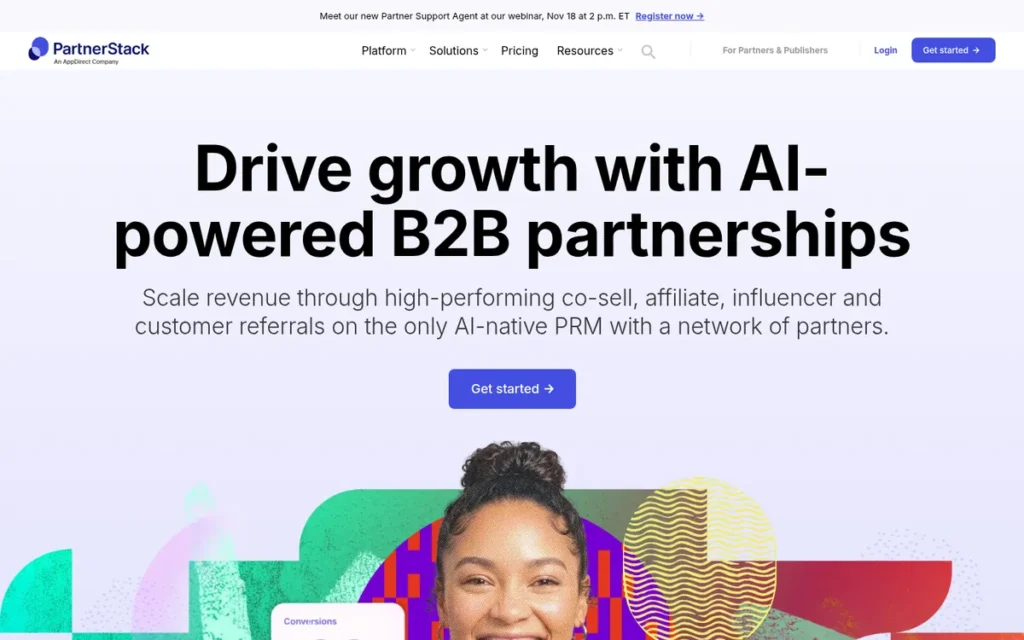
PartnerStack is a B2B SaaS partner management platform for affiliate, referral, reseller, agency and co-sell programs. It pays commissions on leads, renewals and expansion revenue in 100+ currencies and includes a partner marketplace. PartnerStack holds a 4.7/5 G2 rating from 953 reviews but publishes no prices.
PartnerStack scored 3.53/5, third overall. PartnerStack ties Tapfiliate for the top integration score (4.5), but its pricing-transparency score (1.5) is the lowest in the set.
Key Features
- PartnerStack supports affiliate, referral, reseller, agency, co-sell and deal-registration programs in one platform.
- PartnerStack triggers commissions on events such as leads, subscriptions, renewals and expansion revenue.
- PartnerStack integrates with Stripe, Chargebee, Recurly, HubSpot, Salesforce, PayPal and Zapier.
- PartnerStack pays partners globally in 100+ currencies and handles tax and VAT.
- PartnerStack runs a two-sided marketplace and Partner Hub, which third parties put at about 131,000+ partners.
Best For
PartnerStack is best for B2B SaaS companies with budget for an annual contract that want to recruit and manage resellers, agencies and affiliates through CRM-connected workflows.
Pricing
PartnerStack confirms pricing only through a demo (PartnerStack, November 2026):
- Official: PartnerStack requires a demo and publishes no prices.
- Third-party estimate: PartnerStack’s annual base fee is estimated at about $12,000–$19,000, plus a reported 3–15% of partner payouts (Toolradar, November 2026).
- Competitor-reported data point: AddSearch reported paying PartnerStack $18,000/year in a case study published by competitor Rewardful (Rewardful, November 2026).
- Stale listing: PartnerStack’s Capterra figure of $29.99/user/month conflicts with its sales-led model and is likely outdated.
Strengths
- PartnerStack holds a 4.7/5 G2 rating across 953 reviews and a 4.8/5 Capterra rating across about 91 reviews (G2 and Capterra, November 2026). Its G2 sample is the second-largest in this ranking.
- PartnerStack’s Stripe Marketplace app creates partner payments directly from Stripe data with no API keys or webhooks (Stripe Marketplace, November 2026).
- PartnerStack pays partners in 100+ currencies with tax and VAT handling (Capterra and HubSpot Marketplace, November 2026), the most complete documented payout and tax support in this ranking.
- PartnerStack supports reseller, co-sell and deal-registration workflows that PlugRoute did not find documented for the affiliate-focused tools in this ranking (PartnerStack, November 2026).
Limitations
PartnerStack trades cost visibility for B2B channel depth. Its reported annual contracts and the ~$18,000/year data point are likely too much for early-stage teams that only need link tracking.
- PartnerStack reviewers report that commission payments “can take too long,” data updates are slow and reporting customization is limited (G2, November 2026).
- PartnerStack reviewers also report partner applications left pending without a response-time commitment (G2, November 2026).
- PartnerStack’s marketplace size and named-customer results could not be independently confirmed, and PlugRoute found no Reddit discussion of PartnerStack.
Verdict
PartnerStack is the strongest B2B SaaS partner-channel platform in PlugRoute’s November 2026 ranking for companies that need resellers, agencies and co-selling alongside affiliates. PartnerStack’s native Stripe and CRM integrations, global payouts and 953-review G2 rating are well documented.
PartnerStack’s quote-only, annual-contract pricing makes it hard to compare. It is also likely more than teams need if they only want affiliate link tracking.
4. Rewardful: Best for Fast Launch on Stripe or Paddle
Category: SaaS Billing-Synced Tracker, affiliate software whose commissions are driven by subscription billing events.
At a Glance
- Category: SaaS Billing-Synced Tracker
- Best For: Early-stage and growing SaaS companies billing through Stripe or Paddle
- Price Range: Starter $49/month (to $7,500 affiliate revenue); Growth $99/month (to $15,000); 0% transaction fee
- Primary Strength: Rewardful pairs a 4.5/5 G2 rating from 86 reviews, the larger G2 sample of the two SaaS Billing-Synced Trackers, with a two-way Stripe sync that reviewers say launches in hours.
- Biggest Limitation: Rewardful supports only Stripe and Paddle billing and has no marketplace for recruiting affiliates.
- One-Line Summary: Rewardful is a Stripe-first SaaS affiliate tool with two-way billing sync, recurring commissions and automatic refund handling, best for subscription companies that want to launch quickly on Stripe or Paddle.
- Last Verified: November 2026
Overview
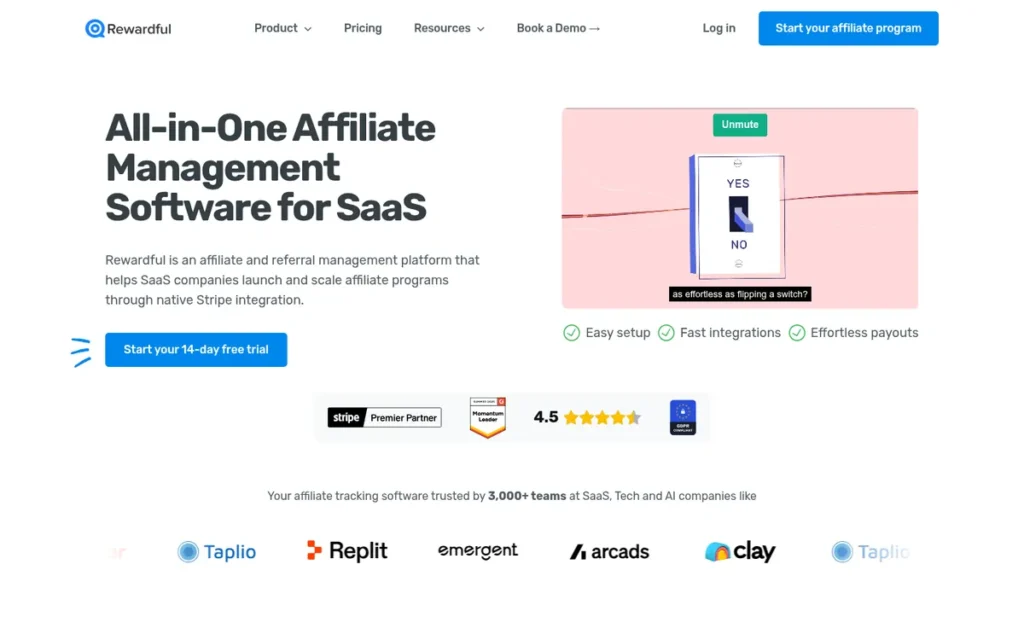
Rewardful is a Stripe-first affiliate and referral tool for subscription SaaS companies. It syncs customers, subscriptions, refunds and commissions two ways with Stripe and also supports Paddle. Plans start at $49/month with a 0% transaction fee. Rewardful reviewers on G2 report setup in about three hours.
Rewardful scored 3.40/5, fourth overall and 0.13 behind PartnerStack. Rewardful has strong sentiment and confirmed pricing, but narrow billing coverage and no marketplace.
Key Features
- Rewardful syncs customers, subscriptions, refunds and commissions two ways with Stripe.
- Rewardful supports recurring commissions and coupon-based attribution.
- Rewardful detects self-referral fraud and adjusts commissions automatically on refunds.
- Rewardful uses last-touch attribution and allows unlimited affiliates.
- Rewardful supports mass payouts through PayPal and Wise.
Best For
Rewardful is best for SaaS founders billing through Stripe or Paddle who want a recurring-commission program running quickly, with affiliates they recruit themselves.
Pricing
Rewardful publishes two self-serve plans (Rewardful, November 2026):
- Starter: Rewardful Starter costs $49/month ($490/year) for up to $7,500 in monthly affiliate revenue.
- Growth: Rewardful Growth costs $99/month ($990/year) for up to $15,000 in monthly affiliate revenue.
- Fees and trial: Rewardful charges a 0% transaction fee and offers a 14-day free trial.
- Payout fee: Rewardful charges 3% on optional ACH payouts, and PayPal or Wise fees may apply separately.
Rewardful does not publish the price of plans above Growth’s $15,000 cap.
Strengths
- Rewardful holds a 4.5/5 G2 rating across 86 reviews (G2, November 2026), more than double FirstPromoter’s 37-review G2 sample.
- Rewardful reviewers report going from account creation to a live affiliate program in about three hours (G2, November 2026).
- Rewardful’s vendor-published AddSearch case study reports about a 90% cut in software cost after moving from PartnerStack ($18,000/year) to Rewardful Growth ($99/month) (Rewardful, November 2026).
- Rewardful’s vendor-published Aragon case study reports 2,000 affiliates and $1M in revenue (Rewardful, November 2026).
This aligns with community sentiment on r/SaaS:
“a friend of mine was launching a SaaS product back in 2022 and used Rewardful to launch an affiliate program. The team helped him set up the program and pick the right commission rates. He’s been very positive about them.” Posted by u/jay_cobski
Takeaway: Rewardful’s hands-on launch support is a real draw for first-time SaaS founders setting up commission structures.
Limitations
Rewardful trades breadth for setup speed. Rewardful supports only Stripe and Paddle and has no marketplace, and reviewers say finding affiliates is harder than on PartnerStack (G2, November 2026).
- Rewardful reviewers report sending monthly PayPal payouts manually and struggling to find and remove spam affiliates (G2, November 2026).
- Rewardful offers limited portal customization and reporting, according to reviewers (G2, November 2026).
- Rewardful’s CEO has described a shift toward sales-led growth and enterprise customers (r/GrowthHacking, 2025), which may signal future pricing changes.
Verdict
Rewardful has the most documented fast-setup reports of any SaaS affiliate tool in PlugRoute’s November 2026 ranking, which makes it a sensible starting point for companies billing through Stripe or Paddle. Rewardful pairs a two-way Stripe sync with a 0% transaction fee and a 4.5/5 G2 rating.
Teams on other billing systems, or teams that need marketplace recruitment, should compare Rewardful with FirstPromoter or PartnerStack.
5. Tapfiliate: Best for Mixed SaaS + Ecommerce and International Programs
Category: Cross-Platform Affiliate Tracker, hosted affiliate tracking that connects to many sales platforms, for brands that recruit their own affiliates.
At a Glance
- Category: Cross-Platform Affiliate Tracker
- Best For: Businesses selling across several platforms or countries, or mixing SaaS and ecommerce revenue
- Price Range: Launch $89/month ($74 billed annually); Scale $179/month ($149 annually); flat fee plus conversion overage; no sales percentage
- Primary Strength: Tapfiliate offers the broadest integration list and tracking-method choice in this ranking, with a flat fee and no percentage of sales.
- Biggest Limitation: Tapfiliate’s Launch plan allows 50 affiliates and charges overage above 500 conversions, and Tapfiliate has no marketplace for finding new affiliates.
- One-Line Summary: Tapfiliate is a hosted affiliate tracker with 30+ integrations and flat-fee pricing, best for businesses that sell across several platforms or currencies and recruit their own affiliates.
- Last Verified: November 2026
Overview
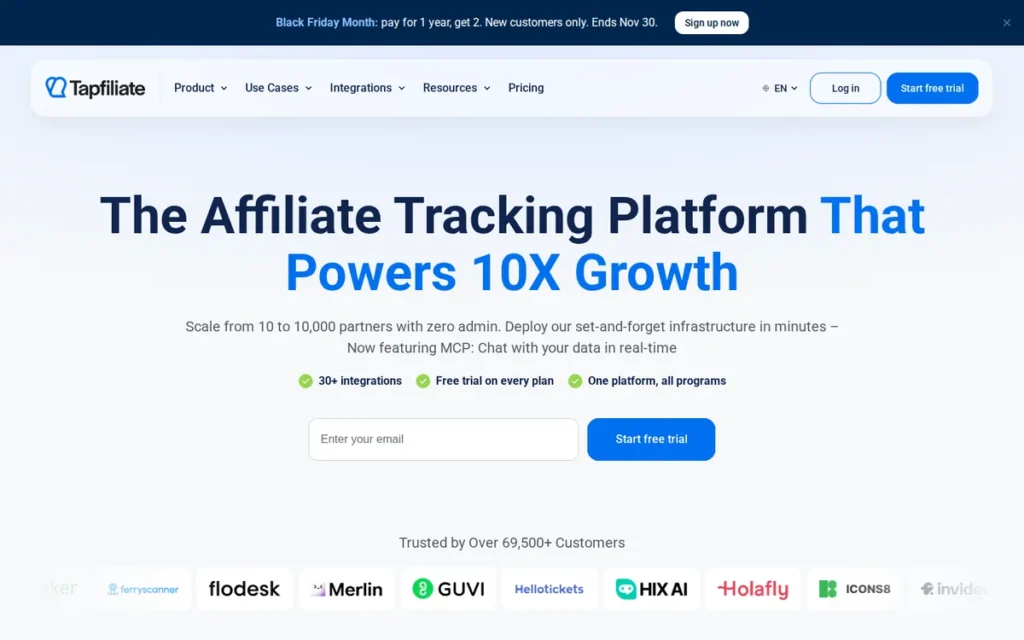
Tapfiliate is a hosted affiliate and referral tracker that connects to 30+ platforms, including Shopify, WooCommerce, Stripe, Paddle and Chargebee. It charges a flat monthly fee with no percentage of sales, starting at $89/month ($74 billed annually). Tapfiliate suits multi-platform sellers that recruit their own affiliates.
Tapfiliate scored 3.28/5, tied with FirstPromoter and Refersion. Tapfiliate, founded in Amsterdam in 2014, has been owned by Admitad since 2021 (Admitad, 2021).
Key Features
- Tapfiliate integrates with 30+ platforms, including Shopify, WooCommerce, Stripe, Paddle, Chargebee, Wix, Squarespace, WordPress, HubSpot and Zapier.
- Tapfiliate supports JS pixel, API, server-to-server/postback and webhook tracking.
- Tapfiliate offers fixed, recurring, lifetime and multi-level commission structures.
- Tapfiliate provides branded affiliate portals on your own domain in several currencies and languages.
- Tapfiliate supports PayPal payouts and custom automation through Triggers and its API.
Best For
Tapfiliate is best for businesses that combine SaaS and ecommerce revenue, sell internationally, or prefer a predictable flat fee over percent-of-sales pricing.
Pricing
Tapfiliate publishes two self-serve plans (Tapfiliate, November 2026):
- Launch: Tapfiliate Launch costs $89/month billed monthly or $74/month billed annually.
- Launch allowances: Tapfiliate Launch includes 50 affiliates, 1 program, 5,000 clicks and 500 conversions per month, plus $15 per 1,000 extra conversions.
- Scale: Tapfiliate Scale costs $179/month or $149/month billed annually and includes 10,000 conversions and 100,000 clicks, plus $10 per 1,000 extra conversions.
- Fees and trial: Tapfiliate charges no percentage of sales and offers a free trial (length unconfirmed).
Some listings show Tapfiliate at $74 and $149. Those are the annual-billing prices, not a pricing conflict.
Strengths
- Tapfiliate documents 30+ native integrations and several tracking methods (Capterra, November 2026), the broadest platform coverage in this ranking.
- Tapfiliate holds a 4.5/5 Capterra rating from 66 reviews and a 4.3/5 G2 rating from 57 reviews (Capterra and G2, November 2026), and the two mid-sized samples agree.
- Tapfiliate charges no percentage of affiliate sales, which reviewers name as a value advantage (Capterra, November 2026).
- Tapfiliate supports recurring, lifetime and multi-level commissions with payouts in several currencies, which suits international programs (G2, November 2026).
Limitations
Tapfiliate trades partner discovery for broad, flat-priced tracking. Tapfiliate has no marketplace, and its Launch plan allows only 50 affiliates before an upgrade is needed.
- Tapfiliate reviewers report poor value for money, tracking code that is harder to install than expected, API changes that broke setups, and slow support (Capterra, November 2026).
- Tapfiliate reviewers cite “insufficient scam filters,” limited report customization, and payout thresholds that are set per currency and not combined (G2, November 2026).
- Tapfiliate has no quantified case studies, and the only Reddit endorsement found came from a self-disclosed affiliate (r/SaaS, 2021).
Verdict
Tapfiliate is the broadest-integration affiliate tracker in PlugRoute’s November 2026 ranking and the strongest fit for businesses selling across several platforms or currencies. Tapfiliate’s flat fee avoids percent-of-sales costs, and its overage pricing is modest.
Tapfiliate’s 50-affiliate Launch limit and lack of a marketplace still limit growth. Check the allowances against your expected volume before buying.
6. FirstPromoter: Best for SaaS on Multiple or Complex Billing Systems
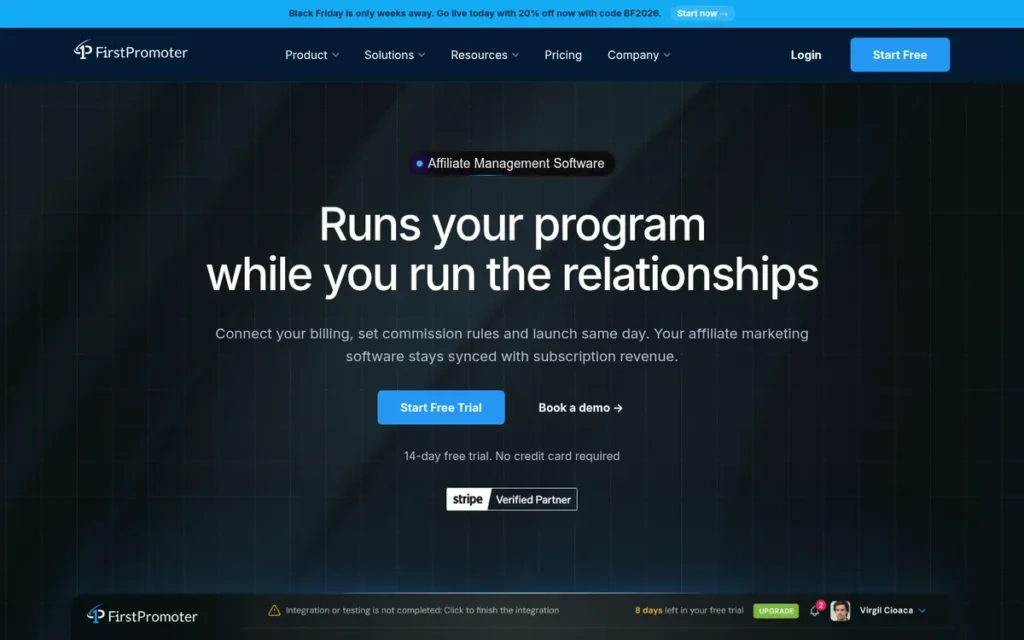
Category: SaaS Billing-Synced Tracker.
At a Glance
- Category: SaaS Billing-Synced Tracker
- Best For: Subscription SaaS companies on Chargebee, Recurly, Braintree, Stripe or Paddle that need flexible commission rules
- Price Range: From $49/month (Starter) to from $149/month (Enterprise), tiered by monthly affiliate revenue; about 17% off annually
- Primary Strength: FirstPromoter supports more SaaS billing systems than any other tool in this ranking, with public pricing tiered by affiliate revenue.
- Biggest Limitation: FirstPromoter has no affiliate marketplace, so brands must recruit every affiliate themselves.
- One-Line Summary: FirstPromoter is a SaaS affiliate and referral platform that drives commissions from billing data across five billing systems, best for subscription companies with complex billing or commission rules.
- Last Verified: November 2026
Overview
FirstPromoter is a SaaS affiliate, referral and reseller platform that adjusts commissions automatically on renewals, upgrades, refunds and cancellations. It works across five billing systems: Stripe, Paddle, Chargebee, Recurly and Braintree. FirstPromoter’s pricing starts at $49/month, tiered by affiliate-generated revenue, and it suits subscription companies rather than ecommerce stores.
FirstPromoter scored 3.28/5, tied with Tapfiliate and Refersion. FirstPromoter has strong billing coverage but no marketplace and little evidence of customer results.
Key Features
- FirstPromoter adjusts commissions automatically when subscriptions renew, upgrade, refund or cancel.
- FirstPromoter integrates with Stripe, Paddle, Chargebee, Recurly and Braintree for billing-event tracking.
- FirstPromoter supports up to three commission tiers and rewards set by plan or product.
- FirstPromoter lets teams run several programs on one billing integration.
- FirstPromoter offers an API, custom roles, a branded portal on a custom domain, and CSS/JS customization.
Best For
FirstPromoter is best for SaaS companies billing through Chargebee, Recurly or Braintree. It also suits companies that need multi-tier or plan-specific commissions that simpler Stripe-only tools do not handle.
Pricing
FirstPromoter publishes three plans tiered by affiliate revenue (FirstPromoter, November 2026):
- Starter: FirstPromoter Starter costs $49/month ($490/year) for up to $5,000 in monthly affiliate revenue, with up to 1,000 affiliates and three campaigns.
- Business: FirstPromoter Business costs $99/month ($990/year) for up to $15,000 in monthly affiliate revenue.
- Enterprise: FirstPromoter Enterprise starts from $149/month above $15,000 in monthly affiliate revenue.
- Fees and trial: FirstPromoter’s pricing page does not state a transaction-fee policy, so confirm before purchase. A free trial exists (length unconfirmed).
FirstPromoter bases its tiers on affiliate-generated revenue, not your company’s total revenue.
Strengths
- FirstPromoter supports five billing systems compared with Rewardful’s two (Rewardful and FirstPromoter comparison pages, November 2026), the widest SaaS billing coverage in this ranking.
- FirstPromoter publishes three affiliate-revenue tiers whose prices matched across every source checked (FirstPromoter, November 2026).
- FirstPromoter holds a 4.6/5 G2 rating from 37 reviews and a 4.6/5 Trustpilot rating (G2 and Trustpilot, November 2026). Its 4.9/5 Capterra score comes from only 7 reviews.
- FirstPromoter’s commission engine follows billing events, which reduces manual corrections to recurring commissions (FirstPromoter, November 2026).
Limitations
FirstPromoter trades partner discovery for billing flexibility. FirstPromoter has no affiliate marketplace, so every partner must be recruited directly.
- FirstPromoter fits ecommerce stores poorly because it is built around subscription billing (Capterra, November 2026).
- FirstPromoter’s extra configuration options suggest more setup work than Stripe-first tools, based on vendor comparisons rather than a published usability score.
- FirstPromoter has no confirmed named case studies, and its Starter plan limits programs to three campaigns. One reviewer called the price “a bit high” (Capterra, November 2026).
Verdict
FirstPromoter is the best-fit affiliate software in PlugRoute’s November 2026 ranking for SaaS companies on multiple or non-Stripe billing systems. FirstPromoter pairs the widest billing-integration coverage with public pricing based on affiliate revenue.
Teams that need help finding affiliates, or that sell physical products, should consider tools with a marketplace or an ecommerce focus instead of FirstPromoter.
7. Refersion: Best for Multi-Platform DTC Ecommerce Brands
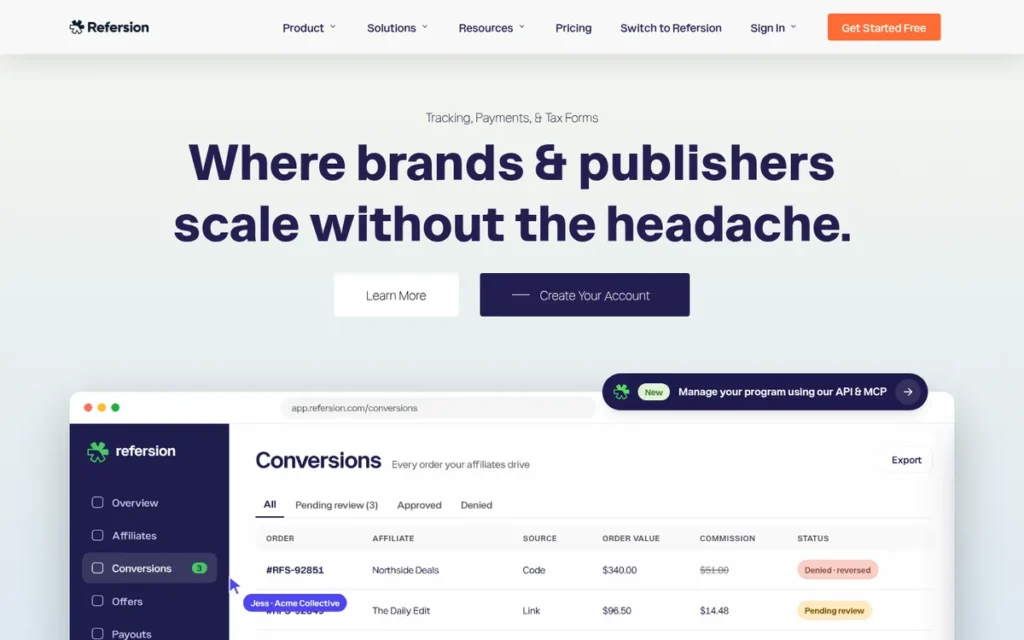
Category: Ecommerce Affiliate App.
At a Glance
- Category: Ecommerce Affiliate App
- Best For: Established DTC brands selling on Shopify, BigCommerce, WooCommerce or Magento that want fine-grained commission rules
- Price Range: Launch $39/month ($29 annually) + 3% of affiliate sales; Growth $199/month ($159 annually) + 2%; enterprise custom
- Primary Strength: Refersion covers more ecommerce platforms than the other Ecommerce Affiliate App in this ranking and uses first-party tracking on the merchant’s own domain.
- Biggest Limitation: Refersion has the lowest G2 score in this ranking (3.6/5 from 22 reviews) and charges a 3% fee on its Launch plan.
- One-Line Summary: Refersion is an ecommerce affiliate and influencer platform with first-party tracking across Shopify, BigCommerce, WooCommerce and Magento, best for multi-platform DTC brands that need product-level commission rules.
- Last Verified: November 2026
Overview
Refersion is a Pantastic-owned ecommerce affiliate, influencer and ambassador platform for DTC brands on Shopify, BigCommerce, WooCommerce, Magento or Stripe. It offers first-party domain tracking, product-level commissions and a marketplace listing for recruiting partners. Refersion’s Launch plan costs $39/month plus 3% of affiliate sales.
Refersion scored 3.28/5, tied with Tapfiliate and FirstPromoter. Refersion is owned by Pantastic (Refersion, November 2026).
Key Features
- Refersion integrates with Shopify, BigCommerce, WooCommerce, Magento and Stripe.
- Refersion tracks referrals through a merchant-controlled domain to reduce losses from cookie restrictions.
- Refersion supports coupon and link attribution, with commissions set by product and by new versus returning customer.
- Refersion offers unlimited affiliates, clicks and conversions on its Launch plan, with one-click PayPal payouts.
- Refersion includes a Refersion Marketplace listing and partner recommendations for recruiting affiliates.
Best For
Refersion is best for established DTC brands selling on more than one ecommerce platform. It suits brands that need product-level or customer-type commission rules plus access to a partner marketplace.
Pricing
Refersion publishes two self-serve plans and a custom tier (Refersion, November 2026):
- Launch: Refersion Launch costs $39/month ($29/month billed annually) plus 3% of affiliate-driven sales (Refersion and Shopify App Store, November 2026).
- Growth: Refersion Growth costs $199/month ($159/month billed annually) plus 2% of affiliate-driven sales.
- Business: Refersion prices its Business tier on request.
- Older pricing: An older Refersion blog post lists Growth at $129, Scale at $599 + 1% and a 0%-fee option up to $1M GMV. These figures appear to be superseded.
Refersion Growth becomes cheaper than Launch above about $16,000/month in affiliate sales.
Strengths
- Refersion holds a 4.8 rating across about 460 Shopify App Store reviews (Shopify App Store, November 2026).
- Refersion supports five ecommerce and payment platforms (G2 and Refersion, November 2026), the widest store-platform coverage among the Ecommerce Affiliate Apps.
- Refersion’s Launch plan includes unlimited affiliates, clicks and conversions, so it avoids the usage allowances on some flat-fee rivals (Refersion, November 2026).
- A Refersion user with about six years on the platform reports that it remains easy to use and values its click metrics (G2, November 2026).
Limitations
Refersion trades a low entry price for percent-of-sales costs and mixed reviews. The 3% Launch fee adds up at volume, and Refersion’s 3.6/5 G2 score from 22 reviews is the lowest in this ranking (G2, November 2026).
- Refersion reviewers call it expensive for the features, unintuitive and slow to configure (G2 and Shopify App Store, November 2026).
- Refersion reviewers also report few payment options, specific reports that require contacting support, and W-9s that must be monitored manually (G2 and Shopify App Store, November 2026).
- Refersion has no quantified case studies. Its founding year is usually given as 2015, though one third-party source dates its Shopify programs to 2013.
Verdict
Refersion covers the most ecommerce platforms of any affiliate tool in PlugRoute’s November 2026 ranking and is a reasonable fit for DTC brands selling across Shopify, BigCommerce, WooCommerce or Magento. Refersion’s first-party tracking and uncapped entry plan are real advantages.
Refersion’s lowest-in-set G2 score and 3% entry fee mean buyers should model costs at their volume and get current pricing in writing.
What Does Affiliate Marketing Software Really Cost at Your Volume?
Affiliate software cost depends on your monthly affiliate sales. Percent-of-sales tools such as UpPromote, Refersion and impact.com Starter cost little at low volume. Revenue-tiered or flat tools such as FirstPromoter, Rewardful and Tapfiliate cost less per dollar as volume grows. At $10,000/month in affiliate sales, published list prices range from about $74 to $339.
The table below uses these assumptions:
- The table uses list monthly prices as of November 2026 and shows the cheapest qualifying tier for each tool.
- The table excludes payout-provider, FX and tax-service fees.
- The table treats affiliate sales as the revenue that impact.com Starter’s 2.5% fee applies to.
- The table shows PartnerStack, which is quote-only, with its labelled data points only.
| Tool | $5K/month | $10K/month | $25K/month | $50K/month |
|---|---|---|---|---|
| UpPromote | $0 (Free; no auto-payouts or marketplace) / ~$130 (Growth) | ~$230 (Growth) | ~$450 (Enterprise) | ~$700 (Enterprise) |
| Refersion | ~$189 (Launch) | ~$339 (Launch) | ~$699 (Growth) | ~$1,199 (Growth) |
| impact.com Starter | ~$155 | ~$280 | ~$655 | ~$1,280 |
| impact.com Essentials | $500* | $500* | $500* | $500* |
| FirstPromoter | $49 (Starter) | $99 (Business) | From $149 (Enterprise) | From $149 (Enterprise) |
| Rewardful | $49 (Starter) | $99 (Growth) | Above Growth’s $15K cap; price not published | Above Growth’s $15K cap; price not published |
| Tapfiliate | $74–$89 (Launch) | $74–$89 + $15 per 1,000 conversions above 500 | $74–$89 + overage, or Scale $149–$179 | Scale $149–$179 if you need more than 50 affiliates |
| PartnerStack | Quote (~$18,000/year competitor-reported; ~$12K–$19K/year + 3–15% of payouts, third-party estimate) | Quote | Quote | Quote |
*impact.com Essentials covers up to $2,500/month in partner payouts. Larger programs are quoted.
To use this table, find your current monthly affiliate sales, then read across to the column at about 3× that figure. The cheapest tool in that column is the one that will still fit as you grow.
The crossover points matter:
- UpPromote Professional becomes cheaper than Growth above about $12,000/month in affiliate sales.
- UpPromote Enterprise becomes cheaper than Professional above about $22,000/month.
- Refersion Growth becomes cheaper than Launch above about $16,000/month.
- impact.com Starter’s 2.5% fee alone costs more than the Essentials platform fee above about $18,800/month.
Neither fee model is better for everyone. Flat and revenue-tiered tools get cheaper per dollar as volume grows, while percent-of-sales tools cost little upfront.
A percent-of-sales fee works like a loan against your own success. It is cheap while the program is small and often becomes the largest line item once the program works.
One r/shopify commenter called per-transaction fees “a joke” (r/shopify, November 2026). An r/SaaS founder said they preferred “higher transaction fees over higher base price” (r/SaaS, 2021).
Takeaway: Fee-model preference splits by business type, so model both before choosing.
What Red Flags Should I Watch For When Evaluating Affiliate Marketing Software?
The biggest red flags are hidden cost structures, usage allowances that trigger overages or upgrades, attribution gaps on refunds and coupons, and evidence that looks independent but isn’t. Each red flag below is named and numbered so you can check any vendor against it before signing.
Red Flag #1: Percent-of-Sales Fees Hidden Behind a Low Subscription A low monthly price can hide a 1–3% fee on every affiliate sale, and that fee grows with your program. For example, impact.com Starter’s 2.5% fee costs more than its $500 Essentials plan above about $18,800/month in revenue (impact.com, November 2026).
Red Flag #2: Usage Allowances That Trigger Overages or Upgrades Entry plans that limit affiliates, conversions or affiliate revenue can add overage fees or force a mid-year upgrade. Tapfiliate Launch charges $15 per 1,000 conversions above 500, and Rewardful Starter caps affiliate revenue at $7,500 per month (Tapfiliate and Rewardful, November 2026).
Red Flag #3: Demo-Only Pricing With Annual Lock-In Quote-only pricing and annual contracts block side-by-side comparison and make switching expensive. Before a demo, ask for written pricing that covers onboarding fees, add-ons, payout-percentage fees and renewal rates.
Red Flag #4: Refund and Multi-Affiliate Clawback Gaps Commission logic can fail when an order is refunded, credited to several affiliates, or claimed by both a coupon and a link. Reviewers documented these failures for UpPromote (Shopify App Store, November 2026), and PlugRoute did not independently verify cross-device tracking for any tool.
Red Flag #5: Manual Payouts and Unclear Tax-Form Ownership Some tools still require manual payout steps, or only export data instead of collecting W-9, W-8BEN or 1099-NEC forms. Rewardful reviewers report manual PayPal payouts, and Refersion reviewers report monitoring W-9s manually (G2, November 2026).
Red Flag #6: Ratings Without Review Counts A rating without a review count is an anecdote with a decimal point. Rewardful’s Capterra 5.0 comes from 4 reviews and FirstPromoter’s 4.9 from 7, while impact.com’s G2 4.4 comes from 2,811 reviews (Capterra and G2, November 2026).
Red Flag #7: Vendor-Written “Independent” Comparisons Many affiliate software comparisons are published by competing vendors, and some Reddit recommendations come from founders or affiliates. In this research, a Rewardful co-founder and a self-disclosed Tapfiliate affiliate both posted recommendations (r/SaaS, 2021).
What Questions Should I Ask Before Choosing Affiliate Marketing Software?
Before choosing, ask how the software integrates with your checkout or billing system, what it costs at higher volume and whether it recruits affiliates. Also ask how it handles refunds and attribution conflicts, who handles tax forms and what contract terms apply. These seven questions surface most of the problems reviewers report after purchase.
Question #1: Does it integrate natively with my checkout or billing system, and is the sync two-way or one-way? A two-way sync updates commissions automatically when customers, subscriptions or refunds change. Ask for documentation of the specific integration, not just a logo on a partner page.
Question #2: What will I pay in total at 3× and 10× my current affiliate revenue? Ask the vendor to calculate the subscription, percent-of-sales fees, overages and tier jumps at both volumes. A good answer includes the exact threshold where you would move to the next plan.
Question #3: Does it help me find new affiliates, or only manage existing ones? Among the seven ranked tools, impact.com (Essentials and above), PartnerStack, UpPromote (paid plans) and Refersion offer marketplaces for recruitment. FirstPromoter, Rewardful and Tapfiliate assume you bring your own affiliates.
Question #4: How are commissions adjusted on upgrades, refunds and cancellations? Recurring programs need commission logic that follows billing events automatically. Run a test purchase and a test refund during the trial to confirm that commissions are clawed back correctly.
Question #5: Who collects and files W-9 and 1099 forms, and who is the payer of record? Some tools file the forms, while others only export data for your finance team. Confirm how payouts work across currencies and whether payout thresholds are combined or set per currency.
Question #6: What happens when a coupon and a link both claim the same order? The attribution rule decides which affiliate gets paid. Test a coupon-versus-link conflict during the trial and ask whether rules can be configured per product.
Question #7: What onboarding fees, contract length and renewal pricing apply? One impact.com reviewer reported extra onboarding charges (Capterra, November 2026), and PartnerStack reportedly uses annual contracts. Get renewal pricing in writing, because promotional rates may not carry over.
Pre-Purchase Trial Test Checklist
Before you pay, run these three tests during any free trial, and check which affiliate is credited and whether the commission reverses:
- Your first test should be a purchase through an affiliate link.
- Your second test should be a full refund of that purchase.
- Your third test should be one order where a coupon and a different affiliate’s link both apply.
How Do I Know My Affiliate Program Has Outgrown Its Software?
Your program has likely outgrown its software when spreadsheets handle approvals, refunds or payouts, or when you manage hundreds of affiliates across currencies. Other signs are commission rules the tool cannot express and a finance team that needs tax-form workflows. At that point, platform depth matters more than entry price.
Watch for these signs:
- Your team uses spreadsheets for affiliate approvals, refund adjustments or payouts.
- Your program has hundreds of affiliates or pays out in several currencies.
- Your commission rules need to vary by product, customer type or subscription event.
- Your program has recurring coupon leakage or affiliate fraud.
- Your finance team needs W-9/1099 workflows and audit trails.
- Your growth plan requires recruiting new partners rather than tracking existing ones.
Tracking reliability is a widespread concern on the partner side. More than half of respondents in the APMA Voice of the Nation survey cited unreliable tracking, and more than a third cited slow payments (APMA, 2025).
As one user on r/Affiliatemarketing described:
“If I can’t trust the numbers, I don’t care how pretty the dashboard is or how many “partner discovery” bells and whistles it has. I’d rather have a boring UI that I know isn’t shaving conversions.” Posted by u/SultrySpankDear
Takeaway: For affiliate partners, accurate tracking matters more than marketplace features or dashboard polish when deciding which affiliate software programs to work with.
The stakes are rising. US affiliate spend reached $12.42B in 2025, up 11.3% year over year (Shopify, 2025). The broader affiliate marketing platform market is estimated at $23.8B in 2026 (Grand View Research, 2026).
How Did We Rank These Affiliate Marketing Software Tools?
PlugRoute scored all seven tools from 1 to 5 on six weighted criteria using identical desk research: the same Perplexity, Reddit and review-platform queries for every tool. Sources were accessed in November 2026, and prices and ratings were re-checked on November 5, 2026. No hands-on testing was performed. Vendor-funded evidence was labelled and discounted.
PlugRoute has no affiliate relationships with any company listed, and rankings are determined entirely by research data and objective evaluation criteria.
The six criteria and their weights are:
- C1: Integration and Platform-Fit Depth (25%): A tool that doesn’t connect natively to your storefront or billing system is a poor choice at any price.
- C2: Verified User Sentiment, Adjusted for Review Volume (20%): Ratings were weighted by review count, samples under 10 reviews counted only as minor evidence, and vendor-connected Reddit posts were excluded.
- C3: Pricing Transparency and Total-Cost Predictability (20%): Buyers need public, consistent pricing to judge total cost. Quote-only pricing affected this criterion only.
- C4: Partner Discovery (10%): Marketplaces help brands recruit affiliates rather than only manage existing ones.
- C5: Commission, Payout and Attribution Operations (15%): Recurring commissions, refunds, payouts, tax forms and fraud controls create most of the ongoing work, and they are the problems reviewers report most often after purchase.
- C6: Evidence Quality of Documented Results (10%): Named, quantified case studies scored above anonymous testimonials, and vendor-funded studies were discounted.
| Tool | C1 (25%) | C2 (20%) | C3 (20%) | C4 (10%) | C5 (15%) | C6 (10%) | Weighted |
|---|---|---|---|---|---|---|---|
| UpPromote | 3.5 | 5.0 | 4.5 | 3.5 | 3.0 | 3.5 | 3.93 |
| impact.com | 3.5 | 4.5 | 3.0 | 5.0 | 4.0 | 3.0 | 3.78 |
| PartnerStack | 4.5 | 4.5 | 1.5 | 4.0 | 4.0 | 2.0 | 3.53 |
| Rewardful | 3.5 | 4.0 | 4.0 | 1.0 | 3.5 | 3.0 | 3.40 |
| Tapfiliate | 4.5 | 3.5 | 3.5 | 1.0 | 3.0 | 2.0 | 3.28 |
| FirstPromoter | 4.0 | 3.5 | 4.0 | 1.0 | 3.5 | 1.5 | 3.28 |
| Refersion | 4.0 | 3.0 | 3.0 | 3.5 | 3.5 | 2.0 | 3.28 |
Score changes after the November 5, 2026 re-verification:
- UpPromote’s C2 rose from 4.5 to 5.0 after its Shopify App Store rating (4.9/5, about 3,924 reviews) was added.
- impact.com’s C3 rose from 2.0 to 3.0 after its published Starter and Essentials prices were confirmed.
- PartnerStack’s C2 rose from 3.5 to 4.5 after its G2 rating (4.7/5, 953 reviews) was confirmed.
- Rewardful’s C3 rose from 3.5 to 4.0 after its revenue caps, 0% fee, trial and annual prices were confirmed.
- FirstPromoter’s C3 fell from 4.5 to 4.0 because its Enterprise plan is listed “from $149” and its pricing page states no transaction-fee policy.
- Tapfiliate’s C3 rose from 3.0 to 3.5 and its C6 from 1.5 to 2.0 after its monthly/annual pricing, overage fees and Admitad ownership were confirmed.
- Refersion’s C3 rose from 2.5 to 3.0 and its C6 from 1.5 to 2.0 after its Growth tier and Pantastic ownership were confirmed.
Important caveats about these scores:
- The weighted scores sit close together (3.28–3.93), so below #2, fit to your segment matters more than rank position.
- Tapfiliate, FirstPromoter and Refersion tied at 3.28. The C2 tiebreaker placed Refersion last, and the C1 tiebreaker placed Tapfiliate (4.5) ahead of FirstPromoter (4.0).
- UpPromote stayed #1 under every single-criterion 0.5-point adjustment PlugRoute tested, while positions #3–#7 can change with adjustments of that size.
- PlugRoute resolved the earlier pricing conflicts for Rewardful and Tapfiliate on November 5, 2026, and shows Refersion’s older blog pricing as superseded.
- Undated vendor pages and Reddit threads are dated by the month they were accessed (November 2026).
- PlugRoute found no peer-reviewed studies of affiliate software in this research, and the only analyst study found (Forrester TEI) was commissioned by impact.com.
Which tools did we leave out? PlugRoute did not research the following nine tools to equal depth, so they are not ranked:
- Store-native apps: AffiliateWP, Shopify Collabs, GoAffPro and ReferralCandy were not researched to equal depth.
- SaaS-focused trackers: Tolt, Partnero and Trackdesk were not researched to equal depth.
- Networks and performance platforms: Awin and Everflow were not researched to equal depth.
The initial discovery search ranked Everflow at #3. PlugRoute replaced Everflow with Rewardful because Everflow mainly serves performance-marketing teams, while Rewardful better fits small-to-midsize SaaS readers.
What Do Buyers Most Often Ask About Affiliate Marketing Software?
Buyers most often ask which tool fits a small business, whether this software is for brands or for affiliates, and how PlugRoute builds its rankings. The short answers below use the same November 2026 data as the ranked entries, and each answer can be read on its own.
What is the best affiliate marketing software for a small business in 2026?
UpPromote is the best-scoring affiliate marketing software for small Shopify businesses in PlugRoute’s November 2026 ranking. UpPromote offers a free plan and holds 4.9/5 ratings on Capterra (217 reviews) and the Shopify App Store (about 3,924 reviews). Small SaaS businesses on Stripe or Paddle should compare Rewardful and FirstPromoter, both from $49/month.
Is this software for affiliates or for brands running a program?
This ranking covers software for brands that run their own affiliate, referral or partner programs. These tools track referrals, calculate commissions and pay partners. Publishers looking for offers to promote need affiliate networks or publisher tools instead. Marketplace platforms such as impact.com and PartnerStack connect brands with publishers.
How does PlugRoute determine rankings?
PlugRoute ranks tools with a weighted score across six published criteria: integration fit, volume-adjusted user sentiment, pricing transparency, partner discovery, payout operations and evidence quality. Each tool received identical desk research in November 2026. Every per-criterion score and score change is published, and vendor-funded evidence is labelled and discounted.
What Do Key Affiliate Marketing Software Terms Mean?
Percent-of-Sales Fee: A charge added on top of the monthly subscription, figured as a share (often 1 to 3%) of the referral sales your affiliates bring in. It costs little while a program is small, but it grows with your volume and can become the biggest part of your bill once the program works.
Revenue-Tiered Pricing: A pricing model where the plan you pay for depends on how much monthly revenue your affiliates generate, not your company’s total revenue. Check where each tier’s cap sits, because going past it can force an upgrade or put you on a plan whose price isn’t published.
Usage Allowance and Overage: Limits on an entry plan, such as a maximum number of affiliates, clicks or conversions. Going past them adds extra fees or requires a higher tier. Compare these allowances with your expected volume before you buy, because they can raise the cost of a flat-fee plan.
Partner Marketplace: A built-in directory where brands can find and recruit new affiliates, creators or partners, instead of only managing the ones they bring themselves. Some vendors include it only on paid or higher-priced plans, so confirm which plan unlocks it.
Two-Way Billing Sync: An integration that keeps customers, subscriptions, refunds and commissions matched in both directions between the affiliate tool and your billing system. It updates commissions automatically when billing changes, which cuts down on manual corrections. Ask for documentation of the specific integration, not just a logo.
Recurring Commission: A commission paid again each time a subscription customer renews, not just once on the first sale. Subscription businesses need commission logic that follows billing events like upgrades, refunds and cancellations so these payments stay accurate.
Clawback: Reversing or deducting a commission that was already credited when the order is refunded or canceled. Test a purchase and a full refund during any trial, because reviewers report clawbacks failing, especially when one order is credited to several affiliates.
Attribution: The rule that decides which affiliate gets credit, and therefore gets paid, for an order (for example, last-touch credit). Ask how the tool handles a coupon and a different affiliate’s link both claiming the same order, since coupons can override link credit.
Cookieless and First-Party Tracking: Ways of tracking referrals that don’t depend on third-party browser cookies, such as server-side, API-based or postback tracking, or tracking through the merchant’s own domain. These methods cut the conversions lost to browser cookie restrictions. That matters because affiliates value reliable tracking above dashboard features.
Multi-Level Commission: A commission structure that pays rewards across more than one tier, for example to an affiliate and to the person who recruited them. Tools differ in how many tiers they allow and whether rewards can be set per product or plan.
Payout Threshold: The minimum balance an affiliate must earn before getting paid. Some tools set thresholds separately for each currency instead of combining them, which affects international programs paying partners in several currencies.
W-9 and 1099 Forms: US tax forms used to collect affiliate tax details and report what affiliates were paid. Some tools collect and file these forms, while others only export data or need manual monitoring, so confirm who handles them and who is the payer of record.
Which Affiliate Marketing Software Is Right for You?
Key Insights
- No single affiliate marketing software tool is best for every business, and the seven weighted scores in this ranking fall within 0.65 points of each other.
- Choose affiliate software by your checkout or billing system first and by price second, because no discount makes up for a missing integration.
- Total cost depends on volume: percent-of-sales fees favor low-volume programs, while revenue-tiered and flat pricing favors high-volume ones.
- Among the seven ranked tools, impact.com (Essentials and above), PartnerStack, UpPromote (paid plans) and Refersion offer marketplaces for finding new affiliates.
- Refund clawbacks, coupon-versus-link conflicts and payouts should be tested during a trial, because reviewers report these failures most often after purchase.
Situational guidance:
- If you run a Shopify store, start with UpPromote, and compare Refersion if you also sell on BigCommerce, WooCommerce or Magento.
- If you run a Stripe-billed SaaS company, compare Rewardful for launch speed and FirstPromoter for billing flexibility.
- If you are building a B2B reseller or enterprise partner channel, request written quotes from PartnerStack and impact.com.
Affiliate software pricing and features change often. We update this guide quarterly. Last updated: November 5, 2026.
Read PlugRoute’s full methodology, or see our other independent reviews, including upcoming guides to SaaS billing tools, Shopify apps, and affiliate payouts and tax handling.