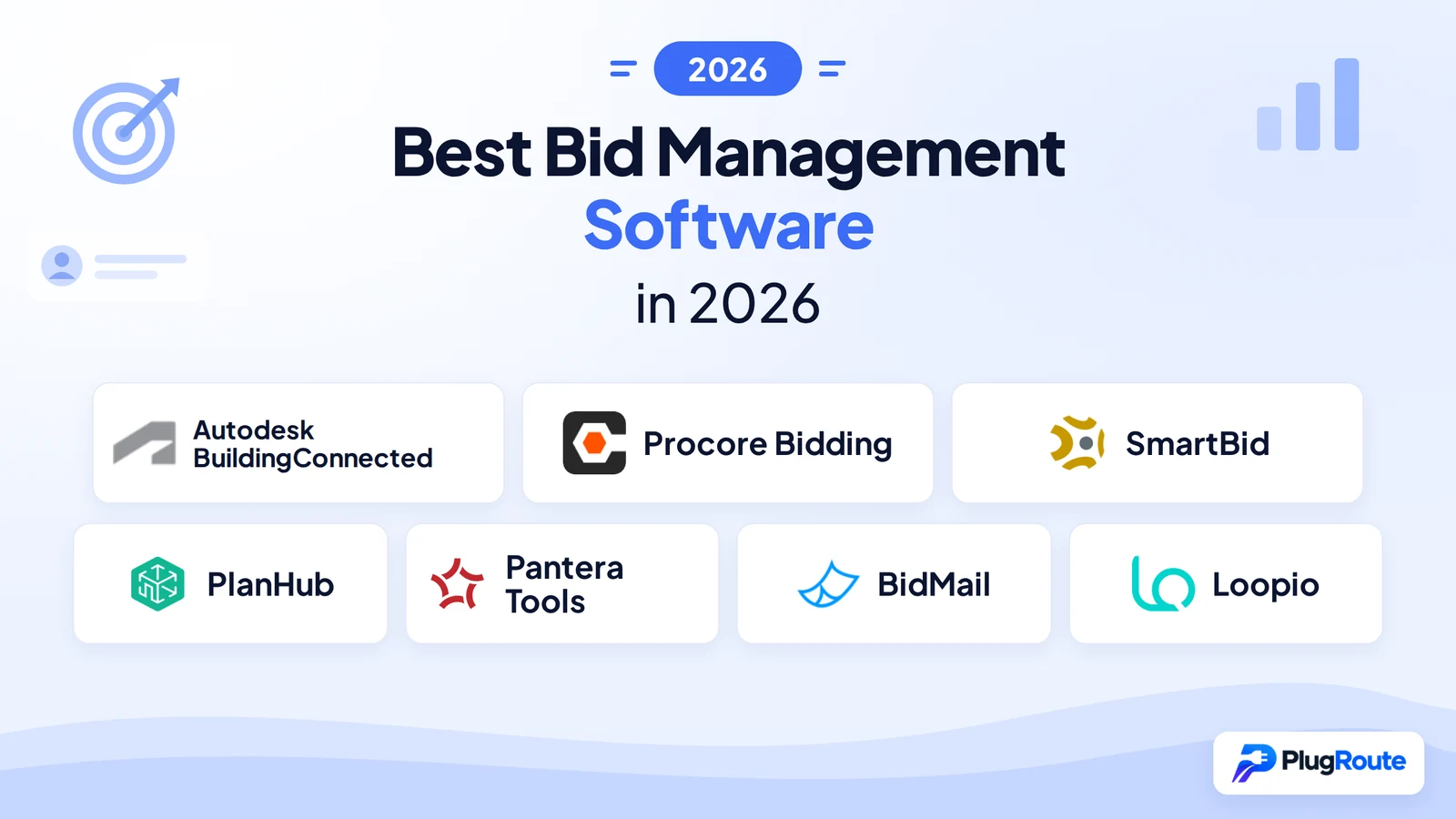
Autodesk BuildingConnected is the best overall bid management software for commercial general contractors. Procore Bidding is best for GCs already running projects in Procore, and SmartBid is best for GCs who want to own their subcontractor database. The right choice depends on your role and your real multi-year cost, not on feature checklists.
Many preconstruction teams still level subcontractor bids in spreadsheets and lose addenda in email. Many also budget against quote-only pricing that can rise at renewal. This guide ranks seven tools by role, evidence and total-cost risk, so you can build a shortlist and book demos with confidence.
As one user on r/Construction described:
“I feel like I don’t have the time to really work with the subcontractors and really qualify their bids. I would like to get back to that because I was learning much more but at this time I only have time to get the bid, quickly read over it and then say “yep good enough” and plug it in. Just waiting for it all to come back and bite me in the ass.” Posted by u/Ok_Class1219
Takeaway: Overloaded GC estimators often accept subcontractor bids with only a quick glance, which is the exact scope-gap risk bid management software is supposed to reduce.
PlugRoute has no affiliate relationships with any company listed, and rankings are determined entirely by research data and objective evaluation criteria.
This guide covers five tool categories, seven ranked products, a cost and integration comparison, red flags and demo questions. Jump to the part that matches your role.
What Are the 5 Categories of Bid Management Tools?
Bid management tools fall into five categories:
- Network Solicitors
- Integrated Platforms
- Private-Database Solicitors
- Lead Marketplaces
- RFP Responders
The first three serve general contractors who send invitations. Lead Marketplaces mainly serve subcontractors looking for projects. RFP Responders serve teams that answer bids rather than ask for them.
Here are the five categories and the products in each:
- Network Solicitor: A Network Solicitor is a GC-side bid tool built around a large shared subcontractor network. It handles invitations, coverage tracking and leveling. Autodesk BuildingConnected is the Network Solicitor in this ranking.
- Integrated Platform: An Integrated Platform puts the bidding module inside an all-in-one construction management system. It hands awards to budgets, contracts and project execution. Procore Bidding is the Integrated Platform in this ranking.
- Private-Database Solicitor: A Private-Database Solicitor is a GC-side bid tool built around the contractor’s own subcontractor list, data ownership and branded invitations. SmartBid, Pantera Tools and BidMail fall in this category.
- Lead Marketplace: A Lead Marketplace lets GCs post projects for free while subcontractors pay to find and bid on project leads. PlanHub is the Lead Marketplace in this ranking.
- RFP Responder: An RFP Responder is software for teams that answer RFPs and questionnaires, not for asking subcontractors to bid. Loopio is the RFP Responder in this ranking.
PlugRoute left out several tools that are often grouped with bid management:
- Dodge Construction Network is a project-intelligence and lead-generation service, not a bid management tool.
- ConstructConnect and iSqFt are project-lead and planroom databases from SmartBid’s parent company, so PlugRoute evaluated them through SmartBid.
- Bluebeam is PDF markup and takeoff software and does not send bid invitations.
- STACK is a takeoff tool. It appears here only as a SmartBid integration.
- Responsive overlaps with Loopio in RFP response, so Loopio represents that category.
Market researchers also disagree on where the category starts and ends:
- The Business Research Company estimates the construction bid management software market at $1.16B in 2025, growing to $2.46B by 2030 (Business Research Company, 2025).
- Verified Market Reports estimates $1.5B in 2025 under a narrow definition. Under a broader “bidding software” definition, it estimates $2.81B, growing to $6.47B by 2033 (Verified Market Reports, 2025).
Should I Choose a Shared Subcontractor Network or a Private Database?
Choose a shared network if your main problem is finding enough bidders, especially in new markets. Choose a private database if you already have trusted subcontractors and want to own the data and brand the invitations. Either way, judge coverage by CSI division in your own market, not by total network size.
- Autodesk BuildingConnected: Autodesk BuildingConnected reports the largest network figure in this comparison, a Builders Network of 1.5M+ construction professionals (Autodesk, 2026). One GC noted that sub records they create are visible to other GCs (Reddit r/estimators, 2020).
- PlanHub: PlanHub reports 500,000+ GC, subcontractor and supplier members (PlanHub, 2026). Some subcontractors describe PlanHub invitations as spam (Reddit r/estimators, 2025–2026).
- Procore Bidding: Procore Bidding sits in the middle through the Procore Construction Network. A national-GC user questions how good that network’s data is (Reddit r/estimators, 2025–2026).
- SmartBid: SmartBid keeps a private, GC-owned database that other contractors cannot see, according to a six-year SmartBid user (Reddit r/estimators, 2020).
- Pantera Tools: Pantera Tools combines the GC’s own list with a public directory and sends white-label invitations (Pantera, 2026).
- BidMail: BidMail provides a prequalified subcontractor database that GCs can search by distance, trade, labor and diversity criteria (BidMail, 2026).
A GC entering a new metro with no local subcontractors gains most from a shared network’s unprompted bids. A GC that has bid with the same 200 trusted subcontractors for a decade gains more from a private database and branded invitations.
How Do the Top Bid Management Software Platforms Compare at a Glance?
Autodesk BuildingConnected leads on network reach and leveling. Procore Bidding leads on single-platform handoff from bid to contract, and SmartBid leads on data ownership. PlanHub publishes the clearest pricing but is a lead marketplace. Pantera Tools and BidMail are lower-cost tools with little independent evidence. Loopio is in a separate category for teams that answer RFPs.
| Rank | Company | Category | Best For | One-Line Summary | Key Capabilities | Primary Strength | Key Limitation |
|---|---|---|---|---|---|---|---|
| 1 | Autodesk BuildingConnected (38/45) | Network Solicitor | Commercial GCs needing new subs and leveling | Autodesk BuildingConnected is the top-ranked bid management platform for commercial GCs in 2026, pairing broad network reach with leveling that is quick to learn. | ITBs, leveling, addenda-view tracking, Bid Board, TradeTapp prequalification (extra cost) | Network reach that brings in unprompted bids | Quote-based pricing, paid prequalification, reported renewal increases |
| 2 | Procore Bidding (33/45) | Integrated Platform | GCs already on Procore | Procore Bidding is the only tool reviewed that hands awarded bids into contracts and financials within a single platform. | Bid packages, leveling, PCN invites, prequalification, AI agents | Single-platform handoff from bid to contract | ACV pricing is hard to budget; thinner sub network |
| 3 | SmartBid (32/45) | Private-Database Solicitor | GCs wanting to own their sub data | SmartBid gives GCs a private subcontractor database with prequalification that users say is in the base price. | ITBs, planroom with version control, leveling, ConsensusDocs 721 prequalification | Data ownership plus included prequalification | Dated interface; fewer unprompted bids |
| 4 | PlanHub (27/45) | Lead Marketplace | Subs and suppliers seeking leads | PlanHub is a lead marketplace with the most transparent published pricing in this comparison, and it is free for GCs. | Free GC posting, lead search, bid board, takeoff add-on | Clear radius-based pricing | No meaningful leveling; auto-renewal disputes |
| 5 | Pantera Tools (19/45) | Private-Database Solicitor | Budget GCs wanting branded invites | Pantera Tools sends white-label invitations from a GC’s own sub list at a lower published price than enterprise platforms. | White-label planroom, ProQual, job costing, QuickBooks | Branding and low cost | No leveling screen; no verified G2 or Capterra rating |
| 6 | BidMail (17/45) | Private-Database Solicitor | Western-US GCs wanting simple ITBs | BidMail is an email-first ITB tool from a company incorporated in 1996 that automatically merges addenda into a current plan set. | Current Plan Set, password-free access, view tracking | Automatic addenda control | No review presence, named customers or leveling |
| 7 | Loopio (24/45, separate category) | RFP Responder | Proposal teams answering RFPs | Loopio is RFP-response software with 800+ G2 reviews, and it is not a construction bid solicitation tool. | Content library, Magic AI drafting, SME review, CRM integrations | Largest product-specific review base (800+ G2 reviews) | Does not solicit subcontractor bids; about $20,000/year (third-party estimate) |
Which Bid Management Software Should I Choose for My Use Case?
Match the tool to your top priority:
- Autodesk BuildingConnected for finding subcontractors and leveling bids
- Procore Bidding if you already run Procore
- SmartBid for owning your subcontractor data
- PlanHub for subcontractors seeking leads
- Pantera Tools or BidMail for budget or Western-US GCs
- Loopio for teams that answer RFPs
| Your #1 Priority | Recommended Tool | Why | Acceptable Alternative |
|---|---|---|---|
| Commercial GC needing new subs and leveling | Autodesk BuildingConnected | Broad network reach plus leveling that practitioners rate highly | SmartBid |
| GC already running Procore | Procore Bidding | Single-platform handoff from bid to budget to contract | Autodesk BuildingConnected via the Procore Marketplace connector |
| GC wanting data ownership and included prequalification | SmartBid | Private database; users report prequalification is in the base price | Pantera Tools |
| Subcontractor managing incoming invitations | Autodesk BuildingConnected free Bid Board or Bid Board Pro | Free basic tier; the paid tier adds calendar sync and analytics | PlanHub |
| Subcontractor or supplier seeking leads | PlanHub (check region and renewal terms) | Published radius-based pricing and a large marketplace | Autodesk BuildingConnected Bid Board |
| Small GC on QuickBooks wanting branded invites on a budget | Pantera Tools | White-label invitations, QuickBooks integration, legacy tiers from $1,500/year | BidMail |
| Western-US GC wanting simple ITBs and addenda control | BidMail | Automatic Current Plan Set; practitioner praise in CA, AZ and NV | Pantera Tools |
| Small or residential firm | Start with a free tier (BidMail free plan, Pantera Basic, PlanHub GC posting) | Lets you test on a live project before an annual contract | A residential builder platform (not evaluated in this ranking) |
| Team answering RFPs | Loopio (different category) | Content library, AI drafting and review workflows | No construction tool fits this need |
PlugRoute did not evaluate residential builder platforms. Small residential firms should use this ranking mainly as a guide to free tiers.
What Are the Best Bid Management Software Platforms in 2026?
Here are the seven best bid management platforms for 2026, ranked:
- Autodesk BuildingConnected (38/45)
- Procore Bidding (33)
- SmartBid (32)
- PlanHub (27)
- Pantera Tools (19)
- BidMail (17)
- Loopio (24, ranked separately as a different category)
PlugRoute scored each product on the same six weighted criteria using dated, source-labeled evidence.
How to read the evidence in each entry:
- Every vendor case-study metric is labeled “vendor-reported” because none is independently audited.
- Competitor-written sources are flagged every time they appear.
- “Not verified” or “no data found” means evidence is missing. It is not a judgment of product quality.
- Loopio ranks #7 because it does not solicit construction bids. Its placement says nothing about its quality within RFP response.
1. Autodesk BuildingConnected: Best Overall for Commercial General Contractors
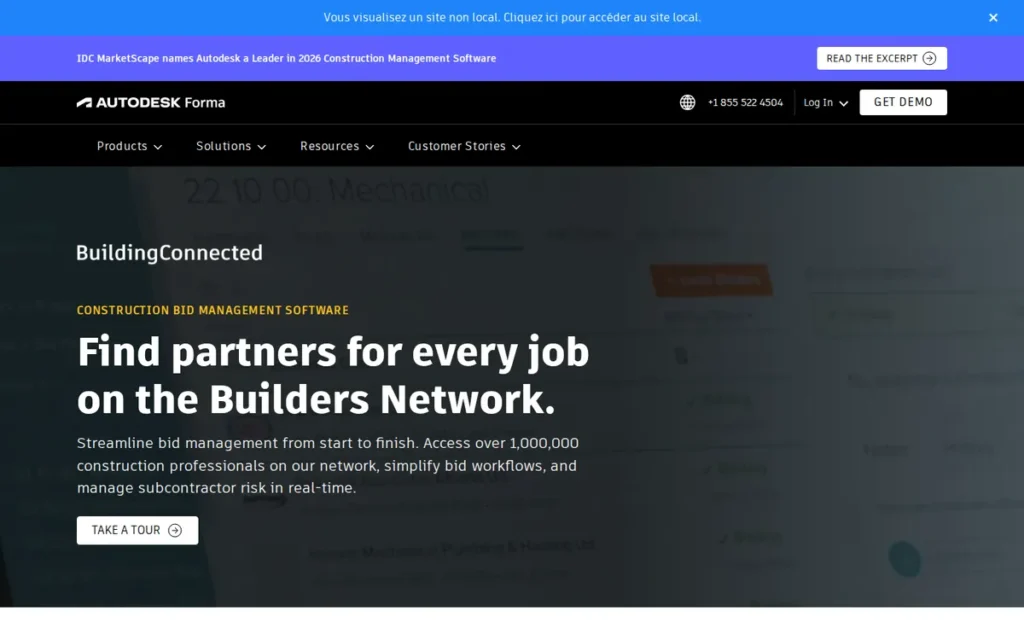
Category: Network Solicitor, a GC-side bid tool built around a large shared subcontractor network.
At a Glance
- Category: Network Solicitor
- Best For: Commercial GCs and owners who need new bidders, coverage tracking and bid leveling
- Price Range: Free basic sub Bid Board; BuildingConnected Pro from $3,600/year (Capterra, 2026); TradeTapp and Bid Board Pro by quote
- Primary Strength: Autodesk BuildingConnected reports the largest network figure in this comparison (1.5M+ construction professionals), and practitioners credit it with bringing in bids from trades a GC never called directly.
- Biggest Limitation: Autodesk BuildingConnected is quote-priced beyond its entry listing and charges extra for TradeTapp prequalification. Users also report renewal increases in 2025.
- One-Line Summary: Autodesk BuildingConnected is the strongest overall bid management platform for commercial general contractors in 2026, combining broad subcontractor network reach with leveling that practitioners rate slightly above Procore’s.
- Last Verified: November 2026
PlugRoute Score: 38/45 (C1 Leveling 5, C2 Network 5, C3 Reviews 4, C4 Pricing 2, C5 Integration 4, C6 Outcomes 4)
Overview
Autodesk BuildingConnected is a construction bid management platform from Autodesk. General contractors and owners use it to send invitations to bid, track subcontractor coverage and level bids. Subcontractors manage incoming invitations through its free Bid Board or the paid Bid Board Pro.
Autodesk BuildingConnected connects to Autodesk Construction Cloud for takeoff, estimating and project handoff.
Key Features
- Autodesk BuildingConnected Pro offers unlimited bid invitations and projects, custom bid forms, bid leveling and historical cost tracking (Autodesk, 2026).
- Autodesk BuildingConnected gives GCs access to the Builders Network, which Autodesk says includes 1.5M+ professionals. That figure counts professionals, not verified bidding companies (Autodesk, 2026).
- Autodesk BuildingConnected shows which invitees viewed addenda, so estimators can tell who is likely to bid before the deadline (Autodesk, 2026; Reddit r/estimators, 2025–2026).
- Autodesk BuildingConnected sells TradeTapp as a separately quoted module for subcontractor prequalification with financial and safety risk scoring (Autodesk, 2026).
- Autodesk BuildingConnected links to Autodesk Construction Cloud (Docs, Takeoff, Build), converts ProEst estimates into Autodesk Build budgets, and has a connector on the Procore App Marketplace (Autodesk, 2026).
Best For
Autodesk BuildingConnected is best for commercial general contractors and owners whose main problem is finding enough qualified bidders. It fits especially well when they enter new markets or already use Autodesk Construction Cloud.
Pricing
As of November 2026, Capterra and G2 list BuildingConnected Pro from $3,600/year. The basic subcontractor Bid Board is free, and TradeTapp and Bid Board Pro are priced by quote (Capterra, 2026).
Autodesk BuildingConnected users self-report paying $22,000/year for a BuildingConnected and ProEst bundle, and “six figures” at a large GC (Reddit r/estimators, 2025–2026). One subcontractor said 2025 costs “increased more than double,” which PlugRoute could not verify officially.
Strengths
- Autodesk BuildingConnected holds a 4.6/5 rating from 204 Capterra reviews (Capterra, 2026), and users praise having plans, messages and bid data in one place.
- Autodesk BuildingConnected’s network reach is its clearest practical edge. A national-GC evaluator said Procore’s network “just doesn’t have nearly the same amount of subcontractors” (Reddit r/estimators, 2025–2026).
- Autodesk BuildingConnected’s leveling is quick to learn. One estimator “figure[d] out bid leveling within hours” (Reddit r/estimators, 2020), and a national-GC user called it “superior” to Procore’s, “but it’s close” (Reddit r/estimators, 2025–2026).
- Autodesk BuildingConnected customers report a 100% increase in bids at Traylor Bros. and a 25% higher win rate at Bowman Flooring (Autodesk, 2026; vendor-reported, not audited).
Users on r/Construction shared their experience:
“BC’s interface is cleaner and more intuitive. I can track responses and addenda are a breeze compared to iSqFt.” Posted by u/AZ2
Takeaway: GCs who move from older planroom databases to Autodesk BuildingConnected credit it with much easier response tracking and addenda handling.
Limitations
- Autodesk BuildingConnected trades cost predictability for network reach. Pricing beyond the entry listing is by quote, and TradeTapp prequalification is a separate paid product.
- Autodesk BuildingConnected shares sub records across its network. One GC objected that “if I create a new subcontractor other GCs can see it” (Reddit r/estimators, 2020).
- Autodesk BuildingConnected draws complaints from the subcontractor side. One part-time subcontractor said “the drawings never show up right in my browser” (Reddit r/estimators, 2020), and Capterra reviewers say the amount of information can feel overwhelming (Capterra, 2026).
- Autodesk BuildingConnected draws reviewer complaints that contact management is “clunky” and that large document sets are hard to navigate (G2, 2026; Capterra, 2026).
- Autodesk BuildingConnected may be weaker in some regions. One practitioner saw little invite volume “from the mid-South or Midwest” (Reddit r/estimators, 2025–2026; anecdotal).
- Autodesk BuildingConnected’s leveling cannot reliably read qualifications and exclusions buried in PDF proposals, according to Consight (Consight, 2026). Consight sells AI bid-leveling software, so it has a commercial interest in that claim.
Verdict
Autodesk BuildingConnected is the best bid management software for commercial general contractors in 2026 because no other platform reviewed combines its subcontractor network reach with leveling this quick to learn.
Autodesk BuildingConnected scored 38 of 45, the highest in PlugRoute’s weighted evaluation. Buyers should get a written renewal cap and a separate TradeTapp price before signing. GCs who care most about owning their sub data should compare it with SmartBid.
2. Procore Bidding: Best for GCs Already Running Projects in Procore
Category: Integrated Platform, a bidding module inside an all-in-one construction management platform.
At a Glance
- Category: Integrated Platform
- Best For: Mid-size to enterprise GCs already using Procore for project management or financials
- Price Range: Pricing on request; annual fee per product based on Annual Construction Volume (ACV), with unlimited users
- Primary Strength: Procore Bidding is the only product in this comparison that hands awarded bids into budgets, contracts and project financials within a single platform.
- Biggest Limitation: Procore Bidding’s volume-based pricing is hard to budget. Practitioners also report renewal increases and a thinner subcontractor network than Autodesk BuildingConnected’s.
- One-Line Summary: Procore Bidding is the best bid management choice for general contractors already running projects in Procore, because it is the only tool here that hands awarded bids into contracts and financials within a single platform.
- Last Verified: November 2026
PlugRoute Score: 33/45 (C1 Leveling 4, C2 Network 3, C3 Reviews 4, C4 Pricing 2, C5 Integration 5, C6 Outcomes 4)
Overview
Procore Bidding is the bid management module inside Procore’s Preconstruction suite. General contractors use it to build bid packages, invite subcontractors, track coverage, level bids and pass awarded bids directly into Procore budgets, contracts and project financials without re-entering data. Procore Bidding fits best for teams already standardized on Procore.
Procore was founded in 2002 and listed on the NYSE in 2021 (Procore, 2026). Procore says its platform holds data from 3M+ projects worldwide (Procore, 2026).
Key Features
- Procore Bidding lets GCs build bid packages, send out plans, specs and addenda, invite subcontractors and send automatic reminders from one workspace (Procore, 2026).
- Procore Bidding includes bid leveling and passes awarded bid data straight into Procore budgets, contracts and project execution (Procore, 2026).
- Procore Bidding connects to the Procore Construction Network (PCN), so GCs can find subcontractors and invite them in one click (Procore, 2026).
- Procore Bidding sits on an app marketplace that had 250+ integrations in 2020, including an Autodesk BuildingConnected connector (Procore, 2020).
- Procore Bidding is adding construction-specific AI agents for bidding, though AI features may be sold under separate plans or credits (Procore, 2026).
Best For
Procore Bidding is best for mid-size and enterprise general contractors that already run project management or financials in Procore and want to stop re-entering data between bid award and contract.
Pricing
As of November 2026, Procore Bidding has no published dollar price. Procore charges an annual upfront fee per product based on ACV, counting only the share of each contract that falls within the subscription term. Users and storage are unlimited (Procore, 2026).
Procore Bidding’s ACV model works like this example. A GC whose projects total $40 million in annual construction volume pays a fee tied to that $40 million whether 5 or 50 people log in. The fee rises when volume grows, even if the team does not. This example is illustrative only, because Procore does not publish rates.
Procore Bidding renewal risk comes up in practitioner reports. A small regional GC said Procore “wanted to double their price” (Reddit r/estimators, 2025–2026; self-reported), and Capterra reviewers call it “very expensive” (Capterra, 2026).
Strengths
- Procore Bidding has named enterprise-scale adoption. Gilbane moved bidding for 60 different use cases onto it, covering solicitation, leveling and trade-partner engagement (Procore, 2026; vendor-reported).
- Procore Bidding runs on a platform rated 4.6/5 from 4,678 G2 reviews (Rankite, 2026, citing G2), though that rating covers all of Procore, not bidding specifically.
- Procore Bidding customer BBL reports saving 8+ hours of preconstruction work by copying bid documents from earlier projects (Procore, 2026; vendor-reported).
- Procore Bidding is “pretty intuitive” for daily use, according to an estimator who valued seeing “who’s submitted, how much” and the automatic reminders (Reddit r/estimators, 2023).
Limitations
- Procore Bidding is reported to have a smaller subcontractor network than Autodesk BuildingConnected. A national-GC evaluator said the PCN “looks like AI scraped companies off the web” (Reddit r/estimators, 2025–2026).
- Procore Bidding’s ACV pricing is the hardest model in this set to budget, and small GCs may pay for platform breadth they never use.
- Procore Bidding draws Capterra complaints about high cost and required training. One reviewer reports a refused refund at renewal (Capterra, 2026).
- Procore Bidding was dismissed by one departing small GC as “kinda really nothing besides a database” (Reddit r/estimators, 2025–2026). Another estimator said getting older subs to use it was the hardest part (Reddit r/estimators, 2023).
- Procore Bidding’s review scores cover the whole platform, so PlugRoute discounted its review score from 5 to 4 because satisfaction with bidding alone cannot be isolated.
Users on r/ConstructionTech noted:
“The need is for smaller, more nimble and more affordable options. Procore is a beast for huge GCs, but for the little guys the cost’ll snow you under. Newer options like smartbuild are trying to be more affordable for the smaller market” Posted by u/Maximum_Structure565
Takeaway: Procore’s platform suits large GCs, but small contractors see its cost as out of proportion to what they actually use.
Verdict
Procore Bidding is the strongest choice for general contractors already standardized on Procore, because its single-platform handoff from bid to contract to financials removes most of the re-entry that standalone bid tools require.
Procore Bidding scored 33 of 45, one point ahead of SmartBid. Procore Bidding ranks below Autodesk BuildingConnected because practitioners report a smaller subcontractor network and slightly weaker leveling. Autodesk BuildingConnected also offers a partial handoff path through ProEst-to-Autodesk Build budgets.
Procore Bidding buyers should get renewal caps in writing and confirm which AI features are included.
3. SmartBid: Best for GCs Who Want to Own Their Subcontractor Data
Category: Private-Database Solicitor, a GC-side bid tool built around the contractor’s own subcontractor list.
At a Glance
- Category: Private-Database Solicitor
- Best For: Mid-size commercial GCs with an established sub base who put data ownership and included prequalification first
- Price Range: Third-party listings conflict: $600 “per feature,” $91/month or $450/month; some plans are custom quote
- Primary Strength: SmartBid gives general contractors full ownership of their subcontractor database, with prequalification that users report is included in the base price.
- Biggest Limitation: SmartBid’s interface is described as dated and slower to learn, and its private-database model brings in fewer unprompted bids than a shared network.
- One-Line Summary: SmartBid is the best bid management platform for general contractors who want to own and control their subcontractor database, offering prequalification and bid leveling in one customizable preconstruction system.
- Last Verified: November 2026
PlugRoute Score: 32/45 (C1 Leveling 5, C2 Network 3, C3 Reviews 3, C4 Pricing 2, C5 Integration 4, C6 Outcomes 4)
Overview
SmartBid is a dedicated general contractor bid management platform from ConstructConnect. It combines invitation-to-bid distribution, a private GC-owned subcontractor database, prequalification, a version-controlled planroom and bid leveling, for commercial GCs who want full control of their subcontractor data.
SmartBid was formerly called SmartBidNet. SmartBid also connects to ConstructConnect’s project-lead data and Project Intelligence (ConstructConnect, 2026).
Key Features
- SmartBid sends invitations to bid with automatic reminders and tracks every subcontractor response in one log (Software Advice, 2026).
- SmartBid stores subcontractors in a private, GC-owned database that other contractors cannot see, according to a six-year SmartBid user (Reddit r/estimators, 2020).
- SmartBid includes prequalification workflows, including ConsensusDocs 721 forms, which users report are part of the base price (Software Advice, 2026).
- SmartBid provides a planroom with version control, so addenda and revisions stay organized across bidders (Software Advice, 2026).
- SmartBid lists integrations with Procore, STACK, Box, Egnyte, Google Drive, SharePoint and OneDrive, and PlugRoute could not verify a native Bluebeam integration (Capterra, 2026).
Best For
SmartBid is best for mid-size commercial general contractors with an established subcontractor base who want to own their data, run prequalification without buying a separate module, and spend setup time on deep customization.
Pricing
As of November 2026, third-party listings for SmartBid conflict:
- SmartBid is listed on G2 and Capterra with a “Basic” plan from $600, which Capterra labels “per feature” (G2, 2026; Capterra, 2026).
- SmartBid is listed on Software Advice at $91/month (Software Advice, 2026).
- SmartBid is listed on Rankite at $450/month (Rankite, 2026).
- SmartBid also offers some plans by custom quote.
SmartBid buyers should ask for an official quote that names what is included, especially prequalification.
Strengths
- SmartBid holds a 4.4/5 rating from 66 Capterra and Software Advice reviews (Software Advice, 2026), and reviewers praise centralized ITBs, response tracking and sub data management.
- SmartBid is preferred by a six-year user across three GCs because “the Prequalification module is included in the base price” and “you own & control all your data” (Reddit r/estimators, 2020).
- SmartBid customer PCL Construction saves “close to 8 hours per project” across ITB distribution, sub qualification and bid comparison (SmartBid, 2026; vendor-reported).
- SmartBid let Sabre Commercial send ITBs, upload drawings and receive subcontractor responses within 30 minutes (CaseStudies.com, 2026; vendor-related).
This aligns with community sentiment on r/Construction:
“I switched over to Smartbid about 3 years ago and have found it to be the best platform available. I demoed BuildingConnected and while the interface looked slick it didn’t have the customization or reporting features that Smartbid had. Also everything in Smartbid is exportable to Excel which is a huge part of how we work.” Posted by u/Constructestimator83
Takeaway: SmartBid wins over GC estimators who care more about customization, reporting and Excel export than interface polish.
Limitations
- SmartBid trades network-driven bid volume for data control. One estimator “never saw that kind of volume of uncoerced responses using SmartBid” compared with BuildingConnected (Reddit r/estimators, 2020).
- SmartBid is “way less polished” than BuildingConnected, according to another estimator (Reddit r/estimators, 2020). Third-party comparison blogs reviewed by PlugRoute also cite a dated interface and significant setup work (2026).
- SmartBid’s conflicting price listings make budgeting hard without an official quote.
- SmartBid’s review samples are small, with only 27 reviews on G2 (G2, 2026).
- SmartBid was the subject of an anonymous, unverified Reddit claim about old and insecure code (Reddit r/estimators, 2025–2026). Buyers should treat it only as a reason to ask for security documentation.
Verdict
SmartBid is the best bid management platform for general contractors who want to own their subcontractor database and prequalify bidders without paying for a separate module.
SmartBid scored 32 of 45 and matches Autodesk BuildingConnected on solicitation and leveling depth (both score 5 of 5 on C1). SmartBid finished one point behind Procore Bidding because its review samples are smaller (27 G2 and 66 Capterra reviews) and Procore Bidding scores higher on award handoff (C5).
SmartBid buyers should get an official quote and request security documentation during the demo.
4. PlanHub: Best for Subcontractors and Suppliers Finding Project Leads
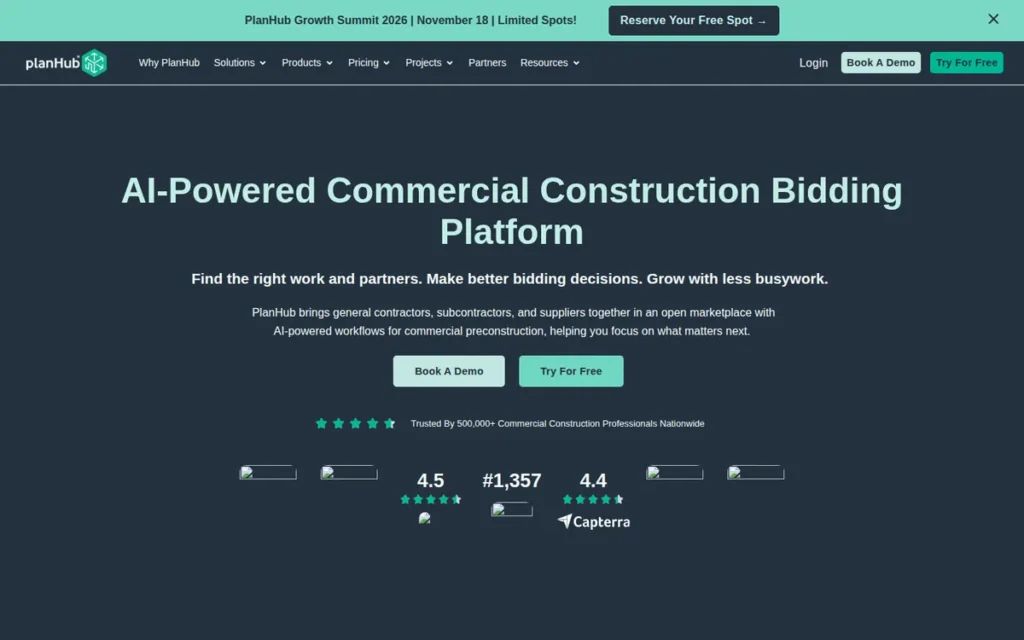
Category: Lead Marketplace, a marketplace where GCs post projects for free and subcontractors pay to find leads.
At a Glance
- Category: Lead Marketplace
- Best For: Subcontractors and suppliers seeking leads in PlanHub’s strong regions; GCs wanting free, simple project posting
- Price Range: Free for GCs; free Basic tier for subs; sub plans $1,999 to about $3,299/year by search radius; Takeoff add-on $91 to $141/month
- Primary Strength: PlanHub publishes the clearest pricing in this comparison and is free for general contractors to post projects.
- Biggest Limitation: PlanHub offers no meaningful bid leveling, and some subcontractors treat its invitations as spam. BBB complaints also cite disputed auto-renewals.
- One-Line Summary: PlanHub is the best option for subcontractors and suppliers looking for project leads, offering the most transparent published pricing of any bid platform reviewed, but it is a lead marketplace rather than a full GC bid management system.
- Last Verified: November 2026
PlugRoute Score: 27/45 (C1 Leveling 2, C2 Network 3, C3 Reviews 4, C4 Pricing 4, C5 Integration 2, C6 Outcomes 3)
Overview
PlanHub is a three-sided construction marketplace. General contractors post projects and invite bidders for free. Subcontractors and suppliers pay radius-based subscriptions to search project leads, manage a bid board and see early-stage projects. PlanHub is mainly a lead-generation tool, not a bid-leveling system.
PlanHub began development in 2008, launched its marketplace in 2015 and is based in West Palm Beach, Florida (PlanHub, 2026).
Key Features
- PlanHub lets general contractors post projects and invite bidders at no cost (PlanHub, 2026).
- PlanHub gives subcontractors a searchable project-lead database and a bid board, with plans priced by search radius (PlanHub, 2026).
- PlanHub connects 500,000+ GCs, subcontractors and suppliers. That is a membership figure, not a count of active users (PlanHub, 2026).
- PlanHub offers a Takeoff and Estimation add-on at $91 or $141 per month, billed annually (PlanHub, 2026).
- PlanHub provides Supplier Pro for suppliers, with custom pricing by region (PlanHub, 2026).
Best For
PlanHub is best for subcontractors and suppliers who want a steady flow of project leads in regions where the platform is active. Practitioners name Texas, Oklahoma and parts of the East Coast (Reddit r/estimators, 2025–2026; anecdotal).
Pricing
As of November 2026, PlanHub is free for GCs and has a free-forever Basic tier for subs and suppliers. PlanHub’s 50-mile sub plan costs $1,999/year with 3 seats (PlanHub, 2026). The 100-mile plan costs about $2,349 and the 200-mile plan about $3,299 (Grit Insurance, 2026).
The $91/month PlanHub figure shown on Capterra is the Takeoff add-on, not the lead subscription. PlanHub’s position is that renewals are non-refundable (BBB, 2026).
Strengths
- PlanHub holds a 4.4/5 rating from 488 Capterra reviews (Capterra, 2026) and 4.5/5 from 77 G2 reviews cited on PlanHub’s site (PlanHub, 2026), the largest construction-bidding-specific review base here. PlanHub’s own page cites 4.3/5 from 476 Capterra reviews.
- PlanHub publishes the most transparent pricing of all seven products, including radius-based sub plans from $1,999/year (PlanHub, 2026).
- PlanHub customer Madewell Construction “doubled revenue while expanding coast to coast” by finding subs in new markets (PlanHub, 2026; vendor-reported).
- PlanHub “actually get[s] subs to submit bids through their system” on simple projects, according to an estimator (Reddit r/estimators, 2020).
Limitations
- PlanHub trades bid management depth for low cost and reach. An estimator noted “they don’t help with leveling,” so GCs still compare bids by hand (Reddit r/estimators, 2020).
- PlanHub invitations are seen as spam by some subcontractors, and one electrical contractor “automatically deletes anything from Planhub” (Reddit r/estimators, 2025–2026).
- PlanHub draws Capterra complaints about GCs “not actually bidding” the projects they list (Capterra, 2026).
- PlanHub faces BBB complaints over disputed auto-renewal charges of about $3,198 and $4,000, even while holding an A+ BBB rating (BBB, 2026).
- PlanHub’s strength varies by region, according to practitioners (Reddit r/estimators, 2025–2026; anecdotal).
Verdict
PlanHub is the most transparently priced bid platform in this comparison and a practical lead source for subcontractors in its strong regions, but it does not replace a GC bid-leveling system.
PlanHub scored 27 of 45. It ranks below the three GC solicitation tools because it has no meaningful bid leveling (C1 = 2), despite the clearest pricing in the set (C4 = 4).
PlanHub subscribers should turn off auto-renewal or set a reminder before the renewal date. GCs who need leveling should compare Autodesk BuildingConnected or SmartBid.
5. Pantera Tools: Best Budget Option for GCs Wanting White-Label Invitations
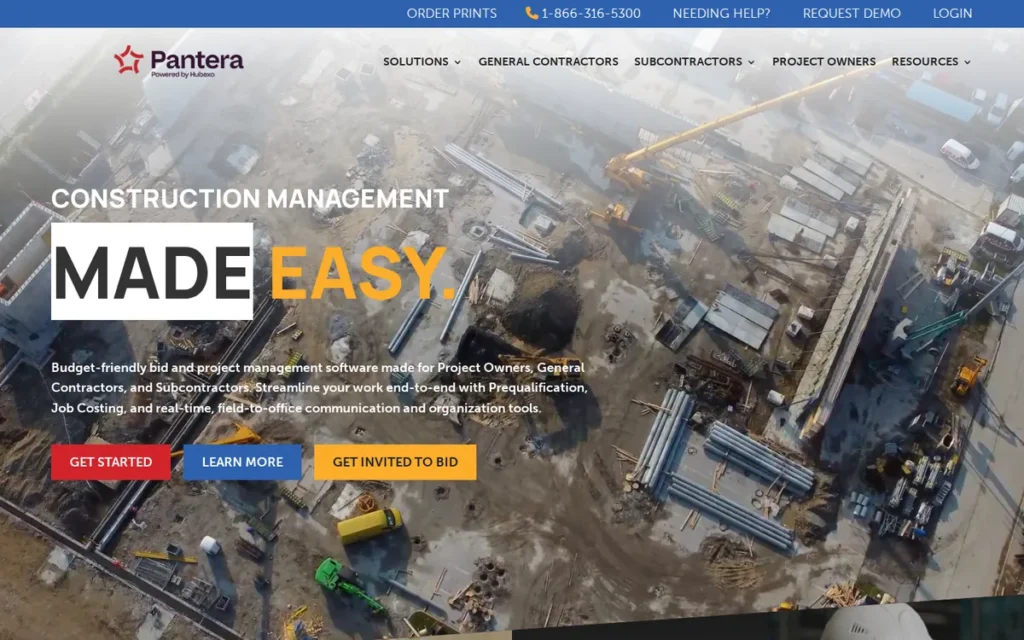
Category: Private-Database Solicitor, a GC-side bid tool built around the contractor’s own list and branding.
At a Glance
- Category: Private-Database Solicitor
- Best For: Small to mid-size GCs wanting branded invitations, QuickBooks integration and light project management on a budget
- Price Range: Legacy published pricing: free Basic; $1,500 to $4,500/year plus $1.00 to $1.50 per file (verify current pricing)
- Primary Strength: Pantera Tools sends invitations under the general contractor’s own brand from a private subcontractor list, at a lower published price than enterprise platforms.
- Biggest Limitation: Pantera Tools has no dedicated bid-leveling screen and no verified G2 or Capterra rating, so buyers have little independent evidence to go on.
- One-Line Summary: Pantera Tools is the best budget bid management option for general contractors who want white-label invitations from their own subcontractor list, though it lacks dedicated bid leveling and independent review validation.
- Last Verified: November 2026
PlugRoute Score: 19/45 (C1 Leveling 2, C2 Network 3, C3 Reviews 1, C4 Pricing 3, C5 Integration 3, C6 Outcomes 1)
Overview
Pantera Tools is a low-cost bid management and light project management platform for small and mid-size general contractors. It sends white-label invitations to bid from a GC-branded planroom, using the contractor’s own subcontractor list plus a public directory.
Pantera Tools is built by Pantera Global Technology, which DeWayne Adamson formed in 2009 (Pantera, 2026). Pantera Tools is expanding from bidding into job costing and field tools.
Key Features
- Pantera Tools sends invitations to bid under the GC’s own brand and letterhead from a white-label planroom that can be embedded on the GC’s website (Pantera, 2026).
- Pantera Tools combines the GC’s uploaded sub list with a public directory that Pantera says covers 1.2M subs across 560+ trades. Pantera’s historical statistics page lists 30,000+ fully registered companies, so buyers should ask how many are active in their trades (Pantera, 2026).
- Pantera Tools includes ProQual, a prequalification module that lets GCs vet subcontractors before inviting them to bid (Pantera, 2026).
- Pantera Tools adds job costing and QuickBooks integration for GCs that track costs after award (Pantera, 2026).
- Pantera Tools offers a mobile app for RFIs, daily reports and punch lists, plus PaySimple payment processing (Pantera, 2026).
Best For
Pantera Tools is best for small to mid-size general contractors on QuickBooks who want branded invitations from their own sub list and basic project management without enterprise pricing.
Pricing
Pantera Tools’ legacy planroom page lists these tiers (Pantera, 2026):
- Pantera Tools Basic is free.
- Pantera Tools Lite costs $1,500/year for 4 seats.
- Pantera Tools Premium costs $2,500/year for 8 seats.
- Pantera Tools Integrated costs $4,500/year for 8 seats.
- Pantera Tools charges document fees of $1.00 to $1.50 per file.
Third-party comparisons in 2026 say Pantera Tools no longer publishes pricing, so the legacy page may be out of date. Pantera Tools buyers should ask for a current quote that spells out per-file fees.
Strengths
- Pantera Tools is “a fraction of the cost” of BuildingConnected with “basically all the same functionality,” according to a practitioner who may be biased (Reddit r/estimators, 2025–2026).
- Pantera Tools lists seat-based paid GC tiers from $1,500/year on its legacy pricing page (Pantera, 2026). That is one of the few vendor-published paid price points among the GC solicitation tools reviewed.
- Pantera Tools is “quick and user-friendly,” according to Software Advice reviewers, who say an ITB can go out “within minutes” (Software Advice, 2026).
- Pantera Tools lets GCs customize ITBs with their own letterhead, which one GC cited as the reason they bought it (Reddit r/estimators, 2020).
Limitations
- Pantera Tools trades leveling depth for low cost and branding control. Software Advice reviewers say it tracks who bid and how much, but its feature pages show no dedicated leveling screen (Software Advice, 2026).
- Pantera Tools has no verified G2 or Capterra rating and no quantified case studies, so buyers have to rely on references.
- Pantera Tools’ own site reproduces a criticism of “excessive” buttons, nested menus and tabs (Pantera, 2026).
- Pantera Tools gives little control over who joins the database or which CSI trade groups members choose, according to a Software Advice reviewer (Software Advice, 2026).
- Switching to Pantera Tools brings adoption “headaches” that “usually outweigh the savings,” a BuildingConnected user cautioned (Reddit r/estimators, 2025–2026).
Verdict
Pantera Tools is the strongest low-cost option for general contractors who want branded invitations sent from their own subcontractor list, plus job costing connected to QuickBooks.
Pantera Tools scored 19 of 45, two points ahead of BidMail (17). Pantera Tools documents a QuickBooks integration (C5) and draws on a larger subcontractor directory (C2). BidMail scores higher on solicitation depth (C1) thanks to its automatic Current Plan Set.
Pantera Tools buyers should ask for three references in their market and a current price sheet.
6. BidMail: Best for Western-US GCs Wanting Simple ITBs and Addenda Control
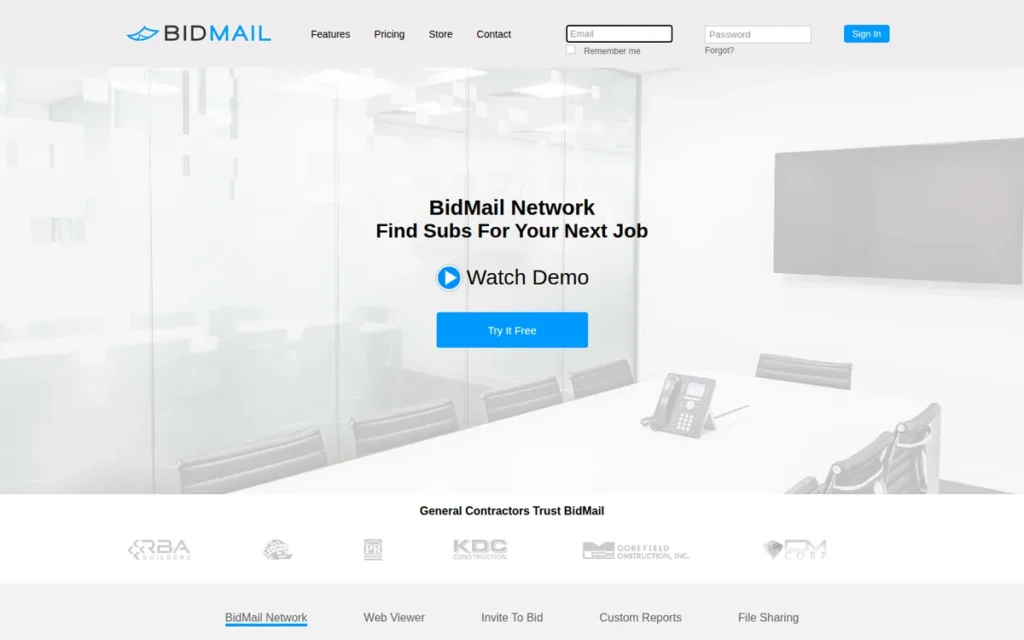
Category: Private-Database Solicitor, an email-first ITB tool built around a prequalified subcontractor database.
At a Glance
- Category: Private-Database Solicitor
- Best For: GCs in California, Arizona and Nevada wanting simple ITB distribution with dependable addenda control
- Price Range: Free plan (1 project); per-user paid tiers plus $0.05/page; base subscription prices not published
- Primary Strength: BidMail automatically merges addenda and bulletins into a single Current Plan Set, so bidders always see the latest documents.
- Biggest Limitation: BidMail has no verified review-platform presence, no named customer outcomes and no documented bid-leveling module.
- One-Line Summary: BidMail is a long-running, email-first invitation-to-bid tool that best serves Western-US general contractors needing automatic addenda merging, though it lacks bid leveling and independent review validation.
- Last Verified: November 2026
PlugRoute Score: 17/45 (C1 Leveling 3, C2 Network 2, C3 Reviews 1, C4 Pricing 3, C5 Integration 1, C6 Outcomes 1)
Overview
BidMail is an email-first invitation-to-bid tool from BidMail, Inc., which was incorporated in 1996. General contractors use it to send ITBs with password-free document access, search a prequalified subcontractor database, track email opens and plan views, and merge addenda automatically into one current plan set.
BidMail says it was “created by estimators for estimators” and that its staff have “50+ years combined commercial estimating experience” (BidMail, 2026).
Key Features
- BidMail merges addenda and bulletins automatically into a “Current Plan Set,” so bidders work from the latest documents (BidMail, 2026).
- BidMail gives bidders password-free access to project documents through an indexed online plan viewer (BidMail, 2026).
- BidMail tracks email opens, plan views and downloads, and keeps a date-stamped communication log for every project (BidMail, 2026).
- BidMail lets GCs search a prequalified subcontractor database by distance, trade, labor and diversity criteria (BidMail, 2026).
- BidMail exports reports to Excel, but no dedicated bid-leveling module is documented (BidMail, 2026).
Best For
BidMail is best for general contractors in California, Arizona and Nevada who want simple invitation distribution with dependable addenda control and already level bids in Excel. BidMail’s password-free document access also suits GCs whose subcontractors refuse to log in to bid portals.
Pricing
As of November 2026, BidMail offers a free plan limited to one project. BidMail’s paid Business, Professional and Enterprise tiers are priced per user, plus $0.05 per page. The tiers come with allowances whose units the site does not define (BidMail, 2026).
BidMail does not publish base subscription prices. A competitor’s blog says it is cheaper than enterprise alternatives (Downtobid, 2026; competitor-written, unverified).
Strengths
- BidMail, Inc. was incorporated in 1996, the longest company track record among the seven products reviewed (BidMail, 2026).
- BidMail is “great for us in CA, AZ, and NV,” according to an estimator comparing regional platforms (Reddit r/estimators, 2025–2026; anecdotal).
- BidMail’s automatic Current Plan Set directly addresses lost addenda and revisions, a top pain point for preconstruction teams (BidMail, 2026).
- BidMail offers a free one-project plan, so small GCs can test it on a live bid without a contract (BidMail, 2026).
Limitations
- BidMail trades modern features and independent validation for simplicity. BidMail has no verified presence on G2, Capterra, Software Advice or Trustpilot, so buyers should ask for references before committing.
- BidMail has no named customers or quantified case studies, so buyers cannot check outcomes at their scale without speaking to current users.
- BidMail has no documented bid-leveling module and no verified integrations with estimating, project management or accounting systems.
- BidMail’s per-page fees add up on large drawing sets, and its base prices are unpublished.
- BidMail “has changed little since roughly 2014,” according to a competitor’s comparison that should be treated with caution (Downtobid, 2026; competitor-written).
Verdict
BidMail is a credible, long-running choice for Western-US general contractors who need simple invitation distribution and automatic addenda merging more than bid leveling.
BidMail scored 17 of 45 and ranks #6 because it has no independent reviews, named customers or documented integrations to back it up. BidMail buyers should test the free plan on a live project and ask for references from GCs in their region.
Different Category: For Teams Answering RFPs. Loopio, the entry below, covers software for responding to bids, the opposite side of the process. General contractors who are soliciting subcontractor bids should not shortlist Loopio.
7. Loopio: Best for Proposal Teams Answering RFPs (Different Category)
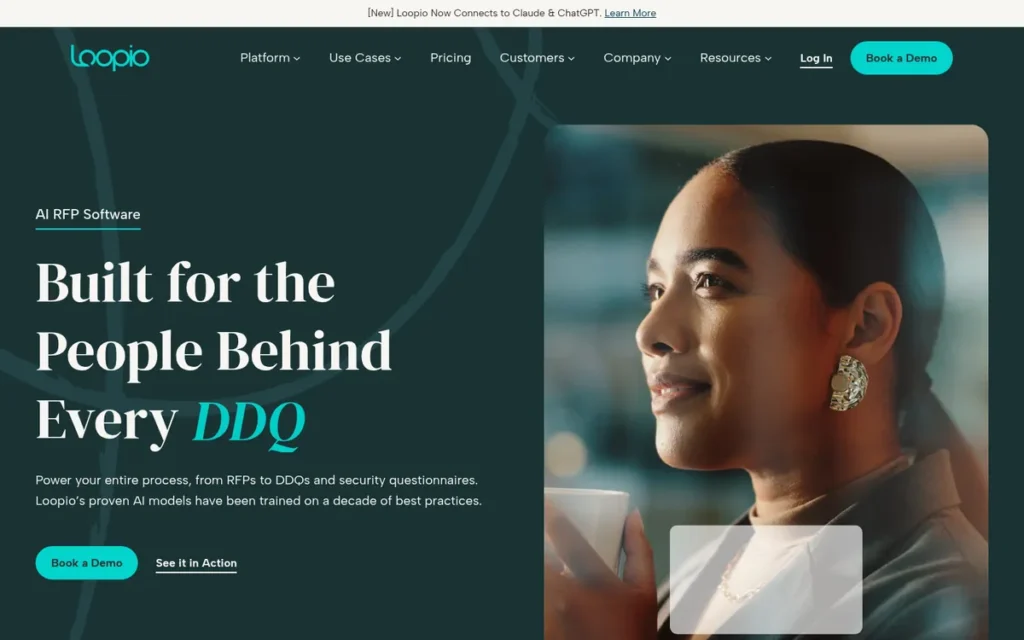
Category: RFP Responder, software for teams answering RFPs and questionnaires, not for soliciting subcontractor bids.
At a Glance
- Category: RFP Responder
- Best For: Mid-market proposal, sales and procurement-response teams, including AEC firms answering owner RFPs
- Price Range: Pricing on request; third parties estimate starting packages around $20,000/year (unofficial)
- Primary Strength: Loopio has the largest product-specific review base in this comparison (800+ G2 reviews), and users praise its support and onboarding.
- Biggest Limitation: Loopio does not solicit or level subcontractor bids, and its estimated starting price is high for firms that answer RFPs infrequently.
- One-Line Summary: Loopio is RFP-response software for teams that answer bids, not a construction bid solicitation tool, and its 800+ G2 reviews make it the best-validated product in this comparison for proposal teams.
- Last Verified: November 2026
PlugRoute Score: 24/45, separate category (C1 Leveling 1, C2 Network 1, C3 Reviews 5, C4 Pricing 2, C5 Integration 4, C6 Outcomes 4)
Overview
Loopio is RFP-response software that proposal, sales and procurement-response teams use to answer RFPs, RFIs, due-diligence questionnaires and security questionnaires. It combines a governed answer library, generative AI drafting and multi-step review. Loopio is not a construction bid solicitation tool and has no subcontractor invitations, planroom or bid leveling.
Loopio was founded in Toronto in 2014 and received a $200M investment from Sumeru Equity Partners in 2021 (Loopio, 2021).
Key Features
- Loopio keeps a governed content library with answer owners, review cycles and tagging, so teams reuse approved responses (Loopio, 2026).
- Loopio uses its “Magic” generative AI to auto-fill and draft answers to imported RFP questions (Loopio, 2026).
- Loopio imports RFP questions, assigns them to subject-matter experts and routes answers through multi-step review (Loopio, 2026).
- Loopio handles RFPs, RFIs, DDQs and security questionnaires in one workspace (Loopio, 2026).
- Loopio integrates with Salesforce, HubSpot, Slack, Microsoft Teams, Google Drive and SharePoint (Loopio, 2026).
Best For
Loopio is best for mid-market proposal and sales teams, including AEC firms responding to owner RFPs, that answer enough RFPs each year to justify an enterprise-priced content library.
Pricing
As of November 2026, Loopio offers three tiers, all priced by quote (Loopio, 2026):
- Loopio Foundations starts with 10 seats and includes unlimited projects and library plus generative AI.
- Loopio Enhanced adds a multilingual library, confidential projects and multi-step review.
- Loopio Enterprise adds business units, sandboxes and premium support.
Loopio’s starting packages run about $20,000/year, according to unofficial third-party estimates (Rankite, 2026; AutoRFP, 2026). DocuSign reported that Loopio pricing does not change with RFP volume (Loopio, 2026; vendor-reported).
Strengths
- Loopio holds about a 4.6/5 rating from 800+ G2 reviews (G2, 2026, via third-party summary), the largest product-specific review base in this comparison.
- Loopio is rated 4.6/5 from 74 Capterra reviews (Capterra, 2026), and one G2 reviewer called its support and onboarding a “key differentiator” (G2, 2026).
- Loopio customer DocuSign grew from 25 North American users to 132 global users in one year and said Magic saved “hours” (Loopio, 2026; vendor-reported).
- Loopio’s benchmark of 1,500+ participants and 250K RFPs found a 39% average win rate and 33 hours spent per RFP (Loopio, 2026; vendor-published, not audited).
Limitations
- Loopio trades construction relevance for depth in proposal response. It has no subcontractor invitations, planroom, prequalification or bid leveling.
- Loopio’s content library takes real effort to maintain, and its search sometimes misses the best answer, according to Capterra reviewers (Capterra, 2026).
- Loopio’s exports to complex Word and Excel files often need cleanup, according to Capterra reviewers (Capterra, 2026).
- Loopio’s “RFP shredding and Magic features were not particularly effective,” according to one G2 reviewer (G2, 2026).
- Loopio’s estimated $20,000/year starting price is likely too high for small firms that bid infrequently. PlugRoute also found no Reddit discussion to back up its review-platform sentiment.
Verdict
Loopio is the best-validated product in this comparison for teams that answer RFPs, but it belongs to a different category from construction bid solicitation and should not be on a general contractor’s shortlist for subcontractor invitations.
Loopio scored 24 of 45. It scored 1 on C1 (solicitation and leveling) and C2 (subcontractor network), the two criteria that require construction bid solicitation. Proposal teams should use their own RFPs to test how much library upkeep Loopio needs and how clean its exports are.
How Much Does Bid Management Software Actually Cost?
Published bid management prices start at free tiers and reach a $3,600/year BuildingConnected Pro listing. Practitioners report contracts reaching six figures. Most vendors quote prices on request, so total cost depends on add-ons, document fees and renewal terms more than on the entry price.
| Product | Pricing Model | Published Price Points (2026) | Known Extra Costs | Renewal Notes |
|---|---|---|---|---|
| Autodesk BuildingConnected | Entry listing plus quote | Pro from $3,600/yr; free basic Bid Board | TradeTapp and Bid Board Pro by quote | Increases reported in 2025; users self-report $22K to six figures |
| Procore Bidding | Annual Construction Volume (ACV), unlimited users | None published | AI plans or credits may be separate | Doubling reported by one small GC (Reddit); one Capterra reviewer reports a refused refund at renewal |
| SmartBid | Conflicting third-party listings | $600 “per feature,” $91/mo or $450/mo | Users report prequalification is included | Get an official quote |
| PlanHub | Radius-based sub subscriptions | GC free; $1,999 to about $3,299/yr for subs | Takeoff add-on $91 to $141/mo | BBB auto-renewal disputes; non-refundable |
| Pantera Tools | Seat tiers plus per-file fees (legacy) | Free Basic; $1,500 to $4,500/yr | $1.00 to $1.50 per file | Current pricing may be unpublished |
| BidMail | Per-user tiers plus per-page fees | Free one-project plan | $0.05 per page | No data found (no review-platform presence to report renewal experiences) |
| Loopio | Quote-only tiers; pricing does not change with RFP volume, per DocuSign | About $20,000/yr (third-party estimate) | Higher tiers add features | No renewal data found |
Costs that buyers most often overlook:
- Prequalification modules can be sold separately, as TradeTapp is for Autodesk BuildingConnected.
- Per-file and per-page document fees at Pantera Tools and BidMail grow with large drawing sets.
- Takeoff add-ons, such as PlanHub’s, are sometimes mistaken for the main subscription price.
- AI features on Procore Bidding may need separate plans or credits.
- Renewal increases and non-refundable auto-renewals can cost more than the first-year price difference.
- Onboarding and implementation fees are a gap. PlugRoute found no published onboarding, data-migration or training fees for any of the seven products in November 2026, so ask each vendor to list them in the quote.
Which Bid Management Tools Integrate With My Existing Systems?
Integration depth varies widely across these seven tools. Procore Bidding hands awards into budgets and contracts in one platform. Autodesk BuildingConnected connects across Autodesk Construction Cloud, and SmartBid lists the broadest third-party file and project connections. BidMail has no verified integrations, so confirm native connectors during every demo.
- Autodesk BuildingConnected: Autodesk BuildingConnected connects to Autodesk Construction Cloud (Docs, Takeoff, Build), converts ProEst estimates into Autodesk Build budgets, and offers a Procore Marketplace connector (Autodesk, 2026).
- Procore Bidding: Procore Bidding passes awards natively into Procore budgets, contracts and financials, and its marketplace listed 250+ apps in 2020 (Procore, 2020).
- SmartBid: SmartBid lists Procore, STACK, Box, Egnyte, Google Drive, SharePoint and OneDrive. PlugRoute could not verify a native Bluebeam integration (Capterra, 2026).
- PlanHub: PlanHub documents no third-party integrations and offers its own Takeoff add-on (PlanHub, 2026).
- Pantera Tools: Pantera Tools integrates with QuickBooks and PaySimple (Pantera, 2026).
- BidMail: BidMail offers Excel export only, with no verified integrations (BidMail, 2026).
- Loopio: Loopio integrates with Salesforce, HubSpot, Slack, Microsoft Teams, Google Drive and SharePoint (Loopio, 2026).
How Should Small Contractors Choose Bid Management Software?
Small contractors should start with a free or entry tier and test it on a live project before signing an annual contract. Upgrade only when leveling, prequalification or integrations clearly justify the extra cost, and compare total cost over three years rather than the first-year price.
- BidMail offers a free plan limited to one project (BidMail, 2026).
- Pantera Tools lists a free Basic tier on its legacy pricing page (Pantera, 2026).
- PlanHub lets general contractors post projects for free (PlanHub, 2026).
- Autodesk BuildingConnected gives subcontractors a free basic Bid Board (Autodesk, 2026).
What Red Flags Should I Watch For When Evaluating Bid Management Software?
The biggest red flags show up in practitioner reports or review complaints about the products in this ranking:
- Uncapped or non-refundable renewals
- Prequalification sold separately
- Network counts that measure members rather than active bidders
- Leveling demos run on sample data
- Integrations that are claimed but not documented
- Roadmap promises in place of shipped features
Red Flag #1: Uncapped or Non-Refundable Renewal Terms
Uncapped renewal pricing is the most reported cost risk in this category. Practitioners describe Procore and BuildingConnected renewals that roughly doubled (Reddit r/estimators, 2025–2026; self-reported). A renewal without a written cap is a second-year budget you don’t control.
Non-refundable auto-renewal makes the risk worse. BBB complaints describe disputed PlanHub renewals of about $3,198 and $4,000 (BBB, 2026). Check: ask for the cap as a percentage in the order form, along with the cancellation notice period.
Users on r/ConstructionTech noted:
“If they succeed, they’ll just start jacking their prices up like Autodesk and Procore.” Posted by u/Ninjaintheshadows3
Takeaway: Contractors see price increases as a pattern at both Autodesk and Procore, so a written renewal cap matters with either incumbent.
Red Flag #2: Prequalification Sold as a Separate Product
Prequalification sold as a separate product can quietly raise total cost. Autodesk BuildingConnected prices TradeTapp separately, while SmartBid users report that prequalification is included in the base price (Reddit r/estimators, 2020).
So comparing BuildingConnected Pro’s $3,600/year listing with a SmartBid quote is misleading unless TradeTapp is quoted too. Check: get both quotes with prequalification included.
Red Flag #3: Network Size Counts Members, Not Active Bidders
Network size figures often count members or professionals rather than companies that actively bid. One subcontractor said they ignore 95% of invites from GCs they have not worked with (Reddit r/estimators, 2020). Network size is a marketing number. Active bidders in your trades within 50 miles is a buying number.
Red Flag #4: Leveling Shown Only on Demo Data
Leveling shown only on clean demo data hides how a tool handles messy real proposals. Exclusions, qualifications and alternates buried in PDF proposals often remain manual work. Insist on a demo that uses your own bid package, and compare the result with your current bid tab.
“As for bid leveling, I have yet to see a software that does this well (other than excel).”, Estimator on Reddit r/estimators (2023)
Takeaway: Test any tool’s leveling on your own messy proposals, because practitioners still fall back on Excel for complex bids.
Red Flag #5: Integrations Claimed but Not Documented
Integrations that are claimed but not documented can force data re-entry after award. PlugRoute could not verify a native SmartBid–Bluebeam integration or any BidMail integrations, and Procore’s 250+ integrations figure dates from 2020 (Procore, 2020). Check: ask which connections are native today.
Red Flag #6: Roadmap Promises Instead of Shipped Features
Roadmap promises in place of shipped features shift the risk onto you. One BuildingConnected user doubts the post-acquisition roadmap (Reddit r/estimators, 2025–2026), and Procore’s AI may need separate plans (Procore, 2026). Check: score only features you can test in the demo.
What Questions Should I Ask Before Choosing Bid Management Software?
Before choosing bid management software, ask vendors about:
- Renewal caps
- Active subcontractor counts in your region
- Prequalification and data visibility
- Leveling on real bids
- Native integrations
- How subcontractors submit bids
- Local references
These seven questions turn vendor marketing claims into commitments you can check before you sign.
Question #1: Can you cap our renewal increase in writing?
A written renewal cap is one of the strongest protections against the price jumps practitioners report. A good answer names a maximum annual percentage and the notice period. A vague “we’ll work with you” is not a cap and should count against the vendor.
Question #2: How many active subs in my trades bid through your platform within 50 miles of my projects?
Active bidders in your trades and region matter more than total network size. A good answer gives counts by trade and radius from recent bidding activity. Regional coverage varies widely, according to practitioners (Reddit r/estimators, 2025–2026), so test it in your own market.
Question #3: Is prequalification included, and who can see the sub records we create?
Prequalification packaging and data visibility both affect cost and control. A good answer says whether prequalification is in the base price and whether other GCs can see subcontractor records you create. Shared networks and private databases answer this differently.
Question #4: Can we level a real bid package from our last project during the demo?
Leveling a real bid package during the demo shows whether the tool handles exclusions, alternates and inconsistent formats. A good answer is yes. Bring three or four actual sub proposals and time how long the side-by-side comparison takes against your current spreadsheet.
Question #5: Which integrations with our estimating, PM and accounting systems are native today?
Native integrations available today determine whether award data flows without re-entry. A good answer names each system, says whether the connector is native or third-party, and lists which fields sync. Treat “on the roadmap” as not available.
Question #6: Can subs submit on their own letterhead without typing numbers into a portal?
How subcontractors can submit directly affects response rates. One GC said subs “won’t bid GCs who use” a portal they disliked (Reddit r/estimators, 2023). A good answer lets subs upload their own proposals while the GC still captures numbers for leveling.
Question #7: Can you provide three references from contractors in my region?
Three regional references let you check support quality and network strength where you actually build. A good answer offers contractors of similar size and trade mix. This matters most for products with little review-platform evidence, such as Pantera Tools and BidMail.
How Did We Rank These Bid Management Software Platforms?
PlugRoute scored every product on six criteria. Three primary criteria count double: solicitation and leveling depth, network reach and data control, and verified review evidence. Three secondary criteria count once: pricing transparency and renewal risk, integration and award handoff, and documented outcomes. Every data point carries a source label and a date.
The six ranking criteria and why each matters:
- C1 – Bid Solicitation and Leveling Depth (primary, ×2): This criterion matters because manual leveling across email and spreadsheets is the audience’s central pain.
- C2 – Subcontractor Network Reach and Data Control (primary, ×2): This criterion matters because bids come back only when the network is strong in your region and you control your sub data.
- C3 – Verified Review Platform Ratings and Sample Size (primary, ×2): This criterion matters because independent ratings with meaningful sample sizes are the most objective check on vendor claims.
- C4 – Pricing Transparency and Total-Cost Risk (secondary, ×1): This criterion matters because quote-only pricing, add-ons and renewal increases make budgeting hard.
- C5 – Integration and Award-Handoff Fit (secondary, ×1): This criterion matters because tools that do not connect to estimating, PM or accounting systems force re-entry after award.
- C6 – Documented Customer Outcomes (secondary, ×1): This criterion matters because named, quantified results help buyers judge fit at their scale.
| Rank | Product | C1 | C2 | C3 | C4 | C5 | C6 | Weighted Total (of 45) |
|---|---|---|---|---|---|---|---|---|
| 1 | Autodesk BuildingConnected | 5 | 5 | 4 | 2 | 4 | 4 | 38 |
| 2 | Procore Bidding | 4 | 3 | 4 | 2 | 5 | 4 | 33 |
| 3 | SmartBid | 5 | 3 | 3 | 2 | 4 | 4 | 32 |
| 4 | PlanHub | 2 | 3 | 4 | 4 | 2 | 3 | 27 |
| 5 | Pantera Tools | 2 | 3 | 1 | 3 | 3 | 1 | 19 |
| 6 | BidMail | 3 | 2 | 1 | 3 | 1 | 1 | 17 |
| 7 | Loopio (separate category) | 1 | 1 | 5 | 2 | 4 | 4 | 24 |
PlugRoute labels every piece of evidence by type:
- Independent review evidence comes from G2, Capterra, Software Advice and BBB, with sample size and scope noted.
- Practitioner reports come from Reddit r/estimators and r/GeneralContractor, and regional claims are labeled anecdotal.
- Vendor claims and case studies are labeled “vendor-reported” because none is independently audited.
- Competitor-written claims from Downtobid, Consight and Planyard are flagged every time they are cited.
- Where a source is undated, the year shown is the year PlugRoute accessed it.
How close rankings were decided:
- Procore Bidding (33) finished one point ahead of SmartBid (32). Procore Bidding’s edge comes from review volume (C3) and native bid-to-contract handoff (C5), while SmartBid scores higher on leveling depth (C1).
- Procore Bidding’s #2 position depends on its review score (C3 = 4). On volume alone that score would be 5, but PlugRoute discounted it because the G2 rating covers the whole platform. One more point of discount would drop Procore Bidding to 31, below SmartBid.
- Pantera Tools (19) finished two points ahead of BidMail (17) on network reach (C2) and integrations (C5). BidMail scores higher on solicitation depth (C1).
- Loopio ranks #7 despite scoring 24 because it does not solicit construction bids, which is this article’s core query.
- Missing evidence lowers only the affected criterion and is not treated as proof of poor quality.
PlugRoute has no affiliate relationships with any company listed, and rankings are determined entirely by research data and objective evaluation criteria.
No peer-reviewed studies specific to bid management software were found.
What Do Buyers Ask Most About Bid Management Software?
Buyers most often ask three things: which tool fits general contractors, which fits subcontractors, and how PlugRoute builds its rankings. The short answers are Autodesk BuildingConnected for most GCs, BuildingConnected’s free Bid Board or PlanHub for subcontractors, and six weighted, source-labeled criteria for the rankings.
What is the best bid management software for general contractors in 2026?
Autodesk BuildingConnected is the best bid management software for most commercial general contractors in 2026. It scored 38 of 45 in PlugRoute’s evaluation for network reach and leveling. Procore Bidding (33) fits GCs already running Procore, and SmartBid (32) suits GCs who want to own their subcontractor database. Confirm renewal caps with any vendor.
What is the best bid management software for subcontractors?
Autodesk BuildingConnected’s free basic Bid Board is the best starting point for subcontractors managing incoming invitations, and Bid Board Pro adds calendar sync and analytics. PlanHub suits subcontractors seeking new leads, with plans from $1,999/year (PlanHub, 2026). Check PlanHub’s regional strength, auto-renewal terms and your own bid-hit ratio before paying.
How does PlugRoute determine its rankings?
PlugRoute ranks products on six weighted criteria. Three primary criteria count double: solicitation and leveling depth, network reach and data control, and verified review evidence. Three secondary criteria count once: pricing transparency, integration fit and documented outcomes. Every data point is source-labeled and dated, and missing evidence lowers only the affected criterion.
What Do Key Bid Management Terms Mean?
Vendors define bid management terms differently, which makes quotes hard to compare. The definitions below cover the eleven terms buyers meet most often in demos and quotes, from invitations to bid and bid leveling to Annual Construction Volume pricing and auto-renewal clauses.
Invitation to Bid (ITB): An invitation to bid is the request a general contractor sends to subcontractors asking them to price a defined scope by a deadline. How easily a tool sends, tracks and follows up on ITBs determines how many bids come back.
Bid Leveling: Bid leveling is the side-by-side comparison of subcontractor bids, adjusted for scope gaps, exclusions and alternates so the numbers are truly comparable. Estimators also call the leveled spreadsheet a bid tab or bid tabulation. Buyers should test leveling on real proposals.
Addendum: An addendum is a formal change to bid documents issued before the bid deadline. Tools that track who viewed each addendum, or that merge addenda into a current plan set, lower the risk of bids priced against outdated drawings.
Prequalification: Prequalification is the process of checking a subcontractor’s bonding capacity, safety record (such as EMR) and financial statements before bidding or award. This information is often collected on standard forms such as ConsensusDocs 721. Buyers should confirm whether prequalification is included or sold separately.
Planroom: A planroom is an online space where bidders view and download project drawings and specifications. Version control and document fees in the planroom affect both bid accuracy and total cost.
Bid Board: A bid board is a subcontractor-side view that organizes incoming invitations, due dates and bid statuses in one place. A bid board helps subcontractors avoid missed deadlines when many invitations arrive at once.
Bid Coverage: Bid coverage is the number of qualified bids a contractor receives for each trade package. Low bid coverage weakens price competition, so buyers should ask vendors for active bidder counts in their trades and region.
Annual Construction Volume (ACV): Annual Construction Volume is a pricing basis tied to the dollar value of construction work under contract during the subscription term. ACV pricing removes per-seat fees but makes costs harder to predict as volume grows.
White-Label Invitations: White-label invitations are bid requests sent under the contractor’s own brand and email identity rather than the software vendor’s. White-label invitations can improve open rates with subcontractors who distrust messages from unfamiliar platforms.
Auto-Renewal Clause: An auto-renewal clause is a contract term that automatically renews a subscription unless the buyer cancels by a set date. Buyers should check notice periods and refund policies before signing.
RFP Response Software: RFP response software helps teams answer requests for proposals using a reusable answer library and review workflows. RFP response software serves companies responding to bids, not contractors soliciting them.
Which Bid Management Software Is Right for You?
Key Insights
The right bid management software depends first on your role and second on total cost. Commercial GCs needing new subcontractors should start with Autodesk BuildingConnected, Procore users with Procore Bidding, and GCs focused on data ownership with SmartBid. Subcontractors seeking leads should consider PlanHub, and proposal teams should look at Loopio.
- Your role determines the right category. GCs soliciting bids need a Network Solicitor, Integrated Platform or Private-Database Solicitor. Subcontractors need a bid board or lead marketplace, and proposal teams need RFP response software.
- Autodesk BuildingConnected leads this ranking because it pairs broad subcontractor network reach with leveling that practitioners say is quick to learn.
- Procore Bidding is the strongest choice for GCs already on Procore, because it is the only tool reviewed that hands awarded bids from bid to contract to financials within a single platform.
- SmartBid is the best fit for GCs who want to own their subcontractor data and get prequalification that users report is included in the base price.
- PlanHub publishes the clearest pricing in the category, but it works as a lead marketplace rather than a bid-leveling system.
- Buyers should confirm renewal caps, auto-renewal terms and regional network coverage in writing before signing with any vendor.
If you need new subcontractors in unfamiliar markets, start with Autodesk BuildingConnected. If you already run Procore or want to own your sub list, compare Procore Bidding and SmartBid. If budget is the main constraint, test the free tiers from BidMail, Pantera Tools or PlanHub on a live project.
Run the same real bid package through each shortlisted tool during demos. Compare leveling time, subcontractor response and total three-year cost. The best bid tool is the one your subcontractors will actually answer. Practitioners agree that no software yet replaces a phone call or an estimator’s judgment (Reddit r/estimators, 2020–2026).
Read PlugRoute’s full ranking methodology and our other independent construction software reviews before booking your demos. We update this guide quarterly. Last updated: November 2026.