Undebt.it is the highest-scoring debt payoff planner for comparing methods free, Debt Payoff Planner is the best-rated mobile payoff app, and YNAB (You Need A Budget) suits debt driven by overspending. Businesses collecting receivables need different software, such as Billtrust. First decide whether you need a payoff planner, a budgeting app or business collections software.
“Debt management software” is a vague label. One search returns payoff planners, budgeting apps with a debt feature and collections platforms built for businesses, so many readers sign up for the wrong kind of tool. Prices and features also change often, which makes older comparisons hard to trust.
As one user on r/personalfinance described:
“Basically, I’m in a constant state of stress/panic/nausea/depression over mine and my mother’s debts and I either need a free tracker (or low cost) that can help me budget and track expenses while also helping me calculate a proper debt payoff plan or someone to just help me.” Posted by u/voodoo_rose
Takeaway: People in debt often want one free tool that both budgets and plans payoff, which is why sorting debt software by category matters before comparing brands.
PlugRoute has no affiliate relationships with any company listed. Rankings are determined entirely by research data and objective evaluation criteria.
Every tool in this guide was scored on the same five weighted criteria, and every price, rating and feature was checked in November 2026. Each entry states its category and audience at the top.
What Are the 5 Categories of Debt Management Software?
Debt management software falls into five categories. Payoff planners order and track debts, payoff calculators give one-off comparisons, budgeting apps treat debt as one feature, money managers cut costs, and receivables platforms collect money owed to businesses. Planners and calculators are built around payoff plans. Budgeting apps such as Monarch Money may offer simpler snowball or avalanche simulations.
The five categories, and the tools in each, are:
- Payoff Planner: A payoff planner orders your debts, compares payoff methods and tracks your progress toward a debt-free date over time. Undebt.it and Debt Payoff Planner are payoff planners.
- Payoff Calculator: A payoff calculator is a free one-off tool that compares methods for the numbers you enter, with no ongoing tracking. Unbury.me is a payoff calculator.
- Budgeting App: A budgeting app is built around a monthly spending plan, and debt payoff is one feature rather than its main purpose. YNAB and Monarch Money are budgeting apps.
- Money Manager: A money manager tracks subscriptions, bills, credit and net worth, and shows debt balances without planning their payoff. Rocket Money is a money manager.
- Receivables Platform: A receivables platform is business software that manages money owed to an organization. Billtrust is a receivables platform and does not help anyone pay off their own debt.
Pick the category that matches your problem:
- If interest costs or payoff order is your problem, a payoff planner or payoff calculator is the right category.
- If your spending keeps outpacing your income, a budgeting app is the right category.
- If you cannot make your minimum payments, a nonprofit credit counsellor is a better first step than any software.
How Do the Top Debt Management Software Tools Compare at a Glance?
Undebt.it leads this ranking with a weighted score of 4.15 out of 5, followed by Debt Payoff Planner at 3.83. YNAB and Monarch Money tie at 3.45, and YNAB places higher on the trust tiebreak. The table below compares all seven tools by category, audience, capabilities, strength and limitation.
| Rank | Company | Category | Best For | One-Line Summary | Key Capabilities | Primary Strength | Key Limitation |
|---|---|---|---|---|---|---|---|
| 1 | Undebt.it | Payoff Planner | Personal: Comparing many payoff methods for free | Undebt.it is a free web-based debt payoff planner that compares eight repayment methods and offers optional read-only bank sync for $10 a year. | 8 methods, snowflakes, SimpleFIN and YNAB sync (paid) | The most payoff methods at the lowest paid price | No native mobile app; spreadsheet-like interface |
| 2 | Debt Payoff Planner | Payoff Planner | Personal: Phone-first payoff planning | Debt Payoff Planner is a highly rated iOS and Android app that builds snowball, avalanche and custom debt payoff plans with a projected debt-free date. | Snowball, avalanche, custom, snowflakes, 0% promo periods | 4.7/5 from 7,403 US App Store ratings (2026) | Free tier caps debts and shows ads; no confirmed bank sync |
| 3 | YNAB | Budgeting App | Household: Debt driven by overspending | YNAB is a zero-based budgeting app that helps households pay down debt by assigning every dollar a job and simulating loan payoff dates. | Loan Planner, credit card targets, bank import in US/CA/UK/EU | Broadest documented country support; up to 6 users | No free plan; no side-by-side method comparison |
| 4 | Monarch Money | Budgeting App | Household: Couples tracking debt alongside net worth | Monarch Money is a household budgeting and net-worth app that tracks debt pay-down goals for couples and families across web and mobile. | Snowball/avalanche pay-down goals, Plaid/Finicity/MX, Shared Views | Three bank-data providers with switching | No free plan; payoff simulation limited to snowball and avalanche |
| 5 | Unbury.me | Payoff Calculator | Personal: Quick comparison without an account | Unbury.me is a free, no-login web calculator that compares snowball and avalanche payoff plans and charts the interest each method costs. | Snowball vs avalanche, payoff date, interest charts | Free, with no sign-up required | No tracking, export, reminders or sync |
| 6 | Rocket Money | Money Manager | Personal: Freeing up cash by cutting subscriptions | Rocket Money is a US-focused money-management app that tracks subscriptions, bills, credit and net worth but does not include a debt payoff planner. | Subscription cancellation, Premium+ bill negotiation, credit monitoring | Free plan plus 10M+ members (company figure) | No payoff planner; built for US users |
| 7 | Billtrust | Receivables Platform | Business: Enterprise AR and collections | Billtrust is an enterprise accounts-receivable and collections platform that helps B2B finance teams collect money owed to their business. | Credit, invoicing, cash application, AI collections | G2 4.4/5 from 515 reviews (2026) | Quote-only pricing; 3–6 month go-live; not for personal debt |
Which Debt Management Software Should I Choose for My Use Case?
Choose based on your single biggest priority. For a free comparison of payoff methods, choose Undebt.it. For a top-rated phone app, choose Debt Payoff Planner. For control over spending, choose YNAB. Couples should look at Monarch Money. If you cannot make your minimum payments, contact a nonprofit credit counsellor instead of buying software.
| Your #1 Priority | Recommended Tool | Why | Acceptable Alternative |
|---|---|---|---|
| Comparing many payoff methods for free | Undebt.it | Eight methods, no stated cap on debts in the free tier | Unbury.me |
| A top-rated phone app | Debt Payoff Planner | 4.7/5 from 7,403 US App Store ratings (2026) | Undebt.it in a mobile browser |
| Fixing spending that keeps adding debt | YNAB | Zero-based budget with loan payoff simulations | Monarch Money |
| Couples or household net worth | Monarch Money | Shared logins, Shared Views and snowball/avalanche pay-down goals | YNAB (up to 6 users) |
| A quick comparison with no account | Unbury.me | Snowball vs avalanche without signing up | Undebt.it free tier |
| Freeing up cash before paying debt | Rocket Money plus a planner | Subscription tracking on the free plan | YNAB |
| Living outside the US | YNAB | Direct import from selected US, Canadian, UK and European banks | A manual-entry planner such as Undebt.it or Unbury.me |
| Collecting money owed to your business | Billtrust (enterprise) | Full credit-to-cash automation | Lighter invoicing tools such as Wave or BILL for small firms |
| Small business tracking its own loans | No tool ranked yet | Receivables platforms do not cover this need | A spreadsheet amortization schedule |
| Cannot make minimum payments | Nonprofit credit counsellor, not software | A debt management plan may lower rates | None |
Can I try these tools before paying?
You can try every consumer tool in this ranking before paying anything (vendor pricing, 2026):
- Undebt.it and Unbury.me have free tiers with no time limit.
- Debt Payoff Planner and Rocket Money both have free plans.
- Undebt.it+ offers a 30-day trial with no card, and YNAB offers a 34-day trial with no card.
- Monarch Money and Rocket Money Premium each offer a 7-day trial.
What Are the Best Debt Management Software Tools in 2026?
The best debt management software tools in 2026 are Undebt.it, Debt Payoff Planner, YNAB, Monarch Money, Unbury.me, Rocket Money and Billtrust, ranked by weighted score on five criteria. The first six serve personal and household users. Billtrust serves business finance teams and appears at #7 in a separate block.
1. Undebt.it: Highest-Scoring Debt Payoff Planner
Audience: Personal
Category: Payoff Planner, software that orders your debts, compares payoff methods and tracks progress toward a debt-free date over time.
At a Glance
- Category: Payoff Planner
- Best For: Consumers with several credit cards and loans who want to compare many payoff methods for free on the web
- Price Range: Free; Undebt.it+ $10/year with no auto-renewal (verified November 2026)
- Primary Strength: Undebt.it supports eight payoff methods plus one-off snowflake payments, more than any other tool in this ranking.
- Biggest Limitation: Undebt.it has no native iOS or Android app, and reviewers describe its interface as spreadsheet-like.
- One-Line Summary: Undebt.it is a free web-based debt payoff planner that compares eight repayment methods and offers optional read-only bank sync for $10 a year.
- Last Verified: November 2026
PlugRoute score: 4.15/5 (C1 5, C2 5, C3 3, C4 4, C5 3)
Overview
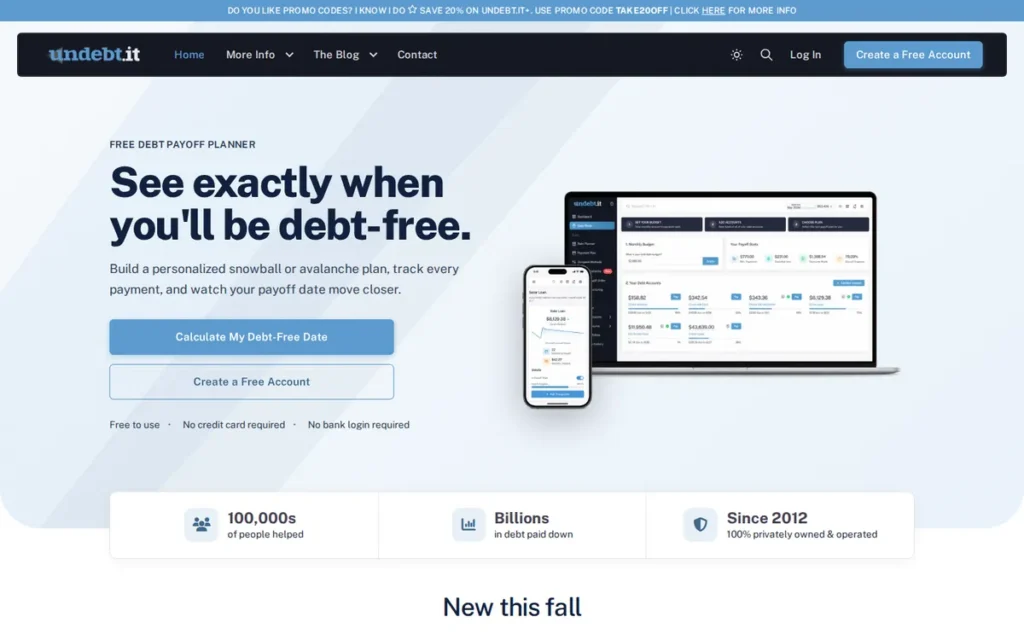
Undebt.it is a free, browser-based debt payoff planner for US consumers with several credit cards and loans who want to compare eight payoff methods, record extra payments and see a month-by-month plan with a projected debt-free date.
Undebt.it has run as a privately owned project since February 28, 2012 (Undebt.it, 2026). Undebt.it’s optional Undebt.it+ tier adds read-only bank sync, YNAB sync and calendar integrations.
Key Features
- Undebt.it calculates payoff plans using eight methods: Snowball, Avalanche, Hybrid (debt-to-interest ratio), Cash Flow Index, Highest Monthly Payment, Highest Credit Utilization, Highest Monthly Interest and Custom order.
- Snowball
- Avalanche
- Hybrid (debt-to-interest ratio)
- Cash Flow Index
- Highest monthly payment
- Highest credit utilization
- Highest monthly interest
- Custom order
- Undebt.it produces a month-by-month payment schedule and a projected debt-free date for each method you test.
- Undebt.it lets users record several one-off extra or negative “snowflake” payments in a single month.
- Undebt.it+ adds read-only nightly bank sync through SimpleFIN, which updates balances but cannot move money.
- Undebt.it+ also adds YNAB sync, calendar sync (Google, Apple/iCloud/CalDAV, Outlook), Excel export, promo-rate support and amortization tables.
Best For
Undebt.it is best for cost-conscious consumers with several debts who want to test many payoff strategies side by side without a recurring subscription. Undebt.it also suits YNAB users who want the method comparison YNAB lacks.
Pricing
Undebt.it’s free plan costs $0, with no time limit and no stated cap on debts (Undebt.it, 2026). Undebt.it+ costs $10/year, down from $12/year earlier in 2026. You pay once, it does not renew automatically, and the 30-day trial needs no card.
Undebt.it+ costs $10 a year, which is less than one month of YNAB ($14.99) or Monarch Money ($14.99) on monthly billing (vendor pricing, 2026). PlugRoute did not independently verify which features sit in which Undebt.it tier, so check the pricing page.
Strengths
- Undebt.it holds a 4.1/5 rating from Investopedia, which names it “Best for Budget, Calendar & Other Integrations,” and appears in InCharge’s 2026 list of the best debt payoff apps (Investopedia, 2026; InCharge, 2026). Investopedia’s note that Undebt.it has no account sync except YNAB was written before the SimpleFIN integration.
- Undebt.it has the lowest paid price in this ranking at $10/year with no automatic renewal (Undebt.it, 2026).
- Undebt.it’s free tier has no time limit and no stated cap on debts, which makes it the most complete free option for ongoing tracking in this ranking.
- Undebt.it states that it never receives bank or YNAB credentials and that SimpleFIN sync is read-only, though these are vendor statements rather than audit findings (Undebt.it, 2026).
This aligns with community sentiment on r/ynab:
“There’s a website called undebt.it. I just started and it really helps visualize how long to pay off and has motivated to start prioritizing pay off and allocating more money towards that to free up cash flow” Posted by u/abccarroll
Takeaway: Undebt.it’s payoff timeline visuals help new users stay motivated and send more money to debt, which is why it pairs well with a YNAB budget.
Limitations
Undebt.it gives up polish and mobile convenience in exchange for payoff depth and a low price. The biggest gap is that Undebt.it has no App Store or Google Play app, so phone-first users have to work in a mobile browser.
- Undebt.it’s interface is called “functional rather than flashy” by DebtPayoffTools and “spreadsheet-like” with little guidance by DebtDriver (DebtPayoffTools, 2026; DebtDriver, 2026).
- Undebt.it’s free tier has no bank sync, so free users must update their balances by hand each month.
- Undebt.it keeps calendar sync, Excel export and amortization tables in the paid Undebt.it+ tier.
- Undebt.it publishes no usage figures, has no app-store ratings and does not name its founder or team, so its evidence base is thinner than its competitors’.
Verdict
Undebt.it is the highest-scoring debt payoff planner in this ranking (4.15/5) for consumers who want to compare the most repayment methods at the lowest cost.
Investopedia rates Debt Payoff Planner higher overall (4.8/5 vs 4.1/5, November 2026). PlugRoute ranks Undebt.it first because payoff depth and cost carry 50% of the weight, even though Undebt.it has no app-store ratings. Readers who need a polished native mobile app should consider Debt Payoff Planner.
2. Debt Payoff Planner: Best-Rated Mobile Debt Payoff App
Audience: Personal
Category: Payoff Planner, software that orders your debts, compares payoff methods and tracks progress toward a debt-free date over time.
At a Glance
- Category: Payoff Planner
- Best For: Phone-first consumers who want a highly rated, simple app with snowball, avalanche and custom plans
- Price Range: Free (ad-supported, debt cap); Pro from $2/month (verified November 2026)
- Primary Strength: Debt Payoff Planner has the strongest independent ratings of any dedicated payoff app, at 4.7/5 from 7,403 US App Store ratings.
- Biggest Limitation: Debt Payoff Planner’s free version caps the number of debts and shows ads, and no source confirms bank sync.
- One-Line Summary: Debt Payoff Planner is a highly rated iOS and Android app that builds snowball, avalanche and custom debt payoff plans with a projected debt-free date.
- Last Verified: November 2026
PlugRoute score: 3.83/5 (C1 4, C2 4, C3 5, C4 3, C5 2.5)
Overview
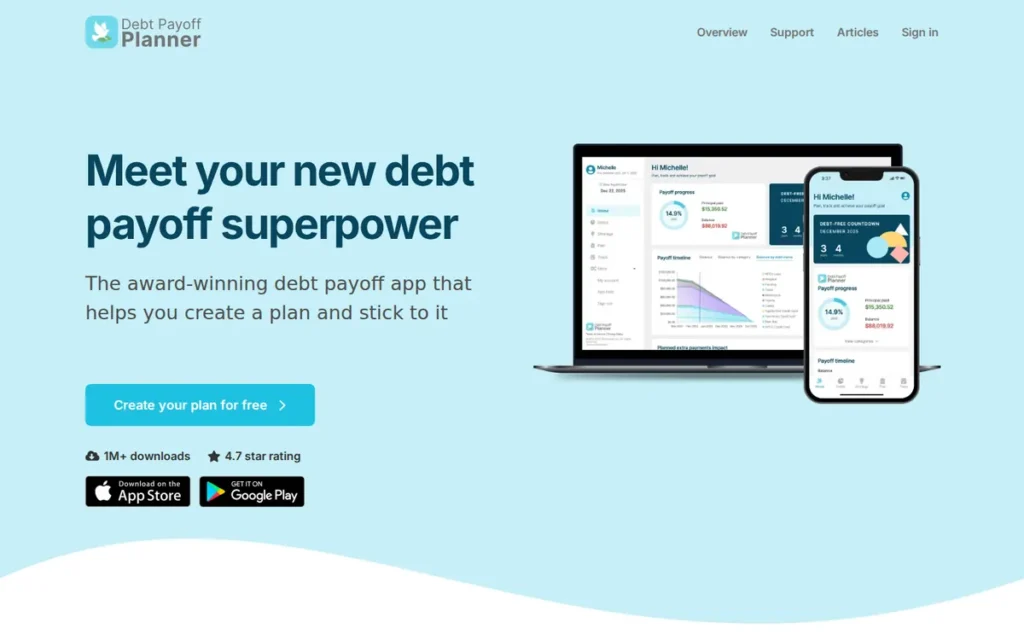
Debt Payoff Planner is a mobile debt payoff app from Oxford Technologies for consumers with several debts. You enter each balance, APR and minimum payment on your phone, and the app builds a snowball, avalanche or custom plan with an estimated debt-free date.
Debt Payoff Planner is free with ads and a debt cap, and Debt Payoff Planner Pro starts at $2/month (Debt Payoff Planner, 2026).
Key Features
- Debt Payoff Planner builds payoff plans using Snowball, Avalanche or a custom payoff order.
- Debt Payoff Planner supports “Debt Snowflake” one-off extra payments and recalculates the plan when you add them.
- Debt Payoff Planner handles temporary 0% promotional interest periods, which App Store reviewers specifically praise (Apple App Store US reviews, 2026).
- Debt Payoff Planner has users record payments by hand, which one reviewer says helps them track their progress.
- Debt Payoff Planner runs on iOS and Android and syncs data across devices through a user account.
Best For
Debt Payoff Planner is best for consumers who manage money mainly on their phone and want a simple, visual payoff plan. Debt Payoff Planner also suits users who would rather enter payments by hand than link bank accounts.
Pricing
Debt Payoff Planner offers a free plan that is ad-supported and caps the number of debts. PlugRoute could not confirm the exact cap (InCharge, 2026). Pro starts “from $2/month” according to the official site and InCharge (Debt Payoff Planner, 2026).
PlugRoute could not confirm Debt Payoff Planner’s annual Pro price, so check the current price in the app.
Strengths
- Debt Payoff Planner holds 4.7/5 from 7,403 US App Store ratings as of November 3, 2026, and 4.4/5 from 4.76K Google Play reviews with 500K+ downloads (Apple App Store, 2026; Google Play, 2026).
- Debt Payoff Planner is rated 4.8/5 and named best overall debt payoff planner by Investopedia, the highest Investopedia score of any tool in this ranking (Investopedia, 2026).
- Debt Payoff Planner’s Pro tier starts at $2/month, one of the cheapest paid options in the category (Debt Payoff Planner, 2026).
- Debt Payoff Planner’s App Store reviewers praise its custom payoff order, interest estimates and handling of 0% promotional periods (Apple App Store US reviews, 2026).
Limitations
Debt Payoff Planner gives up depth and automation in exchange for mobile simplicity. The biggest gap is that Debt Payoff Planner supports fewer payoff methods than Undebt.it, and no source confirms bank sync or a standalone web app.
- Debt Payoff Planner’s free tier limits how many debts you can add and shows ads.
- Debt Payoff Planner’s Google Play reviewers say updating individual payments is slow and that split payment schedules are not supported (Google Play, 2026).
- Debt Payoff Planner’s Canadian App Store reviewers report the app freezing and showing blank screens (Apple App Store Canada, 2026).
- Debt Payoff Planner’s Canadian App Store reviewers also report a one-time payment that did not apply and support that did not respond (Apple App Store Canada, 2026).
- One Canadian App Store reviewer called Debt Payoff Planner’s subscription model “a bit scammy” (Apple App Store Canada, 2026).
- Oxford Technologies publishes little about its team, and no one has independently assessed Debt Payoff Planner’s privacy policy, so check the app-store privacy labels.
Verdict
Debt Payoff Planner is the best-rated dedicated debt payoff app in this ranking for consumers who want to plan on their phone.
Debt Payoff Planner’s app-store ratings earn it the top C3 score (5). Debt Payoff Planner still ranks second at 3.83/5 because it trails Undebt.it on payoff planning (4 vs 5), cost (4 vs 5) and trust (2.5 vs 3). Readers with many debts should budget for Pro because of the free-tier cap.
3. YNAB (You Need A Budget): Best Budgeting App for Paying Off Debt
Audience: Personal and Household
Category: Budgeting App, software built around a monthly spending plan, with debt payoff as one feature rather than the core purpose.
At a Glance
- Category: Budgeting App
- Best For: Households whose debt comes from monthly spending and who will commit to zero-based budgeting
- Price Range: $14.99/month or $109/year after a 34-day free trial (verified November 2026)
- Primary Strength: YNAB links debt payoff to a zero-based monthly budget, with loan payoff simulations and pay-off-by-date targets for credit cards.
- Biggest Limitation: YNAB has no free plan and no side-by-side snowball vs avalanche comparison across all debts.
- One-Line Summary: YNAB is a zero-based budgeting app that helps households pay down debt by assigning every dollar a job and simulating loan payoff dates.
- Last Verified: November 2026
PlugRoute score: 3.45/5 (C1 3, C2 2, C3 4, C4 5, C5 4), tied with Monarch Money; ranked #3 on the C5 tiebreak
Overview
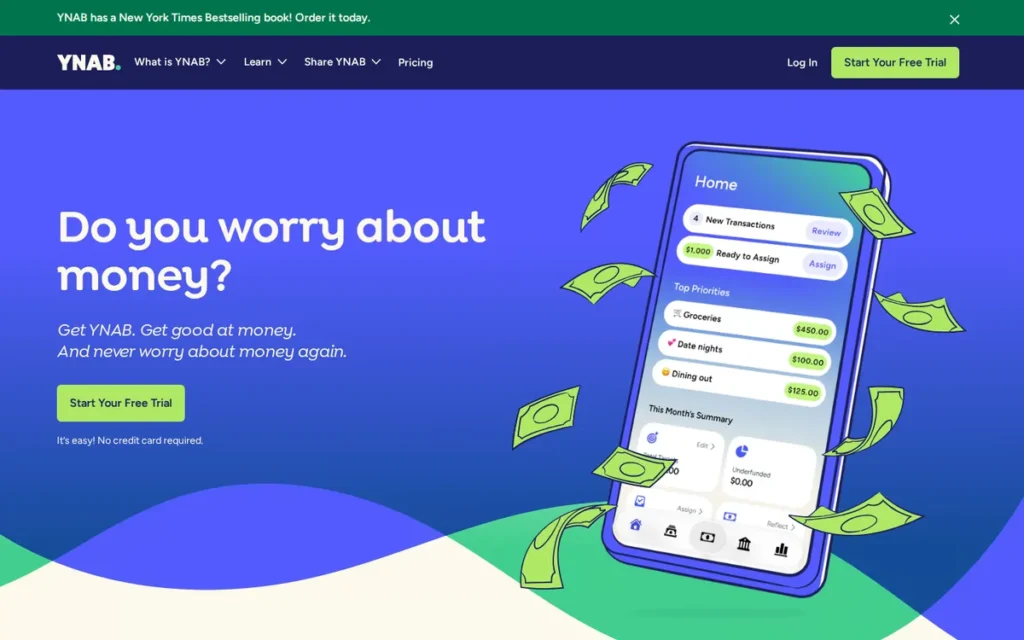
YNAB (You Need A Budget) is a subscription zero-based budgeting app for households that want to fix the spending habits behind their debt. It combines a monthly budget with loan payoff simulations and payment targets for credit cards.
YNAB costs $109/year after a 34-day trial (YNAB, 2026). YNAB does not rank or compare payoff methods across all your debts.
Key Features
- YNAB’s Loan Planner calculates a payoff date from a payment amount, or the monthly payment needed to hit a target date.
- YNAB’s Loan Planner models one-time extra payments and shows the time and interest saved.
- YNAB gives each credit card its own payment category and supports pay-off-by-date targets for card balances.
- YNAB imports transactions directly from selected US, Canadian, UK and European banks, with file import as a fallback.
- YNAB lets up to 6 people share one subscription and works offline on desktop, mobile and tablet.
Best For
YNAB is best for households whose debt keeps growing because spending outpaces income, and who are willing to learn a hands-on budgeting method. YNAB users who want a snowball vs avalanche comparison can pair it with Undebt.it, which syncs with YNAB.
Pricing
YNAB costs $14.99/month or $109/year (about $9.08/month). The 34-day free trial needs no card when you sign up directly with YNAB (YNAB, 2026). Eligible college students get a free 365-day trial.
YNAB has no free plan, so readers looking for a zero-cost tool should start with Undebt.it or Unbury.me.
Strengths
- YNAB was named “Best for serious budgeters” by CNBC Select and “Best for zero-based budgeting” by Forbes Advisor, and appears in NerdWallet’s list of the best budgeting apps (CNBC Select, 2026; Forbes Advisor, 2026; NerdWallet, 2026).
- YNAB offers direct bank import across the US, Canada, the UK and Europe, the broadest documented country support of any consumer tool in this ranking (YNAB, 2026).
- YNAB’s Loan Planner shows the time and interest saved by extra payments, and its credit card targets support pay-off-by-date goals.
- YNAB reports that 92% of about 9,000 surveyed users felt less financial stress, though YNAB ran this survey itself and the sample was self-selected (YNAB “Mood on Money” survey, 2026; survey year not stated).
Limitations
YNAB gives up a low price and automation in exchange for control over your spending. The biggest gap is that YNAB has no built-in side-by-side snowball vs avalanche comparison across all debts.
- YNAB has no free plan, and its $109/year price is higher than Monarch Money Core’s standard $99.99/year (vendor pricing, 2026).
- YNAB’s setup is laborious and it has no bill tracking or bill pay, according to CNBC Select (CNBC Select, 2026).
- YNAB’s Loan Planner is aimed at installment loans, while credit cards are handled separately through payment categories and targets.
- YNAB has a learning curve: one Reddit user found that a card payment did not reduce the amount shown as available for payment until the payee was set correctly (Reddit r/ynab, posted 2023).
Users on r/ynab noted:
“I love the way YNAB works for buying things like your grocery example, that is perfect. It’s just this debt repayment thing that they have really gone about in a obtuse way. Which is odd to me, since this seems like it is billed at helping people out of financial difficulties.” Posted by u/kanucketothrowaway
Takeaway: YNAB wins praise for everyday spending categories, but its credit card handling can frustrate users trying to track separate snowball payments.
Verdict
YNAB is the best fit in this ranking when the cause of your debt is monthly spending rather than payoff order.
YNAB’s zero-based method, wide bank support and household sharing can justify the $109/year price for readers who will commit to budgeting. YNAB and Monarch Money tie at 3.45/5. YNAB takes #3 on the published C5 tiebreak because its operating history is documented back to 2004.
Readers who only need to choose a payoff order will get more from a dedicated planner, or from pairing YNAB with Undebt.it.
4. Monarch Money: Best for Couples and Households Tracking Debt

Audience: Household
Category: Budgeting App, software built around a monthly spending plan, with debt payoff as one feature rather than the core purpose.
At a Glance
- Category: Budgeting App
- Best For: Couples and families who want shared debt tracking inside a full household net-worth dashboard
- Price Range: $14.99/month or $99.99/year ($49.99 first-year promotion when billed directly) (verified November 2026)
- Primary Strength: Monarch Money connects accounts through Plaid, Finicity and MX and lets users switch provider when a bank connection fails.
- Biggest Limitation: Monarch Money has no permanent free plan and is a general finance app rather than a dedicated payoff planner.
- One-Line Summary: Monarch Money is a household budgeting and net-worth app that tracks debt pay-down goals for couples and families across web and mobile.
- Last Verified: November 2026
PlugRoute score: 3.45/5 (C1 3.5, C2 2, C3 4, C4 5, C5 3), tied with YNAB; ranked #4 on the C5 tiebreak
Overview
Monarch Money is a subscription household finance app for couples and families who want loans, mortgages and credit cards tracked alongside assets, budgets and cash flow, with debt pay-down goals linked to each account.
Monarch Money costs $99.99/year after a 7-day trial and has no permanent free plan (Monarch Money, 2026).
Key Features
- Monarch Money’s Pay Down goals simulate Avalanche or Snowball payoff plans with optional monthly and one-time extra payments, and users can save the plan to their budget (Monarch Money help center, 2026).
- Monarch Money connects accounts through Plaid, Finicity and MX and lets users switch provider for a bank whose connection fails.
- Monarch Money covers a household with one subscription, separate logins and “Shared Views” that separate yours, mine and ours.
- Monarch Money offers “Flex Budgeting” for fixed, flexible and non-monthly spending, or traditional category budgets.
- Monarch Money runs on web, iOS, iPad and Android, with cash-flow reports and recurring-bill tracking.
Best For
Monarch Money is best for couples and families who want to pay down shared debt while seeing their full net worth in one place. Monarch Money also suits former Mint users who value reliable bank connections across several data providers.
Pricing
Monarch Money Core costs $14.99/month or $99.99/year, with a 7-day trial and no permanent free plan (Monarch Money, 2026). A $49.99 first-year promotion applies to annual Core when you are billed directly rather than through Apple or Google.
Search results also show a Monarch Money Plus tier at $199/year, but PlugRoute could not verify its features.
Strengths
- Monarch Money was named “Best overall budgeting app” by WSJ Buy Side, “Best for ease of use” by CNBC Select and “Best for families” by Forbes Advisor (WSJ Buy Side, 2025; CNBC Select, 2026; Forbes Advisor, 2026).
- Monarch Money uses three data providers, which one Reddit user credits with linking accounts successfully where other apps failed (Reddit r/mintuit, posted 2024).
- Monarch Money gives partners separate logins plus yours/mine/ours Shared Views under one subscription.
- Monarch Money’s $49.99 first-year promotion halves the first-year cost for readers billed directly (Monarch Money, 2026).
Limitations
Monarch Money gives up payoff-planning depth and a low price in exchange for a broad household dashboard. The biggest gap is that Monarch Money has no hybrid method, no custom payoff order and no view comparing several methods side by side, so its payoff simulation stops at snowball and avalanche.
- Monarch Money has no permanent free plan, and third-party reviews often criticise its price (AppRift, 2026; PocketGuard, a competitor, 2026).
- Monarch Money users sometimes have to reconnect accounts, especially at smaller banks, according to third-party reviews (AppRift, 2026).
- Monarch Money’s 4.9-star rating from 100,000+ reviews is a vendor claim with no platform breakdown.
- PlugRoute could not verify Monarch Money’s founder and funding details.
Users on r/MonarchMoney shared their experience:
“Is it perfect? No. There are definitely some syncing hiccups here and there. But the manual entry system is smooth, so it hasn’t been a dealbreaker for me.” Posted by u/Worldly_Building_147
Takeaway: Even satisfied Monarch Money users run into occasional sync problems, though its smooth manual entry keeps them from being dealbreakers.
Verdict
Monarch Money is the best option in this ranking for couples and families who want to track shared debt inside a complete household finance view.
Monarch Money’s three-provider bank connections and separate partner logins address the two complaints most often raised about budgeting apps in this category: unreliable sync and limited shared access. Monarch Money ties YNAB at 3.45/5 and ranks #4 on the C5 tiebreak.
Readers whose main need is choosing a payoff order can get that more cheaply from a dedicated planner.
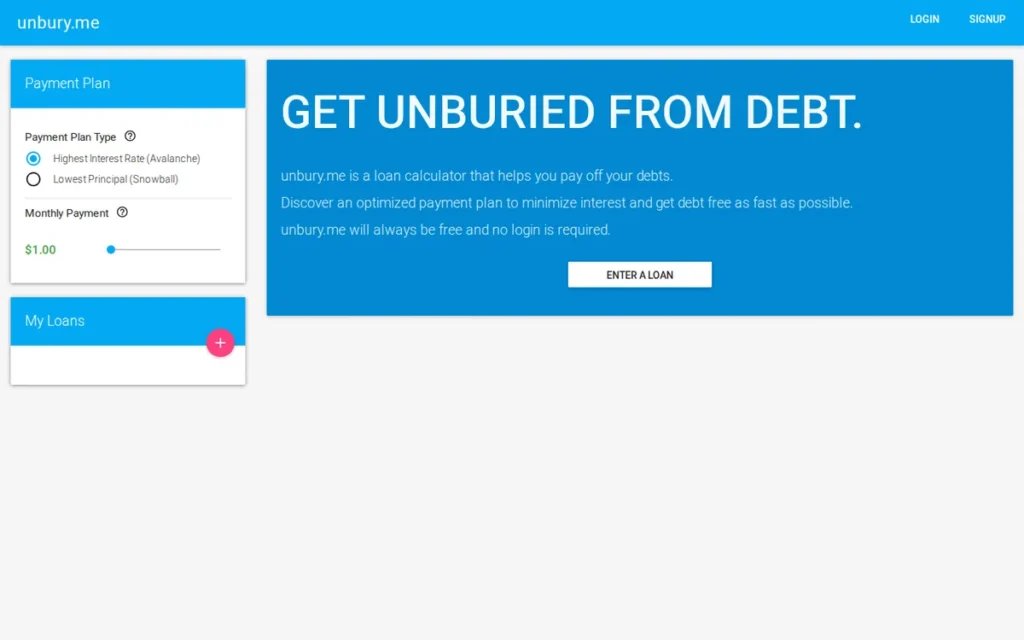
5. Unbury.me: Best Free No-Login Payoff Calculator
Audience: Personal
Category: Payoff Calculator, a free one-off tool that compares payoff methods for the numbers you enter, without ongoing tracking.
At a Glance
- Category: Payoff Calculator
- Best For: Anyone who wants a quick, free snowball vs avalanche comparison without creating an account
- Price Range: Free (verified November 2026)
- Primary Strength: Unbury.me shows a side-by-side snowball and avalanche comparison with payoff dates and interest totals, with no login required.
- Biggest Limitation: Unbury.me does not track progress over time and offers no export, reminders or bank sync.
- One-Line Summary: Unbury.me is a free, no-login web calculator that compares snowball and avalanche payoff plans and charts the interest each method costs.
- Last Verified: November 2026
PlugRoute score: 2.68/5 (C1 2.5, C2 5, C3 2, C4 1.5, C5 2)
Overview
Unbury.me is a free web-based debt payoff calculator for consumers who want a fast snowball vs avalanche comparison without signing up. It is built for one-off comparisons rather than ongoing tracking.
Unbury.me uses the balances, rates and minimum payments you enter to show the debt-free date, the principal and interest paid, and charts.
Key Features
- Unbury.me compares the snowball and avalanche payoff methods for the debts you enter.
- Unbury.me shows the projected payoff date, total principal and interest paid, and average interest rate.
- Unbury.me charts principal, interest and monthly payments over the life of the plan.
- Unbury.me works without a login and offers an optional login to save your details.
- Unbury.me runs in a web browser only and has no native mobile app.
Best For
Unbury.me is best for readers who want to see in a few minutes, at no cost, how much interest avalanche saves over snowball on their own debts. Unbury.me also suits privacy-conscious users who do not want to create an account.
Pricing
Unbury.me is free, and DebtPayoffTools reports that it shows no ads (DebtPayoffTools, 2026).
Unbury.me’s operator has not said how the site makes money, so readers cannot check its long-term funding model.
Strengths
- Unbury.me is named “Best Simple Web Planner” by Investopedia, which praises its free, simple interface (Investopedia, 2026).
- Unbury.me requires no sign-up or bank login, so users can compare methods without sharing account data (Unbury.me, 2026; DebtPayoffTools, 2026).
- Unbury.me shows the interest cost of snowball vs avalanche directly, which answers the common need to compare methods side by side.
- Unbury.me lets users enter an unlimited number of debts at no cost, which Investopedia lists as a strength (Investopedia, 2026).
Limitations
Unbury.me gives up features and accountability in exchange for simplicity. The biggest gap is that Unbury.me offers no progress tracking, export, reminders or bank sync, so it cannot replace an ongoing planner.
- Unbury.me holds only a 3.3/5 rating from Investopedia, which calls it “too simple for detailed financial tracking” (Investopedia, 2026).
- Unbury.me offers only two payoff methods, snowball and avalanche.
- Unbury.me does not publish who runs it or when it launched. A reported 2016 footer hints at the site’s age but does not prove a launch date.
- Unbury.me has no published privacy policy confirming how saved data is stored, and no user ratings exist on any platform. These are gaps in the evidence, not documented failures.
Verdict
Unbury.me is the simplest free way in this ranking to compare snowball and avalanche on your own debts, because it requires no account.
Unbury.me works well as a first step before you commit to a planner. Unbury.me edges Rocket Money (2.68 vs 2.63) because Unbury.me compares payoff methods and Rocket Money does not. Readers who want to track progress month by month should move to Undebt.it’s free tier.
6. Rocket Money: Best for Freeing Up Cash by Cutting Subscriptions
Audience: Personal
Category: Money Manager, an app that tracks subscriptions, bills, credit and net worth, showing debt balances without planning their payoff.
At a Glance
- Category: Money Manager
- Best For: US consumers who want to find extra monthly cash for debt by cancelling subscriptions and lowering bills
- Price Range: Free; Premium pay-what-you-want (typically $7–$14/month); Premium+ $15/month (verified November 2026)
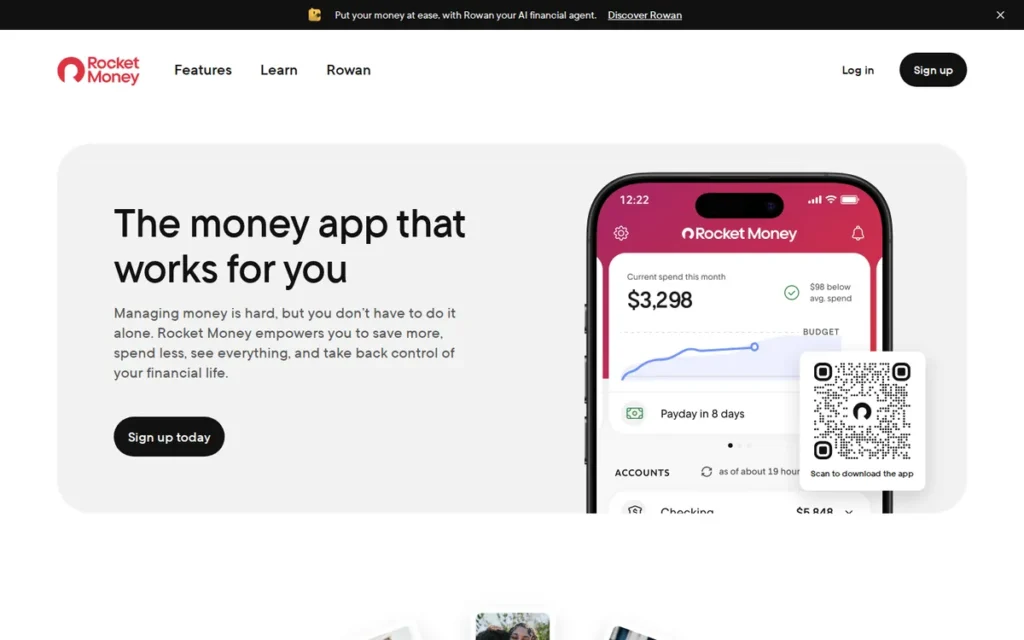
- Primary Strength: Rocket Money finds recurring subscriptions, cancels them on paid plans and offers bill negotiation on Premium+ to free up cash for debt payments.
- Biggest Limitation: Rocket Money has no snowball, avalanche or other payoff planner, so it cannot order debts or project a debt-free date by method.
- One-Line Summary: Rocket Money is a US-focused money-management app that tracks subscriptions, bills, credit and net worth but does not include a debt payoff planner.
- Last Verified: November 2026
PlugRoute score: 2.63/5 (C1 1, C2 4, C3 3.5, C4 3.5, C5 2)
Overview
Rocket Money is a money-management app for US consumers, formerly called Truebill and now owned by Rocket Companies. It finds and cancels subscriptions, negotiates bills on Premium+, monitors credit and tracks net worth, which can free up cash for debt.
Rocket Money does not include a snowball, avalanche or payoff-sequencing planner.
Key Features
- Rocket Money detects recurring subscriptions and, on paid plans, cancels them for you, which the vendor says commonly takes 2–10 days.
- Rocket Money offers bill negotiation on Premium+, with no success fee on negotiations submitted from November 2, 2026, according to its help center (Rocket Money help center, 2026).
- Rocket Money provides credit monitoring and credit reports on paid plans.
- Rocket Money tracks net worth and liabilities, including credit card and loan balances.
- Rocket Money’s free plan includes subscription tracking, spending review, bill reminders and up to 2 custom budget categories.
Best For
Rocket Money is best for US consumers whose first step toward paying off debt is finding wasted monthly spending. Rocket Money should be paired with a dedicated planner such as Undebt.it or Debt Payoff Planner for the payoff plan itself.
Pricing
Rocket Money is free at the base level. Rocket Money Premium is “pay what you think is fair,” typically $7–$14/month after a 7-day trial, and Premium+ costs $15/month (Rocket Money, 2026).
Rocket Money’s help center states that bill negotiations submitted on Premium+ from November 2, 2026 carry no success fee (Rocket Money help center, 2026).
Negotiations submitted before that date are still charged the previous 35–60% success fee. ConsumerAffairs and a BBB complaint document fees in that range, such as $42 on $120 of yearly savings (ConsumerAffairs, 2026; BBB, 2026).
Strengths
- Rocket Money was named “Best money-saving app for managing subscriptions” by Forbes Advisor and “Best for managing subscriptions” among free tools by CNBC Select (Forbes Advisor, 2026; CNBC Select, 2026).
- Rocket Money reports about 4.5/5 on the App Store (~403,000 ratings) and Google Play (~141,000 ratings). These figures come from third-party roundups rather than the store pages (BudgetingApps.org, 2026).
- Rocket Money’s free plan is useful on its own, and one Reddit user reports good bank syncing without upgrading (Reddit r/AppleCard, 2026).
- Rocket Money reports more than 10 million members, the largest user base among the consumer tools ranked here (company figure, 2026).
Limitations
Rocket Money gives up payoff planning in exchange for cost-cutting. The biggest gap is that Rocket Money cannot order debts, compare snowball and avalanche, or project a debt-free date by method.
- Rocket Money’s BBB customer reviews average 1.41/5 across 66 reviews. As of November 12, 2026, Rocket Money had 205 complaints in the past three years and 35 in the last 12 months, despite an A+ BBB business rating (BBB, 2026).
- Rocket Money’s BBB complaints most often cite negotiation fees and surprise charges (BBB, 2026).
- Rocket Money’s BBB complaints also describe difficulty cancelling Premium (BBB, 2026).
- Rocket Money’s BBB complaints also report sync problems and slow support, and its Trustpilot score is 3.9/5 from 4,226 reviews (BBB, 2026; Trustpilot via wonderful.money, 2026).
- Rocket Money is designed for US users. One Reddit user reports it is unavailable in Canada (Reddit r/mintuit, posted 2024), and others report dropped connections and cancellations that were never completed (Reddit r/AppleCard, 2026).
Verdict
Rocket Money is a cost-cutting app, not a debt payoff planner, and Rocket Money works best as a companion to one.
Rocket Money’s C1 score of 1 reflects that it only shows balances. Its C2 (4) and C3 (3.5) scores keep it close to Unbury.me. Rocket Money’s free subscription tracking can free up money for extra payments, so pair Rocket Money with a dedicated planner.
Which Debt Management Software Is Built for Business Finance Teams?
Billtrust is in this ranking only to point business readers to the right type of tool, so personal users can skip this entry. Receivables platforms do not help small businesses track their own loans, and PlugRoute has not yet ranked tools for that need. Tracking public-sector debt schedules is also a separate need.
7. Billtrust: Best for Enterprise Receivables and Collections
Audience: Business finance teams
Category: Receivables Platform, business software that manages money owed TO an organization (invoicing, payments, collections); it does not help anyone pay off their own debt.
At a Glance
- Category: Receivables Platform
- Best For: Mid-size and enterprise finance teams automating invoicing, cash application and B2B collections
- Price Range: Quote-based pricing on request (verified November 2026)
- Primary Strength: Billtrust automates the full accounts-receivable process, from credit decisions to collections, and holds a 4.4/5 G2 rating from 515 reviews.
- Biggest Limitation: Billtrust has quote-only pricing and a typical 3–6 month implementation, and it is unsuitable for personal debt or small firms.
- One-Line Summary: Billtrust is an enterprise accounts-receivable and collections platform that helps B2B finance teams collect money owed to their business.
- Last Verified: November 2026
PlugRoute score: 1.25/5 (C1 0, C2 0, C3 4, C4 0, C5 3), scored against the personal-audience rubric
Overview
Billtrust is an enterprise B2B accounts-receivable, credit and collections platform for mid-size and large finance teams. It automates invoicing, payment acceptance, cash application and collections on money owed to their business.
Billtrust does not track or pay off debt that a person or organization owes.
Key Features
- Billtrust supports credit decisions and ongoing monitoring of customer risk.
- Billtrust delivers invoices digitally, in print and to more than 260 accounts-payable portals.
- Billtrust uses machine-learning cash application, with a vendor-claimed match rate above 95%.
- Billtrust ranks collection priorities with AI and drafts collection emails automatically, which the vendor claims cuts each email from 10 minutes to 60 seconds.
- Billtrust connects to ERPs through 40+ connectors, according to vendor-reported IDC figures.
Best For
Billtrust is best for mid-size and enterprise companies with high invoice volumes that want to cut days sales outstanding and automate collections. Billtrust is heavier than small firms need, and Reddit users point them to lighter invoicing tools such as Wave or BILL (Reddit r/Contractor, 2026).
Pricing
Billtrust pricing is quote-based, with no public rate card (Billtrust, 2026). Billtrust does not disclose whether fees are charged per invoice, per transaction or per module.
Billtrust buyers should request a detailed quote that includes implementation costs.
Strengths
- Billtrust holds a 4.4/5 rating from 515 G2 reviews. G2 named it a Grid Leader in AR Automation for Winter 2026, and Billtrust says it held Leader status for a 21st consecutive quarter in Summer 2026 (G2, 2026; Billtrust, 2026).
- Billtrust was named a Leader in three 2026 IDC MarketScapes, as announced by Billtrust (Billtrust, 2026).
- Billtrust’s Capterra reviewers, including one at Royal Cup Coffee and Tea, report needing fewer cash-application staff and making fewer posting errors (Capterra, 2026).
- Billtrust’s case studies report results such as a 47% cut in DSO and a 60% cut in bad debt at Peak Industrial, though these are unaudited vendor figures (Billtrust, 2026).
- Billtrust has operated since 2001, and in September 2022 it announced that EQT Private Equity would acquire it at about $1.7B equity value (Billtrust, 2022).
Limitations
Billtrust gives up speed and accessibility in exchange for enterprise depth. The biggest gap is that Billtrust’s G2 reviewers most often report a 3–6 month go-live, and pricing is quote-only on top of that (G2, 2026).
- Billtrust’s G2 reviewers describe mixed support, citing slow tickets and issues sent to the wrong team (G2, 2026).
- Billtrust’s G2 reviewers also report product gaps, including invoice totals that are not visible and cash posting that is still partly manual (G2, 2026).
- Billtrust’s 384% ROI figure comes from an IDC study that Billtrust commissioned (Billtrust, 2025).
- Billtrust does not help any person or organization pay off its own debts, and small businesses on Reddit want simpler tools than enterprise AR platforms (Reddit r/Contractor, 2026).
Verdict
Billtrust is a well-reviewed enterprise receivables platform for finance teams collecting money owed to their business, not a tool for paying off debt.
Billtrust’s 1.25/5 score reflects category fit, not product quality, because Billtrust scores 0 on three personal-payoff criteria. Billtrust’s G2 rating and analyst recognition support it for high-volume B2B collections. Personal users and small firms should look elsewhere.
Which Payoff Methods and Bank Sync Options Does Each Tool Support?
Undebt.it supports the most payoff methods in this ranking, and Unbury.me, Debt Payoff Planner and Monarch Money also handle snowball and avalanche. YNAB and Rocket Money focus on budgets and account sync rather than comparing methods. Undebt.it+ is the only dedicated payoff planner in this ranking with documented bank sync.
Payoff method support (verified November 2026)
| Tool | Snowball | Avalanche | Hybrid | Custom | Snowflakes | Promo-rate | Side-by-side comparison |
|---|---|---|---|---|---|---|---|
| Undebt.it | Yes | Yes | Yes | Yes | Yes | Yes (Undebt.it+) | Yes |
| Debt Payoff Planner | Yes | Yes | Not documented | Yes | Yes | Yes | Not confirmed |
| Unbury.me | Yes | Yes | No | No | No | Not documented | Yes |
| YNAB | No | No | No | No | One-time extras (Loan Planner) | Not documented | No |
| Monarch Money | Yes | Yes | No | Not documented | Monthly and one-time extras (snowball/avalanche plans) | Not documented | Switch between methods; no multi-method view |
| Rocket Money | No | No | No | No | No | No | No |
| Billtrust | N/A | N/A | N/A | N/A | N/A | N/A | N/A |
Sync and privacy (verified November 2026)
| Tool | Entry model | Aggregator | Platforms | Countries | No-login option |
|---|---|---|---|---|---|
| Undebt.it | Manual (free); read-only nightly sync (paid) | SimpleFIN; YNAB sync | Web | Manual entry works anywhere; bank sync coverage not documented | Not documented |
| Debt Payoff Planner | Manual | None confirmed | iOS, Android | Manual entry works anywhere; country availability not documented | Not documented |
| Unbury.me | Manual | None | Web | Manual entry works anywhere | Yes |
| YNAB | Direct import plus file import | Plaid (UK agent) | Desktop, mobile, tablet, offline | US, Canada, UK, Europe (selected banks) | No |
| Monarch Money | Synced | Plaid, Finicity, MX | Web, iOS, iPad, Android | Not documented | No |
| Rocket Money | Synced | Plaid | Mobile apps | Designed for US users | No |
| Billtrust | ERP and bank integrations | 40+ ERP connectors | Enterprise | N/A | N/A |
Is Debt Management Software the Same as a Budgeting App?
No. A debt payoff planner orders your debts and projects a debt-free date for each method, while a budgeting app plans your monthly spending and treats debt as one category. Undebt.it, Debt Payoff Planner and Unbury.me are built for payoff. YNAB and Monarch Money are budgeting apps, though Monarch Money adds snowball and avalanche simulation.
A budgeting app decides where each dollar goes; a payoff planner decides which debt each extra dollar hits first.
Each tool type fixes a different cause of debt:
- A payoff planner fixes an interest or ordering problem by showing which debt to pay first.
- A budgeting app fixes a spending problem by planning where each dollar goes before you spend it.
- A money manager frees up cash by finding subscriptions and bills you can cut.
YNAB users on Reddit describe the gap between planning and tracking directly:
“A way better budgeting platform and great reporting tools… I tried Mint in the past but… it’s not a budgeting tool, it’s just a tracking tool after the fact.” (u/IndexFi, r/ynab (Reddit, posted 2022))
Takeaway: A budgeting app plans your money before you spend it, while a tracker only reports what has already happened. Neither one orders your debts the way a payoff planner does.
Many readers use more than one type of tool. A common pairing is YNAB for the budget plus Undebt.it, which syncs with YNAB, for comparing payoff methods.
Should I Use the Snowball or Avalanche Method?
Use avalanche if keeping total interest low matters most, and snowball if early wins keep you motivated. Avalanche pays the highest-rate debt first; snowball pays the smallest balance first. A 2012 Kellogg study of nearly 6,000 people found that the number of accounts closed predicted paying off all debt.
The main payoff methods work like this:
- Snowball pays the smallest balance first, which closes accounts quickly.
- Avalanche pays the highest interest rate first, which keeps total interest lowest when payments are the same.
- Hybrid methods, such as Undebt.it’s debt-to-interest ratio, weigh balance against rate.
- Custom order lets you set the order yourself, for example to clear a promotional balance before its rate rises.
Illustrative example: a $1,000 card balance at the roughly 24% APR on new card offers adds about $20 of interest a month ($1,000 × 24% ÷ 12) (LendingTree via CNBC, 2026). Avalanche sends extra money to that high-rate balance first.
In a 2012 study published in the Journal of Marketing Research, Kellogg researchers David Gal and Blakeley McShane found that the number of accounts people closed predicted paying off their debt better than the dollar amount they paid down (Journal of Marketing Research, 2012).
The Gal and McShane study covered nearly 6,000 people in a debt-settlement program. PlugRoute could not find a verifiable Harvard Business Review source for the similar claim often credited to HBR.
Reddit users in r/DaveRamsey generally see the choice as a question of behaviour:
“Snowball is intentionally not optimized for economics. It’s intentionally optimized for behaviour.” (u/GWeb1920, r/DaveRamsey (Reddit, posted 2023))
Takeaway: Choose snowball if motivation is what holds you back and avalanche if interest cost is, because the best method is the one you will stick with.
Unbury.me and Undebt.it both calculate the interest difference between snowball and avalanche using your own balances, rates and minimum payments.
Is Debt Payoff Software the Same as Debt Settlement or a Debt Management Plan?
No. Debt payoff software is a planning tool you control. A debt management plan (DMP) is an arrangement through a nonprofit credit counsellor that combines your payments to creditors into one. Debt settlement means negotiating to pay less than you owe. It typically costs 15–25% of the debt enrolled and can damage your credit (NFCC, 2026).
Payoff software changes your plan, a debt management plan changes your payments, and debt settlement changes what you owe.
The three options differ like this:
- Payoff planning software leaves you in full control of your accounts and payments. None of the payoff planners or budgeting apps in this ranking contact creditors for you. Rocket Money’s bill negotiation contacts service providers such as cable and phone companies, not lenders.
- A nonprofit debt management plan replaces several payments with one monthly payment that the agency shares out to creditors, sometimes at lower interest, so confirm fees with the agency.
- Debt settlement typically charges 15–25% of enrolled debt, which is a $2,500 fee on $10,000 enrolled, according to the NFCC (NFCC, 2026).
The same $10,000 of debt can be planned in Undebt.it’s free tier for $0.
The FTC’s Telemarketing Sales Rule generally bars covered debt-relief companies from collecting fees until they settle at least one debt and you make a payment under that settlement (FTC, 2026; NFCC, 2026). Settlement risks include missed payments, accounts sent to collections and possible tax on forgiven debt.
What Red Flags Should I Watch For When Evaluating Debt Management Software?
Watch for six red flags when evaluating debt management software:
- bill negotiation that charges a success fee
- debt settlement sold as software
- vague data practices
- budgeting apps sold as payoff planners
- subscriptions that are hard to cancel
- no support for your country or bank
Any one of these can cost you money or expose your data, so check each before you sign up.
Red Flag #1: Success-Fee Bill Negotiation Bill negotiation services that take a share of your savings can cost more than you expect, so confirm the fee before you agree. Rocket Money charged 35–60% success fees on negotiations submitted before November 2, 2026, and its help center states that Premium+ negotiations submitted from that date carry no success fee (Rocket Money help center, 2026).
Red Flag #2: Debt Settlement Marketed as Software A service that offers to negotiate your balances down is debt settlement, not planning software. Settlement fees typically run 15–25% of enrolled debt, and the FTC’s Telemarketing Sales Rule generally bars covered companies from collecting fees before they settle at least one debt (NFCC, 2026; FTC, 2026).
Red Flag #3: Free App With Vague Data Practices Be cautious with a free app that links to your bank but does not say clearly whether it sells your data. Check the App Store Privacy Nutrition Label and the Google Play Data Safety label, because the CFPB’s 2024 Section 1033 open-banking rule remains legally unsettled (Fintechly, 2026).
Red Flag #4: Budgeting App Sold as a Payoff Planner A money manager that only shows your debt balances does not plan their payoff. Before you pay for any app sold as debt software, check that it compares payoff methods side by side.
Red Flag #5: Auto-Renewing Subscription With Hard Cancellation Subscriptions that renew automatically and are hard to cancel cause many of the billing complaints in this category. Before you subscribe, check whether the tool renews automatically and how to cancel.
Red Flag #6: Unsupported Country or Bank If a tool does not support your country or bank, you have to enter everything by hand or the app may not work for you at all. Rocket Money is designed for US users, while YNAB supports selected banks in the US, Canada, the UK and Europe (YNAB, 2026).
What Questions Should I Ask Before Choosing Debt Management Software?
Seven questions matter most before you choose debt management software:
- Does it compare payoff methods?
- What does its free tier cap?
- How does its bank sync work?
- Does it support your country and bank?
- Does it renew automatically?
- Who makes it, and what does its privacy policy say?
- Is it for your own debt or for money owed to a business?
Question #1: Does it compare snowball and avalanche side by side? A real payoff planner shows the debt-free date and total interest for each method on your own numbers. Undebt.it and Unbury.me compare methods side by side, Monarch Money lets you switch between snowball and avalanche, and YNAB and Rocket Money do not compare methods.
Question #2: What does the free tier cap? Free tiers can limit the number of debts, show ads or keep sync for paid plans. Debt Payoff Planner’s free tier caps debts and shows ads, while Undebt.it’s free tier states no cap on debts but has no bank sync.
Question #3: Is bank sync read-only, and which aggregator does it use? Read-only sync updates balances but cannot move money, which limits the risk. You do not have to link a bank at all, since Undebt.it’s free tier, Debt Payoff Planner and Unbury.me work with balances you enter by hand. Monarch Money names Plaid, Finicity and MX as its providers.
Question #4: Does it work in my country and with my bank? Your country and bank decide whether sync works at all. Check the vendor’s list of supported institutions before subscribing, especially outside the US. Manual-entry planners work anywhere.
Question #5: Does it renew automatically? YNAB and Monarch Money subscriptions renew automatically. Undebt.it+ is a one-time $10/year payment with no automatic renewal (Undebt.it, 2026).
Question #6: Who makes it, and what does its privacy policy say about selling data? A named developer and a clear privacy policy make it easier to hold a vendor to account. Debt Payoff Planner names Oxford Technologies as its developer, while Unbury.me and Undebt.it do not name their operators. Check each tool’s privacy statement and its app-store privacy labels.
Question #7: Is it for my own debt or for money owed to my business? Personal payoff tools and business receivables platforms solve opposite problems. Billtrust collects money owed to a business and does not help anyone pay off their own debts.
How Did We Rank These Debt Management Software Tools?
PlugRoute scored all seven products from 0 to 5 on five weighted criteria built for consumers paying off their own debt:
- payoff planning: 30%
- cost: 20%
- independent ratings: 20%
- data entry and sync: 15%
- trust and privacy: 15%
Ranks follow the weighted total, and ties are broken by trust and privacy.
The five criteria, and why each matters:
- C1 Payoff Planning Capability (30%) measures how many payoff methods a tool supports, whether it compares them side by side, and whether it produces schedules and handles snowflakes and promotional rates. Telling a real planner apart from a budgeting app is readers’ biggest problem.
- C2 Cost and Free-Tier Value (20%) measures free-tier limits, the lowest paid price, trial length and renewal terms. Many readers want to avoid a subscription if a free tool is enough.
- C3 Independent Ratings and Editorial Recognition (20%) measures app-store, Trustpilot, BBB and G2 ratings with review counts, plus named editorial awards. Vendor-claimed ratings get no weight because they are not independent.
- C4 Data Entry, Sync and Platform Flexibility (15%) measures manual vs synced entry, named data providers, platforms and country coverage. Sync reliability is the most common complaint in the category.
- C5 Trust, Privacy and Transparency (15%) measures privacy statements, developer identity, fee transparency and patterns of billing disputes. Readers worry about their data being sold and about surprise fees.
Weighted scores
| Rank | Company | C1 (30%) | C2 (20%) | C3 (20%) | C4 (15%) | C5 (15%) | Weighted Total |
|---|---|---|---|---|---|---|---|
| 1 | Undebt.it | 5 | 5 | 3 | 4 | 3 | 4.15 |
| 2 | Debt Payoff Planner | 4 | 4 | 5 | 3 | 2.5 | 3.83 |
| 3 | YNAB | 3 | 2 | 4 | 5 | 4 | 3.45 |
| 4 | Monarch Money | 3.5 | 2 | 4 | 5 | 3 | 3.45 |
| 5 | Unbury.me | 2.5 | 5 | 2 | 1.5 | 2 | 2.68 |
| 6 | Rocket Money | 1 | 4 | 3.5 | 3.5 | 2 | 2.63 |
| 7 | Billtrust | 0 | 0 | 4 | 0 | 3 | 1.25 |
Notes on the scoring:
- In November 2026, PlugRoute confirmed that Monarch Money’s Pay Down goals simulate snowball and avalanche plans. That raised Monarch Money’s C1 score from 3 to 3.5 and its total to 3.45. The new total ties YNAB, which takes #3 on the C5 tiebreak.
- Billtrust ranks #7 because it belongs to a different category, not because it is a worse product. Billtrust is included only to point business readers to the right type of tool.
- Thin data lowers PlugRoute’s confidence in a score but does not lower the score itself. The exception is C3, because independent validation is what that criterion measures.
- PlugRoute resolved two conflicts between sources before publishing: Monarch Money’s payoff simulation and Rocket Money’s Premium+ negotiation fee. One remains open: Debt Payoff Planner’s exact free-tier debt cap.
- This ranking is based on desk research, and PlugRoute did not test the products hands-on. Prices, features and ratings were checked in November 2026.
- For undated web sources, the year shown is when PlugRoute retrieved them (2026). Reddit quotes show the year the post was published.
PlugRoute has no affiliate relationships with any company listed. Rankings are determined entirely by research data and objective evaluation criteria.
AI assistants also mention PocketGuard, PowerPay, DebtBook and Tratta, which PlugRoute has not yet independently verified. They are under review for future updates.
What Do Readers Ask Most About Debt Management Software?
Readers most often ask which free tool to use, which software suits a small business, and how the rankings are decided. In short, Undebt.it and Unbury.me are the top free options, Billtrust suits enterprise receivables, and PlugRoute’s rankings come from a published, weighted scoring system.
What is the best free debt management software in 2026?
Undebt.it is the best free debt management software in 2026 for ongoing tracking, because its free tier has no time limit, no stated cap on debts and eight payoff methods (Undebt.it, 2026). Unbury.me is the best free option for a quick snowball vs avalanche comparison without logging in. Neither free tier includes bank sync.
What is the best debt management software for small businesses?
Billtrust is the best-reviewed option in this ranking for mid-size and enterprise businesses collecting receivables, with a 4.4/5 G2 rating from 515 reviews (G2, 2026). Reddit users point smaller firms to lighter invoicing tools such as Wave or BILL, which PlugRoute has not ranked. No ranked tool serves businesses tracking their own loans.
How does PlugRoute determine rankings?
PlugRoute ranks products by a weighted score on five published criteria, with payoff planning weighted highest at 30%. Each product gets a score of 0 to 5 on each criterion, and ties are broken by trust and privacy. Scores draw on vendor documentation, app-store data, editorial reviews, Reddit and published research, all checked in November 2026.
What Do Key Debt Management Software Terms Mean?
You will meet a small set of terms when comparing debt management software:
- payoff methods: snowball, avalanche and hybrid
- extra payments called snowflakes
- APR and promotional rates
- data aggregators, the services that connect apps to banks
The definitions below also explain how software differs from debt management plans and debt settlement.
Debt Snowball: The debt snowball pays the smallest balance first while you make minimum payments on everything else. The debt snowball gives quick wins, though it may cost more interest than avalanche.
Debt Avalanche: The debt avalanche pays the highest interest rate first. The debt avalanche keeps total interest lowest when payments are the same, so buyers focused on cost should check that a tool supports it.
Hybrid Method: A hybrid method ranks debts by a mix of balance and interest rate, such as a debt-to-interest ratio. A hybrid method offers a middle ground for buyers who want some quick wins without ignoring interest.
Debt Snowflake: A debt snowflake is a one-off extra payment, such as a tax refund or a bonus, applied to a debt. Tools that model debt snowflakes show how irregular extra money changes your debt-free date.
APR (Annual Percentage Rate): APR is the yearly cost of borrowing, including interest. Payoff tools need an accurate APR for each debt to project interest and payoff dates correctly.
Promotional (0%) Rate: A promotional rate is a temporary low or zero interest period, often on balance transfers. Buyers with promotional balances need a tool that models the rate change when the promotion ends.
Amortization Schedule: An amortization schedule is a payment-by-payment table showing how much of each payment goes to principal and how much to interest. An amortization schedule helps buyers see exactly when each debt will be paid off.
Data Aggregator: A data aggregator is a third-party service that connects a finance app to your bank accounts. Buyers should know which data aggregator an app uses, because it affects which banks connect reliably and who handles their data.
Read-Only Sync: Read-only sync lets an app see balances and transactions but not move money. Read-only sync reduces risk for buyers who want automatic updates without giving payment access.
Debt Management Plan (DMP): A debt management plan is an arrangement through a nonprofit credit counsellor that combines your payments to creditors into one monthly payment. A debt management plan suits buyers who cannot keep up with minimum payments, and planning software does not replace it.
Debt Settlement: Debt settlement means negotiating with creditors to pay less than the full balance, usually through a paid company. Debt settlement typically carries large fees, possible credit damage and possible tax on forgiven debt.
Days Sales Outstanding (DSO): DSO is the average number of days a business takes to collect payment after a sale. Business buyers use DSO to judge whether receivables software is speeding up collections.
Which Debt Management Software Tool Is Right for You?
The right debt management software depends on your problem:
- Undebt.it suits free payoff planning across many methods.
- Debt Payoff Planner suits people who plan on their phone.
- YNAB suits debt driven by spending.
- Monarch Money suits couples.
- Rocket Money only frees up cash.
- Billtrust only serves businesses collecting receivables.
Key Insights
- Decide on the type of tool first (payoff planner, payoff calculator, budgeting app, money manager or receivables platform), then compare brands.
- Undebt.it is the highest-scoring debt payoff planner in this ranking. It offers eight payoff methods, a free tier with no stated cap on debts and a $10/year upgrade that does not renew automatically.
- Debt Payoff Planner is the best-rated mobile payoff app, with 4.7/5 from 7,403 US App Store ratings (Apple App Store, 2026).
- YNAB and Monarch Money tie at 3.45/5 and suit households whose real problem is budgeting. YNAB is better for spending discipline, and Monarch Money is better for couples.
- Rocket Money helps free up cash by cutting subscriptions, but Rocket Money does not plan debt payoff.
- Billtrust is for business finance teams collecting receivables, and payoff software is not the same as debt settlement or a debt management plan.
What No Tool Does Well Yet
- No dedicated payoff planner in this ranking combines top app-store ratings with documented bank sync.
- No payoff planner in this ranking clearly serves couples paying off shared debt, and Reddit users often fall back on the free Vertex42 spreadsheet.
- No tool in this ranking clearly serves small businesses tracking their own loans, a need that falls between personal planners and enterprise AR platforms.
“Most of the [apps] I saw on the app store had an issue adding additional payoffs.”, A couple looking for a shared snowball tool, r/debtfree (Reddit, posted 2024)
Takeaway: Couples who want a shared snowball plan often find that app-store payoff apps struggle with extra payments, which is why many fall back on spreadsheets.
Your next three steps:
- Name your problem: interest and payoff order, spending, or cash flow.
- Test your numbers for free in Unbury.me or Undebt.it.
- Upgrade only if you need bank sync, a phone app or shared household access.
If you need a free plan you can keep using, start with Undebt.it, or test your numbers in Unbury.me first. If you plan on your phone, consider Debt Payoff Planner. If spending keeps rebuilding your balances, consider YNAB or Monarch Money paired with a planner.
There are more reasons than ever to have a plan. US household debt reached $19.1 trillion and credit card balances a record $1.285 trillion in Q3 2026, according to the report released November 10, 2026 (New York Fed, 2026).
The average APR on new card offers is about 24%, although that is not the average rate all cardholders pay (LendingTree via CNBC, 2026).
Read PlugRoute’s full scoring methodology and our independent snowball vs avalanche guide before you commit to a tool.
We update this guide quarterly. Last updated: November 12, 2026.