The best deal sourcing tools in 2026 are Grata and Inven for finding off-market companies, PitchBook for investor and transaction data, and Affinity for tracking relationships and warm introductions. Deal sourcing covers three separate jobs (discovery, data and relationship management), so most teams combine tools from different layers instead of buying one platform.
“Deal sourcing” is a vague term, so generic answers rarely fit a firm’s strategy or deal size. Data on small founder-owned businesses is often incomplete. None of the seven tools in this evaluation does discovery, relationship tracking and outreach well on its own, so many teams pay for subscriptions that overlap.
PlugRoute has no affiliate relationships with any company listed. Rankings are determined entirely by research data and objective evaluation criteria.
“Soooo many screening tools out there.” (u/Greedy_Club2142, r/private_equity [Source: Reddit, 2024])
Takeaway: Deal professionals already feel overloaded by overlapping sourcing tools, so the goal is a small stack that fits the firm, not more subscriptions.
What Are the 3 Categories of Deal Sourcing Tools?
Deal sourcing tools fall into three categories:
- Data and intelligence platforms map investors, funds and transactions.
- Off-market discovery tools find private, founder-owned companies.
- Relationship CRMs track networks and warm introductions.
Most firms need a discovery tool and a CRM. They add a data platform when investor context matters.
Users on r/private_equity shared their experience:
“The best setups I’ve seen combine a database for coverage, a CRM to manage outreach, and some automation for monitoring news/filings. That way you’re not just sitting on a list of companies, but actually turning it into conversations.” Posted by u/Big_Dealer_
Takeaway: Practitioners treat deal sourcing as a layered stack, where a discovery database without a CRM behind it produces lists, not conversations.
The seven ranked tools fit these categories as follows:
- Data & Intelligence: Data and intelligence platforms link data on companies, deals, investors, funds and LPs for comps, validation and investor context. In this ranking: PitchBook.
- Off-Market Discovery: Off-market discovery tools find private companies before they come to market, using AI web reading, human-verified lists or plain-language search. In this ranking: Grata, Inven and SourceScrub.
- Relationship & Pipeline CRM: Relationship CRMs capture email and calendar activity, score relationships, surface warm-introduction paths and manage the pipeline. In this ranking: Affinity, Intapp DealCloud and 4Degrees.
Deal marketplaces and outsourced origination firms are a separate route to deal flow, covered in the build-versus-outsource section below. Real estate deal sourcing is its own market and is not covered here.
Recent market data shows why sourcing pressure matters:
- US middle-market PE firms completed 5,371 acquisitions in 2025, up 3.8% year over year [Source: Capstone Partners, 2026].
- Only 48% of search funds launched from 2021 to 2024 have made an acquisition, against 58% of all concluded funds since 1984 [Source: Stanford GSB, 2026].
- Yale SOM research links falling acquisition rates to more competition for small targets [Source: Yale SOM, 2026].
How to read these rankings: A product’s overall rank reflects how strong its evidence is across six criteria. A higher rank does not mean that tool can replace a lower-ranked tool in a different layer.
How Do the Top Deal Sourcing Tools Compare at a Glance?
Grata has the highest G2 rating of the seven tools (4.9/5, 81 reviews). Inven follows at 4.7/5 on 101 reviews, and PitchBook has the largest review base (270). Affinity is the only vendor that publishes per-user prices. The table matches each tool’s category and trade-off to your strategy (ratings verified November 2026).
| Rank | Company | Category | Best For | One-Line Summary | Key Capabilities | Primary Strength | Key Limitation |
|---|---|---|---|---|---|---|---|
| 1 | Grata (G2 4.9/5, 81 reviews) | Off-Market Discovery | LMM PE, independent sponsors, corp dev | Grata has the highest G2 rating among the off-market discovery platforms in PlugRoute’s 2026 evaluation. | AI website search, market maps, founder contacts, six two-way CRM syncs | Finds companies by what they do through AI website search | Estimated financials and contacts need manual checking |
| 2 | Inven (G2 4.7/5, 101 reviews) | Off-Market Discovery | Search funds, ETA buyers, European and cross-border deals | Inven is the best-documented discovery tool for search funds and cross-border mandates in this evaluation. | Plain-language search, intent-to-sell signals, buyer lists, four CRM integrations | European company financials linked to filings | Youngest vendor (2022); DealCloud sync is one-way only |
| 3 | SourceScrub (G2 4.5/5, 56 reviews) | Off-Market Discovery | Conference-driven PE sourcing | SourceScrub links every company to the human-verified industry list it came from. | Sources-first data, 500+ researchers, Snowflake and ADX delivery | Shows why each company appeared | Misses unlisted companies; being merged into Grata |
| 4 | PitchBook (G2 4.5/5, 270 reviews) | Data & Intelligence | Investor, fund and deal context | PitchBook has the most independently documented adoption of any tool in this evaluation. | 12.7M+ companies, 3.1M+ deals, 170K+ funds, new Origin product | Largest linked private-capital dataset in this evaluation | Highest estimated per-seat cost |
| 5 | Affinity (G2 4.4/5, 73 reviews) | Relationship & Pipeline CRM | VC and relationship-led PE | Affinity is the most transparently priced relationship-intelligence CRM in this evaluation. | Automatic capture, relationship scoring, 40+ enrichment sources | Published pricing of $2,000–$2,700 per user per year | Rigid workflows and enrichment locked to higher tiers [Source: G2, 2026; one 2025 Reddit thread] |
| 6 | Intapp DealCloud (G2 4.2/5, 41 reviews) | Relationship & Pipeline CRM | Large PE firms and investment banks | Intapp DealCloud is the most governance-focused deal CRM in this evaluation. | Industry blueprints, dashboards, SOC 2 and ISO 27001 | Prebuilt industry blueprints and configurable workflows | Heavy implementation; no public pricing |
| 7 | 4Degrees (G2 4.5/5, 5 reviews) | Relationship & Pipeline CRM | Small funds on a budget | 4Degrees is the budget relationship-intelligence CRM in this evaluation. | Relationship scoring, warm-path suggestions, mobile app | Lowest indicated entry price among the CRMs | Only nine public reviews |
Which Deal Sourcing Stack Fits My Firm Type and Budget?
The right deal sourcing stack depends on deal type and budget. Search funds can start with Inven and 4Degrees. Lower-middle-market PE firms can pair Grata or SourceScrub with Affinity. Enterprise PE firms and banks typically combine Intapp DealCloud with PitchBook. These combinations are evidence-based starting points, not endorsements.
| Your #1 Priority | Recommended Tool | Why | Acceptable Alternative |
|---|---|---|---|
| Search fund or independent sponsor on a tight budget | Inven + 4Degrees | Inven holds 4.7/5 on 101 G2 reviews and publishes search-fund case studies. 4Degrees has a listed starting price of $100/month [Source: G2; Capterra, 2026]. Inven is quote-only. | Grata + 4Degrees. Skip PitchBook unless investor and fund data is essential. |
| Proprietary sourcing for LMM PE | Grata + Affinity | Grata syncs both ways with Affinity. Affinity Essential costs $6,000/year for three users [Source: Affinity, 2026]. Grata is quote-only. | SourceScrub + Affinity, about $26,000–$66,000/year for three users [Source: CorpDev.ai; Affinity, 2026]. Pilot both discovery tools. |
| Conference and trade-show sourcing | SourceScrub | SourceScrub ties each target to the event or association list it came from, at an estimated $20,000–$60,000/year [Source: CorpDev.ai, 2026]. | Grata (same parent company, Datasite) |
| Warm introductions at a VC fund | Affinity | Affinity captures email and calendar activity automatically, at $2,000–$2,700 per user per year [Source: Affinity, 2026]. | 4Degrees. Add PitchBook for market data, and re-check once PitchBook Origin leaves its waitlist and publishes pricing. |
| Enterprise PE or investment bank workflows | Intapp DealCloud + PitchBook | Intapp DealCloud adds governed workflows, and PitchBook adds deal history at an estimated $12,000–$30,000+ per seat [Source: Private Equity List, 2026]. | Affinity + PitchBook. Budget for DealCloud implementation separately. |
| European or cross-border mandates | Inven | Inven links European company financials to filings [Source: Inven, 2026]. | Grata (test its European coverage first) |
| Investor, fund and LP context | PitchBook | PitchBook reported 107,840 licensed users at year-end 2023 [Source: Morningstar 10-K, 2024]. | Capital IQ or Preqin (not evaluated) |
What Are the Best Deal Sourcing Tools in 2026?
PlugRoute’s 2026 ranking puts Grata first for lower-middle-market discovery, Inven second for search funds and European deals, and SourceScrub third for conference-driven sourcing. PitchBook, Affinity, Intapp DealCloud and 4Degrees follow. Each rank reflects evidence strength across six criteria, not whether one tool can replace another.
- Grata ranks first on the highest G2 rating (4.9/5) plus High scores for off-market fit and interoperability.
- Inven ranks second on 4.7/5 across 101 G2 reviews and High off-market fit, offset by the shortest track record.
- SourceScrub ranks third on High review and sourcing-fit scores, with less documented results than Inven.
- PitchBook ranks fourth because it leads on review volume, adoption and stability but rates Medium-low on off-market fit.
- Affinity ranks fifth because it leads on pricing transparency but does not discover companies.
- Intapp DealCloud ranks sixth on a lower G2 rating than Affinity, no public pricing and heavy implementation.
- 4Degrees ranks seventh because it has the thinnest review evidence and no quantified results.
Every entry below uses the same structure. Vendor-published results are labeled as such, and every entry lists real limitations.
1. Grata: Best Overall for Off-Market Discovery in the Lower Middle Market
Category: Off-Market Discovery, finds private, often founder-owned companies to approach before they come to market.
At a Glance
- Category: Off-Market Discovery
- Best For: Lower-middle-market PE firms, independent sponsors and corporate development teams building thesis-driven, add-on or buy-and-build target lists
- Price Range: Pricing on request; quote-only with no public figures (verified November 2026)
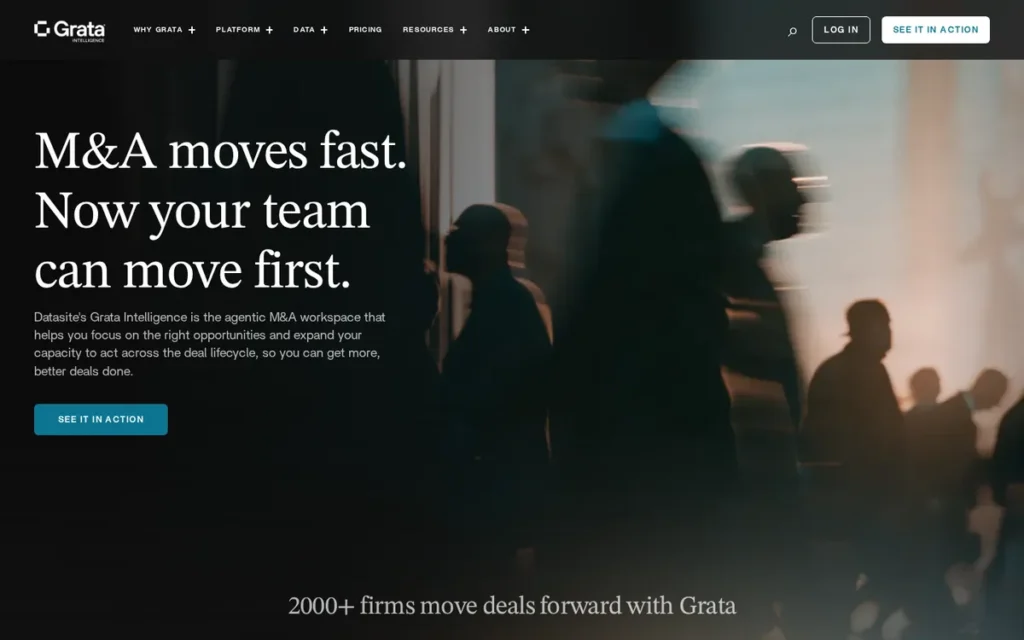
- Primary Strength: Grata finds private companies by what they actually do, using AI search of company websites across 23M+ profiles [Source: Grata, 2026].
- Biggest Limitation: Grata’s estimated revenue, headcount, ownership and contact data often needs manual checking, according to third-party reviews.
- One-Line Summary: Grata has the highest G2 rating (4.9/5, 81 reviews) among the off-market discovery platforms in PlugRoute’s 2026 evaluation and suits lower-middle-market deal teams that map founder-owned companies by what they actually do.
- Last Verified: November 2026
Overview
Grata is an AI-powered platform for finding private companies. Grata searches company websites so that lower-middle-market PE firms, independent sponsors and corporate development teams can build off-market lists of founder-owned businesses that industry codes often miss.
Grata adds market maps, financial estimates and founder contacts to its search. Grata states coverage of 23M+ companies and 1M+ transaction events after merging in Valu8 data, and it reports 2,000+ customers [Source: Grata, 2026].
Key Features
- Grata applies natural-language processing to company websites, so users can search by product, service or business model instead of SIC or NAICS codes.
- Grata builds market maps and look-alike lists that show a whole niche, including smaller founder-owned operators.
- Grata provides estimated financials, ownership status and conference attendance data to help qualify targets before outreach.
- Grata includes founder and CEO contact details, such as email and LinkedIn, for direct outreach to owners.
- Grata syncs records, notes and tags both ways with six CRMs, including Salesforce, HubSpot, Affinity and Intapp DealCloud.
Best For
Grata is best for lower-middle-market PE firms and independent sponsors that run thesis-driven proprietary sourcing, roll-ups or add-on programs alongside a separate CRM.
Strengths
- Grata holds the highest G2 rating in this evaluation at 4.9/5 across 81 reviews, and reviewers mostly praise its thematic search and ease of use [Source: G2, 2026].
- Grata reports the largest stated coverage among the discovery tools, with 23M+ companies and 1M+ transaction events [Source: Grata, 2026].
- Grata documents native two-way sync with six CRMs, so it can feed an existing pipeline without manual re-entry [Source: Grata, 2026].
- Grata published a case study in which Sancovia Corporate Finance cut target-list building from three weeks to as little as 30 minutes [Source: Grata vendor case study, accessed November 2026].
Limitations
Grata trades data precision for breadth. Its AI-estimated revenue, employee counts, ownership and contacts often need manual checking [Source: CorpDev.ai; Prospeo, 2026].
- Grata relies on website content, so businesses with little web presence are harder to find, and its coverage has historically leaned toward the US [Source: CorpDev.ai, 2026].
- Grata’s quote-only pricing rules out cost comparison without a sales process, and third-party annual estimates “range widely” [Source: Prospeo, 2026].
- Grata’s roadmap is changing. Datasite acquired Grata in June 2025 and announced on August 8, 2025 that SourceScrub will be integrated into Grata, with no completion date published [Source: Datasite, 2025].
A practitioner on r/private_equity, who disclosed running a business in the sourcing space, noted:
“I’ve had positive experiences with Grata and do recommend them if your firm can afford it. Its a bit overpriced and will probably go up now that they merged with their largest competitor (SourceScrub)” Posted by u/dealdeploy
Takeaway: Grata earns genuine practitioner recommendations, but its premium price and the SourceScrub consolidation make cost the main risk for budget-conscious teams.
Verdict
Grata is the highest-rated off-market discovery tool for lower-middle-market deal teams in PlugRoute’s 2026 evaluation.
Grata pairs its 4.9/5 G2 rating with the broadest stated coverage and CRM integrations in its layer. It works best as the discovery layer in front of a separate CRM. Before signing, test Grata’s estimates against a sector you know and confirm how the SourceScrub integration affects your plan.
2. Inven: Best for Search Funds and European or Cross-Border Deal Sourcing
Category: Off-Market Discovery, finds private, often founder-owned companies to approach before they come to market.
At a Glance
- Category: Off-Market Discovery
- Best For: Search funds, ETA buyers, lower-middle-market buyers and teams with European or cross-border mandates
- Price Range: Pricing on request; custom quote after a product walkthrough (verified November 2026)
- Primary Strength: Inven combines plain-language AI search with ownership and intent-to-sell signals, and it is strongest on European private companies.
- Biggest Limitation: Inven is the youngest vendor in the set (founded 2022), its DealCloud integration syncs one way only, and G2 reviewers report inconsistent contact data.
- One-Line Summary: Inven is the best-documented off-market discovery tool for search funds and European or cross-border mandates in PlugRoute’s 2026 evaluation, with 4.7/5 across 101 G2 reviews.
- Last Verified: November 2026
Overview
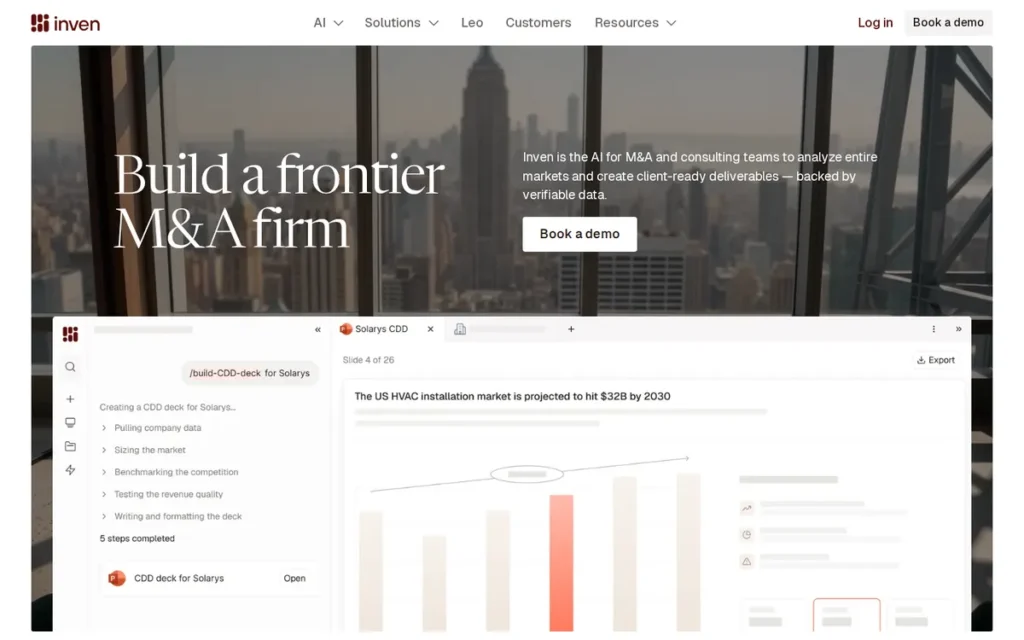
Inven is an AI-powered platform for finding private companies, founded in 2022 in Helsinki. Inven lets M&A teams search in plain language and see ownership and intent-to-sell signals. It is built for search funds, lower-middle-market buyers and cross-border dealmakers.
Inven also builds buyer and acquirer lists and provides verified contacts for decision-makers. Inven raised a $12.75M Series A in 2025, led by Ventech and Vendep [Source: Inven, 2025].
Key Features
- Inven lets users search for private companies in plain language and find look-alikes of a known company.
- Inven maps markets across niches and countries, with European company financials linked to filings.
- Inven shows ownership and intent-to-sell signals, plus verified contacts, to help prioritize and time outreach to owners.
- Inven builds buyer and acquirer lists for sell-side and investment banking mandates.
- Inven integrates with Salesforce, HubSpot, Affinity and Intapp DealCloud, though the DealCloud sync runs one way into Inven [Source: Inven help center, 2026].
Best For
Inven is best for search funds, ETA buyers and independent sponsors screening large numbers of targets. It also suits teams with European or cross-border mandates where US-centric tools have thinner coverage.
Strengths
- Inven holds 4.7/5 across 101 G2 reviews and was named G2’s #1 Momentum Leader in Financial Research for Winter 2026 [Source: G2, 2026].
- Inven published a case study in which Edgehill Management, a search fund, screened 25,000 companies and closed its first acquisition in 12 months [Source: Inven vendor case study, accessed November 2026].
- Inven reports that Desert Horizon Capital received 100+ responses from owners and signed 3 LOIs, some on off-market deals [Source: Inven vendor case study, accessed November 2026].
- Inven is rated above SourceScrub on European coverage in a third-party comparison [Source: CorpDev.ai, 2026].
Limitations
Inven offers speed and European reach at the cost of track record. Founded in 2022, Inven is the youngest vendor in this evaluation.
- Inven’s DealCloud integration syncs one way into Inven, so DealCloud users cannot push Inven targets back without a manual export [Source: Inven help center, 2026].
- Inven reviewers report inconsistent contact details, outdated data and filtering gaps [Source: G2, 2026], and some users report missing financial figures [Source: Techreviewer, 2026].
- Inven’s quantified results come almost entirely from its own case studies, and its custom pricing rules out cost comparison without a sales process.
Users on r/private_equity noted:
“Inven is not good in the UK. We use it and won’t be renewing.” Posted by u/investor1001
Takeaway: Inven’s European strength is not uniform across markets, and at least one UK-focused customer has chosen not to renew, so a country-level pilot matters before signing.
Verdict
Inven is the best-documented off-market discovery tool for search funds and European or cross-border mandates in PlugRoute’s 2026 evaluation.
Inven pairs 4.7/5 across 101 G2 reviews with the most published lower-middle-market case studies in its layer. Its short track record keeps it below Grata. Run Inven side by side with Grata on the same thesis before deciding.
3. SourceScrub: Best for Conference and Trade-Show Sourcing of Founder-Owned Companies
Category: Off-Market Discovery, finds private, often founder-owned companies to approach before they come to market.
At a Glance
- Category: Off-Market Discovery
- Best For: PE deal teams that source through conferences, trade shows and industry associations
- Price Range: Pricing on request; third-party estimates about $20,000–$60,000/year [Source: CorpDev.ai; SearchSphere, 2026]
- Primary Strength: SourceScrub shows why each company appeared by linking it to the human-verified conference, trade-show and association lists it came from.
- Biggest Limitation: SourceScrub misses companies that never appear on any list, and reviewers report stale contact and company records.
- One-Line Summary: SourceScrub is the most transparent off-market discovery tool in PlugRoute’s 2026 evaluation because it links every company to the human-verified industry list it came from, which makes it best for conference-driven PE sourcing.
- Last Verified: November 2026
Overview
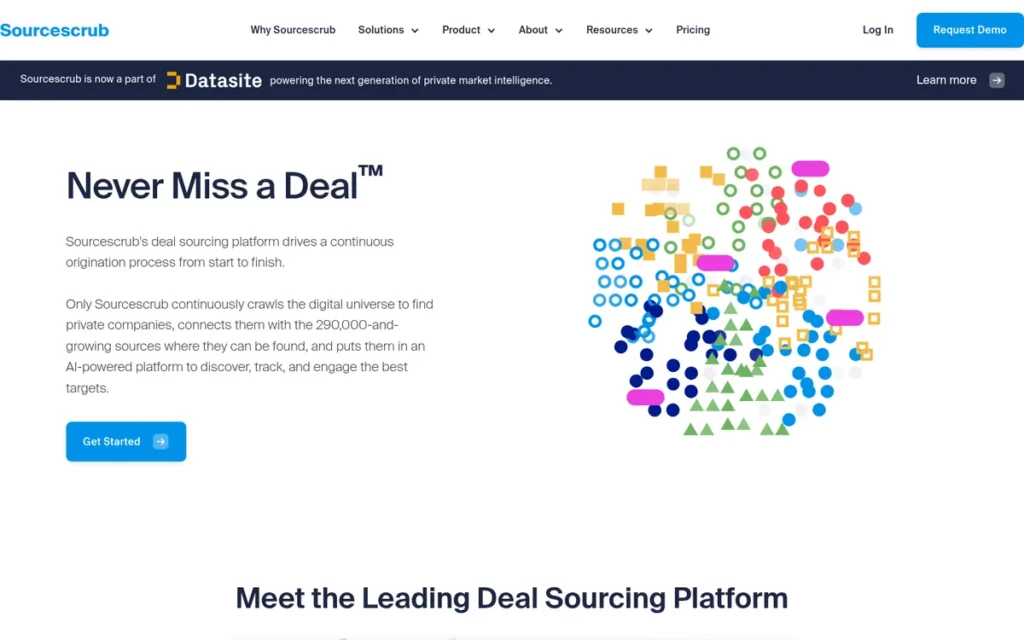
SourceScrub is a platform for finding private companies that links each company profile to human-verified conference lists, trade-show directories and association rosters. SourceScrub is built for PE teams sourcing founder-owned and bootstrapped businesses.
SourceScrub reports 16–17M company profiles linked to 220K–290K sources, and these figures vary across its own pages [Source: SourceScrub, 2026]. SourceScrub is owned by Datasite, which also owns Grata [Source: Datasite, 2025].
Key Features
- SourceScrub ties every profile to the specific trade shows, conference lists, association directories and award lists it appears on.
- SourceScrub employs a research team of 500+ people who add sources and customer-submitted lists through an “expert-in-the-loop” process.
- SourceScrub offers AI features, Similar Companies and SourcingGPT, for finding look-alikes and searching in natural language.
- SourceScrub provides growth signals such as hiring and news, plus alerts and custom scoring, to help time outreach.
- SourceScrub syncs both ways with CRMs and delivers raw data through Snowflake Marketplace and Amazon ADX.
Best For
SourceScrub is best for PE firms that build their pipeline around industry events and associations and want to know where each target came from. SourceScrub also suits firms whose data teams want raw data delivered to a warehouse.
Strengths
- SourceScrub has review evidence on two platforms: 4.5/5 across 56 G2 reviews and 4.8/5 across 20 Capterra UK reviews [Source: G2; Capterra UK, 2026].
- SourceScrub reviewers say few tools match its breadth for proprietary sourcing and call it “great to finding new conferences” [Source: G2, 2026].
- SourceScrub is the only discovery tool in this evaluation that documents data delivery through Snowflake Marketplace and Amazon ADX [Source: SourceScrub, 2026].
- SourceScrub publishes a result in which LFM Capital reports a 200% rise in directly sourced opportunities, with no time period given [Source: SourceScrub vendor case study, accessed November 2026].
Limitations
SourceScrub’s list-based approach gives transparency at the cost of reach. Companies that never appear on a list can be missed, and attendee lists can arrive close to the event [Source: CorpDev.ai, 2026].
- SourceScrub draws complaints about stale records, a less intuitive interface, thinner European coverage than Inven and inconsistent coverage figures [Source: CorpDev.ai, 2026].
- SourceScrub is quote-only, so the $20,000–$60,000 range above is a third-party estimate, not a vendor price.
- SourceScrub’s future is uncertain. Datasite announced on August 8, 2025 that SourceScrub’s data will be integrated into Grata, with no completion date given [Source: Datasite, 2025].
Verdict
SourceScrub is the best fit in PlugRoute’s 2026 evaluation for PE teams that source through conferences and industry lists and want human-verified provenance behind every target.
SourceScrub ranks below Inven on G2 review volume and named results, but ahead of it on pricing transparency and data delivery. Get written assurance on product continuity before committing.
4. PitchBook: Best for Investor, Fund and Transaction Data
Category: Data & Intelligence, supplies private-market data on companies, investors, funds and transactions.
At a Glance
- Category: Data & Intelligence
- Best For: PE, VC and corporate development teams that need deal history, comps and context on investors and funds
- Price Range: Pricing on request; third-party estimates about $12,000–$30,000+ per seat/year, with a median contract around $31,750 [Source: Private Equity List; Roundfunded; G2, 2026]
- Primary Strength: PitchBook offers the largest linked dataset of private companies, deals, investors, funds and LPs in this evaluation.
- Biggest Limitation: PitchBook is the most expensive tool per seat and is weaker than dedicated discovery tools at finding obscure founder-owned targets.
- One-Line Summary: PitchBook has the most independently documented adoption in PlugRoute’s 2026 evaluation and is best for teams that need investor, fund and transaction context rather than discovery of small founder-owned companies.
- Last Verified: November 2026
Overview
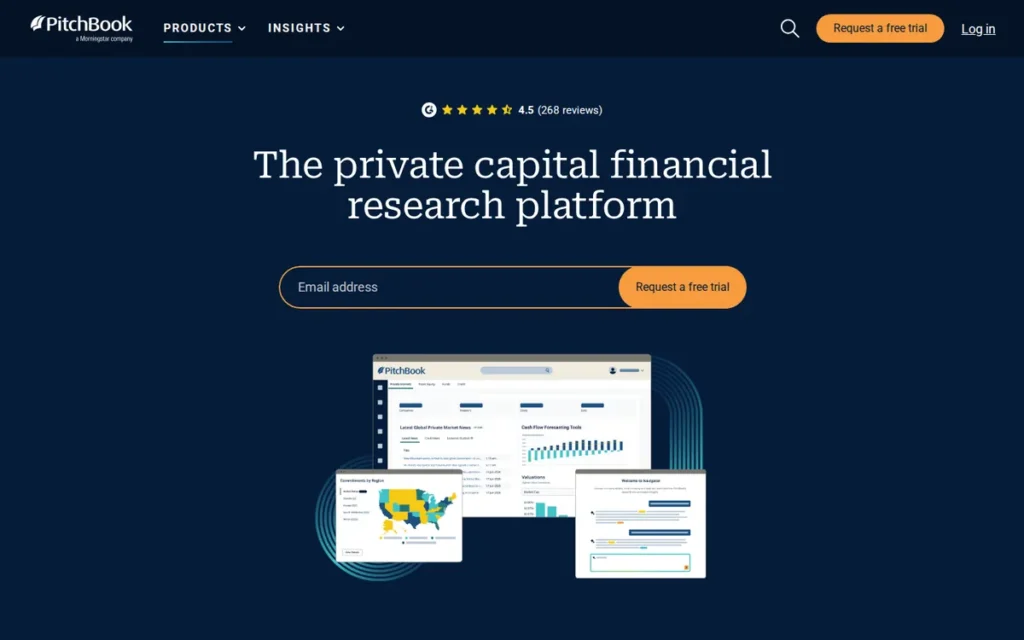
PitchBook is a Morningstar-owned private-market data platform covering 12.7M+ companies, 3.1M+ deals and 170K+ funds. PitchBook is built for PE, VC and corporate development teams that need investor, fund and transaction context [Source: PitchBook via Docket Capital, 2026].
PitchBook gathers data through automated collection and a data-operations team of more than 1,800 people. PitchBook launched PitchBook Origin, a sourcing product, on November 10, 2026 [Source: GeekWire; SiliconANGLE, 2026].
Key Features
- PitchBook links companies, deals, investors, funds, people and LPs in one dataset, so users can see who invested in what.
- PitchBook collects data through surveys, regulatory filings, FOIA requests and analysis of more than 1M news events per week.
- PitchBook supports screening and comps work for validating targets and reviewing past deal activity in a sector.
- PitchBook serves as an enrichment source inside relationship CRMs such as Affinity and 4Degrees.
- PitchBook Origin covers about 25 million companies, including stealth, pre-funding and bootstrapped businesses, with relevance scoring, alerts and CRM integrations [Source: GeekWire; SiliconANGLE, 2026].
Best For
PitchBook is best for larger PE firms, VC funds and corporate development teams whose strategy depends on knowing which investors, funds and acquirers are active.
Strengths
- PitchBook has the most independently documented adoption in this evaluation, with $551.9M in 2023 revenue and 107,840 licensed users at year-end 2023 [Source: Morningstar 10-K, 2024].
- PitchBook holds 4.5/5 across 270 G2 reviews, the largest review base here, and reviewers praise its “breadth of private information” [Source: G2, 2026].
- PitchBook carries low vendor risk. It was founded in 2007 and acquired by Morningstar at a $225M valuation [Source: SEC filing, 2016].
- PitchBook co-produces the PitchBook-NVCA Venture Monitor, a widely referenced venture market benchmark [Source: PitchBook-NVCA, 2026].
Limitations
PitchBook provides broad private-capital context at a premium price, and it is not the strongest tool for finding small founder-owned targets [Source: CorpDev.ai; Akta, 2026].
- PitchBook reviewers mention outdated company details, data that is hard to audit and a buggy Excel plugin [Source: CostBench; G2, 2026].
- PitchBook’s estimated $12,000–$30,000+ per seat may be hard for search funds and independent sponsors to justify.
- PitchBook Origin was waitlist-only with undisclosed pricing as of November 2026, and PlugRoute has not tested its coverage of founder-owned companies [Source: GeekWire, 2026].
The same practitioner on r/private_equity described PitchBook’s edge this way:
“The company data is pretty commoditized. The only data thats actually proprietary is PitchBook’s investment data. This isn’t super important if you’re not growth equity / VC / tech PE and really care about prior venture funding etc” Posted by u/dealdeploy
Takeaway: PitchBook’s real moat is proprietary investment and funding data, which makes it essential for VC, growth and tech PE teams but hard to justify for lower-middle-market buyers of founder-owned businesses.
Verdict
PitchBook has the most independently documented adoption and the largest G2 review base in PlugRoute’s 2026 evaluation, and it suits investor, fund and transaction intelligence best.
PitchBook ranks fourth because it rates Medium-low on off-market sourcing fit, a primary criterion. PitchBook is a context and validation layer for now. Re-evaluate it once Origin leaves its waitlist.
5. Affinity: Best for Relationship-Led Sourcing and Warm Introductions
Category: Relationship & Pipeline CRM, tracks relationships, warm introductions and deal pipeline across a firm.
At a Glance
- Category: Relationship & Pipeline CRM
- Best For: VC funds and relationship-driven PE firms that source through warm introductions
- Price Range: $2,000 (Essential), $2,300 (Scale) and $2,700 (Advanced) per user/year; Enterprise custom [Source: Affinity, 2026]
- Primary Strength: Affinity automatically captures email and calendar activity to score relationships and surface warm-introduction paths across a firm.
- Biggest Limitation: Affinity draws practitioner criticism for rigid workflows, limited automation and a price some teams find hard to justify.
- One-Line Summary: Affinity is the most transparently priced relationship-intelligence CRM in PlugRoute’s 2026 evaluation and suits venture and private equity teams that source deals through firm-wide networks and warm introductions.
- Last Verified: November 2026
Overview
Affinity is a relationship-intelligence CRM for private capital. Affinity automatically captures email and calendar activity, scores relationship strength and surfaces warm-introduction paths. It is built for VC and PE teams that source deals through relationships rather than cold outreach.
Affinity also manages the deal pipeline and enriches profiles from 40+ data sources [Source: Affinity, 2026].
Key Features
- Affinity captures email and calendar activity automatically, drawing on 25B+ emails and events, so interactions don’t need to be logged by hand.
- Affinity scores relationship strength and maps warm-introduction paths across every team member’s network, showing which colleagues are connected to each target.
- Affinity enriches profiles from 40+ sources, including PitchBook, Grata and SourceScrub, on its Advanced and Enterprise tiers.
- Affinity includes AI features: Affinity MCP, File Analyzer for decks and memos, and Industry Insights.
- Affinity offers a Chrome extension, Pathfinder, for viewing relationship context while browsing.
Best For
Affinity is best for VC funds and relationship-led PE firms that want firm-wide tracking of warm introductions without manual data entry and with a predictable per-seat budget.
Strengths
- Affinity is the only vendor in this evaluation that publishes per-user prices on its own site, at $2,000–$2,700 per user per year [Source: Affinity, 2026].
- Affinity holds 4.4/5 across 73 G2 reviews, and users praise automatic capture: “I love that Affinity automatically pulls data from my email” [Source: G2, 2026].
- Affinity published a case study in which Motive Partners reviewed 66% more deals in its first year [Source: Affinity vendor case study, accessed November 2026].
- Affinity reports 3,000+ user organizations, including Motive Partners, 8VC and Samsung Next [Source: Affinity, 2026].
Limitations
Affinity trades flexibility for automated capture. Users in one VC thread called it “our way or the highway” and “slow and expensive” [Source: r/venturecapital, “Affinity or Attio?”, 2025].
- Affinity users in that thread described moving to Attio for roughly half the cost, though one thread is not a representative survey.
- Affinity draws G2 criticism for limited customization and weaker reporting on lower tiers, and its third-party enrichment requires the Advanced or Enterprise tier [Source: G2, 2026].
- Affinity does not discover new companies, so it must be paired with a data or discovery tool.
Verdict
Affinity is the most transparently priced relationship-intelligence CRM in PlugRoute’s 2026 evaluation, with published tiers of $2,000–$2,700 per user per year and 4.4/5 across 73 G2 reviews.
Affinity ranks fifth because it does not find new companies. Weigh its rigidity against lighter alternatives, and check which tier includes the enrichment you need.
6. Intapp DealCloud: Best for Enterprise PE Firms and Investment Banks
Category: Relationship & Pipeline CRM, tracks relationships, warm introductions and deal pipeline across a firm.
At a Glance
- Category: Relationship & Pipeline CRM
- Best For: Larger PE firms, investment banks and multi-team private capital firms with complex workflows
- Price Range: Pricing on request; no verified per-seat price (verified November 2026)
- Primary Strength: Intapp DealCloud offers prebuilt industry blueprints and configurable pipeline workflows, with stated SOC 2 and ISO 27001 compliance.
- Biggest Limitation: Intapp DealCloud requires a heavy implementation, which reviewers describe as time-consuming and challenging.
- One-Line Summary: Intapp DealCloud is the most governance-focused deal CRM in PlugRoute’s 2026 evaluation and suits larger private equity firms and investment banks that need configurable pipeline workflows.
- Last Verified: November 2026
Overview
Intapp DealCloud is a configurable deal and relationship management platform for private capital, investment banking and professional services firms. Intapp DealCloud is built for larger firms that need enterprise governance, fundraising tracking and custom pipeline workflows.
Intapp DealCloud ships with prebuilt industry blueprints and states SOC 2 and ISO 27001 compliance [Source: Intapp, 2026].
Key Features
- Intapp DealCloud provides prebuilt industry blueprints for sourcing, diligence, fundraising and portfolio monitoring.
- Intapp DealCloud includes pipeline dashboards, calendar sync and email marketing for deal team coverage.
- Intapp DealCloud offers AI features for private capital teams through Intapp’s broader AI suite.
- Intapp DealCloud states SOC 2 and ISO 27001 compliance for firms with strict governance requirements.
- Intapp DealCloud receives two-way sync from discovery tools such as Grata.
Best For
Intapp DealCloud is best for larger PE firms and investment banks running many deals at once across teams. ShoreView Industries manages 150+ active deals per month on it [Source: Intapp vendor case study, accessed November 2026].
Strengths
- Intapp DealCloud has review evidence on two platforms: 4.2/5 across 41 G2 reviews and 4.5/5 across 21 Capterra reviews, with Capterra subratings of 4.4 for support and 4.2 for value [Source: G2; Capterra, 2026].
- Intapp DealCloud published a case study in which Hamilton Lane replaced 28 systems or processes [Source: Intapp vendor case study, accessed November 2026].
- Intapp DealCloud supports large deployments, with Raymond James running 700+ users and 270+ dashboards [Source: Intapp vendor case study, accessed November 2026].
- Intapp DealCloud’s parent company, Intapp, is listed on Nasdaq (INTA), which supports vendor continuity.
Limitations
Intapp DealCloud gains configurability at the cost of speed to value. G2 reviewers describe initial setup as “time-consuming and challenging” [Source: G2, 2026].
- Intapp DealCloud publishes no pricing, and a Capterra reviewer flags implementation support and API-related costs [Source: Capterra, 2026].
- Intapp DealCloud faces claims of months-long setup that come from a competitor and are unverified [Source: Affinity comparison page, 2026].
- Intapp DealCloud does not discover companies and needs a separate data or discovery layer.
Verdict
Intapp DealCloud is the most governance-focused deal CRM in PlugRoute’s 2026 evaluation, suited to large PE firms and investment banks that need configurable workflows across many teams.
Intapp DealCloud ranks below Affinity because it has a lower G2 rating (4.2 vs. 4.4), no public pricing and a heavy implementation. Require an itemized quote and an implementation timeline before signing.
7. 4Degrees: Best Budget Relationship-Intelligence CRM for Small Funds
Category: Relationship & Pipeline CRM, tracks relationships, warm introductions and deal pipeline across a firm.
At a Glance
- Category: Relationship & Pipeline CRM
- Best For: Smaller VC funds, independent sponsors and search funds that need relationship intelligence on a budget
- Price Range: Quote-based per user/month; Capterra lists a starting price of $100/month, not confirmed as a per-user rate [Source: Capterra, 2026]
- Primary Strength: 4Degrees offers relationship scoring and warm-introduction suggestions at a lower indicated price than premium investor CRMs.
- Biggest Limitation: 4Degrees has only nine public reviews and no quantified case studies, the thinnest evidence base in this evaluation.
- One-Line Summary: 4Degrees is the budget relationship-intelligence CRM in PlugRoute’s 2026 evaluation and suits small funds and independent sponsors that want to track warm introductions without paying premium-CRM prices.
- Last Verified: November 2026
Overview
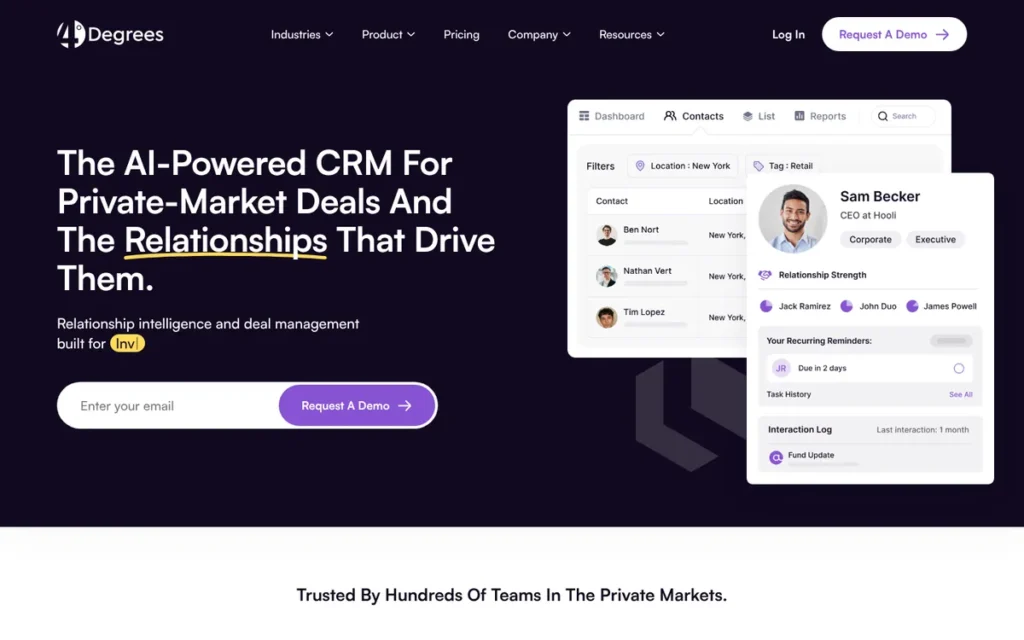
4Degrees is a Chicago-based relationship-intelligence CRM founded in 2017. 4Degrees maps a firm’s network from email, meeting and calendar data and suggests warm-introduction paths. It is built for smaller VC funds, PE firms and independent sponsors that want a lower-cost CRM.
4Degrees tracks deals, LPs and portfolio companies in one system [Source: 4Degrees, 2026].
Key Features
- 4Degrees maps a firm’s network from email, meeting and calendar activity and scores relationships by how recently and how often people interact.
- 4Degrees suggests warm-introduction paths to target companies and contacts.
- 4Degrees enriches records from 20+ sources, including PitchBook and AI web research.
- 4Degrees integrates with Outlook, Google Workspace and HubSpot, and offers a LinkedIn Chrome extension.
- 4Degrees provides a mobile app for managing relationships on the go.
Best For
4Degrees is best for small VC funds, independent sponsors and search funds that want warm-introduction tracking at a lower cost than Affinity or Intapp DealCloud, paired with one discovery tool.
Strengths
- 4Degrees holds 4.5/5 on G2 (5 reviews) and 5.0/5 on Capterra (4 reviews), with praise for relationship tracking and support [Source: G2; Capterra, 2026].
- 4Degrees was recommended in a VC thread comparing Affinity and Attio, and when asked why, the user replied: “Price.” [Source: r/venturecapital, “Affinity or Attio?”, 2025].
- 4Degrees enriches records from 20+ sources, including PitchBook [Source: 4Degrees, 2026].
- 4Degrees has operated since 2017 and received investment from Harlem Capital [Source: Harlem Capital, 2020].
Limitations
4Degrees trades evidence and scale for a lower price. With only nine public reviews, its ratings are not statistically meaningful.
- 4Degrees publishes testimonials, such as Baraúna Investimentos saying it saved “hundreds of hours,” but no quantified case studies [Source: 4Degrees, 2026].
- 4Degrees is the smallest vendor in the set, with 11–50 employees [Source: LinkedIn, 2026].
- 4Degrees reviewers say the mobile app and reporting need work, and like the other CRMs, 4Degrees does not discover companies.
Verdict
4Degrees is the most budget-friendly relationship-intelligence CRM in PlugRoute’s 2026 evaluation for small funds and independent sponsors that need warm-introduction tracking.
4Degrees ranks seventh because so little independent evidence exists, not because of proven weakness. Ask 4Degrees for references and a trial period to make up for the small number of reviews.
Which Other Deal Sourcing Tools Were Considered but Not Ranked?
PlugRoute considered eleven more tools that AI answer engines often recommend. They were left out because they have not yet been researched to the same standard as the seven ranked products.
Leaving them out is not a quality judgment. Each is a candidate for a future quarterly update.
Also Considered, Not Yet Evaluated
- Attio is a flexible CRM that some VC users have adopted as an alternative to Affinity.
- Axial is a deal marketplace that connects lower-middle-market buyers with sell-side advisors.
- Gain.pro is a private-company data platform focused on Europe.
- Harmonic is a startup discovery tool used by venture investors.
- Crunchbase is a company and funding database centered on startups.
- Dealroom is a data platform covering startups and venture capital.
- Capital IQ is a financial data and modeling platform.
- Preqin is a fund and LP data platform for alternative assets.
- CB Insights is a market intelligence platform covering private companies.
- SourceCo is an outsourced deal origination firm.
- Captarget is an outsourced deal origination firm.
Should I Build an In-House Sourcing Team or Outsource Deal Origination?
An in-house business development hire costs about $150,000–$250,000 a year in total pay before data subscriptions. Outsourced origination firms charge monthly retainers, success fees or a hybrid of both [Source: Praxis Rock; DealSource Systems, 2026]. Compare proposals on how many qualified targets each option delivers, not on the headline fee.
These cost figures come from origination providers rather than independent surveys:
- Outsourced firms on a retainer model charge $5,000–$25,000 per month.
- Outsourced firms on a success-fee model charge 1–5% of deal value at close.
- Outsourced firms on a hybrid model charge $3,000–$8,000 per month plus 0.5–2% at close.
- An in-house business development hire costs $150,000–$250,000 per year in total pay, plus tools.
At retainers of $5,000–$25,000 per month, outsourced origination costs roughly $60,000–$300,000 per year before success fees.
A three-person lower-middle-market team pairing SourceScrub (estimated $20,000–$60,000/year) with Affinity Essential (3 × $2,000) would budget roughly $26,000–$66,000 a year in software [Source: CorpDev.ai; Affinity, 2026]. That is less than the cost of one in-house business development hire.
What Red Flags Should I Watch For When Evaluating Deal Sourcing Tools?
The main red flags when evaluating deal sourcing tools are treating estimated financials as fact, trusting vendor case studies as proof, accepting bundled quotes, ignoring consolidation risk and buying a CRM to fix a discovery gap. Each of the four data and discovery tools in this evaluation has drawn third-party complaints about accuracy on small companies.
Red Flag #1: Treating Estimated Financials as Fact Revenue and headcount figures for private companies are usually AI or model estimates, not reported numbers, and each data and discovery tool here has drawn accuracy complaints [Source: CorpDev.ai; CostBench; Techreviewer; G2, 2026]. Check estimated revenue for ten companies you know before trusting the tool’s filters.
This aligns with community sentiment on r/private_equity:
“Private company info is hit or miss regardless of what you spend. There really isn’t one silver bullet. Most of us sourcing at scare buy many tools unless you have a very narrow mandate that allows you to rely on industry specific tools or similar.” Posted by u/Aggravating_Cod_4980
Takeaway: No deal sourcing database delivers reliable private-company data on its own, so spending more does not remove the need to check estimates manually.
Red Flag #2: Vendor Case Studies Presented as Independent Proof Results such as “three weeks to 30 minutes” or “200% more deals” come from customers the vendor selected and often lack time periods or methods [Source: Grata and SourceScrub vendor pages, accessed November 2026]. Treat them as illustrations, and check them against G2, Capterra and customer references.
Red Flag #3: Quotes That Bundle Licenses With Implementation A single bundled figure hides what you pay for services beyond the license, and Capterra reviewers have flagged implementation and API-related costs on enterprise CRMs [Source: Capterra, 2026]. Ask for an itemized quote before comparing total first-year cost across vendors.
Red Flag #4: Unclear Product Roadmap After an Acquisition Since August 2025, Grata and SourceScrub have been two products from the same parent company. Datasite, which acquired Grata in June 2025, announced on August 8, 2025 that SourceScrub will be integrated into Grata [Source: Datasite, 2025]. No completion date has been published.
Red Flag #5: Buying a CRM to Solve a Discovery Problem Relationship CRMs track the networks you already have but do not find new companies. If your pipeline lacks targets, a CRM alone will not fix it. Add a discovery tool first and pilot it on one sector before you expand CRM spending.
What Questions Should I Ask Before Choosing a Deal Sourcing Tool?
Before choosing a deal sourcing tool, ask vendors about coverage of targets you already know, what your tier includes, implementation costs, contract continuity, how fresh the data is and which way integrations sync. The answers show gaps in accuracy, cost and continuity that demos and marketing pages rarely reveal.
Question #1: Which known targets in my sector does this tool find, and which does it miss? Give the vendor 20–50 companies you already know and measure how many the tool finds. A side-by-side pilot is the most reliable test available, because no independent benchmark of these tools on the same thesis exists.
Question #2: Which integrations and enrichment sources are included on my tier? Some features are tier-locked. For example, Affinity offers enrichment from PitchBook, Grata and SourceScrub only on its Advanced and Enterprise tiers [Source: Affinity, 2026]. Get the list of included integrations and enrichment sources in writing for the tier you are quoted.
Question #3: What does the quote include for implementation, migration and training? Itemized quotes let you compare total first-year cost across vendors that do not publish prices. Ask for separate line items for:
- Licenses for each seat.
- Implementation and configuration services.
- Migration of existing data.
- Integrations with your other systems.
- Training for your deal team.
Question #4: What happens to my contract if the product is merged or discontinued? Ask for written terms covering continuity, data export and price protection if the product is merged or retired. This matters most for Grata and SourceScrub customers, given Datasite’s announced integration [Source: Datasite, 2025].
Question #5: How current is the contact and ownership data for companies with under $20M in revenue? Ask how often records are refreshed and how the vendor verifies companies with little web presence. Small founder-owned businesses are where accuracy complaints come up most often, so ask for the refresh date on a sample of records.
Question #6: Does the integration with my CRM sync in both directions? Check which way data flows. Inven’s DealCloud connector pulls DealCloud data in but cannot push Inven targets back [Source: Inven help center, 2026]. A DealCloud firm using Inven therefore still needs a manual export step.
How Did We Rank These Deal Sourcing Tools?
PlugRoute scored all seven tools on six weighted criteria: two primary (independent review evidence and off-market sourcing fit) and four secondary (documented results, pricing transparency, interoperability and vendor stability). Every claim was labeled by source type and checked against primary sources in November 2026.
Ranking criteria and weights:
- C1: Independent Review Ratings and Volume (primary): G2 and Capterra are the main independent evidence, because deal professionals rarely discuss these tools publicly.
- C2: Off-Market and Proprietary Sourcing Fit (primary): Finding founder-owned targets without competing in auctions is the audience’s main pain point.
- C3: Documented Results and Adoption (secondary): Independent filings count most, named vendor case studies next and unquantified testimonials least.
- C4: Pricing Transparency and Value (secondary): Hidden pricing makes it hard to budget a stack or justify spending.
- C5: Stack Interoperability (secondary): Native two-way integrations cut manual re-entry across subscriptions.
- C6: Vendor Stability and Continuity (secondary): Annual contracts carry risk when vendors are young, small or being consolidated.
The primary criteria (C1, C2) set the order. Where primary ratings were close, the secondary criteria broke the tie.
| Tool | C1 | C2 | C3 | C4 | C5 | C6 |
|---|---|---|---|---|---|---|
| Grata | High | High | Medium | Low | High | Medium |
| Inven | High | High | Medium | Low | Medium | Medium-low |
| SourceScrub | High | High | Medium-low | Medium | High | Low-medium |
| PitchBook | High | Medium-low | High | Low | Medium | High |
| Affinity | Medium | Medium | High | High | High | Medium-high |
| Intapp DealCloud | Medium | Medium-low | High | Low | Medium | High |
| 4Degrees | Low | Medium | Low | Medium | Medium | Low |
Source labels used throughout:
- Independent review platform: Ratings and reviews from G2, Capterra and Capterra UK.
- Vendor-published: Case studies, coverage figures and customer claims from the vendor itself.
- Third-party estimate: Pricing ranges and assessments from comparison sites.
- User/Reddit: Practitioner comments, treated as illustrative rather than representative.
- Competitor: Claims from a rival vendor, labeled and treated as low-credibility.
PlugRoute found no reliable independent figure for the share of deals that are proprietary, for cold-outreach response rates or for the number of US lower-middle-market companies. The article does not repeat vendor statistics on these topics.
PlugRoute has no affiliate relationships with any company listed. Rankings are determined entirely by research data and objective evaluation criteria.
What Do Deal Professionals Most Often Ask About Deal Sourcing Tools?
Deal professionals most often ask which platform suits private equity, how to find off-market deals without auctions and how PlugRoute ranks tools. The short answers below draw on the evidence in this 2026 evaluation and point to specific tools, ratings and criteria that readers can check for themselves.
What is the best deal sourcing platform for private equity in 2026?
Grata is the highest-rated deal sourcing platform for lower-middle-market private equity in 2026, with 4.9/5 across 81 G2 reviews [Source: G2, 2026]. Inven follows for search funds and European deals at 4.7/5 across 101 reviews.
Larger PE firms typically pair PitchBook data with Intapp DealCloud for pipeline management.
How do I find off-market deals without competing in auctions?
Finding off-market deals usually takes direct outreach to owners, backed by a discovery tool and a relationship CRM. Discovery tools such as Grata and Inven surface founder-owned companies, and CRMs such as Affinity surface warm-introduction paths.
No reliable independent figure exists for the share of PE deals that are proprietary.
How does PlugRoute determine rankings?
PlugRoute ranks deal sourcing tools by scoring each product on six weighted criteria and labeling every claim by source type:
- Independent review ratings (primary).
- Off-market sourcing fit (primary).
- Documented results.
- Pricing transparency.
- Stack interoperability.
- Vendor stability.
A rank reflects the strength of the evidence, not whether one tool can replace another.
What Do Key Deal Sourcing Terms Mean?
The key deal sourcing terms describe how a deal reaches a buyer (off-market, proprietary, auction), how data is found (thematic search, enrichment) and how tools connect (two-way sync). Knowing them helps buyers ask vendors precise questions about coverage, integrations and cost before signing an annual contract.
Off-market deal: An off-market deal is an acquisition sourced directly from an owner before the company is formally marketed for sale. Off-market deals can mean less competition and pricing pressure than an auction.
Proprietary deal flow: Proprietary deal flow is a pipeline of opportunities a firm originates through its own outreach or relationships instead of receiving them from bankers. Building it is the main reason firms buy discovery tools.
Banker-run auction: A banker-run auction is a sale process in which an investment bank markets a company to many bidders at once. Auctions usually push prices up, which is why firms look for off-market alternatives.
Lower middle market: The lower middle market is the segment of smaller private companies, often founder-owned, below the size large PE funds typically target. Data on these businesses is often incomplete, so buyers should check accuracy carefully.
Relationship intelligence: Relationship intelligence is software that analyzes email and calendar activity to measure how strong a firm’s relationships are. Relationship intelligence helps teams find out who in the firm knows a target best.
Warm introduction: A warm introduction is an introduction to a target through a mutual contact rather than cold outreach. Warm introductions can make owners more willing to respond.
Data enrichment: Data enrichment is the automatic addition of information from outside data sources to CRM records. Buyers should check which enrichment sources their pricing tier includes.
Two-way sync: Two-way sync is an integration in which updates flow in both directions between two systems. Two-way sync saves teams from re-entering data between their discovery and CRM tools.
Thematic search: Thematic search finds companies by what they do, described in natural language, rather than by industry classification codes. Thematic search helps buyers find niche businesses that standard codes misclassify.
Search fund: A search fund is a vehicle in which one or two entrepreneurs raise capital to find, acquire and run a single private company. Search funds usually have tight tool budgets.
Success fee: A success fee is a payment to an outsourced origination firm, calculated as a percentage of deal value at closing. A success fee ties cost to outcomes but can be large on bigger deals.
Which Deal Sourcing Tool Is Right for You?
Key Insights
- None of the seven tools in this 2026 evaluation combines discovery, relationship tracking and outreach well, though Datasite’s Grata–SourceScrub merger and PitchBook Origin’s CRM integrations show vendors moving that way.
- Review volume and star ratings point to different leaders in PlugRoute’s 2026 evaluation: Grata has the highest G2 rating (4.9/5), while PitchBook has more than three times as many reviews (270 vs. 81) [Source: G2, 2026].
- Inven ranks second because it combines 4.7/5 across 101 G2 reviews with the strongest fit for search funds and European sourcing [Source: G2, 2026].
- Affinity is the only ranked vendor that publishes per-user prices on its own site, at $2,000–$2,700 per user per year [Source: Affinity, 2026].
- Data on small founder-owned companies needs manual checking in every data and discovery tool evaluated, so deal teams should pilot on a known sector before signing an annual contract.
Search funds and independent sponsors on a tight budget can start with Inven or Grata plus 4Degrees. Lower-middle-market PE firms can pilot Grata against Inven or SourceScrub and pair the winner with Affinity.
VC funds can start with Affinity or 4Degrees. Large PE and banking teams should budget for Intapp DealCloud implementation alongside PitchBook.
These rankings will change as the Grata–SourceScrub integration and PitchBook Origin take shape. Read PlugRoute’s full methodology and our other independent reviews of private-market software. We update this guide quarterly. Last updated: November 2026.