The best currency exchange bureau software in 2026 depends on your bureau. CurrencyXchanger fits multi-branch bureaus that want cloud or desktop. CEBS fits compliance-first small bureaus at £365 a year. Money Exchanger fits exchange-plus-remittance operations, and FXPlus fits RBI-regulated money changers in India. Only these four passed PlugRoute’s verification.
Bureau operators shop in a crowded market. Online FX platforms, treasury systems and real counter software all use the same marketing language. Pricing is often quote-only, and directory listings sometimes contradict each other. Generic “AML-ready” claims rarely say which regulator or sanctions list they cover.
This guide sorts the field into four categories and scores each product on five published criteria. It ends with eight demo questions to take to every vendor. Each product must still prove offline operation, cash reconciliation and regulator-specific reporting in a live demo.
PlugRoute has no affiliate relationships with any company listed. Rankings are determined entirely by research data and objective evaluation criteria.
Last updated: November 2026 · Next scheduled refresh: February 2027
What Are the 4 Categories of Currency Exchange Bureau Software?
Currency exchange bureau software falls into four categories in 2026: full-suite bureau platforms, compliance-first counter systems, counter POS with accounting, and regional regulatory specialists. All four handle walk-in cash buying and selling. They differ in workflow breadth, in how specifically they document AML and sanctions controls, and in which regulator they are built around.
- Full-Suite Bureau Platform: A full-suite bureau platform covers the counter, multi-currency accounting, compliance, treasury and control of several branches in one system. CurrencyXchanger is the only verified product in this category.
- Compliance-First Counter System: A compliance-first counter system is counter and accounting software built around AML and sanctions controls for specific jurisdictions. CEBS (Capterra listing; official website not verified) is the only verified product in this category.
- Counter POS with Accounting: A counter POS with accounting is a multi-currency point of sale with bookkeeping and KYC built in, often extended to remittances. Money Exchanger (Capterra listing; official website not verified) is the only verified product in this category.
- Regional Regulatory Specialist: A regional regulatory specialist is bureau software built around one country’s regulator and its reporting rules. FXPlus (Capterra listing; official website not verified) is the only verified product in this category.
What counts as currency exchange bureau software? Bureau software supports buying and selling physical currency for walk-in customers at a counter. It must handle cash drawers, denominations and counter receipts. Tools that handle currency only digitally are out of scope.
PlugRoute excluded three groups of products that often appear in bureau software searches:
- Online FX and payments tools, such as Airwallex, Revolut Business, Stripe and Mollie, handle digital transfers rather than cash at a counter.
- Banking and treasury platforms, such as Calypso, Murex, Finastra, FIS, Temenos, Kyriba and TreasuryXpress, serve banks and corporate treasury teams.
- FX brands that run their own bureaus, such as Travelex, Fexco and Euronet, were excluded because PlugRoute found no evidence that they sell counter software to other bureaus.
How Do the Top Currency Exchange Bureau Software Platforms Compare at a Glance?
CurrencyXchanger and CEBS lead the 2026 field, tied at 29 of 35 weighted points. CurrencyXchanger wins on workflow breadth and deployment choice. CEBS wins on compliance detail and published price. Money Exchanger (21.5) is held back by thin compliance evidence, and FXPlus (20) by its focus on India alone.
| Rank | Company | Category | Best For | One-Line Summary | Key Capabilities | Primary Strength | Key Limitation |
|---|---|---|---|---|---|---|---|
| 1 (29/35, tied) | CurrencyXchanger | Full-Suite Bureau Platform | Single- or multi-branch bureaus and MSBs that want a choice of cloud or desktop | CurrencyXchanger is the verified bureau platform with the broadest documented workflow coverage in 2026, sold as a cloud subscription or a one-time desktop licence. | Counter POS, KYC records, AML support, accounting, treasury, cash inventory, multi-branch | Broadest documented workflow coverage, with publicly reported cloud and desktop prices | AML and sanctions features are described only in general vendor terms, and prices conflict across sources |
| 2 (29/35, tied) | CEBS (Capterra listing) | Compliance-First Counter System | Small bureaus that screen against UK, EU, UN and US OFAC sanctions lists and put due diligence first | CEBS is the most compliance-specific bureau software verified in 2026, pairing tiered due diligence and named sanctions-list screening with a £365 annual price. | Counter, multi-currency accounting, tiered due diligence, threshold alerts, sanctions and PEP screening, rate board | Most specific documented AML workflow and lowest clearly published price | Users report it can’t be reached during internet outages |
| 3 (21.5/35) | Money Exchanger (Capterra listing) | Counter POS with Accounting | Bureaus that combine exchange with remittance or wholesale | Money Exchanger is a long-running multi-currency POS and accounting system for bureaus and remittance firms, rated 4.7/5 on Capterra in 2026. | POS, accounting, KYC, remittance, bank reconciliation, position management, API | Reviewers say staff learn it quickly, and they rate support highly | AML depth is unverified and its published pricing contradicts itself |
| 4 (20/35) | FXPlus (Capterra listing) | Regional Regulatory Specialist | RBI-regulated money changers in India | FXPlus is the specialist bureau system for India’s RBI-regulated money changers in 2026, with reviewer-reported FLM-8 and FIU reporting support. | Counter-to-accounting automation, RBI workflows, FLM-8 filings, FIU nil reports, automatic reconciliation | The only verified product with reported RBI and FIU reporting support | No documented support for regulators outside India, and only four reviews |
Table notes:
- CurrencyXchanger is rated 4.8/5 from 13 reviews (G2, accessed November 2026) and 4.5/5 from 62 reviews (Capterra, accessed November 2026). Its prices come from Capterra and the Guideflow blog, and the vendor has not confirmed them.
- CEBS is rated 4.9/5 from 35 reviews (Capterra, accessed November 2026). Its price comes from Capterra UK and G2.
- Money Exchanger is rated 4.7/5 from 22 reviews (Capterra, accessed November 2026). Its price comes from Capterra Canada and Capterra Ireland, which conflict. Money Exchanger did not appear in any AI answer PlugRoute captured.
- FXPlus is rated 5.0/5 from 4 reviews (Capterra, accessed November 2026). Its price is quote-only. FXPlus did not appear in any AI answer PlugRoute captured.
Which Currency Exchange Bureau Software Should I Choose for My Use Case?
Choose by your top priority:
- Several branches, cloud or desktop: CurrencyXchanger.
- Compliance first, small budget: CEBS.
- Exchange plus remittances: Money Exchanger.
- RBI-regulated money changers in India: FXPlus.
If you move money online and don’t run a cash counter, this category is the wrong fit. Look at online FX or payments platforms instead.
| Your #1 Priority | Recommended Tool | Why | Acceptable Alternative |
|---|---|---|---|
| Multiple branches with a choice of cloud or desktop | CurrencyXchanger | Broadest documented workflow, multi-branch support and both deployment models | Money Exchanger (cloud or Windows) |
| Small UK bureau, compliance first, tight budget | CEBS | Named UK, EU, UN and OFAC sanctions screening for £365/year | CurrencyXchanger (higher cost, broader scope) |
| Compliance first, any jurisdiction | CEBS | Most specific documented due-diligence and screening workflow | CurrencyXchanger (confirm which sanctions lists each tier includes) |
| Exchange plus remittance, fast staff training | Money Exchanger | Remittance and bank reconciliation built in, and reviewers praise ease of training | CurrencyXchanger (retail and wholesale) |
| RBI-regulated in India | FXPlus | Reviewer-reported FLM-8 and FIU reporting support | None verified |
| One-time licence instead of a subscription | CurrencyXchanger (desktop) | Desktop editions reported from $2,950 (unconfirmed by vendor) | Money Exchanger (Windows; £800 one-time listing unconfirmed) or FXPlus self-installed (India only) |
| Online FX or payments, no cash counter | This category is the wrong fit | Bureau software is built for physical cash transactions | Online FX or payments platforms |
What Are the Best Currency Exchange Bureau Software Platforms in 2026?
As of November 2026, four bureau software products passed PlugRoute’s verification test. CurrencyXchanger ranks first and CEBS second after a tie at 29/35, decided by workflow coverage. Money Exchanger is third at 21.5/35 and FXPlus fourth at 20/35. Every entry below uses the same structure.
1. CurrencyXchanger: Best for Full-Suite, Multi-Branch Bureaus Wanting Cloud or Desktop

Category: Full-Suite Bureau Platform, one system covering counter, accounting, compliance, treasury and multi-branch control.
At a Glance
- Category: Full-Suite Bureau Platform
- Best For: Single- or multi-branch bureaus and MSBs that want one system for the counter, accounting and compliance, with a choice of cloud or desktop deployment
- Price Range: Cloud reported at $85/user/month to $120/month; desktop licences reported from $2,950 one-time (unconfirmed by vendor, accessed November 2026)
- Primary Strength: CurrencyXchanger documents the broadest bureau workflow coverage of any verified product and offers both cloud and desktop deployment.
- Biggest Limitation: CurrencyXchanger describes its AML and sanctions features only in general vendor terms, with no public mapping to any regulator’s reporting requirements.
- One-Line Summary: CurrencyXchanger is the verified bureau platform with the broadest documented workflow coverage in 2026, combining counter POS, multi-currency accounting, compliance tools and multi-branch control, sold as a cloud subscription or a one-time desktop licence.
- Last Verified: November 2026
Evidence status: Official website verified · Pricing conflicting; vendor-confirmed: No · Reviews: 62 on Capterra and 13 on G2, November 2026
Overview
CurrencyXchanger, built by Clear View Systems, is software for currency exchange bureaus and money services businesses. It puts the counter, accounting, compliance, treasury and multi-branch control in one system. CurrencyXchanger is sold as a cloud subscription or a one-time desktop licence.
CurrencyXchanger handles both retail and wholesale bureau work. It has the largest independent review base of the four verified products as of November 2026.
Key Features
- CurrencyXchanger provides a multi-currency counter point of sale with receipts for walk-in buy and sell transactions.
- CurrencyXchanger keeps customer and KYC records alongside AML support. Vendor pages cited by AI answers describe sanctions and PEP screening, but this is a vendor claim, so check which lists each tier includes.
- CurrencyXchanger combines multi-currency accounting, treasury and cash inventory tracking in the same system as the counter.
- CurrencyXchanger supports multiple branches and is listed with reporting, auditing and CRM functions (Capterra and GetApp, accessed November 2026).
- CurrencyXchanger is one product with two deployment models: browser-based cloud plans (CXR Cloud) or locally installed desktop editions.
Best For
CurrencyXchanger is best for bureaus and MSBs with one or several branches that want the counter, accounting and compliance in one system. It also suits buyers who need to choose between a cloud subscription and a one-time desktop licence.
Pricing
CurrencyXchanger’s published prices vary by source, and the vendor has not confirmed any of them:
- CurrencyXchanger is listed from $120/month with a free trial (Capterra, accessed November 2026).
- A third-party blog reports CurrencyXchanger cloud plans from $85/user/month and desktop editions from $2,950 (Guideflow blog, accessed November 2026).
- AI answer engines citing CurrencyXchanger’s own pages report higher desktop tiers and per-tier limits on sanctions lists and invoice volume. PlugRoute could not verify these figures, so confirm tier limits in writing.
CurrencyXchanger buyers should get a written quote that covers implementation, support, extra sanctions lists and per-branch costs.
Strengths
- CurrencyXchanger has the largest independent review base in the category: 4.5/5 from 62 reviews (Capterra, accessed November 2026) and 4.8/5 from 13 reviews (G2, accessed November 2026).
- CurrencyXchanger is the only verified product with publicly reported prices for both a cloud subscription and a one-time desktop licence, so buyers can make the cloud-or-desktop choice without switching vendors.
- CurrencyXchanger documents the widest range of bureau workflows of any verified product, from the counter POS through accounting, treasury, cash inventory and multi-branch control (Capterra and GetApp, accessed November 2026).
- CurrencyXchanger has an entry-level price listed on an independent directory (Capterra, accessed November 2026), unlike quote-only competitors.
Limitations
CurrencyXchanger gives up compliance detail in exchange for breadth. It describes its AML and sanctions features in general vendor terms. PlugRoute found no public evidence of reporting mapped to FinCEN, FINTRAC, HMRC or EU AMLA requirements.
- CurrencyXchanger’s cloud POS plan is reportedly limited in sanctions lists and invoice volume. This is unverified, so confirm the limits with Clear View Systems, because they may push growing bureaus into more expensive tiers.
- CurrencyXchanger’s entry prices conflict across sources ($85/user/month vs $120/month), so buyers can’t budget with confidence without a vendor quote.
- PlugRoute could not retrieve CurrencyXchanger’s Capterra or G2 review text in November 2026. User complaints could therefore not be assessed the way they were for CEBS and Money Exchanger.
- PlugRoute found no quantified case studies for CurrencyXchanger, and Clear View Systems’ founding year and headquarters are unverified.
- PlugRoute found no public documentation of these CurrencyXchanger capabilities as of November 2026, so test each in a demo: offline operation; denomination-level end-of-day counts; override and reversal logging; user permissions; data-export terms; accounting connectors.
Verdict
CurrencyXchanger is the broadest documented choice for bureaus that need counter-to-accounting coverage across one or several branches, with the option of cloud or desktop deployment.
CurrencyXchanger took first place on workflow coverage after tying with CEBS on total score. Compliance leads should ask Clear View Systems to demonstrate reporting for their regulator. They should also confirm which sanctions lists each tier includes and get a written quote.
2. CEBS: Best for Compliance-First, HMRC-Supervised Small Bureaus
Category: Compliance-First Counter System, counter and accounting software built around AML and sanctions controls for specific jurisdictions.
At a Glance
- Category: Compliance-First Counter System
- Best For: Small bureaus in the UK and other markets that screen against UK, EU, UN and US OFAC sanctions lists and put due diligence first
- Price Range: £365/year including one user, plus £75/year per extra user (published, accessed November 2026); setup and branch fees not published
- Primary Strength: CEBS documents the most specific AML workflow of any verified product, including tiered due diligence, cumulative threshold alerts and screening against named sanctions lists.
- Biggest Limitation: CEBS runs in the browser, and users report that it can’t be reached when the internet connection fails.
- One-Line Summary: CEBS is the most compliance-specific bureau de change software verified in 2026, with the lowest clearly published price, pairing counter and multi-currency accounting with tiered due diligence and UK, EU, UN and US OFAC sanctions screening for £365 a year.
- Last Verified: November 2026
Evidence status: Official website not verified · Pricing published (one conflicting secondary listing); vendor-confirmed: No · Reviews: 35 on Capterra, November 2026
Overview
CEBS, from Calyx Solutions, is browser-based counter and multi-currency accounting software for bureaus that buy and sell foreign currency and travellers’ cheques. Its best-documented strength is compliance: tiered due diligence, threshold alerts and named sanctions-list screening.
CEBS is listed as used in the UK, Canada, New Zealand, Zimbabwe and five other countries that the listing doesn’t name (Capterra UK, accessed November 2026).
Key Features
- CEBS offers simplified, standard and enhanced due-diligence workflows, with a KYC document checklist for each tier.
- CEBS alerts staff when a single transaction or a customer’s cumulative transactions cross a set threshold, and prompts staff when photo ID is needed.
- CEBS screens customers against UK, EU, UN and US OFAC sanctions lists and PEP lists (G2 description and Capterra reviews, accessed November 2026). The listing calls the UK list “HMRC”, so confirm which UK government list Calyx Solutions uses.
- CEBS handles counter buy and sell transactions and multi-currency accounting, with margin setup, profit-and-loss calculation and automatic or manual rate updates.
- CEBS provides customisable receipts and a digital rate board, and runs in the browser, with an older locally installed version also available.
Best For
CEBS is best for small and single-counter bureaus, especially UK bureaus supervised by HMRC for AML. It suits buyers who want strong built-in due diligence and sanctions screening at a low, predictable annual price.
Pricing
CEBS has the clearest published price among the four verified products:
- CEBS costs £365/year including one user, plus £75/year for each extra user, with a free trial (Capterra UK and G2, accessed November 2026).
- One Capterra comparison page lists CEBS at “$365 per user/month”. This conflicts with the main Capterra and G2 listings, which support the annual figure.
- CEBS does not publish fees for extra branches, setup or data migration.
CEBS buyers should confirm in writing which costs the £365 figure leaves out before signing.
Strengths
- CEBS has the highest rating on meaningful review volume in the category, 4.9/5 from 35 reviews (Capterra, accessed November 2026). Reviewers say it is “Easy to use and understand. Easy to set up.” and praise its “fantastic customer service.”
- CEBS has the most specific publicly documented compliance features of any verified product, including named sanctions-list screening and alerts on cumulative thresholds (Capterra and G2, accessed November 2026).
- CEBS has the lowest clearly published price in the category, at £365/year including one user (Capterra UK, accessed November 2026).
- CEBS has long-term users. One reviewer reports that their cashiers have used it for more than six years, and an Icelandic FX business says it met all their requirements (Capterra review, accessed November 2026).
Limitations
CEBS gives up resilience in exchange for low cost and compliance depth. Reviewers report that the browser-based system can’t be reached when the internet is down. That is a serious risk for a counter that must keep trading.
- CEBS users also report occasional freezing and a short session timeout, and some dislike the older local install (Capterra, accessed November 2026).
- CEBS publishes per-user pricing but not per-branch pricing, so multi-branch operators cannot estimate their total cost.
- CEBS does not publicly document multi-branch rate control or treasury functions, so multi-branch operators should test these in a demo.
- CEBS’s official website has not been verified, and Calyx Solutions’ founding year and headquarters are unconfirmed.
- PlugRoute found no public documentation of these CEBS capabilities as of November 2026, so test each in a demo: offline operation; denomination-level end-of-day counts; override and reversal logging; user permissions; data-export terms; accounting connectors.
Verdict
CEBS is the most compliance-specific bureau software PlugRoute verified in 2026 and has the lowest clearly published price, at £365 a year including one user.
CEBS tied CurrencyXchanger on total score and placed second only on workflow coverage. Bureaus with unreliable internet should ask Calyx Solutions how the counter keeps trading during an outage. Multi-branch operators should ask to see denomination and branch-rate controls in a demo.
3. Money Exchanger: Best for Bureau-and-Remittance Operations Needing Fast Staff Training
Category: Counter POS with Accounting, multi-currency point of sale with bookkeeping and KYC built in.
At a Glance
- Category: Counter POS with Accounting
- Best For: Bureaus that also handle remittances, currency wholesaling, or airport and travel-agency counters, and need new staff working quickly
- Price Range: Conflicting: £800 one-time vs $800/user/month on different Capterra listings (unconfirmed by vendor, accessed November 2026)
- Primary Strength: Money Exchanger combines the counter POS, accounting, remittance and bank reconciliation in a system that reviewers describe as easy to train staff on.
- Biggest Limitation: Money Exchanger documents KYC but has no publicly verified depth for AML, sanctions or PEP screening.
- One-Line Summary: Money Exchanger is a long-running multi-currency POS and accounting system for bureaus and remittance firms, rated 4.7/5 on Capterra in 2026 for ease of training and support, but its AML depth is unverified and its published pricing is contradictory.
- Last Verified: November 2026
Evidence status: Official website not verified · Pricing conflicting; vendor-confirmed: No · Reviews: 22 on Capterra, November 2026
Overview
Money Exchanger, from FinTech Crowd, is a multi-currency point-of-sale system with accounting and KYC built in. It is aimed at bureaus, remittance firms, currency wholesalers, travel agencies and airport kiosks, and it runs in the cloud or on Windows.
Money Exchanger was founded in 2010 (Capterra, accessed November 2026). Reviewers mention a UK-based helpdesk, and one reports nearly eight years of continuous use.
Key Features
- Money Exchanger provides a multi-currency counter point of sale with accounting built in.
- Money Exchanger stores KYC records and customer documents alongside each transaction.
- Money Exchanger handles remittances and bank reconciliation as well as currency exchange.
- Money Exchanger includes margin and position management, user permissions and an API for connecting other systems.
- Money Exchanger runs in the cloud or on Windows, and its Capterra listing says support is available 24/7 (accessed November 2026).
Best For
Money Exchanger is best for bureaus that run currency exchange alongside remittance or wholesale work. It suits operators who want a system that counter staff can learn quickly.
Pricing
Money Exchanger’s published pricing contradicts itself across regional Capterra listings:
- Money Exchanger is listed at £800 one-time (Capterra Canada, accessed November 2026).
- Money Exchanger is listed at $800/user/month (Capterra Ireland, accessed November 2026).
- Money Exchanger offers a free trial but no free version.
The one-time listing, together with Windows deployment, may point to a one-time desktop licence. PlugRoute could not confirm this. The conflict reflects unclear pricing across this category and doesn’t suggest bad faith by FinTech Crowd, which should confirm the price in writing.
Strengths
- Money Exchanger is rated 4.7/5 from 22 reviews, with sub-scores of 4.8 for customer service and 4.5 for ease of use (Capterra, accessed November 2026).
- Money Exchanger is repeatedly praised for easy staff onboarding. One reviewer wrote, “It was extremely easy to train the staff on how to use it,” and another said, “The customer service team is easily reachable” (Capterra review, accessed November 2026).
- Money Exchanger documents one of the broader sets of workflows in the category, combining POS, accounting, remittance, bank reconciliation and position management (Capterra, accessed November 2026).
- Money Exchanger has long-term users. One reviewer reports nearly eight years of use and calls it “extremely crucial” to managing their data (Capterra review, accessed November 2026).
Limitations
Money Exchanger gives up compliance documentation in exchange for operational breadth. Publicly, it documents only KYC. Its AML rules and its sanctions and PEP screening are unverified, so compliance leads must test them before shortlisting.
- Money Exchanger reviewers ask for an updated, browser-based interface (Capterra, accessed November 2026).
- Money Exchanger users who hold stock in many currencies say they have to keep re-checking rates.
- Money Exchanger does not publicly document multi-branch features.
- Money Exchanger’s published pricing contradicts itself across Capterra regions, and its official website has not been verified.
- PlugRoute found no public documentation of these Money Exchanger capabilities as of November 2026, so test each in a demo: offline operation; denomination-level end-of-day counts; override and reversal logging; data-export terms; accounting connectors.
Verdict
Money Exchanger is a solid choice for bureaus that combine currency exchange with remittances and need a system staff can learn quickly. Its AML and sanctions screening should be verified in a demo first.
Money Exchanger’s breadth and support are well backed by user reviews, but its compliance depth and price are not. Get written pricing and a live screening demonstration from FinTech Crowd before you compare it with the top two.
4. FXPlus: Best for RBI-Regulated Money Changers and AD Category II Firms in India
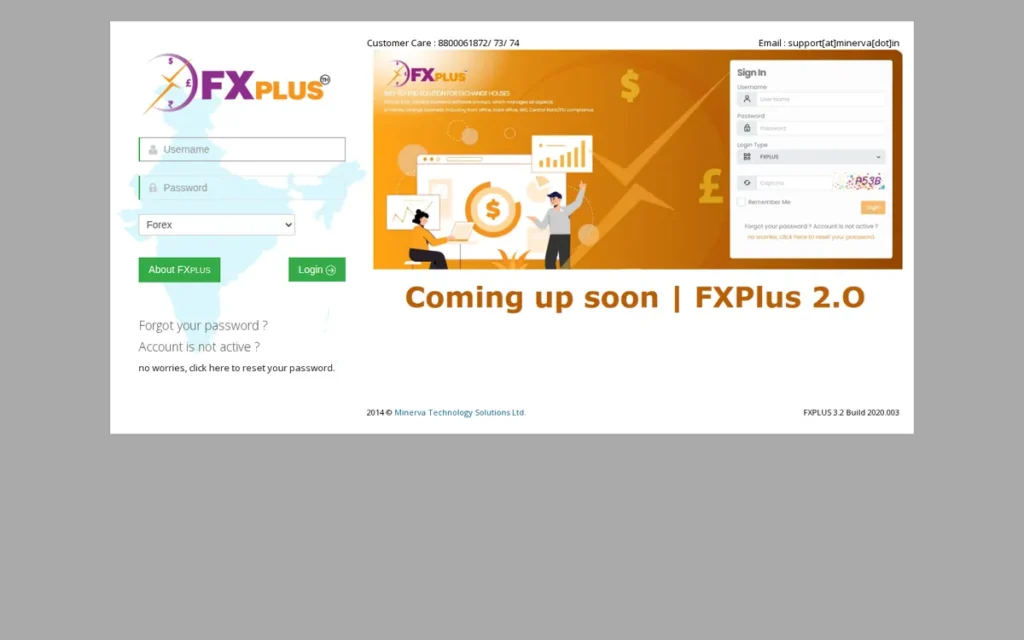
Category: Regional Regulatory Specialist, bureau software built around one country’s regulator and reporting rules.
At a Glance
- Category: Regional Regulatory Specialist
- Best For: Indian full-fledged money changers, AD Category II firms, franchisees and travel agents regulated by the RBI
- Price Range: Quote only; Capterra’s ₹25/month figure appears to be a placeholder (accessed November 2026)
- Primary Strength: FXPlus is the only verified product with reviewer-reported RBI-aligned workflows, FLM-8 filings and support for nil reports to the FIU.
- Biggest Limitation: FXPlus shows no documented support for regulators outside India and has only four independent reviews.
- One-Line Summary: FXPlus is a specialist bureau automation system for India’s RBI-regulated money changers in 2026, with reviewer-reported FLM-8 and FIU reporting and a choice of hosted or self-installed deployment, but it has minimal relevance to bureaus outside India.
- Last Verified: November 2026
Evidence status: Official website not verified · Pricing quote-only; vendor-confirmed: No · Reviews: 4 on Capterra, November 2026
Overview
FXPlus, from Minerva Technology Solutions, automates bureau work from the counter through to accounting. It is built for India’s RBI-regulated full-fledged money changers, AD Category II firms, franchisees and travel agents. FXPlus is sold as a hosted subscription or installed on your own servers.
FXPlus comes from a vendor founded in 1995 (Capterra, accessed November 2026). FXPlus reviewers mention RBI-aligned workflows and automatic reconciliation.
Key Features
- FXPlus automates the bureau workflow from the counter transaction through to accounting.
- FXPlus reviewers report support for RBI-aligned processes, including FLM-8 filings to the Reserve Bank of India (Capterra India, accessed November 2026).
- FXPlus reviewers report support for nil reports to India’s Financial Intelligence Unit (Capterra India, accessed November 2026).
- FXPlus reconciles automatically, which reviewers credit with shrinking back-office work.
- FXPlus is available as a hosted subscription or installed on the bureau’s own servers.
Best For
FXPlus is best for Indian money changers, AD Category II firms, franchisees and travel agents that need software aligned with RBI and FIU reporting.
Pricing
FXPlus pricing is effectively quote-only as of November 2026:
- FXPlus is listed at “₹25 flat rate per month” next to a “contact vendor” note (Capterra, accessed November 2026). The figure appears to be a placeholder and shouldn’t be treated as a real price.
- FXPlus has no listed free trial.
- FXPlus buyers should ask Minerva Technology Solutions for a written quote covering hosting, installation and support.
FXPlus’s quote-only model makes its costs harder to compare, but it is not evidence of poor value.
Strengths
- FXPlus is the only verified bureau product with reviewer-reported RBI-aligned workflows, FLM-8 filings and FIU nil-report support (Capterra India, accessed November 2026).
- FXPlus is rated 5.0/5 from four reviews (Capterra, accessed November 2026), and reviewers praise its security, reports, regular updates, support and automatic reconciliation.
- FXPlus has a reported operational benefit: one reviewer says it cut staffing costs by shrinking the back office and also cut infrastructure costs, though without figures (Capterra India review, accessed November 2026).
- FXPlus offers both hosted and self-installed deployment, so operators who want their data on their own servers have an on-premise option.
Limitations
FXPlus gives up international reach in exchange for regulatory depth in one country. PlugRoute found no public evidence of reporting for HMRC, FinCEN, FINTRAC or EU AMLA. That makes it a poor fit for most UK, EU or North American bureaus.
- FXPlus’s 5.0 rating rests on only four reviews, which is too few to rely on (Capterra, accessed November 2026).
- FXPlus reviewers criticise the report layout and menu organisation. They also mention figures shown without comma separators and a lack of year-on-year comparison reports.
- FXPlus pricing is quote-only with no free trial, and its official website has not been verified.
- PlugRoute found no public documentation of these FXPlus capabilities as of November 2026, so test each in a demo: offline operation; denomination-level end-of-day counts; override and reversal logging; user permissions; data-export terms; accounting connectors.
Verdict
FXPlus is the specialist choice for India’s RBI-regulated money changers. It is the only verified bureau system with reviewer-reported FLM-8 and FIU reporting support.
For a reader based in India, FXPlus has the most jurisdiction-specific compliance evidence of any product. Its #4 position reflects this article’s mostly non-India audience, not weaker software. Indian operators should ask Minerva Technology Solutions for references and a written quote.
Which Currency Exchange Bureau Software Has the Strongest AML Features?
CEBS has the most specifically documented AML features of the four bureau software products PlugRoute verified in 2026: tiered due diligence, single and cumulative threshold alerts, photo-ID prompts, and screening against UK, EU, UN and US OFAC sanctions lists and PEP lists. For India, FXPlus has reviewer-reported RBI and FIU reporting support.
| AML Capability | CurrencyXchanger | CEBS | Money Exchanger | FXPlus |
|---|---|---|---|---|
| KYC records | Documented | Documented | Documented | Not publicly documented |
| Tiered due diligence | Not publicly documented | Documented | Not publicly documented | Not publicly documented |
| Single and cumulative threshold alerts | Not publicly documented | Documented | Not publicly documented | Not publicly documented |
| Photo-ID prompts | Not publicly documented | Documented | Not publicly documented | Not publicly documented |
| Sanctions screening (lists unnamed) | Vendor claim (unverified) | Documented | Not publicly documented | Not publicly documented |
| UK sanctions list | Not publicly documented | Documented (listed as “HMRC”) | Not publicly documented | Not publicly documented |
| EU sanctions list | Not publicly documented | Documented | Not publicly documented | Not publicly documented |
| UN sanctions list | Not publicly documented | Documented | Not publicly documented | Not publicly documented |
| US OFAC list | Not publicly documented | Documented | Not publicly documented | Not publicly documented |
| PEP screening | Vendor claim (unverified) | Documented | Not publicly documented | Not publicly documented |
| RBI and FIU reporting | Not publicly documented | Not publicly documented | Not publicly documented | Reviewer-reported |
| FinCEN reporting | Not publicly documented | Not publicly documented | Not publicly documented | Not publicly documented |
| FINTRAC reporting | Not publicly documented | Not publicly documented | Not publicly documented | Not publicly documented |
“Documented” means a capability is described in an independent listing or a user review (Capterra and G2, accessed November 2026). “Not publicly documented” means PlugRoute found no public evidence, not that the feature is missing. Ask each vendor to demonstrate it.
The UK sanctions list is maintained by the FCDO, and UK financial sanctions are implemented by HM Treasury’s Office of Financial Sanctions Implementation (OFSI). HMRC is an AML supervisor, not a sanctions-list publisher. CEBS buyers should confirm which UK list the software actually uses.
Bureau software supports AML compliance, but the licensed business and its compliance officer remain responsible for it. Software can automate due-diligence tiers, threshold alerts and sanctions screening.
Your own policies, staff training, record-keeping and suspicious activity reports still decide whether your business meets its obligations.
Should I Choose Cloud or Desktop Currency Exchange Bureau Software?
Cloud bureau software suits bureaus with no in-house IT, because the vendor handles updates and hosting. A desktop or self-installed licence suits operators who want a one-time cost, local control of data and less reliance on the internet. Whichever you choose, test in a demo how the counter keeps trading offline.
Market data shows cloud growing quickly while on-premise systems remain common. Estimates depend on how the market is defined:
- Market Research Future reports that on-premise deployments held 54.3% of 2025 currency exchange software revenue, while cloud is growing at 14.6% a year (Market Research Future, accessed November 2026).
- DataIntelo puts cloud at 45.3% to 62.3% of revenue, using a broader definition of the market (DataIntelo, accessed November 2026).
- Estimates of the 2025 currency exchange software market range from $0.65B (6W Research, accessed November 2026) to $3.8B (DataIntelo, accessed November 2026), and none isolates retail bureau software.
Each verified product handles deployment differently:
- CurrencyXchanger offers browser-based cloud plans (CXR Cloud) or locally installed desktop editions.
- CEBS runs in the browser, with an older locally installed version available.
- Money Exchanger runs in the cloud or on Windows.
- FXPlus is available as a hosted subscription or installed on the bureau’s own servers.
CEBS users report that the system can’t be reached during internet outages (Capterra, accessed November 2026). PlugRoute has no equivalent user evidence for the other browser-based or cloud products, so test every one.
For a cash counter, the most important cloud-versus-desktop question is not cost. It is what happens to the next customer when the internet drops.
Which Bureau Software Vendors Did We Find but Not Rank?
PlugRoute did not rank six vendors named in AI answers: Biz4x, Divisafe, ISChange, FX3Fair, Cymonz and Office Exchange. None could be verified on an independent review platform as of November 2026. They were left out because evidence was missing, not because they are poor products.
PlugRoute could not confirm these vendors’ review listings, pricing or official websites. The claims made about them in AI answers are:
- Biz4x is named in captured AI answers as bureau software, but PlugRoute could not verify a review-platform listing, its pricing or its official website.
- Divisafe is said by AI answers to offer denomination-level reconciliation, but PlugRoute could not verify this claim or a review-platform listing.
- ISChange is named in captured AI answers, but PlugRoute could not verify a review-platform listing, its pricing or its official website.
- FX3Fair is described by AI answers as having a Standard tier covering three branches, but PlugRoute could not verify this tier or a review-platform listing.
- Cymonz is named in captured AI answers, but PlugRoute could not verify a review-platform listing, its pricing or its official website.
- Office Exchange is named in captured AI answers, but PlugRoute could not verify a review-platform listing, its pricing or its official website.
PlugRoute also searched for about a dozen other names, including Bureau Buddy, Forex Manager, SwiftExchange, Cambio, FXDesk, EZ Exchange and ForexPOS. None had a findable website, review profile or pricing.
PlugRoute will re-check every vendor in this section at the February 2027 refresh, along with the G2, GetApp and SoftwareSuggest category directories. Any vendor that passes will get a full entry at the same depth as the others, and all scores will be recalculated.
What Red Flags Should I Watch For When Evaluating Currency Exchange Bureau Software?
The six biggest red flags in currency exchange bureau software are AML claims with no named regulator, no answer on offline operation, headline prices that leave out sanctions lists or branch fees, missing data-export terms, scripted demos, and products that are really online FX or treasury platforms. Each one points to regulatory, operational or lock-in risk.
Bureau software that is “AML-compliant” without naming a regulator or sanctions list is making a claim no buyer can check.
Red Flag #1: “AML-Compliant” Claims With No Named Regulator A vendor that calls its software “AML-compliant” without naming a regulator, sanctions list or reporting format is making a claim you can’t check. Ask which requirements each feature maps to, such as the UK Money Laundering Regulations 2017, OFSI, FinCEN CTRs, FINTRAC large cash transaction reports, EU AMLR or RBI/FIU, and ask to see it working.
Red Flag #2: No Answer on Offline Operation A vendor that can’t explain what happens at the counter when the internet drops is leaving you with a real trading risk. PlugRoute found no public documentation of an offline mode for any of the four verified products as of November 2026, so ask every vendor to demonstrate one.
Red Flag #3: Headline Price Excludes Sanctions-List Access or Branch Fees A headline price can understate your real cost considerably if it leaves out these items:
- Sanctions-list access beyond the base tier is often priced separately.
- Fees for each extra branch are rarely published.
- Implementation and setup are usually quoted separately.
- Data migration from your current system is usually quoted separately.
- Support tiers can add recurring cost.
Some vendors reportedly limit lower tiers to a single sanctions list, which shows how tier limits can raise real costs.
Red Flag #4: No Data-Export Terms in the Contract A contract that doesn’t say how, and in what format, you can export all your transaction, customer and KYC data creates a risk of lock-in. PlugRoute found no published data-export terms for any of the four verified products as of November 2026, so get them in writing.
Red Flag #5: Demo Uses Vendor Scripts Instead of Your Transactions A demo that runs only on the vendor’s prepared data hides the friction your staff will meet in a real counter transaction. Bring your own currency pairs, denominations, customer scenarios and end-of-day routine, and ask the vendor to run them live.
Red Flag #6: It’s Actually an Online FX or Treasury Platform A product built for digital transfers or bank treasury is the wrong fit if it doesn’t handle cash drawers, denominations or counter receipts. Online FX tools, payments platforms and treasury systems such as Airwallex, Revolut Business, Kyriba and Murex are outside the bureau software category.
What Questions Should I Ask Before Choosing Currency Exchange Bureau Software?
Before you choose, ask each vendor to:
- Run a complete counter transaction on your own data.
- Show how the counter trades during an internet outage.
- Name the sanctions lists included in your tier.
- Put override logging, data-export, accounting-integration and migration terms in writing.
- Give you a reference bureau in your jurisdiction.
The eight questions below cover each point.
Question #1: Can you run one complete transaction for me, from rate setting to end-of-day reconciliation? A good answer is a live walkthrough on a realistic scenario, such as a customer selling £2,000 in euros:
- The cashier applies the branch buy rate from the rate board.
- The system checks the customer’s 30-day cumulative total against the due-diligence threshold.
- The system prompts for photo ID and screens the customer against sanctions and PEP lists.
- The system prints a compliant receipt.
- The system updates the euro denomination count and the till float in the drawer.
- The cashier reconciles the drawer at close, and the system shows any cash drawer variance.
Each manual step in this walkthrough becomes a possible error at end-of-day reconciliation, so count the screens and steps the cashier needs.
Question #2: What happens at the counter when the internet goes down? A good answer explains whether transactions can continue offline, how they sync once the connection returns, and how compliance checks work while offline. CEBS users report the system can’t be reached during outages (Capterra, accessed November 2026). PlugRoute has no equivalent user evidence for other products, so ask every vendor.
Question #3: Which sanctions and PEP lists are included in my tier, and how often are they updated? A good answer names each list, says how often it is updated and says whether extra lists cost more. CEBS documents screening against four named sanctions lists. For every other product, ask for the list names in writing.
Match the question to your regulator:
- HMRC-supervised bureaus should ask for a demo against the UK Sanctions List and the Money Laundering Regulations due-diligence tiers.
- FinCEN-registered MSBs should ask how the software handles Currency Transaction Report thresholds.
- FINTRAC-registered MSBs should ask how the software produces large cash transaction reports.
- RBI-regulated money changers should ask about FLM returns and FIU reporting.
Question #4: How are overrides and reversals logged, and who can perform them? A good answer shows role-based permissions that restrict who can override a rate or reverse a transaction. It also shows an audit trail recording the user, the time and the reason. PlugRoute found no public documentation of override logging for any of the four verified products as of November 2026.
Question #5: In what format can I export all my data if I leave? A good answer names the file formats, such as CSV or a database export. It confirms that customer, KYC and transaction history are included and says whether exporting costs extra. Ask for these terms to be written into the contract, not just promised in the demo.
Question #6: Which accounting tools do you integrate with? A good answer names specific accounting packages and says whether each connection is a native integration, an API or a manual file export. Money Exchanger lists an API (Capterra, accessed November 2026). PlugRoute found no public list of named accounting connectors for any of the four products.
As one user on r/smallbusiness described:
“I do this in the US and it’s a major pain in the butt. Quickbooks was absolutely terrible at trying to handle it. We honestly haven’t come up with a great solution.” Posted by u/stuiephoto
Takeaway: Businesses that hold balances in several currencies find that general-purpose accounting packages like QuickBooks handle multi-currency books poorly, so bureaus need to know exactly how each vendor’s accounting connection deals with multi-currency entries.
Question #7: Can I speak to a reference bureau of my size in my jurisdiction? A good answer puts you in touch with a current customer that has a similar number of branches and the same regulator as you.
References matter here because the four verified products have 136 public reviews combined on G2 and Capterra (accessed November 2026). PlugRoute found no quantified case studies for any of them.
Question #8: How will you migrate my data from spreadsheets or my current system? A good answer names the import format for customer and KYC records and quotes migration fees in writing. None of the four vendors publishes migration fees. It should also offer a parallel-running period, with one branch reconciling both systems at end of day before full cutover.
How Did We Rank These Currency Exchange Bureau Software Platforms?
PlugRoute scored each verified product from 1 to 5 on five criteria. Bureau Workflow Coverage (C1) and Documented Compliance Depth (C2) count double, for a maximum of 35 points. To qualify, a product had to be built for walk-in cash counter work and have a verifiable independent review listing. Four products passed as of November 2026.
PlugRoute used these five criteria:
- C1 Bureau Workflow Coverage (counts double): C1 scores how many of eight core bureau workflows each product documents. It matters because gaps push bureaus back to spreadsheets.
- C2 Documented Compliance Depth (counts double): C2 scores how specifically each product documents due diligence, thresholds, sanctions, PEP screening and regulator reporting. It matters because generic AML claims may not satisfy a regulator.
- C3 Independent Review Evidence: C3 combines G2 and Capterra ratings with review counts and marks down small review numbers. It matters because operators want proof that real bureaus use the product.
- C4 Pricing Transparency: C4 awards 5 for a consistent price across primary listings. Isolated outliers on secondary comparison pages are disclosed but not scored. Conflicts between primary or third-party sources score 2–3.5, and quote-only pricing scores 1. It matters because unclear pricing makes vendors hard to compare.
- C5 Deployment Flexibility and Resilience: C5 scores deployment options and user-reported outages. It matters because bureaus without IT staff must choose between cloud and desktop.
| Company | C1 (×2) | C2 (×2) | C3 | C4 | C5 | Weighted Total (of 35) | Rank |
|---|---|---|---|---|---|---|---|
| CurrencyXchanger | 5 | 3 | 4.5 | 3.5 | 5 | 29 | 1 |
| CEBS | 3.5 | 5 | 4 | 5 | 3 | 29 | 2 |
| Money Exchanger | 4 | 2 | 3.5 | 2 | 4 | 21.5 | 3 |
| FXPlus | 3.5 | 3 | 2 | 1 | 4 | 20 | 4 |
The C1 scores follow from the workflow matrix below. A documented workflow counts 1 and a vendor claim counts 0.5. A total of 6.5 or more scores 5, 5 to 6 scores 4, and 3 to 4.5 scores 3.5.
| Workflow | CurrencyXchanger | CEBS | Money Exchanger | FXPlus |
|---|---|---|---|---|
| Counter POS | Documented | Documented | Documented | Documented |
| Multi-currency accounting | Documented | Documented | Documented | Documented |
| Rate and margin management | Vendor claim | Documented | Documented | Not publicly documented |
| Cash inventory and reconciliation | Documented | Not publicly documented | Documented | Documented |
| Multi-branch control | Documented | Not publicly documented | Not publicly documented | Not publicly documented |
| User permissions | Not publicly documented | Not publicly documented | Documented | Not publicly documented |
| Reporting | Documented | Documented | Not publicly documented | Documented |
| Remittance or wholesale | Documented | Not publicly documented | Documented | Not publicly documented |
| Total | 6.5 | 4 | 6 | 4 |
Applying the matrix lowered FXPlus’s C1 score from an initial 4 to 3.5, which took its total from 21 to 20. Its rank did not change.
CurrencyXchanger and CEBS tied at 29/35, which is effectively a draw rather than a clear win.
PlugRoute set its tie-break rule before scoring: the higher C1 score wins, because readers most need software that handles a complete counter transaction. CurrencyXchanger scored 5 on C1 and CEBS scored 3.5.
If compliance depth (C2) were the only double-weighted criterion, CEBS would rank first (25.5 vs 24). Readers whose top priority is compliance should treat CEBS as the leading option.
If CEBS’s isolated “$365 per user/month” outlier were scored under C4, CEBS would total 28/35 and the order would not change.
The top two products separate on breadth versus compliance. CurrencyXchanger documents more of the counter-to-accounting workflow, while CEBS documents more of the AML workflow.
Money Exchanger scores 4 rather than 5 on C5. Its one-time price appears on only one regional listing, and another listing contradicts it. CurrencyXchanger’s desktop price is reported consistently by two sources, though the vendor has not confirmed it.
PlugRoute’s evidence base has known limits:
- The four verified products have 136 public reviews combined on G2 and Capterra (accessed November 2026), so review ratings are a secondary criterion only.
- Reddit searches found no discussion of these products by bureau operators, so community sentiment was not scored.
- Claims made only by vendors are labelled as vendor claims, and price conflicts between sources are shown rather than resolved by assumption.
- PlugRoute could not retrieve CurrencyXchanger’s review text, so its resilience is untested rather than shown to be better than CEBS’s.
- Capabilities with no public documentation were scored as absent rather than as weaknesses.
PlugRoute has no affiliate relationships with any company listed. Rankings are determined entirely by research data and objective evaluation criteria.
What Do Buyers Most Often Ask About Currency Exchange Bureau Software?
Buyers most often ask which bureau software suits a small bureau, how much it costs, and how PlugRoute ranks it. In short, CEBS is the strongest documented fit for small bureaus, and published prices start at £365 a year. PlugRoute ranks products on five weighted, evidence-based criteria applied equally to every vendor.
What is the best currency exchange bureau software for a small bureau?
CEBS is the strongest documented fit for a small, single-counter bureau in 2026. CEBS costs £365 a year including one user (Capterra UK, accessed November 2026) and documents tiered due diligence with named sanctions screening. Small bureaus that prefer a one-time licence can compare CurrencyXchanger’s desktop editions, reported from $2,950 (unconfirmed by vendor).
How much does currency exchange bureau software cost in 2026?
Published bureau software prices in 2026 start at £365 a year for CEBS with one user (Capterra UK, accessed November 2026). For three cashiers, CEBS works out to £515 a year. CurrencyXchanger’s reported $85/user/month cloud rate would cost about $3,060 a year (unconfirmed by vendor). Money Exchanger’s listings conflict, and FXPlus is quote-only.
How does PlugRoute determine rankings?
PlugRoute scores bureau software from 1 to 5 on five criteria: workflow coverage, compliance depth, independent reviews, pricing transparency and deployment flexibility. Workflow coverage and compliance depth count double, for a maximum of 35 points, and ties go to the higher workflow score. Every score, source and evidence gap is published in PlugRoute’s methodology section.
What Do Key Currency Exchange Bureau Software Terms Mean?
The key bureau software terms fall into three groups:
- Compliance terms: KYC, due-diligence tiers, PEP, sanctions screening and cumulative thresholds.
- Cash-control terms: denomination control, end-of-day reconciliation and spread.
- Contract terms: perpetual licence vs subscription, and data-export terms.
Each one affects how you judge a demo or a contract.
Bureau de change: A bureau de change is a licensed business that buys and sells physical foreign currency for walk-in customers. Software for a bureau de change must handle cash drawers and counter receipts, not just digital transfers.
Money services business (MSB): A money services business is a regulated business that exchanges currency, transfers money or cashes cheques. Your MSB registration decides which regulator’s reporting rules your software must support.
Know Your Customer (KYC): Know Your Customer is the process of identifying and verifying a customer before or during a transaction. Strong KYC tools prompt staff for the right ID and store the documents with each transaction.
Customer due diligence tiers: Customer due diligence tiers are the simplified, standard and enhanced levels of checks applied according to a customer’s risk and transaction size. Software that applies these tiers automatically makes it less likely that a cashier misses a required check.
Politically exposed person (PEP): A politically exposed person is someone with a prominent public role, or a close associate of one, who needs enhanced checks. PEP screening shows whether a customer needs extra scrutiny before you go ahead.
Sanctions screening: Sanctions screening checks customers against government sanctions lists, such as those published by the UK government (FCDO and HM Treasury’s OFSI), the EU, the UN or US OFAC. Buyers should confirm exactly which lists are included and how often they are updated.
Cumulative threshold alert: A cumulative threshold alert is a warning raised when a customer’s combined transactions over a period cross a set limit. A cumulative threshold alert helps detect structuring, where a large amount is split into smaller transactions to avoid checks.
Denomination control: Denomination control tracks cash stock by individual note and coin value rather than by total amount. Denomination control makes end-of-day counts faster and discrepancies easier to trace.
End-of-day reconciliation: End-of-day reconciliation compares the cash counted in each drawer, including the till float, with the system’s record at close of business. Errors in end-of-day reconciliation are among the most common causes of cash losses and audit problems.
Spread (margin): The spread is the difference between a bureau’s buy and sell rates for a currency, which is where the bureau’s profit comes from. Branch-level rate and margin controls let operators set the spread for each location.
An FX exchange operator on r/Entrepreneur described the problem:
“I’m reaching out to discuss a challenge I’ve encountered in the FX currency exchange business and explore the possibility of creating a practical solution. The issue revolves around the constant fluctuation of exchange rates, leading to potential stress and the risk of selling at lower rates due to a lack of real-time information.” Posted by u/leebaneel
Takeaway: For currency exchange operators, rates that lag behind the market put the spread directly at risk, which is why rate and margin management is a core workflow in bureau software rather than an optional extra.
Perpetual licence vs subscription: A perpetual licence is a one-time purchase of desktop software, while a subscription is a recurring fee, usually for cloud software. The choice affects your upfront cost, who handles updates and how much you rely on an internet connection.
Data export terms: Data export terms are the contract clauses that set out how, and in what format, you can take your data with you if you leave a vendor. Clear data export terms reduce the risk of lock-in.
Which Currency Exchange Bureau Software Is Right for You?
Key Insights
- Only four currency exchange bureau software products passed PlugRoute’s verification in November 2026: CurrencyXchanger, CEBS, Money Exchanger and FXPlus.
- CurrencyXchanger and CEBS are effectively tied at 29/35, with CurrencyXchanger leading on workflow breadth and deployment choice and CEBS leading on compliance detail and published price.
- Bureau software prices need written vendor confirmation, because the directory listings for CurrencyXchanger and Money Exchanger conflict and CEBS leaves out branch and setup fees.
- PlugRoute found no public documentation of offline operation, denomination-level end-of-day counts or data-export terms for any verified product, so bureau buyers should test all three in every demo.
If CurrencyXchanger and CEBS both fit, choose on your priority. Breadth and deployment choice favour CurrencyXchanger. Compliance detail and a published price favour CEBS. Software supports AML compliance, but responsibility for it stays with the licensed business.
Before booking demos, read PlugRoute’s full methodology and other independent reviews, or download the PlugRoute bureau software demo checklist. Take PlugRoute’s eight demo questions to every vendor conversation. They cover a complete transaction, outage handling, sanctions lists, override logging, data export, accounting integrations, references and migration.
We update this guide quarterly. Last updated: November 2026.