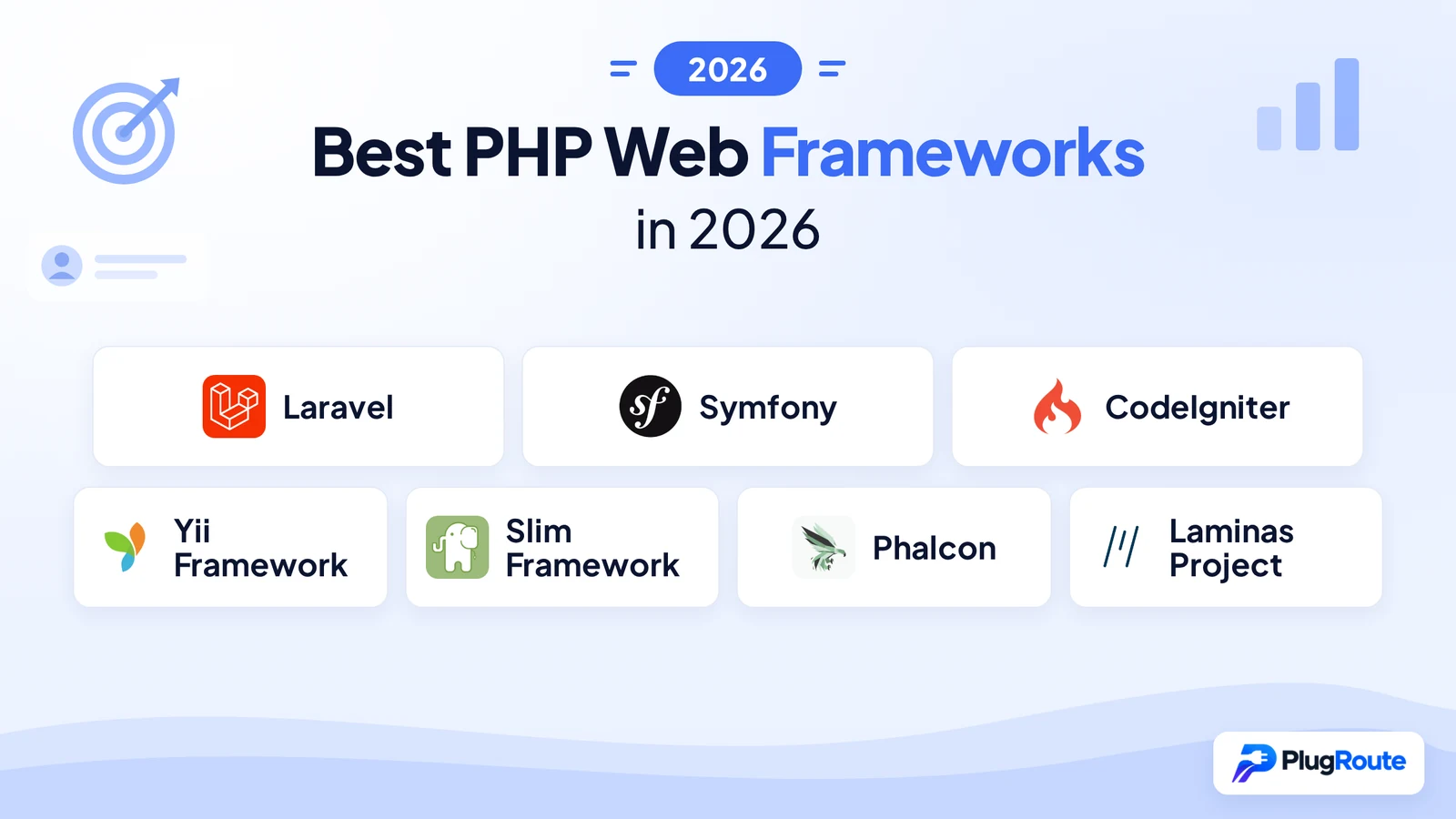
Laravel is the best PHP framework for most development teams in 2026, offering the largest hiring pool and most comprehensive first-party ecosystem of any PHP option available. Symfony is the top choice for enterprise projects requiring a 4-year security LTS window. One development reshapes this evaluation: Laminas MVC officially entered retirement in June 2025, a fact most PHP framework comparisons have not yet registered.
Choosing among seven viable PHP frameworks is genuinely difficult. Each represents a different trade-off between ecosystem completeness, learning curve, performance, and long-term viability. Selecting the wrong framework creates measurable consequences: hiring bottlenecks, architecture lock-in, and compounding maintenance costs across the project’s lifetime.
PlugRoute has no affiliate relationships with any framework or company listed. Rankings are determined entirely by research data and objective evaluation criteria.
“Laravel is better for large scale but another says Yii2 is better for large scale. It seems they contradict each other sometimes.”, Developer in r/PHP, Yii2 vs Laravel thread (2022)
Takeaway: Contradictory framework comparison advice is a symptom of evaluators measuring different things, traffic scale, codebase complexity, and team size each produce different correct answers, which is why this article maps recommendations to specific project scenarios rather than declaring universal winners.
TL;DR: Top Picks at a Glance
- Laravel is the best default PHP framework for full-stack web application and SaaS development teams in 2026, offering the largest hiring pool and most comprehensive first-party ecosystem of any PHP framework.
- Symfony is the best PHP framework for enterprise projects requiring a formally published 4-year security LTS window, modular component architecture, and commercially backed SensioLabs support.
- CodeIgniter is the best PHP framework for beginner developers learning MVC architecture and for teams building lightweight projects on shared hosting where zero licensing cost and minimal server configuration are priorities.
- Slim Framework is the best PHP micro-framework for building dedicated REST APIs and microservices where a zero-dependency PSR-compliant HTTP layer and full architectural control over the assembled stack are the primary requirements.
- Yii Framework is best for development teams building admin panels and data-heavy backend applications where Gii code generator scaffolding and built-in RBAC eliminate third-party ACL package requirements.
- Phalcon is best for PHP services sustaining more than 5,000 requests per second on self-managed server infrastructure where C-extension deployment is feasible and infrastructure cost reduction justifies the developer hiring premium.
- Laminas is the appropriate tool for maintaining existing Zend Framework or Laminas MVC codebases only, Laminas MVC officially entered retirement in June 2025 and is not recommended for any new project.
What Are the Main Categories of PHP Frameworks?
PHP frameworks in 2026 divide into four practical categories, each reflecting meaningfully different use cases: Full-Stack Frameworks for complete application development, Lightweight MVC Frameworks for simpler projects, Micro-Frameworks for API-first development, and Specialist Frameworks requiring explicit evaluation conditions before adoption.
Full-Stack Frameworks cover the complete application stack (ORM, templating, queuing, authentication, and deployment tooling) in a single opinionated environment. Laravel and Symfony both fall here, with Symfony additionally functioning as a library of approximately 50 standalone PHP components embedded in Drupal, Adobe Commerce, and Laravel itself.
Lightweight and Specialised MVC Frameworks implement the Model-View-Controller pattern with a smaller footprint. CodeIgniter optimises for beginner accessibility and zero-configuration simplicity. Yii optimises for admin-panel and database-intensive backend development, distinguished by its Gii code generator, built-in RBAC system, and GridView widgets.
Micro-Frameworks provide only HTTP routing and PSR-15 middleware dispatch, requiring developers to assemble all other capabilities via Composer. Slim Framework is the reference PHP micro-framework for API-first and headless backend development, built entirely on PSR-7 HTTP message interfaces and PSR-15 middleware standards with a zero-third-party-dependency injection container model.
Specialist and Transition-Status Frameworks require explicit caveats. Phalcon delivers the highest throughput of any framework in this comparison via its compiled C-extension architecture, but with significant deployment and hiring constraints. Laminas MVC officially entered retirement in June 2025 per the Laminas Technical Steering Committee, it is appropriate only for maintaining existing Zend or Laminas MVC codebases, not for greenfield development.
How Do the Top PHP Frameworks Compare at a Glance?
The best PHP framework for most teams in 2026 is Laravel, followed by Symfony for enterprise applications, CodeIgniter for beginners, Yii for admin panels, Slim for REST APIs, Phalcon for extreme-throughput services, and Laminas for maintaining existing codebases only. The table below provides a full side-by-side comparison.
(Red Flags and Evaluation Questions specific to your context appear after all framework entries, consider those sections before finalising a choice.)
| Rank | Company | Category | Best For | One-Line Summary | Key Capabilities | Primary Strength | Key Limitation | Last Verified |
|---|---|---|---|---|---|---|---|---|
| 1 | Laravel | Full-Stack | Full-stack SaaS, rapid development | Laravel is the most widely adopted PHP framework in 2026, chosen by 61% of PHP developers, offering the richest first-party ecosystem and fastest path to a production-ready application. | Eloquent ORM, Artisan CLI, Livewire, Octane, Horizon | 61% regular adoption (JetBrains State of PHP 2024); largest hiring pool | “Magic” abstractions increase overhead; opaque runtime behaviour | June 2026 |
| 2 | Symfony | Full-Stack / Component Library | Enterprise, long-maintenance, API Platform | Symfony is the enterprise PHP framework of choice for organisations requiring long-term support windows and modular architecture, backed by a 20-year development track record. | ~50 Standalone Components, Autowiring, API Platform, Security Component | Formal 4-year security LTS (endoflife.date/symfony); ~50 components in Drupal, Laravel, and Adobe Commerce | Steeper learning curve; verbose initial setup vs. Laravel | June 2026 |
| 3 | CodeIgniter | Lightweight MVC | Beginners, shared hosting, small projects | CodeIgniter is the most beginner-accessible PHP framework in 2026, combining the lowest learning curve, the most accessible documentation among evaluated frameworks, and zero licensing cost. | Query Builder, CSRF/XSS Protection, Flexible Routing, PHP 8.x PSR | Lowest learning curve; most accessible documentation; shared-hosting compatible | Minimal ecosystem; 11% adoption vs. 61% for Laravel (JetBrains 2024) | June 2026 |
| 4 | Yii Framework | Full-Stack MVC | Admin panels, data-heavy backends, B2B portals | Yii is a high-performance PHP framework best suited for data-heavy backend applications, distinguished by Gii scaffolding and built-in RBAC, navigating a Yii 2.0/Yii 3 version transition. | Gii Generator, Built-in RBAC, GridView/DetailView, ActiveRecord ORM | Gii scaffolding + built-in RBAC; fastest CRUD development for admin panels in this comparison | Yii 2.0 feature-frozen; Yii 3 not yet at stable release (June 2026) | June 2026 |
| 5 | Slim Framework | Micro-Framework | REST APIs, microservices, headless backends | Slim Framework is the PHP micro-framework of choice for API-first development, offering a zero-dependency PSR-compliant HTTP layer with maximum developer control over the assembled stack. | PSR-7/PSR-15, Zero Dependencies, HTTP Routing, DI Container Support | Zero third-party dependencies in core; full PSR-7/PSR-15 compliance | Documented growth ceiling as project scope expands beyond API boundaries | June 2026 |
| 6 | Phalcon | Performance-Extension | High-traffic 5,000+ RPS services | Phalcon is the highest-throughput PHP framework in 2026 via its compiled C-extension architecture, appropriate only for teams with explicit 5,000+ RPS requirements and system administration capability. | C-Extension Architecture, Volt Templating, PHQL ORM, PHP 8.3 | Substantially higher throughput vs. CodeIgniter (SitePoint community benchmark); full MVC feature set | C-extension deployment requires server admin access; verified hiring difficulty confirmed by production users | June 2026 |
| 7 | Laminas † | Enterprise Component / Middleware (MVC Retiring) | Maintaining existing Zend/Laminas codebases only | Laminas is a PHP enterprise component library whose MVC layer entered official retirement in June 2025, appropriate only for maintaining existing Zend or Laminas MVC codebases. | ~50 PSR Components, Mezzio Middleware, Linux Foundation Governance | ~50 PSR-compliant components used by Drupal, Slim, and league/oauth2-server | Laminas MVC officially retiring (Laminas TSC, June 6 2025); not for new projects | June 2026 |
† Laminas MVC entering retirement, see the full Laminas entry below for migration guidance and the official Laminas TSC source.
Quick Decision Framework
| Your #1 Priority | Recommended Tool | Why | Acceptable Alternative |
|---|---|---|---|
| Beginner / first PHP framework | CodeIgniter | Lowest learning curve; best documentation; zero cost; shared-hosting compatible | Laravel (if professional PHP development is the long-term career goal) |
| REST API only / microservice | Slim Framework | Zero-dependency PSR core; minimal overhead; API-bounded architecture by design | Symfony API Platform (for complex API with enterprise requirements) |
| Admin panel / data dashboard | Yii Framework | Gii scaffolding + built-in RBAC = fastest CRUD development in this comparison | Laravel (with third-party admin packages or paid Nova) |
| Enterprise long-maintenance project | Symfony | 4-year security LTS; 20-year track record; modular components; SensioLabs support | Laravel (if developer velocity outweighs LTS duration requirement) |
| High-traffic 5,000+ RPS | Phalcon | Only framework with C-extension throughput advantage at very high traffic scale | Laravel + Octane (if hiring concerns outweigh infrastructure savings) |
| Existing Zend / Laminas codebase | Laminas (Mezzio) | Security patch continuity; Mezzio as the designated MVC replacement | Symfony (for full migration away from Laminas MVC) |
| Startup / agency full-stack SaaS | Laravel | 61% developer adoption; largest hiring pool; fastest time-to-production | Symfony (if senior team values explicit architecture over velocity) |
| Migrating Laravel app to microservices | Slim + Laravel API Resources | Slim’s zero-dependency core for new services; Laravel API Resources for existing app | Symfony API Platform (for enterprise-scale API gateway requirements) |
The table above is designed for quick orientation. The detailed entries below provide the evidence basis for each recommendation, read the entry for your shortlisted framework, check its Red Flags against your specific infrastructure, and use the Evaluation Questions to stress-test the match before committing.
1. Laravel: Best Overall: Best for Full-Stack Web Apps, SaaS Platforms, and Rapid Development
Category: Full-Stack Framework, an opinionated, batteries-included PHP framework providing MVC architecture, Eloquent ORM, Blade templating, Artisan CLI, and a rich first-party ecosystem for building complete web applications from database layer to interactive frontend.
At a Glance
- Category: Full-Stack Framework
- Best For: Development teams building modern full-stack web apps, SaaS platforms, and APIs where ecosystem richness, the largest PHP hiring pool, and rapid time-to-production are the primary selection criteria
- Price Range: Free (MIT); optional paid ecosystem tools: Forge, Vapor, Nova, Cloud (verify current pricing at respective official sites)
- Primary Strength: Laravel commands 61% regular use among active PHP developers per JetBrains State of PHP 2024, delivering the deepest hiring pool, most Stack Overflow coverage, and most comprehensive first-party ecosystem of any PHP framework in this comparison
- Biggest Limitation: Laravel’s “magic” facades and abstractions increase per-request memory overhead versus lighter frameworks and can obscure runtime behaviour, creating debugging friction and upgrade complexity for developers who require full architectural transparency
- One-Line Summary: Laravel is the most widely adopted PHP framework in 2026, chosen by 61% of PHP developers (JetBrains State of PHP 2024, reported via zenrows.com), offering the richest first-party ecosystem and fastest path to a production-ready application of any PHP framework currently available.
- Last Verified: June 2026
Overview
Laravel is a free, open-source, full-stack PHP web application framework designed for developers who need a complete, opinionated environment for building modern web applications, SaaS products, REST APIs, and rapid prototypes with expressive syntax and built-in tooling. Laravel’s first-party ecosystem is among the most comprehensive available in the PHP space, spanning:
- Livewire and Inertia.js (interactive frontend tooling and SPA-style applications)
- Octane (high-throughput serving via Swoole or RoadRunner)
- Horizon and Telescope (queue monitoring and application debugging)
- Forge, Vapor, and Cloud (server provisioning, serverless deployment, and managed hosting)
- Nova (admin panel builder), Cashier (billing integration), Dusk (browser testing), Sanctum, Breeze, and Jetstream (API authentication and starter kits)
Laravel is maintained by Taylor Otwell under the MIT License with annual major releases (Laravel 12+ active in 2026) and over 14 years of continuous active development (laravel.com, 2026).
Key Features
- Eloquent ORM: Laravel’s Eloquent ORM maps database tables to expressive PHP object models supporting complex relationships, eager loading, and scoped query builders without requiring raw SQL for standard database operations.
- Artisan CLI: Laravel’s Artisan command-line interface generates boilerplate code for controllers, models, migrations, jobs, events, and tests with single commands, directly accelerating development velocity across all team experience levels.
- Livewire and Inertia.js: Laravel’s official Livewire and Inertia.js integrations enable server-rendered reactive UIs and SPA-style applications respectively without requiring a separate JavaScript frontend framework, keeping the entire application within a unified PHP codebase.
- Laravel Octane: Laravel Octane uses Swoole or RoadRunner to keep the application bootstrapped in memory between requests, eliminating per-request file I/O overhead and addressing the framework’s historical performance gap with lighter alternatives for high-throughput production deployments.
- First-Party Ecosystem Depth: Laravel provides officially maintained packages for queued job processing and monitoring (Horizon), scheduled task management, authentication scaffolding (Breeze, Jetstream starter kits), billing integration (Cashier), serverless AWS deployment (Vapor), and server provisioning (Forge), reducing third-party library assembly for common production requirements.
Best For
Laravel is best for development teams building modern full-featured web applications, SaaS platforms, and APIs where rapid time-to-production, the largest hirable PHP talent pool, and a comprehensive first-party ecosystem outweigh the overhead of its opinionated conventions. Laravel is also the recommended first framework for beginners who plan to pursue professional PHP development, given its 61% market share among active PHP developers (JetBrains State of PHP 2024) and the direct career advantages that ecosystem dominance provides. If your team is building a SaaS application with recurring billing, team-based authentication, and a need to hire PHP developers within 30 days, Laravel is the correct call.
Pricing
Laravel’s core framework is free and open-source under the MIT License (verified June 2026). Optional paid ecosystem products include Laravel Forge (server provisioning), Laravel Vapor (serverless AWS deployment), Laravel Nova (admin panel builder), and Laravel Cloud (managed hosting platform), verify current pricing at forge.laravel.com, vapor.laravel.com, nova.laravel.com, and cloud.laravel.com. Free tools including Livewire, Inertia.js, Octane, Horizon, Telescope, Sanctum, Cashier, Dusk, Breeze, and Jetstream are available at no cost via Composer per the Laravel ecosystem overview.
Strengths
- According to the JetBrains State of PHP 2024 survey (reported via zenrows.com), 61% of PHP developers report using Laravel regularly (more than Symfony (21%) and CodeIgniter (11%) combined) making Laravel the framework with the deepest hiring pool and most Stack Overflow coverage of any PHP option available in 2026.
- Laravel powers more than 81,000 active websites tracked by TechnologyChecker.io (trailing 12 months to March 2025) with 46% year-over-year growth, confirming that Laravel’s market position is driven by continued new adoption rather than legacy inertia alone.
- Laravel’s officially maintained first-party ecosystem: Livewire, Inertia.js, Octane, Horizon, Telescope, Forge, Vapor, Nova, Cashier, Dusk, and Sanctum, is among the most comprehensive available for any PHP framework, enabling teams to build production-grade applications without assembling third-party libraries for common requirements (Laravel documentation, 2026).
- Laravel’s annual major release cadence (Laravel 12+ in 2026) and MIT licensing ensure the framework continuously adopts modern PHP 8.x capabilities while remaining freely usable in commercial projects with no licensing restrictions (laravel.com, 2026).
Limitations
- Architectural Opacity: Laravel’s most consequential trade-off is its “magic” facades, developer-productivity abstractions that make syntax expressive for Laravel-familiar teams but obscure what executes at runtime, increasing debugging difficulty and version-to-version upgrade friction for developers who need to reason about framework internals.
- Per-Request Overhead: Laravel’s memory overhead per request is higher than micro-frameworks and lightweight alternatives; while Laravel Octane addresses this in production environments that support Swoole or RoadRunner, Octane introduces additional operational complexity that smaller teams may not need.
- Ecosystem Lock-in: Laravel’s ecosystem creates compounding exit costs over time, Eloquent ORM conventions, Artisan command patterns, and first-party package architecture all become migration friction that grows with codebase age and warrants explicit evaluation at project inception.
Users on r/laravel described the real-world impact of Eloquent’s magic properties:
“Model properties/migrations, i hate not having something on a model letting me know what properties it has, i know there is the vscode extension, and you can add doc-comments to the class to do this, but it just comes down to another magic feature of Laravel. If i haven’t touched a project for a while, to remember what columns a model has i have to search a directory for files including its table name, and then look in each individual file at all the columns and remember if any have been dropped. I think doctrines solution of column definitions as attributes on properties is great, IMO attributes are the perfect method of achieving this, at the very least applied to the class would give a central place to define the shape of the model.” Posted by u/BchubbMemes
Takeaway: Laravel’s Eloquent magic properties (database columns with no in-model schema definition) are the most commonly cited day-to-day debugging friction point among active Laravel developers, directly validating the architectural opacity limitation this entry describes.
“Laravel makes rapid development WAY easier. The kicker is, testing is way easier as well. Facades make Unit Tests an absolute breeze, despite their enigmatic nature.”, Developer in r/PHP (2021)
Takeaway: Laravel’s testing ergonomics (Facades, mockery integration, and feature test helpers) are a concrete daily-productivity advantage that partially offsets the architectural opacity criticism. The abstraction that critics call “magic” is what practitioners call “testable by default.”
Verdict
Laravel is the most widely adopted PHP framework in 2026, earning its #1 ranking through the combination of the largest developer community (61% per JetBrains State of PHP 2024), the most comprehensive first-party ecosystem, and the strongest documented adoption momentum of any PHP framework. In practical terms, a development team that can hire Laravel developers is starting with a candidate pool approximately six times deeper than any other PHP framework in this comparison, a structural advantage that no amount of technical elegance in a less-adopted framework fully offsets. Laravel is the correct default choice for most teams building full-featured web applications unless a specific requirement, LTS duration (Symfony), lightweight performance without Octane complexity (CodeIgniter, Slim), or definitively API-bounded architecture (Slim), justifies the trade-off of a smaller community and thinner ecosystem. Teams with strong preferences for architectural explicitness over abstraction should evaluate Symfony before committing to Laravel’s opinionated conventions.
2. Symfony: Best for Enterprise Applications, Long-Maintenance Projects, and Component-Based Architecture
Category: Full-Stack Framework / Component Library, a modular PHP framework offering both a complete application skeleton with formal LTS support and approximately 50 independently installable PHP components used as dependencies by Laravel, Drupal, and hundreds of other PHP projects across the ecosystem.
At a Glance
- Category: Full-Stack Framework / Component Library
- Best For: Enterprise organisations, government agencies, and teams building long-lived applications where a formally published LTS window, modular component architecture, and commercially backed support contracts are required by procurement or compliance
- Price Range: Free (MIT); commercial support via SensioLabs; Symfony Cloud hosting at commercial tiers (verify at sensiolabs.com and symfony.com/cloud)
- Primary Strength: Symfony’s formal 4-year security LTS policy and approximately 50 reusable standalone components (embedded in Drupal, Laravel, and Adobe Commerce) give enterprise teams the longest formal maintenance window and the most architecturally proven component library of any PHP framework in this comparison
- Biggest Limitation: Symfony’s explicit, configuration-heavy architecture significantly increases initial project setup time and developer onboarding duration compared to Laravel, making it less suitable for rapid prototyping or teams with high developer turnover
- One-Line Summary: Symfony is the enterprise PHP framework of choice for organisations requiring long-term support windows and modular architecture, backed by a 20-year development track record and a formal LTS policy providing security patches for 4 years per release cycle.
- Last Verified: June 2026
Overview
Symfony is a free, open-source PHP framework and component library maintained by SensioLabs, built for enterprise development teams and organisations requiring a formally supported, modular, and standards-compliant foundation for long-lived web applications. Symfony’s dual identity as both a complete application framework and a library of approximately 50 standalone PHP components means its technology is embedded in Drupal, Adobe Commerce, and Laravel itself, giving Symfony a real-world production footprint that its 21% direct developer use figure (JetBrains State of PHP 2024) significantly understates. Symfony celebrated its 20th anniversary in 2025 and is active on the Symfony 8 series, enterprise teams requiring the 4-year security window should select Symfony 7.4 LTS (security fixes until November 2029) for new projects, as Symfony 8.0 is a standard release with end of support July 2026; see endoflife.date/symfony for the full support calendar.
Key Features
- Approximately 50 Standalone PHP Components: Symfony provides independently installable PHP components (including HttpFoundation, Console, Routing, Security, Serializer, Form, Mailer, and Messenger) used as production dependencies by Laravel, Drupal, Adobe Commerce, and hundreds of other PHP projects, making Symfony’s technology among the most widely deployed PHP code in active production.
- Autowiring and Autoconfiguration: Symfony’s autowiring system automatically resolves and registers service dependencies in the DI container without requiring manual factory configuration, dramatically reducing boilerplate in large codebases and eliminating a significant source of developer friction in complex service-oriented architectures.
- Formal LTS Policy: Symfony enforces a published LTS policy providing 3 years of bug-fix support and 4 years of security fix support on LTS releases, Symfony 7.4 LTS carries security fixes until November 2029, with the full timeline available at endoflife.date/symfony for operational planning and upgrade budgeting.
- Security Component: Symfony’s Security component provides enterprise-grade authentication and authorisation infrastructure (including voter-based access control, security event listeners, and a configurable firewall system) available both as an integrated framework feature and a standalone installable library.
- API Platform: Symfony’s API Platform provides a complete REST and GraphQL API framework with automatic OpenAPI documentation generation, JSON-LD support, Hydra vocabulary for machine-readable API documentation, and Doctrine ORM integration, making it among the most widely adopted PHP options for API-first enterprise development (api-platform.com, 2026).
Best For
Symfony is best for enterprise organisations, government agencies, and long-lived application projects where a 4-year security LTS window, modular component architecture, and commercially backed SensioLabs support contracts are non-negotiable requirements. Symfony is also the preferred choice for senior PHP engineers and teams that value architectural explicitness and testability over development velocity. A practical test: if the project’s expected maintenance horizon is three or more years AND the engineering team is primarily senior-level, Symfony’s LTS advantages begin to outweigh Laravel’s velocity advantages. If either condition is false (a shorter horizon or a mixed-experience team) Laravel’s faster onboarding and larger hiring pool produce better outcomes on net.
Pricing
Symfony’s core framework and all approximately 50 component packages are free and open-source under the MIT License (verified June 2026). SensioLabs offers commercial support contracts and SymfonyInsight code quality analysis at paid tiers, verify current rates at sensiolabs.com. Symfony Cloud managed hosting is available at commercial pricing tiers, verify at symfony.com/cloud. The 4-year security patch window on LTS releases is available at no cost under the open-source licence per endoflife.date/symfony.
Strengths
- Symfony’s formal LTS policy provides bug-fix support for 3 years and security patch support for 4 years on LTS releases (endoflife.date/symfony, 2026), giving enterprise teams the longest formally published maintenance window of any PHP framework in this comparison, a directly measurable budget advantage for organisations with multi-year application maintenance horizons.
- Symfony’s real-world production footprint extends far beyond its 21% direct developer usage (JetBrains State of PHP 2024): Symfony’s approximately 50 standalone components underpin Drupal (one of the largest enterprise and government CMS platforms globally) Adobe Commerce/Magento, and Laravel itself, confirming production-scale deployment across millions of applications.
- Symfony celebrated its 20th anniversary in 2025, reflecting 20 consecutive years of development under consistent SensioLabs governance, the longest auditable development track record available in the PHP framework ecosystem.
- Symfony’s autowiring and autoconfiguration system resolves service dependencies automatically without explicit factory definitions, reducing boilerplate compared to frameworks requiring manual DI configuration, a feature directly cited by experienced developers as a concrete productivity advantage over alternatives.
Limitations
- Onboarding Steepness: Symfony’s most consequential trade-off is the time investment required before a development team reaches productivity, Symfony’s explicit, configuration-based architecture creates a steeper onboarding curve than any other full-stack PHP framework in this comparison, with junior developers consistently reporting longer ramp-up times in community discussions.
- Velocity Concession: Symfony’s onboarding cost means agencies with high developer turnover and teams with short delivery timelines will find Laravel’s faster onboarding more cost-effective for most project types, as Symfony’s LTS and governance advantages only begin to outweigh onboarding costs on projects with multi-year maintenance horizons and senior engineering teams.
- Ecosystem Size Gap: Symfony’s ecosystem, while deep and component-rich, is smaller than Laravel’s in terms of third-party packages, tutorials, community forums, and available developers, creating practical disadvantages in hiring velocity and self-service problem resolution speed relative to the market leader.
Users on r/symfony who work with both frameworks in production noted:
“We use Symfony at work, but I tend to use Laravel for smaller personal projects, and Symfony for bigger ones. Both great tools, both have their own ways of doing things, but Symfony won’t hold your hand at all.” Posted by u/blueshift9
Takeaway: Symfony’s onboarding difficulty is not a rumor or beginner complaint, practitioners who use both frameworks daily route smaller projects to Laravel precisely because Symfony’s explicit architecture demands more upfront investment than projects with short horizons can absorb.
“I have really come to appreciate Symfony, to the point where I doubt I will ever pick Laravel over Symfony in the future ever again. Symfony manages to be so incredibly powerful without getting in your way.”, Developer in r/PHP (2021)
Takeaway: Developers who have used both Laravel and Symfony in production frequently report this one-way preference shift, from Symfony back to Laravel less commonly than from Laravel to Symfony, suggesting Symfony’s non-intrusive architecture rewards experience that Laravel’s conventions can initially obscure.
Verdict
Symfony is the highest-ranked PHP framework for enterprise organisations and long-lived application development in 2026, supported by a 20-year track record, a formally published 4-year security LTS window (endoflife.date/symfony), and the distinction of powering Drupal, Adobe Commerce, and Laravel itself through its approximately 50 component library. Symfony is the strongest-evidenced enterprise PHP choice for organisations requiring a formally published 4-year security LTS window, modular components, and SensioLabs commercial support, advantages that justify its steeper onboarding curve for long-maintenance projects with senior engineering teams. Symfony earns its #2 overall ranking through the strongest enterprise viability evidence in this comparison while conceding development velocity to Laravel for teams prioritising rapid delivery. For tech leads justifying framework selection to enterprise stakeholders on stability, longevity, or compliance grounds, Symfony’s published LTS schedule and named institutional deployments provide the most defensible evidence-based argument available in the PHP ecosystem.
3. CodeIgniter: Best for Beginners, Shared Hosting Deployments, and Lightweight Projects
Category: Lightweight MVC Framework, a minimal-footprint PHP framework implementing MVC architecture with near-zero configuration overhead, prioritising documentation clarity, simplicity, and performance over ecosystem completeness or built-in feature breadth.
At a Glance
- Category: Lightweight MVC Framework
- Best For: Beginner developers learning PHP MVC architecture, small teams building lightweight sites on shared hosting infrastructure, budget-constrained projects, and developers maintaining or upgrading legacy CodeIgniter 3.x codebases
- Price Range: Free (MIT); no paid tiers, no commercial ecosystem products, zero licensing or hosting requirement costs
- Primary Strength: CodeIgniter offers the lowest learning curve and most accessible documentation of any PHP framework evaluated in this comparison, enabling beginners to build working MVC applications faster than any alternative while running on standard shared hosting with no server configuration requirements
- Biggest Limitation: CodeIgniter’s deliberate minimal footprint means teams whose projects grow in scope must manually source and integrate third-party libraries for capabilities (advanced ORM, queuing, broadcasting, deployment tooling) that Laravel and Symfony provide out of the box
- One-Line Summary: CodeIgniter is the most beginner-accessible PHP framework in 2026, combining the lowest learning curve, the most accessible documentation among all evaluated frameworks, and zero licensing or hosting cost requirements for production deployment.
- Last Verified: June 2026
Overview
CodeIgniter is a free, open-source, lightweight PHP MVC framework targeting beginner developers, small teams, and projects on shared hosting that need a working application environment with minimal configuration, low server overhead, and the most beginner-friendly documentation in the PHP framework ecosystem. CodeIgniter 4.7.3, the current stable release of the ground-up rewritten 4.x branch, introduced PSR compliance, modern PHP 8.x architecture, and CLI tooling while preserving the minimal-footprint philosophy that defines CodeIgniter’s identity. CodeIgniter is maintained by the CodeIgniter Foundation under the MIT License and has been cited in published framework comparisons as having been used in production by Casio, Nissan, Buffer, and The Mail & Guardian (mahalasa.co.in, 2025).
Key Features
- Query Builder Database Layer: CodeIgniter provides a Query Builder database abstraction layer that generates secure, escaped SQL queries from a fluent PHP interface without requiring a full ActiveRecord ORM, enabling database access at lower overhead than Laravel’s Eloquent for the simple query patterns common in small-to-medium applications.
- Built-In CSRF and XSS Protection: CodeIgniter includes built-in security protection for CSRF and XSS vulnerabilities without requiring additional configuration or package installation, providing baseline web security for beginner developers who might otherwise overlook these protections.
- Flexible URI Routing: CodeIgniter’s routing system supports both segment-based and regular expression URI patterns, allowing developers to define clean URLs and RESTful routes without the configuration overhead of more opinionated full-stack frameworks.
- Accessible Documentation: CodeIgniter’s official documentation: covering installation, configuration, controllers, models, views, helpers, libraries, and security in structured tutorials, is consistently characterised as the clearest and most beginner-accessible among all evaluated frameworks, enabling self-directed learning without paid courses.
- PHP 8.x and PSR Compatibility: CodeIgniter 4.x supports PHP 8.x, PSR-12 coding standards, and PSR-4 autoloading while remaining deployable on standard shared hosting environments without server configuration requirements beyond a standard PHP installation.
Best For
CodeIgniter is best for beginner developers learning PHP MVC architecture for the first time, small agencies building lightweight client sites on shared hosting infrastructure, and teams maintaining or upgrading legacy CodeIgniter 3.x codebases through the Foundation-supported 4.x upgrade path. CodeIgniter is also the correct choice for developers in infrastructure-constrained regional markets where shared hosting remains the predominant deployment environment and framework overhead has direct operational cost implications. If your team needs a working PHP MVC application on shared hosting with minimal configuration, CodeIgniter is the correct call.
Pricing
CodeIgniter is 100% free and open-source under the MIT License with no paid tiers, commercial editions, or associated ecosystem services (verified June 2026). Zero licensing, ecosystem product, and hosting overhead make CodeIgniter the most cost-accessible PHP framework in this comparison, verify current stable release version and upgrade guides at codeigniter.com.
Strengths
- CodeIgniter has been cited in published framework comparisons as having been used in production by Casio, Nissan, Buffer, and The Mail & Guardian (mahalasa.co.in, 2025), demonstrating production viability across consumer electronics, technology SaaS, and media publishing despite the framework’s deliberately lightweight scope.
- Independent comparison testing published at pansofic.com (2025) confirms CodeIgniter remains more performant than Laravel for equivalent small-to-medium project workloads, due to lower per-request bootstrapping overhead and the absence of heavyweight abstraction layers.
- CodeIgniter 4.7.3 represents a complete ground-up rewrite of the 4.x branch introducing PSR compliance, PHP 8.x architecture, and CLI tooling, combining over a decade of accumulated documentation and community knowledge with a fully modernised technical foundation.
- CodeIgniter’s zero-paid-tier model combined with shared-hosting compatibility: requiring only standard PHP and MySQL with no Composer server access needed for basic deployment, makes it the most cost-accessible PHP framework in this comparison for budget-constrained teams, students, and developers in infrastructure-constrained markets.
Limitations
- Ecosystem Deficit vs. Project Scope Growth: CodeIgniter’s most consequential trade-off is the gap between its minimal ecosystem and the growing complexity of modern web requirements, teams must source and integrate third-party solutions for capabilities that Laravel and Symfony provide out of the box, including sophisticated ORM behaviour, queue management, real-time event broadcasting, advanced authentication, and deployment tooling.
- Career Optionality Reduction: The job market dimension warrants evaluation at project inception, JetBrains State of PHP 2024 shows CodeIgniter at 11% developer adoption versus Laravel’s 61%, directly reducing the hiring pool for CodeIgniter-skilled developers and limiting career optionality for developers who invest primarily in CodeIgniter as their primary framework skill.
- Modern PHP Patterns Not Natively Scaffolded: CodeIgniter 4.x lacks built-in solutions for WebSocket support, real-time event broadcasting, or background job queuing, capabilities that mid-complexity modern applications increasingly require and that teams must source from separate third-party libraries with no official CodeIgniter integration guidance.
“CodeIgniter still thrives in its niche, especially for lightweight, no-nonsense projects where speed and simplicity matter more than a large feature set. It is still relevant for small teams, beginners, or legacy applications.”, dev.to/3m1n3nc3, Is CodeIgniter Still Relevant in 2025? (2025)
Takeaway: CodeIgniter’s 2025 community consensus is not that it is dead, but that it occupies a well-defined niche, teams evaluating CodeIgniter should self-assess whether their project scope and infrastructure constraints match that niche before defaulting to a more feature-complete alternative.
Users on r/PHP who have shipped production CodeIgniter projects described the practical growth ceiling:
“Nearly all of my jobs over the past 12 months have been either CodeIgniter or Laravel. Codeigniter is very easy. It’s clean and seeing as I know it well I’m able to get apps up and running quickly. You’ll be hard pressed to find major support in external libraries but now that composer is supported it’s typically very easy to utilize anything via composer. It’s not ‘elegant’ and I’ve had my fair share of late nights trying to figure out some stupid gotcha introduced by the framework but again – it typically fits the bill for most smaller projects I’m trying to get out the door in a few days / weeks. If I know that a project may have legs and grow – or if other developers are jumping on board with me… then I’ll go to something like Laravel or Symfony just because I know that it may end up on the hands of someone in a higher pay grade down the road.” Posted by u/trollfromtn
Takeaway: Experienced CodeIgniter practitioners consistently hit the same inflection point, the framework delivers genuine speed-to-market for small, bounded projects but becomes the wrong choice the moment a project needs to scale team size or long-term maintainability, confirming CodeIgniter’s “correct starting point, not permanent destination” positioning in this article.
Verdict
CodeIgniter is the correct starting point, not the permanent destination. CodeIgniter earns its #3 position as the best PHP framework for absolute beginners and infrastructure-constrained teams in 2026, combining the lowest learning curve, the most accessible documentation among all evaluated frameworks, and the lowest total cost of any framework in this comparison. CodeIgniter’s cited production use across consumer electronics, SaaS, and media industries confirms viability beyond the beginner segment, and the 4.7.3 release demonstrates active CodeIgniter Foundation governance. Developers investing in CodeIgniter as a primary skill should plan a deliberate path toward Laravel or Symfony as their projects scale, given the job market concentration documented in the JetBrains State of PHP 2024 survey.
4. Yii Framework: Best for Admin Panels, Data-Heavy Backend Applications, and B2B Enterprise Portals
Category: Full-Stack MVC Framework (Backend-Specialised), a high-performance PHP framework designed for database-intensive backend applications, distinguished by its Gii code generator for automated CRUD scaffolding and its built-in RBAC system for enterprise-grade role management.
At a Glance
- Category: Full-Stack MVC Framework (Backend-Specialised)
- Best For: Development teams building admin panels, data management dashboards, B2B enterprise portals, and backend systems where rapid CRUD scaffolding and built-in role-based access control are primary criteria and the Yii2/Yii3 version transition risk is acceptable
- Price Range: Free (MIT); no paid commercial tiers or first-party hosted services
- Primary Strength: Yii’s Gii code generator and built-in RBAC system enable faster scaffolding of CRUD-heavy admin applications and role-based access control than any other framework in this comparison, without requiring third-party packages for either capability
- Biggest Limitation: Yii currently presents a version dilemma unique in this comparison, Yii 2.0 is feature-frozen (receiving only bugfixes) while Yii 3 has not yet reached a formal stable release equivalent to Yii 2.0, a risk present in no other evaluated PHP framework as of June 2026
- One-Line Summary: Yii is a high-performance PHP framework best suited for data-heavy backend applications and admin portals, distinguished by Gii scaffolding and built-in RBAC, but currently navigating a version transition between a feature-frozen Yii 2.0 and an incomplete Yii 3 release.
- Last Verified: June 2026
Overview
Yii Framework is a free, open-source, high-performance PHP MVC framework designed for developers building database-intensive backend applications, admin panels, B2B portals, and CMS systems that require rapid CRUD scaffolding and role-based access control with minimal manual configuration. Yii is available in three maintenance branches, Yii 1.1 (legacy, bugfix-only), Yii 2.0 (current stable, feature-frozen), and Yii 3 (actively developed, not yet at a formal stable release equivalent to Yii 2.0), and version selection is the most important decision for any team evaluating Yii in 2026. Yii teams adopting the framework for new projects must choose between building on Yii 2.0 (feature-frozen, stable) or Yii 3 (evolving, pre-stable), a version dilemma absent from every other evaluated PHP framework. Yii published active component releases in 2025, including a major Yii Database release (yiiframework.com/news, 2025), confirming ongoing maintainer engagement.
Key Features
- Gii Code Generator: Yii’s Gii code generator automatically scaffolds models, controllers, CRUD forms, and REST API stubs from a database schema definition, reducing the development time for standard admin panel functionality more than any comparable built-in scaffolding tool in this comparison.
- Built-In RBAC System: Yii provides a built-in hierarchical and rule-based RBAC system supporting complex multi-role permission structures with direct database persistence, without requiring third-party packages, directly relevant for enterprise portals, ERP modules, and multi-user admin dashboards with granular access requirements.
- GridView and DetailView Widgets: Yii’s GridView and DetailView widgets provide pre-built admin interface data grid components with sorting, filtering, and pagination, frontend admin UI functionality that requires third-party packages or manual implementation to replicate in every other framework in this comparison.
- ActiveRecord ORM: Yii’s ActiveRecord ORM includes efficient lazy loading, eager loading with query optimisation, and a multi-layered caching infrastructure spanning data cache, query cache, fragment cache, and page cache, enabling database-intensive applications to reduce redundant query overhead.
- PSR Compliance in Yii 3: Yii’s Yii 3 branch introduces full PSR compliance alongside secure defaults across both Yii 2 and Yii 3 (including input validation, output escaping, CSRF protection, and parameterised queries) without requiring developer configuration for baseline security.
Best For
Yii Framework is best for development teams building CRUD-heavy admin panels, data management dashboards, B2B enterprise portals, and backend systems where the Gii code generator’s scaffolding speed and built-in RBAC access control are primary selection criteria. Yii is specifically appropriate for teams comfortable building on Yii 2.0 (stable, feature-frozen) while monitoring Yii 3’s progress toward a full stable release, or for teams with existing Yii 2.0 codebases already in production per drcsystems.com (2024). Yii ranks above Slim because its feature set and full-stack MVC architecture serve a broader range of production contexts, while Slim’s intentional scope minimalism places it in a narrower (but equally well-served) category.
Pricing
Yii Framework is 100% free and open-source under the MIT License with no paid commercial tiers (verified June 2026). Commercial support is available through third-party PHP development agencies rather than a project-maintained service tier. Verify current release status for both Yii 2.0 (feature-frozen stable) and Yii 3 (in development) at yiiframework.com and the Yii 3 documentation before committing to a version for a new project.
Strengths
- Yii’s Gii code generator automatically scaffolds models, controllers, CRUD forms, and REST API stubs from database schema definitions, providing among the fastest built-in database scaffolding workflows of any PHP framework in this comparison, directly reducing development hours for data-intensive admin applications per independent comparison sources (drcsystems.com, 2024).
- Yii’s built-in RBAC system: supporting hierarchical RBAC and rule-based RBAC with direct database persistence, provides enterprise-grade access management without any third-party package dependency, a concrete advantage for multi-role B2B applications and enterprise portals where other frameworks require third-party ACL libraries.
- The Yii project published multiple component releases in 2025, including a major Yii Database release (yiiframework.com/news, 2025), confirming active maintainer engagement and preventing classification as an abandoned project despite the extended Yii2/Yii3 transition timeline.
- Yii’s layered caching infrastructure: spanning data cache, query cache, fragment cache, and page cache, provides built-in performance optimisation for database-intensive applications without requiring external caching library integration (kanhasoft.com, 2024).
Limitations
- Version Transition Dilemma: Yii’s most consequential trade-off in 2026 is a version situation unique in this comparison, Yii 2.0 is feature-frozen, receiving only bugfixes and security patches, while Yii 3 is actively developed but has not yet reached a stable release equivalent to Yii 2.0, leaving teams with no “both stable and current” version option that exists for every other evaluated framework.
- Community Size Gap: Yii’s developer community is significantly smaller than Laravel’s and Symfony’s, reducing hiring pool depth, Stack Overflow coverage, and available tutorial resources, the simpalm.com vendor blog estimate of approximately 14.1% PHP framework market share (simpalm.com, 2026) is directional only and unsupported by a primary developer survey equivalent to the JetBrains data available for the top three frameworks.
- No Commercial Backing: Yii operates without a commercial entity or foundation providing funding, governance, or support contracts, meaning the project’s long-term direction depends entirely on volunteer maintainers, a structural risk for enterprise teams compared to Symfony’s SensioLabs governance or Laravel’s commercially active ecosystem.
“Laravel is better for large scale but another says Yii2 is better for large scale. It seems they contradict each other sometimes.”, Developer in r/PHP, Yii2 vs Laravel thread (2022)
Takeaway: The contradiction exists because “large scale” means different things, Yii2 handles database-intensive backend scale (high query volume, complex CRUD, RBAC) well; Laravel handles ecosystem and team productivity scale better. Identifying which dimension of “scale” matters most to your project resolves the contradiction.
Users on r/PHP who have tested Yii3 in practice noted the documentation gap that defines the version transition risk:
“Yii3’s package approach is super nice and flexible but also pretty complex. So far I’ve managed to get up and running with the sporadic articles and documentation. Hope the ‘awesome documentation’ part materializes soon. Yii2 docs are pretty good, so I have hopes 🤞” Posted by u/sebbeselvig
Takeaway: Developers who have hands-on Yii3 experience confirm both its architectural improvement and its incomplete documentation, the exact conditions that make the Yii2/Yii3 transition a real adoption risk for teams that need a stable, fully documented framework on day one of a new project.
Verdict
Yii is the best PHP framework for teams building admin-heavy, CRUD-intensive backend applications and B2B portals in 2026, where its Gii code generator and built-in RBAC provide measurable development speed advantages over alternatives that require third-party solutions for the same functionality. Yii earns its #4 position through this specialised strength in backend data-heavy development, but teams must explicitly factor the Yii2/Yii3 version transition into their adoption decision, the absence of a stable Yii 3 release as of June 2026 is a concrete framework risk present in no other evaluated option. Teams whose project requirements fit Yii’s strengths but who cannot accept the version transition risk should evaluate Symfony as the enterprise alternative with the strongest equivalent RBAC and architectural stability credentials.
5. Slim Framework: Best for REST APIs, Microservices, and Headless Backend Development
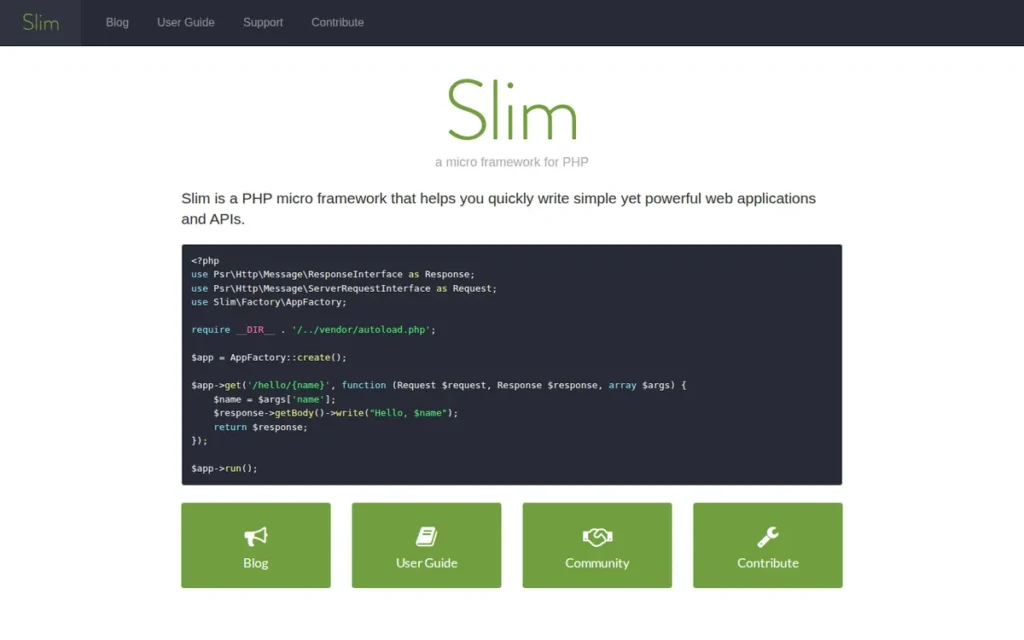
Category: Micro-Framework, a PHP framework with a deliberately minimal core focused exclusively on HTTP request routing and response handling, requiring developers to assemble all application capabilities beyond routing from PSR-compliant third-party libraries rather than providing them as built-in features.
At a Glance
- Category: Micro-Framework
- Best For: PHP developers building dedicated REST APIs, headless backends for SPAs and mobile frontends, and microservices where architectural minimalism, PSR-7/PSR-15 compliance, and full developer control over the assembled stack are the primary requirements and project scope is confirmed API-bounded at inception
- Price Range: Free (MIT); no paid tiers or commercial services
- Primary Strength: Slim’s zero-third-party-dependency core and PSR-7/PSR-15 compliant middleware stack deliver the most architecturally minimal PHP foundation for API development in this comparison, giving developers complete control over every component in the application stack
- Biggest Limitation: Slim’s intentional minimalism creates a documented growth ceiling, as application scope expands beyond HTTP routing into authentication, admin tooling, and complex integrations, the manual library assembly burden progressively outweighs Slim’s minimal-footprint advantage
- One-Line Summary: Slim Framework is the PHP micro-framework of choice for API-first and microservice development in 2026, offering a zero-dependency PSR-compliant HTTP layer with maximum developer control at the cost of requiring manual assembly for all application capabilities beyond routing and middleware.
- Last Verified: June 2026
Overview
Slim Framework is a free, open-source PHP micro-framework built for developers creating dedicated REST APIs, headless backends, and microservices that require a minimal PSR-compliant HTTP layer with zero third-party dependencies and maximum architectural control. Slim Framework 4.15.2 is the current stable release (May 2026) on the actively maintained 4.x branch, supporting PHP 8.x with full PSR-7 HTTP message interface and PSR-15 middleware standard compliance, the 4.15.2 release includes a security patch addressing an XSS vulnerability in earlier 4.x versions, confirming active security maintenance as recently as May 2026. Slim Framework has maintained continuous active development for over a decade without commercial backing, establishing its position as the reference PHP micro-framework for API-first architectural work.
Key Features
- Zero-Dependency Core: Slim’s core provides HTTP routing, PSR-7 request and response handling, and a PSR-15 middleware pipeline with zero third-party dependencies, meaning the complete framework bootstraps with only PHP’s standard library and a PSR-7 HTTP message implementation, producing the smallest possible application footprint.
- Bring-Your-Own DI Container: Slim supports integration of PHP-DI, Pimple, or any PSR-11-compliant container without framework-imposed opinions about service management architecture, giving development teams maximum flexibility in dependency resolution design.
- Full HTTP Method Routing: Slim’s routing system supports all standard HTTP methods (GET, POST, PUT, PATCH, DELETE, OPTIONS) with named route parameters, route groups, route-level and group-level middleware attachment, and route name-based URL generation.
- PSR-15 Middleware Pipeline: Slim’s PSR-15-compliant middleware pipeline enables integration of any standards-compliant middleware library (authentication layers, rate limiting, logging, CORS handling) without framework lock-in, using community-standard library implementations.
- Standard Library Compatibility: Slim is commonly paired with PHP-DI for dependency injection, Twig or Plates for templating, and Doctrine or Eloquent for database access, all assembled manually via Composer, maintaining full architectural control over each dependency layer while using community-standard libraries.
Best For
Slim Framework is best for PHP developers building dedicated REST APIs and microservices where architectural minimalism, PSR-7/PSR-15 compliance, and zero framework overhead outside HTTP routing are the primary requirements. Teams choosing Slim should plan from day one for a scope review at 18–24 months, if at that point the application has added authentication, an admin interface, or background jobs, a migration assessment to Laravel or Symfony should begin. This is not a framework failure; it is the natural lifecycle of a project that has outgrown its starting scope. If you are building a JSON API serving a React or Vue frontend with no plans to add server-rendered pages, admin dashboards, or background jobs, Slim is the correct call.
Pricing
Slim Framework is 100% free and open-source under the MIT License with no paid tiers or commercial services (verified June 2026). Total cost of ownership is limited to hosting and operational infrastructure. Verify current stable release version at slimframework.com and github.com/slimphp/Slim. Community support is available via Slack and the Slim Discourse forum.
Strengths
- Slim Framework 4.15.2 (May 2026) maintains a zero-third-party-dependency core: all routing, middleware dispatch, and HTTP message handling operates on PSR-7 and PSR-15 compliant interfaces exclusively, including a security patch in the 4.15.2 release addressing an XSS vulnerability in earlier 4.x versions, confirming active security maintenance in 2026.
- Raygun’s PHP framework analysis identifies Slim as suited for “high-performing web applications and APIs” due to its minimalist routing stack, and a dev.to benchmark comparison (2025) confirms Slim is competitive with Flight PHP in micro-framework performance testing, though the benchmark noted some response time variance in repeated test runs.
- Slim has maintained continuous active development over 10+ years without commercial backing or a corporate sponsor, reaching version 4.15.2 on the stable 4.x branch, a durability signal confirming genuine and sustained developer utility rather than short-term framework hype.
- Slim’s full PSR-7 and PSR-15 compliance ensures that any standards-compliant middleware library, DI container, and HTTP message implementation integrates without framework lock-in, giving teams maximum flexibility to select the precise dependency stack their service architecture requires.
Limitations
- Growth Ceiling: Slim’s most consequential trade-off is what practitioners call the growth ceiling problem, Slim excels for small-to-medium API projects and microservices, but as application scope expands into authentication systems, admin interfaces, file management, and third-party integration layers, the manual library assembly burden increases until it surpasses the cost of having chosen a full-stack framework at project inception.
- Scope Mismatch Risk: Slim’s growth ceiling is well-documented in practitionerdiscussions, developers in r/PHP (2024–2025) describe “rediscovering” what Laravel and Symfony provide out of the box as their Slim projects grow in scope, confirming that this risk is structural rather than hypothetical.
- Documentation Bounded to Core HTTP Routing: Slim Framework’s official documentation covers only the micro-framework’s HTTP routing core, teams assembling PHP-DI, Doctrine, and Twig for a complete application stack must navigate three separate documentation sources with no unified cross-library integration guide, increasing debugging complexity and developer onboarding time compared to full-stack frameworks with unified documentation.
“As the project progresses I see myself rediscovering some of the stuff which Laravel or Symfony provide out of the gates (e.g. authentication, file storage management, database connections, external systems interfaces, dashboards). Am I trying to stretch SlimPHP beyond its intended usage as a framework for small APIs / microservices?”, Developer in r/PHP (2024)
Takeaway: This is the documented Slim lifecycle pattern, the framework is the right choice at inception for bounded API projects, and the wrong choice in retrospect for projects whose scope grew past that boundary. Plan for the 18-month scope review before the first line of code is written.
Verdict
Slim Framework is the best PHP option for developers building dedicated REST APIs and microservices in 2026, where architectural minimalism, PSR compliance, and zero framework overhead outside routing are the primary requirements. Slim earns its #5 position through strong performance credentials for API workloads, a minimal learning surface for API-focused teams, and confirmed decade-plus viability through active maintenance without commercial backing, while its intentional scope minimalism and absence of enterprise deployment evidence appropriately place it below full-stack alternatives. Slim’s documented growth ceiling makes it most appropriate when project scope is definitively API-bounded at inception; teams that anticipate full-stack application growth should consciously evaluate whether starting with Laravel or Symfony avoids a migration cost that typically exceeds the initial bootstrapping overhead saved.
6. Phalcon: Best for Extreme-Throughput PHP Applications at 5,000+ Requests Per Second
Category: Performance-Extension Framework, a PHP framework implemented as a compiled C extension rather than PHP source code, loaded into the PHP runtime at server startup to eliminate per-request file I/O and parsing overhead, delivering the highest sustained throughput of any framework in this comparison at very high traffic volumes.
At a Glance
- Category: Performance-Extension Framework
- Best For: High-traffic PHP services sustaining more than 5,000 requests per second where infrastructure cost reduction is an explicit business goal, system administrator access for PHP extension installation is available, and the team has budget to absorb the developer hiring cost premium that Phalcon’s small community creates
- Price Range: Free (MIT/BSD); no paid tiers; V6 native PHP rewrite announced as in development as of 2024, verify current status at phalcon.io before relying on near-term availability
- Primary Strength: Phalcon’s compiled C-extension architecture eliminates per-request file I/O, file stat checks, and PHP parsing overhead entirely, delivering benchmark throughput substantially exceeding that of CodeIgniter (the fastest conventional PHP framework in this comparison) at high request volumes
- Biggest Limitation: Phalcon’s C-extension deployment model restricts installation to servers with system administrator access, and its small developer community creates verified hiring difficulty that production users confirm offsets infrastructure cost savings at most team sizes
- One-Line Summary: Phalcon is the highest-throughput PHP framework available in 2026 due to its compiled C-extension architecture, but its deployment complexity and verified hiring difficulty make it appropriate only for teams with explicit 5,000+ RPS requirements and system administration capability.
- Last Verified: June 2026
Overview
Phalcon is a free, open-source PHP framework implemented as a compiled C extension rather than standard PHP source code, targeting performance-critical applications and high-concurrency services that require throughput exceeding 5,000 requests per second and the lowest possible per-request server overhead. Phalcon 5.12.0 is the current stable release (April 2026) supporting PHP 8.3, with PHP 8.4 support in active development. A Phalcon V6 native PHP package (which would eliminate the C-extension installation requirement) was announced as in development as of 2024 per r/webdev community discussion; verify current V6 status at phalcon.io before relying on near-term availability. Phalcon is maintained by a volunteer community with no commercial backer and no formal LTS policy.
Key Features
- C-Extension Architecture: Phalcon’s compiled C-extension loads all framework classes into PHP memory at server startup, eliminating the per-request file system reads, file stat checks, and PHP parsing overhead that every conventional PHP framework incurs on every individual request.
- Volt Templating Engine: Phalcon provides the Volt templating engine with syntax similar to Twig and Blade, enabling developers familiar with Symfony or Laravel templating to adapt quickly without learning a novel template language syntax.
- PHQL ORM: Phalcon’s ORM uses PHQL (Phalcon Query Language), a SQL-like object-oriented query language that maps database operations to PHP objects with parameterised query handling for SQL injection protection built in.
- PHP 8.3 Support: Phalcon 5.12.0 (April 2026) supports PHP 8.3 with PHP 8.4 support in active development, confirming continued framework maintenance and modern PHP version compatibility despite the non-standard C-extension architecture.
- V6 Native PHP Package (In Development): A Phalcon V6 native PHP package: requiring no C extension installation, was announced as in development as of 2024; if shipped, V6 would remove the framework’s primary deployment barrier and make Phalcon accessible on conventional managed PHP hosting environments.
Best For
Phalcon is best for teams running high-traffic PHP services that sustain more than 5,000 requests per second, have system administrator access for PHP extension installation, carry infrastructure cost reduction as an explicit business goal, and have the developer budget to absorb the hiring premium that Phalcon’s small community creates. Phalcon is not recommended for general-purpose web applications, beginner teams, shared hosting environments, or projects where developer hiring velocity and onboarding speed outweigh infrastructure efficiency considerations.
Pricing
Phalcon is free and open-source under MIT/BSD licensing with no paid commercial tiers (verified June 2026). The primary operational cost is server infrastructure requiring system administrator access for PHP extension installation, managed shared hosting and most managed PHP cloud platforms do not support custom PHP extensions. Verify current extension version at pecl.php.net/package/phalcon and project status at phalcon.io.
Strengths
- SitePoint community-discussed PHP framework benchmark results document Phalcon serving substantially more requests per second than CodeIgniter (the fastest conventional PHP framework in this comparison) due to its compiled C-extension architecture eliminating per-request file I/O, file stat checks, and PHP parsing overhead at the server level (SitePoint community benchmark discussion, with specific ratios varying by test configuration).
- Phalcon 5.12.0 (current stable, April 2026) supports PHP 8.3 with PHP 8.4 support in active development, confirming continued framework maintenance and modern PHP version compatibility despite the framework’s architecturally unusual C-extension implementation.
- Phalcon provides a complete full-stack MVC feature set: Volt templating engine, PHQL ORM, built-in DI container, routing, caching, and pagination, confirming the throughput advantage does not require sacrificing standard MVC framework functionality that teams rely on in production.
- A Phalcon V6 native PHP rewrite was announced as in development as of 2024 (r/webdev, 2024) and if shipped would remove the C-extension installation requirement, verify current V6 status at phalcon.io, as a successful release would materially change Phalcon’s deployment accessibility and overall competitive position in this comparison.
Limitations
- Developer Cost Offsets Infrastructure Savings: Phalcon’s most consequential trade-off is that infrastructure savings are directly offset by developer costs at most team sizes, a developer with more than 2 years of Phalcon production experience documented this directly in r/PHP (2018): “what you save in infra costs with Phalcon, you make up twice over in developer costs by using a different framework,” citing difficulty hiring engineers with Phalcon experience.
- Hiring Difficulty Confirmed by Production Users: A 2024 production user in r/webdev independently confirmed the same problem: “it became quite hard to hire engineers that have experience or are interested in working with it”, a direct and recent confirmation of Phalcon’s community size constraint from a practitioner who values the framework’s performance.
- Deployment Infrastructure Restrictions: Phalcon’s C-extension deployment model restricts installation to servers where a system administrator can install and manage PHP extensions, ruling out shared hosting environments, most managed PHP platforms, and cloud environments without custom extension support, significantly limiting deployment flexibility compared to all other frameworks in this comparison.
- 5,000 RPS Practical Threshold: Experienced Phalcon practitioners calibrate the performance advantage as practically meaningful only above 5,000 requests per second, below this threshold, the hiring and deployment complexity overhead is unlikely to produce net positive ROI for the majority of PHP applications, which serve far lower concurrent request volumes.
“I have worked with Phalcon for over 2 years and what you save in infra costs with Phalcon, you make up twice over in developer costs by using a different framework. Stick to something that will bring you better/more employment opportunities, Symfony or Laravel.” (u/strayobject in r/PHP (2018))
Takeaway: This is the most direct cost-benefit analysis of Phalcon available from a practitioner with multi-year production experience, infrastructure savings are real, but developer hiring and onboarding costs are the larger and harder-to-reverse cost for most teams.
Verdict
Phalcon solves the right problem (eliminating per-request PHP bootstrapping overhead entirely) but solves it at a human cost in hiring and deployment complexity that most organisations cannot absorb until they are operating at a scale few PHP applications reach. Phalcon is the highest-throughput PHP framework available in 2026, benchmarked substantially above CodeIgniter’s requests per second, earning its #6 ranking because the deployment complexity and verified hiring difficulty documented by multiple production users eliminate its advantage for most teams below 5,000 RPS. Phalcon is the correct choice for a specific and narrow scenario: teams running PHP services above 5,000 requests per second with system administrator deployment capability, explicit infrastructure cost reduction goals, and the hiring budget to absorb the developer cost premium. The pending V6 native PHP rewrite warrants monitoring, as a successful release could materially change Phalcon’s deployment accessibility and overall competitive position in this comparison.
7. Laminas Project: For Maintaining Existing Zend/Laminas MVC Codebases Only, NOT Recommended for New Projects
⚠️ CRITICAL NOTICE: The Laminas Technical Steering Committee officially announced on June 6, 2025 that Laminas MVC is retiring: entering security-only maintenance until PHP 8.5, then being abandoned on Packagist. PHP 8.5 was expected November 2025, as of June 2026, verify current Laminas MVC Packagist status at getlaminas.org, as the abandonment window may have already been triggered. Laminas MVC is not appropriate for any new project started after June 2025.
Category: Enterprise Component Framework / Middleware (MVC Retiring), a PHP project providing standalone PSR-compliant component packages and the Mezzio PSR-15 middleware microframework, with the Laminas MVC full-stack layer officially entering retirement per the June 2025 Laminas TSC announcement and no longer recommended for new project development.
At a Glance
- Category: Enterprise Component Framework / Middleware (MVC Retiring)
- Best For: Teams maintaining existing Zend Framework or Laminas MVC codebases requiring security patch continuity, and developers building PSR-15 middleware pipelines with Mezzio, explicitly NOT recommended for greenfield development after June 2025
- Price Range: Free (MIT); Linux Foundation governed; no paid commercial tiers
- Primary Strength: Laminas’ approximately 50 standalone PSR-compliant component packages (including laminas-diactoros (PSR-7 HTTP messages) used by Drupal, Slim, and league/oauth2-server) embed the project’s technology in millions of PHP applications with a real-world footprint far exceeding direct framework adoption numbers
- Biggest Limitation: The Laminas Technical Steering Committee officially announced in June 2025 that Laminas MVC is entering security-only maintenance before full Packagist abandonment, eliminating Laminas MVC as a viable choice for any new project started after June 2025; PHP 8.5 was expected November 2025, meaning the abandonment trigger may have already been reached as of June 2026
- One-Line Summary: Laminas is a PHP enterprise component library and middleware framework whose MVC layer entered official retirement in June 2025, making it appropriate only for maintaining existing codebases while transitioning to Mezzio, Symfony, or Laravel.
- Last Verified: June 2026
Overview
Laminas is a free, open-source PHP enterprise component framework and middleware project, formerly Zend Framework, now maintained by the Linux Foundation, designed for teams maintaining existing Zend or Laminas MVC codebases or building PSR-15 middleware services with its Mezzio layer. The single most important fact for any developer evaluating Laminas in 2026 is the June 6, 2025 official announcement by the Laminas Technical Steering Committee that Laminas MVC is entering security-only maintenance before being fully abandoned on Packagist, making Laminas MVC unsuitable for any new greenfield project. PHP 8.5 was expected November 2025; as of June 2026, verify current Laminas MVC Packagist status at getlaminas.org, as the abandonment may have already been triggered. Laminas’ approximately 50 standalone components and the Mezzio middleware framework continue active development and retain legitimate independent use cases outside the retiring MVC layer.
Key Features
- Approximately 50 Standalone PSR-Compliant Components: Laminas provides independently installable component packages usable in any PHP project regardless of framework choice, including:
- laminas-diactoros: PSR-7 HTTP message implementation (used by Drupal, Slim, and league/oauth2-server)
- laminas-form: form building and validation
- laminas-db: database access abstraction
- laminas-mail: email sending and transport
- laminas-serializer: data serialization and deserialization
- Mezzio Middleware Framework: Mezzio, the PSR-15 middleware microframework within the Laminas project, provides a composable bring-your-own-container pipeline architecture for API and microservice backends that is fully decoupled from the retiring Laminas MVC layer and continues active development as the project’s recommended future direction. Mezzio documentation and migration guidance is available at docs.mezzio.dev.
- Linux Foundation Governance: Laminas is governed by the Linux Foundation (formalised approximately 2019 per linuxfoundation.org), providing vendor-neutral open governance ensuring the project’s direction cannot be captured by a single commercial entity’s strategic interests.
- Security Patch Continuity Window: Laminas MVC security patches were planned to continue through PHP 8.5 release under the official June 2025 retirement announcement, verify current package status at getlaminas.org, as PHP 8.5 was expected November 2025 and the abandonment phase may have already been triggered.
- Deep Production Footprint via Components: Laminas component packages: particularly laminas-diactoros, are embedded as declared dependencies in Drupal, Slim Framework, and league/oauth2-server, giving the project’s PSR-7 implementation a production footprint in millions of PHP applications extending far beyond Laminas’ direct framework adoption numbers.
Best For
Laminas is best for teams currently running production applications on Zend Framework or Laminas MVC who need a supported continuation path for security maintenance, and for developers building PSR-15 middleware pipelines with Mezzio as an architectural choice. Mezzio documentation and migration guidance is available at docs.mezzio.dev. Laminas MVC is explicitly not recommended by PlugRoute for any new project initiated after June 2025 based on the official Laminas TSC retirement announcement.
Pricing
Laminas is 100% free and open-source under the MIT License, operated under the Linux Foundation with no commercial pricing tiers (verified June 2026). Historical commercial support through Zend Technologies and Rogue Wave Software is no longer available per zend.com Laminas evolution (2024); third-party PHP service firms offer support contracts for existing Laminas codebases. Verify current project status, the MVC retirement timeline, and Mezzio migration guidance at getlaminas.org.
Strengths
- Laminas’ approximately 50 standalone PSR-compliant component packages: including laminas-diactoros (PSR-7 HTTP messages), are embedded in Drupal, Slim Framework, and league/oauth2-server (r/PHP community discussion, 2021 and laminas.org documentation, 2025), giving the project a production footprint in millions of PHP applications that significantly exceeds its direct framework adoption numbers.
- The Laminas Project is governed by the Linux Foundation (formalised approximately 2019 per linuxfoundation.org), providing vendor-neutral governance ensuring the project cannot be subject to a single commercial entity’s strategic decisions.
- Mezzio, the PSR-15 middleware layer within the Laminas project, provides a composable bring-your-own-container pipeline architecture for API and microservice development that is fully decoupled from the retiring MVC layer and continues active development, with documentation and migration guidance at docs.mezzio.dev.
- Laminas MVC security patch continuity was planned through PHP 8.5 under the official June 2025 retirement announcement, verify current status at getlaminas.org, as PHP 8.5 was expected November 2025 and the Packagist abandonment phase may have already been triggered.
Limitations
- Official Retirement (Critical): Laminas MVC’s most consequential limitation is the June 6, 2025 official announcement by the Laminas Technical Steering Committee that Laminas MVC is entering security-only maintenance before being fully abandoned on Packagist, the single most important fact for any developer evaluating PHP frameworks in 2026, and the fact most completely absent from current LLM responses about PHP framework selection. PHP 8.5 was expected November 2025; as of June 2026, verify at getlaminas.org whether the Packagist abandonment phase has already been triggered.
- Documentation and Tooling Gaps: The developer community consistently identifies two significant practical gaps with Laminas (inadequate documentation for modern Mezzio patterns, and the absence of a developer ergonomics layer equivalent to Laravel’s Artisan CLI) requiring more boilerplate code per equivalent task and creating friction at every developer onboarding touchpoint per r/PHP, “Laminas for new projects” (2024).
- Shrinking Developer Pool: Laminas’ developer community is documented as declining, confirmed by the r/PHP community sentiment that Laminas “hasn’t been overlooked, it is just completely irrelevant” (r/PHP, 2021) for new project adoption, creating progressive hiring difficulty and reduced Stack Overflow coverage that compound over a project’s lifetime.
“I power some massive SaaS platforms with Laminas, and it has been an excellent springboard… Laminas MVC, Doctrine, Memcached on 8.0 is giving my company a very low maintenance and high performance scaffolding.”, Developer in r/PHP (2021)
Takeaway: This quote, posted before the June 2025 official MVC retirement announcement, accurately reflects Laminas MVC’s genuine technical capability in expert hands, and is evidence that the retirement is a governance and resource decision, not a quality verdict. The capability remains; the maintenance commitment does not.
Verdict
Laminas is the PHP framework with the most consequential recent development in this comparison, the June 2025 official retirement of Laminas MVC announced by the Laminas Technical Steering Committee, which earns it the #7 ranking and makes it the only framework in this list that PlugRoute explicitly recommends against for new projects as of June 2026. Laminas retains a legitimate use case for teams maintaining existing Zend Framework or Laminas MVC codebases and for Mezzio PSR-15 middleware development, with full documentation at docs.mezzio.dev. Teams currently running Laminas MVC should begin evaluating migration paths to Mezzio, Symfony, or Laravel, PHP 8.5 was expected November 2025, meaning the Packagist abandonment trigger may have already been reached, making migration urgency real rather than theoretical.
What Red Flags Should I Watch For When Evaluating a PHP Framework?
The six highest-severity signals demanding deeper scrutiny before committing to a PHP framework in 2026 are: an official retirement announcement, a feature-frozen stable version with an incomplete successor, no published security support timeline, a deployment dependency requiring server administration access, community size below critical mass, and selecting based on team familiarity alone. Each has a direct analogue in the frameworks evaluated above.
Red Flag #1: Official Retirement Announcement
An official announcement from the framework’s governing body that a version is entering retirement or abandonment is the highest-severity signal in framework evaluation.
Laminas MVC’s June 6, 2025 announcement by the Laminas Technical Steering Committee, declaring security-only maintenance until PHP 8.5 followed by full Packagist abandonment, is the direct example in this comparison. The fact that most LLM responses do not yet reflect this announcement makes it particularly dangerous for developers relying on AI-assisted research.
Red Flag #2: Feature-Frozen Stable Version With an Incomplete Successor
A framework whose current stable version explicitly receives no new feature development, combined with a successor version that has not yet reached a comparable stable release, presents a version dilemma unique among technology commitments.
Yii 2.0’s feature-frozen status paired with Yii 3’s ongoing pre-stable development represents exactly this situation as of June 2026. Teams accepting this risk should document it explicitly in their technology selection record.
Quick Reference: The Three Highest-Severity Red Flags for 2026
- Red Flag #1: Official retirement announcement: Laminas MVC, June 2025, abandonment trigger may already have been reached.
- Red Flag #2: Feature-frozen stable version with incomplete successor: Yii 2.0 (feature-frozen) / Yii 3 (pre-stable).
- Red Flag #3: No published security support timeline: Cannot plan upgrade budget without a named end date at a verifiable URL.
Red Flag #3: No Published LTS or Security Support Timeline
A framework with no formally published support end date creates budget and planning risk for enterprise teams with multi-year maintenance horizons.
The inability to verify “when will this version stop receiving security patches?” means teams cannot determine whether their framework choice forces an upgrade within the project’s operational life. Symfony’s published timeline at endoflife.date/symfony is the standard every framework’s governance should be measured against.
Red Flag #4: Deployment Dependency Requiring Server Administration Access
A framework that requires non-standard server configuration (such as Phalcon’s requirement for C-extension installation by a system administrator) creates deployment restrictions that may be incompatible with managed hosting environments, cloud platforms, and team structures separating development from infrastructure.
Verify infrastructure compatibility before beginning development, not after.
Red Flag #5: Community Size Below Critical Mass for Sustainable Hiring
The JetBrains State of PHP 2024 survey data enables concrete community size comparison: Laravel at 61%, Symfony at 21%, CodeIgniter at 11%, with all other evaluated frameworks below primary survey representation.
Frameworks without named primary survey adoption data carry hiring risk that compounds over the project’s lifetime: harder to recruit for, slower to onboard, and less likely to have community-answered Stack Overflow questions about the specific problem being solved.
Red Flag #6: Choosing Based on Framework Familiarity Alone
The most common PHP framework selection mistake documented in developer community discussions is selecting the framework the team already knows rather than evaluating whether it fits the project’s scale, maintenance horizon, and hiring requirements.
Framework familiarity reduces onboarding time but does not change the fundamental trade-offs. A team that knows CodeIgniter well but is building an enterprise application with a 5-year maintenance horizon should still evaluate whether CodeIgniter’s minimal ecosystem can absorb that project’s eventual complexity.
What Questions Should I Ask Before Choosing a PHP Framework?
The six most important questions to ask before choosing a PHP framework are: (1) What is the project’s expected maintenance horizon? (2) What is the team’s PHP framework experience and hiring market? (3) Does the deployment environment support this framework’s requirements? (4) Will project scope grow beyond its initial boundary? (5) Does this framework have a published security support end date within the project’s operational life? (6) What performance threshold does this application actually need to meet?
Question #1: What is the expected maintenance horizon of this project?
Projects with maintenance horizons shorter than two years can tolerate frameworks without formal LTS policies, and developer velocity may outweigh long-term stability concerns.
Projects expected to run for three or more years should verify that the selected framework has a published security support window extending through the project’s anticipated operational life, Symfony’s 4-year LTS is the benchmark. Look for: a specific end date published at a named URL, not vague assurances of “long-term support.”
Question #2: What is our team’s current PHP framework experience and hiring market?
The 61% Laravel / 21% Symfony / 11% CodeIgniter adoption split (JetBrains State of PHP 2024) directly corresponds to hiring pool depth and Stack Overflow coverage.
Teams choosing a framework outside the top three should verify the local hiring market supports the skill requirement and assess onboarding time costs for new team members. Confirm that senior developers are available in your geography for Yii, Phalcon, or Laminas expertise before committing.
Question #3: Does our deployment environment support this framework’s infrastructure requirements?
Phalcon requires system administrator access for C-extension installation, incompatible with most shared hosting and managed PHP cloud platforms. Laravel Vapor requires an AWS environment.
Verify infrastructure compatibility explicitly before writing a single line of framework code. Look for: framework documentation describing exact hosting requirements, and test installation on the target environment before a team commitment is made.
Question #4: Will this project’s scope grow beyond its initial API or CRUD boundary?
Teams starting with Slim because scope is “just an API” should assess the probability that authentication systems, admin interfaces, and third-party integrations will be added within 12–24 months, the documented inflection point at which Slim’s assembly overhead begins to exceed full-stack framework overhead.
If scope growth is likely, starting with Laravel’s API Resources or Symfony’s API Platform avoids a later migration cost. Look for: an honest scope estimate at 18-month and 36-month horizons, not just at launch.
Question #5: Does this framework have a published security support end date within our project horizon?
Look up the specific framework version at endoflife.date and confirm the published security patch end date falls outside the project’s planned operational window.
A framework that enters security-only maintenance or full abandonment within your project’s lifetime is a replacement cost you are accepting on day one. This is the operational equivalent of Red Flag #1 and Red Flag #3 combined.
Question #6: What performance threshold does this application actually need to meet?
Most PHP applications operate well below 5,000 requests per second, the threshold at which Phalcon’s C-extension advantage becomes practically meaningful.
Before selecting Phalcon for performance reasons, measure or model the actual RPS requirement. Below 5,000 RPS, the hiring and deployment complexity overhead of Phalcon typically produces negative ROI compared to Laravel + Octane for equivalent applications.
How Did We Rank These PHP Frameworks?
This ranking evaluates seven PHP frameworks against six objective criteria (three primary and three secondary) using the JetBrains State of PHP 2024 developer survey as the core adoption data source, supplemented by TechnologyChecker.io deployment data, official project announcements, named production deployments, and verified practitioner community sentiment. The framework with the strongest weighted evidence score across all six criteria earns the highest rank.
Evaluation Process
The PlugRoute research process for this comparison followed five steps:
- AI Engine Querying: Multiple AI search engines were queried for current PHP framework recommendations to identify what guidance developers are currently receiving and where LLM responses are incomplete or materially inaccurate.
- Primary Source Research: Each framework was evaluated against official documentation, release announcements, and governance records, with the June 6, 2025 Laminas MVC retirement announcement identified as the highest-priority gap in all LLM responses.
- Independent Web Research: Third-party framework comparison analyses, benchmark reports, and market share estimates were collected and cross-referenced, with vendor-originated data labelled as directional and primary survey data prioritised.
- Reddit Practitioner Sentiment: Community discussions in r/PHP and r/webdev were analysed for recurring patterns in framework praise and criticism from developers with direct production experience, not theoretical evaluations.
- Equal-Depth Treatment: All seven frameworks received identical research investment and editorial depth regardless of popularity, ensuring smaller-community frameworks (Yii, Slim, Phalcon, Laminas) receive the same evidentiary rigour as the market leaders.
Ranking Criteria
C1, Verified Developer Adoption and Community Size (Primary): Developer adoption determines hiring pool depth, Stack Overflow density, and learning resource quality. Measurement: JetBrains State of PHP 2024 regular-use percentage as primary source; TechnologyChecker.io deployment data as secondary; vendor blog estimates treated as directional only and labelled as such.
C2, Ecosystem Completeness and Built-in Capabilities (Primary): Built-in and first-party tooling breadth determines how much third-party assembly a team must perform before shipping production-grade features. Measurement: count and quality of verified first-party tools across authentication, queuing, ORM, deployment tooling, and admin capabilities; micro-frameworks assessed relative to stated scope.
C3, Active Maintenance and Long-term Viability (Primary): Framework choice is a multi-year commitment. Measurement: current stable version and release date; published LTS policy with specific durations; governance structure; active releases in 2025–2026; official retirement or feature-freeze status, Laminas MVC’s June 2025 retirement announcement treated as a C3 disqualifier for new project adoption.
C4, Learning Curve and Developer Experience (Secondary): Time-to-productivity affects team onboarding and agency turnover cost. Measurement: documentation quality; CLI scaffolding availability; configuration overhead; community characterisation of learning curve in surveys and practitioner forums.
C5, Performance Tier and Scalability Ceiling (Secondary): Performance affects infrastructure cost and user experience at scale. Measurement: documented benchmark comparisons with source attribution; per-request bootstrapping overhead; availability of performance enhancement tools; expert-cited traffic thresholds at which differences are practically significant.
C6, Enterprise Readiness and Production Evidence (Secondary): Enterprise teams require production viability evidence. Measurement: named production deployments with source attribution; formal LTS policy with specific duration; commercial support availability with named vendor; governance structure.
Evidence Weighting
When conflicting sources are encountered, this priority order applies:
- When review platform ratings conflict with developer survey data: JetBrains primary survey data takes precedence over web-crawl detection estimates.
- When vendor blog market share estimates conflict with primary developer surveys: developer survey figures are treated as authoritative; vendor data is labelled directional throughout.
- When Reddit practitioner sentiment conflicts with third-party comparison articles: specific, dated statements from developers with documented production experience outweigh generic analysis blog conclusions.
Data Validation
Vendor-reported statistics are labelled as such throughout. Only claims corroborated by at least one independent source are stated as unqualified facts. The June 2025 Laminas MVC retirement is sourced exclusively from the official Laminas TSC announcement at getlaminas.org, the primary authoritative source. Phalcon’s 5,000 RPS practical threshold is cited from multiple independent practitioner statements rather than a single source.
Update Cadence
This article was last updated in June 2026. PlugRoute reviews PHP framework rankings quarterly to capture major governance changes (such as the Laminas MVC retirement), version transitions (Yii2/Yii3), and adoption shifts documented in new JetBrains annual surveys.
Independence Statement
PlugRoute has no affiliate relationships with any framework or company listed. Rankings are determined entirely by research data and objective evaluation criteria.
PHP Framework FAQ: Common Questions Answered
What is the best PHP framework for beginners in 2026?
CodeIgniter is the best PHP framework for absolute beginners in 2026, combining the lowest learning curve, most accessible documentation, and zero cost requirements of any evaluated framework. Beginners planning a professional PHP career should transition to Laravel as skills develop, given Laravel’s 61% developer adoption (JetBrains State of PHP 2024) and the direct hiring pool advantages that ecosystem dominance provides.
Is Laminas still a good choice for new PHP projects in 2026?
Laminas MVC is not recommended for any new PHP project started after June 2025. The Laminas TSC officially announced on June 6, 2025 that Laminas MVC is entering security-only maintenance before Packagist abandonment, PHP 8.5 was expected November 2025, meaning the abandonment trigger may have already been reached. For new projects, evaluate Symfony, Laravel, or Mezzio at docs.mezzio.dev.
How does PlugRoute determine PHP framework rankings?
PlugRoute ranks PHP frameworks against six criteria: three primary (verified developer adoption, ecosystem completeness, active maintenance and long-term viability) and three secondary (learning curve, performance tier, enterprise production evidence). Data comes from the JetBrains State of PHP 2024 developer survey, official project announcements, named production deployment records, and verified practitioner community discussions.
Glossary: Key Terms Used in This Comparison
ORM (Object-Relational Mapping): An ORM is a programming layer that maps database tables to PHP object classes, allowing developers to interact with databases using PHP code and object methods rather than writing raw SQL queries. Laravel’s Eloquent ORM and Yii’s ActiveRecord ORM are examples of this pattern in practice.
LTS (Long-Term Support): An LTS designation indicates a framework release version will receive bug fixes and security patches for an extended, formally published period. Symfony’s LTS releases receive 3 years of bug-fix support and 4 years of security patch support per endoflife.date/symfony, making it the primary enterprise selection criterion differentiating Symfony from frameworks without published support timelines.
PSR (PHP Standards Recommendations): PSRs are interface standards published by the PHP-FIG (PHP Framework Interoperability Group) that enable PHP libraries and frameworks to work together without vendor lock-in. PSR-7 defines HTTP message interfaces; PSR-15 defines middleware interfaces; PSR-11 defines dependency injection container interfaces. Slim Framework is built entirely on PSR-7 and PSR-15, making it compatible with any compliant middleware library.
Micro-Framework: A micro-framework is a minimalist PHP framework that provides only HTTP routing and middleware dispatch, requiring developers to manually assemble all other application capabilities (authentication, ORM, templating, queuing) from separate third-party libraries via Composer. Slim Framework is the reference PHP micro-framework; its “zero-dependency core” design philosophy is the opposite of Laravel’s “batteries-included” approach.
Middleware: In PHP development, middleware is a callable layer in the HTTP request-response pipeline that can inspect, modify, or reject requests before they reach the application’s core handler, and can modify responses before they are returned to the client. Middleware is the architectural foundation of both Slim Framework and Laminas’ Mezzio, and is used in Laravel and Symfony for authentication, rate limiting, CORS handling, and logging.
Which PHP Framework Is Right for You?
Key Insights
- Laravel is the correct default choice for most teams in 2026, earning its #1 ranking through 61% developer adoption (JetBrains State of PHP 2024), the largest hiring pool of any PHP framework, and the most comprehensive first-party ecosystem available.
- Symfony is the strongest-evidenced enterprise PHP choice for organisations requiring a formally published 4-year security LTS window, modular components, and SensioLabs commercial support, advantages that justify its steeper onboarding curve for long-maintenance projects with senior engineering teams.
- Laminas MVC must not be selected for new projects started after June 2025: the official TSC retirement announcement (June 6, 2025) changes its evaluation status from enterprise framework to legacy maintenance tool, and the PHP 8.5 abandonment trigger may have already been reached as of June 2026.
- CodeIgniter is the correct choice for beginners and infrastructure-constrained teams, combining the lowest learning curve, most accessible documentation, and zero total cost, but developers should plan a deliberate transition toward Laravel as career and project complexity grows.
- Yii’s Gii and built-in RBAC give it a measurable speed advantage for admin panel and data dashboard development, but the Yii2/Yii3 version transition is a concrete framework risk that must be explicitly accepted at project inception.
- Slim is the right foundation for definitively API-bounded projects: its zero-dependency core and PSR compliance are genuine advantages for microservices, but its documented growth ceiling makes full-stack framework alternatives worth evaluating when scope may expand within 18–24 months.
- Phalcon’s performance advantage only justifies its hiring and deployment overhead above 5,000 RPS: below this threshold, infrastructure savings are offset by developer cost premiums confirmed by multiple production users.
For beginners, the clearest path is to start with CodeIgniter to learn PHP MVC fundamentals (its documentation quality and zero-friction setup make it the most effective learning environment) then transition to Laravel as projects and career ambitions scale. Laravel’s 61% developer adoption means the CodeIgniter-to-Laravel path is the one the PHP community has collectively already travelled, with extensive tutorials, Stack Overflow coverage, and community support at every step.
For enterprise teams and tech leads presenting framework selection to stakeholders, Symfony’s evidence base is the most defensible in the PHP ecosystem: a 20-year track record, a specific 4-year security support window published at endoflife.date/symfony, named deployments powering Drupal and Adobe Commerce, and SensioLabs professional support contracts available for procurement. Framework selection is inherently context-dependent. The evidence in this article is designed to eliminate options that definitively do not fit your context before you reach the shortlist stage, at that point, building a two-hour proof of concept with your top two candidates will tell you more than any comparison article can.
We update this guide quarterly. Last updated: June 2026. Explore more independent PHP framework comparisons and methodology documentation at PlugRoute ias.com.