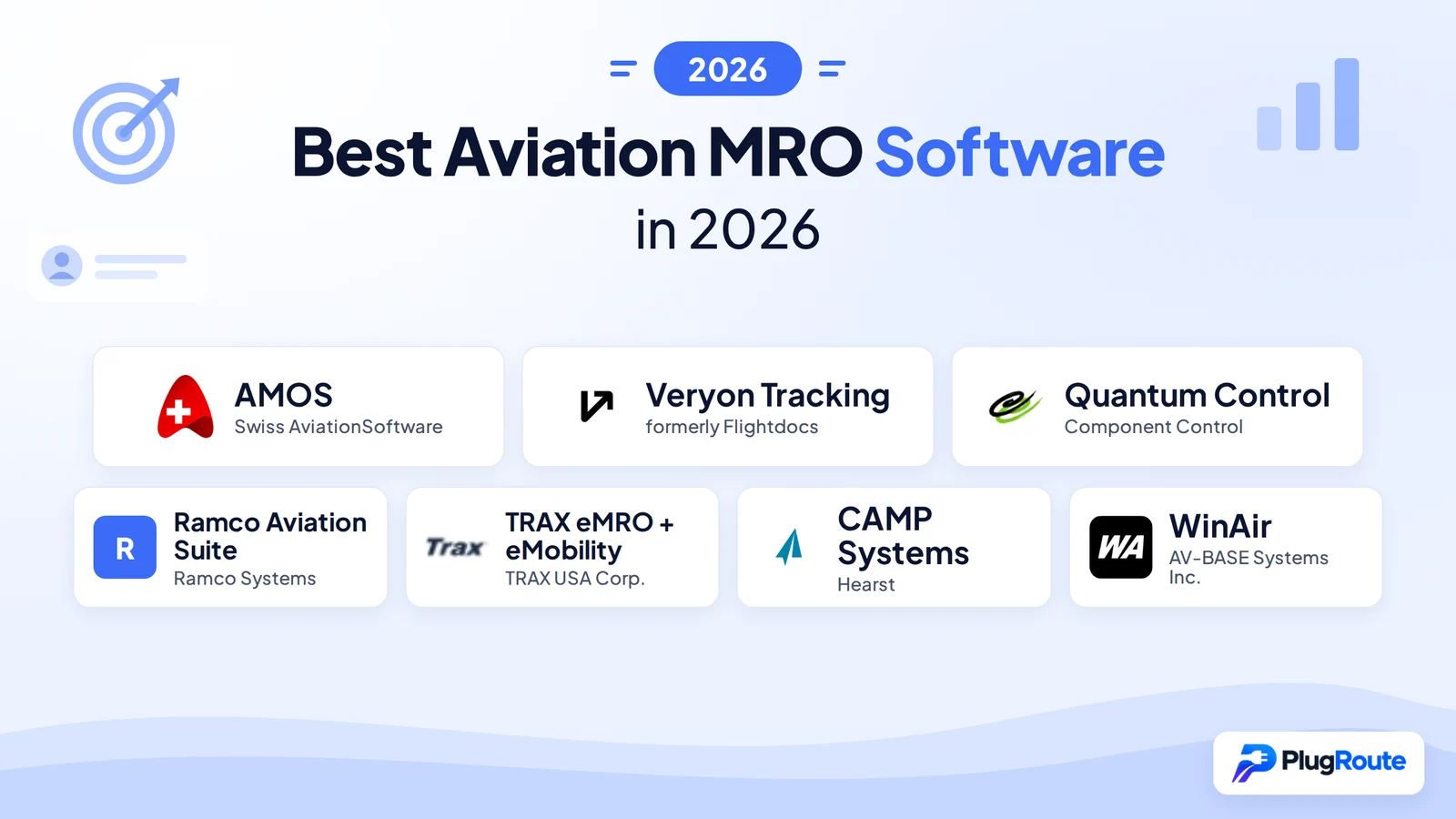
The best aviation MRO software depends on your operation type and who keeps your records. AMOS has the strongest evidence for airlines and large MROs. Veryon Tracking is the top-rated self-service tracker for business aviation and helicopter fleets. Quantum Control leads for Part 145 component shops. Shortlist by segment fit, not overall rank.
Vendor marketing makes every aviation MRO platform look end-to-end. Independent data on usability, implementation success and total cost is hard to find. Each of the other four ranked platforms fits a narrower segment:
- Ramco Aviation Suite fits operators that want M&E and full ERP on one platform.
- TRAX fits airlines and MROs that want paperless hangar work.
- CAMP Systems fits business aviation departments that want analysts to manage their tracking.
- WinAir fits mid-size operators with in-house records teams.
PlugRoute has no affiliate relationships with any company listed, and rankings are determined entirely by research data and objective evaluation criteria.
What Are the 4 Categories of Aviation MRO Software?
Aviation MRO software falls into four categories: Enterprise M&E Suites for airlines and large MROs, Fleet Compliance Trackers for business aviation, Repair Station / Aftermarket ERPs for Part 145 shops, and Mid-Market Integrated Systems for mid-size operators. Most buyers who end up with overkill, or with a system they outgrow, bought from the wrong category.
- Enterprise M&E Suite: An Enterprise M&E Suite combines maintenance, engineering, records and logistics for airlines and large MROs. The ranked products in this category are AMOS, Ramco Aviation Suite and TRAX.
- Fleet Compliance Tracker: A Fleet Compliance Tracker handles maintenance and airworthiness tracking for business aviation, GA and helicopter fleets. Some are self-service and some are run by analysts. The ranked products in this category are Veryon Tracking and CAMP Systems.
- Repair Station / Aftermarket ERP: A Repair Station / Aftermarket ERP manages work orders, traceable inventory, sales and accounting for Part 145 shops and parts distributors. The ranked product in this category is Quantum Control.
- Mid-Market Integrated System: A Mid-Market Integrated System puts maintenance, inventory and accounting in one system for mid-size operators and AMOs. The ranked product in this category is WinAir.
How Do the Top Aviation MRO Software Platforms Compare at a Glance?
AMOS has the highest overall score at 36/45. Veryon Tracking (33.5), Quantum Control (33) and Ramco Aviation Suite (32) follow. The scores are close, and each product serves a different segment. The table shows where each platform fits, and the scores come from the methodology section later in this guide.
| Rank | Company | Category | Best For | One-Line Summary | Key Capabilities | Primary Strength | Key Limitation |
|---|---|---|---|---|---|---|---|
| 1 (36/45) | AMOS | Enterprise M&E Suite | Airlines, CAMOs, large MROs | AMOS is the most thoroughly evidenced enterprise M&E system for airlines and large MROs. It gives up some ease of use for process depth. | Planning, engineering, records, AD/SB, logistics, mobile task cards | Deepest documented M&E coverage; 270+ customers (vendor-published) | Steep learning curve (Capterra ease of use 3.7/5; G2 3.9/5 from 19 reviews) |
| 2 (33.5/45) | Veryon Tracking | Fleet Compliance Tracker | Part 91/135, GA and helicopter operators with in-house records | Veryon Tracking is the highest-rated self-service tracker in this evaluation for operators that keep their own records. | AD/SB, due lists, work orders, inventory, eLogbook, publications | Strongest independent ratings (Capterra 4.5/5 from 90; G2 4.6/5 from 19) | Needs an internet connection; reviewers report slow onboarding |
| 3 (33/45) | Quantum Control | Repair Station / Aftermarket ERP | Part 145 component shops, distributors | Quantum Control reports the largest customer base among the evaluated products and suits shops that need traceable inventory tied to accounting. | Repair orders, serialized traceability, sales, accounting | 1,700+ customers in 66 countries (vendor-published) | Not built for fleet M&E; Capterra 4.8/5 from only 6 reviews |
| 4 (32/45) | Ramco Aviation Suite | Enterprise M&E Suite | Operators that want M&E plus ERP | Ramco Aviation Suite suits operators that want M&E and full ERP on one platform, but implementation is demanding. | M&E, CAMO, finance, HR, supply chain, offline mobile | Only evaluated platform with native M&E plus finance, HR and supply chain | Mixed reviews (Capterra 3.9/5 from 18); demanding go-live |
| 5 (30.5/45) | TRAX | Enterprise M&E Suite | Airlines and MROs that want paperless hangars | TRAX has the most extensive documented offline mobile suite in this evaluation, but independent user evidence is very thin. | 21 eMRO modules, about 14 offline eMobility apps | Most extensive documented offline mobile suite | Only 2 G2 reviews (2.5/5) |
| 6 (29.5/45) | CAMP Systems | Fleet Compliance Tracker | Flight departments with no records staff | CAMP Systems is an established analyst-managed tracking service for business aviation departments that want their records maintained for them. | MTX tracking, 24/7 analysts, engine health monitoring | Analysts apply ADs, SBs and OEM revisions for you | 6 G2 reviews, no visible rating |
| 7 (26.5/45) | WinAir | Mid-Market Integrated System | Mid-size regional and helicopter operators | WinAir combines maintenance, inventory and accounting for operators that run their own records, but its reporting is limited. | Tracking, AD/SB, inventory, cost accounting | One database used across departments (Capterra 4.0/5 from 10) | Weak reporting; hard version upgrades |
Which Aviation MRO Software Should I Choose for My Operation?
Choose by operation type first, then by who updates AD/SB compliance today. Airlines and large MROs should shortlist AMOS, Ramco Aviation Suite and TRAX. Part 145 shops should start with Quantum Control. Business aviation departments with no records staff should start with CAMP Systems. Those with an in-house records person should start with Veryon Tracking.
| Your #1 Priority | Recommended Tool | Why | Acceptable Alternative |
|---|---|---|---|
| Airline or large MRO system of record | AMOS | Deepest documented M&E coverage and the strongest customer evidence | Ramco Aviation Suite or TRAX |
| M&E and full ERP on one platform | Ramco Aviation Suite | Only evaluated product with native finance, HR and supply chain | AMOS with AMOShub interfaces |
| Paperless, offline hangar work | TRAX | About 14 offline-capable eMobility apps | AMOS (AMOSmobile/EXEC) |
| Part 145 component shop or distributor | Quantum Control | Serialized traceability with native accounting | WinAir |
| Part 91/135 operator with no records staff | CAMP Systems | Analysts apply compliance updates for you | Veryon Tracking |
| Part 91/135 or helicopter operator with in-house records | Veryon Tracking | Self-service tracking with highly rated support | CAMP Systems |
| Mid-size regional or helicopter operator with a records team | WinAir | Maintenance, inventory and accounting in one database | Veryon Tracking |
| CAMO-only or FBO operation | Evidence is limited | CAMP Systems bought Aviation FBO Software in 2024, but we did not evaluate that product | See “Also Worth Knowing (Not Ranked)” |
Records-staffing self-test: Start with one question: who updates AD/SB compliance today?
- If no one owns AD/SB compliance, an analyst-managed tracker such as CAMP Systems is the best starting point.
- If one person owns AD/SB compliance, a self-service tracker such as Veryon Tracking fits.
- If a team owns AD/SB compliance, integrated or enterprise systems such as WinAir, AMOS or Ramco Aviation Suite deserve a look.
Best option for a Part 145 repair station: Quantum Control has the strongest evidence for Part 145 component shops and parts distributors in 2026. It combines repair orders, serialized traceability and native accounting, and the vendor reports 1,700+ customers (Component Control, 2026; vendor-published). WinAir is an alternative for repair stations that also track their own aircraft.
Is enterprise M&E overkill for a small operator? AMOS, Ramco Aviation Suite and TRAX are often overkill for small fleets, but no evidence supports an exact fleet-size cutoff. You probably need an enterprise system if you have any of these:
- A fleet of several aircraft types needs the cross-fleet planning that enterprise M&E provides.
- Heavy checks done in-house need work-package and materials depth.
- CAMO responsibilities need maintenance program management and compliance oversight.
- Third-party maintenance customers need customer portals and invoicing.
CAMP Systems vs. Veryon Tracking: The main difference is who maintains your records. CAMP Systems analysts apply ADs, SBs and OEM revisions for you. With Veryon Tracking, your own staff record compliance, backed by vendor support.
Worked example: Take a Part 135 helicopter operator with 8 aircraft and one records clerk. That operator should shortlist Veryon Tracking and CAMP Systems, then add WinAir as a third vendor from outside the Veryon and CAMP groups.
What Are the Best Aviation MRO Software Platforms, Ranked?
We ranked the seven platforms below on a weighted 45-point score covering compliance depth, customer evidence, independent reviews, mobility, pricing transparency and support. TRAX and CAMP Systems rank lower mainly because independent review data is missing. Ramco Aviation Suite’s reviews are verified but mixed. Read each entry for segment fit, not rank alone.
1. AMOS (Swiss AviationSoftware): Best for Airlines, CAMOs and Large MROs (Highest Overall Score)
Category: Enterprise M&E Suite, integrated maintenance, engineering, records and logistics for airlines and large MROs.
At a Glance
- Category: Enterprise M&E Suite
- Best For: Airlines, airline groups, CAMOs and large MROs with complex, multi-type fleets
- Price Range: About CHF 90,000 indicative starting price, priced by users and aircraft, implementation not included (Capterra, accessed November 2026; independent)
- Primary Strength: AMOS has the deepest documented aviation maintenance and engineering coverage in this evaluation and reports 270+ customers (Swiss-AS, 2026; vendor-published).
- Biggest Limitation: AMOS has a steep learning curve and a dated interface, with a Capterra ease-of-use score of 3.7/5 (Capterra, accessed November 2026; independent).
- One-Line Summary: AMOS is the most thoroughly evidenced enterprise maintenance and engineering system for airlines and large MROs, but it gives up some ease of use for process depth.
- Last Verified: November 2026
Overview
AMOS, from Swiss AviationSoftware, is an integrated maintenance and engineering system for airlines, CAMOs and large MROs. It is built for operators that need one system of record and deep process control across complex, multi-type fleets.
AMOS is a heavy enterprise platform, not a lightweight tracker, so operators with only a few aircraft should consider whether they need its full scope. Swiss AviationSoftware has been a Lufthansa Technik subsidiary since the end of 2022 (SWISS newsroom, 2023; vendor-published).
Key Features
- AMOS manages maintenance planning, engineering, technical records and AD/SB compliance in a single integrated database.
- AMOS includes logistics, materials, and repairables and rotables management alongside its maintenance modules.
- AMOSmobile/EXEC provides electronic task cards and technician sign-off, and AMOSmobile/STORES supports warehouse work.
- AMOSeTL adds an electronic technical log, and AMOShub manages interfaces to external systems such as finance and ERP.
- AMOScloud offers vendor hosting for operators that do not want to run AMOS on their own infrastructure.
Best For
AMOS is best for airlines, airline groups, CAMOs and large MROs that need one system of record for technical records, engineering and logistics. Buyers also need the staff to run a multi-month implementation.
Strengths
- AMOS helped Finnair (about 600 users) cut hosting and licence costs by about 75% compared with a nearly 30-year-old in-house mainframe system (Aircraft IT Journal, 2017; vendor-published).
- AMOS supported Czech Airlines in training about 1,000 staff in two to three months without stopping production, and stock fell almost 14% in the first month after go-live (Swiss-AS, 2017; vendor-published; the project began in 2007).
- AMOS ran on hosting at Helvetic Airways for two years with one downtime incident, which was fixed within an hour, and Helvetic needed fewer application staff (Aircraft IT, accessed November 2026; vendor-published).
- AMOS reviewers on G2 (3.9/5, 19 reviews) and Capterra (4.7/5, 9 reviews) praise its breadth and linked modules (G2 and Capterra, accessed November 2026; independent).
Limitations
- AMOS gives up usability for depth: G2 reviewers describe a steep learning curve and a dated “old school” interface (G2, accessed November 2026; independent).
- AMOS reviewers on G2 also report difficulty with customization and multi-currency reporting (G2, accessed November 2026; independent).
- AMOS review scores conflict: 3.9/5 on G2 from 19 reviews against 4.7/5 on Capterra from 9. A combined 28 reviews is a modest sample for the highest-ranked product.
- AMOS has no verifiable Reddit practitioner discussion and no verified ISO or SOC security attestation for AMOScloud, and its case-study data dates from 2017.
Verdict
AMOS is the best-evidenced aviation MRO platform for airlines and large MROs in 2026, combining the deepest maintenance and engineering coverage with the strongest documented customer evidence in its category. AMOS ranks #1 on compliance depth and customer evidence, not on usability.
Demo test: Buyers should budget well beyond the indicative CHF 90,000 starting price and check whether line technicians can work AMOS without heavy coaching. Small operators should look at the fleet trackers and mid-market systems first.
Users on r/aviationmaintenance shared their experience:
“Amos is extremely powerfull, but also very expensive and complex at first. You need a strong team and clear vision what you want with this software. It’s easy to get lost in all the possible functions.
But, as a total package, it literally covers all aspects: workorder tracking, Mel/cdl follow-up, order tracking, purchasing, structural damage, modification status, rotable/Parts tracking, ….
It took our company at least 2 years to somewhat streamline all processes. And even after 6 years of daily usage, we find new options/capabilities.” Posted by u/utterdown
Takeaway: AMOS delivers unmatched functional breadth, but long-time users say it takes years and a dedicated team to get full value from it.
2. Veryon Tracking (formerly Flightdocs): Best for Self-Service Business Aviation, GA and Helicopter Tracking
Category: Fleet Compliance Tracker, maintenance and airworthiness tracking for business aviation, GA and helicopter fleets.
At a Glance
- Category: Fleet Compliance Tracker
- Best For: Part 91/135 flight departments, GA and helicopter operators with at least one person maintaining records in-house
- Price Range: Pricing on request (sales-led quotes; no public price card as of November 2026)
- Primary Strength: Veryon Tracking has the strongest independent user ratings in this evaluation, and reviewers especially praise its support.
- Biggest Limitation: Veryon Tracking depends on an internet connection, and reviewers report slow load times and lengthy onboarding.
- One-Line Summary: Veryon Tracking is the highest-rated self-service maintenance tracker in this evaluation for business aviation, GA and helicopter operators that keep records in-house.
- Last Verified: November 2026
Overview
Veryon Tracking, formerly Flightdocs, is a cloud maintenance tracking platform for Part 91/135 business aviation, general aviation and helicopter operators. It suits operators that manage their own compliance records with vendor support rather than handing them to outside analysts.
Veryon Tracking belongs to the Veryon group, which is backed by private-equity firms Accel-KKR and ParkerGale and reports about 7,600 customers (Veryon, accessed November 2026; vendor-published). Veryon Tracking is a different product from Veryon Tracking+ and Veryon Work Center.
Key Features
- Veryon Tracking manages AD/SB compliance, due lists and maintenance forecasting for each tail number.
- Veryon Tracking includes work orders, inventory and purchasing, and flight operations scheduling in the same platform.
- Veryon Tracking offers a mobile app, an eLogbook, and an AI assistant with dashboards.
- Veryon Tracking connects to Veryon Publications, which hosts documents from 100+ OEMs and regulators (Veryon, accessed November 2026; vendor-published).
- Veryon Tracking links to Veryon Diagnostics, which uses language analysis to find chronic, repeating defects and guide troubleshooting.
Best For
Veryon Tracking is best for business aviation, GA and helicopter operators that want to control their own compliance data and get responsive vendor support, rather than hand records to outside analysts.
Strengths
- Veryon Tracking holds a 4.5/5 Capterra rating from 90 reviews and a 4.6/5 G2 rating from 19 reviews, the largest combined sample in this evaluation (Capterra and G2, accessed November 2026; independent).
- Capterra reviewers call Veryon Tracking’s support “top notch” and available 24/7. One G2 reviewer wrote that “the best part of Veryon Tracking is the support, especially the people” (Capterra and G2, accessed November 2026; independent).
- Veryon Tracking is backed by a group that claims 100+ OEM relationships and customers representing 25% of the worldwide commercial fleet, figures that cover the whole group (Veryon, accessed November 2026; vendor-published).
- Veryon Tracking is the only tracker in this evaluation that pairs compliance tracking with OEM publications and defect diagnostics in one connected stack.
This aligns with community sentiment on r/aviationmaintenance:
“For smaller I have liked Veryon, the interface is easy enough to understand and can handle most of what you need. I have also used WinAir and have some knowledge of Corridor. Generally do not recommend WinAir.” Posted by u/JDShadowline
Takeaway: Practitioners who have used several systems rate Veryon’s tracking interface as easy to learn and capable enough for most small-operator needs.
Limitations
- Veryon Tracking gives up offline resilience and speed for cloud convenience: G2 reviewers cite slow load times, dependence on an internet connection and limited general search (G2, accessed November 2026; independent).
- Veryon Tracking reviewers report labor-heavy processing of maintenance items and little visibility into which document revision was used for compliance (G2, accessed November 2026; independent).
- Some Capterra reviewers say Veryon Tracking support has slowed as the company grew. One reviewer reported more than three months to onboard a single small aircraft (Capterra, accessed November 2026; independent).
- Veryon Tracking belongs to a private-equity-backed group that also owns Rusada, Veryon Work Center (formerly EBIS) and CaseBank. Buyers should check renewal terms and how much of their software would depend on one group.
Verdict
Veryon Tracking is the best-rated self-service maintenance tracker for business aviation, GA and helicopter operators in 2026, with the largest independent review base in this evaluation. Veryon Tracking suits operators with in-house records capacity. Departments with no records staff should compare it with CAMP Systems’ analyst model.
Demo test: Buyers should time how long due lists take to load, ask which document revision each compliance entry used, and run Veryon Tracking on a poor connection.
3. Quantum Control (Component Control): Best for Part 145 Component Shops and Parts Distributors

Category: Repair Station / Aftermarket ERP, work orders, traceable inventory, sales and accounting for Part 145 shops and distributors.
At a Glance
- Category: Repair Station / Aftermarket ERP
- Best For: Part 145 component repair shops, parts distributors and completion centers
- Price Range: SaaS priced as a single monthly price per user, no dollar figure published (Component Control, accessed November 2026; vendor-published)
- Primary Strength: Quantum Control combines repair orders, serialized parts traceability and accounting in one aftermarket ERP that the vendor says 1,700+ customers use.
- Biggest Limitation: Quantum Control is not built for airline fleet M&E, and users report slow part searches and expensive training.
- One-Line Summary: Quantum Control reports the largest customer base among the evaluated products (1,700+ customers in 66 countries) and is built for Part 145 shops and distributors that need traceable inventory tied to accounting.
- Last Verified: November 2026
Overview
Quantum Control, from CAMP-owned Component Control, is an aviation aftermarket ERP for Part 145 component shops, parts distributors and completion centers. It is designed for businesses that need repair orders, serialized traceability and accounting in one system, not for airline fleet M&E.
Quantum Control is a different product from Quantum MX, a small-shop system from another vendor. Component Control is based in San Diego and is a wholly owned subsidiary of CAMP Systems (Component Control, accessed November 2026; vendor-published).
Key Features
- Quantum Control manages MRO work orders and repair orders, with labor and parts costs tied to quoting and invoicing.
- Quantum Control tracks serialized inventory with traceability and produces the regulatory forms that go with released parts.
- Quantum Control includes purchasing, sales, CRM, shipping and accounting modules, which reduces the need for a separate ERP.
- Quantum Control supports manufacturing route sheets that keep an auditable production trail.
- Quantum Control added Mobile Warehouse in version 12.5 and can run on-premises, as private managed hosting or as multi-tenant SaaS.
Best For
Quantum Control is best for Part 145 component shops, parts distributors and combined repair-and-sales businesses whose main workflows are serialized parts, repair routing and connected accounting.
Strengths
- Quantum Control reports 1,700+ customers in 66 countries and 22,000 users, the largest stated customer base among the evaluated products (Component Control, 2026; vendor-published).
- Quantum Control supports Southeast Aerospace at nearly 10,000 work orders a year, about 20,000 inventory parts and 100,000+ part records. These figures show scale, not before-and-after improvement (Component Control, 2026; vendor-published).
- Quantum Control runs work orders and inventory across several sites at Aircraft Propeller Service and keeps an auditable manufacturing trail at Kawak Aviation (Component Control, 2026; vendor-published).
- G2 reviewers praise Quantum Control’s “great traceability and all regulatory forms,” and the product holds a 4.8/5 Capterra rating from 6 reviews (G2 and Capterra, accessed November 2026; independent).
Limitations
- Quantum Control gives up fleet maintenance planning in exchange for aftermarket commerce depth, because it is not designed for airline or operator fleet M&E.
- Quantum Control users report slow part-number searches, especially in customized modules such as Remote Managed Inventory (G2, accessed November 2026; independent).
- One Capterra reviewer said Quantum Control training is expensive, the product was slow to move to the cloud, and their company uses only about 40% of its capabilities (Capterra, accessed November 2026; independent).
- Quantum Control has only 6 Capterra reviews and no Reddit discussion, and one reviewer said it lacks an inventory forecasting module.
Verdict
Quantum Control is the best-evidenced ERP for Part 145 component shops and parts distributors in 2026, pairing serialized traceability with native accounting across 1,700+ customers. Quantum Control ranks #3, 0.5 points behind Veryon Tracking, because its 4.8/5 Capterra rating rests on only 6 reviews.
Demo test: Buyers should time live part-number searches and get training costs in writing. CAMP owns Quantum Control, so include at least one vendor from a different parent company on the shortlist.
4. Ramco Aviation Suite (Ramco Systems): Best for M&E and Full ERP on One Platform

Category: Enterprise M&E Suite, integrated maintenance, engineering, records and logistics, with a full ERP backbone.
At a Glance
- Category: Enterprise M&E Suite
- Best For: Airlines, MROs, helicopter and defense operators that want to replace separate M&E and ERP systems with one platform
- Price Range: Pricing on request (enterprise quotes for cloud or on-premises; no public pricing as of November 2026)
- Primary Strength: Ramco Aviation Suite is the only evaluated platform that combines aviation maintenance and engineering with a full finance, HR and supply chain ERP.
- Biggest Limitation: Ramco Aviation Suite has mixed user reviews (Capterra 3.9/5 from 18) that cite a steep learning curve and a demanding go-live.
- One-Line Summary: Ramco Aviation Suite is the best fit for aviation operators that want maintenance, engineering and full ERP on one platform, but implementation is demanding.
- Last Verified: November 2026
Overview
Ramco Aviation Suite, from publicly listed Ramco Systems of Chennai, is a single platform that combines aviation maintenance and engineering with a full finance, HR and supply chain ERP. It is built for airlines, MROs, helicopter and defense operators that want fewer interfaces between systems.
Ramco Aviation Suite covers line, hangar, heavy, component and engine maintenance as well as CAMO work (Ramco Systems, accessed November 2026; vendor-published). Ramco Aviation Suite can be deployed in the cloud or on-premises.
Key Features
- Ramco Aviation Suite covers line, hangar, heavy, component and engine maintenance alongside fleet technical management and CAMO.
- Ramco Aviation Suite includes native finance, HR, purchasing, supply chain, warranty, and third-party sales and invoicing.
- Ramco Aviation Suite provides “Anywhere” native mobile apps for mechanics, warehouse staff, pilots, quality and executives, with offline use and e-signatures.
- Ramco Aviation Suite applies AI/ML to forecasting, defect clustering and invoice coding. We did not verify the scope of its CHIA chatbot.
- Ramco Aviation Suite supports helicopter operations with power-by-the-hour billing, EFB, offline field maintenance and position-based scheduling.
Best For
Ramco Aviation Suite is best for operators and MROs that want one vendor to own maintenance, inventory and financial data, so they don’t have to maintain interfaces between a separate M&E system and an ERP.
Strengths
- Ramco Aviation Suite reports running 4,000+ aircraft and 24,000+ users worldwide, a count of aircraft rather than customers (Ramco Systems, accessed November 2026; vendor-published).
- Royal Jordanian selected Ramco Aviation Suite for its engine maintenance center, and Life Flight Network reported better visibility and inventory accuracy, though no figures were disclosed (Ramco Systems, accessed November 2026; vendor-published).
- Ramco Aviation Suite is the only evaluated product that natively combines M&E with finance, HR and supply chain. Quantum Control and WinAir include accounting but not a full HR and supply chain ERP.
- Ramco Aviation Suite holds a 3.9/5 Capterra rating from 18 reviews, and reviewers describe its support as “knowledgeable” (Capterra, accessed November 2026; independent).
Limitations
- Ramco Aviation Suite gives up the simplicity of a focused tool in exchange for single-platform breadth. Capterra reviewers describe go-live as a “leap of faith” that needs every level of the business behind it (Capterra, accessed November 2026; independent).
- Capterra reviewers say Ramco Aviation Suite “could be more intuitive in design” and cite a steep learning curve and confusing error messages. Other reviewers call it “friendly and intuitive,” which suggests usability varies by module.
- A Reddit thread described a “very, very costly” effort to fix Ramco Aviation Suite after go-live. The thread is dated and notes that implementation pain is common across the category (Reddit r/aviation, 2018; independent).
- Ramco Aviation Suite’s 3.9/5 Capterra rating ties AMOS’s G2 score as the lowest rating from a 10+ review sample in this evaluation. Its 30% service-level claim and its awards could not be independently verified.
Users on r/aviationmaintenance noted:
“I’ve experienced IAS, Alkym and RAMCO. I have to say Alkym and RAMCO are pretty powerful but if they aren’t implemented and set up well then they can be frustrating and burdening.” Posted by u/ih8nightshift
Takeaway: Ramco Aviation Suite’s power depends on implementation quality, and a poorly configured deployment turns it into a daily burden for maintenance staff.
Verdict
Ramco Aviation Suite is the only aviation MRO platform evaluated in 2026 that natively unifies maintenance, engineering, finance, HR and supply chain. That makes it the strongest candidate for buyers who want to eliminate M&E-to-ERP interfaces. Ramco Aviation Suite ranks #4 with 32/45 because its verified reviews are mixed and its outcome claims lack named-customer figures.
Demo test: Buyers should hold reference calls about go-live and post-go-live support, and should test the modules their staff will use daily.
5. TRAX eMRO + eMobility (TRAX USA Corp.): Best for Paperless Hangar Work at Airlines and MROs
Category: Enterprise M&E Suite, integrated maintenance, engineering, records and logistics for airlines and large MROs.
At a Glance
- Category: Enterprise M&E Suite
- Best For: Airlines and third-party MROs that prioritize paperless, offline-capable hangar work
- Price Range: Pricing on request (enterprise quotes; no public pricing as of November 2026)
- Primary Strength: TRAX offers the most extensive documented offline mobile suite in this evaluation, with about 14 role-based apps writing back to eMRO.
- Biggest Limitation: TRAX has almost no independent review data, so buyers must rely on reference customers to judge usability and support.
- One-Line Summary: TRAX has the most extensive documented offline mobile suite in this evaluation for airlines and MROs pursuing paperless hangar work, though independent user evidence is very thin.
- Last Verified: November 2026
Overview
TRAX eMRO, from AAR-owned TRAX USA Corp., is a web-based aviation ERP with 21 listed modules and about 14 offline-capable eMobility apps. It is built for airlines and MROs that want paperless hangar work recorded directly in the core M&E system.
AAR Corp. acquired TRAX in March 2023 for $120 million plus up to $20 million in contingent consideration (AAR, 2023; vendor-published). TRAX claims 100+ customers and about 6,000 aircraft (TRAX, accessed November 2026; vendor-published), but AAR’s 2023 release cites about 5,000 aircraft.
Key Features
- TRAX eMRO covers fleet engineering, planning, compliance, work packages, non-routines and technical records across 21 listed modules.
- TRAX eMRO includes materials, purchasing, MRO customer portals and invoicing for third-party maintenance providers.
- TRAX eMobility provides about 14 role-based apps with offline support, including eTaskcard, eSignoff, eDefect and eLogbook.
- TRAX eMobility supports RFID and biometric security for technician identification and sign-off.
- TRAX AeroDox and eContent Control digitize records for audits and lease returns.
Best For
TRAX is best for airlines and third-party MROs whose priority is removing paper from the hangar floor, including during heavy checks and lease returns, while keeping a single integrated M&E system.
Strengths
- TRAX supported Sabena Technics in building a minimum viable product, including custom development, in 12 months. A fully digital A330 C-check and full deployment by 20 December 2020 followed (TRAX, 2024; vendor-published).
- TRAX met about 80–90% of Air Europa’s digitalization requirements before any modification, across a mixed B787, B737, E195 and ATR 72 fleet (Aircraft IT MRO, 2022; vendor-published).
- TRAX eContent Control was expected to save Jazz Aviation 60–80% on its records and lease-return process, about $100,000 per aircraft (TRAX, 2020; vendor-published; projected figures).
- TRAX names public customers including Air Europa, Sabena Technics, Jazz, Arajet and Transavia (TRAX, accessed November 2026; vendor-published).
Limitations
- TRAX has only 2 G2 reviews averaging 2.5/5 and no verified Capterra data, so usability and support quality cannot be judged independently (G2, accessed November 2026; independent).
- TRAX’s published outcomes are all vendor-published, and the Jazz figures were projected rather than measured.
- TRAX projects can be enterprise-scale: the Sabena minimum viable product took 12 months and included custom development, which makes TRAX a poor fit for small fleets.
- TRAX’s own aircraft count (about 6,000) conflicts with AAR’s 2023 figure (about 5,000), and no Reddit discussion was found.
Verdict
TRAX is the strongest documented option in 2026 for airlines and MROs that want offline, paperless task cards and sign-off recorded directly in an integrated M&E system. TRAX ranks #5 because independent review data is almost nonexistent, not because of a documented product weakness.
Demo test: Buyers should hold at least two reference calls with similar operators and test TRAX offline sign-off and sync in a live hangar scenario.
6. CAMP Systems (Hearst): Best for Business Aviation Flight Departments Without Records Staff

Category: Fleet Compliance Tracker, analyst-managed maintenance and airworthiness tracking for business aviation, GA and helicopter fleets.
At a Glance
- Category: Fleet Compliance Tracker
- Best For: Part 91/135 business jet and rotorcraft flight departments with no dedicated records clerk
- Price Range: Pricing on request, based on aircraft type, fleet size and modules; free enrollment for broker-listed aircraft (CAMP, accessed November 2026; vendor-published)
- Primary Strength: CAMP Systems uses 24/7 analysts to apply ADs, SBs and OEM revisions for the operator, which works much like an outsourced records department.
- Biggest Limitation: CAMP Systems has almost no independent review data, and third-party sites flag opaque pricing, analyst wait times and switching difficulty.
- One-Line Summary: CAMP Systems is an established analyst-managed tracking service (founded 1968; 20,000+ aircraft, vendor-stated) for business aviation flight departments that want their compliance records maintained for them.
- Last Verified: November 2026
Overview
CAMP Systems, owned by Hearst, is an aircraft health management service for Part 91/135 business jet and rotorcraft flight departments without dedicated records staff. It pairs maintenance tracking software with 24/7 analysts who apply ADs, SBs and OEM revisions for the operator.
CAMP Systems was founded in 1968 and says it supports more than 20,000 aircraft (CAMP, accessed November 2026; vendor-published). CAMP Systems acquired Avinode Group and World Kinect’s FBO software portfolio for about $200 million, closing May 1, 2024 (World Kinect, 2024; vendor-published).
Key Features
- CAMP Systems MTX tracks maintenance, smart due lists and forecasting for 200+ fixed-wing and rotorcraft makes and models (CAMP, accessed November 2026; vendor-published).
- CAMP Systems analysts review submitted compliance records and apply ADs, SBs and OEM maintenance program revisions behind the scenes.
- CAMP Systems provides digital work orders with e-signatures, Inventory, Engine Health Monitoring and AHM Mobile.
- CAMP Systems Enhanced History Enrollment digitizes historical aircraft records.
- CAMP Systems CAMP Connect sends requirements to CORRIDOR, Quantum and CAMP Aviate and receives completed work, parts and certificates back.
Best For
CAMP Systems is best for business jet and helicopter flight departments that lack a dedicated records clerk and want analysts to keep compliance current. It also suits operators planning a future aircraft sale.
Strengths
- Pratt & Whitney Canada extended its CAMP Systems engine health monitoring contract through 2040, and Eagle Copters chose CAMP Systems for 50+ helicopters (CAMP, 2026; vendor-published).
- CAMP Systems reports endorsements from major business aviation OEMs including Bombardier, Gulfstream, Dassault, Embraer and Textron (CAMP, 2026; vendor-published).
- CAMP Systems claims that aircraft enrolled on CAMP sell for 5% more on average at resale. No sample size or method is disclosed, so treat the figure as a rough indication only (CAMP, accessed November 2026; vendor-published).
- G2 reviewers praise CAMP Systems for detailed, customizable tracking, a friendly interface and easy training (G2, accessed November 2026; independent; 6 reviews).
Limitations
- CAMP Systems trades operator control and pricing clarity for outsourced convenience, because compliance updates depend on how quickly analysts turn them around.
- Third-party comparison sites flag CAMP Systems for opaque pricing, analyst wait times, switching difficulty and modules sold separately. Treat these as due-diligence questions, not proven facts (UseRadar and GetFileflo, 2026; independent).
- CAMP Systems has only 6 G2 reviews with no visible rating and no verified Capterra profile. Its 20,000+ aircraft figure is vendor-stated.
- CAMP Systems shares a parent with Quantum Control and CORRIDOR and now owns Avinode and FBO software. Buyers should check how much of their software would depend on one company.
Users on r/aviationmaintenance noted:
“I like CAMP. It’s been around for a long time and MROs are more familiar with it. When purchasing an aircraft I’d rather that it was on CAMP. The only real negative is the cost.” Posted by u/Av8ing1
Takeaway: CAMP Systems’ industry-wide familiarity makes it a trusted standard for maintenance shops and aircraft buyers, but its cost is the main drawback users report.
Verdict
CAMP Systems is the most established analyst-managed maintenance tracking service for business aviation in 2026. It is the default comparison for any flight department without dedicated records staff. CAMP Systems ranks #6 because independent user evidence is minimal, not because of documented failures.
Demo test: Buyers should compare CAMP Systems directly with Veryon Tracking, ask for written analyst turnaround commitments and secure data-export rights.
7. WinAir (AV-BASE Systems Inc.): Best for Mid-Size Regional and Helicopter Operators With In-House Records
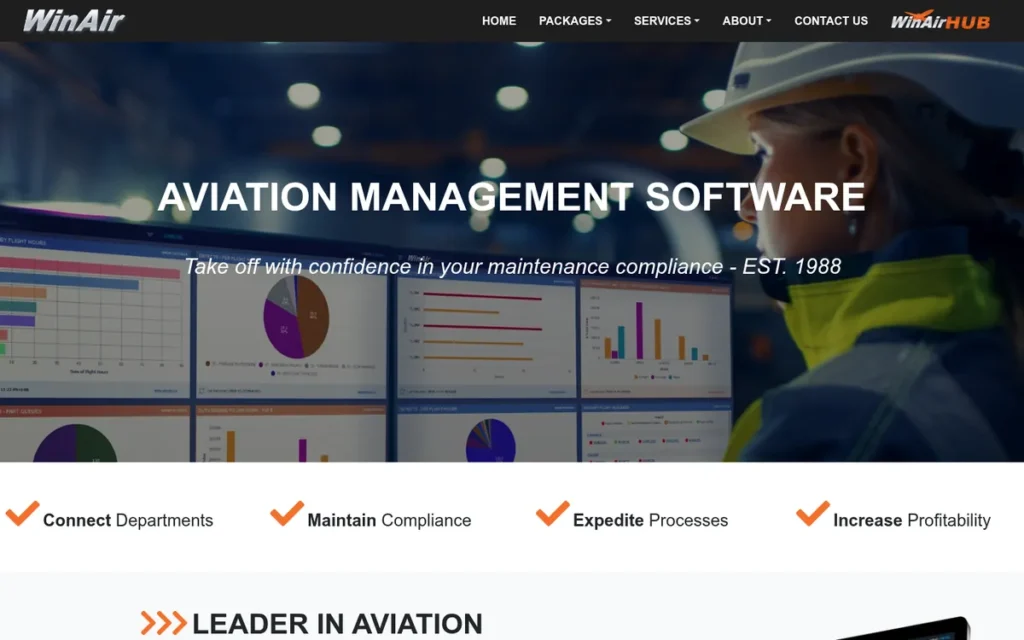
Category: Mid-Market Integrated System, maintenance, inventory and accounting in one system for mid-size operators and AMOs.
At a Glance
- Category: Mid-Market Integrated System
- Best For: Regional airlines, helicopter operators, AMOs and repair stations with an in-house records team
- Price Range: Pricing on request (no public pricing as of November 2026; Capterra reviewers describe it as cost-effective)
- Primary Strength: WinAir puts maintenance tracking, inventory and accounting in one system that departments use daily, without an enterprise-scale implementation.
- Biggest Limitation: WinAir has weak reporting and export tools, difficult version upgrades and no quantified outcome case studies.
- One-Line Summary: WinAir is an integrated maintenance, inventory and accounting system that reviewers describe as cost-effective, suited to mid-size operators that run their own records, though its reporting is limited.
- Last Verified: November 2026
Overview
WinAir, developed by AV-BASE Systems Inc. of London, Ontario, is an integrated maintenance, inventory and accounting system. It is built for regional airlines, helicopter operators, AMOs and repair stations whose in-house records teams track their own data without outside analysts.
WinAir launched its first product in 1988, was founded by Bert and Helen Vergeer, and is independent of the CAMP/Hearst and Veryon groups (WinAir, accessed November 2026; vendor-published). WinAir has less independent evidence than the other entries, so this entry relies mainly on Capterra reviews.
Key Features
- WinAir tracks maintenance, AD/SB compliance and forecasting, with operators maintaining their own data and no outside analysts.
- WinAir includes work orders, inventory and purchasing in the same system as maintenance tracking.
- WinAir includes cost accounting and invoicing, so maintenance planning, inventory and accounting teams work in one database.
- WinAir includes a reliability module, though reviewers note gaps in MEL, repeat-defect and premature-removal handling.
- WinAir Version 7 is the current major release, and operators such as Thai Aviation Services have implemented it (WinAir, 2026; vendor-published).
Best For
WinAir is best for mid-size regional, helicopter and AMO operators with in-house records staff. These operators want maintenance, parts and accounting integrated without the cost and timeline of an enterprise M&E project.
Strengths
- WinAir holds a 4.0/5 Capterra rating from 10 reviews, and reviewers recommend it for ease of use, functionality, cost and its ability to grow with the company (Capterra, accessed November 2026; independent).
- WinAir says it serves hundreds of aviation organizations in 30+ countries, with 15,000+ users managing 9,000+ aircraft (WinAir, 2026; vendor-published).
- WinAir names customers including Thai Aviation Services and North Wright Airways. One Capterra reviewer who has used it since 2009 calls it “far superior” to their previous system (WinAir, 2026; vendor-published; Capterra, accessed November 2026; independent).
- WinAir is used “all day everyday” across planning, inventory and accounting, according to one reviewer. An industry roundup named it the choice for mid-sized operators (Capterra; The Flying Engineer; accessed November 2026; independent).
Limitations
- WinAir gives up reporting depth for mid-market affordability, and Capterra reviewers call assembly management and reporting “a major negative” (Capterra, accessed November 2026; independent).
- WinAir custom reports need raw SQL extracts that break when the database structure changes, and exporting beyond paper, screen or PDF is awkward.
- One reviewer called WinAir version upgrades “difficult & time consuming,” and phone support is not readily available in Australasia.
- WinAir has no quantified outcome case studies, no Reddit discussion and no documented offline mobile capability, so buyers carry more of the due-diligence work.
Verdict
WinAir is an integrated maintenance, inventory and accounting system that Capterra reviewers describe as cost-effective. In 2026 it suits mid-size regional and helicopter operators that want one database without an enterprise implementation. WinAir ranks #7 because it has the thinnest independent and quantified evidence in this evaluation and well-documented reporting limitations.
Demo test: Buyers should ask for references from similar operators and test custom reporting and a version upgrade during the WinAir demo.
Users on r/aviationmaintenance noted:
“Winair can be really good, IF it is set up properly. If it isn’t then it’s garbage in and garbage out.” Posted by u/Valkxb70
Takeaway: WinAir’s value depends heavily on initial setup quality, so operators need disciplined data configuration before go-live to avoid unreliable records.
Also Worth Knowing (Not Ranked)
We did not rank ten aviation MRO products that come up in buyer research and AI answers. Most are sister products of ranked vendors in the CAMP/Hearst or Veryon groups. The rest were not researched to the same depth as the ranked entries. Each one is listed below with its parent company and the reason it was left out.
- IFS Cloud for Aviation Maintenance / Maintenix: IFS Maintenix is an enterprise option we did not research to equal depth. One analyst estimate gives IFS about 1.8% of the broad market (Global Market Insights, accessed November 2026; independent).
- CORRIDOR: CORRIDOR belongs to the CAMP family alongside CAMP Systems and Quantum Control, both ranked here, so we did not rank it separately.
- Veryon Work Center (formerly EBIS): Veryon Work Center is the April 2026 rebrand of EBIS MRO, a Veryon-family product. Capterra shows a $4,500 starting figure with an unclear unit (Capterra, accessed November 2026; independent).
- Veryon Tracking+: Veryon Tracking+ is a Veryon-family product with a broader MRO scope than the ranked Veryon Tracking.
- Rusada ENVISION: Rusada ENVISION is owned by Veryon and was not ranked separately.
- OASES: OASES is positioned for CAMO and mid-market operators but was not researched for this guide.
- Smart 145 and Quantum MX: Smart 145 and Quantum MX are small-shop cloud systems that were not researched. Quantum MX is not Quantum Control.
- Epicor Kinetic and ProMRO: Epicor Kinetic with ProMRO is a general-ERP route to aviation MRO and was not evaluated.
- RAAS: One Reddit user called RAAS “pretty popular in Canada” (Reddit r/aviationmaintenance, accessed November 2026; independent). We have not verified that claim.
Who Owns Which Aviation MRO Software Vendor?
Two groups own much of the business aviation and Part 145 software market: CAMP Systems (owned by Hearst) and the private-equity-backed Veryon group. AAR Corp. owns TRAX. Three “competing” demos can turn out to be two sister companies and their parent, so check who owns each vendor before you build a shortlist.
For example, if you invite CAMP Systems, Quantum Control and CORRIDOR, all three answer to Hearst. If you invite Veryon Tracking, Rusada ENVISION and Veryon Work Center, all three answer to the same private-equity-backed group.
- CAMP Systems / Hearst: The CAMP Systems group owns Component Control (Quantum Control) and links to CORRIDOR and CAMP Aviate through CAMP Connect. CAMP’s purchase of Avinode Group and Aviation FBO Software closed on May 1, 2024 (World Kinect, 2024; vendor-published).
- Veryon: The Veryon group, backed by Accel-KKR and ParkerGale, owns Flightdocs (now Veryon Tracking), Rusada, EBIS, CaseBank, RCMBT and Polaris Aero (Veryon, accessed November 2026; vendor-published).
- AAR Corp.: AAR Corp. acquired TRAX USA Corp. in March 2023 (AAR, 2023; vendor-published). Claims that Boeing owns TRAX are not supported.
- Lufthansa Technik: Swiss AviationSoftware, the maker of AMOS, has been a Lufthansa Technik subsidiary since the end of 2022 (SWISS newsroom, 2023; vendor-published).
- Ramco Systems: Ramco Aviation Suite is made by Ramco Systems, a publicly listed company based in Chennai, India (Ramco Systems, accessed November 2026; vendor-published).
- AV-BASE Systems Inc.: WinAir is developed by AV-BASE Systems Inc. of London, Ontario, which is independent of the CAMP/Hearst and Veryon groups (WinAir, accessed November 2026; vendor-published).
Product name check:
- Quantum Control (Component Control, CAMP family) is a different product from Quantum MX, a small-shop system from another vendor.
- Veryon Tracking is a different product from Veryon Tracking+ and from Veryon Work Center, which was formerly EBIS.
How Long Does an Aviation MRO Software Implementation Take?
Enterprise M&E implementations commonly take 12–24 months, and fleet trackers can still take months to onboard (IATA MRO SmartHub User Forum, 2024; independent). Whatever the vendor’s sales timeline says, plan and budget for four workstreams before go-live:
- Data migration usually takes the longest, especially for back-to-birth records.
- Configuration of maintenance programs, workflows and interfaces needs dedicated internal staff.
- Training for technicians, planners and records staff must happen without stopping production.
- Running the old and new systems in parallel during cutover adds cost and workload.
As one user on r/aviationmaintenance described:
“Create and RFP and get detailed responses from vendors. Do not trust or believe the vendors implementation cost or timeline, it’s not accurate I promise.” Posted by u/uavmx
Takeaway: Aviation MRO software buyers should treat vendor-quoted implementation costs and timelines as optimistic and budget independently for the full rollout.
These documented timelines from our research show how much projects vary:
- TRAX at Sabena Technics: TRAX and Sabena Technics built a minimum viable product, including custom development, in 12 months (TRAX, 2024; vendor-published).
- AMOS at Czech Airlines: AMOS training for about 1,000 Czech Airlines staff took two to three months without stopping production (Swiss-AS, 2017; vendor-published).
- Veryon Tracking onboarding: One Veryon Tracking reviewer reported more than three months to onboard a single small aircraft (Capterra, accessed November 2026; independent).
- Ramco Aviation Suite go-live: Ramco Aviation Suite reviewers describe go-live as a “leap of faith” that needs every level of the business behind it (Capterra, accessed November 2026; independent).
TCO checklist, ask every vendor to price these lines in writing:
- The licence fee should be quoted with its pricing unit (users, aircraft or modules) stated.
- Implementation and configuration services should be priced as a fixed or capped fee.
- Back-to-birth records migration should have its own price and validation method.
- Interfaces, APIs and sandbox environments are often priced outside the base licence (IATA MRO SmartHub User Forum, 2024; independent).
- Hosting and mobile modules should be itemized rather than bundled.
- Training should be priced per session or per user.
- Parallel running of the old and new systems should be budgeted for the full cutover period.
- The renewal cap and the cost of exporting your data when you leave should be written into the contract.
What Is Driving Aviation MRO Software Decisions in 2026?
Analysts put the aviation MRO software market at about $7.6–8.1 billion in 2025, growing about 2.6–4.2% a year. Most installed systems still run on-premises, but cloud deployment is growing faster. Many airlines still have no major program to automate aircraft data management, so plenty of legacy systems will be replaced in the coming years.
- Market size: Mordor Intelligence estimates the market at $7.56B in 2025 and $8.04B in 2026, reaching $9.82B by 2031 at a 4.08% CAGR (Mordor Intelligence, 2026; independent).
- Alternative forecast: Fortune Business Insights estimates $8.14B in 2025, reaching $10.62B by 2034 at a 2.57% CAGR (Fortune Business Insights, 2026; independent).
- Deployment: On-premises systems made up 72.85% of the market in 2025, while cloud deployment is growing 5.98% a year through 2031 (Mordor Intelligence, 2026; independent).
- Underlying MRO spend: Global commercial MRO demand reached $136B in 2025, up 8% from $126B in 2024, and is forecast to approach $198B by 2036 (Oliver Wyman, 2026; independent).
- Digital maturity: Only 51% of airlines have major programs to automate aircraft data management, and 24% are still researching it (Aviation Week, accessed November 2026; independent).
What Red Flags Should I Watch For When Evaluating Aviation MRO Software?
The biggest red flags are a shortlist where every vendor shares a parent company, “offline” apps that only show cached data, quotes without a multi-year total cost of ownership, and ratings built on tiny review samples. Also be wary of any claim that the software alone makes your organization compliant. Each red flag below is numbered for reference.
Red Flag #1: Every Vendor on Your Shortlist Shares a Parent Company CAMP Systems, Quantum Control and CORRIDOR share a corporate family, and so do Veryon Tracking, Rusada and Veryon Work Center. A shortlist drawn from one group weakens your negotiating position and gives you fewer real alternatives.
Red Flag #2: Mobile Apps That Only Show Cached Data Some mobile apps show cached data but cannot record sign-offs without a connection. Others copy paper task cards onto tablets and add clicks (IATA MRO SmartHub User Forum, 2024; independent). To test, switch the tablet to airplane mode, sign off a task card, then reconnect.
Red Flag #3: Quotes Without a 5–7 Year TCO Licence quotes often leave out major costs, so treat any quote without a 5–7 year total cost of ownership as incomplete (IATA MRO SmartHub User Forum, 2024; independent). Commonly missing lines include:
- Data migration is often quoted separately from the licence.
- Interfaces and APIs are often priced as add-ons.
- Training, hosting and mobile modules are often excluded from the base price.
- Renewal increases can raise costs after the first contract term.
Red Flag #4: Review Ratings Based on Fewer Than 10 Reviews Ratings from very small samples are not statistically reliable. Quantum Control’s 4.8 stars come from 6 reviews, while Veryon Tracking’s 4.5 comes from 90, so the lower number is the stronger evidence. Look at how many reviews a score is based on, not just the stars.
Red Flag #5: Claims That the Software Is Compliant on Its Own No aviation MRO software is compliant on its own; regulators approve your procedures, not your vendor. FAA AC 120-78B, which replaced AC 120-78A, provides an acceptable means of compliance for electronic signatures and records (FAA, December 2024; independent). EASA Part-145 and Part-CAMO organizations must show their records have integrity, traceability and retention.
Red Flag #6: No References From Operators Like You Independent review data is thin for several vendors in this category, including TRAX and CAMP Systems. A vendor that cannot provide references from operators of your size and type is asking you to be its test case.
What Questions Should I Ask Before Choosing Aviation MRO Software?
The most useful questions make vendors run your real workflows on your own data. Vague answers to the questions below are warning signs. A strong vendor will be able to:
- Take an unscheduled defect through to a work package live.
- Show offline sign-off followed by sync.
- Name the system of record for parts and cost data.
- Plan the back-to-birth records migration in writing.
- Put renewal caps and exit terms in the contract.
Question #1: Can you show an unscheduled defect becoming a work package using our data? A strong answer is a live demonstration that links the defect, parts demand, labor and sign-off without manual re-entry. Slides are not an answer, and neither is a demo run only on the vendor’s prepared sample data.
Question #2: How does technician sign-off behave offline, and how does it sync? Look for real offline recording, with conflict handling when the device reconnects. Being able to “view cached data” is not offline sign-off. Ask the vendor to show a sign-off made in airplane mode syncing correctly once the device reconnects.
Question #3: Which system owns parts and cost data, the M&E system or the ERP? A good answer names one system of record for each data type and documents the interface between them. Unclear data ownership causes reconciliation problems between maintenance and finance that can last for years after go-live.
Question #4: How will you migrate our back-to-birth records, and what will it cost? Ask for a written migration plan, a fixed or capped price and a method for validating the migrated data. Back-to-birth records are where many projects lose time, so the vendor’s answer here is a good test of its implementation experience.
Question #5: What renewal caps and data-export terms will you put in writing? Strong vendors commit to renewal caps and to exporting your data in a usable format without punitive fees. These terms matter more each year as CAMP/Hearst and Veryon bring more of the market under common ownership.
Question #6: Can you generate an AD/SB compliance report or audit pack live? Ask the vendor to produce the report during the demo and show which document revision each compliance entry used. Auditors check revision traceability, and some reviewers say certain trackers make that revision hard to see.
Question #7: How do your electronic signatures fit our approved procedures? Ask the vendor to explain how its e-signatures and records support FAA AC 120-78B and EASA record-keeping expectations. A good answer acknowledges that your organization’s procedures, not the software, must be approved, and shows audit trails that support those procedures.
How Should I Script a Vendor Demo?
Give every vendor the same script and the same sample data, and score each scenario on the same 1–5 scale. A common script lets you compare vendors’ answers directly instead of comparing their sales presentations. Every demo should include these scenarios:
- The demo should show a scheduled inspection coming due and being planned into a work package.
- The demo should show an unscheduled defect raised on the floor and turned into a work order.
- The demo should show a parts shortage and how it affects the work package and purchasing.
- The demo should show technician sign-off with no connection, followed by sync.
- The demo should show an AD/SB applicability check for a specific tail number or serial number.
- The demo should show a compliance record or audit pack generated on request.
- The demo should show a back-to-birth records search for a specific component.
- The demo should show maintenance costs reconciled with finance or the ERP.
Demo scoring scale:
- A score of 1 means the vendor showed the scenario on slides only.
- A score of 3 means the vendor showed the scenario live on its own data.
- A score of 5 means the vendor showed the scenario live on your data with no manual re-entry.
How Did We Rank These Aviation MRO Software Platforms?
PlugRoute scored each platform from 1 to 5 on six criteria, for a maximum of 45 points. Compliance depth, customer evidence and independent reviews count double. Mobility and integration, pricing transparency, and support and usability count once. Review ratings were weighted by sample size, and vendor case studies were labeled and scored lower than independent data.
Primary criteria (double weight):
- C1, Aviation Compliance and Segment-Fit Depth: C1 measures documented AD/SB, records, traceability and work-execution coverage for the product’s segment, because regulators expect audit-ready documentation.
- C2, Documented Customer Evidence and Scale: C2 counts named customers, quantified outcomes and installed base, because independent reviews are scarce in this category.
- C3, Independent User Review Evidence: C3 weights G2 and Capterra ratings by sample size and consistency, because reviews are the only third-party signal on usability.
Secondary criteria (single weight):
- C4, Shop-Floor Mobility and Integration: C4 assesses offline mobile sign-off and finance or ERP integration, because technicians work away from desks.
- C5, Pricing and Implementation Transparency: C5 rewards published pricing signals and documented timelines, because total cost often surfaces late in the sale.
- C6, Support Quality and Usability Signals: C6 uses review comments on support, learning curve and upgrades, because whether technicians adopt the system decides whether it succeeds.
| Rank | Product | C1 | C2 | C3 | C4 | C5 | C6 | Total /45 | Key Evidence (Dated) |
|---|---|---|---|---|---|---|---|---|---|
| 1 | AMOS | 5 | 5 | 3.0 | 4 | 3 | 3 | 36 | 270+ customers (2026); G2 3.9/5 from 19, Capterra 4.7/5 from 9 (Nov 2026) |
| 2 | Veryon Tracking | 4 | 3.5 | 4.5 | 3 | 2.5 | 4 | 33.5 | Capterra 4.5/5 from 90; G2 4.6/5 from 19 (Nov 2026) |
| 3 | Quantum Control | 4 | 4 | 3.5 | 4 | 3 | 3 | 33 | 1,700+ customers (2026); Capterra 4.8/5 from 6 (Nov 2026) |
| 4 | Ramco Aviation Suite | 5 | 3.5 | 3.0 | 4.5 | 2 | 2.5 | 32 | 4,000+ aircraft (2026); Capterra 3.9/5 from 18 (Nov 2026) |
| 5 | TRAX | 4.5 | 4.5 | 1.5 | 5 | 2.5 | 2 | 30.5 | Air Europa case study (2022); G2 2.5/5 from 2 (Nov 2026) |
| 6 | CAMP Systems | 4.5 | 3.5 | 2 | 3.5 | 2.5 | 3.5 | 29.5 | P&WC contract to 2040 (2026); 6 G2 reviews (Nov 2026) |
| 7 | WinAir | 3.5 | 2.5 | 3 | 3 | 2.5 | 3 | 26.5 | Capterra 4.0/5 from 10 (Nov 2026); named customers (2026) |
The scores are close. Veryon Tracking and Quantum Control are 0.5 points apart, Quantum Control and Ramco Aviation Suite are 1 point apart, and TRAX and CAMP Systems are 1 point apart. Treat the ranking as a guide to overall evidence strength, and choose by segment fit.
How we handled the evidence:
- We weighted star ratings by sample size, because a 4.8-star rating from 6 reviews is weaker evidence than a 4.5 from 90.
- We labeled vendor case studies as vendor-published and scored them lower than independent data.
- TRAX and CAMP Systems rank lower mainly because verifiable independent review data is missing, not because of documented product weaknesses.
What we could not verify:
- We could not verify an overall review score for CAMP Systems.
- We could not verify an ISO or SOC security attestation for any vendor.
- We found no dollar pricing beyond AMOS’s indicative CHF 90,000 starting price and Veryon Work Center’s $4,500 Capterra starting figure, whose unit is unclear.
- Customer counts for AMOS, TRAX, CAMP Systems and WinAir are vendor-stated and were not independently audited.
Scores updated November 2026: We corrected the G2 review counts for AMOS and Veryon Tracking (19 reviews each) using G2 product pages. We also added Ramco Aviation Suite’s Capterra score (3.9/5 from 18 reviews) and WinAir’s named customers. As a result, Ramco Aviation Suite moved to #4 and TRAX to #5.
PlugRoute has no affiliate relationships with any company listed, and rankings are determined entirely by research data and objective evaluation criteria.
What Do Buyers Most Often Ask About Aviation MRO Software?
Buyers most often ask about cost, which system fits a small fleet and how rankings are made. Two things answer most of these questions. Your operation type and records staffing matter more than a vendor’s feature list. And every price should be tested against a 5–7 year total cost of ownership.
How much does aviation MRO software cost?
Aviation MRO software pricing is rarely published. AMOS lists an indicative starting price of about CHF 90,000 (Capterra, accessed November 2026; independent), Quantum Control sells SaaS at a single monthly price per user, and CAMP Systems enrolls broker-listed aircraft free. Every other evaluated vendor quotes on request, so buyers should demand a 5–7 year total cost of ownership.
What is the best aviation MRO software for a small fleet in 2026?
For small fleets in 2026, the best aviation MRO software depends on who keeps your records. CAMP Systems suits flight departments with no records staff, because its analysts apply ADs and SBs for you. Veryon Tracking suits operators with an in-house records person. WinAir suits mid-size operators that want maintenance, inventory and accounting in one database.
How does PlugRoute determine rankings?
PlugRoute ranks software with a 45-point weighted score across six evidence-based criteria. Compliance depth, customer evidence and independent reviews count double. Review ratings are weighted by sample size, and vendor case studies are labeled and scored lower than independent data. Anything we could not verify is disclosed in the methodology section, along with a dated correction note.
What Do Key Aviation MRO Software Terms Mean?
Airworthiness Directive (AD): An Airworthiness Directive is a mandatory instruction from an aviation authority to inspect, repair or modify an aircraft or component. Buyers need software that shows which ADs apply to each aircraft and proves when each one was complied with.
Service Bulletin (SB): A Service Bulletin is a manufacturer’s recommendation for an inspection, modification or improvement. Good software tracks whether each SB applies to an aircraft and records the decision to adopt or defer it.
M&E System: An M&E (maintenance and engineering) system is software that combines maintenance planning, engineering, technical records and logistics in one place. An M&E system is the core system of record for airlines and large MROs.
CAMO: A CAMO (Continuing Airworthiness Management Organisation) is the organization responsible for keeping aircraft airworthy under EASA rules. CAMO teams need software that supports maintenance program management and compliance oversight.
Part 145 Repair Station: A Part 145 repair station is a maintenance organization certificated to perform repairs and alterations under FAA Part 145, and EASA Part-145 is the European equivalent. Repair stations need work orders, traceability and release documentation more than fleet planning.
Authorized Release Certificate: An Authorized Release Certificate (FAA Form 8130-3 or EASA Form 1) is the document that releases a part or component back to service. Buyers should check that a system ties each certificate to the part’s serial number and work order.
Life-Limited Part (LLP): A life-limited part is a component that must be retired after a set number of hours, cycles or calendar time. Software must track every life-limited part’s remaining life accurately to prevent unairworthy installations.
Back-to-Birth Records: Back-to-birth records are the complete history of an aircraft or component from manufacture to today. Migrating these records is one of the hardest and most expensive parts of switching systems.
Electronic Task Card: An electronic task card is a digital work instruction that technicians complete and sign on a tablet or other device. A true electronic task card works offline and is built for mobile use, not copied from a paper form.
Electronic Signature: An electronic signature is a digital sign-off on maintenance records, addressed in the US by FAA AC 120-78B (December 2024). Software can support electronic signatures, but the regulator accepts them only under the organization’s approved procedures.
Due List: A due list is a forecast of upcoming inspections, life limits and compliance items for each aircraft. Accurate due lists prevent missed inspections and unplanned grounding.
Total Cost of Ownership (TCO): Total cost of ownership is the full cost of a system over several years, including licences, implementation, migration, hosting, training and renewals. Buyers should request a 5–7 year TCO, because licence fees alone understate the real cost.
Which Aviation MRO Software Is Right for You?
Key Insights
The right aviation MRO software depends first on your operation type and who maintains your records, and only then on rank. AMOS leads for airlines and large MROs, and Quantum Control leads for Part 145 shops. Veryon Tracking and CAMP Systems divide business aviation into self-service and analyst-managed models.
- Aviation MRO buyers should choose by operation type and records staffing first, because no single platform fits airlines, repair stations and business aviation equally well.
- AMOS has the strongest overall evidence for airlines and large MROs, Quantum Control leads for Part 145 shops, and Ramco Aviation Suite is the only evaluated platform with native M&E plus finance, HR and supply chain.
- Veryon Tracking suits business aviation operators with in-house records staff, while CAMP Systems suits flight departments that want analysts to maintain their records.
- Independent review data is thin for TRAX and CAMP Systems, and no vendor publishes full pricing, so reference calls and a 5–7 year TCO quote matter more than star ratings.
Your next step depends on your operation:
- Airlines and large MROs should invite AMOS, Ramco Aviation Suite and TRAX to scripted demos that use their own data.
- Part 145 component shops should start with Quantum Control and add a vendor from a different parent company.
- Business aviation departments should demo CAMP Systems and Veryon Tracking side by side.
- Mid-size operators with a records team should test WinAir’s reporting closely.
Ownership in this category is consolidating and cloud deployment is growing, so contract terms on data export and renewal caps will matter more each year. To build your shortlist, start with PlugRoute’s full scoring methodology and see our other independent aviation software reviews on PlugRoute.
We update this guide quarterly. Last updated: November 2026.