The best blogger outreach software in 2026 is Pitchbox for high-volume link-building agencies, BuzzStream for small teams that need shared relationship history, and Respona for content-led teams that want built-in opportunity search. Which one fits depends on your main bottleneck and on the real cost once credits, extra seats and contract terms are added.
Most outreach teams run into the same problems. Blogger contacts end up split across spreadsheets and inboxes, follow-ups get forgotten, guessed emails bounce, and pricing tiers force upgrades as the team grows. Beginners on a budget can start free with Hunter.
As one user on r/SEO described:
“Hey, I’m running a side project and trying to build backlinks, but outreach feels like such a grind. Finding good domains, grabbing emails, and sending campaigns are just too much with the time I have.” Posted by u/CompetitiveWolf4212
Takeaway: For small link builders, the slow manual work of prospecting, finding emails and sending campaigns is the main bottleneck that blogger outreach software has to solve.
PlugRoute has no affiliate relationships with any company listed, and rankings are determined entirely by research data and objective evaluation criteria.
This November 2026 update re-checked every price and traced each score to a published feature checklist. As a result, Respona moved up to #3 and Hunter moved down to #4. The guide below matches each tool to the problem it solves best.
What Are the 4 Categories of Blogger Outreach Tools?
There are four categories of blogger outreach tools: link-building platforms, outreach CRMs, email data layers and general cold-email sequencers. Link-building platforms and CRMs cover prospecting, relationship history and link tracking. Email finders and sequencers cost less to start but leave the link-specific work to you. Influencer-marketing platforms are a separate category.
- Link-Building Platform: Pitchbox and Respona are link-building platforms. They cover prospect discovery, contact finding, outreach sequences and reporting in one workflow.
- Outreach CRM: BuzzStream is an outreach CRM. It keeps each contact’s relationship history, notes and conversations for long-term work with publishers.
- Email Data Layer: Hunter is an email data layer. It finds and verifies contact emails and is often paired with a separate sequencer or CRM.
- General Cold-Email Sequencer: Mailshake and lemlist are general cold-email sequencers. They automate multistep outreach to prospect lists you bring yourself.
We left influencer-marketing platforms built for paid creator campaigns out of this ranking on purpose. They solve a different problem from editorial and link outreach.
Snov.io was not in our research set, so we did not score it. PlugRoute does not rank a tool unless it has the same depth of evidence as the others.
“The toughest part, in my opinion, is finding the right site or site owner to pitch to.” (u/billhartzer, r/SEO (Reddit, accessed Nov 2026))
Takeaway: Prospect quality and reaching the right contact affect outreach results more than automation features do.
How Do the Top Blogger Outreach Tools Compare at a Glance?
Pitchbox leads with the most complete link-building workflow (42/50). BuzzStream follows as the relationship CRM (37/50), then Respona for integrated opportunity search (32/50). Hunter is fourth at 30. Mailshake and lemlist come last because, as general sequencers, they have no documented link-specific features. All prices were verified in November 2026.
| Rank | Company | Category | Best For | One-Line Summary | Key Capabilities | Primary Strength | Key Limitation |
|---|---|---|---|---|---|---|---|
| 1 (42/50) | Pitchbox | Link-Building Platform | Agencies and high-volume SEO teams | Pitchbox is the most complete link-building platform evaluated, from $210/month on a one-year commitment. | 20+ prospecting options, 5 SEO-metric integrations, CRM, link monitoring, white-label reports | Unlimited users and 25 workspaces on the Advanced plan | Highest entry price; one-year commitment |
| 2 (37/50) | BuzzStream | Outreach CRM | Relationship-focused teams of 3–6 | BuzzStream is a relationship-focused outreach CRM, with team plans from $174/month for three users. | Shared contact history, BuzzMarker extension, sequences, link monitoring, Ahrefs integration | Per-contact relationship history | 500-contact cap on Starter; lowest G2 rating in the set |
| 3 (32/50) | Respona | Link-Building Platform | Content-led SEO and digital PR teams | Respona sells DIY link-building software from $198/month and a managed service priced per live link. | Opportunity search engine, contact finder, AI personalization, campaign templates, unified inbox | Built-in opportunity search with unlimited members | Contact-finder failures in independent tests; no full warm-up |
| 4 (30/50) | Hunter | Email Data Layer | Finding verified emails on a budget | Hunter is an accessible email finder and verifier with a free plan and unlimited seats. | Domain Search, Email Finder, Email Verifier, confidence scores, basic campaigns | Transparent confidence scoring; unlimited seats | No SEO metrics, placement tracking or CRM; 3 sending accounts on Starter |
| 5 (25/50) | Mailshake | General Cold-Email Sequencer | Solo users who already have a list | Mailshake has the lowest per-user entry price of the sequencers here, at $29/month. | Sequences, Lead Catcher, warm-up, list cleaning, A/B testing | $29 per user entry price | No prospecting or SEO features; per-user pricing |
| 6 (24/50) | lemlist | General Cold-Email Sequencer | Multichannel pitching | lemlist is a multichannel sequencer with strong personalization but no link-building features. | Email, LinkedIn, calls, SMS, WhatsApp; lemwarm; image personalization | Per-team Email plan with unlimited users from $55/month | Per-user Multichannel pricing; billing complaints on Trustpilot |
Which Blogger Outreach Tool Should I Choose for My Use Case?
Choose by team size and by your main bottleneck. To test before paying, start free with Hunter. For the cheapest solo stack, pair Hunter with Mailshake. A small team that needs to coordinate should choose BuzzStream Growth, and a growing agency should choose Pitchbox Advanced.
| Your #1 Priority | Recommended Tool | Why | Acceptable Alternative |
|---|---|---|---|
| Testing at $0 | Hunter Free | 50 credits/month to test email-finding accuracy on your own niche before paying | N/A |
| Solo, tight budget, list already built | Hunter + Mailshake | About $63–$78/month for finding, verifying and sequencing | Mailshake alone if your emails are already verified |
| Solo, link-building-specific | BuzzStream Starter | One user with relationship history from $49/month, but capped at 500 contacts | Respona Starter ($198, unlimited members) |
| Small agency, 3–5 people | BuzzStream Growth | 3 users, 25,000 contacts and shared history for $174/month (about $290 at 5 users, $348 at 6) | Respona Starter ($198, unlimited members) |
| Growing or high-volume agency | Pitchbox Advanced | Unlimited users, 25 workspaces, white-label reporting; one-year commitment | Respona Pro ($495/month, unlimited members) |
| Email-only team of 3+ on a budget | lemlist Email + Hunter | lemlist’s Email plan is priced per team ($55–$69/month) with unlimited users | Hunter + Mailshake |
| Multichannel personalization | lemlist Multichannel | Email, LinkedIn, calls, SMS and WhatsApp in one sequence | Mailshake Sales Engagement (dialer and social tasks) |
| Placements without doing outreach | Respona managed service | Respona says buyers pay only for live links, at $100–$500 each | None in this set. Review search-engine guidance on paid links first. |
Before you pay, test email-finding accuracy on your own niche with Hunter’s free plan (50 credits/month). Email finders fail most often on small blogs that use Gmail addresses or contact forms.
What Are the Best Blogger Outreach Software Tools in 2026?
Ranked by PlugRoute’s weighted score, the best blogger outreach software in 2026 is Pitchbox (42/50), followed by BuzzStream (37), Respona (32), Hunter (30), Mailshake (25) and lemlist (24). Link-building workflow fit counts three times as much as most criteria, so purpose-built platforms rank above general email sequencers even when the sequencers have higher review ratings.
1. Pitchbox: Best Overall for Link-Building Agencies and High-Volume SEO Teams
Category: Link-Building Platform. This is purpose-built software that finds link prospects, qualifies them with SEO metrics and runs outreach in one workflow.
At a Glance
- Category: Link-Building Platform
- Best For: Link-building agencies and in-house SEO teams running several high-volume campaigns across clients
- Price Range: $210–$825/month billed annually or $300–$1,200/month billed monthly; Enterprise Platform priced on request; one-year commitment on all plans
- Primary Strength: Pitchbox combines 20+ prospecting options, five SEO-metric integrations, client workspaces and white-label reporting in one platform.
- Biggest Limitation: Pitchbox has the highest entry price in this comparison and requires a one-year commitment even on monthly billing. Reddit users also report that its site-discovery suggestions need heavy manual filtering.
- One-Line Summary: Pitchbox is the most complete link-building outreach platform of the six tools evaluated in 2026, combining SEO-metric prospecting with unlimited-user team plans at the highest entry price in its category.
- Last Verified: November 2026
Overview Pitchbox is an all-in-one link-building outreach platform for SEO agencies and in-house teams. It lets them find prospects, qualify them with Domain Rating and other third-party SEO metrics, run personalized sequences and report placements to clients from one shared workspace.
Pitchbox sells three published tiers (Pro, Advanced and Scale) plus a custom Enterprise Platform. Pitchbox requires a one-year commitment on every plan, so “monthly” means monthly payments, not month-to-month cancellation (Pitchbox pricing page, 2026).
Key Features
- Pitchbox offers more than 20 prospecting options for finding guest-post, resource-page and editorial link opportunities.
- Pitchbox pulls SEO metrics from Ahrefs, Semrush, Moz, Majestic and LinkResearchTools so teams can qualify prospects before pitching.
- Pitchbox includes a built-in email finder and verifier, plus an “Outreach Engagement Probability” score for prioritizing contacts.
- Pitchbox provides automated email sequences, a unified inbox, a CRM with pipeline history, and link monitoring.
- Pitchbox includes AI Personalization, an AI Reply Agent and an AI Campaign Assistant on every plan, though the vendor documents these features only briefly (Pitchbox pricing page, 2026).
Best For Pitchbox is best for agencies and in-house SEO teams that run several clients or campaigns at once and need unlimited seats, separate workspaces and white-label reports.
Pricing Pitchbox pricing as of November 2026 (Pitchbox pricing page, 2026):
- Pitchbox Pro costs $300/month billed monthly or $210/month billed annually. It includes 2 users, 1 workspace, 2 email accounts and 2,000 outreach emails per month.
- Pitchbox Advanced costs $600/month or $420/month billed annually. It includes unlimited users, 25 workspaces, 6 email accounts and 5,000 outreach emails per month.
- Pitchbox Scale costs $1,200/month or $825/month billed annually. It includes unlimited users and workspaces, 20 email accounts and 25,000 outreach emails per month.
- Pitchbox Enterprise Platform is priced on request.
Strengths
- Pitchbox publishes the most named, quantified case studies in this comparison. In one, Fire&Spark cut bounces from 40% to under 3% and raised average response rates from 6% to 26% (Pitchbox case study, accessed Nov 2026; vendor-published).
- Pitchbox’s other vendor case studies report that Moosend grew from 5 to about 100 links per month and that Ignite SEO cut link-building costs by 54% (Pitchbox case studies, accessed Nov 2026; vendor-published).
- Pitchbox holds 4.7/5 on G2 across 99 reviews (G2, 2026) and 4.6/5 on Capterra across 42 reviews (Capterra, 2026). Reviewers praise its automated follow-up scheduling.
- Pitchbox Advanced includes unlimited users and 25 workspaces for $420/month billed annually, so the cost per seat falls as an agency grows (Pitchbox pricing page, 2026).
- Pitchbox co-published a study of 12 million outreach emails with Backlinko. The study found an 8.5% average reply rate and 65.8% more replies after one follow-up (Backlinko/Pitchbox, 2019).
Limitations Pitchbox’s biggest trade-off is the cost of getting started. Its Pro plan, at $210/month annually or $300 monthly, has the highest entry price of the six tools, and every plan requires a one-year commitment (Pitchbox pricing page, 2026).
- G2 reviewers say Pitchbox’s price is a barrier for small businesses (G2, 2026).
- Pitchbox’s automated prospecting has a quality caveat. One r/SEO user said its site discovery “has gotten much worse” and takes a long time to filter for brand-safe prospects, though another user disagreed (Reddit, accessed Nov 2026).
- Pitchbox’s marketing claim that “82% of link vendors use Pitchbox” has not been independently verified (Pitchbox, accessed Nov 2026).
Verdict Pitchbox is the highest-scoring blogger outreach platform in PlugRoute’s 2026 evaluation (42/50) for agencies and SEO teams that run high-volume link-building campaigns and can justify a price of $210 per month and up.
Pitchbox ranks #1 because it leads on workflow fit, the criterion that counts three times (C1 5, C2 4, C3 4, C4 2, C5 4, C6 5). Its lowest score is pricing accessibility. Pitchbox Advanced is the most scalable team plan here. Skip Pitchbox if you work alone or can’t commit to a full year.
2. BuzzStream: Best Outreach CRM for Relationship-Focused Small Teams and Digital PR
Category: Outreach CRM. This is relationship-management software that stores contact history, notes and conversations for long-term publisher outreach.
At a Glance
- Category: Outreach CRM
- Best For: Small SEO and digital PR teams of 3–6 people building long-term relationships with publishers and bloggers
- Price Range: $49–$424/month on published tiers; Custom from $999/month
- Primary Strength: BuzzStream keeps a shared relationship history for each contact, so teammates can see every earlier conversation and avoid pitching the same person twice.
- Biggest Limitation: BuzzStream’s Starter plan is capped at 500 contacts, which pushes most working teams to the $174/month Growth plan. Reviewers also describe the interface as cluttered.
- One-Line Summary: BuzzStream is a relationship-focused outreach CRM for small link-building and digital PR teams, with team plans from $174 per month for three users.
- Last Verified: November 2026
Overview BuzzStream is an outreach CRM for small SEO, link-building and digital PR teams. It helps them find prospects, keep every blogger conversation in one shared history, automate follow-ups and monitor earned links without juggling spreadsheets and inboxes.
BuzzStream is built around long-term publisher relationships rather than sending volume, so it suits relationship-led link building and digital PR.
Key Features
- BuzzStream stores emails, notes and replies against each contact, so the whole team shares one relationship history.
- BuzzStream’s BuzzMarker browser extension saves sites and contacts while you browse and shows past interactions in place.
- BuzzStream offers sequences with automated follow-ups, team permissions and reporting.
- BuzzStream monitors earned links (25,000 on Growth) and includes 250 prospecting searches per month on Growth.
- BuzzStream integrates with Ahrefs on the Growth tier and provides API access on the Professional tier.
Best For BuzzStream is best for teams of 3–6 people whose main problem is coordination: keeping contacts, conversation history and follow-ups in one place across several projects.
Pricing BuzzStream pricing as of November 2026 (BuzzStream plans page, 2026):
- BuzzStream Starter costs $49/month for 1 user and 500 contacts.
- BuzzStream Growth costs $174/month for 3 users plus $58 per extra user, with 25,000 contacts.
- BuzzStream Professional costs $424/month for 6 users plus $70 per extra user, with 100,000 contacts and API access.
- BuzzStream Custom starts at $999/month for 12 or more users.
BuzzStream’s plans page did not show annual prices or monthly email limits. On BuzzStream Growth, five users cost about $290/month and six users about $348/month.
Strengths
- BuzzStream analyzed more than 12,000 campaigns across 2,000 customer accounts and found a 12% median reply rate. Relevant personalization lifted replies by 10.7%, while superficial personalization lowered them by 1.3% (BuzzStream data study, accessed Nov 2026; vendor data).
- BuzzStream rates 4.5/5 on Capterra across 22 reviews and 4.2/5 on G2 across 165 reviews (G2 and Capterra, 2026). Reviewers praise how it organizes contacts and tracks interactions.
- BuzzStream Growth covers 3 users, 25,000 contacts and automated follow-ups for $174/month, and BuzzStream publishes its extra-seat prices (BuzzStream plans page, 2026).
- BuzzStream supports large teams. A vendor case study describes Content Customs running more than 30 link builders on the platform, though it reports no percentage outcomes (BuzzStream, accessed Nov 2026).
- BuzzStream comes up repeatedly alongside Pitchbox and Respona as a legitimate outreach tool in r/SEO and r/DigitalMarketing threads (Reddit, accessed Nov 2026).
Limitations BuzzStream’s biggest trade-off is a very limited entry tier. The $49 Starter plan allows one user and 500 contacts, so most working teams have to move to the $174 Growth plan (BuzzStream plans page, 2026).
- BuzzStream has the lowest G2 rating of the six tools (4.2/5). Reviewers describe a cluttered, “function over style” interface and a learning curve (G2 and Capterra, 2026).
- One Capterra reviewer had trouble adding a single contact to more than one BuzzStream project or client, which is a problem for agencies (Capterra, 2026).
- One Capterra reviewer cited “a 25% price increase without new features” as the reason for leaving BuzzStream (Capterra, 2026).
- BuzzStream does not document a built-in warm-up feature. Its own data shows reply rates falling from 1.15% to 0.37% as campaigns grow from 1–50 to 1,001–5,000 emails (BuzzStream, accessed Nov 2026).
Verdict BuzzStream is the best blogger outreach software in 2026 for small teams whose main problem is keeping relationship history and follow-ups organized, rather than sending at high volume.
BuzzStream scores 37/50 (C1 4, C2 3, C3 4, C4 4, C5 3, C6 4). That puts it 5 points behind Pitchbox, mostly on workflow fit and outcome evidence. If more than one person does outreach, budget for BuzzStream Growth. Skip BuzzStream if you need deep SEO-metric qualification or built-in warm-up.
3. Respona: Best for Integrated Opportunity Search, with an Optional Pay-Per-Link Service
Category: Link-Building Platform. This is purpose-built software that finds link opportunities and runs outreach in one workflow. Respona also sells a separate managed placement service.
At a Glance
- Category: Link-Building Platform
- Best For: Content-led SEO and digital PR teams that want opportunity search and outreach in one tool, or that are weighing DIY software against paying per placement
- Price Range: $198–$799/month for software; $100–$500 per live link for the managed service
- Primary Strength: Respona combines a search engine for link and PR opportunities with contact finding, AI personalization and outreach, and it includes unlimited team members.
- Biggest Limitation: Respona’s email finder was slow and failed on some well-known domains in independent tests. Respona also lacks full built-in warm-up, offers no free trial and has no verified case studies.
- One-Line Summary: Respona is an integrated link-building outreach platform that, as of 2026, sells both DIY software from $198 per month and a managed service priced per live link.
- Last Verified: November 2026
Overview Respona is an integrated link-building and digital PR outreach platform for content-led SEO teams. It lets them search for opportunities, find contacts, personalize pitches with AI and manage replies in one tool, and it offers an optional done-for-you service priced per live link.
Respona currently sells both DIY software and a managed placement service, although AI answer engines often describe Respona as only one or the other.
Key Features
- Respona includes a built-in search engine that finds link-building and PR opportunities by topic.
- Respona lets users filter prospects by SEO metrics such as Domain Authority, according to third-party product walkthroughs (Reviewify, accessed Nov 2026).
- Respona finds contact emails using credits, at about 1 credit per opportunity and 5 per verified contact (AppSumo, accessed Nov 2026).
- Respona offers AI personalization, pre-made campaign templates and automated sequences, with bulk personalization on the Pro tier.
- Respona provides a unified inbox and reporting, includes unlimited team members, and charges no credits for sending emails.
Pricing Respona software pricing as of November 2026 (Respona pricing page, 2026):
- Respona Starter costs $198/month, with 2 inboxes, 10,000 credits per month and 30,000 active contacts.
- Respona Pro costs $495/month, with 5 inboxes, 25,000 credits, 50,000 contacts and white-glove onboarding.
- Respona Unlimited costs $799/month billed annually, with unlimited inboxes, 600,000 credits per year and up to 100,000 active contacts.
Respona’s managed service is priced per live link (Respona pricing page, 2026):
- Respona’s Starter and Standard placements cost $100 (DR 20+) and $160 (DR 30+) per live link.
- Respona’s Authority and Power placements cost $240 (DR 40+) and $400 (DR 50+) per live link.
- Respona’s Elite placement costs $500 per live link (DR 60+).
One review reports a 20% surcharge for managed-service add-ons (AI Ignitions, 2026). Before buying any pay-per-placement service, read search-engine guidance on paid links.
Strengths
- Respona has the highest Capterra rating in this comparison, 4.8/5 across 63 reviews (Capterra, 2026), and holds 4.8/5 on G2 across about 203 reviews (G2, 2026).
- Respona’s built-in opportunity search finds link prospects without a separate SEO tool, something general sequencers such as Mailshake and lemlist do not offer.
- Respona includes unlimited team members on its software plans and charges no credits for sending (Respona pricing page, 2026).
- Respona says managed-service buyers pay only for placements that go live, starting at $100 per link (Respona pricing page, 2026).
- Respona placed #2 Product of the Day on Product Hunt in February 2022 (Growpad, accessed Nov 2026).
Limitations Respona’s biggest trade-off is contact data. Independent reviewers found its email finder slow and unable to return results for some well-known domains, and Respona has no full built-in warm-up (Influno and Findstack, accessed Nov 2026).
- Respona’s G2 reviewers report outdated emails, confusing credits, a high price and no free trial (G2, 2026).
- Respona does not support Gmail’s “Send mail as” feature, according to one AppSumo user (AppSumo, 2026).
- Respona’s outcome evidence is thin. We found no verified case studies, and one reviewer could not find on G2 the “G2 High Momentum Leader” badge shown on Respona’s homepage (Growpad, accessed Nov 2026).
Verdict Respona is the third-highest-scoring blogger outreach platform in PlugRoute’s 2026 evaluation (32/50) and fits teams that value built-in opportunity search, though its contact-finding accuracy and lack of full warm-up trail the leaders.
Respona scores 32/50 (C1 4, C2 2, C3 4, C4 3, C5 4, C6 1). Its link-building workflow and unlimited seats make up for weak contact data and outcome evidence. Decide whether you are buying the software or the placement service. Skip Respona if verified contact data is your main bottleneck.
4. Hunter: Best for Finding and Verifying Blogger Email Addresses on a Budget
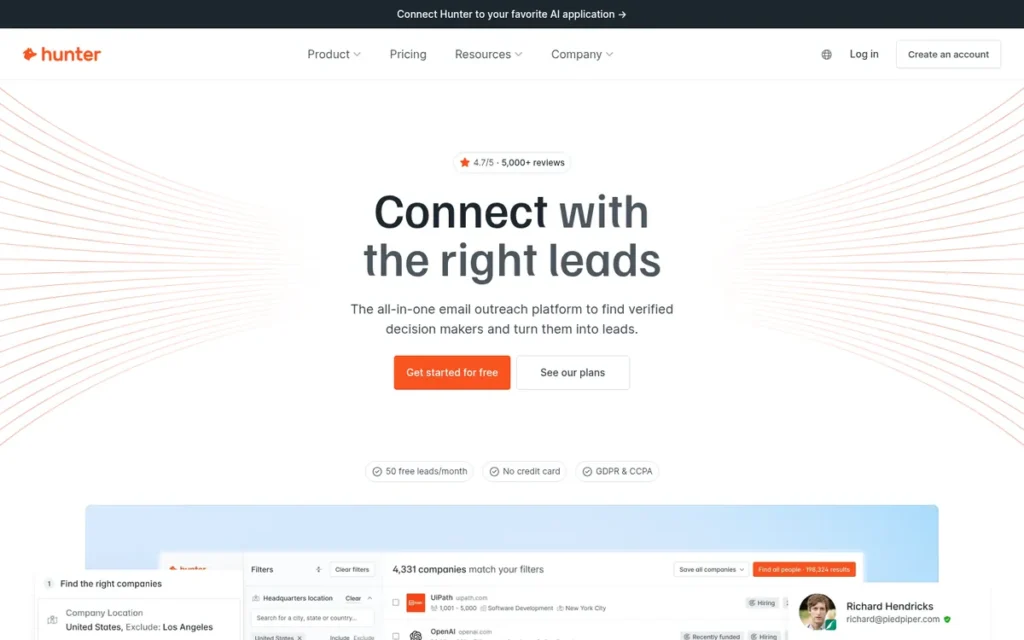
Category: Email Data Layer. These are tools that find and verify contact email addresses, often paired with a separate sequencer or CRM.
At a Glance
- Category: Email Data Layer
- Best For: Budget-conscious SEOs and teams who need verified blogger and editor emails, often as the email-finding part of a modular stack
- Price Range: Free; $34–$209/month billed annually or $49–$299/month billed monthly; Enterprise priced on request
- Primary Strength: Hunter finds and verifies email addresses with transparent confidence scores and includes unlimited team members on every plan.
- Biggest Limitation: Hunter has no SEO metrics, placement tracking or relationship history, and its pattern-based results are weakest on small blogs.
- One-Line Summary: Hunter is an accessible email finder and verifier for blogger outreach in 2026, with a free plan and unlimited seats but only basic campaign features.
- Last Verified: November 2026
Overview Hunter is an email finder and verifier with basic sequencing for SEOs and outreach teams. It suits teams that need to find and confirm editor or site-owner addresses for a domain, then send short follow-up campaigns, without paying for a full outreach CRM.
Hunter usually serves as the data layer in a modular stack, paired with a dedicated sequencer or CRM.
Key Features
- Hunter’s Domain Search and Email Finder locate addresses using public web sources and detected domain email patterns.
- Hunter’s Email Verifier and confidence scores show how likely each address is to be deliverable.
- Hunter Campaigns sends sequences with open and click tracking to up to 2,500 recipients per campaign on Starter.
- Hunter provides a Chrome extension, the Discover B2B lead database with an AI Assistant, a HubSpot integration and an API.
- Hunter includes unlimited team members on every plan, with connected email accounts rising from 3 on Starter to 20 on Scale.
Best For Hunter is best for beginners and budget-limited teams whose main problem is finding verified emails, including teams that pair Hunter with a sequencer such as Mailshake.
Pricing Hunter pricing as of November 2026 (Hunter pricing page, 2026):
- Hunter Free costs $0 and includes 50 credits per month.
- Hunter Starter costs $49/month or $34/month billed annually and includes 2,000 credits and 3 connected email accounts.
- Hunter Growth costs $149/month or $104/month billed annually and includes 10,000 credits and 10 accounts.
- Hunter Scale costs $299/month or $209/month billed annually and includes 25,000 credits and 20 accounts.
- Hunter Enterprise is priced on request.
One third-party estimate puts Hunter usage at about 1 credit per email found and 0.5 per verification (GTM Bud, accessed Nov 2026). Lookups that return nothing raise the real cost of each usable contact.
Strengths
- Hunter holds a 4.4/5 G2 rating across roughly 650+ reviews (G2, 2026; counts vary by source). Reviewers praise ease of use, fast lookups and verification.
- Hunter is unusually open about its method. Hunter publishes how its confidence scores are calculated and keeps an AI transparency page that discusses GDPR profiling (Hunter, accessed Nov 2026).
- Hunter includes unlimited team members on every plan. Connected sending accounts are capped (3 on Starter, 10 on Growth, 20 on Scale), however, so larger teams may still need to upgrade.
- Hunter’s free plan of 50 credits per month lets you test its accuracy on your own niche before paying.
- Hunter publishes a recurring State of Cold Email research report, though we found no named customer case studies (Hunter, accessed Nov 2026).
Limitations Hunter’s biggest trade-off is scope. Hunter is not a full outreach system: it has no SEO metrics, no blogger opportunity discovery, no placement tracking and no relationship CRM.
- Hunter’s pattern-based approach is weakest on small independent blogs that use Gmail addresses, contact forms or accept-all servers. Hunter itself says high-confidence addresses can still bounce (Hunter Help Center, accessed Nov 2026).
- G2 reviewers say Hunter’s credits run out quickly and costs climb at volume (G2, 2026).
- Hunter Starter allows only 3 connected sending accounts. A 10-person team that wants everyone sending through Hunter must move to Growth at $104–$149/month (Hunter pricing page, 2026).
Verdict Hunter is the best blogger outreach tool in 2026 for finding and verifying contact emails cheaply, but it works best as one part of an outreach stack rather than as a complete link-building platform.
Hunter scores 30/50 (C1 1, C2 4, C3 4, C4 5, C5 4, C6 2). Verify every address before sending. Skip Hunter as a standalone tool if you need prospect discovery or relationship history.
5. Mailshake: Best Low-Cost Sequencer When You Already Have a Blogger List
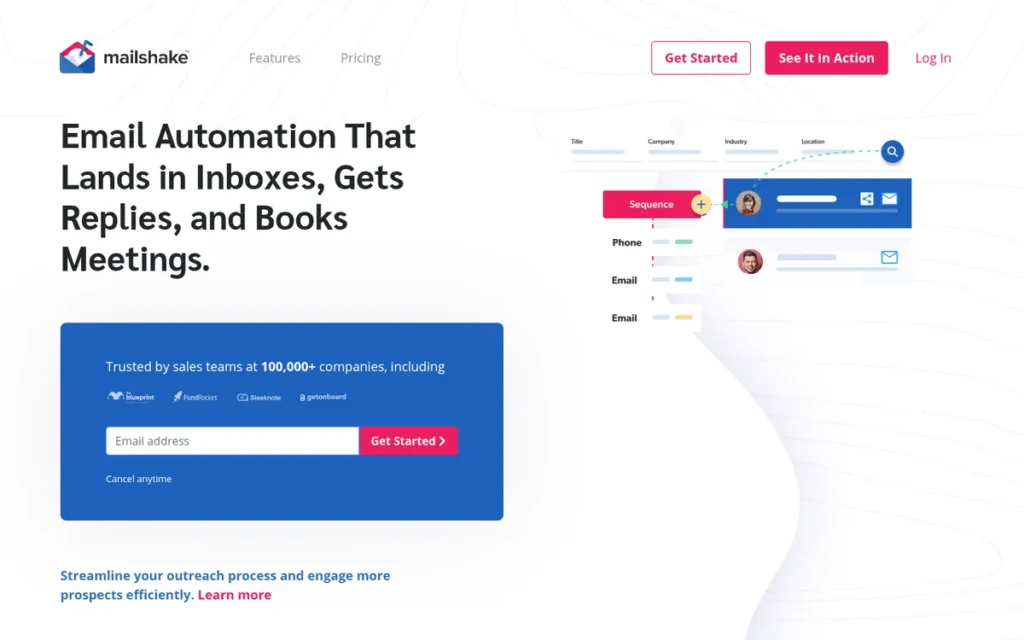
Category: General Cold-Email Sequencer. These are email automation tools where you supply your own prospect list; they are not built specifically for link building.
At a Glance
- Category: General Cold-Email Sequencer
- Best For: Solo outreachers and beginners who already have a qualified blogger list and mainly need affordable follow-up automation
- Price Range: $29–$99 per user/month billed monthly; about $25–$85 per user/month billed annually
- Primary Strength: Mailshake offers simple multistep sequences, warm-up and list cleaning from $29 per user per month.
- Biggest Limitation: Mailshake has no prospect discovery, SEO metrics or link tracking, and its per-user pricing becomes expensive for agencies.
- One-Line Summary: Mailshake has the lowest per-user entry price of the sequencers in this comparison in 2026 and is best for solo users who already have a prospect list and don’t need link-building features.
- Last Verified: November 2026
Overview Mailshake is a cold-email sequencer for solo outreachers and small teams who already have a qualified list of bloggers. It provides affordable multistep follow-ups, reply management, warm-up and list cleaning, all sent from your own Gmail, Outlook or SMTP inbox.
Mailshake is a general sales tool rather than a blogger CRM, so you have to do your prospecting somewhere else.
Key Features
- Mailshake sends multistep sequences through your own Gmail, Outlook or SMTP inbox, using mail merge from CSV files.
- Mailshake’s Lead Catcher collects replies in one queue so follow-ups aren’t forgotten.
- Mailshake includes email warm-up, list cleaning and a Data Finder for looking up contacts.
- Mailshake offers the SHAKEspeare AI writer and A/B testing of outreach copy.
- Mailshake adds a phone dialer and social tasks on its Sales Engagement plan.
Best For Mailshake is best for solo SEOs and beginners who find blogger prospects elsewhere, for example with Hunter, and need reliable, affordable follow-up automation.
Pricing Mailshake pricing as of November 2026 (G2 pricing page and third-party listings, 2026):
- Mailshake Starter costs $29 per user/month, or about $25 billed annually, with 1 sending account and about 1,500 sends per month.
- Mailshake Email Outreach costs $49–$59 per user/month (sources disagree), or about $45 billed annually, with up to 5,000 recipients per campaign.
- Mailshake Sales Engagement costs $99 per user/month, or about $85 billed annually, with up to 10,000 recipients per campaign and a dialer.
Follow-ups count toward Mailshake’s send cap. Ten users on Mailshake Starter cost about $290/month on monthly billing.
Strengths
- Mailshake holds 4.7/5 on G2 across 362 reviews and 4.6/5 on Capterra across about 157 reviews, with sub-scores of 4.7 for ease of use and 4.6 for value (G2 and Capterra via third-party snapshots, 2026).
- Mailshake documents daily sending limits per inbox: about 500 for free Gmail, 2,000 for Google Workspace and 1,000 for Microsoft or SMTP (AI Ignitions, accessed Nov 2026). These limits help users stay within Gmail and Yahoo’s bulk-sender rules (Google and Yahoo, 2024).
- Mailshake includes warm-up and list cleaning. A vendor case study says Los Altos Advisors used validation to remove addresses at high risk of bouncing (Mailshake, accessed Nov 2026; vendor-published).
- In a Mailshake case study, Relentless says personalized mail merge generated “over six figures” (Mailshake, accessed Nov 2026; vendor-published).
- Mailshake’s $29-per-user Starter plan is the lowest per-user entry price among the sequencers in this comparison.
Limitations Mailshake’s biggest trade-off is scope. It covers only the sending part of blogger outreach and has no prospect discovery, SEO metrics, blogger database, relationship history or live-link tracking.
- Mailshake’s per-user pricing grows with team size, and campaigns are reportedly capped at about 5,000 prospects (AI Ignitions, accessed Nov 2026).
- Mailshake support is available only Monday to Friday during US Eastern business hours (Capterra, 2026).
- G2’s AI summary of Mailshake flags bugs and difficulty handling large data volumes, and we found no link-building-specific Mailshake discussion on Reddit (G2, 2026).
Verdict Mailshake is the best low-cost choice in 2026 for blogger outreach when you already have a qualified prospect list and mainly need reliable follow-up automation.
Mailshake scores 25/50 (C1 1, C2 4, C3 2, C4 4, C5 4, C6 2). It scores well on deliverability and user sentiment but has no documented link-building features. Paired with Hunter, Mailshake forms the cheapest solo stack here. Skip Mailshake if your team has three or more senders, because lemlist’s per-team Email plan costs less at that size.
6. lemlist: Best for Multichannel Personalization and Built-In Warm-Up
Category: General Cold-Email Sequencer.
At a Glance
- Category: General Cold-Email Sequencer
- Best For: Outreachers who pitch bloggers across email and LinkedIn and want advanced personalization and built-in warm-up
- Price Range: Email plan from $55–$69/month per team (unlimited users); Multichannel $87–$109 per user/month
- Primary Strength: lemlist combines multichannel sequencing, image and video personalization and lemwarm warm-up, and its Email plan includes unlimited users.
- Biggest Limitation: lemlist has no SEO or link-building features, charges per user on Multichannel, and faces Trustpilot complaints about charges after cancellation.
- One-Line Summary: lemlist is a multichannel cold-outreach sequencer with strong personalization and deliverability tools in 2026, but it lacks the link-building features of dedicated blogger outreach platforms.
- Last Verified: November 2026
Overview lemlist is a multichannel cold-outreach sequencer for marketers who want to pitch contacts across email, LinkedIn, calls, SMS and WhatsApp. It uses dynamic image personalization, conditional text, AI-assisted copy and its built-in lemwarm warm-up tool to protect deliverability.
lemlist is built for sales outreach and did not appear in the AI answer-engine responses we reviewed for blogger outreach.
Key Features
- lemlist runs outreach sequences across five channels: email, LinkedIn, calls, SMS and WhatsApp.
- lemlist supports dynamic image and video personalization, plus Liquid syntax for conditional text.
- lemlist includes lemwarm, a warm-up tool for building sender reputation.
- lemlist provides a people database with enrichment, plus an email finder and verifier at about $0.05 per verified email.
- lemlist offers AI-assisted copywriting for outreach messages.
Best For lemlist is best for outreachers who pitch bloggers through LinkedIn as well as email and who care more about personalization and deliverability than SEO-specific features.
Pricing lemlist pricing as of November 2026 (lemlist pricing page and help center, accessed Nov 2026):
- lemlist’s Email plan costs $69/month, or $55/month billed annually, per team for 50,000 emails per month, with unlimited users and senders.
- lemlist’s higher Email tiers scale with volume, from $89/month ($71 annually) for 100,000 emails to $659/month ($527 annually) for 1,000,000 emails.
- lemlist’s Multichannel plan costs $109 per user/month, or $87 per user/month billed annually.
lemlist gives 20% off for annual billing and 10% off for quarterly billing. Ten users on lemlist Multichannel cost about $870–$1,090/month.
Strengths
- lemlist holds 4.6/5 on G2 across more than 1,300 reviews (count reported by lemlist, 2026), the largest G2 review count in this comparison.
- lemlist’s Email plan includes unlimited users for $55–$69/month per team, so email-only teams don’t pay more as they hire (lemlist pricing page, accessed Nov 2026).
- G2 reviewers rate lemlist’s deliverability management highly, and it is backed by the built-in lemwarm tool (G2, 2026).
- lemlist publishes a clear cost for verified emails: 5 credits at $0.01 each, or about $0.05 per address (lemlist, accessed Nov 2026).
- lemlist’s dynamic image, video and conditional-text personalization goes further than the mail-merge personalization most tools here offer.
Limitations lemlist’s biggest trade-off is fit. It was built for sales, not link building, so it has no SEO metrics, no blogger database and no tracking of whether links went live.
- lemlist’s Multichannel plan is priced per user ($87–$109), so LinkedIn and SMS outreach costs grow with headcount. Reviewers also complain about the cost of enrichment credits (Capterra, 2026).
- Trustpilot reviewers of lemlist report charges after cancellation, automatic renewals and add-ons that must be cancelled separately. One alleges a misleading annual charge of more than $600 (Trustpilot, 2026).
- One independent reviewer says lemlist’s lemwarm “is not a complete dedicated deliverability platform”, and we found no Reddit discussion or verified case studies for lemlist (TrulyInbox, accessed Nov 2026).
Verdict lemlist is a strong multichannel sequencer in 2026 for outreachers who put personalization and deliverability first, but it is the least link-building-specific tool in this ranking.
lemlist scores 24/50 (C1 1, C2 4, C3 3, C4 3, C5 3, C6 1). Its per-team Email pricing raised its scalability score, but it still ranks #6. Review lemlist’s billing and cancellation terms before buying an annual plan. Skip lemlist if SEO-metric prospecting matters more to you than multichannel reach.
What Does Blogger Outreach Software Really Cost?
Blogger outreach software costs from $0 to more than $1,000 per month. Your real bill depends on per-user pricing, credit metering, caps that force upgrades, and contract terms. Plans with unlimited seats get cheaper per person as a team grows, while per-user plans get more expensive with every hire.
- Plans with unlimited seats include Hunter, Respona, Pitchbox Advanced and lemlist’s per-team Email plan.
- Per-user plans include all Mailshake tiers and lemlist Multichannel.
The table below models monthly list prices for 1, 3 and 10 users, excluding taxes and add-on inboxes. Where a range is shown, the lower figure is the annual-billing price.
| Tool | 1 User | 3 Users | 10 Users | Cost Driver to Watch |
|---|---|---|---|---|
| Pitchbox | $210–$300 (Pro) | $420–$600 (Advanced; Pro caps at 2 users) | $420–$600 (Advanced) | One-year commitment; 2,000–5,000 email caps |
| BuzzStream | $49 (500 contacts) or $174 | $174 (Growth) | ~$580 (Growth + 7 × $58) | Starter contact cap; extra-seat fees |
| Respona | $198 | $198 | $198 (2 inboxes) | Credits for discovery and contacts |
| Hunter | $34–$49 | $34–$49 | $34–$49 (3 sending accounts) or $104–$149 (10 accounts) | Sending-account caps; credits used on empty lookups |
| Mailshake | $25–$29 | $75–$87 | $250–$290 | Follow-ups count toward the send cap |
| lemlist | $55–$69 | $55–$69 (Email) or $261–$327 (Multichannel) | $55–$69 (Email) or $870–$1,090 (Multichannel) | Per-user Multichannel; enrichment credits |
Four cost traps stand out:
- BuzzStream’s 500-contact Starter cap means most BuzzStream teams effectively start at $174/month.
- Credit-metered tools such as Hunter, Respona and lemlist charge for lookups, so empty or failed searches raise the cost of each usable contact.
- Hunter’s sending-account caps mean a 10-person Hunter team pays no seat fees, but only 3 members can connect inboxes on Starter.
- Pitchbox’s one-year commitment applies even on monthly billing, which raises the minimum spend for teams testing Pitchbox.
The cheapest blogger outreach tool for one person is rarely the cheapest for five. Per-seat pricing and caps that force upgrades decide the real bill.
Should You Buy an All-in-One Tool or Combine an Email Finder and Sequencer?
For one person, a modular stack of Hunter plus Mailshake is the cheapest way to find, verify and sequence blogger outreach, at about $63–$78 per month. The stack has no SEO metrics, opportunity discovery, link tracking or shared relationship history. Purpose-built tools such as Pitchbox, BuzzStream and Respona include these.
The figures below use Mailshake’s $29 monthly per-user price with Hunter Starter or Growth:
- A Hunter-plus-Mailshake stack for 1 user costs about $63–$78/month at list prices.
- A Hunter-plus-Mailshake stack for 3 users costs about $121–$136/month.
- A Hunter-plus-Mailshake stack for 6 users costs about $208–$223/month, which is more than Respona Starter at $198 with unlimited members.
- A Hunter-plus-Mailshake stack for 10 users costs about $324–$439/month, depending on whether Hunter Growth is needed for more connected accounts.
The Hunter-plus-Mailshake stack stays cheaper than BuzzStream Growth at every team size.
For email-only teams of three or more, Hunter plus lemlist’s per-team Email plan costs about $89–$118/month, however many people are on the team.
Choose a modular stack if you work alone, already know which sites to pitch and mainly need verified emails and follow-ups. Choose an all-in-one tool once teammates need to see each other’s conversations, or once finding prospects takes more time than sending.
What Reply Rates Should You Expect From Blogger Outreach?
Published benchmarks put blogger and cold outreach reply rates at roughly 6% to 12%: 5.8% in Belkins’ 2024 study, 8.5% in the 2019 Backlinko/Pitchbox study and a 12% median in BuzzStream’s vendor data. As of November 2026 we found no vendor or study that publishes placement rates, so these figures measure replies, not links.
- The Backlinko/Pitchbox study found an 8.5% average reply rate across 12 million outreach emails, with one follow-up producing 65.8% more replies (Backlinko/Pitchbox, 2019). Pitchbox, which co-published the study, is ranked in this guide.
- The Belkins study found a 5.8% reply rate across 16.5 million B2B cold emails, and 8.4% on the first email alone. Sequences of four or more emails increased unsubscribes and spam complaints (Belkins, 2024).
- BuzzStream’s data study reports a 12% median reply rate across its customer accounts, with the top 5% reaching 40% or more (BuzzStream data study, accessed Nov 2026; vendor data).
Deliverability rules cap how much you can send. Google and Yahoo require bulk senders to use SPF, DKIM and DMARC authentication, offer one-click unsubscribe and keep spam complaints below 0.3% (Google and Yahoo, 2024).
This aligns with community sentiment on r/SaaS:
“Agree with your point that cold email has shifted from a distribution game to a credibility game. Filters are basically asking: “Would a real person actually send this?”” Posted by u/Confident-Beat1223
Takeaway: Cold outreach deliverability now depends on looking credible and human to spam filters, so outreach tools that push sending volume give diminishing returns.
What Red Flags Should I Watch For When Evaluating Blogger Outreach Software?
The biggest red flags are unverified guessed emails, hidden credit costs, entry tiers with upgrade-forcing caps, missing warm-up controls, fully automated pitches, unverifiable vendor badges, and influencer platforms marketed as blogger outreach tools. Each one can waste budget, damage sender reputation or lower reply rates before you notice the problem.
Red Flag #1: Unverified Pattern-Guessed Emails Email addresses guessed from domain patterns can bounce, and bounces damage your sending domain’s reputation. Hunter itself states that even high-confidence addresses can bounce on accept-all domains (Hunter Help Center, accessed Nov 2026). Verify every address before sending, especially for small blogs.
Users on r/SaaS noted:
“You are absolutely right about the verified tag in Apollo. It is often just a pattern match or cached data rather than a real-time ping, and relying on that is exactly how you burn a domain.” Posted by u/Sea_Surround471
Takeaway: A “verified” label from an email-data tool can still be a pattern guess, so outreach teams need a separate real-time check before sending to protect their domain.
Red Flag #2: Credit Meters That Hide the Real Cost per Contact Credit-metered tools charge for lookups whether or not they return a usable contact. One estimate puts Hunter at about 1 credit per email found (GTM Bud, accessed Nov 2026), and Respona uses about 5 credits per verified contact (AppSumo, accessed Nov 2026). Ask how lookups that return nothing are billed.
Red Flag #3: Entry Tiers With Upgrade-Forcing Caps A low headline price can hide limits that make an upgrade unavoidable. BuzzStream’s $49 Starter plan caps contacts at 500 (BuzzStream plans page, 2026). Plan around next year’s team size, not today’s.
Red Flag #4: No Warm-Up or Sending Limits Without warm-up, send ramping or documented per-inbox limits, it is harder to meet the Gmail and Yahoo bulk-sender rules, which cap spam complaints at 0.3% (Google and Yahoo, 2024). Independent reviewers note that Respona lacks full built-in warm-up (Influno, accessed Nov 2026), and BuzzStream documents none.
Red Flag #5: Fully Automated, Generic Pitches Bloggers report receiving large volumes of automated pitches. One r/SEO commenter (u/WebLinkr) wrote, “I’m quite sure the 900 I get a day are automated.” Another asked why they would link to someone who “couldn’t even be bothered to make a human-written pitch” (Reddit, 37 upvotes, accessed Nov 2026).
Using a blogger’s first name is superficial personalization, which BuzzStream’s data links to 1.3% fewer replies. Referring to a specific post they wrote is relevant personalization, which it links to 10.7% more replies (BuzzStream data study, accessed Nov 2026; vendor data).
Red Flag #6: Unverifiable Vendor Badges and Claims Vendor marketing claims are not independent evidence. One reviewer could not find Respona’s “G2 High Momentum Leader” badge on G2 (Growpad, accessed Nov 2026). Pitchbox’s claim that “82% of link vendors use Pitchbox” has not been independently verified (Pitchbox, accessed Nov 2026). Check every badge at its source.
Red Flag #7: Influencer Platforms Marketed as Blogger Outreach Tools Influencer-marketing platforms are built for paid creator campaigns, not editorial pitches or link building. Some AI answer engines still include them in blogger-outreach shortlists. Before buying, check for opportunity discovery, SEO metrics and live-link monitoring. A tool without any of these is unlikely to replace your spreadsheet.
What Questions Should I Ask Before Choosing Blogger Outreach Software?
Before choosing blogger outreach software, ask vendors six things: what the usage limits are, how credits are used, how emails are verified and warmed up, whether clients can be kept separate, what the billing terms are, and whether you are buying software or a service. The answers show real cost and fit better than review ratings, which sit between 4.2 and 4.8 for all six tools.
Question #1: How many users, contacts and sends does my real workload need? Compare your current team size and monthly pitch volume with each tier’s user, contact and send limits. Then price one extra hire or client using published extra-seat fees, such as BuzzStream’s $58–$70 per user (BuzzStream plans page, 2026). Also check sending-account caps, such as the three on Hunter Starter.
Question #2: How are credits consumed, and what happens on empty lookups? Ask what each opportunity search, email found and verification costs in credits. Then ask whether failed lookups still use credits, because that sets your real cost per usable contact. Respona, for example, uses about 5 credits per verified contact but none for sending (AppSumo, accessed Nov 2026).
Question #3: Does the tool verify emails and support warm-up and SPF/DKIM/DMARC compliance? Look for a built-in verifier, warm-up or send ramping, and documented daily limits per inbox. These controls help you meet the Gmail and Yahoo bulk-sender rules, which require SPF, DKIM and DMARC authentication and cap spam complaints at 0.3% (Google and Yahoo, 2024).
Question #4: Can I separate clients and white-label reports? Agencies running several clients need separate workspaces and white-label reports so contacts and results don’t mix. Pitchbox Advanced includes 25 workspaces and white-label reporting (Pitchbox pricing page, 2026). BuzzStream organizes work by project, while Mailshake and lemlist don’t document client separation.
Question #5: What are the billing, renewal and cancellation terms? Ask how auto-renewal works, whether add-ons must be cancelled separately, and whether an annual commitment applies. Pitchbox requires a one-year commitment even on monthly billing (Pitchbox pricing page, 2026). Trustpilot reviewers of lemlist report charges after cancellation (Trustpilot, 2026).
Question #6: Is this software, a managed placement service, or both? Some vendors sell both, and the two are priced and judged differently. Respona offers DIY software from $198/month and a managed service at $100–$500 per live link (Respona pricing page, 2026). Paid-link services also carry search-engine policy risk, which you should weigh before buying.
Users on r/linkbuilding shared their experience:
“Honestly, the only things I’ve seen consistently work are custom, manual outreach tied to real content or real relationships. most “services” end up being some version of recycled placements once you scratch the surface.” Posted by u/Electronic-Cat185
Takeaway: Experienced link builders distrust done-for-you placement services because many resell recycled inventory, so buyers should vet any managed link service as hard as they vet outreach software.
How Did We Rank These Blogger Outreach Tools?
PlugRoute scored each tool from 1 to 5 on six criteria, for a maximum weighted score of 50. Link-building workflow fit counts three times. Contact data and deliverability, and team scalability, each count twice. Pricing transparency, independent user sentiment and documented outcome evidence each count once.
PlugRoute has no affiliate relationships with any company listed, and rankings are determined entirely by research data and objective evaluation criteria.
Ranking criteria and why each matters:
- C1, Link-Building Workflow Fit (x3) measures whether a tool can replace a scattered stack. It is scored on five documented features: discovery, SEO metrics, relationship history, link monitoring and campaign templates.
- C2, Contact Data and Deliverability (x2) measures verified emails, warm-up and sending controls, all of which protect sender reputation.
- C3, Team Scalability and Total Cost of Ownership (x2) measures seats, workspaces, credit metering and caps that force upgrades as teams grow.
- C4, Pricing Transparency and Entry Access (x1) measures published tier limits, free plans and billing complaints.
- C5, Independent User Sentiment (x1) measures G2, Capterra, Trustpilot and AppSumo ratings, plus Reddit comments after vendor accounts are screened out.
- C6, Documented Outcome Evidence (x1) measures named, quantified case studies and data studies, each labelled as vendor-published where that applies.
Scoring matrix:
| Rank | Tool | C1 (x3) | C2 (x2) | C3 (x2) | C4 | C5 | C6 | Total /50 |
|---|---|---|---|---|---|---|---|---|
| 1 | Pitchbox | 5 | 4 | 4 | 2 | 4 | 5 | 42 |
| 2 | BuzzStream | 4 | 3 | 4 | 4 | 3 | 4 | 37 |
| 3 | Respona | 4 | 2 | 4 | 3 | 4 | 1 | 32 |
| 4 | Hunter | 1 | 4 | 4 | 5 | 4 | 2 | 30 |
| 5 | Mailshake | 1 | 4 | 2 | 4 | 4 | 2 | 25 |
| 6 | lemlist | 1 | 4 | 3 | 3 | 3 | 1 | 24 |
C1 feature checklist (documented in our research):
| Tool | Discovery | SEO Metrics | Relationship History | Link Monitoring | Campaign Templates | C1 |
|---|---|---|---|---|---|---|
| Pitchbox | Yes | Yes | Yes | Yes | Yes | 5 |
| BuzzStream | Yes | Yes (Ahrefs) | Yes | Yes | Not documented | 4 |
| Respona | Yes | Yes (third-party walkthroughs) | Yes (unified inbox) | Not documented | Yes | 4 |
| Hunter | No | No | No | No | No | 1 |
| Mailshake | No | No | No | No | No | 1 |
| lemlist | No | No | No | No | No | 1 |
Our November 2026 re-check traced every C1 score to this checklist and confirmed that lemlist’s Email plan is priced per team. Five scores changed: C1 dropped for Hunter, Mailshake and lemlist (2 to 1), while lemlist’s C3 and C4 each rose from 2 to 3.
As a result, Respona moved from #4 to #3 and Hunter from #3 to #4. PlugRoute will re-score any tool whose pricing model, tier limits or documented features change.
Pitchbox ranks #1 even though current AI answer engines often name BuzzStream “best overall”. Among the six tools evaluated, Pitchbox is the only one with all five link-specific capabilities documented in our research.
Review ratings for all six tools fall between 4.2 and 4.8, so star ratings can’t separate them. Workflow fit, contact accuracy and true cost per seat can.
How we handled evidence:
- Every claim is labelled by type: official pricing page, vendor case study, independent review platform or community comment.
- Reddit comments from disclosed or suspected vendor accounts were flagged, including Hunter bounce warnings posted by accounts promoting competing tools, and were not counted as independent sentiment.
- Official pricing pages took priority over conflicting third-party prices, and all prices will be re-checked every quarter.
Frequently Asked Questions
What is the best blogger outreach software for small agencies in 2026?
BuzzStream Growth is the best fit for small agencies of 3–6 people. It includes 3 users, 25,000 contacts and shared relationship history for $174 per month. Agencies with many clients should look at Pitchbox Advanced, which adds unlimited users and 25 workspaces for $420 per month billed annually on a one-year commitment. Respona Starter includes unlimited members for $198.
What is the cheapest blogger outreach software for beginners?
Hunter’s free plan of 50 credits per month is the cheapest way for beginners to start, and beginners who already have a prospect list can pair it with Mailshake’s $29 Starter tier. The cheapest purpose-built option is BuzzStream Starter at $49 per month, though it caps contacts at 500 (BuzzStream plans page, 2026).
How does PlugRoute determine rankings?
PlugRoute ranks tools with a published, weighted scoring model of six criteria and a maximum score of 50. Link-building workflow fit counts three times, while contact data and team scalability count twice. Every price is checked on official pages, every claim is labelled by evidence type and date, and the full scoring matrix is published.
What Do Key Blogger Outreach Software Terms Mean?
Link-Building Platform: Purpose-built software that covers finding link prospects, finding contacts, running outreach sequences and reporting in one workflow. It costs more to start than an email finder or sequencer, but it handles the link-specific work that those tools leave to you.
Outreach CRM: Software that stores each contact’s relationship history, notes and conversations for long-term work with publishers. It matters most when several teammates pitch the same bloggers and need to see earlier conversations so nobody pitches the same person twice.
Email Data Layer: A tool that finds and verifies contact email addresses, often paired with a separate sequencer or CRM. It solves the contact-finding problem only. It has no SEO metrics, placement tracking or relationship history.
General Cold-Email Sequencer: Email automation software that sends multistep outreach to prospect lists you supply yourself. It isn’t built for link building, so you have to do prospecting and link tracking somewhere else.
Credits: The usage unit that credit-metered tools charge for searches, email lookups and verifications. Failed or empty lookups can still raise your real cost per usable contact, so ask how credits are used before you buy.
Per-User vs. Unlimited-Seat Pricing: Per-user plans charge for each team member, so they cost more with every hire. Unlimited-seat or per-team plans get cheaper per person as the team grows. Which model a plan uses often decides the real bill more than the headline price does.
Upgrade-Forcing Cap: A limit on an entry tier, such as a cap on contacts, users or sending accounts, that makes a working team move to a pricier plan. Plan around next year’s team size, not today’s, so a low starting price doesn’t mislead you.
Confidence Score: A rating that shows how likely a found email address is to be deliverable. Even high-confidence addresses can bounce, especially on small blogs that use Gmail addresses, contact forms or accept-all servers, so verify before sending.
Warm-Up: A feature that slowly raises sending volume from a new or quiet inbox to build sender reputation. Without warm-up or send ramping, it is harder to protect deliverability and stay within mailbox providers’ bulk-sender rules.
SPF, DKIM and DMARC: Email authentication standards that Google and Yahoo require from bulk senders. They come with rules such as one-click unsubscribe and a spam complaint rate below 0.3%. Tools that support these controls help keep your outreach out of spam folders.
Link Monitoring: Tracking whether earned links have gone live and stay in place. General sequencers don’t offer it, so buyers who need to prove placements should confirm a tool documents this feature.
Managed Placement Service: A done-for-you service where the vendor gets links for you and charges per live link, rather than selling you software to do your own outreach. It is priced and judged differently from software and carries search-engine policy risk around paid links, so vet it carefully.
Which Blogger Outreach Tool Is Right for You?
Key Insights
- Pitchbox is the highest-scoring blogger outreach software in 2026 for agencies and high-volume SEO teams. BuzzStream is best for relationship-focused small teams, and Respona suits content-led teams that want built-in opportunity search, so the right choice depends on your main bottleneck and real cost.
- Hunter is the only dedicated email finder and verifier in this comparison, and Hunter needs a sequencer or CRM to become a full outreach workflow.
- Per-user plans such as Mailshake and lemlist Multichannel cost more with every hire. Unlimited-seat plans from Pitchbox Advanced, Hunter, Respona and lemlist Email get cheaper per person as teams grow.
- As of November 2026 we found no blogger outreach vendor that publishes placement-rate data, so every benchmark in this guide measures replies rather than live links.
How to Trial a Tool in 14 Days
- Run 50 target domains through a free plan’s email finder, such as Hunter Free.
- Record what share of those addresses the tool verifies as deliverable.
- Send one two-step sequence to the verified contacts.
- Compare your reply rate with the published benchmarks of 5.8% to 8.5%.
This aligns with community sentiment on r/linkbuilding:
“the trustworthy part is workflow automation, not “automatic links.” anything promising the second is selling submissions or placements. i’d test it on 30 prospects beside your manual process. compare qualified-prospect rate, bounce rate and positive replies, not email volume or DR. keep human approval on every send until it beats the baseline.” Posted by u/feliche93
Takeaway: Judge blogger outreach software by a small side-by-side test of qualified prospects, bounces and positive replies, not by sending volume or promises of automatic links.
If your main problem is coordinating a small team, start with BuzzStream Growth. If you run campaigns for many clients, Pitchbox Advanced’s workspaces and white-label reports justify its higher price. If you mostly need verified emails and follow-ups, Hunter plus Mailshake is the cheapest place to start.
Until a placement-rate claim is independently audited, treat it as marketing.
We update this guide quarterly. Last updated: November 2026.
Read PlugRoute’s full scoring methodology and our other independent SEO software reviews before you commit to a plan.