dbt Semantic Layer leads for analytics engineering teams already operating dbt workflows who need Git-native metric governance; Cube leads for open-source embedded analytics and multi-tenant SaaS applications; AtScale leads for enterprise Power BI and Excel governance via MDX and DAX protocols. No single tool is best for all stacks, the right choice depends on your warehouse, BI tools, multi-tenancy needs, and tolerance for vendor lock-in.
Data teams in 2026 face three compounding pressures: conflicting dashboard numbers from duplicated metric logic across BI tools, genuine confusion over which semantic layers are truly AI-ready versus marketing-washed, and a platform-native disruption where Snowflake and Databricks now offer zero-incremental-cost semantic layers that complicate the standalone tool evaluation more than at any point in the past three years. The 2026 semantic layer decision is not which tool has the most features, it is which architecture fits your current stack, because the most feature-rich tool on the wrong architecture is worse than no semantic layer at all.
As one practitioner on r/dataengineering captured the AI-readiness challenge directly:
“In both instances, the solutions miss the actual problem. You need very clean, very well tagged, very well modelled data. The example I always give is that if you go to the table marked ‘sales’ and count the number of sales…. That is not even remotely correct. Years of schema evolution, changes to products, and poor engineering mean the actual number is much harder to derive. For conversational analytics, the prompts must be very carefully tuned and the AI will straight up invent things if you aren’t careful. I would not trust it in the least. For the CoSQL model, I haven’t tried to use it, but I notice that solution architects are suggesting I use it rather than curating dbt so I can use that to control our transformation logic. In that regard, it’s a complete distraction and a massive net-negative. ‘We don’t have working data products’ is the same problem we have had for years and it’s the same problem that will make AI tools harder to implement even if they are viable, but it’s far too unsexy an issue to attract attention.” Posted by u/GrandOldFarty
Takeaway: Enterprise data practitioners consistently find that AI analytics tools fail not because the AI is wrong, but because the underlying data is ungoverned, validating that a semantic layer is a prerequisite to AI readiness, not an optional enhancement.
PlugRoute has no affiliate relationships with any company listed in this article. Rankings are determined entirely by research data, verified third-party reviews, and objective evaluation criteria. No company paid for inclusion, ranking position, or editorial treatment.
“dbt and Cube are the go-to in my little world. Make sure they have a good integration with your BI tool.” Posted by u/erusackas, r/BusinessIntelligence
Takeaway: Community practitioners consistently name BI tool integration fit (not feature breadth) as the decisive semantic layer selection criterion, which is why this evaluation leads with stack compatibility and BI protocol coverage before any feature comparison.
TL;DR: Top Picks at a Glance
- dbt Semantic Layer: Best for analytics teams already running dbt workflows who need Git-native, warehouse-agnostic metric governance backed by the strongest peer review evidence in the category
- Cube: Best open-source platform for SaaS embedded analytics with native multi-tenant isolation, the only tool in this evaluation with this capability
- AtScale: Best enterprise governance across Power BI, Tableau, and Excel via native MDX and DAX protocols; requires explicit Power BI POC before production commitment
- Snowflake Semantic Views / Databricks Metric Views: Zero incremental cost for teams fully and permanently committed to those single platforms
- All pricing, feature availability, and company data verified May 2026: including Snowflake Autopilot (GA in early 2026), Databricks Metric Views (Public Preview since May 2025), and dbt Semantic Layer pricing tiers.
What Are the Categories of Semantic Layer Tools?
Semantic layer tools split into five architecture categories that determine deployment model, portability, and primary use case: Metrics-as-Code (dbt Semantic Layer), Headless API-First (Cube), Universal Enterprise Middleware (AtScale), Platform-Native (Snowflake Semantic Views and Databricks Metric Views), and Ontology-Based (Timbr.ai and Galaxy). Choosing the wrong architecture category for your stack costs more than choosing the wrong tool within the correct category.
These architectures are variously labeled semantic layers, metrics stores, metrics layers, headless BI platforms, and logical data warehouse abstractions in analyst and vendor literature. This evaluation uses semantic layer as the umbrella term covering all five categories.
Metrics-as-Code (dbt Semantic Layer): Metric definitions live as YAML inside an existing dbt transformation project, version-controlled alongside SQL models with full Git lineage, adding a governed semantic layer without introducing a new toolchain for teams already operating dbt.
Headless API-First (Cube): A warehouse-agnostic, open-source layer exposing governed metrics simultaneously via REST, GraphQL, SQL, MDX, and DAX, no native visualization layer, designed to serve any consuming tool, BI platform, application, or AI agent from a single semantic model.
Universal Enterprise Middleware (AtScale): A long-established commercial platform federating governance across Power BI, Tableau, and Excel via native MDX and DAX protocols, with in-warehouse aggregate awareness and an open-source Semantic Modeling Language (SML).
Platform-Native (Snowflake Semantic Views, Databricks Metric Views): First-class schema or catalog objects inside the warehouse or lakehouse, zero incremental licensing cost for existing customers, but with complete platform dependency and no cross-warehouse portability.
Ontology-Based (Timbr.ai, Galaxy): Knowledge-graph or context-graph architectures modeling entities and inferring relationships beyond what dimensional metric definitions can express, targeting AI agent contexts and complex multi-entity enterprise domains requiring semantic reasoning.
How Do the Top Semantic Layer Tools Compare at a Glance?
The seven best semantic layer tools in 2026 span five architecture categories: dbt Semantic Layer earns the highest peer validation with a 4.7/5 G2 rating and three quantified client case studies; Cube is the only tool with native multi-tenancy and GigaOm Leader and Fast Mover recognition in both 2023 and 2024; AtScale is the only tool with native MDX and DAX for Power BI and Excel governance; Snowflake Semantic Views and Databricks Metric Views offer zero incremental licensing cost at the price of complete platform lock-in; Timbr.ai and Galaxy represent specialized early-stage ontology approaches.
| Rank | Company | Category | Best For | One-Line Summary | Key Capabilities | Primary Strength | Key Limitation |
|---|---|---|---|---|---|---|---|
| 1 | dbt Semantic Layer | Metrics-as-Code | Analytics teams on dbt stacks with Tableau or Looker | dbt Semantic Layer is the highest G2-rated dedicated semantic layer tool in this evaluation (4.7/5, May 2026) and the only tool with three independently cited, quantified client case studies; making it the lowest-risk starting point for analytics engineering teams already operating dbt workflows who need a Git-native, warehouse-agnostic single source of metric truth. | YAML metric definitions, GraphQL/JDBC APIs, MetricFlow engine, MCP/REST AI integration | Highest G2 rating among dedicated semantic layer tools in this evaluation (4.7/5, May 2026); three named client case studies with quantified outcomes (Notion, Snyk, Hims & Hers) | Semantic Layer API requires paid dbt Cloud subscription; Power BI integration immature as of May 2026 |
| 2 | Cube | Headless API-First | SaaS embedded analytics, multi-tenant applications | Cube is a GigaOm-recognized open-source headless semantic layer; rated Leader and Fast Mover in both 2023 and 2024; offering the broadest multi-protocol API support (REST, GraphQL, SQL, MDX, DAX), native multi-tenancy, a free self-hosted production tier, and MCP-based AI agent integration, making it the most accessible, portable, and architecturally flexible dedicated semantic layer tool in 2026. | REST/GraphQL/SQL/MDX/DAX APIs, L1/L2 pre-aggregation, native multi-tenancy, Cube Copilot AI | Only tool with native per-tenant isolation; completely free self-hosted tier; GigaOm Leader and Fast Mover 2023 and 2024 | No G2/Capterra structured reviews; governance outcomes depend on team modeling discipline |
| 3 | AtScale | Universal Enterprise | Power BI + Excel + Tableau enterprises | AtScale is the longest-tenured universal semantic layer platform (founded 2013), recognized as a GigaOm Leader and Fast Mover (September 25, 2025), offering the only native MDX and DAX governance for Power BI and Excel environments alongside an open-source Semantic Modeling Language; with a documented Power BI authoring ribbon conflict requiring explicit POC validation before production commitment. | MDX/DAX/SQL protocols, in-warehouse aggregate awareness, open-source SML, Databricks UC integration | Only native MDX/DAX support for Power BI and Excel live connections; GigaOm Leader and Fast Mover (September 25, 2025) | Enterprise-only opaque pricing; Power BI MDX live connection grays out entire authoring ribbon |
| 4 | Snowflake Semantic Views | Warehouse-Native | Snowflake-committed teams at zero incremental cost | Snowflake Semantic Views are the zero-incremental-cost semantic layer for Snowflake-committed organizations, reaching GA in June 2025 with AI-powered Autopilot in early 2026 and native Cortex Analyst NLP integration; the strongest native AI analytics option for Snowflake-native stacks, with the trade-off of complete Snowflake platform dependency and zero cross-warehouse portability. | Autopilot AI modeling, Cortex Analyst NLP, OSI partner sync, SQL DDL and YAML creation | Zero licensing cost for 10,000+ existing Snowflake customers; Autopilot auto-generates definitions from real query history | Complete Snowflake lock-in; no portability to any other warehouse; no native pre-aggregation caching engine |
| 5 | Databricks Metric Views | Lakehouse-Native | Databricks lakehouse orgs with unified AI/ML governance | Databricks Metric Views are the native semantic layer for Databricks Lakehouse organizations, entering public preview in May 2025 with Unity Catalog governance, Genie NLP integration, and Agent Bricks agentic analytics; with documented Genie AI maturity concerns from practitioners and no programmatic multi-tenant deployment path as of May 2026. | Unity Catalog governance, Genie NLP, Agent Bricks agentic AI, Delta Live Tables integration | Only tool spanning full lakehouse: streaming, ML, analytics, and agentic AI in one platform; $134B Databricks valuation (December 2025) | No multi-tenant Terraform/API deployment path; Genie described as “glorified SQL generator” by community evaluators |
| 6 | Timbr.ai | Ontology-Based | Complex domains requiring semantic inference | Timbr.ai is an ontology-based SQL Knowledge Graph semantic layer offering inference-driven entity relationship reasoning not available in any YAML metric tool; designed for complex multi-entity enterprise domains; with no public reviews, no disclosed funding, and no community-validated production deployments as of May 2026. | Ontology inference, Semantic SQL auto-JOIN generation, JDBC/ODBC compatibility, Databricks integration | Only tool deriving unmodeled entity relationships through semantic inference; a capability architecturally impossible in YAML metric-definition tools | No public pricing, no reviews, no disclosed company fundamentals; requires deep ontology modeling expertise |
| 7 | Galaxy | AI Context Graph (Early Stage) | Forward-looking agentic AI context research | Galaxy is an early-stage AI context graph semantic infrastructure platform with a compelling ontology-driven thesis for agentic AI data access; but it has no public production deployments, no analyst validation, no disclosed company fundamentals, no community presence, and no accessible pricing as of May 2026, placing it in the “watch this space” category rather than the “production recommendation” category. | Dynamic context graph, AI agent APIs, entity relationship extraction without data migration | Dynamic context graph designed to adapt automatically as underlying data changes; addressing YAML maintenance burden | Pre-commercial; zero independent reviews, analyst coverage, or verifiable company fundamentals |
Quick Decision Framework: Which Tool Fits Your Priority?
| Your #1 Priority | Recommended Tool | Why | Acceptable Alternative |
|---|---|---|---|
| Already on dbt; need Git-native metric governance | dbt Semantic Layer | Metrics live inside existing dbt project; zero new toolchain on dbt Cloud | Cube (if multi-cloud portability or multi-BI coverage matters more) |
| Multi-tenant SaaS customer-facing embedded analytics | Cube | Only tool with native per-tenant isolation; free open-source self-hosted tier | No equivalent alternative in this evaluation |
| Power BI + Excel + Tableau enterprise governance | AtScale | Only native MDX and DAX protocol support; SML open-source portability | Cube (broader API support, more accessible pricing) |
| Snowflake-only stack, zero incremental budget | Snowflake Semantic Views | Zero licensing cost, Autopilot, Cortex Analyst native integration | dbt Semantic Layer (if already on dbt Cloud) |
| Databricks lakehouse with AI/ML pipelines | Databricks Metric Views | Unity Catalog + Genie + Agent Bricks native integration | AtScale (if MDX enterprise governance also required) |
| Open-source freedom and maximum portability | Cube | Free self-hosted Cube Core, warehouse-agnostic, no format lock-in | dbt Semantic Layer with MetricFlow CLI |
| Multi-cloud, warehouse-agnostic deployment | Cube or dbt Semantic Layer | Both warehouse-agnostic; Cube has no warehouse dependency; dbt works across all dbt adapters | AtScale (SML portability reduces lock-in) |
| Complex entity relationship inference | Timbr.ai (evaluate carefully) | Only ontology inference in the category; requires sales-led POC engagement | No production-ready alternative for inference use case |
| Forward-looking agentic AI context graph | Galaxy (early access only) | Pre-commercial; not for production infrastructure decisions in 2026 | Timbr.ai (evaluate carefully) |
1. dbt Semantic Layer (MetricFlow): Best Overall for Analytics Engineering Teams
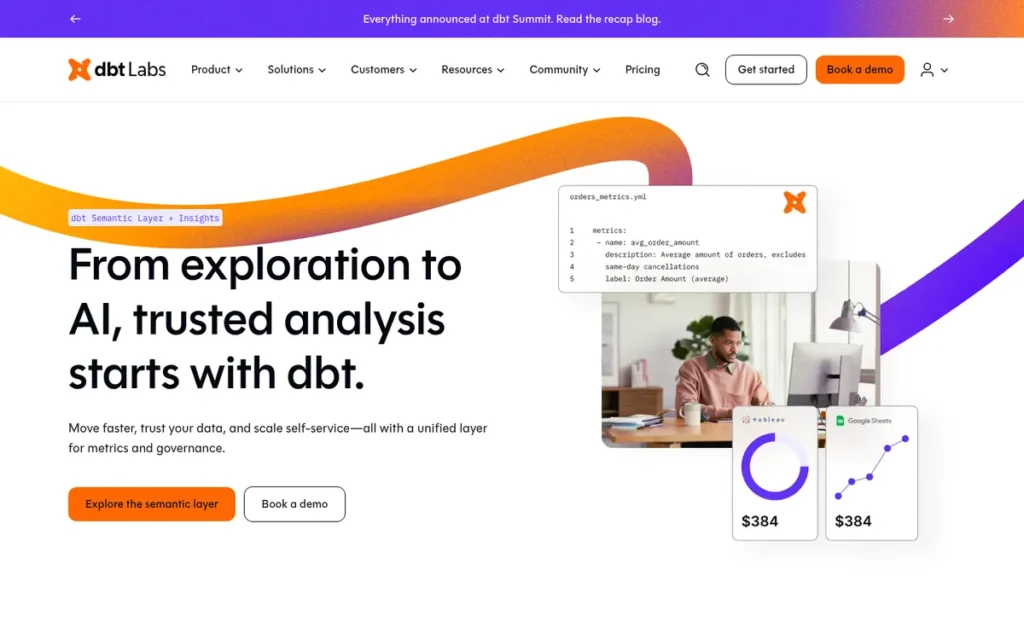
Category: Metrics-as-Code Semantic Layer, defines centralized business metrics in version-controlled YAML within an existing dbt transformation project, generating optimized SQL at query time without pre-aggregated tables.
At a Glance
| Field | Detail |
|---|---|
| Category | Metrics-as-Code Semantic Layer |
| Best For | Analytics engineering teams already operating dbt Core or dbt Cloud on Snowflake, BigQuery, Databricks, or Redshift who need Git-native, warehouse-agnostic metric governance with deep Tableau or Looker integration |
| Price Range | $0 (MetricFlow CLI, open source) / $100/seat/month Team tier (1M Query Units included) / Enterprise: custom; Semantic Layer API requires paid dbt Cloud subscription |
| Primary Strength | dbt Semantic Layer holds a 4.7/5 G2 rating (198+ verified reviews, May 2026); the highest rating of any dedicated semantic layer tool in this evaluation; alongside three independently cited client case studies with quantified outcomes: Notion (80% metric definition time reduction), Snyk (100% cross-BI consistency), and Hims & Hers (90% ad-hoc SQL reduction) |
| Biggest Limitation | dbt Semantic Layer’s Semantic Layer API; which exposes metrics to BI tools via GraphQL and JDBC; requires a paid dbt Cloud subscription; the open-source MetricFlow engine alone does not enable BI connectivity, making the tool’s core production value inaccessible to teams committed to self-hosted dbt Core |
| One-Line Summary | dbt Semantic Layer is the highest G2-rated dedicated semantic layer tool in this evaluation (4.7/5, May 2026) and the only tool with three independently cited, quantified client case studies; making it the lowest-risk starting point for analytics engineering teams already operating dbt workflows who need a Git-native, warehouse-agnostic single source of metric truth. |
| Last Verified | May 2026 |
Overview
dbt Semantic Layer, powered by the open-source MetricFlow engine, is a metrics-as-code platform built for analytics engineering teams already using dbt for SQL transformations, enabling centralized business metric definitions in YAML that propagate consistently to Tableau, Looker, Hex, and other BI tools via GraphQL and JDBC APIs without duplicating logic across dashboards or reports.
dbt Semantic Layer sits within the existing dbt project, meaning metrics are version-controlled alongside transformation models with full data lineage visible through the same Git workflow data teams already use. dbt Semantic Layer adds governed metric access without introducing a new toolchain, making it uniquely accessible for organizations already operating dbt workflows.
dbt Semantic Layer’s MetricFlow engine eliminates fan-out traps and chasm traps through a semantic graph approach (modeling join keys (entities), aggregations (measures), and grouping attributes (dimensions)) that generates optimized JOIN SQL dynamically at query time.
Key Features
- Centralized YAML Metric Definitions: dbt Semantic Layer defines business metrics (including revenue, MAU, and churn rate) in YAML specifications layered on dbt transformation models, automatically generating optimized cross-model JOIN SQL at query time without pre-aggregated tables or duplicated metric logic across BI tools.
- GraphQL and JDBC API Connectivity: dbt Semantic Layer exposes metrics to BI tools via GraphQL and JDBC APIs, enabling Tableau, Looker, Hex, Mode, and Preset to query a single governed metric definition simultaneously rather than each maintaining independent calculated fields or calculated measures.
- MetricFlow Semantic Graph Engine: dbt Semantic Layer’s MetricFlow engine uses an entity-relationship semantic graph (modeling join keys (entities), aggregations (measures), and grouping attributes (dimensions)) to derive metrics dynamically at query time, preventing the incorrect fan-out joins that inflate counts and the chasm traps that undercount measures in multi-BI environments.
- Git-Native CI/CD for Metrics: dbt Semantic Layer integrates natively with dbt Cloud’s CI/CD pipeline so metric definition changes go through the same pull request review, automated testing, and deployment process as SQL transformation changes, bringing engineering-grade governance to business metric definitions.
- MCP and AI Agent Integration: dbt Semantic Layer supports MCP (Model Context Protocol) and REST API integration for LLM and AI agent connectivity, with dbt Labs’ published benchmark reporting 83% LLM query accuracy improvement when AI agents query MetricFlow-defined metrics versus generating SQL directly against raw tables (dbt Labs Blog, 2025; dbt-labs.github.io/dbt-llm-sl-bench/).
Best For
dbt Semantic Layer is best for analytics engineering teams operating dbt Core or dbt Cloud workflows on any dbt-compatible warehouse (Snowflake, BigQuery, Databricks, Redshift, or PostgreSQL) who need Git-native metric governance with deep Tableau or Looker integration. dbt Semantic Layer is particularly suited to teams already paying for dbt Cloud who can access the Semantic Layer API at zero additional toolchain cost, and to SaaS-scale organizations requiring audit-ready, peer-reviewed metric definitions traceable through full Git lineage.
Strengths
- Highest G2 rating among dedicated semantic layer tools in this evaluation: dbt Semantic Layer holds a 4.7/5 G2 rating across 198+ verified reviews as of May 2026, the highest structured peer rating of any dedicated semantic layer tool in this evaluation, with Capterra showing 4.6/5 across 180+ reviews (G2, May 2026; Capterra, May 2026). All other dedicated competitors evaluated here, Cube, AtScale, Timbr.ai, and Galaxy, have no G2 or Capterra review presence.
- Three quantified client case studies: the strongest documented outcome evidence in the category: Notion reduced metric definition time by 80% and BI rework by 60% after unifying 50+ revenue metrics in dbt Semantic Layer (dbt Case Studies, 2024); Snyk achieved 100% metric consistency across Tableau and Looker simultaneously with a 5x query performance improvement (dbt Case Studies, 2024); Hims & Hers scaled to 200+ governed metrics and reduced ad-hoc SQL by 90%, enabling self-service analytics for 100+ analysts (dbt Blog, 2024).
- Strongest vendor financial stability of any dedicated semantic layer tool: dbt Labs has raised $416M in total funding at a $4.2 billion valuation (Series D, February 2022), backed by Andreessen Horowitz, Sequoia Capital, and Altimeter Capital, the highest total funding of any dedicated semantic layer company in this evaluation (Crunchbase; dbt Labs, 2022).
- Zero new toolchain for teams already on dbt: dbt Semantic Layer’s metrics-as-code architecture allows organizations already operating dbt to add centralized metric governance by adding YAML to an existing project, without additional infrastructure, additional vendor relationships, or new team skill development beyond YAML familiarity already required for dbt models.
Limitations
- Access Model Paywall: dbt Semantic Layer’s most consequential trade-off is its access architecture: MetricFlow is open source and free for local metric development and testing, but the Semantic Layer API that exposes metrics to BI tools via GraphQL and JDBC requires a paid dbt Cloud subscription. Teams that chose dbt Core for its zero licensing cost discover mid-evaluation that the semantic layer’s core production value is behind a commercial paywall, the single most consistently reported evaluation disruption in r/BusinessIntelligence threads about dbt Semantic Layer from 2023 through early 2026.
Users on r/dataengineering confirmed this evaluation disruption pattern firsthand:
“The tests and ability to abstract out boiler plate code (eg. Insert deletes, create table, etc) is very nice. The yaml configs make it very easy to separate production from dev environments. Semantic layer is behind a steep paywall, so dbt core is where our line is drawn.” Posted by u/pewpscoops
Takeaway: dbt’s core YAML workflow earns strong practitioner praise, but the Semantic Layer API paywall is a confirmed production deal-breaker for teams committed to free dbt Core, not a theoretical concern vendors acknowledge in their documentation.
- Power BI Integration Gap: dbt Semantic Layer’s Power BI integration is materially less mature than its Tableau coverage as of May 2026, with community discussions documenting Power BI as still roadmap rather than natively integrated, as noted by u/Gators1992 on r/dataengineering, making dbt Semantic Layer a weaker fit than AtScale or Cube for Power BI-dominant organizations.
- Query Unit Overage Risk: dbt Semantic Layer’s QU consumption billing model has generated documented bill shock for teams running high-volume or complex multi-grain metric queries; overages at $5 per additional 1 million QUs accumulate faster than anticipated when complex join paths consume more units than simple metric lookups, as reported across G2 and Capterra reviews (May 2026).
- Architecture Rewrite History: dbt Semantic Layer went through two major MetricFlow architecture rewrites in 2023, creating real instability for early adopters. u/waitingfortheset on r/BusinessIntelligence noted the product “seems a little half-baked and unstable” during that period; residual community skepticism persists despite subsequent stabilization and maturity through 2025–2026.
Verdict
dbt Semantic Layer is the most evidence-backed, practitioner-validated semantic layer tool in the modern data stack as of May 2026, earning the top rank through its 4.7/5 G2 rating, three named client case studies with quantified outcomes, and $416M in institutional backing, the strongest combined trust foundation in the category. dbt Semantic Layer is the default starting point for analytics engineering teams already operating dbt workflows, where metrics-in-YAML adds governed metric access at zero additional toolchain cost on dbt Cloud paid tiers. Teams primarily using Power BI, committed to self-hosted dbt Core with no Cloud subscription, or building SaaS embedded analytics with multi-tenancy requirements should evaluate Cube or AtScale instead.
2. Cube: Best for Embedded Analytics, Open-Source Teams, and Multi-Tenant SaaS Applications
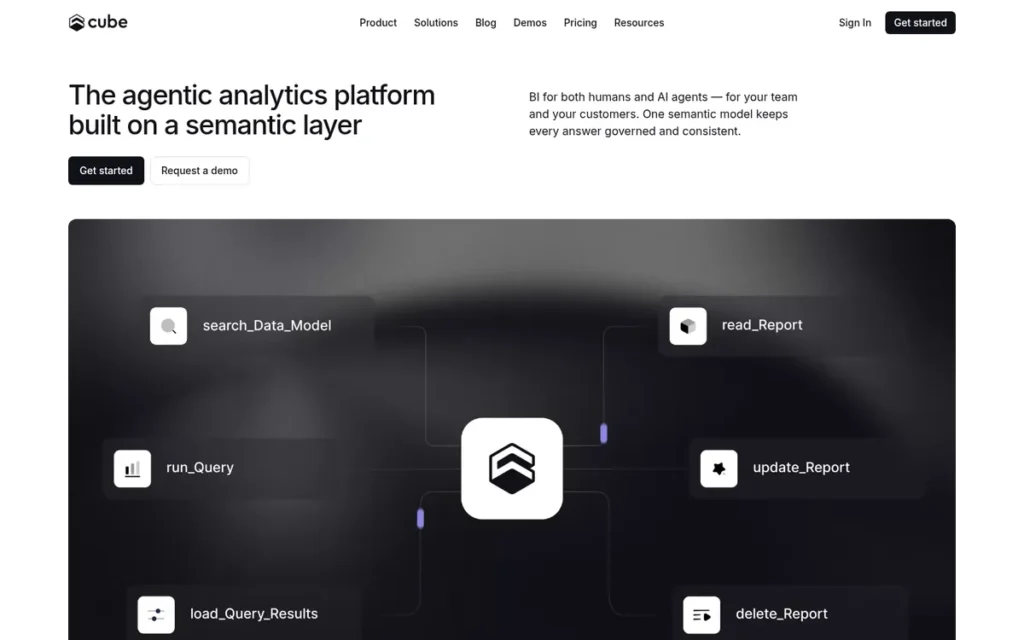
Category: Headless API-First Semantic Layer, an open-source, API-first platform that exposes semantic metric definitions to BI tools, embedded analytics applications, and LLM agents simultaneously via REST, GraphQL, SQL, MDX, and DAX, with no native visualization layer.
At a Glance
| Field | Detail |
|---|---|
| Category | Headless API-First Semantic Layer |
| Best For | SaaS companies building multi-tenant customer-facing embedded analytics, and engineering teams needing a warehouse-agnostic, open-source semantic layer that serves multiple BI tools and LLM agents simultaneously from a single data model |
| Price Range | $0 (Cube Core, self-hosted, open source; full features) / $249/month (Cloud Starter, 5 seats) / $999+/month (Cloud Pro, usage-based) / Enterprise: custom |
| Primary Strength | Cube is the only semantic layer tool in this evaluation with documented native multi-tenant isolation; supporting per-tenant pre-aggregation management, security context isolation, and row-level security; and was recognized as a GigaOm Leader and Fast Mover in both 2023 and 2024 Sonar Reports |
| Biggest Limitation | Cube’s governance outcomes depend heavily on team modeling discipline; the flexibility of YAML and JavaScript semantic modeling rewards rigorous teams but can reproduce metric inconsistency at a new abstraction layer if organizational standards are not enforced, and maximizing pre-aggregation, multi-tenancy, and AI API capabilities requires meaningful upfront engineering investment |
| One-Line Summary | Cube is a GigaOm-recognized open-source headless semantic layer; rated Leader and Fast Mover in both 2023 and 2024; offering the broadest multi-protocol API support (REST, GraphQL, SQL, MDX, DAX), native multi-tenancy, a free self-hosted production tier, and MCP-based AI agent integration, making it the most accessible, portable, and architecturally flexible dedicated semantic layer tool in 2026. |
| Last Verified | May 2026 |
Overview
Cube is a code-first, open-source headless semantic layer that centralizes metric definitions, business logic, and access control above cloud data warehouses, exposing them to BI tools, embedded analytics applications, and AI agents via simultaneous REST, GraphQL, SQL, MDX, DAX, and Semantic SQL APIs with no native visualization layer.
Cube’s architecture is available as free self-hosted Cube Core or managed Cube Cloud, decoupling semantic definitions from any single BI tool or warehouse. Cube enables organizations to serve consistent metrics to Tableau, Power BI, embedded React dashboards, Jupyter notebooks, and LLM chatbots from one governed data model, the widest consuming-tool coverage of any dedicated semantic layer in 2026.
Cube includes a native pre-aggregation engine that automatically builds and manages L1/L2 cached aggregate tables in the warehouse, enabling sub-second query response for embedded analytics at scale without BI tool reconfiguration.
Key Features
- Native L1/L2 Pre-Aggregation Engine: Cube’s pre-aggregation engine automatically builds and manages multi-level cached aggregate tables in the data warehouse, with aggregate awareness detecting which pre-aggregation to use per query, enabling sub-second response for embedded dashboards without manual caching configuration or query rewriting in downstream BI tools.
- Broadest Multi-Protocol API Support: Cube exposes semantic metric definitions simultaneously via REST, GraphQL, SQL, MDX, and DAX APIs (the widest multi-protocol support of any dedicated semantic layer tool in this evaluation) enabling a single Cube data model to serve Tableau (SQL), Power BI (MDX/DAX), embedded React dashboards (REST), and LLM agents (Semantic SQL) without model duplication.
- Native Multi-Tenant Isolation: Cube provides per-tenant security context isolation and per-tenant pre-aggregation management across separate databases (MongoDB, PostgreSQL, Snowflake, and others per tenant) enabling SaaS companies to expose governed analytics to multiple end-customer tenants from a single deployment without data leakage between tenants (cube.dev/docs/product/configuration/multitenancy, 2025).
- Cube Copilot AI Modeling: Cube Copilot is an AI-assisted semantic modeling feature enabling developers to create and modify Cube data models using natural language within the Cube development environment, reducing model authoring time for complex metric and dimension definitions.
- MCP and AI Agent Integration: Cube’s MCP (Model Context Protocol) integration supports AI agent connectivity (including Anthropic Claude and other LLM agents) exposing governed semantic metrics to AI workflows with guardrails that prevent direct warehouse table access and reduce hallucination risk in AI-generated analytics (Cube Blog, 2025).
Best For
Cube is best for SaaS companies building multi-tenant customer-facing embedded analytics where per-tenant data isolation is a non-negotiable requirement. Cube is also best for engineering teams at organizations with multiple BI tools or LLM application needs who want a warehouse-agnostic, open-source semantic layer with the broadest API protocol coverage and the lowest vendor lock-in risk in this evaluation.
Strengths
- GigaOm Leader and Fast Mover: recognized in both 2023 and 2024: Cube was rated a Leader and Fast Mover in GigaOm’s Semantic Layer Sonar Reports in both 2023 and 2024, placing Cube in the same top analyst tier as AtScale’s 2025 GigaOm Leader and Fast Mover designation (GigaOm Sonar Reports, 2023 and 2024; prnewswire.com; cube.dev/blog).
- Only tool with documented native multi-tenant isolation as of May 2026: As of May 2026, Cube is the only semantic layer tool in this evaluation with documented native multi-tenant isolation (including per-tenant security contexts, per-tenant pre-aggregation management, and row-level security configurable in Python or JavaScript) a capability absent from dbt Semantic Layer, AtScale, Snowflake Semantic Views, and Databricks Metric Views (cube.dev/docs, 2025).
- Lowest POC barrier of any dedicated semantic layer tool: Cube’s free open-source Cube Core enables complete production validation (including pre-aggregations, multi-protocol APIs, and security contexts) before any cloud spend, directly contrasting with AtScale’s enterprise-only pricing and dbt Semantic Layer’s dbt Cloud subscription requirement for BI connectivity.
This aligns with direct practitioner comparisons on r/dataengineering:
“I did a POC on both, cube was leagues ahead in both community and features. If I was making the decision today I’d go with them” Posted by u/wallyflops
Takeaway: In direct head-to-head POC evaluations, Cube consistently outperforms dbt Semantic Layer on community depth and feature breadth, reinforcing its position as the leading alternative for teams that cannot accept dbt Cloud subscription dependency.
- Backed by credible enterprise investors with open-source trajectory: Cube raised its Series B from Bessemer Venture Partners and Khosla Ventures, with $49M in total funding (Crunchbase, 2022; TechCrunch, 2022), a credible enterprise trajectory for a developer-first open-source company, though substantially below dbt Labs’ $416M and the institutional scale of Snowflake and Databricks.
Limitations
- Governance Discipline Dependency: Cube’s most consequential trade-off is that governance quality scales directly with team modeling discipline, u/AnAvidPhan on r/dataengineering noted “Cube is a great product, but to maximize its utility you have to have a lot of strong modeling standards,” meaning Cube amplifies organizational rigor or its absence, and teams without enforced standards can reproduce metric inconsistency at the semantic layer level.
- No Structured Review Platform Presence: Cube has no significant presence on G2 or Capterra (its developer audience engages on GitHub, Discord, and Reddit rather than enterprise review platforms) which limits the structured peer validation signal available to procurement teams comparing tools through a formal RFP process relative to dbt Semantic Layer’s 4.7/5 G2 rating.
- Enterprise Support Model Gap: Cube’s support model for self-hosted Cube Core relies on GitHub Issues and community Discord rather than enterprise SLA-backed ticketing, organizations requiring guaranteed incident response windows and named customer success contacts must budget for Cube Cloud Enterprise custom pricing, as the free self-hosted tier carries no support commitments.
- Smaller Financial Scale Than Platform Alternatives: Cube’s $49M total funding is substantially smaller than dbt Labs’ $416M and the institutional backing of Snowflake ($134B market cap) and Databricks ($134B valuation, December 2025), a vendor continuity consideration for organizations making long-term infrastructure commitments, though Bessemer and Khosla backing signals credible enterprise trajectory (Crunchbase, 2022).
Verdict
Cube is the most architecturally flexible, accessible, and portable dedicated semantic layer in 2026, the default recommendation for SaaS companies building embedded multi-tenant analytics and for engineering teams prioritizing open-source freedom and warehouse agnosticism. Cube’s GigaOm Leader and Fast Mover recognition across 2023 and 2024, native multi-tenancy, broadest multi-protocol API support, and free self-hosted tier make it the strongest dedicated semantic layer for teams unwilling to accept warehouse lock-in or dbt Cloud subscription dependency. Cube’s governance quality scales directly with team modeling discipline, strong data modeling standards are a prerequisite for realizing Cube’s full value, making it a tool that rewards engineering-led organizations over BI-first ones.
3. AtScale: Best for Enterprise Multi-BI Environments Requiring Power BI and Excel Governance
Category: Universal Enterprise Semantic Layer, a long-established middleware platform that federates metric governance across Power BI, Tableau, and Excel simultaneously via MDX, DAX, and SQL protocols, with in-warehouse aggregate awareness and an open-source semantic modeling language.
At a Glance
| Field | Detail |
|---|---|
| Category | Universal Enterprise Semantic Layer |
| Best For | Large enterprises operating Power BI and Excel live connections alongside Tableau who need a single semantic governance layer across multiple BI tools and data warehouses, with the budget and technical resources for enterprise-grade, sales-assisted deployment |
| Price Range | Enterprise pricing only; no public dollar amounts; available via AWS, Azure, and Google Cloud marketplaces; community-reported as “very very expensive”; no free tier or starter plan |
| Primary Strength | AtScale is the only semantic layer tool with native MDX and DAX protocol support enabling Power BI and Excel Analysis Services live connections, backed by an open-source Semantic Modeling Language (SML) and GigaOm’s Leader and Fast Mover designation announced September 25, 2025; with over a decade of enterprise deployment history since founding in 2013 |
| Biggest Limitation | AtScale’s MDX live connection to Power BI physically grays out the entire Power BI authoring ribbon; disabling measures, Power Query, relationship editing, and cross-source data addition; a deployment failure pattern documented by enterprise practitioners on r/PowerBI that rendered the integration unusable for one organization’s Power BI developer workflows |
| One-Line Summary | AtScale is the longest-tenured universal semantic layer platform (founded 2013), recognized as a GigaOm Leader and Fast Mover (September 25, 2025), offering the only native MDX and DAX governance for Power BI and Excel environments alongside an open-source Semantic Modeling Language; with the critical caveat that Power BI live connection deployments carry a documented authoring ribbon conflict requiring explicit POC validation before production commitment. |
| Last Verified | May 2026 |
Overview
AtScale is a universal semantic layer platform, founded in 2013 as the first dedicated semantic layer vendor, that defines metrics and business logic once and exposes them consistently to Power BI, Tableau, Excel, LLMs, and AI agents via simultaneous MDX, DAX, and SQL protocols, enabling enterprises to standardize metric governance across heterogeneous BI investments without migrating away from existing tools.
AtScale’s aggregate awareness engine automatically builds in-warehouse aggregate tables in Snowflake, Databricks, BigQuery, or Redshift, then rewrites incoming queries to hit the optimal aggregate, reducing live connection latency and compute cost for Power BI and Excel environments without requiring BI tool changes.
AtScale’s open-source Semantic Modeling Language (SML), available at semanticdatalayer/SML on GitHub, provides a portable YAML-based modeling format designed to reduce lock-in and serve as structured context for AI agents operating against governed enterprise metrics.
Key Features
- In-Warehouse Aggregate Awareness Engine: AtScale’s aggregate awareness engine automatically builds and manages in-warehouse aggregate tables in Snowflake, Databricks, BigQuery, or Redshift, then rewrites incoming MDX, DAX, and SQL queries to hit the optimal aggregate, reducing query latency and compute cost for Power BI and Excel live connections without requiring BI tool reconfiguration.
- Native MDX and DAX Protocol Support: AtScale exposes semantic models natively via MDX and DAX protocols, enabling Power BI and Excel Analysis Services live connections from a single governed semantic layer, the only tool in this evaluation with native MDX and DAX support covering the Power BI and Excel enterprise use case simultaneously.
- Open-Source Semantic Modeling Language (SML): AtScale’s SML is a YAML-based, Git-native, object-oriented modeling format available at semanticdatalayer/SML on GitHub, designed as a portable standard that persists independently of AtScale’s proprietary platform, reducing the migration risk associated with committing to a commercial semantic layer (AtScale SML Blog, 2024).
- Hybrid and Multi-Cloud Deployment: AtScale supports hybrid, cloud, and on-premises deployment configurations across Snowflake, Databricks, BigQuery, Redshift, and on-premises data sources, enabling enterprises with legacy infrastructure to implement semantic governance without requiring a full cloud migration.
- Databricks Unity Catalog Integration: AtScale provides native Databricks Unity Catalog integration via a Databricks Marketplace listing, enabling Databricks Genie natural language querying grounded in AtScale’s governed semantic models, extending AtScale’s governance role to Databricks AI/BI agentic workflows.
Best For
AtScale is best for large enterprises already operating Power BI and Excel live connections as primary BI surfaces alongside Tableau, running on multiple data warehouses or hybrid cloud-on-premises environments, who need centralized metric governance with native MDX and DAX protocol support. AtScale requires an explicit POC phase testing Power BI developer workflows (measures, Power Query, relationship editing) before any production commitment.
Strengths
- GigaOm Leader and Fast Mover (announced September 25, 2025): AtScale was named a Leader and Fast Mover in GigaOm’s 2025 Radar for Semantic Layers and Metric Stores, specifically recognizing its composable modeling capabilities and the open-source SML standard as differentiating competitive strengths (GigaOm Radar for Semantic Layers and Metric Stores, announced September 25, 2025; atscale.com/press).
- Longest enterprise market history in the semantic layer category: AtScale’s deployment history since 2013 gives it the deepest enterprise reference customer relationships (spanning financial services, healthcare, and Fortune 500 organizations across multiple technology eras) that no tool founded after 2019 can replicate. AtScale was defining the semantic layer category a full decade before Snowflake Semantic Views or Databricks Metric Views entered the market.
- SML open-source portability: unique among commercial enterprise semantic layers: AtScale’s SML open-source release on GitHub provides modeling portability that no other commercial enterprise semantic layer offers, team models can be expressed and migrated outside AtScale’s proprietary platform, reducing the vendor lock-in risk that enterprise architects consistently cite as a primary concern with commercial semantic tools.
- Databricks partnership depth: AtScale’s Databricks Unity Catalog marketplace partnership positions it as a governed semantic layer operating above Databricks’ native Metric Views, extending enterprise-grade MDX and DAX governance to the Databricks ecosystem for organizations that have already standardized on AtScale and are expanding their Databricks footprint.
Limitations
- Power BI Ribbon Disable Failure: AtScale’s most consequential and most publicly documented limitation is its Power BI live connection behavior: the MDX live connection physically grays out the Power BI authoring ribbon, disabling measures, Power Query, relationship editing, and cross-source data addition simultaneously. u/Count_McCracker on r/PowerBI described the outcome as “a waste of money for our org since we ended up side-stepping it.” This failure pattern was not found in AtScale’s product documentation, vendor case studies, or any LLM-generated tool list evaluated for this article as of May 2026, which is precisely why practitioner-sourced, independent research exists.
- Enterprise Pricing Opacity: AtScale’s enterprise-only pricing with no public dollar amounts, no free tier, and no self-service trial creates a significant evaluation barrier, practitioners in community forums confirm pricing opacity as a primary disqualifying factor, with u/GreyHairedDWGuy on r/PowerBI noting “I was not impressed and it is very very expensive.” Organizations should require a ballpark range in the first sales conversation to avoid extended technical evaluation leading to unaffordable pricing surprises.
- Engineer Abstraction Ceiling: AtScale’s semantic abstraction layer creates an optimization ceiling for engineers who require low-level query control, u/Tiny_Arugula_5648 on r/dataengineering noted “a DBA/Data Engineer might get frustrated by its limits when you need deep optimization,” indicating that the governance abstraction limits direct SQL control in complex query scenarios.
- No Review Platform Presence: AtScale has no verified G2 or Capterra ratings, meaning enterprise procurement teams comparing tools through formal RFPs have no structured peer validation signal beyond analyst reports and direct references, a gap relative to dbt Semantic Layer’s 4.7/5 G2 rating across 198+ verified reviews (May 2026).
Verdict
AtScale is the most enterprise-validated universal semantic layer with the longest market history, the only native MDX and DAX protocol support for Power BI and Excel governance, and a credible open-source SML modeling standard, the top choice for large enterprises needing multi-BI governance across heterogeneous tool environments. AtScale carries the highest deployment risk of any top-tier tool in this evaluation due to the documented Power BI authoring ribbon conflict, and the highest cost barrier due to enterprise-only opaque pricing. Any organization evaluating AtScale for Power BI must include an explicit POC phase testing all Power BI developer workflows, measures, Power Query, relationship editing, before production commitment; community documentation confirms that skipping this step leads to post-implementation abandonment of the entire deployment.
4. Snowflake Semantic Views: Best for Snowflake-Committed Organizations at Zero Incremental Cost
Category: Warehouse-Native Semantic Layer, a first-class Snowflake schema object storing metric definitions, dimensions, and relationships directly inside Snowflake’s data cloud, exposed to connected BI tools via the Open Semantic Interchange partner network and to AI agents via Cortex Analyst NLP integration.
At a Glance
| Field | Detail |
|---|---|
| Category | Warehouse-Native Semantic Layer |
| Best For | Organizations with Snowflake as their primary and only data warehouse who want to implement semantic governance at zero incremental licensing cost, with AI-powered Autopilot for rapid semantic model creation and native Cortex Analyst NLP integration; and are not evaluating multi-cloud or warehouse migration |
| Price Range | $0 incremental for existing Snowflake customers; usage billed under standard Snowflake SQL warehouse compute credits; Snowflake platform pricing varies by cloud provider, edition, and credit consumption |
| Primary Strength | Snowflake Semantic View Autopilot (GA in early 2026) analyzes existing user query patterns to automatically propose semantic view definitions, dimensions, and metrics; eliminating the blank-page modeling cost that is the primary adoption barrier for all other semantic layer tools in this evaluation; at zero incremental licensing cost for existing Snowflake customers |
| Biggest Limitation | As of May 2026, Snowflake Semantic Views are Snowflake-specific schema objects with no published export format and no documented migration path to Databricks, BigQuery, or standalone semantic layer tools; creating the highest vendor lock-in risk of any tool in this evaluation for organizations not fully committed to Snowflake long-term |
| One-Line Summary | Snowflake Semantic Views are the zero-incremental-cost semantic layer for Snowflake-committed organizations, reaching GA in June 2025 with AI-powered Autopilot in early 2026 and native Cortex Analyst NLP integration; the strongest native AI analytics option for Snowflake-native stacks, with the trade-off of complete Snowflake platform dependency and zero cross-warehouse portability. |
| Last Verified | May 2026 |
Overview
Snowflake Semantic Views are native Snowflake schema-level objects (generally available since June 2025 (Snowflake Summit Release Notes, June 2025)) that store metric definitions, dimensions, filters, and relationships directly inside Snowflake’s data cloud without external middleware, created via SQL DDL (CREATE SEMANTIC VIEW), the Cortex Analyst Semantic View Generator wizard in Snowsight, or YAML.
Snowflake Semantic Views integrate natively with Cortex Analyst, Snowflake’s AI-powered natural language analytics agent, which uses semantic view definitions to generate SQL against physical Snowflake tables, reducing AI hallucination risk by combining LLM reasoning with rule-based semantic definitions.
Snowflake Semantic View Autopilot, reaching GA in early 2026 per Snowflake’s press release (snowflake.com/en/blog/semantic-view-autopilot/), learns from real user query history to automatically propose semantic view definitions, addressing the primary adoption barrier that all other tools in this evaluation require teams to manage manually.
Key Features
- Zero-Infrastructure Creation via SQL DDL: Snowflake Semantic Views are created and managed directly inside Snowflake via SQL DDL (
CREATE SEMANTIC VIEW) or the Cortex Analyst Semantic View Generator wizard in Snowsight, requiring no external middleware, no additional infrastructure, and no toolchain beyond an existing Snowflake account. - Semantic View Autopilot (GA in early 2026): Snowflake Semantic View Autopilot analyzes existing user query patterns to automatically propose candidate metric definitions, dimension hierarchies, and semantic view configurations, reducing semantic layer creation from manual multi-day modeling efforts to AI-assisted minutes for organizations with established query history (Snowflake Press Release, early 2026; snowflake.com/en/blog/semantic-view-autopilot/).
- Native Cortex Analyst NLP Integration: Snowflake Semantic Views integrate natively with Cortex Analyst for AI/NLP querying without additional integration middleware, enabling governed natural language analytics queries that reduce hallucination risk compared to unrestricted LLM-to-SQL generation against raw Snowflake tables.
- Open Semantic Interchange (OSI) Partner Sync: Snowflake Semantic Views support cross-tool synchronization via OSI with partner BI tools including Google Cloud Looker, Sigma Computing, ThoughtSpot, and dbt Labs, with dimension and metric changes in Snowflake propagating automatically to connected OSI partner tools (Snowflake Engineering Blog, 2025).
- Snowflake-Native Query Optimization: Snowflake Semantic Views leverage Snowflake’s built-in query optimization infrastructure (automatic clustering, search optimization, and result caching) without requiring separate pre-aggregation infrastructure, though this result cache does not match the multi-level aggregate pre-materialization capabilities of Cube’s dedicated pre-aggregation engine for high-concurrency embedded analytics workloads.
Best For
Snowflake Semantic Views are best for organizations with Snowflake as their primary and only data warehouse who want to implement semantic governance quickly at zero incremental licensing cost, enable Cortex Analyst AI/NLP querying against governed metric definitions, and work within the OSI partner BI ecosystem. Snowflake Semantic Views are not appropriate for organizations evaluating multi-cloud expansion or warehouse migration in their planning horizon.
Strengths
- Only tool with generally available AI-powered semantic model creation from query history: As of May 2026, Snowflake Semantic View Autopilot is the only generally available feature in this evaluation offering AI-powered semantic model creation from existing usage patterns, eliminating the blank-page modeling cost documented as the primary adoption barrier for semantic layers across the category (Snowflake Press Release, early 2026).
- Zero incremental licensing cost removes budget barrier for 10,000+ existing Snowflake customers: Snowflake Semantic Views are included in existing Snowflake subscriptions at zero incremental licensing cost, removing the budget approval barrier that all standalone semantic layer tools require, a structural adoption advantage for the 10,000+ organizations already paying for Snowflake platform access (Snowflake Docs, May 2026).
- Integrated AI analytics stack eliminates additional vendor relationships: Snowflake Semantic Views integrate directly with Cortex Analyst for AI/NLP querying without additional integration middleware or licensing, creating a complete AI analytics stack within the Snowflake platform and reducing the total number of vendor relationships required for governed AI analytics.
Users on r/snowflake who evaluated this integrated stack during private preview reported a similar conclusion:
“Cortex Agents are built for exactly this, you build your Cortex Search service and Analyst as per usual, then agents sits on top to select which one to use based on your query. If I recall correctly you can set up all three services through the UI (under ‘AI’ in the sidebar) and you’re away. Cortex Intelligence can sit on top of the agents as an OOTB UI, or you can build your own UI that talks to agents using their API. I tried intelligence as part of private preview and was impressed. Can’t remember when it’s out in public preview but it will be soon if it’s not already out. Hope this helps!” Posted by u/iwishihadahippo
Takeaway: Snowflake’s native Cortex AI stack (Cortex Analyst, Cortex Search, and Cortex Agents composing in a single platform UI) earned “impressed” reactions from private preview participants, reinforcing the zero-incremental-cost advantage for Snowflake-committed teams who want governed AI analytics without additional vendor relationships.
- dbt compatibility via OSI eliminates need for separate dbt Cloud subscription: The OSI partnership with dbt Labs means Snowflake Semantic Views can serve as an alternative to the dbt Semantic Layer for Snowflake-native teams, maintaining dbt model compatibility and OSI-partner BI tool synchronization without requiring a paid dbt Cloud subscription for semantic API access.
Limitations
- Complete Vendor Lock-In: As of May 2026, Snowflake Semantic Views are Snowflake-specific schema objects with no published export format and no documented migration path to Databricks, BigQuery, or standalone semantic layer tools, a binary constraint that eliminates Snowflake Semantic Views from consideration for any organization not permanently committed to Snowflake as its sole platform. u/dt-25 on r/snowflake captured the core community concern: “Every product has a semantic layer. Wouldn’t it be great if they all used the same standard?”
- Insufficient Production Validation Depth: As a feature that reached GA in June 2025, Snowflake Semantic Views lack the practitioner validation depth (structured peer reviews, community-documented failure patterns, and quantified case studies) that mature tools have accumulated over years; the product is too new to have generated the real-world evidence base that enterprise infrastructure decisions require.
- No Native Pre-Aggregation Caching Engine: Snowflake Semantic Views rely on Snowflake’s standard result cache rather than a dedicated pre-aggregation caching engine, unlike Cube’s L1/L2 multi-level aggregate management, Snowflake does not pre-materialize aggregates for high-concurrency embedded analytics workloads where multiple external users simultaneously query summary metrics, creating a performance gap for customer-facing embedded analytics at scale.
- Compute Billing Unpredictability: Snowflake Semantic Views’ “zero cost” positioning refers to licensing only, query-intensive semantic layer workloads increase Snowflake credit consumption in ways that can be difficult to forecast without modeling expected query volumes against contracted credit rates, potentially generating unexpectedly elevated compute bills for high-volume metric query workloads.
Verdict
Snowflake Semantic Views are the optimal semantic layer for organizations committed to Snowflake as their sole data warehouse, offering zero incremental licensing cost, AI-powered Autopilot for rapid deployment, and native Cortex Analyst NLP integration that no standalone tool can match for Snowflake-native workflows. Snowflake Semantic Views should not be considered by organizations operating or planning multi-cloud data architectures, as of May 2026, definitions are entirely non-portable outside Snowflake, and the lock-in risk is complete. Organizations on a Snowflake-plus-dbt stack should evaluate whether the OSI integration eliminates their need for a separate dbt Cloud subscription before committing to either path.
5. Databricks Metric Views: Best for Databricks Lakehouse Organizations with Unified AI and Data Engineering Governance
Category: Lakehouse-Native Semantic Layer, Unity Catalog objects within the Databricks Lakehouse Platform defining reusable business metrics, dimensions, and join relationships for governed analytics across BI tools, data science workflows, AI agents (Genie), and multi-agent orchestration (Agent Bricks).
At a Glance
| Field | Detail |
|---|---|
| Category | Lakehouse-Native Semantic Layer |
| Best For | Organizations running the Databricks Lakehouse Platform for data engineering, data science, and analytics who want unified semantic governance across BI, ML pipelines, and AI agents through Unity Catalog; and are not building multi-tenant SaaS embedded analytics requiring programmatic deployment |
| Price Range | $0 incremental for existing Databricks customers; usage billed under standard Databricks SQL Warehouse compute (DBUs); requires SQL Warehouse runtime 2025.16+ or Databricks Runtime 16.4+; Databricks platform pricing varies by plan and consumption |
| Primary Strength | Databricks Metric Views are the only semantic layer natively integrated with a full lakehouse platform covering streaming data (Delta Live Tables), ML pipeline outputs (MLflow), analytics (SQL Warehouses), and agentic AI orchestration (Agent Bricks and Genie); enabling unified semantic governance across the complete Databricks data and AI lifecycle within Unity Catalog |
| Biggest Limitation | Databricks Metric Views have no programmatic multi-tenant deployment path; Genie workspace configurations require manual per-tenant setup with no Terraform or API-based deployment available as of May 2026; making Databricks Metric Views a binary non-starter for SaaS companies needing to serve customer-facing analytics to multiple tenants at scale |
| One-Line Summary | Databricks Metric Views are the native semantic layer for Databricks Lakehouse organizations, entering public preview in May 2025 with Unity Catalog governance, Genie NLP integration, and Agent Bricks agentic analytics; with documented Genie AI maturity concerns from practitioners and no programmatic multi-tenant deployment path as of May 2026. |
| Last Verified | May 2026 |
Overview
Databricks Metric Views are first-class Unity Catalog objects (entering public preview on May 29, 2025 (Azure Databricks Release Notes, May 2025)) that define reusable business metrics and dimensions directly in the Databricks Lakehouse Platform via SQL DDL, Catalog Explorer UI, or YAML, centralizing business logic in the same governance layer that manages tables, ML models, and data pipelines.
Databricks Metric Views integrate natively with Databricks Genie AI/BI for natural language analytics and with Agent Bricks for multi-agent agentic analytics orchestration. Databricks Metric Views were confirmed in Public Preview contexts as of March 2026, practitioners should verify current GA status at docs.databricks.com before committing Metric Views to mission-critical reporting pipelines.
Key Features
- Unity Catalog Single Governance Plane: Databricks Metric Views are stored as Unity Catalog objects alongside tables, ML models, and pipelines, enabling unified governance, lineage tracking, and access control for semantic definitions through the same catalog framework that manages all Databricks assets, a single governance plane covering data engineering, data science, and analytics.
- Optional Materialization for Performance: Databricks Metric Views support optional materialization for performance optimization, allowing high-frequency query paths to be pre-computed and cached without requiring external pre-aggregation infrastructure separate from the Databricks SQL Warehouse compute layer.
- Genie NLP Integration: Databricks Genie AI/BI uses Metric View definitions as semantic context for natural language analytics queries, combining LLM reasoning with governed metric definitions to generate SQL against Databricks tables, reducing hallucination risk compared to unrestricted LLM-to-SQL generation against raw data (Databricks AI/BI Blog, October 2025).
- Agent Bricks Agentic Analytics: Databricks Metric Views integrate with Agent Bricks (Databricks’ multi-agent agentic analytics framework) enabling AI agents to query governed metrics and dimensions as first-class actions within orchestrated AI workflows spanning data retrieval, analysis, and decision-making steps.
- Third-Party Ecosystem Adoption via Hex Integration: Hex added native Databricks Metric Views integration in public beta, enabling Hex users to browse and query Databricks Metric Views directly without redefining metrics in Hex’s own data model layer, demonstrating third-party ecosystem adoption beyond Databricks-internal tools (Hex Blog, 2025).
Best For
Databricks Metric Views are best for organizations already running the Databricks Lakehouse Platform for data engineering, data science, and analytics who want unified semantic governance across BI, ML pipeline outputs, and AI agents through Unity Catalog. Databricks Metric Views are not appropriate for SaaS companies building multi-tenant customer-facing analytics requiring programmatic deployment, as no Terraform or API-based multi-tenant Genie configuration path exists as of May 2026.
Strengths
- Full lakehouse semantic coverage unique to the Databricks ecosystem: Databricks Metric Views are the only semantic layer in this evaluation natively integrated with a full lakehouse platform covering streaming data (Delta Live Tables), ML pipeline outputs (MLflow), analytics (SQL Warehouses), and agentic AI orchestration (Agent Bricks), enabling a single governed semantic layer across the complete Databricks data and AI lifecycle without additional middleware.
- Institutional financial scale at $134B valuation and $5.4B ARR: Databricks’ $134 billion valuation (December 2025) and $5.4 billion ARR (February 2026) provide institutional-scale financial backing for Metric Views development, ensuring sustained feature velocity at a pace no dedicated semantic layer startup can replicate (Databricks Press Releases, December 2025; February 2026).
- Third-party ecosystem validation via Hex integration: Hex’s native Databricks Metric Views integration in public beta demonstrates the point at which a platform feature becomes a recognized semantic standard within the Databricks partner network, not merely an internal Databricks-only capability (Hex Blog, 2025).
- Unity Catalog governance depth: Databricks Metric Views’ Unity Catalog integration brings semantic definitions under the same access control, column-level security, lineage tracking, and data classification framework as all other Databricks assets, reducing governance overhead for organizations using Databricks as their primary governance platform.
Limitations
- Multi-Tenant Deployment Gap: Databricks Metric Views’ most consequential limitation for SaaS organizations is multi-tenant deployment: Genie workspace configurations require manual per-tenant setup with no Terraform or API-based deployment path as of May 2026, a binary architectural blocker documented by u/No_Establishment182 on r/databricks, who was evaluating Genie for 200+ customer schemas and found no programmatic configuration path.
- Genie AI Maturity Concerns: Community evaluations of Databricks Genie (which consumes Metric Views for NLP querying) have surfaced a maturity concern: u/Alarming-Test-346 on r/databricks described Genie as a “glorified SQL generator” that produces tables for users to analyze manually in Excel rather than delivering interpreted analytical insights, undermining the conversational analytics value proposition for organizations expecting AI-interpretive behavior.
- Complete Platform Lock-In: As of May 2026, Databricks Metric Views have no portability outside the Databricks platform (definitions have no export format and no documented migration path to other warehouses or standalone semantic layer tools) creating the same complete lock-in risk as Snowflake Semantic Views for organizations not permanently committed to Databricks.
- DBU Billing Complexity: Databricks’ DBU-based pricing can be difficult to predict for query-intensive semantic layer workloads, organizations may face higher compute bills than anticipated when high-volume metric query traffic runs through SQL Warehouses, a pattern harder to forecast than dbt Cloud’s seat-based pricing model or Cube Cloud’s usage-based tiers.
Verdict
Databricks Metric Views are the natural semantic layer choice for organizations running Databricks as their primary lakehouse platform, offering Unity Catalog governance, Genie NLP integration, Agent Bricks agentic analytics, and lakehouse-spanning semantic coverage at zero incremental licensing cost, advantages no standalone semantic layer tool can replicate within the Databricks ecosystem. Practitioners should evaluate Databricks Metric Views with awareness that Genie’s AI maturity has received mixed community reviews and that multi-tenant SaaS deployment has no programmatic path as of May 2026; organizations building customer-facing embedded analytics should evaluate Cube’s native multi-tenancy instead. Like Snowflake Semantic Views, Databricks Metric Views should be considered only by organizations with long-term Databricks platform commitment, as semantic definitions have no portability outside the lakehouse ecosystem.
6. Timbr.ai: Best for Complex Ontology-Driven Domains Requiring Semantic Inference (Specialized, Early-Stage Evaluation)
Category: Ontology-Based Semantic Layer, models business entities, attributes, relationships, and hierarchies as a SQL Knowledge Graph (SQL KG) with inheritance and inference, enabling Semantic SQL queries that auto-generate JOIN logic from explicitly modeled ontology relationships rather than requiring full multi-table SQL specification.
At a Glance
| Field | Detail |
|---|---|
| Category | Ontology-Based Semantic Layer |
| Best For | Organizations in complex enterprise domains (financial services, healthcare, supply chain) with multi-entity data relationships requiring semantic inference and relationship traversal beyond what YAML metric-definition tools can express; and with the data modeling expertise and budget for a sales-engaged evaluation of an early-stage, specialized vendor |
| Price Range | No public pricing; enterprise-only, direct sales engagement required; no free tier, no trial, no dollar amounts published |
| Primary Strength | Timbr.ai’s ontology inference engine derives implicit entity relationships from explicitly modeled ones; enabling analytical query patterns never anticipated during schema design; a semantic reasoning depth architecturally impossible in YAML-based metric-definition tools (dbt Semantic Layer, Cube, AtScale) or warehouse-native semantic layers (Snowflake, Databricks) |
| Biggest Limitation | Timbr.ai has no public pricing, no G2 or Capterra reviews, no disclosed company funding, no named founding team, and no significant practitioner community presence; representing the highest vendor due-diligence risk in this evaluation for organizations requiring financial stability evidence before committing to long-term semantic infrastructure |
| One-Line Summary | Timbr.ai is an ontology-based SQL Knowledge Graph semantic layer offering inference-driven entity relationship reasoning not available in any YAML metric tool; designed for complex multi-entity enterprise domains; with the significant caveat that the vendor has no public reviews, no disclosed funding, and no community-validated production deployments as of May 2026. |
| Last Verified | May 2026 |
Overview
Timbr.ai is a specialized semantic layer that models business data as a SQL Knowledge Graph, defining entities like Customer, Order, and Product as ontology objects with attributes, relationships, hierarchies, inheritance, and semantic constraints mapped to underlying database tables, enabling analysts to query using standard Semantic SQL that auto-generates JOIN logic from declared entity relationships rather than requiring full multi-table SQL specification.
Timbr.ai’s ontology inference engine supports reasoning over declared relationships, if “Customer places Order” and “Order contains Product,” Timbr.ai infers “Customer buys Product” without explicit modeling, enabling analytical patterns structurally impossible in YAML-based metric-definition tools like dbt Semantic Layer, Cube, or AtScale.
Timbr.ai is positioned for complex enterprise domains where the number of entity relationships and the need for semantic reasoning exceed what can be practically enumerated and maintained in a dimensional metric model.
Key Features
- Ontology Inference Engine: Timbr.ai’s ontology inference engine derives implicit entity relationships from explicitly declared ones, enabling analysts to query relationship patterns (e.g., “Customer buys Product” inferred from “Customer places Order” and “Order contains Product”) that were never explicitly modeled, a semantic reasoning capability absent from all other tools in this evaluation.
- Semantic SQL with Auto-JOIN Generation: Timbr.ai’s Semantic SQL approach uses fully standard SQL syntax against the ontology model, compatible with JDBC, ODBC, and SQLAlchemy connections, enabling analysts and BI tools to query the knowledge graph using familiar SQL without a proprietary query language, with Timbr.ai claiming up to 90% SQL complexity reduction versus equivalent raw SQL (Timbr.ai product documentation, unverified independently as of May 2026).
- 360-Degree Entity Views with Inheritance: Timbr.ai’s knowledge graph supports one-to-many and many-to-many relationship modeling with hierarchy, inheritance, and semantic constraints, enabling 360-degree entity views spanning CRM, ERP, and billing data that require exhaustive cross-system JOIN engineering in dimensional model tools.
- Major Warehouse Integration: Timbr.ai integrates with Databricks (with documented partnership at timbr.ai/data-platforms/databases/), Snowflake, and other major warehouses via JDBC/ODBC, positioning Timbr.ai as an ontology semantic reasoning layer above existing warehouse infrastructure rather than a warehouse replacement.
- Visual Ontology Modeling: Timbr.ai’s visual ontology modeling tools allow data modelers and domain experts to contribute to semantic relationship definitions without writing raw SQL DDL, reducing the SQL expertise barrier for ontology schema design in complex business domains (Timbr.ai product pages, May 2026).
Best For
Timbr.ai is best for data architecture teams in complex enterprise domains (financial services, healthcare, supply chain) where entity relationship depth and inference-driven reasoning are more critical than metric consistency across BI tools. Timbr.ai requires sufficient ontology data modeling expertise and budget for a sales-assisted POC engagement with a vendor that provides no self-service trial path.
Strengths
- Architecturally unique inference capability, no equivalent in any other tool evaluated: Timbr.ai’s semantic inference engine derives unmodeled entity relationships from modeled ones, directly addressing the “questions we didn’t anticipate modeling for” problem that limits YAML metric-definition tools in complex, evolving data domains, a genuinely differentiated architectural capability not available in dbt Semantic Layer, Cube, AtScale, Snowflake Semantic Views, or Databricks Metric Views (Timbr.ai, timbr.ai, no independent verification available as of May 2026).
- Standard SQL compatibility lowers analyst skill barrier for complex multi-entity analytics: Timbr.ai’s Semantic SQL uses fully standard SQL syntax with auto-generated JOIN logic, compatible with JDBC, ODBC, and SQLAlchemy, enabling business analysts to express complex multi-entity queries without multi-table JOIN expertise, lowering the analytical skill barrier below what any other tool in this evaluation achieves for multi-entity relationship queries (Timbr.ai, timbr.ai, no independent verification available as of May 2026).
- Complementary Databricks positioning as an ontology reasoning layer: Timbr.ai’s documented Databricks integration positions it as a complementary ontology reasoning layer above Databricks Metric Views, providing semantic inference depth that Databricks’ SQL metric definitions cannot express for organizations needing both lakehouse-scale data processing and knowledge-graph-level relationship modeling (timbr.ai/data-platforms/databases/).
Limitations
- Maximum Vendor Due-Diligence Risk: Timbr.ai presents the highest vendor due-diligence risk in this evaluation across every measurable dimension: the company has no Crunchbase listing, no disclosed investors, no named founding team, no public headquarters address, no G2 or Capterra reviews on any major platform, and no significant practitioner community presence on Reddit, LinkedIn, or professional forums, providing no third-party signal for enterprise buyers who require financial stability evidence before committing to long-term semantic infrastructure.
- Complete Pricing Opacity: Timbr.ai’s complete pricing opacity eliminates self-directed POC evaluation for organizations without budget for sales-led discovery, blocking the self-service evaluation path that Cube’s free open-source model and dbt’s MetricFlow CLI make accessible to the majority of the target audience evaluating semantic layer tools.
- No Independent Case Studies or Community Validation: The absence of independent case studies, community-validated production deployments, and analyst coverage means practitioners have no peer-reviewed evidence base against which to compare Timbr.ai’s own product capability claims, a fundamental due diligence gap for a tool being considered as enterprise data infrastructure.
- Ontology Modeling Expertise Requirement: Timbr.ai’s ontology-based modeling requires deep knowledge graph expertise (formal ontology design, entity inheritance modeling, and semantic constraint specification) skills outside the YAML and SQL tooling familiarity of most analytics engineering teams. Timbr.ai creates a materially steeper modeling learning curve than every other tool in this evaluation and limits the practitioner pool capable of independently evaluating or maintaining an implementation without vendor-provided professional services.
Verdict
Timbr.ai offers a genuinely differentiated ontology inference capability, deriving unmodeled entity relationships to enable previously impossible query patterns, that no other tool in this evaluation provides, making it a specialized consideration for data architecture teams in complex domains where semantic reasoning depth is more critical than BI metric consistency. Timbr.ai should not be the first semantic layer tool evaluated by teams whose primary need is metric governance across BI tools, dbt Semantic Layer, Cube, or the platform-native options address that need with far stronger evidence bases and accessible evaluation paths. Organizations that find the ontology inference thesis compelling should engage Timbr.ai’s sales team with specific POC design questions about production deployment evidence, customer references, and company fundamentals before allocating significant evaluation resources.
7. Galaxy: Emerging AI Context Graph Platform, Watch This Space (Not Production-Ready for Most Organizations)
Category: AI Context Graph Semantic Layer (Early Stage), an ontology-driven context graph infrastructure designed to build and dynamically maintain a knowledge graph of enterprise entities and relationships for AI agent semantic context, distinct from BI metric consistency tools.
At a Glance
| Field | Detail |
|---|---|
| Category | AI Context Graph Semantic Layer (Early Stage) |
| Best For | Forward-looking organizations exploring agentic AI infrastructure who want early-access partnership with a pre-commercial platform aligned to the ontology-driven AI context direction; not for teams requiring production-ready semantic governance with verifiable vendor stability |
| Price Range | No pricing available; pre-commercial or early-access stage; no free tier, no trial, no pricing page |
| Primary Strength | Galaxy’s dynamic context graph architecture is designed to automatically adapt semantic entity definitions as underlying data changes without manual YAML re-modeling; addressing the maintenance overhead of static semantic definitions in rapidly evolving enterprise data environments |
| Biggest Limitation | Galaxy has no verified customer deployments, no independent reviews, no analyst coverage, no disclosed funding or company background, and no community practitioner discussions as of May 2026; providing no third-party signal for enterprise buyers and placing Galaxy firmly in the pre-commercial research category rather than the production-ready tool category |
| One-Line Summary | Galaxy is an early-stage AI context graph semantic infrastructure platform with a compelling ontology-driven thesis for agentic AI data access; but it has no public production deployments, no analyst validation, no disclosed company fundamentals, no community presence, and no accessible pricing as of May 2026, placing it in the “watch this space” category rather than the “production recommendation” category. |
| Last Verified | May 2026 |
Overview
Galaxy is an ontology-driven semantic infrastructure platform that claims to build a context graph (a unified knowledge graph of enterprise entities, processes, assets, and relationships) automatically extracted from existing data sources and APIs without requiring data migration, designed as a semantic reasoning backbone for AI agents operating across distributed enterprise data.
Galaxy occupies a philosophically distinct position from all other tools in this evaluation: Galaxy focuses less on BI metric consistency (the core use case for dbt Semantic Layer, Cube, and AtScale) and more on providing structured entity-relationship context for multi-agent AI orchestration, a different design hypothesis than dimensional metric governance.
Galaxy’s website prominently produces top-of-funnel content about semantic layer tools broadly, which is how Galaxy surfaces in LLM-generated tool lists despite appearing to be pre-commercial as of May 2026. At least one major LLM-generated tool list ranked Galaxy as the top semantic layer tool as of research conducted for this article, an artifact of content marketing volume rather than production evidence that independent research directly refutes.
Key Features
- Automatic Context Graph Extraction: Galaxy’s context graph architecture claims to automatically extract entity and relationship data from existing source systems, databases, APIs, and data warehouses, without requiring data migration, building a semantic ontology above existing infrastructure (Galaxy, getgalaxy.io, no independent verification available as of May 2026).
- Dynamic Ontology Evolution: Galaxy’s architecture is designed to adapt the context graph as underlying data structures change without requiring manual YAML schema re-modeling, intended to reduce the maintenance burden of semantic definitions in rapidly evolving data environments (Galaxy, getgalaxy.io, no independent verification available as of May 2026).
- Universal Metrics Gateway Concept: Galaxy positions a Universal Metrics Gateway concept for organizations migrating between semantic layers, claiming to coordinate multiple existing semantic tools under a unified ontology during legacy transition periods, an interoperability thesis at the architectural level (Galaxy, getgalaxy.io, no independent verification available as of May 2026).
- AI-Native Context API: Galaxy’s AI-native design exposes semantic context to AI agents and LLM-based systems via queryable APIs, designed to provide entity-level semantic understanding for multi-agent AI orchestration workflows that metric-definition tools do not address (Galaxy, getgalaxy.io, no independent verification available as of May 2026).
- Entity Relationship Extraction Without Data Migration: Galaxy claims to extract entity and relationship definitions from existing source systems without requiring a parallel data pipeline or data migration, positioning Galaxy as an overlay semantic layer rather than a replacement data infrastructure (Galaxy, getgalaxy.io, no independent verification available as of May 2026).
Best For
Galaxy is intended for forward-looking organizations investing in agentic AI infrastructure who want early-access or design-partnership engagement with an ontology-driven context graph platform. Galaxy is not a production-ready semantic layer for the majority of the target audience requiring verifiable governance, peer-reviewed evidence, or accessible vendor stability signals, and should not be selected as enterprise data infrastructure until independent reviews, customer evidence, and company fundamentals become publicly verifiable.
Strengths
- Addresses genuine static modeling maintenance pain: Galaxy’s dynamic context graph architecture, which claims to automatically adapt semantic definitions as underlying data changes, addresses a widely cited maintenance pain point with static YAML-based semantic tools, where rapidly evolving data models require constant manual re-modeling that engineering teams cite as a long-term adoption burden (Galaxy, getgalaxy.io, no independent verification available as of May 2026).
- Directionally aligned with enterprise agentic AI requirements: Galaxy’s ontology-driven, entity-first design philosophy is conceptually aligned with the emerging requirements of enterprise agentic AI deployment, where AI agents operating across distributed enterprise systems require cross-system entity understanding beyond dimensional metric definitions, making Galaxy’s thesis directionally relevant to the most forward-looking segment of the target audience (Galaxy, getgalaxy.io, no independent verification available as of May 2026).
- Category differentiation: entity context versus metric consistency: Galaxy’s entity-first context graph design identifies a real architectural gap: existing semantic layer tools optimize for metric definitions that human analysts query through BI tools, not the entity-relationship context that AI agents need to reason across distributed enterprise systems. Galaxy’s design thesis is directionally aligned with the emerging agentic AI data access category even if Galaxy has not demonstrated production-scale validation (Galaxy, getgalaxy.io, no independent verification available as of May 2026).
Limitations
- Zero Independent Verification Across Every Dimension: Galaxy presents the highest risk of any tool in this evaluation: the company has no Crunchbase listing, no disclosed investors, no named founding team, no public headquarters, no customer list, no published case studies, no analyst coverage from GigaOm, Gartner, or Forrester, no G2 or Capterra listings, and no practitioner discussions on Reddit, LinkedIn, or any professional community forum as of May 2026, providing zero third-party signal for enterprise architects.
- LLM Over-Ranking Artifact: Galaxy’s primary public-facing content is top-of-funnel marketing about semantic layer tools broadly, which is the mechanism by which Galaxy surfaces prominently in LLM-generated tool lists despite being a pre-commercial product. In the independent research for this article, Galaxy appeared as a top recommendation in at least one major LLM-generated tool list, illustrating exactly the pattern where content-volume-driven LLM ranking produces recommendations unsupported by production evidence. An AI tool recommending Galaxy for production infrastructure is surfacing content marketing volume rather than production evidence, and the gap between those two signals is exactly what independent, research-weighted evaluation corrects.
- No Accessible Evaluation Path: The combination of no pricing, no free tier, no trial, and no community-verified production deployments means data architects cannot conduct any self-directed technical evaluation of Galaxy, creating a complete evaluation dead-end for teams following standard infrastructure procurement processes.
Verdict
Galaxy is a conceptually compelling early-stage platform with an ontology-driven AI context graph architecture directionally aligned with the future requirements of enterprise agentic AI systems, but Galaxy is not a production-ready semantic layer tool as of May 2026 and should not be selected or recommended as one. Galaxy’s disproportionate presence in LLM-generated tool lists reflects content marketing effectiveness rather than production readiness or independent validation. Data architects who find Galaxy’s thesis compelling should engage the team in early-access capacity if available and monitor it as a forward indicator of market direction, not cite Galaxy as a justified semantic layer selection in any production infrastructure decision until independent reviews, customer evidence, and company fundamentals become publicly verifiable.
Do You Actually Need a Semantic Layer: Or Is a Well-Built dbt Gold Layer Enough?
For many organizations, a well-built dbt gold layer already provides adequate metric consistency without the added complexity, cost, and governance overhead of a dedicated semantic layer. The right answer depends on how many BI tools simultaneously serve your organization, whether AI agent access to governed metrics is on your roadmap, and whether metric definition conflicts are an active production problem or a theoretical concern.
Adding a semantic layer to a team that lacks the organizational discipline to maintain one can reproduce the same metric inconsistency problem at a new architectural layer, compounding rather than solving the original issue.
A dedicated semantic layer is justified when:
- Your organization operates three or more BI tools simultaneously and metric definitions diverge across them, the “dashboard wars” problem, where the same KPI (revenue, active users, churn) produces different numbers in different reports, is an active and measurable cost causing business decisions to be questioned or reversed.
- AI agents or LLMs need to query business metrics without accessing raw SQL tables directly, and hallucination risk on business queries is a real concern with documented production consequences.
- You are building SaaS embedded analytics and need governed, multi-tenant metric access for external customers, a use case where Cube is the only production-ready option in this evaluation.
- Different teams define the same metric differently and that inconsistency has caused incorrect business decisions.
A dbt gold layer is likely sufficient when:
- Your organization uses one primary BI tool and all analysts query from the same dbt-built marts.
- Team size is small enough that a single analytics engineer can review all metric definitions before they ship.
- AI/LLM integration is not on the 12-month roadmap.
- The organizational cost of adding a new infrastructure layer exceeds the cost of the metric inconsistency problem you are currently experiencing.
“Semantic layers add architectural complexity that smaller teams may not justify vs. well-designed dbt gold layer models.” Posted by r/dataengineering community consensus
Takeaway: The practitioner community actively cautions against semantic layer adoption for teams with a single BI tool and small analytics engineering staff, where a well-maintained dbt gold layer already solves the metric consistency problem without adding a new architectural dependency.
The semantic layer category is growing rapidly, projected at a 22.5% CAGR through 2033 per the MarketIntelo Semantic Layer Platform Market Report (2024), but market growth does not mean every organization needs a tool today. Evaluate the problem you actually have before evaluating the tools.
What Red Flags Should I Watch For When Evaluating Semantic Layer Tools?
Six semantic layer tool evaluation red flags are documented in practitioner communities but absent from vendor materials and LLM-generated tool lists: Power BI MDX live connection disabling the authoring ribbon (AtScale), open-source engines requiring paid subscriptions for BI tool connectivity (dbt Semantic Layer), NLP analytics marketed as conversational AI that only generates SQL tables (Databricks Genie), enterprise pricing opacity with no self-service POC path (AtScale, Timbr.ai, Galaxy), undisclosed vendor fundamentals for tools positioned as long-term infrastructure (Timbr.ai, Galaxy), and LLM over-ranking of marketing-forward pre-commercial tools (Galaxy).
Red Flag #1: Live Connection Ribbon Disable
AtScale’s MDX live connection to Power BI physically grays out the Power BI authoring ribbon, disabling the ability to create measures, use Power Query, edit table relationships, or add external data sources. This failure is documented in production by an enterprise practitioner on r/PowerBI as “a waste of money for our org since we ended up side-stepping it.” Any tool evaluated for Power BI connectivity must include explicit testing of all Power BI developer workflows, not just report consumption, before production commitment.
Red Flag #2: Paywall Behind the Free Tier
Tools marketed as open source or free can require a paid commercial subscription for the feature that makes them useful in production. Picture spending two weeks in a MetricFlow POC (defining revenue metrics, testing dimensional joins, modeling 30 business metrics) only to discover on day 15 that exposing those metrics to Tableau requires a dbt Cloud subscription that was not in the evaluation budget. This specific scenario is the most frequently reported evaluation disruption in r/BusinessIntelligence threads about the dbt Semantic Layer (2023–2026). Always verify explicitly: “Does the free tier enable BI tool metric connectivity, or is that behind a paid plan?”
Red Flag #3: AI-Washing on NLP Features
NLP interfaces marketed as “conversational analytics” or “ask your data in natural language” may generate SQL queries and return tables, without interpreting, summarizing, or explaining the results. Community evaluations of Databricks Genie describe exactly this pattern: the system functions as a “glorified SQL generator” that produces raw tables for users to analyze manually in Excel. Before evaluating any NLP analytics feature, define a specific test: can it answer a business question with an interpreted finding, or does it return a table and stop?
Red Flag #4: Opaque Enterprise Pricing
Tools with no public pricing, no free tier, and no self-service trial path require sales engagement before any technical assessment. Community discussions characterize certain enterprise semantic layers as “very very expensive” without further specificity, because pricing is only disclosed in sales conversations. Organizations evaluating opaque-pricing tools should require a ballpark range in the first sales conversation to avoid weeks of technical evaluation leading to unaffordable pricing surprises.
Red Flag #5: Undisclosed Vendor Fundamentals
Semantic layers are long-term infrastructure investments, once metric definitions are embedded in organizational workflows, BI tools, and AI applications, migration is costly and disruptive. A vendor with no disclosed investors, no named founding team, no Crunchbase listing, no G2 reviews, and no community presence represents real vendor continuity risk for enterprise buyers. This evaluation includes two tools (Timbr.ai and Galaxy) that meet this description, both are evaluated with explicit due-diligence risk framing, and neither is recommended for production selection until company fundamentals become publicly verifiable.
Red Flag #6: LLM Over-Ranking of Marketing-Forward Products
LLMs surface tools that produce the most content about a category, and early-stage or pre-commercial vendors publishing extensive top-of-funnel educational content can rank first in LLM responses despite no mechanism to weight content marketing volume against production evidence. In the independent research for this article, Galaxy (getgalaxy.io), a pre-commercial platform with no G2 reviews, no analyst coverage, and no disclosed company fundamentals, appeared as a top recommendation in at least one major LLM-generated tool list, illustrating exactly this pattern. Treat LLM tool recommendations as a starting point for research, not as a validated recommendation.
What Questions Should I Ask Before Choosing a Semantic Layer Tool?
Eight questions serve as binary decision gates when evaluating semantic layer tools: native multi-tenant isolation availability (SaaS companies only), Semantic Layer API paywall exposure beyond the free tier, BI protocol fit for Power BI (MDX/DAX required), single-cloud versus multi-cloud data architecture commitment, publicly verifiable vendor financial stability, metric consistency versus semantic inference as the actual problem, team YAML maintenance tolerance, and whether AI agent use cases are concrete or speculative.
Question #1: Are You Building Multi-Tenant Customer-Facing Embedded Analytics?
If yes, verify whether the tool has native per-tenant data isolation before any other evaluation. As of May 2026, Cube is the only tool in this evaluation with documented native multi-tenant isolation, per-tenant pre-aggregation management and security contexts. All others are either unsupported, require enterprise-only workarounds, or are platform-bound single-tenant architectures. This is a binary architectural requirement, not a feature preference.
Question #2: Is the Semantic Layer API Accessible Without a Paid Subscription?
Some tools separate the open-source engine (which enables local metric development) from the commercial API layer (which enables BI tool connectivity). Determine which tier provides the specific capability your use case requires before beginning a POC, discovering a paywall after two weeks of evaluation is a documented pattern in community discussions about the dbt Semantic Layer’s MetricFlow versus Semantic Layer API distinction.
Question #3: Does Your Team Primarily Use Power BI, Tableau, or Both?
The answer materially changes the tool recommendation. Power BI requires MDX and DAX protocol support, as of May 2026, only AtScale provides this natively, and AtScale carries a documented Power BI authoring ribbon conflict requiring explicit POC validation. Cube supports MDX and DAX via a different connectivity model. dbt Semantic Layer’s Power BI support is immature as of May 2026. Document your BI tool stack before any tool comparison.
Question #4: Are You Committed to a Single Cloud Warehouse, or Do You Operate Multi-Cloud?
Platform-native tools (Snowflake Semantic Views, Databricks Metric Views) provide zero incremental cost but zero portability. Any organization operating or planning a multi-cloud data architecture (including a combination of Snowflake and Databricks) cannot use either platform-native option as its primary semantic layer without accepting metric definition fragmentation across platforms.
Question #5: Does the Vendor Have Publicly Verifiable Financial Stability?
For long-term infrastructure investments, require evidence of funding, leadership team, and enterprise customer base before production commitment. Ask the vendor directly: “Can you provide current ARR or customer count?” and “Who are your largest named enterprise customers?” A vendor unable to answer either question represents meaningful continuity risk, two tools in this evaluation (Timbr.ai and Galaxy) meet this description.
Question #6: Does Your Use Case Require Semantic Inference, or Metric Consistency?
Metric consistency, ensuring “revenue” means the same thing in Tableau and Looker, is what most semantic layer tools address. Semantic inference, deriving that “Customer buys Product” from “Customer places Order” plus “Order contains Product”, is a structurally different capability available only in ontology-based tools like Timbr.ai. Define your actual problem before evaluating features; most teams need metric consistency, not ontological reasoning.
Question #7: What Is Your Team’s Tolerance for YAML and Code-Based Modeling Maintenance?
Metrics-as-code tools (dbt Semantic Layer, Cube, AtScale SML) require ongoing YAML schema updates when underlying data structures change. Snowflake Semantic View Autopilot and Galaxy’s dynamic graph approach aim to automate this maintenance, with Autopilot having reached GA in early 2026. Teams with high schema change velocity should explicitly evaluate the ongoing maintenance cost of static YAML definitions against the automation capabilities of newer approaches.
Question #8: Do You Have a Concrete AI Agent or LLM Use Case, or Is AI Readiness Speculative?
All seven tools in this evaluation claim some form of AI readiness, MCP integration, Semantic SQL, NLP querying. Community evaluations reveal meaningful quality differences between tools that generate SQL queries for humans to review and tools that provide governed metric context to AI agents preventing direct table access. Define the specific AI use case before evaluating AI readiness claims.
Users on r/dataengineering quantified exactly why this distinction matters in production:
“LLMs generate SQL with 40-60% error rates, confidently JOINing tables that don’t exist and inventing plausible-sounding columns. It’s expensive chaos – each retry burns tokens, each failure erodes trust. A semantic layer fixes this. Error rates drop to 5%, token costs fall 70%, but here’s another crucial part: It must be humanly comprehensible how the LLM queried the data. When the model says it’s calculating revenue, you must have easy methods to check the results. But try validating a 200-line SQL query with 15 JOINs – impossible.” Posted by u/ChildhoodAny4245
Takeaway: Practitioners quantify the AI accuracy gap that semantic layers close (LLM-to-raw-SQL error rates of 40–60% drop to single digits when a governed semantic abstraction mediates the query) making semantic governance a concrete AI reliability investment rather than a theoretical best practice to evaluate speculatively.
How Did We Rank These Semantic Layer Tools?
These seven semantic layer tools were ranked by scoring each product across five objective criteria weighted by the priorities of data engineers, analytics engineers, and data architects making long-term infrastructure decisions. The tool with the highest weighted composite score earned Rank 1 regardless of market prominence or content marketing volume, a principle that directly corrects for at least one major LLM’s #1 ranking of a pre-commercial product with zero independent verification.
How Was Each Tool Evaluated?
The evaluation process followed four steps for every tool:
- LLM gap identification: Multiple AI search engines (GPT-4o, Perplexity Pro with citations) were queried with five target prompts. LLM responses were recorded and used only for gap identification, not as evidence for tool rankings. This step revealed that at least one major LLM ranked Galaxy #1 with no independent corroboration.
- Independent web research: Official product documentation, pricing pages, case studies, and vendor blogs were retrieved and verified against stated capabilities. Every pricing figure and feature availability claim includes a May 2026 verification date.
- Structured review platform analysis: G2 and Capterra ratings and review counts were verified as of May 2026. Tools with no structured review presence are documented as such, absence of reviews is treated as an absence of third-party signal, not equivalence to a zero rating.
- Community sentiment analysis: Practitioner discussions across r/dataengineering, r/BusinessIntelligence, r/databricks, r/snowflake, and r/PowerBI were reviewed for real deployment experiences, including failure modes absent from vendor documentation.
What Criteria Were Used to Rank These Tools?
C1: Documented Third-Party Validation (weight: 3x): G2 and Capterra ratings and review counts, GigaOm analyst designation (Leader, Challenger, Fast Mover), and named customer case studies with quantified outcomes. Weighted highest because it is the primary quality signal available to practitioners evaluating tools they have not personally deployed. Tools with no review platform presence, no analyst coverage, and no named case studies scored lowest on this criterion.
C2: Feature Depth and Architecture Fit (weight: 2x): Native pre-aggregation and caching (binary), multi-tenancy isolation (binary), BI protocol breadth (REST, GraphQL, SQL, MDX, DAX, count of verified protocols), documented AI/LLM integration (MCP, Semantic SQL, NLP accuracy), and architecture type. Multi-tenancy was treated as a decisive binary differentiator for SaaS use cases.
C3: Pricing Transparency and Accessibility (weight: 2x): Public dollar amounts published (yes/no), free tier availability and scope (fully functional vs. limited), specific tier structure, consumption model mechanics, and community-reported pricing surprises. Pricing opacity (AtScale, Timbr.ai, Galaxy) was scored as a significant adoption barrier. The dbt Cloud paywall for MetricFlow’s Semantic Layer API was scored as a documented evaluation disruption.
C4: Vendor Stability and Market Maturity (weight: 2x): Total funding raised (Crunchbase-verified), company founding year and years in market, team size estimate, named enterprise customer base, and analyst or press coverage. Tools with no Crunchbase listing, no named team, and no disclosed funding scored lowest on this criterion.
C5: Portability and Lock-in Risk (weight: 1x): Open-source component scope, warehouse agnosticism, modeling format portability (open standard, proprietary, no export path), and community-documented migration experiences. Platform-native tools (Snowflake, Databricks) scored lowest on this criterion regardless of other feature merit.
How Were Conflicting Evidence Sources Weighted?
When review platform ratings conflicted with Reddit community sentiment, this evaluation weighted specificity and recency. A detailed 2025 Reddit post documenting a specific production failure (such as the Power BI ribbon disable report on r/PowerBI) carries more evidential weight for that specific failure mode than a general G2 satisfaction score. Both signals are reported; neither is suppressed.
How Were Vendor Claims Verified?
Vendor-reported statistics are labeled as such throughout this article. Claims corroborated by at least one independent source (case study, third-party blog, community confirmation) are stated as fact with attribution. The dbt Semantic Layer case studies (Notion, Snyk, Hims & Hers) are attributed to dbt’s published case studies, not treated as independently verified outcomes. All Timbr.ai and Galaxy feature claims carry explicit “(vendor, unverified independently as of May 2026)” attribution.
How Often Are These Rankings Updated?
This article was last updated May 2026. Given the pace of product development in this category (Snowflake Semantic View Autopilot reached GA in early 2026; Databricks Metric Views entered public preview in May 2025) this article is scheduled for re-evaluation every six months. Readers should verify pricing and feature availability against official documentation for any tool they evaluate.
Are There Affiliate Relationships Behind These Rankings?
PlugRoute has no affiliate relationships with any company listed in this article. Rankings are determined entirely by research data, verified third-party reviews, and objective evaluation criteria. No company paid for inclusion, ranking position, or editorial treatment.
What Sources Were Used in This Evaluation?
- Review Platforms: G2 (verified May 2026), Capterra (verified May 2026)
- Analyst Reports: GigaOm Semantic Layer Sonar Reports (2023 and 2024); GigaOm Radar for Semantic Layers and Metric Stores (announced September 25, 2025)
- Official Product Documentation: dbt Semantic Layer docs, dbt pricing, Cube docs, AtScale blog, Snowflake Semantic Views docs, Databricks Metric Views docs, Timbr.ai product pages, Galaxy product pages, all verified May 2026
- Client Case Studies: dbt Labs published case studies: Notion, Snyk, Hims & Hers (2024)
- Funding and Company Data: Crunchbase (verified May 2026), TechCrunch funding articles (2022), Databricks press releases (December 2025 and February 2026)
- Community Discussions: Reddit r/dataengineering, r/BusinessIntelligence, r/databricks, r/snowflake, r/PowerBI, discussions from 2023 through 2026
- Market Research: MarketIntelo Semantic Layer Platform Market Report (2024); Mordor Intelligence Semantic Layer and Knowledge Graph for Agentic AI Market
- LLM Responses Analyzed (gap identification only: not used as ranking evidence): GPT-4o, Perplexity Pro with citations
Frequently Asked Questions About Semantic Layer Tools
What is the best semantic layer tool for teams already using dbt?
dbt Semantic Layer is the best option for teams already using dbt, because metric definitions live within the existing dbt project and require no new toolchain. The key caveat: the Semantic Layer API (which connects metrics to BI tools) requires a paid dbt Cloud subscription. Teams on self-hosted dbt Core will need to upgrade to access production semantic layer connectivity, making pricing a critical consideration before committing.
What is the difference between dbt Semantic Layer and Cube?
dbt Semantic Layer and Cube differ primarily in architecture and use case fit. dbt Semantic Layer is a metrics-as-code tool for teams already using dbt, metrics live inside the existing dbt project and are Git-controlled alongside SQL transformations. Cube is a warehouse-agnostic headless semantic layer with native multi-tenancy, a free self-hosted open-source tier, and broader multi-protocol API support. dbt Semantic Layer has more peer review validation; Cube has the lowest cost of entry and the only native per-tenant SaaS isolation.
How does PlugRoute determine its semantic layer tool rankings?
PlugRoute rankings score each tool across five weighted criteria: Documented Third-Party Validation (G2, Capterra, analyst reports, named case studies, 3x weight), Feature Depth and Architecture Fit (2x), Pricing Transparency and Accessibility (2x), Vendor Stability and Market Maturity (2x), and Portability and Lock-in Risk (1x). LLM-generated tool lists are analyzed only for gap identification, not used as ranking evidence. No company paid for any aspect of this evaluation.
What Key Semantic Layer Terms Should You Know?
Semantic Layer: A software abstraction layer that sits between a data warehouse and consuming tools (BI platforms, AI agents, embedded applications) centralizing the definition of business metrics, dimensions, and entity relationships so that “revenue” means the same thing everywhere it is queried, regardless of which tool requests it.
MetricFlow: The open-source semantic engine developed by Transform (acquired by dbt Labs) that powers the dbt Semantic Layer. MetricFlow translates YAML metric definitions into optimized SQL using an entity-relationship graph, automatically generating JOIN logic and preventing fan-out trap and chasm trap errors in multi-BI environments.
Pre-Aggregation: Cached aggregate tables automatically built from a semantic model and stored in the warehouse or in-memory, allowing semantic layer tools to answer common metric queries from pre-computed results rather than re-running full warehouse scans at query time. Cube’s L1/L2 pre-aggregation engine is a primary differentiator for embedded analytics performance at scale.
Multi-Tenancy: The architectural capability to serve multiple isolated customer tenants from a single semantic layer deployment, with per-tenant data access controls, per-tenant pre-aggregation management, and guaranteed data leakage prevention between tenants. Native multi-tenancy is a binary requirement for SaaS companies building customer-facing embedded analytics, and as of May 2026, Cube is the only tool in this evaluation providing it natively.
Ontology Inference: The ability of a knowledge graph-based semantic layer to derive implicit entity relationships from explicitly declared ones (for example, inferring that “Customer buys Product” from the combination of “Customer places Order” and “Order contains Product”) enabling analytical query patterns that were never anticipated during schema design and are structurally impossible in YAML metric-definition tools.
Glossary: Key Terms Used in This Comparison
Semantic Layer: A software abstraction layer that sits between a data warehouse and consuming tools (BI platforms, AI agents, and embedded applications) centralizing the definition of business metrics, dimensions, and entity relationships so that a term like “revenue” returns consistent results regardless of which tool queries it.
MetricFlow: The open-source semantic engine that powers the dbt Semantic Layer, translating YAML metric definitions into optimized SQL using an entity-relationship graph to automatically generate JOIN logic and prevent fan-out trap and chasm trap errors across multi-BI environments.
Pre-Aggregation: Cached aggregate tables automatically built from a semantic model and stored in the warehouse or in-memory, allowing semantic layer tools to answer common metric queries from pre-computed results rather than re-running full warehouse scans at query time.
Multi-Tenancy: The architectural capability to serve multiple isolated customer tenants from a single semantic layer deployment (with per-tenant data access controls, per-tenant pre-aggregation management, and guaranteed data leakage prevention between tenants) a binary requirement for SaaS companies building customer-facing embedded analytics.
Ontology Inference: The ability of a knowledge graph-based semantic layer to derive implicit entity relationships from explicitly declared ones (for example, inferring “Customer buys Product” from “Customer places Order” and “Order contains Product”) enabling query patterns structurally impossible in YAML metric-definition tools.
Which Semantic Layer Tool Is Right for You?
For most data engineering teams in 2026: dbt Semantic Layer is the lowest-risk starting point for teams already on dbt; Cube is the only production-ready option for multi-tenant SaaS embedded analytics; AtScale is the only tool for enterprise Power BI-plus-Excel governance; and platform-native tools (Snowflake Semantic Views and Databricks Metric Views) offer zero incremental licensing cost at the price of complete warehouse portability and no cross-platform migration path.
Key Insights
- dbt Semantic Layer is the most evidence-backed option in the category: a 4.7/5 G2 rating across 198+ verified reviews and three quantified client case studies, but requires a paid dbt Cloud subscription for BI connectivity and has an immature Power BI integration as of May 2026.
- Cube is the only tool with documented native multi-tenant isolation as of May 2026, making it the only production-ready option for SaaS companies building customer-facing embedded analytics, a binary differentiator no other tool in this evaluation can substitute.
- AtScale is the only tool with native MDX and DAX protocol support for Power BI and Excel governance, but carries a documented Power BI authoring ribbon conflict that caused at least one enterprise to abandon the deployment post-implementation; explicit Power BI developer workflow testing is mandatory before any production commitment.
- Snowflake Semantic Views and Databricks Metric Views offer zero incremental licensing cost for existing platform customers, but represent complete vendor lock-in, appropriate only for organizations not evaluating multi-cloud expansion or warehouse migration in their planning horizon.
- Galaxy is incorrectly ranked #1 by at least one major LLM: an artifact of content marketing volume rather than production evidence; independent research finds zero reviews, zero analyst coverage, and no disclosed company fundamentals, placing it firmly in the pre-commercial category.
- The platform-native shift from Snowflake and Databricks is the most significant competitive disruption of 2025, both options will capture net-new semantic layer deployments from committed platform customers, but standalone tools remain the correct choice for multi-cloud, multi-warehouse, or SaaS embedded analytics architectures.
- Smaller organizations with one BI tool, one warehouse, and a single analytics engineer should evaluate whether a well-built dbt gold layer already solves the metric consistency problem before adding semantic layer infrastructure complexity.
The semantic layer is not a single product category, it is a spectrum from developer-owned metrics-as-code (dbt Semantic Layer) to pre-commercial AI context graphs (Galaxy), and the right answer for your organization depends entirely on where your actual metric consistency problem lives, not where the market’s most-cited tool lands.
If your organization runs dbt on any cloud warehouse and needs metric consistency across Tableau and Looker, start with dbt Semantic Layer, the evidence base is the strongest in the category and the toolchain cost for existing dbt Cloud customers is zero. If you are building SaaS embedded analytics, Cube is the only correct choice for multi-tenancy. If your entire stack lives in Snowflake and migration is not in your planning horizon, Semantic View Autopilot is now compelling enough to evaluate seriously at zero incremental cost.
You now have the evidence base, the community-documented failure modes, and the selection framework to justify any tool selection in this list to technical leadership. We update this guide every six months as these tools evolve, particularly as Databricks Metric Views approaches GA status and Snowflake Autopilot accumulates production evidence. Last updated: May 2026. Visit PlugRoute for the most current independent rankings as the semantic layer market continues to mature.