ApparelMagic is the best overall apparel software for small-to-midsize brands that want a full ERP at a published price. AIMS360 Fashion ERP is best for wholesale brands that need retailer EDI, and BlueCherry Enterprise Suite is best for established brands and manufacturers. Apparel software spans ERP, manufacturing suites, PLM and tech pack tools, so choose your category before your product.
Generic inventory tools store every size and color as a separate SKU instead of using a style-color-size matrix. Growing clothing brands also tend to end up with product development, wholesale orders, EDI and Shopify inventory in separate systems. This guide sorts seven tools by category, then scores each one on the same six weighted criteria.
PlugRoute has no affiliate relationships with any company listed, and rankings are determined entirely by research data and objective evaluation criteria.
PlugRoute scored seven products from 1 to 5 using independent ratings and vendor documentation retrieved in November 2026. ApparelMagic (4.23 of 5) leads AIMS360 (4.10) by about 0.13 points. That gap is small enough that your business model, not the rank, should decide.
What Are the 4 Categories of Apparel Software Tools?
Apparel software falls into four categories: apparel ERP for business operations, manufacturing suites that add PLM and shop-floor control, product development (PLM) platforms for design and sampling, and tech pack tools for factory specifications. PLM and tech pack tools are not built to replace an ERP, so pick your category before comparing products.
The seven ranked products map to these categories:
- Apparel ERP (sometimes called fashion ERP) runs inventory, orders, production, wholesale and accounting on a style-color-size data model. ApparelMagic, AIMS360 Fashion ERP and Aptean Apparel ERP are in this category.
- Manufacturing Suite software combines ERP, PLM and shop-floor production control in one system. BlueCherry Enterprise Suite and PolyPM are in this category.
- Product Development (PLM) software manages design, specs, sampling and supplier collaboration but is not an ERP. Centric PLM is in this category.
- Tech Pack Tool software builds garment specifications and shares them with factories but is not an ERP. Techpacker is in this category.
If the software cannot ship an order, it is not your ERP, however good its tech packs are.
Several adjacent categories sit outside the scored list:
- 3D design and pattern CAD tools such as CLO 3D, Browzwear, Tukatech, Optitex and Gerber AccuMark serve designers and technical teams. One study of 13 participants found 25–35% fewer physical samples with 3D workflows [Source: proc.3dbody.tech study, 2026].
- General commerce and POS platforms such as Shopify and Square are the usual starting stack for very early brands.
- Enterprise suites (Infor CloudSuite Fashion, SAP S/4HANA) and mid-market PLM tools (WFX, Backbone, PTC FlexPLM) were not researched to the same standard, so PlugRoute did not rank them.
Why Can’t Generic ERP Handle Apparel Workflows?
Generic ERP and inventory tools usually store each size and color as a separate SKU instead of a style-color-size matrix. They also rarely support pre-packs, cut tickets, size runs or fabric tracking by roll, lot and shade. Apparel-specific systems handle these natively, which cuts down on spreadsheet workarounds, overselling and retailer chargebacks.
Here is an example. One T-shirt in 4 colors and 6 sizes becomes 24 unrelated SKUs in a generic system. In apparel software, the same T-shirt is one style record with a 4×6 grid.
Clothing brands on generic tools commonly run into these problems:
- Generic ERPs create one SKU per variant, which bloats catalogs and complicates style-level reporting.
- Retailer EDI errors in ASNs, labels and routing guides can lead to chargebacks from wholesale accounts.
- Shopify and wholesale inventory held in separate generic systems can fall out of sync and cause overselling.
- Line plans, BOMs and costing often stay in spreadsheets outside any system of record.
- Implementation costs can exceed the first-year subscription, especially when the vendor bills by the hour.
You have probably outgrown your current tools if any of these is true:
- Your team re-keys Shopify orders into spreadsheets.
- Your team tracks size runs or pre-packs by hand.
- A retailer has charged you back for an ASN or labeling error.
- Your tech packs live in Excel or Illustrator files that get emailed to factories.
As one user on r/sysadmin described:
“They’re currently using an Excel spreadsheet, but it is messy, slow and “ugly”. It is over 100MB right now, and it has almost 50 sheets, and a few hundred rows of info per item.” Posted by u/tedjansen123
Takeaway: Fashion companies that run product data in spreadsheets end up with bloated, slow files that are hard to maintain, which is exactly the point where apparel-specific software becomes necessary.
Full integration is still uncommon in the industry. Only about 17% of fashion and retail respondents had ERP fully integrated across all departments [Source: Rizing Retail Technology Trends survey, 2025].
Kobo Labs reports that brands commonly run a “Frankenstack” of 5–8 disconnected tools [Source: Kobo Labs Tech Stack Report, retrieved November 2026].
How Do the Top Apparel Software Platforms Compare at a Glance?
ApparelMagic (4.23 of 5) and AIMS360 (4.10) lead PlugRoute’s 2026 apparel software ranking. They differ mainly on published pricing versus native, vendor-managed EDI. BlueCherry and PolyPM serve manufacturers, and Aptean serves the mid-market and enterprise. Centric PLM and Techpacker cover product development and work alongside an ERP.
| Rank | Company | Category | Best For | One-Line Summary | Key Capabilities | Primary Strength | Key Limitation |
|---|---|---|---|---|---|---|---|
| 1 | ApparelMagic | Apparel ERP | Small-to-mid brands leaving QuickBooks | ApparelMagic is a cloud apparel ERP from $337/month billed annually, rated 4.9/5 on Capterra from 23 reviews (2026). | Style-color-size inventory, PLM, B2B ecommerce, accounting; EDI method: third-party (SPS Commerce, unconfirmed) | Only full ERP here with published pricing | Tier caps; ratings from small review samples |
| 2 | AIMS360 Fashion ERP | Apparel ERP | Wholesale brands selling to major retailers | AIMS360 is an apparel ERP rated 4.4/5 on G2 (about 27 reviews), with quote-only pricing and vendor-managed EDI it says covers 350+ retailers (2026). | Cut tickets, WMS, Shopify sync; EDI method: native, vendor-managed (vendor-reported) | Vendor-managed retailer EDI | No dollar pricing; hourly implementation |
| 3 | BlueCherry Enterprise Suite | Manufacturing Suite | Established brands and manufacturers | BlueCherry is a modular ERP, PLM and shop-floor suite rated 4.2/5 on Software Advice from 32 reviews, with quote-only pricing (2026). | ERP, PLM, shop floor, WMS, B2B; EDI method: included | Widest single-suite module list | Support rated 3.7/5 |
| 4 | PolyPM | Manufacturing Suite | Manufacturers and textile mills | PolyPM is a combined PLM and ERP rated 4.6/5 from 37 reviews, with a 4.8/5 support score and quote-only pricing (2026). | Roll, shade and lot fabric tracking, cut planning, WIP; EDI method: not confirmed | Highest support score among manufacturing suites | EDI and Shopify integration not confirmed |
| 5 | Aptean Apparel ERP | Apparel ERP | Mid-market and enterprise apparel firms | Aptean Apparel ERP is four apparel ERP editions with quote-only pricing; its Exenta edition is rated 4.1/5 on Capterra from 28 reviews (2026). | Exenta, RLM, Full Circle, Momentis editions; EDI method: included (RLM, Full Circle) | Four editions for different business models | Dated UI and inconsistent support in reviews |
| 6 | Techpacker | Tech Pack Tool | Designers and early-stage brands | Techpacker is a tech-pack builder from $35/user/month billed annually, rated 4.5/5 on Capterra from 28 reviews (2026). | Reusable Cards, BOMs, size specs, translation; EDI method: none | Lowest entry price | No inventory, POs or EDI |
| 7 | Centric PLM | Product Development (PLM) | Global brands with complex development | Centric PLM is an enterprise fashion PLM rated 4.3/5 from 55 G2 reviews, with quote-only pricing (2026). | Styles, materials, samples, costing, supplier collaboration; EDI method: none | Largest independent review base | No accounting, warehouse or EDI |
Quick Decision Framework: Which Apparel Software Fits Your #1 Priority?
| Your #1 Priority | Recommended Tool | Why | Acceptable Alternative |
|---|---|---|---|
| Tech packs for a designer or very early brand | Techpacker (with Shopify) | Lowest entry price at $35/user/month billed annually; replaces Excel and Illustrator templates | Hire a freelance tech pack designer |
| Outgrowing QuickBooks with 3 or fewer users | ApparelMagic Professional | $337/month billed annually covers 3 users, 3 integrations and 3 warehouses | AIMS360 (quote-only; stronger EDI) |
| A full ERP at a known price | ApparelMagic | Only full ERP here with published tiers | AIMS360 (quote-only; choose if EDI matters more than price visibility) |
| Selling to department stores via EDI | AIMS360 Fashion ERP | Vendor-managed EDI it says covers 350+ retailers (vendor-reported) | BlueCherry Enterprise Suite |
| Owned or contracted manufacturing (mid-size) | PolyPM | Roll, shade and lot fabric tracking; 4.8/5 support, the highest among manufacturing suites | BlueCherry Enterprise Suite |
| Established manufacturer wanting one suite | BlueCherry Enterprise Suite | ERP, PLM, shop floor and EDI from one vendor | Aptean Exenta |
| Mid-market on a Microsoft stack or complex import model | Aptean Apparel ERP (confirm the edition) | Four editions for different business models | BlueCherry Enterprise Suite |
| Complex global product development | Centric PLM alongside an ERP | Broadest PLM scope and largest review base | BlueCherry Next PLM |
What Are the 7 Best Apparel Software Platforms in 2026?
PlugRoute’s seven best apparel software platforms for 2026 run from ApparelMagic at #1 to Centric PLM at #7, ordered by weighted score. The ranking rewards business-operations coverage for small-to-midsize brands. A lower rank therefore often reflects narrower scope rather than lower quality.
- ApparelMagic (4.23)
- AIMS360 Fashion ERP (4.10)
- BlueCherry Enterprise Suite (3.53)
- PolyPM (3.33)
- Aptean Apparel ERP (3.13)
- Techpacker (2.98)
- Centric PLM (2.60)
1. ApparelMagic: Best Overall for Small-to-Midsize Brands
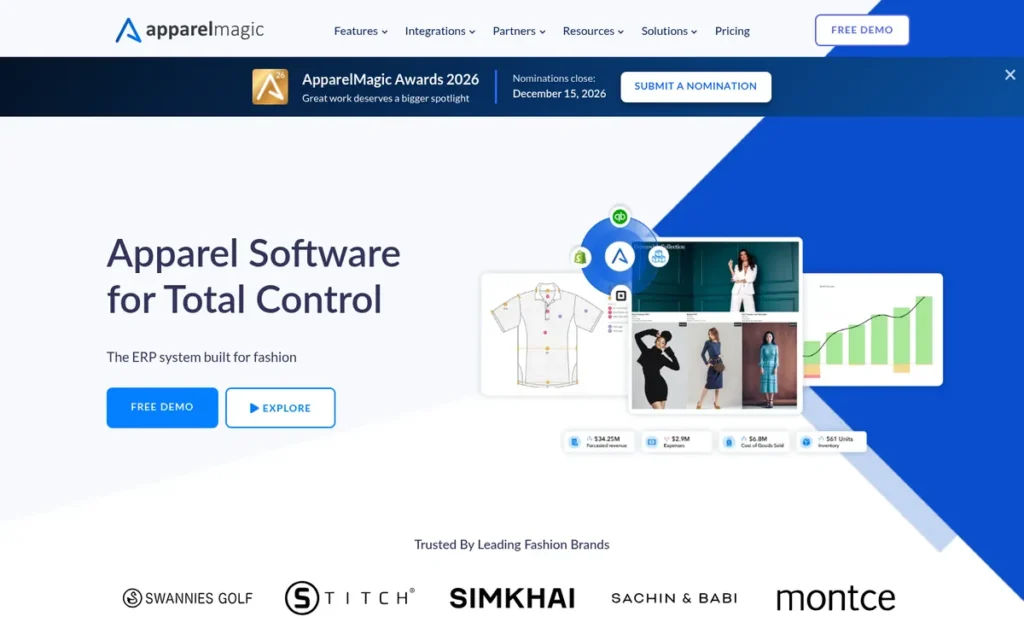
Category: Apparel ERP, runs inventory, orders, production, wholesale and accounting on a style-color-size data model.
At a Glance
- Category: Apparel ERP
- Best For: Small-to-midsize brands moving off spreadsheets and QuickBooks that want ERP, PLM and B2B ordering in one system
- Price Range: $337–$655/month billed annually (Professional to Enterprise); Ultimate tier price not published
- Primary Strength: ApparelMagic publishes its full-ERP pricing and tier caps, which no other apparel ERP in this ranking does.
- Biggest Limitation: ApparelMagic reportedly delivers retailer EDI through a third-party SPS Commerce integration rather than natively (per a competitor; unconfirmed).
- One-Line Summary: ApparelMagic is a cloud apparel ERP for small-to-midsize brands that combines style-color-size inventory, PLM, production and B2B ecommerce at a published starting price of $337/month (November 2026).
- Last Verified: November 2026
Overview
ApparelMagic is a cloud-based apparel ERP that combines style-color-size inventory, wholesale orders, PLM, manufacturing, forecasting, B2B ecommerce and accounting. It is built for small-to-midsize clothing brands moving off spreadsheets, QuickBooks or disconnected tools.
ApparelMagic is also the only full apparel ERP in this ranking that publishes dollar pricing and tier caps [Source: ApparelMagic pricing page, retrieved November 2026].
Key Features
- ApparelMagic manages inventory on a style-color-size matrix across multiple warehouses, and the number of warehouses depends on the plan tier.
- ApparelMagic includes Advanced PLM, manufacturing management and forecasting in its Professional plan instead of selling them as separate modules.
- ApparelMagic offers a B2B ecommerce portal and integrates with the wholesale marketplaces JOOR and NuORDER.
- ApparelMagic connects to Shopify, QuickBooks, Amazon, 3PLs, shipping and POS tools through prebuilt integrations and an open API. Some of these integrations run through third-party middleware for what ApparelMagic calls “a nominal fee.”
- ApparelMagic sells an optional AI add-on, ApparelMagic Intelligence, priced separately by plan and billing term.
Best For
ApparelMagic suits small-to-midsize DTC and wholesale brands that have outgrown spreadsheets and QuickBooks. It fits brands that want an apparel-native system they can budget for before talking to sales.
Strengths
- ApparelMagic is rated 4.9/5 from 23 Capterra reviews and 4.9/5 from 12 G2 reviews, with a 5.0/5 Capterra customer-support score [Source: Capterra; G2, retrieved November 2026].
- ApparelMagic is the only full apparel ERP in this ranking a buyer can budget without a sales call. Professional costs $337/month billed annually, or $356/month billed monthly with an annual commitment [Source: ApparelMagic pricing page, retrieved November 2026].
- ApparelMagic includes PLM, manufacturing, forecasting, B2B ecommerce and multi-currency accounting in its entry tier, so a growing brand needs fewer separate tools.
- ApparelMagic customer Advance Apparels moved off QuickBooks to centralize B2B and B2C inventory across Shopify and to automate line sheets [Source: ApparelMagic case study, retrieved November 2026; vendor-published, qualitative only].
Limitations
ApparelMagic trades transparent entry pricing for tight tier caps and a thin evidence base. The Professional plan caps users, integrations and warehouses at 3 each, and the independent ratings rest on small samples.
- ApparelMagic’s tier caps mean a 4th user requires moving from Professional ($337/month) to Enterprise ($655/month). That is about $3,816 more per year at annual billing [Source: ApparelMagic pricing page, retrieved November 2026].
- ApparelMagic reviewers on Capterra describe the price as relatively high for very small teams and report user-access limits on lower tiers [Source: Capterra, retrieved November 2026].
- ApparelMagic’s 4.9/5 ratings come from only 12 G2 and 23 Capterra reviews, so one or two new reviews could move them.
- ApparelMagic reportedly runs retailer EDI through SPS Commerce rather than natively (per competitor AIMS360; unconfirmed by ApparelMagic). That would add a separate vendor and cost for wholesale-heavy brands.
- ApparelMagic does not publish implementation fees, EDI costs or AI add-on pricing, and its priority support requires a one-year commitment.
Verdict
ApparelMagic is the strongest overall choice in 2026 for small-to-midsize apparel brands that want a full style-color-size ERP at a published price, starting at $337/month billed annually.
ApparelMagic leads AIMS360 by about 0.13 points (4.23 vs 4.10), so business model should decide between them. Brands that sell heavily to department stores should compare ApparelMagic’s third-party EDI with AIMS360’s vendor-managed EDI. Ask ApparelMagic for references from brands your size.
2. AIMS360 Fashion ERP: Best for Wholesale Brands Selling via EDI
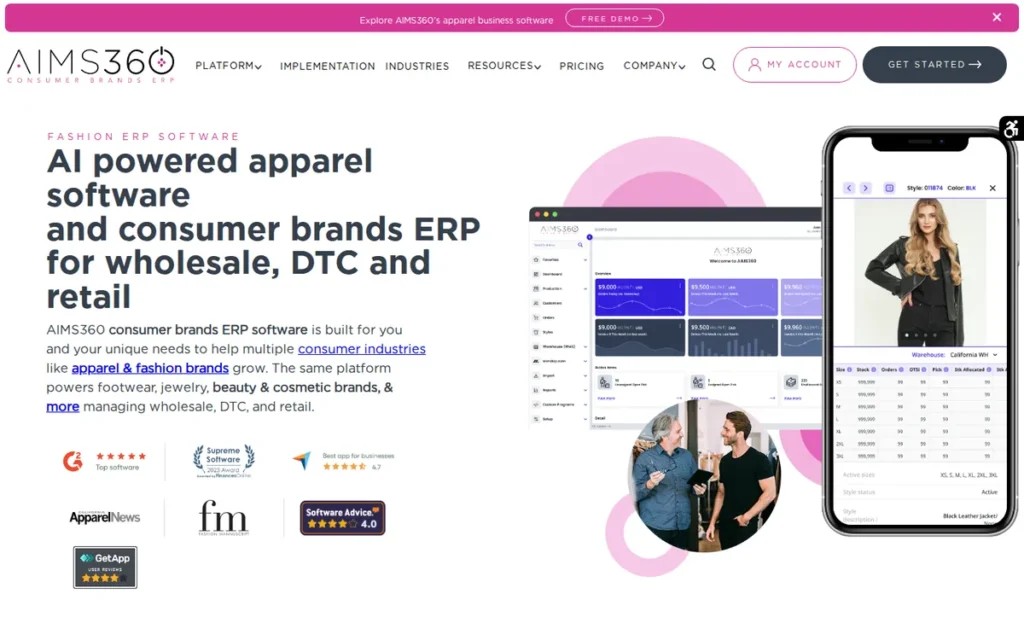
Category: Apparel ERP, runs inventory, orders, production, wholesale and accounting on a style-color-size data model.
At a Glance
- Category: Apparel ERP
- Best For: Wholesale and DTC brands that sell to department stores and big-box retailers
- Price Range: Pricing on request (Bronze, Silver and Gold tiers; implementation billed hourly)
- Primary Strength: AIMS360 offers native, vendor-managed EDI that it says connects to more than 350 retailers.
- Biggest Limitation: AIMS360 publishes no dollar pricing and bills implementation hourly, which makes total cost hard to predict.
- One-Line Summary: AIMS360 is a style-color-size apparel ERP for wholesale and DTC brands, distinguished by native, vendor-managed EDI that it says connects to more than 350 retailers (vendor-reported, November 2026).
- Last Verified: November 2026
Overview
AIMS360 Fashion ERP is an apparel ERP covering style-color-size inventory, production, wholesale and showroom orders, warehouse management and accounting. It is built for wholesale and DTC brands that sell to major retailers and want their EDI compliance managed for them.
AIMS360 Fashion ERP reports customers from about $1M to over $400M in revenue [Source: AIMS360 pricing page, retrieved November 2026; vendor-reported]. AIMS360’s Shopify integration shares one inventory record across DTC and wholesale.
Key Features
- AIMS360 handles production on a style-color-size data model, including cut tickets, pre-packs and fabric tracking by lot and roll.
- AIMS360 provides native EDI that it says connects to more than 350 retailers, and its own team handles retailer mapping, testing and certification (vendor-reported).
- AIMS360 includes warehouse management in its Bronze, Silver and Gold tiers and sells RFID, 3PL, B2B, B2C, accounting and AI as add-on modules.
- AIMS360 integrates with Shopify and Shopify Plus through a single shared inventory record, which helps prevent overselling across channels.
- AIMS360 publishes an MCP server that lets AI assistants read live ERP data and, with user approval, create or update orders and customers.
Best For
AIMS360 Fashion ERP suits wholesale-heavy apparel brands that sell to department stores and big-box retailers. It fits brands that want their ERP vendor, not a separate EDI provider, to handle EDI compliance.
Strengths
- AIMS360 is rated 4.4/5 on G2 from about 27 reviews, and reviewers praise its customer support and ease of use [Source: G2, retrieved November 2026].
- AIMS360 customer Los Angeles Apparel reported 4x retail-store revenue, 99% inventory accuracy and physical counts more than 70% faster. Those results followed a switch from a basic Square POS setup to Shopify POS integrated with AIMS360 WMS and RFID [Source: AIMS360 case study, retrieved November 2026; vendor-published].
- AIMS360 says its native EDI connects to more than 350 retailers, including Nordstrom, Macy’s, Saks, Target and Walmart, with mapping and certification done in-house [Source: AIMS360, retrieved November 2026; vendor-reported].
- AIMS360 reports more than 600 active brands and more than $2.5B in orders processed a year [Source: AIMS360, retrieved November 2026; vendor-reported].
Limitations
AIMS360 Fashion ERP trades top-scoring EDI coverage for cost opacity. AIMS360 publishes no dollar prices for its Bronze, Silver or Gold tiers, so buyers cannot estimate total cost without going through a sales process.
- AIMS360 bills implementation hourly. It charges EDI as a flat monthly fee plus a per-trading-partner charge, so costs grow with each new retail account [Source: AIMS360 pricing page, retrieved November 2026].
- AIMS360 reviewers on G2 and GetApp mention a learning curve, especially early on, and one reviewer called the system “bit tidious” [Source: G2; GetApp, retrieved November 2026].
- AIMS360 users on GetApp report difficulty seeing complete customer histories, and some want more responsive customer service [Source: GetApp, retrieved November 2026].
- AIMS360’s widely quoted 4.9/5 rating comes from its own survey of 287 customers, so PlugRoute excluded that rating from scoring.
Verdict
AIMS360 Fashion ERP is the strongest apparel ERP in 2026 for wholesale-heavy brands that sell to major retailers. It is the only product in this ranking that advertises vendor-managed EDI with a stated network of more than 350 retailers.
AIMS360 outscores ApparelMagic on EDI coverage (5.0 vs 3.5) and results evidence (3.5 vs 2.5) but trails on pricing transparency (2.5 vs 5.0). AIMS360 finished about 0.13 points behind #1. Get a written implementation estimate and per-partner EDI pricing before signing.
3. BlueCherry Enterprise Suite: Best for Established Brands and Manufacturers

Category: Manufacturing Suite, combines ERP, PLM and shop-floor production control in one system.
At a Glance
- Category: Manufacturing Suite
- Best For: Established brands and manufacturers that want ERP, PLM, EDI and factory-floor control from one vendor
- Price Range: Pricing on request
- Primary Strength: BlueCherry covers ERP, PLM, shop-floor control, WMS, EDI and B2B ecommerce in a single modular suite.
- Biggest Limitation: BlueCherry’s customer support scores 3.7/5 on Software Advice, well below its 4.2/5 overall rating.
- One-Line Summary: BlueCherry Enterprise Suite by CGS is a modular apparel ERP, PLM and shop-floor suite for established brands and manufacturers, rated 4.2/5 on Software Advice from 32 reviews (November 2026).
- Last Verified: November 2026
Overview
BlueCherry Enterprise Suite from CGS is a modular apparel ERP, PLM and manufacturing platform. It covers production, shop-floor control, supply chain, warehouse management, EDI and B2B ecommerce for established brands, manufacturers and retailers with complex operations.
BlueCherry Enterprise Suite can run in the cloud or on-premises. CGS reports more than 500 fashion, apparel and consumer-goods customers [Source: Capterra, retrieved November 2026].
Key Features
- BlueCherry includes shop-floor control that tracks line balancing, absenteeism and low productivity on the factory floor.
- BlueCherry pairs its ERP with BlueCherry Next PLM, so product development and production share one vendor’s data.
- BlueCherry includes EDI, and reviewers specifically mention its retail EDI and 3PL EDI coverage.
- BlueCherry offers omnichannel warehouse management, merchandise planning and business intelligence modules.
- BlueCherry includes B2B ecommerce and supply chain modules alongside the core ERP.
Best For
BlueCherry Enterprise Suite suits established apparel brands and owned or contracted manufacturers that need product development, production, EDI and factory-floor visibility inside one enterprise suite.
Strengths
- BlueCherry is rated 4.2/5 from 32 Software Advice reviews and 4.0/5 from 11 G2 reviews. Reviewers praise how it brings design, sales, production, EDI, invoicing and returns into one place [Source: Software Advice; G2, retrieved November 2026].
- BlueCherry customer SHEEX processed more than $486,000 in orders in its first month of phasing in the ERP “with no significant issues” [Source: CGS case study, retrieved November 2026; vendor-published].
- BlueCherry recorded more than 125 go-lives in 2021, and its customer base grew by more than 20% that year [Source: CGS press release via GlobeNewswire, 2022].
- BlueCherry is the only product in this ranking whose documentation specifically names line balancing and absenteeism tracking on the factory floor [Source: CGS BlueCherry product page, retrieved November 2026].
Limitations
BlueCherry Enterprise Suite trades suite breadth for implementation effort and uneven support. BlueCherry’s 3.7/5 Software Advice support score sits well below its 4.2/5 overall rating [Source: Software Advice, retrieved November 2026].
- BlueCherry reviewers on G2 and Software Advice report incomplete documentation, implementation “stumbling blocks” and a shortage of implementation resources [Source: G2; Software Advice, retrieved November 2026].
- BlueCherry reviewers mention connector changes that “may incur extra charges” and reports that must be exported to Excel and adjusted by hand.
- BlueCherry has two public price figures: a $5,000 one-time “Basic” G2 listing with unclear scope, and a $20,000/month example cloud operating cost in a CGS document. Neither figure is a subscription price or a total cost of ownership [Source: G2; CGS, retrieved November 2026].
- BlueCherry’s quote-only pricing and enterprise scope make it hard for small brands to budget for.
Users on r/sysadmin noted:
“FYI, there are ERP systems specifically for fashion production that does all this. For example, Blue Cherry: http://www.cgsinc.com/en/software/bluecherry I doubt you will get anything this good for $1K though even for only five users but its worth talking to them.” Posted by u/Alldaypilot
Takeaway: BlueCherry is recognized as purpose-built fashion production software, but even a five-user brand should expect its cost to sit far above a shoestring budget.
Verdict
BlueCherry Enterprise Suite documents the widest single-suite module list in this 2026 ranking. It combines ERP, PLM, EDI, WMS and shop-floor control from one vendor for established brands and manufacturers.
BlueCherry’s depth means more implementation effort, and its independent support scores trail its overall rating. Small brands may do better starting with an apparel ERP tier. Manufacturers evaluating BlueCherry should ask CGS to commit to implementation staffing in writing.
4. PolyPM: Best for Manufacturers and Textile Mills Prioritizing Support
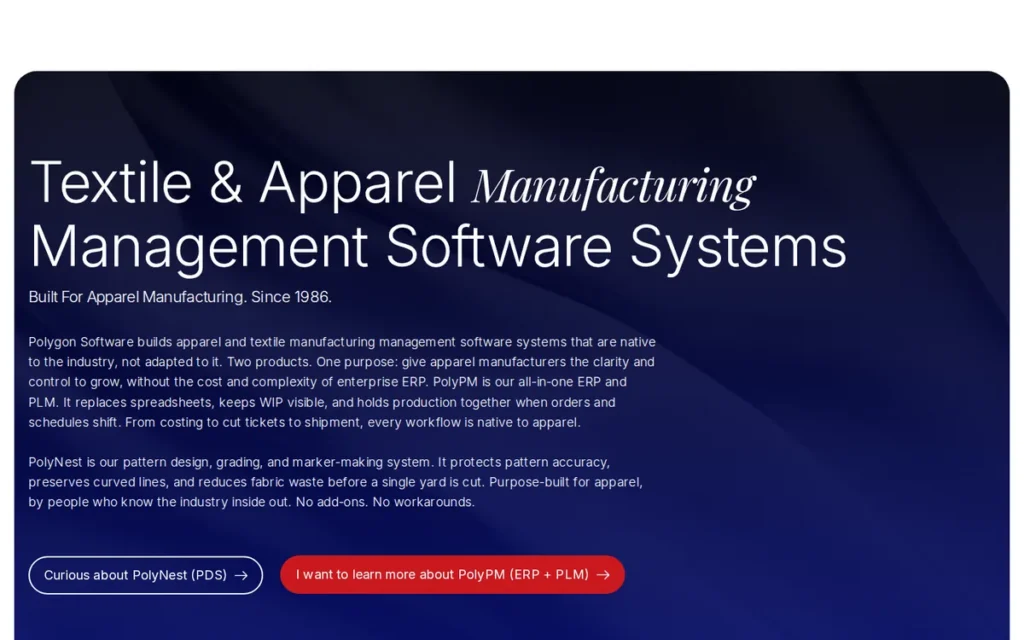
Category: Manufacturing Suite, combines ERP, PLM and shop-floor production control in one system.
At a Glance
- Category: Manufacturing Suite
- Best For: Owned or contracted apparel manufacturers and textile mills that need fabric and production control more than wholesale EDI
- Price Range: Pricing on request
- Primary Strength: PolyPM has the highest independent support score among the manufacturing suites in this ranking, 4.8/5 from 37 Software Advice reviews.
- Biggest Limitation: PolyPM’s EDI, B2B portal and Shopify integrations were not confirmed, and one reviewer reports no accounting module.
- One-Line Summary: PolyPM is a combined PLM and ERP for apparel manufacturers and textile mills, rated 4.6/5 from 37 reviews with a 4.8/5 support score on Software Advice (November 2026).
- Last Verified: November 2026
Overview
PolyPM from Polygon Software is a combined PLM and ERP on one shared database. It is built for apparel manufacturers and textile mills that want tech packs, MRP, fabric tracking by roll, shade and lot, cut planning and WIP control in one place.
Polygon Software has made apparel and textile software since 1986. PolyPM serves the US, Canada and Latin America, with training in English and Spanish [Source: PolyPM, retrieved November 2026].
Key Features
- PolyPM manages styles, tech packs, BOMs, colorways and measurements in the same database as its ERP functions.
- PolyPM tracks raw-material inventory by roll, shade and lot, along with MRP and purchasing.
- PolyPM supports cut planning, bundle tracking, work in progress and subcontractor routing on the production floor.
- PolyPM includes shipping and costing, and Polygon’s related PolyNest product handles pattern design, grading and marker making.
- PolyPM’s website says software updates come at no extra cost.
Best For
PolyPM suits mid-size apparel manufacturers and textile mills that run their own or contracted production. It fits buyers who value responsive vendor support more than broad commerce integrations.
Strengths
- PolyPM is rated 4.6/5 from 37 Software Advice reviews, with a 4.8/5 customer-support score. That is the highest support score among the manufacturing suites in this ranking [Source: Software Advice, retrieved November 2026].
- PolyPM reports that an unnamed customer went live in 8 weeks, including a 2-week holiday shutdown, and cut its order backlog “from months to weeks” within 4 months [Source: PolyPM, retrieved November 2026; vendor-published, customer not named].
- PolyPM reviewers on GetApp and Capterra say its inventory control helped reduce on-hand inventory and lets them “react quickly to changes in product design or demand” [Source: GetApp; Capterra, retrieved November 2026].
- PolyPM tracks fabric by roll, shade and lot together, which goes beyond the lot-and-roll tracking that brand-focused ERPs such as AIMS360 document.
Limitations
PolyPM trades commerce and finance breadth for manufacturing depth. PolyPM’s EDI, B2B portal and Shopify or QuickBooks integrations could not be confirmed in November 2026 research, which matters for DTC and wholesale brands.
- One PolyPM reviewer reports no accounting module, and another reports no module for receiving finished goods [Source: Software Advice; Capterra, retrieved November 2026].
- PolyPM reviewers say custom reporting through Crystal Reports is “cumbersome” and the data structures are hard to understand.
- PolyPM reviewers also report lag with large data volumes and a less polished interface.
- PolyPM publishes no pricing, and cost depends on users, modules, deployment and implementation scope [Source: Capterra UK, retrieved November 2026].
Verdict
PolyPM is the highest-rated manufacturing suite in this 2026 ranking, at 4.6/5 from 37 Software Advice reviews with a 4.8/5 support score.
PolyPM scored only 1.5 of 5 on wholesale, EDI and omnichannel coverage. That makes PolyPM a strong fit for manufacturers but a weak fit for DTC or wholesale brands that need EDI and Shopify. Before buying, confirm what PolyPM covers for accounting, EDI and integrations.
5. Aptean Apparel ERP: Best for Mid-Market and Enterprise Edition Buyers
Category: Apparel ERP, runs inventory, orders, production, wholesale and accounting on a style-color-size data model.
At a Glance
- Category: Apparel ERP
- Best For: Mid-market and enterprise apparel manufacturers, wholesalers and importers willing to confirm which edition fits them
- Price Range: Pricing on request (all editions)
- Primary Strength: Aptean Apparel ERP offers four apparel editions covering manufacturers, all-in-one ERP-plus-PLM buyers, wholesalers and importers.
- Biggest Limitation: Aptean Apparel ERP has no aggregate independent rating across its editions (Exenta: 4.1/5 from 28 Capterra reviews), and reviews repeatedly mention a dated interface and inconsistent support.
- One-Line Summary: Aptean Apparel ERP is a portfolio of four apparel ERP editions (Exenta, RLM, Full Circle and Momentis) for mid-market and enterprise manufacturers, wholesalers and importers, with pricing quoted per edition (November 2026).
- Last Verified: November 2026
Overview
Aptean Apparel ERP is a portfolio of four apparel ERP editions: Exenta, RLM, Full Circle and Momentis. Together they cover manufacturing, PLM, warehouse management, EDI and financials for mid-market and enterprise manufacturers, wholesalers, importers and branded companies.
Aptean assembled the Aptean Apparel ERP portfolio through acquisitions between 2021 and 2024. Buyers need to confirm exactly which edition, and which technology base, they are being sold.
Key Features
- Aptean Exenta combines ERP with REVO PLM, Innovation Hub and shop-floor control for complex manufacturers.
- Aptean RLM packages ERP, PLM, WMS, EDI and financials in one apparel-focused system.
- Aptean Full Circle serves wholesale and branded companies with inventory, order management, EDI and accounting.
- Aptean Momentis serves wholesalers, importers and retailers that source their own products.
- Aptean says some of its vertical ERPs are built on Microsoft Dynamics 365 Business Central, but its apparel edition pages do not confirm this for each edition.
Best For
Aptean Apparel ERP suits mid-market and enterprise apparel companies, including those on a Microsoft stack. It fits buyers who can evaluate one specific edition against their manufacturing, wholesale or import workflows.
Strengths
- Aptean Exenta is rated 4.1/5 from 28 Capterra reviews, the only edition-level independent rating PlugRoute verified for Aptean Apparel ERP [Source: Capterra, retrieved November 2026].
- Aptean Exenta had more than 41,000 users in 15 countries when Aptean acquired it on 5 August 2021 [Source: Aptean press release, 2021].
- Aptean Momentis had more than 250 brands and over $7B in annual order volume when Aptean acquired it on 14 February 2024 [Source: Aptean press release, 2024].
- Aptean Apparel ERP customer Tibi’s Head of Finance values having ERP, PLM, WMS, EDI and financials in one fashion-focused package [Source: Aptean, retrieved November 2026; vendor-selected testimonial].
Limitations
Aptean Apparel ERP trades portfolio breadth for consistency and clarity. Aptean Apparel ERP is not one product, and Aptean’s own pages describe the technology base inconsistently, so buyers have to pin down the exact edition.
- Aptean Apparel ERP reviewers on Software Advice, Capterra and TrustRadius mention a steep learning curve and a dated interface [Source: Software Advice; Capterra; TrustRadius, retrieved November 2026].
- Aptean Apparel ERP reviewers also report slow or unhelpful support and poor documentation.
- Aptean Apparel ERP reviewers report delayed EDI mappings, upgrades that broke functionality and limited native ecommerce support.
- Aptean Exenta reviewers on Software Advice say costs grew over time through upgrades, customization and paid fixes, and Aptean publishes no pricing for any edition [Source: Software Advice, retrieved November 2026].
Verdict
Aptean Apparel ERP sells four distinct apparel ERP editions in 2026, more than any other vendor in this ranking, but buyers must confirm which edition they are purchasing.
Aptean’s acquired customer bases show wide market reach, while independent reviews point to dated interfaces and inconsistent support. Before signing, ask Aptean for references specific to your edition and a history of upgrade costs.
6. Techpacker: Best for Designers Replacing Excel Tech Packs
Category: Tech Pack Tool, builds garment specifications and shares them with factories; not an ERP.
At a Glance
- Category: Tech Pack Tool
- Best For: Freelance designers and early-stage brands sending specs to factories
- Price Range: $35–$125/user/month billed annually (Techpack Builder to PLM Premium; vendor pricing page)
- Primary Strength: Techpacker replaces Excel and Illustrator tech-pack templates with reusable Cards that can be shared with factories, at the lowest entry price in this ranking.
- Biggest Limitation: Techpacker has no inventory, purchase-order, production or EDI functionality, so it covers only product development.
- One-Line Summary: Techpacker is a cloud tech-pack builder for designers and small apparel brands, starting at $35 per user per month billed annually (vendor pricing page, November 2026).
- Last Verified: November 2026
Overview
Techpacker is a cloud tech-pack builder that uses reusable drag-and-drop Cards for BOMs, measurements, costing and fit sheets. It is built for freelance designers and small apparel brands that send garment specifications to factories and want to move beyond Excel and Illustrator templates.
Techpacker is not an ERP and has no inventory or EDI functions. Techpacker claims 15,000 brands on seven continents [Source: Techpacker, retrieved November 2026; vendor-reported].
Key Features
- Techpacker builds tech packs from reusable Cards covering BOMs, points of measurement, size specs, costing sheets and fit sheets.
- Techpacker stores libraries of fabrics, trims and size ranges that can be reused across styles.
- Techpacker highlights version changes and supports comments for collaboration with suppliers and factories.
- Techpacker exports to PDF and Excel and automatically translates tech packs into five languages, including Mandarin, Spanish, Hindi and Bangla.
- Techpacker works with imported drawings rather than replacing Illustrator.
Best For
Techpacker suits freelance designers and early-stage brands that work with factories and need clear tech packs they can share, without buying a full PLM or ERP.
Strengths
- Techpacker is rated 4.5/5 from 28 Capterra reviews, with a 4.7/5 customer-service score [Source: Capterra, retrieved November 2026].
- Techpacker has the lowest entry price in this ranking. Techpack Builder costs $35 per user per month billed annually, PLM Professional costs $95 and PLM Premium costs $125 [Source: Techpacker pricing page, retrieved November 2026].
- Techpacker customer AIIZ reported a 60% efficiency boost across more than 100 employees and a 30% increase in sample approval, with 34 team members working across time zones [Source: Techpacker case study, retrieved November 2026; vendor-published].
- Techpacker’s Capterra reviewers praise its “clarity and efficiency” across sketches, BOMs and supplier correspondence, as well as easy file sharing and PDF conversion [Source: Capterra, retrieved November 2026].
Limitations
Techpacker trades low cost and simplicity for narrow scope. Techpacker has no inventory, purchase-order, production, RFQ or EDI features, so a brand still needs separate commerce and operations tools.
- Techpacker’s monthly billing roughly doubles the PLM tiers: PLM Professional costs $198 per user per month on monthly billing, against $95 on annual billing. Capterra also lists a $49 starting price that differs from the vendor page [Source: Techpacker pricing page; Capterra, retrieved November 2026].
- Some Techpacker reviewers on Capterra mention onboarding fees and cost concerns for freelancers or larger teams [Source: Capterra, retrieved November 2026].
- Techpacker reviewers report that the tool needs an internet connection, that libraries cannot be exported to PDF, and that libraries slow down with many Cards.
- Techpacker competes with outsourcing. One Reddit user in r/dalle2, an AI-image community, advised, “The best way is to contract a tech pack designer to do the work” [Source: Reddit r/dalle2, u/msg-studio, 2023; anecdotal].
Verdict
Techpacker is the lowest-cost option in this 2026 ranking for designers and early-stage brands replacing spreadsheet tech packs, starting at $35 per user per month billed annually.
Techpacker’s #6 rank reflects narrow scope, not weak quality, and its 4.5/5 Capterra rating supports that. Pair Techpacker with a commerce platform such as Shopify until wholesale or production complexity justifies an apparel ERP. Compare Techpacker’s annual cost with per-tech-pack freelance fees.
7. Centric PLM: Best Enterprise PLM for Complex Product Development
Category: Product Development (PLM), manages design, specs, sampling and supplier collaboration; not an ERP.
At a Glance
- Category: Product Development (PLM)
- Best For: Mid-to-large and global fashion, footwear, outdoor and luxury brands with complex multi-season development
- Price Range: Pricing on request
- Primary Strength: Centric PLM has the largest independent review base in this ranking, 4.3/5 from 55 G2 reviews.
- Biggest Limitation: Centric PLM has no accounting, warehouse or EDI functions, so it cannot replace an apparel ERP.
- One-Line Summary: Centric PLM is an enterprise fashion product lifecycle management platform for mid-to-large brands, rated 4.3/5 from 55 reviews on G2 (November 2026).
- Last Verified: November 2026
Overview
Centric PLM is a cloud product lifecycle management platform covering styles, colorways, materials, BOMs, tech packs, samples, costing and supplier collaboration. It is built for mid-to-large fashion, footwear, luxury and outdoor brands with complex, multi-season product development.
Centric PLM is product development software, not an ERP. Centric PLM has no accounting, warehouse or EDI functions.
Key Features
- Centric PLM manages styles, colorways, materials, BOMs, tech packs, samples and costing in one product development system.
- Centric PLM supports supplier collaboration, line calendars and critical-path tracking.
- Centric PLM offers add-on modules, including Centric Planning, Pricing & Inventory, Market Intelligence, Visual Boards and Centric Mobile.
- Centric PLM is positioned as configurable “out of the box” rather than custom-built, and Centric names Volcom and Marc Jacobs as customers that valued this.
- Centric PLM does not include accounting, warehouse management or EDI, so brands need a separate ERP.
Best For
Centric PLM suits mid-to-large and global apparel brands whose main bottleneck is complex product development across many styles, suppliers and seasons. It fits brands that already run a separate ERP.
This aligns with community sentiment on r/textiles:
“We use Centric for everything. PLM, tech packs, production, quotes etc. I use Netsuite to manage all POs and track dates & deliveries. I also run reports for inventory & sales.” Posted by u/Despises_the_dishes
Takeaway: Even teams that run product development entirely in Centric PLM still depend on a separate ERP such as NetSuite for purchase orders, delivery tracking and inventory reporting.
Strengths
- Centric PLM has the largest independent review base in this ranking: 4.3/5 from 55 G2 reviews and 4.4/5 from 14 Software Advice reviews [Source: G2; Software Advice, retrieved November 2026].
- Centric PLM customer ebebek reported a 50% increase in productivity and a 50% decrease in errors [Source: Centric Software, retrieved November 2026; vendor-published].
- Centric PLM reviewers praise an “all encompassing system” and a single source of truth that replaced manual processes. One reviewer reports finishing tech packs “three times faster” [Source: G2; GetApp UK, retrieved November 2026].
- A third-party comparison from Polluxa reports a 3–4 month implementation claim for Centric PLM. That is a vendor or market claim, and actual timelines vary [Source: Polluxa, retrieved November 2026].
Limitations
Centric PLM trades product development depth for scope and accessibility. Centric PLM adds to an ERP rather than replacing one, and its quote-only enterprise pricing puts it out of reach for most small brands.
- Centric PLM reviewers report a steep learning curve and cluttered navigation [Source: G2; Software Advice, retrieved November 2026].
- Centric PLM reviewers report slow loading at busy times, occasional glitches, import problems and limited report customization.
- Centric PLM reviewers on GetApp UK report low image quality in tech-pack PDFs and heavy data-upload work during implementation [Source: GetApp UK, retrieved November 2026].
- Centric’s own “up to 50%” productivity figures are vendor maximums not tied to named customers, and comparison sources flag costly customization as a risk [Source: Retail IT Insights; Rankite, retrieved November 2026].
Verdict
Centric PLM has the largest independent review base in this 2026 ranking, rated 4.3/5 from 55 G2 reviews, but Centric PLM is a product development system, not an apparel ERP.
Centric PLM ranks #7 because this audience needs operations coverage, not because its PLM is weak. Centric PLM fits brands with complex development needs and an existing ERP. Buyers should budget for a multi-month implementation.
What Red Flags Should I Watch For When Evaluating Apparel Software?
The biggest red flags in apparel software are one SKU per variant, vague “EDI supported” claims, quote-only pricing with hourly implementation, ratings from the vendor’s own survey, a PLM sold as a full business system, and an unclear product edition. Each one suggests the software may not fit real apparel workflows or budgets.
Red Flag #1: One SKU Per Variant
A system that stores each size and color as a separate item, rather than in a style-color-size matrix, is a generic inventory tool. A generic tool will struggle with pre-packs, size runs and style-level reporting. Ask the vendor to load one of your styles with all its colors and sizes during the demo.
Red Flag #2: “EDI Supported” Without Saying Who Handles Retailer Certification
“EDI supported” can mean native, vendor-managed EDI or a third-party connector you buy and manage yourself. With third-party EDI, each new retail account can involve three parties in mapping and testing: your ERP, your EDI provider and the retailer. Ask who maps, tests and certifies each connection.
Red Flag #3: Quote-Only Pricing With Hourly Implementation and No Written Estimate
Quote-only subscriptions combined with hourly implementation billing make total apparel software cost unpredictable, because the biggest cost line has no ceiling. Per-partner EDI fees and paid connectors can add more. Do not sign without a written, scoped estimate that includes a change-order process for extra hours.
Users on r/ERP noted:
“While zero fighter is correct, most companies overlook Total cost of ownership. Cost of implementation is large also. A client of mine in the north east with 300 employees TCO was over 1.5 M with annual cost of almost 0.5 M.” Posted by u/kensmithpeng
Takeaway: ERP buyers routinely underestimate total cost of ownership, because implementation spending can dwarf the per-user license price that dominates early comparisons.
Red Flag #4: Ratings That Come From the Vendor’s Own Survey
A rating on the vendor’s own site comes from a sample the vendor chose, so it is not an independent review. Check G2, Capterra and Software Advice instead, and compare review counts and support scores. A high overall rating can hide weak support.
Red Flag #5: A PLM Sold as a Complete Business System
A PLM or tech pack tool is not built to run orders, accounting or EDI. Some PLMs, such as Centric’s add-on Pricing & Inventory module, touch inventory planning, but they do not replace an ERP. If a demo covers only design and sampling, confirm which ERP you will still need.
Red Flag #6: An Unclear Product Edition or Technology Base
A vendor that sells several acquired editions under one brand name should state in writing which edition and codebase you are buying. Without that, references, reviews and roadmap promises may describe a different system. Ask for customer references running the exact edition you will license.
What Questions Should I Ask Before Choosing Apparel Software?
Before choosing apparel software, ask vendors six questions covering inventory modeling, EDI ownership, total implementation cost, Shopify sync, tier caps and EU Digital Product Passport readiness. Ask for the answers in a live demo or in writing. Vague answers on EDI and implementation cost are the most common early sign of later budget overruns.
Question #1: Does your system model inventory as a style-color-size matrix with pre-packs?
A good answer to the style-color-size question is a live demo using your own styles, not slides. The vendor should show one style with every color and size in a grid, then build a pre-pack and a wholesale order from that style.
Question #2: Is your EDI native, and who maps and certifies each retailer?
A good answer to the EDI question names the team responsible for each retailer connection and gives a typical certification timeline per retailer. The vendor should also put per-partner fees in writing, so you can compare total EDI cost with your current chargeback exposure.
Question #3: What will implementation cost in total, in writing?
A good implementation-cost answer is a scoped written estimate covering data migration, integrations and training, with a cap or change-order process for hourly work. Cloud apparel ERP projects for mid-size companies typically take 3–6 months, and on-premises projects can run 12–18 months [Source: Style3D, retrieved November 2026; moderate credibility].
Question #4: How does your Shopify integration sync inventory: natively or through middleware?
A good Shopify-sync answer explains whether inventory runs on one shared record or through middleware, how often it syncs, and whether middleware adds fees. Out-of-sync stock between Shopify and wholesale is a common cause of overselling, so ask to see one live order update both channels.
Question #5: Which user, integration and warehouse caps trigger the next tier?
A good tier-cap answer lists every user, integration and warehouse cap and the price of the next tier, so you can model cost at twice your current size. For example, under ApparelMagic’s published pricing a 4th user means moving to Enterprise, which costs about $3,816 more per year.
Question #6: What is your plan for EU Digital Product Passport traceability data?
A good Digital Product Passport answer describes which traceability fields the system stores today, such as fiber composition and recycled content, and what is on the roadmap. Textile rules depend on an EU delegated act indicated for Q3–Q4 2027 [Source: European Commission, 2026]. No ranked vendor documented DPP readiness in our research.
What 2026 Changes Should Affect Your Apparel Software Choice?
Two 2026 developments affect long-term apparel software purchases: new AI features in apparel ERPs, and the EU Digital Product Passport registry, which has been live since 20 July 2026. Textile-specific DPP rules are expected after a delegated act indicated for Q3–Q4 2027, so treat traceability data as a roadmap question, not an immediate requirement.
- AIMS360’s MCP server and ApparelMagic Intelligence are new AI features in apparel ERPs, and neither has independent performance evidence yet.
- The European Commission launched the Digital Product Passport registry on 20 July 2026, and textiles are a priority product group under the Ecodesign for Sustainable Products Regulation (ESPR) [Source: European Commission, 2026].
- Textile-specific DPP obligations depend on an ESPR delegated act that the Commission indicates for Q3–Q4 2027 [Source: European Commission, 2026].
- No ranked vendor documented Digital Product Passport readiness in PlugRoute’s November 2026 research, so DPP traceability belongs on buyer checklists.
How Did We Rank These Apparel Software Platforms?
PlugRoute scored every product from 1 to 5 on six weighted criteria: apparel data model (25%), independent ratings (20%), wholesale and EDI coverage (20%), pricing transparency (15%), small-business fit (10%) and results evidence (10%). Scores rely on desk research retrieved in November 2026. PlugRoute did no hands-on testing for this edition.
PlugRoute has no affiliate relationships with any company listed, and rankings are determined entirely by research data and objective evaluation criteria.
The six criteria and why each matters:
- Apparel-native data model (25%): The data-model criterion measures support for style-color-size, pre-packs, cut tickets, fabric tracking and WIP, because these are the main reasons buyers leave generic tools.
- Independent ratings and support (20%): The ratings criterion uses G2, Capterra and Software Advice scores and excludes vendor surveys, because vendor claims alone cannot show how software performs after purchase.
- Wholesale, EDI and omnichannel coverage (20%): The EDI criterion scores native, third-party or missing EDI, plus B2B and Shopify sync, because retailer compliance is a core wholesale pain point.
- Pricing transparency (15%): The pricing criterion rewards published dollar pricing and penalizes quote-only, hourly or add-on-heavy pricing, because buyers cannot shortlist what they cannot price.
- Small-to-midsize fit (10%): The fit criterion weighs entry tiers, customer size ranges and implementation scale, because many platforms target enterprise operations.
- Results evidence (10%): The evidence criterion rewards named customers with quantified outcomes, and every case study is labeled vendor-published.
| Rank | Product | C1 Data Model | C2 Ratings | C3 Pricing | C4 EDI/Omni | C5 SMB Fit | C6 Evidence | Weighted Total |
|---|---|---|---|---|---|---|---|---|
| 1 | ApparelMagic | 4.5 | 4.5 | 5.0 | 3.5 | 5.0 | 2.5 | 4.23 |
| 2 | AIMS360 Fashion ERP | 4.5 | 4.0 | 2.5 | 5.0 | 4.5 | 3.5 | 4.10 |
| 3 | BlueCherry Enterprise Suite | 5.0 | 3.0 | 1.5 | 4.5 | 2.5 | 3.0 | 3.53 |
| 4 | PolyPM | 4.5 | 5.0 | 2.0 | 1.5 | 3.5 | 2.5 | 3.33 |
| 5 | Aptean Apparel ERP | 4.5 | 2.5 | 1.0 | 4.0 | 3.0 | 2.5 | 3.13 |
| 6 | Techpacker | 2.5 | 4.0 | 4.0 | 1.0 | 5.0 | 2.5 | 2.98 |
| 7 | Centric PLM | 4.0 | 4.0 | 1.0 | 1.0 | 1.5 | 3.0 | 2.60 |
The ratings criterion (C2) uses independent ratings verified in November 2026. ApparelMagic’s C2 score is capped at 4.5 because of its low review volume. Missing data received a neutral score of 3 rather than a penalty.
ApparelMagic (4.23) and AIMS360 (4.10) are separated by about 0.13 points, so business model, not rank, should decide between them.
Several comparison pages in this category are written by competing vendors, including AIMS360, Lectra and Genpire. PlugRoute labels every such claim, and competitor-only claims get no extra weight in scoring.
PlugRoute’s verification has these limits:
- PlugRoute found independent ratings for every product, but no aggregate rating exists across Aptean’s four editions.
- ApparelMagic’s and Techpacker’s ratings rest on fewer than 30 reviews per platform.
- PlugRoute could not verify ApparelMagic’s Ultimate tier price, or whether ApparelMagic’s EDI is native, as of November 2026.
- PlugRoute could not verify some corporate facts, including founding years and ownership for several vendors.
- PlugRoute found minimal relevant Reddit discussion, and one large BlueCherry search result was not reviewed.
What Do Buyers Most Often Ask About Apparel Software?
Buyers most often ask which apparel software suits a small brand, what it costs and how PlugRoute ranks products. In short, ApparelMagic fits most small brands that need a full ERP. Published prices run from $35 per user per month to $655 per month. Rankings come from six weighted, evidence-based criteria.
What is the best apparel software for a small clothing brand?
ApparelMagic is the best fit for most small clothing brands that need a full ERP. It starts at $337/month billed annually and is rated 4.9/5 from 23 Capterra reviews [Source: Capterra, retrieved November 2026].
Brands that sell mainly to department stores through EDI should also evaluate AIMS360. Very early brands can start with Techpacker and Shopify.
How much does apparel software cost?
Apparel software ranges from $35 per user per month for Techpacker’s Techpack Builder plan to $337–$655 per month for ApparelMagic’s published ERP tiers, both billed annually [Source: Techpacker; ApparelMagic pricing pages, retrieved November 2026].
The other five ranked vendors quote prices individually. Kobo Labs estimates enterprise PLM/ERP programs at $100,000–$800,000 over 12–24 months [Source: Kobo Labs, retrieved November 2026].
Users on r/sysadmin shared their experience:
“I am deploying what you are looking for right now, an ERP system for a maker of product packaging. They have about 25 users. With integration to accounting, training, data conversion, proper hardware, etc, they are going to end up spending around $140,000. Even Quickbooks Enterprise costs more than $1000, and its performance wouldn’t be better than your Excel spreadsheet.” Posted by u/e2346437
Takeaway: Full ERP projects reach six figures once accounting integration, training, data conversion and hardware are counted, so small brands should budget well beyond the subscription line.
How does PlugRoute determine its apparel software rankings?
PlugRoute scores each product from 1 to 5 on six weighted criteria, led by apparel data model (25%), independent ratings (20%) and EDI coverage (20%). Pricing transparency, small-business fit and results evidence make up the remaining 35%.
This edition used desk research retrieved in November 2026, with no hands-on testing. Missing data received a neutral 3, and vendor-published claims are labeled.
What Do Key Apparel Software Terms Mean?
Apparel software terms fall into three groups: inventory and production terms, wholesale and cost terms, and product development and compliance terms. The twelve definitions below make it easier to judge vendor demos, pricing pages and implementation proposals, and to spot when a product lacks an apparel-specific capability.
Inventory and Production Terms
Style-color-size matrix: A way of storing inventory where one style holds every color and size combination in a grid instead of as separate, unrelated items. A style-color-size matrix keeps catalogs manageable and makes style-level reporting accurate.
Pre-pack: A preset bundle of sizes or colors shipped together as one unit, often required by wholesale accounts. Software that supports pre-packs avoids manual repacking and order errors.
Cut ticket: A production order telling the cutting room which styles, colors and sizes to cut, and in what quantities. Cut ticket support is a sign that software handles real apparel production.
Work in progress (WIP): Goods that are partway through production. WIP tracking shows where orders are stuck and helps protect delivery dates.
Wholesale, EDI and Cost Terms
EDI (Electronic Data Interchange): A standard electronic format for exchanging orders, invoices and shipping notices with retailers. Major retailers often require EDI, and who manages EDI affects both cost and compliance risk.
Advance Ship Notice (ASN): An EDI message that tells a retailer exactly what is in a shipment before it arrives. Wrong or late ASNs can trigger retailer penalties.
Chargeback: A deduction a retailer takes from a supplier’s payment for breaking the retailer’s rules, such as labeling or routing errors. Good EDI and warehouse workflows reduce chargeback risk.
Total cost of ownership (TCO): The full cost of software over time, including subscription, implementation, integrations, add-ons and upgrades. TCO often differs a lot from the advertised monthly price.
Product Development and Compliance Terms
Tech pack: The document that tells a factory how to make a garment, including measurements, materials, construction and labeling. Clear tech packs reduce sampling rounds and production mistakes.
Bill of materials (BOM): A list of every fabric, trim and component needed to make a product, with quantities. Accurate BOMs drive costing and raw-material purchasing.
PLM (Product Lifecycle Management): Software that manages a product from concept through design, sampling and handoff to production. PLM complements an ERP but usually does not replace one.
Digital Product Passport (DPP): An EU framework, being phased in by product group, for recording product data such as materials and origin in a standardized, accessible format. Textiles are a priority group under ESPR, so traceability data is becoming a long-term buying factor.
Which Apparel Software Tool Is Right for You?
Key Insights
- Apparel software buyers should choose their category (ERP, manufacturing suite, PLM or tech pack tool) before comparing individual products.
- ApparelMagic (4.23) and AIMS360 (4.10) are close. The two biggest trade-offs between them are pricing you can see and EDI you don’t have to manage.
- Apparel manufacturers should weigh PolyPM’s 4.8/5 independent support score against BlueCherry Enterprise Suite’s broader single-vendor suite.
- Centric PLM and Techpacker work alongside an apparel ERP and are not designed to replace one.
- The pricing and ratings in this guide date from November 2026, so verify them before you buy.
Use your business model to build a shortlist:
- Brands selling DTC plus some wholesale that want predictable costs should shortlist ApparelMagic.
- Brands whose main problem is department-store EDI should shortlist AIMS360 Fashion ERP.
- Brands that own or contract production should compare PolyPM and BlueCherry Enterprise Suite.
- Mid-market brands with an import or complex wholesale model should ask Aptean which Aptean Apparel ERP edition applies.
- Design teams should add Centric PLM or Techpacker alongside an ERP.
AI features and EU Digital Product Passport requirements will likely shape apparel software roadmaps through 2027. PlugRoute will update this ranking as independent ratings and verified pricing change.
Read PlugRoute’s full methodology above, or see PlugRoute’s independent guides to apparel EDI and total cost of ownership. We update this guide quarterly. Last updated: November 2026.