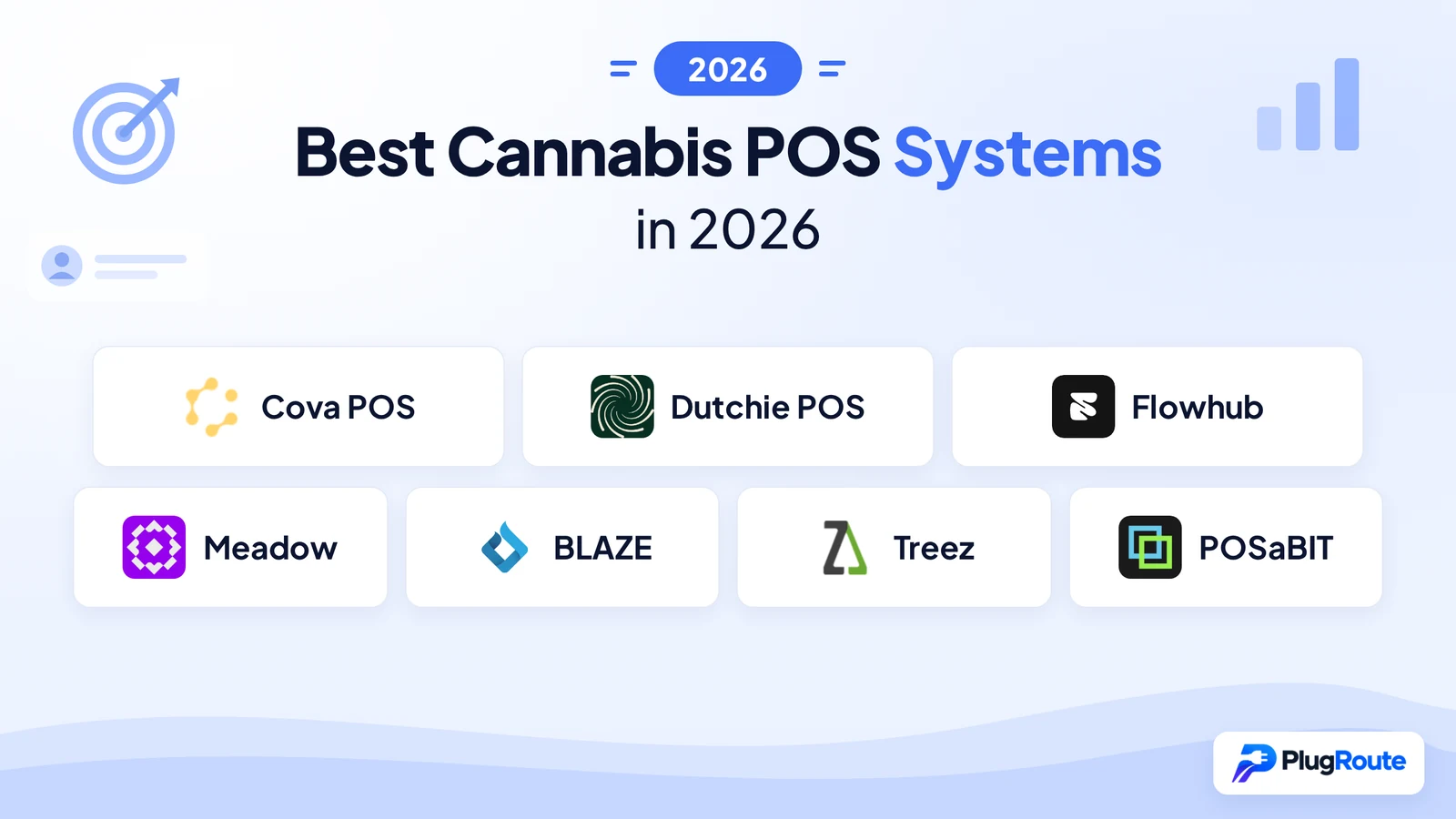
Cova POS is our top cannabis POS for compliance-focused single stores and small chains. Dutchie POS is best for marketplace reach and staff familiarity, and Flowhub is best for markets that mix Metrc and BioTrack. The top four scores sit within about 0.2 points, so filter by your state’s traceability system and vendor availability before you look at rank.
Dispensary operators already know the pain points: hidden pricing, Metrc sync drift, 4/20 downtime and contracts that make leaving hard. Meadow is the strongest fit for delivery-heavy stores in its six Metrc states. BLAZE, Treez and POSaBIT each fit narrower situations.
PlugRoute has no affiliate relationships with any company listed, and rankings are determined entirely by research data and objective evaluation criteria.
We re-checked G2 ratings, Washington’s CCRS integrator list, vendor pricing and public filings on November 12, 2026. Two ranks changed as a result, and the methodology section lists every score change and the evidence behind it.
What Are the 5 Categories of Cannabis POS Systems?
Cannabis POS systems fall into five categories, based on which sales channels each vendor builds itself:
- In-Store Compliance POS
- All-in-One Commerce Platform
- Delivery-First Platform
- Enterprise Retail OS
- Payments-First POS
A vendor’s category tells you which channels run natively and which depend on partners such as Onfleet for delivery.
- In-Store Compliance POS: In-Store Compliance POS systems are register-first tools built around state traceability, purchase limits and ID checks. Cova POS and Flowhub fall in this category.
- All-in-One Commerce Platform: All-in-One Commerce Platforms bundle the POS with ecommerce, payments, loyalty and, in some cases, marketplace reach. Dutchie POS and BLAZE fall in this category.
- Delivery-First Platform: Delivery-First Platforms run delivery, ecommerce and in-store sales on one native stack. Meadow falls in this category.
- Enterprise Retail OS: Enterprise Retail OS platforms are configurable, API-first systems for multi-location chains that have IT and finance teams. Treez falls in this category.
- Payments-First POS: Payments-First POS systems are built around accepting cannabis payments and add retail features on top. POSaBIT falls in this category.
As one user on r/weedbiz described:
“The current transition is platforms doing it all
In the bringing everything was piece milled like Alpine only did rewards, or Jane only did Ecom
Now they’re all trying to do everything in one and some are good some are bad” Posted by u/Afraid-Donke420
Takeaway: Cannabis POS vendors are all moving toward all-in-one platforms, but quality varies from vendor to vendor, so buyers have to check how well each one runs every channel it claims.
How Do the 7 Cannabis POS Systems Compare?
The clearest way to compare the seven cannabis POS systems is by category, best-fit buyer, and the one strength and one limitation that define each vendor. Each company name shows its G2 rating and review count (checked November 2026), because a small review sample is weak evidence by itself.
| Rank | Company | Category | Best For | One-Line Summary | Key Capabilities | Primary Strength | Key Limitation |
|---|---|---|---|---|---|---|---|
| 1 | Cova POS (G2 4.6/5, 27–33 reviews) | In-Store Compliance POS | Single stores and small chains selling mainly in-store | Cova POS is the most price-transparent cannabis POS we evaluated, a compliance-first in-store system for single stores and small chains. | Metrc and BioTrack, purchase-limit gauge, ID scanning, offline mode, Cova Pay | Only full public U.S. price list (from $349/month) | Ecommerce is an add-on; delivery relies on partners; Reddit sentiment is polarized |
| 2 | Dutchie POS (G2 4.5/5, 57–59 reviews) | All-in-One Commerce Platform | Stores that want marketplace traffic and staff who already know the system | Dutchie POS is the broadest commerce ecosystem we evaluated once its consumer marketplace is counted. | Consumer marketplace, ecommerce, kiosks, loyalty, Dutchie Pay, Metrc, BioTrack, WA CCRS | Widest channel coverage; WSLCB-validated CCRS integrator | Acknowledged 4/20 outages (2023, 2024); Dutchie Plus support ends December 31, 2026 |
| 3 | Flowhub (G2 3.8/5, 7 reviews) | In-Store Compliance POS | Operators with stores in both Metrc and BioTrack states | Flowhub is the most traceability-focused cannabis POS we evaluated, with the only SOC 2 Type II certification we could verify. | Metrc and BioTrack, mobile ID check-in, handheld POS, kiosks, Flowhub Pay | Metrc’s first integration partner (2015) | Limited delivery; churn from the Maui migration (2022–2023); small G2 sample |
| 4 | Meadow (G2 4.9/5, 92 reviews) | Delivery-First Platform | Delivery-heavy operators in CA, MI, MA, NY, NJ and MN | Meadow is the strongest native delivery-and-POS platform we evaluated for operators in Metrc states. | Native delivery dispatch, bundled ecommerce, kiosks, loyalty, open processor choice | Most complete native delivery stack; highest G2 rating | Metrc only; live in six states; no offline mode |
| 5 | BLAZE (G2 3.7/5, 22 reviews) | All-in-One Commerce Platform | Multi-state operators that need native delivery | BLAZE offers the broadest native delivery coverage we evaluated, across a published 20-state footprint. | Metrc, BioTrack, Leaf Data and WA CCRS; native delivery; BLAZE ECOM; kiosks | Most traceability systems supported (three) | A G2 report of oversold packages; mixed reliability reports |
| 6 | Treez (G2 3.3/5, 11 reviews) | Enterprise Retail OS | Large MSOs with in-house IT | Treez is the most enterprise-oriented cannabis POS we evaluated, suited to well-resourced multi-state operators. | Bidirectional Metrc sync, unlimited registers, open API, TreezPay | Unlimited registers and API access on every plan | Heaviest implementation burden; reported as the most expensive |
| 7 | POSaBIT (G2 3.0/5, 3 reviews) | Payments-First POS | Payments-focused operators centered on Washington | POSaBIT is a payments-first cannabis POS with a validated Washington CCRS integration and the thinnest review evidence in the set. | POSaBIT Pay (ACH), WA CCRS, synced online ordering, Pocket POS, loyalty | WSLCB-validated CCRS integrator; claims 85%+ of WA POS transactions | Thinnest review base; revenue down 34.5% in 2025 |
Which Cannabis POS Should I Pick for My Top Priority?
Find your single most important priority in the table, pick the vendor whose documented strengths match it, and then check the limiting condition in parentheses. Each row also names an acceptable alternative, so you can build a two-vendor demo shortlist in about a minute.
| Your #1 Priority | Recommended Tool | Why | Acceptable Alternative |
|---|---|---|---|
| Budget single store, in-store focus | Cova POS | Full public price list and documented purchase-limit enforcement (ecommerce costs extra) | Flowhub |
| Marketplace traffic and staff familiarity | Dutchie POS | Consumer marketplace and the widest budtender familiarity (4/20 history, lock-in) | BLAZE |
| MSO operating in both Metrc and BioTrack states | Flowhub | Supports both systems across about 33 published jurisdictions (limited delivery) | Cova POS |
| Delivery-heavy store in CA, MI, MA, NY, NJ or MN | Meadow | Most complete native delivery stack (Metrc only, six states, no offline mode) | BLAZE |
| Multi-state operator with native delivery outside Meadow’s states | BLAZE | Native delivery across 20 published states (test inventory accuracy) | Dutchie POS |
| Large MSO with an IT team | Treez | Unlimited registers and open API (heavy setup, high cost) | Dutchie POS |
| Washington store with a payments-first focus | POSaBIT | WSLCB-validated CCRS integrator with a payments focus (check its finances) | Dutchie POS or BLAZE (both WSLCB-validated) |
| Currently on Dutchie Plus ecommerce | Confirm your Dutchie Plus terms first | Legacy support runs through December 31, 2026; compare Dutchie E-Commerce Pro, a replacement ecommerce layer and a full re-platform | Any finalist that passes Questions #1 and #5 below |
| Verified security certification | Flowhub | The only SOC 2 Type I and Type II certification we could verify in the set | Request SOC 2 reports from every other finalist |
What Are the 7 Best Cannabis POS Systems in 2026?
The seven best cannabis POS systems in 2026 are listed below in order of weighted score. Ranks 1 to 4 fall within about 0.2 points of each other, so every entry uses the same structure, shows G2 ratings with review counts and labels self-reported claims. That lets you compare fit directly.
- Cova POS ranks #1 with a weighted score of 3.88 out of 5.
- Dutchie POS ranks #2 with 3.78. It moved up from #4 after our November 2026 re-verification.
- Flowhub ranks #3 with 3.73.
- Meadow ranks #4 with 3.68. It moved down from #2 after our November 2026 re-verification.
- BLAZE ranks #5 with 3.50.
- Treez ranks #6 with 2.95.
- POSaBIT ranks #7 with 2.28.
1. Cova POS: Best Overall for Compliance-Focused Single Stores and Small Chains

Category: In-Store Compliance POS, a register-first system built around state traceability, purchase limits and ID checks.
At a Glance
- Category: In-Store Compliance POS
- Best For: Single stores and small-to-mid chains that sell mainly in-store and want published pricing
- Price Range: $349–$599/month published (Boutique and Powerhouse); Enterprise by quote; ecommerce and extra workstations cost extra
- Primary Strength: Cova POS publishes its full U.S. price list and documents purchase-limit enforcement and offline mode more explicitly than any other vendor we evaluated.
- Biggest Limitation: Cova POS sells ecommerce as a separate add-on and relies on partners such as Onfleet or Carrot for delivery dispatch.
- One-Line Summary: Cova POS is the most price-transparent cannabis POS we evaluated, a compliance-first in-store system suited to single stores and small chains that don’t need native delivery.
- Last Verified: November 2026
Overview
Cova POS is a tablet-based, in-store cannabis point-of-sale system with Metrc and BioTrack integration, purchase-limit enforcement, ID scanning and an offline mode. It is built for single-location dispensaries and small-to-mid chains that put compliance and predictable published pricing first.
Cova POS also includes Cova Pay, loyalty and multi-store controls, but ecommerce is sold separately. Cova says it serves 2,200+ dispensaries (Published by vendor: Cova, 2026; self-reported). We left out a third-party figure of “20,000+ locations” because it conflicts with Cova’s own count.
We could not verify a SOC 2 certification for Cova POS.
Key Features
- Cova POS shows a purchase-limit gauge at checkout so budtenders can see how much each customer can still legally buy.
- Cova POS scans government IDs at check-in and automatically creates a customer profile for age verification and record-keeping.
- Cova POS integrates with both Metrc and BioTrack, so it can serve stores on either major traceability system.
- Cova POS describes an offline mode on its product page (checked November 2026). Cova does not publicly say whether purchase limits and taxes are enforced while the system is offline.
- Cova POS includes queue management, loyalty and multi-store controls, with unlimited users and transactions on its published plans.
Best For
Cova POS is best for single-store and small-chain dispensaries that sell mainly in-store, need clear Metrc or BioTrack compliance tools, and want a published monthly price to anchor budget comparisons.
Strengths
- Cova POS scored 9.5/10 for support quality in G2’s head-to-head comparison, against 8.6 for Dutchie POS. It also scored 9.2 for ease of use and 8.9 for ease of setup (Review platform: G2, November 2026; 4.6/5 on 27–33 reviews, depending on the page).
- Cova POS is the only vendor of the seven that publishes a full U.S. price list, starting at $349/month (Published by vendor: Cova pricing page, verified November 2026).
- Cova POS kept Eufloria’s stores at 100% uptime on 4/20, while a store still on its previous system was down all day (Published by vendor: Cova case study via casestudies.com, checked 2026).
- Cova POS helped Harborside address an $11M tax risk through tax-inclusive pricing and custom tax rules (Published by vendor: Cova case study via casestudies.com, checked 2026).
This aligns with community sentiment on r/weedbiz:
“Check out Cova. Stores using them seem to be the happiest in NY.” Posted by u/Comfortable-Age-6957
Takeaway: Cova POS has a good reputation among New York dispensary operators, and peers recommend it because its stores seem the most satisfied.
Limitations
Cova POS gives up channel breadth for in-store simplicity. Ecommerce is a paid add-on, delivery depends on partners, and one independent operator called ecommerce integration Cova’s “biggest weakpoint” (Independent user: Reddit r/weedbiz, 2025).
- Cova POS is the most polarizing vendor in the set. A Maryland operator reported crashes, dropped orders and Metrc-sync problems (Independent user: Reddit r/weedbiz, 2026).
- Cova POS was criticized by a self-described consultant who said it might work only for stores with “less than 200 SKUs” (Independent user: Reddit r/weedbiz, 2026). That view clashes with Cova’s strong G2 scores.
- Cova POS reports 99.99% uptime, but the figure is self-reported and we found no audited SLA behind it (Published by vendor: Cova, 2026).
- Cova POS does not appear on Washington’s validated CCRS integrator list (Regulator: WSLCB, March 2026), so Washington operators should confirm support directly.
Verdict
Cova POS is the best starting point for a single store or small chain that puts compliance first and wants a published price, but it is not the right pick for delivery-first operators.
Cova POS earned the top weighted score (3.88), mostly through pricing transparency and clear documentation of purchase limits and offline mode. Polarized operator sentiment and add-on ecommerce kept its lead narrow. Demo Cova POS alongside Flowhub using your real SKU count.
2. Dutchie POS: Best for Marketplace Reach and Staff Familiarity
Category: All-in-One Commerce Platform, a POS bundled with ecommerce, payments, loyalty and marketplace reach in one ecosystem.
At a Glance
- Category: All-in-One Commerce Platform
- Best For: Dispensaries that want online demand from a marketplace, a POS most budtenders already know and, in Washington, validated CCRS reporting
- Price Range: Pricing on request; third-party estimates of $499–$1,000/month per location; one operator reported ~$400 per register (2025)
- Primary Strength: Dutchie POS connects in-store sales to a consumer marketplace, ecommerce, kiosks, loyalty and Dutchie Pay in one ecosystem with 100+ integrations.
- Biggest Limitation: Dutchie POS had acknowledged 4/20 outages in 2023 and 2024, and legacy Dutchie Plus support ends December 31, 2026.
- One-Line Summary: Dutchie POS is the broadest cannabis commerce ecosystem we evaluated once its consumer marketplace is counted, with peak-day reliability and lock-in as the main risks to check.
- Last Verified: November 2026
Overview
Dutchie POS is an all-in-one cannabis retail platform that combines point of sale, ecommerce, a consumer marketplace, Dutchie Pay, kiosks, loyalty and reporting with Metrc, BioTrack and Washington CCRS support. It serves single dispensaries through multi-state operators that want marketplace reach.
Dutchie POS merges the acquired Greenbits and LeafLogix products. Dutchie says it serves 6,500+ dispensaries and has processed $100B+ in transactions (Published by vendor: Dutchie via GetApp, 2026; self-reported).
We could not verify a SOC 2 certification for Dutchie POS.
Key Features
- Dutchie POS links to Dutchie’s consumer marketplace, which can send online shoppers to a dispensary’s menu.
- Dutchie POS supports Metrc and BioTrack reporting, plus automated Washington CCRS reporting, according to Dutchie’s support documentation (checked 2026).
- Dutchie POS bundles ecommerce, kiosks, loyalty and Dutchie Pay (pay-by-bank) with the register.
- Dutchie POS connects with more than 100 technology partners (Published by vendor: Dutchie, checked 2026).
- Dutchie POS supports delivery, but dispatch often relies on tools such as Onfleet, and advanced delivery may cost extra. That claim comes from a competitor, so confirm it with Dutchie (Competitor-authored: Meadow, 2026).
Best For
Dutchie POS is best for dispensaries that want online demand from a marketplace, a deep integration ecosystem and a POS that new budtenders have probably used before.
Strengths
- Dutchie POS is listed as a validated CCRS integrator by Washington’s regulator, one of three vendors in the set with that listing (Regulator: WSLCB, March 2026).
- Dutchie POS holds a 4.5/5 G2 rating on 57–59 reviews, the second-largest sample in the category, with praise for ease of use, compliance and integrations (Review platform: G2, November 2026).
- Dutchie POS has the widest staff familiarity in the market, according to independent operators. One said “9/10 industry pros will have experience using it” (Independent user: Reddit r/weedbiz, 2025).
- Dutchie POS also rates 4.6/5 on Capterra and 4.7/5 on Software Advice, though on only 5 and 6 reviews (Review platform: Capterra and Software Advice, 2026).
Limitations
Dutchie POS gives up continuity for ecosystem breadth. The most serious trade-off is its acknowledged 4/20 outages in 2023 and 2024 (Third-party publication: MJBizDaily, 2023 and 2024).
- Dutchie POS’s CEO promised affected retailers compensation after the 2023 outage. In 2024, Dutchie said fewer than 20% of its roughly 6,000 retail customers had performance issues (Third-party publication: MJBizDaily, 2024).
- Dutchie POS moved Greenbits and LeafLogix stores onto its new platform. One Oregon operator reported cash discrepancies and compliance problems right after the switch (Independent user: Reddit r/weedbiz, 2025).
- Dutchie POS customers on legacy Dutchie Plus have a fixed deadline. Dutchie has said support continues through December 31, 2026, and describes Dutchie E-Commerce Pro as the migration path (Third-party publication: BudAuthority, 2026).
- Dutchie POS bundles Dutchie Pay and relies on its marketplace, and both raise switching costs. G2 reviewers also cite gaps in reporting and discount management (Review platform: G2, 2026).
Users on r/weedbiz noted:
“I was using Dutchie since the actual beginning of it. It’s fine, but has its drawbacks. Initial setup is a BEAR.” Posted by u/aelston33
Takeaway: Long-time Dutchie POS users call the platform serviceable but say initial setup is a heavy lift, so new stores should budget implementation time accordingly.
Verdict
Dutchie POS is the strongest ecosystem choice for dispensaries that want marketplace traffic and easy staff onboarding, but buyers should write peak-day reliability and exit terms into the contract.
Dutchie POS moved from #4 to #2 (3.78) after we verified its listing as a Washington CCRS integrator, which raised its traceability score. Ask for 4/20 performance data and written data-export terms. Plus stores should also ask for a migration plan with URL redirects to protect menu search traffic.
3. Flowhub: Best for Mixed-Traceability Markets and Compliance-Focused Independents
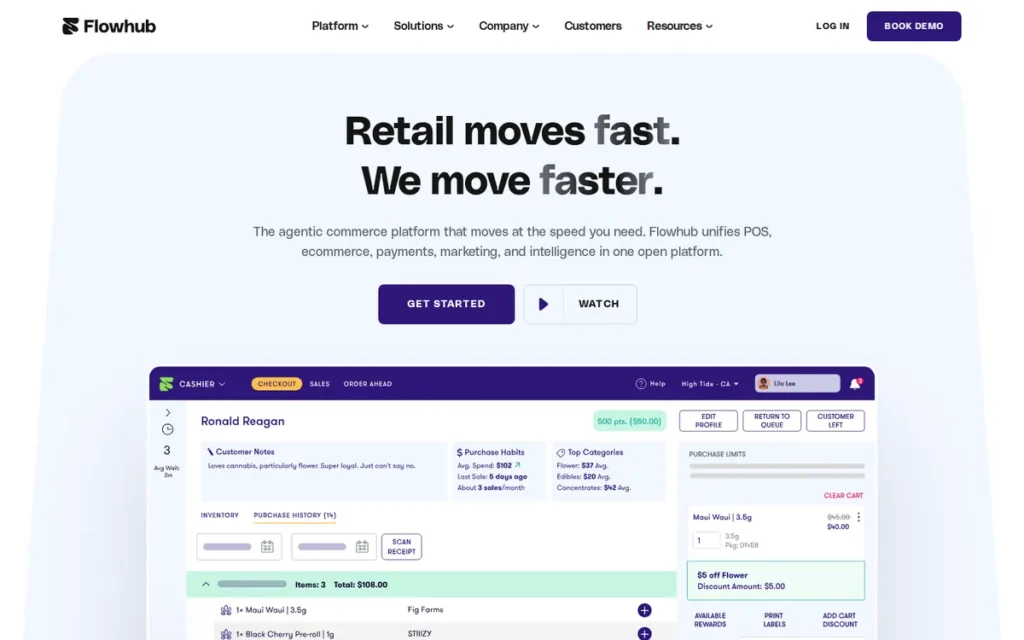
Category: In-Store Compliance POS, a register-first system built around state traceability, purchase limits and ID checks.
At a Glance
- Category: In-Store Compliance POS
- Best For: Compliance-focused independents and multi-state operators running stores in both Metrc and BioTrack markets
- Price Range: Pricing on request; historically ~$499/month per location plus reported per-terminal fees (third-party estimate, undated)
- Primary Strength: Flowhub combines the longest documented Metrc API history in the category with the only SOC 2 Type II certification we could verify among the seven vendors.
- Biggest Limitation: Flowhub offers limited delivery without dynamic dispatch, and its reputation is still recovering from the Maui platform migration.
- One-Line Summary: Flowhub is the most traceability-focused cannabis POS we evaluated, best for operators in mixed Metrc and BioTrack markets who value compliance and security certification over native delivery.
- Last Verified: November 2026
Overview
Flowhub is a compliance-first cannabis point-of-sale platform that supports Metrc and BioTrack across about 33 published jurisdictions. It includes mobile ID check-in, handheld POS, kiosks, ecommerce and Flowhub Pay, and it is built for independent dispensaries and multi-state operators in mixed-traceability markets.
Flowhub was founded in Denver in 2015 by Kyle Sherman. It says it serves 1,000+ dispensaries and processes $4B+ in annual sales (Published by vendor: Flowhub, 2026; self-reported).
Key Features
- Flowhub supports manifest intake, inventory audits and discrepancy resolution for both Metrc and BioTrack, according to its product documentation.
- Flowhub Greet provides mobile ID check-in, so staff can verify age and create customer records before the customer reaches the register.
- Flowhub offers handheld and mobile POS alongside kiosks, which helps with line-busting and inventory counts on the sales floor.
- Flowhub includes native ecommerce, loyalty, AI analytics and Flowhub Pay for debit and ACH payments.
- Flowhub claims checkouts take about 20 seconds, a vendor claim worth timing in a demo.
Best For
Flowhub is best for compliance-focused independents and multi-state operators who need one vendor across Metrc and BioTrack states and want a verified SOC 2 certification.
Strengths
- Flowhub became Metrc’s first integration partner in 2015 and supports Metrc and BioTrack across about 33 published jurisdictions, though it also markets “36+ markets” (Published by vendor: Flowhub, checked 2026).
- Flowhub announced SOC 2 Type II certification on November 4, 2025, in addition to Type I. It is the only security certification we could verify among the seven vendors (Published by vendor: Flowhub, 2025).
- Flowhub was described by an independent operator as having the “strongest tech team,” a “very open API” and “the best bang for buck” (Independent user: Reddit r/weedbiz, 2025).
- Flowhub reports that its customer Thrive has completed 5M+ transactions across six locations (Published by vendor: Flowhub case study, checked 2026).
Limitations
Flowhub gives up channel breadth for compliance depth. Flowhub’s delivery is limited and has no dynamic dispatch, so delivery-first operators will need partners.
- Flowhub’s G2 rating is 3.8/5 on only 7 reviews. Reviewers criticize the discount module, reporting, the lack of cross-store reporting and “very disappointing” customer care (Review platform: G2, November 2026).
- Flowhub’s Maui platform migration, launched in 2022–2023, caused customer churn, according to an independent operator (Independent user: Reddit r/weedbiz, 2025).
- Flowhub drew outage concerns in August 2025. The source was a prospective buyer passing on a secondhand report, not a first-hand outage account (Independent user: Reddit r/weedbiz, 2025).
- Flowhub does not appear on Washington’s validated CCRS integrator list (Regulator: WSLCB, March 2026), so Washington operators should confirm support directly.
Verdict
Flowhub is the strongest choice for operators who need one compliance-first POS across Metrc and BioTrack markets, and its SOC 2 Type II certification is the only one we could verify among the seven vendors.
Flowhub earned the highest traceability-and-compliance score (C1) in the set. A small review sample, quote-only pricing and reliability concerns from the Maui era kept it at #3 (3.73). Ask for 4/20 performance history and a demo of cross-store reporting.
4. Meadow: Best for Delivery-Heavy Operators in Metrc States
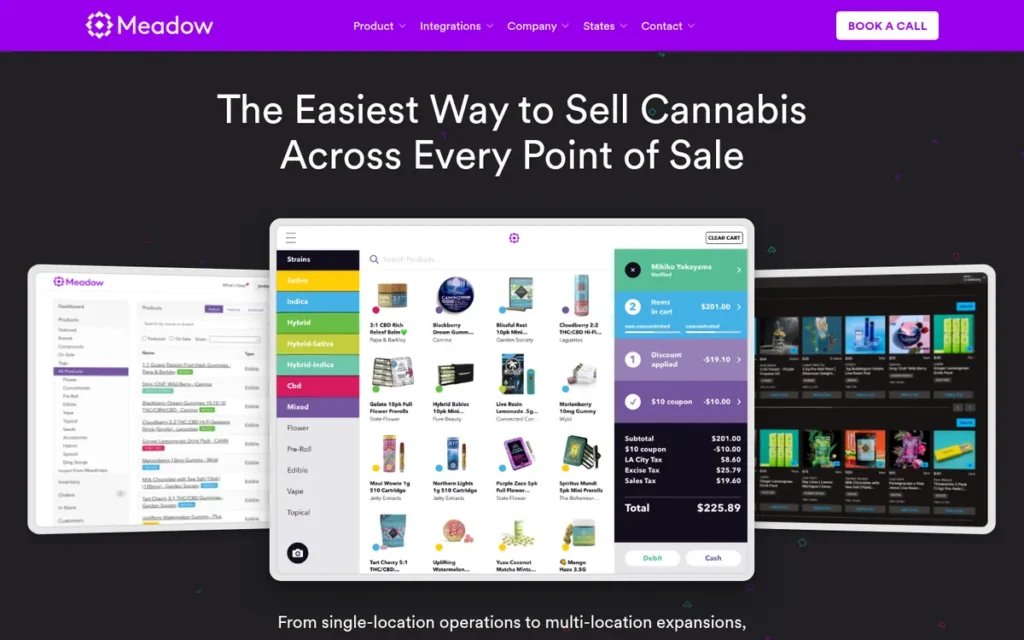
Category: Delivery-First Platform, an all-in-one system where delivery, ecommerce and in-store sales share one native stack.
At a Glance
- Category: Delivery-First Platform
- Best For: Delivery-heavy and omnichannel operators in Meadow’s Metrc states (CA, MI, MA, NY, NJ, MN)
- Price Range: $1,200–$1,800/month published plan range; setup, hardware and full contract terms not published
- Primary Strength: Meadow builds delivery dispatch, ecommerce, kiosks and in-store POS into one native platform without relying on third-party dispatch tools.
- Biggest Limitation: Meadow supports only Metrc and is live in only six states, so it is not available in BioTrack states, Washington or most other markets.
- One-Line Summary: Meadow is the strongest native delivery-and-POS platform we evaluated for operators in Metrc states, but its six-state footprint makes it an option for only part of the U.S. market.
- Last Verified: November 2026
Overview
Meadow is an all-in-one cannabis POS and commerce platform. It combines in-store checkout, bundled ecommerce, native delivery dispatch, kiosks, loyalty and SMS marketing, and it is built for delivery-heavy and omnichannel dispensaries in the six Metrc states where Meadow operates.
Meadow says it has operated since 2014 and describes itself as Y Combinator’s first cannabis startup (Published by vendor: Meadow via Software Advice, 2026).
We could not verify a SOC 2 certification for Meadow.
Key Features
- Meadow supports hub-and-spoke, dynamic (“ice cream truck”) and hybrid delivery models natively, with geofencing and dispatch built in.
- Meadow includes driver-side ID verification and signature capture to document compliant delivery handoffs.
- Meadow bundles ecommerce, kiosks, loyalty, SMS and CRM into its platform instead of selling each as a partner integration.
- Meadow supports debit and ACH payments and lets the store choose its own processor.
- Meadow automates Metrc reporting, which G2 reviewers cite as a time saver.
Best For
Meadow is best for operators in California, Michigan, Massachusetts, New York, New Jersey or Minnesota whose revenue depends heavily on delivery and online ordering and who want those channels on one native inventory.
Strengths
- Meadow holds a 4.9/5 G2 rating on 92 reviews, the highest rating and the most reviews in the category (Review platform: G2, November 2026). That volume is unusually high for a six-state vendor and may reflect active review requests.
- Meadow has the most complete native delivery stack of the seven vendors, including dynamic delivery, geofencing and driver ID checks (Published by vendor: Meadow and its Software Advice listing, 2026).
- Meadow publishes plan pricing of $1,200–$1,800/month with no per-seat or per-transaction fees. It is one of only two vendors in the set that publish price figures (Published by vendor: Meadow via G2 pricing, verified November 2026).
- Meadow is used by Off the Charts across 38 stores (Published by vendor: Meadow via Software Advice, 2026).
Limitations
Meadow gives up market reach for delivery depth. Meadow is Metrc-only and live in six states, so operators in BioTrack and Washington CCRS markets cannot use it, and its Oregon support is unconfirmed.
- Meadow requires an internet connection to process sales and does not offer an offline mode, according to its own published materials (Published by vendor: Meadow, 2026).
- Meadow reports 99.99%–99.999% uptime and a perfect 4/20 record. The figures vary across Meadow’s own pages, are self-reported and are not backed by an audited SLA (Published by vendor: Meadow, 2026).
- Meadow gets little independent Reddit discussion. A four-store California GM reported switching away, but the same comment also promoted a competing vendor (Independent user: Reddit r/weedbiz, 2026).
- Meadow may leave in-store-only dispensaries paying for bundled delivery and ecommerce capacity they don’t use.
Verdict
Meadow is the strongest documented fit for delivery-heavy dispensaries in its six Metrc states, and it is not an option anywhere else.
Meadow moved from #2 to #4 (3.68) after we confirmed it has no offline mode and found conflicting uptime figures, which lowered its reliability score. Meadow’s native delivery stack, published pricing and open processor choice still address major operator pain points. Check its G2 rating against references in your own state.
5. BLAZE: Best All-in-One for Multi-State Operators Needing Native Delivery
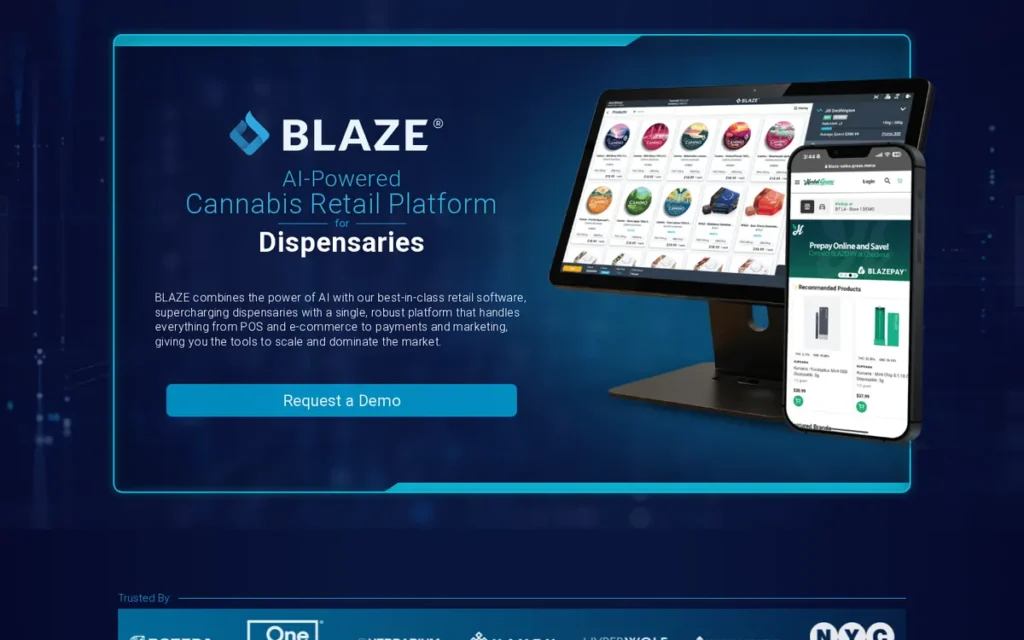
Category: All-in-One Commerce Platform, a POS bundled with ecommerce, payments, loyalty and delivery in one ecosystem.
At a Glance
- Category: All-in-One Commerce Platform
- Best For: Multi-state and delivery-capable operators in BLAZE’s 20 published states that want one hardware-agnostic platform
- Price Range: Pricing on request; one user reported ~$800/month for one location with 40 seats (2021, outdated); hardware, payments and integrations cost extra
- Primary Strength: BLAZE combines native delivery, ecommerce and kiosks with support for three traceability systems (Metrc, BioTrack and Leaf Data) across a published 20-state footprint.
- Biggest Limitation: BLAZE has a mid-range G2 rating (3.7/5 on 22 reviews), and one G2 reviewer reported that its inventory let packages be oversold into negative Metrc balances.
- One-Line Summary: BLAZE offers the broadest native delivery coverage across a published 20-state footprint, but a G2 report of oversold packages makes inventory and Metrc accuracy the first thing to test in a demo.
- Last Verified: November 2026
Overview
BLAZE is a web-based, hardware-agnostic cannabis retail platform. It combines POS, BLAZE ECOM, native delivery, kiosks, QR self-checkout, BLAZE Pay and loyalty with Metrc, BioTrack and Leaf Data integration, and it is built for multi-state and delivery-capable dispensaries in its 20 published states.
BLAZE was founded in 2017 (Published by vendor: BLAZE About page, checked 2026). BLAZE announced its acquisition of the ecommerce platform Tymber in January 2023 (Published by vendor: BLAZE, 2023).
We could not verify a SOC 2 certification for BLAZE.
Key Features
- BLAZE supports scheduled and on-demand delivery with driver tools and mobile checkout.
- BLAZE ECOM, built on the acquired Tymber platform, provides native online ordering connected to the POS.
- BLAZE integrates with Metrc, BioTrack and Leaf Data, the most traceability systems supported by any vendor in the set.
- BLAZE’s Compliance Task Manager and “Compliance Difference” tools flag mismatches between BLAZE records and the state system.
- BLAZE offers kiosks, QR self-checkout, BLAZE Pay, loyalty, marketing and multi-store management on hardware the store chooses.
Best For
BLAZE is best for operators in its 20 published states who want native delivery and ecommerce in one platform without buying vendor-specific hardware.
Strengths
- BLAZE is listed (as Blaze Solutions) as a validated CCRS integrator by Washington’s regulator, one of three vendors in the set with that listing (Regulator: WSLCB, March 2026).
- BLAZE publishes a 20-state availability list and supports Metrc, BioTrack and Leaf Data, the most traceability systems in the set (Published by vendor: BLAZE, 2026).
- BLAZE reported that its customer One Plant grew online sales 38% in its first two months on BLAZE ECOM. BLAZE also powered Housing Works, New York’s first adult-use dispensary, in December 2022 (Published by vendor: BLAZE case studies, checked 2026).
- BLAZE was praised by an independent ecommerce integrator as “relatively easy to use,” with no outages observed and strong customer service (Independent user: Reddit r/weedbiz, 2025).
Limitations
BLAZE gives up consistency for breadth. The most serious reported failure is a G2 reviewer’s account that BLAZE’s inventory “allowed packages to be oversold,” which created negative Metrc balances (Review platform: G2, 2026).
- BLAZE holds a 3.7/5 G2 rating on 22 reviews, though some older G2 pages still show 2.8/5 on 9 reviews (Review platform: G2, November 2026).
- BLAZE reviewers describe glitches, promotion and discount bugs, lag with large SKU counts and support that takes “weeks” (Review platform: G2 and Software Advice, 2026).
- BLAZE’s compliance quality may vary by state. An Oregon operator criticized its labels (Independent user: Reddit r/weedbiz, 2025), and we discounted one positive 2026 account because it read as promotional.
- BLAZE’s only dated user-reported price, about $800/month for one location with 40 seats, is from 2021 (Independent user: Reddit r/weedbiz, 2021).
Verdict
BLAZE is the broadest native-delivery option for multi-state operators across a published 20-state footprint, but buyers must verify inventory and Metrc accuracy in their own state before signing.
BLAZE’s score rose to 3.50 after its live G2 rating and Washington CCRS listing lifted two criteria, but it stays at #5. Ask for local references and a live demo of manifest intake and package-level reconciliation.
6. Treez: Best for Large Multi-State Operators with In-House IT
Category: Enterprise Retail OS, a configurable, API-first platform for multi-location chains with IT and finance teams.
At a Glance
- Category: Enterprise Retail OS
- Best For: Large multi-state operators with in-house IT, web and finance staff that need centralized control and open APIs
- Price Range: Pricing on request; Reddit users call it the most expensive option; ecommerce and delivery may be billed separately
- Primary Strength: Treez includes unlimited registers, employees and API access on every plan, with centralized catalog and discount controls for multi-location chains.
- Biggest Limitation: Treez has the heaviest documented onboarding and configuration burden in our evaluation and is a poor fit for single stores without IT staff.
- One-Line Summary: Treez is the most enterprise-oriented cannabis POS we evaluated, suited to well-resourced multi-state operators and poorly suited to single stores without technical staff.
- Last Verified: November 2026
Overview
Treez is an enterprise cannabis retail operating system. It combines SellTreez POS, a bidirectional Metrc integration, ecommerce, Kiosk Mode, TreezPay, loyalty, analytics and an open API, and it is built for large multi-state operators with IT and finance teams that need centralized control across many locations.
Treez raised a $51M round in April 2022 and acquired the payments company Swifter in November 2022 (Third-party publication: cannabisregulations.ai, checked 2026).
Treez launched Headless E-commerce in November 2023 and Treez Ecommerce in April 2024, then acquired Gap Commerce in December 2024 (Published by vendor: Treez release notes, checked 2026). We could not verify BioTrack support or a SOC 2 certification for Treez.
Key Features
- Treez offers a bidirectional Metrc integration that sends data to the state system and receives data from it.
- Treez includes unlimited registers, employees and open API access on every plan, according to its pricing page.
- Treez provides centralized catalog and discount controls for managing pricing across multiple locations.
- Treez supports PIN debit and ACH through TreezPay, and its Kiosk Mode automates self-service cash and digital payments.
- Treez includes retail analytics and ecommerce. A self-identified Treez employee said the ecommerce product was rebuilt and relaunched in 2024.
Best For
Treez is best for large multi-state operators with dedicated IT, web and finance staff that need centralized control, deep analytics and open API access across many locations.
Strengths
- Treez reported that adopting TreezPay PIN debit raised Swade’s average order value 25%, tripled its transaction volume and made reporting 80% faster (Published by vendor: Treez case study, checked 2026).
- Treez includes unlimited registers, employees and API access on every plan, so large stores avoid per-register fees (Published by vendor: Treez pricing page, verified November 2026).
- Treez was described by an independent operator as having the “strongest data and insights in the game” for multi-site operations (Independent user: Reddit r/weedbiz, 2025).
- Treez reports managing $1B+ in annual sales transactions (Published by vendor: Treez via G2 category page, 2026; self-reported).
Limitations
Treez gives up accessibility and cost for enterprise depth. Treez has the heaviest implementation burden we found, and Reddit users call it “the most expensive option” (Independent user: Reddit r/weedbiz, 2025).
- Treez’s G2 rating is 3.3/5 on 11 reviews, and its ease-of-setup score is 7.5 against 8.6 for Dutchie POS. Reviewers cite bugs, outages and implementation delays (Review platform: G2, November 2026).
- Treez was accused by a 2025 developer of deprecating its headless API and requiring about $3,000/month in ecommerce upkeep. Treez has not publicly announced a deprecation (Independent user: Reddit r/weedbiz, 2025).
- Treez was reported by a compliance lead to time out with Metrc regularly, which required manual reconciliation (Independent user: Reddit r/weedbiz, 2022). That report is older, and a 2025 user disputes it.
- Treez does not appear on Washington’s validated CCRS integrator list (Regulator: WSLCB, March 2026).
Verdict
Treez is the most enterprise-oriented cannabis POS in this evaluation, and it makes sense mainly for multi-state operators with the IT resources to configure and maintain it.
Treez’s unlimited registers and open APIs suit large chains. Low review scores, heavy implementation and the API-deprecation allegation count against it for most readers.
These scores reflect fit for the general reader. For a well-resourced MSO, Treez’s enterprise strengths count for more. MSOs should get API-stability and data-export commitments in writing.
7. POSaBIT: Best for Washington-Focused, Payments-Centric Operators
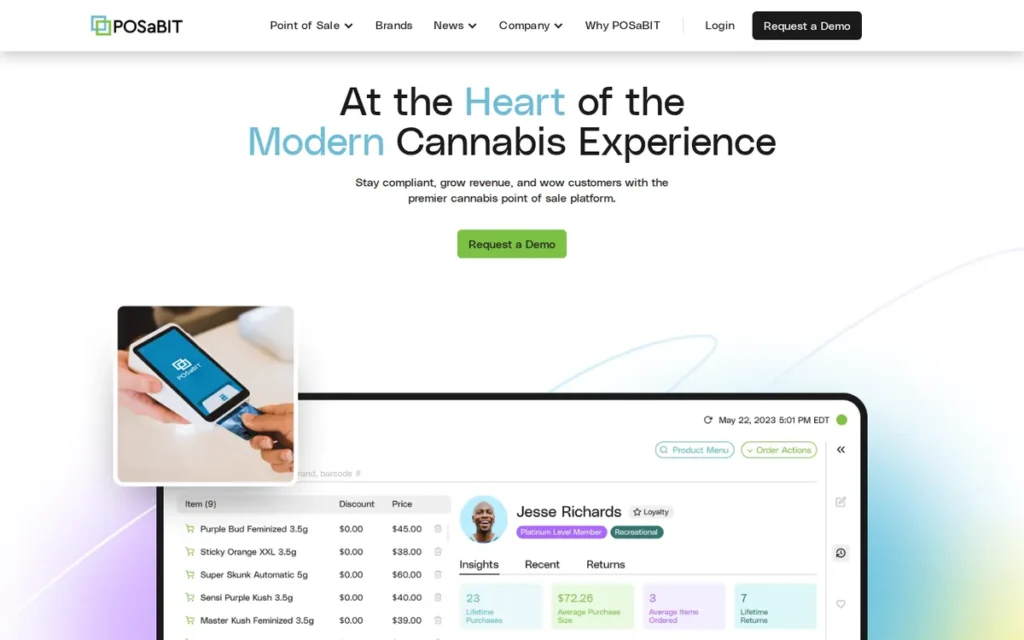
Category: Payments-First POS, a point of sale built around accepting cannabis payments, with retail features added on top.
At a Glance
- Category: Payments-First POS
- Best For: Washington-centered dispensaries whose main priority is accepting cashless payments
- Price Range: Pricing on request; revenue comes from payment services, POS subscriptions, support and hardware rental or sales
- Primary Strength: POSaBIT is a WSLCB-validated Washington CCRS integrator and says it processes more than 85% of Washington State cannabis point-of-sale transactions.
- Biggest Limitation: POSaBIT has the thinnest review evidence in the set (3.0/5 on 3 G2 reviews), and its public filings show revenue down 34.5% in 2025 and limited cash.
- One-Line Summary: POSaBIT is a payments-first cannabis POS with a validated Washington CCRS integration, but the thinnest review evidence in the set and mixed public financials make vendor due diligence essential.
- Last Verified: November 2026
Overview
POSaBIT is a payments-first cannabis point-of-sale system. It covers checkout, inventory, synced online ordering, loyalty, Pocket POS and POSaBIT Pay, and it is built for Washington-centered dispensaries that care more about cashless payments than multi-state coverage or native delivery.
POSaBIT is publicly listed (CSE: PBIT; OTC: POSAF), and Ryan Hamlin is its CEO and co-founder.
We could not verify a SOC 2 certification, an offline mode or kiosk support for POSaBIT.
Key Features
- POSaBIT Pay supports ACH pay-by-bank payments for dispensary customers.
- POSaBIT publishes CCRS integration documentation covering manifest and transaction uploads (Published by vendor: POSaBIT support site, checked 2026).
- POSaBIT syncs online ordering with in-store inventory and integrates with Leafly, Weedmaps, Dutchie and Jane (Third-party publication: axiobench, checked 2026).
- POSaBIT includes inventory, loyalty, discounts, reporting and Pocket POS handheld checkout, and it integrates with Metrc, according to the same directory.
- POSaBIT has acted since August 2025 as an agent that refers merchants to outside processors or cashless-ATM providers, and those providers keep the processing fees (Public filing: SEDAR+, 2025).
Best For
POSaBIT is best for Washington-centered dispensaries focused on cashless payments that want a regulator-validated CCRS integration and can review the vendor’s finances on their own.
Strengths
- POSaBIT is listed as a validated CCRS third-party integrator by Washington’s regulator, the strongest verified evidence in its favor (Regulator: WSLCB, March 2026).
- POSaBIT says it processes more than 85% of Washington State cannabis point-of-sale transactions but does not disclose how it measures that figure (Published by vendor: POSaBIT, checked 2026; self-reported).
- POSaBIT is the only vendor in the set with publicly disclosed financials, so buyers can check its stability directly (Public filing: SEDAR+, 2025 annual results).
- POSaBIT was praised by a G2 reviewer for enabling debit “without having [a] full-service ATM machine” (Review platform: G2, 3 reviews total, 2026).
Limitations
POSaBIT gives up retail breadth for regional payments depth. POSaBIT’s 2025 revenue fell 34.5% to $10.0M, with an operating loss of about $2.09M (Public filing: TMX Money, 2026).
- POSaBIT’s 2025 filings also show improvements: the net loss narrowed to $2.00M from $5.72M, cash rose 76% to about $1.8M, and adjusted EBITDA was $2.55M, up from −$0.76M in 2024. The company raised no new financing in 2025 (Public filing: TMX Money, 2026).
- POSaBIT’s G2 rating is 3.0/5 on only 3 reviews, which cite dropped connections and transactions not recorded on the back end (Review platform: G2, November 2026).
- POSaBIT’s delivery capability is disputed. A user reported the company said it “doesnt do delivery,” which conflicts with its website (Independent user: Reddit r/weedbiz, 2025).
- POSaBIT lost much of its historical in-house PIN-debit advantage when it moved to referral-only payments in August 2025 (Public filing: SEDAR+, 2025).
Verdict
POSaBIT is a viable option mainly for Washington-focused, payments-first operators who value its validated CCRS integration and can accept a mixed financial picture.
POSaBIT’s score rose to 2.28 after we verified its CCRS listing, but the thinnest evidence base in the set keeps it at #7. Ask for an itemized quote, check the referred processor’s fees, chargeback handling and settlement times, and get continuity terms in writing.
Which Cannabis POS Systems Work in My State and With Metrc or BioTrack?
Your state’s traceability system is the first filter:
- Meadow supports only Metrc, in six states.
- BLAZE supports Metrc, BioTrack and Leaf Data across 20 states.
- Flowhub covers about 33 Metrc and BioTrack jurisdictions.
- In Washington, the regulator lists POSaBIT, Dutchie POS and BLAZE as validated CCRS integrators (Regulator: WSLCB, March 2026).
| Vendor | Metrc | BioTrack | WA CCRS | Other Systems | Published Footprint |
|---|---|---|---|---|---|
| Cova POS | Yes | Yes | Not on WSLCB list (March 2026) | None found | State list not verified; claims 2,200+ dispensaries (self-reported) |
| Dutchie POS | Yes | Yes | Yes (WSLCB list, March 2026) | None found | State list not verified; claims 6,500+ dispensaries (self-reported) |
| Flowhub | Yes (Metrc’s first integration partner, 2015) | Yes | Not on WSLCB list (March 2026) | None found | ~33 named jurisdictions; marketed as “36+” |
| Meadow | Yes | No | No (not available in WA) | None | Six states: CA, MI, MA, NY, NJ, MN; Oregon unconfirmed |
| BLAZE | Yes | Yes | Yes (WSLCB list, March 2026) | Leaf Data | 20 states: AK, AZ, CA, CO, IL, ME, MA, MI, MN, MO, MT, NV, NM, NY, OH, OK, OR, VT, VA, WA |
| Treez | Yes (bidirectional) | Not verified | Not on WSLCB list (March 2026) | None found | State list not verified |
| POSaBIT | Yes (per a third-party directory) | Not verified | Yes (WSLCB list, March 2026) | None found | Claims 85%+ of Washington POS transactions (self-reported) |
Until your state’s regulator lists a vendor, its integration claim is only marketing. Three of the seven vendors we evaluated appear on Washington’s validated CCRS integrator list, which you can check yourself at lcb.wa.gov/ccrs/integrators.
State rules change often, and every vendor has to keep up:
- Washington’s move to CCRS, Metrc API v2 migrations, and BioTrack in Florida and New Mexico have all forced rushed vendor updates (Independent user: Reddit r/weedbiz, 2025).
- One Reddit user reported that Oregon’s Metrc v1-to-v2 migration was incomplete for at least one vendor, OpenTHC (Independent user: Reddit r/weedbiz, 2025).
- California’s cannabis excise tax rose from 15% to 19% on July 1, 2025, then returned to 15% on October 1, 2025 under Assembly Bill 564. Retailers who over-collected generally had to refund or report the excess (Regulator: CDTFA, 2025).
- California requires the excise tax to be listed separately on receipts, so rate changes like this directly test how quickly a POS updates its tax settings.
How Much Does a Cannabis POS Really Cost?
Only Cova POS ($349–$599/month) and Meadow ($1,200–$1,800/month) publish cannabis POS prices. The other five vendors quote privately. Your real total cost depends on add-ons that no vendor in this evaluation fully publishes, so ask for a line-item quote that covers every layer below.
- Per-workstation or per-terminal fees can apply once you go past a plan’s register allowance.
- Ecommerce and delivery modules are often billed as add-ons.
- Hardware is usually a separate purchase or rental.
- Onboarding and data-migration fees are rarely published.
- Some subscription discounts require you to use the vendor’s own payments product.
- Auto-renewal and termination terms are rarely disclosed before you get a quote.
Worked example: a three-register store
A three-register in-store dispensary can’t use Cova POS’s $349 Boutique plan, which covers up to two workstations. Cova POS Powerhouse covers up to four (Published by vendor: Cova pricing page, verified November 2026).
If that store also wants online ordering, it needs Cova POS Powerhouse ($499/month with Cova Pay, $599 without) plus ecommerce. Ecommerce was listed earlier at $199/month, so re-verify it. That comes to roughly $700–$800/month before hardware.
Meadow Storefront costs $1,500/month with ecommerce bundled and no per-seat fees. The gap between the two is smaller than the headline prices suggest, and processor terms decide the rest.
| Vendor | Published Price | Third-Party or User-Reported | Known Add-On Layers | Payments Model |
|---|---|---|---|---|
| Cova POS | Boutique $349–$389; Powerhouse $499–$599; Enterprise by quote (2026) | Extra workstations $35–60/month (2023, possibly outdated) | Ecommerce, workstations, hardware, onboarding | Cova Pay lowers the subscription price |
| Dutchie POS | Quote only | $499–$1,000/month per location; ~$400 per register (2025) | Ecommerce, payments, hardware, onboarding | Bundled Dutchie Pay |
| Flowhub | Quote only | ~$499/month per location plus per-terminal fees (undated) | Per-terminal fees, onboarding | Flowhub Pay |
| Meadow | $1,200–$1,800/month (2026) | None found | Setup, hardware and contract terms not published | Store’s choice of processor |
| BLAZE | Quote only | ~$800/month, one location with 40 seats (2021) | Hardware, payments, integrations | BLAZE Pay |
| Treez | Quote only | “Most expensive” (2025); alleged ~$3,000/month ecommerce upkeep | Ecommerce and delivery may be separate | TreezPay (PIN debit, ACH) |
| POSaBIT | Quote only | None found | Hardware rental or sales, support | Referral to outside processors since August 2025 |
Here are the sources behind the table:
- Cova POS workstation pricing comes from third-party data that may be outdated (Third-party publication: posquote, 2023).
- Flowhub’s historical pricing comes from comparison pages, one of them written by a competitor (Third-party publication: Distru and competitor-authored BLAZE comparison, undated, checked November 2026).
- Dutchie POS estimates include about $599/month plus processing (Third-party publication: dispensaries.co, 2026) and about $400 per register (Independent user: Reddit r/weedbiz, 2025).
- Treez’s ecommerce upkeep figure is one developer’s unverified allegation (Independent user: Reddit r/weedbiz, 2025).
- One independent operator suggested using Cova POS’s public pricing as leverage when negotiating with Flowhub (Independent user: Reddit r/weedbiz, 2025).
Why Are Cannabis Payments So Complicated?
Cannabis payments are complicated because Visa and Mastercard generally prohibit cannabis transactions, and “cashless ATM” setups face enforcement risk (Third-party publication: Yahoo Finance, 2025). As a result, most POS vendors push stores toward their own debit or ACH products, which creates the processor lock-in operators worry about.
The payments data shows why vendors push these products:
- Cash still makes up about 60% of cannabis transactions, and its share fell 5.4% year over year (Published by vendor: Flowhub, 2025).
- The average cannabis order is $49.25 for cash and $60.85 for debit (Published by vendor: Flowhub, 2025).
- Online cannabis orders average $68.01 against $50.56 for walk-ins, and about 25% of sales happen online (Published by vendor: Headset data via Flowhub, 2025).
- Operators comparing processors should check transaction fees, chargeback handling, settlement days and whether PIN debit or pay-by-bank is supported.
What Are the Hidden Lock-In Risks?
The biggest hidden lock-in risks in cannabis POS are forced migrations, product sunsets, deprecated APIs, payments bundled with the subscription, vendor financial instability and limited data export. Our research found at least one of these risks for every vendor in this evaluation.
We found no vendor that publicly documents a full export of package IDs, audit logs and loyalty balances, so export terms belong in the contract.
- Dutchie POS moved customers of the acquired Greenbits and LeafLogix products onto its new platform (Independent user: Reddit r/weedbiz, 2025).
- Dutchie POS customers on Dutchie Plus face a support end date of December 31, 2026, and Dutchie describes Dutchie E-Commerce Pro as the migration path (Third-party publication: BudAuthority, 2026). Stores replacing Plus should plan URL redirects to protect menu search traffic.
- Flowhub’s Maui platform migration, launched in 2022–2023, drove customer churn, according to an independent operator (Independent user: Reddit r/weedbiz, 2025).
- Treez was accused by a 2025 developer of deprecating its headless API, but Treez has not publicly announced a deprecation (Independent user: Reddit r/weedbiz, 2025).
- POSaBIT’s public filings show revenue down 34.5% in 2025 and about $1.8M in cash, though its losses narrowed (Public filing: TMX Money, 2026).
- Cova POS ties its lower subscription price to Cova Pay, and Dutchie POS bundles Dutchie Pay, so switching costs go up with both.
- Cova POS is the only vendor we found that explicitly documents an offline mode for in-store sales, while Meadow states that its POS requires an internet connection.
- No vendor we evaluated documents whether offline sales enforce purchase limits and taxes, or how those sales reconcile with the state system afterward.
Which Other Cannabis POS Systems Did We Consider?
PlugRoute also reviewed eight other cannabis POS systems but did not rank them, because each had less verifiable review-platform evidence than the seven ranked vendors. We applied that one standard to all eight. Leaving a vendor out says nothing about the quality of its product, and each one deserves a reference check in your state.
- IndicaOnline lists a published starting price of $240/month with annual billing, so budget-focused buyers should look at it (Published by vendor: IndicaOnline, checked 2026).
- Bleaum gets frequent praise on Reddit, but some of those posts read as promotional (Independent user: Reddit r/weedbiz, 2026).
- Vende, Alleaves, Sweed, Jane POS, GrowFlow and Proteus420 come up in operator threads and AI answers, but none had enough verifiable review data to rank.
What Red Flags Should I Watch For When Evaluating Cannabis POS Systems?
The most important red flags when evaluating a cannabis POS are vendor claims that the vendor cannot demonstrate live or put in writing. Each of the six red flags below comes from documented problems in this category, and any one of them is a good reason to slow down before you sign a contract.
Red Flag #1: Integration Claimed but Not Demonstrated A vendor that says “we integrate with Metrc” but won’t show a live sync is a compliance risk. Operators have reported Metrc timeouts (Independent user: Reddit r/weedbiz, 2022) and oversold packages creating negative balances (Review platform: G2, 2026). Ask to see returns, voids and adjustments sync live.
Red Flag #2: No Written Peak-Day (4/20) Performance History A vendor that can’t document its 4/20 performance in writing is asking you to trust its marketing. Acknowledged 4/20 outages have happened in this category (Third-party publication: MJBizDaily, 2023 and 2024), and none of the seven vendors publishes an audited SLA.
Red Flag #3: Subscription Discount Tied to the Vendor’s Payments Product When the subscription price depends on using the vendor’s own payments product, two contracts become linked. Model the total cost with and without the payments bundle, and include processor fees, chargeback handling and settlement times in both versions.
Red Flag #4: Forced Migration or Product Sunset on the Roadmap A vendor with a planned migration or end-of-support date can force you to re-platform in the middle of a contract. Operators have reported cash discrepancies and compliance problems right after forced moves (Independent user: Reddit r/weedbiz, 2025), so ask about the roadmap before signing.
Red Flag #5: Exit Terms You Can’t See CSV-only exports can lose package IDs, audit trails and loyalty balances. Operators also often report surprises from auto-renewal and termination fees (Independent user: Reddit r/weedbiz, 2025). Get export formats and every exit cost itemized in the contract.
Red Flag #6: Reviews or Reddit Praise From Vendor-Affiliated Accounts Reviewers tied to a vendor can distort a product’s reputation. Our research found self-identified vendor staff and promotional-sounding accounts in operator forums (Independent user: Reddit r/weedbiz, 2025–2026), so give more weight to references you contact yourself in your own state.
What Questions Should I Ask Before Choosing a Cannabis POS System?
The most important questions before choosing a cannabis POS make the vendor prove three things: that it syncs with the state system, that it stays compliant offline and what it will cost in total. Then confirm shared inventory, data export rights and local references. Ask every finalist all six questions so you can compare answers side by side.
Question #1: Can you show a live sale, return, void, adjustment and manifest intake syncing to my state system? A strong answer is a live demo on your state’s Metrc, BioTrack or CCRS setup, not slides. Watch for any step that needs manual reconciliation. In Washington, also confirm the vendor appears on the WSLCB’s validated CCRS integrator list.
Question #2: Are purchase limits and taxes enforced in offline mode, and how do offline sales reconcile afterward? A strong answer explains how limits are enforced offline and the order in which sales sync once the connection returns. Some vendors, including Meadow, state that they have no offline mode at all, so get every finalist’s answer in writing.
Question #3: What is the itemized total cost, including workstations, ecommerce, delivery, hardware, onboarding and payments? A strong answer is a line-item quote that also covers renewal and termination terms. Use the published prices from Cova POS and Meadow as benchmarks when comparing quotes from vendors that don’t publish theirs.
Question #4: Do all my channels share one real-time inventory? A strong answer shows in-store, online, pickup, delivery and kiosk sales all drawing from one inventory. Any channel that runs through a partner tool, such as third-party delivery dispatch, needs its own sync test in the demo.
Users on r/weedbiz shared their experience:
“Choosing the right POS, with all the integrations you need will make your life SO MUCH easier. You don’t want to manage your inventory in store, online, Metrc, Weedmaps separately – it has to be seamless or it will fall apart quickly” Posted by u/webwizard94
Takeaway: A cannabis POS that can’t keep in-store, online, Metrc and marketplace inventory in one seamless sync will cause operational breakdowns, so shared inventory is a must-have.
Question #5: What data can I export if I leave, and in what format? A strong answer commits to exporting customers, products, sales, inventory, package IDs, audit logs and loyalty balances. Get the export format and the delivery deadline written into the contract before you sign.
Question #6: Can you give me references from stores in my state? A strong answer names current customers in your state who use your traceability system. Compliance quality varies by state, as operator complaints about one vendor’s labels in Oregon show, so local references matter more than national logos.
How Did We Rank These Cannabis POS Systems?
PlugRoute scored all seven vendors from 1 to 5 on six weighted criteria, using the same research process for each: two AI answer-engine queries, one Reddit search, and checks of review platforms and vendor pages. Traceability and compliance carried the most weight, and ranks 1 to 4 finished within about 0.2 points.
Our six criteria and weights were:
- C1: Traceability Integration and Compliance Automation (25%): We weighted this criterion most because sync drift and failed audits are the costliest failures.
- C2: Independent User Ratings and Operator Sentiment (20%): Review platforms and operator comments are the best available check on vendor marketing.
- C3: Pricing Transparency and Total-Cost Evidence (15%): Hidden pricing makes total-cost comparisons hard for buyers.
- C4: Sales-Channel Coverage and Shared Inventory (15%): Channels that don’t share one inventory cause stock mismatches.
- C5: Reliability, Security and Continuity/Exit Risk (15%): Outages, migrations and lock-in threaten revenue and data.
- C6: Market Availability and Scalability Fit (10%): A vendor that doesn’t operate in your state isn’t an option for you.
On November 12, 2026, we re-checked G2 ratings, Washington’s CCRS integrator list, Cova pricing, the Dutchie Plus timeline and POSaBIT’s filings. Where the live data differed from our earlier research, we rescored the affected criteria and show each change below.
Score changes after re-verification (November 12, 2026):
- Dutchie POS’s C1 rose from 4 to 4.5 because it is a WSLCB-validated CCRS integrator, which moved it from #4 to #2.
- Meadow’s C5 fell from 4 to 3.5 because it has no offline mode and its uptime figures conflict, which moved it from #2 to #4.
- BLAZE’s C1 rose from 3.5 to 4 (CCRS listing), and its C2 rose from 2 to 3 (live G2 rating of 3.7/5 on 22 reviews).
- POSaBIT’s C1 rose from 2.5 to 3.5 because it is a WSLCB-validated CCRS integrator.
| Vendor | C1 | C2 | C3 | C4 | C5 | C6 | Weighted | Score Drivers |
|---|---|---|---|---|---|---|---|---|
| Cova POS | 4.5 | 3.5 | 5 | 2.5 | 3.5 | 4 | 3.88 | C3 = 5 for the only full public price list; C4 = 2.5 for add-on ecommerce and partner delivery |
| Dutchie POS | 4.5 | 4 | 2 | 5 | 2 | 5 | 3.78 | C4 and C6 = 5 for channels and footprint; C5 = 2 for 4/20 outages and forced migrations |
| Flowhub | 5 | 3 | 2.5 | 3.5 | 3.5 | 4.5 | 3.73 | C1 = 5 for Metrc and BioTrack across ~33 jurisdictions and SOC 2; C2 = 3 for only 7 G2 reviews |
| Meadow | 3 | 4.5 | 4 | 5 | 3.5 | 1.5 | 3.68 | C4 = 5 for native delivery; C6 = 1.5 for six Metrc-only states |
| BLAZE | 4 | 3 | 2 | 5 | 3 | 4 | 3.50 | C4 = 5 for native delivery and ecommerce; C3 = 2 for quote-only pricing |
| Treez | 3.5 | 2.5 | 2 | 4 | 2.5 | 3 | 2.95 | C4 = 4 for enterprise channels; C2 = 2.5 for G2 3.3/5 and implementation burden |
| POSaBIT | 3.5 | 1.5 | 2 | 2.5 | 1.5 | 2 | 2.28 | C1 = 3.5 for CCRS validation; C2 and C5 = 1.5 for 3 reviews and financial strain |
Not appearing on Washington’s list did not lower any vendor’s C1 score. We gave credit for verified positive evidence, and Flowhub, Cova POS and Treez document Metrc coverage across many other jurisdictions.
Because ranks 1 to 4 sit within about 0.2 points, a half-point change on any single criterion can reorder them. Cova POS’s lead comes mostly from pricing transparency (C3), where its score of 5 is worth roughly 0.38–0.45 weighted points over vendors that quote privately.
Every piece of evidence carries one of seven source-type labels:
- Published by vendor: This label covers pricing pages, product pages, case studies, press releases and self-reported figures.
- Competitor-authored: This label covers comparison pages written by rival vendors, which we never used as the only support for a claim about a competitor.
- Independent user: This label covers Reddit operators, and we flagged and discounted accounts that were vendor-affiliated or sounded promotional.
- Review platform: This label covers G2, Capterra, Software Advice and GetApp, and we treated any sample under 15 reviews as weak evidence.
- Third-party publication: This label covers trade news, directories and independent pricing estimates.
- Public filing: This label covers SEDAR+ and related securities disclosures, which we used for financial-stability checks.
- Regulator: This label covers state agencies such as CDTFA and the Washington State Liquor and Cannabis Board.
The licensee remains responsible for compliance no matter which vendor it uses. PlugRoute has no affiliate relationships with any company listed, and rankings are determined entirely by research data and objective evaluation criteria.
What Do Dispensary Operators Ask Most About Cannabis POS Systems?
Dispensary operators most often ask which cannabis POS fits a small store, what happens when the internet goes down and how independent rankings are built. Each answer below is a short, direct response drawn from the evidence in this review, with vendor-specific facts checked in November 2026.
What is the best cannabis POS for a small single-location dispensary in 2026?
Cova POS is the strongest starting point for a small single-location dispensary in 2026. Cova POS publishes plans from $349/month, with Boutique covering up to two workstations, and documents purchase-limit enforcement and offline mode. Flowhub is a close alternative, especially in BioTrack states. Budget extra for ecommerce, and demo both using your real SKU count.
What happens to my cannabis POS when the internet goes down?
That depends on the vendor. Cova POS documents an offline mode on its product page, while Meadow states that its POS requires an internet connection. No vendor we evaluated publicly documents whether offline sales enforce purchase limits and taxes or how they reconcile with Metrc afterward, so ask for a written answer and a live offline test.
How does PlugRoute determine cannabis POS rankings?
PlugRoute scores every vendor from 1 to 5 on six weighted criteria, with traceability and compliance weighted most at 25%. Every vendor goes through the same research process, and every piece of evidence carries a source-type label and date. Star ratings always appear with review counts, and when live re-checks change the evidence, we rescore openly.
What Do Key Cannabis POS Terms Mean?
Key cannabis POS terms cover traceability, payments, contracts and reliability, and knowing them makes vendor demos and contract reviews easier to judge. The 12 definitions below are the terms dispensary buyers run into most often when comparing point-of-sale systems, quotes and service agreements.
Track-and-trace (seed-to-sale): A state-mandated system that records every cannabis package from cultivation to retail sale. A POS that doesn’t sync with it accurately exposes the store to failed audits.
Metrc: The most widely used state traceability system in U.S. cannabis markets. How well a POS integrates with Metrc determines how much manual entry and reconciliation staff must do.
BioTrack: A state traceability system used in markets such as Florida and New Mexico. Operators in BioTrack states need a POS that explicitly supports it.
CCRS: Washington State’s Cannabis Central Reporting System for traceability reporting. Washington operators should check the state’s validated integrator list instead of relying on vendor claims.
Validated integrator: A vendor that a state regulator has approved to submit traceability data on a licensee’s behalf. A regulator’s list is stronger evidence than a vendor’s integration page.
Manifest intake: The process of receiving an inventory transfer and accepting it into both the state system and the POS. Errors here carry into every later sale and inventory count.
Purchase limit: The legal maximum amount of cannabis a customer can buy in a set period. A POS should enforce it automatically, including while offline.
Offline mode: A POS’s ability to keep selling during an internet outage and sync afterward. Buyers should confirm that limits and taxes are still enforced offline, and whether the vendor offers offline mode at all.
Cashless ATM: A payment setup that processes a card transaction as an ATM withdrawal. Cashless ATMs face enforcement risk because card networks generally prohibit cannabis purchases.
Pay-by-bank (ACH): A payment method that moves money directly from a customer’s bank account. It offers an alternative to cards, but settlement times and fees vary by processor.
SOC 2: An independent audit standard for how a software vendor protects customer data. A Type II report shows the controls working over a period of time, not just on paper.
SLA (service-level agreement): A contractual uptime commitment with remedies if the vendor misses it. A self-reported uptime figure is not the same as an audited SLA.
Which Cannabis POS System Is Right for You?
Key Insights
- Your state’s traceability system decides the right cannabis POS first, then your sales channels and budget, so filter by state availability before looking at rank.
- The top four cannabis POS systems (Cova POS, Dutchie POS, Flowhub and Meadow) scored within about 0.2 points of each other, so fit matters more than rank.
- Only Cova POS and Meadow publish prices, so you need to compare the other five vendors’ quotes line by line.
- None of the seven vendors has an audited SLA, and we found none that publicly documents a full data export, so both belong in your contract.
- Demoing two or three vendors with your own staff, SKU count and state workflows is the most reliable way to choose.
Your situation points to a different shortlist:
- Single in-store locations should start with Cova POS and Flowhub.
- Delivery-heavy stores in California, Michigan, Massachusetts, New York, New Jersey or Minnesota should put Meadow first, after confirming they can operate without an offline mode.
- Multi-state delivery operators outside Meadow’s states should compare BLAZE and Dutchie POS.
- Large MSOs with IT teams should evaluate Treez alongside Dutchie POS.
- Washington operators focused on payments should shortlist the three WSLCB-validated CCRS integrators (POSaBIT, Dutchie POS and BLAZE) and review POSaBIT’s financials.
- Stores on Dutchie Plus ecommerce should confirm their December 31, 2026 support terms in writing and start planning a migration now.
The cannabis POS market keeps changing through state-system migrations, tax changes and vendor consolidation, so recheck any vendor’s claims before you sign. We update this guide quarterly. Last updated: November 12, 2026.
For more independent comparisons, read PlugRoute’s full methodology and our other evidence-ranked software reviews.