The best media sales software in 2026, ranked by weighted score, is WideOrbit for broadcast groups needing converged sales-to-billing, Operative for enterprise omnichannel order management, and MediaOS for small and mid-size publishers needing contract-to-cash. The right choice depends on your media type and which workflow stages a platform handles natively rather than through integration.
Generic CRMs typically lack native inventory availability and proposal versioning, two tools media sellers use every day. Each manual handoff from sales to ad operations to finance adds errors and slows campaign launch and invoicing. Most vendors also don’t publish prices, and many cover only part of the proposal-to-billing chain.
As one user on r/adops described:
“I am so jealous of that setup! We are stuck with the ad networks promising the world and delivering so-so results via programmatic and direct deals where they take 50%. We are in that awkward 4-7 million page view range so hard to know whether its worth making the investment to do direct sales.” Posted by u/kiwipaisa
Takeaway: Mid-size digital publishers caught between low-yield ad networks and an unproven in-house direct-sales operation face a real investment decision, so media sales software costs and workflow coverage need to be clear before they commit.
PlugRoute has no affiliate relationships with any company listed, and rankings are determined entirely by research data and objective evaluation criteria.
This guide scores seven platforms on six weighted criteria and maps which of eight workflow stages each platform handles natively. Where independent evidence is thin, we say so, and every figure carries a date of November 2026 or earlier.
What Are the 5 Categories of Media Sales Software?
Media sales software falls into five categories: Broadcast Sales-to-Traffic Suites (WideOrbit, Marketron), Omnichannel Order Management Systems (Operative, Boostr), Publisher Contract-to-Cash Platforms (MediaOS), CRM Platforms with Media Extensions (Salesforce Media Cloud) and Direct-Sold Ad Delivery Layers (Broadstreet). Each category covers a different share of the proposal-to-billing workflow.
The five categories are defined as follows:
- Broadcast Sales-to-Traffic Suite: A Broadcast Sales-to-Traffic Suite is a single system that covers broadcast proposals, avails, traffic, reconciliation and billing. WideOrbit and Marketron are in this category.
- Omnichannel Order Management System (OMS): An OMS manages advertising orders from proposal through execution and billing across channels, often alongside an existing CRM. Operative and Boostr are in this category.
- Publisher Contract-to-Cash Platform: A Publisher Contract-to-Cash Platform is an all-in-one ad sales CRM, contract, production and invoicing system for print, digital and events publishers. MediaOS is in this category.
- CRM Platform with Media Extensions: A CRM Platform with Media Extensions is a general-purpose CRM with media ad sales modules added, connected to separate traffic, ad-server and billing systems. Salesforce Media Cloud is in this category.
- Direct-Sold Ad Delivery Layer: A Direct-Sold Ad Delivery Layer is an ad server that delivers and reports on directly sold ads, usually paired with a CRM or OMS. Broadstreet is in this category.
How Do the Top Media Sales Software Platforms Compare at a Glance?
The seven platforms differ mainly in workflow coverage and media type. WideOrbit and Marketron cover broadcast sales through billing, while Operative and Boostr manage omnichannel and digital orders. MediaOS runs publisher contract-to-cash, Salesforce Media Cloud adds media modules to a CRM, and Broadstreet handles only direct-sold ad delivery.
| Rank | Company | Category | Best For | One-Line Summary | Key Capabilities | Primary Strength | Key Limitation |
|---|---|---|---|---|---|---|---|
| 1 | WideOrbit | Broadcast Sales-to-Traffic Suite | Multi-station TV, radio and cable groups | WideOrbit is a native sales-to-traffic-to-billing suite for broadcast groups that adds converged linear-plus-digital invoicing. | Multi-market proposals on real-time avails; WO Traffic; converged billing; WO Fusion | Native proposal-to-converged-billing chain; 4.1/5 from 50 G2 reviews | Users report UI bugs and slowdowns; quote-only pricing |
| 2 | Operative | Omnichannel Order Management System | Networks, streamers, multi-channel enterprises | Operative is an enterprise omnichannel order management platform for linear, digital and converged ad deals. | Planning, proposals, orders, execution, billing; GAM 360 two-way sync; FreeWheel; CloudCore | Broadest documented channel scope; ties Boostr for top integration score | Only 4 G2 reviews (3.9/5); steep learning curve |
| 3 | MediaOS | Publisher Contract-to-Cash Platform | Small and mid-size print, digital, newsletter, events publishers | MediaOS is a contract-to-cash ad sales platform for small and mid-size publishers, listed at $497/month for five users. | CRM, proposals, DocuSign IOs, production tracking, invoicing, payments | Largest review sample: 4.7/5 from 130 reviews; published package price | No broadcast traffic; some reviews report inconsistent support |
| 4 | Marketron | Broadcast Sales-to-Traffic Suite | Local radio and TV groups that resell digital | Marketron is a local broadcast sales and traffic platform for airtime and resold digital. | NXT proposals and billing; Marketron Traffic; two-way integration; PayNow | Connected airtime-plus-digital flow; three NAB Best of Show awards | No independent review listing found; quote-only pricing |
| 5 | Boostr | Omnichannel Order Management System | Digital, CTV and audio publishers on GAM or FreeWheel | Boostr is a media-specific CRM and OMS for digital publishers with pre-built ad-server and ERP connectors. | CRM, forecasting, Proposal-IQ, IOs, pacing; runs alongside Salesforce or Dynamics | Pre-built ad-server and ERP connectors; ties Operative for top integration score | Only 5 G2 reviews (4.1/5); friction when changing GAM setups |
| 6 | Salesforce Media Cloud | CRM Platform with Media Extensions | Media enterprises already standardized on Salesforce | Salesforce Media Cloud is a configurable media CRM with ad sales proposals and orders that hands off traffic and billing to integrated systems. | CPQ, Advertising Sales Management, Agentforce Proposal Agent, AppExchange | Media CPQ and AI proposals inside an existing enterprise CRM | Traffic and billing only via integration; no media-specific reviews |
| 7 | Broadstreet | Direct-Sold Ad Delivery Layer | Small digital and newsletter publishers | Broadstreet is a direct-sold ad server for small digital and newsletter publishers that handles delivery and reporting but not sales or billing. | Display ads, 100+ high-impact templates, newsletter ads, automated reports, Daybreak | Highest rating in the set: 4.8/5 from 52 G2 reviews | Delivery only; no CRM, contracts or billing |
Which Media Sales Software Should I Choose for My Use Case?
Choose by media type first and workflow coverage second. Broadcast groups should shortlist WideOrbit or Marketron, and enterprise omnichannel sellers should start with Operative. Digital publishers keeping Salesforce or Dynamics fit Boostr, while Salesforce-standardized enterprises fit Salesforce Media Cloud. Small multi-format publishers fit MediaOS, and teams needing only ad delivery can pair Broadstreet with a CRM.
| Your #1 Priority | Recommended Tool | Why | Acceptable Alternative |
|---|---|---|---|
| Broadcast TV, radio or cable group at network scale | WideOrbit | Native proposal-to-traffic flow with converged linear and digital billing | Marketron |
| Local radio or TV group that resells digital | Marketron | Two-way Traffic–NXT integration covers airtime and resold digital | WideOrbit |
| Enterprise omnichannel (linear, digital and CTV) | Operative | Broadest documented channel scope; two-way GAM 360 sync; FreeWheel | Boostr |
| Digital, CTV or audio publisher keeping Salesforce or Dynamics | Boostr | OMS runs alongside an existing CRM; pre-built ad-server and ERP connectors | Operative |
| Small or mid-size print, digital, newsletter or events publisher | MediaOS | Published $497/month package covering contract-to-cash | Broadstreet paired with a CRM |
| Team under 10 sellers, tight budget, no broadcast inventory | MediaOS | Published package price avoids enterprise implementation scope | MediaOS plus Broadstreet if serving ads directly |
| Salesforce-standardized enterprise with existing traffic and billing systems | Salesforce Media Cloud | Media CPQ and proposals inside the current CRM | Boostr or Operative alongside Salesforce |
| Small digital or newsletter publisher needing ad delivery only | Broadstreet (paired with a CRM or OMS) | Highest-rated tool in this list (4.8/5, 52 G2 reviews) | MediaOS with Google Ad Manager |
| Self-serve advertiser storefront with creative tools and automated billing | No evaluated vendor fully covers this | None of the seven documents a full storefront as of November 2026 | Broadstreet Daybreak (partial: lead capture only) |
Which Media Sales Platforms Cover Proposal to Billing?
WideOrbit and Marketron document the most complete native proposal-to-billing coverage for broadcast, each scoring 7.5 of 8 stage points. Operative and MediaOS score 7.0, and Boostr scores 6.5 because it hands off some stages through integrations. Salesforce Media Cloud routes traffic and billing to separate systems, and Broadstreet covers only ad delivery and reporting.
Native coverage matters most when an order changes. On a native suite, a mid-flight budget cut is one edit that flows to traffic and the invoice. On a CRM-plus-integrations stack, the same change must sync separately to the ad server and billing system, and each sync can introduce a makegood or billing error.
Notation: Native = handled in the vendor’s own product (1 point) · Via integration = handled through a connector or partner app (0.5 points) · Not documented = not supported or not documented (0 points)
| Vendor | Pipeline/CRM | Proposals | IO/Order Mgmt | Inventory/Avails | Traffic or Ad-Server Handoff | Fulfillment/Production | Billing/Invoicing | Reporting | Stage Points (C1 input) |
|---|---|---|---|---|---|---|---|---|---|
| WideOrbit | Via integration (sales module, not a general CRM) | Native | Native | Native | Native (WO Traffic) | Native | Native (converged) | Native | 7.5 |
| Operative | Via integration (Salesforce) | Native | Native | Native | Via integration (GAM 360/FreeWheel sync; linear traffic not confirmed) | Native | Native | Native | 7.0 |
| MediaOS | Native | Native | Native (DocuSign) | Via integration / partial (inventory reporting; real-time avails not documented) | Via integration (GAM/Broadstreet) | Native (production/proofs) | Native (QuickBooks sync) | Native | 7.0 |
| Marketron | Via integration (NXT sales tools) | Native | Native | Native | Native (Marketron Traffic) | Native (NXT Digital resale) | Native (PayNow) | Native | 7.5 |
| Boostr | Native (or Salesforce/Dynamics) | Native | Native | Native | Via integration (GAM, FreeWheel, Megaphone, AdsWizz) | Via integration (pacing) | Via integration (NetSuite/Oracle/Sage/QuickBooks) | Native | 6.5 |
| Salesforce Media Cloud | Native | Native (CPQ, AI agent) | Native | Via integration | Via integration | Via integration | Via integration | Native | 6.0 |
| Broadstreet | Not documented | Not documented | Not documented | Not documented | Native (is the ad server) | Native (ad delivery; same capability as ad-server cell) | Not documented | Native (advertiser reports) | 2.0 |
This matrix reflects capabilities documented by each vendor as of November 2026. Broadstreet’s ad-server and ad-delivery cells describe a single capability and count as one stage. Confirm every stage in a live demo before signing.
In media sales software, “end-to-end” usually means “end-to-end with integrations.” Of the seven platforms evaluated, only WideOrbit and Marketron natively connect proposals to their own broadcast traffic systems.
What Are the Best Media Sales Software Platforms in 2026?
The seven best media sales software platforms in 2026, ranked by PlugRoute’s weighted score, are WideOrbit, Operative, MediaOS, Marketron, Boostr, Salesforce Media Cloud and Broadstreet. Each entry below uses the same structure, so buyers can compare strengths, limitations and fit directly. Prices appear in each At a Glance block and in the cost section.
1. WideOrbit: Best Overall for Broadcast Groups Needing Linear Plus Digital Sales
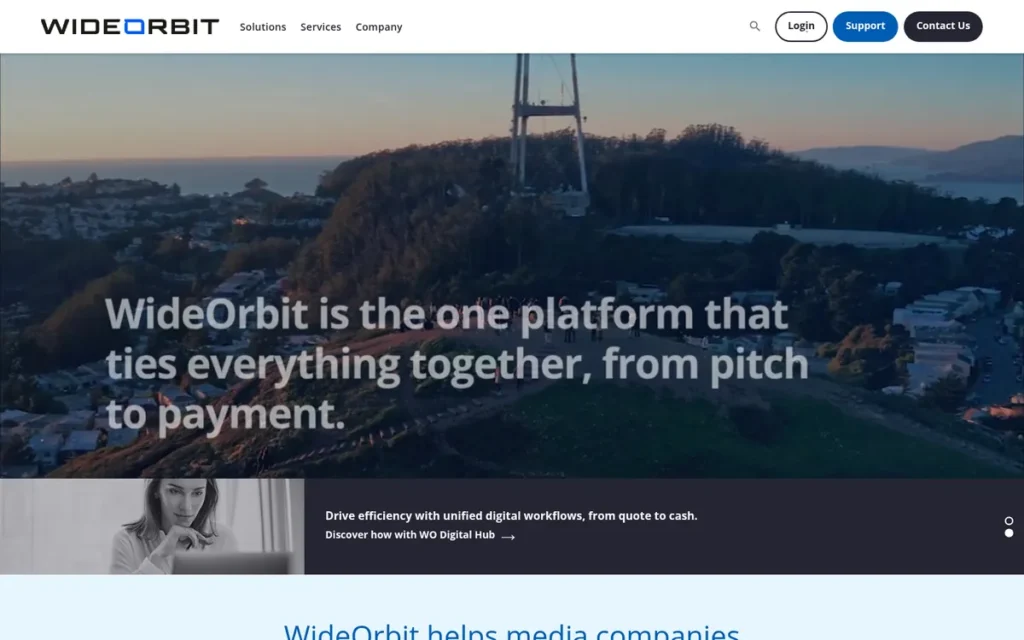
Category: Broadcast Sales-to-Traffic Suite, a single system covering broadcast proposals, avails, traffic, reconciliation and billing.
At a Glance
- Category: Broadcast Sales-to-Traffic Suite
- Best For: Multi-station TV, radio and cable groups and networks that sell linear and digital together
- Price Range: Pricing on request (quote-based; no public rate card as of November 2026)
- Primary Strength: WideOrbit connects media sales, traffic and converged linear-plus-digital billing natively in one system of record.
- Biggest Limitation: WideOrbit’s interface draws G2 complaints about bugs, crashes when users work fast, and slowdowns with many concurrent users.
- One-Line Summary: WideOrbit is a native sales-to-traffic-to-billing suite for broadcast groups that adds converged linear-plus-digital invoicing, used by 5,000+ stations and cable networks according to vendor figures (Lumine Group, 2023).
- Last Verified: November 2026
Overview
WideOrbit is a broadcast advertising sales, traffic and billing suite for TV stations, radio groups, cable networks and multi-station broadcasters that need one system of record from proposal through converged linear-and-digital invoicing. WideOrbit’s core modules are WO Media Sales, WO Traffic, WO Network, WO Omni and WO Fusion.
WideOrbit has been owned by Lumine Group, part of Constellation Software, since the acquisition closed in February 2023 (Lumine Group, 2023).
Key Features
- WideOrbit Media Sales builds a single proposal or order across multiple markets, properties and media types using real-time avails and Nielsen or Comscore audience estimates.
- WideOrbit submits orders from WO Media Sales directly into WO Traffic, so no one has to re-key them between sales and traffic.
- WideOrbit supports converged billing, so advertisers can receive one invoice covering both linear and digital campaigns.
- WideOrbit Fusion provides combined broadcast TV and digital workspaces where sellers build one media plan across multiple audience currencies.
- WideOrbit offers reporting across traffic, sales, billing and logs, plus a WO Payments Suite that integrates with WO Traffic.
Best For
WideOrbit is best for mid-size to large broadcast TV, radio and cable groups, and for networks, that sell linear and digital inventory together and want sales, traffic and billing from one vendor.
Strengths
- WideOrbit holds a 4.1/5 rating from 50 G2 reviews (G2, 2026), the largest independent review base among the enterprise and broadcast vendors here, and reviewers praise its reporting and customizable layouts.
- WideOrbit Fusion won Best in Show at RedTech’s IBC 2025 Awards (RedTech, 2025), an independent industry award for its converged broadcast-and-digital workspace.
- WideOrbit reports serving 5,000+ stations and cable networks and processing $35B+ in annual ad revenue (Lumine Group, 2023; vendor-published).
- WideOrbit’s named customers include Nexstar, TEGNA, Gray, Sinclair, Hearst TV, Audacy and Bell Media (Lumine Group, 2023; vendor-published).
- WideOrbit publishes a customer testimonial saying WO Analytics “cut analysis time by at least half” (WideOrbit, 2026; vendor-published).
Limitations
WideOrbit trades usability for depth. G2 reviewers describe the WideOrbit interface as “clumsy and buggy” in places and say it crashes when users work fast (G2, 2026).
- WideOrbit slows down with many concurrent users and feels “intimidating” at first, according to G2 reviewers, although many add that it is easy once learned (G2, 2026).
- WideOrbit’s 4.1/5 G2 rating is the lowest among vendors with 50+ reviews in this list (G2, 2026), and WideOrbit publishes no pricing.
- WideOrbit’s broadcast-centric design is more than digital-only publishers need, and no one has independently verified whether support quality changed after the 2023 acquisition.
A radio user on r/radio described their experience (2014):
“We use WO for traffic and Automation, Audition for audio production, Premier for video production and Music Master for scheduling. Overall I’m loving WO, we had a few growing pains in the transition from AV but all is smooth now.” Posted by u/bradgoehl
Takeaway: WideOrbit’s learning curve is real but temporary, and radio users report that early growing pains give way to smooth day-to-day traffic operations.
Verdict
WideOrbit is the top-scoring platform in this 2026 ranking for broadcast groups that need proposals, traffic and converged linear-plus-digital billing in one native system. WideOrbit’s scale, its IBC 2025 award and the largest independent review base among broadcast vendors support that position.
Buyers should test WideOrbit’s interface performance under realistic concurrent use during demos. Buyers should also ask for references from groups of similar size.
2. Operative: Best for Enterprise Omnichannel Order Management (Linear, Digital, CTV, DOOH, Audio)
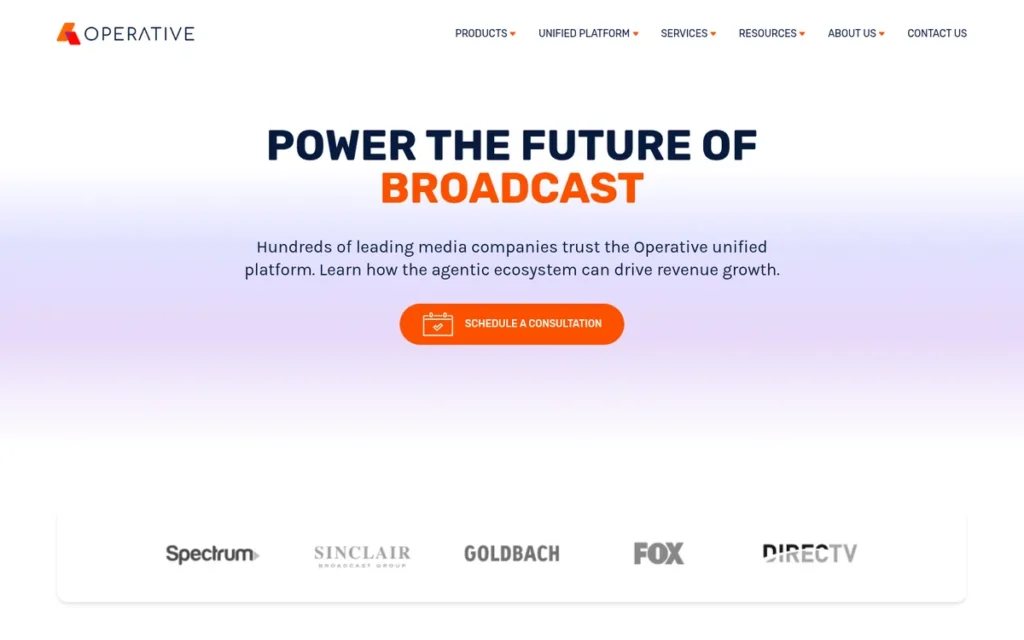
Category: Omnichannel Order Management System (OMS), a platform that manages advertising orders from proposal through execution and billing across multiple channels.
At a Glance
- Category: Omnichannel Order Management System (OMS)
- Best For: Networks, streamers and multi-channel media companies selling linear, digital and CTV inventory
- Price Range: Pricing on request (quote-based; AOS implementation advertised as free, November 2026)
- Primary Strength: Operative documents the broadest omnichannel order management scope in this list and ties Boostr for the strongest integration ecosystem.
- Biggest Limitation: Operative has only 4 G2 reviews (3.9/5), and users report a steep, non-intuitive learning curve.
- One-Line Summary: Operative is an enterprise omnichannel order management platform that handles linear, digital and converged ad deals and connects to GAM 360, FreeWheel and Salesforce.
- Last Verified: November 2026
Overview
Operative is an enterprise advertising sales and order management platform, sold as Operative.One and the lighter AOS edition, for networks, streamers and media companies selling linear, digital, CTV, DOOH and audio inventory. Operative manages deals from media planning through billing in one workflow.
Operative has operated since 2000 and is headquartered in New York (Operative, 2026).
Key Features
- Operative.One manages linear, digital and converged deals across media planning, proposals, orders, execution, billing and revenue visibility.
- Operative integrates two-way with Google Ad Manager 360 for trafficking and delivery sync, and connects to FreeWheel and PubMatic through its CloudCore data-exchange layer.
- Operative connects to Salesforce Media Cloud and Oracle PeopleSoft, so enterprises can keep their existing CRM and ERP.
- Operative AOS is an enterprise-grade OMS configured for smaller or growing media companies, advertised with free implementation and go-live “in as little as three months” (Operative, 2026; vendor claim).
- Operative’s G2 profile states that Operative.One supports major streaming platforms and more than 100 CTV services (G2, 2026; vendor-published).
Best For
Operative is best for large networks, streamers and multi-channel media companies that run complex linear, digital and CTV order volumes and need order management synced with GAM 360, FreeWheel and an existing CRM or ERP.
Strengths
- Operative documents integrations with GAM 360 (two-way), FreeWheel, Salesforce Media Cloud, Oracle PeopleSoft and PubMatic via CloudCore (CRO Club, 2026), the most enterprise-grade connector list in this set.
- Operative names Cox Media, Effectv and Spectrum Reach as live customers on its AOS platform (Operative, 2026; vendor-published).
- Operative reports serving 300+ media brands in 18 countries and processing $60B+ in ad revenue since 2000 (Operative, 2026; vendor-published).
- Operative’s G2 reviewers praise its integration flexibility and support for multiple countries and processes, and one reviewer cites fast customer service (G2, 2026), though the sample is small.
Limitations
Operative pays for enterprise depth with usability. One Operative G2 reviewer notes that “prior training is required… not intuitive” (G2, 2026).
- Operative.One’s independent review base is only 4 G2 reviews averaging 3.9/5 (G2, 2026), with no verified Capterra or TrustRadius listing.
- Our research found no documentation of native linear traffic in Operative’s materials, so Operative customers in broadcast may still need a separate traffic system.
- Operative publishes no pricing and has no verified independent awards, and smaller publishers may find even Operative AOS more complex than they need.
Verdict
Operative is the best-documented choice in 2026 for enterprise media companies that need omnichannel order management tightly synced with GAM 360, FreeWheel and an existing CRM. Operative ties Boostr for the strongest documented integration ecosystem in this list.
Operative’s independent review evidence is very thin, so buyers should insist on reference calls with customers of a similar channel mix. Buyers should also confirm in demos whether Operative handles linear traffic natively.
3. MediaOS: Best for Small and Mid-Size Publishers Needing Contract-to-Cash
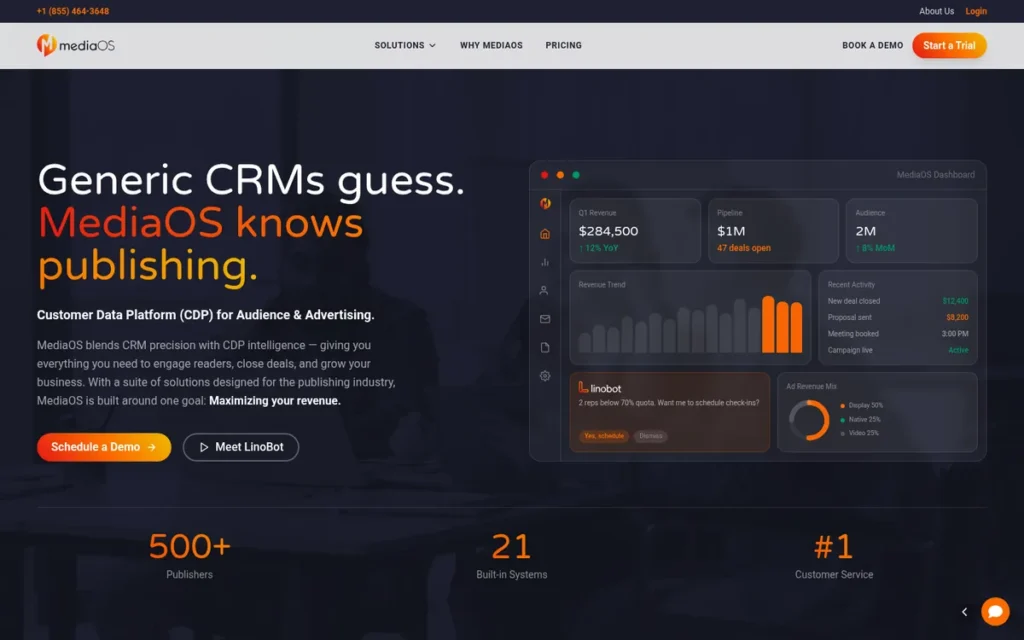
Category: Publisher Contract-to-Cash Platform, an all-in-one system covering ad sales CRM, contracts, production and invoicing for publishers.
At a Glance
- Category: Publisher Contract-to-Cash Platform
- Best For: Small and mid-size print, digital, newsletter and events publishers with up to roughly 10 sellers
- Price Range: $497/month for 5 core user licenses (MediaOS, 2026); Capterra lists $20–$25/user/month, so confirm (setup fees and extra-user prices not public, November 2026)
- Primary Strength: MediaOS combines the largest independent review sample in this list (4.7/5 from 130 reviews) with a published package price covering the full contract-to-cash workflow.
- Biggest Limitation: MediaOS has no broadcast traffic capability, and negative reviews report inconsistent support and strict no-refund cancellation terms.
- One-Line Summary: MediaOS is a contract-to-cash ad sales platform for small and mid-size publishers, rated 4.7/5 from 130 reviews and listed publicly at $497/month for five users.
- Last Verified: November 2026
Overview
MediaOS, formerly Ad Sales Genius, is a contract-to-cash ad sales platform for small and mid-size print, digital, newsletter, events and out-of-home publishers that want CRM, proposals, e-signed insertion orders, production tracking, invoicing and payments in one system at a published price. MediaOS suits teams that don’t sell broadcast airtime.
MediaOS is headquartered in Nashville, Tennessee (LinkedIn, 2026).
Key Features
- MediaOS covers CRM and pipelines, proposals, and electronic contracts and insertion orders signed through DocuSign.
- MediaOS tracks production and proofs, including flat planning for print publications.
- MediaOS handles invoicing, automated past-due reminders, payments, stored cards and payment plans.
- MediaOS provides commission and inventory reporting across print, digital, newsletter, events and OOH products.
- MediaOS integrates with QuickBooks, Google Ad Manager, Broadstreet, DocuSign, InDesign and Slack.
Best For
MediaOS is best for small and mid-size multi-format publishers, such as local news outlets, magazines, newsletters and event organizers, that want one affordable system from proposal to payment and don’t sell broadcast airtime.
Strengths
- MediaOS holds a 4.7/5 rating from 130 reviews across Capterra, GetApp and Software Advice (Capterra, 2026), the largest independent sample in this list; these sites share one review pool, which PlugRoute counted once.
- MediaOS earns 4.6/5 for customer service and 4.5/5 for value from Capterra reviewers (Capterra, 2026).
- MediaOS publishes a package price with a user count, $497/month for 5 core users, on its pricing page (MediaOS, 2026).
- MediaOS reviewers praise flat planning, QuickBooks sync and payment plans, and one calls it “by far the very best cloud-based CRM and all-in-one publishing solution in the media business” (Capterra, 2026).
- MediaOS reports serving 500+ publishers across North America and lists Vice Media, Condé Nast and Texas Monthly as customers (MediaOS, 2026; vendor-published).
Limitations
MediaOS gives up scope and consistency for affordability. MediaOS has no broadcast traffic capability, so radio and TV sellers need another system.
- MediaOS’s negative reviews describe “half-baked features,” features removed in updates, and support described as “nonexistent” (Software Advice, 2026).
- MediaOS users report difficulty importing historical data, outdated training videos and an “untenable” Xero integration (Capterra, 2026).
- MediaOS has no mobile app and cannot export reports to PDF, and one reviewer reported that MediaOS kept months of an annual prepayment after cancellation under its no-refund policy (Software Advice, 2026).
- MediaOS is listed differently on Capterra at $20–$25 per user per month, likely from the Ad Sales Genius era (Capterra, 2026), so buyers should confirm what the $497 package includes.
Verdict
MediaOS is the best-evidenced choice in 2026 for small and mid-size multi-format publishers that want contract-to-cash in one system at a published package price. MediaOS’s 4.7/5 rating across 130 reviews is the largest independent review sample in this list.
Buyers should test historical data import and their accounting integration, especially Xero, in a MediaOS trial. Buyers should also confirm current pricing and read the cancellation terms carefully.
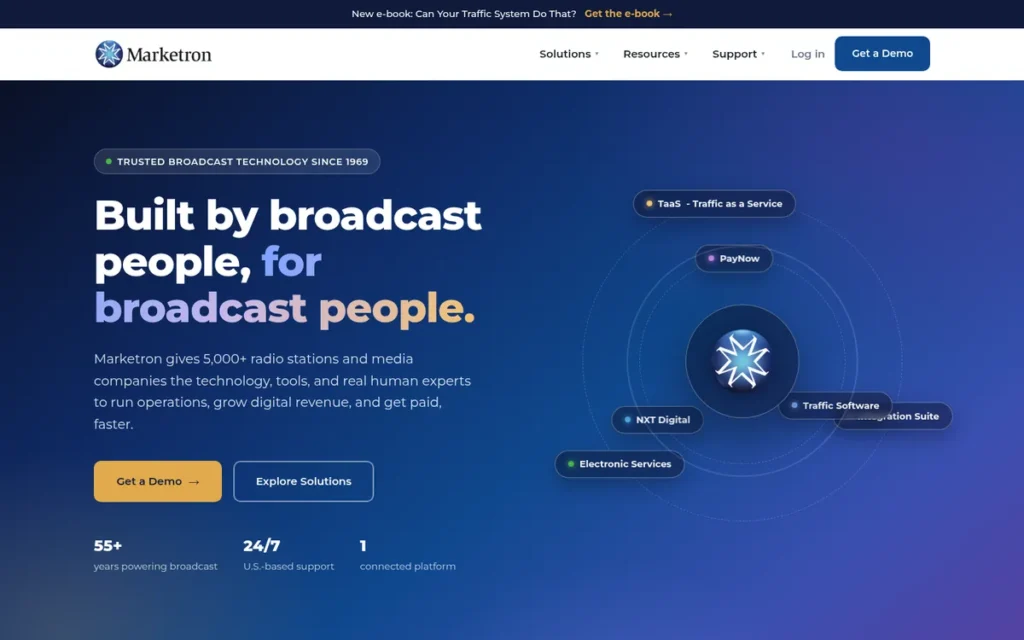
4. Marketron: Best for Local Radio and TV Groups Selling Airtime Plus Resold Third-Party Digital
Category: Broadcast Sales-to-Traffic Suite.
At a Glance
- Category: Broadcast Sales-to-Traffic Suite
- Best For: Local radio and TV groups that also resell third-party digital products to local advertisers
- Price Range: Pricing on request (quote-based; no public rate card as of November 2026)
- Primary Strength: Marketron connects radio and TV proposals, traffic, invoicing and resold digital fulfillment in one two-way integrated flow.
- Biggest Limitation: Marketron has no verified listing on G2, Capterra or TrustRadius, so its quality claims cannot be checked against independent user reviews.
- One-Line Summary: Marketron is a local broadcast sales and traffic platform that lets radio and TV groups propose, order, invoice and report on airtime and resold digital in one connected workflow.
- Last Verified: November 2026
Overview
Marketron is a broadcast sales and traffic software provider, founded in 1969, for local and regional radio and TV groups that sell airtime alongside resold third-party digital advertising to local advertisers. Marketron’s NXT and Traffic products let those groups propose, order, schedule, invoice and report in one connected workflow.
Marketron is headquartered in Hailey, Idaho, and owned by Diversis Capital (Marketron, 2025).
Key Features
- Marketron NXT lets sales teams propose, order, report on and bill both radio and digital advertising buys.
- Marketron Traffic handles broadcast scheduling, avails, copy, log reconciliation and billing.
- Marketron’s two-way Traffic–NXT integration carries airtime and digital products (display, geofencing, OTT, social and search) from proposal to invoice.
- Marketron Traffic integrates with PayNow for electronic invoicing and e-payments.
- Marketron NXT Digital supports fulfillment of third-party digital products that local stations resell to advertisers.
Best For
Marketron is best for local and regional radio and TV groups whose growth depends on bundling airtime with resold digital products, and who want sales tightly tied to traffic to avoid double entry.
Strengths
- Marketron has won Radio World’s NAB Best of Show award three times, for Marketron NXT in 2022 and 2024 and for the Marketron Traffic and NXT integration in 2025 (Radio World, 2025; Marketron, 2025).
- Marketron reports serving 7,000+ media organizations and managing $7B in annual US ad revenue for 1.5M+ advertisers (Marketron, 2025; vendor-published).
- Marketron case studies report that NRG Media tripled its third-party digital ad revenue with NXT Digital and that Iliad Media Group cut monthly expenses 20% with PayNow e-invoicing (Marketron, 2026; vendor-published).
- Marketron marked 55 years in business in 2025 (Radio World, 2025), the longest operating history in this list.
Limitations
Marketron’s local broadcast focus leaves an evidence gap. PlugRoute found no verified Marketron presence on G2, Capterra or TrustRadius as of November 2026, so Marketron’s quality claims rest on vendor testimonials, case studies and awards.
- Marketron’s station-centric model is a poor fit for digital-first publishers.
- Marketron’s product boundaries, including Mediascape and REVENUE/DOM, are unclear in public materials.
- Marketron publishes no pricing, and a third-party directory makes ownership and CEO claims that Marketron’s own 2025 materials contradict.
A RadioTraffic customer on r/radio asked other stations (2023):
“And are you having contract issues? We have 5 years left of our contract but they are threatening to shut us down if we don’t sign a new contract for nearly 3 times as much cost. Anybody else?” Posted by u/WakeMeAndDie
Takeaway: At least one Marketron RadioTraffic customer reports pressure to re-sign mid-contract at nearly triple the cost, so buyers should get Marketron’s quote-only pricing and renewal terms in writing.
Verdict
Marketron is a full-stack sales-and-traffic option built specifically for local radio and TV groups that sell airtime alongside resold digital. Marketron’s three NAB Best of Show awards and its documented Traffic–NXT integration support that position.
PlugRoute found no independent user reviews of Marketron as of November 2026, so buyers should require at least two reference calls with groups of similar size. Buyers should also compare Marketron head-to-head with WideOrbit.
5. Boostr: Best for Mid-to-Large Digital, CTV and Audio Publishers Needing a Media-Native CRM + OMS
Category: Omnichannel Order Management System (OMS).
At a Glance
- Category: Omnichannel Order Management System (OMS), with media-native CRM
- Best For: Mid-size to large digital, CTV, audio and retail media publishers running direct-sold campaigns through GAM or FreeWheel
- Price Range: Pricing on request (G2 lists a “Basic” plan at $149/month without stating the unit or inclusions, November 2026)
- Primary Strength: Boostr pairs a media-native CRM and OMS with pre-built connectors to major digital ad servers and ERPs.
- Biggest Limitation: Boostr has only 5 G2 reviews, users report friction when changing Google Ad Manager setups, and its fit for broadcast traffic is unproven.
- One-Line Summary: Boostr is a media-specific CRM and order management system for digital publishers, with pre-built integrations to Google Ad Manager, FreeWheel, AdsWizz, NetSuite and QuickBooks.
- Last Verified: November 2026
Overview
Boostr is a media-specific CRM and order management system for mid-size to large digital publishers and CTV, audio and retail media sellers that need pipeline, forecasting, proposals, insertion orders, pacing and billing connected to their ad server and ERP. Boostr’s OMS can also run alongside an existing Salesforce or Microsoft Dynamics CRM.
Boostr was founded in 2015 in New York (Boostr, 2026).
Key Features
- Boostr’s CRM and OMS cover pipeline, forecasting, proposals and media plans (with the AI tool “Proposal-IQ”), insertion orders, inventory, pacing and billing.
- Boostr tracks campaign pacing alongside inventory, so sellers can see delivery against each insertion order before billing.
- Boostr offers pre-built integrations with Google Ad Manager, FreeWheel, Megaphone and AdsWizz, plus REST, SOAP and flat-file connections.
- Boostr connects to NetSuite, Oracle Fusion, Sage Intacct and QuickBooks for billing and finance.
- Boostr’s AI agents turn buyer media plans and IO revisions into orders, map tags, activate campaigns in the ad server and send delivery reports in the buyer’s template.
Best For
Boostr is best for mid-size to large digital-first publishers, including CTV, podcast and audio, and retail media sellers, that want media-specific forecasting and order management connected to GAM or FreeWheel, with the option to keep Salesforce or Dynamics as the CRM.
Strengths
- Boostr documents the broadest set of pre-built digital ad-server and ERP connectors among mid-market tools in this list, including GAM, FreeWheel, Megaphone, AdsWizz, NetSuite, Oracle Fusion, Sage Intacct and QuickBooks (Boostr, 2026).
- Boostr’s Morning Brew case study reports that Revenue Operations became 15–20% more efficient, saving about one workday per week, and a separate Boostr case study claims a 50% increase in forecast accuracy (Boostr, 2026; vendor-published).
- Boostr reports 130+ customers and $10B+ in managed ad spend, with named customers including Vox Media, Insider, Vevo, BuzzFeed, Morning Brew and Fandom (Substack company profile, 2026; vendor-published).
- Boostr holds a 4.1/5 rating from 5 G2 reviews, and reviewers praise Boostr’s media planning, forecasting, customizable dashboards and Outlook/Salesloft integration (G2, 2026).
Limitations
Boostr’s integration depth comes with implementation friction. Boostr G2 reviewers say “implementation can be challenging, particularly when making changes related to GAM” (G2, 2026).
- Boostr users report tedious activity entry, manual contract updates and inventory management issues, and SelectHub summaries add occasional bugs and integration sync problems (G2, 2026; SelectHub, 2026).
- Boostr’s own comparison page admits it has no Prisma integration (Boostr, 2026), and Boostr’s fit for broadcast and linear traffic is unproven.
- Boostr’s independent review base totals only 7 ratings across G2 (5) and TrustRadius (2) (G2, 2026; TrustRadius, 2026).
Verdict
Boostr offers the deepest pre-built connector set among the media-native CRM and OMS tools in this list, which makes it a strong 2026 fit for digital, CTV and audio publishers that keep Salesforce or Dynamics. Boostr’s independent review base is very small, and users report friction with GAM changes.
Buyers should run a live GAM order-change scenario in the Boostr demo. Buyers should also ask for reference customers of similar size.
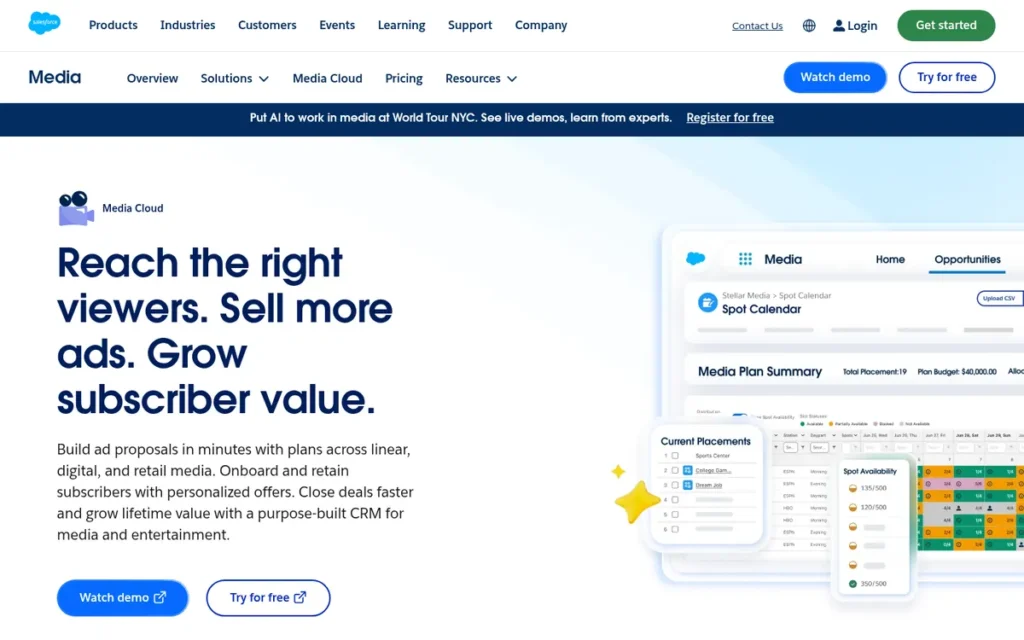
6. Salesforce Media Cloud: Best for Large Media Companies Already Standardized on Salesforce
Category: CRM Platform with Media Extensions, a general-purpose CRM with media-specific ad sales modules that integrates with separate traffic, ad-server and billing systems.
At a Glance
- Category: CRM Platform with Media Extensions
- Best For: Large media companies already running Salesforce that sell both advertising and subscriptions
- Price Range: $300–$800 per user/month, billed annually (Advertising Sales Management add-on priced on request, November 2026)
- Primary Strength: Salesforce Media Cloud adds media-specific CPQ, proposals, orders and AI proposal agents to an enterprise CRM many media companies already use.
- Biggest Limitation: Salesforce Media Cloud relies on integrations with separate systems for traffic, ad serving, campaign operations and billing.
- One-Line Summary: Salesforce Media Cloud is a configurable media CRM with ad sales proposals and orders built in, but by Salesforce’s own description it hands off traffic and billing to integrated systems.
- Last Verified: November 2026
Overview
Salesforce Media Cloud is Salesforce’s industry CRM for media companies, with an Advertising Sales Management add-on covering proposals, configure-price-quote and order execution for large multi-business media organizations that can integrate separate traffic, ad-server and billing systems. Salesforce Media Cloud’s Advertising Sales Management launched in July 2021 (Salesforce, 2021).
Key Features
- Salesforce Media Cloud Advertising Sales Management covers planning, insertion and order execution, campaign tracking, reporting and optimization across digital, linear TV and print.
- Salesforce Media Cloud includes configure-price-quote (CPQ) for complex packages and channel-specific pricing.
- Salesforce Media Cloud’s Agentforce for Media includes an Advertising Proposal Agent that gathers products, budget, timing and audience segments and then generates proposals and pitch materials.
- Salesforce Media Cloud sends submitted plans to separate campaign-management, ad-server, campaign-operations and billing systems through integration.
- Salesforce Media Cloud can be extended with AppExchange partner apps such as CloudSense Media Platform for media order management.
Best For
Salesforce Media Cloud is best for large media companies that already run Salesforce, sell both advertising and subscriptions, have in-house or partner Salesforce administrators, and plan to keep their dedicated traffic and billing systems.
Strengths
- Salesforce Media Cloud publishes per-user list prices for all three tiers (Salesforce, 2026), which makes it more transparent than most enterprise competitors.
- Salesforce Media Cloud includes AI proposal automation through Agentforce for Media, plus agents for RFP tracking and campaign briefs (Salesforce, 2026).
- Salesforce Media Cloud’s Advertising Sales Management named Sony Pictures Networks India, which reaches 700M viewers across 26 channels, as an early customer (Salesforce, 2021).
- Salesforce Media Cloud has an AppExchange partner ecosystem, and partner CloudSense reports a 50% cut in quote cycle time, a result that belongs to CloudSense, not Media Cloud (Salesforce AppExchange, 2026).
Limitations
Salesforce Media Cloud gives up operational completeness for CRM flexibility. By Salesforce’s own description, traffic and billing flow to separate systems, so broadcast needs such as avails, makegoods and log reconciliation depend on integrations (Salesforce, 2026).
- Salesforce Media Cloud’s total cost includes per-seat licenses, a non-public Advertising Sales Management add-on, systems integrators and administrators, and one guide estimates 3–6 months for a core ad sales deployment (Deselect, 2026).
- Salesforce Media Cloud has no media-specific review listing, and PlugRoute does not credit it with the parent Sales Cloud rating.
- Salesforce Media Cloud has no media-specific analyst recognition or customer case study with measured results that PlugRoute could find as of November 2026.
Verdict
Salesforce Media Cloud is the logical choice in 2026 for Salesforce-standardized media companies that want ad sales proposals and orders inside their existing CRM, but it does not replace dedicated traffic or billing systems.
Buyers should budget for integration work and a multi-month Salesforce Media Cloud implementation. Buyers should also compare total cost against pairing their CRM with Boostr or Operative.
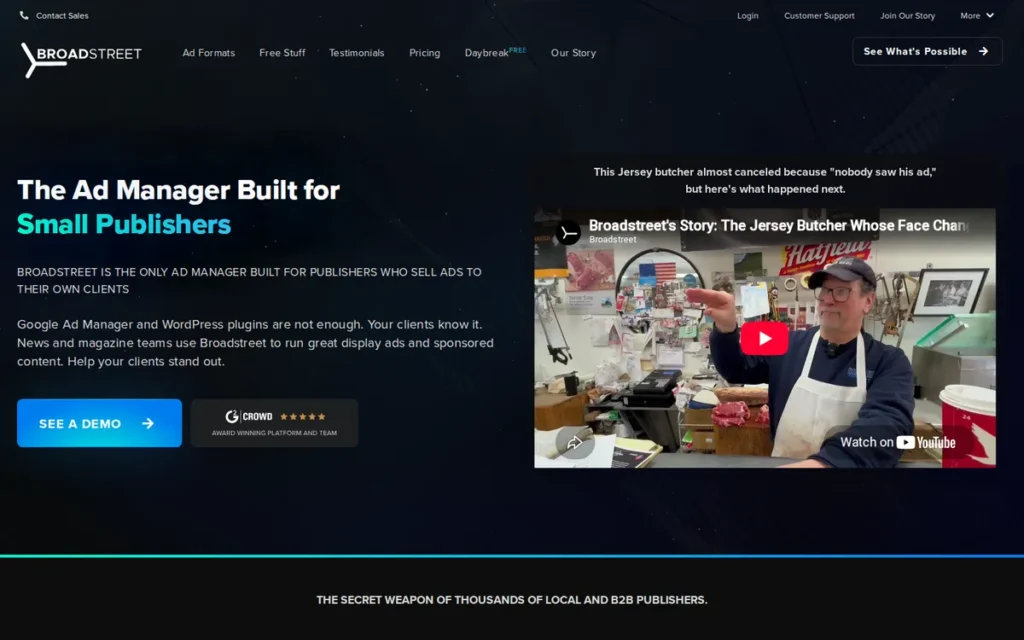
7. Broadstreet: Best for Small Digital and Newsletter Publishers Selling Ads Direct
Category: Direct-Sold Ad Delivery Layer, an ad server for delivering and reporting on directly sold ads, usually paired with a separate CRM or order management system.
At a Glance
- Category: Direct-Sold Ad Delivery Layer
- Best For: Small local news, digital and newsletter publishers selling sponsorships and display ads directly
- Price Range: $299/month Business plan; VIP from $999/month (G2, 2026); free trial available
- Primary Strength: Broadstreet earns the highest independent rating in this list for easy setup, ad-format variety and automated advertiser reporting.
- Biggest Limitation: Broadstreet is not a CRM, proposal, contract or billing system, so it covers only the ad delivery stage of the media sales workflow.
- One-Line Summary: Broadstreet is a direct-sold ad server for small digital and newsletter publishers, rated 4.8/5 from 52 G2 reviews, that handles ad delivery and reporting but not sales or billing.
- Last Verified: November 2026
Overview
Broadstreet is a direct-sold digital ad server for small and mid-size digital and newsletter publishers that need to deliver, preview and report on sponsored display, high-impact and newsletter ads. Publishers typically pair Broadstreet with a separate CRM or order management system.
Broadstreet describes itself as “The Ad Manager for Direct Sales” (Broadstreet, 2026).
Key Features
- Broadstreet serves direct-sold display ads and high-impact formats from 100+ templates, including billboard, pop-out, cube and in-content units.
- Broadstreet supports newsletter ad serving and sponsored content alongside website placements.
- Broadstreet generates ad previews and automated advertiser reports.
- Broadstreet offers Daybreak, a free self-serve lead tool that lets prospective advertisers contact the publisher directly.
- Broadstreet works with WordPress and integrates with MediaOS for publishers that pair it with a sales CRM.
Best For
Broadstreet is best for small local news, digital and newsletter publishers that sell ads directly, find Google Ad Manager too complex, and already have, or plan to add, a CRM or contract-to-cash tool such as MediaOS. Broadstreet offers a free trial, so these publishers can test it before committing (G2, 2026).
Strengths
- Broadstreet holds a 4.8/5 rating from 52 G2 reviews (G2, 2026), the highest independent rating in this list, and reviewers praise its easy setup, support, ad-format variety and automated reporting.
- Broadstreet publishes its $299/month entry price (Broadstreet, 2026), so publishers can budget without a sales call.
- Broadstreet’s Daybreak tool brought The Hernando Sun about 20 inquiries and one new advertiser (Editor & Publisher, 2026), a small but documented self-serve result.
- Broadstreet’s G2 reviewers report that the monthly fee is “quickly offset by ad sales” (G2, 2026; user-reported).
Limitations
Broadstreet’s narrow scope means it covers only ad delivery and reporting. Broadstreet offers no sales-side or billing tools, so publishers need a second system for the rest of the workflow.
- Broadstreet is digital-only, and 98.1% of its G2 reviews come from small businesses (G2, 2026), which leaves little evidence for enterprise use.
- Broadstreet reviewers cite a backend that “could be more intuitive,” occasional lag, and limited header bidding and programmatic support (G2, 2026).
- Broadstreet costs more than free ad servers such as Google Ad Manager.
Verdict
Broadstreet is the highest-rated tool in this 2026 ranking for small digital and newsletter publishers, but it is a delivery layer, not a complete media sales platform. Broadstreet’s 4.8/5 G2 rating comes almost entirely from small-business users.
Buyers should pair Broadstreet with a CRM or contract-to-cash system such as MediaOS. Buyers should also confirm the VIP price on Broadstreet’s live pricing page.
What Is the Best Media Sales Software for Broadcast and Radio Stations?
WideOrbit is the best media sales software for larger broadcast TV, radio and cable groups and networks that need converged linear-plus-digital billing. Marketron is the best fit for local radio and TV groups that bundle airtime with resold third-party digital products. Both connect sales directly to their own traffic systems.
The two broadcast suites compare as follows:
- Scale: WideOrbit reports 5,000+ stations and cable networks (Lumine Group, 2023), while Marketron reports 7,000+ media organizations (Marketron, 2025), and both figures are vendor-published.
- Converged billing: WideOrbit documents one invoice covering linear and digital, while Marketron documents a two-way Traffic–NXT flow for airtime and resold digital plus PayNow e-invoicing.
- Digital resale: Marketron NXT Digital is built specifically for local stations that resell third-party display, geofencing, OTT, social and search.
- Independent evidence: WideOrbit holds 4.1/5 from 50 G2 reviews (G2, 2026), while Marketron has no review listing that PlugRoute could find as of November 2026.
- Awards: WideOrbit Fusion won RedTech’s IBC 2025 Best in Show (RedTech, 2025), and Marketron won Radio World NAB Best of Show in 2022, 2024 and 2025 (Radio World, 2025; Marketron, 2025).
“I think it absolutely has to integrate with your traffic software. Otherwise it will be too much double handling.” (u/entirely_radio, r/radio (Reddit, 2025))
Takeaway: Radio sellers treat native sales-to-traffic integration as a must-have, because without it every order is entered twice, which favors suites like WideOrbit and Marketron.
None of the other five platforms in this ranking documents native broadcast traffic capability as of November 2026.
What Is the Best Media Sales Software for Digital Publishers?
Operative suits enterprise digital, CTV and linear sellers needing two-way GAM 360 sync. Boostr suits mid-to-large digital, CTV and audio publishers keeping Salesforce or Dynamics. MediaOS suits small and mid-size multi-format publishers wanting a published package price. All three cover proposals through orders, but they differ on scale and CRM strategy.
The three digital-first platforms compare as follows:
- Scale: Operative reports 300+ media brands (Operative, 2026), Boostr reports 130+ customers (Substack company profile, 2026) and MediaOS reports 500+ publishers (MediaOS, 2026), and all three figures are vendor-published.
- CRM strategy: Operative and Boostr can run alongside Salesforce, Boostr also supports Microsoft Dynamics, and MediaOS replaces the CRM with its own.
- Ad-server connectors: Operative documents two-way GAM 360 sync plus FreeWheel and PubMatic, Boostr documents GAM, FreeWheel, Megaphone and AdsWizz, and MediaOS integrates with GAM and Broadstreet.
- Independent evidence: Operative holds 3.9/5 from 4 G2 reviews, Boostr holds 4.1/5 from 5 G2 reviews, and MediaOS holds 4.7/5 from 130 Capterra reviews (G2, 2026; Capterra, 2026).
- Price signal: Operative is quote-only with advertised free AOS implementation, Boostr shows only a $149/month G2 listing with an unclear unit, and MediaOS lists $497/month for 5 users.
“I also tried GAM but their setup process was incredibly complicated and their help is non-existent. Both are big red flags!” (u/JD_256, r/AskMarketing (Reddit, 2021))
Takeaway: Small publishers often abandon Google Ad Manager over setup complexity and weak support, which is the gap simpler direct-sold ad servers like Broadstreet target (indirect category evidence).
How Much Does Media Sales Software Cost?
Media sales software costs range from $299/month for a small-publisher ad server to $800 per user/month for an enterprise CRM tier, as of November 2026. Most broadcast and enterprise vendors are quote-only, and none of the seven platforms PlugRoute evaluated publicly discloses implementation, data migration or integration fees.
| Vendor | Published Price and Billing Unit | Independent Rating |
|---|---|---|
| WideOrbit | Quote-only; no public rate card | G2 4.1/5 (50 reviews) |
| Operative | Quote-only; AOS implementation advertised as free (vendor claim) | G2 3.9/5 (4 reviews) |
| MediaOS | $497/month package with 5 core users; Capterra lists $20–$25/user/month | Capterra 4.7/5 (130 reviews) |
| Marketron | Quote-only | No listing found |
| Boostr | G2 “Basic” plan $149/month, unit and scope unclear; full deployments quote-based | G2 4.1/5 (5 reviews) |
| Salesforce Media Cloud | Growth $300, Advanced $450, Sales Max $800 per user/month, billed annually; ASM add-on on request | No media-specific listing |
| Broadstreet | Business $299/month per account; VIP from $999/month; free trial | G2 4.8/5 (52 reviews) |
Prices and ratings as of November 2026 (vendor pricing pages, 2026; G2, 2026; Capterra, 2026).
Pricing details buyers should confirm:
- Salesforce’s pricing page lists Salesforce Media Cloud Advanced at $450 per user per month (Salesforce, 2026), and some AI assistants cite $475, which PlugRoute could not verify.
- Salesforce Media Cloud Sales Max requires an annual contract, and Salesforce says the Advertising Sales Management add-on price varies with licensed seats and order throughput (Salesforce, 2026).
- CloudSense, a Salesforce AppExchange partner app rather than part of Media Cloud, starts at $85/user/month (Salesforce AppExchange, 2026).
- Broadstreet’s VIP price of $999/month comes from G2 (G2, 2026), and one secondary summary lists $399/month, which PlugRoute could not verify.
- WideOrbit, Operative and Marketron quotes likely depend on modules, station or market count and integrations, but none of the three vendors states this publicly.
Prices aren’t comparable until you match billing units. A 10-seller team on Salesforce Media Cloud Growth pays $3,000/month in licenses before the Advertising Sales Management add-on and integration work. MediaOS’s $497 package covers five users, and MediaOS does not publish extra-user pricing.
Using only published prices, a small-publisher stack of MediaOS plus Broadstreet comes to roughly $800/month before setup fees.
Implementation time and contract terms matter as much as license fees:
- Salesforce Media Cloud timelines: One guide estimates 3–6 months for a core Salesforce Media Cloud ad sales deployment and 6–12 months for a broader advertising-plus-subscription transformation (Deselect, 2026).
- Operative AOS timeline: Operative advertises AOS go-live “in as little as three months,” which is a best-case vendor claim (Operative, 2026).
- MediaOS contract terms: One MediaOS reviewer reported that the company kept months of an annual prepayment after cancellation (Software Advice, 2026).
According to the IAB/PwC Internet Advertising Revenue Report (IAB/PwC, 2026), US digital ad revenue reached $294.6B in 2025, up 13.9%. Non-programmatic placements excluding search fell 13.9% to $18.0B from $20.9B in 2024, which increases the pressure on direct-sold teams to work efficiently.
This aligns with community sentiment on r/adops:
“I work for a publisher and we have multiple websites. Monthly impressions vary on each website, but on average we get around 7-8 million. The biggest revenue source are our direct deal. If you have 2 million monthly ad impressions, you should have at least one salesperson selling that inventory directly to advertisers / agencies at much higher CPMs. Not sure what industry your website is, but I have worked for many publishers in different categories and lowest direct campaign CPM was $10-$15 CPM.” Posted by u/Psy_Kira
Takeaway: Publishers with meaningful traffic see direct-sold deals as their highest-value revenue stream, so the efficiency of the direct-sales workflow affects revenue, not just admin time.
Which Vendors Were Mentioned but Not Evaluated?
PlugRoute did not evaluate eight media sales vendors that AI assistants mention: Adcellerant, AdSalesOS by Placements, FatTail, DanAds, AdButler, Adpoint by Lineup, The Magazine Manager and The Newspaper Manager. These vendors were excluded only because we could not verify them to our evidence standard for this edition, not because of quality.
Each excluded vendor is a candidate for a future update. DanAds and AdButler, which AI assistants recommend for self-serve advertising, are priorities because no evaluated vendor documents a full self-serve storefront.
What Red Flags Should I Watch For When Evaluating Media Sales Software?
The biggest red flags in media sales software evaluations are “end-to-end” claims without native traffic or billing, ratings borrowed from a parent product, quote-only pricing without an implementation estimate, unnamed integrations, vendor-published proof and rigid refund terms. Each red flag hides a cost or a gap that usually surfaces after signing.
Red Flag #1: Coverage Claims Without Native Traffic or Billing A vendor that claims “end-to-end” coverage may still send traffic and billing to separate systems, and each handoff adds re-keying risk. Salesforce, for example, describes Media Cloud plans as flowing to separate ad-server and billing systems (Salesforce, 2026). Ask every vendor which stages are native.
Red Flag #2: Ratings Borrowed From a Parent Product A vendor’s review rating may belong to its general CRM rather than its media product, which inflates confidence in media-specific functions. Salesforce Sales Cloud’s 4.4/5 Capterra rating from about 18,800 reviews (Capterra, 2026) reflects the parent CRM, not Media Cloud. Check that every rating names the exact media product.
Red Flag #3: Quote-Only Pricing With No Implementation Estimate Quote-only pricing makes budgeting difficult until late in the sales process. WideOrbit, Operative and Marketron publish no pricing, and none of the seven platforms PlugRoute evaluated publicly discloses implementation, migration or integration fees as of November 2026. Ask for a written three-year cost estimate early.
Red Flag #4: No Named Ad-Server or ERP Connector “Integrates with everything” is not evidence of a working connector. Operative and Boostr name specific connectors such as GAM 360, FreeWheel and NetSuite, while MediaOS names QuickBooks and DocuSign. Expect every vendor to name the exact ad-server, traffic, CRM and ERP connectors it supports today.
Red Flag #5: Sponsored or Vendor-Published Proof Vendor-published case studies, sponsored rankings and vendor-selected testimonials are not independent proof of quality. Homepage quotes from Marketron customers (Marketron, 2026) and WideOrbit’s testimonial that WO Analytics cut analysis time by half (WideOrbit, 2026) are examples. Weigh such claims below independent reviews and reference calls.
Red Flag #6: Rigid Cancellation and Refund Terms Annual prepayment with no refund can lock a team into a poor fit for a full contract year. One MediaOS reviewer reported losing months of prepayment after cancellation (Software Advice, 2026). Read cancellation and refund terms for any vendor before signing, and ask for them in writing.
What Questions Should I Ask Before Choosing Media Sales Software?
Before choosing media sales software, ask which workflow stages are native, have the vendor run your real order scenario live, confirm named connectors, get three-year total costs, speak to two reference customers and check linear-plus-digital invoicing. These questions expose gaps that marketing pages and scripted demos usually skip.
Question #1: Which workflow stages are native and which require integration or partner apps? Ask each vendor to state, stage by stage, whether pipeline, proposals, IOs, avails, traffic, fulfillment, billing and reporting are native or integration-based. As of November 2026, only WideOrbit and Marketron document native broadcast traffic, so any other vendor claiming end-to-end coverage should show its traffic connector live.
Question #2: Can you run our standard scenario live: create an advertiser, build a proposal, check inventory, change the order mid-flight, hand off to traffic or the ad server, and generate the invoice? A live run of your own order scenario exposes friction that scripted demos skip, especially mid-flight changes. Ask broadcast vendors to process a makegood and a daypart change as well. Then add tests that target each vendor’s documented weak spots, drawn from user reviews and PlugRoute’s coverage matrix:
- WideOrbit buyers should test performance under realistic concurrent use, which WideOrbit G2 reviewers flag (G2, 2026).
- Operative buyers should confirm whether Operative handles linear traffic natively or needs a separate traffic system.
- MediaOS buyers should test QuickBooks or Xero sync, which some MediaOS reviewers criticize (Capterra, 2026).
- Marketron buyers should test the Traffic–NXT handoff for a resold digital product, because no independent Marketron reviews confirm it.
- Boostr buyers should run a Google Ad Manager order change, which Boostr G2 reviewers describe as challenging (G2, 2026).
- Salesforce Media Cloud buyers should watch the handoff from Salesforce Media Cloud to the ad server and billing system.
- Broadstreet buyers should test the handoff from their CRM, such as MediaOS, into Broadstreet.
Question #3: Which connectors to our ad server, traffic system, CRM and ERP exist today, and which are custom builds? Ask for named, production-ready connectors and the documented integration method for each, such as API, data-exchange layer or flat file. Find out who maintains any custom build, what it costs per year, and what happens when your ad server or ERP changes its API.
Question #4: What are the full three-year costs for licenses, implementation, migration, integrations and support? Ask for an itemized quote that separates one-time fees from recurring fees across all three years. Confirm the billing unit, whether per user, per package or per station, so you compare like for like. Salesforce Media Cloud Growth, for example, costs $3,000 a month for 10 sellers (Salesforce, 2026).
Question #5: Can you provide two reference customers of our media type and size? Reference calls matter most for vendors with thin or no independent reviews. As of November 2026, that includes Operative (4 G2 reviews), Boostr (5 G2 reviews), Marketron (no listing found) and Salesforce Media Cloud (no media-specific listing). Ask references about implementation time, support response and billing accuracy.
Question #6: Do you support both linear and digital on one order and one invoice? Multi-channel sellers need converged ordering and invoicing to avoid reconciling two billing systems. As of November 2026, WideOrbit documents converged linear-plus-digital billing, and Marketron documents a combined airtime-and-digital flow with PayNow invoicing. Ask every other vendor to demonstrate one order and one invoice covering both channels.
How Did We Rank These Media Sales Software Platforms?
PlugRoute scored every vendor from 1 to 5 on six fixed-weight criteria: End-to-End Workflow Coverage (30%), Media-Type and Channel Breadth (20%), Documented Integration Ecosystem (15%), Independent Review Evidence (15%), Pricing Transparency (10%), and Verified Scale and Third-Party Credentials (10%). Each vendor’s rank comes from its weighted total.
The six criteria and their measurement methods:
- C1 End-to-End Workflow Coverage (30%): End-to-End Workflow Coverage gives 1 point per native stage out of eight and 0.5 points per integrated stage. End-to-End Workflow Coverage converts points to scores as follows: 7.5–8 = 5, 6.5–7 = 4, 5.5–6 = 3, 3.5–5 = 2, 3 or fewer = 1. End-to-End Workflow Coverage carries the most weight because manual handoffs are buyers’ top pain point.
- C2 Media-Type and Channel Breadth (20%): Media-Type and Channel Breadth measures documented support for linear, digital, CTV, audio, print, newsletter, events and OOH, plus converged invoicing. Channel breadth matters because broadcast and digital buyers need different tools.
- C3 Documented Integration Ecosystem (15%): Documented Integration Ecosystem rates named ad-server, ERP, CRM, e-sign and payment connectors. Documented gaps and user-reported friction lower the integration score.
- C4 Independent Review Evidence (15%): Independent Review Evidence combines rating and sample size across G2, Capterra, GetApp, Software Advice and TrustRadius. Independent Review Evidence counts shared review pools once and excludes parent-product ratings.
- C5 Pricing Transparency (10%): Pricing Transparency rewards public prices with clear billing units and inclusions. Pricing transparency matters because buyers need to plan budgets before sales calls.
- C6 Verified Scale and Third-Party Credentials (10%): Verified Scale and Third-Party Credentials weighs documented scale, named customers and independent awards. Scale and credentials are the next-best signals when reviews are thin.
| Company | C1 (30%) | C2 (20%) | C3 (15%) | C4 (15%) | C5 (10%) | C6 (10%) | Weighted Total |
|---|---|---|---|---|---|---|---|
| WideOrbit | 5 | 5 | 3 | 3 | 1 | 5 | 4.00 |
| Operative | 4 | 5 | 5 | 2 | 2 | 4 | 3.85 |
| MediaOS | 4 | 3 | 3 | 5 | 5 | 3 | 3.80 |
| Marketron | 5 | 4 | 3 | 1 | 1 | 5 | 3.50 |
| Boostr | 4 | 3 | 5 | 2 | 2 | 3 | 3.35 |
| Salesforce Media Cloud | 3 | 4 | 4 | 1 | 3 | 3 | 3.05 |
| Broadstreet | 1 | 2 | 2 | 5 | 4 | 2 | 2.35 |
Only 0.05 points separate Operative (#2) and MediaOS (#3), which is within a reasonable margin of judgment. Operative and MediaOS serve different buyers.
Operative leads on channel breadth (C2) and integrations (C3). MediaOS leads on review evidence (C4) and pricing transparency (C5). Both score 4 on workflow coverage (C1).
How rankings shift under different assumptions:
- If MediaOS’s inventory tools counted as native avails, MediaOS would score 5 on C1 and rank first at 4.10; PlugRoute scored them partial because only inventory reporting is documented.
- If pricing transparency and independent reviews were weighted at 25% each, with other criteria scaled down proportionally, MediaOS would rank first.
- If independent reviews (C4) were removed, Marketron would rise above MediaOS to #3.
- If MediaOS’s live pricing page does not confirm $497, MediaOS’s C5 drops to 4 and its total to 3.70, with its #3 rank unchanged.
PlugRoute applied the following rules where evidence was sparse:
- Missing listings: A missing review listing scores 1 on C4 only and has no effect on other criteria.
- Parent-product ratings: A parent-product rating, such as Salesforce Sales Cloud’s, is never credited to the media product.
- Claim labels: Every claim is labeled as an independent review, vendor-published or third-party synthesis.
- Source dates: Undated web pages are cited with the year PlugRoute accessed them (2026).
What changed after verification (November 2026):
- WideOrbit’s G2 rating was confirmed at 4.1/5 from 50 reviews (G2, 2026).
- Operative.One’s overall G2 rating was confirmed at 3.9/5, and the 4.5/5 figure reflects individual reviews (G2, 2026).
- Marketron’s NAB Best of Show count was corrected to three awards (Marketron, 2025).
- Boostr’s 15–20% figure was attributed to its Morning Brew case study (Boostr, 2026).
- Broadstreet’s VIP tier was confirmed at $999/month on G2 (G2, 2026).
Two data conflicts remain open:
- MediaOS pricing: MediaOS’s $497 package conflicts with Capterra’s $20–$25 per-user listing.
- Marketron reviews: Marketron has no verified listing on any major review platform.
PlugRoute has no affiliate relationships with any company listed, and rankings are determined entirely by research data and objective evaluation criteria.
What Do Buyers Most Often Ask About Media Sales Software?
Buyers most often ask which platforms handle order management and billing together, whether they can keep their current CRM, and how PlugRoute ranks vendors. The answers below are current as of November 2026 and draw on the same evidence as the rankings in this guide.
Which media sales software handles order management and billing in one system?
WideOrbit, Operative, Marketron and MediaOS document native order management and billing as of November 2026. WideOrbit adds converged linear-plus-digital invoicing, Marketron connects traffic to PayNow e-invoicing, and MediaOS runs contract-to-cash for publishers. Boostr completes billing through ERP integrations such as NetSuite and QuickBooks, while Salesforce Media Cloud routes billing to separate systems.
Can I keep my existing CRM and add a media order management system?
Yes, Boostr and Operative both run alongside an existing CRM as of November 2026. Boostr’s OMS can work with Salesforce or Microsoft Dynamics instead of Boostr’s own CRM, and Operative connects to Salesforce Media Cloud. MediaOS works differently, because MediaOS replaces the CRM with its own contract-to-cash system. Ask each vendor to demo the CRM sync live.
How does PlugRoute determine rankings?
PlugRoute ranks vendors using six published, fixed-weight criteria scored from 1 to 5, led by end-to-end workflow coverage at 30%. Every claim is labeled as independent, vendor-published or third-party, and parent-product ratings are excluded. The full scoring matrix is published, so readers can re-weight criteria for their own media type and budget.
What Do Key Media Sales Software Terms Mean?
Avails: Avails is short for available inventory, the ad slots or airtime still open for sale. Sellers build proposals around avails, so check whether a platform shows real-time avails natively or only offers inventory reporting.
Insertion Order (IO): An insertion order is the signed contract between a seller and an advertiser that sets out what will run, when and at what price. Some platforms handle IO creation and e-signature natively, for example through DocuSign, which cuts down on manual paperwork between sales and operations.
Order Management System (OMS): An OMS manages advertising orders from proposal through execution and billing across channels, often alongside an existing CRM. It suits buyers who want to keep their current CRM but need media-specific order handling.
Traffic: Traffic is the broadcast function that schedules ads, manages copy and builds the on-air logs. Without native integration between sales and traffic, every order has to be entered twice, so broadcast buyers should confirm how proposals reach the traffic system.
Log Reconciliation: Log reconciliation checks what actually aired against what was ordered, so billing matches delivery. It is a core broadcast need that some CRM-based platforms only cover through integrations with separate systems.
Makegood: A makegood is a replacement ad run when the original placement did not air or deliver as ordered. Each sync between separate sales, ad-server and billing systems can introduce makegood errors, so ask broadcast vendors to process one live in a demo.
Converged Billing: Converged billing means one invoice covers both linear (broadcast) and digital campaigns. Multi-channel sellers need it so they don’t have to reconcile two billing systems.
Ad Server Handoff: This is the step where a sold order passes to an ad server, such as Google Ad Manager or FreeWheel, which delivers the ads. Buyers should ask for named, production-ready connectors, because a vague claim to “integrate with everything” is not evidence that a connector works.
Native vs. Via Integration: A native stage is handled in the vendor’s own product, while a stage handled via integration relies on a connector or partner app. The difference matters most when an order changes mid-flight: on a native suite it is one edit, but on an integrated stack each sync can add errors.
Contract-to-Cash: Contract-to-cash covers the publisher workflow from signed contract through production, invoicing and payment collection in one system. It appeals to small and mid-size publishers who want one affordable tool from proposal to payment.
Configure-Price-Quote (CPQ): CPQ is a tool for building quotes on complex ad packages with channel-specific pricing. It speeds up proposals inside a CRM, but it does not replace traffic or billing systems.
Quote-Only Pricing: Quote-only pricing means the vendor publishes no rate card and gives prices only through a sales process. This makes budgeting hard, so buyers should request a written three-year cost estimate that includes implementation, migration and integration fees and states the billing unit (per user, per package or per station).
Which Media Sales Software Is Right for You?
Key Insights
- The right media sales software depends on your media type and on which workflow stages a platform handles natively, because every integration handoff adds cost, delay and error risk, and WideOrbit, Operative and MediaOS lead PlugRoute’s November 2026 weighted ranking.
- Broadcast buyers should compare WideOrbit (network scale, converged billing) with Marketron (local groups that resell digital), since both connect sales directly to their own traffic systems.
- Salesforce Media Cloud does not replace traffic or billing systems, by Salesforce’s own description, so its total cost should include integration work.
- Small publishers can build a published-price stack of about $800/month with MediaOS ($497/month for 5 users) plus Broadstreet ($299/month).
- The best-reviewed tools in this category come from smaller vendors, while enterprise and broadcast vendors have the least independent review evidence, so reference checks are essential for Operative, Boostr, Marketron and Salesforce Media Cloud.
- No evaluated vendor documents a full self-serve storefront with creative tools and automated billing, and Broadstreet’s Daybreak lead tool and Operative’s self-service messaging are only partial capabilities.
Where to start your demos:
- Linear-and-digital sellers at scale should start demos with WideOrbit and Operative.
- Local radio and TV groups that resell digital should start with Marketron and compare it with WideOrbit.
- Digital-first publishers on Salesforce or Dynamics should test Boostr alongside their CRM.
- Salesforce-standardized enterprises with existing traffic and billing systems should evaluate Salesforce Media Cloud.
- Small multi-format publishers should start with MediaOS and add Broadstreet if they serve ads directly.
- Teams under 10 sellers with no broadcast inventory should avoid enterprise OMS implementations unless they need two-way GAM 360 sync.
Expect AI proposal agents and converged selling to keep reshaping this category, and expect pricing to stay mostly opaque. Before you book demos, read PlugRoute’s full scoring methodology and see our other independent SaaS reviews.
We update this guide quarterly. Last updated: November 2026.