The best dry cleaning software in 2026 is SMRT Systems for dry-cleaning-built, route-heavy operations, CleanCloud for single shops adding delivery from $129 per month, and Xplor Spot for plants that need real-time pressing metrics. No single tool wins for every shop. Fit depends on your garment workflow, your delivery model and how pricing scales.
Choosing is hard because there are many vendors and directory prices often leave out hardware, payment processing and messaging credits. The market is also consolidating under payments companies, which raises questions about lock-in and who controls your data.
As one user on r/drycleaning described:
“There is not a whole lot that differentiates one software from the other. All can run 1000 useless reports but can only successfully open the register on Wednesdays. I’ve used compassmax and spot. Both decent.” Posted by u/hui214
Takeaway: Experienced dry cleaners see little real difference between dry cleaning software vendors on paper, so buyers need to test everyday counter tasks, not feature lists.
PlugRoute has no affiliate relationships with any company listed, and rankings are determined entirely by research data and objective evaluation criteria.
This guide scores six products on a published 45-point scorecard, so you can build a shortlist of two or three before booking demos. Every price and rating carries a source and was verified in November 2026.
What Are the 3 Categories of Dry Cleaning Software?
Dry cleaning software falls into three categories:
- Operations suites: SMRT Systems and Xplor Spot
- Cloud POS + delivery platforms: CleanCloud and Quick Dry Cleaning Software
- Laundromat-first platforms: Cents and Curbside Laundries
Cleaners whose business is mainly garments should start with the first two categories, because laundromat-first tools may not tag individual garments.
- Dry Cleaning Operations Suite: A Dry Cleaning Operations Suite is a garment-level POS built for counter-to-plant work, including tagging, assembly and production tracking. SMRT Systems and Xplor Spot belong here.
- Cloud POS + Delivery Platform: A Cloud POS + Delivery Platform combines garment tracking with tiered pickup-and-delivery and marketing tools. CleanCloud and Quick Dry Cleaning Software belong here.
- Laundromat-First Platform: A Laundromat-First Platform is built for laundromat and wash-and-fold operations, and treats dry cleaning as a secondary use. Cents and Curbside Laundries belong here.
How Do the Top Dry Cleaning Software Tools Compare at a Glance?
In PlugRoute’s 2026 comparison, SMRT Systems leads on review evidence, CleanCloud on low-cost delivery and Xplor Spot on plant production tracking. Cents is strongest on delivery. Quick Dry Cleaning Software offers the lowest-commitment trial, and Curbside Laundries suits wash-and-fold. All data was verified in November 2026.
| Rank | Company | Category | Best For | One-Line Summary | Key Capabilities | Primary Strength | Key Limitation |
|---|---|---|---|---|---|---|---|
| 1 (38.5/45) | SMRT Systems | Operations Suite | Route-heavy and multi-store dry cleaners | SMRT Systems is a dry-cleaning-built cloud POS with photo capture, route tools and the strongest review record in the category. | Photo capture, bulk mark-in, assembly, route module, lockers | 4.9/5 from 117 reviews | Per-user pricing grows with staff; processing rates not published |
| 2 (37.5/45) | CleanCloud | Cloud POS + Delivery | Single shops adding delivery | CleanCloud is a cloud POS with order-volume pricing that includes delivery from $129 per month. | Heat-seal and barcode support, assembly, driver and customer apps, routing | Lowest documented delivery tier | Reviewers report glitches; SMS credits not priced |
| 3 (28.5/45) | Xplor Spot | Operations Suite | Production plants and large groups | Xplor Spot is a modular suite, in use since 1991, with the deepest documented production-floor tracking. | ProductionTrac, per-store configuration, Delivery Connect, customer app | Real-time pieces per operator hour | Quote-only; 6 reviews |
| 4 (27.5/45) | Cents | Laundromat-First | Laundromats with a dry cleaning side line | Cents is a laundromat-first platform that documents both gig-driver and own-fleet delivery. | POS, multi-location controls, gig-driver or own-fleet delivery | Gig-driver delivery network | Garment tagging described as in development |
| 5 (26/45) | Quick Dry Cleaning Software | Cloud POS + Delivery | Budget shops and franchise groups | Quick Dry Cleaning Software is an India-based cloud platform with franchise controls and the most generous trial. | Barcode/QR tagging, delivery scheduling, WhatsApp messaging, franchise controls | 14-day trial using your own data | Conflicting vendor prices; heat-seal unconfirmed |
| 6 (25/45) | Curbside Laundries | Laundromat-First | Wash-and-fold and commercial accounts | Curbside Laundries is an owner-built wash-and-fold and delivery platform rated 4.9/5 from 29 reviews. | Branded ordering site, routing, DoorDash, commercial billing | Unlimited phone support, no revenue share | Weak dry cleaning functions |
Which Dry Cleaning Software Should I Choose for My Use Case?
Pick dry cleaning software by your top priority, not by rank. Budget shops should compare Quick Dry Cleaning Software’s free plan with CleanCloud Lite. Shops adding delivery should start with CleanCloud Pro at $129 per month. Plants should start with Xplor Spot, and route-heavy or multi-store cleaners with SMRT Systems.
| Your #1 Priority | Recommended Tool | Why | Acceptable Alternative |
|---|---|---|---|
| Single shop on a tight budget | Quick Dry Cleaning Software (free under 100 orders/month, 14-day trial) | Lowest published entry price; the trial runs on your own data | CleanCloud Lite ($99/month); test heat-seal tagging in both |
| Single shop adding pickup and delivery | CleanCloud Pro ($129/month) | Lowest documented price that includes delivery | Cents (gig-driver or own-fleet delivery); get its delivery rates in writing first |
| Plant with assembly and pressing lines | Xplor Spot | ProductionTrac reports pieces per operator hour | SMRT Systems; ask both for supported conveyor models in writing |
| Route-heavy or multi-store dry cleaner | SMRT Systems | 4.9/5 from 117 reviews and a route module | Xplor Spot or CleanCloud; compare per-user and per-store cost |
| Delivery-led business without vans | Cents | Gig-driver network plus an own-fleet option | CleanCloud Pro (Uber and DoorDash integrations) |
| Laundromat with a dry cleaning side line | Cents | Laundromat-first with multi-location controls | Curbside Laundries; check garment tagging in both |
| Moving off Compassmax or another acquired legacy system | Xplor Spot (the path the owner has named) | Xplor Pay is focusing development on SPOT | SMRT Systems or CleanCloud; check the export format for customer history and stored cards |
| One-time desktop license | None verified among the six | PlugRoute found no current one-time license from a ranked vendor | See “Also Considered”; ask about offline behavior and what happens to the license after an acquisition |
| Alterations-heavy shop | No verified product | No alterations-specific evidence was found | Run a real alteration ticket during every demo |
Users on r/drycleaning who have run both leading suites noted:
“I don’t really have an answer for you. I have used both and both have their strengths and weaknesses. I think SMRT is easier to train on, but the reporting on SPOT is stronger.” Posted by u/drycleanman12
Takeaway: SMRT Systems wins on ease of staff training while Xplor Spot wins on reporting depth, so the choice between them depends on whether counter onboarding or management analytics matters more.
What Are the 6 Best Dry Cleaning Software Tools in 2026?
The six best dry cleaning software tools in 2026, ranked on PlugRoute’s 45-point, six-criterion scorecard, are SMRT Systems, CleanCloud, Xplor Spot, Cents, Quick Dry Cleaning Software and Curbside Laundries. SMRT Systems leads CleanCloud by one point, so choose by fit to your operation rather than by rank alone.
- SMRT Systems (38.5/45) has the best evidence overall for dry-cleaning-built, route-heavy operations.
- CleanCloud (37.5/45) has the lowest documented price for adding pickup and delivery.
- Xplor Spot (28.5/45) is strongest for production plants.
- Cents (27.5/45) is strongest for laundromats that want delivery without running vans.
- Quick Dry Cleaning Software (26/45) offers the lowest-commitment trial for budget shops and franchises.
- Curbside Laundries (25/45) is strongest for wash-and-fold delivery and commercial accounts.
Ranks #3 and #4 are within one point of each other. Every entry below uses the same structure and the same pricing-exclusions checklist.
1. SMRT Systems: Best-Evidenced Overall for Dry-Cleaning-Built, Route-Heavy Operations
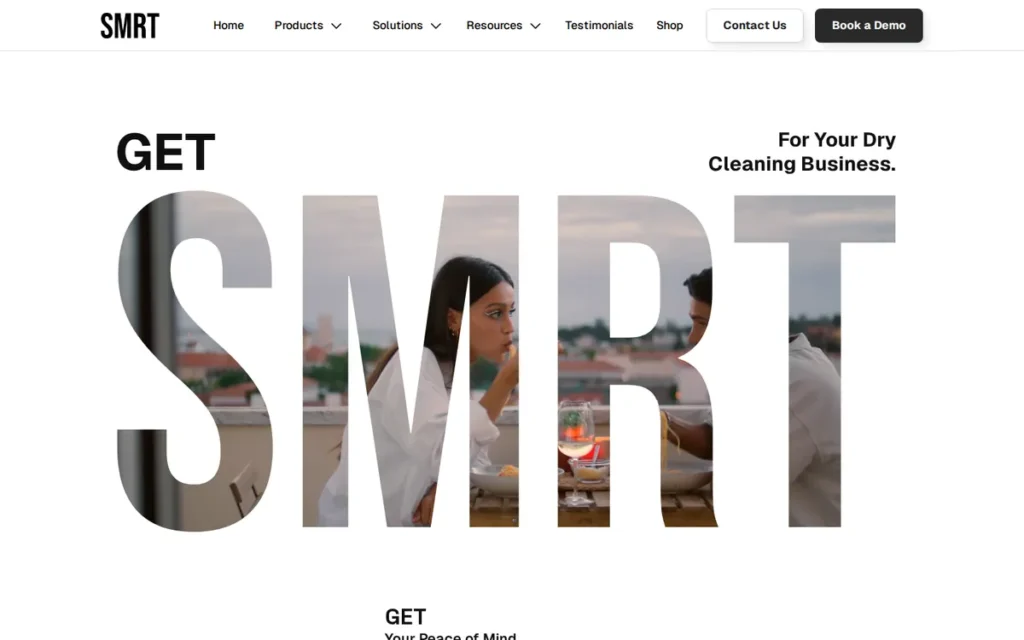
Category: Dry Cleaning Operations Suite, a garment-level POS built for counter-to-plant work, including tagging, assembly and production tracking.
PlugRoute Score: 38.5/45 (Workflow 4.5, Reviews 5, Pricing 4, Delivery 4, Multi-location 3.5, Stability 4). Why #1: SMRT Systems ranks one point above CleanCloud because it scored higher on review evidence (5 vs. 4.5) and workflow depth (4.5 vs. 4). CleanCloud scored higher on delivery and multi-location.
At a Glance
- Category: Dry Cleaning Operations Suite
- Best For: Independent dry cleaners and route-heavy operators that want a dry-cleaning-built cloud POS with strong support
- Price Range: From $75/user/month (Capterra, 2026) plus hardware; full quote on request
- Primary Strength: SMRT Systems has the strongest review record in the category: 4.9/5 from 117 reviews, with a 4.9 support sub-score.
- Biggest Limitation: SMRT Systems charges per user, so costs rise as you add staff and stores, and it publishes no payment-processing rates.
- One-Line Summary: SMRT Systems is a dry-cleaning-built cloud POS that pairs garment photo capture and route tools with the highest review ratings among the six products PlugRoute evaluated in 2026.
- Last Verified: November 2026
Overview
SMRT Systems (SMRT POS) is a cloud dry cleaning POS for Mac and Windows. It is built for independent dry cleaners and route-heavy operators who want garment photo capture, bulk mark-in, assembly, customer messaging and route tools in one platform.
SMRT Systems was founded in 2015 and is based in Raleigh, North Carolina (GetApp, 2026). SMRT Systems is a DLI Corporate Partner. Of the vendors PlugRoute reviewed, SMRT Systems publishes the most hardware pricing.
Key Features
- SMRT Systems photographs garments at intake and after cleaning, which gives the shop a visual record for damage claims.
- SMRT Systems supports bulk mark-in, so staff scan items against orders instead of entering them one at a time.
- SMRT Systems covers production, assembly, customer messaging, billing and custom KPIs in the same POS.
- SMRT Systems includes route scheduling, driver and stop tracking, and pickup requests from customers’ phones (GetApp, 2026).
- SMRT Systems offers a locker module that notifies customers by text or email when orders are ready.
Best For
SMRT Systems is best for independent dry cleaners, including multi-store operators, who want a dry-cleaning-built cloud POS with route delivery and well-rated support, and who can absorb per-user pricing.
Pricing
SMRT Systems starts at $75 per user per month (Capterra, verified November 2026), and full quotes are available on request.
- Hardware: SMRT Systems publishes its hardware prices (SMRT Systems price list, verified November 2026):
- SMRT Systems’ all-in-one computer costs $1,050.
- SMRT Systems’ card terminal costs $300–$390.
- SMRT Systems’ POS scale costs $600.
- SMRT Systems’ cash drawer costs $150.
- Payment processing: SMRT Systems says it will “beat or match” a shop’s current card-processing rate, but it publishes no rates.
- Setup and contract terms: SMRT Systems does not publish setup fees or contract minimums.
- Messaging and delivery add-ons: SMRT Systems does not publish messaging-credit costs or which tier includes delivery.
Strengths
- SMRT Systems holds 4.9/5 from 117 reviews (Capterra, GetApp and Software Advice, 2026). Gartner owns all three directories, so this is one shared review pool, not three separate samples.
- SMRT Systems’ Software Advice sub-scores are 4.9 for support, 4.8 for ease of use, 4.8 for functionality and 4.7 for value (Software Advice, 2026).
- SMRT Systems is the only vendor PlugRoute found that publishes a hardware price list, so buyers can estimate setup cost before a demo.
- SMRT Systems’ route module was called “transformative” by one reviewer (Capterra, 2026). Another reviewer runs 15 stores on SMRT Systems after switching from a legacy system in 2017 (GetApp, 2026).
Documented Results: PlugRoute found no named SMRT Systems case study with before-and-after numbers as of November 2026. Vendor-hosted testimonials include Helena’s Dry Cleaners, which has used SMRT for 10+ years, and Next Day Dry Cleaning (SMRT Systems, 2026). PlugRoute found no Reddit discussion of SMRT Systems.
Limitations
SMRT Systems’ entry price is clear, but costs grow with your team. A per-user fee that looks affordable at one counter adds up across staff and stores, and processing rates and setup fees are not published.
- SMRT Systems reviewers say custom reports are hard to build without help. Others report that some data came across wrong when merging from a previous POS, and that the first day after switching from SPOT was difficult (Capterra, 2026).
- SMRT Systems drew a complaint from one route reviewer who struggled to serve city buildings well (Software Advice, 2026).
- SMRT Systems does not document which conveyor brands or accounting packages it supports.
Users on r/drycleaning shared their experience:
“Oh yeah… SMRT is expensive!! I am paying $800 per month for one location!! Plus about $80 in text messaging fees. The text fees are totally worth it though because your customers are notified when their order is ready. But the $800 is because you pay $100 per station.” Posted by u/99LivesGaming
Takeaway: SMRT Systems’ per-station billing can push a single fully equipped location to hundreds of dollars a month before messaging fees, which makes a station-by-station cost projection essential before signing.
Verdict
SMRT Systems is the best-evidenced dry cleaning software in PlugRoute’s 2026 evaluation, combining a 4.9/5 rating from 117 reviews with dry-cleaning-built garment tracking and route delivery.
SMRT Systems’ photo capture helps with damage disputes, and its published hardware prices reduce the risk of hidden costs. Multi-store buyers should get a per-user cost projection and written processing rates before signing.
2. CleanCloud: Best for Single Shops Adding Pickup and Delivery
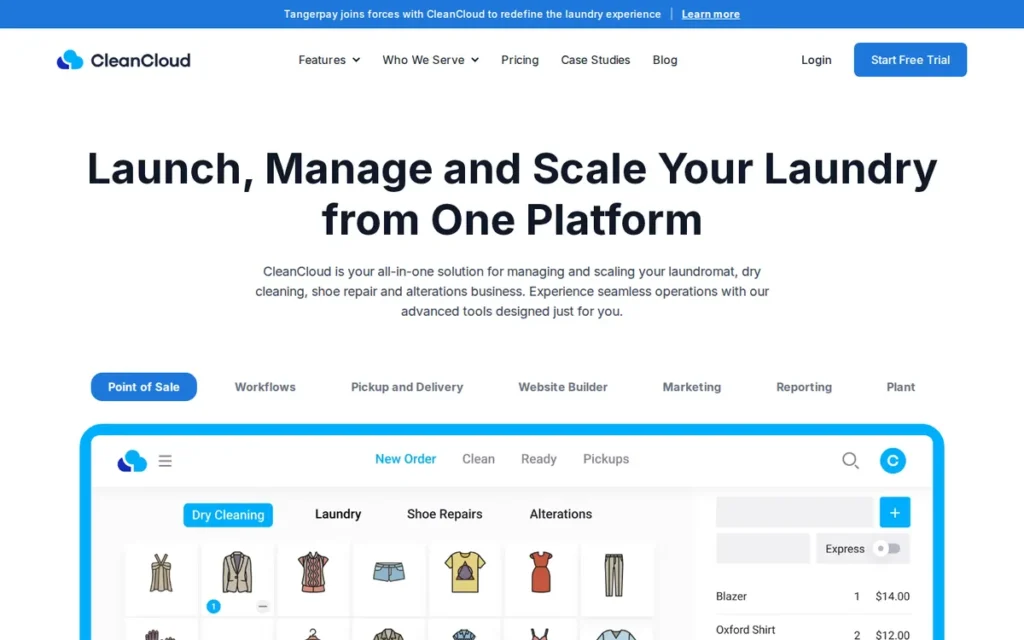
Category: Cloud POS + Delivery Platform, a cloud POS that combines garment tracking with tiered pickup-and-delivery and marketing tools.
PlugRoute Score: 37.5/45 (Workflow 4, Reviews 4.5, Pricing 4, Delivery 5, Multi-location 4, Stability 3.5). Why #2: CleanCloud trails SMRT Systems by one point. Recurring complaints about glitches and assembly lowered its review score, and Auto Assembly is only on the $189 Grow tier.
At a Glance
- Category: Cloud POS + Delivery Platform
- Best For: Single-location and growing dry cleaners that want pickup and delivery without an enterprise contract
- Price Range: $99–$335/month by order volume (CleanCloud pricing page, 2026); up to 20% off with annual billing
- Primary Strength: CleanCloud includes pickup and delivery on its $129/month Pro tier, the lowest documented delivery price in the category.
- Biggest Limitation: CleanCloud reviewers report glitches and unreliable assisted assembly, and SMS credits and branded apps cost extra with no published price.
- One-Line Summary: CleanCloud is a cloud dry cleaning POS with order-volume pricing that includes pickup and delivery from $129 per month, backed by the largest review base among the six products PlugRoute evaluated in 2026.
- Last Verified: November 2026
Overview
CleanCloud is a cloud POS for dry cleaners and laundries. It combines garment tagging, heat-seal and barcode support, assembly, customer and driver apps and automatic routing, for single shops and growing groups that want delivery on an order-volume plan.
CleanCloud was founded in 2014 in London, and LinkedIn lists 11–50 employees (LinkedIn, 2026). CleanCloud says it serves 5,000+ locations, a vendor-reported figure that has not been audited.
Key Features
- CleanCloud supports garment tagging, heat-seal printers and barcode scanners for tracking at the counter and in the plant.
- CleanCloud offers assisted assembly, and its Auto Assembly feature starts at the Grow tier.
- CleanCloud adds pickup and delivery, plus Uber and DoorDash integrations, starting at the Pro tier.
- CleanCloud sends notifications by SMS, email, push and WhatsApp, and adds automated marketing on the Grow tier.
- CleanCloud’s multi-store features sync pricing, promotions and reports across locations.
Best For
CleanCloud is best for single-location dry cleaners adding pickup and delivery, and for growing groups that would rather pay by order volume than per user.
Pricing
CleanCloud’s monthly tiers come from its pricing page (CleanCloud pricing page, verified November 2026). Some directories list different order caps, such as Pro at 1,500 orders and Grow+ as unlimited.
- CleanCloud Lite costs $99 per month for up to 500 orders.
- CleanCloud Pro costs $129 per month for up to 2,000 orders and adds delivery.
- CleanCloud Grow costs $189 per month for up to 3,000 orders and adds Auto Assembly, marketing and API access.
- CleanCloud Grow+ costs $335 per month for up to 10,000 orders and adds a branded app.
The tier prices leave out several costs:
- Messaging and delivery add-ons: CleanCloud charges extra for SMS credits, “Journey” credits and the branded app, and publishes no prices for them.
- Hardware, processing and setup: CleanCloud does not publish hardware prices, payment-processing rates or setup fees.
- Contract terms: CleanCloud’s annual plans save “up to 20%” but are paid up front, and Grow+ requires a 12-month minimum.
- Accounting integrations: PlugRoute could not confirm CleanCloud’s QuickBooks and Xero integrations.
Strengths
- CleanCloud has the largest review sample PlugRoute evaluated: 4.6/5 from 217 reviews on one Capterra listing and 4.7/5 from 216 on another, plus 4.4/5 on G2 (Capterra and G2, 2026).
- CleanCloud’s Pro tier, at $129 per month (CleanCloud, 2026), is the cheapest documented plan in the category that includes delivery.
- CleanCloud reviewers praise metrics that can be split by user and order type (Capterra, 2026).
- CleanCloud has one reviewer who reports seven years of satisfied use with the software, service and pricing (Capterra, 2026).
This aligns with community sentiment on r/drycleaning:
“I use Clean Cloud. It was easy moving customers over. Our customers love the text method and are able to track the delivery driver.” Posted by u/allenperez87
Takeaway: CleanCloud users report smooth customer migration and strong customer response to its text notifications and live driver tracking, which backs up its strength as a delivery-ready platform.
Documented Results: CleanCloud’s case study reports a 10% rise in pickup-and-delivery use at Fluff & Fold Laundry after it adopted automated marketing on the Grow plan (CleanCloud, 2024; vendor-reported, unaudited).
Limitations
CleanCloud gives up some counter speed and reliability in exchange for its broad feature set. Reviewers call the platform “glitchy” and say assisted assembly is “sometimes unusable” (Capterra, 2026).
- CleanCloud was called “bulky” by a Reddit user who said a wash-dry-fold order takes too long to enter (r/drycleaning, January 2026).
- CleanCloud reserves Auto Assembly and API access for the $189 Grow tier and publishes no messaging-credit prices.
- CleanCloud’s listed team of 11–50 employees is small for a platform that claims 5,000+ locations, so buyers should ask about support capacity.
Verdict
CleanCloud is the most affordable documented path to integrated pickup and delivery in PlugRoute’s 2026 evaluation, starting at $129 per month on its Pro tier.
CleanCloud’s large review base and order-volume pricing suit single shops that expect to grow. Buyers should time a real order at the counter during a demo and get messaging-credit costs in writing.
3. Xplor Spot: Best for Production Plants and Large Multi-Store Groups
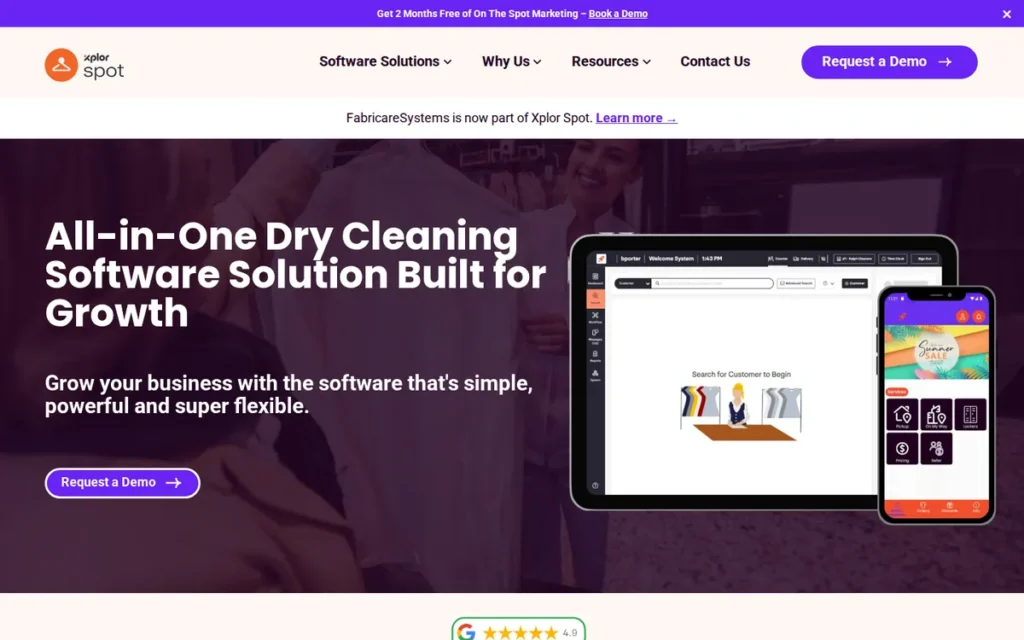
Category: Dry Cleaning Operations Suite, a garment-level POS built for counter-to-plant work, including tagging, assembly and production tracking.
PlugRoute Score: 28.5/45 (Workflow 5, Reviews 2, Pricing 1.5, Delivery 4, Multi-location 5, Stability 2.5). Why #3: Xplor Spot scored highest on dry cleaning workflow depth (5) and multi-location scalability (5). Quote-only pricing and a 6-review sample held it back.
At a Glance
- Category: Dry Cleaning Operations Suite
- Best For: Production plants with assembly and pressing lines, and multi-store groups that need per-store configuration
- Price Range: Pricing on request; a third-party estimate is $150–$400/month per location (unverified)
- Primary Strength: Xplor Spot’s ProductionTrac module reports pieces per operator hour at the press in real time, the deepest documented plant tracking in the category.
- Biggest Limitation: Xplor Spot publishes no pricing, has only 6 directory reviews, and is owned by a payments company that is consolidating legacy vendors.
- One-Line Summary: Xplor Spot is a modular dry cleaning suite, in use since 1991, whose ProductionTrac module gives plants the deepest documented production-floor tracking among the six products PlugRoute evaluated in 2026.
- Last Verified: November 2026
Overview
Xplor Spot (SPOT Business Systems) is a modular dry cleaning management suite, first released in 1991. It is built for production plants and multi-store groups that need real-time plant tracking, per-store configuration, delivery tools and customer apps.
Xplor Spot has been owned by the payments company Xplor since January 2018 (Xplor, 2026) and is based in Draper, Utah. Xplor Pay acquired Compassmax in July 2024 and said future development would focus on SPOT (Xplor Pay, 2024).
Key Features
- Xplor Spot’s ProductionTrac module tracks pieces through the plant and reports pieces per operator hour at the press.
- Xplor Spot’s SPOT/Connect module handles POS and business management and can be configured down to the individual store.
- Xplor Spot’s Delivery Connect module and driver app support pickup-and-delivery routes.
- Xplor Spot offers the branded My Dry Cleaner customer app and the Customer Connect online portal.
- Xplor Spot includes On the Spot Marketing for customer outreach.
Best For
Xplor Spot is best for plants with assembly and pressing lines and for multi-store groups that need production metrics and per-store control, provided they can negotiate a detailed written quote.
Pricing
Xplor Spot publishes no price list and quotes on request (verified November 2026). A third-party estimate puts it at $150–$400 per month per location, depending on modules (Pulse RevOps, 2026). PlugRoute could not verify that figure.
- Legacy anecdote: Xplor Spot charged one owner “$60 per terminal monthly” after taking over his previous vendor (Reddit, 2021). This is a single, dated report.
- Hardware, processing and setup: Xplor Spot does not publish hardware prices, processing rates or setup fees.
- Messaging and delivery add-ons: Xplor Spot does not publish module prices, including Delivery Connect and marketing.
- Contract terms: Xplor Spot does not publish contract minimums.
Strengths
- Xplor Spot’s ProductionTrac reports pieces per operator hour at the press in real time (Xplor Spot, 2026), the strongest documented production-floor feature PlugRoute found.
- Xplor Spot has the longest track record in the category, with its first version launched in 1991 (Xplor Spot, 2026).
- Xplor Spot was praised by a manager with 3–4 years on the system, who said it covers “retail, production, delivery” and that they “could almost use it blind folded” (r/drycleaning, January 2026).
- Xplor Spot reviewers praise its depth of features, per-store customization and support team (GetApp and Software Advice, 2026).
Documented Results: PlugRoute found no named Xplor Spot case study with measurable results as of November 2026.
Limitations
Xplor Spot offers depth on the plant floor, but it is the least transparent product here and has the least review evidence. Its pricing is quote-only, and its 4.2/5 rating rests on just 6 reviews in a shared Gartner pool (Capterra, GetApp and Software Advice, 2026).
- Xplor Spot reviewers say add-on modules are expensive, settings are hard to find, and the built-in reports make year-over-year comparison difficult (GetApp and Software Advice, 2026).
- Xplor Spot drew a complaint from one reviewer who said changes were made “without enough explanation” (GetApp, 2026).
- Xplor Spot took over one owner’s previous software vendor. That owner said he felt “hijacked” into paying $60 per terminal monthly because his database and stored card data were tied to the system (Reddit, 2021).
Users on r/drycleaning noted:
“Spot has a LOT of features and can be confusing, but that also leads it to be customizable to how you operate and can make it work for you; not you having to change your business to work with it.” Posted by u/mlewis47
Takeaway: Xplor Spot’s deep feature set is both its biggest strength and its learning-curve problem, since the same complexity that confuses new users is what lets it fit around an existing operation.
Verdict
Xplor Spot offers the deepest documented production-floor tracking in PlugRoute’s 2026 evaluation, which makes it the strongest fit for plants with assembly and pressing lines.
Xplor Spot’s quote-only pricing and 6-review sample also make it the hardest product in the group to judge before a demo. Plant operators should insist on an itemized quote and written data-export terms.
4. Cents: Best for Laundromats with a Dry Cleaning Side Line and No Fleet
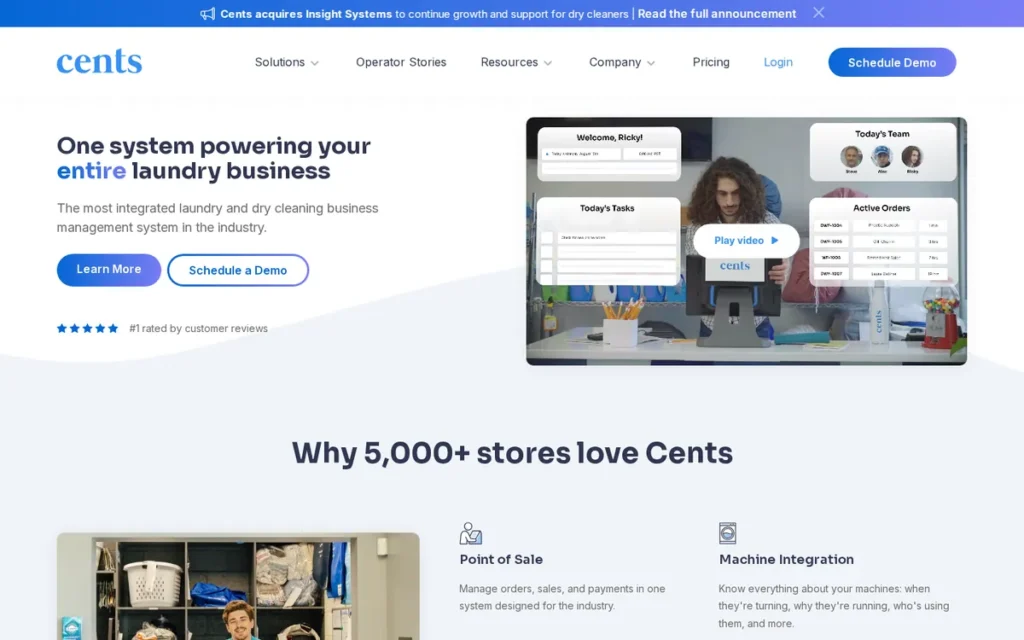
Category: Laundromat-First Platform, software built for laundromat and wash-and-fold operations, with dry cleaning as a secondary use.
PlugRoute Score: 27.5/45 (Workflow 2, Reviews 3, Pricing 2.5, Delivery 5, Multi-location 4, Stability 3.5). Why #4: Cents earned top delivery and strong multi-location scores. Garment tagging that is not yet confirmed as live, and inconsistent published pricing, held it back.
At a Glance
- Category: Laundromat-First Platform
- Best For: Laundromats and wash-and-fold operators with a dry cleaning side line that want delivery without running vans
- Price Range: $89–$599/month depending on configuration (Cents, 2026); the vendor’s page is inconsistent
- Primary Strength: Cents offers delivery through its own gig-driver network or through a shop’s own fleet.
- Biggest Limitation: Cents’ dry-cleaning page describes garment-level tagging with heat-seal labels as a capability it is building, so dry cleaners should confirm what is live today.
- One-Line Summary: Cents is a laundromat-first platform, backed by a $140M Series C in March 2026, that documents both gig-driver and own-fleet delivery for laundromats adding dry cleaning.
- Last Verified: November 2026
Overview
Cents is a laundromat-first cloud platform that combines POS, order workflows, staff management and multi-location controls with own-fleet or gig-driver delivery. It is built for laundromats and wash-and-fold operators adding dry cleaning.
Cents raised a $140M Series C led by Sumeru Equity Partners on March 26, 2026 (Sumeru Equity Partners, 2026). Cents acquired Insight Systems, a laundry data and reporting company, in July 2026 (Cents, 2026).
Key Features
- Cents combines POS, order workflows, staff management, reporting and multi-location controls in one dashboard.
- Cents lets each location set its own services and pricing.
- Cents supports delivery through a shop’s own fleet via its Driver App, or through its gig-driver network and local courier partners.
- Cents is building Cents Dispatch, covering route optimization, communications and driver tracking.
- Cents integrates with Laundroworks for cashless laundromat payments linked to machine data.
Best For
Cents is best for laundromats and wash-and-fold businesses with a dry cleaning side line that want multi-location controls and delivery without owning vehicles.
Pricing
Cents’ pricing page (verified November 2026) shows two sets of monthly prices. PlugRoute could not match either set to a business type or billing period.
- Cents’ first configuration lists $89 (Starter), $249 and $399 (Ultimate) per month.
- Cents’ second configuration lists $149, $399 and $599 per month.
Cents calls its plans “all-inclusive,” but several costs are unpublished:
- Hardware, processing and setup: Cents publishes no hardware prices, processing rates or setup fees.
- Delivery add-ons: Cents publishes no delivery rates, and one reviewer criticized high Uber/Lyft delivery fees (Capterra, 2026).
- Messaging credits: Cents does not say whether messaging volume is capped.
- Contract terms: Cents does not publish contract minimums. One reviewer called startup and monthly fees “steep” but worth it (Capterra, 2026).
Strengths
- Cents’ $140M Series C in March 2026 (Sumeru Equity Partners, 2026) is the largest disclosed funding signal PlugRoute found.
- Cents is the only platform PlugRoute evaluated that documents a gig-driver delivery network alongside an own-fleet driver app.
- Cents holds 4.8/5 from 13 reviews on Capterra and 4.5/5 on G2, where the review count is not displayed (Capterra and G2, 2026).
- Cents reviewers praise ease of use and accessible support, and one said staff and customers took to it quickly (Capterra, 2026).
Documented Results: Cents’ Laundré case study reports a delivery radius that grew from 1–2 miles to 15 miles and wash-and-fold revenue that tripled in two years (Cents, 2026; vendor-reported, unaudited).
Limitations
Cents is strong for laundromats, but its dry cleaning features are thinner. Garment-level tracking with heat-seal labels is described as in development (Cents, verified November 2026), which is a serious gap for shops whose core business is garment care.
- Cents reviewers report that QuickBooks reports don’t upload cleanly and that the POS “needs to be more dependable” (Capterra, 2026).
- Cents reviewers say some needed features are still “on the roadmap” (Capterra, 2026).
- Cents reviewers say customers receive too many automated texts and that gift cards cannot be sold (Capterra, 2026).
- Cents makes it hard to see all of a customer’s open tickets at checkout, according to one G2 reviewer (G2, 2026).
Verdict
Cents is the only platform in PlugRoute’s 2026 evaluation that documents a gig-driver delivery network, so shops can offer delivery without owning vans.
Cents fits best for laundromats and wash-and-fold operators with a dry cleaning side line. Garment-focused cleaners should confirm live tagging and assembly in a demo before shortlisting Cents.
5. Quick Dry Cleaning Software: Best Low-Commitment Trial for Budget Shops and Franchises
Category: Cloud POS + Delivery Platform, a cloud POS that combines garment tracking with tiered pickup-and-delivery and marketing tools.
PlugRoute Score: 26/45 (Workflow 3, Reviews 3.5, Pricing 2, Delivery 3, Multi-location 3.5, Stability 2.5). Why #5: Quick Dry Cleaning Software rose to #5 in PlugRoute’s November 2026 scoring update. Conflicting vendor pricing and unconfirmed heat-seal support keep it below the dry-cleaning-built leaders.
At a Glance
- Category: Cloud POS + Delivery Platform
- Best For: Budget-conscious single shops and franchise groups that want to test with their own data before committing
- Price Range: Free (under 100 orders/month) to $497/store/month (QDC, 2026); the vendor’s own pages conflict
- Primary Strength: Quick Dry Cleaning Software offers a free 14-day trial set up with the shop’s own data, plus a free plan for very low volumes.
- Biggest Limitation: Quick Dry Cleaning Software’s own pricing pages conflict, and its heat-seal and conveyor support were not confirmed.
- One-Line Summary: Quick Dry Cleaning Software is an India-based cloud dry cleaning platform with franchise controls and the most generous trial among the six products PlugRoute evaluated in 2026, but with the least consistent published pricing.
- Last Verified: November 2026
Overview
Quick Dry Cleaning Software (QDC) is an India-based cloud platform for dry cleaners. It covers garment tracking, delivery scheduling, WhatsApp messaging and franchise controls, for budget shops and franchise groups that want to test with their own data.
Quick Dry Cleaning Software was founded in 2010 by Rachit Ahuja and is run by DC Web Services Pvt Ltd in Noida, India (QDC, 2026). Quick Dry Cleaning Software has moved from desktop software to cloud subscriptions.
Key Features
- Quick Dry Cleaning Software generates barcode and QR garment tags and supports tag printers and barcode scanners (QDC, 2026).
- Quick Dry Cleaning Software supports delivery scheduling for pickup-and-delivery services.
- Quick Dry Cleaning Software automates customer messaging, including on WhatsApp.
- Quick Dry Cleaning Software includes multi-location and franchise controls with reporting.
- Quick Dry Cleaning Software offers a free 14-day trial set up with the shop’s own data, with no credit card required.
Best For
Quick Dry Cleaning Software is best for budget single shops and franchise groups that want to test a cloud system with their own data before signing, and that can confirm support hours in their time zone.
Pricing
Quick Dry Cleaning Software’s own pages list conflicting prices (QDC, verified November 2026):
- Quick Dry Cleaning Software says plans “start at $99/month” for one store.
- Quick Dry Cleaning Software’s early-bird bundle costs $147 per store per month, paid annually in advance ($1,764/year) and locked for 3 years.
- Quick Dry Cleaning Software’s usual bundle price is $497 per store per month ($99 platform plus $199 for each of two AI products).
- Quick Dry Cleaning Software’s homepage advertises a free plan for up to 100 orders per month, with usage-based pricing above that.
The listed prices leave out several costs:
- Hardware, processing and setup: Quick Dry Cleaning Software does not include hardware and does not publish processing rates or setup fees.
- Messaging and delivery add-ons: Quick Dry Cleaning Software does not say which tier includes delivery scheduling or WhatsApp automation.
- Additional stores: Quick Dry Cleaning Software lists an additional-store charge of “5k + taxes” with no currency stated.
- Contract terms: Quick Dry Cleaning Software’s early-bird bundle requires a 3-year lock with annual prepayment.
Strengths
- Quick Dry Cleaning Software’s free 14-day trial uses the shop’s own data and needs no credit card (QDC, 2026). It is the most generous trial PlugRoute found.
- Quick Dry Cleaning Software’s free plan for up to 100 orders per month (QDC, 2026) is the lowest published entry price in the category.
- Quick Dry Cleaning Software holds 4.7/5 from 59 Capterra reviews, with sub-scores of 4.5 for ease of use, 4.6 for customer service, 4.6 for features and 4.4 for value (Capterra, verified November 2026).
- Quick Dry Cleaning Software reviewers praise order and delivery tracking, reminders and support (Capterra, 2026).
Documented Results: PlugRoute found no named Quick Dry Cleaning Software case study with quantified results as of November 2026. On Capterra, 90% of reviewers say they would recommend it (Capterra, 2026).
Limitations
Quick Dry Cleaning Software’s low entry cost comes with unclear pricing. Its own pages range from free to $497 per store per month, and its early-bird bundle locks buyers in for three years.
- Quick Dry Cleaning Software’s heat-seal and conveyor support and its per-station licensing were not confirmed.
- Quick Dry Cleaning Software reviewers report a learning curve, occasional payment-page problems and a need for better analytics (Capterra, 2026).
- Quick Dry Cleaning Software’s scale claims are inconsistent. The vendor claims 5,000+ locations, while Crunchbase lists 5,000+ users and a team of 20 (Crunchbase, 2026).
- Quick Dry Cleaning Software’s support is based in India, so US buyers should confirm support hours.
Verdict
Quick Dry Cleaning Software offers the lowest-risk way to test a cloud dry cleaning system in PlugRoute’s 2026 evaluation, through a free 14-day trial that uses a shop’s own data.
Quick Dry Cleaning Software’s conflicting published prices and unconfirmed heat-seal support keep it below the leaders. Buyers should use the trial to check tagging and support hours, and should avoid multi-year price locks until both are confirmed.
6. Curbside Laundries: Best for Wash-and-Fold Delivery and Commercial Accounts
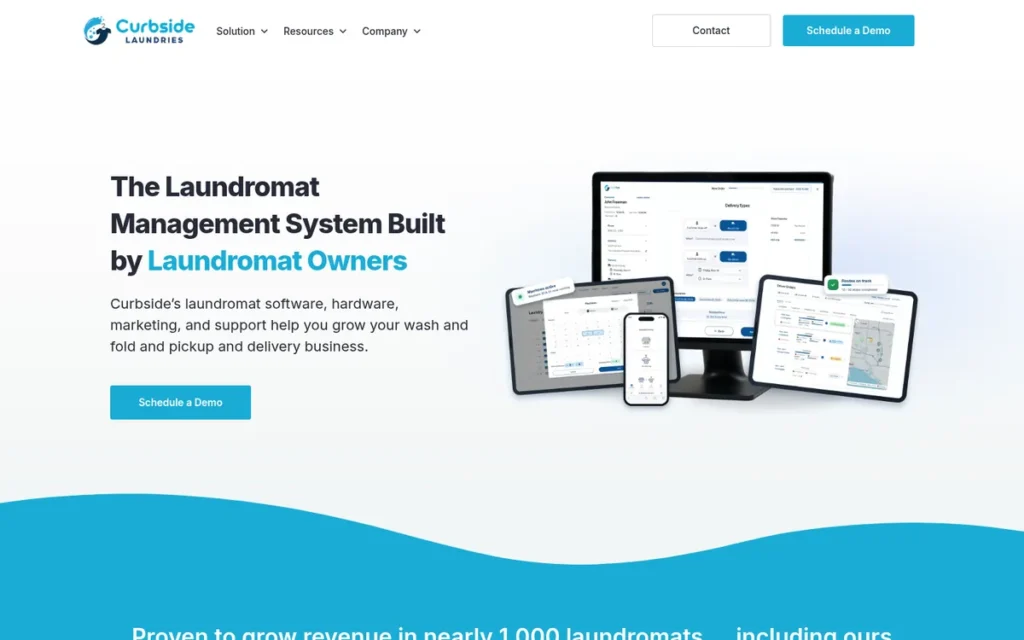
Category: Laundromat-First Platform, software built for laundromat and wash-and-fold operations, with dry cleaning as a secondary use.
PlugRoute Score: 25/45 (Workflow 1.5, Reviews 3.5, Pricing 2.5, Delivery 4, Multi-location 2.5, Stability 3.5). Why #6: Curbside Laundries’ 4.9 rating is offset by the lowest workflow-depth score in the group. It finished one point behind Quick Dry Cleaning Software after the November 2026 update.
At a Glance
- Category: Laundromat-First Platform
- Best For: Wash-and-fold and laundromat businesses running pickup and delivery and commercial accounts
- Price Range: From $260/month flat (Capterra, 2026) plus a one-time setup fee; custom quotes
- Primary Strength: Curbside Laundries bundles a branded ordering website, route optimization, DoorDash integration and commercial billing, with unlimited phone support and no revenue share.
- Biggest Limitation: Curbside Laundries has weak dry cleaning support, with no confirmed garment-level tagging or inspection workflow.
- One-Line Summary: Curbside Laundries is an owner-built wash-and-fold and delivery platform rated 4.9/5 from 29 reviews, best suited to laundromats rather than garment-focused dry cleaners among the six products PlugRoute evaluated in 2026.
- Last Verified: November 2026
Overview
Curbside Laundries is a wash-and-fold and pickup-and-delivery platform built by laundromat owners. It bundles counter sales, a branded ordering website, route optimization, DoorDash integration and commercial billing, and is aimed at laundromats rather than garment-level dry cleaners.
Curbside Laundries was built by Aaron and Matthew Simmons for their family’s Super Suds laundromat. Curbside Laundries says it serves nearly 1,000 laundromats, a vendor-reported figure.
Key Features
- Curbside Laundries handles counter sales, wash-and-fold, inventory, and consumer and commercial accounts, and connects to a scale.
- Curbside Laundries provides a branded website for online ordering and order tracking.
- Curbside Laundries includes route creation and optimization, pickup zones and DoorDash integration.
- Curbside Laundries gives commercial accounts customer-specific pricing, invoicing, scheduled billing and online payment.
- Curbside Laundries’ subscription includes updates, unlimited phone support, hosting, text notifications, cloud printing and backups.
Best For
Curbside Laundries is best for laundromats and wash-and-fold operators building pickup-and-delivery and commercial accounts. Curbside Laundries is a poor fit for cleaners focused on garments.
Pricing
Curbside Laundries is listed at a flat rate starting at $260 per month (Capterra and Software Advice, verified November 2026). Separate packages for in-store wash-and-fold, pickup and delivery, and the website are custom-quoted.
- Setup: Curbside Laundries charges a one-time setup fee that varies with hardware, website options, business size and pickup-and-delivery needs (Capterra, 2026). The amount is not published.
- Hardware and processing: Curbside Laundries does not publish hardware prices or payment-processing rates.
- Messaging and delivery add-ons: Curbside Laundries includes text notifications, but the pickup-and-delivery package is custom-quoted.
- Revenue share: Curbside Laundries says it takes no percentage of revenue (Curbside Laundries, 2026).
- Contract terms: Curbside Laundries does not publish contract minimums.
Strengths
- Curbside Laundries holds 4.9/5 from 29 reviews in the shared Gartner pool (Capterra, GetApp and Software Advice, 2026). Its own site shows 4.9/5 from 63 reviews, but those are hosted by the vendor and are not independent.
- Curbside Laundries reviewers praise ease of use and easy staff training (Capterra, 2026).
- Curbside Laundries includes unlimited phone support and takes no revenue share (Curbside Laundries, 2026).
- Curbside Laundries’ website integration let customers sign up without calling, according to a reviewer named Jeff (GetApp, 2026).
Documented Results: Curbside Laundries’ testimonial reports 108% first-year revenue growth at Mama’s Laundry (Curbside Laundries, 2026; vendor-reported, unaudited).
Limitations
Curbside Laundries specializes in wash-and-fold and gives up dry cleaning capability to do so. One reviewer called its dry cleaning functions “not the best” (Capterra, 2026), and garment-level tagging was not confirmed.
- Curbside Laundries reviewers called the cost “extremely high” and “on the high end.” One reported a costly setup with slower payback than expected (Capterra, 2026).
- Curbside Laundries’ interface is “not always intuitive,” and users have to move between several reports (GetApp, 2026).
- Curbside Laundries does not document its multi-location features.
Verdict
Curbside Laundries is a highly rated wash-and-fold and delivery platform in PlugRoute’s 2026 evaluation, but it is not built for garment-level dry cleaning.
Curbside Laundries’ commercial-account billing and included phone support suit laundromats well. Dry cleaners should shortlist Curbside Laundries only if wash-and-fold is their main revenue line.
Also Considered (Not Ranked)
PlugRoute did not rank three products that AI assistants often recommend, because they could not be verified to the same evidence standard as of November 2026.
PlugRoute excluded a fourth product because its owner is shifting development to a ranked vendor. None of the ratings or prices below are PlugRoute findings.
- Geelus: AI assistants recommend Geelus often, but PlugRoute did not verify its ratings or pricing.
- WinDryClean: AI assistants describe WinDryClean as a one-time desktop license product, but PlugRoute did not verify this.
- Follow POS: AI assistants cite local and cloud license prices for Follow POS that may be promotional, and PlugRoute did not verify them.
- Compassmax: Compassmax was excluded because Xplor Pay acquired it on July 23, 2024. Xplor Pay said it would focus future development on SPOT while continuing to support Compassmax during the transition (Xplor Pay, 2024).
How Much Does Dry Cleaning Software Really Cost in 2026?
Published entry prices for dry cleaning software range from free (Quick Dry Cleaning Software, under 100 orders) to $260 per month (Curbside Laundries, directory price). Xplor Spot is quote-only. Most vendors leave out processing rates, messaging credits, setup fees and delivery add-ons, so the real cost is usually higher than the listed price.
Pricing models vary as much as the prices do:
- CleanCloud charges by order volume.
- SMRT Systems charges per user.
- Curbside Laundries charges a flat rate.
- Quick Dry Cleaning Software charges per store.
- Xplor Spot publishes no price list and quotes on request.
Here is an illustrative example for a single shop with six staff logins. At SMRT Systems’ $75 per user, software alone would come to about $450 per month before hardware, assuming every login is billed (confirm this with SMRT Systems). CleanCloud Pro stays at $129 per month up to its order cap, however many staff you have.
| Product | Pricing Model | Published Entry Price | Delivery Included At | Known Unpublished Costs | Contract Terms | Last Verified |
|---|---|---|---|---|---|---|
| SMRT Systems | Per user | $75/user/month (Capterra) | Route module documented; tier not published | Processing rates, setup | Not published | Nov 2026 |
| CleanCloud | Order volume | $99/month Lite (CleanCloud) | Pro, $129/month | SMS and Journey credits, branded app, processing | Annual prepaid; Grow+ 12-month minimum | Nov 2026 |
| Xplor Spot | Quote only | None (estimate $150–$400/location, unverified) | Delivery Connect module; price not published | All costs | Not published | Nov 2026 |
| Cents | Tiered (conflicting) | $89/month | Own-fleet or gig-driver; tier not matched | Processing, delivery, hardware, setup | Not published | Nov 2026 |
| Quick Dry Cleaning Software | Per store | Free under 100 orders; $99/month | Delivery scheduling; tier not published | Hardware, currency of the additional-store fee | Early-bird: 3-year lock, annual prepaid | Nov 2026 |
| Curbside Laundries | Flat rate | $260/month (directory) | Custom-quoted package | Setup fee, hardware, processing | Not published | Nov 2026 |
In PlugRoute’s 2026 evaluation, no dry cleaning software vendor published its payment-processing rates, so the listed subscription price is never the full cost. One self-identified POS vendor representative wrote that merchant fees and hardware lock-ins “can sting, sometimes more than the POS subscription itself” (Reddit, 2025).
Which Dry Cleaning Software Includes Pickup and Delivery?
All six ranked products document some form of pickup and delivery, but they deliver and price it differently. CleanCloud includes delivery at its $129 Pro tier, and Cents adds a gig-driver network. SMRT Systems and Xplor Spot offer delivery modules without published tier pricing.
- CleanCloud offers customer and driver apps, automatic routing, and Uber and DoorDash integrations from its Pro tier.
- Cents offers its gig-driver network and local couriers, or a shop’s own fleet through its Driver App.
- SMRT Systems offers route optimization, driver and stop tracking, and a locker module.
- Xplor Spot offers Delivery Connect, a driver app and the My Dry Cleaner customer app.
- Quick Dry Cleaning Software offers delivery scheduling.
- Curbside Laundries offers route optimization, pickup zones and DoorDash integration.
Demand for delivery is growing. Future Market Insights sizes the on-demand laundry service market at $41.71B for 2026 (Future Market Insights, 2026). The Laundré example in the Cents entry shows how far a delivery radius can stretch, from 1–2 miles to 15 miles.
How Do I Choose Dry Cleaning Software for Multiple Locations?
Multi-location buyers should compare how each vendor’s cost grows with stores, staff and orders, not just the entry price. Xplor Spot documents the deepest per-store configuration. CleanCloud syncs pricing across stores and charges by order volume. SMRT Systems charges per user.
- SMRT Systems’ costs grow with every user you add, so model staff growth before signing.
- CleanCloud’s costs grow with order volume, and its Grow+ tier carries a 12-month minimum.
- Xplor Spot can be configured down to the individual store, but every module is quote-only.
- Cents lets each location set its own services and pricing.
- Quick Dry Cleaning Software charges per store and lists its additional-store fee without a currency.
- Curbside Laundries does not document its multi-location features.
Many groups run a central plant that serves several drop stores. Ask every vendor whether tickets can move between locations and whether reports combine data from all stores.
The market is shifting toward fewer, larger operators. IBISWorld counts 27,649 US dry cleaning businesses in 2025, down 1.3% from 2024 (IBISWorld, 2025). IBISWorld also projects US dry cleaning revenue of $9.6B in 2026 (IBISWorld, 2026).
Should I Choose Cloud Software or a One-Time Desktop License?
PlugRoute found no current one-time license offer from any of the six ranked vendors, and Quick Dry Cleaning Software has moved from desktop software to cloud subscriptions. Shops that want a single upfront purchase have no verified option on this list.
If you want a one-time license, ask any license vendor how the software works offline, what the support terms are, and what happens to the license if the vendor is acquired.
The conversion risk is real. One owner paid $40,000 for his original software, then paid “$60 per terminal monthly” after SPOT took over that vendor (Reddit, 2021).
Cloud systems offer remote access, automatic updates and easier recovery (American Drycleaner, accessed November 2026). The main trade-off is that they depend on your internet connection, so ask every vendor how the counter works during an outage.
What Does Switching from Paper or a Legacy System Involve?
Switching from paper tickets or a legacy system usually involves data mapping, staff retraining and a rough first few days at the counter. PlugRoute’s evidence shows both difficult and successful switches, so plan the migration as carefully as you choose the software.
- SMRT Systems reviewers reported data errors after merging from a previous POS and a hard first day after leaving SPOT (Capterra, 2026).
- SMRT Systems also has a reviewer running 15 stores who switched from a legacy system in 2017 (GetApp, 2026).
- Quick Dry Cleaning Software’s trial is set up with the shop’s own data, which lets owners test the migration before signing (QDC, 2026).
What Red Flags Should I Watch For When Evaluating Dry Cleaning Software?
The seven biggest red flags in dry cleaning software are:
- Unpriced delivery add-ons
- Missing data-export terms
- Ratings from tiny review samples
- Unpublished processing rates
- Multi-year price locks
- Laundromat software sold to garment cleaners
- Recent acquisitions
PlugRoute found at least one example of each among the six products it evaluated in 2026.
Red Flag #1: Delivery Tools Sold as Unpriced Add-Ons Delivery packages that list routing or driver apps as extras without prices hide what it really costs to run a route. Cents publishes no delivery rates. CleanCloud gates delivery at its $129 Pro tier and sells SMS credits with no published price (Cents and CleanCloud, 2026).
Red Flag #2: No Written Data-Export or Stored-Card Portability Terms No vendor PlugRoute reviewed publishes a data-export or migration policy, so ask whether stored card tokens can move to a new processor or are locked to the current one. One owner said he felt “hijacked” because his database and stored card data were tied to the system (Reddit, 2021).
Red Flag #3: Ratings Built on Tiny Review Samples A high star rating from only a few reviews says little on its own. One new 1-star review would pull Xplor Spot’s 4.2 average from 6 reviews down to about 3.7. The same review would move CleanCloud’s 4.6 average from 217 reviews only to about 4.58.
Cents (13 reviews) also falls below PlugRoute’s 15-review threshold. Capterra, GetApp and Software Advice share one Gartner-owned review pool, so matching scores across those three sites are not independent confirmation (Gartner directories, 2026).
Red Flag #4: Payment Processing Bundled Without Published Rates None of the six ranked vendors publishes payment-processing rates, even though processing can cost more than the software over time. One self-identified POS vendor representative wrote that merchant fees and hardware lock-ins “can sting, sometimes more than the POS subscription itself” (Reddit, 2025).
Red Flag #5: Multi-Year Price Locks or Prepaid Minimums Multi-year or prepaid terms limit your exit options if the software disappoints. Quick Dry Cleaning Software’s early-bird bundle locks for 3 years, and CleanCloud’s Grow+ requires a 12-month minimum (vendor pricing pages, 2026).
Red Flag #6: Laundromat Software Marketed to Garment Cleaners Laundromat-first platforms can be strong at delivery and still lack garment-level tagging. One reviewer called Curbside Laundries’ dry cleaning functions “not the best” (Capterra, 2026). Cents describes heat-seal garment tracking as a capability it is still building (Cents, 2026).
Red Flag #7: Vendor Recently Acquired or Folding Into a Parent Platform A recent acquisition can bring slower updates, weaker support or a forced platform change. Xplor Spot is taking in Compassmax users, and Cents acquired Insight Systems in July 2026.
Who Owns These Vendors?
- Cents acquired Insight Systems, a laundry data and reporting company, in July 2026 (Cents, 2026).
- Xplor, a payments company, has owned Xplor Spot since January 2018 (Xplor, 2026).
- Xplor Pay acquired Compassmax on July 23, 2024 and said it would focus development on SPOT while continuing to support Compassmax (Xplor Pay, 2024).
“Most of these software companies have been bought out by credit card processing companies.” (u/hui214, r/drycleaning (Reddit, 2021))
Takeaway: Before signing, ask who owns the vendor, whether payment processing is bundled, and whether your customer data and stored cards can leave with you.
What Questions Should I Ask Before Choosing Dry Cleaning Software?
Ask every dry cleaning software finalist seven questions about things vendors rarely publish:
- Which conveyor models do you support?
- Can I export my data and stored cards?
- What is my all-in monthly cost?
- How does the system work offline?
- Will you run a timed test with one of my real orders?
- Who is responsible for migration?
- What are your support hours?
Get every answer in writing. PlugRoute did not find these answers published consistently across the six vendors in 2026.
Question #1: Which conveyor and production equipment models do you support, in writing? Dry cleaning plants should demand a written conveyor list, because none of the six vendors publishes one. Ask for named brands and models. Also ask whether pressing and quality-control stages are tracked by the POS or by the conveyor, since vendors split that work differently.
Question #2: Can I export my customer database and stored card data if I leave, and at what cost? Get data-export terms in writing, because no vendor PlugRoute evaluated publishes an export policy. Ask for the export format for customer records and order history, whether stored card tokens can move to a new processor, the timeline and any fees. Then write those terms into the contract.
Question #3: What is my all-in monthly cost for my order volume, staff count and locations? Ask each finalist for one itemized monthly figure, because published entry prices leave out major costs. The figure should cover software, payment processing, SMS credits, hardware, setup and delivery add-ons. Compare it with each vendor’s published entry price to see how much was missing.
Question #4: What happens to the counter when the internet goes down? Ask every cloud vendor about offline behavior, because cloud systems depend on connectivity (American Drycleaner, accessed November 2026). Find out whether staff can still write, tag and take payment for tickets offline, how the data syncs afterward, and how backups are handled.
Question #5: Can you run one of my real orders from intake through tagging, assembly, pickup and delivery while I time it? A timed real-order test shows counter speed better than any feature list. One Reddit user complained that a wash-dry-fold order took too long to enter (r/drycleaning, January 2026). Run the same sample orders on every finalist and record how long each step takes.
Question #6: Who handles migration, and what happens on day one? Ask each vendor who maps your data and who is on call during the first week. SMRT Systems reviewers reported data errors after merging from a previous POS and a hard first day after switching (Capterra, 2026). Get a written migration plan with named contacts before signing.
Question #7: What are your support hours in my time zone? Confirm support hours in writing, because they vary widely across vendors. Quick Dry Cleaning Software’s support is based in India. Ask about phone, chat and after-hours coverage during your busiest days.
How Did We Rank These Dry Cleaning Software Tools?
PlugRoute scored six dry cleaning software products from 1 to 5 on six criteria. Workflow depth, review evidence adjusted for sample size, and pricing transparency count double. Delivery, multi-location scalability and vendor stability count once. The maximum is 45 points, ties go to the higher workflow-depth score, and SMRT Systems scored highest at 38.5.
The six criteria, and why each matters:
- C1, Dry Cleaning Workflow Depth (×2): This criterion matters because laundromat-first tools can be strong at delivery but unable to tag individual garments. Features that are not documented score as absent.
- C2, Review Evidence Strength (×2): This criterion matters because a 4.9 from 6 reviews is weaker evidence than a 4.6 from 217. Ratings from Gartner-owned directories count as one sample. Samples under 15 reviews, and ratings found only in secondary sources, are capped at 3.
- C3, Pricing Transparency (×2): This criterion matters because directory prices often leave out hardware, processing, SMS credits, add-ons and setup. Quote-only pricing scores lowest.
- C4, Delivery Capability and Tier Gating (×1): This criterion matters because owners want delivery without paying for a tier they otherwise don’t need.
- C5, Multi-Location Scalability (×1): This criterion matters because per-user and per-store fees can climb quickly as operators expand.
- C6, Vendor Stability and Data Risk (×1): This criterion matters because the market is consolidating under payments companies. No vendor was penalized for an unpublished export policy, because none publishes one.
| Rank | Product | C1 | C2 | C3 | C4 | C5 | C6 | Total |
|---|---|---|---|---|---|---|---|---|
| 1 | SMRT Systems | 4.5 | 5 | 4 | 4 | 3.5 | 4 | 38.5 |
| 2 | CleanCloud | 4 | 4.5 | 4 | 5 | 4 | 3.5 | 37.5 |
| 3 | Xplor Spot | 5 | 2 | 1.5 | 4 | 5 | 2.5 | 28.5 |
| 4 | Cents | 2 | 3 | 2.5 | 5 | 4 | 3.5 | 27.5 |
| 5 | Quick Dry Cleaning Software | 3 | 3.5 | 2 | 3 | 3.5 | 2.5 | 26 |
| 6 | Curbside Laundries | 1.5 | 3.5 | 2.5 | 4 | 2.5 | 3.5 | 25 |
The formula is Total = 2 × (C1 + C2 + C3) + (C4 + C5 + C6).
Scoring update, November 2026: PlugRoute confirmed Quick Dry Cleaning Software’s Capterra rating (4.7/5, 59 reviews) directly, which removed the secondary-source cap. Its barcode tagging was also documented. Its score rose from 22 to 26, moving it from #6 to #5.
The evidence has limits that readers should know about:
- Only two Reddit threads discussed specific vendors.
- Review samples range from 6 to 217.
- Vendor case studies and scale claims are unaudited.
- Geelus, WinDryClean and Follow POS are unranked because they could not be verified, and Compassmax was excluded.
PlugRoute has no affiliate relationships with any company listed, and rankings are determined entirely by research data and objective evaluation criteria.
What Do Buyers Ask Most About Dry Cleaning Software?
PlugRoute answers the three dry cleaning software questions buyers ask most often below: which tools suit small businesses, which plan is the cheapest documented way to add delivery, and how the rankings work. The answers draw on PlugRoute’s November 2026 evaluation of six products and their published pricing, reviews and features.
What’s the best dry cleaning software for a small business in 2026?
SMRT Systems and CleanCloud are the strongest small-business options in PlugRoute’s 2026 evaluation. SMRT Systems has the best review evidence (4.9/5 from 117 reviews) and starts at $75 per user per month. CleanCloud starts at $99 per month, priced by order volume. Quick Dry Cleaning Software offers a free plan under 100 orders and a 14-day trial.
Which dry cleaning software includes pickup and delivery at the lowest price?
CleanCloud’s Pro tier is the cheapest documented plan that includes pickup and delivery, at $129 per month on CleanCloud’s pricing page (verified November 2026). Get SMS-credit and add-on pricing in writing before comparing.
How does PlugRoute determine rankings?
PlugRoute ranks dry cleaning software on six published criteria, each scored from 1 to 5. Workflow depth, review evidence and pricing transparency count double, for a 45-point maximum. Ratings are adjusted for sample size, and every figure is dated. SMRT Systems scored 38.5/45 and CleanCloud 37.5/45, the closest margin at the top of the 2026 scorecard.
What Do Key Dry Cleaning Software Terms Mean?
Dry cleaning software vendors use specialized terms for tagging, production, pricing and delivery, and these terms affect both cost and fit. The definitions below cover the terms buyers meet most often in quotes and demos, and explain why each one matters when comparing vendors.
Heat-seal tag: A heat-seal tag is a durable label bonded to a garment with a heat press so it survives cleaning. Heat-seal tagging matters because reliable tags prevent lost or mixed-up garments.
Barcode tagging: Barcode tagging links each garment or ticket to a scannable code. Barcode tagging speeds up mark-in and assembly and cuts down on manual entry errors.
Assisted assembly: Assisted assembly is software guidance that helps staff gather a customer’s garments into one completed order. Buyers should test how reliable assisted assembly is, because slow assembly delays pickup.
Auto assembly: Auto assembly is an automated process, often linked to conveyor equipment, that groups garments into orders without manual sorting. Vendors may reserve auto assembly for higher tiers.
Bulk mark-in: Bulk mark-in lets staff scan many items against an order at once. Bulk mark-in matters for busy counters that handle large drop-offs.
Conveyor integration: Conveyor integration connects the POS to the garment conveyor so items can be located and retrieved automatically. Buyers should get the supported conveyor models in writing.
Pieces per operator hour: Pieces per operator hour measures how many garments one presser finishes in an hour. Plants use this metric to manage labor costs and spot bottlenecks.
Per-user pricing: Per-user pricing charges a fee for each staff login. Per-user costs rise directly with headcount, which affects multi-store budgets.
Order-volume pricing: Order-volume pricing sets the monthly fee by how many orders a shop processes. Buyers should check what happens when they go over a tier’s order cap.
Payment processing rate: A payment processing rate is the percentage or fee charged on each card transaction. Payment processing can cost more than the software subscription over time.
White-label app: A white-label app is a customer app branded with the shop’s own name and logo. A white-label app supports customer loyalty but is often sold as an add-on.
Data portability: Data portability is the ability to export customer records, order history and stored card data when you leave a vendor. Without written data-portability terms, switching systems can be difficult or costly.
Which Dry Cleaning Software Tool Is Right for You?
Key Insights
- No single dry cleaning software wins for every operation, and PlugRoute’s top two products, SMRT Systems and CleanCloud, are separated by just one point.
- SMRT Systems is the best-evidenced product in PlugRoute’s 2026 evaluation, with 4.9/5 from 117 reviews and a published hardware price list.
- CleanCloud’s $129 Pro tier is the cheapest documented plan that includes pickup and delivery, and Xplor Spot’s ProductionTrac offers the deepest plant tracking.
- Laundromat-first platforms such as Cents and Curbside Laundries need garment tagging checked in a live demo before dry cleaners shortlist them.
- The dry cleaning software market is consolidating: Xplor owns SPOT and Compassmax, and Cents owns Insight Systems. That makes written data-export terms as important as features.
The right dry cleaning software depends on your operation. Single shops should compare CleanCloud and SMRT Systems, and plants should compare Xplor Spot and SMRT Systems using itemized quotes. Shops built on wash-and-fold should compare Cents and Curbside Laundries.
Follow this shortlist plan:
- Find your row in PlugRoute’s Quick Decision Framework table.
- Shortlist two products from that row.
- Send both vendors the same seven evaluation questions.
- Run the same three sample orders on each product (a shirt bundle, a suit with an alteration and a wash-and-fold bag), and time each one.
- Get data-export terms written into the contract.
For more independent analysis, read PlugRoute’s full methodology and our other POS software reviews. We update this guide quarterly. Last updated: November 2026.