The best coaching software in 2026 is CoachAccountable for between-session accountability, Simply.Coach for executive and multi-coach practices, and Paperbell for solo coaches selling packages. upcoach leads for group cohorts and ABC Trainerize for fitness. The top three finished within two points, so your coaching model and pricing structure should decide.
Most coaches who start looking already juggle a scheduler like Calendly, an e-signature tool, a payment link, and an intake-form builder. Replacing them has hidden costs. Per-client pricing, platform transaction fees, and paid add-ons can turn a low list price into a much higher monthly bill.
PlugRoute has no affiliate relationships with any company listed, and rankings are determined entirely by research data and objective evaluation criteria.
“I used a site for a year and after 1100 dollars very few of my clients logged in, super heavy expense and very little interest in it.” (u/Coachkatherine, r/lifecoaching (Reddit, accessed November 2026))
Takeaway: Client adoption, not feature count, decides whether coaching software pays for itself.
Last verified: November 2026 · Next scheduled refresh: February 2027
What Are the 5 Categories of Coaching Software Tools?
Coaching software falls into five categories. All-in-One Practice Managers handle one-on-one admin. Accountability Platforms track client actions between sessions. Coaching Business Platforms manage sponsors and multiple coaches. Cohort Platforms deliver group programs. Fitness Coaching Apps program workouts and nutrition. The best tool is the one built for how you coach.
- All-in-One Practice Manager: All-in-One Practice Managers run booking, packages, payments, contracts, and a client portal for one-on-one practices. Paperbell and Satori are in this category.
- Accountability Platform: Accountability Platforms track client goals, actions, and metrics between sessions, alongside scheduling and billing. CoachAccountable is in this category.
- Coaching Business Platform: Coaching Business Platforms manage multi-stakeholder engagements, multiple coaches, and organizational reporting. Simply.Coach and Delenta are in this category.
- Cohort Platform: Cohort Platforms deliver reusable group programs with community, check-ins, and participant progress tracking. upcoach is in this category.
- Fitness Coaching App: Fitness Coaching Apps deliver workout programs, nutrition tracking, and wearable data for trainers. ABC Trainerize is in this category.
The ICF 2025 Global Coaching Study (10,035 respondents) puts the coaching industry at $5.34 billion with 122,974 coaches worldwide. In the same study, 54% of coaches named better platforms and technology as a priority (ICF, September 2025).
About 47% of coaches already use digital coaching platforms (Erickson summary of the ICF study, accessed November 2026).
How Do the Top Coaching Software Platforms Compare at a Glance?
All seven platforms cover core coaching admin. They differ most in pricing model, in how deeply they track clients between sessions, and in support for groups or multiple coaches. The table below gives each platform’s category, best fit, pricing model, strength, and limitation, using evidence PlugRoute verified in November 2026.
| Rank | Company | Category | Best For | One-Line Summary | Key Capabilities | Primary Strength | Key Limitation |
|---|---|---|---|---|---|---|---|
| 1 | CoachAccountable | Accountability Platform | Coaches who track client actions between sessions | CoachAccountable is the highest-rated accountability-focused coaching platform in PlugRoute’s 2026 evaluation. | Per active client from $20/month (2 clients); action plans, metrics, worksheets, invoicing, Team Edition | Courses, groups, and white-labeling on every tier; Capterra 5.0/5 (67 reviews) | Per-client cost climbs with roster size; dated interface |
| 2 | Simply.Coach | Coaching Business Platform | Executive coaches and multi-coach practices | Simply.Coach is the most complete platform for executive and multi-coach practices in PlugRoute’s 2026 evaluation. | Solo from $9/month (annual), business per coach from $79; 360 assessments, sponsor roles, coach payouts | G2 4.8/5 from 156 reviews | Navigation complaints; per-coach pricing compounds |
| 3 | Paperbell | All-in-One Practice Manager | Solo coaches selling packages | Paperbell is the most predictable-cost all-in-one platform for solo coaches in PlugRoute’s 2026 evaluation. | Flat $57/month, unlimited clients (vendor page); single checkout for package, contract, and booking | Flat plan with unlimited clients | Thin goal tracking; no native app |
| 4 | Delenta | Coaching Business Platform | ICF credential-seekers and multi-coach firms | Delenta is the most feature-rich platform in PlugRoute’s 2026 evaluation and the only one found advertising ICF hour logging. | Solo $29, Pro $49 (vendor page), higher tiers by quote; CRM, payments, courses, AI note taker, ICF hour logs | Widest feature set evaluated | Key features gated to tiers with unpublished prices |
| 5 | upcoach | Cohort Platform | Group programs and masterminds | upcoach is the most cohort-focused coaching platform in PlugRoute’s 2026 evaluation. | Per participant from $49/month plus 2% fee; reusable cohorts, community, check-ins, MCP AI integration | Built specifically for repeatable cohorts | Publishes its own 2%/1% fee on lower tiers; only 8 Capterra reviews |
| 6 | ABC Trainerize | Fitness Coaching App | Personal trainers and fitness coaches | ABC Trainerize is the only fitness-specific coaching app in PlugRoute’s 2026 evaluation. | Per client from $0 (1 client) plus add-ons; workouts, nutrition, habits, wearables, native app | Fitness depth and ABC Fitness ownership | Add-on stacking; Trustpilot 3.1/5 |
| 7 | Satori | All-in-One Practice Manager | One-on-one coaches with formal enrollment | Satori is the most enrollment-focused one-on-one coaching platform in PlugRoute’s 2026 evaluation. | Per active client, two conflicting price lists; discovery questionnaires, proposals, one-click enrollment, AI notetaker | Structured prospect-to-client flow | Conflicting price lists; non-refundable subscriptions |
Which Coaching Software Should I Choose for My Use Case?
| Your #1 Priority | Recommended Tool | Why | Acceptable Alternative |
|---|---|---|---|
| Fitness or workout programming | ABC Trainerize | Only fitness-specific platform evaluated, with wearable sync; Basic plan is free for 1 client | None evaluated (QuickCoach, Everfit, Kahunas not yet tested) |
| Cohorts, group programs, masterminds | upcoach | Reusable cohorts with facilitators and community | Delenta Pro (group coaching and group packages) |
| Executive coaching with sponsors or multiple coaches | Simply.Coach | Sponsor roles, 360 assessments, coach payouts | Delenta (if ICF hour logging matters) |
| Planning to add coaches within 12 months | CoachAccountable Team Edition | No per-seat fee for coaches or admins | Simply.Coach business tiers (per-coach pricing, deeper sponsor tools) |
| Solo, accountability between sessions is central | CoachAccountable | Action plans, metrics, and worksheets on every tier | Simply.Coach |
| Solo, mainly selling packages and booking | Paperbell | One checkout for package, contract, and booking at a flat price | CoachAccountable (cheaper at 5 or fewer clients) |
| Solo, formal discovery and proposal sales process | Satori | Discovery-to-enrollment workflow | Paperbell |
| Lowest paid starting cost (non-fitness) | Simply.Coach Starter ($9/month annual, 3 clients) | Lowest confirmed paid plan for life and business coaches | CoachAccountable ($20/month, 2 clients); Satori Seed ($9, pricing conflicting) |
What Are the Best Coaching Software Platforms in 2026, Ranked?
CoachAccountable ranks first (38.5/45), Simply.Coach second (37.5), and Paperbell third (36.5). Delenta, upcoach, ABC Trainerize, and Satori follow. Every entry below uses the same structure, the same evidence labels, and dated sources, so you can compare products fairly by coaching model, cost, and risk.
1. CoachAccountable: Best Overall for Between-Session Accountability
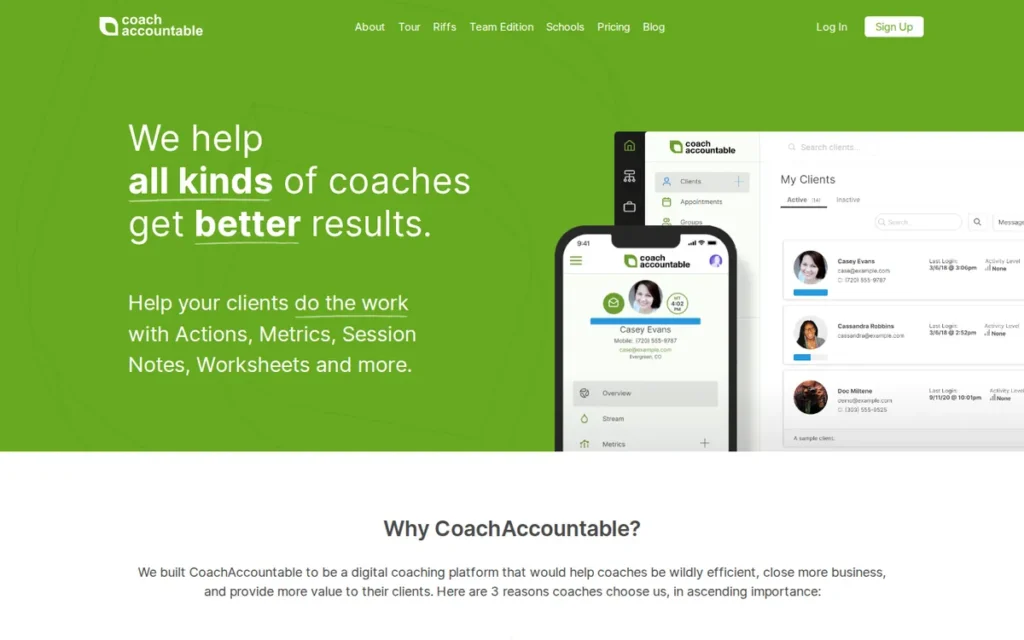
Category: Accountability Platform. It tracks client goals, actions, and metrics between sessions, alongside scheduling and billing.
At a Glance
- Category: Accountability Platform
- Best For: Coaches whose method depends on clients completing tracked actions, metrics, and worksheets between sessions
- Price Range: $20–$4,000/month by active clients ($20 for 2, $70 for 10, $120 for 20); 30-day free trial, no card
- Primary Strength: CoachAccountable includes courses, groups, and white-labeling on every pricing tier and charges no platform transaction fee.
- Biggest Limitation: CoachAccountable’s per-active-client pricing costs roughly double a flat-fee platform at 20 clients, and reviewers describe its interface as dated.
- One-Line Summary: CoachAccountable is the highest-rated accountability-focused coaching platform in PlugRoute’s 2026 evaluation, built for coaches who track client actions and progress between sessions.
- Last Verified: November 2026
Overview
CoachAccountable is a coaching platform built around between-session accountability. It combines action plans, tracked metrics, and worksheets with scheduling, signed agreements, and invoicing, for independent and small-team coaches whose clients need structured follow-through, not just a booking link.
CoachAccountable has operated since August 2012 and holds the highest Capterra score in this evaluation. CoachAccountable charges by active client instead of a flat fee. That makes CoachAccountable the cheapest option for very small rosters and a more expensive one for large rosters.
Key Features
- CoachAccountable assigns action plans with due dates and recurring tasks that clients see and complete between sessions.
- CoachAccountable tracks client-defined metrics over time and pairs them with fillable worksheets and private or shared session notes.
- CoachAccountable handles signed agreements and invoicing through Stripe, Square, or PayPal without adding its own transaction fee.
- CoachAccountable has included drip courses, group spaces, and white-labeling on every plan since 2019.
- CoachAccountable’s Team Edition adds admin oversight, detailed permissions, coach–client pairing, direct company invoicing, Zapier, and an API.
Best For
CoachAccountable is best for goal-driven life, business, and executive coaches with small to mid-size rosters. CoachAccountable also suits small firms adding coaches, because Team Edition charges no per-seat fee for coaches or admins.
Pricing
CoachAccountable publishes its complete per-active-client price ladder (Vendor Page Verified: CoachAccountable pricing page, November 2026):
- CoachAccountable costs $20/month for 2 clients and $40/month for 5 clients.
- CoachAccountable costs $70/month for 10 clients and $120/month for 20 clients.
- CoachAccountable costs $250/month for 50 clients, $400/month for 100, and up to $4,000/month for 1,000.
- CoachAccountable has no setup fees or contracts and adds no transaction fee, but Stripe, Square, or PayPal processing fees still apply.
CoachAccountable users can keep the bill down by deactivating clients who aren’t currently active.
Strengths
- CoachAccountable holds a 5.0/5 Capterra rating from 67 reviews (Capterra, November 2026), the highest score in this evaluation. Third parties report 4.7/5 on G2 (review count not disclosed) and 4.8/5 on Trustpilot from 47 reviews (Third-Party Reported: Paperbell and Coachful comparison pages, October 2026).
- CoachAccountable has operated continuously since August 2012, tied with ABC Trainerize for the longest track record evaluated. This continuity matters after Practice shut down in November 2025.
- CoachAccountable includes courses, groups, and white-labeling on every tier (CoachAccountable pricing page, November 2026), so coaches pay for active clients, not feature upgrades.
- CoachAccountable offers a 30-day free trial with no card, the longest confirmed trial in this evaluation.
- CoachAccountable’s case studies describe automated reflection forms sent 3 hours after each session and a 15-coach firm running on the platform. No measured outcomes were published (Vendor-Stated: CoachAccountable case studies, November 2026).
Limitations
CoachAccountable trades predictable cost for per-client flexibility. Its bill climbs from $40 at 5 clients to $120 at 20 and $250 at 50, so a growing solo practice will eventually pay well above a flat-fee platform.
- CoachAccountable’s interface is described by reviewers and one Reddit user as practical but “not as slick looking as some.” Building templates, metrics, and worksheets also takes real setup time (Reddit r/lifecoaching, accessed November 2026).
- CoachAccountable is run by a 3-person remote team in Denver (CoachAccountable Enterprise page, November 2026), which limits support capacity.
- CoachAccountable’s native mobile app and HIPAA status are Conflicting Across Sources, so health-adjacent coaches should get HIPAA and BAA terms in writing.
- CoachAccountable’s most positive Reddit endorsement included a referral link and should be read as potentially biased.
Users on r/lifecoaching noted:
“I’d say most of my clients don’t use it for much more than booking, but some use metrics actively and I keep most of my communication in the platform. People often say they like it if they use it. But it’s as much for me as for my clients. It keeps everything in one place and automates some things that I’m bad at managing.” Posted by u/ben-gives-advice
Takeaway: CoachAccountable works well as a coach-side command center, but its accountability tools only pay off for the clients who actually engage beyond booking.
Verdict
CoachAccountable is the best coaching software in 2026 for coaches who need to track client actions, metrics, and progress between sessions. It earns PlugRoute’s top overall score through a 5.0/5 Capterra rating and full features on every tier.
CoachAccountable leads Simply.Coach by one point, mainly on its ratings score (C3: 5 vs. 4.5). It is also the lowest-cost full-featured option for very small rosters. Coaches expecting 15 or more active clients should compare per-client cost against flat-fee options and check client log-in rates during the trial.
2. Simply.Coach: Best for Executive Coaching and Multi-Coach Practices
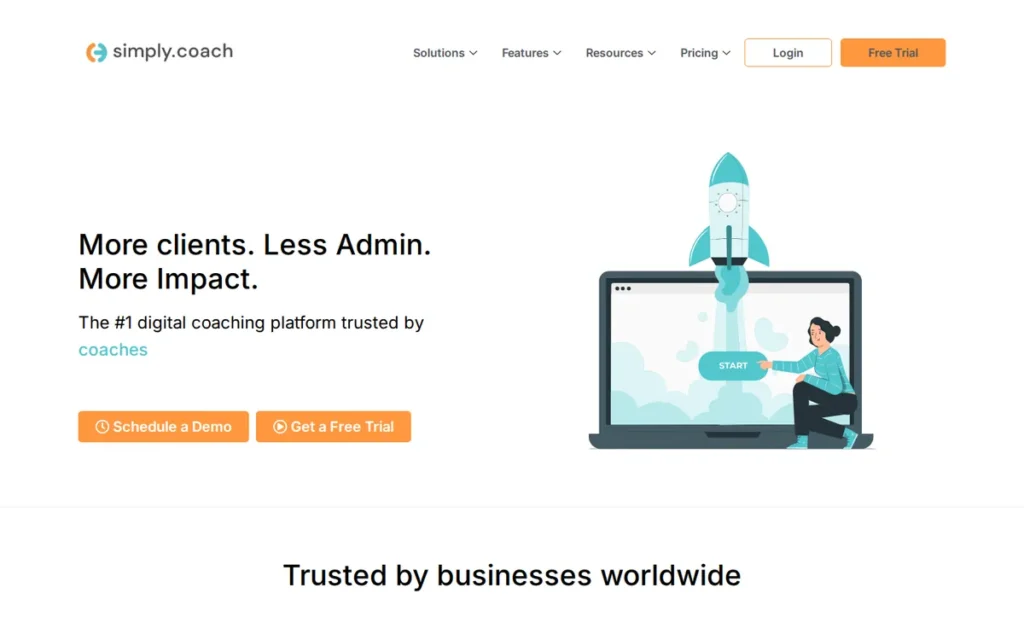
Category: Coaching Business Platform. It manages multi-stakeholder engagements, multiple coaches, and organizational reporting alongside core practice admin.
At a Glance
- Category: Coaching Business Platform
- Best For: Executive and leadership coaches working with organizational sponsors, and practices adding coaches
- Price Range: $9–$69/month solo (annual billing); $79–$289 per coach/month business; Enterprise by quote; 14-day free trial, no card
- Primary Strength: Simply.Coach supports full executive engagements, including 360 assessments, stakeholder feedback, sponsor roles, and coach payouts. This is the deepest executive-engagement toolset in this evaluation.
- Biggest Limitation: Simply.Coach draws repeated complaints about confusing navigation and unclear pricing, and its per-coach business pricing compounds as a practice grows.
- One-Line Summary: Simply.Coach is the most complete coaching platform for executive and multi-coach practices in PlugRoute’s 2026 evaluation, backed by 156 G2 reviews averaging 4.8/5.
- Last Verified: November 2026
Overview
Simply.Coach is a coaching engagement platform that combines goals, action plans, 360-degree assessments, stakeholder feedback, contracts, and invoicing. It is built for executive coaches and growing coaching businesses that manage organizational sponsors, multiple coaches, or framework-based programs.
Simply.Coach can align engagements with ICF, EMCC, or Stakeholder-Centered Coaching frameworks, and it scales from a $9/month solo plan to per-coach business tiers. Simply.Coach was founded in 2020 by Kiran, Ram, and Venkat (Simply.Coach About page, November 2026). Its headquarters and team size are not disclosed.
Key Features
- Simply.Coach structures engagements around coaching journeys, goals, action plans, nudges, and reminders aligned with ICF, EMCC, or Marshall Goldsmith Stakeholder-Centered Coaching frameworks.
- Simply.Coach includes 360-degree assessments, stakeholder feedback, and sponsor and HR business-partner roles for executive engagements.
- Simply.Coach syncs natively with Google Calendar and Microsoft 365 Outlook and adds Zoom, Google Meet, or Teams links to sessions.
- Simply.Coach business tiers add coach matching, round-robin scheduling, NPS tracking, coach payouts, and white-labeling.
- Simply.Coach includes an AI assistant. A competitor comparison also reports native iOS and Android apps (Third-Party Reported: Paperbell comparison page, November 2026).
Best For
Simply.Coach is best for executive coaches who report to sponsors and for businesses scaling to multiple coaches. Simply.Coach’s $9 Starter plan also suits brand-new coaches with three or fewer clients.
Pricing
Simply.Coach prices solo plans by tier and business plans per active coach. These figures are for annual billing; monthly billing costs more (Vendor Page Verified: Simply.Coach pricing pages, November 2026):
- Simply.Coach solo plans are Starter at $9 (3 clients), Essentials at $29 (up to 7 clients), Growth at $49, and Leap at $69 (unlimited clients, white-label, custom domain).
- Simply.Coach business plans are CoCreate at $79/coach (10 clients per coach), Surge at $159/coach (25 clients per coach), and Optima at $289/coach (50 clients per coach, payouts, matching).
- Simply.Coach Enterprise is quote-only and adds SSO/SAML and a SOC 2 report.
Simply.Coach does not disclose platform transaction fees. As a worked example, a 3-coach firm on Surge pays about $477/month (3 × $159).
Strengths
- Simply.Coach holds a 4.8/5 G2 rating from 156 reviews (G2, November 2026), the most G2 reviews of any dedicated coaching tool evaluated. Simply.Coach also rates 4.6/5 on Capterra from 42 reviews (Capterra, November 2026).
- Simply.Coach’s G2 support score is 9.8/10, against a 9.1 category average (G2, November 2026).
- Simply.Coach says it has been SOC 2, HIPAA, and GDPR compliant since November 2022 and offers a BAA (Vendor-Stated: Simply.Coach, November 2026). This is the strongest compliance claim in this evaluation, though PlugRoute has not seen an audit report.
- Simply.Coach supports Marshall Goldsmith Stakeholder-Centered Coaching workflows with built-in 360 assessments and sponsor roles. No other evaluated platform advertises this framework alignment (Simply.Coach, November 2026).
- Simply.Coach offers the lowest confirmed paid plan among the non-fitness platforms evaluated: $9/month on annual billing for up to 3 clients.
Limitations
Simply.Coach trades simplicity for depth. Capterra and Reddit reviewers report confusing navigation, including for booking calls. They also mention a learning curve and limited control over fonts and text (Capterra, November 2026).
- Simply.Coach’s business pricing multiplies by coach count and caps clients per coach, and reviewers describe the pricing as unclear (Capterra and Software Advice, November 2026).
- Simply.Coach’s AI assistant “does not always understand” requests, according to G2 reviewers (G2, November 2026).
- Simply.Coach drew a Reddit complaint about annual lock-in after a short trial. The founder replied that the user had an extended trial and that coaches are encouraged to start monthly (Reddit r/lifecoaching, accessed November 2026).
- Simply.Coach’s founder said publicly that, as a small business, Simply.Coach does not offer 24/7 phone or live-chat support (Reddit r/lifecoaching, accessed November 2026).
Users on r/lifecoaching shared their experience:
“I tried simply.coach and am simply frustrated (no pun intended) at how their platform is built, with a very poor UI and process flow. My prospects find it equally hard to navigate and it’s not intuitive at all, plus their support is woefully inadequate in my opinion – am having to split hairs trying to get them to understand pain points and do something about it. I dont like the idea that I got locked into a year of subscription and they seem to believe that a 14 day trial is sufficient time for understanding the nuances.” Posted by u/kolarvm
Takeaway: Simply.Coach’s navigation problems can reach prospects and clients as well as the coach, so testing it on monthly billing before signing an annual plan is critical.
Verdict
Simply.Coach is the best coaching software in 2026 for executive coaches and multi-coach practices. It offers sponsor roles, 360 assessments, and coach payouts, backed by 156 G2 reviews averaging 4.8/5.
Simply.Coach ranks second, one point behind CoachAccountable. The main reason is that its per-coach pricing and undisclosed transaction fees scored lower on cost transparency (C2: 3 vs. 4). Start on monthly billing, test client-side navigation during the 14-day trial, and ask for the SOC 2 report before handling sensitive data.
3. Paperbell: Best for Solo Coaches Selling Packages

Category: All-in-One Practice Manager. It runs booking, packages, payments, contracts, and a client portal for one-on-one practices.
At a Glance
- Category: All-in-One Practice Manager
- Best For: Solo life, business, and wellness coaches whose main need is selling packages and getting clients booked and paid
- Price Range: One flat plan with unlimited clients, $57/month or $570/year (Vendor Page Verified, November 2026); some AI answer engines cite $97/month; free account to test
- Primary Strength: Paperbell combines package checkout, contract e-signature, and session booking in one client flow, at a flat price that doesn’t rise with client count.
- Biggest Limitation: Paperbell offers thin goal and habit tracking, no native mobile app, and no cohort or community space.
- One-Line Summary: Paperbell is the most predictable-cost all-in-one coaching platform for solo coaches in PlugRoute’s 2026 evaluation, with unlimited clients on a single flat plan.
- Last Verified: November 2026
Overview
Paperbell is an all-in-one coaching platform built around selling packages. In one checkout, a client buys a package, e-signs a contract, books sessions, and gets access to materials. Paperbell is for solo coaches who want to replace a separate scheduler, payment tool, e-signature service, and form builder.
Paperbell charges one flat price with unlimited clients, but its between-session tracking is limited compared with accountability-focused tools. Paperbell was founded in 2020 by Laura Roeder, founder of MeetEdgar (Paperbell FAQ, November 2026). Its team size is not disclosed.
Key Features
- Paperbell links package purchase, contract e-signature, session booking, and material delivery in a single client checkout.
- Paperbell supports one-time payments, payment plans, and Stripe subscriptions through Stripe and PayPal without its own transaction fee.
- Paperbell syncs with Google, Outlook, and iCloud calendars and creates Zoom or Google Meet links for sessions.
- Paperbell includes a coaching website, intake forms and surveys, a client portal, courses, digital downloads, and automated email sequences.
- Paperbell offers basic group program tools within the same flat plan.
Best For
Paperbell is best for solo coaches selling one-on-one packages who want the simplest path from sale to booked session. Paperbell gets more cost-effective than per-client platforms as the active roster grows.
Pricing
Paperbell’s pricing page listed a single plan when PlugRoute checked (Vendor Page Verified: Paperbell pricing page, November 2026):
- Paperbell costs $57/month or $570/year, which works out to about $47.50/month on annual billing.
- Paperbell includes unlimited clients, packages, appointments, and earnings on that single plan.
- Paperbell adds no transaction fee of its own, but Stripe and PayPal processing fees apply.
- Paperbell is quoted at $97/month or $970/year by some AI answer engines, but PlugRoute could not match that figure to a vendor page.
At $57, Paperbell becomes cheaper than CoachAccountable somewhere between 5 and 10 active clients (CoachAccountable costs $40 for 5 and $70 for 10). If the $97 figure were current, the crossover would move to between 10 and 20 clients.
Strengths
- Paperbell holds a 4.7/5 Capterra rating from 151–153 reviews (Capterra, November 2026), the largest Capterra review volume among dedicated coaching tools. Paperbell also rates 4.7/5 on G2 from 63–64 reviews (G2, November 2026).
- Paperbell’s single flat plan with unlimited clients makes it the most predictable cost in this evaluation.
- Paperbell users consistently praise consolidation. One Capterra reviewer wrote that “it is simple to build my packages and have clients buy and schedule in one place” (Capterra, November 2026). A Reddit coach said switching meant they could “schedule, take notes, and send contracts all in one dashboard” (Reddit r/lifecoaching, accessed November 2026).
- Paperbell’s case studies report that a wellness coach saved 20+ hours a week on admin. They also report that self-booking cut scheduling time from over 10 minutes to about 10 seconds (Vendor-Stated: Paperbell case studies, November 2026).
This aligns with community sentiment on r/lifecoaching:
“I’m really surprised you didn’t like Paperbell! I’ve found it really seamless to use and set up and my clients love it as well. I’ve suggested it to a few friends and all have had good experiences and have stuck with it.” Posted by u/kanossis
Takeaway: Paperbell’s fans credit its easy setup and client experience with keeping coaches on the platform long term.
Limitations
Paperbell trades depth for simplicity. Its goal and habit tracking is thin and its group tools are basic, so coaches who build around accountability or cohorts may outgrow it (Third-Party Reported: Coachful, a competing vendor, November 2026).
- Paperbell has no native iOS or Android app, so clients use a mobile-friendly website instead. Paperbell acknowledges this gap in its own Simply.Coach comparison (Paperbell comparison page, November 2026).
- Paperbell’s Capterra reviewers criticize limited contract customization and limited landing-page flexibility (Capterra, November 2026).
- Paperbell’s navigation divides opinion on Reddit: one coach found it confusing, while another found it “really seamless” (Reddit r/lifecoaching, accessed November 2026).
- Paperbell’s SOC 2 or HIPAA certification could not be confirmed in PlugRoute’s research.
Verdict
Paperbell is the best coaching software in 2026 for solo coaches who sell one-on-one packages. It combines checkout, contracts, and booking in one flow at a flat price with unlimited clients.
Paperbell scored highest of all seven on workflow consolidation and cost predictability (5/5 each). It scored lowest among the top four on between-session accountability (2/5), which places it third. Paperbell remains a strong fit for coaches who mainly need to consolidate booking and payments. Confirm the live price before subscribing.
4. Delenta: Best for Feature Breadth and ICF Coaching-Hour Logging

Category: Coaching Business Platform. It manages multi-stakeholder engagements, multiple coaches, and organizational reporting alongside core practice admin.
At a Glance
- Category: Coaching Business Platform
- Best For: Coaches pursuing ICF credentials and businesses managing internal and external coaches
- Price Range: Solo $29/month and Pro $49/month (Vendor Page Verified, November 2026); some AI answer engines cite Solo at $79/month; Business and Enterprise by quote; trial length unconfirmed
- Primary Strength: Delenta offers the widest feature set in this evaluation, including ICF-compliant coaching-hour logging that no other evaluated platform advertises.
- Biggest Limitation: Delenta locks key features such as group coaching, course hosting, and the mobile app to higher tiers whose prices aren’t fully published.
- One-Line Summary: Delenta is the most feature-rich coaching platform in PlugRoute’s 2026 evaluation and the only one found advertising ICF-compliant coaching-hour logging, though its true cost depends on tier.
- Last Verified: November 2026
Overview
Delenta is an all-in-one coaching platform that covers CRM, multi-coach management, and ICF-compliant hour logging. It is built for credential-seeking coaches and for coaching businesses that manage internal and external coaches and want booking, payments, contracts, and courses in one system.
Delenta holds the highest G2 score in this evaluation, from a moderate sample of 32 reviews. What Delenta actually costs depends on which tier unlocks the features you need.
Key Features
- Delenta combines a CRM and sales pipeline with booking that syncs with Google and Outlook and connects to Zoom, Meet, and Teams.
- Delenta processes Stripe and PayPal payments in multiple currencies as one-time, subscription, prepaid, or pay-as-you-go charges.
- Delenta logs coaching hours in an ICF-compliant format to support coach credentialing.
- Delenta includes goals, tasks, rewards and points, a course builder, an AI note taker, and a white-label client portal.
- Delenta manages internal and external coaches with roles, permissions, coach invoicing, time tracking, and sponsor dashboards.
Best For
Delenta is best for ICF credential-seekers and for coaching organizations that need multi-coach operations and sponsor reporting. Delenta suits buyers who will actually use a broad feature set, not just booking and payments.
Pricing
Delenta’s pricing page listed two self-serve tiers during PlugRoute’s research (Vendor Page Verified: Delenta pricing page, November 2026):
- Delenta Solo costs $29/month and covers lead management, intake forms, booking, CRM, e-signed contracts, 1 GB of storage, and a limited number of client portals.
- Delenta Pro costs $49/month and adds group coaching, group video, and group packages.
- Delenta Solo is quoted at $79/month or $699/year by some AI answer engines, but PlugRoute could not match that figure to a vendor page.
- Delenta’s Business and Enterprise prices are not published. Third parties report that course hosting and the mobile app sit on a higher Premium tier (Third-Party Reported: Coachful, a competing vendor, November 2026).
Delenta’s transaction fees and trial length could not be confirmed, so ask Delenta for both in writing.
Strengths
- Delenta holds a 4.9/5 G2 rating from a moderate sample of 32 reviews (G2, November 2026), the highest G2 score evaluated. Delenta also rates 4.8/5 on Capterra (61–62 reviews) and on Software Advice (62 reviews) (Capterra and Software Advice, November 2026).
- Delenta’s Arbinger Institute case study reports growth to 100+ coaches, 50+ admin hours saved a month, and 10× first-year ROI (Vendor-Stated: Delenta case study, November 2026). This is the most detailed outcome data in this evaluation.
- Delenta is the only evaluated platform that PlugRoute found advertising ICF-compliant coaching-hour logging.
- Delenta reviewers repeatedly praise its responsive support and the breadth of its features (Capterra and Software Advice, November 2026).
Limitations
Delenta trades transparency for breadth. Important features sit behind tiers with unpublished prices, and its transaction fees and trial terms are unconfirmed, so buyers can’t calculate total cost upfront.
- Delenta reviewers describe the platform as overwhelming at first, with unintuitive menus. They also report that they can’t cancel one participant from a group session and that they want payment gateways beyond Stripe (Capterra, November 2026).
- Delenta shows 4.1/5 on Trustpilot from only 5 reviews, which is too few to rely on. Calendar and mobile scheduling are reported as repeat weak spots (Third-Party Reported: Coachful, a competing vendor, November 2026).
- Delenta’s founders, founding date, headquarters, and security certifications could not be verified.
- Delenta generated no significant Reddit discussion in PlugRoute’s research, so community sentiment is essentially unknown.
Verdict
Delenta is the most feature-rich coaching software in PlugRoute’s 2026 evaluation and the only option found advertising ICF-compliant coaching-hour logging. That makes Delenta a strong choice for credential-seeking coaches and multi-coach businesses.
Delenta ranks fourth, 3 points behind Paperbell, mainly because of its cost transparency (2.5/5) and platform risk (2/5) scores. Before committing, ask Delenta for a written quote that lists every feature you need.
5. upcoach: Best for Group, Cohort, and Mastermind Programs
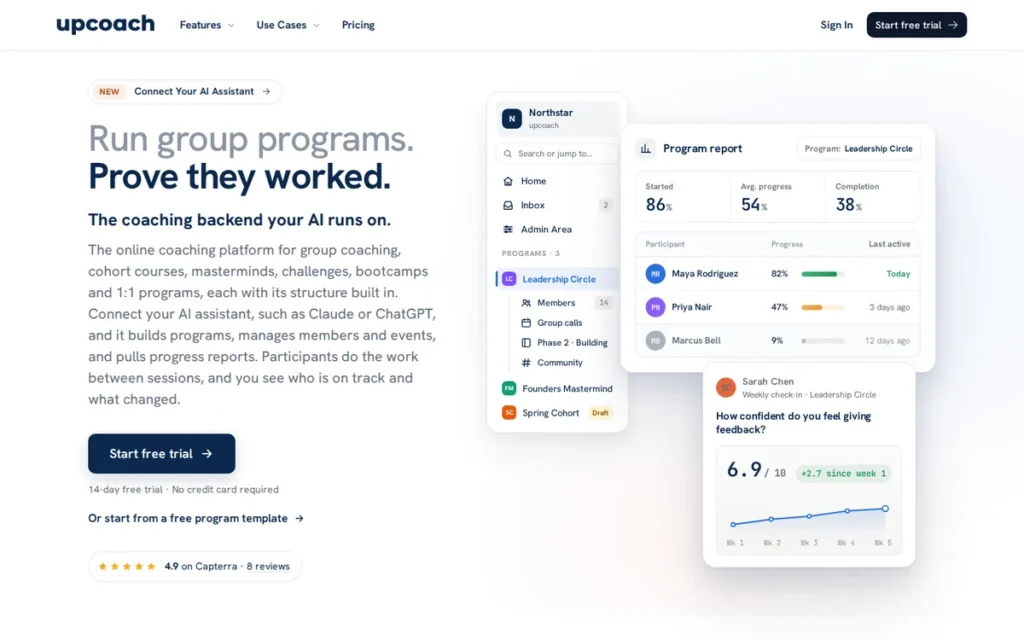
Category: Cohort Platform. It delivers reusable group programs with community, check-ins, and participant progress tracking.
At a Glance
- Category: Cohort Platform
- Best For: Coaches running or launching group programs, cohorts, and masterminds
- Price Range: $49–$399/month by active participants (annual billing), plus a 2%/1%/0.5%/0% platform fee by tier; 14-day free trial, no card
- Primary Strength: upcoach is purpose-built for reusable cohort programs, combining lessons, habits, check-ins, community, and participant progress dashboards.
- Biggest Limitation: upcoach is the only evaluated platform that publishes its own percentage transaction fee on lower tiers, and it has just 8 Capterra reviews.
- One-Line Summary: upcoach is the most cohort-focused coaching platform in PlugRoute’s 2026 evaluation, built for coaches who run repeatable group programs and masterminds.
- Last Verified: November 2026
Overview
upcoach is a group coaching platform built around reusable cohort programs with lessons, habits, daily check-ins, community channels, and participant progress dashboards. It is built for coaches moving from one-on-one work into group programs, cohorts, and masterminds.
upcoach prices by active participants and takes a platform fee on its lower tiers. upcoach’s small review base means its rating should be read with caution.
Key Features
- upcoach lets coaches build programs from modules, lessons, tasks, worksheets, habits, daily check-ins, quizzes, and events, then re-run them as separate cohorts.
- upcoach provides community channels and threads alongside “who’s on track” dashboards that show participant progress.
- upcoach includes checkout with offers, bundles, and coupons, plus landing pages, mainly through Stripe.
- upcoach assigns Admin, Facilitator, and Sponsor roles for organizations running programs with several facilitators.
- upcoach connects to Claude, ChatGPT, or Cursor through an MCP integration and offers an API, webhooks, and Zapier.
Best For
upcoach is best for coaches whose revenue comes from cohorts, live group courses, or masterminds. upcoach also suits organizations that re-run the same program with different facilitators.
Pricing
upcoach publishes participant-based tiers, billed annually (Vendor Page Verified: upcoach pricing page, November 2026):
- upcoach Starter costs $49/month ($588/year) for 25 participants, with a 2% platform fee.
- upcoach Pro costs $99/month for 100 participants, with a 1% fee.
- upcoach Business+ costs $199/month for 250 participants, with a 0.5% fee.
- upcoach Scale costs $399/month for 500+ participants, with no platform fee.
upcoach’s 2% Starter fee adds about $200/month on $10,000 of monthly sales. Moving from Starter to Pro pays for itself at about $5,000/month in sales, if the participant caps fit (PlugRoute calculation). Stripe fees apply on top.
Strengths
- upcoach is the only evaluated platform designed around reusable cohort programs with facilitators, community, and progress dashboards. It holds a 4.9/5 Capterra rating from a small sample of 8 reviews (Capterra, November 2026).
- upcoach publishes its full pricing schedule, with unlimited programs on every plan and a 14-day trial with no card.
- upcoach was co-founded by performance coach Todd Herman, author of The Alter Ego Effect, along with David Henzel and Mert Hurturk. It reports 5,000+ program creators (Vendor-Stated: upcoach, November 2026).
- upcoach is the only evaluated platform with an MCP connection, which lets Claude, ChatGPT, or Cursor build programs and pull progress reports (upcoach pricing page, November 2026).
Limitations
upcoach trades a lower entry price for a share of revenue. upcoach is the only evaluated platform that publishes its own percentage fee: 2% on Starter and 1% on Pro, on top of Stripe processing. Its costs therefore rise with cohort revenue unless you move up a tier.
- upcoach’s 4.9/5 rating rests on only 8 Capterra reviews, and PlugRoute found no verified G2 or Trustpilot presence.
- upcoach reviewers report that group members automatically see each other’s presence with no off switch. They also say integrations are limited and students must be invited manually (Capterra, November 2026).
- upcoach’s Stripe integration was added late and is “slightly limited,” according to AppSumo reviewers. One reviewer alleges a lack of GDPR compliance, which PlugRoute could not verify (AppSumo, November 2026).
- upcoach’s native mobile app status is Conflicting Across Sources, and upcoach generated no significant Reddit discussion in PlugRoute’s research.
Verdict
upcoach is the best coaching software in 2026 for coaches running repeatable group cohorts and masterminds. It puts reusable programs, community, and participant progress tracking in one platform.
upcoach ranks fifth for three reasons: one-on-one admin is secondary, lower tiers carry a platform fee, and its 8-review sample earned a 2.5/5 independent-ratings score. Before choosing a plan, compare your expected cohort revenue against each tier’s fee.
6. ABC Trainerize: Best for Fitness and Personal Training Coaches
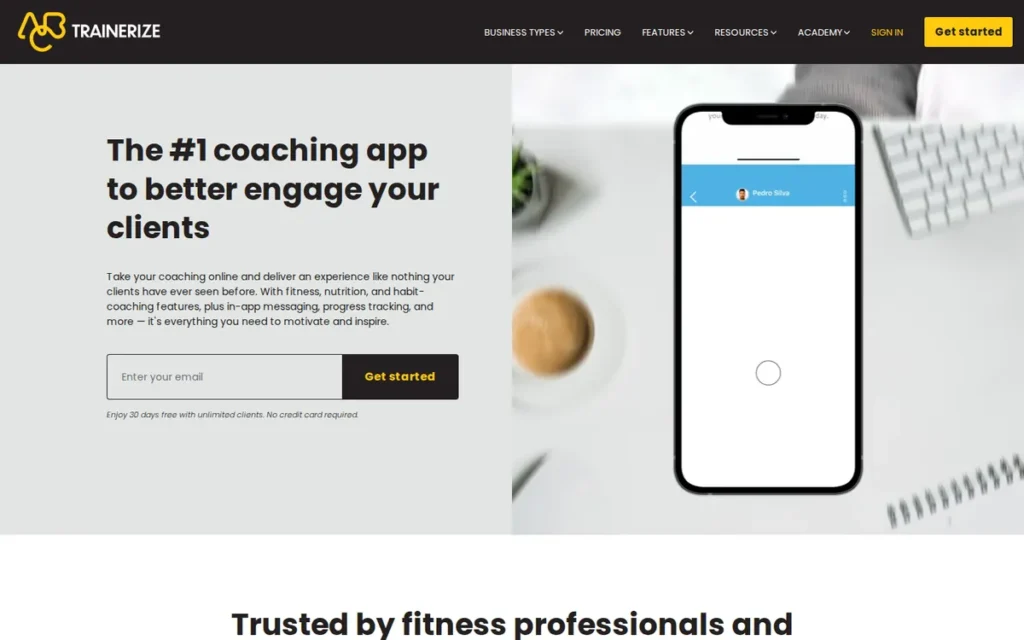
Category: Fitness Coaching App. It delivers workout programs, nutrition tracking, and wearable data for personal trainers and fitness coaches.
At a Glance
- Category: Fitness Coaching App
- Best For: Personal trainers and online or hybrid fitness coaches who program workouts and track nutrition
- Price Range: $0–$275/month by client count (free Basic plan for 1 client), plus add-ons at $10–$45/month each; about $124–$149/month at 30 clients with Business and Nutrition
- Primary Strength: ABC Trainerize combines workout programming, nutrition tracking, habit coaching, and wearable sync in a native app used by a large installed base of trainers.
- Biggest Limitation: ABC Trainerize puts scheduling, payments, and advanced nutrition behind paid add-ons and draws recurring complaints about app reliability.
- One-Line Summary: ABC Trainerize is the only fitness-specific coaching app in PlugRoute’s 2026 evaluation, built for trainers who program workouts and track nutrition, though add-ons can roughly double its list price.
- Last Verified: November 2026
Overview
ABC Trainerize is a fitness coaching app for personal trainers and online fitness coaches. It covers workout programming, nutrition tracking, habit coaching, and wearable sync. Scheduling, payments, and branded apps are available as paid add-ons.
ABC Trainerize has been owned by ABC Fitness since September 2020 (Trainerize company history blog, November 2026). ABC Trainerize is not designed for life, business, or executive coaching.
Key Features
- ABC Trainerize builds workout programs with supersets, circuits, and reusable templates.
- ABC Trainerize tracks nutrition and macros, with MyFitnessPal and Fitbit sync through its Advanced Nutrition add-on.
- ABC Trainerize syncs with Apple Health, Health Connect, Garmin, Fitbit, and Withings, and offers an Apple Watch app.
- ABC Trainerize provides habit coaching, in-app messaging, progress photos, and body measurements.
- ABC Trainerize offers scheduling, Stripe payments, a custom-branded app, and Studio features for gyms through add-ons and higher plans.
Best For
ABC Trainerize is best for trainers who mix in-person and online clients and rely on workout and nutrition data. PlugRoute doesn’t recommend ABC Trainerize for general life or business coaching.
Pricing
ABC Trainerize prices by client count. Monthly prices are shown first, with the annual-billed price in brackets (Vendor Page Verified: Trainerize pricing page, November 2026):
- ABC Trainerize Basic is $0 for 1 client, and Grow is $10 ($9) for 2 clients.
- ABC Trainerize Pro 5 is $25 ($23), Pro 15 is $50 ($45), and Pro 30 is $79 ($71).
- ABC Trainerize Pro 50 is $135 ($122), Pro 100 is $225 ($203), and Studio Plus is $275 ($248) for up to 500 clients per location.
- ABC Trainerize add-ons include Business at $25, Advanced Nutrition at $20–$45, and Video Coaching at $10. There is also a $10 Stripe add-on, which is Conflicting Across Sources on Trainerize’s own pages.
ABC Trainerize’s Pro 30 plan with the Business and Nutrition add-ons comes to about $124–$149/month. One Reddit trainer reports paying $77/month for 30 clients with payments included, possibly on a legacy plan (Reddit r/personaltraining, accessed November 2026).
Strengths
- ABC Trainerize has operated since August 2012 and has been owned by ABC Fitness, a company with 1,000+ employees, since September 2020 (Trainerize company history blog, November 2026). This is the strongest ownership-continuity signal evaluated.
- ABC Trainerize reports 400,000+ trainers and 1.6M+ clients (Vendor-Stated: Trainerize, November 2026).
- ABC Trainerize draws strong praise from some trainers. One called it “a godsend for my business,” and another, after two years of use, said its built-in library is “quite useful” (Reddit r/personaltraining, accessed November 2026).
- ABC Trainerize offers the broadest wearable integration evaluated. It syncs with Apple Health, Health Connect, Garmin, Fitbit, and Withings and runs an Apple Watch app (Trainerize pricing page, November 2026).
- ABC Trainerize lets coaches start free with one client and scale to Studio plans covering up to 500 clients per location.
Limitations
ABC Trainerize trades a low headline price for add-on stacking. Scheduling, payments, and advanced nutrition each cost extra, so a 30-client trainer can pay $124–$149/month instead of the $79 list price.
- ABC Trainerize holds a 3.1/5 Trustpilot rating from 100 reviews (Trustpilot, October 2026), the lowest evaluated, with reviews split between 5-star and 1–2-star.
- ABC Trainerize users report crashes mid-workout, lost logged sets, wearable sync failures, billing disputes, and slow support (Third-Party Reported: Coachful, a competing vendor, November 2026).
- ABC Trainerize accepts Stripe payments in 35 countries, by credit card only. Apple Pay, Google Pay, bank transfers, and buy-now-pay-later aren’t supported (Trainerize Help Center, November 2026).
- ABC Trainerize’s interface is described on Reddit as “too much” for clients. Users also name cheaper alternatives that PlugRoute hasn’t evaluated (Reddit r/personaltraining, accessed November 2026).
Users on r/personaltraining noted:
“Pros: Extensive video library, cool billing features, App and Device Integration, Communication, and progress tracking
Cons: Too many features, and too many “ADDITIONAL FEATURES” $$$ it feels like half of the functions need to be unlocked by an additional subscription” Posted by u/eggathy
Takeaway: ABC Trainerize’s depth in video, billing, and device integration comes with an add-on model that leaves trainers feeling they pay extra to unlock basic functions.
Verdict
ABC Trainerize is the best coaching software in 2026 for personal trainers and fitness coaches who need workout programming, nutrition tracking, and wearable sync, as long as they budget for add-ons that can nearly double the list price.
ABC Trainerize’s sixth-place rank reflects criteria designed for life, business, and executive coaching. It is the only fitness option PlugRoute evaluated, so the rank is not a comparison with fitness alternatives. Use the free Basic plan to test app stability with a real client workout.
7. Satori: Best for Formal One-on-One Enrollment Workflows
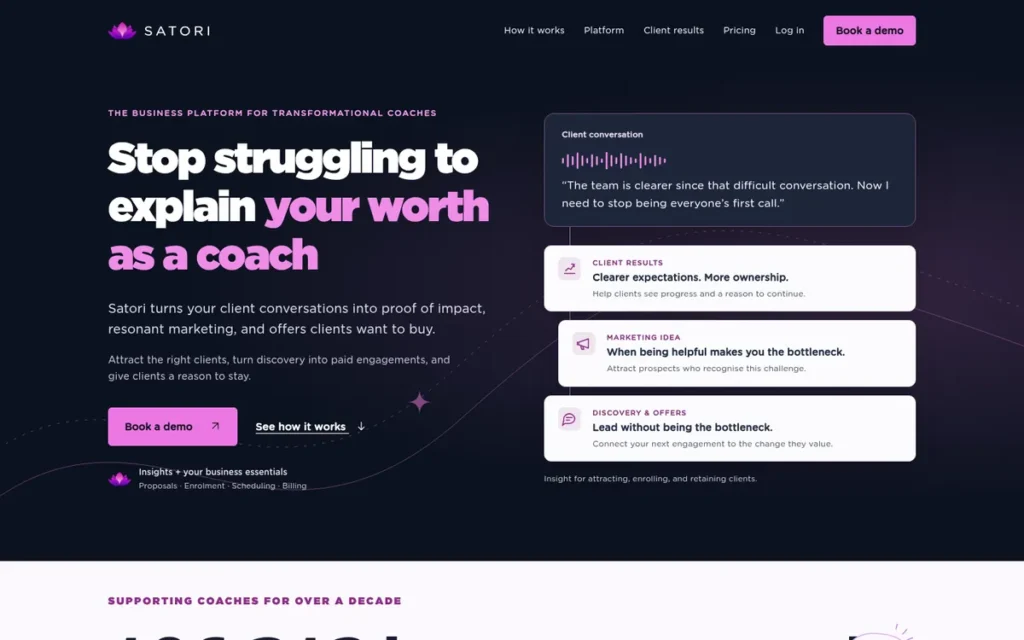
Category: All-in-One Practice Manager. It runs booking, packages, payments, contracts, and a client portal for one-on-one practices.
At a Glance
- Category: All-in-One Practice Manager
- Best For: One-on-one coaches who want a formal discovery, proposal, and enrollment process
- Price Range: Conflicting: about $33–$124/month by active clients per third parties, or $9–$97/month per Satori’s homepage (verify live); 15-day trial, no card; non-refundable
- Primary Strength: Satori guides prospects from discovery questionnaire through proposal, agreement, and one-click enrollment in a structured one-on-one workflow.
- Biggest Limitation: Satori has two conflicting published price lists, non-refundable subscriptions, no native mobile app, and the smallest review samples among one-on-one tools.
- One-Line Summary: Satori is the most enrollment-focused one-on-one coaching platform in PlugRoute’s 2026 evaluation, built around discovery questionnaires, proposals, and one-click enrollment.
- Last Verified: November 2026
Overview
Satori is a one-on-one coaching practice platform built around turning prospects into clients through discovery questionnaires, proposals, and one-click enrollment. It is for coaches who want a formal enrollment process before multi-session programs and recurring billing begin.
Satori is operated by Audacity International Limited, which is registered in Auckland, New Zealand, with Lachlan Cotter as founder and CEO (Satori terms, November 2026). Satori’s pricing currently appears in two versions, so check the live plan before buying.
Key Features
- Satori runs prospects through discovery questionnaires, proposals, agreements, and one-click enrollment.
- Satori delivers multi-session programs with check-ins, notes, and a client portal showing goals, actions, and resources.
- Satori supports recurring and custom billing schedules through Stripe and PayPal, with no platform fee on client payments.
- Satori syncs with Google Calendar and provides practice dashboards.
- Satori Insights is an AI notetaker that visibly joins Zoom or Google Meet calls and records sessions, so coaches need client consent before using it.
Best For
Satori is best for one-on-one coaches who sell higher-ticket engagements through structured discovery and proposals. Satori is less suited to group, cohort, or course-based coaching.
Pricing
Satori’s pricing is Conflicting Across Sources, because Satori’s own pages and a third party show two different price lists:
- Satori Essentials is reported at about $33/month annual or $39 monthly, for 10 clients, 3 programs, and 60 bookings (Third-Party Reported: LearningRevolution, November 2026).
- Satori Pro is reported at $49 or $59 for 50 clients and unlocks group coaching. Satori Leader is reported at $124 or $149 for 150 clients.
- Satori’s homepage separately shows Seed at $9/month for the first 2 clients, Grow at $57, and Blaze at $97 (Satori homepage, November 2026).
- Satori charges no fee on client payments, offers a 15-day full trial with no card, and states that subscriptions are non-refundable (Satori terms, November 2026).
Strengths
- Satori’s customer stories report that one coach saved 290+ hours and grew revenue 3.4× in her first year, and another saved 220 hours with 2.8× revenue. Satori also claims $50M+ in coaching revenue across 3,000+ coaches (Vendor-Stated: Satori customer stories, November 2026).
- Satori holds a 4.5/5 Capterra rating from 13 reviews (Capterra, November 2026), with users valuing its discovery-to-billing flow.
- Satori charges no platform fee on client payments and offers a 15-day full trial with no card required.
- Satori describes Satori Insights as analyzing sessions for client change in mindset, strategy, and execution. No other evaluated notetaker advertises that focus (Vendor-Stated: Satori, November 2026).
Limitations
Satori trades breadth for a narrow one-on-one focus. Group coaching requires Pro or higher, and Satori reportedly lacks a native mobile app, native Zoom integration, a website builder, course hosting, and community features (Third-Party Reported: Coachful and LearningRevolution, November 2026).
- Satori has two conflicting price lists and non-refundable subscriptions, which makes both total cost and the risk of leaving hard to judge.
- Satori’s G2 score of 4.1/5 from 11 reviews (G2, November 2026) is the lowest among the dedicated coaching tools evaluated.
- Satori was reported by Paperbell, a competitor, to have a lapsed security certificate on a blog subdomain and a 2021 footer date. Treat that report with caution (Paperbell comparison page, November 2026).
- Satori generated no significant Reddit discussion in PlugRoute’s research.
Verdict
Satori is the best coaching software in 2026 for one-on-one coaches who sell through formal discovery questionnaires and proposals. Conflicting pricing, non-refundable subscriptions, and thin review data place it seventh overall.
Satori finished 1.5 points behind ABC Trainerize, and a single confirmed price list would raise its cost-transparency score. Get the live price and plan limits in writing, and use the full 15-day trial, because payments can’t be refunded.
What Will Coaching Software Actually Cost at 5, 10, and 20 Clients?
At 20 clients, coaching software costs about $49 to $149 a month in PlugRoute’s November 2026 evaluation. Flat-fee Paperbell stays at $57 at any roster size. CoachAccountable reaches $120, and ABC Trainerize reaches $124–$149 with add-ons. upcoach adds a percentage of sales, and every platform passes through processor fees.
| Product | 5 Clients | 10 Clients | 20 Clients | Platform Fee | Evidence Label |
|---|---|---|---|---|---|
| Paperbell | $57 | $57 | $57 | None | Vendor Page Verified (AI-cited $97 unverified) |
| CoachAccountable | $40 | $70 | $120 | None | Vendor Page Verified |
| Simply.Coach (solo, annual) | $29 (Essentials) | $49–$69 (verify Growth cap) | $69 (Leap) | Not disclosed | Vendor Page Verified |
| Delenta | $29 (Solo; AI-cited $79 unverified) | Depends on portal limits | Likely higher tier; quote | Not confirmed | Vendor Page Verified (higher tiers unpublished) |
| Satori | ~$33 or $57 | ~$33–$57 | ~$49 or $97 | None | Conflicting Across Sources |
| upcoach | $49 | $49 | $49 | 2% on Starter | Vendor Page Verified |
| ABC Trainerize | $50–$60 | $75–$85 | $104–$114 ($124–$149 with Nutrition) | $10 payments add-on (conflicting) | Vendor Page Verified / Conflicting |
These are the pricing breakpoints that matter most:
- Paperbell vs. CoachAccountable: Paperbell at $57 becomes cheaper than CoachAccountable between 5 clients ($40) and 10 clients ($70).
- upcoach Starter vs. Pro: upcoach Pro becomes cheaper than Starter at about $5,000/month in cohort sales, if the participant caps fit (PlugRoute calculation).
- Simply.Coach vs. CoachAccountable for teams: A 3-coach firm with 60 clients pays about $477/month on Simply.Coach Surge. On CoachAccountable it pays between $250 (50-client tier) and $400 (100-client tier), with no per-coach fee.
Here is how those numbers play out over a year:
- A solo coach growing from 5 to 20 active clients over 12 months pays about $960 on CoachAccountable (roughly $80/month on average), versus $570 on Paperbell’s annual plan.
- A solo coach who stays at 5 clients pays $480 a year on CoachAccountable, which is $90 less than Paperbell’s annual plan.
- Every platform’s bill also includes Stripe or PayPal processing. One Reddit trainer reported a 2.9% card fee (Reddit r/personaltraining, accessed November 2026).
Per-client pricing is the cheapest way to start and the most expensive way to grow. Flat pricing is the reverse.
What Red Flags Should I Watch For When Evaluating Coaching Software?
The biggest red flags in coaching software are hidden costs and claims you can’t verify. Watch for six things:
- platform fees on top of processor fees
- add-ons and gated tiers that inflate list prices
- commitments you can’t get out of
- unproven compliance claims
- missing data export
- conflicting prices or vendor-written reviews
Red Flag #1: Platform Transaction Fees on Top of Processor Fees
A platform transaction fee is a percentage the software vendor keeps from each client payment, on top of Stripe or PayPal processing. upcoach’s 2% Starter fee adds about $200 a month on $10,000 in sales. Simply.Coach and Delenta don’t disclose their fees, so get every tier’s fee in writing.
Red Flag #2: Add-On Stacking and Gated Tiers Above List Price
Add-on stacking happens when core functions such as scheduling or payments cost extra. Gated tiers put features behind pricier plans. ABC Trainerize’s $79 Pro 30 plan reaches about $124–$149 a month with the Business and Nutrition add-ons. Delenta reportedly gates course hosting and its mobile app to higher tiers.
Red Flag #3: Annual Lock-In or Non-Refundable Subscriptions
Long commitments and no-refund terms leave you stuck if the platform turns out to be a poor fit. One Reddit coach reported feeling locked into a Simply.Coach annual plan after a 14-day trial (Reddit r/lifecoaching, accessed November 2026). Satori’s terms state that subscriptions are non-refundable (Satori terms, November 2026).
Red Flag #4: Unverified Compliance Claims
A compliance claim without documentation is only a marketing statement until the vendor proves it. In PlugRoute’s research, every HIPAA and SOC 2 claim was either vendor-stated or conflicting across sources. Coaches handling health information should require a SOC 2 report and a signed BAA before storing client data.
Red Flag #5: No Confirmed Data Export
A coaching platform’s G2 rating says nothing about whether it will exist next year. Practice held 4.8/5 on G2 from 64 reviews when it shut down on November 3, 2025, with about two weeks’ notice (Coachful comparison page, a competing vendor, accessed November 2026). PlugRoute could not confirm full data export for any evaluated vendor.
Red Flag #6: Unverifiable Prices and Vendor-Written Reviews
Conflicting prices and vendor-written comparisons make independent judgment hard. Satori shows two price lists, and AI answer engines cite unverified prices for Paperbell and Delenta. Several vendors also publish comparisons of their rivals, so weigh those sources with care:
- Paperbell
- Simply.Coach
- Delenta
- Coachful
- Kahunas
What Questions Should I Ask Before Choosing Coaching Software?
Before choosing coaching software, ask how pricing scales, whether the vendor takes a cut of payments, and which features sit on higher tiers. Also confirm mobile apps, calendar sync, data export, compliance documents, and monthly billing. Get every answer in writing during the free trial, before your clients and data are inside the platform.
Question #1: Is pricing based on clients, participants, or coaches, and what will I pay at double my current roster?
The pricing unit determines how fast your costs grow. CoachAccountable rises from $40 at 5 clients to $70 at 10, Simply.Coach business plans multiply per coach, and Paperbell stays at $57 (vendor pricing pages, November 2026). Model your bill at today’s roster and at twice that size.
Question #2: Does the platform take a percentage of client payments?
A vendor-side percentage compounds as your revenue grows. upcoach charges 2% on Starter and 1% on Pro, while Paperbell, CoachAccountable, and Satori take no cut (vendor pricing pages, November 2026). Ask for the fee on every tier in writing, then add your processor’s rate separately.
Question #3: Is there a native mobile app for clients, and on which tier?
Native mobile apps vary widely across coaching platforms:
- ABC Trainerize has one.
- Simply.Coach reportedly does.
- Paperbell and Satori do not.
- CoachAccountable and upcoach have conflicting reports.
Because client adoption decides whether accountability features pay off, ask whether the app is native or a mobile website, and which plan includes it.
Question #4: Does it sync with my calendar and auto-generate Zoom, Meet, or Teams links?
Calendar and video integration removes most scheduling admin, but coverage varies. Paperbell syncs with Google, Outlook, and iCloud, and Simply.Coach syncs with Google and Microsoft 365. Satori syncs with Google Calendar but reportedly lacks native Zoom integration. Confirm two-way sync and test booking as a client.
Question #5: Can I export all client data, contracts, and notes?
A full data export is your protection against a platform shutdown. Practice closed in November 2025 with about two weeks’ notice, and PlugRoute could not confirm full export for any of the seven evaluated vendors. Ask which formats are supported, and run a test export during the trial.
Question #6: Can you provide a SOC 2 report or a signed BAA?
Documentation separates verified compliance from marketing claims. Simply.Coach says it offers a BAA and provides a SOC 2 report on Enterprise, while CoachAccountable’s HIPAA status conflicts across sources. Coaches working near health topics should treat a refusal to provide a signed BAA as disqualifying.
Question #7: Can I start monthly before committing to annual?
Monthly billing lets you test with real clients before committing to a year. Simply.Coach’s founder publicly encouraged coaches to start monthly before switching to annual, and Satori subscriptions are non-refundable. Ask whether you can switch to annual later and keep the discount.
Question #8: Which features are locked to higher tiers?
Gated features are the most common source of surprise upgrades. Delenta gates group coaching, course hosting, and its mobile app. Satori requires Pro for group coaching. ABC Trainerize sells scheduling and payments as add-ons. List the features you need and ask which tier includes each one.
Use this five-step plan during any free trial:
- Book a test session as a client from your phone to see the client-side experience.
- Run one real package purchase with a contract and payment to check the full checkout.
- Invite two existing clients and track whether they log in within a week.
- Export your test data to confirm you can leave with your records.
- Confirm in writing whether monthly billing is available before the trial ends.
How Did We Rank These Coaching Software Platforms?
PlugRoute scored each platform from 1 to 5 on six criteria. Three primary criteria count double and three secondary criteria count once, for a maximum of 45 points. Every score is tied to dated, source-attributed evidence verified in November 2026. The top three finished within two points, so fit with your coaching model should decide between them.
These are the six ranking criteria and why each one matters:
- C1 Workflow Consolidation (primary, ×2): Workflow Consolidation measures native booking, packages, payments, contracts, intake forms, and client portals, because juggling separate tools is the biggest admin burden coaches report.
- C2 Total Cost Transparency and Predictability (primary, ×2): Cost Transparency measures published tiers, platform fees, add-on stacking, and price consistency, because hidden and scaling costs are a core buyer worry.
- C3 Independent User Ratings and Sentiment (primary, ×2): Independent Ratings combines G2, Capterra, and Trustpilot scores with Reddit sentiment, and weights review volume as heavily as the score itself.
- C4 Between-Session Accountability (secondary, ×1): Accountability measures goals, action plans, metrics, and habits, plus client adoption factors such as mobile access.
- C5 Scalability to Groups and Coaches (secondary, ×1): Scalability measures cohort features, multi-coach roles, sponsor roles, and per-seat pricing.
- C6 Platform Risk and Trust Signals (secondary, ×1): Platform Risk measures company age, team size, compliance substantiation, trial terms, and refund policies.
| Rank | Product | C1 | C2 | C3 | C4 | C5 | C6 | Total (of 45) | Confidence |
|---|---|---|---|---|---|---|---|---|---|
| 1 | CoachAccountable | 4 | 4 | 5 | 5 | 4 | 3.5 | 38.5 | High: 67 Capterra reviews; consistent pricing |
| 2 | Simply.Coach | 4.5 | 3 | 4.5 | 4.5 | 5 | 4 | 37.5 | High: 156 G2 reviews; compliance vendor-stated |
| 3 | Paperbell | 5 | 5 | 4.5 | 2 | 2.5 | 3 | 36.5 | High on ratings; AI-cited price unverified |
| 4 | Delenta | 5 | 2.5 | 4 | 4 | 4.5 | 2 | 33.5 | Medium: background unverified; higher tiers unpublished |
| 5 | upcoach | 3 | 3 | 2.5 | 4.5 | 4.5 | 2.5 | 28.5 | Low-medium: 8 Capterra reviews; no G2 |
| 6 | ABC Trainerize | 3 | 2 | 2 | 4 | 4 | 3.5 | 25.5 | Medium: Trustpilot (100 reviews); G2/Capterra unverified |
| 7 | Satori | 4 | 2 | 2.5 | 3 | 2 | 2 | 24.0 | Low: 11–13 reviews per site; two price lists |
CoachAccountable’s one-point lead over Simply.Coach comes mainly from its ratings score (C3: 5 vs. 4.5). If the two had equal C3 scores, they would tie at 37.5.
C3 weighs each rating against its review volume. PlugRoute judged that CoachAccountable’s 5.0/5 from 67 Capterra reviews should outscore larger review bases rated 4.7–4.8. This is the most consequential single judgment in the ranking.
PlugRoute applies five evidence labels to every claim:
- Independently Rated: Independently Rated claims come from G2, Capterra, Software Advice, or Trustpilot, with review counts.
- Vendor Page Verified: Vendor Page Verified claims come from a live vendor pricing or feature page checked in November 2026.
- Third-Party Reported: Third-Party Reported claims come from review sites or comparisons not run by the vendor, with any competing-vendor authorship disclosed.
- Vendor-Stated: Vendor-Stated claims include case studies, usage figures, and compliance claims that vendors publish about themselves.
- Conflicting Across Sources: Conflicting Across Sources marks claims where credible sources disagree.
When an AI answer engine cites a price that PlugRoute could not match to any vendor page, the vendor-page figure is shown first and the AI-cited figure is marked unverified. When a source shows no publication date, the date shown is the date PlugRoute accessed it.
PlugRoute excluded Practice (practice.do), which shut down on November 3, 2025, with about two weeks’ notice (Coachful comparison page, a competing vendor, accessed November 2026). Practice was excluded even though its G2 rating still appears in comparison data.
PlugRoute also left out enterprise coach-matching platforms (GrowthSpace, Ezra), because HR departments buy them, and course-first platforms such as Kajabi. Much of the comparison content online is written by competing vendors. Every measured outcome PlugRoute found was published by the vendor itself.
Several platforms are candidates for a future update:
- General coaching platforms not yet evaluated: CoachVantage, Quenza, and Coachful.
- Fitness platforms not yet evaluated: QuickCoach, Everfit, and Kahunas.
PlugRoute has no affiliate relationships with any company listed, and rankings are determined entirely by research data and objective evaluation criteria.
What Do Coaches Most Often Ask About Coaching Software?
Coaches most often ask three things: whether they need an all-in-one platform, whether vendors take a cut of client payments, and how rankings like this one are built. The answers below use the same dated evidence as the ranked entries and the methodology, so each one can be checked against its source.
Do I need an all-in-one coaching platform, or can I use separate tools?
Separate tools such as Calendly, Notion, and a payment link can be enough for coaches with a handful of clients. An all-in-one platform starts paying off once contracts, invoicing, and intake forms take several hours a week. Vendor case studies report savings ranging from 16–25 hours a month (Satori) to 20+ hours a week (Paperbell) (Vendor-Stated, November 2026).
As one user on r/lifecoaching described:
“Currently I’m trying out using Calendly and trying to just work with that. I don’t have a bunch of forms or notes I need to exchange with clients, so I may just stick to email. Personally as a client, I don’t like an entire portal for exchanging with a practitioner unless there’s really a lot in there (like for a medical charting portal). Otherwise it’s just an additional thing I need an account for.” Posted by u/OrientionPeace
Takeaway: For coaches with light admin needs, a dedicated coaching platform can feel like one more login to clients, so simple separate tools like Calendly remain a valid place to start.
Does coaching software take a cut of my client payments?
Three of the seven platforms PlugRoute evaluated confirm they take no cut of client payments: Paperbell, CoachAccountable, and Satori. upcoach charges 2% on Starter, 1% on Pro, and 0.5% on Business+ (upcoach, November 2026). Simply.Coach and Delenta don’t disclose platform fees, and ABC Trainerize charges a $10/month payments add-on on some plans.
How does PlugRoute determine its coaching software rankings?
PlugRoute scores every platform from 1 to 5 on six published criteria. Workflow consolidation, cost transparency, and independent ratings count double. Accountability, scalability, and platform risk count once, for a maximum of 45 points. Every claim carries an evidence label and a date, and review volume is weighted so small samples can’t inflate a score.
What Do Key Coaching Software Terms Mean?
Pricing and compliance terms decide what you actually pay for coaching software and what data you can safely store in it. The definitions below cover the terms used throughout this guide, so you can compare vendor pricing pages, contracts, and security claims on equal terms before you subscribe.
Active client pricing: Active client pricing charges a monthly fee based on how many clients are currently enabled in the platform. Active client pricing matters because your bill grows with your practice, though you can lower it by deactivating clients who have finished their engagements.
Flat-rate pricing: Flat-rate pricing charges one fixed monthly or annual fee no matter how many clients you serve. Flat-rate pricing makes costs predictable and usually becomes the cheaper option once your roster passes a certain size.
Platform transaction fee: A platform transaction fee is a percentage of each client payment that the software vendor keeps. A platform transaction fee is charged in addition to card-processing fees, so it directly reduces what you earn from every sale.
Payment processing fee: A payment processing fee is what a processor such as Stripe or PayPal charges to handle a card payment. Payment processing fees are passed through by every coaching platform, so include them in your total-cost calculations.
Add-on: An add-on is a separately priced feature that isn’t included in the base plan, such as scheduling, payments, or nutrition tracking. Add-ons can push the real monthly cost far above the advertised price.
Client portal: A client portal is a private, logged-in space where clients see their sessions, documents, goals, and resources. A client portal replaces scattered email attachments, and how easy it is to use strongly affects whether clients engage between sessions.
White-labeling: White-labeling lets you show your own brand and logo, and sometimes your own domain, instead of the software vendor’s. White-labeling matters for coaches who want a professional, consistent client experience.
Cohort program: A cohort program is a group coaching program in which participants start and progress together on a shared schedule. Cohort-focused platforms let you re-run the same program with new groups without rebuilding it.
ICF coaching-hour log: An ICF coaching-hour log records coaching hours in the format the International Coaching Federation requires for credential applications. An ICF coaching-hour log saves credential-seeking coaches from keeping separate spreadsheets.
SOC 2 report: A SOC 2 report is an independent audit of how a software company protects customer data. Asking for a SOC 2 report confirms whether a vendor’s security claim has actually been audited.
Business Associate Agreement (BAA): A Business Associate Agreement is a contract in which a vendor agrees to protect health information under HIPAA rules. Coaches who handle health-related client information should require a signed BAA before storing any data.
Which Coaching Software Tool Is Right for You?
Key Insights
- CoachAccountable, Simply.Coach, and Paperbell finished within two points of each other (38.5, 37.5, and 36.5 of 45), so fit with your coaching model should decide between them. upcoach leads for cohorts and ABC Trainerize for fitness.
- Paperbell’s flat $57 pricing beats CoachAccountable’s per-client pricing somewhere between 5 and 10 active clients, so solo coaches should model their own roster growth.
- upcoach’s 2% Starter fee (about $200/month on $10,000 in sales) and ABC Trainerize’s add-ons (Pro 30 rising from $79 to $124–$149/month) are the two biggest sources of hidden cost in this evaluation.
- Client adoption decides whether coaching software pays off, so check how often clients actually log in during the free trial.
- Coaching software buyers should confirm data export and compliance documents before committing, as Practice’s November 2025 shutdown showed.
- Every outcome metric PlugRoute found for these seven platforms was vendor-published, so independent ratings with large review counts are the most reliable signal available.
Coaching software pays for itself only when clients log in. The best platform is the one your clients will actually open between sessions.
Use this short guide to choose where to start:
- You sell one-on-one packages: start with Paperbell.
- Your method depends on tracked client actions: consider CoachAccountable.
- You work with sponsors or are hiring coaches: look at Simply.Coach or Delenta.
- You run cohorts: trial upcoach.
- You coach fitness clients: test ABC Trainerize.
- You sell through formal proposals: trial Satori.
We update this guide quarterly. Last updated: November 2026. Read PlugRoute’s full methodology and explore our other independent SaaS reviews before you subscribe.