The best child care software in 2026 is Procare Solutions for complex billing and subsidy accounting, brightwheel for ease of use and parent communication, and Playground for built-in payroll and enrollment marketing. The right choice depends on your billing complexity, site count, and curriculum needs, not on star ratings or vendor claims.
Vendor-published rankings almost always put the vendor’s own product at #1. Review scores also can’t show whether a platform handles your own tuition rules, late fees, and subsidy copays. This guide ranks seven platforms on dated evidence and shows where each one breaks down.
PlugRoute has no affiliate relationships with any company listed. Rankings are determined entirely by research data and objective evaluation criteria.
Every entry below uses the same structure, labels each source by type, and lists at least four documented limitations. The top three platforms finished within 0.35 points of each other, so use the tables to match your priority before you book a demo. All data was last verified in November 2026.
What Are the 5 Categories of Child Care Software Tools?
Child care software, also called daycare management software, falls into five categories. Each category gives up depth in one area, such as billing, learning documentation, multi-site control, or cost, in exchange for convenience or price in another. Knowing your category first narrows the shortlist before any demo.
- All-in-One Operations Platform: brightwheel and Playground run billing, attendance, enrollment, and family communication in a single mobile-first system.
- Finance-First Platform: Procare Solutions puts accounting-grade billing, subsidy split billing, and administrative reporting first.
- Multi-Site Operations Platform: Kangarootime focuses on consolidated billing, reporting, and enrollment across several locations.
- Learning-First Platform: Lillio (formerly HiMama) and Famly put curriculum, observations, and child development documentation first.
- Budget and Small-Program Platform: Daily Connect publishes low per-child pricing for home daycares, nannies, and small centers.
The biggest trade-off in this market is between learning documentation and complex billing. In PlugRoute’s research, the learning-first tools (Lillio, Famly) were weaker on complex billing. A Reddit teacher also reported that their center didn’t use Procare Solutions’ developmental tracking (Reddit r/ECEProfessionals, 2025).
Users on r/ECEProfessionals shared their experience:
“It is super easy to rapid log things like meals, nap times and nappy changes. Some of the apps also have great programming capabilities and sharing observations with parents. The big downfall for me though is over-reliance on photos. We end up stuck behind a screen all day and suddenly “photographer” falls into my other duties as required.” Posted by u/AwkwardAnnual
Takeaway: Classroom staff value child care software for fast daily logging but see heavy photo-documentation expectations as a real cost to time with children.
How Do the Top Child Care Software Platforms Compare at a Glance?
Procare Solutions, brightwheel, and Playground lead PlugRoute’s 2026 rankings with scores of 4.05, 3.85, and 3.70. Kangarootime, Daily Connect, Lillio, and Famly each lead in a narrower area: multi-site billing, budget pricing, standards-based documentation, and teaching tools. The table below summarizes each platform’s fit and main trade-off.
| Rank | Company | Category | Best For | One-Line Summary | Key Capabilities | Primary Strength | Key Limitation |
|---|---|---|---|---|---|---|---|
| 1 (4.05) | Procare Solutions | Finance-First Platform | Subsidy-heavy centers, complex tuition, large chains | Procare Solutions scored highest of the platforms evaluated and is the strongest choice for complex billing and subsidy accounting, trading modern usability for back-office depth. | General ledger, aging reports, split billing, CACFP, enrollment, lesson planning | Deepest documented billing and accounting tools | Steeper learning curve; user reports of periodic bugs |
| 2 (3.85) | brightwheel | All-in-One Operations Platform | Single-site and small multi-site centers focused on ease of use | brightwheel is the most widely reviewed all-in-one child care platform rated 4.7 or higher, and the strongest demo for centers that value ease of use and family communication. | Billing, autopay, subsidy tracking, check-in, admissions, messaging, staff scheduling | Highly rated parent app with broad payment options | Payroll requires Gusto; curriculum is a paid add-on |
| 3 (3.70) | Playground | All-in-One Operations Platform | Growing centers wanting payroll and enrollment marketing | Playground has the broadest built-in feature set of the all-in-one platforms evaluated, though its September 2026 acquisition by Procare Solutions makes written roadmap commitments essential. | Billing, payroll with tax filing, tour automation, subsidy copay, multi-site permissions, AI assistant | Native payroll and tour marketing in one system | 194-review sample; post-acquisition roadmap unpublished |
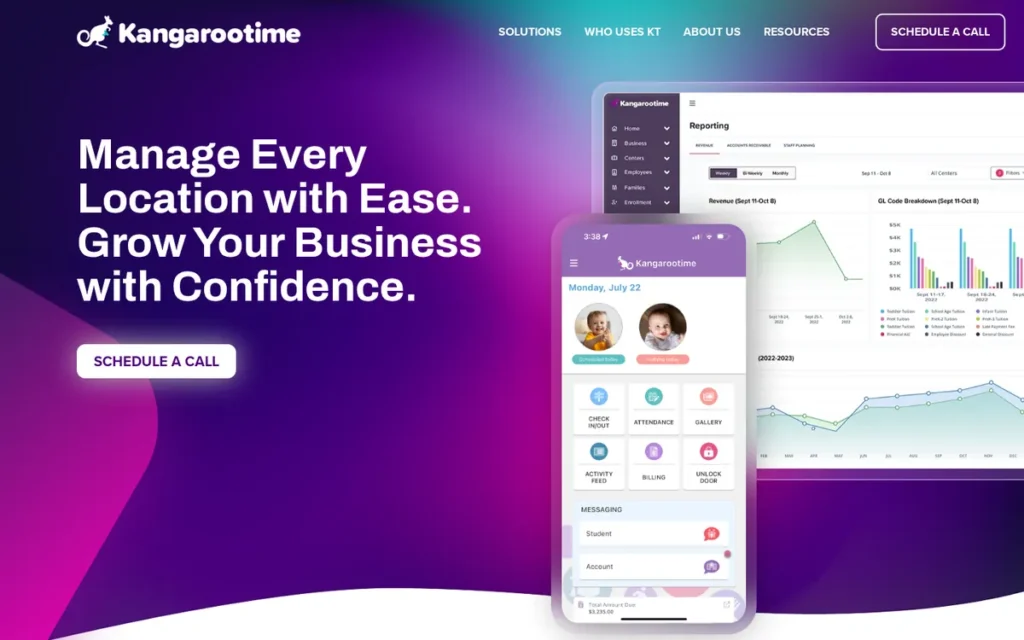
| 4 (3.35) | Kangarootime | Multi-Site Operations Platform | Operators running or growing to 3–10 locations | Kangarootime is the most multi-site-focused child care platform evaluated, with the strongest documented multi-site billing case study but the thinnest review evidence. | Cross-site dashboard, split payments, subsidy management, kiosk check-in, enrollment forecasting | Consolidated multi-location billing and reporting | 91 reviews; autopay-after-edit and QuickBooks issues reported |
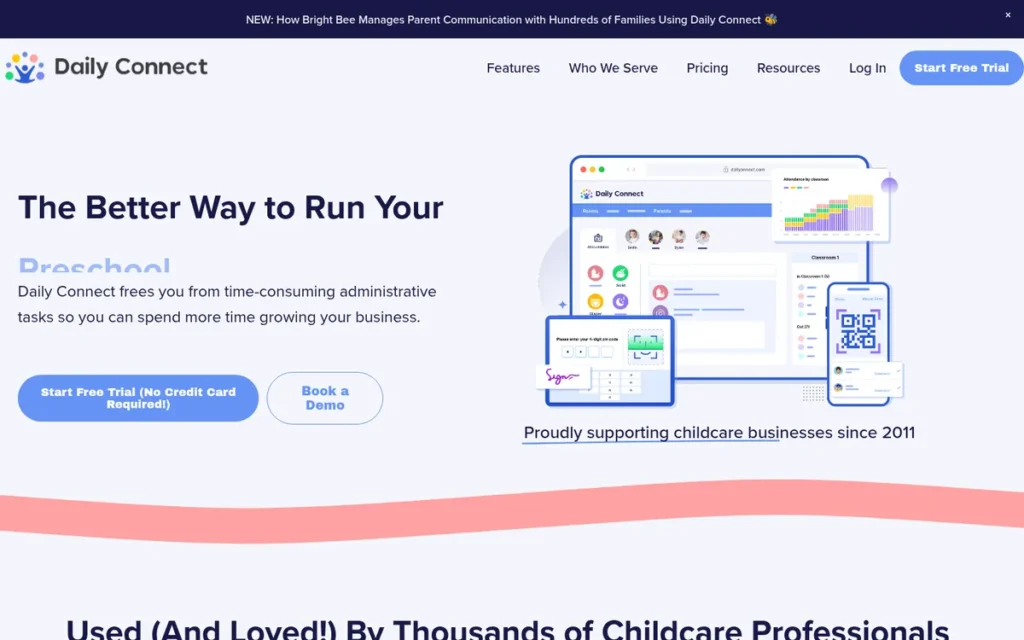
| 5 (3.325) | Daily Connect | Budget and Small-Program Platform | Home daycares, nannies, and small centers | Daily Connect is the most price-transparent child care software evaluated, and the lowest documented-cost option for home daycares and small programs. | Daily reports, QR/PIN check-in, attendance-based billing, state-standards observations | Complete published per-child pricing | No documented subsidy split billing; ownership unverified |
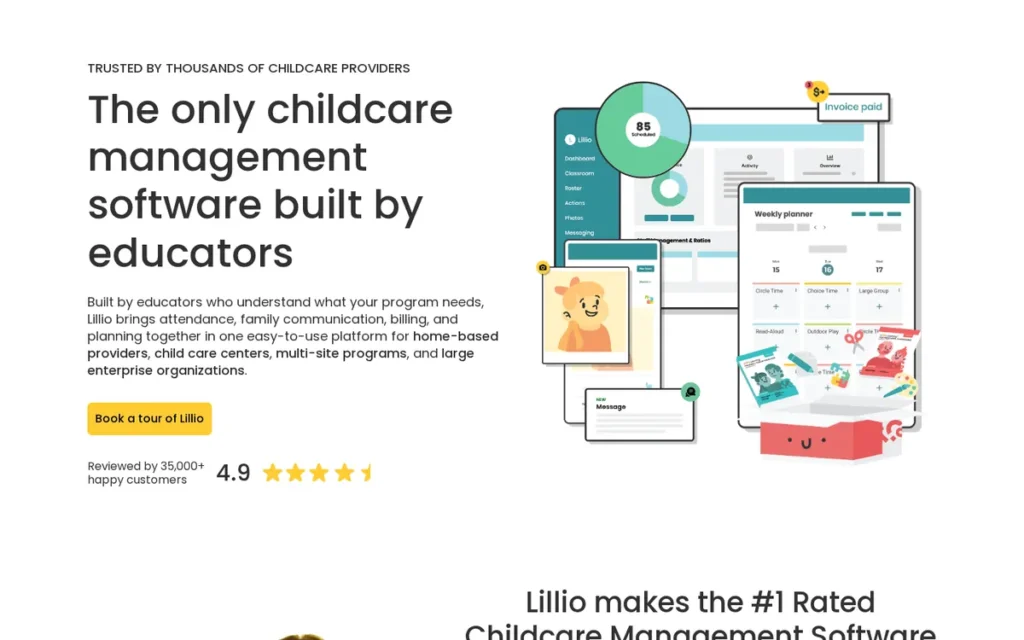
| 6 (3.275) | Lillio (formerly HiMama) | Learning-First Platform | Curriculum-driven centers with simple tuition | Lillio is the most-reviewed child care platform evaluated and the strongest U.S. option for linking child development documentation to state standards and family updates. | Daily reports, milestone observations, portfolios, standards auto-tagging, FunShine curriculum | Automatic tagging to state early-learning standards | Basic billing; quote-only pricing described as unclear |
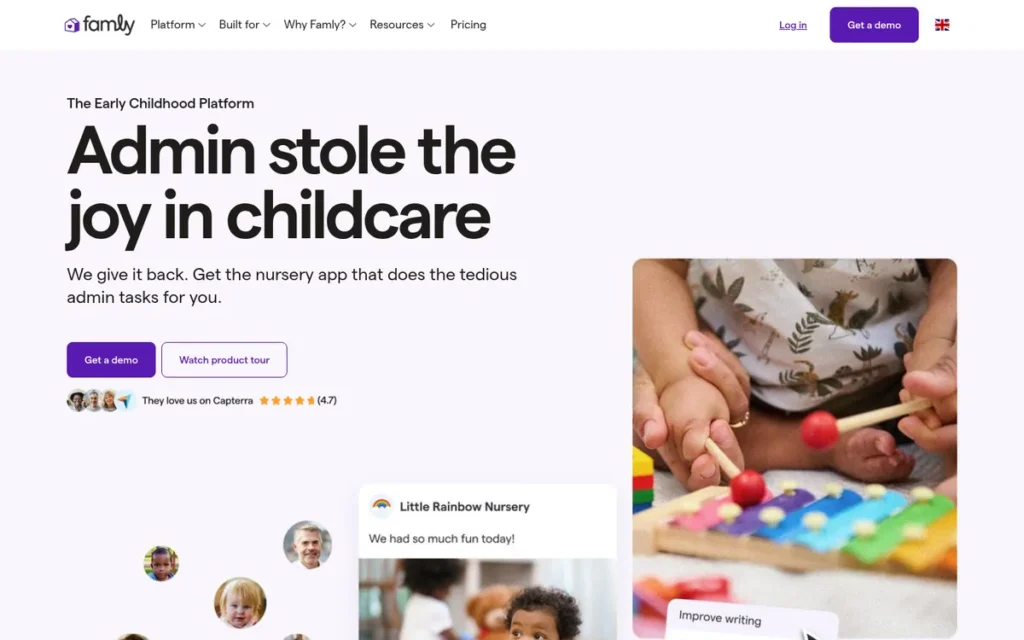
| 7 (3.20) | Famly | Learning-First Platform | Teaching-focused, private-pay programs | Famly is the most teaching-focused child care platform evaluated, best suited to U.S. programs with simple private-pay billing. | Learning journals, parent observations, AI writing helper, ratios, invoicing | Deepest learning-journal tools | Percentage-only payer splits |
Which Child Care Software Should I Choose for My Use Case?
The right child care software depends on your top operational priority. Subsidy-heavy programs should start with Procare Solutions, and small centers that want ease of use should start with brightwheel. Growing groups should demo Kangarootime, and curriculum-led programs should demo Lillio or Famly. Use the table below to build a demo shortlist of two or three platforms.
| Your #1 Priority | Recommended Tool | Why | Acceptable Alternative | Verify in the Demo |
|---|---|---|---|---|
| Subsidy-heavy billing or complex tuition rules | Procare Solutions | General ledger, aging reports, and agency/family split billing | Playground | Your own split-billing scenario |
| Ease of use and parent communication at a small center | brightwheel | Largest review base among platforms rated 4.7+ (Capterra, November 2026) | Playground | Check-in sync between tablet and phone |
| Built-in payroll and tour marketing | Playground | Only platform evaluated that documents payroll with tax filing, plus native lead automation | brightwheel (with Gusto) | Written post-acquisition price and support terms |
| Running or growing to 3–10 sites | Kangarootime | Cross-site dashboard and the strongest documented multi-site billing case study | Procare Solutions, Playground | Autopay after an invoice edit |
| Home daycare or fewer than 20 children on a tight budget | Daily Connect | Published pricing from $8.99/month with no setup fees | Famly | Live per-child rate on the pricing page |
| Curriculum and state-standards documentation | Lillio | Automatic tagging of activities to state early-learning standards | Famly | A late-fee or copay invoice |
| Teaching-focused, private-pay tuition | Famly | Learning journals, parent observations, and an AI writing helper | Lillio | Which tier includes automatic invoicing |
| Protection from acquisitions and vendor changes | Any shortlisted platform | Procare Solutions now owns two of the seven platforms evaluated | Not applicable | Written price-lock and data-export clauses |
Alternatives are chosen by documented fit for that priority, not by overall rank.
“Pricing looks fair for what’s included. Not the cheapest, but I’d rather she has something reliable and worth the investment.”, An operator of two centers comparing platforms (Reddit r/ECEProfessionals, 2025)
Takeaway: Child care operators comparing platforms often rank reliability and support above the lowest monthly price.
What Are the Best Child Care Software Platforms in 2026, Ranked?
PlugRoute ranks Procare Solutions #1 (4.05), brightwheel #2 (3.85), Playground #3 (3.70), Kangarootime #4, Daily Connect #5, Lillio #6, and Famly #7, based on six weighted criteria verified in November 2026. Every entry uses the same structure, labels each source type, and ends with demo tests drawn from documented failures.
1. Procare Solutions: Best for Complex Billing and Subsidy Accounting
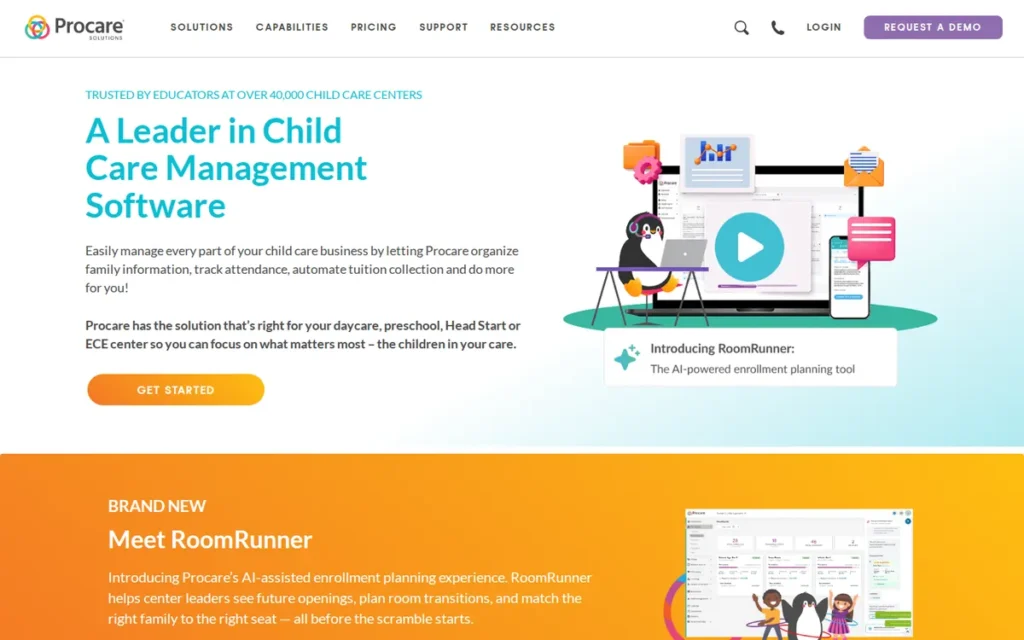
Category: Finance-First Platform, child care software built around accounting-grade billing, subsidy handling, and administrative reporting.
At a Glance
- Category: Finance-First Platform
- Best For: Subsidy-heavy centers, programs with complex tuition rules, and large multi-site chains
- Price Range: Pricing on request (third-party SpotSaaS listing from about $69/month; unclear whether per site or per plan)
- Primary Strength: Procare Solutions offers the deepest documented billing and accounting tools in the category, including split agency/family copay billing and a general ledger.
- Biggest Limitation: Procare Solutions has a steeper learning curve and a less modern interface than newer competitors, and users report periodic bugs.
- One-Line Summary: Procare Solutions scored highest of the platforms evaluated and is the strongest choice for complex billing and subsidy accounting, trading modern usability for back-office depth.
- Last Verified: November 2026
Overview
Procare Solutions is a finance-first child care management platform with accounting-grade billing, subsidy split billing, attendance, enrollment, and staff management. It is built for subsidy-heavy centers, programs with complex tuition rules, and large chains that need deep administrative reporting.
Procare Solutions has operated since 1992. It acquired Kinderlime in 2019 and ChildPlus in 2021, and it announced the Playground acquisition on September 14, 2026 (Procare, 2026; press releases).
Score breakdown: C1 5 · C2 4.5 · C3 4 · C4 3 · C5 4.5 · C6 2 = 4.05. Procare Solutions’ lead in billing depth (5 vs. brightwheel’s 4) and its listing-price figure (C4: 3 vs. 2) outweigh a reliability score of 2, the lowest of the seven.
Key Features
- Procare Solutions provides family ledgers, aging reports, income statements, balance sheets, a general ledger, and trial balance reporting.
- Procare Solutions supports batch billing and split billing between a subsidy agency and a family copay.
- Procare Solutions handles subsidy and CACFP food-program workflows alongside autopay, EFT, refunds, and credits.
- Procare Solutions includes family records, enrollment, contactless check-in, staff management, and lesson planning in Procare Online.
- Procare Solutions offers a parent app and developmental tracking through Procare Early Learning.
Best For
Procare Solutions is best for subsidy-heavy programs, centers with complex tuition and copay rules, and large chains that need accounting-grade reporting. It is less suited to small programs that mainly want simple parent communication.
Strengths
- Procare Solutions holds a 4.6/5 Capterra rating across 2,809 reviews (Capterra, November 2026), the third-largest review base in this evaluation.
- Procare Solutions says it serves more than 40,000 centers and that over 70% of North America’s largest for-profit child care organizations use its platform (Procare, 2026; self-reported press release).
- Procare Solutions documents the most complete accounting toolset of the seven platforms evaluated, including a general ledger, trial balance, and agency/family split billing (Procare, 2026; vendor-published).
- Procare Solutions has a well-capitalized parent company: Roper Technologies announced its acquisition of Procare Solutions in January 2024 (Procare, 2024; press release).
Limitations
Procare Solutions gives up usability for billing depth. A Reddit user who tried it said it “wasn’t intuitive at all” (Reddit r/ECEProfessionals, 2025), and a vendor-authored comparison describes an accounting-oriented, less modern interface (Rankite, 2026; vendor-authored comparison).
- Procare Solutions “gets buggy at least once a month,” according to one user who also still couldn’t load a debit card for payment after a year (Reddit r/ECEProfessionals, 2025).
- Procare Solutions drew outage concerns from an operator comparing platforms for two to three centers (Reddit r/ECEProfessionals, 2025).
- Procare Solutions customers moving from the desktop product to Procare Online face migration work (Rankite, 2026; vendor-authored comparison).
- Procare Solutions now owns two of the seven products evaluated and has published no Playground roadmap, migration timeline, or pricing commitments (Procare, 2026).
Users on r/ECEProfessionals noted:
“I’ve only used Procare as a teacher and a parent, and it’s pretty meh. Easy enough to use but gets buggy at least once a month (both sides) and I still am not able to get my debit card loaded for payment even after a year. It has a lot of features on the teacher side but we only use about half of them.” Posted by u/PermanentTrainDamage
Takeaway: Procare Solutions has plenty of features, but day-to-day users say recurring bugs and payment-setup friction drag down the experience on both the staff and parent sides.
What to test in a Procare Solutions demo:
- Run your own agency/family split-billing scenario in Procare Solutions.
- Test how a parent adds a debit card or bank account in the Procare Solutions app.
- Ask Procare Solutions for its outage history, its status page, and written commitments on any desktop-to-online migration.
Verdict
Procare Solutions has the highest score in PlugRoute’s 2026 evaluation (4.05) and is the strongest choice for subsidy-heavy and accounting-intensive programs. It leads on billing depth but has the lowest reliability score of the seven. Centers that put staff usability first should demo brightwheel alongside Procare Solutions.
2. brightwheel: Best for Ease of Use and Parent Communication
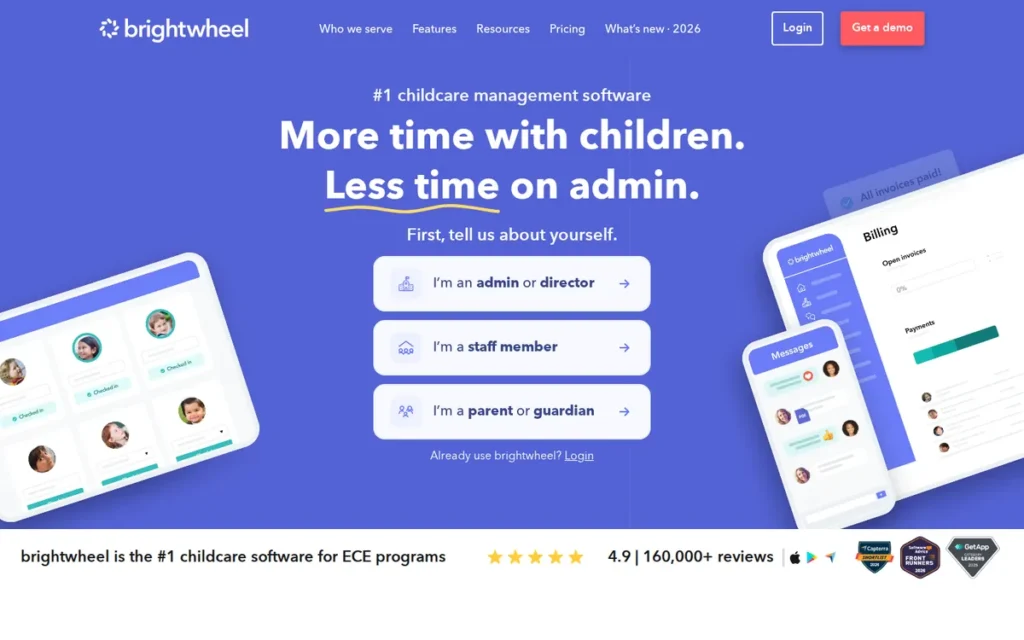
Category: All-in-One Operations Platform, a single system covering billing, attendance, enrollment, and family communication for day-to-day center management.
At a Glance
- Category: All-in-One Operations Platform
- Best For: Single-site centers and small multi-site programs that prioritize ease of use and parent engagement
- Price Range: Pricing on request (custom quote; card and ACH processing fees billed separately)
- Primary Strength: brightwheel pairs a highly rated, easy-to-use parent app with broad billing and payment options in one platform.
- Biggest Limitation: brightwheel does not include built-in payroll (it relies on Gusto) and sells curriculum as a paid add-on.
- One-Line Summary: brightwheel is the most widely reviewed all-in-one child care platform rated 4.7 or higher, and the strongest demo for centers that value ease of use and family communication.
- Last Verified: November 2026
Overview
brightwheel is a mobile-first, all-in-one child care management platform that combines billing, attendance, enrollment, and parent messaging in one app. It is built for single-site centers, preschools, and small multi-site programs that prioritize ease of use and family engagement.
brightwheel claims more than 100 features and quotes pricing per center rather than publishing it (brightwheel, 2026). Bessemer Venture Partners led a 2018 funding round in brightwheel (brightwheel, 2026; vendor-published).
Score breakdown: C1 4 · C2 5 · C3 4 · C4 2 · C5 4 · C6 3.5 = 3.85. brightwheel has the top satisfaction score (5) and a better reliability score than Procare Solutions (3.5 vs. 2), but quote-only pricing (C4: 2) and lighter accounting depth (C1: 4) leave it 0.20 points behind.
Key Features
- brightwheel offers invoicing, autopay, deposits, payment reminders, subsidy tracking, and parent tax statements in its billing module.
- brightwheel accepts card, ACH, and HSA/FSA payments, and supports mobile check deposit and Tap to Pay without extra hardware.
- brightwheel includes check-in, rosters, ratio tracking, admissions, waitlists, tour booking, and staff scheduling in its core platform.
- brightwheel provides parent messaging, newsletters, and classroom updates through its family app.
- brightwheel integrates with QuickBooks Online for accounting and with Gusto for payroll.
Best For
brightwheel is best for single-site centers and small multi-site programs that want one easy-to-learn system with strong parent communication. It fits tuition rules that are moderately complex but don’t need a full general ledger.
Strengths
- brightwheel holds a 4.7/5 Capterra rating across 3,257 reviews (Capterra, November 2026), the largest review base among platforms rated 4.7 or higher in this evaluation.
- brightwheel reports an App Store rating of 4.9 from roughly 150,000 ratings, the largest app footprint in the category (brightwheel, 2026; vendor-reported, mostly parent raters).
- brightwheel was described by a solo provider as “really easy to use” for invoicing parents (Reddit r/ECEProfessionals, 2025).
- brightwheel accepts card, ACH, and HSA/FSA payments, and it supports mobile check deposit and Tap to Pay without extra hardware (brightwheel, 2026).
Users on r/ECEProfessionals shared their experience:
“i used brightwheel at two different centers and honestly its easy to use and efficient no complains really, however we didn’t use the lesson plan features and such (we just uploaded a weekly picture of our lesson plan) and mainly used it for logging food / diapers or potties / naps / pictures for parents and communication.” Posted by u/Objective_Drive_9614
Takeaway: brightwheel earns consistent praise for everyday ease of use across centers, though some programs leave its lesson-planning features unused and rely on it mainly for logging and parent communication.
Limitations
brightwheel gives up back-office depth for ease of use. PlugRoute found no documented general ledger comparable to Procare Solutions’. Payroll runs through a separate Gusto account, and the Experience Curriculum is a paid add-on (brightwheel, 2026).
- brightwheel’s own review analysis names app slowdowns, crashes, and login problems as the most-cited complaints (brightwheel, 2026; vendor-authored).
- brightwheel lists tour booking on its feature pages, but one user reported adding Kinside for tours and waitlists (Reddit r/ECEProfessionals, 2025).
- brightwheel has reportedly used per-child pricing in the past, which can push large-center costs well above the headline price (Rankite, 2026; vendor-authored comparison).
- brightwheel was called “very difficult to cancel” by one reviewer quoted on a competitor’s page (Procare, 2026; competitor-authored). Treat this as one example, not a pattern.
What to test in a brightwheel demo:
- Test whether a brightwheel check-in on a tablet appears promptly on a phone and in the director’s view.
- Walk through brightwheel’s tour-booking workflow from start to finish.
- Get brightwheel’s processing-fee schedule, add-on prices, and cancellation terms in writing.
Verdict
brightwheel is the strongest child care software for ease of use and parent communication in 2026, backed by the largest review base among platforms rated 4.7 or higher. It ranks #2, 0.20 points behind Procare Solutions, because of quote-only pricing and lighter accounting depth. Single-site centers with moderate tuition rules should demo brightwheel first.
3. Playground: Best for Built-In Payroll and Enrollment Marketing
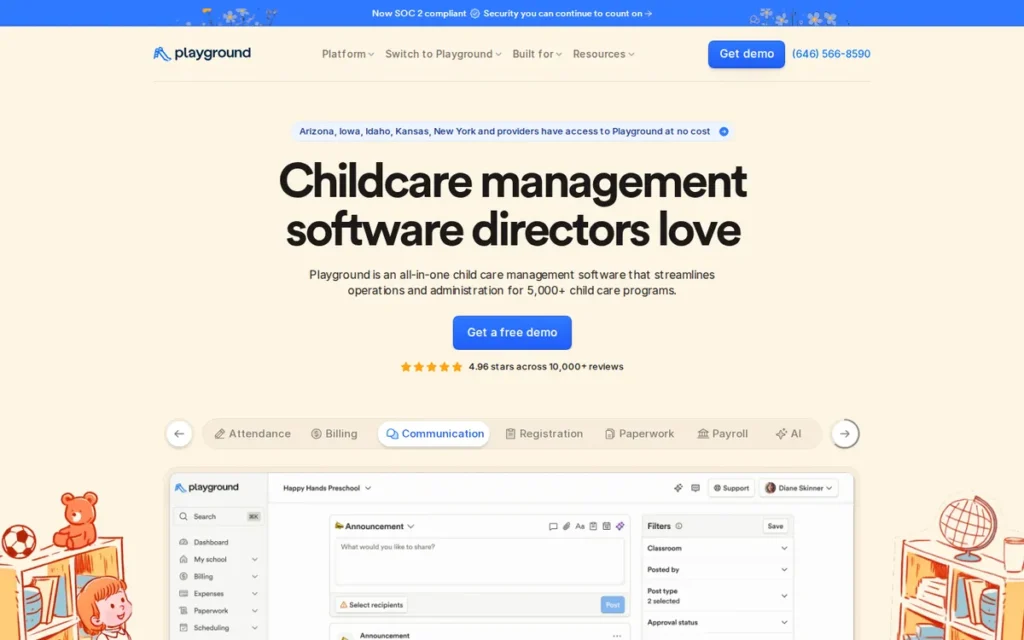
Category: All-in-One Operations Platform, a single system covering billing, attendance, enrollment, and family communication for day-to-day center management.
At a Glance
- Category: All-in-One Operations Platform
- Best For: Growing centers that want payroll, enrollment marketing, and billing in one system
- Price Range: Pricing on request (Montana partner pricing: $50/month in-home, $140/month centers, implementation and support included)
- Primary Strength: Playground includes built-in payroll, tour and lead automation, and subsidy billing, which most competitors split across separate tools.
- Biggest Limitation: Playground’s 4.8 rating rests on only 194 Capterra reviews, and its roadmap under Procare Solutions is unpublished.
- One-Line Summary: Playground has the broadest built-in feature set of the all-in-one platforms evaluated, though its September 2026 acquisition by Procare Solutions makes written roadmap commitments essential.
- Last Verified: November 2026
Overview
Playground is an all-in-one child care management platform covering billing, enrollment marketing, attendance, payroll with tax filing, subsidy copay, and learning documentation. It is built for growing single-site and multi-site centers that want to replace several separate tools with one system.
Playground reports serving 5,000+ programs (Playground, 2026; self-reported). Procare Solutions announced its acquisition of Playground on September 14, 2026. Roper Technologies’ SEC filing records the price as $140 million, net of cash acquired (Roper Technologies SEC filing, 2026).
Score breakdown: C1 4 · C2 3 · C3 5 · C4 3 · C5 3 · C6 3.5 = 3.70. Playground earned the only 5 for all-in-one breadth, but its 194-review sample (C2: 3) and unresolved post-acquisition roadmap (C5: 3) kept it third.
Key Features
- Playground provides bulk billing, autopay, automatic payment retries, late-pickup fees, expense tracking, and subsidy/family copay billing.
- Playground includes payroll with tax filing alongside staff timesheets, which can remove the need for a separate payroll provider.
- Playground automates tour and lead marketing with lead capture, email and text follow-ups, and reminders.
- Playground supports digital registration, waitlists with online fees, attendance and ratios, meal logging, and learning milestones.
- Playground offers multi-site settings and permissions, plus Camber, an AI assistant built for child care.
Best For
Playground is best for growing centers and small groups that want payroll, enrollment marketing, and billing in one platform instead of three. Buyers should be comfortable negotiating written commitments that hold after the acquisition.
Strengths
- Playground holds a 4.8/5 Capterra rating, tied with Daily Connect for the highest in this evaluation, though it rests on only 194 reviews (Capterra, November 2026).
- Playground reports that Southern Oregon Head Start (27 sites, 300+ staff) saved the equivalent of two full-time salaries (Playground, 2026; vendor-published).
- Playground’s built-in payroll was named by a two-center operator as a deciding factor over brightwheel’s Gusto requirement (Reddit r/ECEProfessionals, 2025).
- Playground’s support was praised by a Capterra reviewer for responding within “a few seconds or minutes” (Capterra, November 2026).
Limitations
Playground gives up evidence depth for feature breadth. Its 4.8 rating rests on 194 Capterra reviews, far fewer than the 2,809 to 3,623 reviews behind the market leaders (Capterra, November 2026).
- Playground’s billing and statement portal is called “a little clunky” by Software Advice reviewers, who also report wrong statement dates and slow charge assignment at large centers (Software Advice, November 2026).
- Playground check-ins appeared hours late and notifications disappeared, according to a Google Play reviewer who switched from Procare Solutions (Google Play, November 2026).
- Playground payouts take 1–3 days, and cash-outs are available only two days a week, according to a Capterra reviewer (Capterra, November 2026).
- Playground’s new owner has promised continued support but has published no roadmap, migration timeline, or pricing commitments (Procare, 2026).
What to test in a Playground demo:
- Measure Playground check-in latency across tablet, phone, and desktop.
- Check Playground statement dates against a sample billing cycle.
- Get Playground’s payout schedule and its pricing, support, and data-export terms in writing.
Verdict
Playground has the most complete built-in feature set of the all-in-one platforms evaluated in 2026, with native payroll and enrollment marketing that competitors leave to third-party tools. Its small review base and unresolved post-acquisition roadmap keep it at #3. Buyers should get Playground’s pricing, support, and data-export commitments in writing.
4. Kangarootime: Best for Growing Multi-Site Operators
Category: Multi-Site Operations Platform, child care software built around consolidated billing, reporting, and enrollment management across several locations.
At a Glance
- Category: Multi-Site Operations Platform
- Best For: Operators running or growing to 3–10 locations who need consolidated billing and reporting
- Price Range: From $49/month (Software Advice listing); full pricing on request
- Primary Strength: Kangarootime combines a cross-site dashboard with split payments and subsidy management for multi-location billing.
- Biggest Limitation: Kangarootime has the smallest review base evaluated (91 reviews), and reviewers document autopay and QuickBooks integration issues.
- One-Line Summary: Kangarootime is the most multi-site-focused child care platform evaluated, with the strongest documented multi-site billing case study but the thinnest review evidence.
- Last Verified: November 2026
Overview
Kangarootime is a multi-site child care management platform offering consolidated billing, split payments, subsidy management, kiosk attendance, and a cross-site dashboard. It is built for child care groups running or planning three to ten locations that need central visibility into finances and enrollment.
Kangarootime announced its acquisition of Clay, an AI platform for early education, without disclosing the date or terms (Kangarootime, 2026; press release).
Score breakdown: C1 4 · C2 2.5 · C3 3.5 · C4 3 · C5 3.5 · C6 3.5 = 3.35. Kangarootime’s billing and multi-site evidence beats every lower-ranked platform. Its 91-review sample (C2: 2.5) and unverified ownership details (a 0.5-point deduction in C5) keep it below the top three.
Key Features
- Kangarootime automates invoicing and supports payment plans, split payments, and autopay with failed and returned payment status tracking.
- Kangarootime provides kiosk check-in, absence alerts, staff time logs, scheduling, and ratio management.
- Kangarootime manages enrollment through waitlists, lead capture, and forecasting of open spots.
- Kangarootime includes subsidy management, basic accounts receivable and payable, and custom reports.
- Kangarootime offers a dashboard covering all sites for consolidated multi-location oversight.
Best For
Kangarootime is best for child care groups with three to ten locations that want consolidated billing and enrollment reporting without moving to an accounting-heavy platform. Kangarootime is less proven for curriculum-focused programs.
Strengths
- Kangarootime reports that Tuckaway Early Education (7 centers) went from 30+ hours a week of billing work to saving 30+ hours a week, plus 2 hours from removing double entry (Kangarootime, 2026; vendor-published). That is the strongest multi-site billing result in this evaluation.
- Kangarootime earns a 4.8 customer-service sub-rating and a 4.4 ease-of-use sub-rating on Capterra (Capterra, November 2026).
- Kangarootime support staff were described as working “nonstop” during a migration (Software Advice, November 2026).
- Kangarootime published release notes as recently as July 1, 2026, a sign of active development (Kangarootime, 2026).
A parent on r/ECEProfessionals who had used three platforms noted:
“My preschooler’s school uses ProCare, a daycare we’d been to used LearningGenie, and another used Kangarootime. Out of the three I liked Kangarootime best but I think that was mostly because the staff/center actually utilized it to its fullest capabilities like communication, pictures, reminders, documents, etc The other two are fine, I just never got to see them used fully.” Posted by u/iamthemeowbot
Takeaway: Kangarootime can deliver a strong family experience, but how much of its value shows up depends heavily on how fully a center adopts its features.
Limitations
Kangarootime gives up review-volume confidence for multi-site focus. Its 4.5/5 rating rests on only 91 Capterra reviews, the smallest sample in this evaluation (Capterra, November 2026).
- Kangarootime autopay stopped after an invoice was edited, according to Software Advice and GetApp reviewers (Software Advice, November 2026; GetApp, November 2026).
- Kangarootime reviewers also report payouts taking 2–3 days, weak QuickBooks integration, and onboarding that felt too short (Software Advice, November 2026; GetApp, November 2026).
- Kangarootime check-in icons are too small on tablets, staff clock-in can’t be restricted by IP address, and photo glitches occur, reviewers say (Software Advice, November 2026; GetApp, November 2026).
- Kangarootime documents no built-in payroll or curriculum depth, and PlugRoute could not independently verify its founding date, founders, or headquarters (verified November 2026).
What to test in a Kangarootime demo:
- Edit a Kangarootime invoice and confirm that autopay still runs.
- Check the Kangarootime QuickBooks sync with your own chart of accounts.
- Test Kangarootime tablet check-in and confirm onboarding length in writing.
Verdict
Kangarootime is the most multi-site-focused child care platform evaluated in 2026, backed by the best documented multi-site billing case study. Its thin review base and documented autopay-after-edit issue keep it at #4. Growing groups should demo Kangarootime alongside Procare Solutions and Playground.
5. Daily Connect: Best for Home Daycares and Small Budgets
Category: Budget and Small-Program Platform, low-cost child care software with transparent pricing for home daycares, nannies, and small centers.
At a Glance
- Category: Budget and Small-Program Platform
- Best For: Home daycares, nannies, and small centers on tight budgets
- Price Range: $8.99–$16/month, plus $1.60 per child beyond 10 on the Professional plan (billed annually); quote for 100+ children; no setup, overage, or cancellation fees
- Primary Strength: Daily Connect publishes a complete price list with both plan tiers and per-child rates, the clearest cost picture of any platform evaluated.
- Biggest Limitation: Daily Connect has no documented subsidy split billing or accounting depth, and its ownership could not be verified.
- One-Line Summary: Daily Connect is the most price-transparent child care software evaluated, and the lowest documented-cost option for home daycares and small programs.
- Last Verified: November 2026
Overview
Daily Connect is a low-cost child care management app offering daily reports, QR or PIN check-in, attendance-based billing, parent messaging, and observations against state standards. It is built for nannies, home daycares, Montessori and after-school programs, camps, and small centers.
Daily Connect does not charge parents. Programs are billed by the number of unique active enrolled children each month (Daily Connect, November 2026).
Score breakdown: C1 2.5 · C2 3.5 · C3 3.5 · C4 5 · C5 2.5 · C6 3 = 3.325. Daily Connect earned the only 5 for pricing transparency, but limited billing depth (C1: 2.5) and unverified ownership (C5: 2.5) keep it out of the top four.
Key Features
- Daily Connect sends daily reports with photos and videos, daily summary emails, and parent messages.
- Daily Connect supports QR code or PIN check-in and generates billing from attendance records, with online payments and reminders.
- Daily Connect includes observations and assessments against state standards, lesson plans, and portfolios.
- Daily Connect provides staff scheduling, enrollment and waitlist tools, and immunization records.
- Daily Connect offers an AI assistant and a multi-site dashboard.
Best For
Daily Connect is best for home daycares, nannies, and small centers that want predictable, low per-child costs and core daily-reporting tools. It is not designed for subsidy-heavy billing.
Strengths
- Daily Connect holds a 4.8/5 Capterra rating across 306 reviews, mostly from small organizations (Capterra, November 2026).
- Daily Connect is the only platform in this evaluation that publishes both its plan tiers and its per-child rates, and its pricing page states there are no setup, overage, or cancellation fees (Daily Connect, November 2026).
- Daily Connect explicitly targets home daycares. In a Connecticut Office of Early Childhood provider survey, only 8% of family child care homes used a management system (Connecticut Office of Early Childhood, 2023).
- Daily Connect lists state-standards observations, lesson plans, and portfolios among its features at published budget prices (Daily Connect, November 2026).
Limitations
Daily Connect gives up billing depth for low price. It has no documented subsidy split billing, CACFP support, ledger reporting, or built-in payroll (verified November 2026), which limits its fit for subsidy-heavy or complex-tuition centers.
- Daily Connect receives mentions of “occasional app crashes and UI friction” in G2’s review summary (G2, November 2026).
- Daily Connect “sometimes stops working” while updates are being entered, according to one Capterra reviewer (Capterra, November 2026).
- PlugRoute could not independently verify Daily Connect’s founding date, founders, headquarters, or ownership, and found no case studies with figures (verified November 2026).
- A third-party listing cites $1.40 per child, which conflicts with Daily Connect’s published $1.60 per-child overage rate (Capterra, November 2026). Note that $1.60 is the rate for each child beyond 10, not the starting price.
A staff member on r/ECEProfessionals who had used both platforms described:
“We used to use Daily Connect, and now we use Procare……. soooooooo buggy! The only thing I like better about procare is having the ability to upload multiple pictures all at once rather than 1 at a time. Otherwise, daily connect was better….. from a management standpoint, we can do our billing through Procare and couldn’t with daily connect” Posted by u/ApprehensiveDesk134
Takeaway: Classroom staff can prefer Daily Connect’s day-to-day experience, but centers that need billing in the same system are pushed toward heavier platforms like Procare Solutions.
What to test in a Daily Connect demo:
- Run a subsidy or copay invoice in Daily Connect.
- Enter Daily Connect updates during a simulated busy pickup window.
- Ask Daily Connect for ownership details and data-export terms in writing.
Verdict
Daily Connect is the lowest documented-cost and most price-transparent child care software evaluated in 2026, which makes it a strong first demo for home daycares and small programs. Its limited billing depth keeps it out of the top four. Centers with subsidy-heavy tuition should shortlist Procare Solutions or Kangarootime instead.
6. Lillio (formerly HiMama): Best for Curriculum and State-Standards Documentation
Category: Learning-First Platform, child care software built around curriculum, observations, and child development documentation linked to family updates.
At a Glance
- Category: Learning-First Platform
- Best For: Curriculum-driven centers and preschools pursuing quality ratings with simple tuition billing
- Price Range: Pricing on request (custom quote by center size; free trial available)
- Primary Strength: Lillio links activities to state early-learning standards automatically and shares documentation with families in real time.
- Biggest Limitation: Lillio’s billing is more basic than competitors’, and reviewers describe its pricing as unclear and expensive for small providers.
- One-Line Summary: Lillio is the most-reviewed child care platform evaluated and the strongest U.S. option for linking child development documentation to state standards and family updates.
- Last Verified: November 2026
Overview
Lillio (formerly HiMama) is a learning-first child care management platform combining daily reports, milestone-linked observations, digital portfolios, lesson planning, and curriculum content. It is built for curriculum-driven centers and preschools that want child development records to flow directly into family updates.
Lillio was founded in Toronto in 2013 and is backed by a 2021 minority investment led by Bain Capital Double Impact (Lillio, 2021; press release). PlugRoute found no evidence that Lillio has been acquired.
Score breakdown: C1 2.5 · C2 4.5 · C3 4 · C4 2 · C5 3.5 · C6 3 = 3.275. Lillio’s satisfaction score (4.5) trails only brightwheel’s, but basic billing (C1: 2.5) and quote-only pricing (C4: 2) hold it at #6. The methodology has no dedicated curriculum criterion.
Key Features
- Lillio records daily reports on meals, naps, toileting, and mood, and shares them through a free parent app.
- Lillio ties observations to developmental milestones and compiles them into digital portfolios.
- Lillio automatically attaches the matching state early-learning standards when teachers upload an activity.
- Lillio offers lesson planning plus digital curriculum and curriculum kits from FunShine Express.
- Lillio includes attendance, staff and class scheduling, and tuition billing.
Best For
Lillio is best for curriculum-driven centers and preschools, especially those pursuing QRIS quality ratings, that want standards-tagged documentation shared with families. It fits best where tuition billing is simple.
Strengths
- Lillio holds a 4.6/5 Capterra rating across 3,623 reviews, the largest review base in the child care software category (Capterra, November 2026).
- Lillio automatically tags teacher-uploaded activities to state early-learning standards, which cuts duplicate documentation (Lillio, 2026; vendor case study).
- Lillio acquired the curriculum publisher FunShine Express in June 2021. Lillio customer MIGHT credits that curriculum with helping it reach a five-star quality rating (Lillio, 2026; vendor-published, correlational).
- Lillio is praised by Capterra reviewers for real-time updates, photos, milestone tracking, and sharing with extended family (Capterra, November 2026).
Users on r/ECEProfessionals noted:
“The place where I work uses HiMama. It doesn’t seem to cause any lack of supervision for the most part. It’s harder when you are on your own, but most of our rooms have 2 teachers.” Posted by u/ChronicKitten97
Takeaway: Lillio’s documentation workflow fits well into classrooms with two teachers, but solo-staffed rooms find it harder to keep up with without pulling attention from children.
Limitations
Lillio gives up billing depth for learning documentation. Capterra reviewers cite dated invoicing (Capterra, November 2026), and a competitor’s comparison calls Lillio’s billing “more basic” than rivals’ (brightwheel, 2026; competitor-authored).
- Lillio users on Capterra report blank screens when opening notifications, late message syncing, and lag (Capterra, November 2026).
- Lillio copies directors on every message automatically, which some Capterra reviewers dislike (Capterra, November 2026).
- Lillio’s pricing is quote-only, and GetApp reviewers often describe it as unclear and expensive for small providers (GetApp, November 2026).
- Lillio’s figure of 10,000 centers using the product dates from 2021 and is self-reported (Lillio, 2021; self-reported).
What to test in a Lillio demo:
- Run a late-fee or copay invoice in Lillio.
- Time how long Lillio notifications and messages take to sync, and adjust director message settings.
- Get a written Lillio quote that separates software costs from curriculum costs.
Verdict
Lillio is the strongest U.S. child care platform for linking child development documentation to state standards and family updates, and the most-reviewed product in the category in 2026. It ranks #6 because this methodology weights billing heavily. Curriculum-first programs with simple tuition should put Lillio near the top of their demo list.
7. Famly: Best for Teaching-Focused Programs With Simple Billing
Category: Learning-First Platform, child care software built around curriculum, observations, and child development documentation linked to family updates.
At a Glance
- Category: Learning-First Platform
- Best For: Teaching-focused programs with simple, private-pay tuition and limited subsidy billing
- Price Range: From $49/month for up to 20 children (Famly U.S. pricing calculator, November 2026); UK £79–£209/month excluding VAT
- Primary Strength: Famly offers the deepest teaching and learning-journal tools evaluated, including parent observations and an AI writing helper.
- Biggest Limitation: Famly’s help center says payer splits work by percentage only, which limits its fit for U.S. subsidy-heavy billing.
- One-Line Summary: Famly is the most teaching-focused child care platform evaluated, best suited to U.S. programs with simple private-pay billing.
- Last Verified: November 2026
Overview
Famly is a teaching-focused child care management platform combining learning journals, observations, curriculum planning, an AI writing helper, messaging, ratio tracking, and invoicing. It is built for early learning programs that put teaching and family engagement ahead of complex subsidy billing.
Famly was founded in Denmark and has raised more than $20 million in funding led by Susquehanna Growth Equity (Famly, 2026; press page).
Score breakdown: C1 2 · C2 3.5 · C3 4 · C4 4 · C5 3 · C6 3 = 3.20. Famly’s published pricing (C4: 4) and teaching breadth (C3: 4) can’t make up for the lowest billing score (C1: 2). Its C6 score is a neutral 3 because PlugRoute read no independent reliability evidence for Famly.
Key Features
- Famly provides learning journals, staff and parent observations, and curriculum planning.
- Famly includes Sidekick, an AI writing helper for drafting observations and updates.
- Famly offers a newsfeed, messaging, sign-in and sign-out, and automatic ratio calculations.
- Famly builds invoices automatically from sessions, fees, extras, and funding, and a third party reports U.S. card and ACH support.
- Famly includes medication and accident forms and staff rotas, but rotas and automatic invoicing are limited to the top tier.
Best For
Famly is best for teaching-focused programs with mostly private-pay tuition that want strong learning documentation and parent engagement. It is a weaker fit for U.S. centers that rely on custom subsidy copay splits.
Strengths
- Famly holds a 4.7/5 Capterra rating across 264 reviews (Capterra, November 2026), and its website cites “Best Ease of Use” and “Best Customer Support” badges (Famly, 2026; vendor-cited badges).
- Famly reports that a South Tyneside Council nursery in the UK cut outstanding debt from about £15,000 to about £1,500 (Famly, 2026; vendor-published).
- Famly reports serving 10,000+ providers and 400,000+ parents across 10 countries (Famly, 2026; self-reported), the only multi-country footprint documented in this evaluation.
- Famly publishes both a U.S. pricing calculator based on enrollment and UK tier prices, so buyers can see its feature-gating before a demo (Famly, November 2026).
Limitations
Famly gives up U.S. subsidy billing depth for teaching tools. Its help center says bill splits between payers currently work by percentage only. Subsidies can be applied as fixed amounts, but custom payment arrangements require contacting support (Famly help center, November 2026).
- Famly’s payments sub-rating of about 4.4 sits below its overall score, according to a competitor’s roundup (brightwheel, 2026; competitor-authored).
- Famly has fewer integrations and lighter analytics than Procare Solutions, according to a comparison site (Rankite, 2026; vendor-authored comparison).
- Famly limits staff rotas and automatic invoicing to its top tier, so feature-gating can raise the real cost (Famly, November 2026).
- PlugRoute found no U.S. case studies with figures for Famly and read no Reddit sentiment about it (verified November 2026).
What to test in a Famly demo:
- Build a custom-amount subsidy split in Famly with a fixed agency payment and a family copay.
- Get Famly’s U.S. price for your enrollment band confirmed in writing.
- Confirm which Famly tier includes automatic invoicing and staff rotas.
Verdict
Famly is the most teaching-focused child care platform evaluated in 2026, with strong learning journals and parent engagement tools. It ranks #7 because of percentage-only payer splits and limited U.S.-specific evidence. Private-pay programs focused on teaching should demo Famly alongside Lillio.
What Red Flags Should I Watch For When Evaluating Child Care Software?
The most important red flags in child care software are hidden costs, billing logic that fails on real-world edge cases, unreliable attendance sync, and unclear ownership or exit terms. Each red flag below comes from documented reviews, vendor disclosures, or filings for the seven platforms PlugRoute evaluated in November 2026.
Red Flag #1: Quote-Only Pricing With Unpublished Processing Fees
Five of the seven platforms PlugRoute evaluated rely mainly on custom quotes, and card and ACH processing fees are often billed separately without published rates (PlugRoute review analysis, November 2026). A headline subscription price can hide much of the real cost, so compare written all-in quotes.
Before signing, get these seven numbers in writing:
- Ask for the monthly subscription price at your current enrollment.
- Ask for the subscription price at your projected enrollment or site count.
- Ask for the card processing rate per transaction.
- Ask for the ACH processing rate per transaction.
- Ask for any setup or implementation fee.
- Ask for the price of add-ons such as curriculum, payroll, or tour tools.
- Ask for the price after any promotional period ends.
Red Flag #2: Percentage-Only Subsidy Splits
A platform that splits payers only by percentage can’t cleanly bill a fixed agency payment plus a family copay. Famly’s help center says bill splits between payers currently work by percentage only, with custom arrangements handled by support (Famly help center, November 2026).
A percentage-only split breaks as soon as a subsidy rate changes. Say an agency pays a fixed $412 of $600 tuition. The split has to be entered as 68.67% and 31.33%, then redone after every rate update. Build a custom-amount split in every demo.
Red Flag #3: Autopay That Breaks After Invoice Edits
Autopay that silently stops after an invoice is edited leaves tuition uncollected until someone notices. Kangarootime reviewers on Software Advice and GetApp report exactly this failure (Software Advice, November 2026; GetApp, November 2026). Edit an invoice during every demo, on every platform, and confirm the next autopay still runs.
Red Flag #4: Check-In Data That Lags Between Devices
Check-in data that lags between devices undermines ratio tracking, attendance-based subsidy billing, and parent trust. A Playground reviewer reported check-ins appearing hours late (Google Play, November 2026), and Lillio reviewers report late message syncing (Capterra, November 2026). Time a tablet check-in until it appears on the director’s screen.
Red Flag #5: No Written Post-Acquisition or Exit Terms
Ownership changes and hard exits are a growing risk in this category. Procare Solutions, owned by Roper Technologies, has acquired Kinderlime (2019), ChildPlus (2021), and Playground (announced September 14, 2026). It has published no Playground roadmap, migration timeline, or pricing commitments (Procare, 2026).
Hard-to-cancel contracts and painful data migration also come up repeatedly in reviews across the category (PlugRoute review analysis, November 2026). Before signing, confirm cancellation notice periods, auto-renewal terms, price locks, and CSV export of families, ledgers, and attendance. Make export rights a written contract term.
Red Flag #6: Payroll, Tours, or Curriculum Sold Separately
Of the seven platforms PlugRoute evaluated, only Playground documents built-in payroll with tax filing. brightwheel runs payroll through Gusto and sells curriculum as an add-on, and one brightwheel user added Kinside for tours (Reddit r/ECEProfessionals, 2025). Every extra tool adds cost and another place for data to fall out of sync.
Lillio does not separate software and curriculum pricing in its public materials. Procare Solutions, Kangarootime, Daily Connect, Lillio, and Famly don’t document built-in payroll in the materials PlugRoute reviewed. Ask every vendor which core functions require a third-party tool or a paid add-on.
What Questions Should I Ask Before Choosing Child Care Software?
Before choosing child care software, ask each vendor to price your real enrollment, run your actual billing rules live, and prove how fast attendance syncs. Then get acquisition, migration, and security terms in writing. The seven questions below turn the documented failures in this evaluation into demo scripts.
Question #1: What is my all-in monthly cost, including processing, setup, and add-ons, at my current and projected enrollment?
A strong answer is a written figure covering per-child or per-site scaling, card and ACH rates, setup fees, and the price after promotions end. Promotions do expire: one Kangarootime partner offer gave 50% off in year one and 25% off in year two (Kangarootime, 2026; partner promotion).
Per-child pricing adds up quickly. On Daily Connect’s Professional plan, a 30-child program pays about $48/month ($16 + 20 × $1.60), and a 60-child program pays about $96/month, billed annually (Daily Connect, November 2026). Ask quote-only vendors to run the same calculation for your enrollment.
Question #2: Can you run my actual tuition, late-fee, and subsidy copay rules in this demo?
A strong answer is a live invoice built from your own scenario, including a fixed agency payment plus a family copay and a late-pickup fee. Bring last month’s hardest invoice. Scripted demo data rarely shows edge cases such as the wrong statement dates Playground reviewers report (Software Advice, November 2026).
Question #3: How fast does a check-in on a tablet appear on the director’s desktop and the parent app?
A tablet check-in should appear on the director’s desktop and the parent app within seconds, and the vendor should show this live on two devices. A Playground user reported check-ins appearing hours late (Google Play, November 2026), and Lillio reviewers report late message syncing (Capterra, November 2026). Time it yourself during the demo.
Question #4: What happens to my pricing, support, and data if you are acquired?
Ask for contract clauses that lock pricing for a set term, keep current support levels, and guarantee data export in a usable format such as CSV. This matters because Procare Solutions now owns two of the seven platforms evaluated, including Playground (acquired September 2026), and has published no roadmap or migration commitments.
Question #5: How do you migrate my data and train non-technical staff, and how long is onboarding?
Ask for a named migration contact, a written timeline, and a parallel billing cycle before go-live. Kangarootime reviewers praised “nonstop” migration support but said onboarding felt too short (Software Advice, November 2026). Procare Solutions desktop users also face migration work when moving online (Rankite, 2026; vendor-authored comparison).
Plan the switch in three steps:
- Export families, ledgers, and attendance history from your current system before you cancel it.
- Ask the new vendor to run one billing cycle in parallel with your old system.
- Train one staff champion per classroom before go-live.
Question #6: Does this replace my payroll provider and accounting software, or integrate with them?
Child care software usually replaces tuition billing and attendance tools, but not always payroll or general accounting. Confirm whether payroll is built in or third-party. Then test the QuickBooks or general-ledger sync with your own chart of accounts during the demo.
- brightwheel integrates with QuickBooks Online and runs payroll through a separate Gusto account (brightwheel, 2026).
- Playground includes payroll with tax filing alongside staff timesheets (Playground, 2026).
- Procare Solutions offers a general ledger and trial balance reporting (Procare, 2026).
- Kangarootime reviewers report weak QuickBooks integration (Software Advice, November 2026).
Question #7: Can you provide SOC 2 or ISO 27001 documentation?
Security documentation varies widely across child care software, and every platform stores sensitive child and family records. Ask each vendor for a current audit report during procurement. PlugRoute found one vendor claim of SOC 2 Type 2 certification, one vendor statement of no SOC 2 certification, and five vendors without verified certifications.
- Procare Solutions states that it holds SOC 2 Type 2 certification (Procare, 2026; vendor claim).
- brightwheel’s security FAQ states that brightwheel does not currently hold SOC 2 certification, though its AWS hosting does (brightwheel, 2026).
- PlugRoute could not verify certifications for Playground, Kangarootime, Daily Connect, Lillio, or Famly, including an ISO 27001 mention for Famly (verified November 2026).
How Did We Rank These Child Care Software Platforms?
PlugRoute scored seven child care software platforms from 1 to 5 on six weighted criteria, using dated evidence labeled by source type and verified in November 2026. Billing, payments, and subsidy depth carries the most weight at 25%. Vendor case studies and criticism written by competitors count as claims, not proof.
PlugRoute used the following criteria and weights:
- C1 Billing, Payments and Subsidy Depth (25%): This criterion matters most because billing errors cost real money in an industry where margins are often below 1% (Mordor Intelligence, 2026).
- C2 Verified User Satisfaction, Adjusted for Review Volume (20%): This criterion adjusts for sample size, because review counts vary about 40-fold while ratings differ by only 0.3 points. A 4.8 from 194 reviews tells you less than a 4.7 from 3,257 reviews.
- C3 All-in-One Breadth (20%): This criterion deducts points when payroll, tours, or curriculum require a paid add-on or a third-party tool.
- C4 Pricing Transparency and Cost Clarity (15%): This criterion rewards published price lists and deducts for feature-gating and unpublished fees.
- C5 Scalability and Vendor Stability (10%): This criterion scores multi-site features, how many customers a vendor serves, and how clear its ownership is.
- C6 Reliability, Usability and Support (10%): This criterion scores documented crashes, sync delays, learning curves, and support speed.
Scoring rules applied equally to every platform:
- C2 rates 2,500+ reviews as high confidence (4.7+ = 5; 4.6 = 4.5), 250–500 as moderate (4.7–4.8 = 3.5), and under 250 as low (4.8 = 3; 4.5 = 2.5).
- C4 gives 5 to published vendor price lists, minus 1 for documented feature-gating. It gives 3 to partial figures such as partner or listing-site prices, and 2 to quote-only pricing.
- C5 deducts 0.5 when founding or ownership details could not be verified, which applies to both Kangarootime and Daily Connect.
- C6 weighs independent sources above vendor sources and assigns a neutral 3 where no independent reliability evidence was read, which applies to Famly.
Full Score Matrix (1–5 scale, November 2026)
| Platform | C1 (25%) | C2 (20%) | C3 (20%) | C4 (15%) | C5 (10%) | C6 (10%) | Weighted Total |
|---|---|---|---|---|---|---|---|
| Procare Solutions | 5 | 4.5 | 4 | 3 | 4.5 | 2 | 4.05 |
| brightwheel | 4 | 5 | 4 | 2 | 4 | 3.5 | 3.85 |
| Playground | 4 | 3 | 5 | 3 | 3 | 3.5 | 3.70 |
| Kangarootime | 4 | 2.5 | 3.5 | 3 | 3.5 | 3.5 | 3.35 |
| Daily Connect | 2.5 | 3.5 | 3.5 | 5 | 2.5 | 3 | 3.325 |
| Lillio | 2.5 | 4.5 | 4 | 2 | 3.5 | 3 | 3.275 |
| Famly | 2 | 3.5 | 4 | 4 | 3 | 3 | 3.20 |
Procare Solutions leads brightwheel by 0.20 points, the same effect as a one-point change in a single 20% criterion. Programs that weight usability above billing depth should treat the two as co-leaders. Your billing rules should decide among the top three, not PlugRoute’s rank order.
This methodology has no dedicated curriculum criterion. Curriculum-first programs should shortlist Lillio and Famly on documented fit, such as standards auto-tagging and learning journals. They should use the matrix only to compare billing, pricing, and reliability.
Each evidence claim is labeled by source type: independent review platform, Reddit, vendor-published, self-reported, competitor-authored, SEC filing, or press release. Where a source had no publication date, the year shown is the year PlugRoute verified it.
PlugRoute discloses the following evidence gaps:
- Reddit coverage was thin, and only 2 of 7 Reddit queries returned useful threads.
- PlugRoute read no Reddit sentiment for Famly, so Famly’s reliability score is provisional.
- PlugRoute could not verify founding or ownership details for Kangarootime or Daily Connect.
- PlugRoute could not verify brightwheel’s founding date or total funding.
- Procare Solutions claims SOC 2 Type 2 certification, brightwheel states that it does not hold SOC 2 certification, and the other vendors’ certifications were not verified.
Platforms Not Evaluated: Perplexity named myKidzDay and LineLeader, but PlugRoute found no independent web evidence for either, so neither could be scored fairly.
PlugRoute has no affiliate relationships with any company listed. Rankings are determined entirely by research data and objective evaluation criteria.
What Do Buyers Most Often Ask About Child Care Software?
Buyers most often ask which child care software fits small centers, which fits multiple locations, and how PlugRoute builds its rankings. The answers below are short and stand on their own, and they draw on the same dated evidence as the ranked entries.
What is the best child care software for small centers in 2026?
The best child care software for small centers in 2026 depends on budget and billing needs. Daily Connect has the lowest published cost ($16/month plus $1.60 per child beyond 10, billed annually). brightwheel is the strongest all-in-one for ease of use, and Playground suits small centers that want built-in payroll (PlugRoute, November 2026).
What is the best child care software for multiple locations?
The best child care software for multiple locations is Kangarootime for groups running 3–10 sites. It has a cross-site dashboard and a vendor-published case study of 7 centers saving 30+ billing hours a week. Large chains with complex subsidy accounting should also demo Procare Solutions, and growing groups should demo Playground (PlugRoute, November 2026).
How does PlugRoute determine rankings?
PlugRoute scores every platform from 1 to 5 on six weighted criteria, led by billing, payments, and subsidy depth at 25%. Verified user satisfaction and all-in-one breadth carry 20% each, pricing transparency carries 15%, and scalability and reliability carry 10% each. Vendor case studies count as claims, not proof, and every source is dated.
What Do Key Child Care Software Terms Mean?
Child care software vendors use billing, compliance, and technical terms that directly affect cost and daily operations. The definitions below cover the terms buyers meet most often when comparing platforms, and explain why each one matters during a demo or contract review.
Autopay: Autopay is a setting that charges a family’s saved card or bank account automatically on a schedule. Buyers should confirm that autopay keeps running after an invoice is edited.
ACH: ACH is a bank-to-bank electronic payment that is usually cheaper than a card payment. ACH and card processing rates are often billed separately from the software subscription.
Payment Processing Fee: A payment processing fee is the per-transaction charge for collecting tuition by card or ACH. These fees can add significantly to total cost and are rarely published.
Payout Timing: Payout timing is the delay between a family paying and the money reaching the center’s bank account. Payouts that take one to three days affect cash flow in a low-margin business.
Split Billing: Split billing divides one child’s tuition between two payers, such as a subsidy agency and a family copay. Buyers should check whether splits can be set as fixed custom amounts or only as percentages.
Child Care Subsidy (CCAP/CCDF): A child care subsidy is government funding, largely through the federal Child Care and Development Fund and state assistance programs, that pays part of a family’s tuition. Payments are usually based on attendance and can arrive up to 60 days after care is delivered (New America, 2025).
CACFP: The Child and Adult Care Food Program (CACFP) is a federal program that reimburses eligible meals and snacks. Participating centers need meal logging and reporting that match program rules.
General Ledger: A general ledger is the master accounting record of all income and expenses. Software with a general ledger can reduce reliance on separate accounting tools.
Ratio Tracking: Ratio tracking is real-time monitoring of how many children each staff member supervises. Accurate ratios support licensing compliance and safe staffing.
QRIS: A Quality Rating and Improvement System (QRIS) is a state program that rates early learning providers against quality standards. Programs pursuing a higher rating need documentation that links activities to state early-learning standards.
Total Cost of Ownership: Total cost of ownership is the full cost of a platform over the contract term, including subscription, processing fees, setup, add-ons, and post-promotion pricing. Feature-gating, which restricts features to higher-priced plans, is a common hidden driver of that cost.
SOC 2: SOC 2 is an independent audit standard for how a vendor protects customer data. Asking for a current SOC 2 report helps protect sensitive child and family records.
Which Child Care Software Is Right for You?
Key Insights
- Procare Solutions has the highest score in PlugRoute’s 2026 evaluation (4.05) and is the strongest choice for subsidy-heavy and accounting-intensive programs, at the cost of a steeper learning curve.
- brightwheel is the strongest demo for single-site and small multi-site centers that put ease of use and parent communication first.
- Playground offers the broadest built-in feature set, including payroll, but buyers should get written commitments after its September 2026 acquisition by Procare Solutions.
- Kangarootime is the most multi-site-focused option for groups running or growing to three to ten locations.
- Daily Connect is the lowest documented-cost and most price-transparent option for home daycares and small programs.
- Lillio and Famly are the strongest choices for curriculum-led programs with simple tuition billing, judged on fit rather than total score.
- The top three platforms are separated by only 0.35 points, so buyers should demo two or three against their own billing scenarios rather than rely on rank alone.
If your center depends on subsidy copays, demo Procare Solutions and run your own fixed-amount split. If billing and attendance must work together, test whether a tablet check-in reaches billing and the director’s dashboard without delay in brightwheel, Playground, or Procare Solutions.
Procare Solutions now owns two of the seven platforms PlugRoute evaluated, so any 2026 contract should include price, support, and data-export terms that survive an acquisition. For a scripted demo plan, read PlugRoute’s full scoring methodology and download our child care software demo checklist.
We update this guide quarterly. Last updated: November 2026.